Archive for Opinions – Page 92

What Binance’s US lawsuit says about the future for cryptocurrency regulation

By Andrew Urquhart, University of Reading and Hossein Jahanshahloo, Cardiff University 

The world’s largest cryptocurrency exchange, Binance, has been hit with a lawsuit by US regulator the Commodity Futures Trading Commission (CFTC). This is not the first time a cryptocurrency exchange has been charged by a regulator. But this particular case involves a regulator that does not directly oversee cryptocurrencies. This indicates how regulators – particularly those in the US – hope to clamp down on the cryptocurrency industry.

The CFTC’s lawsuit alleges that Binance violated US derivatives laws by offering its derivative trading services to US customers without registering with the right market regulators. It says Binance has prioritised commercial success over regulatory compliance.

The CFTC has also levied charges against Binance’s founder and CEO, Changpeng Zhao (known as CZ) and former chief compliance officer Samuel Lim. They are charged with taking steps to violate US laws, including directing US-based “VIP customers” to open Binance accounts under the name of shell companies. The regulator has pointed to chat messages as evidence of CZ and Sim’s knowledge of various criminal groups using the exchange.

People visit Binance nearly 15 million times a week to trade on the over 300 cryptocurrencies it offers in more than 1,600 different markets. CZ is an outspoken advocate for cryptocurrencies and regularly tweets about the industry and his company. He even tweeted a link to his initial response to the recent CFTC charges, which he called “unexpected and disappointing”. Promising full responses in due time, he said:

Upon an initial review, the complaint appears to contain an incomplete recitation of facts, and we do not agree with the characterization of many of the issues alleged in the complaint.

Last year CZ’s tweets arguably contributed to the collapse of FTX, one of his company’s main rivals. Binance saw its market share grow following FTX’s collapse.

So, this charge – against not only a crypto giant but also the company of an outspoken industry advocate – has created further upheaval in a market that has already suffered multiple crises in the last year. Investors withdrew a reported US$1.6 billion (£1.3 billion) from Binance within days of the CFTC’s announcement of its charges. These outflows could continue if US regulators tighten their squeeze on crypto companies further, causing major players like Binance to shift focus to other jurisdictions.

Creeping oversight

The CFTC aims to “protect the public from fraud, manipulation, and abusive practices related to the sale of commodity and financial futures and options, and to foster open, competitive, and financially sound futures and option markets”. Previous actions by this regulator in 2021 against Tether and Bitfinex resulted in major fines and a loss of credibility for the crypto industry.

But a statement published at the time by one of the CFTC’s five commissioners, Dawn Stump, pointed out that the CFTC doesn’t actually have responsibility for regulating cryptocurrencies. She warned that these fines might “cause confusion about the CFTC’s role in this area”. She said the action was based on defining stablecoins (a type of cryptocurrency) as a commodity, but: “we should seek to ensure the public understands that we do not regulate stablecoins and we do not have daily insight into the businesses of those who issue such”.

These latest charges against Binance focus on its activities in derivatives – financial contracts that are linked to the value of an asset such as oil or, in this case, cryptocurrencies. This is a market the CFTC does regulate.

Another US financial regulator, the Securities and Exchange Commission (SEC), has also been ramping up its crypto oversight activities. As well as focusing on the Initial Coin Offering market, it saw a 50% increase in enforcement actions against digital asset companies last year compared to 2021.

Crypto market changes

So, Binance is up against two powerful US financial regulators. Some experts have warned that “significant regulatory action could prompt Binance to increasingly shift its business operations beyond the United States”. Certainly, the fact that Binance held a 92% share of the crypto market at the end of 2022 means it facilitates many transactions and offers a lot of liquidity to traders around the world, including in the US.

A trader’s capacity to find competitive prices when buying and selling, as well as sources of liquidity (or other people to trade with) would be affected by the loss of or pull back of one of the world’s top ten crypto exchanges. This would be bad news for retail and institutional investors who could be confronted with a smaller and potentially more expensive market as a result.

And even if the complaints and investigations by the CFTC and SEC take a while to conclude, as is likely, the US legislature may step in before that. A report published by the Financial Times days after the CFTC announcement alleges that Binance has hidden links to China for many years. A statement issued by the the exchange to the FT said this is not “an accurate picture of Binance’s operations” and that the paper’s sources were “citing ancient history (in crypto terms)”.

But recent actions against Chinese tech company Huawei and social media platform Tiktok indicate political leaders are keen to crack down on Chinese companies’ access to US technology systems and customer data. So any similar concerns could lead US politicians to start acting in this area as well.The Conversation

About the Authors:

Andrew Urquhart, Professor of Finance & Financial Technology, ICMA Centre, Henley Business School, University of Reading and Hossein Jahanshahloo, Assistant Professor in Finance, Cardiff University

This article is republished from The Conversation under a Creative Commons license. Read the original article.

Carmakers are mistaken if they think chip shortages are over – they need to reinvent themselves while there’s time

By Howard Yu, International Institute for Management Development (IMD) 

Finally, carmakers got a break. Those in the UK boosted their output by over 13% in February as supply-chain pressures subsided, especially the persistent global shortage in microchips, also known as semiconductors. This “signals an industry on the road to recovery”, declared UK motoring trade association the SMMT. Well, up to a point.

Early in the pandemic, carmakers slashed sales forecasts as demand for cars evaporated, falling 47% in US and 80% in Europe in the first couple of months of lockdowns. Carmakers couldn’t see how sales could rebound quickly, which was a reasonable assumption at the time. In an industry where everyone has their own version of lean or just-in-time manufacturing, where unsold inventories are seen as tantamount to incompetence, they quickly scaled back orders from their supply chain.

Car parts suppliers such as Bosch and Continental reacted by scaling back their production – and naturally, their own suppliers, such as NXP and Infineon, also reduced their forecasts. These second-order effects went deep into the supply chain, eventually converging on the great and mighty semiconductor manufacturer in Taiwan, TSMC (Taiwan Semiconductor Manufacturing Company).

A modern car can easily contain more than 3,000 microchips. These control brakes, doors, airbags and windscreen wipers; they even support advanced functions like driver assistance and navigation control. Chipsets are like golden screws.

Yet obviously, many other industries depend on chips too. At the same time as carmakers were reducing their orders, manufacturers of gadgets such as games consoles, TVs and home appliances were seeing orders surging as consumers were forced to stay at home. They increased their chip requirements, and TSMC was more than happy to oblige.

It then became apparent to carmakers later in 2020 that they had overreacted. But by the time they woke up to this and ramped up orders, it was too late. TSMC was running all of its factories at maximum capacity to meet the surge in gadget demand, and there were no more chips available for carmakers.

As a result of this global semiconductor scarcity, worldwide vehicle production was approximately 11 million units, or about 12%, lower in 2021 than it would otherwise have been.

What carmakers got wrong

No one could have predicted the outbreak of COVID. Nor could anyone have foreseen the ramifications on the supply chain as the virus receded. Still, every executive in the car industry knows the importance of computing power in a modern car. A car is a supercomputer on wheels, they’ll say. And yet they didn’t treat chipsets as a critical area. In other words, they were happy to let their suppliers worry about chip requirements and not have any direct involvement with chipmakers.

Why? Because chips don’t involve mechanical engineering. From the boardroom to the shop floor, carmakers generally focus on final assembly. Chipset design and fabrication is one of many things that gets outsourced.

So during the pandemic, most carmakers had little choice but to perfect the art of triaging their chips: for example, General Motors hoarded them for expensive models, temporarily shutting down factories that produce lower-priced sedans.

Others instead removed features from vehicles that rely on microprocessors. BMW did away with parking assistance and even touchscreen capabilities in various models. It also withdrew semi-autonomous driving functionality from the X3, its top-selling model. Mercedes-Benz eliminated features such as high-end audio and wireless phone-charging from a number of vehicles.

The future threat

Car production is now increasing as the high pandemic demand for chips for household gadgets has fallen away. Still, it would be unwise to conclude that things are back to normal. Demand for chips is likely to look so different in future as we see the rollout of technologies like AI, the internet of things, and 5G/6G.

Major chipmakers are boosting capacity to meet this extra demand, with big new US facilities in the offing, for example. Yet it will take time for this to come on stream, and it’s still difficult to predict whether it will meet demand.

New product categories can appear unexpectedly, in a similar way to how bitcoin mining suddenly led to unforeseen chip demand. As Professor Rakesh Kumar in the Electrical and Computer Engineering department at the University of Illinois observes: “The exact nature, speed and magnitude of the increase in demand is still unknown.”

As we saw during the pandemic, chip factories also typically run close to maximum capacity, leaving production extremely susceptible to disruptions. Natural disasters like earthquakes and floods can cause problems, as can accidents such as fires and power outages. In March 2021, for instance, a fire at a Renesas Electronics chip factory in Japan caused a significant disruption to supplies over and above the pandemic-related problems. Geopolitical or military tensions, including those between the US and China, could also affect production in future.
The implication is clear: carmakers must cultivate in-house expertise in this area. Rather than relying on suppliers or their sub-suppliers for semiconductors, they need to directly engage with chipmakers and do the relevant designs in-house. For example, Ford announced a collaboration with US chipmaker GlobalFoundries in 2021 to create chips for its vehicles while exploring the prospect of expanding domestic chip production.

This approach is already common practice among newer, more self-sufficient carmakers such as Tesla and China’s BYD and NIO, who all have extensive operations dedicated to designing or even producing their own chipsets.

These changes will not be easy. Yet the cost of clinging to the status quo will far outweigh the difficulties in the transition. For any company dependent on semiconductors, their resilience and future success hinge on getting this right. The correct response to the end of the pandemic is not to say “back to normal” but “never again”.The Conversation

About the Author:

Howard Yu, Professor of Management and Innovation, International Institute for Management Development (IMD)

This article is republished from The Conversation under a Creative Commons license. Read the original article.


Why Britain’s new CPTPP trade deal will not make up for Brexit

By Terence Huw Edwards, Loughborough University and Mustapha Douch, The University of Edinburgh 

The UK recently announced that it will join the Comprehensive and Progressive Agreement for Trans-Pacific Partnership (CPTPP), giving British businesses access to the 11 other members of the Indo-Pacific trade bloc and bringing its combined GDP to £11 trillion.

Some commentators have suggested the deal could make up for Brexit. It’s been called “a momentous economic and strategic moment” that “kills off any likelihood that it [the UK] will ever rejoin the EU customs union or single market”. Shanker Singham of think tank the Institute of Economic Affairs has even said: “it’s no exaggeration to say that CPTPP+UK is an equivalent economic power to the EU-28-UK”, comparing it to a trade deal between the UK and EU members.

UK business and trade secretary Kemi Badenoch echoed such sentiments, telling Times Radio:

We’ve left the EU so we need to look at what to do in order to grow the UK economy and not keep talking about a vote from seven years ago.

The problem with this fanfare is that the government’s own economic analysis of the benefits of joining this bloc is underwhelming. There is an estimated gain to the UK of 0.08% of GDP – this is just a 50th of the OBR’s estimate of what Brexit has cost the UK economy to date. Even for those that are sceptical about models and forecasts, that is an enormous difference in magnitude.

Of course, the CPTPP is expected to offer the UK some real gains. It certainly provides significant potential opportunities for some individual exporters. But the estimated gains for Britain overall are very small.

The main reason for this is that, apart from Japan, the major players of the global economy are not in the CPTPP. The US withdrew from the Trans Pacific Partnership (the CPTPP is what the remaining members formed without it). And China started negotiations to join in 2022, but current geopolitics now make its entry highly improbable. India was never involved.

In addition, the UK already has free trade agreements with nine out of the 11 members. The remaining two, Malaysia and Brunei, are controversial due to environmental threats from palm oil production to rainforests and orangutans.

Britain’s existing trade agreements with CPTPP members

A table listing the existing British trade agreements with CPTPP members.
Author provided using GDP data from the World Bank and trade data from UN Comtrade.

And despite the widespread public perception of the Asia-Pacific area as a hub of future growth, the performance and prospects of the CPTPP members are a mixed bag. The largest member, Japan, is arguably in long-term decline, as is Brunei, while just three members (Vietnam, Singapore and New Zealand had average growth in the last decade above 3% annually.

Finally, distance really does matter in trade. All the CPTPP members are thousands of miles from the UK, which explains their relatively small shares in UK trade at present.

container-ship

Some benefits of CPTPP

While all of these points pour cold water on the suggested gains, there are some potential benefits from the CPTPP agreement, which allows for mutual recognition of certain standards. This includes patents and some relaxation of sanitary and phytosanitary rules on food items.

However, agreements over standards will involve the UK submitting to international CPTPP courts on these issues. This sits uncomfortably with many of the “sovereignty” objections to the European Court of Justice in relation to Brexit (largely from many of those who have extolled the CPTPP). It’s also notable that out of the nine agreements with CPTPP members that existed before the UK signed this deal, all but two are rollovers of previous EU deals.

But a trade deal with the CPTPP is worth more to the UK than separate deals with each member due to requirements around “rules of origin”, which determine the national source of a product. When a product contains inputs from more than one country, a series of separate free trade agreements may not eliminate tariffs. But if all the relevant countries are members of a single free trade agreement, then rules of origin on inputs from other members cease to be a problem (although there might be some issues if some members do not police the requirements properly).

Not the ideal agreement

While these benefits should be recognised, we should also acknowledge that the CPTPP is not the ideal agreement for Britain. As stated above, distance really does matter in trade – this is overwhelmingly accepted by modern trade economists.

Research shows that the rate at which trade declines with distance has barely changed over more than a century. This might seem strange because transport costs have fallen over time. But, as transport and communications have improved, firms have outsourced much of their production to complex supply chains that often cross national borders many times, with “just-in-time” supply schedules to keep down the costs of holding large stocks.

This means that, while trade everywhere has grown, there is still a big premium for trading (many times) across borders between contiguous countries. It is exactly this type of trade which benefits most from big comprehensive trade agreements that simplify rules of origin and regulatory paperwork.

This suggests that, while some elements of the the CPTPP offer benefits to the UK, it is unlikely to boost its trade in the way it does between countries around the Pacific Rim. For this sort of boost, the UK really needs to look towards its own neighbours. Of course, this is just the sort of agreement that Badenoch seems reluctant to discuss.The Conversation

About the Author:

Terence Huw Edwards, Senior Lecturer in Economics, Loughborough University and Mustapha Douch, Assistant Professor in Economics, The University of Edinburgh

This article is republished from The Conversation under a Creative Commons license. Read the original article.

Dollar steadies near long-term support

By ForexTime

The greenback has tumbled since topping out and printing a “doji” candle around a month ago at 105.88 on the widely followed DXY index. The low print yesterday at 101.41 was down over 4% from that peak as the USD has struggled with a huge reset of Fed rate hike bets. Policymakers are very much data dependent with much focus on the non-farm payrolls report out tomorrow amid holiday-thin markets and next week’s US CPI data. Strong support should be found around the early February bottom at 100.82.

Most of the economic releases this week have played into the slower growth narrative with ISM data generally disappointing and the JOLTS job vacancy numbers coming in much lower than expected. In fact, it was the lowest print since May 2021 and jolted the market ahead of the marquee NFP report. Consensus sees around 240,000 job gains in March with the jobless rate sticking at 3.6% and average hourly earnings moving a tick higher to a relatively benign 0.3%. The headline number has continued to surprise to the upside over recent months with 311k new jobs created in February and only marginal revisions.

The odds have flipped back and forth as to whether the FOMC hikes rates by 25bps or stand pat at its meeting at the start of next month. Currently, money markets give the no change camp a 56% chance while a hike is seen as a 44% probability. Of course, Fed rate hike expectations have changed markedly since a month ago before the banking turmoil when investors were seeing a peak, terminal rate above 5.5%. Now, this rate is seen close to where we stand at the moment at 4.75%, with around 80bp of rate cuts into year end.

Cable consolidates after breaking higher

Sterling is managing to hold near its recent highs and above key support. The pound pushed north on Tuesday to its highest level since last June. Certainly, the softer dollar is a boon and comments from a BoE official encouraged bulls to advance beyond key resistance at the year-to-date top at 1.2447. Huw Pill, the bank’s chief economist, said that the MPC still cannot be sure that it has raised interest rates enough to tame inflation. He voted last month to lift rates to 4.25%, its eleventh increase since the start of the hiking cycle in December 2021. Money market currently forecast over 50bps of additional hikes by September, before the bank stops tighening policy.

A weekly close above the Janaury peak at 1.2447 is important for buyers to build on this week’s upside bullish momentum. A long-term move towards the 200-week SMA above 1.28 could be on the cards if that happens. Near-term support below the February top is 1.2274.


Forex-Time-LogoArticle by ForexTime

ForexTime Ltd (FXTM) is an award winning international online forex broker regulated by CySEC 185/12 www.forextime.com

Regulating AI: 3 experts explain why it’s difficult to do and important to get right

By S. Shyam Sundar, Penn State; Cason Schmit, Texas A&M University, and John Villasenor, University of California, Los Angeles 

From fake photos of Donald Trump being arrested by New York City police officers to a chatbot describing a very-much-alive computer scientist as having died tragically, the ability of the new generation of generative artificial intelligence systems to create convincing but fictional text and images is setting off alarms about fraud and misinformation on steroids. Indeed, a group of artificial intelligence researchers and industry figures urged the industry on March 29, 2023, to pause further training of the latest AI technologies or, barring that, for governments to “impose a moratorium.”

These technologies – image generators like DALL-E, Midjourney and Stable Diffusion, and text generators like Bard, ChatGPT, Chinchilla and LLaMA – are now available to millions of people and don’t require technical knowledge to use.

Given the potential for widespread harm as technology companies roll out these AI systems and test them on the public, policymakers are faced with the task of determining whether and how to regulate the emerging technology. The Conversation asked three experts on technology policy to explain why regulating AI is such a challenge – and why it’s so important to get it right.

To jump ahead to each response, here’s a list of each:


Human foibles and a moving target
Combining “soft” and “hard” approaches
Four key questions to ask


Human foibles and a moving target

S. Shyam Sundar, Professor of Media Effects & Director, Center for Socially Responsible AI, Penn State

The reason to regulate AI is not because the technology is out of control, but because human imagination is out of proportion. Gushing media coverage has fueled irrational beliefs about AI’s abilities and consciousness. Such beliefs build on “automation bias” or the tendency to let your guard down when machines are performing a task. An example is reduced vigilance among pilots when their aircraft is flying on autopilot.

Numerous studies in my lab have shown that when a machine, rather than a human, is identified as a source of interaction, it triggers a mental shortcut in the minds of users that we call a “machine heuristic.” This shortcut is the belief that machines are accurate, objective, unbiased, infallible and so on. It clouds the user’s judgment and results in the user overly trusting machines. However, simply disabusing people of AI’s infallibility is not sufficient, because humans are known to unconsciously assume competence even when the technology doesn’t warrant it.

Research has also shown that people treat computers as social beings when the machines show even the slightest hint of humanness, such as the use of conversational language. In these cases, people apply social rules of human interaction, such as politeness and reciprocity. So, when computers seem sentient, people tend to trust them, blindly. Regulation is needed to ensure that AI products deserve this trust and don’t exploit it.

AI poses a unique challenge because, unlike in traditional engineering systems, designers cannot be sure how AI systems will behave. When a traditional automobile was shipped out of the factory, engineers knew exactly how it would function. But with self-driving cars, the engineers can never be sure how it will perform in novel situations.

Lately, thousands of people around the world have been marveling at what large generative AI models like GPT-4 and DALL-E 2 produce in response to their prompts. None of the engineers involved in developing these AI models could tell you exactly what the models will produce. To complicate matters, such models change and evolve with more and more interaction.

All this means there is plenty of potential for misfires. Therefore, a lot depends on how AI systems are deployed and what provisions for recourse are in place when human sensibilities or welfare are hurt. AI is more of an infrastructure, like a freeway. You can design it to shape human behaviors in the collective, but you will need mechanisms for tackling abuses, such as speeding, and unpredictable occurrences, like accidents.

AI developers will also need to be inordinately creative in envisioning ways that the system might behave and try to anticipate potential violations of social standards and responsibilities. This means there is a need for regulatory or governance frameworks that rely on periodic audits and policing of AI’s outcomes and products, though I believe that these frameworks should also recognize that the systems’ designers cannot always be held accountable for mishaps.

Artificial intelligence researcher Joanna Bryson describes how professional organizations can play a role in regulating AI.


Combining ‘soft’ and ‘hard’ approaches

Cason Schmit, Assistant Professor of Public Health, Texas A&M University

Regulating AI is tricky. To regulate AI well, you must first define AI and understand anticipated AI risks and benefits.
Legally defining AI is important to identify what is subject to the law. But AI technologies are still evolving, so it is hard to pin down a stable legal definition.

Understanding the risks and benefits of AI is also important. Good regulations should maximize public benefits while minimizing risks. However, AI applications are still emerging, so it is difficult to know or predict what future risks or benefits might be. These kinds of unknowns make emerging technologies like AI extremely difficult to regulate with traditional laws and regulations.

Lawmakers are often too slow to adapt to the rapidly changing technological environment. Some new laws are obsolete by the time they are enacted or even introduced. Without new laws, regulators have to use old laws to address new problems. Sometimes this leads to legal barriers for social benefits or legal loopholes for harmful conduct.

Soft laws” are the alternative to traditional “hard law” approaches of legislation intended to prevent specific violations. In the soft law approach, a private organization sets rules or standards for industry members. These can change more rapidly than traditional lawmaking. This makes soft laws promising for emerging technologies because they can adapt quickly to new applications and risks. However, soft laws can mean soft enforcement.

Megan Doerr, Jennifer Wagner and I propose a third way: Copyleft AI with Trusted Enforcement (CAITE). This approach combines two very different concepts in intellectual property — copyleft licensing and patent trolls.

Copyleft licensing allows for content to be used, reused or modified easily under the terms of a license – for example, open-source software. The CAITE model uses copyleft licenses to require AI users to follow specific ethical guidelines, such as transparent assessments of the impact of bias.

In our model, these licenses also transfer the legal right to enforce license violations to a trusted third party. This creates an enforcement entity that exists solely to enforce ethical AI standards and can be funded in part by fines from unethical conduct. This entity is like a patent troll in that it is private rather than governmental and it supports itself by enforcing the legal intellectual property rights that it collects from others. In this case, rather than enforcement for profit, the entity enforces the ethical guidelines defined in the licenses – a “troll for good.”

This model is flexible and adaptable to meet the needs of a changing AI environment. It also enables substantial enforcement options like a traditional government regulator. In this way, it combines the best elements of hard and soft law approaches to meet the unique challenges of AI.

Though generative AI has been grabbing headlines of late, other types of AI have been posing challenges for regulators for years, particularly in the area of data privacy.


Four key questions to ask

John Villasenor, Professor of Electrical Engineering, Law, Public Policy, and Management, University of California, Los Angeles

The extraordinary recent advances in large language model-based generative AI are spurring calls to create new AI-specific regulation. Here are four key questions to ask as that dialogue progresses:

1) Is new AI-specific regulation necessary? Many of the potentially problematic outcomes from AI systems are already addressed by existing frameworks. If an AI algorithm used by a bank to evaluate loan applications leads to racially discriminatory loan decisions, that would violate the Fair Housing Act. If the AI software in a driverless car causes an accident, products liability law provides a framework for pursuing remedies.

2) What are the risks of regulating a rapidly changing technology based on a snapshot of time? A classic example of this is the Stored Communications Act, which was enacted in 1986 to address then-novel digital communication technologies like email. In enacting the SCA, Congress provided substantially less privacy protection for emails more than 180 days old.

The logic was that limited storage space meant that people were constantly cleaning out their inboxes by deleting older messages to make room for new ones. As a result, messages stored for more than 180 days were deemed less important from a privacy standpoint. It’s not clear that this logic ever made sense, and it certainly doesn’t make sense in the 2020s, when the majority of our emails and other stored digital communications are older than six months.

A common rejoinder to concerns about regulating technology based on a single snapshot in time is this: If a law or regulation becomes outdated, update it. But this is easier said than done. Most people agree that the SCA became outdated decades ago. But because Congress hasn’t been able to agree on specifically how to revise the 180-day provision, it’s still on the books over a third of a century after its enactment.

3) What are the potential unintended consequences? The Allow States and Victims to Fight Online Sex Trafficking Act of 2017 was a law passed in 2018 that revised Section 230 of the Communications Decency Act with the goal of combating sex trafficking. While there’s little evidence that it has reduced sex trafficking, it has had a hugely problematic impact on a different group of people: sex workers who used to rely on the websites knocked offline by FOSTA-SESTA to exchange information about dangerous clients. This example shows the importance of taking a broad look at the potential effects of proposed regulations.

4) What are the economic and geopolitical implications? If regulators in the United States act to intentionally slow the progress in AI, that will simply push investment and innovation — and the resulting job creation — elsewhere. While emerging AI raises many concerns, it also promises to bring enormous benefits in areas including education, medicine, manufacturing, transportation safety, agriculture, weather forecasting, access to legal services and more.

I believe AI regulations drafted with the above four questions in mind will be more likely to successfully address the potential harms of AI while also ensuring access to its benefits.The Conversation

About the Author:

S. Shyam Sundar, James P. Jimirro Professor of Media Effects, Co-Director, Media Effects Research Laboratory, & Director, Center for Socially Responsible AI, Penn State; Cason Schmit, Assistant Professor of Public Health, Texas A&M University, and John Villasenor, Professor of Electrical Engineering, Law, Public Policy, and Management, University of California, Los Angeles

This article is republished from The Conversation under a Creative Commons license. Read the original article.


Currency Speculators continued to trim their Japanese Yen bearish positions

By InvestMacro

Here are the latest charts and statistics for the Commitment of Traders (COT) data published by the Commodities Futures Trading Commission (CFTC).

The latest COT data is updated through Tuesday March 28th and shows a quick view of how large market participants (for-profit speculators and commercial traders) were positioned in the futures markets. All currency positions are in direct relation to the US dollar where, for example, a bet for the euro is a bet that the euro will rise versus the dollar while a bet against the euro will be a bet that the euro will decline versus the dollar.

Weekly Speculator Changes led by Japanese Yen & Australian Dollar

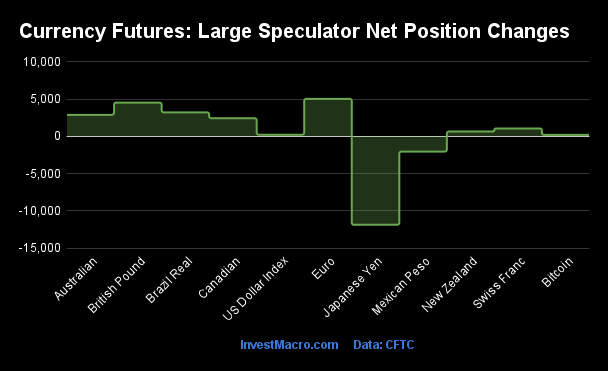
The COT currency market speculator bets were higher this week as six out of the eleven currency markets we cover had higher positioning while the other five markets had lower speculator contracts.

Leading the gains for the currency markets was the Japanese Yen (12,370 contracts) with the Australian Dollar (3,106 contracts), New Zealand Dollar (2,173 contracts), the Swiss Franc (1,223 contracts), EuroFX (183 contracts) and Bitcoin (345 contracts) also showing positive weeks.

The currencies seeing declines in speculator bets on the week were the British Pound (-3,586 contracts) with the Mexican Peso (-2,251 contracts), Brazilian Real (-1,374 contracts), the US Dollar Index (-1,425 contracts) and the Canadian Dollar (-4 contracts) also registering lower bets on the week.

Japanese Yen Speculators continued to trim their bearish positions

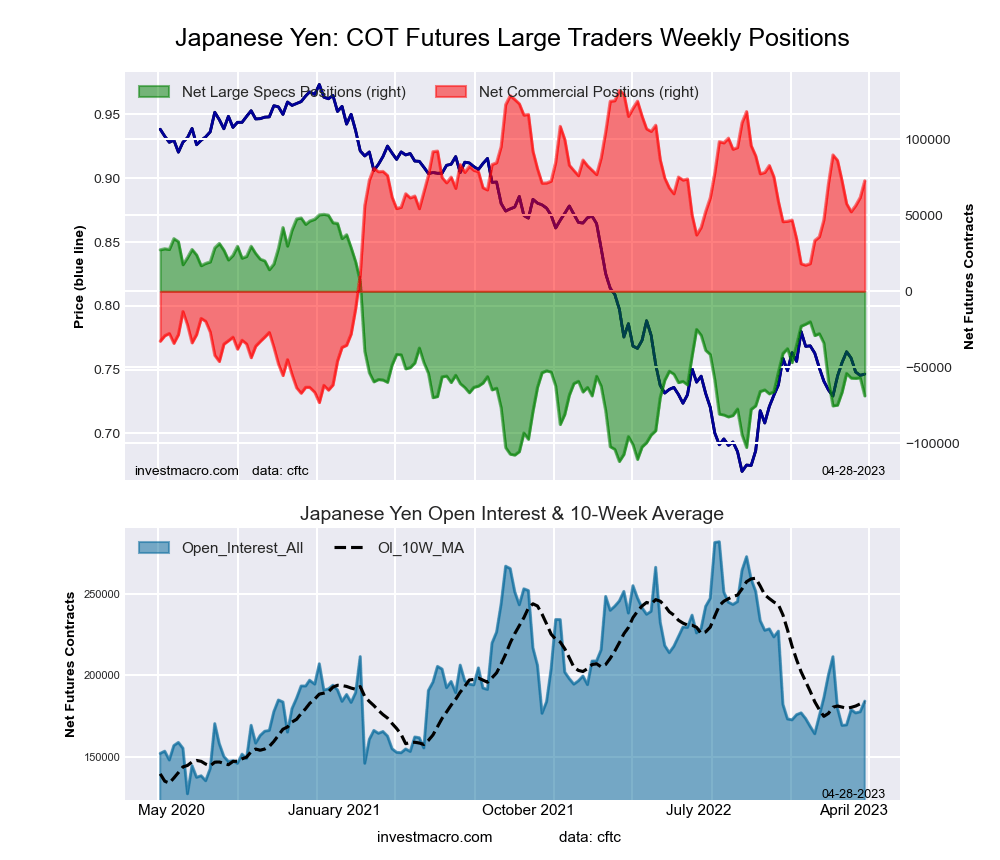
Highlighting the COT currency’s data this week is the improvement of the speculator’s positioning for the Japanese yen. Large speculative Japanese yen positions gained this week by over +12,000 net contracts and rose for a third straight week with a total change of +21,328 contracts over that 3-week period.

The yen, overall, has been in a continuous bearish standing for the past 107 weeks, dating back to March of 2021. The height of the yen bearish positions (eleven straight weeks over -90,000 contracts) was in April and May of 2022 while the bearish level reached a position of -102,618 contracts as recently as October 25th. Since that recent low, the yen positioning has improved markedly with positions falling to as low as -20,060 contracts on January 31st. This week’s gain marks the best in the past fifteen weeks and brings the overall net position (currently at -53,975 contracts) to the least bearish level since February 21st.

The yen spot price has been on the move since dropping to a multi-decade low against the US Dollar in October. The USDJPY currency pair had surged as high as 151.94 on October 17th but has now come back down to the 130s level with the currency pair closing out this week at 132.83.


Data Snapshot of Forex Market Traders | Columns Legend
Mar-28-2023OIOI-IndexSpec-NetSpec-IndexCom-NetCOM-IndexSmalls-NetSmalls-Index
USD Index31,1282612,71946-15,085522,36642
EUR732,50668145,02574-191,2482646,22353
GBP199,86837-24,0844822,577491,50761
JPY169,47331-53,9753657,56264-3,58746
CHF34,85617-6,0743910,73363-4,65942
CAD176,55948-56,825063,41799-6,5928
AUD151,23850-35,3535245,83053-10,47727
NZD31,98113-6,610366,553625752
MXN233,6694949,27986-53,828154,54985
RUB20,93047,54331-7,15069-39324
BRL42,6633023,48366-30,522277,039100
Bitcoin14,40969-27672-271054725


Strength Scores led by Mexican Peso & EuroFX
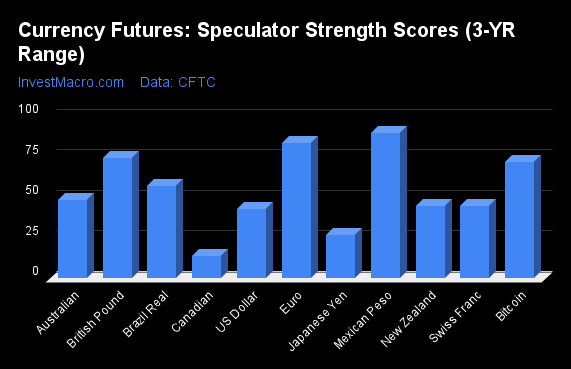
COT Strength Scores (a normalized measure of Speculator positions over a 3-Year range, from 0 to 100 where above 80 is Extreme-Bullish and below 20 is Extreme-Bearish) showed that the Mexican Peso (86 percent) and the EuroFX (74 percent) lead the currency markets this week. The Bitcoin (72 percent), Brazilian Real (66 percent) and the Australian Dollar (52 percent) come in as the next highest in the weekly strength scores.

On the downside, the Canadian Dollar (0 percent) comes in at the lowest strength levels currently and is in Extreme-Bearish territory (below 20 percent). The next lowest strength scores are the New Zealand Dollar (36 percent), Japanese Yen (36 percent) and the Swiss Franc (39 percent).

Strength Statistics:
US Dollar Index (46.1 percent) vs US Dollar Index previous week (48.5 percent)
EuroFX (74.3 percent) vs EuroFX previous week (74.2 percent)
British Pound Sterling (48.3 percent) vs British Pound Sterling previous week (51.4 percent)
Japanese Yen (35.6 percent) vs Japanese Yen previous week (28.0 percent)
Swiss Franc (38.5 percent) vs Swiss Franc previous week (35.3 percent)
Canadian Dollar (0.0 percent) vs Canadian Dollar previous week (0.0 percent)
Australian Dollar (52.1 percent) vs Australian Dollar previous week (49.2 percent)
New Zealand Dollar (35.7 percent) vs New Zealand Dollar previous week (29.8 percent)
Mexican Peso (85.9 percent) vs Mexican Peso previous week (87.6 percent)
Brazilian Real (65.7 percent) vs Brazilian Real previous week (67.4 percent)
Bitcoin (72.1 percent) vs Bitcoin previous week (66.1 percent)


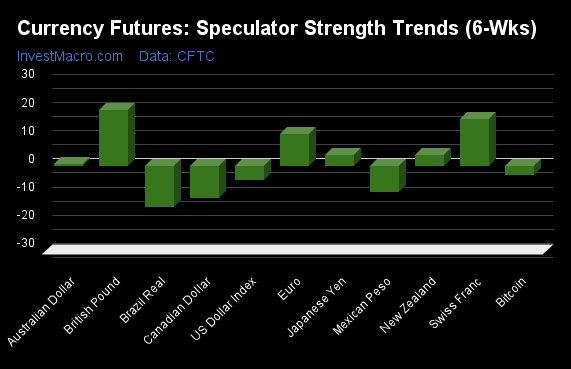
Mexican Peso & Bitcoin top the 6-Week Strength Trends

COT Strength Score Trends (or move index, calculates the 6-week changes in strength scores) showed that the Mexican Peso (67 percent) and the Bitcoin (9 percent) lead the past six weeks trends for the currencies. The Swiss Franc (4 percent) and the US Dollar Index (1 percent) are the next highest positive movers in the latest trends data.

The New Zealand Dollar (-42 percent) leads the downside trend scores currently with the Canadian Dollar (-20 percent), Japanese Yen (-16 percent) and the Brazilian Real (-11 percent) following next with lower trend scores.

Strength Trend Statistics:
US Dollar Index (1.2 percent) vs US Dollar Index previous week (3.1 percent)
EuroFX (-7.3 percent) vs EuroFX previous week (-7.8 percent)
British Pound Sterling (-3.7 percent) vs British Pound Sterling previous week (-5.5 percent)
Japanese Yen (-16.1 percent) vs Japanese Yen previous week (-22.9 percent)
Swiss Franc (3.7 percent) vs Swiss Franc previous week (-2.5 percent)
Canadian Dollar (-20.2 percent) vs Canadian Dollar previous week (-22.5 percent)
Australian Dollar (-6.0 percent) vs Australian Dollar previous week (-9.6 percent)
New Zealand Dollar (-42.3 percent) vs New Zealand Dollar previous week (-53.2 percent)
Mexican Peso (67.4 percent) vs Mexican Peso previous week (72.6 percent)
Brazilian Real (-10.8 percent) vs Brazilian Real previous week (-10.8 percent)
Bitcoin (8.8 percent) vs Bitcoin previous week (9.7 percent)


Individual COT Forex Markets:

US Dollar Index Futures:
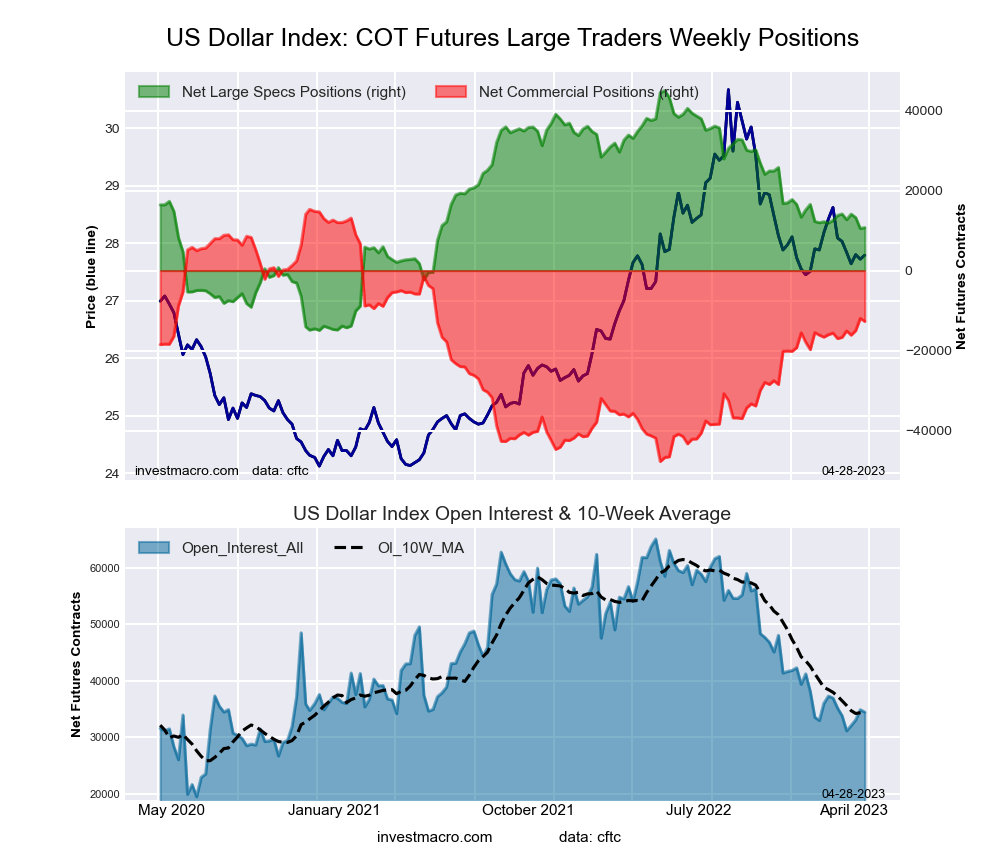
US Dollar Index Forex Futures COT ChartThe US Dollar Index large speculator standing this week equaled a net position of 12,719 contracts in the data reported through Tuesday. This was a weekly lowering of -1,425 contracts from the previous week which had a total of 14,144 net contracts.

This week’s current strength score (the trader positioning range over the past three years, measured from 0 to 100) shows the speculators are currently Bearish with a score of 46.1 percent. The commercials are Bullish with a score of 51.8 percent and the small traders (not shown in chart) are Bearish with a score of 42.4 percent.

US DOLLAR INDEX StatisticsSPECULATORSCOMMERCIALSSMALL TRADERS
– Percent of Open Interest Longs:78.91.815.2
– Percent of Open Interest Shorts:38.050.27.6
– Net Position:12,719-15,0852,366
– Gross Longs:24,5525454,737
– Gross Shorts:11,83315,6302,371
– Long to Short Ratio:2.1 to 10.0 to 12.0 to 1
NET POSITION TREND:
– Strength Index Score (3 Year Range Pct):46.151.842.4
– Strength Index Reading (3 Year Range):BearishBullishBearish
NET POSITION MOVEMENT INDEX:
– 6-Week Change in Strength Index:1.21.7-19.7


Euro Currency Futures:

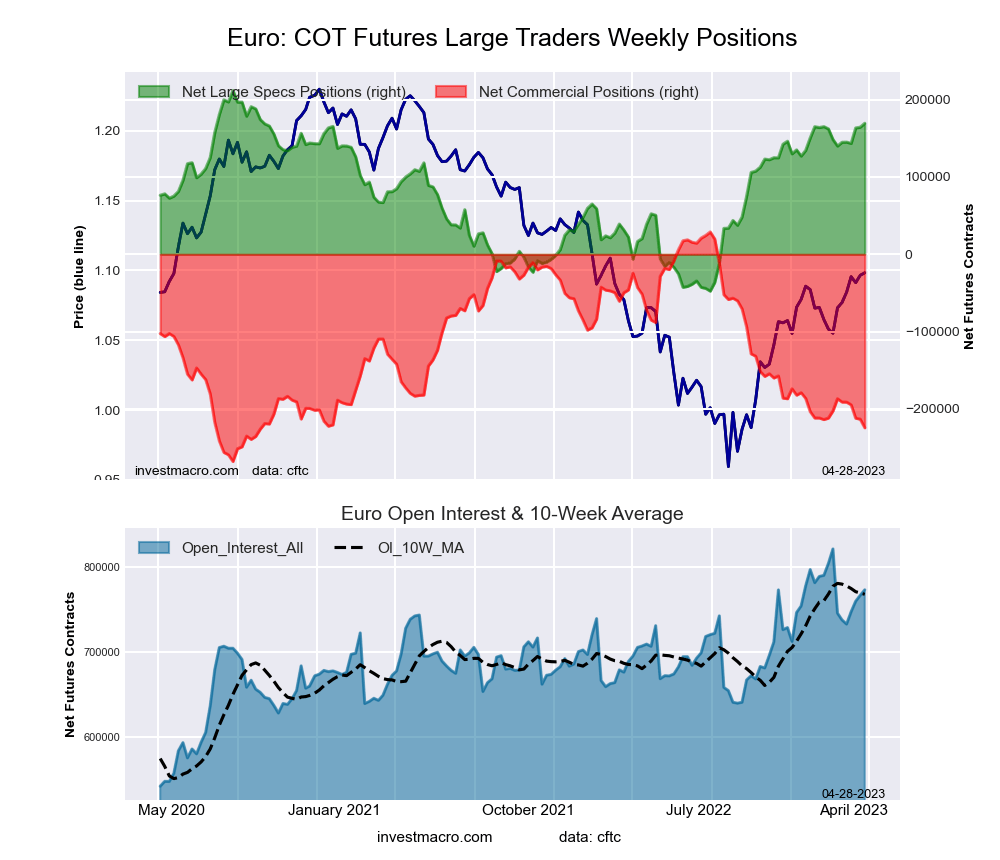
Euro Currency Futures COT ChartThe Euro Currency large speculator standing this week equaled a net position of 145,025 contracts in the data reported through Tuesday. This was a weekly increase of 183 contracts from the previous week which had a total of 144,842 net contracts.

This week’s current strength score (the trader positioning range over the past three years, measured from 0 to 100) shows the speculators are currently Bullish with a score of 74.3 percent. The commercials are Bearish with a score of 25.9 percent and the small traders (not shown in chart) are Bullish with a score of 52.7 percent.

EURO Currency StatisticsSPECULATORSCOMMERCIALSSMALL TRADERS
– Percent of Open Interest Longs:30.456.011.7
– Percent of Open Interest Shorts:10.682.25.4
– Net Position:145,025-191,24846,223
– Gross Longs:222,918410,54585,724
– Gross Shorts:77,893601,79339,501
– Long to Short Ratio:2.9 to 10.7 to 12.2 to 1
NET POSITION TREND:
– Strength Index Score (3 Year Range Pct):74.325.952.7
– Strength Index Reading (3 Year Range):BullishBearishBullish
NET POSITION MOVEMENT INDEX:
– 6-Week Change in Strength Index:-7.36.9-2.6


British Pound Sterling Futures:

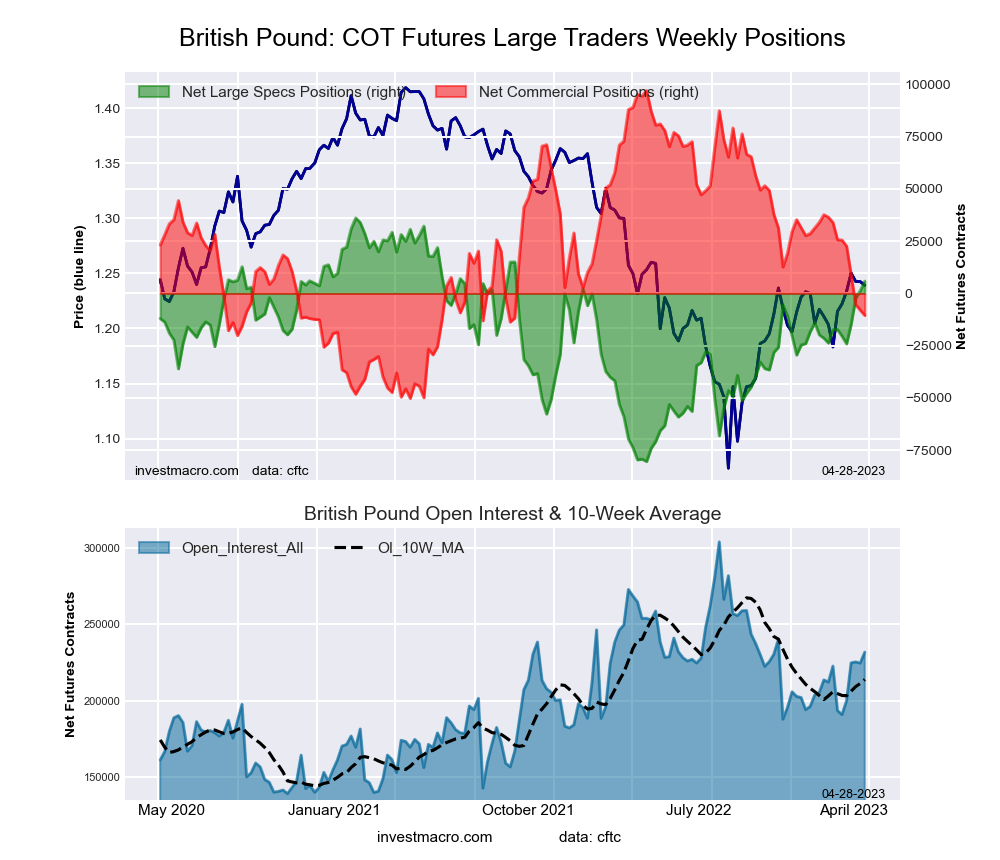
British Pound Sterling Futures COT ChartThe British Pound Sterling large speculator standing this week equaled a net position of -24,084 contracts in the data reported through Tuesday. This was a weekly lowering of -3,586 contracts from the previous week which had a total of -20,498 net contracts.

This week’s current strength score (the trader positioning range over the past three years, measured from 0 to 100) shows the speculators are currently Bearish with a score of 48.3 percent. The commercials are Bearish with a score of 49.4 percent and the small traders (not shown in chart) are Bullish with a score of 61.0 percent.

BRITISH POUND StatisticsSPECULATORSCOMMERCIALSSMALL TRADERS
– Percent of Open Interest Longs:14.266.613.1
– Percent of Open Interest Shorts:26.255.312.4
– Net Position:-24,08422,5771,507
– Gross Longs:28,355133,14926,264
– Gross Shorts:52,439110,57224,757
– Long to Short Ratio:0.5 to 11.2 to 11.1 to 1
NET POSITION TREND:
– Strength Index Score (3 Year Range Pct):48.349.461.0
– Strength Index Reading (3 Year Range):BearishBearishBullish
NET POSITION MOVEMENT INDEX:
– 6-Week Change in Strength Index:-3.7-7.830.9


Japanese Yen Futures:

Japanese Yen Forex Futures COT ChartThe Japanese Yen large speculator standing this week equaled a net position of -53,975 contracts in the data reported through Tuesday. This was a weekly gain of 12,370 contracts from the previous week which had a total of -66,345 net contracts.

This week’s current strength score (the trader positioning range over the past three years, measured from 0 to 100) shows the speculators are currently Bearish with a score of 35.6 percent. The commercials are Bullish with a score of 63.7 percent and the small traders (not shown in chart) are Bearish with a score of 46.1 percent.

JAPANESE YEN StatisticsSPECULATORSCOMMERCIALSSMALL TRADERS
– Percent of Open Interest Longs:5.777.914.5
– Percent of Open Interest Shorts:37.644.016.6
– Net Position:-53,97557,562-3,587
– Gross Longs:9,717132,07024,593
– Gross Shorts:63,69274,50828,180
– Long to Short Ratio:0.2 to 11.8 to 10.9 to 1
NET POSITION TREND:
– Strength Index Score (3 Year Range Pct):35.663.746.1
– Strength Index Reading (3 Year Range):BearishBullishBearish
NET POSITION MOVEMENT INDEX:
– 6-Week Change in Strength Index:-16.110.68.8


Swiss Franc Futures:

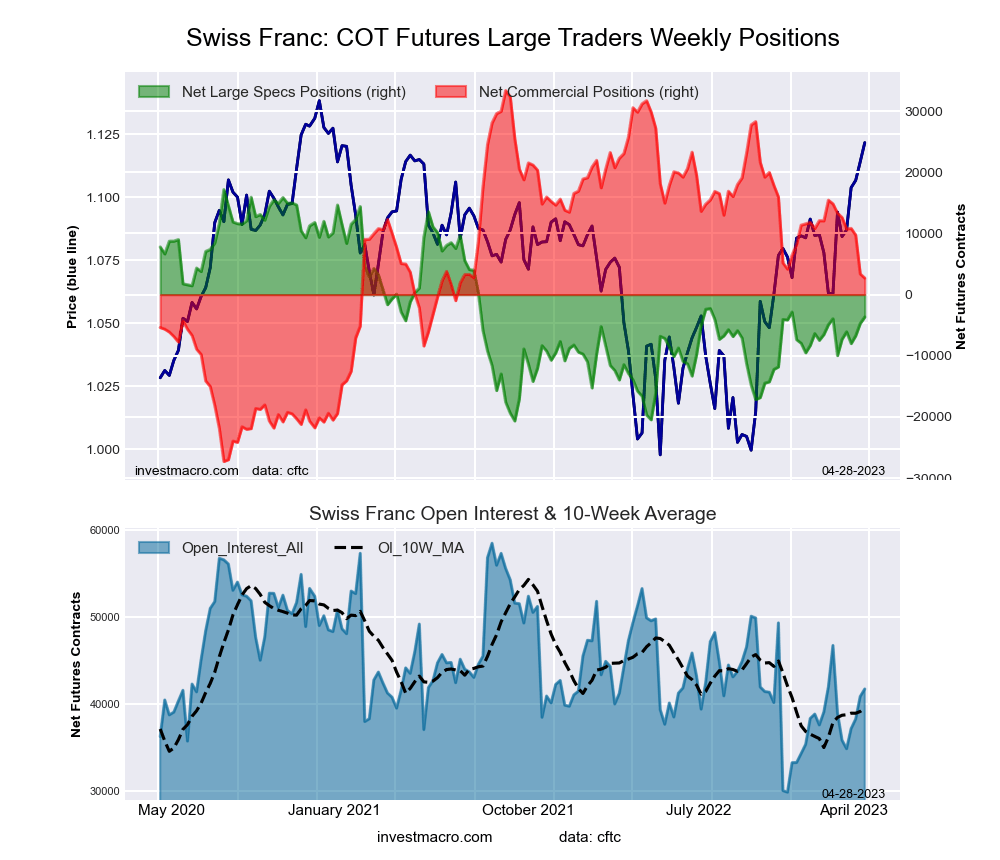
Swiss Franc Forex Futures COT ChartThe Swiss Franc large speculator standing this week equaled a net position of -6,074 contracts in the data reported through Tuesday. This was a weekly lift of 1,223 contracts from the previous week which had a total of -7,297 net contracts.

This week’s current strength score (the trader positioning range over the past three years, measured from 0 to 100) shows the speculators are currently Bearish with a score of 38.5 percent. The commercials are Bullish with a score of 62.7 percent and the small traders (not shown in chart) are Bearish with a score of 41.8 percent.

SWISS FRANC StatisticsSPECULATORSCOMMERCIALSSMALL TRADERS
– Percent of Open Interest Longs:11.457.029.2
– Percent of Open Interest Shorts:28.826.242.6
– Net Position:-6,07410,733-4,659
– Gross Longs:3,97819,86510,185
– Gross Shorts:10,0529,13214,844
– Long to Short Ratio:0.4 to 12.2 to 10.7 to 1
NET POSITION TREND:
– Strength Index Score (3 Year Range Pct):38.562.741.8
– Strength Index Reading (3 Year Range):BearishBullishBearish
NET POSITION MOVEMENT INDEX:
– 6-Week Change in Strength Index:3.7-2.2-0.2


Canadian Dollar Futures:

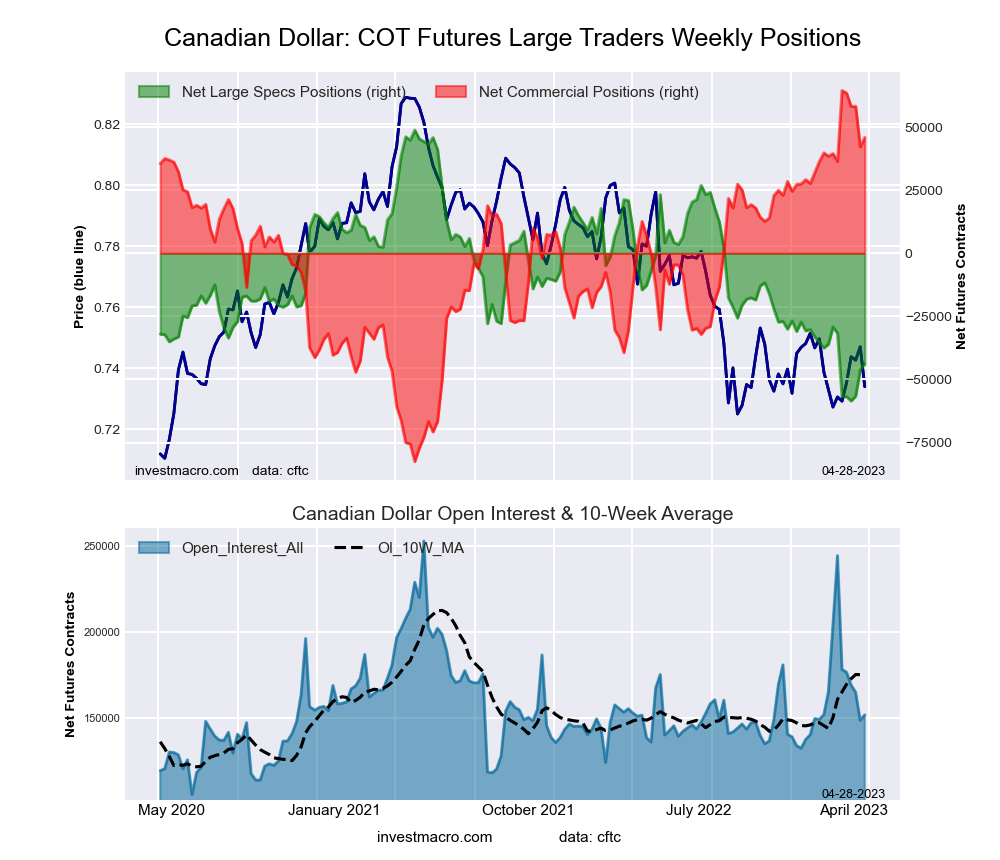
Canadian Dollar Forex Futures COT ChartThe Canadian Dollar large speculator standing this week equaled a net position of -56,825 contracts in the data reported through Tuesday. This was a weekly decrease of -4 contracts from the previous week which had a total of -56,821 net contracts.

This week’s current strength score (the trader positioning range over the past three years, measured from 0 to 100) shows the speculators are currently Bearish-Extreme with a score of 0.0 percent. The commercials are Bullish-Extreme with a score of 99.3 percent and the small traders (not shown in chart) are Bearish-Extreme with a score of 8.2 percent.

CANADIAN DOLLAR StatisticsSPECULATORSCOMMERCIALSSMALL TRADERS
– Percent of Open Interest Longs:11.170.417.4
– Percent of Open Interest Shorts:43.334.521.1
– Net Position:-56,82563,417-6,592
– Gross Longs:19,672124,28530,744
– Gross Shorts:76,49760,86837,336
– Long to Short Ratio:0.3 to 12.0 to 10.8 to 1
NET POSITION TREND:
– Strength Index Score (3 Year Range Pct):0.099.38.2
– Strength Index Reading (3 Year Range):Bearish-ExtremeBullish-ExtremeBearish-Extreme
NET POSITION MOVEMENT INDEX:
– 6-Week Change in Strength Index:-20.218.4-12.7


Australian Dollar Futures:

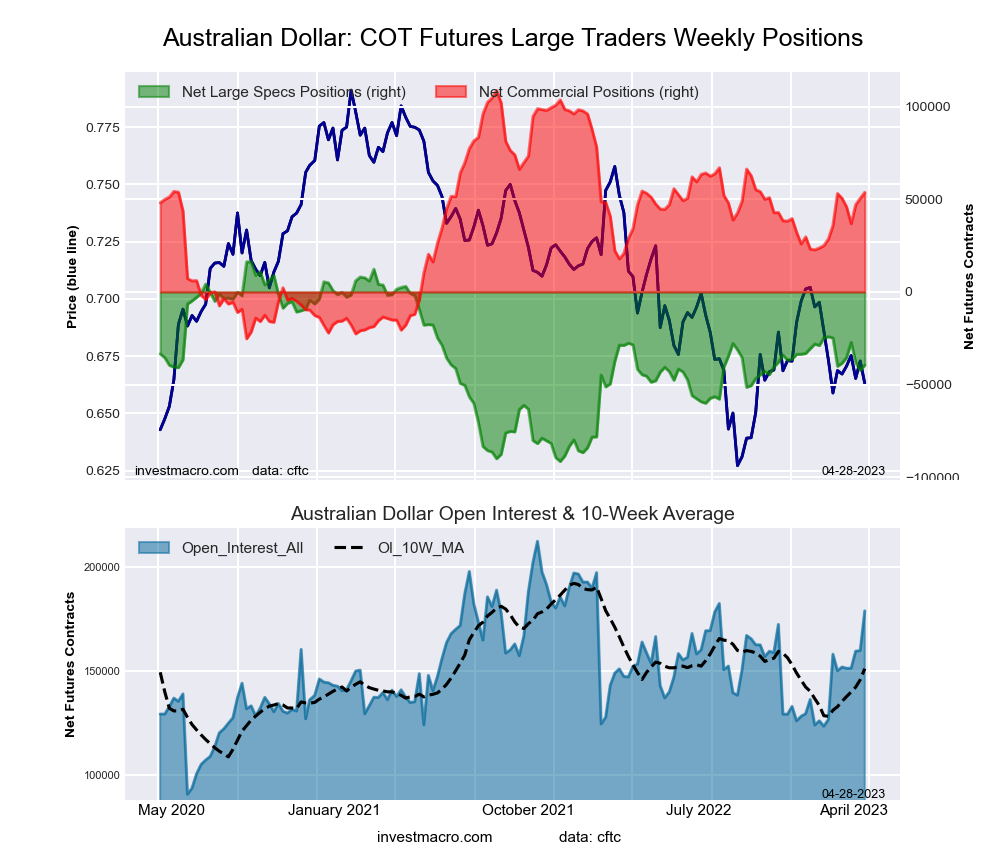
Australian Dollar Forex Futures COT ChartThe Australian Dollar large speculator standing this week equaled a net position of -35,353 contracts in the data reported through Tuesday. This was a weekly rise of 3,106 contracts from the previous week which had a total of -38,459 net contracts.

This week’s current strength score (the trader positioning range over the past three years, measured from 0 to 100) shows the speculators are currently Bullish with a score of 52.1 percent. The commercials are Bullish with a score of 53.1 percent and the small traders (not shown in chart) are Bearish with a score of 26.9 percent.

AUSTRALIAN DOLLAR StatisticsSPECULATORSCOMMERCIALSSMALL TRADERS
– Percent of Open Interest Longs:29.055.212.8
– Percent of Open Interest Shorts:52.324.919.7
– Net Position:-35,35345,830-10,477
– Gross Longs:43,81383,52319,330
– Gross Shorts:79,16637,69329,807
– Long to Short Ratio:0.6 to 12.2 to 10.6 to 1
NET POSITION TREND:
– Strength Index Score (3 Year Range Pct):52.153.126.9
– Strength Index Reading (3 Year Range):BullishBullishBearish
NET POSITION MOVEMENT INDEX:
– 6-Week Change in Strength Index:-6.016.5-38.2


New Zealand Dollar Futures:

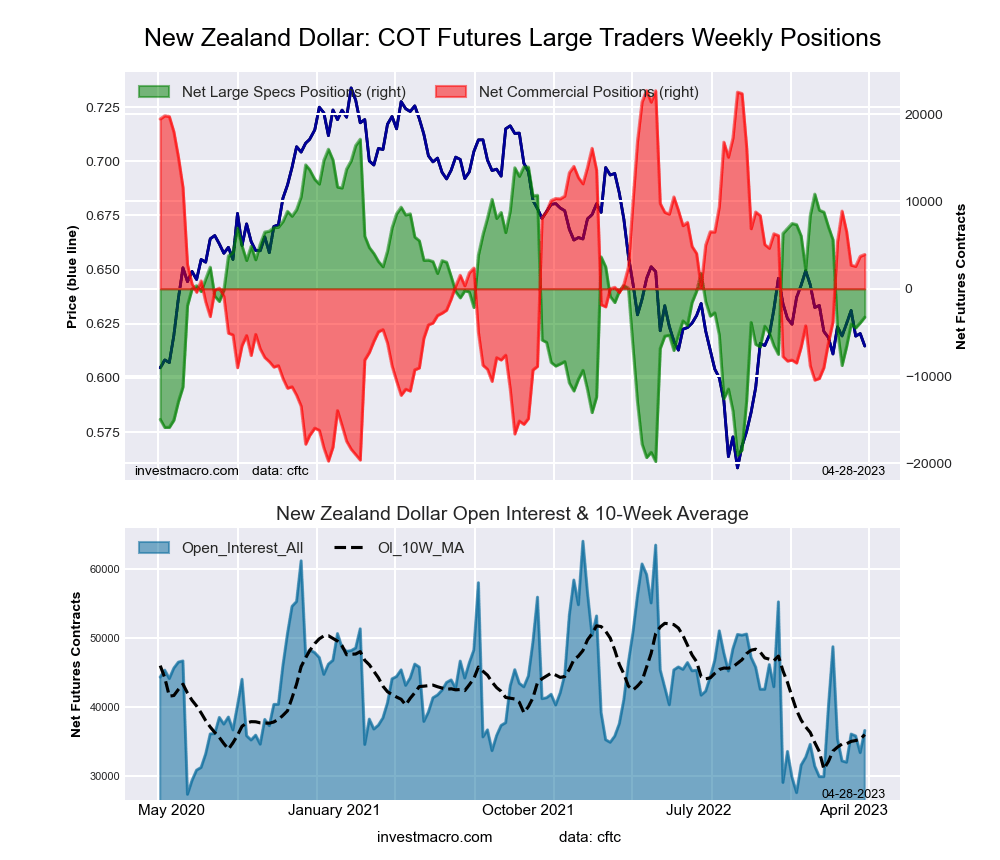
New Zealand Dollar Forex Futures COT ChartThe New Zealand Dollar large speculator standing this week equaled a net position of -6,610 contracts in the data reported through Tuesday. This was a weekly lift of 2,173 contracts from the previous week which had a total of -8,783 net contracts.

This week’s current strength score (the trader positioning range over the past three years, measured from 0 to 100) shows the speculators are currently Bearish with a score of 35.7 percent. The commercials are Bullish with a score of 61.9 percent and the small traders (not shown in chart) are Bullish with a score of 52.3 percent.

NEW ZEALAND DOLLAR StatisticsSPECULATORSCOMMERCIALSSMALL TRADERS
– Percent of Open Interest Longs:30.458.310.8
– Percent of Open Interest Shorts:51.137.810.7
– Net Position:-6,6106,55357
– Gross Longs:9,72018,6393,467
– Gross Shorts:16,33012,0863,410
– Long to Short Ratio:0.6 to 11.5 to 11.0 to 1
NET POSITION TREND:
– Strength Index Score (3 Year Range Pct):35.761.952.3
– Strength Index Reading (3 Year Range):BearishBullishBullish
NET POSITION MOVEMENT INDEX:
– 6-Week Change in Strength Index:-42.339.6-13.9


Mexican Peso Futures:

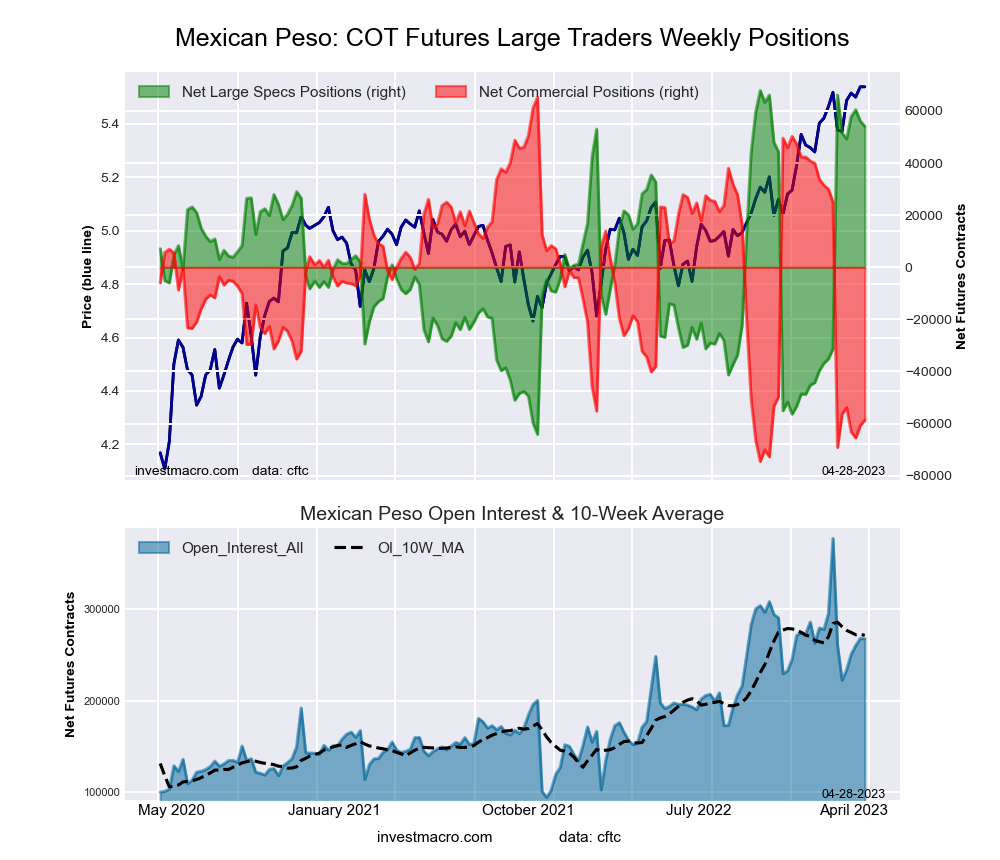
Mexican Peso Futures COT ChartThe Mexican Peso large speculator standing this week equaled a net position of 49,279 contracts in the data reported through Tuesday. This was a weekly decline of -2,251 contracts from the previous week which had a total of 51,530 net contracts.

This week’s current strength score (the trader positioning range over the past three years, measured from 0 to 100) shows the speculators are currently Bullish-Extreme with a score of 85.9 percent. The commercials are Bearish-Extreme with a score of 14.8 percent and the small traders (not shown in chart) are Bullish-Extreme with a score of 84.6 percent.

MEXICAN PESO StatisticsSPECULATORSCOMMERCIALSSMALL TRADERS
– Percent of Open Interest Longs:46.850.03.0
– Percent of Open Interest Shorts:25.773.11.1
– Net Position:49,279-53,8284,549
– Gross Longs:109,417116,9397,079
– Gross Shorts:60,138170,7672,530
– Long to Short Ratio:1.8 to 10.7 to 12.8 to 1
NET POSITION TREND:
– Strength Index Score (3 Year Range Pct):85.914.884.6
– Strength Index Reading (3 Year Range):Bullish-ExtremeBearish-ExtremeBullish-Extreme
NET POSITION MOVEMENT INDEX:
– 6-Week Change in Strength Index:67.4-62.7-7.5


Brazilian Real Futures:

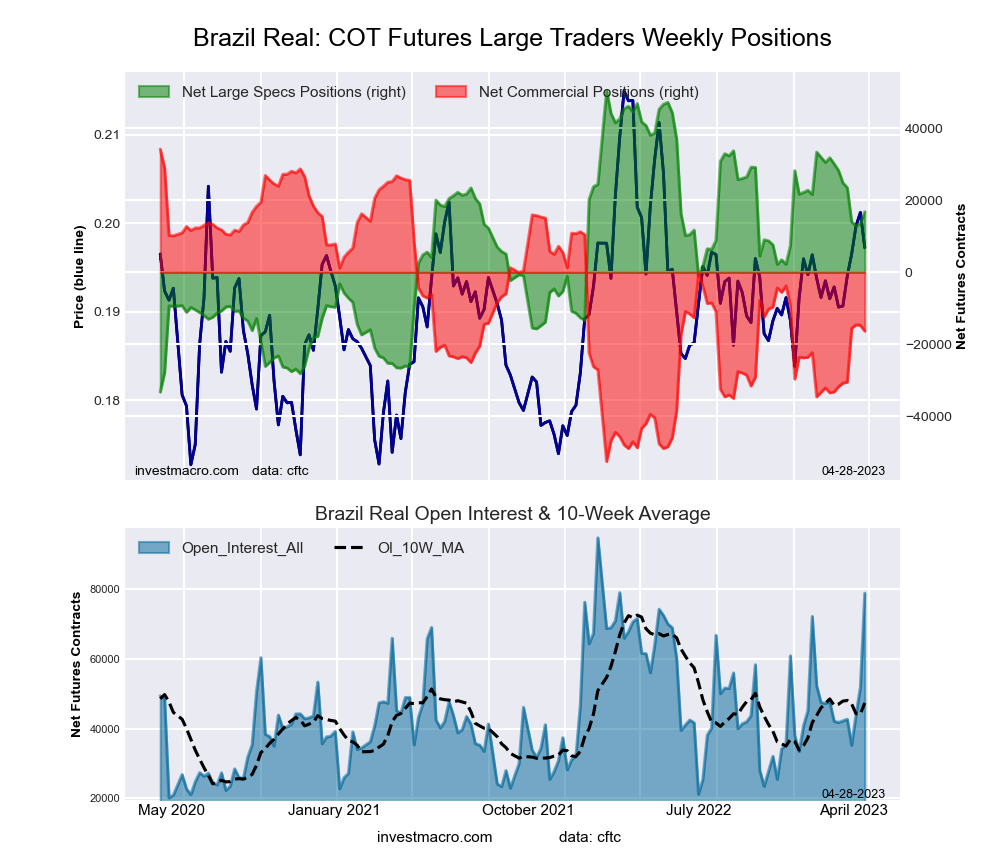
Brazil Real Futures COT ChartThe Brazilian Real large speculator standing this week equaled a net position of 23,483 contracts in the data reported through Tuesday. This was a weekly decrease of -1,374 contracts from the previous week which had a total of 24,857 net contracts.

This week’s current strength score (the trader positioning range over the past three years, measured from 0 to 100) shows the speculators are currently Bullish with a score of 65.7 percent. The commercials are Bearish with a score of 27.1 percent and the small traders (not shown in chart) are Bullish-Extreme with a score of 100.0 percent.

BRAZIL REAL StatisticsSPECULATORSCOMMERCIALSSMALL TRADERS
– Percent of Open Interest Longs:60.919.319.8
– Percent of Open Interest Shorts:5.890.83.3
– Net Position:23,483-30,5227,039
– Gross Longs:25,9688,2318,429
– Gross Shorts:2,48538,7531,390
– Long to Short Ratio:10.4 to 10.2 to 16.1 to 1
NET POSITION TREND:
– Strength Index Score (3 Year Range Pct):65.727.1100.0
– Strength Index Reading (3 Year Range):BullishBearishBullish-Extreme
NET POSITION MOVEMENT INDEX:
– 6-Week Change in Strength Index:-10.83.545.0


Bitcoin Futures:

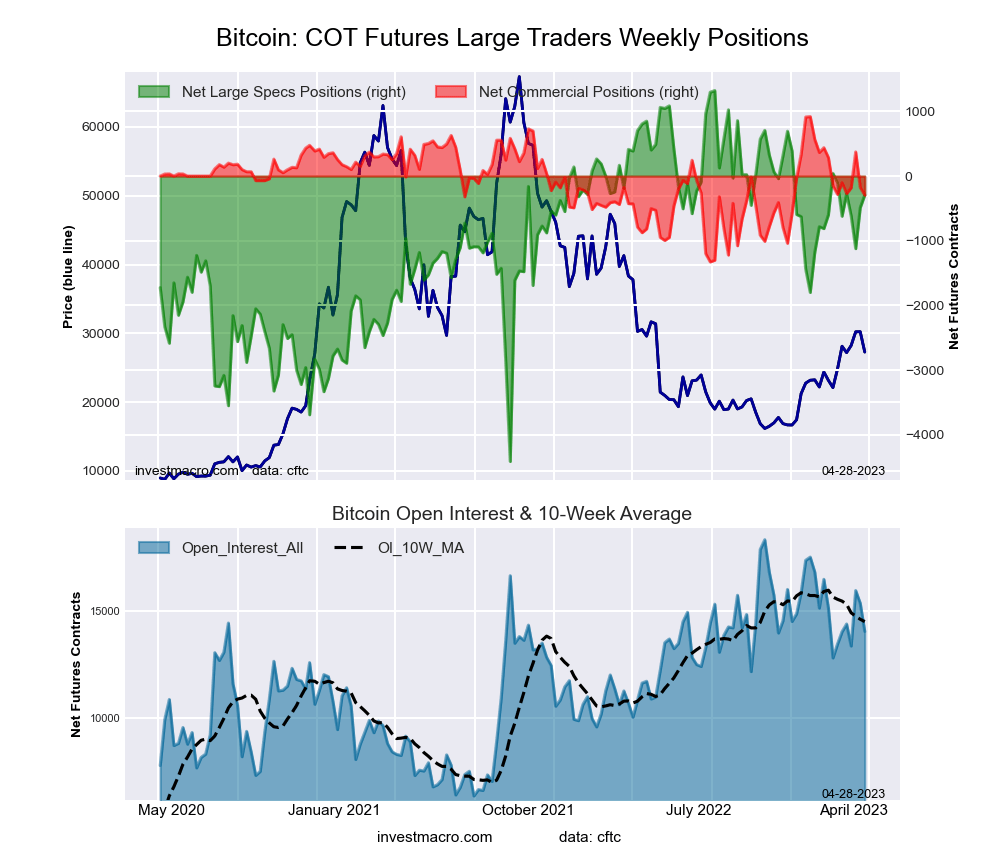
Bitcoin Crypto Futures COT ChartThe Bitcoin large speculator standing this week equaled a net position of -276 contracts in the data reported through Tuesday. This was a weekly gain of 345 contracts from the previous week which had a total of -621 net contracts.

This week’s current strength score (the trader positioning range over the past three years, measured from 0 to 100) shows the speculators are currently Bullish with a score of 72.1 percent. The commercials are Bearish with a score of 47.0 percent and the small traders (not shown in chart) are Bearish with a score of 25.4 percent.

BITCOIN StatisticsSPECULATORSCOMMERCIALSSMALL TRADERS
– Percent of Open Interest Longs:77.51.810.1
– Percent of Open Interest Shorts:79.43.76.3
– Net Position:-276-271547
– Gross Longs:11,1682631,449
– Gross Shorts:11,444534902
– Long to Short Ratio:1.0 to 10.5 to 11.6 to 1
NET POSITION TREND:
– Strength Index Score (3 Year Range Pct):72.147.025.4
– Strength Index Reading (3 Year Range):BullishBearishBearish
NET POSITION MOVEMENT INDEX:
– 6-Week Change in Strength Index:8.8-28.32.9


Article By InvestMacroReceive our weekly COT Newsletter

*COT Report: The COT data, released weekly to the public each Friday, is updated through the most recent Tuesday (data is 3 days old) and shows a quick view of how large speculators or non-commercials (for-profit traders) were positioned in the futures markets.

The CFTC categorizes trader positions according to commercial hedgers (traders who use futures contracts for hedging as part of the business), non-commercials (large traders who speculate to realize trading profits) and nonreportable traders (usually small traders/speculators) as well as their open interest (contracts open in the market at time of reporting). See CFTC criteria here.


Gold Speculator’s bullish bets continued to climb to 44-week high

By InvestMacro

The Commodities Futures Trading Commission (CFTC) has released the latest Commitment of Traders (COT) data, which provides an update view of how large traders, such as speculators and commercial entities, position themselves in the futures markets. This data is current as of Tuesday March 28th.

Weekly Speculator Changes led by Silver & Platinum

The COT metals markets speculator bets were higher this week as five out of the six metals markets we cover had higher positioning while the other one markets had lower speculator contracts.

Leading the gains for the metals was Gold (23,025 contracts) with Copper (10,806 contracts), Silver (9,899 contracts), Platinum (848 contracts) and Palladium (254 contracts) also showing positive weeks.

The only market with declines in speculator bets for the week was Steel (-484 contracts).

Gold Speculator bets continue to climb to 44-week high

Highlighting the COT metals data this week is the continued bullishness for the Gold speculative positions. The large speculator position in Gold futures climbed this week for a third straight week and for the fifth time out of the past six weeks. Gold spec bets have now advanced by a total of +83,156 contracts over just the past three weeks.

The Gold position has increased from a total net position of +105,529 contracts on February 14th to a total of +181,630 contracts this week which marks the highest level in 44-weeks, dating back to May of 2022. The boost in speculator sentiment has pushed the Gold speculator strength score to 57.0 percent (0 to 100 percent over a 3-year range) while the 6-week speculator strength score trend has gained by 33.5 percent.

The Gold futures price saw a small gain this week after a small decline last week. Previously to the past two weeks, Gold futures had risen for three straight weeks and hit the highest price in just about a year over the $2,014.00 level. This week Gold futures managed to reach a high back over the $2,000.00 price level but retreated to close at $1,986.20.


Data Snapshot of Commodity Market Traders | Columns Legend
Mar-28-2023OIOI-IndexSpec-NetSpec-IndexCom-NetCOM-IndexSmalls-NetSmalls-Index
Gold478,61126181,63057-201,5084619,87830
Silver117,395013,36137-21,875678,51414
Copper211,88952-1,54527-4,924696,46959
Palladium11,51478-6,76437,19398-42916
Platinum57,2443210,37440-14,781634,40727


Strength Scores led by Steel & Gold

COT Strength Scores (a normalized measure of Speculator positions over a 3-Year range, from 0 to 100 where above 80 is Extreme-Bullish and below 20 is Extreme-Bearish) showed that Steel (58 percent) and Gold (57 percent) lead the metals markets this week. Platinum (39.5 percent) comes in as the next highest in the weekly strength scores.

On the downside, Palladium (3.1 percent) comes in at the lowest strength level currently and is in Extreme-Bearish territory (below 20 percent).

Strength Statistics:
Gold (57.0 percent) vs Gold previous week (46.9 percent)
Silver (37.3 percent) vs Silver previous week (23.2 percent)
Copper (27.0 percent) vs Copper previous week (17.4 percent)
Platinum (39.5 percent) vs Platinum previous week (37.6 percent)
Palladium (3.1 percent) vs Palladium previous week (0.7 percent)
Steel (57.9 percent) vs Palladium previous week (59.3 percent)

Gold & Platinum top the 6-Week Strength Trends

COT Strength Score Trends (or move index, calculates the 6-week changes in strength scores) showed that Gold (34 percent) and Platinum (10 percent) lead the past six weeks trends for metals.

Palladium (-16 percent) leads the downside trend scores currently with Steel (-4 percent) as the next market with lower trend scores.

Move Statistics:
Gold (33.5 percent) vs Gold previous week (13.1 percent)
Silver (2.6 percent) vs Silver previous week (-14.4 percent)
Copper (3.5 percent) vs Copper previous week (-13.3 percent)
Platinum (10.1 percent) vs Platinum previous week (-2.5 percent)
Palladium (-16.4 percent) vs Palladium previous week (-26.9 percent)
Steel (-3.8 percent) vs Steel previous week (-1.3 percent)


Individual Markets:

Gold Comex Futures:

Gold Futures COT ChartThe Gold Comex Futures large speculator standing this week came in at a net position of 181,630 contracts in the data reported through Tuesday. This was a weekly rise of 23,025 contracts from the previous week which had a total of 158,605 net contracts.

This week’s current strength score (the trader positioning range over the past three years, measured from 0 to 100) shows the speculators are currently Bullish with a score of 57.0 percent. The commercials are Bearish with a score of 46.1 percent and the small traders (not shown in chart) are Bearish with a score of 29.8 percent.

Gold Futures StatisticsSPECULATORSCOMMERCIALSSMALL TRADERS
– Percent of Open Interest Longs:51.227.59.9
– Percent of Open Interest Shorts:13.369.65.7
– Net Position:181,630-201,50819,878
– Gross Longs:245,135131,78647,388
– Gross Shorts:63,505333,29427,510
– Long to Short Ratio:3.9 to 10.4 to 11.7 to 1
NET POSITION TREND:
– Strength Index Score (3 Year Range Pct):57.046.129.8
– Strength Index Reading (3 Year Range):BullishBearishBearish
NET POSITION MOVEMENT INDEX:
– 6-Week Change in Strength Index:33.5-28.0-9.2


Silver Comex Futures:

Silver Futures COT ChartThe Silver Comex Futures large speculator standing this week came in at a net position of 13,361 contracts in the data reported through Tuesday. This was a weekly lift of 9,899 contracts from the previous week which had a total of 3,462 net contracts.

This week’s current strength score (the trader positioning range over the past three years, measured from 0 to 100) shows the speculators are currently Bearish with a score of 37.3 percent. The commercials are Bullish with a score of 67.4 percent and the small traders (not shown in chart) are Bearish-Extreme with a score of 13.5 percent.

Silver Futures StatisticsSPECULATORSCOMMERCIALSSMALL TRADERS
– Percent of Open Interest Longs:36.038.318.8
– Percent of Open Interest Shorts:24.656.911.5
– Net Position:13,361-21,8758,514
– Gross Longs:42,25444,97022,062
– Gross Shorts:28,89366,84513,548
– Long to Short Ratio:1.5 to 10.7 to 11.6 to 1
NET POSITION TREND:
– Strength Index Score (3 Year Range Pct):37.367.413.5
– Strength Index Reading (3 Year Range):BearishBullishBearish-Extreme
NET POSITION MOVEMENT INDEX:
– 6-Week Change in Strength Index:2.64.8-32.5


Copper Grade #1 Futures:

Copper Futures COT ChartThe Copper Grade #1 Futures large speculator standing this week came in at a net position of -1,545 contracts in the data reported through Tuesday. This was a weekly lift of 10,806 contracts from the previous week which had a total of -12,351 net contracts.

This week’s current strength score (the trader positioning range over the past three years, measured from 0 to 100) shows the speculators are currently Bearish with a score of 27.0 percent. The commercials are Bullish with a score of 69.2 percent and the small traders (not shown in chart) are Bullish with a score of 59.3 percent.

Copper Futures StatisticsSPECULATORSCOMMERCIALSSMALL TRADERS
– Percent of Open Interest Longs:26.744.38.7
– Percent of Open Interest Shorts:27.446.65.7
– Net Position:-1,545-4,9246,469
– Gross Longs:56,59593,92018,451
– Gross Shorts:58,14098,84411,982
– Long to Short Ratio:1.0 to 11.0 to 11.5 to 1
NET POSITION TREND:
– Strength Index Score (3 Year Range Pct):27.069.259.3
– Strength Index Reading (3 Year Range):BearishBullishBullish
NET POSITION MOVEMENT INDEX:
– 6-Week Change in Strength Index:3.5-2.2-8.5


Platinum Futures:

Platinum Futures COT ChartThe Platinum Futures large speculator standing this week came in at a net position of 10,374 contracts in the data reported through Tuesday. This was a weekly gain of 848 contracts from the previous week which had a total of 9,526 net contracts.

This week’s current strength score (the trader positioning range over the past three years, measured from 0 to 100) shows the speculators are currently Bearish with a score of 39.5 percent. The commercials are Bullish with a score of 62.9 percent and the small traders (not shown in chart) are Bearish with a score of 27.2 percent.

Platinum Futures StatisticsSPECULATORSCOMMERCIALSSMALL TRADERS
– Percent of Open Interest Longs:42.440.412.6
– Percent of Open Interest Shorts:24.266.34.9
– Net Position:10,374-14,7814,407
– Gross Longs:24,24723,1467,193
– Gross Shorts:13,87337,9272,786
– Long to Short Ratio:1.7 to 10.6 to 12.6 to 1
NET POSITION TREND:
– Strength Index Score (3 Year Range Pct):39.562.927.2
– Strength Index Reading (3 Year Range):BearishBullishBearish
NET POSITION MOVEMENT INDEX:
– 6-Week Change in Strength Index:10.1-5.2-24.7


Palladium Futures:

Palladium Futures COT ChartThe Palladium Futures large speculator standing this week came in at a net position of -6,764 contracts in the data reported through Tuesday. This was a weekly gain of 254 contracts from the previous week which had a total of -7,018 net contracts.

This week’s current strength score (the trader positioning range over the past three years, measured from 0 to 100) shows the speculators are currently Bearish-Extreme with a score of 3.1 percent. The commercials are Bullish-Extreme with a score of 98.1 percent and the small traders (not shown in chart) are Bearish-Extreme with a score of 15.9 percent.

Palladium Futures StatisticsSPECULATORSCOMMERCIALSSMALL TRADERS
– Percent of Open Interest Longs:13.872.210.2
– Percent of Open Interest Shorts:72.69.713.9
– Net Position:-6,7647,193-429
– Gross Longs:1,5938,3141,174
– Gross Shorts:8,3571,1211,603
– Long to Short Ratio:0.2 to 17.4 to 10.7 to 1
NET POSITION TREND:
– Strength Index Score (3 Year Range Pct):3.198.115.9
– Strength Index Reading (3 Year Range):Bearish-ExtremeBullish-ExtremeBearish-Extreme
NET POSITION MOVEMENT INDEX:
– 6-Week Change in Strength Index:-16.416.3-9.6


Steel Futures Futures:

Steel Futures COT ChartThe Steel Futures large speculator standing this week came in at a net position of -5,255 contracts in the data reported through Tuesday. This was a weekly decline of -484 contracts from the previous week which had a total of -4,771 net contracts.

This week’s current strength score (the trader positioning range over the past three years, measured from 0 to 100) shows the speculators are currently Bullish with a score of 57.9 percent. The commercials are Bearish with a score of 41.4 percent and the small traders (not shown in chart) are Bullish with a score of 61.4 percent.

Steel Futures StatisticsSPECULATORSCOMMERCIALSSMALL TRADERS
– Percent of Open Interest Longs:12.176.11.4
– Percent of Open Interest Shorts:29.559.80.3
– Net Position:-5,2554,933322
– Gross Longs:3,68723,103422
– Gross Shorts:8,94218,170100
– Long to Short Ratio:0.4 to 11.3 to 14.2 to 1
NET POSITION TREND:
– Strength Index Score (3 Year Range Pct):57.941.461.4
– Strength Index Reading (3 Year Range):BullishBearishBullish
NET POSITION MOVEMENT INDEX:
– 6-Week Change in Strength Index:-3.84.1-11.0


Article By InvestMacroReceive our weekly COT Newsletter

*COT Report: The COT data, released weekly to the public each Friday, is updated through the most recent Tuesday (data is 3 days old) and shows a quick view of how large speculators or non-commercials (for-profit traders) were positioned in the futures markets.

The CFTC categorizes trader positions according to commercial hedgers (traders who use futures contracts for hedging as part of the business), non-commercials (large traders who speculate to realize trading profits) and nonreportable traders (usually small traders/speculators) as well as their open interest (contracts open in the market at time of reporting). See CFTC criteria here.

Bonds Speculators raised their 10-Year Bond bets to best level in 11-weeks

By InvestMacro

Here are the latest charts and statistics for the Commitment of Traders (COT) reports data published by the Commodities Futures Trading Commission (CFTC).

The latest COT data is updated through Tuesday March 28th and shows a quick view of how large traders (for-profit speculators and commercial hedgers) were positioned in the futures markets.

Weekly Speculator Changes led by 10-Year Bonds & SOFR 3-Months

The COT bond market speculator bets were higher this week as six out of the nine bond markets we cover had higher positioning while the other three markets had lower speculator contracts.

Leading the gains for the bond markets was the 10-Year Bonds (99,451 contracts) with the SOFR 3-Months (35,598 contracts), the Ultra Treasury Bonds (22,186 contracts), Eurodollar (8,563 contracts), US Treasury Bonds (8,014 contracts), and the Ultra 10-Year Bonds (6,322 contracts) also seeing positive weeks.

The bond markets with declines in speculator bets for the week were the Fed Funds (-144,248 contracts), the 2-Year Bonds (-61,280 contracts) and the 5-Year Bonds (-50,787 contracts) also having lower bets on the week.

10-Year Bond Speculator bets improve to best level in 11-weeks

Highlighting the COT bond’s data this week is the recent improvement of the speculator positioning in the 10-Year Bonds contracts. Large speculative positions for the 10-Year Bonds rose this week by the largest amount of the past 27 weeks and the weekly bets have now been higher in three out of the past five weeks as well as five out of the past seven weeks.

The 10-Year Bond speculator net positions, overall, have been in a continuous bearish position for the past 76 weeks (since October of 2021). The bearish bets have accelerated over the past year in conjunction with the Federal Reserve’s interest rate hiking campaign to tame inflation. The 10-Year Bonds spec position recently hit a 230-week low of -627,947 contracts on February 28th, marking the lowest level dating back to October of 2018 and potentially the low for this cycle.

Since then, the 10-Year Bond speculator positions have taken +156,369 contracts off of the bearish standing and leveled this week at a total of -471,578 contracts which marks the least bearish level of the past eleven weeks. The 10-Year Bond’s speculator strength score level remains depressed in a bearish-extreme standing of 19.3 percent (compared to its 3-year range) but its 6-week strength score trend has shown an improvement by 11.3 percent.

The 10-Year Bond futures price dipped this week after showing gains in the previous four straight weeks. The front month futures price closed at approximately the 114.30 level, just below its 50-day moving average but up over 4 percent from the 2023 low of 110.125.


Data Snapshot of Bond Market Traders | Columns Legend
Mar-28-2023OIOI-IndexSpec-NetSpec-IndexCom-NetCOM-IndexSmalls-NetSmalls-Index
Eurodollar4,708,9920-629,40858815,49941-186,09164
FedFunds1,779,64770-168,60019174,03381-5,43380
2-Year2,356,31852-525,47722504,3957821,08266
Long T-Bond1,201,69958-91,3995521,6861869,713100
10-Year4,127,91774-471,57819436,4976835,08192
5-Year4,378,90099-682,3556628,1788354,17796


Strength Scores led by SOFR 3-Months & Eurodollar

COT Strength Scores (a normalized measure of Speculator positions over a 3-Year range, from 0 to 100 where above 80 is Extreme-Bullish and below 20 is Extreme-Bearish) showed that the SOFR 3-Months (91 percent) and the Eurodollar (58 percent) lead the bond markets this week. The US Treasury Bonds (55 percent) comes in as the next highest in the weekly strength scores.

On the downside, the 5-Year Bonds (6 percent), the Ultra Treasury Bonds (9 percent), the Ultra 10-Year Bonds (11 percent), the Fed Funds (18.8 percent) and the 10-Year Bonds (19 percent) came in at the lowest strength levels currently and are all in Extreme-Bearish territory (below 20 percent).

Strength Statistics:
Fed Funds (18.8 percent) vs Fed Funds previous week (36.6 percent)
2-Year Bond (21.8 percent) vs 2-Year Bond previous week (29.6 percent)
5-Year Bond (6.1 percent) vs 5-Year Bond previous week (12.2 percent)
10-Year Bond (19.3 percent) vs 10-Year Bond previous week (7.0 percent)
Ultra 10-Year Bond (10.6 percent) vs Ultra 10-Year Bond previous week (9.3 percent)
US Treasury Bond (54.8 percent) vs US Treasury Bond previous week (52.2 percent)
Ultra US Treasury Bond (9.4 percent) vs Ultra US Treasury Bond previous week (0.0 percent)
Eurodollar (57.9 percent) vs Eurodollar previous week (57.7 percent)
SOFR 3-Months (90.7 percent) vs SOFR 3-Months previous week (87.8 percent)

SOFR 3-Months & US Treasury Bonds top the 6-Week Strength Trends

COT Strength Score Trends (or move index, calculates the 6-week changes in strength scores) showed that the SOFR 3-Months (40 percent) and the US Treasury Bonds (31 percent) lead the past six weeks trends for bonds. The 2-Year Bonds (22 percent) are the next highest positive movers in the latest trends data.

The 5-Year Bond (-11.2 percent) and the Fed Funds (-7 percent) lead the downside trend scores currently with the Ultra 10-Year Bonds (-6 percent) and the Ultra Treasury Bonds (-2 percent) following next with lower trend scores.

Strength Trend Statistics:
Fed Funds (-6.9 percent) vs Fed Funds previous week (5.2 percent)
2-Year Bond (21.8 percent) vs 2-Year Bond previous week (24.8 percent)
5-Year Bond (-11.2 percent) vs 5-Year Bond previous week (4.5 percent)
10-Year Bond (11.3 percent) vs 10-Year Bond previous week (1.8 percent)
Ultra 10-Year Bond (-6.4 percent) vs Ultra 10-Year Bond previous week (-6.7 percent)
US Treasury Bond (30.5 percent) vs US Treasury Bond previous week (26.5 percent)
Ultra US Treasury Bond (-1.9 percent) vs Ultra US Treasury Bond previous week (-10.3 percent)
Eurodollar (10.3 percent) vs Eurodollar previous week (10.2 percent)
SOFR 3-Months (40.2 percent) vs SOFR 3-Months previous week (10.2 percent)


Individual Bond Markets:

Eurodollars Futures:

Eurodollar Bonds Futures COT ChartThe 3-Month Eurodollars large speculator standing this week was a net position of -629,408 contracts in the data reported through Tuesday. This was a weekly rise of 8,563 contracts from the previous week which had a total of -637,971 net contracts.

This week’s current strength score (the trader positioning range over the past three years, measured from 0 to 100) shows the speculators are currently Bullish with a score of 57.9 percent. The commercials are Bearish with a score of 41.1 percent and the small traders (not shown in chart) are Bullish with a score of 63.5 percent.

3-Month Eurodollars StatisticsSPECULATORSCOMMERCIALSSMALL TRADERS
– Percent of Open Interest Longs:7.167.25.1
– Percent of Open Interest Shorts:20.449.99.0
– Net Position:-629,408815,499-186,091
– Gross Longs:332,4233,163,717238,646
– Gross Shorts:961,8312,348,218424,737
– Long to Short Ratio:0.3 to 11.3 to 10.6 to 1
NET POSITION TREND:
– Strength Index Score (3 Year Range Pct):57.941.163.5
– Strength Index Reading (3 Year Range):BullishBearishBullish
NET POSITION MOVEMENT INDEX:
– 6-Week Change in Strength Index:10.3-11.013.2


Secured Overnight Financing Rate (SOFR 3-Month) Futures:

SOFR 3-Months Bonds Futures COT ChartThe Secured Overnight Financing Rate (3-Month) large speculator standing this week was a net position of -47,199 contracts in the data reported through Tuesday. This was a weekly gain of 35,598 contracts from the previous week which had a total of -82,797 net contracts.

This week’s current strength score (the trader positioning range over the past three years, measured from 0 to 100) shows the speculators are currently Bullish-Extreme with a score of 90.7 percent. The commercials are Bearish-Extreme with a score of 9.6 percent and the small traders (not shown in chart) are Bullish-Extreme with a score of 84.9 percent.

SOFR 3-Months StatisticsSPECULATORSCOMMERCIALSSMALL TRADERS
– Percent of Open Interest Longs:21.356.50.8
– Percent of Open Interest Shorts:21.856.00.8
– Net Position:-47,19952,561-5,362
– Gross Longs:2,001,1245,319,82773,750
– Gross Shorts:2,048,3235,267,26679,112
– Long to Short Ratio:1.0 to 11.0 to 10.9 to 1
NET POSITION TREND:
– Strength Index Score (3 Year Range Pct):90.79.684.9
– Strength Index Reading (3 Year Range):Bullish-ExtremeBearish-ExtremeBullish-Extreme
NET POSITION MOVEMENT INDEX:
– 6-Week Change in Strength Index:40.2-39.6-3.5


30-Day Federal Funds Futures:

Federal Funds 30-Day Bonds Futures COT ChartThe 30-Day Federal Funds large speculator standing this week was a net position of -168,600 contracts in the data reported through Tuesday. This was a weekly fall of -144,248 contracts from the previous week which had a total of -24,352 net contracts.

This week’s current strength score (the trader positioning range over the past three years, measured from 0 to 100) shows the speculators are currently Bearish-Extreme with a score of 18.8 percent. The commercials are Bullish-Extreme with a score of 81.0 percent and the small traders (not shown in chart) are Bullish-Extreme with a score of 80.3 percent.

30-Day Federal Funds StatisticsSPECULATORSCOMMERCIALSSMALL TRADERS
– Percent of Open Interest Longs:3.581.71.9
– Percent of Open Interest Shorts:13.071.92.2
– Net Position:-168,600174,033-5,433
– Gross Longs:62,6641,454,31533,575
– Gross Shorts:231,2641,280,28239,008
– Long to Short Ratio:0.3 to 11.1 to 10.9 to 1
NET POSITION TREND:
– Strength Index Score (3 Year Range Pct):18.881.080.3
– Strength Index Reading (3 Year Range):Bearish-ExtremeBullish-ExtremeBullish-Extreme
NET POSITION MOVEMENT INDEX:
– 6-Week Change in Strength Index:-6.95.915.6


2-Year Treasury Note Futures:

2-Year Treasury Bonds Futures COT ChartThe 2-Year Treasury Note large speculator standing this week was a net position of -525,477 contracts in the data reported through Tuesday. This was a weekly reduction of -61,280 contracts from the previous week which had a total of -464,197 net contracts.

This week’s current strength score (the trader positioning range over the past three years, measured from 0 to 100) shows the speculators are currently Bearish with a score of 21.8 percent. The commercials are Bullish with a score of 78.3 percent and the small traders (not shown in chart) are Bullish with a score of 65.9 percent.

2-Year Treasury Note StatisticsSPECULATORSCOMMERCIALSSMALL TRADERS
– Percent of Open Interest Longs:5.785.28.3
– Percent of Open Interest Shorts:28.063.87.4
– Net Position:-525,477504,39521,082
– Gross Longs:133,3762,007,134196,052
– Gross Shorts:658,8531,502,739174,970
– Long to Short Ratio:0.2 to 11.3 to 11.1 to 1
NET POSITION TREND:
– Strength Index Score (3 Year Range Pct):21.878.365.9
– Strength Index Reading (3 Year Range):BearishBullishBullish
NET POSITION MOVEMENT INDEX:
– 6-Week Change in Strength Index:21.8-21.1-10.9


5-Year Treasury Note Futures:

5-Year Treasury Bonds Futures COT ChartThe 5-Year Treasury Note large speculator standing this week was a net position of -682,355 contracts in the data reported through Tuesday. This was a weekly reduction of -50,787 contracts from the previous week which had a total of -631,568 net contracts.

This week’s current strength score (the trader positioning range over the past three years, measured from 0 to 100) shows the speculators are currently Bearish-Extreme with a score of 6.1 percent. The commercials are Bullish-Extreme with a score of 82.9 percent and the small traders (not shown in chart) are Bullish-Extreme with a score of 95.9 percent.

5-Year Treasury Note StatisticsSPECULATORSCOMMERCIALSSMALL TRADERS
– Percent of Open Interest Longs:7.882.58.6
– Percent of Open Interest Shorts:23.468.17.4
– Net Position:-682,355628,17854,177
– Gross Longs:343,2413,611,307377,097
– Gross Shorts:1,025,5962,983,129322,920
– Long to Short Ratio:0.3 to 11.2 to 11.2 to 1
NET POSITION TREND:
– Strength Index Score (3 Year Range Pct):6.182.995.9
– Strength Index Reading (3 Year Range):Bearish-ExtremeBullish-ExtremeBullish-Extreme
NET POSITION MOVEMENT INDEX:
– 6-Week Change in Strength Index:-11.21.422.3


10-Year Treasury Note Futures:

10-Year Treasury Notes Bonds Futures COT ChartThe 10-Year Treasury Note large speculator standing this week was a net position of -471,578 contracts in the data reported through Tuesday. This was a weekly rise of 99,451 contracts from the previous week which had a total of -571,029 net contracts.

This week’s current strength score (the trader positioning range over the past three years, measured from 0 to 100) shows the speculators are currently Bearish-Extreme with a score of 19.3 percent. The commercials are Bullish with a score of 68.0 percent and the small traders (not shown in chart) are Bullish-Extreme with a score of 92.0 percent.

10-Year Treasury Note StatisticsSPECULATORSCOMMERCIALSSMALL TRADERS
– Percent of Open Interest Longs:10.478.69.2
– Percent of Open Interest Shorts:21.968.08.3
– Net Position:-471,578436,49735,081
– Gross Longs:430,5983,245,247379,666
– Gross Shorts:902,1762,808,750344,585
– Long to Short Ratio:0.5 to 11.2 to 11.1 to 1
NET POSITION TREND:
– Strength Index Score (3 Year Range Pct):19.368.092.0
– Strength Index Reading (3 Year Range):Bearish-ExtremeBullishBullish-Extreme
NET POSITION MOVEMENT INDEX:
– 6-Week Change in Strength Index:11.3-24.633.0


Ultra 10-Year Notes Futures:

Ultra 10-Year Treasury Notes Bonds Futures COT ChartThe Ultra 10-Year Notes large speculator standing this week was a net position of -151,804 contracts in the data reported through Tuesday. This was a weekly advance of 6,322 contracts from the previous week which had a total of -158,126 net contracts.

This week’s current strength score (the trader positioning range over the past three years, measured from 0 to 100) shows the speculators are currently Bearish-Extreme with a score of 10.6 percent. The commercials are Bullish-Extreme with a score of 84.0 percent and the small traders (not shown in chart) are Bullish with a score of 66.1 percent.

Ultra 10-Year Notes StatisticsSPECULATORSCOMMERCIALSSMALL TRADERS
– Percent of Open Interest Longs:8.879.110.9
– Percent of Open Interest Shorts:18.564.216.1
– Net Position:-151,804232,397-80,593
– Gross Longs:136,4411,232,587170,563
– Gross Shorts:288,2451,000,190251,156
– Long to Short Ratio:0.5 to 11.2 to 10.7 to 1
NET POSITION TREND:
– Strength Index Score (3 Year Range Pct):10.684.066.1
– Strength Index Reading (3 Year Range):Bearish-ExtremeBullish-ExtremeBullish
NET POSITION MOVEMENT INDEX:
– 6-Week Change in Strength Index:-6.42.212.0


US Treasury Bonds Futures:

US Year Treasury Notes Long Bonds Futures COT ChartThe US Treasury Bonds large speculator standing this week was a net position of -91,399 contracts in the data reported through Tuesday. This was a weekly boost of 8,014 contracts from the previous week which had a total of -99,413 net contracts.

This week’s current strength score (the trader positioning range over the past three years, measured from 0 to 100) shows the speculators are currently Bullish with a score of 54.8 percent. The commercials are Bearish-Extreme with a score of 18.3 percent and the small traders (not shown in chart) are Bullish-Extreme with a score of 100.0 percent.

US Treasury Bonds StatisticsSPECULATORSCOMMERCIALSSMALL TRADERS
– Percent of Open Interest Longs:8.876.614.4
– Percent of Open Interest Shorts:16.474.88.6
– Net Position:-91,39921,68669,713
– Gross Longs:105,219920,469172,685
– Gross Shorts:196,618898,783102,972
– Long to Short Ratio:0.5 to 11.0 to 11.7 to 1
NET POSITION TREND:
– Strength Index Score (3 Year Range Pct):54.818.3100.0
– Strength Index Reading (3 Year Range):BullishBearish-ExtremeBullish-Extreme
NET POSITION MOVEMENT INDEX:
– 6-Week Change in Strength Index:30.5-51.136.5


Ultra US Treasury Bonds Futures:

Ultra US Year Treasury Notes Long Bonds Futures COT ChartThe Ultra US Treasury Bonds large speculator standing this week was a net position of -421,776 contracts in the data reported through Tuesday. This was a weekly rise of 22,186 contracts from the previous week which had a total of -443,962 net contracts.

This week’s current strength score (the trader positioning range over the past three years, measured from 0 to 100) shows the speculators are currently Bearish-Extreme with a score of 9.4 percent. The commercials are Bullish-Extreme with a score of 84.5 percent and the small traders (not shown in chart) are Bullish-Extreme with a score of 97.9 percent.

Ultra US Treasury Bonds StatisticsSPECULATORSCOMMERCIALSSMALL TRADERS
– Percent of Open Interest Longs:4.883.012.0
– Percent of Open Interest Shorts:34.657.47.9
– Net Position:-421,776363,69758,079
– Gross Longs:68,5401,175,863170,261
– Gross Shorts:490,316812,166112,182
– Long to Short Ratio:0.1 to 11.4 to 11.5 to 1
NET POSITION TREND:
– Strength Index Score (3 Year Range Pct):9.484.597.9
– Strength Index Reading (3 Year Range):Bearish-ExtremeBullish-ExtremeBullish-Extreme
NET POSITION MOVEMENT INDEX:
– 6-Week Change in Strength Index:-1.9-3.311.3


Article By InvestMacroReceive our weekly COT Newsletter

*COT Report: The COT data, released weekly to the public each Friday, is updated through the most recent Tuesday (data is 3 days old) and shows a quick view of how large speculators or non-commercials (for-profit traders) were positioned in the futures markets.

The CFTC categorizes trader positions according to commercial hedgers (traders who use futures contracts for hedging as part of the business), non-commercials (large traders who speculate to realize trading profits) and nonreportable traders (usually small traders/speculators) as well as their open interest (contracts open in the market at time of reporting). See CFTC criteria here.

Soft Commodities Speculators boost Cocoa bullish bets to multi-year highs

By InvestMacro

Here are the latest charts and statistics for the Commitment of Traders (COT) reports data published by the Commodities Futures Trading Commission (CFTC).

The latest COT data is updated through Tuesday March 28th and shows a quick view of how large traders (for-profit speculators and commercial entities) were positioned in the futures markets.

Weekly Speculator Changes led by Cocoa & Sugar

The COT soft commodities markets speculator bets were lower this week as four out of the eleven softs markets we cover had higher positioning while the other seven markets had lower speculator contracts.

Leading the gains for the softs markets was Cocoa (23,427 contracts) with Sugar (12,173 contracts), Corn (12,052 contracts), Cotton (1,461 contracts), Soybean Oil (-7,041 contracts) and Live Cattle (-5,002 contracts) also showing positive weeks.

The markets with the declines in speculator bets this week were Soybean Meal (-18,802 contracts) with Soybeans (-10,767 contracts), Lean Hogs (-4,350 contracts), Coffee (-1,945 contracts) and Wheat (-1,342 contracts) also registering lower bets on the week.

Cocoa speculator bets and futures prices hit multi-year highs

Highlighting the COT soft commodities data this week is the continued rise in the Cocoa speculator’s bullish positioning. The large speculator bets for Cocoa rose this week by over +20,000 contracts and have gained for two straight weeks as well as for five out of the past seven weeks (total 7-week rise of +38,842 contracts). The Cocoa net positions has now advanced to the highest net speculator position level of the past 160 weeks, dating back to March 3rd of 2020 when positions totaled +73,970 net contracts.

Cocoa’s speculator strength score level is at the top of its 3-year range at 100 percent while its strength score trend (6-weeks) has jumped by 41 percent and illustrates its recent speculator sentiment strength.

The Cocoa futures price has been on a strong bullish run since hitting a bottom in September of 2022. This week marked a third straight week of gains and Cocoa futures touched their highest level since 2017 at over the 2960 threshold.


Data Snapshot of Commodity Market Traders | Columns Legend
Mar-28-2023OIOI-IndexSpec-NetSpec-IndexCom-NetCOM-IndexSmalls-NetSmalls-Index
WTI Crude1,785,80735181,0696-191,6169710,54716
Gold478,61126181,63057-201,5084619,87830
Silver117,395013,36137-21,875678,51414
Copper211,88952-1,54527-4,924696,46959
Palladium11,51478-6,76437,19398-42916
Platinum57,2443210,37440-14,781634,40727
Natural Gas1,279,18064-126,1972295,3827830,81553
Brent159,74221-52,506048,5691003,93762
Heating Oil271,542259,26344-26,9765617,71360
Soybeans723,43332161,02052-129,32152-31,69919
Corn1,345,8862071,52839-12,51870-59,01018
Coffee200,8941316,75145-15,70960-1,0420
Sugar953,47760222,82971-275,1572452,32873
Wheat373,92651-60,5451160,3249022192


Strength Scores led by Cocoa & Sugar

COT Strength Scores (a normalized measure of Speculator positions over a 3-Year range, from 0 to 100 where above 80 is Extreme-Bullish and below 20 is Extreme-Bearish) showed that Cocoa (100 percent) and Sugar (71 percent) lead the softs markets this week. Soybean Meal (67 percent), Soybeans (52 percent) and Live Cattle (51 percent) come in as the next highest in the weekly strength scores.

On the downside, Lean Hogs (0 percent), Soybean Oil (0 percent), Cotton (1 percent) and Wheat (11 percent) came in at the lowest strength levels currently and are in Extreme-Bearish territory (below 20 percent).

Strength Statistics:
Corn (39.2 percent) vs Corn previous week (37.6 percent)
Sugar (70.5 percent) vs Sugar previous week (66.3 percent)
Coffee (44.6 percent) vs Coffee previous week (46.6 percent)
Soybeans (52.4 percent) vs Soybeans previous week (56.7 percent)
Soybean Oil (0.0 percent) vs Soybean Oil previous week (4.7 percent)
Soybean Meal (67.4 percent) vs Soybean Meal previous week (77.2 percent)
Live Cattle (50.6 percent) vs Live Cattle previous week (56.2 percent)
Lean Hogs (0.0 percent) vs Lean Hogs previous week (4.0 percent)
Cotton (1.1 percent) vs Cotton previous week (0.0 percent)
Cocoa (100.0 percent) vs Cocoa previous week (70.1 percent)
Wheat (10.6 percent) vs Wheat previous week (11.7 percent)


Cocoa & Coffee top the 6-Week Strength Trends

COT Strength Score Trends (or move index, calculates the 6-week changes in strength scores) showed that Cocoa (41 percent) and Coffee (12 percent) lead the past six weeks trends for soft commodities.

Live Cattle (-41 percent) leads the downside trend scores currently with Soybean Meal (-30 percent), Corn (-30 percent) and Soybean Oil (-25 percent) following next with lower trend scores.

Strength Trend Statistics:
Corn (-29.8 percent) vs Corn previous week (-28.5 percent)
Sugar (-5.5 percent) vs Sugar previous week (-8.7 percent)
Coffee (12.0 percent) vs Coffee previous week (17.0 percent)
Soybeans (-12.1 percent) vs Soybeans previous week (-1.2 percent)
Soybean Oil (-24.7 percent) vs Soybean Oil previous week (-17.5 percent)
Soybean Meal (-30.1 percent) vs Soybean Meal previous week (-14.5 percent)
Live Cattle (-40.5 percent) vs Live Cattle previous week (-28.4 percent)
Lean Hogs (-15.0 percent) vs Lean Hogs previous week (-9.2 percent)
Cotton (-16.0 percent) vs Cotton previous week (-17.6 percent)
Cocoa (41.4 percent) vs Cocoa previous week (19.7 percent)
Wheat (-22.0 percent) vs Wheat previous week (-10.7 percent)


Individual Soft Commodities Markets:

CORN Futures:

CORN Futures COT ChartThe CORN large speculator standing this week reached a net position of 71,528 contracts in the data reported through Tuesday. This was a weekly boost of 12,052 contracts from the previous week which had a total of 59,476 net contracts.

This week’s current strength score (the trader positioning range over the past three years, measured from 0 to 100) shows the speculators are currently Bearish with a score of 39.2 percent. The commercials are Bullish with a score of 70.1 percent and the small traders (not shown in chart) are Bearish-Extreme with a score of 18.2 percent.

CORN Futures StatisticsSPECULATORSCOMMERCIALSSMALL TRADERS
– Percent of Open Interest Longs:23.649.18.4
– Percent of Open Interest Shorts:18.350.112.7
– Net Position:71,528-12,518-59,010
– Gross Longs:317,171661,172112,429
– Gross Shorts:245,643673,690171,439
– Long to Short Ratio:1.3 to 11.0 to 10.7 to 1
NET POSITION TREND:
– Strength Index Score (3 Year Range Pct):39.270.118.2
– Strength Index Reading (3 Year Range):BearishBullishBearish-Extreme
NET POSITION MOVEMENT INDEX:
– 6-Week Change in Strength Index:-29.830.018.2


SUGAR Futures:

SUGAR Futures COT ChartThe SUGAR large speculator standing this week reached a net position of 222,829 contracts in the data reported through Tuesday. This was a weekly gain of 12,173 contracts from the previous week which had a total of 210,656 net contracts.

This week’s current strength score (the trader positioning range over the past three years, measured from 0 to 100) shows the speculators are currently Bullish with a score of 70.5 percent. The commercials are Bearish with a score of 24.2 percent and the small traders (not shown in chart) are Bullish with a score of 72.5 percent.

SUGAR Futures StatisticsSPECULATORSCOMMERCIALSSMALL TRADERS
– Percent of Open Interest Longs:33.037.511.1
– Percent of Open Interest Shorts:9.666.45.6
– Net Position:222,829-275,15752,328
– Gross Longs:314,608357,720106,016
– Gross Shorts:91,779632,87753,688
– Long to Short Ratio:3.4 to 10.6 to 12.0 to 1
NET POSITION TREND:
– Strength Index Score (3 Year Range Pct):70.524.272.5
– Strength Index Reading (3 Year Range):BullishBearishBullish
NET POSITION MOVEMENT INDEX:
– 6-Week Change in Strength Index:-5.51.214.6


COFFEE Futures:

COFFEE Futures COT ChartThe COFFEE large speculator standing this week reached a net position of 16,751 contracts in the data reported through Tuesday. This was a weekly reduction of -1,945 contracts from the previous week which had a total of 18,696 net contracts.

This week’s current strength score (the trader positioning range over the past three years, measured from 0 to 100) shows the speculators are currently Bearish with a score of 44.6 percent. The commercials are Bullish with a score of 60.3 percent and the small traders (not shown in chart) are Bearish-Extreme with a score of 0.0 percent.

COFFEE Futures StatisticsSPECULATORSCOMMERCIALSSMALL TRADERS
– Percent of Open Interest Longs:20.049.14.6
– Percent of Open Interest Shorts:11.657.05.1
– Net Position:16,751-15,709-1,042
– Gross Longs:40,11298,7339,239
– Gross Shorts:23,361114,44210,281
– Long to Short Ratio:1.7 to 10.9 to 10.9 to 1
NET POSITION TREND:
– Strength Index Score (3 Year Range Pct):44.660.30.0
– Strength Index Reading (3 Year Range):BearishBullishBearish-Extreme
NET POSITION MOVEMENT INDEX:
– 6-Week Change in Strength Index:12.0-8.9-33.3


SOYBEANS Futures:

SOYBEANS Futures COT ChartThe SOYBEANS large speculator standing this week reached a net position of 161,020 contracts in the data reported through Tuesday. This was a weekly decrease of -10,767 contracts from the previous week which had a total of 171,787 net contracts.

This week’s current strength score (the trader positioning range over the past three years, measured from 0 to 100) shows the speculators are currently Bullish with a score of 52.4 percent. The commercials are Bullish with a score of 52.1 percent and the small traders (not shown in chart) are Bearish-Extreme with a score of 19.0 percent.

SOYBEANS Futures StatisticsSPECULATORSCOMMERCIALSSMALL TRADERS
– Percent of Open Interest Longs:28.345.26.5
– Percent of Open Interest Shorts:6.063.010.8
– Net Position:161,020-129,321-31,699
– Gross Longs:204,717326,71846,723
– Gross Shorts:43,697456,03978,422
– Long to Short Ratio:4.7 to 10.7 to 10.6 to 1
NET POSITION TREND:
– Strength Index Score (3 Year Range Pct):52.452.119.0
– Strength Index Reading (3 Year Range):BullishBullishBearish-Extreme
NET POSITION MOVEMENT INDEX:
– 6-Week Change in Strength Index:-12.17.117.3


SOYBEAN OIL Futures:

SOYBEAN OIL Futures COT ChartThe SOYBEAN OIL large speculator standing this week reached a net position of -7,608 contracts in the data reported through Tuesday. This was a weekly decline of -7,041 contracts from the previous week which had a total of -567 net contracts.

This week’s current strength score (the trader positioning range over the past three years, measured from 0 to 100) shows the speculators are currently Bearish-Extreme with a score of 0.0 percent. The commercials are Bullish-Extreme with a score of 100.0 percent and the small traders (not shown in chart) are Bearish-Extreme with a score of 3.3 percent.

SOYBEAN OIL Futures StatisticsSPECULATORSCOMMERCIALSSMALL TRADERS
– Percent of Open Interest Longs:14.658.26.3
– Percent of Open Interest Shorts:16.356.46.4
– Net Position:-7,6088,146-538
– Gross Longs:68,222270,89329,443
– Gross Shorts:75,830262,74729,981
– Long to Short Ratio:0.9 to 11.0 to 11.0 to 1
NET POSITION TREND:
– Strength Index Score (3 Year Range Pct):0.0100.03.3
– Strength Index Reading (3 Year Range):Bearish-ExtremeBullish-ExtremeBearish-Extreme
NET POSITION MOVEMENT INDEX:
– 6-Week Change in Strength Index:-24.724.9-20.1


SOYBEAN MEAL Futures:

SOYBEAN MEAL Futures COT ChartThe SOYBEAN MEAL large speculator standing this week reached a net position of 114,541 contracts in the data reported through Tuesday. This was a weekly decline of -18,802 contracts from the previous week which had a total of 133,343 net contracts.

This week’s current strength score (the trader positioning range over the past three years, measured from 0 to 100) shows the speculators are currently Bullish with a score of 67.4 percent. The commercials are Bearish with a score of 34.2 percent and the small traders (not shown in chart) are Bearish with a score of 21.4 percent.

SOYBEAN MEAL Futures StatisticsSPECULATORSCOMMERCIALSSMALL TRADERS
– Percent of Open Interest Longs:33.138.310.4
– Percent of Open Interest Shorts:5.669.76.5
– Net Position:114,541-131,09516,554
– Gross Longs:138,126159,90543,573
– Gross Shorts:23,585291,00027,019
– Long to Short Ratio:5.9 to 10.5 to 11.6 to 1
NET POSITION TREND:
– Strength Index Score (3 Year Range Pct):67.434.221.4
– Strength Index Reading (3 Year Range):BullishBearishBearish
NET POSITION MOVEMENT INDEX:
– 6-Week Change in Strength Index:-30.130.6-2.1


LIVE CATTLE Futures:

LIVE CATTLE Futures COT ChartThe LIVE CATTLE large speculator standing this week reached a net position of 64,698 contracts in the data reported through Tuesday. This was a weekly decline of -5,002 contracts from the previous week which had a total of 69,700 net contracts.

This week’s current strength score (the trader positioning range over the past three years, measured from 0 to 100) shows the speculators are currently Bullish with a score of 50.6 percent. The commercials are Bearish with a score of 44.1 percent and the small traders (not shown in chart) are Bullish-Extreme with a score of 83.6 percent.

LIVE CATTLE Futures StatisticsSPECULATORSCOMMERCIALSSMALL TRADERS
– Percent of Open Interest Longs:36.728.912.4
– Percent of Open Interest Shorts:15.549.712.8
– Net Position:64,698-63,683-1,015
– Gross Longs:112,14788,37838,033
– Gross Shorts:47,449152,06139,048
– Long to Short Ratio:2.4 to 10.6 to 11.0 to 1
NET POSITION TREND:
– Strength Index Score (3 Year Range Pct):50.644.183.6
– Strength Index Reading (3 Year Range):BullishBearishBullish-Extreme
NET POSITION MOVEMENT INDEX:
– 6-Week Change in Strength Index:-40.535.339.0


LEAN HOGS Futures:

LEAN HOGS Futures COT ChartThe LEAN HOGS large speculator standing this week reached a net position of -22,003 contracts in the data reported through Tuesday. This was a weekly decrease of -4,350 contracts from the previous week which had a total of -17,653 net contracts.

This week’s current strength score (the trader positioning range over the past three years, measured from 0 to 100) shows the speculators are currently Bearish-Extreme with a score of 0.0 percent. The commercials are Bullish-Extreme with a score of 100.0 percent and the small traders (not shown in chart) are Bullish-Extreme with a score of 97.5 percent.

LEAN HOGS Futures StatisticsSPECULATORSCOMMERCIALSSMALL TRADERS
– Percent of Open Interest Longs:29.537.411.1
– Percent of Open Interest Shorts:39.527.411.1
– Net Position:-22,00321,98320
– Gross Longs:64,99082,47824,503
– Gross Shorts:86,99360,49524,483
– Long to Short Ratio:0.7 to 11.4 to 11.0 to 1
NET POSITION TREND:
– Strength Index Score (3 Year Range Pct):0.0100.097.5
– Strength Index Reading (3 Year Range):Bearish-ExtremeBullish-ExtremeBullish-Extreme
NET POSITION MOVEMENT INDEX:
– 6-Week Change in Strength Index:-15.015.71.5


COTTON Futures:

COTTON Futures COT ChartThe COTTON large speculator standing this week reached a net position of -10,121 contracts in the data reported through Tuesday. This was a weekly rise of 1,461 contracts from the previous week which had a total of -11,582 net contracts.

This week’s current strength score (the trader positioning range over the past three years, measured from 0 to 100) shows the speculators are currently Bearish-Extreme with a score of 1.1 percent. The commercials are Bullish-Extreme with a score of 98.5 percent and the small traders (not shown in chart) are Bearish-Extreme with a score of 4.7 percent.

COTTON Futures StatisticsSPECULATORSCOMMERCIALSSMALL TRADERS
– Percent of Open Interest Longs:25.450.05.5
– Percent of Open Interest Shorts:30.544.06.5
– Net Position:-10,12111,990-1,869
– Gross Longs:50,89399,93411,070
– Gross Shorts:61,01487,94412,939
– Long to Short Ratio:0.8 to 11.1 to 10.9 to 1
NET POSITION TREND:
– Strength Index Score (3 Year Range Pct):1.198.54.7
– Strength Index Reading (3 Year Range):Bearish-ExtremeBullish-ExtremeBearish-Extreme
NET POSITION MOVEMENT INDEX:
– 6-Week Change in Strength Index:-16.017.4-26.2


COCOA Futures:

COCOA Futures COT ChartThe COCOA large speculator standing this week reached a net position of 61,273 contracts in the data reported through Tuesday. This was a weekly boost of 23,427 contracts from the previous week which had a total of 37,846 net contracts.

This week’s current strength score (the trader positioning range over the past three years, measured from 0 to 100) shows the speculators are currently Bullish-Extreme with a score of 100.0 percent. The commercials are Bearish-Extreme with a score of 0.0 percent and the small traders (not shown in chart) are Bearish with a score of 38.0 percent.

COCOA Futures StatisticsSPECULATORSCOMMERCIALSSMALL TRADERS
– Percent of Open Interest Longs:32.436.24.5
– Percent of Open Interest Shorts:16.053.73.4
– Net Position:61,273-65,4184,145
– Gross Longs:121,238135,58216,709
– Gross Shorts:59,965201,00012,564
– Long to Short Ratio:2.0 to 10.7 to 11.3 to 1
NET POSITION TREND:
– Strength Index Score (3 Year Range Pct):100.00.038.0
– Strength Index Reading (3 Year Range):Bullish-ExtremeBearish-ExtremeBearish
NET POSITION MOVEMENT INDEX:
– 6-Week Change in Strength Index:41.4-40.7-6.8


WHEAT Futures:

WHEAT Futures COT ChartThe WHEAT large speculator standing this week reached a net position of -60,545 contracts in the data reported through Tuesday. This was a weekly decrease of -1,342 contracts from the previous week which had a total of -59,203 net contracts.

This week’s current strength score (the trader positioning range over the past three years, measured from 0 to 100) shows the speculators are currently Bearish-Extreme with a score of 10.6 percent. The commercials are Bullish-Extreme with a score of 90.0 percent and the small traders (not shown in chart) are Bullish-Extreme with a score of 91.6 percent.

WHEAT Futures StatisticsSPECULATORSCOMMERCIALSSMALL TRADERS
– Percent of Open Interest Longs:27.235.59.7
– Percent of Open Interest Shorts:43.419.39.6
– Net Position:-60,54560,324221
– Gross Longs:101,707132,61636,122
– Gross Shorts:162,25272,29235,901
– Long to Short Ratio:0.6 to 11.8 to 11.0 to 1
NET POSITION TREND:
– Strength Index Score (3 Year Range Pct):10.690.091.6
– Strength Index Reading (3 Year Range):Bearish-ExtremeBullish-ExtremeBullish-Extreme
NET POSITION MOVEMENT INDEX:
– 6-Week Change in Strength Index:-22.020.717.8


Article By InvestMacroReceive our weekly COT Newsletter

*COT Report: The COT data, released weekly to the public each Friday, is updated through the most recent Tuesday (data is 3 days old) and shows a quick view of how large speculators or non-commercials (for-profit traders) were positioned in the futures markets.

The CFTC categorizes trader positions according to commercial hedgers (traders who use futures contracts for hedging as part of the business), non-commercials (large traders who speculate to realize trading profits) and nonreportable traders (usually small traders/speculators) as well as their open interest (contracts open in the market at time of reporting). See CFTC criteria here.

Watermarking ChatGPT, DALL-E and other generative AIs could help protect against fraud and misinformation

By Hany Farid, University of California, Berkeley 

Shortly after rumors leaked of former President Donald Trump’s impending indictment, images purporting to show his arrest appeared online. These images looked like news photos, but they were fake. They were created by a generative artificial intelligence system.

Generative AI, in the form of image generators like DALL-E, Midjourney and Stable Diffusion, and text generators like Bard, ChatGPT, Chinchilla and LLaMA, has exploded in the public sphere. By combining clever machine-learning algorithms with billions of pieces of human-generated content, these systems can do anything from create an eerily realistic image from a caption, synthesize a speech in President Joe Biden’s voice, replace one person’s likeness with another in a video, or write a coherent 800-word op-ed from a title prompt.

Even in these early days, generative AI is capable of creating highly realistic content. My colleague Sophie Nightingale and I found that the average person is unable to reliably distinguish an image of a real person from an AI-generated person. Although audio and video have not yet fully passed through the uncanny valley – images or models of people that are unsettling because they are close to but not quite realistic – they are likely to soon. When this happens, and it is all but guaranteed to, it will become increasingly easier to distort reality.

In this new world, it will be a snap to generate a video of a CEO saying her company’s profits are down 20%, which could lead to billions in market-share loss, or to generate a video of a world leader threatening military action, which could trigger a geopolitical crisis, or to insert the likeness of anyone into a sexually explicit video.

The technology to make fake videos of real people is becoming increasingly available.

Advances in generative AI will soon mean that fake but visually convincing content will proliferate online, leading to an even messier information ecosystem. A secondary consequence is that detractors will be able to easily dismiss as fake actual video evidence of everything from police violence and human rights violations to a world leader burning top-secret documents.

As society stares down the barrel of what is almost certainly just the beginning of these advances in generative AI, there are reasonable and technologically feasible interventions that can be used to help mitigate these abuses. As a computer scientist who specializes in image forensics, I believe that a key method is watermarking.

Watermarks

There is a long history of marking documents and other items to prove their authenticity, indicate ownership and counter counterfeiting. Today, Getty Images, a massive image archive, adds a visible watermark to all digital images in their catalog. This allows customers to freely browse images while protecting Getty’s assets.

Imperceptible digital watermarks are also used for digital rights management. A watermark can be added to a digital image by, for example, tweaking every 10th image pixel so that its color (typically a number in the range 0 to 255) is even-valued. Because this pixel tweaking is so minor, the watermark is imperceptible. And, because this periodic pattern is unlikely to occur naturally, and can easily be verified, it can be used to verify an image’s provenance.

Even medium-resolution images contain millions of pixels, which means that additional information can be embedded into the watermark, including a unique identifier that encodes the generating software and a unique user ID. This same type of imperceptible watermark can be applied to audio and video.

The ideal watermark is one that is imperceptible and also resilient to simple manipulations like cropping, resizing, color adjustment and converting digital formats. Although the pixel color watermark example is not resilient because the color values can be changed, many watermarking strategies have been proposed that are robust – though not impervious – to attempts to remove them.

Watermarking and AI

These watermarks can be baked into the generative AI systems by watermarking all the training data, after which the generated content will contain the same watermark. This baked-in watermark is attractive because it means that generative AI tools can be open-sourced – as the image generator Stable Diffusion is – without concerns that a watermarking process could be removed from the image generator’s software. Stable Diffusion has a watermarking function, but because it’s open source, anyone can simply remove that part of the code.

OpenAI is experimenting with a system to watermark ChatGPT’s creations. Characters in a paragraph cannot, of course, be tweaked like a pixel value, so text watermarking takes on a different form.

Text-based generative AI is based on producing the next most-reasonable word in a sentence. For example, starting with the sentence fragment “an AI system can…,” ChatGPT will predict that the next word should be “learn,” “predict” or “understand.” Associated with each of these words is a probability corresponding to the likelihood of each word appearing next in the sentence. ChatGPT learned these probabilities from the large body of text it was trained on.

Generated text can be watermarked by secretly tagging a subset of words and then biasing the selection of a word to be a synonymous tagged word. For example, the tagged word “comprehend” can be used instead of “understand.” By periodically biasing word selection in this way, a body of text is watermarked based on a particular distribution of tagged words. This approach won’t work for short tweets but is generally effective with text of 800 or more words depending on the specific watermark details.

Generative AI systems can, and I believe should, watermark all their content, allowing for easier downstream identification and, if necessary, intervention. If the industry won’t do this voluntarily, lawmakers could pass regulation to enforce this rule. Unscrupulous people will, of course, not comply with these standards. But, if the major online gatekeepers – Apple and Google app stores, Amazon, Google, Microsoft cloud services and GitHub – enforce these rules by banning noncompliant software, the harm will be significantly reduced.

Signing authentic content

Tackling the problem from the other end, a similar approach could be adopted to authenticate original audiovisual recordings at the point of capture. A specialized camera app could cryptographically sign the recorded content as it’s recorded. There is no way to tamper with this signature without leaving evidence of the attempt. The signature is then stored on a centralized list of trusted signatures.

Although not applicable to text, audiovisual content can then be verified as human-generated. The Coalition for Content Provenance and Authentication (C2PA), a collaborative effort to create a standard for authenticating media, recently released an open specification to support this approach. With major institutions including Adobe, Microsoft, Intel, BBC and many others joining this effort, the C2PA is well positioned to produce effective and widely deployed authentication technology.

The combined signing and watermarking of human-generated and AI-generated content will not prevent all forms of abuse, but it will provide some measure of protection. Any safeguards will have to be continually adapted and refined as adversaries find novel ways to weaponize the latest technologies.

In the same way that society has been fighting a decadeslong battle against other cyber threats like spam, malware and phishing, we should prepare ourselves for an equally protracted battle to defend against various forms of abuse perpetrated using generative AI.The Conversation

About the Author:

Hany Farid, Professor of Computer Science, University of California, Berkeley

This article is republished from The Conversation under a Creative Commons license. Read the original article.