Archive for Opinions – Page 112

Emergency budget announcement: expert reaction to new UK chancellor’s attempt to calm financial markets

By Steve Schifferes, City, University of London; Andrew Burlinson, University of East Anglia; Brian Scott-Quinn, University of Reading; Catherine Waddams, University of East Anglia; Morten O. Ravn, UCL, and Steven McCabe, Birmingham City University 

Newly installed UK chancellor, Jeremy Hunt, has unveiled a raft of changes to Kwasi Kwarteng’s September 23 mini-budget, which essentially amounted to a rollback on most of its headline points.

The September mini-budget, which included £45 billion in unfunded tax cuts, created significant volatility in financial markets in the weeks after it was announced. The resulting impact on the cost of borrowing for the UK also filtered through to consumer mortgage rates and pensions.

Hunt has indefinitely postponed a planned cut to the basic rate of income tax and rolled back most of the other taxation plans from the government’s growth plan. Only the repeal of the National Insurance increase and the cut to stamp duty remains because they are already in the process of being signed off by parliament.

We will be updating this article with more expert insight about the impact of the announcement and what else the government should do to restore the UK’s economic reputation.

Rolling back energy price support

Andrew Burlinson, Lecturer in Energy Economics, University of East Anglia and Catherine Waddams, Emeritus Professor of Economic Regulation, Norwich Business School, University of East Anglia

The new chancellor has a chance to ease the pressures facing some of the most vulnerable energy consumers in the UK. We welcome the continued promise of help for all until April 2023, and the opportunity to target help more to those who most need it after that.

The government is right to take time to explore how best to achieve this challenging combination of objectives, including protection of households in the most vulnerable circumstances. The £2,500 limit on the average bill under the energy price guarantee scheme is more than £1,000 less than the Ofgem price cap it replaced. But the energy price guarantee will still see the average household paying twice as much this winter compared to the same time last year.

More protection is needed for those households who struggled to afford the prices faced last year, never mind this year. By adjusting the current package, the government could move towards supporting those most in need with a new social tariff, by coordinating with Ofgem to rebalance the prepayment price premium, and establishing vital channels for advice and financial assistance to those in energy debt.

The Government must further reconsider imposing a windfall tax on energy companies to help pay for these measures, as well as considering how to bolster energy efficiency schemes to improve the warmth and comfort of homes and the health of those most in need.

On the other hand, all other households will become more exposed to the volatility shaping the energy market. Given other cost of living pressures, many may still need some help when the energy price guarantee is reviewed next spring. Government objectives should include consumer protection, inflation reduction, market confidence and an ambitious programme of carbon reduction.

Financial market reaction

Steve Schifferes, Honorary Research Fellow, City Political Economy Research Centre, City, University of London

The government appears to have stabilised the financial markets with an emergency statement by the new chancellor, Jeremy Hunt. The statement was brought forward by two weeks, in an unprecedented move designed to calm recent financial market turbulence in the weeks following ex-chancellor Kwasi Kwarteng’s September 23 mini-budget.

The interest rate on a key measure of government debt, 30-year gilts, had been rising sharply over the weekend to 4.8%, but fell back to 4.4% immediately ahead of Hunt’s statement. Such drops are uncommon in this market, which has now stablised. The cost of government borrowing has still not recovered to the 3.5% level of before the mini-budget, however. Similarly, the pound strengthened from US$1.11 to US$1.13, but remains 18% below its level one year ago.

In addition to scrapping £32 billion of the £45 billion in unfunded tax cuts announced in the mini-budget, Hunt also announced there would be further public spending cuts. Most importantly, however, the government has abandoned its commitment to fund an energy price cap – expected to cost £60 billion this year alone – beyond April 2023.

It will replace the scheme with a more targeted measure to be developed by the Treasury in the meantime. This will substantially reduce the deficit for the next two financial years – the original time period for the plan, announced in September. This will not have a direct impact on the Office of Budget Responsibility’s five-year deficit forecast, which discounts temporary measures, but it will lower the amount of debt interest payments the government will have to make.

But there are limits to how far his announcement can completely reassure the markets. Investors are likely to continue to add a “risk premium” when it comes to the UK, which means the markets will still demand higher interest rates when lending to the UK government than before the mini-budget. Among other issues, concerns remain over political instability, with the fate of the prime minister Liz Truss, in particular, remaining unclear.

Additionally, the increased likelihood of a UK recession (which would reduce government revenues) has increased. This is partly because the Bank of England is now expected to raise interest rates more sharply than previously planned, and also because the global economy – especially in the US, Europe and China – is slowing down faster than anticipated.

The next test for the government will be the Office for Budget Responsibility forecast and full budget statement on October 31. Despite buying some time, the fate of this government is still in the hands of the markets.

Business certainty

Steven McCabe, Associate Professor, Institute for Design, Economic Acceleration & Sustainability (IDEAS), Birmingham City University

Businesses tend to be successful when there’s confidence that the government has a coherent plan for the economy and is consistent in its implementation. The past three weeks have been anything but coherent or consistent. Hunt’s five-minute emergency statement consigns Trussonomics to the bin and acts as a warning to future governments about ignoring the markets.

The reversal of Kwarteng’s unfunded tax cuts, as well as the review of the energy support scheme – expected to cost more than £100 billion before it was cut from two years to six months – means public finances are on a surer footing. Creating a sense of stability and showing there is a grownup in charge will restore confidence among the international financial markets. This will be excellent news for businesses which, although they will be paying more corporation tax after last week’s U-turn, can at least make investment decisions with reasonable certainty.

Nonetheless, problems remain. Inflation is still very high, which may require the base rate to remain elevated for months. The pound, which has risen today after Hunt’s announcement, is still lower than when Kwarteng became chancellor in early September. Many businesses are in a precarious state and beset by a range of challenges including skill shortages and the prospect of higher energy after April.

Hospitality businesses – already being squeezed by rising energy costs – will not be helped by the scrapping of the alcohol freeze. Equally, Hunt’s reversal of plans for tax-free shopping for tourists will be a kick in the teeth for those hoping to see the UK attract more overseas visitors. The retail sector is also bracing itself for tough times as people in the UK become collectively poorer and cut back on discretionary spending. More intervention may be essential to stem the rate of business closures this winter.

The real economy

Professor Brian Scott-Quinn, Emeritus Professor of Finance, ICMA Centre, University of Reading

Many politicians have referred to the “magic money tree” in recent years. In 2017, then-prime minister Theresa May warned nurses: “There isn’t a magic money tree that we can shake that suddenly provides for everything that people want.” More recently, Labour leader Keir Starmer has promised there will be “no magic money tree economics” if his party gets into power.

It’s good news then that this “magic money tree” has been well and truly cut down by the new chancellor of the exchequer, Jeremy Hunt. By trying to increase spending substantially without increasing taxes, the UK government was losing credibility – and fast – in recent weeks. So Hunt is really only accepting the reality that slowing growth around world at the moment is making everyone, everywhere poorer. He is facing reality, which means ensuring that the UK remains creditworthy, even while the world becomes poorer.

So, where do we stand now? Central banks like the Bank of England must raise interest rates to damp down the economy and try to stop inflation getting of control and causing financial instability. On the other hand, governments want interest rates to be low to achieve their growth targets. But growth is not determined by interest rates so much as by a stable and low risk economic environment. This gives companies the opportunity to develop new products and provides households with access to new skills to supply such firms with appropriate labour.

A focus on the real economy (and today that would apply with even more force to clean energy asset growth), would be a much better policy than the tug-of-war over interest rates that has recently led to instability and loss of confidence by buyers of gilts, investors, industrialists and consumers. These are the people that matter when trying to achieve a growth target.

Targeted policies needed

Morten Ravn, Professor of Economics at University College London, UCL

This was an inescapable U-turn. The September mini-budget brought market turmoil because it caused an unsolvable policy inconsistency with the Bank of England. This inconsistency was seriously threatening the economic and financial stability of the UK economy.

The unfinanced tax cuts announced in the mini-budget immediately affected government bond prices and the Sterling exchange rate. Declining long-term government bond prices put pressure on large UK pension funds, which forced the Bank of England to support the gilt market by buying long-term government debt.

The Bank of England has therefore, on the one hand, had to increase short-term rates to reduce inflationary pressures on the UK economy while, on the other, support long-term bond markets with its recent purchase programme. Such policy inconsistency can only persist for a short time before it risks a speculative attack on the gilt market and further downward pressure on the sterling.

The increase in inflation in the UK hurts lower income households more than those that are better off because these people spend a greater portion of their incomes on goods and services with rapidly rising costs such as energy. Therefore, there is a need for targeted policies offering protection for the poorest parts of society – something the government should bear in mind when designing a replacement energy price support package after April.

So will the U-turn work? Markets appear to have been stabilised so far. What is still missing in an Office of Budgetary Responsibility evaluation of the fiscal framework and details about the financing of the government deficit. It is important that both of these issues are resolved quickly. This might involve very difficult spending cuts.

It is extremely unfortunate that precious time has been lost over the last few weeks that could have been used for designing these cuts in the least harmful way possible. It is also extremely unfortunate that this episode has seriously undermined the credibility of the UK’s monetary-fiscal framework. Confidence must be restored as fast as possible. It is equally important to rethink the energy price cap and replace it with targeted policies and better incentives in terms of energy efficiency.The Conversation

About the Authors:

Steve Schifferes, Honorary Research Fellow, City Political Economy Research Centre, City, University of London; Andrew Burlinson, Lecturer in Energy Economics, University of East Anglia; Brian Scott-Quinn, Emeritus Professor of Finance, ICMA Centre, University of Reading; Catherine Waddams, Emeritus Professor of Economic Regulation, Norwich Business School, University of East Anglia; Morten O. Ravn, Professor of Economics at University College London, UCL, and Steven McCabe, Associate Professor, Institute for Design, Economic Acceleration & Sustainability (IDEAS), Birmingham City University

This article is republished from The Conversation under a Creative Commons license. Read the original article.


Lumber Stocks Are Over Valued and Poised for a Plunge

Source: Ron Struthers  (10/15/22)

 Markets will remain in a bear market for some time, and it is best to look for short trades. Lumber stocks ran up in price with high lumber prices and a post-Covid-19 recovery in the economy. They are priced too high and not reflecting lower lumber prices and a softer housing market induced by a coming recession.

Canada Bank Stocks

I will try to pinpoint that. This past Tuesday, the Canadian bank stocks broke down on the charts, except for Royal Bank, which managed to hold at its July low. I show the chart here on CIBC where we have the March 2023 $65 Put option that has a good gain now.

I suggested selling half our Bank of Nova Scotia in March 2023 for $80 Put where we have a 100% gain. The bank stocks are starting to price in a recession and a plunging real estate market. I expect they could test their 2020 Covid lows.

TD Bank had forecast that Canadian house prices would fall -19% by end of 2022. Now they are predicting another -11.2% in 2023. That works out to about a -28% drop, coming in line with my -30% or more prediction. TD’s Sondhi expects home sales to drop -20% below pre-pandemic levels.

That will probably mean a drop in housing construction and lumber prices that have already fallen to pre-pandemic levels. The housing in the U.S. is a different story as it was not so highly leveraged as Canada, but U.S. housing starts have fallen with a combination of a weaker market with labor and supply shortages.

US Housing

That said, an economic slowdown and recession will negatively affect U.S. housing too. Surprise, surprise, surprise, as Gomer Pyle would say.

Well, you should not be, as I have been warning for a year. The September report is the seventh out of nine CPI readings this year to have topped expectations, according to Michael Brown, the senior market analyst at Caxton.

As I have been commenting numerous times, this inflation is entrenched and will be very tough to tame. Year-over-year CPI retreated to 8.2% last month from 8.3% in August, while the annualized increase in core CPI, which strips out volatile food and energy prices, rose to 6.6% from 6.3%. Both numbers came in higher than economists polled by the Wall Street Journal had expected.

The 0.6% core versus a Wall Street forecast of 0.4% was a big shock. The increase in the core rate over the past year climbed to a new peak of 6.6% from 6.3%, marking the biggest gain in 40 years. Take note, it is the core (PCE) that the Fed focuses on.

Markets initially plunged Thursday on the bad inflation report and then rallied in one of the biggest reversals I have ever witnessed. S&P futures peaked +1.57% ahead of the CPI release, bottomed out -2.4%, and the S&P 500 closed +2.6% with a round trip intraday range of 5.52%, according to Deutsche Bank.

The reversal is impressive, and I show a chart on the popular Spyder ETF that represents the S&P 500. What is noteworthy, the volume was not very impressive for such a move. This is a powerful reversal from a new low indicated by a strong engulfing bullish white candle.

All the talk I heard was about this is peak inflation, the market has bottomed, blah blah blah. We could have a bear market rally, and that is it. Bear markets bottom when everyone is bearish and calling for new lows, not bottoms and reversals. This alone convinces me this is no bottom but could be another bear trap a rally emerges.

Thursday could just be a one-day wonder, but if we do get a bear rally, I marked in resistance levels that would relate to 3,700 and 3,900 on the S&P 500. Friday, markets bounced lower off the 3,700 area. I would be surprised if the market could move much above 3,900; all the problems facing the economy and markets have not improved and will probably get worse before they get better.

I commented and had a chart on lumber in May 2021 and called it a bubble top. As it turned out, I was within days of calling that top. Times then were too unpredictable to suggest a way to benefit from lumber decline, but not today.

Lumber

This is a monthly chart until the end of September, and the current lumber price has rallied a little to about US$500. With a recession and weak housing, I expect we will see a drop to $300 and possibly lower.

Lumber prices are back to pre-pandemic levels, but the lumber stocks are still at lofty levels and not priced in a weaker market. They are great short candidates now. U.S. housing starts in June were down to 1.6 million annualized units, their lowest level since September 2021. In July, U.S. housing starts fell further to 1.45 million annualized units but rebounded in August to 1.58 million. Weaker numbers are in store with a Fed-induced recession. I think the best two to short are West Fraser Timber (WFG:NYSE) and Boise Cascade (BCC:NYSE).

Both companies are focused a lot on the lumber market, with West Frazer affected more by Canada and the Canadian housing market than Boise.

The U.S. Commerce Department said Thursday it will decrease the duty rate for most Canadian lumber producers to 8.59%, compared with the current 17.91%.

The Commerce Department had made its intentions known in January to reduce tariffs, proposing a preliminary duty rate of 11.64%, and has now reduced that amount further with the final rate of 8.59%.

This has probably been accounted for in the recent rally in lumber prices.

West Fraser has grown beyond the company’s original base in British Columbia and today is one of the largest lumber and OSB manufacturers in the world.

You can see from the slide above from West Frazer’s Q2 presentation that CA$ earnings are about 100% lumber and Engineered Wood Products (EWP), which are strands, fibers, veneers, or particle boards bound together with strong adhesive.

Currently, Boise looks like a very solid company.

There was a substantial earnings decline from Q1 to Q2, and lumber prices have seen a further decline in Q3.

West Frazer also shipped a lot more volume in Q2 over Q1, with lumber shipments up +17% as transportation constraints eased in Western Canada. OSB (board) shipments were also up 10%. This was shown on slide six of their presentation, with slide 16 below showing huge dependence on housing.

The Housing Market

It does not take a rocket scientist to know that a recession and rapidly rising interest rates will crush the housing markets. Credit Suisse says.

“Our lower estimates reflect our expectation of a sharp slowing of housing turnover and a reduction in home improvement spending in 2023 based on this lower turnover,” wrote analyst Dan Oppenheim in a note to clients Friday.

West Frazer stock ran up in price because of the housing boom and high lumber prices caused by Covid-19 policies. Lumber prices have come down, and the housing boom is ending as North America falls into a recession.

The stock ran up about 120% from around CA$60 in 2019 to the 2022 high of CA$132, and it is currently not reflecting lower lumber prices and a looming recession with a housing slowdown.

I expect the stock can easily drop to around $66 and, with a bad recession, could easily see prices back to around $40. I would sell the stock, short it, and/or buy Put Options.

I like the February 2023 $110 Put for about $14. There is little activity on these, but on the U.S. side, in February 2023, $70 Put around $5.00 has more trading, showing huge dependence on housing.

Boise Cascade’s recent price was $58.60.

Boise is totally focused on the U.S., and that is why I prefer West Frazer more of a short because of the Canadian market exposure.

Nevertheless, I expect Boise stock will take quite a haircut in a poor housing market driven by high-interest rates and a U.S. recession. Boise also has a big focus on residential real estate and home improvements.

What I am saying is the good times are over, so sales and profits have peaked and will soon decline.

They are one of the largest U.S. wholesale building products distributors, with 38 warehouse centers and one truss plant.

This partial slide on the right from their presentation is interesting because it shows that 79% of sales were from their Building Materials distribution segment but only accounted for 49% of profits. It is a clear sign that high lumber prices have driven high profits in their Wood Products Division. As I mentioned above, lumber prices have dropped further in Q3.

Currently, Boise looks like a very solid company, as shown in the slide below from their presentation, and had strong sales and earnings growth since 2020. What I am saying is the good times are over, so sales and profits have peaked and will soon decline.

Boise gives this warning in their Q2 financials: “As a manufacturer of certain commodity products, we have sales and profitability exposure to declines in commodity product prices and rising input costs. Our distribution business purchases and resells a broad mix of commodity products with periods of increasing prices, providing the opportunity for higher sales and increased margins, while declining price environments expose us to declines in sales and profitability. We expect future commodity product pricing and commodity input costs to be volatile in response to economic uncertainties, industry operating rates, transportation constraints or disruptions, net import and export activity, inventory levels in various distribution channels, and seasonal demand patterns. EWP and general line products have historically experienced limited price volatility but are also subject to price erosion as economic activity slows. “

Boise has a very similar chart to West Frazer, just at a different price level. The percentage gain from 2019 and the potential percentage drop are around the same. For Put options, I like January 2023, $60 Put for around $6.00.

Struthers Stock Report Disclaimers: 

All forecasts and recommendations are based on opinion. Markets change direction with consensus beliefs, which may change at any time and without notice. The author/publisher of this publication has taken every precaution to provide the most accurate information possible. The information & data were obtained from sources believed to be reliable, but because the information & data source are beyond the author’s control, no representation or guarantee is made that it is complete or accurate.

The reader accepts information on the condition that errors or omissions shall not be made the basis for any claim, demand or cause for action. Because of the ever-changing nature of information & statistics the author/publisher strongly encourages the reader to communicate directly with the company and/or with their personal investment adviser to obtain up to date information.

Past results are not necessarily indicative of future results. Any statements non-factual in nature constitute only current opinions, which are subject to change. The author/publisher may or may not have a position in the securities and/or options relating thereto, & may make purchases and/or sales of these securities relating thereto from time to time in the open market or otherwise. Neither the information, nor opinions expressed, shall be construed as a solicitation to buy or sell any stock, futures or options contract mentioned herein. The author/publisher of this letter is not a qualified financial adviser & is not acting as such in this publication.

Charts provided by author.

Disclosures: 

1) Ron Struthers: I, or members of my immediate household or family, own shares of the following companies mentioned in this article: None. I personally am, or members of my immediate household or family are, paid by the following companies mentioned in this article: None. My company currently has a financial relationship with the following companies mentioned in this article: None. I determined which companies would be included in this article based on my research and understanding of the sector.

2) The following companies mentioned in this article are billboard sponsors of Streetwise Reports: None. Click here for important disclosures about sponsor fees. The information provided above is for informational purposes only and is not a recommendation to buy or sell any security.

3) Statements and opinions expressed are the opinions of the author and not of Streetwise Reports or its officers. The author is wholly responsible for the validity of the statements. The author was not paid by Streetwise Reports for this article. Streetwise Reports was not paid by the author to publish or syndicate this article. Streetwise Reports requires contributing authors to disclose any shareholdings in, or economic relationships with, companies that they write about. Streetwise Reports relies upon the authors to accurately provide this information and Streetwise Reports has no means of verifying its accuracy.

4) This article does not constitute investment advice. Each reader is encouraged to consult with his or her individual financial professional and any action a reader takes as a result of information presented here is his or her own responsibility. By opening this page, each reader accepts and agrees to Streetwise Reports’ terms of use and full legal disclaimer. This article is not a solicitation for investment. Streetwise Reports does not render general or specific investment advice and the information on Streetwise Reports should not be considered a recommendation to buy or sell any security. Streetwise Reports does not endorse or recommend the business, products, services, or securities of any company mentioned on Streetwise Reports.

5) From time to time, Streetwise Reports LLC and its directors, officers, employees, or members of their families, as well as persons interviewed for articles and interviews on the site, may have a long or short position in the securities mentioned. Directors, officers, employees, or members of their immediate families are prohibited from making purchases and/or sales of those securities in the open market or otherwise from the time of the decision to publish an article until three business days after the publication of the article. The foregoing prohibition does not apply to articles that in substance only restate previously published company releases.


Speculator Extremes: Bitcoin, Nikkei, Ultra 10s & Canadian Dollar top Bullish & Bearish Positions

By InvestMacro

The latest update for the weekly Commitment of Traders (COT) report was released by the Commodity Futures Trading Commission (CFTC) on Friday for data ending on October 11th.

This weekly Extreme Positions report highlights the Top Most Bullish and Top Most Bearish Positions for the speculator category. Extreme positioning in these markets can foreshadow strong moves in the underlying market.

To signify an extreme position, we use the Strength Index (also known as the COT Index) of each instrument, a common method of measuring COT data. The Strength Index is simply a comparison of current trader positions against the range of positions over the previous 3 years. We use over 80 percent as extremely bullish and under 20 percent as extremely bearish. (Compare Strength Index scores across all markets in the data table or cot leaders table).

We added new charts this week that gives a trend view with the linear regression and a 20-week moving average. Note that the weekly candles close on Tuesdays to match up with the COT data and will have significant gaps.


This Week’s Most Bullish Speculator Positions:

Bitcoin

The Bitcoin speculator position comes in as the most bullish extreme standing this week. The Bitcoin speculator level is currently at a 91.9 percent score of its 3-year range.

Bitcoin’s strength score jumped from 76.4 percent last week with a gain in speculator bets this week.


Nikkei 225

The Nikkei 225 speculator position comes next in the extreme standings this week. The Nikkei 225 speculator level is now at a 85.3 percent score of its 3-year range.

Despite the speculator extreme, the Nikkei ETF price has been on a sharp downfall as seen in the chart.


Soybean Meal

The Soybean Meal speculator position comes in third this week in the extreme standings. The Soybean Meal speculator level resides at a 81.3 percent score of its 3-year range.


This Week’s Most Bearish Speculator Positions:

Ultra 10-Year U.S. T-Note

The Ultra 10-Year U.S. T-Note speculator position comes in as the most bearish extreme standing this week. The Ultra 10-Year speculator level is at just a 9.1 percent score of its 3-year range.

The Ultra 10-Year Note is a futures product that stays very close to the actual 10-Year Bond and has an approximate maturity between 9 and a half years and 10 years (Compared to the original 10-Year Bond futures that has a maturity from 7-10 years).


Canadian Dollar

The Canadian Dollar speculator position comes in next for the most bearish extreme standing on the week. The CAD speculator level is at a 10.5 percent score of its 3-year range.

The exchange rate for the Canadian dollar against the US dollar is near two-year lows at the moment.


2-Year Bond

The 2-Year Bond speculator position comes in as third most bearish extreme standing of the week. The 2-Year Note speculator level resides at a 10.8 percent score of its 3-year range.

The 2-Year has been falling sharply since the US Federal Reserve started hiking interest rates and could likely continue lower as inflation remains high. The yield on the 2-Year has climbed to 4.50 percent.


MSCI EAFE MINI

The MSCI EAFE MINI speculator position comes in as this week’s fourth most bearish extreme standing. The EAFE speculator level is at a 11.4 percent score of its 3-year range.

The EAFE ETF price has fallen with the speculator sentiment as seen on the chart and has fallen to the lowest levels since May 2020.


5-Year Bond

Finally, the 5-Year Bond speculator position comes in as the fifth most bearish extreme standing for this week. The 5-Year Bond speculator level is at a 12.3 percent score of its 3-year range.

Like the 2-Year, the 5-Year has been on a steep downtrend this year as the Fed and central banks around the world up their interest rates due to high inflation. Currently, this bond ETF level has fallen to the lowest price since 2011.


Article By InvestMacroReceive our weekly COT Newsletter

*COT Report: The COT data, released weekly to the public each Friday, is updated through the most recent Tuesday (data is 3 days old) and shows a quick view of how large speculators or non-commercials (for-profit traders) were positioned in the futures markets.

The CFTC categorizes trader positions according to commercial hedgers (traders who use futures contracts for hedging as part of the business), non-commercials (large traders who speculate to realize trading profits) and nonreportable traders (usually small traders/speculators) as well as their open interest (contracts open in the market at time of reporting). See CFTC criteria here.

Commodity Currencies (Loonie, Aussie & Kiwi) lead COT Speculators bet changes this week

By InvestMacro

Here are the latest charts and statistics for the Commitment of Traders (COT) data published by the Commodities Futures Trading Commission (CFTC).

The latest COT data is updated through Tuesday October 11th and shows a quick view of how large market participants (for-profit speculators and commercial traders) were positioned in the futures markets. All currency positions are in direct relation to the US dollar where, for example, a bet for the euro is a bet that the euro will rise versus the dollar while a bet against the euro will be a bet that the euro will decline versus the dollar.

Weekly Speculator Changes led by British pound sterling & Japanese Yen

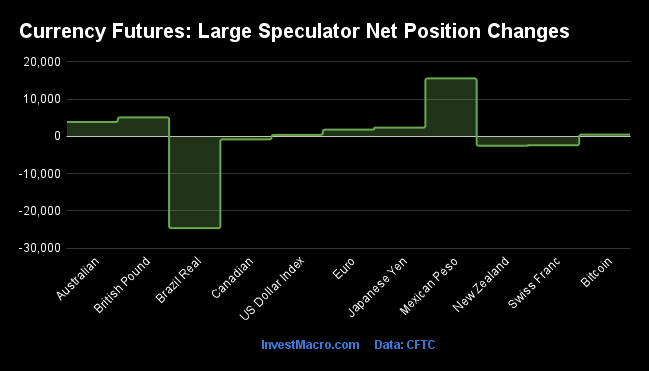
The COT currency market speculator bets were higher this week as seven out of the eleven currency markets we cover had higher positioning while the other four markets had lower speculator contracts.

Leading the gains for the currency markets was the British pound sterling (10,369 contracts) with the Japanese yen (4,230 contracts), the Mexican peso (3,667 contracts), the US Dollar Index (1,089 contracts), the Swiss franc (962 contracts), Bitcoin (889 contracts) and the Brazilian real (296 contracts) also showing a positive week.

The currencies leading the declines in speculator bets this week were the Euro (-6,183 contracts) with the New Zealand dollar (-5,064 contracts), the Canadian dollar (-4,265 contracts) and the Australian dollar (-3,507 contracts) also registering lower bets on the week.

Highlighting the COT currencies this week is the weakness for the commodity currencies. The Australian dollar, New Zealand dollar and the Canadian dollar all had lower speculator bets this week and are all firmly in negative territory at the moment.

The Canadian dollar speculator positions fell this week for the sixth consecutive week and have declined by a total of -49,851 contracts over that time-period. This recent weakness has brought the CAD bets to their most bearish level in 52 weeks, dating back to October 12th of 2021. The CAD exchange level has been sharply falling as well and dropped this week to its lowest level since May of 2020.

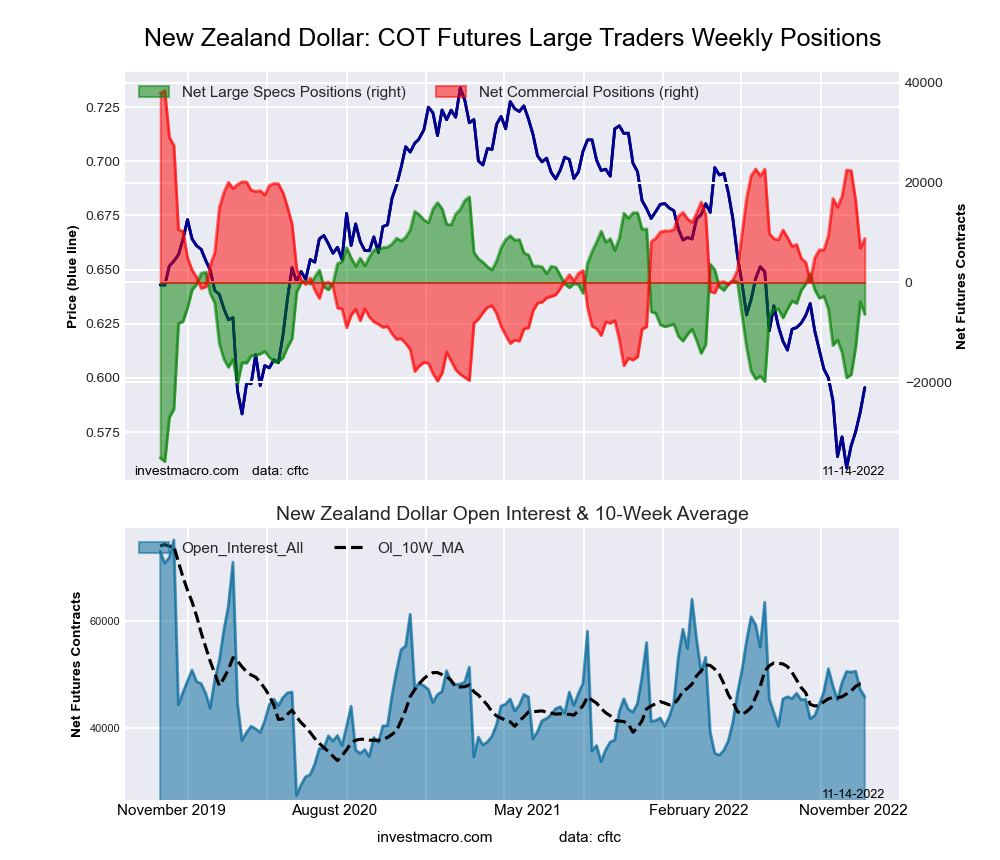
The New Zealand dollar positions declined for the second straight week and for the fourth time in the past five weeks. Speculators have now pushed their overall net positioning (-19,042 contracts) to the most bearish level in the past 18 weeks, dating back to June 7th. NZD spec positions have been bearish for twenty-three out of the last twenty-four weeks. The New Zealand dollar price has been on the defensive and has, in particular, been dropping sharply over the past six weeks (over -500 pips). The NZDUSD currency pair this week also touched the lowest level since the pandemic lows of March 2020 below the 0.5600 exchange rate.

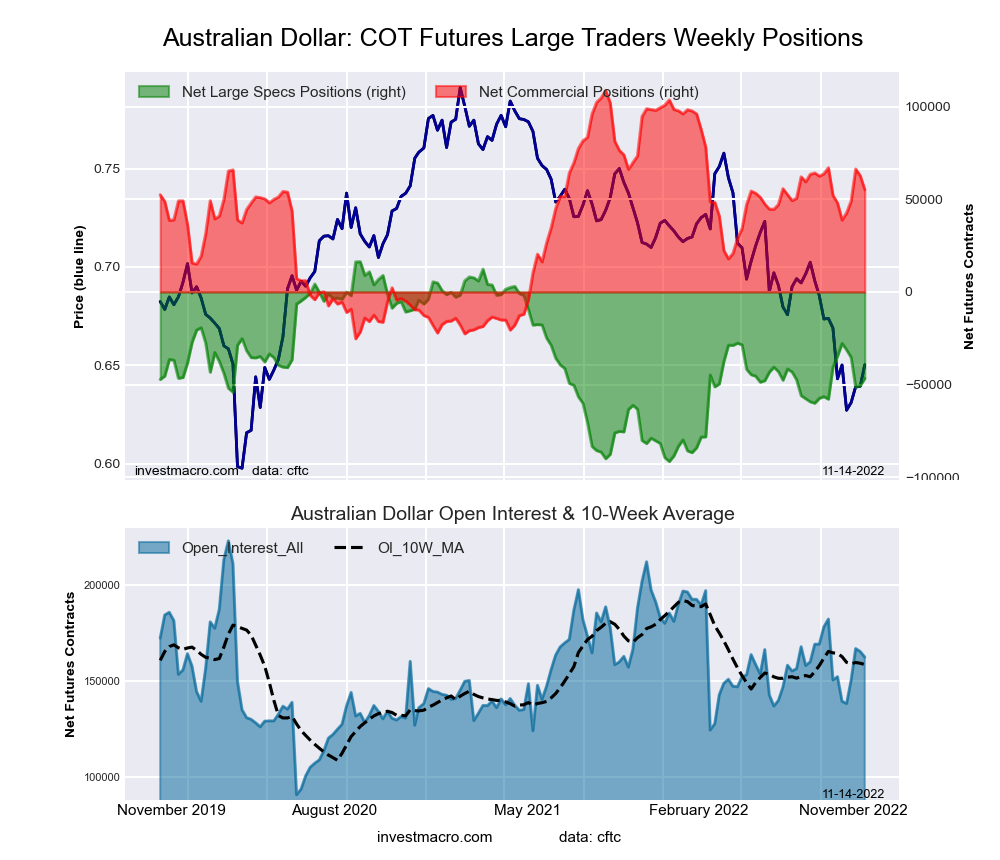
The Australian dollar spec positioning, meanwhile, fell this week for the first time in four weeks. Aussie speculator positions have now been in a continuous bearish level for 73 straight weeks, dating back to May 18th of 2021. Although the current positioning (-31,271 contracts) is near the lower end of the bearish range that has seen levels above -80,000 contracts, the AUD currency price has also been dropping. The AUDUSD currency pair has fallen for five straight weeks and hit its lowest level against the US dollar since April of 2020.

All three of these currencies are currently oversold against the US dollar on the weekly Relative Strength Index (RSI) and worth watching for potential peaks in the weeks and months ahead.


Data Snapshot of Forex Market Traders | Columns Legend
Oct-11-2022OIOI-IndexSpec-NetSpec-IndexCom-NetCOM-IndexSmalls-NetSmalls-Index
USD Index54,6157732,78680-36,847174,06161
EUR639,3485237,49947-60,1615922,66215
GBP255,64971-39,1703564,80478-25,6348
JPY245,00777-77,3932194,44982-17,05619
CHF43,74828-5,8904217,98372-12,09317
CAD144,00026-25,6721127,36692-1,69427
AUD138,32036-31,2715642,69251-11,42125
NZD50,55745-19,0423722,51767-3,47512
MXN206,17052-33,6541327,839845,81568
RUB20,93047,54331-7,15069-39324
BRL41,3602826,07576-27,966241,89187
Bitcoin15,7569385792-1,077022018


Strength Scores led by Bitcoin, US Dollar Index & Brazilian Real

Strength Scores (a normalized measure of Speculator positions over a 3-Year range, from 0 to 100 where above 80 is extreme bullish and below 20 is extreme bearish) showed that Bitcoin (91.9 percent) jumped back to lead the currency markets and is in a bullish extreme position above 80 percent. The US Dollar Index (79.6 percent) and the Brazilian Real (76.0 percent) come in as the next highest in the currency markets for strength scores.

On the downside, the Canadian Dollar (10.5 percent) and the Mexican Peso (13.0 percent) come in at the lowest strength level currently and are both in extreme bearish positions this week.

Strength Statistics:
US Dollar Index (79.6 percent) vs US Dollar Index previous week (77.8 percent)
EuroFX (46.5 percent) vs EuroFX previous week (48.4 percent)
British Pound Sterling (35.4 percent) vs British Pound Sterling previous week (26.5 percent)
Japanese Yen (21.2 percent) vs Japanese Yen previous week (18.6 percent)
Swiss Franc (41.6 percent) vs Swiss Franc previous week (39.1 percent)
Canadian Dollar (10.5 percent) vs Canadian Dollar previous week (15.3 percent)
Australian Dollar (55.8 percent) vs Australian Dollar previous week (59.1 percent)
New Zealand Dollar (37.1 percent) vs New Zealand Dollar previous week (45.9 percent)
Mexican Peso (13.0 percent) vs Mexican Peso previous week (11.4 percent)
Brazilian Real (76.0 percent) vs Brazilian Real previous week (75.7 percent)
Bitcoin (91.9 percent) vs Bitcoin previous week (76.4 percent)

Strength Trends led by EuroFX, Australian Dollar &

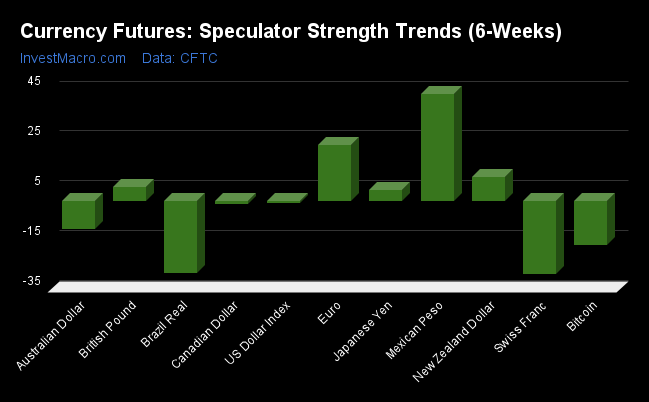
Strength Score Trends (or move index, calculates the 6-week changes in strength scores) show that the EuroFX (26.1 percent) leads the past six weeks trends for the currency markets this week. The Australian Dollar (24.2 percent) and the Brazilian Real (16.9 percent) fill out the next top movers in the latest trends data.

The Canadian Dollar (-56.0 percent) leads the downside trend scores currently while the next markets with lower trend scores were the New Zealand Dollar (-27.7 percent) and the Japanese Yen (-22.1 percent).

Strength Trend Statistics:
US Dollar Index (-4.6 percent) vs US Dollar Index previous week (-5.7 percent)
EuroFX (26.1 percent) vs EuroFX previous week (26.9 percent)
British Pound Sterling (-8.6 percent) vs British Pound Sterling previous week (-18.5 percent)
Japanese Yen (-22.1 percent) vs Japanese Yen previous week (-26.4 percent)
Swiss Franc (-9.2 percent) vs Swiss Franc previous week (-11.3 percent)
Canadian Dollar (-56.0 percent) vs Canadian Dollar previous week (-50.1 percent)
Australian Dollar (24.2 percent) vs Australian Dollar previous week (29.9 percent)
New Zealand Dollar (-27.7 percent) vs New Zealand Dollar previous week (-21.7 percent)
Mexican Peso (-2.0 percent) vs Mexican Peso previous week (-2.6 percent)
Brazilian Real (16.9 percent) vs Brazilian Real previous week (19.1 percent)
Bitcoin (-7.7 percent) vs Bitcoin previous week (-17.4 percent)


Individual COT Forex Markets:

US Dollar Index Futures:

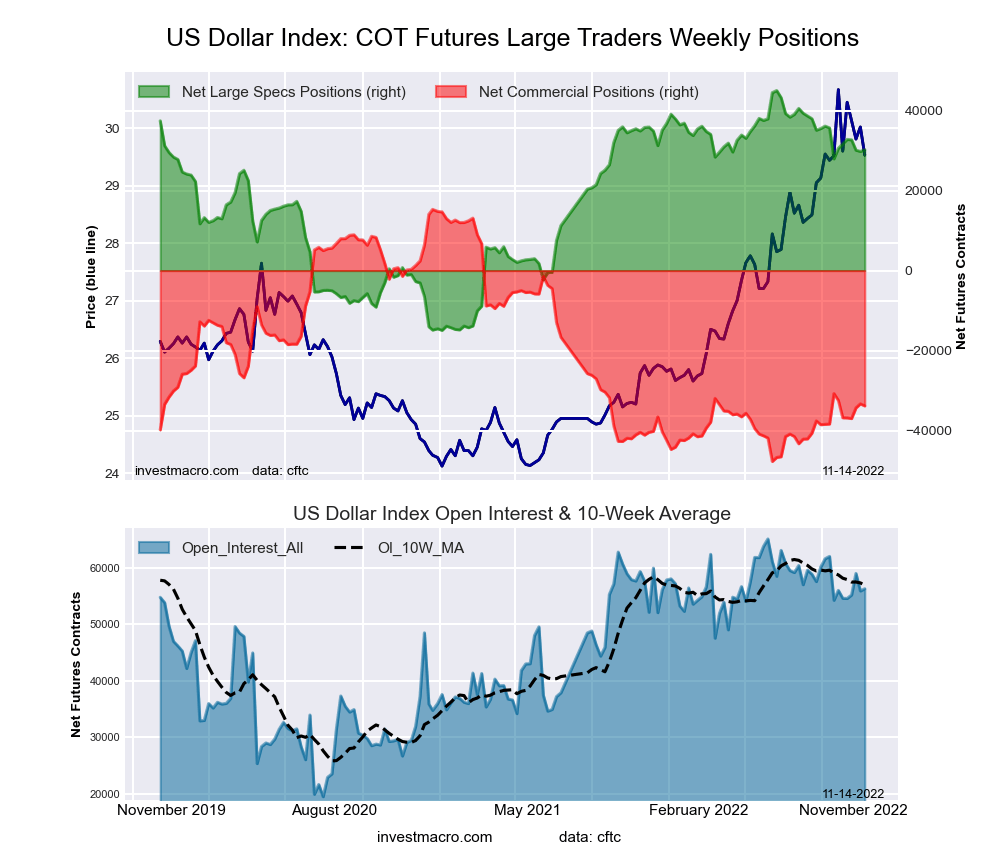
US Dollar Index Forex Futures COT ChartThe US Dollar Index large speculator standing this week totaled a net position of 32,786 contracts in the data reported through Tuesday. This was a weekly lift of 1,089 contracts from the previous week which had a total of 31,697 net contracts.

This week’s current strength score (the trader positioning range over the past three years, measured from 0 to 100) shows the speculators are currently Bullish with a score of 79.6 percent. The commercials are Bearish-Extreme with a score of 17.3 percent and the small traders (not shown in chart) are Bullish with a score of 60.9 percent.

US DOLLAR INDEX StatisticsSPECULATORSCOMMERCIALSSMALL TRADERS
– Percent of Open Interest Longs:82.53.112.0
– Percent of Open Interest Shorts:22.570.64.6
– Net Position:32,786-36,8474,061
– Gross Longs:45,0791,7086,563
– Gross Shorts:12,29338,5552,502
– Long to Short Ratio:3.7 to 10.0 to 12.6 to 1
NET POSITION TREND:
– Strength Index Score (3 Year Range Pct):79.617.360.9
– Strength Index Reading (3 Year Range):BullishBearish-ExtremeBullish
NET POSITION MOVEMENT INDEX:
– 6-Week Change in Strength Index:-4.62.711.4


Euro Currency Futures:

Euro Currency Futures COT ChartThe Euro Currency large speculator standing this week totaled a net position of 37,499 contracts in the data reported through Tuesday. This was a weekly decline of -6,183 contracts from the previous week which had a total of 43,682 net contracts.

This week’s current strength score (the trader positioning range over the past three years, measured from 0 to 100) shows the speculators are currently Bearish with a score of 46.5 percent. The commercials are Bullish with a score of 59.0 percent and the small traders (not shown in chart) are Bearish-Extreme with a score of 15.1 percent.

EURO Currency StatisticsSPECULATORSCOMMERCIALSSMALL TRADERS
– Percent of Open Interest Longs:30.754.612.0
– Percent of Open Interest Shorts:24.864.08.4
– Net Position:37,499-60,16122,662
– Gross Longs:196,136349,09176,656
– Gross Shorts:158,637409,25253,994
– Long to Short Ratio:1.2 to 10.9 to 11.4 to 1
NET POSITION TREND:
– Strength Index Score (3 Year Range Pct):46.559.015.1
– Strength Index Reading (3 Year Range):BearishBullishBearish-Extreme
NET POSITION MOVEMENT INDEX:
– 6-Week Change in Strength Index:26.1-25.36.1


British Pound Sterling Futures:

British Pound Sterling Futures COT ChartThe British Pound Sterling large speculator standing this week totaled a net position of -39,170 contracts in the data reported through Tuesday. This was a weekly advance of 10,369 contracts from the previous week which had a total of -49,539 net contracts.

This week’s current strength score (the trader positioning range over the past three years, measured from 0 to 100) shows the speculators are currently Bearish with a score of 35.4 percent. The commercials are Bullish with a score of 78.1 percent and the small traders (not shown in chart) are Bearish-Extreme with a score of 7.7 percent.

BRITISH POUND StatisticsSPECULATORSCOMMERCIALSSMALL TRADERS
– Percent of Open Interest Longs:19.270.37.7
– Percent of Open Interest Shorts:34.544.917.7
– Net Position:-39,17064,804-25,634
– Gross Longs:48,979179,70019,620
– Gross Shorts:88,149114,89645,254
– Long to Short Ratio:0.6 to 11.6 to 10.4 to 1
NET POSITION TREND:
– Strength Index Score (3 Year Range Pct):35.478.17.7
– Strength Index Reading (3 Year Range):BearishBullishBearish-Extreme
NET POSITION MOVEMENT INDEX:
– 6-Week Change in Strength Index:-8.69.0-6.5


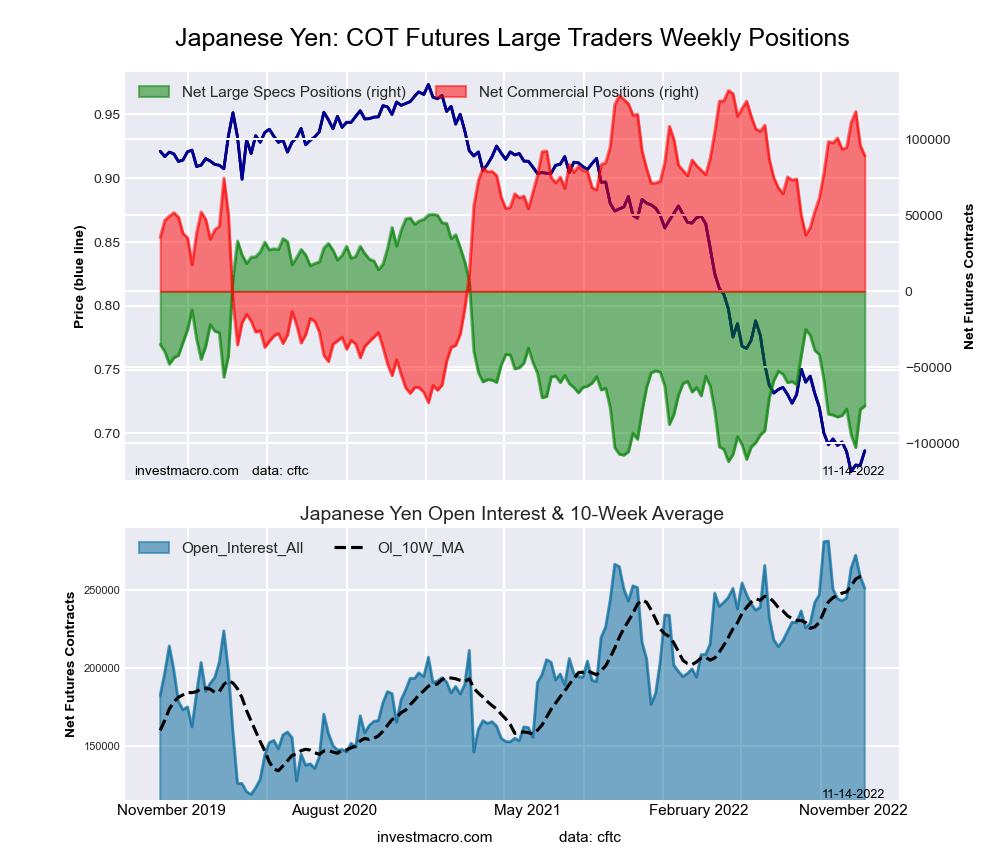
Japanese Yen Futures:

Japanese Yen Forex Futures COT ChartThe Japanese Yen large speculator standing this week totaled a net position of -77,393 contracts in the data reported through Tuesday. This was a weekly advance of 4,230 contracts from the previous week which had a total of -81,623 net contracts.

This week’s current strength score (the trader positioning range over the past three years, measured from 0 to 100) shows the speculators are currently Bearish with a score of 21.2 percent. The commercials are Bullish-Extreme with a score of 81.7 percent and the small traders (not shown in chart) are Bearish-Extreme with a score of 18.8 percent.

JAPANESE YEN StatisticsSPECULATORSCOMMERCIALSSMALL TRADERS
– Percent of Open Interest Longs:12.376.410.0
– Percent of Open Interest Shorts:43.937.817.0
– Net Position:-77,39394,449-17,056
– Gross Longs:30,149187,11924,526
– Gross Shorts:107,54292,67041,582
– Long to Short Ratio:0.3 to 12.0 to 10.6 to 1
NET POSITION TREND:
– Strength Index Score (3 Year Range Pct):21.281.718.8
– Strength Index Reading (3 Year Range):BearishBullish-ExtremeBearish-Extreme
NET POSITION MOVEMENT INDEX:
– 6-Week Change in Strength Index:-22.116.25.5


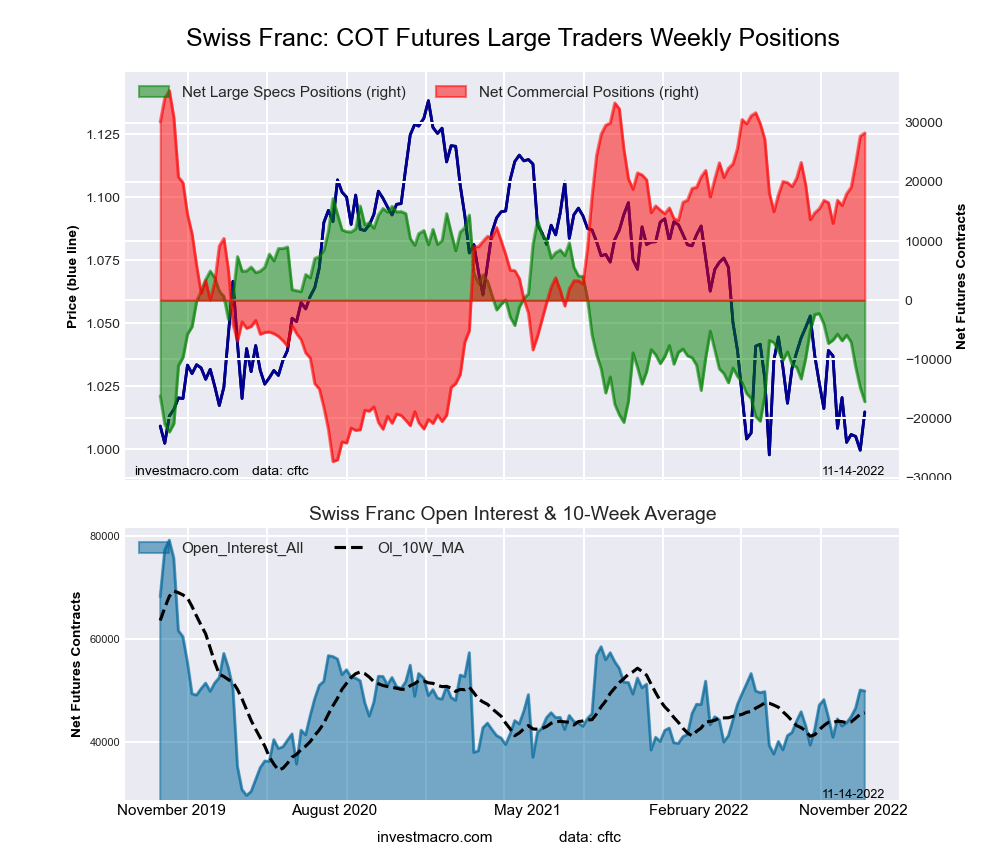
Swiss Franc Futures:

Swiss Franc Forex Futures COT ChartThe Swiss Franc large speculator standing this week totaled a net position of -5,890 contracts in the data reported through Tuesday. This was a weekly boost of 962 contracts from the previous week which had a total of -6,852 net contracts.

This week’s current strength score (the trader positioning range over the past three years, measured from 0 to 100) shows the speculators are currently Bearish with a score of 41.6 percent. The commercials are Bullish with a score of 72.2 percent and the small traders (not shown in chart) are Bearish-Extreme with a score of 16.6 percent.

SWISS FRANC StatisticsSPECULATORSCOMMERCIALSSMALL TRADERS
– Percent of Open Interest Longs:12.667.320.0
– Percent of Open Interest Shorts:26.026.247.7
– Net Position:-5,89017,983-12,093
– Gross Longs:5,50129,4368,770
– Gross Shorts:11,39111,45320,863
– Long to Short Ratio:0.5 to 12.6 to 10.4 to 1
NET POSITION TREND:
– Strength Index Score (3 Year Range Pct):41.672.216.6
– Strength Index Reading (3 Year Range):BearishBullishBearish-Extreme
NET POSITION MOVEMENT INDEX:
– 6-Week Change in Strength Index:-9.24.03.8


Canadian Dollar Futures:

Canadian Dollar Forex Futures COT ChartThe Canadian Dollar large speculator standing this week totaled a net position of -25,672 contracts in the data reported through Tuesday. This was a weekly decline of -4,265 contracts from the previous week which had a total of -21,407 net contracts.

This week’s current strength score (the trader positioning range over the past three years, measured from 0 to 100) shows the speculators are currently Bearish-Extreme with a score of 10.5 percent. The commercials are Bullish-Extreme with a score of 91.5 percent and the small traders (not shown in chart) are Bearish with a score of 26.7 percent.

CANADIAN DOLLAR StatisticsSPECULATORSCOMMERCIALSSMALL TRADERS
– Percent of Open Interest Longs:22.654.121.6
– Percent of Open Interest Shorts:40.435.122.8
– Net Position:-25,67227,366-1,694
– Gross Longs:32,47677,92931,136
– Gross Shorts:58,14850,56332,830
– Long to Short Ratio:0.6 to 11.5 to 10.9 to 1
NET POSITION TREND:
– Strength Index Score (3 Year Range Pct):10.591.526.7
– Strength Index Reading (3 Year Range):Bearish-ExtremeBullish-ExtremeBearish
NET POSITION MOVEMENT INDEX:
– 6-Week Change in Strength Index:-56.047.0-13.2


Australian Dollar Futures:

Australian Dollar Forex Futures COT ChartThe Australian Dollar large speculator standing this week totaled a net position of -31,271 contracts in the data reported through Tuesday. This was a weekly decrease of -3,507 contracts from the previous week which had a total of -27,764 net contracts.

This week’s current strength score (the trader positioning range over the past three years, measured from 0 to 100) shows the speculators are currently Bullish with a score of 55.8 percent. The commercials are Bullish with a score of 50.7 percent and the small traders (not shown in chart) are Bearish with a score of 24.6 percent.

AUSTRALIAN DOLLAR StatisticsSPECULATORSCOMMERCIALSSMALL TRADERS
– Percent of Open Interest Longs:21.262.513.2
– Percent of Open Interest Shorts:43.831.721.4
– Net Position:-31,27142,692-11,421
– Gross Longs:29,32586,47518,245
– Gross Shorts:60,59643,78329,666
– Long to Short Ratio:0.5 to 12.0 to 10.6 to 1
NET POSITION TREND:
– Strength Index Score (3 Year Range Pct):55.850.724.6
– Strength Index Reading (3 Year Range):BullishBullishBearish
NET POSITION MOVEMENT INDEX:
– 6-Week Change in Strength Index:24.2-14.8-15.4


New Zealand Dollar Futures:

New Zealand Dollar Forex Futures COT ChartThe New Zealand Dollar large speculator standing this week totaled a net position of -19,042 contracts in the data reported through Tuesday. This was a weekly decline of -5,064 contracts from the previous week which had a total of -13,978 net contracts.

This week’s current strength score (the trader positioning range over the past three years, measured from 0 to 100) shows the speculators are currently Bearish with a score of 37.1 percent. The commercials are Bullish with a score of 66.9 percent and the small traders (not shown in chart) are Bearish-Extreme with a score of 11.7 percent.

NEW ZEALAND DOLLAR StatisticsSPECULATORSCOMMERCIALSSMALL TRADERS
– Percent of Open Interest Longs:23.570.95.5
– Percent of Open Interest Shorts:61.226.312.4
– Net Position:-19,04222,517-3,475
– Gross Longs:11,89435,8342,771
– Gross Shorts:30,93613,3176,246
– Long to Short Ratio:0.4 to 12.7 to 10.4 to 1
NET POSITION TREND:
– Strength Index Score (3 Year Range Pct):37.166.911.7
– Strength Index Reading (3 Year Range):BearishBullishBearish-Extreme
NET POSITION MOVEMENT INDEX:
– 6-Week Change in Strength Index:-27.725.3-0.8


Mexican Peso Futures:

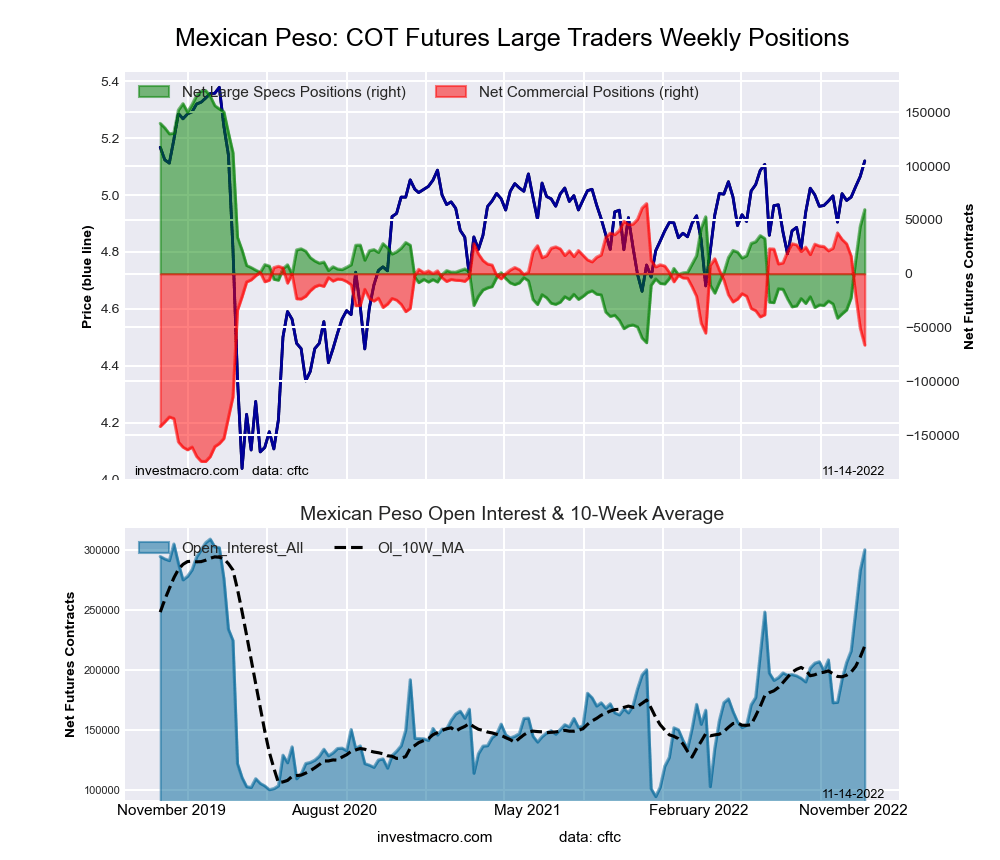
Mexican Peso Futures COT ChartThe Mexican Peso large speculator standing this week totaled a net position of -33,654 contracts in the data reported through Tuesday. This was a weekly gain of 3,667 contracts from the previous week which had a total of -37,321 net contracts.

This week’s current strength score (the trader positioning range over the past three years, measured from 0 to 100) shows the speculators are currently Bearish-Extreme with a score of 13.0 percent. The commercials are Bullish-Extreme with a score of 84.4 percent and the small traders (not shown in chart) are Bullish with a score of 67.7 percent.

MEXICAN PESO StatisticsSPECULATORSCOMMERCIALSSMALL TRADERS
– Percent of Open Interest Longs:58.337.54.0
– Percent of Open Interest Shorts:74.624.01.2
– Net Position:-33,65427,8395,815
– Gross Longs:120,23977,3938,294
– Gross Shorts:153,89349,5542,479
– Long to Short Ratio:0.8 to 11.6 to 13.3 to 1
NET POSITION TREND:
– Strength Index Score (3 Year Range Pct):13.084.467.7
– Strength Index Reading (3 Year Range):Bearish-ExtremeBullish-ExtremeBullish
NET POSITION MOVEMENT INDEX:
– 6-Week Change in Strength Index:-2.00.910.8


Brazilian Real Futures:

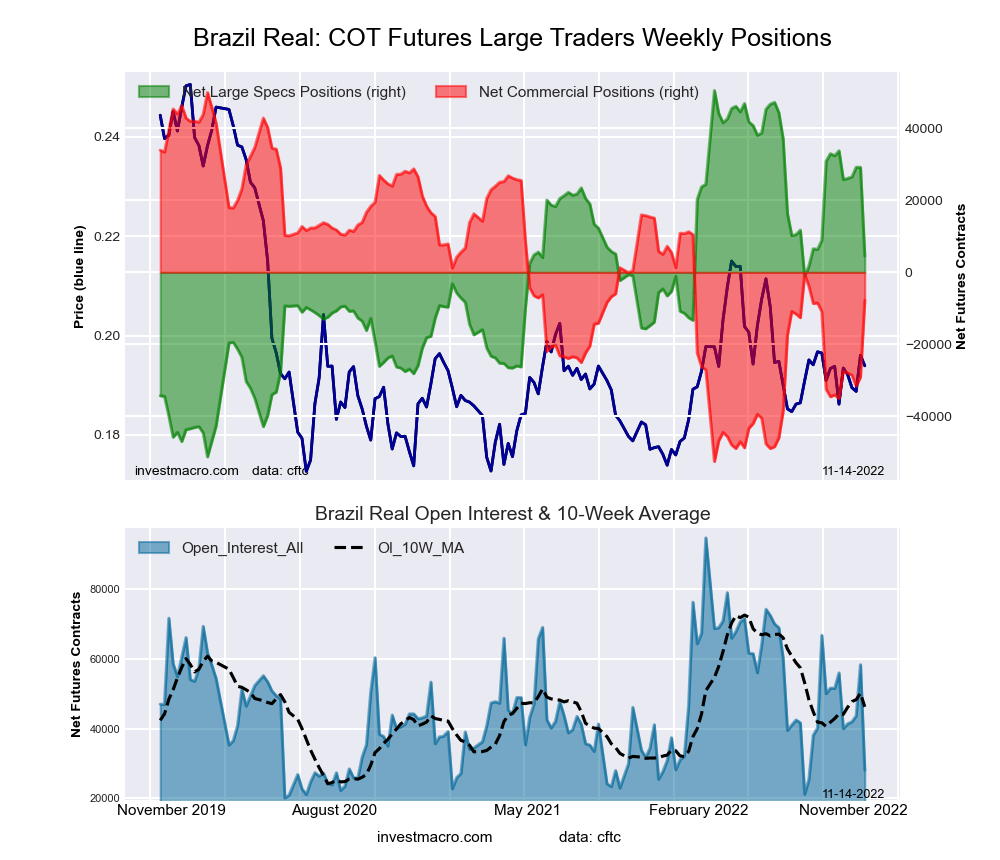
Brazil Real Futures COT ChartThe Brazilian Real large speculator standing this week totaled a net position of 26,075 contracts in the data reported through Tuesday. This was a weekly increase of 296 contracts from the previous week which had a total of 25,779 net contracts.

This week’s current strength score (the trader positioning range over the past three years, measured from 0 to 100) shows the speculators are currently Bullish with a score of 76.0 percent. The commercials are Bearish with a score of 24.0 percent and the small traders (not shown in chart) are Bullish-Extreme with a score of 86.9 percent.

BRAZIL REAL StatisticsSPECULATORSCOMMERCIALSSMALL TRADERS
– Percent of Open Interest Longs:69.721.07.7
– Percent of Open Interest Shorts:6.788.63.1
– Net Position:26,075-27,9661,891
– Gross Longs:28,8298,6973,182
– Gross Shorts:2,75436,6631,291
– Long to Short Ratio:10.5 to 10.2 to 12.5 to 1
NET POSITION TREND:
– Strength Index Score (3 Year Range Pct):76.024.086.9
– Strength Index Reading (3 Year Range):BullishBearishBullish-Extreme
NET POSITION MOVEMENT INDEX:
– 6-Week Change in Strength Index:16.9-16.6-2.0


Bitcoin Futures:

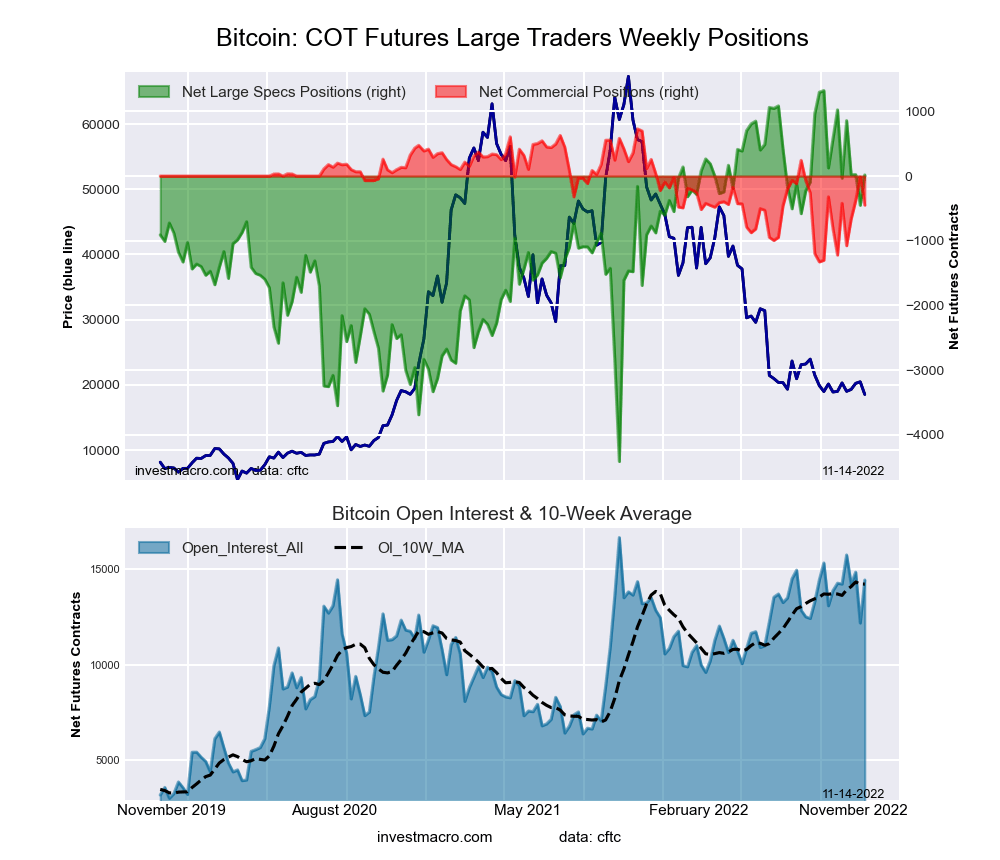
Bitcoin Crypto Futures COT ChartThe Bitcoin large speculator standing this week totaled a net position of 857 contracts in the data reported through Tuesday. This was a weekly increase of 889 contracts from the previous week which had a total of -32 net contracts.

This week’s current strength score (the trader positioning range over the past three years, measured from 0 to 100) shows the speculators are currently Bullish-Extreme with a score of 91.9 percent. The commercials are Bearish-Extreme with a score of 12.2 percent and the small traders (not shown in chart) are Bearish-Extreme with a score of 17.9 percent.

BITCOIN StatisticsSPECULATORSCOMMERCIALSSMALL TRADERS
– Percent of Open Interest Longs:80.60.26.4
– Percent of Open Interest Shorts:75.27.05.0
– Net Position:857-1,077220
– Gross Longs:12,704331,007
– Gross Shorts:11,8471,110787
– Long to Short Ratio:1.1 to 10.0 to 11.3 to 1
NET POSITION TREND:
– Strength Index Score (3 Year Range Pct):91.912.217.9
– Strength Index Reading (3 Year Range):Bullish-ExtremeBearish-ExtremeBearish-Extreme
NET POSITION MOVEMENT INDEX:
– 6-Week Change in Strength Index:-7.712.24.3


Article By InvestMacroReceive our weekly COT Newsletter

*COT Report: The COT data, released weekly to the public each Friday, is updated through the most recent Tuesday (data is 3 days old) and shows a quick view of how large speculators or non-commercials (for-profit traders) were positioned in the futures markets.

The CFTC categorizes trader positions according to commercial hedgers (traders who use futures contracts for hedging as part of the business), non-commercials (large traders who speculate to realize trading profits) and nonreportable traders (usually small traders/speculators) as well as their open interest (contracts open in the market at time of reporting). See CFTC criteria here.

Bonds Speculators add to 2-Year Treasury Bonds bearish bets

By InvestMacro

Here are the latest charts and statistics for the Commitment of Traders (COT) reports data published by the Commodities Futures Trading Commission (CFTC).

The latest COT data is updated through Tuesday October 11th and shows a quick view of how large traders (for-profit speculators and commercial hedgers) were positioned in the futures markets.

10-Year Bond & Ultra US Bond lead Weekly Speculator Changes

The COT bond market speculator bets were higher this week as five out of the eight bond markets we cover had higher positioning this week while two markets had lower contracts.

Leading the weekly gains for the bond market was the 10-Year Bond (26,709 contracts) with the Ultra US Bond (26,591 contracts), the Long US Bond (19,731 contracts), the Fed Funds (7,692 contracts) and the Ultra 10-Year (6,320 contracts) also showing positive weeks.

The bond market leading the weekly declines in speculator bets this week was the Eurodollar (-55,468 contracts) with the 2-Year Bond (-47,552 contracts) and the 5-Year Bond (-888 contracts) also registering lower bets on the week.

Highlighting the COT bonds data this week is the bearishness of the 2-Year Bond market. Speculators added over -47,000 contracts this week to the overall bearish position. The decline in the 2-Year this week follows three straight weeks of lessening bearish levels. This bearish reboot pushed the overall bearish standing up to -353,686 total net contracts which is the most in five weeks and the second highest in past 79 weeks. The 2-Year is feeling the brunt of the US Federal Reserve’s interest rate hiking campaign (to subdue inflation) and will likely not get a reprieve any time soon with inflation coming in higher again this week. The 2-Year yield (as bond prices fall, yields rise) ended the week at just under 4.50 percent and significantly higher from a 2-Year yield of just 0.38 percent on October 15th of 2021, exactly one year ago today.


Data Snapshot of Bond Market Traders | Columns Legend
Oct-11-2022OIOI-IndexSpec-NetSpec-IndexCom-NetCOM-IndexSmalls-NetSmalls-Index
Eurodollar8,129,6820-2,143,216142,373,77583-230,55954
FedFunds1,617,720508884022,18363-23,0711
2-Year2,045,92312-353,68611443,750100-90,06412
Long T-Bond1,211,22945-83,7925756,1573127,63575
10-Year3,873,98656-340,16321392,17168-52,00868
5-Year4,040,58354-483,92012601,68587-117,76549


US Treasury Bond leads the Strength Scores

Strength Scores (a normalized measure of Speculator positions over a 3-Year range, from 0 to 100 where above 80 is extreme bullish and below 20 is extreme bearish) show that the US Treasury Bond (57.3 percent) lead the bonds category. This is the only market above 50 percent or the midpoint of its 3-year range. The Ultra US Treasury Bond (42.3 percent) comes in as the next highest bonds market in strength scores and its score this week has risen from 31.5 percent last week.

On the downside, the Ultra 10-Year Bond (9.1 percent), the 2-Year Bond (10.8 percent), the 5-Year Bond (12.3 percent) and the Eurodollar (13.7 percent) come in at the lowest strength level currently and are all in bearish extreme speculator levels (below 20 percent).

Strength Statistics:
Fed Funds (39.7 percent) vs Fed Funds previous week (38.8 percent)
2-Year Bond (10.8 percent) vs 2-Year Bond previous week (20.4 percent)
5-Year Bond (12.3 percent) vs 5-Year Bond previous week (12.5 percent)
10-Year Bond (20.7 percent) vs 10-Year Bond previous week (16.7 percent)
Ultra 10-Year Bond (9.1 percent) vs Ultra 10-Year Bond previous week (7.4 percent)
US Treasury Bond (57.3 percent) vs US Treasury Bond previous week (50.9 percent)
Ultra US Treasury Bond (42.3 percent) vs Ultra US Treasury Bond previous week (31.5 percent)
Eurodollar (13.7 percent) vs Eurodollar previous week (14.7 percent)

Strength Trends led by 10-Year Bond

Strength Score Trends (or move index, calculates the 6-week changes in strength scores) show that the 10-Year Bond (15.2 percent) leads the past six weeks trends for bonds this week. The Eurodollar (13.2 percent), the 5-Year Bond (12.3 percent) and the Ultra US Treasury Bond (2.3 percent) fill out the rest of the positive movers in the latest trends data.

The Ultra 10-Year Bond (-15.0 percent) and the 2-Year Bond (-14.6 percent) lead the downside trend scores this week followed by the Fed Funds (-10.4 percent).

Strength Trend Statistics:
Fed Funds (-10.4 percent) vs Fed Funds previous week (-13.5 percent)
2-Year Bond (-14.6 percent) vs 2-Year Bond previous week (-13.1 percent)
5-Year Bond (12.3 percent) vs 5-Year Bond previous week (3.1 percent)
10-Year Bond (15.2 percent) vs 10-Year Bond previous week (2.2 percent)
Ultra 10-Year Bond (-15.0 percent) vs Ultra 10-Year Bond previous week (-14.8 percent)
US Treasury Bond (-4.9 percent) vs US Treasury Bond previous week (-17.0 percent)
Ultra US Treasury Bond (2.3 percent) vs Ultra US Treasury Bond previous week (-0.2 percent)
Eurodollar (13.2 percent) vs Eurodollar previous week (14.6 percent)


Individual Bond Markets:

3-Month Eurodollars Futures:

Eurodollar Bonds Futures COT ChartThe 3-Month Eurodollars large speculator standing this week recorded a net position of -2,143,216 contracts in the data reported through Tuesday. This was a weekly decrease of -55,468 contracts from the previous week which had a total of -2,087,748 net contracts.

This week’s current strength score (the trader positioning range over the past three years, measured from 0 to 100) shows the speculators are currently Bearish-Extreme with a score of 13.7 percent. The commercials are Bullish-Extreme with a score of 83.5 percent and the small traders (not shown in chart) are Bullish with a score of 53.7 percent.

3-Month Eurodollars StatisticsSPECULATORSCOMMERCIALSSMALL TRADERS
– Percent of Open Interest Longs:7.369.45.1
– Percent of Open Interest Shorts:33.640.27.9
– Net Position:-2,143,2162,373,775-230,559
– Gross Longs:591,0905,639,550411,933
– Gross Shorts:2,734,3063,265,775642,492
– Long to Short Ratio:0.2 to 11.7 to 10.6 to 1
NET POSITION TREND:
– Strength Index Score (3 Year Range Pct):13.783.553.7
– Strength Index Reading (3 Year Range):Bearish-ExtremeBullish-ExtremeBullish
NET POSITION MOVEMENT INDEX:
– 6-Week Change in Strength Index:13.2-12.1-7.6


30-Day Federal Funds Futures:

Federal Funds 30-Day Bonds Futures COT ChartThe 30-Day Federal Funds large speculator standing this week recorded a net position of 888 contracts in the data reported through Tuesday. This was a weekly rise of 7,692 contracts from the previous week which had a total of -6,804 net contracts.

This week’s current strength score (the trader positioning range over the past three years, measured from 0 to 100) shows the speculators are currently Bearish with a score of 39.7 percent. The commercials are Bullish with a score of 62.6 percent and the small traders (not shown in chart) are Bearish-Extreme with a score of 0.9 percent.

30-Day Federal Funds StatisticsSPECULATORSCOMMERCIALSSMALL TRADERS
– Percent of Open Interest Longs:10.773.31.4
– Percent of Open Interest Shorts:10.671.92.8
– Net Position:88822,183-23,071
– Gross Longs:172,3271,185,07322,805
– Gross Shorts:171,4391,162,89045,876
– Long to Short Ratio:1.0 to 11.0 to 10.5 to 1
NET POSITION TREND:
– Strength Index Score (3 Year Range Pct):39.762.60.9
– Strength Index Reading (3 Year Range):BearishBullishBearish-Extreme
NET POSITION MOVEMENT INDEX:
– 6-Week Change in Strength Index:-10.412.2-42.1


2-Year Treasury Note Futures:

2-Year Treasury Bonds Futures COT ChartThe 2-Year Treasury Note large speculator standing this week recorded a net position of -353,686 contracts in the cot data reported through Tuesday. This was a weekly lowering of -47,552 contracts from the previous week which had a total of -306,134 net contracts.

This week’s current strength score (the trader positioning range over the past three years, measured from 0 to 100) shows the speculators are currently Bearish-Extreme with a score of 10.8 percent. The commercials are Bullish-Extreme with a score of 100.0 percent and the small traders (not shown in chart) are Bearish-Extreme with a score of 11.8 percent.

2-Year Treasury Note StatisticsSPECULATORSCOMMERCIALSSMALL TRADERS
– Percent of Open Interest Longs:7.082.77.9
– Percent of Open Interest Shorts:24.361.112.3
– Net Position:-353,686443,750-90,064
– Gross Longs:143,2771,692,889160,698
– Gross Shorts:496,9631,249,139250,762
– Long to Short Ratio:0.3 to 11.4 to 10.6 to 1
NET POSITION TREND:
– Strength Index Score (3 Year Range Pct):10.8100.011.8
– Strength Index Reading (3 Year Range):Bearish-ExtremeBullish-ExtremeBearish-Extreme
NET POSITION MOVEMENT INDEX:
– 6-Week Change in Strength Index:-14.618.5-10.4


5-Year Treasury Note Futures:

5-Year Treasury Bonds Futures COT ChartThe 5-Year Treasury Note large speculator standing this week recorded a net position of -483,920 contracts in the data reported through Tuesday. This was a weekly decline of -888 contracts from the previous week which had a total of -483,032 net contracts.

This week’s current strength score (the trader positioning range over the past three years, measured from 0 to 100) shows the speculators are currently Bearish-Extreme with a score of 12.3 percent. The commercials are Bullish-Extreme with a score of 86.6 percent and the small traders (not shown in chart) are Bearish with a score of 48.6 percent.

5-Year Treasury Note StatisticsSPECULATORSCOMMERCIALSSMALL TRADERS
– Percent of Open Interest Longs:6.085.57.5
– Percent of Open Interest Shorts:18.070.610.4
– Net Position:-483,920601,685-117,765
– Gross Longs:243,7723,456,189303,741
– Gross Shorts:727,6922,854,504421,506
– Long to Short Ratio:0.3 to 11.2 to 10.7 to 1
NET POSITION TREND:
– Strength Index Score (3 Year Range Pct):12.386.648.6
– Strength Index Reading (3 Year Range):Bearish-ExtremeBullish-ExtremeBearish
NET POSITION MOVEMENT INDEX:
– 6-Week Change in Strength Index:12.3-11.33.1


10-Year Treasury Note Futures:

10-Year Treasury Notes Bonds Futures COT ChartThe 10-Year Treasury Note large speculator standing this week recorded a net position of -340,163 contracts in the data reported through Tuesday. This was a weekly rise of 26,709 contracts from the previous week which had a total of -366,872 net contracts.

This week’s current strength score (the trader positioning range over the past three years, measured from 0 to 100) shows the speculators are currently Bearish with a score of 20.7 percent. The commercials are Bullish with a score of 68.5 percent and the small traders (not shown in chart) are Bullish with a score of 67.7 percent.

10-Year Treasury Note StatisticsSPECULATORSCOMMERCIALSSMALL TRADERS
– Percent of Open Interest Longs:9.978.58.9
– Percent of Open Interest Shorts:18.768.310.3
– Net Position:-340,163392,171-52,008
– Gross Longs:382,9093,039,993345,964
– Gross Shorts:723,0722,647,822397,972
– Long to Short Ratio:0.5 to 11.1 to 10.9 to 1
NET POSITION TREND:
– Strength Index Score (3 Year Range Pct):20.768.567.7
– Strength Index Reading (3 Year Range):BearishBullishBullish
NET POSITION MOVEMENT INDEX:
– 6-Week Change in Strength Index:15.2-19.815.8


Ultra 10-Year Notes Futures:

Ultra 10-Year Treasury Notes Bonds Futures COT ChartThe Ultra 10-Year Notes large speculator standing this week recorded a net position of -75,771 contracts in the data reported through Tuesday. This was a weekly rise of 6,320 contracts from the previous week which had a total of -82,091 net contracts.

This week’s current strength score (the trader positioning range over the past three years, measured from 0 to 100) shows the speculators are currently Bearish-Extreme with a score of 9.1 percent. The commercials are Bullish-Extreme with a score of 87.0 percent and the small traders (not shown in chart) are Bullish with a score of 56.5 percent.

Ultra 10-Year Notes StatisticsSPECULATORSCOMMERCIALSSMALL TRADERS
– Percent of Open Interest Longs:7.981.410.0
– Percent of Open Interest Shorts:13.368.317.7
– Net Position:-75,771182,196-106,425
– Gross Longs:109,0931,127,822138,379
– Gross Shorts:184,864945,626244,804
– Long to Short Ratio:0.6 to 11.2 to 10.6 to 1
NET POSITION TREND:
– Strength Index Score (3 Year Range Pct):9.187.056.5
– Strength Index Reading (3 Year Range):Bearish-ExtremeBullish-ExtremeBullish
NET POSITION MOVEMENT INDEX:
– 6-Week Change in Strength Index:-15.014.70.2


US Treasury Bonds Futures:

US Year Treasury Notes Long Bonds Futures COT ChartThe US Treasury Bonds large speculator standing this week recorded a net position of -83,792 contracts in the data reported through Tuesday. This was a weekly rise of 19,731 contracts from the previous week which had a total of -103,523 net contracts.

This week’s current strength score (the trader positioning range over the past three years, measured from 0 to 100) shows the speculators are currently Bullish with a score of 57.3 percent. The commercials are Bearish with a score of 30.6 percent and the small traders (not shown in chart) are Bullish with a score of 74.5 percent.

US Treasury Bonds StatisticsSPECULATORSCOMMERCIALSSMALL TRADERS
– Percent of Open Interest Longs:6.778.513.8
– Percent of Open Interest Shorts:13.673.911.5
– Net Position:-83,79256,15727,635
– Gross Longs:81,465951,230166,967
– Gross Shorts:165,257895,073139,332
– Long to Short Ratio:0.5 to 11.1 to 11.2 to 1
NET POSITION TREND:
– Strength Index Score (3 Year Range Pct):57.330.674.5
– Strength Index Reading (3 Year Range):BullishBearishBullish
NET POSITION MOVEMENT INDEX:
– 6-Week Change in Strength Index:-4.95.5-0.3


Ultra US Treasury Bonds Futures:

Ultra US Year Treasury Notes Long Bonds Futures COT ChartThe Ultra US Treasury Bonds large speculator standing this week recorded a net position of -350,232 contracts in the data reported through Tuesday. This was a weekly advance of 26,591 contracts from the previous week which had a total of -376,823 net contracts.

This week’s current strength score (the trader positioning range over the past three years, measured from 0 to 100) shows the speculators are currently Bearish with a score of 42.3 percent. The commercials are Bullish with a score of 63.2 percent and the small traders (not shown in chart) are Bullish with a score of 62.0 percent.

Ultra US Treasury Bonds StatisticsSPECULATORSCOMMERCIALSSMALL TRADERS
– Percent of Open Interest Longs:6.282.011.2
– Percent of Open Interest Shorts:30.760.77.9
– Net Position:-350,232303,28346,949
– Gross Longs:88,1461,171,440160,022
– Gross Shorts:438,378868,157113,073
– Long to Short Ratio:0.2 to 11.3 to 11.4 to 1
NET POSITION TREND:
– Strength Index Score (3 Year Range Pct):42.363.262.0
– Strength Index Reading (3 Year Range):BearishBullishBullish
NET POSITION MOVEMENT INDEX:
– 6-Week Change in Strength Index:2.3-9.810.3


Article By InvestMacroReceive our weekly COT Newsletter

*COT Report: The COT data, released weekly to the public each Friday, is updated through the most recent Tuesday (data is 3 days old) and shows a quick view of how large speculators or non-commercials (for-profit traders) were positioned in the futures markets.

The CFTC categorizes trader positions according to commercial hedgers (traders who use futures contracts for hedging as part of the business), non-commercials (large traders who speculate to realize trading profits) and nonreportable traders (usually small traders/speculators) as well as their open interest (contracts open in the market at time of reporting). See CFTC criteria here.

COT Metals Speculators boost their Gold bullish bets 2nd week

By InvestMacro

Here are the latest charts and statistics for the Commitment of Traders (COT) data published by the Commodities Futures Trading Commission (CFTC).

The latest COT data is updated through Tuesday October 11th and shows a quick view of how large traders (for-profit speculators and commercial entities) were positioned in the futures markets.

Weekly Speculator Changes shows Gold, Platinum & Copper have higher bets

The COT precious metals speculator bets were higher this week as three out of the five metals markets we cover had higher positioning this week while two markets had lower contracts.

Leading the gains for the precious metals markets was Gold (6,035 contracts) with Platinum (2,647 contracts) and Copper (2,352 contracts) also showing a positive week.

The metals markets leading the declines in speculator bets this week were Silver (-1,319 contracts) with Palladium (-158 contracts) also registering lower bets on the week.

Highlighting the metals COT markets this week is the Gold positioning that has rebounded slightly from the steep declines over the past couple of months. Gold speculator bets rose for a second straight week this week after seeing a decline in the previous seven straight weeks (a total drop of -90,770 speculator contracts over that period). The Gold position, on September 27th, had fallen to the lowest level in the past 179-weeks before rebounding over the past two weeks. Last week’s rise in speculator bets by over +36,000 contracts was the largest one-week increase since February 18th of 2020 and today’s speculator positioning is now back close to the +100,000 contract level. Gold prices, meanwhile, are currently trading just below the $1,650 support level after falling over 3 percent this week. The price decline is potentially setting up a new test of the 2-year lows under $1,620 that took place in late September.


Data Snapshot of Commodity Market Traders | Columns Legend
Oct-11-2022OIOI-IndexSpec-NetSpec-IndexCom-NetCOM-IndexSmalls-NetSmalls-Index
WTI Crude1,499,4983259,22013-283,6268824,40641
Gold431,395094,42014-103,728879,3083
Silver125,62307,38922-15,603808,21410
Copper167,4498-15,8992416,90380-1,00419
Palladium6,8905-7541981079-5641
Platinum52,43595,92817-8,690852,7625
Natural Gas974,4685-162,10330130,0997232,00456
Brent163,11311-41,8884138,882583,00650
Heating Oil275,2622519,42371-38,4483019,02564
Soybeans694,9602655,76930-30,61477-25,15529
Corn1,408,93920325,12172-258,22535-66,8965
Coffee188,198340,53473-43,359302,82529
Sugar687,2090101,11557-135,1454334,03050
Wheat307,9019-1,990168,70572-6,71576


Silver and Copper top the Strength Scores

Strength scores (a measure of the 3-Year range of Speculator positions, from 0 to 100 where above 80 is extreme bullish and below 20 is extreme bearish) showed that the Copper (23.7 percent) and Silver (22.3 percent) lead the metals this week.

On the downside, Gold (14.0 percent), Platinum (17.1 percent) and Palladium (19.1 percent) continue to be at the lower end of their range and are all in bearish extreme positions below 20 percent.

Strength Statistics:
Gold (14.0 percent) vs Gold previous week (12.0 percent)
Silver (22.3 percent) vs Silver previous week (23.7 percent)
Copper (23.7 percent) vs Copper previous week (21.8 percent)
Platinum (17.1 percent) vs Platinum previous week (13.5 percent)
Palladium (19.1 percent) vs Palladium previous week (20.0 percent)

Strength Trends led Silver and Platinum

Strength Score Trends (or move index, calculates the 6-week changes in strength scores) show that the Silver (17.3 percent) and Platinum (15.2 percent) lead the past six weeks trends for metals this week. Copper (5.9 percent) and Palladium (2.2 percent) fill out the other positive movers in the latest trends data.

This leaves Gold (-7.7 percent) as the only negative mover over the past six weeks. Gold, however, has been seeing improvements in the past few weeks and is higher this week from -12.4 percent last week.

Move Statistics:
Gold (-7.7 percent) vs Gold previous week (-12.4 percent)
Silver (17.3 percent) vs Silver previous week (14.6 percent)
Copper (5.9 percent) vs Copper previous week (0.6 percent)
Platinum (15.2 percent) vs Platinum previous week (5.2 percent)
Palladium (2.2 percent) vs Palladium previous week (6.9 percent)


Individual Markets:

Gold Comex Futures:

Gold Futures COT ChartThe Gold Comex Futures large speculator standing this week came in at a net position of 94,420 contracts in the data reported through Tuesday. This was a weekly gain of 6,035 contracts from the previous week which had a total of 88,385 net contracts.

This week’s current strength score (the trader positioning range over the past three years, measured from 0 to 100) shows the speculators are currently Bearish-Extreme with a score of 14.0 percent. The commercials are Bullish-Extreme with a score of 87.1 percent and the small traders (not shown in chart) are Bearish-Extreme with a score of 2.9 percent.

Gold Futures StatisticsSPECULATORSCOMMERCIALSSMALL TRADERS
– Percent of Open Interest Longs:49.326.28.6
– Percent of Open Interest Shorts:27.450.26.4
– Net Position:94,420-103,7289,308
– Gross Longs:212,561112,86736,988
– Gross Shorts:118,141216,59527,680
– Long to Short Ratio:1.8 to 10.5 to 11.3 to 1
NET POSITION TREND:
– Strength Index Score (3 Year Range Pct):14.087.12.9
– Strength Index Reading (3 Year Range):Bearish-ExtremeBullish-ExtremeBearish-Extreme
NET POSITION MOVEMENT INDEX:
– 6-Week Change in Strength Index:-7.78.0-6.6


Silver Comex Futures:

Silver Futures COT ChartThe Silver Comex Futures large speculator standing this week came in at a net position of 7,389 contracts in the data reported through Tuesday. This was a weekly decrease of -1,319 contracts from the previous week which had a total of 8,708 net contracts.

This week’s current strength score (the trader positioning range over the past three years, measured from 0 to 100) shows the speculators are currently Bearish with a score of 22.3 percent. The commercials are Bullish-Extreme with a score of 80.5 percent and the small traders (not shown in chart) are Bearish-Extreme with a score of 10.1 percent.

Silver Futures StatisticsSPECULATORSCOMMERCIALSSMALL TRADERS
– Percent of Open Interest Longs:38.237.917.0
– Percent of Open Interest Shorts:32.350.310.5
– Net Position:7,389-15,6038,214
– Gross Longs:47,93947,60321,347
– Gross Shorts:40,55063,20613,133
– Long to Short Ratio:1.2 to 10.8 to 11.6 to 1
NET POSITION TREND:
– Strength Index Score (3 Year Range Pct):22.380.510.1
– Strength Index Reading (3 Year Range):BearishBullish-ExtremeBearish-Extreme
NET POSITION MOVEMENT INDEX:
– 6-Week Change in Strength Index:17.3-15.01.0


Copper Grade #1 Futures:

Copper Futures COT ChartThe Copper Grade #1 Futures large speculator standing this week came in at a net position of -15,899 contracts in the data reported through Tuesday. This was a weekly gain of 2,352 contracts from the previous week which had a total of -18,251 net contracts.

This week’s current strength score (the trader positioning range over the past three years, measured from 0 to 100) shows the speculators are currently Bearish with a score of 23.7 percent. The commercials are Bullish-Extreme with a score of 80.1 percent and the small traders (not shown in chart) are Bearish-Extreme with a score of 19.5 percent.

Copper Futures StatisticsSPECULATORSCOMMERCIALSSMALL TRADERS
– Percent of Open Interest Longs:30.547.28.3
– Percent of Open Interest Shorts:40.037.18.9
– Net Position:-15,89916,903-1,004
– Gross Longs:51,02179,07913,853
– Gross Shorts:66,92062,17614,857
– Long to Short Ratio:0.8 to 11.3 to 10.9 to 1
NET POSITION TREND:
– Strength Index Score (3 Year Range Pct):23.780.119.5
– Strength Index Reading (3 Year Range):BearishBullish-ExtremeBearish-Extreme
NET POSITION MOVEMENT INDEX:
– 6-Week Change in Strength Index:5.9-6.34.2


Platinum Futures:

Platinum Futures COT ChartThe Platinum Futures large speculator standing this week came in at a net position of 5,928 contracts in the data reported through Tuesday. This was a weekly boost of 2,647 contracts from the previous week which had a total of 3,281 net contracts.

This week’s current strength score (the trader positioning range over the past three years, measured from 0 to 100) shows the speculators are currently Bearish-Extreme with a score of 17.1 percent. The commercials are Bullish-Extreme with a score of 85.1 percent and the small traders (not shown in chart) are Bearish-Extreme with a score of 5.3 percent.

Platinum Futures StatisticsSPECULATORSCOMMERCIALSSMALL TRADERS
– Percent of Open Interest Longs:46.438.012.5
– Percent of Open Interest Shorts:35.054.67.2
– Net Position:5,928-8,6902,762
– Gross Longs:24,30619,9476,554
– Gross Shorts:18,37828,6373,792
– Long to Short Ratio:1.3 to 10.7 to 11.7 to 1
NET POSITION TREND:
– Strength Index Score (3 Year Range Pct):17.185.15.3
– Strength Index Reading (3 Year Range):Bearish-ExtremeBullish-ExtremeBearish-Extreme
NET POSITION MOVEMENT INDEX:
– 6-Week Change in Strength Index:15.2-11.8-26.2


Palladium Futures:

Palladium Futures COT ChartThe Palladium Futures large speculator standing this week came in at a net position of -754 contracts in the data reported through Tuesday. This was a weekly fall of -158 contracts from the previous week which had a total of -596 net contracts.

This week’s current strength score (the trader positioning range over the past three years, measured from 0 to 100) shows the speculators are currently Bearish-Extreme with a score of 19.1 percent. The commercials are Bullish with a score of 79.0 percent and the small traders (not shown in chart) are Bearish with a score of 40.6 percent.

Palladium Futures StatisticsSPECULATORSCOMMERCIALSSMALL TRADERS
– Percent of Open Interest Longs:29.753.116.2
– Percent of Open Interest Shorts:40.741.317.1
– Net Position:-754810-56
– Gross Longs:2,0493,6561,119
– Gross Shorts:2,8032,8461,175
– Long to Short Ratio:0.7 to 11.3 to 11.0 to 1
NET POSITION TREND:
– Strength Index Score (3 Year Range Pct):19.179.040.6
– Strength Index Reading (3 Year Range):Bearish-ExtremeBullishBearish
NET POSITION MOVEMENT INDEX:
– 6-Week Change in Strength Index:2.2-2.98.0


Article By InvestMacroReceive our weekly COT Newsletter

*COT Report: The COT data, released weekly to the public each Friday, is updated through the most recent Tuesday (data is 3 days old) and shows a quick view of how large speculators or non-commercials (for-profit traders) were positioned in the futures markets.

The CFTC categorizes trader positions according to commercial hedgers (traders who use futures contracts for hedging as part of the business), non-commercials (large traders who speculate to realize trading profits) and nonreportable traders (usually small traders/speculators) as well as their open interest (contracts open in the market at time of reporting). See CFTC criteria here.

Soaring inflation prompts biggest Social Security cost-of-living boost since 1981 – 6 questions answered 

By John W. Diamond, Rice University 

Social Security is set to boost the benefits it provides retirees by 8.7%, the biggest cost-of-living adjustment since 1981. It comes as sky-high inflation continues to eat into incomes and savings.

The changes are set to take effect in January 2023 and were announced following the release of the September 2022 consumer price index report, which showed inflation climbing more than expected during the month, by 0.4%.

The automatic adjustment will surely come as a relief to tens of millions of retirees and those who receive supplemental security income who may be struggling to afford basic necessities as inflation has accelerated throughout 2022. But an annual adjustment wasn’t always the case – and other government benefits and programs deal with inflation differently.

John Diamond, who directs the Center for Public Finance at Rice’s Baker Institute, explains the history of the Social Security cost-of-living, or COLA, increase, what other benefits are adjusted for inflation and why the government makes these changes.

1. How fast is the cost of living rising?

The latest data, for September, shows average consumer prices are up 8.2% from a year earlier. The monthly gain of 0.4% was double what economists surveyed by Reuters had expected.

More troubling, so-called core inflation – which excludes volatile food and energy prices – gained even more in September, ticking up by 0.6%. Core inflation is a measure that’s closely watched by the Federal Reserve, as it helps show how pervasive and persistent inflation has become in the economy.

2. How are Social Security benefits adjusted for inflation?

Automatic adjustments to Social Security benefits began in 1975 after President Richard Nixon signed the 1972 Social Security amendments into law.

Before 1975, Congress had to act each year to increase benefits to offset the effects of inflation. But this was an inefficient system, as politics would often be injected into a simple economic decision. Under this system, an increase in benefits could be too small or too large, or could fail to happen at all if one party blocked the change entirely.

Not to mention that with the baby boomers – those born from 1946 to 1964 – entering the labor force it was already clear that Social Security would face long-term funding issues in the future, and so putting the program on autopilot reduced the political risk faced by politicians.

Since then, benefits have climbed automatically by the average increase in consumer prices during the third quarter of a given year from the same period 12 months earlier. This is based on a version of the consumer price index meant to estimate price changes for working people and has been rising slightly faster than the overall pace of inflation.

While helpful, these inflation adjustments are backward-looking and imperfect. For example, 2022 Social Security benefits increased by 5.9% from the previous year, even though inflation throughout this year has been significantly higher – which means the higher benefits weren’t covering the higher cost of living. Thus, the 2023 increase in benefits primarily offsets what was lost over the previous year.

3. Are the benefits taxable?

A growing portion of Social Security benefits are taxed in the same way as ordinary income, except at different threshold with various caps and percentages. Only 8% of benefits were subject to taxation in 1984, but that’s climbed to almost 50% in recent years. That percentage will likely continue to increase as the taxable thresholds are not adjusted for inflation.

For example, if an individual filer’s income, including benefits, is below US$25,000, none of that is taxed. But up to 50% of a person’s benefits may be taxed at incomes of $25,000 to $34,000. After that, up to 85% of their benefits may be taxed.

Such a big increase in Social Security benefits likely means some people who paid no tax will now have to pay some, while others will see larger increases in their tax liability.

4. Why does the government adjust benefits for inflation?

Rapid gains of inflation, like the kind the U.S. and many other countries are currently experiencing, can have significant impacts on the finances of households and businesses.

For example, it might mean seniors cutting back on heating or food. Government policies generally try to account for this to reduce the negative impacts that rising prices can have on those with limited or fixed resources.

In addition, reducing the impacts of price changes creates a more efficient and fair allocation of resources and reduces the arbitrary outcomes that would otherwise occur.

5. What other government programs typically get a COLA?

Other government programs and benefits also increase to account for inflation.

The U.S. Department of Agriculture estimates the cost of its Thrifty Food Plan each June and adjusts Supplemental Nutrition Assistance Program or SNAP benefits – formerly known as food stamps – in October of each year. Beginning in October 2022, food stamp benefits rose by 12.5%, which helps make up for the largest increases in food prices since the 1970s.

In addition, the federal poverty level is adjusted for changes in the consumer price index annually by the Department of Health and Human Services, an adjustment that affects a number of government-provided benefits, such as housing benefits, health insurance and others, including SNAP benefits.

6. Does the tax system also adjust for inflation?

While some aspects of the tax code adjust for inflation, others do not.

For example, income tax bracket thresholds, the size of the standard deduction, alternative minimum tax parameters and estate tax provisions all increase annually for inflation. That means come tax filing season next year, U.S. tax filers will likely see big changes in all these items.

But examples of provisions that are not adjusted for inflation include the maximum value of the child tax credit and the $10,000 cap on the deduction of state and local taxes. In addition, the threshold that determines who is liable for the net investment income tax – the additional 3.8% tax on investment and passive income for taxpayers above a certain income level – doesn’t adjust, which means each year more individuals are subject to it.The Conversation

About the Author:

John W. Diamond, Director of the Center for Public Finance at the Baker Institute, Rice University

This article is republished from The Conversation under a Creative Commons license. Read the original article.

Mid-Week Technical Outlook: GBP

By ForexTime 

– Sterling remains in the market headlines for all the wrong reasons thanks to growing uncertainty and confusion from not only the Bank of England but the UK government.

Pound bulls were dealt a heavy blow yesterday after Andrew Bailey warned that the central bank would not extend its emergency intervention beyond this week. However, prices later rebounded on reports that the BoE could extend bond purchases past Friday’s deadline. It does not end here. The prospects of more humiliating U-turns on the mini-Budget injected bulls with fresh confidence, sending the GBPUSD roughly 1% higher as of speaking. Despite the recent gains, bears remain in the vicinity thanks to the confusion with the path of least resistance for sterling pointing south.

Our focus this afternoon falls on pound crosses and the tool of choice will be none other than technical analysis.

GBPUSD not out of the woods yet

The British pound could be gearing for a steeper decline, especially after the bearish daily candle created on Tuesday. A breakdown below 1.0925 could signal a selloff towards 1.05200. Should 1.0925 prove to be reliable support, prices may venture towards 1.1300.

EURGBP trapped within a range

Despite the recent choppiness, the EURGBP remains trapped within a range on the daily charts with support at 0.8720 and resistance at 0.8850. A breakout could be on the horizon but this may require a fundamental spark. Should prices sink back below 0.8720, a decline towards 0.8650 and lower could be on the cards. Alternatively, a strong break above 0.8850 could suggest a move toward 0.9050.

GBPJPY presses against 50 SMA

After experiencing a sharp decline yesterday, the GBPJPY has clawed back almost all of its losses. Nevertheless, prices are back within a range with support at 160.00 and resistance at 164.00. A break below 160.00 may open a path back towards 158.00. Should bulls push the currency pair above 162.00, the GBPJPY could challenge 164.00.

GBPAUD eyes 1.7800

Prices are turning bullish on the daily charts with the first key level of interest around 1.7800. This is just above the 200-day Simple Moving Average which could act as a very tough resistance. A strong breakout above this point could encourage an incline toward 1.8100. Alternatively, sustained weakness below 1.7800 may signal a selloff towards 1.7350.


Forex-Time-LogoArticle by ForexTime

ForexTime Ltd (FXTM) is an award winning international online forex broker regulated by CySEC 185/12 www.forextime.com

Nobel economics prize: insights into financial contagion changed how central banks react during a crisis

By Elena Carletti, Bocconi University 

This year’s Nobel prize in economics, known as the Sveriges Riksbank Prize in Economic Sciences, has gone to Douglas Diamond, Philip Dybvig and former Federal Reserve Chair Ben Bernanke for their work on banks and how they relate to financial crises.

To explain the work and why it matters, we talked to Elena Carletti, a Professor of Finance at Bocconi University in Milan.

Why have Diamond, Bernanke and Dybvig been awarded the prize?

The works by Diamond and Dybvig essentially explained why banks exist and the role they play in the economy by channelling savings from individuals into productive investments. Essentially, banks play two roles. On the one hand, they monitor borrowers within the economy. On the other, they provide liquidity to individuals, who don’t know what they will need to buy in future, and this can make them averse to depositing money in case it’s not available when they need it. Banks smooth out this aversion by providing us with the assurance that we will be able to take out our money when it’s required.

The problem is that by providing this assurance, banks are also vulnerable to crises even at times when their finances are healthy. This occurs when individual depositors worry that many other depositors are removing their money from the bank. This then gives them an incentive to remove money themselves, which can lead to a panic that causes a bank run.

Ben Bernanke fed into this by looking at bank behaviour during the great depression of the 1930s, and showed that bank runs during the depression was the decisive factor in making the crisis longer and deeper than it otherwise would have been.

The observations behind the Nobel win seem fairly straightforward compared to previous years. Why are they so important?

It’s the idea that banks that are otherwise financially sound can nevertheless be vulnerable because of panicking depositors. Or, in cases such as during the global financial crisis of 2007-09, it can be a combination of the two, where there is a problem with a bank’s fundamentals but it is exacerbated by panic.

Having recognised the intrinsic vulnerability of healthy banks, it was then possible to start thinking about policies to alleviate that risk, such as depositor insurance and reassuring everyone that the central bank will step in as the lender of last resort.

In a bank run caused by liquidity (panic) rather than insolvency, an announcement from the government or central bank is likely to be enough to solve the problem on its own – often without the need for any deposit insurance even being paid out. On the other hand, in a banking crisis caused by insolvency, that’s when you need to pump in money to rescue the institution.

What was the consensus about bank runs before Diamond and Dybvig began publishing their work?

There had been a lot of bank runs in the past and it was understood that financial crises were linked to them – particularly before the US Federal Reserve was founded in 1913. It was understood that bank runs made financial crises longer by exacerbating them. But the mechanism causing the bank runs wasn’t well understood.

How easy is it to tell what kind of bank run you are dealing with?

It’s not always easy. For example, in 2008 in Ireland it was thought to be a classic example of bank runs caused by liquidity fears. The state stepped up to give a blanket guarantee to creditors, but it then became apparent that the banks were really insolvent and the government had to inject enormous amounts of money into them, which led to a sovereign debt crisis.

Speaking of sovereign debt crises, the work by Diamond and Dybvig also underpins the literature on financial contagion, which is based on a 2000 paper by Franklin Allen and Douglas Gale. I worked with Allen and Gale for many years, and all our papers have been based on the work of Diamond, and Diamond and Dybvig.

In a similar way to how state reassurances can defuse a bank run caused by liquidity problems, we saw how the then European Central Bank President Mario Draghi was able to defuse the run on government bonds in the eurozone crisis in 2011 by saying that the bank would do “whatever it takes” to preserve the euro.

The prize announcement has attracted plenty of people on social media saying we shouldn’t be celebrating Bernanke when he was so involved in the quantitative easing (QE) that has helped to cause today’s global financial problems – what’s your view?

I would say that without QE our problems would today be much worse, but also that the prize recognises his achievements as an academic and not as chair of the Fed. Also, Bernanke was only one of the numerous central bankers who resorted to QE after 2008.

And it is not only the central bank actions that make banks stable. It’s also worth pointing out that the changes to the rules around the amount of capital that banks have to hold after 2008 have made the financial system much better protected against bank runs than it was beforehand.

Should such rules have been introduced when the academics first explained the risks around bank runs and contagion?

The literature had certainly hinted at these risks, but regulation-wise, we had to wait until after the global financial crisis to see reforms such as macro-prudential regulation and more stringent micro-prudential regulation. This shows that regulators were underestimating the risk of financial crises, perhaps also pushed by the banking lobbies that had been traditionally very powerful and managed to convince regulators that risks were well managed.

If retail banks become less important in future because of blockchain technology or central bank digital currencies, do you think the threat of financial panic will reduce?

If we are heading for a situation where depositors put their money into central banks rather than retail banks, that would diminish the role of retail banking, but I think we are far from that. Central bank digital currencies can be designed in such a way that retail banks are still necessary. But either way, the insights from Diamond and Dybvig about liquidity panics are still relevant because they apply to any context where coordination failures among investors are important, such as sovereign debt crises, currency attacks and so on.The Conversation

About the Author:

Elena Carletti, Professor of Finance, Bocconi University

This article is republished from The Conversation under a Creative Commons license. Read the original article.

Trade Of The Week: Are Gold Bears Back In Town?

By ForexTime 

– The past few days have been rocky for gold.

After briefly punching above the 50-day Simple Moving Average early last week, bear hijacked the driving seat as multiple fundamental forces dimmed the metal’s allure. Despite gaining over 1% since the start of October, prices are back below the psychological $1700 level with the path of least resistance pointing south.

Last Friday’s strong US jobs numbers coupled with hawkish speeches by Fed officials made life hard for zero-yielding gold with rising Treasury yields adding insult to injury.

The US economy added 263,000 new jobs in September, beating market expectations of 250,000. Despite the marginal beat, the figure raised concerns that the US labour market may be starting to cool. Nevertheless, market expectations remain elevated over the Federal Reserve unleashing more monetary bazookas against the inflation menace.

With the greenback drawing fresh strength from the US jobs report and rising Treasury yields, gold could be exposed to fresh downside risks.

The low down…

It has been a rough year for gold.

The precious metal is down over 8% year-to-date thanks to an appreciating dollar, rising Treasury yields, and expectations for aggressive interest rates enforced by central banks. Although geopolitical risks, periods of dollar weakness and global growth concerns have somewhat limited downside losses – bears are currently winning this war. According to Bloomberg, traders are pricing in a 92% of a 75-basis point rate hike at the next FOMC meeting in November. If such becomes reality, gold could be instore for more pain as 2022 slowly comes to an end.

Taking a brief look at the monthly chart, every single monthly candle has closed negative since April 2022.

The week ahead…

It may be wise to fasten your seatbelts because the next few days promise to be eventful for gold. Investors will be served a platter of key economic reports and speeches from numerous financial heavyweights. To top things up, all eyes will be on the latest US inflation which is arguably now the biggest data point on the risk calendar.

Thursday sees the release of the US inflation report with investors watching to see if prices are rising again or perhaps if we are finally peaking. According to Bloomberg, the headline print for September is expected to drop 8.1% from 8.3% while the core is expected to jump 6.5% from the shock of 6.3% in August. A higher-than-expected CPI figure may reinforce expectations around the Fed unleashing more monetary bazookas to tame the inflation beast. This could see gold prices tumble lower as the dollar and Treasury yields rise. Alternatively, a lower-than-expected inflation report could reduce rate hike bets and feed the “dovish pivot” narrative – ultimately providing room for gold bulls to fight back.

Gold ETFs favour bears

According to an automated report from Bloomberg, gold ETFs cut 95,021 troy ounces of gold from their holdings last Friday, bringing this year’s net sales to 1.01 million ounces. This was the fourth straight day of declines.

The outflows may be the result of last Friday’s strong jobs data which bolstered bets over the Fed moving ahead with a 75-basis point rate hike next month. It’s worth keeping in mind that a gold ETF provides investors exposure to the precious metal without owning the physical asset. Outflows from ETFs are generally seen as bearish for the underlying asset.

Gold ready for a steep selloff?

Gold remains dominated by bears on the daily and weekly timeframes. After breaking back below $1700, this could open doors towards $1655, $1615, and $1600. Given how the precious metal remains in a fierce battle against a stronger dollar and aggressive rate hike bets among other themes, bears remain in control. The pending inflation report may set the tone for gold for the rest of this month. Should prices push back above $1700, this could open a path back toward $1724, $1752, and $1770.


Forex-Time-LogoArticle by ForexTime

ForexTime Ltd (FXTM) is an award winning international online forex broker regulated by CySEC 185/12 www.forextime.com