Archive for Opinions – Page 111

Is This the Vaunted Fed Pivot?

Source: Clive Maund  (10/24/22)

Expert Clive Maund believes the Fed may pivot soon. Read to find out why he believes this is true and where he thinks the market is heading.

The stock market was at a critical juncture by late last week, and without Fed intervention, or at least the talk of Fed intervention, it would have plunged, so right on cue, it was put about that the Fed would “pivot” soon, meaning abandon its policy of jacking up interest rates to battle inflation (a battle it cannot win, by the way).

This was, of course, what the oversold market wanted to hear, and the effect was immediate, with early losses being reversed and the Dow closing up almost 750 points on the day as yields started to drop and the dollar took a hit.

It hardly looks like the time has arrived to start cracking open the champagne, for overall, the setup remains incredibly dangerous, so if the Fed doesn’t deliver with a “pivot,” or even if it does and it has little effect, the market could yet turn tail and plunge.

If the Fed (and other central banks) keep creating money at an exponentially faster rate than they are now to stop the debt markets from imploding, the result will be hyperinflation, and we are heading in that direction already.

In the writer’s view (that is to say me), this way of carrying on suits the Globalists or New World Order just fine.

After all, they have already had the effrontery to put up loads of adverts saying, “You will own nothing and be happy,” and a policy of continually expanding the money supply will enable them to buy up everything and, at the same time exterminate the population at large by creating hyperinflation that renders them destitute so that they end up going “cap in hand” for their universal-basic-income subsistence handouts which they will have to qualify for by being fully vaxxed and not visiting websites that their Masters don’t approve of, etc.

Clearly, if this is the approach they adopt, it could have a stabilizing effect on the markets regardless of the economy being in terminal decline.

Thus it was that the mere hint yesterday of the Fed going easy caused a dramatic reversal in markets back to risk-on, and the S&P500 index (and other índices) finished the day with a nice big white candle on their charts, as we can see on the latest 6-month chart for the S&P500 index below.

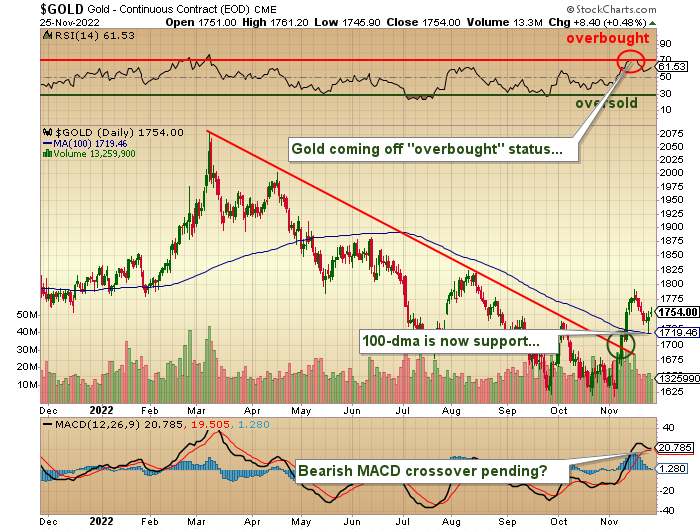
If the Fed takes the easy way out, which is to keep creating money until it leads to hyperinflation, then the precious metals (and many other commodities) should soar.

Incidentally, this positive candle builds on the impressive “bullish engulfing pattern” reversal that appeared the week before last, which involved an impressive large white candle, so it is looking increasingly like the market has put in an intermediate low for now.

However, that said, it hardly looks like the time has arrived to start cracking open the champagne, for overall, the setup remains incredibly dangerous, so if the Fed doesn’t deliver with a “pivot,” or even if it does and it has little effect, the market could yet turn tail and plunge.

We can see the horribly bearish setup on the latest 5-year chart for the S&P500 index, which would not be changed by a rally in the coming weeks back up to the Dome boundary.

What could be going on now is that the Fed is complicit in massaging sentiment to keep the market propped up until the mid-terms, after which they may permit it to drop like a rock. Therefore a good tactic may be to see if the market can make it up to or near to the Dome boundary, at which point it will be time to thin positions or lay on more hedges, buy tranches of Puts at good prices, etc.

We will be on the lookout for this.

The chart for the 2008 crash is shown below to enable you to see the uncanny similarity between then and now.

The difference is that if the markets do crash soon, they won’t bounce back afterward as in 2008 and 2009.

This is because the bond market will be crashing, too, as there will be no QE card to play, unlike last time, as the entire system flies apart.

On the 6-month chart for the S&P500 index, we can see the large bullish engulfing pattern that appeared the week before last, which marked the turn, and the impressive white candle that occurred yesterday as the Fed leaked out hints that it will “pivot.”

We will be turning our attention to the precious metals sector tomorrow since clearly, if the Fed takes the easy way out, which is to keep creating money until it leads to hyperinflation, then the precious metals (and many other commodities) should soar, so it’s no wonder we saw impressive action in many PM stocks yesterday. Keep in mind the political motivations for keeping the markets propped up until the mid-terms.

CliveMaund.com Disclosures

The above represents the opinion and analysis of Mr. Maund, based on data available to him, at the time of writing. Mr. Maund’s opinions are his own, and are not a recommendation or an offer to buy or sell securities. Mr. Maund is an independent analyst who receives no compensation of any kind from any groups, individuals or corporations mentioned in his reports. As trading and investing in any financial markets may involve serious risk of loss, Mr. Maund recommends that you consult with a qualified investment advisor, one licensed by appropriate regulatory agencies in your legal jurisdiction and do your own due diligence and research when making any kind of a transaction with financial ramifications. Although a qualified and experienced stock market analyst, Clive Maund is not a Registered Securities Advisor. Therefore Mr. Maund’s opinions on the market and stocks can only be construed as a solicitation to buy and sell securities when they are subject to the prior approval and endorsement of a Registered Securities Advisor operating in accordance with the appropriate regulations in your area of jurisdiction.

Disclosures:
1) Statements and opinions expressed are the opinions of Clive Maund and not of Streetwise Reports or its officers. The author is wholly responsible for the validity of the statements. Streetwise Reports was not involved in any aspect of the article preparation. The author was not paid by Streetwise Reports LLC for this article. Streetwise Reports was not paid by the author to publish or syndicate this article.

2) This article does not constitute investment advice. Each reader is encouraged to consult with his or her individual financial professional and any action a reader takes as a result of information presented here is his or her own responsibility. By opening this page, each reader accepts and agrees to Streetwise Reports’ terms of use and full legal disclaimer. This article is not a solicitation for investment. Streetwise Reports does not render general or specific investment advice and the information on Streetwise Reports should not be considered a recommendation to buy or sell any security. Streetwise Reports does not endorse or recommend the business, products, services or securities of any company mentioned on Streetwise Reports.

3) From time to time, Streetwise Reports LLC and its directors, officers, employees or members of their families, as well as persons interviewed for articles and interviews on the site, may have a long or short position in securities mentioned. Directors, officers, employees or members of their immediate families are prohibited from making purchases and/or sales of those securities in the open market or otherwise from the time of the decision to publish an article until three business days after the publication of the article. The foregoing prohibition does not apply to articles that in substance only restate previously published company releases.


Rugby union’s financial crisis: why the sport’s model is ‘broken’

By Christina Philippou, University of Portsmouth 

As athletes, rugby union players are notoriously robust. But in England, the finances behind the sport are looking far from healthy. In the space of a few weeks, two of its most famous club teams, Worcester (founded 1871) and Wasps (1866), have gone into administration.

Bill Sweeney, chief-executive of the Rugby Football Union (RFU) which governs the English game, said the financial model of the sport is “broken”. He added: “Two professional clubs facing financial difficulties is a clear barometer of the challenges being felt by the economy, sport and rugby union specifically.”

A parliamentary inquiry has now been launched over “serious concerns about the future of the sport”.

For Wasps and Worcester, those concerns are immediate. Both clubs will be relegated from the top tier of English rugby, and hundreds of staff have lost their jobs. Fans of the clubs will miss out too of course, as will local businesses who rely on match-day spending by large numbers of supporters.

In the case of Wasps, there is a knock-on effect on its affiliated netball team, whose players and staff have also been made redundant, and its close relationship with Coventry City, the football club which shares use of its stadium.

That said, going into administration need not be fatal, and is a way of trying to save a business from disappearing completely (liquidation).

The running of the business is passed on to an external team of specialists who try to negotiate with creditors and typically attempt to find new investors while also cutting costs. Administration has been commonly used in sport, particularly football, to keep clubs in existence, and has touched rugby union’s top tier of clubs before.

Two years after the top professional league (Premiership) was established in 1997, two long-standing clubs (London Scottish and Richmond) went into administration. Both now play in the league’s second tier, the RFU Championship.

But a broader fear remains over the financial sustainability of the sport. Former Wasps and England player Rob Andrew said recently that governance of the game was due an overhaul, adding: “The game has not been on a solid footing for quite some time.”

He’s right. Rugby union was the last of all the main team sports in the UK to turn professional when the Premiership was established. This put it at a significant financial disadvantage right from the start, as the likes of football, cricket and rugby league had already negotiated commercial deals with sponsors and broadcasters.

Rugby union had to try to muscle in and make up for the delay, facing what the business world calls “last mover disadvantage” in the market – arriving late to a limited pot of cash.

As a sport, it is heavily dependent on ticket sales for revenue. Part of Wasps’ decision to move to Coventry from London (for a time the club had been known as London Wasps) was an attempt to drive up attendances in a less saturated market than the capital.

But, as with so many decisions associated with sport, that was a gamble. Investors being repaid for helping finance the move to Coventry is part of the reason money is needed so desperately now.

COVID didn’t help either. In common with other sports (and industries), the closure of stadiums during the pandemic drastically affected income. Such reduced capacity in the stands meant match-day income was zero (or extremely low) for most of the 2020-21 season.

Must try harder

But perhaps the key issue comes from the wider difficulty of governing and regulating what are essentially private businesses. The agility and strength demanded from players on the pitch is not always matched by those responsible for running these business behind the scenes.

And as with other sports (like football) that are struggling with financial sustainability, keeping control of expenses is a major problem.

To that end, the Premiership introduced a salary cap in 1999. This was designed to put a limit on how much clubs are allowed to spend on wages, the largest costs they face (although there have been instances of breaches by teams such as Leicester Tigers and Saracens).

The salary cap is a “hard” cap, which means it is a set value for all clubs, rather than a percentage of revenue. The trouble with this system is that clubs can still try to spend as much as the salary limit allows, even if their income cannot cover it.

As a result, research into Premiership rugby clubs found imbalances in their financial status had increased between 2006 and 2015, and that there were issues around wage costs and how these compared with turnover.

Wasps, for example, spent 103% of its income on wages in 2014. Three years later, the club’s 2017 accounts were already highlighting a “material uncertainty to continue as a going concern” – that is, a risk that the club wouldn’t be able to pay its debts.

It seems, then, that the warning signs were there some time ago. Perhaps the time has finally come for the sport to submit itself to a serious financial health check.The Conversation

About the Author:

Christina Philippou, Principal Lecturer, Accounting and Financial Management, University of Portsmouth

This article is republished from The Conversation under a Creative Commons license. Read the original article.

Trade of the Week: Will ECB help EURUSD end its monthly losing streak?

By ForexTime

Euro bulls are desperate for any form of solace from the rampant US dollar.

The world’s most-popular FX pair, EURUSD, has endured 5 consecutive months of declines. In fact, EURUSD has only managed one monthly gain so far in 2022, which was back in May.

To be fair, at the time of writing, EURUSD is holding on to a 0.5% gain so far in October.


Whether EURUSD can officially claim a gain for the entirety of October and break this monthly losing streak could all boil down to the European Central Bank policy meeting this Thursday, October 27th.

What to look out for?

  • Size of the rate hike: Markets are forecasting a 89% chance that the ECB will hike its benchmark rates by yet another 75-basis points (bps), as they did back in September.
  • Lagarde’s press conference:  Traders and investors worldwide will be closely monitoring the words used by ECB President Christine Lagarde during her press conference at 2:45PM GMT, just half an hour after the ECB’s Governing Council publishes its policy decision.

    Given the forward-looking nature of markets, traders and investors worldwide will be ready to react to what ECB President Christine Lagarde’s latest clues on the central bank’s next policy moves.

How might EURUSD react?

  • If the ECB disappoints markets and triggers a smaller-than-75bps hike, that could see EURUSD faltering once more.
  • If the ECB shocks markets with a gargantuan 100-bps hike, that could see EURUSD breaking substantially above its 50-day SMA.
  • If a 75bps hike materialises, that may offer little reaction in the euro, given that such a move is already the primary outcome that markets are expecting.
  • If Lagarde suggests that we’ve not seen the last of these 75bps hikes, perhaps leaving the door open for another such supersized move at subsequent meetings, that may help the euro recover.
  • However, if Lagarde’s press conference or the ECB Governing Council’s policy statement unveils greater concern over incurring too much economic damage with the ongoing inflation-fighting rate hikes, that may unwind the euro’s month-to-date gains.

Expect a combination of the scenarios stated above.

Key levels to look out for:

  1. RESISTANCE: 50-day simple moving average (SMA) 

    Since March, EURUSD has struggled to sustain consecutive daily closes above its 50-day SMA. This FX pair has been guided lower by this widely-known technical indicator, with this key resistance level yet again holding its ground so far today (Monday, Oct 24).

  2. STRONGER RESISTANCE: 1.000 a.k.a. parity 

    If EURUSD has enough reason to see a substantial upside break, then stronger resistance is set to arrive at the parity mark, which had already repelled EURUSD bulls earlier this month.

  3. SUPPORT: Recent cycle lows
  • 0.97049
  • 0.96313
  • 0.95357

    These support levels may be called into action once more this week, especially if the ECB fails to assure markets that the central bank’s fight against inflation will not cause too much damage to the Eurozone economy.

At the time of writing, markets are forecasting greater odds of 69.3% that EURUSD would touch the 0.990 mark over the next one week period, versus the less-than-even chance (45.5%) that EURUSD would touch 0.970.

Sustained EURUSD gains this week may require a hawkish ECB that can convince markets of its ability to keep hiking rates aggressively.


Forex-Time-LogoArticle by ForexTime
ForexTime Ltd (FXTM) is an award winning international online forex broker regulated by CySEC 185/12 www.forextime.com

Large Currency Speculators boost Euro bullish bets to 19-week high

By InvestMacro

Here are the latest charts and statistics for the Commitment of Traders (COT) data published by the Commodities Futures Trading Commission (CFTC).

The latest COT data is updated through Tuesday October 18th and shows a quick view of how large market participants (for-profit speculators and commercial traders) were positioned in the futures markets. All currency positions are in direct relation to the US dollar where, for example, a bet for the euro is a bet that the euro will rise versus the dollar while a bet against the euro will be a bet that the euro will decline versus the dollar.

Euro & Mexican Peso lead Weekly Speculator Changes

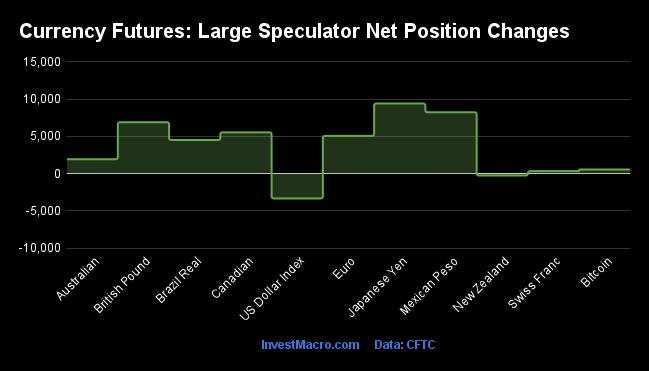
The COT currency market speculator bets were slightly lower this week as five out of the eleven currency markets we cover had higher positioning while the other six markets had lower speculator contracts.

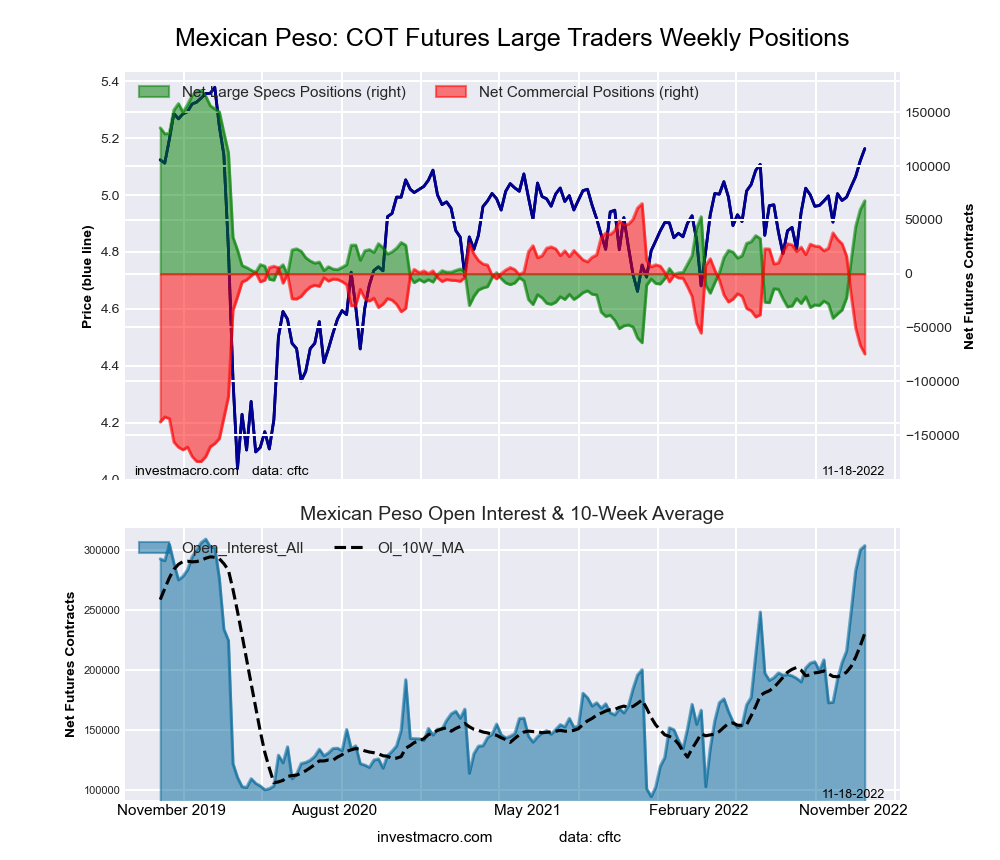
Leading the gains for the currency markets were the Mexican peso (11,360 contracts) and the Euro (10,651 contracts) with the Canadian dollar (5,099 contracts), the New Zealand dollar (597 contracts) and the Brazilian real (423 contracts) also showing a positive week.

The currencies leading the declines in speculator bets this week were the Japanese yen (-16,943 contracts) and the British pound sterling (-12,041 contracts) with the Australian dollar (-4,088 contracts), the Swiss franc (-1,196 contracts), Bitcoin (-835 contracts) and the US Dollar Index (-96 contracts) also registering lower bets on the week.

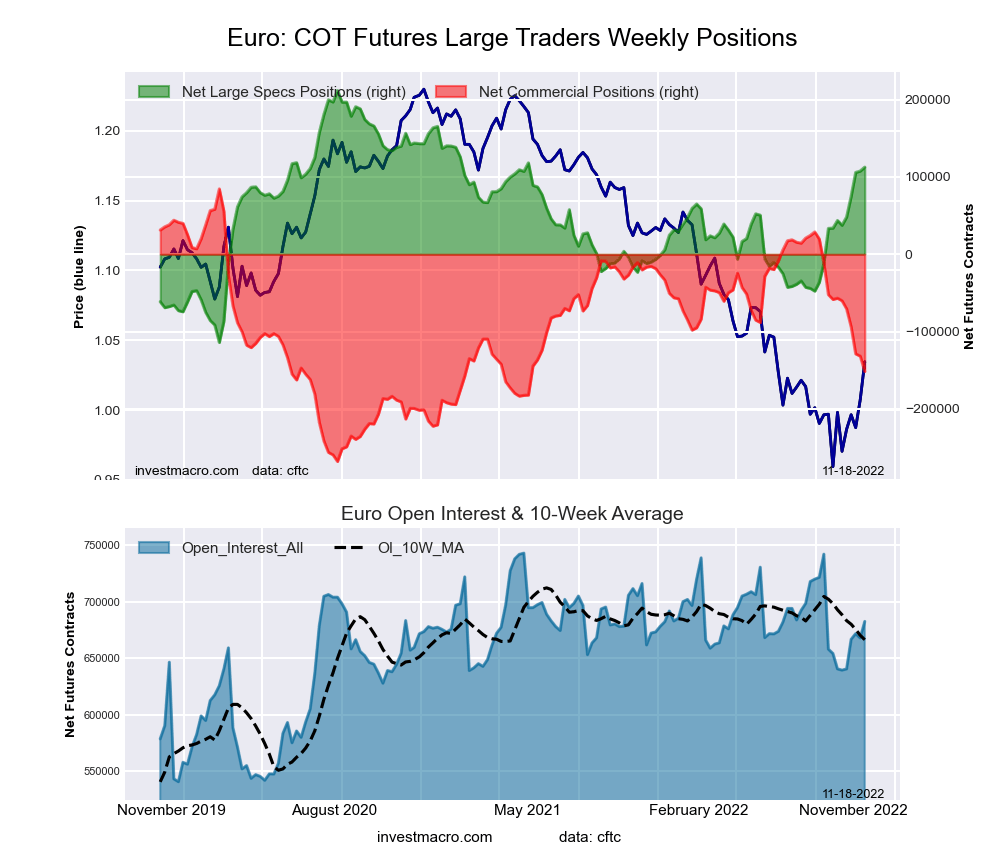
Highlighting the COT currency data this week was the Euro. The large speculator positioning this week saw Euro bets rise by over +10,000 contracts and go higher for the sixth time out of the past seven weeks. Euro bets have gained by over +95,000 net contracts in just the past seven weeks, going from -47,676 contracts on August 30th to over +48,000 contracts this week. This bullishness has brought the overall net speculator standing to its highest level in nineteen weeks, dating back to June 7th.

Euro speculators have been raising their bets into a market that is close to 20-year lows in the EURUSD exchange rate. Speculators are clearly betting that the exchange rate is close to a low point and looking to profit on a turnaround. The European Central Bank is expected to raise their interest rates this week by potentially 75-basis points and with the possibility of further rate rises before the end of the year.

The EURUSD exchange rate closed the week over 1.25 percent higher and ended the week around the 0.9855 exchange level.


Data Snapshot of Forex Market Traders | Columns Legend
Oct-18-2022OIOI-IndexSpec-NetSpec-IndexCom-NetCOM-IndexSmalls-NetSmalls-Index
USD Index55,2347832,69079-37,014174,32464
EUR640,4695048,15050-70,5775622,42715
GBP258,82673-51,2112576,30986-25,0989
JPY264,26589-94,33611110,84190-16,50520
CHF44,91131-7,0863919,09874-12,01217
CAD146,42528-20,5731625,10390-4,53021
AUD150,49645-35,3595248,97155-13,61219
NZD50,44844-18,4453822,35967-3,9147
MXN215,83657-22,2941816,273806,02169
RUB20,93047,54331-7,15069-39324
BRL41,9542926,49876-28,581232,08389
Bitcoin14,228822277-665064328


Strength Scores led by US Dollar Index, Bitcoin & Brazilian Real

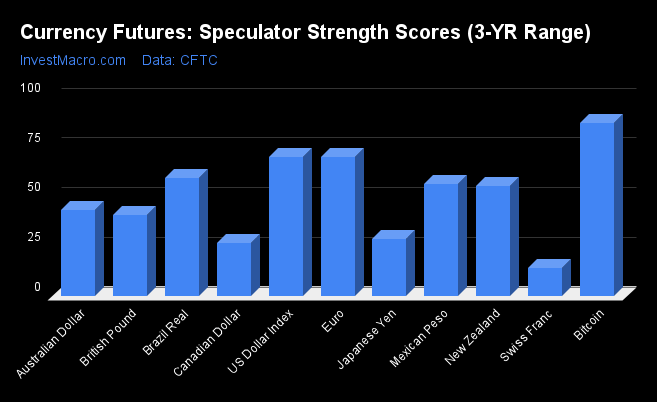
Strength Scores (a normalized measure of Speculator positions over a 3-Year range, from 0 to 100 where above 80 is extreme bullish and below 20 is extreme bearish) show that the US Dollar Index (79.5 percent), Bitcoin and the Brazilian Real (76.4 percent) lead the currency markets this week. The Australian Dollar (52.1 percent) comes in as the next highest in the currency markets in strength scores.

On the downside, the Japanese Yen (10.8 percent), Canadian Dollar (16.3 percent) and the Mexican Peso (17.8 percent) come in at the lowest strength level currently and all three are in bearish extreme levels (below 20 percent).

Strength Statistics:
US Dollar Index (79.5 percent) vs US Dollar Index previous week (79.6 percent)
EuroFX (49.8 percent) vs EuroFX previous week (46.5 percent)
British Pound Sterling (25.0 percent) vs British Pound Sterling previous week (35.4 percent)
Japanese Yen (10.8 percent) vs Japanese Yen previous week (21.2 percent)
Swiss Franc (38.5 percent) vs Swiss Franc previous week (41.6 percent)
Canadian Dollar (16.3 percent) vs Canadian Dollar previous week (10.5 percent)
Australian Dollar (52.1 percent) vs Australian Dollar previous week (55.8 percent)
New Zealand Dollar (38.2 percent) vs New Zealand Dollar previous week (37.1 percent)
Mexican Peso (17.8 percent) vs Mexican Peso previous week (13.0 percent)
Brazilian Real (76.4 percent) vs Brazilian Real previous week (76.0 percent)
Bitcoin (77.3 percent) vs Bitcoin previous week (91.9 percent)

EuroFX leads the Strength Trends

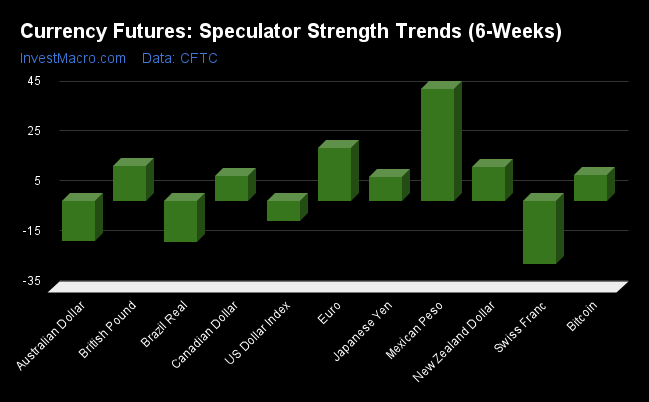
Strength Score Trends (or move index, calculates the 6-week changes in strength scores) show that the EuroFX (25.9 percent) leads the past six weeks trends for the currency markets this week. The Australian Dollar (19.6 percent) and the Mexican Peso (3.1 percent) fill out the only other positive movers in the latest trends data.

The Canadian Dollar (-43.2 percent) leads the downside trend scores currently while the next market with lower trend scores were the New Zealand Dollar (-27.3 percent), Bitcoin (-22.7 percent) and the Japanese Yen (-22.3 percent).

Strength Trend Statistics:
US Dollar Index (-5.7 percent) vs US Dollar Index previous week (-4.6 percent)
EuroFX (25.9 percent) vs EuroFX previous week (26.1 percent)
British Pound Sterling (-0.7 percent) vs British Pound Sterling previous week (-8.6 percent)
Japanese Yen (-22.3 percent) vs Japanese Yen previous week (-22.1 percent)
Swiss Franc (-7.7 percent) vs Swiss Franc previous week (-9.2 percent)
Canadian Dollar (-43.2 percent) vs Canadian Dollar previous week (-56.0 percent)
Australian Dollar (19.6 percent) vs Australian Dollar previous week (24.2 percent)
New Zealand Dollar (-27.3 percent) vs New Zealand Dollar previous week (-27.7 percent)
Mexican Peso (3.1 percent) vs Mexican Peso previous week (-2.0 percent)
Brazilian Real (-4.3 percent) vs Brazilian Real previous week (16.9 percent)
Bitcoin (-22.7 percent) vs Bitcoin previous week (-7.7 percent)


Individual COT Forex Markets:

US Dollar Index Futures:

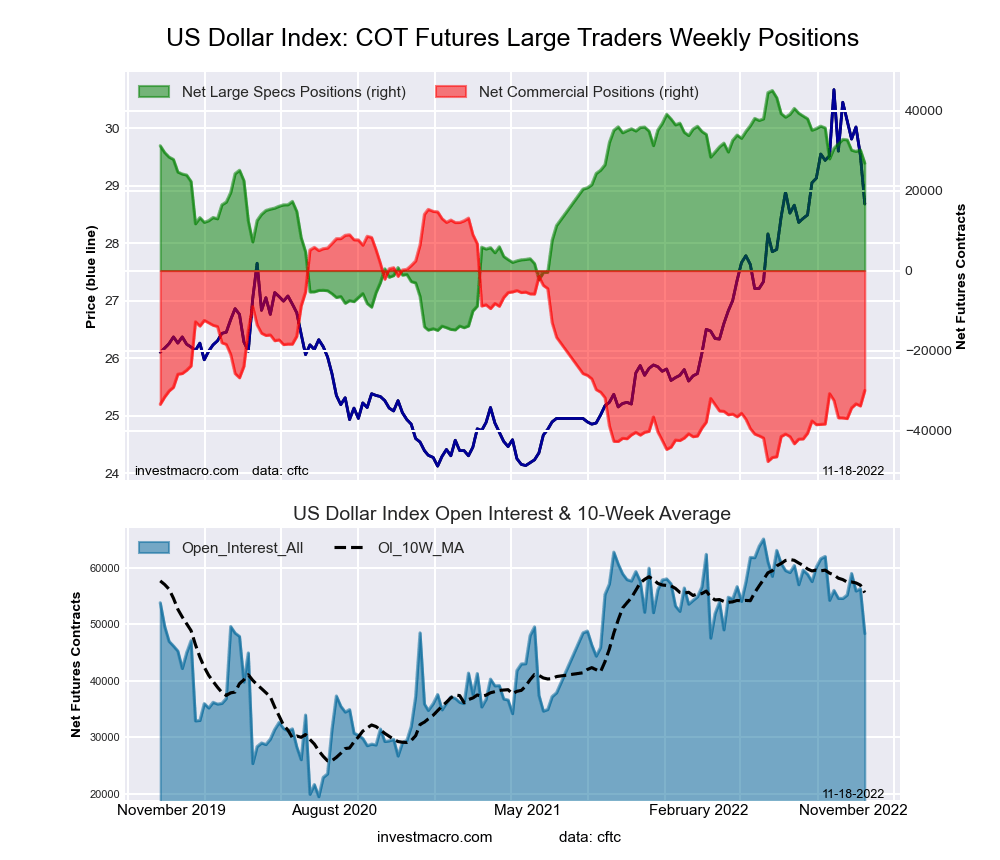
US Dollar Index Forex Futures COT ChartThe US Dollar Index large speculator standing this week resulted in a net position of 32,690 contracts in the data reported through Tuesday. This was a weekly decrease of -96 contracts from the previous week which had a total of 32,786 net contracts.

This week’s current strength score (the trader positioning range over the past three years, measured from 0 to 100) shows the speculators are currently Bullish with a score of 79.5 percent. The commercials are Bearish-Extreme with a score of 17.0 percent and the small traders (not shown in chart) are Bullish with a score of 63.8 percent.

US DOLLAR INDEX StatisticsSPECULATORSCOMMERCIALSSMALL TRADERS
– Percent of Open Interest Longs:81.43.512.6
– Percent of Open Interest Shorts:22.270.64.8
– Net Position:32,690-37,0144,324
– Gross Longs:44,9561,9556,954
– Gross Shorts:12,26638,9692,630
– Long to Short Ratio:3.7 to 10.1 to 12.6 to 1
NET POSITION TREND:
– Strength Index Score (3 Year Range Pct):79.517.063.8
– Strength Index Reading (3 Year Range):BullishBearish-ExtremeBullish
NET POSITION MOVEMENT INDEX:
– 6-Week Change in Strength Index:-5.72.321.6


Euro Currency Futures:

Euro Currency Futures COT ChartThe Euro Currency large speculator standing this week resulted in a net position of 48,150 contracts in the data reported through Tuesday. This was a weekly lift of 10,651 contracts from the previous week which had a total of 37,499 net contracts.

This week’s current strength score (the trader positioning range over the past three years, measured from 0 to 100) shows the speculators are currently Bearish with a score of 49.8 percent. The commercials are Bullish with a score of 56.0 percent and the small traders (not shown in chart) are Bearish-Extreme with a score of 14.8 percent.

EURO Currency StatisticsSPECULATORSCOMMERCIALSSMALL TRADERS
– Percent of Open Interest Longs:31.654.211.9
– Percent of Open Interest Shorts:24.165.28.4
– Net Position:48,150-70,57722,427
– Gross Longs:202,703347,07876,183
– Gross Shorts:154,553417,65553,756
– Long to Short Ratio:1.3 to 10.8 to 11.4 to 1
NET POSITION TREND:
– Strength Index Score (3 Year Range Pct):49.856.014.8
– Strength Index Reading (3 Year Range):BearishBullishBearish-Extreme
NET POSITION MOVEMENT INDEX:
– 6-Week Change in Strength Index:25.9-25.69.1


British Pound Sterling Futures:

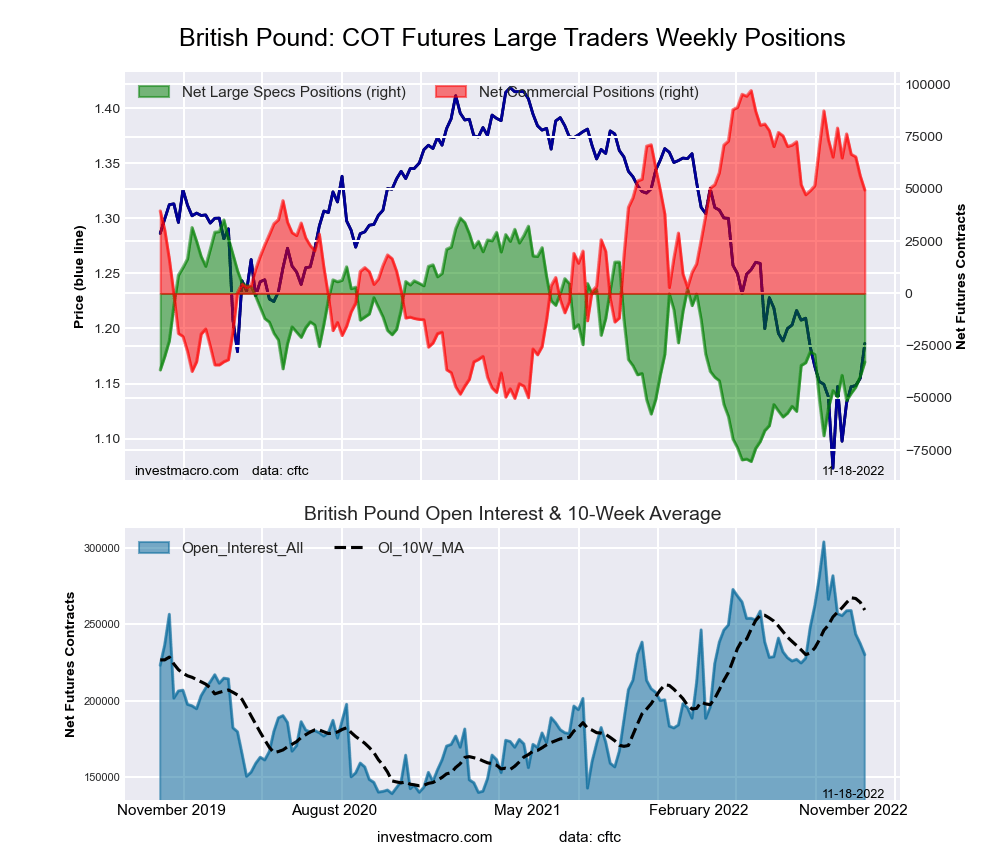
British Pound Sterling Futures COT ChartThe British Pound Sterling large speculator standing this week resulted in a net position of -51,211 contracts in the data reported through Tuesday. This was a weekly fall of -12,041 contracts from the previous week which had a total of -39,170 net contracts.

This week’s current strength score (the trader positioning range over the past three years, measured from 0 to 100) shows the speculators are currently Bearish with a score of 25.0 percent. The commercials are Bullish-Extreme with a score of 85.9 percent and the small traders (not shown in chart) are Bearish-Extreme with a score of 8.8 percent.

BRITISH POUND StatisticsSPECULATORSCOMMERCIALSSMALL TRADERS
– Percent of Open Interest Longs:15.675.17.2
– Percent of Open Interest Shorts:35.445.616.9
– Net Position:-51,21176,309-25,098
– Gross Longs:40,328194,38518,668
– Gross Shorts:91,539118,07643,766
– Long to Short Ratio:0.4 to 11.6 to 10.4 to 1
NET POSITION TREND:
– Strength Index Score (3 Year Range Pct):25.085.98.8
– Strength Index Reading (3 Year Range):BearishBullish-ExtremeBearish-Extreme
NET POSITION MOVEMENT INDEX:
– 6-Week Change in Strength Index:-0.74.3-10.9


Japanese Yen Futures:

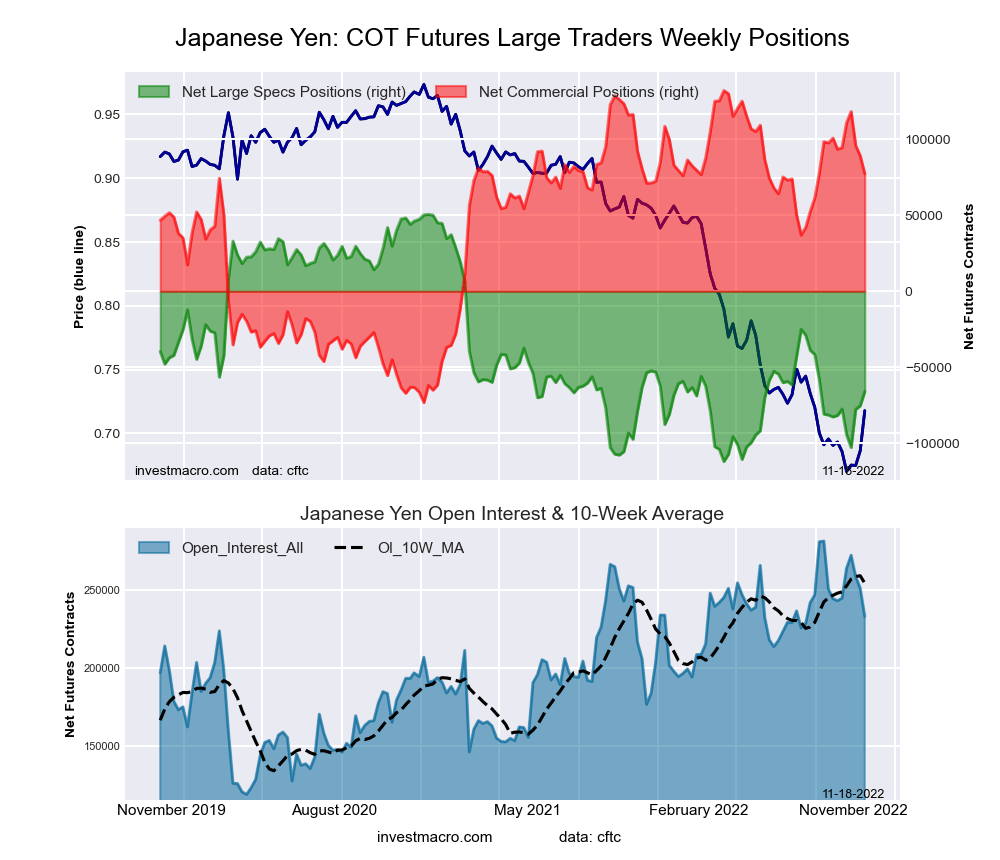
Japanese Yen Forex Futures COT ChartThe Japanese Yen large speculator standing this week resulted in a net position of -94,336 contracts in the data reported through Tuesday. This was a weekly fall of -16,943 contracts from the previous week which had a total of -77,393 net contracts.

This week’s current strength score (the trader positioning range over the past three years, measured from 0 to 100) shows the speculators are currently Bearish-Extreme with a score of 10.8 percent. The commercials are Bullish-Extreme with a score of 89.7 percent and the small traders (not shown in chart) are Bearish-Extreme with a score of 19.9 percent.

JAPANESE YEN StatisticsSPECULATORSCOMMERCIALSSMALL TRADERS
– Percent of Open Interest Longs:11.677.010.0
– Percent of Open Interest Shorts:47.335.116.3
– Net Position:-94,336110,841-16,505
– Gross Longs:30,583203,50826,491
– Gross Shorts:124,91992,66742,996
– Long to Short Ratio:0.2 to 12.2 to 10.6 to 1
NET POSITION TREND:
– Strength Index Score (3 Year Range Pct):10.889.719.9
– Strength Index Reading (3 Year Range):Bearish-ExtremeBullish-ExtremeBearish-Extreme
NET POSITION MOVEMENT INDEX:
– 6-Week Change in Strength Index:-22.316.26.0


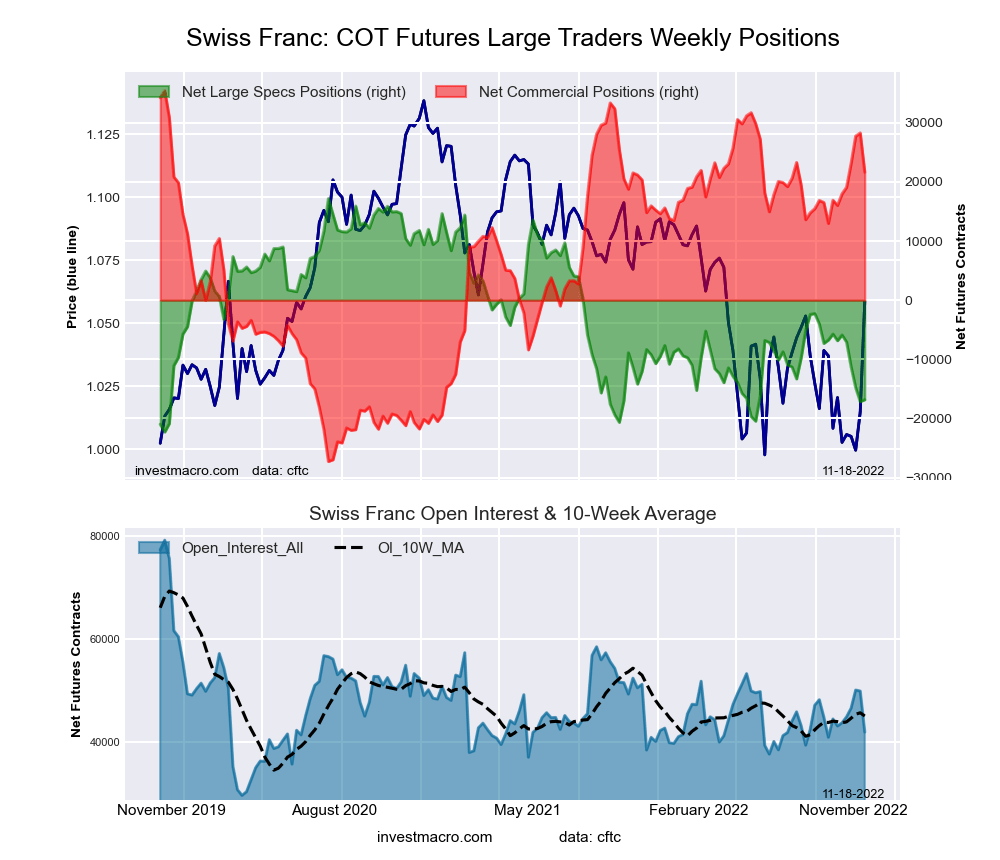
Swiss Franc Futures:

Swiss Franc Forex Futures COT ChartThe Swiss Franc large speculator standing this week resulted in a net position of -7,086 contracts in the data reported through Tuesday. This was a weekly decrease of -1,196 contracts from the previous week which had a total of -5,890 net contracts.

This week’s current strength score (the trader positioning range over the past three years, measured from 0 to 100) shows the speculators are currently Bearish with a score of 38.5 percent. The commercials are Bullish with a score of 73.9 percent and the small traders (not shown in chart) are Bearish-Extreme with a score of 16.9 percent.

SWISS FRANC StatisticsSPECULATORSCOMMERCIALSSMALL TRADERS
– Percent of Open Interest Longs:15.763.920.3
– Percent of Open Interest Shorts:31.521.447.1
– Net Position:-7,08619,098-12,012
– Gross Longs:7,05228,7029,122
– Gross Shorts:14,1389,60421,134
– Long to Short Ratio:0.5 to 13.0 to 10.4 to 1
NET POSITION TREND:
– Strength Index Score (3 Year Range Pct):38.573.916.9
– Strength Index Reading (3 Year Range):BearishBullishBearish-Extreme
NET POSITION MOVEMENT INDEX:
– 6-Week Change in Strength Index:-7.73.62.8


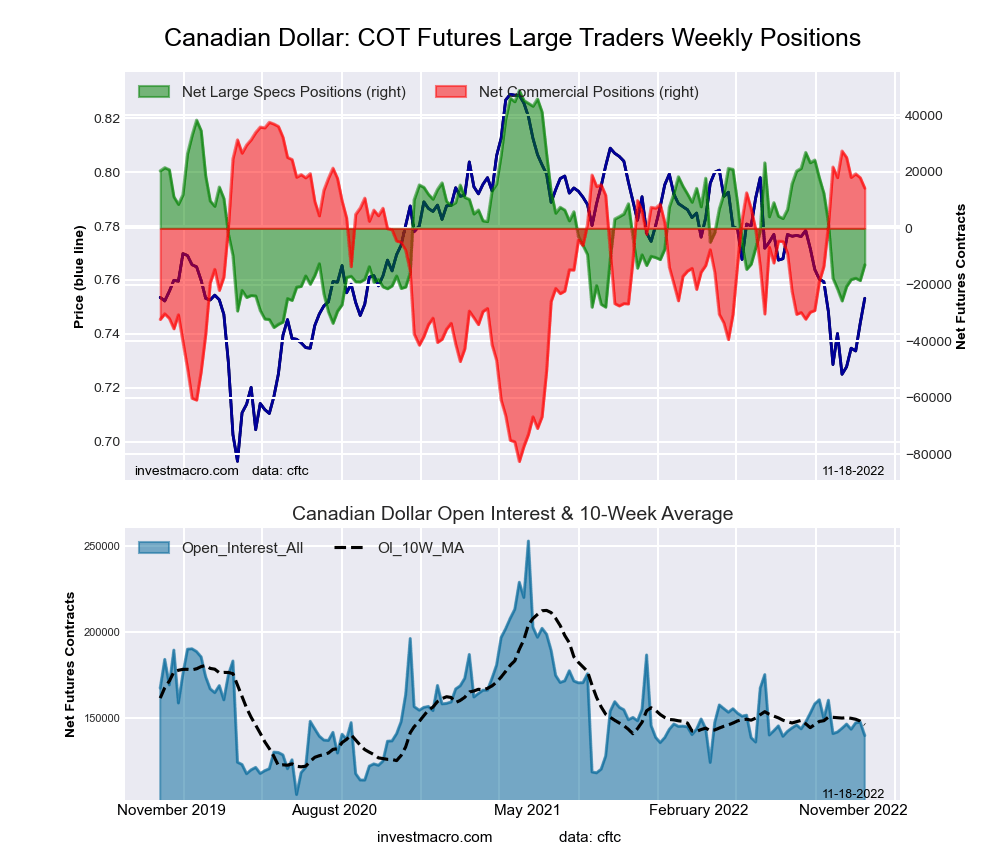
Canadian Dollar Futures:

Canadian Dollar Forex Futures COT ChartThe Canadian Dollar large speculator standing this week resulted in a net position of -20,573 contracts in the data reported through Tuesday. This was a weekly gain of 5,099 contracts from the previous week which had a total of -25,672 net contracts.

This week’s current strength score (the trader positioning range over the past three years, measured from 0 to 100) shows the speculators are currently Bearish-Extreme with a score of 16.3 percent. The commercials are Bullish-Extreme with a score of 89.6 percent and the small traders (not shown in chart) are Bearish with a score of 21.0 percent.

CANADIAN DOLLAR StatisticsSPECULATORSCOMMERCIALSSMALL TRADERS
– Percent of Open Interest Longs:24.253.920.2
– Percent of Open Interest Shorts:38.236.723.2
– Net Position:-20,57325,103-4,530
– Gross Longs:35,38478,89529,508
– Gross Shorts:55,95753,79234,038
– Long to Short Ratio:0.6 to 11.5 to 10.9 to 1
NET POSITION TREND:
– Strength Index Score (3 Year Range Pct):16.389.621.0
– Strength Index Reading (3 Year Range):Bearish-ExtremeBullish-ExtremeBearish
NET POSITION MOVEMENT INDEX:
– 6-Week Change in Strength Index:-43.236.7-11.1


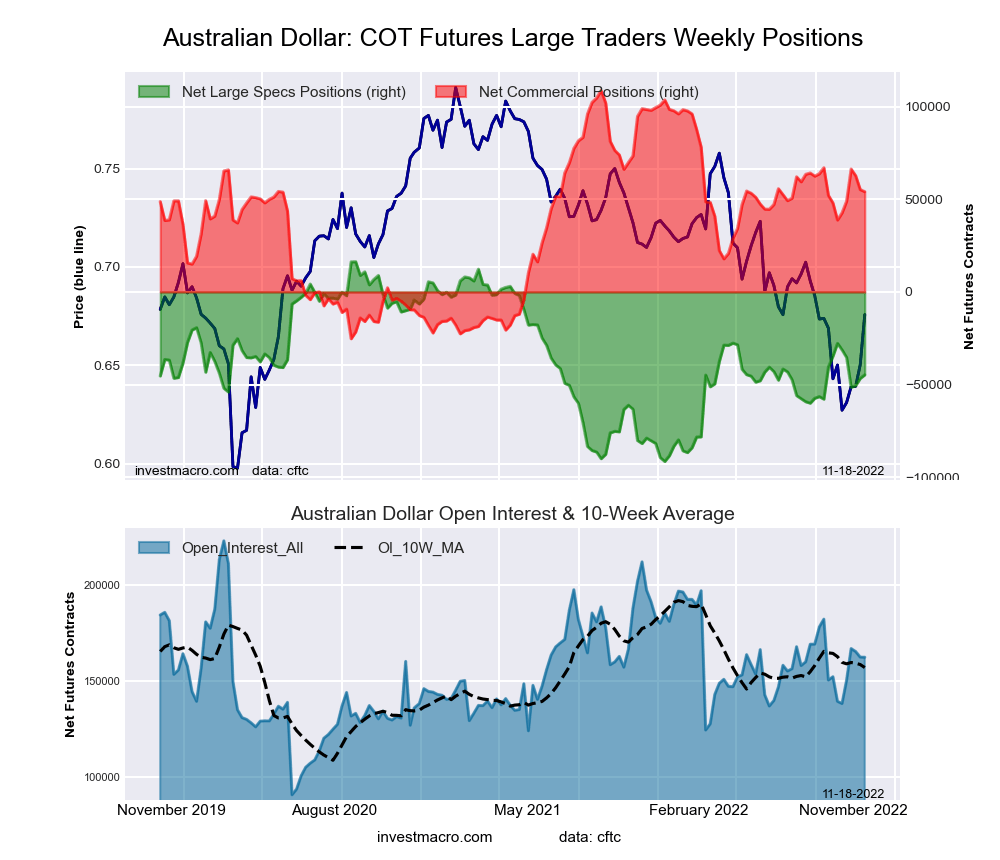
Australian Dollar Futures:

Australian Dollar Forex Futures COT ChartThe Australian Dollar large speculator standing this week resulted in a net position of -35,359 contracts in the data reported through Tuesday. This was a weekly lowering of -4,088 contracts from the previous week which had a total of -31,271 net contracts.

This week’s current strength score (the trader positioning range over the past three years, measured from 0 to 100) shows the speculators are currently Bullish with a score of 52.1 percent. The commercials are Bullish with a score of 55.4 percent and the small traders (not shown in chart) are Bearish-Extreme with a score of 19.2 percent.

AUSTRALIAN DOLLAR StatisticsSPECULATORSCOMMERCIALSSMALL TRADERS
– Percent of Open Interest Longs:22.063.411.5
– Percent of Open Interest Shorts:45.530.920.5
– Net Position:-35,35948,971-13,612
– Gross Longs:33,04695,47417,233
– Gross Shorts:68,40546,50330,845
– Long to Short Ratio:0.5 to 12.1 to 10.6 to 1
NET POSITION TREND:
– Strength Index Score (3 Year Range Pct):52.155.419.2
– Strength Index Reading (3 Year Range):BullishBullishBearish-Extreme
NET POSITION MOVEMENT INDEX:
– 6-Week Change in Strength Index:19.6-11.1-15.4


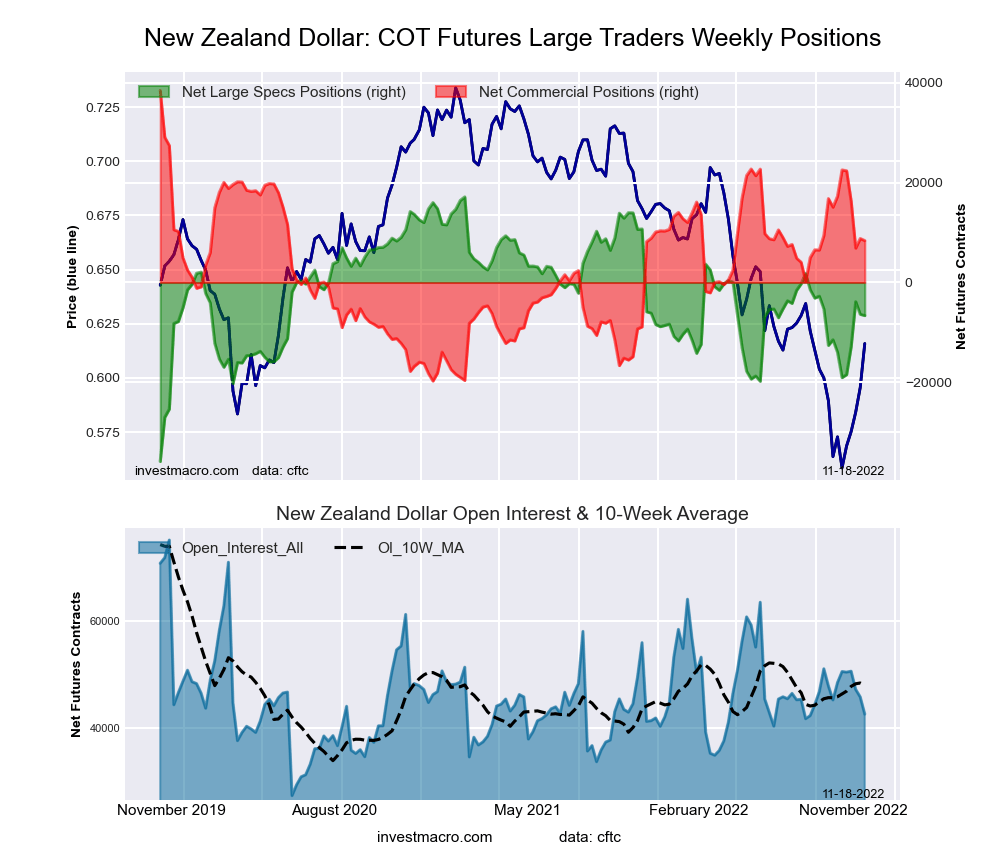
New Zealand Dollar Futures:

New Zealand Dollar Forex Futures COT ChartThe New Zealand Dollar large speculator standing this week resulted in a net position of -18,445 contracts in the data reported through Tuesday. This was a weekly increase of 597 contracts from the previous week which had a total of -19,042 net contracts.

This week’s current strength score (the trader positioning range over the past three years, measured from 0 to 100) shows the speculators are currently Bearish with a score of 38.2 percent. The commercials are Bullish with a score of 67.0 percent and the small traders (not shown in chart) are Bearish-Extreme with a score of 6.6 percent.

NEW ZEALAND DOLLAR StatisticsSPECULATORSCOMMERCIALSSMALL TRADERS
– Percent of Open Interest Longs:20.573.45.5
– Percent of Open Interest Shorts:57.029.113.3
– Net Position:-18,44522,359-3,914
– Gross Longs:10,32837,0482,787
– Gross Shorts:28,77314,6896,701
– Long to Short Ratio:0.4 to 12.5 to 10.4 to 1
NET POSITION TREND:
– Strength Index Score (3 Year Range Pct):38.267.06.6
– Strength Index Reading (3 Year Range):BearishBullishBearish-Extreme
NET POSITION MOVEMENT INDEX:
– 6-Week Change in Strength Index:-27.325.3-1.8


Mexican Peso Futures:

Mexican Peso Futures COT ChartThe Mexican Peso large speculator standing this week resulted in a net position of -22,294 contracts in the data reported through Tuesday. This was a weekly gain of 11,360 contracts from the previous week which had a total of -33,654 net contracts.

This week’s current strength score (the trader positioning range over the past three years, measured from 0 to 100) shows the speculators are currently Bearish-Extreme with a score of 17.8 percent. The commercials are Bullish with a score of 79.6 percent and the small traders (not shown in chart) are Bullish with a score of 68.5 percent.

MEXICAN PESO StatisticsSPECULATORSCOMMERCIALSSMALL TRADERS
– Percent of Open Interest Longs:61.834.23.8
– Percent of Open Interest Shorts:72.226.61.0
– Net Position:-22,29416,2736,021
– Gross Longs:133,43273,7588,139
– Gross Shorts:155,72657,4852,118
– Long to Short Ratio:0.9 to 11.3 to 13.8 to 1
NET POSITION TREND:
– Strength Index Score (3 Year Range Pct):17.879.668.5
– Strength Index Reading (3 Year Range):Bearish-ExtremeBullishBullish
NET POSITION MOVEMENT INDEX:
– 6-Week Change in Strength Index:3.1-3.87.9


Brazilian Real Futures:

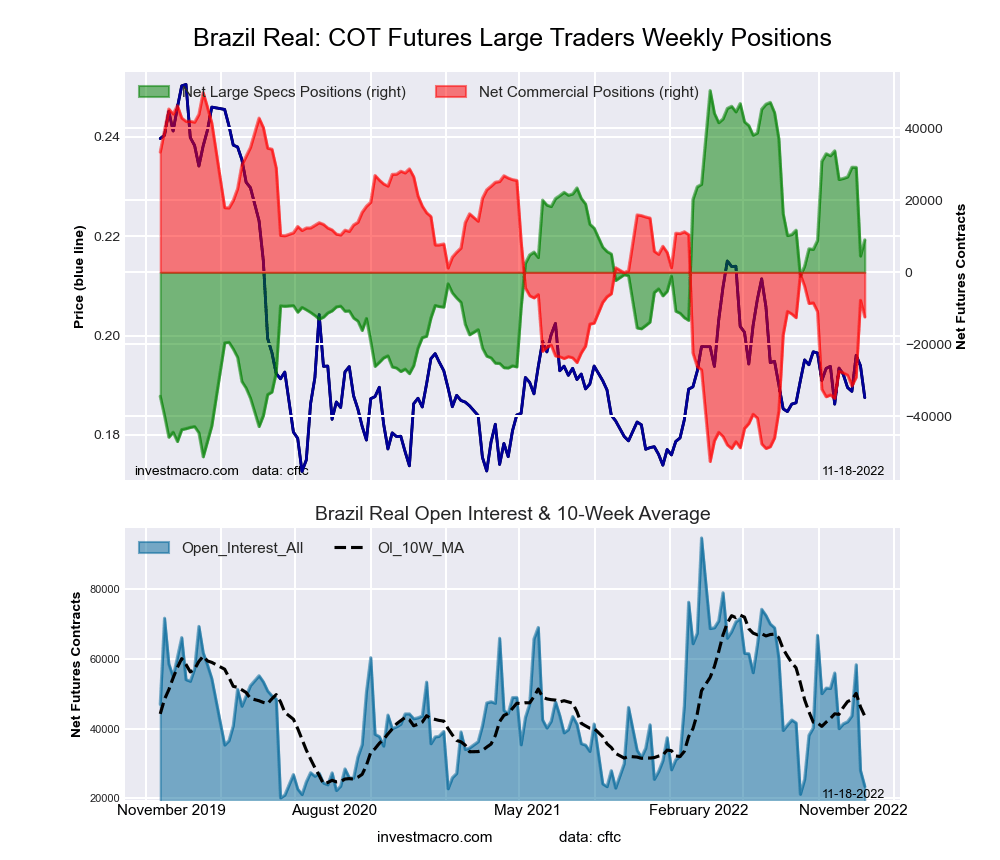
Brazil Real Futures COT ChartThe Brazilian Real large speculator standing this week resulted in a net position of 26,498 contracts in the data reported through Tuesday. This was a weekly advance of 423 contracts from the previous week which had a total of 26,075 net contracts.

This week’s current strength score (the trader positioning range over the past three years, measured from 0 to 100) shows the speculators are currently Bullish with a score of 76.4 percent. The commercials are Bearish with a score of 23.4 percent and the small traders (not shown in chart) are Bullish-Extreme with a score of 89.2 percent.

BRAZIL REAL StatisticsSPECULATORSCOMMERCIALSSMALL TRADERS
– Percent of Open Interest Longs:72.319.68.1
– Percent of Open Interest Shorts:9.187.73.1
– Net Position:26,498-28,5812,083
– Gross Longs:30,3268,2293,398
– Gross Shorts:3,82836,8101,315
– Long to Short Ratio:7.9 to 10.2 to 12.6 to 1
NET POSITION TREND:
– Strength Index Score (3 Year Range Pct):76.423.489.2
– Strength Index Reading (3 Year Range):BullishBearishBullish-Extreme
NET POSITION MOVEMENT INDEX:
– 6-Week Change in Strength Index:-4.33.85.4


Bitcoin Futures:

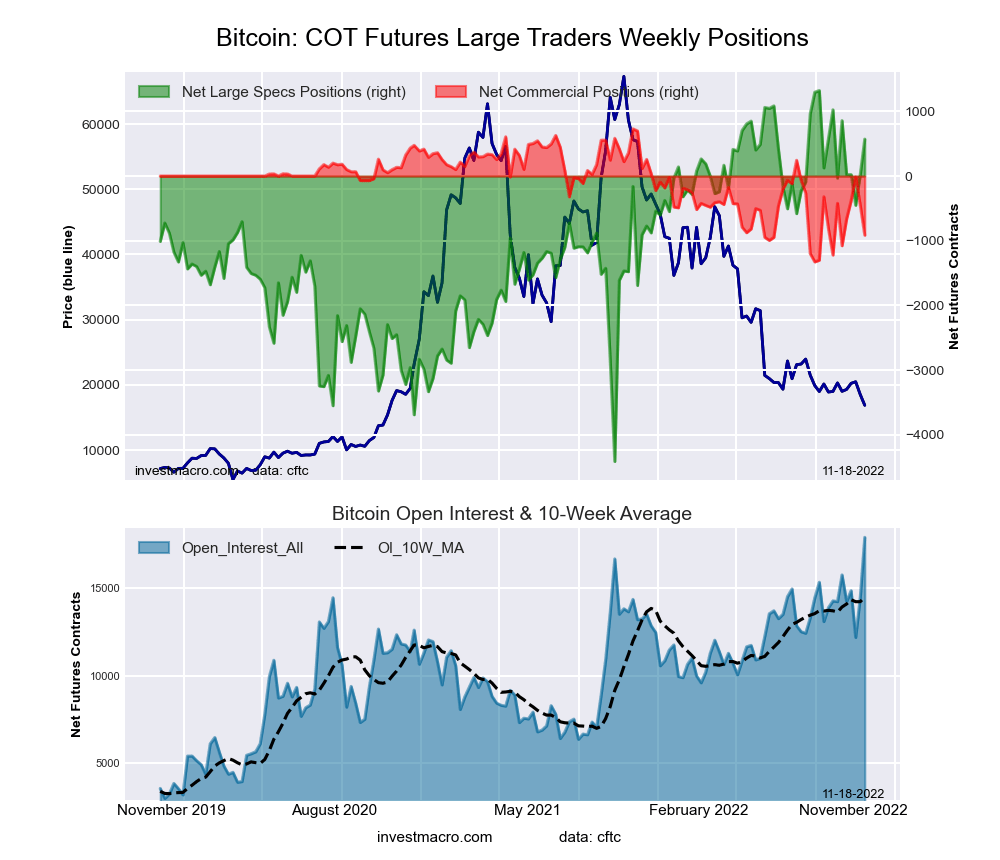
Bitcoin Crypto Futures COT ChartThe Bitcoin large speculator standing this week resulted in a net position of 22 contracts in the data reported through Tuesday. This was a weekly fall of -835 contracts from the previous week which had a total of 857 net contracts.

This week’s current strength score (the trader positioning range over the past three years, measured from 0 to 100) shows the speculators are currently Bullish with a score of 77.3 percent. The commercials are Bearish with a score of 32.2 percent and the small traders (not shown in chart) are Bearish with a score of 27.6 percent.

BITCOIN StatisticsSPECULATORSCOMMERCIALSSMALL TRADERS
– Percent of Open Interest Longs:75.30.89.9
– Percent of Open Interest Shorts:75.15.55.3
– Net Position:22-665643
– Gross Longs:10,7101201,404
– Gross Shorts:10,688785761
– Long to Short Ratio:1.0 to 10.2 to 11.8 to 1
NET POSITION TREND:
– Strength Index Score (3 Year Range Pct):77.332.227.6
– Strength Index Reading (3 Year Range):BullishBearishBearish
NET POSITION MOVEMENT INDEX:
– 6-Week Change in Strength Index:-22.730.915.1


Article By InvestMacroReceive our weekly COT Newsletter

*COT Report: The COT data, released weekly to the public each Friday, is updated through the most recent Tuesday (data is 3 days old) and shows a quick view of how large speculators or non-commercials (for-profit traders) were positioned in the futures markets.

The CFTC categorizes trader positions according to commercial hedgers (traders who use futures contracts for hedging as part of the business), non-commercials (large traders who speculate to realize trading profits) and nonreportable traders (usually small traders/speculators) as well as their open interest (contracts open in the market at time of reporting). See CFTC criteria here.

Speculator Extremes: Bloomberg Commodity Index, MSCI EAFE lead Bullish & Bearish COT Positions

By InvestMacro 

The latest update for the weekly Commitment of Traders (COT) report was released by the Commodity Futures Trading Commission (CFTC) on Friday for data ending on October 18th.

This weekly Extreme Positions report highlights the Top Most Bullish and Top Most Bearish Positions for the speculator category. Extreme positioning in these markets can foreshadow strong moves in the underlying market.

To signify an extreme position, we use the Strength Index (also known as the COT Index) of each instrument, a common method of measuring COT data. The Strength Index is simply a comparison of current trader positions against the range of positions over the previous 3 years. We use over 80 percent as extremely bullish and under 20 percent as extremely bearish. (Compare Strength Index scores across all markets in the data table or cot leaders table.

* We use Tuesday to Tuesday weekly price closes to match up with the COT data (data through Tuesdays) and this accounts for large gaps in the price chart candles.


Here Are This Week’s Most Bullish Speculator Positions:

Bloomberg Commodity Index


The Bloomberg Commodity Index speculator position comes in as the most bullish extreme standing this week. The Bloomberg Commodity Index speculator level is currently at a 88.3 percent score of its 3-year range.

The overall net speculator position is in bearish territory but has has been steadily improving with speculators at the most bullish point in over a year.


Nikkei 225


The Nikkei 225 speculator position comes next in the extreme standings this week. The strength level is now at a 84.97 percent score of its 3-year range.

The Nikkei 225 speculator position is in positive or bullish territory for a fourth straight week this week. The net position has been mostly bearish over the past three years so a positive standing currently puts the strength scores in extreme bullish levels.


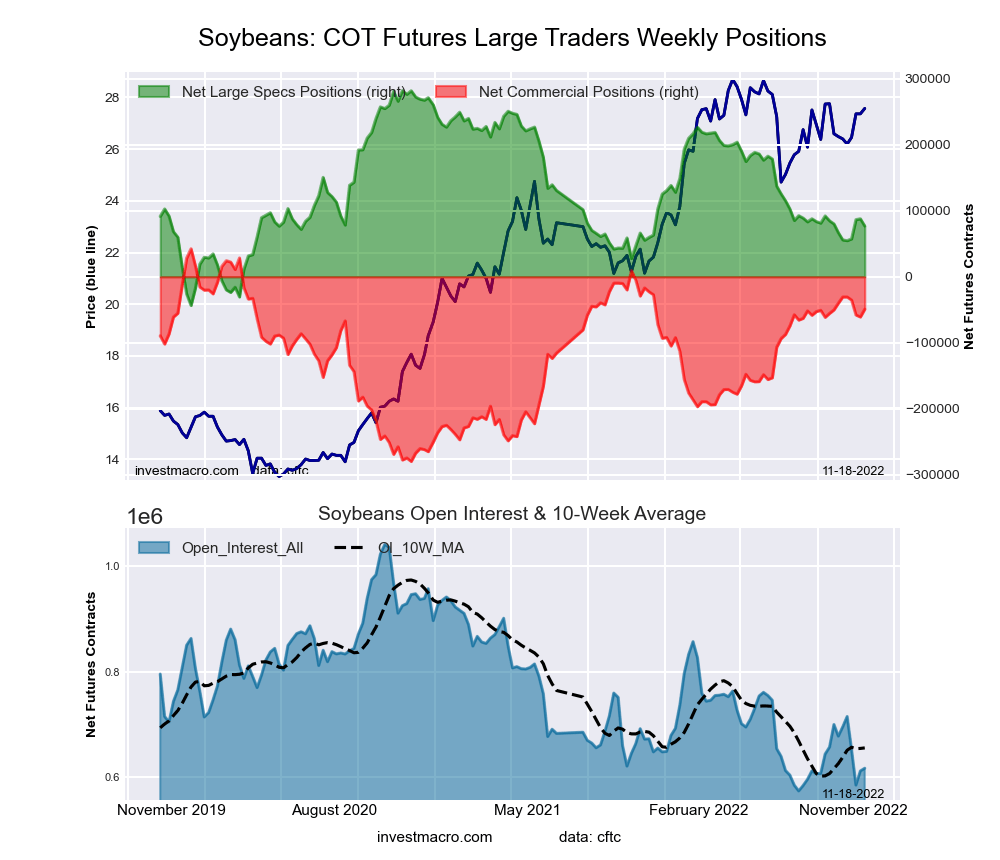
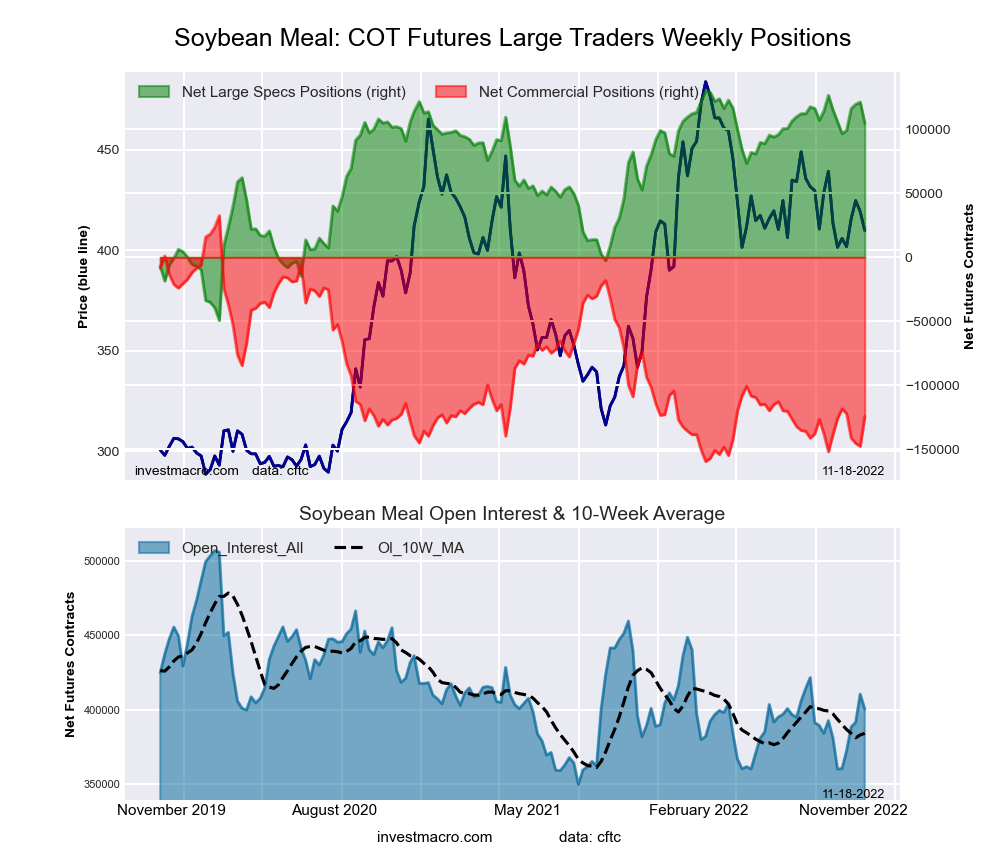
Soybean Meal

The Soybean Meal speculator position comes in third this week in the extreme standings. The Soybean Meal strength score resides at a 82.6 percent score of its 3-year range.

The Soybean Meal speculator position has been very bullish since the middle of 2021 with speculator net positions reaching over +100,000 net contracts at their peaks.


US Dollar Index


The US Dollar Index speculator position comes up number four in the extreme standings this week but is just a touch under the 80 percent threshold. The US Dollar Index strength level is at a 79.45 percent score of its 3-year range.

The Dollar has been very strong for a long time now and is near 20-year highs against the Euro, Yen and the British Pound Sterling. Speculator strength scores for the US Dollar Index have been near or above extreme bullish levels for almost a year.


This Week’s Most Bearish Speculator Positions:

MSCI EAFE MINI


The MSCI EAFE MINI speculator position comes in as the most bearish extreme standing this week. The EAFE strength level is at a 6.3 percent score of its 3-year range.


Gold


The Gold speculator position comes in next for the most bearish extreme standing on the week. The Gold strength score is at a 8.2 percent score of its 3-year range as the metals markets have been under pressure in the rising interest rate environment.


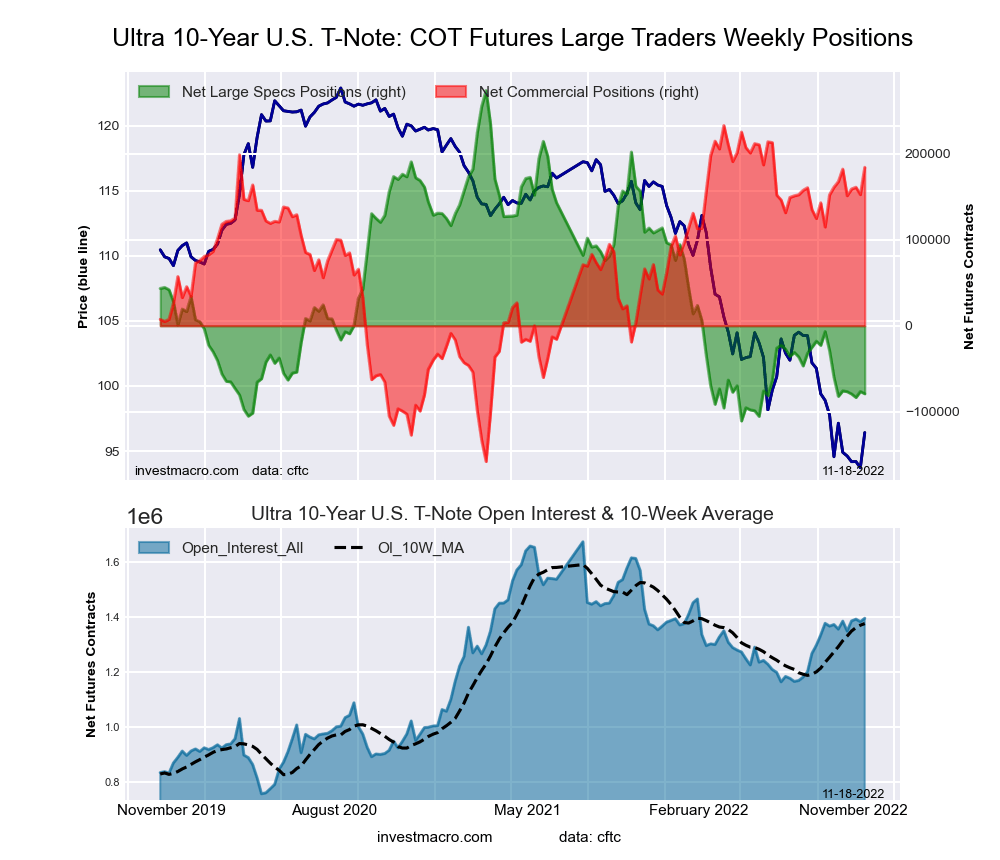
Ultra 10-Year U.S. T-Note

Last this week is the Ultra 10-Year U.S. T-Note speculator position which comes in as third most bearish extreme standing of the week. The Ultra 10-Year strength level resides at a 8.9 percent score of its 3-year range.


Article By InvestMacroReceive our weekly COT Newsletter

*COT Report: The COT data, released weekly to the public each Friday, is updated through the most recent Tuesday (data is 3 days old) and shows a quick view of how large speculators or non-commercials (for-profit traders) were positioned in the futures markets.

The CFTC categorizes trader positions according to commercial hedgers (traders who use futures contracts for hedging as part of the business), non-commercials (large traders who speculate to realize trading profits) and nonreportable traders (usually small traders/speculators) as well as their open interest (contracts open in the market at time of reporting). See CFTC criteria here.

COT Metals Speculators push Platinum bullish bets to 28-week high

By InvestMacro

Here are the latest charts and statistics for the Commitment of Traders (COT) data published by the Commodities Futures Trading Commission (CFTC).

The latest COT data is updated through Tuesday October 18th and shows a quick view of how large traders (for-profit speculators and commercial entities) were positioned in the futures markets.

Platinum tops Weekly Speculator Changes

The COT precious metals speculator bets were lower this week as just one out of the five metals markets we cover had higher positioning this week while four markets had lower contracts.

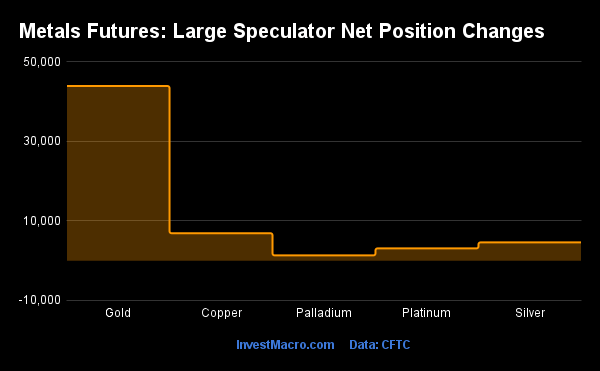
Leading the precious metals markets was just Platinum (2,566 contracts) showing a positive week.

The metals markets leading the declines in speculator bets this week were Gold (-17,464 contracts) with Silver (-6,122 contracts), Copper (-4,403 contracts) and Palladium (-455 contracts) also registering lower bets on the week.

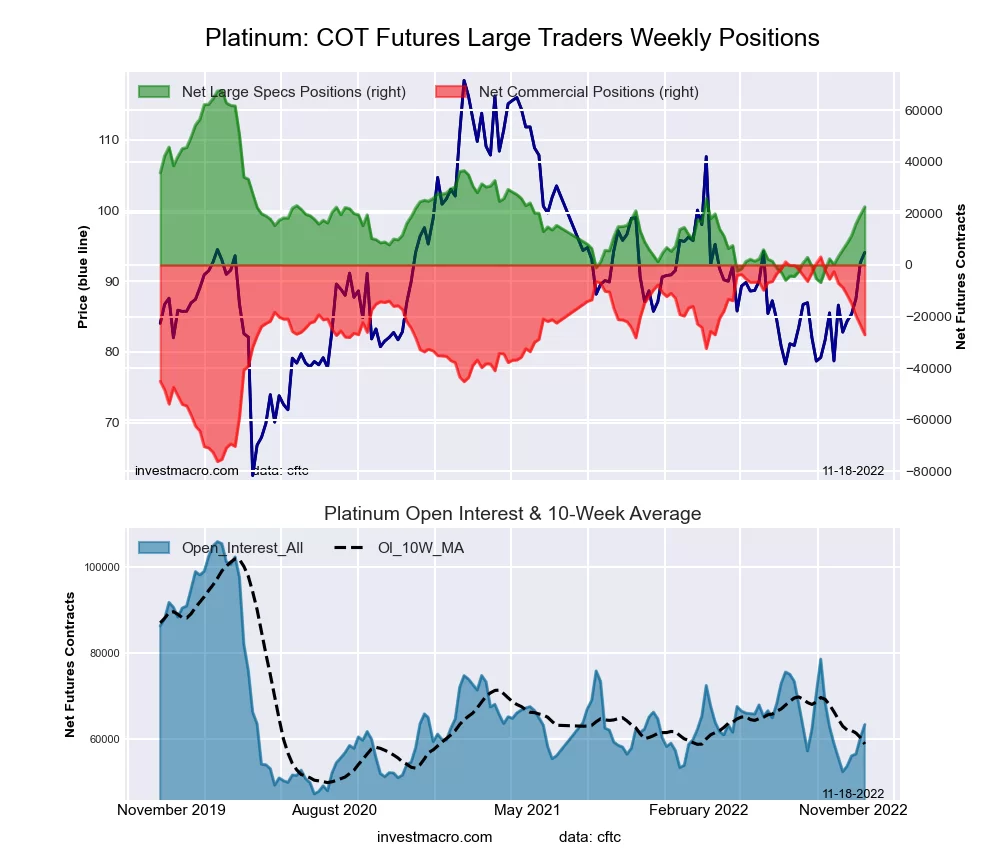
Highlighting the COT Metals data this week was the speculator positions in Platinum. The large speculative positions rose this week for a third straight week and for the fifth time in the past six weeks. Over the past six weeks, speculative bets have improved by a total of +15,245 contracts. This recent bullishness has brought the overall net standing to its highest level in the past twenty-eight weeks, dating back to April 5th of this year.

Platinum prices have been on the rise as well with a monthly gain above 8 percent so far in October. Platinum could also benefit going forward from an interesting tax loophole in India that has pushed Platinum imports to a record high to approximately 27 tonnes this September compared to a little over 1 tonnes last September, according to Reuters. Indian gold refiners are importing Platinum mixed with Gold to offset new higher taxes on Gold. A Gold/Platinum mix allows importers to classify the import as a Platinum alloy and pay a lower tax rate on it.

Platinum futures closed this week over 4 percent higher near the $933 level but below the $940 level which has acted as a resistance barrier over the past five weeks.


Data Snapshot of Commodity Market Traders | Columns Legend
Oct-18-2022OIOI-IndexSpec-NetSpec-IndexCom-NetCOM-IndexSmalls-NetSmalls-Index
WTI Crude1,454,4310251,54511-273,7579022,21237
Gold434,701176,9568-90,0309113,07412
Silver136,05591,26715-9,085877,8188
Copper178,73017-20,3022019,6968260629
Palladium6,8054-1,209161,44482-23530
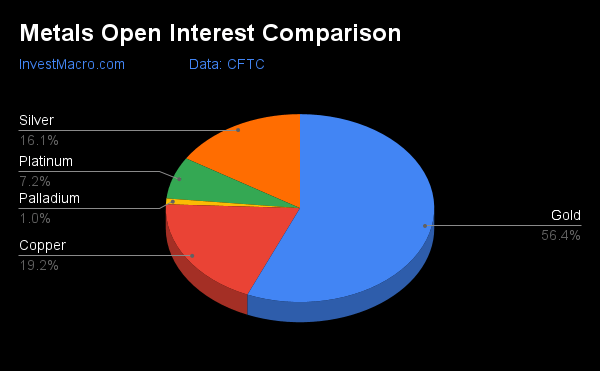
Platinum53,728118,49421-11,632813,13810
Natural Gas963,7923-154,73432126,7607127,97446
Brent163,29611-41,8474138,681583,16652
Heating Oil283,7022924,55579-44,0312419,47666
Soybeans714,5323054,68330-30,59577-24,08830
Corn1,419,08722312,41970-249,25536-63,1647
Coffee196,729919,22353-21,605522,38224
Sugar711,6644126,41263-164,6713738,25955
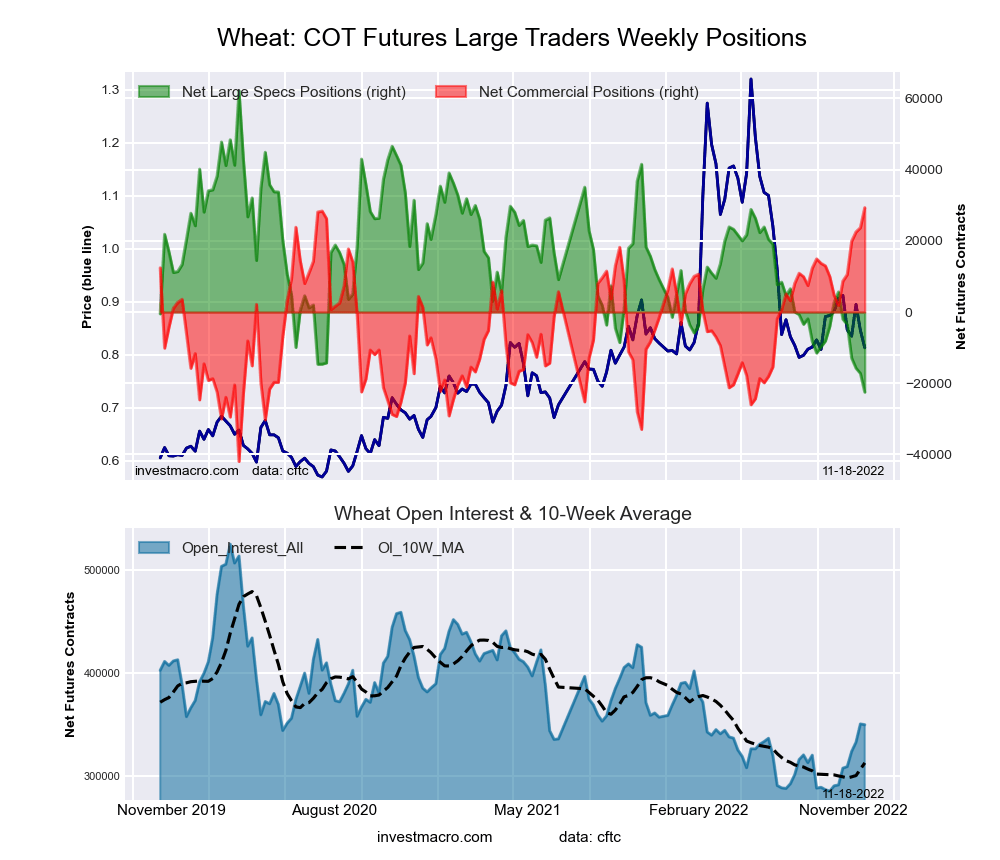
Wheat309,42910-3,5411410,53475-6,99374


Strength Scores led by Platinum and Copper

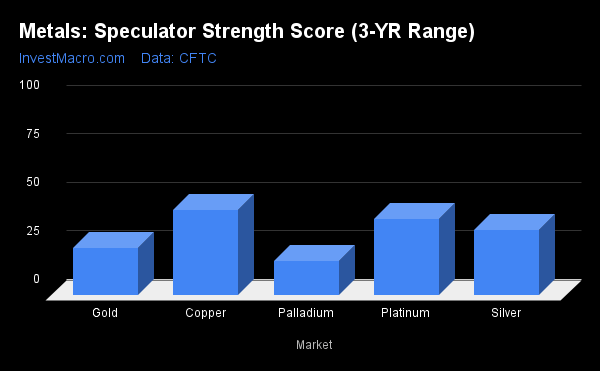
Strength scores (a measure of the 3-Year range of Speculator positions, from 0 to 100 where above 80 is extreme bullish and below 20 is extreme bearish) showed that Platinum (20.5 percent) and Copper (20.2 percent) lead the metals this week just above the bearish extreme level.

On the downside, Gold (8.2 percent) continues to be at the lowest strength level currently and is followed by Silver (15.5 percent) and Palladium (16.4 percent). All three markets in extreme bearish levels below 20 percent.

Strength Statistics:
Gold (8.2 percent) vs Gold previous week (14.0 percent)
Silver (15.5 percent) vs Silver previous week (22.3 percent)
Copper (20.2 percent) vs Copper previous week (23.7 percent)
Platinum (20.5 percent) vs Platinum previous week (17.1 percent)
Palladium (16.4 percent) vs Palladium previous week (19.1 percent)

Platinum leads the Strength Trend Scores

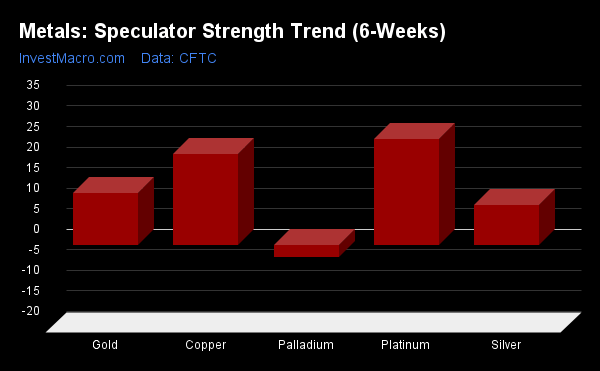
Strength Score Trends (or move index, calculates the 6-week changes in strength scores) show that Platinum (20.5 percent) leads the past six weeks trends for metals this week. Silver (15.5 percent), Copper (2.9 percent) and Palladium (2.3 percent) fill out the other positive movers in the latest trends data.

Gold (-8.9 percent) leads the downside trend scores currently as the only negative mover in the latest data.

Move Statistics:
Gold (-8.9 percent) vs Gold previous week (-7.7 percent)
Silver (15.5 percent) vs Silver previous week (17.3 percent)
Copper (2.9 percent) vs Copper previous week (5.9 percent)
Platinum (20.5 percent) vs Platinum previous week (15.2 percent)
Palladium (2.3 percent) vs Palladium previous week (2.2 percent)


Individual Markets:

Gold Comex Futures:

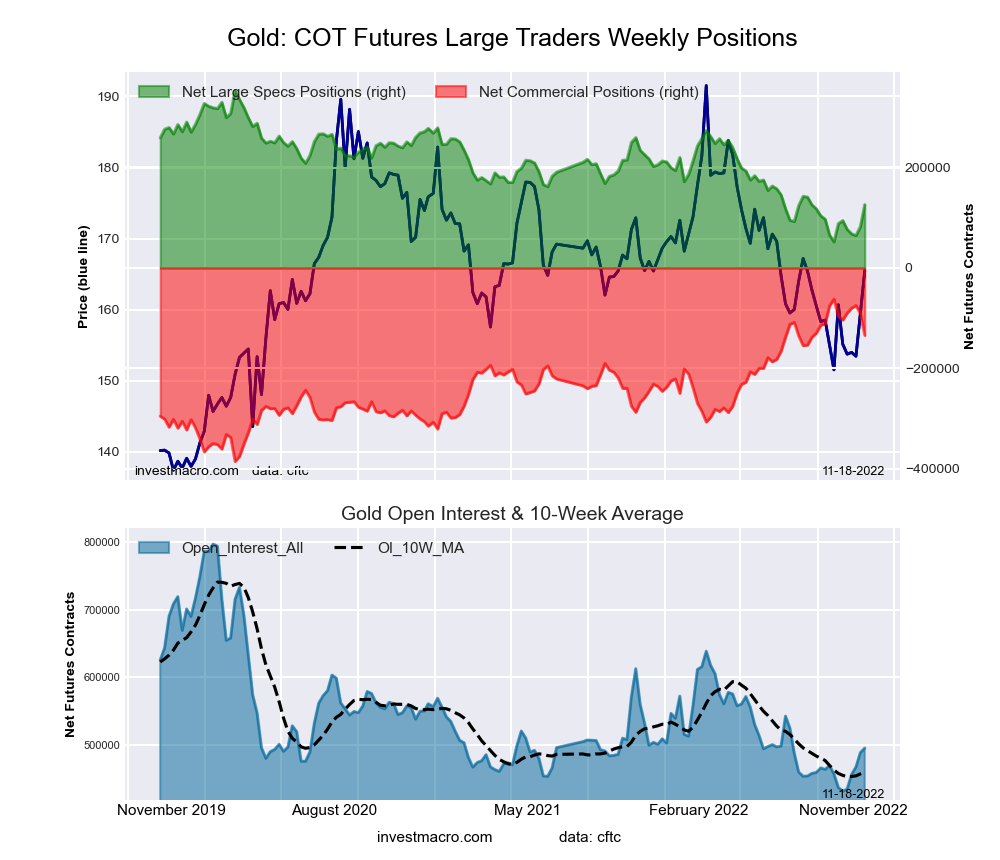
Gold Futures COT ChartThe Gold Comex Futures large speculator standing this week came in at a net position of 76,956 contracts in the data reported through Tuesday. This was a weekly reduction of -17,464 contracts from the previous week which had a total of 94,420 net contracts.

This week’s current strength score (the trader positioning range over the past three years, measured from 0 to 100) shows the speculators are currently Bearish-Extreme with a score of 8.2 percent. The commercials are Bullish-Extreme with a score of 91.4 percent and the small traders (not shown in chart) are Bearish-Extreme with a score of 12.4 percent.

Gold Futures StatisticsSPECULATORSCOMMERCIALSSMALL TRADERS
– Percent of Open Interest Longs:48.526.59.0
– Percent of Open Interest Shorts:30.847.26.0
– Net Position:76,956-90,03013,074
– Gross Longs:210,890115,07339,286
– Gross Shorts:133,934205,10326,212
– Long to Short Ratio:1.6 to 10.6 to 11.5 to 1
NET POSITION TREND:
– Strength Index Score (3 Year Range Pct):8.291.412.4
– Strength Index Reading (3 Year Range):Bearish-ExtremeBullish-ExtremeBearish-Extreme
NET POSITION MOVEMENT INDEX:
– 6-Week Change in Strength Index:-8.97.47.2


Silver Comex Futures:

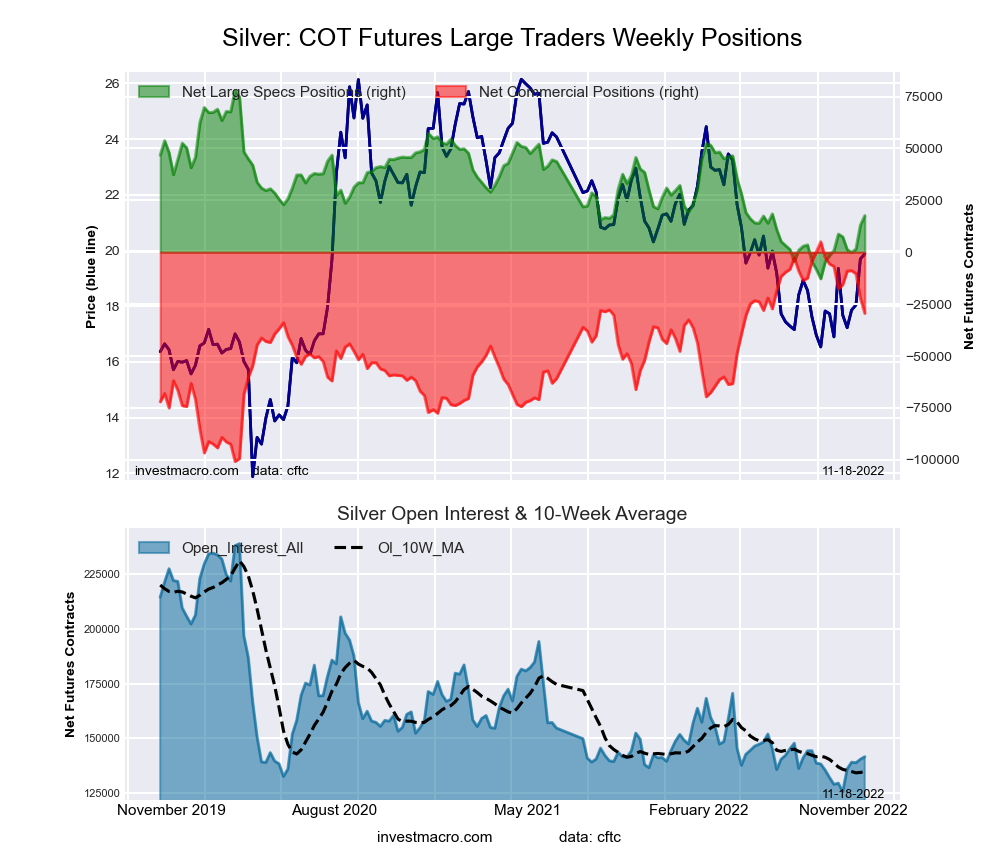
Silver Futures COT ChartThe Silver Comex Futures large speculator standing this week came in at a net position of 1,267 contracts in the data reported through Tuesday. This was a weekly decline of -6,122 contracts from the previous week which had a total of 7,389 net contracts.

This week’s current strength score (the trader positioning range over the past three years, measured from 0 to 100) shows the speculators are currently Bearish-Extreme with a score of 15.5 percent. The commercials are Bullish-Extreme with a score of 86.6 percent and the small traders (not shown in chart) are Bearish-Extreme with a score of 8.2 percent.

Silver Futures StatisticsSPECULATORSCOMMERCIALSSMALL TRADERS
– Percent of Open Interest Longs:37.937.516.2
– Percent of Open Interest Shorts:37.044.110.4
– Net Position:1,267-9,0857,818
– Gross Longs:51,54150,95622,014
– Gross Shorts:50,27460,04114,196
– Long to Short Ratio:1.0 to 10.8 to 11.6 to 1
NET POSITION TREND:
– Strength Index Score (3 Year Range Pct):15.586.68.2
– Strength Index Reading (3 Year Range):Bearish-ExtremeBullish-ExtremeBearish-Extreme
NET POSITION MOVEMENT INDEX:
– 6-Week Change in Strength Index:15.5-13.40.4


Copper Grade #1 Futures:

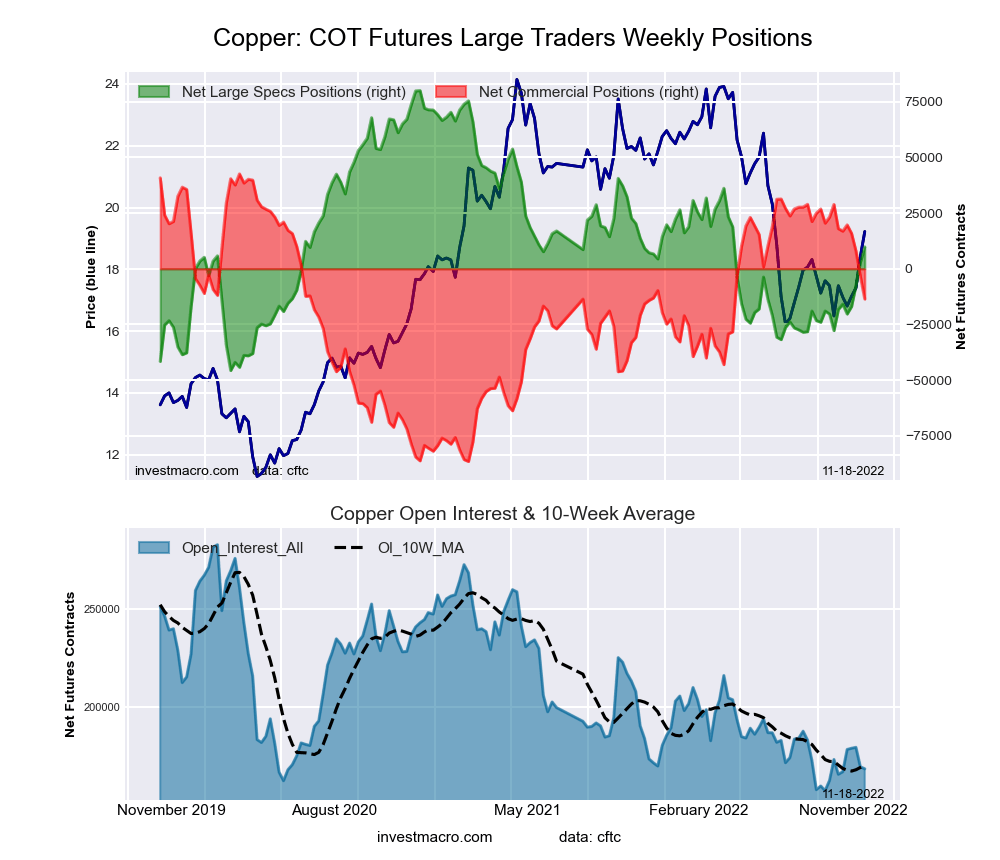
Copper Futures COT ChartThe Copper Grade #1 Futures large speculator standing this week came in at a net position of -20,302 contracts in the data reported through Tuesday. This was a weekly decline of -4,403 contracts from the previous week which had a total of -15,899 net contracts.

This week’s current strength score (the trader positioning range over the past three years, measured from 0 to 100) shows the speculators are currently Bearish with a score of 20.2 percent. The commercials are Bullish-Extreme with a score of 82.3 percent and the small traders (not shown in chart) are Bearish with a score of 28.8 percent.

Copper Futures StatisticsSPECULATORSCOMMERCIALSSMALL TRADERS
– Percent of Open Interest Longs:27.646.48.5
– Percent of Open Interest Shorts:39.035.48.1
– Net Position:-20,30219,696606
– Gross Longs:49,33582,89015,118
– Gross Shorts:69,63763,19414,512
– Long to Short Ratio:0.7 to 11.3 to 11.0 to 1
NET POSITION TREND:
– Strength Index Score (3 Year Range Pct):20.282.328.8
– Strength Index Reading (3 Year Range):BearishBullish-ExtremeBearish
NET POSITION MOVEMENT INDEX:
– 6-Week Change in Strength Index:2.9-5.519.9


Platinum Futures:

Platinum Futures COT ChartThe Platinum Futures large speculator standing this week came in at a net position of 8,494 contracts in the data reported through Tuesday. This was a weekly gain of 2,566 contracts from the previous week which had a total of 5,928 net contracts.

This week’s current strength score (the trader positioning range over the past three years, measured from 0 to 100) shows the speculators are currently Bearish with a score of 20.5 percent. The commercials are Bullish-Extreme with a score of 81.4 percent and the small traders (not shown in chart) are Bearish-Extreme with a score of 10.3 percent.

Platinum Futures StatisticsSPECULATORSCOMMERCIALSSMALL TRADERS
– Percent of Open Interest Longs:49.136.112.0
– Percent of Open Interest Shorts:33.357.86.1
– Net Position:8,494-11,6323,138
– Gross Longs:26,38519,4066,436
– Gross Shorts:17,89131,0383,298
– Long to Short Ratio:1.5 to 10.6 to 12.0 to 1
NET POSITION TREND:
– Strength Index Score (3 Year Range Pct):20.581.410.3
– Strength Index Reading (3 Year Range):BearishBullish-ExtremeBearish-Extreme
NET POSITION MOVEMENT INDEX:
– 6-Week Change in Strength Index:20.5-18.6-6.1


Palladium Futures:

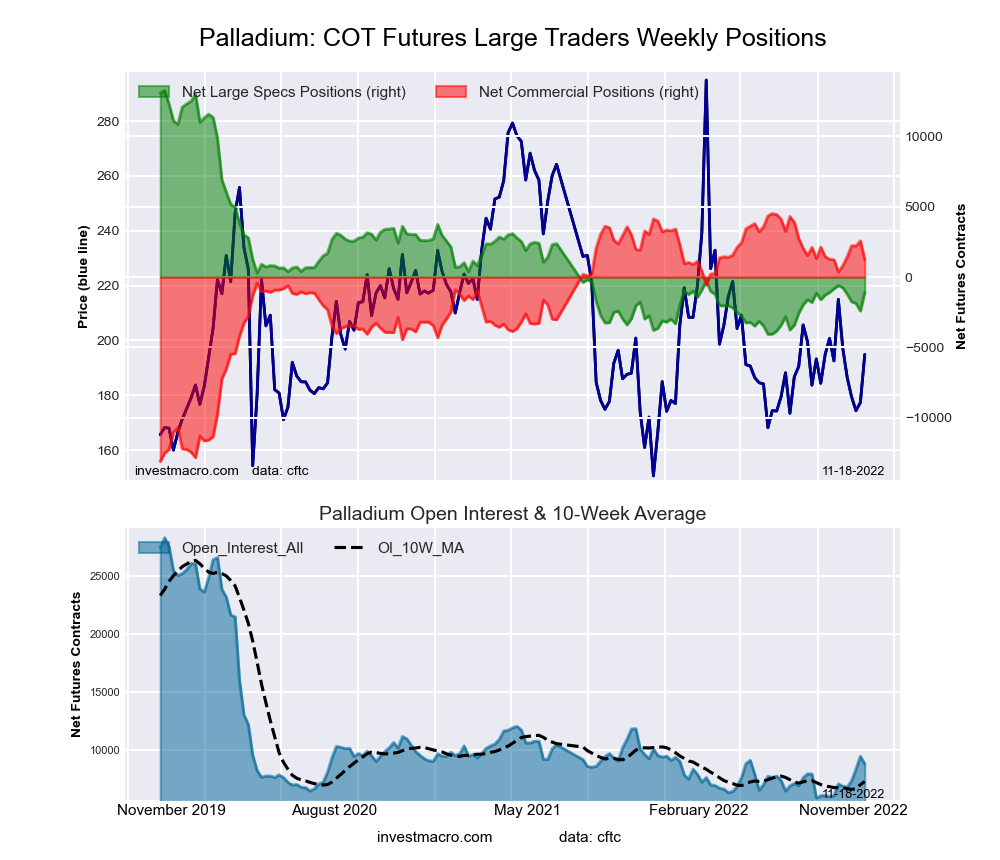
Palladium Futures COT ChartThe Palladium Futures large speculator standing this week came in at a net position of -1,209 contracts in the data reported through Tuesday. This was a weekly fall of -455 contracts from the previous week which had a total of -754 net contracts.

This week’s current strength score (the trader positioning range over the past three years, measured from 0 to 100) shows the speculators are currently Bearish-Extreme with a score of 16.4 percent. The commercials are Bullish-Extreme with a score of 82.3 percent and the small traders (not shown in chart) are Bearish with a score of 30.3 percent.

Palladium Futures StatisticsSPECULATORSCOMMERCIALSSMALL TRADERS
– Percent of Open Interest Longs:26.358.314.3
– Percent of Open Interest Shorts:44.137.117.8
– Net Position:-1,2091,444-235
– Gross Longs:1,7933,968975
– Gross Shorts:3,0022,5241,210
– Long to Short Ratio:0.6 to 11.6 to 10.8 to 1
NET POSITION TREND:
– Strength Index Score (3 Year Range Pct):16.482.330.3
– Strength Index Reading (3 Year Range):Bearish-ExtremeBullish-ExtremeBearish
NET POSITION MOVEMENT INDEX:
– 6-Week Change in Strength Index:2.3-4.016.9


Article By InvestMacroReceive our weekly COT Newsletter

*COT Report: The COT data, released weekly to the public each Friday, is updated through the most recent Tuesday (data is 3 days old) and shows a quick view of how large speculators or non-commercials (for-profit traders) were positioned in the futures markets.

The CFTC categorizes trader positions according to commercial hedgers (traders who use futures contracts for hedging as part of the business), non-commercials (large traders who speculate to realize trading profits) and nonreportable traders (usually small traders/speculators) as well as their open interest (contracts open in the market at time of reporting). See CFTC criteria here.

Measuring the ‘Halloween effect’ – can retail investor optimism really affect stock returns?

By Moritz Wagner, University of Canterbury 

The upcoming spooky season is not only a favourite time for most kids (and a few adults), but also for share markets due to what’s been called the “Halloween effect” – often referred to as “sell in May and go away”.

There is hardly a year investors and the media do not refer to the popular market wisdom suggesting higher stock returns in the months November through to April, compared with May through to October (that is, in the northern hemisphere’s winter and summer, but it also applies to southern hemisphere countries where the seasons are offset by six months).

With investors looking for a crystal ball to help with investing, predictable patterns can offer a guide for when to invest and when to sell. But has this pattern survived the financial volatility of the past two decades?

New research shows this seasonal investment pattern is still alive and well in most stock markets around the world and, if anything, has become more pronounced in recent years.

Both the Halloween and January effect – the observation that stock prices of mainly smaller firms tend to increase in January more than in other months – are pervasive. These patterns seemingly provide guidance for the two most fundamental decisions when making an investment: what assets to buy or sell, and when.

Of course, such anomalies appear to be inconsistent with the common hypothesis that markets are efficient and that prices change randomly.

Finally answering the ‘why’

A recent analysis using stock returns and mutual fund flows in the United States provides a simple answer to the nagging question of why these anomalies exist and why they have worked for so long. Previous explanations have largely been inconclusive.

Aggregate fund flows (the bars depicting money invested or withdrawn by investors) exhibit a similar calendar-based pattern as market returns (the lines). The returns are substantially higher during winter months than during summer months.

Remarkably, in years where this is not the case – when summer flow is higher than winter flow – the winter excess returns are also negative.

Markets influenced by optimism or pessimism

When examined jointly, high average stock returns in winter months (Halloween effect) and in January (January effect) can be attributed to a large average influx of funds. After accounting for the effect of these increased fund flows, there are no seasonal factors affecting market returns anymore.

The study builds on earlier findings, providing strong evidence of the price-pressure effects from funds that expand their portfolios when they receive money from investors (cash inflow) and sell their shares when investors withdraw money (cash outflow).

In other words, large cash inflow induces fund managers to invest the excess cash, driving up the demand for stocks. When funds experience outflow, they liquidate investment positions, increasing the supply of stocks.

Such trading across funds can affect returns by temporarily driving stock prices away from their fundamental value. Interestingly, only flows to retail funds catering to individual investors, as opposed to institutional funds catering to high-net-worth or institutional investors, are seasonal.

The effect also appears to be short-lived and reverses within a few months and highlights the behavioural nature of the patterns observed in the market.

Overall, the interrelation between seasonal flows and stock returns originates from the buying and selling activities of perhaps overly optimistic or pessimistic individual retail investors.

Time to get into investing?

Some readers might ask whether it is still a good idea to buy stocks in the coming Halloween season, as the recent downturn in markets may appear like a good entry point.

However, the troublesome mix of record high inflation, rising interest rates and Russia’s war in Ukraine may ultimately result in a recession.

If retail investors then stay away from the market, seasonal patterns are less likely to materialise this time around. But there is no crystal ball to predict what is going to happen.

The best advice is to keep emotions out of investment decisions and focus on a broader strategy – look for long-term opportunities in the market rather than trying to time it.The Conversation

About the Author:

Moritz Wagner, Lecturer, University of Canterbury

This article is republished from The Conversation under a Creative Commons license. Read the original article.

A new type of material called a mechanical neural network can learn and change its physical properties to create adaptable, strong structures

By Ryan H. Lee, University of California, Los Angeles 

The Research Brief is a short take about interesting academic work.

The big idea

A new type of material can learn and improve its ability to deal with unexpected forces thanks to a unique lattice structure with connections of variable stiffness, as described in a new paper by my colleagues and me.

A hand holding a small, complex cube of plastic.
Architected materials – like this 3D lattice – get their properties not from what they are made out of, but from their structure.
Ryan Lee, CC BY-ND

The new material is a type of architected material, which gets its properties mainly from the geometry and specific traits of its design rather than what it is made out of. Take hook-and-loop fabric closures like Velcro, for example. It doesn’t matter whether it is made from cotton, plastic or any other substance. As long as one side is a fabric with stiff hooks and the other side has fluffy loops, the material will have the sticky properties of Velcro.

My colleagues and I based our new material’s architecture on that of an artificial neural network – layers of interconnected nodes that can learn to do tasks by changing how much importance, or weight, they place on each connection. We hypothesized that a mechanical lattice with physical nodes could be trained to take on certain mechanical properties by adjusting each connection’s rigidity.

To find out if a mechanical lattice would be able to adopt and maintain new properties – like taking on a new shape or changing directional strength – we started off by building a computer model. We then selected a desired shape for the material as well as input forces and had a computer algorithm tune the tensions of the connections so that the input forces would produce the desired shape. We did this training on 200 different lattice structures and found that a triangular lattice was best at achieving all of the shapes we tested.

Once the many connections are tuned to achieve a set of tasks, the material will continue to react in the desired way. The training is – in a sense – remembered in the structure of the material itself.

We then built a physical prototype lattice with adjustable electromechanical springs arranged in a triangular lattice. The prototype is made of 6-inch connections and is about 2 feet long by 1½ feet wide. And it worked. When the lattice and algorithm worked together, the material was able to learn and change shape in particular ways when subjected to different forces. We call this new material a mechanical neural network.

A photo of hydraulic springs arranged in a triangular lattice
The prototype is 2D, but a 3D version of this material could have many uses.
Jonathan Hopkins, CC BY-ND

Why it matters

Besides some living tissues, very few materials can learn to be better at dealing with unanticipated loads. Imagine a plane wing that suddenly catches a gust of wind and is forced in an unanticipated direction. The wing can’t change its design to be stronger in that direction.

The prototype lattice material we designed can adapt to changing or unknown conditions. In a wing, for example, these changes could be the accumulation of internal damage, changes in how the wing is attached to a craft or fluctuating external loads. Every time a wing made out of a mechanical neural network experienced one of these scenarios, it could strengthen and soften its connections to maintain desired attributes like directional strength. Over time, through successive adjustments made by the algorithm, the wing adopts and maintains new properties, adding each behavior to the rest as a sort of muscle memory.

This type of material could have far reaching applications for the longevity and efficiency of built structures. Not only could a wing made of a mechanical neural network material be stronger, it could also be trained to morph into shapes that maximize fuel efficiency in response to changing conditions around it.

This connection of springs is a new type of material that can change shape and learn new properties.
Jonathan Hopkins, CC BY-ND

What’s still not known

So far, our team has worked only with 2D lattices. But using computer modeling, we predict that 3D lattices would have a much larger capacity for learning and adaptation. This increase is due to the fact that a 3D structure could have tens of times more connections, or springs, that don’t intersect with one another. However, the mechanisms we used in our first model are far too complex to support in a large 3D structure.

What’s next

The material my colleagues and I created is a proof of concept and shows the potential of mechanical neural networks. But to bring this idea into the real world will require figuring out how to make the individual pieces smaller and with precise properties of flex and tension.

We hope new research in the manufacturing of materials at the micron scale, as well as work on new materials with adjustable stiffness, will lead to advances that make powerful smart mechanical neural networks with micron-scale elements and dense 3D connections a ubiquitous reality in the near future.The Conversation

About the Author:

Ryan H. Lee, PhD Student in Mechanical and Aerospace Engineering, University of California, Los Angeles

This article is republished from The Conversation under a Creative Commons license. Read the original article.

Towards zero hunger in Africa: 5 steps to achieve food security

By Edward Mabaya, Cornell University; Robert B. Richardson, Michigan State University, and Thomas Jayne, Michigan State University 

Global food systems have been battered by overlapping crises in recent years. Key among these are the COVID-19 pandemic, the Russo-Ukraine war and extreme weather events resulting from climate change. These have resulted in forced migration, loss of employment, climate stress, loss of biodiversity, and economic instability.

In Africa, which is home to 1.5 billion people, these shocks and stressors have slowed – or even reversed – decades of progress in improving food security and nutrition. For example, 37 million people in the Greater Horn of Africa are facing acute hunger in one of the region’s worst droughts in decades.

These multiple crises have forced the world to recognise that improving nutrition and food security requires more resilient global and national food systems. Food systems are the sum of actors and interactions along the food value chain – from input supply and production to transport, processing, retailing, wholesaling, preparation, consumption and disposal.

As set out in the Sustainable Development Goals (SDG2), the journey towards food and nutritional security for Africa has a clear destination – zero hunger. The target is to ensure access to safe, nutritious and sufficient food for all people by 2030.

The recently launched Africa Agriculture Status Report examines the continent’s progress towards food and nutritional security.

We co-edited the report, which has six key themes. It charts a roadmap to get to the goal faster while adapting to a changing environment. Our report coincided with World Food Day 2022, whose theme is safer food, better health.

Without transformative change like the Asian Green Revolution, African food systems will continue to impede human development. They will also continue to be overly dependent on food imports. Without a strong drive for sustainable agricultural practices, the continent’s food systems will worsen environmental destruction. Urgent action is needed to anticipate megatrends, rally political will, mobilise investments and strengthen capacity.

Five ways to transform African food systems

The need for true cost accounting

Development practitioners working in Africa need true cost accounting for our food systems. It should explicitly consider all the environmental, social and human health outcomes associated with the way food systems are organised. For example, 74% of agricultural production growth in sub-Saharan Africa since 2000 has been achieved through area expansion and only 26% from increased yields. This is far from ideal. Reliance on area expansion has converted forests and grasslands into cropland on a massive scale. The result has been substantial damage to the region’s stock of natural resources and ecosystem services.

A true cost accounting framework sets out the costs of this approach. It would lead to the recognition that technical innovation is important to improve yields on existing farmland. It would show that this is a more sustainable approach to production growth, better health and improved nutrition.

Anticipate the megatrends

African governments must be prepared for the big demographic, economic, environmental, and social trends shaping the continent’s food systems. These include:

  • rapid population growth, associated land scarcity and rapidly rising land prices
  • rapidly growing demand for food, driven by rapidly growing urban areas, rising incomes and purchasing power
  • more frequent and intense weather disruptions associated with climate change
  • global health crises, economic disruptions, and civil conflicts such as the Russo-Ukraine war
  • technical innovation in digital agriculture.

Africa’s food systems continue to evolve in response to these drivers. Food policies and investment strategies need to change too. We are chasing a moving target.

Role of leadership

Leadership is essential to harness collective effort, shared responsibility, stakeholder engagement and political will to transform food systems.

Political leaders can either push the accelerator or step on the brakes. The complex nature of our food systems requires that key actors, including national governments, international agencies, civil society, farmer organisations and the private sector, work together towards the common goal.

Governments and regional bodies are at the centre of food systems interventions.

Investment gap

Financing is the fuel needed to accelerate transformation. Based on recent estimates from New Growth International, a network based management consulting firm, food systems transformation in Africa requires up to US$77 billion a year from the public sector and up to US$180 billion from the private sector.

Mobilising financing at scale requires African governments to:

  • define priorities
  • commit to financing priority actions
  • enhance coordination between government and private sector
  • ensure good governance and accountability.

Capacities and capabilities

Africa must invest in domestic human, institutional and system-wide capacities and capabilities. Capacity development efforts should be guided by seven core principles: country ownership and leadership; alignment with national needs and priorities; use of national systems and local expertise; no “one-size-fits-all” tactics; multi-level approaches; and mutual accountability.

We also note that even though agricultural research capacity has increased by 90% between 2000 and 2016 there has been a decline in public investment in agricultural research systems. This threatens Africa’s capacity to adapt the latest technologies to local conditions.

Call to action

There’s an urgency to transforming African and global food systems to make them more resilient and sustainable. Failure is not an option.

Transformation will require a coordinated approach from governments, development partners, the private sector and civil society. It is time to put into action the carefully designed strategies, policy reforms and investment plans highlighted in the latest report.The Conversation

About the Author:

Edward Mabaya, Research Professor, Cornell University; Robert B. Richardson, Professor of Sustainable Development, Michigan State University, and Thomas Jayne, MSU Foundation Professor, Agricultural, Food and Resource Economics, Michigan State University

This article is republished from The Conversation under a Creative Commons license. Read the original article.


Mid-Week Technical Outlook : Majors

By ForexTime 

A sense of caution returned to markets on Wednesday as concerns over soaring inflation and slowing economic growth punctured risk sentiment. King dollar drew strength from the negative vibes while sterling weakened after UK inflation hit double digits. In the commodity space, oil prices edged cautiously higher thanks to bullish signals but gold tumbled with bears eyeing $1615. With the economic calendar relatively light today, markets could be influenced by corporate earnings and other key themes influencing sentiment. Our focus falls on the currency space with the tool of choice none other than technical analysis.

EURUSD eyes 0.9700

The path of least resistance for the EURUSD points south. Prices are trading below the 50, 100, and 200-day Simple Moving Average while the MACD trades below zero. A stronger dollar may drag the EURUSD and may pull prices closer to 0.9700. If this support is breached, the next key level can be found at 0.9500.  A move back above 0.9900 could open the doors back to parity.

GBPUSD…watch the range

Prices remain trapped within a wide range with support at 1.0925 and resistance at 1.1400. Sustained weakness under this resistance is likely to open the doors towards 1.1200 and 1.0925. If bulls can push prices above 1.1400, then an incline toward 1.1490 (where the 50-day SMA resides could be on the cards).

AUDUSD gearing for major breakdown

The trend is bearish on the AUDUSD. Prices are currently within a range with support at 0.6200 and resistance at 0.6340. A breakdown below 0.6200 could trigger a selloff towards 0.6000. If prices can break above 0.6340, the AUDUSD could test 0.6550.

USDJPY keeps pushing higher

After securing a daily close above 149.00, USDJPY bulls are certainly in the driver’s seat. The currency pair is trading at levels not seen in 32 years thanks to verbal intervention by the Bank of Japan and an appreciating dollar. The upside momentum could take prices towards 150.00 and higher. A move back below 149.00 could trigger a selloff towards 145.00.

USDCAD ready to move?

Nothing much has happened on the USDCAD over the past few days. Prices have been trapped within a tight range with support at 1.3700 and resistance at 1.3840. Given how the dollar is back on the rise amid risk aversion, the USDCAD could conquer 1.3840 and 1.4000, respectively. If prices end up breaking below 1.3700, bears may target 1.3502.


Forex-Time-LogoArticle by ForexTime
ForexTime Ltd (FXTM) is an award winning international online forex broker regulated by CySEC 185/12 www.forextime.com