Archive for Opinions – Page 113

Currency Speculators continued to boost their Euro bets to 17-week high

By InvestMacro

Here are the latest charts and statistics for the Commitment of Traders (COT) data published by the Commodities Futures Trading Commission (CFTC).

The latest COT data is updated through Tuesday October 4th and shows a quick view of how large market participants (for-profit speculators and commercial traders) were positioned in the futures markets. All currency positions are in direct relation to the US dollar where, for example, a bet for the euro is a bet that the euro will rise versus the dollar while a bet against the euro will be a bet that the euro will decline versus the dollar.

Weekly Speculator Changes

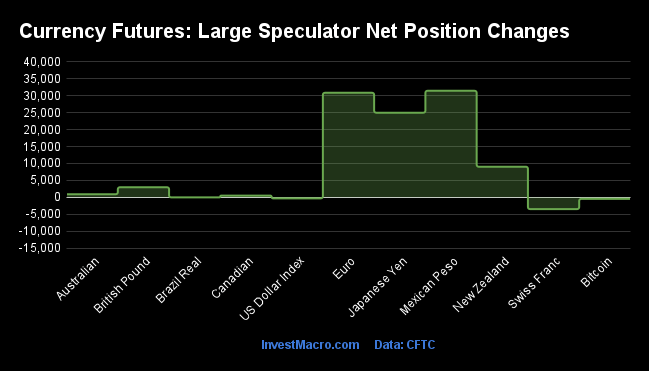
The COT currency market speculator bets were slightly lower this week as five out of the eleven currency markets we cover had higher positioning while the other six markets had lower speculator contracts.

Leading the gains for the currency markets was the Euro (9,885 contracts) with the Australian dollar (6,889 contracts), the Mexican peso (4,001 contracts), the US Dollar Index (1,135 contracts) and the Japanese yen (933 contracts) also showing a positive week.

The currencies leading the declines in speculator bets this week were the Brazilian real (-7,985 contracts) with the Canadian dollar (-3,741 contracts), the British pound sterling (-3,115 contracts),  the New Zealand dollar (-2,507 contracts), the Swiss franc (-1,122 contracts) and Bitcoin (-1,056 contracts) also registering lower bets on the week.

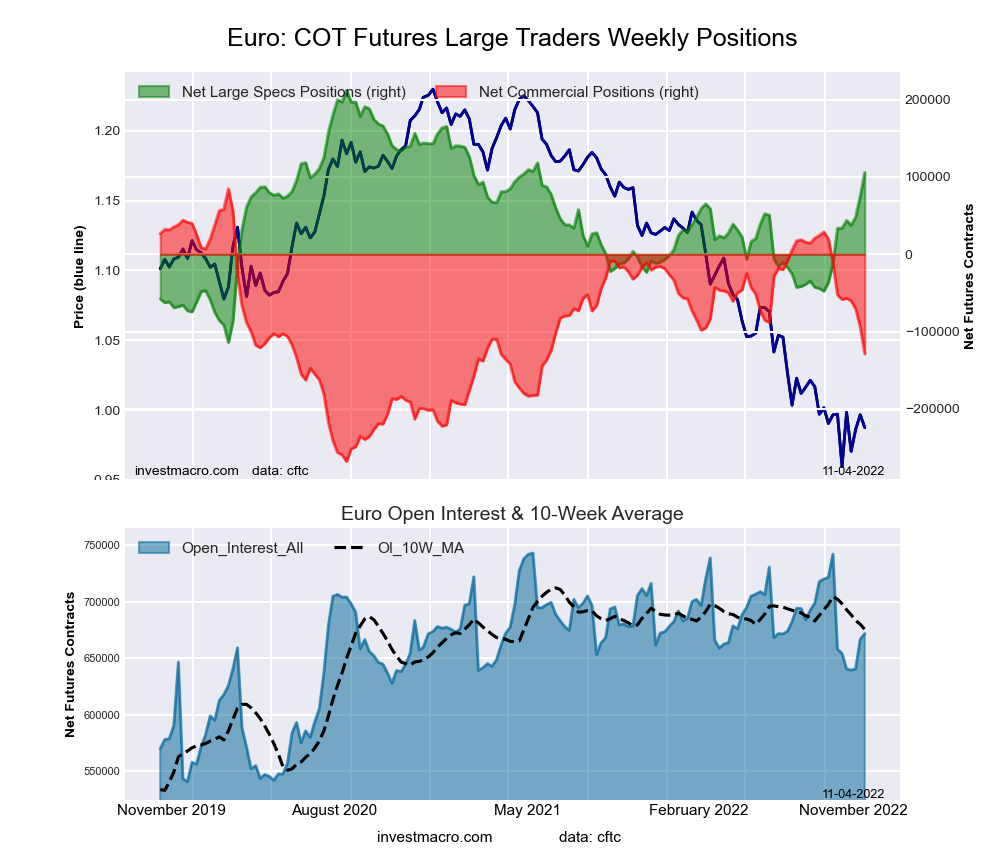
Highlighting the COT currency positioning this week is the Euro speculators positioning that has improved for the fifth straight week. Euro speculators have now boosted their net positions by a total of +91,358 contracts over these past five weeks. This has taken the net positioning from -47,676 contracts on August 30th to a total of +43,682 contracts this week and to the most bullish level since June 7th, a span of 17 weeks.

Speculators are clearly betting that the Euro is near or getting near a bottom against the US dollar as the Euro prices have been testing 20-year lows versus its American counterpart.

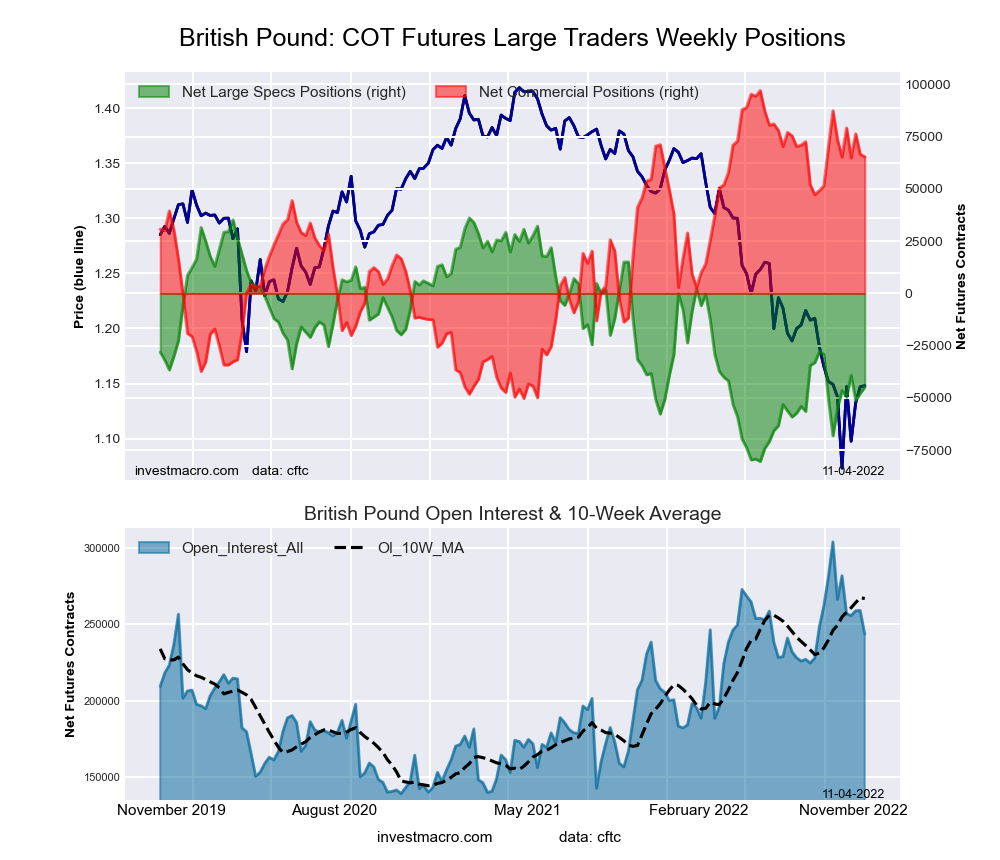
Speculator contracts are usually trend-following and stay relatively in lock-step with prices. The current unusual situation in the Euro contracts can be contrasted with other major currencies at the moment. The British pound sterling net positions are currently at -49,539 contracts while its currency is at similar multi-decade lows and the Japanese yen speculator level is at -81,623 contracts while its currency is also near its own 25-year lows.

The European economic situation seems to be as uncertain as the UK (recession?) and the Japanese (low interest rates) situations with an energy crisis potentially looming and a recession on the horizon. However, speculators are feeling differently at the moment.

Meanwhile in the markets, the EURUSD exchange rate remained below parity this week and fell modestly by less than -1.00 percent, closing out the week at the 0.9742 exchange rate.


Data Snapshot of Forex Market Traders | Columns Legend
Oct-04-2022OIOI-IndexSpec-NetSpec-IndexCom-NetCOM-IndexSmalls-NetSmalls-Index
USD Index54,6387731,69778-36,817175,12073
EUR640,4585543,68248-56,8486013,1660
GBP256,90671-49,5392679,11688-29,5770
JPY243,28976-81,6231993,32481-11,70130
CHF43,12127-6,8523916,02269-9,17026
CAD141,79925-21,4071517,947843,46037
AUD139,49037-27,7645938,80448-11,04026
NZD48,48741-13,9784617,25959-3,28114
MXN192,35246-37,3211131,914865,40766
RUB20,93047,54331-7,15069-39324
BRL39,9842725,77976-27,570241,79186
Bitcoin14,23082-3276-421045323


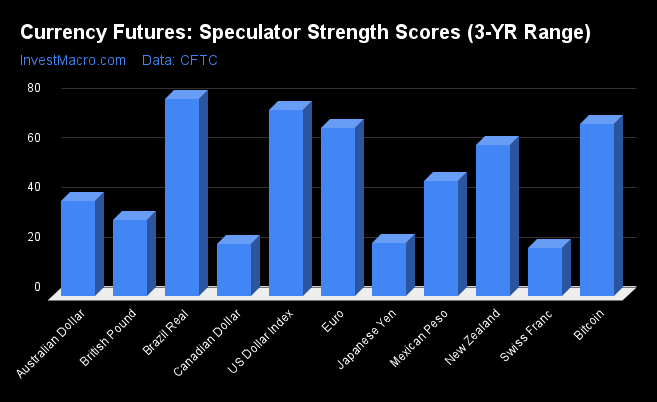
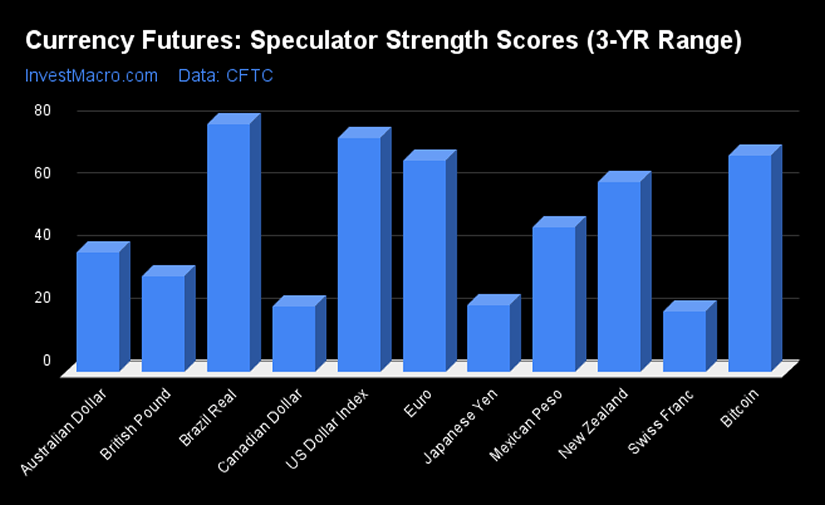
US Dollar Index (77.8 percent) leads Strength Scores

Strength Scores (a normalized measure of Speculator positions over a 3-Year range, from 0 to 100 where above 80 is extreme bullish and below 20 is extreme bearish) showed that the US Dollar Index (77.8 percent) is back in the lead for the currency markets scores. Bitcoin (76.4 percent) and the Brazilian Real (75.7 percent) come in as the next highest in the currency markets in strength scores.

On the downside, the Mexican Peso (11.4 percent), Canadian Dollar (15.3 percent) and the Japanese Yen (18.6 percent) come in at the lowest strength level currently. All three of these markets are in bearish extreme positions with scores under the 20 percent level.


Strength Statistics:
US Dollar Index (77.8 percent) vs US Dollar Index previous week (75.9 percent)
EuroFX (48.4 percent) vs EuroFX previous week (45.4 percent)
British Pound Sterling (26.5 percent) vs British Pound Sterling previous week (29.2 percent)
Japanese Yen (18.6 percent) vs Japanese Yen previous week (18.0 percent)
Swiss Franc (39.1 percent) vs Swiss Franc previous week (42.0 percent)
Canadian Dollar (15.3 percent) vs Canadian Dollar previous week (19.5 percent)
Australian Dollar (59.1 percent) vs Australian Dollar previous week (52.7 percent)
New Zealand Dollar (45.9 percent) vs New Zealand Dollar previous week (50.3 percent)
Mexican Peso (11.4 percent) vs Mexican Peso previous week (9.7 percent)
Brazilian Real (75.7 percent) vs Brazilian Real previous week (83.6 percent)
Bitcoin (76.4 percent) vs Bitcoin previous week (94.8 percent)

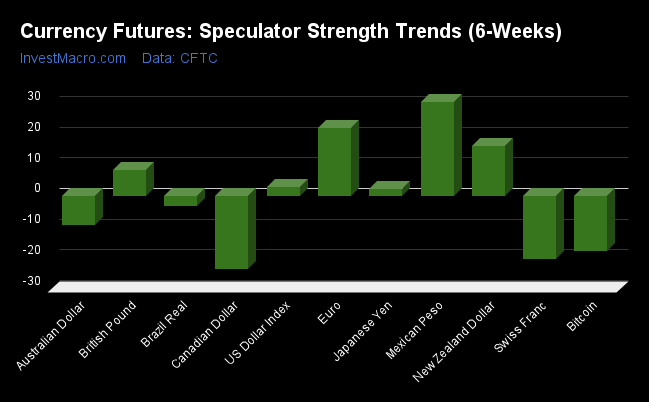
Australian Dollar (29.9 percent) leads Strength Trends

Strength Score Trends (or move index, calculates the 6-week changes in strength scores) show that the Australian Dollar (29.9 percent) leads the past six weeks trends for the currency markets this week. The EuroFX (26.9 percent) and the Brazilian Real (19.1 percent) fill out the rest of the positive movers in the latest trends data.

The Canadian Dollar (-50.1 percent) leads the downside trend scores currently while the next markets with lower trend scores were the Japanese Yen (-26.4 percent), New Zealand Dollar (-21.7 percent) and the British Pound Sterling (-18.5 percent).

Strength Trend Statistics:
US Dollar Index (-5.7 percent) vs US Dollar Index previous week (-12.3 percent)
EuroFX (26.9 percent) vs EuroFX previous week (23.5 percent)
British Pound Sterling (-18.5 percent) vs British Pound Sterling previous week (-11.4 percent)
Japanese Yen (-26.4 percent) vs Japanese Yen previous week (-33.1 percent)
Swiss Franc (-11.3 percent) vs Swiss Franc previous week (-1.6 percent)
Canadian Dollar (-50.1 percent) vs Canadian Dollar previous week (-50.0 percent)
Australian Dollar (29.9 percent) vs Australian Dollar previous week (22.8 percent)
New Zealand Dollar (-21.7 percent) vs New Zealand Dollar previous week (-23.0 percent)
Mexican Peso (-2.6 percent) vs Mexican Peso previous week (-8.5 percent)
Brazilian Real (19.1 percent) vs Brazilian Real previous week (26.8 percent)
Bitcoin (-17.4 percent) vs Bitcoin previous week (19.5 percent)


Individual COT Forex Markets:

US Dollar Index Futures:

US Dollar Index Forex Futures COT ChartThe US Dollar Index large speculator standing this week recorded a net position of 31,697 contracts in the data reported through Tuesday. This was a weekly boost of 1,135 contracts from the previous week which had a total of 30,562 net contracts.

This week’s current strength score (the trader positioning range over the past three years, measured from 0 to 100) shows the speculators are currently Bullish with a score of 77.8 percent. The commercials are Bearish-Extreme with a score of 17.3 percent and the small traders (not shown in chart) are Bullish with a score of 72.5 percent.

US DOLLAR INDEX StatisticsSPECULATORSCOMMERCIALSSMALL TRADERS
– Percent of Open Interest Longs:81.43.513.0
– Percent of Open Interest Shorts:23.370.93.7
– Net Position:31,697-36,8175,120
– Gross Longs:44,4491,9267,123
– Gross Shorts:12,75238,7432,003
– Long to Short Ratio:3.5 to 10.0 to 13.6 to 1
NET POSITION TREND:
– Strength Index Score (3 Year Range Pct):77.817.372.5
– Strength Index Reading (3 Year Range):BullishBearish-ExtremeBullish
NET POSITION MOVEMENT INDEX:
– 6-Week Change in Strength Index:-5.71.228.7


Euro Currency Futures:

Euro Currency Futures COT ChartThe Euro Currency large speculator standing this week recorded a net position of 43,682 contracts in the data reported through Tuesday. This was a weekly rise of 9,885 contracts from the previous week which had a total of 33,797 net contracts.

This week’s current strength score (the trader positioning range over the past three years, measured from 0 to 100) shows the speculators are currently Bearish with a score of 48.4 percent. The commercials are Bullish with a score of 59.9 percent and the small traders (not shown in chart) are Bearish-Extreme with a score of 0.0 percent.

EURO Currency StatisticsSPECULATORSCOMMERCIALSSMALL TRADERS
– Percent of Open Interest Longs:31.154.511.6
– Percent of Open Interest Shorts:24.363.39.5
– Net Position:43,682-56,84813,166
– Gross Longs:199,391348,81774,175
– Gross Shorts:155,709405,66561,009
– Long to Short Ratio:1.3 to 10.9 to 11.2 to 1
NET POSITION TREND:
– Strength Index Score (3 Year Range Pct):48.459.90.0
– Strength Index Reading (3 Year Range):BearishBullishBearish-Extreme
NET POSITION MOVEMENT INDEX:
– 6-Week Change in Strength Index:26.9-23.0-10.6


British Pound Sterling Futures:

British Pound Sterling Futures COT ChartThe British Pound Sterling large speculator standing this week recorded a net position of -49,539 contracts in the data reported through Tuesday. This was a weekly decline of -3,115 contracts from the previous week which had a total of -46,424 net contracts.

This week’s current strength score (the trader positioning range over the past three years, measured from 0 to 100) shows the speculators are currently Bearish with a score of 26.5 percent. The commercials are Bullish-Extreme with a score of 87.8 percent and the small traders (not shown in chart) are Bearish-Extreme with a score of 0.0 percent.

BRITISH POUND StatisticsSPECULATORSCOMMERCIALSSMALL TRADERS
– Percent of Open Interest Longs:16.474.76.4
– Percent of Open Interest Shorts:35.743.917.9
– Net Position:-49,53979,116-29,577
– Gross Longs:42,078191,81916,367
– Gross Shorts:91,617112,70345,944
– Long to Short Ratio:0.5 to 11.7 to 10.4 to 1
NET POSITION TREND:
– Strength Index Score (3 Year Range Pct):26.587.80.0
– Strength Index Reading (3 Year Range):BearishBullish-ExtremeBearish-Extreme
NET POSITION MOVEMENT INDEX:
– 6-Week Change in Strength Index:-18.520.3-16.4


Japanese Yen Futures:

Japanese Yen Forex Futures COT ChartThe Japanese Yen large speculator standing this week recorded a net position of -81,623 contracts in the data reported through Tuesday. This was a weekly rise of 933 contracts from the previous week which had a total of -82,556 net contracts.

This week’s current strength score (the trader positioning range over the past three years, measured from 0 to 100) shows the speculators are currently Bearish-Extreme with a score of 18.6 percent. The commercials are Bullish-Extreme with a score of 81.2 percent and the small traders (not shown in chart) are Bearish with a score of 29.7 percent.

JAPANESE YEN StatisticsSPECULATORSCOMMERCIALSSMALL TRADERS
– Percent of Open Interest Longs:11.176.311.0
– Percent of Open Interest Shorts:44.638.015.8
– Net Position:-81,62393,324-11,701
– Gross Longs:26,962185,69126,766
– Gross Shorts:108,58592,36738,467
– Long to Short Ratio:0.2 to 12.0 to 10.7 to 1
NET POSITION TREND:
– Strength Index Score (3 Year Range Pct):18.681.229.7
– Strength Index Reading (3 Year Range):Bearish-ExtremeBullish-ExtremeBearish
NET POSITION MOVEMENT INDEX:
– 6-Week Change in Strength Index:-26.419.94.0


Swiss Franc Futures:

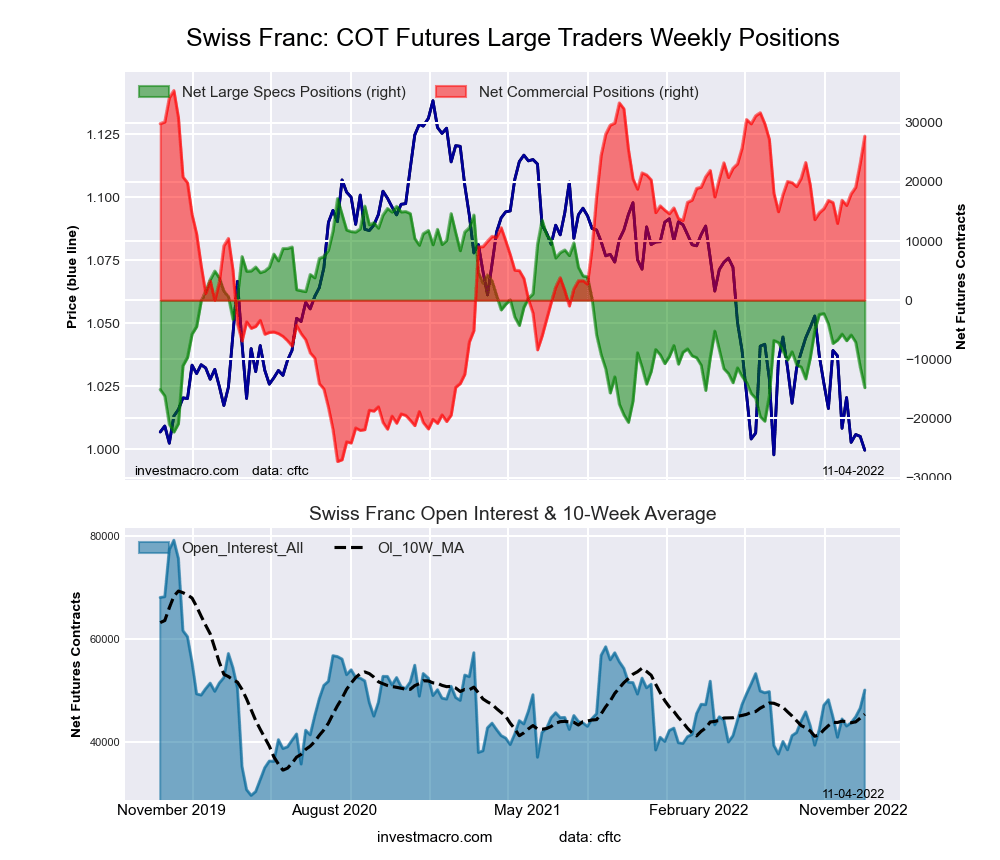
Swiss Franc Forex Futures COT ChartThe Swiss Franc large speculator standing this week recorded a net position of -6,852 contracts in the data reported through Tuesday. This was a weekly lowering of -1,122 contracts from the previous week which had a total of -5,730 net contracts.

This week’s current strength score (the trader positioning range over the past three years, measured from 0 to 100) shows the speculators are currently Bearish with a score of 39.1 percent. The commercials are Bullish with a score of 69.0 percent and the small traders (not shown in chart) are Bearish with a score of 26.5 percent.

SWISS FRANC StatisticsSPECULATORSCOMMERCIALSSMALL TRADERS
– Percent of Open Interest Longs:18.160.621.2
– Percent of Open Interest Shorts:34.023.542.4
– Net Position:-6,85216,022-9,170
– Gross Longs:7,81626,1409,128
– Gross Shorts:14,66810,11818,298
– Long to Short Ratio:0.5 to 12.6 to 10.5 to 1
NET POSITION TREND:
– Strength Index Score (3 Year Range Pct):39.169.026.5
– Strength Index Reading (3 Year Range):BearishBullishBearish
NET POSITION MOVEMENT INDEX:
– 6-Week Change in Strength Index:-11.32.010.8


Canadian Dollar Futures:

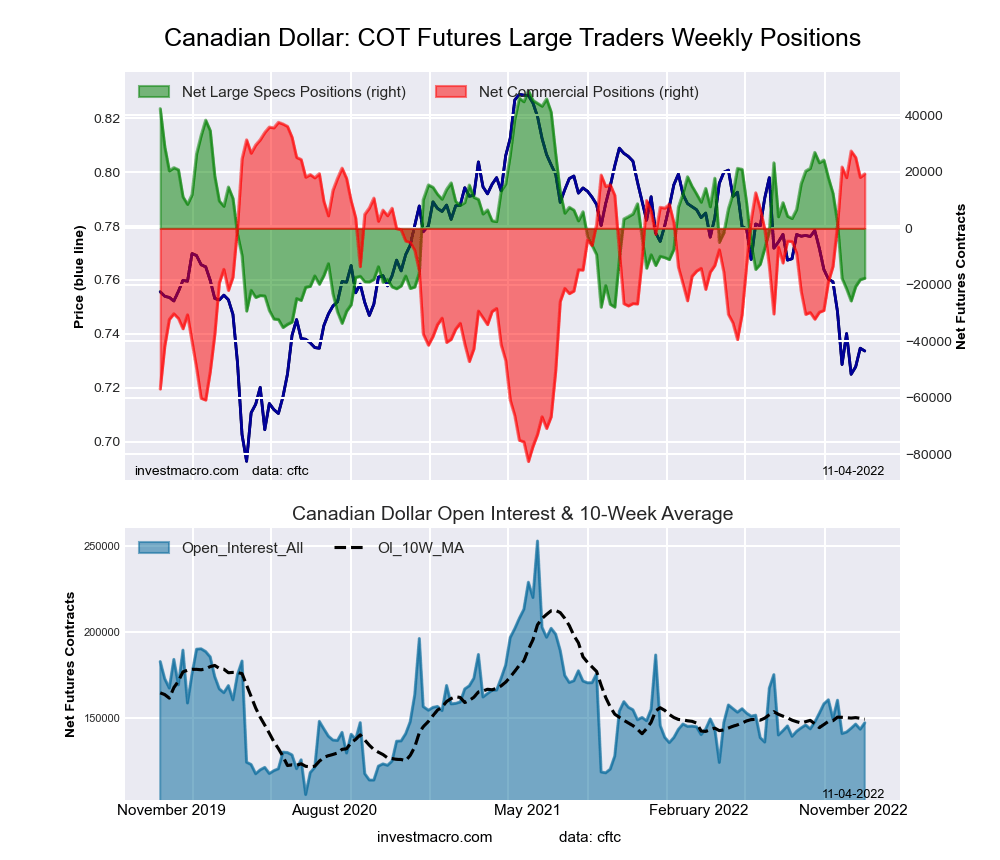
Canadian Dollar Forex Futures COT ChartThe Canadian Dollar large speculator standing this week recorded a net position of -21,407 contracts in the data reported through Tuesday. This was a weekly lowering of -3,741 contracts from the previous week which had a total of -17,666 net contracts.

This week’s current strength score (the trader positioning range over the past three years, measured from 0 to 100) shows the speculators are currently Bearish-Extreme with a score of 15.3 percent. The commercials are Bullish-Extreme with a score of 83.7 percent and the small traders (not shown in chart) are Bearish with a score of 37.1 percent.

CANADIAN DOLLAR StatisticsSPECULATORSCOMMERCIALSSMALL TRADERS
– Percent of Open Interest Longs:25.649.823.3
– Percent of Open Interest Shorts:40.737.120.8
– Net Position:-21,40717,9473,460
– Gross Longs:36,24670,62433,001
– Gross Shorts:57,65352,67729,541
– Long to Short Ratio:0.6 to 11.3 to 11.1 to 1
NET POSITION TREND:
– Strength Index Score (3 Year Range Pct):15.383.737.1
– Strength Index Reading (3 Year Range):Bearish-ExtremeBullish-ExtremeBearish
NET POSITION MOVEMENT INDEX:
– 6-Week Change in Strength Index:-50.139.7-6.0


Australian Dollar Futures:

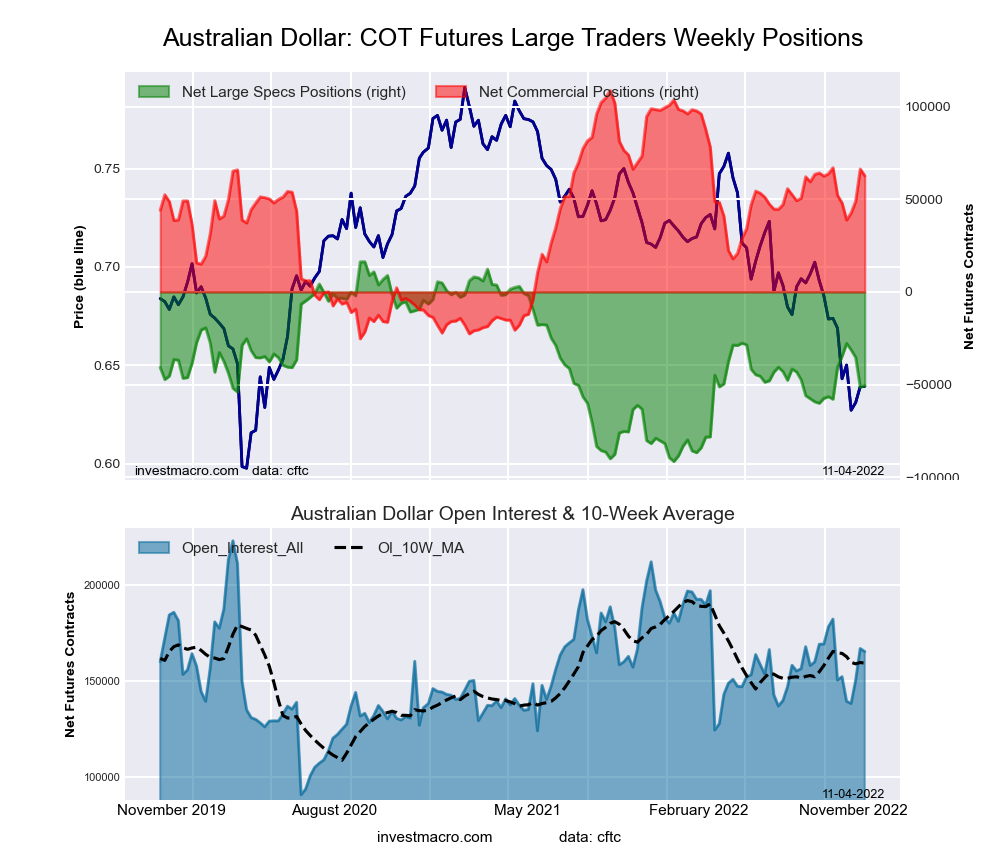
Australian Dollar Forex Futures COT ChartThe Australian Dollar large speculator standing this week recorded a net position of -27,764 contracts in the data reported through Tuesday. This was a weekly advance of 6,889 contracts from the previous week which had a total of -34,653 net contracts.

This week’s current strength score (the trader positioning range over the past three years, measured from 0 to 100) shows the speculators are currently Bullish with a score of 59.1 percent. The commercials are Bearish with a score of 47.8 percent and the small traders (not shown in chart) are Bearish with a score of 25.5 percent.

AUSTRALIAN DOLLAR StatisticsSPECULATORSCOMMERCIALSSMALL TRADERS
– Percent of Open Interest Longs:26.058.812.1
– Percent of Open Interest Shorts:45.931.020.0
– Net Position:-27,76438,804-11,040
– Gross Longs:36,24882,08016,813
– Gross Shorts:64,01243,27627,853
– Long to Short Ratio:0.6 to 11.9 to 10.6 to 1
NET POSITION TREND:
– Strength Index Score (3 Year Range Pct):59.147.825.5
– Strength Index Reading (3 Year Range):BullishBearishBearish
NET POSITION MOVEMENT INDEX:
– 6-Week Change in Strength Index:29.9-18.9-16.8


New Zealand Dollar Futures:

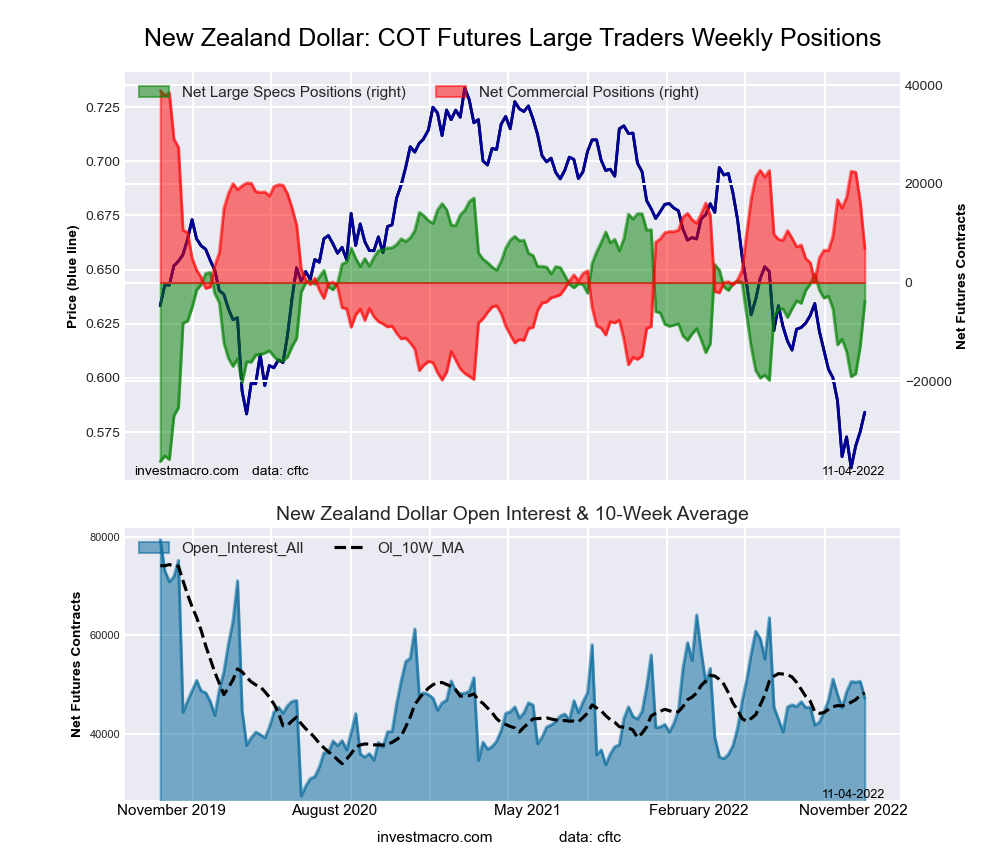
New Zealand Dollar Forex Futures COT ChartThe New Zealand Dollar large speculator standing this week recorded a net position of -13,978 contracts in the data reported through Tuesday. This was a weekly reduction of -2,507 contracts from the previous week which had a total of -11,471 net contracts.

This week’s current strength score (the trader positioning range over the past three years, measured from 0 to 100) shows the speculators are currently Bearish with a score of 45.9 percent. The commercials are Bullish with a score of 58.6 percent and the small traders (not shown in chart) are Bearish-Extreme with a score of 13.9 percent.

NEW ZEALAND DOLLAR StatisticsSPECULATORSCOMMERCIALSSMALL TRADERS
– Percent of Open Interest Longs:30.963.84.9
– Percent of Open Interest Shorts:59.728.311.6
– Net Position:-13,97817,259-3,281
– Gross Longs:14,96630,9572,359
– Gross Shorts:28,94413,6985,640
– Long to Short Ratio:0.5 to 12.3 to 10.4 to 1
NET POSITION TREND:
– Strength Index Score (3 Year Range Pct):45.958.613.9
– Strength Index Reading (3 Year Range):BearishBullishBearish-Extreme
NET POSITION MOVEMENT INDEX:
– 6-Week Change in Strength Index:-21.719.42.8


Mexican Peso Futures:

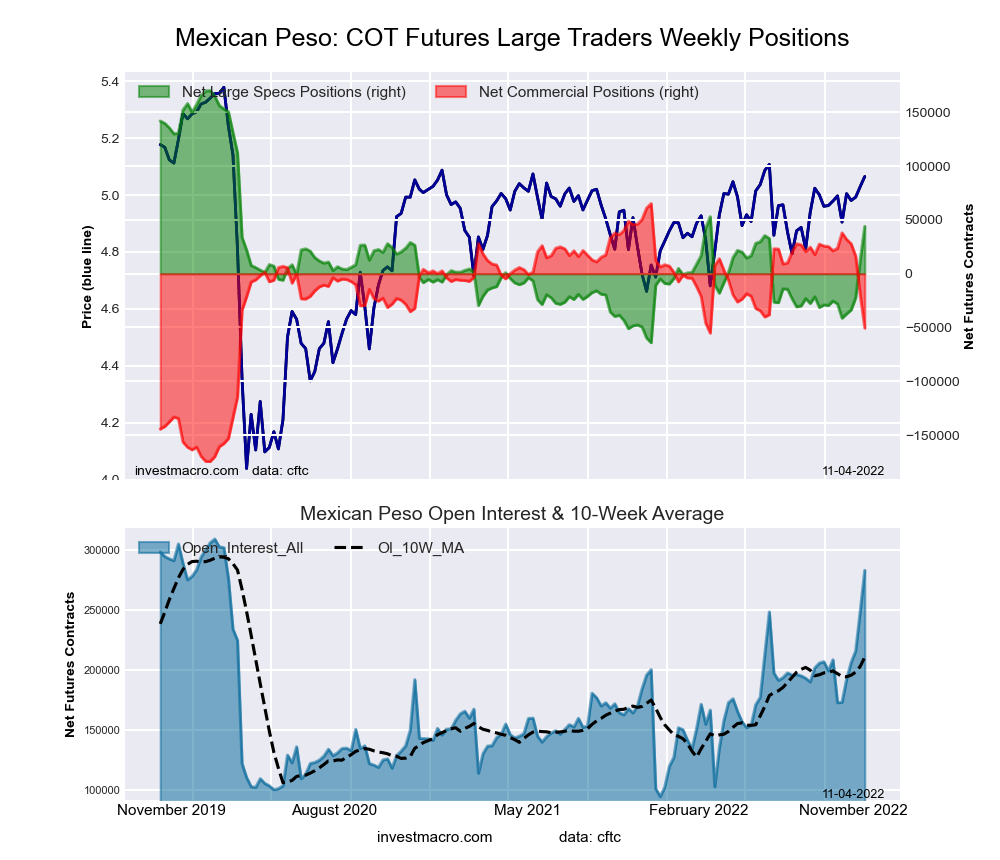
Mexican Peso Futures COT ChartThe Mexican Peso large speculator standing this week recorded a net position of -37,321 contracts in the data reported through Tuesday. This was a weekly gain of 4,001 contracts from the previous week which had a total of -41,322 net contracts.

This week’s current strength score (the trader positioning range over the past three years, measured from 0 to 100) shows the speculators are currently Bearish-Extreme with a score of 11.4 percent. The commercials are Bullish-Extreme with a score of 86.1 percent and the small traders (not shown in chart) are Bullish with a score of 65.9 percent.

MEXICAN PESO StatisticsSPECULATORSCOMMERCIALSSMALL TRADERS
– Percent of Open Interest Longs:56.539.34.1
– Percent of Open Interest Shorts:75.922.71.3
– Net Position:-37,32131,9145,407
– Gross Longs:108,62675,6487,916
– Gross Shorts:145,94743,7342,509
– Long to Short Ratio:0.7 to 11.7 to 13.2 to 1
NET POSITION TREND:
– Strength Index Score (3 Year Range Pct):11.486.165.9
– Strength Index Reading (3 Year Range):Bearish-ExtremeBullish-ExtremeBullish
NET POSITION MOVEMENT INDEX:
– 6-Week Change in Strength Index:-2.61.86.7


Brazilian Real Futures:

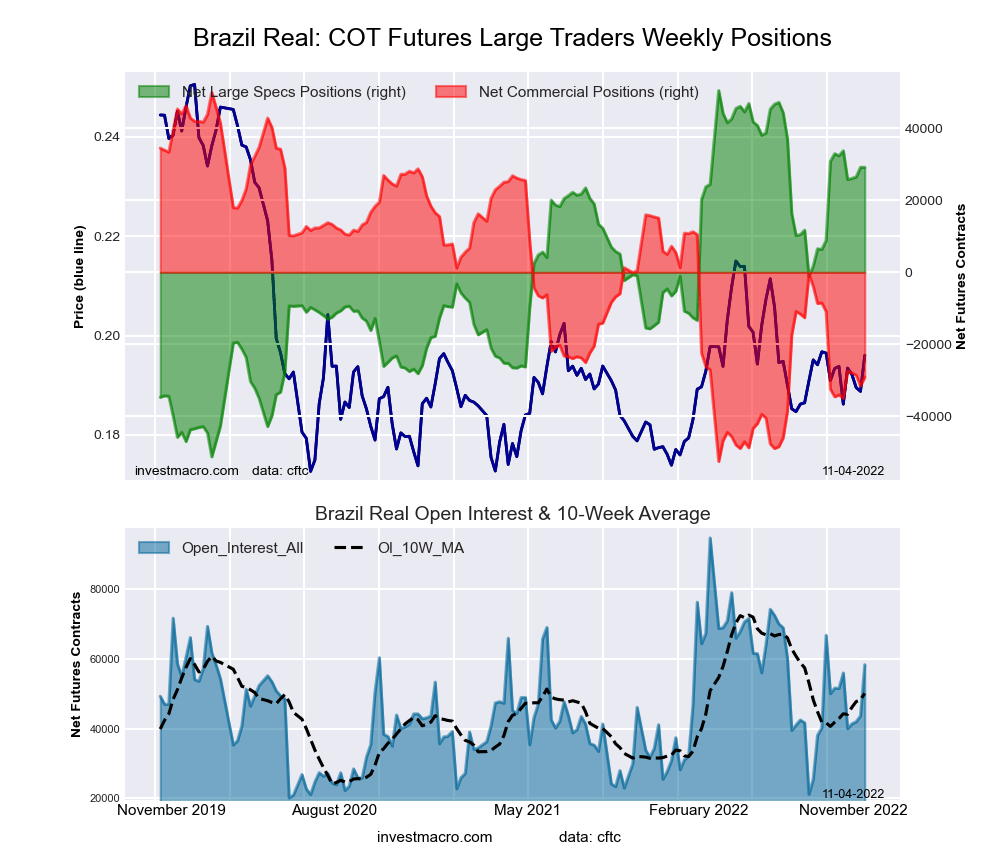
Brazil Real Futures COT ChartThe Brazilian Real large speculator standing this week recorded a net position of 25,779 contracts in the data reported through Tuesday. This was a weekly lowering of -7,985 contracts from the previous week which had a total of 33,764 net contracts.

This week’s current strength score (the trader positioning range over the past three years, measured from 0 to 100) shows the speculators are currently Bullish with a score of 75.7 percent. The commercials are Bearish with a score of 24.4 percent and the small traders (not shown in chart) are Bullish-Extreme with a score of 85.8 percent.

BRAZIL REAL StatisticsSPECULATORSCOMMERCIALSSMALL TRADERS
– Percent of Open Interest Longs:72.319.87.3
– Percent of Open Interest Shorts:7.888.82.9
– Net Position:25,779-27,5701,791
– Gross Longs:28,8947,9202,935
– Gross Shorts:3,11535,4901,144
– Long to Short Ratio:9.3 to 10.2 to 12.6 to 1
NET POSITION TREND:
– Strength Index Score (3 Year Range Pct):75.724.485.8
– Strength Index Reading (3 Year Range):BullishBearishBullish-Extreme
NET POSITION MOVEMENT INDEX:
– 6-Week Change in Strength Index:19.1-18.6-4.0


Bitcoin Futures:

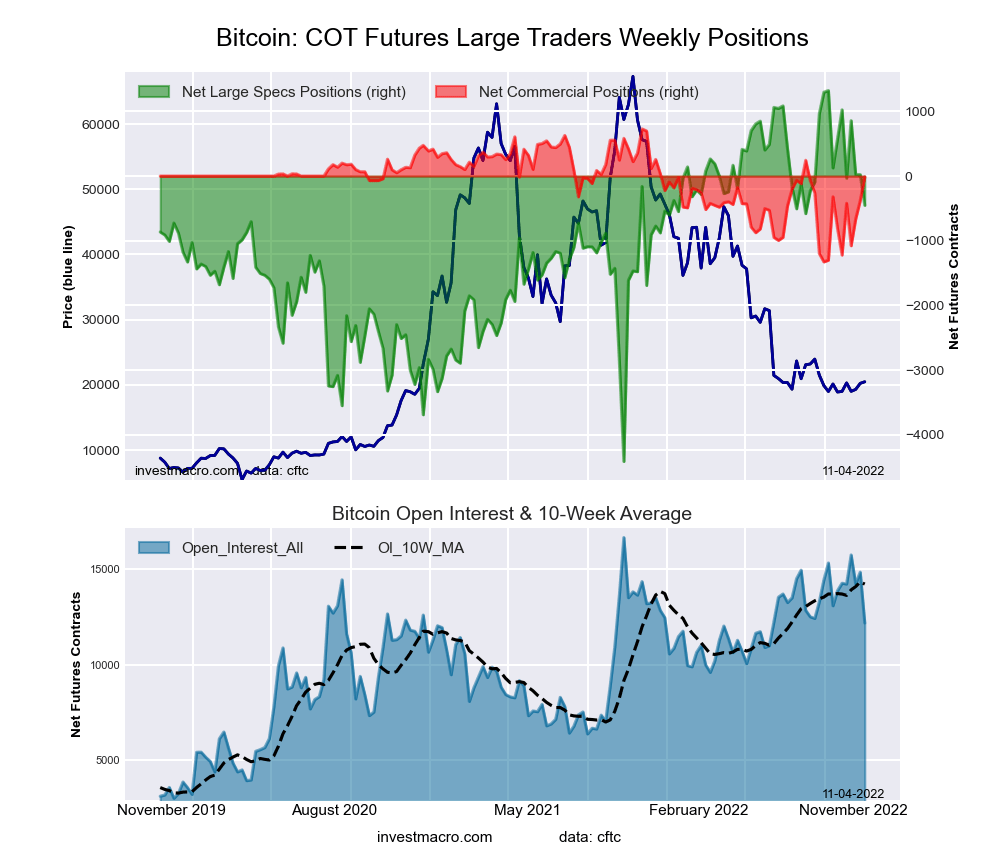
Bitcoin Crypto Futures COT ChartThe Bitcoin large speculator standing this week recorded a net position of -32 contracts in the data reported through Tuesday. This was a weekly reduction of -1,056 contracts from the previous week which had a total of 1,024 net contracts.

This week’s current strength score (the trader positioning range over the past three years, measured from 0 to 100) shows the speculators are currently Bullish with a score of 76.4 percent. The commercials are Bearish with a score of 44.1 percent and the small traders (not shown in chart) are Bearish with a score of 23.2 percent.

BITCOIN StatisticsSPECULATORSCOMMERCIALSSMALL TRADERS
– Percent of Open Interest Longs:80.72.69.1
– Percent of Open Interest Shorts:80.95.55.9
– Net Position:-32-421453
– Gross Longs:11,4813631,291
– Gross Shorts:11,513784838
– Long to Short Ratio:1.0 to 10.5 to 11.5 to 1
NET POSITION TREND:
– Strength Index Score (3 Year Range Pct):76.444.123.2
– Strength Index Reading (3 Year Range):BullishBearishBearish
NET POSITION MOVEMENT INDEX:
– 6-Week Change in Strength Index:-17.437.85.0


Article By InvestMacroReceive our weekly COT Newsletter

*COT Report: The COT data, released weekly to the public each Friday, is updated through the most recent Tuesday (data is 3 days old) and shows a quick view of how large speculators or non-commercials (for-profit traders) were positioned in the futures markets.

The CFTC categorizes trader positions according to commercial hedgers (traders who use futures contracts for hedging as part of the business), non-commercials (large traders who speculate to realize trading profits) and nonreportable traders (usually small traders/speculators) as well as their open interest (contracts open in the market at time of reporting). See CFTC criteria here.

 

Silver Speculator bets rise for 4th week, climb to highest since June

By InvestMacro

Here are the latest charts and statistics for the Commitment of Traders (COT) reports data published by the Commodities Futures Trading Commission (CFTC).

The latest COT data is updated through Tuesday October 4th and shows a quick view of how large traders (for-profit speculators and commercial entities) were positioned in the futures markets.

Weekly Speculator Changes

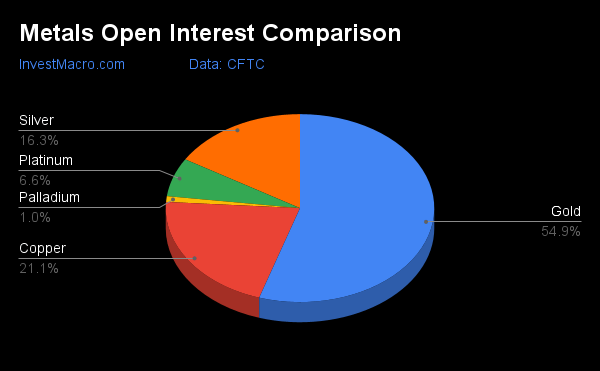
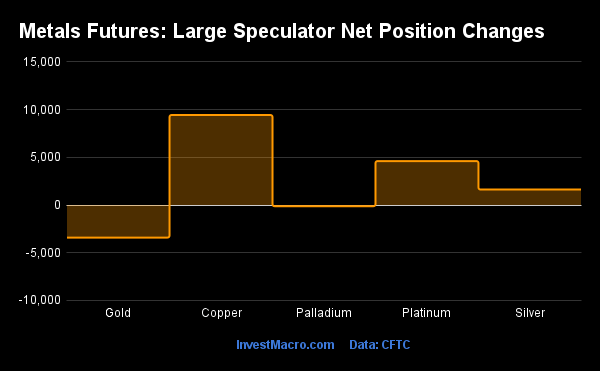
The COT precious metals speculator bets were higher this week all across the board as all five of the metals markets we cover saw stronger sentiment and increased positioning.

Leading the gains for the precious metals markets was Gold (36,304 contracts) with Copper (9,505 contracts), Silver (7,950 contracts), Platinum (3,120 contracts) and Palladium (235 contracts) also showing a positive week.

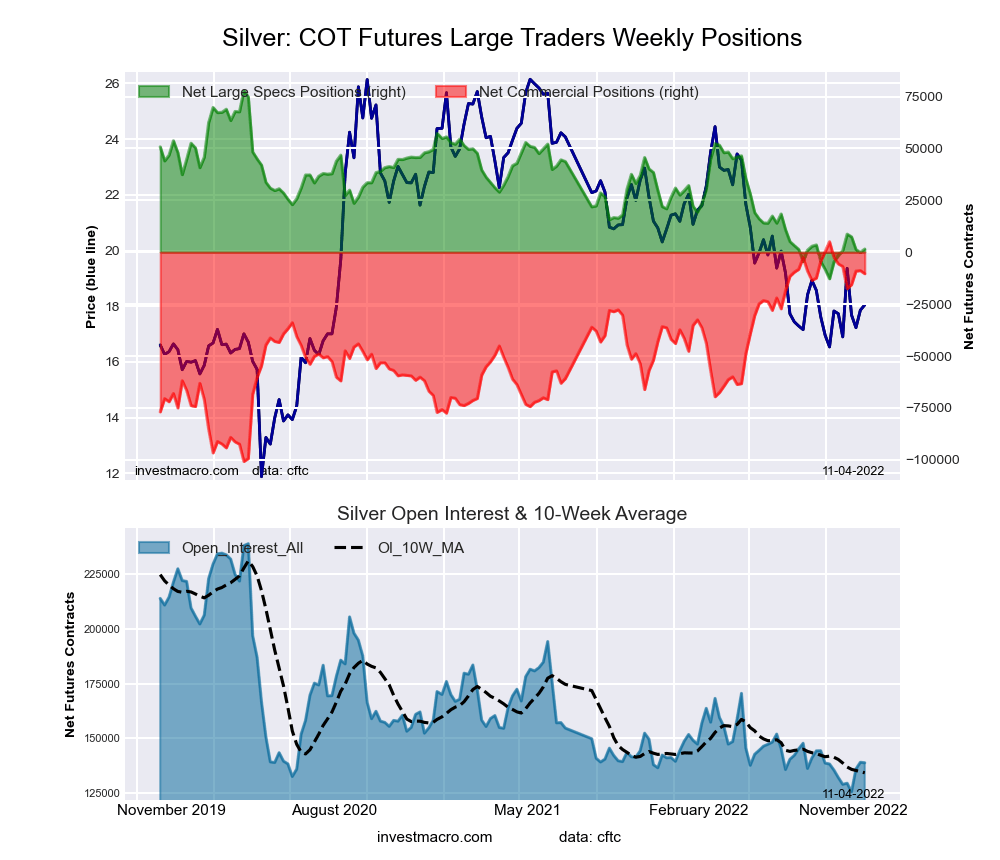
Highlighting the COT Metals this week is the gains in the Silver speculator positions. Silver speculators boosted their bets this week for a fourth straight week and have now pushed their bets higher by +21,492 contracts over that time-frame. This recent turnaround in sentiment brought the overall net position back out of bearish territory after spending five straight weeks there from August 23rd to September 20th. This week’s total net position of +8,708 contracts is the best level for Silver since June 28th. The Silver price closed this week above the $20.25 level and managed to touch its highest level since June above $21 before closing lower.


Data Snapshot of Commodity Market Traders | Columns Legend
Oct-04-2022OIOI-IndexSpec-NetSpec-IndexCom-NetCOM-IndexSmalls-NetSmalls-Index
WTI Crude1,495,5382241,9998-260,8549418,85531
Gold437,065088,38512-96,548898,1630
Silver129,52408,70824-17,617798,90913
Copper166,1617-18,2512318,0237922827
Palladium7,0805-596203647723257
Platinum55,682143,28113-7,137873,85620
Natural Gas967,1264-159,09631126,0467133,05058
Brent162,76210-39,8204438,106571,71432
Heating Oil282,9882815,75566-32,1033716,34855
Soybeans677,1782266,75734-40,08374-26,67426
Corn1,365,62214304,96269-239,95938-65,0036
Coffee184,698042,15175-44,264292,11319
Sugar687,018047,08746-63,3545616,26728
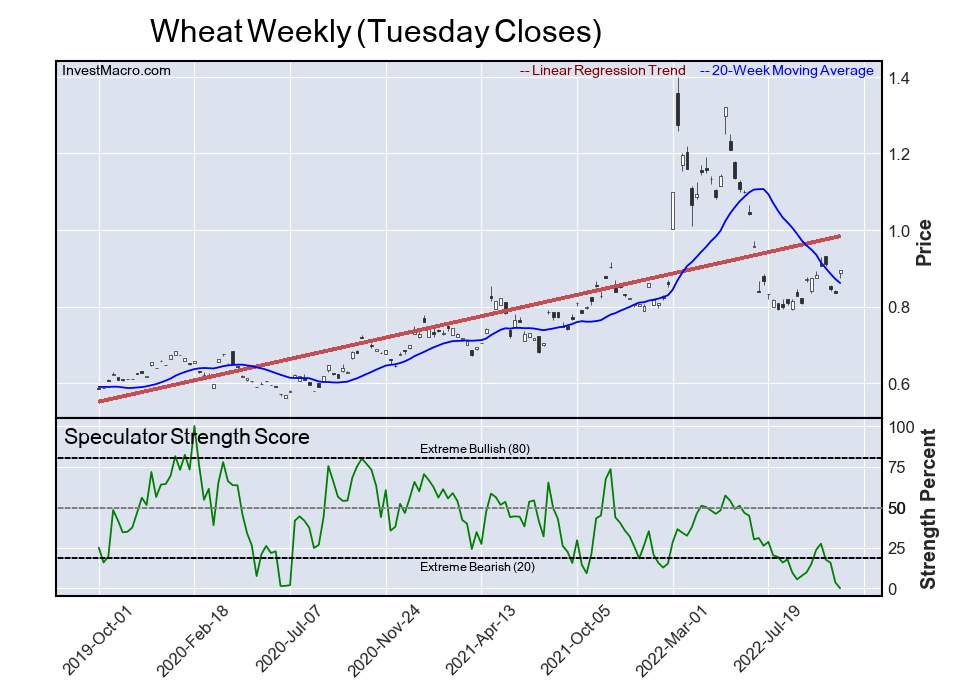
Wheat291,61435,624261,90162-7,52571


Strength Scores show Silver and Copper rise

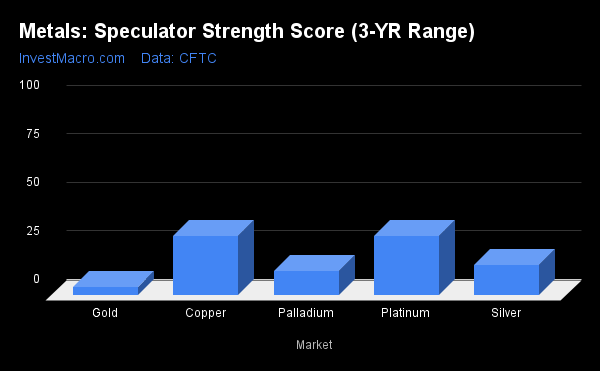
Strength scores (a measure of the 3-Year range of Speculator positions, from 0 to 100 where above 80 is extreme bullish and below 20 is extreme bearish) showed that the Silver (23.7 percent) and Copper (22.8 percent) are leading the metals category currently. Both of these markets have now seen there strength scores improve and are above the 20 percent level and out of a bearish extreme position.

On the downside, Gold (12.0 percent), Platinum (13.5 percent) and Palladium (19.9 percent) continue to be at the lowest strength levels currently and in bearish extreme positions (below 20 percent).


Strength Statistics:
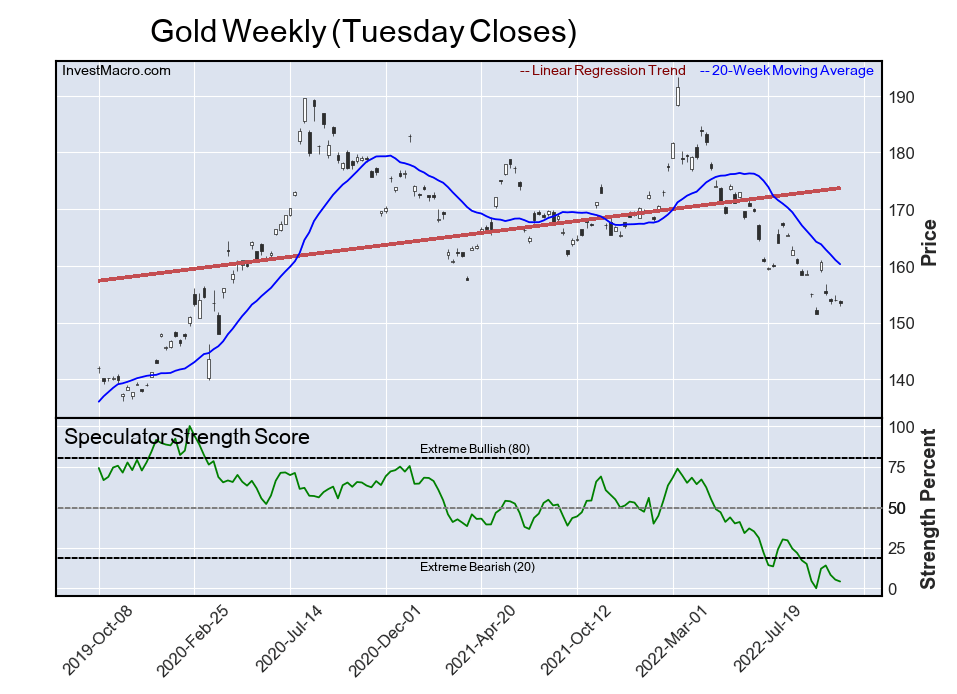
Gold (12.0 percent) vs Gold previous week (0.0 percent)
Silver (23.7 percent) vs Silver previous week (14.9 percent)
Copper (22.8 percent) vs Copper previous week (15.3 percent)
Platinum (13.5 percent) vs Platinum previous week (9.3 percent)
Palladium (19.9 percent) vs Palladium previous week (18.6 percent)

Silver leads the Strength Trends

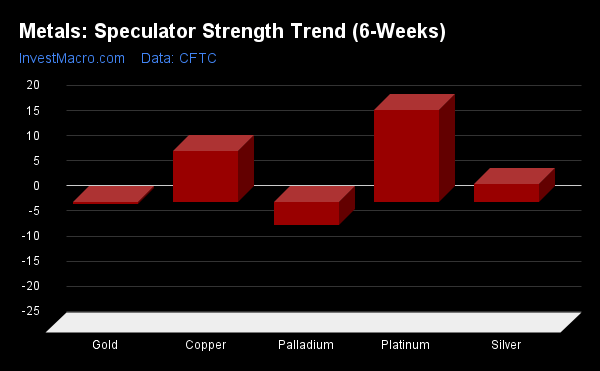
Strength Score Trends (or move index, calculates the 6-week changes in strength scores) show that Silver (14.6 percent) leads the past six weeks trends for metals this week. Palladium (6.9 percent), Platinum (5.2 percent) and Copper (0.6 percent) are all seeing positive moves for the past 6-weeks in the latest trends data.

Gold (-12.4 percent) is the only market this week with lower trend scores.


Move Statistics:
Gold (-12.4 percent) vs Gold previous week (-29.5 percent)
Silver (14.6 percent) vs Silver previous week (-3.0 percent)
Copper (0.6 percent) vs Copper previous week (0.4 percent)
Platinum (5.2 percent) vs Platinum previous week (-3.7 percent)
Palladium (6.9 percent) vs Palladium previous week (4.4 percent)


Individual Markets:

Gold Comex Futures:

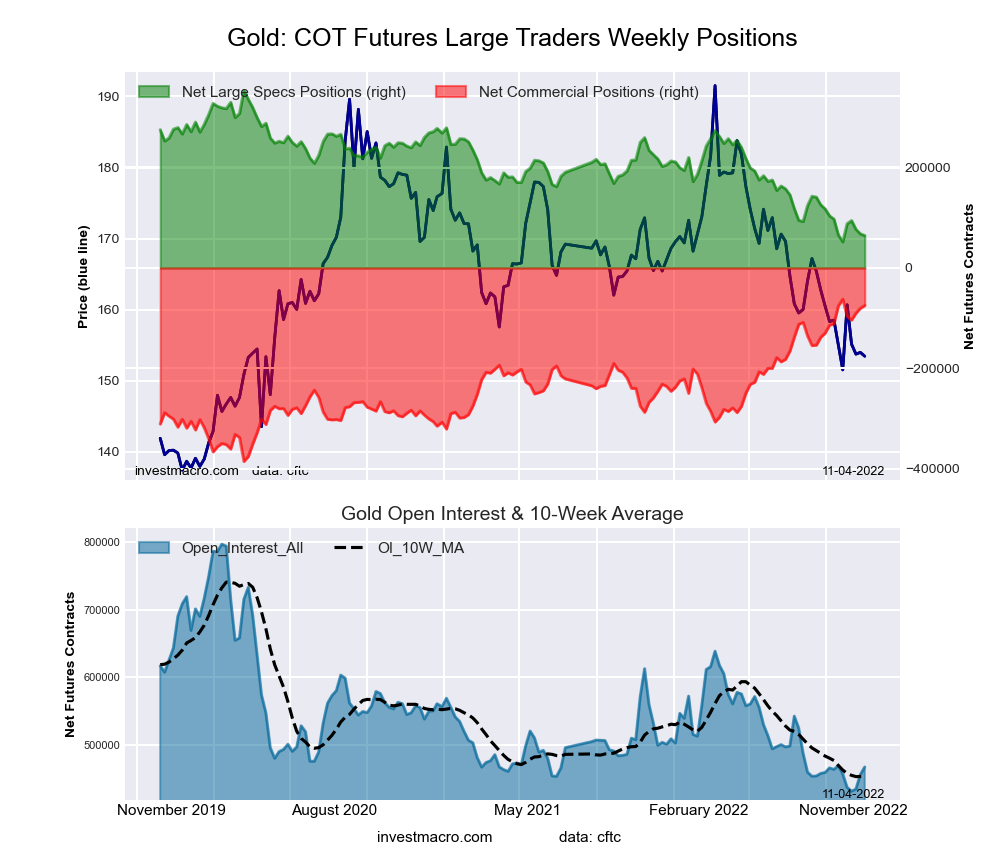
Gold Futures COT ChartThe Gold Comex Futures large speculator standing this week came in at a net position of 88,385 contracts in the data reported through Tuesday. This was a weekly boost of 36,304 contracts from the previous week which had a total of 52,081 net contracts.

This week’s current strength score (the trader positioning range over the past three years, measured from 0 to 100) shows the speculators are currently Bearish-Extreme with a score of 12.0 percent. The commercials are Bullish-Extreme with a score of 89.4 percent and the small traders (not shown in chart) are Bearish-Extreme with a score of 0.0 percent.

Gold Futures StatisticsSPECULATORSCOMMERCIALSSMALL TRADERS
– Percent of Open Interest Longs:49.426.68.4
– Percent of Open Interest Shorts:29.248.76.5
– Net Position:88,385-96,5488,163
– Gross Longs:215,964116,45136,704
– Gross Shorts:127,579212,99928,541
– Long to Short Ratio:1.7 to 10.5 to 11.3 to 1
NET POSITION TREND:
– Strength Index Score (3 Year Range Pct):12.089.40.0
– Strength Index Reading (3 Year Range):Bearish-ExtremeBullish-ExtremeBearish-Extreme
NET POSITION MOVEMENT INDEX:
– 6-Week Change in Strength Index:-12.412.8-10.2


Silver Comex Futures:

Silver Futures COT ChartThe Silver Comex Futures large speculator standing this week came in at a net position of 8,708 contracts in the data reported through Tuesday. This was a weekly boost of 7,950 contracts from the previous week which had a total of 758 net contracts.

This week’s current strength score (the trader positioning range over the past three years, measured from 0 to 100) shows the speculators are currently Bearish with a score of 23.7 percent. The commercials are Bullish with a score of 78.6 percent and the small traders (not shown in chart) are Bearish-Extreme with a score of 13.4 percent.

Silver Futures StatisticsSPECULATORSCOMMERCIALSSMALL TRADERS
– Percent of Open Interest Longs:40.136.917.0
– Percent of Open Interest Shorts:33.450.510.1
– Net Position:8,708-17,6178,909
– Gross Longs:51,92647,75522,040
– Gross Shorts:43,21865,37213,131
– Long to Short Ratio:1.2 to 10.7 to 11.7 to 1
NET POSITION TREND:
– Strength Index Score (3 Year Range Pct):23.778.613.4
– Strength Index Reading (3 Year Range):BearishBullishBearish-Extreme
NET POSITION MOVEMENT INDEX:
– 6-Week Change in Strength Index:14.6-12.60.4


Copper Grade #1 Futures:

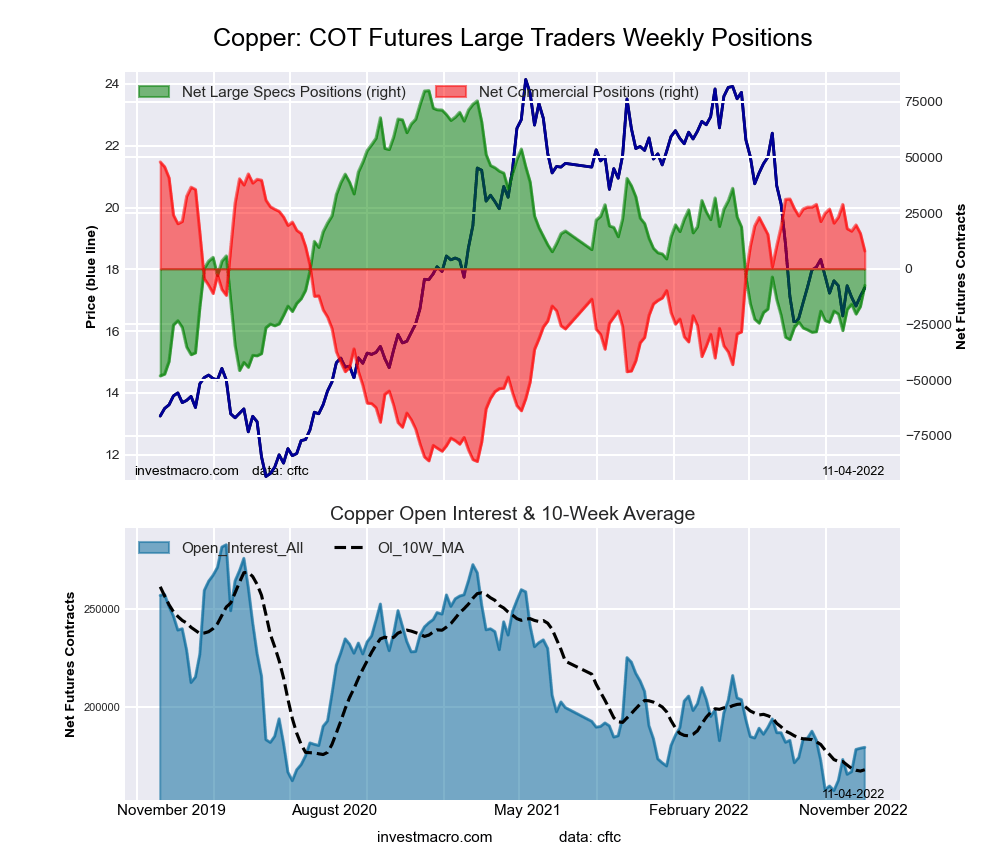
Copper Futures COT ChartThe Copper Grade #1 Futures large speculator standing this week came in at a net position of -18,251 contracts in the data reported through Tuesday. This was a weekly boost of 9,505 contracts from the previous week which had a total of -27,756 net contracts.

This week’s current strength score (the trader positioning range over the past three years, measured from 0 to 100) shows the speculators are currently Bearish with a score of 22.8 percent. The commercials are Bullish with a score of 79.0 percent and the small traders (not shown in chart) are Bearish with a score of 26.6 percent.

Copper Futures StatisticsSPECULATORSCOMMERCIALSSMALL TRADERS
– Percent of Open Interest Longs:30.447.48.7
– Percent of Open Interest Shorts:41.436.68.6
– Net Position:-18,25118,023228
– Gross Longs:50,47078,81714,537
– Gross Shorts:68,72160,79414,309
– Long to Short Ratio:0.7 to 11.3 to 11.0 to 1
NET POSITION TREND:
– Strength Index Score (3 Year Range Pct):22.879.026.6
– Strength Index Reading (3 Year Range):BearishBullishBearish
NET POSITION MOVEMENT INDEX:
– 6-Week Change in Strength Index:0.6-2.414.3


Platinum Futures:

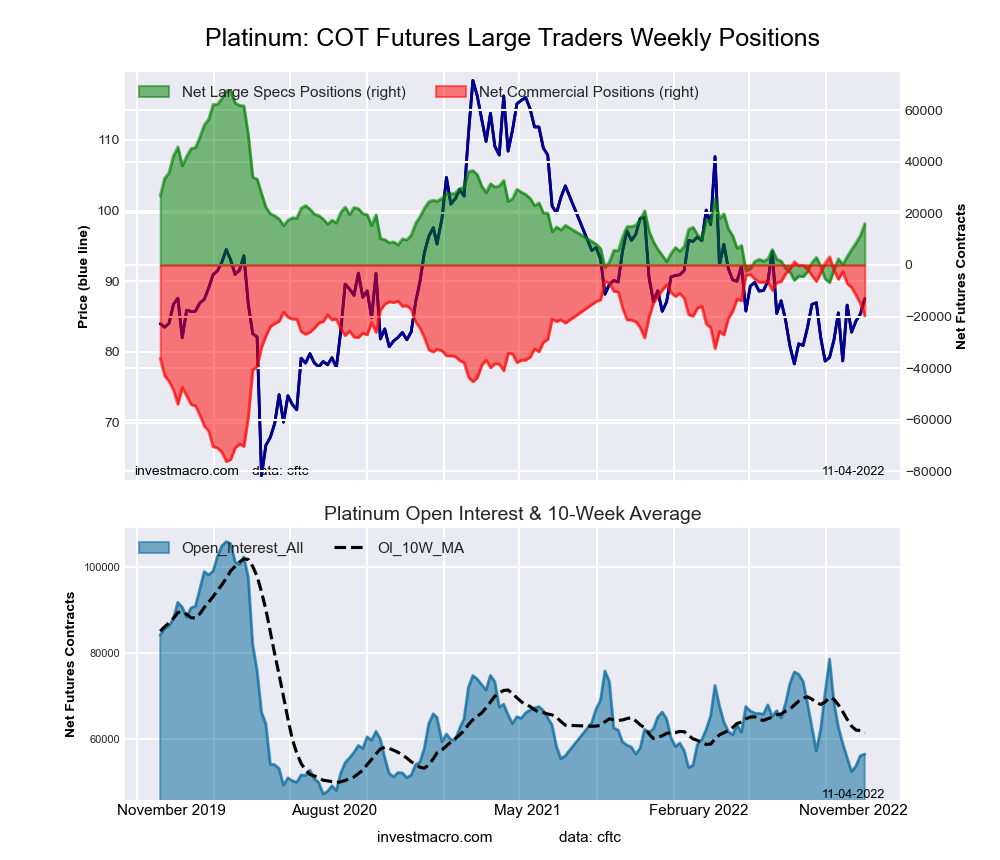
Platinum Futures COT ChartThe Platinum Futures large speculator standing this week came in at a net position of 3,281 contracts in the data reported through Tuesday. This was a weekly advance of 3,120 contracts from the previous week which had a total of 161 net contracts.

This week’s current strength score (the trader positioning range over the past three years, measured from 0 to 100) shows the speculators are currently Bearish-Extreme with a score of 13.5 percent. The commercials are Bullish-Extreme with a score of 87.0 percent and the small traders (not shown in chart) are Bearish-Extreme with a score of 19.8 percent.

Platinum Futures StatisticsSPECULATORSCOMMERCIALSSMALL TRADERS
– Percent of Open Interest Longs:46.037.912.9
– Percent of Open Interest Shorts:40.150.76.0
– Net Position:3,281-7,1373,856
– Gross Longs:25,61021,1167,197
– Gross Shorts:22,32928,2533,341
– Long to Short Ratio:1.1 to 10.7 to 12.2 to 1
NET POSITION TREND:
– Strength Index Score (3 Year Range Pct):13.587.019.8
– Strength Index Reading (3 Year Range):Bearish-ExtremeBullish-ExtremeBearish-Extreme
NET POSITION MOVEMENT INDEX:
– 6-Week Change in Strength Index:5.2-5.23.1


Palladium Futures:

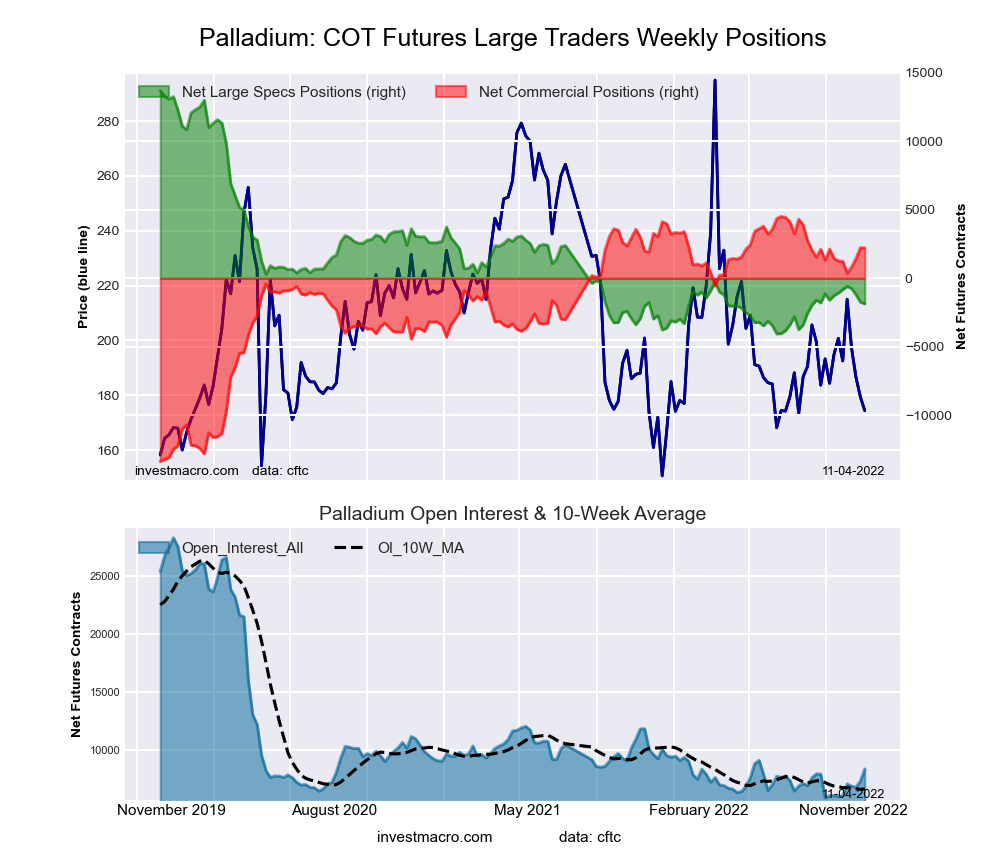
Palladium Futures COT ChartThe Palladium Futures large speculator standing this week came in at a net position of -596 contracts in the data reported through Tuesday. This was a weekly lift of 235 contracts from the previous week which had a total of -831 net contracts.

This week’s current strength score (the trader positioning range over the past three years, measured from 0 to 100) shows the speculators are currently Bearish-Extreme with a score of 19.9 percent. The commercials are Bullish with a score of 76.6 percent and the small traders (not shown in chart) are Bullish with a score of 57.3 percent.

Palladium Futures StatisticsSPECULATORSCOMMERCIALSSMALL TRADERS
– Percent of Open Interest Longs:30.948.119.1
– Percent of Open Interest Shorts:39.443.015.8
– Net Position:-596364232
– Gross Longs:2,1913,4091,352
– Gross Shorts:2,7873,0451,120
– Long to Short Ratio:0.8 to 11.1 to 11.2 to 1
NET POSITION TREND:
– Strength Index Score (3 Year Range Pct):19.976.657.3
– Strength Index Reading (3 Year Range):Bearish-ExtremeBullishBullish
NET POSITION MOVEMENT INDEX:
– 6-Week Change in Strength Index:6.9-9.931.8


Article By InvestMacroReceive our weekly COT Newsletter

*COT Report: The COT data, released weekly to the public each Friday, is updated through the most recent Tuesday (data is 3 days old) and shows a quick view of how large speculators or non-commercials (for-profit traders) were positioned in the futures markets.

The CFTC categorizes trader positions according to commercial hedgers (traders who use futures contracts for hedging as part of the business), non-commercials (large traders who speculate to realize trading profits) and nonreportable traders (usually small traders/speculators) as well as their open interest (contracts open in the market at time of reporting). See CFTC criteria here.

COT Speculator Extremes: Soybean Meal & Nikkei 225 lead weekly Bullish & Bearish Positions

By InvestMacro

The latest update for the weekly Commitment of Traders (COT) report was released by the Commodity Futures Trading Commission (CFTC) on Friday for data ending on Tuesday October 4th.

This weekly Extreme Positions report highlights the Top Most Bullish and Top Most Bearish Positions for the speculator category. Extreme positioning in these markets can foreshadow strong moves in the underlying market.

To signify an extreme position, we use the Strength Index (also known as the COT Index) of each instrument, a common method of measuring COT data. The Strength Index is simply a comparison of current trader positions against the range of positions over the previous 3 years. We use over 80 percent as extremely bullish and under 20 percent as extremely bearish.

Compare Strength Index scores across all markets in the data table or cot leaders table, see a profile of speculators in COT markets in our cot reports guide.


Here Are This Week’s Most Bullish Speculator Positions:

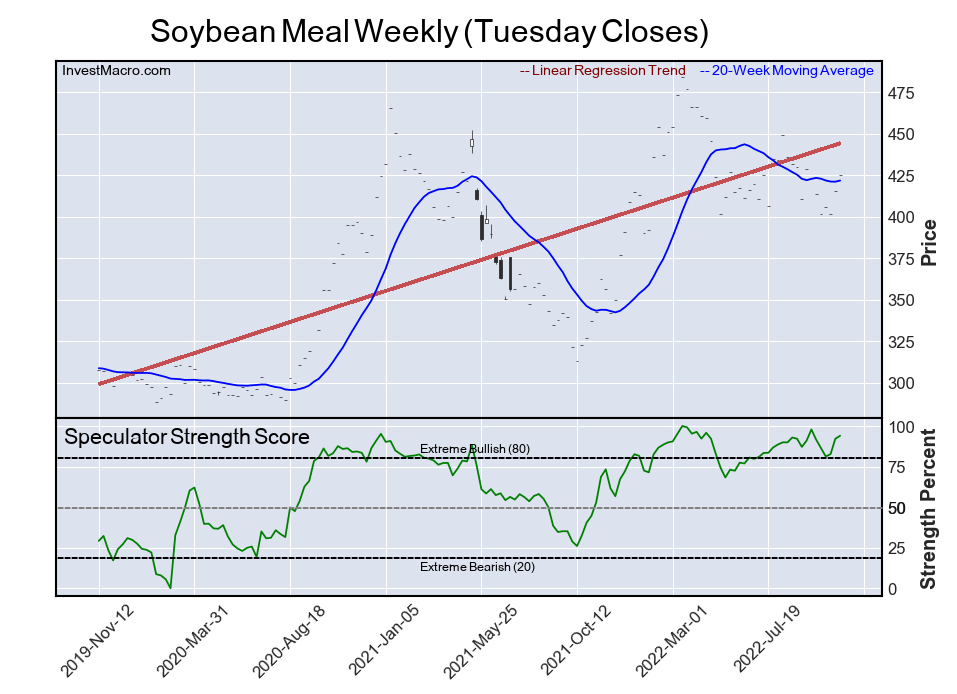
Soybean Meal – 86.4 percent

This week there are only two bullish markets (above the 80 percent) and Soybean Meal is the most bullish market of the week. This market has come in near the top of the most bullish markets for several weeks now. The strength score for Soybean Meal is currently 86.4 percent, down from 91.5 percent last week and 97.9 percent the week before.

The net speculator positioning for Soybean Meal dipped for a second straight this week but the overall net position has remained above the +100,000 contract level for the thirteenth consecutive week. This is the longest such streak since the middle of 2018.


Nikkei 225 – 84.9 percent


The Nikkei 225 speculator futures position comes in as the second most bullish extreme standing this week. The Nikkei 225 speculator level is currently at a 85 percent score of its 3-year range.

The speculator position totaled 1,558 net contracts this week which was a change of just 38 contracts from last week. The Nikkei strength score is near the top of the list because over the past 3 years, speculators have usually held a bearish position and this has changed over the past two weeks (both bullish levels).


This Week’s Most Bearish Speculator Positions:

MSCI EAFE MINI – 2.7 percent

The EAFE Mini registered as the most bearish of the markets this week. The EAFE came in with a strength score of just 2.7 percent out of its 3-year range, near the very bottom of its range.

Speculators sharply cut their net positions this week by -22,448 contracts and pushed the overall net positioning for speculators to the lowest level since July.


Ultra 10-Year U.S. T-Note – 7.4 percent

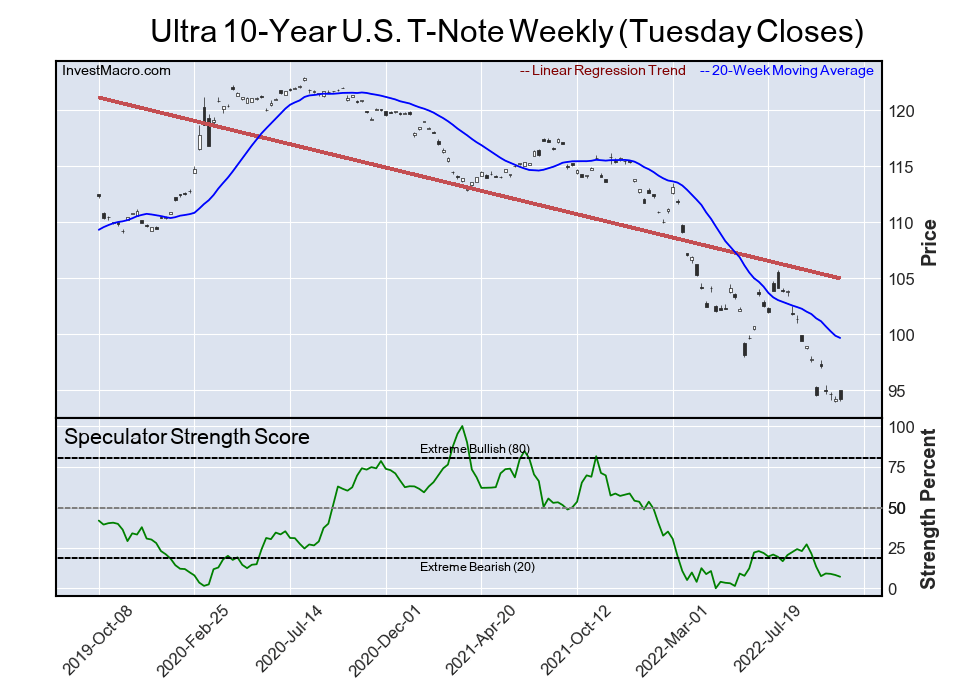
The Ultra 10-Year Bond large speculator position comes in as the next bearish extreme standing this week. The Ultra 10-Year Bond speculator level is currently at a 7.4 percent score of its 3-year range.

The speculator position was a total of -82,091 net contracts this week, a weekly change of -22,331 contracts from last week. This market has seen a total speculator net position decline of -75,305 contracts over the past three weeks and has pushed the net position to the lowest level since May 31st.


WTI Crude Oil – 8.3 percent


The WTI Crude Oil speculator position is next in line of the most bearish extreme standings on the week. The WTI Crude speculator level is currently residing at a 8.3 percent score of its 3-year range.

The speculator position was a total of 241,999 net contracts this week which had a positive gain by 15,919 contracts from last week. Overall, the net position for WTI futures has been under the +300,000 net contract level for the past sixteen weeks, something that has not happened since 2015.


Mexican Peso – 11.4 percent


The Mexican Peso speculator position comes in as the next most bearish extreme standing of the week. The MXN speculator level currently sits at a 11.4 percent score of its 3-year range.

The speculator position was -37,321 net contracts this week and had a gain by 4,001 contracts from last week. The peso net contract positioning has been lower in two out of the past three weeks and touched the lowest level in forty-two weeks last week (before this week’s gain by 4,001 contracts).


Russell 2000 Mini – 11.6 percent

The Russell 2000 Mini speculator position comes in as the next most bearish extreme standing of the week. The Russell 2000 Mini speculator level is currently at a 11.6 percent score of its 3-year range.

The overall large speculator position was -99,193 net contracts this week and had a gain by 6,868 contracts from last week. The Russell Mini has now been in a continuous bearish position for the past eighty weeks, dating back to March of 2021.


Gold – 12 percent


Finally, the Gold speculator position comes in as the sixth most bearish extreme standing for this week. The Gold speculator level is currently at a 12 percent score of its 3-year range.

The speculator position was 88,385 net contracts this week and bounced back from multiple weeks of declines to rise by 36,304 contracts from last week.


Article By InvestMacroReceive our weekly COT Newsletter

*COT Report: The COT data, released weekly to the public each Friday, is updated through the most recent Tuesday (data is 3 days old) and shows a quick view of how large speculators or non-commercials (for-profit traders) were positioned in the futures markets.

The CFTC categorizes trader positions according to commercial hedgers (traders who use futures contracts for hedging as part of the business), non-commercials (large traders who speculate to realize trading profits) and nonreportable traders (usually small traders/speculators) as well as their open interest (contracts open in the market at time of reporting). See CFTC criteria here.

Weekly COT Bonds Speculator Changes led by Eurodollar and 2-Year Bond

By InvestMacro

Here are the latest charts and statistics for the Commitment of Traders (COT) reports data published by the Commodities Futures Trading Commission (CFTC).

The latest COT data is updated through Tuesday October 4th and shows a quick view of how large traders (for-profit speculators and commercial hedgers) were positioned in the futures markets.

Weekly Speculator Changes led by Eurodollar and 2-Year Bond

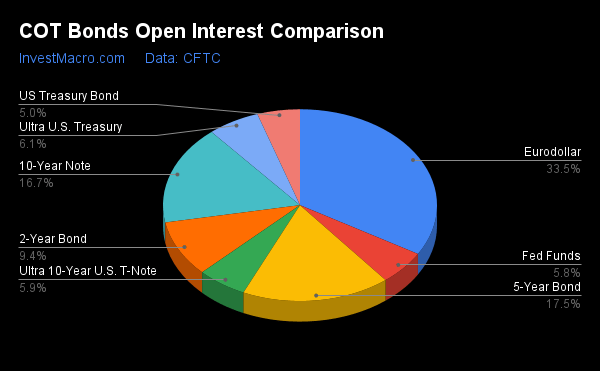
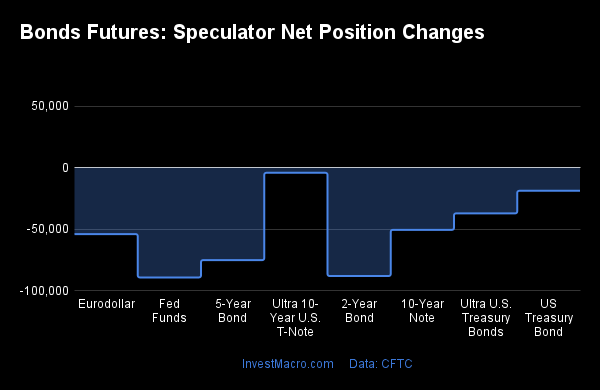
The COT bond market speculator bets were mixed this week as four out of the eight bond markets we cover had higher positioning this week while four markets had lower contracts.

Leading the gains for the bond markets was the Eurodollar (72,027 contracts) with the 2-Year Bond (13,743 contracts), the Ultra US Bond (5,084 contracts) and the Long US Bond (2,987 contracts) also showing a positive week.

The bond markets leading the declines in speculator bets this week was the Fed Funds (-109,287 contracts) with the 5-Year Bond (-41,066 contracts), the Ultra 10-Year (-22,331 contracts) and the 10-Year Bond (-1,680 contracts) also registering lower bets on the week.


Data Snapshot of Bond Market Traders | Columns Legend
Oct-04-2022OIOI-IndexSpec-NetSpec-IndexCom-NetCOM-IndexSmalls-NetSmalls-Index
Eurodollar8,226,0750-2,087,748152,343,91183-256,16348
FedFunds1,516,16843-6,8043924,90863-18,10414
2-Year1,963,4798-306,13420394,72791-88,59312
Long T-Bond1,213,68047-96,5525368,2683528,28475
10-Year3,850,49454-366,87217416,62871-49,75668
5-Year3,995,72551-483,03212625,17389-142,14142


US Treasury Bond remains highest in Strength Scores

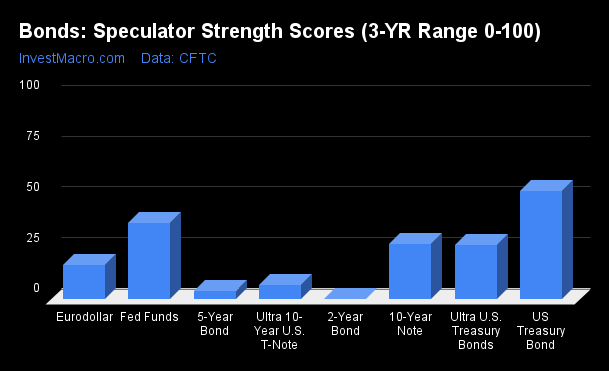
Strength Scores (a normalized measure of Speculator positions over a 3-Year range, from 0 to 100 where above 80 is extreme bullish and below 20 is extreme bearish) show that the US Treasury Bond (53.2 percent) leads the bonds markets currently and is the only market with a score above 50 percent (3-Year midpoint of range). The Fed Funds (38.8 percent) comes in as the next highest bonds market in strength scores.

On the downside, the Ultra 10-Year Bond (7.4 percent) comes in at the lowest strength level currently and is followed by the 5-Year Bond (12.5 percent), the Eurodollar (14.7 percent) and the 10-Year Bond (16.7 percent). All of these markets are currently in bearish extreme levels with scores below 20 percent.


Strength Statistics:
Fed Funds (38.8 percent) vs Fed Funds previous week (52.3 percent)
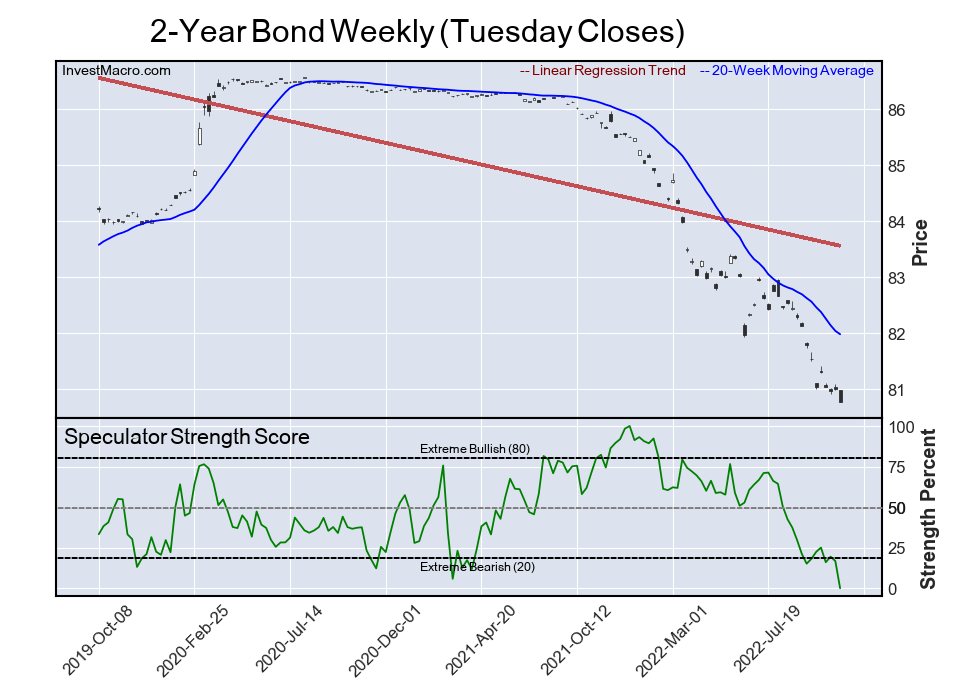
2-Year Bond (20.4 percent) vs 2-Year Bond previous week (17.7 percent)
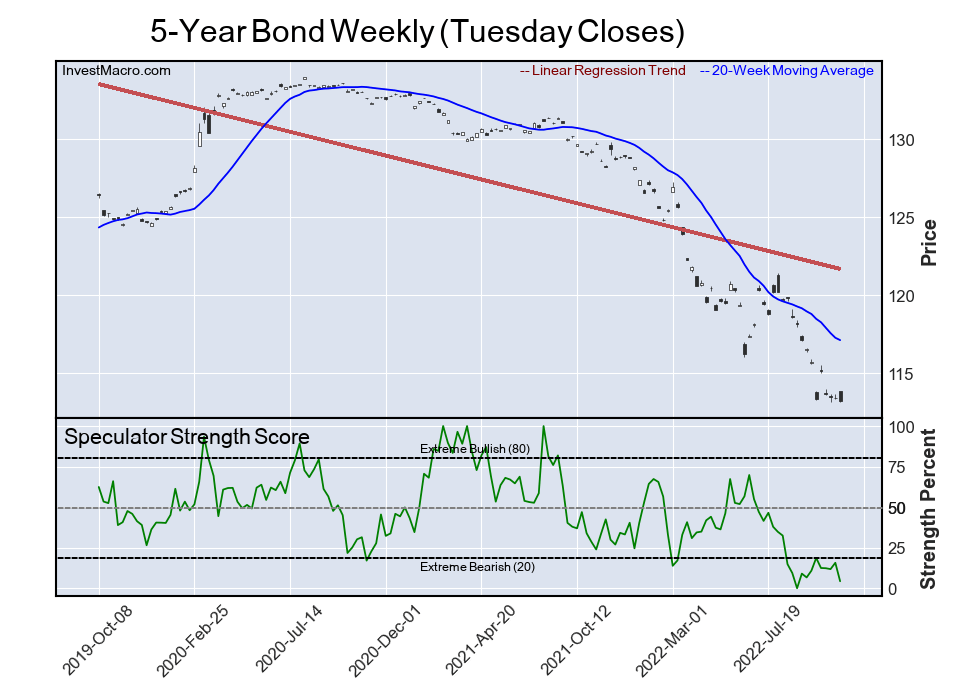
5-Year Bond (12.5 percent) vs 5-Year Bond previous week (18.7 percent)
10-Year Bond (16.7 percent) vs 10-Year Bond previous week (16.9 percent)
Ultra 10-Year Bond (7.4 percent) vs Ultra 10-Year Bond previous week (13.3 percent)
US Treasury Bond (53.2 percent) vs US Treasury Bond previous week (52.2 percent)
Ultra US Treasury Bond (31.5 percent) vs Ultra US Treasury Bond previous week (29.4 percent)
Eurodollar (14.7 percent) vs Eurodollar previous week (13.4 percent)

Strength Trends led by Eurodollar

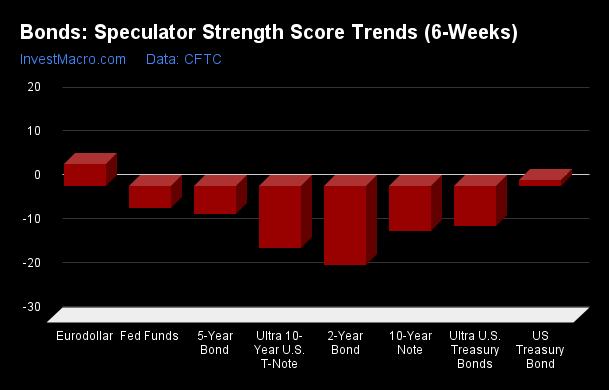
Strength Score Trends (or move index, calculates the 6-week changes in strength scores) show that the Eurodollar (14.6 percent) leads the past six weeks trends for bonds this week. The 5-Year Bond (3.1 percent) and the 10-Year Bond (2.2 percent) fill out the other positive movers in the latest trends data.

The US Treasury Bond (-16.0 percent) leads the downside trend scores currently while the next markets with lower trend scores were the Ultra 10-Year Bond (-14.8 percent), Fed Funds (-13.5 percent) and the 2-Year Bond (-13.1 percent).


Strength Trend Statistics:
Fed Funds (-13.5 percent) vs Fed Funds previous week (1.7 percent)
2-Year Bond (-13.1 percent) vs 2-Year Bond previous week (-21.4 percent)
5-Year Bond (3.1 percent) vs 5-Year Bond previous week (3.8 percent)
10-Year Bond (2.2 percent) vs 10-Year Bond previous week (-0.3 percent)
Ultra 10-Year Bond (-14.8 percent) vs Ultra 10-Year Bond previous week (-7.2 percent)
US Treasury Bond (-16.0 percent) vs US Treasury Bond previous week (-16.9 percent)
Ultra US Treasury Bond (-0.2 percent) vs Ultra US Treasury Bond previous week (-2.9 percent)
Eurodollar (14.6 percent) vs Eurodollar previous week (13.1 percent)


Individual Markets:

3-Month Eurodollars Futures:

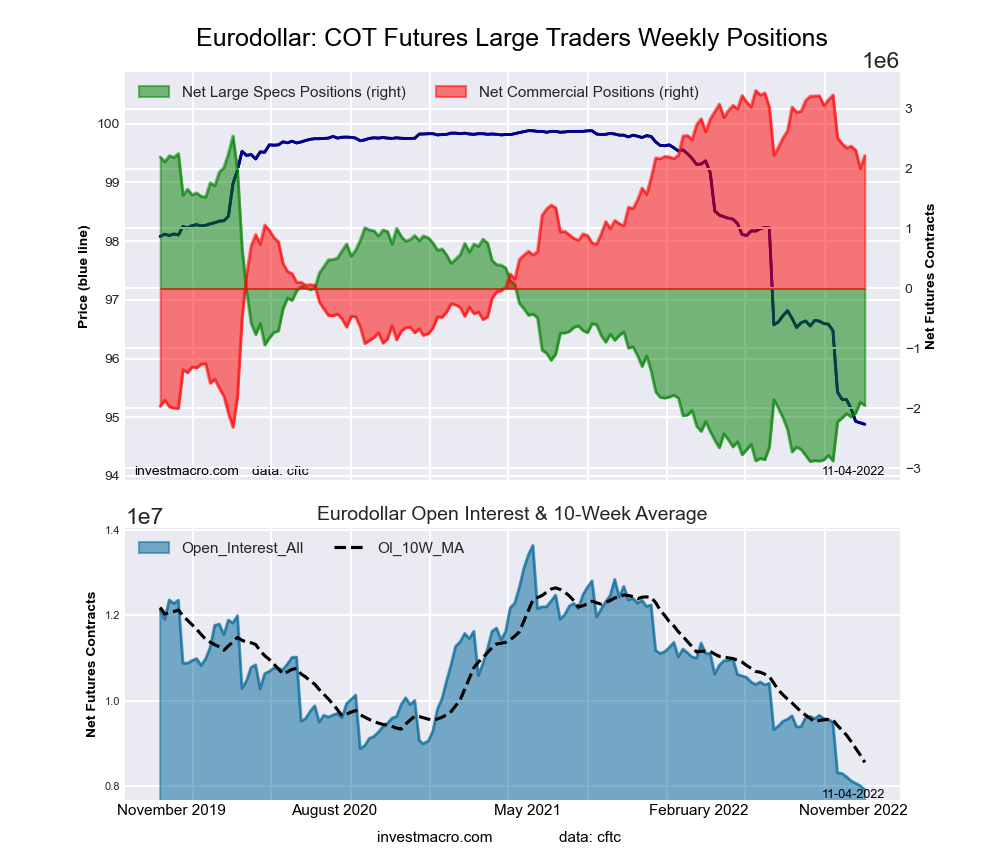
Eurodollar Bonds Futures COT ChartThe 3-Month Eurodollars large speculator standing this week equaled a net position of -2,087,748 contracts in the data reported through Tuesday. This was a weekly gain of 72,027 contracts from the previous week which had a total of -2,159,775 net contracts.

This week’s current strength score (the trader positioning range over the past three years, measured from 0 to 100) shows the speculators are currently Bearish-Extreme with a score of 14.7 percent. The commercials are Bullish-Extreme with a score of 83.0 percent and the small traders (not shown in chart) are Bearish with a score of 48.1 percent.

3-Month Eurodollars StatisticsSPECULATORSCOMMERCIALSSMALL TRADERS
– Percent of Open Interest Longs:8.268.24.9
– Percent of Open Interest Shorts:33.639.78.0
– Net Position:-2,087,7482,343,911-256,163
– Gross Longs:674,3655,606,961401,184
– Gross Shorts:2,762,1133,263,050657,347
– Long to Short Ratio:0.2 to 11.7 to 10.6 to 1
NET POSITION TREND:
– Strength Index Score (3 Year Range Pct):14.783.048.1
– Strength Index Reading (3 Year Range):Bearish-ExtremeBullish-ExtremeBearish
NET POSITION MOVEMENT INDEX:
– 6-Week Change in Strength Index:14.6-15.517.5


30-Day Federal Funds Futures:

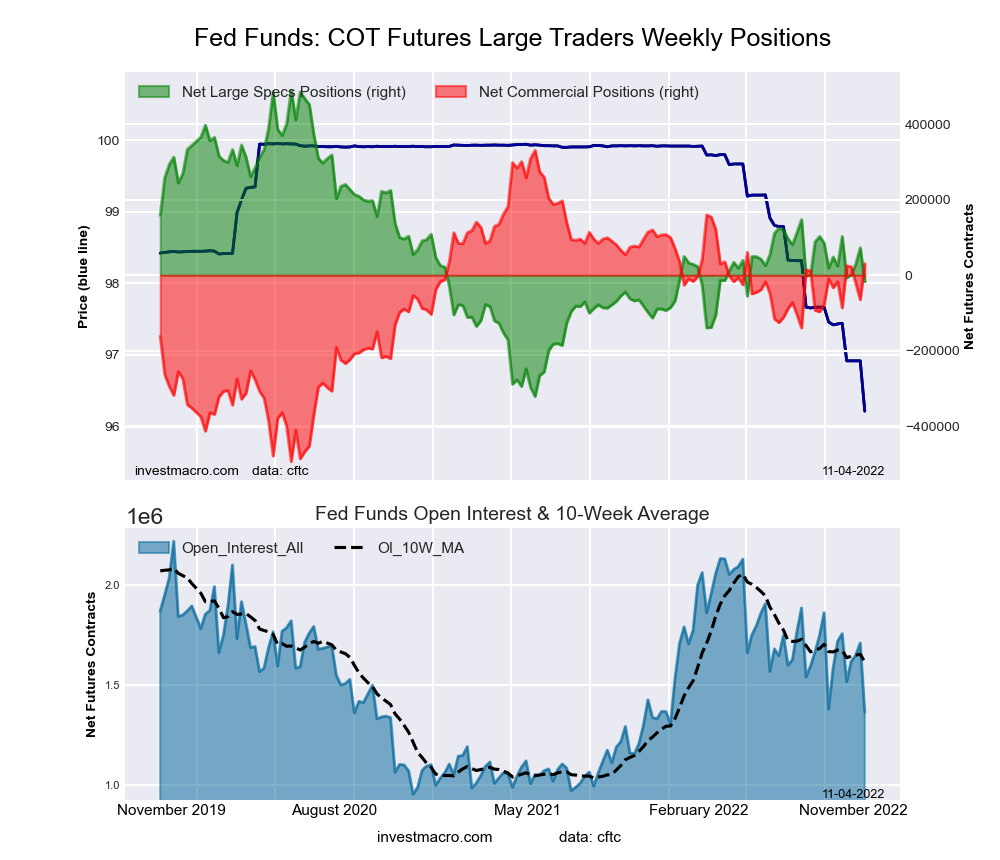
Federal Funds 30-Day Bonds Futures COT ChartThe 30-Day Federal Funds large speculator standing this week equaled a net position of -6,804 contracts in the data reported through Tuesday. This was a weekly decrease of -109,287 contracts from the previous week which had a total of 102,483 net contracts.

This week’s current strength score (the trader positioning range over the past three years, measured from 0 to 100) shows the speculators are currently Bearish with a score of 38.8 percent. The commercials are Bullish with a score of 62.9 percent and the small traders (not shown in chart) are Bearish-Extreme with a score of 13.5 percent.

30-Day Federal Funds StatisticsSPECULATORSCOMMERCIALSSMALL TRADERS
– Percent of Open Interest Longs:10.074.51.7
– Percent of Open Interest Shorts:10.572.82.9
– Net Position:-6,80424,908-18,104
– Gross Longs:151,7591,129,09825,617
– Gross Shorts:158,5631,104,19043,721
– Long to Short Ratio:1.0 to 11.0 to 10.6 to 1
NET POSITION TREND:
– Strength Index Score (3 Year Range Pct):38.862.913.5
– Strength Index Reading (3 Year Range):BearishBullishBearish-Extreme
NET POSITION MOVEMENT INDEX:
– 6-Week Change in Strength Index:-13.514.8-31.0


2-Year Treasury Note Futures:

2-Year Treasury Bonds Futures COT ChartThe 2-Year Treasury Note large speculator standing this week equaled a net position of -306,134 contracts in the data reported through Tuesday. This was a weekly rise of 13,743 contracts from the previous week which had a total of -319,877 net contracts.

This week’s current strength score (the trader positioning range over the past three years, measured from 0 to 100) shows the speculators are currently Bearish with a score of 20.4 percent. The commercials are Bullish-Extreme with a score of 91.5 percent and the small traders (not shown in chart) are Bearish-Extreme with a score of 12.5 percent.

2-Year Treasury Note StatisticsSPECULATORSCOMMERCIALSSMALL TRADERS
– Percent of Open Interest Longs:7.982.38.0
– Percent of Open Interest Shorts:23.562.212.5
– Net Position:-306,134394,727-88,593
– Gross Longs:154,3211,616,300156,188
– Gross Shorts:460,4551,221,573244,781
– Long to Short Ratio:0.3 to 11.3 to 10.6 to 1
NET POSITION TREND:
– Strength Index Score (3 Year Range Pct):20.491.512.5
– Strength Index Reading (3 Year Range):BearishBullish-ExtremeBearish-Extreme
NET POSITION MOVEMENT INDEX:
– 6-Week Change in Strength Index:-13.117.6-11.1


5-Year Treasury Note Futures:

5-Year Treasury Bonds Futures COT ChartThe 5-Year Treasury Note large speculator standing this week equaled a net position of -483,032 contracts in the data reported through Tuesday. This was a weekly decrease of -41,066 contracts from the previous week which had a total of -441,966 net contracts.

This week’s current strength score (the trader positioning range over the past three years, measured from 0 to 100) shows the speculators are currently Bearish-Extreme with a score of 12.5 percent. The commercials are Bullish-Extreme with a score of 89.5 percent and the small traders (not shown in chart) are Bearish with a score of 41.9 percent.

5-Year Treasury Note StatisticsSPECULATORSCOMMERCIALSSMALL TRADERS
– Percent of Open Interest Longs:5.985.77.4
– Percent of Open Interest Shorts:18.070.111.0
– Net Position:-483,032625,173-142,141
– Gross Longs:234,4183,425,691296,148
– Gross Shorts:717,4502,800,518438,289
– Long to Short Ratio:0.3 to 11.2 to 10.7 to 1
NET POSITION TREND:
– Strength Index Score (3 Year Range Pct):12.589.541.9
– Strength Index Reading (3 Year Range):Bearish-ExtremeBullish-ExtremeBearish
NET POSITION MOVEMENT INDEX:
– 6-Week Change in Strength Index:3.1-1.4-2.6


10-Year Treasury Note Futures:

10-Year Treasury Notes Bonds Futures COT ChartThe 10-Year Treasury Note large speculator standing this week equaled a net position of -366,872 contracts in the data reported through Tuesday. This was a weekly lowering of -1,680 contracts from the previous week which had a total of -365,192 net contracts.

This week’s current strength score (the trader positioning range over the past three years, measured from 0 to 100) shows the speculators are currently Bearish-Extreme with a score of 16.7 percent. The commercials are Bullish with a score of 71.4 percent and the small traders (not shown in chart) are Bullish with a score of 68.2 percent.

10-Year Treasury Note StatisticsSPECULATORSCOMMERCIALSSMALL TRADERS
– Percent of Open Interest Longs:9.779.08.8
– Percent of Open Interest Shorts:19.268.210.1
– Net Position:-366,872416,628-49,756
– Gross Longs:373,6343,041,673340,013
– Gross Shorts:740,5062,625,045389,769
– Long to Short Ratio:0.5 to 11.2 to 10.9 to 1
NET POSITION TREND:
– Strength Index Score (3 Year Range Pct):16.771.468.2
– Strength Index Reading (3 Year Range):Bearish-ExtremeBullishBullish
NET POSITION MOVEMENT INDEX:
– 6-Week Change in Strength Index:2.2-9.515.6


Ultra 10-Year Notes Futures:

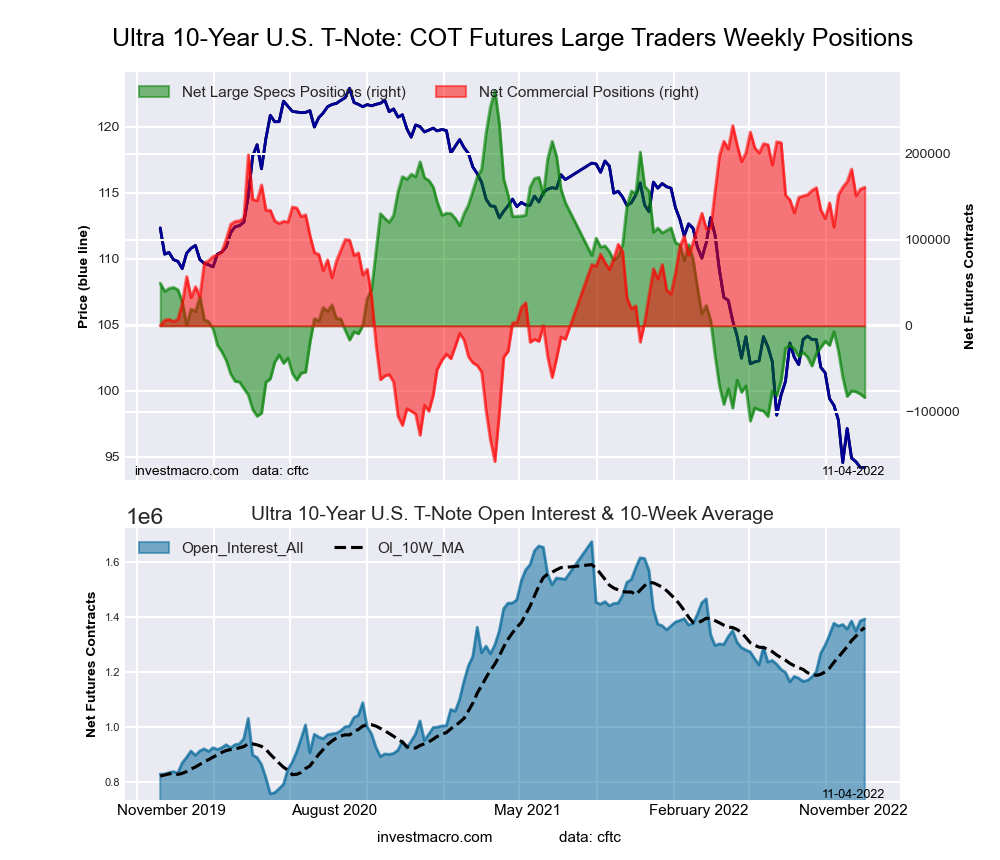
Ultra 10-Year Treasury Notes Bonds Futures COT ChartThe Ultra 10-Year Notes large speculator standing this week equaled a net position of -82,091 contracts in the data reported through Tuesday. This was a weekly lowering of -22,331 contracts from the previous week which had a total of -59,760 net contracts.

This week’s current strength score (the trader positioning range over the past three years, measured from 0 to 100) shows the speculators are currently Bearish-Extreme with a score of 7.4 percent. The commercials are Bullish-Extreme with a score of 83.3 percent and the small traders (not shown in chart) are Bullish with a score of 70.2 percent.

Ultra 10-Year Notes StatisticsSPECULATORSCOMMERCIALSSMALL TRADERS
– Percent of Open Interest Longs:6.282.111.0
– Percent of Open Interest Shorts:12.369.817.3
– Net Position:-82,091167,665-85,574
– Gross Longs:84,1831,113,708149,111
– Gross Shorts:166,274946,043234,685
– Long to Short Ratio:0.5 to 11.2 to 10.6 to 1
NET POSITION TREND:
– Strength Index Score (3 Year Range Pct):7.483.370.2
– Strength Index Reading (3 Year Range):Bearish-ExtremeBullish-ExtremeBullish
NET POSITION MOVEMENT INDEX:
– 6-Week Change in Strength Index:-14.88.316.1


US Treasury Bonds Futures:

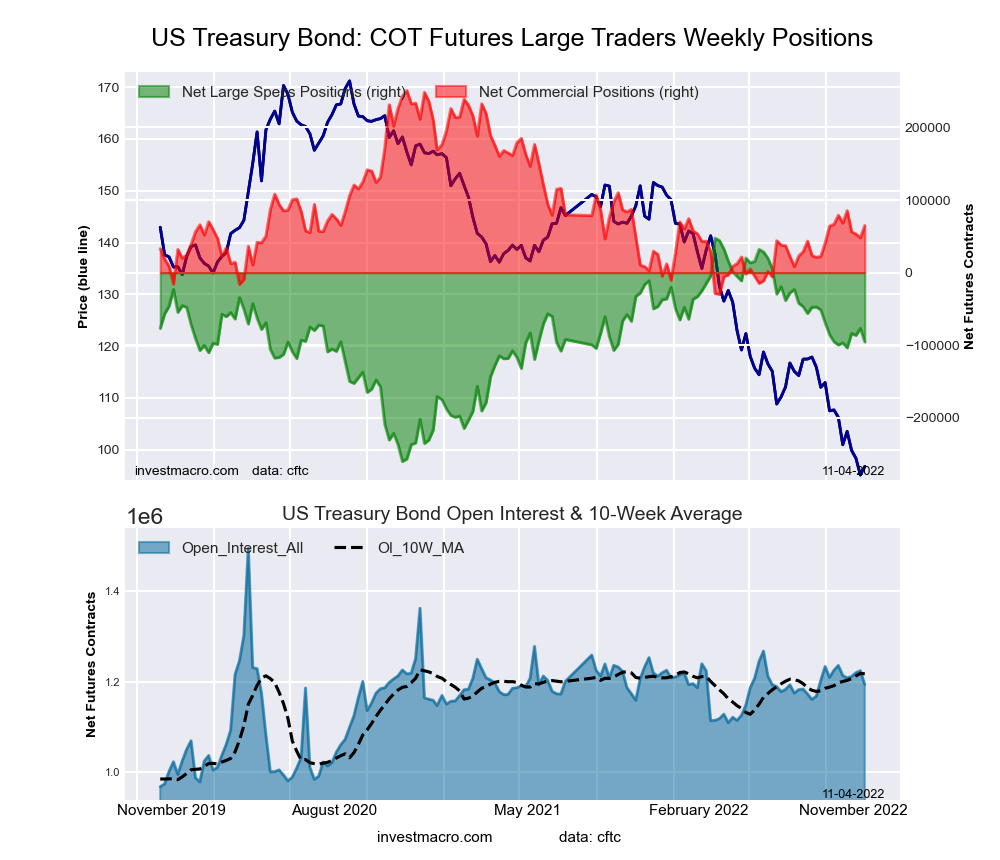
US Year Treasury Notes Long Bonds Futures COT ChartThe US Treasury Bonds large speculator standing this week equaled a net position of -96,552 contracts in the data reported through Tuesday. This was a weekly rise of 2,987 contracts from the previous week which had a total of -99,539 net contracts.

This week’s current strength score (the trader positioning range over the past three years, measured from 0 to 100) shows the speculators are currently Bullish with a score of 53.2 percent. The commercials are Bearish with a score of 35.0 percent and the small traders (not shown in chart) are Bullish with a score of 75.0 percent.

US Treasury Bonds StatisticsSPECULATORSCOMMERCIALSSMALL TRADERS
– Percent of Open Interest Longs:5.978.314.2
– Percent of Open Interest Shorts:13.872.711.9
– Net Position:-96,55268,26828,284
– Gross Longs:71,317950,661172,811
– Gross Shorts:167,869882,393144,527
– Long to Short Ratio:0.4 to 11.1 to 11.2 to 1
NET POSITION TREND:
– Strength Index Score (3 Year Range Pct):53.235.075.0
– Strength Index Reading (3 Year Range):BullishBearishBullish
NET POSITION MOVEMENT INDEX:
– 6-Week Change in Strength Index:-16.016.81.7


Ultra US Treasury Bonds Futures:

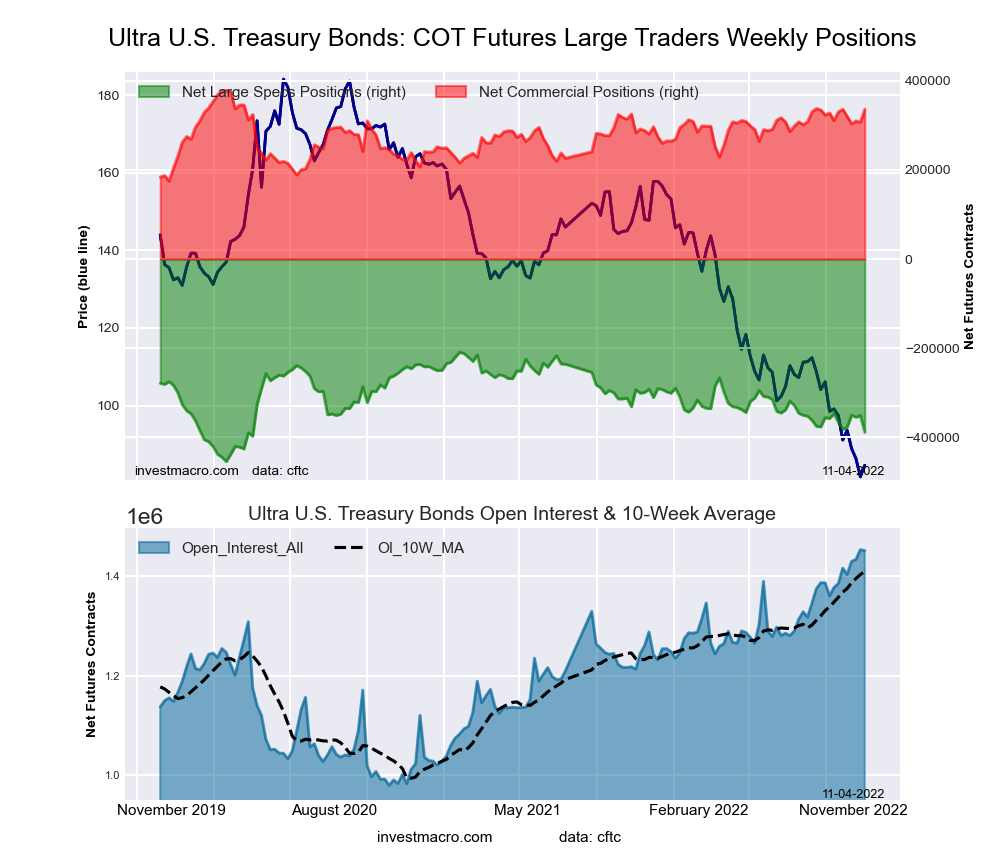
Ultra US Year Treasury Notes Long Bonds Futures COT ChartThe Ultra US Treasury Bonds large speculator standing this week equaled a net position of -376,823 contracts in the data reported through Tuesday. This was a weekly advance of 5,084 contracts from the previous week which had a total of -381,907 net contracts.

This week’s current strength score (the trader positioning range over the past three years, measured from 0 to 100) shows the speculators are currently Bearish with a score of 31.5 percent. The commercials are Bullish with a score of 71.5 percent and the small traders (not shown in chart) are Bullish with a score of 69.0 percent.

Ultra US Treasury Bonds StatisticsSPECULATORSCOMMERCIALSSMALL TRADERS
– Percent of Open Interest Longs:4.883.311.4
– Percent of Open Interest Shorts:31.660.57.3
– Net Position:-376,823320,05856,765
– Gross Longs:66,9111,169,527159,344
– Gross Shorts:443,734849,469102,579
– Long to Short Ratio:0.2 to 11.4 to 11.6 to 1
NET POSITION TREND:
– Strength Index Score (3 Year Range Pct):31.571.569.0
– Strength Index Reading (3 Year Range):BearishBullishBullish
NET POSITION MOVEMENT INDEX:
– 6-Week Change in Strength Index:-0.2-7.110.8


Article By InvestMacroReceive our weekly COT Newsletter

*COT Report: The COT data, released weekly to the public each Friday, is updated through the most recent Tuesday (data is 3 days old) and shows a quick view of how large speculators or non-commercials (for-profit traders) were positioned in the futures markets.

The CFTC categorizes trader positions according to commercial hedgers (traders who use futures contracts for hedging as part of the business), non-commercials (large traders who speculate to realize trading profits) and nonreportable traders (usually small traders/speculators) as well as their open interest (contracts open in the market at time of reporting). See CFTC criteria here.

A secretive legal system lets fossil fuel investors sue countries over policies to keep oil and gas in the ground – podcast

By Gemma Ware, The Conversation and Daniel Merino, The Conversation 

A new barrier to climate action is opening up in an obscure and secretive part of international trade law, which fossil fuel investors are using to sue countries if policy decisions go against them.

In this episode of The Conversation Weekly podcast, we speak to experts about the investor-state dispute settlement (ISDS) mechanism and how it works. Many are worried that these clauses in international trade deals could jeopardise global efforts to save the climate – costing countries billions of dollars in the process.

ISDS clauses were first introduced into international trade agreements in the post-colonial period. Most of these treaties were between a developed and a developing country. “It was really intended in the first instance to protect the interests of multinational companies from the global north when they were operating in these newly decolonised parts of the world,” explains Kyla Tienhaara, an expert in ISDS and environmental governance at Queen’s University in Ontario, Canada.

Yet Tienhaara says the use of ISDS has “morphed beyond all recognition” of the treaties’ original intentions, due to what she calls “creative lawyering” and the fact the system is stacked in favour of investors and against governments.

A looming concern is the chilling effect these clauses could have on countries’ decisions to phase out fossil fuels or take other action to protect the environment if investors decide to sue for compensation. In April, a summary report by the UN’s Intergovernmental Panel on Climate Change singled out ISDS clauses saying that they may “limit countries’ ability to adopt trade-related climate policies” and stick to their commitments under the 2015 Paris agreement.

In a recent study, Tienhaara and her colleagues estimated that countries could face up to US$340 billion in financial and legal risk from cancelling fossil fuel projects covered by ISDS clauses.

Some countries are more vulnerable than others because of the nature of the contracts they’ve entered into. Mozambique, with its large gas and coal reserves, is particularly so, explains Lea Di Salvatore, a PhD candidate at Nottingham University in the UK.

She analysed 29 of the country’s mega-projects for gas, coal and hydrocarbons and found that the vast majority are covered by ISDS clauses. This means that “the company can directly go and initiate an arbitration against Mozambique”, she says, if it feels a government policy has negatively affected its investment.

We hear what it’s like inside one of these arbitration rooms from Emilia Onyema, a professor of international commercial law at SOAS, University of London in the UK. “It’s a private process,” she explains. “The parties determine who the arbitrator is. They appoint the arbitrator. They pay the arbitrator. So they have more powers over the process than they would have in litigation.”

And we tell the story of one ISDS case launched against Italy by the British oil company, Rockhopper Exploration. In 2016, Italy banned oil drilling 12 nautical miles off its coast, which blocked Rockhopper’s exploration of the offshore Ombrina Mare field in the Adriatic Sea. Maria-Rita D’Orsogna, a US-based mathematician and leading campaigner against oil exploration in Abruzzo, explains what was at stake and what happened next.

Listen to the whole episode on The Conversation Weekly to find out about the fight back against ISDS, including moves to reform a big international trade treaty covering the fossil fuel industry and what countries are doing to limit their risk from ISDS climate arbitration.

This episode was produced by Gemma Ware and Mend Mariwany, with sound design by Eloise Stevens. The executive producer was Gemma Ware. Our theme music is by Neeta Sarl.

You can find us on Twitter @TC_Audio, on Instagram at theconversationdotcom or via email. You can also sign up to The Conversation’s free daily email here. A transcript of this episode will be available soon.

You can listen to “The Conversation Weekly” via any of the apps listed above, download it directly via our RSS feed, or find out how else to listen here.The Conversation

About the Author:

Gemma Ware, Editor and Co-Host, The Conversation Weekly Podcast, The Conversation and Daniel Merino, Assistant Science Editor & Co-Host of The Conversation Weekly Podcast, The Conversation

This article is republished from The Conversation under a Creative Commons license. Read the original article.


Expert Says, ‘Watch US 10-Year Treasury Yield as Your Night Sextant’

Provided by streetwisereports.com

Michael Ballanger Expert Michael Ballanger takes a moment to review current updates in the stock market, including the position of gold, the current Fed mandate, the outlook of Getchell Gold Corp., and the Nord Stream Gas Pipelines.I open this week’s missive with a repeat of my Wednesday evening Email Alert:

“Despite yesterday’s pop, I expect that collateral and margin calls are going to keep stocks under pressure right through month-end, but there is little doubt that yesterday’s outside reversal day (defined by a real technical analyst David Chapman as “a two-day pattern is observed in which a security’s high and low prices for the day exceed the high and low of the previous day’s trading session.”) was a major bullish event.

We had a positive outside day for gold and stocks and a negative outside day for the UST 10-year yield, and while these cannot be discounted, the headline shown above may be a portent of an impending shift in Fed policy. The reason for this lies in my “pigs in the barnyard” analogy regarding money managers and the banks from whom they obtain leverage.

With yields so compressed over the past decade, many pension funds have been forced to implement large dollops of leverage in order to squeeze out a minimum 8% return to pensioners. In the case of the British gilts (10-year sovereign bonds), they sported a negative yield late last year and are now over 4%. The destruction to bond portfolios overweighted in these gilts must be enormous, but when you stack leverage on top of the losses, it is no wonder that the Bank of England had to step up and take on billions of pounds worth of paper lest the entire U.K. banking system become vaporized.

Now, returning to the “pigs in the barnyard,” when you gaze upon a herd of pigs in a barnyard, there will be pink pigs and mottled grey and brown pigs and black and white pigs and, of course, brown pigs, but when the farmer’s wife clangs the triangle with her ladle, all those pigs sidle up to the trough together.

In the same manner, the banks, hedge funds, and pension funds all feed at the same trough, so when I read that the BOE had to step in and buy gilts when their stated intent is to sell gilts as part of the globally-led (read: “Fed-Ordered”) quantitative tightening (“QT”) operation designed to curb inflation, you can bet that there are also American and Canadian and a boatload of European and Asian entities leveraged to the nines in government debt whose face value has been crushed in 2022.

So as refreshing as the rally on Wednesday was, we have three more full trading sessions before the month comes to a close. If the lows hold by Friday at 4:00 p.m. EST, then there is a strong probability of a tradable rally in risk-on assets, which includes precious metals and commodities.

However, if calls for additional collateral accelerate and this liquidity-starved financial environment persists, there remains a significant risk that one of the other highly-leveraged pension or hedge funds tip the boat over again.

The Fed’s dual mandate includes maximum full employment and price stability with the current focus on the latter, but there is only one condition that countermands the dual mandate, and that condition is “financial system stability,” and what happened with those British gilts is that very condition.

Margin calls are the ultimate form of financial contagion, so to say that we are at a critical inflection point is an understatement.

Watch the Fed like a hawk for signs of dovish rhetoric or an overt acknowledgment of stresses finally arriving on Wall Street. The “pivot” only occurs if the Fed’s owners, the big U.S. banks that have been feeding at the same leverage trough as their British counterparts, start getting collateral calls.

Then, and only then, will it be safe to go in the water again. . .”

Coast Not Clear

I sent out that missive at 9:22 a.m. (pre-opening Thursday) to make the emphatic point that “the coast” was not exactly “clear.” Eight minutes later, stocks opened down and proceeded to completely erase the near-600-point advance in the Dow and, at one point, were at new lows for the year.

“Fade every rally until the Fed goes officially neutral-positive. . .” I tweeted out a few weeks back, and Thursday’s crushing reversal confirmed that advice, all a function of the most significant four-letter-word in the history of modern markets: Debt.

Truly the only collateral is gold.

I launched my advisory service in January of 2020 with the GGMA 2020 Forecast Issue and proceeded to offer the premise that the ultimate arbiter of all pricing structures would eventually be determined by the value of the collateral held by those that control the currency.

Since the treasury departments of most sovereign nations control the collateral and since the central banks are the entities that extend credit to the treasuries, then the collateral that coerces people to believe in the “Full Faith and Credit” of government must be related to a higher mark.

That collateral, and truly the only collateral, is gold.

Gold, Gold, Gold

In that piece written by and large in the fourth quarter of 2019, I provided a chart illustrating how much-maligned nations like Italy and Russia were actually more solvent than the United States.

Dividing the national debt by the value of their stated central bank or treasury holdings, Russia (thanks largely to the art of default in 1998) had the lowest national-debt-to-gold ratio of any country on the planet, while resource-rich Canada had the highest — as in infinity — because there was then and exists today zero gold at the Bank of Canada nor anywhere close to the Royal Canadian Mint.

Gold enthusiasts have been eating the exhaust fumes of the mainstream media since 2011, and I suspect that with the events in the U.K. this week, a huge regime change is about to arrive.

As a commodity-rich country anchored by the Rule Of Law, I find that an astounding act of national embarrassment. It is funny how generational hardship affects behavior but also comprises the bulk of the wisdom passed down from grandfather to father to son, which amplifies one’s attention to the causes of said hardship.

My mother was taught by her mother never to throw away day-old bread because it had great healing powers in the mold. My father was told by his grandmother to “avoid debt at all costs” because of the farm they lost to foreclosure in Saskatchewan in the 1930s, which prompted my father to avoid taking on debt when a piece of land located at the mouth of the Credit River on Lake Ontario became available for US$2,500.

It is easy to chastise those that opted for conservation over speculation, but it all falls under the category of “right time, right place,” and there is no better time than the present to truly appreciate this truism.

Ask the cryptojunkies to take out ads beseeching us to “sell your gold and buy crypto!” back in 2021.

Gold enthusiasts have been eating the exhaust fumes of the mainstream media since 2011, and I suspect that with the events in the U.K. this week, a huge regime change is about to arrive.

The Fed Mandate

The chart shown above is a perfectly-timed illustration of what happens when bubbles crack wide open and spill the hopes and dreams of a generation onto an odious and steaming sidewalk.

Sexagenarians like me know how the twin demons of government profligacy and mainstream media deception combine to mold investor optimism to a predetermined advantage, all while unelected and very powerful quasi-government officials milk the system largely insulated from either the forces of moral suasion or penal scrutiny.

Is it any coincidence that the stock market was rolling along “just fine” until Fed governors Kaplan, Rosengren, and Clarida were all caught front-running Fed decisions?

Shortly thereafter, the Fed mandate shifted, and once the Wall Street traders finally received and actually read the memo, they finally sold their positions, got shot, and then pulled every bid imaginable until the bear market finally arrived.

Now, we are in a full-blown bear market in every single asset class in existence which is what occurs when the management of currency moves from the ridiculous to the sublime.

Here is a brief pecking order of how households manage their monthly income. Dad and Mom pool their paycheques into a joint account. Nothing gets withdrawn until rent (or mortgage), groceries, utilities, loans (auto, credit cards, etc.) Dad then has to ask Mom if he can grab a few quid to hit the track with “the boys.”

Knowing full well that she will have a resentful and ungrateful hubby if she refuses, she gives him a few quid and then cancels her hair appointment because her three sons need shoes, and there is a dental appointment for one of them that surely is not covered by anything other than the piggy-bank up behind the fridge.

Shortly thereafter, the Fed mandate shifted, and once the Wall Street traders finally received and actually read the memo, they finally sold their positions, got shot, and then pulled every bid imaginable until the bear market finally arrived.

These are the challenges of the average working family.

Now, contrast that with the political class that preaches climate change and “Tax the Rich” while they sip champagne in the front section of the aircraft taking them to Davos for a “Climate Change Conference” as the chartered jet spews out more carbon crossing the Atlantic than a coal-carrying steamer in the 1920s.

They will then be police-escorted (at taxpayer expense) to a five-star hotel, where they will sip more champagne and scarf down Beluga Caviar (of Russian origin) while debating how to free the Ukrainians from Putin’s aggression.

This entire farce confronting the world we face today is a function of public apathy and voter ambivalence to issues that once appeared trivial but which have now metamorphosed in combination and coincident with staccato-like repetition into a leviathan-sized problem.

And it all arrives around the fact that while Mom and Dad cannot ask their banker to increase their credit lines to pay for my little brother’s tuition, the politicians can legislate without recourse any amount they so choose with no entity empowered to say “HALT!” and order House Arrest.

Whether the politicians are Liberal or Conservative, Whig or Labour, or Republican or Democrat, they are all in the same barnyard, and when the farmer’s wife clangs that huge iron triangle just above the trough, they all come running, regardless of color, tone, race, creed, or party and they feed with the gusto of Mr. Creosote in that famous Python sketch where he “has a mint” and then explodes.

Politicians are the minions of the elite, but that is a discussion for another day.

As disgusting as the above picture appears, there is no better graphic available to adequately describe today’s political narrative. The politician of the year 2022 enters into a career not because he (or she) feels a need to change the world but more as a need to feel important.

As a student of history, I always run the risk of believing in the neutrality of the author, but biographies of the great (and not-so-great) statesmen like Churchill, Bismarck, Lincoln, and Gandhi would reveal a common thread of invincibility against media scrutiny.

They gave the middle finger to the journalist, irrespective of stature and notoriety, and went on their merry ways. There are far too many Mr. Creosote’s in today’s congressional and parliamentary gatherings; once they at once both discredited and removed, the government will improve.

Getchell Gold Last Man Standing

Markets will undoubtedly head into October with the greatest of fear and reverence. I know from conversations with my wonderful subscribers that they are terrified that our “last man standing,”

Getchell Gold Corp. (GTCH:CSE; GGLDF:OTCQB), stunned but not staggered, will finally get victimized by this most ruthless of canine predators. My response has always been the same; if the company does nothing else but deliver their revised resource estimate, then we can park our money into Getchell with the full expectation that it will eventually be rerated at “par.”

In this case, “par” is a euphemism for “fair value,” which is between 7.5-and-15-times current pricing. Forget the arrival of “the new paradigm” or the “ultimate demise of the bullion bank naked shorters”; gold mining stocks are bound for a regression to the mean of historical valuation.

When that happens, all boats shall rise.

My observation on the state of markets is this: we are at a point of extreme pessimism and headline bearishness, both historically the starter pistol “CRACK!” of a new bull market advance. The problem is that we do not yet have anything close to a confirmation by Fed policy that they give a hoot about anything but lagging deflationary indicators, so until they acknowledge the protests from the Bank of England or the screams from the U.S. pension fund clients underwater at Goldman or JPM or BofA, it will be “Preservation of Capital” at all costs.

Nord Stream Gas Pipelines

My final comment on the week revolves around the far more significant geopolitical headline that involves the sabotage of Nord Stream gas pipelines, the conduits for Russian gas transmission into Germany.

Like always, the mainstream media are so far behind the curve on this event that it begs the question: “Who actually reports the news?”

With winter approaching, the energy crisis in Europe has just ratcheted up several notches because now the Russians have ZERO leverage over the European decision-makers. As long as Vlad the Impaler carried the threat of shutting down gas flows to Europe, he had leverage in his battle for control of Ukraine but, more importantly, in his battle to wrest control of Europe from the NATO forces.

That leverage has now evaporated, and Putin knows it. The reason this is a much larger story than U.K. pension funds imploding is that it has launched the globe directly back to the Cold War of the 1960s, but since the Russians are already entangled in their Hot War in Ukraine, the loss of leverage as winter approaches has forced a desperate Europe back into the arms of NATO — meaning — the U.S.

Look for gold prices to be a dark night lighthouse, and as we sail into the outer perimeters of a possible new precious metals bull, the safe arrival will be annotated with calm seas but clear night skies full of watchful stars and suspicious moon. Watch the U.S. 10-year treasury yield as your night sextant.

So, logic dictates that on a scale of one to ten, with one being “maximum benefit of a Russian gas shutdown” and ten being “minimum (or no) benefit of a Russian gas shutdown,” Russia and all of Europe would be a “one” as Russia gets no gas revenue from Europe and Europe freezes this winter while those loyal to NATO and the U.S. would get a “ten” as Europe reaches out in desperation for assistance (“rescue”) from the West.

This was a game-changer, and the danger is that Putin, being a chess grandmaster, knows that a retaliatory move is absolutely required in order to even the playing field and to maintain favor in the court of public opinion, in the Duma, and the Russian Federal Assembly.

With the campaign in Ukraine going badly awry and certainly not the turnkey operation that was originally formatted in their war game modeling, Putin’s vice-grip on power is certainly not strengthening. We all know that there is nothing more dangerous than a wounded, cornered animal, and as a child who grew up with air raid sirens and “Duck-and-cover” drills in the 1960s, I am far more sensitive to the prospect of a nuclear option currently at the disposal of Vlad the Impaler.

Somewhere out there is a retaliatory move being planned, and while markets creaked and shuddered at the specter of a massive pension fund default earlier this week, it will most certainly break in half at a sinking of a large LNG freighter carrying a U.S. flag or something (god forbid) even direr.

Look for gold prices to be a dark night lighthouse, and as we sail into the outer perimeters of a possible new precious metals bull, the safe arrival will be annotated with calm seas but clear night skies full of watchful stars and suspicious moon.

Watch the U.S. 10-year treasury yield as your night sextant. It looks like it has been “taken” lower this week — always the first clue for a cynical man trying to make sense of the world growing increasingly mad by the day, hour, and minute.

Michael Ballanger Disclaimer:

This letter makes no guarantee or warranty on the accuracy or completeness of the data provided. Nothing contained herein is intended or shall be deemed to be investment advice, implied or otherwise. This letter represents my views and replicates trades that I am making but nothing more than that. Always consult your registered advisor to assist you with your investments. I accept no liability for any loss arising from the use of the data contained on this letter. Options and junior mining stocks contain a high level of risk that may result in the loss of part or all invested capital and therefore are suitable for experienced and professional investors and traders only. One should be familiar with the risks involved in junior mining and options trading and we recommend consulting a financial adviser if you feel you do not understand the risks involved.

Disclosures:

1) Michael J. Ballanger: I, or members of my immediate household or family, own securities of the following companies mentioned in this article: Getchell Gold Corp. I personally am, or members of my immediate household or family are, paid by the following companies mentioned in this article: None. My company, Bonaventure Explorations Ltd., has a consulting relationship with Getchell Gold Corp.

2) The following companies mentioned in this article are billboard sponsors of Streetwise Reports: None. Click here for important disclosures about sponsor fees.

3) Statements and opinions expressed are the opinions of the author and not of Streetwise Reports or its officers. The author is wholly responsible for the validity of the statements. The author was not paid by Streetwise Reports for this article. Streetwise Reports was not paid by the author to publish or syndicate this article. Streetwise Reports requires contributing authors to disclose any shareholdings in, or economic relationships with, companies that they write about. Streetwise Reports relies upon the authors to accurately provide this information and Streetwise Reports has no means of verifying its accuracy.

4) This article does not constitute investment advice. Each reader is encouraged to consult with his or her individual financial professional and any action a reader takes as a result of information presented here is his or her own responsibility. By opening this page, each reader accepts and agrees to Streetwise Reports’ terms of use and full legal disclaimer. This article is not a solicitation for investment. Streetwise Reports does not render general or specific investment advice and the information on Streetwise Reports should not be considered a recommendation to buy or sell any security. Streetwise Reports does not endorse or recommend the business, products, services or securities of any company mentioned on Streetwise Reports.

5) From time to time, Streetwise Reports LLC and its directors, officers, employees or members of their families, as well as persons interviewed for articles and interviews on the site, may have a long or short position in securities mentioned. Directors, officers, employees or members of their immediate families are prohibited from making purchases and/or sales of those securities in the open market or otherwise from the time of the decision to publish an article until three business days after the publication of the article. The foregoing prohibition does not apply to articles that in substance only restate previously published company releases.

As of the date of this article, officers and/or employees of Streetwise Reports LLC (including members of their household) own securities of Getchell Gold Corp., a company mentioned in this article.


Plunging pound and crumbling confidence: How the new UK government stumbled into a political and financial crisis of its own making

By David McMillan, University of Stirling 

The new British government is off to a very rocky start – after stumbling through an economic and financial crisis of its own making.

Just a few weeks into its term on Sept. 23, 2022, Prime Minister Liz Truss’ government released a so-called mini-budget that proposed £161 billion – about US$184 billion at today’s rate – in new spending and the biggest tax cuts in half a century, with the benefits mainly going to Britain’s top earners. The aim was to jump-start growth in an economy on the verge of recession, but the government didn’t indicate how it would pay for it – or provide evidence that the spending and tax cuts would actually work.

Financial markets reacted badly, prompting interest rates to soar and the pound to plunge to the lowest level against the dollar since 1985. The Bank of England was forced to gobble up government bonds to avoid a financial crisis.

After days of defending the plan, the government did a U-turn of sorts on Oct. 3 by scrapping the most controversial component of the budget – elimination of its top 45% tax rate on high earners. This calmed markets, leading to a rally in the pound and government bonds.

As a finance professor who tracks markets closely, I believe at the heart of this mini-crisis over the mini-budget was a lack of confidence – and now a lack of credibility.

A looming recession

Truss’ government inherited a troubled economy.

Growth has been sluggish, with the latest quarterly figure at 0.2%. The Bank of England predicts the U.K. will soon enter a recession that could last until 2024. The latest data on U.K. manufacturing shows the sector is contracting.

Consumer confidence is at its lowest level ever as soaring inflation – currently at an annualized pace of 9.9% – drives up the cost of living, especially for food and fuel. At the same time, real, inflation-adjusted wages are falling by a record amount, or around 3%.

It’s important to note that many countries in the world, including the U.S. and in mainland Europe, are experiencing the same problems of low growth and high inflation. But rumblings in the background in the U.K. are also other weaknesses.

Since the financial crisis of 2008, the U.K. has suffered from lower productivity compared with other major economies. Business investment plateaued after Brexit in 2016 – when a slim majority of voters chose to leave the European Union – and remains significantly below pre-COVID-19 levels. And the U.K. also consistently runs a balance of payments deficit, which means the country imports a lot more goods and services than it exports, with a trade deficit of over 5% of gross domestic product.

In other words, investors were already predisposed to view the long-term trajectory of the U.K. economy and the British pound in a negative light.

An ambitious agenda

Truss, who became prime minister on Sept. 6, 2022, also didn’t have a strong start politically.

The government of Boris Johnson lost the confidence of his party and the electorate after a series of scandals, including accusations he mishandled sexual abuse allegations and revelations about parties being held in government offices while the country was in lockdown.

Truss was not the preferred candidate of lawmakers in her own Conservative Party, who had the task of submitting two choices for the wider party membership to vote on. The rest of the party – dues-paying members of the general public – chose Truss. The lack of support from Conservative members of Parliament meant she wasn’t in a position of strength coming into the job.

Nonetheless, the new cabinet had an ambitious agenda of cutting taxes and deregulating energy and business.

Some of the decisions, laid out in the mini-budget, were expected, such as subsidies limiting higher energy prices, reversing an increase in social security taxes and a planned increase in the corporate tax rate.

But others, notably a plan to abolish the 45% tax rate on incomes over £150,000, were not anticipated by markets. Since there were no explicit spending cuts cited, funding for the £161 billion package was expected to come from selling more debt. There was also the threat that this would be paid for, in part, by lower welfare payments at a time when poorer Britons are suffering from the soaring cost of living. The fear of welfare cuts is putting more pressure on the Truss government.

A collapse in confidence

Even as the new U.K. Chancellor of the Exchequer Kwasi Kwarteng was presenting the mini-budget on Sept. 23, the British pound was already getting hammered. It sank from $1.13 the day before the proposal to as low as $1.03 in intraday trading on Sept. 26. Yields on 10-year government bonds, known as gilts, jumped from about 3.5% to 4.5% – the highest level since 2008 – in the same period.

The jump in rates prompted mortgage lenders to suspend deals with new customers, eventually offering them again at significantly higher borrowing costs. There were fears that this would lead to a crash in the housing market.

In addition, the drop in gilt prices led to a crisis in pension funds, putting them at risk of insolvency.

Many members of Truss’ party voiced opposition to the high levels of borrowing likely necessary to finance the tax cuts and spending and said they would vote against the package.

The International Monetary Fund, which bailed out the U.K. in 1976, even offered its figurative two cents on the tax cuts, urging the government to “reevaluate” the plan. The comments further spooked investors.

To prevent a broader crisis in financial markets, the Bank of England stepped in and pledged to purchase up to £65 billion in government bonds.

Besides causing investors to lose faith, the crisis also severely dented the public’s confidence in the U.K. government. The latest polls showed the opposition Labour Party enjoying a 24-point lead, on average, over the Conservatives.

So the government likely had little choice but to reverse course and drop the most controversial part of the plan, the abolition of the 45% tax rate. The pound recovered its losses. The recovery in gilts was more modest, with bonds still trading at elevated levels.

Putting this all together, less than a month into the job, Truss has lost confidence – and credibility – with international investors, voters and her own party. And all this over a “mini-budget” – the full budget isn’t due until November 2022. It suggests the U.K.‘s troubles are far from over, a view echoed by credit rating agencies.The Conversation

About the Author:

David McMillan, Professor in Finance, University of Stirling

This article is republished from The Conversation under a Creative Commons license. Read the original article.

Mid-Week Technical Outlook: Commodity Currencies & Minors

By ForexTime 

A sense of caution lingered across financial markets on Thursday as investors weighed the impact of rising oil prices on economic growth. Anticipation ahead of the US jobs report on Friday added to the tense atmosphere with market players adopting a guarded approach toward riskier assets. In the equity space, stocks in Europe edged higher as global markets searched for normality after the recent volatility. There was an uneasy calm in the currency markets with the dollar on standby while oil prices hovered near three-week highs after OPEC+ agreed to cut output by 2 million barrels a day.

Over the past few days, our attention has been on the mighty dollar but this morning the spotlight shines on commodity currencies and minors. The minors refer to non-USD forex currency pairs while commodity currencies are those which are correlated with the value of a particular commodity. With oil bulls back in the building thanks to OPEC+ latest decision this could influence commodity currencies. Economic, domestic, and political forces impacting non-USD currencies may translate to increased volatility across minor pairs. Where there is volatility, this presents opportunity and our tool will be technical analysis.

USDCAD eyes 1.3840

Canadian Dollar bulls failed to draw inspiration from the rebound in oil prices yesterday. The USDCAD could be experiencing a technical rebound from 1.3502 which may encourage an incline back towards 1.3840. Overall, the currency pair remains bullish on the daily charts as there have been consistently higher highs and higher lows. A solid breakout above 1.3840 could trigger a move towards 1.4000. Below 1.3502, bears will be eyeing 1.3390.

NZDUSD to resume downtrend?

After failing to conquer the 0.5800 resistance level, the NZDUSD could be preparing to resume its journey south.

All eyes will be on how prices behave around the 0.5720 level which has acted as a resistance in the past. A strong breakdown below this point could encourage a selloff towards 0.5560 and 0.5467. If bulls can push prices back above 0.5800, this could open the doors towards 0.5880 and higher.

AUDUSD trapped within range

There is nothing much going on for AUDUSD but the pressure is building. Support can be found at 0.6390 and resistance at 0.6520. Although there have been consistently lower lows and lower highs, the currency pair could need a directional catalyst to breakout/down. A solid move above 0.6520 could trigger an incline towards 0.6650 and higher. Alternatively, a move below 0.6300 may result in a selloff towards 0.6270 and 0.6200, respectively.

GBPJPY wobbles above 100 SMA

If you are craving action, then look no further.  The GBPJPY has been incredibly volatile over the past few days thanks to fundamental forces in the United Kingdom. Prices are trading below 164.00 as of writing and could edge lower if the 100-day SMA gives way. Bears may target 162.00 and 160.00 if the pound continues to weaken. Alternatively, a move back above 164.00 could open the doors towards 165.50 and 167.00.

EUR/JPY back within range

The EURJPY is trading back within a range with support at 141.50 and resistance at 144.00. A breakout could be on the horizon. Bulls could take control of the driving seat if prices push beyond 144.00. Such a development is likely to open the doors toward 145.60. Should 144.00 prove to be reliable resistance, the currency pair may decline back towards 141.50 and 139.00.


Forex-Time-LogoArticle by ForexTime
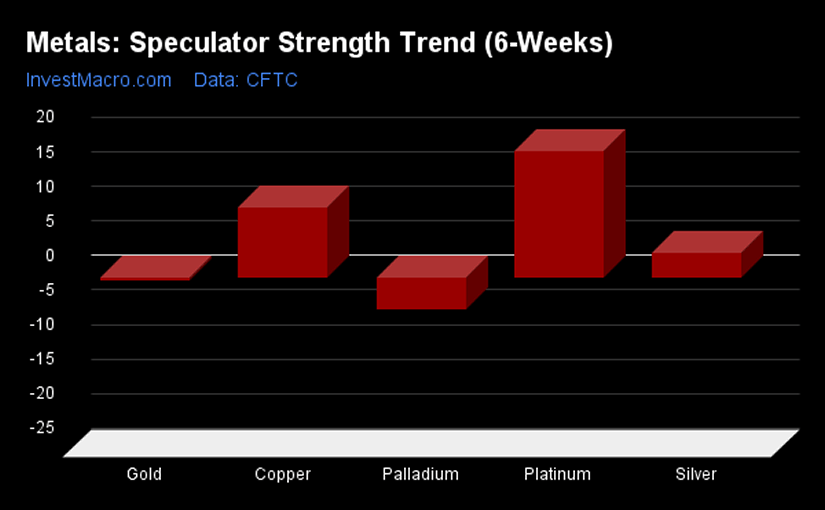
ForexTime Ltd (FXTM) is an award winning international online forex broker regulated by CySEC 185/12 www.forextime.com
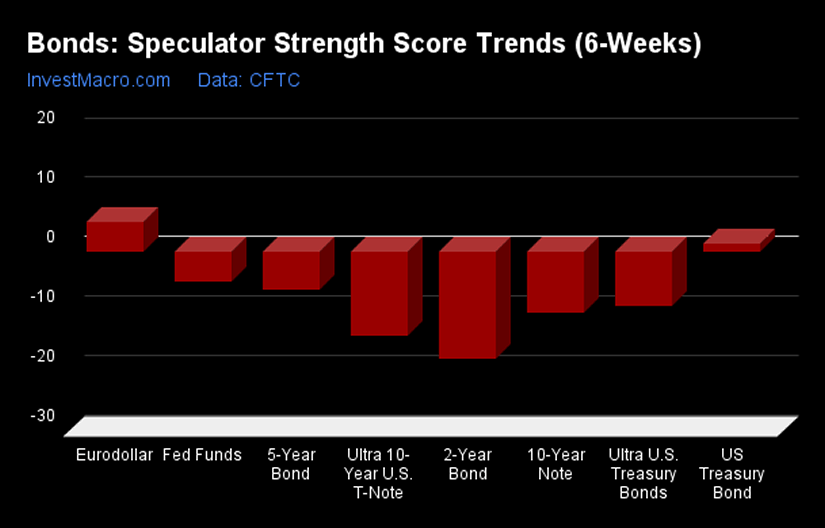
Pound recovers but remains at low levels – how to assess the long-term value of sterling

By Ganesh Viswanath-Natraj, Warwick Business School, University of Warwick 

The pound has recovered from a recent record dip after the chancellor’s mini-budget announcement. But it is still at low levels versus many other currencies.

The recent decline can be mostly attributed to the tax cuts announced during Chancellor Kwasi Kwarteng’s recent mini-budget. The £45 billion package caused concern among investors by considerably increasing future government debt, although Kwarteng has since announced a U-turn on the £2 billion plans to abolish cuts for the highest earners. More generally, escalating inflation expectations from this increased fiscal expansion, coupled with ongoing rising energy costs, have had a negative impact on the UK economy and therefore the value of sterling.

The weakening of the pound is also part of a global phenomenon. The US dollar has appreciated by 12% since the end of 2021 against a broad index of currencies, and by more than 20% against the pound. This broad appreciation is attributed to a tightening of US monetary policy and a shift in the risk appetite of investors towards US dollar assets, currently viewed as more of a safe haven.

Given these underlying pressures, questions about the long-term valuation of pound sterling abound, including whether it will settle at parity with the US dollar. An analysis by Bloomberg has shown financial markets believe there is a 60% probability that sterling will reach dollar parity by the end of 2022. A long-term decline in the valuation of the pound increases the price of imported goods, which can feed into consumer price inflation.

If policy makers want to shore up the currency’s strength, several economic theories suggest they must address high inflation expectations, the impacts of Brexit and the various supply chain issues plaguing the economy at present.

Comparing burgers with burgers

Ever heard of the Big Mac Index? Research about long-term movements in exchange rates shows they tend to change in line with relative inflation rates in many countries. This theory, known as purchasing power parity (PPP), uses the price of specific products or baskets of goods to compare currencies and standards of living in different countries.

As such, we can examine the value of the pound compared to other currencies by looking at a single good such as a McDonald’s Big Mac burger. Since this product is the same across countries, the Big Mac can be used to calculate a PPP-implied exchange rate by comparing its price in the UK and the US. In July 2022, the Big Mac Index showed the pound was undervalued by around 14%, based on the exchange rate implied by Big Mac prices in the US versus the UK.

Forecasts by the Bank of England put inflation at 14% by the fourth quarter of 2022, however it is expected to decline to 5% by the end of 2023. The relative fall in UK inflation in 2023 should strengthen the pound, reducing the undervaluation predicted by the Big Mac Index.

Another theory that can help us understand the long-term value of the pound is the link between the sustainability of public debt, sovereign risk and exchange rates. A large increase in the ratio of government debt to gross domestic product (GDP) can trigger a weakening of the currency as financial markets expect more risk, that is, concerns increase about the government being able to repay this debt.

Before the second world war, when sterling was the world’s reserve currency, the government could borrow at low cost. Present-day sterling no longer has the same privileges, however, particularly in recent weeks when sterling has even been compared to emerging market currencies. This theory would dictate that the debt-to-GDP ratio and corresponding sovereign risk must decrease for sterling to recover its value.

Long-term exchange rate movements can also be assessed by comparing productivity differences across countries. Known as the Balassa-Samuelson hypothesis, this theory links productivity slowdowns in a country’s tradeable sector – the industries that produce items that are traded internationally – to a weakening in its real exchange rate (that is, after accounting for differences in inflation).

This theory would therefore link supply chain disruptions resulting from Brexit and the war in Ukraine with fundamental declines in the UK’s productivity, causing the long-term value of the pound to depreciate.

Protecting the pound

Rescuing the pound from long-term parity with the dollar will require action from policy makers. The Bank of England oversees monetary policy – using interest rates, among other tools to control the supply of money to the economy – and has a mandate from the government to tackle price stability by using interest rate increases to bring down inflation. Futures markets forecast an interest rate increase of 4% to 6.25% by May 2023 , showing an expectation that the Bank will continue to hike rates to tackle inflation.

The government takes care of fiscal policy – spending and taxation decisions – and recommendations from markets and organisations such as the International Monetary Fund point towards a need for more prudence and fiscal restraint in light of current inflationary pressures. The UK government will announce a medium-term fiscal plan on November 23 that should aim to address the government debt to GDP ratio and shore up investor confidence in the economy.

Perhaps the most difficult challenge, however, will be tackling structural change as a result of the recent productivity slowdown due to Brexit and pandemic-related supply chain disruptions. Facilitating post-Brexit trade relations with the European Union could provide the necessary support to the UK’s tradeable sector to help boost the pound.

Without firm plans on these issues, the outlook for the long-term valuation of the pound remains uncertain. While global factors like the risk appetite of investors may continue to keep the dollar strong, domestic factors could mitigate these effects. Monetary tightening, fiscal consolidation and structural reform of the tradeable sector will all contribute to a revaluation of the pound, providing a route for policy makers to shore up its value on the international stage.The Conversation

About the Author:

Ganesh Viswanath-Natraj, Assistant professor, Warwick Business School, University of Warwick

This article is republished from The Conversation under a Creative Commons license. Read the original article.

The Dollar Has Hit The First Target

By Ino.com

The king currency has finally hit the first long-term target of $114 that was set in the summer of a distant 2019 when it traded around $96.

That aim wasn’t clear then as the dollar index (DX) looked weak in the chart. The short-term structure was similar to a pullback after a heavy drop.

The majority of readers did not believe the DX would ever raise its head as you can see in the 2019 ballot results below.

Ballot Votes

However, I had found a bullish hint in a very big map, and I warned you “Don’t Get Trapped By Recent Dollar Weakness”.

Back in August, you had already been more bullish on the dollar as you voted the most for the target of $121.3 in the earlier post. This confidence is due to the certain position of the Fed, which resolutely fights the inflation, lifting the rate aggressively round by round.

Let me update the visualization of the real interest rate comparison below to see if the dollar still has fuel to keep unstoppable.

DX Monthly vs Real IR

Source: TradingView
 

The real interest rate differentials are shown on the scale B: blue line for U.S. – Eurozone, orange line for U.S. – U.K. and the red line for U.S. – Japan.

As you can see in the chart above the dollar’s buffer only grows over time as the trend gets even sharper. In August, the blue line was at +2.4%, the orange line was at +2.35% and the red line was at -3.3%. The change is huge in favor of the U.S. compared to its rivals.
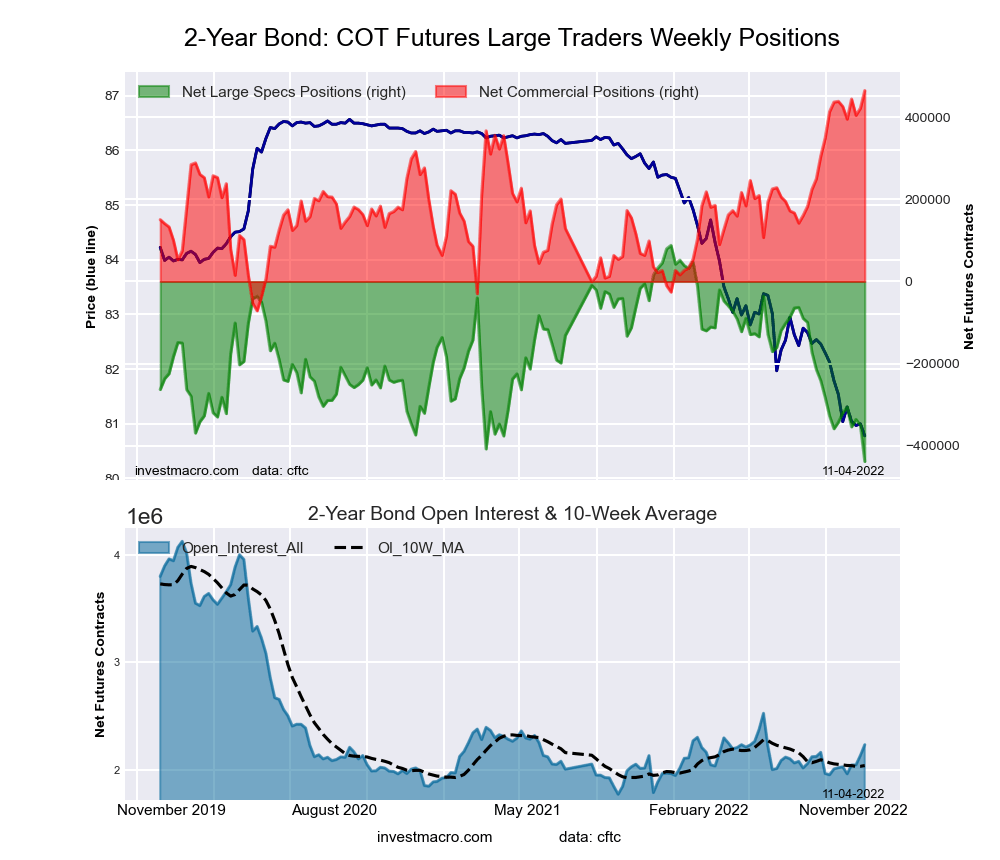
Currently, the DX is lagging behind two differentials: U.S. – Eurozone (the largest component of the DX) and U.S. – U.K. (3rd largest component of DX). We can clearly observe the potential of the dollar to close that gap, rallying at least in the area of $120-$123, where the next target of the distant 2001-year top is located.

Let me refresh the technical chart below for more details.
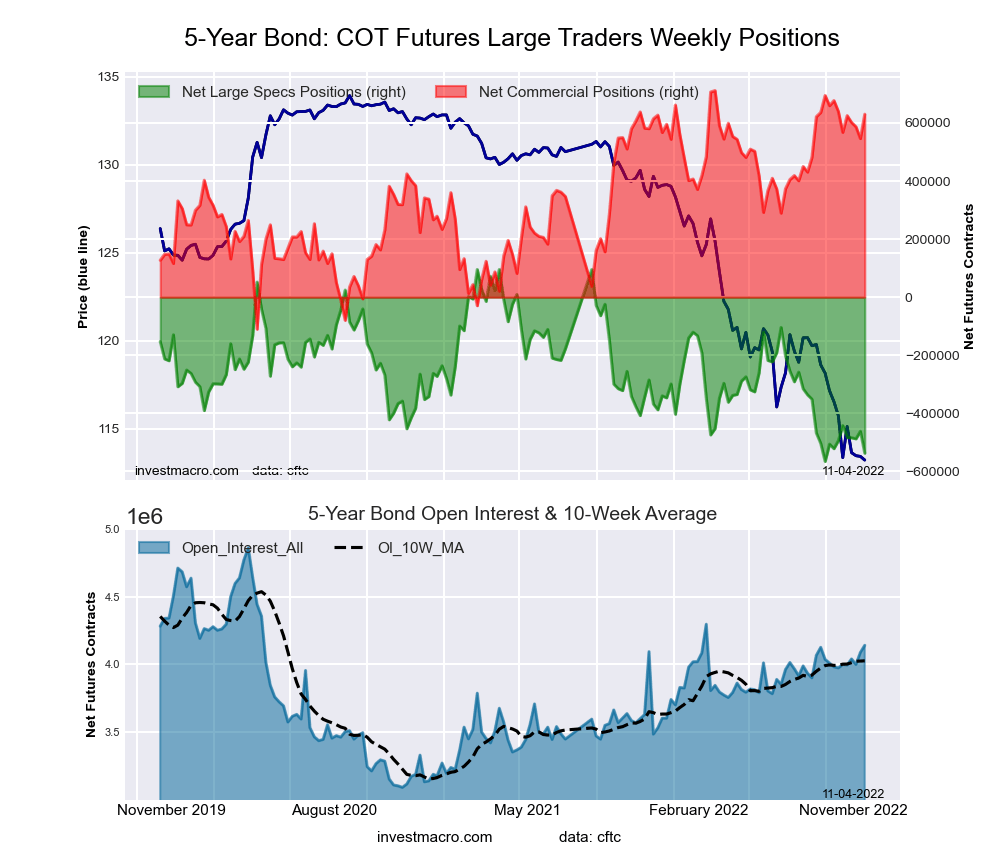
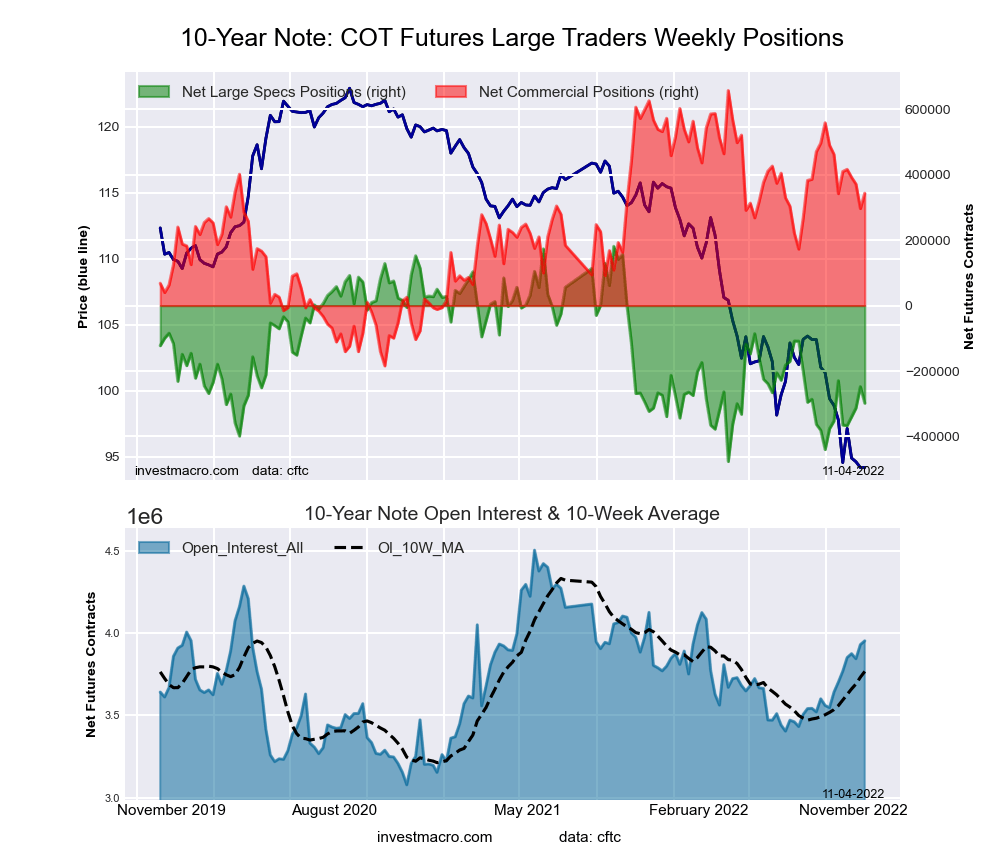
DX Monthly

Source: TradingView
 

This chart above represents the right part of a Giant Double bottom pattern (purple). It emerges accurately as planned as the price is approaching the main barrier of the Neckline.

There is another crucial element in the chart, the uptrend channel (blue dotted). Recently, the price has pierced the upside of it above $114. However, the DX couldn’t consolidate the success and dropped back below the barrier to close the month’s candle underneath.

The price could take two paths from here. The continuation to the upside based on the aggressive tightening is the first option. Another option could put the market on the pause within a consolidation (red down arrow). The former is needed to let the market take a break and reflect on the consequences of the Fed’s actions. This path is not bearish as it is just one of the natural stages of the market to let the latter accumulate enough power for further growth.

The bearish scenario is not considered as the next target of $121 is closer than the first support at $100. That area has been shown in my earlier post. It consists of the simple moving average for the past one year and the large volume profile zone.

Intelligent trades!

Aibek Burabayev
INO.com Contributor

Disclosure: This contributor has no positions in any stocks mentioned in this article. This article is the opinion of the contributor themselves. The above is a matter of opinion provided for general information purposes only and is not intended as investment advice. This contributor is not receiving compensation (other than from INO.com) for their opinion.

By Ino.com – See our Trader Blog, INO TV Free & Market Analysis Alerts

Source: The Dollar Has Hit The First Target