Archive for Opinions – Page 106

Mid-Week Technical Outlook: Safe Haven Currencies

By ForexTime 

The mood across financial markets turned gloomy on Wednesday as disappointing data from China fuelled fears about slowing global economic growth.

European equities were mixed amid the risk-off sentiment while safe-haven currencies appreciated as investors rushed to safety. Generally, safe-haven currencies like the USD, CHF, JPY, and to a lesser degree even EUR are expected to shine during periods of uncertainty. However, their status tends to be tested thanks to shifting market dynamics and developments at home. Our focus today falls on safe-haven currencies with the tool of choice being nothing but technical analysis.

Euro bulls are certainly on a roll today. We can see a similar theme with the Swiss franc which has gained against most of its counterparts. However, the USD is showing a mixed performance, while the Japanese Yen seems to be getting no love at all.

Equally weighted USD technical bounce?

After dipping below the 200-day SMA last week, the equally-weighted USD index has experienced a rebound back toward 1.1950. A strong daily close above this point could threaten the current bearish channel with the next key level found at 1.2184 – a point below the 100-day SMA. Should 1.1950 prove to be reliable resistance, prices may decline back towards 1.1740.

Equally weighted EUR remains bullish

As the subtitle says, FXTM’s equally weighted Euro index remains bullish on the daily charts. There have been consistently higher highs and higher lows while prices are trading above the MACD. A strong breakout and daily close above 1.26650 could open the doors towards 1.2740. If prices dip back below 1.2550, the next level of interest can be found at 1.2400.

EURJPY hits 50-day SMA

The EURJPY may be back on the rise after support was found above the 100-day SMA. Prices remain in a bullish trend despite periods of weakness with bulls breaking above 144.00. If the upside gains momentum, the next key level of interest can be found at 145.60. If bears re-enter the scene, the EURJPY could descend back towards 141.50.

USDCHF eyes 0.9350

Bears remain in control on the daily charts as there have been consistently lower lows and lower highs. Prices are approaching the 0.9350 support level as of writing. A strong break below this point could trigger a selloff towards 0.9300. Alternatively, a move back above 0.9430 could signal a rally toward 0.9550.

JPY Index back below 100-day SMA

The Japanese Yen index remains choppy and trapped within a pretty wide range on the daily charts with support at 80.15 and resistance at 84.00. Prices are trading below the 100-day SMA and currently balancing above 82.20 as of writing. Weakness below this point could encourage a decline toward 81.30 and 80.15, respectively. A rebound may open a path back towards 83.00 and beyond.


Forex-Time-LogoArticle by ForexTime

ForexTime Ltd (FXTM) is an award winning international online forex broker regulated by CySEC 185/12 www.forextime.com

Welcome to the New Golden Bull

Source: Michael Ballanger  (12/5/22)

 Expert Michael Ballanger of GGM Advisory Inc. reviews Andrew Ross Sorkin’s decision to interview SBF in a global broadcast, Fed Chairman Jerome Powell’s November 30th email alert, and the price of gold as it advances to tell you where he believes the market is heading and what you should look out for.

I will discuss gold in a few paragraphs, but first. . .

Andrew Ross Sorkin

At the exact moment where I thought I could move on from this incessant preoccupation with FTX founder Sam Bankman-Fried, along comes one of the Wall Street media “royalty,” author of the book Too Big to Fail and a regular morning anchor on CNBC, Andrew Ross Sorkin, who makes the fateful decision to interview SBF in a global broadcast effectively allowing the alleged mastermind of the largest “misallocation” of customer funds in history a virtually unchallenged opportunity to pre-plead his case.

Notwithstanding the softball questions and buddy-buddy repartee between them, Sorkin and the NT Times audience actually applauded Bankman-Fried at the end of the interview.

Granted that the young man has not been indicted for any crime yet, these media gluttons are free to take whatever cash he transferred their way in return for the venue. They were (and still are) free to do anything they so choose with him because he is innocent until proven guilty, despite the admissions of the comingling of customer funds with that of his private trading entity, Alameda, as well as failure to adequately explain why he felt it excusable to buy tens of millions of dollars of real estate and put it in his own name or that of his parents.

The only reason I bring this up lies in the now-famous quote by the late, brilliant comedian George Carlin, when he said in reference to the elites that run the nation, “It is one big club, and you ain’t in it!”

Now, I am not going to continue to beat this dead mule as it truly serves no purpose but what I will say is that I find these interviews in poor taste at best and obscenely greed-driven at worst with the determination of legality to be decided at a later date.

To think that political parties on both sides of the aisle were given enormous amounts of campaign funding as well as all of the media companies, is an absolute abomination and an abject conflict of interest of staggering proportions.

The only reason I bring this up lies in the now-famous quote by the late, brilliant comedian George Carlin, when he said in reference to the elites that run the nation, “It is one big club, and you ain’t in it!”

To have such a prominent Wall Street cheerleader like Ross-Sorkin sit there and serve up overhand smashes for the fully-prepared SBF was, at least for me, an offense. It makes one wonder just how much the average investor is getting played by the Wall Street titans that control the behemoth software programs that are able to identify trades nanoseconds before they occur.

As my late friend and technical analyst Ian McAvity used to say, “In the hold of every sunken ship, you will always find a chart.”

It makes you wonder whether the bid offer for a particular security is real and whether the research report recommending an issuer is the product of actual research (as in “unbiased”) or whether it is part of an investment banking agreement where the only research generated with positive tilts are those attached to banking fees.

Plus ça change, plus c’est la meme chose,” (The more things change, the more they remain the same.) wrote French writer Alphonse Karr and in the case of Wall Street, it is a most-fitting and very apropos phrase for describing an event that mirrors the unbridled hubris of the 2001 DotCom crash and the 2008 Subprime crash, two of the most recent examples of Wall Street Gone Wild under the influence of the most powerful narcotic known to mankind — greed.

I want this chapter to be the last in the sequence, but until someone actually goes to jail for white-collar crimes of ever-increasing magnitude and audacity, it is an exercise in futility.

The Fed Concerned About Overtightening

Moving along, this week was dominated by Fed Chairman Jerome Powell, so I will provide a sample of Email Alert 2022-109 sent to subscribers on Thursday morning pre-opening:

“I am concerned about overtightening.”

Jerome Powell, November 30th, 2022

Yesterday afternoon, one solitary word  — “overtightening” —  sent the Dow Jones Industrials up 2.18% on the hope and prayer that the rate-hike cycle is soon coming to a close.

The S&P 500 popped 3.09%, with the NASDAQ an impressive 4.41% as the beaten-up technology issues caught a hefty, short-covering bid. That he reaffirmed the Fed’s intention to continue increasing — as opposed to lowering — borrowing costs means nothing when the bulls decide to charge.

What I take to the bank about yesterday’s reaction to Powell’s speech is that it was most certainly not his preferred outcome because rising stock prices are in direct opposition to the stated goal of reducing demand in the economy.

I have often referred to the asymmetrical wealth effect, which was first introduced in the 1980s and assumes that rising equity prices have a positive effect on consumer spending habits. A big year-end rally that begins at the end of November will give the holiday shopping season a boost from improved month-end statements and portfolio values.

Gold Advancing

The good news for me was that while everyone was mesmerized with stocks, the gold and silver markets advanced 1.28% and 4.45%, respectively, in response to Powell’s “overtightening” fears.

In markets dominated by apprehension, knee-jerk reactions tend to be overblown by abnormally-large short positions and/or FOMO (fear of missing out), but while I think that applies to stocks, it was not the case for the precious metals, where an orderly advance simply gathered steam as the session wore on.

What is usually absent from the gold and silver markets is next-day follow-through, so to have gold nudging up against US$1,800 resistance and silver blowing through US$22.00 resistance is encouraging (verging upon exciting).”

The highlighted part is particularly important as Thursday saw an extremely powerful follow-through, with February gold punching out through that US$1,800 resistance and actually settling at US$1,815.30.

From the CME pit session close Wednesday to the pit session close Thursday saw a US$55.30/ounce pop, which broke it out through the 200-DMA as well.

The next two resistance levels are US$1,825 and US$1,875, but with the RSI settling on Thursday at US$71.22, gold moved into an overbought condition and in need of a sideways consolidation with which to work it off while holding US$1,800.

Mind you, it should be known that coming off the COVID crash lows of March 2020, gold stayed in overbought condition for eleven days, with RSI eventually topping out at US$91.57.

As I have been discussing for the better part of twenty years, the prices for precious metals are inextricably linked to the U.S. dollar because all commodities are priced in the reserve currency of the globe.

It is akin to a “peg” only because if your domestic currency is the British pound and you step into the London Metals Exchange to buy a carload of gold, you are paying the dollar quote, not the pound quote.

Weakness in non-dollar units of exchange will buy less gold per unit and vice-versa.

This chart is a clear illustration of the near 1:1 inverse correlation between gold and the U.S. greenback, with tops in the dollar on September 28 and November 3 coinciding perfectly with lows in gold US$1,622 and US$1,618 before embarking on the current almost US$200 per ounce rally.

To try to map out the course for gold and the dollar for the next six months is more an exercise in mindreading rather than an analysis of the economic or geopolitical landscapes.

There are just so many possible policy alternatives, all being weighed upon by domestic and foreign policy agendas related to inflation, oil prices, and partisan politics, that you have to read multiple minds to achieve accuracy.

Since mind reading is only possible if one wears a cape and goes by the title of “The Amazing Kreskin,” I depend on the predictive power of technical analysis to guide me in the general vicinity of accuracy because all of those head-and-shoulders tops and bottoms and ascending cup-and-handle mumbo-jumbo “signals” are simply clues to the mystery and not the ultimate solution.

As my late friend and technical analyst Ian McAvity used to say, “In the hold of every sunken ship, you will always find a chart.”

In all successful starts to bull moves in the precious metals, you need a combination of positive events occurring simultaneously. You need the more speculative assets classes to outperform the more conservative — i.e. junior gold miners (GDXJ:US) outperforming senior gold miners (GDX:US) and silver (SLV:US) outperforming gold (GLD:US) with the shares outperforming the metals.

This is exactly what we have seen off the September 28 lows all coincident with U.S. dollar weakness and declining bond yields.

Gold Versus the Basket

There used to be an expression about a certain profession that went like this:

How do you tell if a <insert profession> is lying?”

“His lips are moving.”

Well, the profession that has earned that reputation is now all central bank governors, presidents, and vice presidents, with the chairman being the leader.

As the former head of the European Central bank, Jean-Claude Juncker, once said, “When it becomes serious, you have to lie.” So with the global economy, with particular emphasis on the U.S. economy, decelerating rapidly, I would surmise that we have reached the point of “seriousness.”

Jerome Powell addressed the Brookings Institute on Wednesday afternoon, and despite reiterating all of his warnings about “higher for longer” (interest rate levels and duration), the infinitesimal wisdom of stock markets determined that Mr. Powell was “lying” and decided that the “pivot” was “on” and that seasonality would trump policy into year-end selling dollars and buying stocks and gold and bonds as if this was April of 2020.

Only time will tell, but I learned a long time ago that markets that spit in the eye of the consensus view are markets that should not be faded (sold).

This creates a monumental problem for the Fed (as discussed earlier), but it creates an even greater problem for me in that despite the awesome technical set-up for the precious metals as we move into December, one word out of Powell’s mouth at the December 14 FOMC meeting could derail the dollar decline and stock/gold/bond rally in a New York minute.

On the other hand, what if the events of September 28 in London, where the Band of England was forced to reverse their QT course and instead launch a QE rescue mission for their pension funds, was a precursor of systemic risks to the global financial system due — once again — to the excessive use of leverage in meeting yield requirements?

If that event is what is spooking Powell & Company, then the “pivot” actually began in clandestine fashion in late September, with all markets around the globe looking far beyond the futile jawboning of the Fed and its “honored representatives.”

Only time will tell, but I learned a long time ago that markets that spit in the eye of the consensus view are markets that should not be faded (sold).

The Friday Jobs Report came in hotter than expectations but failed to derail a major chunk of the weekly gains, most of which came after the Powell speech. I find it hilarious that a mere two days after the narrative turns “pivot positive” due to that one word — “overtighten” — a jobs report that is a lagging indicator of economic activity brings about yet another 180-degree shift in sentiment.

I suspect that in a couple of weeks, the NFP will come in under consensus with revisions to Friday’s report knocking it back to a “miss.” However, profits were taken before the Powell speech, so I am now looking for a suitable re-entry point in anticipation of a continuation of the seasonal rally into year-end.

I suspect that in a couple of weeks, the NFP will come in under consensus with revisions to Friday’s report knocking it back to a “miss.” However, profits were taken before the Powell speech, so I am now looking for a suitable re-entry point in anticipation of a continuation of the seasonal rally into year-end.

With the Dow actually up after being down US$350 on the opening, it did a complete 180 — to my absolute AWE — and closed up US$34.78 to add 82 points for the week. Astounding, but not unexpected for followers of my weekly diatribe . . .

I suspect that in a couple of weeks, the NFP will come in under consensus with revisions to Friday’s report knocking it back to a “miss.” However, profits were taken before the Powell speech, so I am now looking for a suitable re-entry point in anticipation of a continuation of the seasonal rally into year-end.

Ditto the precious metals, where I have been looking to add aggressively on dips under US$1,800 and did today with the early plunge under US$1,800. For an old gold trader like me, trained in the late 80’s bull market where a lifelong narcotic was injected into my bloodstream, the action in gold is reminiscent of the period 2009-2021 for tech stocks — all dips are bought, and no pops are sold (at least for long).

Silver went out with a US$0.57/ounce gain on a day where all other white metals (palladium, platinum) lost 2.48% and 2.80%, respectively. Copper also had not only a decent day; it had a decent week giving me great confidence in the outlook for 2023 for all these metals AND for the junior wannabes that are either searching for or developing them.

Today’s resiliency for all markets in the face of a hostile jobs report and in the face of overbought market conditions reeks of too many portfolio managers (not yet born when the market crashed in ’87) underweight equities and panicking to get back into “fully-invested” mode.

If this trend accelerates, there might be an EPIC short squeeze into year-end that could rival the one that nailed those fuzzy-cheeked whiz kids back in April of 2020 when they were certain that the global pandemic was going to throw us into the 1930s again, which was EXACTLY what I was told by one of the kiddies in 2008 after junior stocks all crashed.

It never happened then, and it won’t happen now as the BIG MONEY wants a rally, and that is all one needs to know.

End of story.

Michael Ballanger Disclaimer:

This letter makes no guarantee or warranty on the accuracy or completeness of the data provided. Nothing contained herein is intended or shall be deemed to be investment advice, implied or otherwise. This letter represents my views and replicates trades that I am making but nothing more than that. Always consult your registered advisor to assist you with your investments. I accept no liability for any loss arising from the use of the data contained on this letter. Options and junior mining stocks contain a high level of risk that may result in the loss of part or all invested capital and therefore are suitable for experienced and professional investors and traders only. One should be familiar with the risks involved in junior mining and options trading and we recommend consulting a financial adviser if you feel you do not understand the risks involved.

Disclosures:
1) Statements and opinions expressed are the opinions of Michael Ballanger and not of Streetwise Reports or its officers. Michael Ballanger is wholly responsible for the validity of the statements. Streetwise Reports was not involved in any aspect of the article preparation. Michael Ballanger was not paid by Streetwise Reports LLC for this article. Streetwise Reports was not paid by the author to publish or syndicate this article.

2) The following companies mentioned in this article are billboard sponsors of Streetwise Reports: None. Click here for important disclosures about sponsor fees. The information provided above is for informational purposes only and is not a recommendation to buy or sell any security.

3) This article does not constitute investment advice. Each reader is encouraged to consult with his or her individual financial professional and any action a reader takes as a result of information presented here is his or her own responsibility. By opening this page, each reader accepts and agrees to Streetwise Reports’ terms of use and full legal disclaimer. This article is not a solicitation for investment. Streetwise Reports does not render general or specific investment advice and the information on Streetwise Reports should not be considered a recommendation to buy or sell any security. Streetwise Reports does not endorse or recommend the business, products, services or securities of any company mentioned on Streetwise Reports.

4) From time to time, Streetwise Reports LLC and its directors, officers, employees or members of their families, as well as persons interviewed for articles and interviews on the site, may have a long or short position in securities mentioned. Directors, officers, employees or members of their immediate families are prohibited from making purchases and/or sales of those securities in the open market or otherwise from the time of the decision to publish an article until three business days after the publication of the article. The foregoing prohibition does not apply to articles that in substance only restate previously published company releases.

Jiang Zemin propelled China’s economic rise in the world, leaving his successors to deal with the massive inequality that followed

By Edward Cunningham, Harvard Kennedy School 

By the summer of 1989, a series of problems were threatening China’s stability. Soaring inflation was undermining the economy at home while the violent suppression of Tiananmen Square demonstrations had left it largely a pariah state abroad. Yet within a few years the nation rebounded – beginning two decades of high economic growth, membership in the largest trading club in the world and international acceptance on the global stage.

That transition came thanks in no small part to an underestimated, Soviet-trained electrical engineer – former Chinese President Jiang Zemin, who died on Nov. 30, 2022, at the age of 96.

I first traveled to and studied in China in 1992. At that time, the still powerful former leader Deng Xiaoping was publicly criticizing Jiang’s more conservative approach to the economy in a series of visits and talks he gave during what became known as Deng’s “Southern Tour.” Eventually Jiang fell in line and supported Deng’s liberalization measures and the idea of economic transformation. Yet while Jiang’s subsequent policies laid a strong foundation for China’s growth, they also likely sowed the seeds of excess that set the stage for current President Xi Jinping’s rise.

The grand experiment

Jiang was picked to lead the country as general secretary in June 1989, after the ouster of former leader Zhao Ziyang for Zhao’s conciliatory approach towards the Tiananmen Square protesters.

Within three years Jiang embarked on a grand experiment together with Deng and then-Vice Premier Zhu Rongji, which required Jiang to do what others had been unable or unwilling to do: force the restructuring of inefficient state-owned enterprises in a wide range of sectors. This resulted in the laying off of millions of workers who had expected such jobs to be lifelong “iron rice bowls.”

From 1998 to 2002, approximately 34 million people were fired as China privatized hundreds of state-owned enterprises and shuttered thousands more.

This concerted effort proved an important and necessary step toward preparing Chinese companies for more direct market competition and integration with the world economy by the turn of the century.

Ascending on the world stage

Jiang’s real influence began upon Deng’s death in February 1997.

In July of that year, he presided over the handover of Hong Kong to the mainland. He then proved an able leader during the macroeconomic storm of the Asian financial crisis that began that same month. China quickly recovered and by 2001 had both acceded to the World Trade Organization and won the bid to host the 2008 Summer Olympic Games.

By 2002 China’s economy had grown to represent over 4% of the global economy. Jiang sought to reinforce such economic dynamism through more formal means, and revised the constitution that same year to formally allow corporate elite and private business entrepreneurs into the Chinese Communist Party.

Growing inequality

This economic liberalization was paired with housing privatization policies. Combined, they spurred the creation of a burgeoning middle class and large-scale private wealth generation.

What was missing, though, was adequate regulation to provide a check on the often-wild results of unbridled growth. Economic inequalities grew dramatically in the 1990s and on through 2005, when Jiang formally relinquished his final title as the head of the military.

This created large social fissures, as rampant corruption began to permeate central and local governments, crime rates rose, and even the military itself got into business schemes. Local governments resorted to rafts of arbitrary and extra-budgetary fees levied on citizens to pay for critical public goods and services, as well as infrastructure, which had eroded over time.

Return of the state

Jiang’s successors needed to respond to the problems his policies created. They did so by elevating the role of the state in social and economic life, promoting what they described as a more “balanced development” model.

Hu Jintao, who succeeded Jiang, focused resources and policy priorities on transferring more resources to the poorer regions of China, shoring up a weak medical and social insurance system and promulgating more egalitarian measures as part of a “putting people first” program. In just five years, the percentage of China’s population covered by health insurance more than doubled, from 43% in 2006 to 95% in 2011.

Hu also moderated Jiang’s growth at any cost focus, pushing through policies that provided assistance to groups who had not benefited as much from China’s economic reforms, such as migrants, the rural poor and laid-off urban workers.

Xi has provided a more pointed response to what he likely views as the costs of Jiang’s governance. While continuing the shift toward greater centralization, he has deepened and widened the state’s role in not only the economy but other spheres of Chinese life, such as society and the military.

A smooth transition?

But Jiang’s legacy is more than just soaring economic growth and staggering inequality. It is also important to note that the end of his leadership marked China’s first orderly transition of political power since the founding of the People’s Republic of China in 1949.

That precedent was, and continues to be, important. While he initially maintained some influence for several years after formally stepping down as general secretary, Jiang’s most singular legacy may be showing the world – and the Chinese people – that smooth transitions of power were indeed possible. Whether they still are possible remains an open question.The Conversation

About the Author:

Edward Cunningham, Director of Ash Center China Programs, Harvard Kennedy School

This article is republished from The Conversation under a Creative Commons license. Read the original article.


Currency Speculators up their Mexican Peso bets higher for 8th time in 9 weeks

By InvestMacro

Here are the latest charts and statistics for the Commitment of Traders (COT) data published by the Commodities Futures Trading Commission (CFTC).

The latest COT data is updated through Tuesday November 29th and shows a quick view of how large market participants (for-profit speculators and commercial traders) were positioned in the futures markets. All currency positions are in direct relation to the US dollar where, for example, a bet for the euro is a bet that the euro will rise versus the dollar while a bet against the euro will be a bet that the euro will decline versus the dollar.

Weekly Speculator Changes

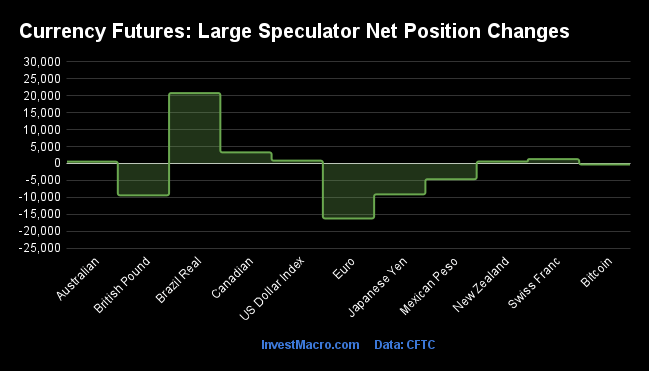
The COT currency market speculator bets were overall lower this week as three out of the eleven currency markets we cover had higher positioning while the other eight markets had lower speculator contracts.

Leading the gains for the currency markets was the Mexican peso (2,767 contracts) with the US Dollar Index (827 contracts) and the Swiss franc (229 contracts) also showing a positive week.

The currencies leading the declines in speculator bets this week were the Canadian dollar (-4,444 contracts) and the Japanese yen (-2,544 contracts) with the Australian dollar (-1,844 contracts), the Brazilian real (-1,099 contracts), the Euro (-865 contracts), the New Zealand dollar (-770 contracts), the British pound sterling (-642 contracts) and Bitcoin (-382 contracts) also registering lower bets on the week.

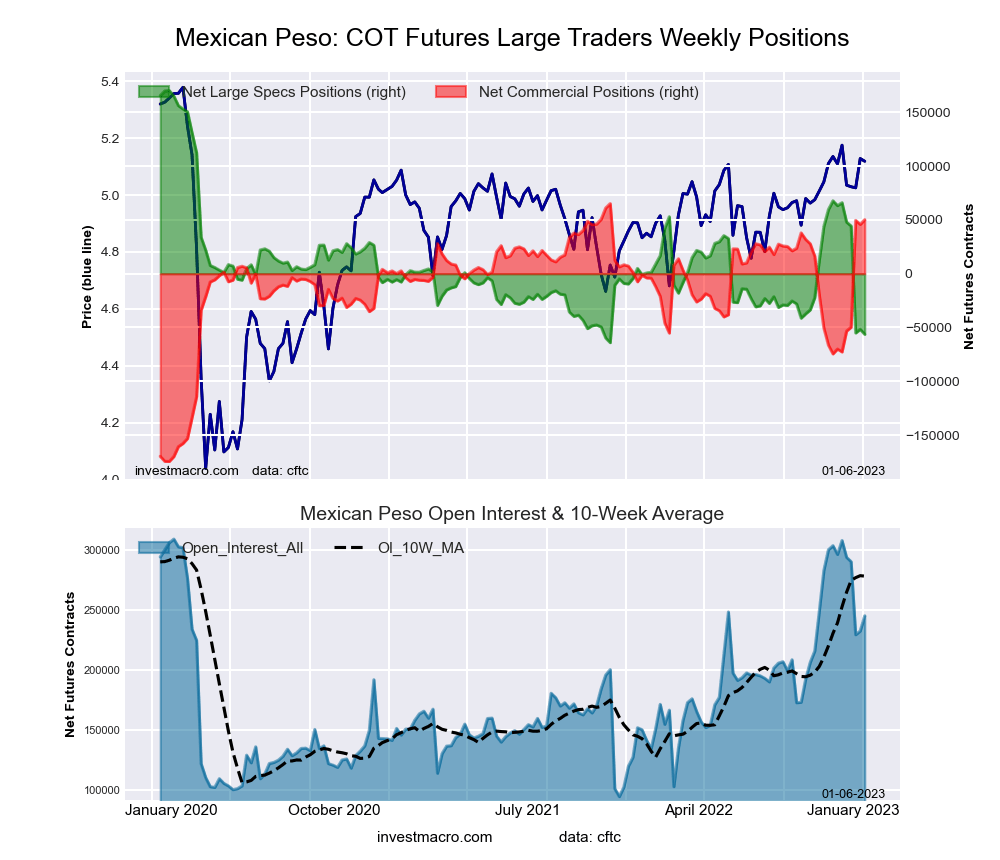
Highlighting the COT currency data this week is the rising Mexican peso positioning. Large speculators boosted their bullish bets for the Mexican peso this week for the eighth time out of the past nine weeks. Peso bets have now improved by a total of +107,408 contracts over that nine-week period going from a standing of -41,322 contracts on September 27th to +66,086 contracts through Tuesday.

The peso positioning has been helped out by the rising interest rates in Mexico that have reached 10 percent with expectations of another 50 basis point increase in December. Peso prices have also been on the rise higher against the US Dollar recently and are up by over 6 percent (vs USD) since late-September. The peso is also one of the rare currencies to be up overall against the US Dollar in 2022.


Data Snapshot of Forex Market Traders | Columns Legend
Nov-29-2022OIOI-IndexSpec-NetSpec-IndexCom-NetCOM-IndexSmalls-NetSmalls-Index
USD Index46,8366024,89266-28,492313,60056
EUR695,77677122,24773-154,5853232,33831
GBP225,48052-36,5843849,23268-12,64833
JPY228,32867-67,3942782,66976-15,27522
CHF41,36025-14,2471719,97078-5,72338
CAD136,65421-16,1162313,951802,16534
AUD159,37852-44,6304350,90657-6,27637
NZD46,18039-5,054484,6415241356
MXN307,7339966,08656-72,759426,67371
RUB20,93047,54331-7,15069-39324
BRL32,057167,63756-9,659442,02285
Bitcoin16,8329032483-780045623


Bitcoin, EuroFX lead Strength Scores

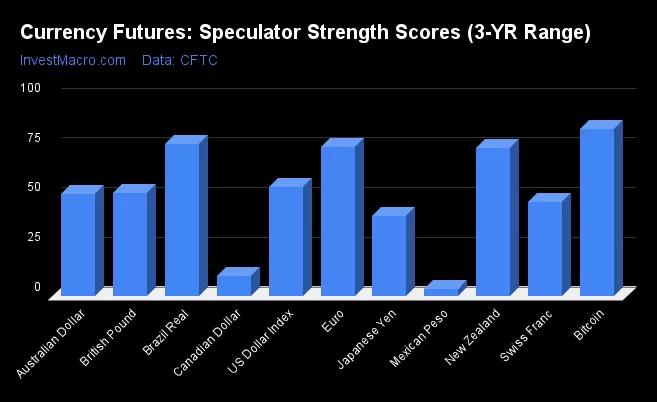
Strength Scores (a normalized measure of Speculator positions over a 3-Year range, from 0 to 100 where above 80 is extreme bullish and below 20 is extreme bearish) show that Bitcoin (82.6 percent) and the EuroFX (72.5 percent) lead the currency markets at the top of their respective ranges and are both in bullish extreme positions. The US Dollar Index (66.4 percent) comes in as the next highest in the currency markets in strength scores but the Dollar has been losing steam over the past weeks and months.

On the downside, the Swiss Franc (17.4 percent) comes in at the lowest strength level currently and is in a bearish extreme level (below 20 percent).

Strength Statistics:
US Dollar Index (66.4 percent) vs US Dollar Index previous week (65.1 percent)
EuroFX (72.5 percent) vs EuroFX previous week (72.8 percent)
British Pound Sterling (37.6 percent) vs British Pound Sterling previous week (38.2 percent)
Japanese Yen (27.4 percent) vs Japanese Yen previous week (28.9 percent)
Swiss Franc (17.4 percent) vs Swiss Franc previous week (16.8 percent)
Canadian Dollar (22.6 percent) vs Canadian Dollar previous week (27.9 percent)
Australian Dollar (43.5 percent) vs Australian Dollar previous week (45.2 percent)
New Zealand Dollar (47.8 percent) vs New Zealand Dollar previous week (49.6 percent)
Mexican Peso (55.5 percent) vs Mexican Peso previous week (54.3 percent)
Brazilian Real (56.0 percent) vs Brazilian Real previous week (57.2 percent)
Bitcoin (82.6 percent) vs Bitcoin previous week (89.3 percent)

Strength Trends led by Mexican Peso

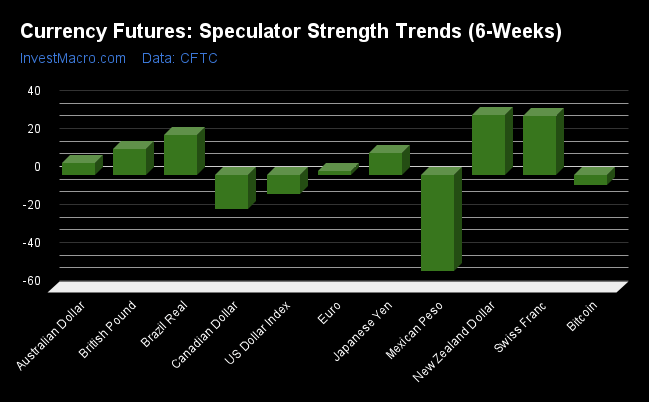
Strength Score Trends (or move index, calculates the 6-week changes in strength scores) showed that the Mexican Peso (37.7 percent) leads the past six weeks trends for the currency markets this week. The New Zealand Dollar (31.5 percent), the EuroFX (22.7 percent) and the Japanese Yen (16.6 percent) fill out the next top movers in the latest trends data.

The Brazilian Real (-19.3 percent) and the Swiss Franc (-18.8 percent) lead the downside trend scores currently while the next market with lower trend scores was the US Dollar Index (-13.0 percent).

Strength Trend Statistics:
US Dollar Index (-13.0 percent) vs US Dollar Index previous week (-14.5 percent)
EuroFX (22.7 percent) vs EuroFX previous week (26.3 percent)
British Pound Sterling (12.6 percent) vs British Pound Sterling previous week (2.8 percent)
Japanese Yen (16.6 percent) vs Japanese Yen previous week (7.7 percent)
Swiss Franc (-18.8 percent) vs Swiss Franc previous week (-22.6 percent)
Canadian Dollar (5.3 percent) vs Canadian Dollar previous week (16.7 percent)
Australian Dollar (-8.6 percent) vs Australian Dollar previous week (-10.7 percent)
New Zealand Dollar (31.5 percent) vs New Zealand Dollar previous week (34.8 percent)
Mexican Peso (37.7 percent) vs Mexican Peso previous week (41.4 percent)
Brazilian Real (-19.3 percent) vs Brazilian Real previous week (-17.8 percent)
Bitcoin (5.3 percent) vs Bitcoin previous week (-2.6 percent)


Individual COT Forex Markets:

US Dollar Index Futures:

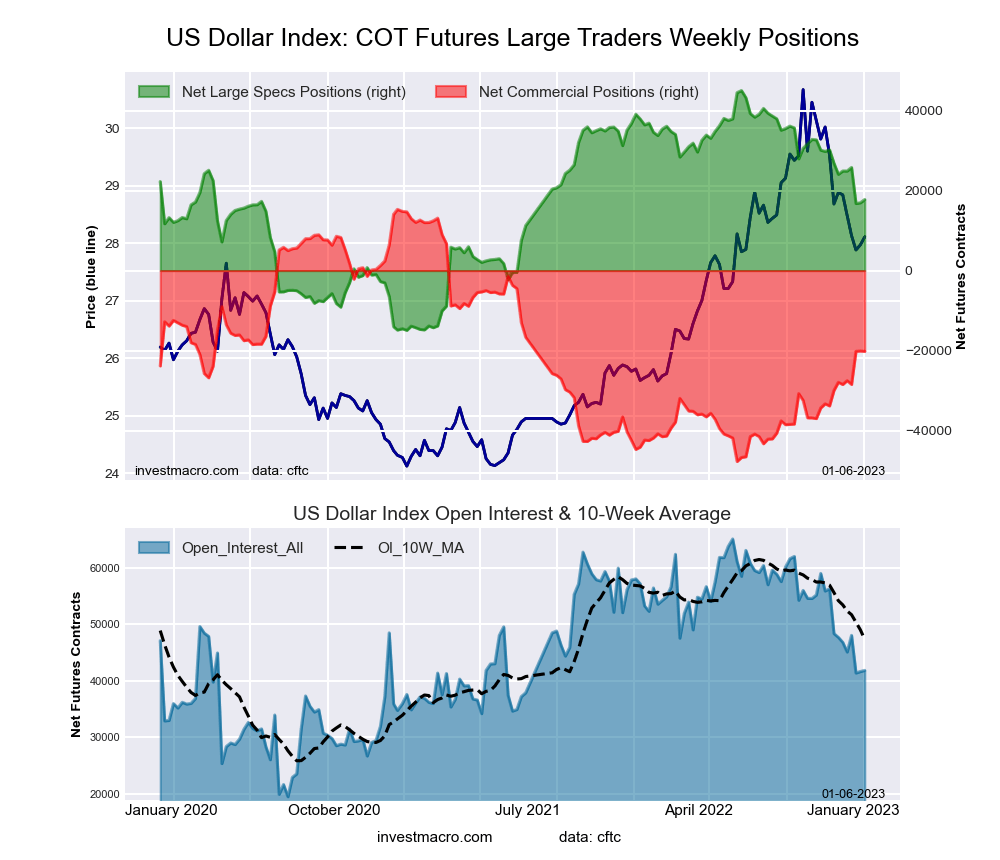
US Dollar Index Forex Futures COT ChartThe US Dollar Index large speculator standing this week recorded a net position of 24,892 contracts in the data reported through Tuesday. This was a weekly lift of 827 contracts from the previous week which had a total of 24,065 net contracts.

This week’s current strength score (the trader positioning range over the past three years, measured from 0 to 100) shows the speculators are currently Bullish with a score of 66.4 percent. The commercials are Bearish with a score of 30.5 percent and the small traders (not shown in chart) are Bullish with a score of 55.9 percent.

US DOLLAR INDEX StatisticsSPECULATORSCOMMERCIALSSMALL TRADERS
– Percent of Open Interest Longs:79.64.413.2
– Percent of Open Interest Shorts:26.465.35.5
– Net Position:24,892-28,4923,600
– Gross Longs:37,2792,0796,199
– Gross Shorts:12,38730,5712,599
– Long to Short Ratio:3.0 to 10.1 to 12.4 to 1
NET POSITION TREND:
– Strength Index Score (3 Year Range Pct):66.430.555.9
– Strength Index Reading (3 Year Range):BullishBearishBullish
NET POSITION MOVEMENT INDEX:
– 6-Week Change in Strength Index:-13.013.5-7.9


Euro Currency Futures:

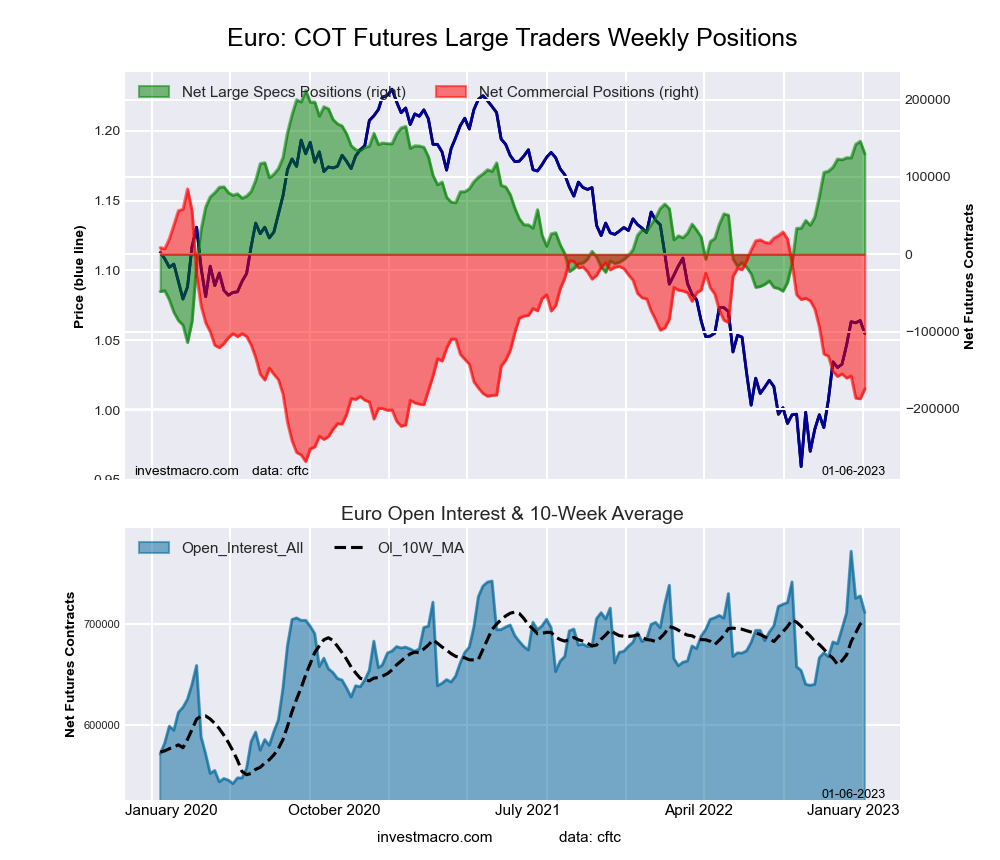
Euro Currency Futures COT ChartThe Euro Currency large speculator standing this week recorded a net position of 122,247 contracts in the data reported through Tuesday. This was a weekly reduction of -865 contracts from the previous week which had a total of 123,112 net contracts.

This week’s current strength score (the trader positioning range over the past three years, measured from 0 to 100) shows the speculators are currently Bullish with a score of 72.5 percent. The commercials are Bearish with a score of 32.2 percent and the small traders (not shown in chart) are Bearish with a score of 30.6 percent.

EURO Currency StatisticsSPECULATORSCOMMERCIALSSMALL TRADERS
– Percent of Open Interest Longs:34.751.311.8
– Percent of Open Interest Shorts:17.173.57.1
– Net Position:122,247-154,58532,338
– Gross Longs:241,122356,90581,867
– Gross Shorts:118,875511,49049,529
– Long to Short Ratio:2.0 to 10.7 to 11.7 to 1
NET POSITION TREND:
– Strength Index Score (3 Year Range Pct):72.532.230.6
– Strength Index Reading (3 Year Range):BullishBearishBearish
NET POSITION MOVEMENT INDEX:
– 6-Week Change in Strength Index:22.7-23.815.8


British Pound Sterling Futures:

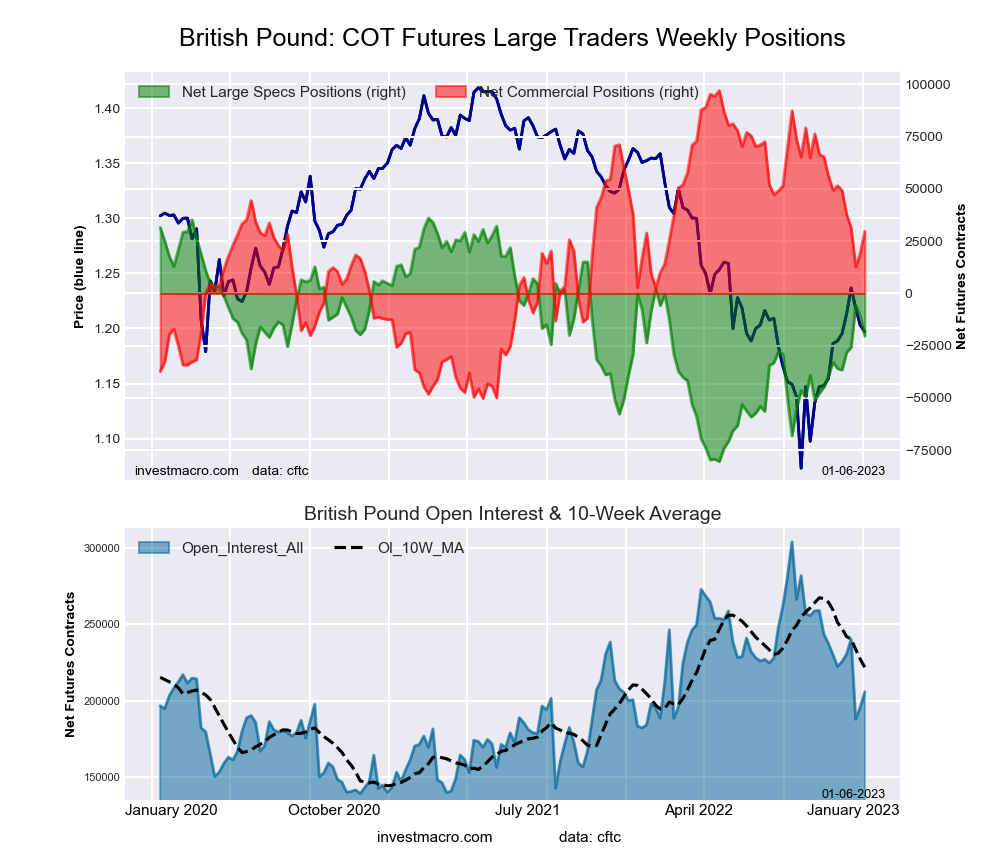
British Pound Sterling Futures COT ChartThe British Pound Sterling large speculator standing this week recorded a net position of -36,584 contracts in the data reported through Tuesday. This was a weekly fall of -642 contracts from the previous week which had a total of -35,942 net contracts.

This week’s current strength score (the trader positioning range over the past three years, measured from 0 to 100) shows the speculators are currently Bearish with a score of 37.6 percent. The commercials are Bullish with a score of 67.5 percent and the small traders (not shown in chart) are Bearish with a score of 33.2 percent.

BRITISH POUND StatisticsSPECULATORSCOMMERCIALSSMALL TRADERS
– Percent of Open Interest Longs:11.576.49.5
– Percent of Open Interest Shorts:27.854.515.1
– Net Position:-36,58449,232-12,648
– Gross Longs:26,000172,19921,363
– Gross Shorts:62,584122,96734,011
– Long to Short Ratio:0.4 to 11.4 to 10.6 to 1
NET POSITION TREND:
– Strength Index Score (3 Year Range Pct):37.667.533.2
– Strength Index Reading (3 Year Range):BearishBullishBearish
NET POSITION MOVEMENT INDEX:
– 6-Week Change in Strength Index:12.6-18.424.4


Japanese Yen Futures:

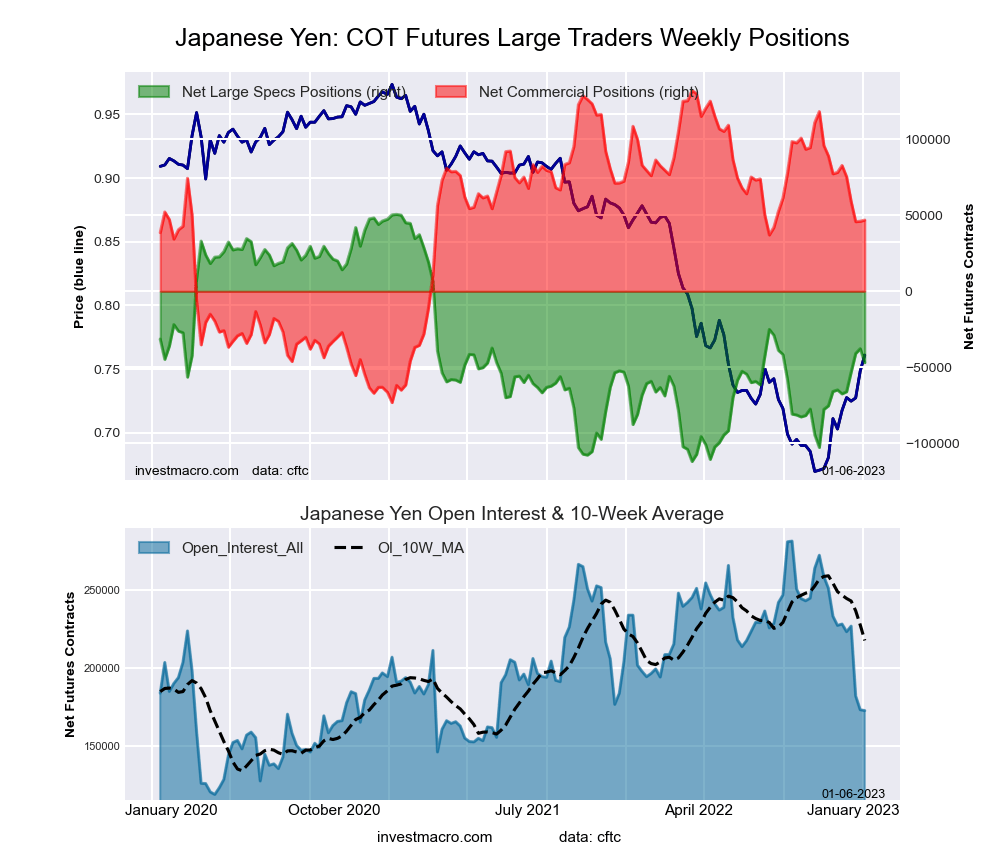
Japanese Yen Forex Futures COT ChartThe Japanese Yen large speculator standing this week recorded a net position of -67,394 contracts in the data reported through Tuesday. This was a weekly lowering of -2,544 contracts from the previous week which had a total of -64,850 net contracts.

This week’s current strength score (the trader positioning range over the past three years, measured from 0 to 100) shows the speculators are currently Bearish with a score of 27.4 percent. The commercials are Bullish with a score of 76.0 percent and the small traders (not shown in chart) are Bearish with a score of 22.4 percent.

JAPANESE YEN StatisticsSPECULATORSCOMMERCIALSSMALL TRADERS
– Percent of Open Interest Longs:12.376.29.8
– Percent of Open Interest Shorts:41.840.016.5
– Net Position:-67,39482,669-15,275
– Gross Longs:28,125173,95922,403
– Gross Shorts:95,51991,29037,678
– Long to Short Ratio:0.3 to 11.9 to 10.6 to 1
NET POSITION TREND:
– Strength Index Score (3 Year Range Pct):27.476.022.4
– Strength Index Reading (3 Year Range):BearishBullishBearish
NET POSITION MOVEMENT INDEX:
– 6-Week Change in Strength Index:16.6-13.72.5


Swiss Franc Futures:

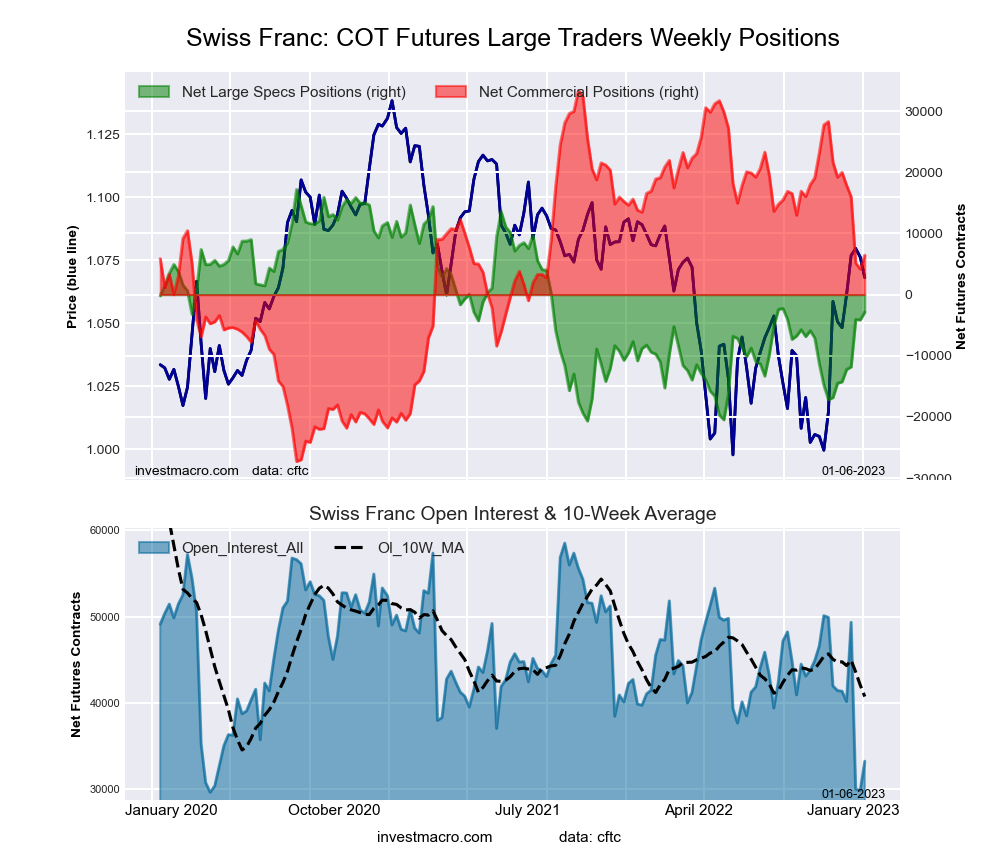
Swiss Franc Forex Futures COT ChartThe Swiss Franc large speculator standing this week recorded a net position of -14,247 contracts in the data reported through Tuesday. This was a weekly rise of 229 contracts from the previous week which had a total of -14,476 net contracts.

This week’s current strength score (the trader positioning range over the past three years, measured from 0 to 100) shows the speculators are currently Bearish-Extreme with a score of 17.4 percent. The commercials are Bullish with a score of 77.9 percent and the small traders (not shown in chart) are Bearish with a score of 38.2 percent.

SWISS FRANC StatisticsSPECULATORSCOMMERCIALSSMALL TRADERS
– Percent of Open Interest Longs:3.669.725.9
– Percent of Open Interest Shorts:38.021.439.7
– Net Position:-14,24719,970-5,723
– Gross Longs:1,48828,81410,696
– Gross Shorts:15,7358,84416,419
– Long to Short Ratio:0.1 to 13.3 to 10.7 to 1
NET POSITION TREND:
– Strength Index Score (3 Year Range Pct):17.477.938.2
– Strength Index Reading (3 Year Range):Bearish-ExtremeBullishBearish
NET POSITION MOVEMENT INDEX:
– 6-Week Change in Strength Index:-18.81.421.3


Canadian Dollar Futures:

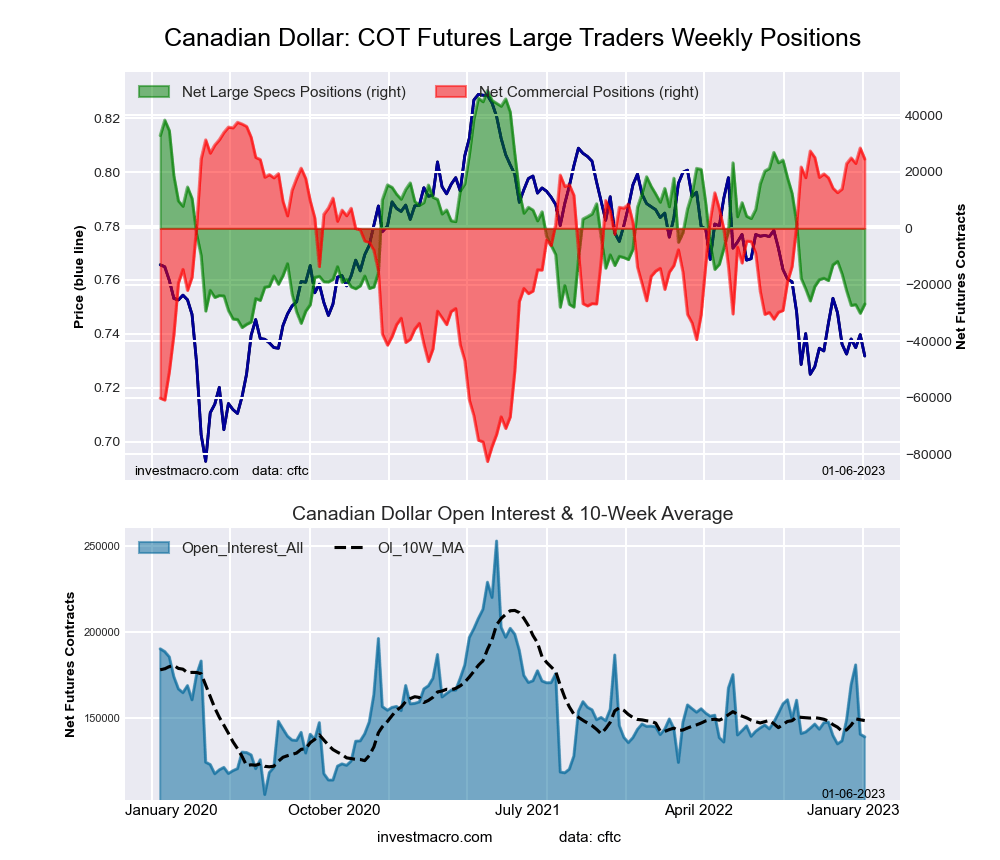
Canadian Dollar Forex Futures COT ChartThe Canadian Dollar large speculator standing this week recorded a net position of -16,116 contracts in the data reported through Tuesday. This was a weekly lowering of -4,444 contracts from the previous week which had a total of -11,672 net contracts.

This week’s current strength score (the trader positioning range over the past three years, measured from 0 to 100) shows the speculators are currently Bearish with a score of 22.6 percent. The commercials are Bullish-Extreme with a score of 80.4 percent and the small traders (not shown in chart) are Bearish with a score of 34.5 percent.

CANADIAN DOLLAR StatisticsSPECULATORSCOMMERCIALSSMALL TRADERS
– Percent of Open Interest Longs:25.748.524.4
– Percent of Open Interest Shorts:37.538.322.8
– Net Position:-16,11613,9512,165
– Gross Longs:35,12366,30433,375
– Gross Shorts:51,23952,35331,210
– Long to Short Ratio:0.7 to 11.3 to 11.1 to 1
NET POSITION TREND:
– Strength Index Score (3 Year Range Pct):22.680.434.5
– Strength Index Reading (3 Year Range):BearishBullish-ExtremeBearish
NET POSITION MOVEMENT INDEX:
– 6-Week Change in Strength Index:5.3-9.313.5


Australian Dollar Futures:

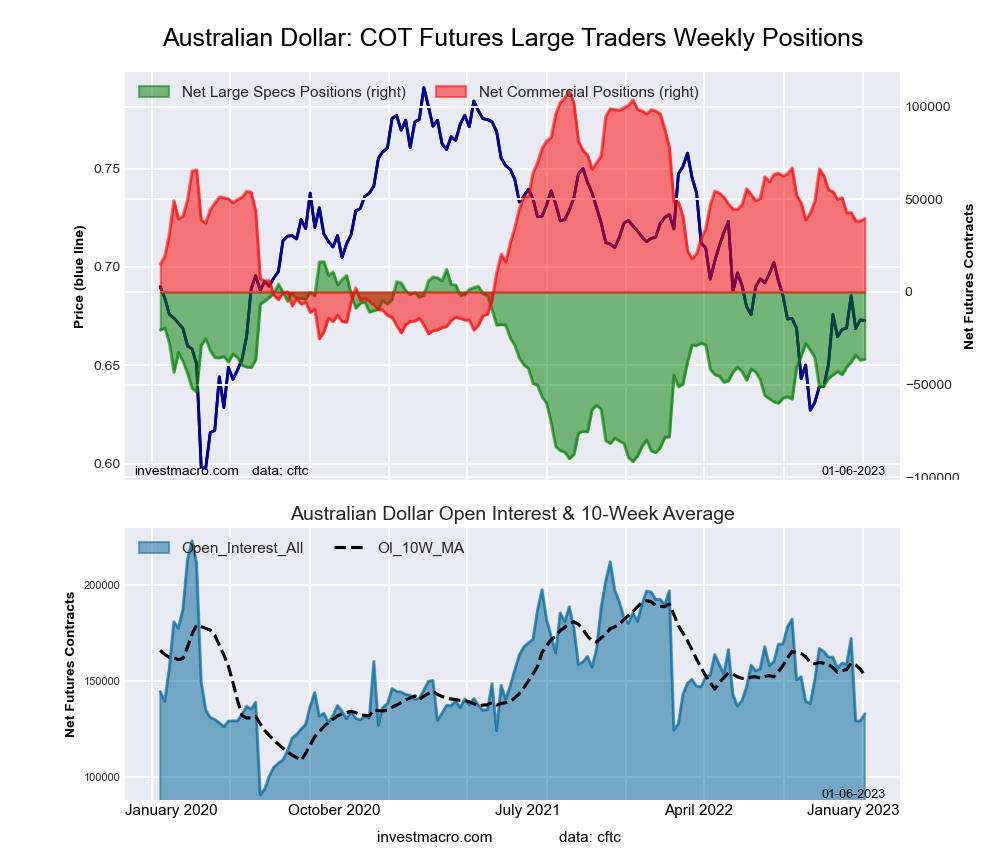
Australian Dollar Forex Futures COT ChartThe Australian Dollar large speculator standing this week recorded a net position of -44,630 contracts in the data reported through Tuesday. This was a weekly fall of -1,844 contracts from the previous week which had a total of -42,786 net contracts.

This week’s current strength score (the trader positioning range over the past three years, measured from 0 to 100) shows the speculators are currently Bearish with a score of 43.5 percent. The commercials are Bullish with a score of 56.9 percent and the small traders (not shown in chart) are Bearish with a score of 37.1 percent.

AUSTRALIAN DOLLAR StatisticsSPECULATORSCOMMERCIALSSMALL TRADERS
– Percent of Open Interest Longs:22.065.69.8
– Percent of Open Interest Shorts:50.033.613.8
– Net Position:-44,63050,906-6,276
– Gross Longs:35,045104,50615,698
– Gross Shorts:79,67553,60021,974
– Long to Short Ratio:0.4 to 11.9 to 10.7 to 1
NET POSITION TREND:
– Strength Index Score (3 Year Range Pct):43.556.937.1
– Strength Index Reading (3 Year Range):BearishBullishBearish
NET POSITION MOVEMENT INDEX:
– 6-Week Change in Strength Index:-8.61.417.9


New Zealand Dollar Futures:

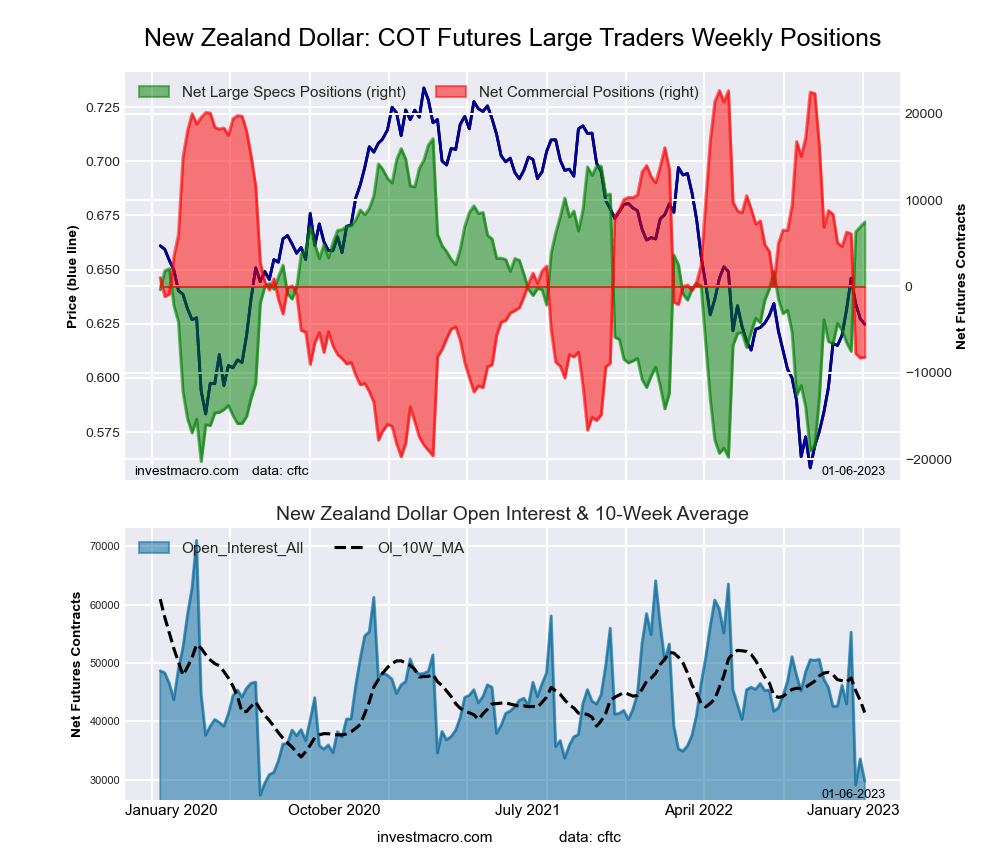
New Zealand Dollar Forex Futures COT ChartThe New Zealand Dollar large speculator standing this week recorded a net position of -5,054 contracts in the data reported through Tuesday. This was a weekly decline of -770 contracts from the previous week which had a total of -4,284 net contracts.

This week’s current strength score (the trader positioning range over the past three years, measured from 0 to 100) shows the speculators are currently Bearish with a score of 47.8 percent. The commercials are Bullish with a score of 51.7 percent and the small traders (not shown in chart) are Bullish with a score of 56.4 percent.

NEW ZEALAND DOLLAR StatisticsSPECULATORSCOMMERCIALSSMALL TRADERS
– Percent of Open Interest Longs:40.850.28.0
– Percent of Open Interest Shorts:51.840.17.1
– Net Position:-5,0544,641413
– Gross Longs:18,85523,1623,691
– Gross Shorts:23,90918,5213,278
– Long to Short Ratio:0.8 to 11.3 to 11.1 to 1
NET POSITION TREND:
– Strength Index Score (3 Year Range Pct):47.851.756.4
– Strength Index Reading (3 Year Range):BearishBullishBullish
NET POSITION MOVEMENT INDEX:
– 6-Week Change in Strength Index:31.5-37.649.7


Mexican Peso Futures:

Mexican Peso Futures COT ChartThe Mexican Peso large speculator standing this week recorded a net position of 66,086 contracts in the data reported through Tuesday. This was a weekly lift of 2,767 contracts from the previous week which had a total of 63,319 net contracts.

This week’s current strength score (the trader positioning range over the past three years, measured from 0 to 100) shows the speculators are currently Bullish with a score of 55.5 percent. The commercials are Bearish with a score of 42.5 percent and the small traders (not shown in chart) are Bullish with a score of 71.3 percent.

MEXICAN PESO StatisticsSPECULATORSCOMMERCIALSSMALL TRADERS
– Percent of Open Interest Longs:64.932.03.0
– Percent of Open Interest Shorts:43.455.60.8
– Net Position:66,086-72,7596,673
– Gross Longs:199,74498,3229,226
– Gross Shorts:133,658171,0812,553
– Long to Short Ratio:1.5 to 10.6 to 13.6 to 1
NET POSITION TREND:
– Strength Index Score (3 Year Range Pct):55.542.571.3
– Strength Index Reading (3 Year Range):BullishBearishBullish
NET POSITION MOVEMENT INDEX:
– 6-Week Change in Strength Index:37.7-37.12.8


Brazilian Real Futures:

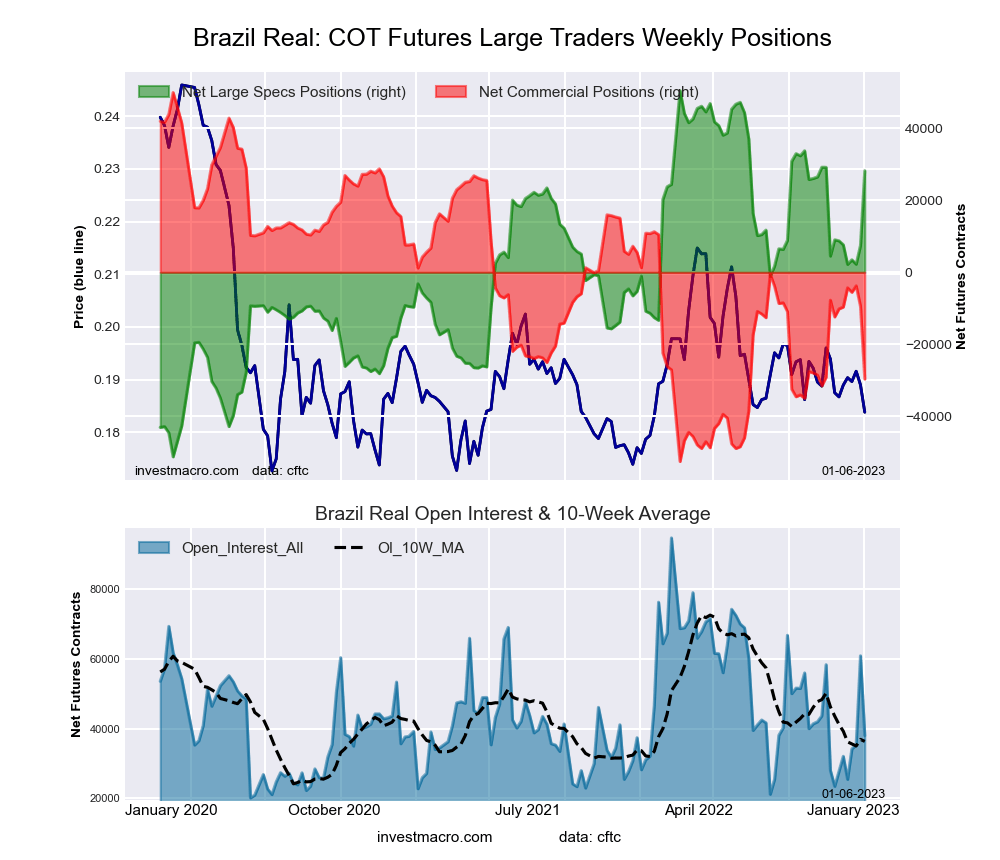
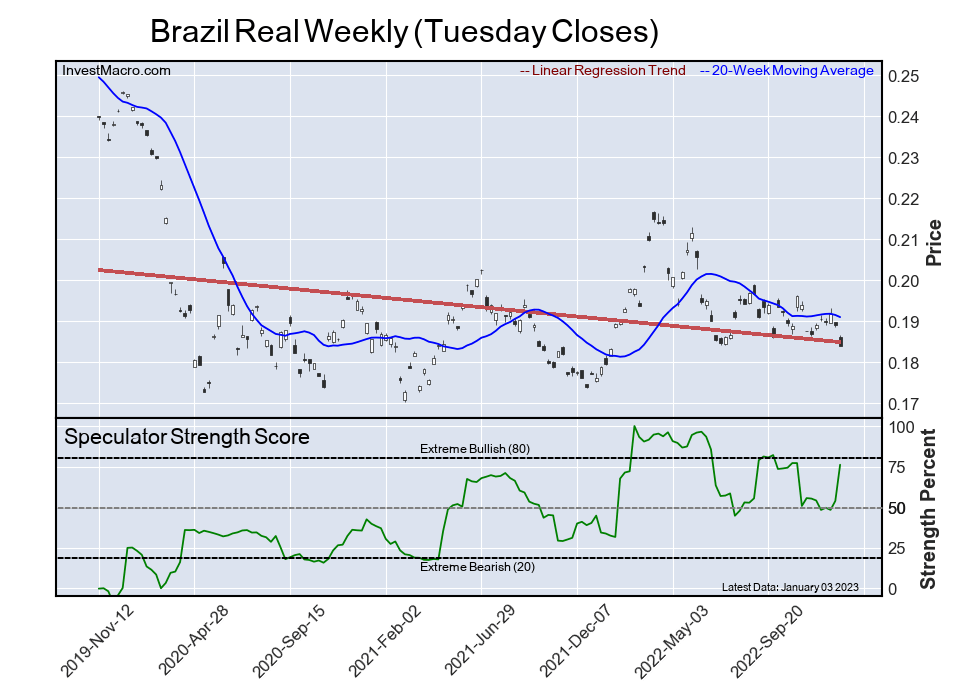
Brazil Real Futures COT ChartThe Brazilian Real large speculator standing this week recorded a net position of 7,637 contracts in the data reported through Tuesday. This was a weekly fall of -1,099 contracts from the previous week which had a total of 8,736 net contracts.

This week’s current strength score (the trader positioning range over the past three years, measured from 0 to 100) shows the speculators are currently Bullish with a score of 56.0 percent. The commercials are Bearish with a score of 43.6 percent and the small traders (not shown in chart) are Bullish-Extreme with a score of 84.7 percent.

BRAZIL REAL StatisticsSPECULATORSCOMMERCIALSSMALL TRADERS
– Percent of Open Interest Longs:51.536.011.4
– Percent of Open Interest Shorts:27.666.15.1
– Net Position:7,637-9,6592,022
– Gross Longs:16,50011,5413,666
– Gross Shorts:8,86321,2001,644
– Long to Short Ratio:1.9 to 10.5 to 12.2 to 1
NET POSITION TREND:
– Strength Index Score (3 Year Range Pct):56.043.684.7
– Strength Index Reading (3 Year Range):BullishBearishBullish-Extreme
NET POSITION MOVEMENT INDEX:
– 6-Week Change in Strength Index:-19.319.2-0.7


Bitcoin Futures:

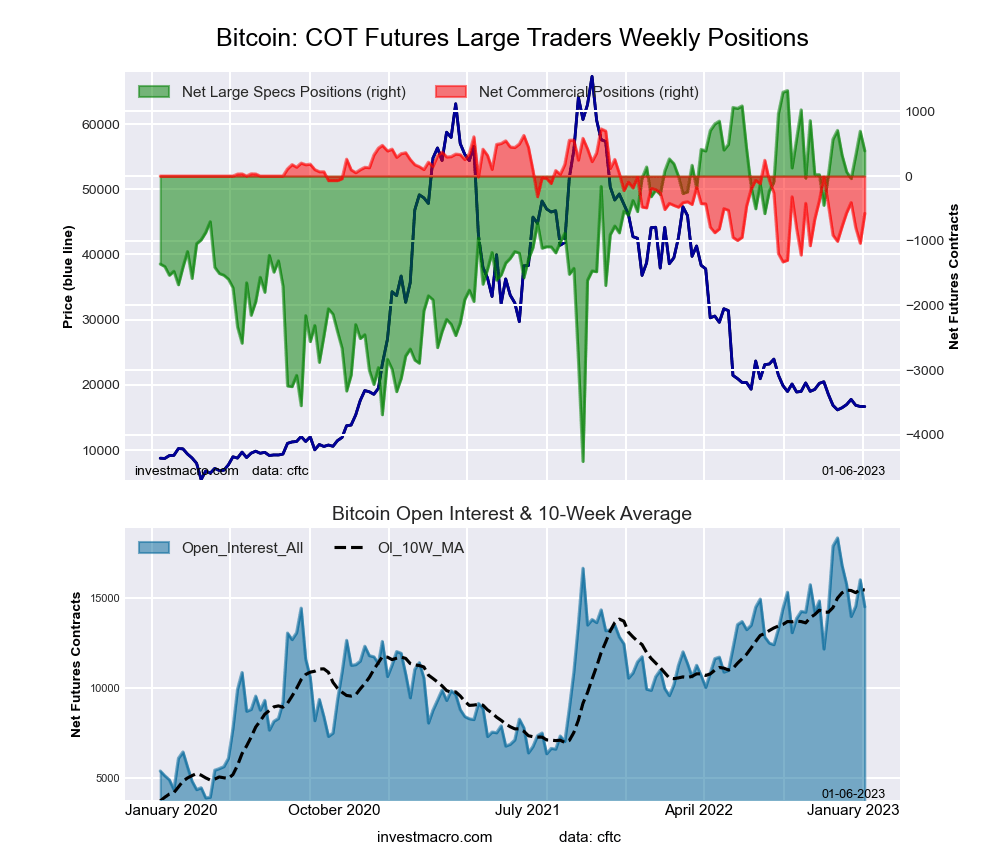
Bitcoin Crypto Futures COT ChartThe Bitcoin large speculator standing this week recorded a net position of 324 contracts in the data reported through Tuesday. This was a weekly lowering of -382 contracts from the previous week which had a total of 706 net contracts.

This week’s current strength score (the trader positioning range over the past three years, measured from 0 to 100) shows the speculators are currently Bullish-Extreme with a score of 82.6 percent. The commercials are Bearish with a score of 26.6 percent and the small traders (not shown in chart) are Bearish with a score of 23.3 percent.

BITCOIN StatisticsSPECULATORSCOMMERCIALSSMALL TRADERS
– Percent of Open Interest Longs:81.90.87.3
– Percent of Open Interest Shorts:80.05.44.6
– Net Position:324-780456
– Gross Longs:13,7831271,236
– Gross Shorts:13,459907780
– Long to Short Ratio:1.0 to 10.1 to 11.6 to 1
NET POSITION TREND:
– Strength Index Score (3 Year Range Pct):82.626.623.3
– Strength Index Reading (3 Year Range):Bullish-ExtremeBearishBearish
NET POSITION MOVEMENT INDEX:
– 6-Week Change in Strength Index:5.3-5.6-4.3


Article By InvestMacroReceive our weekly COT Newsletter

*COT Report: The COT data, released weekly to the public each Friday, is updated through the most recent Tuesday (data is 3 days old) and shows a quick view of how large speculators or non-commercials (for-profit traders) were positioned in the futures markets.

The CFTC categorizes trader positions according to commercial hedgers (traders who use futures contracts for hedging as part of the business), non-commercials (large traders who speculate to realize trading profits) and nonreportable traders (usually small traders/speculators) as well as their open interest (contracts open in the market at time of reporting). See CFTC criteria here.

COT Speculator Extremes: Bloomberg Commodity Index, Wheat lead weekly Bullish & Bearish Positions

By InvestMacro 

The latest update for the weekly Commitment of Traders (COT) report was released by the Commodity Futures Trading Commission (CFTC) on Friday for data ending on November 29th.

This weekly Extreme Positions report highlights the Top Most Bullish and Top Most Bearish Positions for the speculator category. Extreme positioning in these markets can foreshadow strong moves in the underlying market.

To signify an extreme position, we use the Strength Index (also known as the COT Index) of each instrument, a common method of measuring COT data. The Strength Index is simply a comparison of current trader positions against the range of positions over the previous 3 years. We use over 80 percent as extremely bullish and under 20 percent as extremely bearish. (Compare Strength Index scores across all markets in the data table or cot leaders table)


Speculators or Non-Commercials Notes:

Speculators, classified as non-commercial traders by the CFTC, are made up of large commodity funds, hedge funds and other significant for-profit participants. The Specs are generally regarded as trend-followers in their behavior towards price action – net speculator bets and prices tend to go in the same directions. These traders often look to buy when prices are rising and sell when prices are falling. To illustrate this point, many times speculator contracts can be found at their most extremes (bullish or bearish) when prices are also close to their highest or lowest levels.

These extreme levels can be dangerous for the large speculators as the trade is most crowded, there is less trading ammunition still sitting on the sidelines to push the trend further and prices have moved a significant distance. When the trend becomes exhausted, some speculators take profits while others look to also exit positions when prices fail to continue in the same direction. This process usually plays out over many months to years and can ultimately create a reverse effect where prices start to fall and speculators start a process of selling when prices are falling.


Here Are This Week’s Most Bullish Speculator Positions:

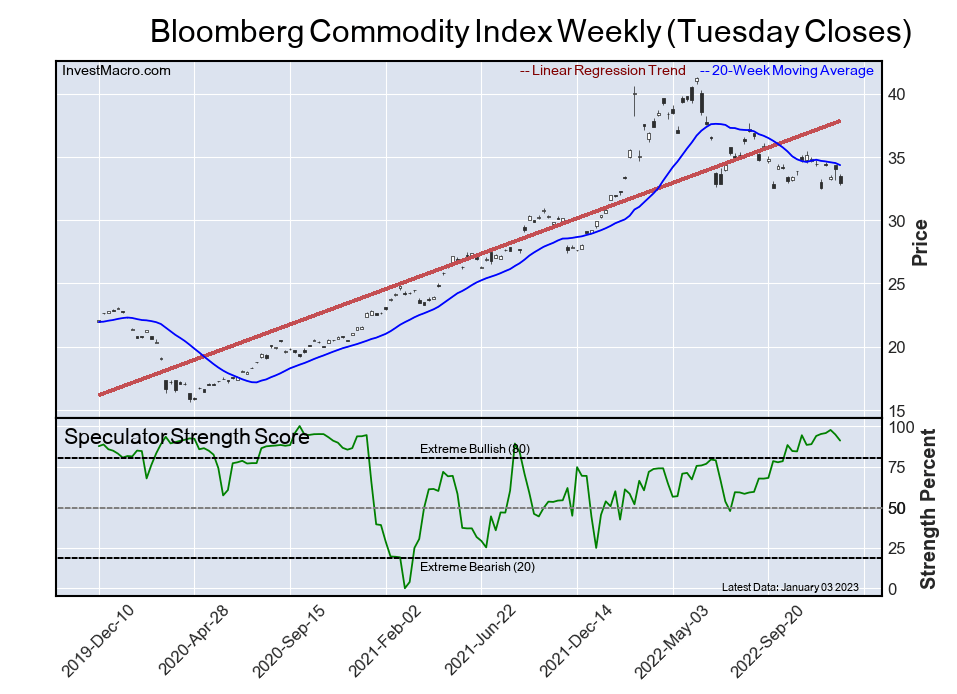
Bloomberg Commodity Index

The Bloomberg Commodity Index speculator position comes in as the most bullish extreme standing this week. The Bloomberg Commodity Index speculator level is currently at a 93.9 percent score of its 3-year range.

The overall net speculator position totaled -3,559 net contracts this week. This market usually has a bearish speculator position and currently it is at the lower end of its range that has averaged a weekly position of -10,636 contracts in 2022.


Heating Oil

The Heating Oil speculator position comes next in the extreme standings this week. The Heating Oil speculator level is now at a 87.6 percent score of its 3-year range.

The speculator position was 30,733 net contracts this week after rising by 3,561 contracts for the week.


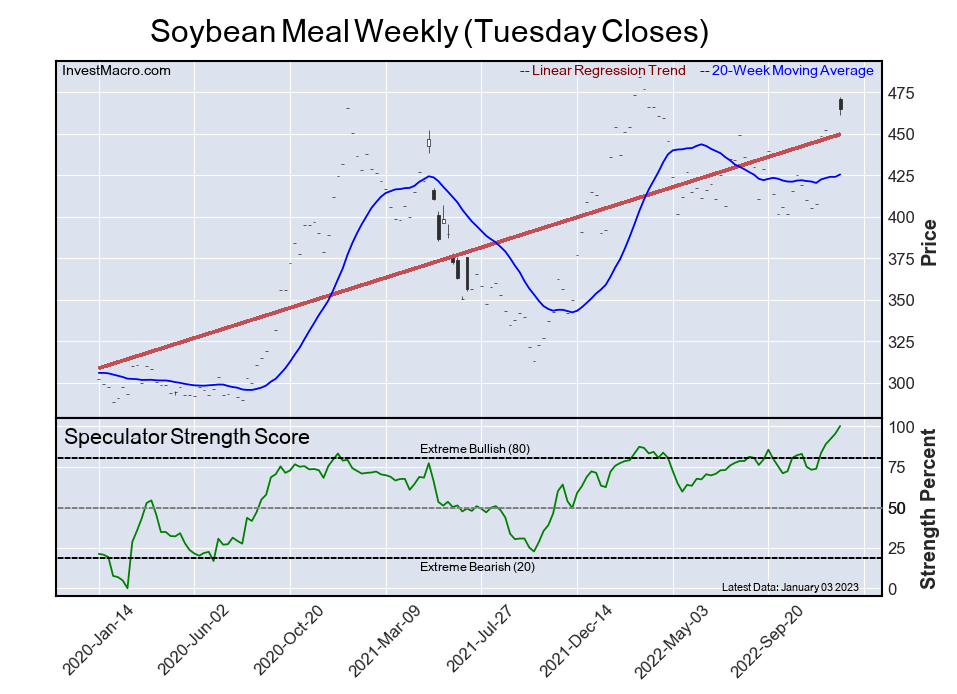
Soybean Meal

The Soybean Meal speculator position comes in third this week in the extreme standings. The Soybean Meal speculator level resides at a 84.5 percent score of its 3-year range.

The speculator position was 102,339 net contracts this week and edged up by 1,269 contracts through Tuesday.


Bitcoin

The Bitcoin speculator position comes up number four in the extreme standings this week. The Bitcoin speculator level is at a 82.6 percent score of its 3-year range.

The speculator position was a total of 324 net contracts this week after falling by -382 speculator contracts this week.


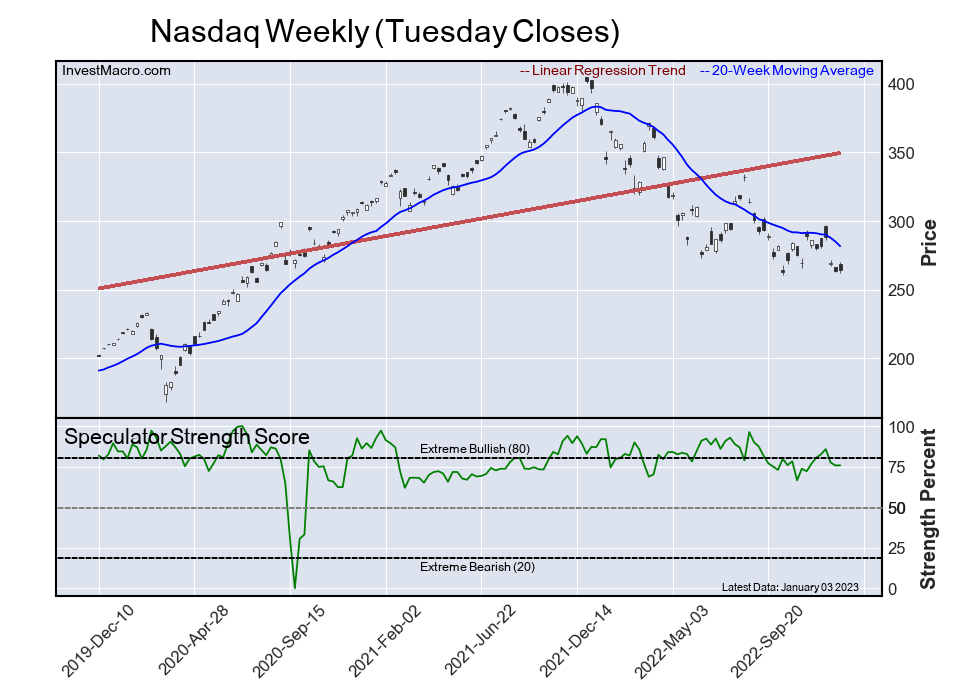
Nasdaq

The Nasdaq speculator position rounds out the top five in this week’s bullish extreme standings. The Nasdaq speculator level sits at a 80.5 percent score of its 3-year range.

The speculator position was 9,755 net contracts this week and saw an increase of 6,709 contracts through Tuesday.


This Week’s Most Bearish Speculator Positions:

Wheat

The Wheat speculator position comes in as the most bearish extreme standing this week. The Wheat speculator level is at a 0.0 percent score of its 3-year range.

The speculator position was -33,305 net contracts this week as the position fell by -5,787 contracts this week.


Coffee

The Coffee speculator position comes in next for the most bearish extreme standing on the week. The Coffee speculator level is at a 1.8 percent score of its 3-year range.

The speculator position was a total of -14,636 net contracts this week. Coffee bets rose by 1,550 contracts this week but had fallen for the previous eight straight weeks.


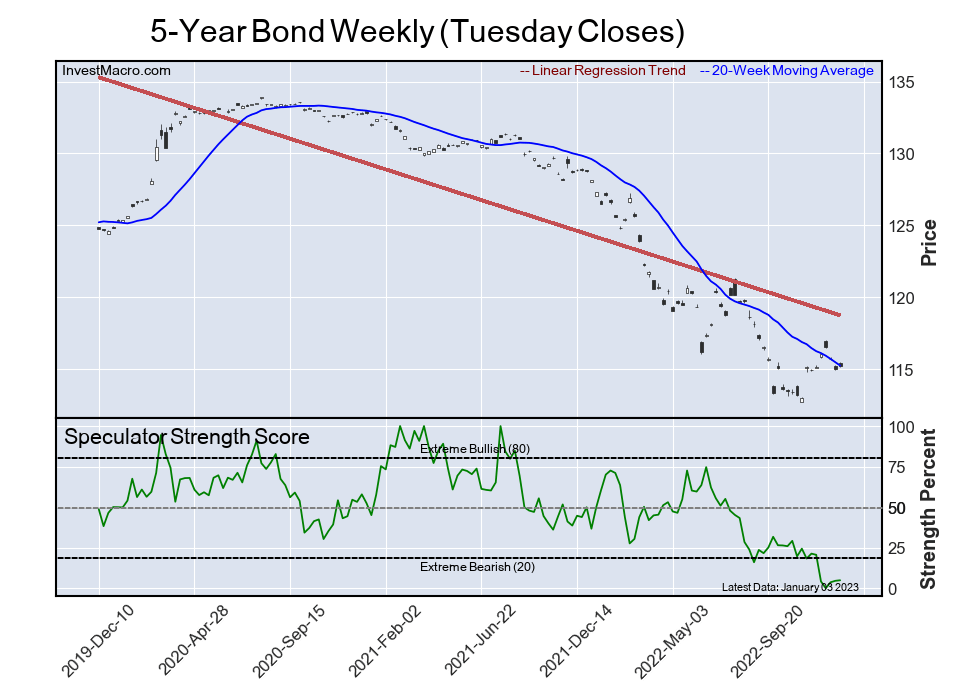
5-Year Bond

The 5-Year Bond speculator position comes in as third most bearish extreme standing of the week. The 5-Year Bond speculator level resides at a 5.5 percent score of its 3-year range.

The speculator position was -529,349 net contracts this week and saw a dip by -5,695 contracts for the week.

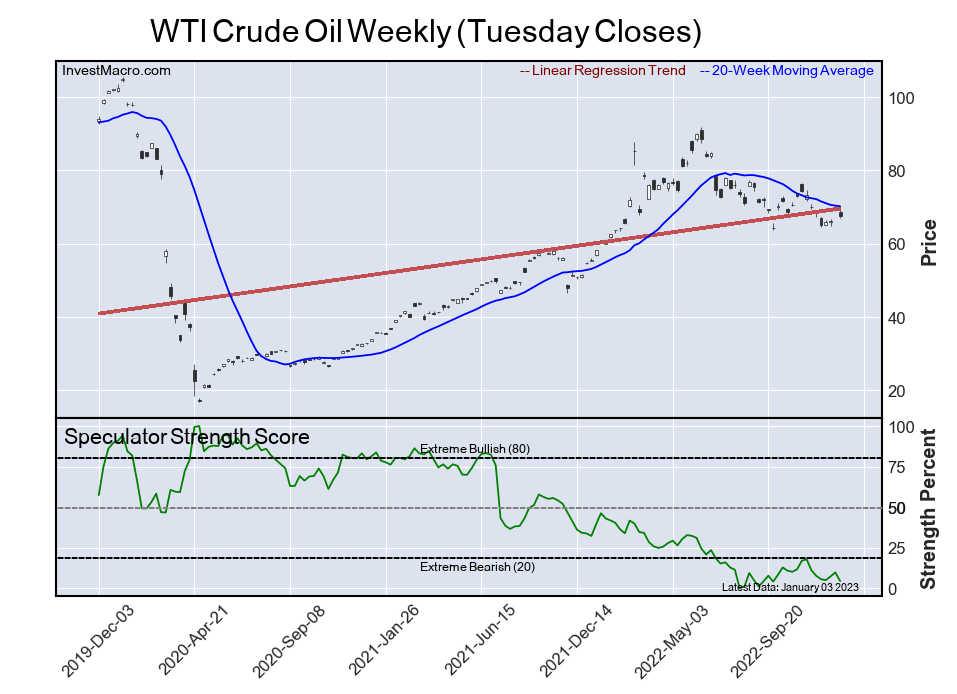
WTI Crude Oil

The WTI Crude Oil speculator position comes in as this week’s next most bearish extreme standing. The WTI Crude Oil speculator level is at a 7.7 percent score of its 3-year range.

The speculator position was 239,739 net contracts this week after a decline of -12,736 contracts through Tuesday’s data cutoff.


Article By InvestMacroReceive our weekly COT Newsletter

*COT Report: The COT data, released weekly to the public each Friday, is updated through the most recent Tuesday (data is 3 days old) and shows a quick view of how large speculators or non-commercials (for-profit traders) were positioned in the futures markets.

The CFTC categorizes trader positions according to commercial hedgers (traders who use futures contracts for hedging as part of the business), non-commercials (large traders who speculate to realize trading profits) and nonreportable traders (usually small traders/speculators) as well as their open interest (contracts open in the market at time of reporting). See CFTC criteria here.

Platinum Speculators raise their bullish bets to 38-week high

By InvestMacro

Here are the latest charts and statistics for the Commitment of Traders (COT) data published by the Commodities Futures Trading Commission (CFTC).
The latest COT data is updated through Tuesday November 29th and shows a quick view of how large traders (for-profit speculators and commercial entities) were positioned in the futures markets.
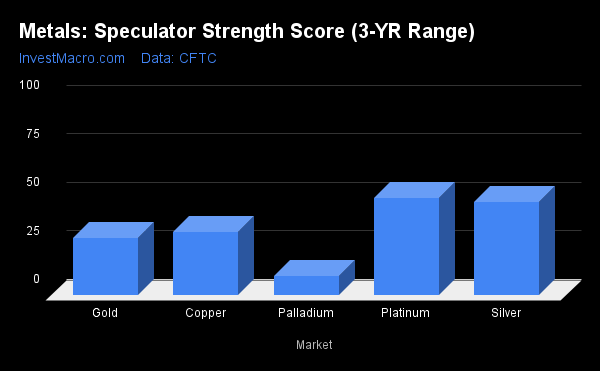
Weekly Speculator Changes led by Platinum

The COT precious metals speculator bets were a little lower this week as two out of the five metals markets we cover had higher positioning this week while three markets had lower contracts.

Leading the gains for the precious metals markets was Platinum (1,769 contracts) with Silver (717 contracts) also showing a positive week.

The metals markets leading the declines in speculator bets this week were Gold (-6,110 contracts) with Copper (-1,120 contracts) and Palladium (-523 contracts) also registering lower bets on the week.

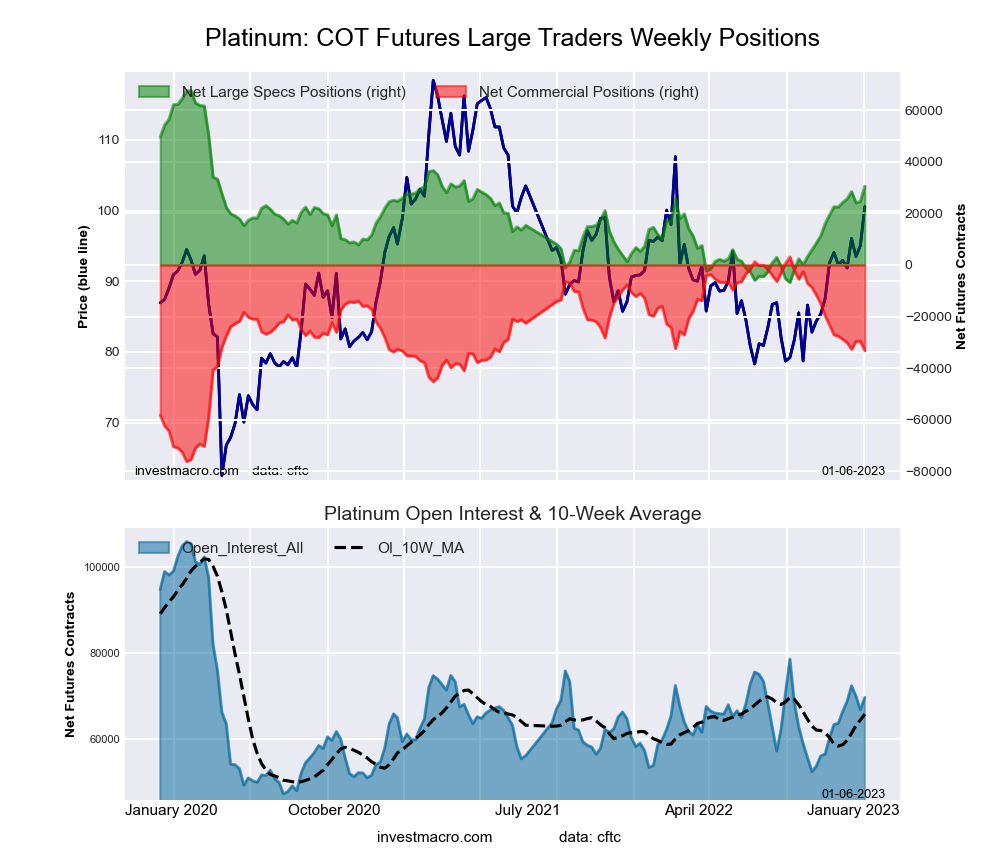
Highlighting the COT metals data this week is the continued bullishness of Platinum positions. The large speculator standing in Platinum futures rose this week by +1,769 contracts. Speculator bets have now gained in eight out of the past nine weeks with a total rise of +24,098 contracts over that period. This has pushed the overall speculator’s bullish level for Platinum to its highest level in the past thirty-eight weeks, dating back to March 8th when the net position totaled +25,833 contracts.

Platinum futures prices have also been on the rise since hitting a September low near the $800.00 level. Platinum futures closed out this week right around the $1,026.60 level for an approximate  gain by 28 percent since the September 1st low.


Data Snapshot of Commodity Market Traders | Columns Legend
Nov-29-2022OIOI-IndexSpec-NetSpec-IndexCom-NetCOM-IndexSmalls-NetSmalls-Index
WTI Crude1,412,1211239,7398-262,6549322,91537
Gold433,6611110,00319-119,233829,2303
Silver121,258017,48333-28,9976811,51426
Copper146,76001,98438-3,362641,37833
Palladium7,5378-1,631141,68784-5638
Platinum66,4683324,25942-28,762604,50328
Natural Gas985,0107-163,42930136,1917427,23845
Brent155,50015-32,0875729,424422,66345
Heating Oil266,8292330,73388-48,2552017,52259
Soybeans634,7541387,20840-61,55168-25,65728
Corn1,226,4100270,24265-231,16939-39,07321
Coffee196,3659-14,636213,6959994112
Sugar876,30934179,03556-222,6073943,57262
Wheat310,66710-33,305037,024100-3,71991


Strength Scores led by Platinum & Copper

Strength scores (a measure of the 3-Year range of Speculator positions, from 0 to 100 where above 80 is extreme bullish and below 20 is extreme bearish) show that Platinum (41.7 percent) and Copper (37.9 percent) lead the metals category at the moment. Silver (33.4 percent) comes in as the next highest metals market in strength scores.

On the downside, Palladium (14.2 percent) and Gold (19.2 percent) are at the lowest strength levels currently and are both in extreme bearish levels.

Strength Statistics:
Gold (19.2 percent) vs Gold previous week (21.2 percent)
Silver (33.4 percent) vs Silver previous week (32.6 percent)
Copper (37.9 percent) vs Copper previous week (38.8 percent)
Platinum (41.7 percent) vs Platinum previous week (39.3 percent)
Palladium (14.2 percent) vs Palladium previous week (17.3 percent)

Platinum tops Strength Trends

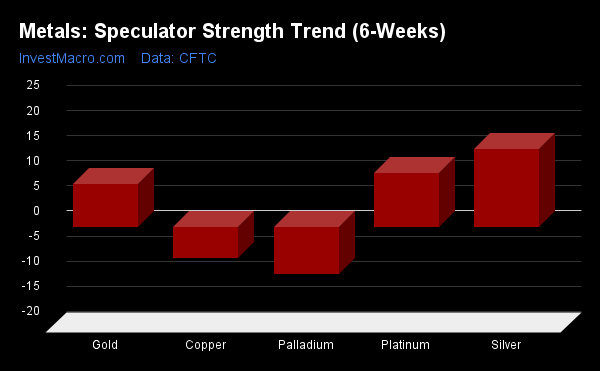
Strength Score Trends (or move index, calculates the 6-week changes in strength scores) show that Platinum (21.2 percent) leads the past six weeks trends for metals this week. Silver (17.9 percent), Copper (17.7 percent) and Gold (11.0 percent) are also positive movers in the latest trends data.

Palladium (-2.5 percent) leads the downside trend scores currently.

Move Statistics:
Gold (11.0 percent) vs Gold previous week (7.2 percent)
Silver (17.9 percent) vs Silver previous week (10.3 percent)
Copper (17.7 percent) vs Copper previous week (15.1 percent)
Platinum (21.2 percent) vs Platinum previous week (22.3 percent)
Palladium (-2.5 percent) vs Palladium previous week (-2.1 percent)


Individual Markets:

Gold Comex Futures:

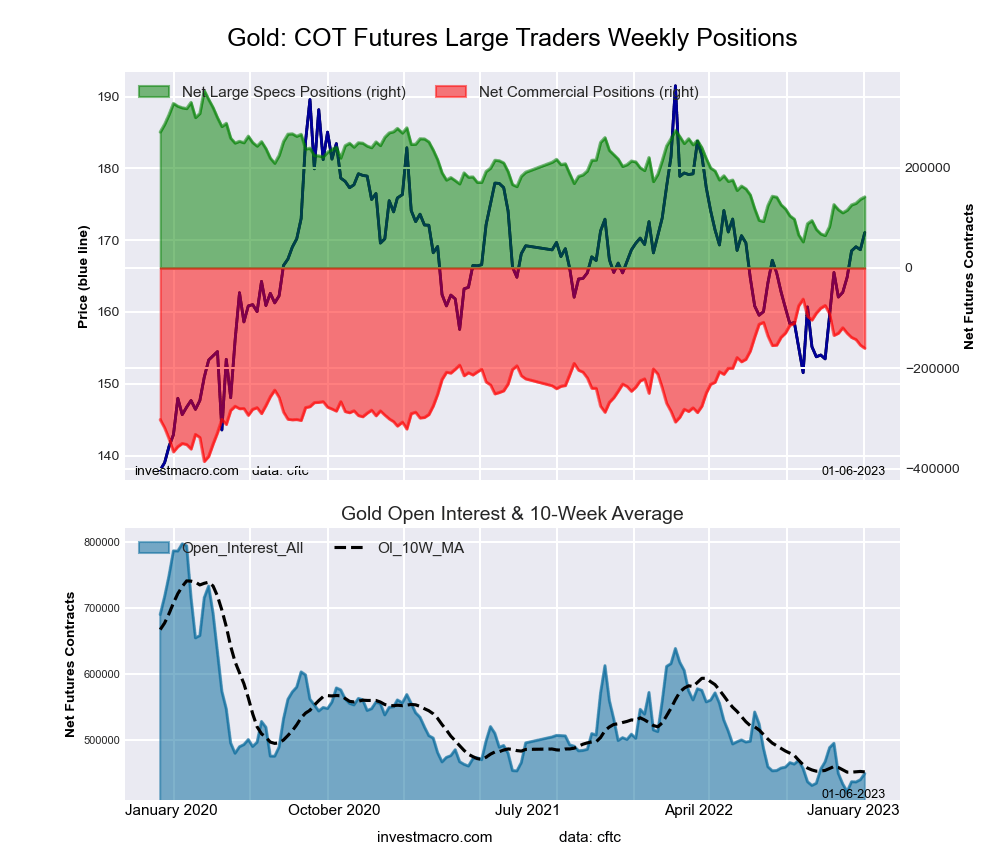
Gold Futures COT ChartThe Gold Comex Futures large speculator standing this week equaled a net position of 110,003 contracts in the data reported through Tuesday. This was a weekly decrease of -6,110 contracts from the previous week which had a total of 116,113 net contracts.

This week’s current strength score (the trader positioning range over the past three years, measured from 0 to 100) shows the speculators are currently Bearish-Extreme with a score of 19.2 percent. The commercials are Bullish-Extreme with a score of 82.3 percent and the small traders (not shown in chart) are Bearish-Extreme with a score of 3.0 percent.

Gold Futures StatisticsSPECULATORSCOMMERCIALSSMALL TRADERS
– Percent of Open Interest Longs:48.230.97.8
– Percent of Open Interest Shorts:22.958.45.7
– Net Position:110,003-119,2339,230
– Gross Longs:209,161134,18433,946
– Gross Shorts:99,158253,41724,716
– Long to Short Ratio:2.1 to 10.5 to 11.4 to 1
NET POSITION TREND:
– Strength Index Score (3 Year Range Pct):19.282.33.0
– Strength Index Reading (3 Year Range):Bearish-ExtremeBullish-ExtremeBearish-Extreme
NET POSITION MOVEMENT INDEX:
– 6-Week Change in Strength Index:11.0-9.0-9.7


Silver Comex Futures:

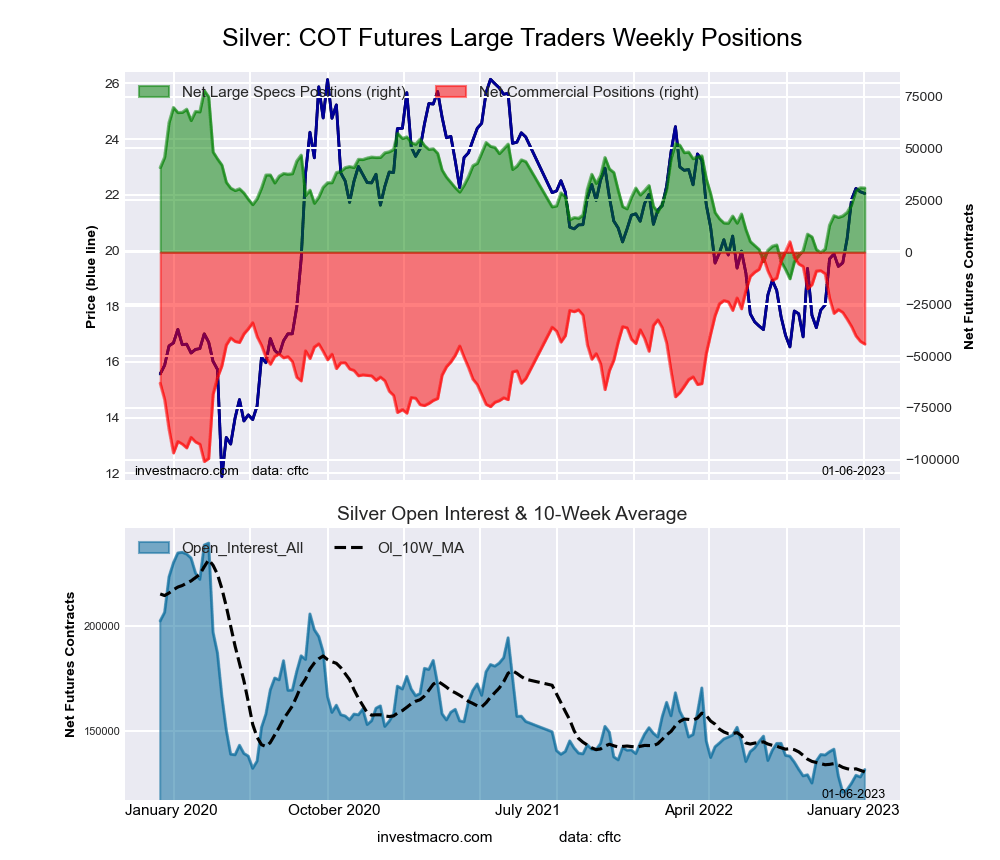
Silver Futures COT ChartThe Silver Comex Futures large speculator standing this week equaled a net position of 17,483 contracts in the data reported through Tuesday. This was a weekly boost of 717 contracts from the previous week which had a total of 16,766 net contracts.

This week’s current strength score (the trader positioning range over the past three years, measured from 0 to 100) shows the speculators are currently Bearish with a score of 33.4 percent. The commercials are Bullish with a score of 67.8 percent and the small traders (not shown in chart) are Bearish with a score of 26.0 percent.

Silver Futures StatisticsSPECULATORSCOMMERCIALSSMALL TRADERS
– Percent of Open Interest Longs:39.938.218.3
– Percent of Open Interest Shorts:25.562.18.8
– Net Position:17,483-28,99711,514
– Gross Longs:48,44146,27022,150
– Gross Shorts:30,95875,26710,636
– Long to Short Ratio:1.6 to 10.6 to 12.1 to 1
NET POSITION TREND:
– Strength Index Score (3 Year Range Pct):33.467.826.0
– Strength Index Reading (3 Year Range):BearishBullishBearish
NET POSITION MOVEMENT INDEX:
– 6-Week Change in Strength Index:17.9-18.817.8


Copper Grade #1 Futures:

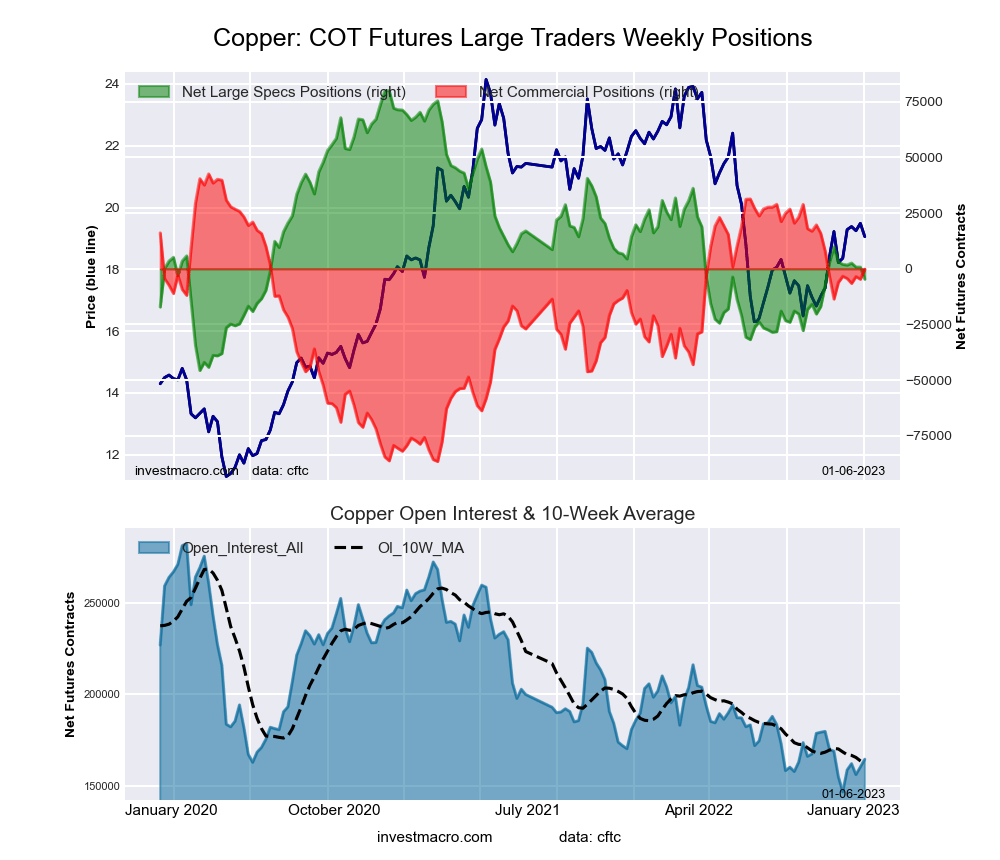
Copper Futures COT ChartThe Copper Grade #1 Futures large speculator standing this week equaled a net position of 1,984 contracts in the data reported through Tuesday. This was a weekly reduction of -1,120 contracts from the previous week which had a total of 3,104 net contracts.

This week’s current strength score (the trader positioning range over the past three years, measured from 0 to 100) shows the speculators are currently Bearish with a score of 37.9 percent. The commercials are Bullish with a score of 64.4 percent and the small traders (not shown in chart) are Bearish with a score of 33.3 percent.

Copper Futures StatisticsSPECULATORSCOMMERCIALSSMALL TRADERS
– Percent of Open Interest Longs:35.043.19.2
– Percent of Open Interest Shorts:33.745.48.3
– Net Position:1,984-3,3621,378
– Gross Longs:51,43363,19613,549
– Gross Shorts:49,44966,55812,171
– Long to Short Ratio:1.0 to 10.9 to 11.1 to 1
NET POSITION TREND:
– Strength Index Score (3 Year Range Pct):37.964.433.3
– Strength Index Reading (3 Year Range):BearishBullishBearish
NET POSITION MOVEMENT INDEX:
– 6-Week Change in Strength Index:17.7-17.94.5


Platinum Futures:

Platinum Futures COT ChartThe Platinum Futures large speculator standing this week equaled a net position of 24,259 contracts in the data reported through Tuesday. This was a weekly lift of 1,769 contracts from the previous week which had a total of 22,490 net contracts.

This week’s current strength score (the trader positioning range over the past three years, measured from 0 to 100) shows the speculators are currently Bearish with a score of 41.7 percent. The commercials are Bullish with a score of 59.8 percent and the small traders (not shown in chart) are Bearish with a score of 28.5 percent.

Platinum Futures StatisticsSPECULATORSCOMMERCIALSSMALL TRADERS
– Percent of Open Interest Longs:53.129.811.1
– Percent of Open Interest Shorts:16.673.14.4
– Net Position:24,259-28,7624,503
– Gross Longs:35,26819,8247,400
– Gross Shorts:11,00948,5862,897
– Long to Short Ratio:3.2 to 10.4 to 12.6 to 1
NET POSITION TREND:
– Strength Index Score (3 Year Range Pct):41.759.828.5
– Strength Index Reading (3 Year Range):BearishBullishBearish
NET POSITION MOVEMENT INDEX:
– 6-Week Change in Strength Index:21.2-21.618.2


Palladium Futures:

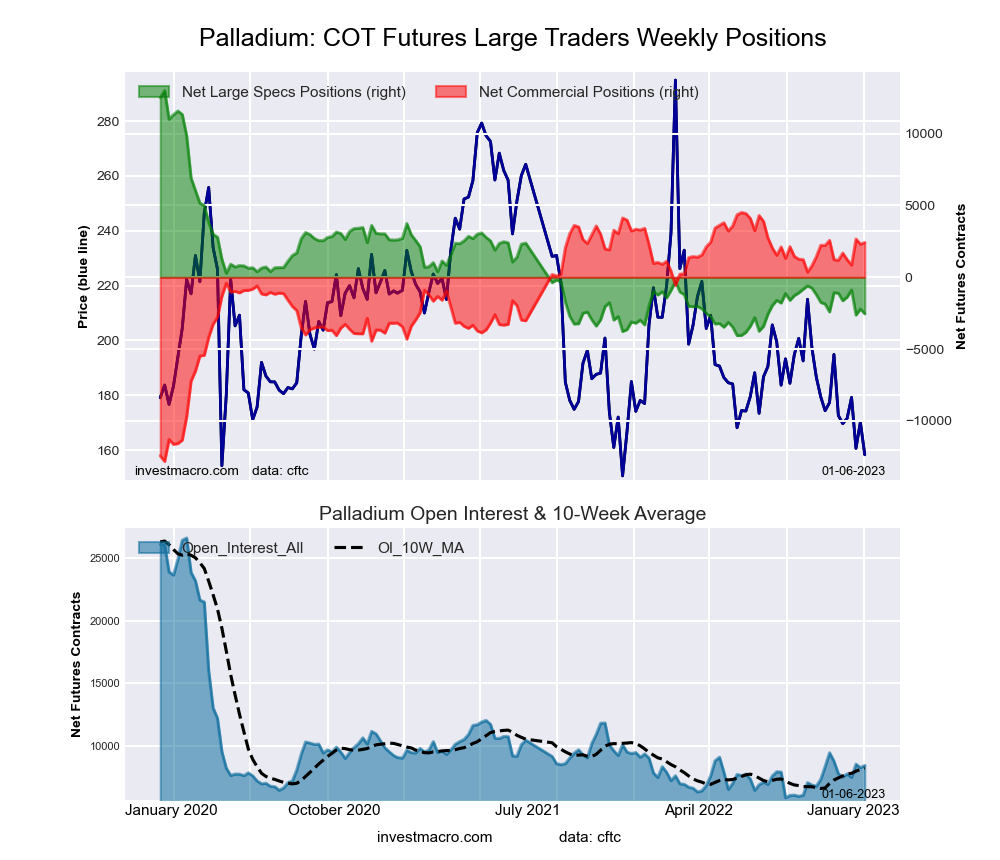
Palladium Futures COT ChartThe Palladium Futures large speculator standing this week equaled a net position of -1,631 contracts in the data reported through Tuesday. This was a weekly lowering of -523 contracts from the previous week which had a total of -1,108 net contracts.

This week’s current strength score (the trader positioning range over the past three years, measured from 0 to 100) shows the speculators are currently Bearish-Extreme with a score of 14.2 percent. The commercials are Bullish-Extreme with a score of 83.7 percent and the small traders (not shown in chart) are Bearish with a score of 38.3 percent.

Palladium Futures StatisticsSPECULATORSCOMMERCIALSSMALL TRADERS
– Percent of Open Interest Longs:30.452.414.1
– Percent of Open Interest Shorts:52.030.014.8
– Net Position:-1,6311,687-56
– Gross Longs:2,2893,9511,061
– Gross Shorts:3,9202,2641,117
– Long to Short Ratio:0.6 to 11.7 to 10.9 to 1
NET POSITION TREND:
– Strength Index Score (3 Year Range Pct):14.283.738.3
– Strength Index Reading (3 Year Range):Bearish-ExtremeBullish-ExtremeBearish
NET POSITION MOVEMENT INDEX:
– 6-Week Change in Strength Index:-2.51.410.8


Article By InvestMacroReceive our weekly COT Newsletter

*COT Report: The COT data, released weekly to the public each Friday, is updated through the most recent Tuesday (data is 3 days old) and shows a quick view of how large speculators or non-commercials (for-profit traders) were positioned in the futures markets.

The CFTC categorizes trader positions according to commercial hedgers (traders who use futures contracts for hedging as part of the business), non-commercials (large traders who speculate to realize trading profits) and nonreportable traders (usually small traders/speculators) as well as their open interest (contracts open in the market at time of reporting). See CFTC criteria here.

COT Bonds Speculators trim their Eurodollar bearish bets

By InvestMacro

Here are the latest charts and statistics for the Commitment of Traders (COT) reports data published by the Commodities Futures Trading Commission (CFTC).

The latest COT data is updated through Tuesday November 29th and shows a quick view of how large traders (for-profit speculators and commercial hedgers) were positioned in the futures markets.

Weekly Speculator Changes led by Eurodollar & 2-Year Bond

The COT bond market speculator bets were mixed this week as four out of the eight bond markets we cover had higher positioning this week while the other four markets had lower contracts.

Leading the weekly gains for the bond markets was the Eurodollar (115,943 contracts) with the 2-Year Bond (38,817 contracts), the Ultra 10-Year (25,883 contracts) and the 10-Year Bond (24,484 contracts) also showing positive weeks.

The bond markets leading the weekly declines in speculator bets this week was the Fed Funds (-44,174 contracts) with the Long US Bond (-13,433 contracts), the Ultra US Bond (-12,393 contracts), and the 5-Year Bond (-5,695 contracts) also registering lower bets on the week.

Highlighting the COT bonds data this week is the continued decrease in speculator bearish positions for the Eurodollar market. The large speculator position in Eurodollar futures fell this week for the third straight week and for the eighth time out of the past eleven weeks. This recent trimming of the bearish position has shaved off a total of 1,167,970 contracts – going from a total of -2,877,322 contracts on September 13th to this week’s total of -1,709,352 contracts.

Eurodollar contracts are a bet on short-term interest rates where more bullish bets equal a bet on lower interest rates while more bearish bets means speculators are looking for higher interest rates. The Eurodollar speculator contracts hit a bearish peak on August 9th at a total of -2,885,979 contracts and since then speculators have reduced their bearish bets in eleven out of those sixteen weeks.


Data Snapshot of Bond Market Traders | Columns Legend
Nov-29-2022OIOI-IndexSpec-NetSpec-IndexCom-NetCOM-IndexSmalls-NetSmalls-Index
Eurodollar7,234,8010-1,709,352221,952,15276-242,80051
FedFunds1,641,59558-32,6183642,97365-10,35533
2-Year2,099,11715-528,1789519,516898,66256
Long T-Bond1,197,68142-103,9175166,8513437,06682
10-Year3,897,38358-296,77227359,62065-62,84865
5-Year4,303,41969-529,3495618,52289-89,17357


US Treasury Bond tops Strength Scores

Strength Scores (a normalized measure of Speculator positions over a 3-Year range, from 0 to 100 where above 80 is extreme bullish and below 20 is extreme bearish) show that the US Treasury Bond (50.8 percent) leads the bonds category and is the only market above its three-year midpoint (above 50 percent).

On the downside, the 5-Year Bond (5.5 percent), the Ultra 10-Year Bond (8.2 percent) and the 2-Year Bond (8.6 percent) come in at the lowest strength levels currently and are all in bearish extreme positions (below 20 percent).

Strength Statistics:
Fed Funds (35.6 percent) vs Fed Funds previous week (41.0 percent)
2-Year Bond (8.6 percent) vs 2-Year Bond previous week (2.9 percent)
5-Year Bond (5.5 percent) vs 5-Year Bond previous week (6.3 percent)
10-Year Bond (27.3 percent) vs 10-Year Bond previous week (23.6 percent)
Ultra 10-Year Bond (8.2 percent) vs Ultra 10-Year Bond previous week (1.5 percent)
US Treasury Bond (50.8 percent) vs US Treasury Bond previous week (55.1 percent)
Ultra US Treasury Bond (26.3 percent) vs Ultra US Treasury Bond previous week (31.4 percent)
Eurodollar (21.7 percent) vs Eurodollar previous week (19.5 percent)

Strength Trends led by Eurodollar & 10-Year Treasury Bond

Strength Score Trends (or move index, calculates the 6-week changes in strength scores) showed that the Eurodollar (6.8 percent) leads the past six weeks trends for bonds this week. The 10-Year Bond (2.5 percent) is the only other positive mover in the latest trends data.

The 2-Year Bond (-28.6 percent) leads the downside trend scores currently while the next markets with lower trend scores were the Ultra US Treasury Bond (-14.2 percent) and the Fed Funds (-7.7 percent).

Strength Trend Statistics:
Fed Funds (-7.7 percent) vs Fed Funds previous week (1.3 percent)
2-Year Bond (-28.6 percent) vs 2-Year Bond previous week (-31.6 percent)
5-Year Bond (-6.3 percent) vs 5-Year Bond previous week (-6.0 percent)
10-Year Bond (2.5 percent) vs 10-Year Bond previous week (2.9 percent)
Ultra 10-Year Bond (-0.7 percent) vs Ultra 10-Year Bond previous week (-7.6 percent)
US Treasury Bond (-5.7 percent) vs US Treasury Bond previous week (-2.2 percent)
Ultra US Treasury Bond (-14.2 percent) vs Ultra US Treasury Bond previous week (-10.9 percent)
Eurodollar (6.8 percent) vs Eurodollar previous week (5.9 percent)


Individual Bond Markets:

3-Month Eurodollars Futures:

Eurodollar Bonds Futures COT ChartThe 3-Month Eurodollars large speculator standing this week came in at a net position of -1,709,352 contracts in the data reported through Tuesday. This was a weekly rise of 115,943 contracts from the previous week which had a total of -1,825,295 net contracts.

This week’s current strength score (the trader positioning range over the past three years, measured from 0 to 100) shows the speculators are currently Bearish with a score of 21.7 percent. The commercials are Bullish with a score of 76.0 percent and the small traders (not shown in chart) are Bullish with a score of 51.0 percent.

3-Month Eurodollars StatisticsSPECULATORSCOMMERCIALSSMALL TRADERS
– Percent of Open Interest Longs:7.268.65.0
– Percent of Open Interest Shorts:30.841.68.3
– Net Position:-1,709,3521,952,152-242,800
– Gross Longs:520,5474,964,242360,091
– Gross Shorts:2,229,8993,012,090602,891
– Long to Short Ratio:0.2 to 11.6 to 10.6 to 1
NET POSITION TREND:
– Strength Index Score (3 Year Range Pct):21.776.051.0
– Strength Index Reading (3 Year Range):BearishBullishBullish
NET POSITION MOVEMENT INDEX:
– 6-Week Change in Strength Index:6.8-6.3-3.1


30-Day Federal Funds Futures:

Federal Funds 30-Day Bonds Futures COT ChartThe 30-Day Federal Funds large speculator standing this week came in at a net position of -32,618 contracts in the data reported through Tuesday. This was a weekly reduction of -44,174 contracts from the previous week which had a total of 11,556 net contracts.

This week’s current strength score (the trader positioning range over the past three years, measured from 0 to 100) shows the speculators are currently Bearish with a score of 35.6 percent. The commercials are Bullish with a score of 65.1 percent and the small traders (not shown in chart) are Bearish with a score of 33.3 percent.

30-Day Federal Funds StatisticsSPECULATORSCOMMERCIALSSMALL TRADERS
– Percent of Open Interest Longs:11.275.01.9
– Percent of Open Interest Shorts:13.272.32.5
– Net Position:-32,61842,973-10,355
– Gross Longs:184,2731,230,56730,497
– Gross Shorts:216,8911,187,59440,852
– Long to Short Ratio:0.8 to 11.0 to 10.7 to 1
NET POSITION TREND:
– Strength Index Score (3 Year Range Pct):35.665.133.3
– Strength Index Reading (3 Year Range):BearishBullishBearish
NET POSITION MOVEMENT INDEX:
– 6-Week Change in Strength Index:-7.77.7-4.2


2-Year Treasury Note Futures:

2-Year Treasury Bonds Futures COT ChartThe 2-Year Treasury Note large speculator standing this week came in at a net position of -528,178 contracts in the data reported through Tuesday. This was a weekly gain of 38,817 contracts from the previous week which had a total of -566,995 net contracts.

This week’s current strength score (the trader positioning range over the past three years, measured from 0 to 100) shows the speculators are currently Bearish-Extreme with a score of 8.6 percent. The commercials are Bullish-Extreme with a score of 89.2 percent and the small traders (not shown in chart) are Bullish with a score of 55.9 percent.

2-Year Treasury Note StatisticsSPECULATORSCOMMERCIALSSMALL TRADERS
– Percent of Open Interest Longs:7.481.08.9
– Percent of Open Interest Shorts:32.656.38.5
– Net Position:-528,178519,5168,662
– Gross Longs:156,2491,700,306186,732
– Gross Shorts:684,4271,180,790178,070
– Long to Short Ratio:0.2 to 11.4 to 11.0 to 1
NET POSITION TREND:
– Strength Index Score (3 Year Range Pct):8.689.255.9
– Strength Index Reading (3 Year Range):Bearish-ExtremeBullish-ExtremeBullish
NET POSITION MOVEMENT INDEX:
– 6-Week Change in Strength Index:-28.617.434.5


5-Year Treasury Note Futures:

5-Year Treasury Bonds Futures COT ChartThe 5-Year Treasury Note large speculator standing this week came in at a net position of -529,349 contracts in the data reported through Tuesday. This was a weekly fall of -5,695 contracts from the previous week which had a total of -523,654 net contracts.

This week’s current strength score (the trader positioning range over the past three years, measured from 0 to 100) shows the speculators are currently Bearish-Extreme with a score of 5.5 percent. The commercials are Bullish-Extreme with a score of 88.7 percent and the small traders (not shown in chart) are Bullish with a score of 56.6 percent.

5-Year Treasury Note StatisticsSPECULATORSCOMMERCIALSSMALL TRADERS
– Percent of Open Interest Longs:7.482.47.2
– Percent of Open Interest Shorts:19.768.09.3
– Net Position:-529,349618,522-89,173
– Gross Longs:316,9863,544,108309,862
– Gross Shorts:846,3352,925,586399,035
– Long to Short Ratio:0.4 to 11.2 to 10.8 to 1
NET POSITION TREND:
– Strength Index Score (3 Year Range Pct):5.588.756.6
– Strength Index Reading (3 Year Range):Bearish-ExtremeBullish-ExtremeBullish
NET POSITION MOVEMENT INDEX:
– 6-Week Change in Strength Index:-6.33.92.8


10-Year Treasury Note Futures:

10-Year Treasury Notes Bonds Futures COT ChartThe 10-Year Treasury Note large speculator standing this week came in at a net position of -296,772 contracts in the data reported through Tuesday. This was a weekly rise of 24,484 contracts from the previous week which had a total of -321,256 net contracts.

This week’s current strength score (the trader positioning range over the past three years, measured from 0 to 100) shows the speculators are currently Bearish with a score of 27.3 percent. The commercials are Bullish with a score of 64.6 percent and the small traders (not shown in chart) are Bullish with a score of 65.1 percent.

10-Year Treasury Note StatisticsSPECULATORSCOMMERCIALSSMALL TRADERS
– Percent of Open Interest Longs:12.075.49.0
– Percent of Open Interest Shorts:19.766.210.6
– Net Position:-296,772359,620-62,848
– Gross Longs:469,0722,939,872351,940
– Gross Shorts:765,8442,580,252414,788
– Long to Short Ratio:0.6 to 11.1 to 10.8 to 1
NET POSITION TREND:
– Strength Index Score (3 Year Range Pct):27.364.665.1
– Strength Index Reading (3 Year Range):BearishBullishBullish
NET POSITION MOVEMENT INDEX:
– 6-Week Change in Strength Index:2.5-1.4-1.1


Ultra 10-Year Notes Futures:

Ultra 10-Year Treasury Notes Bonds Futures COT ChartThe Ultra 10-Year Notes large speculator standing this week came in at a net position of -79,249 contracts in the data reported through Tuesday. This was a weekly gain of 25,883 contracts from the previous week which had a total of -105,132 net contracts.

This week’s current strength score (the trader positioning range over the past three years, measured from 0 to 100) shows the speculators are currently Bearish-Extreme with a score of 8.2 percent. The commercials are Bullish-Extreme with a score of 81.2 percent and the small traders (not shown in chart) are Bullish with a score of 73.7 percent.

Ultra 10-Year Notes StatisticsSPECULATORSCOMMERCIALSSMALL TRADERS
– Percent of Open Interest Longs:10.577.011.7
– Percent of Open Interest Shorts:16.365.317.6
– Net Position:-79,249159,553-80,304
– Gross Longs:142,5881,050,386159,395
– Gross Shorts:221,837890,833239,699
– Long to Short Ratio:0.6 to 11.2 to 10.7 to 1
NET POSITION TREND:
– Strength Index Score (3 Year Range Pct):8.281.273.7
– Strength Index Reading (3 Year Range):Bearish-ExtremeBullish-ExtremeBullish
NET POSITION MOVEMENT INDEX:
– 6-Week Change in Strength Index:-0.72.1-3.7


US Treasury Bonds Futures:

US Year Treasury Notes Long Bonds Futures COT ChartThe US Treasury Bonds large speculator standing this week came in at a net position of -103,917 contracts in the data reported through Tuesday. This was a weekly decrease of -13,433 contracts from the previous week which had a total of -90,484 net contracts.

This week’s current strength score (the trader positioning range over the past three years, measured from 0 to 100) shows the speculators are currently Bullish with a score of 50.8 percent. The commercials are Bearish with a score of 34.4 percent and the small traders (not shown in chart) are Bullish-Extreme with a score of 82.0 percent.

US Treasury Bonds StatisticsSPECULATORSCOMMERCIALSSMALL TRADERS
– Percent of Open Interest Longs:4.078.815.2
– Percent of Open Interest Shorts:12.673.212.1
– Net Position:-103,91766,85137,066
– Gross Longs:47,371943,291182,448
– Gross Shorts:151,288876,440145,382
– Long to Short Ratio:0.3 to 11.1 to 11.3 to 1
NET POSITION TREND:
– Strength Index Score (3 Year Range Pct):50.834.482.0
– Strength Index Reading (3 Year Range):BullishBearishBullish-Extreme
NET POSITION MOVEMENT INDEX:
– 6-Week Change in Strength Index:-5.74.93.1


Ultra US Treasury Bonds Futures:

Ultra US Year Treasury Notes Long Bonds Futures COT ChartThe Ultra US Treasury Bonds large speculator standing this week came in at a net position of -389,404 contracts in the data reported through Tuesday. This was a weekly lowering of -12,393 contracts from the previous week which had a total of -377,011 net contracts.

This week’s current strength score (the trader positioning range over the past three years, measured from 0 to 100) shows the speculators are currently Bearish with a score of 26.3 percent. The commercials are Bullish with a score of 75.4 percent and the small traders (not shown in chart) are Bullish with a score of 79.4 percent.

Ultra US Treasury Bonds StatisticsSPECULATORSCOMMERCIALSSMALL TRADERS
– Percent of Open Interest Longs:4.182.711.9
– Percent of Open Interest Shorts:30.460.38.0
– Net Position:-389,404331,41257,992
– Gross Longs:60,2281,222,893175,631
– Gross Shorts:449,632891,481117,639
– Long to Short Ratio:0.1 to 11.4 to 11.5 to 1
NET POSITION TREND:
– Strength Index Score (3 Year Range Pct):26.375.479.4
– Strength Index Reading (3 Year Range):BearishBullishBullish
NET POSITION MOVEMENT INDEX:
– 6-Week Change in Strength Index:-14.211.510.7


Article By InvestMacroReceive our weekly COT Newsletter

*COT Report: The COT data, released weekly to the public each Friday, is updated through the most recent Tuesday (data is 3 days old) and shows a quick view of how large speculators or non-commercials (for-profit traders) were positioned in the futures markets.

The CFTC categorizes trader positions according to commercial hedgers (traders who use futures contracts for hedging as part of the business), non-commercials (large traders who speculate to realize trading profits) and nonreportable traders (usually small traders/speculators) as well as their open interest (contracts open in the market at time of reporting). See CFTC criteria here.

Soft Commodity Speculators drop Cotton bets for 12th time in 13 weeks

By InvestMacro

Here are the latest charts and statistics for the Commitment of Traders (COT) reports data published by the Commodities Futures Trading Commission (CFTC).

The latest COT data is updated through Tuesday November 29th and shows a quick view of how large traders (for-profit speculators and commercial entities) were positioned in the futures markets.

Weekly Speculator Changes led by Corn  & Soybeans

The COT soft commodities speculator bets were slightly lower this week as five out of the eleven soft commodities markets we cover had higher positioning this week while the other six markets had decreases in contracts.

Leading the gains for soft commodities markets was Corn (21,477 contracts) with Soybeans (16,969 contracts), Soybean Oil (4,333 contracts), Coffee (1,550 contracts) and Soybean Meal (1,269 contracts) also showing positive weeks.

The softs market leading the declines in speculator bets this week was Sugar (-8,927 contracts) with Lean Hogs (-8,233 contracts), Wheat (-5,787 contracts), Cocoa (-5,586 contracts), Live Cattle (-1,481 contracts) and Cotton (-1,143 contracts) also registering lower bets on the week.

Highlighting the COT soft commodities data this week is the continued decline in Cotton‘s speculator positioning. The large speculator bets for Cotton have declined for three straight weeks and in twelve out of the past thirteen weeks. Overall, Cotton bets have dropped by a total of -35,187 contracts in the past thirteen weeks going from a standing of +51,767 total net contracts on August 30th to just +16,580 total net contracts this week.

Cotton futures prices have been in sharp retreat since late-August as well. The front-month futures price settled on Friday at just over $83.00 which is down almost 30 percent from August 30th. Cotton prices are also down by approximately 47 percent from the 2022 high-point reached in early May at over $155.95.


Data Snapshot of Commodity Market Traders | Columns Legend
Nov-29-2022OIOI-IndexSpec-NetSpec-IndexCom-NetCOM-IndexSmalls-NetSmalls-Index
WTI Crude1,412,1211239,7398-262,6549322,91537
Gold433,6611110,00319-119,233829,2303
Silver121,258017,48333-28,9976811,51426
Copper146,76001,98438-3,362641,37833
Palladium7,5378-1,631141,68784-5638
Platinum66,4683324,25942-28,762604,50328
Natural Gas985,0107-163,42930136,1917427,23845
Brent155,50015-32,0875729,424422,66345
Heating Oil266,8292330,73388-48,2552017,52259
Soybeans634,7541387,20840-61,55168-25,65728
Corn1,226,4100270,24265-231,16939-39,07321
Coffee196,3659-14,636213,6959994112
Sugar876,30934179,03556-222,6073943,57262
Wheat310,66710-33,305037,024100-3,71991


Soybean Meal tops Strength Scores

Strength Scores (a normalized measure of Speculator positions over a 3-Year range, from 0 to 100 where above 80 is extreme bullish and below 20 is extreme bearish) showed that Soybean Meal (84.5 percent) and Soybean Oil (74.3 percent) lead the soft commodity markets with Soybean Meal residing in a bullish extreme position (above 80 percent). Corn (64.6 percent) and Sugar (55.6 percent) come in as the next highest soft commodity markets in strength scores.

On the downside, Wheat (0.0 percent), Coffee (1.8 percent) and Cotton (19.9 percent) come in at the lowest strength level currently and are all in bearish extreme levels (below 20 percent).

Strength Statistics:
Corn (64.6 percent) vs Corn previous week (61.8 percent)
Sugar (55.6 percent) vs Sugar previous week (58.6 percent)
Coffee (1.8 percent) vs Coffee previous week (0.0 percent)
Soybeans (40.1 percent) vs Soybeans previous week (34.9 percent)
Soybean Oil (74.3 percent) vs Soybean Oil previous week (71.4 percent)
Soybean Meal (84.5 percent) vs Soybean Meal previous week (83.7 percent)
Live Cattle (47.1 percent) vs Live Cattle previous week (49.0 percent)
Lean Hogs (45.4 percent) vs Lean Hogs previous week (54.4 percent)
Cotton (19.9 percent) vs Cotton previous week (20.8 percent)
Cocoa (26.4 percent) vs Cocoa previous week (32.0 percent)
Wheat (0.0 percent) vs Wheat previous week (6.1 percent)


Strength Trends led Soybean Oil & Sugar

Strength Score Trends (or move index, calculates the 6-week changes in strength scores) showed that Soybean Oil (18.9 percent) and Sugar (18.1 percent) lead the past six weeks trends for soft commodity markets this week. Live Cattle (15.5 percent), Soybeans (10.0 percent) and Lean Hogs (9.2 percent) fill out the top movers in the latest trends data.

Coffee (-38.9 percent), Wheat (-31.2 percent) and Cotton (-12.2 percent) lead the downside trend scores currently.

Strength Trend Statistics:
Corn (-5.4 percent) vs Corn previous week (-9.8 percent)
Sugar (18.1 percent) vs Sugar previous week (29.8 percent)
Coffee (-38.9 percent) vs Coffee previous week (-65.2 percent)
Soybeans (10.0 percent) vs Soybeans previous week (4.4 percent)
Soybean Oil (18.9 percent) vs Soybean Oil previous week (28.6 percent)
Soybean Meal (1.8 percent) vs Soybean Meal previous week (2.5 percent)
Live Cattle (15.5 percent) vs Live Cattle previous week (19.9 percent)
Lean Hogs (9.2 percent) vs Lean Hogs previous week (26.8 percent)
Cotton (-12.2 percent) vs Cotton previous week (-13.9 percent)
Cocoa (-1.5 percent) vs Cocoa previous week (1.6 percent)
Wheat (-31.2 percent) vs Wheat previous week (-26.7 percent)


Individual Soft Commodities Markets:

CORN Futures:

CORN Futures COT ChartThe CORN large speculator standing this week totaled a net position of 270,242 contracts in the data reported through Tuesday. This was a weekly increase of 21,477 contracts from the previous week which had a total of 248,765 net contracts.

This week’s current strength score (the trader positioning range over the past three years, measured from 0 to 100) shows the speculators are currently Bullish with a score of 64.6 percent. The commercials are Bearish with a score of 39.0 percent and the small traders (not shown in chart) are Bearish with a score of 20.6 percent.

CORN Futures StatisticsSPECULATORSCOMMERCIALSSMALL TRADERS
– Percent of Open Interest Longs:29.445.110.0
– Percent of Open Interest Shorts:7.363.913.2
– Net Position:270,242-231,169-39,073
– Gross Longs:360,350552,816122,723
– Gross Shorts:90,108783,985161,796
– Long to Short Ratio:4.0 to 10.7 to 10.8 to 1
NET POSITION TREND:
– Strength Index Score (3 Year Range Pct):64.639.020.6
– Strength Index Reading (3 Year Range):BullishBearishBearish
NET POSITION MOVEMENT INDEX:
– 6-Week Change in Strength Index:-5.42.613.9


SUGAR Futures:

SUGAR Futures COT ChartThe SUGAR large speculator standing this week totaled a net position of 179,035 contracts in the data reported through Tuesday. This was a weekly reduction of -8,927 contracts from the previous week which had a total of 187,962 net contracts.

This week’s current strength score (the trader positioning range over the past three years, measured from 0 to 100) shows the speculators are currently Bullish with a score of 55.6 percent. The commercials are Bearish with a score of 39.3 percent and the small traders (not shown in chart) are Bullish with a score of 61.7 percent.

SUGAR Futures StatisticsSPECULATORSCOMMERCIALSSMALL TRADERS
– Percent of Open Interest Longs:32.345.210.7
– Percent of Open Interest Shorts:11.870.65.8
– Net Position:179,035-222,60743,572
– Gross Longs:282,793396,43394,194
– Gross Shorts:103,758619,04050,622
– Long to Short Ratio:2.7 to 10.6 to 11.9 to 1
NET POSITION TREND:
– Strength Index Score (3 Year Range Pct):55.639.361.7
– Strength Index Reading (3 Year Range):BullishBearishBullish
NET POSITION MOVEMENT INDEX:
– 6-Week Change in Strength Index:18.1-16.66.6


COFFEE Futures:

COFFEE Futures COT ChartThe COFFEE large speculator standing this week totaled a net position of -14,636 contracts in the data reported through Tuesday. This was a weekly advance of 1,550 contracts from the previous week which had a total of -16,186 net contracts.

This week’s current strength score (the trader positioning range over the past three years, measured from 0 to 100) shows the speculators are currently Bearish-Extreme with a score of 1.8 percent. The commercials are Bullish-Extreme with a score of 98.8 percent and the small traders (not shown in chart) are Bearish-Extreme with a score of 12.5 percent.

COFFEE Futures StatisticsSPECULATORSCOMMERCIALSSMALL TRADERS
– Percent of Open Interest Longs:18.256.04.6
– Percent of Open Interest Shorts:25.749.14.1
– Net Position:-14,63613,695941
– Gross Longs:35,834110,0259,075
– Gross Shorts:50,47096,3308,134
– Long to Short Ratio:0.7 to 11.1 to 11.1 to 1
NET POSITION TREND:
– Strength Index Score (3 Year Range Pct):1.898.812.5
– Strength Index Reading (3 Year Range):Bearish-ExtremeBullish-ExtremeBearish-Extreme
NET POSITION MOVEMENT INDEX:
– 6-Week Change in Strength Index:-38.938.8-20.1


SOYBEANS Futures:

SOYBEANS Futures COT ChartThe SOYBEANS large speculator standing this week totaled a net position of 87,208 contracts in the data reported through Tuesday. This was a weekly increase of 16,969 contracts from the previous week which had a total of 70,239 net contracts.

This week’s current strength score (the trader positioning range over the past three years, measured from 0 to 100) shows the speculators are currently Bearish with a score of 40.1 percent. The commercials are Bullish with a score of 67.7 percent and the small traders (not shown in chart) are Bearish with a score of 27.7 percent.

SOYBEANS Futures StatisticsSPECULATORSCOMMERCIALSSMALL TRADERS
– Percent of Open Interest Longs:23.850.87.8
– Percent of Open Interest Shorts:10.160.511.9
– Net Position:87,208-61,551-25,657
– Gross Longs:151,317322,23149,683
– Gross Shorts:64,109383,78275,340
– Long to Short Ratio:2.4 to 10.8 to 10.7 to 1
NET POSITION TREND:
– Strength Index Score (3 Year Range Pct):40.167.727.7
– Strength Index Reading (3 Year Range):BearishBullishBearish
NET POSITION MOVEMENT INDEX:
– 6-Week Change in Strength Index:10.0-9.6-2.7


SOYBEAN OIL Futures:

SOYBEAN OIL Futures COT ChartThe SOYBEAN OIL large speculator standing this week totaled a net position of 103,854 contracts in the data reported through Tuesday. This was a weekly increase of 4,333 contracts from the previous week which had a total of 99,521 net contracts.

This week’s current strength score (the trader positioning range over the past three years, measured from 0 to 100) shows the speculators are currently Bullish with a score of 74.3 percent. The commercials are Bearish with a score of 26.8 percent and the small traders (not shown in chart) are Bullish with a score of 62.1 percent.

SOYBEAN OIL Futures StatisticsSPECULATORSCOMMERCIALSSMALL TRADERS
– Percent of Open Interest Longs:30.841.27.5
– Percent of Open Interest Shorts:7.467.54.6
– Net Position:103,854-116,88913,035
– Gross Longs:136,812183,31533,560
– Gross Shorts:32,958300,20420,525
– Long to Short Ratio:4.2 to 10.6 to 11.6 to 1
NET POSITION TREND:
– Strength Index Score (3 Year Range Pct):74.326.862.1
– Strength Index Reading (3 Year Range):BullishBearishBullish
NET POSITION MOVEMENT INDEX:
– 6-Week Change in Strength Index:18.9-15.9-8.1


SOYBEAN MEAL Futures:

SOYBEAN MEAL Futures COT ChartThe SOYBEAN MEAL large speculator standing this week totaled a net position of 102,339 contracts in the data reported through Tuesday. This was a weekly advance of 1,269 contracts from the previous week which had a total of 101,070 net contracts.

This week’s current strength score (the trader positioning range over the past three years, measured from 0 to 100) shows the speculators are currently Bullish-Extreme with a score of 84.5 percent. The commercials are Bearish-Extreme with a score of 19.4 percent and the small traders (not shown in chart) are Bearish with a score of 36.1 percent.

SOYBEAN MEAL Futures StatisticsSPECULATORSCOMMERCIALSSMALL TRADERS
– Percent of Open Interest Longs:33.140.411.9
– Percent of Open Interest Shorts:5.473.46.5
– Net Position:102,339-122,24719,908
– Gross Longs:122,479149,13943,937
– Gross Shorts:20,140271,38624,029
– Long to Short Ratio:6.1 to 10.5 to 11.8 to 1
NET POSITION TREND:
– Strength Index Score (3 Year Range Pct):84.519.436.1
– Strength Index Reading (3 Year Range):Bullish-ExtremeBearish-ExtremeBearish
NET POSITION MOVEMENT INDEX:
– 6-Week Change in Strength Index:1.8-0.1-15.8


LIVE CATTLE Futures:

LIVE CATTLE Futures COT ChartThe LIVE CATTLE large speculator standing this week totaled a net position of 54,034 contracts in the data reported through Tuesday. This was a weekly lowering of -1,481 contracts from the previous week which had a total of 55,515 net contracts.

This week’s current strength score (the trader positioning range over the past three years, measured from 0 to 100) shows the speculators are currently Bearish with a score of 47.1 percent. The commercials are Bearish with a score of 41.4 percent and the small traders (not shown in chart) are Bullish-Extreme with a score of 86.5 percent.

LIVE CATTLE Futures StatisticsSPECULATORSCOMMERCIALSSMALL TRADERS
– Percent of Open Interest Longs:36.733.111.5
– Percent of Open Interest Shorts:18.051.212.0
– Net Position:54,034-52,522-1,512
– Gross Longs:106,26595,83833,215
– Gross Shorts:52,231148,36034,727
– Long to Short Ratio:2.0 to 10.6 to 11.0 to 1
NET POSITION TREND:
– Strength Index Score (3 Year Range Pct):47.141.486.5
– Strength Index Reading (3 Year Range):BearishBearishBullish-Extreme
NET POSITION MOVEMENT INDEX:
– 6-Week Change in Strength Index:15.5-14.3-7.7


LEAN HOGS Futures:

LEAN HOGS Futures COT ChartThe LEAN HOGS large speculator standing this week totaled a net position of 35,499 contracts in the data reported through Tuesday. This was a weekly decrease of -8,233 contracts from the previous week which had a total of 43,732 net contracts.

This week’s current strength score (the trader positioning range over the past three years, measured from 0 to 100) shows the speculators are currently Bearish with a score of 45.4 percent. The commercials are Bullish with a score of 63.4 percent and the small traders (not shown in chart) are Bearish with a score of 44.5 percent.

LEAN HOGS Futures StatisticsSPECULATORSCOMMERCIALSSMALL TRADERS
– Percent of Open Interest Longs:38.035.47.9
– Percent of Open Interest Shorts:19.748.613.1
– Net Position:35,499-25,480-10,019
– Gross Longs:73,57368,58615,357
– Gross Shorts:38,07494,06625,376
– Long to Short Ratio:1.9 to 10.7 to 10.6 to 1
NET POSITION TREND:
– Strength Index Score (3 Year Range Pct):45.463.444.5
– Strength Index Reading (3 Year Range):BearishBullishBearish
NET POSITION MOVEMENT INDEX:
– 6-Week Change in Strength Index:9.2-6.5-15.2


COTTON Futures:

COTTON Futures COT ChartThe COTTON large speculator standing this week totaled a net position of 16,580 contracts in the data reported through Tuesday. This was a weekly fall of -1,143 contracts from the previous week which had a total of 17,723 net contracts.

This week’s current strength score (the trader positioning range over the past three years, measured from 0 to 100) shows the speculators are currently Bearish-Extreme with a score of 19.9 percent. The commercials are Bullish-Extreme with a score of 80.3 percent and the small traders (not shown in chart) are Bearish with a score of 20.6 percent.

COTTON Futures StatisticsSPECULATORSCOMMERCIALSSMALL TRADERS
– Percent of Open Interest Longs:32.647.86.6
– Percent of Open Interest Shorts:24.157.15.7
– Net Position:16,580-18,1721,592
– Gross Longs:63,35292,85412,743
– Gross Shorts:46,772111,02611,151
– Long to Short Ratio:1.4 to 10.8 to 11.1 to 1
NET POSITION TREND:
– Strength Index Score (3 Year Range Pct):19.980.320.6
– Strength Index Reading (3 Year Range):Bearish-ExtremeBullish-ExtremeBearish
NET POSITION MOVEMENT INDEX:
– 6-Week Change in Strength Index:-12.211.2-0.5


COCOA Futures:

COCOA Futures COT ChartThe COCOA large speculator standing this week totaled a net position of 9,698 contracts in the data reported through Tuesday. This was a weekly fall of -5,586 contracts from the previous week which had a total of 15,284 net contracts.

This week’s current strength score (the trader positioning range over the past three years, measured from 0 to 100) shows the speculators are currently Bearish with a score of 26.4 percent. The commercials are Bullish with a score of 74.3 percent and the small traders (not shown in chart) are Bearish with a score of 32.8 percent.

COCOA Futures StatisticsSPECULATORSCOMMERCIALSSMALL TRADERS
– Percent of Open Interest Longs:31.147.74.4
– Percent of Open Interest Shorts:27.452.83.0
– Net Position:9,698-13,3223,624
– Gross Longs:80,762123,63911,404
– Gross Shorts:71,064136,9617,780
– Long to Short Ratio:1.1 to 10.9 to 11.5 to 1
NET POSITION TREND:
– Strength Index Score (3 Year Range Pct):26.474.332.8
– Strength Index Reading (3 Year Range):BearishBullishBearish
NET POSITION MOVEMENT INDEX:
– 6-Week Change in Strength Index:-1.5-0.924.0


WHEAT Futures:

WHEAT Futures COT ChartThe WHEAT large speculator standing this week totaled a net position of -33,305 contracts in the data reported through Tuesday. This was a weekly lowering of -5,787 contracts from the previous week which had a total of -27,518 net contracts.

This week’s current strength score (the trader positioning range over the past three years, measured from 0 to 100) shows the speculators are currently Bearish-Extreme with a score of 0.0 percent. The commercials are Bullish-Extreme with a score of 100.0 percent and the small traders (not shown in chart) are Bullish-Extreme with a score of 91.1 percent.

WHEAT Futures StatisticsSPECULATORSCOMMERCIALSSMALL TRADERS
– Percent of Open Interest Longs:28.342.110.2
– Percent of Open Interest Shorts:39.030.211.4
– Net Position:-33,30537,024-3,719
– Gross Longs:87,807130,93831,815
– Gross Shorts:121,11293,91435,534
– Long to Short Ratio:0.7 to 11.4 to 10.9 to 1
NET POSITION TREND:
– Strength Index Score (3 Year Range Pct):0.0100.091.1
– Strength Index Reading (3 Year Range):Bearish-ExtremeBullish-ExtremeBullish-Extreme
NET POSITION MOVEMENT INDEX:
– 6-Week Change in Strength Index:-31.233.517.0


Article By InvestMacroReceive our weekly COT Newsletter

*COT Report: The COT data, released weekly to the public each Friday, is updated through the most recent Tuesday (data is 3 days old) and shows a quick view of how large speculators or non-commercials (for-profit traders) were positioned in the futures markets.

The CFTC categorizes trader positions according to commercial hedgers (traders who use futures contracts for hedging as part of the business), non-commercials (large traders who speculate to realize trading profits) and nonreportable traders (usually small traders/speculators) as well as their open interest (contracts open in the market at time of reporting). See CFTC criteria here.

Darknet markets generate millions in revenue selling stolen personal data, supply chain study finds

By Christian Jordan Howell, University of South Florida and David Maimon, Georgia State University 

It is common to hear news reports about large data breaches, but what happens once your personal data is stolen? Our research shows that, like most legal commodities, stolen data products flow through a supply chain consisting of producers, wholesalers and consumers. But this supply chain involves the interconnection of multiple criminal organizations operating in illicit underground marketplaces.

The stolen data supply chain begins with producers – hackers who exploit vulnerable systems and steal sensitive information such as credit card numbers, bank account information and Social Security numbers. Next, the stolen data is advertised by wholesalers and distributors who sell the data. Finally, the data is purchased by consumers who use it to commit various forms of fraud, including fraudulent credit card transactions, identity theft and phishing attacks.

This trafficking of stolen data between producers, wholesalers and consumers is enabled by darknet markets, which are websites that resemble ordinary e-commerce websites but are accessible only using special browsers or authorization codes.

We found several thousand vendors selling tens of thousands of stolen data products on 30 darknet markets. These vendors had more than US$140 million in revenue over an eight-month period.

Horizontal left-to-right flowchart with four segments
The stolen data supply chain, from data theft to fraud.
Christian Jordan Howell, CC BY-ND

Darknet markets

Just like traditional e-commerce sites, darknet markets provide a platform for vendors to connect with potential buyers to facilitate transactions. Darknet markets, though, are notorious for the sale of illicit products. Another key distinction is that access to darknet markets requires the use of special software such as the Onion Router, or TOR, which provides security and anonymity.

Silk Road, which emerged in 2011, combined TOR and bitcoin to become the first known darknet market. The market was eventually seized in 2013, and the founder, Ross Ulbricht, was sentenced to two life sentences plus 40 years without the possibility of parole. Ulbricht’s hefty prison sentence did not appear to have the intended deterrent effect. Multiple markets emerged to fill the void and, in doing so, created a thriving ecosystem profiting from stolen personal data.

Screenshot of a webpage showing a product for sale
Example of a stolen data ‘product’ sold on a darknet market.
Screenshot by Christian Jordan Howell, CC BY-ND

Stolen data ecosystem

Recognizing the role of darknet markets in trafficking stolen data, we conducted the largest systematic examination of stolen data markets that we are aware of to better understand the size and scope of this illicit online ecosystem. To do this, we first identified 30 darknet markets advertising stolen data products.

Next, we extracted information about stolen data products from the markets on a weekly basis for eight months, from Sept. 1, 2020, through April 30, 2021. We then used this information to determine the number of vendors selling stolen data products, the number of stolen data products advertised, the number of products sold and the amount of revenue generated.

In total, there were 2,158 vendors who advertised at least one of the 96,672 product listings across the 30 marketplaces. Vendors and product listings were not distributed equally across markets. On average, marketplaces had 109 unique vendor aliases and 3,222 product listings related to stolen data products. Marketplaces recorded 632,207 sales across these markets, which generated $140,337,999 in total revenue. Again, there is high variation across the markets. On average, marketplaces had 26,342 sales and generated $5,847,417 in revenue.

Graphic with a silhouette representing a person and a dollar sign
The size and scope of the stolen data ecosystem over an eight-month period.
Christian Jordan Howell, CC BY-ND

After assessing the aggregate characteristics of the ecosystem, we analyzed each of the markets individually. In doing so, we found that a handful of markets were responsible for trafficking most of the stolen data products. The three largest markets – Apollon, WhiteHouse and Agartha – contained 58% of all vendors. The number of listings ranged from 38 to 16,296, and the total number of sales ranged from 0 to 237,512. The total revenue of markets also varied substantially during the 35-week period: It ranged from $0 to $91,582,216 for the most successful market, Agartha.

For comparison, most midsize companies operating in the U.S. earn between $10 million and $1 billion annually. Both Agartha and Cartel earned enough revenue within the 35-week period we tracked them to be characterized as midsize companies, earning $91.6 million and $32.3 million, respectively. Other markets like Aurora, DeepMart and WhiteHouse were also on track to reach the revenue of a midsize company if given a full year to earn.

Our research details a thriving underground economy and illicit supply chain enabled by darknet markets. As long as data is routinely stolen, there are likely to be marketplaces for the stolen information.

These darknet markets are difficult to disrupt directly, but efforts to thwart customers of stolen data from using it offers some hope. We believe that advances in artificial intelligence can provide law enforcement agencies, financial institutions and others with information needed to prevent stolen data from being used to commit fraud. This could stop the flow of stolen data through the supply chain and disrupt the underground economy that profits from your personal data.The Conversation

About the Author:

Christian Jordan Howell, Assistant Professor in Cybercrime, University of South Florida and David Maimon, Professor of Criminal Justice and Criminology, Georgia State University

This article is republished from The Conversation under a Creative Commons license. Read the original article.

The Economy May Not Look Good but Oil and Energy Transport Stocks Do

Source: Ron Struthers  (11/29/22) 

Expert Ron Struthers believes consumers are on an unsustainable path of wracking up credit card debt, and it is only a matter of when the economy buckles, meanwhile big profits are being made by tanker companies and oil and gas/energy transmission companies as supplies continue to tighten.

Gold bounced off the US$1730 support area I outlined in my Nov 22, 2022 update. Last week witnessed a hammer candle stick down to US$1720. So far, we are holding above my support level, and my new bull market theory is looking good so far. A break above US$1830 would be a strong sign of a new bull move.

A U.S. consumer confidence survey fell to 100.2 in November and touched the lowest level in four months, reflecting growing angst about a softening economy and potential recession. The closely followed index dropped 2 points from 102.2 in the prior month, the nonprofit Conference Board said today.

The U.S. Housing Market

The U.S. housing market pulled back even more in September, with prices slipping 1.2% from a month earlier. It was the third straight decline for the seasonally adjusted measure of prices in 20 large U.S. cities, according to the S&P CoreLogic Case-Shiller index.

Canada is setting records. Home sales had fallen for eight straight months before October brought a small uptick. Not only is that the longest stretch of falling sales on record, but it is also the steepest, said a CIBC team. “And it’s not really over yet.”

Prices are also setting records. With the average price of a home in Canada down 20% since February, the correction is already the steepest on record, said CIBC.

Well, this is no surprise to us. I believe the bad effect on Canadian Banks will be delayed some. I have learned that many of the variable rate mortgages have fixed payments but increase the amount of the payment that is interest only as rates rise until some trigger point is met, and the mortgagee will then have to make a large lump sum payment.

Skyrocketing home prices and massive interest rate spikes have driven affordability to its worst level in decades, according to a TD Economics report, leaving some first-time buyers shut out of the market altogether.

It is hard to get a handle on the numbers, but there was an article last week where the Bank of Canada said 50% of variable rate mortgages have hit the trigger. I quote from that article.

“After hiking the overnight rate from near zero at the start of the year to 3.75%, the Bank of Canada said this week that about 50% of borrowers with variable-rate, fixed-payment mortgages have reached a trigger rate — the point at which set monthly payments cover only the interest while the principal remains unpaid. Nearly 13% of all Canadian mortgages are affected, according to the central bank.

Federal rules stipulate that mortgages must be amortizing — meaning borrowers must be repaying principal — but lenders have three options once a trigger-rate threshold is reached: raise monthly payments, require a lump-sum pre-payment on the mortgage, or allow borrowers to slip into negative or reverse amortization for a period under rules set by banking authorities and mortgage insurers.”

I expect the majority of affected mortgages are in Ontario. This has likely delayed defaults and more selling pressure, and the banks have not had to increase their loss reserves as quickly as past housing declines. That said, Canadian Banks are reporting financials this week, so we will get a picture of how much their earnings are declining, but they won’t feel the heavy brunt of the housing decline until 2023.

Canada house prices will fall much further. Skyrocketing home prices and massive interest rate spikes have driven affordability to its worst level in decades, according to a TD Economics report, leaving some first-time buyers shut out of the market altogether.

The drop in prices has not offset the effect of higher interest rates,” said RBC economist Robert Hogue. “Our affordability measure is still deteriorating.

Another factor is that homeowners and consumers are piling up credit card debt, which only delays the reckoning.

Equifax Canada’s consumer survey released end of October found the average credit card balance held by Canadians was at a record high of CA$2,121 by the end of September.

This chart was posted by @zerohedge on Twitter. U.S. consumers are piling on credit card debt even faster than Canadians.

Cyber Monday Vs. Black Friday

According to Adobe Analytics, the e-commerce-focused Cyber Monday has usurped Black Friday as the premier sales day of the holiday season.

Consumers spent US$11.79B on Cyber Monday sales, comfortably above the US$9.12B recorded for Black Friday, which was a new record.

It would appear that U.S. consumers are not worried about high-interest rates and a recession or maybe don’t know what one is. At the moment, there is no sign of a recession, but avoiding one by making ends meet with credit cards is just a band-aid.

The chart next page shows the spike in Monday online sales over Black Friday.

Meanwhile, the equity markets seem to be undecided about their direction.

I think there is some more room to rally up to around 4,100, but if we see a drop below 3,900, it would likely mean this bear market rally is over.

The Oil Market

Now let’s get to some better news for us with our shipping stocks, ATCO and DHT. And a look at the oil market.

Earnings on the U.S. Gulf Coast-to-China shipping route have soared above US$100,000 per day, equivalent to US$7 per barrel, demonstrating the shrinking availability of crude tankers lately.

As reported by Bloomberg, global long-term LNG contracts before 2026 are all sold out, meaning that over the upcoming three years (until Qatar’s upgrades are commissioned), Europe and Asia will remain on a collision course for remaining spot cargoes.

The recent weakness in oil is probably because of shipping costs. Spot differentials for crudes across the Americas are tanking because of higher shipping costs — free-on-board prices for WTI plummeted a whopping US$5 per barrel week-on-week to reflect the shipping.

Oilprice.com pointed out last week that the shortage of tankers is taking place across all vessel categories; even VLCC freight costs from the Middle East into Asia Pacific have tripled year-on-year. The news of Freeport LNG pushing its restart into March 2023 following a damning report from federal pipeline safety regulators has pushed U.S. natural gas prices to US$6.7 per mmBtu, aggravated by forecasts for colder weather into December.

Germany’s LNG Terminal Costs Soar

The cost of purchasing and maintaining floating LNG terminals to help Germany survive this winter and diversify away from Russian gas has doubled to some US$6.6 billion, with the first unit already completed at the North Sea port of Wilhelmshaven.

As reported by Bloomberg, global long-term LNG contracts before 2026 are all sold out, meaning that over the upcoming three years (until Qatar’s upgrades are commissioned), Europe and Asia will remain on a collision course for remaining spot cargoes.

Remember, the oil sanctions on Russia were only announced, and the EU sanctions are supposed to come into effect in less than two weeks. Italy is considering several options to save its largest refinery, operated by Russia’s Lukoil in Sicily; one of them is to ask the EU for a temporary waiver.

A petition from a range of public interest groups is pushed the U.S. government to condition the approval of federal drilling permits on operators posting the upfront cost to clean up wells, trying to deter cases when small producers file for bankruptcy to avoid cleanup costs.

More Biden Administration negative influence on oil and gas exploration. The only thing I know for certain is the whole energy sector is in a mess and will just get worse. This winter will be horrific for many. However, as investors, there are great ways to profit from the government fiasco. Our two shipping stocks are doing great.

Atlas Energy Group

Atlas Energy Group, LLC (ATLS:OTCMKT) is being bought out at US$15.50 and will be taken private by Q2 2023, and they will keep paying the dividend until then.

You can hold the stock and get US$15.50 or sell now and put funds into one of my other millennium stocks.

We have a yield of 6.8%, but that is based on our US$7.33 buy price. The current yield is 3.2%, and there are other stocks on my Millennium Index with higher yields. A good replacement could be—

Energy Transfer

Energy Transfer Partners L.P. (ET:NYSE) is yielding 8.5% paying US$0.265 per quarter. The company plans to get back to its pre covid dividend of US$0.305 per quarter. I see no reason why they will not get there.

ET reported very good Q3 results on September 30, 2022. Net income attributable to partners for the three months ended September 30, 2022, of US$1.01 billion, a US$371 million increase from the same period last year. For the same period, net income per limited partner unit (basic and diluted) was US$0.29 per unit.

In the third quarter of 2022, the partnership experienced a US$126 million charge in the crude oil transportation and services segment related to a legal matter. In addition, Energy Transfer’s third quarter 2022 results were impacted by an approximately US$130 million negative adjustment related to hedged inventory in the NGL and refined products transportation and services segment.

These two items impacted the third quarter of 2022’s Adjusted EBITDA by approximately US$260 million in aggregate. Otherwise, ET numbers could have been better still.

During the third quarter of 2022, each of Energy Transfer’s five core segments realized higher volumes compared with the same period in 2021.

  • Intrastate natural gas transportation volumes were up 28% and set a new Partnership record.
  • Interstate natural gas transportation volumes were up 43%.
  • Midstream gathered volumes were up 47% and set a new Partnership record.
  • NGL transportation volumes were up 5%.
  • NGL fractionation volumes were up 6% and set a new Partnership record.
  • Crude oil transportation and terminal volumes were up 10% and 14%, respectively.

Over 90% of ET’s growth capital spending is comprised of projects that are already on-line or expected to be on-line and contributing cash flow at very attractive returns before the end of 2023.

The project backlog includes Gulf Run Pipeline in Louisiana, Grey Wolf and Bear processing plants in the Permian Basin, Fractionator VIII in Mont Belvieu, and LPG facilities projects at Energy Transfer’s Nederland Terminal.

There is no good reason why this stock is not back to the higher levels witnessed in 2019. The recent break above US$12.50 is a good signal the stock is headed higher.

DHT Holdings

DHT Holdings Inc.’s (DHT:NYSE) stock moved very quickly for us, breaking out to highs and prices not seen since 2012. The oil shipping market will probably get tighter still this winter. Since we bought the stock in early October, they released their Q3 results on November 7, 2022.

In the third quarter of 2022, the Company achieved combined time charter equivalent earnings of US$25,400 per day, comprised of US$35,300 per day for the Company’s VLCCs on time-charter and US$22,000 per day for the Company’s VLCCs operating in the spot market. Adjusted EBITDA for the third quarter of 2022 was US$35.6 million. Net profit for the quarter was US$7.5 million, which equates to US$0.04 per basic share. DHT is paying a US$0.04 dividend, payable today.

Profits and dividends are going much higher. Look at the rates they are getting so far in Q4 compared to the above. Thus far, in the fourth quarter of 2022, 69% of the available VLCC spot days have been booked at an average rate of US$61,800 per day on a discharge-to-discharge basis.

77% of the available VLCC days, combined spot and time-charter days, have been booked at an average rate of US$53,100 per day (not including any potential profit splits on time charters).

Our timing to buy the stock was perfect, with the dip under US$7.50. The pullback from the recent US$10.50 is healthy market action, and I would buy on any dip below US$9.50.

Sentiment in the oil market has been weak, with the China Covid-19 lockdowns causing demand fear.

At the same time, liquidity in the key contracts traded is wafer-thin as last week’s volatility prompted the sell-off of an equivalent of 90 million barrels, with open interest in WTI falling to the lowest since 2015.

Oil dropped under US$40 in 2015, where it bottomed, so this low open interest is likely another bottom with a second test of US$75.

The Emergencies Act

I hate to say I told you so because it is not good news.

Early this year, I commented that invoking the Emergencies Act in Canada caused a bank run and would result in strong capital outflows from Canada.

Capital flows are transactions involving financial assets between international entities.

The Emergencies Act was invoked in February, and you can see the steep plunge since then. The last biggest steep plunge was in the 2008 financial crisis, which saw a plunge from around +6000 to -11,000 (click 25-year chart). This current plunge is much more than that.

Financial assets to be included can be bank deposits, loans, equity securities, debt securities, etc. Capital outflow generally results from economic uncertainty in a country, whereas large amounts of capital inflow indicate a growing economy.

It has been a while now since Trudeau made his ridiculous move, and we have some data.

This is a 10-year chart of Canada Capital flows from Statistics Canada.

You can see that Capital flows were improving with the recovery from the pandemic and high oil prices that in the past have been a big benefit to Canada.

From around 2001 to 2008, Canada had its strongest inflows when oil ran from around US$60 to US$150. Canada was running at the 10,000 mark on the plus side back then.

The Emergencies Act was invoked in February, and you can see the steep plunge since then. The last biggest steep plunge was in the 2008 financial crisis, which saw a plunge from around +6000 to -11,000 (click 25-year chart). This current plunge is much more than that, and we have not seen the bottom yet. There is no doubt we are seeing the greatest outflow of money from Canada in its history.

The Emergencies Act in Canada was all about going after the ‘Freedom Convoy’ money. The big Canadian banks admitted just that in the current parliament inquiry underway. I am not going to get into that and the political BS right now, but it is no surprise business confidence is plunging also.

Small business confidence in Canada has hit one of its lowest levels ever, according to the Canadian Federation of Independent Business (CFIB). Meanwhile, the long-term index, based on a 12-month outlook, dropped 1.2 points to 50.0 this month — the lowest recorded since 2009, outside of the 2008/09 and 2020 recessions, the CFIB said.

Right now, markets in Canada and the U.S. are trading on the proverbial ‘soft landing’ that seldom occurs. A severe recession is coming that will get started in Europe this winter as they are forced to shut down industries because of energy shortages.

Putin’s recent attacks on Ukraine’s energy grid will result in more shortages as Ukraine is no longer able to export electricity to Europe.

I hate to say it, but another bad news told-you-so will sadly occur this winter.

From a personal experience, I have an emergency kerosene heater and paid around US$20 for an 18 to 19-liter jug of fuel. A recent discussion prompted me to check prices, and I found out those jugs of fuel are now selling for over US$100. And that is if you can find one.

Struthers Stock Report Disclaimers: 

All forecasts and recommendations are based on opinion. Markets change direction with consensus beliefs, which may change at any time and without notice. The author/publisher of this publication has taken every precaution to provide the most accurate information possible. The information & data were obtained from sources believed to be reliable, but because the information & data source are beyond the author’s control, no representation or guarantee is made that it is complete or accurate.

The reader accepts information on the condition that errors or omissions shall not be made the basis for any claim, demand or cause for action. Because of the ever-changing nature of information & statistics the author/publisher strongly encourages the reader to communicate directly with the company and/or with their personal investment adviser to obtain up to date information.

Past results are not necessarily indicative of future results. Any statements non-factual in nature constitute only current opinions, which are subject to change. The author/publisher may or may not have a position in the securities and/or options relating thereto, & may make purchases and/or sales of these securities relating thereto from time to time in the open market or otherwise. Neither the information, nor opinions expressed, shall be construed as a solicitation to buy or sell any stock, futures or options contract mentioned herein. The author/publisher of this letter is not a qualified financial adviser & is not acting as such in this publication.

Disclosures: 

Charts provided by the author.

1) Ron Struthers: I, or members of my immediate household or family, own shares of the following companies mentioned in this article: Energy Transfer and DHT Holdings. I personally am, or members of my immediate household or family are, paid by the following companies mentioned in this article: None. My company currently has a financial relationship with the following companies mentioned in this article: None. I determined which companies would be included in this article based on my research and understanding of the sector.

2) The following companies mentioned in this article are billboard sponsors of Streetwise Reports: None. Click here for important disclosures about sponsor fees. The information provided above is for informational purposes only and is not a recommendation to buy or sell any security.

3) Statements and opinions expressed are the opinions of the author and not of Streetwise Reports or its officers. The author is wholly responsible for the validity of the statements. The author was not paid by Streetwise Reports for this article. Streetwise Reports was not paid by the author to publish or syndicate this article. Streetwise Reports requires contributing authors to disclose any shareholdings in, or economic relationships with, companies that they write about. Streetwise Reports relies upon the authors to accurately provide this information and Streetwise Reports has no means of verifying its accuracy.

4) This article does not constitute investment advice. Each reader is encouraged to consult with his or her individual financial professional and any action a reader takes as a result of information presented here is his or her own responsibility. By opening this page, each reader accepts and agrees to Streetwise Reports’ terms of use and full legal disclaimer. This article is not a solicitation for investment. Streetwise Reports does not render general or specific investment advice and the information on Streetwise Reports should not be considered a recommendation to buy or sell any security. Streetwise Reports does not endorse or recommend the business, products, services, or securities of any company mentioned on Streetwise Reports.

5) From time to time, Streetwise Reports LLC and its directors, officers, employees, or members of their families, as well as persons interviewed for articles and interviews on the site, may have a long or short position in the securities mentioned. Directors, officers, employees, or members of their immediate families are prohibited from making purchases and/or sales of those securities in the open market or otherwise from the time of the decision to publish an article until three business days after the publication of the article. The foregoing prohibition does not apply to articles that in substance only restate previously published company releases.