Archive for Opinions – Page 105

Trade Of The Week: Heavy Event Week To Trigger GBPUSD Breakout?

By ForexTime 

Watch this space as the GBPUSD could enter into the holiday season with a bang!

Later this week, investors will be served a super combo of top-tier economic data and central bank meetings featuring not only the Federal Reserve (Fed) but European Central Bank (ECB) and Bank of England (BoE). With so much going on over the next few days, volatility could be the name across currency, commodity, and equity markets.

Our focus falls on the GBPUSD which is up roughly 10% quarter-to-date. After staging a powerful rebound back in late September, prices have been supported by fundamental and technical forces. With the dollar losing its grip on the FX throne as aggressive Fed rate hike bets cool, this has fuelled sterling’s upside gains. The currency pair is bullish and could experience a breakout with the right fundamental drivers. Before we discuss what to expect from the Fed and BoE this week, it is worth keeping in mind that the USD has depreciated against every single G10 currency since the start of Q4.

On the monthly charts, bulls seem to be stealing more control with prices currently testing a sticky level around 1.2300.

The same can be said on the weekly timeframe with 1.2300 just below the 50-week SMA. Nevertheless, prices are still bullish as there have been consistently higher highs and higher lows.

Whatever the outcome of the policy meetings between the two central banks, it most likely will set the tone for the GBPUSD for the rest of 2022.

What to expect from the Fed?

The Fed is widely expected to shift into lower gear on rates in December, hiking by 50 basis points compared to the 75-basis point increases they’ve undertaken over the last four policy meetings.

Indeed, signs of easing inflationary pressures have reduced the pressure on the Fed to raise interest rates aggressively. On top of this, such a move would be consistent with recent dovish speeches from Fed officials, including Jerome Powell. The million-dollar question is what the Fed does at its next policy meeting in February 2023. Jerome Powell’s press conference and information from the December meeting could provide investors with some important insight.

Before the heavily anticipated meeting on Wednesday, all eyes will be on the latest US inflation figures on Tuesday. Inflation is expected to have slowed to 7.3% in November compared to the 7.7% witnessed in October. A figure that meets or prints below expectations may further pare back interest rate hike bets, weakening the dollar. Alternatively, a hot print could result in the Fed raising rates for longer than anticipated – boosting dollar bulls as a result.

How about the BoE?

Markets widely expect the Bank of England to hike rates by a further 50 basis points this month.

Early signs of easing inflationary pressures have reduced the pressure for the BoE to move ahead with another jumbo 75 basis point rate hike. Indeed, the latest UK CPI data for November is expected to show inflation cooling to 10.9% on an annual basis. If expectations become reality, this may suggest that inflation may have peaked at 11.1% back in October. Nevertheless, inflation is still well above the central bank’s 2% target – forcing the BoE to continue raising interest rates in 2023.

It may be wise to keep a close eye on the latest UK jobs, retail sales and PMI figures which may offer additional insight into the health of the economy. But given how the UK economy is likely in recession, the central bank is trapped between a rock and a hard place on rates and economic growth. Ultimately, investors will closely observe the meeting for clues on the pace of future rate hikes in the New Year.

GBPUSD gearing to push higher?

A weaker dollar remains one of the major driving forces behind the GBPUSD’s upside momentum. However, prices remain within a minor range with support at 1.2120 and resistance at 1.2300.

The currency pair is firmly bullish on the daily charts as there have been consistently higher highs and highs and higher lows. Prices are trading above the 50, 100, and 200-day SMA while the MACD trades above zero. A solid breakout and daily close above 1.2300 may open the doors towards 1.2460 and 1.2650. Alternately, a move back below 1.2120 (where the 200-day SMA resides) could signal a selloff towards 1.1900 and 1.1750, respectively.


Forex-Time-LogoArticle by ForexTime
ForexTime Ltd (FXTM) is an award winning international online forex broker regulated by CySEC 185/12 www.forextime.com

Will price caps on coal and gas bring power prices down? An expert isn’t so sure

By Bruce Mountain, Victoria University 

In a bid to arrest escalating power prices, Australia’s federal, state and territory governments have agreed to impose caps on the wholesale price of coal and gas.

Announcing the decision after National Cabinet met on Friday, Prime Minister Anthony Albanese said parliament would be recalled next week to pass the necessary legislation. He indicated there was enough crossbench support for this to be a formality.

There will also be $1.5 billion to subsidise electricity bills for households and small businesses. This will be administered by state and territory governments starting in April 2023, and for households it will be subject to means tests.

For the next year, coal used in Australia cannot be sold in wholesale markets for more than $125 a tonne. Gas used in Australia cannot be sold in wholesale markets for more than $12 a gigajoule.

At the time of writing, the short-term (spot) market price for coal at the Newcastle export terminal was $580 a tonne. Gas could be bought at the Wallumbilla hub near Brisbane for $22 a gigajoule.

With such a big gap between spot coal and gas prices and the announced caps, can we expect much lower gas and electricity prices?

In short, maybe or maybe not.

The aphorism “the devil is in the detail” is made for questions like this. This is because of the complex ways domestic coal and gas markets are linked to export markets, how supplies are contracted, and the lack of publicly available information on supply and demand in these markets.

Effect on coal price

The majority of Australia’s coal-fired electricity generators get their coal from nearby mines. Much of this coal cannot be exported, either because of its low quality (such as the brown coal of Victoria’s Latrobe Valley) or because the transport infrastructure doesn’t exist.

This “mine mouth” coal is therefore unaffected by export prices. Its price is based on extraction and delivery costs, plus a margin (of course). In all cases this is well below the $125 per tonne cap.

There are exceptions. Two of Queensland’s eight coal-fired generators – the government-owned Stanwell and the privately owned Gladstone – are supplied by mines able to divert some coal to export markets.

In NSW, coal from most of the mines that supply the state’s six coal-fired stations can, to varying degrees, be diverted. But much of this supply is already contracted for years ahead, so the export price is unlikely to be an accurate estimate of the price power stations will pay.

As best we know, only the Eraring station, near Newcastle in NSW’s Hunter region, is currently paying a price higher than the cap.

In the National Energy Market covering eastern Australia the price of the most expensive generator sets the price all generators receive. The coal price cap is therefore likely to make a difference to wholesale electricity prices when the Eraring power station is setting the market price.

This happens about 30% of the time, according to the publicly available data. So capping the coal price Eraring will pay much below what it is now paying could have a big effect on electricity prices.

But there’s a caveat. How will Eraring’s coal supplier respond?

Will it continue to supply coal at the lower capped price? Or will it decide to divert that coal to more lucrative export markets?

If the former, we can reasonably say the cap will reduce electricity prices.

If the latter, we could potentially be facing a supply crisis, with much higher electricity prices. If Eraring, the largest generator in eastern Australia, sits idle for want of coal to burn, more expensive gas generators (if available) will have to take its place.

Effects on gas price

What about gas? It’s a similar story to coal, although diverting gas to the export market is easier than for coal (because gas is much easier to move than coal and the pipeline network is much more extensive than the coal freight network).

As a result, domestic spot gas prices are more closely linked to export prices.

Like the coal price cap, the gas price cap is much lower than spot gas price. So the question is whether gas suppliers will sell uncontracted gas at the capped price, or politely decline.

The government hopes the Heads of Agreement with gas suppliers will ensure supply. It remains to be seen whether such a deal will ensure supply at a much lower price than we see in the gas markets today, at least for spot market purchases.

Imperfect information

None of this is to suggest the decision to impose price caps is necessarily flawed.

I do not have the necessary information about the existing situation, or accurate foresight of what lies ahead, to pass a categorical judgement. Presumably neither do any of our governments. None of us can confidently predict success or failure.

At the media briefing to announce the policy, Albanese was asked to quantify the effect on prices. He wisely refused to name a number, but insisted the policy would place “downward pressure” on prices. Presumably the government intends that the rebates (to be funded by federal taxpayers and the jurisdictions) will kick in if the wholesale caps don’t work as hoped.

Are there obviously better solutions?

Orthodox economists would suggest these challenges should be handled outside the market (for example through coal and gas export taxes, which would provide income to bail out exposed customers).

Sounds easy, but here too many devils lurk in the details.The Conversation

About the Author:

Bruce Mountain, Director, Victoria Energy Policy Centre, Victoria University

This article is republished from The Conversation under a Creative Commons license. Read the original article.


COT Currency Speculators drive Euro bullish bets to a 92-week high

By InvestMacro

Here are the latest charts and statistics for the Commitment of Traders (COT) data published by the Commodities Futures Trading Commission (CFTC).

The latest COT data is updated through Tuesday December 6th and shows a quick view of how large market participants (for-profit speculators and commercial traders) were positioned in the futures markets. All currency positions are in direct relation to the US dollar where, for example, a bet for the euro is a bet that the euro will rise versus the dollar while a bet against the euro will be a bet that the euro will decline versus the dollar.

British pound sterling & Australian dollar lead Weekly Speculator Changes

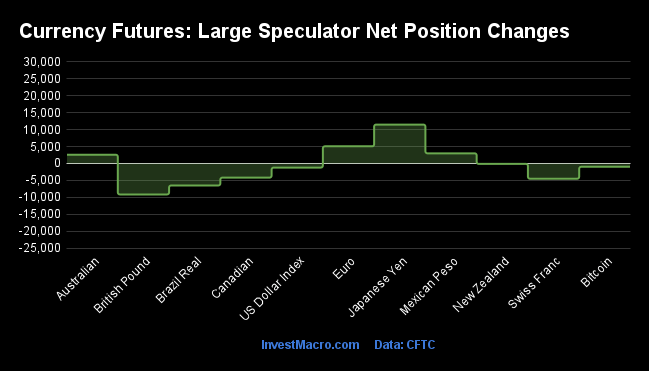
COT currency market speculator bets were slightly lower this week as five out of the eleven currency markets we cover had higher positioning while the other six markets had lower speculator contracts.

Leading the gains for the currency markets was the British pound sterling (8,391 contracts) with the Australian dollar (4,067 contracts), the Euro (2,636 contracts), the Swiss franc (2,017 contracts) and the Japanese yen (1,398 contracts) also showing a positive week.

The currencies leading the declines in speculator bets this week were the Mexican peso (-18,134 contracts) with the Canadian dollar (-5,974 contracts), the Brazilian real (-5,439 contracts), the New Zealand dollar (-1,444 contracts), Bitcoin (-257 contracts) and the US Dollar Index (-6 contracts) also registering lower bets on the week.

Highlighting the COT currency data this week is the rising Euro positioning. Large speculators increased their bullish bets for the Euro this week for the seventh time out of the past eight weeks and for the twelfth time out of the past thirteen weeks. The Euro speculator position has gone from a total of -47,676 contracts on August 30th to a total of +124,883 contracts this week for a thirteen-week change of +172,559 contracts. The current speculator standing for the Euro has now ascended to the most bullish level since March 2nd of 2021, a span of ninety-two weeks.

The Euro (EURUSD) price has been on a bullish trend as well since falling to an approximate 20-year low in September at a below parity exchange rate of 0.9593. Since the September low, the Euro has rallied by approximately 9 percent and is now trading at the highest levels since June with this week’s close above the 1.0550 exchange rate.


Data Snapshot of Forex Market Traders | Columns Legend
Dec-06-2022OIOI-IndexSpec-NetSpec-IndexCom-NetCOM-IndexSmalls-NetSmalls-Index
USD Index45,1155624,88666-27,540322,65446
EUR711,53784124,88373-160,0053135,12235
GBP230,31155-28,1934537,77460-9,58139
JPY223,42464-65,9962875,20272-9,20635
CHF40,17133-12,2302217,85974-5,62938
CAD148,89129-22,0901522,90588-81528
AUD158,75551-40,5634742,82051-2,25747
NZD42,95436-6,498376,3016119754
MXN293,7089347,95248-53,360515,40866
RUB20,93047,54331-7,15069-39324
BRL25,46472,19848-4,324512,12686
Bitcoin15,769836778-568050124


Strength Scores led by Bitcoin & EuroFX

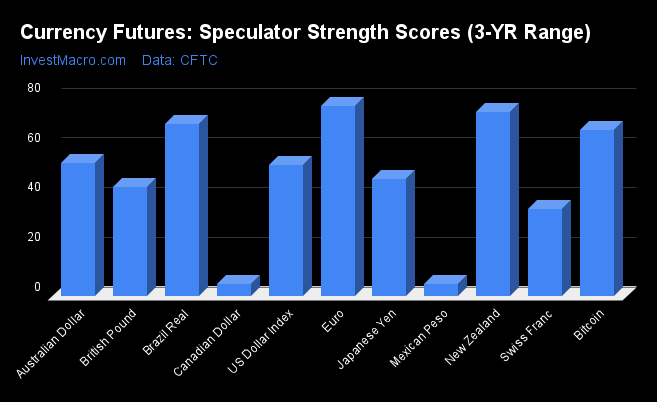
Strength Scores (a normalized measure of Speculator positions over a 3-Year range, from 0 to 100 where above 80 is extreme bullish and below 20 is extreme bearish) showed that Bitcoin (78.1 percent) and the EuroFX (73.3 percent) lead the currency markets currently. The US Dollar Index (66.4 percent) comes in as the next highest in the currency markets in strength scores.

On the downside, the Canadian Dollar (15.5 percent) comes in at the lowest strength level currently and the only currency in an Extreme-Bearish position (below 20 percent).

Strength Statistics:
US Dollar Index (66.4 percent) vs US Dollar Index previous week (66.4 percent)
EuroFX (73.3 percent) vs EuroFX previous week (72.5 percent)
British Pound Sterling (44.8 percent) vs British Pound Sterling previous week (37.6 percent)
Japanese Yen (28.2 percent) vs Japanese Yen previous week (27.4 percent)
Swiss Franc (22.3 percent) vs Swiss Franc previous week (16.9 percent)
Canadian Dollar (15.5 percent) vs Canadian Dollar previous week (22.6 percent)
Australian Dollar (47.2 percent) vs Australian Dollar previous week (43.5 percent)
New Zealand Dollar (36.8 percent) vs New Zealand Dollar previous week (40.7 percent)
Mexican Peso (47.8 percent) vs Mexican Peso previous week (55.5 percent)
Brazilian Real (48.3 percent) vs Brazilian Real previous week (54.1 percent)
Bitcoin (78.1 percent) vs Bitcoin previous week (82.6 percent)

Japanese Yen tops Strength Trends

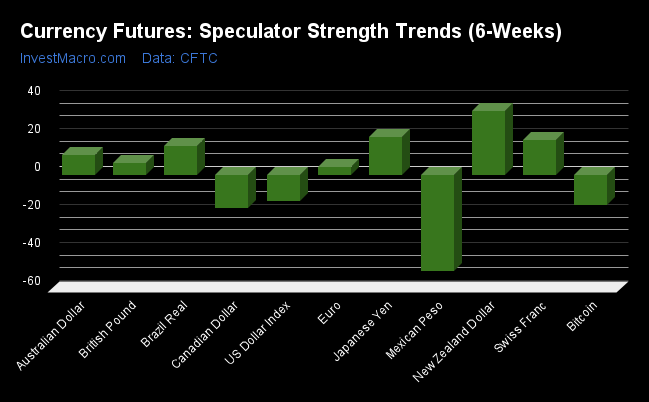
Strength Score Trends (or move index, calculates the 6-week changes in strength scores) show that the Japanese Yen (22.6 percent) leads the past six weeks trends for the currency markets this week. The New Zealand Dollar (17.1 percent), the British Pound Sterling (16.8 percent), the EuroFX (15.3 percent) and the Australian Dollar (10.1 percent) fill out the top movers in the latest trends data.

The Brazilian Real (-28.9 percent) leads the downside trend scores currently while the next markets with lower trend scores were the US Dollar Index (-8.7 percent), the Canadian Dollar (-4.7 percent) and the Swiss Franc (-2.5 percent).

Strength Trend Statistics:
US Dollar Index (-8.7 percent) vs US Dollar Index previous week (-13.0 percent)
EuroFX (15.3 percent) vs EuroFX previous week (22.7 percent)
British Pound Sterling (16.8 percent) vs British Pound Sterling previous week (12.6 percent)
Japanese Yen (22.6 percent) vs Japanese Yen previous week (16.6 percent)
Swiss Franc (-2.5 percent) vs Swiss Franc previous week (-18.9 percent)
Canadian Dollar (-4.7 percent) vs Canadian Dollar previous week (5.3 percent)
Australian Dollar (10.1 percent) vs Australian Dollar previous week (-8.6 percent)
New Zealand Dollar (17.1 percent) vs New Zealand Dollar previous week (35.8 percent)
Mexican Peso (15.1 percent) vs Mexican Peso previous week (37.7 percent)
Brazilian Real (-28.9 percent) vs Brazilian Real previous week (-20.2 percent)
Bitcoin (0.8 percent) vs Bitcoin previous week (5.3 percent)


Individual COT Forex Markets:

US Dollar Index Futures:

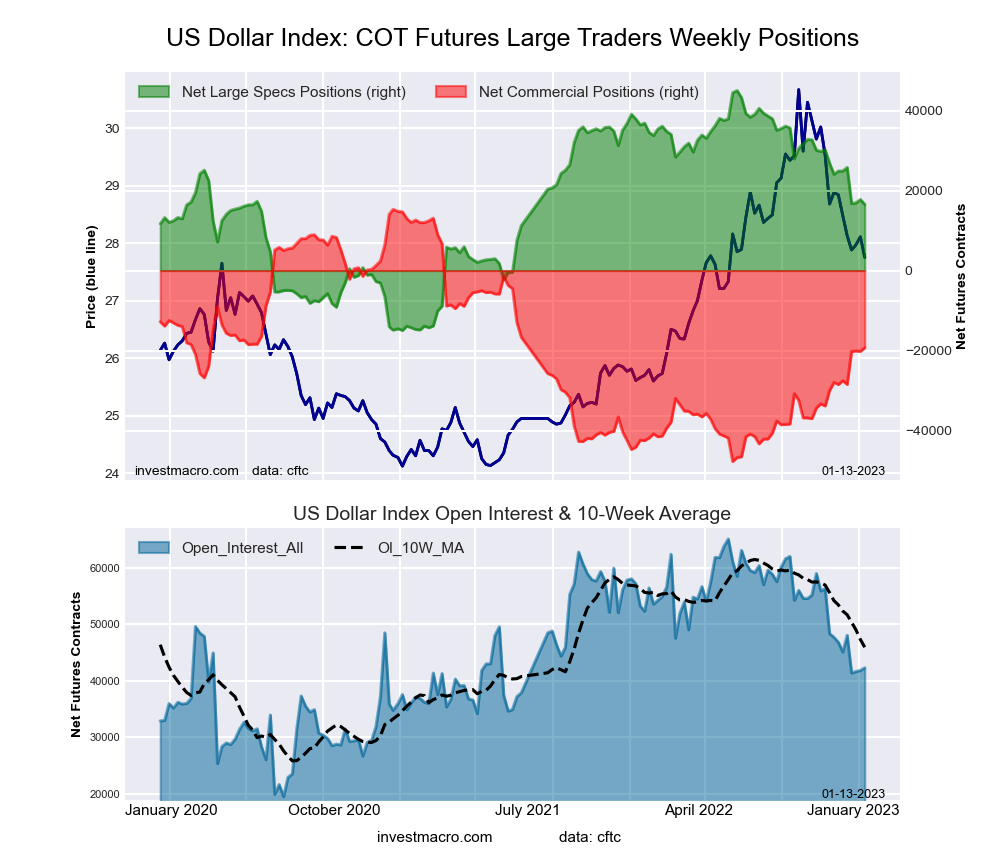
US Dollar Index Forex Futures COT ChartThe US Dollar Index large speculator standing this week equaled a net position of 24,886 contracts in the data reported through Tuesday. This was a weekly decrease of -6 contracts from the previous week which had a total of 24,892 net contracts.

This week’s current strength score (the trader positioning range over the past three years, measured from 0 to 100) shows the speculators are currently Bullish with a score of 66.4 percent. The commercials are Bearish with a score of 32.0 percent and the small traders (not shown in chart) are Bearish with a score of 45.6 percent.

US DOLLAR INDEX StatisticsSPECULATORSCOMMERCIALSSMALL TRADERS
– Percent of Open Interest Longs:80.14.112.4
– Percent of Open Interest Shorts:25.065.16.6
– Net Position:24,886-27,5402,654
– Gross Longs:36,1571,8385,610
– Gross Shorts:11,27129,3782,956
– Long to Short Ratio:3.2 to 10.1 to 11.9 to 1
NET POSITION TREND:
– Strength Index Score (3 Year Range Pct):66.432.045.6
– Strength Index Reading (3 Year Range):BullishBearishBearish
NET POSITION MOVEMENT INDEX:
– 6-Week Change in Strength Index:-8.710.8-17.6


Euro Currency Futures:

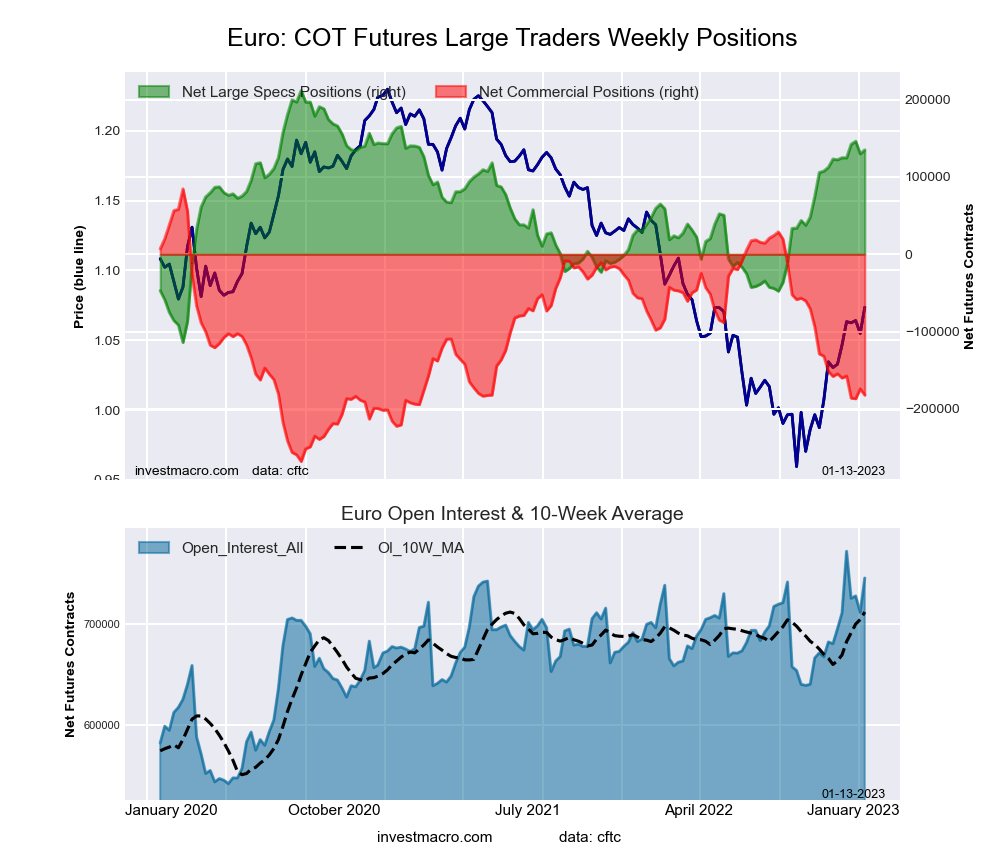
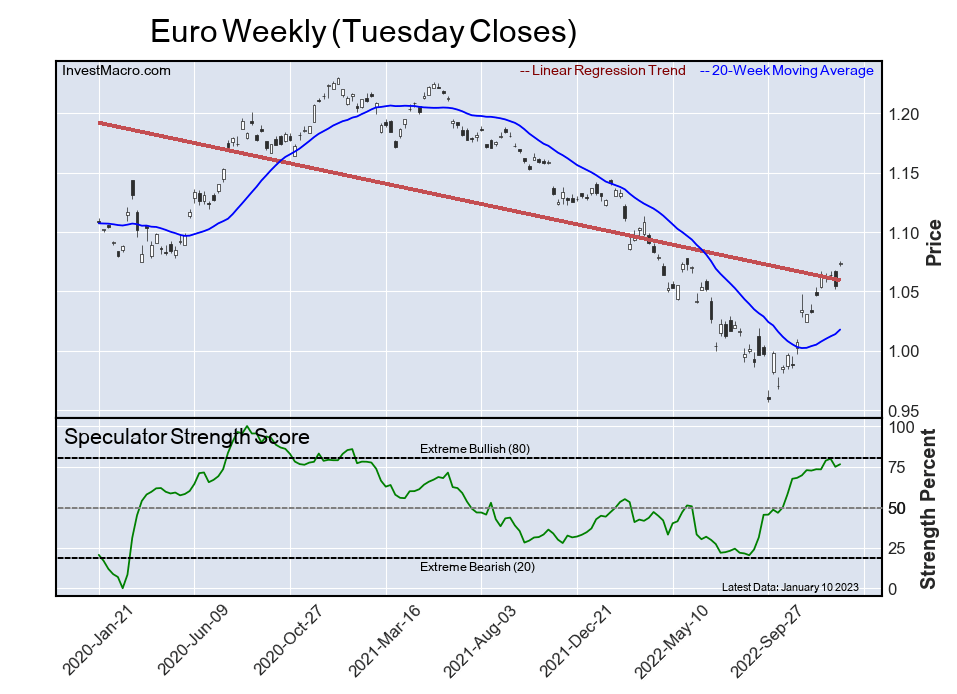
Euro Currency Futures COT ChartThe Euro Currency large speculator standing this week equaled a net position of 124,883 contracts in the data reported through Tuesday. This was a weekly advance of 2,636 contracts from the previous week which had a total of 122,247 net contracts.

This week’s current strength score (the trader positioning range over the past three years, measured from 0 to 100) shows the speculators are currently Bullish with a score of 73.3 percent. The commercials are Bearish with a score of 30.6 percent and the small traders (not shown in chart) are Bearish with a score of 35.0 percent.

EURO Currency StatisticsSPECULATORSCOMMERCIALSSMALL TRADERS
– Percent of Open Interest Longs:34.451.012.0
– Percent of Open Interest Shorts:16.973.57.0
– Net Position:124,883-160,00535,122
– Gross Longs:245,063363,16985,050
– Gross Shorts:120,180523,17449,928
– Long to Short Ratio:2.0 to 10.7 to 11.7 to 1
NET POSITION TREND:
– Strength Index Score (3 Year Range Pct):73.330.635.0
– Strength Index Reading (3 Year Range):BullishBearishBearish
NET POSITION MOVEMENT INDEX:
– 6-Week Change in Strength Index:15.3-18.825.8


British Pound Sterling Futures:

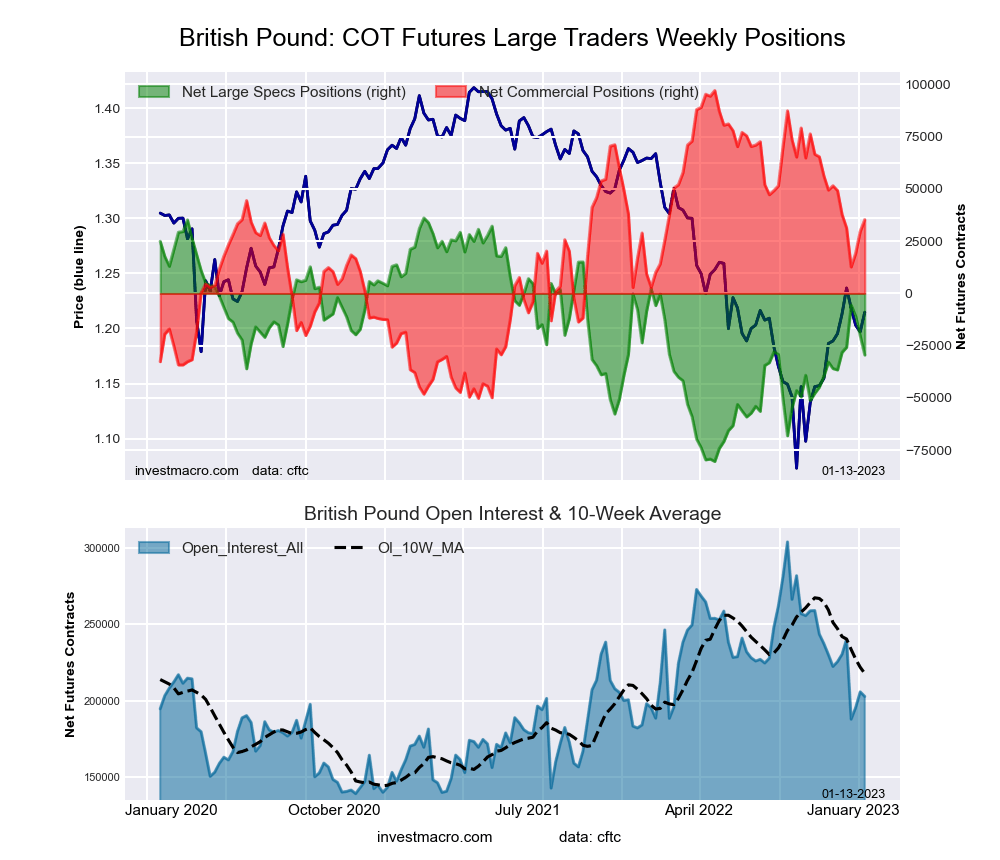
British Pound Sterling Futures COT ChartThe British Pound Sterling large speculator standing this week equaled a net position of -28,193 contracts in the data reported through Tuesday. This was a weekly increase of 8,391 contracts from the previous week which had a total of -36,584 net contracts.

This week’s current strength score (the trader positioning range over the past three years, measured from 0 to 100) shows the speculators are currently Bearish with a score of 44.8 percent. The commercials are Bullish with a score of 59.7 percent and the small traders (not shown in chart) are Bearish with a score of 39.2 percent.

BRITISH POUND StatisticsSPECULATORSCOMMERCIALSSMALL TRADERS
– Percent of Open Interest Longs:12.473.310.0
– Percent of Open Interest Shorts:24.656.914.1
– Net Position:-28,19337,774-9,581
– Gross Longs:28,539168,83822,941
– Gross Shorts:56,732131,06432,522
– Long to Short Ratio:0.5 to 11.3 to 10.7 to 1
NET POSITION TREND:
– Strength Index Score (3 Year Range Pct):44.859.739.2
– Strength Index Reading (3 Year Range):BearishBullishBearish
NET POSITION MOVEMENT INDEX:
– 6-Week Change in Strength Index:16.8-19.618.0


Japanese Yen Futures:

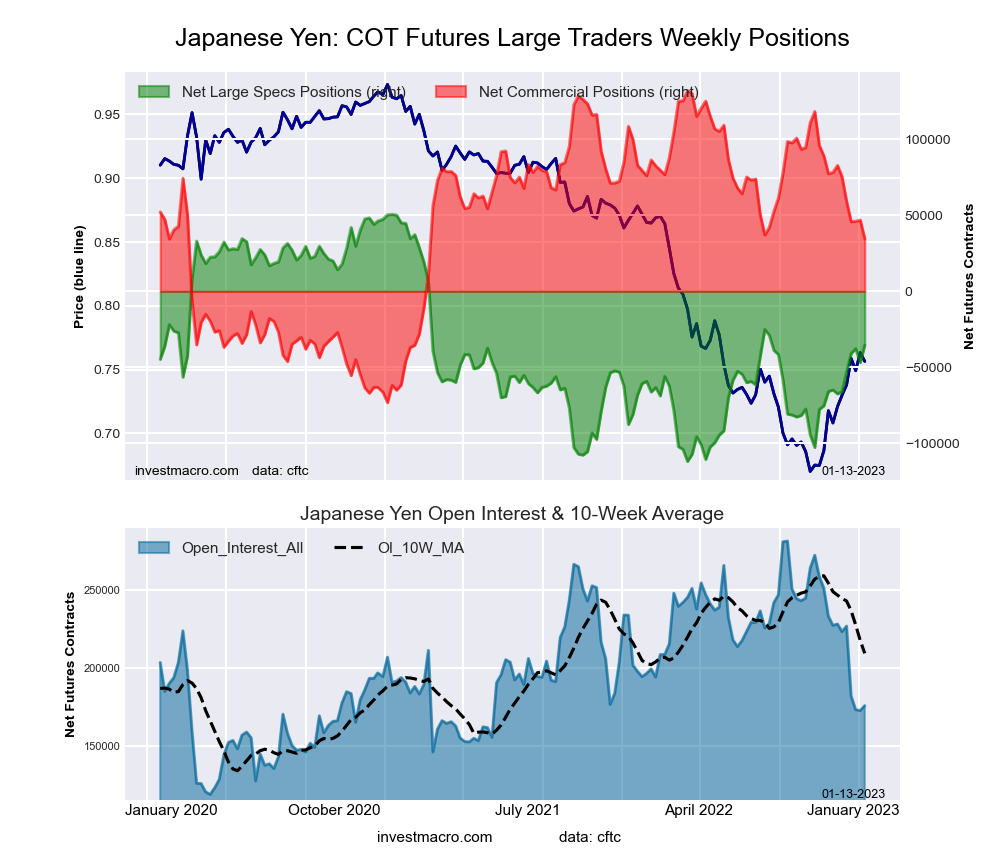
Japanese Yen Forex Futures COT ChartThe Japanese Yen large speculator standing this week equaled a net position of -65,996 contracts in the data reported through Tuesday. This was a weekly boost of 1,398 contracts from the previous week which had a total of -67,394 net contracts.

This week’s current strength score (the trader positioning range over the past three years, measured from 0 to 100) shows the speculators are currently Bearish with a score of 28.2 percent. The commercials are Bullish with a score of 72.3 percent and the small traders (not shown in chart) are Bearish with a score of 34.7 percent.

JAPANESE YEN StatisticsSPECULATORSCOMMERCIALSSMALL TRADERS
– Percent of Open Interest Longs:10.676.111.1
– Percent of Open Interest Shorts:40.142.415.3
– Net Position:-65,99675,202-9,206
– Gross Longs:23,589169,91824,896
– Gross Shorts:89,58594,71634,102
– Long to Short Ratio:0.3 to 11.8 to 10.7 to 1
NET POSITION TREND:
– Strength Index Score (3 Year Range Pct):28.272.334.7
– Strength Index Reading (3 Year Range):BearishBullishBearish
NET POSITION MOVEMENT INDEX:
– 6-Week Change in Strength Index:22.6-20.912.7


Swiss Franc Futures:

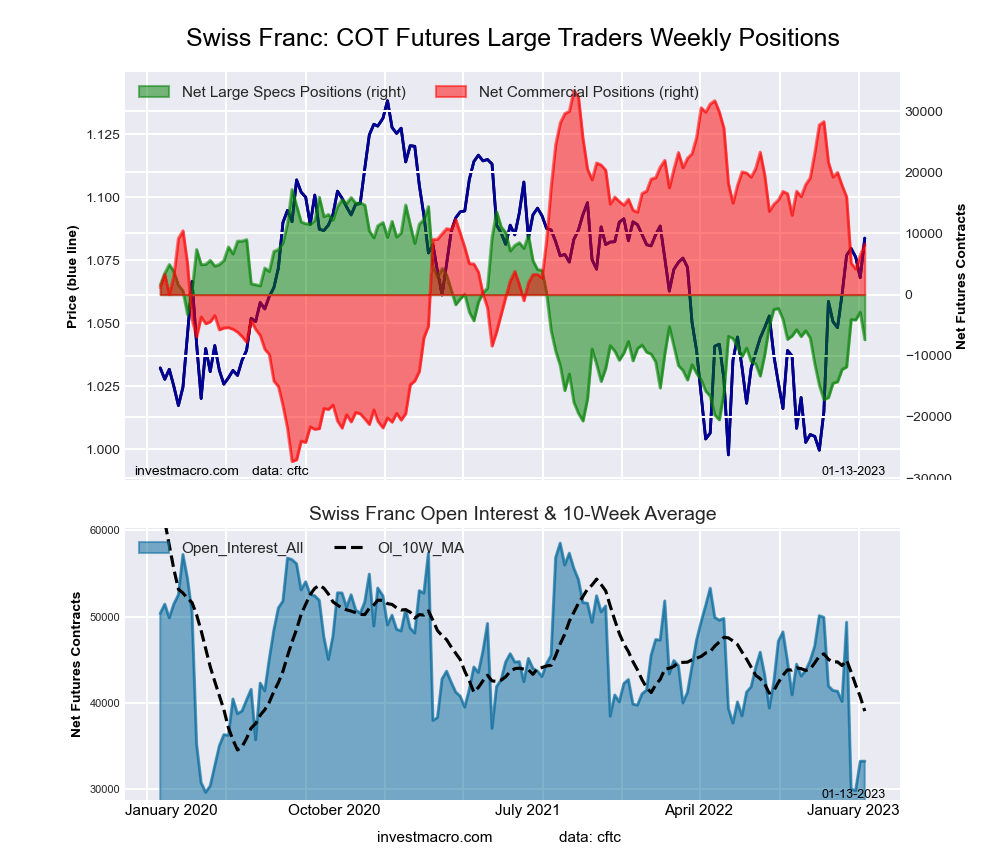
Swiss Franc Forex Futures COT ChartThe Swiss Franc large speculator standing this week equaled a net position of -12,230 contracts in the data reported through Tuesday. This was a weekly increase of 2,017 contracts from the previous week which had a total of -14,247 net contracts.

This week’s current strength score (the trader positioning range over the past three years, measured from 0 to 100) shows the speculators are currently Bearish with a score of 22.3 percent. The commercials are Bullish with a score of 74.4 percent and the small traders (not shown in chart) are Bearish with a score of 38.5 percent.

SWISS FRANC StatisticsSPECULATORSCOMMERCIALSSMALL TRADERS
– Percent of Open Interest Longs:3.370.925.3
– Percent of Open Interest Shorts:33.826.539.4
– Net Position:-12,23017,859-5,629
– Gross Longs:1,34328,50010,183
– Gross Shorts:13,57310,64115,812
– Long to Short Ratio:0.1 to 12.7 to 10.6 to 1
NET POSITION TREND:
– Strength Index Score (3 Year Range Pct):22.374.438.5
– Strength Index Reading (3 Year Range):BearishBullishBearish
NET POSITION MOVEMENT INDEX:
– 6-Week Change in Strength Index:-2.5-8.721.1


Canadian Dollar Futures:

Canadian Dollar Forex Futures COT ChartThe Canadian Dollar large speculator standing this week equaled a net position of -22,090 contracts in the data reported through Tuesday. This was a weekly lowering of -5,974 contracts from the previous week which had a total of -16,116 net contracts.

This week’s current strength score (the trader positioning range over the past three years, measured from 0 to 100) shows the speculators are currently Bearish-Extreme with a score of 15.5 percent. The commercials are Bullish-Extreme with a score of 87.8 percent and the small traders (not shown in chart) are Bearish with a score of 28.5 percent.

CANADIAN DOLLAR StatisticsSPECULATORSCOMMERCIALSSMALL TRADERS
– Percent of Open Interest Longs:20.653.320.8
– Percent of Open Interest Shorts:35.537.921.4
– Net Position:-22,09022,905-815
– Gross Longs:30,71779,37930,984
– Gross Shorts:52,80756,47431,799
– Long to Short Ratio:0.6 to 11.4 to 11.0 to 1
NET POSITION TREND:
– Strength Index Score (3 Year Range Pct):15.587.828.5
– Strength Index Reading (3 Year Range):Bearish-ExtremeBullish-ExtremeBearish
NET POSITION MOVEMENT INDEX:
– 6-Week Change in Strength Index:-4.74.0-1.8


Australian Dollar Futures:

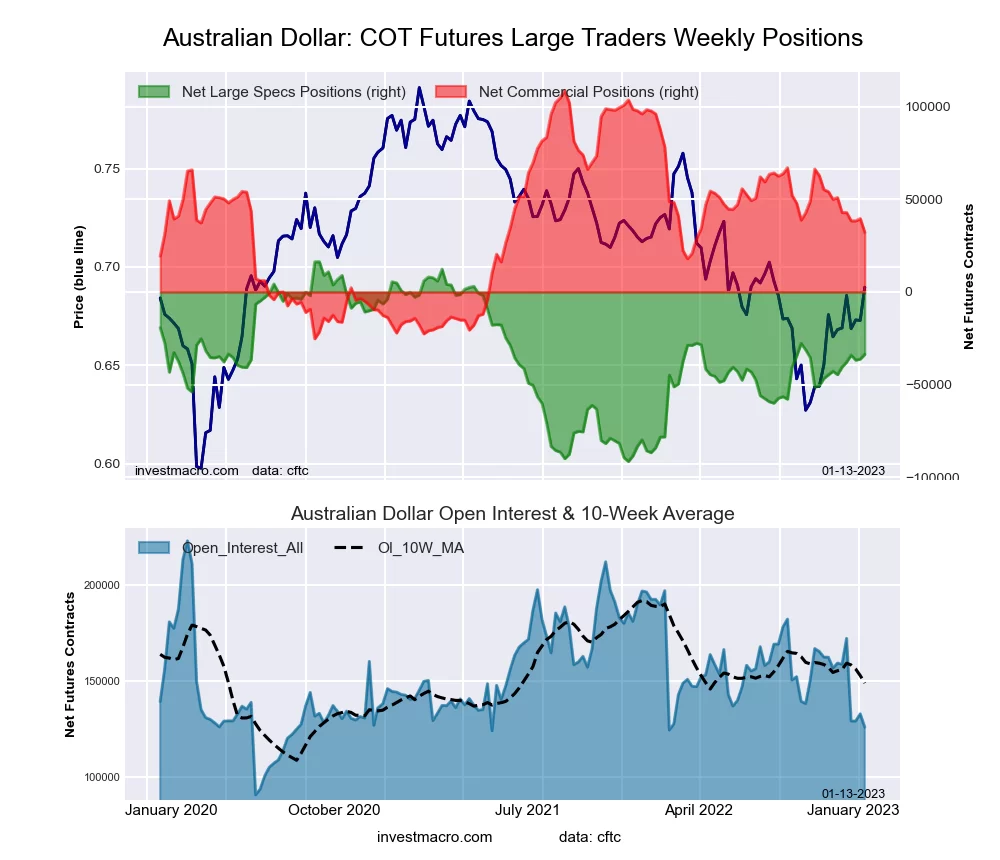
Australian Dollar Forex Futures COT ChartThe Australian Dollar large speculator standing this week equaled a net position of -40,563 contracts in the data reported through Tuesday. This was a weekly boost of 4,067 contracts from the previous week which had a total of -44,630 net contracts.

This week’s current strength score (the trader positioning range over the past three years, measured from 0 to 100) shows the speculators are currently Bearish with a score of 47.2 percent. The commercials are Bullish with a score of 50.8 percent and the small traders (not shown in chart) are Bearish with a score of 46.9 percent.

AUSTRALIAN DOLLAR StatisticsSPECULATORSCOMMERCIALSSMALL TRADERS
– Percent of Open Interest Longs:22.963.710.6
– Percent of Open Interest Shorts:48.436.712.0
– Net Position:-40,56342,820-2,257
– Gross Longs:36,334101,16016,814
– Gross Shorts:76,89758,34019,071
– Long to Short Ratio:0.5 to 11.7 to 10.9 to 1
NET POSITION TREND:
– Strength Index Score (3 Year Range Pct):47.250.846.9
– Strength Index Reading (3 Year Range):BearishBullishBearish
NET POSITION MOVEMENT INDEX:
– 6-Week Change in Strength Index:10.1-17.530.8


New Zealand Dollar Futures:

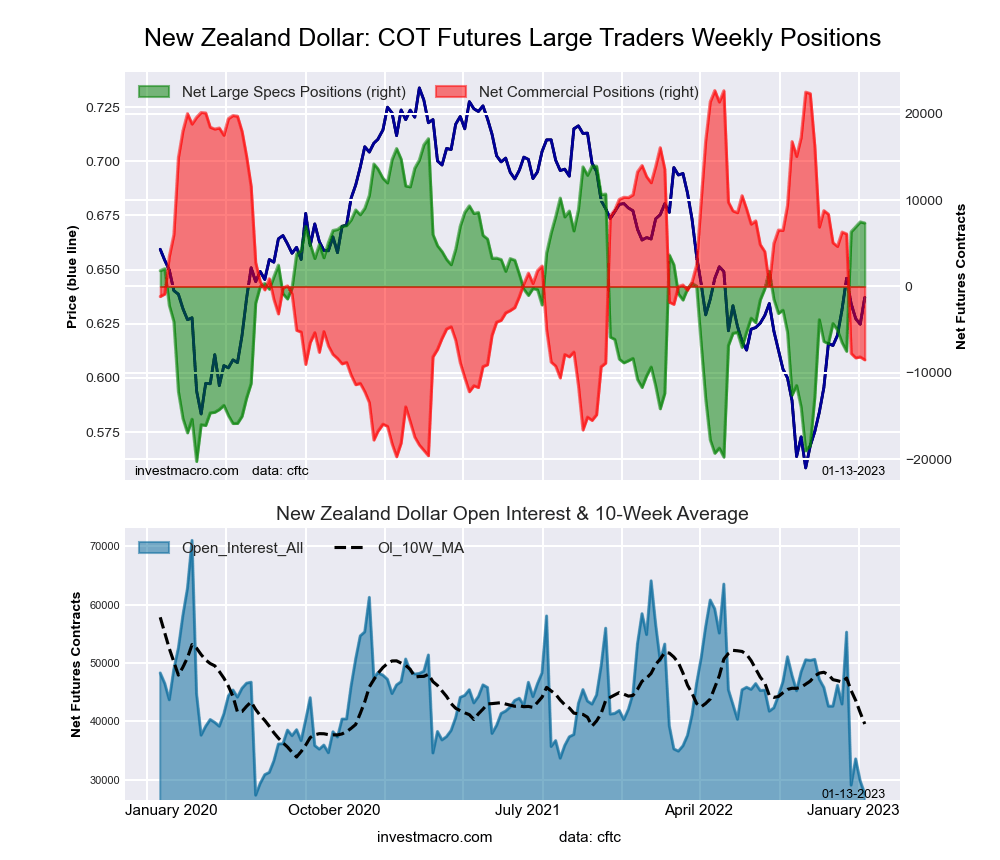
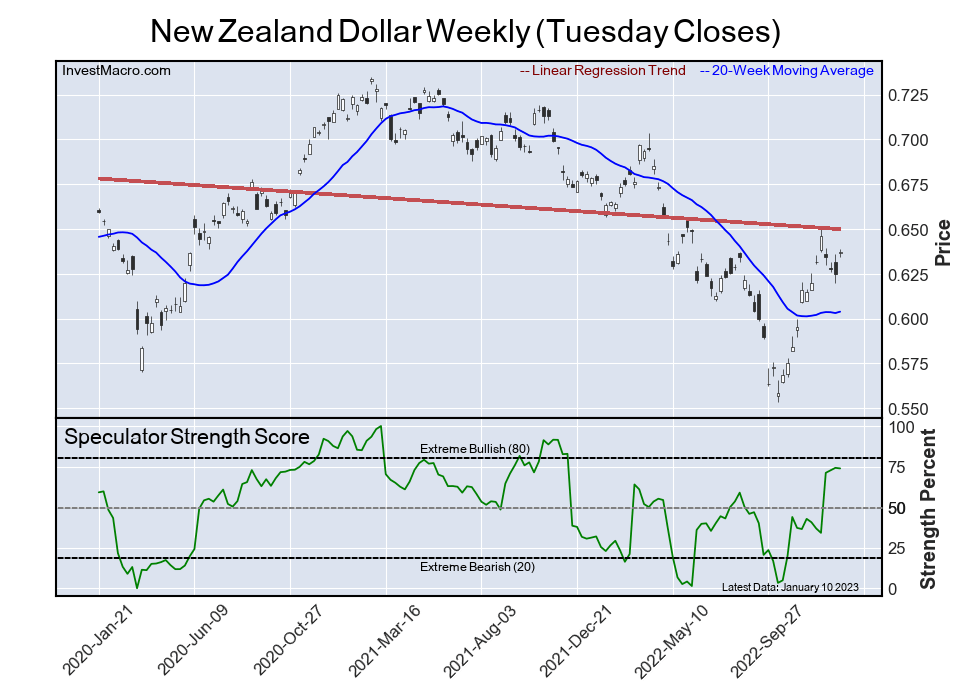
New Zealand Dollar Forex Futures COT ChartThe New Zealand Dollar large speculator standing this week equaled a net position of -6,498 contracts in the data reported through Tuesday. This was a weekly decline of -1,444 contracts from the previous week which had a total of -5,054 net contracts.

This week’s current strength score (the trader positioning range over the past three years, measured from 0 to 100) shows the speculators are currently Bearish with a score of 36.8 percent. The commercials are Bullish with a score of 61.3 percent and the small traders (not shown in chart) are Bullish with a score of 53.9 percent.

NEW ZEALAND DOLLAR StatisticsSPECULATORSCOMMERCIALSSMALL TRADERS
– Percent of Open Interest Longs:38.053.47.9
– Percent of Open Interest Shorts:53.138.87.4
– Net Position:-6,4986,301197
– Gross Longs:16,30222,9503,397
– Gross Shorts:22,80016,6493,200
– Long to Short Ratio:0.7 to 11.4 to 11.1 to 1
NET POSITION TREND:
– Strength Index Score (3 Year Range Pct):36.861.353.9
– Strength Index Reading (3 Year Range):BearishBullishBullish
NET POSITION MOVEMENT INDEX:
– 6-Week Change in Strength Index:17.1-23.541.4


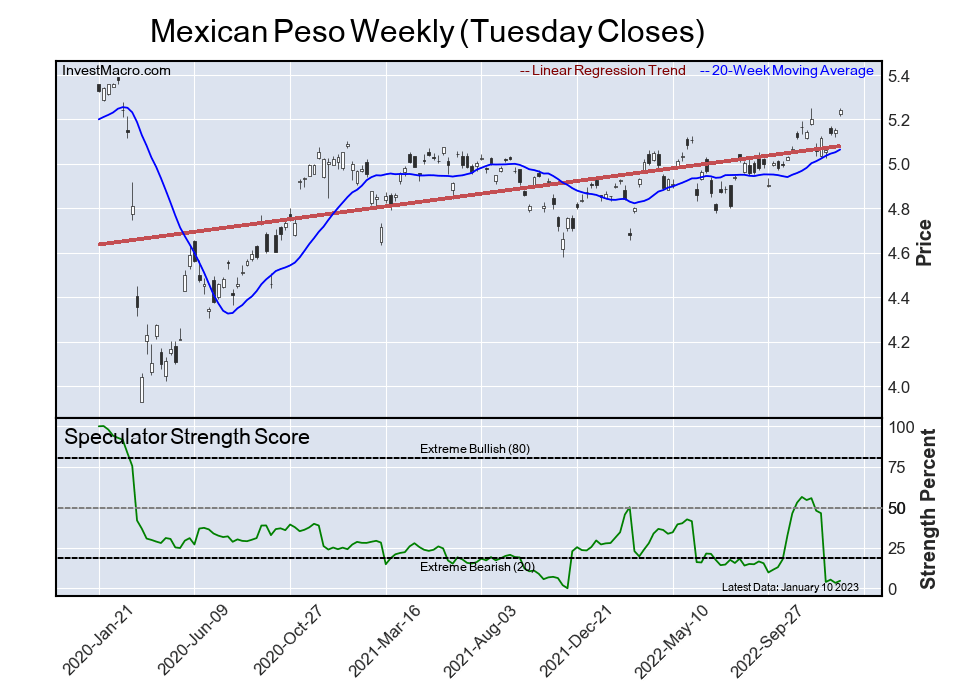
Mexican Peso Futures:

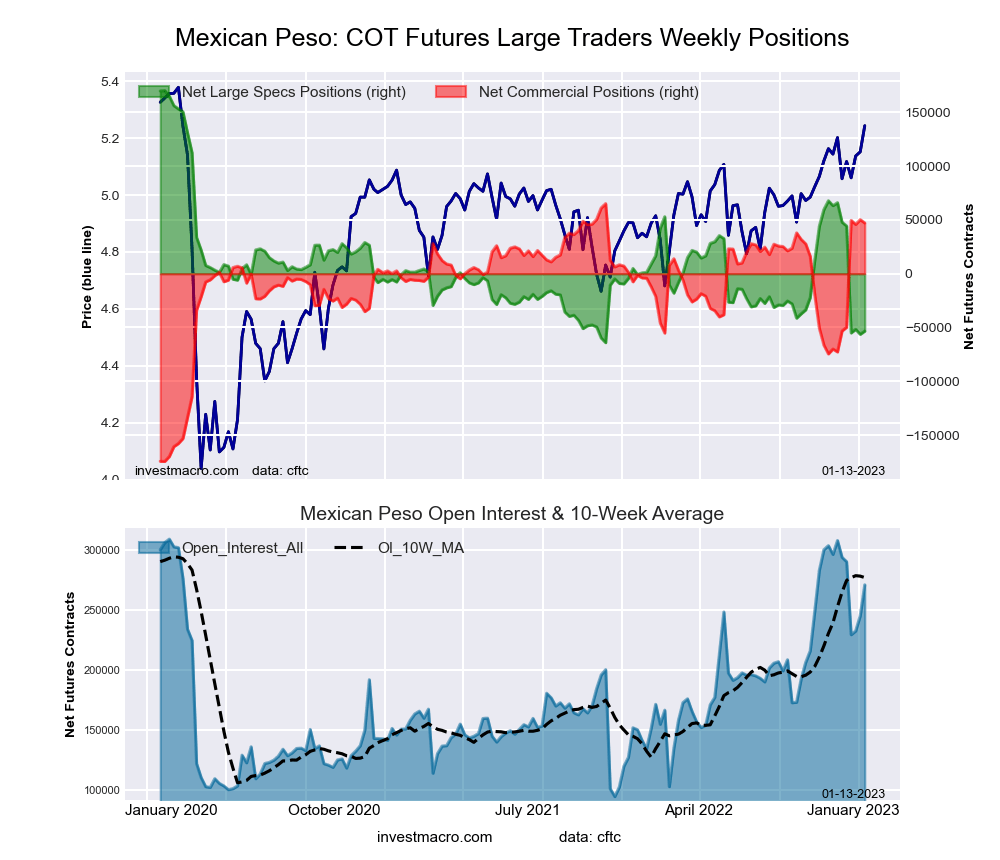
Mexican Peso Futures COT ChartThe Mexican Peso large speculator standing this week equaled a net position of 47,952 contracts in the data reported through Tuesday. This was a weekly fall of -18,134 contracts from the previous week which had a total of 66,086 net contracts.

This week’s current strength score (the trader positioning range over the past three years, measured from 0 to 100) shows the speculators are currently Bearish with a score of 47.8 percent. The commercials are Bullish with a score of 50.5 percent and the small traders (not shown in chart) are Bullish with a score of 65.9 percent.

MEXICAN PESO StatisticsSPECULATORSCOMMERCIALSSMALL TRADERS
– Percent of Open Interest Longs:60.535.92.7
– Percent of Open Interest Shorts:44.154.10.8
– Net Position:47,952-53,3605,408
– Gross Longs:177,555105,4107,854
– Gross Shorts:129,603158,7702,446
– Long to Short Ratio:1.4 to 10.7 to 13.2 to 1
NET POSITION TREND:
– Strength Index Score (3 Year Range Pct):47.850.565.9
– Strength Index Reading (3 Year Range):BearishBullishBullish
NET POSITION MOVEMENT INDEX:
– 6-Week Change in Strength Index:15.1-14.0-7.7


Brazilian Real Futures:

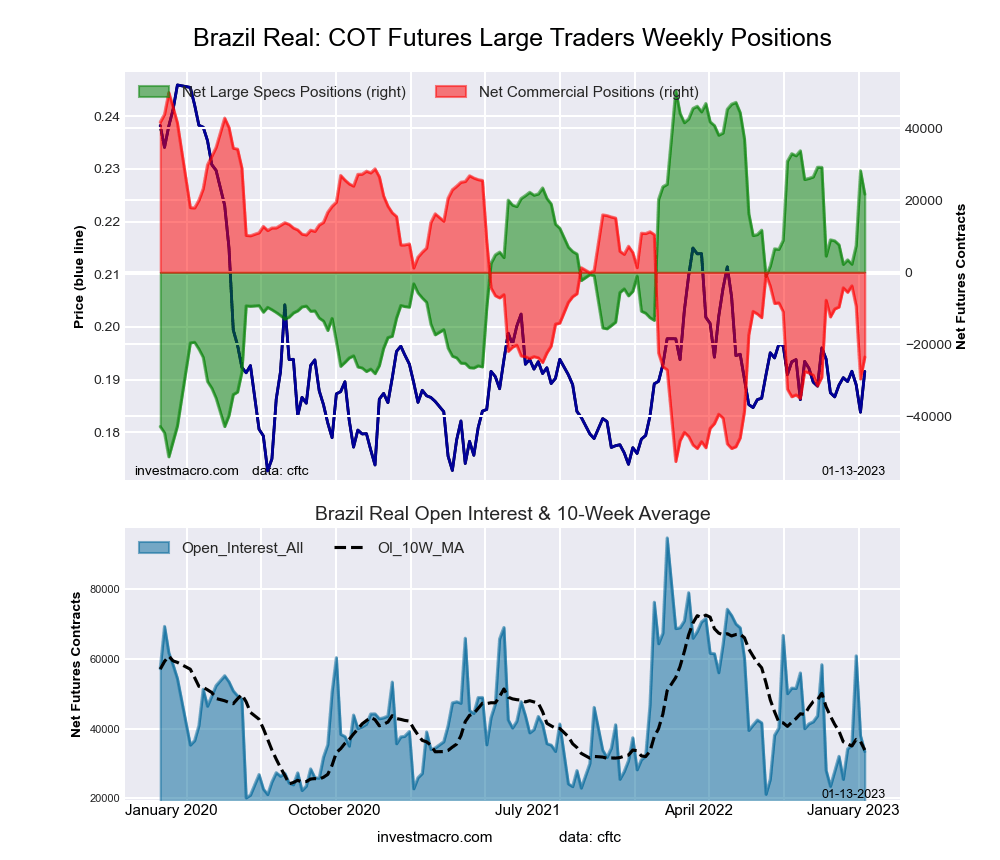
Brazil Real Futures COT ChartThe Brazilian Real large speculator standing this week equaled a net position of 2,198 contracts in the data reported through Tuesday. This was a weekly decrease of -5,439 contracts from the previous week which had a total of 7,637 net contracts.

This week’s current strength score (the trader positioning range over the past three years, measured from 0 to 100) shows the speculators are currently Bearish with a score of 48.3 percent. The commercials are Bullish with a score of 50.6 percent and the small traders (not shown in chart) are Bullish-Extreme with a score of 85.9 percent.

BRAZIL REAL StatisticsSPECULATORSCOMMERCIALSSMALL TRADERS
– Percent of Open Interest Longs:57.428.614.0
– Percent of Open Interest Shorts:48.845.55.7
– Net Position:2,198-4,3242,126
– Gross Longs:14,6257,2713,566
– Gross Shorts:12,42711,5951,440
– Long to Short Ratio:1.2 to 10.6 to 12.5 to 1
NET POSITION TREND:
– Strength Index Score (3 Year Range Pct):48.350.685.9
– Strength Index Reading (3 Year Range):BearishBullishBullish-Extreme
NET POSITION MOVEMENT INDEX:
– 6-Week Change in Strength Index:-28.928.6-3.2


Bitcoin Futures:

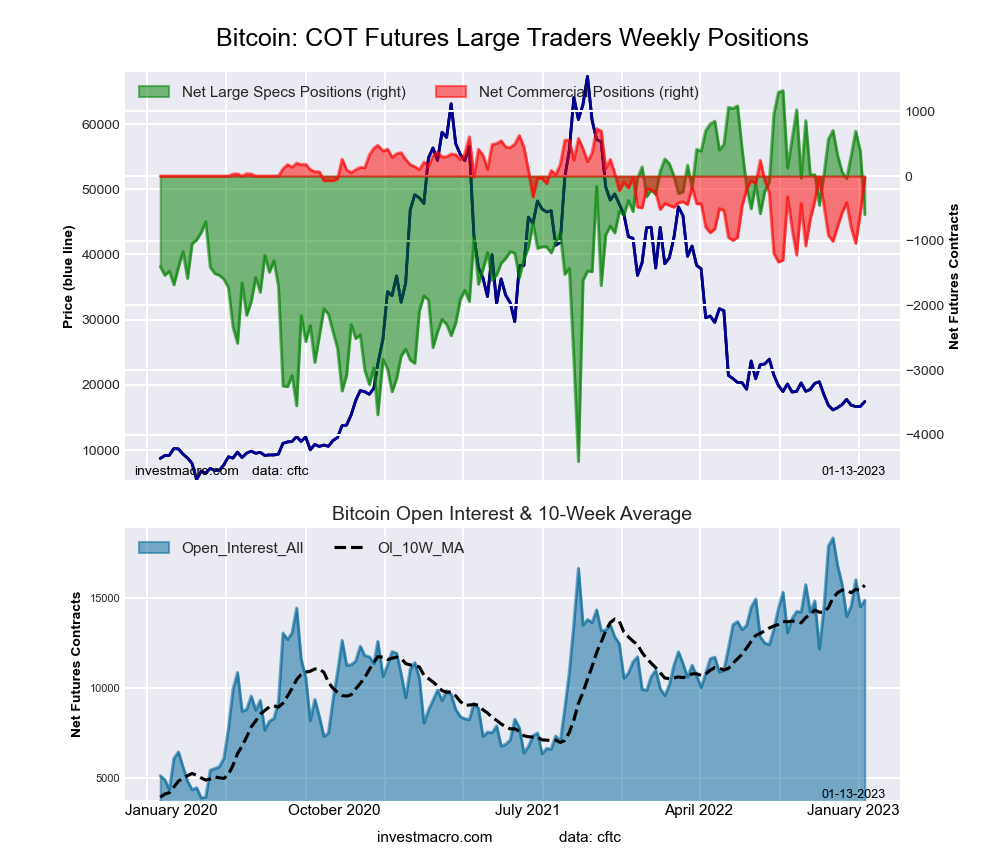
Bitcoin Crypto Futures COT ChartThe Bitcoin large speculator standing this week equaled a net position of 67 contracts in the data reported through Tuesday. This was a weekly fall of -257 contracts from the previous week which had a total of 324 net contracts.

This week’s current strength score (the trader positioning range over the past three years, measured from 0 to 100) shows the speculators are currently Bullish with a score of 78.1 percent. The commercials are Bearish with a score of 36.9 percent and the small traders (not shown in chart) are Bearish with a score of 24.3 percent.

BITCOIN StatisticsSPECULATORSCOMMERCIALSSMALL TRADERS
– Percent of Open Interest Longs:80.21.98.7
– Percent of Open Interest Shorts:79.85.55.5
– Net Position:67-568501
– Gross Longs:12,6513061,365
– Gross Shorts:12,584874864
– Long to Short Ratio:1.0 to 10.4 to 11.6 to 1
NET POSITION TREND:
– Strength Index Score (3 Year Range Pct):78.136.924.3
– Strength Index Reading (3 Year Range):BullishBearishBearish
NET POSITION MOVEMENT INDEX:
– 6-Week Change in Strength Index:0.8-9.13.3


Article By InvestMacroReceive our weekly COT Newsletter

*COT Report: The COT data, released weekly to the public each Friday, is updated through the most recent Tuesday (data is 3 days old) and shows a quick view of how large speculators or non-commercials (for-profit traders) were positioned in the futures markets.

The CFTC categorizes trader positions according to commercial hedgers (traders who use futures contracts for hedging as part of the business), non-commercials (large traders who speculate to realize trading profits) and nonreportable traders (usually small traders/speculators) as well as their open interest (contracts open in the market at time of reporting). See CFTC criteria here.

Speculator Extremes: Soybean Meal & Wheat lead Most Bullish & Bearish Positions

By InvestMacro

The latest update for the weekly Commitment of Traders (COT) report was released by the Commodity Futures Trading Commission (CFTC) on Friday for data ending on December 6th.

This weekly Extreme Positions report highlights the Most Bullish and Most Bearish Positions for the speculator category. Extreme positioning in these markets can foreshadow strong moves in the underlying market.

To signify an extreme position, we use the Strength Index (also known as the COT Index) of each instrument, a common method of measuring COT data. The Strength Index is simply a comparison of current trader positions against the range of positions over the previous 3 years. We use over 80 percent as extremely bullish and under 20 percent as extremely bearish.

Compare Strength Index scores across all markets in the data table or cot leaders table.


Here Are This Week’s Most Bullish Speculator Positions:

Soybean Meal


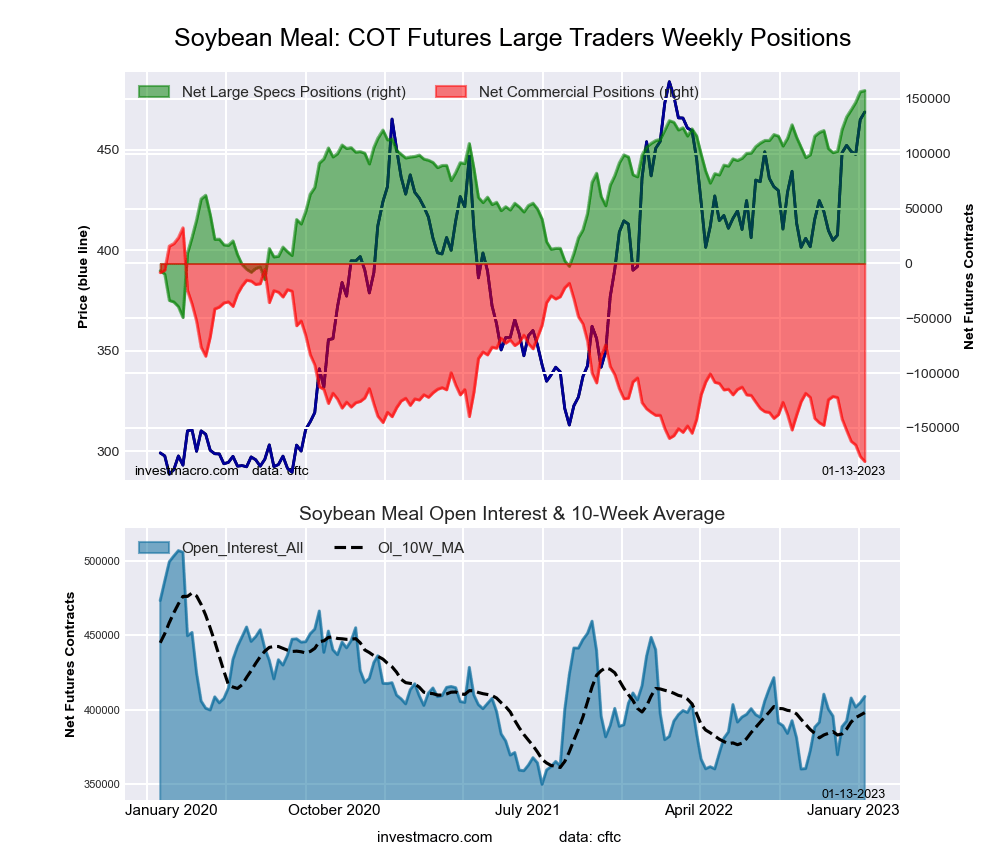
The Soybean Meal speculator position comes in as the most bullish extreme standing this week. The Soybean Meal speculator level is currently at a 95.5 percent score of its 3-year range.

The overall net speculator position totaled 122,174 net contracts this week with a gain of +19,835 contract in weekly speculator bets.


Bloomberg Commodity Index


The Bloomberg Commodity Index speculator position comes next in the extreme standings this week. The Bloomberg Commodity Index speculator level is now at a 95.1 percent score of its 3-year range.

The speculator position was -3,239 net contracts this week with a change of +320 contract in this week’s speculator bets.


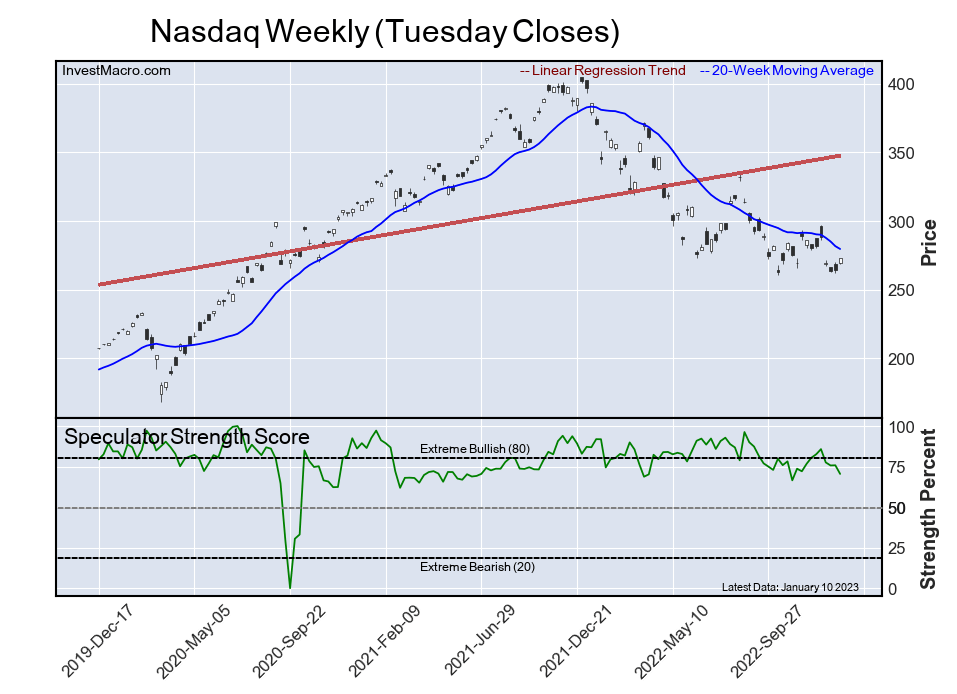
Nasdaq


The Nasdaq speculator position comes in third this week in the extreme standings. The Nasdaq speculator level resides at a 82.6 percent score of its 3-year range.

The speculator position was 13,517 net contracts this week with a gain of +3,762 contract in this week’s speculator positions.


Bitcoin


The Bitcoin speculator position comes up number four in the extreme standings this week. The Bitcoin speculator level is at a 78.1 percent score of its 3-year range.

The speculator position was 67 net contracts this week although with a drop of -257 contract in this week’s speculator positions.


This Week’s Most Bearish Speculator Positions:

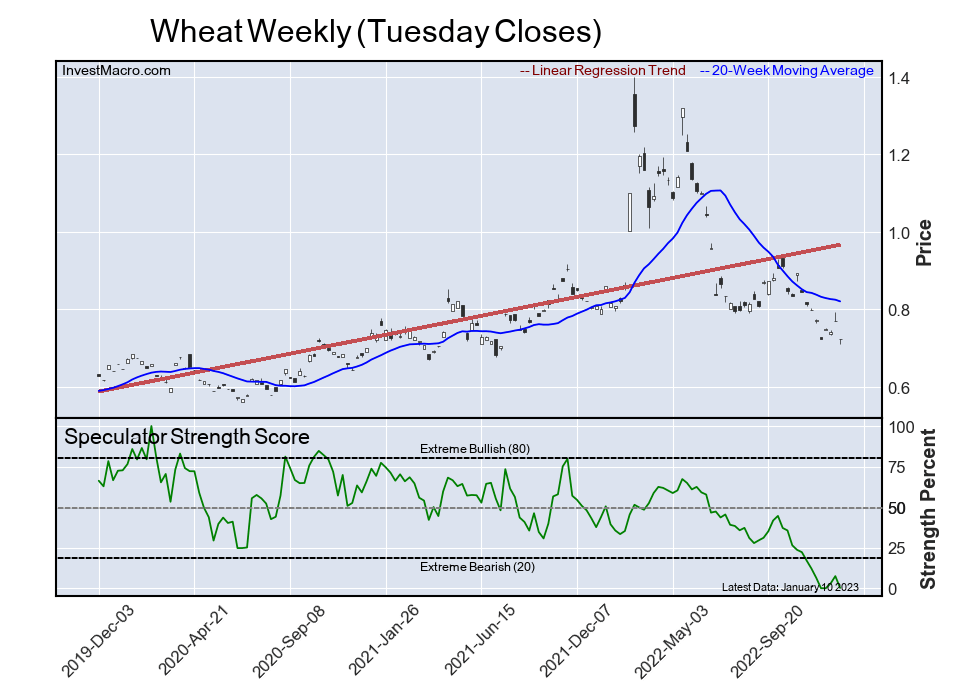
Wheat


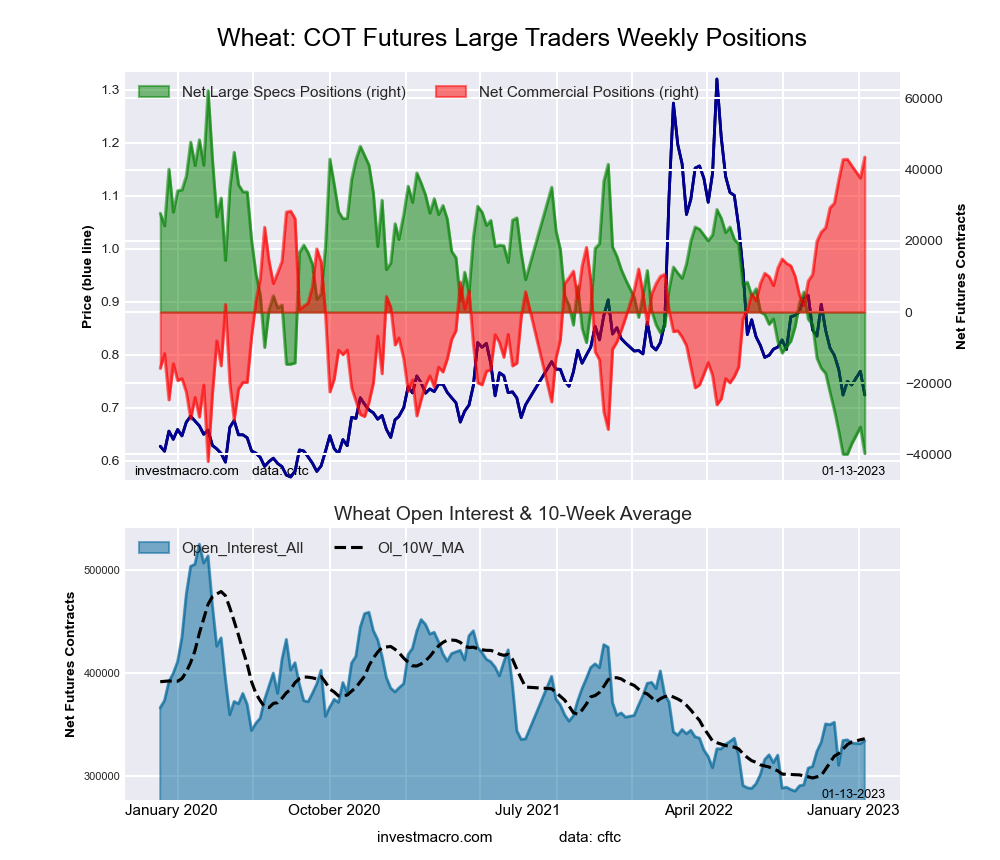
The Wheat speculator position comes in as the most bearish extreme standing this week. The Wheat speculator level is at a 0.0 percent score of its 3-year range.

The speculator position was -39,897 net contracts this week with a -6,592 contract decline in speculator bets.


5-Year Bond


The 5-Year Bond speculator position comes in next for the most bearish extreme standing on the week. The 5-Year Bond speculator level is also at a 0.0 percent score of its 3-year range.

The speculator position was -658,606 net contracts this week with a significant drop of -129,257 contract in this week’s speculator positions.


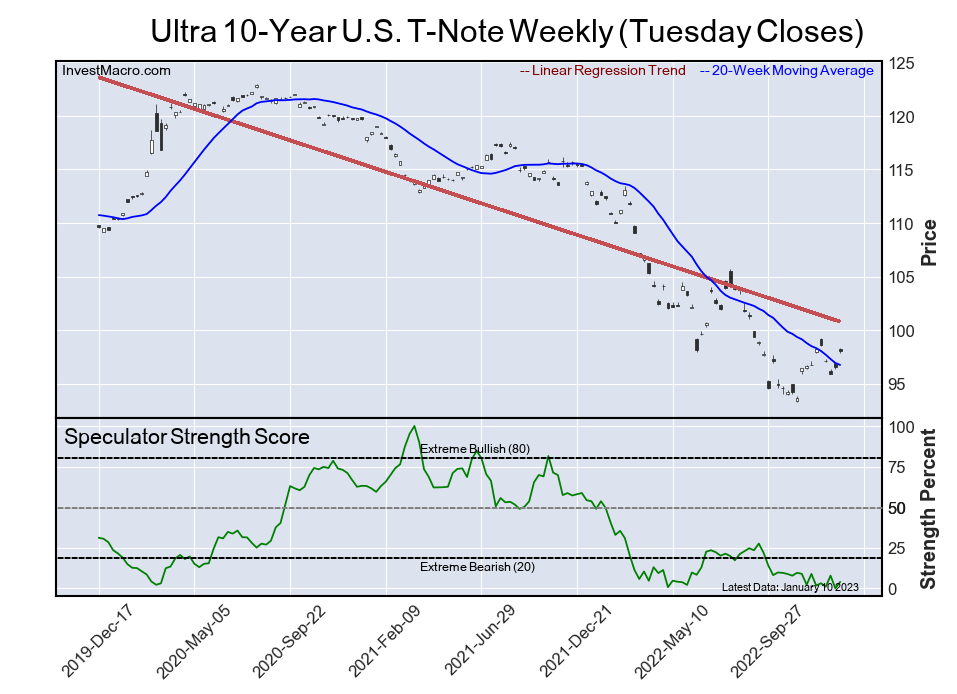
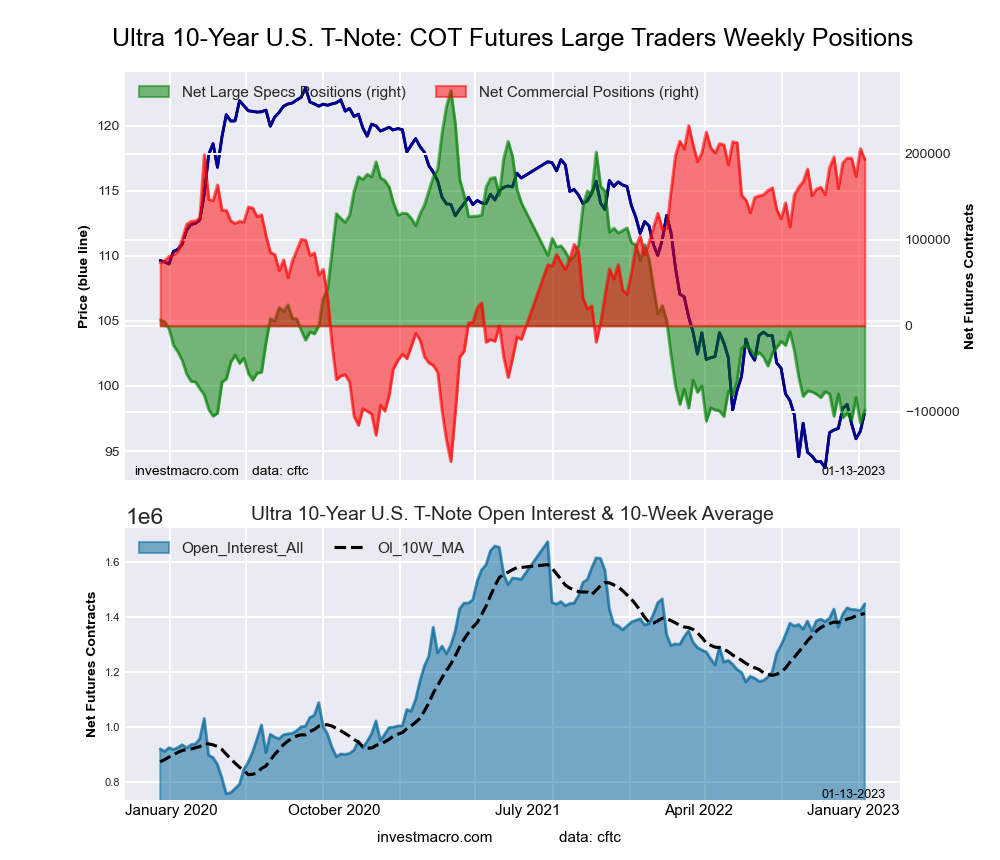
Ultra 10-Year U.S. T-Note


The Ultra 10-Year U.S. T-Note speculator position comes in as third most bearish extreme standing of the week. The Ultra 10-Year U.S. T-Note speculator level resides at a 1.0 percent score of its 3-year range.

The speculator position was -106,952 net contracts this week with a decline of -27,703 contract in this week’s speculator positions.


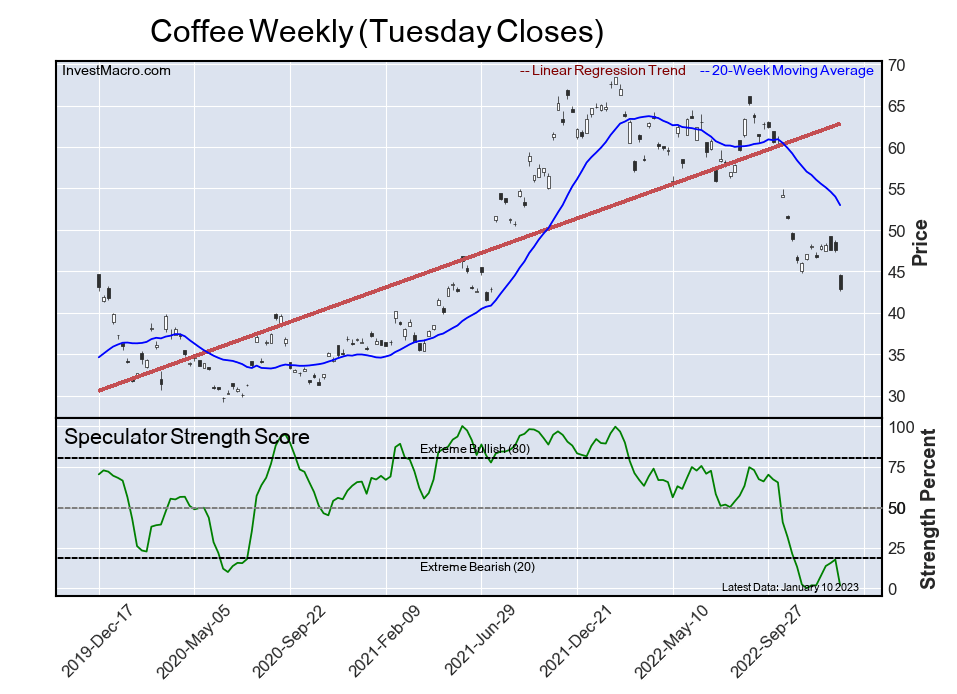
Coffee


The Coffee speculator position comes in as this week’s fourth most bearish extreme standing. The Coffee speculator level is at a 1.8 percent score of its 3-year range.

The speculator position was -14,642 net contracts this week with a small -6 contract change in the weekly speculator bets.


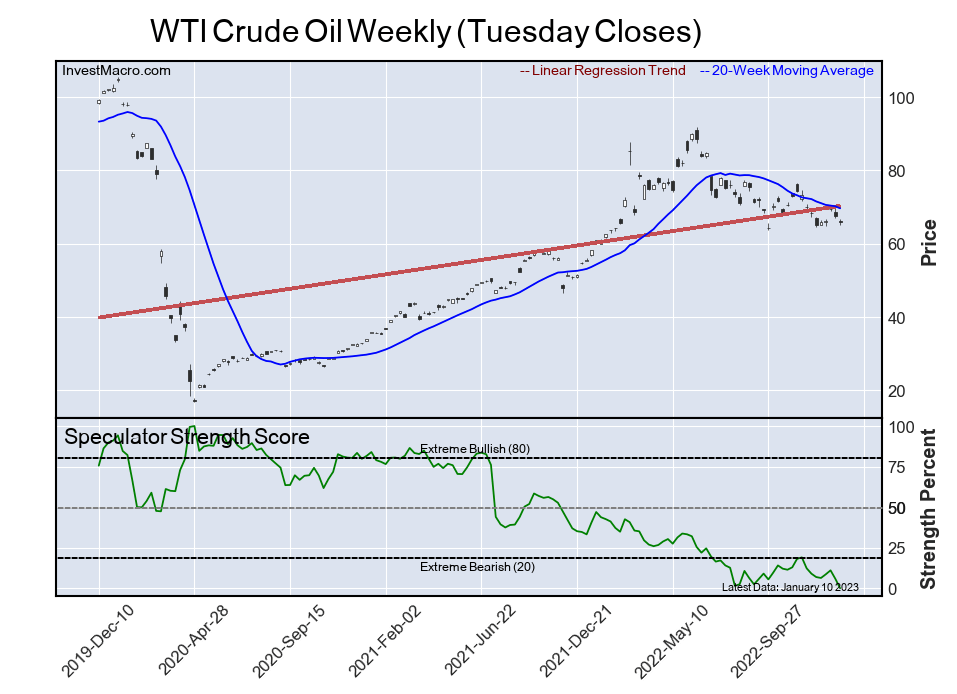
WTI Crude Oil


Finally, the WTI Crude Oil speculator position comes in as the fifth most bearish extreme standing for this week. The WTI Crude Oil speculator level is at a 5.6 percent score of its 3-year range.

The speculator position was 231,720 net contracts this week with a weekly -8,019 contract shortfall in speculator bets.


Article By InvestMacroReceive our weekly COT Newsletter

*COT Report: The COT data, released weekly to the public each Friday, is updated through the most recent Tuesday (data is 3 days old) and shows a quick view of how large speculators or non-commercials (for-profit traders) were positioned in the futures markets.

The CFTC categorizes trader positions according to commercial hedgers (traders who use futures contracts for hedging as part of the business), non-commercials (large traders who speculate to realize trading profits) and nonreportable traders (usually small traders/speculators) as well as their open interest (contracts open in the market at time of reporting). See CFTC criteria here.

COT Metals Speculators boosted their Silver bullish bets to 30-week high

By InvestMacro

Here are the latest charts and statistics for the Commitment of Traders (COT) data published by the Commodities Futures Trading Commission (CFTC).

The latest COT data is updated through Tuesday December 6th and shows a quick view of how large traders (for-profit speculators and commercial entities) were positioned in the futures markets.

Gold & Platinum lead the Weekly Speculator Changes

The COT precious metals speculator bets were higher this week as four out of the five metals markets we cover had higher positioning this week while just one market had lower contracts.

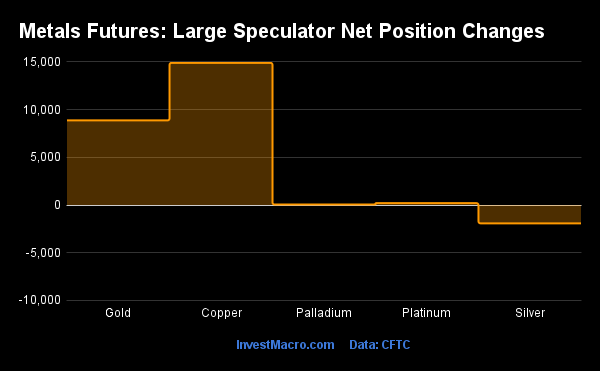
Leading the gains for the precious metals markets was Gold (5,122 contracts) with Platinum (1,377 contracts), Silver (1,725 contracts) and Palladium (259 contracts) also showing a positive week.

The only metals markets with declines in speculator bets this week was Copper at a total of -305 contracts.

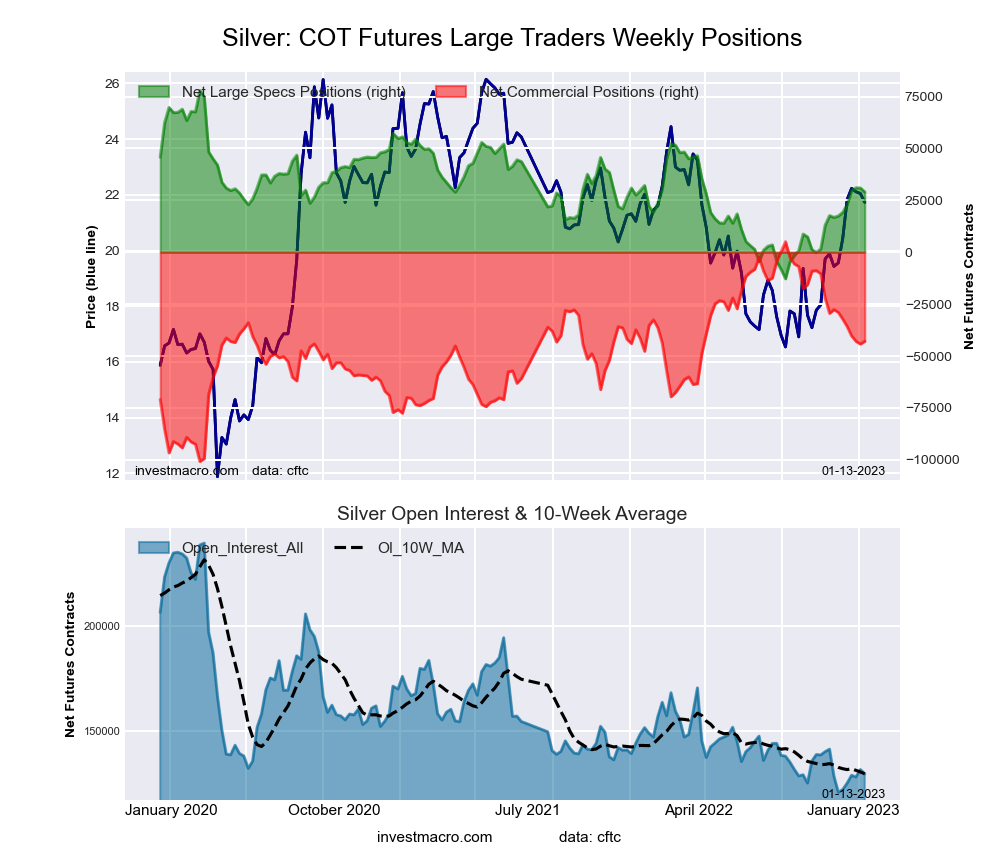
Highlighting the COT metals data this week is the increasing bullishness of Silver positions. The large speculator position in Silver futures rose this week for a second straight week and for the fifth time out of the past six weeks. Speculator bets have now risen by a total of +19,309 contracts over these past six weeks, going from a total of -101 contracts on October 25th to a total of +19,208 contracts this week. The recent gains have now positioned the speculator standing at its highest level since May 10th, a span of 30 weeks.

The Silver futures price has been on the move as well with prices closing out the week at $23.71. This is the highest weekly close for Silver since April and Silver is now up by over +30 percent since bottoming at the beginning of September.


Data Snapshot of Commodity Market Traders | Columns Legend
Dec-06-2022OIOI-IndexSpec-NetSpec-IndexCom-NetCOM-IndexSmalls-NetSmalls-Index
WTI Crude1,436,7283231,7206-259,5539427,83345
Gold422,1000115,12521-130,0797914,95417
Silver122,558119,20835-32,2626513,05433
Copper158,76291,67938-4,354642,67541
Palladium7,7859-1,372161,2268114650
Platinum68,8213725,63644-30,148584,51229
Natural Gas1,010,47911-164,03729135,6067428,43148
Brent144,1477-28,1186423,746334,37268
Heating Oil257,1581922,82876-39,5062916,67856
Soybeans622,2001189,66138-59,88271-29,77921
Corn1,232,3071198,37555-157,53649-40,83920
Coffee203,29614-14,642212,907981,73524
Sugar881,38834183,12457-226,0663842,94261
Wheat334,76021-39,897042,820100-2,92395


Strength Scores led by Platinum & Copper

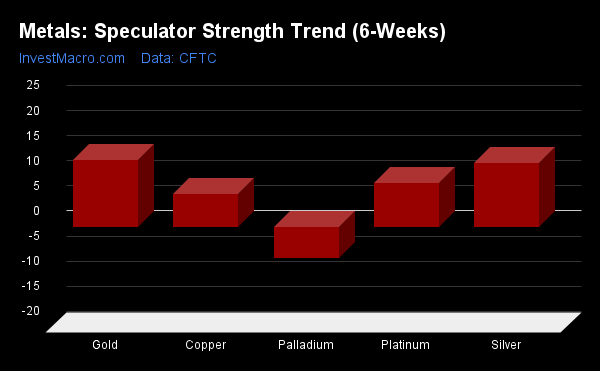
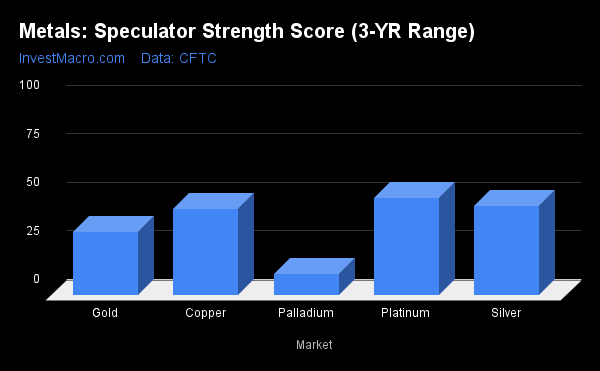
Strength scores (a measure of the 3-Year range of Speculator positions, from 0 to 100 where above 80 is extreme bullish and below 20 is extreme bearish) showed that Platinum (43.6 percent) and Copper (37.7 percent) lead the metals category this week. Silver (35.3 percent) and then Gold (20.9 percent) comes in as the next highest metals market in strength scores.

On the downside, Palladium (15.7 percent) is at the lowest strength level currently and is in an Extreme-Bearish level below 20 percent.

Strength Statistics:
Gold (20.9 percent) vs Gold previous week (19.2 percent)
Silver (35.3 percent) vs Silver previous week (33.4 percent)
Copper (37.7 percent) vs Copper previous week (37.9 percent)
Platinum (43.6 percent) vs Platinum previous week (41.7 percent)
Palladium (15.7 percent) vs Palladium previous week (14.2 percent)

Silver & Platinum tops Strength Trends

Strength Score Trends (or move index, calculates the 6-week changes in strength scores) showed that all metals markets were positive movers this week. Silver (21.3 percent) leads the past six weeks trends for metals. Platinum (19.2 percent), Gold (15.6 percent), Copper (14.8 percent) and Palladium (2.2 percent) fill out the positive movers in the latest trends data.

Move Statistics:
Gold (15.6 percent) vs Gold previous week (11.0 percent)
Silver (21.3 percent) vs Silver previous week (17.9 percent)
Copper (14.8 percent) vs Copper previous week (17.7 percent)
Platinum (19.2 percent) vs Platinum previous week (21.2 percent)
Palladium (2.2 percent) vs Palladium previous week (-2.5 percent)


Individual Markets:

Gold Comex Futures:

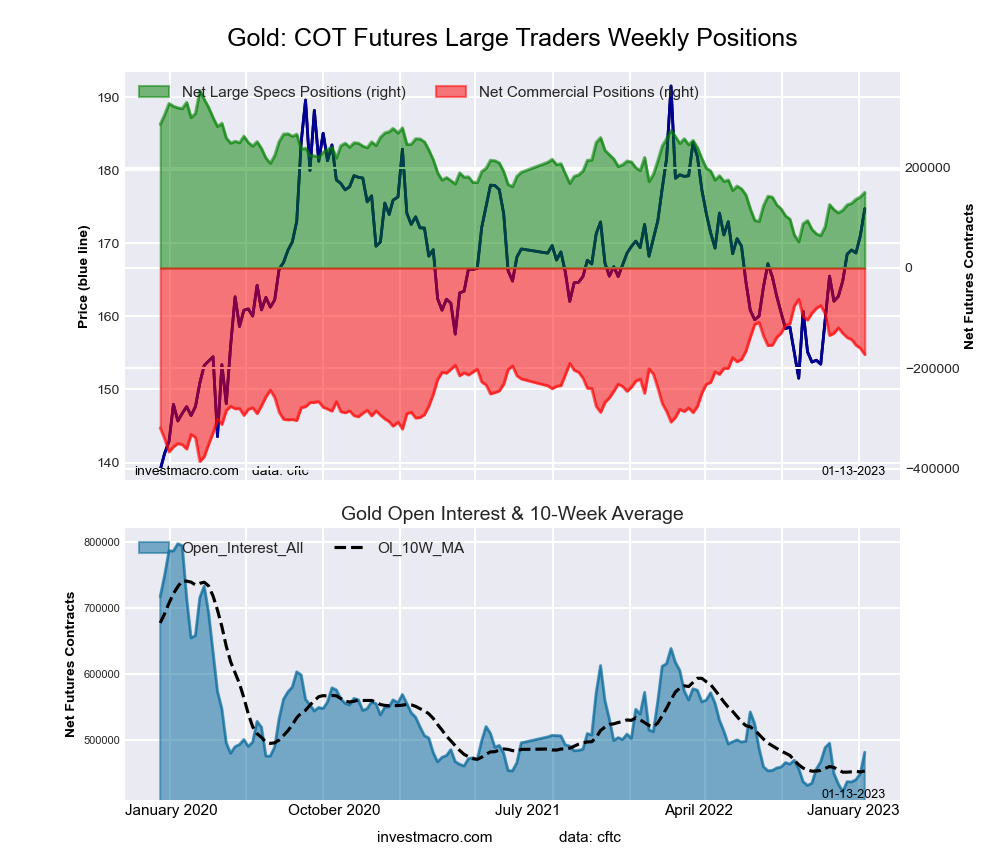
Gold Futures COT ChartThe Gold Comex Futures large speculator standing this week reached a net position of 115,125 contracts in the data reported through Tuesday. This was a weekly boost of 5,122 contracts from the previous week which had a total of 110,003 net contracts.

This week’s current strength score (the trader positioning range over the past three years, measured from 0 to 100) shows the speculators are currently Bearish with a score of 20.9 percent. The commercials are Bullish with a score of 79.0 percent and the small traders (not shown in chart) are Bearish-Extreme with a score of 17.4 percent.

Gold Futures StatisticsSPECULATORSCOMMERCIALSSMALL TRADERS
– Percent of Open Interest Longs:50.127.99.0
– Percent of Open Interest Shorts:22.858.75.4
– Net Position:115,125-130,07914,954
– Gross Longs:211,472117,57837,785
– Gross Shorts:96,347247,65722,831
– Long to Short Ratio:2.2 to 10.5 to 11.7 to 1
NET POSITION TREND:
– Strength Index Score (3 Year Range Pct):20.979.017.4
– Strength Index Reading (3 Year Range):BearishBullishBearish-Extreme
NET POSITION MOVEMENT INDEX:
– 6-Week Change in Strength Index:15.6-15.47.0


Silver Comex Futures:

Silver Futures COT ChartThe Silver Comex Futures large speculator standing this week reached a net position of 19,208 contracts in the data reported through Tuesday. This was a weekly lift of 1,725 contracts from the previous week which had a total of 17,483 net contracts.

This week’s current strength score (the trader positioning range over the past three years, measured from 0 to 100) shows the speculators are currently Bearish with a score of 35.3 percent. The commercials are Bullish with a score of 64.7 percent and the small traders (not shown in chart) are Bearish with a score of 33.4 percent.

Silver Futures StatisticsSPECULATORSCOMMERCIALSSMALL TRADERS
– Percent of Open Interest Longs:39.936.519.3
– Percent of Open Interest Shorts:24.362.88.6
– Net Position:19,208-32,26213,054
– Gross Longs:48,95444,75723,648
– Gross Shorts:29,74677,01910,594
– Long to Short Ratio:1.6 to 10.6 to 12.2 to 1
NET POSITION TREND:
– Strength Index Score (3 Year Range Pct):35.364.733.4
– Strength Index Reading (3 Year Range):BearishBullishBearish
NET POSITION MOVEMENT INDEX:
– 6-Week Change in Strength Index:21.3-22.119.7


Copper Grade #1 Futures:

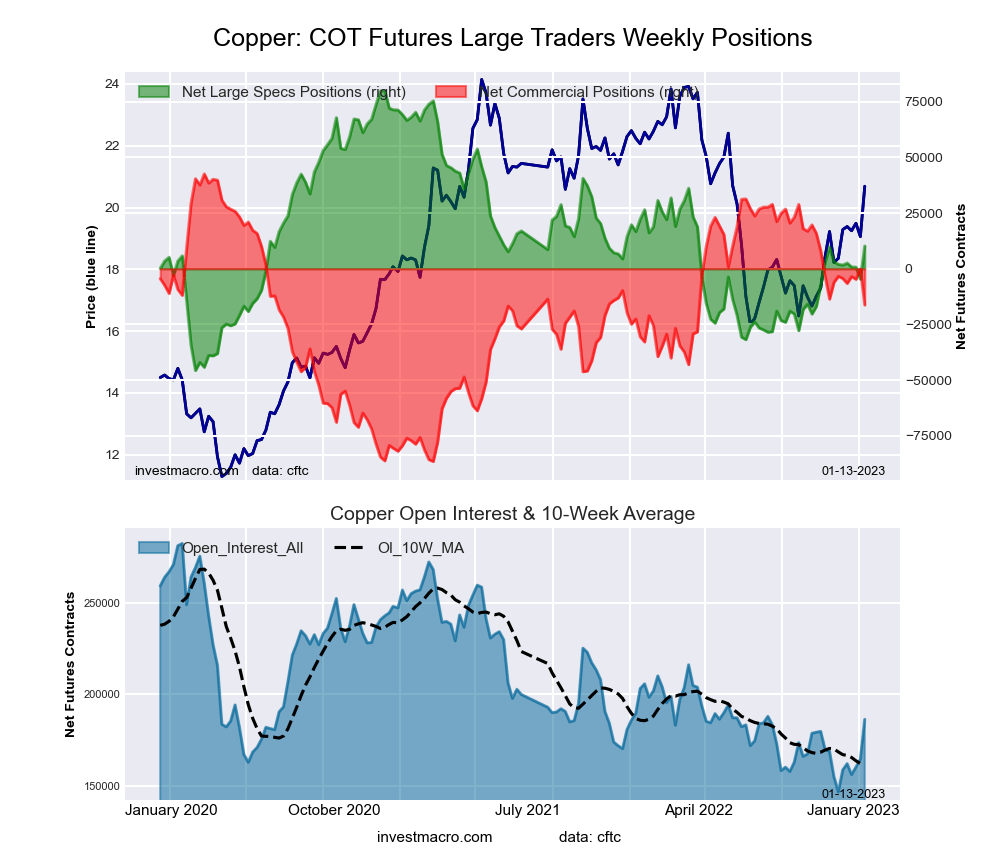
Copper Futures COT ChartThe Copper Grade #1 Futures large speculator standing this week reached a net position of 1,679 contracts in the data reported through Tuesday. This was a weekly reduction of -305 contracts from the previous week which had a total of 1,984 net contracts.

This week’s current strength score (the trader positioning range over the past three years, measured from 0 to 100) shows the speculators are currently Bearish with a score of 37.7 percent. The commercials are Bullish with a score of 63.6 percent and the small traders (not shown in chart) are Bearish with a score of 40.8 percent.

Copper Futures StatisticsSPECULATORSCOMMERCIALSSMALL TRADERS
– Percent of Open Interest Longs:35.041.89.7
– Percent of Open Interest Shorts:33.944.58.0
– Net Position:1,679-4,3542,675
– Gross Longs:55,49666,28615,368
– Gross Shorts:53,81770,64012,693
– Long to Short Ratio:1.0 to 10.9 to 11.2 to 1
NET POSITION TREND:
– Strength Index Score (3 Year Range Pct):37.763.640.8
– Strength Index Reading (3 Year Range):BearishBullishBearish
NET POSITION MOVEMENT INDEX:
– 6-Week Change in Strength Index:14.8-15.79.6


Platinum Futures:

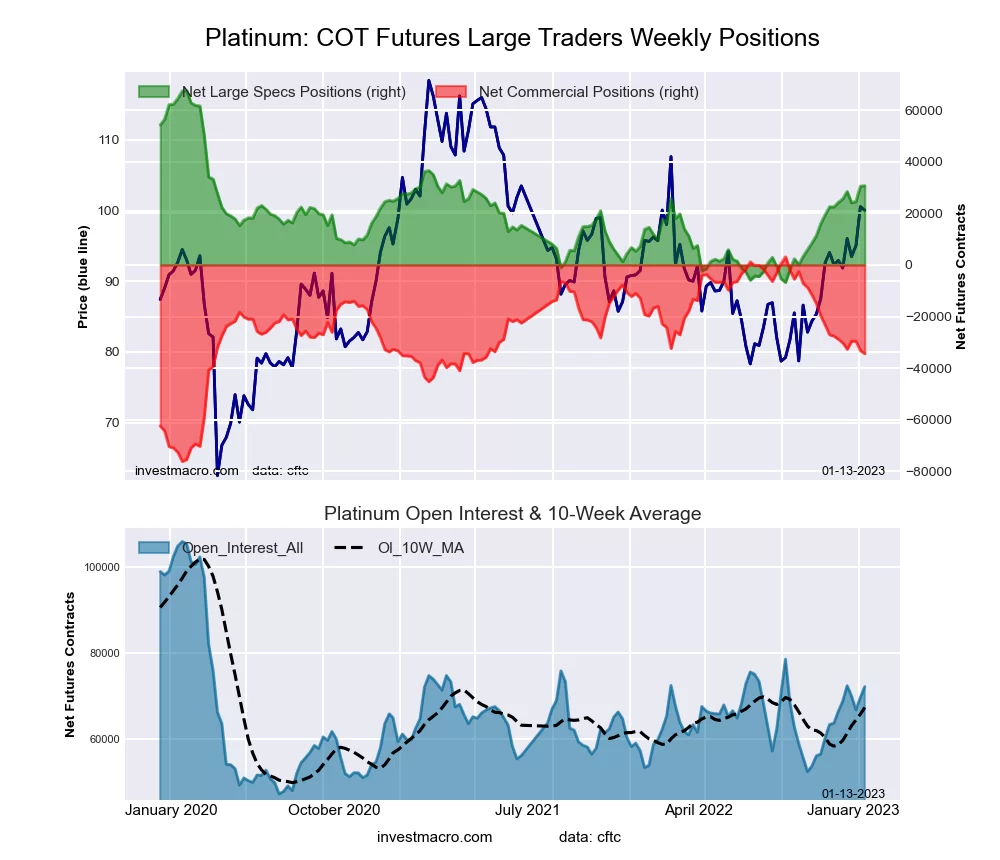
Platinum Futures COT ChartThe Platinum Futures large speculator standing this week reached a net position of 25,636 contracts in the data reported through Tuesday. This was a weekly lift of 1,377 contracts from the previous week which had a total of 24,259 net contracts.

This week’s current strength score (the trader positioning range over the past three years, measured from 0 to 100) shows the speculators are currently Bearish with a score of 43.6 percent. The commercials are Bullish with a score of 58.0 percent and the small traders (not shown in chart) are Bearish with a score of 28.6 percent.

Platinum Futures StatisticsSPECULATORSCOMMERCIALSSMALL TRADERS
– Percent of Open Interest Longs:53.329.110.6
– Percent of Open Interest Shorts:16.172.94.1
– Net Position:25,636-30,1484,512
– Gross Longs:36,69320,0257,324
– Gross Shorts:11,05750,1732,812
– Long to Short Ratio:3.3 to 10.4 to 12.6 to 1
NET POSITION TREND:
– Strength Index Score (3 Year Range Pct):43.658.028.6
– Strength Index Reading (3 Year Range):BearishBullishBearish
NET POSITION MOVEMENT INDEX:
– 6-Week Change in Strength Index:19.2-19.112.3


Palladium Futures:

Palladium Futures COT ChartThe Palladium Futures large speculator standing this week reached a net position of -1,372 contracts in the data reported through Tuesday. This was a weekly boost of 259 contracts from the previous week which had a total of -1,631 net contracts.

This week’s current strength score (the trader positioning range over the past three years, measured from 0 to 100) shows the speculators are currently Bearish-Extreme with a score of 15.7 percent. The commercials are Bullish-Extreme with a score of 81.1 percent and the small traders (not shown in chart) are Bullish with a score of 50.5 percent.

Palladium Futures StatisticsSPECULATORSCOMMERCIALSSMALL TRADERS
– Percent of Open Interest Longs:31.649.814.9
– Percent of Open Interest Shorts:49.234.013.0
– Net Position:-1,3721,226146
– Gross Longs:2,4603,8751,157
– Gross Shorts:3,8322,6491,011
– Long to Short Ratio:0.6 to 11.5 to 11.1 to 1
NET POSITION TREND:
– Strength Index Score (3 Year Range Pct):15.781.150.5
– Strength Index Reading (3 Year Range):Bearish-ExtremeBullish-ExtremeBullish
NET POSITION MOVEMENT INDEX:
– 6-Week Change in Strength Index:2.2-5.837.8


Article By InvestMacroReceive our weekly COT Newsletter

*COT Report: The COT data, released weekly to the public each Friday, is updated through the most recent Tuesday (data is 3 days old) and shows a quick view of how large speculators or non-commercials (for-profit traders) were positioned in the futures markets.

The CFTC categorizes trader positions according to commercial hedgers (traders who use futures contracts for hedging as part of the business), non-commercials (large traders who speculate to realize trading profits) and nonreportable traders (usually small traders/speculators) as well as their open interest (contracts open in the market at time of reporting). See CFTC criteria here.

COT Bonds Speculators drop 5-Year Treasury bets to 215-week low

By InvestMacro

Here are the latest charts and statistics for the Commitment of Traders (COT) reports data published by the Commodities Futures Trading Commission (CFTC).

The latest COT data is updated through Tuesday December 6th and shows a quick view of how large traders (for-profit speculators and commercial hedgers) were positioned in the futures markets.

5-Year, 10-Year drops lead the Weekly Speculator Changes

The COT bond market speculator bets were lower this week as just two out of the eight bond markets we cover had higher positioning this week while six markets had lower contracts.

Leading the weekly gains for the bond markets was the Eurodollar (65,490 contracts) with the Ultra US Bond (17,631 contracts) also showing a positive week.

The bond markets leading the weekly declines in speculator bets this week was the 5-Year Bond (-129,257 contracts) with the 10-Year Bond (-72,434 contracts), the Fed Funds (-46,249 contracts), the Ultra 10-Year (-27,703 contracts), the Long US Bond (-11,444 contracts) and the 2-Year Bond (-6,362 contracts) also registering lower bets on the week.

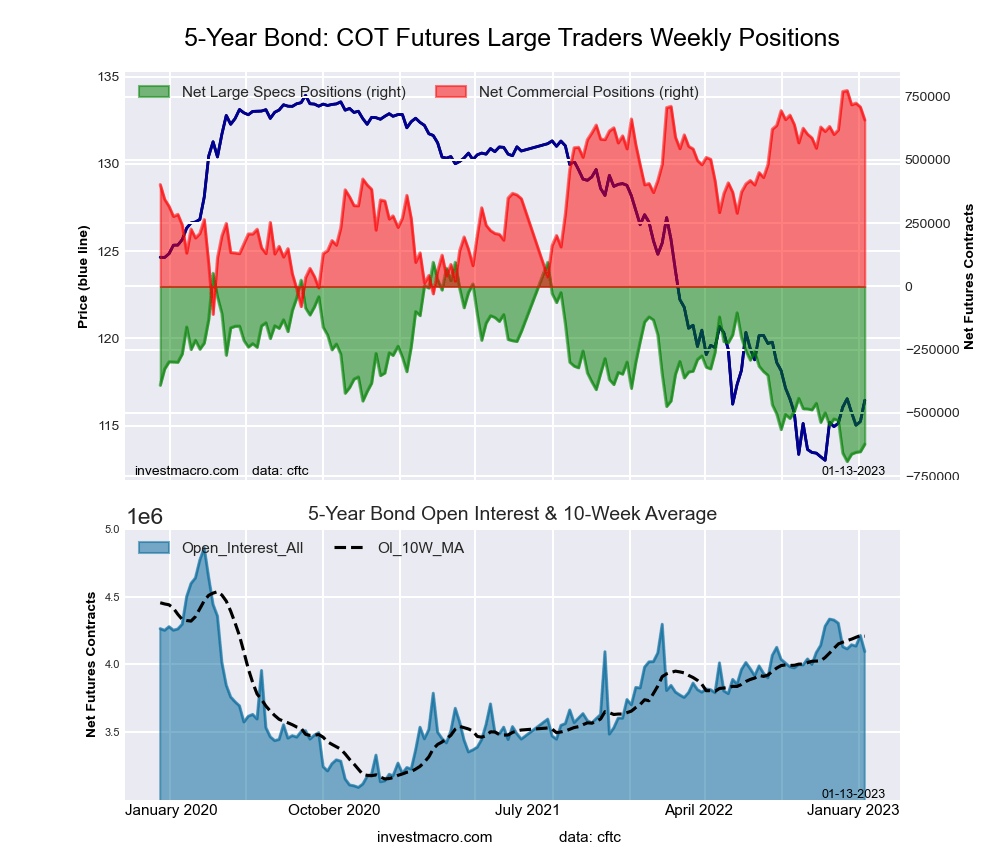
Highlighting the COT bonds data this week is the further decrease in speculator positions for the 5-Year Bonds market. The large speculator position in 5-Year Bonds futures fell this week by the largest one-week amount (-129,257 contracts) since February and have now dropped for the third time out of the past four weeks (a total decline of -159,151 contracts over last 4-week period). This weakness in speculator bets for the 5-Year Bond has brought the overall level to its most bearish point of the past 215 weeks. The last time the 5-Year Bond bets were this bearish was October 23rd of 2018 with a total of -773,639 contracts at that time. Despite the speculator weakness, the 5-Year Bond future prices have come off their November lows and touched their highest level since September this week.


Data Snapshot of Bond Market Traders | Columns Legend
Dec-06-2022OIOI-IndexSpec-NetSpec-IndexCom-NetCOM-IndexSmalls-NetSmalls-Index
Eurodollar7,263,6700-1,643,862231,944,03176-300,16938
FedFunds1,323,02831-78,8673087,74571-8,87837
2-Year2,109,98815-534,5408529,893914,64754
Long T-Bond1,170,66337-115,3614790,7004324,66172
10-Year3,775,43149-369,20616483,14979-113,94353
5-Year4,130,32259-658,6060770,224100-111,61850


Strength Scores led by US Treasury Bond

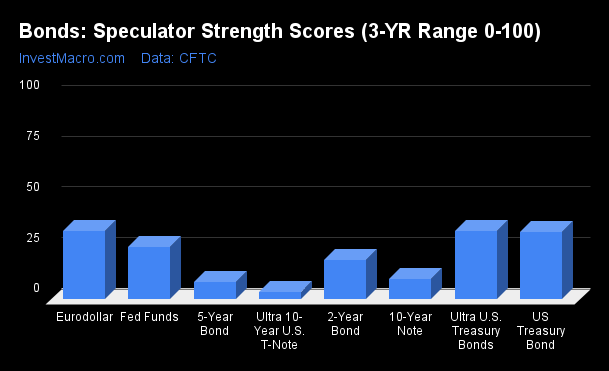
Strength Scores (a normalized measure of Speculator positions over a 3-Year range, from 0 to 100 where above 80 is extreme bullish and below 20 is extreme bearish) show that the US Treasury Bond (47.0 percent) leads the bonds category.

On the downside, the 5-Year Bond (0.0 percent), the Ultra 10-Year Bond (1.0 percent), the 2-Year Bond (7.7 percent) and the 10-Year Bond (16.3 percent) come in at the lowest strength levels currently and are all in Extreme-Bearish levels (below 20 percent).

Strength Statistics:
Fed Funds (29.9 percent) vs Fed Funds previous week (35.6 percent)
2-Year Bond (7.7 percent) vs 2-Year Bond previous week (8.6 percent)
5-Year Bond (0.0 percent) vs 5-Year Bond previous week (17.1 percent)
10-Year Bond (16.3 percent) vs 10-Year Bond previous week (27.3 percent)
Ultra 10-Year Bond (1.0 percent) vs Ultra 10-Year Bond previous week (8.2 percent)
US Treasury Bond (47.0 percent) vs US Treasury Bond previous week (50.8 percent)
Ultra US Treasury Bond (33.5 percent) vs Ultra US Treasury Bond previous week (26.3 percent)
Eurodollar (22.9 percent) vs Eurodollar previous week (21.7 percent)

Eurodollar tops Strength Trends

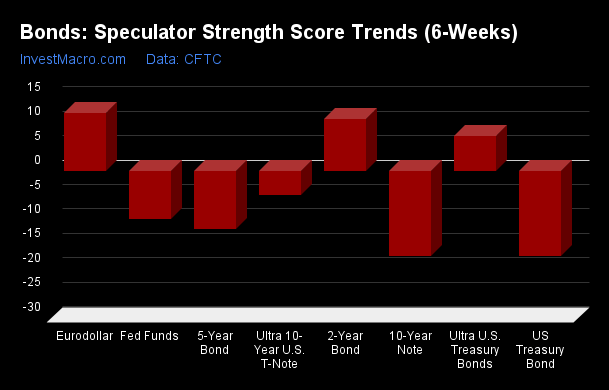
Strength Score Trends (or move index, calculates the 6-week changes in strength scores) showed that the Eurodollar (4.7 percent) leads the past six weeks trends for bonds this week and is the only positive mover in the latest trends data.

The 2-Year Bond (-27.4 percent), the 5-Year Bond (-26.1 percent), the Fed Funds (-18.7 percent) and the 10-Year Bond (-18.5 percent) lead the downside trend scores this week.

Strength Trend Statistics:
Fed Funds (-18.7 percent) vs Fed Funds previous week (-7.7 percent)
2-Year Bond (-27.4 percent) vs 2-Year Bond previous week (-28.6 percent)
5-Year Bond (-26.1 percent) vs 5-Year Bond previous week (-5.5 percent)
10-Year Bond (-18.5 percent) vs 10-Year Bond previous week (2.5 percent)
Ultra 10-Year Bond (-7.2 percent) vs Ultra 10-Year Bond previous week (-0.7 percent)
US Treasury Bond (-12.6 percent) vs US Treasury Bond previous week (-5.7 percent)
Ultra US Treasury Bond (-8.5 percent) vs Ultra US Treasury Bond previous week (-14.2 percent)
Eurodollar (4.7 percent) vs Eurodollar previous week (6.8 percent)


Individual Bond Markets:

3-Month Eurodollars Futures:

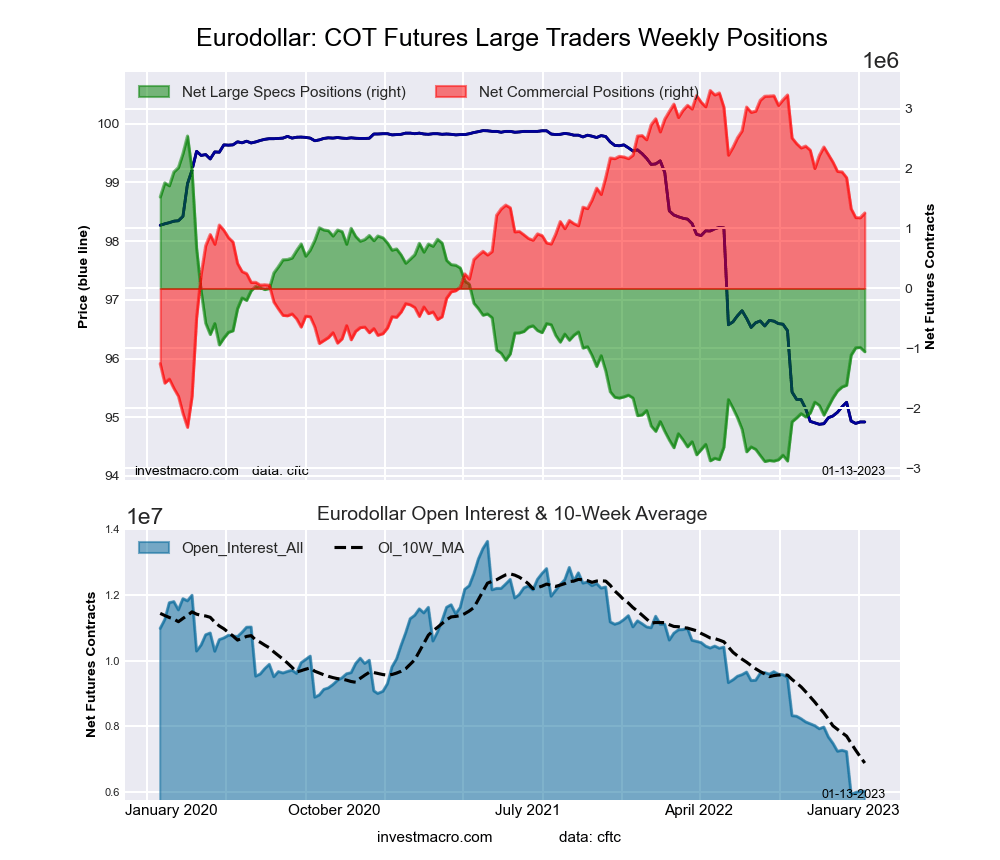
Eurodollar Bonds Futures COT ChartThe 3-Month Eurodollars large speculator standing this week recorded a net position of -1,643,862 contracts in the data reported through Tuesday. This was a weekly rise of 65,490 contracts from the previous week which had a total of -1,709,352 net contracts.

This week’s current strength score (the trader positioning range over the past three years, measured from 0 to 100) shows the speculators are currently Bearish with a score of 22.9 percent. The commercials are Bullish with a score of 75.8 percent and the small traders (not shown in chart) are Bearish with a score of 38.4 percent.

3-Month Eurodollars StatisticsSPECULATORSCOMMERCIALSSMALL TRADERS
– Percent of Open Interest Longs:7.669.44.9
– Percent of Open Interest Shorts:30.242.69.0
– Net Position:-1,643,8621,944,031-300,169
– Gross Longs:548,9985,041,684353,408
– Gross Shorts:2,192,8603,097,653653,577
– Long to Short Ratio:0.3 to 11.6 to 10.5 to 1
NET POSITION TREND:
– Strength Index Score (3 Year Range Pct):22.975.838.4
– Strength Index Reading (3 Year Range):BearishBullishBearish
NET POSITION MOVEMENT INDEX:
– 6-Week Change in Strength Index:4.7-1.0-43.2


30-Day Federal Funds Futures:

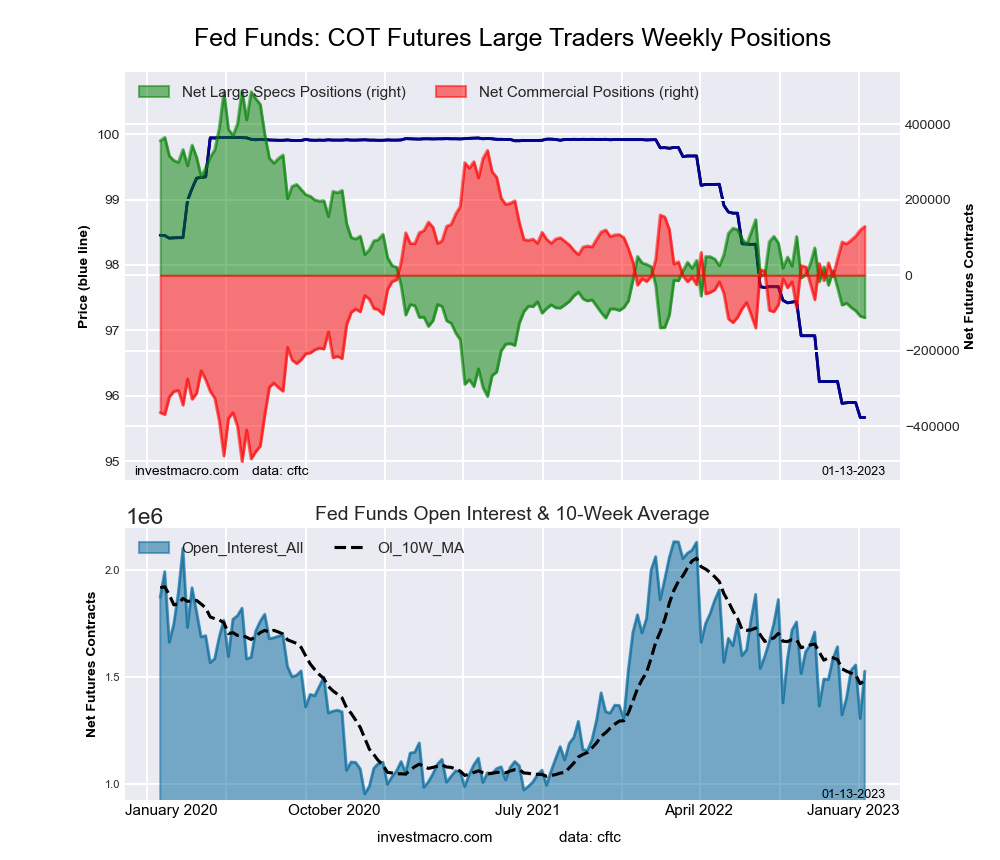
Federal Funds 30-Day Bonds Futures COT ChartThe 30-Day Federal Funds large speculator standing this week recorded a net position of -78,867 contracts in the data reported through Tuesday. This was a weekly reduction of -46,249 contracts from the previous week which had a total of -32,618 net contracts.

This week’s current strength score (the trader positioning range over the past three years, measured from 0 to 100) shows the speculators are currently Bearish with a score of 29.9 percent. The commercials are Bullish with a score of 70.5 percent and the small traders (not shown in chart) are Bearish with a score of 37.0 percent.

30-Day Federal Funds StatisticsSPECULATORSCOMMERCIALSSMALL TRADERS
– Percent of Open Interest Longs:8.778.62.3
– Percent of Open Interest Shorts:14.671.92.9
– Net Position:-78,86787,745-8,878
– Gross Longs:114,6991,039,30330,010
– Gross Shorts:193,566951,55838,888
– Long to Short Ratio:0.6 to 11.1 to 10.8 to 1
NET POSITION TREND:
– Strength Index Score (3 Year Range Pct):29.970.537.0
– Strength Index Reading (3 Year Range):BearishBullishBearish
NET POSITION MOVEMENT INDEX:
– 6-Week Change in Strength Index:-18.718.5-3.5


2-Year Treasury Note Futures:

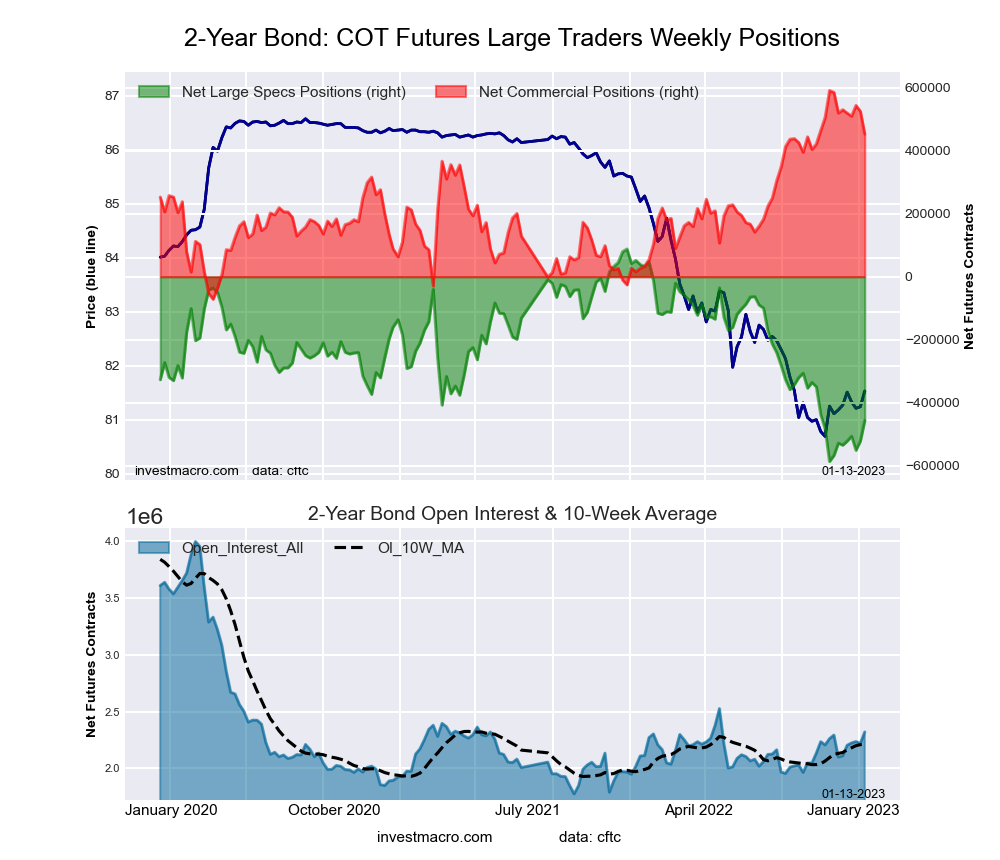
2-Year Treasury Bonds Futures COT ChartThe 2-Year Treasury Note large speculator standing this week recorded a net position of -534,540 contracts in the data reported through Tuesday. This was a weekly reduction of -6,362 contracts from the previous week which had a total of -528,178 net contracts.

This week’s current strength score (the trader positioning range over the past three years, measured from 0 to 100) shows the speculators are currently Bearish-Extreme with a score of 7.7 percent. The commercials are Bullish-Extreme with a score of 90.8 percent and the small traders (not shown in chart) are Bullish with a score of 54.1 percent.

2-Year Treasury Note StatisticsSPECULATORSCOMMERCIALSSMALL TRADERS
– Percent of Open Interest Longs:8.182.08.3
– Percent of Open Interest Shorts:33.556.98.1
– Net Position:-534,540529,8934,647
– Gross Longs:171,7601,730,674174,708
– Gross Shorts:706,3001,200,781170,061
– Long to Short Ratio:0.2 to 11.4 to 11.0 to 1
NET POSITION TREND:
– Strength Index Score (3 Year Range Pct):7.790.854.1
– Strength Index Reading (3 Year Range):Bearish-ExtremeBullish-ExtremeBullish
NET POSITION MOVEMENT INDEX:
– 6-Week Change in Strength Index:-27.416.434.1


5-Year Treasury Note Futures:

5-Year Treasury Bonds Futures COT ChartThe 5-Year Treasury Note large speculator standing this week recorded a net position of -658,606 contracts in the data reported through Tuesday. This was a weekly decline of -129,257 contracts from the previous week which had a total of -529,349 net contracts.

This week’s current strength score (the trader positioning range over the past three years, measured from 0 to 100) shows the speculators are currently Bearish-Extreme with a score of 0.0 percent. The commercials are Bullish-Extreme with a score of 100.0 percent and the small traders (not shown in chart) are Bullish with a score of 50.4 percent.

5-Year Treasury Note StatisticsSPECULATORSCOMMERCIALSSMALL TRADERS
– Percent of Open Interest Longs:5.585.67.3
– Percent of Open Interest Shorts:21.567.010.1
– Net Position:-658,606770,224-111,618
– Gross Longs:229,0013,537,413303,580
– Gross Shorts:887,6072,767,189415,198
– Long to Short Ratio:0.3 to 11.3 to 10.7 to 1
NET POSITION TREND:
– Strength Index Score (3 Year Range Pct):0.0100.050.4
– Strength Index Reading (3 Year Range):Bearish-ExtremeBullish-ExtremeBullish
NET POSITION MOVEMENT INDEX:
– 6-Week Change in Strength Index:-26.125.5-7.5


10-Year Treasury Note Futures:

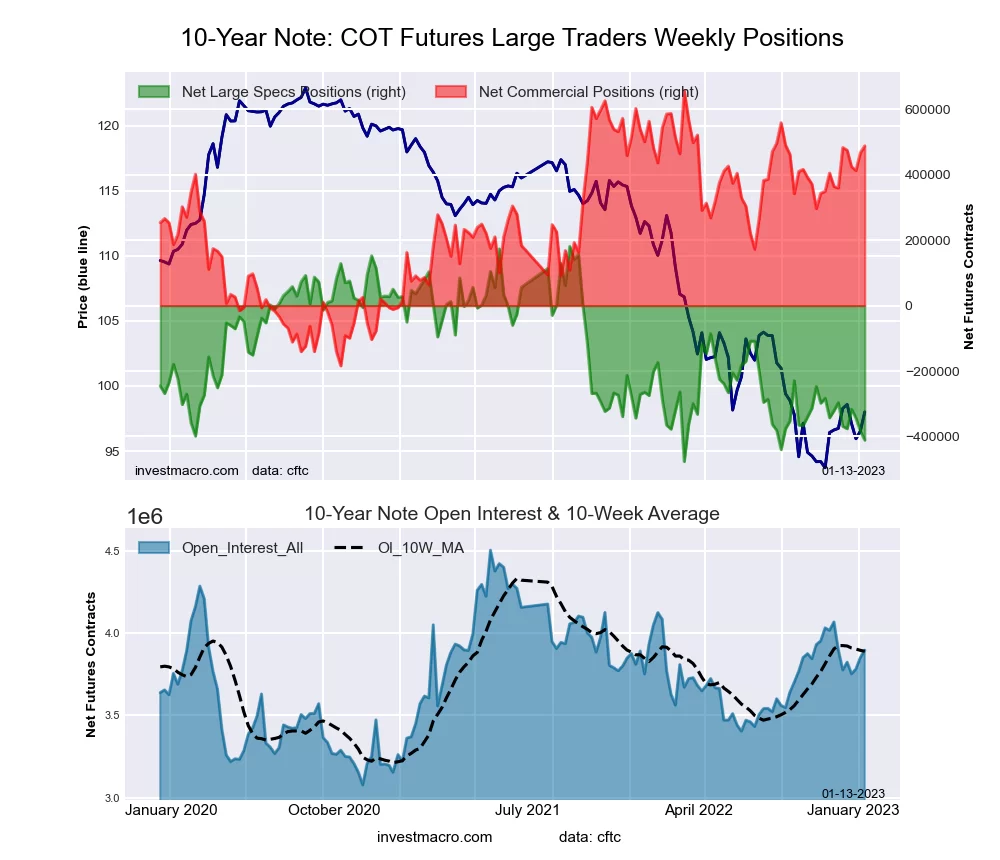
10-Year Treasury Notes Bonds Futures COT ChartThe 10-Year Treasury Note large speculator standing this week recorded a net position of -369,206 contracts in the data reported through Tuesday. This was a weekly decrease of -72,434 contracts from the previous week which had a total of -296,772 net contracts.

This week’s current strength score (the trader positioning range over the past three years, measured from 0 to 100) shows the speculators are currently Bearish-Extreme with a score of 16.3 percent. The commercials are Bullish with a score of 79.3 percent and the small traders (not shown in chart) are Bullish with a score of 53.0 percent.

10-Year Treasury Note StatisticsSPECULATORSCOMMERCIALSSMALL TRADERS
– Percent of Open Interest Longs:11.277.28.9
– Percent of Open Interest Shorts:21.064.411.9
– Net Position:-369,206483,149-113,943
– Gross Longs:423,9942,914,741336,179
– Gross Shorts:793,2002,431,592450,122
– Long to Short Ratio:0.5 to 11.2 to 10.7 to 1
NET POSITION TREND:
– Strength Index Score (3 Year Range Pct):16.379.353.0
– Strength Index Reading (3 Year Range):Bearish-ExtremeBullishBullish
NET POSITION MOVEMENT INDEX:
– 6-Week Change in Strength Index:-18.522.1-15.4


Ultra 10-Year Notes Futures:

Ultra 10-Year Treasury Notes Bonds Futures COT ChartThe Ultra 10-Year Notes large speculator standing this week recorded a net position of -106,952 contracts in the data reported through Tuesday. This was a weekly lowering of -27,703 contracts from the previous week which had a total of -79,249 net contracts.

This week’s current strength score (the trader positioning range over the past three years, measured from 0 to 100) shows the speculators are currently Bearish-Extreme with a score of 1.0 percent. The commercials are Bullish-Extreme with a score of 88.9 percent and the small traders (not shown in chart) are Bullish with a score of 72.2 percent.

Ultra 10-Year Notes StatisticsSPECULATORSCOMMERCIALSSMALL TRADERS
– Percent of Open Interest Longs:10.177.911.4
– Percent of Open Interest Shorts:17.764.517.2
– Net Position:-106,952189,505-82,553
– Gross Longs:142,2631,099,122160,187
– Gross Shorts:249,215909,617242,740
– Long to Short Ratio:0.6 to 11.2 to 10.7 to 1
NET POSITION TREND:
– Strength Index Score (3 Year Range Pct):1.088.972.2
– Strength Index Reading (3 Year Range):Bearish-ExtremeBullish-ExtremeBullish
NET POSITION MOVEMENT INDEX:
– 6-Week Change in Strength Index:-7.27.8-1.9


US Treasury Bonds Futures:

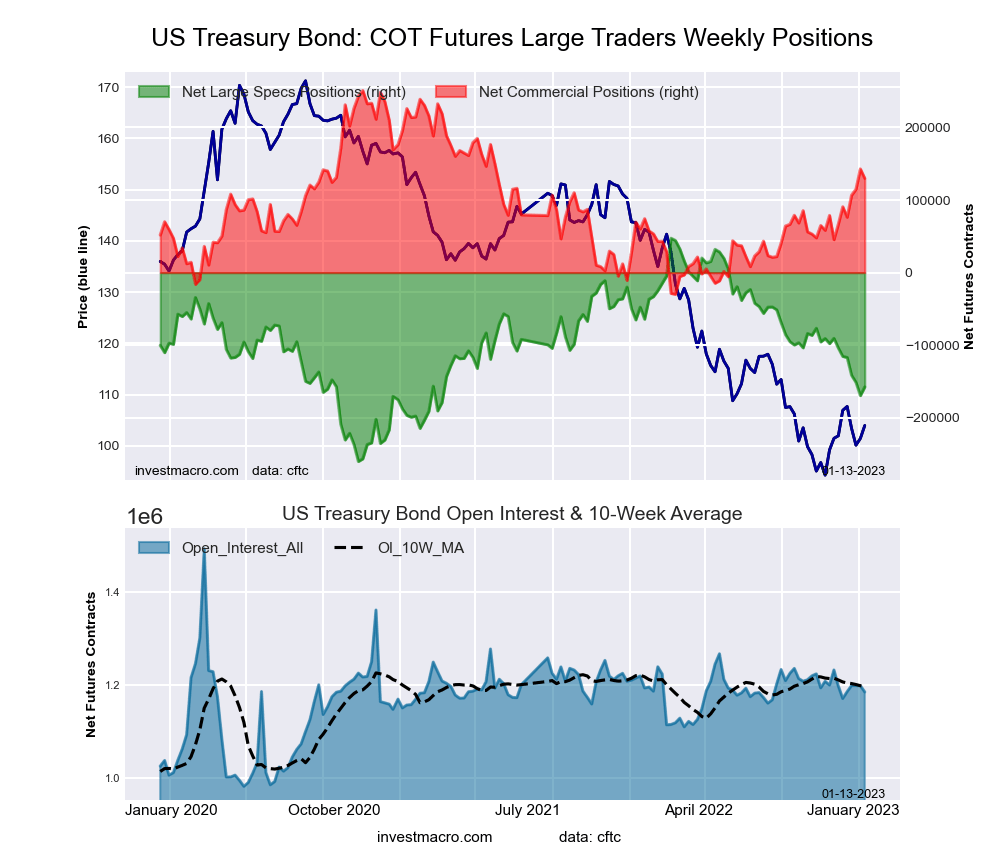
US Year Treasury Notes Long Bonds Futures COT ChartThe US Treasury Bonds large speculator standing this week recorded a net position of -115,361 contracts in the data reported through Tuesday. This was a weekly decrease of -11,444 contracts from the previous week which had a total of -103,917 net contracts.

This week’s current strength score (the trader positioning range over the past three years, measured from 0 to 100) shows the speculators are currently Bearish with a score of 47.0 percent. The commercials are Bearish with a score of 42.9 percent and the small traders (not shown in chart) are Bullish with a score of 72.2 percent.

US Treasury Bonds StatisticsSPECULATORSCOMMERCIALSSMALL TRADERS
– Percent of Open Interest Longs:4.779.514.8
– Percent of Open Interest Shorts:14.671.712.7
– Net Position:-115,36190,70024,661
– Gross Longs:55,349930,571173,282
– Gross Shorts:170,710839,871148,621
– Long to Short Ratio:0.3 to 11.1 to 11.2 to 1
NET POSITION TREND:
– Strength Index Score (3 Year Range Pct):47.042.972.2
– Strength Index Reading (3 Year Range):BearishBearishBullish
NET POSITION MOVEMENT INDEX:
– 6-Week Change in Strength Index:-12.615.3-3.2


Ultra US Treasury Bonds Futures:

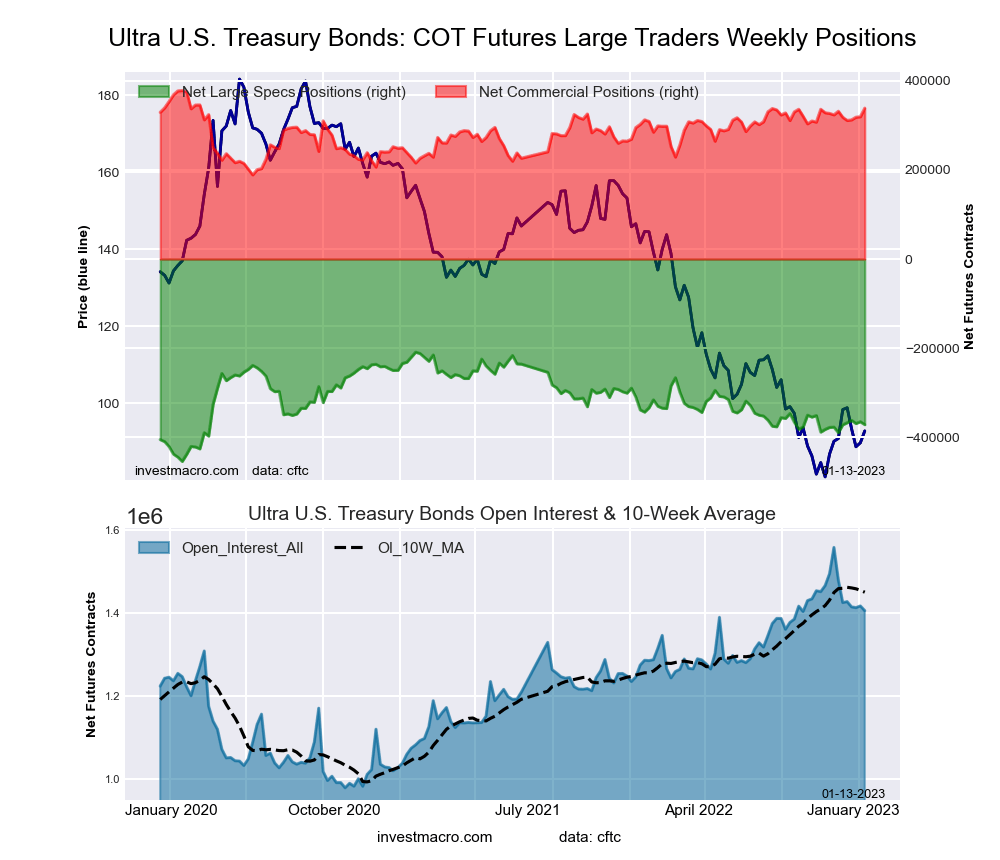
Ultra US Year Treasury Notes Long Bonds Futures COT ChartThe Ultra US Treasury Bonds large speculator standing this week recorded a net position of -371,773 contracts in the data reported through Tuesday. This was a weekly lift of 17,631 contracts from the previous week which had a total of -389,404 net contracts.

This week’s current strength score (the trader positioning range over the past three years, measured from 0 to 100) shows the speculators are currently Bearish with a score of 33.5 percent. The commercials are Bullish with a score of 68.3 percent and the small traders (not shown in chart) are Bullish with a score of 76.0 percent.

Ultra US Treasury Bonds StatisticsSPECULATORSCOMMERCIALSSMALL TRADERS
– Percent of Open Interest Longs:3.983.811.8
– Percent of Open Interest Shorts:30.061.58.0
– Net Position:-371,773317,92953,844
– Gross Longs:56,2721,193,551168,437
– Gross Shorts:428,045875,622114,593
– Long to Short Ratio:0.1 to 11.4 to 11.5 to 1
NET POSITION TREND:
– Strength Index Score (3 Year Range Pct):33.568.376.0
– Strength Index Reading (3 Year Range):BearishBullishBullish
NET POSITION MOVEMENT INDEX:
– 6-Week Change in Strength Index:-8.55.88.0


Article By InvestMacroReceive our weekly COT Newsletter

*COT Report: The COT data, released weekly to the public each Friday, is updated through the most recent Tuesday (data is 3 days old) and shows a quick view of how large speculators or non-commercials (for-profit traders) were positioned in the futures markets.

The CFTC categorizes trader positions according to commercial hedgers (traders who use futures contracts for hedging as part of the business), non-commercials (large traders who speculate to realize trading profits) and nonreportable traders (usually small traders/speculators) as well as their open interest (contracts open in the market at time of reporting). See CFTC criteria here.

COT Soft Commodities Speculators drop Corn bullish bets to 19-week low

By InvestMacro

Here are the latest charts and statistics for the Commitment of Traders (COT) reports data published by the Commodities Futures Trading Commission (CFTC).

The latest COT data is updated through Tuesday December 6th and shows a quick view of how large traders (for-profit speculators and commercial entities) were positioned in the futures markets.

Weekly Speculator Changes

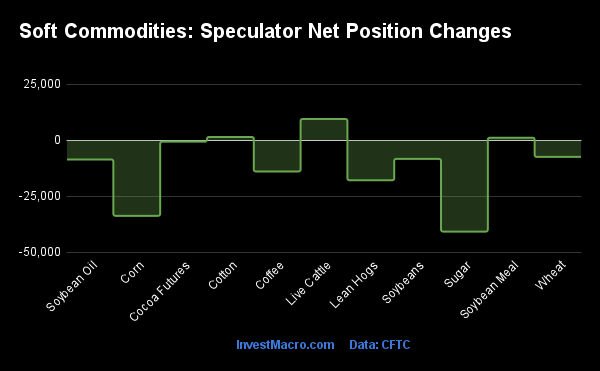
The COT soft commodities speculator bets were overall higher this week as seven out of the eleven soft commodities markets we cover had higher positioning this week while the other four markets had decreases in contracts.

Leading the gains for soft commodities markets was Soybean Meal (19,835 contracts) with Cocoa (8,266 contracts), Sugar (4,089 contracts), Lean Hogs (3,409 contracts), Soybeans (2,453 contracts), Cotton (2,140 contracts) and Live Cattle (1,229 contracts) also showing positive weeks.

The softs market leading the declines in speculator bets this week was Corn (-71,867 contracts) with Soybean Oil (-37,543 contracts), Wheat (-6,592 contracts) and Coffee (-6 contracts) also registering lower bets on the week.

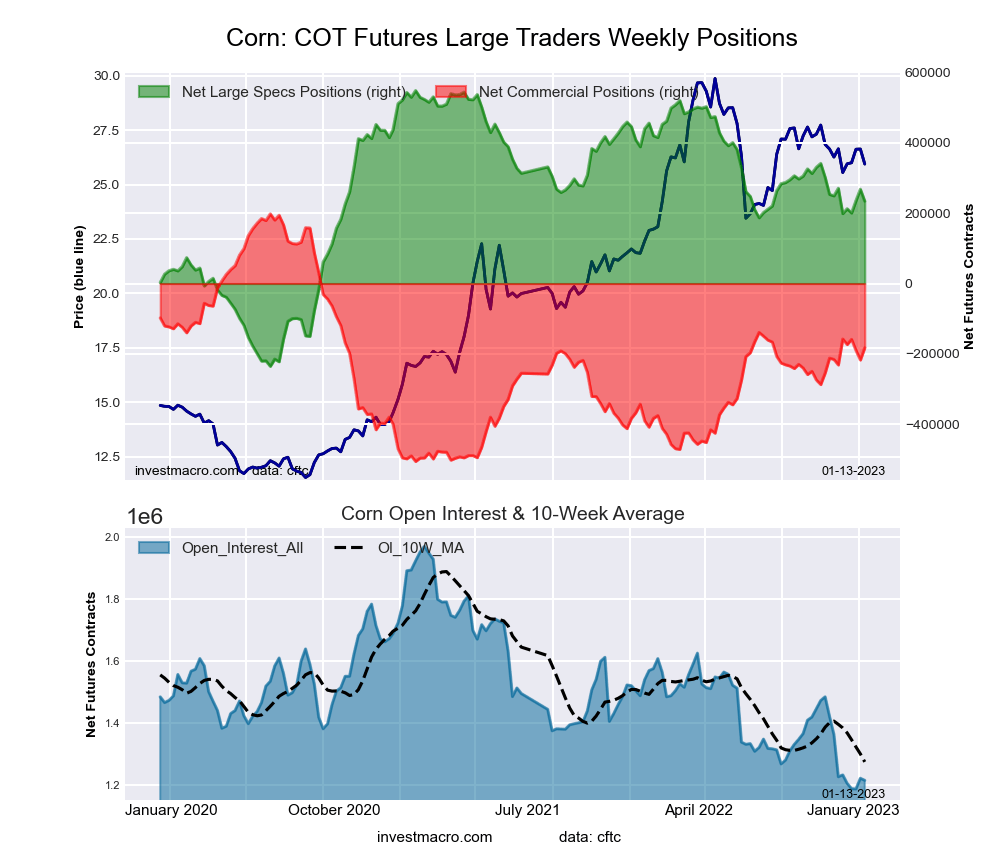
Highlighting the COT soft commodities data this week is the recent drop in Corn‘s speculator positioning. The large speculator bets for Corn decreased sharply this week and by the largest one-week amount since 2018 with a -71,867 contract decline. Overall, Corn bets have now fallen by -142,413 net speculator contracts in just the past five weeks, going from a total of +340,788 contracts on November 1st to a total of +198,375 contracts this week. This week’s total is the least bullish level in the past nineteen weeks, dating back to July 26th.

Corn futures prices have been in retreat since peaking in April of this year as the front-month futures price settled on Friday at just over 644’0. This is down almost 20 percent from the April peak, however, Corn does remain in an uptrend on the weekly charts.


Data Snapshot of Commodity Market Traders | Columns Legend
Dec-06-2022OIOI-IndexSpec-NetSpec-IndexCom-NetCOM-IndexSmalls-NetSmalls-Index
WTI Crude1,436,7283231,7206-259,5539427,83345
Gold422,1000115,12521-130,0797914,95417
Silver122,558119,20835-32,2626513,05433
Copper158,76291,67938-4,354642,67541
Palladium7,7859-1,372161,2268114650
Platinum68,8213725,63644-30,148584,51229
Natural Gas1,010,47911-164,03729135,6067428,43148
Brent144,1477-28,1186423,746334,37268
Heating Oil257,1581922,82876-39,5062916,67856
Soybeans622,2001189,66138-59,88271-29,77921
Corn1,232,3071198,37555-157,53649-40,83920
Coffee203,29614-14,642212,907981,73524
Sugar881,38834183,12457-226,0663842,94261
Wheat334,76021-39,897042,820100-2,92395


Soybean Meal  tops Strength Scores

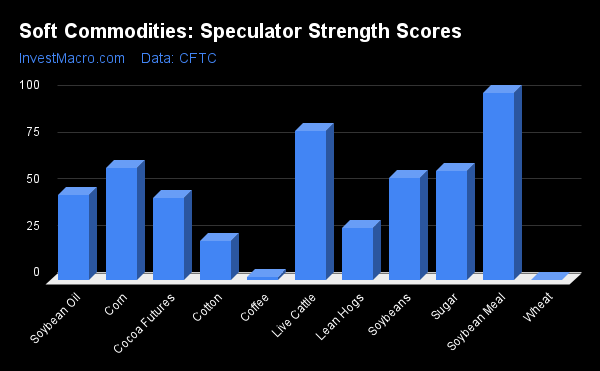
Strength Scores (a normalized measure of Speculator positions over a 3-Year range, from 0 to 100 where above 80 is extreme bullish and below 20 is extreme bearish) showed that Soybean Meal (95.5 percent) leads the soft commodity markets and is in a bullish extreme position (above 80 percent). Sugar (56.9 percent) and Corn (55.4 percent) come in as the next highest soft commodity markets in strength scores.

On the downside, Wheat (0.0 percent) and Coffee (1.8 percent) come in at the lowest strength level currently and are in an Extreme-Bearish position (below 20 percent).

Strength Statistics:
Corn (55.4 percent) vs Corn previous week (64.6 percent)
Sugar (56.9 percent) vs Sugar previous week (55.5 percent)
Coffee (1.8 percent) vs Coffee previous week (1.8 percent)
Soybeans (38.5 percent) vs Soybeans previous week (37.7 percent)
Soybean Oil (48.5 percent) vs Soybean Oil previous week (74.3 percent)
Soybean Meal (95.5 percent) vs Soybean Meal previous week (84.5 percent)
Live Cattle (48.7 percent) vs Live Cattle previous week (47.1 percent)
Lean Hogs (46.9 percent) vs Lean Hogs previous week (43.1 percent)
Cotton (21.5 percent) vs Cotton previous week (19.9 percent)
Cocoa (34.6 percent) vs Cocoa previous week (26.4 percent)
Wheat (0.0 percent) vs Wheat previous week (6.5 percent)

Sugar leads the 6-Week Strength Trends

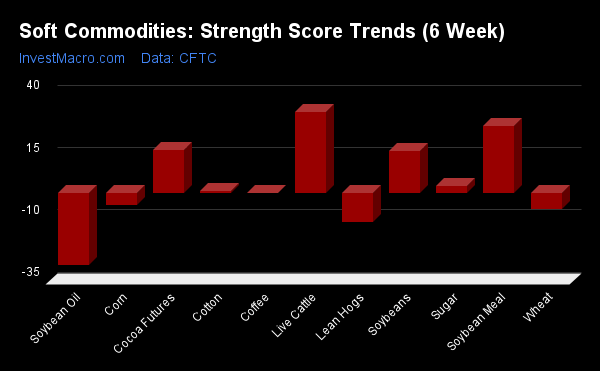
Strength Score Trends (or move index, calculates the 6-week changes in strength scores) show that Sugar (24.5 percent) leads the past six weeks trends for soft commodity markets this week. Cocoa (19.3 percent), Soybeans (10.3 percent) and Soybean Meal (3.4 percent) fill out the other positive movers in the latest trends data.

Coffee (-29.9 percent) and Wheat (-26.4 percent) lead the downside trend scores this week. The next markets with lower trend scores were Corn (-16.8 percent), Live Cattle (-11.1 percent) and Cotton (-4.6 percent).

Strength Trend Statistics:
Corn (-16.8 percent) vs Corn previous week (-5.4 percent)
Sugar (24.5 percent) vs Sugar previous week (18.1 percent)
Coffee (-29.9 percent) vs Coffee previous week (-38.9 percent)
Soybeans (10.3 percent) vs Soybeans previous week (10.4 percent)
Soybean Oil (-18.5 percent) vs Soybean Oil previous week (18.9 percent)
Soybean Meal (3.4 percent) vs Soybean Meal previous week (1.8 percent)
Live Cattle (-11.1 percent) vs Live Cattle previous week (15.5 percent)
Lean Hogs (-1.7 percent) vs Lean Hogs previous week (9.6 percent)
Cotton (-4.6 percent) vs Cotton previous week (-12.2 percent)
Cocoa (19.3 percent) vs Cocoa previous week (-1.5 percent)
Wheat (-26.4 percent) vs Wheat previous week (-29.2 percent)


Individual Soft Commodities Markets:

CORN Futures:

CORN Futures COT ChartThe CORN large speculator standing this week totaled a net position of 198,375 contracts in the data reported through Tuesday. This was a weekly fall of -71,867 contracts from the previous week which had a total of 270,242 net contracts.

This week’s current strength score (the trader positioning range over the past three years, measured from 0 to 100) shows the speculators are currently Bullish with a score of 55.4 percent. The commercials are Bearish with a score of 49.5 percent and the small traders (not shown in chart) are Bearish with a score of 20.0 percent.

CORN Futures StatisticsSPECULATORSCOMMERCIALSSMALL TRADERS
– Percent of Open Interest Longs:25.648.59.9
– Percent of Open Interest Shorts:9.561.213.2
– Net Position:198,375-157,536-40,839
– Gross Longs:315,270597,177121,431
– Gross Shorts:116,895754,713162,270
– Long to Short Ratio:2.7 to 10.8 to 10.7 to 1
NET POSITION TREND:
– Strength Index Score (3 Year Range Pct):55.449.520.0
– Strength Index Reading (3 Year Range):BullishBearishBearish
NET POSITION MOVEMENT INDEX:
– 6-Week Change in Strength Index:-16.816.59.0


SUGAR Futures:

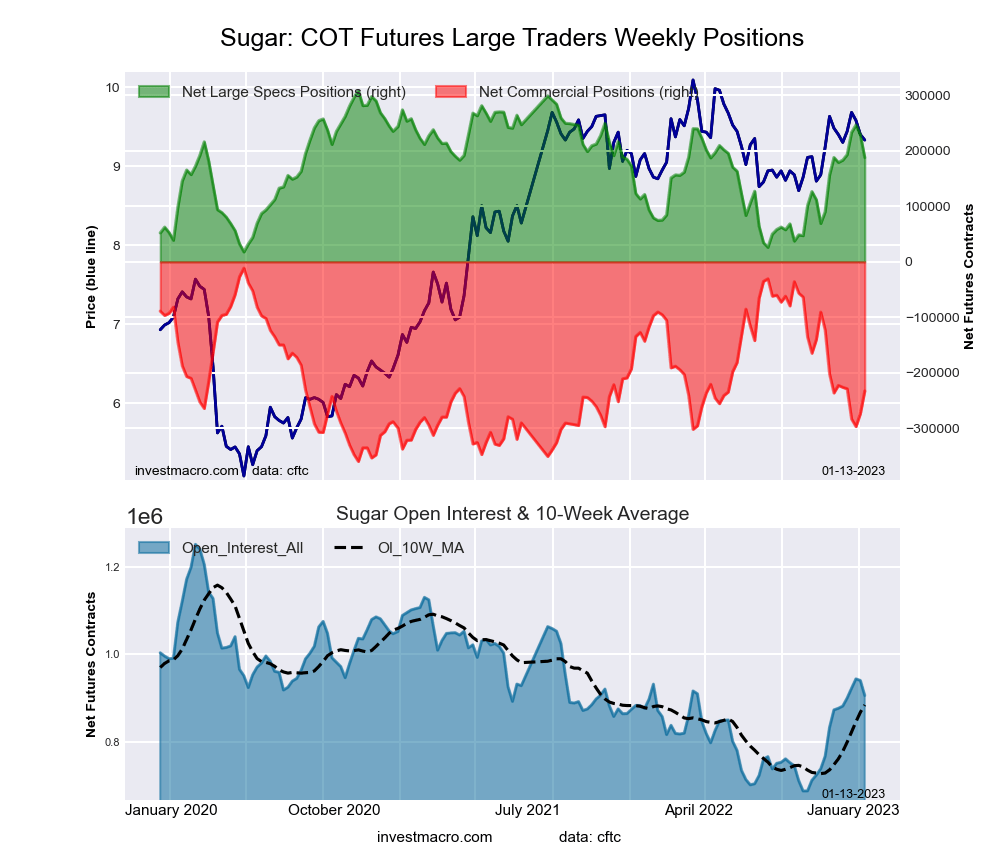
SUGAR Futures COT ChartThe SUGAR large speculator standing this week totaled a net position of 183,124 contracts in the data reported through Tuesday. This was a weekly advance of 4,089 contracts from the previous week which had a total of 179,035 net contracts.

This week’s current strength score (the trader positioning range over the past three years, measured from 0 to 100) shows the speculators are currently Bullish with a score of 56.9 percent. The commercials are Bearish with a score of 38.3 percent and the small traders (not shown in chart) are Bullish with a score of 60.9 percent.

SUGAR Futures StatisticsSPECULATORSCOMMERCIALSSMALL TRADERS
– Percent of Open Interest Longs:32.145.010.4
– Percent of Open Interest Shorts:11.370.65.5
– Net Position:183,124-226,06642,942
– Gross Longs:282,673396,31791,614
– Gross Shorts:99,549622,38348,672
– Long to Short Ratio:2.8 to 10.6 to 11.9 to 1
NET POSITION TREND:
– Strength Index Score (3 Year Range Pct):56.938.360.9
– Strength Index Reading (3 Year Range):BullishBearishBullish
NET POSITION MOVEMENT INDEX:
– 6-Week Change in Strength Index:24.5-24.718.1


COFFEE Futures:

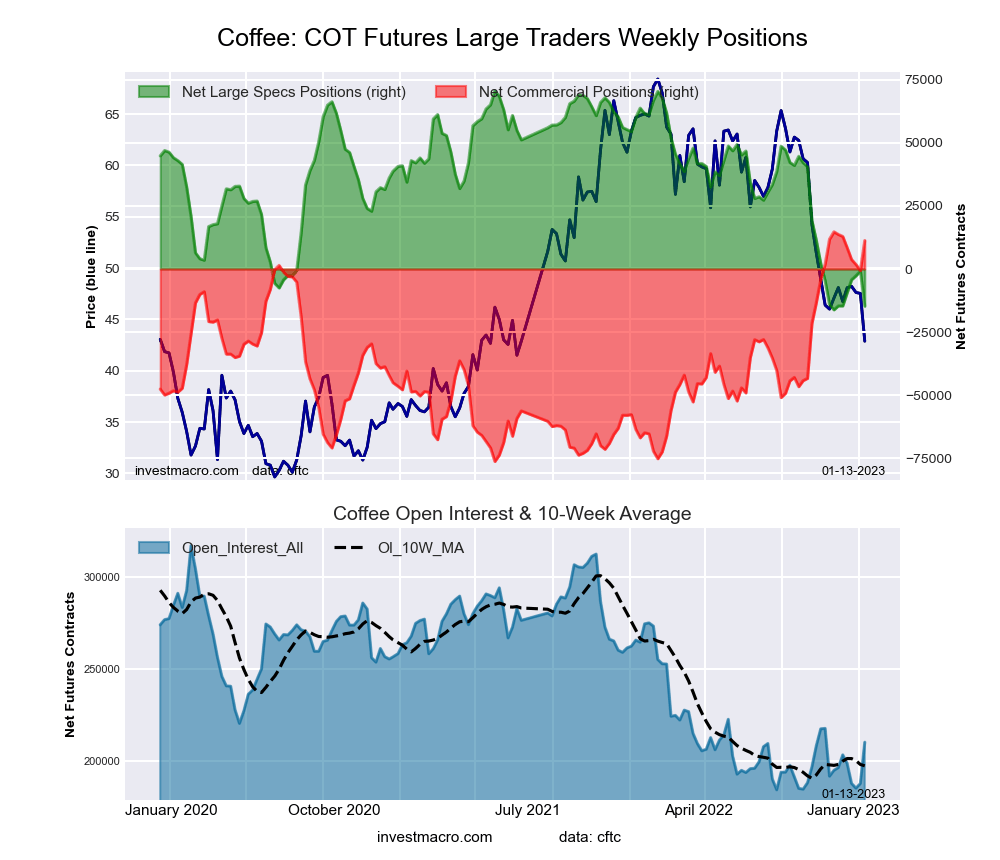
COFFEE Futures COT ChartThe COFFEE large speculator standing this week totaled a net position of -14,642 contracts in the data reported through Tuesday. This was a weekly lowering of -6 contracts from the previous week which had a total of -14,636 net contracts.

This week’s current strength score (the trader positioning range over the past three years, measured from 0 to 100) shows the speculators are currently Bearish-Extreme with a score of 1.8 percent. The commercials are Bullish-Extreme with a score of 98.0 percent and the small traders (not shown in chart) are Bearish with a score of 23.6 percent.

COFFEE Futures StatisticsSPECULATORSCOMMERCIALSSMALL TRADERS
– Percent of Open Interest Longs:19.954.84.7
– Percent of Open Interest Shorts:27.148.43.8
– Net Position:-14,64212,9071,735
– Gross Longs:40,476111,3659,524
– Gross Shorts:55,11898,4587,789
– Long to Short Ratio:0.7 to 11.1 to 11.2 to 1
NET POSITION TREND:
– Strength Index Score (3 Year Range Pct):1.898.023.6
– Strength Index Reading (3 Year Range):Bearish-ExtremeBullish-ExtremeBearish
NET POSITION MOVEMENT INDEX:
– 6-Week Change in Strength Index:-29.928.8-3.3


SOYBEANS Futures:

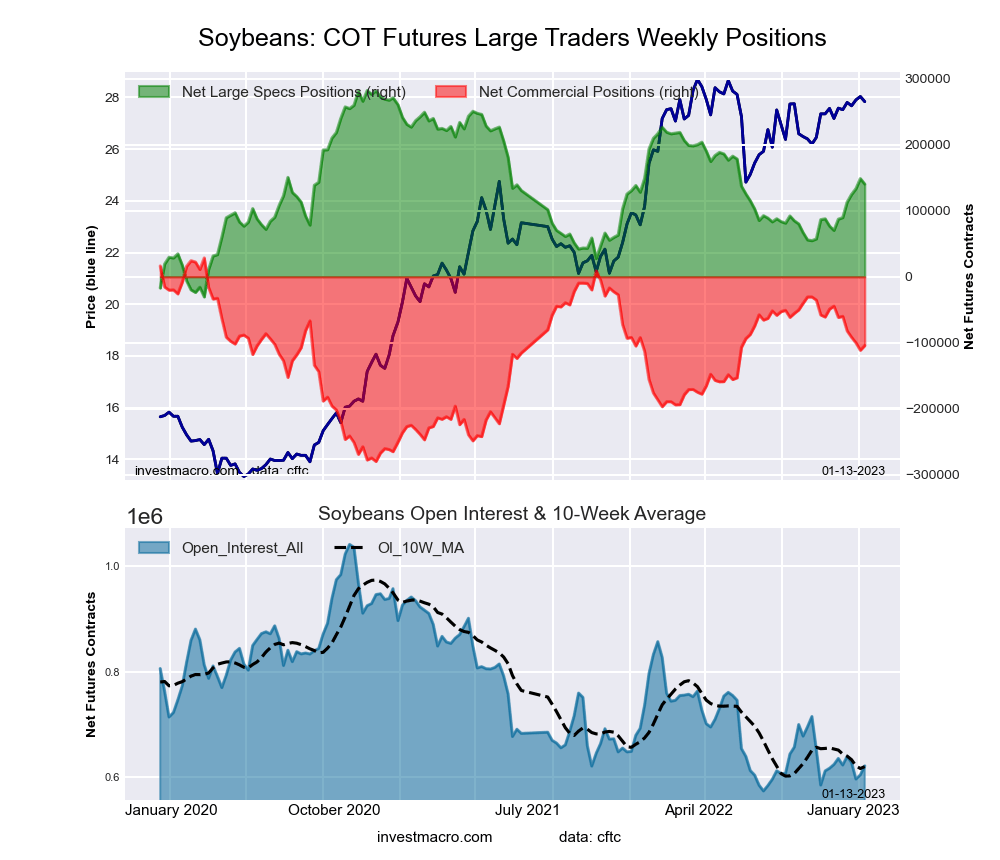
SOYBEANS Futures COT ChartThe SOYBEANS large speculator standing this week totaled a net position of 89,661 contracts in the data reported through Tuesday. This was a weekly increase of 2,453 contracts from the previous week which had a total of 87,208 net contracts.

This week’s current strength score (the trader positioning range over the past three years, measured from 0 to 100) shows the speculators are currently Bearish with a score of 38.5 percent. The commercials are Bullish with a score of 71.3 percent and the small traders (not shown in chart) are Bearish with a score of 20.7 percent.

SOYBEANS Futures StatisticsSPECULATORSCOMMERCIALSSMALL TRADERS
– Percent of Open Interest Longs:25.851.37.3
– Percent of Open Interest Shorts:11.460.912.1
– Net Position:89,661-59,882-29,779
– Gross Longs:160,518319,12045,508
– Gross Shorts:70,857379,00275,287
– Long to Short Ratio:2.3 to 10.8 to 10.6 to 1
NET POSITION TREND:
– Strength Index Score (3 Year Range Pct):38.571.320.7
– Strength Index Reading (3 Year Range):BearishBullishBearish
NET POSITION MOVEMENT INDEX:
– 6-Week Change in Strength Index:10.3-8.0-13.1


SOYBEAN OIL Futures:

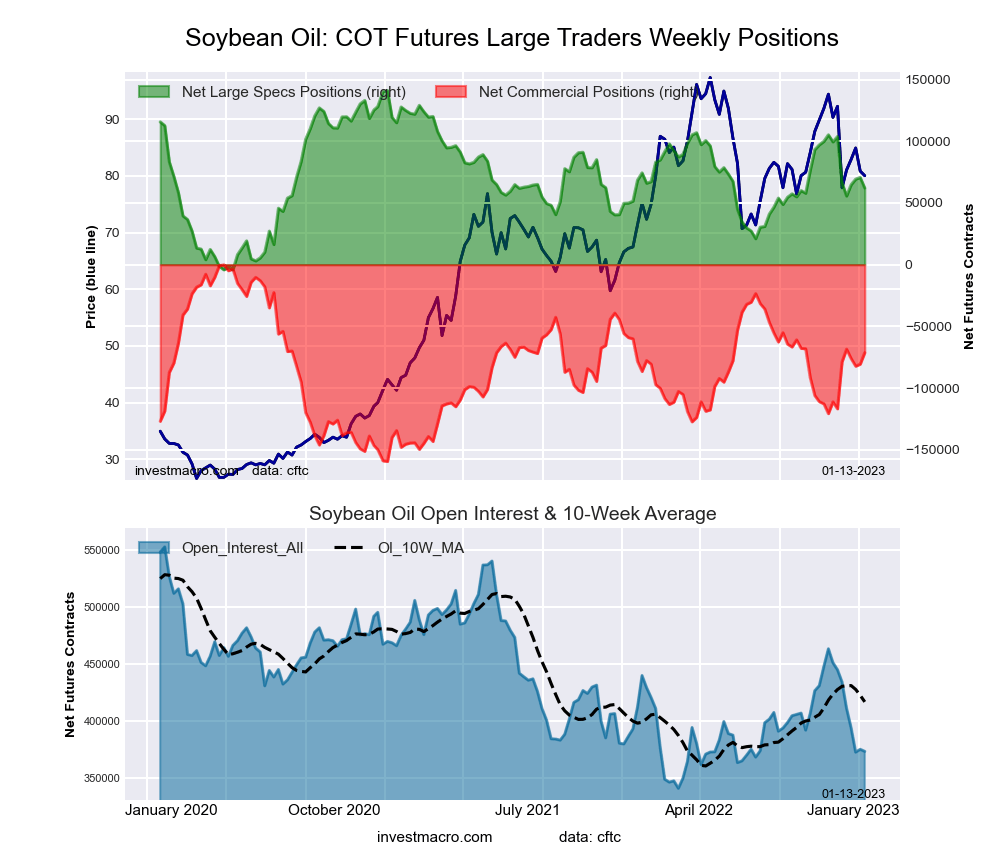
SOYBEAN OIL Futures COT ChartThe SOYBEAN OIL large speculator standing this week totaled a net position of 66,311 contracts in the data reported through Tuesday. This was a weekly reduction of -37,543 contracts from the previous week which had a total of 103,854 net contracts.

This week’s current strength score (the trader positioning range over the past three years, measured from 0 to 100) shows the speculators are currently Bearish with a score of 48.5 percent. The commercials are Bullish with a score of 50.6 percent and the small traders (not shown in chart) are Bullish with a score of 60.3 percent.

SOYBEAN OIL Futures StatisticsSPECULATORSCOMMERCIALSSMALL TRADERS
– Percent of Open Interest Longs:24.547.08.5
– Percent of Open Interest Shorts:9.365.25.6
– Net Position:66,311-78,86712,556
– Gross Longs:106,474204,19336,717
– Gross Shorts:40,163283,06024,161
– Long to Short Ratio:2.7 to 10.7 to 11.5 to 1
NET POSITION TREND:
– Strength Index Score (3 Year Range Pct):48.550.660.3
– Strength Index Reading (3 Year Range):BearishBullishBullish
NET POSITION MOVEMENT INDEX:
– 6-Week Change in Strength Index:-18.517.0-0.9


SOYBEAN MEAL Futures:

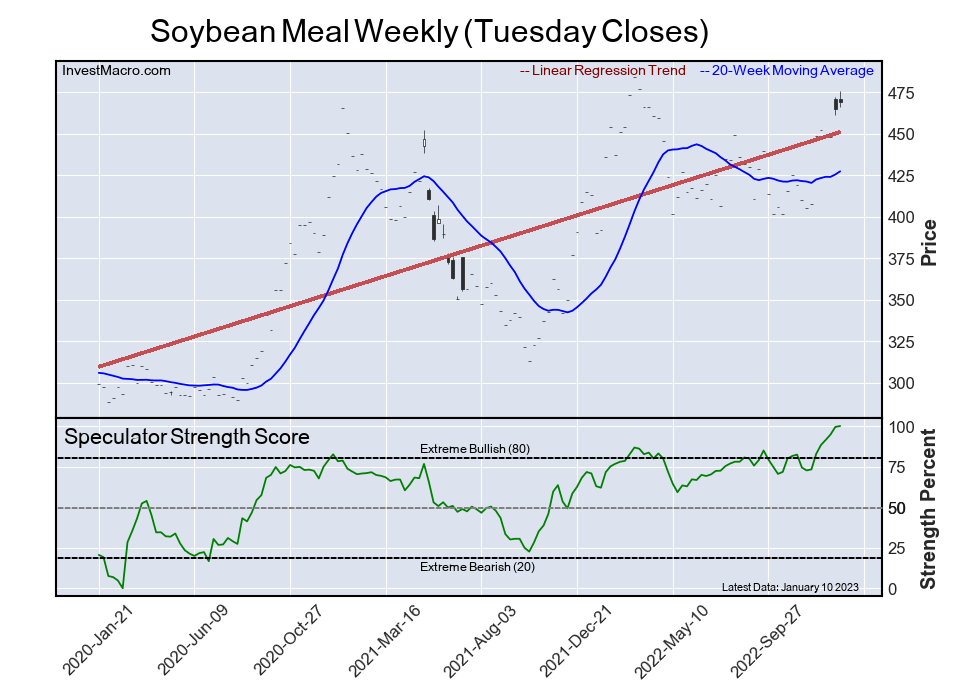
SOYBEAN MEAL Futures COT ChartThe SOYBEAN MEAL large speculator standing this week totaled a net position of 122,174 contracts in the data reported through Tuesday. This was a weekly advance of 19,835 contracts from the previous week which had a total of 102,339 net contracts.

This week’s current strength score (the trader positioning range over the past three years, measured from 0 to 100) shows the speculators are currently Bullish-Extreme with a score of 95.5 percent. The commercials are Bearish-Extreme with a score of 9.2 percent and the small traders (not shown in chart) are Bearish with a score of 34.5 percent.

SOYBEAN MEAL Futures StatisticsSPECULATORSCOMMERCIALSSMALL TRADERS
– Percent of Open Interest Longs:36.037.912.3
– Percent of Open Interest Shorts:4.674.47.3
– Net Position:122,174-141,76119,587
– Gross Longs:140,034147,25147,971
– Gross Shorts:17,860289,01228,384
– Long to Short Ratio:7.8 to 10.5 to 11.7 to 1
NET POSITION TREND:
– Strength Index Score (3 Year Range Pct):95.59.234.5
– Strength Index Reading (3 Year Range):Bullish-ExtremeBearish-ExtremeBearish
NET POSITION MOVEMENT INDEX:
– 6-Week Change in Strength Index:3.4-0.3-28.4


LIVE CATTLE Futures:

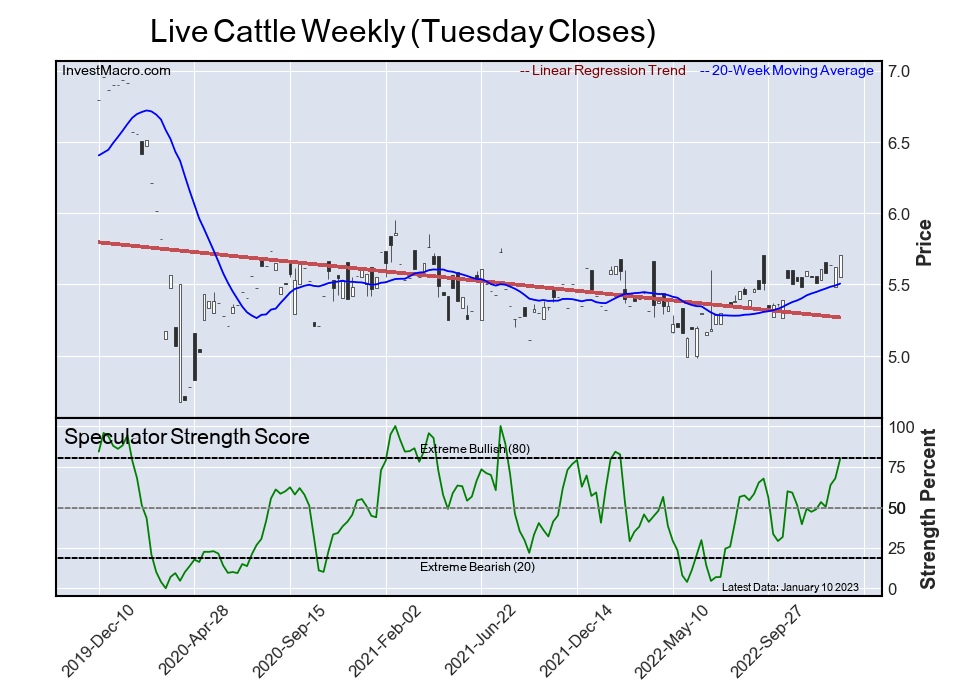
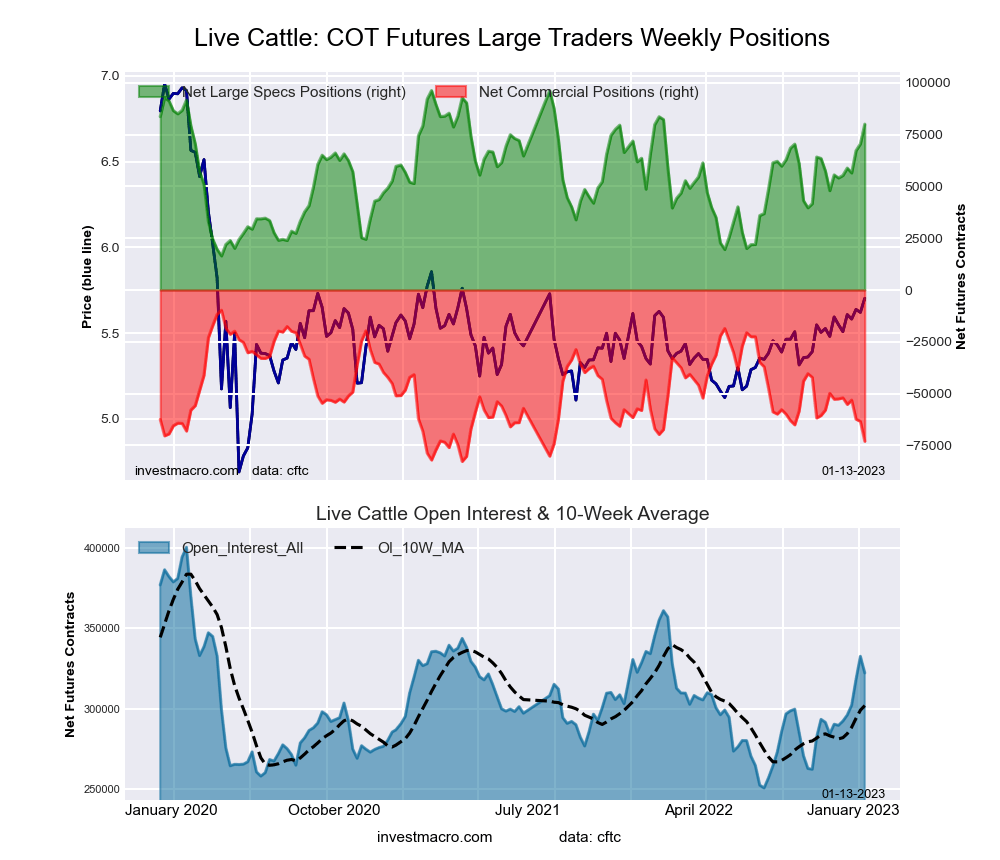
LIVE CATTLE Futures COT ChartThe LIVE CATTLE large speculator standing this week totaled a net position of 55,263 contracts in the data reported through Tuesday. This was a weekly boost of 1,229 contracts from the previous week which had a total of 54,034 net contracts.

This week’s current strength score (the trader positioning range over the past three years, measured from 0 to 100) shows the speculators are currently Bearish with a score of 48.7 percent. The commercials are Bearish with a score of 42.0 percent and the small traders (not shown in chart) are Bullish with a score of 79.8 percent.

LIVE CATTLE Futures StatisticsSPECULATORSCOMMERCIALSSMALL TRADERS
– Percent of Open Interest Longs:37.332.811.2
– Percent of Open Interest Shorts:18.450.612.3
– Net Position:55,263-52,026-3,237
– Gross Longs:108,91295,85132,667
– Gross Shorts:53,649147,87735,904
– Long to Short Ratio:2.0 to 10.6 to 10.9 to 1
NET POSITION TREND:
– Strength Index Score (3 Year Range Pct):48.742.079.8
– Strength Index Reading (3 Year Range):BearishBearishBullish
NET POSITION MOVEMENT INDEX:
– 6-Week Change in Strength Index:-11.113.3-3.2


LEAN HOGS Futures:

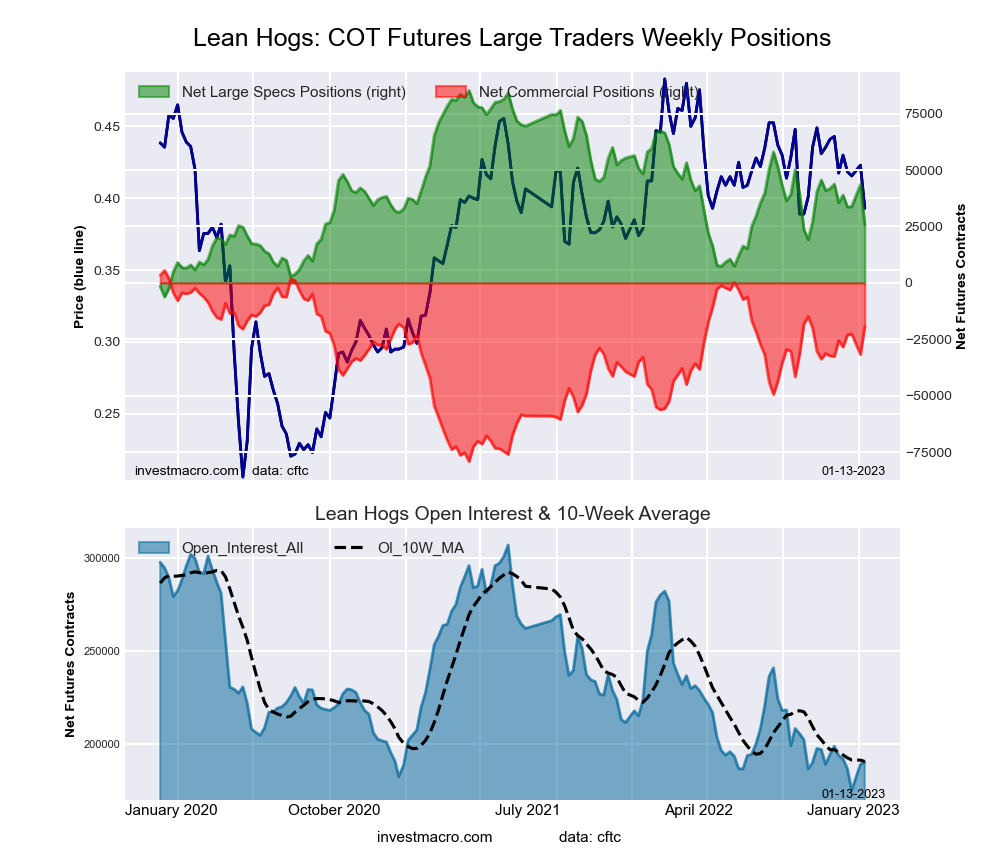
LEAN HOGS Futures COT ChartThe LEAN HOGS large speculator standing this week totaled a net position of 38,908 contracts in the data reported through Tuesday. This was a weekly rise of 3,409 contracts from the previous week which had a total of 35,499 net contracts.

This week’s current strength score (the trader positioning range over the past three years, measured from 0 to 100) shows the speculators are currently Bearish with a score of 46.9 percent. The commercials are Bullish with a score of 62.5 percent and the small traders (not shown in chart) are Bearish with a score of 42.5 percent.

LEAN HOGS Futures StatisticsSPECULATORSCOMMERCIALSSMALL TRADERS
– Percent of Open Interest Longs:40.135.17.1
– Percent of Open Interest Shorts:19.849.912.6
– Net Position:38,908-28,396-10,512
– Gross Longs:76,84967,37613,694
– Gross Shorts:37,94195,77224,206
– Long to Short Ratio:2.0 to 10.7 to 10.6 to 1
NET POSITION TREND:
– Strength Index Score (3 Year Range Pct):46.962.542.5
– Strength Index Reading (3 Year Range):BearishBullishBearish
NET POSITION MOVEMENT INDEX:
– 6-Week Change in Strength Index:-1.72.4-2.5


COTTON Futures:

COTTON Futures COT ChartThe COTTON large speculator standing this week totaled a net position of 18,720 contracts in the data reported through Tuesday. This was a weekly increase of 2,140 contracts from the previous week which had a total of 16,580 net contracts.

This week’s current strength score (the trader positioning range over the past three years, measured from 0 to 100) shows the speculators are currently Bearish with a score of 21.5 percent. The commercials are Bullish with a score of 78.5 percent and the small traders (not shown in chart) are Bearish with a score of 22.8 percent.

COTTON Futures StatisticsSPECULATORSCOMMERCIALSSMALL TRADERS
– Percent of Open Interest Longs:33.247.26.3
– Percent of Open Interest Shorts:23.657.85.3
– Net Position:18,720-20,6581,938
– Gross Longs:64,80792,04712,243
– Gross Shorts:46,087112,70510,305
– Long to Short Ratio:1.4 to 10.8 to 11.2 to 1
NET POSITION TREND:
– Strength Index Score (3 Year Range Pct):21.578.522.8
– Strength Index Reading (3 Year Range):BearishBullishBearish
NET POSITION MOVEMENT INDEX:
– 6-Week Change in Strength Index:-4.63.56.6


COCOA Futures:

COCOA Futures COT ChartThe COCOA large speculator standing this week totaled a net position of 17,964 contracts in the data reported through Tuesday. This was a weekly increase of 8,266 contracts from the previous week which had a total of 9,698 net contracts.

This week’s current strength score (the trader positioning range over the past three years, measured from 0 to 100) shows the speculators are currently Bearish with a score of 34.6 percent. The commercials are Bullish with a score of 66.0 percent and the small traders (not shown in chart) are Bearish with a score of 34.0 percent.

COCOA Futures StatisticsSPECULATORSCOMMERCIALSSMALL TRADERS
– Percent of Open Interest Longs:32.447.44.6
– Percent of Open Interest Shorts:25.555.83.1
– Net Position:17,964-21,7133,749
– Gross Longs:83,808122,38311,758
– Gross Shorts:65,844144,0968,009
– Long to Short Ratio:1.3 to 10.8 to 11.5 to 1
NET POSITION TREND:
– Strength Index Score (3 Year Range Pct):34.666.034.0
– Strength Index Reading (3 Year Range):BearishBullishBearish
NET POSITION MOVEMENT INDEX:
– 6-Week Change in Strength Index:19.3-21.117.5


WHEAT Futures:

WHEAT Futures COT ChartThe WHEAT large speculator standing this week totaled a net position of -39,897 contracts in the data reported through Tuesday. This was a weekly decrease of -6,592 contracts from the previous week which had a total of -33,305 net contracts.

This week’s current strength score (the trader positioning range over the past three years, measured from 0 to 100) shows the speculators are currently Bearish-Extreme with a score of 0.0 percent. The commercials are Bullish-Extreme with a score of 100.0 percent and the small traders (not shown in chart) are Bullish-Extreme with a score of 95.2 percent.

WHEAT Futures StatisticsSPECULATORSCOMMERCIALSSMALL TRADERS
– Percent of Open Interest Longs:28.640.610.2
– Percent of Open Interest Shorts:40.527.811.1
– Net Position:-39,89742,820-2,923
– Gross Longs:95,846135,85734,182
– Gross Shorts:135,74393,03737,105
– Long to Short Ratio:0.7 to 11.5 to 10.9 to 1
NET POSITION TREND:
– Strength Index Score (3 Year Range Pct):0.0100.095.2
– Strength Index Reading (3 Year Range):Bearish-ExtremeBullish-ExtremeBullish-Extreme
NET POSITION MOVEMENT INDEX:
– 6-Week Change in Strength Index:-26.427.021.1


Article By InvestMacroReceive our weekly COT Newsletter

*COT Report: The COT data, released weekly to the public each Friday, is updated through the most recent Tuesday (data is 3 days old) and shows a quick view of how large speculators or non-commercials (for-profit traders) were positioned in the futures markets.

The CFTC categorizes trader positions according to commercial hedgers (traders who use futures contracts for hedging as part of the business), non-commercials (large traders who speculate to realize trading profits) and nonreportable traders (usually small traders/speculators) as well as their open interest (contracts open in the market at time of reporting). See CFTC criteria here.

Ada Lovelace’s skills with language, music and needlepoint contributed to her pioneering work in computing

By Corinna Schlombs, Rochester Institute of Technology 

Ada Lovelace, known as the first computer programmer, was born on Dec. 10, 1815, more than a century before digital electronic computers were developed.

Lovelace has been hailed as a model for girls in science, technology, engineering and math (STEM). A dozen biographies for young audiences were published for the 200th anniversary of her birth in 2015. And in 2018, The New York Times added hers as one of the first “missing obituaries” of women at the rise of the #MeToo movement.

Ada King, Countess of Lovelace, was more than just another mathematician.
Watercolor portrait of Ada King, Countess of Lovelace by Alfred Edward Chalon via Wikimedia
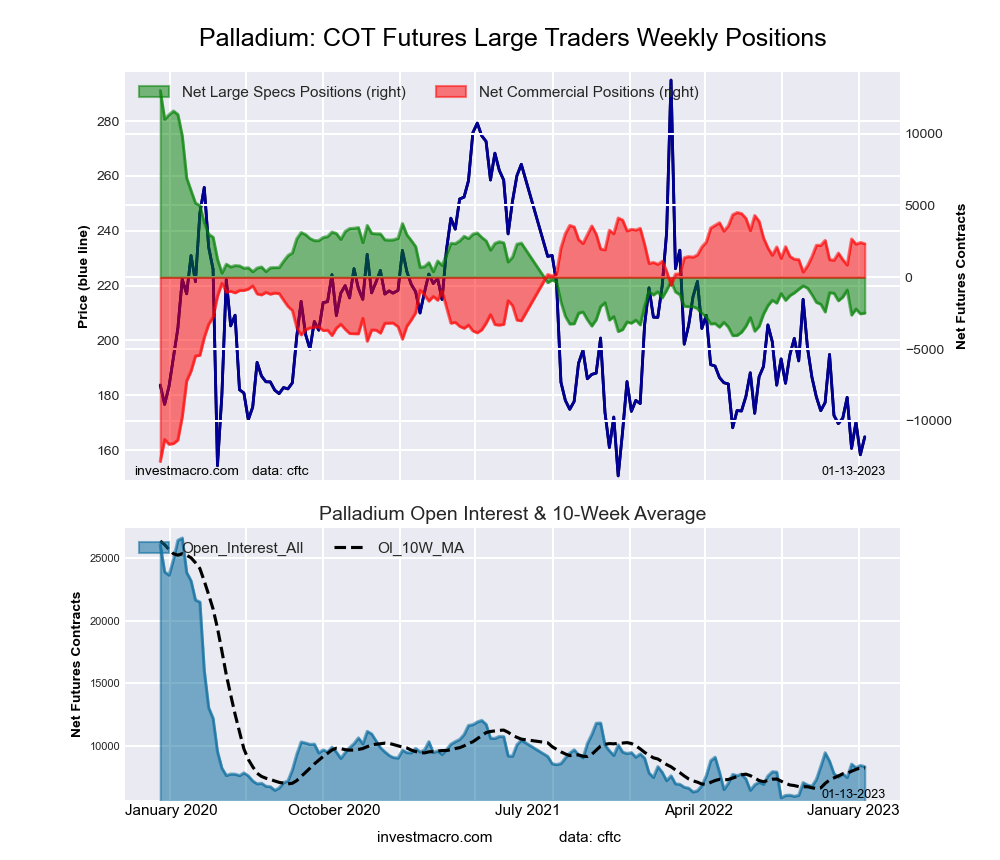
But Lovelace – properly Ada King, Countess of Lovelace after her marriage – drew on many different fields for her innovative work, including languages, music and needlecraft, in addition to mathematical logic. Recognizing that her well-rounded education enabled her to accomplish work that was well ahead of her time, she can be a model for all students, not just girls.

Lovelace was the daughter of the scandal-ridden romantic poet George Gordon Byron, aka Lord Byron, and his highly educated and strictly religious wife Anne Isabella Noel Byron, known as Lady Byron. Lovelace’s parents separated shortly after her birth. At a time when women were not allowed to own property and had few legal rights, her mother managed to secure custody of her daughter.

Growing up in a privileged aristocratic family, Lovelace was educated by home tutors, as was common for girls like her. She received lessons in French and Italian, music and in suitable handicrafts such as embroidery. Less common for a girl in her time, she also studied math. Lovelace continued to work with math tutors into her adult life, and she eventually corresponded with mathematician and logician Augustus De Morgan at London University about symbolic logic.

antique black-and-white photograph of a woman in an elaborate outfit
A rare photograph of Ada Lovelace.
Daguerreotype by Antoine Claudet via Wikimedia
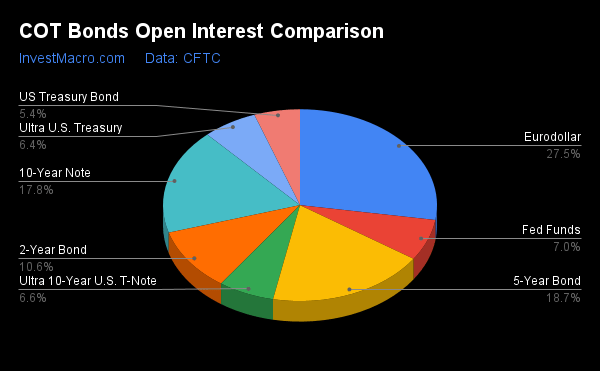
Lovelace’s algorithm

Lovelace drew on all of these lessons when she wrote her computer program – in reality, it was a set of instructions for a mechanical calculator that had been built only in parts.
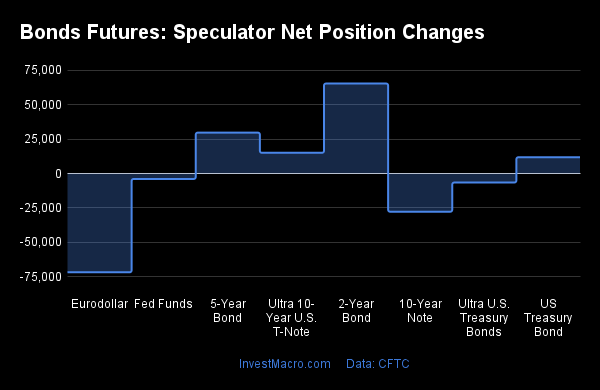
The computer in question was the Analytical Engine designed by mathematician, philosopher and inventor Charles Babbage. Lovelace had met Babbage when she was introduced to London society. The two related to each other over their shared love for mathematics and fascination for mechanical calculation. By the early 1840s, Babbage had won and lost government funding for a mathematical calculator, fallen out with the skilled craftsman building the precision parts for his machine, and was close to giving up on his project. At this point, Lovelace stepped in as an advocate.

To make Babbage’s calculator known to a British audience, Lovelace proposed to translate into English an article that described the Analytical Engine. The article was written in French by the Italian mathematician Luigi Menabrea and published in a Swiss journal. Scholars believe that Babbage encouraged her to add notes of her own.

Ada Lovelace envisioned in the early 19th century the possibilities of computing.

In her notes, which ended up twice as long as the original article, Lovelace drew on different areas of her education. Lovelace began by describing how to code instructions onto cards with punched holes, like those used for the Jacquard weaving loom, a device patented in 1804 that used punch cards to automate weaving patterns in fabric.

Having learned embroidery herself, Lovelace was familiar with the repetitive patterns used for handicrafts. Similarly repetitive steps were needed for mathematical calculations. To avoid duplicating cards for repetitive steps, Lovelace used loops, nested loops and conditional testing in her program instructions.

The notes included instructions on how to calculate Bernoulli numbers, which Lovelace knew from her training to be important in the study of mathematics. Her program showed that the Analytical Engine was capable of performing original calculations that had not yet been performed manually. At the same time, Lovelace noted that the machine could only follow instructions and not “originate anything.”

a yellowed sheet of paper with spreadsheet-like lines
Ada Lovelace created this chart for the individual program steps to calculate Bernoulli numbers.
Courtesy of Linda Hall Library of Science, Engineering & Technology, CC BY-ND

Finally, Lovelace recognized that the numbers manipulated by the Analytical Engine could be seen as other types of symbols, such as musical notes. An accomplished singer and pianist, Lovelace was familiar with musical notation symbols representing aspects of musical performance such as pitch and duration, and she had manipulated logical symbols in her correspondence with De Morgan. It was not a large step for her to realize that the Analytical Engine could process symbols — not just crunch numbers — and even compose music.

A well-rounded thinker

Inventing computer programming was not the first time Lovelace brought her knowledge from different areas to bear on a new subject. For example, as a young girl, she was fascinated with flying machines. Bringing together biology, mechanics and poetry, she asked her mother for anatomical books to study the function of bird wings. She built and experimented with wings, and in her letters, she metaphorically expressed her longing for her mother in the language of flying.

Despite her talents in logic and math, Lovelace didn’t pursue a scientific career. She was independently wealthy and never earned money from her scientific pursuits. This was common, however, at a time when freedom – including financial independence – was equated with the capability to impartially conduct scientific experiments. In addition, Lovelace devoted just over a year to her only publication, the translation of and notes on Menabrea’s paper about the Analytical Engine. Otherwise, in her life cut short by cancer at age 37, she vacillated between math, music, her mother’s demands, care for her own three children, and eventually a passion for gambling. Lovelace thus may not be an obvious model as a female scientist for girls today.

However, I find Lovelace’s way of drawing on her well-rounded education to solve difficult problems inspirational. True, she lived in an age before scientific specialization. Even Babbage was a polymath who worked in mathematical calculation and mechanical innovation. He also published a treatise on industrial manufacturing and another on religious questions of creationism.

But Lovelace applied knowledge from what we today think of as disparate fields in the sciences, arts and the humanities. A well-rounded thinker, she created solutions that were well ahead of her time.The Conversation

About the Author:

Corinna Schlombs, Associate Professor of History, Rochester Institute of Technology

This article is republished from The Conversation under a Creative Commons license. Read the original article.


China’s new space station opens for business in an increasingly competitive era of space activity

By Eytan Tepper, Indiana University and Scott Shackelford, Indiana University 

The International Space Station is no longer the only place where humans can live in orbit.

On Nov. 29, 2022, the Shenzhou 15 mission launched from China’s Gobi Desert carrying three taikonauts – the Chinese word for astronauts. Six hours later, they reached their destination, China’s recently completed space station, called Tiangong, which means “heavenly palace” in Mandarin. The three taikonauts replaced the existing crew that helped wrap up construction. With this successful mission, China has become just the third nation to operate a permanent space station.

China’s space station is an achievement that solidifies the country’s position alongside the U.S. and Russia as one of the world’s top three space powers. As scholars of space law and space policy who lead the Indiana University Ostrom Workshop’s Space Governance Program, we have been following the development of the Chinese space station with interest.

Unlike the collaborative, U.S.-led International Space Station, Tiangong is entirely built and run by China. The successful opening of the station is the beginning of some exciting science. But the station also highlights the country’s policy of self-reliance and is an important step for China toward achieving larger space ambitions among a changing landscape of power dynamics in space.

A diagram of the space station.
The Tiangong space station is much smaller than the International Space Station and consists of three modules.
Shujianyang/Wikimedia Commons, CC BY-SA

Capabilities of a Chinese station

The Tiangong space station is the culmination of three decades of work on the Chinese manned space program. The station is 180 feet (55 meters) long and is comprised of three modules that were launched separately and connected in space. These include one core module where a maximum of six taikonauts can live and two experiment modules for a total of 3,884 cubic feet (110 cubic meters) of space, about one-fifth the size of the International Space Station. The station also has an external robotic arm, which can support activities and experiments outside the station, and three docking ports for resupply vehicles and manned spacecraft.

Like China’s aircraft carriers and other spacecraft, Tiangong is based on a Soviet-era design – it is pretty much a copy of the Soviet Mir space station from the 1980s. But the Tiangong station has been heavily modernized and improved.

The Chinese space station is slated to stay in orbit for 15 years, with plans to send two six-month crewed missions and two cargo missions to it annually. The science experiments have already begun, with a planned study involving monkey reproduction commencing in the station’s biological test cabinets. Whether the monkeys will cooperate is an entirely different matter.

Science and a steppingstone

The main function of the Tiangong station is to perform research on life in space. There is a particular focus on learning about the growth and development of different types of plants, animals and microorganisms, and there are more than 1,000 experiments planned for the next 10 years.

Tiangong is strictly Chinese made and managed, but China has an open invitation for other nations to collaborate on experiments aboard Tiangong. So far, nine projects from 17 countries have been selected.

Although the new station is small compared to the 16 modules of the International Space Station, Tiangong and the science done aboard will help support China’s future space missions. In December 2023, China is planning to launch a new space telescope called Xuntian. This telescope will map stars and supermassive black holes among other projects with a resolution about the same as the Hubble Space Telescope but with a wider view. The telescope will periodically dock with the station for maintenance.

China also has plans to launch multiple missions to Mars and nearby comets and asteroids with the goal of bringing samples back to Earth. And perhaps most notably, China has announced plans to build a joint Moon base with Russia – though no timeline for this mission has been set.

The three-person crew of taikonauts greets the crew already aboard the Tiangong station in early December 2022.

Astropolitics

A new era in space is unfolding. The Tiangong station is beginning its life just as the International Space Station, after more than 30 years in orbit, is set to be decommissioned by 2030.

The International Space Station is the classic example of collaborative ideals in space – even at the height of the Cold War, the U.S. and the Soviet Union came together to develop and launch the beginnings of the space station in the early 1990s. By comparison, China and the U.S. have not been so jovial in their orbital dealings.

In the 1990s, when China was still launching U.S. satellites into orbit, concerns emerged that China was accidentally acquiring – or stealing – U.S. technology. These concern in part led to the Wolf Amendment, passed by Congress in 2011, which prohibits NASA from collaborating with China in any capacity. China’s space program was not mature enough to be part of the construction of the International Space Station in the 1990s and early 2000s. By the time China had the ability to contribute to the International Space Station, the Wolf Amendment prevented it from doing so.

It remains to be seen how the map of space collaboration will change in the coming years. The U.S.-led Artemis Program that aims to build a self-sustaining habitat on the Moon is open to all nations, and 19 countries have joined as partners so far. China has also recently opened its joint Moon mission with Russia to other nations. This was partly driven by cooling Chinese-Russian relations but also due to the fact that because of the war in Ukraine, Sweden, France and the European Space Agency canceled planned missions with Russia.

As tensions on Earth rise between China, Russia and the West, and some of that jockeying spills over into space, it remains to be seen how the decommissioning of the International Space Station and operation of the Tiangong station will influence the China-U.S. relationship.

An event like the famous handshake between U.S. astronauts and Russian cosmonauts while orbiting Earth in 1975 is a long way off, but collaboration between the U.S. and China could do much to cool tensions on and above the Earth.The Conversation

About the Author:

Eytan Tepper, Visiting Assistant Professor of Space Governance, Indiana University and Scott Shackelford, Professor of Business Law and Ethics, Indiana University

This article is republished from The Conversation under a Creative Commons license. Read the original article.

How do floating wind turbines work? With 5 companies winning the first US leases to build wind farms off California’s coast, let’s take a look

By Matthew Lackner, UMass Amherst 

Northern California has some of the strongest offshore winds in the U.S., with immense potential to produce clean energy. But it also has a problem. Its continental shelf drops off quickly, making building traditional wind turbines directly on the seafloor costly if not impossible.

Once water gets more than about 200 feet deep – roughly the height of an 18-story building – these “monopile” structures are pretty much out of the question.

A solution has emerged that’s being tested in several locations around the world: wind turbines that float.

In California, where drought has put pressure on the hydropower supply, the state is moving forward on a plan to develop the nation’s first floating offshore wind farms. On Dec. 7, 2022, the federal government auctioned off five lease areas about 20 miles off the California coast to companies with plans to develop floating wind farms. The bids were lower than recent leases off the Atlantic coast, where wind farms can be anchored to the seafloor, but still significant, together exceeding US$757 million.

So, how do floating wind farms work?

Three main ways to float a turbine

A floating wind turbine works just like other wind turbines – wind pushes on the blades, causing the rotor to turn, which drives a generator that creates electricity. But instead of having its tower embedded directly into the ground or the seafloor, a floating wind turbine sits on a platform with mooring lines, such as chains or ropes, that connect to anchors in the seabed below.

These mooring lines hold the turbine in place against the wind and keep it connected to the cable that sends its electricity back to shore.

Most of the stability is provided by the floating platform itself. The trick is to design the platform so the turbine doesn’t tip too far in strong winds or storms.

An illustration of each in an ocean, showing how lines anchor it to the seafloor.
Three of the common types of floating wind turbine platform.
Josh Bauer/NREL

There are three main types of platforms:

  • A spar buoy platform is a long hollow cylinder that extends downward from the turbine tower. It floats vertically in deep water, weighted with ballast in the bottom of the cylinder to lower its center of gravity. It’s then anchored in place, but with slack lines that allow it to move with the water to avoid damage. Spar buoys have been used by the oil and gas industry for years for offshore operations.
  • Semisubmersible platforms have large floating hulls that spread out from the tower, also anchored to prevent drifting. Designers have been experimenting with multiple turbines on some of these hulls.
  • Tension leg platforms have smaller platforms with taut lines running straight to the floor below. These are lighter but more vulnerable to earthquakes or tsunamis because they rely more on the mooring lines and anchors for stability.

Each platform must support the weight of the turbine and remain stable while the turbine operates. It can do this in part because the hollow platform, often made of large steel or concrete structures, provides buoyancy to support the turbine. Since some can be fully assembled in port and towed out for installation, they might be far cheaper than fixed-bottom structures, which require specialty vessels for installation on site.

Floating platforms can support wind turbines that can produce 10 megawatts or more of power – that’s similar in size to other offshore wind turbines and several times larger than the capacity of a typical onshore wind turbine you might see in a field.

Why do we need floating turbines?

Some of the strongest wind resources are away from shore in locations with hundreds of feet of water below, such as off the U.S. West Coast, the Great Lakes, the Mediterranean Sea and the coast of Japan.

Map showing offshore wind potential
Some of the strongest offshore wind power potential in the U.S. is in areas where the water is too deep for fixed turbines, including off the West Coast.
NREL

The U.S. lease areas auctioned off in early December cover about 583 square miles in two regions – one off central California’s Morro Bay and the other near the Oregon state line. The water off California gets deep quickly, so any wind farm that is even a few miles from shore will require floating turbines.

Once built, wind farms in those five areas could provide about 4.6 gigawatts of clean electricity, enough to power 1.5 million homes, according to government estimates. The winning companies suggested they could produce even more power.

But getting actual wind turbines on the water will take time. The winners of the lease auction will undergo a Justice Department anti-trust review and then a long planning, permitting and environmental review process that typically takes several years.

Maps showing the locations off Moro Bay, north of Santa Barbara, and Eureka, near the Oregon border.
The first five federal lease areas for Pacific coast offshore wind energy development.
Bureau of Ocean Energy Management

Globally, several full-scale demonstration projects with floating wind turbines are already operating in Europe and Asia. The Hywind Scotland project became the first commercial-scale offshore floating wind farm in 2017, with five 6-megawatt turbines supported by spar buoys designed by the Norwegian energy company Equinor.

Equinor Wind US had one of the winning bids off Central California. Another winning bidder was RWE Offshore Wind Holdings. RWE operates wind farms in Europe and has three floating wind turbine demonstration projects. The other companies involved – Copenhagen Infrastructure Partners, Invenergy and Ocean Winds – have Atlantic Coast leases or existing offshore wind farms.

While floating offshore wind farms are becoming a commercial technology, there are still technical challenges that need to be solved. The platform motion may cause higher forces on the blades and tower, and more complicated and unsteady aerodynamics. Also, as water depths get very deep, the cost of the mooring lines, anchors and electrical cabling may become very high, so cheaper but still reliable technologies will be needed.

But we can expect to see more offshore turbines supported by floating structures in the near future.

This article was updated with the first lease sale.The Conversation

About the Author:

Matthew Lackner, Professor of Mechanical Engineering, UMass Amherst

This article is republished from The Conversation under a Creative Commons license. Read the original article.