Archive for Opinions – Page 102

Global economy 2023: what happens next with industrial action

By Stéphanie Matteudi-Lecocq, Université de Lille; Jim Stanford, University of Sydney; Marick Masters, Wayne State University; Nabiyla Risfa Izzati, Universitas Gadjah Mada ; Phil Tomlinson, University of Bath, and Rubén Garrido-Yserte, Universidad de Alcalá 

This is the fifth instalment in our series on where the global economy is heading in 2023. It follows recent articles on inflation, energy, food and the cost of living.


Canada: assertive unions getting results

Jim Stanford, Economist and Director, Centre for Future Work, Australia Institute

Canada’s trade union movement is among the more resilient in the OECD, the club of developed countries. This is related to laws that prevent “free riding”, which is where workers can benefit from collective agreements without being union members.

Union density in Canada has been around 30% of workers since the turn of the century, although membership in the private sector is barely half that and slowly falling. In contrast, unionisation is high in public services (over 75%) and growing.

This relatively stability has left Canadian workers better prepared to confront the impact of inflation on their wages. Unions made higher wage demands than in recent decades, and more frequently went on strike (continuing a trend from 2021).

From January to October 2022, there were
145 strikes, and the final year tally will likely exceed the 161 in 2021 – itself a marked increase. A total of 1.9 million person-days of work were lost in strikes up to October (the highest in 15 years). Unlike in recent years, the majority were in the private sector.

A spring wave of strikes in construction in Ontario (Canada’s most populous province) symbolised the increased militancy. At peak, over 40,000 workers downed tools for higher wages, including carpenters, dry-wallers and engineers. Tentative agreements reached by officials were sometimes rejected by members, prolonging the strikes.

A second historic flash point came later in the year when Ontario’s right-wing government invoked a rarely used constitutional clause to override the right to strike for 55,000 education support workers. After unions in the public and private sector threatened a province-wide general strike, the government backed down.

Meanwhile, employer lockouts have virtually disappeared. This tactic, in which employers suspend operations until workers agree to terms being offered, had only been used eight times by October, compared to 60 per year a decade ago.

Annual wage growth increased modestly to an average of 5% by late in the year. That still lagged the 6.8% inflation, but closed the gap from 2021.

It remains to be seen whether this union pressure can be sustained in the face of rapid interest rate increases, a likely recession in 2023, and continued government suppression of union rights in some provinces.

United Kingdom: an olive branch for the health service?

Phil Tomlinson, Professor of Industrial Strategy, University of Bath

The UK’s latest winter of discontent is extending into 2023 as the country endures its largest wave of strikes in over 30 years. Most are in the public sector, where pay offers are well below inflation and significantly lag private companies.

The sense of grievance is high following the austerity and real-terms pay cuts of the 2010s. Strikes – estimated to have cost the UK economy £1.7 billion in 2022 – are being co-ordinated across different unions, adding to the public inconvenience.

The UK government has steadfastly refused to yield, however. It has hidden behind independent recommendations by public-sector pay review bodies, despite not always following them. They have also claimed that inflation matching public sector pay rises would cost each UK household an extra £1,000 a year, though this figure has been debunked.

The Treasury also echoes Bank of England concerns about setting off a wage-price spiral. Yet this is unlikely, given the current inflation is largely down to supply shocks (from COVID and the war in Ukraine), while average wage growth is well below inflation.

There is an economic case for a generous deal, especially in the National Health Service (NHS): with over 133,000 unfilled vacancies, better wages might help improve staff retention and recruitment. Of course, funding this in a recession involves tough choices.

Higher taxes would be politically difficult with the tax burden at a 70-year high. Higher government borrowing could aggravate inflation if accommodated by the Bank of England increasing the money supply through more quantitative easing.

Public opinion appears largely sympathetic to the strikes, especially in the NHS. But if the government relents in one sector, it sets a precedent for others, with potentially wider economic consequences.

For the NHS, it may instead bring forward public sector pay review body negotiations for 2023 to allow for an improved deal – possibly alongside a one-off hardship payment. Elsewhere it will probably hold firm and hope the trade unions lose their resolve.

Australia and New Zealand: strikes remain rare despite inflation

Jim Stanford, Economist and Director, Centre for Future Work, Australia Institute

Strikes in Australia have become very rare in recent decades, thanks to restrictive labour laws passed since the 1990s. Despite historically low unemployment and wages lagging far behind inflation, these laws continue to short-circuit most industrial action.

In 2022, union density fell to 12.5% of employees, an all-time low. As recently as 1990, union density was over 50% of workers. Union members can legally strike only after negotiations, ballots and specific plans for action have been publicly divulged (thus fully revealing union strategy to the employer). Even when there are strikes, they tend to be short.

A total of 182 industrial disputes occurred in the year to September. (The statistics don’t distinguish between strikes and employer lockouts, which have become common in Australia.) This is similar to the pre-COVID years, following a drop in 2020, and only a fraction of 1970s and 1980s industrial action.

The only visible increase in strike action in 2022 was a series of one-day protest strikes organised by teachers and health care workers in New South Wales, the country’s most populous state. Having put up with a decade of austere wage caps by the conservative state government, they decided they had had enough as inflation picked up.

Most other workers have been passive despite Australia experiencing among the slowest wage growth of any major industrial country. Nominal wages grew just 2% per year over the decade to 2021. That rose to 3.1% by late 2022, but it’s still less than half the 7.3% inflation rate.

Australia’s newly elected Labor government did pass a series of important labour law reforms at the end of 2022, aimed at strengthening collective bargaining and wage growth. That might herald incremental improvement in workers’ bargaining power in the years ahead.

The industrial relations outlook in New Zealand is somewhat more hospitable for workers and their unions. Union density increased in 2021, to 17% of employees (from 14% in 2020). Average ordinary hourly earnings grew an impressive 7.4% in the latest 12-month period – helped by a 6% boost in the minimum wage by New Zealand’s Labour government.

Industrial action remains rare – perhaps in part because workers are successfully lifting wages via other means. No official strike data is available for 2022, but in 2021, just 20 work stoppages occurred, down sharply from an average of 140 per year in the previous three years.

Indonesia: anger against labour law reforms

Nabiyla Risfa Izzati, Lecturer of Labour Law, Universitas Gadjah Mada

A few weeks ago, the government replaced its controversial “omnibus law” with new emergency regulation. This was in response to the Indonesian constitutional court finding it unconstitutional in 2021.

Passed in late 2020, the omnibus law embodies President Joko Widodo’s ambition to attract foreign investors by slashing red tape at the cost of employees’ rights. It made it easier for businesses to lay off employees without prior notice.

It also lowered statutory severance pay and extended the maximum length of temporary contracts, while ignoring worker safety. In 2022, its new formula to determine the minimum wage also resulted in the lowest annual increase ever. The law attracted much criticism from workers, activists and civil society organisations.

The new emergency regulation is arguably even more problematic. The majority of its provision simply copies the omnibus law. Several changes and additional provisions are confusing and overlap with previous regulations, as well as leaving many loopholes that could be exploited in future.

Yet despite complaints from workers and trade unions that the new rules were passed suddenly and without consultation, strike action is out of the question. Strikes are not popular because they can only be organised with permission from the company in question. If labourers hold informal strikes, employers also entitled to get rid of them.

Public protests are the obvious alternative, though pandemic rules restricting mobility and mass gatherings have made these difficult. Nevetheless, thousands or perhaps even millions of workers staged protests in their respective cities in the second half of 2022.

The workers wanted the omnibus law revoked, and for the government to not use the minimum wage formulations stipulated in the law. The demonstrations got more intense as the government raised subsidised fuel prices in September, which boosted already high inflation due to rising food prices.

The government has since issued a separate regulation to determine the 2023 minimum wage, so the demands were successful, although both workers and employers are furious that the minimum wage rules have changed again under the emergency regulation.

Clearly the protesters did not see the rest of the rules in the omnibus law removed. Some workers have been protesting on social media. This might not induce the government to change the law, but a few viral tweets have pushed several businesses to change abusive practices.

The controversy is likely to continue in 2023 and into the election year of 2024, especially amid possible massive layoffs in the midst of a global recession.

United States: worker protest showing signs of life

Marick Masters, Professor of Business and Adjunct Professor of Political Science, Wayne State University

US workers organised and took to the picket line in increased numbers in 2022 to demand better pay and working conditions, leading to optimism among labour leaders and advocates that they’re witnessing a turnaround in labour’s sagging fortunes.

Teachers, journalists and baristas were among tens of thousands of workers who went on strike. And it took an act of Congress to prevent 115,000 railroad employees from walking out as well.

In total, there have been at least 20 major work stoppages involving upwards of 1,000 workers each in 2022, up from 16 in 2021, plus hundreds more that were smaller.

Workers at Starbucks, Amazon, Apple and dozens of other companies also filed over 2,000 petitions to form unions during the year – the most since 2015. Workers won 76% of the 1,363 elections that were held.

Historically, however, these figures are tepid. The number of major work stoppages has been plunging for decades, from nearly 200 as recently as 1980.

As of 2021, union membership was at about the lowest level on record, at 10.3%. In the 1950s, over one in three workers belonged to a union.

The deck is still heavily stacked against unions, with unsupportive labour laws and very few employers showing real receptivity to having a unionised workforce. Unions are limited in how much they can change public policy. Reforming labour law through legislation has remained elusive, and the results of the 2022 midterms are not likely to make it easier.

Nonetheless, public support for labour is at its highest since 1965, with 71% saying they approve of unions, according to a Gallup poll in August. And workers themselves are increasingly showing an interest in joining them.

In 2017, 48% of workers polled said they would vote for union representation, up from 32% in 1995, the last time the question was asked.

Future success may depend on unions’ ability to tap into their growing popularity and emulate the recent wins in establishing union representation at Starbucks and Amazon, as well as the successful “Fight for $15” campaign, which since 2012 has helped pass US$15 minimum wage laws in a dozen states and Washington DC.

The odds may be steep, but the seeds of opportunity are there if labour can exploit them.

This is an excerpt from an article published on January 5 2023.

France: militant unions risk going too far

Stéphanie Matteudi-Lecocq, Chercheuse au LEREDS, Directrice practice Chez Alixio, Université de Lille

France in 2022 saw new industrial protests, from blockades of oil refineries, to unprecedented strikes at EDF’s nuclear power plants, to rail workers staying at home on public holidays.

TotalEnergies announced “super profits” in the second quarter of 2022 and increased CEO Patrick Pouyanné’s salary by 52% to €5,944,129. In September the militant CGT union demanded a 10% salary increase for workers and called for a strike at the group’s refineries.

Five of Total’s refineries went on strike, joined by two owned by ExxonMobil subsidiary Esso. Esso was already talking to its unions about a pay deal, but Total had only planned to open negotiations in November.

The strikes in the refineries threatened to bring France to a standstill, and the CGT used its power over this key resource to demand that discussions begin more quickly with Total (in the end, the company negotiated earlier and pay deals were done, ending the strikes by early November).

The strike at EDF’s nuclear power stations similarly gave the company’s workers the balance of power because it made it impossible for France to build up energy reserves (since fossil fuels had to be burned to make up for the lack of nuclear power). In the end, the company signed deals with the unions in October.

Unions may have succeeded in both cases, but they are arguably endangered by these kinds of practices. Too many trades union leaders remain stuck in their old militant ways.

There’s a fragile balance between negotiation and protest, and such ransom tactics might damage unions’ public image, making dialogue more difficult in future. In 50 years, the rate of unionisation in France has already halved from over 20% to around 10%.

It’s telling that two of the major strikes at the end of 2022, first by train workers and then by general practitioners, were initiated by groups independent from the unions. They both started spontaneously through social media and the unions found out very late.

In 2023 the unions have an opportunity to improve their influence if they manage to prevent the government from passing its unpopular bill on pensions, which seeks to raise the full pensionable retirement age from 62 to 64 or 65.

The unions have already announced their strong opposition to the bill. With major demonstrations due to take place after the full bill is presented today, January 10, it will be interesting to see their tactics.

This is based on an excerpt from an article published in October 2022.

Spain: unequal support measures could cause trouble

Rubén Garrido-Yserte, Director del Instituto Universitario de Análisis Económico y Social, Universidad de Alcalá

Global inflation is triggering a global economic slowdown and interest rates raised to levels not seen since before 2008. Interest rates will continue to rise in 2023, especially affecting economies as indebted as Spain.

It will undermine both families’ disposable income and the profitability of companies (especially small ones), while making public debt repayments more expensive. Meanwhile, inflation is expected to cause a sustained increase in the cost of the shopping basket in the medium term.

Government measures have partially mitigated this loss of purchasing power so far. Spain capped power prices, subsidised fuel and made public transport free for urbanites and commuters.

There were agreements with banks to refinance mortgages for the most vulnerable families. Plus there have been increases in pensions and public salaries and there are plans to raise the minimum wage.

However, many of these measures must necessarily be temporary. The danger is that they come to be seen as rights that should not be renounced. They also distort the economy and create problems with fairness by excluding or insufficiently supporting some groups. Private salaries will not rise enough to cover inflation, for instance.

The government’s measures have been such that there has been very little industrial action in response to the cost of living crisis. The danger is that they create a scenario where today’s calm may be the harbinger of a social storm tomorrow.


This article is part of Global Economy 2023, our series about the challenges facing the world in the year ahead. You might also like our Global Economy Newsletter, which you can subscribe to here.The Conversation

Stéphanie Matteudi-Lecocq, Enseignante. Chercheuse au LEREDS, Directrice practice Chez Alixio, Université de Lille; Jim Stanford, Economist and Director, Centre for Future Work, Australia Institute; Honorary Professor of Political Economy, University of Sydney; Marick Masters, Professor of Business and Adjunct Professor of Political Science, Wayne State University; Nabiyla Risfa Izzati, Lecturer of Labour Law, Universitas Gadjah Mada ; Phil Tomlinson, Professor of Industrial Strategy, Deputy Director Centre for Governance, Regulation and Industrial Strategy (CGR&IS), University of Bath, and Rubén Garrido-Yserte, Director del Instituto Universitario de Análisis Económico y Social, Universidad de Alcalá

This article is republished from The Conversation under a Creative Commons license. Read the original article.

Mid-Week Technical Outlook: Major Currencies

By ForexTime 

A sense of anticipation gripped financial markets today as investors prepared for the US inflation data on Thursday.

Market players remain hopeful that inflation may have cooled further in December and this seems to be supporting global equity markets. In the currency space, the dollar remains firm while gold has struggled to conquer the $1880 resistance level. With less than 24 hours until the key US inflation report is published, markets may remain on standby waiting for a fundamental spark. Despite the expected lack of action over the next few hours, this period of calm could help identify some potential opportunities before the CPI storm!

EURUSD waiting for softer USD?

This currency pair remains firmly bullish on the daily timeframe as there have been consistently higher highs and higher lows. Prices are trading above the 50, 100, and 200-day SMA while the MACD trades above zero. The recent breakout above 1.0700 could signal further upside with 1.0770 with 1.0900 acting as key levels of interest. Should prices slip back under 1.0700, the currency pair could experience a selloff towards 1.0505.

GBPUSD trapped within a range 

It seems like the GBPUSD remains trapped within a very wide range on the daily charts. Support can be found at 1.1900 and resistance at 1.2210. A potent fundamental spark may be needed for the currency pair to resume the uptrend or experience a reversal lower. The pending US inflation report could inject fresh life into the GBPUSD, with a softer inflation report favour GBPUSD bulls. Looking at the technical picture, a strong breakout above 1.2210 may signal an incline toward 1.2300 and 1.2460, respectively.

USDJPY breakout on horizon

As the subtitle says, the USDJPY could be gearing up for a breakout. Prices remain trapped within a 450 range with bulls and bears waiting for a direction catalyst. This may come in the form of the pending US inflation data which may determine the USDJPY’s short-term outlook. A solid breakout and daily close below 130.00 could signal a selloff towards 127.00. Should prices push back above 134.50, the next key level of interest can be found at 138.00.


Forex-Time-LogoArticle by ForexTime

ForexTime Ltd (FXTM) is an award winning international online forex broker regulated by CySEC 185/12 www.forextime.com

AI and the future of work: 5 experts on what ChatGPT, DALL-E and other AI tools mean for artists and knowledge workers

By Lynne Parker, University of Tennessee; Casey Greene, University of Colorado Anschutz Medical Campus; Daniel Acuña, University of Colorado Boulder; Kentaro Toyama, University of Michigan, and Mark Finlayson, Florida International University 

From steam power and electricity to computers and the internet, technological advancements have always disrupted labor markets, pushing out some jobs while creating others. Artificial intelligence remains something of a misnomer – the smartest computer systems still don’t actually know anything – but the technology has reached an inflection point where it’s poised to affect new classes of jobs: artists and knowledge workers.

Specifically, the emergence of large language models – AI systems that are trained on vast amounts of text – means computers can now produce human-sounding written language and convert descriptive phrases into realistic images. The Conversation asked five artificial intelligence researchers to discuss how large language models are likely to affect artists and knowledge workers. And, as our experts noted, the technology is far from perfect, which raises a host of issues – from misinformation to plagiarism – that affect human workers.

To jump ahead to each response, here’s a list of each:


Creativity for all – but loss of skills?
Potential inaccuracies, biases and plagiarism
With humans surpassed, niche and ‘handmade’ jobs will remain
Old jobs will go, new jobs will emerge
Leaps in technology lead to new skills


Creativity for all – but loss of skills?

Lynne Parker, Associate Vice Chancellor, University of Tennessee

Large language models are making creativity and knowledge work accessible to all. Everyone with an internet connection can now use tools like ChatGPT or DALL-E 2 to express themselves and make sense of huge stores of information by, for example, producing text summaries.

Especially notable is the depth of humanlike expertise large language models display. In just minutes, novices can create illustrations for their business presentations, generate marketing pitches, get ideas to overcome writer’s block, or generate new computer code to perform specified functions, all at a level of quality typically attributed to human experts.

These new AI tools can’t read minds, of course. A new, yet simpler, kind of human creativity is needed in the form of text prompts to get the results the human user is seeking. Through iterative prompting – an example of human-AI collaboration – the AI system generates successive rounds of outputs until the human writing the prompts is satisfied with the results. For example, the (human) winner of the recent Colorado State Fair competition in the digital artist category, who used an AI-powered tool, demonstrated creativity, but not of the sort that requires brushes and an eye for color and texture.

While there are significant benefits to opening the world of creativity and knowledge work to everyone, these new AI tools also have downsides. First, they could accelerate the loss of important human skills that will remain important in the coming years, especially writing skills. Educational institutes need to craft and enforce policies on allowable uses of large language models to ensure fair play and desirable learning outcomes.

Educators are preparing for a world where students have ready access to AI-powered text generators.

Second, these AI tools raise questions around intellectual property protections. While human creators are regularly inspired by existing artifacts in the world, including architecture and the writings, music and paintings of others, there are unanswered questions on the proper and fair use by large language models of copyrighted or open-source training examples. Ongoing lawsuits are now debating this issue, which may have implications for the future design and use of large language models.

As society navigates the implications of these new AI tools, the public seems ready to embrace them. The chatbot ChatGPT went viral quickly, as did image generator Dall-E mini and others. This suggests a huge untapped potential for creativity, and the importance of making creative and knowledge work accessible to all.


Potential inaccuracies, biases and plagiarism

Daniel Acuña, Associate Professor of Computer Science, University of Colorado Boulder

I am a regular user of GitHub Copilot, a tool for helping people write computer code, and I’ve spent countless hours playing with ChatGPT and similar tools for AI-generated text. In my experience, these tools are good at exploring ideas that I haven’t thought about before.

I’ve been impressed by the models’ capacity to translate my instructions into coherent text or code. They are useful for discovering new ways to improve the flow of my ideas, or creating solutions with software packages that I didn’t know existed. Once I see what these tools generate, I can evaluate their quality and edit heavily. Overall, I think they raise the bar on what is considered creative.

But I have several reservations.

One set of problems is their inaccuracies – small and big. With Copilot and ChatGPT, I am constantly looking for whether ideas are too shallow – for example, text without much substance or inefficient code, or output that is just plain wrong, such as wrong analogies or conclusions, or code that doesn’t run. If users are not critical of what these tools produce, the tools are potentially harmful.

Recently, Meta shut down its Galactica large language model for scientific text because it made up “facts” but sounded very confident. The concern was that it could pollute the internet with confident-sounding falsehoods.

Another problem is biases. Language models can learn from the data’s biases and replicate them. These biases are hard to see in text generation but very clear in image generation models. Researchers at OpenAI, creators of ChatGPT, have been relatively careful about what the model will respond to, but users routinely find ways around these guardrails.

Another problem is plagiarism. Recent research has shown that image generation tools often plagiarize the work of others. Does the same happen with ChatGPT? I believe that we don’t know. The tool might be paraphrasing its training data – an advanced form of plagiarism. Work in my lab shows that text plagiarism detection tools are far behind when it comes to detecting paraphrasing.

two rows of six images, each top and bottom pair very similar to each other
Plagiarism is easier to see in images than in text. Is ChatGPT paraphrasing as well?
Somepalli, G., et al., CC BY

These tools are in their infancy, given their potential. For now, I believe there are solutions to their current limitations. For example, tools could fact-check generated text against knowledge bases, use updated methods to detect and remove biases from large language models, and run results through more sophisticated plagiarism detection tools.


With humans surpassed, niche and ‘handmade’ jobs will remain

Kentaro Toyama, Professor of Community Information, University of Michigan

We human beings love to believe in our specialness, but science and technology have repeatedly proved this conviction wrong. People once thought that humans were the only animals to use tools, to form teams or to propagate culture, but science has shown that other animals do each of these things.

Meanwhile, technology has quashed, one by one, claims that cognitive tasks require a human brain. The first adding machine was invented in 1623. This past year, a computer-generated work won an art contest. I believe that the singularity – the moment when computers meet and exceed human intelligence – is on the horizon.

How will human intelligence and creativity be valued when machines become smarter and more creative than the brightest people? There will likely be a continuum. In some domains, people still value humans doing things, even if a computer can do it better. It’s been a quarter of a century since IBM’s Deep Blue beat world champion Garry Kasparov, but human chess – with all its drama – hasn’t gone away.

In other domains, human skill will seem costly and extraneous. Take illustration, for example. For the most part, readers don’t care whether the graphic accompanying a magazine article was drawn by a person or a computer – they just want it to be relevant, new and perhaps entertaining. If a computer can draw well, do readers care whether the credit line says Mary Chen or System X? Illustrators would, but readers might not even notice.

And, of course, this question isn’t black or white. Many fields will be a hybrid, where some Homo sapiens find a lucky niche, but most of the work is done by computers. Think manufacturing – much of it today is accomplished by robots, but some people oversee the machines, and there remains a market for handmade products.

If history is any guide, it’s almost certain that advances in AI will cause more jobs to vanish, that creative-class people with human-only skills will become richer but fewer in number, and that those who own creative technology will become the new mega-rich. If there’s a silver lining, it might be that when even more people are without a decent livelihood, people might muster the political will to contain runaway inequality.


Old jobs will go, new jobs will emerge

Mark Finlayson, Associate Professor of Computer Science, Florida International University

Large language models are sophisticated sequence completion machines: Give one a sequence of words (“I would like to eat an …”) and it will return likely completions (“… apple.”). Large language models like ChatGPT that have been trained on record-breaking numbers of words (trillions) have surprised many, including many AI researchers, with how realistic, extensive, flexible and context-sensitive their completions are.

Like any powerful new technology that automates a skill – in this case, the generation of coherent, albeit somewhat generic, text – it will affect those who offer that skill in the marketplace. To conceive of what might happen, it is useful to recall the impact of the introduction of word processing programs in the early 1980s. Certain jobs like typist almost completely disappeared. But, on the upside, anyone with a personal computer was able to generate well-typeset documents with ease, broadly increasing productivity.

Further, new jobs and skills appeared that were previously unimagined, like the oft-included resume item MS Office. And the market for high-end document production remained, becoming much more capable, sophisticated and specialized.

I think this same pattern will almost certainly hold for large language models: There will no longer be a need for you to ask other people to draft coherent, generic text. On the other hand, large language models will enable new ways of working, and also lead to new and as yet unimagined jobs.

To see this, consider just three aspects where large language models fall short. First, it can take quite a bit of (human) cleverness to craft a prompt that gets the desired output. Minor changes in the prompt can result in a major change in the output.

Second, large language models can generate inappropriate or nonsensical output without warning.

Third, as far as AI researchers can tell, large language models have no abstract, general understanding of what is true or false, if something is right or wrong, and what is just common sense. Notably, they cannot do relatively simple math. This means that their output can unexpectedly be misleading, biased, logically faulty or just plain false.

These failings are opportunities for creative and knowledge workers. For much content creation, even for general audiences, people will still need the judgment of human creative and knowledge workers to prompt, guide, collate, curate, edit and especially augment machines’ output. Many types of specialized and highly technical language will remain out of reach of machines for the foreseeable future. And there will be new types of work – for example, those who will make a business out of fine-tuning in-house large language models to generate certain specialized types of text to serve particular markets.

In sum, although large language models certainly portend disruption for creative and knowledge workers, there are still many valuable opportunities in the offing for those willing to adapt to and integrate these powerful new tools.


Leaps in technology lead to new skills

Casey Greene, Professor of Biomedical Informatics, University of Colorado Anschutz Medical Campus

Technology changes the nature of work, and knowledge work is no different. The past two decades have seen biology and medicine undergoing transformation by rapidly advancing molecular characterization, such as fast, inexpensive DNA sequencing, and the digitization of medicine in the form of apps, telemedicine and data analysis.

Some steps in technology feel larger than others. Yahoo deployed human curators to index emerging content during the dawn of the World Wide Web. The advent of algorithms that used information embedded in the linking patterns of the web to prioritize results radically altered the landscape of search, transforming how people gather information today.

The release of OpenAI’s ChatGPT indicates another leap. ChatGPT wraps a state-of-the-art large language model tuned for chat into a highly usable interface. It puts a decade of rapid progress in artificial intelligence at people’s fingertips. This tool can write passable cover letters and instruct users on addressing common problems in user-selected language styles.

Just as the skills for finding information on the internet changed with the advent of Google, the skills necessary to draw the best output from language models will center on creating prompts and prompt templates that produce desired outputs.

For the cover letter example, multiple prompts are possible. “Write a cover letter for a job” would produce a more generic output than “Write a cover letter for a position as a data entry specialist.” The user could craft even more specific prompts by pasting portions of the job description, resume and specific instructions – for example, “highlight attention to detail.”

As with many technological advances, how people interact with the world will change in the era of widely accessible AI models. The question is whether society will use this moment to advance equity or exacerbate disparities.The Conversation

About the Author:

Lynne Parker, Associate Vice Chancellor, University of Tennessee; Casey Greene, Professor of Biomedical Informatics, University of Colorado Anschutz Medical Campus; Daniel Acuña, Associate Professor of Computer Science, Affiliate Professor of Information Science, University of Colorado Boulder; Kentaro Toyama, Professor of Community Information, University of Michigan, and Mark Finlayson, Associate Professor of Computer Science, Florida International University

This article is republished from The Conversation under a Creative Commons license. Read the original article.


‘Peak opportunity’ in Q1 is when investors could be rewarded

By George Prior

Economic ‘peak opportunity’ is likely to be late Quarter 1 for most major developed economies, and when investors might be rewarded for taking the plunge, predicts the CEO and founder of one of the world’s largest independent financial advisory, asset management and fintech organizations.

The prediction from deVere Group’s Nigel Green comes as global investors review their portfolios with their advisers for the year ahead.

He says: “Economic ‘peak opportunity’ might come late in the first quarter.

“Until then, unemployment will be rising and there will still be aggressive language from the central banks on the need to stamp out inflation – which by then will be sharply down from current levels, especially as demand for staff is falling fast and this will help ease wage inflation, but it will still be well above the 2% target set by the central banks.

“This is, perhaps, when stocks will reach their cyclical bottom, and when investors might be rewarded for taking the plunge.”

The second quarter of the year might see risk assets start to price in a cyclical upturn in the G7 economies.

“The assets that have fallen hardest between now and then may be the strongest performers during this recovery rally, with the best performing days probably at the start,” noted Nigel Green.

“There will be cyclically-sensitive sectors, such as industrials, consumer discretionary and autos.”

What might trigger this recovery? “Probably central banks’ ending of rate hikes, and easing of rhetoric on inflation, as it slowly makes its way down to the 2% target rate in the major western economies, companies cutting back fast, together with signs of economic stabilisation.”

Investors should remain diversified, affirms the CEO of deVere. There is no ‘right way’ to approach investing, since each individual’s attitude to risk, and time horizon, differs. However, a disciplined approach to putting money into the markets, that ignores current trends, when the outlook for corporate earnings and interest rates is so opaque. Investors should remain diversified in multi-asset portfolios, that offer exposure to equities, bonds and alternative asset classes.

“Holding cash is tempting, but it suggests an ability to ‘time the market’, to invest it at an optimum point in the cycle, and this is nearly always impossible.  Investors should be starting to position themselves for the cyclical upturn,” he concludes.

About:

deVere Group is one of the world’s largest independent advisors of specialist global financial solutions to international, local mass affluent, and high-net-worth clients.  It has a network of more than 70 offices across the world, over 80,000 clients and $12bn under advisement.

Trade Of The Week: Gold Eyes Key US Inflation Data

By ForexTime 

Gold is certainly glittering, gaining 2.3% in the first full trading week of 2023 alone.

The precious metal continues to draw ample strength from a softer dollar, falling Treasury yields, and growing expectations of a less hawkish Federal Reserve. Last Friday’s mixed US jobs report added fuel to the bullish momentum, resulting in a weekly close above resistance at $1860.

In our 2023 outlook, we discussed how gold could be one of the biggest winners in 2023 due to the shifting market dynamics and fundamental themes. Well, it looks like bulls are wasting no time in our marking their territory, pushing the precious metal to levels not seen since May 2022.

Regarding December’s jobs data, it offered conflicting signals as NFP exceeded expectations by rising 223,000k but wage growth slowed, and weekly working hours continued to fall. The slowing wage growth fuelled speculation around the Fed slowing its rate hikes – dealing a blow to the dollar which was already on the verge of a “death cross” technical pattern on the daily charts. Ultimately, this was a welcome development for zero-yielding gold.

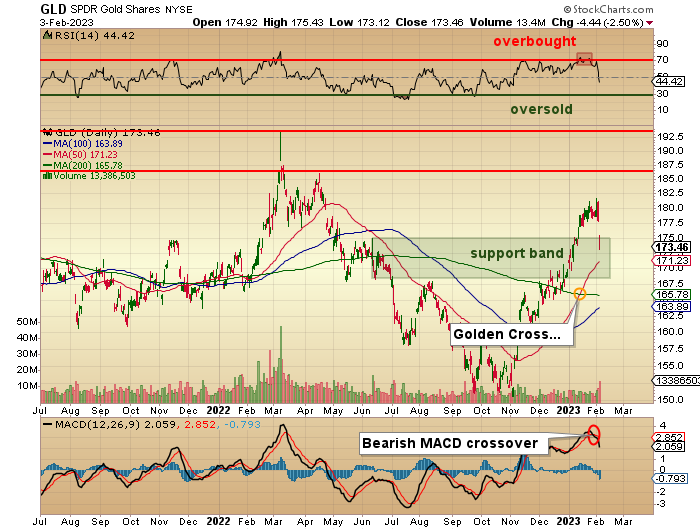
Taking a quick peek at the technical picture, gold remains firmly bullish on the daily timeframe. The upside momentum could propel prices towards the psychological $1900 if the fundamentals remain in favour of bulls.

US Inflation report in focus

Inflation in the United States slowed for a fifth straight month to 7.1% in November, the lowest level since December 2021. Persistent signs of easing inflationary pressures in the world’s largest economy have somewhat brightened the market mood and fuelled speculation around a less hawkish Fed.

According to Bloomberg, December’s inflation data is expected to show annual inflation cooling to 6.5%. Should expectations become reality, this will mark the sixth straight monthly decline and the lowest since October 2021. Given the market sensitivity to anything relating to inflation, this could result in explosive levels of volatility across financial markets.

More signs of falling inflation may fuel talks around the Federal Reserve veering to smaller rate hikes. Currently, traders are currently pricing in a 27% probability of a 50-basis point rate hike in February. When considering gold’s zero-yielding nature, this is certainly a welcome development for the metal which could support upside gains.

Alternatively, a hotter-than-expected CPI report could revive aggressive rate hike bets as investors question whether inflation is plateauing. Such a development could see gold prices weaken as the dollar bounces back along with Treasury yields.

Other factors to watch out for…

Other than the highly anticipated US CPI report on Thursday, there are a couple of reports and Fed speeches this week that could influence gold prices.

On Monday, Atlanta Fed President Raphael Bostic will be under the spotlight. All eyes will be on Fed Chair Jerome Powell on Tuesday as he speaks during an international symposium at Riksbank in Stockholm. More Fed members are due to speak on Thursday with the US January consumer sentiment report on Friday ending the week. Should Fed members strike a hawkish note, this could weigh on gold prices. Alternatively, any whiff of caution or appearance of doves may boost gold’s allure.

Gold bulls switch into higher gear…

Gold bulls remain in a position of power with their feet pressed aggressively on the accelerator. Prices are firmly bullish on the daily timeframe with $1900 acting as the first key level of interest. A move above this level could encourage an incline towards $1920 and $1958, respectively. Should bulls run out of steam, prices may dip back below $1860 – opening the doors towards $1840, $1814, and $1800, respectively.


Forex-Time-LogoArticle by ForexTime

ForexTime Ltd (FXTM) is an award winning international online forex broker regulated by CySEC 185/12 www.forextime.com

Large Currency Speculators trimmed Euro bullish bets after run to 100-week high

By InvestMacro

Here are the latest charts and statistics for the Commitment of Traders (COT) data published by the Commodities Futures Trading Commission (CFTC).

The latest COT data is updated through Tuesday January 3rd and shows a quick view of how large market participants (for-profit speculators and commercial traders) were positioned in the futures markets. All currency positions are in direct relation to the US dollar where, for example, a bet for the euro is a bet that the euro will rise versus the dollar while a bet against the euro will be a bet that the euro will decline versus the dollar.

Weekly Speculator Changes led by the Brazilian Real & Canadian Dollar

The COT currency market speculator bets were higher this week as six out of the eleven currency markets we cover had higher positioning while the other five markets had lower speculator contracts.

Leading the gains for the currency markets was the Brazilian Real (20,796 contracts) with the Canadian Dollar (3,267 contracts), the Swiss Franc (1,277 contracts), the US Dollar Index (820 contracts), New Zealand Dollar (573 contracts) and the Australian Dollar (524 contracts) also having positive weeks.

The currencies seeing declines in speculator bets on the week were the EuroFX (-16,247 contracts) with the British Pound (-9,414 contracts), Japanese Yen (-9,134 contracts), Mexican Peso (-4,650 contracts) and Bitcoin (-304 contracts) also registering lower bets on the week.

Highlighting the COT currencies data is this week’s breather in the highly bullish Euro currency speculator positioning. The large speculator bets for the Euro dropped this week by the most in the past twenty-four weeks. This week’s shortfall, however, follows a strong bullish run that had seen positions rise in fourteen out of the previous seventeen weeks, going from a total of -47,676 contracts on August 30th to a new 100-week high last week at a total of +146,621 contracts and the highest since January of 2021. Despite this week’s decline, the Euro positions have now been above +100,000 contracts for the past ten weeks which marks the best run since 2021.

The Euro price has been in an uptrend since bottoming in September and has shot higher against the US Dollar since US inflationary data has started to cool. The Euro/US Dollar exchange rate closed just below the 1.0700 level this week after having been right at parity (1.0000) as recently as November 22nd.


Data Snapshot of Forex Market Traders | Columns Legend
Jan-03-2023OIOI-IndexSpec-NetSpec-IndexCom-NetCOM-IndexSmalls-NetSmalls-Index
USD Index41,8504917,76155-20,204442,44343
EUR712,03074129,91575-174,0812744,16649
GBP205,72240-20,3015229,69254-9,39140
JPY172,59033-46,8644046,773589154
CHF33,25012-2,854476,43156-3,57745
CAD138,99523-26,7661024,541892,22535
AUD132,96032-36,2675139,59548-3,32844
NZD29,77367,48074-8,1702769060
MXN245,02970-56,376350,262946,11494
RUB20,93047,54331-7,15069-39324
BRL37,9872428,21176-29,648241,43778
Bitcoin14,5307438984-578018917


Strength Scores led by Bitcoin & Brazilian Real

COT Strength Scores (a normalized measure of Speculator positions over a 3-Year range, from 0 to 100 where above 80 is Extreme-Bullish and below 20 is Extreme-Bearish) showed that the Bitcoin (84 percent) and the Brazilian Real (76 percent) lead the currency markets this week. The EuroFX (75 percent), New Zealand Dollar (74 percent) and the US Dollar Index (55 percent) come in as the next highest in the weekly strength scores.

On the downside, the Mexican Peso (3 percent) and the Canadian Dollar (10 percent) come in at the lowest strength levels currently and are in Extreme-Bearish territory (below 20 percent). The next lowest strength scores are the Japanese Yen (40 percent) and the Swiss Franc (47 percent).

Strength Statistics:
US Dollar Index (54.6 percent) vs US Dollar Index previous week (53.2 percent)
EuroFX (74.9 percent) vs EuroFX previous week (79.9 percent)
British Pound Sterling (51.6 percent) vs British Pound Sterling previous week (59.7 percent)
Japanese Yen (40.0 percent) vs Japanese Yen previous week (45.6 percent)
Swiss Franc (47.1 percent) vs Swiss Franc previous week (43.7 percent)
Canadian Dollar (9.9 percent) vs Canadian Dollar previous week (6.0 percent)
Australian Dollar (51.2 percent) vs Australian Dollar previous week (50.7 percent)
New Zealand Dollar (74.2 percent) vs New Zealand Dollar previous week (72.7 percent)
Mexican Peso (3.3 percent) vs Mexican Peso previous week (5.3 percent)
Brazilian Real (76.1 percent) vs Brazilian Real previous week (53.9 percent)
Bitcoin (83.7 percent) vs Bitcoin previous week (89.0 percent)


Swiss Franc & New Zealand Dollar top the 6-Week Strength Trends

COT Strength Score Trends (or move index, calculates the 6-week changes in strength scores) showed that the Swiss Franc (31 percent) and the New Zealand Dollar (31 percent) lead the past six weeks trends for the currencies. The Brazilian Real (21 percent), the British Pound (13 percent) and the Japanese Yen (11 percent) are the next highest positive movers in the latest trends data.

The Mexican Peso (-51 percent) leads the downside trend scores currently with the Canadian Dollar (-18 percent), US Dollar Index (-11 percent) and Bitcoin (-6 percent) following next with lower trend scores.

Strength Trend Statistics:
US Dollar Index (-10.5 percent) vs US Dollar Index previous week (-16.5 percent)
EuroFX (2.1 percent) vs EuroFX previous week (10.3 percent)
British Pound Sterling (13.4 percent) vs British Pound Sterling previous week (18.8 percent)
Japanese Yen (11.1 percent) vs Japanese Yen previous week (17.3 percent)
Swiss Franc (30.7 percent) vs Swiss Franc previous week (33.6 percent)
Canadian Dollar (-18.0 percent) vs Canadian Dollar previous week (-20.4 percent)
Australian Dollar (6.0 percent) vs Australian Dollar previous week (7.4 percent)
New Zealand Dollar (31.5 percent) vs New Zealand Dollar previous week (36.2 percent)
Mexican Peso (-51.0 percent) vs Mexican Peso previous week (-51.0 percent)
Brazilian Real (20.9 percent) vs Brazilian Real previous week (-1.7 percent)
Bitcoin (-5.5 percent) vs Bitcoin previous week (2.1 percent)


Individual COT Forex Markets:

US Dollar Index Futures:

US Dollar Index Forex Futures COT ChartThe US Dollar Index large speculator standing this week resulted in a net position of 17,761 contracts in the data reported through Tuesday. This was a weekly lift of 820 contracts from the previous week which had a total of 16,941 net contracts.

This week’s current strength score (the trader positioning range over the past three years, measured from 0 to 100) shows the speculators are currently Bullish with a score of 54.6 percent. The commercials are Bearish with a score of 43.7 percent and the small traders (not shown in chart) are Bearish with a score of 43.2 percent.

US DOLLAR INDEX StatisticsSPECULATORSCOMMERCIALSSMALL TRADERS
– Percent of Open Interest Longs:79.33.813.2
– Percent of Open Interest Shorts:36.852.17.4
– Net Position:17,761-20,2042,443
– Gross Longs:33,1711,5885,538
– Gross Shorts:15,41021,7923,095
– Long to Short Ratio:2.2 to 10.1 to 11.8 to 1
NET POSITION TREND:
– Strength Index Score (3 Year Range Pct):54.643.743.2
– Strength Index Reading (3 Year Range):BullishBearishBearish
NET POSITION MOVEMENT INDEX:
– 6-Week Change in Strength Index:-10.512.3-15.8


Euro Currency Futures:

Euro Currency Futures COT ChartThe Euro Currency large speculator standing this week resulted in a net position of 129,915 contracts in the data reported through Tuesday. This was a weekly decline of -16,247 contracts from the previous week which had a total of 146,162 net contracts.

This week’s current strength score (the trader positioning range over the past three years, measured from 0 to 100) shows the speculators are currently Bullish with a score of 74.9 percent. The commercials are Bearish with a score of 26.6 percent and the small traders (not shown in chart) are Bearish with a score of 49.4 percent.

EURO Currency StatisticsSPECULATORSCOMMERCIALSSMALL TRADERS
– Percent of Open Interest Longs:31.354.812.0
– Percent of Open Interest Shorts:13.079.25.8
– Net Position:129,915-174,08144,166
– Gross Longs:222,543389,86185,209
– Gross Shorts:92,628563,94241,043
– Long to Short Ratio:2.4 to 10.7 to 12.1 to 1
NET POSITION TREND:
– Strength Index Score (3 Year Range Pct):74.926.649.4
– Strength Index Reading (3 Year Range):BullishBearishBearish
NET POSITION MOVEMENT INDEX:
– 6-Week Change in Strength Index:2.1-4.614.9


British Pound Sterling Futures:

British Pound Sterling Futures COT ChartThe British Pound Sterling large speculator standing this week resulted in a net position of -20,301 contracts in the data reported through Tuesday. This was a weekly reduction of -9,414 contracts from the previous week which had a total of -10,887 net contracts.

This week’s current strength score (the trader positioning range over the past three years, measured from 0 to 100) shows the speculators are currently Bullish with a score of 51.6 percent. The commercials are Bullish with a score of 54.3 percent and the small traders (not shown in chart) are Bearish with a score of 39.6 percent.

BRITISH POUND StatisticsSPECULATORSCOMMERCIALSSMALL TRADERS
– Percent of Open Interest Longs:21.265.810.8
– Percent of Open Interest Shorts:31.151.315.3
– Net Position:-20,30129,692-9,391
– Gross Longs:43,625135,31422,168
– Gross Shorts:63,926105,62231,559
– Long to Short Ratio:0.7 to 11.3 to 10.7 to 1
NET POSITION TREND:
– Strength Index Score (3 Year Range Pct):51.654.339.6
– Strength Index Reading (3 Year Range):BullishBullishBearish
NET POSITION MOVEMENT INDEX:
– 6-Week Change in Strength Index:13.4-14.812.1


Japanese Yen Futures:

Japanese Yen Forex Futures COT ChartThe Japanese Yen large speculator standing this week resulted in a net position of -46,864 contracts in the data reported through Tuesday. This was a weekly lowering of -9,134 contracts from the previous week which had a total of -37,730 net contracts.

This week’s current strength score (the trader positioning range over the past three years, measured from 0 to 100) shows the speculators are currently Bearish with a score of 40.0 percent. The commercials are Bullish with a score of 58.5 percent and the small traders (not shown in chart) are Bullish with a score of 53.6 percent.

JAPANESE YEN StatisticsSPECULATORSCOMMERCIALSSMALL TRADERS
– Percent of Open Interest Longs:14.768.315.8
– Percent of Open Interest Shorts:41.941.215.7
– Net Position:-46,86446,77391
– Gross Longs:25,377117,95927,267
– Gross Shorts:72,24171,18627,176
– Long to Short Ratio:0.4 to 11.7 to 11.0 to 1
NET POSITION TREND:
– Strength Index Score (3 Year Range Pct):40.058.553.6
– Strength Index Reading (3 Year Range):BearishBullishBullish
NET POSITION MOVEMENT INDEX:
– 6-Week Change in Strength Index:11.1-15.327.1


Swiss Franc Futures:

Swiss Franc Forex Futures COT ChartThe Swiss Franc large speculator standing this week resulted in a net position of -2,854 contracts in the data reported through Tuesday. This was a weekly gain of 1,277 contracts from the previous week which had a total of -4,131 net contracts.

This week’s current strength score (the trader positioning range over the past three years, measured from 0 to 100) shows the speculators are currently Bearish with a score of 47.1 percent. The commercials are Bullish with a score of 55.6 percent and the small traders (not shown in chart) are Bearish with a score of 45.4 percent.

SWISS FRANC StatisticsSPECULATORSCOMMERCIALSSMALL TRADERS
– Percent of Open Interest Longs:19.948.931.0
– Percent of Open Interest Shorts:28.529.641.8
– Net Position:-2,8546,431-3,577
– Gross Longs:6,63216,27410,322
– Gross Shorts:9,4869,84313,899
– Long to Short Ratio:0.7 to 11.7 to 10.7 to 1
NET POSITION TREND:
– Strength Index Score (3 Year Range Pct):47.155.645.4
– Strength Index Reading (3 Year Range):BearishBullishBearish
NET POSITION MOVEMENT INDEX:
– 6-Week Change in Strength Index:30.7-21.13.9


Canadian Dollar Futures:

Canadian Dollar Forex Futures COT ChartThe Canadian Dollar large speculator standing this week resulted in a net position of -26,766 contracts in the data reported through Tuesday. This was a weekly lift of 3,267 contracts from the previous week which had a total of -30,033 net contracts.

This week’s current strength score (the trader positioning range over the past three years, measured from 0 to 100) shows the speculators are currently Bearish-Extreme with a score of 9.9 percent. The commercials are Bullish-Extreme with a score of 89.2 percent and the small traders (not shown in chart) are Bearish with a score of 34.6 percent.

CANADIAN DOLLAR StatisticsSPECULATORSCOMMERCIALSSMALL TRADERS
– Percent of Open Interest Longs:18.355.822.9
– Percent of Open Interest Shorts:37.638.221.3
– Net Position:-26,76624,5412,225
– Gross Longs:25,49777,62431,870
– Gross Shorts:52,26353,08329,645
– Long to Short Ratio:0.5 to 11.5 to 11.1 to 1
NET POSITION TREND:
– Strength Index Score (3 Year Range Pct):9.989.234.6
– Strength Index Reading (3 Year Range):Bearish-ExtremeBullish-ExtremeBearish
NET POSITION MOVEMENT INDEX:
– 6-Week Change in Strength Index:-18.09.96.5


Australian Dollar Futures:

Australian Dollar Forex Futures COT ChartThe Australian Dollar large speculator standing this week resulted in a net position of -36,267 contracts in the data reported through Tuesday. This was a weekly gain of 524 contracts from the previous week which had a total of -36,791 net contracts.

This week’s current strength score (the trader positioning range over the past three years, measured from 0 to 100) shows the speculators are currently Bullish with a score of 51.2 percent. The commercials are Bearish with a score of 48.4 percent and the small traders (not shown in chart) are Bearish with a score of 44.3 percent.

AUSTRALIAN DOLLAR StatisticsSPECULATORSCOMMERCIALSSMALL TRADERS
– Percent of Open Interest Longs:26.556.213.4
– Percent of Open Interest Shorts:53.826.415.9
– Net Position:-36,26739,595-3,328
– Gross Longs:35,20874,72417,847
– Gross Shorts:71,47535,12921,175
– Long to Short Ratio:0.5 to 12.1 to 10.8 to 1
NET POSITION TREND:
– Strength Index Score (3 Year Range Pct):51.248.444.3
– Strength Index Reading (3 Year Range):BullishBearishBearish
NET POSITION MOVEMENT INDEX:
– 6-Week Change in Strength Index:6.0-7.89.5


New Zealand Dollar Futures:

New Zealand Dollar Forex Futures COT ChartThe New Zealand Dollar large speculator standing this week resulted in a net position of 7,480 contracts in the data reported through Tuesday. This was a weekly advance of 573 contracts from the previous week which had a total of 6,907 net contracts.

This week’s current strength score (the trader positioning range over the past three years, measured from 0 to 100) shows the speculators are currently Bullish with a score of 74.2 percent. The commercials are Bearish with a score of 27.2 percent and the small traders (not shown in chart) are Bullish with a score of 59.6 percent.

NEW ZEALAND DOLLAR StatisticsSPECULATORSCOMMERCIALSSMALL TRADERS
– Percent of Open Interest Longs:44.941.612.9
– Percent of Open Interest Shorts:19.869.010.6
– Net Position:7,480-8,170690
– Gross Longs:13,36612,3783,842
– Gross Shorts:5,88620,5483,152
– Long to Short Ratio:2.3 to 10.6 to 11.2 to 1
NET POSITION TREND:
– Strength Index Score (3 Year Range Pct):74.227.259.6
– Strength Index Reading (3 Year Range):BullishBearishBullish
NET POSITION MOVEMENT INDEX:
– 6-Week Change in Strength Index:31.5-31.216.9


Mexican Peso Futures:

Mexican Peso Futures COT ChartThe Mexican Peso large speculator standing this week resulted in a net position of -56,376 contracts in the data reported through Tuesday. This was a weekly decline of -4,650 contracts from the previous week which had a total of -51,726 net contracts.

This week’s current strength score (the trader positioning range over the past three years, measured from 0 to 100) shows the speculators are currently Bearish-Extreme with a score of 3.3 percent. The commercials are Bullish-Extreme with a score of 93.8 percent and the small traders (not shown in chart) are Bullish-Extreme with a score of 93.6 percent.

MEXICAN PESO StatisticsSPECULATORSCOMMERCIALSSMALL TRADERS
– Percent of Open Interest Longs:53.543.03.3
– Percent of Open Interest Shorts:76.622.50.8
– Net Position:-56,37650,2626,114
– Gross Longs:131,201105,4018,078
– Gross Shorts:187,57755,1391,964
– Long to Short Ratio:0.7 to 11.9 to 14.1 to 1
NET POSITION TREND:
– Strength Index Score (3 Year Range Pct):3.393.893.6
– Strength Index Reading (3 Year Range):Bearish-ExtremeBullish-ExtremeBullish-Extreme
NET POSITION MOVEMENT INDEX:
– 6-Week Change in Strength Index:-51.050.2-3.6


Brazilian Real Futures:

Brazil Real Futures COT ChartThe Brazilian Real large speculator standing this week resulted in a net position of 28,211 contracts in the data reported through Tuesday. This was a weekly rise of 20,796 contracts from the previous week which had a total of 7,415 net contracts.

This week’s current strength score (the trader positioning range over the past three years, measured from 0 to 100) shows the speculators are currently Bullish with a score of 76.1 percent. The commercials are Bearish with a score of 24.0 percent and the small traders (not shown in chart) are Bullish with a score of 78.1 percent.

BRAZIL REAL StatisticsSPECULATORSCOMMERCIALSSMALL TRADERS
– Percent of Open Interest Longs:84.57.38.2
– Percent of Open Interest Shorts:10.385.44.4
– Net Position:28,211-29,6481,437
– Gross Longs:32,1052,7793,096
– Gross Shorts:3,89432,4271,659
– Long to Short Ratio:8.2 to 10.1 to 11.9 to 1
NET POSITION TREND:
– Strength Index Score (3 Year Range Pct):76.124.078.1
– Strength Index Reading (3 Year Range):BullishBearishBullish
NET POSITION MOVEMENT INDEX:
– 6-Week Change in Strength Index:20.9-20.4-0.2


Bitcoin Futures:

Bitcoin Crypto Futures COT ChartThe Bitcoin large speculator standing this week resulted in a net position of 389 contracts in the data reported through Tuesday. This was a weekly fall of -304 contracts from the previous week which had a total of 693 net contracts.

This week’s current strength score (the trader positioning range over the past three years, measured from 0 to 100) shows the speculators are currently Bullish-Extreme with a score of 83.7 percent. The commercials are Bearish with a score of 36.4 percent and the small traders (not shown in chart) are Bearish-Extreme with a score of 17.2 percent.

BITCOIN StatisticsSPECULATORSCOMMERCIALSSMALL TRADERS
– Percent of Open Interest Longs:80.80.57.6
– Percent of Open Interest Shorts:78.24.56.3
– Net Position:389-578189
– Gross Longs:11,747731,103
– Gross Shorts:11,358651914
– Long to Short Ratio:1.0 to 10.1 to 11.2 to 1
NET POSITION TREND:
– Strength Index Score (3 Year Range Pct):83.736.417.2
– Strength Index Reading (3 Year Range):Bullish-ExtremeBearishBearish-Extreme
NET POSITION MOVEMENT INDEX:
– 6-Week Change in Strength Index:-5.521.0-2.6


Article By InvestMacroReceive our weekly COT Newsletter

*COT Report: The COT data, released weekly to the public each Friday, is updated through the most recent Tuesday (data is 3 days old) and shows a quick view of how large speculators or non-commercials (for-profit traders) were positioned in the futures markets.

The CFTC categorizes trader positions according to commercial hedgers (traders who use futures contracts for hedging as part of the business), non-commercials (large traders who speculate to realize trading profits) and nonreportable traders (usually small traders/speculators) as well as their open interest (contracts open in the market at time of reporting). See CFTC criteria here.

Speculator Extremes: Soybean Meal & Ultra 10-Year Bonds lead weekly Bullish & Bearish Positions

By InvestMacro 

The latest update for the weekly Commitment of Traders (COT) report was released by the Commodity Futures Trading Commission (CFTC) on Friday for data ending on January 3rd.

This weekly Extreme Positions report highlights the Most Bullish and Most Bearish Positions for the speculator category. Extreme positioning in these markets can foreshadow strong moves in the underlying market.

To signify an extreme position, we use the Strength Index (also known as the COT Index) of each instrument, a common method of measuring COT data. The Strength Index is simply a comparison of current trader positions against the range of positions over the previous 3 years. We use over 80 percent as extremely bullish and under 20 percent as extremely bearish. (Compare Strength Index scores across all markets in the data table or cot leaders table)


Here Are This Week’s Most Bullish Speculator Positions:

Soybean Meal


The Soybean Meal speculator position comes in as the most bullish extreme standing this week. The Soybean Meal speculator level is currently at a 100.0 percent score of its 3-year range.

The six-week trend for the percent strength score totaled a gain of 27.0 this week. The overall net speculator position was a total of 156,568 net contracts this week with a rise of 9,695 contracts in this week’s speculator bets.


Bloomberg Commodity Index


The Bloomberg Commodity Index speculator position comes next in the extreme standings this week. The Bloomberg Commodity Index speculator level is now at a 91.0 percent score of its 3-year range.

The six-week trend for the percent strength score was a small gain of 2.2 this week. The speculator position registered -4,301 net contracts this week with a weekly decline of -980 contracts in speculator bets.


Bitcoin


The Bitcoin speculator position comes in third this week in the extreme standings. The Bitcoin speculator level resides at a 83.7 percent score of its 3-year range.

The six-week trend for the speculator strength score came in at -5.5 this week. The speculator position was 389 net contracts this week with a change of -304 contracts in this week’s speculator bets.


Brazil Real


The Brazil Real speculator position comes up number four in the extreme standings this week. The Brazil Real speculator level is at a 76.1 percent score of its 3-year range.

The six-week trend for the speculator strength score totaled a change of 20.9 this week. The speculator position was 28,211 net contracts this week with a rise by 20,796 contracts in this week’s speculator bets.


Nasdaq


The Nasdaq speculator position rounds out the top five in this week’s bullish extreme standings. The Nasdaq speculator level sits at a 75.8 percent score of its 3-year range.

The six-week trend for the speculator strength score was -0.9 this week. The speculator position was 1,362 net contracts this week with a small gain of 190 contracts in this week’s speculator bets.


This Week’s Most Bearish Speculator Positions:

Ultra 10-Year U.S. T-Note


The Ultra 10-Year U.S. T-Note speculator position comes in as the most bearish extreme standing this week. The Ultra 10-Year U.S. T-Note speculator level is at a 0.0 percent score of its 3-year range.

The six-week trend for the speculator strength score was -2.1 this week. The speculator position was -113,357 net contracts this week with a shortfall of -30,091 contracts in this week’s speculator bets.


Mexican Peso

The Mexican Peso speculator position comes in next for the most bearish extreme standing on the week. The Mexican Peso speculator level is at a 3.3 percent score of its 3-year range.

The six-week trend for the speculator strength score was -51.0 this week. The overall speculator position was -56,376 net contracts this week with a decrease of -4,650 contracts in this week’s speculator bets.


WTI Crude Oil


The WTI Crude Oil speculator position comes in as third most bearish extreme standing of the week. The WTI Crude Oil speculator level resides at a 4.5 percent score of its 3-year range.

The six-week trend for the speculator strength score was -6.6 this week. The speculator position was 227,607 net contracts this week with a drop by -20,011 contracts in this week’s speculator bets.


5-Year Bond


The 5-Year Bond speculator position comes in as this week’s fourth most bearish extreme standing. The 5-Year Bond speculator level is at a 4.9 percent score of its 3-year range.

The six-week trend for the speculator strength score was -16.4 this week. The overall speculator position was -652,919 net contracts this week with a small rise by 2,609 contracts in this week’s speculator bets.


Wheat


Finally, the Wheat speculator position comes in as the fifth most bearish extreme standing for this week. The Wheat speculator level is at a 7.5 percent score of its 3-year range.

The six-week trend for the speculator strength score was -4.7 this week. The speculator position was -32,291 net contracts this week with an increase by 3,998 contracts in this week’s speculator bets.


Speculators or Non-Commercials Notes:

Speculators, classified as non-commercial traders by the CFTC, are made up of large commodity funds, hedge funds and other significant for-profit participants. The Specs are generally regarded as trend-followers in their behavior towards price action – net speculator bets and prices tend to go in the same directions. These traders often look to buy when prices are rising and sell when prices are falling. To illustrate this point, many times speculator contracts can be found at their most extremes (bullish or bearish) when prices are also close to their highest or lowest levels.

These extreme levels can be dangerous for the large speculators as the trade is most crowded, there is less trading ammunition still sitting on the sidelines to push the trend further and prices have moved a significant distance. When the trend becomes exhausted, some speculators take profits while others look to also exit positions when prices fail to continue in the same direction. This process usually plays out over many months to years and can ultimately create a reverse effect where prices start to fall and speculators start a process of selling when prices are falling.


Article By InvestMacroReceive our weekly COT Newsletter

*COT Report: The COT data, released weekly to the public each Friday, is updated through the most recent Tuesday (data is 3 days old) and shows a quick view of how large speculators or non-commercials (for-profit traders) were positioned in the futures markets.

The CFTC categorizes trader positions according to commercial hedgers (traders who use futures contracts for hedging as part of the business), non-commercials (large traders who speculate to realize trading profits) and nonreportable traders (usually small traders/speculators) as well as their open interest (contracts open in the market at time of reporting). See CFTC criteria here.


Metals Speculators push their Platinum bullish bets to 91-week high

By InvestMacro

Here are the latest charts and statistics for the Commitment of Traders (COT) data published by the Commodities Futures Trading Commission (CFTC).

The latest COT data is updated through Tuesday January 3rd and shows a quick view of how large traders (for-profit speculators and commercial entities) were positioned in the futures markets.

Weekly Speculator Changes led by Platinum & Gold

The COT metals markets speculator bets were lower this week as just two out of the five precious metals markets we cover had higher positioning while the other three markets had lower speculator contracts.

Leading the gains for the metals was Platinum (5,837 contracts) with Gold (4,786 contracts) also showing a positive week.

The markets with declines in speculator bets for the week were Copper (-5,399 contracts), Palladium (-336 contracts) and Silver (-93 contracts) registering lower bets on the week.

Highlighting the COT metals data this week is the continued gains in bets for the Platinum positions. The large speculator position in Platinum futures rose this week for a second straight week and for the fifth time over the past six weeks. Over the past fourteen weeks, Platinum bets have been higher in twelve of those weeks. The speculator position (sitting at +30,503 contracts) has now risen to the most bullish level since April 6th of 2021, a span of 91 weeks.

Platinum prices have been moving higher since hitting a multi-year low in early September as well. Since falling to a low just beneath $800 on September 1st, Platinum futures have been in a strong uptrend and closed this week above the $1100 price level for an almost 40 percent rise (since Sept. 1st) and the highest weekly close since March 2022.


Data Snapshot of Commodity Market Traders | Columns Legend
Jan-03-2023OIOI-IndexSpec-NetSpec-IndexCom-NetCOM-IndexSmalls-NetSmalls-Index
Gold449,3937141,66630-159,9747018,30826
Silver131,990930,93448-44,2115313,27737
Copper164,59413-4,67533-163674,83853
Palladium8,45612-2,542102,4228712049
Platinum69,6873830,50350-33,157542,6544


Strength Scores led by Platinum & Silver

COT Strength Scores (a normalized measure of Speculator positions over a 3-Year range, from 0 to 100 where above 80 is Extreme-Bullish and below 20 is Extreme-Bearish) showed that the Platinum (50 percent) leads the metals markets this week. Silver (48 percent) comes in as the next highest in the weekly strength scores.

On the downside, Palladium (10 percent) comes in at the lowest strength level currently and is in Extreme-Bearish territory (below 20 percent). The next lowest strength score was Gold (30 percent).

Strength Statistics:
Gold (29.7 percent) vs Gold previous week (28.1 percent)
Silver (48.2 percent) vs Silver previous week (48.3 percent)
Copper (32.6 percent) vs Copper previous week (36.9 percent)
Platinum (50.1 percent) vs Platinum previous week (42.3 percent)
Palladium (9.8 percent) vs Palladium previous week (12.0 percent)


Silver & Platinum top the 6-Week Strength Trends

COT Strength Score Trends (or move index, calculates the 6-week changes in strength scores) showed that Silver (16 percent) leads the past six weeks trends for metals. Platinum (11 percent) is the next highest positive mover in the latest trends data.

Palladium (-9 percent) leads the downside trend scores currently with Copper (-6 percent) as the next market with lower trend scores.

Move Statistics:
Gold (8.5 percent) vs Gold previous week (3.5 percent)
Silver (15.6 percent) vs Silver previous week (14.8 percent)
Copper (-6.2 percent) vs Copper previous week (-7.2 percent)
Platinum (10.8 percent) vs Platinum previous week (2.9 percent)
Palladium (-9.3 percent) vs Palladium previous week (-7.4 percent)


Individual Markets:

Gold Comex Futures:

Gold Futures COT ChartThe Gold Comex Futures large speculator standing this week was a net position of 141,666 contracts in the data reported through Tuesday. This was a weekly lift of 4,786 contracts from the previous week which had a total of 136,880 net contracts.

This week’s current strength score (the trader positioning range over the past three years, measured from 0 to 100) shows the speculators are currently Bearish with a score of 29.7 percent. The commercials are Bullish with a score of 69.8 percent and the small traders (not shown in chart) are Bearish with a score of 25.8 percent.

Gold Futures StatisticsSPECULATORSCOMMERCIALSSMALL TRADERS
– Percent of Open Interest Longs:51.425.39.4
– Percent of Open Interest Shorts:19.860.95.3
– Net Position:141,666-159,97418,308
– Gross Longs:230,801113,52042,337
– Gross Shorts:89,135273,49424,029
– Long to Short Ratio:2.6 to 10.4 to 11.8 to 1
NET POSITION TREND:
– Strength Index Score (3 Year Range Pct):29.769.825.8
– Strength Index Reading (3 Year Range):BearishBullishBearish
NET POSITION MOVEMENT INDEX:
– 6-Week Change in Strength Index:8.5-9.211.0


Silver Comex Futures:

Silver Futures COT ChartThe Silver Comex Futures large speculator standing this week was a net position of 30,934 contracts in the data reported through Tuesday. This was a weekly reduction of -93 contracts from the previous week which had a total of 31,027 net contracts.

This week’s current strength score (the trader positioning range over the past three years, measured from 0 to 100) shows the speculators are currently Bearish with a score of 48.2 percent. The commercials are Bullish with a score of 53.5 percent and the small traders (not shown in chart) are Bearish with a score of 36.5 percent.

Silver Futures StatisticsSPECULATORSCOMMERCIALSSMALL TRADERS
– Percent of Open Interest Longs:43.833.517.9
– Percent of Open Interest Shorts:20.467.07.8
– Net Position:30,934-44,21113,277
– Gross Longs:57,80144,22923,576
– Gross Shorts:26,86788,44010,299
– Long to Short Ratio:2.2 to 10.5 to 12.3 to 1
NET POSITION TREND:
– Strength Index Score (3 Year Range Pct):48.253.536.5
– Strength Index Reading (3 Year Range):BearishBullishBearish
NET POSITION MOVEMENT INDEX:
– 6-Week Change in Strength Index:15.6-15.712.2


Copper Grade #1 Futures:

Copper Futures COT ChartThe Copper Grade #1 Futures large speculator standing this week was a net position of -4,675 contracts in the data reported through Tuesday. This was a weekly lowering of -5,399 contracts from the previous week which had a total of 724 net contracts.

This week’s current strength score (the trader positioning range over the past three years, measured from 0 to 100) shows the speculators are currently Bearish with a score of 32.6 percent. The commercials are Bullish with a score of 66.9 percent and the small traders (not shown in chart) are Bullish with a score of 53.3 percent.

Copper Futures StatisticsSPECULATORSCOMMERCIALSSMALL TRADERS
– Percent of Open Interest Longs:34.741.910.4
– Percent of Open Interest Shorts:37.642.07.4
– Net Position:-4,675-1634,838
– Gross Longs:57,19168,90517,079
– Gross Shorts:61,86669,06812,241
– Long to Short Ratio:0.9 to 11.0 to 11.4 to 1
NET POSITION TREND:
– Strength Index Score (3 Year Range Pct):32.666.953.3
– Strength Index Reading (3 Year Range):BearishBullishBullish
NET POSITION MOVEMENT INDEX:
– 6-Week Change in Strength Index:-6.24.610.6


Platinum Futures:

Platinum Futures COT ChartThe Platinum Futures large speculator standing this week was a net position of 30,503 contracts in the data reported through Tuesday. This was a weekly lift of 5,837 contracts from the previous week which had a total of 24,666 net contracts.

This week’s current strength score (the trader positioning range over the past three years, measured from 0 to 100) shows the speculators are currently Bullish with a score of 50.1 percent. The commercials are Bullish with a score of 54.2 percent and the small traders (not shown in chart) are Bearish-Extreme with a score of 3.9 percent.

Platinum Futures StatisticsSPECULATORSCOMMERCIALSSMALL TRADERS
– Percent of Open Interest Longs:59.626.99.9
– Percent of Open Interest Shorts:15.974.56.1
– Net Position:30,503-33,1572,654
– Gross Longs:41,55518,7346,879
– Gross Shorts:11,05251,8914,225
– Long to Short Ratio:3.8 to 10.4 to 11.6 to 1
NET POSITION TREND:
– Strength Index Score (3 Year Range Pct):50.154.23.9
– Strength Index Reading (3 Year Range):BullishBullishBearish-Extreme
NET POSITION MOVEMENT INDEX:
– 6-Week Change in Strength Index:10.8-7.1-31.8


Palladium Futures:

Palladium Futures COT ChartThe Palladium Futures large speculator standing this week was a net position of -2,542 contracts in the data reported through Tuesday. This was a weekly reduction of -336 contracts from the previous week which had a total of -2,206 net contracts.

This week’s current strength score (the trader positioning range over the past three years, measured from 0 to 100) shows the speculators are currently Bearish-Extreme with a score of 9.8 percent. The commercials are Bullish-Extreme with a score of 86.8 percent and the small traders (not shown in chart) are Bearish with a score of 48.9 percent.

Palladium Futures StatisticsSPECULATORSCOMMERCIALSSMALL TRADERS
– Percent of Open Interest Longs:25.155.615.0
– Percent of Open Interest Shorts:55.126.913.6
– Net Position:-2,5422,422120
– Gross Longs:2,1204,7001,270
– Gross Shorts:4,6622,2781,150
– Long to Short Ratio:0.5 to 12.1 to 11.1 to 1
NET POSITION TREND:
– Strength Index Score (3 Year Range Pct):9.886.848.9
– Strength Index Reading (3 Year Range):Bearish-ExtremeBullish-ExtremeBearish
NET POSITION MOVEMENT INDEX:
– 6-Week Change in Strength Index:-9.37.811.9


Article By InvestMacroReceive our weekly COT Newsletter

*COT Report: The COT data, released weekly to the public each Friday, is updated through the most recent Tuesday (data is 3 days old) and shows a quick view of how large speculators or non-commercials (for-profit traders) were positioned in the futures markets.

The CFTC categorizes trader positions according to commercial hedgers (traders who use futures contracts for hedging as part of the business), non-commercials (large traders who speculate to realize trading profits) and nonreportable traders (usually small traders/speculators) as well as their open interest (contracts open in the market at time of reporting). See CFTC criteria here.

Week Ahead: Can US Dollar fend off “death cross”?

By ForexTime 

The US inflation outlook, and how it’ll impact the Fed’s plans for raising US interest rates, is set to come into sharpened focus over the coming week which also features these major data releases and events:

Monday, January 9

  • EUR: Eurozone November unemployment; Germany November industrial production
  • GBP: BOE’s Huw Pill speech
  • USD: Atlanta Fed President Raphael Bostic speech

Tuesday, January 10

  • GBPUSD: Speeches by Fed Chair Jerome Powell and BOE Governor Andrew Bailey
  • World Bank set to release global economic prospects report

Wednesday, January 11

  • AUD: Australia November inflation and retail sales

Thursday, January 12

  • AUD: Australia November external trade
  • CNH: China December CPI and PPI
  • USD: US December CPI; weekly initial jobless claims
  • USD: Fed speak – Speeches by St. Louis Fed President James Bullard, Richmond Fed President Thomas Barkin

Friday, January 13

  • CNH: China December external trade
  • GBP: UK November GDP, industrial production, trade balance
  • EUR: Eurozone November industrial production
  • USD: US January consumer sentiment
  • S&P 500: US earnings season kicks off


This time last week, we contemplated whether the US dollar would falter at the onset of 2023.

So far in this first trading week of the year, the equally-weighted USD Index has held up pretty well, even testing the key 200-day SMA / 50% Fibonacci resistance levels that we pointed out in our previous Week Ahead article (published Dec 30th):


Still, to be fair, this article is being published before this first week of 2023 is over.

We’ve still got the marquee US nonfarm payrolls (NFP) due in just a few hours today (Friday, January 6th).

Even as we wait for the pivotal US jobs report, the astute investor and trader would already be keeping an eye on the coming week.

And looking at the charts, one can’t help but notice that the USD Index appears headed for a “death cross”.

What is a “death cross”?

The death cross occurs when an asset’s 50-day simple moving average (SMA) crosses below its 200-day counterpart.

Investors and traders take such an event as confirmation of the downtrend for that particular asset’s prices.

This technical event is widely viewed as a “bearish” sign, suggesting that prices would decline further after the “death cross”.

For example, the last time this USD Index witnessed a “death cross” was back in July 2020.

After such a bearish technical event, this index then fell by a further 9.7%, before reaching bottom at 1.04399 in February 2021.


What could push the USD Index closer to a death cross?

If the US inflation data due on January 12th comes in lower than expected, that should drag the dollar even lower.

Markets are currently expecting the December consumer price index (CPI) – which measures headline inflation – to register a 6.6% advance compared to December 2021.

If so, that 6.6% would be significantly lower from the 40-year high of 9.1% that was registered back in June 2022, though still three times higher than the Fed’s 2% inflation target.

Recall the reason for these Fed rate hikes = it’s to subdue US inflation.


Also, recall how the buck has been reacting to market expectations surrounding US interest rates:

  • For the first 3 quarters of 2022, the US dollar drew tremendous strength from the notion that the Fed will send rates even higher, which the central bank did.
  • The US dollar then faltered since October as markets begin to believe that the Fed is close to being done with its aggressive rate hikes.
  • Adding to the dollar’s weakness in recent months is the idea that the Fed may even have to cut interest rates later in 2023 in order to offset the risk of dragging the world’s largest economy into a recession.

Potential scenarios for USD Index in response to CPI release:

1) Dollar down: If markets are given further evidence that US inflation is further subsiding, that should give the Fed less of a need to send interest rates much higher.

Such hopes may drag the USD Index back lower to the 1.170 region, and potentially see this USD Index form a death cross.

2) Dollar up: If next week’s US inflation print exceeds the market forecasts of 6.6%, that implies that the Fed has more to do to combat stubborn inflation.

Such a hawkish narrative may well send this USD Index upwards to test its 50-day SMA (around 1.20) as the immediate resistance level, while perhaps delaying the formation of a “death cross” for a while longer.


Forex-Time-LogoArticle by ForexTime

ForexTime Ltd (FXTM) is an award winning international online forex broker regulated by CySEC 185/12 www.forextime.com

Major recession fears rise on Fed minutes

By George Prior

The latest Federal Reserve meeting minutes suggest that the U.S. economy is headed for recession as the central bank will remain aggressive in raising rates to cool inflation, warns the CEO of one of the world’s largest independent financial advisory, asset management and fintech organizations.

The warning comes from deVere Group’s Nigel Green as the meeting minutes released Wednesday signal that the U.S. central bank remains cautious on inflation, with officials agreeing that “rate cuts shouldn’t happen in 2023.”

He says: “Investors have been waiting with bated breath as the Federal Open Market Committee (FOMC) minutes from the December meeting released on Wednesday give us more insight into what factors the Committee has been using for future policy decisions.

“It appears that officials remain hawkish and are especially concerned about the tight labor market.

“We expect that the latest minutes will give the central bank further support to maintain interest rates higher for longer than had been previously priced-in by the markets.

“With the labor market not cooling as fast, there seems to be a considerable turnaround in tone from the more dovish minutes in November.”

He continues: “These minutes dash yet more hopes for an economic soft landing.

“Investors are increasingly concerned that the Federal Reserve could now overtighten and will steer the U.S. economy into a major recession.

“Of course, the central bank will argue it needs to continue with rate rises to bring inflation back to target.

“But it must also ensure that the tight labor market doesn’t overshadow the broader picture and continue to overdo the hikes, which would make a U.S. recession deeper and longer.

“As the world’s largest economy, this would clearly have a serious, negative impact on the global economy.”

Nigel Green concludes: “The tone of the minutes indicate the Fed is not yet ready to pivot as the central bank believes risks for inflation remain to the upside and they will keep tightening until more substantial progress is made on bringing it back closer to target.

“Inflation remains their primary concern, not risks to economic growth.”

About:

deVere Group is one of the world’s largest independent advisors of specialist global financial solutions to international, local mass affluent, and high-net-worth clients.  It has a network of more than 70 offices across the world, over 80,000 clients and $12bn under advisement.