Archive for Financial News – Page 79

Trump suspended planned tariffs on Mexico and Canada after talks with their leaders

By JustMarkets

On Monday’s close, the Dow Jones Index (US30) was down 0.28%. The S&P 500 Index (US500) decreased by 0.76%. The Nasdaq Technology Index (US100) fell by 0.84%. Global stock markets came under pressure on Monday after President Trump on Saturday announced 25% tariffs on Canada and Mexico and 10% tariffs on China, and warned of impending European tariffs. The tariffs were due to take effect on Tuesday and could spark a trade war that threatens economic growth around the world. Goldman Sachs warned there was a risk of a 5% drop in US stocks due to the hit to corporate earnings, while RBC Capital Markets estimated a 5% to 10% drop in stocks. However, stocks recovered more than half of their losses after President Trump agreed late in the day to suspend planned tariffs on Mexico and Canada for a month after successful talks with their leaders.

The Canadian dollar strengthened to 1.45 per US dollar in February, rising from its lowest level in two years, after Prime Minister Trudeau confirmed that the imposition of US tariffs on Canadian goods would be suspended for at least 30 days. The postponement alleviated immediate concerns over potential trade disruptions, which had pressured the loonie due to fears of lower demand for Canadian exports and restricted foreign exchange inflows. Despite this, the CAD remains under pressure as Canadian GDP growth in December was just 0.2%, leaving the annualized growth rate for 2024 at a modest 1.4%.

The Mexican peso (USD/MXN) strengthened to 20.5 per US dollar, recovering after briefly falling to a three-year low after US President Trump delayed the imposition of tariffs against Mexico announced over the weekend. The US president cited talks with Mexican counterpart Sheinbaum and progress on the border issue, supporting bets that the restrictions will be avoided by the new deadline.

Equity markets in Europe were mostly down yesterday. Germany’s DAX (DE40) fell by 1.40%, France’s CAC 40 (FR40) closed down 1.20%, Spain’s IBEX 35 (ES35) lost 1.32%, and the UK’s FTSE 100 (UK100) closed down 1.04%.

WTI crude oil prices trimmed gains and traded near $73 per barrel after OPEC+ confirmed a gradual increase in production and removed the US Energy Information Administration (EIA) from its list of sources for monitoring production. The decision follows past tensions between OPEC+ and President Trump, who has previously pressured the group to increase supply to offset US sanctions on Iran. Since returning to office, Trump has again urged OPEC to release more oil, arguing that high prices support Russia’s war in Ukraine.

Silver (XAG/USD) topped $31.5 an ounce on Monday, near its highest since early December, amid easing trade war fears and optimism about improving demand for manufactured goods. Meanwhile, strong manufacturing data from ISM pointed to welcome momentum in US factory activity, which supported silver’s prospects as industrial demand, especially in electrification technologies. On the supply side, the Silver Institute recently predicted a fifth consecutive year of significant market shortages of the metal in 2025, driven by strong industrial demand and retail investment.

Asian markets were mostly falling yesterday. Japan’s Nikkei 225 (JP225) was down 2.66%, China’s FTSE China A50 (CHA50) lost 0.37%, Hong Kong’s Hang Seng (HK50) was 0.04% cheaper, and Australia’s ASX 200 (AU200) was negative 1.79%.

US President Donald Trump is set to speak to his Chinese counterpart Xi Jinping as early as this week as the two major economies work towards a deal to avoid wider trade tensions. On Monday, Beijing called on Washington for “frank dialogue and strengthened cooperation,” stressing that the tariffs are counterproductive and harmful to normal trade relations. Beijing also plans to sue the World Trade Organization.

S&P 500 (US500) 5,994.57 −45.96 (−0.76%)

Dow Jones (US30) 44,421.91 −122.75 (−0.28%)

DAX (DE40) 21,428.24 −303.81 (−1.40%)

FTSE 100 (UK100) 8,583.56 −90.40 (−1.04%)

USD Index 108.81 +0.44 (+0.41%)

News feed for: 2025.02.04

  • US JOLTs Job Openings (m/m) at 17:00 (GMT+2);
  • New Zealand Unemployment Rate (q/q) at 23:45 (GMT+2).

By JustMarkets


This article reflects a personal opinion and should not be interpreted as an investment advice, and/or offer, and/or a persistent request for carrying out financial transactions, and/or a guarantee, and/or a forecast of future events.

Australian Dollar Recovers, But Risks Remain High

By RoboForex Analytical Department 

The AUD/USD pair rebounded to 0.6199 on Tuesday, recovering some losses. Earlier in the week, the Australian dollar tested multi-year lows as investors distanced themselves from riskier assets amid concerns over US tariffs on Canada, Mexico, and China.

A reprieve came as US President Donald Trump delayed the implementation of tariffs on Canada and Mexico for one month while negotiating with both countries. This pause improved sentiment for risk currencies, including the Australian dollar.

Key factors influencing AUD/USD

Despite this temporary relief, uncertainty remains, particularly regarding China, Australia’s largest trading partner. The newly announced US tariffs on Chinese goods take effect today, which could have significant economic consequences. Any updates related to China directly impact Australia’s economy and currency movements.

Adding to the uncertainty, Trump is set to meet with Chinese President Xi Jinping this week. While China is keen to avoid escalating trade tensions, the US administration will likely use the situation strategically to its advantage. The outcome of these discussions could shape risk sentiment in global markets.

On the domestic front, Australia’s trade balance data for December is scheduled for release on Thursday. This report will provide insights into the health of Australia’s export-driven economy and could influence the Reserve Bank of Australia’s (RBA) policy stance.

Technical analysis of AUD/USD

On the H4 chart, AUD/USD previously formed a downside wave to 0.6088, followed by a correction to 0.6233. Today, the market is expected to initiate another downward wave towards 0.6077. A potential corrective move back to 0.6230 may follow, forming a consolidation range. If the pair breaks upwards from this range, another correction towards 0.6290 is possible. However, if it breaks downwards, the downward wave to 0.6077 will likely continue. The MACD indicator supports this scenario, with its signal line positioned above the zero mark but pointing sharply downwards, indicating strong bearish momentum.

On the H1 chart, AUD/USD established a consolidation range near 0.6160 before breaking upwards to complete a correction at 0.6230. The next move is expected to be a new downward wave targeting 0.6150. If this level is breached, the pair could extend losses towards 0.6077. The Stochastic oscillator confirms this bearish outlook, with its signal line below 80 and trending downwards towards 20, indicating growing downside pressure.

Conclusion

The Australian dollar has staged a modest recovery, but risks remain elevated due to ongoing US-China trade tensions and uncertainty surrounding Australia’s economic outlook. While short-term technical indicators suggest the potential for further downside, the key levels to watch are 0.6150 and 0.6077. Market participants will closely monitor Trump’s meeting with Xi Jinping and Australia’s trade balance data for further directional cues.


Disclaimer

Any forecasts contained herein are based on the author’s particular opinion. This analysis may not be treated as trading advice. RoboForex bears no responsibility for trading results based on trading recommendations and reviews contained herein.

Trump’s tariff policy could lead to trade wars between key economies

By JustMarkets 

As of Friday, the Dow Jones (US30) was down 0.75% (for the week +0.90%). The S&P500 Index (US500) decreased by 0.50% (for the week +1.20%). The Nasdaq Technology Index (US100) is down 0.14% (for the week +2.28%). Stocks gave up an early rally on Friday and declined moderately. The long liquidation in stocks emerged on Friday afternoon when the White House denied a Reuters report that President Trump would delay imposing tariffs against Canada and Mexico until March 1.

Relations between longtime allies the US and Canada, which has the world’s longest land border, have reached a new low. Canadian Prime Minister Trudeau said he was imposing tariffs on 155 billion Canadian dollars ($107 billion) worth of US goods. He said tariffs on 30 billion Canadian dollars will take effect Tuesday, the same day as Trump’s tariffs, and duties on the remaining 125 billion Canadian dollars 21 days later. Trudeau’s announcement came just hours after Trump imposed 25 percent tariffs on Canadian and Mexican imports and 10 percent on goods from China, creating the risk of a trade war that economists say could slow global growth and stoke inflation.

The tariffs pose a significant threat to the commodity-linked CAD, as they could reduce currency demand and limit foreign exchange inflows. These tariff risks also add to pessimism about Mexico’s economic outlook, especially after its GDP contracted by 0.6% in Q4 2024. Meanwhile, diverging monetary policies between the hawkish US Federal Reserve and Mexico’s central bank, expected to cut rates further to stimulate economic recovery, have narrowed the yield differential, adding pressure on MXN.

Equity markets in Europe were mostly up on Friday. Germany’s DAX (DE40) rose by 0.02% (for the week +2.50%), France’s CAC 40 (FR40) closed up 0.11% (for the week +0.97%), Spain’s IBEX 35 (ES35) index fell by 0.41% (for the week +4.00%), and the UK’s FTSE 100 (UK100) closed 0.31% (for the week +2.02%) on Friday. The DAX index closed without significant changes on Friday, setting a new record high. Market participants were assessing key inflation data from Europe and the US and the latest corporate earnings reports. In Germany and France, core inflation came in below forecasts, indicating that price pressures are easing and reinforcing expectations that the ECB will continue to cut rates this year.

WTI crude oil prices rose to around $73.8 a barrel on Monday after US President Donald Trump imposed tariffs against Canada, Mexico, and China, raising concerns about possible supply disruptions. However, crude oil prices could face downward pressure in the near term. Imposing tariffs and subsequent retaliatory measures could trigger a wider trade war, hurting global economic growth and reducing energy demand.

Asian markets were predominantly up last week. Japan’s Nikkei 225 (JP225) fell by 2.59%, China’s FTSE China A50 (CHA50) gained 0.44%, Hong Kong’s Hang Seng (HK50) rose by 0.91%, and Australia’s ASX 200 (AU200) posted a positive 1.21% for the week. Hong Kong stocks fell 1.3% in early trading at the start of the new month, reversing gains from the previous three sessions when trading resumed after the New Year holiday amid widespread sector losses. Over the weekend, investors reacted as Donald Trump imposed sweeping tariffs against several countries, including China. Meanwhile, Beijing announced plans to challenge Trump’s decision at the WTO and take other countermeasures, adding to fears of a trade dispute between the two countries.

The Australian dollar fell about 2% to below $0.61, hitting its lowest since April 2020. New US tariffs heightened fears about a global trade war, triggering a sell-off in risk assets. While Australia has not been directly impacted by the new US tariffs, its economy, which relies heavily on exports and free trade, remains vulnerable to disruptions in global trade. Meanwhile, data showed a 0.1% decline in Australian retail sales for December, the first drop in nine months. The slowdown has further supported expectations of a dovish stance by the Reserve Bank of Australia, with many analysts predicting rate cuts could begin as early as this month.

On Monday, the New Zealand dollar fell by 2% to US$0.553, its lowest level since March 2020, as the threat of a global trade war weighed on risk sentiment. In addition, the Kiwi weakened further after China’s manufacturing PMI fell below expectations as China is New Zealand’s key trading partner. The prospect of further rate cuts by the Reserve Bank of New Zealand also weighed on the currency. The market is pricing in a 50 bps rate cut to 3.75% at the February 19 meeting and forecasts a rate cut to 3% over the next 12 months.

Indonesia’s annualized inflation rate for January 2025 fell to 0.76% from December’s 1.57%, the lowest since March 2000. Core inflation, which excludes managed and volatile food prices, accelerated to an 18-month high of 2.36%, beating growth estimates of 2.30%.

S&P 500 (US500) 6,040.53 −30.64 (−0.50%)

Dow Jones (US30) 44,544.66 −337.47 (−0.75%)

DAX (DE40) 21,732.05 +4.85 (+0.02%)

FTSE 100 (UK100) 8,673.96 +27.08 (+0.31%)

USD index 108.50 +0.70 (+0.65%)

News feed for: 2025.02.03

  • Australia Manufacturing PMI (m/m) at 00:00 (GMT+2);
  • Australia Retail Sales (m/m) at 02:30 (GMT+2);
  • Japan Manufacturing PMI (m/m) at 02:30 (GMT+2);
  • China Caixin Manufacturing PMI (m/m) at 03:45 (GMT+2);
  • Switzerland Manufacturing PMI (m/m) at 10:30 (GMT+2);
  • German Manufacturing PMI (m/m) at 10:55 (GMT+2);
  • Eurozone Manufacturing PMI (m/m) at 11:00 (GMT+2);
  • UK Manufacturing PMI (m/m) at 11:00 (GMT+2);
  • Eurozone Consumer Price Index (m/m) at 12:00 (GMT+2);
  • OPEC+ meeting at 13:00 (GMT+2);
  • US ISM Manufacturing PMI (m/m) at 17:00 (GMT+2).

By JustMarkets


This article reflects a personal opinion and should not be interpreted as an investment advice, and/or offer, and/or a persistent request for carrying out financial transactions, and/or a guarantee, and/or a forecast of future events.

Trump Tariffs: How are markets reacting? Here are 3 lessons for traders

By ForexTime 

  • Starting Feb 4th: 25% tariffs on Canada and Mexico; 10% on China
  • Dollar index (USDInd) returns towards 2-year high around 110.0
  • Canadian Dollar (CAD) tumbles to weakest against USD since 2003
  • NZD, AUD – China proxies – lead G10 declines against US dollar
  • Mexican Peso (MXN) sinks to near 3-year low (since March 2022)
  • Offshore Chinese Yuan (CNH) down 0.3%; all Asian currencies lower vs. USD
  • Gold falters from record high; US crude oil pares initial spike
  • US, European, Chinese stock indexes gapped down
  • Bitcoin briefly sank below $92k; smaller cryptos see double-digit declines
  • 3 Lessons: Traders must stay alert, have adequate capital, and move fast to seize on potential market opportunities


President Trump is following through on his tariff threats!

Starting 12:01 AM Eastern Standard time (5:01 AM GMT) on February 4th, 2025, the following levies will be imposed on US-bound imports from:

  • Canada = 25% (except energy products)
  • Mexico = 25%
  • China = 10%

Also, President Trump warned that tariffs against the EU “will definitely happen”.

Although POTUS intends to hold talks with Canada and Mexico later today, it would require something dramatic over the coming hours for Trump to reverse his decision before 12:01 AM EST.

The prospects of tit-for-tat trade wars, and a souring global economy, are hurting riskier assets across global financial markets.


How are markets reacting?

February has indeed kicked off with a bang, considering the incoming economy-dampening tariffs:


Currencies:

  • The US dollar index (USDInd)

    • soared back closer to its 2-year high around the psychological 110.0 mark.
    • skyrocketed as much as 1.3%, and if it holds, would be its biggest one-day gain since November 2024.
    • US dollar is widely seen as a “safe haven”, which helps protects investors’ wealth during times of heightened fear and uncertainty.
    • Trump’s tariffs are expected to reignite US inflation.

      – reawakened inflation may prevent the Federal Reserve from lowering US interest rates.

      – US dollar tends to strengthen when US interest rates remain higher than its major peers (Euro, UK, Canada, etc.)


  • Canadian dollar (CAD)

    • tumbled to its weakest levels since April 2003.
    • USDCAD is climbing 1.5% (stronger US dollar, weaker CAD), getting within a few pips of the 1.4800 level.
    • biggest loser among G10 currencies against the US dollar, down 2.2% so far in 2025.


  • AUDUSD and NZDUSD

    • biggest G10 losers vs. USD today
    • The Australian Dollar (AUD) and New Zealand Dollar (NZD) are now weaker by 1.27% and 1.37% against the US dollar respectively.
    • Antipodean currencies are widely seen as G10 proxies to China, given that the world’s second-largest economy, is the top trade partner for Australia and New Zealand respectively.


All G10 currencies initially weakened by over 1% against the US dollar today …

… except for safe havens Swiss Franc (CHF: down 0.7%), and the Japanese Yen (JPY: down 0.3%) at the time of writing.


  • Mexican Peso (MXN)

    • worst-performing LatAm currency today, down 2.2% against US dollar so far
    • 2nd-worst currency in the world against US dollar today (second to the Vanuatu Vatu, down 2.5%), as tracked by Bloomberg
    • down 1.7% year-to-date


  • Chinese Yuan (CNH)

    • down 2.2% against US dollar today
    • Onshore Yuan (CNY) due to resume trading on Tuesday, Feb 4th – after Chinese New Year break


Metals/Commodities:

  • Gold

    • XAUUSD is holding steady, despite initially falling about 0.5%
    • demand for “safe havens” is keeping bullion around its record high around $2800 posted just this past Friday, Jan 31st.

However, with major G10 currencies weakening against the stronger US dollar …

FXTM’s new, non-USD Gold pairs are actually gaining!

  • XAUCNH: up 0.2%
  • XAUGBP: up 0.6%
  • XAUEUR: up 1.0%
  • XAUAUD: up 1.1%

  • Crude oil

    • Initially, US crude surged by as much as 1.5% (using FXTM’s prices), at the thought of tariffs being imposed on suppliers of crude to the US:- 10% tariff on Canada’s 4 million barrels of crude shipped per day to the US

      25% tariff on Mexico’s 500,000 barrels of crude shipped per day to the US

    • Crude, which measures US-only prices (as opposed to Brent oil, which is the world’s benchmark for oil prices), then pared its initial spike.
    • With imported crude set to carry a heftier price tag, that is spurring on demand for US onshore oil – hence the initial spike up for Crude prices.


Stock Indexes:

  • US stock indices

    • US500, US30, NAS100, US400, RUS2000 – all gapped down.
    • US stock indexes are hurtling towards their respective year-to-date lows, these stock indexes are about to test widely-followed technical indicators known as simple moving averages (SMAs) for immediate support:

      US500 and NAS100: 100-day SMA

      US30: 50-day SMA

      – RUS2000: 200-day SMA


  • European stock indexes

    • EU50 gapped down from a 24-year high
    • GER40 and UK100 tumbled away from their respective record highs
    • FRA40 falls from 7-month high (since June 2024)


  • Asian stock indexes

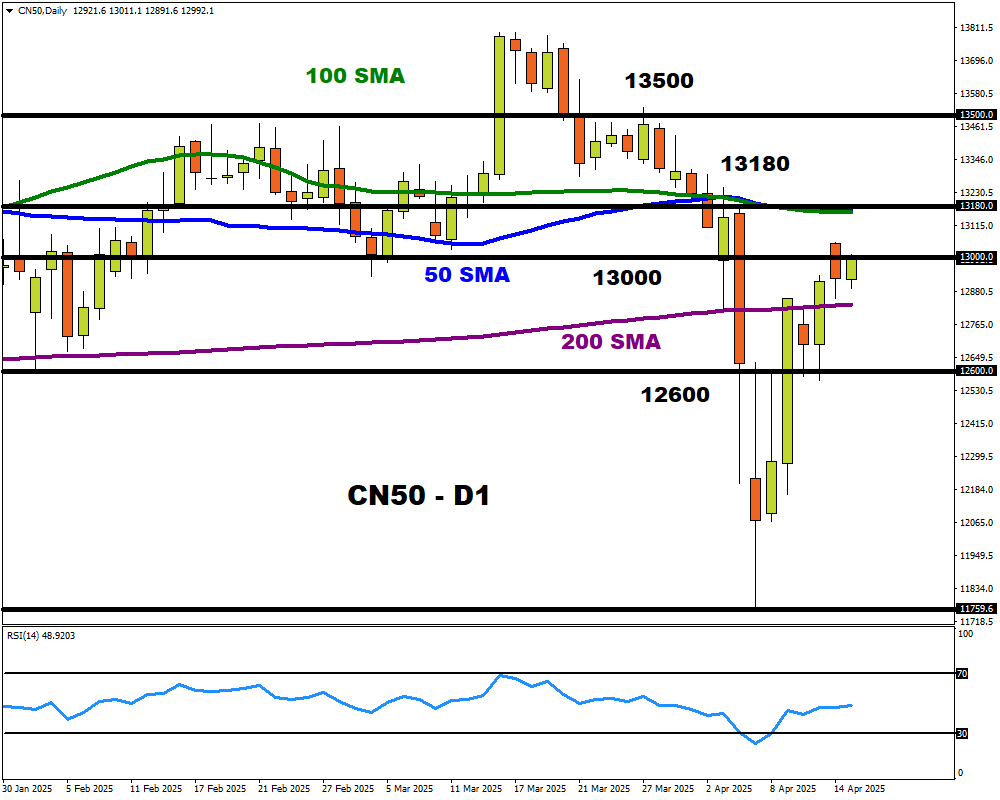
    • JAP225, CHINAH, CN50, and HK50 – also gapped down
    • still adhering to the sideways price range since mid-2024.


Cryptocurrencies:

  • Bitcoin

    • briefly dipped below the $92,000 level – its lowest levels since mid-January.
    • However, at the time of writing, the world’s oldest crypto is now attempting to keep its head above $94k.
  • Smaller cryptos

    • Ethereum, Litecoin, Ripple, Bitcoin Cash, Dogecoin, etc. – are falling between 10-15% respectively.


Trump tariffs: 3 lessons for traders in navigating market volatility

Beyond the bloodbath, perhaps what’s more surprising is how markets actually reacted on this Monday, Feb. 3rd

After all, President Trump has made no secret of his tariff threats.

Markets are perhaps guilty of being too complacent over Trump’s tariff threats, hoping that Trump 2.0 would have adopted a more restrained approach with regards to his protectionist policies, and incurring less damage towards the global trade order.

Clearly, those rose-tinted glasses have been smashed over the weekend.

These incoming tariffs show that President Trump may be willing to incur some economic pain in forcing other countries to fall in line with his policies.


Still, amid the market turmoil, here are some crucial lessons for traders in navigating these Trump-fuelled market volatility:


1) Stay Alert

President Trump is of course renowned for his penchant to shock markets.

Hence, it’s imperative that traders and investors stay up to date with his next moves, including threats made verbally or via social media posts, as well as official announcements.


2) Manage Risks

  • Diversification: having positions across various instruments/assets to reduce risks and potentially offset losses).
  • Adequate Capital: ensure that you have enough cash to either keep your positions open, or live to see another day, when prices go against you. Never risk all your capital into one single trade, especially given these highly uncertain times.
  • KYRA – Know Your Risk Appetite: It’s important to know how much you’re willing to lose, in exchange for the chance at potential profits, before entering any trade.


3) Move fast

Being aware of these market moves is one thing; capitalising on them is another.

Traders who seize opportunities when they arise, taking advantage of fast-moving trends or price swings, stand to benefit amid this Trump-fuelled market volatility.

After all, CFD traders can potentially profit both when prices go up or down.

Quick decision-making and execution, without letting your emotions run amok, are key to potentially profiting in turbulent markets.

Otherwise, all market participants can do is watch and rue those missed opportunities.


Volatility creates opportunities

Markets have certainly been volatile in these early days of President Trump’s administration.

And to think that inauguration day was merely 2 weeks ago to the day (Monday, January 20th).

If this trend from these early days of Trump 2.0 persists through January 2029 – essentially, throughout Trump’s final term in office – there are bound to be a lot more outsized market opportunities ahead …

as long traders and investors remain alert, prudent, and strike during bouts of Trump-fuelled market volatility.


Forex-Time-LogoArticle by ForexTime

ForexTime Ltd (FXTM) is an award winning international online forex broker regulated by CySEC 185/12 www.forextime.com

Canadian dollar under pressure as US tariffs drive USD/CAD to a 22-year high

By RoboForex Analytical Department 

The USD/CAD pair surged above 1.4760 on Monday, reaching its highest level since April 2003. This sharp rise came in response to the US government’s decision to impose 25% tariffs on Canadian imports, significantly impacting the Loonie.

Key factors driving USD/CAD

The White House framed the tariffs as part of a broader policy to combat illegal immigration and illicit trade. However, the economic repercussions are immediate, particularly for Canada’s commodity-driven economy.

A separate 10% tariff has been applied to Canadian energy exports, a somewhat lower rate than initially expected. Similar tariffs were also introduced for Mexico, while Chinese goods now face a 10% import duty. In response, all affected countries have signalled plans for retaliatory measures.

For Canada, the new trade barriers pose a significant threat. With the economy heavily reliant on exports, reduced foreign demand could lower foreign currency inflows and further weaken the CAD.

Investors are now turning their attention to upcoming Canadian GDP data. December’s figures are expected to show 0.2% growth, translating to an annual expansion of 1.4%, aligning with the Bank of Canada’s (BoC) projections.

The BoC recently cut its benchmark interest rate by 25 basis points to 3.0% per annum and announced an end to its quantitative easing programme. Additionally, the central bank has indicated plans to resume asset purchases in March, further weighing on the Canadian dollar.

USD/CAD technical analysis

On the H4 chart, USD/CAD broke through 1.4591 and continues its upward wave. With this breakout, the path towards 1.4808 is now open, making it the next local target. After reaching this level, a correction towards 1.4591 is possible before a renewed growth wave targets 1.4919. The MACD indicator supports this outlook, with its signal line above zero and pointing sharply upwards, confirming bullish momentum.

On the H1 chart, the pair has extended its upward structure to 1.4742 and is now consolidating around this level. A breakout from the consolidation range to the upside would signal a move towards 1.4808. However, if the pair breaks downwards, a correction to 1.4591 is possible before another attempt at the 1.4808 level. The Stochastic oscillator indicates a potential short-term pullback, with its signal line above 80 and preparing to decline towards 20.

Conclusion

The Canadian dollar remains under significant pressure as US trade tariffs drive uncertainty over future export demand. While technical indicators suggest further upside for USD/CAD towards 1.4808, a corrective move towards 1.4591 is also possible before another wave of growth. The market’s next key focus will be Canadian GDP data and any further developments on trade retaliation from affected countries, both of which could impact the pair’s trajectory.


Disclaimer

Any forecasts contained herein are based on the author’s particular opinion. This analysis may not be treated as trading advice. RoboForex bears no responsibility for trading results based on trading recommendations and reviews contained herein.

COT Metals Charts: Weekly Speculator Bets led by Palladium

By InvestMacro

Here are the latest charts and statistics for the Commitment of Traders (COT) data published by the Commodities Futures Trading Commission (CFTC).

The latest COT data is updated through Tuesday January 28th and shows a quick view of how large traders (for-profit speculators and commercial entities) were positioned in the futures markets.

Weekly Speculator Bets led by Palladium

The COT metals markets speculator bets were decisively lower this week as just one out of the six metals markets we cover had higher positioning while the other five markets had lower speculator contracts.

The only metals market with a gain was Palladium with a rise of 952 contracts on the week.

The markets with declines in speculator bets for the week were Copper (-3,618 contracts), Silver (-3,112 contracts), Gold (-1,375 contracts), Platinum (-1,235 contracts) and with Steel (-251 contracts) also registering lower bets on the week.


Metals Net Speculators Leaderboard

Legend: Weekly Speculators Change | Speculators Current Net Position | Speculators Strength Score compared to last 3-Years (0-100 range)


Strength Scores led by Gold & Steel

COT Strength Scores (a normalized measure of Speculator positions over a 3-Year range, from 0 to 100 where above 80 is Extreme-Bullish and below 20 is Extreme-Bearish) showed that Gold (94 percent) and Steel (88 percent) lead the metals markets this week. Silver (72 percent) comes in as the next highest in the weekly strength scores.

On the downside, Copper (45 percent) and Platinum (48 percent) come in at the lowest strength level currently.

Strength Statistics:
Gold (93.9 percent) vs Gold previous week (94.5 percent)
Silver (72.2 percent) vs Silver previous week (76.1 percent)
Copper (45.4 percent) vs Copper previous week (48.8 percent)
Platinum (47.6 percent) vs Platinum previous week (50.5 percent)
Palladium (50.1 percent) vs Palladium previous week (43.1 percent)
Steel (88.4 percent) vs Palladium previous week (89.5 percent)


Gold & Copper top the 6-Week Strength Trends

COT Strength Score Trends (or move index, calculates the 6-week changes in strength scores) showed that Gold (14 percent) and Copper (7 percent) lead the past six weeks trends for metals. Steel (8 percent) is the next highest positive mover in the latest trends data.

Platinum (-1 percent) leads the downside trend scores currently.

Move Statistics:
Gold (14.2 percent) vs Gold previous week (9.6 percent)
Silver (5.2 percent) vs Silver previous week (8.0 percent)
Copper (6.6 percent) vs Copper previous week (5.3 percent)
Platinum (-0.9 percent) vs Platinum previous week (-0.5 percent)
Palladium (1.7 percent) vs Palladium previous week (-14.7 percent)
Steel (7.5 percent) vs Steel previous week (5.3 percent)


Individual Markets:

Gold Comex Futures:

Gold Futures COT ChartThe Gold Comex Futures large speculator standing this week recorded a net position of 299,409 contracts in the data reported through Tuesday. This was a weekly fall of -1,375 contracts from the previous week which had a total of 300,784 net contracts.

This week’s current strength score (the trader positioning range over the past three years, measured from 0 to 100) shows the speculators are currently Bullish-Extreme with a score of 93.9 percent. The commercials are Bearish-Extreme with a score of 5.8 percent and the small traders (not shown in chart) are Bullish with a score of 58.7 percent.

Price Trend-Following Model: Strong Uptrend

Our weekly trend-following model classifies the current market price position as: Strong Uptrend.

Gold Futures StatisticsSPECULATORSCOMMERCIALSSMALL TRADERS
– Percent of Open Interest Longs:58.619.18.5
– Percent of Open Interest Shorts:6.775.14.3
– Net Position:299,409-323,72224,313
– Gross Longs:338,371110,03449,224
– Gross Shorts:38,962433,75624,911
– Long to Short Ratio:8.7 to 10.3 to 12.0 to 1
NET POSITION TREND:
– Strength Index Score (3 Year Range Pct):93.95.858.7
– Strength Index Reading (3 Year Range):Bullish-ExtremeBearish-ExtremeBullish
NET POSITION MOVEMENT INDEX:
– 6-Week Change in Strength Index:14.2-13.94.0


Silver Comex Futures:

Silver Futures COT ChartThe Silver Comex Futures large speculator standing this week recorded a net position of 44,368 contracts in the data reported through Tuesday. This was a weekly decrease of -3,112 contracts from the previous week which had a total of 47,480 net contracts.

This week’s current strength score (the trader positioning range over the past three years, measured from 0 to 100) shows the speculators are currently Bullish with a score of 72.2 percent. The commercials are Bearish with a score of 27.8 percent and the small traders (not shown in chart) are Bearish with a score of 47.6 percent.

Price Trend-Following Model: Weak Downtrend

Our weekly trend-following model classifies the current market price position as: Weak Downtrend.

Silver Futures StatisticsSPECULATORSCOMMERCIALSSMALL TRADERS
– Percent of Open Interest Longs:45.222.017.0
– Percent of Open Interest Shorts:18.358.57.4
– Net Position:44,368-60,26815,900
– Gross Longs:74,65636,40428,119
– Gross Shorts:30,28896,67212,219
– Long to Short Ratio:2.5 to 10.4 to 12.3 to 1
NET POSITION TREND:
– Strength Index Score (3 Year Range Pct):72.227.847.6
– Strength Index Reading (3 Year Range):BullishBearishBearish
NET POSITION MOVEMENT INDEX:
– 6-Week Change in Strength Index:5.2-3.1-6.5


Copper Grade #1 Futures:

Copper Futures COT ChartThe Copper Grade #1 Futures large speculator standing this week recorded a net position of 13,045 contracts in the data reported through Tuesday. This was a weekly decrease of -3,618 contracts from the previous week which had a total of 16,663 net contracts.

This week’s current strength score (the trader positioning range over the past three years, measured from 0 to 100) shows the speculators are currently Bearish with a score of 45.4 percent. The commercials are Bullish with a score of 54.6 percent and the small traders (not shown in chart) are Bearish with a score of 49.9 percent.

Price Trend-Following Model: Weak Downtrend

Our weekly trend-following model classifies the current market price position as: Weak Downtrend.

Copper Futures StatisticsSPECULATORSCOMMERCIALSSMALL TRADERS
– Percent of Open Interest Longs:37.036.17.2
– Percent of Open Interest Shorts:31.443.94.9
– Net Position:13,045-18,3575,312
– Gross Longs:86,83184,78316,918
– Gross Shorts:73,786103,14011,606
– Long to Short Ratio:1.2 to 10.8 to 11.5 to 1
NET POSITION TREND:
– Strength Index Score (3 Year Range Pct):45.454.649.9
– Strength Index Reading (3 Year Range):BearishBullishBearish
NET POSITION MOVEMENT INDEX:
– 6-Week Change in Strength Index:6.6-5.7-3.0


Platinum Futures:

Platinum Futures COT ChartThe Platinum Futures large speculator standing this week recorded a net position of 13,373 contracts in the data reported through Tuesday. This was a weekly fall of -1,235 contracts from the previous week which had a total of 14,608 net contracts.

This week’s current strength score (the trader positioning range over the past three years, measured from 0 to 100) shows the speculators are currently Bearish with a score of 47.6 percent. The commercials are Bearish with a score of 49.3 percent and the small traders (not shown in chart) are Bullish with a score of 58.6 percent.

Price Trend-Following Model: Weak Downtrend

Our weekly trend-following model classifies the current market price position as: Weak Downtrend.

Platinum Futures StatisticsSPECULATORSCOMMERCIALSSMALL TRADERS
– Percent of Open Interest Longs:61.220.612.9
– Percent of Open Interest Shorts:43.746.24.9
– Net Position:13,373-19,4836,110
– Gross Longs:46,60015,6919,802
– Gross Shorts:33,22735,1743,692
– Long to Short Ratio:1.4 to 10.4 to 12.7 to 1
NET POSITION TREND:
– Strength Index Score (3 Year Range Pct):47.649.358.6
– Strength Index Reading (3 Year Range):BearishBearishBullish
NET POSITION MOVEMENT INDEX:
– 6-Week Change in Strength Index:-0.94.2-23.3


Palladium Futures:

Palladium Futures COT ChartThe Palladium Futures large speculator standing this week recorded a net position of -7,084 contracts in the data reported through Tuesday. This was a weekly gain of 952 contracts from the previous week which had a total of -8,036 net contracts.

This week’s current strength score (the trader positioning range over the past three years, measured from 0 to 100) shows the speculators are currently Bullish with a score of 50.1 percent. The commercials are Bullish with a score of 50.1 percent and the small traders (not shown in chart) are Bullish with a score of 63.1 percent.

Price Trend-Following Model: Weak Downtrend

Our weekly trend-following model classifies the current market price position as: Weak Downtrend.

Palladium Futures StatisticsSPECULATORSCOMMERCIALSSMALL TRADERS
– Percent of Open Interest Longs:32.847.311.7
– Percent of Open Interest Shorts:74.49.38.1
– Net Position:-7,0846,470614
– Gross Longs:5,5938,0582,000
– Gross Shorts:12,6771,5881,386
– Long to Short Ratio:0.4 to 15.1 to 11.4 to 1
NET POSITION TREND:
– Strength Index Score (3 Year Range Pct):50.150.163.1
– Strength Index Reading (3 Year Range):BullishBullishBullish
NET POSITION MOVEMENT INDEX:
– 6-Week Change in Strength Index:1.70.8-16.4


Steel Futures Futures:

Steel Futures COT ChartThe Steel Futures large speculator standing this week recorded a net position of -1,785 contracts in the data reported through Tuesday. This was a weekly fall of -251 contracts from the previous week which had a total of -1,534 net contracts.

This week’s current strength score (the trader positioning range over the past three years, measured from 0 to 100) shows the speculators are currently Bullish-Extreme with a score of 88.4 percent. The commercials are Bearish-Extreme with a score of 12.3 percent and the small traders (not shown in chart) are Bearish with a score of 39.8 percent.

Price Trend-Following Model: Weak Downtrend

Our weekly trend-following model classifies the current market price position as: Weak Downtrend.

Steel Futures StatisticsSPECULATORSCOMMERCIALSSMALL TRADERS
– Percent of Open Interest Longs:25.767.50.9
– Percent of Open Interest Shorts:31.961.50.7
– Net Position:-1,7851,71768
– Gross Longs:7,36719,372271
– Gross Shorts:9,15217,655203
– Long to Short Ratio:0.8 to 11.1 to 11.3 to 1
NET POSITION TREND:
– Strength Index Score (3 Year Range Pct):88.412.339.8
– Strength Index Reading (3 Year Range):Bullish-ExtremeBearish-ExtremeBearish
NET POSITION MOVEMENT INDEX:
– 6-Week Change in Strength Index:7.5-7.76.6


Article By InvestMacroReceive our weekly COT Newsletter

*COT Report: The COT data, released weekly to the public each Friday, is updated through the most recent Tuesday (data is 3 days old) and shows a quick view of how large speculators or non-commercials (for-profit traders) were positioned in the futures markets.

The CFTC categorizes trader positions according to commercial hedgers (traders who use futures contracts for hedging as part of the business), non-commercials (large traders who speculate to realize trading profits) and nonreportable traders (usually small traders/speculators) as well as their open interest (contracts open in the market at time of reporting). See CFTC criteria here.

COT Bonds Charts: Speculator Bets led by SOFR 1-Month & Ultra 10-Year Bonds

By InvestMacro

Here are the latest charts and statistics for the Commitment of Traders (COT) reports data published by the Commodities Futures Trading Commission (CFTC).

The latest COT data is updated through Tuesday January 28th and shows a quick view of how large traders (for-profit speculators and commercial hedgers) were positioned in the futures markets.

Weekly Speculator Bets led by SOFR 1-Month & Ultra 10-Year Bonds

The COT bond market speculator bets were slightly higher this week as five out of the nine bond markets we cover had higher positioning while the other four markets had lower speculator contracts.

Leading the gains for the bond markets was the SOFR 1-Month (77,373 contracts) with the Ultra 10-Year Bonds (63,045 contracts), the SOFR 3-Months (28,065 contracts), the 5-Year Bonds (20,136 contracts) and the US Treasury Bonds (4,128 contracts) also having positive weeks.

The bond markets with declines in speculator bets for the week were the 10-Year Bonds (-120,397 contracts), the Fed Funds (-41,201 contracts), the 2-Year Bonds (-27,182 contracts) and with the Ultra Treasury Bonds (-11,604 contracts) also seeing lower bets on the week.


Bonds Net Speculators Leaderboard

Legend: Weekly Speculators Change | Speculators Current Net Position | Speculators Strength Score compared to last 3-Years (0-100 range)


Strength Scores led by SOFR 1-Month & US Treasury Bonds

COT Strength Scores (a normalized measure of Speculator positions over a 3-Year range, from 0 to 100 where above 80 is Extreme-Bullish and below 20 is Extreme-Bearish) showed that the SOFR 1-Month (96 percent) and the US Treasury Bonds (93 percent) lead the bond markets this week. The Ultra Treasury Bonds (82 percent) come in as the next highest in the weekly strength scores.

On the downside, the Fed Funds (12 percent), the 5-Year Bond (11 percent) and the 2-Year Bonds (19 percent) come in at the lowest strength level currently and are in Extreme-Bearish territory (below 20 percent).

Strength Statistics:
Fed Funds (11.8 percent) vs Fed Funds previous week (19.4 percent)
2-Year Bond (19.3 percent) vs 2-Year Bond previous week (21.2 percent)
5-Year Bond (11.0 percent) vs 5-Year Bond previous week (9.9 percent)
10-Year Bond (41.9 percent) vs 10-Year Bond previous week (53.3 percent)
Ultra 10-Year Bond (52.3 percent) vs Ultra 10-Year Bond previous week (32.8 percent)
US Treasury Bond (93.5 percent) vs US Treasury Bond previous week (92.0 percent)
Ultra US Treasury Bond (82.1 percent) vs Ultra US Treasury Bond previous week (86.5 percent)
SOFR 1-Month (96.3 percent) vs SOFR 1-Month previous week (77.3 percent)
SOFR 3-Months (27.0 percent) vs SOFR 3-Months previous week (25.5 percent)


SOFR 1-Month & US Treasury Bonds top the 6-Week Strength Trends

COT Strength Score Trends (or move index, calculates the 6-week changes in strength scores) showed that the SOFR 1-Month (38 percent) and the US Treasury Bonds (26 percent) lead the past six weeks trends for bonds. The 2-Year Bonds (4 percent) are the next highest positive movers in the latest trends data.

The SOFR 3-Months (-28 percent) and the Ultra Treasury Bonds (-9 percent) lead the downside trend scores currently.

Strength Trend Statistics:
Fed Funds (-36.3 percent) vs Fed Funds previous week (-18.9 percent)
2-Year Bond (3.9 percent) vs 2-Year Bond previous week (5.5 percent)
5-Year Bond (-0.7 percent) vs 5-Year Bond previous week (-0.3 percent)
10-Year Bond (3.1 percent) vs 10-Year Bond previous week (27.9 percent)
Ultra 10-Year Bond (0.9 percent) vs Ultra 10-Year Bond previous week (-20.6 percent)
US Treasury Bond (26.1 percent) vs US Treasury Bond previous week (22.3 percent)
Ultra US Treasury Bond (-8.5 percent) vs Ultra US Treasury Bond previous week (-5.2 percent)
SOFR 1-Month (37.6 percent) vs SOFR 1-Month previous week (25.8 percent)
SOFR 3-Months (-27.7 percent) vs SOFR 3-Months previous week (-17.8 percent)


30-Day Federal Funds Futures:

Federal Funds 30-Day Bonds Futures COT ChartThe 30-Day Federal Funds large speculator standing this week equaled a net position of -231,996 contracts in the data reported through Tuesday. This was a weekly reduction of -41,201 contracts from the previous week which had a total of -190,795 net contracts.

This week’s current strength score (the trader positioning range over the past three years, measured from 0 to 100) shows the speculators are currently Bearish-Extreme with a score of 11.8 percent. The commercials are Bullish-Extreme with a score of 84.2 percent and the small traders (not shown in chart) are Bullish-Extreme with a score of 85.9 percent.

Price Trend-Following Model: Downtrend

Our weekly trend-following model classifies the current market price position as: Downtrend.

30-Day Federal Funds StatisticsSPECULATORSCOMMERCIALSSMALL TRADERS
– Percent of Open Interest Longs:7.872.31.9
– Percent of Open Interest Shorts:19.261.01.9
– Net Position:-231,996231,578418
– Gross Longs:158,8881,475,43238,321
– Gross Shorts:390,8841,243,85437,903
– Long to Short Ratio:0.4 to 11.2 to 11.0 to 1
NET POSITION TREND:
– Strength Index Score (3 Year Range Pct):11.884.285.9
– Strength Index Reading (3 Year Range):Bearish-ExtremeBullish-ExtremeBullish-Extreme
NET POSITION MOVEMENT INDEX:
– 6-Week Change in Strength Index:-36.335.07.6


Secured Overnight Financing Rate (3-Month) Futures:

SOFR 3-Months Bonds Futures COT ChartThe Secured Overnight Financing Rate (3-Month) large speculator standing this week equaled a net position of -644,264 contracts in the data reported through Tuesday. This was a weekly boost of 28,065 contracts from the previous week which had a total of -672,329 net contracts.

This week’s current strength score (the trader positioning range over the past three years, measured from 0 to 100) shows the speculators are currently Bearish with a score of 27.0 percent. The commercials are Bullish with a score of 72.7 percent and the small traders (not shown in chart) are Bullish-Extreme with a score of 90.6 percent.

Price Trend-Following Model: Weak Uptrend

Our weekly trend-following model classifies the current market price position as: Weak Uptrend.

SOFR 3-Months StatisticsSPECULATORSCOMMERCIALSSMALL TRADERS
– Percent of Open Interest Longs:11.863.40.3
– Percent of Open Interest Shorts:18.257.10.3
– Net Position:-644,264639,1895,075
– Gross Longs:1,190,2016,390,62731,310
– Gross Shorts:1,834,4655,751,43826,235
– Long to Short Ratio:0.6 to 11.1 to 11.2 to 1
NET POSITION TREND:
– Strength Index Score (3 Year Range Pct):27.072.790.6
– Strength Index Reading (3 Year Range):BearishBullishBullish-Extreme
NET POSITION MOVEMENT INDEX:
– 6-Week Change in Strength Index:-27.727.07.4


Individual Bond Markets:

Secured Overnight Financing Rate (1-Month) Futures:

SOFR 1-Month Bonds Futures COT ChartThe Secured Overnight Financing Rate (1-Month) large speculator standing this week equaled a net position of 112,967 contracts in the data reported through Tuesday. This was a weekly boost of 77,373 contracts from the previous week which had a total of 35,594 net contracts.

This week’s current strength score (the trader positioning range over the past three years, measured from 0 to 100) shows the speculators are currently Bullish-Extreme with a score of 96.3 percent. The commercials are Bearish-Extreme with a score of 3.9 percent and the small traders (not shown in chart) are Bullish with a score of 51.9 percent.

Price Trend-Following Model: Uptrend

Our weekly trend-following model classifies the current market price position as: Uptrend.

SOFR 1-Month StatisticsSPECULATORSCOMMERCIALSSMALL TRADERS
– Percent of Open Interest Longs:26.157.30.0
– Percent of Open Interest Shorts:18.964.40.0
– Net Position:112,967-112,462-505
– Gross Longs:411,468902,583131
– Gross Shorts:298,5011,015,045636
– Long to Short Ratio:1.4 to 10.9 to 10.2 to 1
NET POSITION TREND:
– Strength Index Score (3 Year Range Pct):96.33.951.9
– Strength Index Reading (3 Year Range):Bullish-ExtremeBearish-ExtremeBullish
NET POSITION MOVEMENT INDEX:
– 6-Week Change in Strength Index:37.6-37.5-1.3


2-Year Treasury Note Futures:

2-Year Treasury Bonds Futures COT ChartThe 2-Year Treasury Note large speculator standing this week equaled a net position of -1,201,559 contracts in the data reported through Tuesday. This was a weekly fall of -27,182 contracts from the previous week which had a total of -1,174,377 net contracts.

This week’s current strength score (the trader positioning range over the past three years, measured from 0 to 100) shows the speculators are currently Bearish-Extreme with a score of 19.3 percent. The commercials are Bullish with a score of 78.2 percent and the small traders (not shown in chart) are Bullish with a score of 79.8 percent.

Price Trend-Following Model: Weak Downtrend

Our weekly trend-following model classifies the current market price position as: Weak Downtrend.

2-Year Treasury Note StatisticsSPECULATORSCOMMERCIALSSMALL TRADERS
– Percent of Open Interest Longs:14.176.16.0
– Percent of Open Interest Shorts:42.650.92.7
– Net Position:-1,201,5591,063,075138,484
– Gross Longs:594,5963,213,069253,132
– Gross Shorts:1,796,1552,149,994114,648
– Long to Short Ratio:0.3 to 11.5 to 12.2 to 1
NET POSITION TREND:
– Strength Index Score (3 Year Range Pct):19.378.279.8
– Strength Index Reading (3 Year Range):Bearish-ExtremeBullishBullish
NET POSITION MOVEMENT INDEX:
– 6-Week Change in Strength Index:3.9-5.42.8


5-Year Treasury Note Futures:

5-Year Treasury Bonds Futures COT ChartThe 5-Year Treasury Note large speculator standing this week equaled a net position of -1,776,055 contracts in the data reported through Tuesday. This was a weekly gain of 20,136 contracts from the previous week which had a total of -1,796,191 net contracts.

This week’s current strength score (the trader positioning range over the past three years, measured from 0 to 100) shows the speculators are currently Bearish-Extreme with a score of 11.0 percent. The commercials are Bullish-Extreme with a score of 86.9 percent and the small traders (not shown in chart) are Bullish with a score of 74.3 percent.

Price Trend-Following Model: Downtrend

Our weekly trend-following model classifies the current market price position as: Downtrend.

5-Year Treasury Note StatisticsSPECULATORSCOMMERCIALSSMALL TRADERS
– Percent of Open Interest Longs:6.684.66.6
– Percent of Open Interest Shorts:34.658.54.7
– Net Position:-1,776,0551,656,392119,663
– Gross Longs:417,9565,363,619420,005
– Gross Shorts:2,194,0113,707,227300,342
– Long to Short Ratio:0.2 to 11.4 to 11.4 to 1
NET POSITION TREND:
– Strength Index Score (3 Year Range Pct):11.086.974.3
– Strength Index Reading (3 Year Range):Bearish-ExtremeBullish-ExtremeBullish
NET POSITION MOVEMENT INDEX:
– 6-Week Change in Strength Index:-0.7-0.95.4


10-Year Treasury Note Futures:

10-Year Treasury Notes Bonds Futures COT ChartThe 10-Year Treasury Note large speculator standing this week equaled a net position of -700,642 contracts in the data reported through Tuesday. This was a weekly reduction of -120,397 contracts from the previous week which had a total of -580,245 net contracts.

This week’s current strength score (the trader positioning range over the past three years, measured from 0 to 100) shows the speculators are currently Bearish with a score of 41.9 percent. The commercials are Bullish with a score of 57.2 percent and the small traders (not shown in chart) are Bullish with a score of 77.5 percent.

Price Trend-Following Model: Downtrend

Our weekly trend-following model classifies the current market price position as: Downtrend.

10-Year Treasury Note StatisticsSPECULATORSCOMMERCIALSSMALL TRADERS
– Percent of Open Interest Longs:14.075.38.7
– Percent of Open Interest Shorts:28.362.27.5
– Net Position:-700,642640,37460,268
– Gross Longs:683,4373,676,042426,342
– Gross Shorts:1,384,0793,035,668366,074
– Long to Short Ratio:0.5 to 11.2 to 11.2 to 1
NET POSITION TREND:
– Strength Index Score (3 Year Range Pct):41.957.277.5
– Strength Index Reading (3 Year Range):BearishBullishBullish
NET POSITION MOVEMENT INDEX:
– 6-Week Change in Strength Index:3.1-1.4-4.7


Ultra 10-Year Notes Futures:

Ultra 10-Year Treasury Notes Bonds Futures COT ChartThe Ultra 10-Year Notes large speculator standing this week equaled a net position of -109,479 contracts in the data reported through Tuesday. This was a weekly lift of 63,045 contracts from the previous week which had a total of -172,524 net contracts.

This week’s current strength score (the trader positioning range over the past three years, measured from 0 to 100) shows the speculators are currently Bullish with a score of 52.3 percent. The commercials are Bearish with a score of 21.0 percent and the small traders (not shown in chart) are Bullish-Extreme with a score of 86.4 percent.

Price Trend-Following Model: Weak Uptrend

Our weekly trend-following model classifies the current market price position as: Weak Uptrend.

Ultra 10-Year Notes StatisticsSPECULATORSCOMMERCIALSSMALL TRADERS
– Percent of Open Interest Longs:14.874.39.9
– Percent of Open Interest Shorts:19.667.811.7
– Net Position:-109,479149,059-39,580
– Gross Longs:336,7391,690,796226,084
– Gross Shorts:446,2181,541,737265,664
– Long to Short Ratio:0.8 to 11.1 to 10.9 to 1
NET POSITION TREND:
– Strength Index Score (3 Year Range Pct):52.321.086.4
– Strength Index Reading (3 Year Range):BullishBearishBullish-Extreme
NET POSITION MOVEMENT INDEX:
– 6-Week Change in Strength Index:0.91.6-5.1


US Treasury Bonds Futures:

US Year Treasury Notes Long Bonds Futures COT ChartThe US Treasury Bonds large speculator standing this week equaled a net position of 28,584 contracts in the data reported through Tuesday. This was a weekly gain of 4,128 contracts from the previous week which had a total of 24,456 net contracts.

This week’s current strength score (the trader positioning range over the past three years, measured from 0 to 100) shows the speculators are currently Bullish-Extreme with a score of 93.5 percent. The commercials are Bearish-Extreme with a score of 0.0 percent and the small traders (not shown in chart) are Bullish with a score of 65.9 percent.

Price Trend-Following Model: Downtrend

Our weekly trend-following model classifies the current market price position as: Downtrend.

US Treasury Bonds StatisticsSPECULATORSCOMMERCIALSSMALL TRADERS
– Percent of Open Interest Longs:23.863.911.0
– Percent of Open Interest Shorts:22.468.97.5
– Net Position:28,584-96,97268,388
– Gross Longs:466,6741,252,662215,698
– Gross Shorts:438,0901,349,634147,310
– Long to Short Ratio:1.1 to 10.9 to 11.5 to 1
NET POSITION TREND:
– Strength Index Score (3 Year Range Pct):93.50.065.9
– Strength Index Reading (3 Year Range):Bullish-ExtremeBearish-ExtremeBullish
NET POSITION MOVEMENT INDEX:
– 6-Week Change in Strength Index:26.1-20.4-8.2


Ultra US Treasury Bonds Futures:

Ultra US Year Treasury Notes Long Bonds Futures COT ChartThe Ultra US Treasury Bonds large speculator standing this week equaled a net position of -241,592 contracts in the data reported through Tuesday. This was a weekly fall of -11,604 contracts from the previous week which had a total of -229,988 net contracts.

This week’s current strength score (the trader positioning range over the past three years, measured from 0 to 100) shows the speculators are currently Bullish-Extreme with a score of 82.1 percent. The commercials are Bearish-Extreme with a score of 14.9 percent and the small traders (not shown in chart) are Bearish with a score of 37.5 percent.

Price Trend-Following Model: Downtrend

Our weekly trend-following model classifies the current market price position as: Downtrend.

Ultra US Treasury Bonds StatisticsSPECULATORSCOMMERCIALSSMALL TRADERS
– Percent of Open Interest Longs:7.881.210.1
– Percent of Open Interest Shorts:21.468.89.0
– Net Position:-241,592221,57820,014
– Gross Longs:139,1671,444,856180,040
– Gross Shorts:380,7591,223,278160,026
– Long to Short Ratio:0.4 to 11.2 to 11.1 to 1
NET POSITION TREND:
– Strength Index Score (3 Year Range Pct):82.114.937.5
– Strength Index Reading (3 Year Range):Bullish-ExtremeBearish-ExtremeBearish
NET POSITION MOVEMENT INDEX:
– 6-Week Change in Strength Index:-8.510.2-0.9


Article By InvestMacroReceive our weekly COT Newsletter

*COT Report: The COT data, released weekly to the public each Friday, is updated through the most recent Tuesday (data is 3 days old) and shows a quick view of how large speculators or non-commercials (for-profit traders) were positioned in the futures markets.

The CFTC categorizes trader positions according to commercial hedgers (traders who use futures contracts for hedging as part of the business), non-commercials (large traders who speculate to realize trading profits) and nonreportable traders (usually small traders/speculators) as well as their open interest (contracts open in the market at time of reporting). See CFTC criteria here.

COT Soft Commodities Charts: Speculator Bets led by Corn & Soybeans

By InvestMacro

Here are the latest charts and statistics for the Commitment of Traders (COT) reports data published by the Commodities Futures Trading Commission (CFTC).

The latest COT data is updated through Tuesday January 28th and shows a quick view of how large traders (for-profit speculators and commercial entities) were positioned in the futures markets.

Weekly Speculator Bets led by Corn & Soybeans

The COT soft commodities markets speculator bets were higher this week as seven out of the eleven softs markets we cover had higher positioning while the other four markets had lower speculator contracts.

Leading the gains for the softs markets was Corn (50,952 contracts) with Soybeans (12,802 contracts), Soybean Oil (9,666 contracts), Soybean Meal (4,090 contracts), Coffee (2,229 contracts), Sugar (2,033 contracts) and Live Cattle (312 contracts) also showing positive weeks.

The markets with the declines in speculator bets this week were Wheat (-18,102 contracts), Lean Hogs (-3,915 contracts), Cotton (-2,477 contracts) and with Cocoa (-497 contracts) also registering lower bets on the week.


Soft Commodities Net Speculators Leaderboard

Legend: Weekly Speculators Change | Speculators Current Net Position | Speculators Strength Score compared to last 3-Years (0-100 range)


Strength Scores led by Coffee & Live Cattle

COT Strength Scores (a normalized measure of Speculator positions over a 3-Year range, from 0 to 100 where above 80 is Extreme-Bullish and below 20 is Extreme-Bearish) showed that Coffee (100 percent) and Live Cattle (96 percent) lead the softs markets this week. Corn (90 percent), Lean Hogs (79 percent) and Soybean Oil (68 percent) come in as the next highest in the weekly strength scores.

On the downside, Sugar (1 percent), Cotton (2 percent), Wheat (5 percent) and Soybean Meal (17 percent) come in at the lowest strength levels currently and are in Extreme-Bearish territory (below 20 percent).

Strength Statistics:
Corn (90.4 percent) vs Corn previous week (83.9 percent)
Sugar (0.7 percent) vs Sugar previous week (0.0 percent)
Coffee (100.0 percent) vs Coffee previous week (97.8 percent)
Soybeans (54.0 percent) vs Soybeans previous week (50.9 percent)
Soybean Oil (67.8 percent) vs Soybean Oil previous week (62.5 percent)
Soybean Meal (17.4 percent) vs Soybean Meal previous week (15.7 percent)
Live Cattle (95.9 percent) vs Live Cattle previous week (95.6 percent)
Lean Hogs (78.9 percent) vs Lean Hogs previous week (81.9 percent)
Cotton (2.5 percent) vs Cotton previous week (4.2 percent)
Cocoa (47.7 percent) vs Cocoa previous week (48.2 percent)
Wheat (4.8 percent) vs Wheat previous week (19.2 percent)


Soybeans & Corn top the 6-Week Strength Trends

COT Strength Score Trends (or move index, calculates the 6-week changes in strength scores) showed that Soybeans (33 percent) and Corn (28 percent) lead the past six weeks trends for soft commodities. Coffee (14 percent), Soybean Meal (8 percent) and Soybean Oil (8 percent) are the next highest positive movers in the latest trends data.

Sugar (-31 percent) leads the downside trend scores currently with Lean Hogs (-21 percent), Cotton (-11 percent) and Wheat (-9 percent) following next with lower trend scores.

Strength Trend Statistics:
Corn (28.3 percent) vs Corn previous week (21.5 percent)
Sugar (-31.4 percent) vs Sugar previous week (-41.4 percent)
Coffee (13.9 percent) vs Coffee previous week (11.8 percent)
Soybeans (33.2 percent) vs Soybeans previous week (24.7 percent)
Soybean Oil (8.1 percent) vs Soybean Oil previous week (-2.4 percent)
Soybean Meal (8.3 percent) vs Soybean Meal previous week (0.3 percent)
Live Cattle (8.0 percent) vs Live Cattle previous week (15.5 percent)
Lean Hogs (-21.1 percent) vs Lean Hogs previous week (-16.6 percent)
Cotton (-10.7 percent) vs Cotton previous week (-13.8 percent)
Cocoa (1.7 percent) vs Cocoa previous week (0.5 percent)
Wheat (-9.3 percent) vs Wheat previous week (-10.9 percent)


Individual Soft Commodities Markets:

CORN Futures:

CORN Futures COT ChartThe CORN large speculator standing this week resulted in a net position of 443,875 contracts in the data reported through Tuesday. This was a weekly increase of 50,952 contracts from the previous week which had a total of 392,923 net contracts.

This week’s current strength score (the trader positioning range over the past three years, measured from 0 to 100) shows the speculators are currently Bullish-Extreme with a score of 90.4 percent. The commercials are Bearish-Extreme with a score of 15.2 percent and the small traders (not shown in chart) are Bearish-Extreme with a score of 0.0 percent.

Price Trend-Following Model: Strong Uptrend

Our weekly trend-following model classifies the current market price position as: Strong Uptrend.

CORN Futures StatisticsSPECULATORSCOMMERCIALSSMALL TRADERS
– Percent of Open Interest Longs:31.239.46.0
– Percent of Open Interest Shorts:8.857.410.4
– Net Position:443,875-355,959-87,916
– Gross Longs:617,299780,449117,958
– Gross Shorts:173,4241,136,408205,874
– Long to Short Ratio:3.6 to 10.7 to 10.6 to 1
NET POSITION TREND:
– Strength Index Score (3 Year Range Pct):90.415.20.0
– Strength Index Reading (3 Year Range):Bullish-ExtremeBearish-ExtremeBearish-Extreme
NET POSITION MOVEMENT INDEX:
– 6-Week Change in Strength Index:28.3-24.6-44.7


SUGAR Futures:

SUGAR Futures COT ChartThe SUGAR large speculator standing this week resulted in a net position of -29,434 contracts in the data reported through Tuesday. This was a weekly rise of 2,033 contracts from the previous week which had a total of -31,467 net contracts.

This week’s current strength score (the trader positioning range over the past three years, measured from 0 to 100) shows the speculators are currently Bearish-Extreme with a score of 0.7 percent. The commercials are Bullish-Extreme with a score of 97.5 percent and the small traders (not shown in chart) are Bearish with a score of 24.4 percent.

Price Trend-Following Model: Downtrend

Our weekly trend-following model classifies the current market price position as: Downtrend.

SUGAR Futures StatisticsSPECULATORSCOMMERCIALSSMALL TRADERS
– Percent of Open Interest Longs:23.054.06.9
– Percent of Open Interest Shorts:26.051.56.6
– Net Position:-29,43425,7463,688
– Gross Longs:230,941541,54469,367
– Gross Shorts:260,375515,79865,679
– Long to Short Ratio:0.9 to 11.0 to 11.1 to 1
NET POSITION TREND:
– Strength Index Score (3 Year Range Pct):0.797.524.4
– Strength Index Reading (3 Year Range):Bearish-ExtremeBullish-ExtremeBearish
NET POSITION MOVEMENT INDEX:
– 6-Week Change in Strength Index:-31.428.5-10.6


COFFEE Futures:

COFFEE Futures COT ChartThe COFFEE large speculator standing this week resulted in a net position of 76,520 contracts in the data reported through Tuesday. This was a weekly increase of 2,229 contracts from the previous week which had a total of 74,291 net contracts.

This week’s current strength score (the trader positioning range over the past three years, measured from 0 to 100) shows the speculators are currently Bullish-Extreme with a score of 100.0 percent. The commercials are Bearish-Extreme with a score of 0.0 percent and the small traders (not shown in chart) are Bullish-Extreme with a score of 81.3 percent.

Price Trend-Following Model: Strong Uptrend

Our weekly trend-following model classifies the current market price position as: Strong Uptrend.

COFFEE Futures StatisticsSPECULATORSCOMMERCIALSSMALL TRADERS
– Percent of Open Interest Longs:44.129.36.1
– Percent of Open Interest Shorts:4.870.74.0
– Net Position:76,520-80,7054,185
– Gross Longs:85,90257,11711,978
– Gross Shorts:9,382137,8227,793
– Long to Short Ratio:9.2 to 10.4 to 11.5 to 1
NET POSITION TREND:
– Strength Index Score (3 Year Range Pct):100.00.081.3
– Strength Index Reading (3 Year Range):Bullish-ExtremeBearish-ExtremeBullish-Extreme
NET POSITION MOVEMENT INDEX:
– 6-Week Change in Strength Index:13.9-14.39.8


SOYBEANS Futures:

SOYBEANS Futures COT ChartThe SOYBEANS large speculator standing this week resulted in a net position of 31,351 contracts in the data reported through Tuesday. This was a weekly increase of 12,802 contracts from the previous week which had a total of 18,549 net contracts.

This week’s current strength score (the trader positioning range over the past three years, measured from 0 to 100) shows the speculators are currently Bullish with a score of 54.0 percent. The commercials are Bearish with a score of 49.6 percent and the small traders (not shown in chart) are Bearish with a score of 21.3 percent.

Price Trend-Following Model: Weak Downtrend

Our weekly trend-following model classifies the current market price position as: Weak Downtrend.

SOYBEANS Futures StatisticsSPECULATORSCOMMERCIALSSMALL TRADERS
– Percent of Open Interest Longs:21.255.84.9
– Percent of Open Interest Shorts:17.555.48.9
– Net Position:31,3513,608-34,959
– Gross Longs:182,713482,19242,015
– Gross Shorts:151,362478,58476,974
– Long to Short Ratio:1.2 to 11.0 to 10.5 to 1
NET POSITION TREND:
– Strength Index Score (3 Year Range Pct):54.049.621.3
– Strength Index Reading (3 Year Range):BullishBearishBearish
NET POSITION MOVEMENT INDEX:
– 6-Week Change in Strength Index:33.2-30.1-50.2


SOYBEAN OIL Futures:

SOYBEAN OIL Futures COT ChartThe SOYBEAN OIL large speculator standing this week resulted in a net position of 48,167 contracts in the data reported through Tuesday. This was a weekly rise of 9,666 contracts from the previous week which had a total of 38,501 net contracts.

This week’s current strength score (the trader positioning range over the past three years, measured from 0 to 100) shows the speculators are currently Bullish with a score of 67.8 percent. The commercials are Bearish with a score of 36.3 percent and the small traders (not shown in chart) are Bearish with a score of 36.3 percent.

Price Trend-Following Model: Uptrend

Our weekly trend-following model classifies the current market price position as: Uptrend.

SOYBEAN OIL Futures StatisticsSPECULATORSCOMMERCIALSSMALL TRADERS
– Percent of Open Interest Longs:20.454.55.5
– Percent of Open Interest Shorts:11.964.14.5
– Net Position:48,167-53,8935,726
– Gross Longs:115,448308,19331,027
– Gross Shorts:67,281362,08625,301
– Long to Short Ratio:1.7 to 10.9 to 11.2 to 1
NET POSITION TREND:
– Strength Index Score (3 Year Range Pct):67.836.336.3
– Strength Index Reading (3 Year Range):BullishBearishBearish
NET POSITION MOVEMENT INDEX:
– 6-Week Change in Strength Index:8.1-9.517.5


SOYBEAN MEAL Futures:

SOYBEAN MEAL Futures COT ChartThe SOYBEAN MEAL large speculator standing this week resulted in a net position of -24,508 contracts in the data reported through Tuesday. This was a weekly advance of 4,090 contracts from the previous week which had a total of -28,598 net contracts.

This week’s current strength score (the trader positioning range over the past three years, measured from 0 to 100) shows the speculators are currently Bearish-Extreme with a score of 17.4 percent. The commercials are Bullish-Extreme with a score of 80.5 percent and the small traders (not shown in chart) are Bearish with a score of 34.8 percent.

Price Trend-Following Model: Weak Downtrend

Our weekly trend-following model classifies the current market price position as: Weak Downtrend.

SOYBEAN MEAL Futures StatisticsSPECULATORSCOMMERCIALSSMALL TRADERS
– Percent of Open Interest Longs:16.550.58.5
– Percent of Open Interest Shorts:20.749.35.5
– Net Position:-24,5086,91617,592
– Gross Longs:95,385292,58249,507
– Gross Shorts:119,893285,66631,915
– Long to Short Ratio:0.8 to 11.0 to 11.6 to 1
NET POSITION TREND:
– Strength Index Score (3 Year Range Pct):17.480.534.8
– Strength Index Reading (3 Year Range):Bearish-ExtremeBullish-ExtremeBearish
NET POSITION MOVEMENT INDEX:
– 6-Week Change in Strength Index:8.3-5.8-26.1


LIVE CATTLE Futures:

LIVE CATTLE Futures COT ChartThe LIVE CATTLE large speculator standing this week resulted in a net position of 119,044 contracts in the data reported through Tuesday. This was a weekly increase of 312 contracts from the previous week which had a total of 118,732 net contracts.

This week’s current strength score (the trader positioning range over the past three years, measured from 0 to 100) shows the speculators are currently Bullish-Extreme with a score of 95.9 percent. The commercials are Bearish-Extreme with a score of 9.5 percent and the small traders (not shown in chart) are Bearish-Extreme with a score of 5.0 percent.

Price Trend-Following Model: Strong Uptrend

Our weekly trend-following model classifies the current market price position as: Strong Uptrend.

LIVE CATTLE Futures StatisticsSPECULATORSCOMMERCIALSSMALL TRADERS
– Percent of Open Interest Longs:51.727.77.1
– Percent of Open Interest Shorts:21.351.413.9
– Net Position:119,044-92,602-26,442
– Gross Longs:202,150108,43627,836
– Gross Shorts:83,106201,03854,278
– Long to Short Ratio:2.4 to 10.5 to 10.5 to 1
NET POSITION TREND:
– Strength Index Score (3 Year Range Pct):95.99.55.0
– Strength Index Reading (3 Year Range):Bullish-ExtremeBearish-ExtremeBearish-Extreme
NET POSITION MOVEMENT INDEX:
– 6-Week Change in Strength Index:8.0-5.6-12.1


LEAN HOGS Futures:

LEAN HOGS Futures COT ChartThe LEAN HOGS large speculator standing this week resulted in a net position of 66,061 contracts in the data reported through Tuesday. This was a weekly decrease of -3,915 contracts from the previous week which had a total of 69,976 net contracts.

This week’s current strength score (the trader positioning range over the past three years, measured from 0 to 100) shows the speculators are currently Bullish with a score of 78.9 percent. The commercials are Bearish-Extreme with a score of 18.0 percent and the small traders (not shown in chart) are Bullish with a score of 52.2 percent.

Price Trend-Following Model: Strong Uptrend

Our weekly trend-following model classifies the current market price position as: Strong Uptrend.

LEAN HOGS Futures StatisticsSPECULATORSCOMMERCIALSSMALL TRADERS
– Percent of Open Interest Longs:41.433.97.8
– Percent of Open Interest Shorts:19.354.69.2
– Net Position:66,061-61,847-4,214
– Gross Longs:123,796101,49323,441
– Gross Shorts:57,735163,34027,655
– Long to Short Ratio:2.1 to 10.6 to 10.8 to 1
NET POSITION TREND:
– Strength Index Score (3 Year Range Pct):78.918.052.2
– Strength Index Reading (3 Year Range):BullishBearish-ExtremeBullish
NET POSITION MOVEMENT INDEX:
– 6-Week Change in Strength Index:-21.115.952.2


COTTON Futures:

COTTON Futures COT ChartThe COTTON large speculator standing this week resulted in a net position of -42,428 contracts in the data reported through Tuesday. This was a weekly reduction of -2,477 contracts from the previous week which had a total of -39,951 net contracts.

This week’s current strength score (the trader positioning range over the past three years, measured from 0 to 100) shows the speculators are currently Bearish-Extreme with a score of 2.5 percent. The commercials are Bullish-Extreme with a score of 94.5 percent and the small traders (not shown in chart) are Bearish with a score of 31.8 percent.

Price Trend-Following Model: Strong Downtrend

Our weekly trend-following model classifies the current market price position as: Strong Downtrend.

COTTON Futures StatisticsSPECULATORSCOMMERCIALSSMALL TRADERS
– Percent of Open Interest Longs:23.449.85.9
– Percent of Open Interest Shorts:38.835.45.0
– Net Position:-42,42839,9292,499
– Gross Longs:64,766137,71416,275
– Gross Shorts:107,19497,78513,776
– Long to Short Ratio:0.6 to 11.4 to 11.2 to 1
NET POSITION TREND:
– Strength Index Score (3 Year Range Pct):2.594.531.8
– Strength Index Reading (3 Year Range):Bearish-ExtremeBullish-ExtremeBearish
NET POSITION MOVEMENT INDEX:
– 6-Week Change in Strength Index:-10.77.721.0


COCOA Futures:

COCOA Futures COT ChartThe COCOA large speculator standing this week resulted in a net position of 36,968 contracts in the data reported through Tuesday. This was a weekly decline of -497 contracts from the previous week which had a total of 37,465 net contracts.

This week’s current strength score (the trader positioning range over the past three years, measured from 0 to 100) shows the speculators are currently Bearish with a score of 47.7 percent. The commercials are Bearish with a score of 49.6 percent and the small traders (not shown in chart) are Bullish with a score of 66.1 percent.

Price Trend-Following Model: Uptrend

Our weekly trend-following model classifies the current market price position as: Uptrend.

COCOA Futures StatisticsSPECULATORSCOMMERCIALSSMALL TRADERS
– Percent of Open Interest Longs:40.536.09.7
– Percent of Open Interest Shorts:10.571.14.6
– Net Position:36,968-43,2976,329
– Gross Longs:49,95044,47112,017
– Gross Shorts:12,98287,7685,688
– Long to Short Ratio:3.8 to 10.5 to 12.1 to 1
NET POSITION TREND:
– Strength Index Score (3 Year Range Pct):47.749.666.1
– Strength Index Reading (3 Year Range):BearishBearishBullish
NET POSITION MOVEMENT INDEX:
– 6-Week Change in Strength Index:1.7-1.3-3.9


WHEAT Futures:

WHEAT Futures COT ChartThe WHEAT large speculator standing this week resulted in a net position of -91,111 contracts in the data reported through Tuesday. This was a weekly fall of -18,102 contracts from the previous week which had a total of -73,009 net contracts.

This week’s current strength score (the trader positioning range over the past three years, measured from 0 to 100) shows the speculators are currently Bearish-Extreme with a score of 4.8 percent. The commercials are Bullish-Extreme with a score of 90.1 percent and the small traders (not shown in chart) are Bullish-Extreme with a score of 83.3 percent.

Price Trend-Following Model: Weak Downtrend

Our weekly trend-following model classifies the current market price position as: Weak Downtrend.

WHEAT Futures StatisticsSPECULATORSCOMMERCIALSSMALL TRADERS
– Percent of Open Interest Longs:27.135.57.6
– Percent of Open Interest Shorts:45.518.16.6
– Net Position:-91,11186,2894,822
– Gross Longs:133,872175,75437,566
– Gross Shorts:224,98389,46532,744
– Long to Short Ratio:0.6 to 12.0 to 11.1 to 1
NET POSITION TREND:
– Strength Index Score (3 Year Range Pct):4.890.183.3
– Strength Index Reading (3 Year Range):Bearish-ExtremeBullish-ExtremeBullish-Extreme
NET POSITION MOVEMENT INDEX:
– 6-Week Change in Strength Index:-9.34.335.7


Article By InvestMacroReceive our weekly COT Newsletter

*COT Report: The COT data, released weekly to the public each Friday, is updated through the most recent Tuesday (data is 3 days old) and shows a quick view of how large speculators or non-commercials (for-profit traders) were positioned in the futures markets.

The CFTC categorizes trader positions according to commercial hedgers (traders who use futures contracts for hedging as part of the business), non-commercials (large traders who speculate to realize trading profits) and nonreportable traders (usually small traders/speculators) as well as their open interest (contracts open in the market at time of reporting). See CFTC criteria here.

COT Stock Market Charts: Speculator Bets led by S&P500 & Nasdaq

By InvestMacro

Here are the latest charts and statistics for the Commitment of Traders (COT) data published by the Commodities Futures Trading Commission (CFTC).

The latest COT data is updated through Tuesday January 28th and shows a quick view of how large traders (for-profit speculators and commercial entities) were positioned in the futures markets.

Weekly Speculator Bets led by S&P500-Mini & Nasdaq-Mini

The COT stock markets speculator bets were slightly lower this week as four out of the seven stock markets we cover had higher positioning while the other three markets had lower speculator contracts.

Leading the gains for the stock markets was the S&P500-Mini (19,561 contracts) with the Nasdaq-Mini (12,202 contracts) and the MSCI EAFE-Mini (2,676 contracts) also experiencing positive weeks.

The markets with the declines in speculator bets this week were the VIX (-21,385 contracts), the Russell-Mini (-1,008 contracts), the DowJones-Mini (-593 contracts) and with the Nikkei 225 (-305 contracts) also seeing lower bets on the week.


Stock Market Net Speculators Leaderboard

Legend: Weekly Speculators Change | Speculators Current Net Position | Speculators Strength Score compared to last 3-Years (0-100 range)


Strength Scores led by Nasdaq-Mini & Russell-Mini

COT Strength Scores (a normalized measure of Speculator positions over a 3-Year range, from 0 to 100 where above 80 is Extreme-Bullish and below 20 is Extreme-Bearish) showed that the Nasdaq-Mini (87 percent) and the Russell-Mini (67 percent) lead the stock markets this week. The DowJones-Mini (63 percent) comes in as the next highest in the weekly strength scores.

On the downside, the MSCI EAFE-Mini (46 percent) comes in at the lowest strength level currently.

Strength Statistics:
VIX (51.6 percent) vs VIX previous week (70.9 percent)
S&P500-Mini (56.4 percent) vs S&P500-Mini previous week (53.5 percent)
DowJones-Mini (63.1 percent) vs DowJones-Mini previous week (64.1 percent)
Nasdaq-Mini (86.7 percent) vs Nasdaq-Mini previous week (67.8 percent)
Russell2000-Mini (66.9 percent) vs Russell2000-Mini previous week (67.6 percent)
Nikkei USD (54.1 percent) vs Nikkei USD previous week (56.7 percent)
EAFE-Mini (46.2 percent) vs EAFE-Mini previous week (42.7 percent)


MSCI EAFE-Mini tops the 6-Week Strength Trends

COT Strength Score Trends (or move index, calculates the 6-week changes in strength scores) showed that the MSCI EAFE-Mini (4 percent) leads the past six weeks trends for the stock markets and is the only positive mover in the latest trends data.

The Russell-Mini (-15 percent) leads the downside trend scores currently with the DowJones-Mini (-9 percent) coming in as the next market with lower trend scores.

Strength Trend Statistics:
VIX (-0.4 percent) vs VIX previous week (15.5 percent)
S&P500-Mini (-2.4 percent) vs S&P500-Mini previous week (1.1 percent)
DowJones-Mini (-9.4 percent) vs DowJones-Mini previous week (-14.2 percent)
Nasdaq-Mini (-8.4 percent) vs Nasdaq-Mini previous week (-26.5 percent)
Russell2000-Mini (-14.8 percent) vs Russell2000-Mini previous week (-12.9 percent)
Nikkei USD (-5.1 percent) vs Nikkei USD previous week (-6.8 percent)
EAFE-Mini (4.1 percent) vs EAFE-Mini previous week (-17.1 percent)


Individual Stock Market Charts:

VIX Volatility Futures:

VIX Volatility Futures COT ChartThe VIX Volatility large speculator standing this week was a net position of -49,445 contracts in the data reported through Tuesday. This was a weekly fall of -21,385 contracts from the previous week which had a total of -28,060 net contracts.

This week’s current strength score (the trader positioning range over the past three years, measured from 0 to 100) shows the speculators are currently Bullish with a score of 51.6 percent. The commercials are Bullish with a score of 51.3 percent and the small traders (not shown in chart) are Bullish with a score of 71.7 percent.

Price Trend-Following Model: Downtrend

Our weekly trend-following model classifies the current market price position as: Downtrend.

VIX Volatility Futures StatisticsSPECULATORSCOMMERCIALSSMALL TRADERS
– Percent of Open Interest Longs:19.349.67.6
– Percent of Open Interest Shorts:34.234.28.1
– Net Position:-49,44550,961-1,516
– Gross Longs:63,710164,19025,270
– Gross Shorts:113,155113,22926,786
– Long to Short Ratio:0.6 to 11.5 to 10.9 to 1
NET POSITION TREND:
– Strength Index Score (3 Year Range Pct):51.651.371.7
– Strength Index Reading (3 Year Range):BullishBullishBullish
NET POSITION MOVEMENT INDEX:
– 6-Week Change in Strength Index:-0.42.3-9.3


S&P500 Mini Futures:

SP500 Mini Futures COT ChartThe S&P500 Mini large speculator standing this week was a net position of -56,154 contracts in the data reported through Tuesday. This was a weekly boost of 19,561 contracts from the previous week which had a total of -75,715 net contracts.

This week’s current strength score (the trader positioning range over the past three years, measured from 0 to 100) shows the speculators are currently Bullish with a score of 56.4 percent. The commercials are Bearish with a score of 23.7 percent and the small traders (not shown in chart) are Bullish-Extreme with a score of 90.9 percent.

Price Trend-Following Model: Uptrend

Our weekly trend-following model classifies the current market price position as: Uptrend.

S&P500 Mini Futures StatisticsSPECULATORSCOMMERCIALSSMALL TRADERS
– Percent of Open Interest Longs:12.471.013.7
– Percent of Open Interest Shorts:15.274.97.1
– Net Position:-56,154-79,303135,457
– Gross Longs:252,5951,444,016279,072
– Gross Shorts:308,7491,523,319143,615
– Long to Short Ratio:0.8 to 10.9 to 11.9 to 1
NET POSITION TREND:
– Strength Index Score (3 Year Range Pct):56.423.790.9
– Strength Index Reading (3 Year Range):BullishBearishBullish-Extreme
NET POSITION MOVEMENT INDEX:
– 6-Week Change in Strength Index:-2.45.8-9.1


Dow Jones Mini Futures:

Dow Jones Mini Futures COT ChartThe Dow Jones Mini large speculator standing this week was a net position of 1,734 contracts in the data reported through Tuesday. This was a weekly fall of -593 contracts from the previous week which had a total of 2,327 net contracts.

This week’s current strength score (the trader positioning range over the past three years, measured from 0 to 100) shows the speculators are currently Bullish with a score of 63.1 percent. The commercials are Bearish with a score of 32.8 percent and the small traders (not shown in chart) are Bullish with a score of 66.0 percent.

Price Trend-Following Model: Strong Uptrend

Our weekly trend-following model classifies the current market price position as: Strong Uptrend.

Dow Jones Mini Futures StatisticsSPECULATORSCOMMERCIALSSMALL TRADERS
– Percent of Open Interest Longs:17.564.716.7
– Percent of Open Interest Shorts:15.469.214.3
– Net Position:1,734-3,7692,035
– Gross Longs:14,70354,45514,096
– Gross Shorts:12,96958,22412,061
– Long to Short Ratio:1.1 to 10.9 to 11.2 to 1
NET POSITION TREND:
– Strength Index Score (3 Year Range Pct):63.132.866.0
– Strength Index Reading (3 Year Range):BullishBearishBullish
NET POSITION MOVEMENT INDEX:
– 6-Week Change in Strength Index:-9.413.6-21.5


Nasdaq Mini Futures:

Nasdaq Mini Futures COT ChartThe Nasdaq Mini large speculator standing this week was a net position of 30,691 contracts in the data reported through Tuesday. This was a weekly increase of 12,202 contracts from the previous week which had a total of 18,489 net contracts.

This week’s current strength score (the trader positioning range over the past three years, measured from 0 to 100) shows the speculators are currently Bullish-Extreme with a score of 86.7 percent. The commercials are Bearish-Extreme with a score of 7.6 percent and the small traders (not shown in chart) are Bullish with a score of 77.6 percent.

Price Trend-Following Model: Uptrend

Our weekly trend-following model classifies the current market price position as: Uptrend.

Nasdaq Mini Futures StatisticsSPECULATORSCOMMERCIALSSMALL TRADERS
– Percent of Open Interest Longs:32.050.915.4
– Percent of Open Interest Shorts:20.566.810.9
– Net Position:30,691-42,75812,067
– Gross Longs:85,687136,28541,209
– Gross Shorts:54,996179,04329,142
– Long to Short Ratio:1.6 to 10.8 to 11.4 to 1
NET POSITION TREND:
– Strength Index Score (3 Year Range Pct):86.77.677.6
– Strength Index Reading (3 Year Range):Bullish-ExtremeBearish-ExtremeBullish
NET POSITION MOVEMENT INDEX:
– 6-Week Change in Strength Index:-8.44.71.9


Russell 2000 Mini Futures:

Russell 2000 Mini Futures COT ChartThe Russell 2000 Mini large speculator standing this week was a net position of -22,035 contracts in the data reported through Tuesday. This was a weekly reduction of -1,008 contracts from the previous week which had a total of -21,027 net contracts.

This week’s current strength score (the trader positioning range over the past three years, measured from 0 to 100) shows the speculators are currently Bullish with a score of 66.9 percent. The commercials are Bearish with a score of 27.9 percent and the small traders (not shown in chart) are Bullish with a score of 68.6 percent.

Price Trend-Following Model: Weak Uptrend

Our weekly trend-following model classifies the current market price position as: Weak Uptrend.

Russell 2000 Mini Futures StatisticsSPECULATORSCOMMERCIALSSMALL TRADERS
– Percent of Open Interest Longs:11.677.38.1
– Percent of Open Interest Shorts:16.875.84.4
– Net Position:-22,0356,38715,648
– Gross Longs:49,368328,98934,288
– Gross Shorts:71,403322,60218,640
– Long to Short Ratio:0.7 to 11.0 to 11.8 to 1
NET POSITION TREND:
– Strength Index Score (3 Year Range Pct):66.927.968.6
– Strength Index Reading (3 Year Range):BullishBearishBullish
NET POSITION MOVEMENT INDEX:
– 6-Week Change in Strength Index:-14.817.6-19.9


Nikkei Stock Average (USD) Futures:

Nikkei Stock Average (USD) Futures COT ChartThe Nikkei Stock Average (USD) large speculator standing this week was a net position of -3,063 contracts in the data reported through Tuesday. This was a weekly fall of -305 contracts from the previous week which had a total of -2,758 net contracts.

This week’s current strength score (the trader positioning range over the past three years, measured from 0 to 100) shows the speculators are currently Bullish with a score of 54.1 percent. The commercials are Bearish with a score of 44.5 percent and the small traders (not shown in chart) are Bullish with a score of 52.3 percent.

Price Trend-Following Model: Downtrend

Our weekly trend-following model classifies the current market price position as: Downtrend.

Nikkei Stock Average Futures StatisticsSPECULATORSCOMMERCIALSSMALL TRADERS
– Percent of Open Interest Longs:6.473.020.6
– Percent of Open Interest Shorts:31.951.516.6
– Net Position:-3,0632,586477
– Gross Longs:7678,7652,473
– Gross Shorts:3,8306,1791,996
– Long to Short Ratio:0.2 to 11.4 to 11.2 to 1
NET POSITION TREND:
– Strength Index Score (3 Year Range Pct):54.144.552.3
– Strength Index Reading (3 Year Range):BullishBearishBullish
NET POSITION MOVEMENT INDEX:
– 6-Week Change in Strength Index:-5.17.0-7.9


MSCI EAFE Mini Futures:

MSCI EAFE Mini Futures COT ChartThe MSCI EAFE Mini large speculator standing this week was a net position of -28,515 contracts in the data reported through Tuesday. This was a weekly increase of 2,676 contracts from the previous week which had a total of -31,191 net contracts.

This week’s current strength score (the trader positioning range over the past three years, measured from 0 to 100) shows the speculators are currently Bearish with a score of 46.2 percent. The commercials are Bullish with a score of 56.9 percent and the small traders (not shown in chart) are Bearish with a score of 32.1 percent.

Price Trend-Following Model: Weak Downtrend

Our weekly trend-following model classifies the current market price position as: Weak Downtrend.

MSCI EAFE Mini Futures StatisticsSPECULATORSCOMMERCIALSSMALL TRADERS
– Percent of Open Interest Longs:9.587.62.4
– Percent of Open Interest Shorts:16.081.81.7
– Net Position:-28,51525,4943,021
– Gross Longs:41,888384,81510,617
– Gross Shorts:70,403359,3217,596
– Long to Short Ratio:0.6 to 11.1 to 11.4 to 1
NET POSITION TREND:
– Strength Index Score (3 Year Range Pct):46.256.932.1
– Strength Index Reading (3 Year Range):BearishBullishBearish
NET POSITION MOVEMENT INDEX:
– 6-Week Change in Strength Index:4.16.8-43.7


Article By InvestMacroReceive our weekly COT Newsletter

*COT Report: The COT data, released weekly to the public each Friday, is updated through the most recent Tuesday (data is 3 days old) and shows a quick view of how large speculators or non-commercials (for-profit traders) were positioned in the futures markets.

The CFTC categorizes trader positions according to commercial hedgers (traders who use futures contracts for hedging as part of the business), non-commercials (large traders who speculate to realize trading profits) and nonreportable traders (usually small traders/speculators) as well as their open interest (contracts open in the market at time of reporting). See CFTC criteria here.

Trump confirmed plans to impose 25% tariffs on Canada and Mexico

By JustMarkets

At the end of Thursday, the Dow Jones Index (US30) was up 0.38%. The S&P 500 Index (US500) added 0.53%. The Nasdaq Technology Index (US100) rose by 0.25%. The US stocks closed higher after a choppy Thursday amid mixed earnings results, while Fed policy bets remained unchanged following the release of key economic data. Meta rose by 1.6% after beating earnings expectations and signaling an ambitious investment in open-source AI, while Tesla jumped 2.9% after announcing earnings despite missing expectations. Meanwhile, Oracle and Broadcom rose by 5.2% and 4.5%, respectively. Microsoft, on the other hand, was down more than 6.2% as its revenue estimates fell short, reflecting some pessimism about the company’s big bet on Azure.

According to BEA’s preliminary estimate, the US economy is expected to grow at an annualized rate of 2.3% in Q4 2024, the slowest pace in three quarters, down from 3.1% in Q3 and projections of 2.6%.

On Thursday, Trump confirmed plans to impose 25% tariffs on Canada and Mexico starting February 1, but did not give a firm date on China, though he noted that tariffs on Chinese goods would be imposed soon.

Mexico’s Q4 2024 GDP contracted by 0.6% quarter-on-quarter, canceling out the 1.1% increase in the previous quarter and falling short of market expectations of a softer 0.2% decline. It’s the first cut since Q3 2021, coinciding with Central Bank signals that more rate cuts may be needed this year, especially if the US follows through on its tariff threats.

Equity markets in Europe traded flat yesterday. Germany’s DAX (DE40) rose by 0.41%, France’s CAC 40 (FR 40) closed up 0.88%, Spain’s IBEX 35 (ES35) gained 1.08%, and the UK’s FTSE 100 (UK100) closed positive 1.04%. After the ECB cut its key deposit rate by 25 bps, as expected, and signaled the possibility of further cuts, the DAX Index set a new record. Meanwhile, the Eurozone economy unexpectedly stalled in Q4 2024, posting its weakest performance in a year. The two largest economies saw an unexpected contraction, with Germany’s GDP declining by 0.2% and France’s by 0.1%. Italy stagnated for the second consecutive quarter, Ireland’s GDP fell by 1.3%, and Austria’s economy was flat. On the other hand, strong growth was recorded in Spain (+0.8%), Portugal (+1.5%) and Lithuania (+0.9%).

WTI crude prices climbed to $73 per barrel on Thursday, trying to rebound from four-week lows as weaker-than-expected economic growth in the US put pressure on the dollar and fueled speculation of a Fed rate cut in March. A weaker dollar made oil more attractive to buyers in other currencies. Meanwhile, investors assessed Trump’s new tariff threats against Canada and Mexico, major suppliers of oil to the US. The White House has confirmed plans to impose 25% tariffs if those countries don’t curb the fentanyl trade. Markets are also keeping an eye on the upcoming OPEC+ meeting on February 3 as Trump pressures the group, particularly Saudi Arabia, to lower oil prices.

The US natural gas prices fell nearly 2% to $3.11/MMBtu, the lowest level since early December, as projections point to milder weather and lower demand next week. Meanwhile, the EIA reported massive gas withdrawals due to last week’s extreme cold weather. The US utilities withdrew 321 billion cubic feet (bcf) from storage in the week ended January 24, well above last year’s 234 bcf and the five-year average of 189 bcf.

Asian markets were mostly up yesterday. Japan’s Nikkei 225 (JP225) was up 0.25%, China’s FTSE China A50 (CHA50) and Hong Kong’s Hang Seng (HK50) were not trading due to holidays, while Australia’s ASX 200 (AU200) was positive 0.55%.

The benchmark Consumer Price Index in Tokyo, Japan rose 2.5% year-on-year in January 2025, up from 2.4% in the previous month to the highest level since February last year. The January figure was also in line with market expectations, signaling increased price pressures and providing further justification for the latest interest rate hike. At its January meeting, the Bank of Japan raised its discount rate to 0.5% from 0.25% and revised upward its inflation prognoses, signaling the possibility of further rate hikes.

The Australian dollar stabilized near $0.622 on Friday, but was still on track for a sharp weekly decline amid growing expectations that the Reserve Bank of Australia will start cutting interest rates in February. Data released earlier this week showed Australia’s annual inflation slowed to 2.4% in Q4, down from 2.8% in Q3 and slightly below the estimates of 2.5%. Producer inflation also fell to 3.7% in Q4, down from 3.9% in Q3. Markets are pricing in a 95% probability of a 25 basis point cut in the cash rate to 4.35% at the Central Bank’s February 18 meeting.

S&P 500 (US500) 6,071.17 +31.86 (+0.53%)

Dow Jones (US30) 44,882.13 +168.61 (+0.38%)

DAX (DE40) 21,727.20 +89.67 (+0.41%)

FTSE 100 (UK100) 8,646.88 +89.07 (+1.04%)

USD Index 108.13 +0.13 (+0.12%)

News feed for: 2025.01.31

  • Japan Tokyo Core CPI (m/m) at 01:30 (GMT+2);
  • Japan Unemployment Rate (m/m) at 01:30 (GMT+2);
  • Japan Retail Sales (m/m) at 01:50 (GMT+2);
  • German Retail Sales (m/m) at 09:30 (GMT+2);
  • Switzerland Retail Sales (m/m) at 09:30 (GMT+2);
  • German Unemployment Rate (m/m) at 10:55 (GMT+2);
  • German Consumer Price Index (m/m) at 15:00 (GMT+2);
  • Canada GDP (m/m) at 15:30 (GMT+2);
  • US Core PCE Price Index (m/m) at 15:30 (GMT+2);
  • US Chicago PMI (m/m) at 16:45 (GMT+2).

By JustMarkets


This article reflects a personal opinion and should not be interpreted as an investment advice, and/or offer, and/or a persistent request for carrying out financial transactions, and/or a guarantee, and/or a forecast of future events.