Archive for Financial News – Page 78

COT Metals Charts: Speculator Bets led higher by Silver, Platinum & Gold

By InvestMacro

Here are the latest charts and statistics for the Commitment of Traders (COT) data published by the Commodities Futures Trading Commission (CFTC).

The latest COT data is updated through Tuesday February 4th and shows a quick view of how large traders (for-profit speculators and commercial entities) were positioned in the futures markets.

Weekly Speculator Changes led higher by Silver, Platinum & Gold

The COT metals markets speculator bets were decisively higher this week as all six out of the six metals markets we cover had higher positioning.

Leading the gains for the metals was Silver (5,993 contracts) with Platinum (5,602 contracts), Gold (3,099 contracts), Copper (2,376 contracts), Palladium (960 contracts) and with Steel (22 contracts) also seeing positive weeks.


Metals Net Speculators Leaderboard

Legend: Weekly Speculators Change | Speculators Current Net Position | Speculators Strength Score compared to last 3-Years (0-100 range)


Strength Scores led by Gold & Steel

COT Strength Scores (a normalized measure of Speculator positions over a 3-Year range, from 0 to 100 where above 80 is Extreme-Bullish and below 20 is Extreme-Bearish) showed that Gold (95 percent) and Steel (89 percent) lead the metals markets this week. Silver (80 percent) comes in as the next highest in the weekly strength scores.

On the downside, Copper (48 percent) and Palladium (57 percent) come in at the lowest strength level currently.

Strength Statistics:
Gold (95.1 percent) vs Gold previous week (93.9 percent)
Silver (79.8 percent) vs Silver previous week (72.2 percent)
Copper (47.6 percent) vs Copper previous week (45.4 percent)
Platinum (60.8 percent) vs Platinum previous week (47.6 percent)
Palladium (57.1 percent) vs Palladium previous week (50.1 percent)
Steel (88.5 percent) vs Palladium previous week (88.4 percent)


Gold & Palladium top the 6-Week Strength Trends

COT Strength Score Trends (or move index, calculates the 6-week changes in strength scores) showed that Gold (21 percent) and Palladium (14 percent) lead the past six weeks trends for metals. Copper (13 percent), Silver (13 percent) and Steel (12 percent) are the next highest positive mover in the latest trends data.

There are no lower or negative trend scores this week underscoring the positive sentiment for metals currently.

Move Statistics:
Gold (20.8 percent) vs Gold previous week (14.2 percent)
Silver (12.9 percent) vs Silver previous week (5.2 percent)
Copper (12.7 percent) vs Copper previous week (6.6 percent)
Platinum (7.9 percent) vs Platinum previous week (-0.9 percent)
Palladium (14.4 percent) vs Palladium previous week (1.7 percent)
Steel (11.8 percent) vs Steel previous week (7.5 percent)


Individual Markets:

Gold Comex Futures:

Gold Futures COT ChartThe Gold Comex Futures large speculator standing this week equaled a net position of 302,508 contracts in the data reported through Tuesday. This was a weekly advance of 3,099 contracts from the previous week which had a total of 299,409 net contracts.

This week’s current strength score (the trader positioning range over the past three years, measured from 0 to 100) shows the speculators are currently Bullish-Extreme with a score of 95.1 percent. The commercials are Bearish-Extreme with a score of 4.2 percent and the small traders (not shown in chart) are Bullish with a score of 63.6 percent.

Price Trend-Following Model: Strong Uptrend

Our weekly trend-following model classifies the current market price position as: Strong Uptrend.

Gold Futures StatisticsSPECULATORSCOMMERCIALSSMALL TRADERS
– Percent of Open Interest Longs:65.813.79.1
– Percent of Open Interest Shorts:10.074.34.4
– Net Position:302,508-328,17525,667
– Gross Longs:356,50074,37849,522
– Gross Shorts:53,992402,55323,855
– Long to Short Ratio:6.6 to 10.2 to 12.1 to 1
NET POSITION TREND:
– Strength Index Score (3 Year Range Pct):95.14.263.6
– Strength Index Reading (3 Year Range):Bullish-ExtremeBearish-ExtremeBullish
NET POSITION MOVEMENT INDEX:
– 6-Week Change in Strength Index:20.8-19.8-0.1


Silver Comex Futures:

Silver Futures COT ChartThe Silver Comex Futures large speculator standing this week equaled a net position of 50,361 contracts in the data reported through Tuesday. This was a weekly boost of 5,993 contracts from the previous week which had a total of 44,368 net contracts.

This week’s current strength score (the trader positioning range over the past three years, measured from 0 to 100) shows the speculators are currently Bullish with a score of 79.8 percent. The commercials are Bearish-Extreme with a score of 18.1 percent and the small traders (not shown in chart) are Bullish with a score of 60.9 percent.

Price Trend-Following Model: Weak Downtrend

Our weekly trend-following model classifies the current market price position as: Weak Downtrend.

Silver Futures StatisticsSPECULATORSCOMMERCIALSSMALL TRADERS
– Percent of Open Interest Longs:48.717.318.6
– Percent of Open Interest Shorts:19.257.77.7
– Net Position:50,361-69,00718,646
– Gross Longs:83,12029,56431,821
– Gross Shorts:32,75998,57113,175
– Long to Short Ratio:2.5 to 10.3 to 12.4 to 1
NET POSITION TREND:
– Strength Index Score (3 Year Range Pct):79.818.160.9
– Strength Index Reading (3 Year Range):BullishBearish-ExtremeBullish
NET POSITION MOVEMENT INDEX:
– 6-Week Change in Strength Index:12.9-15.518.4


Copper Grade #1 Futures:

Copper Futures COT ChartThe Copper Grade #1 Futures large speculator standing this week equaled a net position of 15,421 contracts in the data reported through Tuesday. This was a weekly increase of 2,376 contracts from the previous week which had a total of 13,045 net contracts.

This week’s current strength score (the trader positioning range over the past three years, measured from 0 to 100) shows the speculators are currently Bearish with a score of 47.6 percent. The commercials are Bullish with a score of 54.3 percent and the small traders (not shown in chart) are Bearish with a score of 37.6 percent.

Price Trend-Following Model: Weak Downtrend

Our weekly trend-following model classifies the current market price position as: Weak Downtrend.

Copper Futures StatisticsSPECULATORSCOMMERCIALSSMALL TRADERS
– Percent of Open Interest Longs:39.135.56.7
– Percent of Open Interest Shorts:32.543.55.3
– Net Position:15,421-18,7103,289
– Gross Longs:92,00283,74515,692
– Gross Shorts:76,581102,45512,403
– Long to Short Ratio:1.2 to 10.8 to 11.3 to 1
NET POSITION TREND:
– Strength Index Score (3 Year Range Pct):47.654.337.6
– Strength Index Reading (3 Year Range):BearishBullishBearish
NET POSITION MOVEMENT INDEX:
– 6-Week Change in Strength Index:12.7-9.2-17.6


Platinum Futures:

Platinum Futures COT ChartThe Platinum Futures large speculator standing this week equaled a net position of 18,975 contracts in the data reported through Tuesday. This was a weekly boost of 5,602 contracts from the previous week which had a total of 13,373 net contracts.

This week’s current strength score (the trader positioning range over the past three years, measured from 0 to 100) shows the speculators are currently Bullish with a score of 60.8 percent. The commercials are Bearish with a score of 39.7 percent and the small traders (not shown in chart) are Bearish with a score of 37.6 percent.

Price Trend-Following Model: Weak Downtrend

Our weekly trend-following model classifies the current market price position as: Weak Downtrend.

Platinum Futures StatisticsSPECULATORSCOMMERCIALSSMALL TRADERS
– Percent of Open Interest Longs:62.419.512.1
– Percent of Open Interest Shorts:36.551.95.6
– Net Position:18,975-23,7394,764
– Gross Longs:45,67614,2768,882
– Gross Shorts:26,70138,0154,118
– Long to Short Ratio:1.7 to 10.4 to 12.2 to 1
NET POSITION TREND:
– Strength Index Score (3 Year Range Pct):60.839.737.6
– Strength Index Reading (3 Year Range):BullishBearishBearish
NET POSITION MOVEMENT INDEX:
– 6-Week Change in Strength Index:7.9-4.7-19.1


Palladium Futures:

Palladium Futures COT ChartThe Palladium Futures large speculator standing this week equaled a net position of -6,124 contracts in the data reported through Tuesday. This was a weekly advance of 960 contracts from the previous week which had a total of -7,084 net contracts.

This week’s current strength score (the trader positioning range over the past three years, measured from 0 to 100) shows the speculators are currently Bullish with a score of 57.1 percent. The commercials are Bearish with a score of 43.3 percent and the small traders (not shown in chart) are Bullish with a score of 63.3 percent.

Price Trend-Following Model: Downtrend

Our weekly trend-following model classifies the current market price position as: Downtrend.

Palladium Futures StatisticsSPECULATORSCOMMERCIALSSMALL TRADERS
– Percent of Open Interest Longs:34.144.711.4
– Percent of Open Interest Shorts:69.812.67.8
– Net Position:-6,1245,506618
– Gross Longs:5,8537,6711,955
– Gross Shorts:11,9772,1651,337
– Long to Short Ratio:0.5 to 13.5 to 11.5 to 1
NET POSITION TREND:
– Strength Index Score (3 Year Range Pct):57.143.363.3
– Strength Index Reading (3 Year Range):BullishBearishBullish
NET POSITION MOVEMENT INDEX:
– 6-Week Change in Strength Index:14.4-11.9-14.5


Steel Futures Futures:

Steel Futures COT ChartThe Steel Futures large speculator standing this week equaled a net position of -1,763 contracts in the data reported through Tuesday. This was a weekly boost of 22 contracts from the previous week which had a total of -1,785 net contracts.

This week’s current strength score (the trader positioning range over the past three years, measured from 0 to 100) shows the speculators are currently Bullish-Extreme with a score of 88.5 percent. The commercials are Bearish-Extreme with a score of 11.8 percent and the small traders (not shown in chart) are Bullish with a score of 52.2 percent.

Price Trend-Following Model: Uptrend

Our weekly trend-following model classifies the current market price position as: Uptrend.

Steel Futures StatisticsSPECULATORSCOMMERCIALSSMALL TRADERS
– Percent of Open Interest Longs:24.066.11.3
– Percent of Open Interest Shorts:30.360.40.6
– Net Position:-1,7631,582181
– Gross Longs:6,67318,417355
– Gross Shorts:8,43616,835174
– Long to Short Ratio:0.8 to 11.1 to 12.0 to 1
NET POSITION TREND:
– Strength Index Score (3 Year Range Pct):88.511.852.2
– Strength Index Reading (3 Year Range):Bullish-ExtremeBearish-ExtremeBullish
NET POSITION MOVEMENT INDEX:
– 6-Week Change in Strength Index:11.8-12.620.7


Article By InvestMacroReceive our weekly COT Newsletter

*COT Report: The COT data, released weekly to the public each Friday, is updated through the most recent Tuesday (data is 3 days old) and shows a quick view of how large speculators or non-commercials (for-profit traders) were positioned in the futures markets.

The CFTC categorizes trader positions according to commercial hedgers (traders who use futures contracts for hedging as part of the business), non-commercials (large traders who speculate to realize trading profits) and nonreportable traders (usually small traders/speculators) as well as their open interest (contracts open in the market at time of reporting). See CFTC criteria here.

COT Bonds Charts: Speculator Bets led lower by 5-Year Bonds & SOFR 3-Months

By InvestMacro

Here are the latest charts and statistics for the Commitment of Traders (COT) reports data published by the Commodities Futures Trading Commission (CFTC).

The latest COT data is updated through Tuesday February 4th and shows a quick view of how large traders (for-profit speculators and commercial hedgers) were positioned in the futures markets.

Weekly Speculator Changes led lower by 5-Year Bonds & SOFR 3-Months

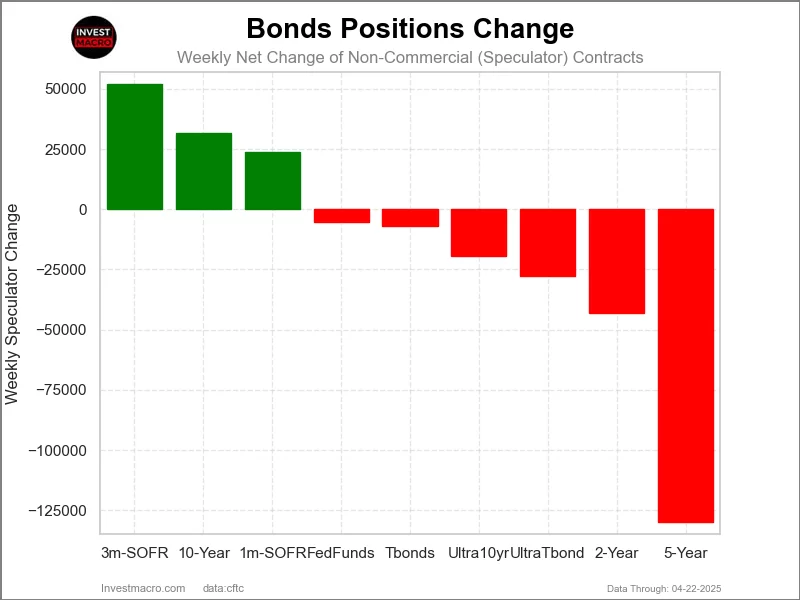
The COT bond market speculator bets were decisively lower this week as just one out of the nine bond markets we cover had higher positioning while the other eight markets had lower speculator contracts.

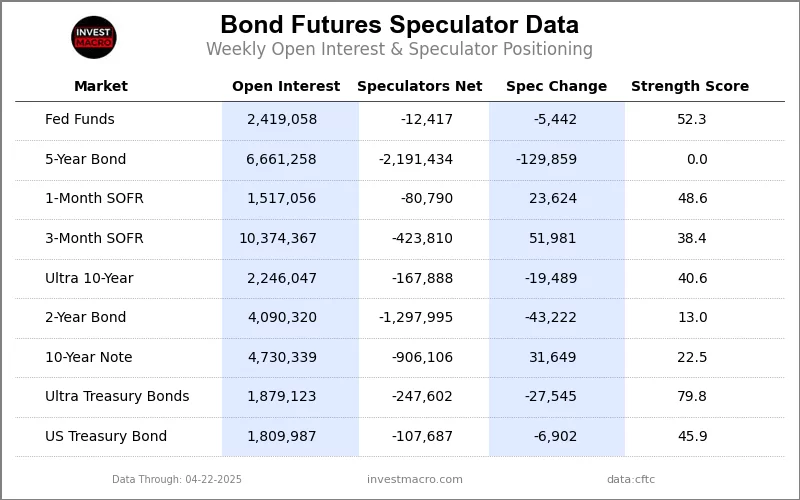
The only market to gain this week for the bond markets was the Fed Funds with a gain of 30,143 contracts on the week.

The bond markets with declines in speculator bets for the week were the 5-Year Bonds (-151,611 contracts), the SOFR 3-Months (-102,586 contracts), the US Treasury Bonds (-33,511 contracts), the SOFR 1-Month (-32,506 contracts), the 2-Year Bonds (-17,065 contracts), the 10-Year Bonds (-7,061 contracts), the Ultra 10-Year Bonds (-6,084 contracts) and the Ultra Treasury Bonds (-2,024 contracts) also registering lower bets on the week.


Bonds Net Speculators Leaderboard

Legend: Weekly Speculators Change | Speculators Current Net Position | Speculators Strength Score compared to last 3-Years (0-100 range)


Strength Scores led by SOFR 1-Month & US Treasury Bonds

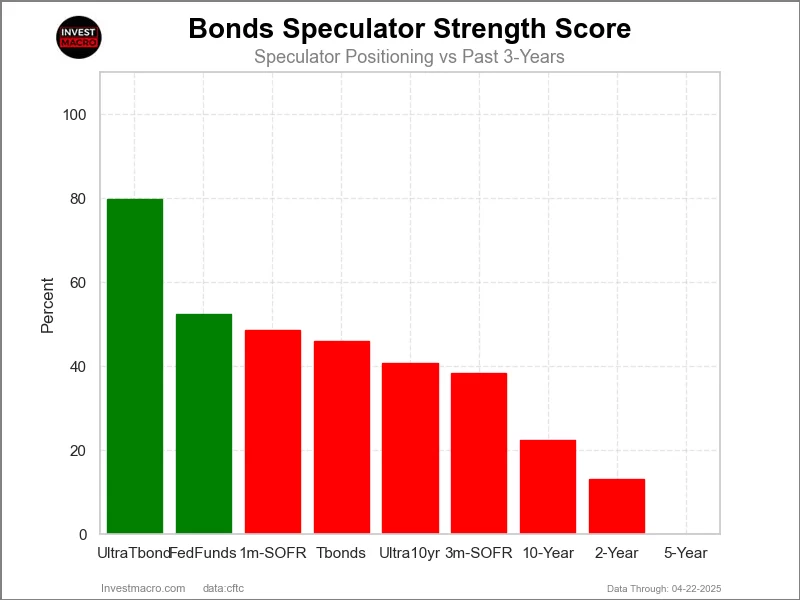
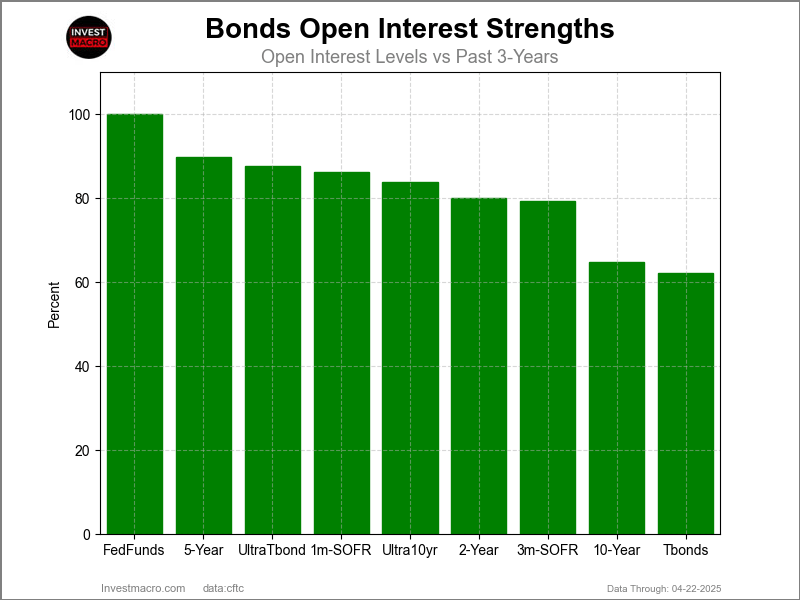
COT Strength Scores (a normalized measure of Speculator positions over a 3-Year range, from 0 to 100 where above 80 is Extreme-Bullish and below 20 is Extreme-Bearish) showed that the SOFR 1-Month (88 percent) and the US Treasury Bonds (82 percent) lead the bond markets this week. The Ultra Treasury Bonds (81 percent) comes in as the next highest in the weekly strength scores.

On the downside, the 5-Year Bond (3 percent), the Fed Funds (17 percent) and the 2-Year Bonds (18 percent) come in at the lowest strength level currently and are in Extreme-Bearish territory (below 20 percent). The next lowest strength scores were the SOFR 3-Months (22 percent) and the 10-Year Bonds (41 percent).

Strength Statistics:
Fed Funds (17.3 percent) vs Fed Funds previous week (11.8 percent)
2-Year Bond (18.3 percent) vs 2-Year Bond previous week (19.4 percent)
5-Year Bond (2.9 percent) vs 5-Year Bond previous week (11.0 percent)
10-Year Bond (41.2 percent) vs 10-Year Bond previous week (41.9 percent)
Ultra 10-Year Bond (53.9 percent) vs Ultra 10-Year Bond previous week (55.9 percent)
US Treasury Bond (81.8 percent) vs US Treasury Bond previous week (93.5 percent)
Ultra US Treasury Bond (81.3 percent) vs Ultra US Treasury Bond previous week (82.1 percent)
SOFR 1-Month (88.3 percent) vs SOFR 1-Month previous week (96.3 percent)
SOFR 3-Months (21.7 percent) vs SOFR 3-Months previous week (27.0 percent)


SOFR 1-Month & Ultra 10-Year Bonds top the 6-Week Strength Trends

COT Strength Score Trends (or move index, calculates the 6-week changes in strength scores) showed that the SOFR 1-Month (45 percent) and the Ultra 10-Year Bonds (9 percent) lead the past six weeks trends for bonds.

The Fed Funds (-32 percent), the SOFR 3-Months (-18 percent) and the Ultra Treasury Bonds (-15 percent) lead the downside trend scores currently.

Strength Trend Statistics:
Fed Funds (-31.6 percent) vs Fed Funds previous week (-36.3 percent)
2-Year Bond (2.3 percent) vs 2-Year Bond previous week (3.9 percent)
5-Year Bond (-8.9 percent) vs 5-Year Bond previous week (-0.7 percent)
10-Year Bond (-11.0 percent) vs 10-Year Bond previous week (3.1 percent)
Ultra 10-Year Bond (9.2 percent) vs Ultra 10-Year Bond previous week (1.0 percent)
US Treasury Bond (7.5 percent) vs US Treasury Bond previous week (26.1 percent)
Ultra US Treasury Bond (-15.0 percent) vs Ultra US Treasury Bond previous week (-8.5 percent)
SOFR 1-Month (44.8 percent) vs SOFR 1-Month previous week (37.6 percent)
SOFR 3-Months (-17.8 percent) vs SOFR 3-Months previous week (-27.7 percent)


30-Day Federal Funds Futures:

Federal Funds 30-Day Bonds Futures COT ChartThe 30-Day Federal Funds large speculator standing this week resulted in a net position of -201,853 contracts in the data reported through Tuesday. This was a weekly increase of 30,143 contracts from the previous week which had a total of -231,996 net contracts.

This week’s current strength score (the trader positioning range over the past three years, measured from 0 to 100) shows the speculators are currently Bearish-Extreme with a score of 17.3 percent. The commercials are Bullish with a score of 78.1 percent and the small traders (not shown in chart) are Bullish-Extreme with a score of 91.8 percent.

Price Trend-Following Model: Downtrend

Our weekly trend-following model classifies the current market price position as: Downtrend.

30-Day Federal Funds StatisticsSPECULATORSCOMMERCIALSSMALL TRADERS
– Percent of Open Interest Longs:9.971.82.3
– Percent of Open Interest Shorts:22.859.12.1
– Net Position:-201,853198,2023,651
– Gross Longs:154,5111,121,07936,072
– Gross Shorts:356,364922,87732,421
– Long to Short Ratio:0.4 to 11.2 to 11.1 to 1
NET POSITION TREND:
– Strength Index Score (3 Year Range Pct):17.378.191.8
– Strength Index Reading (3 Year Range):Bearish-ExtremeBullishBullish-Extreme
NET POSITION MOVEMENT INDEX:
– 6-Week Change in Strength Index:-31.629.813.3


Secured Overnight Financing Rate (3-Month) Futures:
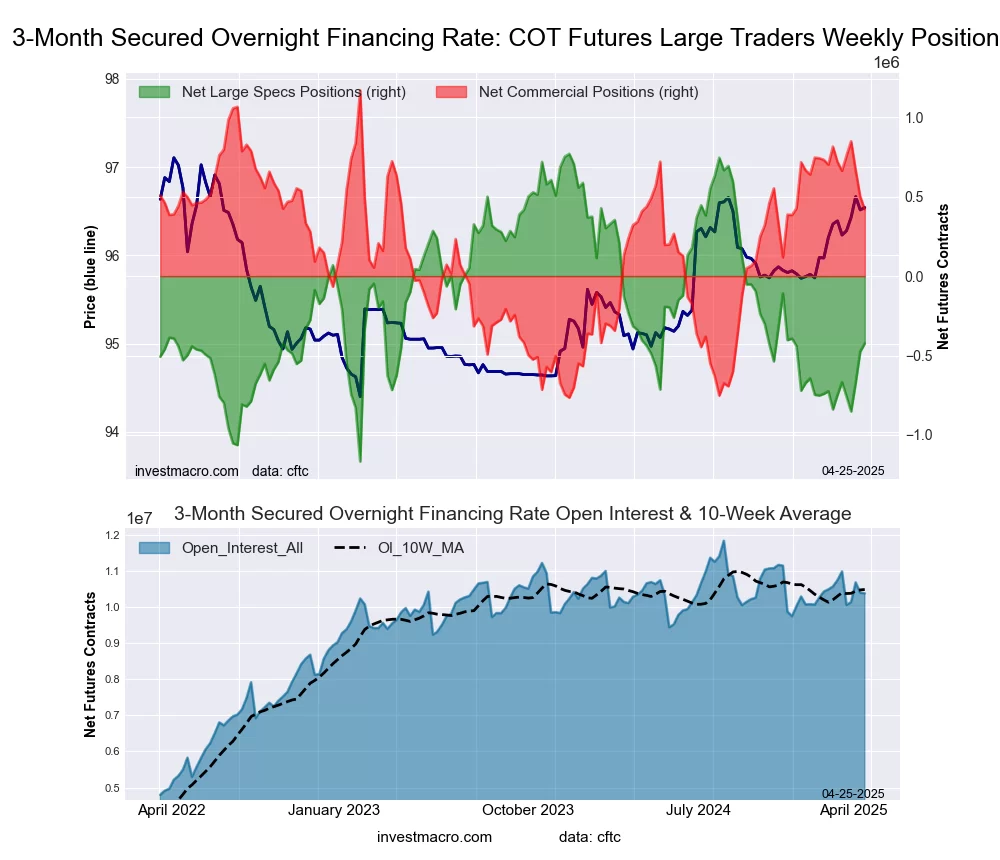
SOFR 3-Months Bonds Futures COT ChartThe Secured Overnight Financing Rate (3-Month) large speculator standing this week resulted in a net position of -746,850 contracts in the data reported through Tuesday. This was a weekly decline of -102,586 contracts from the previous week which had a total of -644,264 net contracts.

This week’s current strength score (the trader positioning range over the past three years, measured from 0 to 100) shows the speculators are currently Bearish with a score of 21.7 percent. The commercials are Bullish with a score of 78.1 percent and the small traders (not shown in chart) are Bullish-Extreme with a score of 88.8 percent.

Price Trend-Following Model: Weak Uptrend

Our weekly trend-following model classifies the current market price position as: Weak Uptrend.

SOFR 3-Months StatisticsSPECULATORSCOMMERCIALSSMALL TRADERS
– Percent of Open Interest Longs:11.764.80.2
– Percent of Open Interest Shorts:19.157.40.2
– Net Position:-746,850745,2001,650
– Gross Longs:1,176,7786,523,57523,679
– Gross Shorts:1,923,6285,778,37522,029
– Long to Short Ratio:0.6 to 11.1 to 11.1 to 1
NET POSITION TREND:
– Strength Index Score (3 Year Range Pct):21.778.188.8
– Strength Index Reading (3 Year Range):BearishBullishBullish-Extreme
NET POSITION MOVEMENT INDEX:
– 6-Week Change in Strength Index:-17.818.6-8.1


Individual Bond Markets:

Secured Overnight Financing Rate (1-Month) Futures:
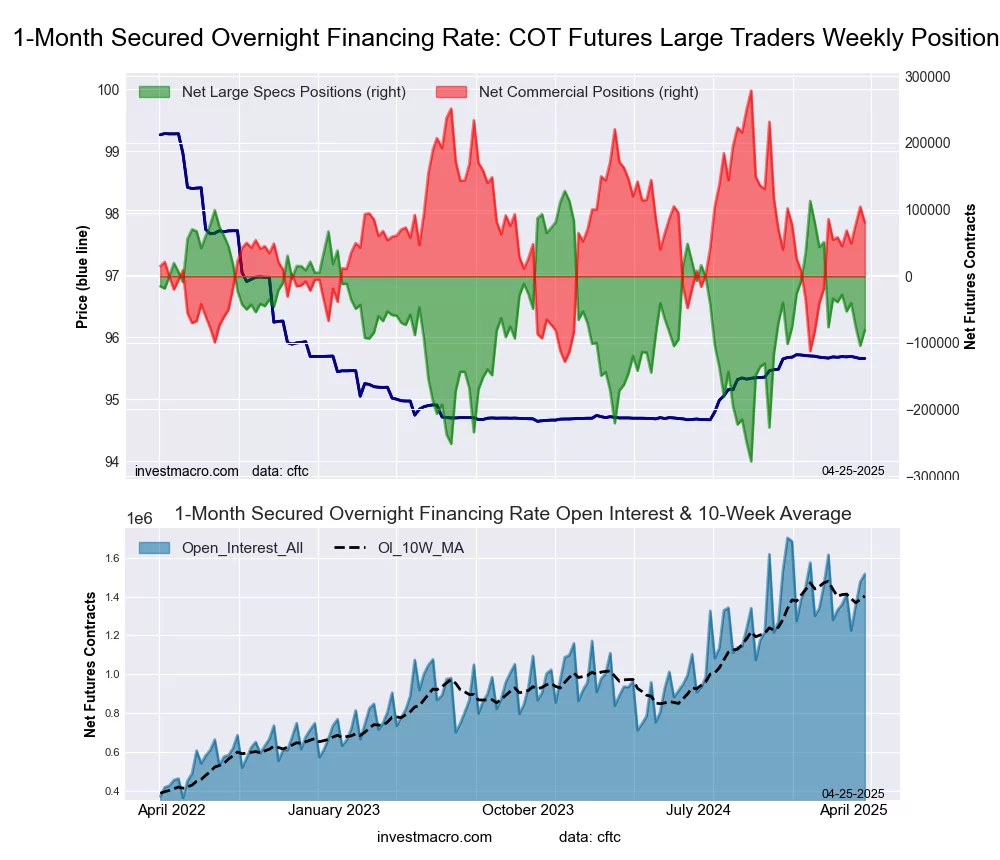
SOFR 1-Month Bonds Futures COT ChartThe Secured Overnight Financing Rate (1-Month) large speculator standing this week resulted in a net position of 80,461 contracts in the data reported through Tuesday. This was a weekly decline of -32,506 contracts from the previous week which had a total of 112,967 net contracts.

This week’s current strength score (the trader positioning range over the past three years, measured from 0 to 100) shows the speculators are currently Bullish-Extreme with a score of 88.3 percent. The commercials are Bearish-Extreme with a score of 11.3 percent and the small traders (not shown in chart) are Bullish with a score of 70.5 percent.

Price Trend-Following Model: Uptrend

Our weekly trend-following model classifies the current market price position as: Uptrend.

SOFR 1-Month StatisticsSPECULATORSCOMMERCIALSSMALL TRADERS
– Percent of Open Interest Longs:23.157.40.2
– Percent of Open Interest Shorts:16.963.70.0
– Net Position:80,461-82,2761,815
– Gross Longs:300,031746,8472,155
– Gross Shorts:219,570829,123340
– Long to Short Ratio:1.4 to 10.9 to 16.3 to 1
NET POSITION TREND:
– Strength Index Score (3 Year Range Pct):88.311.370.5
– Strength Index Reading (3 Year Range):Bullish-ExtremeBearish-ExtremeBullish
NET POSITION MOVEMENT INDEX:
– 6-Week Change in Strength Index:44.8-45.216.6


2-Year Treasury Note Futures:

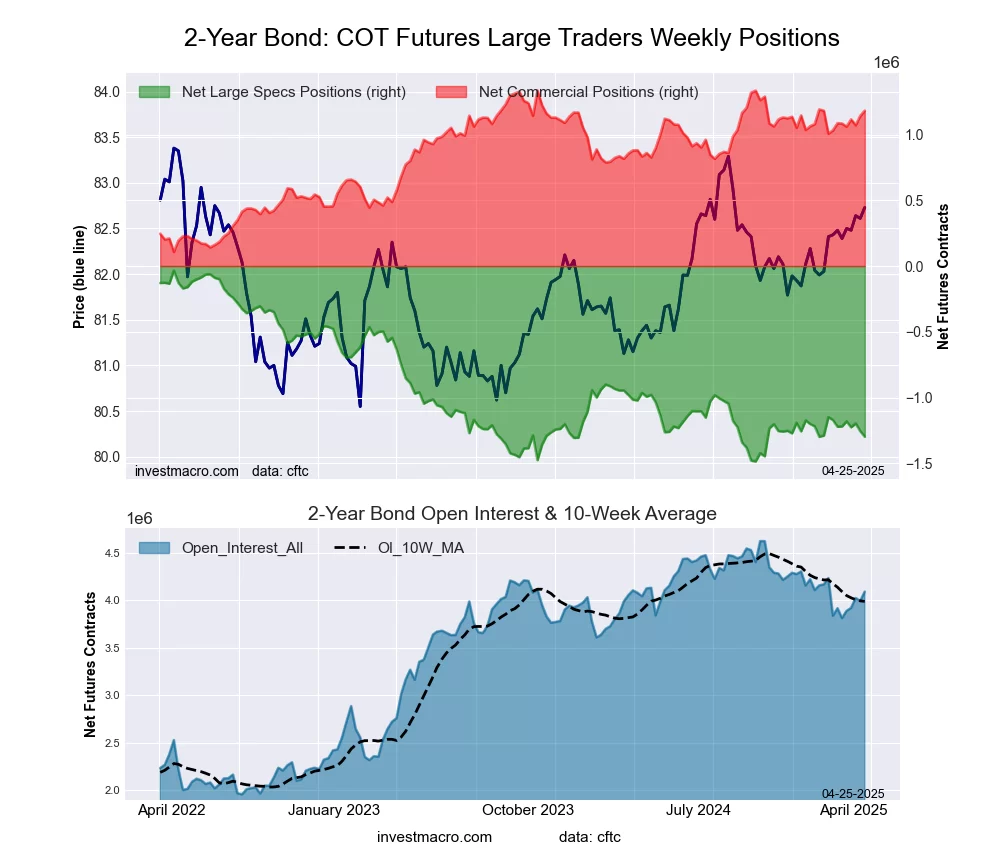
2-Year Treasury Bonds Futures COT ChartThe 2-Year Treasury Note large speculator standing this week resulted in a net position of -1,218,624 contracts in the data reported through Tuesday. This was a weekly lowering of -17,065 contracts from the previous week which had a total of -1,201,559 net contracts.

This week’s current strength score (the trader positioning range over the past three years, measured from 0 to 100) shows the speculators are currently Bearish-Extreme with a score of 18.3 percent. The commercials are Bullish with a score of 79.5 percent and the small traders (not shown in chart) are Bullish-Extreme with a score of 80.1 percent.

Price Trend-Following Model: Downtrend

Our weekly trend-following model classifies the current market price position as: Downtrend.

2-Year Treasury Note StatisticsSPECULATORSCOMMERCIALSSMALL TRADERS
– Percent of Open Interest Longs:14.476.56.1
– Percent of Open Interest Shorts:44.150.22.7
– Net Position:-1,218,6241,079,136139,488
– Gross Longs:592,2173,141,260250,760
– Gross Shorts:1,810,8412,062,124111,272
– Long to Short Ratio:0.3 to 11.5 to 12.3 to 1
NET POSITION TREND:
– Strength Index Score (3 Year Range Pct):18.379.580.1
– Strength Index Reading (3 Year Range):Bearish-ExtremeBullishBullish-Extreme
NET POSITION MOVEMENT INDEX:
– 6-Week Change in Strength Index:2.3-3.52.9


5-Year Treasury Note Futures:

5-Year Treasury Bonds Futures COT ChartThe 5-Year Treasury Note large speculator standing this week resulted in a net position of -1,927,666 contracts in the data reported through Tuesday. This was a weekly reduction of -151,611 contracts from the previous week which had a total of -1,776,055 net contracts.

This week’s current strength score (the trader positioning range over the past three years, measured from 0 to 100) shows the speculators are currently Bearish-Extreme with a score of 2.9 percent. The commercials are Bullish-Extreme with a score of 96.9 percent and the small traders (not shown in chart) are Bullish with a score of 73.2 percent.

Price Trend-Following Model: Downtrend

Our weekly trend-following model classifies the current market price position as: Downtrend.

5-Year Treasury Note StatisticsSPECULATORSCOMMERCIALSSMALL TRADERS
– Percent of Open Interest Longs:5.785.16.7
– Percent of Open Interest Shorts:35.657.04.9
– Net Position:-1,927,6661,813,533114,133
– Gross Longs:366,6385,485,200430,333
– Gross Shorts:2,294,3043,671,667316,200
– Long to Short Ratio:0.2 to 11.5 to 11.4 to 1
NET POSITION TREND:
– Strength Index Score (3 Year Range Pct):2.996.973.2
– Strength Index Reading (3 Year Range):Bearish-ExtremeBullish-ExtremeBullish
NET POSITION MOVEMENT INDEX:
– 6-Week Change in Strength Index:-8.910.31.1


10-Year Treasury Note Futures:

10-Year Treasury Notes Bonds Futures COT ChartThe 10-Year Treasury Note large speculator standing this week resulted in a net position of -707,703 contracts in the data reported through Tuesday. This was a weekly decrease of -7,061 contracts from the previous week which had a total of -700,642 net contracts.

This week’s current strength score (the trader positioning range over the past three years, measured from 0 to 100) shows the speculators are currently Bearish with a score of 41.2 percent. The commercials are Bullish with a score of 58.5 percent and the small traders (not shown in chart) are Bullish with a score of 75.5 percent.

Price Trend-Following Model: Downtrend

Our weekly trend-following model classifies the current market price position as: Downtrend.

10-Year Treasury Note StatisticsSPECULATORSCOMMERCIALSSMALL TRADERS
– Percent of Open Interest Longs:15.274.08.6
– Percent of Open Interest Shorts:29.660.77.5
– Net Position:-707,703651,56656,137
– Gross Longs:743,4053,628,286422,857
– Gross Shorts:1,451,1082,976,720366,720
– Long to Short Ratio:0.5 to 11.2 to 11.2 to 1
NET POSITION TREND:
– Strength Index Score (3 Year Range Pct):41.258.575.5
– Strength Index Reading (3 Year Range):BearishBullishBullish
NET POSITION MOVEMENT INDEX:
– 6-Week Change in Strength Index:-11.017.3-5.9


Ultra 10-Year Notes Futures:

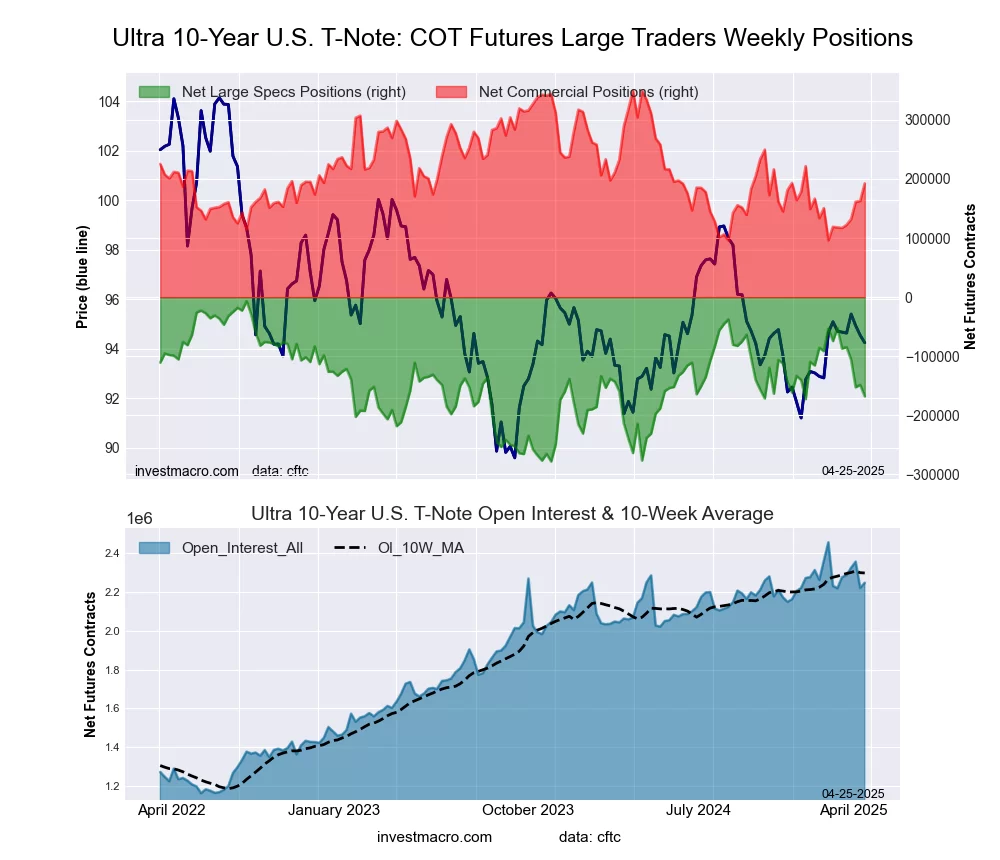
Ultra 10-Year Treasury Notes Bonds Futures COT ChartThe Ultra 10-Year Notes large speculator standing this week resulted in a net position of -115,563 contracts in the data reported through Tuesday. This was a weekly decline of -6,084 contracts from the previous week which had a total of -109,479 net contracts.

This week’s current strength score (the trader positioning range over the past three years, measured from 0 to 100) shows the speculators are currently Bullish with a score of 53.9 percent. The commercials are Bearish with a score of 27.9 percent and the small traders (not shown in chart) are Bullish with a score of 76.6 percent.

Price Trend-Following Model: Downtrend

Our weekly trend-following model classifies the current market price position as: Downtrend.

Ultra 10-Year Notes StatisticsSPECULATORSCOMMERCIALSSMALL TRADERS
– Percent of Open Interest Longs:14.275.39.8
– Percent of Open Interest Shorts:19.268.112.0
– Net Position:-115,563166,490-50,927
– Gross Longs:327,9821,740,156226,814
– Gross Shorts:443,5451,573,666277,741
– Long to Short Ratio:0.7 to 11.1 to 10.8 to 1
NET POSITION TREND:
– Strength Index Score (3 Year Range Pct):53.927.976.6
– Strength Index Reading (3 Year Range):BullishBearishBullish
NET POSITION MOVEMENT INDEX:
– 6-Week Change in Strength Index:9.2-5.7-10.3


US Treasury Bonds Futures:

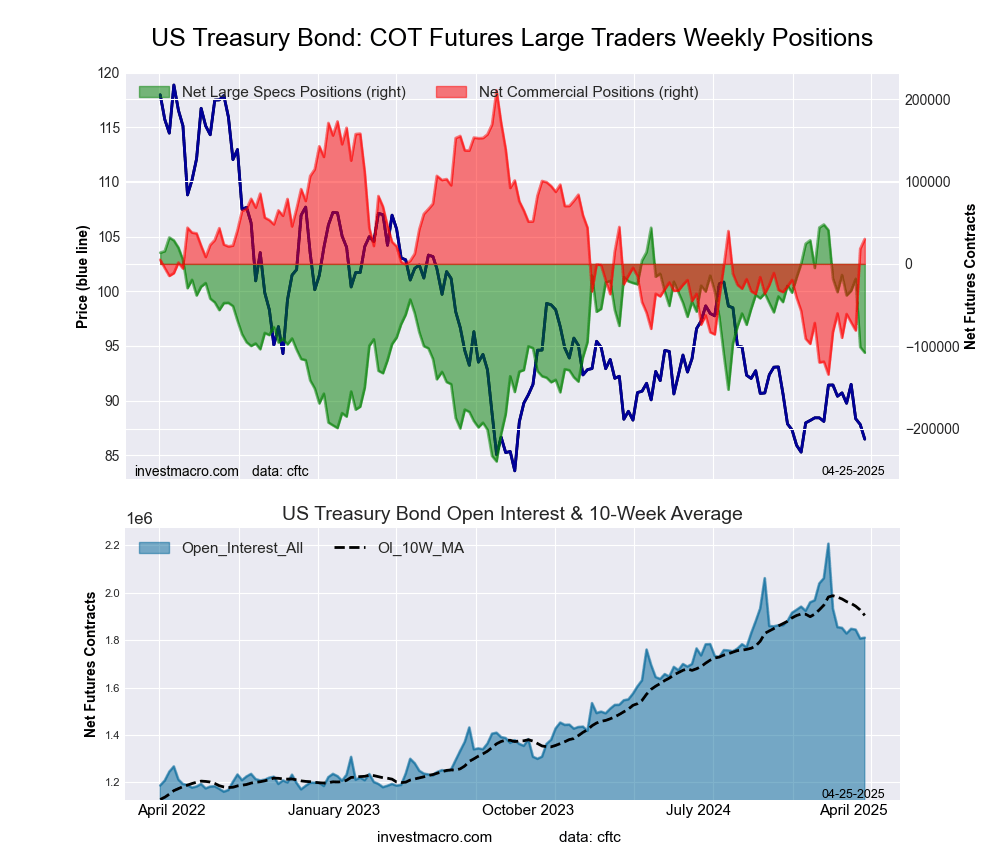
US Year Treasury Notes Long Bonds Futures COT ChartThe US Treasury Bonds large speculator standing this week resulted in a net position of -4,927 contracts in the data reported through Tuesday. This was a weekly lowering of -33,511 contracts from the previous week which had a total of 28,584 net contracts.

This week’s current strength score (the trader positioning range over the past three years, measured from 0 to 100) shows the speculators are currently Bullish-Extreme with a score of 81.8 percent. The commercials are Bearish-Extreme with a score of 8.2 percent and the small traders (not shown in chart) are Bullish with a score of 71.5 percent.

Price Trend-Following Model: Downtrend

Our weekly trend-following model classifies the current market price position as: Downtrend.

US Treasury Bonds StatisticsSPECULATORSCOMMERCIALSSMALL TRADERS
– Percent of Open Interest Longs:23.264.011.2
– Percent of Open Interest Shorts:23.467.67.3
– Net Position:-4,927-71,66176,588
– Gross Longs:455,7771,259,191219,800
– Gross Shorts:460,7041,330,852143,212
– Long to Short Ratio:1.0 to 10.9 to 11.5 to 1
NET POSITION TREND:
– Strength Index Score (3 Year Range Pct):81.88.271.5
– Strength Index Reading (3 Year Range):Bullish-ExtremeBearish-ExtremeBullish
NET POSITION MOVEMENT INDEX:
– 6-Week Change in Strength Index:7.5-14.415.5


Ultra US Treasury Bonds Futures:

Ultra US Year Treasury Notes Long Bonds Futures COT ChartThe Ultra US Treasury Bonds large speculator standing this week resulted in a net position of -243,616 contracts in the data reported through Tuesday. This was a weekly fall of -2,024 contracts from the previous week which had a total of -241,592 net contracts.

This week’s current strength score (the trader positioning range over the past three years, measured from 0 to 100) shows the speculators are currently Bullish-Extreme with a score of 81.3 percent. The commercials are Bearish-Extreme with a score of 18.5 percent and the small traders (not shown in chart) are Bearish with a score of 29.3 percent.

Price Trend-Following Model: Downtrend

Our weekly trend-following model classifies the current market price position as: Downtrend.

Ultra US Treasury Bonds StatisticsSPECULATORSCOMMERCIALSSMALL TRADERS
– Percent of Open Interest Longs:8.181.69.8
– Percent of Open Interest Shorts:21.768.89.0
– Net Position:-243,616229,73713,879
– Gross Longs:144,8381,463,002175,978
– Gross Shorts:388,4541,233,265162,099
– Long to Short Ratio:0.4 to 11.2 to 11.1 to 1
NET POSITION TREND:
– Strength Index Score (3 Year Range Pct):81.318.529.3
– Strength Index Reading (3 Year Range):Bullish-ExtremeBearish-ExtremeBearish
NET POSITION MOVEMENT INDEX:
– 6-Week Change in Strength Index:-15.09.424.6


Article By InvestMacroReceive our weekly COT Newsletter

*COT Report: The COT data, released weekly to the public each Friday, is updated through the most recent Tuesday (data is 3 days old) and shows a quick view of how large speculators or non-commercials (for-profit traders) were positioned in the futures markets.

The CFTC categorizes trader positions according to commercial hedgers (traders who use futures contracts for hedging as part of the business), non-commercials (large traders who speculate to realize trading profits) and nonreportable traders (usually small traders/speculators) as well as their open interest (contracts open in the market at time of reporting). See CFTC criteria here.

COT Soft Commodities Charts: Speculator Bets led by Soybean Meal, Wheat & Corn

By InvestMacro

Here are the latest charts and statistics for the Commitment of Traders (COT) reports data published by the Commodities Futures Trading Commission (CFTC).

The latest COT data is updated through Tuesday February 4th and shows a quick view of how large traders (for-profit speculators and commercial entities) were positioned in the futures markets.

Weekly Speculator Changes led by Soybean Meal, Wheat & Corn

The COT soft commodities markets speculator bets were slightly higher this week as six out of the eleven softs markets we cover had higher positioning while the other five markets had lower speculator contracts.

Leading the gains for the softs markets was Soybean Meal (23,817 contracts) with Wheat (23,756 contracts), Corn (18,506 contracts), Soybeans (5,815 contracts), Soybean Oil (5,428 contracts) and Lean Hogs (3,384 contracts) also showing positive weeks.

The markets with the declines in speculator bets this week were Cotton (-8,339 contracts), Coffee (-4,642 contracts), Sugar (-3,675 contracts), Live Cattle (-2,605 contracts) and with Cocoa (-1,578 contracts) also registering lower bets on the week.


Soft Commodities Net Speculators Leaderboard

Legend: Weekly Speculators Change | Speculators Current Net Position | Speculators Strength Score compared to last 3-Years (0-100 range)


Strength Scores led by Coffee, Live Cattle & Corn

COT Strength Scores (a normalized measure of Speculator positions over a 3-Year range, from 0 to 100 where above 80 is Extreme-Bullish and below 20 is Extreme-Bearish) showed that Coffee (96 percent), Live Cattle (93 percent) and Corn (93 percent) lead the softs markets this week. Lean Hogs (81 percent) and Soybean Oil (71 percent) come in as the next highest in the weekly strength scores.

On the downside, Cotton (0 percent) and Sugar (0 percent) come in at the lowest strength levels currently and are in Extreme-Bearish territory (below 20 percent). The next lowest strength scores are Wheat (24 percent) and Soybean Meal (27 percent).

Strength Statistics:
Corn (92.7 percent) vs Corn previous week (90.4 percent)
Sugar (0.0 percent) vs Sugar previous week (1.2 percent)
Coffee (95.5 percent) vs Coffee previous week (100.0 percent)
Soybeans (55.3 percent) vs Soybeans previous week (54.0 percent)
Soybean Oil (70.8 percent) vs Soybean Oil previous week (67.8 percent)
Soybean Meal (27.1 percent) vs Soybean Meal previous week (17.4 percent)
Live Cattle (93.4 percent) vs Live Cattle previous week (95.9 percent)
Lean Hogs (81.5 percent) vs Lean Hogs previous week (78.9 percent)
Cotton (0.0 percent) vs Cotton previous week (5.4 percent)
Cocoa (46.1 percent) vs Cocoa previous week (47.7 percent)
Wheat (23.7 percent) vs Wheat previous week (4.8 percent)


Soybeans & Corn top the 6-Week Strength Trends

COT Strength Score Trends (or move index, calculates the 6-week changes in strength scores) showed that Soybeans (34 percent) and Corn (30 percent) lead the past six weeks trends for soft commodities. Soybean Oil (21 percent), Soybean Meal (19 percent) and Wheat (16 percent) are the next highest positive movers in the latest trends data.

Sugar (-30 percent) leads the downside trend scores currently with Lean Hogs (-14 percent), Cotton (-12 percent) and Cocoa (-1 percent) following next with lower trend scores.

Strength Trend Statistics:
Corn (30.1 percent) vs Corn previous week (28.3 percent)
Sugar (-29.8 percent) vs Sugar previous week (-31.2 percent)
Coffee (7.5 percent) vs Coffee previous week (13.9 percent)
Soybeans (33.5 percent) vs Soybeans previous week (33.2 percent)
Soybean Oil (20.7 percent) vs Soybean Oil previous week (8.1 percent)
Soybean Meal (18.9 percent) vs Soybean Meal previous week (8.3 percent)
Live Cattle (13.0 percent) vs Live Cattle previous week (8.0 percent)
Lean Hogs (-13.8 percent) vs Lean Hogs previous week (-21.1 percent)
Cotton (-12.4 percent) vs Cotton previous week (-10.3 percent)
Cocoa (-1.2 percent) vs Cocoa previous week (1.7 percent)
Wheat (15.8 percent) vs Wheat previous week (-9.3 percent)


Individual Soft Commodities Markets:

CORN Futures:

CORN Futures COT ChartThe CORN large speculator standing this week recorded a net position of 462,381 contracts in the data reported through Tuesday. This was a weekly rise of 18,506 contracts from the previous week which had a total of 443,875 net contracts.

This week’s current strength score (the trader positioning range over the past three years, measured from 0 to 100) shows the speculators are currently Bullish-Extreme with a score of 92.7 percent. The commercials are Bearish-Extreme with a score of 12.8 percent and the small traders (not shown in chart) are Bearish-Extreme with a score of 0.1 percent.

Price Trend-Following Model: Strong Uptrend

Our weekly trend-following model classifies the current market price position as: Strong Uptrend.

CORN Futures StatisticsSPECULATORSCOMMERCIALSSMALL TRADERS
– Percent of Open Interest Longs:31.038.35.9
– Percent of Open Interest Shorts:8.156.910.2
– Net Position:462,381-374,564-87,817
– Gross Longs:626,001773,870118,268
– Gross Shorts:163,6201,148,434206,085
– Long to Short Ratio:3.8 to 10.7 to 10.6 to 1
NET POSITION TREND:
– Strength Index Score (3 Year Range Pct):92.712.80.1
– Strength Index Reading (3 Year Range):Bullish-ExtremeBearish-ExtremeBearish-Extreme
NET POSITION MOVEMENT INDEX:
– 6-Week Change in Strength Index:30.1-27.5-35.9


SUGAR Futures:

SUGAR Futures COT ChartThe SUGAR large speculator standing this week recorded a net position of -33,109 contracts in the data reported through Tuesday. This was a weekly decline of -3,675 contracts from the previous week which had a total of -29,434 net contracts.

This week’s current strength score (the trader positioning range over the past three years, measured from 0 to 100) shows the speculators are currently Bearish-Extreme with a score of 0.0 percent. The commercials are Bullish-Extreme with a score of 98.6 percent and the small traders (not shown in chart) are Bearish with a score of 24.0 percent.

Price Trend-Following Model: Downtrend

Our weekly trend-following model classifies the current market price position as: Downtrend.

SUGAR Futures StatisticsSPECULATORSCOMMERCIALSSMALL TRADERS
– Percent of Open Interest Longs:22.453.87.3
– Percent of Open Interest Shorts:25.750.87.0
– Net Position:-33,10929,7453,364
– Gross Longs:227,314544,96074,415
– Gross Shorts:260,423515,21571,051
– Long to Short Ratio:0.9 to 11.1 to 11.0 to 1
NET POSITION TREND:
– Strength Index Score (3 Year Range Pct):0.098.624.0
– Strength Index Reading (3 Year Range):Bearish-ExtremeBullish-ExtremeBearish
NET POSITION MOVEMENT INDEX:
– 6-Week Change in Strength Index:-29.826.2-4.9


COFFEE Futures:

COFFEE Futures COT ChartThe COFFEE large speculator standing this week recorded a net position of 71,878 contracts in the data reported through Tuesday. This was a weekly lowering of -4,642 contracts from the previous week which had a total of 76,520 net contracts.

This week’s current strength score (the trader positioning range over the past three years, measured from 0 to 100) shows the speculators are currently Bullish-Extreme with a score of 95.5 percent. The commercials are Bearish-Extreme with a score of 3.8 percent and the small traders (not shown in chart) are Bullish-Extreme with a score of 98.4 percent.

Price Trend-Following Model: Strong Uptrend

Our weekly trend-following model classifies the current market price position as: Strong Uptrend.

COFFEE Futures StatisticsSPECULATORSCOMMERCIALSSMALL TRADERS
– Percent of Open Interest Longs:42.931.55.8
– Percent of Open Interest Shorts:5.871.13.3
– Net Position:71,878-76,7284,850
– Gross Longs:83,06660,96411,225
– Gross Shorts:11,188137,6926,375
– Long to Short Ratio:7.4 to 10.4 to 11.8 to 1
NET POSITION TREND:
– Strength Index Score (3 Year Range Pct):95.53.898.4
– Strength Index Reading (3 Year Range):Bullish-ExtremeBearish-ExtremeBullish-Extreme
NET POSITION MOVEMENT INDEX:
– 6-Week Change in Strength Index:7.5-9.028.6


SOYBEANS Futures:

SOYBEANS Futures COT ChartThe SOYBEANS large speculator standing this week recorded a net position of 37,166 contracts in the data reported through Tuesday. This was a weekly increase of 5,815 contracts from the previous week which had a total of 31,351 net contracts.

This week’s current strength score (the trader positioning range over the past three years, measured from 0 to 100) shows the speculators are currently Bullish with a score of 55.3 percent. The commercials are Bearish with a score of 47.5 percent and the small traders (not shown in chart) are Bearish with a score of 28.4 percent.

Price Trend-Following Model: Weak Downtrend

Our weekly trend-following model classifies the current market price position as: Weak Downtrend.

SOYBEANS Futures StatisticsSPECULATORSCOMMERCIALSSMALL TRADERS
– Percent of Open Interest Longs:20.455.74.8
– Percent of Open Interest Shorts:16.356.28.5
– Net Position:37,166-4,926-32,240
– Gross Longs:182,119495,67243,118
– Gross Shorts:144,953500,59875,358
– Long to Short Ratio:1.3 to 11.0 to 10.6 to 1
NET POSITION TREND:
– Strength Index Score (3 Year Range Pct):55.347.528.4
– Strength Index Reading (3 Year Range):BullishBearishBearish
NET POSITION MOVEMENT INDEX:
– 6-Week Change in Strength Index:33.5-31.5-38.8


SOYBEAN OIL Futures:

SOYBEAN OIL Futures COT ChartThe SOYBEAN OIL large speculator standing this week recorded a net position of 53,595 contracts in the data reported through Tuesday. This was a weekly lift of 5,428 contracts from the previous week which had a total of 48,167 net contracts.

This week’s current strength score (the trader positioning range over the past three years, measured from 0 to 100) shows the speculators are currently Bullish with a score of 70.8 percent. The commercials are Bearish with a score of 33.0 percent and the small traders (not shown in chart) are Bearish with a score of 41.5 percent.

Price Trend-Following Model: Strong Uptrend

Our weekly trend-following model classifies the current market price position as: Strong Uptrend.

SOYBEAN OIL Futures StatisticsSPECULATORSCOMMERCIALSSMALL TRADERS
– Percent of Open Interest Longs:21.254.35.7
– Percent of Open Interest Shorts:11.864.94.4
– Net Position:53,595-60,6797,084
– Gross Longs:121,346311,28332,530
– Gross Shorts:67,751371,96225,446
– Long to Short Ratio:1.8 to 10.8 to 11.3 to 1
NET POSITION TREND:
– Strength Index Score (3 Year Range Pct):70.833.041.5
– Strength Index Reading (3 Year Range):BullishBearishBearish
NET POSITION MOVEMENT INDEX:
– 6-Week Change in Strength Index:20.7-21.521.7


SOYBEAN MEAL Futures:

SOYBEAN MEAL Futures COT ChartThe SOYBEAN MEAL large speculator standing this week recorded a net position of -691 contracts in the data reported through Tuesday. This was a weekly advance of 23,817 contracts from the previous week which had a total of -24,508 net contracts.

This week’s current strength score (the trader positioning range over the past three years, measured from 0 to 100) shows the speculators are currently Bearish with a score of 27.1 percent. The commercials are Bullish with a score of 71.6 percent and the small traders (not shown in chart) are Bearish with a score of 28.5 percent.

Price Trend-Following Model: Weak Downtrend

Our weekly trend-following model classifies the current market price position as: Weak Downtrend.

SOYBEAN MEAL Futures StatisticsSPECULATORSCOMMERCIALSSMALL TRADERS
– Percent of Open Interest Longs:17.450.18.3
– Percent of Open Interest Shorts:17.552.75.6
– Net Position:-691-15,51316,204
– Gross Longs:103,159297,38849,293
– Gross Shorts:103,850312,90133,089
– Long to Short Ratio:1.0 to 11.0 to 11.5 to 1
NET POSITION TREND:
– Strength Index Score (3 Year Range Pct):27.171.628.5
– Strength Index Reading (3 Year Range):BearishBullishBearish
NET POSITION MOVEMENT INDEX:
– 6-Week Change in Strength Index:18.9-16.4-21.5


LIVE CATTLE Futures:

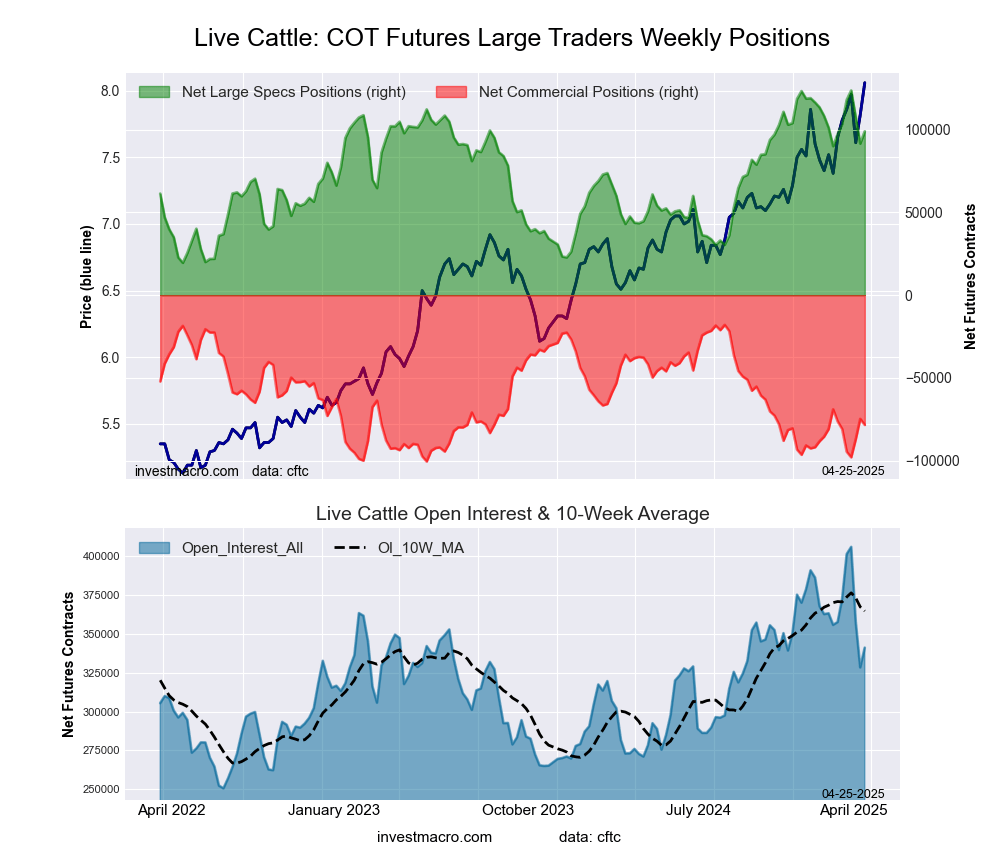
LIVE CATTLE Futures COT ChartThe LIVE CATTLE large speculator standing this week recorded a net position of 116,439 contracts in the data reported through Tuesday. This was a weekly decline of -2,605 contracts from the previous week which had a total of 119,044 net contracts.

This week’s current strength score (the trader positioning range over the past three years, measured from 0 to 100) shows the speculators are currently Bullish-Extreme with a score of 93.4 percent. The commercials are Bearish-Extreme with a score of 10.4 percent and the small traders (not shown in chart) are Bearish-Extreme with a score of 11.3 percent.

Price Trend-Following Model: Strong Uptrend

Our weekly trend-following model classifies the current market price position as: Strong Uptrend.

LIVE CATTLE Futures StatisticsSPECULATORSCOMMERCIALSSMALL TRADERS
– Percent of Open Interest Longs:51.628.27.0
– Percent of Open Interest Shorts:21.552.013.4
– Net Position:116,439-91,888-24,551
– Gross Longs:199,414109,04027,075
– Gross Shorts:82,975200,92851,626
– Long to Short Ratio:2.4 to 10.5 to 10.5 to 1
NET POSITION TREND:
– Strength Index Score (3 Year Range Pct):93.410.411.3
– Strength Index Reading (3 Year Range):Bullish-ExtremeBearish-ExtremeBearish-Extreme
NET POSITION MOVEMENT INDEX:
– 6-Week Change in Strength Index:13.0-12.6-10.1


LEAN HOGS Futures:

LEAN HOGS Futures COT ChartThe LEAN HOGS large speculator standing this week recorded a net position of 69,445 contracts in the data reported through Tuesday. This was a weekly lift of 3,384 contracts from the previous week which had a total of 66,061 net contracts.

This week’s current strength score (the trader positioning range over the past three years, measured from 0 to 100) shows the speculators are currently Bullish-Extreme with a score of 81.5 percent. The commercials are Bearish-Extreme with a score of 15.6 percent and the small traders (not shown in chart) are Bearish with a score of 48.2 percent.

Price Trend-Following Model: Strong Uptrend

Our weekly trend-following model classifies the current market price position as: Strong Uptrend.

LEAN HOGS Futures StatisticsSPECULATORSCOMMERCIALSSMALL TRADERS
– Percent of Open Interest Longs:42.833.27.4
– Percent of Open Interest Shorts:19.854.69.0
– Net Position:69,445-64,565-4,880
– Gross Longs:129,010100,20422,404
– Gross Shorts:59,565164,76927,284
– Long to Short Ratio:2.2 to 10.6 to 10.8 to 1
NET POSITION TREND:
– Strength Index Score (3 Year Range Pct):81.515.648.2
– Strength Index Reading (3 Year Range):Bullish-ExtremeBearish-ExtremeBearish
NET POSITION MOVEMENT INDEX:
– 6-Week Change in Strength Index:-13.811.526.8


COTTON Futures:

COTTON Futures COT ChartThe COTTON large speculator standing this week recorded a net position of -50,767 contracts in the data reported through Tuesday. This was a weekly lowering of -8,339 contracts from the previous week which had a total of -42,428 net contracts.

This week’s current strength score (the trader positioning range over the past three years, measured from 0 to 100) shows the speculators are currently Bearish-Extreme with a score of 0.0 percent. The commercials are Bullish-Extreme with a score of 100.0 percent and the small traders (not shown in chart) are Bearish with a score of 26.0 percent.

Price Trend-Following Model: Strong Downtrend

Our weekly trend-following model classifies the current market price position as: Strong Downtrend.

COTTON Futures StatisticsSPECULATORSCOMMERCIALSSMALL TRADERS
– Percent of Open Interest Longs:22.450.35.5
– Percent of Open Interest Shorts:39.933.34.9
– Net Position:-50,76749,2141,553
– Gross Longs:64,897145,91215,822
– Gross Shorts:115,66496,69814,269
– Long to Short Ratio:0.6 to 11.5 to 11.1 to 1
NET POSITION TREND:
– Strength Index Score (3 Year Range Pct):0.0100.026.0
– Strength Index Reading (3 Year Range):Bearish-ExtremeBullish-ExtremeBearish
NET POSITION MOVEMENT INDEX:
– 6-Week Change in Strength Index:-12.410.314.5


COCOA Futures:

COCOA Futures COT ChartThe COCOA large speculator standing this week recorded a net position of 35,390 contracts in the data reported through Tuesday. This was a weekly lowering of -1,578 contracts from the previous week which had a total of 36,968 net contracts.

This week’s current strength score (the trader positioning range over the past three years, measured from 0 to 100) shows the speculators are currently Bearish with a score of 46.1 percent. The commercials are Bullish with a score of 51.6 percent and the small traders (not shown in chart) are Bullish with a score of 62.6 percent.

Price Trend-Following Model: Uptrend

Our weekly trend-following model classifies the current market price position as: Uptrend.

COCOA Futures StatisticsSPECULATORSCOMMERCIALSSMALL TRADERS
– Percent of Open Interest Longs:37.735.28.5
– Percent of Open Interest Shorts:10.267.43.9
– Net Position:35,390-41,3095,919
– Gross Longs:48,47345,21010,952
– Gross Shorts:13,08386,5195,033
– Long to Short Ratio:3.7 to 10.5 to 12.2 to 1
NET POSITION TREND:
– Strength Index Score (3 Year Range Pct):46.151.662.6
– Strength Index Reading (3 Year Range):BearishBullishBullish
NET POSITION MOVEMENT INDEX:
– 6-Week Change in Strength Index:-1.22.0-6.0


WHEAT Futures:

WHEAT Futures COT ChartThe WHEAT large speculator standing this week recorded a net position of -67,355 contracts in the data reported through Tuesday. This was a weekly lift of 23,756 contracts from the previous week which had a total of -91,111 net contracts.

This week’s current strength score (the trader positioning range over the past three years, measured from 0 to 100) shows the speculators are currently Bearish with a score of 23.7 percent. The commercials are Bullish with a score of 72.0 percent and the small traders (not shown in chart) are Bullish with a score of 76.9 percent.

Price Trend-Following Model: Weak Downtrend

Our weekly trend-following model classifies the current market price position as: Weak Downtrend.

WHEAT Futures StatisticsSPECULATORSCOMMERCIALSSMALL TRADERS
– Percent of Open Interest Longs:27.533.57.5
– Percent of Open Interest Shorts:41.720.16.8
– Net Position:-67,35563,6813,674
– Gross Longs:130,876159,16035,860
– Gross Shorts:198,23195,47932,186
– Long to Short Ratio:0.7 to 11.7 to 11.1 to 1
NET POSITION TREND:
– Strength Index Score (3 Year Range Pct):23.772.076.9
– Strength Index Reading (3 Year Range):BearishBullishBullish
NET POSITION MOVEMENT INDEX:
– 6-Week Change in Strength Index:15.8-17.17.6


Article By InvestMacroReceive our weekly COT Newsletter

*COT Report: The COT data, released weekly to the public each Friday, is updated through the most recent Tuesday (data is 3 days old) and shows a quick view of how large speculators or non-commercials (for-profit traders) were positioned in the futures markets.

The CFTC categorizes trader positions according to commercial hedgers (traders who use futures contracts for hedging as part of the business), non-commercials (large traders who speculate to realize trading profits) and nonreportable traders (usually small traders/speculators) as well as their open interest (contracts open in the market at time of reporting). See CFTC criteria here.

COT Stock Market Charts: Speculator Changes led by S&P500 & MSCI EAFE

By InvestMacro

Here are the latest charts and statistics for the Commitment of Traders (COT) data published by the Commodities Futures Trading Commission (CFTC).

The latest COT data is updated through Tuesday February 4th and shows a quick view of how large traders (for-profit speculators and commercial entities) were positioned in the futures markets.

Weekly Speculator Changes led by S&P500-Mini & MSCI EAFE-Mini

The COT stock markets speculator bets were hgher this week as four out of the seven stock markets we cover had higher positioning while the other three markets had lower speculator contracts.

Leading the gains for the stock markets was the S&P500-Mini (51,337 contracts) with the MSCI EAFE-Mini (13,909 contracts), the VIX (915 contracts) and the Nikkei 225 (863 contracts) also showing positive weeks.

The markets with the declines in speculator bets this week were the Nasdaq-Mini (-11,713 contracts), the Russell-Mini (-5,463 contracts) and with the DowJones-Mini (-13 contracts) also registering lower bets on the week.


Stock Market Net Speculators Leaderboard

Legend: Weekly Speculators Change | Speculators Current Net Position | Speculators Strength Score compared to last 3-Years (0-100 range)


Strength Scores led by Nasdaq-Mini & S&P500-Mini

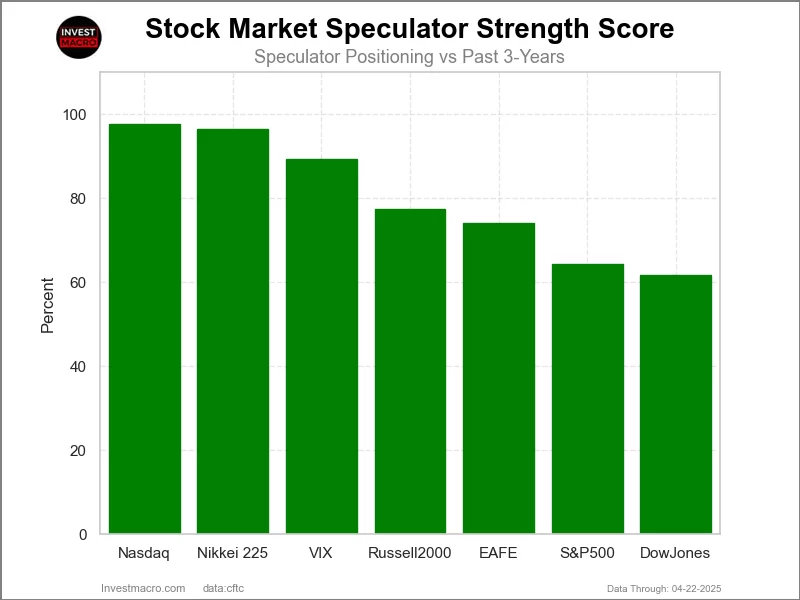
COT Strength Scores (a normalized measure of Speculator positions over a 3-Year range, from 0 to 100 where above 80 is Extreme-Bullish and below 20 is Extreme-Bearish) showed that the Nasdaq-Mini (69 percent) and the S&P500-Mini (64 percent) lead the stock markets this week. The MSCI EAFE-Mini (64 percent) and DowJones-Mini (63 percent) come in as the next highest in the weekly strength scores.

On the downside, the VIX (52 percent) comes in at the lowest strength level currently.

Strength Statistics:
VIX (52.4 percent) vs VIX previous week (51.6 percent)
S&P500-Mini (64.0 percent) vs S&P500-Mini previous week (56.4 percent)
DowJones-Mini (63.1 percent) vs DowJones-Mini previous week (63.1 percent)
Nasdaq-Mini (68.6 percent) vs Nasdaq-Mini previous week (86.7 percent)
Russell2000-Mini (63.2 percent) vs Russell2000-Mini previous week (66.9 percent)
Nikkei USD (61.4 percent) vs Nikkei USD previous week (54.1 percent)
EAFE-Mini (64.2 percent) vs EAFE-Mini previous week (46.2 percent)


MSCI EAFE-Mini & S&P500-Mini top the 6-Week Strength Trends

COT Strength Score Trends (or move index, calculates the 6-week changes in strength scores) showed that the MSCI EAFE-Mini (20 percent) leads the past six weeks trends for the stock markets. The S&P500-Mini (9 percent) and the Nikkei 225 (3 percent) are the next highest positive movers in the latest trends data.

The VIX (-28 percent) leads the downside trend scores currently with the Russell-Mini (-18 percent) coming in as the next market with lower trend scores.

Strength Trend Statistics:
VIX (-28.3 percent) vs VIX previous week (-0.4 percent)
S&P500-Mini (8.8 percent) vs S&P500-Mini previous week (-2.4 percent)
DowJones-Mini (-6.9 percent) vs DowJones-Mini previous week (-9.4 percent)
Nasdaq-Mini (-12.8 percent) vs Nasdaq-Mini previous week (-8.4 percent)
Russell2000-Mini (-17.7 percent) vs Russell2000-Mini previous week (-14.8 percent)
Nikkei USD (3.4 percent) vs Nikkei USD previous week (-5.1 percent)
EAFE-Mini (20.2 percent) vs EAFE-Mini previous week (4.1 percent)


Individual Stock Market Charts:

VIX Volatility Futures:

VIX Volatility Futures COT ChartThe VIX Volatility large speculator standing this week reached a net position of -48,530 contracts in the data reported through Tuesday. This was a weekly lift of 915 contracts from the previous week which had a total of -49,445 net contracts.

This week’s current strength score (the trader positioning range over the past three years, measured from 0 to 100) shows the speculators are currently Bullish with a score of 52.4 percent. The commercials are Bearish with a score of 47.4 percent and the small traders (not shown in chart) are Bullish-Extreme with a score of 86.9 percent.

Price Trend-Following Model: Downtrend

Our weekly trend-following model classifies the current market price position as: Downtrend.

VIX Volatility Futures StatisticsSPECULATORSCOMMERCIALSSMALL TRADERS
– Percent of Open Interest Longs:19.648.18.8
– Percent of Open Interest Shorts:34.533.88.1
– Net Position:-48,53046,3672,163
– Gross Longs:63,875156,54328,653
– Gross Shorts:112,405110,17626,490
– Long to Short Ratio:0.6 to 11.4 to 11.1 to 1
NET POSITION TREND:
– Strength Index Score (3 Year Range Pct):52.447.486.9
– Strength Index Reading (3 Year Range):BullishBearishBullish-Extreme
NET POSITION MOVEMENT INDEX:
– 6-Week Change in Strength Index:-28.321.524.7


S&P500 Mini Futures:

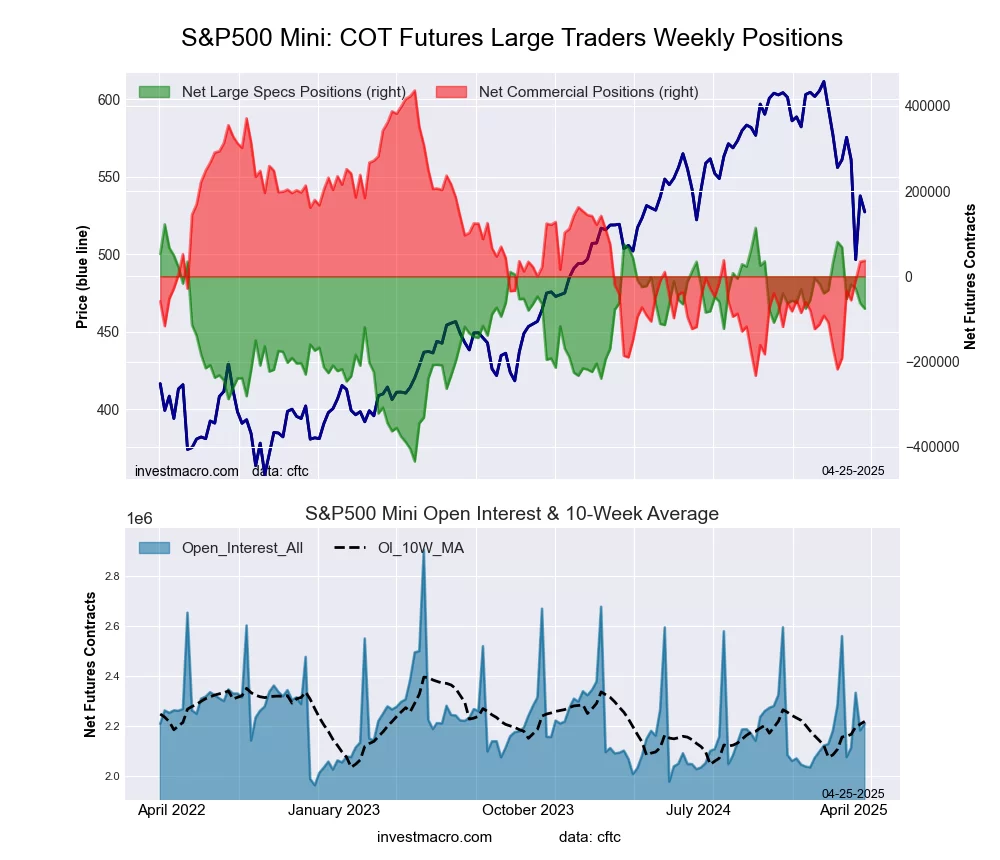
SP500 Mini Futures COT ChartThe S&P500 Mini large speculator standing this week reached a net position of -4,817 contracts in the data reported through Tuesday. This was a weekly increase of 51,337 contracts from the previous week which had a total of -56,154 net contracts.

This week’s current strength score (the trader positioning range over the past three years, measured from 0 to 100) shows the speculators are currently Bullish with a score of 64.0 percent. The commercials are Bearish-Extreme with a score of 17.2 percent and the small traders (not shown in chart) are Bullish-Extreme with a score of 88.1 percent.

Price Trend-Following Model: Uptrend

Our weekly trend-following model classifies the current market price position as: Uptrend.

S&P500 Mini Futures StatisticsSPECULATORSCOMMERCIALSSMALL TRADERS
– Percent of Open Interest Longs:14.868.713.1
– Percent of Open Interest Shorts:15.074.76.9
– Net Position:-4,817-123,461128,278
– Gross Longs:306,7411,423,400271,788
– Gross Shorts:311,5581,546,861143,510
– Long to Short Ratio:1.0 to 10.9 to 11.9 to 1
NET POSITION TREND:
– Strength Index Score (3 Year Range Pct):64.017.288.1
– Strength Index Reading (3 Year Range):BullishBearish-ExtremeBullish-Extreme
NET POSITION MOVEMENT INDEX:
– 6-Week Change in Strength Index:8.8-8.90.4


Dow Jones Mini Futures:

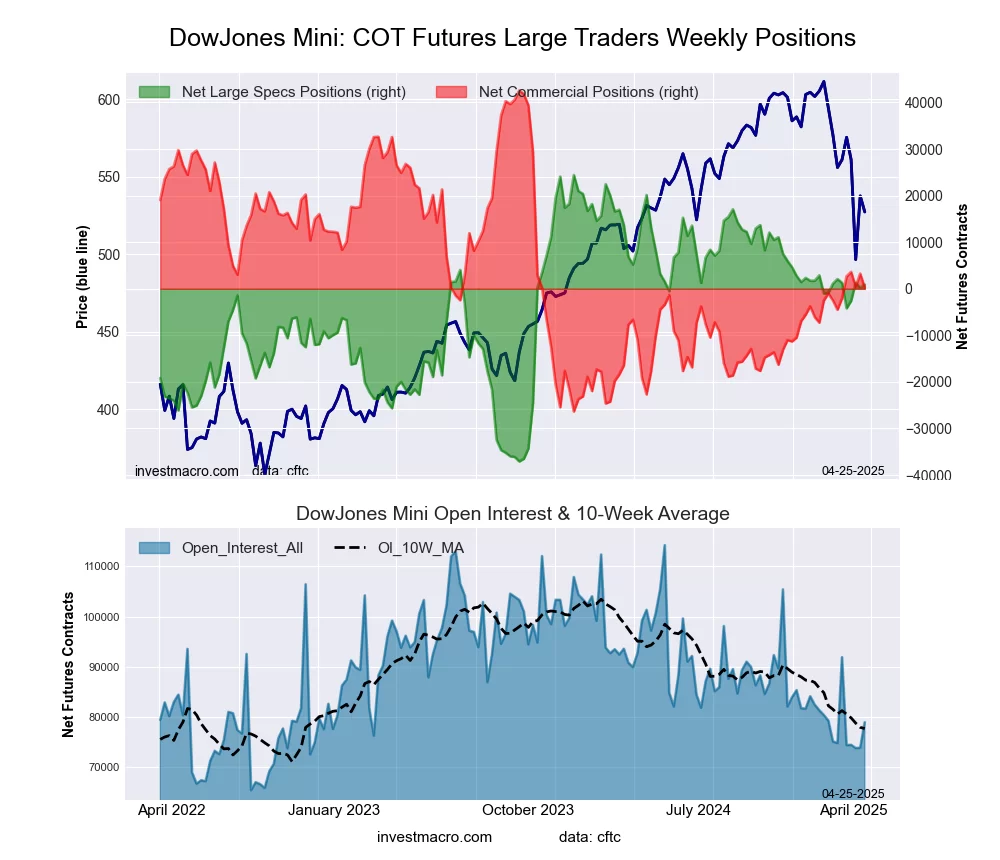
Dow Jones Mini Futures COT ChartThe Dow Jones Mini large speculator standing this week reached a net position of 1,721 contracts in the data reported through Tuesday. This was a weekly reduction of -13 contracts from the previous week which had a total of 1,734 net contracts.

This week’s current strength score (the trader positioning range over the past three years, measured from 0 to 100) shows the speculators are currently Bullish with a score of 63.1 percent. The commercials are Bearish with a score of 29.4 percent and the small traders (not shown in chart) are Bullish with a score of 79.9 percent.

Price Trend-Following Model: Strong Uptrend

Our weekly trend-following model classifies the current market price position as: Strong Uptrend.

Dow Jones Mini Futures StatisticsSPECULATORSCOMMERCIALSSMALL TRADERS
– Percent of Open Interest Longs:16.063.518.1
– Percent of Open Interest Shorts:13.970.912.9
– Net Position:1,721-6,0834,362
– Gross Longs:13,20552,40914,969
– Gross Shorts:11,48458,49210,607
– Long to Short Ratio:1.1 to 10.9 to 11.4 to 1
NET POSITION TREND:
– Strength Index Score (3 Year Range Pct):63.129.479.9
– Strength Index Reading (3 Year Range):BullishBearishBullish
NET POSITION MOVEMENT INDEX:
– 6-Week Change in Strength Index:-6.97.2-4.0


Nasdaq Mini Futures:

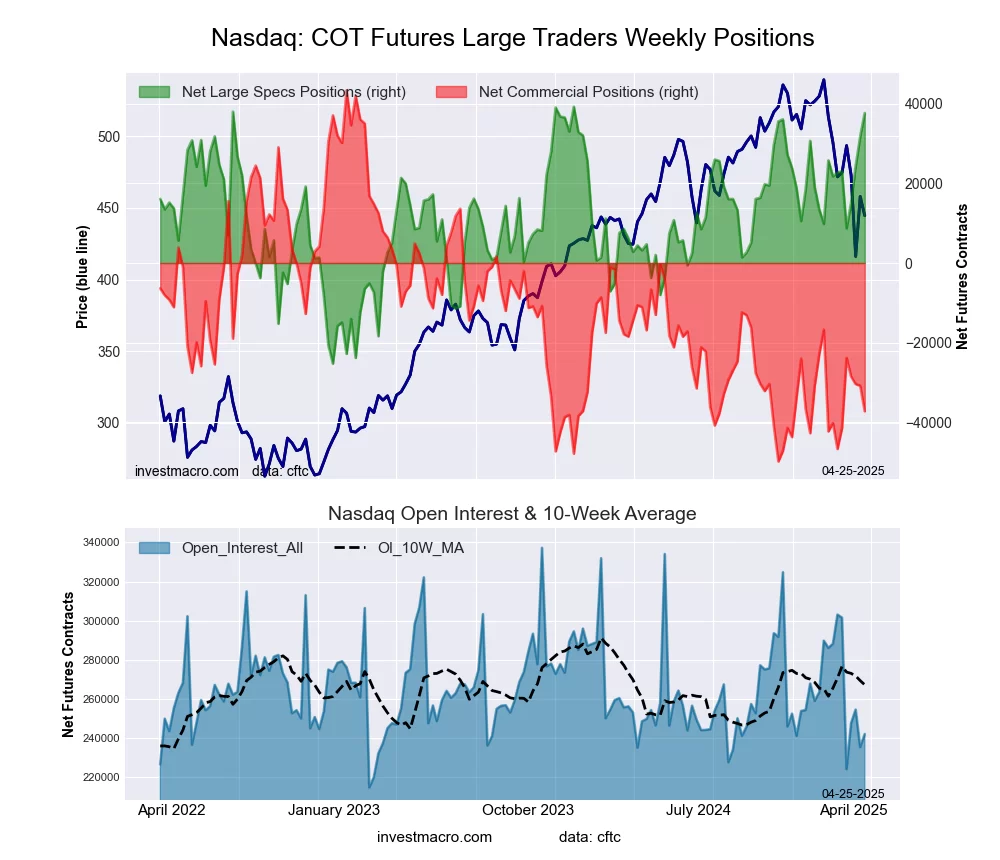
Nasdaq Mini Futures COT ChartThe Nasdaq Mini large speculator standing this week reached a net position of 18,978 contracts in the data reported through Tuesday. This was a weekly fall of -11,713 contracts from the previous week which had a total of 30,691 net contracts.

This week’s current strength score (the trader positioning range over the past three years, measured from 0 to 100) shows the speculators are currently Bullish with a score of 68.6 percent. The commercials are Bearish with a score of 20.4 percent and the small traders (not shown in chart) are Bullish with a score of 77.1 percent.

Price Trend-Following Model: Uptrend

Our weekly trend-following model classifies the current market price position as: Uptrend.

Nasdaq Mini Futures StatisticsSPECULATORSCOMMERCIALSSMALL TRADERS
– Percent of Open Interest Longs:29.354.115.2
– Percent of Open Interest Shorts:21.966.010.7
– Net Position:18,978-30,81111,833
– Gross Longs:75,804140,04839,452
– Gross Shorts:56,826170,85927,619
– Long to Short Ratio:1.3 to 10.8 to 11.4 to 1
NET POSITION TREND:
– Strength Index Score (3 Year Range Pct):68.620.477.1
– Strength Index Reading (3 Year Range):BullishBearishBullish
NET POSITION MOVEMENT INDEX:
– 6-Week Change in Strength Index:-12.811.4-4.6


Russell 2000 Mini Futures:

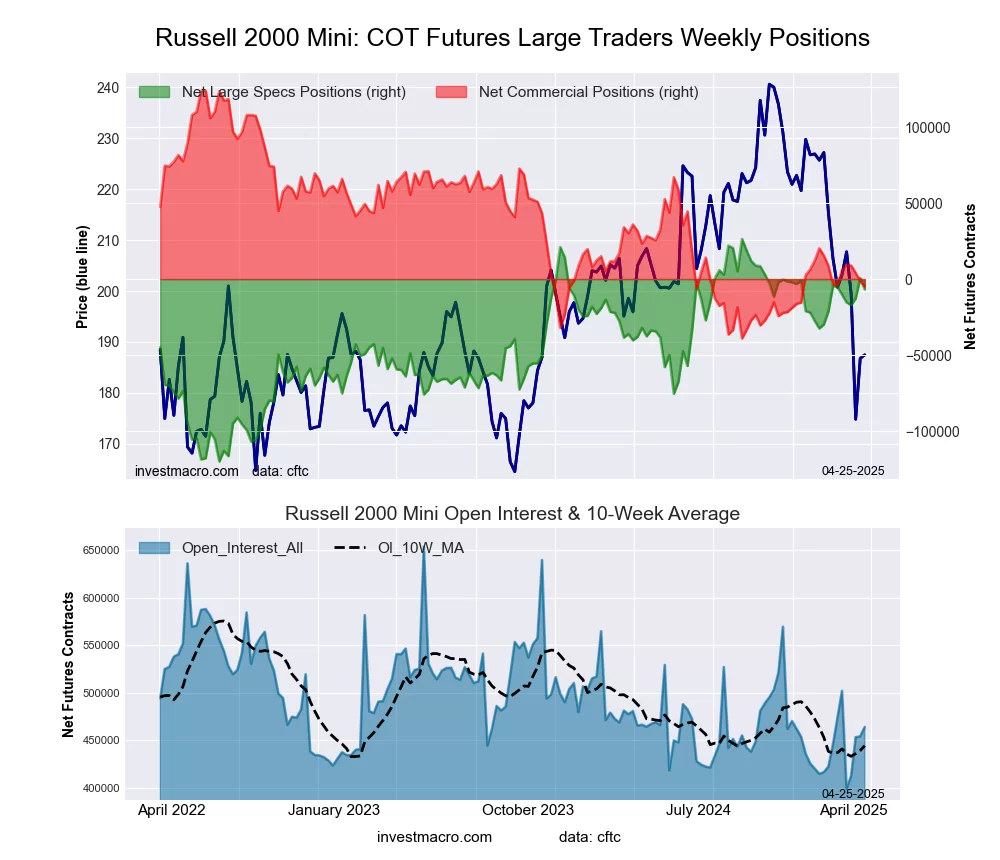
Russell 2000 Mini Futures COT ChartThe Russell 2000 Mini large speculator standing this week reached a net position of -27,498 contracts in the data reported through Tuesday. This was a weekly reduction of -5,463 contracts from the previous week which had a total of -22,035 net contracts.

This week’s current strength score (the trader positioning range over the past three years, measured from 0 to 100) shows the speculators are currently Bullish with a score of 63.2 percent. The commercials are Bearish with a score of 31.4 percent and the small traders (not shown in chart) are Bullish with a score of 67.6 percent.

Price Trend-Following Model: Weak Uptrend

Our weekly trend-following model classifies the current market price position as: Weak Uptrend.

Russell 2000 Mini Futures StatisticsSPECULATORSCOMMERCIALSSMALL TRADERS
– Percent of Open Interest Longs:10.577.68.8
– Percent of Open Interest Shorts:17.074.75.2
– Net Position:-27,49812,18615,312
– Gross Longs:44,118326,37137,173
– Gross Shorts:71,616314,18521,861
– Long to Short Ratio:0.6 to 11.0 to 11.7 to 1
NET POSITION TREND:
– Strength Index Score (3 Year Range Pct):63.231.467.6
– Strength Index Reading (3 Year Range):BullishBearishBullish
NET POSITION MOVEMENT INDEX:
– 6-Week Change in Strength Index:-17.720.8-22.7


Nikkei Stock Average (USD) Futures:

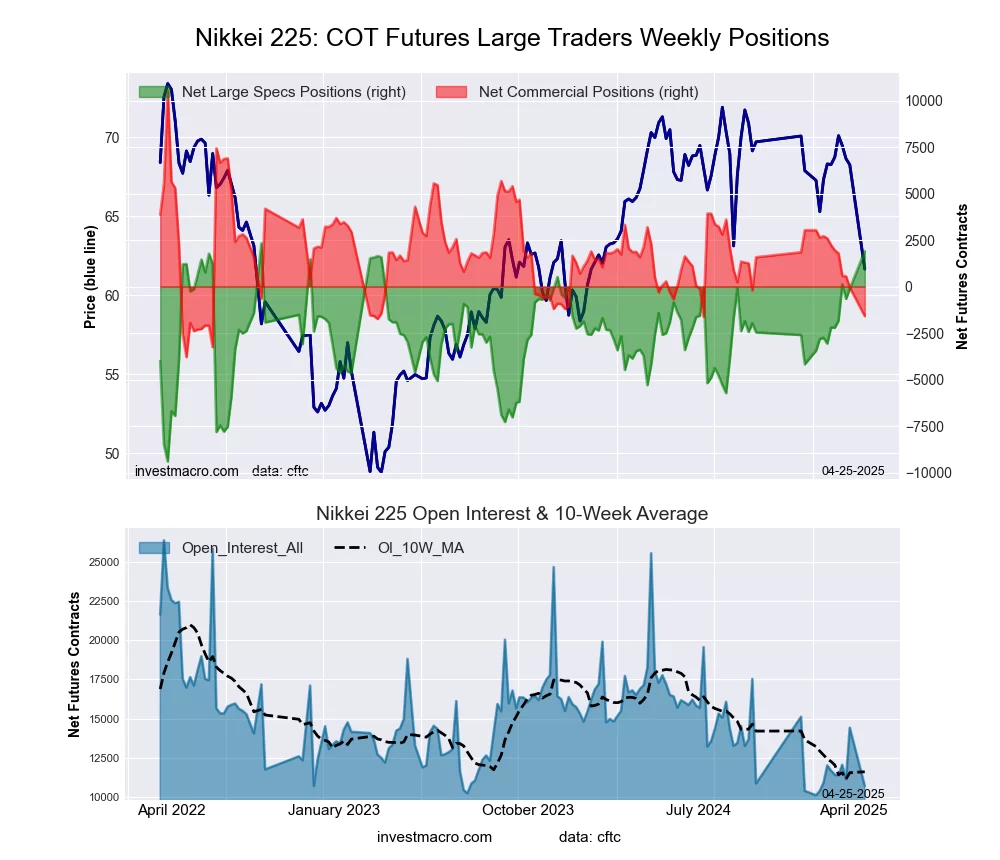
Nikkei Stock Average (USD) Futures COT ChartThe Nikkei Stock Average (USD) large speculator standing this week reached a net position of -2,200 contracts in the data reported through Tuesday. This was a weekly increase of 863 contracts from the previous week which had a total of -3,063 net contracts.

This week’s current strength score (the trader positioning range over the past three years, measured from 0 to 100) shows the speculators are currently Bullish with a score of 61.4 percent. The commercials are Bearish with a score of 42.0 percent and the small traders (not shown in chart) are Bearish with a score of 42.6 percent.

Price Trend-Following Model: Downtrend

Our weekly trend-following model classifies the current market price position as: Downtrend.

Nikkei Stock Average Futures StatisticsSPECULATORSCOMMERCIALSSMALL TRADERS
– Percent of Open Interest Longs:7.972.319.8
– Percent of Open Interest Shorts:26.853.220.0
– Net Position:-2,2002,229-29
– Gross Longs:9238,4382,311
– Gross Shorts:3,1236,2092,340
– Long to Short Ratio:0.3 to 11.4 to 11.0 to 1
NET POSITION TREND:
– Strength Index Score (3 Year Range Pct):61.442.042.6
– Strength Index Reading (3 Year Range):BullishBearishBearish
NET POSITION MOVEMENT INDEX:
– 6-Week Change in Strength Index:3.42.7-15.1


MSCI EAFE Mini Futures:

MSCI EAFE Mini Futures COT ChartThe MSCI EAFE Mini large speculator standing this week reached a net position of -14,606 contracts in the data reported through Tuesday. This was a weekly gain of 13,909 contracts from the previous week which had a total of -28,515 net contracts.

This week’s current strength score (the trader positioning range over the past three years, measured from 0 to 100) shows the speculators are currently Bullish with a score of 64.2 percent. The commercials are Bearish with a score of 40.3 percent and the small traders (not shown in chart) are Bearish with a score of 31.5 percent.

Price Trend-Following Model: Weak Downtrend

Our weekly trend-following model classifies the current market price position as: Weak Downtrend.

MSCI EAFE Mini Futures StatisticsSPECULATORSCOMMERCIALSSMALL TRADERS
– Percent of Open Interest Longs:10.486.92.6
– Percent of Open Interest Shorts:13.884.11.9
– Net Position:-14,60611,7102,896
– Gross Longs:44,985376,34511,105
– Gross Shorts:59,591364,6358,209
– Long to Short Ratio:0.8 to 11.0 to 11.4 to 1
NET POSITION TREND:
– Strength Index Score (3 Year Range Pct):64.240.331.5
– Strength Index Reading (3 Year Range):BullishBearishBearish
NET POSITION MOVEMENT INDEX:
– 6-Week Change in Strength Index:20.2-18.2-2.2


Article By InvestMacroReceive our weekly COT Newsletter

*COT Report: The COT data, released weekly to the public each Friday, is updated through the most recent Tuesday (data is 3 days old) and shows a quick view of how large speculators or non-commercials (for-profit traders) were positioned in the futures markets.

The CFTC categorizes trader positions according to commercial hedgers (traders who use futures contracts for hedging as part of the business), non-commercials (large traders who speculate to realize trading profits) and nonreportable traders (usually small traders/speculators) as well as their open interest (contracts open in the market at time of reporting). See CFTC criteria here.

Speculator Extremes: Cotton, Sugar & 5-Year lead Bearish Positions

By InvestMacro 

The latest update for the weekly Commitment of Traders (COT) report was released by the Commodity Futures Trading Commission (CFTC) on Friday for data ending on February 4th.

This weekly Extreme Positions report highlights the Most Bullish and Most Bearish Positions for the speculator category. Extreme positioning in these markets can foreshadow strong moves in the underlying market.

To signify an extreme position, we use the Strength Index (also known as the COT Index) of each instrument, a common method of measuring COT data. The Strength Index is simply a comparison of current trader positions against the range of positions over the previous 3 years. We use over 80 percent as extremely bullish and under 20 percent as extremely bearish. (Compare Strength Index scores across all markets in the data table or cot leaders table)


Here Are This Week’s Most Bullish Speculator Positions:

Coffee


The Coffee speculator position comes in as the most bullish extreme standing this week. The Coffee speculator level is currently at a 95.5 percent score of its 3-year range.

The six-week trend for the percent strength score totaled 7.5 this week. The overall net speculator position was a total of 71,878 net contracts this week with a decline of -4,642 contracts in the weekly speculator bets.


Speculators or Non-Commercials Notes:

Speculators, classified as non-commercial traders by the CFTC, are made up of large commodity funds, hedge funds and other significant for-profit participants. The Specs are generally regarded as trend-followers in their behavior towards price action – net speculator bets and prices tend to go in the same directions. These traders often look to buy when prices are rising and sell when prices are falling. To illustrate this point, many times speculator contracts can be found at their most extremes (bullish or bearish) when prices are also close to their highest or lowest levels.

These extreme levels can be dangerous for the large speculators as the trade is most crowded, there is less trading ammunition still sitting on the sidelines to push the trend further and prices have moved a significant distance. When the trend becomes exhausted, some speculators take profits while others look to also exit positions when prices fail to continue in the same direction. This process usually plays out over many months to years and can ultimately create a reverse effect where prices start to fall and speculators start a process of selling when prices are falling.


Gold


The Gold speculator position comes next in the extreme standings this week. The Gold speculator level is now at a 95.1 percent score of its 3-year range.

The six-week trend for the percent strength score was 20.8 this week. The speculator position registered 302,508 net contracts this week with a weekly gain of 3,099 contracts in speculator bets.


Live Cattle


The Live Cattle speculator position comes in third this week in the extreme standings. The Live Cattle speculator level resides at a 93.4 percent score of its 3-year range.

The six-week trend for the speculator strength score came in at 13.0 this week. The overall speculator position was 116,439 net contracts this week with a decrease of -2,605 contracts in the weekly speculator bets.


Corn


The Corn speculator position comes up number four in the extreme standings this week. The Corn speculator level is at a 92.7 percent score of its 3-year range.

The six-week trend for the speculator strength score totaled a change of 30.1 this week. The overall speculator position was 462,381 net contracts this week with a boost of 18,506 contracts in the speculator bets.


Steel


The Steel speculator position rounds out the top five in this week’s bullish extreme standings. The Steel speculator level sits at a 88.5 percent score of its 3-year range. The six-week trend for the speculator strength score was 11.8 this week.

The speculator position was -1,763 net contracts this week with a small increase of 22 contracts in the weekly speculator bets.


This Week’s Most Bearish Speculator Positions:

Cotton


The Cotton speculator position comes in as the most bearish extreme standing this week. The Cotton speculator level is at a 0.0 percent score of its 3-year range.

The six-week trend for the speculator strength score was -12.4 this week. The overall speculator position was -50,767 net contracts this week with a drop of -8,339 contracts in the speculator bets.


Sugar


The Sugar speculator position comes in next for the most bearish extreme standing on the week. The Sugar speculator level is at a 0.0 percent score of its 3-year range.

The six-week trend for the speculator strength score was -29.8 this week. The speculator position was -33,109 net contracts this week with a decline of -3,675 contracts in the weekly speculator bets.


5-Year Bond


The 5-Year Bond speculator position comes in as third most bearish extreme standing of the week. The 5-Year Bond speculator level resides at a 2.9 percent score of its 3-year range.

The six-week trend for the speculator strength score was -8.9 this week. The overall speculator position was -1,927,666 net contracts this week with a drop of -151,611 contracts in the speculator bets.


Euro


The Euro speculator position comes in as this week’s fourth most bearish extreme standing. The Euro speculator level is at a 6.5 percent score of its 3-year range.

The six-week trend for the speculator strength score was 3.8 this week. The speculator position was -58,614 net contracts this week with a rise of 7,990 contracts in the weekly speculator bets.


New Zealand Dollar


Finally, the New Zealand Dollar speculator position comes in as the fifth most bearish extreme standing for this week. The New Zealand Dollar speculator level is at a 6.5 percent score of its 3-year range.

The six-week trend for the speculator strength score was -3.6 this week. The speculator position was -49,090 net contracts this week with a dip of -2,059 contracts in the weekly speculator bets.


Article By InvestMacroReceive our weekly COT Newsletter

*COT Report: The COT data, released weekly to the public each Friday, is updated through the most recent Tuesday (data is 3 days old) and shows a quick view of how large speculators or non-commercials (for-profit traders) were positioned in the futures markets.

The CFTC categorizes trader positions according to commercial hedgers (traders who use futures contracts for hedging as part of the business), non-commercials (large traders who speculate to realize trading profits) and nonreportable traders (usually small traders/speculators) as well as their open interest (contracts open in the market at time of reporting). See CFTC criteria here.
The Reserve Bank of India cut rates for the first time in 5 years. The Bank of Mexico continued monetary policy easing

By JustMarkets

At the end of Thursday, the Dow Jones Index (US30) was down 0.28%. The S&P 500 Index (US500) was up 0.36%. The Nasdaq Technology Index (US100) added 0.51%. Initial jobless claims came in slightly above projections but remained in line with recent months, while labor costs and productivity rose less than expected. The long-awaited Non-Farm report will be released today. Economists estimate that the US added 154,000 jobs last month, up from an impressive 256,000 in December. The unemployment rate will come in at 4.1%, the same as last month. Average hourly earnings growth will be 0.3%, also in line with December. Trump’s tariff policy and a strong labor market will support the US dollar, which will put pressure on risk assets such as EUR, GBP and especially CAD and MXN. Gold and silver may also come under pressure amid rising government bond yields. The dollar will be under pressure if the labor market data comes out unexpectedly worse than expected. In this case, risk sentiment may be reevaluated. In such a scenario, stock indices will continue to grow steadily, and gold will continue to renew its historical highs.

The Bank of Mexico cut its benchmark interest rate by 50 bps to 9.50%. This is in line with the global downward trend in inflation, although inflation persists in major economies, especially in services. Domestically, economic activity contracted in Q4 2024 and is expected to weaken in 2025, with employment growth slowing and downside risks persisting. Core inflation fell to 3.69% in mid-January 2025 and core inflation was 3.72%. While core inflation continues to decline, persistent service sector inflation has led Banxico to maintain its inflation prognoses, expecting core inflation to converge to the 3% target by Q3 2026. The bank said further rate cuts may be appropriate depending on the pace of disinflation and the economic outlook.

The Canadian dollar traded above 1.43 per dollar, pausing a rally that led to a seven-week high of 1.431 hit on January 5, as recent economic data shifted focus to the Bank of Canada’s increasingly soft outlook. Canada’s key economic indicator showed a sharp contraction in buying activity, with Ivey’s January 2025 PMI falling to 47.1 from 54.7 in December, well below market expectations of 53.

Equity markets in Europe were mostly up yesterday. Germany’s DAX (DE40) rose by 1.47% to set a new record high. France’s CAC 40 (FR40) closed 1.47% higher, Spain’s IBEX 35 (ES35) gained 1.55%, and the UK’s FTSE 100 (UK100) closed 1.21% higher. The growth of indices was supported by good corporate reports. Despite mixed results from Dutch giant ING, growth was led by banks, with BBVA, Santander and UniCredit shares up 3-6%. Traders put aside fears of a trade war and the impact of tariffs, focusing on a new round of corporate earnings and the next moves by central banks. Rumors of a peace plan for Ukraine due next week also helped improve market sentiment.

The US natural gas (XNG/USD) prices rose above $3.35/MMBtu, helped by a larger-than-expected drawdown in storage inventories. The EIA reported a withdrawal of 174 billion cubic feet (bcf) from storage for the week ended January 31, slightly above analysts’ expectations of 168 bcf. The volume also exceeded last year’s 110 bcf decline and was in line with the five-year average. Colder-than-normal conditions February 10-14 are expected to boost heating demand.

Asian markets are predominantly steady yesterday. Japan’s Nikkei 225 (JP225) rose by 0.61%, China’s FTSE China A50 (CHA50) gained 0.99%, Hong Kong’s Hang Seng (HK50) jumped 1.43%, and Australia’s ASX 200 (AU200) gained 1.23%.

The Reserve Bank of India (RBI) cut its key repo rate by 25bps to 6.25%, marking the first-rate cut since May 2020 during its February meeting. The move came amid slowing economic growth and global trade uncertainty, as expected. The Central Bank expects GDP growth of 6.7% in FY 2025-26, maintaining its inflation estimates at 4.2%, with estimates of 4.5% in Q1, 4.0% in Q2 and 3.8% in Q3.

S&P 500 (US500) 6,083.57 +22.09 (+0.36%)

Dow Jones (US30) 44,747.63 −125.65 (−0.28%)

DAX (DE40) 21,902.42 +316.49 (+1.47%)

FTSE 100 (UK100) 8,727.28 +103.99 (+1.21%)

USD Index 107.68 +0.10 (+0.09%)

News feed for: 2025.02.07

  • India RBI Interest Rate Decision at 06:30 (GMT+2);
  • German Trade Balance at 09:00 (GMT+2);
  • Canada Unemployment Rate (m/m) at 15:30 (GMT+2);
  • US Non Farm Payrolls (m/m) at 15:30 (GMT+2);
  • US Unemployment Rate (m/m) at 15:30 (GMT+2);
  • US Michigan Inflation Expectations at 17:00 (GMT+2).

By JustMarkets


This article reflects a personal opinion and should not be interpreted as an investment advice, and/or offer, and/or a persistent request for carrying out financial transactions, and/or a guarantee, and/or a forecast of future events.

Week Ahead: USD faces triple risk – Tariffs, Powell & CPI

By ForexTime

*Note: This report was written before the US NFP data was published*

  • FXTM USDInd ↓ 0.7% MTD
  • China retaliatory tariffs take effect 10th Feb
  • Powell’s testimony + US CPI = more USD volatility?
  • US CPI sparked moves of ↑ 0.9% & ↓ 0.6% over past year
  • Technical levels: 109.10, 108.20 & 107.00

China’s retaliatory tariffs against the United States are set to take effect on Monday 10th February.

How Trump responds may set the tone for global markets in the week ahead.

Beyond tariffs, Powell’s testimony and key data including the latest US CPI could present fresh trading opportunities:

Sunday, February 9th

  • CN50: China PPI, CPI

Monday, 10th February

Tuesday, 11th February

  • AU200: Australia Westpac consumer confidence
  • MXN: Mexico industrial production, international reserves
  • ZAR: South Africa manufacturing production
  • GBP: BOE Governor Andrew Bailey speech
  • USDInd: Fed Chairman Jerome Powell testimony, Fed speak

Wednesday, 12th February

  • USDInd: Fed Chairman Jerome Powell testimony, US January CPI, Fed speak

Thursday, 13th February

  • EUR: Eurozone industrial production
  • GER40: Germany CPI
  • JP225: Japan PPI
  • UK100: UK industrial production, GDP
  • US500: US initial jobless claims, PPI

Friday, 14th February

  • EUR: Eurozone GDP
  • NZD: New Zealand food prices, BusinessNZ manufacturing PMI
  • USDInd: US retail sales, industrial production

FXTM’s USDInd is under the spotlight after shedding roughly 2% from Monday’s peak.

Fading concerns over Trump’s tariff threats have weakened the dollar. However, an air of caution still lingers as trade war fears keep investors on edge.

Prices remain within a range on the weekly charts with support at 107.00 and resistance at 110.00.

*Note: This chart was created before the US NFP data was published*

DXY 2

The USDInd tracks the dollar’s performance against a basket of six different G10 currencies, including the Euro, British Pound, Japanese Yen, and Canadian dollar.

With all the above said, here are 4 reasons why the USDInd could see more price swings:


    1) China’s retaliatory tariffs

China is expected to slap 15% tariffs on U.S. coal and liquefied natural gas as well as a 10% tariff on crude oil, farm equipment, pickup trucks, and large-engine cars.

These are expected to come into effect on Monday 10th February.

  • If China’s retaliation results in Trump slapping more tariffs on Chinese imports, this could fuel trade war fears – boosting safe-haven assets like the dollar.
  • Should China’s retrained response open the doors to possible negotiations, the dollar may weaken as trade war fears cool.


    2) Fed Chair Powell’s 2-day Testimony

Fed Chair Jerome Powell’s semi-annual testimony before Congress may provide key insight into future policy moves.

During January’s FOMC meeting, Powell stated that the Fed was in no hurry to cut interest rates due to a strong economy and stubborn inflation.

  • Should Powell repeat the same message and strike a hawkish note, this could support the dollar.
  • If the Fed Chair sound more dovish than expected, this may weaken the USDInd.


    3) US January CPI report

The January Consumer Price Index (CPI) published on Wednesday 12th February may influence Fed cut bets.

Markets are forecasting:

  • CPI year-on-year (January 2025 vs. January 2024) to remain unchanged at 2.9%.
  • Core CPI year-on-year to remain unchanged at 3.2%.
  • CPI month-on-month (January 2025 vs December 2024) to cool 0.3% from 0.4%.
  • Core CPI month-on-month to rise 0.3% from 0.2%.

Over the past 12 months, the US CPI has triggered upside moves of as much as 0.9% or declines of 0.6% in a 6-hour window post-release.

Note: The US retail sales report, industrial production and speeches by Fed officials are likely to influence the dollar.

  • A softer-than-expected US CPI report could pull the USDInd lower as Fed cut bets jump.
  • Should the inflation report print above market forecasts, this could support the USDInd.


    4) Technical forces

The USDInd is under pressure on the daily timeframe. Prices are trading below the 21 and 50-day SMA.

  • A breakdown below 107.00 could open a path toward 106.40 and the 100-day SMA at 105.90.
  • Should prices push back above 108.20, this could see an inline toward the 21-day SMA, 109.10 and 110.00.

DXY

*Note: This chart was created before the US NFP data was published*


Forex-Time-LogoArticle by ForexTime

ForexTime Ltd (FXTM) is an award winning international online forex broker regulated by CySEC 185/12 www.forextime.com

Vietnam’s inflation rate rose to a 6-month high. The Mexican peso continues to weaken against the US dollar

By JustMarkets

At the end of Wednesday, the Dow Jones Index (US30) rose by 0.71%. The S&P 500 Index (US500) was up 0.39%. The Nasdaq Technology Index (US100) was up 0.42%. The US stock indices rebounded from early losses on Wednesday, helped by a sharp decline in long-dated Treasury yields as markets priced in a series of mixed earnings releases and economic data. Shares of Broadcom and Nvidia soared 6% and 4.5%, respectively, setting a strong pace for chip makers. Defensive stocks also performed well, with banks, healthcare and consumer staples rising after a weaker-than-expected ISM Services PMI strengthened bets on multiple Fed rate cuts this year. On the other hand, the ADP report showed that the private sector added more jobs than expected, underscoring the resilience of the labor market. For its part, Alphabet shares fell by 7.5% after the company missed cloud revenue expectations and announced higher-than-expected spending plans for AI. In addition, AMD fell more than 10% due to lower data center revenue and Uber fell 7% after weak first-quarter guidance.

The Mexican peso weakened to 20.58 per US dollar amid lingering concerns over US tariffs and heightened expectations of a dovish Banxico stance in response to disappointing data on the country’s economy. Meanwhile, Mexico’s manufacturing PMI fell to 49.1 in January, the steepest decline in factory activity in three months, with low Business Confidence indicating a slowdown in the economy. Weak data continues to weigh on the peso, while downward revisions to growth and inflation expectations reinforce expectations of a rate cut by the Bank of Mexico, putting further pressure on the currency.

The Canadian dollar strengthened to 1.43 per US dollar in February, hitting a seven-week high, as investors welcomed signs of economic growth and easing trade tensions with the US. Despite a second consecutive month of contraction, the PMI Index improved to 49.5 in January from 49, with services continuing to contract and manufacturing rising for a fourth month.

Equity markets in Europe were mostly up yesterday. Germany’s DAX (DE40) rose by 0.37%, France’s CAC 40 (FR40) closed down 0.19%, Spain’s IBEX 35 (ES35) added 1.35%, and the UK’s FTSE 100 (UK100) closed positive 0.61%. European markets recovered losses and closed higher on Wednesday thanks to strong earnings performance across sectors.

WTI crude oil prices fell to $71.20 per barrel on Wednesday following the release of an EIA report that showed a larger-than-expected increase in US crude inventories. Inventories rose by 8.664 million barrels last week, the biggest increase in almost a year, exceeding market projections for a 2.6 million barrel rise and a 5.025 million barrel increase reported by API.

Asian markets traded mostly flat yesterday. Japan’s Nikkei 225 (JP225) was up 0.08%, China’s FTSE China A50 (CHA50) was down 1.31%, Hong Kong’s Hang Seng (HK50) decreased by 0.93%, and Australia’s ASX 200 (AU200) was positive 0.51%.

The Australian dollar held near $0.628 on Thursday after rising for three consecutive sessions, helped by a weaker US dollar. The dollar’s decline was driven by easing fears of a global trade war following cautious tariff measures from the US and China. US President Donald Trump and Chinese President Xi Jinping are expected to discuss developments in trade relations during an upcoming phone call, raising hopes that further escalation will be avoided and tariffs may even be lifted. On the domestic front, data showed Australia’s trade surplus narrowed in December as export growth slowed and import growth accelerated. Market sentiment is increasingly shifting towards expectations that the Reserve Bank of Australia may cut interest rates this month amid weakening inflation and signs of slowing economic activity.

Vietnam’s annual inflation rate rose to 3.63% in January 2025, the highest since July last year, up from 2.94% in December. The main upward pressure came from faster price increases in food and medical services. The annualized core inflation rate, which excludes volatile goods, rose to 3.07%, the highest since November 2023, up from 2.85% in December.

S&P 500 (US500) 6,061.48 +23.60 (+0.39%)

Dow Jones (US30) 44,873.28 +317.24 (+0.71%)

DAX (DE40) 21,585.93 +80.23 (+0.37%)

FTSE 100 (UK100) 8,623.29 +52.52 (+0.61%)

USD Index 107.64 −0.32 (−0.30%)

News feed for: 2025.02.06

  • Switzerland Unemployment Rate (m/m) at 08:45 (GMT+2);
  • Eurozone Retail Sales (m/m) at 12:00 (GMT+2);
  • UK BoE Interest Rate Decision at 14:00 (GMT+2);
  • UK BoE Monetary Policy Report at 14:00 (GMT+2);
  • US Initial Jobless Claims (w/w) at 15:30 (GMT+2);
  • Canada Ivey PMI (m/m) at 17:00 (GMT+2);
  • US Natural Gas Reserves (w/w) at 17:30 (GMT+2).

By JustMarkets


This article reflects a personal opinion and should not be interpreted as an investment advice, and/or offer, and/or a persistent request for carrying out financial transactions, and/or a guarantee, and/or a forecast of future events.

A weak JOLTS report reinforced the likelihood of multiple Fed rate cuts this year

By JustMarkets

At Tuesday’s close, the Dow Jones Index (US30) was up 0.30%. The S&P 500 Index (US500) added 0.72%. The Nasdaq Technology Index (US100) was up 1.26%. Despite China imposing new tariffs on US coal, liquefied natural gas, crude oil and farm equipment in response to Washington’s 10% duties on Chinese imports, market sentiment remained cautiously optimistic. Hopes for a détente on trade increased after President Trump agreed to delay the imposition of tariffs on Canada and Mexico for at least 30 days. Meanwhile, the JOLTS report showed that there were fewer job openings in the US in December than expected, and manufacturing orders fell sharply. Thus, the market continued to bet on multiple Fed rate cuts this year, supporting the position of rate-sensitive assets.

The Mexican peso held near 20.36 per US dollar, supported by US President Trump’s decision to postpone the imposition of 25% tariffs on Mexican imports, easing fears of economic turmoil and dampening risk sentiment that limited demand for the US dollar.

Equity markets in Europe were mostly down yesterday. Germany’s DAX (DE40) rose by 0.36%, France’s CAC 40 (FR40) closed higher by 0.66%, Spain’s IBEX 35 (ES35) gained 1.37%, and the UK’s FTSE 100 (UK100) closed negative 0.15%. The European Union is seeking to defuse a looming conflict with the US over steel and aluminum exports that is set to erupt next month. However, early indications are that EU officials have failed to make good contacts in the emerging US administration, so the Eurozone is preparing for a trade fight.

WTI crude oil prices rose to just below $73 a barrel on Tuesday after hitting a session low of $70.65 amid rising expectations that the US will tighten sanctions against Iran. President Trump intends to restore “maximum pressure” on Iran in a bid to halt oil exports altogether and counter its regional influence. The move will include new sanctions and tougher action against violators.

Palladium (XPDUSD) prices fell to $1,030 an ounce, retreating from a three-month high of $1,063 hit on January 31, as problems in the global auto sector reduced consumption of catalytic converters. Declining car sales in China and the EU, combined with the ongoing shift to electric vehicles, have reduced automakers’ demand for palladium. In addition, trade tensions between the US and China negatively impacted industrial demand, particularly in China, where manufacturing activity remains sluggish amid weak export growth and low domestic consumption.

Asian markets were predominantly falling yesterday. Japan’s Nikkei 225 (JP225) rose by 0.72%, China’s FTSE China A50 (CHA50) gained 1.04%, Hong Kong’s Hang Seng (HK50) added 2.83%, and Australia’s ASX 200 (AU200) was negative 0.06%. The Hang Seng Index retreated from a near two-month high reached a day earlier after China imposed tariffs on various US goods in direct retaliation to new 10% duties on Chinese imports announced by President Donald Trump. Meanwhile, the White House said a meeting between Trump and Chinese leader Xi Jinping has yet to be scheduled, adding to market uncertainty. On the data front, a private survey showed China’s services sector grew at its slowest pace in four months in January, further dampening sentiment.

S&P 500 (US500) 6,037.88 +43.31 (+0.72%)

Dow Jones (US30) 44,556.04 +134.13 (+0.30%)

DAX (DE40) 21,505.70 +77.46 (+0.36%)

FTSE 100 (UK100) 8,570.77 −12.79 (−0.15%)

USD Index 107.93 −1.07 (−0.98%)

News feed for: 2025.02.05

  • Australia Services PMI (m/m) at 00:00 (GMT+2);
  • Japan Services PMI (m/m) at 02:30 (GMT+2);
  • China Caixin Services PMI (m/m) at 03:45 (GMT+2);
  • German Services PMI (m/m) at 10:55 (GMT+2);
  • Eurozone Services PMI (m/m) at 11:00 (GMT+2);
  • UK Services PMI (m/m) at 11:30 (GMT+2);
  • Eurozone Producer Price Index (m/m) at 12:00 (GMT+2);
  • US ADP Non-Farm Employment Change (m/m) at 15:15 (GMT+2);
  • Canada Trade Balance (m/m) at 15:30 (GMT+2);
  • US Trade Balance (m/m) at 15:30 (GMT+2);
  • US ISM Services PMI (m/m) at 17:00 (GMT+2);
  • US Crude Oil Reserves (w/w) at 17:30 (GMT+2).

By JustMarkets


This article reflects a personal opinion and should not be interpreted as an investment advice, and/or offer, and/or a persistent request for carrying out financial transactions, and/or a guarantee, and/or a forecast of future events.

Bitcoin hammered by US-China trade tensions

By ForexTime 

  • Bitcoin ↓ 4.2% month-to-date
  • Trade fears trigger $235 million outflows from Bitcoin ETFs
  • Over past year NFP triggered moves of ↑ 3.2% & ↓ 2.3%
  • Trapped in W1 range: support $91,500, resistance $107,500
  • Key level of interest: $100,000

It’s been a rollercoaster week for Bitcoin.

Over the weekend, the “OG” crypto slumped 5% after Trump slapped 25% tariffs on Mexico and Canada, in addition to 10% tariffs on China.

Prices staged a sharp rebound on Monday as investors cheered his decision to delay 25% tariffs on Canada and Mexico for a month after successful negotiations.

However, Bitcoin and other cryptos tumbled yesterday amid sizzling trade tensions between the world’s two largest economies.

Note: Trump’s 10% tariff on China went into effect on Tuesday 4th February. China has announced retaliatory tariffs against the US, set to take effect on February 10th.

Trump’s tariff drama has left markets uneasy, haunting investor attraction for riskier assets.

This was reflected in the massive $235 million outflows from Bitcoin ETFs on Monday. However, a whopping $341 million in inflows was recorded on Tuesday thanks to tariff hopes.

ETF

Source: Coinglass

Beyond trade developments, the incoming NFP report on Friday could spell more volatility for Bitcoin.

The US economy is expected to have created 170,000 jobs in January, compared with the 256,000 seen in December. Average wages are expected to cool 3.8% YoY while the unemployment rate to remain unchanged at 4.1%.

A disappointing jobs print could strengthen the argument around lower US interest rates, boosting Bitcoin which has shown sensitivity to US rates. The same can be said vice-versa.

Note: Traders are currently pricing in a 40% probability of a 25bp rate cut by May with this jumping to 80% by June.

Over the past year, the US jobs report has triggered upside moves of as much as 3.2% or declines of 2.3% in a 6-hour window post-release.


It’s not only Bitcoin that may see big swings on Friday…

  • AVALANCH: ↑ 4.0 % or ↓ 4.5%
  • CHAINLINK: ↑ 4.0 % or ↓ 4.5%
  • DOGECOIN: ↑ 4.0 % or ↓ 4.1%
  • CARDANO: ↑ 3.8% or ↓ 4.4%
  • BITCOINC: ↑ 3.8 % or ↓ 4.0%
  • SOLANA: ↑ 3.4 % or ↓ 3.1
  • POLYGON: ↑ 3.4% or ↓ 4.0%
  • RIPPLE: ↑ 3.0% or ↓ 3.7%
  • ETHEREUM: ↑ 3.0% or ↓ 3.3%
  • LITECOIN: ↑ 2.9 % or ↓ 4.0%

All 10 cryptos listed above are offered by FXTM as Crypto CFDs.


Technical outlook…

Bitcoin remains trapped within a range on the weekly charts with support at $91,500 and resistance at $107,500.

Bitcoin W1

Prices are under pressure on the daily charts, trading below the 21 and 50-day SMA.

  • A solid close above the 50-day SMA at $99,000 could trigger a move back toward the psychological $100,000 level and 21-day SMA at $103,000.
  • A decline below the 100-day SMA at $94,500 may trigger a selloff toward $91,500 and $90,000.

BITCOIN 3


Forex-Time-LogoArticle by ForexTime

ForexTime Ltd (FXTM) is an award winning international online forex broker regulated by CySEC 185/12 www.forextime.com