Archive for Financial News – Page 4

USD/JPY – Yen Weakens Amid Geopolitical Uncertainty

By Analytical Department RoboForex

USD/JPY rose to 159.39 on Thursday, as the yen weakened amid conflicting signals from Donald Trump on a possible de-escalation of the Middle East conflict. The situation continues to support the US dollar while weighing on the yen.

The US currency strengthened following reports that the operation in Iran is “close to completion” and could achieve its goals in the coming weeks. However, these statements were accompanied by warnings of a potential escalation in hostilities. At the same time, Trump emphasised that diplomatic contacts are ongoing, keeping investors cautious and maintaining heightened attention to geopolitical risks.

For Japan, the situation remains sensitive: the country relies heavily on oil imports from the Middle East, and fuel prices reached record levels in March, although they have since eased slightly supported by government subsidies.

New Bank of Japan board member Toichiro Asada has signalled a preference for a cautious, data-driven approach. He joins the council ahead of the 27–28 April meeting, where markets currently price in a probability of a rate hike at approximately 70%.

Technical Analysis

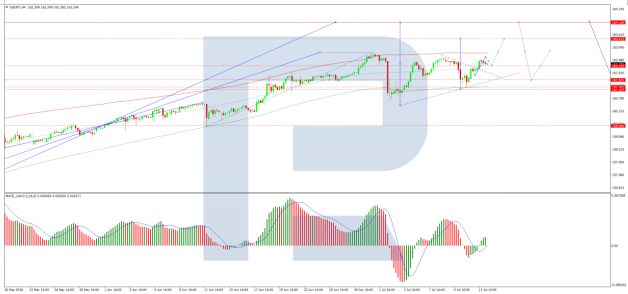
On the H4 chart, USD/JPY is forming a consolidation range around 159.10. The range is expected to expand to 159.50 today, followed by a decline to 157.70. An upside breakout could lead to a correction to 160.40, after which a new downward impulse to 157.70 is anticipated, with the prospect of a continued move towards 156.00. The MACD indicator confirms this scenario, with its signal line below zero and pointing firmly downwards, supporting the potential for the downtrend to continue.

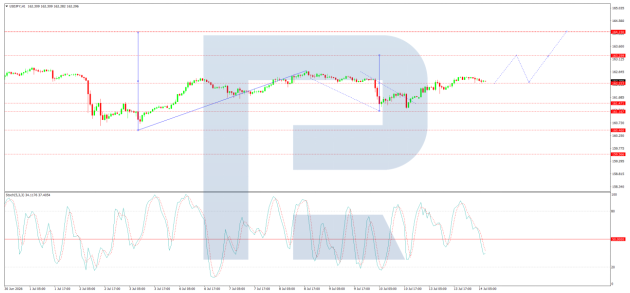
On the H1 chart, the market is forming an advance towards 159.50 and is likely to reach the target today. Following this, a downward wave to 157.70 (testing from below) is possible. The Stochastic oscillator confirms this structure, with its signal line above 80 and pointing firmly downwards, indicating continued short-term downside potential.

Conclusion

USD/JPY remains in positive territory, with conflicting signals from the US over Middle East de-escalation creating an uncertain backdrop that favours the dollar over the yen. While reports of progress in the Iran operation have supported the greenback, ongoing diplomatic contacts and warnings of escalation keep markets on edge. Japan’s sensitivity to oil price fluctuations adds to yen pressure, although government subsidies provide partial relief. With a new BoJ board member advocating a cautious approach and markets pricing in a 70% probability of a rate hike at the April meeting, the yen’s near-term trajectory will likely depend on both geopolitical developments and upcoming policy signals from Tokyo. Technical indicators point to a possible short-term correction lower.


Disclaimer

Any forecasts contained herein are based on the author’s particular opinion. This analysis may not be treated as trading advice. RoboForex bears no responsibility for trading results based on trading recommendations and reviews contained herein.

Signs of diplomatic dialogue have appeared in the Middle East – markets reacted positively

By JustMarkets 

On Tuesday, the US stock markets ended with a powerful rally. By the end of the day, the Dow Jones Index (US30) rose by 2.49%. The S&P 500 Index (US500) increased by 2.91%. The Tech Index NASDAQ (US100) closed higher by 3.43%. Investor optimism was triggered by signals of possible diplomatic de‑escalation: Iran’s President Masoud Pezeshkian, during international contacts, confirmed Tehran’s readiness for a ceasefire. The main conditions from the Iranian side were the provision of firm international security guarantees, payment of reparations, and recognition of the country’s sovereign rights, which the market interpreted as the first real “exit” from the hot phase of the conflict. The leaders of the recovery were technology giants, the most sensitive to geopolitical risks: Nvidia shares rose by 5.6%, and Microsoft by 3.1%. Despite Tuesday’s positive close, March results remain extremely painful for investors: the S&P 500 ended the month down 5.3%, its worst result since 2022.

The Canadian dollar reached 1.395 per US dollar, updating its lowest levels since December of last year. Despite positive domestic statistics, Canada’s economy grew by 0.2% in February due to a recovery in the mining and financial sectors, but the national currency could not withstand the global dominance of the US dollar. The main factor behind the weakening of the loonie was the widespread flight of investors into safe‑haven assets amid the prolonged conflict in the Middle East. The situation is worsened by the fact that the traditional support for the Canadian dollar from high oil prices is being offset by concerns over global economic growth. Markets are pricing in a prolonged supply shock scenario, in which Canada’s benefit from expensive commodities is overshadowed by a general decline in risk appetite.

European stock markets showed growth yesterday. Germany’s DAX (DE40) rose by 0.52%, France’s CAC 40 (FR40) closed up 0.57%, Spain’s IBEX 35 (ES35) gained 0.47%, and the UK’s FTSE 100 (UK100) closed 0.48% higher.

Silver (XAG) prices showed a local rise to 73 dollars per ounce. However, this short‑term interest does not change the catastrophic monthly dynamics: silver ends March with a decline of more than 20%, the worst monthly result in the past 14 years. At the moment, the asset is trading almost 40% below its historical highs recorded at the end of January 2026. Such a sharp collapse of the industrial and precious metals is due to a radical shift in the macroeconomic landscape caused by the war in the Middle East. The blockade of the Strait of Hormuz and the subsequent energy shock (Brent oil above 115 dollars) turned inflation from a temporary factor into a long‑term threat. This forced investors to completely revise their expectations for interest rates: before the war, the market expected two Fed rate cuts in 2026, but now traders have fully ruled out such a scenario, pricing in the continuation of tight credit conditions.

WTI oil prices showed a corrective decline, falling to 100 dollars per barrel. Earlier in the session, prices reached a local peak of 107 dollars, but the market reacted to diplomatic signals from Tehran. The easing of tensions coincided with a tactical pause in US actions. President Donald Trump temporarily suspended direct strikes on Iranian territory, giving traders hope for a partial resumption of tanker traffic from GCC countries through the Strait of Hormuz. At the moment, shipping in this key chokepoint is almost paralyzed, and freight rates have reached multi‑year highs.

Asian markets traded without a unified trend yesterday. Japan’s Nikkei 225 (JP225) fell by 1.58%, China’s FTSE China A50 (CHA50) declined by 0.47%, Hong Kong’s Hang Seng (HK50) rose by 0.15%, and Australia’s ASX 200 (AU200) posted a positive result of 0.25%.

China’s manufacturing sector in March 2026 experienced a noticeable cooling of growth rates, according to the PMI business‑activity Index from RatingDog. The decline of the indicator to 50.8 (after February’s 52.1) was more pronounced than the market expected (prediction 51.6). Although the Index remains above the 50‑point threshold separating growth from stagnation, the report revealed serious structural challenges caused by global instability.

S&P 500 (US500) 6,528.52 +184.80 (+2.91%)

Dow Jones (US30) 46,341.51 +1,125.37 (+2.49%)

DAX (DE40) 22,680.04 +117.16 (+0.52%)

FTSE 100 (UK100) 10,176.45 +48.49 (+0.48%)

USD Index 99.82 -0.69% (-0.68%)

News feed for: 2026.04.01

  • Japan Monetary Policy Meeting Minutes at 01:50 (GMT+2) – JPY (MED)
  • Australia Inflation Rate (m/m) at 02:30 (GMT+2) – AUD (HIGH)
  • UK Inflation Rate (m/m) at 09:00 (GMT+2) – GBP (HIGH)
  • Eurozone ECB President Lagarde Speaks at 10:45 (GMT+2) – EUR (LOW)
  • German Ifo Business Climate (m/m) at 11:00 (GMT+2) – EUR (MED)
  • US Crude Oil Reserves (w/w) at 16:30 (GMT+2) – WTI (HIGH)

By JustMarkets


This article reflects a personal opinion and should not be interpreted as an investment advice, and/or offer, and/or a persistent request for carrying out financial transactions, and/or a guarantee, and/or a forecast of future events.

Gold Rises as Geopolitical Risk Premium Fades

By Analytical Department RoboForex

Gold prices rose more than 4% on Wednesday, approaching 4,690 USD per ounce amid signs of easing tensions in the Middle East. Expectations of de-escalation could lead to lower oil prices and reduced concerns about further tightening of central bank policy.

Donald Trump stated he was ready to end the conflict with Iran even with the Strait of Hormuz partially closed. Separately, reports emerged that Iranian President Masoud Pezeshkian may consider ending the conflict under certain conditions.

However, the rise in gold remains constrained. Reducing geopolitical risks diminishes demand for safe-haven assets, while a strong dollar and elevated government bond yields continue to pressure the metal.

In March, gold lost more than 13%-its steepest monthly decline since October 2008. The precious metal now remains approximately 19% below its January highs. Going forward, its dynamics will depend on US macroeconomic data and Federal Reserve signals on interest rates.

Technical Analysis

On the H4 XAU/USD chart, the market is forming a consolidation range around the 4,656 USD level. An upside breakout would open potential for a correction to 4,848 USD. A downside breakout could see the beginning of a downward wave to 4,750 USD. The MACD indicator confirms the current momentum, with its signal line above the centre line and pointing strictly upwards.

On the H1 chart, the market has broken above the 4,682 USD level and is forming a wave towards 4,855 USD. Looking ahead, a corrective move back to 4,490 USD will be considered, followed by an expected rise to 4,900 USD. The Stochastic oscillator supports this scenario, with its signal line remaining above the 20 level and showing upward pressure towards 80.

Conclusion

Gold’s sharp rally reflects growing market optimism over a potential de-escalation in the Middle East, with signals from both US and Iranian leadership suggesting a possible path toward ending the conflict. However, the metal’s upside remains capped by the corresponding decline in safe-haven demand, alongside persistent headwinds from a strong dollar and high bond yields. Having suffered its worst monthly loss since 2008 in March, gold now faces a pivotal moment where further gains will likely depend on whether easing geopolitical tensions translate into a sustained shift in central bank policy expectations. Technical indicators point to near-term upside, though the broader trend remains fragile.


Disclaimer

Any forecasts contained herein are based on the author’s particular opinion. This analysis may not be treated as trading advice. RoboForex bears no responsibility for trading results based on trading recommendations and reviews contained herein.

WTI crude oil has settled above $100 a barrel. Market participants prefer to hedge risks

By JustMarkets 

Monday’s trading session on US stock exchanges was characterized by increased volatility and a pronounced sectoral split. By the end of Monday, the Dow Jones Index (US30) rose by 0.11%. The S&P 500 Index (US500) fell by 0.39%. The Tech Index NASDAQ (US100) closed lower by 0.73%. Despite Jerome Powell’s attempts to calm the markets by stating that the Federal Reserve does not plan to react to temporary spikes in energy prices, this only led to a local rise in the Dow Jones Index. The decline in US Treasury yields, which normally stimulates growth stocks, was unable to offset investor concerns about the security of Iran’s energy infrastructure and the stability of shipping routes through the Red Sea. Instead of buying cheaper tech assets, capital flowed into defensive instruments and energy companies. The elevated fear index confirms that market participants are not yet ready to believe in long‑term de‑escalation and prefer to hedge risks ahead of new developments from the conflict zone.

The Canadian dollar continues its downward trend, falling below 1.39 per US dollar and setting a new low since December of last year. Despite Canada being a major exporter of energy resources and global oil prices surging to 2022 levels due to the effective blockade of the Strait of Hormuz, the loonie is not receiving its usual support from the commodity rally. The main pressure factor is the global strengthening of the US dollar, which benefits from its “safe‑haven” status and expectations of continued Federal Reserve tightening.

European stock markets showed a confident rebound on Monday. Germany’s DAX (DE40) rose by 1.18%, France’s CAC 40 (FR40) closed up 0.92%, Spain’s IBEX 35 (ES35) gained 0.99%, and the UK’s FTSE 100 (UK100) closed up 1.61%. The main driver of growth was the temporary decline in government‑bond yields, which provided necessary support to indices during a period of strong oversold conditions. Despite the positive sentiment in equities, the situation in the energy sector remains extremely tense. Oil prices held at their 2022 peak levels due to ongoing threats from Houthi forces in the Red Sea and Donald Trump’s harsh rhetoric regarding a potential strike on Iran’s oil facilities. Nevertheless, investors temporarily shifted their focus from inflation risks to concerns about a broader slowdown in economic growth, triggering a decline in bond yields.

WTI oil prices are ending March with an unprecedented rally, settling at 101.7 dollars per barrel. Prices have risen more than 50% this month, a direct reaction to the full‑scale conflict in the Middle East that began in late February 2024. The main driver of fear in the market remains the effective blockade of the Strait of Hormuz, through which about 20% of global oil supplies pass. The situation escalated after Donald Trump shifted to a strategy of direct ultimatums. Despite his statements about “progress in negotiations” and a temporary halt to strikes until April 6, the US president clearly outlined targets for the next phase of the operation. If Iran does not immediately open the strait, power plants, oil wells, and the key export hub on Kharg Island will be targeted. Adding fuel to the fire is the expanding geography of hostilities: the involvement of Yemen’s Houthi rebels, who attacked Israel and threatened Saudi infrastructure, has created the risk of a large‑scale regional conflagration. With maritime transport nearly paralyzed and Washington’s diplomatic proposals rejected by Tehran as “illogical,” analysts warn that a surge in oil prices to 120 dollars in April becomes a realistic scenario if strikes on Iranian refineries begin.

The XNG showed a sharp decline, falling more than 5% to 2.866 dollars per MMBtu. The main driver of the drop was updated meteorological expectations predicting unusually warm weather on the US East Coast in the first half of April. The expected warming effectively ends the heating season, sharply reducing gas demand from households and utilities. The geopolitical agenda related to Donald Trump’s ultimatums toward Iran and uncertainty around the Strait of Hormuz has only an indirect impact on the US gas market. Unlike oil prices, US natural gas prices remain insulated from Middle Eastern tensions in the short term due to the self‑sufficiency of the American energy system and the limited dependence of domestic prices on global LNG export flows.

Asian markets also mostly declined yesterday. Japan’s Nikkei 225 (JP225) fell by 2.79%, China’s FTSE China A50 (CHA50) dropped by 0.08%, Hong Kong’s Hang Seng (HK50) declined by 0.81%, and Australia’s ASX 200 (AU200) posted a negative result of 0.65%.

On Tuesday, the AUD held near 0.686 US dollars, trading close to a two‑month low. March became the worst month for the aussie since late 2024, with a cumulative decline of about 3.6%. Although interest‑rate decisions supported the currency at the beginning of the month, by the end of the quarter, market sentiment shifted from fighting inflation to concerns about slowing global economic growth. Minutes from the March meeting of the RBA added uncertainty. After two rate hikes this year, the regulator acknowledged that the prolonged Middle East conflict creates a dual threat: on one hand, it fuels inflation through higher energy prices; on the other, it suppresses business activity. The RBA board emphasized the need for a delicate balance, causing investors to doubt the straightforwardness of further policy tightening.

S&P 500 (US500) 6,343.72 −25.13 (−0.39%)

Dow Jones (US30) 45,216.14 +49.50 (+0.11%)

DAX (DE40) 22,562.88 +262.13 (+1.18%)

FTSE 100 (UK100) 10,127.96 +160.61 (+1.61%)

USD Index 100.54 +0.39% (+0.39%)

News feed for: 2026.03.31

  • Japan Tokyo Core CPI (m/m) at 02:30 (GMT+3); – JPY (MED)
  • Japan Unemployment Rate (m/m) at 02:50 (GMT+3); – JPY (MED)
  • Japan Retail Sales (m/m) at 02:50 (GMT+3); – JPY (MED)
  • Australia Monetary Policy Meeting Minutes at 03:30 (GMT+3); – AUD (MED)
  • China Manufacturing PMI (m/m) at 04:30 (GMT+3); – CHA50, HK50 (MED)
  • China Non-Manufacturing PMI (m/m) at 04:30 (GMT+3); – CHA50, HK50 (MED)
  • UK GDP (q/q) at 09:00 (GMT+3); – GBP (MED)
  • German Retail Sales (m/m) at 09:00 (GMT+3); – EUR (MED)
  • German Unemployment Rate (m/m) at 10:55 (GMT+3); – EUR (LOW)
  • Eurozone Consumer Price Index (m/m) at 12:00 (GMT+3); – EUR (MED)
  • Canada GDP (m/m) at 15:30 (GMT+3); – CAD (MED)
  • US JOLTs Job Openings (m/m) at 17:00 (GMT+3); – USD (HIGH)
  • US CB Consumer Confidence (m/m) at 17:00 (GMT+3). – USD (MED)

By JustMarkets


This article reflects a personal opinion and should not be interpreted as an investment advice, and/or offer, and/or a persistent request for carrying out financial transactions, and/or a guarantee, and/or a forecast of future events.

GBP/USD – pause for recovery needed after five-day sell-off

By Analytical Department RoboForex

GBP/USD is attempting to recover on Tuesday following earlier declines, bouncing from 1.3198 after five consecutive sessions of selling. Sterling remains under pressure as investors assess the impact of the Iran conflict on the British economy.

Despite this, since the beginning of March, the pound has remained one of the most stable currencies against the dollar.

However, sterling remains vulnerable. Britain’s high reliance on gas imports, persistently high inflation, and pressure on public finances are heightening risks. The yield on 10-year government bonds is holding around 4.98%, near highs not seen since 2008, following recent increases.

Additional attention is focused on the debt market: after the government bond sale, some pension funds were required to increase collateral to hedge positions, although the scale remains far from the 2022 crisis levels.

Macroeconomic data also point to a slowing economy. Business activity is growing at its slowest pace in six months, producer costs are accelerating, and retail sales are declining.

The Bank of England is likely to remain cautious about changing rates – this remains the prevailing expectation.

Technical Analysis

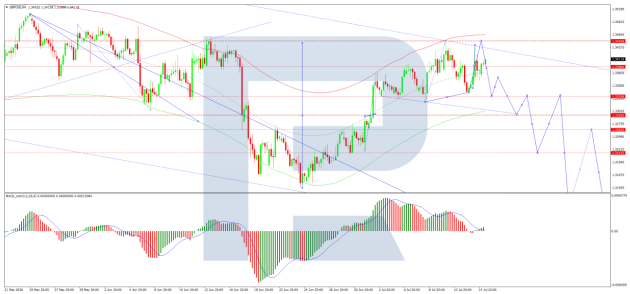
On the H4 GBP/USD chart, the market is forming a broad consolidation range around 1.3297, currently extending up to 1.3434. A decline to 1.3156 is likely in the near term, followed by the formation of a new consolidation range. An upside breakout would open the way for a continuation move to 1.3300, while a downside breakout would suggest further movement to 1.3100. Technically, this scenario is confirmed by the MACD indicator, whose signal line is below zero and pointing downwards.

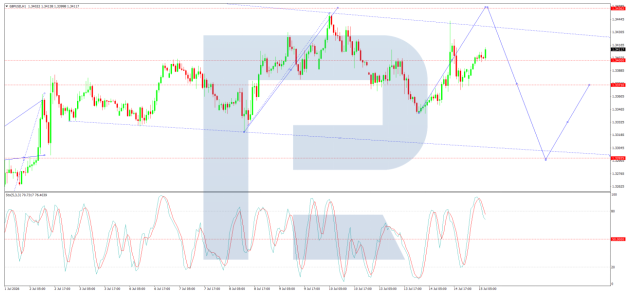
On the H1 chart, the market has formed a compact consolidation range around 1.3322. A downside breakout has initiated a wave structure extending to 1.3100. Should this level be breached, further downside potential towards 1.3050 would emerge. Conversely, an upside breakout from the range could trigger a rebound towards 1.3300. Technically, this scenario is confirmed by the Stochastic oscillator, with its signal line below 50 and pointing downwards.

Conclusion

GBP/USD is attempting to stabilise after five consecutive days of selling, though the broader outlook remains fragile. While sterling has shown relative resilience compared to other currencies since March, mounting headwinds – including the UK’s energy import dependence, stubborn inflation, debt market pressures, and slowing economic activity – continue to weigh on the pound. The Bank of England’s cautious stance offers little immediate support, and technical indicators point to further downside potential. A recovery pause may materialise, but sustained upside appears unlikely without a tangible shift in either geopolitical tensions or domestic economic data.


Disclaimer

Any forecasts contained herein are based on the author’s particular opinion. This analysis may not be treated as trading advice. RoboForex bears no responsibility for trading results based on trading recommendations and reviews contained herein.

Armed confrontation in the Middle East has entered its fifth week with no visible prospects for de‑escalation

By JustMarkets 

On Friday, the US stock markets continued their active decline, hitting the lowest levels in the past seven months amid fears of global stagflation. By the end of Friday, the Dow Jones Index (US30) fell by 1.73% (down -1.39% for the week). The S&P 500 Index (US500) declined by 1.67% (down -3.13% for the week). The Tech Index NASDAQ (US100) closed lower by 1.93% (down -4.69% for the week). The sharp rise in energy prices has effectively deprived investors of hope for Federal Reserve policy easing this year, while additional pressure came from China’s launch of a trade investigation against the United States in response to tariff measures.

The technology sector is experiencing a massive capital outflow, which has seriously undermined the positions of companies linked to the artificial‑intelligence industry. Shares of giants such as Tesla, Amazon, and Oracle lost more than 3%, while worsening credit conditions triggered a similar decline in JPMorgan and Visa. The most dramatic drop was seen in Meta, whose market value plunged by 12% in recent days due to large‑scale layoffs and an unfavorable court ruling declaring the social network addictive.

The Mexican peso weakened, breaking through the psychological level of 18 per US dollar and reaching its lowest value since the beginning of winter. The main reason for this dynamic was the narrowing interest‑rate differential between the US and Mexico, which made previously popular carry‑trade strategies less attractive. Investors reacted to the unexpected decision by the Bank of Mexico to resume its monetary‑policy easing cycle and cut the rate to 6.75%, despite inflation accelerating to 4.63% in mid‑March. The regulator was driven by slowing domestic economic activity and negative labor‑market data showing rising unemployment and persistently high informal employment.

European stock markets closed lower but remained in positive territory for the week. Germany’s DAX (DE40) fell by 1.38% (up +1.61% for the week), France’s CAC 40 (FR40) closed down 0.87% (up +2.12% for the week), Spain’s IBEX 35 (ES35) declined by 0.95% (up +2.53% for the week), and the UK’s FTSE 100 (UK100) closed down by 0.05% (up +0.49% for the week). Price pressure in the oil market has already begun to translate into real inflation indicators. The scale of the problem was most clearly reflected in Spain, where consumer‑price growth in March reached multi‑year highs, showing the sharpest monthly jump since the 2022 crisis. Against this backdrop, the banking sector continued to suffer losses due to instability in the sovereign‑debt market, leading to noticeable declines in shares of giants such as BBVA, UniCredit, and Deutsche Bank.

The oil market opened the week with strong gains, rising about 3% and consolidating above the psychological level of 102 dollars per barrel. Investors are increasingly skeptical about a quick end to the conflict in Iran, which has now entered its second month. The situation was further complicated by the direct involvement of Yemen’s Houthi rebels, who launched missile strikes on Israeli territory over the weekend and declared their intention to continue attacks until pressure on Tehran ceases. Another destabilizing factor is the ability of rebel groups to disrupt shipping in the Red Sea and attack strategic facilities in Saudi Arabia.

Asian markets also mostly rose last week. Japan’s Nikkei 225 (JP225) gained 1.72% for the trading week, China’s FTSE China A50 (CHA50) rose by 0.45%, Hong Kong’s Hang Seng (HK50) increased by 0.66%, and Australia’s ASX 200 (AU200) posted a five‑day gain of 2.81%.

Monday’s trading session in Asian markets opened with a noticeable decline, as the armed confrontation in the Middle East entered its fifth week with no visible prospects for de‑escalation. The geopolitical situation worsened after Donald Trump’s high‑profile statements about a possible takeover of Iran’s oil resources, coinciding with active involvement in the conflict by Yemen’s Houthi rebels, who carried out attacks on Israeli territory.

S&P 500 (US500) 6,368.85 −108.31 (−1.67%)

Dow Jones (US30) 45,166.64 −793.47 (−1.73%)

DAX (DE40) 22,300.75 −312.22 (−1.38%)

FTSE 100 (UK100) 9,967.35 −4.82 (−0.05%)

USD Index 100.19 +0.29% (+0.29%)

News feed for: 2026.03.30

  • Japan BoJ Summary of Opinions at 02:50 (GMT+3); – JPY (MED)
  • Switzerland KOF Leading Indicators (m/m) at 10:00 (GMT+3); – CHF (LOW)
  • German Consumer Price Index (m/m) at 15:00 (GMT+3); – EUR (MED)
  • US Fed Chair Powell Speaks at 17:30 (GMT+3). – USD, XAU (MED)

By JustMarkets


This article reflects a personal opinion and should not be interpreted as an investment advice, and/or offer, and/or a persistent request for carrying out financial transactions, and/or a guarantee, and/or a forecast of future events.

EUR/USD: Middle East Conflict Still Determines Sentiment

By Analytical Department RoboForex

EUR/USD edged higher on Monday after earlier declines, reaching 1.1516. The US dollar continues to draw support from safe-haven demand amid the ongoing Middle East conflict, which has now entered its fifth week with no signs of resolution.

Tensions escalated following Donald Trump’s remarks regarding the possible confiscation of Iranian oil and control of the export hub on Kharg Island. At the same time, the US is increasing its military presence in the region and preparing for potentially prolonged operations. Iran-aligned forces, including the Houthis in Yemen, have also joined the conflict.

Rising oil prices in this environment are amplifying inflation risks and reinforcing expectations of tighter Federal Reserve policy. The market is increasingly pricing in the possibility of a rate hike this year, marking a notable shift from earlier expectations of rate cuts.

Investor focus now turns to US macroeconomic data. This week will see the release of labour market indicators, including JOLTS and ADP figures, as well as the key March employment report due on Friday.

Technical Analysis

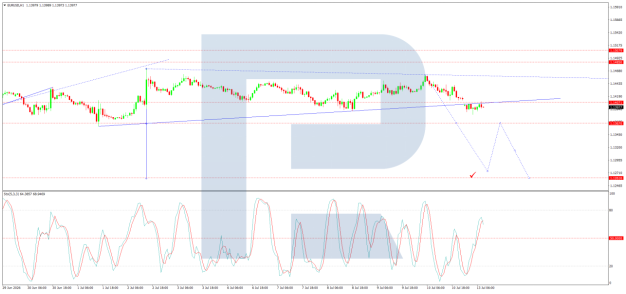
On the H4 chart, EUR/USD is forming a consolidation range around 1.1528. A downside breakout is expected, with a continuation wave to 1.1404 as a near-term target, followed by a subsequent rebound to 1.1528. Technically, this scenario is confirmed by the MACD indicator – its signal line is below zero and pointing firmly downwards, reflecting sustained bearish momentum and the potential for the downtrend to persist.

On the H1 chart, the market is forming the structure of the next downward wave towards 1.1440. After reaching this level, a rebound to 1.1535 is expected, potentially extending the move to 1.1647. Technically, this scenario is confirmed by the Stochastic oscillator – its signal line is below 50 and pointing firmly downwards towards 20.

Conclusion

EUR/USD remains firmly driven by geopolitical forces, with the Middle East conflict entering its fifth week and showing no signs of de-escalation. The US dollar’s safe-haven appeal continues to dominate, while escalating tensions and rising oil prices have shifted market expectations from rate cuts to the possibility of a Fed hike later this year. Technical indicators point to further near-term downside, although this week’s US labour market data could introduce volatility. Until there is a tangible shift in the geopolitical landscape, the euro is likely to remain under pressure.


Disclaimer

Any forecasts contained herein are based on the author’s particular opinion. This analysis may not be treated as trading advice. RoboForex bears no responsibility for trading results based on trading recommendations and reviews contained herein.

COT Metals Charts: Steel Speculator Bets continue to rise to New Record High


By InvestMacro

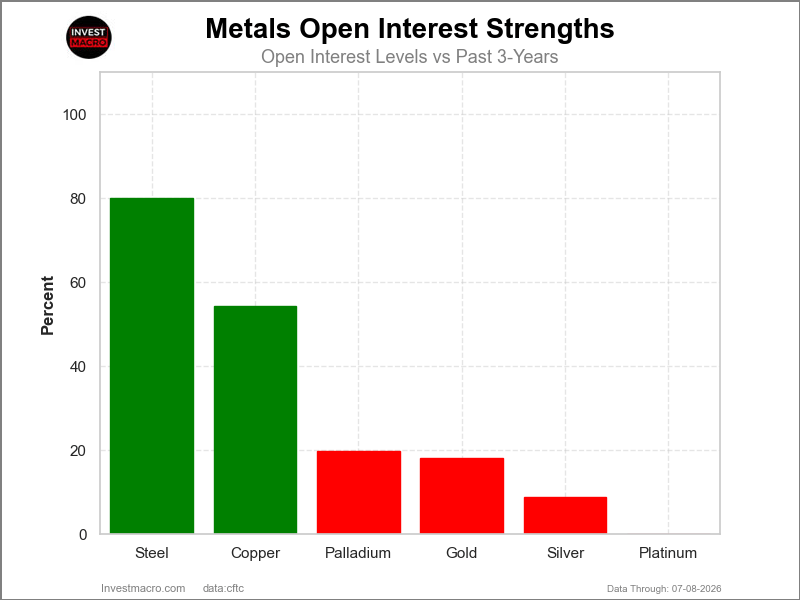
Metals Open Interest COT Chart
Here are the latest charts and statistics for the Commitment of Traders (COT) data published by the Commodities Futures Trading Commission (CFTC).

The latest COT data is updated through Tuesday March 24th and shows a quick view of how large traders (for-profit speculators and commercial entities) were positioned in the futures markets.

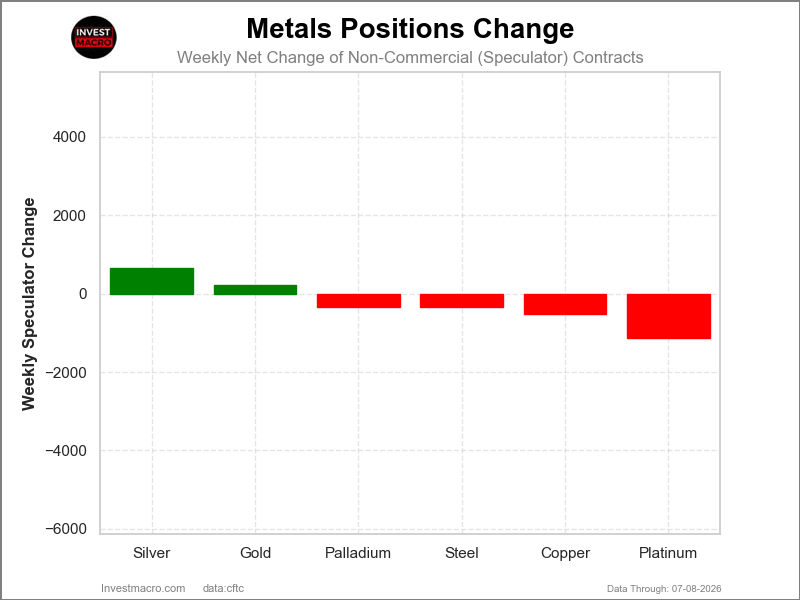
Weekly Speculator Changes led by Gold & Silver

Metals Net Positions COT Chart
The COT metals markets speculator bets were mixed this week as three out of the six metals markets we cover had higher positioning while the other three markets had lower speculator contracts.

Leading the gains for the metals was Gold (8,458 contracts) with Silver (2,792 contracts) and Steel (595 contracts) also showing positive weeks.

The markets with declines in speculator bets for the week were Copper (-10,507 contracts), Palladium (-1,057 contracts) and with Platinum (-700 contracts) also registering lower bets on the week.

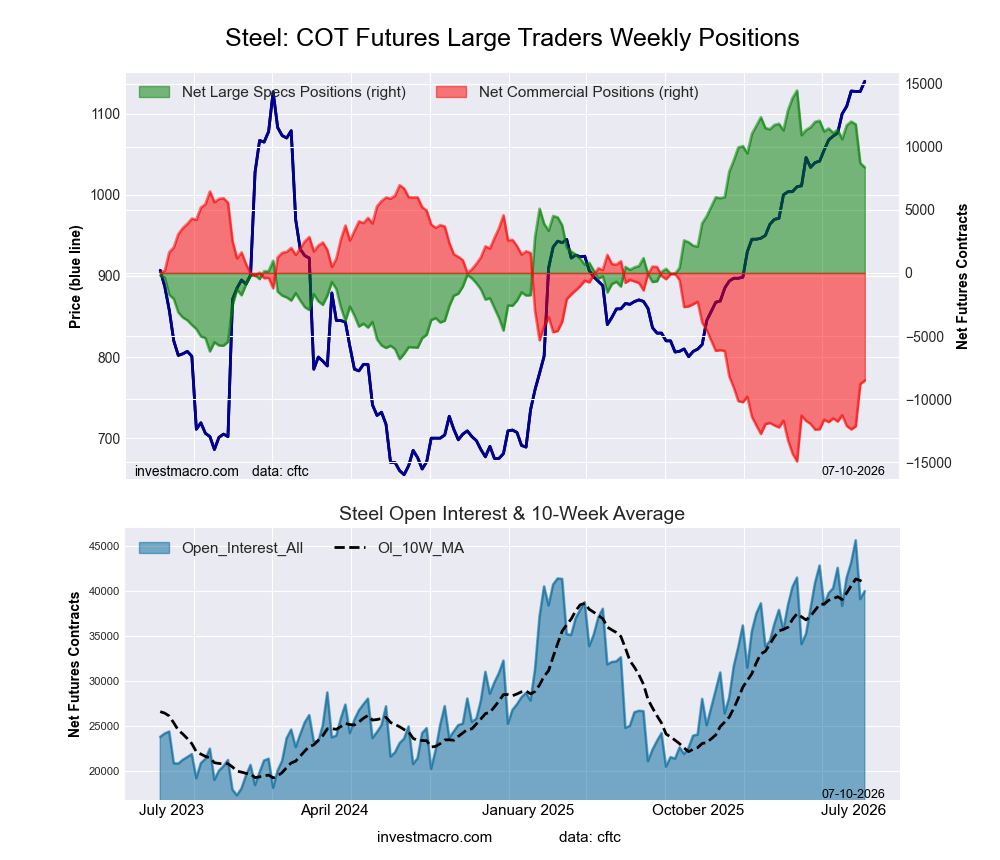
Steel Speculator Positions continue to rise to New Record High

Highlighting the weekly speculator positions was the Steel speculator position which rose this week for a third consecutive week. The Steel position has been rising consistently higher over the past months with gains in 13 out of the past 17 weeks. The Steel speculator position is currently at an all-time high record at 14,462 contracts, according to the CFTC data — although it is a limited dataset going back only to 2020. This market traditionally has held negative speculative positions, but since September, the overall net position has been bullish with 12 out of the last 13 weeks seeing bullish positions above +10,000 net contracts. The open interest levels for Steel are also at all-time record highs, showing there are more open positions and interest in the market than has been seen going back to data beginning in 2020.

Copper and Silver lead Metals markets price performance this week.

The major Metals markets this week were led by Copper, which rose by 3.40% over the past five days. Silver was next with a gain of 3.09%. Steel rose by 0.50% on the week while Gold rounded out the gainers with a 0.32% rise. Palladium fell by -1.92% on the week, while Platinum was the biggest loser on the week with a decline of -3.36%.

Over the past 30 days, the high-flying Metals markets have come back to Earth with Steel being the only Metals market that has seen a gain over the past 30 days with a 4.94% rise. Palladium has fallen by -18.31% over the past 30 days, while Platinum has dipped by -9.57%. Gold is down by -8.13%, with Silver lower by -6.36%, and Copper has fallen by -5.80% in these past 30 days.

However, over the past 90 days, all of the Metals markets still have positive returns except for Palladium, which has fallen by just -0.45%.


Metals Data:

Metals Table COT Chart
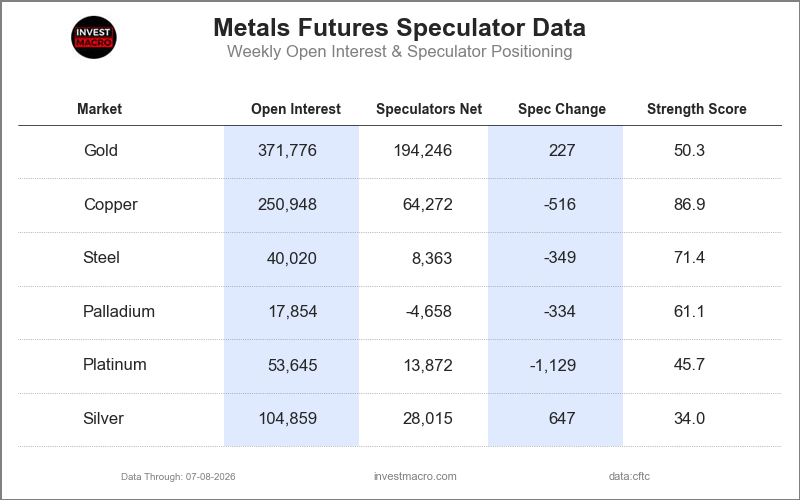
Legend: Weekly Speculators Change | Speculators Current Net Position | Speculators Strength Score compared to last 3-Years (0-100 range)


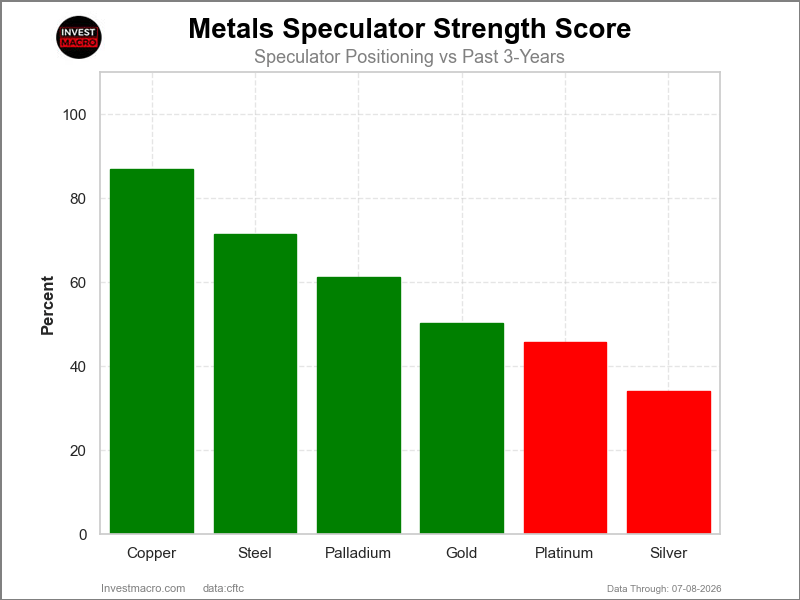
Strength Scores led by Steel & Palladium

Metals Strength Scores COT Chart
COT Strength Scores (a normalized measure of Speculator positions over a 3-Year range, from 0 to 100 where above 80 is Extreme-Bullish and below 20 is Extreme-Bearish) showed that Steel (100 percent) and Palladium (84 percent) lead the metals markets this week.

On the downside, Silver (28 percent) comes in at the lowest strength level currently.

Strength Statistics:
Gold (39.7 percent) vs Gold previous week (36.3 percent)
Silver (28.3 percent) vs Silver previous week (23.6 percent)
Copper (68.2 percent) vs Copper previous week (78.0 percent)
Platinum (51.5 percent) vs Platinum previous week (53.3 percent)
Palladium (83.7 percent) vs Palladium previous week (90.7 percent)
Steel (100.0 percent) vs Steel previous week (97.2 percent)


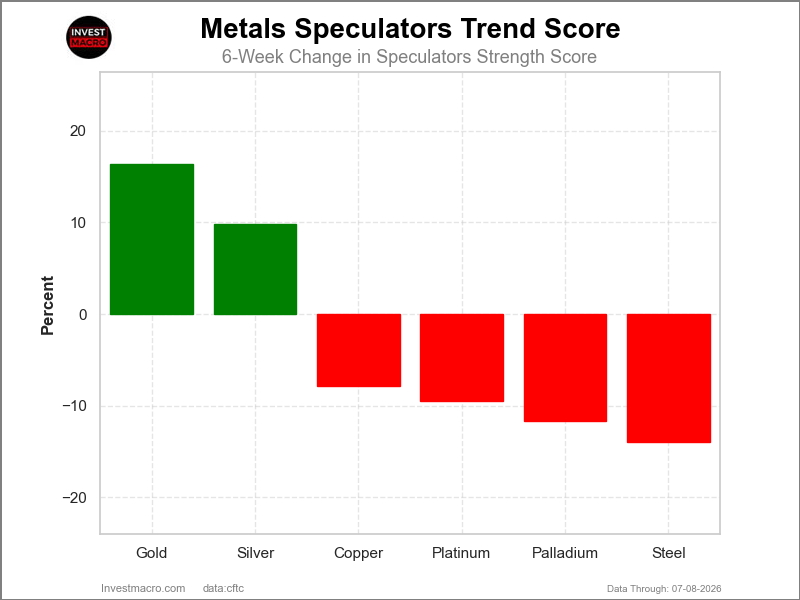
Steel & Platinum top the 6-Week Strength Trends

Metals Trends COT Chart
COT Strength Score Trends (or move index, calculates the 6-week changes in strength scores) showed that Steel (14 percent) and Platinum (10 percent) lead the past six weeks trends for metals.

Palladium (-12 percent) leads the downside trend scores currently with Copper (-8 percent) as the next market with lower trend scores.

Move Statistics:
Gold (3.4 percent) vs Gold previous week (-2.4 percent)
Silver (2.9 percent) vs Silver previous week (-6.7 percent)
Copper (-7.8 percent) vs Copper previous week (0.2 percent)
Platinum (10.3 percent) vs Platinum previous week (9.5 percent)
Palladium (-11.6 percent) vs Palladium previous week (-8.7 percent)
Steel (14.4 percent) vs Steel previous week (11.2 percent)


Individual Markets:

Gold Comex Futures:

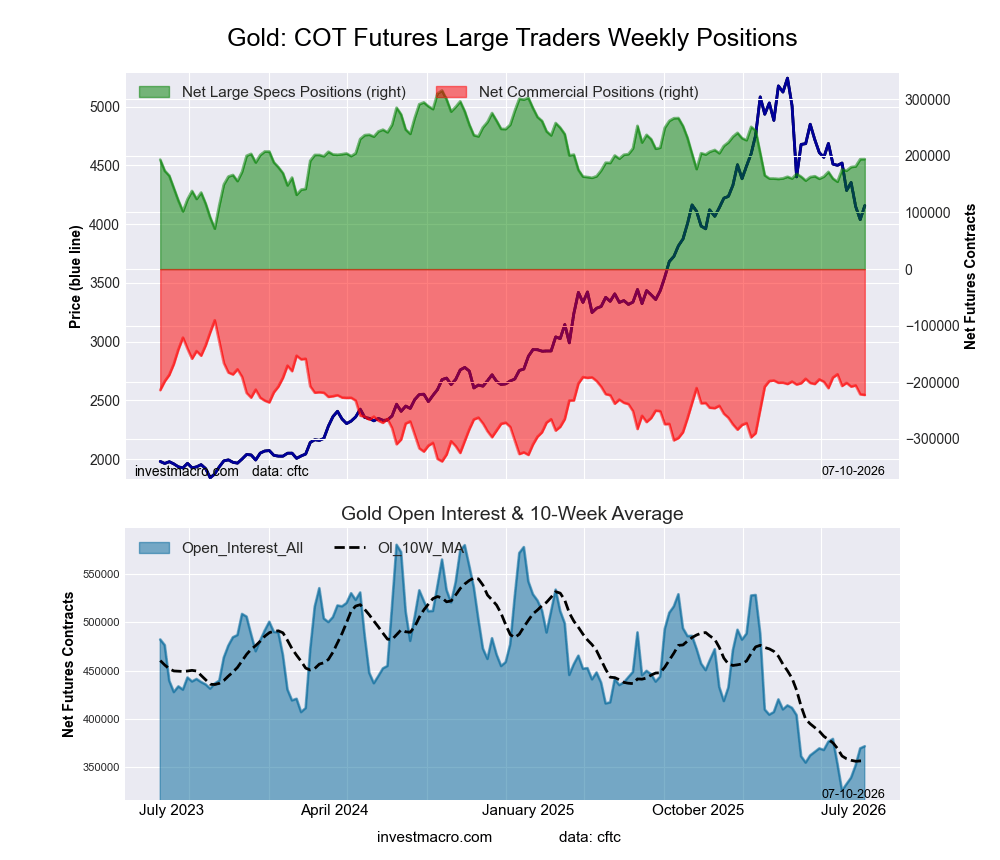
Gold Futures COT ChartThe Gold Comex Futures large speculator standing this week resulted in a net position of 168,327 contracts in the data reported through Tuesday. This was a weekly boost of 8,458 contracts from the previous week which had a total of 159,869 net contracts.

This week’s current strength score (the trader positioning range over the past three years, measured from 0 to 100) shows the speculators are currently Bearish with a score of 39.7 percent. The commercials are Bullish with a score of 54.5 percent and the small traders (not shown in chart) are Bullish with a score of 69.7 percent.

Price Trend-Following Model: Weak Uptrend

Our weekly trend-following model classifies the current market price position as: Weak Uptrend.

Gold Futures StatisticsSPECULATORSCOMMERCIALSSMALL TRADERS
– Percent of Open Interest Longs:54.719.112.2
– Percent of Open Interest Shorts:13.069.53.4
– Net Position:168,327-203,82835,501
– Gross Longs:220,86176,99749,273
– Gross Shorts:52,534280,82513,772
– Long to Short Ratio:4.2 to 10.3 to 13.6 to 1
NET POSITION TREND:
– Strength Index Score (3 Year Range Pct):39.754.569.7
– Strength Index Reading (3 Year Range):BearishBullishBullish
NET POSITION MOVEMENT INDEX:
– 6-Week Change in Strength Index:3.4-2.4-6.5


Silver Comex Futures:

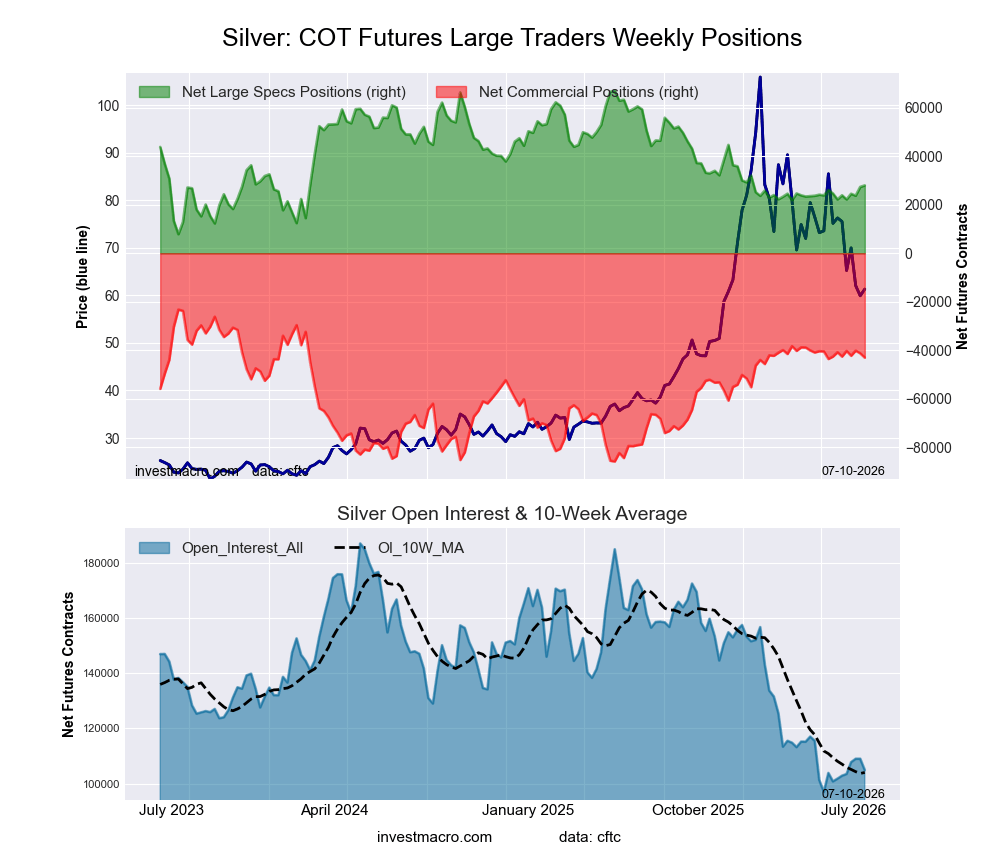
Silver Futures COT ChartThe Silver Comex Futures large speculator standing this week resulted in a net position of 24,673 contracts in the data reported through Tuesday. This was a weekly gain of 2,792 contracts from the previous week which had a total of 21,881 net contracts.

This week’s current strength score (the trader positioning range over the past three years, measured from 0 to 100) shows the speculators are currently Bearish with a score of 28.3 percent. The commercials are Bullish with a score of 72.8 percent and the small traders (not shown in chart) are Bearish with a score of 38.6 percent.

Price Trend-Following Model: Weak Uptrend

Our weekly trend-following model classifies the current market price position as: Weak Uptrend.

Silver Futures StatisticsSPECULATORSCOMMERCIALSSMALL TRADERS
– Percent of Open Interest Longs:30.026.121.7
– Percent of Open Interest Shorts:8.261.77.9
– Net Position:24,673-40,28815,615
– Gross Longs:33,93829,51124,555
– Gross Shorts:9,26569,7998,940
– Long to Short Ratio:3.7 to 10.4 to 12.7 to 1
NET POSITION TREND:
– Strength Index Score (3 Year Range Pct):28.372.838.6
– Strength Index Reading (3 Year Range):BearishBullishBearish
NET POSITION MOVEMENT INDEX:
– 6-Week Change in Strength Index:2.93.0-19.9


Copper Grade #1 Futures:

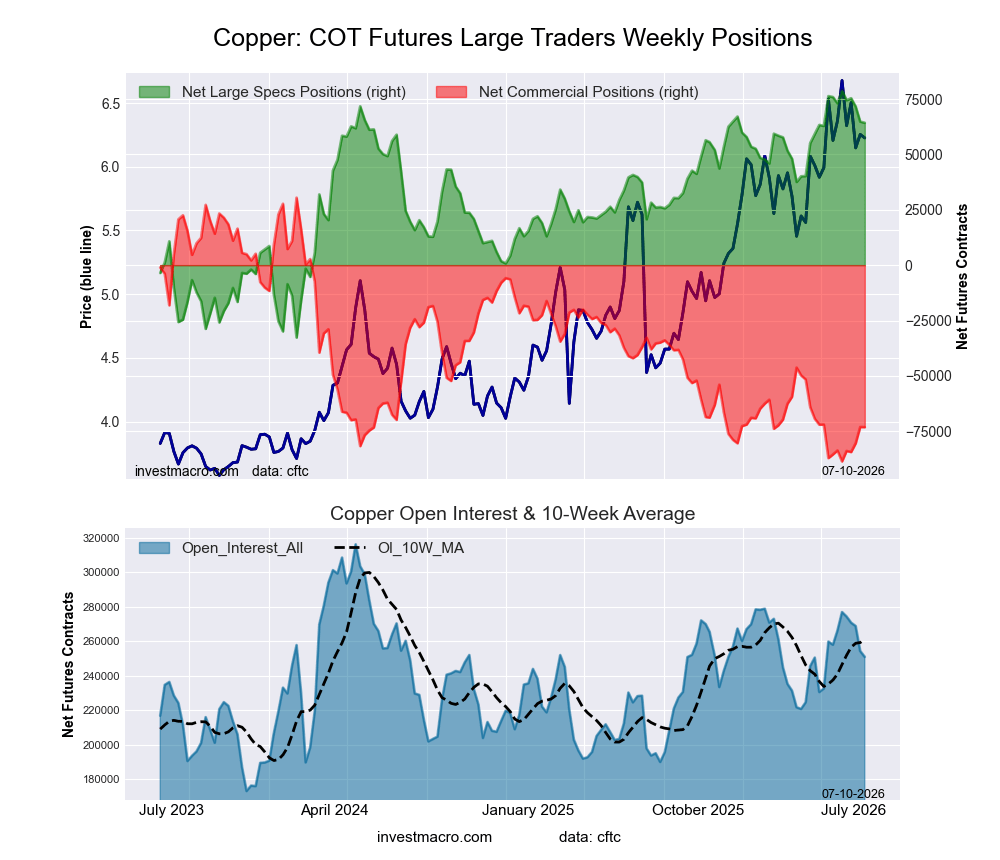
Copper Futures COT ChartThe Copper Grade #1 Futures large speculator standing this week resulted in a net position of 37,537 contracts in the data reported through Tuesday. This was a weekly lowering of -10,507 contracts from the previous week which had a total of 48,044 net contracts.

This week’s current strength score (the trader positioning range over the past three years, measured from 0 to 100) shows the speculators are currently Bullish with a score of 68.2 percent. The commercials are Bearish with a score of 30.5 percent and the small traders (not shown in chart) are Bullish with a score of 59.5 percent.

Price Trend-Following Model: Weak Uptrend

Our weekly trend-following model classifies the current market price position as: Weak Uptrend.

Copper Futures StatisticsSPECULATORSCOMMERCIALSSMALL TRADERS
– Percent of Open Interest Longs:30.941.08.7
– Percent of Open Interest Shorts:14.061.84.7
– Net Position:37,537-46,2888,751
– Gross Longs:68,49190,87219,196
– Gross Shorts:30,954137,16010,445
– Long to Short Ratio:2.2 to 10.7 to 11.8 to 1
NET POSITION TREND:
– Strength Index Score (3 Year Range Pct):68.230.559.5
– Strength Index Reading (3 Year Range):BullishBearishBullish
NET POSITION MOVEMENT INDEX:
– 6-Week Change in Strength Index:-7.812.5-31.8


Platinum Futures:

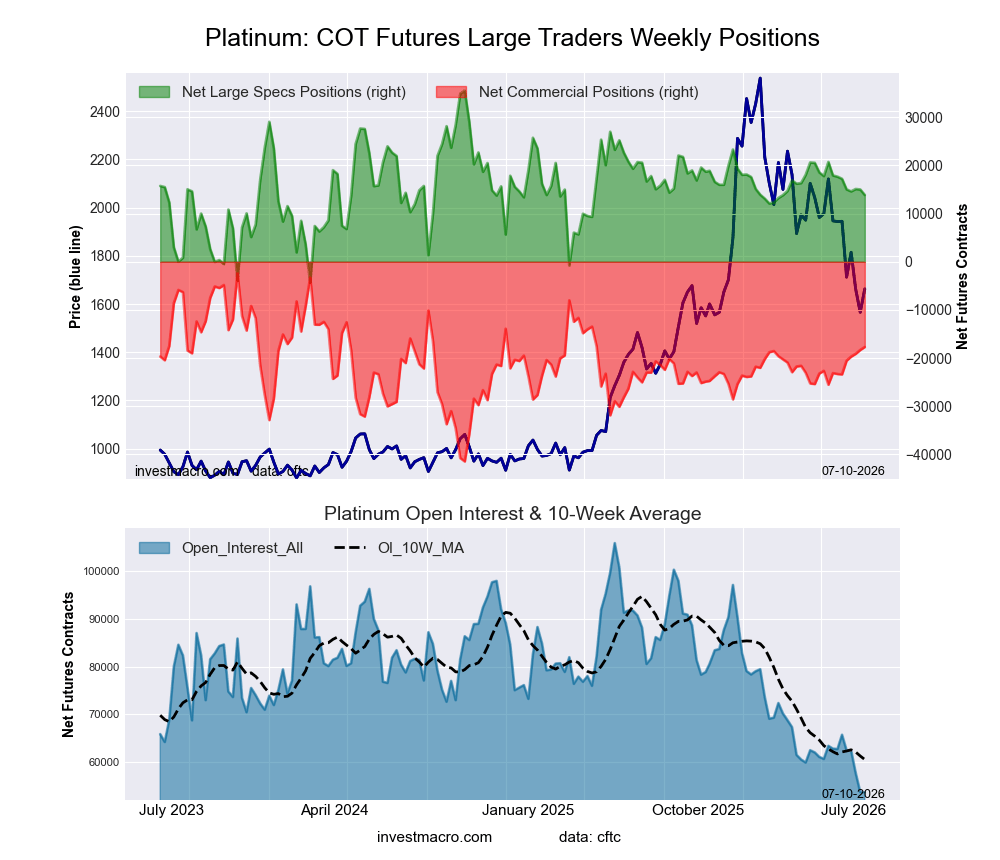
Platinum Futures COT ChartThe Platinum Futures large speculator standing this week resulted in a net position of 16,198 contracts in the data reported through Tuesday. This was a weekly reduction of -700 contracts from the previous week which had a total of 16,898 net contracts.

This week’s current strength score (the trader positioning range over the past three years, measured from 0 to 100) shows the speculators are currently Bullish with a score of 51.5 percent. The commercials are Bullish with a score of 50.4 percent and the small traders (not shown in chart) are Bullish with a score of 62.5 percent.

Price Trend-Following Model: Weak Uptrend

Our weekly trend-following model classifies the current market price position as: Weak Uptrend.

Platinum Futures StatisticsSPECULATORSCOMMERCIALSSMALL TRADERS
– Percent of Open Interest Longs:42.531.114.0
– Percent of Open Interest Shorts:16.266.45.0
– Net Position:16,198-21,7495,551
– Gross Longs:26,14619,0938,601
– Gross Shorts:9,94840,8423,050
– Long to Short Ratio:2.6 to 10.5 to 12.8 to 1
NET POSITION TREND:
– Strength Index Score (3 Year Range Pct):51.550.462.5
– Strength Index Reading (3 Year Range):BullishBullishBullish
NET POSITION MOVEMENT INDEX:
– 6-Week Change in Strength Index:10.3-7.6-13.2


Palladium Futures:

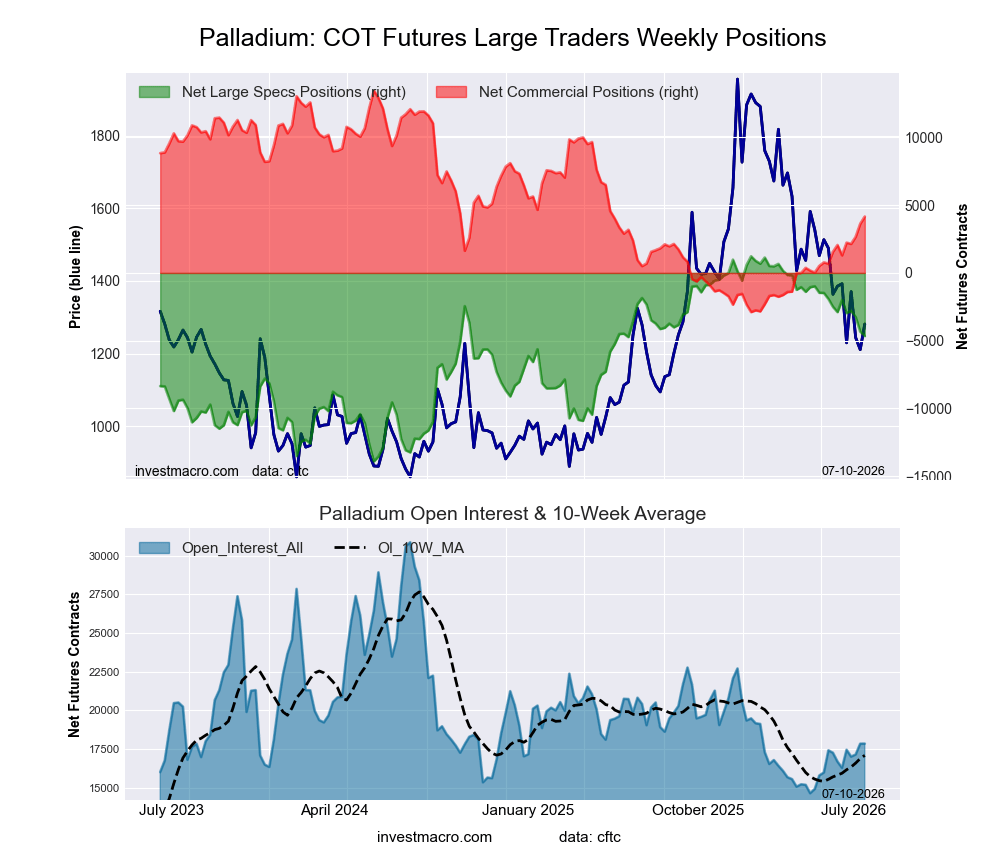
Palladium Futures COT ChartThe Palladium Futures large speculator standing this week resulted in a net position of -1,242 contracts in the data reported through Tuesday. This was a weekly fall of -1,057 contracts from the previous week which had a total of -185 net contracts.

This week’s current strength score (the trader positioning range over the past three years, measured from 0 to 100) shows the speculators are currently Bullish-Extreme with a score of 83.7 percent. The commercials are Bearish-Extreme with a score of 17.6 percent and the small traders (not shown in chart) are Bullish with a score of 63.5 percent.

Price Trend-Following Model: Weak Uptrend

Our weekly trend-following model classifies the current market price position as: Weak Uptrend.

Palladium Futures StatisticsSPECULATORSCOMMERCIALSSMALL TRADERS
– Percent of Open Interest Longs:42.936.415.9
– Percent of Open Interest Shorts:51.236.57.5
– Net Position:-1,242-151,257
– Gross Longs:6,4685,4882,389
– Gross Shorts:7,7105,5031,132
– Long to Short Ratio:0.8 to 11.0 to 12.1 to 1
NET POSITION TREND:
– Strength Index Score (3 Year Range Pct):83.717.663.5
– Strength Index Reading (3 Year Range):Bullish-ExtremeBearish-ExtremeBullish
NET POSITION MOVEMENT INDEX:
– 6-Week Change in Strength Index:-11.610.32.2


Steel Futures Futures:

Steel Futures COT ChartThe Steel Futures large speculator standing this week resulted in a net position of 14,462 contracts in the data reported through Tuesday. This was a weekly rise of 595 contracts from the previous week which had a total of 13,867 net contracts.

This week’s current strength score (the trader positioning range over the past three years, measured from 0 to 100) shows the speculators are currently Bullish-Extreme with a score of 100.0 percent. The commercials are Bearish-Extreme with a score of 0.0 percent and the small traders (not shown in chart) are Bullish-Extreme with a score of 98.7 percent.

Price Trend-Following Model: Uptrend

Our weekly trend-following model classifies the current market price position as: Uptrend.

Steel Futures StatisticsSPECULATORSCOMMERCIALSSMALL TRADERS
– Percent of Open Interest Longs:38.058.11.8
– Percent of Open Interest Shorts:3.194.10.6
– Net Position:14,462-14,946484
– Gross Longs:15,76924,143736
– Gross Shorts:1,30739,089252
– Long to Short Ratio:12.1 to 10.6 to 12.9 to 1
NET POSITION TREND:
– Strength Index Score (3 Year Range Pct):100.00.098.7
– Strength Index Reading (3 Year Range):Bullish-ExtremeBearish-ExtremeBullish-Extreme
NET POSITION MOVEMENT INDEX:
– 6-Week Change in Strength Index:14.4-14.0-1.3


Article By InvestMacroReceive our weekly COT Newsletter

*COT Report: The COT data, released weekly to the public each Friday, is updated through the most recent Tuesday (data is 3 days old) and shows a quick view of how large speculators or non-commercials (for-profit traders) were positioned in the futures markets.

The CFTC categorizes trader positions according to commercial hedgers (traders who use futures contracts for hedging as part of the business), non-commercials (large traders who speculate to realize trading profits) and nonreportable traders (usually small traders/speculators) as well as their open interest (contracts open in the market at time of reporting). See CFTC criteria here.

COT Bonds Charts: Weekly Speculator Bets boosted by record week for 5-Year Bonds

By InvestMacro

Bonds Market Open Interest Comparison
Here are the latest charts and statistics for the Commitment of Traders (COT) reports data published by the Commodities Futures Trading Commission (CFTC).

The latest COT data is updated through Tuesday March 24th and shows a quick view of how large traders (for-profit speculators and commercial hedgers) were positioned in the futures markets.

Weekly Speculator Changes led by 5-Year Bonds

Bonds Market Net Speculators Positions
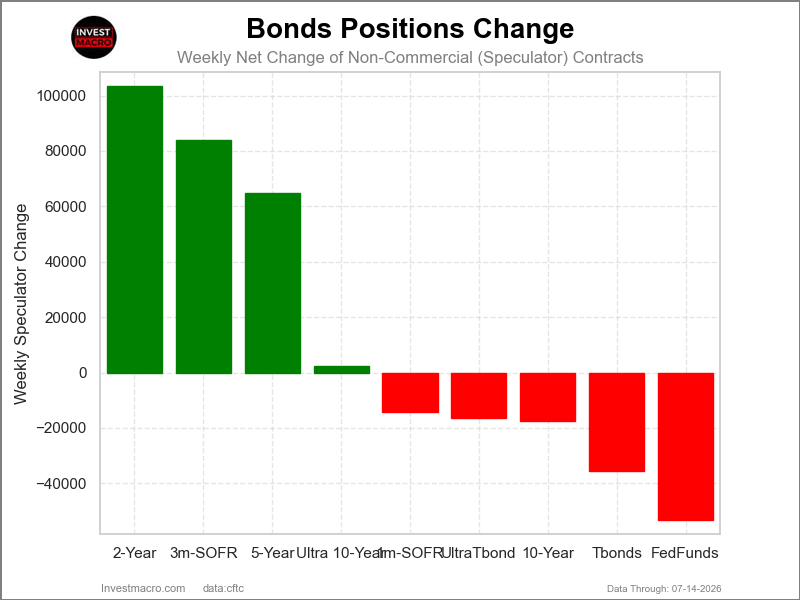
The COT bond market speculator bets were slightly lower this week as four out of the nine bond markets we cover had higher positioning while the other five markets had lower speculator contracts.

Leading the gains for the bond markets was the 5-Year Bonds (325,016 contracts) with the SOFR 3-Months (134,015 contracts), the SOFR 1-Month (58,570 contracts) and the Ultra 10-Year Bonds (27,241 contracts) also recording positive weeks.

The bond markets with declines in speculator bets for the week were  the 2-Year Bonds (-155,512 contracts), the 10-Year Bonds (-44,009 contracts), the Fed Funds (-8,643 contracts), the Ultra Treasury Bonds (-8,050 contracts) and with the US Treasury Bonds (-2,194 contracts) also registering lower bets on the week.

Speculators slash their bearish 5-Year Bond bets by most on record

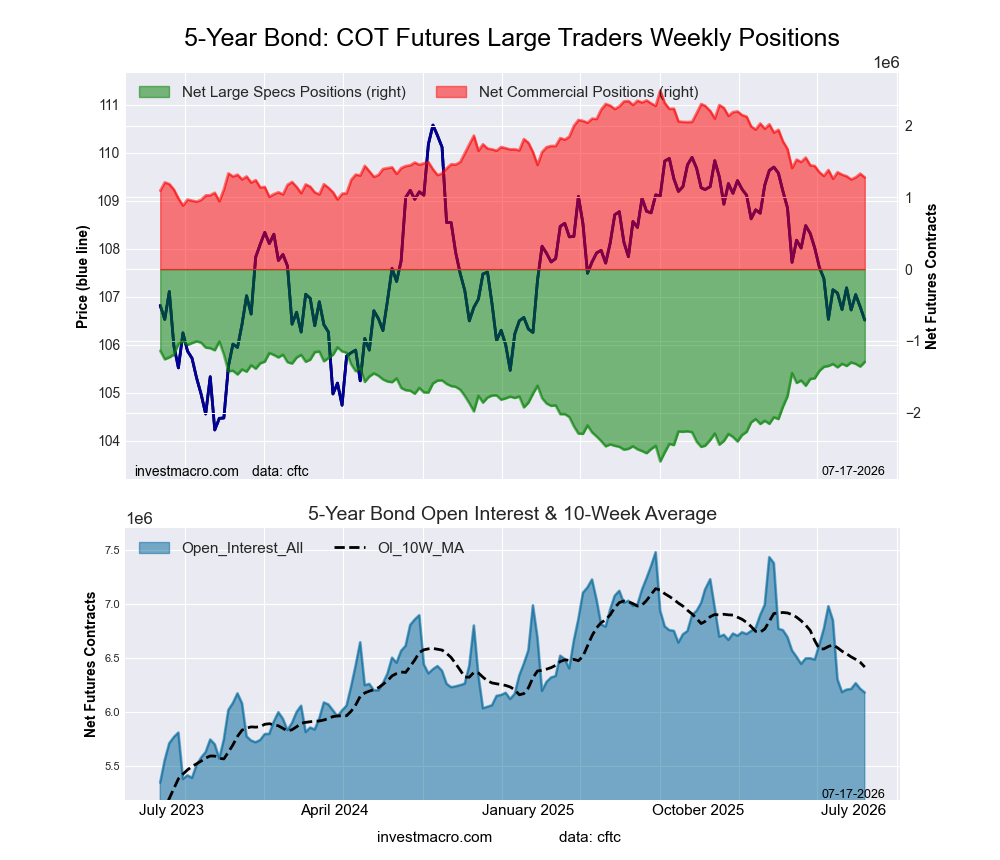
The 5-Year Bond this week highlights the weekly speculator changes for the Bonds markets. The 5-Year Bonds speculator positions rose this week by 325,016 weekly net contracts and have now risen for three consecutive weeks. The 5-Year Bond speculator bets have been improving and have been positive in 9 out of the past 12 weeks with a gain of +954,361 net contracts over these past 12 weeks. This week’s rise by 325,016 weekly net contracts represents the highest 1-week change on record for speculator bets, according to CFTC data going back to the late 1980s.

The 5-Year Bond speculator positions, like most of the other major Bond positions, have been consistently bearish in recent years (the last time there has been multiple weeks of bullish positions for the 5-Year was in 2021). The 5-Year Bond hit an all-time low in speculator positions in September at a position of -2,463,971 net contracts. However, since that all-time low position, there has been an improvement in the 5-Year Bond speculator position, and this week the overall position comes in at -1,448,436 net contracts.

Bond market price performance was mostly unchanged on the week

The Bonds markets were modestly changed over the past five days, with the Two-Year Bond seeing a slight uptick by 0.10%, while the One-Month Secured Overnight Financing Rate (SOFR) was just a tick higher by 0.02%, and the Three-Month SOFR was higher by even less at an increase of 0.01%. The Fed Funds was relatively unchanged. The Five-Year Bond was slightly lower by -0.10%, while the Treasury Bonds were lower by -0.22%, and the Ten-Year Note was down by -0.30% on the week.


Bonds Data:

Bonds Market Speculators Data Table
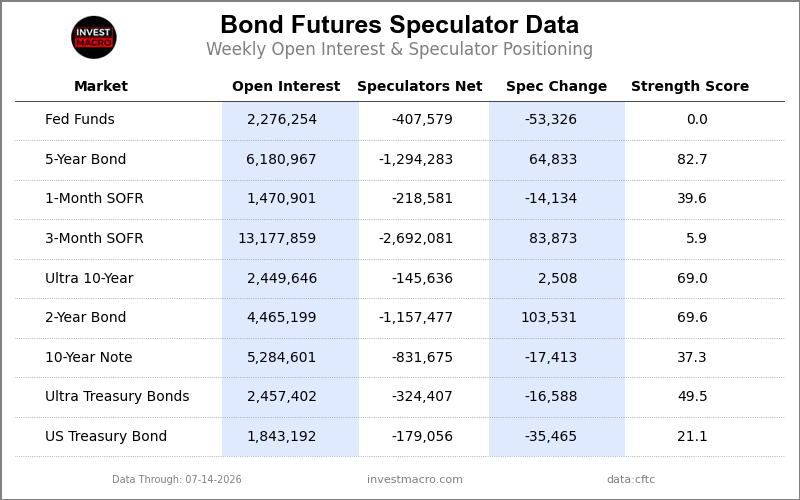
Legend: Open Interest | Speculators Current Net Position | Weekly Specs Change | Specs Strength Score compared to last 3-Years (0-100 range)


Strength Scores led by US Treasury Bonds & Ultra Treasury Bonds

Bonds Market Strength Index Comparison
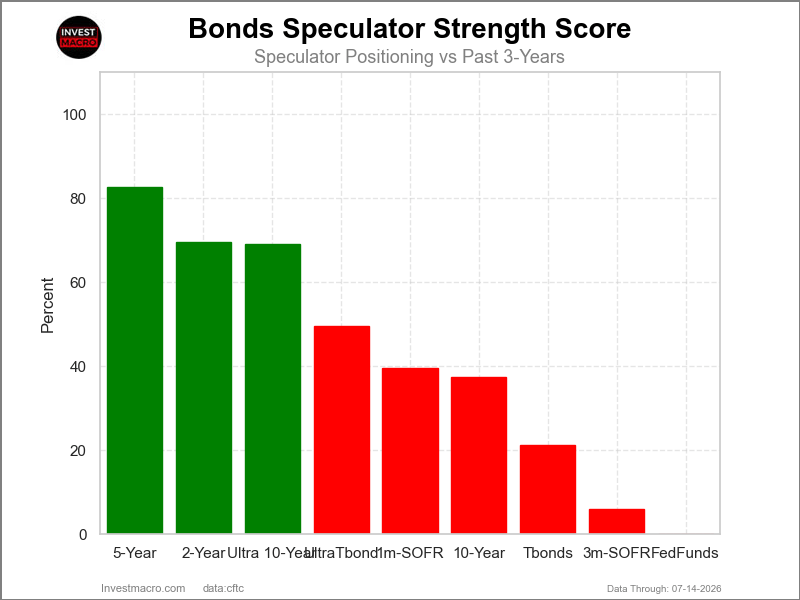
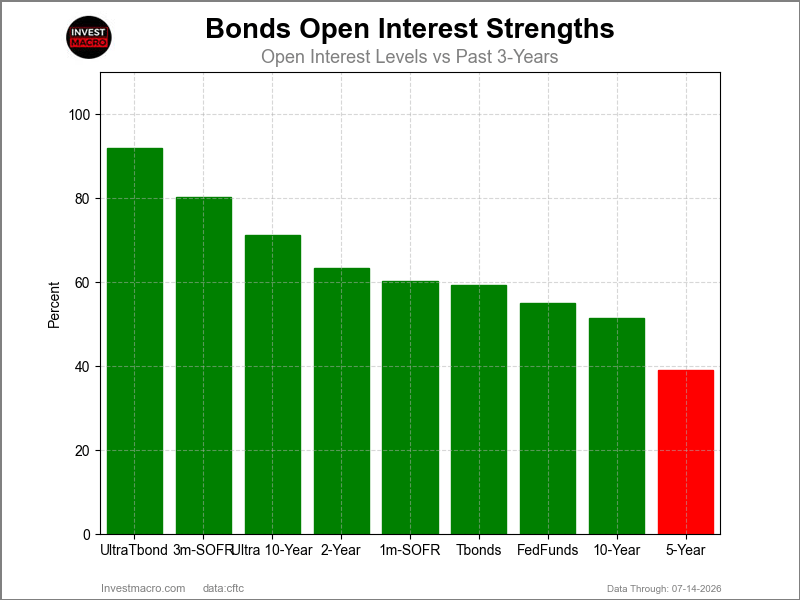
COT Strength Scores (a normalized measure of Speculator positions over a 3-Year range, from 0 to 100 where above 80 is Extreme-Bullish and below 20 is Extreme-Bearish) showed that the US Treasury Bonds (86 percent) and the Ultra Treasury Bonds (66 percent) lead the bond markets this week. The 5-Year Bonds (64 percent) comes in as the next highest in the weekly strength scores.

On the downside, the 2-Year Bond (0 percent) comes in at the lowest strength level currently and is in Extreme-Bearish territory (below 20 percent). The next lowest strength score was the SOFR 3-Months (37 percent).

Strength Statistics:
Fed Funds (51.3 percent) vs Fed Funds previous week (52.6 percent)
2-Year Bond (0.0 percent) vs 2-Year Bond previous week (13.6 percent)
5-Year Bond (64.0 percent) vs 5-Year Bond previous week (47.1 percent)
10-Year Bond (60.0 percent) vs 10-Year Bond previous week (65.3 percent)
Ultra 10-Year Bond (62.0 percent) vs Ultra 10-Year Bond previous week (54.6 percent)
US Treasury Bond (85.7 percent) vs US Treasury Bond previous week (86.4 percent)
Ultra US Treasury Bond (66.5 percent) vs Ultra US Treasury Bond previous week (69.5 percent)
SOFR 1-Month (54.9 percent) vs SOFR 1-Month previous week (44.7 percent)
SOFR 3-Months (37.2 percent) vs SOFR 3-Months previous week (30.1 percent)


5-Year, 10-Year Bonds & Fed Funds top the 6-Week Strength Trends

Bonds Market Trend Index Comparison
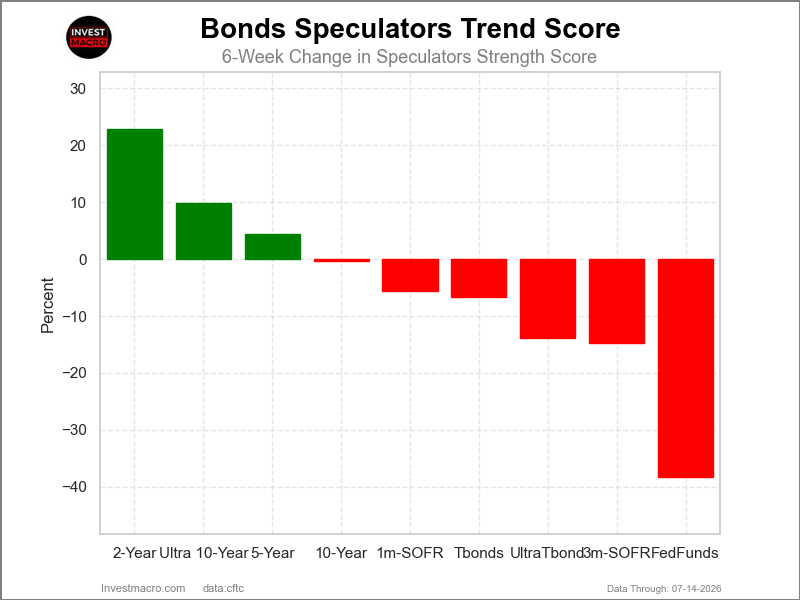
COT Strength Score Trends (or move index, calculates the 6-week changes in strength scores) showed that the 5-Year Bonds (35 percent), 10-Year Bonds (20 percent) and the Fed Funds (20 percent) lead the past six weeks trends for bonds.

The 2-Year Bond (-31 percent) leads the downside trend scores currently with the Ultra 10-Year Bonds (-7 percent) following next with lower trend scores.

Strength Trend Statistics:
Fed Funds (20.2 percent) vs Fed Funds previous week (24.3 percent)
2-Year Bond (-30.5 percent) vs 2-Year Bond previous week (-11.8 percent)
5-Year Bond (34.6 percent) vs 5-Year Bond previous week (20.0 percent)
10-Year Bond (20.5 percent) vs 10-Year Bond previous week (15.7 percent)
Ultra 10-Year Bond (-6.8 percent) vs Ultra 10-Year Bond previous week (-5.4 percent)
US Treasury Bond (2.3 percent) vs US Treasury Bond previous week (7.8 percent)
Ultra US Treasury Bond (-3.2 percent) vs Ultra US Treasury Bond previous week (-0.8 percent)
SOFR 1-Month (-3.3 percent) vs SOFR 1-Month previous week (-15.0 percent)
SOFR 3-Months (1.9 percent) vs SOFR 3-Months previous week (-0.7 percent)


30-Day Federal Funds Futures:
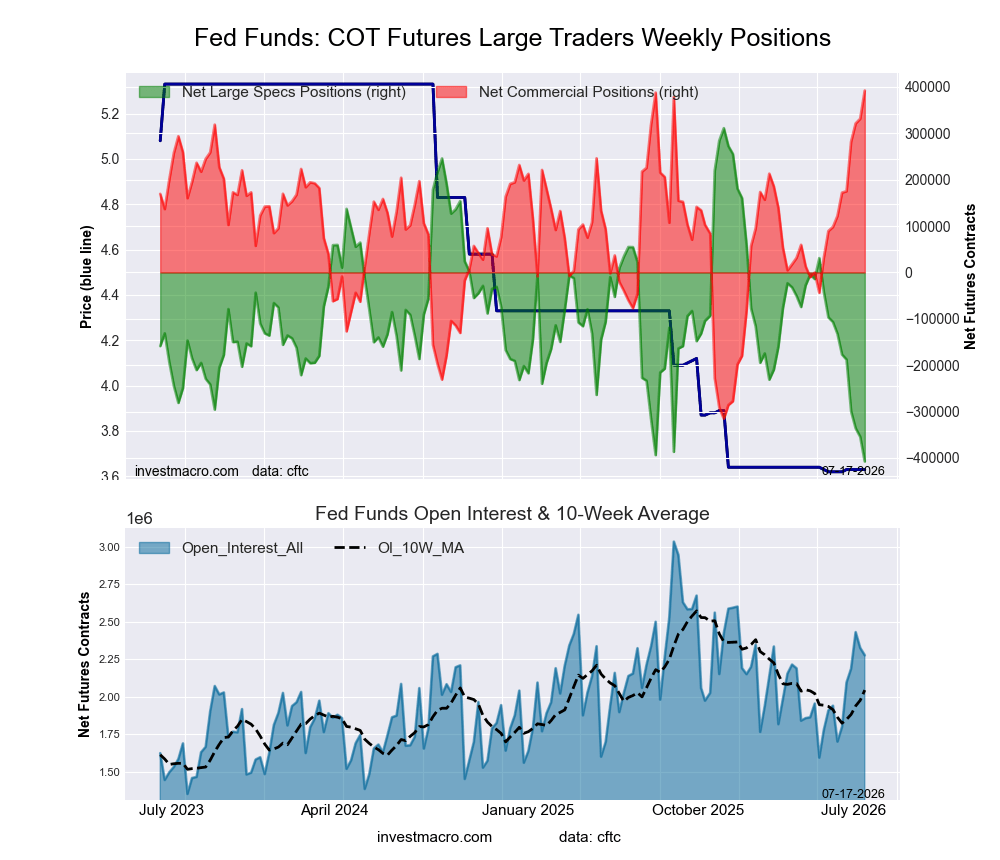
Federal Funds 30-Day Bonds Futures COT ChartThe 30-Day Federal Funds large speculator standing this week came in at a net position of -32,042 contracts in the data reported through Tuesday. This was a weekly reduction of -8,643 contracts from the previous week which had a total of -23,399 net contracts.

This week’s current strength score (the trader positioning range over the past three years, measured from 0 to 100) shows the speculators are currently Bullish with a score of 51.3 percent. The commercials are Bearish with a score of 47.4 percent and the small traders (not shown in chart) are Bullish with a score of 75.1 percent.

Price Trend-Following Model: Weak Uptrend

Our weekly trend-following model classifies the current market price position as: Weak Uptrend.

30-Day Federal Funds StatisticsSPECULATORSCOMMERCIALSSMALL TRADERS
– Percent of Open Interest Longs:15.863.12.6
– Percent of Open Interest Shorts:17.362.31.9
– Net Position:-32,04217,69814,344
– Gross Longs:350,2431,397,66357,058
– Gross Shorts:382,2851,379,96542,714
– Long to Short Ratio:0.9 to 11.0 to 11.3 to 1
NET POSITION TREND:
– Strength Index Score (3 Year Range Pct):51.347.475.1
– Strength Index Reading (3 Year Range):BullishBearishBullish
NET POSITION MOVEMENT INDEX:
– 6-Week Change in Strength Index:20.2-19.7-6.6


Secured Overnight Financing Rate (3-Month) Futures:
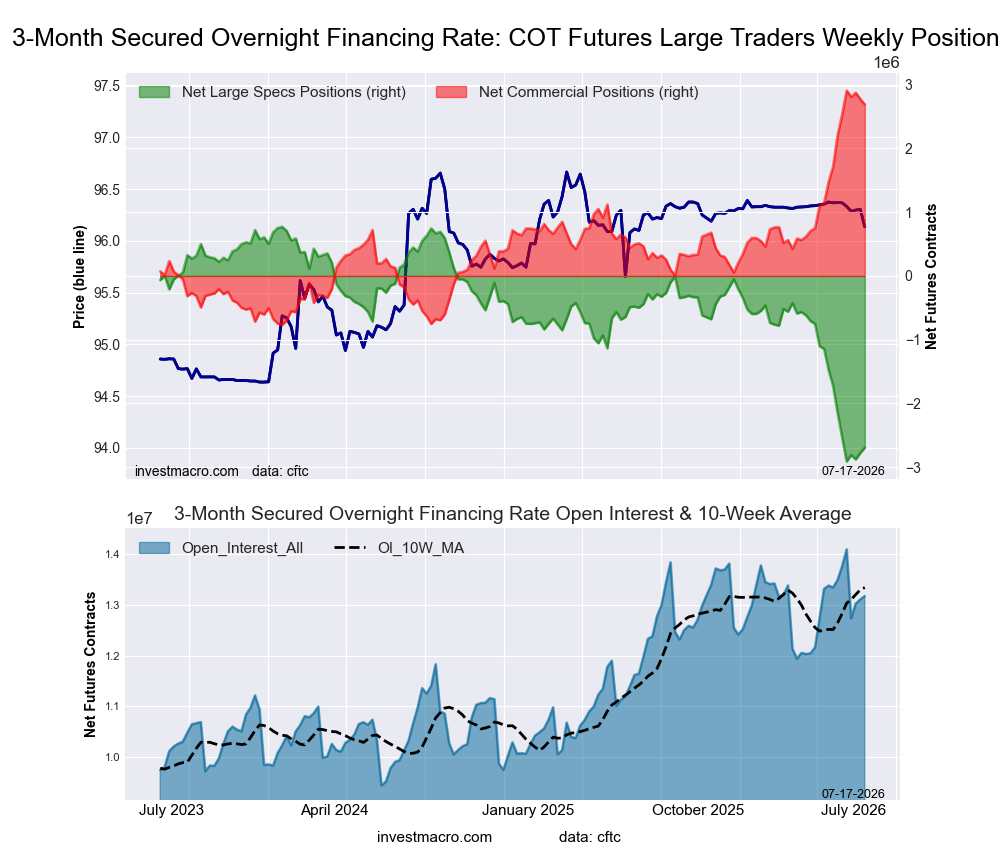
SOFR 3-Months Bonds Futures COT ChartThe Secured Overnight Financing Rate (3-Month) large speculator standing this week came in at a net position of -425,910 contracts in the data reported through Tuesday. This was a weekly rise of 134,015 contracts from the previous week which had a total of -559,925 net contracts.

This week’s current strength score (the trader positioning range over the past three years, measured from 0 to 100) shows the speculators are currently Bearish with a score of 37.2 percent. The commercials are Bullish with a score of 63.1 percent and the small traders (not shown in chart) are Bearish with a score of 42.3 percent.

Price Trend-Following Model: Weak Uptrend

Our weekly trend-following model classifies the current market price position as: Weak Uptrend.

SOFR 3-Months StatisticsSPECULATORSCOMMERCIALSSMALL TRADERS
– Percent of Open Interest Longs:15.457.40.2
– Percent of Open Interest Shorts:18.953.90.1
– Net Position:-425,910424,3931,517
– Gross Longs:1,864,9746,971,50419,178
– Gross Shorts:2,290,8846,547,11117,661
– Long to Short Ratio:0.8 to 11.1 to 11.1 to 1
NET POSITION TREND:
– Strength Index Score (3 Year Range Pct):37.263.142.3
– Strength Index Reading (3 Year Range):BearishBullishBearish
NET POSITION MOVEMENT INDEX:
– 6-Week Change in Strength Index:1.9-1.90.6


Individual Bond Markets:

Secured Overnight Financing Rate (1-Month) Futures:
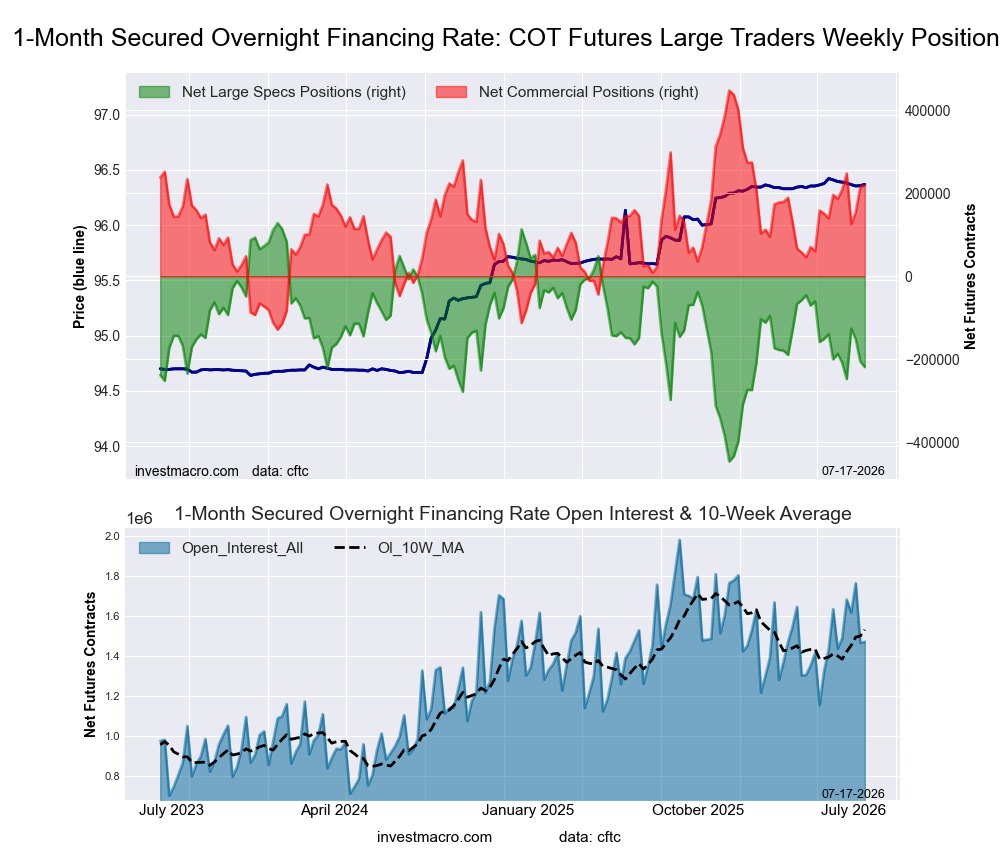
SOFR 1-Month Bonds Futures COT ChartThe Secured Overnight Financing Rate (1-Month) large speculator standing this week came in at a net position of -130,667 contracts in the data reported through Tuesday. This was a weekly boost of 58,570 contracts from the previous week which had a total of -189,237 net contracts.

This week’s current strength score (the trader positioning range over the past three years, measured from 0 to 100) shows the speculators are currently Bullish with a score of 54.9 percent. The commercials are Bearish with a score of 45.1 percent and the small traders (not shown in chart) are Bullish with a score of 66.7 percent.

Price Trend-Following Model: Weak Uptrend

Our weekly trend-following model classifies the current market price position as: Weak Uptrend.

SOFR 1-Month StatisticsSPECULATORSCOMMERCIALSSMALL TRADERS
– Percent of Open Interest Longs:21.258.81.2
– Percent of Open Interest Shorts:29.750.31.2
– Net Position:-130,667130,758-91
– Gross Longs:327,967909,19518,922
– Gross Shorts:458,634778,43719,013
– Long to Short Ratio:0.7 to 11.2 to 11.0 to 1
NET POSITION TREND:
– Strength Index Score (3 Year Range Pct):54.945.166.7
– Strength Index Reading (3 Year Range):BullishBearishBullish
NET POSITION MOVEMENT INDEX:
– 6-Week Change in Strength Index:-3.33.3-0.0


2-Year Treasury Note Futures:

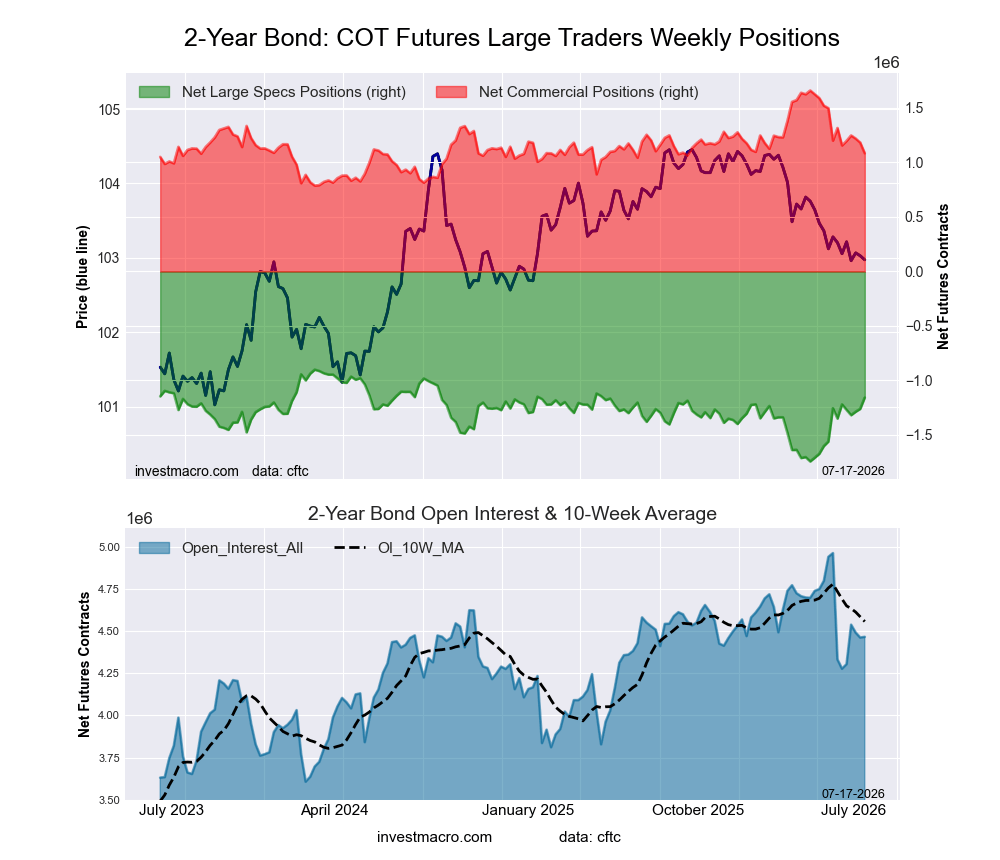
2-Year Treasury Bonds Futures COT ChartThe 2-Year Treasury Note large speculator standing this week came in at a net position of -1,638,179 contracts in the data reported through Tuesday. This was a weekly decrease of -155,512 contracts from the previous week which had a total of -1,482,667 net contracts.

This week’s current strength score (the trader positioning range over the past three years, measured from 0 to 100) shows the speculators are currently Bearish-Extreme with a score of 0.0 percent. The commercials are Bullish-Extreme with a score of 100.0 percent and the small traders (not shown in chart) are Bearish with a score of 30.2 percent.

Price Trend-Following Model: Strong Downtrend

Our weekly trend-following model classifies the current market price position as: Strong Downtrend.

2-Year Treasury Note StatisticsSPECULATORSCOMMERCIALSSMALL TRADERS
– Percent of Open Interest Longs:12.080.24.5
– Percent of Open Interest Shorts:46.347.62.8
– Net Position:-1,638,1791,555,76782,412
– Gross Longs:572,8973,825,356213,847
– Gross Shorts:2,211,0762,269,589131,435
– Long to Short Ratio:0.3 to 11.7 to 11.6 to 1
NET POSITION TREND:
– Strength Index Score (3 Year Range Pct):0.0100.030.2
– Strength Index Reading (3 Year Range):Bearish-ExtremeBullish-ExtremeBearish
NET POSITION MOVEMENT INDEX:
– 6-Week Change in Strength Index:-30.534.5-13.9


5-Year Treasury Note Futures:

5-Year Treasury Bonds Futures COT ChartThe 5-Year Treasury Note large speculator standing this week came in at a net position of -1,448,436 contracts in the data reported through Tuesday. This was a weekly boost of 325,016 contracts from the previous week which had a total of -1,773,452 net contracts.

This week’s current strength score (the trader positioning range over the past three years, measured from 0 to 100) shows the speculators are currently Bullish with a score of 64.0 percent. The commercials are Bearish with a score of 39.1 percent and the small traders (not shown in chart) are Bearish-Extreme with a score of 14.5 percent.

Price Trend-Following Model: Strong Downtrend

Our weekly trend-following model classifies the current market price position as: Strong Downtrend.

5-Year Treasury Note StatisticsSPECULATORSCOMMERCIALSSMALL TRADERS
– Percent of Open Interest Longs:11.079.86.1
– Percent of Open Interest Shorts:33.158.45.5
– Net Position:-1,448,4361,409,43539,001
– Gross Longs:722,7445,244,682401,263
– Gross Shorts:2,171,1803,835,247362,262
– Long to Short Ratio:0.3 to 11.4 to 11.1 to 1
NET POSITION TREND:
– Strength Index Score (3 Year Range Pct):64.039.114.5
– Strength Index Reading (3 Year Range):BullishBearishBearish-Extreme
NET POSITION MOVEMENT INDEX:
– 6-Week Change in Strength Index:34.6-30.8-48.2


10-Year Treasury Note Futures:

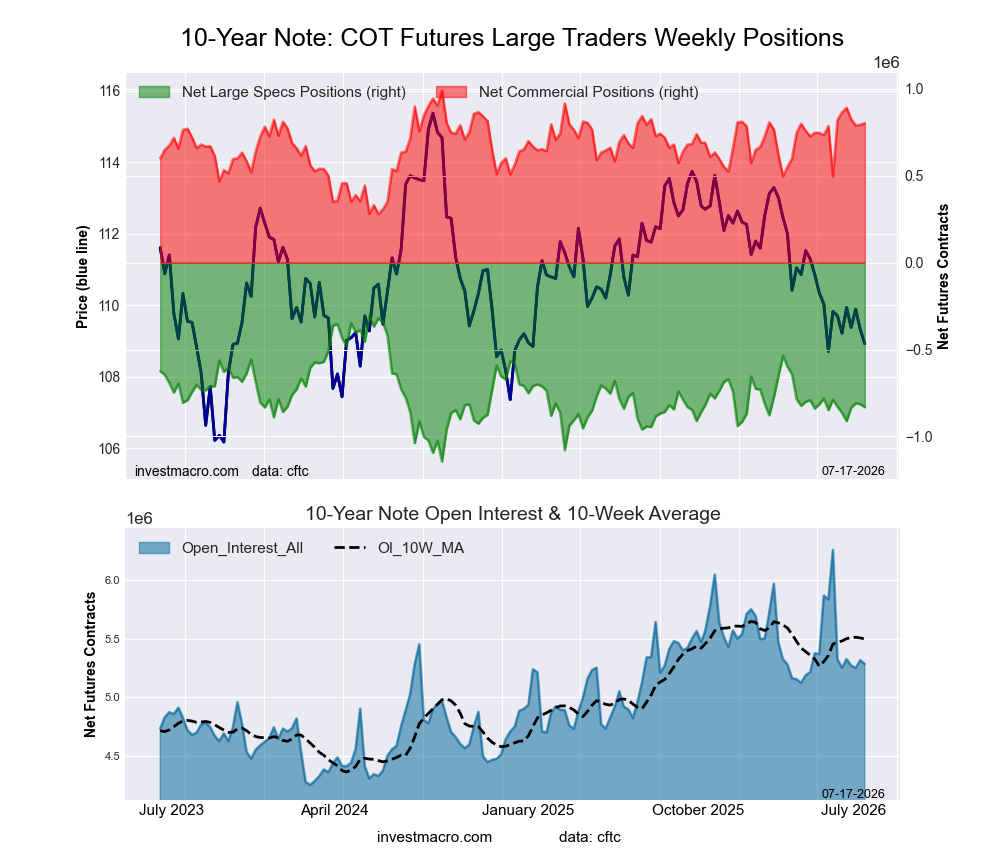
10-Year Treasury Notes Bonds Futures COT ChartThe 10-Year Treasury Note large speculator standing this week came in at a net position of -641,887 contracts in the data reported through Tuesday. This was a weekly fall of -44,009 contracts from the previous week which had a total of -597,878 net contracts.

This week’s current strength score (the trader positioning range over the past three years, measured from 0 to 100) shows the speculators are currently Bullish with a score of 60.0 percent. The commercials are Bearish with a score of 45.1 percent and the small traders (not shown in chart) are Bearish with a score of 32.4 percent.

Price Trend-Following Model: Strong Downtrend

Our weekly trend-following model classifies the current market price position as: Strong Downtrend.

10-Year Treasury Note StatisticsSPECULATORSCOMMERCIALSSMALL TRADERS
– Percent of Open Interest Longs:14.674.87.8
– Percent of Open Interest Shorts:27.163.27.0
– Net Position:-641,887600,13441,753
– Gross Longs:755,8443,863,211404,699
– Gross Shorts:1,397,7313,263,077362,946
– Long to Short Ratio:0.5 to 11.2 to 11.1 to 1
NET POSITION TREND:
– Strength Index Score (3 Year Range Pct):60.045.132.4
– Strength Index Reading (3 Year Range):BullishBearishBearish
NET POSITION MOVEMENT INDEX:
– 6-Week Change in Strength Index:20.5-17.9-21.6


Ultra 10-Year Notes Futures:

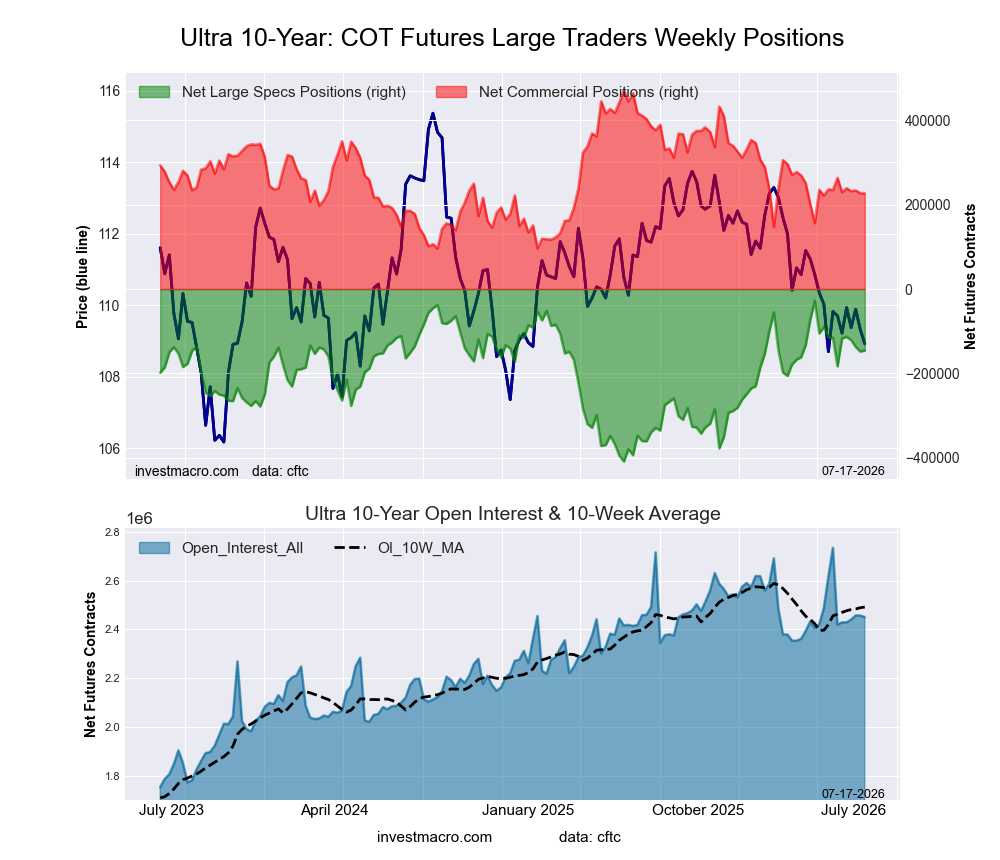
Ultra 10-Year Treasury Notes Bonds Futures COT ChartThe Ultra 10-Year Notes large speculator standing this week came in at a net position of -178,553 contracts in the data reported through Tuesday. This was a weekly boost of 27,241 contracts from the previous week which had a total of -205,794 net contracts.

This week’s current strength score (the trader positioning range over the past three years, measured from 0 to 100) shows the speculators are currently Bullish with a score of 62.0 percent. The commercials are Bearish with a score of 46.7 percent and the small traders (not shown in chart) are Bearish with a score of 35.0 percent.

Price Trend-Following Model: Strong Downtrend

Our weekly trend-following model classifies the current market price position as: Strong Downtrend.

Ultra 10-Year Notes StatisticsSPECULATORSCOMMERCIALSSMALL TRADERS
– Percent of Open Interest Longs:8.981.58.8
– Percent of Open Interest Shorts:16.470.012.7
– Net Position:-178,553270,472-91,919
– Gross Longs:208,3771,917,811207,204
– Gross Shorts:386,9301,647,339299,123
– Long to Short Ratio:0.5 to 11.2 to 10.7 to 1
NET POSITION TREND:
– Strength Index Score (3 Year Range Pct):62.046.735.0
– Strength Index Reading (3 Year Range):BullishBearishBearish
NET POSITION MOVEMENT INDEX:
– 6-Week Change in Strength Index:-6.8-4.934.1


US Treasury Bonds Futures:

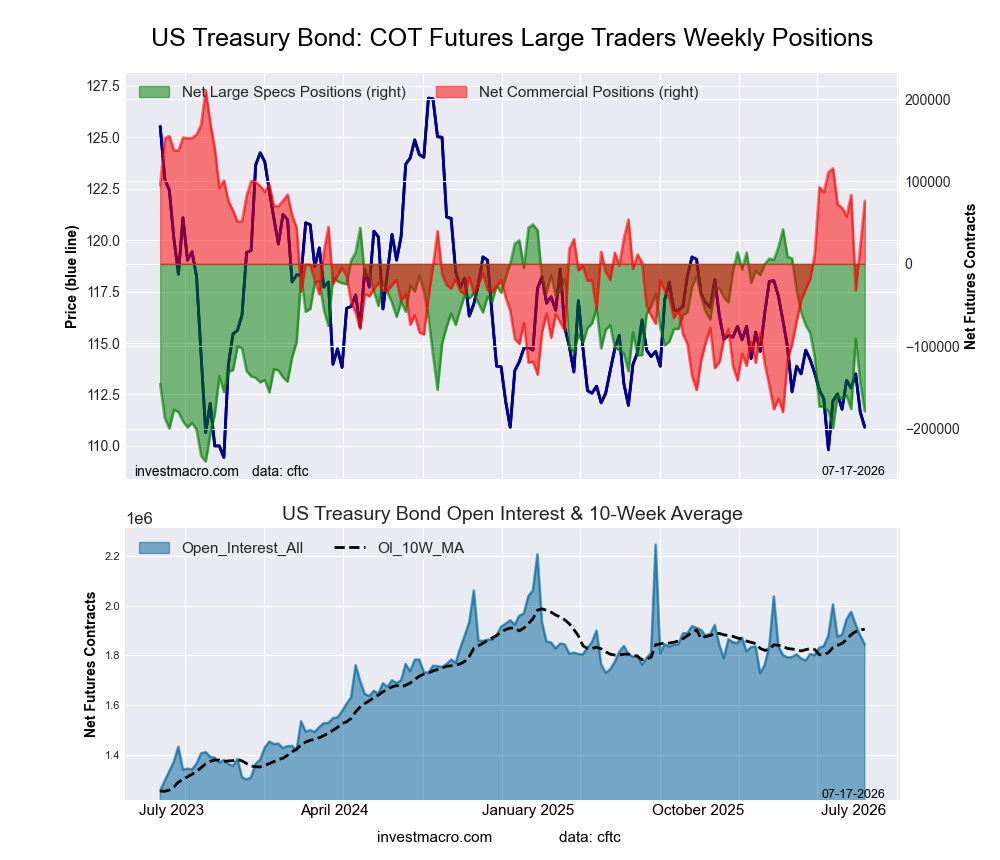
US Year Treasury Notes Long Bonds Futures COT ChartThe US Treasury Bonds large speculator standing this week came in at a net position of 6,570 contracts in the data reported through Tuesday. This was a weekly reduction of -2,194 contracts from the previous week which had a total of 8,764 net contracts.

This week’s current strength score (the trader positioning range over the past three years, measured from 0 to 100) shows the speculators are currently Bullish-Extreme with a score of 85.7 percent. The commercials are Bearish with a score of 21.1 percent and the small traders (not shown in chart) are Bearish with a score of 44.1 percent.

Price Trend-Following Model: Strong Downtrend

Our weekly trend-following model classifies the current market price position as: Strong Downtrend.

US Treasury Bonds StatisticsSPECULATORSCOMMERCIALSSMALL TRADERS
– Percent of Open Interest Longs:13.272.712.9
– Percent of Open Interest Shorts:12.878.17.8
– Net Position:6,570-97,53890,968
– Gross Longs:236,1951,302,472231,398
– Gross Shorts:229,6251,400,010140,430
– Long to Short Ratio:1.0 to 10.9 to 11.6 to 1
NET POSITION TREND:
– Strength Index Score (3 Year Range Pct):85.721.144.1
– Strength Index Reading (3 Year Range):Bullish-ExtremeBearishBearish
NET POSITION MOVEMENT INDEX:
– 6-Week Change in Strength Index:2.36.1-21.3


Ultra US Treasury Bonds Futures:

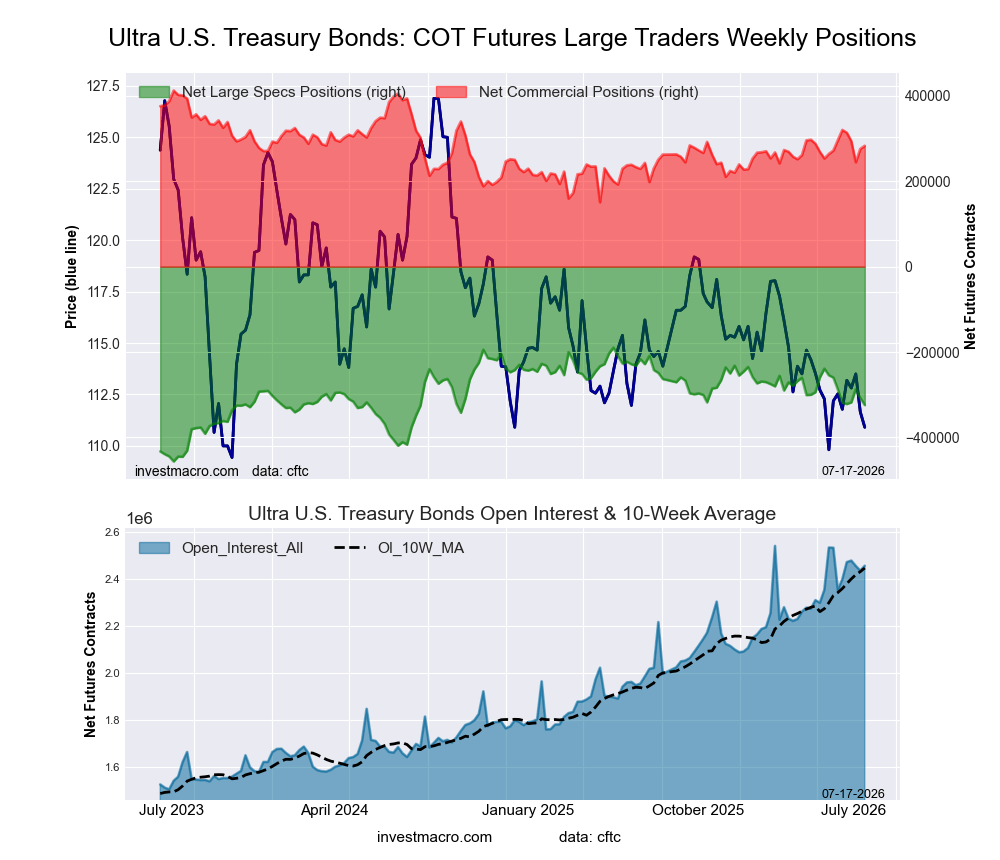
Ultra US Year Treasury Notes Long Bonds Futures COT ChartThe Ultra US Treasury Bonds large speculator standing this week came in at a net position of -279,187 contracts in the data reported through Tuesday. This was a weekly lowering of -8,050 contracts from the previous week which had a total of -271,137 net contracts.

This week’s current strength score (the trader positioning range over the past three years, measured from 0 to 100) shows the speculators are currently Bullish with a score of 66.5 percent. The commercials are Bearish with a score of 40.8 percent and the small traders (not shown in chart) are Bearish with a score of 37.3 percent.

Price Trend-Following Model: Strong Downtrend

Our weekly trend-following model classifies the current market price position as: Strong Downtrend.

Ultra US Treasury Bonds StatisticsSPECULATORSCOMMERCIALSSMALL TRADERS
– Percent of Open Interest Longs:5.984.68.9
– Percent of Open Interest Shorts:18.573.07.9
– Net Position:-279,187257,62021,567
– Gross Longs:131,8311,881,002197,970
– Gross Shorts:411,0181,623,382176,403
– Long to Short Ratio:0.3 to 11.2 to 11.1 to 1
NET POSITION TREND:
– Strength Index Score (3 Year Range Pct):66.540.837.3
– Strength Index Reading (3 Year Range):BullishBearishBearish
NET POSITION MOVEMENT INDEX:
– 6-Week Change in Strength Index:-3.2-4.922.0


Article By InvestMacroReceive our weekly COT Newsletter

*COT Report: The COT data, released weekly to the public each Friday, is updated through the most recent Tuesday (data is 3 days old) and shows a quick view of how large speculators or non-commercials (for-profit traders) were positioned in the futures markets.

The CFTC categorizes trader positions according to commercial hedgers (traders who use futures contracts for hedging as part of the business), non-commercials (large traders who speculate to realize trading profits) and nonreportable traders (usually small traders/speculators) as well as their open interest (contracts open in the market at time of reporting). See CFTC criteria here.

COT Energy Charts: Speculator Bets led by WTI, Natural Gas & Brent Crude Oil

By InvestMacro

Speculators OI Energy Futures COT Chart
Here are the latest charts and statistics for the Commitment of Traders (COT) data published by the Commodities Futures Trading Commission (CFTC).
The latest COT data is updated through Tuesday March 24th and shows a quick view of how large traders (for-profit speculators and commercial entities) were positioned in the futures markets.

Weekly Speculator Changes led by WTI, Natural Gas & Brent Crude Oil

Speculators Nets Energy Futures COT Chart
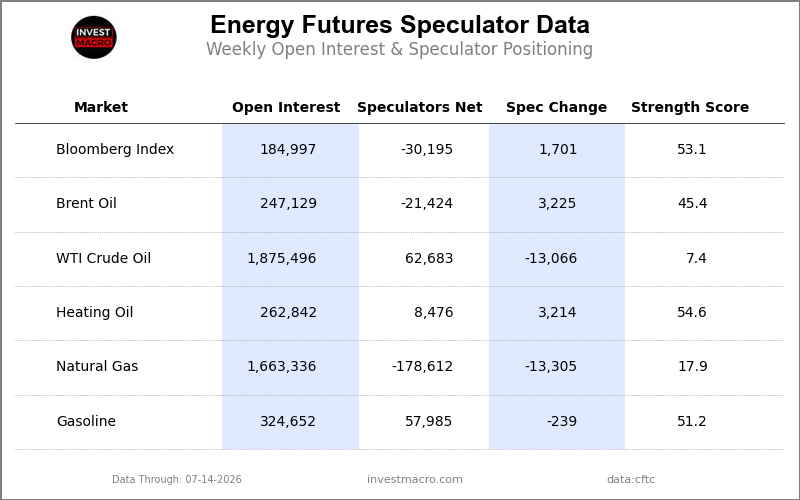
The COT energy market speculator bets were overall higher this week as four out of the six energy markets we cover had higher positioning while the other two markets had lower speculator contracts.

Leading the gains for the energy markets was WTI Crude (14,932 contracts) with Natural Gas (5,422 contracts), Brent Oil (5,002 contracts) and the Bloomberg Commodity Index (882 contracts) also having a positive week.

The markets with declines in speculator bets for the week were Gasoline (-6,749 contracts) and with Heating Oil (-5,864 contracts) also seeing lower bets on the week.

WTI Highlights Speculator Bets this week

WTI Crude Oil highlights the speculator bets this week with an increase of 14,932 net positions through Tuesday. The WTI Crude Oil speculator bets have been higher in 8 out of the past 11 weeks and have risen by +176,268 net contracts over that time-frame. The March 10th week saw a sharp increase with a weekly jump by +55,865 net positions. This week’s total net position for WTI Crude Oil is at +233,620 net contracts, which marks the highest position in 38 weeks, dating back to July 1, 2025 as the last time contracts have been higher than this week.

WTI Crude Leads Price Performance

Leading the Energy markets this week in price performance was WTI Crude Oil, which rose by 2.28% on the week. This was followed by the Bloomberg Commodity Index, which was up by 0.82%, and Heating Oil, which saw a 0.43% increase over the last five days. On the downside, the biggest loser on the week was Gasoline, which fell by -1.52%, followed by Natural Gas, which was down by -0.89%. Finally, Brent Oil slipped this week by -0.42%.

Over the past 30 days, the Energy markets have been exploding higher due to the Iran war. Heating Oil is up by 86% over the past 30 days. Brent Crude Oil is higher by 65% in that time-frame while WTI Crude Oil is up by 62%. Gasoline is higher by 51% over that period and the Bloomberg Commodity Index is higher by 17.39%.

Natural Gas is the outlier and has been lower by -1.21% over the past 30 days.


Energy Data:

Speculators Table Energy Futures COT Chart
Legend: Weekly Speculators Change | Speculators Current Net Position | Speculators Strength Score compared to last 3-Years (0-100 range)


Strength Scores led by Gasoline & WTI Crude

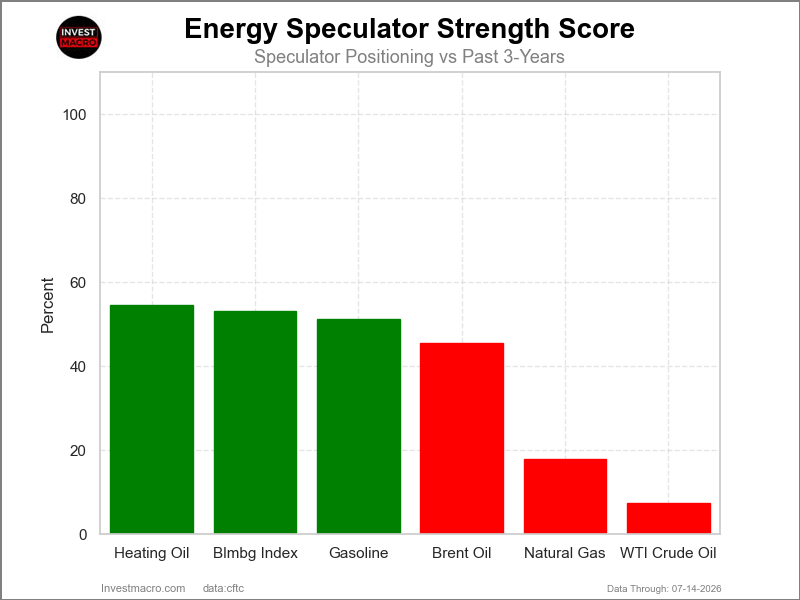
Speculators Strength Energy Futures COT Chart
COT Strength Scores (a normalized measure of Speculator positions over a 3-Year range, from 0 to 100 where above 80 is Extreme-Bullish and below 20 is Extreme-Bearish) showed that Gasoline (64.3 percent) and WTI Crude (62.5 percent) lead the energy markets this week.

On the downside, Natural Gas (21.7 percent) comes in at the lowest strength level currently.

Strength Statistics:
WTI Crude Oil (62.5 percent) vs WTI Crude Oil previous week (57.7 percent)
Brent Crude Oil (56.1 percent) vs Brent Crude Oil previous week (49.0 percent)
Natural Gas (21.7 percent) vs Natural Gas previous week (18.2 percent)
Gasoline (64.3 percent) vs Gasoline previous week (71.7 percent)
Heating Oil (56.1 percent) vs Heating Oil previous week (63.8 percent)
Bloomberg Commodity Index (51.6 percent) vs Bloomberg Commodity Index previous week (47.5 percent)


WTI Crude & Brent Oil top the 6-Week Strength Trends

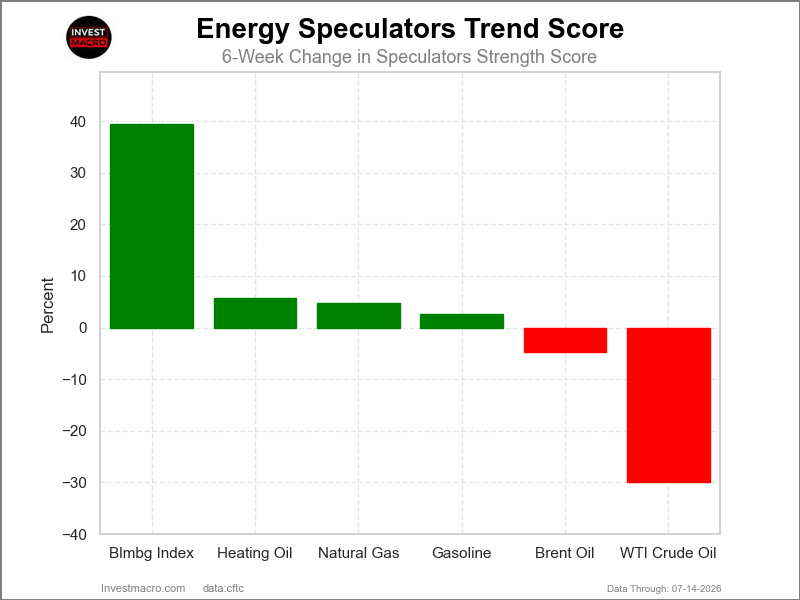
Speculators Trend Energy Futures COT Chart
COT Strength Score Trends (or move index, calculates the 6-week changes in strength scores) showed that WTI Crude (37.3 percent) and Brent Oil (26.4 percent) lead the past six weeks trends for the energy markets.

Gasoline (-22.2 percent) leads the downside trend scores currently with Heating Oil (-13.0 percent) as the next market with lower trend scores.

Move Statistics:
WTI Crude Oil (37.3 percent) vs WTI Crude Oil previous week (30.3 percent)
Brent Crude Oil (26.4 percent) vs Brent Crude Oil previous week (16.5 percent)
Natural Gas (-0.5 percent) vs Natural Gas previous week (-3.7 percent)
Gasoline (-22.2 percent) vs Gasoline previous week (0.2 percent)
Heating Oil (-13.0 percent) vs Heating Oil previous week (-13.0 percent)
Bloomberg Commodity Index (-3.4 percent) vs Bloomberg Commodity Index previous week (-25.3 percent)


Individual COT Market Charts:

WTI Crude Oil Futures:

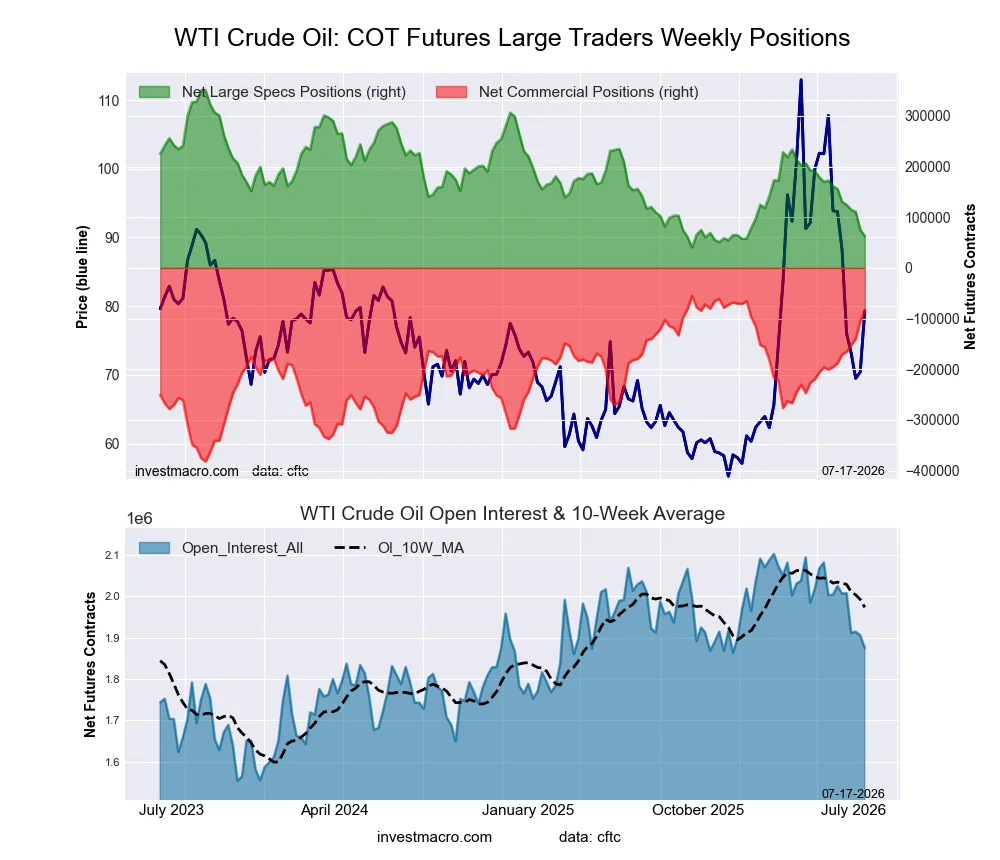
WTI Crude Oil Futures COT ChartThe WTI Crude Oil Futures large speculator standing this week equaled a net position of 233,620 contracts in the data reported through Tuesday. This was a weekly increase of 14,932 contracts from the previous week which had a total of 218,688 net contracts.

This week’s current strength score (the trader positioning range over the past three years, measured from 0 to 100) shows the speculators are currently Bullish with a score of 62.5 percent. The commercials are Bearish with a score of 35.2 percent and the small traders (not shown in chart) are Bullish with a score of 66.9 percent.

Price Trend-Following Model: Strong Uptrend

Our weekly trend-following model classifies the current market price position as: Strong Uptrend.

WTI Crude Oil Futures StatisticsSPECULATORSCOMMERCIALSSMALL TRADERS
– Percent of Open Interest Longs:18.842.03.8
– Percent of Open Interest Shorts:7.155.42.2
– Net Position:233,620-267,01033,390
– Gross Longs:376,150841,20076,513
– Gross Shorts:142,5301,108,21043,123
– Long to Short Ratio:2.6 to 10.8 to 11.8 to 1
NET POSITION TREND:
– Strength Index Score (3 Year Range Pct):62.535.266.9
– Strength Index Reading (3 Year Range):BullishBearishBullish
NET POSITION MOVEMENT INDEX:
– 6-Week Change in Strength Index:37.3-34.0-9.2


Brent Crude Oil Futures:

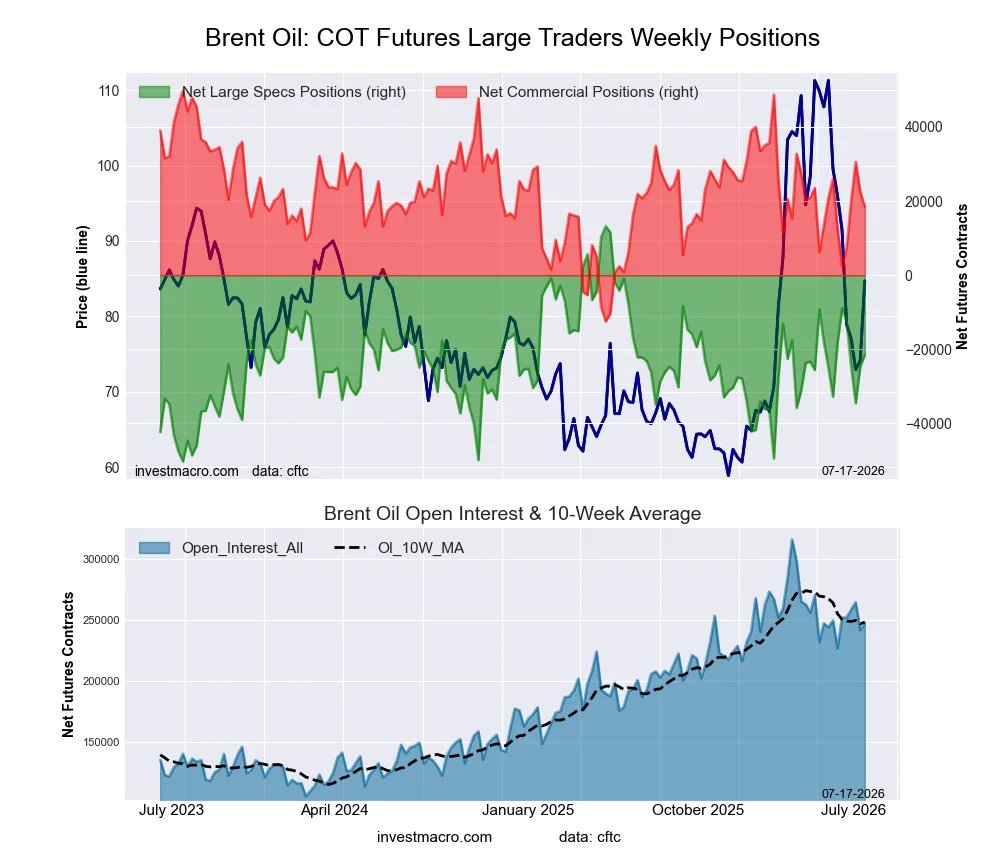
Brent Last Day Crude Oil Futures COT ChartThe Brent Crude Oil Futures large speculator standing this week equaled a net position of -17,555 contracts in the data reported through Tuesday. This was a weekly lift of 5,002 contracts from the previous week which had a total of -22,557 net contracts.

This week’s current strength score (the trader positioning range over the past three years, measured from 0 to 100) shows the speculators are currently Bullish with a score of 56.1 percent. The commercials are Bearish with a score of 42.7 percent and the small traders (not shown in chart) are Bullish with a score of 60.7 percent.

Price Trend-Following Model: Strong Uptrend

Our weekly trend-following model classifies the current market price position as: Strong Uptrend.

Brent Crude Oil Futures StatisticsSPECULATORSCOMMERCIALSSMALL TRADERS
– Percent of Open Interest Longs:27.342.53.5
– Percent of Open Interest Shorts:32.837.62.8
– Net Position:-17,55515,3732,182
– Gross Longs:86,045134,19811,152
– Gross Shorts:103,600118,8258,970
– Long to Short Ratio:0.8 to 11.1 to 11.2 to 1
NET POSITION TREND:
– Strength Index Score (3 Year Range Pct):56.142.760.7
– Strength Index Reading (3 Year Range):BullishBearishBullish
NET POSITION MOVEMENT INDEX:
– 6-Week Change in Strength Index:26.4-30.112.5


Natural Gas Futures:

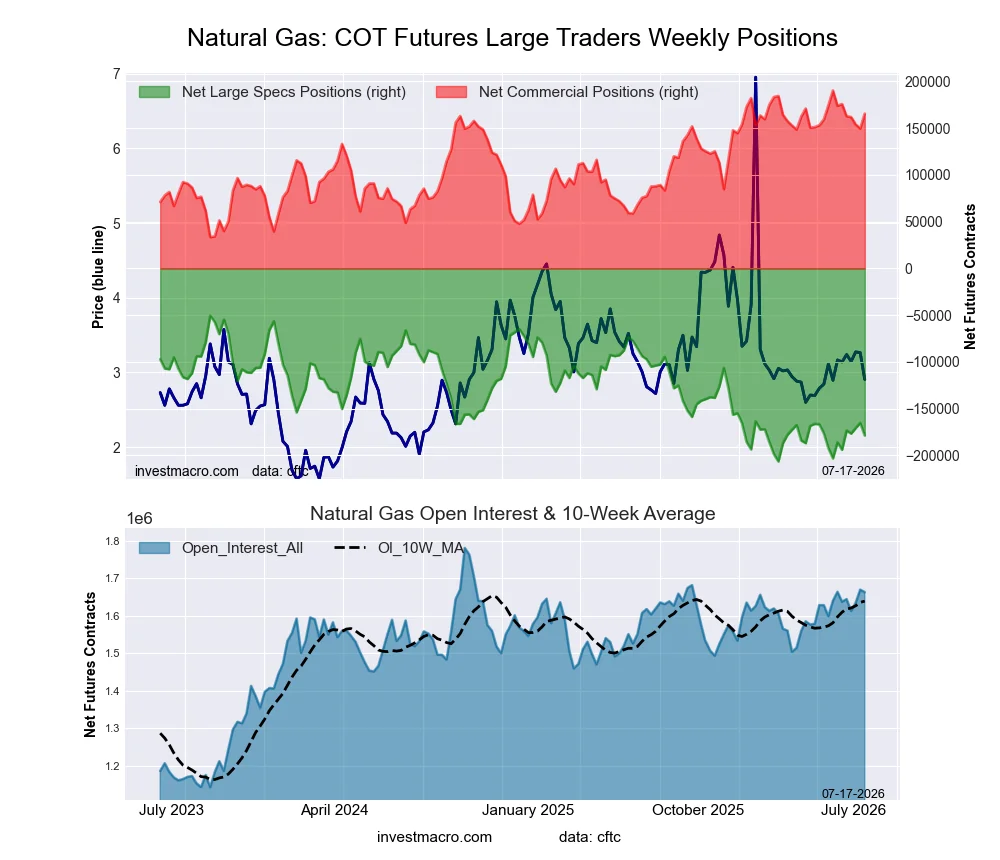
Natural Gas Futures COT ChartThe Natural Gas Futures large speculator standing this week equaled a net position of -172,607 contracts in the data reported through Tuesday. This was a weekly lift of 5,422 contracts from the previous week which had a total of -178,029 net contracts.

This week’s current strength score (the trader positioning range over the past three years, measured from 0 to 100) shows the speculators are currently Bearish with a score of 21.7 percent. The commercials are Bullish with a score of 79.1 percent and the small traders (not shown in chart) are Bullish with a score of 53.3 percent.

Price Trend-Following Model: Downtrend

Our weekly trend-following model classifies the current market price position as: Downtrend.

Natural Gas Futures StatisticsSPECULATORSCOMMERCIALSSMALL TRADERS
– Percent of Open Interest Longs:14.037.43.8
– Percent of Open Interest Shorts:25.427.22.5
– Net Position:-172,607152,74819,859
– Gross Longs:210,159562,54056,760
– Gross Shorts:382,766409,79236,901
– Long to Short Ratio:0.5 to 11.4 to 11.5 to 1
NET POSITION TREND:
– Strength Index Score (3 Year Range Pct):21.779.153.3
– Strength Index Reading (3 Year Range):BearishBullishBullish
NET POSITION MOVEMENT INDEX:
– 6-Week Change in Strength Index:-0.5-4.418.8


Gasoline Blendstock Futures:

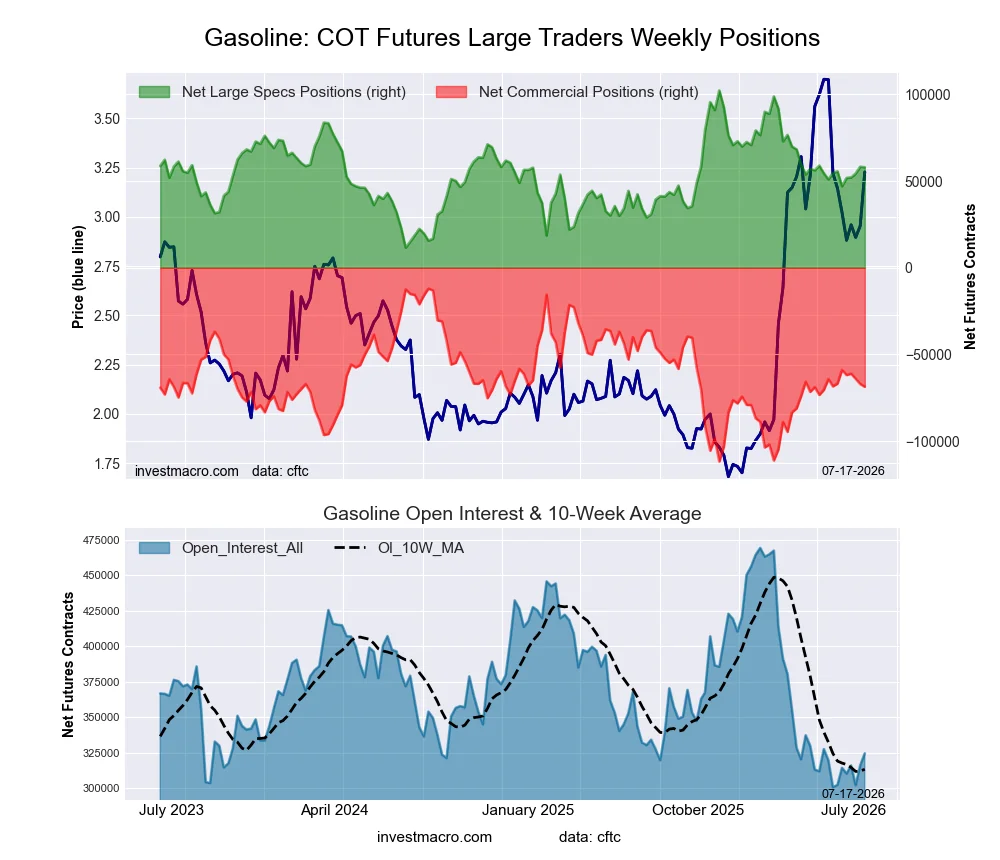
RBOB Gasoline Energy Futures COT ChartThe Gasoline Blendstock Futures large speculator standing this week equaled a net position of 69,846 contracts in the data reported through Tuesday. This was a weekly fall of -6,749 contracts from the previous week which had a total of 76,595 net contracts.

This week’s current strength score (the trader positioning range over the past three years, measured from 0 to 100) shows the speculators are currently Bullish with a score of 64.3 percent. The commercials are Bearish with a score of 28.4 percent and the small traders (not shown in chart) are Bullish with a score of 79.4 percent.

Price Trend-Following Model: Strong Uptrend

Our weekly trend-following model classifies the current market price position as: Strong Uptrend.

Nasdaq Mini Futures StatisticsSPECULATORSCOMMERCIALSSMALL TRADERS
– Percent of Open Interest Longs:26.050.17.3
– Percent of Open Interest Shorts:6.373.53.5
– Net Position:69,846-83,41813,572
– Gross Longs:92,274177,74826,021
– Gross Shorts:22,428261,16612,449
– Long to Short Ratio:4.1 to 10.7 to 12.1 to 1
NET POSITION TREND:
– Strength Index Score (3 Year Range Pct):64.328.479.4
– Strength Index Reading (3 Year Range):BullishBearishBullish
NET POSITION MOVEMENT INDEX:
– 6-Week Change in Strength Index:-22.220.3-0.6


#2 Heating Oil NY-Harbor Futures:

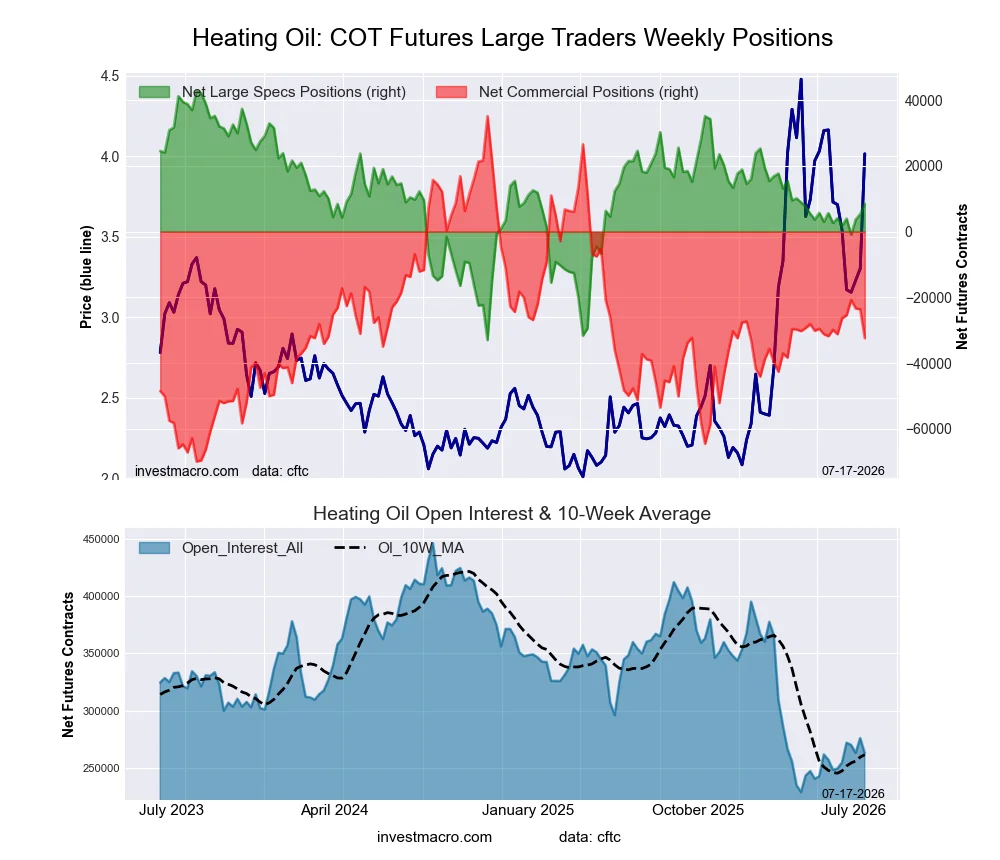
NY Harbor Heating Oil Energy Futures COT ChartThe #2 Heating Oil NY-Harbor Futures large speculator standing this week equaled a net position of 9,567 contracts in the data reported through Tuesday. This was a weekly reduction of -5,864 contracts from the previous week which had a total of 15,431 net contracts.

This week’s current strength score (the trader positioning range over the past three years, measured from 0 to 100) shows the speculators are currently Bullish with a score of 56.1 percent. The commercials are Bearish with a score of 38.4 percent and the small traders (not shown in chart) are Bullish with a score of 72.9 percent.

Price Trend-Following Model: Strong Uptrend

Our weekly trend-following model classifies the current market price position as: Strong Uptrend.

Heating Oil Futures StatisticsSPECULATORSCOMMERCIALSSMALL TRADERS
– Percent of Open Interest Longs:14.652.817.2
– Percent of Open Interest Shorts:10.964.49.4
– Net Position:9,567-29,59620,029
– Gross Longs:37,342134,96443,977
– Gross Shorts:27,775164,56023,948
– Long to Short Ratio:1.3 to 10.8 to 11.8 to 1
NET POSITION TREND:
– Strength Index Score (3 Year Range Pct):56.138.472.9
– Strength Index Reading (3 Year Range):BullishBearishBullish
NET POSITION MOVEMENT INDEX:
– 6-Week Change in Strength Index:-13.08.81.7


Bloomberg Commodity Index Futures:

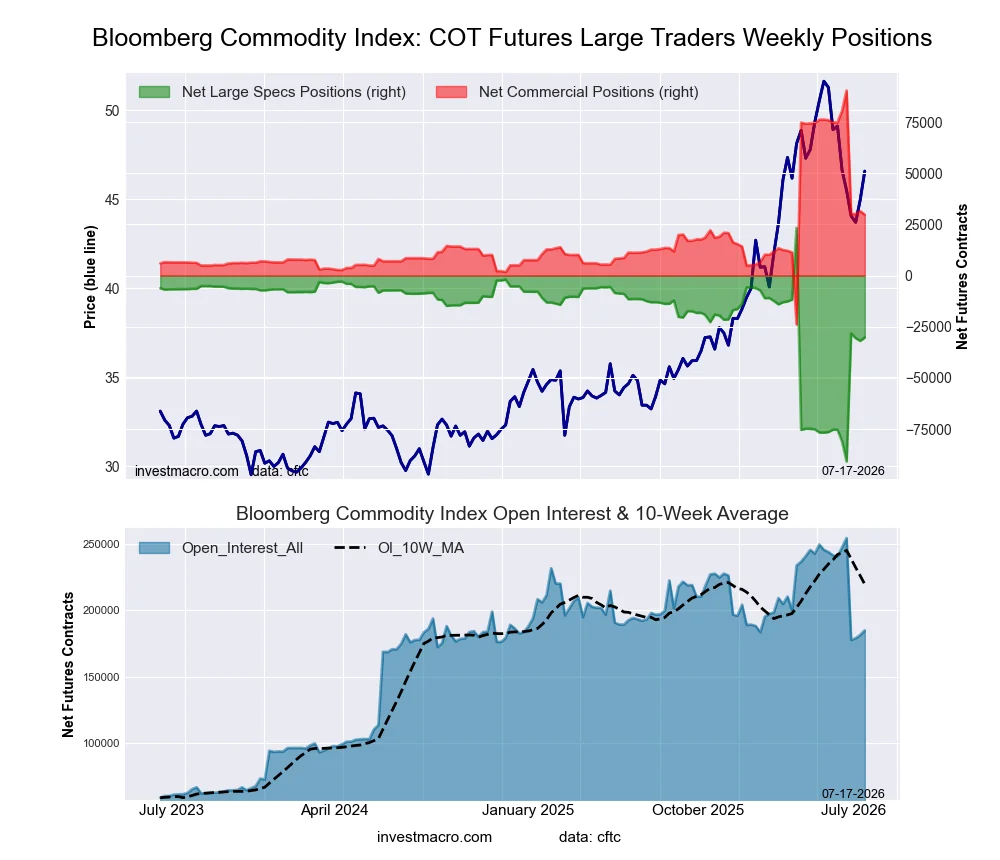
Bloomberg Commodity Index Futures COT ChartThe Bloomberg Commodity Index Futures large speculator standing this week equaled a net position of -11,732 contracts in the data reported through Tuesday. This was a weekly advance of 882 contracts from the previous week which had a total of -12,614 net contracts.

This week’s current strength score (the trader positioning range over the past three years, measured from 0 to 100) shows the speculators are currently Bullish with a score of 51.6 percent. The commercials are Bearish with a score of 48.2 percent and the small traders (not shown in chart) are Bullish with a score of 61.3 percent.

Price Trend-Following Model: Strong Uptrend

Our weekly trend-following model classifies the current market price position as: Strong Uptrend.

Bloomberg Index Futures StatisticsSPECULATORSCOMMERCIALSSMALL TRADERS
– Percent of Open Interest Longs:30.569.20.2
– Percent of Open Interest Shorts:36.463.50.0
– Net Position:-11,73211,283449
– Gross Longs:60,948138,240486
– Gross Shorts:72,680126,95737
– Long to Short Ratio:0.8 to 11.1 to 113.1 to 1
NET POSITION TREND:
– Strength Index Score (3 Year Range Pct):51.648.261.3
– Strength Index Reading (3 Year Range):BullishBearishBullish
NET POSITION MOVEMENT INDEX:
– 6-Week Change in Strength Index:-3.45.0-24.9


Article By InvestMacroReceive our weekly COT Newsletter

*COT Report: The COT data, released weekly to the public each Friday, is updated through the most recent Tuesday (data is 3 days old) and shows a quick view of how large speculators or non-commercials (for-profit traders) were positioned in the futures markets.

The CFTC categorizes trader positions according to commercial hedgers (traders who use futures contracts for hedging as part of the business), non-commercials (large traders who speculate to realize trading profits) and nonreportable traders (usually small traders/speculators) as well as their open interest (contracts open in the market at time of reporting). See CFTC criteria here.