Archive for Financial News – Page 175

The Euro/Dollar exchange rate remains near its lowest levels

By RoboForex Analytical Department

The main currency pair starts the week and the month by consolidating around the 1.0569 mark.

The US Federal Reserve’s intention to potentially raise interest rates once again in 2023 is strengthening the position of the USD. The 10-year treasury bonds yield in the US remains at long-term highs regardless of a minor correction.

This week, statistics will be abundant in both the US and the eurozone. Employment sector reports for September in the US are expected to show stabilisation without any notable catalysts.

The eurozone will report on retail sales in August, the PPI, and business activity in the services sector. All these reports will provide insight into the state of the economic system. It is not certain whether there will be any catalyst among the European statistics to support the EUR, although this possibility exists.

Technical analysis of EUR/USD currency pair:

On the EURUSD H4 chart, a consolidation range has formed around 1.0700, reaching the local target of a declining wave at 1.0500 upon escaping the range downwards. Today the market has corrected to 1.0615. A new link of correction to 1.0620 is not excluded, followed by a decline to 1.0440. After reaching this level, a correction to 1.0700 could follow (with a test from below). Next, a decline to 1.0140 is expected. Technically, this scenario is confirmed by the MACD, whose signal line is below zero. The indicator is expected to set new lows.

On the EURUSD H1 chart, a movement in a declining wave to 1.0440 is forming. By now, the market has completed a consolidation range of around 1.0586, reaching the local target of a declining wave at 1.0500 with an escape from the range downwards. A link of correction to 1.0615 has formed today. A new price hike to 1.0620 is not excluded. Next, a new declining movement to 1.0440 is expected, followed by a rise to 1.0700. Technically, this scenario is confirmed by the Stochastic oscillator, whose signal line has rebounded from the 80 mark and is currently pointing sharply downwards. The line might eventually fall to the 20 mark.

Disclaimer

Any predictions contained herein are based on the author’s particular opinion. This analysis shall not be treated as trading advice. RoboForex shall not be held liable for the results of the trades arising from relying upon trading recommendations and reviews contained herein.

COT Metals Charts: Speculator Bets led lower by Gold & Copper

By InvestMacro

Here are the latest charts and statistics for the Commitment of Traders (COT) data published by the Commodities Futures Trading Commission (CFTC).

The latest COT data is updated through Tuesday September 26th and shows a quick view of how large traders (for-profit speculators and commercial entities) were positioned in the futures markets.

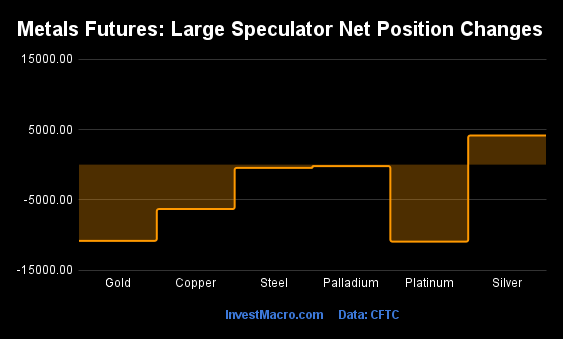
Weekly Speculator Changes led by Silver & Palladium

The COT metals markets speculator bets were lower this week as just one out of the six metals markets we cover had higher positioning while the other five markets had lower speculator contracts.

Leading the gains for the metals was Silver with a gain of 4,874 contracts.

The markets with declines in speculator bets for the week were Gold (-19,348 contracts), Copper (-12,479 contracts), Platinum (-2,668 contracts), Steel (-1,064 contracts) and Palladium (-72 contracts) also registering lower bets on the week.


Data Snapshot of Commodity Market Traders | Columns Legend
Sep-26-2023OIOI-IndexSpec-NetSpec-IndexCom-NetCOM-IndexSmalls-NetSmalls-Index
Gold435,6206115,81528-134,8367219,02128
Silver126,2061520,10547-33,0805412,97538
Copper216,03155-28,779627,192941,58728
Palladium18,00483-10,302510,45897-15632
Platinum72,957617,32632-12,349685,02335


Strength Scores led by Steel & Silver

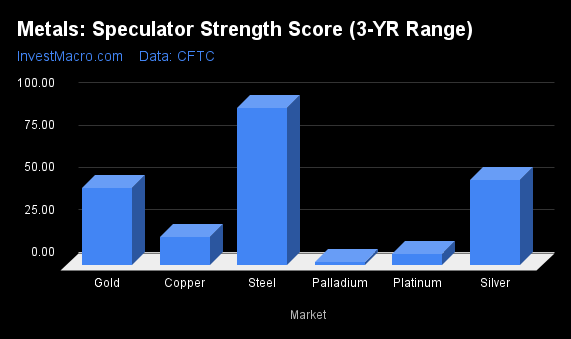
COT Strength Scores (a normalized measure of Speculator positions over a 3-Year range, from 0 to 100 where above 80 is Extreme-Bullish and below 20 is Extreme-Bearish) showed that Steel (60 percent) and Silver (47 percent) lead the metals markets this week.

On the downside, Copper (6 percent) and Palladium (5 percent) come in at the lowest strength level currently and are both in Extreme-Bearish territory (below 20 percent).

Strength Statistics:
Gold (28.0 percent) vs Gold previous week (36.6 percent)
Silver (46.9 percent) vs Silver previous week (40.0 percent)
Copper (6.0 percent) vs Copper previous week (16.8 percent)
Platinum (32.5 percent) vs Platinum previous week (38.6 percent)
Palladium (4.9 percent) vs Palladium previous week (5.4 percent)
Steel (60.1 percent) vs Palladium previous week (63.5 percent)


Silver & Platinum top the 6-Week Strength Trends

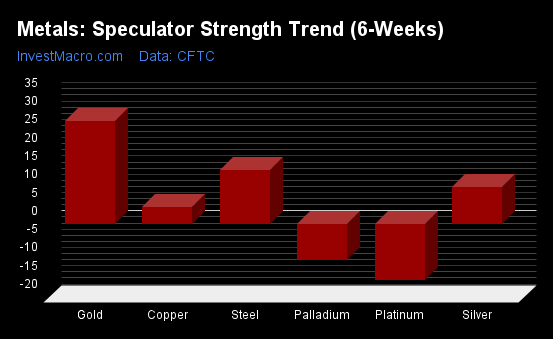
COT Strength Score Trends (or move index, calculates the 6-week changes in strength scores) showed that Silver (18 percent) and Platinum (17 percent) lead the past six weeks trends for metals.

Steel (-9 percent), Palladium (-6 percent) and Copper (-3 percent) lead the downside trend scores currently.

Move Statistics:
Gold (-2.3 percent) vs Gold previous week (-3.4 percent)
Silver (17.5 percent) vs Silver previous week (2.7 percent)
Copper (-2.7 percent) vs Copper previous week (-5.4 percent)
Platinum (16.9 percent) vs Platinum previous week (16.2 percent)
Palladium (-6.0 percent) vs Palladium previous week (-0.3 percent)
Steel (-8.5 percent) vs Steel previous week (-6.4 percent)


Individual Markets:

Gold Comex Futures:

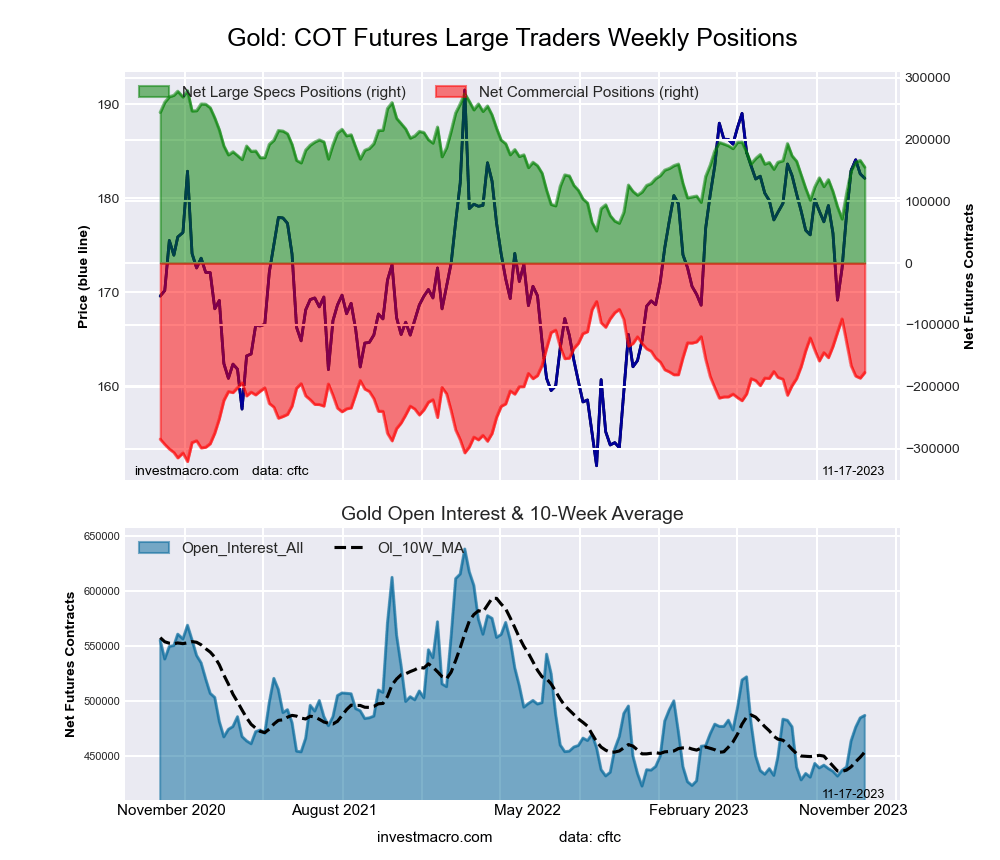
Gold Futures COT ChartThe Gold Comex Futures large speculator standing this week came in at a net position of 115,815 contracts in the data reported through Tuesday. This was a weekly fall of -19,348 contracts from the previous week which had a total of 135,163 net contracts.

This week’s current strength score (the trader positioning range over the past three years, measured from 0 to 100) shows the speculators are currently Bearish with a score of 28.0 percent. The commercials are Bullish with a score of 71.9 percent and the small traders (not shown in chart) are Bearish with a score of 27.6 percent.

Price Trend-Following Model: Strong Downtrend

Our weekly trend-following model classifies the current market price position as: Strong Downtrend. The current action for the model is considered to be: Hold – Maintain Short Position.

Gold Futures StatisticsSPECULATORSCOMMERCIALSSMALL TRADERS
– Percent of Open Interest Longs:54.125.410.4
– Percent of Open Interest Shorts:27.556.46.0
– Net Position:115,815-134,83619,021
– Gross Longs:235,560110,84445,213
– Gross Shorts:119,745245,68026,192
– Long to Short Ratio:2.0 to 10.5 to 11.7 to 1
NET POSITION TREND:
– Strength Index Score (3 Year Range Pct):28.071.927.6
– Strength Index Reading (3 Year Range):BearishBullishBearish
NET POSITION MOVEMENT INDEX:
– 6-Week Change in Strength Index:-2.32.7-4.5


Silver Comex Futures:

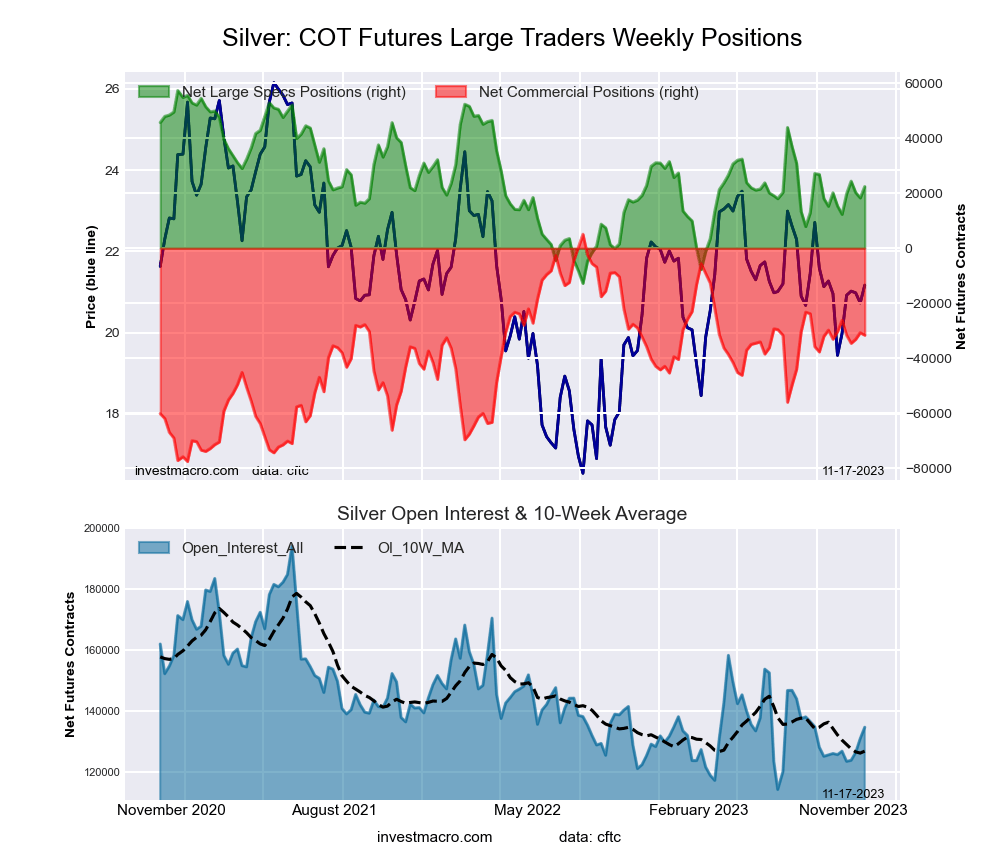
Silver Futures COT ChartThe Silver Comex Futures large speculator standing this week came in at a net position of 20,105 contracts in the data reported through Tuesday. This was a weekly advance of 4,874 contracts from the previous week which had a total of 15,231 net contracts.

This week’s current strength score (the trader positioning range over the past three years, measured from 0 to 100) shows the speculators are currently Bearish with a score of 46.9 percent. The commercials are Bullish with a score of 53.8 percent and the small traders (not shown in chart) are Bearish with a score of 38.5 percent.

Price Trend-Following Model: Strong Downtrend

Our weekly trend-following model classifies the current market price position as: Strong Downtrend. The current action for the model is considered to be: Hold – Maintain Short Position.

Silver Futures StatisticsSPECULATORSCOMMERCIALSSMALL TRADERS
– Percent of Open Interest Longs:40.832.020.3
– Percent of Open Interest Shorts:24.958.210.0
– Net Position:20,105-33,08012,975
– Gross Longs:51,53940,34625,601
– Gross Shorts:31,43473,42612,626
– Long to Short Ratio:1.6 to 10.5 to 12.0 to 1
NET POSITION TREND:
– Strength Index Score (3 Year Range Pct):46.953.838.5
– Strength Index Reading (3 Year Range):BearishBullishBearish
NET POSITION MOVEMENT INDEX:
– 6-Week Change in Strength Index:17.5-11.9-13.6


Copper Grade #1 Futures:

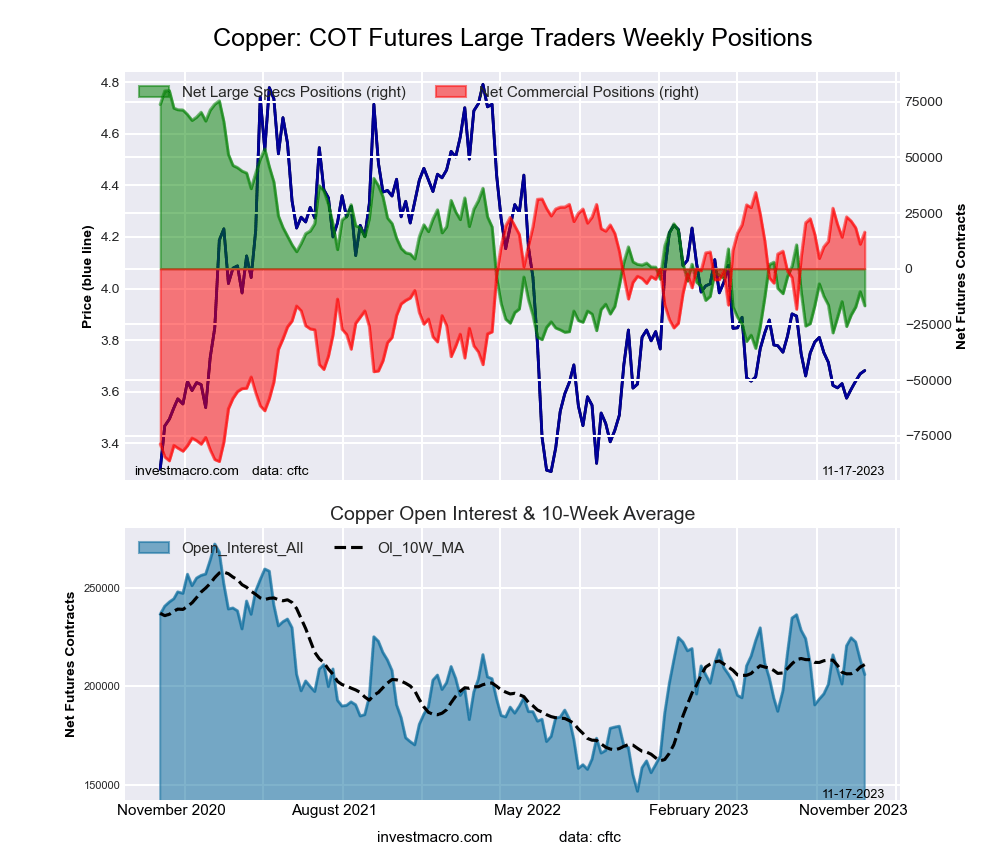
Copper Futures COT ChartThe Copper Grade #1 Futures large speculator standing this week came in at a net position of -28,779 contracts in the data reported through Tuesday. This was a weekly lowering of -12,479 contracts from the previous week which had a total of -16,300 net contracts.

This week’s current strength score (the trader positioning range over the past three years, measured from 0 to 100) shows the speculators are currently Bearish-Extreme with a score of 6.0 percent. The commercials are Bullish-Extreme with a score of 94.1 percent and the small traders (not shown in chart) are Bearish with a score of 28.5 percent.

Price Trend-Following Model: Strong Downtrend

Our weekly trend-following model classifies the current market price position as: Strong Downtrend. The current action for the model is considered to be: Hold – Maintain Short Position.

Copper Futures StatisticsSPECULATORSCOMMERCIALSSMALL TRADERS
– Percent of Open Interest Longs:32.740.57.4
– Percent of Open Interest Shorts:46.027.96.6
– Net Position:-28,77927,1921,587
– Gross Longs:70,66387,51815,925
– Gross Shorts:99,44260,32614,338
– Long to Short Ratio:0.7 to 11.5 to 11.1 to 1
NET POSITION TREND:
– Strength Index Score (3 Year Range Pct):6.094.128.5
– Strength Index Reading (3 Year Range):Bearish-ExtremeBullish-ExtremeBearish
NET POSITION MOVEMENT INDEX:
– 6-Week Change in Strength Index:-2.75.4-21.7


Platinum Futures:

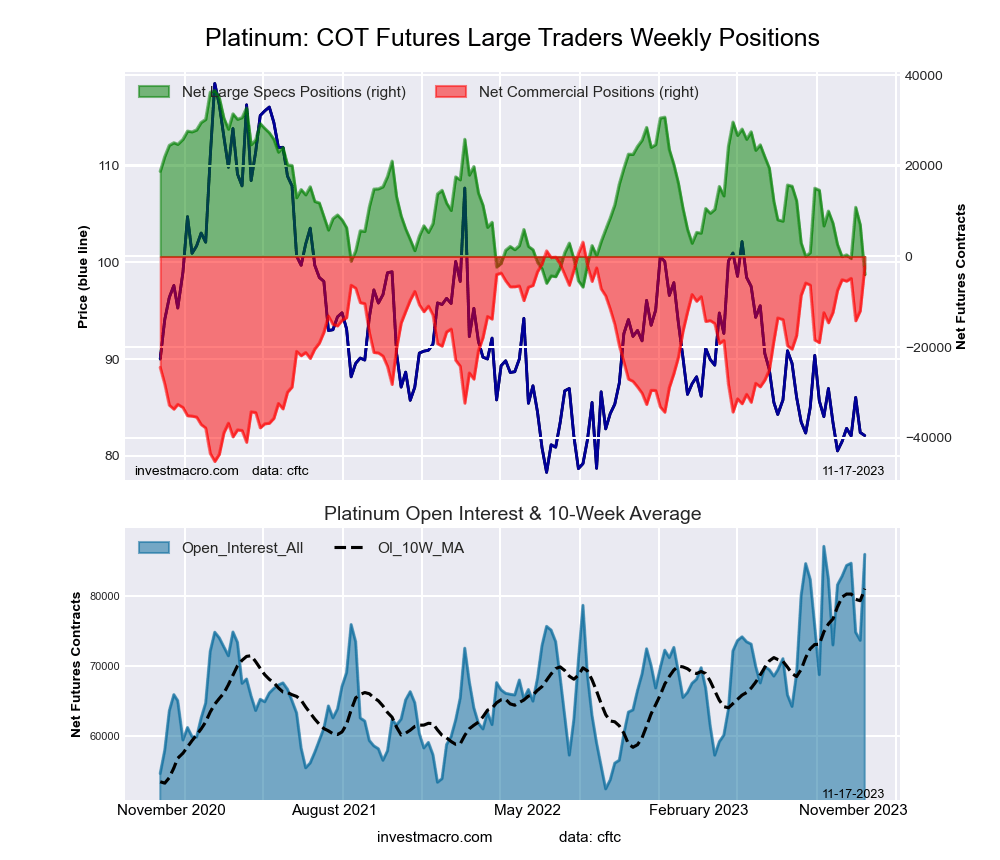
Platinum Futures COT ChartThe Platinum Futures large speculator standing this week came in at a net position of 7,326 contracts in the data reported through Tuesday. This was a weekly fall of -2,668 contracts from the previous week which had a total of 9,994 net contracts.

This week’s current strength score (the trader positioning range over the past three years, measured from 0 to 100) shows the speculators are currently Bearish with a score of 32.5 percent. The commercials are Bullish with a score of 67.9 percent and the small traders (not shown in chart) are Bearish with a score of 35.4 percent.

Price Trend-Following Model: Strong Downtrend

Our weekly trend-following model classifies the current market price position as: Strong Downtrend. The current action for the model is considered to be: Hold – Maintain Short Position.

Platinum Futures StatisticsSPECULATORSCOMMERCIALSSMALL TRADERS
– Percent of Open Interest Longs:55.225.311.8
– Percent of Open Interest Shorts:45.242.24.9
– Net Position:7,326-12,3495,023
– Gross Longs:40,30518,4438,612
– Gross Shorts:32,97930,7923,589
– Long to Short Ratio:1.2 to 10.6 to 12.4 to 1
NET POSITION TREND:
– Strength Index Score (3 Year Range Pct):32.567.935.4
– Strength Index Reading (3 Year Range):BearishBullishBearish
NET POSITION MOVEMENT INDEX:
– 6-Week Change in Strength Index:16.9-13.4-11.2


Palladium Futures:

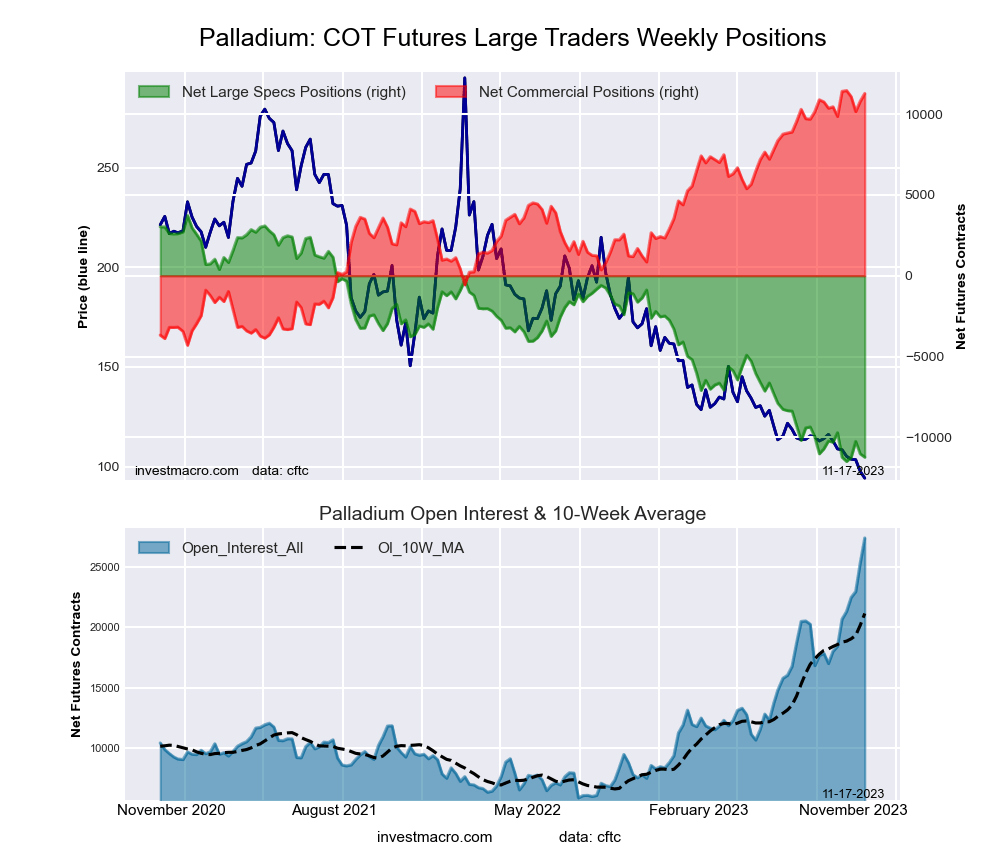
Palladium Futures COT ChartThe Palladium Futures large speculator standing this week came in at a net position of -10,302 contracts in the data reported through Tuesday. This was a weekly decrease of -72 contracts from the previous week which had a total of -10,230 net contracts.

This week’s current strength score (the trader positioning range over the past three years, measured from 0 to 100) shows the speculators are currently Bearish-Extreme with a score of 4.9 percent. The commercials are Bullish-Extreme with a score of 97.2 percent and the small traders (not shown in chart) are Bearish with a score of 32.3 percent.

Price Trend-Following Model: Downtrend

Our weekly trend-following model classifies the current market price position as: Downtrend. The current action for the model is considered to be: Hold – Maintain Short Position.

Palladium Futures StatisticsSPECULATORSCOMMERCIALSSMALL TRADERS
– Percent of Open Interest Longs:22.563.58.0
– Percent of Open Interest Shorts:79.75.48.9
– Net Position:-10,30210,458-156
– Gross Longs:4,04311,4241,443
– Gross Shorts:14,3459661,599
– Long to Short Ratio:0.3 to 111.8 to 10.9 to 1
NET POSITION TREND:
– Strength Index Score (3 Year Range Pct):4.997.232.3
– Strength Index Reading (3 Year Range):Bearish-ExtremeBullish-ExtremeBearish
NET POSITION MOVEMENT INDEX:
– 6-Week Change in Strength Index:-6.04.88.6


Steel Futures Futures:

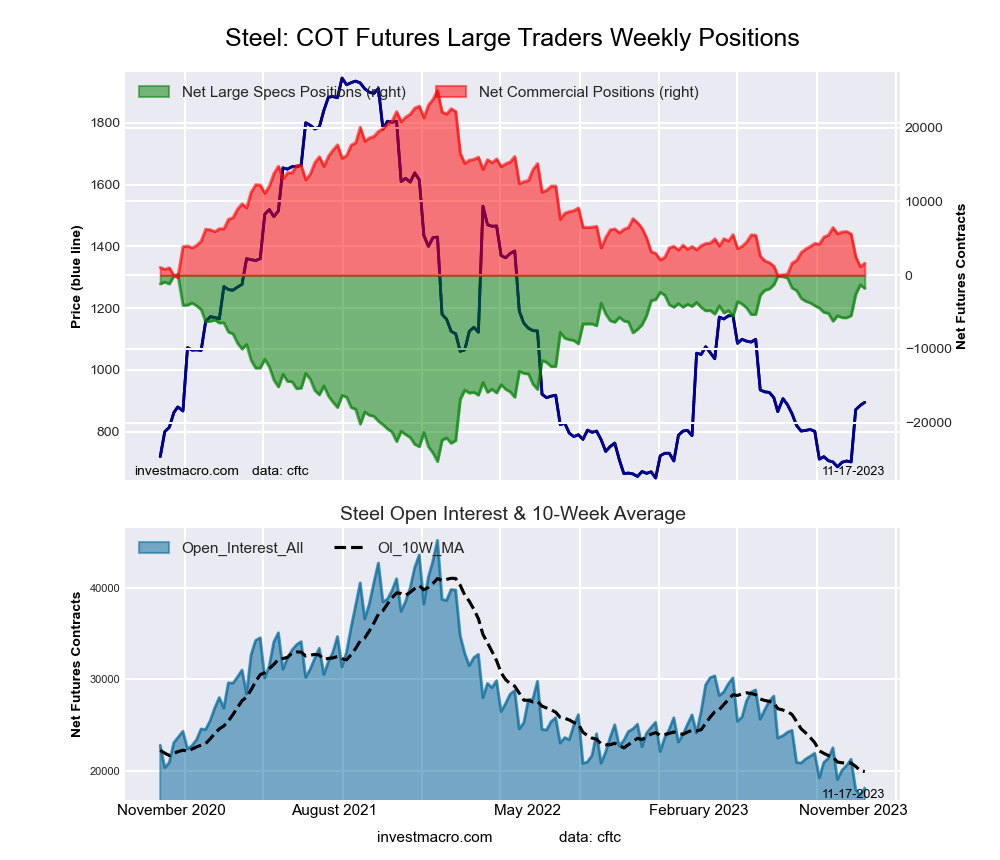
Steel Futures COT ChartThe Steel Futures large speculator standing this week came in at a net position of -6,219 contracts in the data reported through Tuesday. This was a weekly decline of -1,064 contracts from the previous week which had a total of -5,155 net contracts.

This week’s current strength score (the trader positioning range over the past three years, measured from 0 to 100) shows the speculators are currently Bullish with a score of 60.1 percent. The commercials are Bearish with a score of 41.0 percent and the small traders (not shown in chart) are Bearish-Extreme with a score of 6.0 percent.

Price Trend-Following Model: Downtrend

Our weekly trend-following model classifies the current market price position as: Downtrend. The current action for the model is considered to be: Hold – Maintain Short Position.

Steel Futures StatisticsSPECULATORSCOMMERCIALSSMALL TRADERS
– Percent of Open Interest Longs:5.787.20.7
– Percent of Open Interest Shorts:33.358.51.8
– Net Position:-6,2196,460-241
– Gross Longs:1,28319,640164
– Gross Shorts:7,50213,180405
– Long to Short Ratio:0.2 to 11.5 to 10.4 to 1
NET POSITION TREND:
– Strength Index Score (3 Year Range Pct):60.141.06.0
– Strength Index Reading (3 Year Range):BullishBearishBearish-Extreme
NET POSITION MOVEMENT INDEX:
– 6-Week Change in Strength Index:-8.59.2-22.6


Article By InvestMacroReceive our weekly COT Newsletter

See our Weekly Trend Model Readings and Actions for each COT Futures Market and Category. All information contained in this data are for general informational purposes only and do not constitute investment advice.

*COT Report: The COT data, released weekly to the public each Friday, is updated through the most recent Tuesday (data is 3 days old) and shows a quick view of how large speculators or non-commercials (for-profit traders) were positioned in the futures markets.

The CFTC categorizes trader positions according to commercial hedgers (traders who use futures contracts for hedging as part of the business), non-commercials (large traders who speculate to realize trading profits) and nonreportable traders (usually small traders/speculators) as well as their open interest (contracts open in the market at time of reporting). See CFTC criteria here.

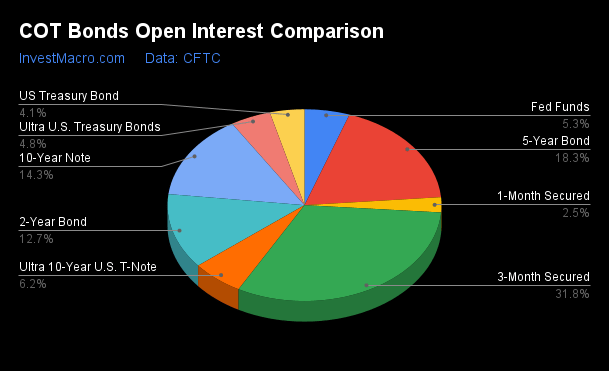
COT Bonds Charts: Speculators bets led by 2-Year Bonds and Ultra Treasury Bonds

By InvestMacro

Here are the latest charts and statistics for the Commitment of Traders (COT) reports data published by the Commodities Futures Trading Commission (CFTC).

The latest COT data is updated through Tuesday September 26th and shows a quick view of how large traders (for-profit speculators and commercial hedgers) were positioned in the futures markets.

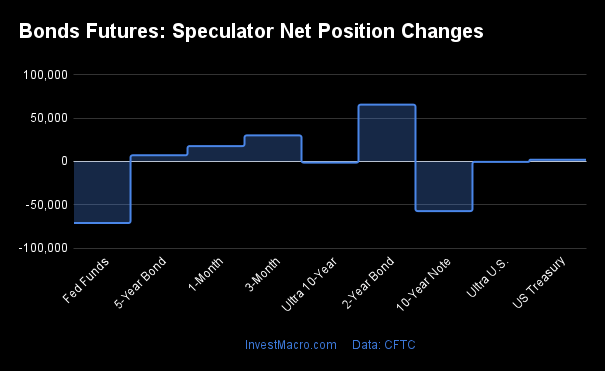
Weekly Speculator Changes led by 2-Year Bonds & Ultra Treasury Bonds

The COT bond market speculator bets were lower this week as three out of the eight bond markets we cover had higher positioning while the other five markets had lower speculator contracts.

Leading the gains for the bond markets was the 2-Year Bonds (31,163 contracts) with the Ultra Treasury Bonds (18,129 contracts) and the Fed Funds (15,454 contracts) also showing positive weeks.

The bond markets with declines in speculator bets for the week was the SOFR 3-Months (-182,231 contracts) with the Ultra 10-Year Bonds (-61,389 contracts), the US Treasury Bonds (-31,704 contracts), the 10-Year Bonds (-29,682 contracts), and the 5-Year Bonds (-18,836 contracts) also registering lower bets on the week.


Data Snapshot of Bond Market Traders | Columns Legend
Sep-26-2023OIOI-IndexSpec-NetSpec-IndexCom-NetCOM-IndexSmalls-NetSmalls-Index
SOFR-3-Months9,718,98091317,14689-311,98611-5,16085
FedFunds1,630,23657-195,07823217,05279-21,97448
2-Year3,903,50296-1,210,30041,080,59495129,706100
Long T-Bond1,405,06492-232,8119169,0187163,79395
10-Year4,767,69892-731,99811679,6439052,35585
5-Year5,579,72691-1,025,78217964,6058061,17786


Strength Scores led by SOFR 3-Months & Ultra Treasury Bonds

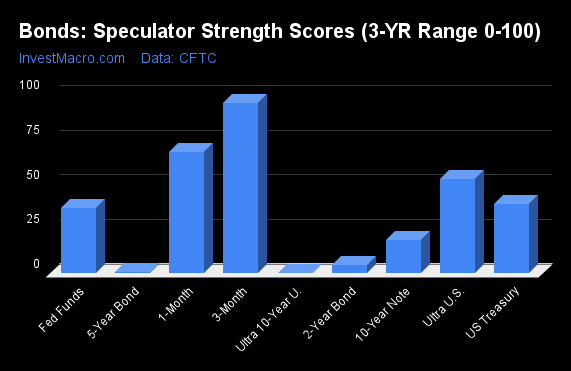
COT Strength Scores (a normalized measure of Speculator positions over a 3-Year range, from 0 to 100 where above 80 is Extreme-Bullish and below 20 is Extreme-Bearish) showed that the SOFR 3-Months (89 percent) leads the bond markets this week. The Ultra Treasury Bonds (34 percent) come in as the next highest in the weekly strength scores.

On the downside, the Ultra 10-Year Bonds (4 percent), the 2-Year Bonds (4 percent), the US Treasury Bonds (9 percent), the 10-Year Bonds (11 percent) and the 5-Year Bond (17 percent) come in at the lowest strength level currently and are in Extreme-Bearish territory (below 20 percent).

Strength Statistics:
Fed Funds (23.1 percent) vs Fed Funds previous week (20.2 percent)
2-Year Bond (4.5 percent) vs 2-Year Bond previous week (2.2 percent)
5-Year Bond (17.1 percent) vs 5-Year Bond previous week (18.5 percent)
10-Year Bond (11.5 percent) vs 10-Year Bond previous week (14.4 percent)
Ultra 10-Year Bond (4.1 percent) vs Ultra 10-Year Bond previous week (16.6 percent)
US Treasury Bond (8.8 percent) vs US Treasury Bond previous week (19.1 percent)
Ultra US Treasury Bond (33.5 percent) vs Ultra US Treasury Bond previous week (26.2 percent)
SOFR 3-Months (89.1 percent) vs SOFR 3-Months previous week (100.0 percent)


Ultra Treasury Bonds & SOFR 3-Months top the 6-Week Strength Trends

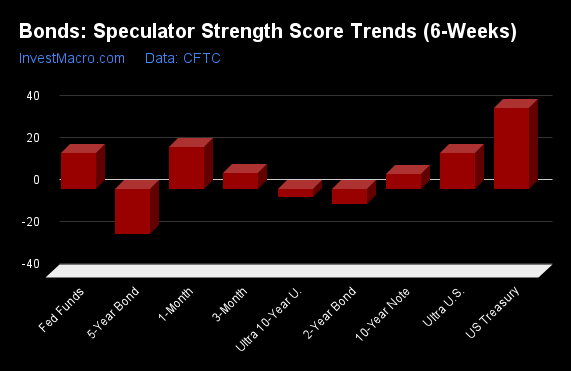
COT Strength Score Trends (or move index, calculates the 6-week changes in strength scores) showed that the Ultra Treasury Bonds (29 percent) and the SOFR 3-Months (19 percent) lead the past six weeks trends for bonds. The 5-Year Bonds (12 percent) and the  the next highest positive movers in the latest trends data.

The US Treasury Bonds (-18 percent), the Ultra 10-Year Bonds (-12 percent) and the 2-Year Bonds (-7 percent) lead the downside trend scores currently.

Strength Trend Statistics:
Fed Funds (9.0 percent) vs Fed Funds previous week (-3.2 percent)
2-Year Bond (-6.8 percent) vs 2-Year Bond previous week (-9.7 percent)
5-Year Bond (12.2 percent) vs 5-Year Bond previous week (16.5 percent)
10-Year Bond (1.4 percent) vs 10-Year Bond previous week (-1.0 percent)
Ultra 10-Year Bond (-12.3 percent) vs Ultra 10-Year Bond previous week (2.7 percent)
US Treasury Bond (-18.2 percent) vs US Treasury Bond previous week (-0.5 percent)
Ultra US Treasury Bond (29.1 percent) vs Ultra US Treasury Bond previous week (21.6 percent)
SOFR 3-Months (18.8 percent) vs SOFR 3-Months previous week (33.2 percent)


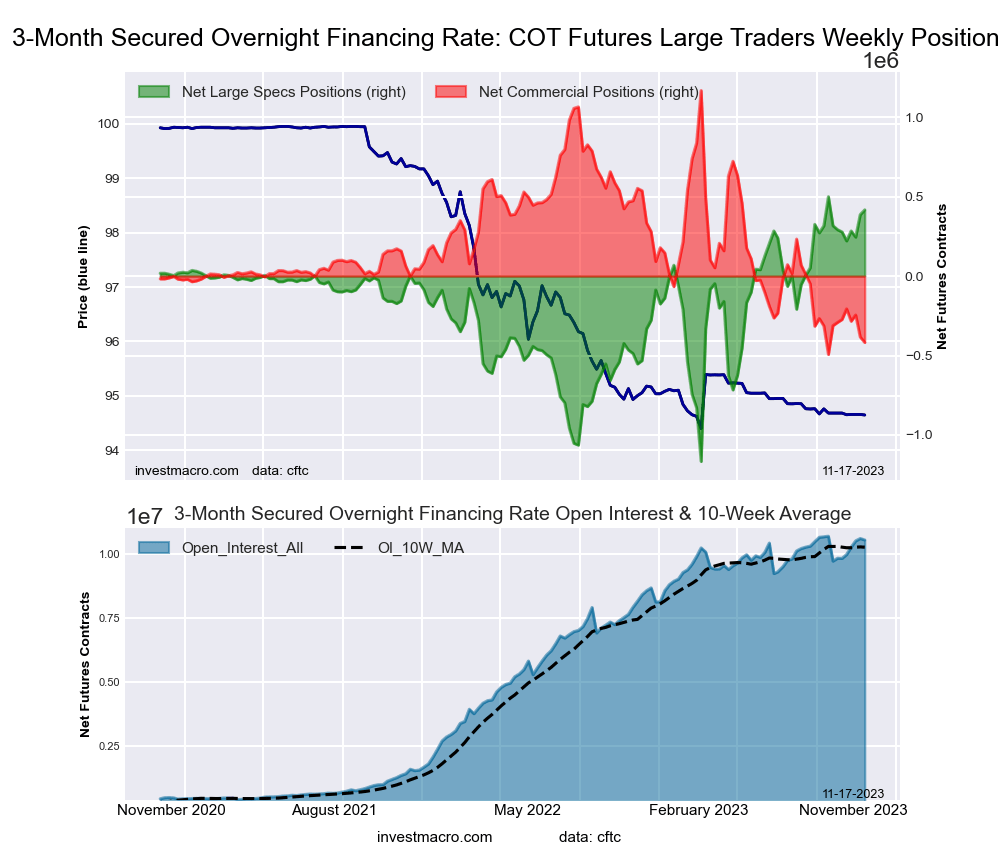
Secured Overnight Financing Rate (3-Month) Futures:

SOFR 3-Months Bonds Futures COT ChartThe Secured Overnight Financing Rate (3-Month) large speculator standing this week resulted in a net position of 317,146 contracts in the data reported through Tuesday. This was a weekly fall of -182,231 contracts from the previous week which had a total of 499,377 net contracts.

This week’s current strength score (the trader positioning range over the past three years, measured from 0 to 100) shows the speculators are currently Bullish-Extreme with a score of 89.1 percent. The commercials are Bearish-Extreme with a score of 10.9 percent and the small traders (not shown in chart) are Bullish-Extreme with a score of 85.0 percent.

Price Trend-Following Model: Weak Uptrend

Our weekly trend-following model classifies the current market price position as: Weak Uptrend. The current action for the model is considered to be: Hold – Maintain Long Position.

SOFR 3-Months StatisticsSPECULATORSCOMMERCIALSSMALL TRADERS
– Percent of Open Interest Longs:20.155.50.3
– Percent of Open Interest Shorts:16.858.80.4
– Net Position:317,146-311,986-5,160
– Gross Longs:1,953,9875,398,26229,392
– Gross Shorts:1,636,8415,710,24834,552
– Long to Short Ratio:1.2 to 10.9 to 10.9 to 1
NET POSITION TREND:
– Strength Index Score (3 Year Range Pct):89.110.985.0
– Strength Index Reading (3 Year Range):Bullish-ExtremeBearish-ExtremeBullish-Extreme
NET POSITION MOVEMENT INDEX:
– 6-Week Change in Strength Index:18.8-19.45.6


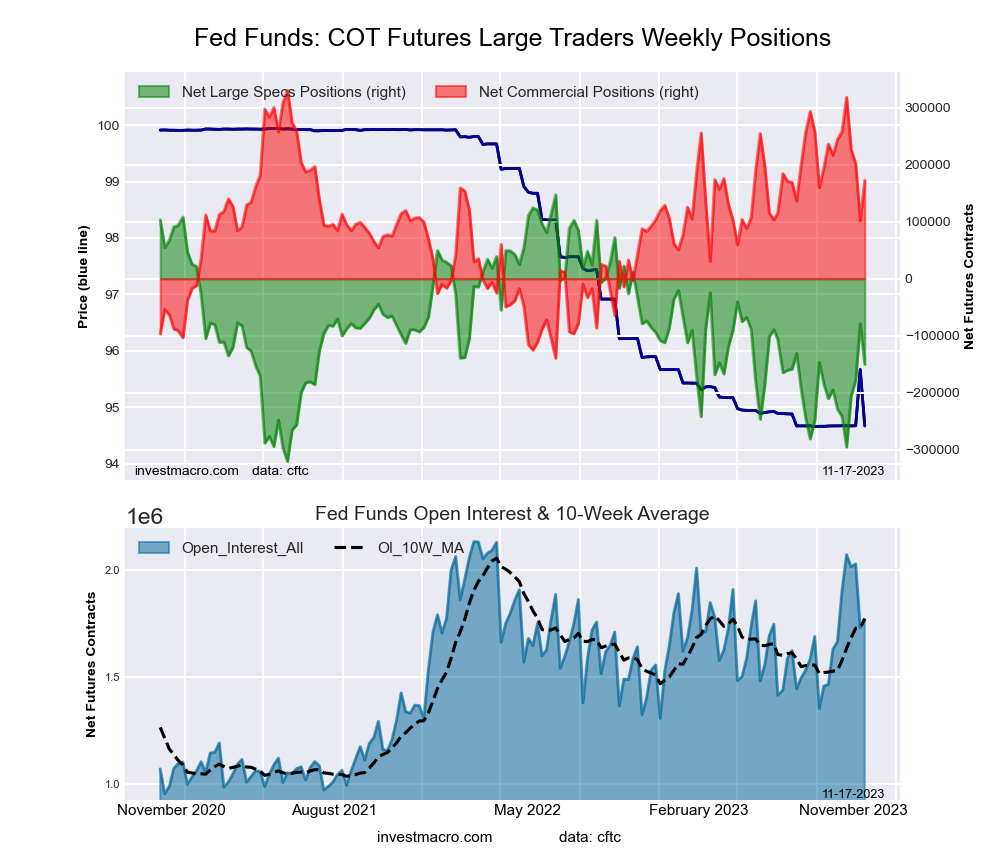
30-Day Federal Funds Futures:

Federal Funds 30-Day Bonds Futures COT ChartThe 30-Day Federal Funds large speculator standing this week resulted in a net position of -195,078 contracts in the data reported through Tuesday. This was a weekly rise of 15,454 contracts from the previous week which had a total of -210,532 net contracts.

This week’s current strength score (the trader positioning range over the past three years, measured from 0 to 100) shows the speculators are currently Bearish with a score of 23.1 percent. The commercials are Bullish with a score of 79.4 percent and the small traders (not shown in chart) are Bearish with a score of 47.9 percent.

Price Trend-Following Model: Downtrend

Our weekly trend-following model classifies the current market price position as: Downtrend. The current action for the model is considered to be: Hold – Maintain Short Position.

30-Day Federal Funds StatisticsSPECULATORSCOMMERCIALSSMALL TRADERS
– Percent of Open Interest Longs:7.175.81.9
– Percent of Open Interest Shorts:19.162.53.2
– Net Position:-195,078217,052-21,974
– Gross Longs:116,3591,236,20130,537
– Gross Shorts:311,4371,019,14952,511
– Long to Short Ratio:0.4 to 11.2 to 10.6 to 1
NET POSITION TREND:
– Strength Index Score (3 Year Range Pct):23.179.447.9
– Strength Index Reading (3 Year Range):BearishBullishBearish
NET POSITION MOVEMENT INDEX:
– 6-Week Change in Strength Index:9.0-7.3-17.3


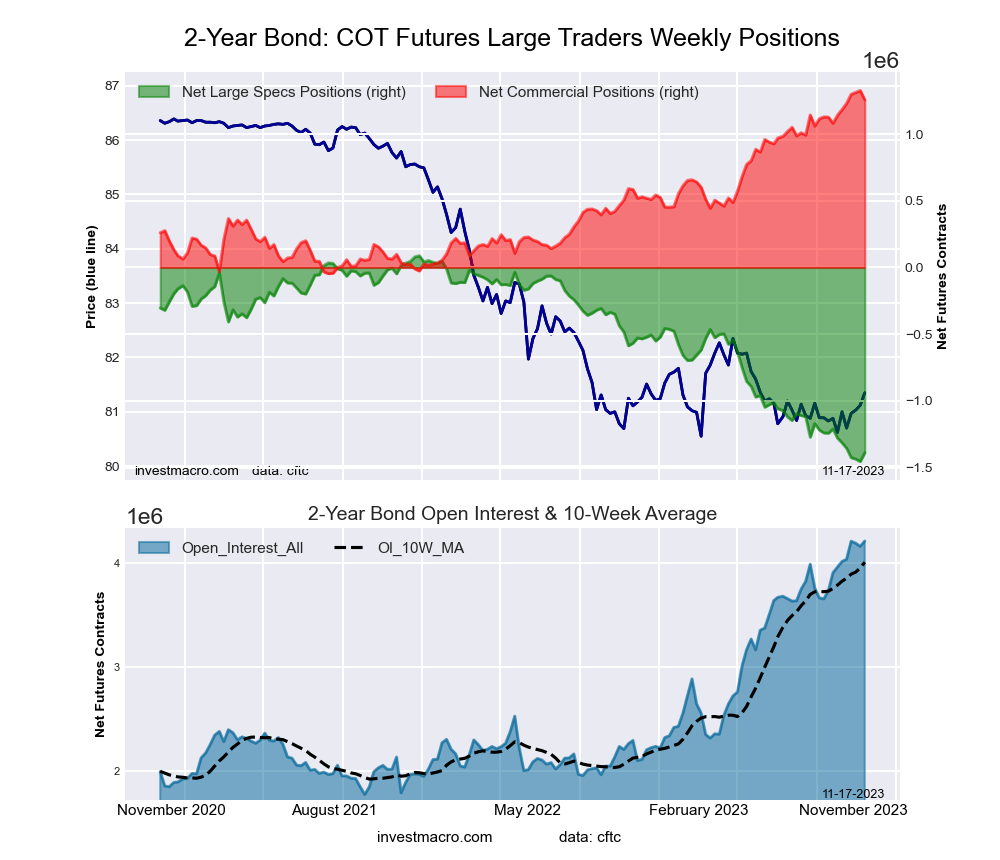
2-Year Treasury Note Futures:

2-Year Treasury Bonds Futures COT ChartThe 2-Year Treasury Note large speculator standing this week resulted in a net position of -1,210,300 contracts in the data reported through Tuesday. This was a weekly advance of 31,163 contracts from the previous week which had a total of -1,241,463 net contracts.

This week’s current strength score (the trader positioning range over the past three years, measured from 0 to 100) shows the speculators are currently Bearish-Extreme with a score of 4.5 percent. The commercials are Bullish-Extreme with a score of 94.7 percent and the small traders (not shown in chart) are Bullish-Extreme with a score of 100.0 percent.

Price Trend-Following Model: Downtrend

Our weekly trend-following model classifies the current market price position as: Downtrend. The current action for the model is considered to be: Hold – Maintain Short Position.

2-Year Treasury Note StatisticsSPECULATORSCOMMERCIALSSMALL TRADERS
– Percent of Open Interest Longs:11.080.16.9
– Percent of Open Interest Shorts:42.052.43.6
– Net Position:-1,210,3001,080,594129,706
– Gross Longs:429,5413,127,095269,088
– Gross Shorts:1,639,8412,046,501139,382
– Long to Short Ratio:0.3 to 11.5 to 11.9 to 1
NET POSITION TREND:
– Strength Index Score (3 Year Range Pct):4.594.7100.0
– Strength Index Reading (3 Year Range):Bearish-ExtremeBullish-ExtremeBullish-Extreme
NET POSITION MOVEMENT INDEX:
– 6-Week Change in Strength Index:-6.87.51.7


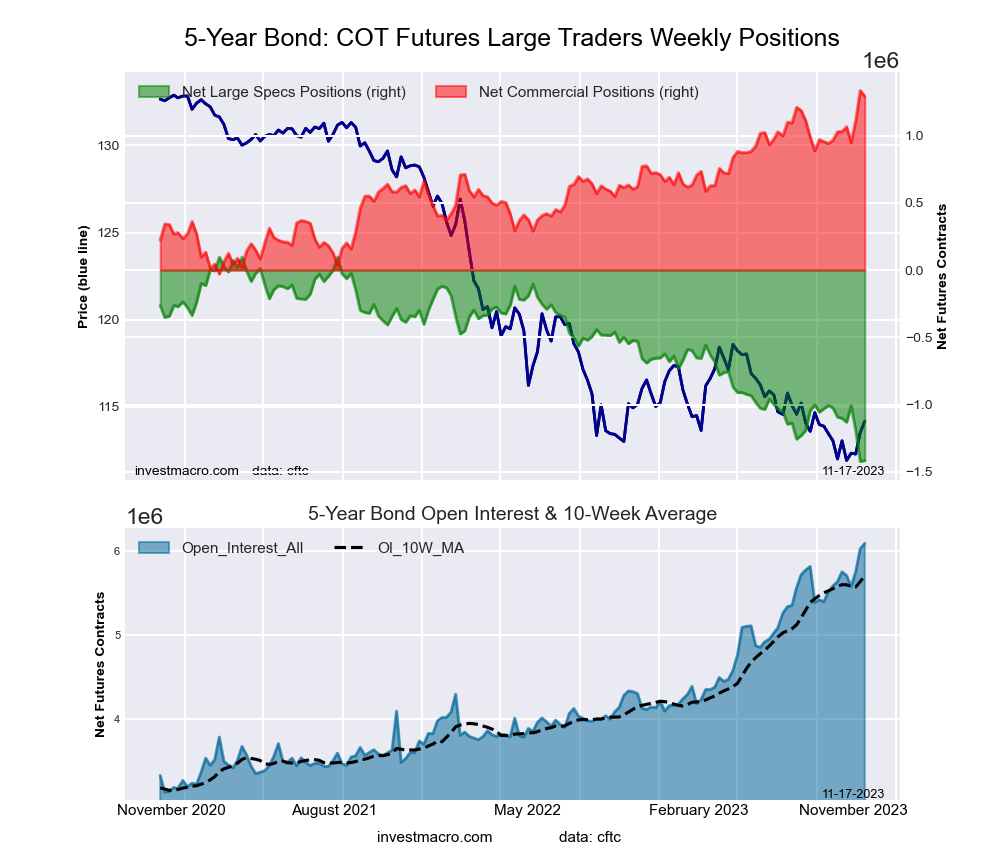
5-Year Treasury Note Futures:

5-Year Treasury Bonds Futures COT ChartThe 5-Year Treasury Note large speculator standing this week resulted in a net position of -1,025,782 contracts in the data reported through Tuesday. This was a weekly fall of -18,836 contracts from the previous week which had a total of -1,006,946 net contracts.

This week’s current strength score (the trader positioning range over the past three years, measured from 0 to 100) shows the speculators are currently Bearish-Extreme with a score of 17.1 percent. The commercials are Bullish-Extreme with a score of 80.2 percent and the small traders (not shown in chart) are Bullish-Extreme with a score of 86.3 percent.

Price Trend-Following Model: Strong Downtrend

Our weekly trend-following model classifies the current market price position as: Strong Downtrend. The current action for the model is considered to be: Hold – Maintain Short Position.

5-Year Treasury Note StatisticsSPECULATORSCOMMERCIALSSMALL TRADERS
– Percent of Open Interest Longs:8.882.67.2
– Percent of Open Interest Shorts:27.265.36.1
– Net Position:-1,025,782964,60561,177
– Gross Longs:492,7414,610,560404,260
– Gross Shorts:1,518,5233,645,955343,083
– Long to Short Ratio:0.3 to 11.3 to 11.2 to 1
NET POSITION TREND:
– Strength Index Score (3 Year Range Pct):17.180.286.3
– Strength Index Reading (3 Year Range):Bearish-ExtremeBullish-ExtremeBullish-Extreme
NET POSITION MOVEMENT INDEX:
– 6-Week Change in Strength Index:12.2-11.8-4.8


10-Year Treasury Note Futures:

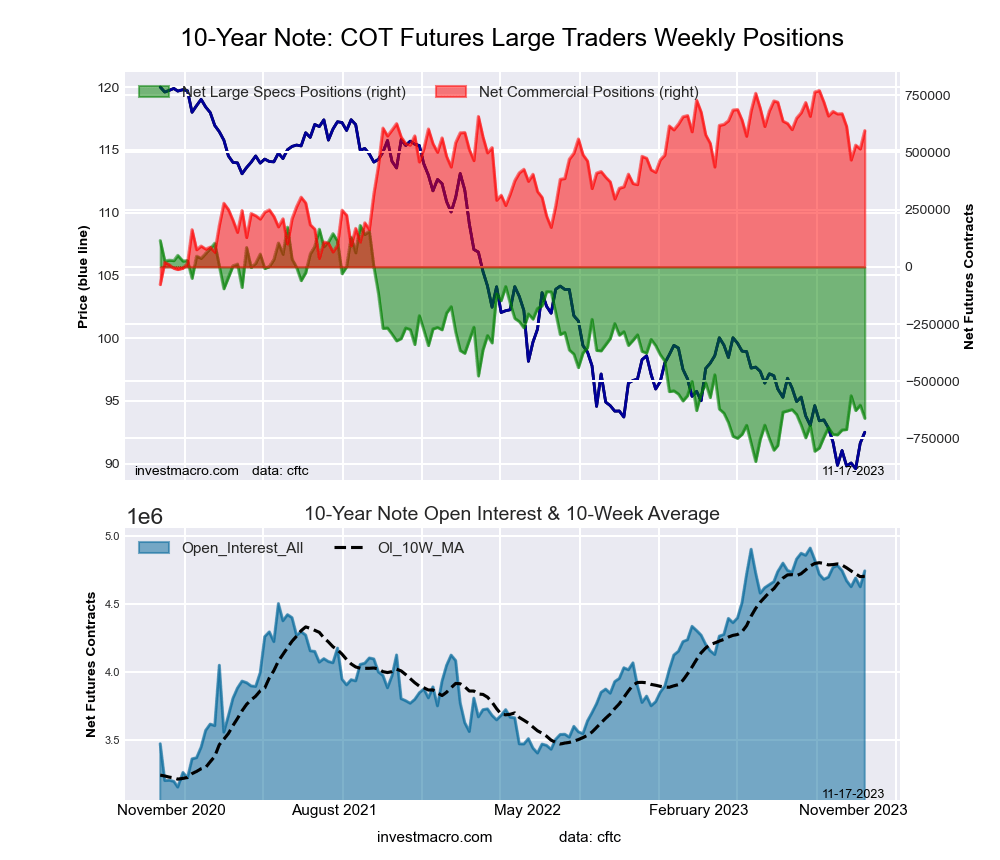
10-Year Treasury Notes Bonds Futures COT ChartThe 10-Year Treasury Note large speculator standing this week resulted in a net position of -731,998 contracts in the data reported through Tuesday. This was a weekly reduction of -29,682 contracts from the previous week which had a total of -702,316 net contracts.

This week’s current strength score (the trader positioning range over the past three years, measured from 0 to 100) shows the speculators are currently Bearish-Extreme with a score of 11.5 percent. The commercials are Bullish-Extreme with a score of 89.6 percent and the small traders (not shown in chart) are Bullish-Extreme with a score of 84.9 percent.

Price Trend-Following Model: Strong Downtrend

Our weekly trend-following model classifies the current market price position as: Strong Downtrend. The current action for the model is considered to be: Hold – Maintain Short Position.

10-Year Treasury Note StatisticsSPECULATORSCOMMERCIALSSMALL TRADERS
– Percent of Open Interest Longs:10.778.19.1
– Percent of Open Interest Shorts:26.063.98.0
– Net Position:-731,998679,64352,355
– Gross Longs:509,5783,724,693434,390
– Gross Shorts:1,241,5763,045,050382,035
– Long to Short Ratio:0.4 to 11.2 to 11.1 to 1
NET POSITION TREND:
– Strength Index Score (3 Year Range Pct):11.589.684.9
– Strength Index Reading (3 Year Range):Bearish-ExtremeBullish-ExtremeBullish-Extreme
NET POSITION MOVEMENT INDEX:
– 6-Week Change in Strength Index:1.4-4.45.2


Ultra 10-Year Notes Futures:

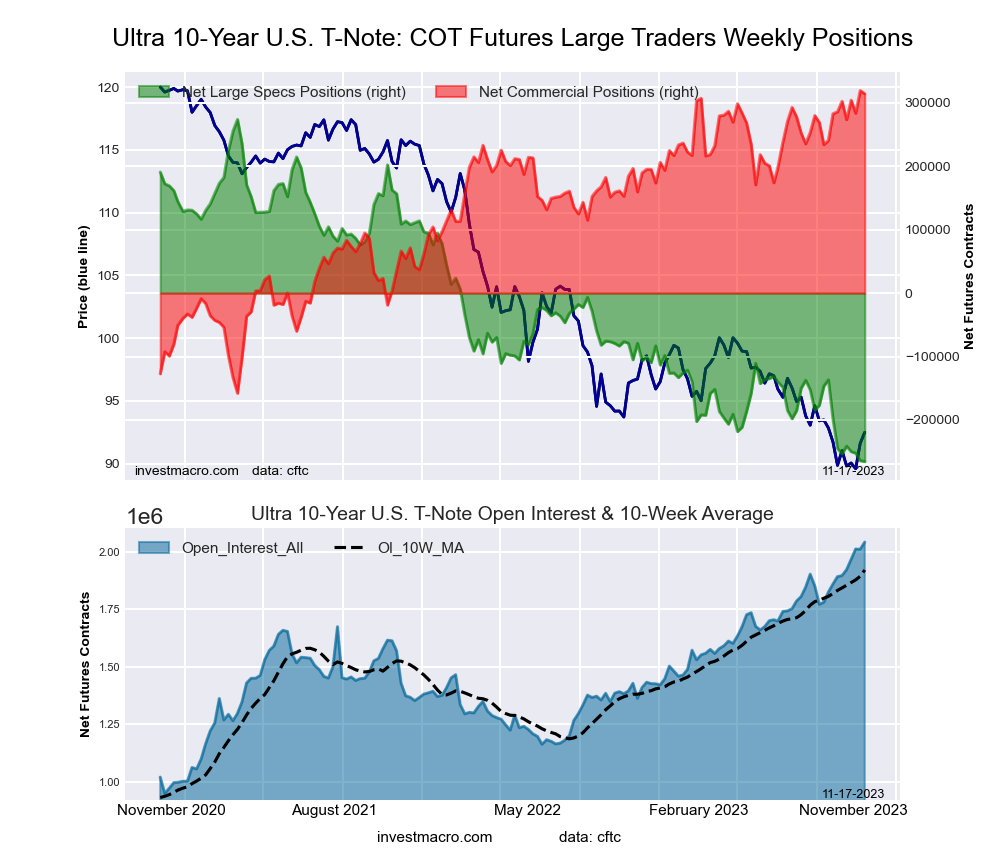
Ultra 10-Year Treasury Notes Bonds Futures COT ChartThe Ultra 10-Year Notes large speculator standing this week resulted in a net position of -198,126 contracts in the data reported through Tuesday. This was a weekly fall of -61,389 contracts from the previous week which had a total of -136,737 net contracts.

This week’s current strength score (the trader positioning range over the past three years, measured from 0 to 100) shows the speculators are currently Bearish-Extreme with a score of 4.1 percent. The commercials are Bullish-Extreme with a score of 94.8 percent and the small traders (not shown in chart) are Bullish with a score of 63.8 percent.

Price Trend-Following Model: Weak Uptrend

Our weekly trend-following model classifies the current market price position as: Weak Uptrend. The current action for the model is considered to be: Hold – Maintain Long Position.

Ultra 10-Year Notes StatisticsSPECULATORSCOMMERCIALSSMALL TRADERS
– Percent of Open Interest Longs:9.677.510.7
– Percent of Open Interest Shorts:20.362.315.2
– Net Position:-198,126282,654-84,528
– Gross Longs:179,4081,441,650198,446
– Gross Shorts:377,5341,158,996282,974
– Long to Short Ratio:0.5 to 11.2 to 10.7 to 1
NET POSITION TREND:
– Strength Index Score (3 Year Range Pct):4.194.863.8
– Strength Index Reading (3 Year Range):Bearish-ExtremeBullish-ExtremeBullish
NET POSITION MOVEMENT INDEX:
– 6-Week Change in Strength Index:-12.310.27.9


US Treasury Bonds Futures:

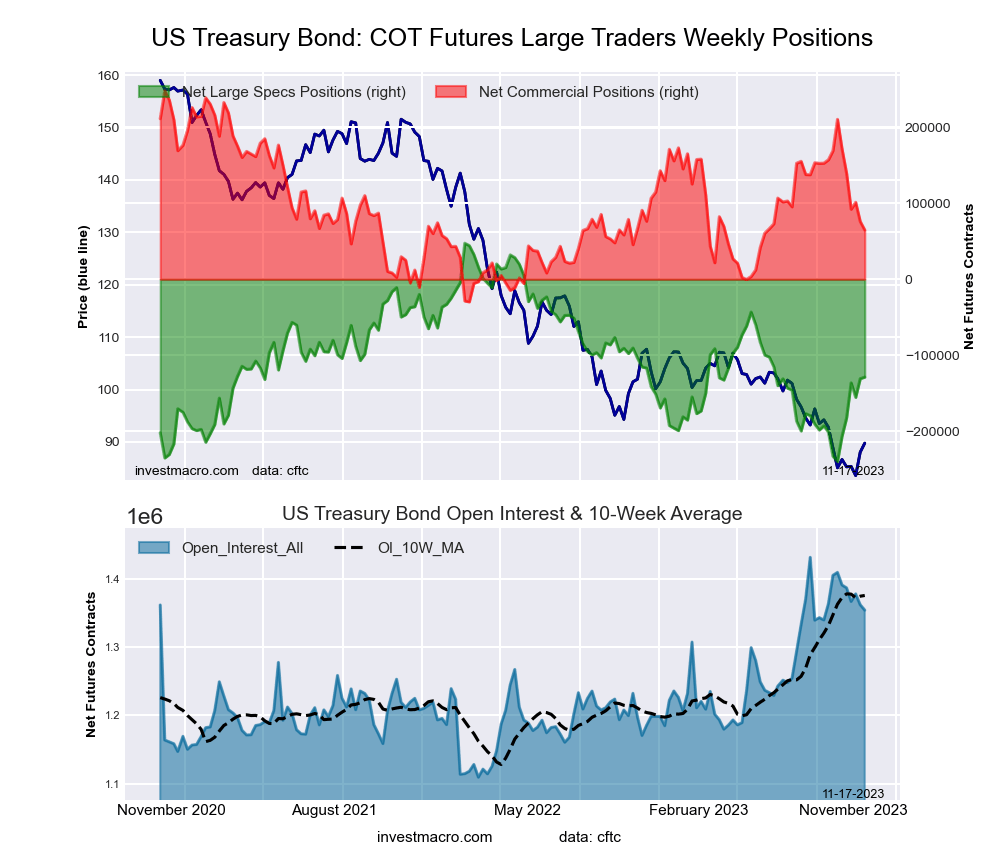
US Year Treasury Notes Long Bonds Futures COT ChartThe US Treasury Bonds large speculator standing this week resulted in a net position of -232,811 contracts in the data reported through Tuesday. This was a weekly fall of -31,704 contracts from the previous week which had a total of -201,107 net contracts.

This week’s current strength score (the trader positioning range over the past three years, measured from 0 to 100) shows the speculators are currently Bearish-Extreme with a score of 8.8 percent. The commercials are Bullish with a score of 70.9 percent and the small traders (not shown in chart) are Bullish-Extreme with a score of 94.9 percent.

Price Trend-Following Model: Strong Downtrend

Our weekly trend-following model classifies the current market price position as: Strong Downtrend. The current action for the model is considered to be: Hold – Maintain Short Position.

US Treasury Bonds StatisticsSPECULATORSCOMMERCIALSSMALL TRADERS
– Percent of Open Interest Longs:5.379.214.6
– Percent of Open Interest Shorts:21.867.210.0
– Net Position:-232,811169,01863,793
– Gross Longs:74,1341,113,332204,449
– Gross Shorts:306,945944,314140,656
– Long to Short Ratio:0.2 to 11.2 to 11.5 to 1
NET POSITION TREND:
– Strength Index Score (3 Year Range Pct):8.870.994.9
– Strength Index Reading (3 Year Range):Bearish-ExtremeBullishBullish-Extreme
NET POSITION MOVEMENT INDEX:
– 6-Week Change in Strength Index:-18.211.218.1


Ultra US Treasury Bonds Futures:

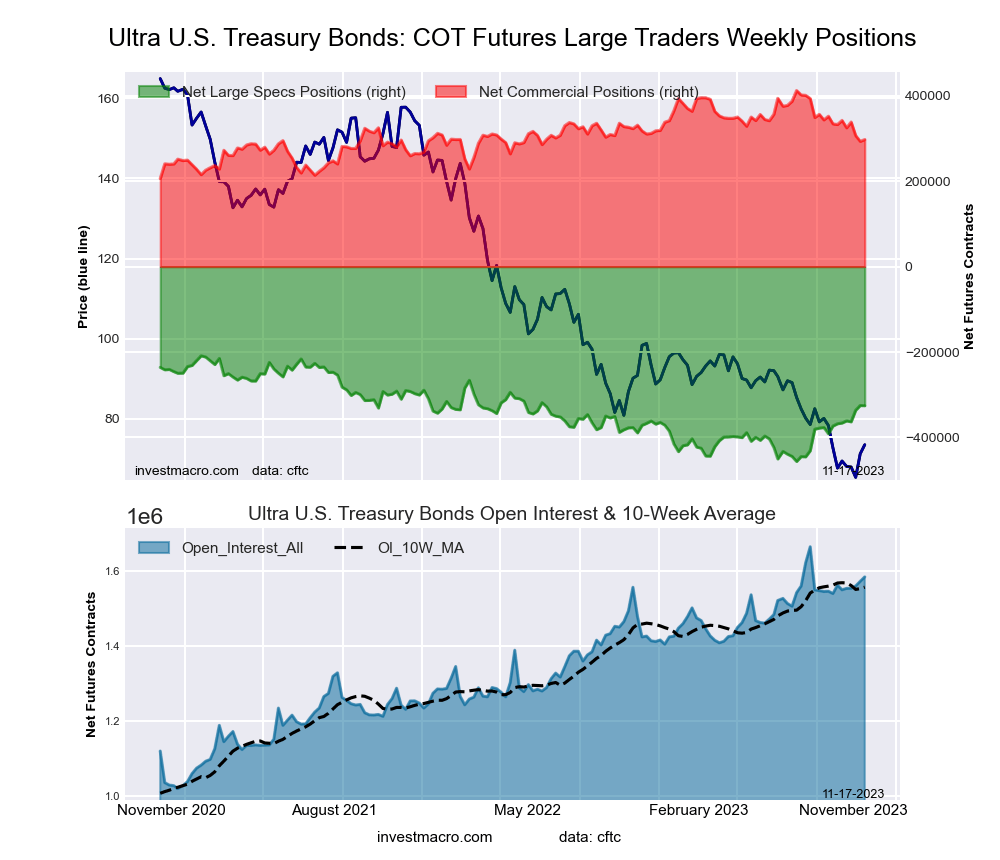
Ultra US Year Treasury Notes Long Bonds Futures COT ChartThe Ultra US Treasury Bonds large speculator standing this week resulted in a net position of -373,447 contracts in the data reported through Tuesday. This was a weekly rise of 18,129 contracts from the previous week which had a total of -391,576 net contracts.

This week’s current strength score (the trader positioning range over the past three years, measured from 0 to 100) shows the speculators are currently Bearish with a score of 33.5 percent. The commercials are Bullish with a score of 62.1 percent and the small traders (not shown in chart) are Bullish with a score of 74.0 percent.

Price Trend-Following Model: Strong Downtrend

Our weekly trend-following model classifies the current market price position as: Strong Downtrend. The current action for the model is considered to be: Hold – Maintain Short Position.

Ultra US Treasury Bonds StatisticsSPECULATORSCOMMERCIALSSMALL TRADERS
– Percent of Open Interest Longs:5.781.612.2
– Percent of Open Interest Shorts:30.059.89.7
– Net Position:-373,447334,47938,968
– Gross Longs:87,9441,256,355187,791
– Gross Shorts:461,391921,876148,823
– Long to Short Ratio:0.2 to 11.4 to 11.3 to 1
NET POSITION TREND:
– Strength Index Score (3 Year Range Pct):33.562.174.0
– Strength Index Reading (3 Year Range):BearishBullishBullish
NET POSITION MOVEMENT INDEX:
– 6-Week Change in Strength Index:29.1-32.4-5.0


Article By InvestMacroReceive our weekly COT Newsletter

See our Weekly Trend Model Readings and Actions for each COT Futures Market and Category. All information contained in this data are for general informational purposes only and do not constitute investment advice.

*COT Report: The COT data, released weekly to the public each Friday, is updated through the most recent Tuesday (data is 3 days old) and shows a quick view of how large speculators or non-commercials (for-profit traders) were positioned in the futures markets.

The CFTC categorizes trader positions according to commercial hedgers (traders who use futures contracts for hedging as part of the business), non-commercials (large traders who speculate to realize trading profits) and nonreportable traders (usually small traders/speculators) as well as their open interest (contracts open in the market at time of reporting). See CFTC criteria here.
COT Stock Market Charts: Speculator Bets led by S&P500-Mini & MSCI EAFE-Mini

By InvestMacro

Here are the latest charts and statistics for the Commitment of Traders (COT) data published by the Commodities Futures Trading Commission (CFTC).

The latest COT data is updated through Tuesday September 26th and shows a quick view of how large traders (for-profit speculators and commercial entities) were positioned in the futures markets.

Weekly Speculator Changes led by S&P500-Mini & MSCI EAFE-Mini

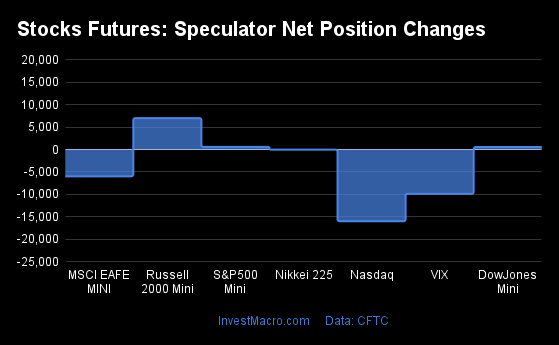
The COT stock markets speculator bets were lower this week as three out of the seven stock markets we cover had higher positioning while the other four markets had lower speculator contracts.

Leading the gains for the stock markets was the S&P500-Mini (49,710 contracts) with the MSCI EAFE-Mini (4,923 contracts) and the Russell-Mini (1,959 contracts) also showing positive weeks.

The markets with the declines in speculator bets this week were the VIX (-24,019 contracts) with the DowJones-Mini (-3,849 contracts), the Nasdaq-Mini (-2,348 contracts) and the Nikkei 225 (-196 contracts) also registering lower bets on the week.


Data Snapshot of Stock Market Traders | Columns Legend
Sep-26-2023OIOI-IndexSpec-NetSpec-IndexCom-NetCOM-IndexSmalls-NetSmalls-Index
S&P500-Mini2,137,64815-89,2815165,6224923,65947
Nikkei 22515,48315-61062-1,200291,81051
Nasdaq-Mini241,0182984666-9923614666
DowJones-Mini92,55151-21,6181319,472732,14654
VIX384,93064-52,8358058,63119-5,79666
Nikkei 225 Yen53,6904210,779677,03230-17,81149


Strength Scores led by VIX & Nasdaq-Mini

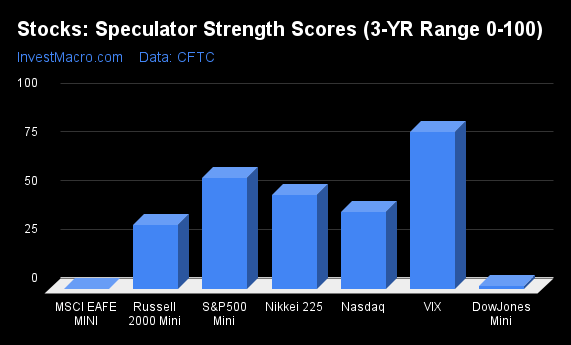
COT Strength Scores (a normalized measure of Speculator positions over a 3-Year range, from 0 to 100 where above 80 is Extreme-Bullish and below 20 is Extreme-Bearish) showed that the VIX (80 percent) currently leads the stock markets this week and is in Extreme-Bullish territory (above 80 percent). The Nasdaq-Mini (66 percent) and Nikkei 225 (62 percent) come in as the next highest in the weekly strength scores.

On the downside, the DowJones-Mini (13 percent) comes in at the lowest strength level currently and is in Extreme-Bearish territory (below 20 percent). The next lowest strength score is the MSCI EAFE-Mini (32 percent).

Strength Statistics:
VIX (80.4 percent) vs VIX previous week (97.9 percent)
S&P500-Mini (51.4 percent) vs S&P500-Mini previous week (44.0 percent)
DowJones-Mini (12.7 percent) vs DowJones-Mini previous week (23.6 percent)
Nasdaq-Mini (66.2 percent) vs Nasdaq-Mini previous week (68.2 percent)
Russell2000-Mini (35.0 percent) vs Russell2000-Mini previous week (33.8 percent)
Nikkei USD (62.4 percent) vs Nikkei USD previous week (63.8 percent)
EAFE-Mini (31.7 percent) vs EAFE-Mini previous week (27.0 percent)


Russell-Mini tops the 6-Week Strength Trends

COT Strength Score Trends (or move index, calculates the 6-week changes in strength scores) showed that the Russell-Mini (6 percent) leads the past six weeks trends for the stock markets. The S&P500-Mini (4 percent) and the Nikkei 225 (1 percent) are the next highest positive movers in the latest trends data.

The DowJones-Mini (-52 percent) leads the downside trend scores currently with the VIX (-20 percent) coming in as the next market with lower trend scores.

Strength Trend Statistics:
VIX (-19.6 percent) vs VIX previous week (11.4 percent)
S&P500-Mini (4.3 percent) vs S&P500-Mini previous week (3.1 percent)
DowJones-Mini (-52.1 percent) vs DowJones-Mini previous week (-61.7 percent)
Nasdaq-Mini (-3.8 percent) vs Nasdaq-Mini previous week (12.3 percent)
Russell2000-Mini (5.8 percent) vs Russell2000-Mini previous week (0.6 percent)
Nikkei USD (0.6 percent) vs Nikkei USD previous week (1.8 percent)
EAFE-Mini (-1.8 percent) vs EAFE-Mini previous week (-7.1 percent)


Individual Stock Market Charts:

VIX Volatility Futures:

VIX Volatility Futures COT ChartThe VIX Volatility large speculator standing this week reached a net position of -52,835 contracts in the data reported through Tuesday. This was a weekly lowering of -24,019 contracts from the previous week which had a total of -28,816 net contracts.

This week’s current strength score (the trader positioning range over the past three years, measured from 0 to 100) shows the speculators are currently Bullish-Extreme with a score of 80.4 percent. The commercials are Bearish-Extreme with a score of 19.3 percent and the small traders (not shown in chart) are Bullish with a score of 66.4 percent.

Price Trend-Following Model: Strong Uptrend

Our weekly trend-following model classifies the current market price position as: Strong Uptrend. The current action for the model is considered to be: New Buy – Long Position.

VIX Volatility Futures StatisticsSPECULATORSCOMMERCIALSSMALL TRADERS
– Percent of Open Interest Longs:22.447.26.4
– Percent of Open Interest Shorts:36.232.07.9
– Net Position:-52,83558,631-5,796
– Gross Longs:86,408181,65124,727
– Gross Shorts:139,243123,02030,523
– Long to Short Ratio:0.6 to 11.5 to 10.8 to 1
NET POSITION TREND:
– Strength Index Score (3 Year Range Pct):80.419.366.4
– Strength Index Reading (3 Year Range):Bullish-ExtremeBearish-ExtremeBullish
NET POSITION MOVEMENT INDEX:
– 6-Week Change in Strength Index:-19.619.2-0.9


S&P500 Mini Futures:

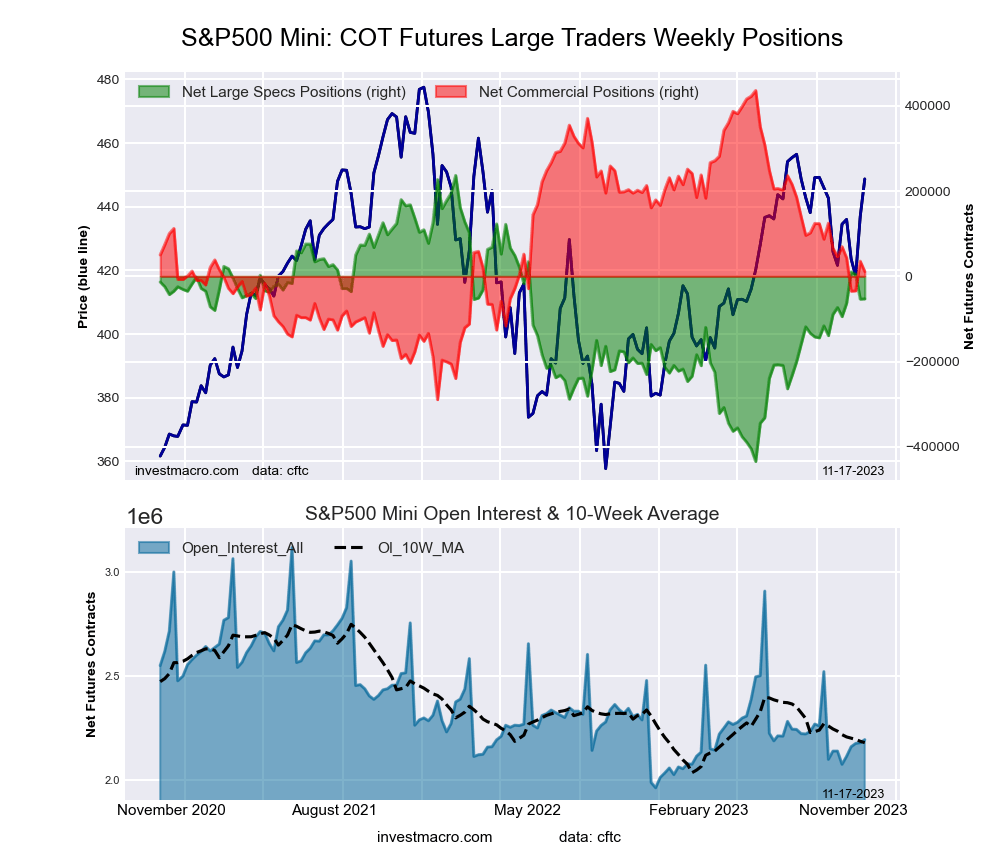
SP500 Mini Futures COT ChartThe S&P500 Mini large speculator standing this week reached a net position of -89,281 contracts in the data reported through Tuesday. This was a weekly lift of 49,710 contracts from the previous week which had a total of -138,991 net contracts.

This week’s current strength score (the trader positioning range over the past three years, measured from 0 to 100) shows the speculators are currently Bullish with a score of 51.4 percent. The commercials are Bearish with a score of 49.0 percent and the small traders (not shown in chart) are Bearish with a score of 46.6 percent.

Price Trend-Following Model: Weak Uptrend

Our weekly trend-following model classifies the current market price position as: Weak Uptrend. The current action for the model is considered to be: Hold – Maintain Long Position.

S&P500 Mini Futures StatisticsSPECULATORSCOMMERCIALSSMALL TRADERS
– Percent of Open Interest Longs:12.473.011.8
– Percent of Open Interest Shorts:16.669.910.7
– Net Position:-89,28165,62223,659
– Gross Longs:266,0951,560,014251,580
– Gross Shorts:355,3761,494,392227,921
– Long to Short Ratio:0.7 to 11.0 to 11.1 to 1
NET POSITION TREND:
– Strength Index Score (3 Year Range Pct):51.449.046.6
– Strength Index Reading (3 Year Range):BullishBearishBearish
NET POSITION MOVEMENT INDEX:
– 6-Week Change in Strength Index:4.3-4.20.6


Dow Jones Mini Futures:

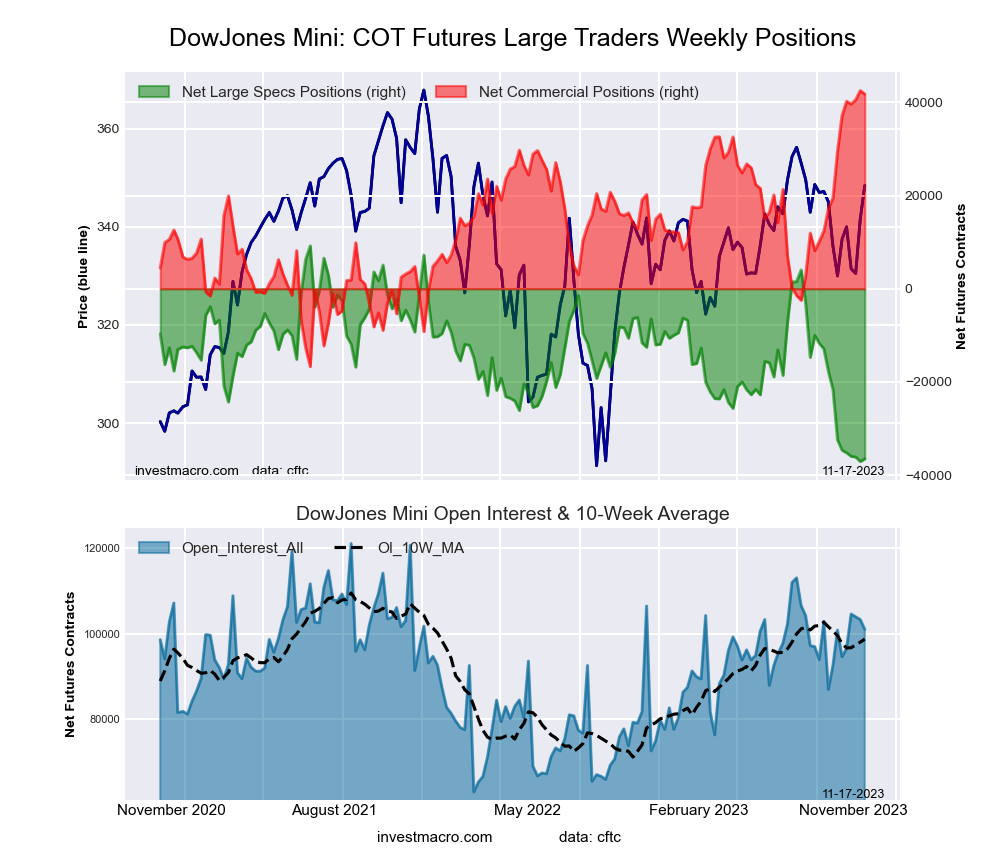
Dow Jones Mini Futures COT ChartThe Dow Jones Mini large speculator standing this week reached a net position of -21,618 contracts in the data reported through Tuesday. This was a weekly lowering of -3,849 contracts from the previous week which had a total of -17,769 net contracts.

This week’s current strength score (the trader positioning range over the past three years, measured from 0 to 100) shows the speculators are currently Bearish-Extreme with a score of 12.7 percent. The commercials are Bullish with a score of 73.3 percent and the small traders (not shown in chart) are Bullish with a score of 54.4 percent.

Price Trend-Following Model: Weak Uptrend

Our weekly trend-following model classifies the current market price position as: Weak Uptrend. The current action for the model is considered to be: Hold – Maintain Long Position.

Dow Jones Mini Futures StatisticsSPECULATORSCOMMERCIALSSMALL TRADERS
– Percent of Open Interest Longs:19.762.315.7
– Percent of Open Interest Shorts:43.141.313.4
– Net Position:-21,61819,4722,146
– Gross Longs:18,23757,68114,570
– Gross Shorts:39,85538,20912,424
– Long to Short Ratio:0.5 to 11.5 to 11.2 to 1
NET POSITION TREND:
– Strength Index Score (3 Year Range Pct):12.773.354.4
– Strength Index Reading (3 Year Range):Bearish-ExtremeBullishBullish
NET POSITION MOVEMENT INDEX:
– 6-Week Change in Strength Index:-52.133.78.8


Nasdaq Mini Futures:

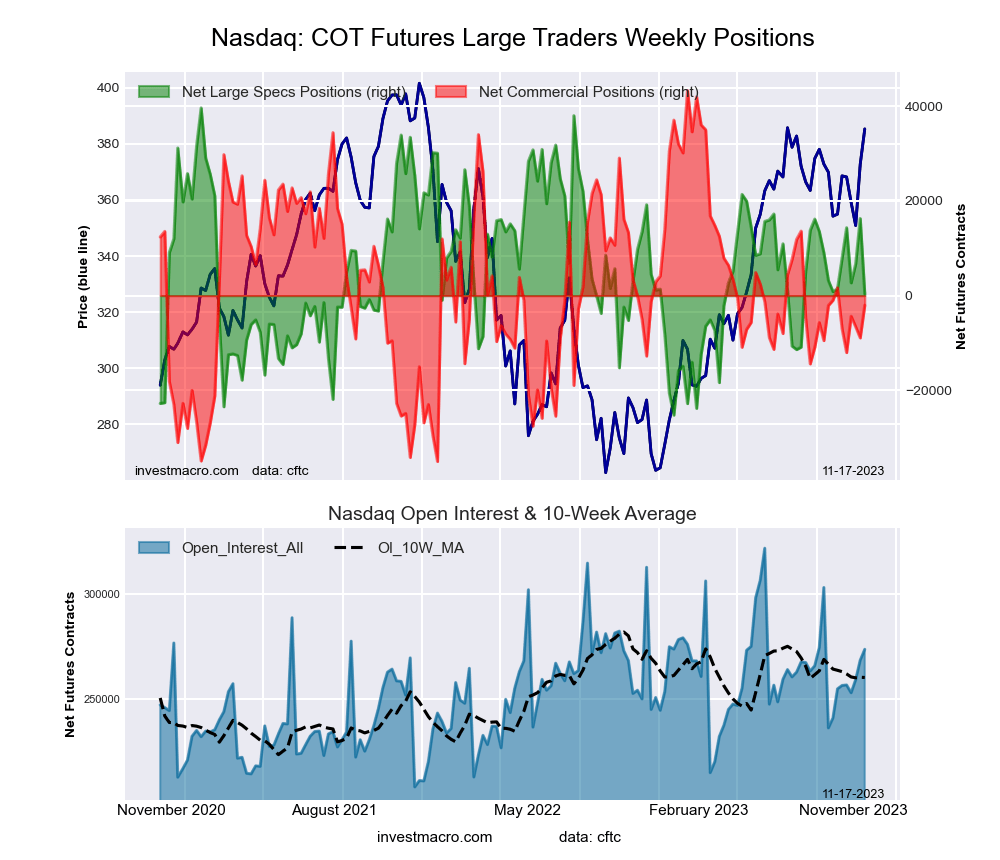
Nasdaq Mini Futures COT ChartThe Nasdaq Mini large speculator standing this week reached a net position of 846 contracts in the data reported through Tuesday. This was a weekly decline of -2,348 contracts from the previous week which had a total of 3,194 net contracts.

This week’s current strength score (the trader positioning range over the past three years, measured from 0 to 100) shows the speculators are currently Bullish with a score of 66.2 percent. The commercials are Bearish with a score of 35.8 percent and the small traders (not shown in chart) are Bullish with a score of 66.0 percent.

Price Trend-Following Model: Weak Uptrend

Our weekly trend-following model classifies the current market price position as: Weak Uptrend. The current action for the model is considered to be: Hold – Maintain Long Position.

Nasdaq Mini Futures StatisticsSPECULATORSCOMMERCIALSSMALL TRADERS
– Percent of Open Interest Longs:24.258.216.6
– Percent of Open Interest Shorts:23.858.616.5
– Net Position:846-992146
– Gross Longs:58,307140,15639,946
– Gross Shorts:57,461141,14839,800
– Long to Short Ratio:1.0 to 11.0 to 11.0 to 1
NET POSITION TREND:
– Strength Index Score (3 Year Range Pct):66.235.866.0
– Strength Index Reading (3 Year Range):BullishBearishBullish
NET POSITION MOVEMENT INDEX:
– 6-Week Change in Strength Index:-3.83.91.4


Russell 2000 Mini Futures:

Russell 2000 Mini Futures COT ChartThe Russell 2000 Mini large speculator standing this week reached a net position of -61,602 contracts in the data reported through Tuesday. This was a weekly rise of 1,959 contracts from the previous week which had a total of -63,561 net contracts.

This week’s current strength score (the trader positioning range over the past three years, measured from 0 to 100) shows the speculators are currently Bearish with a score of 35.0 percent. The commercials are Bullish with a score of 63.8 percent and the small traders (not shown in chart) are Bearish with a score of 33.8 percent.

Price Trend-Following Model: Weak Uptrend

Our weekly trend-following model classifies the current market price position as: Weak Uptrend. The current action for the model is considered to be: Hold – Maintain Long Position.

Russell 2000 Mini Futures StatisticsSPECULATORSCOMMERCIALSSMALL TRADERS
– Percent of Open Interest Longs:7.785.25.4
– Percent of Open Interest Shorts:21.072.44.9
– Net Position:-61,60259,2762,326
– Gross Longs:35,566393,90724,965
– Gross Shorts:97,168334,63122,639
– Long to Short Ratio:0.4 to 11.2 to 11.1 to 1
NET POSITION TREND:
– Strength Index Score (3 Year Range Pct):35.063.833.8
– Strength Index Reading (3 Year Range):BearishBullishBearish
NET POSITION MOVEMENT INDEX:
– 6-Week Change in Strength Index:5.8-4.8-3.5


Nikkei Stock Average (USD) Futures:

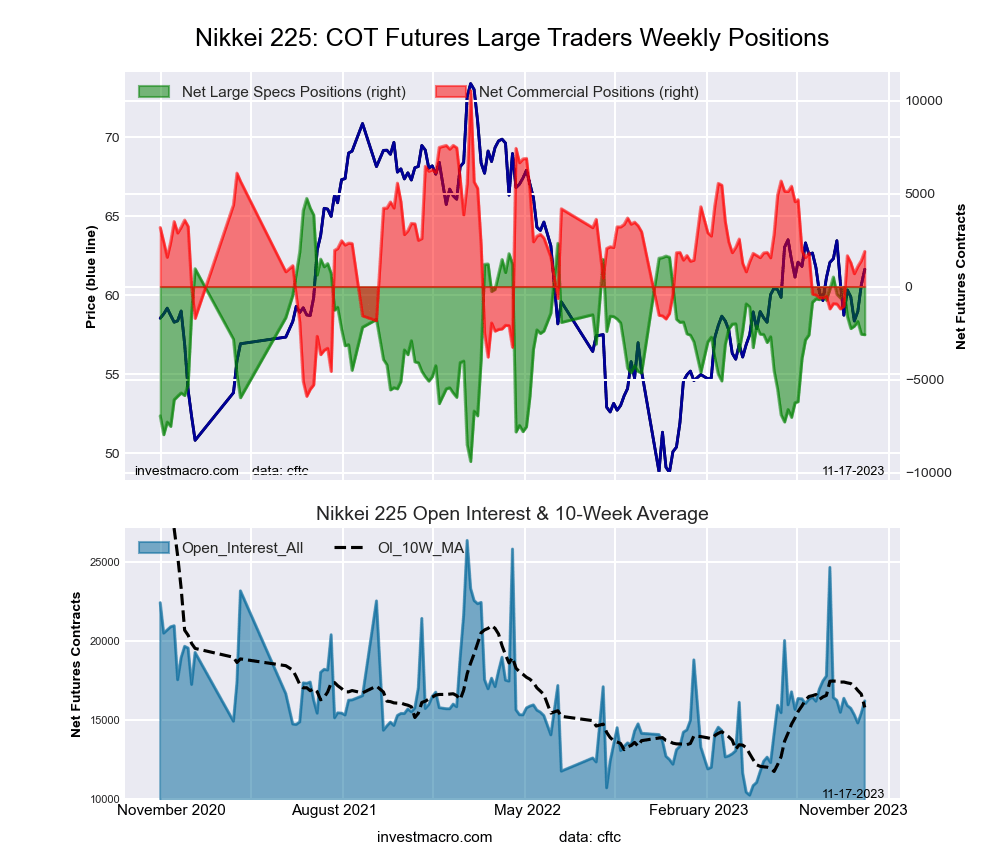
Nikkei Stock Average (USD) Futures COT ChartThe Nikkei Stock Average (USD) large speculator standing this week reached a net position of -610 contracts in the data reported through Tuesday. This was a weekly reduction of -196 contracts from the previous week which had a total of -414 net contracts.

This week’s current strength score (the trader positioning range over the past three years, measured from 0 to 100) shows the speculators are currently Bullish with a score of 62.4 percent. The commercials are Bearish with a score of 28.6 percent and the small traders (not shown in chart) are Bullish with a score of 51.1 percent.

Price Trend-Following Model: Weak Uptrend

Our weekly trend-following model classifies the current market price position as: Weak Uptrend. The current action for the model is considered to be: Hold – Maintain Long Position.

Nikkei Stock Average Futures StatisticsSPECULATORSCOMMERCIALSSMALL TRADERS
– Percent of Open Interest Longs:8.667.124.4
– Percent of Open Interest Shorts:12.574.812.7
– Net Position:-610-1,2001,810
– Gross Longs:1,32510,3853,773
– Gross Shorts:1,93511,5851,963
– Long to Short Ratio:0.7 to 10.9 to 11.9 to 1
NET POSITION TREND:
– Strength Index Score (3 Year Range Pct):62.428.651.1
– Strength Index Reading (3 Year Range):BullishBearishBullish
NET POSITION MOVEMENT INDEX:
– 6-Week Change in Strength Index:0.6-3.76.5


MSCI EAFE Mini Futures:

MSCI EAFE Mini Futures COT ChartThe MSCI EAFE Mini large speculator standing this week reached a net position of -25,328 contracts in the data reported through Tuesday. This was a weekly gain of 4,923 contracts from the previous week which had a total of -30,251 net contracts.

This week’s current strength score (the trader positioning range over the past three years, measured from 0 to 100) shows the speculators are currently Bearish with a score of 31.7 percent. The commercials are Bullish with a score of 69.6 percent and the small traders (not shown in chart) are Bearish with a score of 29.5 percent.

Price Trend-Following Model: Strong Downtrend

Our weekly trend-following model classifies the current market price position as: Strong Downtrend. The current action for the model is considered to be: Hold – Maintain Short Position.

MSCI EAFE Mini Futures StatisticsSPECULATORSCOMMERCIALSSMALL TRADERS
– Percent of Open Interest Longs:7.589.42.2
– Percent of Open Interest Shorts:14.183.51.6
– Net Position:-25,32822,8342,494
– Gross Longs:29,019344,9098,675
– Gross Shorts:54,347322,0756,181
– Long to Short Ratio:0.5 to 11.1 to 11.4 to 1
NET POSITION TREND:
– Strength Index Score (3 Year Range Pct):31.769.629.5
– Strength Index Reading (3 Year Range):BearishBullishBearish
NET POSITION MOVEMENT INDEX:
– 6-Week Change in Strength Index:-1.85.8-20.7


Article By InvestMacroReceive our weekly COT Newsletter

See our Weekly Trend Model Readings and Actions for each COT Futures Market and Category. All information contained in this data are for general informational purposes only and do not constitute investment advice.

*COT Report: The COT data, released weekly to the public each Friday, is updated through the most recent Tuesday (data is 3 days old) and shows a quick view of how large speculators or non-commercials (for-profit traders) were positioned in the futures markets.

The CFTC categorizes trader positions according to commercial hedgers (traders who use futures contracts for hedging as part of the business), non-commercials (large traders who speculate to realize trading profits) and nonreportable traders (usually small traders/speculators) as well as their open interest (contracts open in the market at time of reporting). See CFTC criteria here.

Clean Beef Firm Sees Gold in Waste Streams

Source: Streetwise Reports  (9/27/23)

Consumers love beef, but producing this delicious meat at scale can be an environmental nightmare. However, freshly-proven technology from Bion Environmental Technologies Inc. promises to make beef “green” again. Read below to see why one technical analyst likes this company’s stock.

Despite the company being publicly traded for almost 30 years, you may not be familiar with Bion Environmental Technologies Inc. (BNET:OTCQB). The firm is a niche agricultural tech company with a focus on developing sustainable solutions for environmental issues in livestock agriculture.

Bion has focused on developing patented technology that provides advanced waste treatment and resource recovery for large-scale livestock production facilities (also known as Concentrated Animal Feeding Operations or CAFOs), which, as many environmentalists can tell you, are some of the more polluting elements of modern large-scale agricultural production.

Bion Environmental Technologies’ third-generation tech platform (Gen3 Tech) can mitigate environmental problems, while simultaneously improving operational and resource efficiencies by recovering high-value co-products from CAFOs’ waste streams.

The tech is designed to capture and stabilize the various components of the effluent, converting them from liabilities into assets, including renewable energy, fertilizer products, and clean water, all key aspects of raising verifiably sustainable livestock.

The company is also focused on developing markets and distribution partners for its sustainable animal protein products and the low-carbon and organic fertilizer products it captures and upcycles from the waste stream.

The Catalyst: Controlled Steady State Ammonia Recovery at Scale

On September 19, Bion Environmental Technologies announced that its proof-of-concept ammonia recovery system at its Fair Oaks commercial scale demonstration facility had achieved and maintained controlled steady-state operations.

The release stated, “When at steady state, the system produces an ammonium distillate (solution), the base of Bion’s nitrogen fertilizer products. Bion has begun optimizing the system’s operating parameters so that it will meet Bion’s economic models for large-scale commercial projects.”

The release anticipates at least four to eight weeks for optimization, after which time the final design for commercial projects can begin.

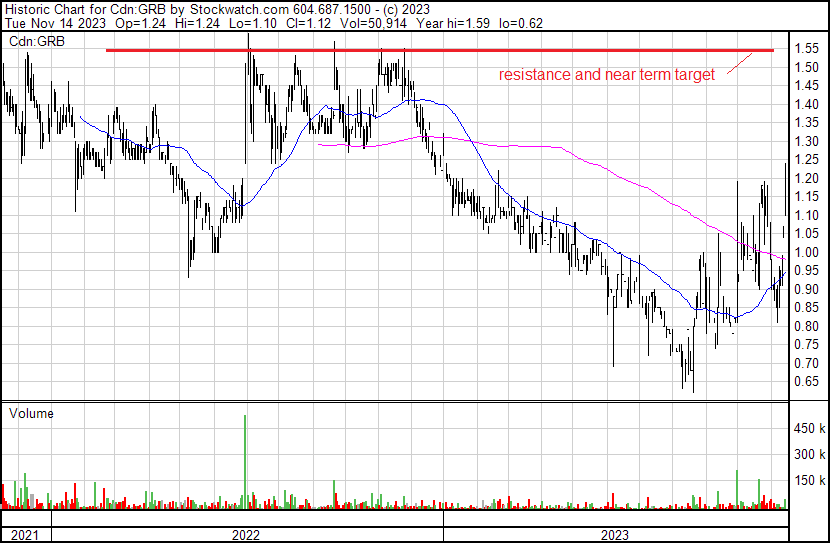
Technical Analyst Clive Maund addressed the stock on August 24, 2023, writing, “This looks like a good point to buy Bion Environmental Tech which, after being in a downtrend for much of this year, hit bottom in mid-July when it briefly touched $0.90 as we can see on its latest 3-month chart.”

The Ammonia Recovery System (ARS) at the core of the Gen3 Tech platform recovers, stabilizes, and upcycles the problematic ammonia-nitrogen in the waste stream, minimizing its environmental impacts and creating organic and low-carbon nitrogen fertilizer products.

Today, raw waste is spread on fields for its fertilizer value; however, most of the ammonia volatilizes or runs off to contribute to groundwater nitrate contamination, harmful (some toxic) algae blooms and dead zones, and formation of PM2.5, small particulate air pollution.

The release continued, “In the next few weeks, Bion intends to produce ammonium distillate at Fair Oaks in several concentrations and apply for organic certification for each product. Bion will also produce a solid/granular water-soluble nitrogen product that is climate-smart — a pure nitrogen fertilizer with a low carbon footprint that can be easily shipped and is readily available to plants.”

The company has applied to several state agencies to certify the granular product for use in organic production.

Company CEO Bill O’Neil said the company is “Very pleased with system performance at Fair Oaks, and to be back in control of our timelines. Over the next few weeks, we will conduct demonstration tours with key stakeholders in the beef industry, potential partners in distribution, banking, and project finance, and others as we establish the strategic relationships needed to develop commercial projects.”

Why This Industry? Green Concerns are Global

O’Neil continues, “Today, many are focused on climate impacts, but we believe the larger issue with livestock is ammonia, which is of increasing concern in the U.S., especially in California and Washington.”

“In the EU, a nitrogen cap has already led to social and political unrest in Ireland and the Netherlands. We think the value of being able to upcycle and redirect that ammonia so that its nitrogen can be used where and when it is needed cannot be overemphasized.”

Indeed, nitrogen has become a serious agricultural and environmental concern in many developed economies, especially those producing feedlot animals. As a 2022 article in MercoPress warns, “Farmers in the Netherlands are revolting over the government’s plan to drastically reduce nitrogen emissions by 2030.”

“This plan, as announced in practice, means that, in certain areas, farmers have to reduce their nitrogen emissions by 70%,” explains Marcel Crok, a Dutch science writer and co-founder of the Climate Intelligence Foundation. “That means they simply have to quit.”

“Most investors are familiar with the meteoric rise (and subsequent fall) of plant-based meat companies over 2021 and 2022,” Penny Queen explains. “I believe the lesson to be learned from it is two-fold: there is a great demand for alternatives to current farming practices, and there is still a massive demand for animal proteins. A recent survey by Midan Marketing showed that 62% of American consumers purchase premium beef.”

“I see BION being a steady grower over the next few years.”

However, with access to ammonia control practices and technologies like Bion’s, that might not be the case.

The article notes that “The proposal to sharply cut nitrogen emissions is tied to a 2019 Dutch court decision forcing the nation’s government to take more aggressive measures to curb nitrogen emissions. The Netherlands, though, has heavily regulated agriculture emissions since the 1990s, and farmers have largely complied with such rules.”

“The Netherlands emits a large quantity of nitrogen because of its massive agriculture industry, which accounts for about 87% of the country’s 124 million kilograms of annual ammonia emissions, a U.S. Department of Agriculture report showed. The nation exported US$26.8 billion worth of food products despite having a relatively tiny population compared to other major producers, according to World Bank data.”

“It is not very rational to curb Dutch agriculture if you realize that they have the highest production per acre in the world and therefore the environmental load per kilogram of food is lower than elsewhere,” explains Simon Rozendaal, a Dutch journalist and chemist.

Of course, the Netherlands is only one country facing the harsh environmental reality of industrial-scale agricultural production. Ireland, likewise, has farmers in its crosshairs.

On September 7, writing for Tri-State Livestock NewsChris McCullough reported that “Dairy farmers in the Republic of Ireland say the government does not care for the agriculture industry after threatened cuts to the country’s nitrogen derogation levels were imposed.”

“According to the National Trust for Ireland, the Nitrates Derogation is a license to spread more organic nitrogen per hectare on land than is routinely permitted under the Nitrates Directive. According to the text of the Directive, organic Nitrogen is livestock manure applied to the land each year, including by the animals themselves.”

“The current derogation limit of 250 kg/ha was due to expire on January 1, 2026, but Ireland’s failure to improve water quality has forced an EU reduction to 220 kg/ha. This new level is set to commence on January 1, 2024, in some areas, affecting around 3,000 farmers, ultimately forcing them to reduce cattle numbers or find more land to rent.”

“Dairy farmers are furious and have blamed the government for putting the future of Ireland’s multi-billion euro dairy industry in jeopardy.”

Clearly, this is a cross-jurisdictional international issue that will continue to plague producers well into the future. Alleviating the environmental stress food production causes while allowing countries to maintain viable herd sizes is an important social, structural, and food security goal, one in which Bion Environmental Technologies could play a significant role. More so, could certain regions of the U.S., where overconcentration has already led to profound impacts on local and downstream ecosystems, be next?

Why This Company? Proven Tech, No Competition

With the announcement of its successful startup at its Fair Oaks commercial scale demonstration facility, Bion Environmental Technologies has taken a big step in leading the fight to stop and reverse the environmental damage caused by CAFO facilities. When asked about competitors and comparable businesses, CEO O’Neill wasn’t able to name any other firm working on the same problems in the same manner.

“I don’t know of any true competitors,” he explained, “unless you want to count macro industry competitors, such as plant-based proteins, cellular meat. On the clean water side, Varcor/ Sedron Engineering has a tech that works for dairy but has limitations we can help with.”

“As far as the US$66 billion U.S. beef industry? No one else has developed a comprehensive solution for that sector of the livestock industry. We are unique.”

Why Now? Inflection Point From R&D to Sales

Bion Environmental Technologies could be said to be at a sweet spot right now. The company is transitioning from decades of research and development into full-swing commercialization, and all the things that come with that transition –team building, establishing partnerships and strategic alliances, as well as expanding the board, completing a private placement, and retaining an investment banker, all with the goal of uplisting to a senior exchange.

Technical Analyst Clive Maund addressed the stock on August 24, 2023, writing, “This looks like a good point to buy Bion Environmental Tech which, after being in a downtrend for much of this year, hit bottom in mid-July when it briefly touched $0.90 as we can see on its latest 3-month chart.”

“Since hitting this low, it has stabilized in a triangular pattern that comprises the latter part of what is believed to be a Head-and-Shoulders bottom, with the Left Shoulder forming in mid-June. A big reason that a valid H&S Bottom is believed to have formed is the strong volume pattern since July, with most of the volume in recent weeks being upside volume, which is why the Accumulation line has risen in a robust manner and the dissipation of downside volume.”

“On the long-term 3-year chart,” Maund continued, “We can clearly see why this is a good point for Bion to turn higher again as the downtrend from early this year has brought it back down to a zone of strong support close to long-term cyclical lows and this also shows us another attribute of this stock, for as we can see it has the habit of occasionally erupting into steep and spectacular rallies that are then followed by ‘cooling off’ periods in long and tedious downtrends.”

“Right now, it looks like it will soon break out into a possible rocket move, and if anyone who buys in this area is fortunate enough to catch such a move, it will probably be prudent to take profits if it should make it to the resistance at the top of the broad channel shown on this chart. Bion Environmental Tech is therefore rated a strong buy here for all timeframes.”

Writing in January of this year, Penny Queen was equally optimistic about the company’s long-term prospects. “What really sticks out to me about their latest announcement is how it ties Bion to Walmart. The company has been careful with its words, but you don’t have to look very deep to see the connection.”

“Bion is now planning a 45k head project with Olson Farms/TD Angus. It is worth noting that Olson Farms/TD Angus is a founding member of Sustainable Beef, LLC, a rancher-owned, US$325 million packing plant being developed in North Platte, NE.”

“Walmart just announced an equity investment to buy a minority stake in Sustainable Beef, LLC. Connecting the dots seems pretty easy here. It looks like Walmart is showing that they have sufficient demand for a premium product and want to secure its distribution. In late September, Bion added Bill Rupp to its Advisory Group; he also happens to be a principal of Sustainable Beef, LLC., a former president at Cargill and JBS, two of the world’s top three meat packers.”

“Most investors are familiar with the meteoric rise (and subsequent fall) of plant-based meat companies over 2021 and 2022,” Penny Queen explains. “I believe the lesson to be learned from it is two-fold: there is a great demand for alternatives to current farming practices, and there is still a massive demand for animal proteins. A recent survey by Midan Marketing showed that 62% of American consumers purchase premium beef.”

“I see BION being a steady grower over the next few years.”

Ownership and Share Structure

About 44% of the company is held by management and insiders and about 5% by strategic investors, Bion said. The rest is retail.

The stock is covered by several newsletter writers, including Maund, Matt Badiali, and Chris Temple, editor of The National Investor. Click in the data box above to view more of what they are saying.

Bion has a market cap of US$60.36 million and 48.9 million shares outstanding. It trades in a 52-week range of US$2.30 and US$0.505.


Important Disclosures:

  1. Owen Ferguson wrote this article for Streetwise Reports LLC and provides services to Streetwise Reports as an independent contractor.
  2. The article does not constitute investment advice. Each reader is encouraged to consult with his or her individual financial professional and any action a reader takes as a result of information presented here is his or her own responsibility. By opening this page, each reader accepts and agrees to Streetwise Reports’ terms of use and full legal disclaimer. This article is not a solicitation for investment. Streetwise Reports does not render general or specific investment advice and the information on Streetwise Reports should not be considered a recommendation to buy or sell any security. Streetwise Reports does not endorse or recommend the business, products, services or securities of any company mentioned on Streetwise Reports.

For additional disclosures, please click here.

Now Is an Opportune Time To Invest in Diverse Energy Co.

Source: Nicholas Cortellucci  (9/27/23)

Despite ongoing positive news, this firm’s stock price is down 23% from its July high, noted an Atrium Research report.

Jericho Energy Ventures Inc. (JEV:TSX.V; JROOF:OTC; JLM:FSE) announced three important developments, seemingly ignored by the market, during this month of September, Atrium Research analyst Nicholas Cortellucci in a September 26 research note.

Good Time To Buy

Accordingly, Atrium reiterated its CA$0.50 per share target price on the Canadian energy company, now trading at CA$0.255 per share, Cortellucci noted.

The difference between the current and target prices implies a significant return for investors of 96%.

Cortellucci also pointed out that Jericho’s stock price is down 23% from its high of CA$0.33 per share in July, despite ongoing positive news since.

“We view the pullback as a buying opportunity ahead of boiler sales orders,” the analyst added.

Jericho remains a Buy.

New Catalysts Lasts Longer

Most recently, durability testing on H2U’s new iridium-free catalyst showed strong results, Cortellucci reported. H2U is Jericho’s portfolio company of which it owns 6.5%.

Testing showed the new catalyst has a projected lifetime of 25,000 hours, which compares to the 1,000−1,500 hours with current iridium-free catalysts. Thus, H2U’s catalysts are projected to last at least six years when used for certain applications.  Testing involved operating the new catalyst continuously for 4,000 hours and at a ten times higher density.

“[These results] represented a significant milestone on H2U’s path to addressing bottlenecks in the sustainable hydrogen supply chain that uses proton exchange membrane electrolyzers,” Cortellucci wrote.

Green Hydrogen Supplier Secured

In other news, reported Cortellucci, Jericho’s partner in the European Union, Exogen, signed a memorandum of understanding on September 19 with Lhyfe SA, a green hydrogen producer and supplier. Lhyfe will supply Exogen with hydrogen for its hydrogen steam plant, equipped with Hydrogen Technologies’ zero-emissions DCC boiler.

“Lhyfe also plans to build and operate green hydrogen production facilities for the combined product offering,” noted Cortellucci.

Another Patent Received

Lastly, on September 12, Hydrogen Technologies, developer of the DCC boiler, was granted another patent in the U.S. for it, reported Cortellucci. Two other related patent applications are pending with the U.S. Patent and Trademark Office.

What To Watch For

Along with orders for the DCC boiler, Cortellucci indicated that near-term stock catalysts include drill results and production growth from its joint venture oil and gas assets in Oklahoma, as well as any funding awards by the government.


Important Disclosures:

  1. Jericho Energy Ventures Inc. is a billboard sponsor of Streetwise Reports and pays SWR a monthly sponsorship fee between US$4,000 and US$5,000.
  2. As of the date of this article, officers and/or employees of Streetwise Reports LLC (including members of their household) own securities of Jericho Energy Ventures Inc.
  3. Doresa Banning wrote this article for Streetwise Reports LLC and provides services to Streetwise Reports as an independent contractor.
  4. The article does not constitute investment advice. Each reader is encouraged to consult with his or her individual financial professional and any action a reader takes as a result of information presented here is his or her own responsibility. By opening this page, each reader accepts and agrees to Streetwise Reports’ terms of use and full legal disclaimer. This article is not a solicitation for investment. Streetwise Reports does not render general or specific investment advice and the information on Streetwise Reports should not be considered a recommendation to buy or sell any security. Streetwise Reports does not endorse or recommend the business, products, services or securities of any company mentioned on Streetwise Reports.

For additional disclosures, please click here.

Disclosures for Atrium Research, Jericho Energy Ventures Inc., September 26, 2023

Analyst Certification Each authoring analyst of Atrium Research on this report certifies that (i) the recommendations and opinions expressed in this research accurately reflect the authoring analyst’s personal, independent and objective views about any and all of the designated securities discussed (ii) no part of the authoring analyst’s compensation was, is, or will be, directly or indirectly, related to the specific recommendations or views expressed in the research, (iii) to the best of the authoring analyst’s knowledge, she/he is not in receipt of material non-public information about the issuer, (iv) the analyst does not own common shares, options, or warrants in the company under coverage, and (v) the analysts adhere to the CFA Institute guidelines for analyst independence.

About Atrium Research Atrium Research provides institutional quality issuer paid research on public equities in North America. Our investment philosophy takes a 3-5 year view on equities currently being overlooked by the market. Our research process emphasizes understanding the key performance metrics for each specific company, trustworthy management teams, unit economics, and an in-depth valuation analysis. General Information Atrium Research Corporation (ARC) has created and distributed this report. This report is based on information we considered reliable; we have not been provided with any material non-public information by the company (or companies) discussed in this report. We do not represent that this report is accurate or complete and it should not be relied upon as such; further any information in this report is subject to change without any formal or type of notice provided. Investors should consider this report as only one factor in their investment decisions; this report is not intended as a replacement for investor’s independent judgment. ARC is not an IIROC registered dealer and does not offer investment-banking services to its clients. ARC (and its employees) do not own, trade or have a beneficial interest in the securities of the companies we provide research services for and does not serve as an officer or Director of the companies discussed in this report. ARC does not make a market in any securities. This report is not disseminated in connection with any distribution of securities and is not an offer to sell or the solicitation of an offer to buy any security in any jurisdiction where such an offer or solicitation would be illegal. ARC does not make any warranties, expressed or implied, as to the results to be obtained from using this information and makes no express of implied warranties for particular use. Anyone using this report assumes full responsibility for whatever results they obtain. This does not constitute a personal recommendation or take into account any financial or investment objectives, financial situations or needs of individuals.

This report has not been prepared for any particular individual or institution. Recipients should consider whether any information in this report is suitable for their particular circumstances and should seek professional advice. Past performance is not a guide for future results, future returns are not guaranteed, and loss of original capital may occur. Neither ARC nor any person employed by ARC accepts any liability whatsoever for any direct or indirect loss resulting from any use of its research or the information it contains. This report contains “forward looking” statements. Forward-looking statements regarding the Company and/or stock’s performance inherently involve risks and uncertainties that could cause actual results to differ from such forward-looking statements. Such statements involve a number of risks and uncertainties such as competition, technology shifts, market demand and the company’s (and management’s) ability to correctly forecast financial estimates; please see the company’s MD&A “Risk Factors” Section for a more complete discussion of company specific risks for the company discussed in this report. ARC is receiving a cash compensation from Jericho Energy Ventures Inc. for 12-months of research coverage. ARC retains full editorial control over its research content. ARC does not have investment banking relationships and does not expect to receive any investment banking driven income. ARC reports are primarily disseminated electronically and, in some cases, printed form. Electronic reports are simultaneously available to all recipients in any form. Reprints of ARC reports are prohibited without permission. The information contained in this report is intended to be viewed only in jurisdictions where it may be legally viewed and is not intended for use by any person or entity in any jurisdiction where such use would be contrary to local regulations or which would require any registration requirement within such jurisdiction.

The US economy is showing resilience. In Japan, there is a decrease in inflationary pressure

By JustMarkets

At yesterday’s stock market close, the Dow Jones Index (US30) increased by 0.35%, while the S&P 500 Index (US500) added 0.59%. The NASDAQ Technology Index (US100) closed positive by 0.83% on Thursday.

Fed spokesman Neel Kashkari continued his aggressive stance on monetary policy yesterday, stating the potential need for another Fed interest rate hike. The US second quarter GDP was revised downward, and home sales fell more than expected in August. On the positive side, Thursday was a weaker dollar and dovish comments from Chicago Fed Chairman Goolsbee, who said policymakers risked raising interest rates too much.

The head of the largest US bank, Jamie Dimon, said yesterday that the world is not ready for a 7% rate along with stagflation and that going from 5% to 7% would be much more painful than 3% to 5%. In fact, even 5% is already a pain that no one has fully felt yet, as current actual US government debt service rates are only approaching 3%. The cost of servicing private sector debt is also far from rates consistent with 5%.

Recent data shows that Reverse Repo volumes are actively declining. This suggests that banks are no longer “parking” excess liquidity with the Fed and are beginning to actively buy short-term Treasury bills. In periods of such rotations, the capital flow of investors does not go into shares, and it leads to the weakness of stock indices.

US GDP in Q2 amounted to 2.1% (annualized q/q), which was weaker than expectations of a 2.2% increase. But overall, the US economy continues to show economic resilience. The second quarter personal consumption reading was revised downward to 0.8% from the previously announced 1.7%. US weekly initial jobless claims rose by 2,000 to 204,000, indicating a robust labor market. US home sales in August fell by 7.1% m/m, weaker than expectations of 1.0% m/m and the largest decline in 11 months.

Equity markets in Europe were mostly up on Thursday. Germany’s DAX (DE40) rose by 0.70%, France’s CAC 40 (FR40) gained 0.63% yesterday, Spain’s IBEX 35 (ES35) added 1.03%, and the UK’s FTSE 100 (UK100) closed positive by 0.11%.

The Eurozone Economic Confidence Index for September fell by 0.3 to 93.3, which was stronger than expectations of 92.4. The German Consumer Price Index (EU harmonized) fell from 6.1% to 4.5% y/y, the lowest level in two years. ECB Governing Council representative and Bundesbank President Nagel said that additional ECB interest rate hikes could be imminent “if the data show that further action is warranted.” Eurozone inflation data will be released today. Overall inflation is expected to fall from 5.2% to 4.5% y/y, while core inflation (excluding food and energy prices) is expected to fall from 5.3% to 4.8% y/y. Such data would be a dovish factor for ECB policy.

Natural gas prices rose to a 1-week high on Thursday and closed moderately higher. Forecasts of colder weather that will spur demand for natural gas for heating helped push prices higher after WSI Trader reported that below-normal temperatures could spread to the central US by the middle of next month. But natural gas price gains were capped yesterday after the EIA’s weekly natural gas inventories rose 90 bcf, exceeding expectations of 89 bcf. As of September 25, natural gas storage in Europe was 95% full, well above the 5-year seasonal average of 87% for this time of year. The US natural gas inventories as of September 22 were 6.0% above the 5-year seasonal average.

Asian markets were mostly down yesterday. Japan’s Nikkei 225 (JP225) decreased by 1.54% for the day, China’s FTSE China A50 (CHA50) fell by 0.58%, Hong Kong’s Hang Seng (HK50) was down by 1.36% for the day, and Australia’s ASX 200 (AU200) was negative 0.05% for Thursday. Today is a bank holiday in China.

Core inflation in Japan’s capital slowed in September for the third consecutive month, mainly due to lower fuel costs. Tokyo’s core consumer price index (CPI), which excludes volatile fresh food but includes fuel costs, came in at 2.5% y/y in September, while the median market forecast called for a 2.6% y/y figure. Other data showed factory output was unchanged in August, suggesting that companies are feeling the pain from weaker global demand and weak signs in China’s economy. Despite slowing inflation, the continued rise in food and service prices is likely to force the Bank of Japan to phase out its massive stimulus, analysts said.

S&P 500 (F)(US500) 4,299.70 +25.19 (+0.59%)

Dow Jones (US30) 33,666.34 +116.07 (+0.35%)

DAX (DE40)  15,323.50 +106.05 (+0.70%)

FTSE 100 (UK100) 7,601.85 +8.63 (+0.11%)

USD Index  106.14 -0.53 (-0.50%)

News feed for 2023.09.25:
  • – Japan Tokyo Core CPI (m/m) at 02:30 (GMT+3);
  • – Japan Industrial Production (m/m) at 02:50 (GMT+3);
  • – Japan Retail Sales (m/m) at 02:50 (GMT+3);
  • – UK GDP (q/q) at 09:00 (GMT+3);
  • – German Retail Sales (m/m) at 09:00 (GMT+3);
  • – Switzerland KOF Leading Indicators (m/m) at 10:00 (GMT+3);
  • – Eurozone ECB President Lagarde Speaks at 10:40 (GMT+3);
  • – German Unemployment Rate (m/m) at 10:55 (GMT+3);
  • – Eurozone Consumer Price Index (m/m) at 12:00 (GMT+3);
  • – Canada GDP (m/m) at 15:30 (GMT+3);
  • – US PCE Price index (m/m) at 15:30 (GMT+3);
  • – US Chicago PMI (m/m) at 16:45 (GMT+3);
  • – US Michigan Consumer Sentiment (m/m) at 17:00 (GMT+3);
  • – US FOMC Member Williams Speaks at 19:45 (GMT+3).

By JustMarkets


This article reflects a personal opinion and should not be interpreted as an investment advice, and/or offer, and/or a persistent request for carrying out financial transactions, and/or a guarantee, and/or a forecast of future events.

Murrey Math Lines 28.09.2023 (USDCHF, XAUUSD)

By RoboForex.com

USDCHF, “US Dollar vs Swiss Franc”

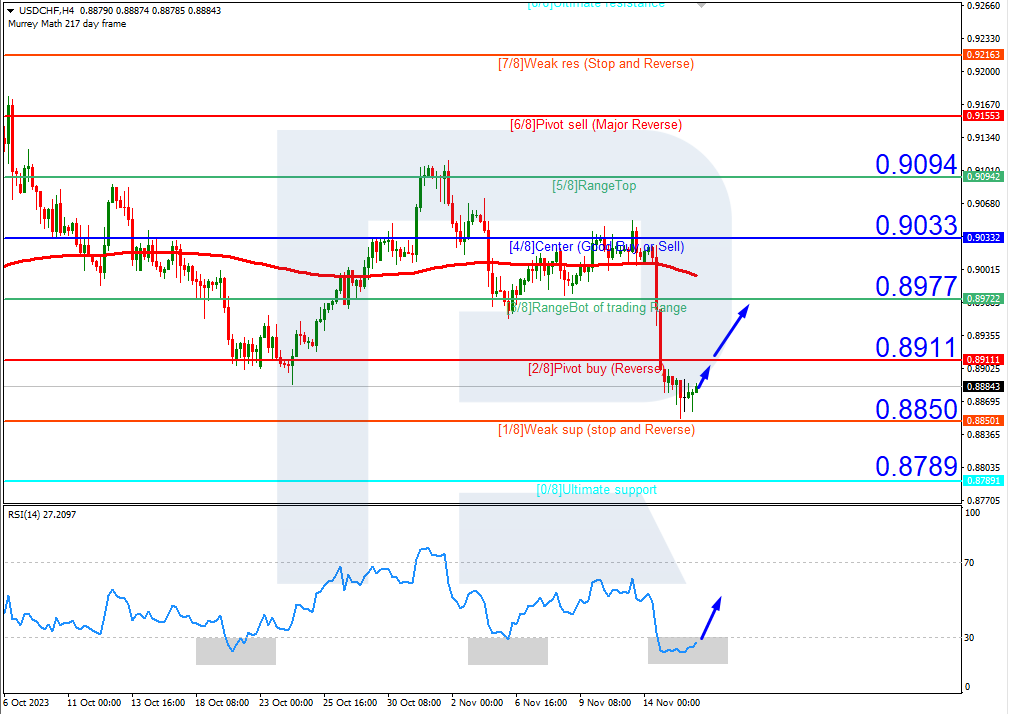
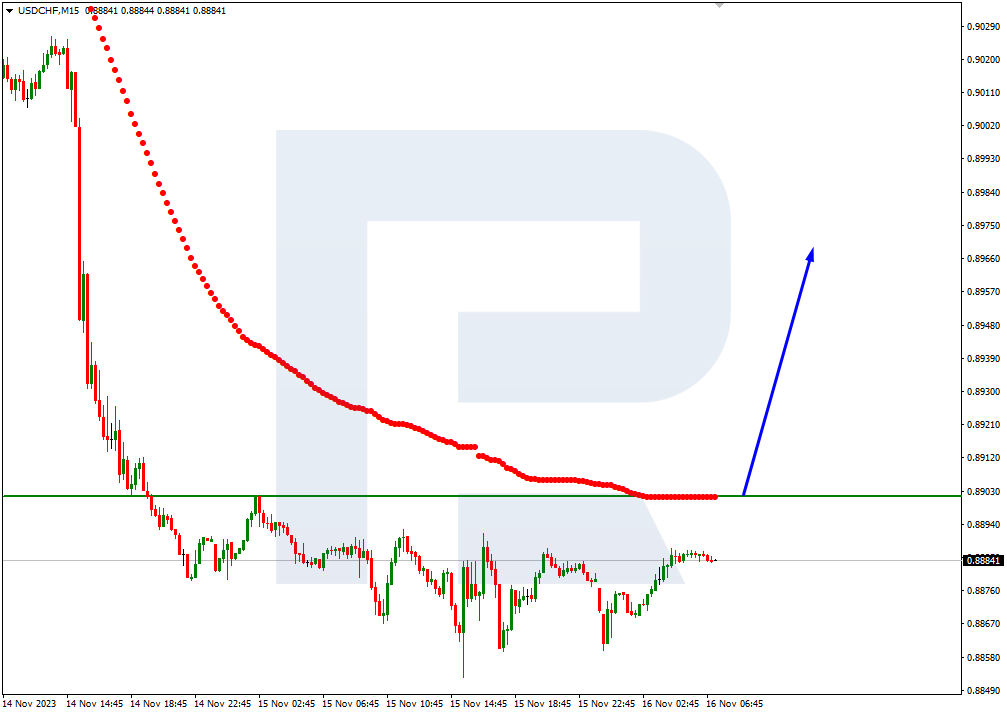
USDCHF quotes are above the 200-day Moving Average on H4, indicating a prevailing uptrend. The RSI has reached the oversold area. In this situation, the price is expected to test the 8/8 (0.9277) level, rebound from it, and drop to the support at 6/8 (0.9155). The scenario can be cancelled by breaking the 8/8 (0.9277) level. In this case, the quotes could reach the resistance at +1/8 (0.9334).

USDCHF
Risk Warning: the result of previous trading operations do not guarantee the same results in the future

On M15, following a rebound from the 8/8 (0.9277) level on H4, the price decline could be additionally supported by a breakout of the lower line of the VoltyChannel.

USDCHF
Risk Warning: the result of previous trading operations do not guarantee the same results in the future

XAUUSD, “Gold vs US Dollar”

Gold quotes and the RSI are in the oversold area. In such circumstances, the quotes are expected to surpass the 0/8 (1875.00) level, rising to the resistance at 2/8 (1890.62). The scenario can be cancelled by a downward breakout of the -1/8 (1867.19) level, which will send the quotes down to the support at -2/8 (1859.38).

XAUUSD
Risk Warning: the result of previous trading operations do not guarantee the same results in the future

On M15, the upper line of the VoltyChannel is too far from the current price so the price rise could be supported by breaking the 0/8 (1875.00) level on H4.

XAUUSD

Article By RoboForex.com

Attention!
Forecasts presented in this section only reflect the author s private opinion and should not be considered as guidance for trading. RoboForex LP bears no responsibility for trading results based on trading recommendations described in these analytical reviews.

Economic institutions lowered their forecasts for German GDP. Oil updates highs again

By JustMarkets

At yesterday’s stock market close, the Dow Jones Index (US30) decreased by 0.20%, while the S&P 500 Index (US500) added 0.02%. The NASDAQ Technology Index (US100) closed positive by 0.22% on Wednesday.

The Dow Jones Industrials (US30) fell to a 3-month low. The broad market moved to the downside yesterday after bond yields resumed their upward trend, with the 10-year German bond yield rising to a new 12-year high. Stocks initially headed higher after bond yields fell amid dovish comments from Minneapolis Fed President Kashkari, who said the government shutdown and a prolonged strike by automakers may require less action from the Fed. Stocks also gained support after Democratic and Republican leaders in the Senate on Tuesday night agreed on a plan to keep the government open through mid-November and provide $6 billion in aid to Ukraine.

According to the Mortgage Bankers Association (MBA), US mortgage applications fell by 1.3% for the week ended September 22 from the previous week. The subindex of home purchase applications fell by 1.5%, and the subindex of refinance applications fell by 0.9%. The average 30-year fixed-rate mortgage rose by 10 bps to 7.1%, the highest rate in 22 years. US new capital goods orders rose by 0.9% m/m in August, beating expectations of 0.1% m/m and the most substantial increase in 7 months.

Markets factor in a 24% probability that the FOMC will raise the interest rate by 25 bps at the next FOMC meeting on November 1 and a 47% probability that the rate will be raised by 25 bps at the meeting ending December 13. Markets then expect the FOMC to start cutting rates in the second half of 2024 in response to an anticipated slowdown in the US economy.

Equity markets in Europe were mostly down on Wednesday. Germany’s DAX (DE40) was down by 0.25%, France’s CAC 40 (FR40) fell by 0.03% yesterday, Spain’s IBEX 35 (ES35) lost 0.42%, and the UK’s FTSE 100 (UK100) closed negative by 0.43%.

Germany’s GfK Consumer Confidence Index for October fell to a 6-month low of 26.5, weaker than expectations of 26.0. The French consumer confidence indicator for September fell to a 4-month low of 83, weaker than expectations of 84. Five German economic institutions downgraded their forecasts for German GDP for 2023 to a contraction of -0.6% from a previous forecast of 0.3% growth. Eurozone M3 money supply contracted by a record 1.3% y/y in August, weaker than expectations of 1.0% y/y.

Oil prices rose to a 13-month-high yesterday. Crude oil prices continue to rise amid concerns that global oil supplies will remain tight for the foreseeable future. The weekly EIA report released on Wednesday showed crude oil inventories fell to a 9-month low, and crude inventories at Cushing, the delivery point for WTI crude futures, fell to a 14-month low.

Asian markets traded flat on Wednesday. Japan’s Nikkei 225 (JP225) gained 0.18% for the day, China’s FTSE China A50 (CHA50) fell by 0.05%, Hong Kong’s Hang Seng (HK50) ended the day up by 0.83%, and Australia’s ASX 200 (AU200) ended Wednesday positive 0.05%.

In China, Evergrande’s suspension has dampened sentiment in Chinese markets ahead of the week-long Autumn Festival holiday. Nevertheless, the holiday is expected to support the Chinese economy by boosting consumer spending.

Uncertainty over China caused Australia’s ASX 200 Index (AU200) to lose most of its gains for the day. Data also showed that Australian retail sales rose less than expected in August amid continued pressure from high-interest rates and inflation.

S&P 500 (F)(US500) 4,274.51 +0.98 (+0.02%)

Dow Jones (US30) 33,550.27 −68.61 (−0.20%)

DAX (DE40)  15,217.45 −38.42 (−0.25%)

FTSE 100 (UK100) 7,593.22 −32.50 (−0.43%)

USD Index  106.73 +0.50 (+0.47%)

News feed for 2023.09.25:
  • – Australia Retail Sales (m/m) at 04:30 (GMT+3);
  • – German Consumer Price Index (m/m) at 15:00 (GMT+3);
  • – US GDP (q/q) at 15:30 (GMT+3);
  • – US Initial Jobless Claims (w/w) at 15:30 (GMT+3);
  • – US Pending Home Sales (m/m) at 17:00 (GMT+3);
  • – US Natural Gas Storage (w/w) at 17:30 (GMT+3);
  • – US Fed Chair Powell Speaks at 23:00 (GMT+3).

By JustMarkets


This article reflects a personal opinion and should not be interpreted as an investment advice, and/or offer, and/or a persistent request for carrying out financial transactions, and/or a guarantee, and/or a forecast of future events.

How markets might react to a US government shutdown?

By ForexTime

  • US government shutdown may further slow economic momentum
  • Fed could be prevented from one last rate hike
  • Market reaction from 2018 shutdown may repeat itself
  • US dollar may weaken, but not much
  • Gold, US stock indexes could recover

The US government is set to be shut down temporarily, starting this Sunday, October 1st.

The Democrats and Republicans in the world’s largest economy are at loggerheads, yet again, over how to deploy fiscal funds.


A blast from the past …

Since 1981, the US government has suspended operations (though not entirely) 14 different times.

The last time we saw a US government shutdown was for a 35-day stretch between December 2018 till January 2019 – the longest shutdown in US history.

And during that last shutdown:

  • The US dollar (as measured by USDInd) fell by 1.2%
  • Gold climbed by 3.8%
  • SPX500_m soared by 10.3%


Perhaps the more notable takeaway from that prior episode is this:

The previous US government shutdown also coincided with the Fed’s last interest rate hike for that cycle.

  • December 2015: Fed raises US interest rates for the first time since the global financial crisis
  • December 2018: US government shuts down for 35 days; Fed’s last rate hike of that cycle that began in Dec 2015
  • July 2019: Fed turns tail and begins CUTTING rates, eventually sending it all the way back down to near-zero at the onset of the global pandemic in 2020.


Would Fed adopt same playbook at imminent US government shutdown?

Probably not, given that core US inflation, at 4.1% in August, remains more than double the Fed’s 2% inflation target.

Sticky inflation suggests that one more Fed rate hike could be in the pipeline, or at least US rates staying higher for longer.


Still, markets remain obsessed with trying to figure out:

  • Whether the Fed can trigger one last 25-basis point hike by year-end?
    Currently, markets predict a 53% chance of it happening.
  • How long will the Fed keep interest rates at this peak?


And we know that these rate hikes are intended to slow down inflation by destroying demand in the economy.

Even prior to the threat of this imminent government shutdown, economists and market watchers had already been bracing for a US economic slowdown, possibly even a recession.

Goldman Sachs predicted that the shutdown may result in a 0.2 percentage point drag on US GDP per week.


How would a government shutdown slow the US economy?

A US government shutdown means that:

  • many public employees, including staff at national parks to museums, will see their paycheques halted.
  • private companies that get paid from government contracts, stand to lose almost US$ 2 billion a day from this shutdown.
  • The highly-anticipated releases of the US nonfarm payrolls report (due Friday, October 6th) and the US consumer price index (due October 12th), as well as other major economic data, may be delayed.

All the above suggests that, the longer the US government stays shut, the more it deprives the world’s largest economy of crucial fiscal spending.

Hence, an extended US government shutdown could yet raise the prospects of a US recession.

And that could prevent one more Fed hike, or even hasten a rate cut.

And such an outlook would have a major impact across global financial markets.


POTENTIAL SCENARIOS

If the US government is shut down, as expected, beginning October 1st, with signs of staying offline for an extended period, we’d expect a similar market reaction from 2018:

  • The USD Index may find it tougher to climb higher, and even moderate lower as the shutdown goes on.

However, the US dollar may not fall by much, perhaps only to around the 105.0 region, as long as US yields remain notably higher than its major peers, such as Europe, the UK, and Japan.


  • Spot gold may return above $1900

An easing US dollar would make it an easier task ahead for gold bulls (those hoping prices will move higher) as markets wind down bets for one final Fed rate hike.

After all, gold tends to have an inverse relationship with US interest rates/yields/dollar (gold tends to go up when US rates/yields/dollar does down, and vice versa).

Demand for traditional safe havens, which include gold, may also help the precious metal recover.


  • US stock indexes (SPX500_m, NQ100_m, WSt30_m) may find some relief

The declines of late for US stock markets have been largely attributed to the fact that the Federal Reserve intends to keep its benchmark rates higher for longer.

However, an extended US government shutdown could alter that narrative, i.e. prevent one last Fed rate hike, or potentially even bring forward the Fed’s rate CUT.

Hopes for a sooner-than-expected Fed rate cut should help US stock indexes pare back recent declines.


Forex-Time-LogoArticle by ForexTime

ForexTime Ltd (FXTM) is an award winning international online forex broker regulated by CySEC 185/12 www.forextime.com