COT Bonds Charts: Speculator Changes led this week by 2-Year Bonds & SOFR-1M

By InvestMacro

Bonds Market Open Interest Comparison

Here are the latest charts and statistics for the Commitment of Traders (COT) reports data published by the Commodities Futures Trading Commission (CFTC).

The latest COT data is updated through Tuesday April 29th and shows a quick view of how large traders (for-profit speculators and commercial hedgers) were positioned in the futures markets.

Weekly Speculator Changes led by 2-Year Bonds & SOFR 1-M

Bonds Market Net Speculators Positions

The COT bond market speculator bets were overall lower this week as four out of the nine bond markets we cover had higher positioning while the other five markets had lower speculator contracts.

Leading the gains for the bond markets was the 2-Year Bonds (91,618 contracts) with the SOFR 1-Month (61,386 contracts), the 10-Year Bonds (34,569 contracts) and the US Treasury Bonds (22,131 contracts) also recording positive weeks.

The bond markets with declines in speculator bets for the week were the SOFR 3-Months (-141,796 contracts), the 5-Year Bonds (-101,110 contracts), the Fed Funds (-95,303 contracts), the Ultra 10-Year Bonds (-53,801 contracts) and the Ultra Treasury Bonds (-3,792 contracts) also registering lower bets on the week.


Bonds Data:

Bonds Market Speculators Data Table

Legend: Open Interest | Speculators Current Net Position | Weekly Specs Change | Specs Strength Score compared to last 3-Years (0-100 range)


Strength Scores led by Ultra Treasury Bonds & SOFR 1-Month

Bonds Market Strength Index Comparison

COT Strength Scores (a normalized measure of Speculator positions over a 3-Year range, from 0 to 100 where above 80 is Extreme-Bullish and below 20 is Extreme-Bearish) showed that the Ultra Treasury Bonds (78 percent) and the SOFR 1-Month (64 percent) lead the bond markets this week. The US Treasury Bonds (54 percent) comes in as the next highest in the weekly strength scores.

On the downside, the 5-Year Bond (0.0 percent) and the 2-Year Bonds (19 percent) come in at the lowest strength level currently and are in Extreme-Bearish territory (below 20 percent). The next lowest strength scores were the Ultra 10-Year Bonds (21 percent), the 10-Year Bonds (26 percent) and the SOFR 3-Months (31 percent).

Strength Statistics:
Fed Funds (34.7 percent) vs Fed Funds previous week (52.3 percent)
2-Year Bond (19.3 percent) vs 2-Year Bond previous week (13.0 percent)
5-Year Bond (0.0 percent) vs 5-Year Bond previous week (4.6 percent)
10-Year Bond (25.7 percent) vs 10-Year Bond previous week (22.5 percent)
Ultra 10-Year Bond (20.8 percent) vs Ultra 10-Year Bond previous week (40.6 percent)
US Treasury Bond (53.6 percent) vs US Treasury Bond previous week (45.9 percent)
Ultra US Treasury Bond (78.3 percent) vs Ultra US Treasury Bond previous week (79.8 percent)
SOFR 1-Month (63.7 percent) vs SOFR 1-Month previous week (48.6 percent)
SOFR 3-Months (31.1 percent) vs SOFR 3-Months previous week (38.4 percent)


Fed Funds & SOFR 3-Months top the 6-Week Strength Trends

Bonds Market Trend Index Comparison

COT Strength Score Trends (or move index, calculates the 6-week changes in strength scores) showed that the Fed Funds (11 percent) and the SOFR 3-Months (5 percent) lead the past six weeks trends for bonds.

The Ultra 10-Year Bond (-49.6 percent), the US Treasury Bonds (-25 percent) and the 5-Year Bonds (-18 percent) lead the downside trend scores currently.

Strength Trend Statistics:
Fed Funds (10.7 percent) vs Fed Funds previous week (33.8 percent)
2-Year Bond (1.0 percent) vs 2-Year Bond previous week (-5.2 percent)
5-Year Bond (-17.7 percent) vs 5-Year Bond previous week (-14.5 percent)
10-Year Bond (0.9 percent) vs 10-Year Bond previous week (-16.0 percent)
Ultra 10-Year Bond (-49.6 percent) vs Ultra 10-Year Bond previous week (-42.7 percent)
US Treasury Bond (-25.1 percent) vs US Treasury Bond previous week (-25.6 percent)
Ultra US Treasury Bond (-1.6 percent) vs Ultra US Treasury Bond previous week (1.4 percent)
SOFR 1-Month (2.0 percent) vs SOFR 1-Month previous week (-10.3 percent)
SOFR 3-Months (5.3 percent) vs SOFR 3-Months previous week (16.8 percent)


30-Day Federal Funds Futures:

Federal Funds 30-Day Bonds Futures COT ChartThe 30-Day Federal Funds large speculator standing this week resulted in a net position of -107,720 contracts in the data reported through Tuesday. This was a weekly decrease of -95,303 contracts from the previous week which had a total of -12,417 net contracts.

This week’s current strength score (the trader positioning range over the past three years, measured from 0 to 100) shows the speculators are currently Bearish with a score of 34.7 percent. The commercials are Bullish with a score of 58.9 percent and the small traders (not shown in chart) are Bullish-Extreme with a score of 82.0 percent.

Price Trend-Following Model: Downtrend

Our weekly trend-following model classifies the current market price position as: Downtrend.

30-Day Federal Funds StatisticsSPECULATORSCOMMERCIALSSMALL TRADERS
– Percent of Open Interest Longs:16.868.02.1
– Percent of Open Interest Shorts:21.164.31.5
– Net Position:-107,72092,57415,146
– Gross Longs:428,3361,729,75054,431
– Gross Shorts:536,0561,637,17639,285
– Long to Short Ratio:0.8 to 11.1 to 11.4 to 1
NET POSITION TREND:
– Strength Index Score (3 Year Range Pct):34.758.982.0
– Strength Index Reading (3 Year Range):BearishBullishBullish-Extreme
NET POSITION MOVEMENT INDEX:
– 6-Week Change in Strength Index:10.7-8.1-17.3


Secured Overnight Financing Rate (3-Month) Futures:

SOFR 3-Months Bonds Futures COT ChartThe Secured Overnight Financing Rate (3-Month) large speculator standing this week resulted in a net position of -565,606 contracts in the data reported through Tuesday. This was a weekly decline of -141,796 contracts from the previous week which had a total of -423,810 net contracts.

This week’s current strength score (the trader positioning range over the past three years, measured from 0 to 100) shows the speculators are currently Bearish with a score of 31.1 percent. The commercials are Bullish with a score of 68.9 percent and the small traders (not shown in chart) are Bullish-Extreme with a score of 83.6 percent.

Price Trend-Following Model: Weak Uptrend

Our weekly trend-following model classifies the current market price position as: Weak Uptrend.

SOFR 3-Months StatisticsSPECULATORSCOMMERCIALSSMALL TRADERS
– Percent of Open Interest Longs:11.860.10.3
– Percent of Open Interest Shorts:17.154.80.3
– Net Position:-565,606565,988-382
– Gross Longs:1,254,6676,381,33934,681
– Gross Shorts:1,820,2735,815,35135,063
– Long to Short Ratio:0.7 to 11.1 to 11.0 to 1
NET POSITION TREND:
– Strength Index Score (3 Year Range Pct):31.168.983.6
– Strength Index Reading (3 Year Range):BearishBullishBullish-Extreme
NET POSITION MOVEMENT INDEX:
– 6-Week Change in Strength Index:5.3-5.0-3.0


Individual Bond Markets:

Secured Overnight Financing Rate (1-Month) Futures:

SOFR 1-Month Bonds Futures COT ChartThe Secured Overnight Financing Rate (1-Month) large speculator standing this week resulted in a net position of -19,404 contracts in the data reported through Tuesday. This was a weekly boost of 61,386 contracts from the previous week which had a total of -80,790 net contracts.

This week’s current strength score (the trader positioning range over the past three years, measured from 0 to 100) shows the speculators are currently Bullish with a score of 63.7 percent. The commercials are Bearish with a score of 36.8 percent and the small traders (not shown in chart) are Bullish with a score of 80.0 percent.

Price Trend-Following Model: Weak Uptrend

Our weekly trend-following model classifies the current market price position as: Weak Uptrend.

SOFR 1-Month StatisticsSPECULATORSCOMMERCIALSSMALL TRADERS
– Percent of Open Interest Longs:14.566.60.1
– Percent of Open Interest Shorts:15.765.20.2
– Net Position:-19,40421,480-2,076
– Gross Longs:231,1991,064,063846
– Gross Shorts:250,6031,042,5832,922
– Long to Short Ratio:0.9 to 11.0 to 10.3 to 1
NET POSITION TREND:
– Strength Index Score (3 Year Range Pct):63.736.880.0
– Strength Index Reading (3 Year Range):BullishBearishBullish
NET POSITION MOVEMENT INDEX:
– 6-Week Change in Strength Index:2.0-5.841.1


2-Year Treasury Note Futures:

2-Year Treasury Bonds Futures COT ChartThe 2-Year Treasury Note large speculator standing this week resulted in a net position of -1,206,377 contracts in the data reported through Tuesday. This was a weekly boost of 91,618 contracts from the previous week which had a total of -1,297,995 net contracts.

This week’s current strength score (the trader positioning range over the past three years, measured from 0 to 100) shows the speculators are currently Bearish-Extreme with a score of 19.3 percent. The commercials are Bullish with a score of 78.7 percent and the small traders (not shown in chart) are Bullish with a score of 77.4 percent.

Price Trend-Following Model: Uptrend

Our weekly trend-following model classifies the current market price position as: Uptrend.

2-Year Treasury Note StatisticsSPECULATORSCOMMERCIALSSMALL TRADERS
– Percent of Open Interest Longs:14.477.95.9
– Percent of Open Interest Shorts:43.951.72.6
– Net Position:-1,206,3771,073,007133,370
– Gross Longs:588,9843,188,309239,843
– Gross Shorts:1,795,3612,115,302106,473
– Long to Short Ratio:0.3 to 11.5 to 12.3 to 1
NET POSITION TREND:
– Strength Index Score (3 Year Range Pct):19.378.777.4
– Strength Index Reading (3 Year Range):Bearish-ExtremeBullishBullish
NET POSITION MOVEMENT INDEX:
– 6-Week Change in Strength Index:1.0-0.9-1.2


5-Year Treasury Note Futures:

5-Year Treasury Bonds Futures COT ChartThe 5-Year Treasury Note large speculator standing this week resulted in a net position of -2,292,544 contracts in the data reported through Tuesday. This was a weekly lowering of -101,110 contracts from the previous week which had a total of -2,191,434 net contracts.

This week’s current strength score (the trader positioning range over the past three years, measured from 0 to 100) shows the speculators are currently Bearish-Extreme with a score of 0.0 percent. The commercials are Bullish-Extreme with a score of 100.0 percent and the small traders (not shown in chart) are Bullish-Extreme with a score of 91.3 percent.

Price Trend-Following Model: Uptrend

Our weekly trend-following model classifies the current market price position as: Uptrend.

5-Year Treasury Note StatisticsSPECULATORSCOMMERCIALSSMALL TRADERS
– Percent of Open Interest Longs:8.882.86.7
– Percent of Open Interest Shorts:42.252.53.6
– Net Position:-2,292,5442,079,747212,797
– Gross Longs:605,2815,682,152460,646
– Gross Shorts:2,897,8253,602,405247,849
– Long to Short Ratio:0.2 to 11.6 to 11.9 to 1
NET POSITION TREND:
– Strength Index Score (3 Year Range Pct):0.0100.091.3
– Strength Index Reading (3 Year Range):Bearish-ExtremeBullish-ExtremeBullish-Extreme
NET POSITION MOVEMENT INDEX:
– 6-Week Change in Strength Index:-17.720.25.6


10-Year Treasury Note Futures:

10-Year Treasury Notes Bonds Futures COT ChartThe 10-Year Treasury Note large speculator standing this week resulted in a net position of -871,537 contracts in the data reported through Tuesday. This was a weekly advance of 34,569 contracts from the previous week which had a total of -906,106 net contracts.

This week’s current strength score (the trader positioning range over the past three years, measured from 0 to 100) shows the speculators are currently Bearish with a score of 25.7 percent. The commercials are Bullish with a score of 66.4 percent and the small traders (not shown in chart) are Bullish-Extreme with a score of 98.0 percent.

Price Trend-Following Model: Uptrend

Our weekly trend-following model classifies the current market price position as: Uptrend.

10-Year Treasury Note StatisticsSPECULATORSCOMMERCIALSSMALL TRADERS
– Percent of Open Interest Longs:10.278.39.7
– Percent of Open Interest Shorts:28.063.66.5
– Net Position:-871,537715,931155,606
– Gross Longs:496,5463,818,873472,429
– Gross Shorts:1,368,0833,102,942316,823
– Long to Short Ratio:0.4 to 11.2 to 11.5 to 1
NET POSITION TREND:
– Strength Index Score (3 Year Range Pct):25.766.498.0
– Strength Index Reading (3 Year Range):BearishBullishBullish-Extreme
NET POSITION MOVEMENT INDEX:
– 6-Week Change in Strength Index:0.9-9.820.3


Ultra 10-Year Notes Futures:

Ultra 10-Year Treasury Notes Bonds Futures COT ChartThe Ultra 10-Year Notes large speculator standing this week resulted in a net position of -221,689 contracts in the data reported through Tuesday. This was a weekly fall of -53,801 contracts from the previous week which had a total of -167,888 net contracts.

This week’s current strength score (the trader positioning range over the past three years, measured from 0 to 100) shows the speculators are currently Bearish with a score of 20.8 percent. The commercials are Bullish with a score of 56.0 percent and the small traders (not shown in chart) are Bullish-Extreme with a score of 94.9 percent.

Price Trend-Following Model: Weak Uptrend

Our weekly trend-following model classifies the current market price position as: Weak Uptrend.

Ultra 10-Year Notes StatisticsSPECULATORSCOMMERCIALSSMALL TRADERS
– Percent of Open Interest Longs:12.976.110.0
– Percent of Open Interest Shorts:22.665.710.7
– Net Position:-221,689237,815-16,126
– Gross Longs:295,6541,738,406229,056
– Gross Shorts:517,3431,500,591245,182
– Long to Short Ratio:0.6 to 11.2 to 10.9 to 1
NET POSITION TREND:
– Strength Index Score (3 Year Range Pct):20.856.094.9
– Strength Index Reading (3 Year Range):BearishBullishBullish-Extreme
NET POSITION MOVEMENT INDEX:
– 6-Week Change in Strength Index:-49.647.69.9


US Treasury Bonds Futures:

US Year Treasury Notes Long Bonds Futures COT ChartThe US Treasury Bonds large speculator standing this week resulted in a net position of -85,556 contracts in the data reported through Tuesday. This was a weekly rise of 22,131 contracts from the previous week which had a total of -107,687 net contracts.

This week’s current strength score (the trader positioning range over the past three years, measured from 0 to 100) shows the speculators are currently Bullish with a score of 53.6 percent. The commercials are Bearish with a score of 36.7 percent and the small traders (not shown in chart) are Bullish-Extreme with a score of 82.0 percent.

Price Trend-Following Model: Weak Uptrend

Our weekly trend-following model classifies the current market price position as: Weak Uptrend.

US Treasury Bonds StatisticsSPECULATORSCOMMERCIALSSMALL TRADERS
– Percent of Open Interest Longs:10.475.512.5
– Percent of Open Interest Shorts:15.275.97.3
– Net Position:-85,556-7,85393,409
– Gross Longs:188,5181,362,011225,910
– Gross Shorts:274,0741,369,864132,501
– Long to Short Ratio:0.7 to 11.0 to 11.7 to 1
NET POSITION TREND:
– Strength Index Score (3 Year Range Pct):53.636.782.0
– Strength Index Reading (3 Year Range):BullishBearishBullish-Extreme
NET POSITION MOVEMENT INDEX:
– 6-Week Change in Strength Index:-25.123.7-6.9


Ultra US Treasury Bonds Futures:

Ultra US Year Treasury Notes Long Bonds Futures COT ChartThe Ultra US Treasury Bonds large speculator standing this week resulted in a net position of -251,394 contracts in the data reported through Tuesday. This was a weekly reduction of -3,792 contracts from the previous week which had a total of -247,602 net contracts.

This week’s current strength score (the trader positioning range over the past three years, measured from 0 to 100) shows the speculators are currently Bullish with a score of 78.3 percent. The commercials are Bearish with a score of 23.0 percent and the small traders (not shown in chart) are Bullish with a score of 55.7 percent.

Price Trend-Following Model: Weak Uptrend

Our weekly trend-following model classifies the current market price position as: Weak Uptrend.

Ultra US Treasury Bonds StatisticsSPECULATORSCOMMERCIALSSMALL TRADERS
– Percent of Open Interest Longs:6.782.99.2
– Percent of Open Interest Shorts:20.171.37.5
– Net Position:-251,394217,82133,573
– Gross Longs:126,0531,557,821173,657
– Gross Shorts:377,4471,340,000140,084
– Long to Short Ratio:0.3 to 11.2 to 11.2 to 1
NET POSITION TREND:
– Strength Index Score (3 Year Range Pct):78.323.055.7
– Strength Index Reading (3 Year Range):BullishBearishBullish
NET POSITION MOVEMENT INDEX:
– 6-Week Change in Strength Index:-1.60.63.6


Article By InvestMacroReceive our weekly COT Newsletter

*COT Report: The COT data, released weekly to the public each Friday, is updated through the most recent Tuesday (data is 3 days old) and shows a quick view of how large speculators or non-commercials (for-profit traders) were positioned in the futures markets.

The CFTC categorizes trader positions according to commercial hedgers (traders who use futures contracts for hedging as part of the business), non-commercials (large traders who speculate to realize trading profits) and nonreportable traders (usually small traders/speculators) as well as their open interest (contracts open in the market at time of reporting). See CFTC criteria here.

COT Soft Commodities Charts: Speculator Bets led higher by Cotton, Soybean Oil & Coffee

By InvestMacro

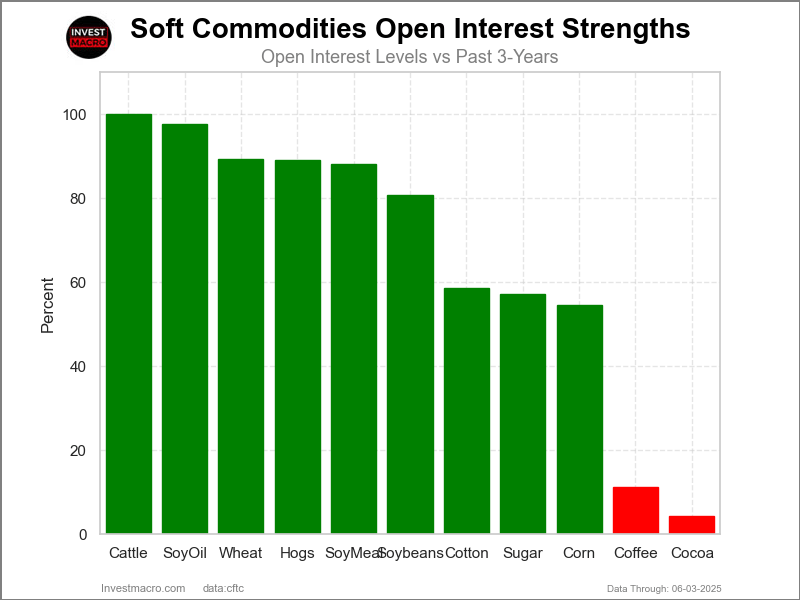
Speculators OI Softs

Here are the latest charts and statistics for the Commitment of Traders (COT) reports data published by the Commodities Futures Trading Commission (CFTC).

The latest COT data is updated through Tuesday April 29th and shows a quick view of how large traders (for-profit speculators and commercial entities) were positioned in the futures markets.

Weekly Speculator Changes led by Cotton, Soybean Oil & Coffee

Speculators Nets Softs

The COT soft commodities markets speculator bets were higher this week as eight out of the eleven softs markets we cover had higher positioning while the other three markets had lower speculator contracts.

Leading the gains for the softs markets was Cotton (13,340 contracts) with Soybean Oil (9,774 contracts), Coffee (8,233 contracts), Sugar (5,530 contracts), Live Cattle (4,024 contracts), Soybeans (3,789 contracts), Lean Hogs (3,561 contracts) and Cocoa (1,775 contracts) also having positive weeks.

The markets with the declines in speculator bets this week were Corn (-44,414 contracts), Soybean Meal (-22,758 contracts) and with Wheat (-22,839 contracts) also registering lower bets on the week.


Soft Commodities Data

Speculators Table Softs

Legend: Weekly Speculators Change | Speculators Current Net Position | Speculators Strength Score compared to last 3-Years (0-100 range)


Strength Scores led by Soybean Oil & Live Cattle

Speculators Strength Softs

COT Strength Scores (a normalized measure of Speculator positions over a 3-Year range, from 0 to 100 where above 80 is Extreme-Bullish and below 20 is Extreme-Bearish) showed that Soybean Oil (81 percent) and Live Cattle (80 percent) lead the softs markets this week. Coffee (74 percent), Soybeans (66 percent) and Corn (60 percent) come in as the next highest in the weekly strength scores.

On the downside, Wheat (0 percent) and Soybean Meal (5 percent) come in at the lowest strength levels currently and are in Extreme-Bearish territory (below 20 percent). The next lowest strength scores are the Sugar (23 percent) and the Cocoa (28 percent).

Strength Statistics:
Corn (59.7 percent) vs Corn previous week (65.7 percent)
Sugar (23.0 percent) vs Sugar previous week (21.2 percent)
Coffee (73.6 percent) vs Coffee previous week (65.7 percent)
Soybeans (65.7 percent) vs Soybeans previous week (64.8 percent)
Soybean Oil (80.6 percent) vs Soybean Oil previous week (75.2 percent)
Soybean Meal (5.4 percent) vs Soybean Meal previous week (14.7 percent)
Live Cattle (80.2 percent) vs Live Cattle previous week (76.3 percent)
Lean Hogs (54.8 percent) vs Lean Hogs previous week (52.0 percent)
Cotton (30.6 percent) vs Cotton previous week (22.5 percent)
Cocoa (27.7 percent) vs Cocoa previous week (25.8 percent)
Wheat (0.0 percent) vs Wheat previous week (15.7 percent)


Soybean Oil & Cotton top the 6-Week Strength Trends

Speculators Trend Softs

COT Strength Score Trends (or move index, calculates the 6-week changes in strength scores) showed that Soybean Oil (44 percent) and Cotton (23 percent) lead the past six weeks trends for soft commodities. Soybeans (17 percent), Sugar (2 percent) and Cocoa (1 percent) are the next highest positive movers in the latest trends data.

Wheat (-28 percent) leads the downside trend scores currently with Soybean Meal (-9 percent), Corn (-9 percent) and Coffee (-7 percent) following next with lower trend scores.

Strength Trend Statistics:
Corn (-8.6 percent) vs Corn previous week (-6.6 percent)
Sugar (2.2 percent) vs Sugar previous week (7.8 percent)
Coffee (-6.6 percent) vs Coffee previous week (-14.9 percent)
Soybeans (17.3 percent) vs Soybeans previous week (17.4 percent)
Soybean Oil (44.2 percent) vs Soybean Oil previous week (34.2 percent)
Soybean Meal (-8.8 percent) vs Soybean Meal previous week (5.8 percent)
Live Cattle (-0.4 percent) vs Live Cattle previous week (1.6 percent)
Lean Hogs (0.2 percent) vs Lean Hogs previous week (-5.3 percent)
Cotton (22.8 percent) vs Cotton previous week (19.2 percent)
Cocoa (0.9 percent) vs Cocoa previous week (-1.8 percent)
Wheat (-27.7 percent) vs Wheat previous week (-10.9 percent)


Individual Soft Commodities Markets:

CORN Futures:

CORN Futures COT ChartThe CORN large speculator standing this week was a net position of 175,429 contracts in the data reported through Tuesday. This was a weekly reduction of -44,414 contracts from the previous week which had a total of 219,843 net contracts.

This week’s current strength score (the trader positioning range over the past three years, measured from 0 to 100) shows the speculators are currently Bullish with a score of 59.7 percent. The commercials are Bearish with a score of 41.9 percent and the small traders (not shown in chart) are Bullish with a score of 52.1 percent.

Price Trend-Following Model: Weak Uptrend

Our weekly trend-following model classifies the current market price position as: Weak Uptrend.

CORN Futures StatisticsSPECULATORSCOMMERCIALSSMALL TRADERS
– Percent of Open Interest Longs:26.744.47.7
– Percent of Open Interest Shorts:15.352.710.8
– Net Position:175,429-128,654-46,775
– Gross Longs:412,036685,641119,389
– Gross Shorts:236,607814,295166,164
– Long to Short Ratio:1.7 to 10.8 to 10.7 to 1
NET POSITION TREND:
– Strength Index Score (3 Year Range Pct):59.741.952.1
– Strength Index Reading (3 Year Range):BullishBearishBullish
NET POSITION MOVEMENT INDEX:
– 6-Week Change in Strength Index:-8.67.512.7


SUGAR Futures:

SUGAR Futures COT ChartThe SUGAR large speculator standing this week was a net position of 38,765 contracts in the data reported through Tuesday. This was a weekly boost of 5,530 contracts from the previous week which had a total of 33,235 net contracts.

This week’s current strength score (the trader positioning range over the past three years, measured from 0 to 100) shows the speculators are currently Bearish with a score of 23.0 percent. The commercials are Bullish-Extreme with a score of 81.2 percent and the small traders (not shown in chart) are Bearish-Extreme with a score of 15.1 percent.

Price Trend-Following Model: Weak Uptrend

Our weekly trend-following model classifies the current market price position as: Weak Uptrend.

SUGAR Futures StatisticsSPECULATORSCOMMERCIALSSMALL TRADERS
– Percent of Open Interest Longs:24.254.66.9
– Percent of Open Interest Shorts:19.458.97.4
– Net Position:38,765-34,712-4,053
– Gross Longs:196,828444,87856,409
– Gross Shorts:158,063479,59060,462
– Long to Short Ratio:1.2 to 10.9 to 10.9 to 1
NET POSITION TREND:
– Strength Index Score (3 Year Range Pct):23.081.215.1
– Strength Index Reading (3 Year Range):BearishBullish-ExtremeBearish-Extreme
NET POSITION MOVEMENT INDEX:
– 6-Week Change in Strength Index:2.25.3-36.7


COFFEE Futures:

COFFEE Futures COT ChartThe COFFEE large speculator standing this week was a net position of 49,289 contracts in the data reported through Tuesday. This was a weekly gain of 8,233 contracts from the previous week which had a total of 41,056 net contracts.

This week’s current strength score (the trader positioning range over the past three years, measured from 0 to 100) shows the speculators are currently Bullish with a score of 73.6 percent. The commercials are Bearish with a score of 27.2 percent and the small traders (not shown in chart) are Bullish with a score of 67.0 percent.

Price Trend-Following Model: Uptrend

Our weekly trend-following model classifies the current market price position as: Uptrend.

COFFEE Futures StatisticsSPECULATORSCOMMERCIALSSMALL TRADERS
– Percent of Open Interest Longs:38.237.05.9
– Percent of Open Interest Shorts:6.570.64.0
– Net Position:49,289-52,1942,905
– Gross Longs:59,40557,5669,134
– Gross Shorts:10,116109,7606,229
– Long to Short Ratio:5.9 to 10.5 to 11.5 to 1
NET POSITION TREND:
– Strength Index Score (3 Year Range Pct):73.627.267.0
– Strength Index Reading (3 Year Range):BullishBearishBullish
NET POSITION MOVEMENT INDEX:
– 6-Week Change in Strength Index:-6.66.50.9


SOYBEANS Futures:

SOYBEANS Futures COT ChartThe SOYBEANS large speculator standing this week was a net position of 59,473 contracts in the data reported through Tuesday. This was a weekly rise of 3,789 contracts from the previous week which had a total of 55,684 net contracts.

This week’s current strength score (the trader positioning range over the past three years, measured from 0 to 100) shows the speculators are currently Bullish with a score of 65.7 percent. The commercials are Bearish with a score of 33.5 percent and the small traders (not shown in chart) are Bullish with a score of 59.0 percent.

Price Trend-Following Model: Uptrend

Our weekly trend-following model classifies the current market price position as: Uptrend.

SOYBEANS Futures StatisticsSPECULATORSCOMMERCIALSSMALL TRADERS
– Percent of Open Interest Longs:24.550.35.5
– Percent of Open Interest Shorts:16.655.58.2
– Net Position:59,473-38,976-20,497
– Gross Longs:184,167378,82541,309
– Gross Shorts:124,694417,80161,806
– Long to Short Ratio:1.5 to 10.9 to 10.7 to 1
NET POSITION TREND:
– Strength Index Score (3 Year Range Pct):65.733.559.0
– Strength Index Reading (3 Year Range):BullishBearishBullish
NET POSITION MOVEMENT INDEX:
– 6-Week Change in Strength Index:17.3-21.227.9


SOYBEAN OIL Futures:

SOYBEAN OIL Futures COT ChartThe SOYBEAN OIL large speculator standing this week was a net position of 70,165 contracts in the data reported through Tuesday. This was a weekly boost of 9,774 contracts from the previous week which had a total of 60,391 net contracts.

This week’s current strength score (the trader positioning range over the past three years, measured from 0 to 100) shows the speculators are currently Bullish-Extreme with a score of 80.6 percent. The commercials are Bearish with a score of 20.5 percent and the small traders (not shown in chart) are Bullish with a score of 56.3 percent.

Price Trend-Following Model: Strong Uptrend

Our weekly trend-following model classifies the current market price position as: Strong Uptrend.

SOYBEAN OIL Futures StatisticsSPECULATORSCOMMERCIALSSMALL TRADERS
– Percent of Open Interest Longs:27.646.06.6
– Percent of Open Interest Shorts:14.860.74.7
– Net Position:70,165-80,64410,479
– Gross Longs:151,088251,91435,994
– Gross Shorts:80,923332,55825,515
– Long to Short Ratio:1.9 to 10.8 to 11.4 to 1
NET POSITION TREND:
– Strength Index Score (3 Year Range Pct):80.620.556.3
– Strength Index Reading (3 Year Range):Bullish-ExtremeBearishBullish
NET POSITION MOVEMENT INDEX:
– 6-Week Change in Strength Index:44.2-45.637.3


SOYBEAN MEAL Futures:

SOYBEAN MEAL Futures COT ChartThe SOYBEAN MEAL large speculator standing this week was a net position of -53,734 contracts in the data reported through Tuesday. This was a weekly reduction of -22,758 contracts from the previous week which had a total of -30,976 net contracts.

This week’s current strength score (the trader positioning range over the past three years, measured from 0 to 100) shows the speculators are currently Bearish-Extreme with a score of 5.4 percent. The commercials are Bullish-Extreme with a score of 91.8 percent and the small traders (not shown in chart) are Bearish with a score of 44.3 percent.

Price Trend-Following Model: Weak Uptrend

Our weekly trend-following model classifies the current market price position as: Weak Uptrend.

SOYBEAN MEAL Futures StatisticsSPECULATORSCOMMERCIALSSMALL TRADERS
– Percent of Open Interest Longs:20.551.08.4
– Percent of Open Interest Shorts:30.344.55.1
– Net Position:-53,73435,54618,188
– Gross Longs:112,251279,11446,066
– Gross Shorts:165,985243,56827,878
– Long to Short Ratio:0.7 to 11.1 to 11.7 to 1
NET POSITION TREND:
– Strength Index Score (3 Year Range Pct):5.491.844.3
– Strength Index Reading (3 Year Range):Bearish-ExtremeBullish-ExtremeBearish
NET POSITION MOVEMENT INDEX:
– 6-Week Change in Strength Index:-8.88.7-2.9


LIVE CATTLE Futures:

LIVE CATTLE Futures COT ChartThe LIVE CATTLE large speculator standing this week was a net position of 103,030 contracts in the data reported through Tuesday. This was a weekly increase of 4,024 contracts from the previous week which had a total of 99,006 net contracts.

This week’s current strength score (the trader positioning range over the past three years, measured from 0 to 100) shows the speculators are currently Bullish-Extreme with a score of 80.2 percent. The commercials are Bearish with a score of 21.3 percent and the small traders (not shown in chart) are Bearish with a score of 26.0 percent.

Price Trend-Following Model: Strong Uptrend

Our weekly trend-following model classifies the current market price position as: Strong Uptrend.

LIVE CATTLE Futures StatisticsSPECULATORSCOMMERCIALSSMALL TRADERS
– Percent of Open Interest Longs:48.928.38.0
– Percent of Open Interest Shorts:20.151.513.7
– Net Position:103,030-82,863-20,167
– Gross Longs:174,783101,16828,663
– Gross Shorts:71,753184,03148,830
– Long to Short Ratio:2.4 to 10.5 to 10.6 to 1
NET POSITION TREND:
– Strength Index Score (3 Year Range Pct):80.221.326.0
– Strength Index Reading (3 Year Range):Bullish-ExtremeBearishBearish
NET POSITION MOVEMENT INDEX:
– 6-Week Change in Strength Index:-0.4-2.48.0


LEAN HOGS Futures:

LEAN HOGS Futures COT ChartThe LEAN HOGS large speculator standing this week was a net position of 34,857 contracts in the data reported through Tuesday. This was a weekly advance of 3,561 contracts from the previous week which had a total of 31,296 net contracts.

This week’s current strength score (the trader positioning range over the past three years, measured from 0 to 100) shows the speculators are currently Bullish with a score of 54.8 percent. The commercials are Bearish with a score of 41.2 percent and the small traders (not shown in chart) are Bullish with a score of 75.6 percent.

Price Trend-Following Model: Weak Downtrend

Our weekly trend-following model classifies the current market price position as: Weak Downtrend.

LEAN HOGS Futures StatisticsSPECULATORSCOMMERCIALSSMALL TRADERS
– Percent of Open Interest Longs:36.334.78.0
– Percent of Open Interest Shorts:23.447.48.1
– Net Position:34,857-34,534-323
– Gross Longs:98,52694,17421,808
– Gross Shorts:63,669128,70822,131
– Long to Short Ratio:1.5 to 10.7 to 11.0 to 1
NET POSITION TREND:
– Strength Index Score (3 Year Range Pct):54.841.275.6
– Strength Index Reading (3 Year Range):BullishBearishBullish
NET POSITION MOVEMENT INDEX:
– 6-Week Change in Strength Index:0.2-2.616.8


COTTON Futures:

COTTON Futures COT ChartThe COTTON large speculator standing this week was a net position of -11,738 contracts in the data reported through Tuesday. This was a weekly lift of 13,340 contracts from the previous week which had a total of -25,078 net contracts.

This week’s current strength score (the trader positioning range over the past three years, measured from 0 to 100) shows the speculators are currently Bearish with a score of 30.6 percent. The commercials are Bullish with a score of 72.9 percent and the small traders (not shown in chart) are Bearish-Extreme with a score of 0.4 percent.

Price Trend-Following Model: Weak Downtrend

Our weekly trend-following model classifies the current market price position as: Weak Downtrend.

COTTON Futures StatisticsSPECULATORSCOMMERCIALSSMALL TRADERS
– Percent of Open Interest Longs:31.048.15.2
– Percent of Open Interest Shorts:36.641.36.4
– Net Position:-11,73814,393-2,655
– Gross Longs:65,344101,38810,925
– Gross Shorts:77,08286,99513,580
– Long to Short Ratio:0.8 to 11.2 to 10.8 to 1
NET POSITION TREND:
– Strength Index Score (3 Year Range Pct):30.672.90.4
– Strength Index Reading (3 Year Range):BearishBullishBearish-Extreme
NET POSITION MOVEMENT INDEX:
– 6-Week Change in Strength Index:22.8-19.3-26.7


COCOA Futures:

COCOA Futures COT ChartThe COCOA large speculator standing this week was a net position of 17,352 contracts in the data reported through Tuesday. This was a weekly lift of 1,775 contracts from the previous week which had a total of 15,577 net contracts.

This week’s current strength score (the trader positioning range over the past three years, measured from 0 to 100) shows the speculators are currently Bearish with a score of 27.7 percent. The commercials are Bullish with a score of 71.8 percent and the small traders (not shown in chart) are Bullish with a score of 63.9 percent.

Price Trend-Following Model: Weak Downtrend

Our weekly trend-following model classifies the current market price position as: Weak Downtrend.

COCOA Futures StatisticsSPECULATORSCOMMERCIALSSMALL TRADERS
– Percent of Open Interest Longs:30.539.410.6
– Percent of Open Interest Shorts:11.163.65.7
– Net Position:17,352-21,7084,356
– Gross Longs:27,33735,3189,480
– Gross Shorts:9,98557,0265,124
– Long to Short Ratio:2.7 to 10.6 to 11.9 to 1
NET POSITION TREND:
– Strength Index Score (3 Year Range Pct):27.771.863.9
– Strength Index Reading (3 Year Range):BearishBullishBullish
NET POSITION MOVEMENT INDEX:
– 6-Week Change in Strength Index:0.9-2.112.7


WHEAT Futures:

WHEAT Futures COT ChartThe WHEAT large speculator standing this week was a net position of -116,808 contracts in the data reported through Tuesday. This was a weekly reduction of -22,839 contracts from the previous week which had a total of -93,969 net contracts.

This week’s current strength score (the trader positioning range over the past three years, measured from 0 to 100) shows the speculators are currently Bearish-Extreme with a score of 0.0 percent. The commercials are Bullish-Extreme with a score of 100.0 percent and the small traders (not shown in chart) are Bullish-Extreme with a score of 96.6 percent.

Price Trend-Following Model: Strong Downtrend

Our weekly trend-following model classifies the current market price position as: Strong Downtrend.

WHEAT Futures StatisticsSPECULATORSCOMMERCIALSSMALL TRADERS
– Percent of Open Interest Longs:25.739.38.5
– Percent of Open Interest Shorts:51.814.86.9
– Net Position:-116,808109,6067,202
– Gross Longs:114,740175,67938,188
– Gross Shorts:231,54866,07330,986
– Long to Short Ratio:0.5 to 12.7 to 11.2 to 1
NET POSITION TREND:
– Strength Index Score (3 Year Range Pct):0.0100.096.6
– Strength Index Reading (3 Year Range):Bearish-ExtremeBullish-ExtremeBullish-Extreme
NET POSITION MOVEMENT INDEX:
– 6-Week Change in Strength Index:-27.725.333.2


Article By InvestMacroReceive our weekly COT Newsletter

*COT Report: The COT data, released weekly to the public each Friday, is updated through the most recent Tuesday (data is 3 days old) and shows a quick view of how large speculators or non-commercials (for-profit traders) were positioned in the futures markets.

The CFTC categorizes trader positions according to commercial hedgers (traders who use futures contracts for hedging as part of the business), non-commercials (large traders who speculate to realize trading profits) and nonreportable traders (usually small traders/speculators) as well as their open interest (contracts open in the market at time of reporting). See CFTC criteria here.

COT Stock Market Charts: Speculator Bets led higher by VIX & Russell 2000

By InvestMacro

Speculators OI Stocks COT Chart

Here are the latest charts and statistics for the Commitment of Traders (COT) data published by the Commodities Futures Trading Commission (CFTC).

The latest COT data is updated through Tuesday April 29th and shows a quick view of how large traders (for-profit speculators and commercial entities) were positioned in the futures markets.

Weekly Speculator Changes led higher by VIX & Russell 2000

Speculators Nets Stocks COT Chart

The COT stock markets speculator bets were higher this week as five out of the seven stock markets we cover had higher positioning while the other two markets had lower speculator contracts.

Leading the gains for the stock markets was the VIX (9,985 contracts) with the Russell-Mini (6,313 contracts), the DowJones-Mini (4,662 contracts), the Nikkei 225 (2,025 contracts) and the MSCI EAFE-Mini (618 contracts) also showing positive weeks.

The markets with the declines in speculator bets this week were the Nasdaq-Mini (-6,817 contracts) and the S&P500-Mini (-2,731 contracts) also registering lower bets on the week.


Stock Market Data:

Speculators Table Stocks COT Chart

Legend: Weekly Speculators Change | Speculators Current Net Position | Speculators Strength Score compared to last 3-Years (0-100 range)


Strength Scores led by VIX & Nikkei 225

Speculators Strength Stocks COT Chart

COT Strength Scores (a normalized measure of Speculator positions over a 3-Year range, from 0 to 100 where above 80 is Extreme-Bullish and below 20 is Extreme-Bearish) showed that the VIX (98 percent) and the Nikkei 225 (96 percent) lead the stock markets this week. The Nasdaq-Mini (87 percent) and Russell-Mini (82 percent) come in as the next highest in the weekly strength scores.

On the downside, there are no markets at less than 50 percent of the past 3-year range.

Strength Statistics:
VIX (98.3 percent) vs VIX previous week (89.4 percent)
S&P500-Mini (63.9 percent) vs S&P500-Mini previous week (64.4 percent)
DowJones-Mini (69.3 percent) vs DowJones-Mini previous week (61.7 percent)
Nasdaq-Mini (87.0 percent) vs Nasdaq-Mini previous week (97.6 percent)
Russell2000-Mini (81.7 percent) vs Russell2000-Mini previous week (77.4 percent)
Nikkei USD (96.4 percent) vs Nikkei USD previous week (79.1 percent)
EAFE-Mini (74.8 percent) vs EAFE-Mini previous week (74.0 percent)


Nikkei 225 & Nasdaq-Mini top the 6-Week Strength Trends

Speculators Trend Stocks COT Chart

COT Strength Score Trends (or move index, calculates the 6-week changes in strength scores) showed that the Nikkei 225 (35 percent) leads the past six weeks trends for the stock markets. The Nasdaq-Mini (12 percent), the DowJones-Mini (7 percent) and the Russell-Mini (7 percent) are the next highest positive movers in the latest trends data.

The S&P500-Mini (-26 percent) leads the downside trend scores currently with the MSCI EAFE-Mini (-2 percent) coming in as the next market with lower trend scores.

Strength Trend Statistics:
VIX (-1.7 percent) vs VIX previous week (10.8 percent)
S&P500-Mini (-26.4 percent) vs S&P500-Mini previous week (-28.2 percent)
DowJones-Mini (7.0 percent) vs DowJones-Mini previous week (-1.9 percent)
Nasdaq-Mini (12.2 percent) vs Nasdaq-Mini previous week (23.2 percent)
Russell2000-Mini (6.7 percent) vs Russell2000-Mini previous week (-1.1 percent)
Nikkei USD (35.0 percent) vs Nikkei USD previous week (25.1 percent)
EAFE-Mini (-2.2 percent) vs EAFE-Mini previous week (-26.0 percent)


Individual Stock Market Charts:

VIX Volatility Futures:

VIX Volatility Futures COT ChartThe VIX Volatility large speculator standing this week recorded a net position of 4,240 contracts in the data reported through Tuesday. This was a weekly boost of 9,985 contracts from the previous week which had a total of -5,745 net contracts.

This week’s current strength score (the trader positioning range over the past three years, measured from 0 to 100) shows the speculators are currently Bullish-Extreme with a score of 98.3 percent. The commercials are Bearish-Extreme with a score of 1.3 percent and the small traders (not shown in chart) are Bullish-Extreme with a score of 86.2 percent.

Price Trend-Following Model: Uptrend

Our weekly trend-following model classifies the current market price position as: Uptrend.

VIX Volatility Futures StatisticsSPECULATORSCOMMERCIALSSMALL TRADERS
– Percent of Open Interest Longs:26.843.310.6
– Percent of Open Interest Shorts:25.346.19.3
– Net Position:4,240-7,8373,597
– Gross Longs:74,898120,74729,624
– Gross Shorts:70,658128,58426,027
– Long to Short Ratio:1.1 to 10.9 to 11.1 to 1
NET POSITION TREND:
– Strength Index Score (3 Year Range Pct):98.31.386.2
– Strength Index Reading (3 Year Range):Bullish-ExtremeBearish-ExtremeBullish-Extreme
NET POSITION MOVEMENT INDEX:
– 6-Week Change in Strength Index:-1.7-2.928.7


S&P500 Mini Futures:

SP500 Mini Futures COT ChartThe S&P500 Mini large speculator standing this week recorded a net position of -78,666 contracts in the data reported through Tuesday. This was a weekly reduction of -2,731 contracts from the previous week which had a total of -75,935 net contracts.

This week’s current strength score (the trader positioning range over the past three years, measured from 0 to 100) shows the speculators are currently Bullish with a score of 63.9 percent. The commercials are Bearish with a score of 40.5 percent and the small traders (not shown in chart) are Bullish with a score of 53.5 percent.

Price Trend-Following Model: Downtrend

Our weekly trend-following model classifies the current market price position as: Downtrend.

S&P500 Mini Futures StatisticsSPECULATORSCOMMERCIALSSMALL TRADERS
– Percent of Open Interest Longs:11.374.611.3
– Percent of Open Interest Shorts:14.972.99.4
– Net Position:-78,66637,75340,913
– Gross Longs:240,0961,592,776240,722
– Gross Shorts:318,7621,555,023199,809
– Long to Short Ratio:0.8 to 11.0 to 11.2 to 1
NET POSITION TREND:
– Strength Index Score (3 Year Range Pct):63.940.553.5
– Strength Index Reading (3 Year Range):BullishBearishBullish
NET POSITION MOVEMENT INDEX:
– 6-Week Change in Strength Index:-26.434.3-32.7


Dow Jones Mini Futures:

Dow Jones Mini Futures COT ChartThe Dow Jones Mini large speculator standing this week recorded a net position of 5,549 contracts in the data reported through Tuesday. This was a weekly boost of 4,662 contracts from the previous week which had a total of 887 net contracts.

This week’s current strength score (the trader positioning range over the past three years, measured from 0 to 100) shows the speculators are currently Bullish with a score of 69.3 percent. The commercials are Bearish with a score of 34.4 percent and the small traders (not shown in chart) are Bearish with a score of 36.4 percent.

Price Trend-Following Model: Downtrend

Our weekly trend-following model classifies the current market price position as: Downtrend.

Dow Jones Mini Futures StatisticsSPECULATORSCOMMERCIALSSMALL TRADERS
– Percent of Open Interest Longs:16.964.010.7
– Percent of Open Interest Shorts:9.867.414.4
– Net Position:5,549-2,637-2,912
– Gross Longs:13,20250,1368,381
– Gross Shorts:7,65352,77311,293
– Long to Short Ratio:1.7 to 11.0 to 10.7 to 1
NET POSITION TREND:
– Strength Index Score (3 Year Range Pct):69.334.436.4
– Strength Index Reading (3 Year Range):BullishBearishBearish
NET POSITION MOVEMENT INDEX:
– 6-Week Change in Strength Index:7.0-0.8-22.2


Nasdaq Mini Futures:

Nasdaq Mini Futures COT ChartThe Nasdaq Mini large speculator standing this week recorded a net position of 30,863 contracts in the data reported through Tuesday. This was a weekly fall of -6,817 contracts from the previous week which had a total of 37,680 net contracts.

This week’s current strength score (the trader positioning range over the past three years, measured from 0 to 100) shows the speculators are currently Bullish-Extreme with a score of 87.0 percent. The commercials are Bearish with a score of 28.5 percent and the small traders (not shown in chart) are Bearish with a score of 40.0 percent.

Price Trend-Following Model: Downtrend

Our weekly trend-following model classifies the current market price position as: Downtrend.

Nasdaq Mini Futures StatisticsSPECULATORSCOMMERCIALSSMALL TRADERS
– Percent of Open Interest Longs:31.253.813.1
– Percent of Open Interest Shorts:18.763.316.2
– Net Position:30,863-23,292-7,571
– Gross Longs:77,026132,87332,433
– Gross Shorts:46,163156,16540,004
– Long to Short Ratio:1.7 to 10.9 to 10.8 to 1
NET POSITION TREND:
– Strength Index Score (3 Year Range Pct):87.028.540.0
– Strength Index Reading (3 Year Range):Bullish-ExtremeBearishBearish
NET POSITION MOVEMENT INDEX:
– 6-Week Change in Strength Index:12.219.5-49.5


Russell 2000 Mini Futures:

Russell 2000 Mini Futures COT ChartThe Russell 2000 Mini large speculator standing this week recorded a net position of -406 contracts in the data reported through Tuesday. This was a weekly advance of 6,313 contracts from the previous week which had a total of -6,719 net contracts.

This week’s current strength score (the trader positioning range over the past three years, measured from 0 to 100) shows the speculators are currently Bullish-Extreme with a score of 81.7 percent. The commercials are Bearish with a score of 25.9 percent and the small traders (not shown in chart) are Bearish-Extreme with a score of 16.5 percent.

Price Trend-Following Model: Downtrend

Our weekly trend-following model classifies the current market price position as: Downtrend.

Russell 2000 Mini Futures StatisticsSPECULATORSCOMMERCIALSSMALL TRADERS
– Percent of Open Interest Longs:18.472.65.2
– Percent of Open Interest Shorts:18.571.95.8
– Net Position:-4063,154-2,748
– Gross Longs:84,850333,92823,884
– Gross Shorts:85,256330,77426,632
– Long to Short Ratio:1.0 to 11.0 to 10.9 to 1
NET POSITION TREND:
– Strength Index Score (3 Year Range Pct):81.725.916.5
– Strength Index Reading (3 Year Range):Bullish-ExtremeBearishBearish-Extreme
NET POSITION MOVEMENT INDEX:
– 6-Week Change in Strength Index:6.7-1.5-20.7


Nikkei Stock Average (USD) Futures:

The Nikkei Stock Average (USD) large speculator standing this week recorded a net position of 1,904 contracts in the data reported through Tuesday. This was a weekly lift of 2,025 contracts from the previous week which had a total of -121 net contracts.

This week’s current strength score (the trader positioning range over the past three years, measured from 0 to 100) shows the speculators are currently Bullish-Extreme with a score of 96.4 percent. The commercials are Bearish-Extreme with a score of 15.4 percent and the small traders (not shown in chart) are Bearish with a score of 37.1 percent.

Price Trend-Following Model: Downtrend

Our weekly trend-following model classifies the current market price position as: Downtrend.

Nikkei Stock Average Futures StatisticsSPECULATORSCOMMERCIALSSMALL TRADERS
– Percent of Open Interest Longs:20.360.519.2
– Percent of Open Interest Shorts:2.575.422.1
– Net Position:1,904-1,590-314
– Gross Longs:2,1696,4802,056
– Gross Shorts:2658,0702,370
– Long to Short Ratio:8.2 to 10.8 to 10.9 to 1
NET POSITION TREND:
– Strength Index Score (3 Year Range Pct):96.415.437.1
– Strength Index Reading (3 Year Range):Bullish-ExtremeBearish-ExtremeBearish
NET POSITION MOVEMENT INDEX:
– 6-Week Change in Strength Index:35.0-26.7-5.5


MSCI EAFE Mini Futures:

MSCI EAFE Mini Futures COT ChartThe MSCI EAFE Mini large speculator standing this week recorded a net position of -10,432 contracts in the data reported through Tuesday. This was a weekly increase of 618 contracts from the previous week which had a total of -11,050 net contracts.

This week’s current strength score (the trader positioning range over the past three years, measured from 0 to 100) shows the speculators are currently Bullish with a score of 74.8 percent. The commercials are Bearish with a score of 32.2 percent and the small traders (not shown in chart) are Bearish with a score of 44.3 percent.

Price Trend-Following Model: Strong Uptrend

Our weekly trend-following model classifies the current market price position as: Strong Uptrend.

MSCI EAFE Mini Futures StatisticsSPECULATORSCOMMERCIALSSMALL TRADERS
– Percent of Open Interest Longs:9.288.22.4
– Percent of Open Interest Shorts:11.487.11.2
– Net Position:-10,4324,9605,472
– Gross Longs:43,109414,03111,117
– Gross Shorts:53,541409,0715,645
– Long to Short Ratio:0.8 to 11.0 to 12.0 to 1
NET POSITION TREND:
– Strength Index Score (3 Year Range Pct):74.832.244.3
– Strength Index Reading (3 Year Range):BullishBearishBearish
NET POSITION MOVEMENT INDEX:
– 6-Week Change in Strength Index:-2.24.6-11.2


Article By InvestMacroReceive our weekly COT Newsletter

*COT Report: The COT data, released weekly to the public each Friday, is updated through the most recent Tuesday (data is 3 days old) and shows a quick view of how large speculators or non-commercials (for-profit traders) were positioned in the futures markets.

The CFTC categorizes trader positions according to commercial hedgers (traders who use futures contracts for hedging as part of the business), non-commercials (large traders who speculate to realize trading profits) and nonreportable traders (usually small traders/speculators) as well as their open interest (contracts open in the market at time of reporting). See CFTC criteria here.

Stock indices are rising amid the signing of trade agreements with the US. Natural gas prices rose to a 3-week high

By JustMarkets

Wall Street opened May on a strong note. The Dow Jones (US30) was up 0.21% on Thursday. The S&P 500 Index (US500) added 0.63%. The Nasdaq Technology Index (US100) increased by 1.10%. Strong earnings results from technology giants and optimism about global trade talks drove the rise. Microsoft shares jumped by 10% after the company predicted stronger-than-expected growth in its Azure cloud business, while Meta shares rose more than 6% on better-than-expected revenue. Meanwhile, General Motors shares rose by 1.5% after the company released new 2025 earnings expectations.

On trade, President Trump highlighted potential agreements with India, Japan, and South Korea, and expressed confidence in reaching a deal with China. Meanwhile, economic data showed that initial jobless claims hit a nine-week high and jobless claims hit their highest since 2021, while US manufacturing contracted again in April amid tariff disruptions.

The S&P Global Canada Manufacturing PMI fell to 45.3 in April 2025 from 46.3 in the previous month, marking the third consecutive deterioration in factory activity and the lowest reading since May 2020, driven by a sharp decline in output and new orders. Companies noted that tariffs and the unpredictable nature of US trade policy have weighed heavily on demand, with output and new work declining at a pace not seen since the COVID-19 pandemic, and new export orders falling sharply over the past five years.

Equity markets in Europe were mostly closed yesterday. Germany’s DAX (DE40), France’s CAC 40 (FR40), and Spain’s IBEX35 (ES35) indices were not trading. Britain’s FTSE 100 (UK100) closed positive 0.02%.

Oil fell more than 2% amid demand concerns and expectations of increased supply from OPEC+, with Saudi Arabia signaling that it may accept lower prices and demand an increase in production at the May 5 meeting. Despite the bearish sentiment, geopolitical risks remain: US lawmakers insist on imposing tough sanctions against Russia, as well as continued repression of Iranian and Venezuelan oil. On the demand side, weak economic data, including a contraction in US GDP and China’s worst manufacturing slowdown since 2023, had a negative impact.

In the week ended April 25, the US utilities added 107 billion cubic feet of gas to storage to 2.041 trillion cubic feet, in line with market expectations of 110 billion cubic feet and the sharpest increase in inventories in two years. Natural gas prices rose to a 3-week high of $3.4/MMBtu.

Asian markets were mostly up on Wednesday. Japan’s Nikkei 225 (JP225) gained 1.13% yesterday, China’s FTSE China A50 (CHA50) and Hong Kong’s Hang Seng (HK50) were not trading yesterday, while Australia’s ASX 200 (AU200) was positive 0.24%.

Australian retail sales rose by 0.3% in March, slightly below expectations of 0.4%. Combined with a decline in core inflation, the latest data has reinforced market expectations of a rate cut by the Reserve Bank of Australia soon. The RBA is widely expected to cut its money rate by 25 basis points to 3.85% in May, with markets expecting a further cut to 2.85% by the end of the year.

Indonesian consumer prices rose to 1.95% y/y in April 2025, accelerating from March’s 1.03% increase. This was the highest annual rate since August 2024, driven by higher spending during Eid al-Fitr celebrations. Despite the increase, inflation remained within the Central Bank’s target range of 1.5% to 3.5%. Core inflation, which excludes food prices, rose to a 22-month high of 2.50%.

S&P 500 (US500) 5,604.14 +35.08 (+0.63%)

Dow Jones (US30) 40,752.96 +83.60 (+0.21%)

DAX (DE40) 22,496.98 0 (0%)

FTSE 100 (UK100) 8,496.80 +1.95 (+0.023%)

USD Index 100.19 +0.73 (+0.73%)

News feed for: 2025.05.02

  • Japan Unemployment Rate (m/m) at 02:30 (GMT+3);
  • Australia Retail Sales (m/m) at 04:30 (GMT+3);
  • Switzerland Manufacturing PMI (m/m) at 10:30 (GMT+3);
  • Germany Manufacturing PMI (m/m) at 10:55 (GMT+3);
  • Eurozone Manufacturing PMI (m/m) at 11:00 (GMT+3);
  • Eurozone Consumer Price Index (m/m) at 12:00 (GMT+3);
  • Eurozone Unemployment Rate (m/m) at 12:00 (GMT+3);
  • US Nonfarm Payrolls (m/m) at 15:30 (GMT+3);
  • US Unemployment Rate (m/m) at 15:30 (GMT+3).

By JustMarkets


This article reflects a personal opinion and should not be interpreted as an investment advice, and/or offer, and/or a persistent request for carrying out financial transactions, and/or a guarantee, and/or a forecast of future events.

Week Ahead: Crude caught in crosswinds ahead of OPEC+ showdown

By ForexTime 

  • Crude ends April ↓ 18.6%
  • OPEC+ expected to sign off another supply hike
  • Positive US-China trade may support oil bulls
  • Fed decision sparked moves of ↑ 0.4% & ↓ 0.9% over past year
  • Technical levels: $65, $60 & $55

As the countdown draws closer to the key US jobs report this afternoon (Friday, 2nd May), markets are bracing for more volatility in the week ahead.

An influx of high-impact data, risk events and key central bank decisions could present fresh trading opportunities:

Saturday, 3rd May 

  • AUD: Australia general election

Sunday, 4th May 

  • Asian Development Bank annual meeting

Monday, 5th May 

  • UK markets closed for Bank holiday
  • OIL: OPEC+ meeting on production levels
  • USDInd: US ISM services

Tuesday, 6th May 

  • AUD: Australia building approvals
  • CN50: China Caixin services PMI
  • EUR: Eurozone HCOB services PMI, PPI
  • US500: US Treasury Secretary Scott Bessent testimony

Wednesday, 7th May

  • CNY: China forex reserves
  • EUR: Eurozone retail sales
  • GER40: Germany factory orders
  • TWN: Taiwan CPI
  • US500: US Fed rate decision

Thursday, 8th May

  • GER40: Germany industrial production
  • ZAR: South Africa manufacturing production
  • UK100: BOE rate decision
  • SEK: Sweden rate decision
  • RUS200: US jobless claims

Friday, 9th May

  • CN50: China trade
  • JP225: Japan household spending, cash earnings
  • CAD: Canada employment
  • USDInd: Fed governors Lisa Cook, Christopher Waller, St. Louis Fed President Alberto Musalem, Cleveland Fed President Beth Hammack, Chicago Fed President Austan Goolsbee speech

Our focus lands on oil benchmarks which have shed over 17% year-to-date amid global recession fears and oversupply worries.

Imagen
Crude oil

Crude prices have recently rebounded on easing trade tensions and new sanctions on Iran. However, the global commodity is still headed for a weekly loss of more than 6%.

And things could spice up further in the week ahead. Here are 4 reasons why:


1) OPEC+ meeting on production levels

On Monday 5th May, OPEC+ will meet to decide the supply policy for June. 

Earlier in April, Saudi Arabia shocked markets by pushing OPEC+ for faster output increases in May after Kazakhstan and Iraq produced well above quotas.

Markets expect the cartel to sign off on another supply surge to punish over-producing members.

But most importantly, infighting within the cartel and overproduction could be a recipe for disaster for oil, especially if it leads to a “free-for-all” where members pump at will.

  • Oil prices may tumble if OPEC+ pushes for faster production hikes with any signs of internal instability fuelling downside pressures.
  • Should OPEC+ surprise by slowing down or pausing output hikes, this could boost oil prices as oversupply fears cool.


2) US-China trade talks

Market sentiment has received a boost after China said it’s evaluating trade talks with the United States. This comes after weeks of conflicting reports and uncertainty around US-China trade talks.

If this soothes tensions and opens the doors to concrete negotiations, this could cool concerns about a global recession. 

  • More positive progress with US-China trade talks may support oil prices as investors become more hopeful about the demand outlook.
  • Should the talks lead to more uncertainty or result in renewed tensions, oil prices may take a hit.


3) Fed rate decision

The Fed is widely expected to leave interest rates unchanged at its May meeting, but all eyes will be on Fed Chair Jerome Powell’s press conference.

Friday’s incoming US jobs report along with developments on the trade front, may influence what tone Powell strikes on Wednesday 7th May. 

Traders are currently pricing in 3 rate cuts in 2025 with the probability of a 4th one by December at 67%. Any major shifts to these expectations may influence oil prices. 

  1. Lower interest rates could stimulate economic growth, which fuels oil demand.
  2. Lower interest rates may also lead to a weaker dollar, boosting oil which is priced in dollars.

The same can be said vice versa.

  • If Powell strikes a hawkish note and the dollar appreciates, oil prices may slip. 
  • If Powell sounds more dovish and signals faster rate cuts, oil prices may jump. 


Over the past 12 months, the Fed rate decision has triggered upside moves on CRUDE of as much as 0.4% or declines of 0.9% in a 6-hour window post-release.


4) Technical forces

Crude is under pressure on the daily charts with prices trading below the 50, 100 and 200-day SMA. However, the Relative Strength Index (RSI) is close to 30, signalling that prices are oversold.

  • A solid breakout and daily close above $60 may pave a path toward the 50-day SMA near $65.00 and potentially the 100-day SMA $68.80 in the medium to longer term.
  •  Should $60 prove to be a tough resistance, prices may slip back towards $55 and levels not seen since January 2021 at $51.50. 


Imagen
crude d3

Note: This chart was created before the release of the US NFP report on Friday 2nd May. 


Forex-Time-LogoArticle by ForexTime

ForexTime Ltd (FXTM) is an award winning international online forex broker regulated by CySEC 185/12 www.forextime.com

Whether GDP swings up or down, there are limits to what it says about the economy and your place in it

By Sophie Mitra, Fordham University 

The Bureau of Economic Analysis released the latest U.S. gross domestic product data on April 30. In the first three months of 2025, it said, GDP contracted by 0.3%. The GDP growth rate captures the pace at which the total value of goods and services grows or shrinks. Together with unemployment and inflation, it usually receives a lot of attention as an indicator of economic performance.

Some economists and analysts said the economy might not be as bad as this rate’s decline might suggest. While this is the first time in three years that GDP has shrunk instead of growing, it is a relatively small decline.

This raises a critical question: Does a relatively small GDP contraction mean the economy is in trouble? I have spent much of my working life studying economic well-being at the level of individuals or families.

What I’ve learned can offer a different lens on the economy than you’d get from just focusing on the most popular indicators, such as the GDP growth rate.

GDP problems

The GDP growth rate has many limitations as an economic indicator. It captures only a very narrow slice of economic activity: goods and services. It pays no attention to what is produced, how it is produced or how people assess their economic lives.

GDP gets a lot of attention, in part, because of the misconception that economics only has to do with market transactions, money and wealth. But economics is also about people and their livelihoods.

Many economists would agree that economics treats wealth or the production of goods and services as means to improve human lives.

Since the 1990s, a number of international commissions and research projects have come up with ways to go beyond GDP. In 2008, the French government asked two Nobel Prize winners, Joseph Stiglitz and Amartya Sen, as well as the late economist Jean-Paul Fitoussi, to put together an international commission of experts to come up with new ways to measure economic performance and progress. In their 2010 report, they argued that there is a need to “shift emphasis from measuring economic production to measuring people’s well-being.”

Considering complementary metrics

One approach is to use a composite index that combines data on a variety of aspects of a country’s well-being into a single statistic. That one number could unfold into a detailed picture of the situation of a country if you zoom into each underlying indicator, by demographic group or region.

The production of such composite indices has flourished. For example, the Human Development Index of the United Nations, started in 1990, covers income per capita, life expectancy at birth and education. This index shows how focusing on GDP alone can mislead the public about a country’s economic performance.

In 2024, the U.S. ranked fifth in the world in terms of GDP per capita, but was in 20th place on the Human Development Index due to relatively lower life expectancy and years of schooling compared to other countries at the top of the list, like Switzerland and Norway.

Monitoring other indicators

Another approach is to rely on a larger number of indicators that are frequently updated. These other data points reflect a variety of perspectives about the economy, including subjective ones that convey personal perceptions and experiences.

For instance, in addition to inflation rates, there is data on stress due to inflation as well as inflation expectations. Both offer insights into people’s perceptions, perspectives and experiences about inflation.

During the COVID-19 pandemic, the annual U.S. inflation rate increased from 1% in July 2020 to 8.5% in July 2022. My research partners and I found, using U.S. Census data, that more than 3 in 4 adults in the U.S. were experiencing moderate or high levels of stress due to inflation at that time and continued to do so even after inflation went down in 2023.

More recently, the Trump administration’s sporadic tariff changes have made future prices more uncertain, which exposes people to risks. That, in turn, makes people adjust their expectations and feel worse off.

The share of consumers expecting higher inflation rates has climbed sharply in 2025, while consumer confidence has declined abruptly. About 1 in 3 consumers expect that there will be fewer jobs created in the next six months, which is almost as low as during the Great Recession of 2007-2009.

Consumers also have negative expectations about their own future income and worry about their own economic status.

At this moment, the U.S. economy has not officially entered a recession – which requires a longer period of GDP contraction than just one quarter. Although unemployment and inflation rates remain relatively low, the broad picture of the economy that takes into account people’s expectations and perceptions is troubling. To be clear, I’m not saying that just because of what the GDP data may indicate.

This article includes material from an article originally published on Aug. 7, 2018.The Conversation

About the Author:

Sophie Mitra, Professor of Economics, Fordham University

This article is republished from The Conversation under a Creative Commons license. Read the original article.

US GDP unexpectedly contracted. Oil prices fell by 18% over the month.

By JustMarkets

At the end of Wednesday, the Dow Jones Index (US30) rose by 0.35%. The S&P 500 Index (US500) was up 0.15%. The Nasdaq Technology Index (US100) added 0.13%. Investors brushed off recession fears despite data showing the economy contracted for the first quarterly contraction in three years. The US economy shrank by 0.3% in the first quarter, missing expectations as businesses rushed to import goods before Trump’s tariffs took effect. While consumer spending rose a stronger-than-expected 0.7% in March, low hiring and government spending cuts underscored growing economic pressures.

The Canadian dollar strengthened to 1.38 per dollar, its strongest level since October, after the Bank of Canada’s latest meeting minutes showed a marked pullback from its earlier dovish rhetoric. The minutes emphasized the need for caution, expressing concerns that further easing could jeopardize efforts to control inflation, thus lowering expectations of a rate cut soon. The longs were further boosted by preliminary data that Canada’s economy grew 0.2% in the first quarter, avoiding a technical recession and in sharp contrast to the US.

The Mexican peso is holding near 19.60 per US dollar, remaining at its highest level in six months, as investors digest the latest data on economic growth. The Mexican economy avoided a technical recession thanks to preliminary first-quarter GDP growth of 0.2%, beating expectations of stagnation and recovering from a 0.6% contraction in the previous quarter.

Equity markets in Europe were mostly up yesterday. Germany’s DAX (DE40) rose by 0.35%, France’s CAC 40 (FR40) closed 0.50% higher, Spain’s IBEX35 (ES35) Index fell by 0.59%, and the UK’s FTSE 100 (UK100) closed positive 0.37%. While the US economy unexpectedly contracted in the first quarter, Eurozone GDP growth came in above analysts’ expectations. The German economy emerged from a brief downturn, posting a 0.2% growth in Q1 after contracting 0.2% in the previous quarter, which matched expectations. Meanwhile, German inflation fell for the second consecutive month to 2.1% in April, the lowest since October 2024, but still slightly above the market prognoses of 2.0%.

WTI crude oil prices fell by 3.7% to $58.20 a barrel on Wednesday, posting their steepest monthly drop since the end of 2021, down 18% amid growing concerns about a global supply glut and weakening demand. Prices were pressured by Saudi Arabia’s signal to increase production and regain market share, while OPEC+ is reportedly considering additional production increases at its May 5 meeting, adding to fears of a renewed price war.

Asian markets were mostly up on Wednesday. Japan’s Nikkei 225 (JP225) rose by 0.57%, China’s FTSE China A50 (CHA50) was down 0.61%, Hong Kong’s Hang Seng (HK50) added 0.51%, and Australia’s ASX 200 (AU200) was positive 0.69%.

In New Zealand, markets are firmly expecting a 25bps rate cut at the Central Bank’s meeting later this month, with rates set to be at 2.75% by October. On the economic front, recent data showed that business confidence in New Zealand deteriorated in April due to concerns over US tariffs. For April, the kiwi dollar rose strongly by 4.6%.

The Australian dollar climbed above US$0.64 on Thursday, building on gains made in the previous session following the release of strong trade balance data. Australia reported a trade surplus of A$6.9 billion in March, up significantly from February’s A$2.85 billion. The currency was further supported by April data, which showed that manufacturing activity continued to grow, and new orders increased at the fastest pace in almost two and a half years, which is a positive sign for domestic demand.

S&P 500 (US500) 5,569.06 +8.23 (+0.15%)

Dow Jones (US30) 40,669.36 +141.74 (+0.35%)

DAX (DE40) 22,496.98 +71.15 (+0.32%)

FTSE 100 (UK100) 8,494.85 +31.39 (+0.37%)

USD Index 99.64 (+0.41%)

News feed for: 2025.05.01

  • Australia Manufacturing PMI (m/m) at 02:00 (GMT+3);
  • Japan Manufacturing PMI (m/m) at 03:30 (GMT+3);
  • Australia Trade Balance (m/m) at 04:30 (GMT+3);
  • Japan BoJ Interest Rate Decision at 06:00 (GMT+3);
  • Japan BoJ Monetary Policy Statement at 06:00 (GMT+3);
  • Switzerland Retail Sales (m/m) at 09:30 (GMT+3);
  • UK Manufacturing PMI (m/m) at 11:30 (GMT+3);
  • US Initial Jobless Claims (w/w) at 15:30 (GMT+3);
  • Canada Manufacturing PMI (m/m) at 16:30 (GMT+3);
  • US ISM Manufacturing PMI (m/m) at 17:00 (GMT+3);
  • US Natural Gas Storage (w/w) at 17:30 (GMT+3).

By JustMarkets


This article reflects a personal opinion and should not be interpreted as an investment advice, and/or offer, and/or a persistent request for carrying out financial transactions, and/or a guarantee, and/or a forecast of future events.

Inflation in Australia continues to decline. China’s PMI data disappointed investors

By JustMarkets 

The Dow Jones Index (US30) gained 0.75% on Tuesday. The S&P 500 Index (US500) increased by 0.58%. The Nasdaq Technology Index (US100) was up 0.61%. Stocks headed higher on Tuesday after weaker-than-expected reports on US job openings and consumer confidence crashed 10-year T-note yields to 3-week lows, raising the likelihood that the Federal Reserve will cut interest rates. Markets have moved to estimate a 100 bps Fed rate cut within a year, compared with the Central Bank’s 50 bps announcement last month.

A preliminary estimate saw the US trade deficit widen sharply to $162 billion in March 2025, a record high, exceeding the market consensus expectations of $146 billion, as tariffs threatened by the US government force domestic companies to increase imports.

The Canadian dollar hit 1.38 per dollar, trading near its highest level in six months, as G10 currencies continued to receive support from a flight from dollar assets and markets assessed the outlook for domestic economic policy under the newly elected Liberal Party government. Canada’s Liberal Party won its fourth consecutive election by a relatively small margin, which put little pressure on the CAD after expectations of a majority victory. Still, it made former Bank of England and BoE Governor Mark Carney the Prime Minister of a minority government. So far, the incumbent PM has refrained from prioritizing a trade deal with the US, emphasizing Canada’s influence and preferring to make deals with other countries. At the same time, the Bank of Canada noted that an uncertain US trade policy risks a recession in Canada if the US continues to impose an aggressive tariff package.

Equity markets in Europe traded without a single dynamic yesterday. German DAX (DE40) gained 0.69%, French CAC 40 (FR40) closed down 0.24%, Spanish IBEX35 (ES35) fell by 0.66%, and British FTSE 100 (UK100) closed higher 0.55%. Frankfurt’s DAX Index rose about 0.7% on Tuesday to 22,426, its highest level since early April and marking its sixth consecutive session of gains. The rise came as investors weighed a wave of corporate earnings and former President Trump’s proposal to cut tariffs on auto parts for US-made vehicles. Germany’s largest lender, Deutsche Bank, was also in the spotlight, rising 5% after posting better-than-expected first-quarter earnings.

WTI crude oil prices fell more than 2% to below $61 a barrel, a two-week low, and extended a 1.5% decline in the previous session as global trade tensions and weak US data worsened the demand outlook. Oil is on track for its sharpest monthly decline since 2021, falling 15% in April, as fears grow that President Trump’s escalating tariffs could push the global economy into recession. The US consumer confidence fell, adding to signs of economic strain.

Asian markets were mostly rising on Tuesday. Japan’s Nikkei 225 (JP225) was not trading yesterday, China’s FTSE China A50 (CHA50) was down 0.50%, Hong Kong’s Hang Seng (HK50) was up 0.16%, and Australia’s ASX 200 (AU200) was positive 0.92%. Hong Kong stocks fell 72 points in early trading on Wednesday, reversing the previous session’s modest gains, as investors reacted to China’s April PMI data. Official data showed factory activity contracted by the most in 16 months, amid growing concerns about the impact of rising US tariffs. In contrast, the private survey showed unexpected growth in manufacturing, albeit at the slowest pace since January. Meanwhile, growth in the services sector also weakened, with the reading falling short of expectations.

Headline inflation in Australia rose by 2.4% in the first quarter, in line with the previous quarter’s pace and slightly above market expectations of 2.3%. However, core inflation fell to 2.9% from 3.3%, reinforcing expectations of a rate cut soon. The Reserve Bank of Australia is widely expected to cut its monetary rate by 25 basis points to 3.85% in May, with markets’ pricing in further easing to 2.85% by year-end. The outlook is shaped by rising domestic economic uncertainty and heightened external risks, particularly the potential global impact of new US tariffs.

S&P 500 (US500) 5,560.83 +32.08 (+0.58%)

Dow Jones (US30) 40,527.62 +300.03 (+0.75%)

DAX (DE40) 22,425.83 +154.16 (+0.69%)

FTSE 100 (UK100) 8,463.46 +46.12 (+0.55%)

USD Index 99.19 +0.18 (+0.18%)

News feed for: 2025.04.30

  • Japan Industrial Production (m/m) at 02:50 (GMT+3);
  • Japan Retail Sales (m/m) at 02:50 (GMT+3);
  • Australia Consumer Price Index (m/m) at 04:30 (GMT+3);
  • China Manufacturing PMI (m/m) at 04:30 (GMT+3);
  • China Non-Manufacturing PMI (m/m) at 04:30 (GMT+3);
  • China Caixin Manufacturing PMI (m/m) at 04:45 (GMT+3);
  • German Retail Sales (m/m) at 09:00 (GMT+3);
  • Thailand BoT Interest Rate Decision at 10:00 (GMT+3);
  • Switzerland KOF Leading Indicators (m/m) at 10:30 (GMT+3);
  • German Unemployment Rate (m/m) at 10:55 (GMT+3);
  • German GDP (q/q) at 11:00 (GMT+3);
  • Eurozone GDP (q/q) at 12:00 (GMT+3);
  • German Consumer Price Index (m/m) at 15:00 (GMT+3);
  • Mexico GDP (q/q) at 15:00 (GMT+3);
  • US ADP Nonfarm Employment Change (m/m) at 15:15 (GMT+3);
  • Canada GDP (m/m) at 15:30 (GMT+3);
  • US GDP (q/q) at 15:30 (GMT+3);
  • US Chicago PMI (m/m) at 16:45 (GMT+3);
  • US PCE Price Index (m/m) at 17:00 (GMT+3);
  • US Crude Oil Reserves (w/w) at 17:30 (GMT+3).

By JustMarkets


This article reflects a personal opinion and should not be interpreted as an investment advice, and/or offer, and/or a persistent request for carrying out financial transactions, and/or a guarantee, and/or a forecast of future events.

Japanese Yen Edges Lower as Weak Data Dampens Confidence

By RoboForex Analytical Department 

The USD/JPY pair is rising cautiously for a second consecutive day, reaching 142.48, as a string of underwhelming economic figures from Japan weighs on market sentiment.

Key factors driving USD/JPY Movement

March’s economic data revealed a larger-than-expected contraction in industrial production, while retail sales growth also fell short of forecasts. Collectively, these indicators point to potential challenges for Japan’s economy.

Market focus now shifts to the upcoming Bank of Japan (BoJ) meeting, where the central bank is widely expected to hold interest rates steady at 0.5%.

The BoJ’s commentary will likely remain cautious as policymakers assess the potential fallout from new US tariffs on Japan’s export-reliant economy.

In a recent development, US Treasury Secretary Scott Bessent noted that the Trump administration has extensively discussed a potential trade agreement with Japan – a sign that bilateral tensions may be easing.

Technical analysis: USD/JPY

On the H4 chart, USDJPY has broken below the 142.75 level and continues to decline towards 141.56. This move is considered a correction within the broader upward trend. Once this correction ends, a new bullish wave towards 144.00 may begin. A breakout above 144.00 could pave the way for a further rise towards the local target of 146.40. Technically, this scenario is supported by the MACD indicator, as its signal line is below zero and sloping decisively downwards.

On the H1 chart, USDJPY is consolidating around the 142.30 level. A rise towards 142.75 is possible today, followed by a decline to 141.67, which marks a local target for the corrective move. Technically, this scenario is confirmed by the Stochastic oscillator, whose signal line is above 80 and preparing to reverse towards 20.

Conclusion

The yen remains under pressure amid a lacklustre economic performance while traders await fresh cues from the BoJ. While a technical rebound appears likely after the correction, the pair’s near-term trajectory will hinge on trade developments and US tariff policy.


Disclaimer

Any forecasts contained herein are based on the author’s particular opinion. This analysis may not be treated as trading advice. RoboForex bears no responsibility for trading results based on trading recommendations and reviews contained herein.

WTI oil prices continue to decline. The Canadian dollar weakened amid the federal elections

By JustMarkets

At the end of Monday, the Dow Jones Index (US30) rose by 0.28%. The S&P 500 Index (US500) gained 0.06%. The Nasdaq Technology Index (US100) was down 0.09%. Wall Street is gearing up for a busy week of important earnings releases and crucial economic data. Key GDP, inflation, and employment reports coming out this week are expected to provide new insights into the economic outlook. Investors are focused on upcoming quarterly results from Amazon, Apple, Meta Platforms and Microsoft, as well as signs of how President Trump’s sweeping tariffs affect the companies’ prospects. While earnings largely beat expectations, uncertainty surrounding the tariffs caused many companies to lower their second-quarter projections.

The Canadian dollar weakened to around $1.39, reversing gains from the previous session as investors awaited the final election results. Early expectations suggested that Canada’s ruling Liberal Party may retain power, although the final results remain uncertain, as the Liberals are still short of the 172 seats needed for a majority in the 343-seat House of Commons. Mark Carney’s bid for a stronger mandate to manage US tariffs faced opposition from stronger-than-expected Conservatives, raising the possibility of a minority government that may have to negotiate policy support.

The Mexican peso held below 19.6 per US dollar, near a six-month high of 19.51 on April 25, helped by the Bank of Mexico’s hawkish outlook. The country’s unemployment rate hit a record low of 2.2% in March, indicating a resilient labor market in the face of restrictive policies, and core inflation accelerated to 3.9% in mid-April — the highest level since September 2024 — confirming the Bank of Mexico’s decision to keep the benchmark rate at 11%. This large differential in real interest rates continues to attract carry-trade inflows.

Equity markets in Europe were mostly up on Monday. The German DAX (DE40) rose by 0.13%, the French CAC 40 (FR40) closed 0.50% higher, the Spanish IBEX35 (ES35) gained 0.75%, and the British FTSE 100 (UK100) closed positive 0.03%. Hopes for improved trade relations between the US and China also helped boost market sentiment. In Europe, traders were expecting corporate earnings: Porsche, Schneider Electric, and Deutsche Boerse are due to report.

WTI crude prices fell more than 2% to below $62 a barrel on Monday as concerns over rising tariffs threatened to reduce fuel consumption while supply rose. OPEC+ surprised markets by agreeing to raise output by about 411,000 barrels a day in May, reversing much of last year’s cuts, and US oil production is holding steady at a record 13.5 million barrels a day amid a rising rig count. Barrel discounts from Iran and Russia further boosted stocks in Asia, adding to the glut.

Asian markets were mostly rising on Monday. Japan’s Nikkei 225 (JP225) was up 0.38% yesterday, China’s FTSE China A50 (CHA50) was up 0.05%, Hong Kong’s Hang Seng (HK50) was down 0.04%, and Australia’s ASX 200 (AU200) was positive 0.36%. China reiterated that it is not involved in trade talks with the US, clarifying that Chinese President Xi Jinping has not spoken to President Donald Trump despite Trump’s statement in a recent Time interview. Domestically, expectations are rising that the Reserve Bank of Australia will make another 25 basis point rate cut in May amid growing economic uncertainty and worsening global trade concerns. Investors are now awaiting Australian inflation data due for release on Wednesday to gain further insight into the RBA’s future actions.

S&P 500 (US500) 5,528.75 +3.54 (+0.06%)

Dow Jones (US30) 40,227.59 +114.09 (+0.28%)

DAX (DE40) 22,271.67 +29.22 (+0.13%)

FTSE 100 (UK100) 8,417.34 +2.09 (+0.03%)

USD Index 98.93 -0.54 (-0.54%)

News feed for: 2025.04.29

  • German GfK Consumer Confidence (m/m) at 09:00 (GMT+3);
  • US JOLTs Job Openings (m/m) at 17:00 (GMT+3);
  • US CB Consumer Confidence (m/m) at 17:00 (GMT+3).

By JustMarkets


This article reflects a personal opinion and should not be interpreted as an investment advice, and/or offer, and/or a persistent request for carrying out financial transactions, and/or a guarantee, and/or a forecast of future events.