The US and UK signed a trade agreement. China’s trade balance data pleased investors

By JustMarkets

US stocks continued to rise on Thursday as expectations of tariff cuts from major trading partners triggered a rally in US capital markets. The Dow Jones Index (US30) was up 0.62%. The S&P 500 Index (US500) gained 0.58%. The Nasdaq Technology Index (US100) closed higher by 0.98%. President Trump unveiled a trade deal with the UK that keeps existing tariffs in place but signals fewer future US export restrictions. Stocks only gained momentum after the President acknowledged the possibility of lower tariffs against China after talks that begin this weekend.

Technology stocks surged, with Tesla (TSLA) jumping more than 4% and Palantir (PLTR) soaring 7.5%, reversing yesterday’s decline. Shares of Apple (AAPL) and Alphabet (GOOG) also rose, partially recovering from last session’s decline.

The Mexican peso (USD/MXN) strengthened to 19.50 per US dollar, again nearing a six-month-high, as Consumer Price Index data supported a cautious stance on rate cuts and optimism that trade tensions are easing. Core annual inflation accelerated to 3.93% in April, slightly above expectations, while the monthly figure rose by 0.49% month-on-month, suggesting the Bank of Mexico may need to slow interest rate cuts.

Bitcoin (BTC/USD) rose about 9% this week, breaking the key psychological threshold of $100,000 for the first time since early February. Two US states passed legislation authorizing strategic bitcoin reserves. Meanwhile, the federal government confirmed that US banks can “responsibly” trade digital assets on behalf of customers and can outsource trading of digital currency and custody services to trusted third parties. These developments have reinforced the view of Bitcoin as a mature asset class.

Equity markets in Europe were mostly down on Thursday. Germany’s DAX (DE40) rose by 1.02%, France’s CAC 40 (FR40) closed higher by 0.89%, Spain’s IBEX35 (ES35) gained 0.06%, and the UK’s FTSE 100 (UK100) fell by 0.32%. On Thursday, European stocks held on to early gains and closed with solid gains. Most sectors rose as markets assessed recent developments in European trade and monetary policy. Sweden’s Riksbank kept its discount rate at 2.25% for May 2025, in line with expectations, citing increased global uncertainty, especially following the US trade policy shift, which has led to volatility in markets and weakened growth prospects in both the US and Europe. Norges Bank left its key rate unchanged at 4.5% at its May 2025 meeting, keeping it at a 15-year high for more than one year, in line with market expectations and Central Bank signals. Like other monetary authorities that monitor G10 currencies, Norges Bank emphasized that trade barriers imposed by the United States and other major economies are increasing uncertainty in the global macroeconomic backdrop.

WTI crude oil prices rose nearly 3.2% to reach $59.9 per barrel on Thursday, driven by renewed hopes of progress in upcoming trade talks between the US and China, key players in the global oil market. Lingering trade tensions between the US and China have raised concerns about a decline in global oil consumption, but signs of diplomatic engagement have helped ease market fears. At the same time, the announcement of a trade agreement between the US and the UK boosted positive sentiment.

Asian markets were predominantly rising yesterday. Japan’s Nikkei 225 (JP225) rose by 0.41%, China’s FTSE China A50 (CHA50) gained 0.63%, and Hong Kong’s Hang Seng (HK50) climbed 0.37%, while Australia’s ASX 200 (AU200) gained 0.16%.

China’s trade surplus in April 2025 rose to US$96.18 billion from US$72.04 billion in the same period a year earlier and exceeded market expectations of US$89 billion. The sharp increase was mainly due to an 8.1% year-on-year rise in exports, well above market projections that expected a 1.9% rise, despite growth weakening from 12.4% in March as shipments to the US were weakened by Trump’s tariffs.

The New Zealand dollar fell as low as 0.588 US dollars on Friday, extending losses for a third straight session and hitting its lowest level in more than three weeks. The kiwi came under pressure as the US dollar strengthened following President Donald Trump’s announcement of a trade deal with Britain, which he called “the first of many.” It also raised hopes for progress in talks between the US and China in Switzerland over the weekend.

S&P 500 (US500) 5,663.94 +32.66 (+0.58%)

Dow Jones (US30) 41,368.45 +254.48 (+0.62%)

DAX (DE40) 23,352.69 +236.73 (+1.02%)

FTSE 100 (UK100) 8,531.61 −27.72 (−0.32%)

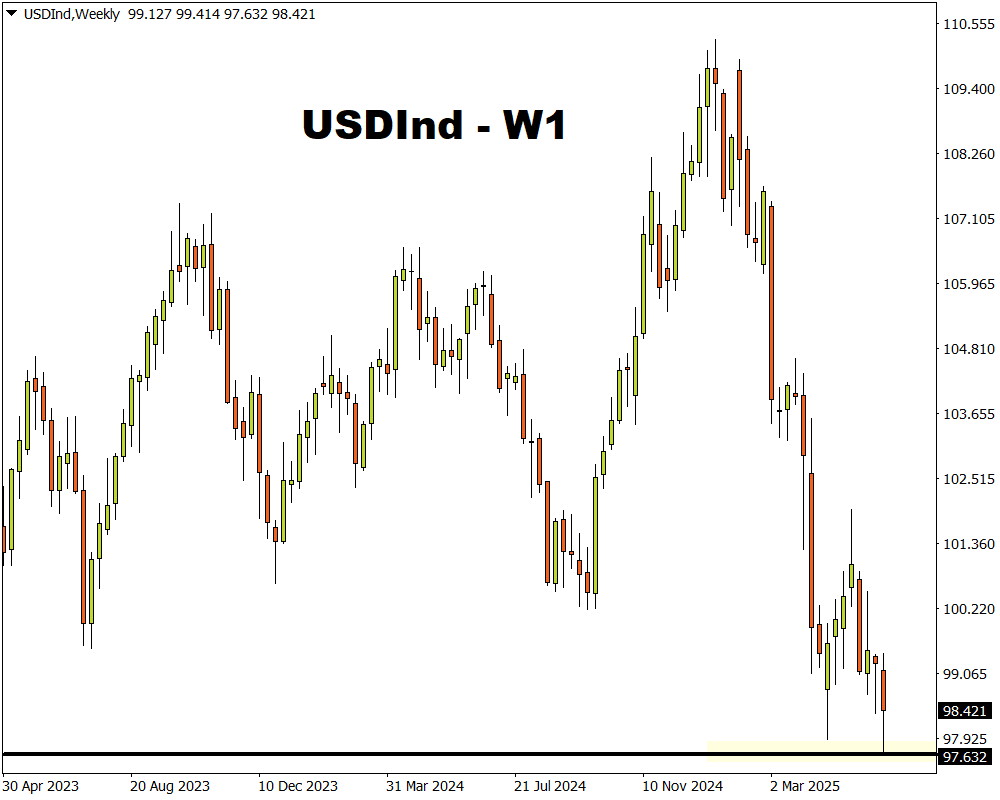
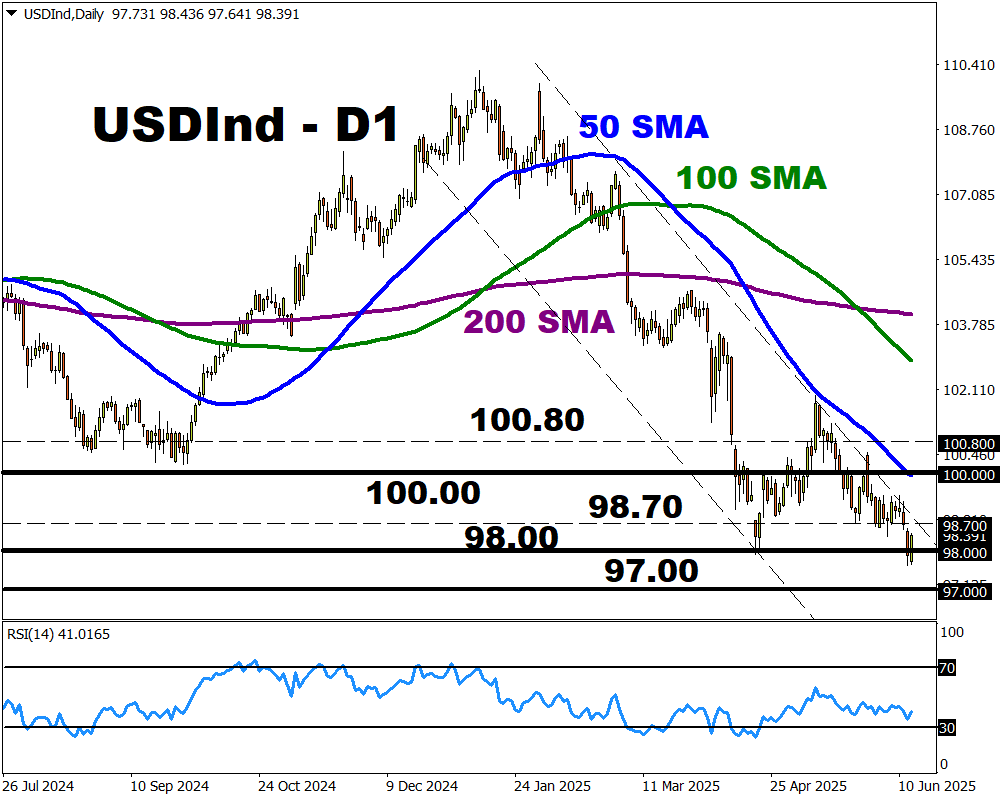
USD Index 100.64 +1.02 (+1.03%)

News feed for: 2025.05.09

  • China Trade Balance (m/m) at 06:00 (GMT+3);
  • Norway Inflation Rate (m/m) at 09:00 (GMT+3);
  • UK BoE Gov Bailey Speaks at 11:40 (GMT+3);
  • Canada Unemployment Rate (m/m) at 15:30 (GMT+3).

By JustMarkets


This article reflects a personal opinion and should not be interpreted as an investment advice, and/or offer, and/or a persistent request for carrying out financial transactions, and/or a guarantee, and/or a forecast of future events.

Can Fed rate decision extend US stocks’ rebound?

By ForexTime 

  • Fed widely expected to leave US rates unchanged
  • Markets fully anticipate next Fed rate cut in July; 1-in-3 chance of June cut
  • Hints of earlier-than-expected rate cut could send US stock indices soaring
  • Risk assets may pare recent gains if Chair Powell pushes back on rate cuts
  • See below for past and projected post-Fed reactions for US500, NAS100, US30


The Fed is set to dominate the market’s attention overnight.

To be clear, the FOMC (Federal Open Market Committee) is widely expected to keep its benchmark rates unchanged at 4.25 – 4.50%.

Given its forward-looking nature, markets are already trying to anticipate the outcomes of FOMC meetings in the months ahead.

Here’s what markets currently predict:

  • June: 1-in-3 chance (33.7%)
  • July: 25-basis point rate cut fully priced in!

Of course, those odds could drastically change in the days, weeks, and months ahead, not just depending on what the Fed tells us this week.

The chances of a Fed rate cut may also depend heavily on whether US President Donald Trump’s tariffs further weaken US economic growth, forcing the Fed into a sooner-than-expected rate cut.

NOTE: The FOMC lowers interest rates in order to shore up economic growth.


What to look out for today (Wednesday, May 7th)?

Markets will be combing through the:

  • FOMC policy statement released at 6:00PM GMT on Wednesday, May 7th, along with …
  • Fed Chair Jerome Powell’s press conference (due 30 minutes after the FOMC statement).

Both the FOMC statement and Powell’s spoken words will be scrutinized for clues about the timing of the next Fed rate cut.

Judging by recent commentary, Fed officials appear to be adopting a wait-and-see approach, in assessing the tariffs’ impact on inflation and growth in the world’s largest economy.

After all, recent weeks have shown that tariffs can be announced, and then retracted, seemingly at POTUS’s whims and fancy.

The ongoing narrative is that …

If US tariffs are kept at elevated levels for longer, the greater the potential damage on the US economy.

And given that this week’s FOMC meeting also comes amid the 90-day pause on some of the harshest tariffs, the Fed may be inclined to maintain this wait-and-see approach, without jolting markets in the interim.

Also note that, at this week’s meeting, the Fed will not be releasing a new dot plot (forecasts by each FOMC member on US interest rate levels in the future), nor fresh economic projections.

Hence, any incoming policy signals, if any, are set to stem from the FOMC policy statement and Powell’s press conference.

How might US stock indices react to today’s Fed meeting?

  • BULLISH: Should Chair Powell and his FOMC colleagues sound “dovish” and start paving the way for rate cuts, that should cheer on risk assets that sends US stock indices higher.
  • BEARISH: If Chair Powell and his FOMC colleagues instead strike a “hawkish” tone, suggesting that US interest rates could stay higher for longer to quell any tariff-induced spikes to US inflation, that could force US stock indices to pare its stunning rebound since early April.

Here’s what markets predict these major US stock indices could react in the 6 hours after today’s FOMC decision:

S&P 500 (tracked by FXTM’s US500) could:

  • rise by as much as 1.4%
  • fall by as much as 1.6

Nasdaq 100 (tracked by FXTM’s NAS100) could:

  • rise/fall by as much as 1.9%

Dow Jones Industrial Average (tracked by FXTM’s US30) could:

  • rise as much as 1.1%
  • fall by as much as 1.7%


How have US stock indices reacted to recent Fed meetings?

These Fed rate decisions of course hold tremendous sway over markets.

Here’s a sample of the “biggest” reactions by major US stock indices within 6 hours of Fed decisions from the past 12 months:

S&P 500 (US500)

  • rose as much as 1.7% (Sept 2024)
  • fell as much as 3% (Dec 2024)

Nasdaq 100 (NAS100)

  • rose as much as 2.35% (Sept 2024)
  • fell as much as 3.5% (Dec 2024)

Dow Jones Industrial Average (US30)

  • rose as much as 1.2% (Sept 2024)
  • fell as much as 2.7% (Dec 2024)


Over the next 12 months …

Wall Street still predicts double-digit potential gains for US stock indices by this time next year.

Here are the projections for 12-month potential upside for 3 major US stock indices:

  • S&P 500 (tracked by FXTM’s US500 index): 16%
    (S&P 500 to cross above 6500 by this time next year)
  • Nasdaq 100 (tracked by FXTM’s NAS100 index): 18%
    (Nasdaq 100 to cross above 23,300 by this time next year)
  • Dow Jones Industrial Average (tracked by FXTM’s US30 index): 14%
    (Dow to cross above 46,700 by this time next year)


Looking at the price charts …

Widely-followed simple moving averages (SMA) stand in the way of bulls (those hoping prices will go higher) of these stock indexes, and could act as immediate resistance levels post-FOMC meeting:


  • 200-day SMA potential immediate resistance for the US500
Imagen
Markets await Fed rate decision

US500: Potential Scenarios

BULLISH: Greater prospects of a mid-year Fed rate cut could send the US500 towards its 200-day SMA / 5700 psychological level. Further north lies its 100-day SMA and 5800 target.

BEARISH: A break below its 50-day SMA could test initial support at the 5,500 round number, with its 21-day SMA and 5400 price region potentially offering stronger support.


  • 200-day SMA potential immediate resistance for the NAS100
    Imagen
    Markets await Fed rate decision

NAS100: Potential Scenarios

BULLISH: A break above the 200-day SMA could see the NAS100 striving for its upside target of 20,800.

BEARISH: The NAS100 may look to find support at its 50-day SMA around the 19,400 region. Further support could arrive around the 21-day SMA.


  • 50-day SMA immediate resistance for the US30
Imagen
Markets await Fed rate decision

US30: Potential Scenarios

BULLISH: A break above the 50-day SMA could see the US30 striving for its immediate upside target of 41,800. Further north, the price region around its 200-day SMA / 42,500 level / 100-day SMA could lend stronger resistance to bulls.

BEARISH: A second consecutive daily close below the 41k mark for the US30 could see prices faltering to the big, round 40,000 number, where its 21-day SMA also currently lies.


Forex-Time-LogoArticle by ForexTime

ForexTime Ltd (FXTM) is an award winning international online forex broker regulated by CySEC 185/12 www.forextime.com

Oil prices rose to 60 dollars per barrel. PBoC lowered reserve requirement ratios (RRR) by 50 bps

By JustMarkets

At the end of Tuesday, the Dow Jones (US30) was down 0.95%. The S&P 500 Index (US500) decreased by 0.77%. The Nasdaq Technology Index (US100) closed lower by 0.88%. The US stocks closed lower on Tuesday as investor sentiment deteriorated amid mixed trade signals. President Trump’s wavering stance on trade — he said “we don’t have to sign deals” — contradicts recent optimism from Treasury officials and dampens hopes for tariff relief. Diplomatic tensions also rose after a sharp exchange with Canadian Prime Minister Mark Carney, who said “Canada is not for sale,” prompting Trump to respond, “Never say never.”

The US trade deficit widened to $140.5 billion in March 2025, hitting a new record high, compared with expectations of a $137 billion deficit. Imports jumped 4.4% to a record $419 billion in anticipation of new tariff announcements in April.

Technology stocks weakened, with Meta down 1.8% and Tesla down 1.7% on disappointing European sales. Palantir Technologies fell by 12% after results fell short of investor expectations, while Ford rose 2.4%, even after warning that tariffs could cut the company’s 2025 earnings by about $2.5 billion.

The US Federal Reserve will hold a monetary policy meeting today. The US Federal Reserve is expected to leave the federal funds rate unchanged at 4.25–4.50% for the third consecutive meeting in May 2025, as policymakers take into account slowing inflation amid a still-resilient labor market and increased uncertainty over trade policy.

Canada’s trade deficit in March 2025 was CAD 0.51 billion, down from the CAD 1.41 billion deficit recorded in February. The improvement came amid a sharper decline in imports compared to exports, driven by retaliatory tariffs by Ottawa in response to new US duties, as well as a voluntary boycott of US goods by Canadian retailers and households.

Equity markets in Europe traded flat on Tuesday. Germany’s DAX (DE40) decreased by 0.41%, France’s CAC 40 (FR40) closed down 0.40%, Spain’s IBEX35 (ES35) added 0.09%, and the UK’s FTSE 100 (UK100) was up 0.01%. European stocks closed modestly lower on Tuesday, capping off the rally of the past four weeks, as markets digested earnings reports, political setbacks, and continued to assess how economic uncertainty is affecting corporate orders. German conservative leader Friedrich Merz was elected chancellor in the second round of voting in Germany’s Bundestag, but the first vote unexpectedly ended without his election. On the corporate front, technology, retail, and pharmaceutical stocks were among the top losers.

WTI crude oil prices rose to $60 a barrel on Wednesday, extending their gains of more than 3% from the previous session, helped by signs of lower production in the US and rising demand in Europe and China. Adding to the upbeat sentiment were reports that US and Chinese officials will meet this week, boosting hopes of easing tensions between the two biggest oil consumers. In addition, API data showed a larger-than-expected decline in US crude inventories, with a 4.5 million barrel drop last week, exceeding the expected 2.5 million barrel decline.

The US natural gas futures rose to $3.6/MMBtu on Tuesday after declining 2.2% in the previous session, helped by lower production and record LNG exports. Production fell about 4.8 Bcf/d to a seven-week low of 102.6 Bcf/d on Tuesday. In addition, the US remains the world’s top LNG exporter, supported by robust international demand despite the recent slowdown in the domestic market.

Asian markets were predominantly up yesterday. Japan’s Nikkei 225 (JP225) was up 1.04%, China’s FTSE China A50 (CHA50) added 0.51%, and Hong Kong’s Hang Seng (HK50) was up 0.70%, while Australia’s ASX 200 (AU200) was negative 0.08%.

People’s Bank of China (PBOC) Governor Pan Gongsheng announced a 50 basis point cut in the reserve requirement ratio (RRR) on Wednesday, which could lead to an injection of around RMB1 trillion in liquidity. This is the first RRR cut in 2025 as Beijing seeks to support economic growth amid escalating trade tensions with the US. Meanwhile, the Central Bank decided to cut the rate on seven-day reverse repurchase agreements by 10 basis points to 1.40%, effective Thursday, May 8. This is the first key rate cut since September 2024 and could lead to a broader cut in rates on market and liquidity instruments.

S&P 500 (US500) 5,606.91 −43.47 (−0.77%)

Dow Jones (US30) 40,829.00 −389.83 (−0.95%)

DAX (DE40) 23,249.65 −94.89 (−0.41%)

FTSE 100 (UK100) 8,597.42 +1.07 (+0.012%)

USD Index 99.19 −0.64 (−0.64%)

News feed for: 2025.05.07

  • New Zealand Unemployment Rate (m/m) at 01:45 (GMT+3);
  • Japan Services PMI (m/m) at 03:30 (GMT+3);
  • UK Construction PMI (m/m) at 11:30 (GMT+3);
  • Eurozone Retail Sales (m/m) at 12:00 (GMT+3);
  • US Crude Oil Reserves (w/w) at 17:30 (GMT+3);
  • US Federal Funds Rate at 21:00 (GMT+3);
  • US FOMC Statement at 21:00 (GMT+3);
  • US FOMC Press Conference at 21:30 (GMT+3).

By JustMarkets


This article reflects a personal opinion and should not be interpreted as an investment advice, and/or offer, and/or a persistent request for carrying out financial transactions, and/or a guarantee, and/or a forecast of future events.

Tariff policy uncertainty persists. China’s service sector shows a decline

By JustMarkets 

On Monday, the Dow Jones Industrial Average (US30) was down 0.24%. The S&P 500 Index (US500) decreased by 0.64%. The Nasdaq Technology Index (US100) closed lower by 0.67%. Markets reacted to President Trump’s threat to impose new tariffs, including a 100% tax on foreign movies, but sentiment improved following stronger-than-expected ISM services sector data. Still, uncertainty remains after Trump said he has no plans to speak with Chinese President Xi Jinping, causing investors to stay cautious. The energy sector led the decline, followed by the consumer discretionary and technology sectors.

The S&P Global Canada Services PMI for April 2025 rose slightly to 41.5 from 41.2 in the previous month, reflecting the fifth consecutive period of contraction in Canadian services activity at a historically high rate. While recovering slightly from March’s decline, business confidence remained historically weak amid continued uncertainty.

Equity markets in Europe were mostly up on Monday. Germany’s DAX (DE40) rose by 1.12%, France’s CAC 40 (FR40) closed down 0.55%, Spain’s IBEX35 (ES35) added 0.53%, and the UK’s FTSE 100 (UK100) was not trading yesterday. The Fed is expected to leave interest rates unchanged following the release of a good employment report for April. Several major companies, including Continental, Hugo Boss, BMW, Fresenius, Infineon, Puma, Heidelberg Materials, Commerzbank, Zalando, and Siemens Energy are also due to report quarterly results this week. Volkswagen, meanwhile, reaffirmed its full-year outlook, excluding the potential impact of US tariffs, after reporting a 12.4% rise in first-quarter revenue, helped by higher sales of electric vehicles.

Swiss consumer prices were unchanged year-on-year in April 2025 after rising to 0.3% y/y in March and defeating expectations for a 0.2% increase. This is the lowest rate since deflation was recorded in March 2021. Meanwhile, core inflation, which excludes volatile items such as food and energy, fell to 0.6% from 0.9% in March.

WTI crude futures rose more than 1% to $58 a barrel on Tuesday, breaking a two-day decline amid renewed tensions in the Middle East. On Monday, Israel launched airstrikes on Yemen’s Hodeidah port and cement factory in response to an attack by Iranian-backed Houthis with ballistic missiles that hit Israel’s main airport a day earlier.

Silver (XAG/USD) prices rose more than 1% to $32.40 per ounce on Monday, recovering from last week’s losses amid a weaker US dollar, amid lingering concerns over trade relations between the US and China. President Donald Trump has said he has no plans to speak with his Chinese counterpart this week, but has signaled a willingness to cut tariffs on Chinese imports to boost trade. Last week, China said it might consider launching trade talks with the US, but emphasized that Washington must first lift all unilateral tariffs to demonstrate sincerity of intent.

Asian markets were predominantly down yesterday. Japan’s Nikkei 225 (JP225) was down 0.21%, China’s FTSE China A50 (CHA50) and Hong Kong’s Hang Seng (HK50) were not trading, while Australia’s ASX 200 (AU200) was negative 0.97%.

The Caixin China Services PMI fell to 50.7 in April 2025, down from March’s three-month high of 51.9 and below market expectations of 51.7, marking the lowest growth in the services sector since September last year. Business sentiment fell to the second-lowest level since data collection began in November 2005 due to concerns about the negative impact of trade policy changes.

Indonesia’s economy contracted by 0.98% QoQ in the first quarter of 2025, the first quarterly GDP contraction in a year and short of the market consensus expecting a 0.89% contraction. The decline followed a 0.53% rise in Q4, helped by a sharp contraction in government spending.

S&P 500 (US500) 5,650.38 −36.29 (−0.64%)

Dow Jones (US30) 41,218.83 −98.60 (−0.24%)

DAX (DE40) 23,344.54 +257.89 (+1.12%)

FTSE 100 (UK100) 8,596.35 +99.55 (+1.17%)

USD Index 99.81 −0.22 (−0.22%)

News feed for: 2025.05.06

  • Caixin Services PMI (m/m) at 04:45 (GMT+3);
  • Switzerland Unemployment Rate (m/m) at 08:45 (GMT+3);
  • Germany Services PMI (m/m) at 10:55 (GMT+3);
  • Eurozone Services PMI (m/m) at 11:00 (GMT+3);
  • UK Services PMI (m/m) at 11:30 (GMT+3);
  • Eurozone Producer Price Index (m/m) at 12:00 (GMT+3);
  • US Trade Balance (m/m) at 15:30 (GMT+3);
  • Canada Trade Balance (m/m) at 15:30 (GMT+3);
  • Canada Ivey PMI (m/m) at 17:00 (GMT+3).

By JustMarkets


This article reflects a personal opinion and should not be interpreted as an investment advice, and/or offer, and/or a persistent request for carrying out financial transactions, and/or a guarantee, and/or a forecast of future events.

Japanese yen halts gains as US trade negotiations return to the spotlight

By RoboForex Analytical Department 

USD/JPY had an opportunity to correct after two consecutive days of decline, with Tuesday’s trading centred around 143.78.

Dollar strengthens on trade optimism and Fed anticipation

The US dollar regained ground as markets reacted to renewed expectations surrounding US-China trade negotiations. Investor caution also grew ahead of the Federal Reserve’s meeting, which begins today.

President Donald Trump cautiously suggested that the 145% tariffs on Chinese imports might be reduced. However, true to form, he offered only a vague hint, further adding to the already uncertain outlook for US-China relations.

Markets are also paying attention to the US-Japan bilateral talks regarding trade engagement. Tokyo aims to finalise an agreement before the June deadline, and any delays could complicate the process further.

Meanwhile, last week’s Bank of Japan meeting saw no change in the key interest rate, which remains at 0.5% per annum. However, the BoJ lowered its GDP and inflation forecasts, reinforcing the view that it does not intend to raise rates soon.

Japan observes a bank holiday on Tuesday, so no major domestic news is expected.

Technical analysis of USD/JPY

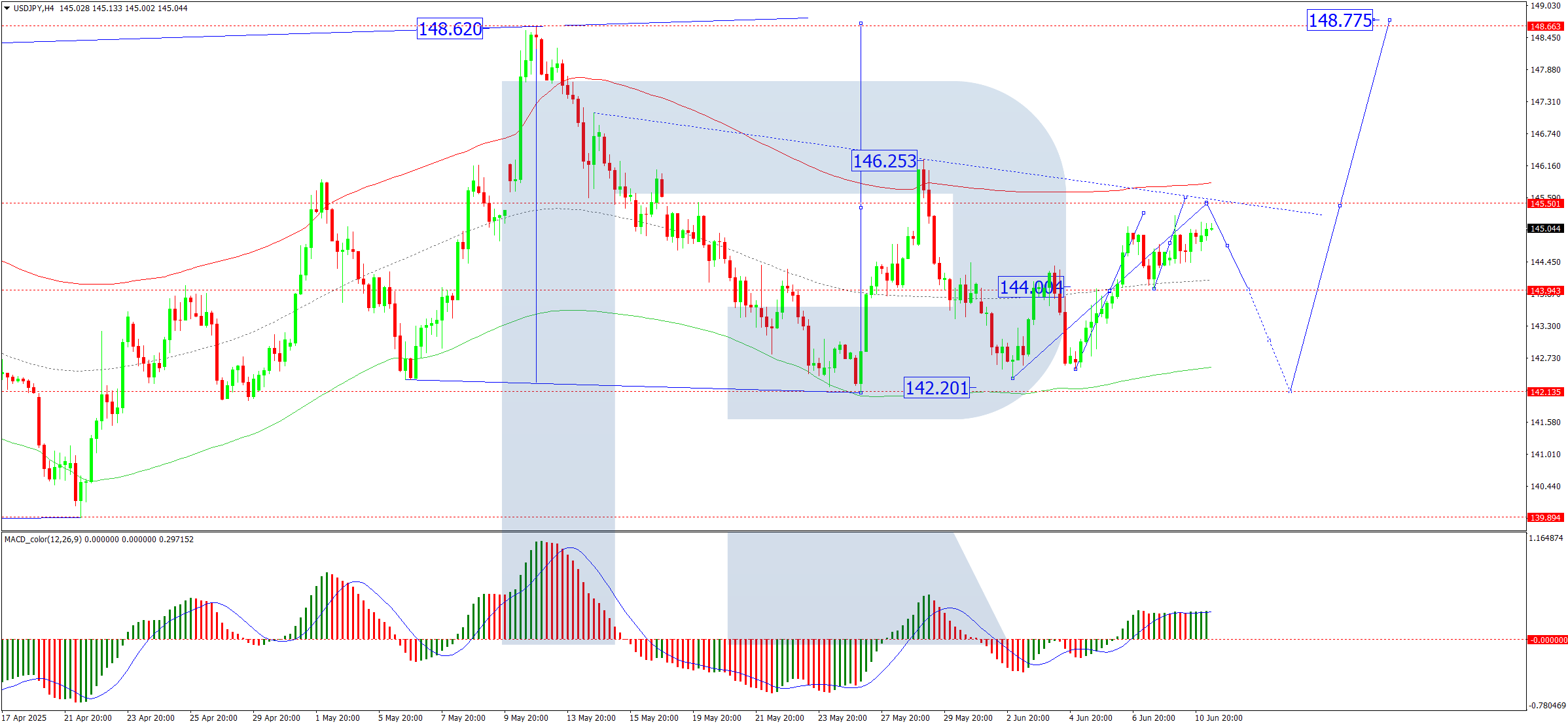
On the H4 chart, USD/JPY completed a growth wave towards 145.86, followed by the start of a corrective phase. The first downward impulse reached 143.72, followed by a correction to 145.05. The market is now forming a consolidation range around 144.30. A downward breakout from this range could send the pair to 142.75. The MACD indicator supports this scenario, as its signal line has exited the histogram area and points firmly downwards, suggesting continued bearish pressure.

On the H1 chart, the pair is building a corrective structure targeting 142.75. The local correction target of 143.53 has already been achieved. Today, there is a strong likelihood of a fifth downward wave in this correction, with 142.75 as the next target. Once this level is reached, a new upward wave towards 145.86 may begin. The Stochastic oscillator confirms this view, with its signal line below 50 and heading sharply towards 20, indicating strong short-term downside momentum.

Conclusion

USD/JPY is currently in a corrective phase as markets digest renewed trade hopes and prepare for the Fed’s decision. Technical indicators support further downside towards 142.75, with a possible reversal to 145.86 thereafter. Trade talks with both China and Japan, along with the Fed’s stance, will remain the key drivers of short-term volatility for the pair.


Disclaimer

Any forecasts contained herein are based on the author’s particular opinion. This analysis may not be treated as trading advice. RoboForex bears no responsibility for trading results based on trading recommendations and reviews contained herein.

The US labor market unexpectedly showed resilience. Oil prices fell sharply after the OPEC+ meeting

By JustMarkets 

The US stocks rose on Friday thanks to a strong jobs report and signs of easing trade tensions between the US and China, which boosted investor confidence. The Dow Jones (US30) Index was up 1.39% (up +2.85% on the week). The S&P 500 Index (US500) was up 1.47% (for the week +2.85%). The Nasdaq Technology Index (US100) closed higher by 1.60% (for the week +3.45%). Nonfarm Payrolls for April rose by 177,000, exceeding expectations and bolstering optimism about the labor market despite lingering uncertainty over tariffs. Further supporting sentiment was Beijing’s openness to a resumption of trade talks, subject to tariff reductions from the US. However, earnings results remained mixed, with Apple shares falling 3.7% after warning of a $900 million tariff hit, and Amazon down 0.1% after a cautious outlook. Exxon Mobil shares were up 0.4% and Chevron was up 1.7% after the results were released.

Canadian GDP rose slightly in March despite falling prices of key Canadian commodities and pessimism over the country’s trade war with the US, reinforcing expectations that GDP may be somewhat resilient to a weakening US economy. On the political front, the Liberal Party of Canada won its fourth consecutive election by a relatively small margin, putting little pressure on the Lonnie after expectations of a majority victory, but still making former Bank of Canada and Bank of England governor Mark Carney prime minister of a minority government. So far, the incumbent PM has refrained from prioritizing a trade deal with the US, emphasizing Canada’s influence and preferring to make deals with other countries.

Equity markets in Europe were mostly up on Friday. Germany’s DAX (DE40) gained 2.62% (for the week +3.94%), France’s CAC 40 (FR40) closed 2.33% higher (for the week +2.71%), Spain’s IBEX35 (ES35) gained 1.20% (for the week +1.22%), and the UK’s FTSE 100 (UK100) closed 1.17% higher (for the week +2.15%). In Europe, encouraging economic data emerged with inflation unchanged at 2.2% in April, although core inflation rose slightly to 2.7% from 2.5%. Meanwhile, final PMI data for April showed tentative signs of a recovery in manufacturing activity. Shell shares rose by 1.9% after beating first-quarter earnings expectations and launching a $3.5 billion share buyback. Standard Chartered also beat projections thanks to profit gains in wealth management and global banking services.

WTI crude futures fell more than 3% to around $56 a barrel on Monday as OPEC+ agreed to increase production, adding to fears of a global supply glut. OPEC+ will boost oil production for the second straight month, increasing output by 411,000 bpd in June. That could put as much as 2.2 million bpd back on the market by November as group leader Saudi Arabia seeks to punish some members of the organization that have exceeded their quotas.

Asian markets were mostly up last week. Japan’s Nikkei 225 (JP225) was up 4.08%, China’s FTSE China A50 (CHA50) decreased by 1.17%, Hong Kong’s Hang Seng (HK50) added 1.92%, and Australia’s ASX 200 (AU200) was positive 3.39% over the past week.

The Australian dollar climbed above $0.645 on Monday, hitting its highest level in nearly five months, after Prime Minister Anthony Albanese won a second three-year term in Saturday’s federal election. Albanese promised the government would act in a “disciplined and orderly” manner, focusing on addressing rising living costs and global trade tensions. He also reiterated commitments to expand renewable energy, cut taxes, ease the housing crisis, and invest in Australia’s strained health system. On monetary policy, the Reserve Bank of Australia is expected to cut its benchmark interest rate by 25 basis points to 3.85% in May.

The New Zealand dollar rose to around US$0.598 on Monday, extending gains from the previous session, helped by continued weakness in the US dollar as investors awaited clearer signals on trade relations between the US and China. On Sunday, President Trump reiterated his confidence that China wants a deal, although he did not provide any details. Meanwhile, Beijing signaled last week that it was open to talks but insisted that the US first remove all unilateral tariffs.

S&P 500 (US500) 5,686.67 +82.53 (+1.47%)

Dow Jones (US30) 41,317.43 +564.47 (+1.39%)

DAX (DE40) 23,086.65 +589.67 (+2.62%)

FTSE 100 (UK100) 8,596.35 +99.55 (+1.17%)

USD Index 100.04 -0.21 (-0.21%)

News feed for: 2025.05.05

  • Switzerland Consumer Price Index (m/m) at 09:30 (GMT+3);
  • US ISM Services PMI (m/m) at 17:00 (GMT+3).

By JustMarkets


This article reflects a personal opinion and should not be interpreted as an investment advice, and/or offer, and/or a persistent request for carrying out financial transactions, and/or a guarantee, and/or a forecast of future events.

Gold rises as demand for safe-haven assets returns

By RoboForex Analytical Department

Gold prices climbed to 3,260 USD per troy ounce on Monday, as global uncertainty—particularly around US-China trade negotiations—continues to drive demand for safe-haven assets.

Trade tensions and a weaker dollar support gold

Market sentiment remains cautious after US President Donald Trump stated that China is ready to make a deal, yet offered no specifics on the content or timing of renewed negotiations.

Earlier, Beijing confirmed it was reviewing US proposals to restart talks but reiterated that certain conditions must be met before any dialogue can begin. This lingering uncertainty continues to bolster investor interest in gold.

Adding to the upside pressure, the US dollar weakened, making gold more attractive for holders of other currencies.

Investors are now turning their attention to the upcoming Federal Reserve meeting, which begins on Tuesday and concludes on Wednesday evening. Markets widely expect the Fed to maintain current interest rates, despite renewed calls from Trump to lower them.

Technical analysis of XAU/USD

On the H4 chart, XAU/USD is consolidating around 3,266 USD. A decline to 3,165 USD is possible in the short term. After reaching this level, the market may correct back up to 3,266 USD. If the correction completes, another downward wave could unfold with a target at 3,033 USD. The MACD indicator supports this bearish scenario, with its signal line below zero and pointing sharply downwards.

On the H1 chart, gold broke below 3,266 USD, reached the local target of 3,202 USD, and then corrected back up to test 3,266 USD from below. The formation of another downside wave towards 3,179 USD is relevant today. The Stochastic oscillator confirms this outlook, with its signal line below 80 and heading directly towards 20, indicating continued downward momentum.

Conclusion

Gold remains supported by geopolitical uncertainty and a weakening dollar, while technical indicators point to short-term downside potential before another possible corrective rebound. Key levels to watch are 3,179 USD and 3,165 USD as near-term support, with a broader bearish target at 3,033 USD. The Fed’s upcoming meeting may influence price direction depending on its tone regarding interest rates and the broader economic outlook.


Disclaimer

Any forecasts contained herein are based on the author’s particular opinion. This analysis may not be treated as trading advice. RoboForex bears no responsibility for trading results based on trading recommendations and reviews contained herein.

Speculators boost Brazilian Real and Japanese Yen Bets to New Record Highs

By InvestMacro

Speculators OI FX Futures COT Chart

Here are the latest charts and statistics for the Commitment of Traders (COT) data published by the Commodities Futures Trading Commission (CFTC).

The latest COT data is updated through Tuesday April 29th and shows a quick view of how large market participants (for-profit speculators and commercial traders) were positioned in the futures markets. All currency positions are in direct relation to the US dollar where, for example, a bet for the euro is a bet that the euro will rise versus the dollar while a bet against the euro will be a bet that the euro will decline versus the dollar.

Weekly Speculator Changes led by Brazilian Real & Mexican Peso

Speculators Nets FX Futures COT Chart

The COT currency market speculator bets were overall higher this week as nine out of the eleven currency markets we cover had higher positioning while the other two markets had lower speculator contracts.

Leading the gains for the currency markets was the Brazilian Real (18,451 contracts) with the Mexican Peso (18,347 contracts), the EuroFX (10,769 contracts), the New Zealand Dollar (5,372 contracts), the Australian Dollar (4,639 contracts), the British Pound (3,469 contracts), the Japanese Yen (1,398 contracts), the Swiss Franc (1,160 contracts) and the US Dollar Index (525 contracts) also showing positive weeks.

The currencies seeing declines in speculator bets were Bitcoin (-425 contracts) and with the Canadian Dollar (-38 contracts) also seeing a tiny decline on the week.

Speculators boost Brazilian Real and Japanese Yen Bets to New Record Highs

Highlighting the COT currency’s data this week is new record high speculator levels for the both the Brazilian real and Japanese yen.

First up, the Brazilian real rose by over +18,000 contracts this week and have now risen for four straight weeks (by a total of over 31,000 contracts) to land at a total of 68,338 contracts. This is now the highest on record and surpasses the previous high of +50,496 contracts that was established on March 8th of 2022.

This has been sharp and swift turnaround for the BRL as net positions were negative as recent as January 28th. The overall net position had been in bearish territory from May 7th of 2024 continuously through January 28th of 2025 before turning bullish. February 4th saw a huge jump by over +38,000 contracts in just that week and set in motion the current bullish sentiment trend.

The Brazilian real exchange rate has been on the move higher since hitting a record low in December of 2024. Since that record low position, the currency has improved by over 10% versus the US dollar. The Brazilian real exchange rate has now risen in 13 out of the last 18 weeks but despite the all-time record high in speculative bets, the currency still resides at a relatively low level compared to the last 3 years, 5 years and 10 years time-frames.
The Japanese yen speculator bets also continued higher with new all-time high record levels. The yen speculator positions have made new all-time record highs for the fourth consecutive week and landed this week at +179,212 net contracts. The yen positions have risen higher in 13 out of the last 15 weeks for a cumulative gain of +208,623 net contracts over that 15 week period.
The yen exchange rate, however, has dipped in the last couple weeks following 3 consecutive weeks of gains versus the US dollar. The yen exchange rate, like the Brazilian real, remains historically low despite the all-time record high in speculator bets.

Currencies Data:

Speculators FX Futures COT Data Table

Legend: Open Interest | Speculators Current Net Position | Weekly Specs Change | Specs Strength Score compared to last 3-Years (0-100 range)


Strength Scores led by Japanese Yen & Brazilian Real

Speculators Strength Scores FX Futures COT Chart

COT Strength Scores (a normalized measure of Speculator positions over a 3-Year range, from 0 to 100 where above 80 is Extreme-Bullish and below 20 is Extreme-Bearish) showed that the Japanese Yen (100 percent) and the Brazilian Real (100 percent) lead the currency markets this week. The Mexican Peso (59 percent), EuroFX (58 percent) and the Canadian Dollar (58 percent) come in as the next highest in the weekly strength scores.

On the downside, the US Dollar Index (6 percent) comes in at the lowest strength level currently and is in Extreme-Bearish territory (below 20 percent). The next lowest strength scores are Bitcoin (24 percent), the New Zealand Dollar (40 percent) and the Australian Dollar (41 percent).

3-Year Strength Statistics:
US Dollar Index (5.8 percent) vs US Dollar Index previous week (4.7 percent)
EuroFX (57.6 percent) vs EuroFX previous week (53.5 percent)
British Pound Sterling (46.9 percent) vs British Pound Sterling previous week (45.3 percent)
Japanese Yen (100.0 percent) vs Japanese Yen previous week (99.6 percent)
Swiss Franc (51.6 percent) vs Swiss Franc previous week (49.3 percent)
Canadian Dollar (57.8 percent) vs Canadian Dollar previous week (57.9 percent)
Australian Dollar (40.9 percent) vs Australian Dollar previous week (37.6 percent)
New Zealand Dollar (39.6 percent) vs New Zealand Dollar previous week (33.4 percent)
Mexican Peso (59.1 percent) vs Mexican Peso previous week (49.7 percent)
Brazilian Real (100.0 percent) vs Brazilian Real previous week (85.0 percent)
Bitcoin (24.4 percent) vs Bitcoin previous week (33.7 percent)


Canadian Dollar & New Zealand Dollar top the 6-Week Strength Trends

Speculators Trends FX Futures COT Chart

COT Strength Score Trends (or move index, calculates the 6-week changes in strength scores) showed that the Canadian Dollar (31 percent) and the New Zealand Dollar (22 percent) lead the past six weeks trends for the currencies. The Brazilian Real (22 percent), the Swiss Franc (20 percent) and the Japanese Yen (15 percent) are the next highest positive movers in the 3-Year trends data.

Bitcoin (-67 percent) leads the downside trend scores currently with the US Dollar Index (-16 percent) and the British Pound (-2 percent) following next with lower trend scores.

3-Year Strength Trends:
US Dollar Index (-15.8 percent) vs US Dollar Index previous week (-36.9 percent)
EuroFX (6.2 percent) vs EuroFX previous week (19.8 percent)
British Pound Sterling (-2.4 percent) vs British Pound Sterling previous week (-3.9 percent)
Japanese Yen (15.5 percent) vs Japanese Yen previous week (12.1 percent)
Swiss Franc (20.4 percent) vs Swiss Franc previous week (23.3 percent)
Canadian Dollar (31.1 percent) vs Canadian Dollar previous week (33.7 percent)
Australian Dollar (14.5 percent) vs Australian Dollar previous week (-4.5 percent)
New Zealand Dollar (21.9 percent) vs New Zealand Dollar previous week (30.1 percent)
Mexican Peso (1.8 percent) vs Mexican Peso previous week (5.7 percent)
Brazilian Real (22.4 percent) vs Brazilian Real previous week (6.5 percent)
Bitcoin (-67.0 percent) vs Bitcoin previous week (-50.9 percent)


Individual COT Forex Markets:

US Dollar Index Futures:

US Dollar Index Forex Futures COT ChartThe US Dollar Index large speculator standing this week reached a net position of -449 contracts in the data reported through Tuesday. This was a weekly gain of 525 contracts from the previous week which had a total of -974 net contracts.

This week’s current strength score (the trader positioning range over the past three years, measured from 0 to 100) shows the speculators are currently Bearish-Extreme with a score of 5.8 percent. The commercials are Bullish-Extreme with a score of 97.1 percent and the small traders (not shown in chart) are Bearish-Extreme with a score of 15.4 percent.

Price Trend-Following Model: Downtrend

Our weekly trend-following model classifies the current market price position as: Downtrend.

US DOLLAR INDEX StatisticsSPECULATORSCOMMERCIALSSMALL TRADERS
– Percent of Open Interest Longs:58.228.67.7
– Percent of Open Interest Shorts:59.523.911.0
– Net Position:-4491,548-1,099
– Gross Longs:19,0939,3882,515
– Gross Shorts:19,5427,8403,614
– Long to Short Ratio:1.0 to 11.2 to 10.7 to 1
NET POSITION TREND:
– Strength Index Score (3 Year Range Pct):5.897.115.4
– Strength Index Reading (3 Year Range):Bearish-ExtremeBullish-ExtremeBearish-Extreme
NET POSITION MOVEMENT INDEX:
– 6-Week Change in Strength Index:-15.816.3-8.9


Euro Currency Futures:

Euro Currency Futures COT ChartThe Euro Currency large speculator standing this week reached a net position of 75,797 contracts in the data reported through Tuesday. This was a weekly gain of 10,769 contracts from the previous week which had a total of 65,028 net contracts.

This week’s current strength score (the trader positioning range over the past three years, measured from 0 to 100) shows the speculators are currently Bullish with a score of 57.6 percent. The commercials are Bearish with a score of 36.4 percent and the small traders (not shown in chart) are Bullish-Extreme with a score of 97.1 percent.

Price Trend-Following Model: Strong Uptrend

Our weekly trend-following model classifies the current market price position as: Strong Uptrend.

EURO Currency StatisticsSPECULATORSCOMMERCIALSSMALL TRADERS
– Percent of Open Interest Longs:26.955.013.3
– Percent of Open Interest Shorts:16.573.05.7
– Net Position:75,797-131,51155,714
– Gross Longs:196,388401,74697,376
– Gross Shorts:120,591533,25741,662
– Long to Short Ratio:1.6 to 10.8 to 12.3 to 1
NET POSITION TREND:
– Strength Index Score (3 Year Range Pct):57.636.497.1
– Strength Index Reading (3 Year Range):BullishBearishBullish-Extreme
NET POSITION MOVEMENT INDEX:
– 6-Week Change in Strength Index:6.2-13.350.6


British Pound Sterling Futures:

British Pound Sterling Futures COT ChartThe British Pound Sterling large speculator standing this week reached a net position of 23,959 contracts in the data reported through Tuesday. This was a weekly advance of 3,469 contracts from the previous week which had a total of 20,490 net contracts.

This week’s current strength score (the trader positioning range over the past three years, measured from 0 to 100) shows the speculators are currently Bearish with a score of 46.9 percent. The commercials are Bearish with a score of 49.6 percent and the small traders (not shown in chart) are Bullish with a score of 74.3 percent.

Price Trend-Following Model: Strong Uptrend

Our weekly trend-following model classifies the current market price position as: Strong Uptrend.

BRITISH POUND StatisticsSPECULATORSCOMMERCIALSSMALL TRADERS
– Percent of Open Interest Longs:47.428.716.4
– Percent of Open Interest Shorts:34.944.213.4
– Net Position:23,959-29,7235,764
– Gross Longs:91,06455,26331,474
– Gross Shorts:67,10584,98625,710
– Long to Short Ratio:1.4 to 10.7 to 11.2 to 1
NET POSITION TREND:
– Strength Index Score (3 Year Range Pct):46.949.674.3
– Strength Index Reading (3 Year Range):BearishBearishBullish
NET POSITION MOVEMENT INDEX:
– 6-Week Change in Strength Index:-2.43.6-7.5


Japanese Yen Futures:

Japanese Yen Forex Futures COT ChartThe Japanese Yen large speculator standing this week reached a net position of 179,212 contracts in the data reported through Tuesday. This was a weekly advance of 1,398 contracts from the previous week which had a total of 177,814 net contracts.

This week’s current strength score (the trader positioning range over the past three years, measured from 0 to 100) shows the speculators are currently Bullish-Extreme with a score of 100.0 percent. The commercials are Bearish-Extreme with a score of 0.0 percent and the small traders (not shown in chart) are Bullish-Extreme with a score of 99.0 percent.

Price Trend-Following Model: Uptrend

Our weekly trend-following model classifies the current market price position as: Uptrend.

JAPANESE YEN StatisticsSPECULATORSCOMMERCIALSSMALL TRADERS
– Percent of Open Interest Longs:55.428.612.1
– Percent of Open Interest Shorts:6.483.85.9
– Net Position:179,212-201,89722,685
– Gross Longs:202,797104,91044,388
– Gross Shorts:23,585306,80721,703
– Long to Short Ratio:8.6 to 10.3 to 12.0 to 1
NET POSITION TREND:
– Strength Index Score (3 Year Range Pct):100.00.099.0
– Strength Index Reading (3 Year Range):Bullish-ExtremeBearish-ExtremeBullish-Extreme
NET POSITION MOVEMENT INDEX:
– 6-Week Change in Strength Index:15.5-16.420.7


Swiss Franc Futures:

Swiss Franc Forex Futures COT ChartThe Swiss Franc large speculator standing this week reached a net position of -24,314 contracts in the data reported through Tuesday. This was a weekly boost of 1,160 contracts from the previous week which had a total of -25,474 net contracts.

This week’s current strength score (the trader positioning range over the past three years, measured from 0 to 100) shows the speculators are currently Bullish with a score of 51.6 percent. The commercials are Bearish with a score of 40.7 percent and the small traders (not shown in chart) are Bullish with a score of 74.7 percent.

Price Trend-Following Model: Strong Uptrend

Our weekly trend-following model classifies the current market price position as: Strong Uptrend.

SWISS FRANC StatisticsSPECULATORSCOMMERCIALSSMALL TRADERS
– Percent of Open Interest Longs:7.774.517.5
– Percent of Open Interest Shorts:41.539.418.8
– Net Position:-24,31425,264-950
– Gross Longs:5,56753,62012,562
– Gross Shorts:29,88128,35613,512
– Long to Short Ratio:0.2 to 11.9 to 10.9 to 1
NET POSITION TREND:
– Strength Index Score (3 Year Range Pct):51.640.774.7
– Strength Index Reading (3 Year Range):BullishBearishBullish
NET POSITION MOVEMENT INDEX:
– 6-Week Change in Strength Index:20.4-28.932.6


Canadian Dollar Futures:

Canadian Dollar Forex Futures COT ChartThe Canadian Dollar large speculator standing this week reached a net position of -67,205 contracts in the data reported through Tuesday. This was a weekly fall of -38 contracts from the previous week which had a total of -67,167 net contracts.

This week’s current strength score (the trader positioning range over the past three years, measured from 0 to 100) shows the speculators are currently Bullish with a score of 57.8 percent. The commercials are Bearish with a score of 45.5 percent and the small traders (not shown in chart) are Bearish with a score of 20.7 percent.

Price Trend-Following Model: Strong Uptrend

Our weekly trend-following model classifies the current market price position as: Strong Uptrend.

CANADIAN DOLLAR StatisticsSPECULATORSCOMMERCIALSSMALL TRADERS
– Percent of Open Interest Longs:6.483.59.1
– Percent of Open Interest Shorts:33.453.312.4
– Net Position:-67,20575,322-8,117
– Gross Longs:16,046208,15622,693
– Gross Shorts:83,251132,83430,810
– Long to Short Ratio:0.2 to 11.6 to 10.7 to 1
NET POSITION TREND:
– Strength Index Score (3 Year Range Pct):57.845.520.7
– Strength Index Reading (3 Year Range):BullishBearishBearish
NET POSITION MOVEMENT INDEX:
– 6-Week Change in Strength Index:31.1-30.57.0


Australian Dollar Futures:

Australian Dollar Forex Futures COT ChartThe Australian Dollar large speculator standing this week reached a net position of -49,943 contracts in the data reported through Tuesday. This was a weekly gain of 4,639 contracts from the previous week which had a total of -54,582 net contracts.

This week’s current strength score (the trader positioning range over the past three years, measured from 0 to 100) shows the speculators are currently Bearish with a score of 40.9 percent. The commercials are Bullish with a score of 59.0 percent and the small traders (not shown in chart) are Bullish with a score of 52.1 percent.

Price Trend-Following Model: Strong Uptrend

Our weekly trend-following model classifies the current market price position as: Strong Uptrend.

AUSTRALIAN DOLLAR StatisticsSPECULATORSCOMMERCIALSSMALL TRADERS
– Percent of Open Interest Longs:14.466.612.4
– Percent of Open Interest Shorts:41.440.211.8
– Net Position:-49,94348,8031,140
– Gross Longs:26,602123,07922,967
– Gross Shorts:76,54574,27621,827
– Long to Short Ratio:0.3 to 11.7 to 11.1 to 1
NET POSITION TREND:
– Strength Index Score (3 Year Range Pct):40.959.052.1
– Strength Index Reading (3 Year Range):BearishBullishBullish
NET POSITION MOVEMENT INDEX:
– 6-Week Change in Strength Index:14.5-13.24.3


New Zealand Dollar Futures:

New Zealand Dollar Forex Futures COT ChartThe New Zealand Dollar large speculator standing this week reached a net position of -21,523 contracts in the data reported through Tuesday. This was a weekly gain of 5,372 contracts from the previous week which had a total of -26,895 net contracts.

This week’s current strength score (the trader positioning range over the past three years, measured from 0 to 100) shows the speculators are currently Bearish with a score of 39.6 percent. The commercials are Bullish with a score of 58.1 percent and the small traders (not shown in chart) are Bullish with a score of 56.2 percent.

Price Trend-Following Model: Strong Uptrend

Our weekly trend-following model classifies the current market price position as: Strong Uptrend.

NEW ZEALAND DOLLAR StatisticsSPECULATORSCOMMERCIALSSMALL TRADERS
– Percent of Open Interest Longs:19.373.06.7
– Percent of Open Interest Shorts:53.439.36.3
– Net Position:-21,52321,302221
– Gross Longs:12,17046,0704,201
– Gross Shorts:33,69324,7683,980
– Long to Short Ratio:0.4 to 11.9 to 11.1 to 1
NET POSITION TREND:
– Strength Index Score (3 Year Range Pct):39.658.156.2
– Strength Index Reading (3 Year Range):BearishBullishBullish
NET POSITION MOVEMENT INDEX:
– 6-Week Change in Strength Index:21.9-23.121.2


Mexican Peso Futures:

Mexican Peso Futures COT ChartThe Mexican Peso large speculator standing this week reached a net position of 59,512 contracts in the data reported through Tuesday. This was a weekly gain of 18,347 contracts from the previous week which had a total of 41,165 net contracts.

This week’s current strength score (the trader positioning range over the past three years, measured from 0 to 100) shows the speculators are currently Bullish with a score of 59.1 percent. The commercials are Bearish with a score of 42.6 percent and the small traders (not shown in chart) are Bearish with a score of 33.6 percent.

Price Trend-Following Model: Strong Uptrend

Our weekly trend-following model classifies the current market price position as: Strong Uptrend.

MEXICAN PESO StatisticsSPECULATORSCOMMERCIALSSMALL TRADERS
– Percent of Open Interest Longs:64.530.24.3
– Percent of Open Interest Shorts:18.477.82.8
– Net Position:59,512-61,4701,958
– Gross Longs:83,28739,0195,554
– Gross Shorts:23,775100,4893,596
– Long to Short Ratio:3.5 to 10.4 to 11.5 to 1
NET POSITION TREND:
– Strength Index Score (3 Year Range Pct):59.142.633.6
– Strength Index Reading (3 Year Range):BullishBearishBearish
NET POSITION MOVEMENT INDEX:
– 6-Week Change in Strength Index:1.8-2.68.8


Brazilian Real Futures:

Brazil Real Futures COT ChartThe Brazilian Real large speculator standing this week reached a net position of 68,338 contracts in the data reported through Tuesday. This was a weekly boost of 18,451 contracts from the previous week which had a total of 49,887 net contracts.

This week’s current strength score (the trader positioning range over the past three years, measured from 0 to 100) shows the speculators are currently Bullish-Extreme with a score of 100.0 percent. The commercials are Bearish-Extreme with a score of 0.0 percent and the small traders (not shown in chart) are Bearish with a score of 33.5 percent.

Price Trend-Following Model: Strong Uptrend

Our weekly trend-following model classifies the current market price position as: Strong Uptrend.

BRAZIL REAL StatisticsSPECULATORSCOMMERCIALSSMALL TRADERS
– Percent of Open Interest Longs:64.932.02.9
– Percent of Open Interest Shorts:10.288.51.1
– Net Position:68,338-70,5742,236
– Gross Longs:81,03739,9533,636
– Gross Shorts:12,699110,5271,400
– Long to Short Ratio:6.4 to 10.4 to 12.6 to 1
NET POSITION TREND:
– Strength Index Score (3 Year Range Pct):100.00.033.5
– Strength Index Reading (3 Year Range):Bullish-ExtremeBearish-ExtremeBearish
NET POSITION MOVEMENT INDEX:
– 6-Week Change in Strength Index:22.4-22.0-0.6


Bitcoin Futures:

Bitcoin Crypto Futures COT ChartThe Bitcoin large speculator standing this week reached a net position of -1,231 contracts in the data reported through Tuesday. This was a weekly fall of -425 contracts from the previous week which had a total of -806 net contracts.

This week’s current strength score (the trader positioning range over the past three years, measured from 0 to 100) shows the speculators are currently Bearish with a score of 24.4 percent. The commercials are Bullish-Extreme with a score of 86.3 percent and the small traders (not shown in chart) are Bearish with a score of 45.7 percent.

Price Trend-Following Model: Weak Downtrend

Our weekly trend-following model classifies the current market price position as: Weak Downtrend.

BITCOIN StatisticsSPECULATORSCOMMERCIALSSMALL TRADERS
– Percent of Open Interest Longs:82.95.04.8
– Percent of Open Interest Shorts:87.51.73.7
– Net Position:-1,231915316
– Gross Longs:22,3551,3601,307
– Gross Shorts:23,586445991
– Long to Short Ratio:0.9 to 13.1 to 11.3 to 1
NET POSITION TREND:
– Strength Index Score (3 Year Range Pct):24.486.345.7
– Strength Index Reading (3 Year Range):BearishBullish-ExtremeBearish
NET POSITION MOVEMENT INDEX:
– 6-Week Change in Strength Index:-67.066.424.9


Article By InvestMacroReceive our weekly COT Newsletter

*COT Report: The COT data, released weekly to the public each Friday, is updated through the most recent Tuesday (data is 3 days old) and shows a quick view of how large speculators or non-commercials (for-profit traders) were positioned in the futures markets.

The CFTC categorizes trader positions according to commercial hedgers (traders who use futures contracts for hedging as part of the business), non-commercials (large traders who speculate to realize trading profits) and nonreportable traders (usually small traders/speculators) as well as their open interest (contracts open in the market at time of reporting). See CFTC criteria here.

Speculator Extremes: JPY, BRL, Wheat & 5-Year Bonds lead Bullish & Bearish Positions

By InvestMacro 

The latest update for the weekly Commitment of Traders (COT) report was released by the Commodity Futures Trading Commission (CFTC) on Friday for data ending on April 29th.

This weekly Extreme Positions report highlights the Most Bullish and Most Bearish Positions for the speculator category. Extreme positioning in these markets can foreshadow strong moves in the underlying market.

To signify an extreme position, we use the Strength Index (also known as the COT Index) of each instrument, a common method of measuring COT data. The Strength Index is simply a comparison of current trader positions against the range of positions over the previous 3 years. We use over 80 percent as extremely bullish and under 20 percent as extremely bearish. (Compare Strength Index scores across all markets in the data table or cot leaders table)


Here Are This Week’s Most Bullish Speculator Positions:

Japanese Yen

Extreme Bullish Leader
The Japanese Yen speculator position comes in as the most bullish extreme standing once again this week as the JPY speculator level is currently at a 100 percent score of its 3-year range.

The six-week trend for the percent strength score totaled 15 this week. The overall net speculator position reached a new all-time record high at a total of 179,212 net contracts this week with a gain of 1,398 contract in the weekly speculator bets.


Speculators or Non-Commercials Notes:

Speculators, classified as non-commercial traders by the CFTC, are made up of large commodity funds, hedge funds and other significant for-profit participants. The Specs are generally regarded as trend-followers in their behavior towards price action – net speculator bets and prices tend to go in the same directions. These traders often look to buy when prices are rising and sell when prices are falling. To illustrate this point, many times speculator contracts can be found at their most extremes (bullish or bearish) when prices are also close to their highest or lowest levels.

These extreme levels can be dangerous for the large speculators as the trade is most crowded, there is less trading ammunition still sitting on the sidelines to push the trend further and prices have moved a significant distance. When the trend becomes exhausted, some speculators take profits while others look to also exit positions when prices fail to continue in the same direction. This process usually plays out over many months to years and can ultimately create a reverse effect where prices start to fall and speculators start a process of selling when prices are falling.


Brazil Real

Extreme Bullish Leader
The Brazil Real speculator position comes in tied at the top of the extreme standings this week as the BRL speculator level is also at 100 percent score of its 3-year range.

The six-week trend for the percent strength score was a gain of 22 this week. The speculator position registered 68,338 net contracts this week with a weekly boost of 18,451 contracts in speculator bets.


VIX

Extreme Bullish Leader
The VIX speculator position comes in third this week in the extreme standings. The VIX speculator level resides at a 98 percent score of its 3-year range.

The six-week trend for the speculator strength score came in at -2 this week. The overall speculator position was 4,240 net contracts this week with a rise of 9,985 contracts in the weekly speculator bets.


Nikkei 225

Extreme Bullish Leader
The Nikkei 225 speculator position comes up number four in the extreme standings this week. The Nikkei 225 speculator level is at a 96 percent score of its 3-year range.

The six-week trend for the speculator strength score totaled a change of 35 this week. The overall speculator position was 1,904 net contracts this week with an increase by 2,025 contracts in the speculator bets.


Nasdaq

Extreme Bullish Leader
The Nasdaq speculator position rounds out the top five in this week’s bullish extreme standings. The Nasdaq-Mini speculator level sits at a 87 percent score of its 3-year range. The six-week trend for the speculator strength score was 12 this week.

The speculator position was 30,863 net contracts this week with a decline by -6,817 contracts in the weekly speculator bets.


This Week’s Most Bearish Speculator Positions:

Wheat

Extreme Bearish Leader
The Wheat speculator position comes in as the most bearish extreme standing this week. The Wheat speculator level is at the bottom or 0 percent score of its 3-year range.

The six-week trend for the speculator strength score was -28 this week. The overall speculator position was -116,808 net contracts this week with a decrease of -22,839 contracts in the speculator bets.


5-Year Bond

Extreme Bearish Leader
The 5-Year Bond speculator position comes in next for the most bearish extreme standing on the week. The 5-Year speculator level is at a 0 percent score of its 3-year range.

The six-week trend for the speculator strength score was -18 this week. The speculator position was -2,292,544 net contracts this week with a drop by -101,110 contracts in the weekly speculator bets.


US Dollar Index

Extreme Bearish Leader
The US Dollar Index speculator position comes in as third most bearish extreme standing of the week. The USD Index speculator level resides at a 6 percent score of its 3-year range.

The six-week trend for the speculator strength score was -16 this week. The overall speculator position was -449 net contracts this week with a rise of 525 contracts in the speculator bets.


Heating Oil

Extreme Bearish Leader
The Heating Oil speculator position comes in as this week’s fourth most bearish extreme standing. The Heating Oil speculator level is at a 17 percent score of its 3-year range.

The six-week trend for the speculator strength score was -6 this week. The speculator position was -20,034 net contracts this week with a decline by -7,483 contracts in the weekly speculator bets.


WTI Crude Oil

Extreme Bearish Leader
Finally, the WTI Crude Oil speculator position comes in as the fifth most bearish extreme standing for this week. The WTI Crude speculator level is at a 18 percent score of its 3-year range.

The six-week trend for the speculator strength score was 5 this week. The speculator position was 177,209 net contracts this week with an advance by 6,254 contracts in the weekly speculator bets.


Article By InvestMacroReceive our weekly COT Newsletter

*COT Report: The COT data, released weekly to the public each Friday, is updated through the most recent Tuesday (data is 3 days old) and shows a quick view of how large speculators or non-commercials (for-profit traders) were positioned in the futures markets.

The CFTC categorizes trader positions according to commercial hedgers (traders who use futures contracts for hedging as part of the business), non-commercials (large traders who speculate to realize trading profits) and nonreportable traders (usually small traders/speculators) as well as their open interest (contracts open in the market at time of reporting). See CFTC criteria here.

COT Metals Charts: Speculator Weekly Changes led by Silver & Platinum

By InvestMacro

Metals Open Interest COT Chart

Here are the latest charts and statistics for the Commitment of Traders (COT) data published by the Commodities Futures Trading Commission (CFTC).

The latest COT data is updated through Tuesday April 29th and shows a quick view of how large traders (for-profit speculators and commercial entities) were positioned in the futures markets.

Weekly Speculator Changes led by Silver & Platinum

Metals Net Positions COT Chart

The COT metals markets speculator bets were overall lower this week as just two out of the six metals markets we cover had higher positioning while the other four markets had lower speculator contracts.

Leading the gains for the metals was Silver (5,217 contracts) with Platinum (4,285 contracts) also showing a positive week.

The markets with declines in speculator bets for the week were Gold (-12,060 contracts), Copper (-5,396 contracts), Steel (-460 contracts) and with Palladium (-75 contracts) also seeing lower bets on the week.


Metals Data:

Metals Table COT Chart

\Legend: Weekly Speculators Change | Speculators Current Net Position | Speculators Strength Score compared to last 3-Years (0-100 range)


Strength Scores led by Steel & Silver

Metals Strength Scores COT Chart

COT Strength Scores (a normalized measure of Speculator positions over a 3-Year range, from 0 to 100 where above 80 is Extreme-Bullish and below 20 is Extreme-Bearish) showed that Steel (80 percent) and Silver (79 percent) lead the metals markets this week. Copper (51 percent) comes in as the next highest in the weekly strength scores.

On the downside, Palladium (22 percent) comes in at the lowest strength level currently.

Strength Statistics:
Gold (42.2 percent) vs Gold previous week (46.8 percent)
Silver (79.3 percent) vs Silver previous week (72.7 percent)
Copper (51.3 percent) vs Copper previous week (56.3 percent)
Platinum (39.5 percent) vs Platinum previous week (29.4 percent)
Palladium (22.5 percent) vs Palladium previous week (23.1 percent)
Steel (79.5 percent) vs Palladium previous week (81.6 percent)


Copper & Silver top the 6-Week Strength Trends

Metals Trends COT Chart

COT Strength Score Trends (or move index, calculates the 6-week changes in strength scores) showed that all of the metals markets have negative trends currently. Copper (-5 percent) and Silver (-16 percent) have the lowest negative scores at the moment while Gold (-36 percent) and Platinum (-25 percent) have the most negative trends this week.

Move Statistics:
Gold (-35.9 percent) vs Gold previous week (-23.1 percent)
Silver (-15.6 percent) vs Silver previous week (-18.7 percent)
Copper (-5.4 percent) vs Copper previous week (5.7 percent)
Platinum (-24.9 percent) vs Platinum previous week (-23.8 percent)
Palladium (-18.2 percent) vs Palladium previous week (-17.5 percent)
Steel (-17.3 percent) vs Steel previous week (-15.7 percent)


Individual Markets:

Gold Comex Futures:

Gold Futures COT ChartThe Gold Comex Futures large speculator standing this week came in at a net position of 163,318 contracts in the data reported through Tuesday. This was a weekly reduction of -12,060 contracts from the previous week which had a total of 175,378 net contracts.

This week’s current strength score (the trader positioning range over the past three years, measured from 0 to 100) shows the speculators are currently Bearish with a score of 42.2 percent. The commercials are Bullish with a score of 53.7 percent and the small traders (not shown in chart) are Bullish with a score of 73.5 percent.

Price Trend-Following Model: Uptrend

Our weekly trend-following model classifies the current market price position as: Uptrend.

Gold Futures StatisticsSPECULATORSCOMMERCIALSSMALL TRADERS
– Percent of Open Interest Longs:53.220.511.2
– Percent of Open Interest Shorts:17.162.85.1
– Net Position:163,318-190,76127,443
– Gross Longs:240,37792,78750,675
– Gross Shorts:77,059283,54823,232
– Long to Short Ratio:3.1 to 10.3 to 12.2 to 1
NET POSITION TREND:
– Strength Index Score (3 Year Range Pct):42.253.773.5
– Strength Index Reading (3 Year Range):BearishBullishBullish
NET POSITION MOVEMENT INDEX:
– 6-Week Change in Strength Index:-35.934.00.8


Silver Comex Futures:

Silver Futures COT ChartThe Silver Comex Futures large speculator standing this week came in at a net position of 49,943 contracts in the data reported through Tuesday. This was a weekly lift of 5,217 contracts from the previous week which had a total of 44,726 net contracts.

This week’s current strength score (the trader positioning range over the past three years, measured from 0 to 100) shows the speculators are currently Bullish with a score of 79.3 percent. The commercials are Bearish-Extreme with a score of 17.8 percent and the small traders (not shown in chart) are Bullish with a score of 64.2 percent.

Price Trend-Following Model: Uptrend

Our weekly trend-following model classifies the current market price position as: Uptrend.

Silver Futures StatisticsSPECULATORSCOMMERCIALSSMALL TRADERS
– Percent of Open Interest Longs:46.027.018.7
– Percent of Open Interest Shorts:13.372.46.0
– Net Position:49,943-69,26419,321
– Gross Longs:70,29941,24028,535
– Gross Shorts:20,356110,5049,214
– Long to Short Ratio:3.5 to 10.4 to 13.1 to 1
NET POSITION TREND:
– Strength Index Score (3 Year Range Pct):79.317.864.2
– Strength Index Reading (3 Year Range):BullishBearish-ExtremeBullish
NET POSITION MOVEMENT INDEX:
– 6-Week Change in Strength Index:-15.613.7-0.2


Copper Grade #1 Futures:

Copper Futures COT ChartThe Copper Grade #1 Futures large speculator standing this week came in at a net position of 19,369 contracts in the data reported through Tuesday. This was a weekly decrease of -5,396 contracts from the previous week which had a total of 24,765 net contracts.

This week’s current strength score (the trader positioning range over the past three years, measured from 0 to 100) shows the speculators are currently Bullish with a score of 51.3 percent. The commercials are Bullish with a score of 53.2 percent and the small traders (not shown in chart) are Bearish with a score of 21.9 percent.

Price Trend-Following Model: Uptrend

Our weekly trend-following model classifies the current market price position as: Uptrend.

Copper Futures StatisticsSPECULATORSCOMMERCIALSSMALL TRADERS
– Percent of Open Interest Longs:37.333.07.1
– Percent of Open Interest Shorts:27.243.56.8
– Net Position:19,369-20,064695
– Gross Longs:71,61263,42013,700
– Gross Shorts:52,24383,48413,005
– Long to Short Ratio:1.4 to 10.8 to 11.1 to 1
NET POSITION TREND:
– Strength Index Score (3 Year Range Pct):51.353.221.9
– Strength Index Reading (3 Year Range):BullishBullishBearish
NET POSITION MOVEMENT INDEX:
– 6-Week Change in Strength Index:-5.46.5-10.1


Platinum Futures:

Platinum Futures COT ChartThe Platinum Futures large speculator standing this week came in at a net position of 9,962 contracts in the data reported through Tuesday. This was a weekly advance of 4,285 contracts from the previous week which had a total of 5,677 net contracts.

This week’s current strength score (the trader positioning range over the past three years, measured from 0 to 100) shows the speculators are currently Bearish with a score of 39.5 percent. The commercials are Bullish with a score of 59.7 percent and the small traders (not shown in chart) are Bearish with a score of 38.8 percent.

Price Trend-Following Model: Uptrend

Our weekly trend-following model classifies the current market price position as: Uptrend.

Platinum Futures StatisticsSPECULATORSCOMMERCIALSSMALL TRADERS
– Percent of Open Interest Longs:59.624.111.5
– Percent of Open Interest Shorts:46.643.45.2
– Net Position:9,962-14,8224,860
– Gross Longs:45,79418,4938,844
– Gross Shorts:35,83233,3153,984
– Long to Short Ratio:1.3 to 10.6 to 12.2 to 1
NET POSITION TREND:
– Strength Index Score (3 Year Range Pct):39.559.738.8
– Strength Index Reading (3 Year Range):BearishBullishBearish
NET POSITION MOVEMENT INDEX:
– 6-Week Change in Strength Index:-24.920.224.1


Palladium Futures:

Palladium Futures COT ChartThe Palladium Futures large speculator standing this week came in at a net position of -10,918 contracts in the data reported through Tuesday. This was a weekly reduction of -75 contracts from the previous week which had a total of -10,843 net contracts.

This week’s current strength score (the trader positioning range over the past three years, measured from 0 to 100) shows the speculators are currently Bearish with a score of 22.5 percent. The commercials are Bullish with a score of 73.6 percent and the small traders (not shown in chart) are Bullish with a score of 73.0 percent.

Price Trend-Following Model: Weak Uptrend

Our weekly trend-following model classifies the current market price position as: Weak Uptrend.

Palladium Futures StatisticsSPECULATORSCOMMERCIALSSMALL TRADERS
– Percent of Open Interest Longs:30.052.311.3
– Percent of Open Interest Shorts:82.54.26.9
– Net Position:-10,91810,001917
– Gross Longs:6,23310,8732,351
– Gross Shorts:17,1518721,434
– Long to Short Ratio:0.4 to 112.5 to 11.6 to 1
NET POSITION TREND:
– Strength Index Score (3 Year Range Pct):22.573.673.0
– Strength Index Reading (3 Year Range):BearishBullishBullish
NET POSITION MOVEMENT INDEX:
– 6-Week Change in Strength Index:-18.220.1-9.8


Steel Futures Futures:

Steel Futures COT ChartThe Steel Futures large speculator standing this week came in at a net position of 658 contracts in the data reported through Tuesday. This was a weekly decline of -460 contracts from the previous week which had a total of 1,118 net contracts.

This week’s current strength score (the trader positioning range over the past three years, measured from 0 to 100) shows the speculators are currently Bullish with a score of 79.5 percent. The commercials are Bearish with a score of 22.0 percent and the small traders (not shown in chart) are Bearish with a score of 27.1 percent.

Price Trend-Following Model: Uptrend

Our weekly trend-following model classifies the current market price position as: Uptrend.

Steel Futures StatisticsSPECULATORSCOMMERCIALSSMALL TRADERS
– Percent of Open Interest Longs:29.164.50.5
– Percent of Open Interest Shorts:27.466.10.6
– Net Position:658-610-48
– Gross Longs:11,27625,030186
– Gross Shorts:10,61825,640234
– Long to Short Ratio:1.1 to 11.0 to 10.8 to 1
NET POSITION TREND:
– Strength Index Score (3 Year Range Pct):79.522.027.1
– Strength Index Reading (3 Year Range):BullishBearishBearish
NET POSITION MOVEMENT INDEX:
– 6-Week Change in Strength Index:-17.318.6-26.4


Article By InvestMacroReceive our weekly COT Newsletter

*COT Report: The COT data, released weekly to the public each Friday, is updated through the most recent Tuesday (data is 3 days old) and shows a quick view of how large speculators or non-commercials (for-profit traders) were positioned in the futures markets.

The CFTC categorizes trader positions according to commercial hedgers (traders who use futures contracts for hedging as part of the business), non-commercials (large traders who speculate to realize trading profits) and nonreportable traders (usually small traders/speculators) as well as their open interest (contracts open in the market at time of reporting). See CFTC criteria here.