COT Bonds Charts: Speculator Bets led by 2-Year Bonds & Ultra 10-Year Bonds

By InvestMacro

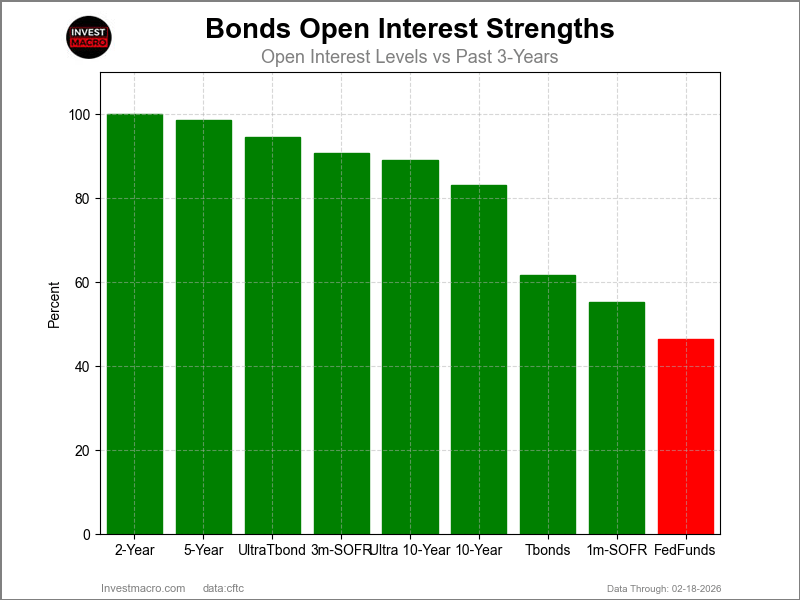
Bonds Market Open Interest Comparison
Here are the latest charts and statistics for the Commitment of Traders (COT) reports data published by the Commodities Futures Trading Commission (CFTC).

The latest COT data is updated through Tuesday February 17th and shows a quick view of how large traders (for-profit speculators and commercial hedgers) were positioned in the futures markets.

Weekly Speculator Changes led by 2-Year Bonds & Ultra 10-Year Bonds
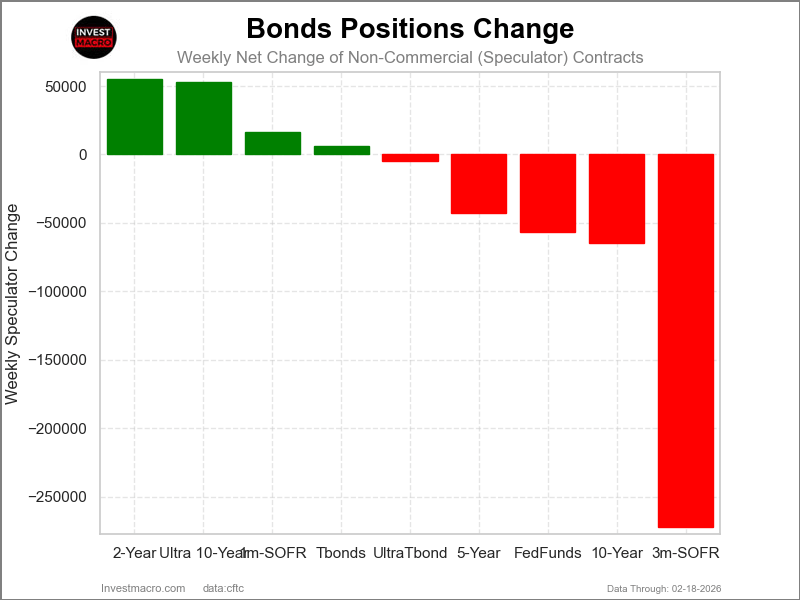
Bonds Market Net Speculators Positions
The COT bond market speculator bets were overall lower this week as four out of the nine bond markets we cover had higher positioning while the other five markets had lower speculator contracts.

Leading the gains for the bond markets was the 2-Year Bonds (55,279 contracts) with the Ultra 10-Year Bonds (53,282 contracts), the SOFR 1-Month (16,688 contracts) and the US Treasury Bonds (6,517 contracts) also having positive weeks.

The bond markets with declines in speculator bets for the week were the SOFR 3-Months (-272,311 contracts), the 10-Year Bonds (-64,826 contracts), the Fed Funds (-56,451 contracts), the 5-Year Bonds (-42,478 contracts) and the Ultra Treasury Bonds (-4,642 contracts) also seeing lower bets on the week.

10-Year Note Leads Price Returns this week

Leading the price performance over the last five days, the 10-Year Note rose by a modest 0.27% followed by the US Treasury Bond which rose by 0.20%. The 5-Year Bond was marginally higher by 0.17%, and the 2-Year Bond was a tick higher at 0.07%.

The 1-Month SOFR was up a tick by 0.03% while the Fed Funds was virtually unchanged at -0.01%. The 3-Month SOFR was also lower by -0.06%.


Bonds Data:
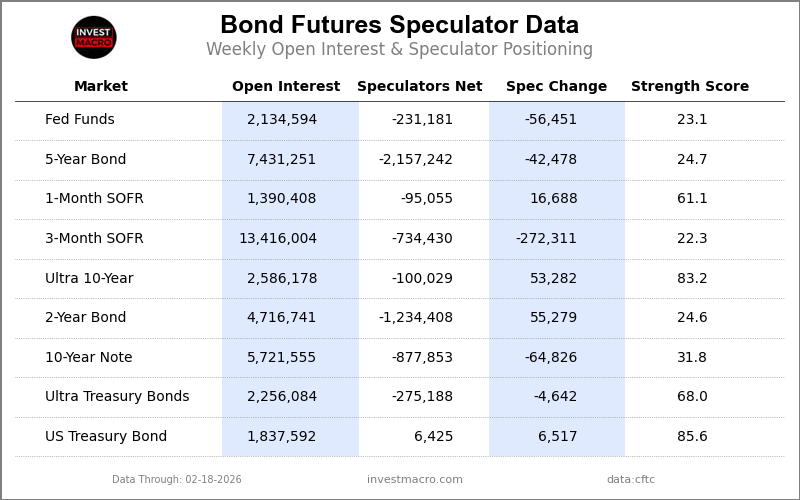
Bonds Market Speculators Data Table
Legend: Open Interest | Speculators Current Net Position | Weekly Specs Change | Specs Strength Score compared to last 3-Years (0-100 range)


Strength Scores led by US Treasury Bonds & Ultra 10-Year Bonds
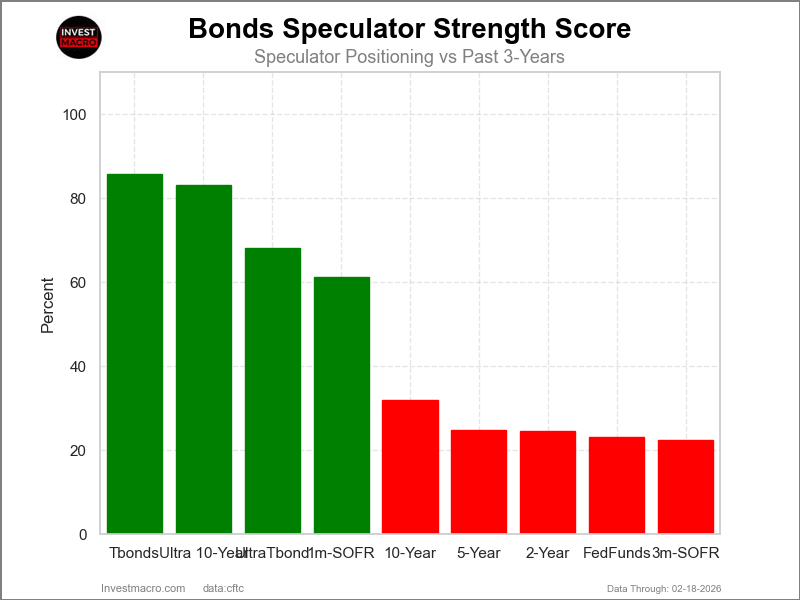
Bonds Market Strength Index Comparison
COT Strength Scores (a normalized measure of Speculator positions over a 3-Year range, from 0 to 100 where above 80 is Extreme-Bullish and below 20 is Extreme-Bearish) showed that the US Treasury Bonds (86 percent) and the Ultra 10-Year Bonds (83 percent) lead the bond markets this week.

On the downside, the Fed Funds (23 percent) and the 5-Year Bonds (25 percent) come in at the lowest strength levels currently while the next lowest strength scores were the 2-Year Bonds (25 percent) and the 10-Year Bonds (32 percent).

Strength Statistics:
Fed Funds (23.1 percent) vs Fed Funds previous week (31.1 percent)
2-Year Bond (24.6 percent) vs 2-Year Bond previous week (19.2 percent)
5-Year Bond (24.7 percent) vs 5-Year Bond previous week (26.7 percent)
10-Year Bond (31.8 percent) vs 10-Year Bond previous week (39.6 percent)
Ultra 10-Year Bond (83.2 percent) vs Ultra 10-Year Bond previous week (68.8 percent)
US Treasury Bond (85.6 percent) vs US Treasury Bond previous week (83.3 percent)
Ultra US Treasury Bond (68.0 percent) vs Ultra US Treasury Bond previous week (69.7 percent)
SOFR 1-Month (61.1 percent) vs SOFR 1-Month previous week (58.2 percent)
SOFR 3-Months (22.3 percent) vs SOFR 3-Months previous week (36.4 percent)


Ultra 10-Year Bonds & SOFR 1-Month top the 6-Week Strength Trends
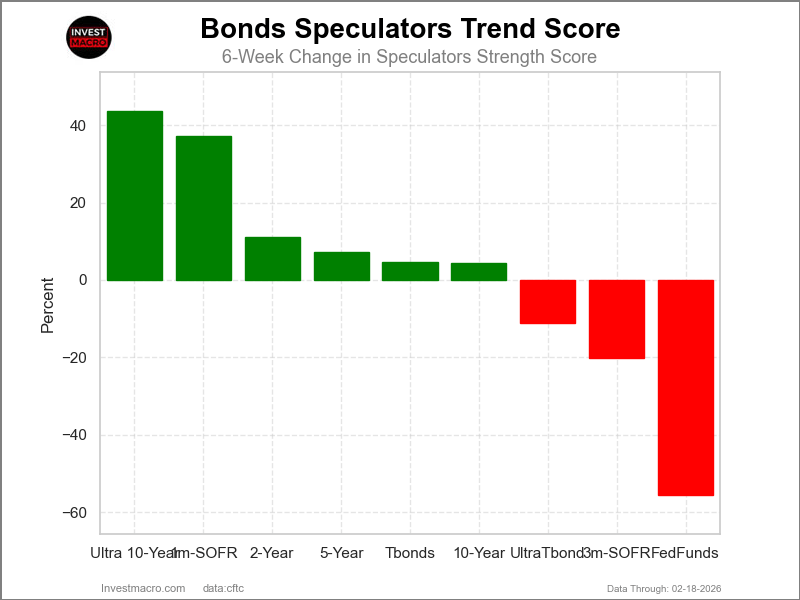
Bonds Market Trend Index Comparison
COT Strength Score Trends (or move index, calculates the 6-week changes in strength scores) showed that the Ultra 10-Year Bonds (44 percent) and the SOFR 1-Month (37 percent) lead the past six weeks trends for bonds. The 2-Year Bonds (11 percent) are the next highest positive movers in the latest trends data.

The Fed Funds (-55.6 percent) leads the downside trend scores currently with the SOFR 3-Months (-20 percent) following next with lower trend scores.

Strength Trend Statistics:
Fed Funds (-55.6 percent) vs Fed Funds previous week (-50.4 percent)
2-Year Bond (11.0 percent) vs 2-Year Bond previous week (10.8 percent)
5-Year Bond (7.3 percent) vs 5-Year Bond previous week (13.6 percent)
10-Year Bond (4.5 percent) vs 10-Year Bond previous week (15.1 percent)
Ultra 10-Year Bond (43.7 percent) vs Ultra 10-Year Bond previous week (34.5 percent)
US Treasury Bond (4.6 percent) vs US Treasury Bond previous week (-5.0 percent)
Ultra US Treasury Bond (-11.0 percent) vs Ultra US Treasury Bond previous week (-5.8 percent)
SOFR 1-Month (37.3 percent) vs SOFR 1-Month previous week (49.8 percent)
SOFR 3-Months (-20.1 percent) vs SOFR 3-Months previous week (-13.2 percent)


30-Day Federal Funds Futures:
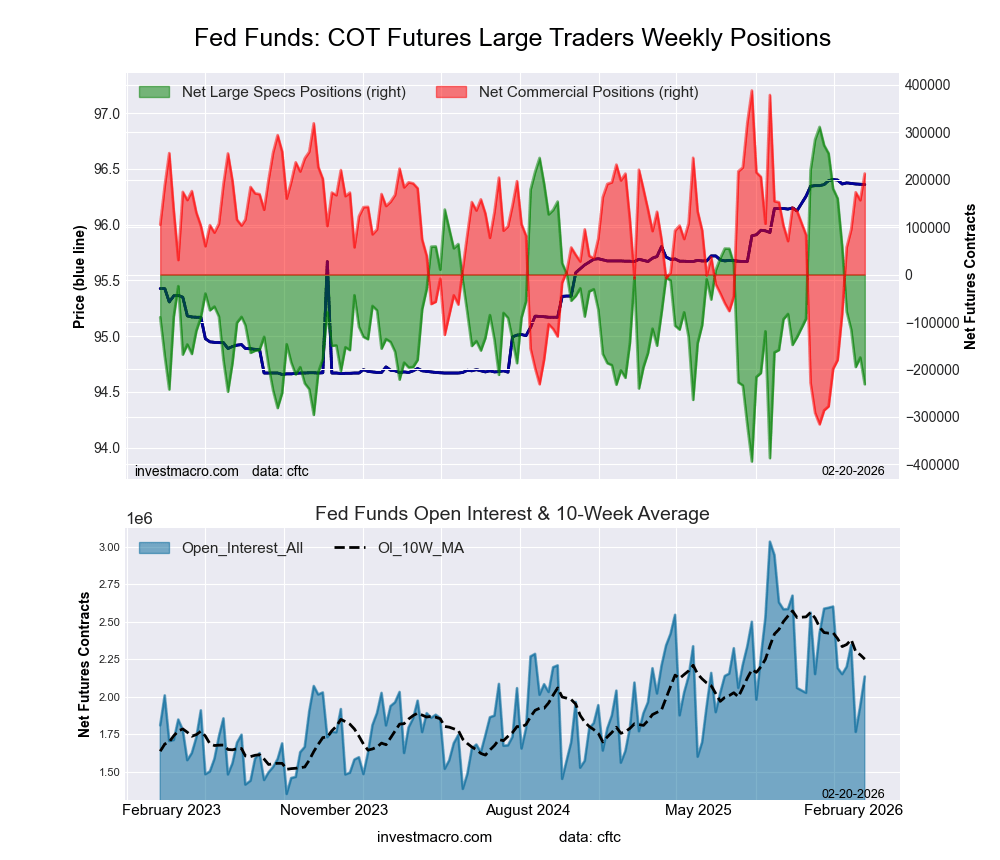
Federal Funds 30-Day Bonds Futures COT ChartThe 30-Day Federal Funds large speculator standing this week was a net position of -231,181 contracts in the data reported through Tuesday. This was a weekly decrease of -56,451 contracts from the previous week which had a total of -174,730 net contracts.

This week’s current strength score (the trader positioning range over the past three years, measured from 0 to 100) shows the speculators are currently Bearish with a score of 23.1 percent. The commercials are Bullish with a score of 75.1 percent and the small traders (not shown in chart) are Bullish-Extreme with a score of 86.3 percent.

Price Trend-Following Model: Weak Uptrend

Our weekly trend-following model classifies the current market price position as: Weak Uptrend.

30-Day Federal Funds StatisticsSPECULATORSCOMMERCIALSSMALL TRADERS
– Percent of Open Interest Longs:7.966.62.4
– Percent of Open Interest Shorts:18.856.71.5
– Net Position:-231,181212,86418,317
– Gross Longs:169,4951,422,16951,309
– Gross Shorts:400,6761,209,30532,992
– Long to Short Ratio:0.4 to 11.2 to 11.6 to 1
NET POSITION TREND:
– Strength Index Score (3 Year Range Pct):23.175.186.3
– Strength Index Reading (3 Year Range):BearishBullishBullish-Extreme
NET POSITION MOVEMENT INDEX:
– 6-Week Change in Strength Index:-55.655.9-1.7


Secured Overnight Financing Rate (3-Month) Futures:
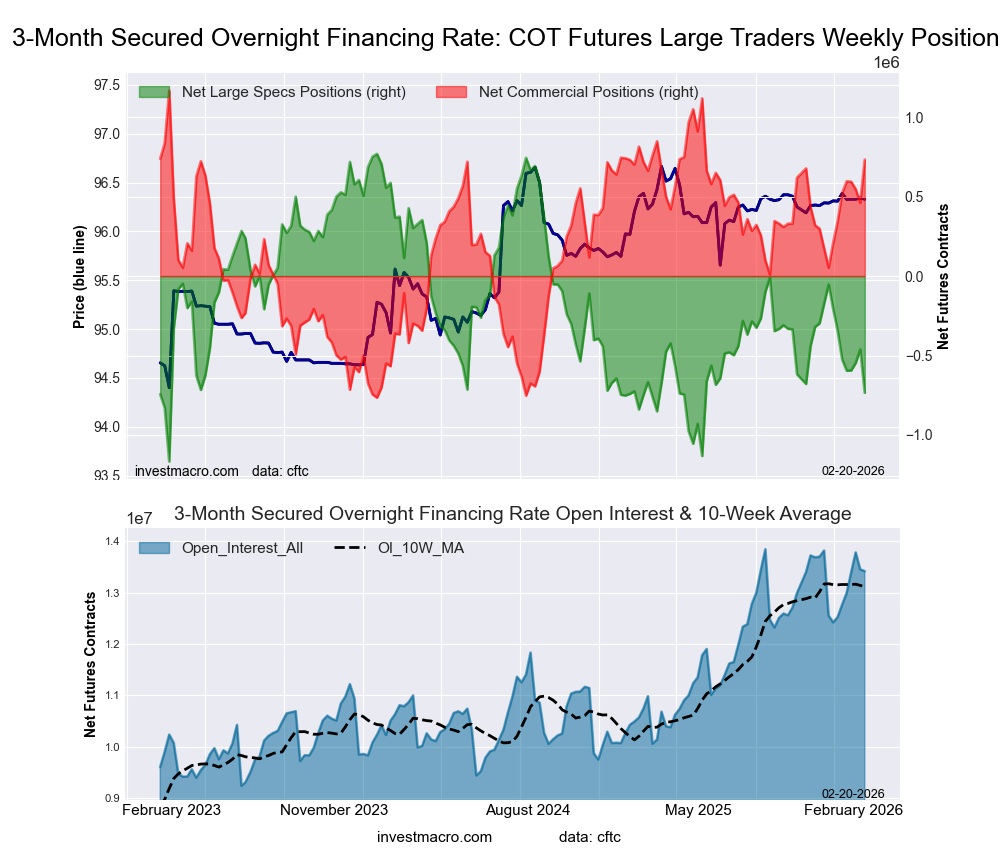
SOFR 3-Months Bonds Futures COT ChartThe Secured Overnight Financing Rate (3-Month) large speculator standing this week was a net position of -734,430 contracts in the data reported through Tuesday. This was a weekly reduction of -272,311 contracts from the previous week which had a total of -462,119 net contracts.

This week’s current strength score (the trader positioning range over the past three years, measured from 0 to 100) shows the speculators are currently Bearish with a score of 22.3 percent. The commercials are Bullish with a score of 77.5 percent and the small traders (not shown in chart) are Bullish with a score of 79.0 percent.

Price Trend-Following Model: Weak Uptrend

Our weekly trend-following model classifies the current market price position as: Weak Uptrend.

SOFR 3-Months StatisticsSPECULATORSCOMMERCIALSSMALL TRADERS
– Percent of Open Interest Longs:11.658.90.3
– Percent of Open Interest Shorts:17.153.40.3
– Net Position:-734,430732,8741,556
– Gross Longs:1,560,4907,900,00045,620
– Gross Shorts:2,294,9207,167,12644,064
– Long to Short Ratio:0.7 to 11.1 to 11.0 to 1
NET POSITION TREND:
– Strength Index Score (3 Year Range Pct):22.377.579.0
– Strength Index Reading (3 Year Range):BearishBullishBullish
NET POSITION MOVEMENT INDEX:
– 6-Week Change in Strength Index:-20.120.10.7


Individual Bond Markets:

Secured Overnight Financing Rate (1-Month) Futures:
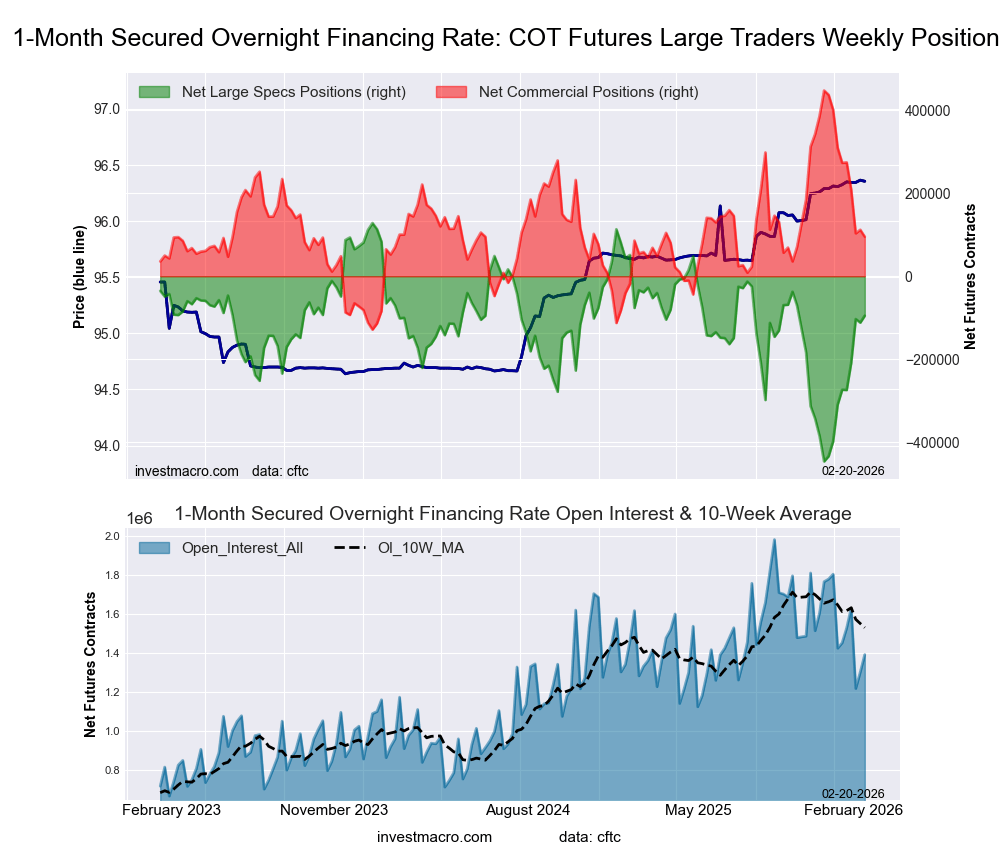
SOFR 1-Month Bonds Futures COT ChartThe Secured Overnight Financing Rate (1-Month) large speculator standing this week was a net position of -95,055 contracts in the data reported through Tuesday. This was a weekly gain of 16,688 contracts from the previous week which had a total of -111,743 net contracts.

This week’s current strength score (the trader positioning range over the past three years, measured from 0 to 100) shows the speculators are currently Bullish with a score of 61.1 percent. The commercials are Bearish with a score of 38.9 percent and the small traders (not shown in chart) are Bullish with a score of 66.8 percent.

Price Trend-Following Model: Uptrend

Our weekly trend-following model classifies the current market price position as: Uptrend.

SOFR 1-Month StatisticsSPECULATORSCOMMERCIALSSMALL TRADERS
– Percent of Open Interest Longs:19.861.20.0
– Percent of Open Interest Shorts:26.754.40.0
– Net Position:-95,05595,078-23
– Gross Longs:275,903851,086171
– Gross Shorts:370,958756,008194
– Long to Short Ratio:0.7 to 11.1 to 10.9 to 1
NET POSITION TREND:
– Strength Index Score (3 Year Range Pct):61.138.966.8
– Strength Index Reading (3 Year Range):BullishBearishBullish
NET POSITION MOVEMENT INDEX:
– 6-Week Change in Strength Index:37.3-37.2-0.1


2-Year Treasury Note Futures:

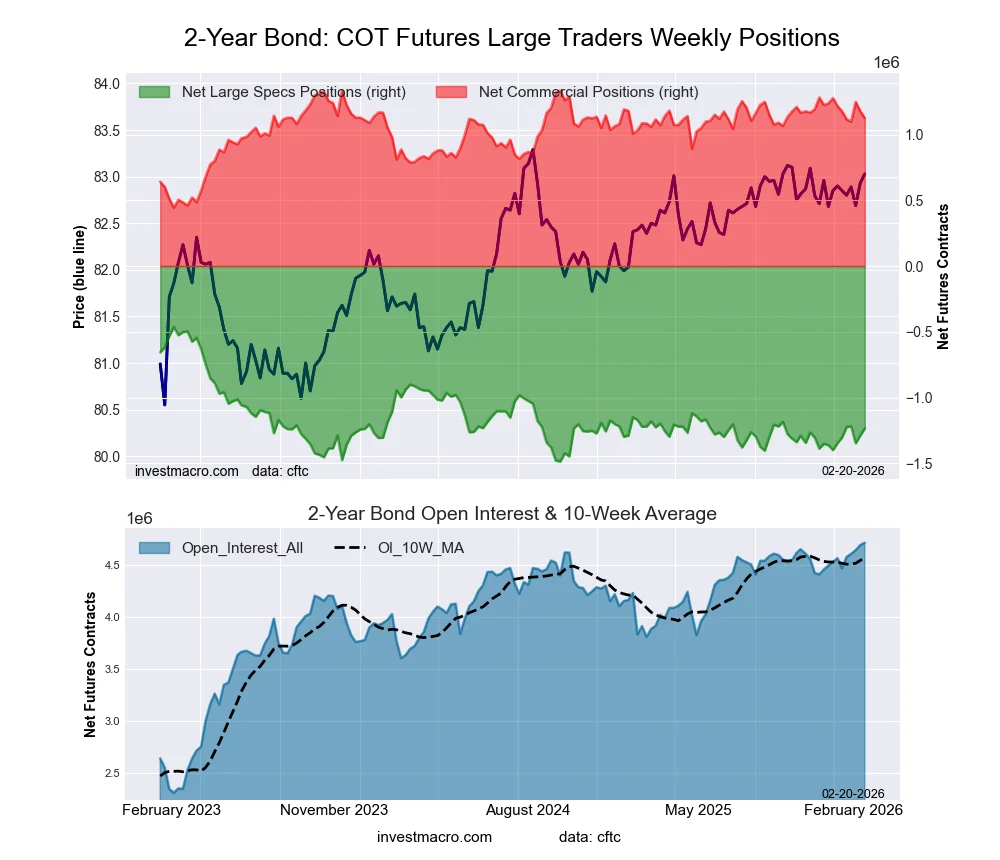
2-Year Treasury Bonds Futures COT ChartThe 2-Year Treasury Note large speculator standing this week was a net position of -1,234,408 contracts in the data reported through Tuesday. This was a weekly rise of 55,279 contracts from the previous week which had a total of -1,289,687 net contracts.

This week’s current strength score (the trader positioning range over the past three years, measured from 0 to 100) shows the speculators are currently Bearish with a score of 24.6 percent. The commercials are Bullish with a score of 76.5 percent and the small traders (not shown in chart) are Bearish with a score of 43.6 percent.

Price Trend-Following Model: Weak Downtrend

Our weekly trend-following model classifies the current market price position as: Weak Downtrend.

2-Year Treasury Note StatisticsSPECULATORSCOMMERCIALSSMALL TRADERS
– Percent of Open Interest Longs:15.075.84.9
– Percent of Open Interest Shorts:41.252.02.6
– Net Position:-1,234,4081,125,715108,693
– Gross Longs:707,4673,577,502230,853
– Gross Shorts:1,941,8752,451,787122,160
– Long to Short Ratio:0.4 to 11.5 to 11.9 to 1
NET POSITION TREND:
– Strength Index Score (3 Year Range Pct):24.676.543.6
– Strength Index Reading (3 Year Range):BearishBullishBearish
NET POSITION MOVEMENT INDEX:
– 6-Week Change in Strength Index:11.0-10.2-10.0


5-Year Treasury Note Futures:

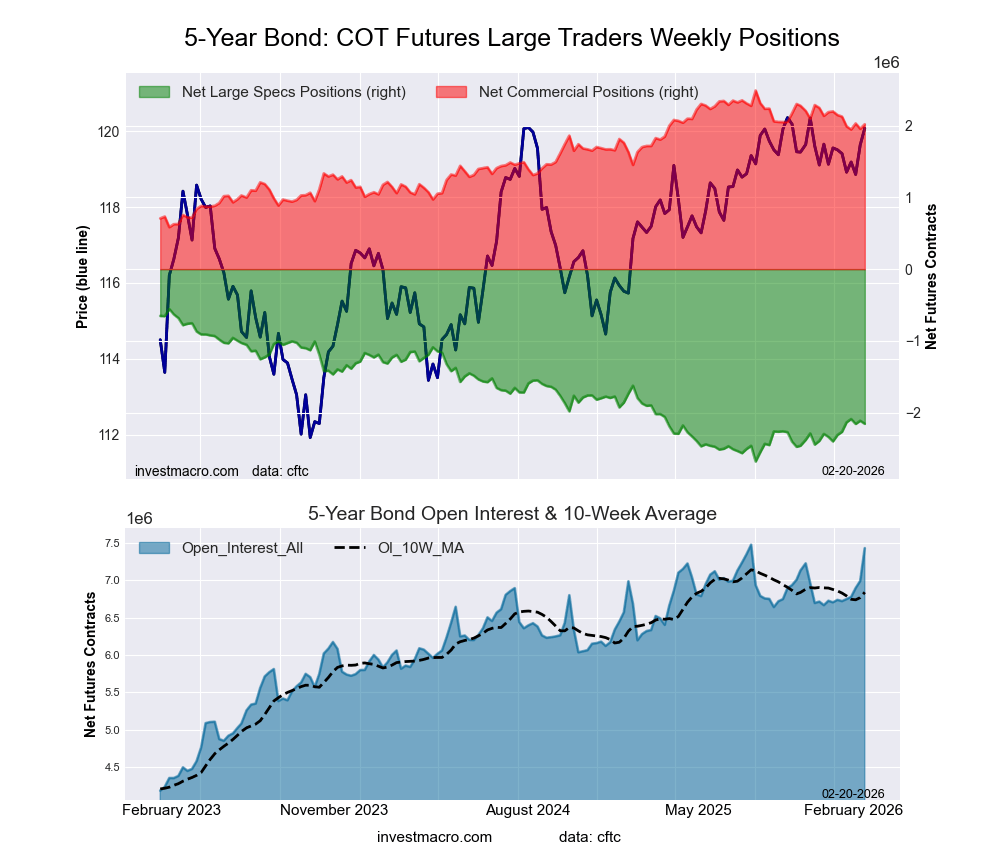
5-Year Treasury Bonds Futures COT ChartThe 5-Year Treasury Note large speculator standing this week was a net position of -2,157,242 contracts in the data reported through Tuesday. This was a weekly fall of -42,478 contracts from the previous week which had a total of -2,114,764 net contracts.

This week’s current strength score (the trader positioning range over the past three years, measured from 0 to 100) shows the speculators are currently Bearish with a score of 24.7 percent. The commercials are Bullish with a score of 75.3 percent and the small traders (not shown in chart) are Bullish with a score of 65.5 percent.

Price Trend-Following Model: Weak Downtrend

Our weekly trend-following model classifies the current market price position as: Weak Downtrend.

5-Year Treasury Note StatisticsSPECULATORSCOMMERCIALSSMALL TRADERS
– Percent of Open Interest Longs:7.380.06.1
– Percent of Open Interest Shorts:36.352.84.2
– Net Position:-2,157,2422,019,604137,638
– Gross Longs:541,3515,943,599451,754
– Gross Shorts:2,698,5933,923,995314,116
– Long to Short Ratio:0.2 to 11.5 to 11.4 to 1
NET POSITION TREND:
– Strength Index Score (3 Year Range Pct):24.775.365.5
– Strength Index Reading (3 Year Range):BearishBullishBullish
NET POSITION MOVEMENT INDEX:
– 6-Week Change in Strength Index:7.3-6.8-8.1


10-Year Treasury Note Futures:

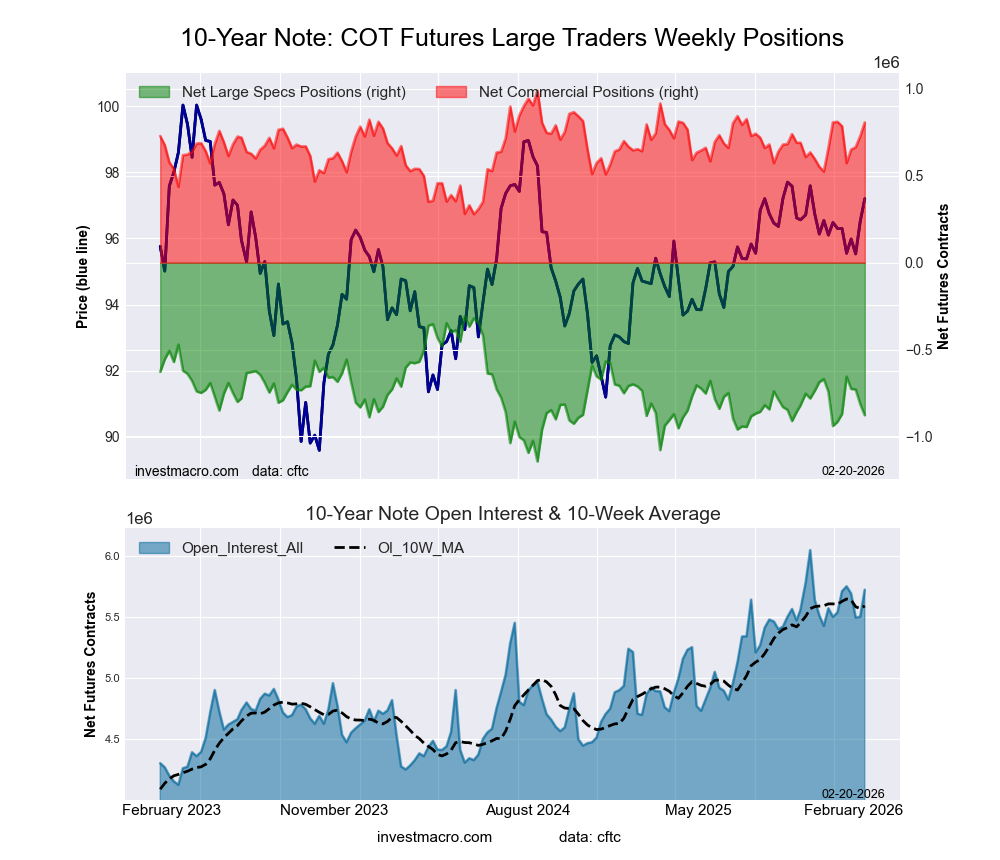
10-Year Treasury Notes Bonds Futures COT ChartThe 10-Year Treasury Note large speculator standing this week was a net position of -877,853 contracts in the data reported through Tuesday. This was a weekly fall of -64,826 contracts from the previous week which had a total of -813,027 net contracts.

This week’s current strength score (the trader positioning range over the past three years, measured from 0 to 100) shows the speculators are currently Bearish with a score of 31.8 percent. The commercials are Bullish with a score of 74.2 percent and the small traders (not shown in chart) are Bullish with a score of 63.8 percent.

Price Trend-Following Model: Weak Downtrend

Our weekly trend-following model classifies the current market price position as: Weak Downtrend.

10-Year Treasury Note StatisticsSPECULATORSCOMMERCIALSSMALL TRADERS
– Percent of Open Interest Longs:8.778.07.9
– Percent of Open Interest Shorts:24.163.96.6
– Net Position:-877,853806,96170,892
– Gross Longs:500,0974,461,711449,456
– Gross Shorts:1,377,9503,654,750378,564
– Long to Short Ratio:0.4 to 11.2 to 11.2 to 1
NET POSITION TREND:
– Strength Index Score (3 Year Range Pct):31.874.263.8
– Strength Index Reading (3 Year Range):BearishBullishBullish
NET POSITION MOVEMENT INDEX:
– 6-Week Change in Strength Index:4.5-0.5-11.3


Ultra 10-Year Notes Futures:

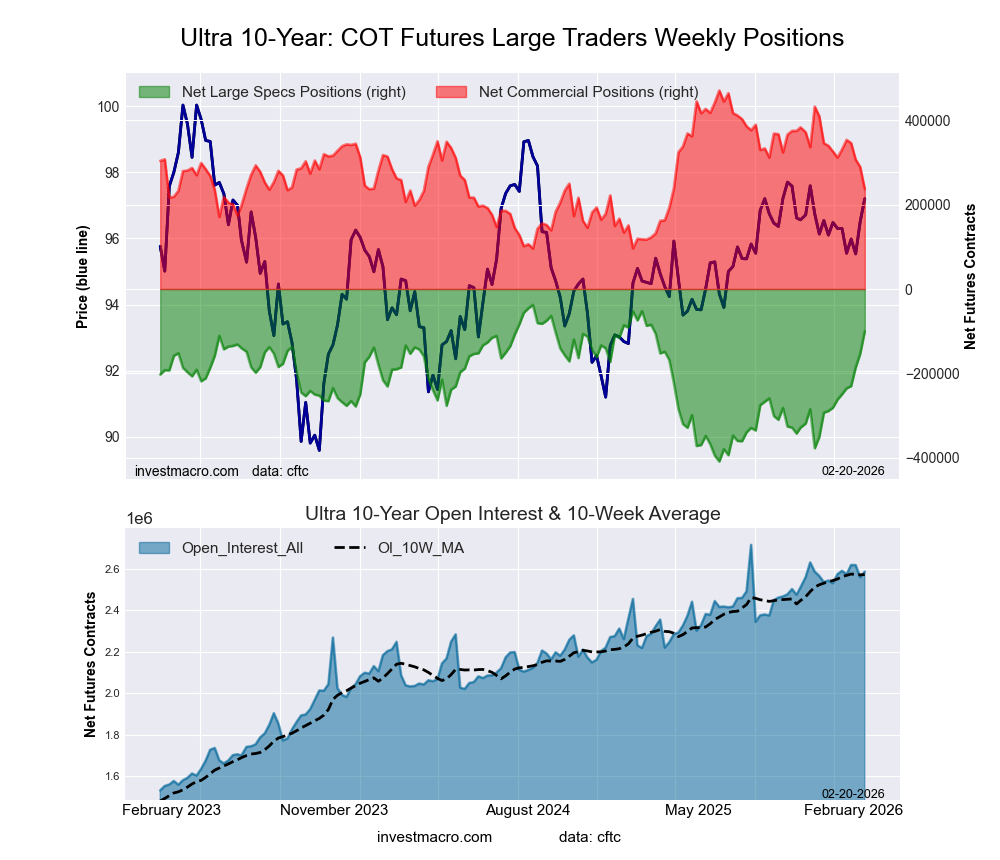
Ultra 10-Year Treasury Notes Bonds Futures COT ChartThe Ultra 10-Year Notes large speculator standing this week was a net position of -100,029 contracts in the data reported through Tuesday. This was a weekly boost of 53,282 contracts from the previous week which had a total of -153,311 net contracts.

This week’s current strength score (the trader positioning range over the past three years, measured from 0 to 100) shows the speculators are currently Bullish-Extreme with a score of 83.2 percent. The commercials are Bearish with a score of 37.7 percent and the small traders (not shown in chart) are Bearish-Extreme with a score of 0.0 percent.

Price Trend-Following Model: Weak Uptrend

Our weekly trend-following model classifies the current market price position as: Weak Uptrend.

Ultra 10-Year Notes StatisticsSPECULATORSCOMMERCIALSSMALL TRADERS
– Percent of Open Interest Longs:11.078.08.6
– Percent of Open Interest Shorts:14.868.913.9
– Net Position:-100,029236,624-136,595
– Gross Longs:283,2462,017,361222,759
– Gross Shorts:383,2751,780,737359,354
– Long to Short Ratio:0.7 to 11.1 to 10.6 to 1
NET POSITION TREND:
– Strength Index Score (3 Year Range Pct):83.237.70.0
– Strength Index Reading (3 Year Range):Bullish-ExtremeBearishBearish-Extreme
NET POSITION MOVEMENT INDEX:
– 6-Week Change in Strength Index:43.7-19.9-68.4


US Treasury Bonds Futures:

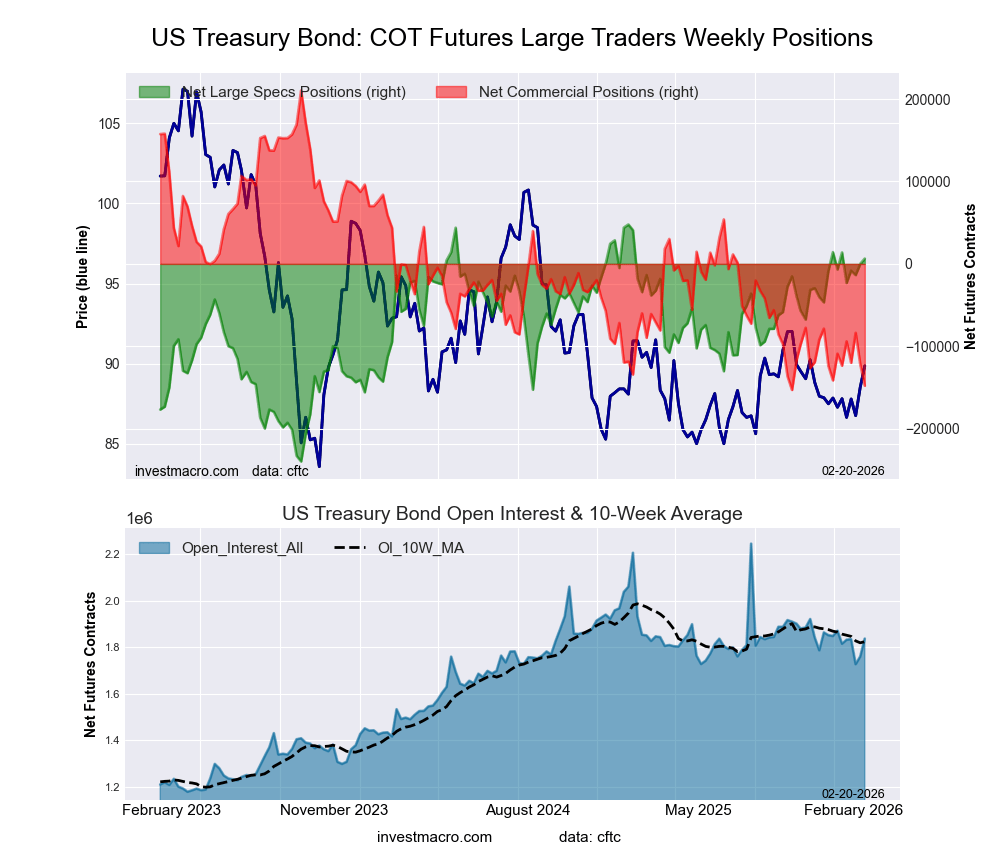
US Year Treasury Notes Long Bonds Futures COT ChartThe US Treasury Bonds large speculator standing this week was a net position of 6,425 contracts in the data reported through Tuesday. This was a weekly boost of 6,517 contracts from the previous week which had a total of -92 net contracts.

This week’s current strength score (the trader positioning range over the past three years, measured from 0 to 100) shows the speculators are currently Bullish-Extreme with a score of 85.6 percent. The commercials are Bearish-Extreme with a score of 1.4 percent and the small traders (not shown in chart) are Bullish-Extreme with a score of 82.6 percent.

Price Trend-Following Model: Weak Downtrend

Our weekly trend-following model classifies the current market price position as: Weak Downtrend.

US Treasury Bonds StatisticsSPECULATORSCOMMERCIALSSMALL TRADERS
– Percent of Open Interest Longs:11.371.614.2
– Percent of Open Interest Shorts:10.979.76.5
– Net Position:6,425-147,788141,363
– Gross Longs:207,0411,315,962261,044
– Gross Shorts:200,6161,463,750119,681
– Long to Short Ratio:1.0 to 10.9 to 12.2 to 1
NET POSITION TREND:
– Strength Index Score (3 Year Range Pct):85.61.482.6
– Strength Index Reading (3 Year Range):Bullish-ExtremeBearish-ExtremeBullish-Extreme
NET POSITION MOVEMENT INDEX:
– 6-Week Change in Strength Index:4.6-10.716.7


Ultra US Treasury Bonds Futures:

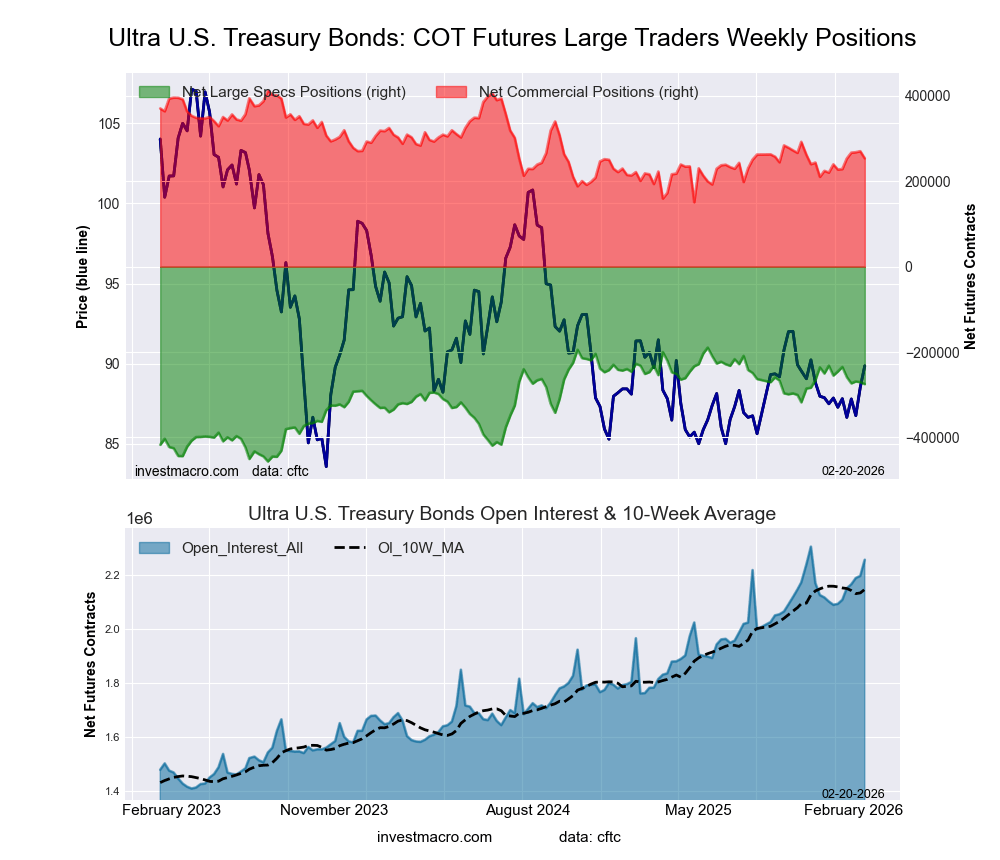
Ultra US Year Treasury Notes Long Bonds Futures COT ChartThe Ultra US Treasury Bonds large speculator standing this week was a net position of -275,188 contracts in the data reported through Tuesday. This was a weekly fall of -4,642 contracts from the previous week which had a total of -270,546 net contracts.

This week’s current strength score (the trader positioning range over the past three years, measured from 0 to 100) shows the speculators are currently Bullish with a score of 68.0 percent. The commercials are Bearish with a score of 39.3 percent and the small traders (not shown in chart) are Bearish with a score of 37.3 percent.

Price Trend-Following Model: Weak Downtrend

Our weekly trend-following model classifies the current market price position as: Weak Downtrend.

Ultra US Treasury Bonds StatisticsSPECULATORSCOMMERCIALSSMALL TRADERS
– Percent of Open Interest Longs:6.882.48.7
– Percent of Open Interest Shorts:19.071.27.8
– Net Position:-275,188253,62421,564
– Gross Longs:153,4601,860,075197,124
– Gross Shorts:428,6481,606,451175,560
– Long to Short Ratio:0.4 to 11.2 to 11.1 to 1
NET POSITION TREND:
– Strength Index Score (3 Year Range Pct):68.039.337.3
– Strength Index Reading (3 Year Range):BullishBearishBearish
NET POSITION MOVEMENT INDEX:
– 6-Week Change in Strength Index:-11.010.03.4


Article By InvestMacroReceive our weekly COT Newsletter

*COT Report: The COT data, released weekly to the public each Friday, is updated through the most recent Tuesday (data is 3 days old) and shows a quick view of how large speculators or non-commercials (for-profit traders) were positioned in the futures markets.

The CFTC categorizes trader positions according to commercial hedgers (traders who use futures contracts for hedging as part of the business), non-commercials (large traders who speculate to realize trading profits) and nonreportable traders (usually small traders/speculators) as well as their open interest (contracts open in the market at time of reporting). See CFTC criteria here.

COT Energy Charts: WTI Crude Speculator Bets rise to highest level since August

By InvestMacro

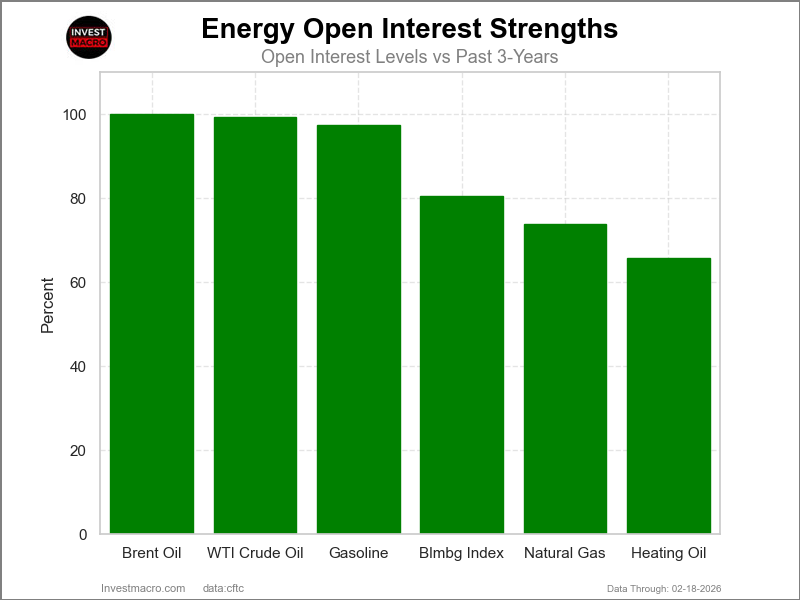
Speculators OI Energy Futures COT Chart
Here are the latest charts and statistics for the Commitment of Traders (COT) data published by the Commodities Futures Trading Commission (CFTC).

The latest COT data is updated through Tuesday February 17th and shows a quick view of how large traders (for-profit speculators and commercial entities) were positioned in the futures markets.

Weekly Speculator Changes led by WTI Crude Oil

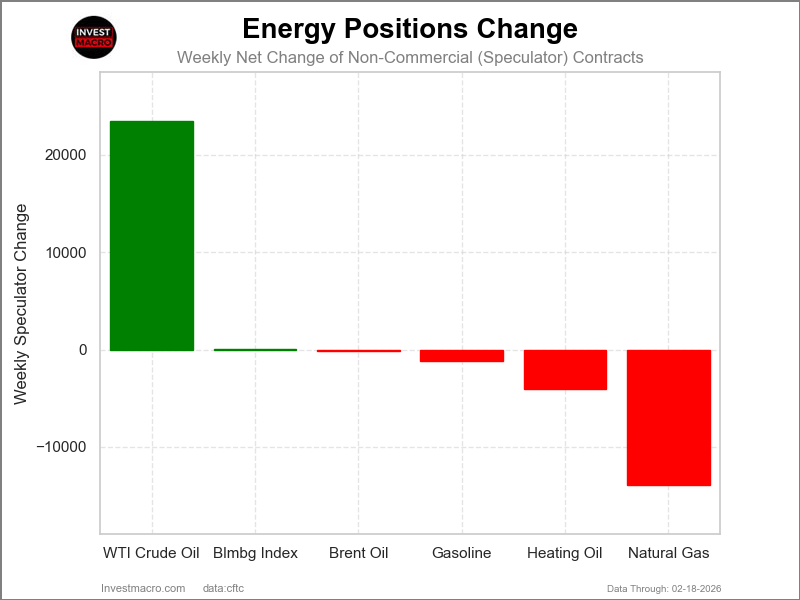
Speculators Nets Energy Futures COT Chart
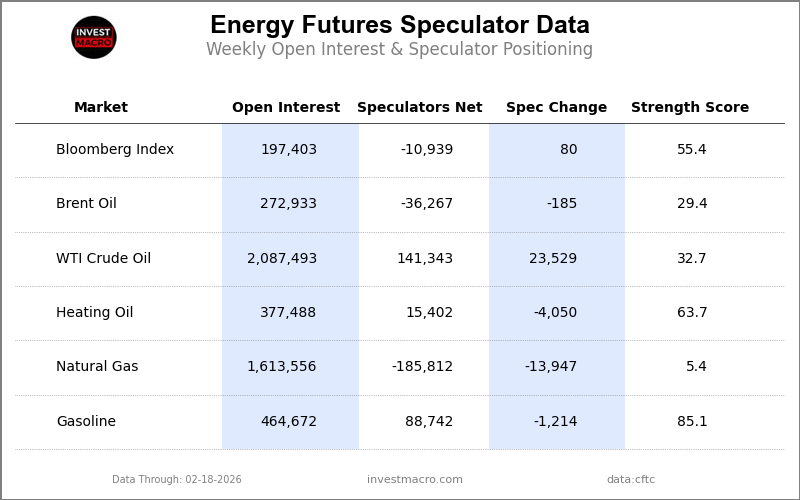
The COT energy market speculator bets were overall lower this week as just two out of the six energy markets we cover had higher positioning while the other four markets had lower speculator contracts.

Leading the gains for the energy markets was WTI Crude (23,529 contracts) with the Bloomberg Commodity Index (80 contracts) also having a small positive week.

The markets with declines in speculator bets for the week were Natural Gas (-13,947 contracts), Heating Oil (-4,050 contracts), Gasoline (-1,214 contracts) and with Brent Oil (-185 contracts) also seeing lower bets on the week.

WTI Crude Speculator Bets rise to highest level since August

Leading the energy markets for speculative bets this week was WTI Crude Oil, which rose by over +23,000 contracts on the week. This was the fifth week out of the past six that the WTI net large speculative positions improved.

This recent positive sentiment has pushed the overall net speculative standing above the +100,000 contract level for the first time since September. This week’s speculative position (+141,343 net contracts) is now at the highest standing since August 5th of 2025, a span of 28 weeks.

Heating Oil and Brent Oil lead the Energy Market Price Performances on the Week

Leading the energy markets over the past week was Heating Oil with a 7.55% gain. Brent Crude Oil was not far behind with a 6.27% increase, while WTI Crude Oil also advanced by 5.85%. Gasoline was higher by 4.70% and the Bloomberg Commodity Index rounded out the gainers with a 3.03% uptick on the week.

Natural Gas was the only market over the last five trading periods that was lower with a -3.38% decrease.


Energy Data:

Speculators Table Energy Futures COT Chart
Legend: Weekly Speculators Change | Speculators Current Net Position | Speculators Strength Score compared to last 3-Years (0-100 range)


Strength Scores led by Gasoline & Heating Oil

Speculators Strength Energy Futures COT Chart
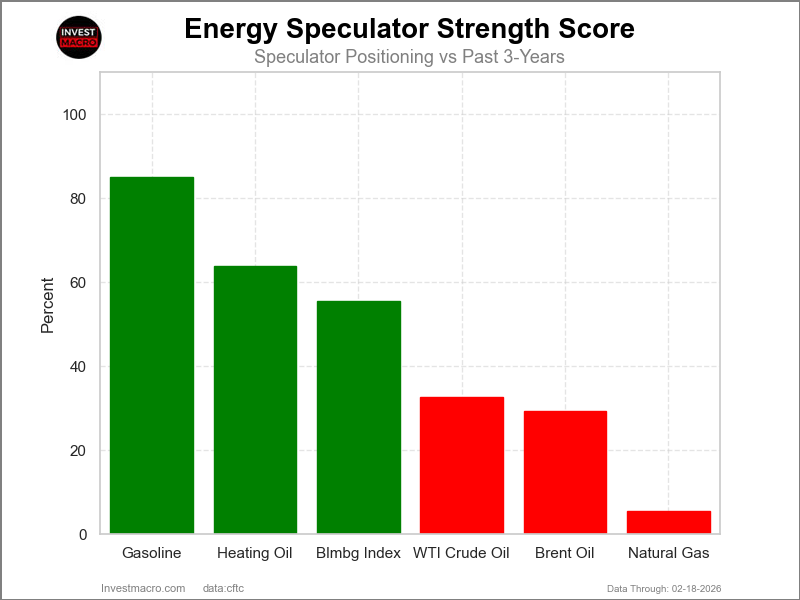
COT Strength Scores (a normalized measure of Speculator positions over a 3-Year range, from 0 to 100 where above 80 is Extreme-Bullish and below 20 is Extreme-Bearish) showed that Gasoline (85.1 percent) and Heating Oil (63.7 percent) lead the energy markets this week.

On the downside, Natural Gas (5.4 percent) comes in at the lowest strength level currently and is in Extreme-Bearish territory (below 20 percent). The next lowest strength score was Brent Oil (29.4 percent) and then WTI Crude (32.7 percent).

Strength Statistics:
WTI Crude Oil (32.7 percent) vs WTI Crude Oil previous week (25.1 percent)
Brent Crude Oil (29.4 percent) vs Brent Crude Oil previous week (29.7 percent)
Natural Gas (5.4 percent) vs Natural Gas previous week (15.1 percent)
Gasoline (85.1 percent) vs Gasoline previous week (86.4 percent)
Heating Oil (63.7 percent) vs Heating Oil previous week (69.1 percent)
Bloomberg Commodity Index (55.4 percent) vs Bloomberg Commodity Index previous week (55.0 percent)


WTI Crude & Gasoline top the 6-Week Strength Trends

Speculators Trend Energy Futures COT Chart
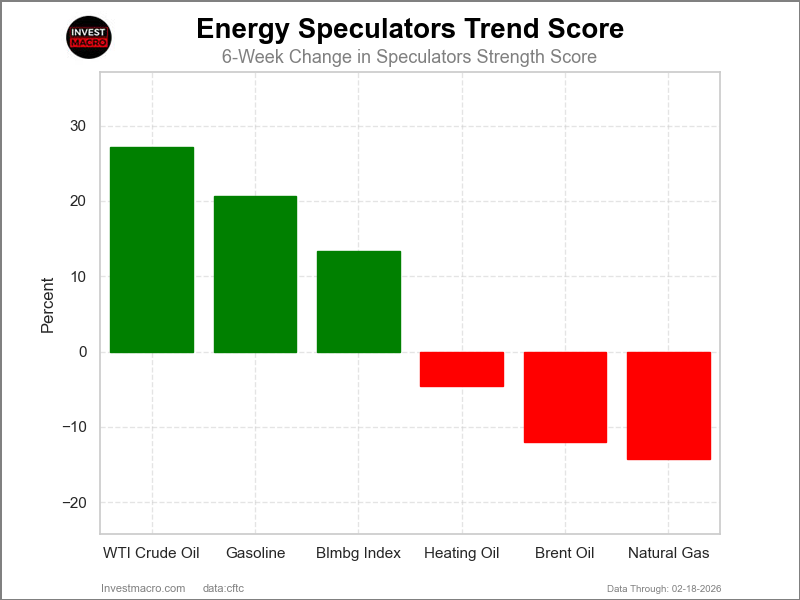
COT Strength Score Trends (or move index, calculates the 6-week changes in strength scores) showed that WTI Crude (27.1 percent) and Gasoline (20.7 percent) lead the past six weeks trends for the energy markets.

Natural Gas (-14.2 percent) and Brent Oil (-12.0 percent) lead the downside trend scores currently with Heating Oil (-4.6 percent) as the next market with lower trend scores.

Move Statistics:
WTI Crude Oil (27.1 percent) vs WTI Crude Oil previous week (17.2 percent)
Brent Crude Oil (-12.0 percent) vs Brent Crude Oil previous week (-12.1 percent)
Natural Gas (-14.2 percent) vs Natural Gas previous week (-11.9 percent)
Gasoline (20.7 percent) vs Gasoline previous week (18.7 percent)
Heating Oil (-4.6 percent) vs Heating Oil previous week (2.4 percent)
Bloomberg Commodity Index (13.4 percent) vs Bloomberg Commodity Index previous week (25.0 percent)


Individual COT Market Charts:

WTI Crude Oil Futures:

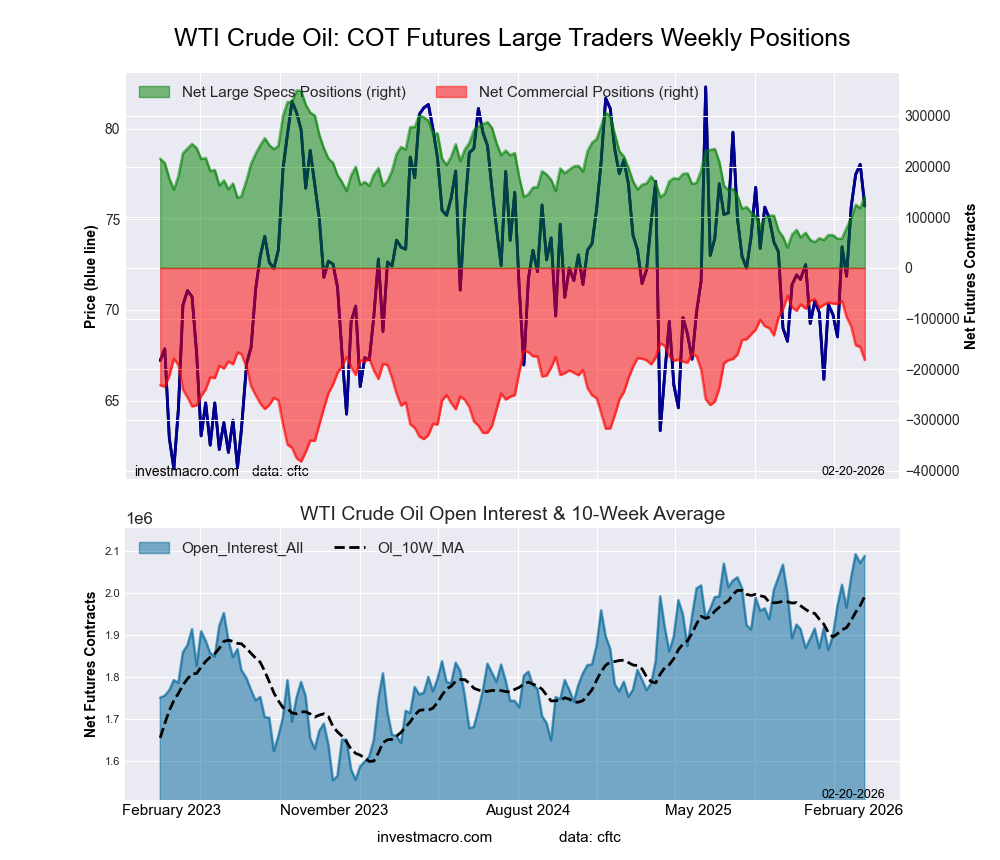
WTI Crude Oil Futures COT ChartThe WTI Crude Oil Futures large speculator standing this week reached a net position of 141,343 contracts in the data reported through Tuesday. This was a weekly advance of 23,529 contracts from the previous week which had a total of 117,814 net contracts.

This week’s current strength score (the trader positioning range over the past three years, measured from 0 to 100) shows the speculators are currently Bearish with a score of 32.7 percent. The commercials are Bullish with a score of 61.3 percent and the small traders (not shown in chart) are Bullish-Extreme with a score of 84.2 percent.

Price Trend-Following Model: Strong Uptrend

Our weekly trend-following model classifies the current market price position as: Strong Uptrend.

WTI Crude Oil Futures StatisticsSPECULATORSCOMMERCIALSSMALL TRADERS
– Percent of Open Interest Longs:15.441.03.9
– Percent of Open Interest Shorts:8.649.72.0
– Net Position:141,343-181,62940,286
– Gross Longs:321,645855,37881,123
– Gross Shorts:180,3021,037,00740,837
– Long to Short Ratio:1.8 to 10.8 to 12.0 to 1
NET POSITION TREND:
– Strength Index Score (3 Year Range Pct):32.761.384.2
– Strength Index Reading (3 Year Range):BearishBullishBullish-Extreme
NET POSITION MOVEMENT INDEX:
– 6-Week Change in Strength Index:27.1-33.955.5


Brent Crude Oil Futures:

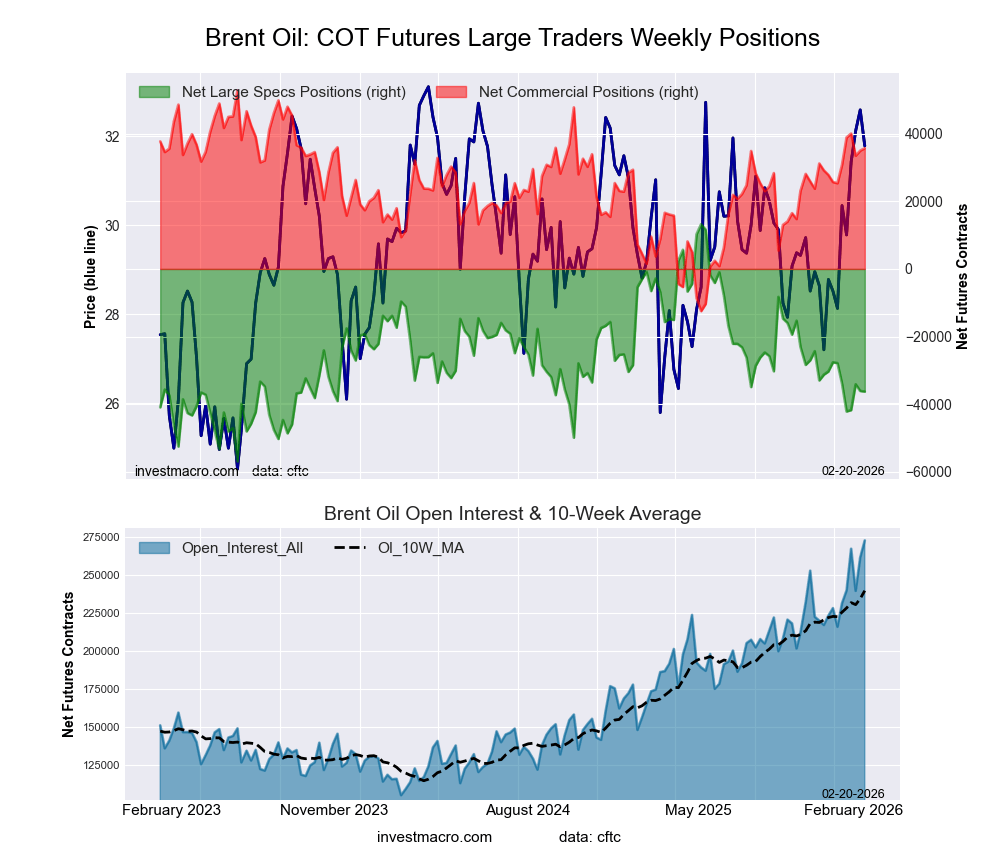
Brent Last Day Crude Oil Futures COT ChartThe Brent Crude Oil Futures large speculator standing this week reached a net position of -36,267 contracts in the data reported through Tuesday. This was a weekly decrease of -185 contracts from the previous week which had a total of -36,082 net contracts.

This week’s current strength score (the trader positioning range over the past three years, measured from 0 to 100) shows the speculators are currently Bearish with a score of 29.4 percent. The commercials are Bullish with a score of 73.8 percent and the small traders (not shown in chart) are Bearish with a score of 41.9 percent.

Price Trend-Following Model: Strong Uptrend

Our weekly trend-following model classifies the current market price position as: Strong Uptrend.

Brent Crude Oil Futures StatisticsSPECULATORSCOMMERCIALSSMALL TRADERS
– Percent of Open Interest Longs:21.641.82.5
– Percent of Open Interest Shorts:34.928.72.3
– Net Position:-36,26735,690577
– Gross Longs:59,005113,9926,755
– Gross Shorts:95,27278,3026,178
– Long to Short Ratio:0.6 to 11.5 to 11.1 to 1
NET POSITION TREND:
– Strength Index Score (3 Year Range Pct):29.473.841.9
– Strength Index Reading (3 Year Range):BearishBullishBearish
NET POSITION MOVEMENT INDEX:
– 6-Week Change in Strength Index:-12.015.9-22.6


Natural Gas Futures:

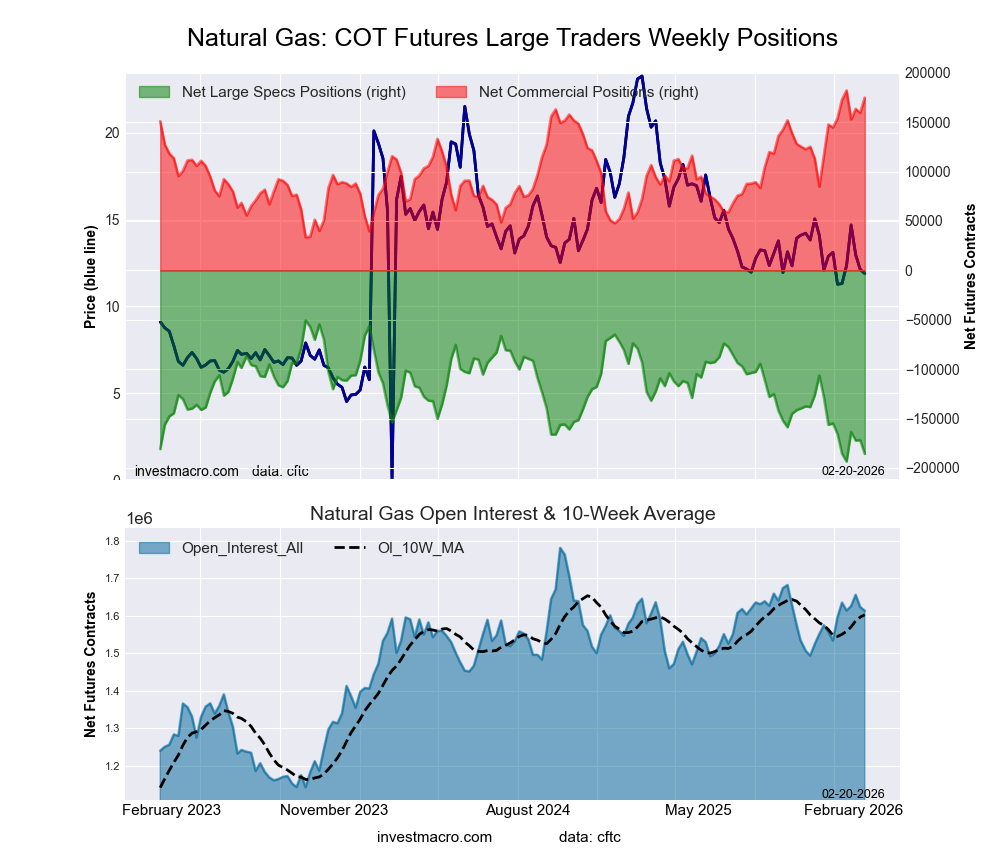
Natural Gas Futures COT ChartThe Natural Gas Futures large speculator standing this week reached a net position of -185,812 contracts in the data reported through Tuesday. This was a weekly reduction of -13,947 contracts from the previous week which had a total of -171,865 net contracts.

This week’s current strength score (the trader positioning range over the past three years, measured from 0 to 100) shows the speculators are currently Bearish-Extreme with a score of 5.4 percent. The commercials are Bullish-Extreme with a score of 95.1 percent and the small traders (not shown in chart) are Bearish with a score of 30.9 percent.

Price Trend-Following Model: Strong Downtrend

Our weekly trend-following model classifies the current market price position as: Strong Downtrend.

Natural Gas Futures StatisticsSPECULATORSCOMMERCIALSSMALL TRADERS
– Percent of Open Interest Longs:12.838.23.3
– Percent of Open Interest Shorts:24.327.32.6
– Net Position:-185,812174,79811,014
– Gross Longs:205,853615,91053,277
– Gross Shorts:391,665441,11242,263
– Long to Short Ratio:0.5 to 11.4 to 11.3 to 1
NET POSITION TREND:
– Strength Index Score (3 Year Range Pct):5.495.130.9
– Strength Index Reading (3 Year Range):Bearish-ExtremeBullish-ExtremeBearish
NET POSITION MOVEMENT INDEX:
– 6-Week Change in Strength Index:-14.214.1-1.6


Gasoline Blendstock Futures:

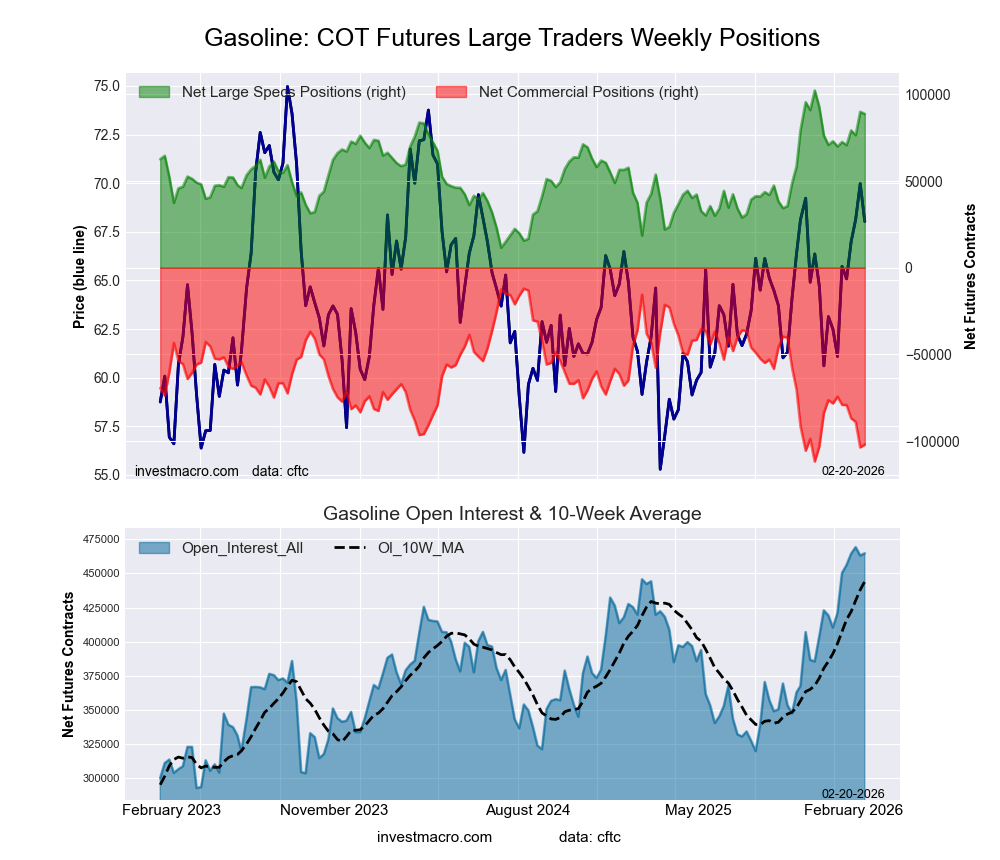
RBOB Gasoline Energy Futures COT ChartThe Gasoline Blendstock Futures large speculator standing this week reached a net position of 88,742 contracts in the data reported through Tuesday. This was a weekly decline of -1,214 contracts from the previous week which had a total of 89,956 net contracts.

This week’s current strength score (the trader positioning range over the past three years, measured from 0 to 100) shows the speculators are currently Bullish-Extreme with a score of 85.1 percent. The commercials are Bearish-Extreme with a score of 9.8 percent and the small traders (not shown in chart) are Bullish-Extreme with a score of 97.4 percent.

Price Trend-Following Model: Strong Uptrend

Our weekly trend-following model classifies the current market price position as: Strong Uptrend.

Nasdaq Mini Futures StatisticsSPECULATORSCOMMERCIALSSMALL TRADERS
– Percent of Open Interest Longs:25.246.26.1
– Percent of Open Interest Shorts:6.168.23.2
– Net Position:88,742-101,98413,242
– Gross Longs:117,261214,86528,300
– Gross Shorts:28,519316,84915,058
– Long to Short Ratio:4.1 to 10.7 to 11.9 to 1
NET POSITION TREND:
– Strength Index Score (3 Year Range Pct):85.19.897.4
– Strength Index Reading (3 Year Range):Bullish-ExtremeBearish-ExtremeBullish-Extreme
NET POSITION MOVEMENT INDEX:
– 6-Week Change in Strength Index:20.7-27.750.6


#2 Heating Oil NY-Harbor Futures:

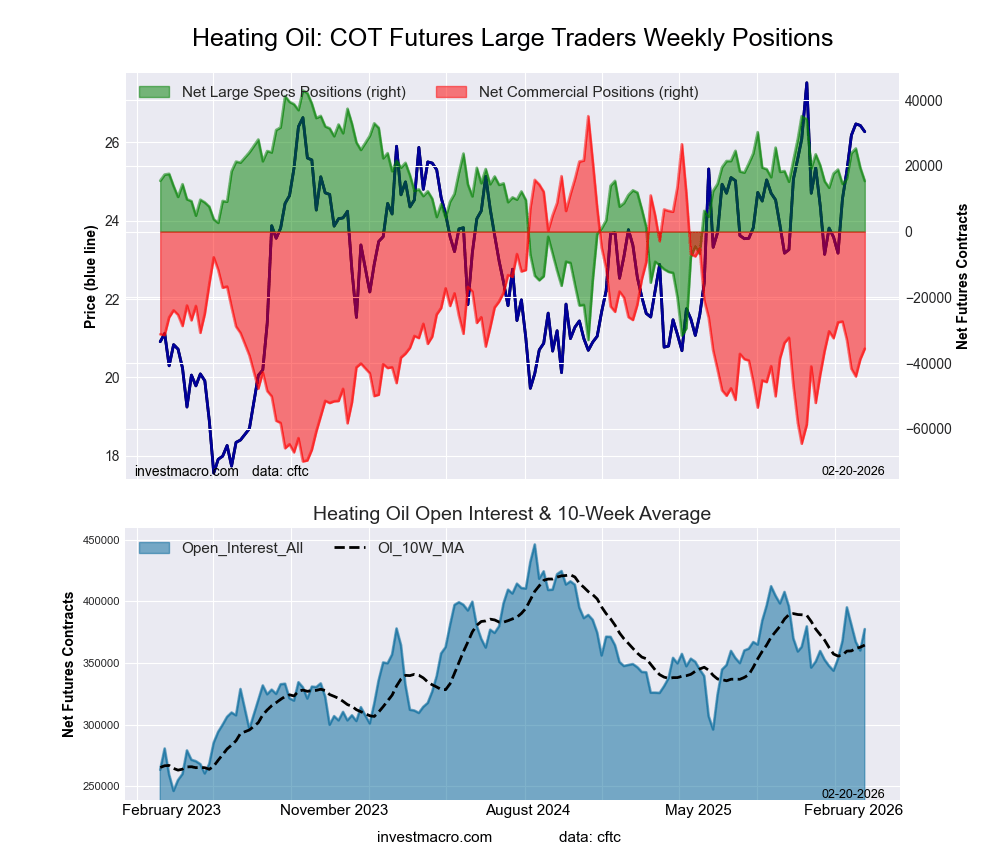
NY Harbor Heating Oil Energy Futures COT ChartThe #2 Heating Oil NY-Harbor Futures large speculator standing this week reached a net position of 15,402 contracts in the data reported through Tuesday. This was a weekly fall of -4,050 contracts from the previous week which had a total of 19,452 net contracts.

This week’s current strength score (the trader positioning range over the past three years, measured from 0 to 100) shows the speculators are currently Bullish with a score of 63.7 percent. The commercials are Bearish with a score of 32.6 percent and the small traders (not shown in chart) are Bullish with a score of 73.4 percent.

Price Trend-Following Model: Strong Uptrend

Our weekly trend-following model classifies the current market price position as: Strong Uptrend.

Heating Oil Futures StatisticsSPECULATORSCOMMERCIALSSMALL TRADERS
– Percent of Open Interest Longs:16.748.612.9
– Percent of Open Interest Shorts:12.658.07.5
– Net Position:15,402-35,61520,213
– Gross Longs:63,052183,34348,508
– Gross Shorts:47,650218,95828,295
– Long to Short Ratio:1.3 to 10.8 to 11.7 to 1
NET POSITION TREND:
– Strength Index Score (3 Year Range Pct):63.732.673.4
– Strength Index Reading (3 Year Range):BullishBearishBullish
NET POSITION MOVEMENT INDEX:
– 6-Week Change in Strength Index:-4.6-7.631.3


Bloomberg Commodity Index Futures:

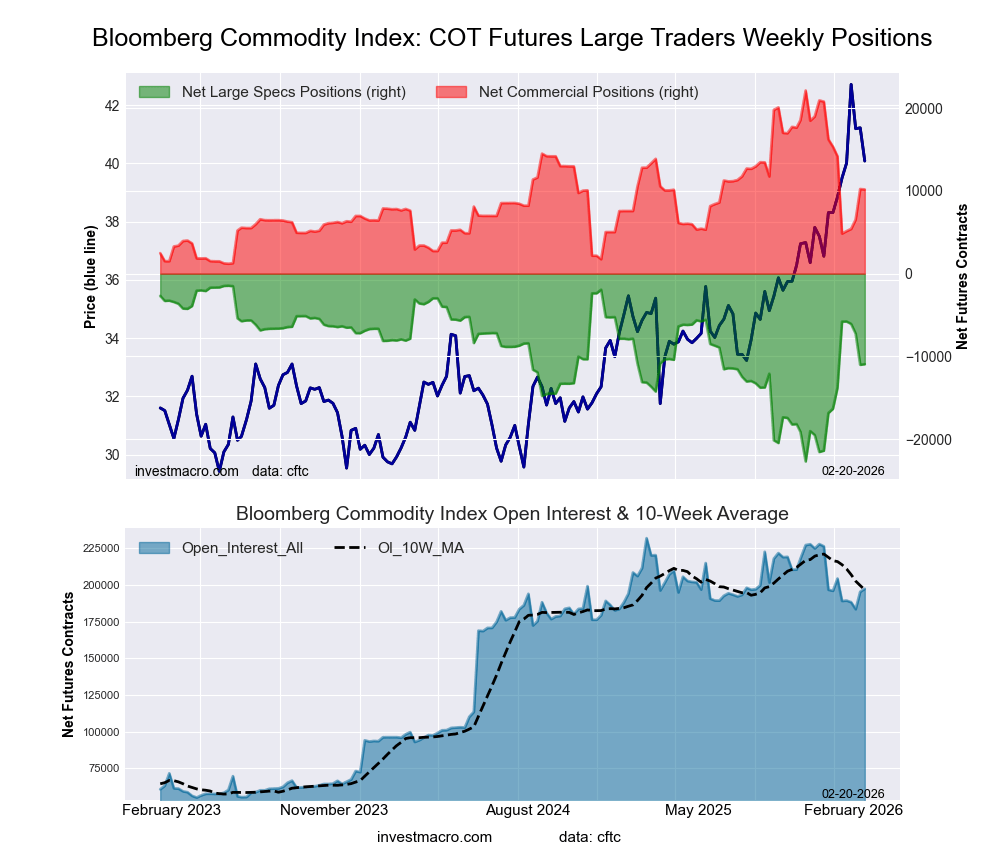
Bloomberg Commodity Index Futures COT ChartThe Bloomberg Commodity Index Futures large speculator standing this week reached a net position of -10,939 contracts in the data reported through Tuesday. This was a weekly advance of 80 contracts from the previous week which had a total of -11,019 net contracts.

This week’s current strength score (the trader positioning range over the past three years, measured from 0 to 100) shows the speculators are currently Bullish with a score of 55.4 percent. The commercials are Bearish with a score of 42.9 percent and the small traders (not shown in chart) are Bullish with a score of 53.3 percent.

Price Trend-Following Model: Strong Uptrend

Our weekly trend-following model classifies the current market price position as: Strong Uptrend.

Bloomberg Index Futures StatisticsSPECULATORSCOMMERCIALSSMALL TRADERS
– Percent of Open Interest Longs:27.869.30.4
– Percent of Open Interest Shorts:33.464.20.0
– Net Position:-10,93910,174765
– Gross Longs:54,901136,855790
– Gross Shorts:65,840126,68125
– Long to Short Ratio:0.8 to 11.1 to 131.6 to 1
NET POSITION TREND:
– Strength Index Score (3 Year Range Pct):55.442.953.3
– Strength Index Reading (3 Year Range):BullishBearishBullish
NET POSITION MOVEMENT INDEX:
– 6-Week Change in Strength Index:13.4-19.153.3


Article By InvestMacroReceive our weekly COT Newsletter

*COT Report: The COT data, released weekly to the public each Friday, is updated through the most recent Tuesday (data is 3 days old) and shows a quick view of how large speculators or non-commercials (for-profit traders) were positioned in the futures markets.

The CFTC categorizes trader positions according to commercial hedgers (traders who use futures contracts for hedging as part of the business), non-commercials (large traders who speculate to realize trading profits) and nonreportable traders (usually small traders/speculators) as well as their open interest (contracts open in the market at time of reporting). See CFTC criteria here.
COT Soft Commodities Charts: Weekly Speculator Bets led by Soybeans & Wheat

By InvestMacro

Speculators OI Softs
Here are the latest charts and statistics for the Commitment of Traders (COT) reports data published by the Commodities Futures Trading Commission (CFTC).

The latest COT data is updated through Tuesday February 17th and shows a quick view of how large traders (for-profit speculators and commercial entities) were positioned in the futures markets.

Weekly Speculator Changes led by Soybeans & Wheat

Speculators Nets Softs
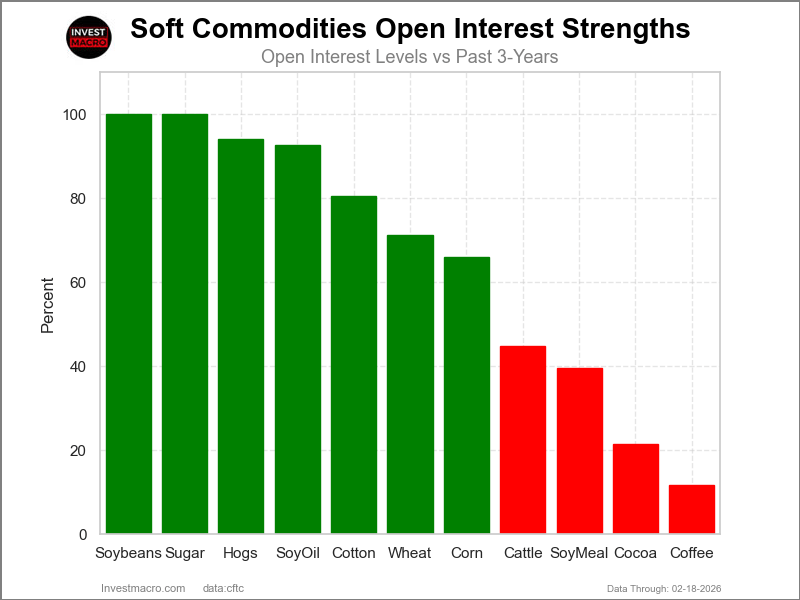
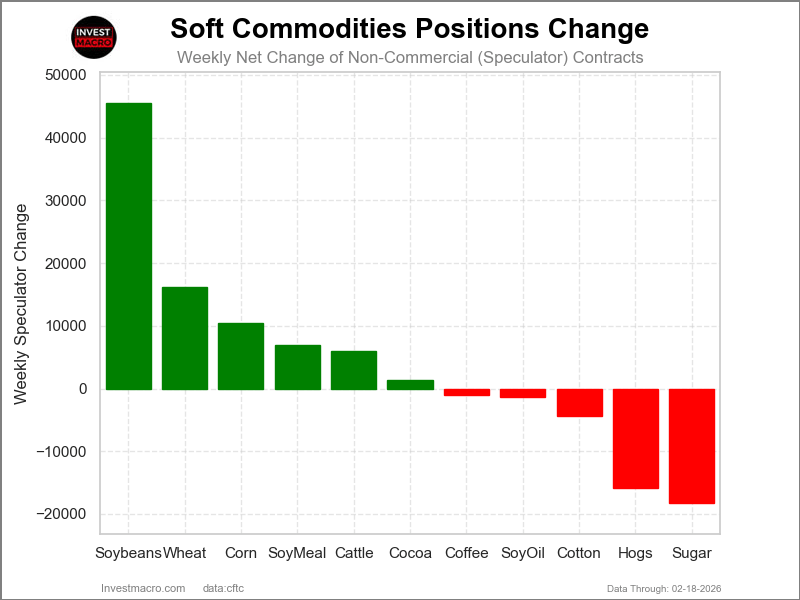
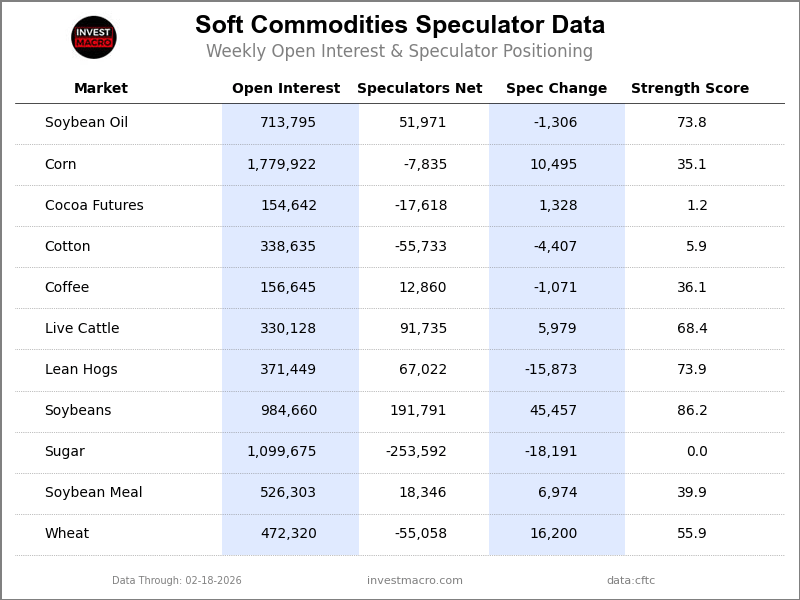
The COT soft commodities markets speculator bets were overall higher this week as six out of the eleven softs markets we cover had higher positioning while the other five markets had lower speculator contracts.

Leading the gains for the softs markets was Soybeans (45,457 contracts) with Wheat (16,200 contracts), Corn (10,495 contracts), Soybean Meal (6,974 contracts), Live Cattle (5,979 contracts) and Cocoa (1,328 contracts) also showing positive weeks.

The markets with the declines in speculator bets this week were Sugar (-18,191 contracts), Lean Hogs (-15,873 contracts), Cotton (-4,407 contracts), Soybean Oil (-1,306 contracts) and with Coffee (-1,071 contracts) also registering lower bets on the week.

Wheat leads Price Price Performance Leaders

Price performance leaders were Wheat and Soybean Oil this week. Wheat was the highest riser in the past five days with a 3.89% gain and Soybean Oil was higher by 3.25% in the same period.

Lean Hogs rose by 2.58%, Cotton was higher by 2.35%, and Sugar also got a boost by over 2% on the week. Live Cattle rose by approximately 1% and Soybean Meal saw a gain of 0.62%. Soybeans and Corn were virtually unchanged on the week.

Leading the declines on the week was Cocoa, which dropped sharply by approximately -15% and followed by Coffee which was also lower by -4.87%.


Soft Commodities Data:

Speculators Table Softs
Legend: Weekly Speculators Change | Speculators Current Net Position | Speculators Strength Score compared to last 3-Years (0-100 range)


Strength Scores led by Soybeans, Lean Hogs & Soybean Oil

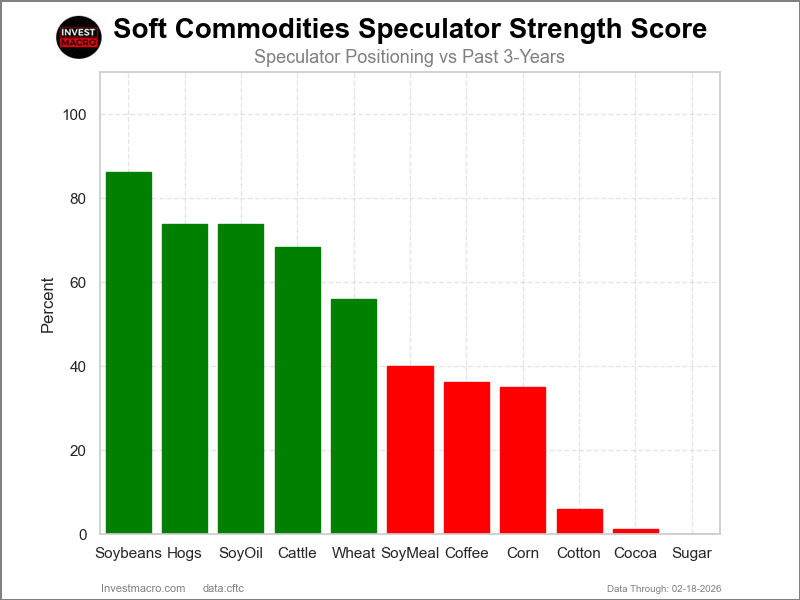
Speculators Strength Softs
COT Strength Scores (a normalized measure of Speculator positions over a 3-Year range, from 0 to 100 where above 80 is Extreme-Bullish and below 20 is Extreme-Bearish) showed that Soybeans (86 percent), Lean Hogs (74 percent) and Soybean Oil (74 percent) lead the softs markets this week. Live Cattle (68 percent) and Wheat (56 percent) come in as the next highest in the weekly strength scores.

On the downside, Sugar (0 percent), Cocoa (1 percent) and Cotton (6 percent) come in at the lowest strength levels currently and are in Extreme-Bearish territory (below 20 percent).

Strength Statistics:
Corn (35.1 percent) vs Corn previous week (33.7 percent)
Sugar (0.0 percent) vs Sugar previous week (3.4 percent)
Coffee (36.1 percent) vs Coffee previous week (37.2 percent)
Soybeans (86.2 percent) vs Soybeans previous week (76.1 percent)
Soybean Oil (73.8 percent) vs Soybean Oil previous week (74.6 percent)
Soybean Meal (39.9 percent) vs Soybean Meal previous week (37.2 percent)
Live Cattle (68.4 percent) vs Live Cattle previous week (62.4 percent)
Lean Hogs (73.9 percent) vs Lean Hogs previous week (85.3 percent)
Cotton (5.9 percent) vs Cotton previous week (8.5 percent)
Cocoa (1.2 percent) vs Cocoa previous week (0.0 percent)
Wheat (55.9 percent) vs Wheat previous week (41.6 percent)


Soybean Oil & Wheat top the 6-Week Strength Trends

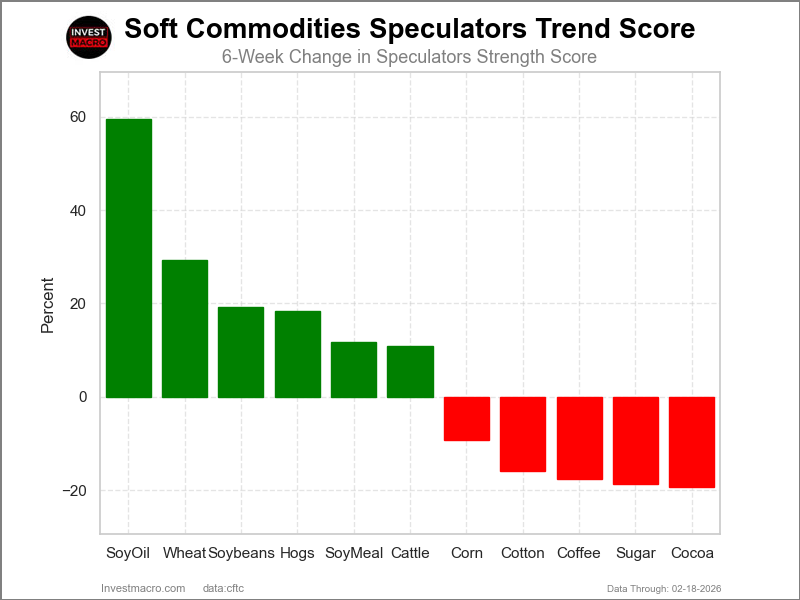
Speculators Trend Softs
COT Strength Score Trends (or move index, calculates the 6-week changes in strength scores) showed that Soybean Oil (60 percent) and Wheat (29 percent) lead the past six weeks trends for soft commodities. Soybeans (19 percent), Lean Hogs (18 percent) and Soybean Meal (12 percent) are the next highest positive movers in the latest trends data.

Cocoa (-19 percent) leads the downside trend scores currently with Sugar (-19 percent), Coffee (-18 percent) and Cotton (-16 percent) following next with lower trend scores.

Strength Trend Statistics:
Corn (-9.2 percent) vs Corn previous week (-9.7 percent)
Sugar (-18.7 percent) vs Sugar previous week (-18.3 percent)
Coffee (-17.7 percent) vs Coffee previous week (-10.7 percent)
Soybeans (19.3 percent) vs Soybeans previous week (5.4 percent)
Soybean Oil (59.6 percent) vs Soybean Oil previous week (65.7 percent)
Soybean Meal (11.7 percent) vs Soybean Meal previous week (5.2 percent)
Live Cattle (10.9 percent) vs Live Cattle previous week (7.5 percent)
Lean Hogs (18.4 percent) vs Lean Hogs previous week (29.8 percent)
Cotton (-16.0 percent) vs Cotton previous week (-12.1 percent)
Cocoa (-19.4 percent) vs Cocoa previous week (-20.6 percent)
Wheat (29.3 percent) vs Wheat previous week (-0.2 percent)


Individual Soft Commodities Markets:

CORN Futures:

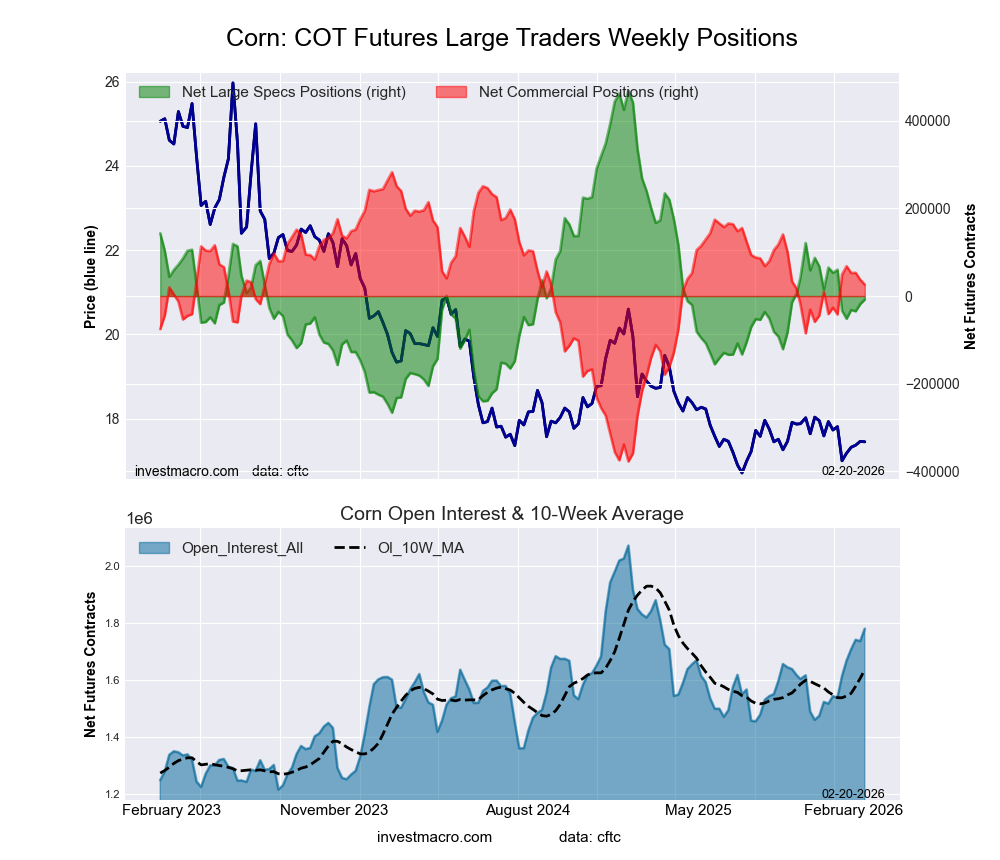
CORN Futures COT ChartThe CORN large speculator standing this week equaled a net position of -7,835 contracts in the data reported through Tuesday. This was a weekly boost of 10,495 contracts from the previous week which had a total of -18,330 net contracts.

This week’s current strength score (the trader positioning range over the past three years, measured from 0 to 100) shows the speculators are currently Bearish with a score of 35.1 percent. The commercials are Bullish with a score of 61.1 percent and the small traders (not shown in chart) are Bullish-Extreme with a score of 85.5 percent.

Price Trend-Following Model: Strong Downtrend

Our weekly trend-following model classifies the current market price position as: Strong Downtrend.

CORN Futures StatisticsSPECULATORSCOMMERCIALSSMALL TRADERS
– Percent of Open Interest Longs:18.946.78.2
– Percent of Open Interest Shorts:19.445.39.3
– Net Position:-7,83525,990-18,155
– Gross Longs:336,717831,608146,498
– Gross Shorts:344,552805,618164,653
– Long to Short Ratio:1.0 to 11.0 to 10.9 to 1
NET POSITION TREND:
– Strength Index Score (3 Year Range Pct):35.161.185.5
– Strength Index Reading (3 Year Range):BearishBullishBullish-Extreme
NET POSITION MOVEMENT INDEX:
– 6-Week Change in Strength Index:-9.210.30.1


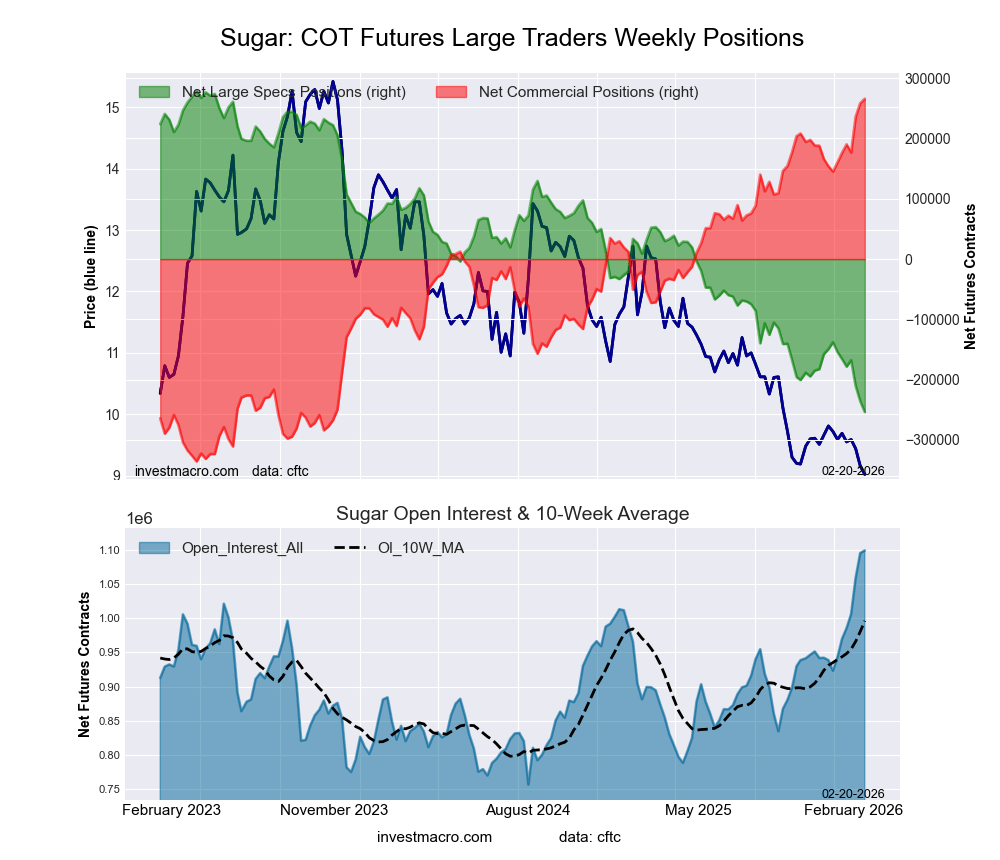
SUGAR Futures:

SUGAR Futures COT ChartThe SUGAR large speculator standing this week equaled a net position of -253,592 contracts in the data reported through Tuesday. This was a weekly reduction of -18,191 contracts from the previous week which had a total of -235,401 net contracts.

This week’s current strength score (the trader positioning range over the past three years, measured from 0 to 100) shows the speculators are currently Bearish-Extreme with a score of 0.0 percent. The commercials are Bullish-Extreme with a score of 100.0 percent and the small traders (not shown in chart) are Bearish-Extreme with a score of 16.2 percent.

Price Trend-Following Model: Strong Downtrend

Our weekly trend-following model classifies the current market price position as: Strong Downtrend.

SUGAR Futures StatisticsSPECULATORSCOMMERCIALSSMALL TRADERS
– Percent of Open Interest Longs:15.656.97.5
– Percent of Open Interest Shorts:38.732.78.6
– Net Position:-253,592265,824-12,232
– Gross Longs:171,981625,81282,477
– Gross Shorts:425,573359,98894,709
– Long to Short Ratio:0.4 to 11.7 to 10.9 to 1
NET POSITION TREND:
– Strength Index Score (3 Year Range Pct):0.0100.016.2
– Strength Index Reading (3 Year Range):Bearish-ExtremeBullish-ExtremeBearish-Extreme
NET POSITION MOVEMENT INDEX:
– 6-Week Change in Strength Index:-18.717.6-7.3


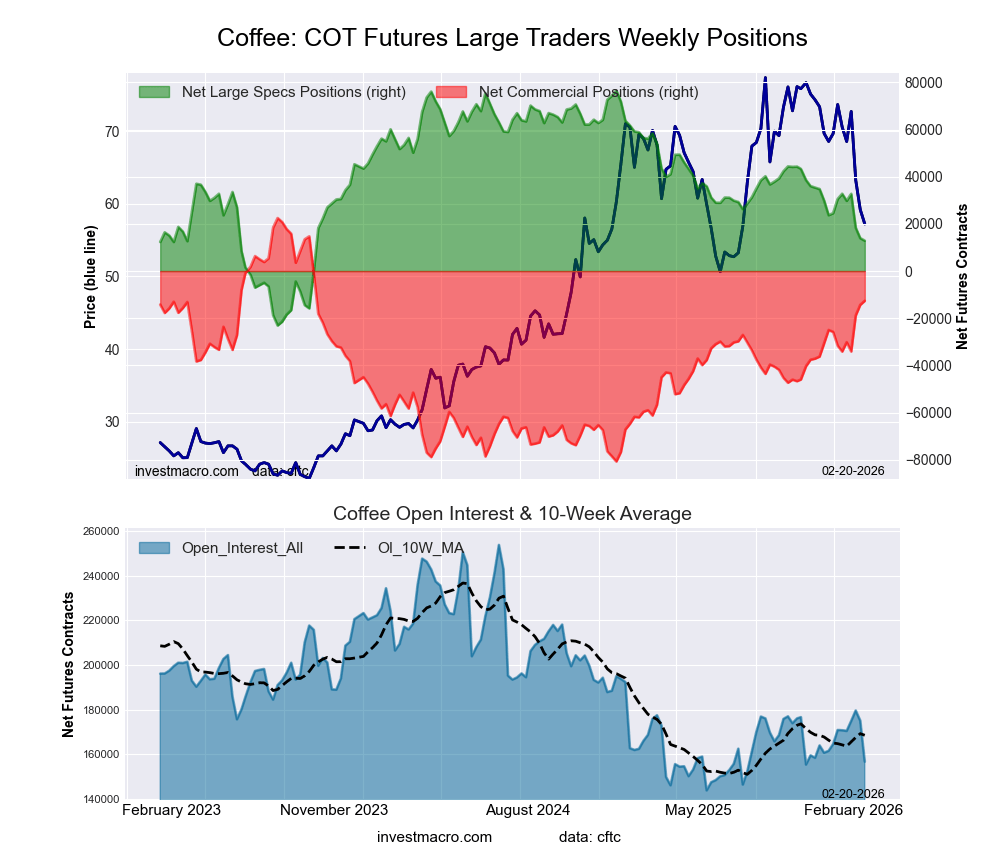
COFFEE Futures:

COFFEE Futures COT ChartThe COFFEE large speculator standing this week equaled a net position of 12,860 contracts in the data reported through Tuesday. This was a weekly reduction of -1,071 contracts from the previous week which had a total of 13,931 net contracts.

This week’s current strength score (the trader positioning range over the past three years, measured from 0 to 100) shows the speculators are currently Bearish with a score of 36.1 percent. The commercials are Bullish with a score of 66.0 percent and the small traders (not shown in chart) are Bearish-Extreme with a score of 13.5 percent.

Price Trend-Following Model: Strong Downtrend

Our weekly trend-following model classifies the current market price position as: Strong Downtrend.

COFFEE Futures StatisticsSPECULATORSCOMMERCIALSSMALL TRADERS
– Percent of Open Interest Longs:30.342.04.8
– Percent of Open Interest Shorts:22.150.05.0
– Net Position:12,860-12,616-244
– Gross Longs:47,50265,7227,517
– Gross Shorts:34,64278,3387,761
– Long to Short Ratio:1.4 to 10.8 to 11.0 to 1
NET POSITION TREND:
– Strength Index Score (3 Year Range Pct):36.166.013.5
– Strength Index Reading (3 Year Range):BearishBullishBearish-Extreme
NET POSITION MOVEMENT INDEX:
– 6-Week Change in Strength Index:-17.718.4-22.6


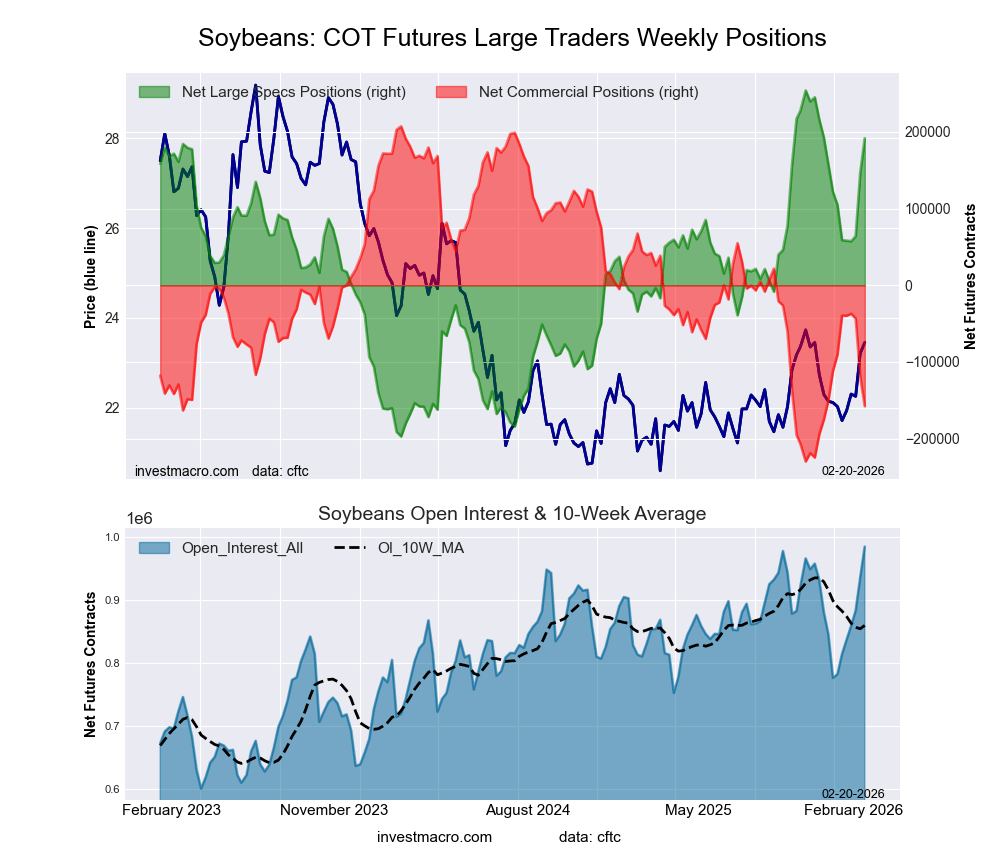
SOYBEANS Futures:

SOYBEANS Futures COT ChartThe SOYBEANS large speculator standing this week equaled a net position of 191,791 contracts in the data reported through Tuesday. This was a weekly gain of 45,457 contracts from the previous week which had a total of 146,334 net contracts.

This week’s current strength score (the trader positioning range over the past three years, measured from 0 to 100) shows the speculators are currently Bullish-Extreme with a score of 86.2 percent. The commercials are Bearish-Extreme with a score of 16.5 percent and the small traders (not shown in chart) are Bearish-Extreme with a score of 18.2 percent.

Price Trend-Following Model: Strong Uptrend

Our weekly trend-following model classifies the current market price position as: Strong Uptrend.

SOYBEANS Futures StatisticsSPECULATORSCOMMERCIALSSMALL TRADERS
– Percent of Open Interest Longs:27.947.15.0
– Percent of Open Interest Shorts:8.463.18.5
– Net Position:191,791-157,771-34,020
– Gross Longs:274,388463,65249,618
– Gross Shorts:82,597621,42383,638
– Long to Short Ratio:3.3 to 10.7 to 10.6 to 1
NET POSITION TREND:
– Strength Index Score (3 Year Range Pct):86.216.518.2
– Strength Index Reading (3 Year Range):Bullish-ExtremeBearish-ExtremeBearish-Extreme
NET POSITION MOVEMENT INDEX:
– 6-Week Change in Strength Index:19.3-15.4-54.7


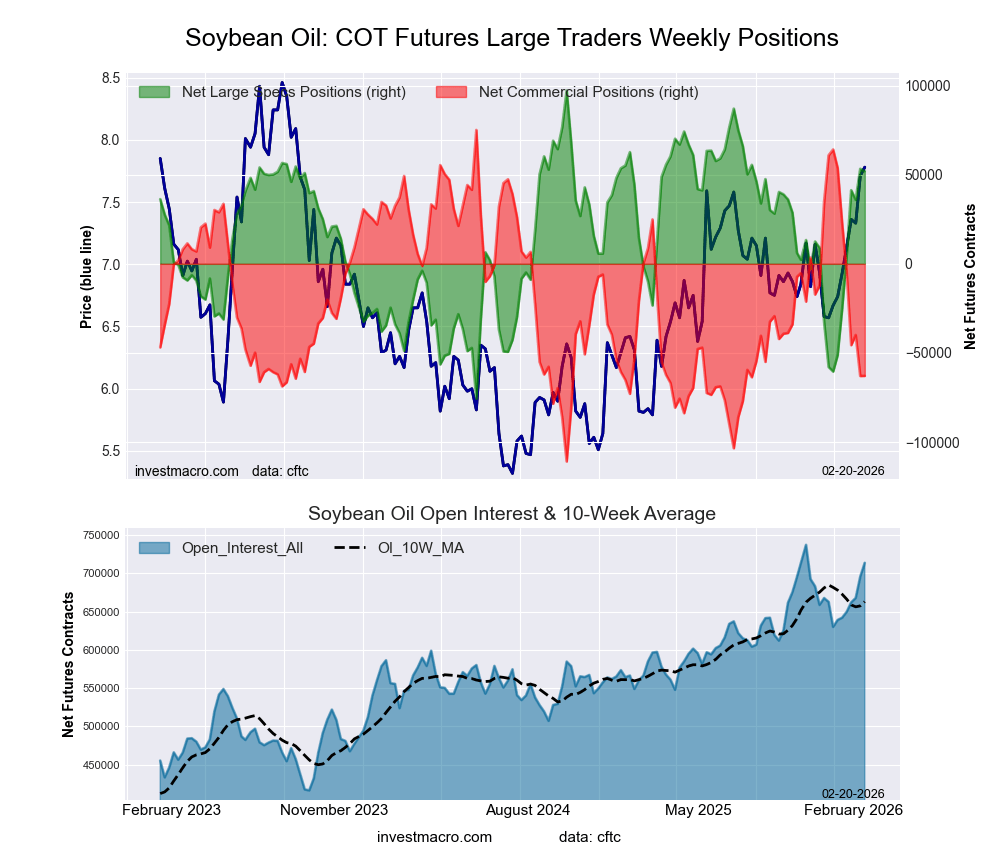
SOYBEAN OIL Futures:

SOYBEAN OIL Futures COT ChartThe SOYBEAN OIL large speculator standing this week equaled a net position of 51,971 contracts in the data reported through Tuesday. This was a weekly reduction of -1,306 contracts from the previous week which had a total of 53,277 net contracts.

This week’s current strength score (the trader positioning range over the past three years, measured from 0 to 100) shows the speculators are currently Bullish with a score of 73.8 percent. The commercials are Bearish with a score of 25.8 percent and the small traders (not shown in chart) are Bullish with a score of 72.7 percent.

Price Trend-Following Model: Strong Uptrend

Our weekly trend-following model classifies the current market price position as: Strong Uptrend.

SOYBEAN OIL Futures StatisticsSPECULATORSCOMMERCIALSSMALL TRADERS
– Percent of Open Interest Longs:21.747.05.2
– Percent of Open Interest Shorts:14.455.83.7
– Net Position:51,971-62,88010,909
– Gross Longs:155,039335,70437,409
– Gross Shorts:103,068398,58426,500
– Long to Short Ratio:1.5 to 10.8 to 11.4 to 1
NET POSITION TREND:
– Strength Index Score (3 Year Range Pct):73.825.872.7
– Strength Index Reading (3 Year Range):BullishBearishBullish
NET POSITION MOVEMENT INDEX:
– 6-Week Change in Strength Index:59.6-62.767.3


SOYBEAN MEAL Futures:

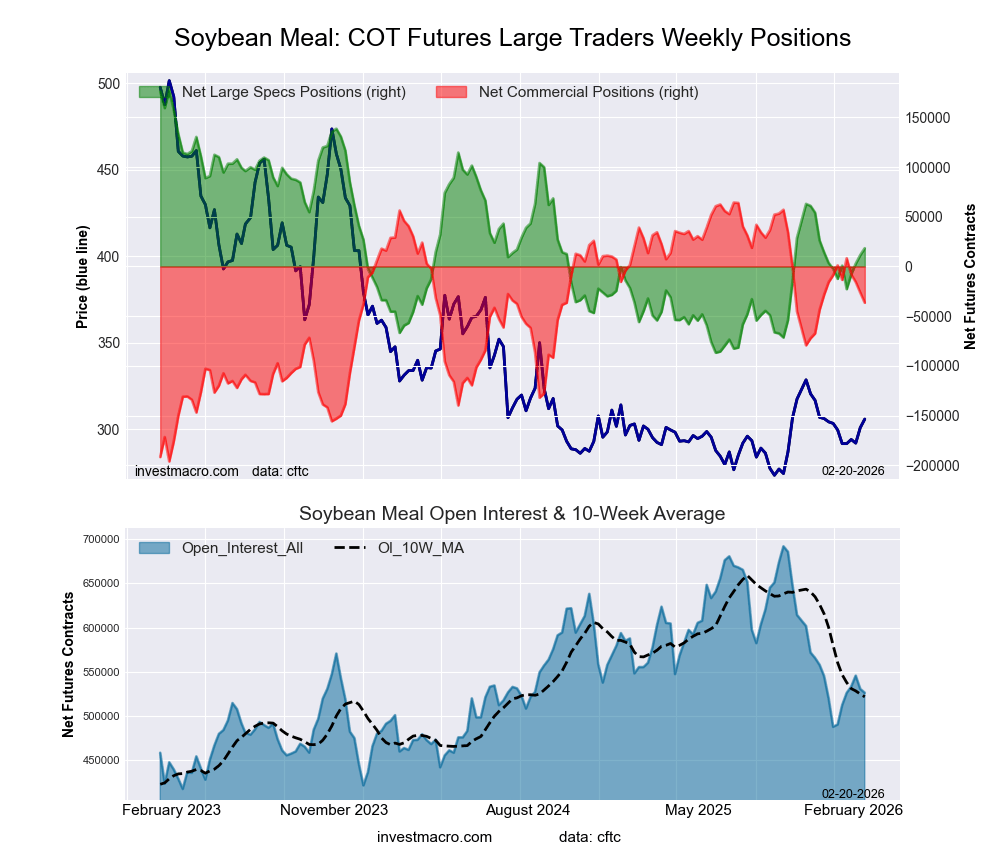
SOYBEAN MEAL Futures COT ChartThe SOYBEAN MEAL large speculator standing this week equaled a net position of 18,346 contracts in the data reported through Tuesday. This was a weekly increase of 6,974 contracts from the previous week which had a total of 11,372 net contracts.

This week’s current strength score (the trader positioning range over the past three years, measured from 0 to 100) shows the speculators are currently Bearish with a score of 39.9 percent. The commercials are Bullish with a score of 61.3 percent and the small traders (not shown in chart) are Bearish with a score of 45.6 percent.

Price Trend-Following Model: Strong Uptrend

Our weekly trend-following model classifies the current market price position as: Strong Uptrend.

SOYBEAN MEAL Futures StatisticsSPECULATORSCOMMERCIALSSMALL TRADERS
– Percent of Open Interest Longs:20.853.89.0
– Percent of Open Interest Shorts:17.360.75.5
– Net Position:18,346-36,47318,127
– Gross Longs:109,382283,09147,273
– Gross Shorts:91,036319,56429,146
– Long to Short Ratio:1.2 to 10.9 to 11.6 to 1
NET POSITION TREND:
– Strength Index Score (3 Year Range Pct):39.961.345.6
– Strength Index Reading (3 Year Range):BearishBullishBearish
NET POSITION MOVEMENT INDEX:
– 6-Week Change in Strength Index:11.7-14.437.1


LIVE CATTLE Futures:

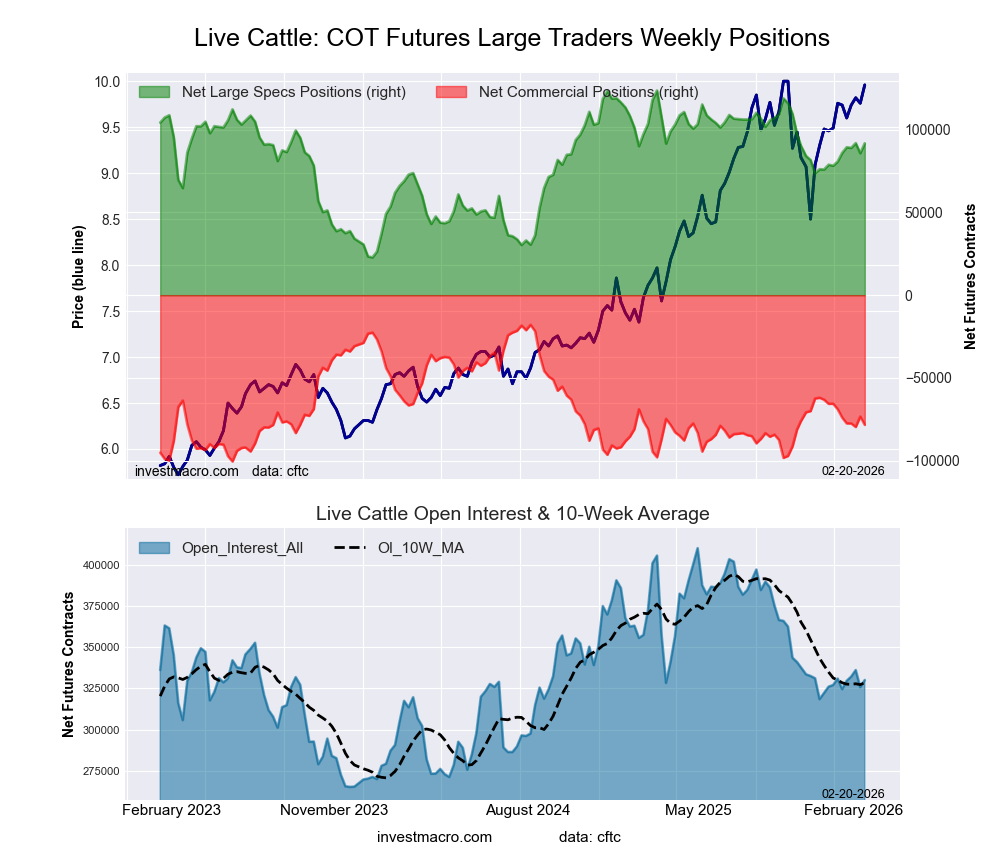
LIVE CATTLE Futures COT ChartThe LIVE CATTLE large speculator standing this week equaled a net position of 91,735 contracts in the data reported through Tuesday. This was a weekly gain of 5,979 contracts from the previous week which had a total of 85,756 net contracts.

This week’s current strength score (the trader positioning range over the past three years, measured from 0 to 100) shows the speculators are currently Bullish with a score of 68.4 percent. The commercials are Bearish with a score of 26.8 percent and the small traders (not shown in chart) are Bullish with a score of 51.3 percent.

Price Trend-Following Model: Strong Uptrend

Our weekly trend-following model classifies the current market price position as: Strong Uptrend.

LIVE CATTLE Futures StatisticsSPECULATORSCOMMERCIALSSMALL TRADERS
– Percent of Open Interest Longs:45.631.08.3
– Percent of Open Interest Shorts:17.854.712.3
– Net Position:91,735-78,353-13,382
– Gross Longs:150,433102,30827,276
– Gross Shorts:58,698180,66140,658
– Long to Short Ratio:2.6 to 10.6 to 10.7 to 1
NET POSITION TREND:
– Strength Index Score (3 Year Range Pct):68.426.851.3
– Strength Index Reading (3 Year Range):BullishBearishBullish
NET POSITION MOVEMENT INDEX:
– 6-Week Change in Strength Index:10.9-11.5-5.5


LEAN HOGS Futures:

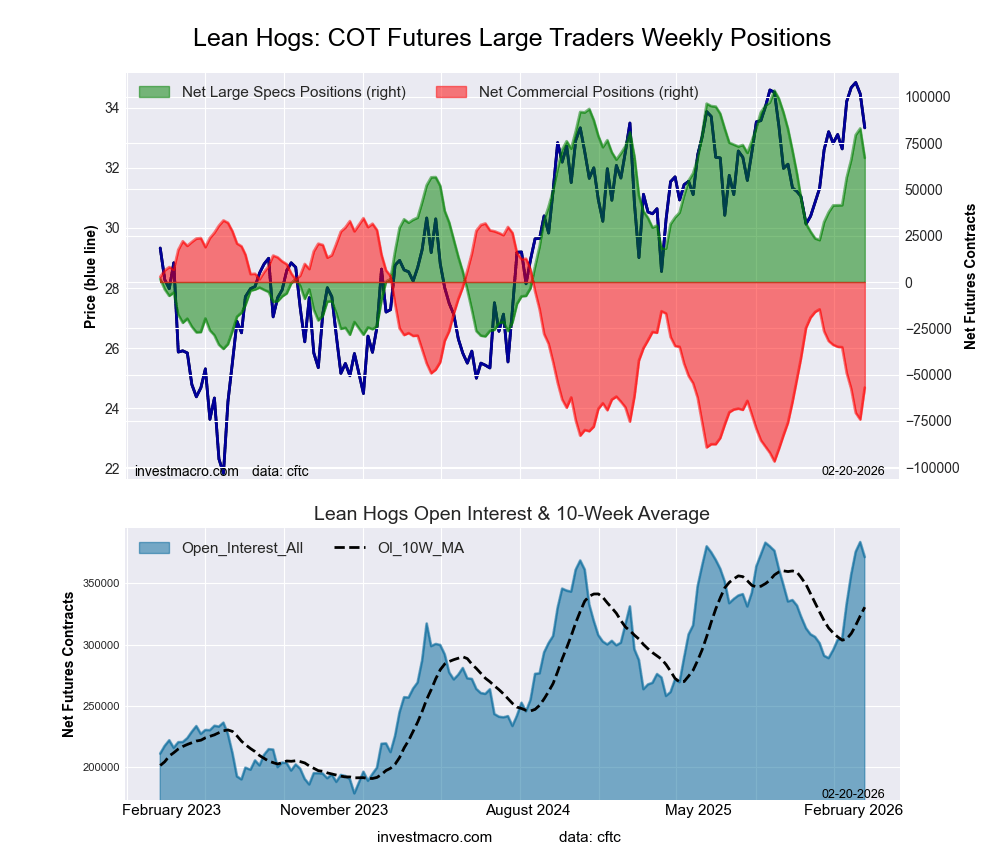
LEAN HOGS Futures COT ChartThe LEAN HOGS large speculator standing this week equaled a net position of 67,022 contracts in the data reported through Tuesday. This was a weekly reduction of -15,873 contracts from the previous week which had a total of 82,895 net contracts.

This week’s current strength score (the trader positioning range over the past three years, measured from 0 to 100) shows the speculators are currently Bullish with a score of 73.9 percent. The commercials are Bearish with a score of 30.3 percent and the small traders (not shown in chart) are Bearish-Extreme with a score of 17.3 percent.

Price Trend-Following Model: Uptrend

Our weekly trend-following model classifies the current market price position as: Uptrend.

LEAN HOGS Futures StatisticsSPECULATORSCOMMERCIALSSMALL TRADERS
– Percent of Open Interest Longs:39.832.35.6
– Percent of Open Interest Shorts:21.847.68.3
– Net Position:67,022-57,027-9,995
– Gross Longs:147,998119,95620,920
– Gross Shorts:80,976176,98330,915
– Long to Short Ratio:1.8 to 10.7 to 10.7 to 1
NET POSITION TREND:
– Strength Index Score (3 Year Range Pct):73.930.317.3
– Strength Index Reading (3 Year Range):BullishBearishBearish-Extreme
NET POSITION MOVEMENT INDEX:
– 6-Week Change in Strength Index:18.4-16.8-21.6


COTTON Futures:

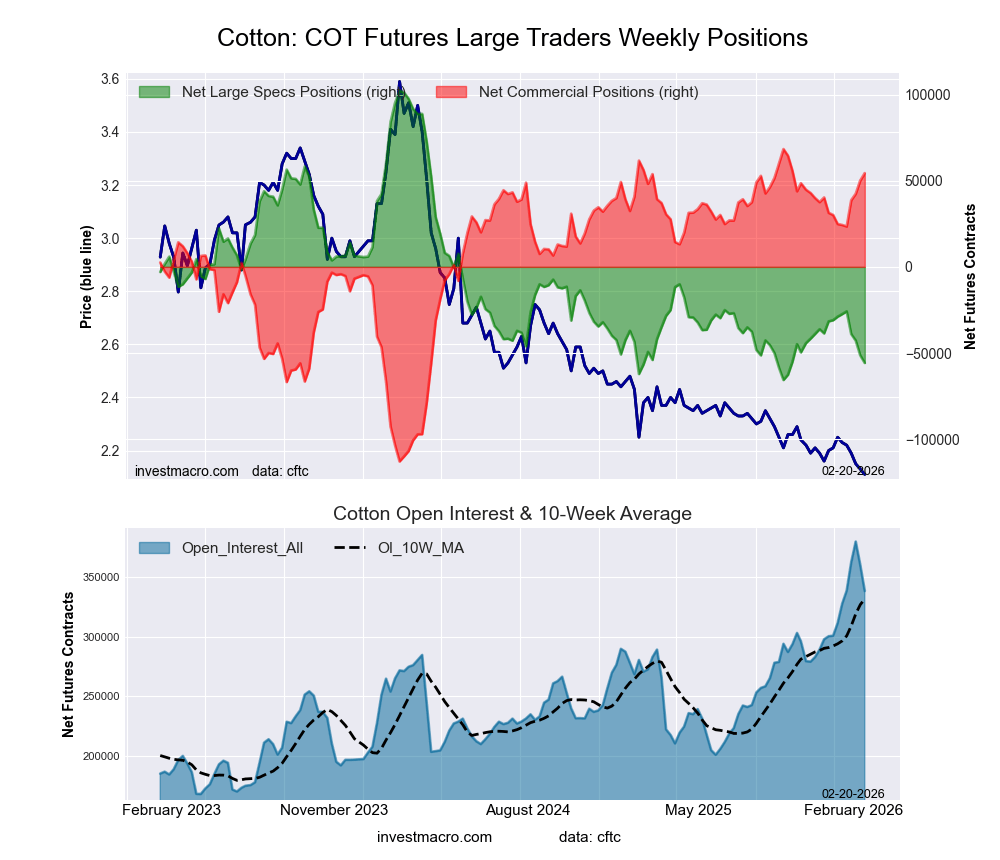
COTTON Futures COT ChartThe COTTON large speculator standing this week equaled a net position of -55,733 contracts in the data reported through Tuesday. This was a weekly reduction of -4,407 contracts from the previous week which had a total of -51,326 net contracts.

This week’s current strength score (the trader positioning range over the past three years, measured from 0 to 100) shows the speculators are currently Bearish-Extreme with a score of 5.9 percent. The commercials are Bullish-Extreme with a score of 92.3 percent and the small traders (not shown in chart) are Bearish with a score of 32.3 percent.

Price Trend-Following Model: Downtrend

Our weekly trend-following model classifies the current market price position as: Downtrend.

COTTON Futures StatisticsSPECULATORSCOMMERCIALSSMALL TRADERS
– Percent of Open Interest Longs:29.446.24.6
– Percent of Open Interest Shorts:45.930.14.2
– Net Position:-55,73354,3891,344
– Gross Longs:99,583156,45215,630
– Gross Shorts:155,316102,06314,286
– Long to Short Ratio:0.6 to 11.5 to 11.1 to 1
NET POSITION TREND:
– Strength Index Score (3 Year Range Pct):5.992.332.3
– Strength Index Reading (3 Year Range):Bearish-ExtremeBullish-ExtremeBearish
NET POSITION MOVEMENT INDEX:
– 6-Week Change in Strength Index:-16.016.3-19.9


COCOA Futures:

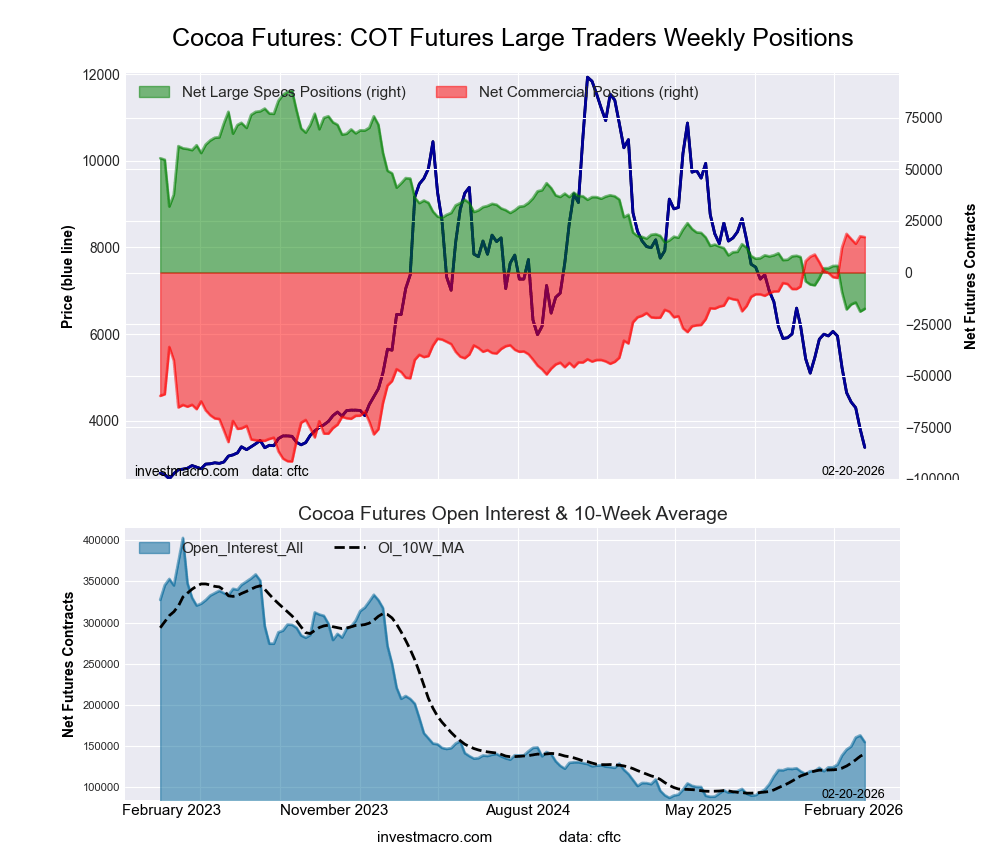
COCOA Futures COT ChartThe COCOA large speculator standing this week equaled a net position of -17,618 contracts in the data reported through Tuesday. This was a weekly advance of 1,328 contracts from the previous week which had a total of -18,946 net contracts.

This week’s current strength score (the trader positioning range over the past three years, measured from 0 to 100) shows the speculators are currently Bearish-Extreme with a score of 1.2 percent. The commercials are Bullish-Extreme with a score of 98.6 percent and the small traders (not shown in chart) are Bearish with a score of 31.6 percent.

Price Trend-Following Model: Strong Downtrend

Our weekly trend-following model classifies the current market price position as: Strong Downtrend.

COCOA Futures StatisticsSPECULATORSCOMMERCIALSSMALL TRADERS
– Percent of Open Interest Longs:19.048.37.4
– Percent of Open Interest Shorts:30.337.27.1
– Net Position:-17,61817,159459
– Gross Longs:29,31074,71611,431
– Gross Shorts:46,92857,55710,972
– Long to Short Ratio:0.6 to 11.3 to 11.0 to 1
NET POSITION TREND:
– Strength Index Score (3 Year Range Pct):1.298.631.6
– Strength Index Reading (3 Year Range):Bearish-ExtremeBullish-ExtremeBearish
NET POSITION MOVEMENT INDEX:
– 6-Week Change in Strength Index:-19.417.910.2


WHEAT Futures:

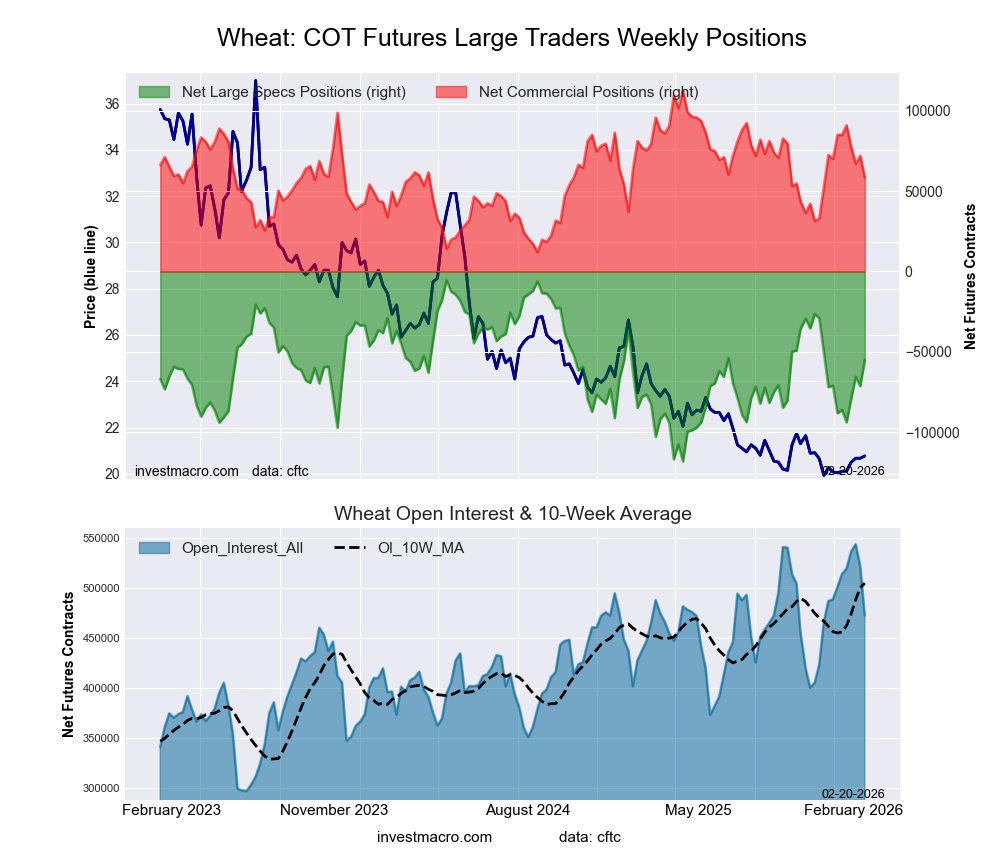
WHEAT Futures COT ChartThe WHEAT large speculator standing this week equaled a net position of -55,058 contracts in the data reported through Tuesday. This was a weekly increase of 16,200 contracts from the previous week which had a total of -71,258 net contracts.

This week’s current strength score (the trader positioning range over the past three years, measured from 0 to 100) shows the speculators are currently Bullish with a score of 55.9 percent. The commercials are Bearish with a score of 46.2 percent and the small traders (not shown in chart) are Bearish with a score of 34.6 percent.

Price Trend-Following Model: Uptrend

Our weekly trend-following model classifies the current market price position as: Uptrend.

WHEAT Futures StatisticsSPECULATORSCOMMERCIALSSMALL TRADERS
– Percent of Open Interest Longs:25.835.56.8
– Percent of Open Interest Shorts:37.523.17.5
– Net Position:-55,05858,384-3,326
– Gross Longs:122,049167,70732,177
– Gross Shorts:177,107109,32335,503
– Long to Short Ratio:0.7 to 11.5 to 10.9 to 1
NET POSITION TREND:
– Strength Index Score (3 Year Range Pct):55.946.234.6
– Strength Index Reading (3 Year Range):BullishBearishBearish
NET POSITION MOVEMENT INDEX:
– 6-Week Change in Strength Index:29.3-26.4-37.8


Article By InvestMacroReceive our weekly COT Newsletter

*COT Report: The COT data, released weekly to the public each Friday, is updated through the most recent Tuesday (data is 3 days old) and shows a quick view of how large speculators or non-commercials (for-profit traders) were positioned in the futures markets.

The CFTC categorizes trader positions according to commercial hedgers (traders who use futures contracts for hedging as part of the business), non-commercials (large traders who speculate to realize trading profits) and nonreportable traders (usually small traders/speculators) as well as their open interest (contracts open in the market at time of reporting). See CFTC criteria here.
Probability underlies much of the modern world – an engineering professor explains how it actually works

By Zachary del Rosario, Olin College of Engineering 

Probability underpins AI, cryptography and statistics. However, as the philosopher Bertrand Russell said, “Probability is the most important concept in modern science, especially as nobody has the slightest notion what it means.”

I teach statistics to engineers, so I know that while probability is important, it is counterintuitive.

Probability is a branch of mathematics that describes randomness. When scientists describe randomness, they’re describing chance events – like a coin flip – not strange occurrences, like a person dressed as a zebra. While scientists do not have a way to predict strange occurrences, probability does predict long-run behavior – that is, the trends that emerge from many repeated events.

Left: A person in a zebra costume. Right: A coin in mid-air after being flipped. A hand is visible with thumb extended upward.
We may say ‘random’ to describe strange occurrences (person dressed as zebra), but probability describes chance events (a coin flip).
Zebras in La Paz, Bolivia by EEJCC, Own Work CC A-SA 4.0; https://commons.wikimedia.org/wiki/File:Zebra_La_Paz.jpg _ , CC BY-SA

Modeling with probability

Since probability is about events, a scientist must choose which events to study. This choice defines the sample space. When flipping a coin, for example, you might define your event as the way it lands.

Coins almost always land on heads or tails. However, it’s possible – if very unlikely – for a coin to land on its side. So to create a sample space, you’d have two choices: heads and tails, or heads, tails and side. For now, ignore the side landings and use heads and tails as our sample space.

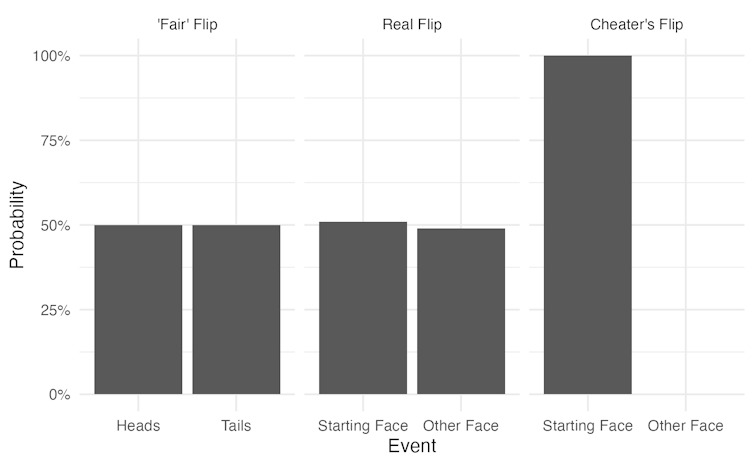
Next, you would assign probabilities to the events. Probability describes the rate of occurrence of an event and takes values between 0% and 100%. For example, a fair flip will tend to land 50% heads up and 50% tails up.

To assign probabilities, however, you need to think carefully about the scenario. What if the person flipping the coin is a cheater? There’s a sneaky technique to “wobble” the coin without flipping, controlling the outcome. Even if you can prevent cheating, real coin flips are slightly more probable to land on their starting face – so if you start the flip with the coin heads up, it’s very slightly more likely to land heads up.

In both the cheating and real flip cases, you need an appropriate sample space: starting face and other face. To have a fair flip in the real world, you’d need an additional step where you randomly – with equal probability – choose the starting face, then flip the coin.

Three bar graphs displaying probabilities for different outcomes. The 'Fair' Flip assigns equal probability (50%) to both heads and tails. The Real Flip assigns 51% to the Starting Face and 49% to the Other Face. The Cheater's Flip assigns 100% to the Starting Face.
The probabilities for different coin-flipping scenarios.
Zachary del Rosario, CC BY-SA

These assumptions add up quickly. To have a fair flip, you had to ignore side landings, assume no one is cheating, and assume the starting face is evenly random. Together, these assumptions constitute a model for the coin flip with random outcomes. Probability tells us about the long-run behavior of a random model. In the case of the coin model, probability describes how many coins land on heads out of many flips.

But instead of using a random model, why not just solve the coin toss using physics? Actually, scientists have done just that, and the physics shows that slight changes in the speed of the flip determine whether it comes up heads or tails. This sensitivity makes a coin flip unpredictable, so a random model is a good one.

Frequency vs. probability

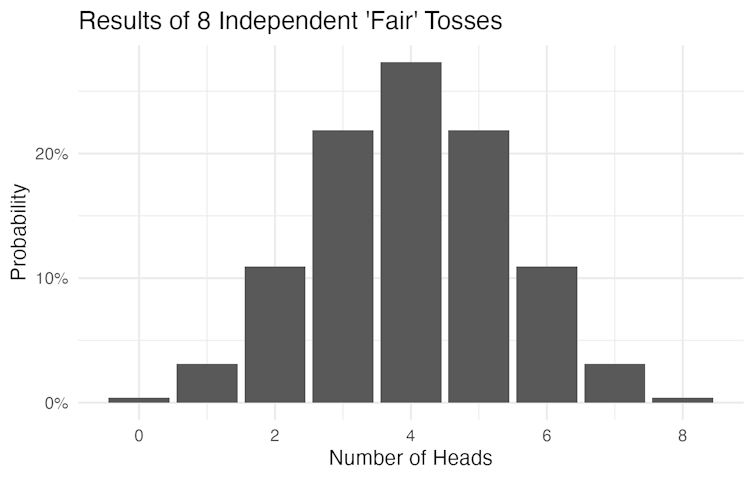
Probability differs from frequency, which is the rate of events in a sequence. For example, if you flip a coin eight times and get two heads, that’s a frequency of 25%. Even if the probability of flipping a coin and seeing heads is 50% over the long run, each short sequence of flips will come out different. Four heads and four tails is the most probable outcome from eight flips, but other events can – and will – happen.

Frequency and probability are the same in one special setting: when the number of data points goes to infinity. In this sense, probability tells us about long-run behavior.

A bar chart of probabilities for all possible outcomes of eight 'fair' coin flips. Four heads has the highest probability (~27%), and the distribution is symmetric around four heads.
Probabilities for all possible outcomes of eight ‘fair’ coin flips.
Zachary del Rosario, CC BY-SA

Applications to AI, cryptography and statistics

Probability isn’t just useful for predicting coin flips. It underlies many modern technological systems.

For example, AI systems such as large language models, or LLMs, are based on next-word prediction. Essentially, they compute a probability for the words that follow your prompt. For example, with the prompt “New York” you might get “City” or “State” as the predicted next word, because in the training data those are the words that most frequently follow.

But since probability describes randomness, the outputs of a LLM are random. Just like a sequence of coin flips is not guaranteed to come out the same way every time, if you ask an LLM the same question again, you will tend to get a different response. Effectively, each next word is treated like a new coin flip.

Randomness is also key to cryptography: the science of securing information. Cryptographic communication uses a shared secret, such as a password, to secure information. However, surprising randomness isn’t good enough for security, which is why picking a surprising word is a bad choice of password. A shared secret is only secure if it’s hard to guess. Even if a word is surprising, real words are easier to guess than flipping a “coin” for each letter.

You can make a much stronger password by using probability to choose characters at random on your keyboard – or better yet, use a password manager.

Finally, randomness is key in statistics. Statisticians are responsible for designing and analyzing studies to make use of limited data. This practice is especially important when studying medical treatments, because every data point represents a person’s life.

The gold standard is a randomized controlled trial. Participants are assigned to receive the new treatment or the current standard of care based on a fair coin flip. It may seem strange to do this assignment randomly – using coin flips to make decisions about lives. However, the unpredictability serves an important role, as it ensures that nothing about the person affects their chance to get the treatment: not age, gender, race, income or any other factor. The unpredictability helps scientists ensure that only the treatment causes the observed result and not any other factor.

So what does probability mean? Like any kind of math, it’s only a model, meaning it can’t perfectly describe the world. In the examples discussed, probability is useful for describing long-term behaviors and using unpredictability to solve practical problems.The Conversation

About the Author:

Zachary del Rosario, Assistant Professor of Engineering, Olin College of Engineering

This article is republished from The Conversation under a Creative Commons license. Read the original article.


Week Ahead: Nvidia finale to wrap up earnings season

By ForexTime

  • Nvidia shares only ↑1% year-to-date, 10% away from ATH
  • Hyperscale spending and fiscal Q1 2027 guidance in focus
  • Shares could move 5.7% ↑ or ↓ post earnings
  • Analysts remain bullish with 12M target price at $258
  • Technical levels – $210, $195, 200-day SMA

As the most valuable company in the world, Nvidia’s earnings carry widespread implications.

But the focus for Q4 is unlikely to be about whether results smash forecasts.

It may revolve around management’s ability to convince investors that the AI spending spree is paying off amid growing fears over AI disrupting established business models.

Earnings from this tech titan along with global data may set the tone for March:

Monday, 23rd February

  • EUR: Germany Ifo Business Climate (Feb); ECB President Christine Lagarde speech
  • USD: Chicago Fed National Activity Index (Jan, Dec); US Factory Orders (Dec); Dallas Fed Manufacturing Index (Feb); Fed Governor Christopher Waller speech

Tuesday, 24th February

  • EUR: Eurozone New Car Registrations (Jan); France Business Confidence (Feb)
  • GBP: UK CBI Distributive Trades (Feb)
  • USD: US ADP Employment Change Weekly; Fed Golsbee Speech; President Donald Trump delivers the State of the Union Address
  • Crude (WTI, Brent): US API Crude Oil Stock Change (w/e Feb 20)
  • CNY: China loan prime rates

Wednesday, 25th February

  • AUD: Australia Inflation Rate (Jan)
  • EUR: Germany GfK Consumer Confidence (Mar); France Consumer Confidence (Feb)
  • Crude (WTI, Brent): US EIA Crude Oil Stocks Change (w/e Feb 20)
  • Major Earnings: Nvidia (after markets close)

Thursday, 26th February

  • JPY: BoJ Takada Speech; Japan Industrial Production (Jan); Retail Sales (Jan)
  • EUR: Eurozone Economic Sentiment (Feb); Spain Business Confidence (Feb)
  • USD: Initial Jobless Claims (w/e Feb 21)

Friday, 27th February

  • GBP: UK Gfk Consumer Confidence (Feb)
  • CHF: Swiss Retail Sales (Jan); GDP Growth Rate (Q4); KOF Leading Indicators (Feb)
  • EUR: Germany Inflation Rate (Feb); France Inflation Rate (Feb); Germany Unemployment Data (Feb); Spain Inflation Rate (Feb)
  • CAD: Canada GDP Growth Rate (Q4)
  • USD: US PPI (Jan)

Nvidia remains among the biggest drivers of the AI rally, with its earnings acting as a litmus test for the health of the entire AI industry.

Interestingly, the Magnificent 7 index is down 6% YTD despite tech titans posting positive earnings. This could be due to concerns about AI capex spending, stretched valuations and lofty expectations.

Even if Nvidia delivers exceptional results, investors need to be convinced that all the AI spending will pay off down the road.

When will earnings be published

Nvidia releases its Q4 Fiscal Year 2026 earnings after US markets close on Wednesday 25th February.

Market expectations

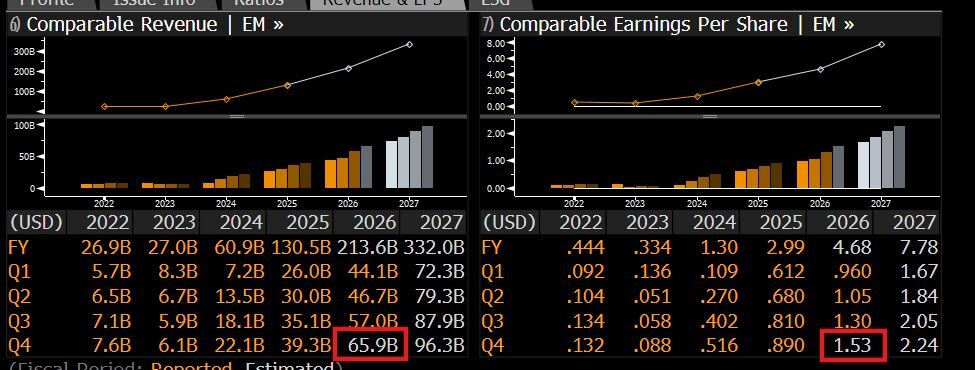
The tech giant is forecast to post earnings per share of $1.53 compared to $0.89 a year ago – representing a 72% jump.

Quarterly revenues are expected to rise $65.9 billion from $39.3 billion in the prior year – representing a 67% increase. 

As highlighted earlier, there is little room for error with exceptional results needed to justify its whopping $4.6 trillion valuation.

What to watch

  • Blackwell Ramp: Updates on the new architecture and supply constraints
  • Guidance: Q1 2027 outlook is critical. Street expects $71.6B in revenue
  • Margins: Rising memory costs could pressure profitability

How will Nvidia shares react to earnings

Markets are forecasting a 5.7% move, either Up or Down, for Nvidia stocks on Thursday post earnings. 

This is equivalent to a move of roughly $260 billion, bigger than the entire market cap of many large companies in the S&P500 and Nasdaq 100. 

How will wider markets be influenced?

Over the past 12 months, the Nasdaq 100 has shown an 83% positive correlation with Nvidia shares.

But more interestingly, over a rolling 5-day period over the past 2 years:

  • US500: +60%
  • UK100: +56%
  • Meta Platforms: +87%
  • Apple: +80%
  • Amazon: +84%
  • Broadcom: +82%
  • ASML holdings: +60%


Analyst forecasts

According to Bloomberg consensus, over 90% of analysts are bullish on Nvidia with the 12 month price target at $257.76 – roughly 25% away from current prices.

Technical forces

Prices may continue to consolidate within a range until the earnings are published.

  • A solid breakout above $195 may open a path toward $210 and potentially higher.
  •  Weakness below the 100-day SMA could trigger a decline back toward the 200-day SMA and $170.


Forex-Time-LogoArticle by ForexTime


ForexTime Ltd (FXTM) is an award winning international online forex broker regulated by CySEC 185/12 www.forextime.com

Oil prices continue to rise amid escalating geopolitical tensions

By JustMarkets 

On Thursday, trading on the US stock market concluded with a decline. By the end of the day, the Dow Jones index (US30) fell by 0.54%. The S&P 500 (US500) declined by 0.28%. The tech-heavy Nasdaq (US100) closed lower by 0.41%. The catalyst for profit-taking was the FOMC minutes, which pointed to the risk of prolonged deflation and the permissibility of additional policy tightening, heightening investor caution. Against this backdrop, long-term government bond yields rose. Rising commodity prices supported the energy sector, while banking stocks came under pressure.

European markets ended the day with a drop. Germany’s DAX (DE40) declined by 0.93%, France’s CAC 40 (FR40) closed down 0.36%, Spain’s IBEX 35 (ES35) fell by 0.99%, and the UK’s FTSE 100 (UK100) closed at negative 0.55%. Within the European region, investor sentiment is dictated by potential reshuffles in the financial leadership. Reports of a likely early resignation of Christine Lagarde as head of the ECB, as well as the resignation of Bank of France Governor François Villeroy de Galhau in June 2026, are creating a backdrop of political uncertainty. Despite the personnel rumors, a stable inflation level in the Eurozone suggests that the regulator will keep current monetary policy parameters unchanged until the end of this year.

WTI oil quotes closed in on the $66.5 per barrel mark, hitting half-year highs amid a sharp escalation of geopolitical tensions. The primary driver of growth is the risk of a large-scale military conflict between the US and Iran, fueled by statements regarding a potential forceful operation and Israel’s demands for a change in Tehran’s political course. The situation is exacerbated by a narrowing diplomatic space for maneuver and the potential threat of a blockade of the Strait of Hormuz, which is a key artery for one-third of the world’s maritime hydrocarbon exports. In parallel with foreign policy factors, price support came from unexpected data from the US Department of Energy, which recorded a rapid drop in domestic crude reserves by 9 million barrels. This significant decline in inventories during the second week of February completely refuted conservative analyst prognoses that had expected a moderate market surplus.

Natural gas prices (XNG) in the US stabilized around $3.0 per MMBtu, holding near four-month lows amid a noticeable weakening of the market balance. A key downward factor is the active recovery of production in the Lower 48 states, which in February approached historic highs, reaching 108.7 billion cubic feet per day (bcf/d). Despite continued LNG exports at record levels, total supply confidently covers current system requirements, neutralizing concerns regarding resource shortages. EIA data confirms that the rate of inventory decline is trailing both last year’s figures and the five-year averages. Although the current volume of reserves remains 6% below the norm, experts expect this gap to be fully eliminated by the beginning of March. The combination of excess production and expected warming deprives quotes of growth incentives, consolidating the downward trend in the gas segment.

Asian markets traded mostly higher yesterday. Japan’s Nikkei 225 (JP225) rose by 0.57%, China’s FTSE China A50 (CHA50) did not trade due to Lunar New Year celebrations, Hong Kong’s Hang Seng (HK50) also did not trade, and Australia’s ASX 200 (AU200) showed a positive result of 0.88%.
The New Zealand dollar (NZD) showed a notable weakness, settling at a four-week low near the $0.595 level. Pressure on the currency was exerted by the rhetoric of the new head of the Reserve Bank of New Zealand (RBNZ), Anna Breman, who, after maintaining the base rate at 2.25%, signaled no rush to tighten monetary conditions. Although inflation at the end of 2025 slightly exceeded the target range, reaching 3.1%, the regulator expressed confidence in its return to the 2% target within the year without aggressive intervention. A revision of investor expectations led to a sharp drop in the probability of a rate hike in the coming months: the chances of an increase in September plunged from 68% to 40%.

Bank Indonesia (BI) in February 2026 maintained its benchmark interest rate at 4.75%, which was fully in line with analyst projections. This decision by the regulator was dictated by the need to stabilize the national currency, which is under pressure near historic lows due to risks of sovereign rating downgrades by Moody’s and MSCI. Against a backdrop of global financial volatility, the central bank aims to keep inflation within the target corridor and ensure the sustainability of economic growth.

S&P 500 (US500) 66,861.89 −19.42 (−0.28%)

Dow Jones (US30) 49,395.16 −267.50 (−0.54%)

DAX (DE40) 25,043.57 −234.64 (−0.93%)

FTSE 100 (UK100) 10,627.04 −59.14 (−0.55%)

USD Index 97.84 +0.14% (+0.14%)

News feed for: 2026.02.20

  • Australia Manufacturing PMI (m/m) at 00:00 (GMT+2); – AUD (MED)
  • Australia Services PMI (m/m) at 00:00 (GMT+2); – AUD (MED)
  • Japan Inflation Rate (m/m) at 01:30 (GMT+2); – JPY (HIGH)
  • Japan Manufacturing PMI (m/m) at 02:30 (GMT+2); – JPY (MED)
  • Japan Services PMI (m/m) at 02:30 (GMT+2); – JPY (MED)
  • UK Retail Sales (m/m) at 09:00 (GMT+2); – GBP (MED)
  • Eurozone Manufacturing PMI (m/m) at 11:00 (GMT+2); – EUR (MED)
  • Eurozone Services PMI (m/m) at 11:00 (GMT+2); – EUR (MED)
  • UK Manufacturing PMI (m/m) at 11:30 (GMT+2); – GBP (MED)
  • UK Services PMI (m/m) at 11:30 (GMT+2); – GBP (MED)
  • Canada Retail Sales (m/m) at 15:30 (GMT+2); – CAD (MED)
  • US PCE Price Index (m/m) at 15:30 (GMT+2); – USD (HIGH)
  • US GDP (m/m) at 15:30 (GMT+2); – USD (HIGH)
  • US Manufacturing PMI (m/m) at 16:45 (GMT+2); – USD (MED)
  • US Services PMI (m/m) at 16:45 (GMT+2); – USD (MED)
  • US New Home Sales (m/m) at 17:00 (GMT+2). – USD (LOW)

By JustMarkets


This article reflects a personal opinion and should not be interpreted as an investment advice, and/or offer, and/or a persistent request for carrying out financial transactions, and/or a guarantee, and/or a forecast of future events.

GBP/USD: Slide Enters Fifth Consecutive Day

By RoboForex Analytical Department 

GBP/USD fell for the fifth consecutive day, reaching 1.3445. The slowdown in headline price growth has boosted expectations of an imminent rate cut by the Bank of England, although underlying price pressures remain robust.

Annual inflation in January slowed to 3.0% from 3.4% in December, in line with forecasts. However, inflation in the services sector, which reflects domestic price pressures, only fell to 4.4% from 4.5%, above the expected 4.3%. This partly supported the pound. Earlier, sterling had fallen after weak labour data raised expectations of a rate cut.

According to Chris Turner, Head of Global Research at ING, the market had been counting on a more pronounced slowdown in inflation, but the data were not unambiguously weak. A better-than-expected figure for services gave sterling “only limited respite.”

Investors now price the chance of a 25bp rate cut by the Bank of England next month at around 85%. By the end of the year, the market fully prices in two 25bp reductions.

The political situation remains an additional factor of uncertainty. The upcoming parliamentary by-election in Greater Manchester could reignite discussions about Prime Minister Keir Starmer’s leadership in the event of a Labour defeat. According to ING, a major loss for the party could increase pressure on the pound and the government bond market.

Technical Analysis

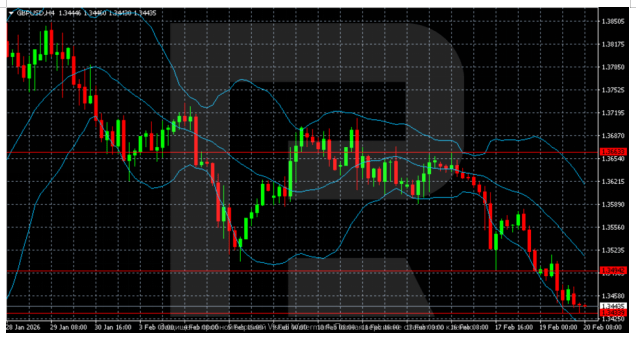
The H4 chart maintains a pronounced downtrend. After a series of lower highs, the pair broke through the 1.3490–1.3500 zone and accelerated its decline to 1.3430–1.3440. The price moves along the lower band of the Bollinger Bands, confirming the dominance of sellers.

Local rebound attempts remain weak and are quickly sold into. The nearest resistance stands at 1.3490–1.3520, followed by 1.3660. Support is at 1.3430; a break below would open the path to further losses.

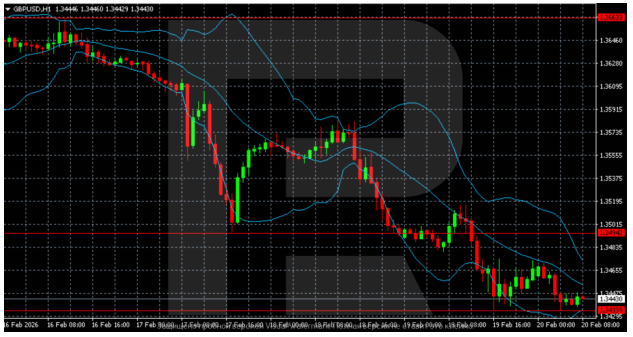
The H1 time frame shows a sharp sell-off on 19 February, followed by narrow consolidation at the lows. The Bollinger Bands have begun to narrow, suggesting volatility is easing after the recent sharp move.

The price is holding near 1.3430–1.3450. A sustained move above 1.3490 would allow for a more pronounced corrective pullback. The bearish scenario remains intact while the pair trades below 1.3490.

Conclusion

In summary, GBP/USD remains entrenched in a sustained downtrend, extending its losing streak to five sessions. While headline inflation softened as expected, sticky services inflation and resilient underlying pressures complicate the BoE’s policy calculus. The market remains firmly priced for a March rate cut, with political risks adding to the uncertainty. Technically, the pair has breached key support and trades with a clear bearish bias. Any corrective bounces are likely to be capped near 1.3490–1.3520, with a break below 1.3430 opening the door to deeper losses. The near-term outlook remains firmly negative unless prices can reclaim the 1.3490 level.


Disclaimer

Any forecasts contained herein are based on the author’s particular opinion. This analysis may not be treated as trading advice. RoboForex bears no responsibility for trading results based on trading recommendations and reviews contained herein.

The Arsenal Beneath Our Feet: Inside the US Defense Industrial Base Consortium

Source: Jason Williams (2/17/26) 

America is rebuilding its defense supply chain from the ground up, and a select group of mining companies now sits at the center of national security.

For decades, the U.S. defense conversation focused on jets, missiles, ships, and software — the visible hardware of military might.

What almost nobody talked about was the industrial engine underneath it all…

The Quiet Machine Behind American Power

The mines, processors, refiners, manufacturers, and logistics chains that turn rocks in the ground into weapons, infrastructure, and strategic leverage.

But that engine now has a name that’s finally entering the public conversation: the U.S. Defense Industrial Base Consortium.

At its core, the Consortium exists to strengthen, coordinate, and secure the Defense Industrial Base — often shortened to the DIB.

You can think of it as the full ecosystem of companies that supply materials, components, technology, and production capacity essential to U.S. national defense.

This includes not just traditional defense contractors, but the upstream producers that make everything else possible.

And in today’s geopolitical reality, upstream means minerals.

Why Washington Suddenly Cares About Where Materials Come From

For years, globalization made supply chains cheap, efficient, and fragile. Critical inputs were sourced wherever costs were lowest, often from geopolitical rivals.

That worked… until it didn’t.

Trade wars, sanctions, hot conflicts, cyber warfare, and industrial espionage exposed a dangerous truth…

The U.S. military cannot be stronger than its weakest supply chain link.

When rare earths, uranium, silver, or specialty metals come from hostile or unstable jurisdictions, national security becomes a hostage to foreign policy.

The Defense Industrial Base Consortium was built to fix that problem.

Its mission isn’t flashy, but it’s existential…

Identify vulnerabilities, coordinate domestic capacity, accelerate permitting and production, and align private companies with national defense priorities long before a crisis hits.

This isn’t about hypothetical future wars. It’s about readiness — today.

Why Membership Is a Strategic Asset, not a Press Release

For companies inside the Consortium’s orbit, participation is far more than symbolic…

It acts as a signal flare to Washington, the Pentagon, and capital markets that a company is strategically relevant.

Membership opens doors to federal coordination, long-term procurement visibility, and policy alignment that non-members simply don’t get.

It also places companies inside the conversation when rules are written around permitting reform, domestic sourcing mandates, stockpiling programs, and defense funding priorities.

In plain English, Consortium-aligned companies stop being “just another miner” or manufacturer. They become infrastructure.

That distinction matters when governments are deciding who gets funding, who gets fast-tracked, and who becomes indispensable.

And that brings us to a new and very important development: mining companies are now stepping into the defense spotlight.

Apollo Silver Corp: Silver as a Strategic Metal Again

One of the more interesting names to emerge in this shift is Apollo Silver Corp. (APGO:TSX.V; APGOF:OTCQB).

Silver rarely gets framed as a defense metal in popular discourse, but it absolutely should.

It is critical to advanced electronics, missile guidance systems, secure communications, solar-powered defense infrastructure, and a growing range of aerospace and energy applications.

Modern warfare is digital, electrified, and sensor-dense — and silver sits at the center of that reality.

Apollo Silver’s alignment with the Defense Industrial Base Consortium reflects a broader recognition that precious metals are no longer just financial hedges or industrial afterthoughts.

They’re strategic inputs.

Domestic silver supply, especially from stable U.S. jurisdictions, reduces exposure to foreign bottlenecks at a time when defense systems are becoming more metal-intensive, not less.

This is silver growing up. And investors who still think of it as a shiny relic are missing the plot.

MP Materials: Rare Earths, Real Power

If Apollo Silver represents the rediscovery of an old strategic metal, MP Materials Corp. (MP:NYSE) represents the hard lesson of losing an entire supply chain.

Rare earth elements are essential to fighter jets, precision-guided munitions, radar systems, drones, and electric propulsion.

For years, the U.S. outsourced this capability almost entirely. The result was a near-total dependence on China for materials that underpin modern warfare.

While it’s yet to become an official member, MP Materials and its government investment reflects a national effort to reverse that mistake.

By rebuilding domestic mining, processing, and magnet production capacity, MP isn’t just supplying materials — it’s restoring strategic autonomy.

This is what “onshoring” looks like when it actually matters. Not slogans. Capacity.

Energy Fuels: Nuclear Security Starts at the Mine

The third pillar in this emerging defense-miner alignment is Energy Fuels Inc. (EFR:TSX; UUUU:NYSE.American).

Nuclear energy sits at a strange intersection of civilian infrastructure and national defense.

Uranium fuels power grids, but it also underpins naval propulsion, deterrence credibility, and long-term strategic stability.

A nation that cannot secure its nuclear fuel cycle cannot fully secure its defense posture.

Energy Fuels’ participation in Defense Industrial Base initiatives reflects a recognition that uranium independence is not optional. It is foundational…

From fueling reactors to supporting advanced nuclear technologies, domestic uranium production is a national security imperative hiding in plain sight.

This is less about profits next quarter and more about sovereignty next decade.

The Bigger Picture Most Investors Are Missing

Here’s the part the market is still slow to price in…

The Defense Industrial Base Consortium represents a structural shift in how America thinks about industry.

Efficiency is no longer king. Resilience is. Redundancy is. Domestic capacity is.

That shift doesn’t happen overnight, but once it starts, it doesn’t reverse easily…

Defense supply chains are sticky. Relationships last decades. Contracts roll forward. Strategic suppliers become embedded.

For investors, that means something profound…

Companies aligned with national defense priorities often enjoy longer runways, stronger political tailwinds, and a margin of safety that purely commercial players don’t.

Apollo Silver, MP Materials, and Energy Fuels aren’t just operating in hot commodity markets. They’re operating in markets that Washington has decided it cannot afford to lose.

And historically, when that happens, capital follows policy.

This Isn’t a Trade—It’s a Theme

Let’s call this what it is…

The Defense Industrial Base is being rebuilt in real time, under pressure, with urgency. The Consortium is the connective tissue making that rebuild possible.

Mining companies inside this orbit are no longer background players. They are strategic assets.

The smartest investors won’t wait until everyone else starts calling these companies “defense stocks.”

By then, the easy money is gone.


Important Disclosures:

  1. As of the date of this article, officers, contractors, shareholders, and/or employees of Streetwise Reports LLC (including members of their household) own securities of Energy Fuels Inc.
  2. Jason Williams: I, or members of my immediate household or family, own securities of: Apollo Silver Corp. My company has a financial relationship with: None. My company has purchased stocks mentioned in this article for my management clients: None. I determined which companies would be included in this article based on my research and understanding of the sector.
  3. Statements and opinions expressed are the opinions of the author and not of Streetwise Reports, Street Smart, or their officers. The author is wholly responsible for the accuracy of the statements. Streetwise Reports was not paid by the author to publish or syndicate this article. Streetwise Reports requires contributing authors to disclose any shareholdings in, or economic relationships with, companies that they write about. Any disclosures from the author can be found  below. Streetwise Reports relies upon the authors to accurately provide this information and Streetwise Reports has no means of verifying its accuracy.
  4.  This article does not constitute investment advice and is not a solicitation for any investment. Streetwise Reports does not render general or specific investment advice and the information on Streetwise Reports should not be considered a recommendation to buy or sell any security. Each reader is encouraged to consult with his or her personal financial adviser and perform their own comprehensive investment research. By opening this page, each reader accepts and agrees to Streetwise Reports’ terms of use and full legal disclaimer. Streetwise Reports does not endorse or recommend the business, products, services or securities of any company.

For additional disclosures, please click here.

Week In Review: Brent rallies, hawkish Fed minutes, US PCE in focus

By ForexTime 

  • Mixed week for equities due to lack of catalyst
  • Brent hits $71 on geopolitical risk
  • Hawkish Fed minutes hit rate cut bets
  • Gold on standby ahead of US PCE

It has been a relatively quiet week for markets due to the absence of any significant fundamental drivers.

US equities got off to a slow start due to the public holiday on Monday, while Chinese markets were closed all week thanks to the Lunar New Year. Lingering worries over the outlook for artificial intelligence promoted some volatility, but this was nothing special compared to previous weeks.

Yesterday evening, the Fed minutes showed several officials suggesting the central bank may need to raise rates if inflation remains stubbornly high. With only two dissenters favoring a cut and no indications of further easing, this shaved Fed cut bets for 2026.

Before the meeting, traders were pricing a 50% chance of three Fed cuts this year; this figure had dipped to under 30%.

In response, the dollar gained with FXTM’s DXY punching above 97.70.

Prices are turning bullish on the daily charts with a solid breakout above 98.00, opening a path toward the 200-day and 10-day SMA.

Looking at commodities, oil extended its biggest daily jump since October amid mounting geopolitical risk. Growing concerns around the US and Iran sinking deeper into a fresh conflict sparked fears around supply.

Brent touched $71 a barrel on Wednesday after rallying over 4% on Wednesday. Oil benchmarks have gained over 15% year-to-date, with the risk of conflict pushing prices higher.

Indeed, a potential war in the region that pumps about a third of the world’s oil could result in major supply disruptions – boosting oil prices.

It’s been a flat week for gold with prices hovering around $5000. The precious metal seems to be waiting for the incoming US PCE/GDP combo which may shape Fed cut bets. A strong breakout above $5000 may open a path toward $5100. Weakness below $5000 could see prices test $4900.


Forex-Time-LogoArticle by ForexTime


ForexTime Ltd (FXTM) is an award winning international online forex broker regulated by CySEC 185/12 www.forextime.com

European indices hit new highs. Oil prices jump 4%

By JustMarkets 

On Wednesday, trading on the US stock market concluded with moderate gains. By the end of the day, the Dow Jones index (US30) rose by 0.23%. The S&P 500 (US500) climbed by 0.56%. The tech-heavy Nasdaq (US100) closed higher by 0.80%. The minutes from the January FOMC meeting revealed a divergence of positions within the US Federal Reserve regarding the future rate trajectory. Some participants allow for a resumption of federal funds rate cuts if inflation slows further, while others insist on maintaining current policy parameters for an extended period, and some do not rule out tightening in the event of persistently elevated price pressure. At the same time, the majority noted a decrease in risks to the labor market but highlighted lingering threats from inflation. The overall tone of the document emphasizes a cautious approach and the dependence of future decisions on incoming macro data.
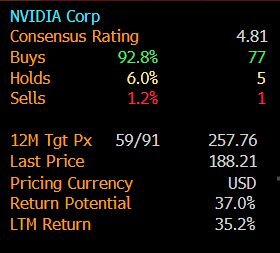
European markets ended Tuesday with gains. Germany’s DAX (DE40) rose by 1.12%, France’s CAC 40 (FR40) closed up 0.81%, Spain’s IBEX 35 (ES35) gained 1.35%, and the UK’s FTSE 100 (UK100) closed up 1.23%. The French CAC 40 Index hit a new all-time high at 8,429 points amid slowing inflation and steady demand for defense and financial stocks. Annual price growth in France fell to 0.3% in January, a low since late 2020, which bolstered expectations that the ECB will maintain a dovish course. The British FTSE 100 also reached a record high, exceeding 10,691 points, as UK inflation slowed to 3%, its lowest level since March 2025. Lower prices for fuel, airfare, food, and education fueled expectations of Bank of England policy easing, supporting demand for equities.
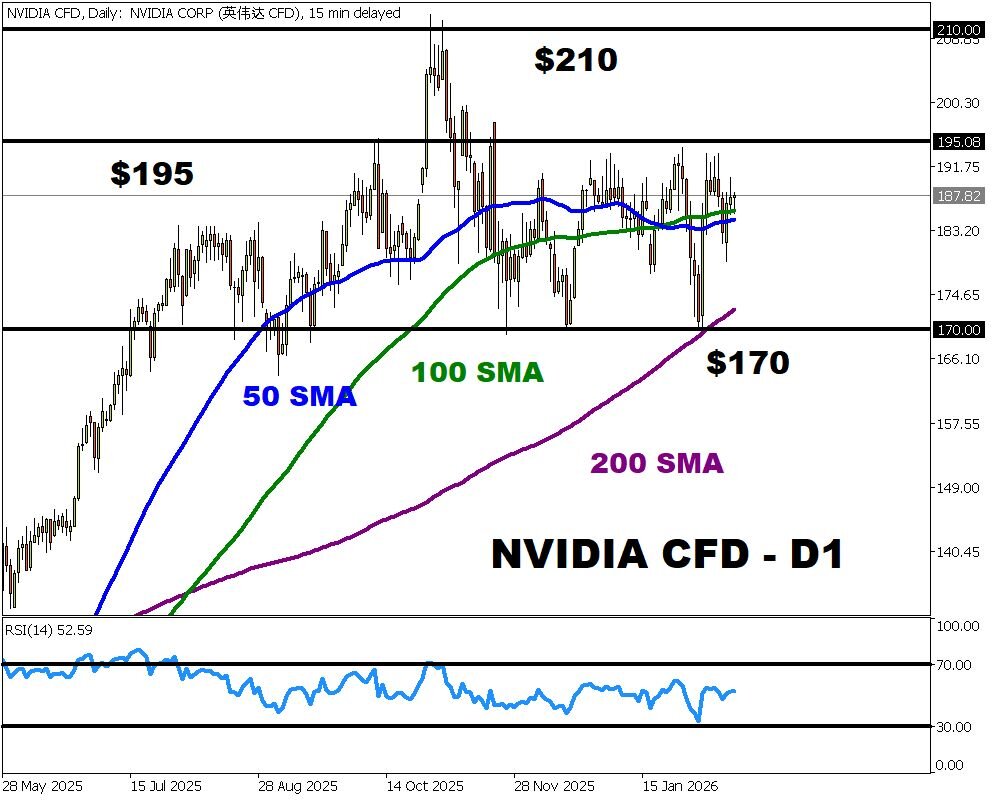

WTI prices jumped by more than 4%, exceeding $65 per barrel and hitting monthly highs amid supply tightening and strengthening demand in Asia. According to the International Energy Agency, winter disruptions and export restrictions reduced global production by approximately 1.2 million barrels per day in January, while active purchasing from China and India further tightened available volumes on international markets. Geopolitical tensions in the Middle East and risks to shipping through the Strait of Hormuz added to the risk premium.

Palladium (XPD) prices exceeded $1,700, reaching a weekly high amid a general strengthening of platinum group metals despite a strong dollar. Prices were further supported by signals from China, where new measures to stabilize the automotive sector are intended to offset a sharp drop in sales in January. Expectations of an automotive market recovery are boosting demand prognoses for palladium, which is widely used in catalytic converters.
Asian markets traded mostly higher yesterday. Japan’s Nikkei 225 (JP225) rose by 1.02%, China’s FTSE China A50 (CHA50) will not trade for the entire week due to Lunar New Year celebrations, Hong Kong’s Hang Seng (HK50) also did not trade yesterday, and Australia’s ASX 200 (AU200) showed a positive result of 0.54%.

The Australian dollar (AUD) strengthened to 0.706, holding near three-year highs on the back of resilient employment data. Unemployment remained at 4.1% in January, a seven-month low, while the number of employed persons increased by 17.8k, confirming labor market tightness and strengthening the case for further Reserve Bank of Australia (RBA) policy tightening. Markets increased the probability of a rate hike to 4.10% in May to approximately 77%, although most analysts still expect a pause in March. Since the beginning of the year, the currency has gained more than 5.5%, becoming one of the strongest in the G10 group.

The New Zealand dollar (NZD) recovered to 0.597 after a sharp drop the previous day caused by a dovish signal from the Reserve Bank of New Zealand (RBNZ). At the first meeting chaired by Anna Breman, the regulator kept the rate at 2.25% and signaled that supportive policy would remain as inflation is expected to return to the midpoint of the target range within the year. While the possibility of a rate hike later this year remains, it will depend on actual economic dynamics and is not yet fully priced in. Following the decision, the market adjusted expectations, shifting the likely timing of tightening closer to the end of 2026.

S&P 500 (US500) 6,881.32 +38.10 (+0.56%)

Dow Jones (US30) 49,663.03 +129.84 (+0.26%)

DAX (DE40) 25,278.21 +279.81 (+1.12%)

FTSE 100 (UK100) 10,686.18 +130.01 (+1.23%)

USD Index 97.73 +0.57% (+0.59%)

News feed for: 2026.02.19

  • Australia Unemployment Rate (m/m) at 02:30 (GMT+2); – AUD (HIGH)
  • Indonesia BI Interest Rate Decision at 09:30 (GMT+2); – IDR (MED)
  • Canada Trade Balance (m/m) at 15:30 (GMT+2); – CAD (MED)
  • US Trade Balance (m/m) at 15:30 (GMT+2); – USD (MED)
  • US Initial Jobless Claims (w/w) at 15:30 (GMT+2); – USD (MED)
  • US Natural Gas Reserves (w/w) at 17:30 (GMT+2); – XNG (HIGH)
  • US Crude Oil Reserves (w/w) at 19:00 (GMT+2); – WTI (HIGH)
  • New Zealand Trade Balance (q/q) at 23:45 (GMT+2). – NZD (MED)

By JustMarkets


This article reflects a personal opinion and should not be interpreted as an investment advice, and/or offer, and/or a persistent request for carrying out financial transactions, and/or a guarantee, and/or a forecast of future events.