From youth bulges to graying societies: The demographic dynamics that are upending the world

By John Rennie Short, University of Maryland, Baltimore County 

Government-shaking protests in Bangladesh, Iran, Nepal and Sri Lanka – to name a few – have all in recent years been linked to what demographers call a “youth bulge.” Meanwhile, the economic slowdown in China and ballooning public debt in the United States are in part due to the two powers’ aging populations. In contrast, recent economic growth in Brazil, India and Vietnam reflects a “demographic dividend” of the economically active.

Demographic trends are fueling some of the events reshaping the world. But what exactly are these age-related phenomena, and why are they having such an impact now? I explored these issues in depth in my 2024 book “Demography and the Making of the Modern World.”

Below is a rundown on some of the main demographic dynamics that are changing the world.

Young populations

Having a high proportion of a population age 14 and under is something generally found in poorer countries, and it usually means a huge demographic drag on economic performance.

We see this in Angola, Niger and Somalia, all of which have between 45% and 50% in that age group — compared to around 17% in the United States.

Having such a large proportion of society in their early childhood means fewer workers are supporting a vast number of citizens not in the workforce – and that leads to reduced savings rates and slower economic growth.

Countries still at this early stage of the demographic transition from high to low birth rates often have limited economic opportunities.

The youth bulge

Baby booms, the result of high fertility rates, are inevitably followed by a “youth bulge.” This is defined as a country with a larger than average proportion of people ages 15 to 29.

This bulge is linked to an increase in political instability and the possibility of increased political violence.

Research has found that countries with more than 60% of their population under 30 are four times more likely to experience outbreaks of civil conflict.

So it is of little surprise that countries that have experienced mass political protests of late have a significant youth bulge. In Bangladesh, which saw its government toppled by mass protests in 2024, 53% of the population is under 30. Iran, where major protests in January were brutally repressed, has between 50% and 60% under 30. And in Sri Lanka, the site of major protests in 2022, 48% of the population is under 30.

This isn’t an entirely new phenomenon. The Arab Spring uprisings of 2011-12 owe much of their origin to a youth bulge in the Middle East. At the time, the portion of the population under 30 in Egypt, one of the epicenters of the uprising, was 60%-65%.

When economies cannot create enough jobs for a large youth cohort, unemployment among educated young people can cause widespread frustration and a sense of political marginalization, which can sometimes turn into violent methods to effect change.

Societies with high percentages of young people, both under 15 or in places with a youth bulge, can have other serious global knock-on effects. For example, while there are many reasons behind new immigration flows, an underlying driver of departures – from Africa and the Middle East in particular – is a lack of opportunity at home and the promise of better opportunities abroad for this burgeoning population.

The demographic dividend

As youthful countries age, a phenomenon called a “demographic dividend” can occur. That’s when a higher proportion of people in the more economically active 15-64 age group emerges.

From 1970 to 2000, the rapid economic growth of East Asian economies, Western Europe and the U.S. was tied to this demographic dividend.

Today, countries with demographic dividends such as Vietnam, with 70% of the population ages 15-64, have the opportunity for impressive growth rates.

And while sub-Saharan Africa has many problems now, partly as a result of a large population under 15, it can look forward to the potential of a huge demographic dividend in the future.

The aging population

The window of opportunity created by the demographic dividend does not last forever. As longer life expectancy kicks in, so too does the population age.

China has now aged out of its dividend, and Brazil’s is coming to an end. In China, the population over 65 will reach 28% by 2040 – more than double what it was just 15 years ago.

In super-aged countries, such as Japan and Italy, the 65-and-over population now accounts for 25%-30% of the total population.

And that can be a huge problem.

A graying population can dampen economic growth. In the U.S., people over 65 are the fastest-growing cohort, and they tend to be high-propensity voters who pressure the government to extend retirement benefits, leading to a massive flow of wealth transfer from the shrinking working population to the expanding number of retirees. In 1950, there were 16.5 workers for every beneficiary of Social Security in the United States. By 2023, this figure had fallen to 2.7 workers per beneficiary.

A second demographic dividend can occur if an aging population has enough savings and asset accumulation to pass on to younger generations. But this wealth transfer can increase inequality, as those who receive substantial inheritance will be better positioned than those who do not.

In most graying societies, there are often acrimonious debates about how governments should pay for the benefits for an increasingly elderly population from the wages of a reduced working-age population.

Solutions such as increasing retirement age, reducing benefits or imposing higher taxes come with political costs. President Emmanuel Macron’s government in France, for example, has been periodically threatened by popular protest against cuts in social welfare, especially retirement benefits.

At the latter stages of the transition, aging richer countries now require workers from overseas – but are coming up against a nativist backlash. A combination of slowing economies and new streams of immigrants are creating a volatile politics conducive to the rise of authoritarianism and xenophobia. In this way, the rise of a populist nationalism in the U.S. and across Europe is linked to an increasingly aging population.

The shrinking world

As birth rates fall, the shrinking of a nation’s population is often worrisome for political elites, who tend to see a large population as a source of power.

It explains the official encouragement of higher birth rates in China and Russia through pronatal policies such as tax breaks and fiscal incentives. Even the U.S. administration has mused how to increase birth rates.

But governments have little power when it comes to encouraging women to have more children.

Population size can influence geopolitical rivalries. India is in the fortunate position of a demographic dividend that may last for several more decades. By 2100, the population of India is estimated to be roughly 1.5 billion; China’s is forecast to be 800 million. And that could change the dynamic between the two longtime rivals.

Meanwhile, Russia’s population continues to fall due to very low birth rates. This population crisis feeds into a post-imperial syndrome, where the decline of empire and power status invokes a sense of loss of self-importance that gives rise to resentment and an unwavering commitment to retain great power status.

How governments and societies adapt to population change is key: Demographic dividends can be squandered and aging populations can enrich societies, if played right. Demography is undoubtedly a vital force in contemporary events – but it is also not a predetermined destiny.The Conversation

About the Author:

John Rennie Short, Professor Emeritus of Public Policy, University of Maryland, Baltimore County

This article is republished from The Conversation under a Creative Commons license. Read the original article.


Signs of diplomatic dialogue have appeared in the Middle East – markets reacted positively

By JustMarkets 

On Tuesday, the US stock markets ended with a powerful rally. By the end of the day, the Dow Jones Index (US30) rose by 2.49%. The S&P 500 Index (US500) increased by 2.91%. The Tech Index NASDAQ (US100) closed higher by 3.43%. Investor optimism was triggered by signals of possible diplomatic de‑escalation: Iran’s President Masoud Pezeshkian, during international contacts, confirmed Tehran’s readiness for a ceasefire. The main conditions from the Iranian side were the provision of firm international security guarantees, payment of reparations, and recognition of the country’s sovereign rights, which the market interpreted as the first real “exit” from the hot phase of the conflict. The leaders of the recovery were technology giants, the most sensitive to geopolitical risks: Nvidia shares rose by 5.6%, and Microsoft by 3.1%. Despite Tuesday’s positive close, March results remain extremely painful for investors: the S&P 500 ended the month down 5.3%, its worst result since 2022.

The Canadian dollar reached 1.395 per US dollar, updating its lowest levels since December of last year. Despite positive domestic statistics, Canada’s economy grew by 0.2% in February due to a recovery in the mining and financial sectors, but the national currency could not withstand the global dominance of the US dollar. The main factor behind the weakening of the loonie was the widespread flight of investors into safe‑haven assets amid the prolonged conflict in the Middle East. The situation is worsened by the fact that the traditional support for the Canadian dollar from high oil prices is being offset by concerns over global economic growth. Markets are pricing in a prolonged supply shock scenario, in which Canada’s benefit from expensive commodities is overshadowed by a general decline in risk appetite.

European stock markets showed growth yesterday. Germany’s DAX (DE40) rose by 0.52%, France’s CAC 40 (FR40) closed up 0.57%, Spain’s IBEX 35 (ES35) gained 0.47%, and the UK’s FTSE 100 (UK100) closed 0.48% higher.

Silver (XAG) prices showed a local rise to 73 dollars per ounce. However, this short‑term interest does not change the catastrophic monthly dynamics: silver ends March with a decline of more than 20%, the worst monthly result in the past 14 years. At the moment, the asset is trading almost 40% below its historical highs recorded at the end of January 2026. Such a sharp collapse of the industrial and precious metals is due to a radical shift in the macroeconomic landscape caused by the war in the Middle East. The blockade of the Strait of Hormuz and the subsequent energy shock (Brent oil above 115 dollars) turned inflation from a temporary factor into a long‑term threat. This forced investors to completely revise their expectations for interest rates: before the war, the market expected two Fed rate cuts in 2026, but now traders have fully ruled out such a scenario, pricing in the continuation of tight credit conditions.

WTI oil prices showed a corrective decline, falling to 100 dollars per barrel. Earlier in the session, prices reached a local peak of 107 dollars, but the market reacted to diplomatic signals from Tehran. The easing of tensions coincided with a tactical pause in US actions. President Donald Trump temporarily suspended direct strikes on Iranian territory, giving traders hope for a partial resumption of tanker traffic from GCC countries through the Strait of Hormuz. At the moment, shipping in this key chokepoint is almost paralyzed, and freight rates have reached multi‑year highs.

Asian markets traded without a unified trend yesterday. Japan’s Nikkei 225 (JP225) fell by 1.58%, China’s FTSE China A50 (CHA50) declined by 0.47%, Hong Kong’s Hang Seng (HK50) rose by 0.15%, and Australia’s ASX 200 (AU200) posted a positive result of 0.25%.

China’s manufacturing sector in March 2026 experienced a noticeable cooling of growth rates, according to the PMI business‑activity Index from RatingDog. The decline of the indicator to 50.8 (after February’s 52.1) was more pronounced than the market expected (prediction 51.6). Although the Index remains above the 50‑point threshold separating growth from stagnation, the report revealed serious structural challenges caused by global instability.

S&P 500 (US500) 6,528.52 +184.80 (+2.91%)

Dow Jones (US30) 46,341.51 +1,125.37 (+2.49%)

DAX (DE40) 22,680.04 +117.16 (+0.52%)

FTSE 100 (UK100) 10,176.45 +48.49 (+0.48%)

USD Index 99.82 -0.69% (-0.68%)

News feed for: 2026.04.01

  • Japan Monetary Policy Meeting Minutes at 01:50 (GMT+2) – JPY (MED)
  • Australia Inflation Rate (m/m) at 02:30 (GMT+2) – AUD (HIGH)
  • UK Inflation Rate (m/m) at 09:00 (GMT+2) – GBP (HIGH)
  • Eurozone ECB President Lagarde Speaks at 10:45 (GMT+2) – EUR (LOW)
  • German Ifo Business Climate (m/m) at 11:00 (GMT+2) – EUR (MED)
  • US Crude Oil Reserves (w/w) at 16:30 (GMT+2) – WTI (HIGH)

By JustMarkets


This article reflects a personal opinion and should not be interpreted as an investment advice, and/or offer, and/or a persistent request for carrying out financial transactions, and/or a guarantee, and/or a forecast of future events.

Gold Rises as Geopolitical Risk Premium Fades

By Analytical Department RoboForex

Gold prices rose more than 4% on Wednesday, approaching 4,690 USD per ounce amid signs of easing tensions in the Middle East. Expectations of de-escalation could lead to lower oil prices and reduced concerns about further tightening of central bank policy.

Donald Trump stated he was ready to end the conflict with Iran even with the Strait of Hormuz partially closed. Separately, reports emerged that Iranian President Masoud Pezeshkian may consider ending the conflict under certain conditions.

However, the rise in gold remains constrained. Reducing geopolitical risks diminishes demand for safe-haven assets, while a strong dollar and elevated government bond yields continue to pressure the metal.

In March, gold lost more than 13%-its steepest monthly decline since October 2008. The precious metal now remains approximately 19% below its January highs. Going forward, its dynamics will depend on US macroeconomic data and Federal Reserve signals on interest rates.

Technical Analysis

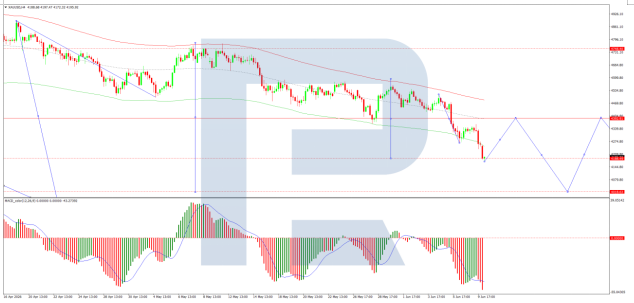
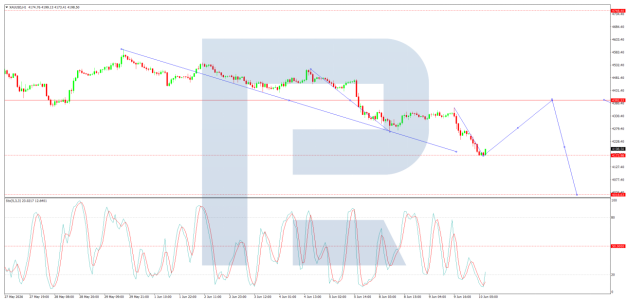
On the H4 XAU/USD chart, the market is forming a consolidation range around the 4,656 USD level. An upside breakout would open potential for a correction to 4,848 USD. A downside breakout could see the beginning of a downward wave to 4,750 USD. The MACD indicator confirms the current momentum, with its signal line above the centre line and pointing strictly upwards.

On the H1 chart, the market has broken above the 4,682 USD level and is forming a wave towards 4,855 USD. Looking ahead, a corrective move back to 4,490 USD will be considered, followed by an expected rise to 4,900 USD. The Stochastic oscillator supports this scenario, with its signal line remaining above the 20 level and showing upward pressure towards 80.

Conclusion

Gold’s sharp rally reflects growing market optimism over a potential de-escalation in the Middle East, with signals from both US and Iranian leadership suggesting a possible path toward ending the conflict. However, the metal’s upside remains capped by the corresponding decline in safe-haven demand, alongside persistent headwinds from a strong dollar and high bond yields. Having suffered its worst monthly loss since 2008 in March, gold now faces a pivotal moment where further gains will likely depend on whether easing geopolitical tensions translate into a sustained shift in central bank policy expectations. Technical indicators point to near-term upside, though the broader trend remains fragile.


Disclaimer

Any forecasts contained herein are based on the author’s particular opinion. This analysis may not be treated as trading advice. RoboForex bears no responsibility for trading results based on trading recommendations and reviews contained herein.

How polling failures, gambling legalization and political gridlock paved the way for the explosive rise of prediction markets

By Parker Bach, University of North Carolina at Chapel Hill 

Though prediction markets have been legal in the U.S. for less than 18 months, they can’t stop making news and making money.

On prediction markets such as Kalshi and Polymarket, users can stake real money on just about anything, from the winner of the 2028 U.S. presidential election to when Taylor Swift will get married.

But this isn’t simple entertainment: In theory, these wagers serve as a means of collecting the public’s insights into the future.

That’s why you may have seen CNN’s pundits casually mention Kalshi’s election odds for the 2026 primaries, or watched CBS offer real-time Polymarket projections of which actors would win awards during the Golden Globes.

Existing research on the principles and history of prediction markets suggests they can be a valuable way of pooling collective knowledge about the future.

But as researchers like me, journalists and legislators race to understand the impact these markets are having on society and politics, several questions have emerged about the regulation of these platforms and their forecasting abilities.

The what and why of prediction markets

In practice, prediction markets are quite simple.

Each market offers what are known as “event contracts” on whether some future outcome will occur. Each contract costs between 1 and 99 cents, paying out US$1 if the event occurs or nothing if it does not.

Similar to sports betting, purchasing a contract represents a wager. There are higher returns for positions on outcomes deemed less likely. Like in the stock market, a trader can buy and sell contracts over time, as odds – and thus prices – fluctuate.

At the time of writing, Kalshi traders put the odds of the passage of the SAVE Act, legislation centered on requiring proof of U.S. citizenship to register to vote, at about 10%. So each contract for this outcome costs 10 cents. If I think the act is more likely to pass than that, I could purchase some “shares” and sell them at a higher price if the odds go up in the future. If I hold them and the bill ultimately becomes law, I would receive a return that’s 10 times what I originally paid.

Two theories support the idea that prediction markets should excel at forecasting: the wisdom of crowds and the efficient market hypothesis.

First described over a century ago, the wisdom of crowds refers to the idea that the median judgment of a large, diverse group of people operating independently is often more accurate than that of a single expert.

A related argument appears in the efficient market hypothesis, which emerged in the mid-20th century among economists who championed free markets. It holds that prices encode all available information, reflecting the collective judgments of profit-seeking sellers and deal-seeking buyers.

At their best, then, prediction markets aggregate collective intelligence to weigh the likelihood of future events.

Polling’s credibility crisis creates an opening

Gambling on the outcomes of the day’s events has a long history. In 16th-century Italy, gamblers could wager on the election of civic magistrates and the outcome of papal conclaves. And from the 1880s to 1930s, New York City was the hub of political wagering, which sometimes exceeded the stock market in daily volume.

Reporting on bets ahead of the 1924 presidential election, The New York Times observed, “It is an old axiom in the financial district that Wall Street betting odds are ‘never wrong.’”

However, the rise of scientific polling and legal crackdowns on political wagering forced prediction markets to fade to the background.

That changed in 2024.

One month before the U.S. elections, a federal court granted the prediction market startup Kalshi permission to legally operate prediction markets concerning U.S. election results.

Around the same time, Elon Musk posted on X about Donald Trump leading Kamala Harris in prediction market odds. Trump followed suit. Kalshi put up billboards with live election odds in Times Square. Users and dollars flowed in. By election day, a volume of over $500 million in presidential election bets had been traded on Kalshi alone. Polymarket featured over $3.6 billion more in volume.

Political polling, meanwhile, was facing a crisis of confidence. Response rates had been declining for decades, and Trump voters had been undercounted in 2016 and 2020.

The polls forecast the presidential election as a coin toss. The prediction market, meanwhile, favored Trump at roughly 60% odds to win.

After Trump won at the ballot box, prediction markets declared victory over polling as the new, trustworthy forecasters of public opinion.

The utility of the markets

Over the past 50 years, journalists have increasingly incorporated quantitative data in their reporting, and audiences have come to expect political forecasting as part of their news diet.

With polling experiencing a crisis of confidence, prediction markets have become an increasingly attractive way for journalists to offer a data-backed snapshot of public beliefs.

Prediction markets have other advantages over polls for journalists. They respond to events in real time, and they’re free to access. Polls, meanwhile, take time and money to administer. They provide forecasts for political outcomes that go beyond elections – such as Cabinet nominations and Supreme Court decisions – which are usually outside the purview of polling.

In recent months, Kalshi and Polymarket have inked several partnership deals with news outlets. There’s a symbiotic relationship at play: Prediction markets provide journalists with data to report and discuss. Journalists, in turn, legitimize prediction markets by citing them as a trusted source.

Prediction markets have historically performed well on elections. Whether they’re more accurate than polls on other kinds of questions is still up for debate.

If traders behave purely rationally, in the economic sense, they might flit between positions to maximize profit based on new information, personal biases aside.

But when wagering on elections, most traders have seemed to consistently buy and sell only one position, rather than switching between them. They may think they’re trading rationally while exhibiting a “wishful thinking” bias. Or, like many sports bettors, they may be wagering out of fandom or for entertainment.

All of these scenarios could undercut the accuracy of these markets.

The elephant in the room

Many journalists are embracing the data even as their news outlets run stories about concerns over insider trading in predictive markets. Because the outcome of events is often determined by human actors, those privy to certain plans – say, a looming ceasefire deal – would have access to information not available to the public and could profit handsomely off that information.

Two anonymous accounts made hundreds of thousands of dollars predicting the downfall of Nicolás Maduro and betting on the toppling of Ayatollah Ali Khamanei, with traders putting their money down just before the U.S. took military action. This timing has raised some eyebrows.

Kalshi prohibits insider trading, and in early 2026 it fined and suspended two high-profile traders who were using inside information.

Likely in response to bad press and statements from lawmakers seeking to regulate the platforms, Kalshi and Polymarket also announced new insider trading rules on March 23, 2026, centered on politics and sports.

The legal mechanisms for enforcing these rules, however, are less clear. SEC Rule 10b5-1 prohibits trading securities on the basis of material nonpublic information.

But event contracts are not governed by the SEC. They’re under the purview of the Commodity Futures Trading Commission, a much smaller agency. As things stand, the small agency has too few employees to regulate the legality of specific event contracts, which are governed by the Commodity Exchange Act. Kalshi and certain other prediction market platforms are instead given the latitude to self-certify the legality of each contract.

Any efforts to meaningfully regulate insider trading would, in my view, require clear rules and viable enforcement mechanisms.

From participation to profit

As I conduct my research, I often consider what the booming popularity of prediction markets says about American culture and politics in 2026.

In 1969, sociologist Erving Goffman theorized that Americans’ attraction to gambling stemmed from a need for “action” in an increasingly bureaucratized society. Similarly, studies have suggested that betting on sports makes fans feel like they’re participating, not just observing.

Congress is less productive than ever. Most Americans feel they have little influence over the workings of the government, with many looking on helplessly as democratic guardrails have been dismantled.

Who knows what will happen in the coming year. The filibuster might be weakened, or the U.S. could invade Cuba. Most Americans will have little say. But prediction markets at least offer the chance to make a buck off the action.The Conversation

About the Author:

Parker Bach, PhD Student in Media and Communication, University of North Carolina at Chapel Hill

This article is republished from The Conversation under a Creative Commons license. Read the original article.


WTI crude oil has settled above $100 a barrel. Market participants prefer to hedge risks

By JustMarkets 

Monday’s trading session on US stock exchanges was characterized by increased volatility and a pronounced sectoral split. By the end of Monday, the Dow Jones Index (US30) rose by 0.11%. The S&P 500 Index (US500) fell by 0.39%. The Tech Index NASDAQ (US100) closed lower by 0.73%. Despite Jerome Powell’s attempts to calm the markets by stating that the Federal Reserve does not plan to react to temporary spikes in energy prices, this only led to a local rise in the Dow Jones Index. The decline in US Treasury yields, which normally stimulates growth stocks, was unable to offset investor concerns about the security of Iran’s energy infrastructure and the stability of shipping routes through the Red Sea. Instead of buying cheaper tech assets, capital flowed into defensive instruments and energy companies. The elevated fear index confirms that market participants are not yet ready to believe in long‑term de‑escalation and prefer to hedge risks ahead of new developments from the conflict zone.

The Canadian dollar continues its downward trend, falling below 1.39 per US dollar and setting a new low since December of last year. Despite Canada being a major exporter of energy resources and global oil prices surging to 2022 levels due to the effective blockade of the Strait of Hormuz, the loonie is not receiving its usual support from the commodity rally. The main pressure factor is the global strengthening of the US dollar, which benefits from its “safe‑haven” status and expectations of continued Federal Reserve tightening.

European stock markets showed a confident rebound on Monday. Germany’s DAX (DE40) rose by 1.18%, France’s CAC 40 (FR40) closed up 0.92%, Spain’s IBEX 35 (ES35) gained 0.99%, and the UK’s FTSE 100 (UK100) closed up 1.61%. The main driver of growth was the temporary decline in government‑bond yields, which provided necessary support to indices during a period of strong oversold conditions. Despite the positive sentiment in equities, the situation in the energy sector remains extremely tense. Oil prices held at their 2022 peak levels due to ongoing threats from Houthi forces in the Red Sea and Donald Trump’s harsh rhetoric regarding a potential strike on Iran’s oil facilities. Nevertheless, investors temporarily shifted their focus from inflation risks to concerns about a broader slowdown in economic growth, triggering a decline in bond yields.

WTI oil prices are ending March with an unprecedented rally, settling at 101.7 dollars per barrel. Prices have risen more than 50% this month, a direct reaction to the full‑scale conflict in the Middle East that began in late February 2024. The main driver of fear in the market remains the effective blockade of the Strait of Hormuz, through which about 20% of global oil supplies pass. The situation escalated after Donald Trump shifted to a strategy of direct ultimatums. Despite his statements about “progress in negotiations” and a temporary halt to strikes until April 6, the US president clearly outlined targets for the next phase of the operation. If Iran does not immediately open the strait, power plants, oil wells, and the key export hub on Kharg Island will be targeted. Adding fuel to the fire is the expanding geography of hostilities: the involvement of Yemen’s Houthi rebels, who attacked Israel and threatened Saudi infrastructure, has created the risk of a large‑scale regional conflagration. With maritime transport nearly paralyzed and Washington’s diplomatic proposals rejected by Tehran as “illogical,” analysts warn that a surge in oil prices to 120 dollars in April becomes a realistic scenario if strikes on Iranian refineries begin.

The XNG showed a sharp decline, falling more than 5% to 2.866 dollars per MMBtu. The main driver of the drop was updated meteorological expectations predicting unusually warm weather on the US East Coast in the first half of April. The expected warming effectively ends the heating season, sharply reducing gas demand from households and utilities. The geopolitical agenda related to Donald Trump’s ultimatums toward Iran and uncertainty around the Strait of Hormuz has only an indirect impact on the US gas market. Unlike oil prices, US natural gas prices remain insulated from Middle Eastern tensions in the short term due to the self‑sufficiency of the American energy system and the limited dependence of domestic prices on global LNG export flows.

Asian markets also mostly declined yesterday. Japan’s Nikkei 225 (JP225) fell by 2.79%, China’s FTSE China A50 (CHA50) dropped by 0.08%, Hong Kong’s Hang Seng (HK50) declined by 0.81%, and Australia’s ASX 200 (AU200) posted a negative result of 0.65%.

On Tuesday, the AUD held near 0.686 US dollars, trading close to a two‑month low. March became the worst month for the aussie since late 2024, with a cumulative decline of about 3.6%. Although interest‑rate decisions supported the currency at the beginning of the month, by the end of the quarter, market sentiment shifted from fighting inflation to concerns about slowing global economic growth. Minutes from the March meeting of the RBA added uncertainty. After two rate hikes this year, the regulator acknowledged that the prolonged Middle East conflict creates a dual threat: on one hand, it fuels inflation through higher energy prices; on the other, it suppresses business activity. The RBA board emphasized the need for a delicate balance, causing investors to doubt the straightforwardness of further policy tightening.

S&P 500 (US500) 6,343.72 −25.13 (−0.39%)

Dow Jones (US30) 45,216.14 +49.50 (+0.11%)

DAX (DE40) 22,562.88 +262.13 (+1.18%)

FTSE 100 (UK100) 10,127.96 +160.61 (+1.61%)

USD Index 100.54 +0.39% (+0.39%)

News feed for: 2026.03.31

  • Japan Tokyo Core CPI (m/m) at 02:30 (GMT+3); – JPY (MED)
  • Japan Unemployment Rate (m/m) at 02:50 (GMT+3); – JPY (MED)
  • Japan Retail Sales (m/m) at 02:50 (GMT+3); – JPY (MED)
  • Australia Monetary Policy Meeting Minutes at 03:30 (GMT+3); – AUD (MED)
  • China Manufacturing PMI (m/m) at 04:30 (GMT+3); – CHA50, HK50 (MED)
  • China Non-Manufacturing PMI (m/m) at 04:30 (GMT+3); – CHA50, HK50 (MED)
  • UK GDP (q/q) at 09:00 (GMT+3); – GBP (MED)
  • German Retail Sales (m/m) at 09:00 (GMT+3); – EUR (MED)
  • German Unemployment Rate (m/m) at 10:55 (GMT+3); – EUR (LOW)
  • Eurozone Consumer Price Index (m/m) at 12:00 (GMT+3); – EUR (MED)
  • Canada GDP (m/m) at 15:30 (GMT+3); – CAD (MED)
  • US JOLTs Job Openings (m/m) at 17:00 (GMT+3); – USD (HIGH)
  • US CB Consumer Confidence (m/m) at 17:00 (GMT+3). – USD (MED)

By JustMarkets


This article reflects a personal opinion and should not be interpreted as an investment advice, and/or offer, and/or a persistent request for carrying out financial transactions, and/or a guarantee, and/or a forecast of future events.

GBP/USD – pause for recovery needed after five-day sell-off

By Analytical Department RoboForex

GBP/USD is attempting to recover on Tuesday following earlier declines, bouncing from 1.3198 after five consecutive sessions of selling. Sterling remains under pressure as investors assess the impact of the Iran conflict on the British economy.

Despite this, since the beginning of March, the pound has remained one of the most stable currencies against the dollar.

However, sterling remains vulnerable. Britain’s high reliance on gas imports, persistently high inflation, and pressure on public finances are heightening risks. The yield on 10-year government bonds is holding around 4.98%, near highs not seen since 2008, following recent increases.

Additional attention is focused on the debt market: after the government bond sale, some pension funds were required to increase collateral to hedge positions, although the scale remains far from the 2022 crisis levels.

Macroeconomic data also point to a slowing economy. Business activity is growing at its slowest pace in six months, producer costs are accelerating, and retail sales are declining.

The Bank of England is likely to remain cautious about changing rates – this remains the prevailing expectation.

Technical Analysis

On the H4 GBP/USD chart, the market is forming a broad consolidation range around 1.3297, currently extending up to 1.3434. A decline to 1.3156 is likely in the near term, followed by the formation of a new consolidation range. An upside breakout would open the way for a continuation move to 1.3300, while a downside breakout would suggest further movement to 1.3100. Technically, this scenario is confirmed by the MACD indicator, whose signal line is below zero and pointing downwards.

On the H1 chart, the market has formed a compact consolidation range around 1.3322. A downside breakout has initiated a wave structure extending to 1.3100. Should this level be breached, further downside potential towards 1.3050 would emerge. Conversely, an upside breakout from the range could trigger a rebound towards 1.3300. Technically, this scenario is confirmed by the Stochastic oscillator, with its signal line below 50 and pointing downwards.

Conclusion

GBP/USD is attempting to stabilise after five consecutive days of selling, though the broader outlook remains fragile. While sterling has shown relative resilience compared to other currencies since March, mounting headwinds – including the UK’s energy import dependence, stubborn inflation, debt market pressures, and slowing economic activity – continue to weigh on the pound. The Bank of England’s cautious stance offers little immediate support, and technical indicators point to further downside potential. A recovery pause may materialise, but sustained upside appears unlikely without a tangible shift in either geopolitical tensions or domestic economic data.


Disclaimer

Any forecasts contained herein are based on the author’s particular opinion. This analysis may not be treated as trading advice. RoboForex bears no responsibility for trading results based on trading recommendations and reviews contained herein.

Armed confrontation in the Middle East has entered its fifth week with no visible prospects for de‑escalation

By JustMarkets 

On Friday, the US stock markets continued their active decline, hitting the lowest levels in the past seven months amid fears of global stagflation. By the end of Friday, the Dow Jones Index (US30) fell by 1.73% (down -1.39% for the week). The S&P 500 Index (US500) declined by 1.67% (down -3.13% for the week). The Tech Index NASDAQ (US100) closed lower by 1.93% (down -4.69% for the week). The sharp rise in energy prices has effectively deprived investors of hope for Federal Reserve policy easing this year, while additional pressure came from China’s launch of a trade investigation against the United States in response to tariff measures.

The technology sector is experiencing a massive capital outflow, which has seriously undermined the positions of companies linked to the artificial‑intelligence industry. Shares of giants such as Tesla, Amazon, and Oracle lost more than 3%, while worsening credit conditions triggered a similar decline in JPMorgan and Visa. The most dramatic drop was seen in Meta, whose market value plunged by 12% in recent days due to large‑scale layoffs and an unfavorable court ruling declaring the social network addictive.

The Mexican peso weakened, breaking through the psychological level of 18 per US dollar and reaching its lowest value since the beginning of winter. The main reason for this dynamic was the narrowing interest‑rate differential between the US and Mexico, which made previously popular carry‑trade strategies less attractive. Investors reacted to the unexpected decision by the Bank of Mexico to resume its monetary‑policy easing cycle and cut the rate to 6.75%, despite inflation accelerating to 4.63% in mid‑March. The regulator was driven by slowing domestic economic activity and negative labor‑market data showing rising unemployment and persistently high informal employment.

European stock markets closed lower but remained in positive territory for the week. Germany’s DAX (DE40) fell by 1.38% (up +1.61% for the week), France’s CAC 40 (FR40) closed down 0.87% (up +2.12% for the week), Spain’s IBEX 35 (ES35) declined by 0.95% (up +2.53% for the week), and the UK’s FTSE 100 (UK100) closed down by 0.05% (up +0.49% for the week). Price pressure in the oil market has already begun to translate into real inflation indicators. The scale of the problem was most clearly reflected in Spain, where consumer‑price growth in March reached multi‑year highs, showing the sharpest monthly jump since the 2022 crisis. Against this backdrop, the banking sector continued to suffer losses due to instability in the sovereign‑debt market, leading to noticeable declines in shares of giants such as BBVA, UniCredit, and Deutsche Bank.

The oil market opened the week with strong gains, rising about 3% and consolidating above the psychological level of 102 dollars per barrel. Investors are increasingly skeptical about a quick end to the conflict in Iran, which has now entered its second month. The situation was further complicated by the direct involvement of Yemen’s Houthi rebels, who launched missile strikes on Israeli territory over the weekend and declared their intention to continue attacks until pressure on Tehran ceases. Another destabilizing factor is the ability of rebel groups to disrupt shipping in the Red Sea and attack strategic facilities in Saudi Arabia.

Asian markets also mostly rose last week. Japan’s Nikkei 225 (JP225) gained 1.72% for the trading week, China’s FTSE China A50 (CHA50) rose by 0.45%, Hong Kong’s Hang Seng (HK50) increased by 0.66%, and Australia’s ASX 200 (AU200) posted a five‑day gain of 2.81%.

Monday’s trading session in Asian markets opened with a noticeable decline, as the armed confrontation in the Middle East entered its fifth week with no visible prospects for de‑escalation. The geopolitical situation worsened after Donald Trump’s high‑profile statements about a possible takeover of Iran’s oil resources, coinciding with active involvement in the conflict by Yemen’s Houthi rebels, who carried out attacks on Israeli territory.

S&P 500 (US500) 6,368.85 −108.31 (−1.67%)

Dow Jones (US30) 45,166.64 −793.47 (−1.73%)

DAX (DE40) 22,300.75 −312.22 (−1.38%)

FTSE 100 (UK100) 9,967.35 −4.82 (−0.05%)

USD Index 100.19 +0.29% (+0.29%)

News feed for: 2026.03.30

  • Japan BoJ Summary of Opinions at 02:50 (GMT+3); – JPY (MED)
  • Switzerland KOF Leading Indicators (m/m) at 10:00 (GMT+3); – CHF (LOW)
  • German Consumer Price Index (m/m) at 15:00 (GMT+3); – EUR (MED)
  • US Fed Chair Powell Speaks at 17:30 (GMT+3). – USD, XAU (MED)

By JustMarkets


This article reflects a personal opinion and should not be interpreted as an investment advice, and/or offer, and/or a persistent request for carrying out financial transactions, and/or a guarantee, and/or a forecast of future events.

EUR/USD: Middle East Conflict Still Determines Sentiment

By Analytical Department RoboForex

EUR/USD edged higher on Monday after earlier declines, reaching 1.1516. The US dollar continues to draw support from safe-haven demand amid the ongoing Middle East conflict, which has now entered its fifth week with no signs of resolution.

Tensions escalated following Donald Trump’s remarks regarding the possible confiscation of Iranian oil and control of the export hub on Kharg Island. At the same time, the US is increasing its military presence in the region and preparing for potentially prolonged operations. Iran-aligned forces, including the Houthis in Yemen, have also joined the conflict.

Rising oil prices in this environment are amplifying inflation risks and reinforcing expectations of tighter Federal Reserve policy. The market is increasingly pricing in the possibility of a rate hike this year, marking a notable shift from earlier expectations of rate cuts.

Investor focus now turns to US macroeconomic data. This week will see the release of labour market indicators, including JOLTS and ADP figures, as well as the key March employment report due on Friday.

Technical Analysis

On the H4 chart, EUR/USD is forming a consolidation range around 1.1528. A downside breakout is expected, with a continuation wave to 1.1404 as a near-term target, followed by a subsequent rebound to 1.1528. Technically, this scenario is confirmed by the MACD indicator – its signal line is below zero and pointing firmly downwards, reflecting sustained bearish momentum and the potential for the downtrend to persist.

On the H1 chart, the market is forming the structure of the next downward wave towards 1.1440. After reaching this level, a rebound to 1.1535 is expected, potentially extending the move to 1.1647. Technically, this scenario is confirmed by the Stochastic oscillator – its signal line is below 50 and pointing firmly downwards towards 20.

Conclusion

EUR/USD remains firmly driven by geopolitical forces, with the Middle East conflict entering its fifth week and showing no signs of de-escalation. The US dollar’s safe-haven appeal continues to dominate, while escalating tensions and rising oil prices have shifted market expectations from rate cuts to the possibility of a Fed hike later this year. Technical indicators point to further near-term downside, although this week’s US labour market data could introduce volatility. Until there is a tangible shift in the geopolitical landscape, the euro is likely to remain under pressure.


Disclaimer

Any forecasts contained herein are based on the author’s particular opinion. This analysis may not be treated as trading advice. RoboForex bears no responsibility for trading results based on trading recommendations and reviews contained herein.

Euro Large Speculator Bets dropped to 55-Week Low

By InvestMacro

Speculators OI FX Futures COT Chart

Here are the latest charts and statistics for the Commitment of Traders (COT) data published by the Commodities Futures Trading Commission (CFTC).

The latest COT data is updated through Tuesday March 24th and shows a quick view of how large market participants (for-profit speculators and commercial traders) were positioned in the futures markets. All currency positions are in direct relation to the US dollar where, for example, a bet for the euro is a bet that the euro will rise versus the dollar while a bet against the euro will be a bet that the euro will decline versus the dollar.

Weekly Speculator Changes led by British Pound & Mexican Peso

Speculators Nets FX Futures COT Chart
The COT currency market speculator bets were slightly lower this week as five out of the eleven currency markets we cover had higher positioning while the other six markets had lower speculator contracts.

Leading the gains for the currency markets was the British Pound (7,093 contracts) with the Mexican Peso (5,616 contracts), the Japanese Yen (4,974 contracts), the Australian Dollar (1,811 contracts) and Bitcoin (333 contracts) also showing positive weeks.

The currencies seeing declines in speculator bets on the week were the EuroFX (-11,853 contracts), the Canadian Dollar (-2,488 contracts), the New Zealand Dollar (-3,949 contracts), the Swiss Franc (-1,884 contracts), the US Dollar Index (-76 contracts) and with the Brazilian Real (-69 contracts) also registering lower bets on the week.

Euro Speculator Bets dropped to 55-Week Low

Highlighting the Currencies speculator positions this week was the continued drop in the Euro speculator bullish position. It has been quite a turnaround for the Euro speculator positions in recent weeks as speculators pushed the Euro net positions to an all-time top ten high bullish position on February 10th at a total of 180,305 net contracts. Since that recent high, Euro positions have fallen for six consecutive weeks and by -171,026 net contracts over that time period. This has brought the overall speculator position down from 180,305 bullish positions to this week’s net contract level of just 9,279 contracts. Overall, the Euro position has continuously been in a bullish standing since March 11th of 2025. The Euro price has now fallen below the 1.1600 exchange rate in the Currency markets and has now declined in six out of the last nine weeks and currently trades at the 1.1556 area. The Euro traded as high as 1.2110 late in January before the Iran war broke out and has now come back towards the 1.1500 major support level.

The Canadian Dollar speculative position this week fell by approximately -2,500 contracts and has now fallen three out of the past four weeks. This negative sentiment has brought the Canadian Dollar speculator position back into a small bearish position of -1,602 net positions this week. The Canadian Dollar contracts had been in a strong bearish position for the past few years before seeing a turnaround and rising into bullish bets in early February. That had pushed the bullish position up to as high as +36,159 contracts on March 10th. However, since then, the speculative position has fallen off and culminated in a bearish level this week. The Canadian Dollar in the Currency markets has been on the decline as well and has fallen for three consecutive weeks against the US Dollar. The Canadian Dollar recently bounced to lower levels off the 200-week moving average (CAD traded as high as 0.7431 in late January) and has now trended lower to this week’s close at 0.7225.

The Mexican Peso position rebounded this week with a gain of over 5,500 net contracts. This breaks an eight-week losing streak that had seen the overall net position fall from 103,114 net contracts on January 27th to a total of 68,460 net contracts on March 17th. This week’s gain brings the overall net position back above +70,000 contracts to +74,076 net contracts. Overall, the Mexican Peso has pretty much seen strong bullish speculator positions dating back to March of 2023 through the current period (save for a small bullish positioning streak in late 2024). The Mexican Peso in the Currency markets this week, although, has continued on a decline for five consecutive weeks against the US Dollar. However, overall, the Mexican Peso has been higher against the US Dollar since the beginning of 2025 by approximately 15%.

The US Dollar Index contracts were virtually unchanged this week with a small decline of just 76 contracts. Overall, the US Dollar net positioning has now been in a consecutive bullish position for two weeks straight after seeing a large +9,575 net contract change on March 17th. The US Dollar Index in the Currency markets has now been higher in four out of the past six weeks and trades right around the major 100.00 level, which may determine the currency’s direction in the near and medium term. The US Dollar Index has now rallied by approximately 5% since hitting a low near 95.36 in January.

Brazilian Real and US Dollar Index lead weekly Currency Market Price Performance

The Currency Market Price Performance this week was heavily skewed towards the downside as only two currencies had positive returns over the past five days, while nine currencies had lower prices on the week. The Brazilian Real led the way with a 0.95% increase on the week and was followed by the US Dollar Index, which improved by 0.58%.

On the downside, the biggest loser on the week was Bitcoin, which fell by -5.78%, with the next largest decliner on the week being the Australian Dollar, which fell by -2.14%. The Peso, the Mexican Peso, declined by -1.57%, followed by the New Zealand Dollar, which fell by -1.45%. The Swiss Franc was lower by -1.3%. The Canadian Dollar dipped by -1.22%, while the Japanese Yen decreased by -0.66%. The British Pound Sterling was lower by -0.59%, and the Euro rounds out the decliners on the week with a -0.53% dip.

Over the past 30 days, all of the Currency markets were lower except for the US Dollar Index, which is up by 3.80% over that time period.


Currencies Data:

Speculators FX Futures COT Data Table
Legend: Open Interest | Speculators Current Net Position | Weekly Specs Change | Specs Strength Score compared to last 3-Years (0-100 range)


Strength Scores led by Australian Dollar & Bitcoin

Speculators Strength Scores FX Futures COT Chart
COT Strength Scores (a normalized measure of Speculator positions over a 3-Year range, from 0 to 100 where above 80 is Extreme-Bullish and below 20 is Extreme-Bearish) showed that the Australian Dollar (100 percent) and the Bitcoin (97 percent) lead the currency markets this week. The Canadian Dollar (84 percent), Brazilian Real (76 percent) and the US Dollar Index (54 percent) come in as the next highest in the weekly strength scores.

On the downside, the British Pound (15 percent) comes in at the lowest strength levels currently and are in Extreme-Bearish territory (below 20 percent). The next lowest strength scores are the EuroFX (32 percent), the Japanese Yen (33 percent) and the New Zealand Dollar (34 percent).

3-Year Strength Statistics:
US Dollar Index (53.9 percent) vs US Dollar Index previous week (54.1 percent)
EuroFX (32.3 percent) vs EuroFX previous week (36.8 percent)
British Pound Sterling (14.8 percent) vs British Pound Sterling previous week (11.8 percent)
Japanese Yen (33.4 percent) vs Japanese Yen previous week (32.0 percent)
Swiss Franc (46.0 percent) vs Swiss Franc previous week (49.8 percent)
Canadian Dollar (83.8 percent) vs Canadian Dollar previous week (84.8 percent)
Australian Dollar (100.0 percent) vs Australian Dollar previous week (99.0 percent)
New Zealand Dollar (34.0 percent) vs New Zealand Dollar previous week (38.5 percent)
Mexican Peso (53.5 percent) vs Mexican Peso previous week (49.6 percent)
Brazilian Real (75.8 percent) vs Brazilian Real previous week (75.8 percent)
Bitcoin (97.3 percent) vs Bitcoin previous week (90.3 percent)


Swiss Franc & Bitcoin top the 6-Week Strength Trends

Speculators Trends FX Futures COT Chart
COT Strength Score Trends (or move index, calculates the 6-week changes in strength scores) showed that the Swiss Franc (31 percent) and Bitcoin (23 percent) lead the past six weeks trends for the currencies. The Australian Dollar (21 percent), the Brazilian Real (13 percent) and the US Dollar Index (12 percent) are the next highest positive movers in the 3-Year trends data.

The EuroFX (-65 percent) leads the downside trend scores currently with the British Pound (-14 percent), Japanese Yen (-12 percent) and the Mexican Peso (-8 percent) following next with lower trend scores.

3-Year Strength Trends:
US Dollar Index (11.7 percent) vs US Dollar Index previous week (12.3 percent)
EuroFX (-65.1 percent) vs EuroFX previous week (-54.1 percent)
British Pound Sterling (-13.9 percent) vs British Pound Sterling previous week (-21.9 percent)
Japanese Yen (-12.0 percent) vs Japanese Yen previous week (-13.4 percent)
Swiss Franc (30.7 percent) vs Swiss Franc previous week (31.4 percent)
Canadian Dollar (-6.4 percent) vs Canadian Dollar previous week (-0.5 percent)
Australian Dollar (21.1 percent) vs Australian Dollar previous week (24.1 percent)
New Zealand Dollar (9.0 percent) vs New Zealand Dollar previous week (12.8 percent)
Mexican Peso (-7.7 percent) vs Mexican Peso previous week (-15.7 percent)
Brazilian Real (12.8 percent) vs Brazilian Real previous week (13.4 percent)
Bitcoin (23.1 percent) vs Bitcoin previous week (16.2 percent)


Individual COT Forex Markets:

US Dollar Index Futures:

US Dollar Index Forex Futures COT ChartThe US Dollar Index large speculator standing this week came in at a net position of 3,617 contracts in the data reported through Tuesday. This was a weekly reduction of -76 contracts from the previous week which had a total of 3,693 net contracts.

This week’s current strength score (the trader positioning range over the past three years, measured from 0 to 100) shows the speculators are currently Bullish with a score of 53.9 percent. The commercials are Bearish with a score of 44.0 percent and the small traders (not shown in chart) are Bullish with a score of 56.4 percent.

Price Trend-Following Model: Weak Downtrend

Our weekly trend-following model classifies the current market price position as: Weak Downtrend.

US DOLLAR INDEX StatisticsSPECULATORSCOMMERCIALSSMALL TRADERS
– Percent of Open Interest Longs:56.629.58.0
– Percent of Open Interest Shorts:46.642.35.3
– Net Position:3,617-4,615998
– Gross Longs:20,45710,6522,903
– Gross Shorts:16,84015,2671,905
– Long to Short Ratio:1.2 to 10.7 to 11.5 to 1
NET POSITION TREND:
– Strength Index Score (3 Year Range Pct):53.944.056.4
– Strength Index Reading (3 Year Range):BullishBearishBullish
NET POSITION MOVEMENT INDEX:
– 6-Week Change in Strength Index:11.7-18.341.7


Euro Currency Futures:

Euro Currency Futures COT ChartThe Euro Currency large speculator standing this week came in at a net position of 9,279 contracts in the data reported through Tuesday. This was a weekly lowering of -11,853 contracts from the previous week which had a total of 21,132 net contracts.

This week’s current strength score (the trader positioning range over the past three years, measured from 0 to 100) shows the speculators are currently Bearish with a score of 32.3 percent. The commercials are Bullish with a score of 65.3 percent and the small traders (not shown in chart) are Bullish with a score of 53.6 percent.

Price Trend-Following Model: Weak Uptrend

Our weekly trend-following model classifies the current market price position as: Weak Uptrend.

EURO Currency StatisticsSPECULATORSCOMMERCIALSSMALL TRADERS
– Percent of Open Interest Longs:26.258.111.1
– Percent of Open Interest Shorts:24.964.26.2
– Net Position:9,279-46,75837,479
– Gross Longs:200,025444,11884,972
– Gross Shorts:190,746490,87647,493
– Long to Short Ratio:1.0 to 10.9 to 11.8 to 1
NET POSITION TREND:
– Strength Index Score (3 Year Range Pct):32.365.353.6
– Strength Index Reading (3 Year Range):BearishBullishBullish
NET POSITION MOVEMENT INDEX:
– 6-Week Change in Strength Index:-65.164.4-38.0


British Pound Sterling Futures:

British Pound Sterling Futures COT ChartThe British Pound Sterling large speculator standing this week came in at a net position of -58,422 contracts in the data reported through Tuesday. This was a weekly boost of 7,093 contracts from the previous week which had a total of -65,515 net contracts.

This week’s current strength score (the trader positioning range over the past three years, measured from 0 to 100) shows the speculators are currently Bearish-Extreme with a score of 14.8 percent. The commercials are Bullish-Extreme with a score of 84.1 percent and the small traders (not shown in chart) are Bearish with a score of 46.1 percent.

Price Trend-Following Model: Weak Uptrend

Our weekly trend-following model classifies the current market price position as: Weak Uptrend.

BRITISH POUND StatisticsSPECULATORSCOMMERCIALSSMALL TRADERS
– Percent of Open Interest Longs:19.567.910.8
– Percent of Open Interest Shorts:43.942.311.9
– Net Position:-58,42261,187-2,765
– Gross Longs:46,459162,12825,772
– Gross Shorts:104,881100,94128,537
– Long to Short Ratio:0.4 to 11.6 to 10.9 to 1
NET POSITION TREND:
– Strength Index Score (3 Year Range Pct):14.884.146.1
– Strength Index Reading (3 Year Range):Bearish-ExtremeBullish-ExtremeBearish
NET POSITION MOVEMENT INDEX:
– 6-Week Change in Strength Index:-13.918.0-35.0


Japanese Yen Futures:

Japanese Yen Forex Futures COT ChartThe Japanese Yen large speculator standing this week came in at a net position of -62,806 contracts in the data reported through Tuesday. This was a weekly lift of 4,974 contracts from the previous week which had a total of -67,780 net contracts.

This week’s current strength score (the trader positioning range over the past three years, measured from 0 to 100) shows the speculators are currently Bearish with a score of 33.4 percent. The commercials are Bullish with a score of 65.5 percent and the small traders (not shown in chart) are Bearish with a score of 49.4 percent.

Price Trend-Following Model: Strong Downtrend

Our weekly trend-following model classifies the current market price position as: Strong Downtrend.

JAPANESE YEN StatisticsSPECULATORSCOMMERCIALSSMALL TRADERS
– Percent of Open Interest Longs:29.951.012.6
– Percent of Open Interest Shorts:49.133.411.1
– Net Position:-62,80657,9014,905
– Gross Longs:98,271167,44341,460
– Gross Shorts:161,077109,54236,555
– Long to Short Ratio:0.6 to 11.5 to 11.1 to 1
NET POSITION TREND:
– Strength Index Score (3 Year Range Pct):33.465.549.4
– Strength Index Reading (3 Year Range):BearishBullishBearish
NET POSITION MOVEMENT INDEX:
– 6-Week Change in Strength Index:-12.011.4-3.9


Swiss Franc Futures:

Swiss Franc Forex Futures COT ChartThe Swiss Franc large speculator standing this week came in at a net position of -27,097 contracts in the data reported through Tuesday. This was a weekly decline of -1,884 contracts from the previous week which had a total of -25,213 net contracts.

This week’s current strength score (the trader positioning range over the past three years, measured from 0 to 100) shows the speculators are currently Bearish with a score of 46.0 percent. The commercials are Bullish with a score of 50.6 percent and the small traders (not shown in chart) are Bullish with a score of 60.7 percent.

Price Trend-Following Model: Weak Uptrend

Our weekly trend-following model classifies the current market price position as: Weak Uptrend.

SWISS FRANC StatisticsSPECULATORSCOMMERCIALSSMALL TRADERS
– Percent of Open Interest Longs:10.272.616.5
– Percent of Open Interest Shorts:45.631.622.1
– Net Position:-27,09731,364-4,267
– Gross Longs:7,83155,55412,634
– Gross Shorts:34,92824,19016,901
– Long to Short Ratio:0.2 to 12.3 to 10.7 to 1
NET POSITION TREND:
– Strength Index Score (3 Year Range Pct):46.050.660.7
– Strength Index Reading (3 Year Range):BearishBullishBullish
NET POSITION MOVEMENT INDEX:
– 6-Week Change in Strength Index:30.7-10.3-37.5


Canadian Dollar Futures:

Canadian Dollar Forex Futures COT ChartThe Canadian Dollar large speculator standing this week came in at a net position of -1,602 contracts in the data reported through Tuesday. This was a weekly decrease of -2,488 contracts from the previous week which had a total of 886 net contracts.

This week’s current strength score (the trader positioning range over the past three years, measured from 0 to 100) shows the speculators are currently Bullish-Extreme with a score of 83.8 percent. The commercials are Bearish-Extreme with a score of 17.3 percent and the small traders (not shown in chart) are Bullish with a score of 53.6 percent.

Price Trend-Following Model: Weak Uptrend

Our weekly trend-following model classifies the current market price position as: Weak Uptrend.

CANADIAN DOLLAR StatisticsSPECULATORSCOMMERCIALSSMALL TRADERS
– Percent of Open Interest Longs:34.144.217.3
– Percent of Open Interest Shorts:35.044.915.7
– Net Position:-1,602-1,3712,973
– Gross Longs:62,38280,78831,593
– Gross Shorts:63,98482,15928,620
– Long to Short Ratio:1.0 to 11.0 to 11.1 to 1
NET POSITION TREND:
– Strength Index Score (3 Year Range Pct):83.817.353.6
– Strength Index Reading (3 Year Range):Bullish-ExtremeBearish-ExtremeBullish
NET POSITION MOVEMENT INDEX:
– 6-Week Change in Strength Index:-6.47.6-11.0


Australian Dollar Futures:

Australian Dollar Forex Futures COT ChartThe Australian Dollar large speculator standing this week came in at a net position of 70,872 contracts in the data reported through Tuesday. This was a weekly gain of 1,811 contracts from the previous week which had a total of 69,061 net contracts.

This week’s current strength score (the trader positioning range over the past three years, measured from 0 to 100) shows the speculators are currently Bullish-Extreme with a score of 100.0 percent. The commercials are Bearish-Extreme with a score of 0.0 percent and the small traders (not shown in chart) are Bullish-Extreme with a score of 90.2 percent.

Price Trend-Following Model: Uptrend

Our weekly trend-following model classifies the current market price position as: Uptrend.

AUSTRALIAN DOLLAR StatisticsSPECULATORSCOMMERCIALSSMALL TRADERS
– Percent of Open Interest Longs:51.531.115.5
– Percent of Open Interest Shorts:24.067.76.4
– Net Position:70,872-94,36723,495
– Gross Longs:132,62980,06339,940
– Gross Shorts:61,757174,43016,445
– Long to Short Ratio:2.1 to 10.5 to 12.4 to 1
NET POSITION TREND:
– Strength Index Score (3 Year Range Pct):100.00.090.2
– Strength Index Reading (3 Year Range):Bullish-ExtremeBearish-ExtremeBullish-Extreme
NET POSITION MOVEMENT INDEX:
– 6-Week Change in Strength Index:21.1-16.6-5.2


New Zealand Dollar Futures:

New Zealand Dollar Forex Futures COT ChartThe New Zealand Dollar large speculator standing this week came in at a net position of -27,006 contracts in the data reported through Tuesday. This was a weekly reduction of -3,949 contracts from the previous week which had a total of -23,057 net contracts.

This week’s current strength score (the trader positioning range over the past three years, measured from 0 to 100) shows the speculators are currently Bearish with a score of 34.0 percent. The commercials are Bullish with a score of 65.3 percent and the small traders (not shown in chart) are Bearish with a score of 43.4 percent.

Price Trend-Following Model: Weak Uptrend

Our weekly trend-following model classifies the current market price position as: Weak Uptrend.

NEW ZEALAND DOLLAR StatisticsSPECULATORSCOMMERCIALSSMALL TRADERS
– Percent of Open Interest Longs:16.777.55.2
– Percent of Open Interest Shorts:58.234.96.3
– Net Position:-27,00627,694-688
– Gross Longs:10,84750,3933,403
– Gross Shorts:37,85322,6994,091
– Long to Short Ratio:0.3 to 12.2 to 10.8 to 1
NET POSITION TREND:
– Strength Index Score (3 Year Range Pct):34.065.343.4
– Strength Index Reading (3 Year Range):BearishBullishBearish
NET POSITION MOVEMENT INDEX:
– 6-Week Change in Strength Index:9.0-6.7-25.0


Mexican Peso Futures:

Mexican Peso Futures COT ChartThe Mexican Peso large speculator standing this week came in at a net position of 74,076 contracts in the data reported through Tuesday. This was a weekly lift of 5,616 contracts from the previous week which had a total of 68,460 net contracts.

This week’s current strength score (the trader positioning range over the past three years, measured from 0 to 100) shows the speculators are currently Bullish with a score of 53.5 percent. The commercials are Bearish with a score of 45.8 percent and the small traders (not shown in chart) are Bearish with a score of 40.3 percent.

Price Trend-Following Model: Weak Uptrend

Our weekly trend-following model classifies the current market price position as: Weak Uptrend.

MEXICAN PESO StatisticsSPECULATORSCOMMERCIALSSMALL TRADERS
– Percent of Open Interest Longs:55.340.73.5
– Percent of Open Interest Shorts:10.987.01.6
– Net Position:74,076-77,2323,156
– Gross Longs:92,24667,7585,899
– Gross Shorts:18,170144,9902,743
– Long to Short Ratio:5.1 to 10.5 to 12.2 to 1
NET POSITION TREND:
– Strength Index Score (3 Year Range Pct):53.545.840.3
– Strength Index Reading (3 Year Range):BullishBearishBearish
NET POSITION MOVEMENT INDEX:
– 6-Week Change in Strength Index:-7.78.1-5.7


Brazilian Real Futures:

Brazil Real Futures COT ChartThe Brazilian Real large speculator standing this week came in at a net position of 49,248 contracts in the data reported through Tuesday. This was a weekly reduction of -69 contracts from the previous week which had a total of 49,317 net contracts.

This week’s current strength score (the trader positioning range over the past three years, measured from 0 to 100) shows the speculators are currently Bullish with a score of 75.8 percent. The commercials are Bearish with a score of 23.4 percent and the small traders (not shown in chart) are Bearish with a score of 42.4 percent.

Price Trend-Following Model: Uptrend

Our weekly trend-following model classifies the current market price position as: Uptrend.

BRAZIL REAL StatisticsSPECULATORSCOMMERCIALSSMALL TRADERS
– Percent of Open Interest Longs:68.621.54.3
– Percent of Open Interest Shorts:23.869.80.9
– Net Position:49,248-53,0673,819
– Gross Longs:75,35423,5934,777
– Gross Shorts:26,10676,660958
– Long to Short Ratio:2.9 to 10.3 to 15.0 to 1
NET POSITION TREND:
– Strength Index Score (3 Year Range Pct):75.823.442.4
– Strength Index Reading (3 Year Range):BullishBearishBearish
NET POSITION MOVEMENT INDEX:
– 6-Week Change in Strength Index:12.8-11.9-5.7


Bitcoin Futures:

Bitcoin Crypto Futures COT ChartThe Bitcoin large speculator standing this week came in at a net position of 2,106 contracts in the data reported through Tuesday. This was a weekly gain of 333 contracts from the previous week which had a total of 1,773 net contracts.

This week’s current strength score (the trader positioning range over the past three years, measured from 0 to 100) shows the speculators are currently Bullish-Extreme with a score of 97.3 percent. The commercials are Bearish-Extreme with a score of 13.2 percent and the small traders (not shown in chart) are Bearish with a score of 29.2 percent.

Price Trend-Following Model: Downtrend

Our weekly trend-following model classifies the current market price position as: Downtrend.

BITCOIN StatisticsSPECULATORSCOMMERCIALSSMALL TRADERS
– Percent of Open Interest Longs:68.21.04.7
– Percent of Open Interest Shorts:59.19.35.4
– Net Position:2,106-1,949-157
– Gross Longs:15,8612241,097
– Gross Shorts:13,7552,1731,254
– Long to Short Ratio:1.2 to 10.1 to 10.9 to 1
NET POSITION TREND:
– Strength Index Score (3 Year Range Pct):97.313.229.2
– Strength Index Reading (3 Year Range):Bullish-ExtremeBearish-ExtremeBearish
NET POSITION MOVEMENT INDEX:
– 6-Week Change in Strength Index:23.1-18.5-13.3


Article By InvestMacroReceive our weekly COT Newsletter

*COT Report: The COT data, released weekly to the public each Friday, is updated through the most recent Tuesday (data is 3 days old) and shows a quick view of how large speculators or non-commercials (for-profit traders) were positioned in the futures markets.

The CFTC categorizes trader positions according to commercial hedgers (traders who use futures contracts for hedging as part of the business), non-commercials (large traders who speculate to realize trading profits) and nonreportable traders (usually small traders/speculators) as well as their open interest (contracts open in the market at time of reporting). See CFTC criteria here.

Speculator Extremes: AUD, Steel & Soybean Oil lead weekly Bullish Positions

By InvestMacro 

The latest update for the weekly Commitment of Traders (COT) report was released by the Commodity Futures Trading Commission (CFTC) on Friday for data ending on Tuesday March 24th.

This weekly Extreme Positions report highlights the Most Bullish and Most Bearish Positions for the speculator category and is a current snapshot of how speculators were positioned as of Tuesday. Extreme positioning in these markets can foreshadow strong moves in the underlying market.

To signify an extreme position, we use the Strength Index (also known as the COT Index) of each instrument, a common method of measuring COT data. The Strength Index is simply a comparison of current trader positions against the range of positions over the previous 3 years. We use over 80 percent as extremely bullish and under 20 percent as extremely bearish (Compare Strength Index scores across all markets in the data table or cot leaders table).

The 6-WK Trend score is the change in the Strength Index over the past 6 weeks and signals how strong and which way the Strength Index is going.


Extreme Bullish Speculator Table


Here Are This Week’s Most Bullish Speculator Positions:

Australian Dollar

Extreme Bullish Leader
The Australian Dollar speculator position once again comes in at the top of the extreme standing this week with a maximum 100% score out of its three-year range. The six-week trend for the  strength score was a gain of 21% this week while the speculator net position registered a total of 70,872 net contracts this week after a weekly change of 1,811 contracts.


Speculators or Non-Commercials Notes:

Speculators, classified as non-commercial traders by the CFTC, are made up of large commodity funds, hedge funds and other significant for-profit participants. The Specs are generally regarded as trend-followers in their behavior towards price action – net speculator bets and prices tend to go in the same directions. These traders often look to buy when prices are rising and sell when prices are falling. To illustrate this point, many times speculator contracts can be found at their most extremes (bullish or bearish) when prices are also close to their highest or lowest levels.

These extreme levels can be dangerous for the large speculators as the trade is most crowded, there is less trading ammunition still sitting on the sidelines to push the trend further and prices have moved a significant distance. When the trend becomes exhausted, some speculators take profits while others look to also exit positions when prices fail to continue in the same direction. This process usually plays out over many months to years and can ultimately create a reverse effect where prices start to fall and speculators start a process of selling when prices are falling.


Steel

Extreme Bullish Leader
The Steel speculator position comes in tied as the most bullish extreme standing this week as the Steel speculator level is currently at a 100 percent score of its 3-year range.

The six-week trend for the percent strength score totaled a change of 14 percentage points this week. The overall net speculator position was a total of 14,462 net contracts this week with a gain of 595 contract in the weekly speculator bets.


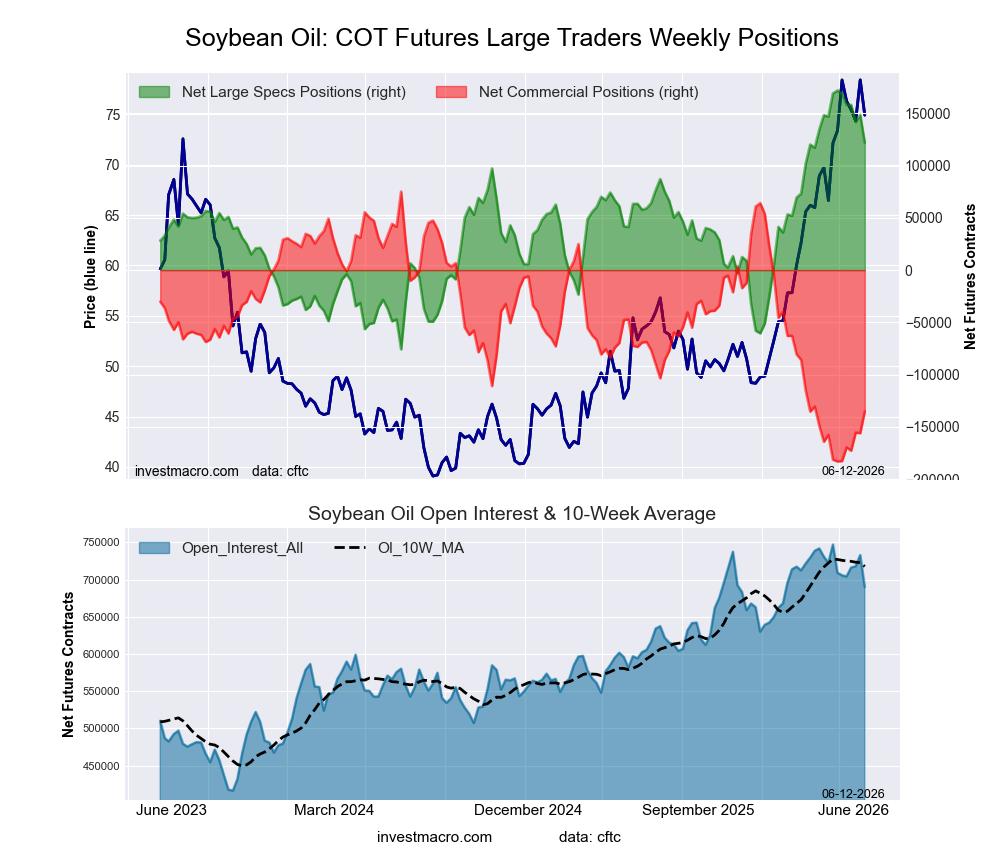
Soybean Oil

Extreme Bullish Leader
The Soybean Oil speculator position comes in third this week in the extreme standings as the Soybean Oil speculator level resides at a 98 percent score of its 3-year range.

The six-week trend for the speculator strength score came in at a gain of 33 percentage points this week. The overall speculator position was 117,135 net contracts this week with a dip by -2,962 contracts in the weekly speculator bets.


Bitcoin

Extreme Bullish Leader
The Bitcoin speculator position comes up number four in the extreme standings this week. The Bitcoin speculator level is at a 97 percent score of its 3-year range.

The six-week trend for the speculator strength score totaled a rise of 23 percentage points this week while the overall speculator position was 2,106 net contracts this week with an increase of 333 contracts in the speculator bets.


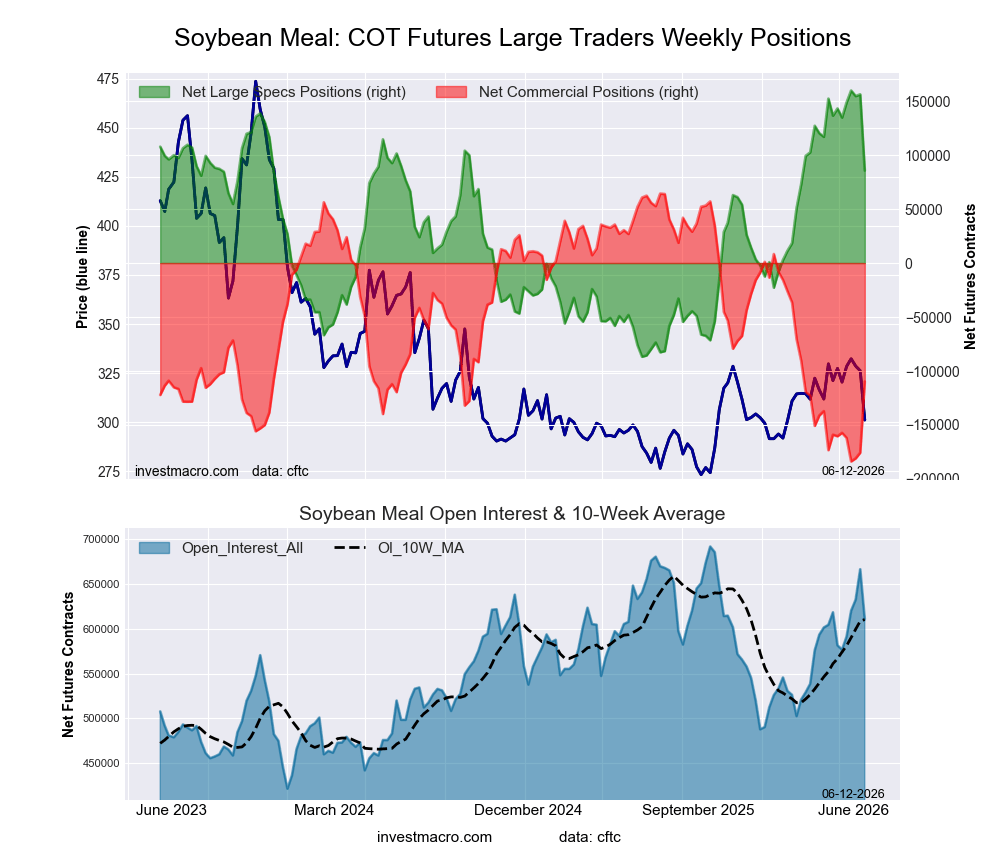
Soybean Meal

Extreme Bullish Leader
The Soybean Meal speculator position rounds out the top five in this week’s bullish extreme standings as this market sits at a 95 percent score of its 3-year range. The six-week trend for the speculator strength score was a jump by 51 percentage points this week.

The speculator position was 127,071 net contracts this week with a rise of 24,533 contracts in the weekly speculator bets.


The Most Bearish Speculator Positions of the Week:

Extreme Bearish Speculator Table


2-Year Bond

Extreme Bearish Leader
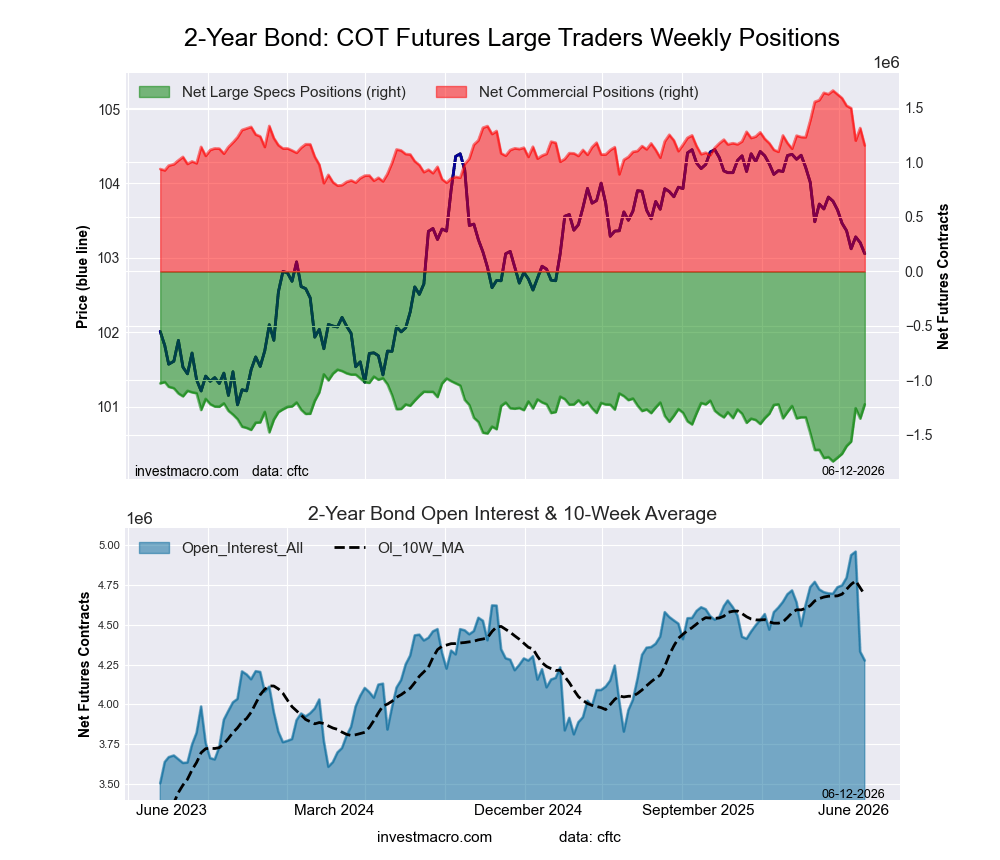
The 2-Year Bond speculator position comes in as the most bearish extreme standing this week as the 2-Year speculator level is at a 0 percent score of its 3-year range.

The six-week trend for the speculator strength score was a drop by -31 percentage points this week while the overall speculator position was -1,638,179 net contracts this week with a decline of -155,512 contracts in the speculator bets.


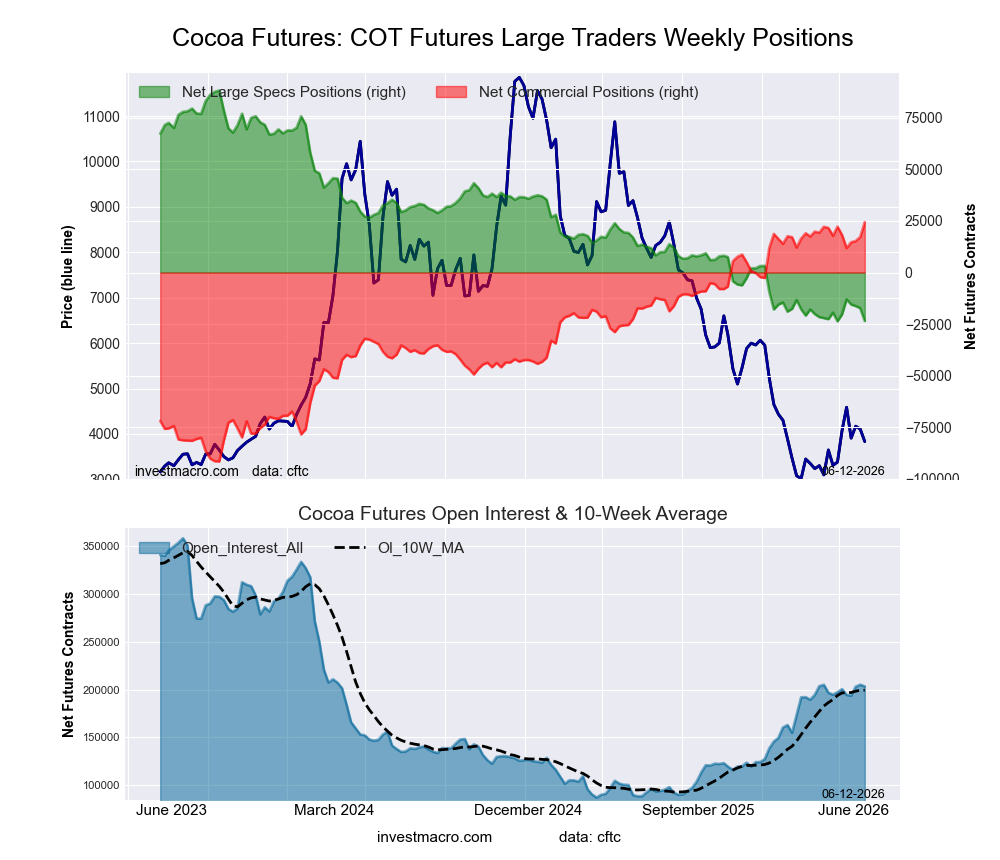
Cocoa Futures

Extreme Bearish Leader
The Cocoa Futures speculator position comes in next for the most bearish extreme standing on the week with the Cocoa speculator level at just a 1 percent score of its 3-year range.

The six-week trend for the speculator strength score was a dip of -1 percentage points this week. The speculator position was -20,116 net contracts this week with a decline of -2,257 contracts in the weekly speculator bets.


British Pound

Extreme Bearish Leader
The British Pound speculator position comes in as third most bearish extreme standing of the week. The GBP speculator level resides at a 15 percent score of its 3-year range.

The six-week trend for the speculator strength score was a decrease by -14 percentage points this week. The overall speculator position was -58,422 net contracts this week with a gain of 7,093 contracts in the speculator bets.


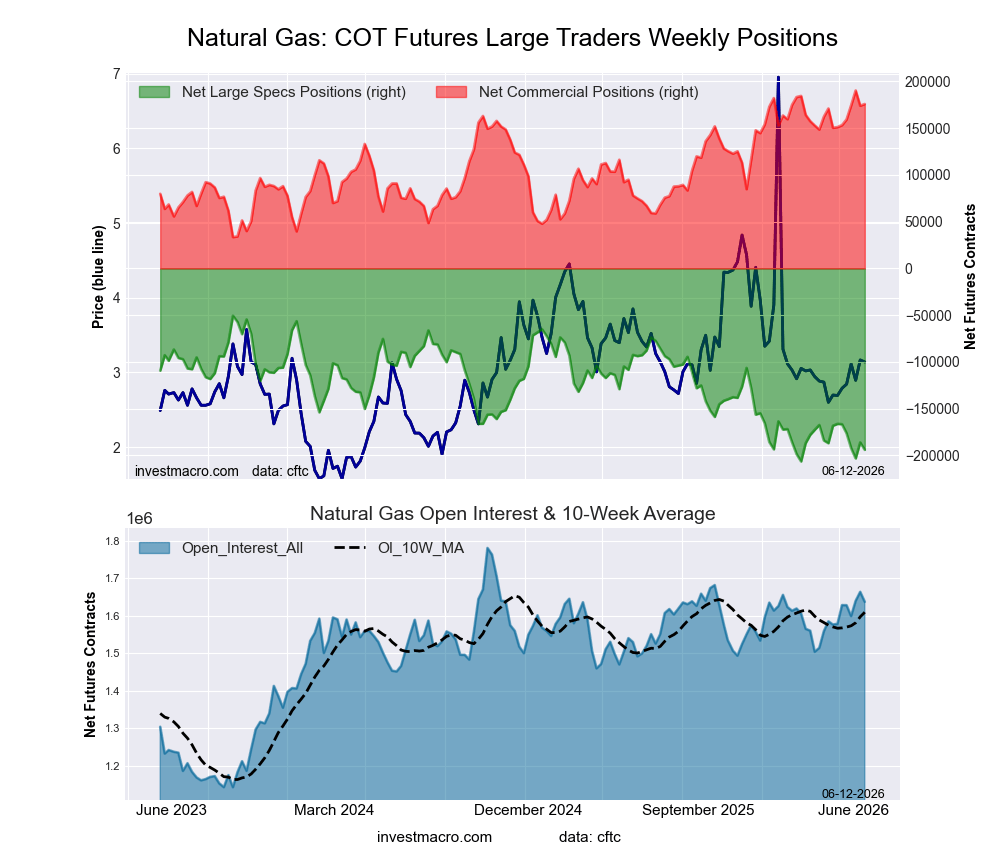
Natural Gas

Extreme Bearish Leader
The Natural Gas speculator position comes in as this week’s fourth most bearish extreme standing as the Natural Gas speculator level is at a 22 percent score of its 3-year range.

The six-week trend for the speculator strength score was unchanged this week while the speculator position was -172,607 net contracts this week with a gain of 5,422 contracts in the weekly speculator bets.


Silver

Extreme Bearish Leader
Next, the Silver speculator position comes in as the fifth most bearish extreme standing for this week as the Silver speculator level is at a 28 percent score of its 3-year range.

The six-week trend for the speculator strength score was a small gain of 3 percentage points this week and the speculator position was 24,673 net contracts this week with a small boost of 2,792 contracts in the weekly speculator bets.


Article By InvestMacroReceive our weekly COT Newsletter

*COT Report: The COT data, released weekly to the public each Friday, is updated through the most recent Tuesday (data is 3 days old) and shows a quick view of how large speculators or non-commercials (for-profit traders) were positioned in the futures markets.

The CFTC categorizes trader positions according to commercial hedgers (traders who use futures contracts for hedging as part of the business), non-commercials (large traders who speculate to realize trading profits) and nonreportable traders (usually small traders/speculators) as well as their open interest (contracts open in the market at time of reporting). See CFTC criteria here.