COT Metals Charts: Gold Speculator Bets rise to highest since March

By InvestMacro

Metals Open Interest COT Chart
Here are the latest charts and statistics for the Commitment of Traders (COT) data published by the Commodities Futures Trading Commission (CFTC).

The latest COT data is updated through Tuesday July 22nd and shows a quick view of how large traders (for-profit speculators and commercial entities) were positioned in the futures markets.

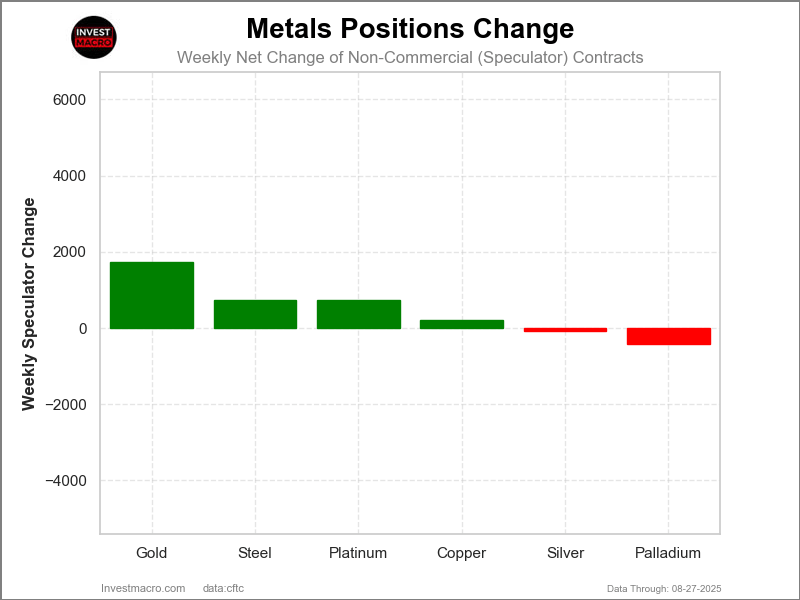
Weekly Speculator Changes led by Gold & Steel

Metals Net Positions COT Chart
The COT metals markets speculator bets were decisively higher this week as five out of the six metals markets we cover had higher positioning while the other one markets had lower speculator contracts.

Leading the gains for the metals was Gold (39,923 contracts) with Platinum (1,373 contracts), Palladium (1,281 contracts), Silver (1,172 contracts) and Steel (112 contracts) also seeing positive weeks.

The only market with a decline in speculator bets for the week was Copper with a dip by -902 contracts.

Gold Speculator Bets rise to highest since March

The gold speculator position rose this week for a fourth consecutive week and for the eighth time in the past ten weeks. This week’s boost by +39,923 contracts marked the highest one-week gain in over a year and brings the 10-week advance by speculator bets to over +91,000 contracts.

This boost in speculator bets for gold puts the current speculator net position, currently at +253,038 contracts, at the highest level in the past 18 weeks, dating back to March 18th.

Major metals prices this week were mixed

– Copper rose by over 3% for the week.
– Steel went higher by over 1.3%.
– Silver also saw just a small gain.
– Gold was down by -0.32%.
– Palladium and Platinum fell by almost -2% over the past week.


Metals Data:

Metals Table COT Chart
Legend: Weekly Speculators Change | Speculators Current Net Position | Speculators Strength Score compared to last 3-Years (0-100 range)


Strength Scores led by Silver & Palladium

Metals Strength Scores COT Chart
COT Strength Scores (a normalized measure of Speculator positions over a 3-Year range, from 0 to 100 where above 80 is Extreme-Bullish and below 20 is Extreme-Bearish) showed that Silver (92 percent) and Palladium (87 percent) lead the metals markets this week. Gold (76 percent) comes in as the next highest in the weekly strength scores.

Strength Statistics:
Gold (76.3 percent) vs Gold previous week (61.2 percent)
Silver (91.8 percent) vs Silver previous week (90.3 percent)
Copper (70.3 percent) vs Copper previous week (71.2 percent)
Platinum (64.8 percent) vs Platinum previous week (61.6 percent)
Palladium (87.2 percent) vs Palladium previous week (77.6 percent)
Steel (68.4 percent) vs Palladium previous week (67.7 percent)


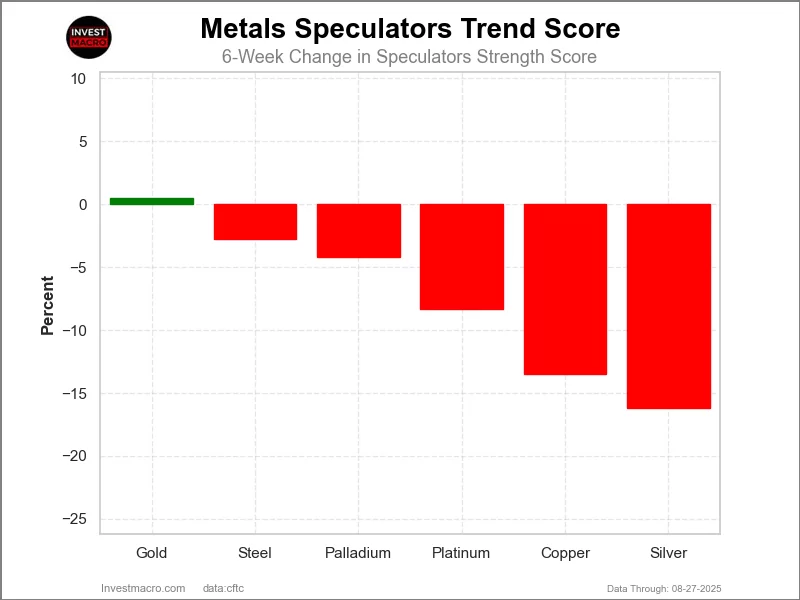
Palladium & Gold top the 6-Week Strength Trends

Metals Trends COT Chart
COT Strength Score Trends (or move index, calculates the 6-week changes in strength scores) showed that Palladium (26 percent) and Gold (25 percent) lead the past six weeks trends for metals. Copper (13 percent) is the next highest positive mover in the latest trends data.

Platinum (-15 percent) leads the downside trend scores currently with Silver (-8 percent) as the next market with lower trend scores.

Move Statistics:
Gold (24.9 percent) vs Gold previous week (9.6 percent)
Silver (-7.5 percent) vs Silver previous week (-1.7 percent)
Copper (12.5 percent) vs Copper previous week (15.5 percent)
Platinum (-14.9 percent) vs Platinum previous week (-1.8 percent)
Palladium (26.3 percent) vs Palladium previous week (27.9 percent)
Steel (9.9 percent) vs Steel previous week (13.8 percent)


Individual Markets:

Gold Comex Futures:

Gold Futures COT ChartThe Gold Comex Futures large speculator standing this week totaled a net position of 253,038 contracts in the data reported through Tuesday. This was a weekly advance of 39,923 contracts from the previous week which had a total of 213,115 net contracts.

This week’s current strength score (the trader positioning range over the past three years, measured from 0 to 100) shows the speculators are currently Bullish with a score of 76.3 percent. The commercials are Bearish with a score of 20.7 percent and the small traders (not shown in chart) are Bullish with a score of 72.0 percent.

Price Trend-Following Model: Uptrend

Our weekly trend-following model classifies the current market price position as: Uptrend.

Gold Futures StatisticsSPECULATORSCOMMERCIALSSMALL TRADERS
– Percent of Open Interest Longs:63.715.711.0
– Percent of Open Interest Shorts:12.073.45.1
– Net Position:253,038-282,33729,299
– Gross Longs:311,94976,72654,052
– Gross Shorts:58,911359,06324,753
– Long to Short Ratio:5.3 to 10.2 to 12.2 to 1
NET POSITION TREND:
– Strength Index Score (3 Year Range Pct):76.320.772.0
– Strength Index Reading (3 Year Range):BullishBearishBullish
NET POSITION MOVEMENT INDEX:
– 6-Week Change in Strength Index:24.9-21.5-20.1


Silver Comex Futures:

Silver Futures COT ChartThe Silver Comex Futures large speculator standing this week totaled a net position of 60,620 contracts in the data reported through Tuesday. This was a weekly rise of 1,172 contracts from the previous week which had a total of 59,448 net contracts.

This week’s current strength score (the trader positioning range over the past three years, measured from 0 to 100) shows the speculators are currently Bullish-Extreme with a score of 91.8 percent. The commercials are Bearish-Extreme with a score of 7.4 percent and the small traders (not shown in chart) are Bullish with a score of 60.7 percent.

Price Trend-Following Model: Strong Uptrend

Our weekly trend-following model classifies the current market price position as: Strong Uptrend.

Silver Futures StatisticsSPECULATORSCOMMERCIALSSMALL TRADERS
– Percent of Open Interest Longs:49.321.218.4
– Percent of Open Interest Shorts:14.466.87.7
– Net Position:60,620-79,22718,607
– Gross Longs:85,67836,80331,942
– Gross Shorts:25,058116,03013,335
– Long to Short Ratio:3.4 to 10.3 to 12.4 to 1
NET POSITION TREND:
– Strength Index Score (3 Year Range Pct):91.87.460.7
– Strength Index Reading (3 Year Range):Bullish-ExtremeBearish-ExtremeBullish
NET POSITION MOVEMENT INDEX:
– 6-Week Change in Strength Index:-7.57.1-2.0


Copper Grade #1 Futures:

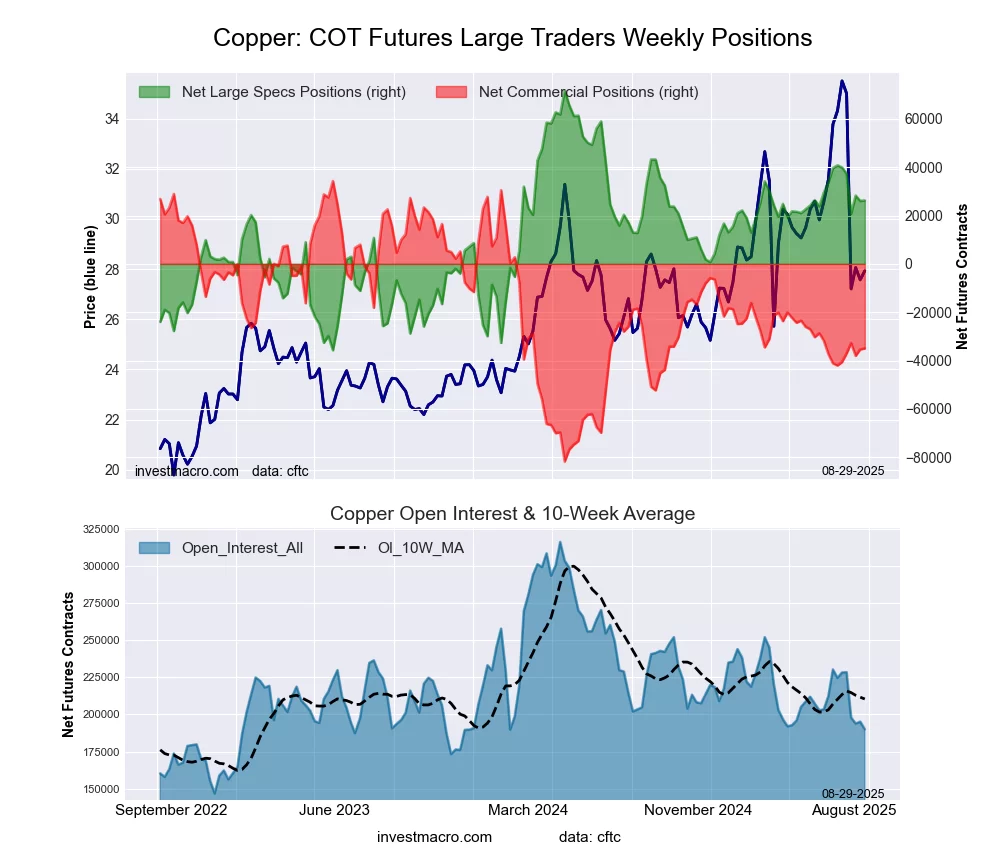
Copper Futures COT ChartThe Copper Grade #1 Futures large speculator standing this week totaled a net position of 39,822 contracts in the data reported through Tuesday. This was a weekly decline of -902 contracts from the previous week which had a total of 40,724 net contracts.

This week’s current strength score (the trader positioning range over the past three years, measured from 0 to 100) shows the speculators are currently Bullish with a score of 70.3 percent. The commercials are Bearish with a score of 35.4 percent and the small traders (not shown in chart) are Bearish with a score of 22.5 percent.

Price Trend-Following Model: Strong Uptrend

Our weekly trend-following model classifies the current market price position as: Strong Uptrend.

Copper Futures StatisticsSPECULATORSCOMMERCIALSSMALL TRADERS
– Percent of Open Interest Longs:34.029.06.9
– Percent of Open Interest Shorts:16.646.86.6
– Net Position:39,822-40,614792
– Gross Longs:77,63766,21515,779
– Gross Shorts:37,815106,82914,987
– Long to Short Ratio:2.1 to 10.6 to 11.1 to 1
NET POSITION TREND:
– Strength Index Score (3 Year Range Pct):70.335.422.5
– Strength Index Reading (3 Year Range):BullishBearishBearish
NET POSITION MOVEMENT INDEX:
– 6-Week Change in Strength Index:12.5-8.9-19.0


Platinum Futures:

Platinum Futures COT ChartThe Platinum Futures large speculator standing this week totaled a net position of 20,675 contracts in the data reported through Tuesday. This was a weekly rise of 1,373 contracts from the previous week which had a total of 19,302 net contracts.

This week’s current strength score (the trader positioning range over the past three years, measured from 0 to 100) shows the speculators are currently Bullish with a score of 64.8 percent. The commercials are Bearish with a score of 39.1 percent and the small traders (not shown in chart) are Bearish with a score of 37.2 percent.

Price Trend-Following Model: Strong Uptrend

Our weekly trend-following model classifies the current market price position as: Strong Uptrend.

Platinum Futures StatisticsSPECULATORSCOMMERCIALSSMALL TRADERS
– Percent of Open Interest Longs:60.819.611.1
– Percent of Open Interest Shorts:38.046.17.4
– Net Position:20,675-24,0253,350
– Gross Longs:55,18017,77310,028
– Gross Shorts:34,50541,7986,678
– Long to Short Ratio:1.6 to 10.4 to 11.5 to 1
NET POSITION TREND:
– Strength Index Score (3 Year Range Pct):64.839.137.2
– Strength Index Reading (3 Year Range):BullishBearishBearish
NET POSITION MOVEMENT INDEX:
– 6-Week Change in Strength Index:-14.917.6-17.9


Palladium Futures:

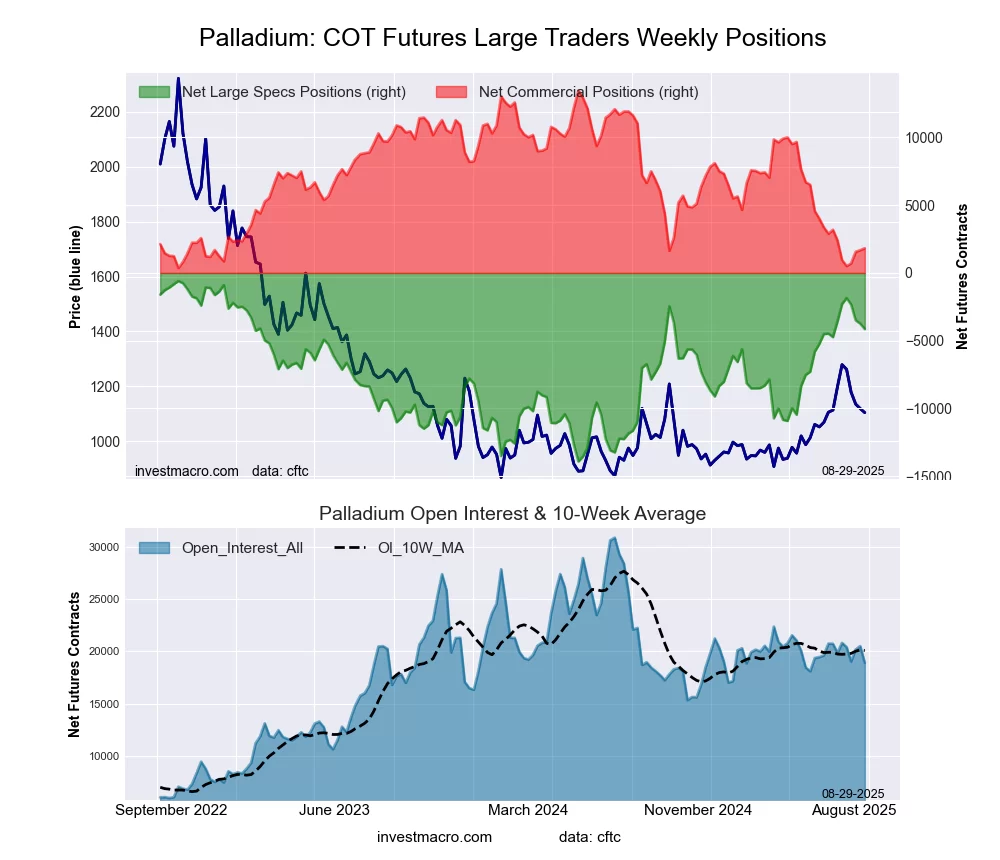
Palladium Futures COT ChartThe Palladium Futures large speculator standing this week totaled a net position of -2,300 contracts in the data reported through Tuesday. This was a weekly boost of 1,281 contracts from the previous week which had a total of -3,581 net contracts.

This week’s current strength score (the trader positioning range over the past three years, measured from 0 to 100) shows the speculators are currently Bullish-Extreme with a score of 87.2 percent. The commercials are Bearish-Extreme with a score of 4.5 percent and the small traders (not shown in chart) are Bullish-Extreme with a score of 89.1 percent.

Price Trend-Following Model: Strong Uptrend

Our weekly trend-following model classifies the current market price position as: Strong Uptrend.

Palladium Futures StatisticsSPECULATORSCOMMERCIALSSMALL TRADERS
– Percent of Open Interest Longs:43.235.315.2
– Percent of Open Interest Shorts:54.230.78.7
– Net Position:-2,3009521,348
– Gross Longs:8,9917,3413,155
– Gross Shorts:11,2916,3891,807
– Long to Short Ratio:0.8 to 11.1 to 11.7 to 1
NET POSITION TREND:
– Strength Index Score (3 Year Range Pct):87.24.589.1
– Strength Index Reading (3 Year Range):Bullish-ExtremeBearish-ExtremeBullish-Extreme
NET POSITION MOVEMENT INDEX:
– 6-Week Change in Strength Index:26.3-27.65.1


Steel Futures Futures:

Steel Futures COT ChartThe Steel Futures large speculator standing this week totaled a net position of 550 contracts in the data reported through Tuesday. This was a weekly lift of 112 contracts from the previous week which had a total of 438 net contracts.

This week’s current strength score (the trader positioning range over the past three years, measured from 0 to 100) shows the speculators are currently Bullish with a score of 68.4 percent. The commercials are Bearish with a score of 31.4 percent and the small traders (not shown in chart) are Bullish with a score of 66.3 percent.

Price Trend-Following Model: Downtrend

Our weekly trend-following model classifies the current market price position as: Downtrend.

Steel Futures StatisticsSPECULATORSCOMMERCIALSSMALL TRADERS
– Percent of Open Interest Longs:24.769.11.7
– Percent of Open Interest Shorts:22.772.10.8
– Net Position:550-788238
– Gross Longs:6,61418,476459
– Gross Shorts:6,06419,264221
– Long to Short Ratio:1.1 to 11.0 to 12.1 to 1
NET POSITION TREND:
– Strength Index Score (3 Year Range Pct):68.431.466.3
– Strength Index Reading (3 Year Range):BullishBearishBullish
NET POSITION MOVEMENT INDEX:
– 6-Week Change in Strength Index:9.9-10.38.3


Article By InvestMacroReceive our weekly COT Newsletter

*COT Report: The COT data, released weekly to the public each Friday, is updated through the most recent Tuesday (data is 3 days old) and shows a quick view of how large speculators or non-commercials (for-profit traders) were positioned in the futures markets.

The CFTC categorizes trader positions according to commercial hedgers (traders who use futures contracts for hedging as part of the business), non-commercials (large traders who speculate to realize trading profits) and nonreportable traders (usually small traders/speculators) as well as their open interest (contracts open in the market at time of reporting). See CFTC criteria here.

COT Bonds Charts: Speculator Bets led by 2-Year Bonds & Treasury Bonds

By InvestMacro

Bonds Market Open Interest Comparison
Here are the latest charts and statistics for the Commitment of Traders (COT) reports data published by the Commodities Futures Trading Commission (CFTC).

The latest COT data is updated through Tuesday July 22nd and shows a quick view of how large traders (for-profit speculators and commercial hedgers) were positioned in the futures markets.

Weekly Speculator Changes led by 2-Year Bonds & Treasury Bonds

Bonds Market Net Speculators Positions
The COT bond market speculator bets were slightly higher this week as five out of the nine bond markets we cover had higher positioning while the other four markets had lower speculator contracts.

Leading the gains for the bond markets was the 2-Year Bonds (51,208 contracts) with the US Treasury Bonds (47,265 contracts), the 5-Year Bonds (35,604 contracts), the 10-Year Bonds (22,843 contracts) and the SOFR 3-Months (7,373 contracts) also showing higher weeks.

The bond markets with declines in speculator bets for the week were the SOFR 1-Month (-14,444 contracts), the Ultra 10-Year Bonds (-14,211 contracts), the Ultra Treasury Bonds (-3,725 contracts) and the Fed Funds (-219 contracts)also registering lower bets on the week.

Bonds prices slightly up 

The bond market prices on the week saw the longer U.S. Treasury bonds trending higher with gains of over 1%.

The 10-year Notes were higher by almost half a percent, while the 5-year, the 2-year, the Fed funds, and the 3-month overnight financing rate bonds were slightly higher on the week.

The 1-month secured overnight financing rate was the only bond with a weekly fall.


Bonds Data:

Bonds Market Speculators Data Table
Legend: Open Interest | Speculators Current Net Position | Weekly Specs Change | Specs Strength Score compared to last 3-Years (0-100 range)


Strength Scores led by Ultra Treasury Bonds & Fed Funds

Bonds Market Strength Index Comparison
COT Strength Scores (a normalized measure of Speculator positions over a 3-Year range, from 0 to 100 where above 80 is Extreme-Bullish and below 20 is Extreme-Bearish) showed that the Ultra Treasury Bonds (84 percent) and the Fed Funds (65 percent) lead the bond markets this week. The US Treasury Bonds (55 percent) comes in as the next highest in the weekly strength scores.

On the downside, the 5-Year Bond (2 percent), the Ultra 10-Year Bonds (4 percent) and the 2-Year Bonds (17 percent) come in at the lowest strength level currently and are in Extreme-Bearish territory (below 20 percent).

Strength Statistics:
Fed Funds (64.7 percent) vs Fed Funds previous week (64.7 percent)
2-Year Bond (17.1 percent) vs 2-Year Bond previous week (13.4 percent)
5-Year Bond (2.1 percent) vs 5-Year Bond previous week (0.5 percent)
10-Year Bond (43.1 percent) vs 10-Year Bond previous week (40.6 percent)
Ultra 10-Year Bond (3.7 percent) vs Ultra 10-Year Bond previous week (7.3 percent)
US Treasury Bond (54.5 percent) vs US Treasury Bond previous week (38.1 percent)
Ultra US Treasury Bond (84.0 percent) vs Ultra US Treasury Bond previous week (85.4 percent)
SOFR 1-Month (28.2 percent) vs SOFR 1-Month previous week (31.8 percent)
SOFR 3-Months (35.5 percent) vs SOFR 3-Months previous week (35.1 percent)


SOFR 3-Months & Fed Funds top the 6-Week Strength Trends

Bonds Market Trend Index Comparison
COT Strength Score Trends (or move index, calculates the 6-week changes in strength scores) showed that the SOFR 3-Months (34 percent) and the Fed Funds (30 percent) lead the past six weeks trends for bonds.

The SOFR 1-Month (-22 percent), the Ultra Treasury Bonds (-11 percent) and the Ultra 10-Year Bonds (-6 percent) leads the downside trend scores currently with the 2-Year Bonds (-5 percent) and the 10-Year Bonds (-3 percent) following next with lower trend scores.

Strength Trend Statistics:
Fed Funds (29.7 percent) vs Fed Funds previous week (36.8 percent)
2-Year Bond (-4.9 percent) vs 2-Year Bond previous week (-11.2 percent)
5-Year Bond (0.0 percent) vs 5-Year Bond previous week (-5.0 percent)
10-Year Bond (-2.8 percent) vs 10-Year Bond previous week (-7.3 percent)
Ultra 10-Year Bond (-6.0 percent) vs Ultra 10-Year Bond previous week (-1.9 percent)
US Treasury Bond (-1.1 percent) vs US Treasury Bond previous week (-9.7 percent)
Ultra US Treasury Bond (-10.7 percent) vs Ultra US Treasury Bond previous week (-0.1 percent)
SOFR 1-Month (-21.9 percent) vs SOFR 1-Month previous week (-31.6 percent)
SOFR 3-Months (33.7 percent) vs SOFR 3-Months previous week (22.9 percent)


30-Day Federal Funds Futures:

Federal Funds 30-Day Bonds Futures COT ChartThe 30-Day Federal Funds large speculator standing this week totaled a net position of 54,525 contracts in the data reported through Tuesday. This was a weekly fall of -219 contracts from the previous week which had a total of 54,744 net contracts.

This week’s current strength score (the trader positioning range over the past three years, measured from 0 to 100) shows the speculators are currently Bullish with a score of 64.7 percent. The commercials are Bearish with a score of 28.0 percent and the small traders (not shown in chart) are Bullish-Extreme with a score of 91.8 percent.

Price Trend-Following Model: Downtrend

Our weekly trend-following model classifies the current market price position as: Downtrend.

30-Day Federal Funds StatisticsSPECULATORSCOMMERCIALSSMALL TRADERS
– Percent of Open Interest Longs:20.460.52.9
– Percent of Open Interest Shorts:17.964.11.9
– Net Position:54,525-77,02922,504
– Gross Longs:440,4991,303,75262,363
– Gross Shorts:385,9741,380,78139,859
– Long to Short Ratio:1.1 to 10.9 to 11.6 to 1
NET POSITION TREND:
– Strength Index Score (3 Year Range Pct):64.728.091.8
– Strength Index Reading (3 Year Range):BullishBearishBullish-Extreme
NET POSITION MOVEMENT INDEX:
– 6-Week Change in Strength Index:29.7-31.012.3


Secured Overnight Financing Rate (3-Month) Futures:

SOFR 3-Months Bonds Futures COT ChartThe Secured Overnight Financing Rate (3-Month) large speculator standing this week totaled a net position of -479,775 contracts in the data reported through Tuesday. This was a weekly increase of 7,373 contracts from the previous week which had a total of -487,148 net contracts.

This week’s current strength score (the trader positioning range over the past three years, measured from 0 to 100) shows the speculators are currently Bearish with a score of 35.5 percent. The commercials are Bullish with a score of 65.2 percent and the small traders (not shown in chart) are Bullish with a score of 70.3 percent.

Price Trend-Following Model: Weak Uptrend

Our weekly trend-following model classifies the current market price position as: Weak Uptrend.

SOFR 3-Months StatisticsSPECULATORSCOMMERCIALSSMALL TRADERS
– Percent of Open Interest Longs:12.759.30.5
– Percent of Open Interest Shorts:16.855.00.6
– Net Position:-479,775495,967-16,192
– Gross Longs:1,471,0926,885,62357,425
– Gross Shorts:1,950,8676,389,65673,617
– Long to Short Ratio:0.8 to 11.1 to 10.8 to 1
NET POSITION TREND:
– Strength Index Score (3 Year Range Pct):35.565.270.3
– Strength Index Reading (3 Year Range):BearishBullishBullish
NET POSITION MOVEMENT INDEX:
– 6-Week Change in Strength Index:33.7-32.2-14.6


Individual Bond Markets:

Secured Overnight Financing Rate (1-Month) Futures:

SOFR 1-Month Bonds Futures COT ChartThe Secured Overnight Financing Rate (1-Month) large speculator standing this week totaled a net position of -163,451 contracts in the data reported through Tuesday. This was a weekly lowering of -14,444 contracts from the previous week which had a total of -149,007 net contracts.

This week’s current strength score (the trader positioning range over the past three years, measured from 0 to 100) shows the speculators are currently Bearish with a score of 28.2 percent. The commercials are Bullish with a score of 70.6 percent and the small traders (not shown in chart) are Bullish with a score of 75.9 percent.

Price Trend-Following Model: Weak Uptrend

Our weekly trend-following model classifies the current market price position as: Weak Uptrend.

SOFR 1-Month StatisticsSPECULATORSCOMMERCIALSSMALL TRADERS
– Percent of Open Interest Longs:12.668.50.4
– Percent of Open Interest Shorts:23.757.70.1
– Net Position:-163,451159,0694,382
– Gross Longs:185,6991,011,1976,250
– Gross Shorts:349,150852,1281,868
– Long to Short Ratio:0.5 to 11.2 to 13.3 to 1
NET POSITION TREND:
– Strength Index Score (3 Year Range Pct):28.270.675.9
– Strength Index Reading (3 Year Range):BearishBullishBullish
NET POSITION MOVEMENT INDEX:
– 6-Week Change in Strength Index:-21.919.817.2


2-Year Treasury Note Futures:

2-Year Treasury Bonds Futures COT ChartThe 2-Year Treasury Note large speculator standing this week totaled a net position of -1,248,652 contracts in the data reported through Tuesday. This was a weekly increase of 51,208 contracts from the previous week which had a total of -1,299,860 net contracts.

This week’s current strength score (the trader positioning range over the past three years, measured from 0 to 100) shows the speculators are currently Bearish-Extreme with a score of 17.1 percent. The commercials are Bullish-Extreme with a score of 81.0 percent and the small traders (not shown in chart) are Bullish with a score of 71.3 percent.

Price Trend-Following Model: Weak Downtrend

Our weekly trend-following model classifies the current market price position as: Weak Downtrend.

2-Year Treasury Note StatisticsSPECULATORSCOMMERCIALSSMALL TRADERS
– Percent of Open Interest Longs:14.377.25.8
– Percent of Open Interest Shorts:42.851.72.8
– Net Position:-1,248,6521,115,887132,765
– Gross Longs:627,2083,380,466253,553
– Gross Shorts:1,875,8602,264,579120,788
– Long to Short Ratio:0.3 to 11.5 to 12.1 to 1
NET POSITION TREND:
– Strength Index Score (3 Year Range Pct):17.181.071.3
– Strength Index Reading (3 Year Range):Bearish-ExtremeBullish-ExtremeBullish
NET POSITION MOVEMENT INDEX:
– 6-Week Change in Strength Index:-4.95.70.8


5-Year Treasury Note Futures:

5-Year Treasury Bonds Futures COT ChartThe 5-Year Treasury Note large speculator standing this week totaled a net position of -2,469,924 contracts in the data reported through Tuesday. This was a weekly lift of 35,604 contracts from the previous week which had a total of -2,505,528 net contracts.

This week’s current strength score (the trader positioning range over the past three years, measured from 0 to 100) shows the speculators are currently Bearish-Extreme with a score of 2.1 percent. The commercials are Bullish-Extreme with a score of 97.1 percent and the small traders (not shown in chart) are Bullish-Extreme with a score of 82.6 percent.

Price Trend-Following Model: Strong Uptrend

Our weekly trend-following model classifies the current market price position as: Strong Uptrend.

5-Year Treasury Note StatisticsSPECULATORSCOMMERCIALSSMALL TRADERS
– Percent of Open Interest Longs:7.083.96.4
– Percent of Open Interest Shorts:42.451.13.8
– Net Position:-2,469,9242,290,033179,891
– Gross Longs:488,6335,860,765447,110
– Gross Shorts:2,958,5573,570,732267,219
– Long to Short Ratio:0.2 to 11.6 to 11.7 to 1
NET POSITION TREND:
– Strength Index Score (3 Year Range Pct):2.197.182.6
– Strength Index Reading (3 Year Range):Bearish-ExtremeBullish-ExtremeBullish-Extreme
NET POSITION MOVEMENT INDEX:
– 6-Week Change in Strength Index:0.0-0.73.0


10-Year Treasury Note Futures:

10-Year Treasury Notes Bonds Futures COT ChartThe 10-Year Treasury Note large speculator standing this week totaled a net position of -749,534 contracts in the data reported through Tuesday. This was a weekly gain of 22,843 contracts from the previous week which had a total of -772,377 net contracts.

This week’s current strength score (the trader positioning range over the past three years, measured from 0 to 100) shows the speculators are currently Bearish with a score of 43.1 percent. The commercials are Bullish with a score of 53.6 percent and the small traders (not shown in chart) are Bullish with a score of 69.9 percent.

Price Trend-Following Model: Weak Downtrend

Our weekly trend-following model classifies the current market price position as: Weak Downtrend.

10-Year Treasury Note StatisticsSPECULATORSCOMMERCIALSSMALL TRADERS
– Percent of Open Interest Longs:11.877.38.9
– Percent of Open Interest Shorts:27.363.67.0
– Net Position:-749,534660,27789,257
– Gross Longs:567,9733,730,048428,586
– Gross Shorts:1,317,5073,069,771339,329
– Long to Short Ratio:0.4 to 11.2 to 11.3 to 1
NET POSITION TREND:
– Strength Index Score (3 Year Range Pct):43.153.669.9
– Strength Index Reading (3 Year Range):BearishBullishBullish
NET POSITION MOVEMENT INDEX:
– 6-Week Change in Strength Index:-2.82.03.6


Ultra 10-Year Notes Futures:

Ultra 10-Year Treasury Notes Bonds Futures COT ChartThe Ultra 10-Year Notes large speculator standing this week totaled a net position of -393,327 contracts in the data reported through Tuesday. This was a weekly lowering of -14,211 contracts from the previous week which had a total of -379,116 net contracts.

This week’s current strength score (the trader positioning range over the past three years, measured from 0 to 100) shows the speculators are currently Bearish-Extreme with a score of 3.7 percent. The commercials are Bullish-Extreme with a score of 98.3 percent and the small traders (not shown in chart) are Bearish with a score of 48.8 percent.

Price Trend-Following Model: Weak Uptrend

Our weekly trend-following model classifies the current market price position as: Weak Uptrend.

Ultra 10-Year Notes StatisticsSPECULATORSCOMMERCIALSSMALL TRADERS
– Percent of Open Interest Longs:10.479.59.3
– Percent of Open Interest Shorts:26.760.312.2
– Net Position:-393,327463,537-70,210
– Gross Longs:251,8161,920,013223,556
– Gross Shorts:645,1431,456,476293,766
– Long to Short Ratio:0.4 to 11.3 to 10.8 to 1
NET POSITION TREND:
– Strength Index Score (3 Year Range Pct):3.798.348.8
– Strength Index Reading (3 Year Range):Bearish-ExtremeBullish-ExtremeBearish
NET POSITION MOVEMENT INDEX:
– 6-Week Change in Strength Index:-6.012.6-19.5


US Treasury Bonds Futures:

US Year Treasury Notes Long Bonds Futures COT ChartThe US Treasury Bonds large speculator standing this week totaled a net position of -82,879 contracts in the data reported through Tuesday. This was a weekly lift of 47,265 contracts from the previous week which had a total of -130,144 net contracts.

This week’s current strength score (the trader positioning range over the past three years, measured from 0 to 100) shows the speculators are currently Bullish with a score of 54.5 percent. The commercials are Bearish with a score of 37.1 percent and the small traders (not shown in chart) are Bullish with a score of 72.2 percent.

Price Trend-Following Model: Downtrend

Our weekly trend-following model classifies the current market price position as: Downtrend.

US Treasury Bonds StatisticsSPECULATORSCOMMERCIALSSMALL TRADERS
– Percent of Open Interest Longs:9.076.313.1
– Percent of Open Interest Shorts:13.676.78.1
– Net Position:-82,879-6,24389,122
– Gross Longs:160,5791,368,819234,183
– Gross Shorts:243,4581,375,062145,061
– Long to Short Ratio:0.7 to 11.0 to 11.6 to 1
NET POSITION TREND:
– Strength Index Score (3 Year Range Pct):54.537.172.2
– Strength Index Reading (3 Year Range):BullishBearishBullish
NET POSITION MOVEMENT INDEX:
– 6-Week Change in Strength Index:-1.10.9-0.1


Ultra US Treasury Bonds Futures:

Ultra US Year Treasury Notes Long Bonds Futures COT ChartThe Ultra US Treasury Bonds large speculator standing this week totaled a net position of -232,343 contracts in the data reported through Tuesday. This was a weekly lowering of -3,725 contracts from the previous week which had a total of -228,618 net contracts.

This week’s current strength score (the trader positioning range over the past three years, measured from 0 to 100) shows the speculators are currently Bullish-Extreme with a score of 84.0 percent. The commercials are Bearish with a score of 31.5 percent and the small traders (not shown in chart) are Bearish-Extreme with a score of 14.2 percent.

Price Trend-Following Model: Downtrend

Our weekly trend-following model classifies the current market price position as: Downtrend.

Ultra US Treasury Bonds StatisticsSPECULATORSCOMMERCIALSSMALL TRADERS
– Percent of Open Interest Longs:7.581.59.4
– Percent of Open Interest Shorts:19.469.69.4
– Net Position:-232,343233,192-849
– Gross Longs:146,2601,589,126183,117
– Gross Shorts:378,6031,355,934183,966
– Long to Short Ratio:0.4 to 11.2 to 11.0 to 1
NET POSITION TREND:
– Strength Index Score (3 Year Range Pct):84.031.514.2
– Strength Index Reading (3 Year Range):Bullish-ExtremeBearishBearish-Extreme
NET POSITION MOVEMENT INDEX:
– 6-Week Change in Strength Index:-10.77.68.9


Article By InvestMacroReceive our weekly COT Newsletter

*COT Report: The COT data, released weekly to the public each Friday, is updated through the most recent Tuesday (data is 3 days old) and shows a quick view of how large speculators or non-commercials (for-profit traders) were positioned in the futures markets.

The CFTC categorizes trader positions according to commercial hedgers (traders who use futures contracts for hedging as part of the business), non-commercials (large traders who speculate to realize trading profits) and nonreportable traders (usually small traders/speculators) as well as their open interest (contracts open in the market at time of reporting). See CFTC criteria here.

COT Soft Commodities Charts: Speculator Bets led by Soybeans, Soybean Oil & Wheat

By InvestMacro

Speculators OI Softs
Here are the latest charts and statistics for the Commitment of Traders (COT) reports data published by the Commodities Futures Trading Commission (CFTC).

The latest COT data is updated through Tuesday July 22nd and shows a quick view of how large traders (for-profit speculators and commercial entities) were positioned in the futures markets.

Weekly Speculator Changes led by Soybeans, Soybean Oil & Wheat

Speculators Nets Softs
The COT soft commodities markets speculator bets were slightly lower this week as five out of the eleven softs markets we cover had higher positioning while the other six markets had lower speculator contracts.

Leading the gains for the softs markets was Soybeans (20,739 contracts) with Soybean Oil (12,389 contracts), Wheat (11,612 contracts), Soybean Meal (6,164 contracts) and Live Cattle (4,413 contracts) also showing positive weeks.

The markets with the declines in speculator bets this week were Sugar (-7,630 contracts), Lean Hogs (-7,623 contracts), Corn (-4,426 contracts), Cocoa (-3,491 contracts), Cotton (-2,167 contracts) and Coffee (-16 contracts) with also registering lower bets on the week.

Soft Commodities Prices down over the week

The soft commodities market prices were down across the board, with Live Cattle being the only market that had a positive week.

Soybean Meal dropped by almost -4%, Cocoa by over -3%, and Sugar was down by -2.5%. Soybeans, Coffee, Wheat, and Corn were also down by over -1 percent.

Over the past 30 days, Coffee is down by over -13%, followed by Soybean Meal which is lower by almost -9%. On the positive side, Cocoa is up by 14% in the last 30 days, followed by Soybean Oil which is up by over 10% in the same time frame.


Soft Commodities Data:

Speculators Table Softs
Legend: Weekly Speculators Change | Speculators Current Net Position | Speculators Strength Score compared to last 3-Years (0-100 range)


Strength Scores led by Live Cattle & Soybean Oil

Speculators Strength Softs
COT Strength Scores (a normalized measure of Speculator positions over a 3-Year range, from 0 to 100 where above 80 is Extreme-Bullish and below 20 is Extreme-Bearish) showed that Live Cattle (85 percent), Lean Hogs (84 percent)  and Soybean Oil (84 percent) lead the softs markets this week. Soybeans (60 percent) and Coffee (56 percent) come in as the next highest in the weekly strength scores.

On the downside, Sugar (2 percent), Soybean Meal (5 percent), Cocoa (19 percent) and Corn (18 percent) come in at the lowest strength levels currently and are in Extreme-Bearish territory (below 20 percent).

Strength Statistics:
Corn (18.0 percent) vs Corn previous week (18.6 percent)
Sugar (2.1 percent) vs Sugar previous week (4.3 percent)
Coffee (56.0 percent) vs Coffee previous week (56.0 percent)
Soybeans (59.7 percent) vs Soybeans previous week (54.4 percent)
Soybean Oil (84.1 percent) vs Soybean Oil previous week (77.3 percent)
Soybean Meal (5.0 percent) vs Soybean Meal previous week (2.7 percent)
Live Cattle (85.3 percent) vs Live Cattle previous week (81.0 percent)
Lean Hogs (84.1 percent) vs Lean Hogs previous week (89.8 percent)
Cotton (21.2 percent) vs Cotton previous week (22.5 percent)
Cocoa (18.5 percent) vs Cocoa previous week (22.0 percent)
Wheat (51.9 percent) vs Wheat previous week (42.5 percent)


Wheat & Soybean Oil top the 6-Week Strength Trends

Speculators Trend Softs
COT Strength Score Trends (or move index, calculates the 6-week changes in strength scores) showed that Wheat (32 percent) and Soybean Oil (19 percent) lead the past six weeks trends for soft commodities. Cotton (6 percent) is the next highest positive mover in the latest trends data.

Sugar (-12 percent) leads the downside trend scores currently with Cocoa (-11 percent), Soybean Meal (-10 percent) and Soybeans (-9 percent) following next with lower trend scores.

Strength Trend Statistics:
Corn (-5.2 percent) vs Corn previous week (-6.6 percent)
Sugar (-11.6 percent) vs Sugar previous week (-13.9 percent)
Coffee (-6.0 percent) vs Coffee previous week (-3.8 percent)
Soybeans (-8.8 percent) vs Soybeans previous week (-11.4 percent)
Soybean Oil (19.5 percent) vs Soybean Oil previous week (12.3 percent)
Soybean Meal (-9.7 percent) vs Soybean Meal previous week (-9.6 percent)
Live Cattle (-6.3 percent) vs Live Cattle previous week (1.2 percent)
Lean Hogs (-3.6 percent) vs Lean Hogs previous week (12.3 percent)
Cotton (5.7 percent) vs Cotton previous week (4.4 percent)
Cocoa (-11.1 percent) vs Cocoa previous week (-7.8 percent)
Wheat (32.3 percent) vs Wheat previous week (25.5 percent)


Individual Soft Commodities Markets:

CORN Futures:

CORN Futures COT ChartThe CORN large speculator standing this week totaled a net position of -133,883 contracts in the data reported through Tuesday. This was a weekly reduction of -4,426 contracts from the previous week which had a total of -129,457 net contracts.

This week’s current strength score (the trader positioning range over the past three years, measured from 0 to 100) shows the speculators are currently Bearish-Extreme with a score of 18.0 percent. The commercials are Bullish-Extreme with a score of 82.3 percent and the small traders (not shown in chart) are Bullish with a score of 69.7 percent.

Price Trend-Following Model: Strong Downtrend

Our weekly trend-following model classifies the current market price position as: Strong Downtrend.

CORN Futures StatisticsSPECULATORSCOMMERCIALSSMALL TRADERS
– Percent of Open Interest Longs:19.443.79.4
– Percent of Open Interest Shorts:28.332.611.6
– Net Position:-133,883165,523-31,640
– Gross Longs:289,307652,507141,014
– Gross Shorts:423,190486,984172,654
– Long to Short Ratio:0.7 to 11.3 to 10.8 to 1
NET POSITION TREND:
– Strength Index Score (3 Year Range Pct):18.082.369.7
– Strength Index Reading (3 Year Range):Bearish-ExtremeBullish-ExtremeBullish
NET POSITION MOVEMENT INDEX:
– 6-Week Change in Strength Index:-5.27.7-14.7


SUGAR Futures:

SUGAR Futures COT ChartThe SUGAR large speculator standing this week totaled a net position of -59,729 contracts in the data reported through Tuesday. This was a weekly fall of -7,630 contracts from the previous week which had a total of -52,099 net contracts.

This week’s current strength score (the trader positioning range over the past three years, measured from 0 to 100) shows the speculators are currently Bearish-Extreme with a score of 2.1 percent. The commercials are Bullish-Extreme with a score of 99.0 percent and the small traders (not shown in chart) are Bearish-Extreme with a score of 3.8 percent.

Price Trend-Following Model: Downtrend

Our weekly trend-following model classifies the current market price position as: Downtrend.

SUGAR Futures StatisticsSPECULATORSCOMMERCIALSSMALL TRADERS
– Percent of Open Interest Longs:22.953.17.2
– Percent of Open Interest Shorts:29.844.88.6
– Net Position:-59,72972,031-12,302
– Gross Longs:198,761460,20962,484
– Gross Shorts:258,490388,17874,786
– Long to Short Ratio:0.8 to 11.2 to 10.8 to 1
NET POSITION TREND:
– Strength Index Score (3 Year Range Pct):2.199.03.8
– Strength Index Reading (3 Year Range):Bearish-ExtremeBullish-ExtremeBearish-Extreme
NET POSITION MOVEMENT INDEX:
– 6-Week Change in Strength Index:-11.611.1-7.5


COFFEE Futures:

COFFEE Futures COT ChartThe COFFEE large speculator standing this week totaled a net position of 31,117 contracts in the data reported through Tuesday. This was a weekly decline of -16 contracts from the previous week which had a total of 31,133 net contracts.

This week’s current strength score (the trader positioning range over the past three years, measured from 0 to 100) shows the speculators are currently Bullish with a score of 56.0 percent. The commercials are Bearish with a score of 46.6 percent and the small traders (not shown in chart) are Bearish with a score of 29.6 percent.

Price Trend-Following Model: Strong Downtrend

Our weekly trend-following model classifies the current market price position as: Strong Downtrend.

COFFEE Futures StatisticsSPECULATORSCOMMERCIALSSMALL TRADERS
– Percent of Open Interest Longs:32.541.14.5
– Percent of Open Interest Shorts:12.261.94.1
– Net Position:31,117-31,817700
– Gross Longs:49,72262,7816,915
– Gross Shorts:18,60594,5986,215
– Long to Short Ratio:2.7 to 10.7 to 11.1 to 1
NET POSITION TREND:
– Strength Index Score (3 Year Range Pct):56.046.629.6
– Strength Index Reading (3 Year Range):BullishBearishBearish
NET POSITION MOVEMENT INDEX:
– 6-Week Change in Strength Index:-6.07.6-31.2


SOYBEANS Futures:

SOYBEANS Futures COT ChartThe SOYBEANS large speculator standing this week totaled a net position of 36,033 contracts in the data reported through Tuesday. This was a weekly increase of 20,739 contracts from the previous week which had a total of 15,294 net contracts.

This week’s current strength score (the trader positioning range over the past three years, measured from 0 to 100) shows the speculators are currently Bullish with a score of 59.7 percent. The commercials are Bearish with a score of 39.1 percent and the small traders (not shown in chart) are Bullish with a score of 66.5 percent.

Price Trend-Following Model: Uptrend

Our weekly trend-following model classifies the current market price position as: Uptrend.

SOYBEANS Futures StatisticsSPECULATORSCOMMERCIALSSMALL TRADERS
– Percent of Open Interest Longs:20.352.05.1
– Percent of Open Interest Shorts:16.354.07.0
– Net Position:36,033-18,411-17,622
– Gross Longs:182,121466,69845,428
– Gross Shorts:146,088485,10963,050
– Long to Short Ratio:1.2 to 11.0 to 10.7 to 1
NET POSITION TREND:
– Strength Index Score (3 Year Range Pct):59.739.166.5
– Strength Index Reading (3 Year Range):BullishBearishBullish
NET POSITION MOVEMENT INDEX:
– 6-Week Change in Strength Index:-8.810.7-13.9


SOYBEAN OIL Futures:

SOYBEAN OIL Futures COT ChartThe SOYBEAN OIL large speculator standing this week totaled a net position of 76,514 contracts in the data reported through Tuesday. This was a weekly boost of 12,389 contracts from the previous week which had a total of 64,125 net contracts.

This week’s current strength score (the trader positioning range over the past three years, measured from 0 to 100) shows the speculators are currently Bullish-Extreme with a score of 84.1 percent. The commercials are Bearish-Extreme with a score of 15.7 percent and the small traders (not shown in chart) are Bullish-Extreme with a score of 89.9 percent.

Price Trend-Following Model: Strong Uptrend

Our weekly trend-following model classifies the current market price position as: Strong Uptrend.

SOYBEAN OIL Futures StatisticsSPECULATORSCOMMERCIALSSMALL TRADERS
– Percent of Open Interest Longs:22.745.16.3
– Percent of Open Interest Shorts:10.659.34.2
– Net Position:76,514-90,09013,576
– Gross Longs:143,743285,70539,958
– Gross Shorts:67,229375,79526,382
– Long to Short Ratio:2.1 to 10.8 to 11.5 to 1
NET POSITION TREND:
– Strength Index Score (3 Year Range Pct):84.115.789.9
– Strength Index Reading (3 Year Range):Bullish-ExtremeBearish-ExtremeBullish-Extreme
NET POSITION MOVEMENT INDEX:
– 6-Week Change in Strength Index:19.5-22.040.7


SOYBEAN MEAL Futures:

SOYBEAN MEAL Futures COT ChartThe SOYBEAN MEAL large speculator standing this week totaled a net position of -73,578 contracts in the data reported through Tuesday. This was a weekly rise of 6,164 contracts from the previous week which had a total of -79,742 net contracts.

This week’s current strength score (the trader positioning range over the past three years, measured from 0 to 100) shows the speculators are currently Bearish-Extreme with a score of 5.0 percent. The commercials are Bullish-Extreme with a score of 96.3 percent and the small traders (not shown in chart) are Bullish with a score of 60.9 percent.

Price Trend-Following Model: Strong Downtrend

Our weekly trend-following model classifies the current market price position as: Strong Downtrend.

SOYBEAN MEAL Futures StatisticsSPECULATORSCOMMERCIALSSMALL TRADERS
– Percent of Open Interest Longs:18.749.88.4
– Percent of Open Interest Shorts:29.542.15.3
– Net Position:-73,57852,67220,906
– Gross Longs:127,091339,11857,005
– Gross Shorts:200,669286,44636,099
– Long to Short Ratio:0.6 to 11.2 to 11.6 to 1
NET POSITION TREND:
– Strength Index Score (3 Year Range Pct):5.096.360.9
– Strength Index Reading (3 Year Range):Bearish-ExtremeBullish-ExtremeBullish
NET POSITION MOVEMENT INDEX:
– 6-Week Change in Strength Index:-9.710.0-1.7


LIVE CATTLE Futures:

LIVE CATTLE Futures COT ChartThe LIVE CATTLE large speculator standing this week totaled a net position of 108,858 contracts in the data reported through Tuesday. This was a weekly gain of 4,413 contracts from the previous week which had a total of 104,445 net contracts.

This week’s current strength score (the trader positioning range over the past three years, measured from 0 to 100) shows the speculators are currently Bullish-Extreme with a score of 85.3 percent. The commercials are Bearish-Extreme with a score of 17.5 percent and the small traders (not shown in chart) are Bearish-Extreme with a score of 17.0 percent.

Price Trend-Following Model: Strong Uptrend

Our weekly trend-following model classifies the current market price position as: Strong Uptrend.

LIVE CATTLE Futures StatisticsSPECULATORSCOMMERCIALSSMALL TRADERS
– Percent of Open Interest Longs:49.228.37.7
– Percent of Open Interest Shorts:22.249.613.3
– Net Position:108,858-86,017-22,841
– Gross Longs:198,499114,34930,934
– Gross Shorts:89,641200,36653,775
– Long to Short Ratio:2.2 to 10.6 to 10.6 to 1
NET POSITION TREND:
– Strength Index Score (3 Year Range Pct):85.317.517.0
– Strength Index Reading (3 Year Range):Bullish-ExtremeBearish-ExtremeBearish-Extreme
NET POSITION MOVEMENT INDEX:
– 6-Week Change in Strength Index:-6.310.2-7.2


LEAN HOGS Futures:

LEAN HOGS Futures COT ChartThe LEAN HOGS large speculator standing this week totaled a net position of 75,180 contracts in the data reported through Tuesday. This was a weekly lowering of -7,623 contracts from the previous week which had a total of 82,803 net contracts.

This week’s current strength score (the trader positioning range over the past three years, measured from 0 to 100) shows the speculators are currently Bullish-Extreme with a score of 84.1 percent. The commercials are Bearish-Extreme with a score of 15.3 percent and the small traders (not shown in chart) are Bearish with a score of 48.4 percent.

Price Trend-Following Model: Uptrend

Our weekly trend-following model classifies the current market price position as: Uptrend.

LEAN HOGS Futures StatisticsSPECULATORSCOMMERCIALSSMALL TRADERS
– Percent of Open Interest Longs:44.829.36.2
– Percent of Open Interest Shorts:22.350.47.7
– Net Position:75,180-70,335-4,845
– Gross Longs:149,57797,90920,708
– Gross Shorts:74,397168,24425,553
– Long to Short Ratio:2.0 to 10.6 to 10.8 to 1
NET POSITION TREND:
– Strength Index Score (3 Year Range Pct):84.115.348.4
– Strength Index Reading (3 Year Range):Bullish-ExtremeBearish-ExtremeBearish
NET POSITION MOVEMENT INDEX:
– 6-Week Change in Strength Index:-3.64.3-3.4


COTTON Futures:

COTTON Futures COT ChartThe COTTON large speculator standing this week totaled a net position of -27,250 contracts in the data reported through Tuesday. This was a weekly reduction of -2,167 contracts from the previous week which had a total of -25,083 net contracts.

This week’s current strength score (the trader positioning range over the past three years, measured from 0 to 100) shows the speculators are currently Bearish with a score of 21.2 percent. The commercials are Bullish-Extreme with a score of 80.1 percent and the small traders (not shown in chart) are Bearish with a score of 24.7 percent.

Price Trend-Following Model: Downtrend

Our weekly trend-following model classifies the current market price position as: Downtrend.

COTTON Futures StatisticsSPECULATORSCOMMERCIALSSMALL TRADERS
– Percent of Open Interest Longs:29.447.75.1
– Percent of Open Interest Shorts:41.835.45.0
– Net Position:-27,25026,936314
– Gross Longs:64,278104,38111,166
– Gross Shorts:91,52877,44510,852
– Long to Short Ratio:0.7 to 11.3 to 11.0 to 1
NET POSITION TREND:
– Strength Index Score (3 Year Range Pct):21.280.124.7
– Strength Index Reading (3 Year Range):BearishBullish-ExtremeBearish
NET POSITION MOVEMENT INDEX:
– 6-Week Change in Strength Index:5.7-5.74.2


COCOA Futures:

COCOA Futures COT ChartThe COCOA large speculator standing this week totaled a net position of 8,332 contracts in the data reported through Tuesday. This was a weekly decrease of -3,491 contracts from the previous week which had a total of 11,823 net contracts.

This week’s current strength score (the trader positioning range over the past three years, measured from 0 to 100) shows the speculators are currently Bearish-Extreme with a score of 18.5 percent. The commercials are Bullish-Extreme with a score of 81.4 percent and the small traders (not shown in chart) are Bullish with a score of 59.3 percent.

Price Trend-Following Model: Strong Uptrend

Our weekly trend-following model classifies the current market price position as: Strong Uptrend.

COCOA Futures StatisticsSPECULATORSCOMMERCIALSSMALL TRADERS
– Percent of Open Interest Longs:25.442.411.1
– Percent of Open Interest Shorts:16.455.56.9
– Net Position:8,332-12,2723,940
– Gross Longs:23,63139,49210,378
– Gross Shorts:15,29951,7646,438
– Long to Short Ratio:1.5 to 10.8 to 11.6 to 1
NET POSITION TREND:
– Strength Index Score (3 Year Range Pct):18.581.459.3
– Strength Index Reading (3 Year Range):Bearish-ExtremeBullish-ExtremeBullish
NET POSITION MOVEMENT INDEX:
– 6-Week Change in Strength Index:-11.113.5-24.7


WHEAT Futures:

WHEAT Futures COT ChartThe WHEAT large speculator standing this week totaled a net position of -53,909 contracts in the data reported through Tuesday. This was a weekly increase of 11,612 contracts from the previous week which had a total of -65,521 net contracts.

This week’s current strength score (the trader positioning range over the past three years, measured from 0 to 100) shows the speculators are currently Bullish with a score of 51.9 percent. The commercials are Bullish with a score of 52.8 percent and the small traders (not shown in chart) are Bearish with a score of 21.0 percent.

Price Trend-Following Model: Strong Downtrend

Our weekly trend-following model classifies the current market price position as: Strong Downtrend.

WHEAT Futures StatisticsSPECULATORSCOMMERCIALSSMALL TRADERS
– Percent of Open Interest Longs:29.435.67.0
– Percent of Open Interest Shorts:41.821.88.4
– Net Position:-53,90960,291-6,382
– Gross Longs:128,140155,13230,392
– Gross Shorts:182,04994,84136,774
– Long to Short Ratio:0.7 to 11.6 to 10.8 to 1
NET POSITION TREND:
– Strength Index Score (3 Year Range Pct):51.952.821.0
– Strength Index Reading (3 Year Range):BullishBullishBearish
NET POSITION MOVEMENT INDEX:
– 6-Week Change in Strength Index:32.3-30.1-37.1


Article By InvestMacroReceive our weekly COT Newsletter

*COT Report: The COT data, released weekly to the public each Friday, is updated through the most recent Tuesday (data is 3 days old) and shows a quick view of how large speculators or non-commercials (for-profit traders) were positioned in the futures markets.

The CFTC categorizes trader positions according to commercial hedgers (traders who use futures contracts for hedging as part of the business), non-commercials (large traders who speculate to realize trading profits) and nonreportable traders (usually small traders/speculators) as well as their open interest (contracts open in the market at time of reporting). See CFTC criteria here.

Week Ahead: Heavy hitter line up to rock US500?

By ForexTime 

  • US500 ↑ over 8% YTD, recently touching ATH 
  • Microsoft, Meta, Amazon and Apple = nearly 20% of US500 weight
  • US GDP, PCE & NFP could influence Fed cut bets
  • Trump’s tariff deadline = Liberation Day 2.0? 
  • Technical levels: 6400, 6350 and 6300

If you thought the last few days were eventful, just wait until you see the calendar for the week ahead…

Rate decisions by major central banks, top-tier economic reports, corporate earnings from tech titans, and Trump’s tariff deadline will be in focus:

Sunday, 27th July 

  • CN50: China industrial profits

Monday, 28th July 

  • US-China trade talks in Stockholm

Tuesday, 29th July

  • AUD: Austria UniCredit Bank Austria manufacturing PMI
  • EUR: Eurozone consumers’ inflation expectations
  • SPN35: Spain GDP, retail sales
  • UK100: Barclays earnings.
  • US500: Conference Board, consumer confidence, job openings

Wednesday, 30th July

  • AUD: Australia CPI
  • CAD: Canada rate decision
  • EU50: Eurozone GDP, consumer confidence
  • GER40: Germany GDP
  • US500: US Fed rate decision, GDP, ADP employment, US Treasury quarterly refunding, Microsoft, Meta earnings

Thursday, 31st July

  • AUD: Australia retail sales
  • CAD: Canada GDP
  • CN50: China manufacturing PMI, non-manufacturing PMI
  • GER40: Germany CPI, unemployment
  • JP225: Japan rate decision, industrial production, retail sales
  • ZAR: South Africa rate decision, trade
  • US500: US consumer income/spending, PCE price index, jobless claims, Apple, Amazon earnings

Friday, 1st August 

  • AU200: Austria CPI
  • CN50: China S&P Global manufacturing PMI
  • EU50: Eurozone CPI, Germany HCOB manufacturing PMI
  • JPY: Japan unemployment, S&P Global manufacturing PMI
  • GBP: UK trade, S&P Global manufacturing PMI
  • US500: US NFP, S&P Global manufacturing PMI, ISM manufacturing, University of Michigan consumer sentiment
  • Trump-imposed deadline for the US tariff pause ends

The spotlight shines on FXTM’s US500, which has gained over 8% year-to-date. 

Imagen
US5002

Note: FXTM’s US500 tracks the underlying S&P 500 index

US equities have been pushing higher with the US500 recently touching fresh all-time highs amid optimism about trade deals.


Here are 4 factors that could trigger significant moves:


1) Fed rate decision

The Federal Reserve is widely expected to leave interest rates unchanged in July, but any clues about future moves may shape the US500’s outlook. 

Note: The latest US CPI report increased to 2.7% in June. 

  • The US500 could rise if the Fed strikes a dovish tone and signals lower rates down the road.
  • Should Powell strike a hawkish note and suggest that rates may remain steady, it could drag the US500.

US500 is forecasted to move 1.5% up or down 1.4% in a 6-hour window after the Fed rate decision. 


2) US data dump: Q2 GDP, PCE, ISM & NFP

A string of high-impact US data releases may influence Fed cut bets for the second half of 2025, impacting the US500 as a result.

Wednesday 30th July – Q2 GDP, ADP employment

  • Note: US500 is forecasted to move 0.5% up or down 0.8% in a 6-hour window after the US GDP report.

Thursday 31st July – US PCE price index, jobless claims

  • Note: US500 is forecasted to move 1.3% up or down 1.0% in a 6-hour window after the US PCE report.

Friday 1st August– US June NFP, ISM manufacturing

  • Note: US500 is forecasted to move 0.7% up or down 1.6% in a 6-hour window after the US NFP report.

Traders are currently pricing in one Fed rate cut in 2025 with the odds of a second cut by December at 70%. 

Any significant shifts in these bets may impact the US500.

  • A set of figures that support the argument around lower rates may boost the US500.
  • Should data cool bets around lower rates, this may weigh on the US500. 


3) Big tech set for big moves?

Four of the “Magnificent” 7 tech titans with a combined market cap of over $11 trillion are set to publish their latest results.

Quarterly results from Microsoft, Meta, Amazon and Apple could offer key insight into how the tech industry fared last quarter.

It is worth noting that the combined weight of Meta, Microsoft, Amazon and Apple makes up just under 20% of the US500!

  • A solid set of results and optimistic forward guidance from tech titans may push the US500 higher.
  • Should results disappoint and concerns be expressed about the business outlook, the US500 could fall.


4) Trump’s tariff deadline

A barrage of country-specific tariffs will take effect on Friday, August 1st, unless targeted partners reach a deal with the United States.

So far, a deal has been struck with the UK, Vietnam, Japan, Philippines, and Indonesia, while there is optimism around a US-EU trade deal. Talks are still ongoing with China, with the third round of negotiations kicking off on Monday 28th.

The US government has only secured 5 trade deals, well below what was pledged on “Liberation Day” back in April. So, the question is whether markets could be headed for “Liberation Day 2.0” as time runs out.

  • If risk aversion returns with a vengeance, this may drag the US500 lower. 


5) Technical forces

The US500 remains firmly bullish with prices closing above the 6350 psychological level. However, the Relative Strength Index (RSI) is signaling that prices are heavily overbought.

  • Should 6350 prove reliable support, this may push prices toward 6400 and 6450.
  • Weakness below 6350 may drag prices back toward 6300 and 6220. 
Imagen
US5007

Forex-Time-LogoArticle by ForexTime

ForexTime Ltd (FXTM) is an award winning international online forex broker regulated by CySEC 185/12 www.forextime.com

EUR/USD Under Pressure Despite Weaker US Dollar

By RoboForex Analytical Department

The EUR/USD pair dipped to 1.1738 on Friday as the US dollar staged a modest recovery, though it remains on track for a weekly decline. Investors continue to weigh developments in trade negotiations while awaiting next week’s Federal Reserve meeting.

Recent reports suggest the US and EU are nearing a trade agreement, which would impose tariffs of 15% on most European goods, mirroring the recent deal struck with Japan.

Amid this backdrop, monetary policy is coming into sharper focus. Markets expect the Fed to keep rates on hold at its upcoming meeting, as policymakers monitor the potential inflationary impact of new tariffs.

Meanwhile, President Donald Trump has softened his tone towards Fed Chair Jerome Powell following a historic visit to the central bank’s headquarters. Trump reiterated that he has no intention of removing Powell, despite earlier speculation.

Interest rate futures currently reflect expectations of a rate cut totalling 43 basis points by the end of 2025, with the consensus forecast anticipating one cut in September and another in December.

Technical Analysis: EUR/USD

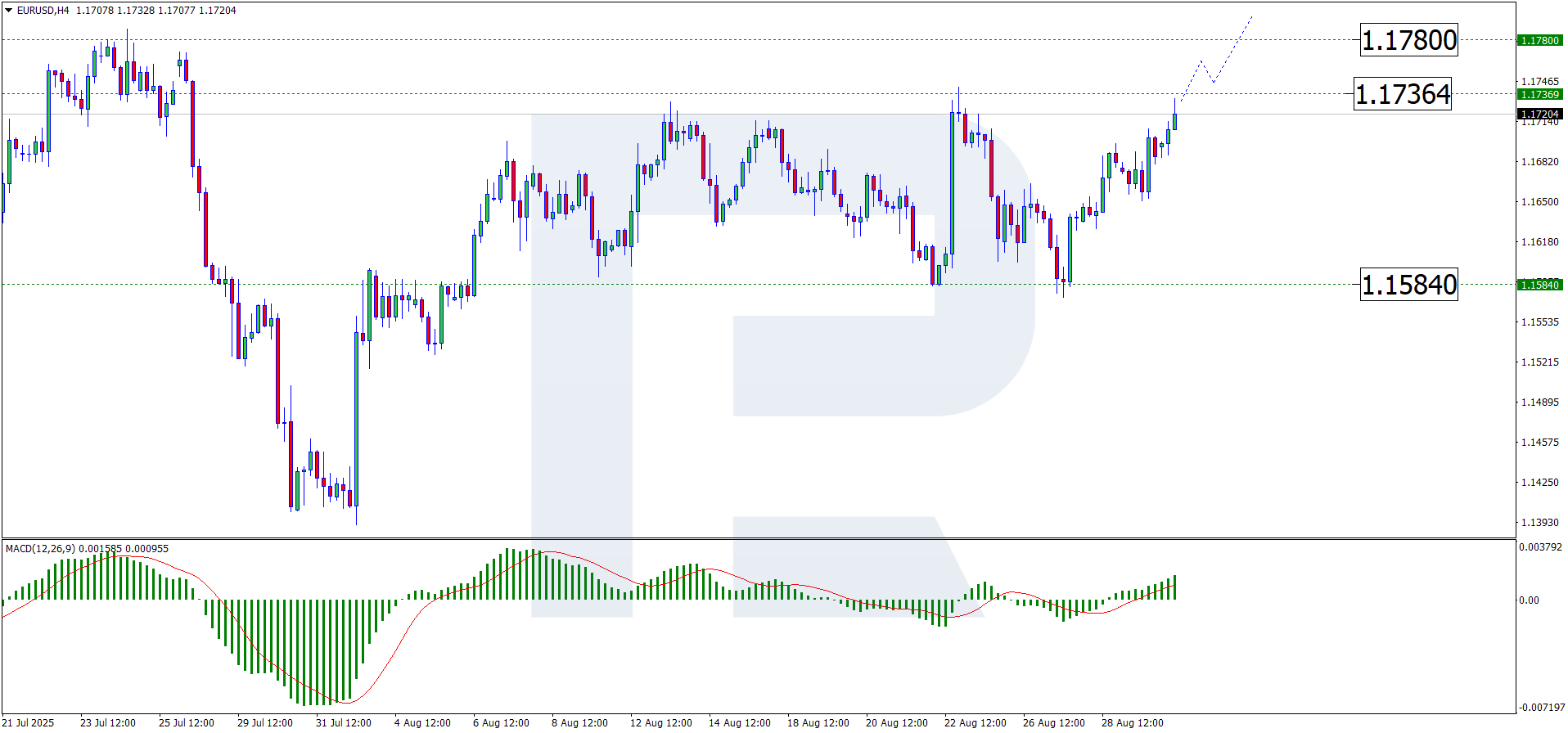
H4 Chart:

The EUR/USD has completed an upward wave towards 1.1788 on the H4 chart. Today, we expect a downward impulse to 1.1723, followed by a potential rebound to 1.1755. The pair is likely to enter a consolidation range near the peak of this upward wave, with a possible breakout to the downside towards 1.1670 as the primary target. This scenario is supported by the MACD indicator, where the signal line remains above zero but is trending sharply downward.

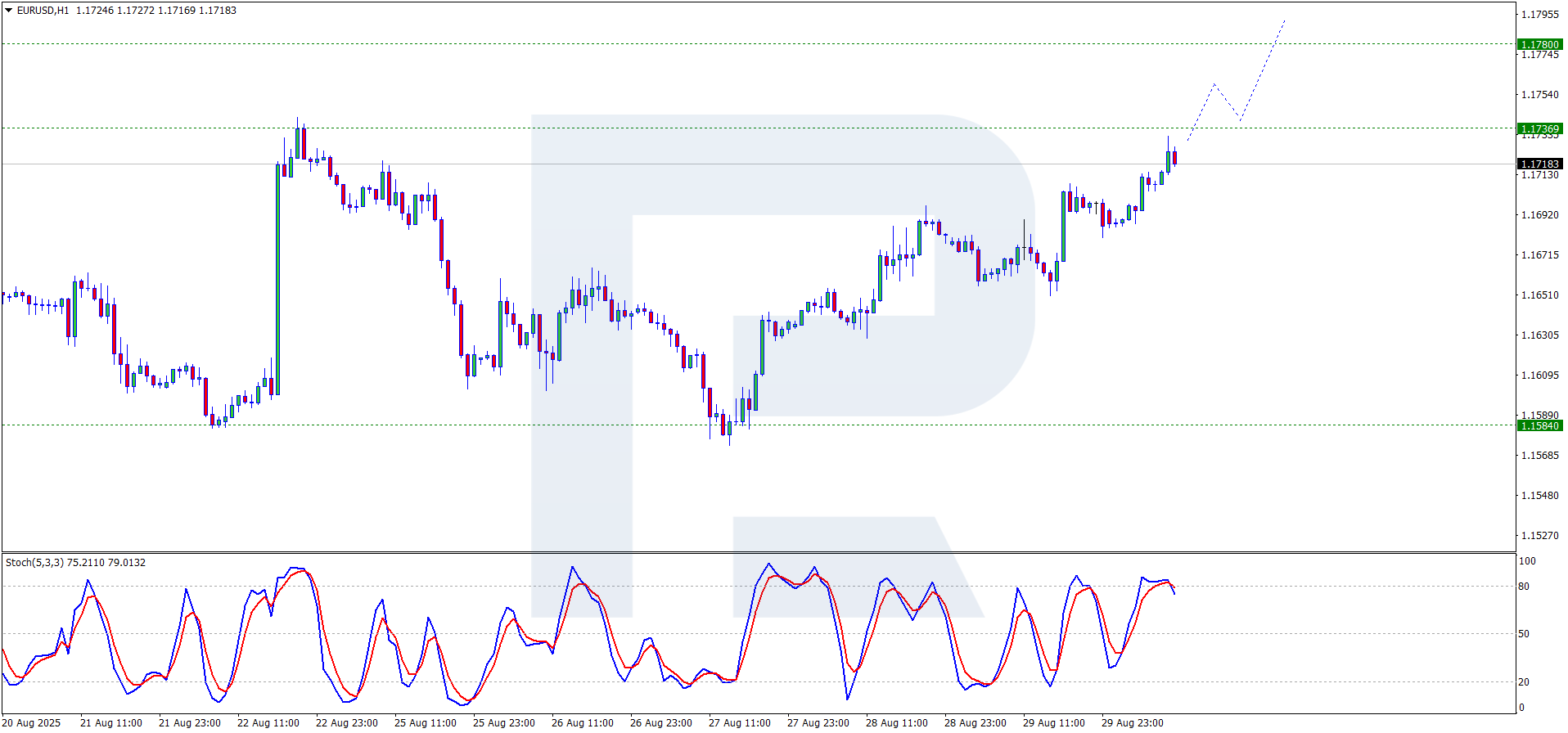
H1 Chart:

On the H1 timeframe, the pair is forming the initial structure of a downward wave targeting 1.1723. The first local target at 1.1733 has already been met. A corrective rise to 1.1755 may follow before another decline towards 1.1723. The Stochastic oscillator corroborates this outlook, with its signal line below 50 and pointing firmly downward towards 20.

Conclusion

The EUR/USD faces near-term pressure, but broader dollar weakness persists. Traders should monitor developments in trade policy and forthcoming Fed communications for directional cues, while technicals suggest further consolidation with a bearish bias.


Disclaimer

Any forecasts contained herein are based on the author’s particular opinion. This analysis may not be treated as trading advice. RoboForex bears no responsibility for trading results based on trading recommendations and reviews contained herein.

Strong Alphabet report pushes indices to new highs; US-Canada tariff talks stall

By JustMarkets 

On Thursday, the US stocks traded mixed: the Dow Jones Index (US30) fell by 0.70%. The S&P 500 (US500) rose by 0.07%, and the tech-heavy Nasdaq (US100) closed higher by 0.25%. The S&P 500 and Nasdaq 100 both ended Thursday at record highs, supported by strong earnings from Alphabet, which boosted investor confidence in AI-related investments.

Alphabet shares rose by 1% after the company beat Q2 expectations and raised its capital expenditure forecast for 2025 by $10 billion, lifting other tech giants like Microsoft, Nvidia, and Amazon. Tesla fell by 7.9% after CEO Elon Musk warned of challenging quarters ahead. Markets also focused on an unexpected visit by President Trump to the Federal Reserve, where he increased pressure on Chairman Powell regarding interest rates. Meanwhile, trade negotiations remained a key topic: progress was reported in talks with the EU, Japan, and South Korea, although Trump stated that tariffs would not fall below 15%.

The Canadian dollar traded near 1.36 per US dollar, rebounding sharply from the July 17 low of 1.374, aided by a weakening US dollar as optimism returned around US trade deals with Japan and the EU, possibly preventing tariff escalation. Rising crude oil prices also supported Canada’s export revenues and lent further strength to the loonie. However, the rally paused as markets shifted focus to the looming August 1 tariff deadline, with US-Canada talks deadlocked. At the same time, stronger June retail sales likely support domestic growth expectations and increase pressure on the Bank of Canada to extend its easing cycle.

European stock markets traded higher yesterday. Germany’s DAX (DE40) rose by 0.23%, France’s CAC 40 (FR40) closed down 0.41%, Spain’s IBEX35 (ES35) gained 1.34%, and the UK’s FTSE 100 (UK100) ended the day 0.85% higher. On Thursday, European stocks closed higher as markets evaluated the outlook for EU trade and monetary policy. The ECB kept interest rates unchanged and noted that disinflation is progressing in line with its previous forecasts. The central bank also stated that more information on economic developments is needed for further policy clarity. Nevertheless, markets trimmed expectations for rate cuts this year after ECB President Christine Lagarde said that cuts might be unjustified. Meanwhile, reports emerged that the US is likely to agree to reduce tariffs on the EU to 15%, the lowest level applied to other countries, amid a trade deal that EU diplomats are close to finalizing.

The UK’s GfK Consumer Confidence Index fell to 19 in July 2025 from 18 in June, pulling back from a six-month high as households became more cautious amid growing concerns about taxes and inflation. Finance Minister Rachel Reeves is expected to raise taxes for the second consecutive year in her upcoming budget, after Prime Minister Keir Starmer scrapped previous plans to cut billions in welfare spending. Amid uncertainty, households boosted savings, with GfK’s savings index jumping 7 points to 34, its highest since November 2007, reflecting a shift toward financial prudence.

Hopes that easing trade tensions will support global economic growth helped ease concerns over future oil demand. WTI crude prices rose 1.2% to $66 per barrel on Thursday, breaking a four-day losing streak. On the supply side, US crude inventories fell by 3.2 million barrels last week, more than double analysts’ expectations, signaling strong demand.

Asian markets mostly advanced yesterday. Japan’s Nikkei 225 (JP225) rose by 1.59%, China’s FTSE China A50 (CHA50) gained 0.11%, Hong Kong’s Hang Seng (HK50) increased by 0.51%, while Australia’s ASX 200 (AU200) declined by 0.32%.

In New Zealand, markets are pricing in a roughly 75% chance that the Reserve Bank of New Zealand will cut its official cash rate by 25 basis points from 3.25% at its August meeting, though investors suspect it may be near the end of the easing cycle. Meanwhile, RBNZ Chief Economist Paul Conway said Thursday that the central bank is prepared to lower rates further if price pressures continue to ease as expected, warning that US tariffs could weigh on economic growth and inflation. This week, the New Zealand dollar rose by 1%, ending a two-week losing streak.

The Australian dollar fell to around 0.658 USD on Friday, extending losses from the previous session as investors remained cautious ahead of next week’s key inflation data releases. Both monthly and quarterly inflation figures are expected, which could play a pivotal role in shaping the Reserve Bank of Australia’s monetary policy outlook. RBA Governor Michele Bullock recently emphasized that the central bank is not ready to cut interest rates until stronger evidence emerges that inflation is sustainably returning to its 2.5% target, defending the RBA’s slow and steady approach.

S&P 500 (US500) 6,363.35 +4.44 (+0.07%)

Dow Jones (US30) 44,693.91 −316.38 (−0.70%)

DAX (DE40) 24,295.93 +55.11 (+0.23%)

FTSE 100 (UK100) 9,138.37 +76.88 (+0.85%)

USD index 97.52 +0.31 (+0.32%)

News feed for: 2025.07.25

  • Japan Tokyo Core CPI (m/m) at 02:30 (GMT+3);
  • UK Retail Sales (m/m) at 09:00 (GMT+3);
  • German Ifo Business Climate (m/m) at 11:00 (GMT+3);
  • US Core Durable Goods Orders (m/m) at 15:30 (GMT+3).

By JustMarkets


This article reflects a personal opinion and should not be interpreted as an investment advice, and/or offer, and/or a persistent request for carrying out financial transactions, and/or a guarantee, and/or a forecast of future events.

Zimbabwe’s lithium is in demand for making batteries: how to make sure benefits flow to the local economy

By Jabulani Shaba, University of Groningen 

Zimbabwe has the largest lithium reserves on the African continent. Lithium has been mined since the colonial period in the 1950s. It’s a critical part of rechargeable lithium-ion batteries that are essential for the electric vehicle industry. Globally, the lithium-ion battery market is worth US$78.9 billion and is likely to amount to US$349.6 billion by 2034.

In 2021, there was a new lithium rush in Zimbabwe because of increased global demand for the mineral. Today, most of Zimbabwe’s lithium mines are owned by Chinese mining companies like Sinomine, Zhejiang Huayo Cobalt, Chengxin Lithium, Yahua and Canmax.

Lithium-ion batteries aren’t made in Zimbabwe. Instead, the country exports the mineral as a raw resource. Much of the value of Zimbabwe’s lithium – 480,000 metric tonnes mined since 2015 – is reaped by companies in China which make the raw lithium into batteries and other goods.

During the lithium rush, artisanal miners were involved in the lithium industry. They mined and sold raw ore. But their participation has recently slowed down because artisanal lithium mining is largely illegal. For this reason, official data reports haven’t been able to record how much lithium has been mined this way.

In 2022, the Zimbabwean government banned the export of raw lithium ore in an attempt to regulate the industry and curb artisanal lithium mining and illicit exports.

However, it was still permitted to export lithium concentrate (a powdered version of the raw mineral). But the government recently decided to ban the export of lithium concentrate from January 2027. It says the ban will improve the country’s efforts towards building facilities that add value to lithium, such as lithium refineries and battery production plants.

I research resource extraction and environmental change caused by mining in southern Africa.

If properly implemented and regulated, the new ban on exporting lithium concentrate could increase Zimbabwe’s self-sufficiency in lithium processing. It could even help the country achieve the middle-income economy it has set out in its Vision 2030, in which it aims to have a mining industry that generates US$12 billion a year in revenue. Zimbabwe has the world’s second largest reserves of platinum and huge supplies of chrome. Making goods locally from lithium would expand the mineral export revenue in addition to platinum and chrome.

However, becoming a middle-income nation is currently hampered by mining revenue leaking away – through losses from smuggling, tax evasion and others.

Also, environmental justice groups estimate that about 3,000 tonnes of raw lithium leaves the country daily. Between now and the time the 2027 ban on exporting lithium concentrate comes into effect, about 1.6 million additional tonnes of raw lithium could have been extracted and sent overseas. This means the government should not wait for 2027, but should implement the ban on lithium concentrate exports now.

The ban also doesn’t seem to be aimed at uplifting the livelihoods of communities who live near lithium mines. I describe these communities as living in sacrifice zones: they bear the brunt of lithium mining pollution and land grabs for mines. These vulnerable groups include women, children and artisanal lithium miners who have been disempowered by the just transition.

To use its lithium reserves to uplift the country, the government of Zimbabwe needs to establish local plans that place community development and improved livelihood of mining communities at the centre of mining. This could be done through pro-poor development policies that will create employment opportunities for local people in lithium mining frontiers. It could also include compelling mines to purchase locally made goods and fresh produce. Bringing artisanal miners into local value chains in gold, diamond and chrome mining would also help these informal miners become part of the formal mining economy.

The politics of lithium mining in Zimbabwe

Zimbabwe is one of the 10 biggest global lithium exporters (Chile, Argentina and Australia are others). In the first nine months of 2023 alone, it is estimated that about US$209 million worth of Zimbabwean lithium was sold.

The potential of lithium to stimulate economic development and attract international investments is unquestionable. The problem, however, over the last few years seems to be that the market isn’t regulated enough. Lithium mining has not created many jobs, and for the few that are employed, there’ve been gross human rights abuses, wage cuts, and a lack of investment in road infrastructure.

The politics of lithium mining are also shaped by networks of political elites. They are known as the lithium barons: people who engage in corrupt deals and smuggling.

Another problem has been the misplaced focus on artisanal miners. For example, the 2022 lithium ban mainly targeted artisanal lithium miners who were on the margins of the industry. It did not affect large-scale mining companies to the same extent. When the lithium ban was introduced, the market for processed lithium expanded and the demand for unprocessed lithium drastically shrank. This left artisanal miners with raw lithium and a shrinking market price.

What needs to happen next

Between now and 2027, lithium mining companies in Zimbabwe will try to extract as much lithium as possible before the ban comes into effect. This could deplete the lithium reserves in the country. Mining investors might look elsewhere.

The Zimbabwean government should take these steps to solve the problem:

1) The Zimbabwe government must ensure total monopoly of its lithium reserves. The over-reliance on Chinese investments in the lithium industry has set a bad precedent for what might happen with other minerals in future. It will take time for the government to undo this and set up its own monopoly. This resource sovereignty will be vital.

2) The government must consider how to govern minerals in a people-centred way. So far, lithium has not benefited ordinary Zimbabweans.

3) The resource communities where extraction deals are taking place must be consulted and brought into the conversation about how Zimbabwe can benefit from its lithium reserves. Communities in Zimbabwe like Buhera, Bikita, Mberengwa and Goromonzi have endured years of lithium mining pollution.

This includes their freshwater sources being contaminated by mines, toxic dust from blasting, mineworkers being exposed to hazardous and unsafe working conditions, displacement, and above all gross human rights abuses from multinational lithium mining companies.

4) The ban on the exports of lithium concentrates is crucial for stimulating local beneficiation and value addition. The government should implement this ban immediately rather than waiting for the 2027 timeline.The Conversation

About the Author:

Jabulani Shaba, Postdoctoral researcher, University of Groningen

This article is republished from The Conversation under a Creative Commons license. Read the original article.

Taiwan Looks to Drones to Fight China

Source: Streetwise Reports (7/22/25)

Like with this island in East Asia, militaries around the world are increasingly using drones, a staple in their arsenal, in conflict or training. This trend could benefit companies in the sector, including New Horizon Aircraft Ltd. (HOVR:NASDAQ), AIRO Group Holdings Inc. (AIRO:NASDAQ), AML3D Ltd. (AL3:ASX), and Firestorm Labs Inc.

The constant threat that China will invade Taiwan at any moment has the island continuing to prepare for war against the powerful country.

“Beijing’s Chinese Communist Party government claims Taiwan as its territory, though it has never ruled the island, and China’s rapid military buildup and coercive actions in the Taiwan Strait have led its neighbor to boost defense spending and order a series of high-profile weapons systems from the U.S.,” wrote Newsweek on July 15.

Last month Taiwan tested a first person-view kamikaze sea drone called Overkill, according to Firstpost. The government aims to build up to 25,000 of these units, equipped with artificial intelligence-enabled targeting and a precision camera.

Also, Taiwan just completed the largest version ever of its annual Han Kuan military exercise, reported Business Insider on July 14. The dual focus was on countering a Chinese invasion and, for the possibility such an event is successful, carrying out contingency plans.

“This comes as Taipei’s current government, known for resisting Beijing, grows increasingly concerned about emerging hostilities with mainland China,” the article explained. “Chinese leader Xi Jinping has pledged to reunify the island under Beijing’s control, and said his country would never renounce its right to use force to reach that goal.”

Other countries in the Asia-Pacific are preparing for an eventual China-Taiwan conflict, too. The Philippines, for example, is advancing a US$35 billion military modernization program, noted Newsweek. One of its several goals is to integrate into ground operations command and control systems, drones, and intelligence, surveillance, reconnaissance (ISR) tools, noted Inquirer.net.

As with the China-Taiwan tensions and other recent geopolitical conflicts around the globe, drones are increasingly taking center stage. For example, in the ongoing Myanmar conflict, both sides are now using drones, and so much so, the country ranks third, after Ukraine and Russia, for the number of drone events, according to Armed Conflict Location & Event Data in a July 1 article.

“This isn’t a tactical shift — but rather the start of a military revolution, tearing apart the old rules of war,” wrote Antonio Salinas and Jason P. LeVay, U.S. military analysts, in a May article. “What was once ‘no man’s land’ between trenches is now a drone kill zone, patrolled by flying munitions that loiter, observe, and strike with terrifying accuracy.”

All armed forces must adapt to this new reality, the authors asserted, or suffer total defeat in war.

Companies that could stand to benefit from drones dominating the battlefield, as well as increasing conflicts around the globe, include:

New Horizon Aircraft

Based in Ontario, Canada, New Horizon Aircraft Ltd. (HOVR:NASDAQ) is an advanced aerospace engineering company doing business as Horizon Aircraft and developing hybrid electric vertical takeoff and landing, or eVTOL, aircraft, according to its website.

Its prototype, the Cavorite X7, can take off vertically, but once in flight, its wing system reverts to that of a conventional airplane, providing the same speed, range, and operational utility. This hybrid eVTOL prototype is designed to fly in bad weather, including icy conditions, and it emits 30% less hydrocarbons than a traditional plane. Currently, the prototype is in a flight-testing phase. After completing this, Horizon intends to obtain certification of the Cavorite X7 and then scale production to meet demand from customers, including the military.

Recently, Horizon and ZeroAvia, a global hydrogen-electric powertrain company, announced their plan to collaboratively develop regional hydrogen-electric VTOL air travel, noted a news release.

Richard Ryan, analyst at Oak Ridge Financial Research, noted in his June 16 research report that in mid-May, Horizon achieved a full wing transition flight of Cavorite X7. A U.S. Executive Order signed subsequently intends to accelerate the safe commercialization of drone and other emerging technologies, such as eVTOL aircraft.

In light of these internal and external developments, Oak Ridge increased its target price on New Horizon by 45%. The new target implies a 44% return from HOVR’s share price at the close on July 18. Oak Ridge rates the company Buy.

D. Boral Capital Analyst Jesse Sobelson has a Buy rating on New Horizon and a target price suggesting 16.3% uplift, as noted in his June 9 research report. The consensus target price, according to Refinitiv, reflects 11.6% upside.

Refinitiv also reports that 14 strategic entities own 46.59% of New Horizon. The Top 3 are Canso Group with 16.23%, Robinson Family Ventures Inc. with 7.63% and William Brumder with 7.29%. Six institutional investors hold 0.34%. The rest is in retail.

New Horizon has 31.39 million (31.39M) outstanding shares and 16.76M free float traded shares. Its market cap is US$53.98 million (US$53.98M). Its 52-week range is US$0.24–2.52 per share.

AIRO Group 

AIRO Group Holdings Inc. (AIRO:NASDAQ) is an aerospace and defense company headquartered in Albuquerque, N.M., whose four divisions are drones, avionics, electric air mobility and training, notes the website. The drones segment develops, manufactures and sells drones. Military drones are sold through the Sky-Watch brand.

In recent news, AIRO concluded a highly specialized 90-day training support mission for Naval Special Warfare, “building on strong revenue growth in 2024 and H1/25 in its military training division,” as announced in a news release. The company provides elite training solutions to the U.S. Navy and U.S. Marine Corps’ Joint Terminal Attack Controller program.

According to Refinitiv, the consensus target price on AIRO suggests 8% return from the company’s share price at the end of trading on July 18. TipRanks reports that three analysts cover AIRO, and all of them rate it Buy.

As for ownership, Refinitiv reports that nine strategic investors own 64.71% of AIRO. The Top 3 are AIRO Executive Chairman Dr. Chirinjeev Kathuria with 19.46%, New Generation Aerospace LLC with 15.37% and Carter Aviation Technologies LLC with 11.1%. The rest is in retail.

AIRO has 26.17M outstanding shares and 9.24M free float traded shares. Its market cap is US$688.13M. its 52-week range is US$12.90–38.07 per share.

AML3D Ltd. 

AML3D Ltd. (AL3:ASX; AMLDF:OTCPK), based in Australia, specializes in large-scale metal three-dimensional (3D) printing using its patented wire additive manufacturing process that combines welding science, robotics automation, materials engineering, and proprietary software, the company’s website explains. The company manufactures and sells industrial metal 3D printers under the ARCEMY brand as well as large, high-performance metal components and structures, to defense, aerospace, maritime, manufacturing, mining, and oil and gas customers.

Earlier this month, AML3D received a letter of intent (LOI) from the U.S. Navy to collaborate on several key additive manufacturing initiatives. “The LOI focuses on AML3D’s ability to support materials characterization, parts manufacturing and supply of large scale ARCEMY metal 3D printing systems,” the news release noted.

Daniel Laing, Bell Potter analyst, and Abraham Akra, Shaw and Partners analyst, both cover AML3D. In a July 20 flash note, Bell Potter analyst Daniel Laing gave the company a Buy rating an US$0.35 valuation.

According to Refinitiv, 17 strategic entities own 16.58% of AML3D. The insider with the largest share is Andrew Sales, AML3D’s executive director and chief technology officer, with 4.84%.

Two institutions hold 10.76%. They are Netwealth Investments Ltd. with 5.78% and Regal Funds Management Pty. Ltd. with 4.97%. The rest is in retail.

AML3D has 542.14M outstanding shares and 451.77M free float traded shares. Its market cap is AU$112.54M. Its 52-week range is AU$0.105–0.325 per share.

Firestorm Labs Inc.

Firestorm Labs, a private company headquartered in San Diego, Calif., develops modular, open-architecture drones for rapid deployment in combat and expeditionary environments, according to its website. Its products integrate ISR, electronic warfare/signals intelligence and kinetic payload capabilities. Firestorm’s drones are mission adaptable and can be built any time, anywhere.

“Our unique ability to 3D print modular airframes on site dramatically reduces production timelines, costs and logistical constraints, giving the U.S. and allied forces the adaptive technology they urgently need in complex and contested operational environments,” Dan Magy, Firestorm chief executive officer, said in a July 16 news release.

This release announced that Firestorm secured US$47M in Series A funding. Lockheed Martin Ventures, Decisive Point, Washington Harbour Partners, Booz Allen Ventures, and other defense-focused investors participated in the round led by New Enterprise Associates.

Firestorm will use the capital to advance its additive-manufacturing platform, accelerate in-theater drone production, and scale xCell. xCell produces UAS systems and any 3d printed assets as required, but it’s primary purpose is not to house the above. It serves as a modular micro factory.


Important Disclosures:

  1. As of the date of this article, officers and/or employees of Streetwise Reports LLC (including members of their household) own securities of Firestorm.
  2. Doresa Banning wrote this article for Streetwise Reports LLC and provides services to Streetwise Reports as an independent contractor.
  3.  This article does not constitute investment advice and is not a solicitation for any investment. Streetwise Reports does not render general or specific investment advice and the information on Streetwise Reports should not be considered a recommendation to buy or sell any security. Each reader is encouraged to consult with his or her personal financial adviser and perform their own comprehensive investment research. By opening this page, each reader accepts and agrees to Streetwise Reports’ terms of use and full legal disclaimer. Streetwise Reports does not endorse or recommend the business, products, services or securities of any company.

For additional disclosures, please click here.
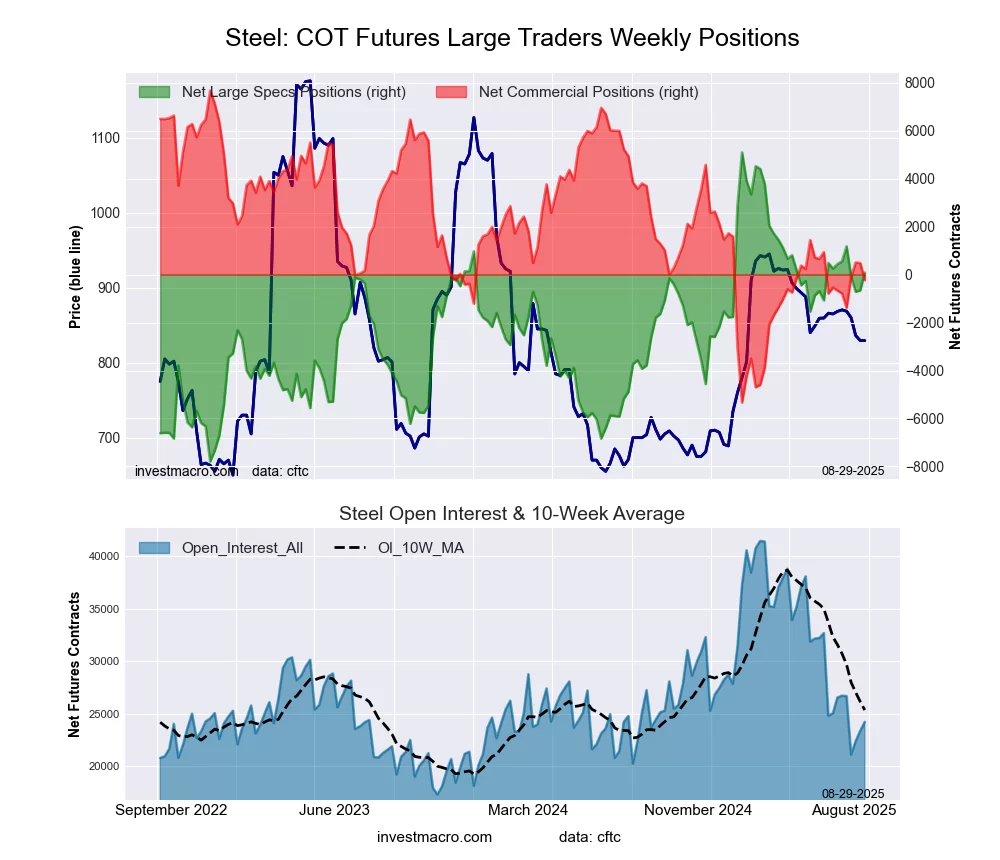
Mining Stock ETFs & Miners

Source: Stewart Thomson (7/23/25)

Newsletter writer Stewart Thomson addresses the question: Should investors own mining stock ETFs and some exciting individual miners?

As governments around the world race to implement fresh stagflationary tariff taxes, more spending, and debt, central banks and sovereign wealth funds are moving away from fiat currencies and government bonds.

They are moving into gold.

Here’s a look at the daily chart:

A symmetrical triangle pattern breakout appears imminent, and the target of this pattern is about $3800.

Silver tends to lag gold when deflation is in play and lead it when the big theme is inflation. In recent months, silver has taken the lead baton from gold, and I’ve suggested it could continue to lead until the year 2026 or even 2027.

Here’s a look at the chart:

Silver is making a beeline to the $44 zone, and even some mainstream money managers are taking notice.

In this environment, gold and silver stocks have begun to surge, but they are still so undervalued that senior miners could rise hundreds of percent before they hit “fair value.”

Junior miners could rise thousands of percent, and in some cases tens of thousands of percent. The current state of undervaluation of miners versus metal is truly surreal.

Here’s a look at the weekly GDXJ ETF chart:

There are numerous bull flags on the chart, and a fresh upside breakout is occurring from one of those flags now.

Silver stocks? They look even better!

Here’s a look at the SILJ chart:

Note the gargantuan volume that has accompanied the inverse H&S pattern breakout. It’s almost surreal!

I’ve talked about a “seasonal inversion,” where instead of swooning from July to October, the miners stage a mighty surge higher.

Well, that surge appears to be getting underway now, and the biggest price action of all appears to be occurring in junior miners that are in the CDNX

Here’s a look at the weekly CDNX chart:

A short-term pullback would be a “gift” for investors, but it may not occur.

Charts that are as bullish as this one tend to feature only very short pullbacks that don’t last long.

There are several individual miners that look very good this week. One of them is Big Ridge Gold Corp. (BRAU:TSXV; ALVLF:OTCQB).

They are reinvigorating a past producing property in Newfoundland.

What’s interesting is that gold was stuck in a rough $300-$500 range during the previous operation.

So, a lot of additional gold could be there . . .  gold that wasn’t worth mining at the time.

Here’s the Big Ridge chart:

I have a $2 target price for this stock, and if it’s hit, the CDNX may only be in the 1000 area at that point, which is the neckline zone of its massive H&S base pattern.

The bottom junior mining stocks line: What looks like a high price or “overbought” situation needs to be taken in the context of a very large 40-year inflation cycle that is only in year 5 of the cycle. Arguably, the junior miners offer the greatest value in the modern history of markets, and the word that best sums it all up could be: Enjoy!

Special Offer for Streetwise Readers: Please send me an Email to [email protected] and I’ll send you my free “Copper, Gold, & Rare Earths Too!” report. I highlight key junior resource stocks that are trading under $1/share and ready to soar! Key buy and sell tactics are included in this report. I write my junior resource stocks newsletter 2-3 times a week, and at just $199/12mths it’s an investor favorite. I’m doing a special pricing this week of $169 for 14mths.  Click this link or send me an email if you want the offer and I’ll get you onboard. Thank-you.


Important Disclosures:

  1. Stewart Thomson: I, or members of my immediate household or family, own securities of: None. My company has a financial relationship with: None. My company has purchased stocks mentioned in this article for my management clients: None. I determined which companies would be included in this article based on my research and understanding of the sector.
  2. Statements and opinions expressed are the opinions of the author and not of Streetwise Reports, Street Smart, or their officers. The author is wholly responsible for the accuracy of the statements. Streetwise Reports was not paid by the author to publish or syndicate this article. Streetwise Reports requires contributing authors to disclose any shareholdings in, or economic relationships with, companies that they write about. Any disclosures from the author can be found  below. Streetwise Reports relies upon the authors to accurately provide this information and Streetwise Reports has no means of verifying its accuracy.
  3.  This article does not constitute investment advice and is not a solicitation for any investment. Streetwise Reports does not render general or specific investment advice and the information on Streetwise Reports should not be considered a recommendation to buy or sell any security. Each reader is encouraged to consult with his or her personal financial adviser and perform their own comprehensive investment research. By opening this page, each reader accepts and agrees to Streetwise Reports’ terms of use and full legal disclaimer. Streetwise Reports does not endorse or recommend the business, products, services or securities of any company.

For additional disclosures, please click here.

Stewart Thomson Disclosures

Stewart Thomson is no longer an investment advisor. The information provided by Stewart and Graceland Updates is for general information purposes only. Before taking any action on any investment, it is imperative that you consult with multiple properly licensed, experienced and qualified investment advisors and get numerous opinions before taking any action. Your minimum risk on any investment in the world is: 100% loss of all your money. You may be taking or preparing to take leveraged positions in investments and not know it, exposing yourself to unlimited risks. This is highly concerning if you are an investor in any derivatives products. There is an approx $700 trillion OTC Derivatives Iceberg with a tiny portion written off officially. The bottom line:

Are You Prepared?

Oil prices have been declining for four consecutive days. Natural gas prices have fallen to a two-month low

By JustMarkets 

On Wednesday, the US stocks closed with solid gains: the Dow Jones (US30) rose by 1.14%, the S&P 500 (US500) increased by 0.78%, and the tech-heavy Nasdaq (US100) closed up 0.61%. The US equities extended their gains on Wednesday following reports that the US would agree to a trade deal with the EU, building on previous momentum from a deal with Japan. Reports indicate that the US is close to reaching an agreement to lower tariffs on EU goods from 30% to 15%, aligning with the measures taken with Japan and reinforcing expectations that aggressive tariffs will be scaled back by August. Optimistic corporate earnings also supported the indices.

European stock markets traded higher yesterday. Germany’s DAX (DE40) rose by 0.83%, France’s CAC 40 (FR40) ended up 1.37%, Spain’s IBEX35 (ES35) gained 0.19%, and the UK’s FTSE 100 (UK100) closed 0.42% higher. European stocks ended Wednesday with a strong rebound, breaking a three-day losing streak, amid expectations that the US might agree to lower tariff rates after reaching a new trade deal with Japan. Progress on automotive tariffs, which heavily impact car manufacturers, drove gains in the shares of BMW, Stellantis, Mercedes-Benz, and Volkswagen, rising between 4% and 9%. Additionally, UniCredit jumped 3.5% after releasing its earnings, although the bank confirmed it had abandoned its planned acquisition of Banco BPM due to opposition from Rome.

WTI crude oil prices fell to $65 per barrel on Wednesday, marking a fourth straight day of declines, as investors focused on US trade negotiations. Treasury Secretary Scott Bessent said he would meet with Chinese officials in Stockholm next week to discuss an extension of the trade truce, possibly including Chinese purchases of Russian and Iranian oil under sanctions. Meanwhile, US government data showed crude inventories fell by 3.17 million barrels last week, exceeding expectations. Despite the sharper-than-expected inventory drop, oil prices remain under pressure due to concerns that ongoing tariff tensions could weaken global demand, even as OPEC+ increases production.

The US natural gas prices fell by more than 5% to below $3.10 per MMBtu, the lowest level since April 22, pressured by near-record production levels and expectations for milder weather than previously expected. Despite summer heat, analysts expect record output to continue supporting robust storage replenishment. Current inventories are already 6% above seasonal norms.

Asian markets mostly rose yesterday. Japan’s Nikkei 225 (JP225) jumped by 3.51%, China’s FTSE China A50 (CHA50) increased by 0.30%, Hong Kong’s Hang Seng (HK50) gained 1.62%, and Australia’s ASX 200 (AU200) posted a 0.69% rise.

On Tuesday, the Hang Seng Index closed at 25,538, marking its fourth consecutive gain and reaching its highest level in nearly four years. The rally was driven by broad sectoral gains and optimism ahead of a scheduled US-China meeting in Stockholm next week, the third round of talks aimed at extending the tariff truce. Bullish sentiment was further fueled by reports that daily trading volume on Chinese stock markets surged to a nearly five-month high, while margin financing reached its highest level in nearly four months. Meanwhile, Beijing recently approved the construction of a massive hydroelectric power plant in Tibet.

Stocks in Singapore rose to 4,252 in early Thursday trading, posting their 14th consecutive session of gains, following Wall Street’s rally on Wednesday after the US reached trade deals with the EU. Data released Wednesday showed that overall inflation in June remained at its lowest level since February 2021, with core inflation steady at 0.6%, below expectations and within the Monetary Authority of Singapore’s annual target range of 0.5% to 1.5%. These solid figures followed last week’s data showing stronger-than-expected Q2 GDP growth and the fastest export growth in 11 months.

S&P 500 (US500) 6,358.91 +49.29 (+0.78%)

Dow Jones (US30) 45,010.29 +507.85 (+1.14%)

DAX (DE40) 24,240.82 +198.92 (+0.83%)

FTSE 100 (UK100) 9,061.49 +37.68 (+0.42%)

USD Index 97.21 −0.18 (−0.18%)

News feed for: 2025.07.24

  • Australia Manufacturing PMI (m/m) at 02:00 (GMT+3);
  • Australia Services PMI (m/m) at 02:00 (GMT+3);
  • Japan Manufacturing PMI (m/m) at 03:30 (GMT+3);
  • Japan Services PMI (m/m) at 03:30 (GMT+3);
  • Germany GfK Consumer Confidence (m/m) at 09:00 (GMT+3);
  • Germany Manufacturing PMI (m/m) at 10:30 (GMT+3);
  • Germany Services PMI (m/m) at 10:30 (GMT+3);
  • Eurozone Manufacturing PMI (m/m) at 11:00 (GMT+3);
  • Eurozone Services PMI (m/m) at 11:00 (GMT+3);
  • UK Manufacturing PMI (m/m) at 11:30 (GMT+3);
  • UK Services PMI (m/m) at 11:30 (GMT+3);
  • Eurozone ECB Interest Rate Decision at 15:15 (GMT+3);
  • Eurozone ECB Monetary Policy Statement at 15:15 (GMT+3);
  • Canada Retail Sales (m/m) at 15:30 (GMT+3);
  • US Initial Jobless Claims (w/w) at 15:30 (GMT+3);
  • Eurozone ECB Press Conference at 15:45 (GMT+3);
  • US Manufacturing PMI (m/m) at 16:45 (GMT+3);
  • US Services PMI (m/m) at 16:45 (GMT+3);
  • US New Home Sales (m/m) at 17:00 (GMT+3);
  • US Natural Gas Storage (w/w) at 17:30 (GMT+3).

By JustMarkets


This article reflects a personal opinion and should not be interpreted as an investment advice, and/or offer, and/or a persistent request for carrying out financial transactions, and/or a guarantee, and/or a forecast of future events.