Gold gains, but lags 5 other FXTM commodities

By ForexTime

  • Gold edges up 0.2% today; still stuck in sideways range since April
  • Bullion’s year-to-date gains now at 13.1%
  • Bloomberg model: Gold may be range-bound for another month
  • Fed rate cuts, PBOC buying needed to trigger next leg up
  • 5 other FXTM commodities outperformed gold so far in 2024


Gold’s luster has been waning of late.

To be certain, the precious metal added to its 13% gains from 2023 with a further 13% so far in 2024.

Despite posting fresh record highs in recent months, gold’s gains have stalled since mid-April.

Notice how spot gold attempted to break above the $2430 line back in mid-April and mid-May.

Those intraday spikes however could not be sustained.

Although edging higher at the time of writing, gold has been trading back below its 50-day simple moving average (SMA) for the first time since February 2024.


Why has gold’s rally stalled?

1) Lowered bets for Fed rate cuts this year

Back in March 2024, markets were according up to a 92% chance that the Fed would lower its benchmark rates by a total of 75 basis points (three rate cuts of 25-basis points each) by year-end.

Recall that gold offers no interest (zero yield) to holders of this asset. Hence, lower interest rates tend to reduce the opportunity cost of holding gold.

In other words, lower rates boost the appeal of zero-yielding gold.

But with markets now predicting just two rate cuts (25-bps each) by the Fed this year, that has curbed gold’s upside, though providing support for the precious metal in the interim.


2) PBOC halted gold purchases

A big driver of gold’s surge has been the persistent buying from major central banks, especially the People’s Bank of China.

The PBoC bought about 10 million troy ounces worth of the precious metal since November 2022, as it sought to pad up and diversify its foreign reserves.

However, on 7th June 2024, it was revealed that the PBoC halted its 18-month buying spree in May 2024.

That news triggered a 3.5% drop in spot gold and dragged prices well below the 50-day SMA.


What could make gold’s rally resume?

  • Fed rate cuts

As mentioned earlier, markets need greater certainty that the Fed can indeed press ahead with its intended rate cuts.

Given its stated “data dependent” stance, the incoming US jobs/inflation data may prompt gold bulls to charge on once again.

  • Central bank buying

The PBoC and other central banks may yet be compelled to return to the market, either due to a further need to increase their foreign reserves, or if lower gold prices prove attractive enough.

A resumption of their buying spree should give fresh impetus for gold to move higher once more.


How is gold expected to perform over the days/weeks ahead?

According to Bloomberg’s model:

  • 74% chance of $2286 – $2382 over the next one-week period
  • 73% chance of $2246 – $2439 over the next one month.

Contrasting the above forecasted ranges to current prices …

Gold appears to retain a downside bias, with less chance of posting a new record high by mid-July.

Such an outlook would be keeping with the downtrend (lower highs and lower lows) since its current record high of $2450.03 on May 20th.

The Fed is also unlikely to give more concrete signals about its policy intentions before these central bankers are shown another couple months’ worth of jobs/inflation data.

The next FOMC policy meeting isn’t slated until July 31st.

Hence, gold bulls might have to bide their time in the interim, and perhaps endure bouts of profit-taking that results in dips for spot gold prices.


How has the rest of the FXTM commodities complex performed?

FXTM recently launched 10 new commodities, adding to the ranks that already feature Gold, Silver, Brent (oil), Crude (US crude oil), and NatGas (Natural Gas).

While gold’s 13% in year-to-date gains is certainly notable, it still lags behind the year-to-date gains seen in Silver, as well as 5 of those new commodities:

  1. Cocoa: +136.8%
  2. Robusta: +34.3%
  3. Silver: +24%
  4. Arabica: +20%
  5. Copper: +16.8%


Certainly it has been a good year so far for commodity bulls, thanks to lacking supply and resilient demand across the global economy.

  • However, if the global economic outlook deteriorates, due to demand-destroying elevated interest rates, that could prompt these commodities to unwind these stellar year-to-date gains.
  • To the upside, should major central banks press ahead with their plans to lower interest rates, which is supportive of demand for these commodities, that could boost these commodity prices even higher.

Either way, traders who are primed and ready stand to reap sizeable trading opportunities along the way, either up or down.


Forex-Time-LogoArticle by ForexTime

ForexTime Ltd (FXTM) is an award winning international online forex broker regulated by CySEC 185/12 www.forextime.com

The escalation of conflicts in different regions of the world supports oil prices

By JustMarkets

At the end of yesterday, the Dow Jones Index (US30) gained 0.15%, while the S&P 500 Index (US500) rose 0.25% to an all-time high. The NASDAQ Technology Index (US100) closed positive 0.03%. Strengthening chipmakers helped boost the overall market on Tuesday, led by a 3% gain in Nvidia (NVDA) shares after Rosenblatt Securities raised its price target on the stock.

The US economic news on Tuesday was mixed for stocks. May retail sales rose less than expected and raised concerns about consumer spending. However, a stronger-than-expected manufacturing output report for May eased concerns about a slowdown in consumer spending. Fed comments on Tuesday were mostly on the hawkish side, as policymakers said they would prefer to wait to cut interest rates.

According to Fitch Ratings’ latest estimate, global economic growth will strengthen this year and slow in 2025. The rating agency raised its prognosis for global GDP growth in 2024 to 2.6%, from its previous prediction of 2.4%. The revised outlook reflects Fitch’s increased confidence in European economic recovery prospects, strengthening domestic demand in emerging markets (excluding China).

Equity markets in Europe were mostly up on Tuesday. Germany’s DAX (DE40) rose by 0.35%, France’s CAC 40 (FR40) closed 0.76% higher, Spain’s IBEX 35 (ES35) jumped 0.99%, and the UK’s FTSE 100 (UK100) closed positive 0.60%. The Eurozone’s annual inflation rate for May 2024 was 2.6%, up from 2.4% in April. A year earlier, the figure stood at 6.1%. The lowest annual rates were recorded in Latvia (0.0%), Finland (0.4%), and Italy (0.8%). The highest annual rates were recorded in Romania (5.8%), Belgium (4.9%) and Croatia (4.3%). Compared to April, annual inflation fell in eleven Member States, remained unchanged in two, and rose in fourteen.

WTI crude oil prices held near $81.5 a barrel on Wednesday, at their highest levels in seven weeks, as the escalating conflict in Eastern Europe and the Middle East renewed supply concerns. In Russia, a Ukrainian drone strike sparked a fire at an oil terminal at a major port, while a senior Israeli official warned of a looming “all-out war” with Lebanon’s Hezbollah. Oil prices were also supported by global demand growth estimates, with OPEC, the IEA, and the US EIA all predicting strong oil demand growth in the second half of this year.

Asian markets traded yesterday without any unified dynamics. Japan’s Nikkei 225 (JP225) gained 1.00%, China’s FTSE China A50 (CHA50) decreased by 0.09%, Hong Kong’s Hang Seng (HK50) was down 0.11%, while Australia’s ASX 200 (AU200) was positive 1.01%.

Hong Kong stocks rose in early trading on Wednesday, recovering from sluggish sessions in the previous two sessions as all sectors rose. The index approached its highest level in a fortnight as traders sought to take new positions following the Hong Kong government’s announcement that markets in the Asian financial center will remain open during typhoons and extreme weather conditions from September 23. Investors are also awaiting the People’s Bank of China’s lending rate decision on Thursday after the Central Bank decided earlier this week to leave the medium-term lending rate unchanged at 2.5%.

The Reserve Bank of Australia took a hawkish tone in a press conference after this week’s meeting, warning of upside risks to inflation. RBA Governor Michele Bullock also said the board discussed the need to raise the interest rate at its June meeting, while arguments for a rate cut were not considered. These comments came after the Central Bank left the money rate unchanged at 4.35% for the fifth consecutive meeting, as expected.

New Zealand’s inflation rate has slowed significantly recently. However, it remains above both pre-pandemic levels and the Monetary Policy Committee’s (MPC) target range of 1% to 3%. Compared to other countries, labor market shortages caused by the border closure have played an important role in driving up inflation in New Zealand. Recent research emphasizes that the emergence of spare capacity in the economy will lead to lower domestic inflation.

S&P 500 (US500) 5,487.03 +13.80 (+0.25%)

Dow Jones (US30) 38,834.86 +56.76 (+0.15%)

DAX (DE40) 18,131.97 +63.76 (+0.35%)

FTSE 100 (UK100) 8,191.29 +49.14 (+0.60%)

USD Index 105.25 −0.07 (−0.06%)

Important events today:
  • – Japan BoJ Monetary Policy Meeting Minutes (m/m) at 02:50 (GMT+3);
  • – Japan Trade Balance (m/m) at 02:50 (GMT+3);
  • – UK Consumer Price Index (m/m) at 09:00 (GMT+3);
  • – UK Producer Price Index (m/m) at 09:00 (GMT+3).

By JustMarkets


This article reflects a personal opinion and should not be interpreted as an investment advice, and/or offer, and/or a persistent request for carrying out financial transactions, and/or a guarantee, and/or a forecast of future events.

Brent oil has risen in price: reliance on stock market demand has worked

By RoboForex Analytical Department

The commodity market was adjusted moderately on Tuesday morning after the price of Brent crude oil rose by 2% the day before. A barrel of the North Sea variety is at about 84 USD.

The main support factor currently is the improving prospects for global demand. Additionally, there are expectations that global oil producers will restrain supply.

The latest oil market reports from OPEC+, the International Energy Agency and the US Department of Energy suggest a steady increase in energy demand in the second half of 2024.

Yesterday’s surge in Brent’s price was also supported by an increase in the value of the entire range of risky assets. This is due to reduced inflationary pressures in the world’s largest economies. Such signals strengthen the bet on lowering the cost of lending in the coming months.

The proposal is underpinned by the collaborative efforts of key OPEC+ member countries, including Russia and Iraq, which have confirmed their intentions to adhere to the agreed production quotas. Saudi Arabia has also expressed its readiness to adjust production volumes to fully account for market conditions.

Technical analysis of Brent

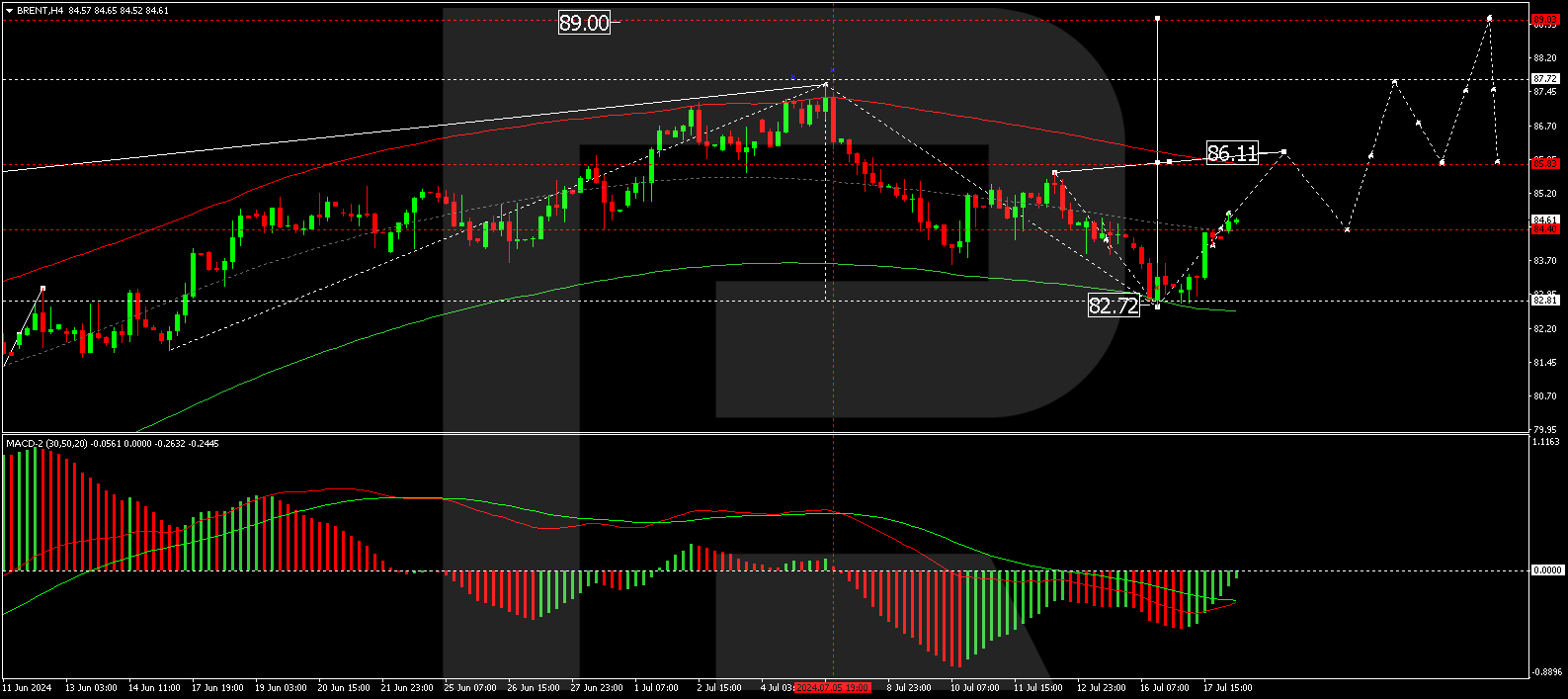
On the H4 Brent chart, the market has formed a consolidation range above the 81.60 level. Today, the price has moved up from this range, continuing to develop a wave of growth to the level of 86.40. After achieving this level, we anticipate a correction to 81.60. Next, we expect the trend to continue to the level of 89.00. This scenario is technically confirmed by the MACD indicator, with its signal line above the zero mark and directed strictly upwards.

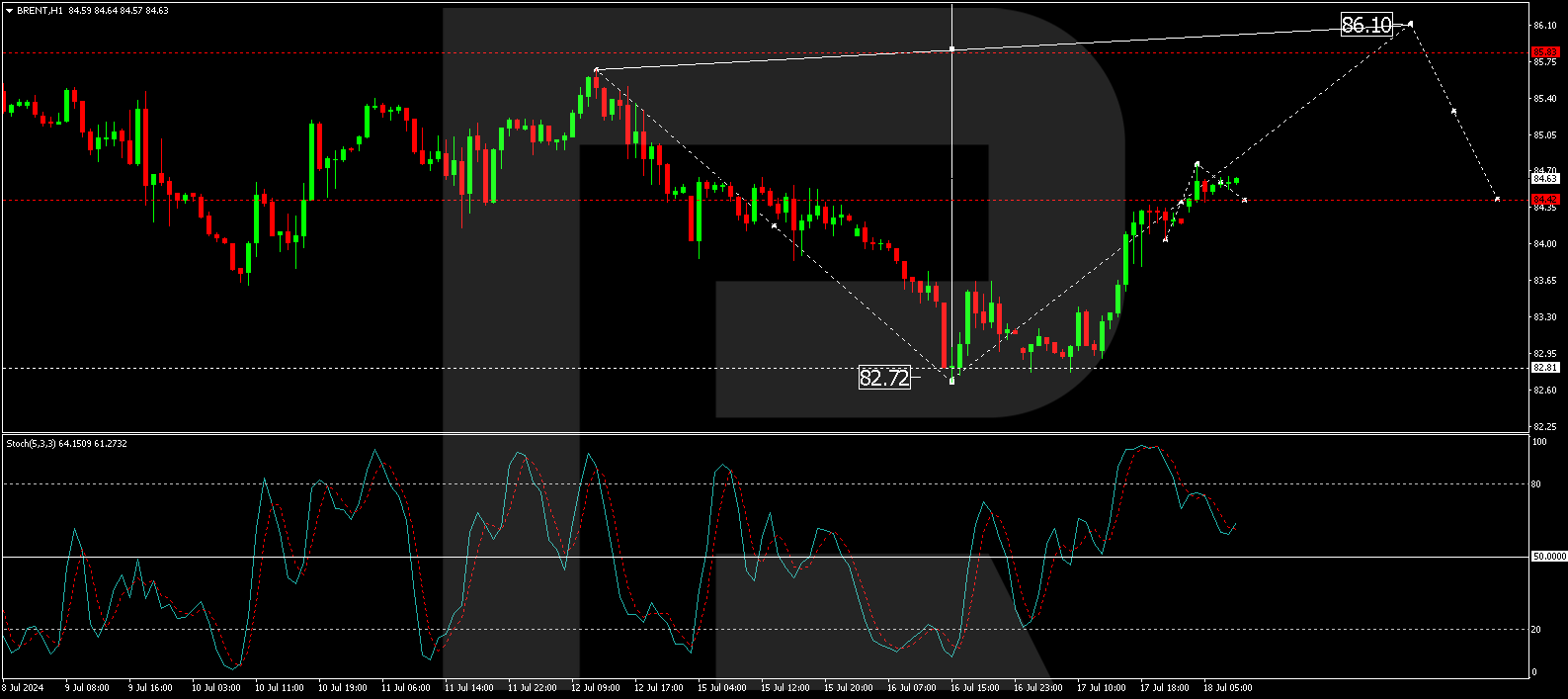
On the H1 Brent chart, the market received support at 81.56 and began the development of the second half of the growth wave. At the moment, the local target at the level of 83.98 is fulfilled. Today, a link of growth to 84.00 is possible. Next, we expect a correction link to the level of 82.76 (test from above), followed by an increase to the level of 86.40. Technically, this scenario is confirmed by the Stochastic oscillator. Its signal line is below the level of 20 and is preparing for the start of growth.


Disclaimer

Any forecasts contained herein are based on the author’s particular opinion. This analysis may not be treated as trading advice. RoboForex bears no responsibility for trading results based on trading recommendations and reviews contained herein.

The RBA kept interest rates on hold and remained hawkish. Oil rises as global demand outlook improves

By JustMarkets

At the end of yesterday, the Dow Jones Index (US30) added 0.49%, while the S&P 500 Index (US500) was up 0.77%. The NASDAQ Technology Index (US100) closed positive 0.95%. On Monday, the S&P 500 Index (US500) closed at a record high, ignoring rising Treasury yields, with technology stocks continuing to rise amid continued Fed speeches. Philadelphia Fed President Patrick Harker said on Monday that he expects only one rate cut if the economy performs as expected, as current rate levels are likely to keep inflation lower and prevent the risk of higher inflation. Markets rate the odds of a 25bp rate cut at 8% for the next FOMC meeting on 30–31 July and 59% for the 17–18 September meeting.

Also positive for US equities, Citigroup raised its outlook for US equities to “overweight” from “neutral.” It lowered its outlook for European equities to “neutral” from “overweight,” citing a “significantly greater pro-growth bias in the US compared to Europe.”

Moderna (MRNA) closed down over 1% on signs of insider selling after director Afeyan sold $2.21 million shares last Wednesday. Tesla (TSLA) closed higher by more than 5% after Bloomberg reported that the company received approval to test its advanced driver assistance system on streets in China.

Equity markets in Europe were mostly up on Monday. Germany’s DAX (DE40) rose by 0.37%, France’s CAC 40 (FR40) closed higher by 0.91%, Spain’s IBEX 35 (ES35) fell by 0.30% and the UK’s FTSE 100 (UK100) closed negative 0.06%. French political risks eased slightly with Marine Le Pen saying she would cooperate with French President Macron if she wins the upcoming French election.

WTI crude oil prices held above the $80 per barrel mark on Tuesday, having risen nearly 2% in the previous session, thanks to an improving global demand outlook and expectations that major oil producers will keep supply low. Recent market outlook reports from OPEC, the International Energy Agency, and the US Energy Information Administration pointed to strong growth in oil demand in the second half of this year. Oil prices also followed a broad rally in risk assets as easing inflationary pressures in major economies boosted hopes of interest rate cuts in the coming months.

Asian markets were predominantly falling yesterday. Japan’s Nikkei 225 (JP225) fell by 1.83%, China’s FTSE China A50 (CHA50) was down 0.17%, Hong Kong’s Hang Seng (HK50) lost 0.03%, and Australia’s ASX 200 (AU200) was negative 0.31%.

The Reserve Bank of Australia (RBA) kept the cash rate at 4.35% at its June meeting, leaving borrowing costs unchanged for the fifth time. At the same time, the Central Bank again warned that inflation is still above the mid-point of the target range of 2–3% due to the continued high cost of services. The board is still not ruling anything out and will rely on incoming data. At the same time, there have been signs of softening economic activity, as evidenced by slowing GDP growth, rising joblessness, and slower-than-expected wage growth.

Bank of Japan Governor Kazuo Ueda told the Japanese Parliament that he may raise interest rates again at the July meeting depending on upcoming economic data. He also noted that rising import costs caused by a weak yen could hurt household spending but added that rising wages could boost consumption. This could be the foundation for a trend reversal in the yen.

S&P 500 (US500) 5,473.23 +41.63 (+0.77%)

Dow Jones (US30) 38,778.10 +188.94 (+0.49%)

DAX (DE40) 18,068.21 +66.19 (+0.37%)

FTSE 100 (UK100) 8,142.15 −4.71 (−0.06%)

USD Index 105.34 −0.21 (−0.2%)

Important events today:
  • – Australia RBA Interest Rate Decision at 07:30 (GMT+3);
  • – Australia RBA Rate Statement at 07:30 (GMT+3);
  • – Australia RBA Press Conference at 08:30 (GMT+3);
  • – German ZEW Economic Sentiment (m/m) at 12:00 (GMT+3);
  • – Eurozone ZEW Economic Sentiment (m/m) at 12:00 (GMT+3);
  • – Eurozone Consumer Price Index (m/m) at 12:00 (GMT+3);
  • – US Retail Sales (m/m) at 15:30 (GMT+3);
  • – US Industrial Production (m/m) at 16:15 (GMT+3).

By JustMarkets


This article reflects a personal opinion and should not be interpreted as an investment advice, and/or offer, and/or a persistent request for carrying out financial transactions, and/or a guarantee, and/or a forecast of future events.

Central banks face threats to their independence – and that isn’t good news for sound economic stewardship (or battling inflation)

By Cristina Bodea, Michigan State University and Ana Carolina Garriga, University of Essex 

Nearly every country in the world has a central bank – a public institution that manages a country’s currency and its monetary policy. And these banks have an extraordinary amount of power. By controlling the flow of money and credit in a country, they can affect economic growth, inflation, employment and financial stability – all things that can, if played right, provide politicians with economic boosts around election time, only to saddle the economy with problems further down the line.

That is why, recently, central banks across the globe received significant leeway to set interest rates independently and free from the electoral wishes of politicians.

In fact, monetary policymaking that is data-driven and technocratic – rather than politically motivated – has since the early 1990s been seen as the gold standard of governance of national finances. By and large, this arrangement – in which central bankers keep politicians at arm’s length – has achieved its main purpose: Inflation has been relatively low and stable in countries with independent central banks, such as Switzerland or Sweden – certainly until the pandemic and war in Europe began pushing up prices globally.

In comparison, countries such as Lebanon or Egypt, where independence was never extended, or Argentina and Turkey, where it has been curtailed, have experienced more bouts of high inflation.

But despite independence being seen to work, central banks over the past decade have come under increased pressure from politicians. They hope to keep interest rates low and reap voter gratitude for a humming economy and cheap loans.

Donald Trump is one recent example. While president, Trump criticized his own choice to head the U.S. Federal Reserve and demanded lower interest rates. Now, should Trump return to the White House, some of his allies have drawn up plans that would see a reelected Trump sitting in the Fed’s interest rate-setting meetings or, at the very least, replace current Fed Chair Jerome Powell.

Similarly, the Bank of England’s independence has been formally put under review. The British government has also publicly pressured the Bank of England to cut interest rates, presumably to bolster the economy in advance of July’s general election.

As political economists, we are not surprised to see politicians try to exert influence on central banks. Monetary policy, even with independence, has always been political. For one thing, central banks remain part of the government bureaucracy, and independence granted to them can always be reversed – either by changing laws or backtracking on established practices.

Moreover, the reason politicians – especially those facing an election – may want to interfere in monetary policy is that low interest rates remain a potent, quick method to boost an economy. And while politicians know that there are costs to besieging an independent central bank – financial markets may react negatively, or inflation may flare up – short-term control of a powerful policy tool can prove irresistible.

Legislating independence

If monetary policy is such a coveted policy tool, how have central banks held off politicians and stayed independent? And is this independence being eroded?

Broadly, central banks are protected by laws that offer long tenures to their leadership, allow them to focus policy primarily on inflation, and severely limit lending to the rest of the government.

Of course, such legislation cannot anticipate all future contingencies, which may open the door for political interference or for practices that break the law. And sometimes central bankers are unceremoniously fired.

However, laws do keep politicians in line. For example, even in authoritarian countries, laws protecting central banks from political interference have helped reduce inflation and restricted central bank lending to the government.

In our own research, we have detailed the ways that laws have insulated central banks from the rest of the government, but also the recent trend of eroding this legal independence.

Politicizing appointees

Around the world, appointments to central bank leadership are political – elected politicians select candidates based on career credentials, political affiliation and, importantly, their dislike or tolerance of inflation.

But lawmakers in different countries exercise different degrees of political control.

A 2023 study shows that the large majority of central bank leaders – about 70% – are appointed by the head of government alone or with the intervention of other members of the executive branch. This ensures that the preferences of the central bank are closer to the government’s, which can boost the central bank’s legitimacy in democratic countries, but at the risk of permeability to political influence.

Alternatively, appointments can involve the legislative power or even the central bank’s own board. In the U.S., while the president nominates members of the Federal Reserve Board, the Senate can and has rejected unconventional or incompetent candidates.

Moreover, even if appointments are political, many central bankers stay in office long after the people who appointed them have been voted out. By the end of 2023, the most common length of the governors’ appointment is five years, and in 41 countries the legal mandate was six years or longer.

In the 2000s, several countries shortened the tenure of their central banks’ governors to four or five years. Sometimes, this was part of broader restrictions in central bank independence, as was the case in Iceland in 2001, Ghana in 2002 and Romania in 2004.

The low inflation objective

As of 2023, all but six central banks globally had low inflation as their main goal. Yet many central banks are required by law to try to achieve additional and sometimes conflicting goals, such as financial stability, full employment or support for the government’s policies.

This is the case for 38 central banks that either have the explicit dual mandate of price stability and employment or more complex goals. In Argentina, for example, the central bank’s mandate is to provide “employment and economic development with social equity.”

Conflicting objectives can open central banks to politicization. In the U.S., the Federal Reserve has a dual mandate of stable prices and maximum sustainable employment. These goals are often complementary, and economists have argued that low inflation is a prerequisite for sustainable high levels of employment.

But in times of overlapping high inflation and high unemployment, like in the late 1970s or when the COVID-19 crisis was winding down in 2022, the Fed’s dual mandate has become active territory for political wrangling.

Since 2000, at least 23 countries have expanded the focus of their central banks beyond just inflation.

Limits on government lending

The first central banks were created to help secure finance for governments fighting wars. But today, limiting lending to governments is at the core of protecting price stability from unsustainable fiscal spending.

History is dotted with the consequences of not doing so. For example, in the 1960s and 1970s, central banks in Latin America printed money to support their governments’ spending goals. But it resulted in massive inflation while not securing growth or political stability.

Today, limits on lending are strongly associated with lower inflation in the developing world. And central banks with high levels of independence can reject a government’s financing requests or dictate the terms of loans.

Yet over the past two decades, almost 40 countries have made their central banks less able to limit central government funding. In the more extreme examples – such as in Belarus, Ecuador or even New Zealand – they have turned the central bank into a potential financier for the government.

Scapegoating central bankers

In recent years, governments have tried to influence central banks by pushing for lower interest rates, making statements criticizing bank policy or calling for meetings with central bank leadership.

At the same time, politicians have blamed the same central bankers for a number of perceived failings: not anticipating economic shocks such as the 2007-09 financial crisis; exceeding their authority with quantitative easing; and creating massive inequality or instability while trying to save the financial sector.

And since mid-2021, major central banks have struggled to keep inflation low, raising questions from populist and antidemocratic politicians about the merits of an arm’s-length relationship.

But chipping away at central bank independence is a historically sure way to high inflation.The Conversation

About the Author:

Cristina Bodea, Professor of Political Science, Michigan State University and Ana Carolina Garriga, Professor of Political Science, University of Essex

This article is republished from The Conversation under a Creative Commons license. Read the original article.

 

Expert Says Lithium-Brine Stock on Course to New Highs

Source: Clive Maund (6/17/24) 

Technical Analyst Clive Maund shares why he believes American Salars Lithium Inc. (USLI:CSE) is a Strong Buy, including the recent news that it acquired a new project.

American Salars Lithium Inc. (USLI:CSE) is a lithium exploration company whose stock is viewed as a Strong Buy here for both fundamental and technical reasons.

First we will consider the fundamentals of the company before proceeding to review its latest stock chart.

The first point to make is a general one concerning the outlook for lithium itself. As you may recall, after a massive speculative runup in 2020 and especially in 2021, the lithium price fell victim to a severe bear market that ran from mid-2022 through the end of 2023, as we can see on the following 5-year chart. By the end of last year, this bear market had exhausted itself, and a basing process began that has continued up to the present.

Chart courtesy of tradingeconomics.com

The chart implies that perhaps after some further basing action, lithium prices will start higher again in a new bull market.

Turning now to the particulars of the company itself, American Salars has a range of projects in Argentina, Canada, and the U.S. Its flagship project is the 3000 Hectare Candela II Salar project in Argentina, which features a National Instrument 43-101 inferred resource of 457,000 tonnes of lithium carbonate that is open for expansion.

Other projects include the Blackrock South lithium brine project in Nevada, located just 72 miles north of the Tesla Gigafactory. The company also has a highly prospective portfolio of projects in British Columbia and Quebec, Canada.

The Incahuasi Salar Project, which is easily accessible by road, is located in the province of Salta in northwestern Argentina, and it supports conditions for quality lithium mines at depth. The region has been substantially explored and it has been found that the lithium brines are close to the surface. The following picture from the company’s website gives some general information about the project.

The following excerpt, also from the company website, sets out some highlights of the project.

This photo shows drilling in progress at the Incahuasi Salar.

Turning now to the company’s other projects, which are all in the exploration stage, we will start by looking briefly at the prospective Black Rock South property in Nevada.

This picture shows the location of the project in NW Nevada and its proximity to the Tesla Gigafactory, an obvious large nearby market for the lithium extracted by the company.

At the Black Rock South property, the recent mineral exploration on the Galt claim group under option to Surge Battery Metals Inc. (NILIF:OTCMKTS;NILI:TSX-V) located 11 Miles to the South includes 51 playa sediment samples collected for chemical analysis at ALS Geochemistry in Vancouver, B.C.

Results of aqua regia leaching of the samples show 68 to 852 parts per million lithium (mean 365 ppm), 5.3 to 201 ppm cesium (mean 72 ppm) and 35 to 377 ppm rubidium (mean 180 ppm). Results from two seven-foot-deep auger holes show lithium, cesium, and rubidium concentrations in the range of 143.5 to 773 ppm Li, 56.8 to 102.5 ppm Cs and 155 to 272 Rb.

The entire San Emidio Desert basin is a highly prospective lithium exploration zone and is about 38 km long and up to 11 km wide at the widest point, with the central playa measuring about 8.5 km north-south and 4.5 km east-west.

A proposed four-hole drill program at the Galt project is pending permitting approval. It is designed to test a tight grouping of highly anomalous surface sediment sampling locations, which returned assay values with a high of 312 ppm lithium and a mean value of 215 ppm lithium.

The following photo gives an idea of the terrain at Black Rock South.

With respect to the company’s Quebec Project, this excerpt from the company website gives some details about it.

Lastly the company’s La Isla property in British Columbia is not lithium but gold with some copper and this excerpt from the company website gives some details about it. Note that this description continues on and the balance of it can be read on the relevant page on the website, the important closing sentence of which reads.

“Results to date from the Isla property demonstrate strong potential for gold and copper bearing mineralization that warrants further geological, geochemical, and geophysical exploration.”

Now we will examine the latest stock chart for the company to see what it portends and we will use a 9-month chart which shows the entire history of the stock from its inception on this market.

As we can see, the stock was “dormant” from September through late February, marking out a low base with almost no trading. Hence the “fly specked” appearance of the chart up to that point, but in March, it suddenly came to life, blasting higher on strong volume to double in price in a matter of a few days. However, since that early March surge, it has meandered around in a rather erratic manner, dropping back hard during the second half of April and early May to successfully test the support shown at the breakout point.

Whilst some might interpret the erratic pattern from the early March surge to be some kind of top area, this is not thought to be the case at all. In the first place, the high volume breakout that we saw in early March has strong bullish implications and should mark the start of a major bull market.

Secondly, the recurrent heavy upside volume since early March is also bullish, especially as it has driven both volume indicators, the Accumulation line and the On-balance Volume line (not shown), to stage breakouts to clear new highs on the high volume advance late in May and early this month. This is a powerful indication that the stock is destined to break out above the resistance to clear new highs soon despite the dip of the past week or so, and with respect to this, we should recall that lithium itself is looking set to break out into a new bull market soon as we saw above.

Last, and certainly not least, there was big news out this morning (June 17) that AMERICAN SALARS ACQUIRES POCITOS LITHIUM SALAR PROJECT WITH INFERRED LITHIUM CARBONATE MINERAL RESOURCEThis is clearly a major positive development for the company because this project has an NI 43-101 Mineral Resource Estimate (“MRE”) prepared in December 2023, consisting of an inferred 760,000-tonne lithium carbonate equivalent (“LCE”).

The conclusion is that American Salars is on course to break out to new highs soon, so anyone holding should stay long, and it is rated a Strong Buy here. Upon breaking out to new highs, a likely initial target for the upleg that follows is the CA$0.60 area.

American Salars’ website.

American Salars Lithium Inc. (USLI:CSE) closed for trading at CA$0.33 on June 14, 2024.


Important Disclosures:

  1. American Salars Lithium Inc. has a consulting relationship with an affiliate of Streetwise Reports, and pays a monthly consulting fee between US$8,000 and US$20,000. For this article, the Company has paid Street Smart, an affiliate of Streetwise Reports, US$1,500 in addition to the monthly consulting fee.
  2. As of the date of this article, officers and/or employees of Streetwise Reports LLC (including members of their household) own securities of American Salars Lithium Inc.
  3. Author Certification and Compensation: [Clive Maund of clivemaund.com] was retained and compensated as an independent contractor by Street Smart to write this article. Mr. Maund is a technical analyst who analyzes historical trading data and he received his UK Technical Analysts’ Diploma in 1989.  The recommendations and opinions expressed in this content reflect the personal, independent, and objective views of the author regarding any and all of the companies discussed. No part of the compensation received by the author was, is, or will be directly or indirectly tied to the specific recommendations or views expressed.
  4. Statements and opinions expressed are the opinions of the author and not of Streetwise Reports, Street Smart, or their officers. The author is wholly responsible for the accuracy of the statements. Streetwise Reports requires contributing authors to disclose any shareholdings in, or economic relationships with, companies that they write about. Any disclosures from the author can be found below. Streetwise Reports relies upon the authors to accurately provide this information and Streetwise Reports has no means of verifying its accuracy.
  5. This article does not constitute investment advice and is not a solicitation for any investment. Streetwise Reports does not render general or specific investment advice and the information on Streetwise Reports should not be considered a recommendation to buy or sell any security. Each reader is encouraged to consult with his or her personal financial adviser and perform their own comprehensive investment research. By opening this page, each reader accepts and agrees to Streetwise Reports’ terms of use and full legal disclaimer. Streetwise Reports does not endorse or recommend the business, products, services, or securities of any company.

For additional disclosures, please click here.

Clivemaund.com Disclosures

The above represents the opinion and analysis of Mr. Maund, based on data available to him, at the time of writing. Mr. Maund’s opinions are his own, and are not a recommendation or an offer to buy or sell securities. As trading and investing in any financial markets may involve serious risk of loss, Mr. Maund recommends that you consult with a qualified investment advisor, one licensed by appropriate regulatory agencies in your legal jurisdiction, and do your own due diligence and research when making any kind of a transaction with financial ramifications. Although a qualified and experienced stock market analyst, Clive Maund is not a Registered Securities Advisor. Therefore Mr. Maund’s opinions on the market and stocks cannot be construed as a recommendation or solicitation to buy and sell securities.

Oil prices continue to be supported by voluntary cuts by OPEC countries. Hong Kong index fell to a 6-week low

By JustMarkets

At Friday’s close, the Dow Jones (US30) Index was down 0.15% (for the week -0.50%), while the S&P 500 (US500) Index decreased by 0.04% (for the week +1.69%). The NASDAQ Technology Index (US100) closed positive 0.12% (for the week +3.54%). Hawkish comments from Fed Chair Cleveland Mester bolstered the US dollar and pressured stocks when she said she wanted to see a few more months of good inflation data before cutting interest rates.

The University of Michigan’s US consumer sentiment index for June unexpectedly fell by 2.5 to a 7-month low of 65.6, weaker than expectations for a rise to 72.0. The University of Michigan’s US 1-year inflation expectations indicator for June was unchanged from May at 3.3%, which was weaker than expectations of a decline to 3.2%. The 5-10 year inflation expectations indicator rose to a 7-month high of 3.1% in June, above expectations of no change at 3.0%.

Equity markets in Europe mostly fell on Friday. The German DAX (DE40) fell by 1.44% (for the week -2.96%), the French CAC 40 (FR40) closed down 2.66% (for the week -3.96%), the Spanish IBEX 35 (ES35) decreased by 0.67% (for the week -3.37%), and the UK FTSE 100 (UK100) closed negative 0.21% (for the week -1.19%) on Friday. European markets are increasingly anxious about European politics after French President Macron announced snap legislative elections following his party’s defeat in last Sunday’s European Parliament elections.

Centeno, a spokesman for the ECB’s governing council, said the ECB should be cautious in bringing interest rates to levels that neither stimulate nor restrain the economy, suggesting the ECB would not be in a hurry before cutting rates again. His colleague, ECB Governing Council spokesman Vasle, said there is a good chance that cutting interest rates will be much slower than the process of raising rates. Swaps discount the odds of a 25 bps ECB rate cut by 16% for the 18 July meeting and 63% for the 12 September meeting.

Oil prices rose nearly 4% last week due to improved global demand forecasts, and OPEC’s current production policy continues to support the market. Despite the announcement that it may begin phasing out voluntary cuts in October, the group continues to stress that it will force non-compliant members to cut production in the coming months.

Asian markets were predominantly up last week. Japan’s Nikkei 225 (JP225) gained 0.32% for the week, China’s FTSE China A50 (CHA50) closed around its opening level for the week, Hong Kong’s Hang Seng (HK50) fell by 3.34% for the week and Australia’s ASX 200 (AU200) was negative 1.25%. Hong Kong’s Hang Seng Index (HK50) hit a six-week low on Monday. Hong Kong stocks have come under pressure in recent weeks as the prospect of lower US interest rates and further Western economic sanctions on Chinese companies have undermined investor confidence.

The offshore yuan stabilized at 7.26 per dollar as traders processed a variety of economic indicators from China. The country’s retail sales rose to a three-month high of 3.7% year-on-year in May, accelerating from a fifteen-month low of 2.3% in the previous month and exceeding the forecast growth of 3%, signaling a rebound in consumer spending. However, the broader economic picture remained mixed, with industrial production and fixed asset investment coming in below market forecasts in May and the urban unemployment rate remaining unchanged at 5%. On the monetary policy front, the People’s Bank of China (PBoC) decided to leave the medium-term lending rate unchanged at 2.5% for 10 consecutive months, which was widely expected.

S&P 500 (US500) 5,431.60 −2.14 (−0.04%)

Dow Jones (US30) 38,589.16 −57.94 (−0.15%)

DAX (DE40) 18,002.02 −263.66 (−1.44%)

FTSE 100 (UK100) 8,146.86 −16.81 (−0.21%)

USD Index 105.51 −0.04 (−0.04%)

Important events today:
  • – China Industrial Production (m/m) at 05:00 (GMT+3);
  • – China Retail Sales (m/m) at 05:00 (GMT+3);
  • – China Unemployment Rate (m/m) at 05:00 (GMT+3);
  • – US NY Empire State Manufacturing Index at 15:30 (GMT+3);
  • – US FOMC Harker Speaks at 20:00 (GMT+3).

By JustMarkets


This article reflects a personal opinion and should not be interpreted as an investment advice, and/or offer, and/or a persistent request for carrying out financial transactions, and/or a guarantee, and/or a forecast of future events.

The New Zealand dollar is falling

By RoboForex Analytical Department

Like other major currencies, the New Zealand dollar is under pressure from the strong US dollar. This development comes after the Federal Reserve’s updated forecasts last week. Stock market expectations point to only one interest rate cut this year, most likely in December.

Earlier, some American monetary policymakers confirmed these expectations, calling them reasonable.

The New Zealand services sector experienced a significant downturn in May, dropping the indicator to its lowest value since 2007. This reflects the country’s economic state, which is already in recession. The business activity index also decreased to 43.0 points from 46.6 points previously. Everything below the 50.0-point mark indicates a deterioration in the market situation.

Such data increases the likelihood that the Reserve Bank of New Zealand will decide to cut rates eventually. The main forecast is November. However, the RBNZ’s position, which has been voiced repeatedly, is that in 2024, the rates are unlikely to be revised down. The Central Bank believes that any reduction is not likely before mid-2025.

NZD/USD Technical Analysis

On the H4 NZD/USD chart, the market executed a correction wave to the level of 0.6220. At the moment, the market is forming another wave following the downward trend. The first target is at 0.6055. After reaching this level, a correction link to 0.6140 is possible (test from below). Next, we will consider a new wave of decline to 0.6016, the local target. Technically, this scenario is confirmed by the MACD indicator. Its signal line is located below the zero mark and is directed strictly downwards.

On the H1 NZD/USD chart, a downward impulse has been executed towards 0.6140. At the moment, a consolidation range has formed around this level. Today, we expect an exit from this range down to 0.6080. After reaching this level, a correction link to 0.6140 is possible (test from below), followed by a further decrease to 0.6055. The first target is trending down. Technically, this scenario is also confirmed by the Stochastic oscillator. Its signal line is located below the 20 mark and is directed strictly downwards.

Disclaimer

Any forecasts contained herein are based on the author’s particular opinion. This analysis may not be treated as trading advice. RoboForex bears no responsibility for trading results based on trading recommendations and reviews contained herein.

Trade of the Week: UK100 index set for 1,000 pip move?

By ForexTime 

  • This week set to be UK100’s 2nd most-volatile period so far in 2024
  • UK100 may even see a 1000-pip intraday move
  • Traders brace for BOE decision, UK economic data
  • UK100 still holding on to QTD gains, but 3.8% lower from ATH
  • Wall Street predicts 15% future gains over next 12 months


This week could see big price swings for the UK100 stock index.

Markets currently predict this week to be the 2nd most-volatile period so far this year for this benchmark stock index.

The year-to-date peak was back in April, when Iran launched its unprecedented attacks on Israel, which stoked risk-off sentiment across global financial markets.

NOTE: FXTM’s UK100 stock index tracks the benchmark FTSE 100 index.


What could move the UK100 this week?

Traders will be highly tuned in to these 3 major economic events in the UK:

1) Wednesday, June 19th: UK May consumer price index (CPI)

The consumer price index, which measures headline inflation, is a key piece of economic data which tells investors and traders when the UK central bank can start cutting interest rates.

Here’s what economists predict for this week’s CPI releases:

  • CPI May 2024 vs. April 2024 (month-on-month): 0.4%
    If so, that would be an uptick from April’s 0.3% month-on-month figure.
  • CPI May 2024 vs. May 2023 (year-on-year): 2.0%
    If so, that would be considerably lower than April’s 2.3% year-on-year figure.
  • CPI core (excluding prices of energy, food, alcohol, and tobacco) year-on-year: 3.5%
    If so, that would be considerably lower than April’s 3.9% year-on-year figure.

As the CPI trends lower to the central bank’s 2% target, that increases the likelihood of a BOE rate cut.

In addition to the above, markets will also be shown the latest inflation rates on services, housing costs, retail prices, and producer prices.


POTENTIAL SCENARIOS:

  • UK100 index may push higher: if UK inflation does moderate lower towards the BOE’s 2% target, perhaps paving the way for a UK rate cut.
  • UK100 index may be dragged lower: if UK inflation proves higher-than-expected, taking its own sweet time in moderating towards the BOE’s 2% target, in turn delaying UK rate cuts.

Over the past 12 months, the UK CPI have triggered upside moves as much as 1.3%, or as much as 0.56% declines, in the 6 hours after the data release.


2) Thursday, June 20th: Bank of England (BOE) rate decision

To be clear, the BOE is not expected to lower its bank rate this week from its current 5.25% level.

If it does, that could be a major shocker for the UK100 index!

  • The odds for a rate cut on August 1st is down to a coin toss (47% chance).
  • Meanwhile, there’s an 84% chance currently given for a mid-September rate cut.


With those expectations in mind, investors and traders worldwide will be scouring for clues as to what the BOE might say about the timing of its eventual rate cut.

POTENTIAL SCENARIOS:

  • UK100 index may push higher: if the BOE signals that its rate cut might happen sooner (August?) rather than later (September?)
  • UK100 index may be dragged lower: if the BOE pushes back on the idea of imminent rate cuts, saying that its bank rate has to stay at the 5.25% peak for longer to convincingly subdue UK inflation.

Over the past 12 months, BOE rate decisions have triggered upside moves as much as 1.1%, or as much as 0.5% declines, in the 6 hours after the data release.


3) Friday, June 21st: UK May retail sales, June purchasing managers indexes (PMIs)

Overall, these data points are expected to show that the UK economy is on a steadier footing:

  • UK retail sales fared better in May, both on a month-on-month as well as year-on-year basis, compared to April 2024.
  • The manufacturing, services, and composite PMIs are expected to hold above the 50 line, which denotes expanding conditions (as opposed to a sub-50 reading which points to contracting conditions for that sector).

POTENTIAL SCENARIOS:

  • UK100 index may push higher: if the UK retail sales and PMI data come in below market expectations, forcing the BOE to proceed with rate cuts sooner rather than later.
  • UK100 index may be dragged lower: if the UK economic data exceeds market expectations and forces the BOE to delay its rate cuts.

Over the past 12 months, the UK retail sales data releases have triggered upside moves as much as 1.4%, or as much as 1.2% declines, in the 6 hours after the data release.


Political turmoil to inject more UK100 volatility?

As the French political turmoil has amplified investor angst surrounding European stock indexes (EU50, FRA40, etc.), the UK100 index has been able to hold on to its quarter-to-date (QTD) gains so far:

  • NETH25: +4.4%
  • UK100: +2.3%
  • GER40: -2.6%
  • EU50: -4.5%
  • FRA40: -8.5%

The above performance has enabled the UK stock market to reclaim the title as Europe’s largest stock market from France.

However, fundamental investors also note that the UK elections are set for merely two weeks away, on July 4th.

The closer we get to polling day, the more influence UK politics could hold over this benchmark stock index.


How might UK100 fare over the long term?

Wall Street analysts predict another 15% potential upside (12,000 pips / 1,200 index points) from the UK100’s current levels over the next 12 months.

But first, the above-mentioned near-term events must first be overcome before potentially crossing above the 9,300 level by this time in 2025, assuming Wall Street’s forecasts prove true.


From a technical perspective …

At the time of writing, the UK100 is trading about 3.8% below its all-time high (ATH), using intraday prices, of 8486.4 set on May 15th.

However, the 8120 level has provided support in recent sessions, with prices not straying far from its 50-day simple moving average (SMA) over the past week.


POTENTIAL RESISTANCE

  • 50-day SMA:  immediate resistance
  • 8250: upper downtrend line
  • 21-day SMA

POTENTIAL SUPPORT:

  • 8120 area: crucial support from recent sessions.
  • 8100: downward lower trendline
  • 8020 area: support in late-April 2024

However, such a drastic decline (to 8020) would have to come by way of an aggressively hawkish BOE or a serious bout of risk-off sentiment across global financial markets.


Forex-Time-LogoArticle by ForexTime

ForexTime Ltd (FXTM) is an award winning international online forex broker regulated by CySEC 185/12 www.forextime.com

Speculator Extremes: New Zealand Dollar, Palladium lead Bullish & Bearish Positions

By InvestMacro

The latest update for the weekly Commitment of Traders (COT) report was released by the Commodity Futures Trading Commission (CFTC) on Friday for data ending on June 11th.

This weekly Extreme Positions report highlights the Most Bullish and Most Bearish Positions for the speculator category. Extreme positioning in these markets can foreshadow strong moves in the underlying market.

To signify an extreme position, we use the Strength Index (also known as the COT Index) of each instrument, a common method of measuring COT data. The Strength Index is simply a comparison of current trader positions against the range of positions over the previous 3 years. We use over 80 percent as extremely bullish and under 20 percent as extremely bearish. (Compare Strength Index scores across all markets in the data table or cot leaders table)


Here Are This Week’s Most Bullish Speculator Positions:

New Zealand Dollar


The New Zealand Dollar speculator position comes in as the most bullish extreme standing this week. The New Zealand Dollar speculator level is currently at a 91.5 percent score of its 3-year range.

The six-week trend for the percent strength score totaled 55.4 this week. The overall net speculator position was a total of 10,978 net contracts this week with a boost of 3,773 contract in the weekly speculator bets.


Speculators or Non-Commercials Notes:

Speculators, classified as non-commercial traders by the CFTC, are made up of large commodity funds, hedge funds and other significant for-profit participants. The Specs are generally regarded as trend-followers in their behavior towards price action – net speculator bets and prices tend to go in the same directions. These traders often look to buy when prices are rising and sell when prices are falling. To illustrate this point, many times speculator contracts can be found at their most extremes (bullish or bearish) when prices are also close to their highest or lowest levels.

These extreme levels can be dangerous for the large speculators as the trade is most crowded, there is less trading ammunition still sitting on the sidelines to push the trend further and prices have moved a significant distance. When the trend becomes exhausted, some speculators take profits while others look to also exit positions when prices fail to continue in the same direction. This process usually plays out over many months to years and can ultimately create a reverse effect where prices start to fall and speculators start a process of selling when prices are falling.


Copper


The Copper speculator position comes next in the extreme standings this week. The Copper speculator level is now at a 90.3 percent score of its 3-year range.

The six-week trend for the percent strength score was 3.0 this week. The speculator position registered 61,288 net contracts this week with a weekly edge higher by 161 contracts in speculator bets.


Mexican Peso


The Mexican Peso speculator position comes in third this week in the extreme standings. The Mexican Peso speculator level resides at a 89.8 percent score of its 3-year range.

The six-week trend for the speculator strength score came in at -0.0 this week. The overall speculator position was 118,993 net contracts this week with a decline of -5,678 contracts in the weekly speculator bets.


Silver


The Silver speculator position comes up number four in the extreme standings this week. The Silver speculator level is at a 89.0 percent score of its 3-year range.

The six-week trend for the speculator strength score totaled a change of -3.9 this week. The overall speculator position was 51,692 net contracts this week with a drop of -4,711 contracts in the speculator bets.


British Pound


The British Pound speculator position rounds out the top five in this week’s bullish extreme standings. The British Pound speculator level sits at a 87.8 percent score of its 3-year range. The six-week trend for the speculator strength score was 53.8 this week.

The speculator position was 52,121 net contracts this week with a boost of 8,911 contracts in the weekly speculator bets.


This Week’s Most Bearish Speculator Positions:

Palladium


The Palladium speculator position comes in as the most bearish extreme standing this week. The Palladium speculator level is at a 0.0 percent score of its 3-year range.

The six-week trend for the speculator strength score was -17.5 this week. The overall speculator position was -13,914 net contracts this week with a decline of -1,242 contracts in the speculator bets.


Canadian Dollar


The Canadian Dollar speculator position comes in next for the most bearish extreme standing on the week. The Canadian Dollar speculator level is at a 0.0 percent score of its 3-year range.

The six-week trend for the speculator strength score was -37.8 this week. The speculator position was -129,493 net contracts this week with a sharp decrease of -37,854 contracts in the weekly speculator bets.


Cotton


The Cotton speculator position comes in as third most bearish extreme standing of the week. The Cotton speculator level resides at a 0.0 percent score of its 3-year range.

The six-week trend for the speculator strength score was -27.8 this week. The overall speculator position was -20,056 net contracts this week with a reduction by -13,365 contracts in the speculator bets.


5-Year Bond


The 5-Year Bond speculator position comes in as this week’s fourth most bearish extreme standing. The 5-Year Bond speculator level is at a 4.5 percent score of its 3-year range.

The six-week trend for the speculator strength score was -21.0 this week. The speculator position was -1,497,424 net contracts this week with a gain of 75,613 contracts in the weekly speculator bets.


Soybean Oil


Finally, the Soybean Oil speculator position comes in as the fifth most bearish extreme standing for this week. The Soybean Oil speculator level is at a 4.6 percent score of its 3-year range.

The six-week trend for the speculator strength score was 4.6 this week. The speculator position was -48,951 net contracts this week with a drop of -12,366 contracts in the weekly speculator bets.


Article By InvestMacroReceive our weekly COT Newsletter

*COT Report: The COT data, released weekly to the public each Friday, is updated through the most recent Tuesday (data is 3 days old) and shows a quick view of how large speculators or non-commercials (for-profit traders) were positioned in the futures markets.

The CFTC categorizes trader positions according to commercial hedgers (traders who use futures contracts for hedging as part of the business), non-commercials (large traders who speculate to realize trading profits) and nonreportable traders (usually small traders/speculators) as well as their open interest (contracts open in the market at time of reporting). See CFTC criteria here.