RBNZ unexpectedly decreased the rate by 0.25%. Today the focus of investors is directed to the data on the inflation of the US and the UK

By JustMarkets

On Tuesday, the Dow Jones (US30) Index gained 1.04%, while the S&P 500 (US500) Index closed 1.68% higher. The NASDAQ Technology Index (US100) closed yesterday at a positive 2.43%. Stocks found support on Tuesday thanks to lower bond yields after US producer prices for July rose less than expected, reinforcing expectations that the Federal Reserve will begin cutting interest rates next month. Strengthening in semiconductor stocks and technology mega majors on Tuesday also supported gains in the overall market. In addition, Starbucks closed higher by more than 24% following the appointment of a new CEO.

The July US FMCG price index declined to 2.2% y/y from 2.7% y/y in June, less than expectations of 2.3% y/y. Additionally, the July food and energy price index declined to 2.4% y/y from 3.0% y/y in June, better than expectations of 2.6% y/y.

On Tuesday, Atlanta Fed President Bostic made dovish comments that supported stocks, stating that he would likely be willing to support a Fed rate cut. Markets are awaiting the release of Wednesday’s consumer price report, which should also help clarify the likely timing and size of any Fed interest rate cut. The July CPI is expected to be unchanged from June at 3.0% y/y, while the core July CPI, excluding food and energy, is expected to decline to 3.2% y/y from 3.3% y/y in June. Indicators that show only a slight cooling could reinforce fears that the Fed has derailed the economy by leaving rates at high levels for too long. This would increase recession fears, which could cause new volatility in the market and trigger more stock index sell-offs. The strong upward surprise would be worse for the market, as the Fed could not quickly reduce the rate even though the economy lost growth.

Equity markets in Europe were mostly up on Tuesday. Germany’s DAX (DE40) rose by 0.48%, France’s CAC 40 (FR40) closed higher by 0.35%, Spain’s IBEX 35 (ES35) added 0.73%, and the UK’s FTSE 100 (UK100) closed up 0.30%.

Frankfurt’s DAX (DE40) index marked its sixth consecutive session in the green on Tuesday with strong support from technology and industrial giants. In spite of this, the indicator of economic confidence ZEW fell stronger than expected, as in the Eurozone and Germany, strengthening the danger of the economy’s growth.

WTI crude futures fell below $79 a barrel on Tuesday, breaking a five-day winning streak. Traders weighed the potential glut amid escalating tensions in the Middle East. A monthly report from the International Energy Agency showed inventory drawdowns would weaken in the final quarter, and OPEC cut demand forecasts for this year and next. Due to weak demand in China, OPEC cut its 2023 demand growth forecast by 135,000 barrels a day and lowered its 2025 growth forecast to 1.78 million barrels a day.

Asian markets were predominantly up yesterday. Japan’s Nikkei 225 (JP225) rose by 3.45%, China’s FTSE China A50 (CHA50) closed at its opening level, Hong Kong’s Hang Seng (HK50) gained 0.36% over yesterday and Australia’s ASX 200 (AU200) was positive 0.17%.

The New Zealand dollar fell by 1.1% to around $0.60 on Wednesday after the Reserve Bank of New Zealand unexpectedly cut interest rates. The RBNZ cut the official money rate by 25 basis points to 5.25%, the first cut since March 2020. The central bank said price pressures are easing and expects annual inflation to return to a target range of 1% to 3% in the third quarter. The bank cautioned that policy should remain restrictive for some time but still forecasts the money rate at 4.92% by the end of the year and 3.85% by the end of 2025.

The Australian dollar is at three-week highs as it weakened on lower-than-expected US producer inflation data, which boosted bets on more aggressive interest rate cuts by the Federal Reserve. The Aussie also rose against the Kiwi after the Reserve Bank of New Zealand surprised markets by cutting its money rate.

S&P 500 (US500) 5,434.43 +90.04 (+1.68%)

Dow Jones (US30) 39,765.64 +408.63 (+1.04%)

DAX (DE40) 17,812.05 +85.58 (+0.48%)

FTSE 100 (UK100) 8,235.23 +24.98 (+0.30%)

USD index 102.62 −0.52 (−0.50%)

Important events for today:
  • – New Zealand RBNZ Interest Rate Decision (m/m) at 05:00 (GMT+3);
  • – New Zealand RBNZ Monetary Policy Statement (m/m) at 05:00 (GMT+3);
  • – New Zealand RBNZ Press Conference at 06:00 (GMT+3);
  • – UK Consumer Price Index (m/m) at 09:00 (GMT+3);
  • – UK Producer Price Index (m/m) at 09:00 (GMT+3);
  • – Eurozone GDP (q/q) at 12:00 (GMT+3);
  • – Eurozone Industrial Production (m/m) at 12:00 (GMT+3);
  • – US Consumer Price Index (m/m) at 15:30 (GMT+3);
  • – US Crude Oil Reserves (w/w) at 17:30 (GMT+3);
  • – New Zealand RBNZ Gov Orr Speaks at 21:00 (GMT+3).

By JustMarkets


This article reflects a personal opinion and should not be interpreted as an investment advice, and/or offer, and/or a persistent request for carrying out financial transactions, and/or a guarantee, and/or a forecast of future events.

USD/JPY Sees Retreat Amid US Dollar Weakness

By RoboForex Analytical Department

USD/JPY has retreated from its peak this week, settling at 146.82. The yen gained some strength as the US dollar weakened following July’s lacklustre US Producer Price Index (PPI) data. This report bolstered market expectations for a potential 50 basis point cut by the Federal Reserve at its upcoming September meeting.

The focus now shifts to the July US Consumer Price Index (CPI), due for release today. Market participants predict sharp reactions if the data is weaker than expected, reinforcing the case for further rate cuts.

Domestically, the Tankan report indicated a decline in business confidence in Japan in August, likely influenced by reduced demand from China and other external pressures. This decrease to 10 points from 11 reflects Japan’s broader economic challenges.

Additionally, the Bank of Japan’s (BoJ) monetary policy outlook remains a critical focal point amid recent stock market volatility and decreased carry trade activities involving the yen. While a former BoJ official expressed doubts about the possibility of an interest rate increase this year due to financial market impacts, the broader market remains cautiously optimistic about future monetary tightening.

Technical Analysis of USD/JPY

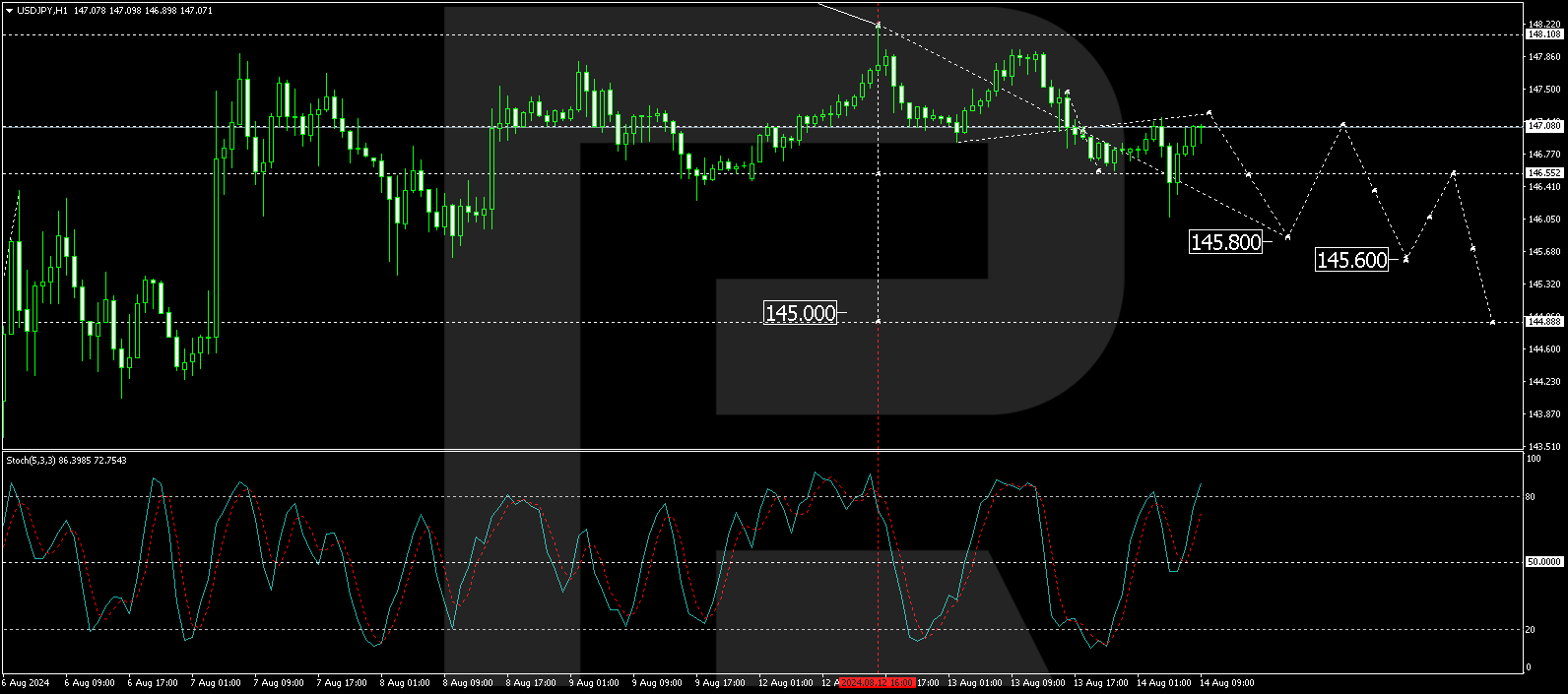
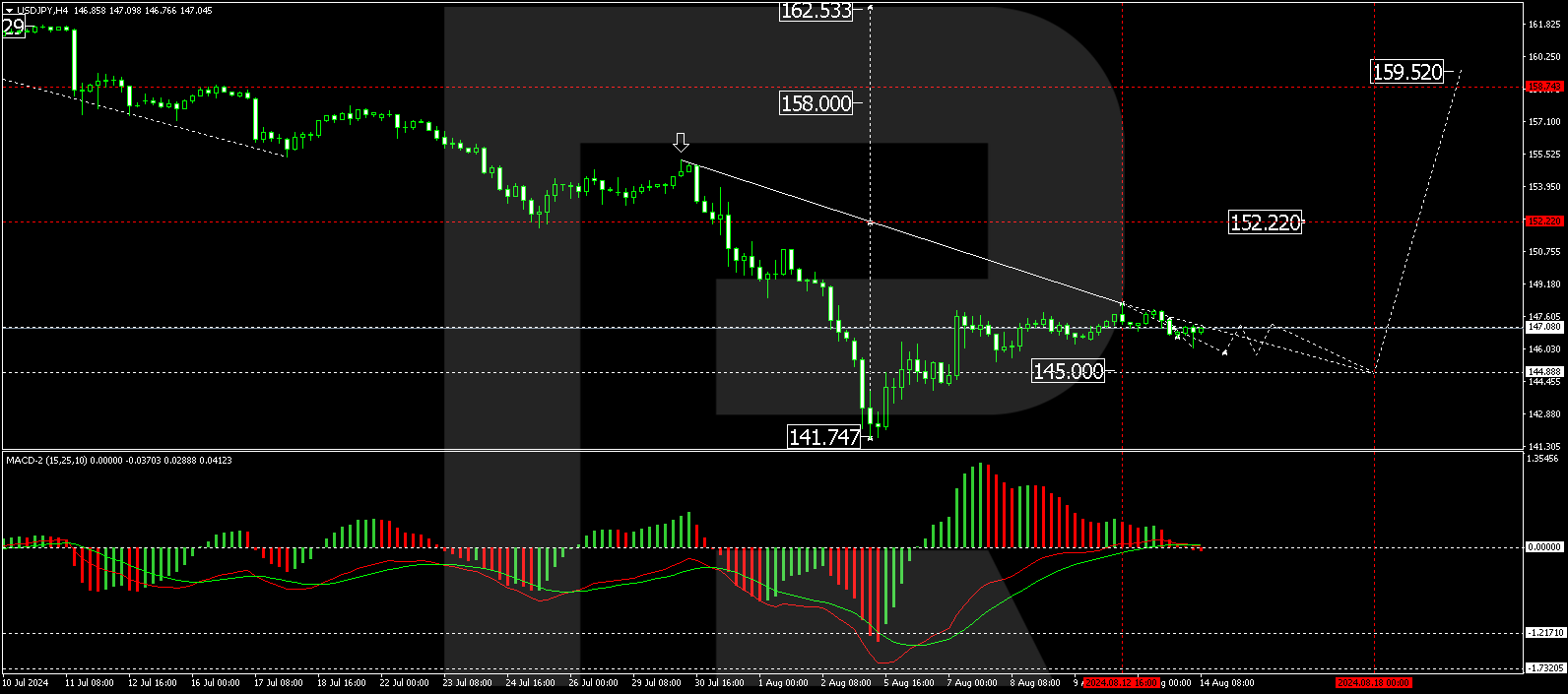
The USD/JPY forecast shows that the pair is currently consolidating around the 147.00 level. We anticipate a corrective decline to 145.00, followed by a potential rebound towards 152.22. A breach of this level could extend the upward trend towards 159.52. This bullish outlook is technically supported by the MACD indicator, which, although its signal line is below zero, suggests downward momentum.

On the hourly chart, USD/JPY continues its corrective phase with a target set at 145.80. The pair is currently stabilising around 146.55, setting the stage for a potential decline to 145.60, and possibly extending the correction to 145.00. This scenario is corroborated by the Stochastic oscillator, with its signal line poised to move from below the 80 level to the 20 level, suggesting potential further declines.


Disclaimer

Any forecasts contained herein are based on the author’s particular opinion. This analysis may not be treated as trading advice. RoboForex bears no responsibility for trading results based on trading recommendations and reviews contained herein.

WTI crude oil prices rise for the 5th day in a row. Australian dollar rises amid strong economic data

By JustMarkets

At Monday’s close, the Dow Jones (US30) Index was down 0.36%, while the S&P 500 (US500) Index closed at its opening level. The NASDAQ Technology Index (US100) closed positively, 0.21%. Strengthening chip stocks supported the overall market, led by Nvidia’s (NVDA) 4% gain. Additionally, energy stocks rose, with the price of WTI crude oil up more than +%.

This week, markets await US producer and consumer price reports, which should help clarify the likely timing and size of any Fed interest rate cut. On Tuesday, July’s PPI is expected to decline to 2.3% y/y from 2.6% y/y in June, while July’s core PPI, excluding food and energy, is expected to decline to 2.7% y/y from 3.0% y/y in June. On Wednesday, July’s CPI is expected to remain unchanged at 3.0% y/y from June, while July’s core CPI, excluding food and energy, is expected to decline to 3.2% y/y from 3.3% y/y in June. Markets rate the odds of a 25bp rate cut at the September 18 FOMC meeting at 100% and a 50bp rate cut at 57%.

Equity markets in Europe were mostly up on Monday. Germany’s DAX (DE40) rose by 0.02%, France’s CAC 40 (FR40) closed down 0.26%, Spain’s IBEX 35 (ES35) added 0.07%, and the UK’s FTSE 100 (UK100) closed up 0.52%.

WTI crude futures rose by 4.2% to close at $80.06 a barrel on Monday, rising for a fifth straight day amid an escalating conflict in the Middle East that threatens to cut global oil supplies. The Pentagon is beefing up its military presence in the region, with Defense Secretary Lloyd Austin ordering the deployment of an aircraft carrier strike group and additional forces in response to potential Iranian aggression against Israel. OPEC cut its forecast for global oil demand growth in 2024 to 2.11 million bpd from 2.25 million, citing weak data and weaker demand in China. OPEC+ extended production cuts through September with a phase-out in October.

Asian markets were mostly up yesterday. Japan’s Nikkei 225 (JP225) rose by 0.56%, China’s FTSE China A50 (CHA50) climbed 0.05%, Hong Kong’s Hang Seng (HK50) gained 0.13%, and Australia’s ASX 200 (AU200) was positive 0.46%.

India’s annualized consumer inflation rate fell sharply to 3.54% in July 2024 from 5.08% in the previous month, well below market expectations of 3.65%, marking the softest rise in consumer prices since August 2019. Inflation fell below the RBI’s target range of 4% for the first time in nearly five years, although the sharp decline was largely due to a large base effect in food prices, and the Central Bank does not expect price growth to remain as low for the rest of the year.

The Australian dollar rose to $0.66, near its highest level in three weeks, as risk sentiment continued to improve and investors digested mostly positive reports on the domestic economy. Data showed that consumer confidence in Australia rose sharply in August as tax cuts lifted sentiment, although concerns about the Reserve Bank of Australia’s (RBA) hawkish stance dampened sentiment. Business confidence also rose in July, while wages rose less than expected in the second quarter.

The Reserve Bank of New Zealand (RBNZ) will hold a monetary policy meeting as early as tomorrow. Economists do not expect any changes, but there is a growing consensus among economists that the RBNZ will announce a 25bp cut in the cash rate. 12 of 21 economists surveyed by Bloomberg expect the Reserve Bank to keep the official money rate at 5.5%, but nine predict it will start the easing cycle. Further supporting the case for policy easing was the RBNZ’s survey of inflation expectations, which showed the lowest level of expectations in more than three years. A rate cut would result in a weaker New Zealand dollar. If policymakers decide not to cut rates, they are expected to open the door for a move to the two remaining 2024 decisions. However, it will give the New Zealand dollar an advantage over other currencies, where central banks have already started a downward cycle (EUR, GBP, CAD).

S&P 500 (US500) 5,344.39 +0.23 (+0.0043%)

Dow Jones (US30) 39,357.01 −140.53 (−0.36%)

DAX (DE40) 17,726.47 +3.59 (+0.02%)

FTSE 100 (UK100) 8,210.25 +42.15 (+0.52%)

USD Index 103.13 −0.01 (−0.01%)

Important events for today:
  • – Japan Producer Price Index (m/m) at 02:50 (GMT+3);
  • – Australia Wage Price Index (q/q) at 04:30 (GMT+3);
  • – UK Average Earnings Index (m/m) at 09:00 (GMT+3);
  • – UK Claimant Count Change (m/m) at 09:00 (GMT+3);
  • – UK Unemployment Rate (m/m) at 09:00 (GMT+3);
  • – German ZEW Economic Sentiment (m/m) at 12:00 (GMT+3);
  • – Eurozone ZEW Economic Sentiment (m/m) at 12:00 (GMT+3);
  • – US Producer Price Index (m/m) at 15:30 (GMT+3);
  • – US FOMC Member Bostic Speaks at 20:15 (GMT+3).

By JustMarkets


This article reflects a personal opinion and should not be interpreted as an investment advice, and/or offer, and/or a persistent request for carrying out financial transactions, and/or a guarantee, and/or a forecast of future events.

UK100: Set for more wild price swings?

By ForexTime 

  • Raft of UK data could rock UK100 this week
  • UK CPI sparked moves of ↑ 0.9% & ↓ 0.8% over past year
  • Incoming US CPI data may set tone for markets
  • Key levels of interest – 8120, 8200, 8310

Watch this space because FXTM’s UK100 index could see significant price swings!

That’s right, a raft of UK economic data over the next few days may inject the stock index with fresh volatility. We have already seen some action this morning after a surprise drop in the UK’s unemployment rate for June triggered a selloff.

UK100

The strong jobs data cooled bets around BoE rate cuts – boosting the British Pound as a result.

Note: Over 80% of the revenues from FTSE100 companies come from outside of the UK. When the pound appreciates, it results in lower revenues for those companies that acquire sales from overseas – dragging the UK100 lower as a result. The same is true vice versa.

Despite the aggressive selloff last Monday, prices remain trapped within a range on the weekly charts with support at 8150 and resistance at 8450.

UK100 weekly

Note: UK100 tracks the FTSE100 index – the benchmark measuring the stock performance of the 100 largest listed companies on the London Stock Exchange.

With all the above said, here are 3 major economic events that may trigger significant volatility:

    1) UK July CPI report – Wednesday, 14th August

The incoming consumer price index report may influence bets around when the BoE will cut rates again in 2024.

Markets are forecasting:

  • CPI year-on-year (July 2024 vs. July 2023) to rise 2.3% from 2.0% in the prior month.
  • Core CPI year-on-year to cool 3.4% from 3.5% in the prior month.
  • CPI month-on-month (July 2024 vs June 2024) to cool 0.1% from 0.1% in the prior month.

UK inflation rate is expected to have risen in July. If the incoming figures confirm this, then this may push back BoE cut bets.

Golden nugget: Over the past year, the UK CPI report has triggered upside moves on the UK100 as much as 0.9% and declines of 0.8% in a 6-hour window post-release.


    2) UK Q2 GDP data – Thursday 15th August

Beyond the UK CPI report, all eyes will be on second-quarter GDP figures published on Thursday.

Markets expect a modest quarter-on-quarter growth of 0.6%, slightly slower than the 0.7% seen in Q1. Also, keep an eye on the latest industrial production figures which could provide additional insight into the health of the UK economy.

  • Should the data support the case for lower UK interest rates, this could boost the UK100.
  • If the reports push back BoE cut bets – this may hit the UK100 as the pound strengthens.

Golden nugget: Over the past year, the UK GDP report has triggered upside moves on the UK100 as much as 0.7% and declines of 0.6% in a 6-hour window post-release.


    3) US July CPI

Outside of the United Kingdom, all eyes will be on the US July inflation report published on Wednesday.

Markets remain edgy due to the weak jobs report earlier this month with US recession fears lingering in the air. The incoming US CPI report may shape expectations around aggressive Fed rate cuts this year.

Traders have already priced in a 25-basis point move next month with a 50% probability of a 50-basis point cut.

Given how this key report may set the tone for markets, indices across the globe including the UK100 may be impacted.


    4) Technical forces

On the technical front, the UK100 is flirting around the 50 and 100-day SMA with prices still trapped within a range. The index could be waiting for a potent fundamental spark to trigger its next significant move either up or down.

  • A strong daily close above 8200 could encourage a move higher toward 8310 and 8400.
  • Should prices dip below the 100-day SMA, this could encourage a decline to 8120 and 8040.

UK100


Forex-Time-LogoArticle by ForexTime

ForexTime Ltd (FXTM) is an award winning international online forex broker regulated by CySEC 185/12 www.forextime.com

Brent Crude Oil Faces Demand Concerns Despite Recent Gains

By RoboForex Analytical Department

After five consecutive days of upward movement, Brent crude oil is now experiencing a consolidation phase, with prices retreating slightly to 81.80 USD per barrel on Tuesday. Market sentiment is being influenced by renewed concerns over global oil demand, particularly following OPEC’s downward adjustment of its demand forecasts for 2024 and 2025. This adjustment reflects weaker-than-expected economic data from China and reduced regional demand projections.

OPEC now estimates global oil demand will grow by 2.11 million barrels per day (bpd) in 2024, down from its previous forecast of 2.25 million bpd. For 2025, the projection has been revised to 1.78 million bpd from 1.85 million bpd. These revisions are mainly due to the sluggish economic indicators emerging from China, a significant driver of global oil demand.

The ongoing conflict in the Middle East keeps market participants on edge. A new round of negotiations could be scheduled for Thursday, although there remains uncertainty about whether they will occur. Market players are particularly concerned about the potential for escalated conflicts involving Israel and Iran, which could disrupt oil supplies from the region and create further volatility in oil prices.

Technical analysis of Brent crude oil

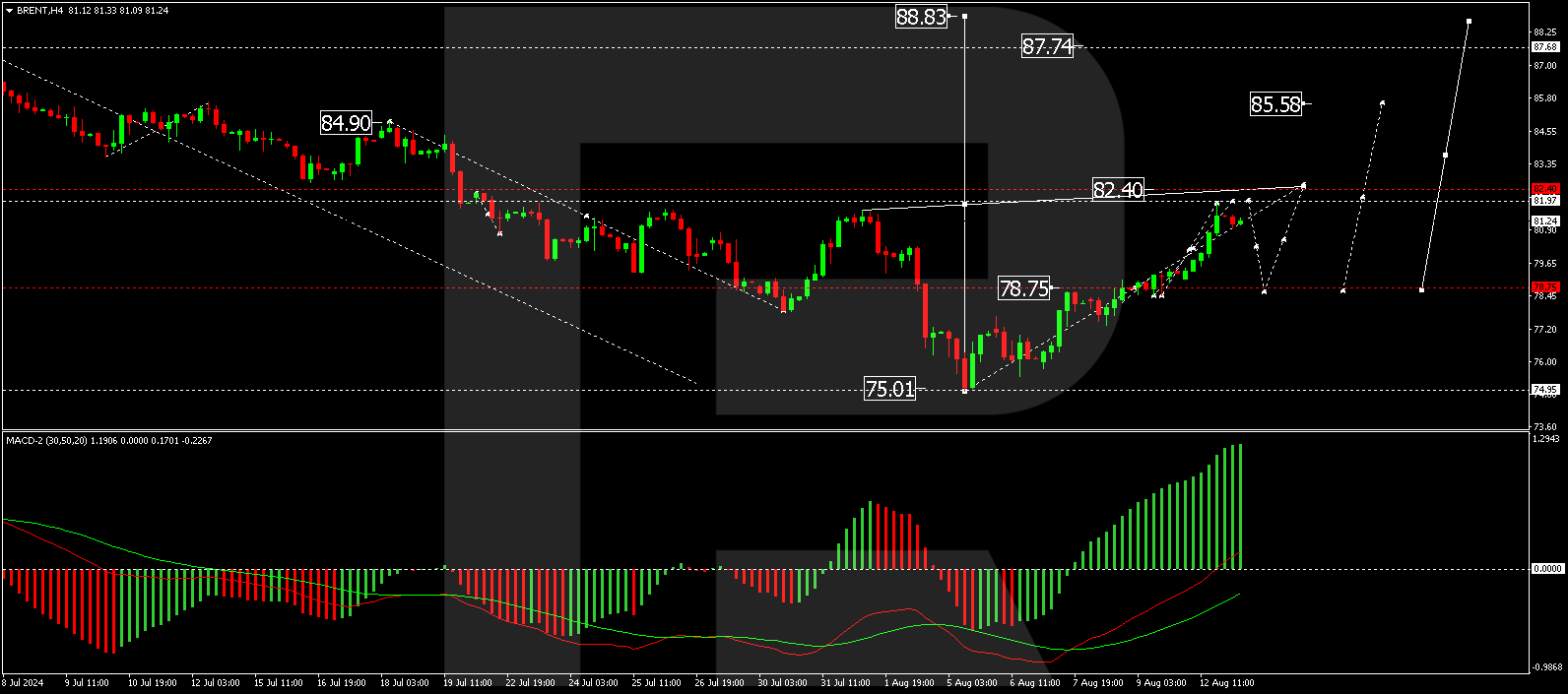
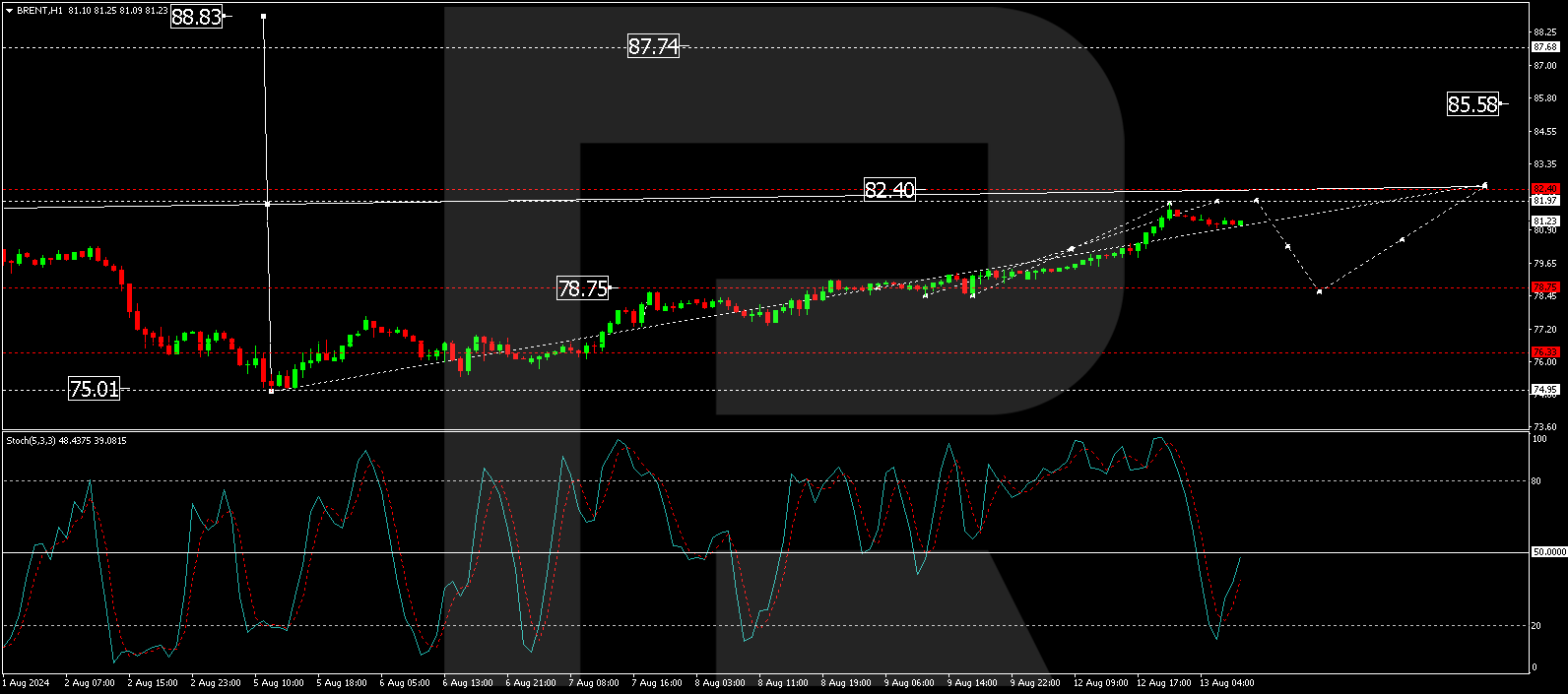
The technical forecast on the Brent crude shows that the price is forming a consolidation range around 78.75 USD, with a recent upward breakout continuing the growth trend towards 81.97 USD. This level serves as a local target. Upon reaching this level, a correction back to 78.75 USD may occur, followed by a potential rise towards 82.40 USD. This bullish scenario is supported by the MACD indicator, which, despite being below zero, shows a clear upward trajectory.

On the H1 chart, Brent found support at 78.44 USD and is developing a growth structure towards 81.97 USD. Having already reached a local target at 81.90 USD, a corrective move to at least 80.17 USD could follow before resuming the upward trend. The stochastic oscillator, positioned near the 20 mark, indicates potential for upward movement, aligning with the broader bullish sentiment observed on the H4 chart.


Disclaimer

Any forecasts contained herein are based on the author’s particular opinion. This analysis may not be treated as trading advice. RoboForex bears no responsibility for trading results based on trading recommendations and reviews contained herein.

European gas prices jump to an 8-month high. Canada’s labor market is cooling down

By JustMarkets

On Friday, the Dow Jones (US30) was up 0.13% (for the week+1.17%), while the S&P 500 (US500) was up 0.47% (for the week+3.75%). The NASDAQ Technology Index (US100) closed positive 0.51% (for the week+6.57%). That day, all sectors ended trading in positive territory except for commodities. Notable highlights included Expedia, whose shares rose by 10.2% after the company reported second-quarter results that beat expectations.

Canada’s unemployment rate remained unchanged at 6.4%, the highest in two and a half years. While the data came in slightly below market expectations, it did indicate a weakening labor market. The cooling labor market, as well as the continued contraction of the manufacturing sector and sluggish economic growth, further fueled expectations of further rate cuts by the Bank of Canada (BoC).

Equity markets in Europe were mostly up on Friday. Germany’s DAX (DE40) rose by 0.24% (for the week +1.13%), France’s CAC 40 (FR40) closed 0.31% higher (for the week +2.40%), Spain’s IBEX 35 (ES35) added 0.76% (for the week +2.26%), and the UK’s FTSE 100 (UK100) closed 0.28% higher (for the week -0.08%).

Norway’s annualized consumer inflation rate rose to 2.8% in July 2024 from a three-and-a-half-year low of 2.6% in June, which is in line with market expectations. This increases the likelihood that Norway’s Central Bank (Norges Bank) will leave rates unchanged at this week’s meeting.

European natural gas futures are trading near an 8-month high of €40/MWh. They are on track for a 9% weekly gain, driven by concerns over the stability of gas supplies after Ukrainian troops took control of the Suja gas transportation station in Russia’s Kursk region. Despite ongoing conflicts around this key transit point, Russian gas continues to flow through Ukraine. As the gas transit agreement expires at the end of the year, any early disruption could have a significant impact on Central European countries that depend on these supplies.

Oil prices rose last week as comments from Fed officials about the possibility of a rate cut as early as September eased demand concerns, while fears of widening conflict in the Middle East continue to increase supply risks. For the week, Brent crude rose more than 3.5% and WTI crude rose more than 4%. Concerns about the prospect of recession have subsided, boosting the demand outlook.

Asian markets were mostly down last week. Japan’s Nikkei 225 (JP225) fell by 0.64%, China’s FTSE China A50 (CHA50) declined by 0.18%, Hong Kong’s Hang Seng (HK50) gained 2.48% over 5 trading days, and Australia’s ASX 200 (AU200) was negative 2.08%.

In New Zealand, investors await the RBNZ’s decision on Wednesday. The Central Bank is expected to keep its monetary rate unchanged at 5.5% for the ninth consecutive time, although concerns about the economy’s strength remain. The latest data showed New Zealand’s unemployment rate rose less than estimated in the second quarter. However, inflation expectations fell to three-year lows in the third quarter, bolstering the case for a rate cut.

The offshore yuan weakened to 7.18 per dollar as traders await the release of key economic data from China. Traders are eagerly awaiting data on outstanding loan growth, new yuan loans and M2 money supply for the year to be released today. Industrial production, retail sales, and unemployment rate data are also expected later in the week. This expectation follows last week’s reports that showed an unexpected acceleration in China’s annual inflation rate, which beat market expectations and reached the highest level since February.

S&P 500 (US500) 5,344.16 +24.85 (+0.47%)

Dow Jones (US30) 39,497.54 +51.05 (+0.13%)

DAX (DE40) 17,722.88 +42.48 (+0.24%)

FTSE 100 (UK100) 8,168.10 +23.13 (+0.28%)

USD index 103.15 −0.06 (−0.05%)

There are no Important events today.

By JustMarkets


This article reflects a personal opinion and should not be interpreted as an investment advice, and/or offer, and/or a persistent request for carrying out financial transactions, and/or a guarantee, and/or a forecast of future events.

NZD/USD gains momentum ahead of RBNZ meeting

By RoboForex Analytical Department

The New Zealand dollar is steadily rising against the US dollar, with the NZD/USD pair reaching 0.6014 as of Monday. The financial markets are gearing up for Wednesday’s Reserve Bank of New Zealand (RBNZ) meeting. Analysts widely anticipate that the RBNZ will maintain the official cash rate at 5.5% for the ninth consecutive time, reflecting ongoing concerns about the robustness of New Zealand’s economy.

Recent data releases have painted a mixed economic picture. The unemployment rate in New Zealand showed a less-than-expected increase in Q2, while inflation expectations dipped to a three-year low for Q3. These factors collectively strengthen the case for potential rate cuts, though it appears unlikely that the RBNZ will adjust rates downward in August, preferring to wait for cues from major global central banks.

Investor attention is also turning towards upcoming US inflation data, which could further influence global monetary policy expectations, particularly Federal Reserve expectations.

Despite challenges in July and August, the NZD has shown commendable resilience, suggesting potential for continued stability and barring significant external shocks.

Technical analysis of NZD/USD

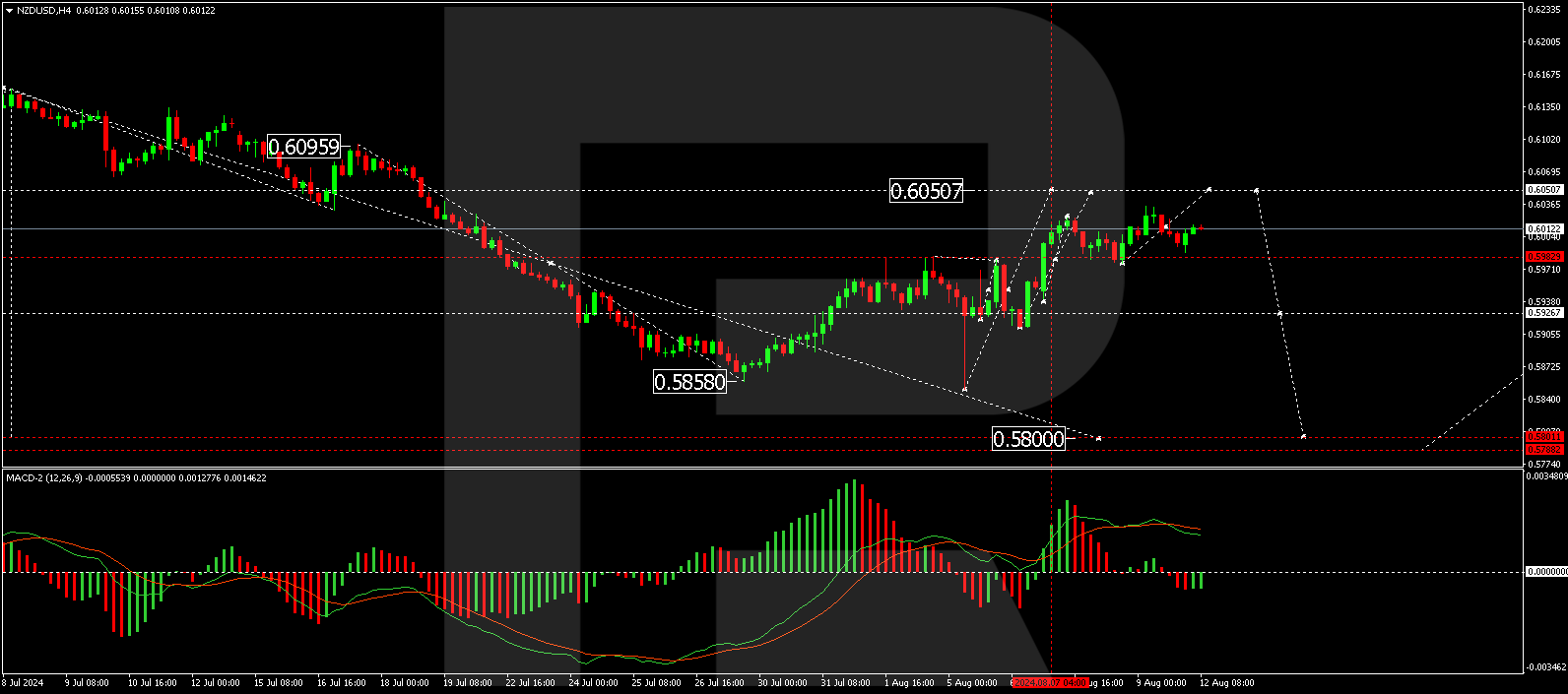
The NZD/USD pair is developing a consolidation range just above the 0.5983 level. We expect to see an extension of this range to 0.6050, considered a corrective move. According to our NZD/USD forex forecast, the market will likely initiate a downward trend towards 0.5920 following this correction. A breach of this level could open the path to a further decline towards 0.5800. This bearish outlook is supported by the MACD indicator, which, although above zero, points downwards, indicating potential selling pressure.

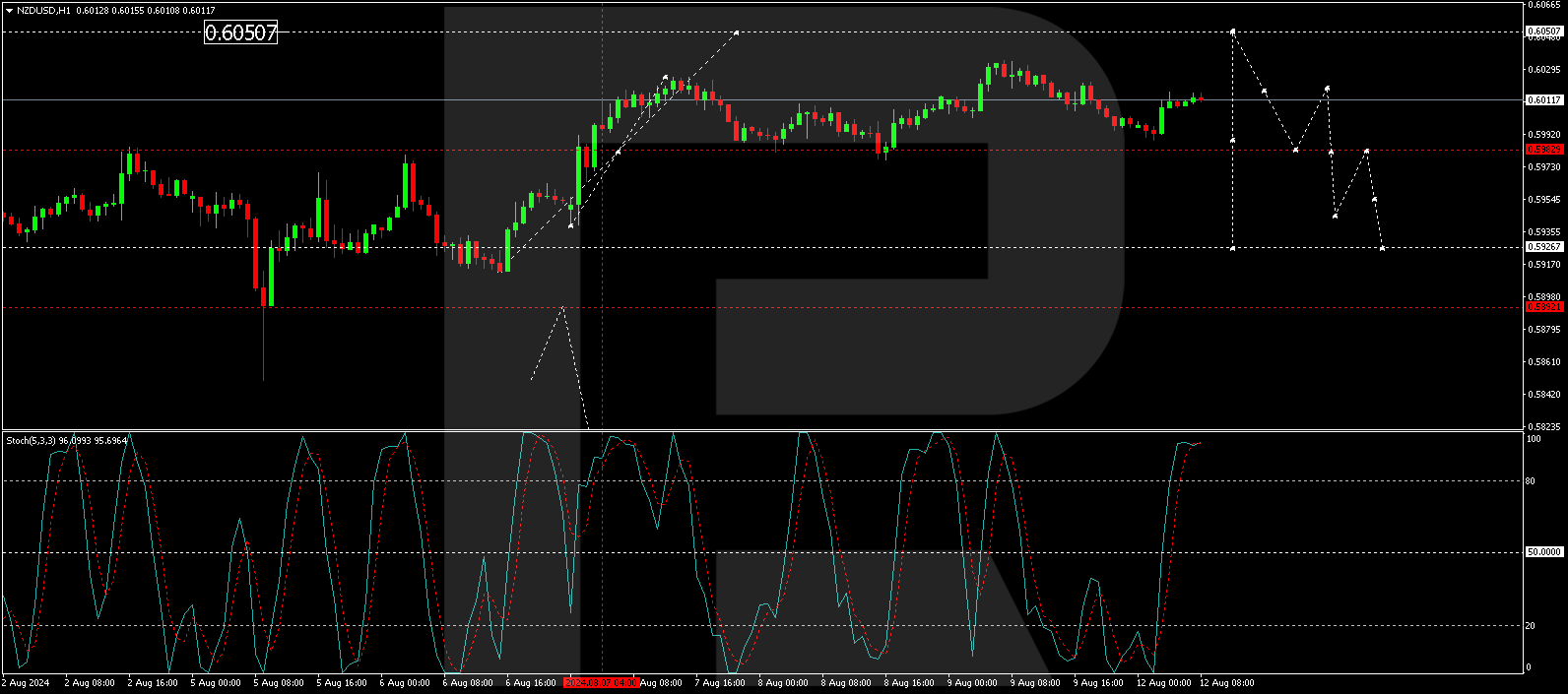
On the hourly chart, the NZD/USD is crafting the fifth segment of a growth wave aiming for 0.6050, considered a corrective rally. Upon reaching this level, we anticipate a reversal leading to a decrease towards 0.5983, potentially extending the downtrend to 0.5920. This bearish scenario is substantiated by the Stochastic oscillator, whose signal line is currently positioned above 80 but shows signs of a forthcoming downturn.


Disclaimer

Any forecasts contained herein are based on the author’s particular opinion. This analysis may not be treated as trading advice. RoboForex bears no responsibility for trading results based on trading recommendations and reviews contained herein.

Speculators sharply pare back Japanese Yen bearish bets

By InvestMacro

Here are the latest charts and statistics for the Commitment of Traders (COT) data published by the Commodities Futures Trading Commission (CFTC).

The latest COT data is updated through Tuesday August 6th and shows a quick view of how large market participants (for-profit speculators and commercial traders) were positioned in the futures markets. All currency positions are in direct relation to the US dollar where, for example, a bet for the euro is a bet that the euro will rise versus the dollar while a bet against the euro will be a bet that the euro will decline versus the dollar.

Weekly Speculator Changes led by Japanese Yen & EuroFX
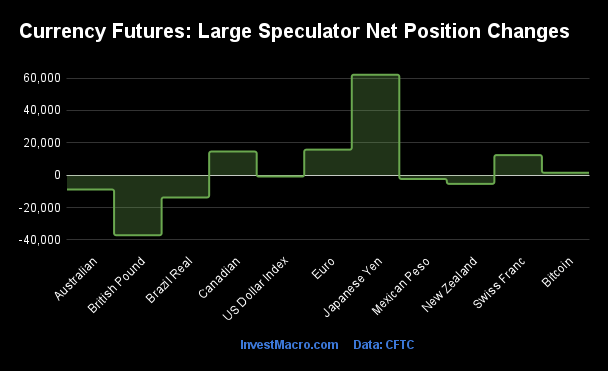
The COT currency market speculator bets were slightly lower overall this week as five out of the eleven currency markets we cover had higher positioning while the other six markets had lower speculator contracts.

Leading the gains for the currency markets was the Japanese Yen (62,106 contracts) with the EuroFX (15,781 contracts), the Canadian Dollar (14,631 contracts), the Swiss Franc (12,447 contracts) and Bitcoin (1,540 contracts) also recording positive weeks.

The currencies seeing declines in speculator bets on the week were the British Pound (-37,072 contracts), the Brazilian Real (-13,724 contracts), the Australian Dollar (-8,829 contracts), the New Zealand Dollar (-5,343 contracts), the Mexican Peso (-2,324 contracts) and with the US Dollar Index (-822 contracts) also seeing lower bets on the week.

Currency Speculators sharply pared back Japanese Yen bearish bets

Highlighting the COT currency’s data this week was the large move in the Japanese yen speculator position that took place after last week’s (and the previous Friday) early risk-off trades and volatility spikes.

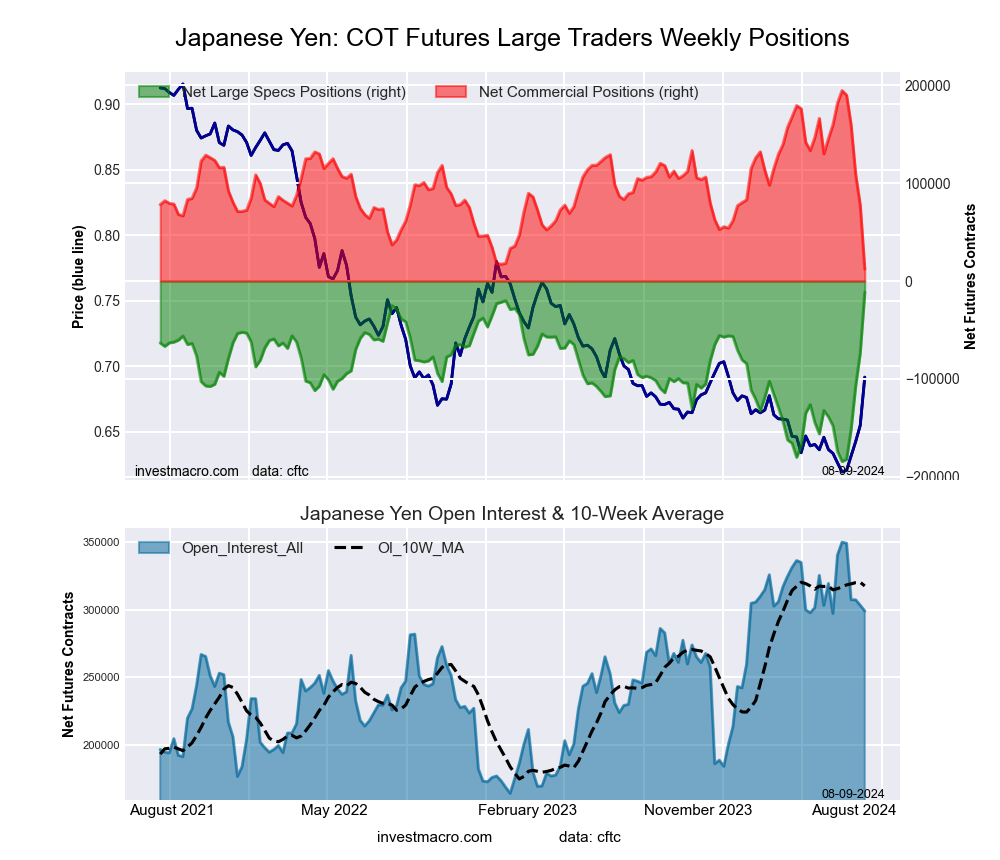
The Japanese yen speculator contracts saw a huge surge of buying with the yen speculator positioning jumping by over +62,000 contracts on the week. This was the highest one-week gain since March 1st of 2011 when the yen rose by +69,020 contracts. The turnaround in yen positions coincided with an enormous volatility event that shook the financial markets with many focusing the risk-off behavior on an unwind of yen carry trades – where traders sell a low-yielding asset like the yen to invest in a higher yielding like the USD to pocket the interest rate difference.

The yen buying and paring of shorts brought the overall speculator standing to just -11,354 contracts through Tuesday. This puts the speculator positioning back to an almost neutral position after the standing had been at least -100,000 contracts for twenty-four straight weeks from February 13th through two weeks ago on July 23rd. Overall, the yen positioning has now continued to remain in a bearish position for 178 consecutive weeks, dating back to March 16th of 2021.

This possibly could be coming to an end as a change in policy by the Bank of Japan and an unwinding of the carry trade may bring some yen strength back into the market or at least dampen the one-way market action. The yen had lost approximately 50 percent of its value against the US Dollar in the past three years with the USDJPY currency pair reaching multi-decade highs above 162.00 before the latest selloff and unwind of the yen short positioning.


Currencies Net Speculators Leaderboard
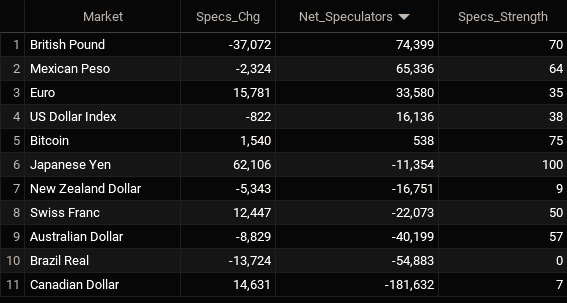
Legend: Weekly Speculators Change | Speculators Current Net Position | Speculators Strength Score compared to last 3-Years (0-100 range)


Strength Scores led by Japanese Yen & Bitcoin
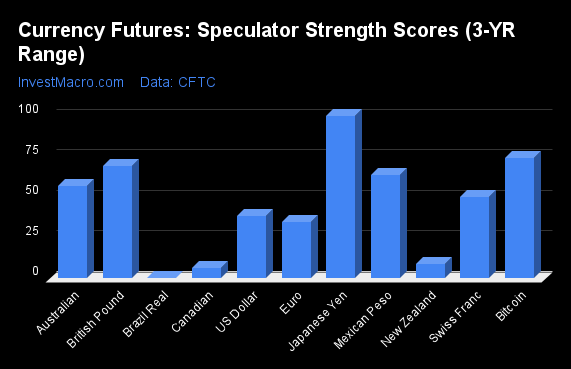
COT Strength Scores (a normalized measure of Speculator positions over a 3-Year range, from 0 to 100 where above 80 is Extreme-Bullish and below 20 is Extreme-Bearish) showed that the Japanese Yen (100 percent) and Bitcoin (75 percent) lead the currency markets this week. The British Pound (70 percent), Mexican Peso (64 percent) and the Australian Dollar (57 percent) come in as the next highest in the weekly strength scores.

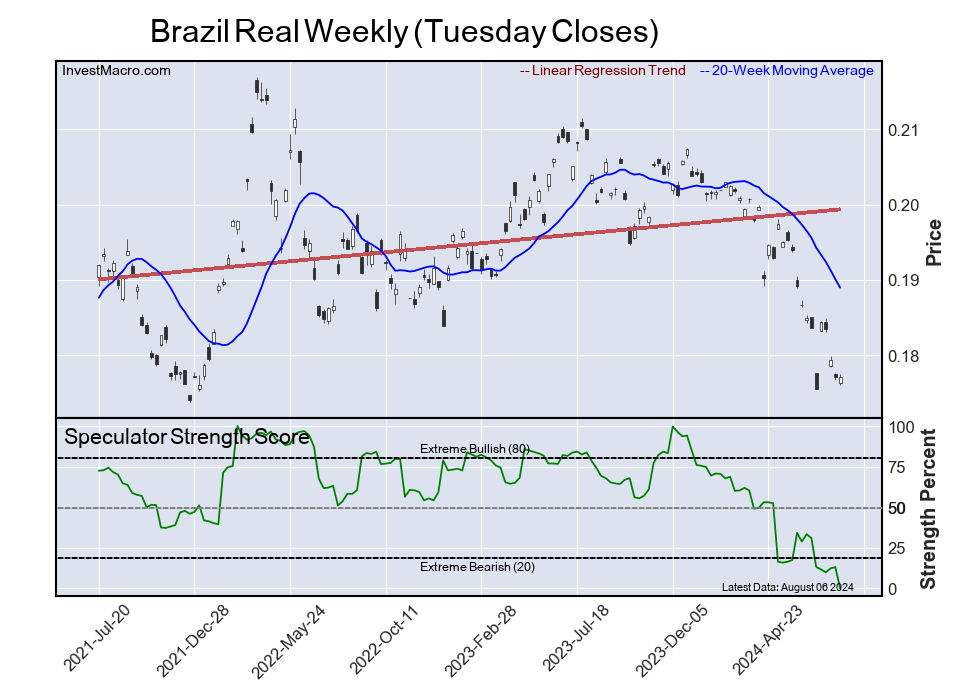
On the downside, the Brazilian Real (0 percent), the Canadian Dollar (7 percent) and the New Zealand Dollar (9 percent) come in at the lowest strength levels currently and are in Extreme-Bearish territory (below 20 percent).

Strength Statistics:
US Dollar Index (38.4 percent) vs US Dollar Index previous week (40.2 percent)
EuroFX (34.6 percent) vs EuroFX previous week (27.9 percent)
British Pound Sterling (69.5 percent) vs British Pound Sterling previous week (86.2 percent)
Japanese Yen (100.0 percent) vs Japanese Yen previous week (64.1 percent)
Swiss Franc (50.1 percent) vs Swiss Franc previous week (27.6 percent)
Canadian Dollar (6.6 percent) vs Canadian Dollar previous week (0.0 percent)
Australian Dollar (56.8 percent) vs Australian Dollar previous week (64.2 percent)
New Zealand Dollar (8.7 percent) vs New Zealand Dollar previous week (19.0 percent)
Mexican Peso (63.5 percent) vs Mexican Peso previous week (64.7 percent)
Brazilian Real (0.0 percent) vs Brazilian Real previous week (13.0 percent)
Bitcoin (74.5 percent) vs Bitcoin previous week (51.3 percent)


Japanese Yen & Swiss Franc top the 6-Week Strength Trends
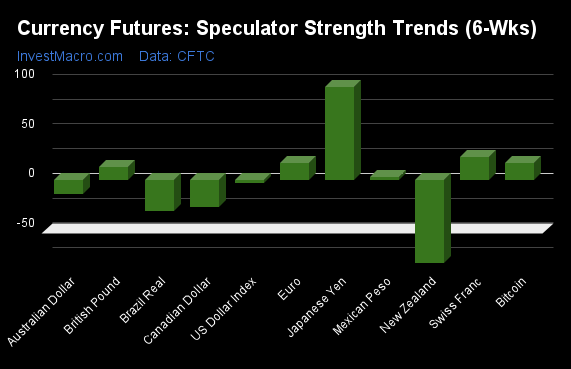
COT Strength Score Trends (or move index, calculates the 6-week changes in strength scores) showed that the Japanese Yen (94 percent) and the Swiss Franc (23 percent) lead the past six weeks trends for the currencies. The EuroFX (18 percent), the Bitcoin (17 percent) and the British Pound (14 percent) are the next highest positive movers in the latest trends data.

The New Zealand Dollar (-83 percent) leads the downside trend scores currently with the Brazilian Real (-31 percent), Canadian Dollar (-27 percent) and the Australian Dollar (-14 percent) following next with lower trend scores.

Strength Trend Statistics:
US Dollar Index (-3.0 percent) vs US Dollar Index previous week (-1.4 percent)
EuroFX (17.9 percent) vs EuroFX previous week (4.2 percent)
British Pound Sterling (13.6 percent) vs British Pound Sterling previous week (28.7 percent)
Japanese Yen (94.0 percent) vs Japanese Yen previous week (43.0 percent)
Swiss Franc (23.5 percent) vs Swiss Franc previous week (5.2 percent)
Canadian Dollar (-26.5 percent) vs Canadian Dollar previous week (-21.7 percent)
Australian Dollar (-13.9 percent) vs Australian Dollar previous week (8.7 percent)
New Zealand Dollar (-83.4 percent) vs New Zealand Dollar previous week (-61.0 percent)
Mexican Peso (3.7 percent) vs Mexican Peso previous week (8.5 percent)
Brazilian Real (-30.9 percent) vs Brazilian Real previous week (-20.3 percent)
Bitcoin (17.5 percent) vs Bitcoin previous week (-4.2 percent)


Individual COT Forex Markets:

US Dollar Index Futures:
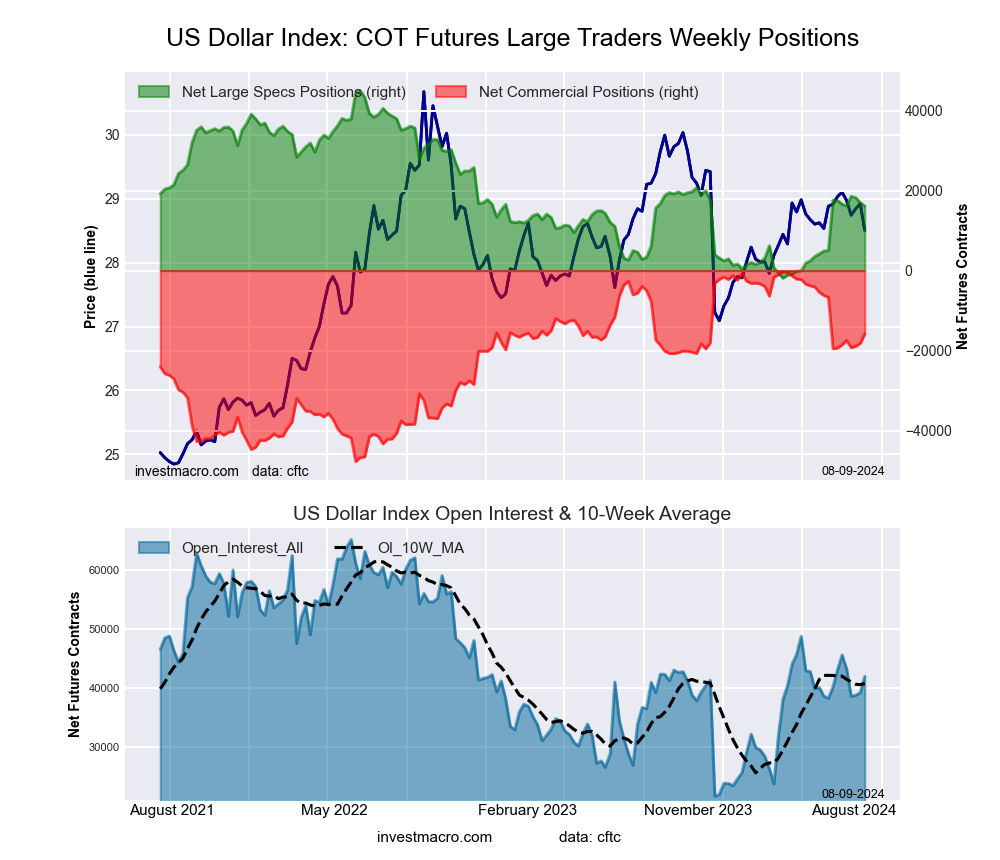
US Dollar Index Forex Futures COT ChartThe US Dollar Index large speculator standing this week resulted in a net position of 16,136 contracts in the data reported through Tuesday. This was a weekly decline of -822 contracts from the previous week which had a total of 16,958 net contracts.

This week’s current strength score (the trader positioning range over the past three years, measured from 0 to 100) shows the speculators are currently Bearish with a score of 38.4 percent. The commercials are Bullish with a score of 67.3 percent and the small traders (not shown in chart) are Bearish-Extreme with a score of 7.6 percent.

Price Trend-Following Model: Weak Uptrend

Our weekly trend-following model classifies the current market price position as: Weak Uptrend. The current action for the model is considered to be: Hold – Maintain Long Position.

US DOLLAR INDEX StatisticsSPECULATORSCOMMERCIALSSMALL TRADERS
– Percent of Open Interest Longs:73.817.96.3
– Percent of Open Interest Shorts:35.455.57.1
– Net Position:16,136-15,827-309
– Gross Longs:30,9967,5022,667
– Gross Shorts:14,86023,3292,976
– Long to Short Ratio:2.1 to 10.3 to 10.9 to 1
NET POSITION TREND:
– Strength Index Score (3 Year Range Pct):38.467.37.6
– Strength Index Reading (3 Year Range):BearishBullishBearish-Extreme
NET POSITION MOVEMENT INDEX:
– 6-Week Change in Strength Index:-3.07.5-25.1


Euro Currency Futures:

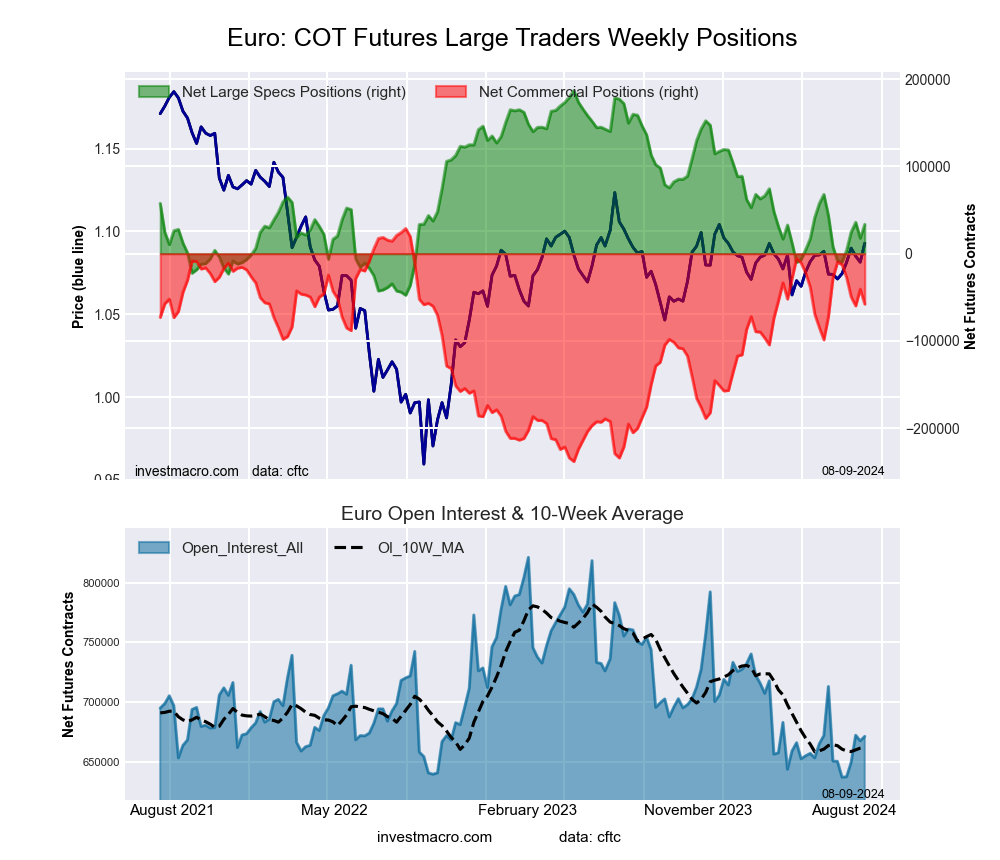
Euro Currency Futures COT ChartThe Euro Currency large speculator standing this week resulted in a net position of 33,580 contracts in the data reported through Tuesday. This was a weekly rise of 15,781 contracts from the previous week which had a total of 17,799 net contracts.

This week’s current strength score (the trader positioning range over the past three years, measured from 0 to 100) shows the speculators are currently Bearish with a score of 34.6 percent. The commercials are Bullish with a score of 67.5 percent and the small traders (not shown in chart) are Bearish with a score of 25.3 percent.

Price Trend-Following Model: Strong Uptrend

Our weekly trend-following model classifies the current market price position as: Strong Uptrend. The current action for the model is considered to be: Hold – Maintain Long Position.

EURO Currency StatisticsSPECULATORSCOMMERCIALSSMALL TRADERS
– Percent of Open Interest Longs:27.757.611.1
– Percent of Open Interest Shorts:22.766.27.5
– Net Position:33,580-57,86024,280
– Gross Longs:185,799386,56874,618
– Gross Shorts:152,219444,42850,338
– Long to Short Ratio:1.2 to 10.9 to 11.5 to 1
NET POSITION TREND:
– Strength Index Score (3 Year Range Pct):34.667.525.3
– Strength Index Reading (3 Year Range):BearishBullishBearish
NET POSITION MOVEMENT INDEX:
– 6-Week Change in Strength Index:17.9-18.013.9


British Pound Sterling Futures:

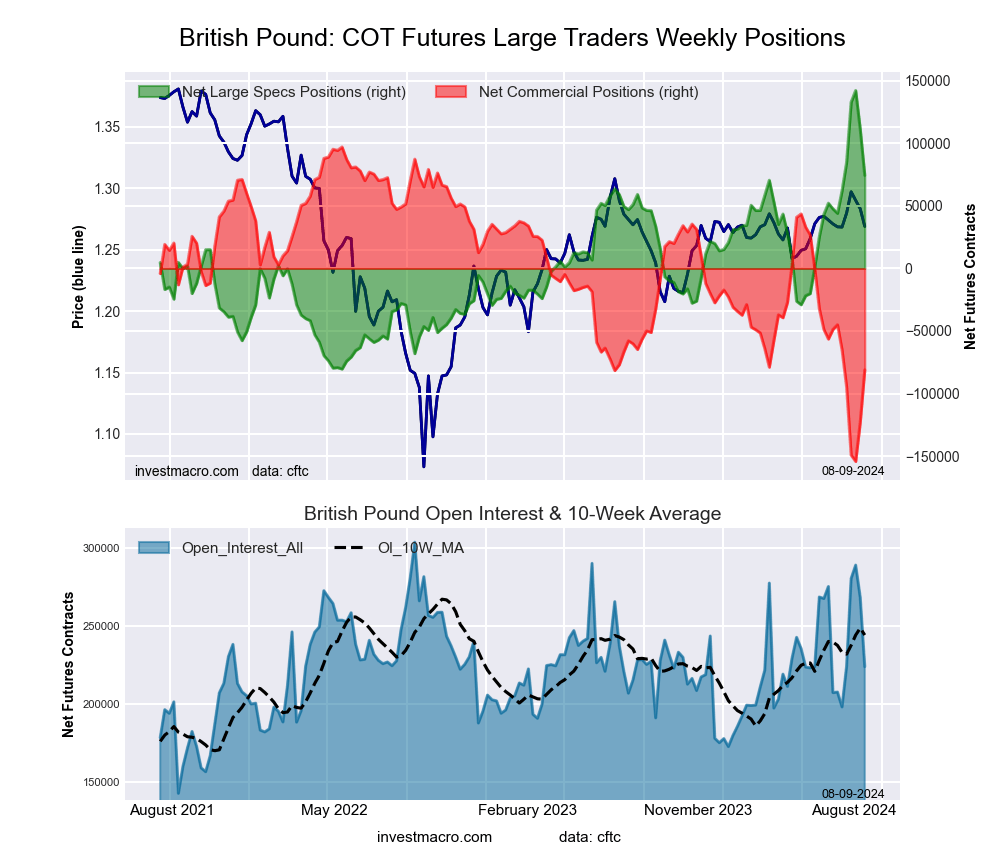
British Pound Sterling Futures COT ChartThe British Pound Sterling large speculator standing this week resulted in a net position of 74,399 contracts in the data reported through Tuesday. This was a weekly decline of -37,072 contracts from the previous week which had a total of 111,471 net contracts.

This week’s current strength score (the trader positioning range over the past three years, measured from 0 to 100) shows the speculators are currently Bullish with a score of 69.5 percent. The commercials are Bearish with a score of 29.1 percent and the small traders (not shown in chart) are Bullish with a score of 76.2 percent.

Price Trend-Following Model: Uptrend

Our weekly trend-following model classifies the current market price position as: Uptrend. The current action for the model is considered to be: Hold – Maintain Long Position.

BRITISH POUND StatisticsSPECULATORSCOMMERCIALSSMALL TRADERS
– Percent of Open Interest Longs:56.326.214.7
– Percent of Open Interest Shorts:23.162.411.8
– Net Position:74,399-81,0806,681
– Gross Longs:126,08058,80033,006
– Gross Shorts:51,681139,88026,325
– Long to Short Ratio:2.4 to 10.4 to 11.3 to 1
NET POSITION TREND:
– Strength Index Score (3 Year Range Pct):69.529.176.2
– Strength Index Reading (3 Year Range):BullishBearishBullish
NET POSITION MOVEMENT INDEX:
– 6-Week Change in Strength Index:13.6-14.312.0


Japanese Yen Futures:

Japanese Yen Forex Futures COT ChartThe Japanese Yen large speculator standing this week resulted in a net position of -11,354 contracts in the data reported through Tuesday. This was a weekly gain of 62,106 contracts from the previous week which had a total of -73,460 net contracts.

This week’s current strength score (the trader positioning range over the past three years, measured from 0 to 100) shows the speculators are currently Bullish-Extreme with a score of 100.0 percent. The commercials are Bearish-Extreme with a score of 0.0 percent and the small traders (not shown in chart) are Bullish with a score of 79.9 percent.

Price Trend-Following Model: Weak Downtrend

Our weekly trend-following model classifies the current market price position as: Weak Downtrend. The current action for the model is considered to be: Hold – Maintain Short Position.

JAPANESE YEN StatisticsSPECULATORSCOMMERCIALSSMALL TRADERS
– Percent of Open Interest Longs:22.164.211.1
– Percent of Open Interest Shorts:25.960.111.4
– Net Position:-11,35412,196-842
– Gross Longs:66,169191,82933,312
– Gross Shorts:77,523179,63334,154
– Long to Short Ratio:0.9 to 11.1 to 11.0 to 1
NET POSITION TREND:
– Strength Index Score (3 Year Range Pct):100.00.079.9
– Strength Index Reading (3 Year Range):Bullish-ExtremeBearish-ExtremeBullish
NET POSITION MOVEMENT INDEX:
– 6-Week Change in Strength Index:94.0-93.022.3


Swiss Franc Futures:

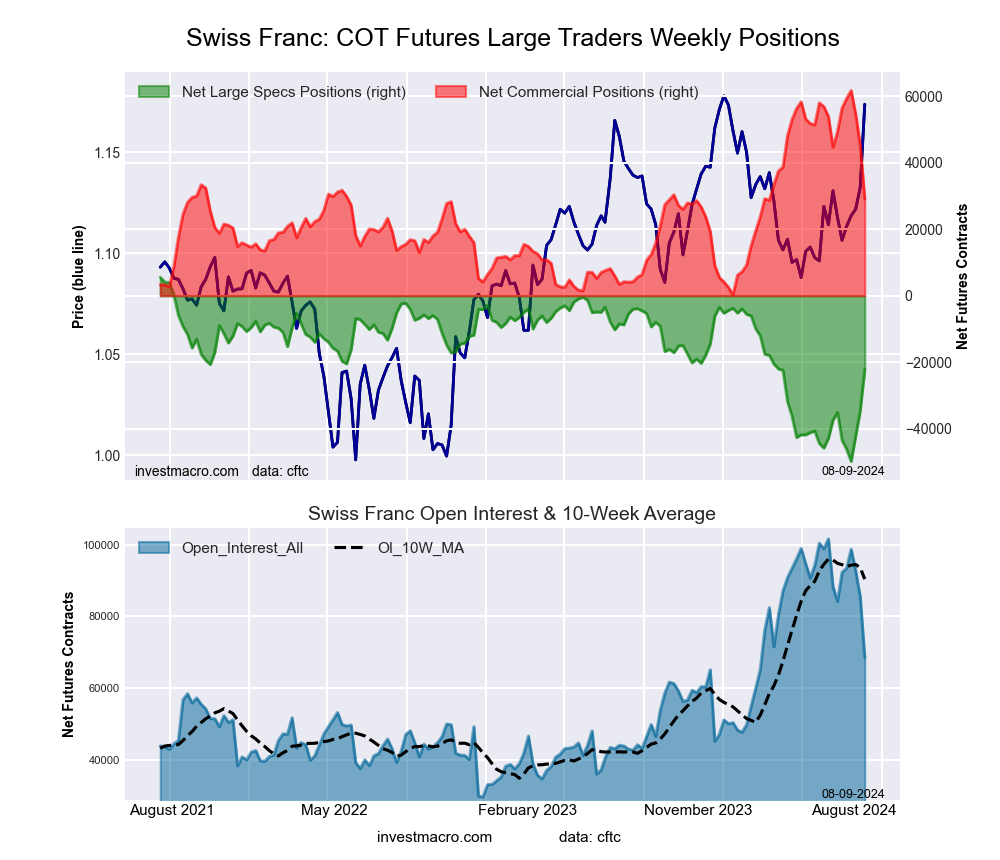
Swiss Franc Forex Futures COT ChartThe Swiss Franc large speculator standing this week resulted in a net position of -22,073 contracts in the data reported through Tuesday. This was a weekly rise of 12,447 contracts from the previous week which had a total of -34,520 net contracts.

This week’s current strength score (the trader positioning range over the past three years, measured from 0 to 100) shows the speculators are currently Bullish with a score of 50.1 percent. The commercials are Bearish with a score of 47.0 percent and the small traders (not shown in chart) are Bearish with a score of 45.1 percent.

Price Trend-Following Model: Strong Uptrend

Our weekly trend-following model classifies the current market price position as: Strong Uptrend. The current action for the model is considered to be: Hold – Maintain Long Position.

SWISS FRANC StatisticsSPECULATORSCOMMERCIALSSMALL TRADERS
– Percent of Open Interest Longs:14.068.616.5
– Percent of Open Interest Shorts:46.226.026.8
– Net Position:-22,07329,131-7,058
– Gross Longs:9,57046,96011,309
– Gross Shorts:31,64317,82918,367
– Long to Short Ratio:0.3 to 12.6 to 10.6 to 1
NET POSITION TREND:
– Strength Index Score (3 Year Range Pct):50.147.045.1
– Strength Index Reading (3 Year Range):BullishBearishBearish
NET POSITION MOVEMENT INDEX:
– 6-Week Change in Strength Index:23.5-32.932.8


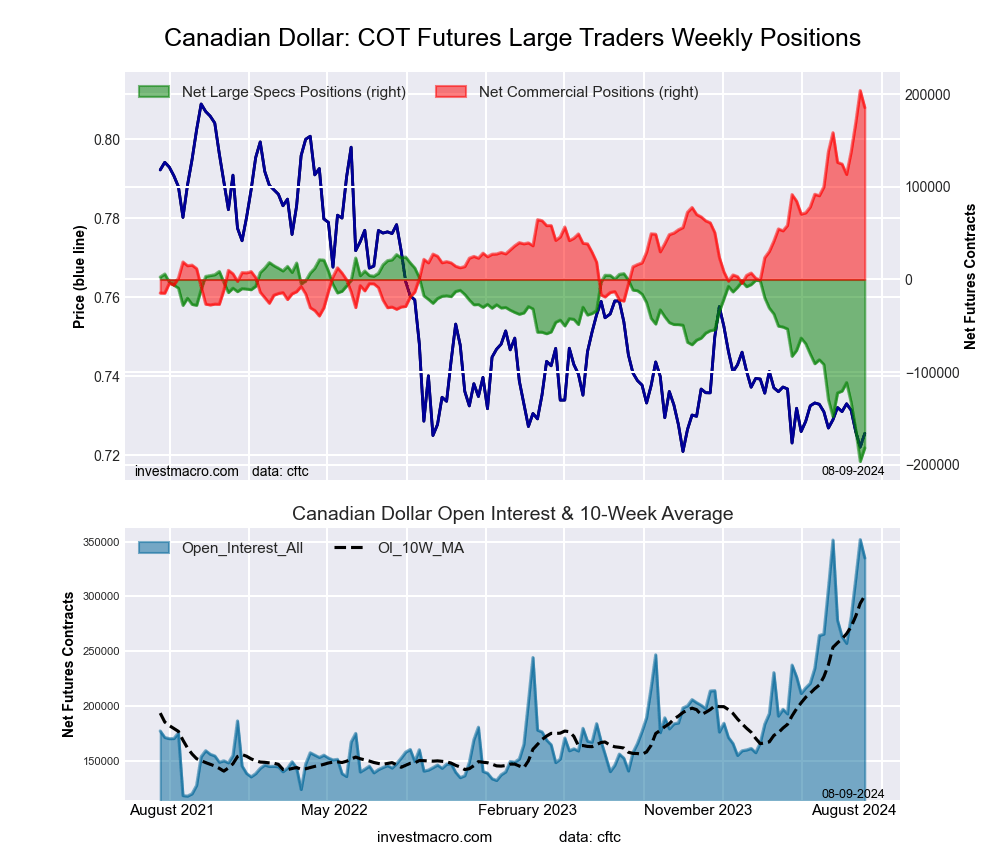
Canadian Dollar Futures:

Canadian Dollar Forex Futures COT ChartThe Canadian Dollar large speculator standing this week resulted in a net position of -181,632 contracts in the data reported through Tuesday. This was a weekly boost of 14,631 contracts from the previous week which had a total of -196,263 net contracts.

This week’s current strength score (the trader positioning range over the past three years, measured from 0 to 100) shows the speculators are currently Bearish-Extreme with a score of 6.6 percent. The commercials are Bullish-Extreme with a score of 92.5 percent and the small traders (not shown in chart) are Bearish-Extreme with a score of 19.6 percent.

Price Trend-Following Model: Downtrend

Our weekly trend-following model classifies the current market price position as: Downtrend. The current action for the model is considered to be: Hold – Maintain Short Position.

CANADIAN DOLLAR StatisticsSPECULATORSCOMMERCIALSSMALL TRADERS
– Percent of Open Interest Longs:6.681.89.4
– Percent of Open Interest Shorts:60.826.510.5
– Net Position:-181,632185,438-3,806
– Gross Longs:21,993274,24931,460
– Gross Shorts:203,62588,81135,266
– Long to Short Ratio:0.1 to 13.1 to 10.9 to 1
NET POSITION TREND:
– Strength Index Score (3 Year Range Pct):6.692.519.6
– Strength Index Reading (3 Year Range):Bearish-ExtremeBullish-ExtremeBearish-Extreme
NET POSITION MOVEMENT INDEX:
– 6-Week Change in Strength Index:-26.524.30.3


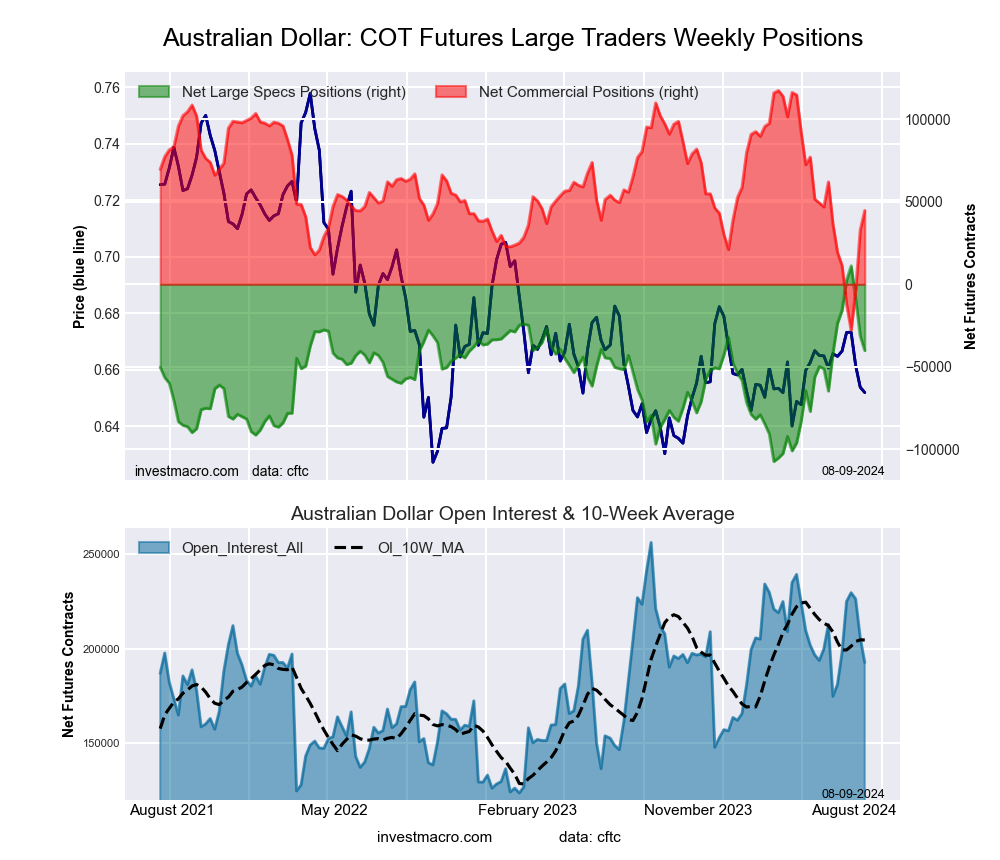
Australian Dollar Futures:

Australian Dollar Forex Futures COT ChartThe Australian Dollar large speculator standing this week resulted in a net position of -40,199 contracts in the data reported through Tuesday. This was a weekly fall of -8,829 contracts from the previous week which had a total of -31,370 net contracts.

This week’s current strength score (the trader positioning range over the past three years, measured from 0 to 100) shows the speculators are currently Bullish with a score of 56.8 percent. The commercials are Bearish with a score of 49.9 percent and the small traders (not shown in chart) are Bearish with a score of 44.3 percent.

Price Trend-Following Model: Weak Uptrend

Our weekly trend-following model classifies the current market price position as: Weak Uptrend. The current action for the model is considered to be: Hold – Maintain Long Position.

AUSTRALIAN DOLLAR StatisticsSPECULATORSCOMMERCIALSSMALL TRADERS
– Percent of Open Interest Longs:35.450.411.7
– Percent of Open Interest Shorts:56.327.114.1
– Net Position:-40,19944,743-4,544
– Gross Longs:68,19397,01922,601
– Gross Shorts:108,39252,27627,145
– Long to Short Ratio:0.6 to 11.9 to 10.8 to 1
NET POSITION TREND:
– Strength Index Score (3 Year Range Pct):56.849.944.3
– Strength Index Reading (3 Year Range):BullishBearishBearish
NET POSITION MOVEMENT INDEX:
– 6-Week Change in Strength Index:-13.917.5-23.2


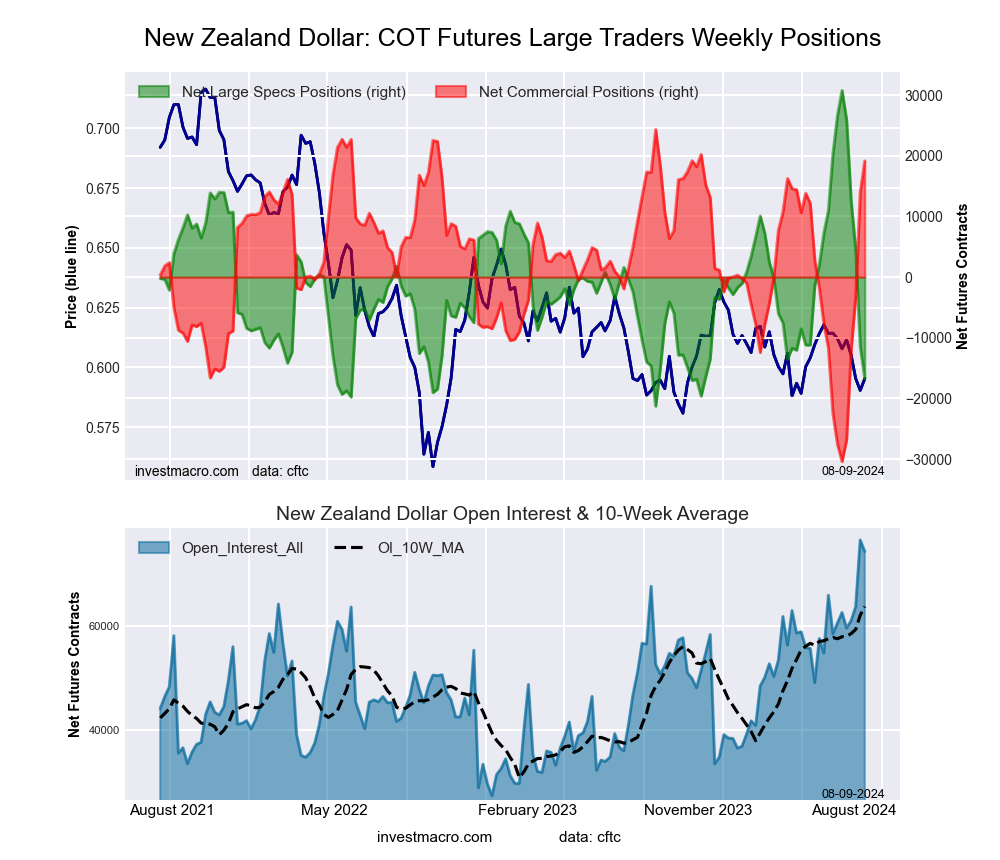
New Zealand Dollar Futures:

New Zealand Dollar Forex Futures COT ChartThe New Zealand Dollar large speculator standing this week resulted in a net position of -16,751 contracts in the data reported through Tuesday. This was a weekly decrease of -5,343 contracts from the previous week which had a total of -11,408 net contracts.

This week’s current strength score (the trader positioning range over the past three years, measured from 0 to 100) shows the speculators are currently Bearish-Extreme with a score of 8.7 percent. The commercials are Bullish-Extreme with a score of 90.6 percent and the small traders (not shown in chart) are Bearish with a score of 25.2 percent.

Price Trend-Following Model: Weak Uptrend

Our weekly trend-following model classifies the current market price position as: Weak Uptrend. The current action for the model is considered to be: Hold – Maintain Long Position.

NEW ZEALAND DOLLAR StatisticsSPECULATORSCOMMERCIALSSMALL TRADERS
– Percent of Open Interest Longs:26.868.04.9
– Percent of Open Interest Shorts:49.442.28.1
– Net Position:-16,75119,140-2,389
– Gross Longs:19,84350,4423,611
– Gross Shorts:36,59431,3026,000
– Long to Short Ratio:0.5 to 11.6 to 10.6 to 1
NET POSITION TREND:
– Strength Index Score (3 Year Range Pct):8.790.625.2
– Strength Index Reading (3 Year Range):Bearish-ExtremeBullish-ExtremeBearish
NET POSITION MOVEMENT INDEX:
– 6-Week Change in Strength Index:-83.485.4-46.1


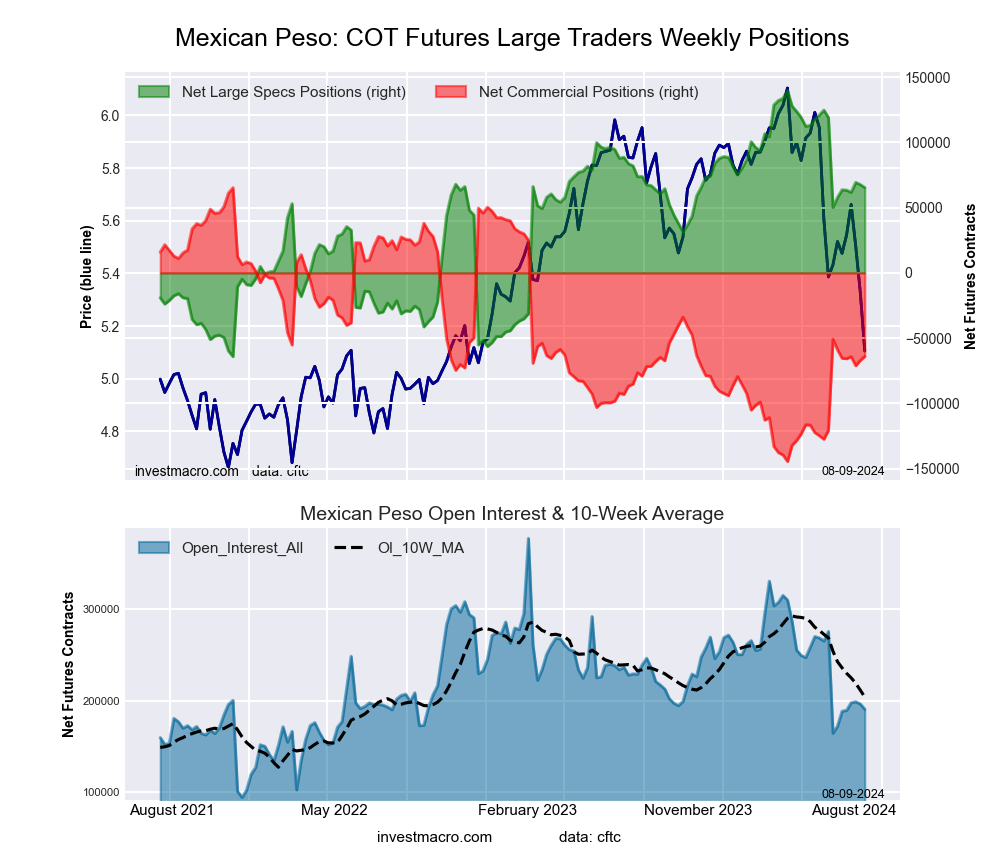
Mexican Peso Futures:

Mexican Peso Futures COT ChartThe Mexican Peso large speculator standing this week resulted in a net position of 65,336 contracts in the data reported through Tuesday. This was a weekly decline of -2,324 contracts from the previous week which had a total of 67,660 net contracts.

This week’s current strength score (the trader positioning range over the past three years, measured from 0 to 100) shows the speculators are currently Bullish with a score of 63.5 percent. The commercials are Bearish with a score of 38.4 percent and the small traders (not shown in chart) are Bearish-Extreme with a score of 2.7 percent.

Price Trend-Following Model: Strong Downtrend

Our weekly trend-following model classifies the current market price position as: Strong Downtrend. The current action for the model is considered to be: Hold – Maintain Short Position.

MEXICAN PESO StatisticsSPECULATORSCOMMERCIALSSMALL TRADERS
– Percent of Open Interest Longs:50.945.62.0
– Percent of Open Interest Shorts:16.679.22.7
– Net Position:65,336-64,007-1,329
– Gross Longs:96,91686,8133,812
– Gross Shorts:31,580150,8205,141
– Long to Short Ratio:3.1 to 10.6 to 10.7 to 1
NET POSITION TREND:
– Strength Index Score (3 Year Range Pct):63.538.42.7
– Strength Index Reading (3 Year Range):BullishBearishBearish-Extreme
NET POSITION MOVEMENT INDEX:
– 6-Week Change in Strength Index:3.7-2.4-15.9


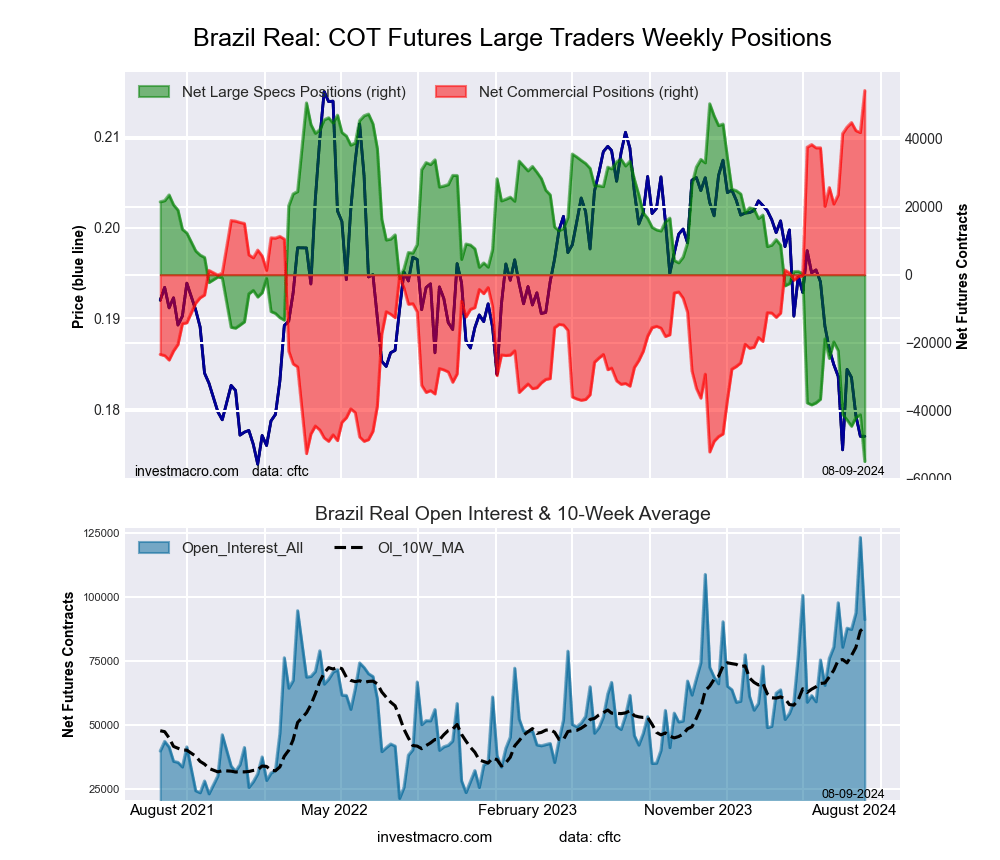
Brazilian Real Futures:

Brazil Real Futures COT ChartThe Brazilian Real large speculator standing this week resulted in a net position of -54,883 contracts in the data reported through Tuesday. This was a weekly decrease of -13,724 contracts from the previous week which had a total of -41,159 net contracts.

This week’s current strength score (the trader positioning range over the past three years, measured from 0 to 100) shows the speculators are currently Bearish-Extreme with a score of 0.0 percent. The commercials are Bullish-Extreme with a score of 100.0 percent and the small traders (not shown in chart) are Bearish with a score of 41.5 percent.

Price Trend-Following Model: Downtrend

Our weekly trend-following model classifies the current market price position as: Downtrend. The current action for the model is considered to be: Hold – Maintain Short Position.

BRAZIL REAL StatisticsSPECULATORSCOMMERCIALSSMALL TRADERS
– Percent of Open Interest Longs:24.171.83.9
– Percent of Open Interest Shorts:84.412.43.0
– Net Position:-54,88354,127756
– Gross Longs:21,98665,4373,508
– Gross Shorts:76,86911,3102,752
– Long to Short Ratio:0.3 to 15.8 to 11.3 to 1
NET POSITION TREND:
– Strength Index Score (3 Year Range Pct):0.0100.041.5
– Strength Index Reading (3 Year Range):Bearish-ExtremeBullish-ExtremeBearish
NET POSITION MOVEMENT INDEX:
– 6-Week Change in Strength Index:-30.928.717.8


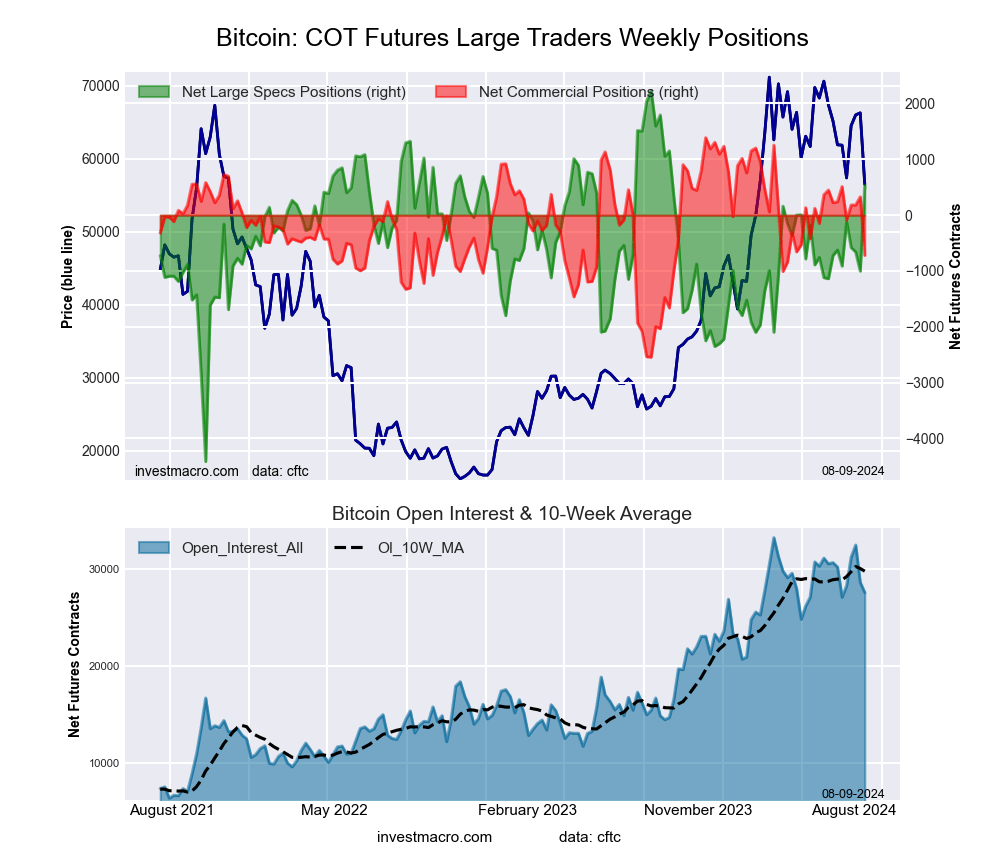
Bitcoin Futures:

Bitcoin Crypto Futures COT ChartThe Bitcoin large speculator standing this week resulted in a net position of 538 contracts in the data reported through Tuesday. This was a weekly gain of 1,540 contracts from the previous week which had a total of -1,002 net contracts.

This week’s current strength score (the trader positioning range over the past three years, measured from 0 to 100) shows the speculators are currently Bullish with a score of 74.5 percent. The commercials are Bearish with a score of 46.4 percent and the small traders (not shown in chart) are Bearish-Extreme with a score of 17.1 percent.

Price Trend-Following Model: Strong Downtrend

Our weekly trend-following model classifies the current market price position as: Strong Downtrend. The current action for the model is considered to be: Hold – Maintain Short Position.

BITCOIN StatisticsSPECULATORSCOMMERCIALSSMALL TRADERS
– Percent of Open Interest Longs:87.02.14.2
– Percent of Open Interest Shorts:85.04.73.6
– Net Position:538-719181
– Gross Longs:23,9545791,164
– Gross Shorts:23,4161,298983
– Long to Short Ratio:1.0 to 10.4 to 11.2 to 1
NET POSITION TREND:
– Strength Index Score (3 Year Range Pct):74.546.417.1
– Strength Index Reading (3 Year Range):BullishBearishBearish-Extreme
NET POSITION MOVEMENT INDEX:
– 6-Week Change in Strength Index:17.5-24.4-4.6


Article By InvestMacroReceive our weekly COT Newsletter

*COT Report: The COT data, released weekly to the public each Friday, is updated through the most recent Tuesday (data is 3 days old) and shows a quick view of how large speculators or non-commercials (for-profit traders) were positioned in the futures markets.

The CFTC categorizes trader positions according to commercial hedgers (traders who use futures contracts for hedging as part of the business), non-commercials (large traders who speculate to realize trading profits) and nonreportable traders (usually small traders/speculators) as well as their open interest (contracts open in the market at time of reporting). See CFTC criteria here.


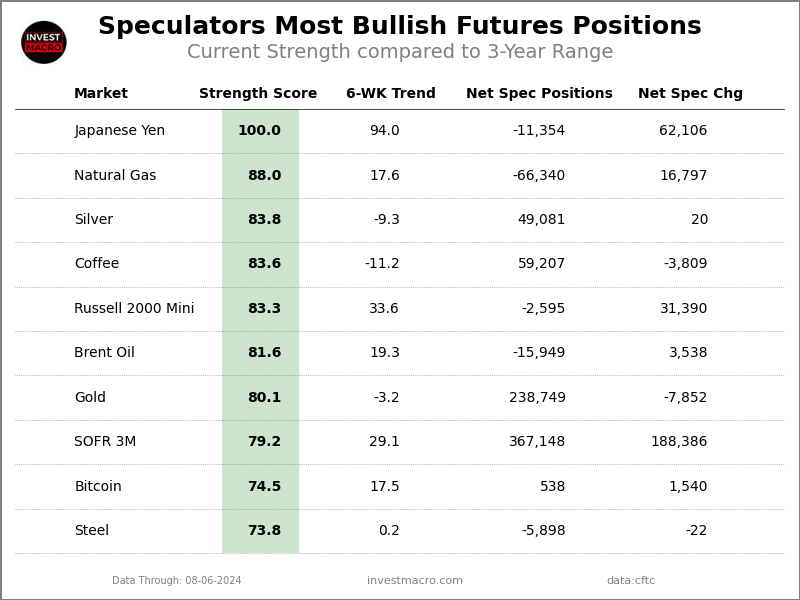
Speculator Extremes: Japanese Yen, Natural Gas & Silver lead Bullish Positions

By InvestMacro

The latest update for the weekly Commitment of Traders (COT) report was released by the Commodity Futures Trading Commission (CFTC) on Friday for data ending on August 6th.

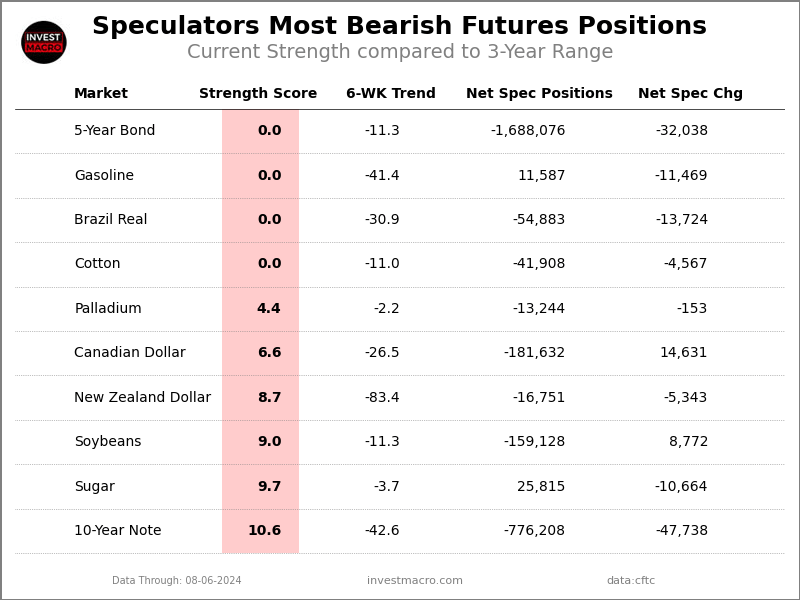
This weekly Extreme Positions report highlights the Most Bullish and Most Bearish Positions for the speculator category. Extreme positioning in these markets can foreshadow strong moves in the underlying market.

To signify an extreme position, we use the Strength Index (also known as the COT Index) of each instrument, a common method of measuring COT data. The Strength Index is simply a comparison of current trader positions against the range of positions over the previous 3 years. We use over 80 percent as extremely bullish and under 20 percent as extremely bearish. (Compare Strength Index scores across all markets in the data table or cot leaders table)


Here Are This Week’s Most Bullish Speculator Positions:

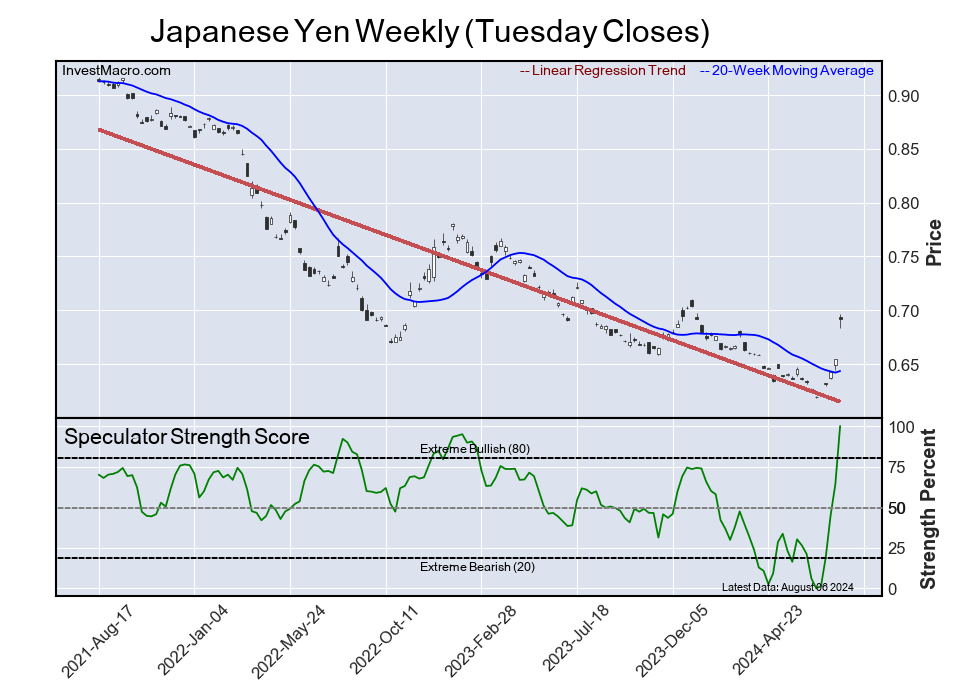
Japanese Yen


The Japanese Yen speculator position comes in as the most bullish extreme standing this week as a volatility spike helped turnaround this currency. The Japanese Yen speculator level is currently at a 100.0 percent score of its 3-year range.

The six-week trend for the percent strength score totaled 94.0 this week. The overall net speculator position was a total of -11,354 net contracts this week with a huge gain of 62,106 contract in the weekly speculator bets.


Speculators or Non-Commercials Notes:

Speculators, classified as non-commercial traders by the CFTC, are made up of large commodity funds, hedge funds and other significant for-profit participants. The Specs are generally regarded as trend-followers in their behavior towards price action – net speculator bets and prices tend to go in the same directions. These traders often look to buy when prices are rising and sell when prices are falling. To illustrate this point, many times speculator contracts can be found at their most extremes (bullish or bearish) when prices are also close to their highest or lowest levels.

These extreme levels can be dangerous for the large speculators as the trade is most crowded, there is less trading ammunition still sitting on the sidelines to push the trend further and prices have moved a significant distance. When the trend becomes exhausted, some speculators take profits while others look to also exit positions when prices fail to continue in the same direction. This process usually plays out over many months to years and can ultimately create a reverse effect where prices start to fall and speculators start a process of selling when prices are falling.


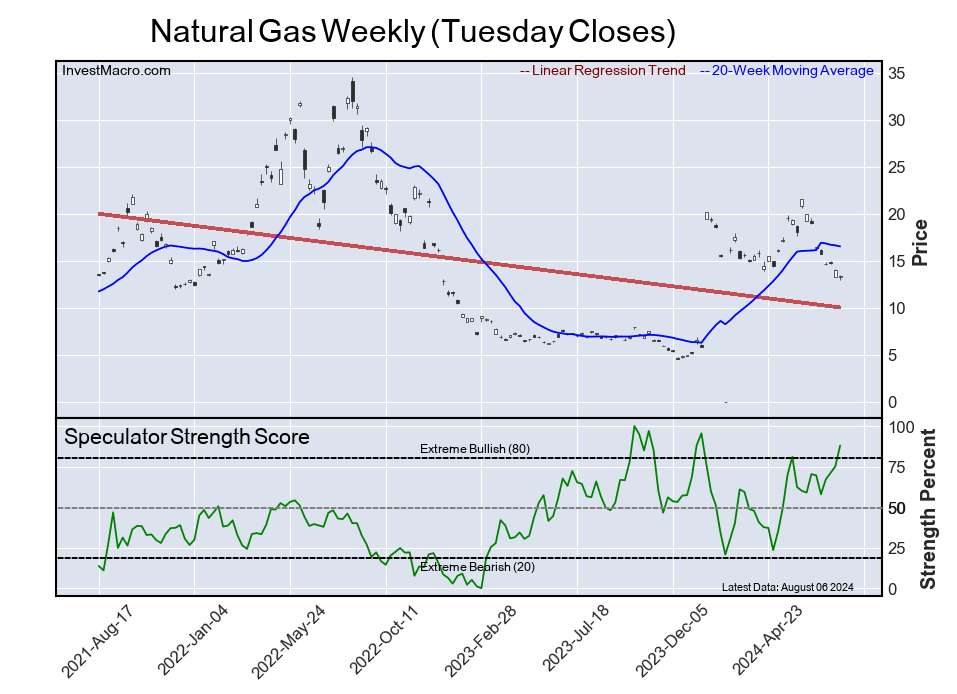
Natural Gas


The Natural Gas speculator position comes next in the extreme standings this week. The Natural Gas speculator level is now at a 88.0 percent score of its 3-year range.

The six-week trend for the percent strength score was 17.6 this week. The speculator position registered -66,340 net contracts this week with a weekly rise of 16,797 contracts in speculator bets.


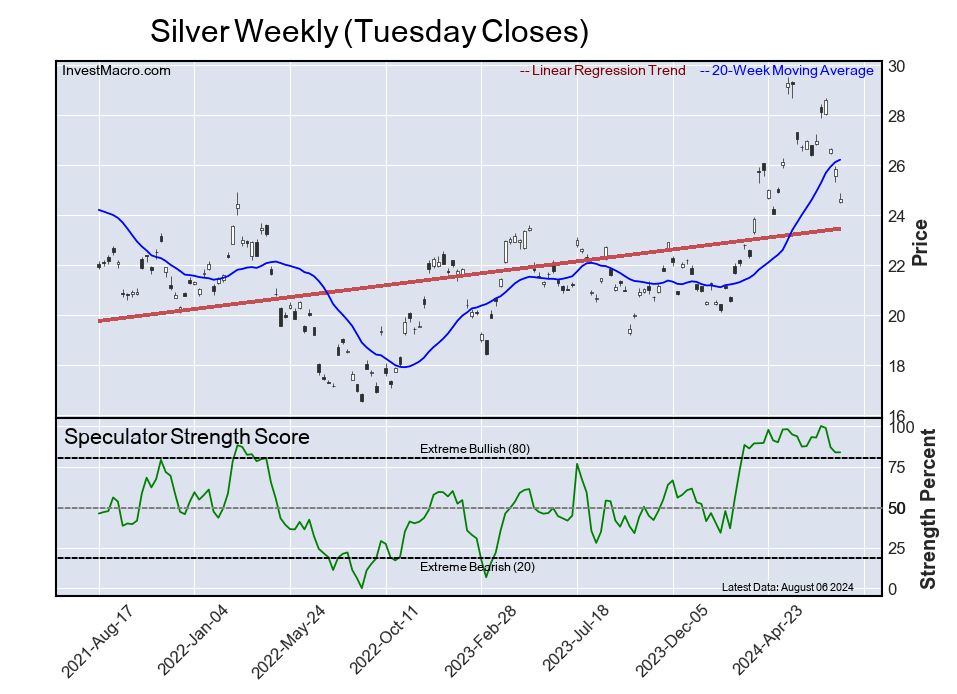
Silver


The Silver speculator position comes in third this week in the extreme standings. The Silver speculator level resides at a 83.8 percent score of its 3-year range.

The six-week trend for the speculator strength score came in at -9.3 this week. The overall speculator position was 49,081 net contracts this week with an edge higher by 20 contracts in the weekly speculator bets.


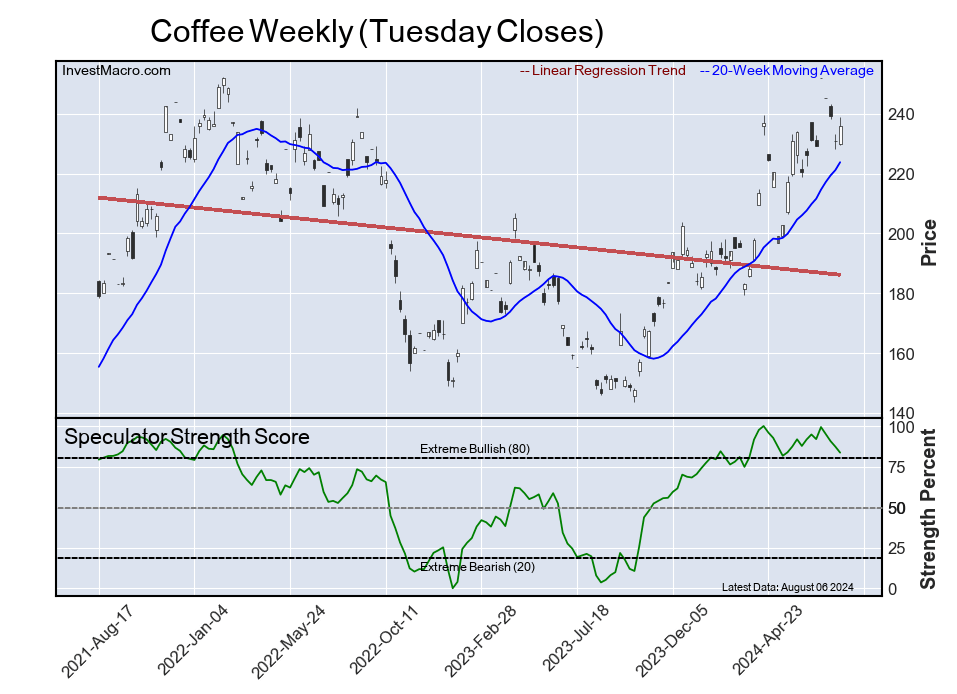
Coffee


The Coffee speculator position comes up number four in the extreme standings this week. The Coffee speculator level is at a 83.6 percent score of its 3-year range.

The six-week trend for the speculator strength score totaled a change of -11.2 this week. The overall speculator position was 59,207 net contracts this week with a dip of -3,809 contracts in the speculator bets.


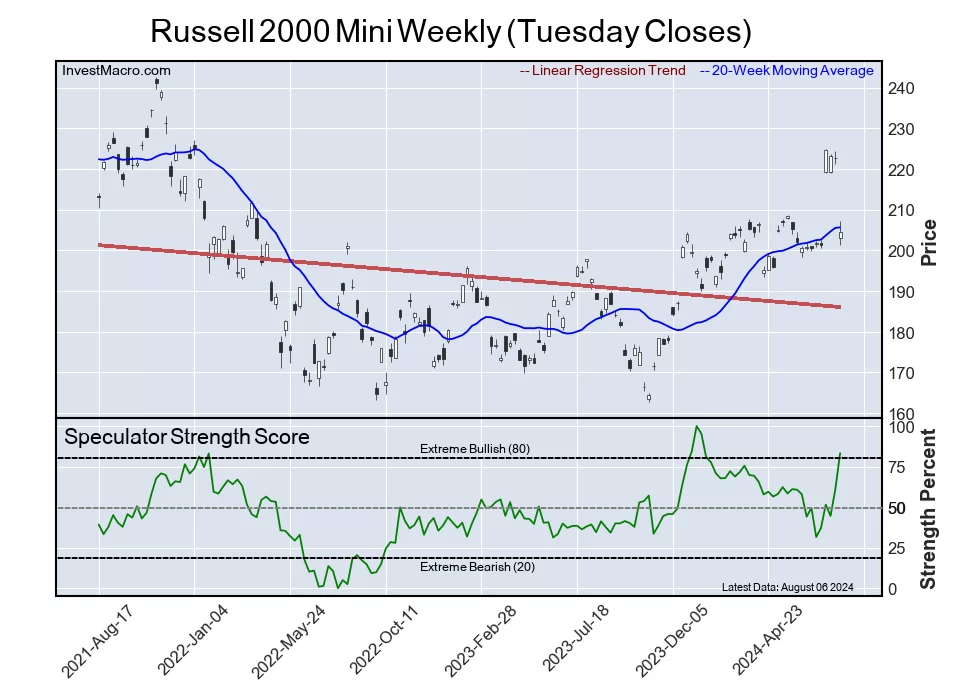
Russell 2000 Mini


The Russell 2000 Mini speculator position rounds out the top five in this week’s bullish extreme standings. The Russell 2000 Mini speculator level sits at a 83.3 percent score of its 3-year range. The six-week trend for the speculator strength score was 33.6 this week.

The speculator position was -2,595 net contracts this week with a boost of 31,390 contracts in the weekly speculator bets.


This Week’s Most Bearish Speculator Positions:

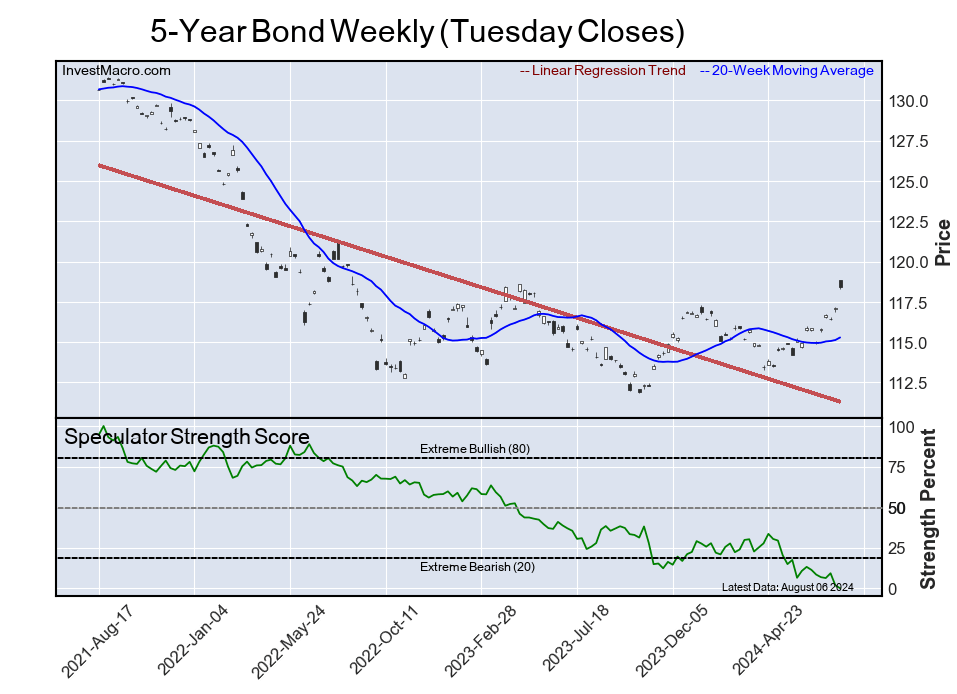
5-Year Bond


The 5-Year Bond speculator position comes in as the most bearish extreme standing this week. The 5-Year Bond speculator level is at a 0.0 percent score of its 3-year range.

The six-week trend for the speculator strength score was -11.3 this week. The overall speculator position was -1,688,076 net contracts this week with a drop of -32,038 contracts in the speculator bets.


Brazil Real


The Brazil Real speculator position comes in next for the most bearish extreme standing on the week. The Brazil Real speculator level is at a 0.0 percent score of its 3-year range.

The six-week trend for the speculator strength score was -30.9 this week. The speculator position was -54,883 net contracts this week with a decrease of -13,724 contracts in the weekly speculator bets.


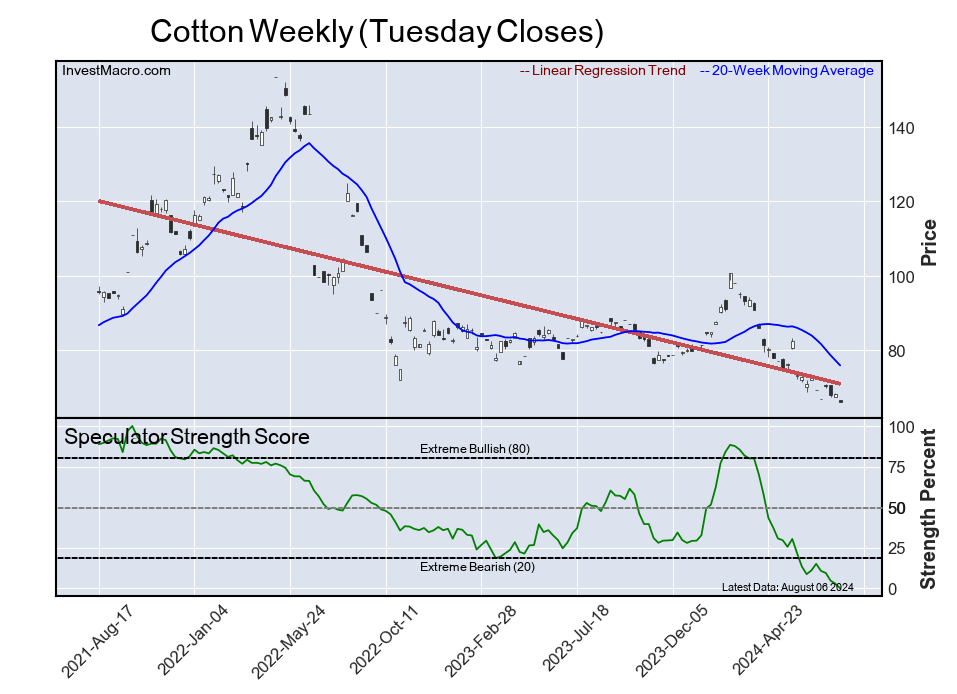
Cotton


The Cotton speculator position comes in as third most bearish extreme standing of the week. The Cotton speculator level resides at a 0.0 percent score of its 3-year range.

The six-week trend for the speculator strength score was -11.0 this week. The overall speculator position was -41,908 net contracts this week with a decline of -4,567 contracts in the speculator bets.


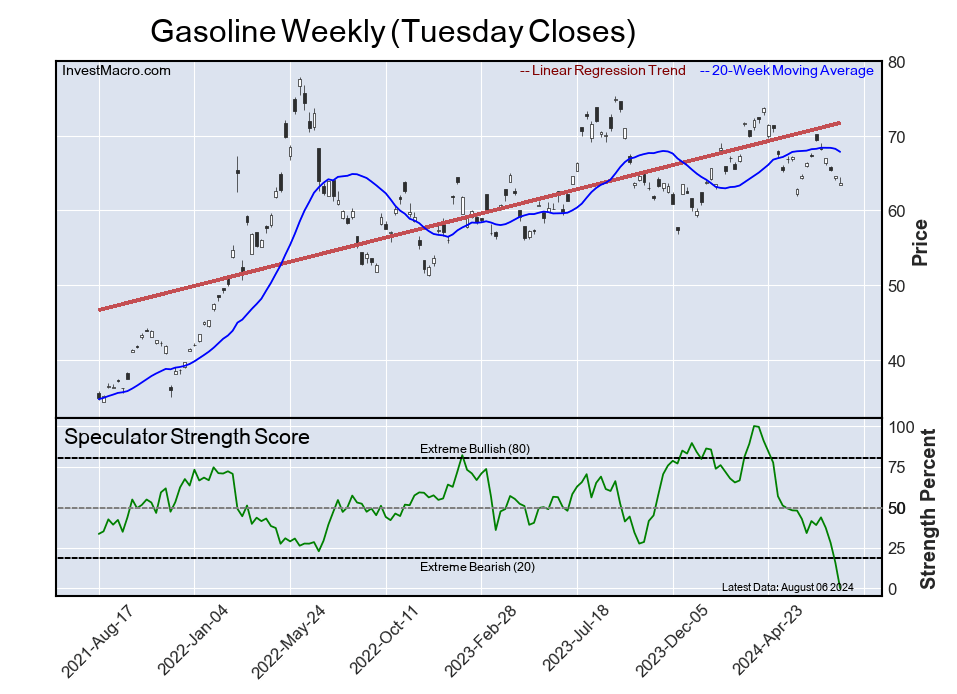
Gasoline


The Gasoline speculator position comes in as this week’s fourth most bearish extreme standing. The Gasoline speculator level is at a 0.0 percent score of its 3-year range.

The six-week trend for the speculator strength score was -41.4 this week. The speculator position was 11,587 net contracts this week with a drop of -11,469 contracts in the weekly speculator bets.


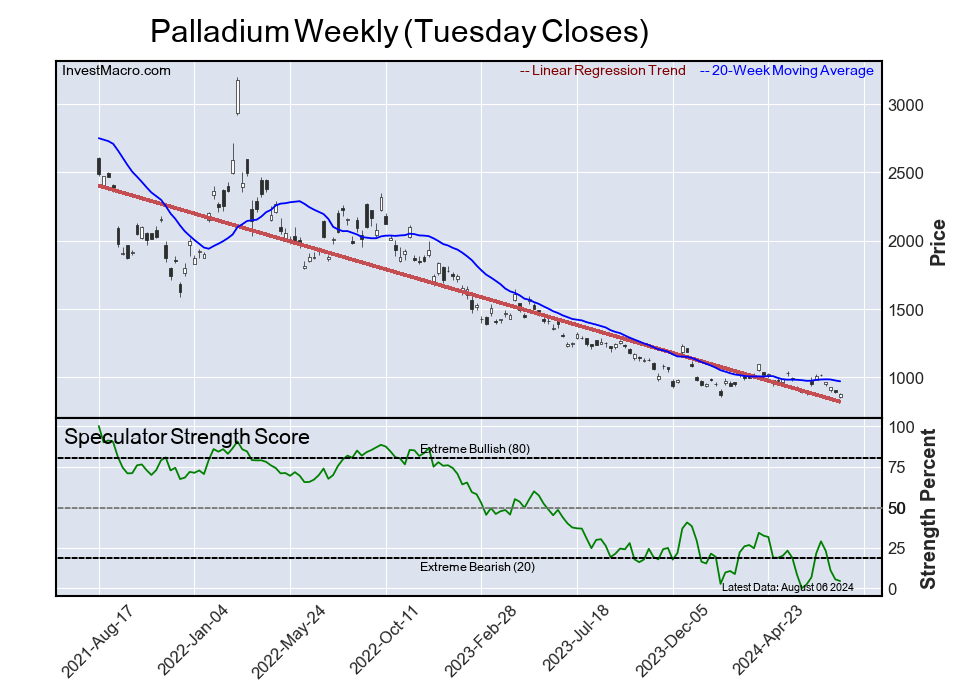
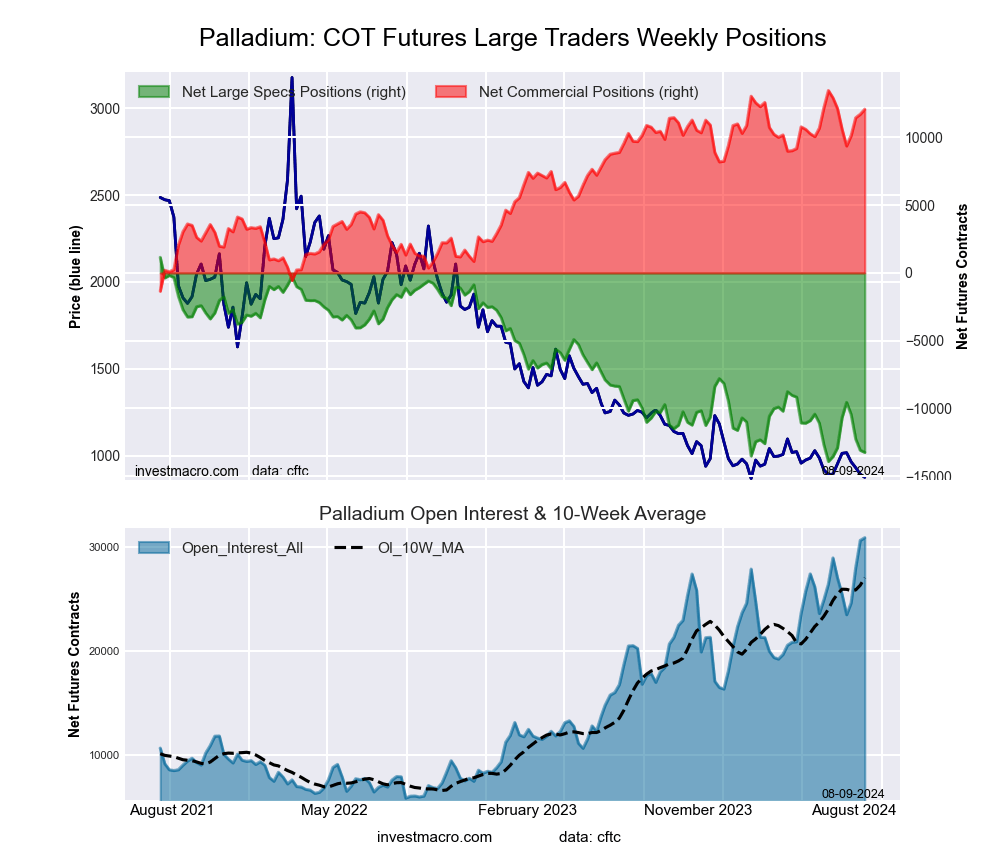
Palladium


Finally, the Palladium speculator position comes in as the fifth most bearish extreme standing for this week. The Palladium speculator level is at a 4.4 percent score of its 3-year range.

The six-week trend for the speculator strength score was -2.2 this week. The speculator position was -13,244 net contracts this week with an edge lower by -153 contracts in the weekly speculator bets.


Article By InvestMacroReceive our weekly COT Newsletter

*COT Report: The COT data, released weekly to the public each Friday, is updated through the most recent Tuesday (data is 3 days old) and shows a quick view of how large speculators or non-commercials (for-profit traders) were positioned in the futures markets.

The CFTC categorizes trader positions according to commercial hedgers (traders who use futures contracts for hedging as part of the business), non-commercials (large traders who speculate to realize trading profits) and nonreportable traders (usually small traders/speculators) as well as their open interest (contracts open in the market at time of reporting). See CFTC criteria here.
COT Metals Charts: Speculator Bets led lower by Gold & Copper

By InvestMacro

Here are the latest charts and statistics for the Commitment of Traders (COT) data published by the Commodities Futures Trading Commission (CFTC).

The latest COT data is updated through Tuesday August 6th and shows a quick view of how large traders (for-profit speculators and commercial entities) were positioned in the futures markets.

Weekly Speculator Changes led lower by Gold & Copper

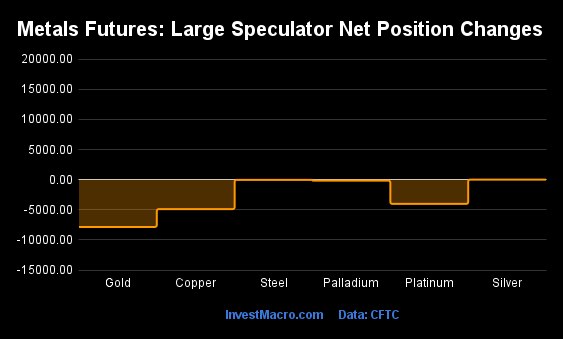
The COT metals markets speculator bets were lower this week as just one out of the six metals markets we cover had higher positioning while the other five markets had lower speculator contracts.

Leading the gains for the metals was the Silver market with a small gain of just 20 contracts.

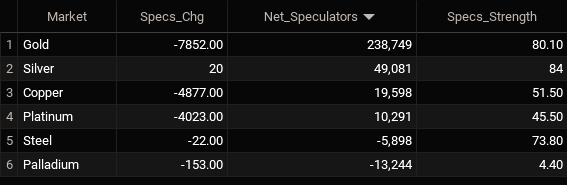
Meanwhile, the markets with declines in speculator bets for the week were Gold (-7,852 contracts), Copper (-4,877 contracts), Platinum (-4,023 contracts), Steel (-22 contracts) and with Palladium (-153 contracts) also registering lower bets on the week.


Metals Net Speculators Leaderboard

Legend: Weekly Speculators Change | Speculators Current Net Position | Speculators Strength Score compared to last 3-Years (0-100 range)


Strength Scores led by Silver & Gold

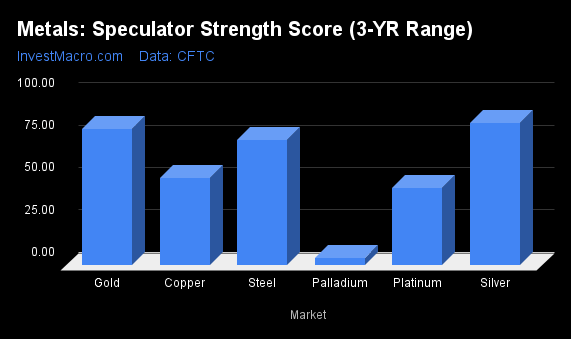
COT Strength Scores (a normalized measure of Speculator positions over a 3-Year range, from 0 to 100 where above 80 is Extreme-Bullish and below 20 is Extreme-Bearish) showed that Silver (84 percent) and Gold (80 percent) lead the metals markets this week. Steel (74 percent) comes in as the next highest in the weekly strength scores.

On the downside, Palladium (4 percent) comes in at the lowest strength level currently and is in Extreme-Bearish territory (below 20 percent).

Strength Statistics:
Gold (80.1 percent) vs Gold previous week (83.5 percent)
Silver (83.8 percent) vs Silver previous week (83.8 percent)
Copper (51.5 percent) vs Copper previous week (56.0 percent)
Platinum (45.5 percent) vs Platinum previous week (56.2 percent)
Palladium (4.4 percent) vs Palladium previous week (5.5 percent)
Steel (73.8 percent) vs Palladium previous week (73.9 percent)


Steel tops the 6-Week Strength Trends

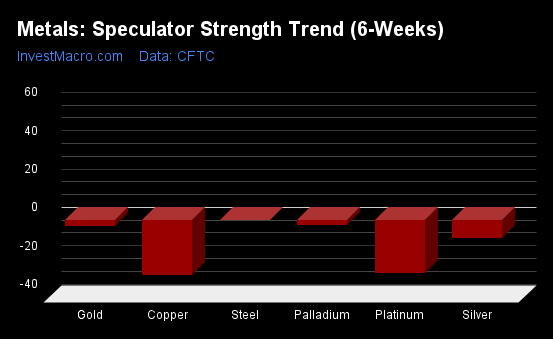
COT Strength Score Trends (or move index, calculates the 6-week changes in strength scores) showed that Steel (0.2 percent) leads the past six weeks trends for metals and is the only market with a positive level in the latest trends data.

Copper (-28 percent) and Platinum (-28 percent) lead the downside trend scores currently.

Move Statistics:
Gold (-3.2 percent) vs Gold previous week (1.5 percent)
Silver (-9.3 percent) vs Silver previous week (-3.8 percent)
Copper (-28.4 percent) vs Copper previous week (-26.2 percent)
Platinum (-27.5 percent) vs Platinum previous week (-4.1 percent)
Palladium (-2.2 percent) vs Palladium previous week (3.1 percent)
Steel (0.2 percent) vs Steel previous week (-0.5 percent)


Individual Markets:

Gold Comex Futures:

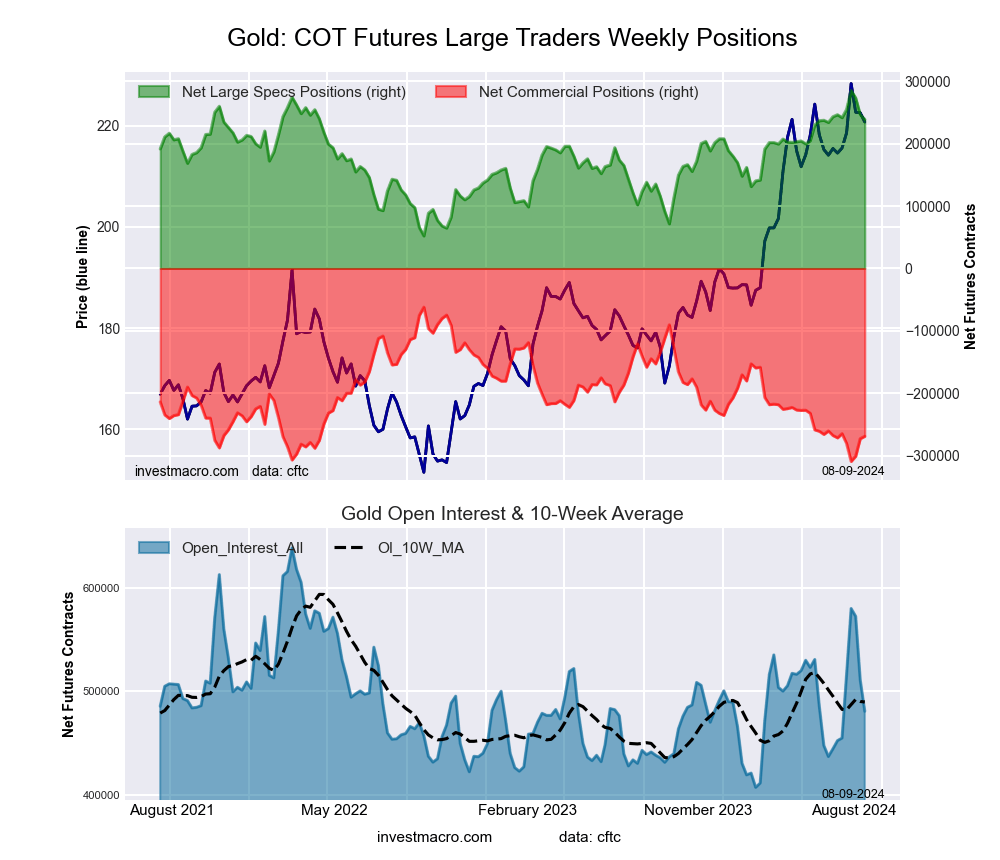
Gold Futures COT ChartThe Gold Comex Futures large speculator standing this week was a net position of 238,749 contracts in the data reported through Tuesday. This was a weekly fall of -7,852 contracts from the previous week which had a total of 246,601 net contracts.

This week’s current strength score (the trader positioning range over the past three years, measured from 0 to 100) shows the speculators are currently Bullish-Extreme with a score of 80.1 percent. The commercials are Bearish-Extreme with a score of 16.3 percent and the small traders (not shown in chart) are Bullish-Extreme with a score of 80.2 percent.

Price Trend-Following Model: Strong Uptrend

Our weekly trend-following model classifies the current market price position as: Strong Uptrend. The current action for the model is considered to be: Hold – Maintain Long Position.

Gold Futures StatisticsSPECULATORSCOMMERCIALSSMALL TRADERS
– Percent of Open Interest Longs:62.018.410.7
– Percent of Open Interest Shorts:12.474.44.4
– Net Position:238,749-269,03430,285
– Gross Longs:298,11988,44251,205
– Gross Shorts:59,370357,47620,920
– Long to Short Ratio:5.0 to 10.2 to 12.4 to 1
NET POSITION TREND:
– Strength Index Score (3 Year Range Pct):80.116.380.2
– Strength Index Reading (3 Year Range):Bullish-ExtremeBearish-ExtremeBullish-Extreme
NET POSITION MOVEMENT INDEX:
– 6-Week Change in Strength Index:-3.21.018.1


Silver Comex Futures:

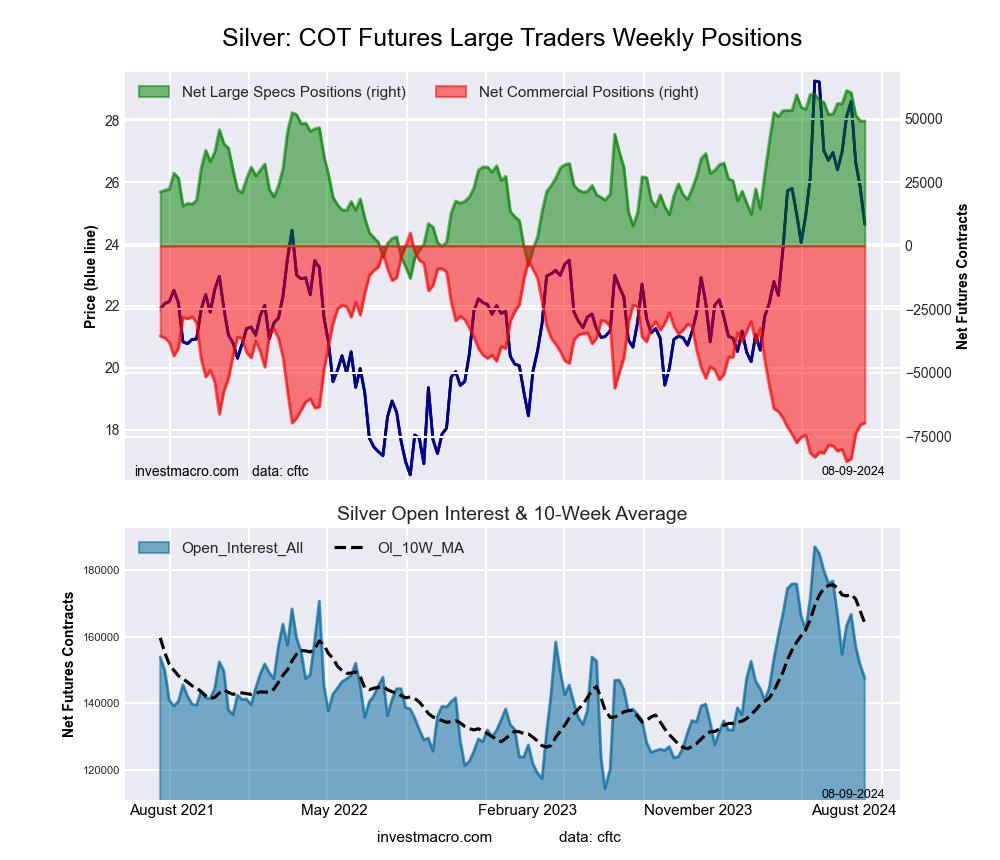
Silver Futures COT ChartThe Silver Comex Futures large speculator standing this week was a net position of 49,081 contracts in the data reported through Tuesday. This was a weekly advance of 20 contracts from the previous week which had a total of 49,061 net contracts.

This week’s current strength score (the trader positioning range over the past three years, measured from 0 to 100) shows the speculators are currently Bullish-Extreme with a score of 83.8 percent. The commercials are Bearish-Extreme with a score of 16.9 percent and the small traders (not shown in chart) are Bullish with a score of 70.1 percent.

Price Trend-Following Model: Weak Uptrend

Our weekly trend-following model classifies the current market price position as: Weak Uptrend. The current action for the model is considered to be: Hold – Maintain Long Position.

Silver Futures StatisticsSPECULATORSCOMMERCIALSSMALL TRADERS
– Percent of Open Interest Longs:43.823.320.8
– Percent of Open Interest Shorts:10.570.46.9
– Net Position:49,081-69,63120,550
– Gross Longs:64,57434,30430,694
– Gross Shorts:15,493103,93510,144
– Long to Short Ratio:4.2 to 10.3 to 13.0 to 1
NET POSITION TREND:
– Strength Index Score (3 Year Range Pct):83.816.970.1
– Strength Index Reading (3 Year Range):Bullish-ExtremeBearish-ExtremeBullish
NET POSITION MOVEMENT INDEX:
– 6-Week Change in Strength Index:-9.312.3-20.3


Copper Grade #1 Futures:

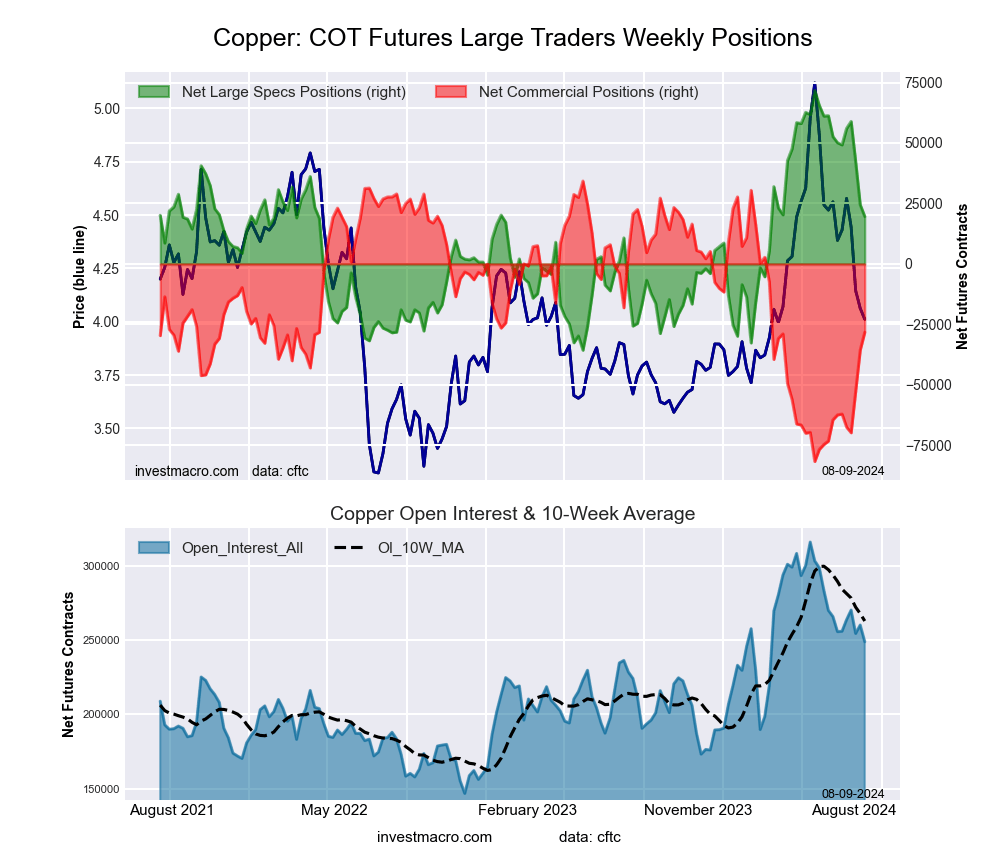
Copper Futures COT ChartThe Copper Grade #1 Futures large speculator standing this week was a net position of 19,598 contracts in the data reported through Tuesday. This was a weekly decline of -4,877 contracts from the previous week which had a total of 24,475 net contracts.

This week’s current strength score (the trader positioning range over the past three years, measured from 0 to 100) shows the speculators are currently Bullish with a score of 51.5 percent. The commercials are Bearish with a score of 46.1 percent and the small traders (not shown in chart) are Bullish with a score of 70.3 percent.

Price Trend-Following Model: Strong Downtrend

Our weekly trend-following model classifies the current market price position as: Strong Downtrend. The current action for the model is considered to be: New Sell – Short Position.

Copper Futures StatisticsSPECULATORSCOMMERCIALSSMALL TRADERS
– Percent of Open Interest Longs:35.634.78.2
– Percent of Open Interest Shorts:27.746.04.7
– Net Position:19,598-28,2818,683
– Gross Longs:88,59886,31520,395
– Gross Shorts:69,000114,59611,712
– Long to Short Ratio:1.3 to 10.8 to 11.7 to 1
NET POSITION TREND:
– Strength Index Score (3 Year Range Pct):51.546.170.3
– Strength Index Reading (3 Year Range):BullishBearishBullish
NET POSITION MOVEMENT INDEX:
– 6-Week Change in Strength Index:-28.429.5-22.1


Platinum Futures:

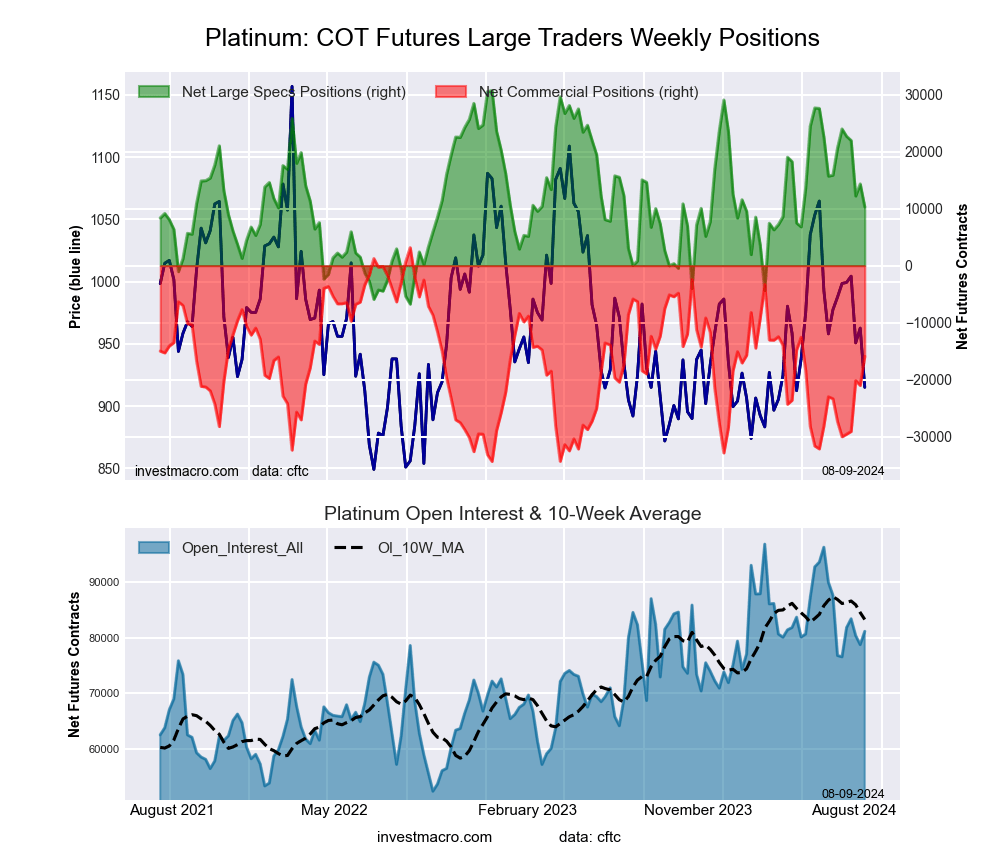
Platinum Futures COT ChartThe Platinum Futures large speculator standing this week was a net position of 10,291 contracts in the data reported through Tuesday. This was a weekly fall of -4,023 contracts from the previous week which had a total of 14,314 net contracts.

This week’s current strength score (the trader positioning range over the past three years, measured from 0 to 100) shows the speculators are currently Bearish with a score of 45.5 percent. The commercials are Bearish with a score of 49.1 percent and the small traders (not shown in chart) are Bullish with a score of 58.4 percent.

Price Trend-Following Model: Downtrend

Our weekly trend-following model classifies the current market price position as: Downtrend. The current action for the model is considered to be: Hold – Maintain Short Position.

Platinum Futures StatisticsSPECULATORSCOMMERCIALSSMALL TRADERS
– Percent of Open Interest Longs:54.724.211.8
– Percent of Open Interest Shorts:42.043.84.8
– Net Position:10,291-15,9255,634
– Gross Longs:44,39119,6589,567
– Gross Shorts:34,10035,5833,933
– Long to Short Ratio:1.3 to 10.6 to 12.4 to 1
NET POSITION TREND:
– Strength Index Score (3 Year Range Pct):45.549.158.4
– Strength Index Reading (3 Year Range):BearishBearishBullish
NET POSITION MOVEMENT INDEX:
– 6-Week Change in Strength Index:-27.530.5-19.9


Palladium Futures:

Palladium Futures COT ChartThe Palladium Futures large speculator standing this week was a net position of -13,244 contracts in the data reported through Tuesday. This was a weekly fall of -153 contracts from the previous week which had a total of -13,091 net contracts.

This week’s current strength score (the trader positioning range over the past three years, measured from 0 to 100) shows the speculators are currently Bearish-Extreme with a score of 4.4 percent. The commercials are Bullish-Extreme with a score of 90.7 percent and the small traders (not shown in chart) are Bullish-Extreme with a score of 89.5 percent.

Price Trend-Following Model: Strong Downtrend

Our weekly trend-following model classifies the current market price position as: Strong Downtrend. The current action for the model is considered to be: Hold – Maintain Short Position.

Palladium Futures StatisticsSPECULATORSCOMMERCIALSSMALL TRADERS
– Percent of Open Interest Longs:31.347.48.7
– Percent of Open Interest Shorts:74.28.25.0
– Net Position:-13,24412,0831,161
– Gross Longs:9,67714,6222,700
– Gross Shorts:22,9212,5391,539
– Long to Short Ratio:0.4 to 15.8 to 11.8 to 1
NET POSITION TREND:
– Strength Index Score (3 Year Range Pct):4.490.789.5
– Strength Index Reading (3 Year Range):Bearish-ExtremeBullish-ExtremeBullish-Extreme
NET POSITION MOVEMENT INDEX:
– 6-Week Change in Strength Index:-2.2-0.419.0


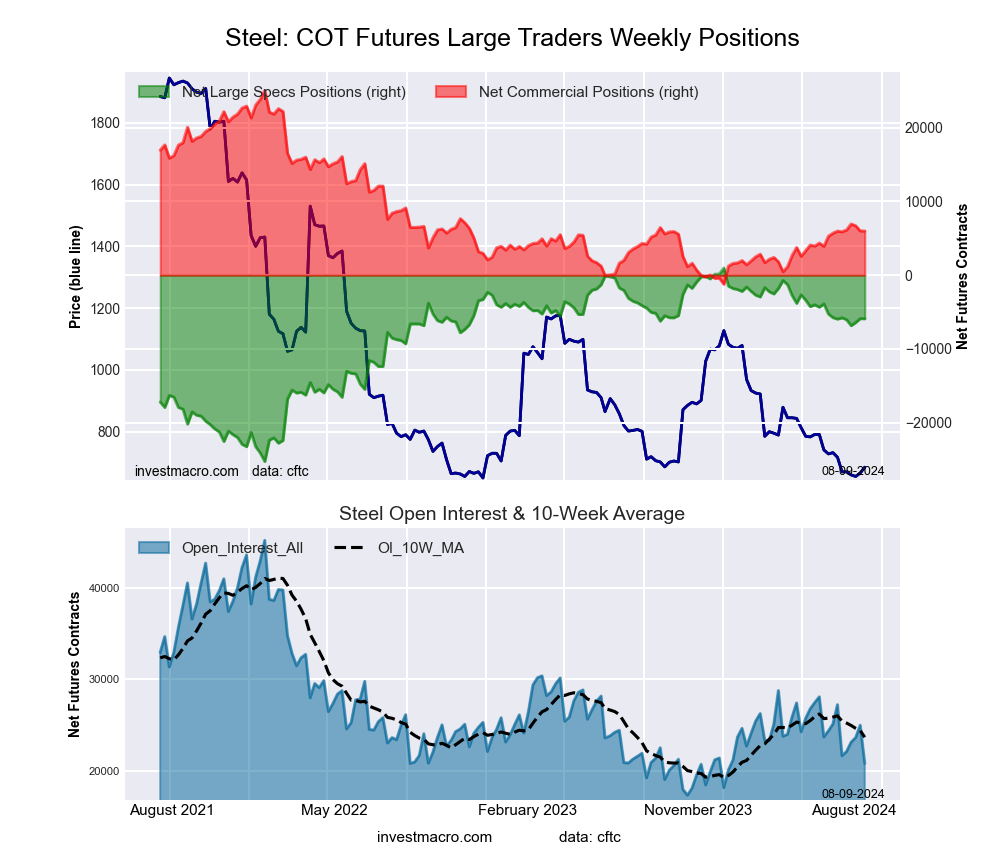
Steel Futures Futures:

Steel Futures COT ChartThe Steel Futures large speculator standing this week was a net position of -5,898 contracts in the data reported through Tuesday. This was a weekly decrease of -22 contracts from the previous week which had a total of -5,876 net contracts.

This week’s current strength score (the trader positioning range over the past three years, measured from 0 to 100) shows the speculators are currently Bullish with a score of 73.8 percent. The commercials are Bearish with a score of 27.4 percent and the small traders (not shown in chart) are Bearish with a score of 22.2 percent.

Price Trend-Following Model: Downtrend

Our weekly trend-following model classifies the current market price position as: Downtrend. The current action for the model is considered to be: Hold – Maintain Short Position.

Steel Futures StatisticsSPECULATORSCOMMERCIALSSMALL TRADERS
– Percent of Open Interest Longs:9.679.81.0
– Percent of Open Interest Shorts:38.051.01.4
– Net Position:-5,8985,991-93
– Gross Longs:2,00716,615203
– Gross Shorts:7,90510,624296
– Long to Short Ratio:0.3 to 11.6 to 10.7 to 1
NET POSITION TREND:
– Strength Index Score (3 Year Range Pct):73.827.422.2
– Strength Index Reading (3 Year Range):BullishBearishBearish
NET POSITION MOVEMENT INDEX:
– 6-Week Change in Strength Index:0.20.0-5.9


Article By InvestMacroReceive our weekly COT Newsletter

*COT Report: The COT data, released weekly to the public each Friday, is updated through the most recent Tuesday (data is 3 days old) and shows a quick view of how large speculators or non-commercials (for-profit traders) were positioned in the futures markets.

The CFTC categorizes trader positions according to commercial hedgers (traders who use futures contracts for hedging as part of the business), non-commercials (large traders who speculate to realize trading profits) and nonreportable traders (usually small traders/speculators) as well as their open interest (contracts open in the market at time of reporting). See CFTC criteria here.