Japanese Yen Surges: Potential Intervention Amid Inflation Shocks

By RoboForex Analytical Department

The USD/JPY pair experienced a significant drop to 159.06, driven by sharp declines following the release of unexpectedly low US inflation figures and potential interventions from Japanese authorities.

On Thursday, the pair plunged nearly 3%, prompted by US inflation data and rumours of Tokyo’s intervention to bolster the yen, which is nearing 38-year lows. Masato Kanda, Japan’s chief currency diplomat, hinted at readiness to intervene in the currency market but remained non-committal about the specific actions taken the previous evening.

Market participants are left to speculate on the nature of these moves as official data that could confirm government interventions will only be available at the end of the month. Reports from Asahi suggest that interventions did occur, while Nikkei highlighted the BoJ’s inspections of banks’ euro-yen rates, potentially escalating market tensions and supporting the yen’s strength.

USD/JPY technical analysis

The USD/JPY chart shows a second correction impulse down to 157.40. The potential for a recovery to 159.60 is noted, which would serve as a test from below. A subsequent decline to 157.22 is anticipated. This bearish outlook is supported by the MACD indicator, whose signal line is below zero, indicating a downward trend.

The H1 chart confirms the formation of a downward trajectory towards 157.22, with the immediate target of 157.40 already achieved. A rebound to 159.60 is expected, followed by another decline to the target level. The Stochastic oscillator aligns with this analysis, showing a signal line above 80 and preparing for a downward adjustment to 20, suggesting potential for further declines.

Investors and traders will closely watch further statements from Japanese officials and the forthcoming official statistics to clarify the situation, as these factors will significantly influence the yen’s trajectory in the near term.


Disclaimer

Any forecasts contained herein are based on the author’s particular opinion. This analysis may not be treated as trading advice. RoboForex bears no responsibility for trading results based on trading recommendations and reviews contained herein.

Japanese Yen Faces Continued Decline Amid Interest Rate Differentials

By RoboForex Analytical Department

The USD/JPY pair has risen to 161.65, with the market cautious ahead of today’s US consumer price index release. Despite this, the yen remains weakened by the significant interest rate differential between the Bank of Japan (BoJ) and the Federal Reserve.

Earlier this year, the BoJ abandoned its longstanding negative interest rate policy, adjusting the rate to zero. However, this adjustment has not halted the yen’s depreciation, raising concerns about the currency’s ongoing decline.

Investors eagerly await the BoJ’s meeting in July, where crucial decisions on bond purchases are expected. The outcome of this meeting could mark a significant shift in Japan’s monetary policy.

Mixed economic signals from Japan

Morning statistics from Japan showed mixed results. Core machinery orders declined by 3.2% month-on-month in May, following a 2.9% decrease the previous month. However, on an annual basis, these orders increased by 10.8%, surpassing the expected 7.2% growth, suggesting some underlying strength in the industrial sector.

USD/JPY technical analysis

The USD/JPY is establishing a consolidation range around 161.12. The price could reach up to 162.00, considered a local target within the current upward trend. Following this level, a correction to 158.80 is anticipated, which could lead to another growth phase targeting 163.30. This bullish outlook is supported technically by the MACD indicator, where the signal line is prominently above zero and oriented upward.

On the H1 chart, the pair has completed a growth structure reaching 161.79. Currently, a downward impulse to 161.47 has been observed. A continuation of this correction to 161.12 is expected, which should precede another rise to 162.00. This analysis is corroborated by the Stochastic oscillator, with the signal line poised to drop from above 80 to 20, indicating potential short-term pullbacks before further gains.

Investors and traders will closely monitor upcoming data releases and central bank communications to gauge the potential directions for both the yen and broader currency markets.


Disclaimer

Any forecasts contained herein are based on the author’s particular opinion. This analysis may not be treated as trading advice. RoboForex bears no responsibility for trading results based on trading recommendations and reviews contained herein.

The US stock indices are once again hitting highs. Oil rises amid falling inventories

By JustMarkets

At the end of Wednesday, the Dow Jones Index (US30) rose by 1.09%, and the S&P 500 Index (US500) gained 1.02%. The NASDAQ Technology Index (US100) closed yesterday 1.18% positive. The S&P 500 and Nasdaq 100 indices hit new all-time highs, while the Dow Jones Industrials Index hit a 7-week high. The strength in chip maker stocks led tech stocks and the broader market higher Wednesday after Taiwan Semiconductor Manufacturing Co (TSMC), the sole supplier of cutting-edge chips to Nvidia and Apple, reported better-than-expected second-quarter sales. In addition, Apple shares rose to a record high on news that the company intends to ship 10% more new iPhones this year.

Today, the US will release its inflation report for June. Economists expect consumer inflation to rise 0.1% month-over-month and fall slightly to 3.1% from 3.3% year-over-year. The core rate, which excludes food and energy prices, is expected to be unchanged at 3.4% year-on-year. Economists note that if the June CPI report meets expectations, the Fed will likely start a rate cut cycle in December. This could give the US dollar temporary confidence. At the same time, economists note that any downward deviation of the index (especially the core index) by more than 0.2% will sharply increase the probability of the first rate cut in September, especially given the recent weak economic data. A further slowdown in inflation could convince more market participants to bet on two Fed rate cuts by December. Such a situation would pressure the US dollar but send a green signal for precious metals and stock indices.

Equity markets in Europe were mostly down on Wednesday. Germany’s DAX (DE40) rose by 0.94%, France’s CAC 40 (FR40) closed higher by 0.86%, Spain’s IBEX 35 (ES35) climbed 1.59%, and the UK’s FTSE 100 (UK100) closed positive 0.66%.

Germany’s annualized inflation rate for June 2024 eased to 2.2%, down from 2.4% in the previous month, in line with preliminary estimates. Commodity prices slowed (0.8% vs. 1% in May), while energy costs declined faster (-2.1% vs. -1.1%). Looking at the consumer price index harmonized across EU countries, the annual rate fell to 2.5% from 2.8%, and the monthly rate was 0.2%, unchanged from May.

The UK economy grew by 0.4% month-on-month in May 2024 after stagnating in April. Construction grew at the fastest pace in almost a year. UK industrial production rose by 0.2% month-on-month in May 2024, recovering from a 0.9% fall in the previous month and matching market expectations. Manufacturing output rebounded (0.4% vs. -1.4% in April).

WTI crude oil prices rose to 82.7 dollars per barrel on Thursday, rising for the second consecutive session thanks to a larger-than-expected decline in US crude inventories. According to the EIA, the US crude oil inventories fell by 3.444 million barrels in the week ended July 5, a larger-than-expected decline of 3.0 million barrels. Gasoline inventories also fell more than expected. In addition, OPEC reaffirmed its forecast for strong growth in global oil demand in 2024. The EIA forecasts global oil demand to reach 104.7 million bpd by 2025, slightly higher than the projected supply of 104.6 million bpd, indicating a future deficit.

Asian markets were predominantly down yesterday. Japan’s Nikkei 225 (JP225) was up 0.61%, China’s FTSE China A50 (CHA50) was down 0.51%, Hong Kong’s Hang Seng (HK50) was down 0.29% for the day, and Australia’s ASX 200 (AU200) was negative 0.16%.

The Australian dollar exchange rate surpassed $0.675, hitting its highest level in six months amid growing expectations that the Reserve Bank of Australia (RBA) may raise interest rate again if inflation picks up. Markets still see a 20% chance of further RBA policy tightening in August while ruling out the possibility of a rate cut this year.

S&P 500 (US500) 5,633.91 +56.93 (+1.02%)

Dow Jones (US30) 39,721.36 +429.39 (+1.09%)

DAX (DE40) 18,407.22 +171.03 (+0.94%)

FTSE 100 (UK100) 8,193.51 +53.70 (+0.66%)

USD Index 105.01 -0.12 (-0.11%)

Important events today:
  • – UK GDP (m/m) at 09:00 (GMT+3);
  • – UK Industrial Production (m/m) at 09:00 (GMT+3);
  • – UK Manufacturing Production (m/m) at 09:00 (GMT+3);
  • – UK Trade Balance (m/m) at 09:00 (GMT+3);
  • – US Initial Jobless Claims (w/w) at 15:30 (GMT+3);
  • – US Consumer Price Index (m/m) at 15:30 (GMT+3);
  • – US Natural Gas Storage (w/w) at 17:30 (GMT+3);
  • – US FOMC Member Bostic Speaks at 18:30 (GMT+3).

By JustMarkets


This article reflects a personal opinion and should not be interpreted as an investment advice, and/or offer, and/or a persistent request for carrying out financial transactions, and/or a guarantee, and/or a forecast of future events.

Spain vs. England: Stock indexes hint at Euro 2024 winners?

By ForexTime 

SPN35 index has risen 9.8% so far this year

  • UK100 index has risen 6.2% so far this year
  • Markets predict SPN35 can climb another 18.7% within 12 months
  • Markets predict UK100 can climb another 14.4% within 12 months
  • Spain favoured to beat England in Euro 2024 final

England and Spain are set to battle it out for Europe’s footballing crown this Sunday, July 14th.

In the lead up to this highly-anticipated football contest, we take the opportunity to compare how their respective stock markets have fared so far this year.


First, here are some basics about stock indexes.

What is a stock index?

Imagine a stock index to be a basket of stocks.

This index measures the combined performance of the stocks within that “basket”.

Hence, the index’s price should rise when the prices of the stocks in that basket are moving higher, and vice versa.

What is the SPN35 index?

FXTM’s SPN35 index tracks the performance of the IBEX 35 index.

The IBEX measures the combined performance of the 35 most-liquid stocks traded on the Spanish Continuous exchange.

This index includes big names such as Inditex (one of the world’s largest fashion retailers which owns brands such as Zara, Pull & Bear, and Massimo Dutti), energy giant Iberdrola, and Banco Santander one of the EU’s largest banks by market value.


What is the UK100 index?

FXTM’s UK100 index tracks the performance of the FTSE 100 index.

The FTSE 100 measures the combined performance of the 100 largest companies listed on the London Stock Exchange, including global names such as AstraZeneca, Shell, HSBC, Unilever, and BP.


Although these men’s national football teams will do battle at the summit, the stock markets tell a different story.

Despite their footballing conquests, neither Spain’s nor England’s benchmark stock indexes are at the top of the continental heap.

Here’s how FXTM’s European stock indices have performed so far in 2024:

  • NETH25: +19.8%
  • EU50: +10%
  • GER40: +10%
  • SPN35: +9.8%
  • UK100: +6.2%
  • FRA40: +0.9%

And when stacked against their global peers, European stock indices have mostly lagged their US and Asian peers year to date:

  • TWN: +31%
  • JP225: +26.2%
  • NAS100: +22.9%
  • US500: +18.1%


Still, if making the comparison solely between the two Euro 2024 finalists’ benchmark stock indexes, there’s one clear winner.

The SPN35 index has outperformed the UK100 index so far in 2024.

And this outperformance is forecasted to extend over the next 12 months.

  • SPN35 is forecasted to climb another 18.7% till mid-2025
  • UK100 is forecasted to climb another 14.4% till mid-2025


The stock indexes seem to affirm the same outcome as forecasted by the sports betting industry:

Spain is favoured to beat England in the Euro 2024 final.

And that’s despite England being ranked higher (5th) on the FIFA Men’s World Ranking, compared to Spain (8th).


Yet, to be diplomatic to England football fans however, the FX arena paints a vastly contrasting picture.

The British Pound has strengthened by 2.8% against the Euro so far this year.

Also, GBP is the only G10 currency that has a year-to-date gain versus the US dollar.

  • GBPUSD: +1.1%
  • EURUSD: -1.7%


Still, anything could happen in the sporting final, hence the drama.

To be clear, financial markets are far more influenced by fundamental factors, including macroeconomic data, central banks’ policy outlooks, and even political risks, rather than fleeting bouts of sporting euphoria or despair.

Similarly, football teams do not rely on stock markets when preparing for major tournament finals.

Yet no matter the outcome of the England vs. Spain Euro 2024 final, traders and investors can take heart from the fact that financial markets do not just trade once every 4 years (unlike the Euros football tournament).

The SPN35 and UK100 indexes, along with a host of other financial instruments, are available for trading across FXTM’s platforms all year round.


Article by ForexTime

ForexTime Ltd (FXTM) is an award winning international online forex broker regulated by CySEC 185/12 www.forextime.com

Market trust at stake: What the Supreme Court’s ruling in SEC v. Jarkesy means for investors

By D. Brian Blank, Mississippi State University and Brandy Hadley, Appalachian State University 

A recent Supreme Court ruling has gotten a lot of attention for how it could reshape government. What’s gotten much less attention is how it could affect markets.

As finance professors, we find this at least as important. The Supreme Court’s 6-3 ruling in SEC v. Jarkesy could make it more challenging for the Securities and Exchange Commission – the U.S. agency that regulates securities markets – to fight fraud. And any time the SEC loses power, as it just did, market trust and transparency may be at risk.

What matters for investors, including anyone with a 401(k) plan, is how the SEC chooses to handle cases moving forward.

What is securities fraud, anyway?

Securities are investments like stocks and bonds, and securities fraud is a crime that involves misleading investors. Specifically, it is “the misrepresentation or omission of critical information to induce investors into trading securities,” according to the Legal Information Institute at Cornell University.

Some people joke that “everything is securities fraud,” because words like “misrepresentation” and “securities” are open to a lot of interpretation.

But even though those words can be defined broadly, the SEC prosecutes relatively few cases – those where it has the greatest likelihood of winning.

What happened in SEC v. Jarkesy?

The story of SEC v. Jarkesy began with the 2008 financial crisis, when a hedge fund manager in Texas watched the value of his funds decline.

In 2013, the SEC accused the fund manager – George Jarkesy – of committing securities fraud, alleging that he overestimated fund values and made other false claims. The SEC charged Jarkesy and fined him US$300,000 in a proceeding in an in-house SEC court overseen by an administrative law judge.

Jarkesy then sued the SEC, claiming he hadn’t been granted a fair trial.

The case found its way before the Supreme Court, which ruled in Jarkesy’s favor. The ruling determined that the SEC proceedings used to identify fraud and impose fines didn’t meet the criteria for a fair trial. Moving forward, such cases will need to be tried in federal court.

It’s an important precedent for the defense of people accused of misdeeds by government agencies. And the SEC isn’t the only agency to use such internal administrative proceedings. More than two dozen other agencies, including the Department of Labor and the Environmental Protection Agency, will be affected by the court’s ruling.

Arcane, but important.

How will the ruling affect SEC enforcement?

Some people have argued the ruling won’t change much for the SEC, since the agency had already started routing many cases through federal courts. Additionally, the SEC has plenty of other opportunities to fight fraud through federal litigation, industry bars and suspensions.

However, a ruling that the SEC now must turn to judiciary trials or proceedings instead of internal administrative proceedings will move all securities-fraud cases involving fines to the federal courts, potentially raising the cost of prosecution. That, in turn, could result in fewer enforcement efforts, given limited agency resources.

What’s more, losing the implicit home-court advantage the SEC previously had with its internal proceedings could further slow and complicate enforcement efforts. The result could be that when people commit securities fraud, the SEC won’t have the resources to ensure they’re caught and punished.

In the short term, the Supreme Court ruling avoided limiting the SEC’s power as much as some of the lower courts suggested it should. So at least the SEC kept most of its rule-making and enforcement authority.

How could the ruling affect markets?

To understand what will likely change, it’s important to understand the former status quo.

In the most recent fiscal year, 2023, the SEC filed 784 enforcement actions, ordering nearly $5 billion in fines and distributing nearly $1 billion to harmed investors. That was a 3% increase in enforcement actions over 2022. And the past two years of SEC fines have been the largest on record.

But now, the SEC cannot fine defendants through administrative courts and must seek civil penalties through federal courts.

One potential outcome could be a smaller regulatory burden for investment professionals who may have been concerned with how their actions would be viewed by the SEC – including, but not necessarily limited to, fraudsters. This is because the SEC may bring forward fewer fines or cases with fines due to the additional resources necessary for judiciary proceedings.

If that happens, fraudsters might be emboldened – since the expected cost of committing securities fraud would be lower than it was before the ruling – and investors would have to depend less on regulators protecting them and more on limiting risks themselves.

This could pose a problem for less sophisticated investors. Lots of people don’t know how to define securities fraud; even fewer can figure out whether a fund manager may have committed it. That risk, in turn, could limit the way investors participate in markets.

But if that simply means Americans buy more shares of S&P 500 exchange-traded funds and invest less in hedge funds, it shouldn’t be a problem for anyone’s bottom line. And more sophisticated investors should be well-equipped to evaluate risks on their own.

At the end of the day, researchers have documented the importance of trust on market quality and efficiency. So whatever helps the SEC maintain trust will have the most value for markets.

Enforcement will remain key to maintaining transparency in markets, but the method of enforcement – be it in a federal court or elsewhere – may not matter very much. The important thing is that people who commit financial crimes continue to face consequences.The Conversation

About the Authors:

D. Brian Blank, Associate Professor of Finance, Mississippi State University and Brandy Hadley, Associate Professor of Finance and Distinguished Scholar of Applied Investments, Appalachian State University

This article is republished from The Conversation under a Creative Commons license. Read the original article.


Expert Says Buy Copper

Source: Michael Ballanger (7/8/24) 

Michael Ballanger of GGM Advisory Inc. shares his thoughts on the current state of copper and gold and explains his positions in some stocks. 

When I started writing a newsletter decades ago, I did so for two reasons. The first was to condense communication to one mailed letter rather than several hundred telephone conversations; the second was to clarify my own thoughts. By that, I mean taking the ideas I had been formulating on the “investment climate as I see it” and translating those thoughts into a concise, comprehensible, and simple format that all clients could grasp without a great deal of explanation.

What started as an experiment evolved into a ritual, which in later years became a business where subscribers pay to know what I am thinking on the “investment climate as I see it.” In doing so, I was inadvertently imparting learned behaviors (and largely successful ones) from a past era to an entirely new generation of traders and investors. This new generation of investors would hear their parents and grandparents talk about the stock market in whispered reverence of names like Robert Friedland (Diamondfields), Ron Netolitzsky (Eskay Creek), and Chuck Fipke (Dia Met) and, in later eras, names like Chris Smith (Great Bear’s Dixie Project) and Blair Way (Patriot Battery Metals) — names all associated with massive wealth creation.

However, outside of Friedland, very few have replicated their victories. Few except, of course, Friedland, who has parlayed a billion-dollar win with Diamondfields into multiples of that with his family-owned Ivanhoe Mines Ltd. (IVN:TSX; IVPAF:OTCQX), which is one of the top mining performers for 2024, up 45.68% on the strength of its partial ownership of the staggering Kamoa-Kakula Copper Complex in the DRC.

I met Friedland in the early 1990s long before the mercurial Voisey’s Bay “Hustle” that turned a decent nickel find in Labrador into a larger-than-life, world-class, must-own asset for nickel giant Inco Limited wound up (thanks to Friedland’s masterful prompting) pay double what they should have for the resource. It is names like Bob Friedland that keep old-timers like me coming back to the junior resource casino, but the one thing that I neglected to recognize in my recent travels is that it is names like Michael Saylor (Bitcoin) and Elon Musk (Tesla, Space-X) and Jensen Huang (NVidia) that dominate the collective psyches of the youthful investing demographic.

The “kiddies” (as I love to call them) have little experience in multi-bagger mining stock windfalls, but they have plenty of them in technology and “meme” stocks.

So, when I entitle my weekend missive “BUY COPPER,” I fully expect to look out into the audience and see a multitude of glazed eyes and unresponsive stares. While the electrification movement won over the Millennial and Gen-X throng with emphasis on battery metals and storage (lithium) and the clean-energy revolution implied by a return to nuclear (uranium), they have been largely unimpressed with the stories being told by some of the world’s most experienced resource managers.

Even the senior gold stocks like Barrick Gold Corp.’s (ABX:TSX; GOLD:NYSE) CEO (and resolute gold bug, Mark Bristow) have shifted to a copper-bias and now aggressively seek out copper-gold porphyry deposits over straight gold deposits as part of their new strategy.

One has to ask one’s self why these heretofore trumpeting sound money advocates of yesteryear are now moving — charging — into the world of copper. One also has to admire the brilliance of the management vision of global copper leader Freeport-McMoRan Inc. (FCX:NYSE), whose portfolio of copper and gold operations has it superbly positioned to benefit from the rapidly accelerating structural shortage in the red metal. You have heard it and read it all before many times through eardrum-piercing screams and bold italicized capitals that waning global production brought on by hostile governments and declining grades has created a “too-little-too-late” conundrum verging upon crisis for copper consumers the world over.

I wrote about copper in 2023 at $3.40/lb. and urged ownership of FCX in the low $30’s when everyone was chastising me because I “obviously” did not “get it” because surely, with a recession about to ravage the U.S. (and the globe), my copper-bullish thesis was completely flawed. The big miners like Newmont and Barrick just kept acquiring copper-centric assets while the electrification crowd waving pompoms and blowing streamers about lithium as the new “Wonder-metal for the New Age” got their backsides handed to them in the wake of a 75% drop in lithium prices just as copper was quietly moving toward the $4.00/lb. then $5.00/lb. by early 2024.

I exited the copper market in mid-May at around $5.15/lb. only after scrolling down through Twitter and discovering that 90% of all the “kiddies” that were flag-waving over uranium and lithium juniors at the top in 2023 were now the newly-and-self-proclaimed experts in copper. Six-paragraph posts offering “The Ten Reasons Copper is headed to $10!” inundated the blogosphere, so seeing that I exited the copper ETFs and my beloved FCX (above $52), fully expecting a pullback in prices. Well, lo and behold, I got the 16.6% correction in copper, but alas, a testimonial to the incredible strength of their operations, the best (or worst) FCX could do was track back to just under $47 only to scream back to where it lies today at $51.68.

Agonizingly, I am forced to buy back my cherished Freeport a mere 50 cents under where I sold it. So be it.

The technical picture for copper could not get any more bullish. You have a “neutral” RSI down from “overbought” while just entering a bullish MACD crossover and “buy signal” along with a bullish money flow indicator.

More importantly, the Twitterverse is now silent, absent the incessant cheerleading so characteristic of a top as sentiment has become subdued once again and conditions ripe for the turn.

Gold

Gold has completed its correction and now looks poised to test the highs of last May at $225.66. I have yet to lift my minuscule hedge positions, but I still have 42 days until expiry, so I will wait to see what next week brings.

SPDR Gold Shares ETF (GLD:NYSE) was poised to test the 100-dma at what was $202 originally when I first put on the hedges, but the action has been so positive for gold that the 100-dma is now $209.34 and rising. I will not put on any further trading positions until my usual mid-August shopping spree for “all things golden,” but with both copper and now gold kicking back into overdrive, it looks like my overweight positions in copper and copper-gold juniors (Fitzroy Minerals Inc. (FTZ:TSX.V; FTZFF:OTCQB), Getchell Gold Corp. (GTCH:CSE; GGLDF:OTCQB),American Eagle Gold Corp. (AE:TSXV), and now Vortex Metals Inc. (VMSSF:OTCMKTS; VMS:TSX; DM8:FSE)) are going to be soon validated.

Let us all hope and pray that the blogosphere and the Twitterverse remain quiet until next year, some time allowing the two metal beasts to thrive and advance.


Important Disclosures:

  1. As of the date of this article, officers and/or employees of Streetwise Reports LLC (including members of their household) own securities of Fitzroy Minerals Inc., Getchell Gold Corp., American Eagle Gold Corp., Vortex Metals Inc., and Barrick Gold Corp.
  2. Michael Ballanger: I, or members of my immediate household or family, own securities of: Ivanhoe Mines Ltd., Freeport-McMoRan Inc., Fitzroy Minerals Inc., Getchell Gold Corp.,American Eagle Gold Corp. , and Vortex Metals Inc. My company has a financial relationship with Fitzroy Minerals Inc. I determined which companies would be included in this article based on my research and understanding of the sector.
  3. Statements and opinions expressed are the opinions of the author and not of Streetwise Reports, Street Smart, or their officers. The author is wholly responsible for the accuracy of the statements. Streetwise Reports was not paid by the author to publish or syndicate this article. Streetwise Reports requires contributing authors to disclose any shareholdings in, or economic relationships with, companies that they write about. Any disclosures from the author can be found  below. Streetwise Reports relies upon the authors to accurately provide this information and Streetwise Reports has no means of verifying its accuracy.
  4.  This article does not constitute investment advice and is not a solicitation for any investment. Streetwise Reports does not render general or specific investment advice and the information on Streetwise Reports should not be considered a recommendation to buy or sell any security. Each reader is encouraged to consult with his or her personal financial adviser and perform their own comprehensive investment research. By opening this page, each reader accepts and agrees to Streetwise Reports’ terms of use and full legal disclaimer. Streetwise Reports does not endorse or recommend the business, products, services or securities of any company.

For additional disclosures, please click here.
Michael Ballanger Disclosures

This letter makes no guarantee or warranty on the accuracy or completeness of the data provided. Nothing contained herein is intended or shall be deemed to be investment advice, implied or otherwise. This letter represents my views and replicates trades that I am making but nothing more than that. Always consult your registered advisor to assist you with your investments. I accept no liability for any loss arising from the use of the data contained on this letter. Options and junior mining stocks contain a high level of risk that may result in the loss of part or all invested capital and therefore are suitable for experienced and professional investors and traders only. One should be familiar with the risks involved in junior mining and options trading and we recommend consulting a financial adviser if you feel you do not understand the risks involved.

AI Data Centers, EVs to Lead New Surge in Energy Demand

Source: Streetwise Reports (7/9/24)

With Electric Vehicles (EVs) and a swarm of new products requiring more power, experts agree that a surge in demand is coming, and soon. Here are several companies that can get you exposure to this important and growing resource.

With Electric Vehicles (EVs) and a swarm of new products requiring more power, experts agree that a surge in demand is coming, and soon.

But the nation’s largest utility companies are warning the surge could be unlike anything seen since the widespread adoption of heat pumps and air conditioners pushed demand sky-high in the 20th Century, according to a June 30 piece by Spencer Kimball for CNBC.

This time the engine of growth will come from power-hungry artificial intelligence data centers, EVs, and the expansion of computer chip manufacturing, he wrote.

“In absolute terms, the growth in electricity demand from these two segments, EVs and data centers, is equivalent to the total electricity demand of a country such as Turkey, that the U.S. has to take on,” said Rystad Energy analyst Surya Hendry in a June release on the issue. “This growth is a race against time to expand power generation without overwhelming electricity systems to the point of stress. If you envision cleaner roads and sustainable AI for the future, renewable energy is the key to meeting this demand and providing the scalability needed for U.S. power systems to endure.”

The tech giants — Amazon, Alphabet’s Google, Microsoft, and Meta — are looking for more power as they bring data centers online that can require as much as a gigawatt of electricity, Petter Skantze, vice president of infrastructure development at NextEra Energy Resources, told CNBC.

“To put that in context, a gigawatt is equivalent to the capacity of nuclear reactor,” the CNBC report noted.

Skantze’s parent company is NextEra Energy, the largest power company in the S&P utilities sector by market capitalization.

“This is a different urgency coming,” Skantze told the Reuters Global Energy Transition conference in New York recently, according to CNBC. “They need this load to drive the next iteration of growth. They’re showing up now at the utility and they’re banging on the door and they’re saying I need to put this resource on the grid.”

The Spark: AI Data Centers, EVs Demand Power

Rystad Energy’s research predicted that data centers and EVs alone will add 290 terrawatt hours (TWh) of new demand by 2030.

“Overall, the combined expansion of traditional and AI data centers, along with chip foundries, will increase demand cumulatively by 177 TWh from 2023 to 2030, reaching a total of 307 TWh,” noted Rystad, an independent research and energy intelligence company. “Despite data centers currently representing a relatively modest portion of total electricity demand in the U.S., this marks a more than two-fold increase compared to 2023 levels, which stood at 130 TWh, highlighting the efforts of the U.S. to position itself as a global data center hub.”

Rystad said the reliance on coal in the U.S. has diminished. This is expected to continue while overall power generation is expected to rise.

“The power mix will increasingly be defined by renewable energy growth and declining coal generation, supported by the Inflation Reduction Act and lowering costs for solar and wind generation technologies,” analysts wrote. “Most states are embracing renewable energy and natural gas in comparison to coal plants, in an effort to become greener and achieve climate goals. Overall, natural gas will continue to dominate much of the US power mix for the next decade, but renewable energy will play an increasingly important role.”

Solar PV capacity is expected to increase by 237 gigawatts (GW) between 2023 and 2030, while wind capacity is projected to grow by 78 GW, Rystad said. The strong growth from these two sources should be sufficient to meet the rising power demand brought by data centers and EVs in the US, while continuing to displace coal in the generation mix.

Southern Co., the second-largest utility in the U.S. by market cap, headquartered in Atlanta, said supplying the demand needed all of America’s future needs is a matter of economic and national security.

Chief Executive Officer Chris Womack told CNBC’s Kimball that nuclear power also has “got to be a big part of this mix.”

“Energy security brings national security, also brings about and supports economic security,” Womack said. “We’ve got to balance and meet the needs of sustainability. But — to ensure that we can continue to have a growing, a thriving economy — we got to get the energy piece right.”

There are some companies that investors can look at to get exposure to this revolution, including one that focuses on renewable sources, another that has created a sustainable battery that could help store all of this energy, and uranium explorers looking to supply future nuclear reactors.

Revolve Renewable Power Corp.

Revolve Renewable Power Corp. (TSXV:REVV; OTCQB:REVVF) was formed 12 years ago to capitalize on the growing global demand for renewable power. It develops utility-scale wind, solar, and battery storage projects in the US, Canada, and Mexico. Its second division, Revolve Renewable Business Solutions, installs and operates sub-20MW “behind the meter” distributed generation (or “DG”) assets.

Management & Insiders: 60%
Retail: 40%
60.0%
40.0%
*Share Structure as of 2/1/2024


Its portfolio includes 11 Megawatts (net) of operating assets under long-term power purchase agreements across Canada and Mexico covering wind, solar, battery storage, and hydro generation; a 3 Megawatt (MW) CHP project and a 450 Kilowatt peak (kWp) rooftop solar project that are both under construction and expected to be operational later this year; and a diverse portfolio of utility-scale development projects across the U.S., Canada, and Mexico that have a combined capacity of over 3,000 MWs, as well as a 140 MW+ distributed generation portfolio that is under development.

Revolve has developed and sold over 1,550MW of projects so far. Going forward, Revolve said it is targeting 5,000 MW of utility-scale projects under development and is rapidly growing its portfolio of revenue-generating DG assets in parallel.

The company reported renewable energy generation of 3,877,342 kWh for the three-month period and 4,822,522 kWh for the nine-month period ending March 31, 2024.

During that quarter, Revolve completed the acquisition of WindRiver, a Canadian-based renewable energy operator and developer, enhancing its portfolio with additional hydro and wind projects.

About 60% of the company is owned by insiders and management, Revolve said.

Top shareholders include Joseph O’Farrell with 13.21%, Roger Norwich with 12.15%, the CEO and Director Stephen Dalton with 6.01%, President and Director Omar Bojoquez with 4.82%, and Jonathan Clare with 1.84%, according to Reuters and the company.

The rest is retail.

Revolve has a market cap of CA$22.06 million with 63.04 million shares outstanding and 38.08 million free-floating. It trades in a 52-week range of CA$0.50 and CA$0.20.

BioLargo Inc.

BioLargo Inc. (BLGO:OTCQB) plans to revolutionize the way energy is stored during the transition. It recently announced it has manufactured “liquid sodium” prototype battery cells that are long-lasting and safer than lithium-ion batteries.

Streetwise Ownership Overview*

BioLargo Inc. (BLGO:OTCQB)

Retail: 85%
Insiders & Management: 15%
85%
15%
*Share Structure as of 2/20/2024

BioLargo’s Cellinity™ battery cells have no runaway fires or risk of explosion, don’t decrease in performance over thousands of uses, and store more energy per unit of weight than lithium batteries, the company noted.

The company also said the battery is not self-discharging and does not have outgassing or parasitic load for cooling, and all of the materials in it can be sourced in North America without the need for rare earth elements.

The batteries have a unique chemistry involving molten salt electrolytes that “imparts substantial benefits over lithium-ion chemistry,” the company noted in a release.

“The world needs a reliable, safe, and eco-friendly alternative to lithium batteries, and we believe our Cellinity battery will meet these needs,” BioLargo President and Chief Executive Officer Dennis P. Calvert said.

BioLargo is made up of several subsidiaries that work in different sectors, a “family of products,” including ONM Environmental, BioLargo Engineering, BioLargo Water, BioLargo Energy Technologies, Clyra Medical Technologies, and the new BioLargo Equipment Solutions & Technologies Inc. (BEST) subsidiary.

Technical Analyst Clive Maund said on July 2 BioLargo’s stock “looks better than ever” as a “range of factors strongly suggest that it will now embark on another upleg.”

“Amongst the bullish factors to observe here is the increase in upside volume in recent weeks, with the Accumulation line showing remarkable strength and advancing to new highs, indicating that the stock has continued to be accumulated even as it has corrected back in a downtrend from its February peak,” Maund wrote.

About 14.6% of BioLargo is owned by insiders and management, according to Yahoo Finance. They include Chief Science Officer Kenneth Code with 8.44%, CEO Calvert with 3.32%, and Director Jack Strommen with 1.64%, Reuters reported.

About 0.04% is held by the institution First American Trust, Reuters said.

The rest, about 85%, is retail.

Its market cap is US$80.15 million, with about 296.84 million shares outstanding and about 254.71 million free-floating. It trades in a 52-week range of US$0.45 and US$0.15.

Skyharbour Resources Ltd.

Skyharbour Resources Ltd. (SYH:TSX.V; SYHBF:OTCQX; SC1P:FSE) has an extensive portfolio of uranium exploration projects in Canada’s Athabasca Basin, with 29 projects, 10 of which are drill-ready, covering over 587,000 hectares of mineral claims.

Institutions: 55%
Retail: 40%
Management and Insiders: 5%
55.0%
40.0%
5.0%
*Share Structure as of 4/4/2024


On Tuesday, the company announced initial results from more than 3,000 meters of drilling from Phase One of its 2024 winter drilling program at the Russell Lake Uranium Project in the central core of the Eastern Athabasca Basin. Second phase results from more than 2,800 meters of drilling are still pending.

The best intercept of uranium mineralization historically on the property was discovered in hole RSL24-02 during Phase One, which returned a 2.5-meter-wide intercept of 0.721% U3O8 at a relatively shallow depth of 338.1 meters, including 2.99% U3O8 over 0.5 meters at 339.6 meters just above the unconformity in the sandstone, the company said.

This high-grade intercept is a new discovery at the recently identified Fork Target, Skyharbour noted in a release.

“The discovery of multi-percent, high-grade, sandstone-hosted uranium mineralization at a new target is a major breakthrough in the discovery process at Russell — something that hasn’t been seen before at the project with the potential to quickly grow with more drilling,” President and Chief Executive Officer Jordan Trimble said.

In addition to exploring for high-grade uranium deposits, Skyharbour utilizes a prospect generator strategy by bringing in partner companies to advance its secondary assets.

Partner companies include Azincourt Energy Corp. (AAZ:TSX.V; AZURF:OTC), Thunderbird Resources Ltd. (THB:ASX) (formerly Valor Resources Ltd.), Basin Uranium Corp. (NCLR:CSE; BURCF:OTC; 6NP0:FRA), and Medaro Mining Corp. (MEDA:CNX). More recently, two earn-in option agreements have been signed with Tisdale Clean Energy Corp. to option the South Falcon East project, as well as North Shore Uranium Ltd. to option the Falcon project.

Jeff Clark, who just took over Gwen Preston’s The Maven Letter, which has now been christened Paydirt Prospector, said both the management team and the company’s projects themselves are impressive.

“Skyharbour is fully funded, sitting on CA$7M in cash,” he said in a June 26 Streetwise Reports article.

Management, insiders, and close business associates own approximately 5% of the company. According to Reuters, the CEO Trimble owns 1.54%, and Director David Cates owns 0.70%.

Institutional, corporate, and strategic investors own approximately 55% of the company. Denison Mines owns 6.3%, Rio Tinto owns 2.0%, Extract Advisors LLC owns 9%, Alps Advisors Inc. owns 9.91%, Mirae Asset Global Investments (U.S.A) L.L.C. owns 6.29%, Sprott Asset Management L.P. owns 1.5%, and Incrementum AG owns 1.18%, Reuters reported.

There are 182.53 million shares outstanding with 177.73 million free float traded shares, while the company has a market cap of CA$66.62 million and trades in a 52-week range of CA$0.33 and CA$0.64.

Tisdale Clean Energy Corp.

One of Skyharbour’s partner companies is British Columbia-based Tisdale Clean Energy Corp. (TCEC:CSE; TCEFF:OTCQB; T1KC:SE), which is advancing the South Falcon East uranium project just outside the southeast part of Saskatchewan’s Athabasca Basin, as part of an earn-in agreement with Skyharbour.

Retail: 79.46%
Strategic Investors: 15.5%
Management and Insiders: 5.04%
79.5%
15.5%
5.0%
*Share Structure as of 6/20/2024


Nearby, big uranium companies are operating, including Cameco Corp. (CCO:TSX; CCJ:NYSE), Denison Mines Corp. (DML:TSX; DNN:NYSE.MKT), NexGen Energy Ltd. (NXE:TSX; NXE:NYSE.MKT), and Rio Tinto Plc (RIO:NYSE; RIO:ASX; RIO:LSE; RTPPF:OTCPK), Technical Analyst Clive Maund highlighted on June 11.*

“They would not be there without good reason, so the chances of [Tisdale] making a significant discovery are high,” wrote Maund.

The 12,234-hectare South Falcon East property encompasses the near-surface Fraser Lakes Zone B deposit. It has a historical Inferred resource of about 7 million pounds of U3O8 at 0.03% and 5.3 million pounds of thorium dioxide at 0.023% within 10,354,926 tons using a U3O8 cutoff grade of 0.01%.

Maund recommended the stock as a Strong Buy for all time horizons. In his report, he explained that though the stock has been declining in price since last spring, it is showing signs, on its one-and-two-year charts, that it is “set to reverse to the upside soon.”

Tisdale provided a breakdown of the company’s ownership and share structure, where CEO Alex Klenman owns 5.04% of the company with 1,591,300 shares.

Planet Ventures Inc. owns approximately 12% of the company, with 3.88 million shares, while Skyharbour Resources owns approximately 3.5%, with 1.11 million.

Tisdale has 31.54 million outstanding shares and 26.6 million free-float traded shares.

Over the past 52 weeks, the company has traded between CA$0.08 and CA$0.40 per share and has a market cap of CA$3.15 million.

North Shore Uranium Ltd.

Another uranium option is another Skyharbour partner, North Shore Uranium Ltd. (NSU:TSX), which is preparing for a follow-up drill program at Falcon and, later, a maiden drill campaign at West Bear, which are both uranium projects in the Athabasca Basin.

Streetwise Ownership Overview*

North Shore Uranium Ltd. (NSU:TSX)

Retail: 55%
Management & Insiders: 45%
55%
45%
*Share Structure as of 5/16/2024


“We think we’ve just scratched the surface at Falcon,” President and Chief Executive Officer Brooke Clements said in an interview on RCTV. “More work is clearly warranted on the discoveries we made this winter. We have a lot of untested, high-priority targets that we want to evaluate.”

Both projects, about 90 kilometers (90 km) apart, are at the basin’s eastern margin, an area with much less past exploration than the expanse to the west. Both projects have historical exploration data, now in the hands of North Shore, which complemented it with airborne gravity surveys over each property in 2022. Both projects boast established uranium potential.

Clements said for the 55,000-hectare Falcon project, North Shore completed its maiden drill program earlier this year. It selected the drill targets after analyzing various historical data sets and the results of airborne geophysical surveys done in 2006, 2007, and 2022, said Clements.

Red Cloud Securities Analyst David Talbot described the drill results in a March research report. “In our view, the structures and alteration typical of basement-hosted uranium mineralization [were] identified by this initial drill program,” he wrote. “We see the results as a positive first step.”

Before the next drill program, said Clements, North Shore is analyzing its extensive geophysical and geological database along with data from the drill program and plans to go into the field to investigate some of the priority targets. North Shore also intends to drill the West Bear property in the future.

Among the reasons investors should consider North Shore, Clements said, are its ownership by insiders and founding investors, tight share structure, and attractive valuation.

Insiders and founding investors who are not insiders own approximately 45% of the issued and outstanding shares. Clements himself owns 3.43% or 1.26 million shares, Director Doris Meyer has 2.11% or 0.78 million shares, and Director James Arthur holds 1.45% or 0.53 million shares.

Most of the rest is with retail, as the institutional holdings are minor.

North Shore has 36.81 million outstanding shares.

The company has a market cap of CA$3.31 million at the recent price of CA$0.09 per share. It has traded in the past 52 weeks between CA$0.08 and CA$0.30 per share.


Important Disclosures:

  1. BioLargo Inc., Revolve Renewable Power Corp., Skyharbour Resources Ltd., and Tisdale Clean Energy Corp. are billboard sponsors of Streetwise Reports and pay SWR a monthly sponsorship fee between US$4,000 and US$5,000. In addition, North Shore Uranium Ltd. and Tisdale Clean Energy Corp. have a consulting relationship with an affiliate of Streetwise Reports, and pay a monthly consulting fee between US$8,000 and US$20,000.
  2. As of the date of this article, officers and/or employees of Streetwise Reports LLC (including members of their household) own securities of Azincourt Energy Corp., BioLargo Inc., North Shore Uranium Ltd., Revolve Renewable Power Corp., Cameco Corp., and Tisdale Clean Energy Corp.
  3. Steve Sobek wrote this article for Streetwise Reports LLC and provides services to Streetwise Reports as an employee.
  4. This article does not constitute investment advice and is not a solicitation for any investment. Streetwise Reports does not render general or specific investment advice and the information on Streetwise Reports should not be considered a recommendation to buy or sell any security. Each reader is encouraged to consult with his or her personal financial adviser and perform their own comprehensive investment research. By opening this page, each reader accepts and agrees to Streetwise Reports’ terms of use and full legal disclaimer. Streetwise Reports does not endorse or recommend the business, products, services or securities of any company.

For additional disclosures, please click here.

* Disclosure for the quote from the Clive Maund article published on June 11, 2024

  1. For the quoted article (published on June 6, 2024), Tisdale Clean Energy Corp. paid Street Smart, an affiliate of Streetwise Reports, US$1,500 in addition to the monthly consulting fee.
  2. Author Certification and Compensation: [Clive Maund of clivemaund.com] is being compensated as an independent contractor by Street Smart, an affiliate of Streetwise Reports, for writing the article quoted. Maund received his UK Technical Analysts’ Diploma in 1989.  The recommendations and opinions expressed in the article accurately reflect the personal, independent, and objective views of the author regarding any and all of the designated securities discussed. No part of the compensation received by the author was, is, or will be directly or indirectly related to the specific recommendations or views expressed

Clivemaund.com Disclosures

The quoted article represents the opinion and analysis of Mr. Maund, based on data available to him, at the time of writing. Mr. Maund’s opinions are his own, and are not a recommendation or an offer to buy or sell securities. As trading and investing in any financial markets may involve serious risk of loss, Mr. Maund recommends that you consult with a qualified investment advisor, one licensed by appropriate regulatory agencies in your legal jurisdiction and do your own due diligence and research when making any kind of a transaction with financial ramifications. Although a qualified and experienced stock market analyst, Clive Maund is not a Registered Securities Advisor. Therefore Mr. Maund’s opinions on the market and stocks cannot be  only be construed as a recommendation or solicitation to buy and sell securities.

Gold Prices Rise Amid Anticipation of Fed Rate Cut

By RoboForex Analytical Department

Gold prices continue to experience an upward trend, reaching 2368 USD per troy ounce, fuelled by growing market anticipation of a potential rate cut by the US Federal Reserve. As investors focus on upcoming US inflation data, gold remains a focal point of investment interest.

In his recent testimony before Congress, Federal Reserve chair Jerome Powell highlighted June’s improved yet uncertain economic indicators. He noted the need for more comprehensive data to solidify inflation forecasts and hinted at concerns over a slowing economy and a cooling job market. These developments are considered critical drivers for the speculated rate cut in September, currently perceived as likely by 73% of market analysts.

Additionally, increased investment flows into exchange-traded funds (ETFs) bolster gold’s appeal, marking a second consecutive month of positive cash inflows. This investment trend underscores gold’s role as a safe-haven asset amid financial market uncertainties.

Technical analysis of XAU/USD

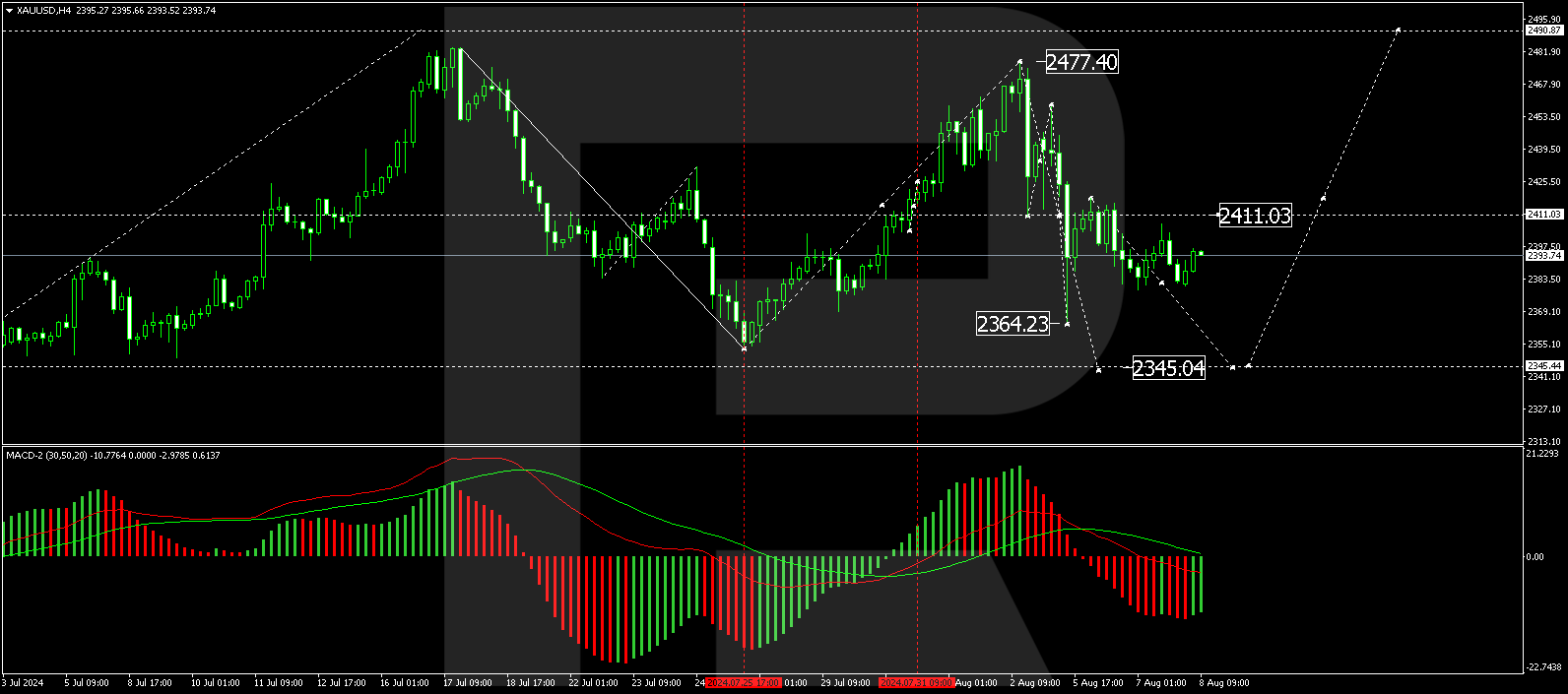
Gold’s (XAU/USD) trajectory on the H4 chart shows a potential movement towards the 2337.43 USD level. A rebound to 2365.20 USD could follow, testing this resistance from below. The market may then gear up for a further downward movement towards 2281.66 USD, potentially extending to 2175.00 USD. This bearish outlook is supported by the MACD indicator, which is currently at its peak and poised for a downward adjustment towards the zero level.

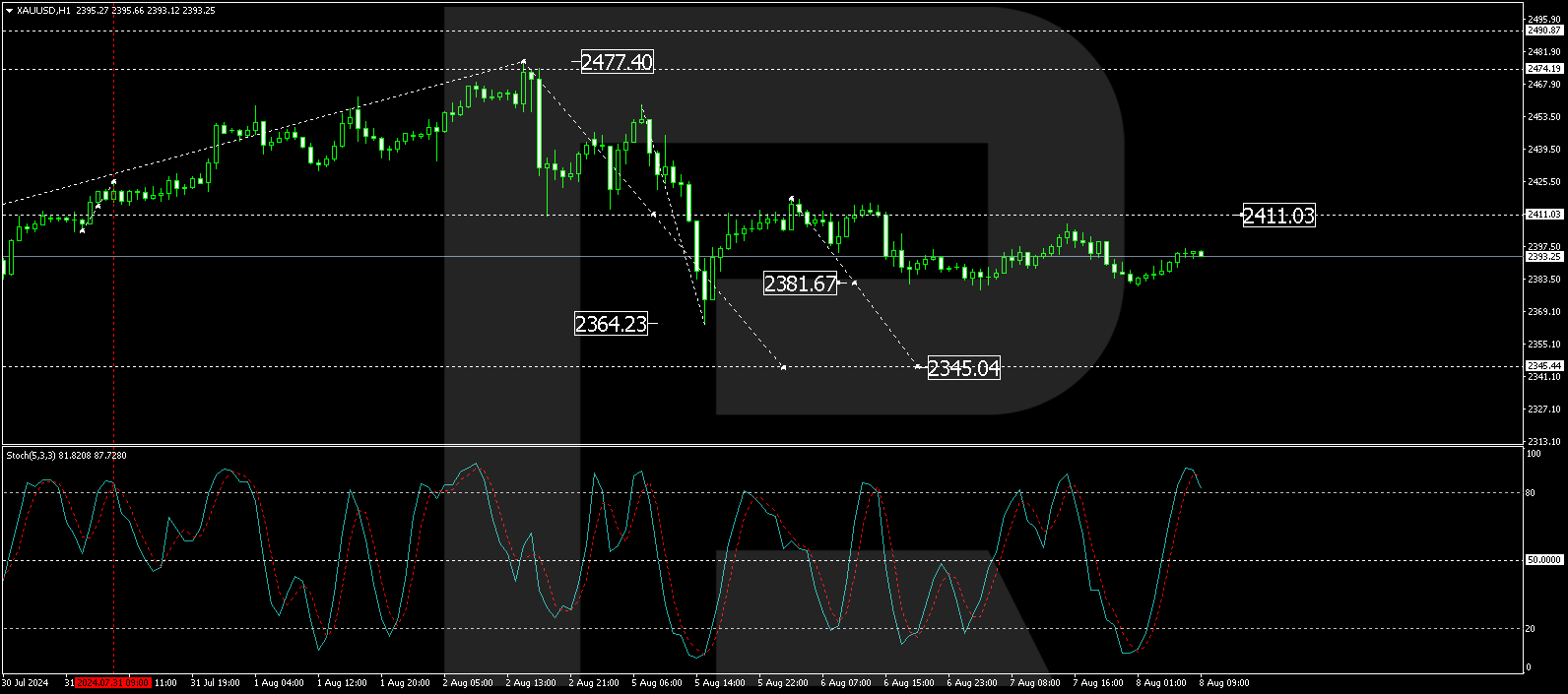
On the H1 chart, gold is consolidating around the 2365.20 USD mark. A downward break is anticipated, targeting 2337.43 USD as the immediate goal. Should this level be reached, a subsequent upward correction back to 2365.20 USD is likely. This scenario is validated by the Stochastic oscillator, which signals a potential decline from its current high position near 80, suggesting a near-term downward correction before further gains.


As the market navigates through these potential movements, investors remain vigilant, watching closely for any new economic data or policy shifts that could influence gold’s price dynamics and the broader financial landscape.


Disclaimer

Any forecasts contained herein are based on the author’s particular opinion. This analysis may not be treated as trading advice. RoboForex bears no responsibility for trading results based on trading recommendations and reviews contained herein.

The RBNZ kept the interest rate at 5.5%. In China, inflationary pressures are easing.

By JustMarkets 

At Tuesday’s close, the Dow Jones (US30) Index was down 0.13%, while the S&P 500 (US500) Index added 0.07%. The NASDAQ Technology Index (US100) closed positive 0.14%. Stock indices showed mixed performance on Tuesday, with the S&P 500 (US500) and NASDAQ (US100) hitting new all-time highs. Strengthening bank and chip stocks led to a higher overall market.

Fed Chairman Powell said Tuesday that good data would bolster confidence that inflation is moving toward the Fed’s 2% target and recent data point to “modest further progress” in prices. He added that the labor market is strong but not overheated, and easing too quickly and too much could hurt inflation progress. Markets estimate the odds of a 25 bps rate cut at 5% at the next FOMC meeting on July 30–31 and 71% at the next meeting on September 17–18.

Markets await the US CPI report for June, due out on Thursday, to see if price pressures continue to ease. The consensus is that the June CPI fell to 3.1% y/y from 3.3% y/y in May, while the core CPI was unchanged from May at 3.4% y/y. Falling inflationary pressures may put pressure on the US dollar.

Equity markets in Europe were mostly down on Tuesday. Germany’s DAX (DE40) was down 0.02%, France’s CAC 40 (FR40) fell by 0.63%, Spain’s IBEX 35 (ES35) lost 0.01%, and the UK’s FTSE 100 (UK100) closed negative 0.13%. European equity markets opened higher on Wednesday amid easing political concerns in France. France faces a hung parliament after no party won an outright majority in Sunday’s election, although the left-wing New Popular Front won the most seats.

Norway’s annual consumer inflation rate slowed to 2.6% in June 2024, down from 3% the previous month and below market estimates of 2.9%. This is the lowest since December 2020, mainly due to lower inflation for food and non-alcoholic beverages (4.9% vs. 5.4%), recreation and culture (4% vs. 7.6%) and healthcare (4.6% vs. 4.8%).

WTI crude oil prices hovered around $81.5 a barrel on Wednesday, trying to break a three-day decline as traders reacted to a larger-than-expected drop in US crude inventories. According to API data, the US crude oil inventories fell by 1.923 million barrels in the week ended July 5, significantly higher than market expectations for a 0.25 million barrel decline. In addition, oil prices are supported by the growing likelihood of an interest rate cut by the Federal Reserve. This move is seen as a potential boost to economic activity and demand.

Asian markets were predominantly up yesterday. Japan’s Nikkei 225 (JP225) rose by 1.96%, China’s FTSE China A50 (CHA50) climbed 0.99%, Hong Kong’s Hang Seng (HK50) was little changed for the day, and Australia’s ASX 200 (AU200) was positive 0.86%. Stock indices in Asia continued to rise at Wednesday’s open as soft consumer inflation data in China bolstered the case for easing monetary policy in the country.

China’s annual inflation rate fell to 0.2% in June 2024 from 0.3% in the previous two months, falling short of market estimates of 0.4%. It was the fifth straight month of rising consumer inflation but the lowest since March amid a fragile economic recovery. Food prices fell for the 12th month (-2.1% vs. -2.0%) despite a sharp price rise during the Dragon Boat Festival. The offshore yuan weakened to 7.29 per dollar.

The Reserve Bank of New Zealand (RBNZ) kept the official cash rate (OCR) at 5.5% at the July 2024 policy meeting, extending the rate pause for the eighth consecutive time and confirming market expectations. Policymakers noted that restrictive monetary policy has eased pressure on manufacturing capacity and lowered consumer price inflation. Core inflation fell to a nearly three-year low of 4% in the first quarter of 2024 but was still above the target range of 1-3%. The Committee continues to expect core inflation to return to the target range in the second half of the year. The degree of restraint will be gradually adjusted in line with the expected decline in inflationary pressures.

S&P 500 (US500) 5,576.98 +4.13 (0.074%)

Dow Jones (US30) 39,291.97 −52.82 (0.13%)

DAX (DE40) 18,236.19 −235.86 (1.28%)

FTSE 100 (UK100) 8,139.81 −53.68 (0.66%)

USD Index 105.12 +0.12 (+0.11%)

Important events today:
  • – Japan Producer Price Index (m/m) at 02:50 (GMT+3);
  • – China Consumer Price Index (m/m) at 04:30 (GMT+3);
  • – China Producer Price Index (m/m) at 04:30 (GMT+3);
  • – New Zealand RBNZ Interest Rate Decision at 05:00 (GMT+3);
  • – New Zealand RBNZ Rate Statement at 05:00 (GMT+3);
  • – US Fed Chair Powell Testifies at 17:00 (GMT+3);
  • – US Crude Oil Reserves (w/w) at 17:30 (GMT+3);
  • – US FOMC Member Bowman Speaks at 21:30 (GMT+3).

By JustMarkets


This article reflects a personal opinion and should not be interpreted as an investment advice, and/or offer, and/or a persistent request for carrying out financial transactions, and/or a guarantee, and/or a forecast of future events.

Oil declines amid prospects of an agreement between Israel and Hamas. Powell will address the US Congress today

By JustMarkets

On Monday, the Dow Jones (US30) decreased by 0.08%, while the S&P 500 (US500) added 0.10%. The NASDAQ Technology Index (US100) closed positive 0.28%. Strengthening chip stocks on Monday led technology stocks higher and boosted the overall market.

Markets are awaiting Fed Chairman Powell’s semi-annual monetary policy report before the Senate Banking Committee on Tuesday and before the House Financial Services Committee on Wednesday. Markets are also cautiously awaiting key US inflation data on Thursday (CPI) and Friday (PPI). On Monday, data showed that expectations for 1-year US consumer inflation fell for the second straight month to 3% in June from 3.2% in May. Last week’s data also pointed to rising unemployment, a contraction in service-sector activity, and weak private-sector employment. The probability of a Fed rate cut in September is about 76%.

Nike (NKE) stock price fell more than 3% and topped the Dow Jones Industrials’ list of losers after Jim Cramer said the company’s latest conference call was a “desperation call” and he “can’t find anything good for the company.” Shares of Gilead Sciences (GILD) closed higher by more than 1% after Raymond James upgraded the stock to “outperform” from “market perform” with a $93 price target.

Equity markets in Europe were mostly down on Monday. Germany’s DAX (DE40) was down 0.02%, France’s CAC 40 (FR40) fell by 0.63%, Spain’s IBEX 35 (ES35) was down 0.01%, and the UK’s FTSE 100 (UK100) closed negative 0.13%.

German exports for May fell by 3.6% m/m, weaker than expectations of 2.8% m/m and the biggest decline in 5 months. Imports fell by -6.6% mom in May, weaker than expectations of 1.0% m/m and the strongest in 17 months. ECB Governing Council spokesman Muller said yesterday that wage and service price growth in the Eurozone remains strong and “for this reason, the ECB cannot rush to cut interest rates.”

The Euro Stoxx 50 Index rose to a 3-week high on Monday after Sunday’s French election was unexpectedly won by a far-left party, leaving a divided parliament and without a clear majority. This result limits the options for any party, leading to expectations that President Macron will form a new coalition between centrists and center-leftists.

Trade tensions between China and the EU are escalating, with Beijing planning to hold anti-dumping hearings next week over brandy purchased from the EU. The move follows the imposition of additional tariffs on Chinese electric cars from the EU.

WTI crude oil prices fell to $82 a barrel on Tuesday, extending losses from the previous session, amid easing fears of supply disruptions. Tropical Storm Beryl, which first hit Texas as a Category 1 hurricane, has been downgraded due to reduced wind speeds and now looks set to dissipate without impacting US domestic oil markets. In addition, concerns about supply risks due to wildfires in Canada have diminished as they have not largely spread to Suncor’s infrastructure. Meanwhile, investors are watching geopolitical developments in the Middle East amid prospects of a ceasefire agreement between Israel and Hamas, which reduces concerns about the escalation of the conflict and possible disruptions to oil supplies.

Asian markets were mostly down last week. Japan’s Nikkei 225 (JP225) decreased by 0.32%, China’s FTSE China A50 (CHA50) fell by 0.50%, Hong Kong’s Hang Seng (HK50) lost 1.55%, and Australia’s ASX 200 (AU200) was negative 0.76%.

The Reserve Bank of New Zealand (RBNZ) will hold a monetary policy meeting as early as tomorrow. The Central Bank is expected to leave the official monetary rate at 5.5% for the eighth consecutive time. At the last meeting in May, the Bank said that restrictive policy should be maintained to ensure that inflation returns to target levels. In addition, the possibility of raising interest rates was discussed at that meeting. As the RBNZ has little reason to move to a less hawkish stance, a repeat of the May message could help boost the Kiwi.

The offshore yuan slid to 7.29 per dollar after the People’s Bank of China (PBoC) weakened its benchmark rate. The Central Bank set the average rate at 7.1310 per dollar, reversing the strengthening trend over the past three sessions. The yuan has faced pressure since the beginning of 2023 due to domestic issues, including a sluggish real estate sector, weak consumer spending, and declining yields, which have caused capital outflows. However, despite these challenges, there is potential for the offshore yuan to strengthen. On Monday, China’s Central Bank announced temporary liquidity operations, which helped ease pressure by improving liquidity management and stabilizing short-term interest rates.

S&P 500 (US500) 5,572.85 +5.66 (+0.10%)

Dow Jones (US30) 39,344.79 −31.08 (−0.08%)

DAX (DE40) 18,472.05 −3.40 (−0.02%)

FTSE 100 (UK100) 8,193.49 −10.44 (−0.13%)

USD Index 105.01 +0.14 (+0.13%)

Important events today:
  • – Australia NAB Business Confidence (m/m) at 04:30 (GMT+3);
  • – US Fed Chair Powell Testifies at 17:00 (GMT+3);
  • – US FOMC Member Bowman Speaks at 20:30 (GMT+3).

By JustMarkets


This article reflects a personal opinion and should not be interpreted as an investment advice, and/or offer, and/or a persistent request for carrying out financial transactions, and/or a guarantee, and/or a forecast of future events.