Brent Oil Price Analysis: Anticipating a Correction

By RoboForex Analytical Department

Brent crude oil’s price increased to 76.88 USD per barrel on Wednesday, continuing to rise for the second consecutive session. This rebound helps mitigate previous losses, which were part of a broader market risk aversion phase.

Current market dynamics

Investor concerns about energy supply disruptions are heightening due to political developments in Hamas and ongoing unrest affecting Libya’s Sharara oil field. These factors contribute to apprehensions about potential threats to oil supply from the Middle East.

Additionally, the latest data from the American Petroleum Institute (API) indicated a modest rise in US oil inventories, less than market forecasts, which had anticipated a more considerable increase. This was the first inventory build in five weeks, adding a layer of complexity to market dynamics.

Broader economic concerns, including fears of a US recession and weak Chinese demand, continue to exert downward pressure on oil prices.

Technical analysis of Brent

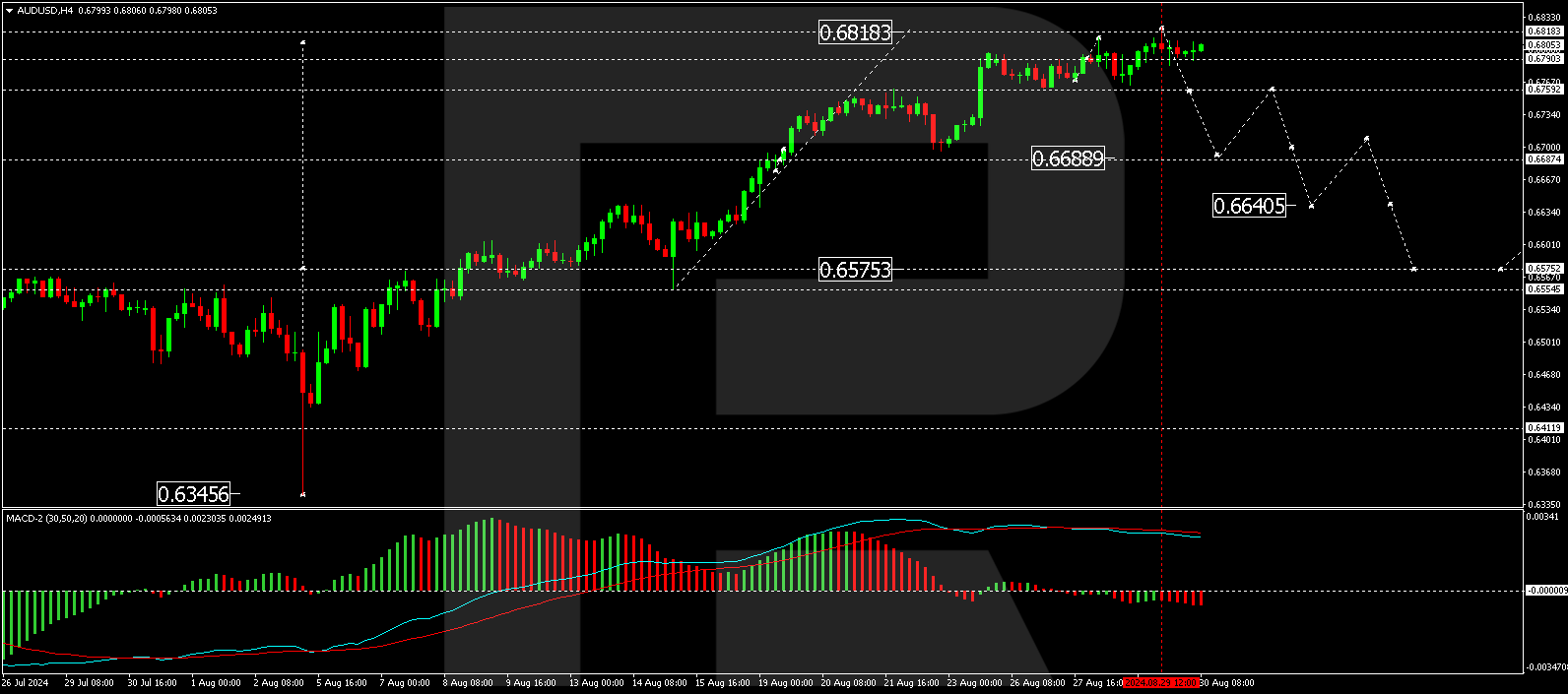
The H4 chart suggests that Brent is progressing towards the 78.12 USD level. After reaching this target, a pullback to 76.33 USD could occur, potentially setting the stage for another upward movement towards 79.85 USD and extending to 81.37 USD. The MACD indicator supports this bullish scenario, with the signal line positioned for upward momentum from current lows.

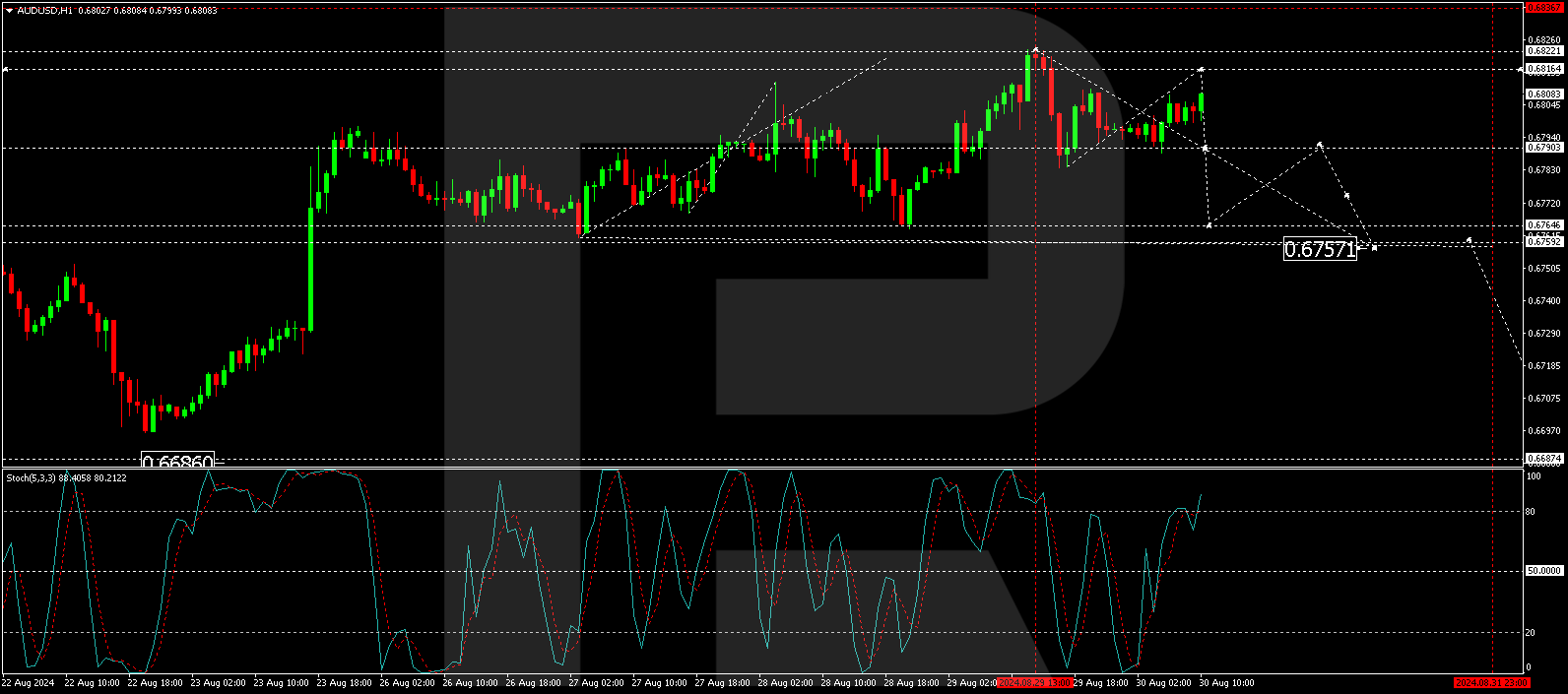
On the H1 chart, Brent has established a consolidation range of around 76.33 USD. An upward breakout towards 78.12 USD is anticipated. Once this target is achieved, a retracement to 76.33 USD might follow. The Stochastic oscillator is poised near the 80 level, suggesting an impending downturn, which aligns with the expected corrective phase following the initial rise.


Market outlook

Investors should monitor further geopolitical developments and additional inventory reports, which could significantly influence oil price movements. The upcoming Federal Reserve communications and economic indicators will also be crucial in shaping market sentiment, especially concerning the potential for economic slowdowns, which could impact oil demand.

Disclaimer

Any forecasts contained herein are based on the author’s particular opinion. This analysis may not be treated as trading advice. RoboForex bears no responsibility for trading results based on trading recommendations and reviews contained herein.

Panic selling of indices is over. New Zealand’s rising unemployment brings the RBNZ easing cycle closer

By JustMarkets

At Tuesday’s close, the Dow Jones (US30) Index was up 0.76%, while the S&P 500 (US500) Index was up 1.04%. The NASDAQ Technology Index (US100) closed positive 1.03%. US stocks recovered strongly on Tuesday, rebounding after a three-day sell-off. Dip buyers emerged yesterday, pushing stocks higher after Monday’s sharp decline. The sharp rise in Japanese stocks today provided support for US stocks. All sectors were up, with real estate and technology leading the way. Japan’s Nikkei Stock Index (JP225) rose more than 10% today as a weaker yen sparked a rally in Japanese exporters after the Bank of Japan (BoJ) said it will hold a trilateral meeting with the Ministry of Finance and the Financial Services Agency in Tokyo to discuss international markets.

Nvidia (NVDA) shares are up more than 5% after New Street Research upgraded the stock to “buy” from “neutral” with a $120 price target. Uber Technologies (UBER) is up more than 7% after reporting second-quarter gross orders of $39.95 billion, better than the consensus estimate of $39.70 billion Palantir Technologies (PLTR) is up more than 10% after reporting second-quarter revenue of $678.1 million, better than the consensus of $652.8 million, and raising its full-year revenue outlook

The US trade deficit narrowed to $73.1 billion in June from a revised $75.1 billion in May but was larger than expectations of $72.5 billion and a negative for second-quarter GDP. The market consensus expects second-quarter earnings for S&P 500 companies to rise 9% year-over-year. About half of the companies in the S&P 500 have already reported. According to Bloomberg data, most of the companies that reported beat consensus on earnings, but only 43% beat revenue expectations, the lowest in five years.

Equity markets in Europe traded mixed yesterday. Germany’s DAX (DE40) rose by 0.09%, France’s CAC 40 (FR40) closed down 0.27%, Spain’s IBEX 35 (ES35) fell 0.32%, and the UK’s FTSE 100 (UK100) closed positive 0.23%. Eurozone retail sales fell by 0.3% m/m in June, weaker than expectations of 0.1% m/m and the biggest decline in 6 months. German factory orders rose by 3.9% m/m in June, which was stronger than expectations of 0.5% m/m and was the largest increase in the last 6 months. Swaps discount the probability of a 25bp ECB rate cut at the September 12 meeting to 100%.

The US crude oil inventories rose by 4.495 million barrels in the week ended August 2, 2024, after declining by 4.495 million barrels in the previous week, data from API’s weekly statistical bulletin showed. This marked the fifth consecutive week of decline in crude inventories and was below market expectations of a 0.85 million barrel increase.

Asian markets traded flat yesterday. Japan’s Nikkei 225 (JP225) was up 10.23%, China’s FTSE China A50 (CHA50) was down 0.66%, Hong Kong’s Hang Seng (HK50) lost 0.31% by Tuesday’s close, while Australia’s ASX 200 (AU200) was positive 0.41%.

The offshore yuan slipped to 7.18 per dollar, falling short of the seven-month peak reached earlier this week, as traders reacted to the latest economic data from China. On Wednesday, China reported a trade surplus of $84.65 billion for July 2024, up from $80.22 billion in the same month a year earlier but short of market expectations of $99 billion. Exports rose 7% year-on-year in July, below the 9.7% growth estimate and the slowest growth since April. In contrast, imports posted the fastest growth rate since April, rising 7.2% from a year earlier and well ahead of the prognosis of 3.5% increase.

New Zealand’s unemployment rate rose to 4.6% in the three months to June 2024, following an upwardly revised 4.4% in the previous quarter. This is the highest rate since the first quarter of 2021 and slightly below market expectations of 4.7%. This will increase the likelihood of an earlier rate cut by the RBNZ and will harm the kiwi.

S&P 500 (US500) 5,240.03 +53.70 (+1.04%)

Dow Jones (US30) 38,997.66 +294.39 (+0.76%)

DAX (DE40) 17,354.32 +15.32 (+0.09%)

FTSE 100 (UK100) 8,026.69 +18.46 (+0.23%)

USD Index 102.96 +0.27 (+0.26%)

Important events today:
  • – New Zealand Unemployment Rate (q/q) at 01:45 (GMT+3);
  • – German Industrial Production (m/m) at 09:00 (GMT+3);
  • – German Trade Balance (m/m) at 09:00 (GMT+3);
  • – Canada Ivey PMI (m/m) at 17:00 (GMT+3);
  • – US Crude Oil Reserves (w/w) at 17:30 (GMT+3).

By JustMarkets


This article reflects a personal opinion and should not be interpreted as an investment advice, and/or offer, and/or a persistent request for carrying out financial transactions, and/or a guarantee, and/or a forecast of future events.

AIs encode language like brains do − opening a window on human conversations

By Zaid Zada, Princeton University 

Language enables people to transmit thoughts to each other because each person’s brain responds similarly to the meaning of words. In our newly published research, my colleagues and I developed a framework to model the brain activity of speakers as they engaged in face-to-face conversations.

We recorded the electrical activity of two people’s brains as they engaged in unscripted conversations. Previous research has shown that when two people converse, their brain activity becomes coupled, or aligned, and that the degree of neural coupling is associated with better understanding of the speaker’s message.

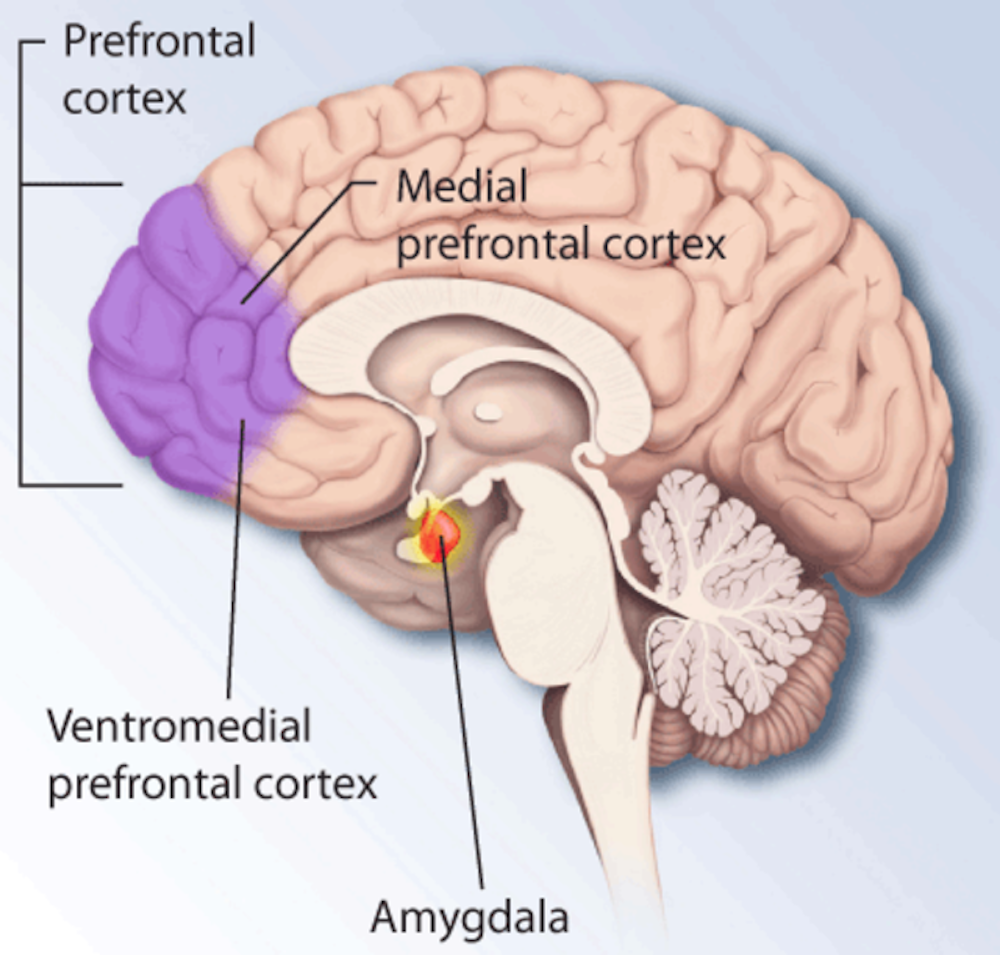
A neural code refers to particular patterns of brain activity associated with distinct words in their contexts. We found that the speakers’ brains are aligned on a shared neural code. Importantly, the brain’s neural code resembled the artificial neural code of large language models, or LLMs.

The neural patterns of words

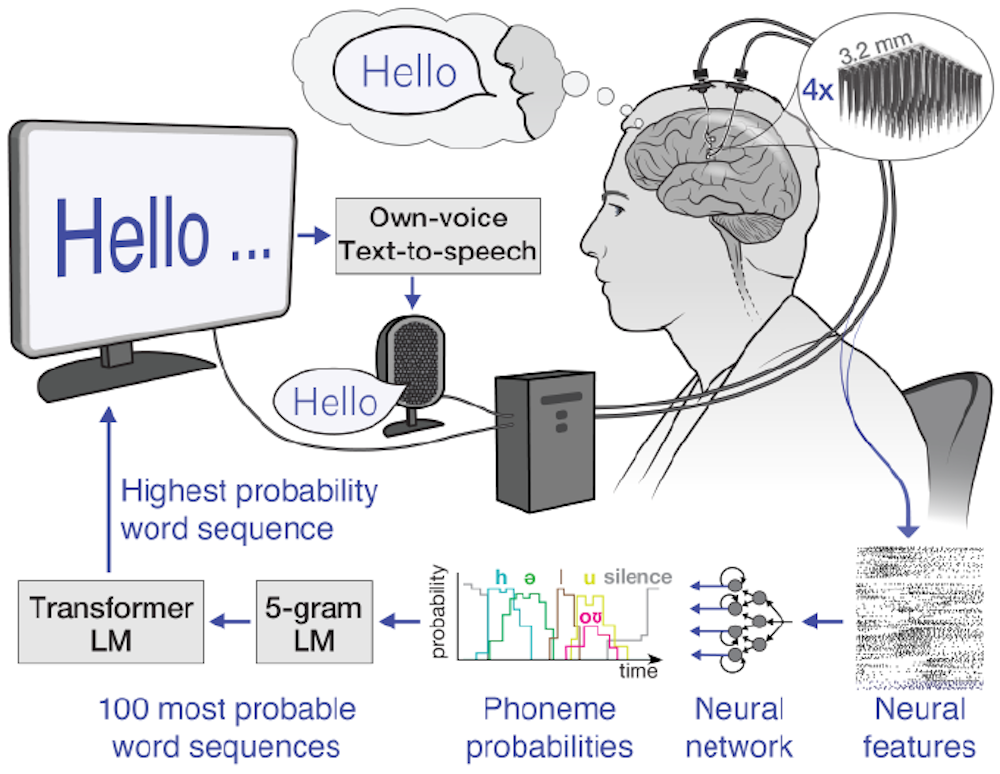
A large language model is a machine learning program that can generate text by predicting what words most likely follow others. Large language models excel at learning the structure of language, generating humanlike text and holding conversations. They can even pass the Turing test, making it difficult for someone to discern whether they are interacting with a machine or a human. Like humans, LLMs learn how to speak by reading or listening to text produced by other humans.

By giving the LLM a transcript of the conversation, we were able to extract its “neural activations,” or how it translates words into numbers, as it “reads” the script. Then, we correlated the speaker’s brain activity with both the LLM’s activations and with the listener’s brain activity. We found that the LLM’s activations could predict the speaker and listener’s shared brain activity.

To be able to understand each other, people have a shared agreement on the grammatical rules and the meaning of words in context. For instance, we know to use the past tense form of a verb to talk about past actions, as in the sentence: “He visited the museum yesterday.” Additionally, we intuitively understand that the same word can have different meanings in different situations. For instance, the word cold in the sentence “you are cold as ice” can refer either to one’s body temperature or personality trait, depending on the context. Due to the complexity and richness of natural language, until the recent success of large language models, we lacked a precise mathematical model to describe it.

Our study found that large language models can predict how linguistic information is encoded in the human brain, providing a new tool to interpret human brain activity. The similarity between the human brain’s and the large language model’s linguistic code has enabled us, for the first time, to track how information in the speaker’s brain is encoded into words and transferred, word by word, to the listener’s brain during face-to-face conversations. For example, we found that brain activity associated with the meaning of a word emerges in the speaker’s brain before articulating a word, and the same activity rapidly reemerges in the listener’s brain after hearing the word.

Powerful new tool

Our study has provided insights into the neural code for language processing in the human brain and how both humans and machines can use this code to communicate. We found that large language models were better able to predict shared brain activity compared with different features of language, such as syntax, or the order in which words connect to form phrases and sentences. This is partly due to the LLM’s ability to incorporate the contextual meaning of words, as well as integrate multiple levels of the linguistic hierarchy into one model: from words to sentences to conceptual meaning. This suggests important similarities between the brain and artificial neural networks.

An important aspect of our research is using everyday recordings of natural conversations to ensure that our findings capture the brain’s processing in real life. This is called ecological validity. In contrast to experiments in which participants are told what to say, we relinquish control of the study and let the participants converse as naturally as possible. This loss of control makes it difficult to analyze the data because each conversation is unique and involves two interacting individuals who are spontaneously speaking. Our ability to model neural activity as people engage in everyday conversations attests to the power of large language models.

Other dimensions

Now that we’ve developed a framework to assess the shared neural code between brains during everyday conversations, we’re interested in what factors drive or inhibit this coupling. For example, does linguistic coupling increase if a listener better understands the speaker’s intent? Or perhaps complex language, like jargon, may reduce neural coupling.

Another factor that can influence linguistic coupling may be the relationship between the speakers. For example, you may be able to convey a lot of information with a few words to a good friend but not to a stranger. Or you may be better neurally coupled to political allies rather than rivals. This is because differences in the way we use words across groups may make it easier to align and be coupled with people within rather than outside our social groups.The Conversation

About the Author:

Zaid Zada, Ph.D. Candidate in Psychology, Princeton University

This article is republished from The Conversation under a Creative Commons license. Read the original article.

NZD/USD Sees Recovery After Hitting Nine-Month Low

By RoboForex Analytical Department

The NZD/USD pair has shown signs of recovery, reaching 0.5941 after initially plunging to a nine-month low. This downturn was triggered by concerns over a potential US recession, driven by weak job sector data, which rattled global financial markets.

As risk aversion spiked, the New Zealand dollar and other currencies declined steeply. This market turmoil reflects growing fears that the Federal Reserve may run out of time to adjust monetary policy to avert economic troubles.

The Reserve Bank of New Zealand (RBNZ) will meet next week. Current market expectations lean towards a rate cut, possibly by 25 basis points, reducing the interest rate to 5.25% per annum on 14 August. This anticipated move is part of a broader global trend towards monetary easing.

Further rate reductions in New Zealand could follow, with projections suggesting a potential decrease to 4.75% per annum by the end of 2024.

Technical analysis of NZD/USD

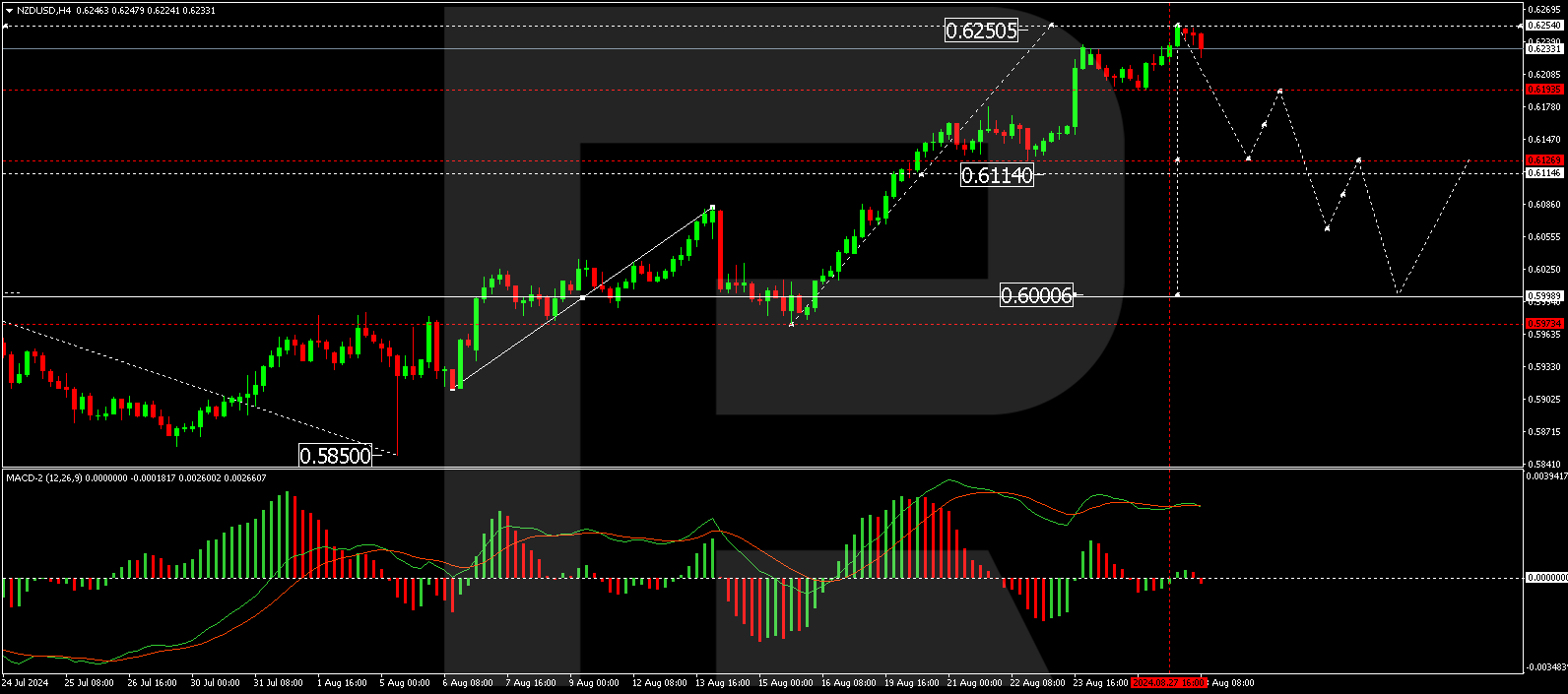
On the H4 chart, the NZD/USD pair executed a downside wave to 0.5850 and a correction to 0.5977. Today, the market is forming another wave of decline towards 0.5800, after which a correction to 0.5977 is likely (testing from below). On the technical analysis side, this scenario is confirmed by the MACD indicator with its signal line above the zero mark and pointing downwards.

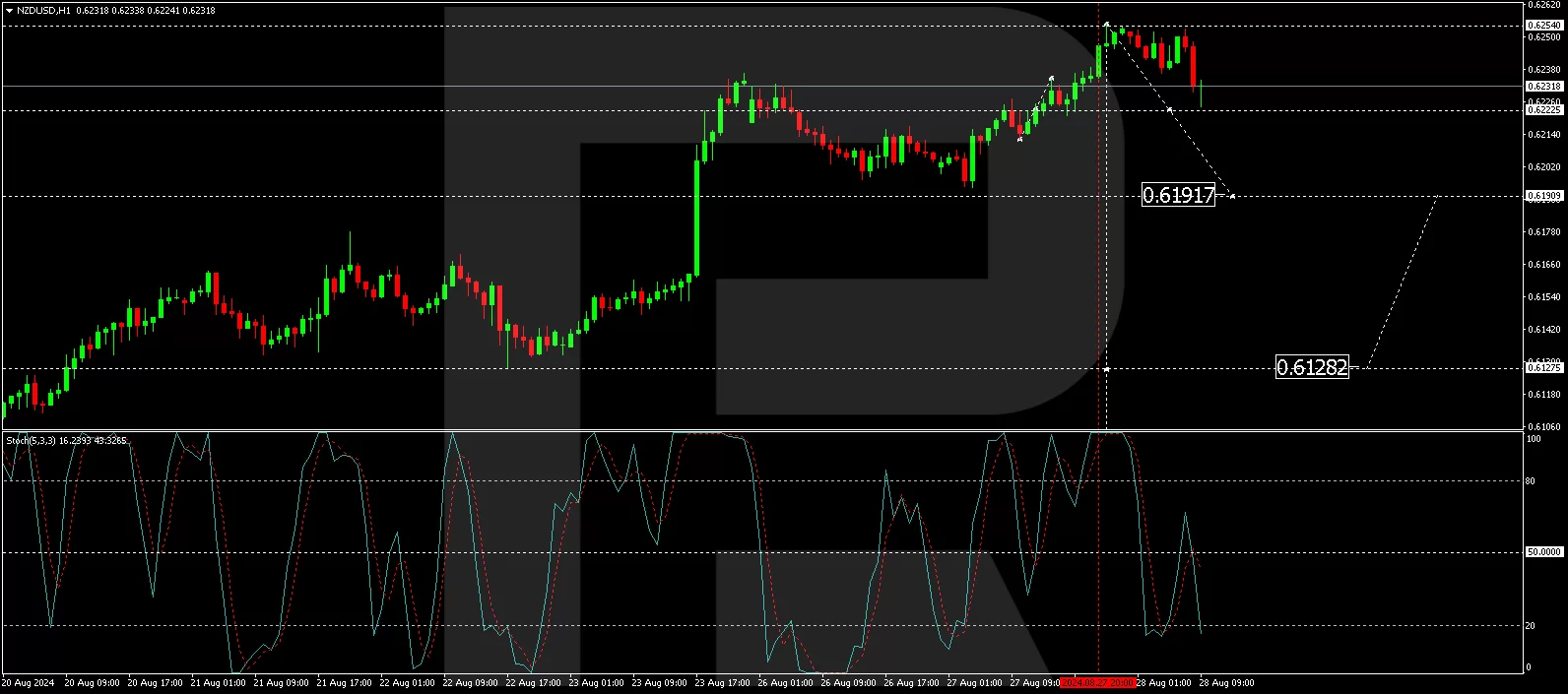
On the H1 chart, the NZD/USD pair forms downward waves to 0.5892. After working off this level, a correction to 0.5936 (testing from below) is likely, and the next wave of decline to 0.5850 is expected to develop with the prospect of trend continuation to 0.5800. This bearish NZD/USD forecast is corroborated by the Stochastic Oscillator, whose signal line is currently below 50 and showing a solid downward trend.

Investors and traders will closely monitor upcoming speeches and reports from central banks, especially the Federal Reserve and RBNZ, as these will significantly influence the currency pair’s movements in the near term.


Disclaimer

Any forecasts contained herein are based on the author’s particular opinion. This analysis may not be treated as trading advice. RoboForex bears no responsibility for trading results based on trading recommendations and reviews contained herein.

Forced closures of carry-trade positions led to a crash in indices on Monday. The RBA maintained its policy settings

By JustMarkets

At Monday’s close, the Dow Jones (US30) Index was down 2.60%, while the S&P 500 (US500) Index fell by 3.00%. The NASDAQ Technology Index (US100) closed negative 3.43%. The S&P 500 and Nasdaq 100 Indexes fell to 3-month lows, and the Dow Jones Industrials Index fell to a 7-week low. The fall in global stock markets on Monday triggered a flight into government debt and drove bond yields lower, with the 10-year T-note yield falling to a 14-month low and the 10-year German bund yield falling to a 7-month low. The fall in equities on Monday led to a de-risking of asset markets, with the price of bitcoin (BTCUSD) falling more than 14% to a 5-month low and WTI crude oil falling to a 6-month low.

Why did such a massive sell-off occur? Economists have several theories, but the most real is the Japanese yen theory, where there is a forced closing of curry-trade positions. Funds have to pay higher interest rates on borrowed yen. Their USD assets may not be enough to repay the JPY loans. This has caused a massive sell-off of trading positions to attract more USD, converting them back into JPY to repay the loans. Expect an emergency Fed meeting against this backdrop only if the current volatility triggers risks to financial stability. It has nothing to do with recession risks at the moment, although it could trigger/accelerate them. However, after such an upsurge in volatility, some market participants will be forced to cut risks/shoulders by reducing positions, creating conditions and inertia for the process to continue. The Middle East conflict and political uncertainty in the US are adding to the fear and panic.

Chicago Fed President Goolsbee said last month’s jobs data “came in weaker than expected, but does not yet look like a recession” as US economic growth continues at a “fairly robust level.” Markets rate the odds of a 25bp rate cut at the September 17–18 FOMC meeting at 100% and a 50bp rate cut at the September 17–18 FOMC meeting at 95%.

Equity markets in Europe were mostly falling yesterday. Germany’s DAX (DE40) fell by 1.82%, France’s CAC 40 (FR40) closed down 1.42%, Spain’s IBEX 35 (ES35) lost 2.34%, and the UK’s FTSE 100 (UK100) closed negative 2.04%. The S&P Eurozone Composite PMI for July was revised upward by 0.1 to 50.2 from the previously reported 50.1. Swaps discount the odds of a 25 bp rate cut by the ECB by 99% at the September 12 meeting.

WTI crude oil prices rose to around $74 a barrel on Tuesday after declining for three consecutive sessions, helped by continued supply risks from rising tensions in the Middle East. Fears of a regional war intensified as Israel braced for possible attacks following Iran’s threats to retaliate after the recent assassinations of a senior Hezbollah commander in Lebanon and Hamas’ top political leader in Iran. Due to anti-government protests and security concerns, oil prices also received support from the shutdown of production at Libya’s largest oil field, Sharara.

Asian markets were mostly down yesterday. Japan’s Nikkei 225 (JP225) fell by 12.40%, China’s FTSE China A50 (CHA50) was down 0.59%, Hong Kong’s Hang Seng (HK50) was down 1.46%, and Australia’s ASX 200 (AU200) was negative 3.70%.

Japan’s Nikkei 225 Index soared 10.7% early Tuesday, a day after a record 12.4% drop. By late morning, the index had given up some ground and was up 8.7% at 34,211.83. The rise followed sharp losses on Wall Street, which were dramatic but not as widespread as Monday’s crash in Tokyo. The losses of the past few sessions followed the Bank of Japan raising its main interest rate from nearly zero last week. That move helped to boost the value of the Japanese yen, but it also forced traders to exit trades in which they had borrowed money in Japan for virtually free and invested it elsewhere in the world.

The Reserve Bank of Australia (RBA) left interest rates unchanged for the sixth consecutive meeting but reiterated that it did not rule out further rate hikes to control inflation. The Central Bank kept the official money rate at a 12-year high of 4.35%, as expected, and emphasized that monetary policy should remain restrictive enough to ensure inflation returns to the target range of 2–3%. In addition, RBA chief Michele Bullock effectively ruled out the possibility of an interest rate cut in the near future.

In New Zealand, investors and some economists expect the Reserve Bank (RBNZ) to start cutting interest rates next week as markets around the world raise bets on imminent monetary easing. ANZ estimates the Central Bank will cut the official money rate by 25 bps to 5.25% at its August 14 meeting, with two more cuts to 4.75% expected by the end of the year.

S&P 500 (US500) 5,186.33 −160.23 (−3.00%)

Dow Jones (US30) 38,703.27 −1,033.99 (−2.60%)

DAX (DE40) 17,339.00 −322.22 (−1.82%)

FTSE 100 (UK100) 8,008.23 −166.48 (−2.04%)

USD Index 102.74 −0.46 (−0.45%)

Important events today:
  • – Australia RBA Interest Rate Decision (m/m) at 07:30 (GMT+3);
  • – Australia RBA Monetary Policy Statement (m/m) at 07:30 (GMT+3);
  • – Switzerland Unemployment Rate (m/m) at 08:45 (GMT+3).
  • – Eurozone Retail Sales (m/m) at 12:00 (GMT+3);
  • – US Trade Balance (m/m) at 15:30 (GMT+3);
  • – Canada Trade Balance (m/m) at 15:30 (GMT+3).

By JustMarkets


This article reflects a personal opinion and should not be interpreted as an investment advice, and/or offer, and/or a persistent request for carrying out financial transactions, and/or a guarantee, and/or a forecast of future events.

The US dollar fell to a 12-year low. Bitcoin lost 10% of its value during the day

By JustMarkets

At the end of Friday, the Dow Jones Index (US30) fell by 1.51% (for the week -2.28%), and the S&P 500 Index (US500) lost 1.84% (for the week -2.37%). The NASDAQ Technology Index (US100) closed negative 2.43% (for the week -3.83%). On Friday, the US dollar fell to a twenty-week low against a basket of currencies due to weak US jobs data, which heightened fears of a possible recession and raised the stakes for more Fed rate cuts. The US economy added 114,000 jobs in July, which was below market expectations of a 175,000 increase. In addition, the unemployment rate unexpectedly rose to its highest level since 2021, and wage growth slowed more than expected. This followed weak manufacturing data, with the ISM manufacturing PMI showing a larger-than-expected contraction in factory activity. This raised fears of a recession in the US and also increased expectations of a dovish Federal Reserve rate hike. Markets now believe there is a more than 70% chance of a 50 basis point Fed rate cut in September, with a total easing of around 155 basis points this year and next.

Bitcoin fell 10% to below 53,000 on Monday, hitting a more than five-month low, as rising fears of a US recession prompted investors to shed risky assets, including digital currencies, stocks, commodities, and risk-sensitive currencies. The moves came amid weak US jobs data, which heightened fears that the Federal Reserve may already be too late to cut interest rates as the US economy may already be entering recession.

Equity markets in Europe mostly fell on Friday. Germany’s DAX (DE40) fell by 2.23% (week ended -4.75%), France’s CAC 40 (FR40) closed down by 1.61% (week ended -3.92%), Spain’s IBEX 35 (ES35) fell 1.67% (week ended -4.89%), and the UK’s FTSE 100 (UK100) closed negative 1.31% (week ended -1.34%).

ECB official Stournaras emphasized that inflation could fall below the 2% target due to problems in the Eurozone economy. As for the data, Eurozone annual inflation unexpectedly accelerated to 2.6% in July, but services inflation fell for the first time in three months. In addition, preliminary estimates suggest that the Eurozone economy grew 0.3% faster than expected in Q2, driven by growth in France, Italy, and Spain. On the other hand, Germany’s economy unexpectedly contracted.

WTI crude oil prices fell to $73 a barrel on Monday, declining for the third consecutive session as fears of recession in the US, the world’s top oil consumer, outweighed supply risks caused by geopolitical tensions in the Middle East. Markets are also watching the reaction of Iran, which vowed to avenge the assassination of Hamas leader Ismail Haniyeh after an airstrike in Tehran killed a top Hezbollah commander.

Asian markets were mostly down last week. Japan’s Nikkei 225 (JP225) fell by 5.85%, China’s FTSE China A50 (CHA50) declined 0.86%, Hong Kong’s Hang Seng (HK50) lost 2.08% over 5 trading days, while Australia’s ASX 200 (AU200) was positive 0.28%.

In Asia, investors await the Reserve Bank of Australia’s (RBA) interest rate decision on Tuesday, where a rate hold is widely expected. The probability of an RBA rate cut in November is around 75%, much earlier than previous estimates that suggested a rate cut in April next year. The Melbourne Institute’s monthly inflation gauge rose 0.4% in July 2024 after rising 0.3% in the previous two months. It was the fifth straight month of growth and the sharpest reading since December last year.

The overall Caixin China PMI fell to 51.2 in July 2024 from June’s reading of 52.8, indicating the lowest since last October and marking the ninth month of expansion in sector activity.

S&P 500 (US500) 5,346.56 −100.12 (−1.84%)

Dow Jones (US30) 39,737.26 −610.71 (−1.51%)

DAX (DE40) 17,661.22 −421.83 (−2.33%)

FTSE 100 (UK100) 8,174.71 −108.65 (−1.31%)

USD Index 103.22 −1.20 (−1.15%)

Important events today:
  • – Japan Monetary Policy Meeting Minutes at 02:50 (GMT+3);
  • – Japan Services PMI (m/m) at 03:30 (GMT+3);
  • – German Services PMI (m/m) at 10:55 (GMT+3);
  • – Eurozone Services PMI (m/m) at 11:00 (GMT+3);
  • – UK Services PMI (m/m) at 11:30 (GMT+3);
  • – US ISM Services PMI (m/m) at 17:00 (GMT+3).

By JustMarkets


This article reflects a personal opinion and should not be interpreted as an investment advice, and/or offer, and/or a persistent request for carrying out financial transactions, and/or a guarantee, and/or a forecast of future events.

Why are Stock, FX, Crypto markets falling?

By ForexTime 

  • Risk assets (global stocks, cryptos, etc.) plummeting
  • Higher US unemployment rate fuelling US recession fears
  • Markets fear Fed may be too late to fend off recession
  • Safe havens JPY, CHF rising against all G10 peers
  • Volatile markets present trading opportunities galore, including for NAS100 index


Markets are a sea of red today!

Various asset classes, from stocks to cryptos, are plummeting after the recent US jobs shocker.

Last Friday (August 2nd), we learned that the US unemployment rate for July 2024 rose to 4.3%, its highest since October 2021 (back when the US economy was still recovering from the Covid pandemic).

That 4.3% unemployment rate has now officially triggered the “Sahm rule” – a historically accurate predictor of US recessions.


What is the “Sahm rule”?

This “rule” stipulates that a US recession begins when the 3-month moving average of the US unemployment rate rises by half (0.5) a percentage point, compared to its 12-month low.

Although the architect of this rule, former Federal Reserve economist Claudia Sahm, has sought to downplay the significance of such backward-looking data, markets were in no mood to hang around to give the benefit of the doubt to the world’s largest economy.


Can the Fed prevent a recession?

It’s still possible, but such odds appear less likely in light of the sudden jump in the US unemployment rate.

The Fed may yet shore up support for the economy by triggering larger-than-usual rate CUTS.

Still, markets fear that the Fed rate cuts may arrive too late.

After all, Fed rate cuts need six months or more before they are truly felt in the real economy.


Prior to last Friday’s US nonfarm payrolls data release, markets had forecasted just a 31% chance that the Fed will cut interest rates by 50-basis points at its September FOMC meeting.

Remember that the norm is a 25-basis point adjustment per meeting. A 50-bps cut would be double the typical rate move.

At the time of writing, markets have fully priced in a 50-basis point cut in September.


How are markets reacting?

Markets are extending the selloff across “risk assets” following Friday’s US jobs report.

So far today (Monday, August 5th):

  • US500 = down 2.9%
  • NAS100 = down 4.7%
  • Bitcoin = down 11.7%
  • Ethereum = down 16.4%


On the flip side, “safe havens” are climbing.

NOTE: Safe havens are assets that help protect investors’ wealth during times of heightened fear and uncertainty, as we’re seeing right now.

Typical safe havens are the Japanese Yen (USDJPY falling 3.1%) as well as the Swiss Franc (USDCHF falling 1.2%).

No surprise that both these safe haven currencies are stronger against all of their G10 peers today.

Safe haven Yen stronger against G10 peers


Safe havenCHF stronger against G10 peers


Back to “risk assets” …

How long will the selloff last?

Unfortunately, there’s no definite answer.

Even as “fear begets fear”, there are signs that point to prices reacting either way: a rebound, or further declines.


  • Potential rebound?

Focusing on the NAS100 index, traders may draw clues from these technical events:

  • 14-day relative strength index (RSI): the past 2 instances when this indicator reached the 30 level (which is the textbook threshold for “oversold” conditions), the NAS100 went on to stage a stunning rebound.
  • 200-day simple moving average (SMA): the past 2 instances when prices reach this technical indicator, in March and October 2023, prices then duly soared.

If recent history is to be the guide, and such technical signals prove true once more, that should set the stage for a recovery for the NAS100 stock index, and potentially broader US stock markets as well.


  • Further declines?

However, the fundamental picture is different this time around, compared to the last time we saw the above-listed technical events.

As mentioned earlier, the US unemployment rate at 4.3% is at its highest since 2021.

The risks of a US recession loom larger, compared to during the 2023 selloff across US stock markets.

If the US economic outlook turns darker, and markets believe that the Fed is unable to fend off a recession, that could heap more downward pressure on the NAS100.

If so, the NAS100 index could be dragged down to the psychological 17,000 mark over the near term.

NAS100 falls amid US recession fears


Forex-Time-LogoArticle by ForexTime

ForexTime Ltd (FXTM) is an award winning international online forex broker regulated by CySEC 185/12 www.forextime.com

Rapid Yen Appreciation: Key Factors Boosting JPY

By RoboForex Analytical Department

The Japanese yen continues its recovery rally. The USDJPY pair falls to 143.38 on Monday.

This development is likely only the midpoint of the process as the market regains past losses and brings the JPY to equilibrium. USDJPY is currently at its lowest level since 3 January.

Several reasons are driving this movement. The first is the winding down of carry trade operations on the yen. The process started earlier when it became clear that the Bank of Japan was moving towards tightening monetary conditions.

The second concern is that a US recession is playing an important role. Friday’s employment data was weaker than expected, triggering fears that the Federal Reserve might delay its decision on interest rate cuts. The market is worried the Fed could be late in making a crucial decision.

The third key factor for the JPY is the increased attractiveness of the yen as a safe-haven asset amid escalating geopolitical tensions in the Middle East. The ongoing conflict in the region poses a hypothetical threat to global stability, and investors are factoring in this risk and favouring safe-haven assets.

Technical analysis: USD/JPY

The USD/JPY pair formed a consolidation range of around 149.80 before breaking downwards on impactful news. The decline reached 142.00, setting a local low. We anticipate a new consolidation phase above this level. An upward break could see a corrective move towards 149.80. Conversely, a downward exit might extend losses towards 138.10. The MACD indicator supports this bearish outlook, showing continued downward momentum.

After reaching 142.00, a corrective phase to 147.33 may unfold, representing an intermediate target. Following this correction, a further decline to 144.66 could occur. This analysis aligns with the Stochastic oscillator, indicating a potential for an upward correction from oversold levels.


Disclaimer

Any forecasts contained herein are based on the author’s particular opinion. This analysis may not be treated as trading advice. RoboForex bears no responsibility for trading results based on trading recommendations and reviews contained herein.

Speculator Extremes: Coffee, GBP, Gasoline, Cotton & CAD lead Bullish & Bearish Positions

By InvestMacro

The latest update for the weekly Commitment of Traders (COT) report was released by the Commodity Futures Trading Commission (CFTC) on Friday for data ending on July 30th.

This weekly Extreme Positions report highlights the Most Bullish and Most Bearish Positions for the speculator category. Extreme positioning in these markets can foreshadow strong moves in the underlying market.

To signify an extreme position, we use the Strength Index (also known as the COT Index) of each instrument, a common method of measuring COT data. The Strength Index is simply a comparison of current trader positions against the range of positions over the previous 3 years. We use over 80 percent as extremely bullish and under 20 percent as extremely bearish. (Compare Strength Index scores across all markets in the data table or cot leaders table)


Speculators or Non-Commercials Notes:

Speculators, classified as non-commercial traders by the CFTC, are made up of large commodity funds, hedge funds and other significant for-profit participants. The Specs are generally regarded as trend-followers in their behavior towards price action – net speculator bets and prices tend to go in the same directions. These traders often look to buy when prices are rising and sell when prices are falling. To illustrate this point, many times speculator contracts can be found at their most extremes (bullish or bearish) when prices are also close to their highest or lowest levels.

These extreme levels can be dangerous for the large speculators as the trade is most crowded, there is less trading ammunition still sitting on the sidelines to push the trend further and prices have moved a significant distance. When the trend becomes exhausted, some speculators take profits while others look to also exit positions when prices fail to continue in the same direction. This process usually plays out over many months to years and can ultimately create a reverse effect where prices start to fall and speculators start a process of selling when prices are falling.


Here Are This Week’s Most Bullish Speculator Positions:

Coffee


The Coffee speculator position comes in as the most bullish extreme standing this week. The Coffee speculator level is currently at a 87.3 percent score of its 3-year range.

The six-week trend for the percent strength score totaled -4.4 this week. The overall net speculator position was a total of 63,016 net contracts this week with a decline of -3,484 contract in the weekly speculator bets.


British Pound


The British Pound speculator position comes next in the extreme standings this week. The British Pound speculator level is now at a 86.2 percent score of its 3-year range.

The six-week trend for the percent strength score was 28.7 this week. The speculator position registered 111,471 net contracts this week with a weekly drop of -30,712 contracts in speculator bets.


Silver


The Silver speculator position comes in third this week in the extreme standings. The Silver speculator level resides at a 83.8 percent score of its 3-year range.

The six-week trend for the speculator strength score came in at -3.8 this week. The overall speculator position was 49,061 net contracts this week with a reduction by -2,319 contracts in the weekly speculator bets.


Gold


The Gold speculator position comes up number four in the extreme standings this week. The Gold speculator level is at a 83.5 percent score of its 3-year range.

The six-week trend for the speculator strength score totaled a change of 1.5 this week. The overall speculator position was 246,601 net contracts this week with a drop by -26,473 contracts in the speculator bets.


DowJones Mini


The DowJones Mini speculator position rounds out the top five in this week’s bullish extreme standings. The DowJones Mini speculator level sits at a 82.3 percent score of its 3-year range. The six-week trend for the speculator strength score was 19.5 this week.

The speculator position was 13,538 net contracts this week with a gain of 2,172 contracts in the weekly speculator bets.


This Week’s Most Bearish Speculator Positions:


Gasoline


The Gasoline speculator position comes in as the most bearish extreme standing this week. The Gasoline speculator level is at a 0.0 percent score of its 3-year range.

The six-week trend for the speculator strength score was -21.5 this week. The overall speculator position was 23,056 net contracts this week with a decline of -8,827 contracts in the speculator bets.


Cotton


The Cotton speculator position comes in next for the most bearish extreme standing on the week. The Cotton speculator level is at a 0.0 percent score of its 3-year range.

The six-week trend for the speculator strength score was -6.0 this week. The speculator position was -37,341 net contracts this week with a decrease by -3,070 contracts in the weekly speculator bets.


5-Year Bond


The 5-Year Bond speculator position comes in as third most bearish extreme standing of the week. The 5-Year Bond speculator level resides at a 0.0 percent score of its 3-year range.

The six-week trend for the speculator strength score was -11.6 this week. The overall speculator position was -1,656,038 net contracts this week with a slide by -132,777 contracts in the speculator bets.


Canadian Dollar


The Canadian Dollar speculator position comes in as this week’s fourth most bearish extreme standing. The Canadian Dollar speculator level is at a 0.0 percent score of its 3-year range.

The six-week trend for the speculator strength score was -21.7 this week. The speculator position was -196,263 net contracts this week with a decrease of -34,660 contracts in the weekly speculator bets.


Brazil Real


Finally, the Brazil Real speculator position comes in as the fifth most bearish extreme standing for this week. The Brazil Real speculator level is at a 3.5 percent score of its 3-year range.

The six-week trend for the speculator strength score was -22.5 this week. The speculator position was -41,159 net contracts this week with an increase of 839 contracts in the weekly speculator bets.


Article By InvestMacroReceive our weekly COT Newsletter

*COT Report: The COT data, released weekly to the public each Friday, is updated through the most recent Tuesday (data is 3 days old) and shows a quick view of how large speculators or non-commercials (for-profit traders) were positioned in the futures markets.

The CFTC categorizes trader positions according to commercial hedgers (traders who use futures contracts for hedging as part of the business), non-commercials (large traders who speculate to realize trading profits) and nonreportable traders (usually small traders/speculators) as well as their open interest (contracts open in the market at time of reporting). See CFTC criteria here.

Gold (XAU/USD) Continues to Surge: New Highs as Fed Rate Cut Looms

By RoboForex Analytical Department

The price of gold (XAUUSD) continues its upward trajectory, hitting a new peak at 2460 USD per troy ounce on Friday. The surge in gold prices is largely driven by growing expectations that the US Federal Reserve will soon reduce interest rates. This anticipation has been bolstered by recent signals from the Fed’s July meeting and weaker-than-expected US economic data.

Recent US manufacturing activity has declined sharply, and unemployment claims have reached a high of 249,000 for the year, indicating potential economic softening. These factors contribute to the speculation of a possible rate cut by the Fed as early as September, contingent on forthcoming economic reports.

Moreover, escalating tensions in the Middle East enhance gold’s appeal as a safe-haven asset, adding another layer of support for the rising prices.

Technical analysis: XAU/USD

On the H4 chart, XAU/USD performed a growth wave to the level of 2422.22. The market has formed a compact consolidation range around this level, and with the upside exit, the growth wave continues to the level of 2474.50. The target is local. After reaching this level, we will consider the probability of correction to 2422.22 (testing from above). Further, we expect the beginning of a new wave of growth towards 2490.90. Technically, this scenario is confirmed by the MACD indicator, with its signal line above the zero level and trending upwards.

On the H1 chart of XAU/USD, the market has formed a consolidation range around 2446.00. With the upside exit, considering the probability of the wave continuation to the local target of 2474.50 is suggested. After reaching this level, we will consider the likelihood of correction to 2422.22. Technically, this scenario is confirmed by the Stochastic oscillator, with its signal line above 80 and preparing for a decline.

Investors and traders should monitor these levels closely, as developments regarding the Fed’s forthcoming decisions and geopolitical factors could significantly impact further movements in the gold market.


Disclaimer

Any forecasts contained herein are based on the author’s particular opinion. This analysis may not be treated as trading advice. RoboForex bears no responsibility for trading results based on trading recommendations and reviews contained herein.