COT Stock Market Charts: Speculator Bets led by Russell & S&P 500

By InvestMacro

Here are the latest charts and statistics for the Commitment of Traders (COT) data published by the Commodities Futures Trading Commission (CFTC).

The latest COT data is updated through Tuesday August 6th and shows a quick view of how large traders (for-profit speculators and commercial entities) were positioned in the futures markets.

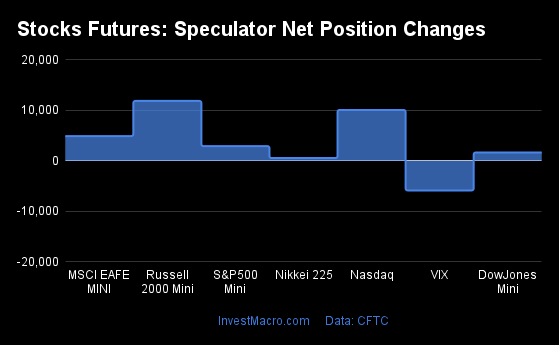
Weekly Speculator Changes led by Russell & S&P 500

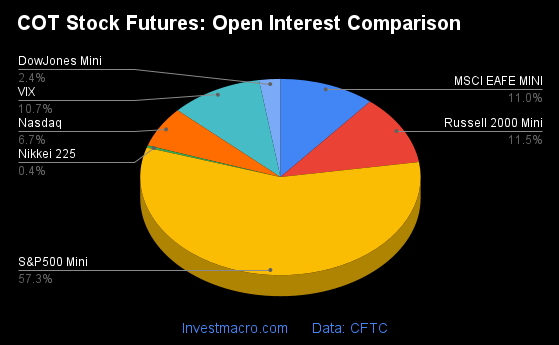
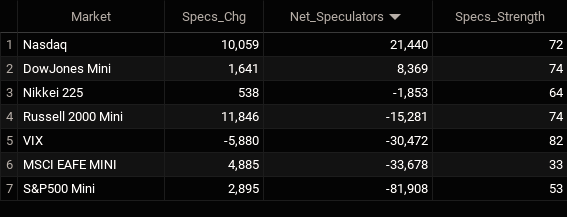
The COT stock markets speculator bets were higher this week as five out of the seven stock markets we cover had higher positioning while the other two markets had lower speculator contracts.

Leading the gains for the stock markets was the Russell-Mini (31,390 contracts), the S&P500-Mini (22,034 contracts), the Nasdaq-Mini (10,189 contracts), the VIX (6,108 contracts) and the Nikkei 225 (2,136 contracts) also showing positive weeks.

The markets with the declines in speculator bets this week were the MSCI EAFE-Mini (-2,360 contracts) and with the DowJones-Mini (-6,169 contracts) also registering lower bets on the week.


Stock Market Net Speculators Leaderboard

Legend: Weekly Speculators Change | Speculators Current Net Position | Speculators Strength Score compared to last 3-Years (0-100 range)


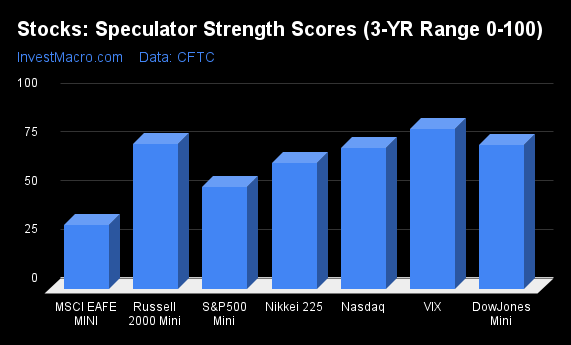
Strength Scores led by Russell-Mini & DowJones-Mini

COT Strength Scores (a normalized measure of Speculator positions over a 3-Year range, from 0 to 100 where above 80 is Extreme-Bullish and below 20 is Extreme-Bearish) showed that the Russell-Mini (83 percent) and the DowJones-Mini (72 percent) lead the stock markets this week. The S&P500-Mini (70 percent) and VIX (68 percent) come in as the next highest in the weekly strength scores.

The MSCI EAFE-Mini (44 percent) comes in at the lowest strength level currently.

Strength Statistics:
VIX (68.0 percent) vs VIX previous week (61.4 percent)
S&P500-Mini (69.8 percent) vs S&P500-Mini previous week (66.5 percent)
DowJones-Mini (72.3 percent) vs DowJones-Mini previous week (82.3 percent)
Nasdaq-Mini (58.7 percent) vs Nasdaq-Mini previous week (42.9 percent)
Russell2000-Mini (83.3 percent) vs Russell2000-Mini previous week (61.0 percent)
Nikkei USD (65.4 percent) vs Nikkei USD previous week (47.2 percent)
EAFE-Mini (44.2 percent) vs EAFE-Mini previous week (46.7 percent)


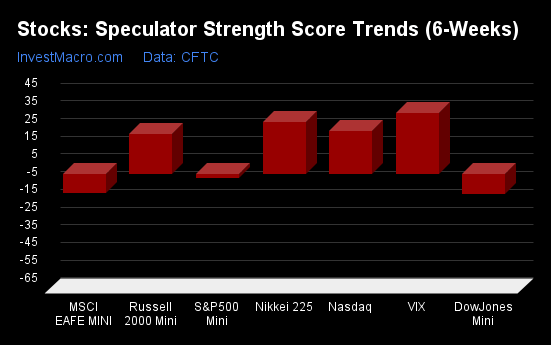
Russell-Mini & Nikkei 225 top the 6-Week Strength Trends

COT Strength Score Trends (or move index, calculates the 6-week changes in strength scores) showed that the Russell-Mini (34 percent) leads the past six weeks trends for the stock markets. The Nikkei 225 (27 percent), the VIX (19 percent) and the S&P500-Mini (15 percent) are the next highest positive movers in the latest trends data.

Strength Trend Statistics:
VIX (18.9 percent) vs VIX previous week (-0.2 percent)
S&P500-Mini (14.8 percent) vs S&P500-Mini previous week (18.8 percent)
DowJones-Mini (12.8 percent) vs DowJones-Mini previous week (19.5 percent)
Nasdaq-Mini (8.1 percent) vs Nasdaq-Mini previous week (9.7 percent)
Russell2000-Mini (33.6 percent) vs Russell2000-Mini previous week (16.9 percent)
Nikkei USD (27.1 percent) vs Nikkei USD previous week (11.3 percent)
EAFE-Mini (3.5 percent) vs EAFE-Mini previous week (3.5 percent)


Individual Stock Market Charts:

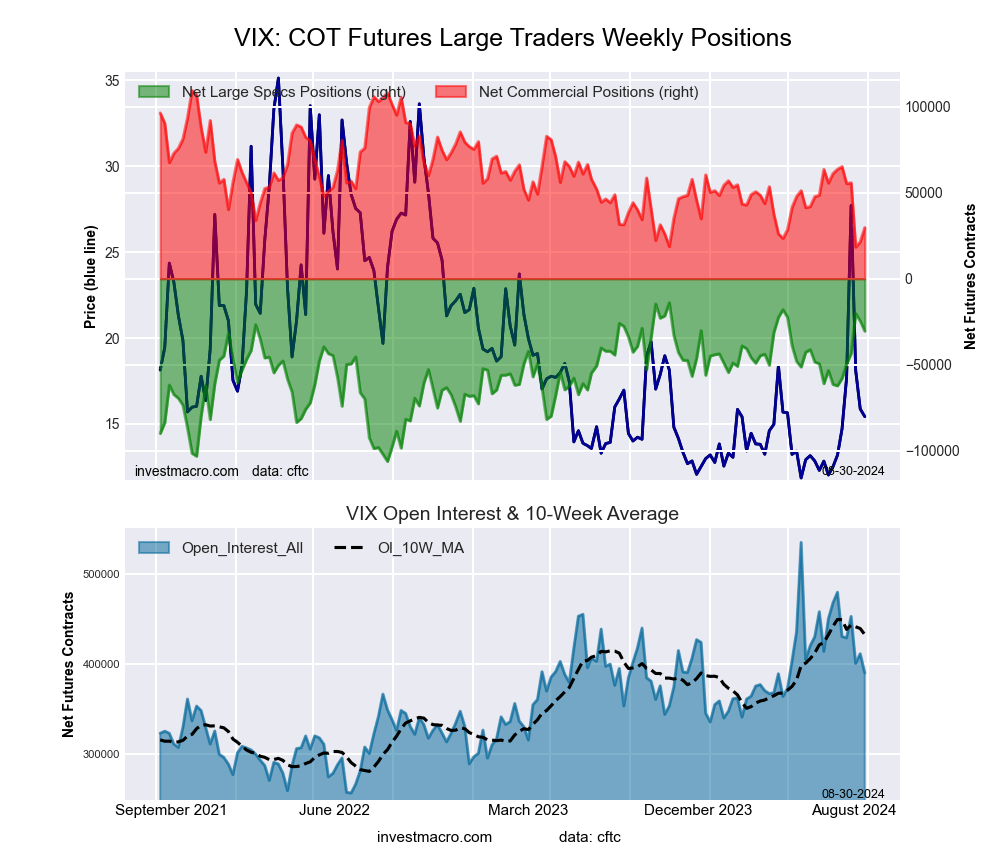
VIX Volatility Futures:

VIX Volatility Futures COT ChartThe VIX Volatility large speculator standing this week reached a net position of -43,545 contracts in the data reported through Tuesday. This was a weekly boost of 6,108 contracts from the previous week which had a total of -49,653 net contracts.

This week’s current strength score (the trader positioning range over the past three years, measured from 0 to 100) shows the speculators are currently Bullish with a score of 68.0 percent. The commercials are Bearish with a score of 40.9 percent and the small traders (not shown in chart) are Bearish with a score of 32.5 percent.

Price Trend-Following Model: Strong Uptrend

Our weekly trend-following model classifies the current market price position as: Strong Uptrend. The current action for the model is considered to be: Hold – Maintain Long Position.

VIX Volatility Futures StatisticsSPECULATORSCOMMERCIALSSMALL TRADERS
– Percent of Open Interest Longs:22.051.16.3
– Percent of Open Interest Shorts:31.638.79.0
– Net Position:-43,54555,847-12,302
– Gross Longs:99,536231,32628,694
– Gross Shorts:143,081175,47940,996
– Long to Short Ratio:0.7 to 11.3 to 10.7 to 1
NET POSITION TREND:
– Strength Index Score (3 Year Range Pct):68.040.932.5
– Strength Index Reading (3 Year Range):BullishBearishBearish
NET POSITION MOVEMENT INDEX:
– 6-Week Change in Strength Index:18.9-8.5-48.2


S&P500 Mini Futures:

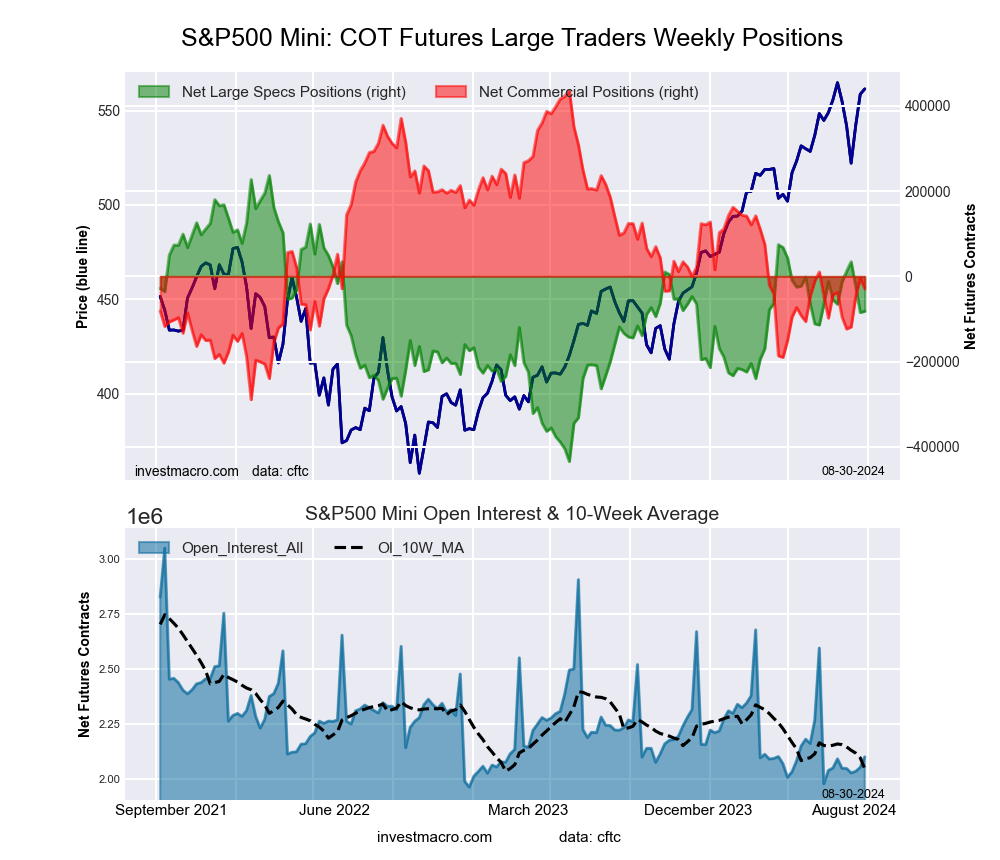
SP500 Mini Futures COT ChartThe S&P500 Mini large speculator standing this week reached a net position of 33,990 contracts in the data reported through Tuesday. This was a weekly lift of 22,034 contracts from the previous week which had a total of 11,956 net contracts.

This week’s current strength score (the trader positioning range over the past three years, measured from 0 to 100) shows the speculators are currently Bullish with a score of 69.8 percent. The commercials are Bearish with a score of 23.5 percent and the small traders (not shown in chart) are Bullish with a score of 72.2 percent.

Price Trend-Following Model: Uptrend

Our weekly trend-following model classifies the current market price position as: Uptrend. The current action for the model is considered to be: Hold – Maintain Long Position.

S&P500 Mini Futures StatisticsSPECULATORSCOMMERCIALSSMALL TRADERS
– Percent of Open Interest Longs:16.169.512.4
– Percent of Open Interest Shorts:14.475.38.2
– Net Position:33,990-118,57584,585
– Gross Longs:326,3761,407,615250,827
– Gross Shorts:292,3861,526,190166,242
– Long to Short Ratio:1.1 to 10.9 to 11.5 to 1
NET POSITION TREND:
– Strength Index Score (3 Year Range Pct):69.823.572.2
– Strength Index Reading (3 Year Range):BullishBearishBullish
NET POSITION MOVEMENT INDEX:
– 6-Week Change in Strength Index:14.8-10.0-10.8


Dow Jones Mini Futures:

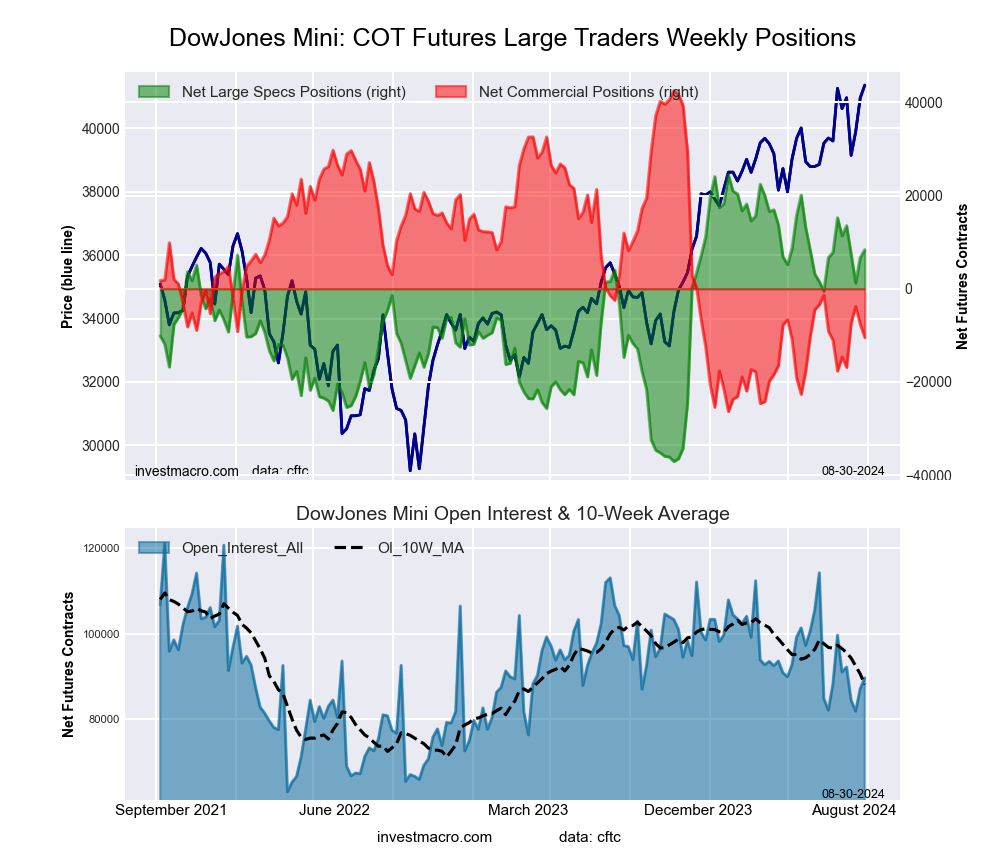
Dow Jones Mini Futures COT ChartThe Dow Jones Mini large speculator standing this week reached a net position of 7,369 contracts in the data reported through Tuesday. This was a weekly fall of -6,169 contracts from the previous week which had a total of 13,538 net contracts.

This week’s current strength score (the trader positioning range over the past three years, measured from 0 to 100) shows the speculators are currently Bullish with a score of 72.3 percent. The commercials are Bearish with a score of 27.6 percent and the small traders (not shown in chart) are Bearish with a score of 47.1 percent.

Price Trend-Following Model: Uptrend

Our weekly trend-following model classifies the current market price position as: Uptrend. The current action for the model is considered to be: Hold – Maintain Long Position.

Dow Jones Mini Futures StatisticsSPECULATORSCOMMERCIALSSMALL TRADERS
– Percent of Open Interest Longs:25.457.514.6
– Percent of Open Interest Shorts:16.766.114.7
– Net Position:7,369-7,321-48
– Gross Longs:21,48448,53612,361
– Gross Shorts:14,11555,85712,409
– Long to Short Ratio:1.5 to 10.9 to 11.0 to 1
NET POSITION TREND:
– Strength Index Score (3 Year Range Pct):72.327.647.1
– Strength Index Reading (3 Year Range):BullishBearishBearish
NET POSITION MOVEMENT INDEX:
– 6-Week Change in Strength Index:12.8-8.7-10.0


Nasdaq Mini Futures:

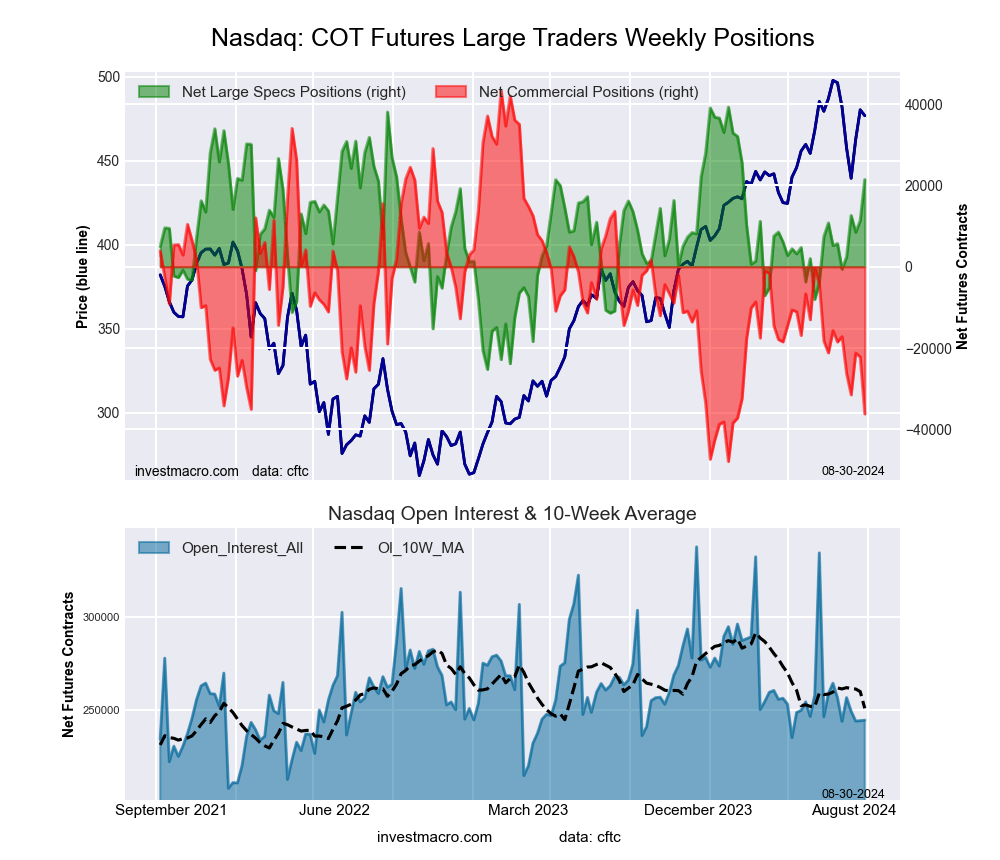
Nasdaq Mini Futures COT ChartThe Nasdaq Mini large speculator standing this week reached a net position of 12,611 contracts in the data reported through Tuesday. This was a weekly increase of 10,189 contracts from the previous week which had a total of 2,422 net contracts.

This week’s current strength score (the trader positioning range over the past three years, measured from 0 to 100) shows the speculators are currently Bullish with a score of 58.7 percent. The commercials are Bearish-Extreme with a score of 18.0 percent and the small traders (not shown in chart) are Bullish-Extreme with a score of 90.6 percent.

Price Trend-Following Model: Weak Uptrend

Our weekly trend-following model classifies the current market price position as: Weak Uptrend. The current action for the model is considered to be: Hold – Maintain Long Position.

Nasdaq Mini Futures StatisticsSPECULATORSCOMMERCIALSSMALL TRADERS
– Percent of Open Interest Longs:20.460.017.4
– Percent of Open Interest Shorts:15.372.69.8
– Net Position:12,611-31,50118,890
– Gross Longs:50,888149,54443,363
– Gross Shorts:38,277181,04524,473
– Long to Short Ratio:1.3 to 10.8 to 11.8 to 1
NET POSITION TREND:
– Strength Index Score (3 Year Range Pct):58.718.090.6
– Strength Index Reading (3 Year Range):BullishBearish-ExtremeBullish-Extreme
NET POSITION MOVEMENT INDEX:
– 6-Week Change in Strength Index:8.1-14.515.3


Russell 2000 Mini Futures:

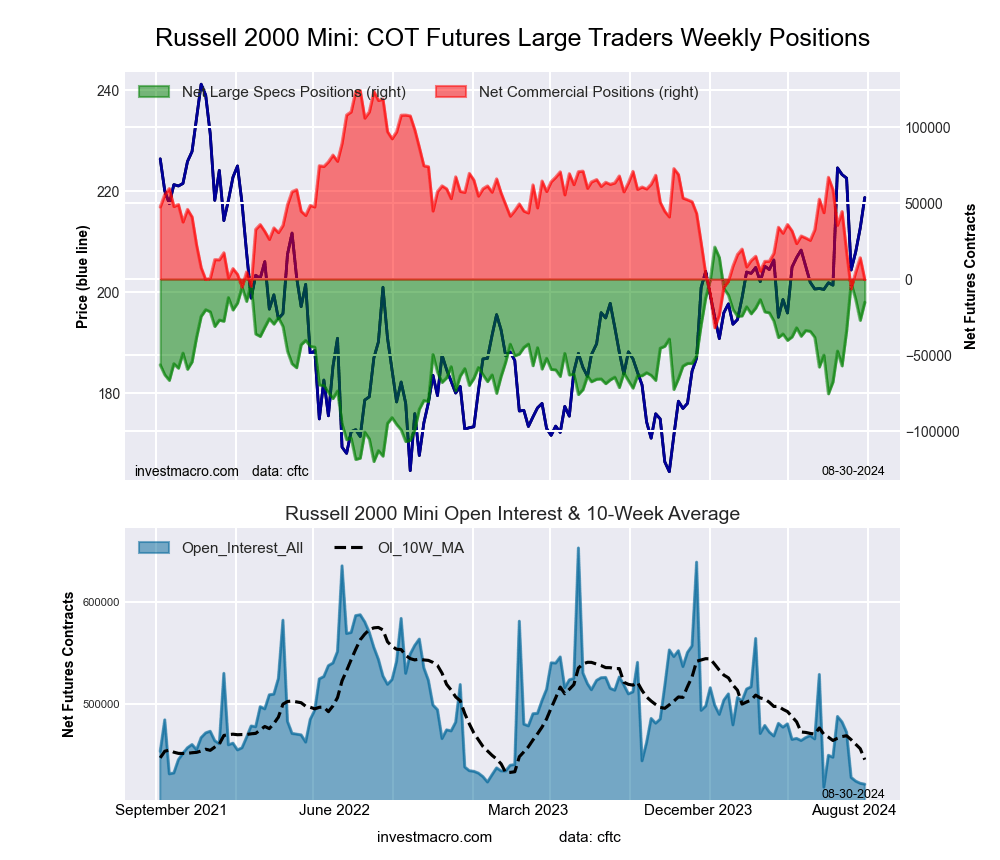
Russell 2000 Mini Futures COT ChartThe Russell 2000 Mini large speculator standing this week reached a net position of -2,595 contracts in the data reported through Tuesday. This was a weekly boost of 31,390 contracts from the previous week which had a total of -33,985 net contracts.

This week’s current strength score (the trader positioning range over the past three years, measured from 0 to 100) shows the speculators are currently Bullish-Extreme with a score of 83.3 percent. The commercials are Bearish-Extreme with a score of 16.3 percent and the small traders (not shown in chart) are Bullish with a score of 59.6 percent.

Price Trend-Following Model: Uptrend

Our weekly trend-following model classifies the current market price position as: Uptrend. The current action for the model is considered to be: Hold – Maintain Long Position.

Russell 2000 Mini Futures StatisticsSPECULATORSCOMMERCIALSSMALL TRADERS
– Percent of Open Interest Longs:16.474.97.1
– Percent of Open Interest Shorts:17.076.45.0
– Net Position:-2,595-6,5029,097
– Gross Longs:70,303320,58830,609
– Gross Shorts:72,898327,09021,512
– Long to Short Ratio:1.0 to 11.0 to 11.4 to 1
NET POSITION TREND:
– Strength Index Score (3 Year Range Pct):83.316.359.6
– Strength Index Reading (3 Year Range):Bullish-ExtremeBearish-ExtremeBullish
NET POSITION MOVEMENT INDEX:
– 6-Week Change in Strength Index:33.6-32.29.2


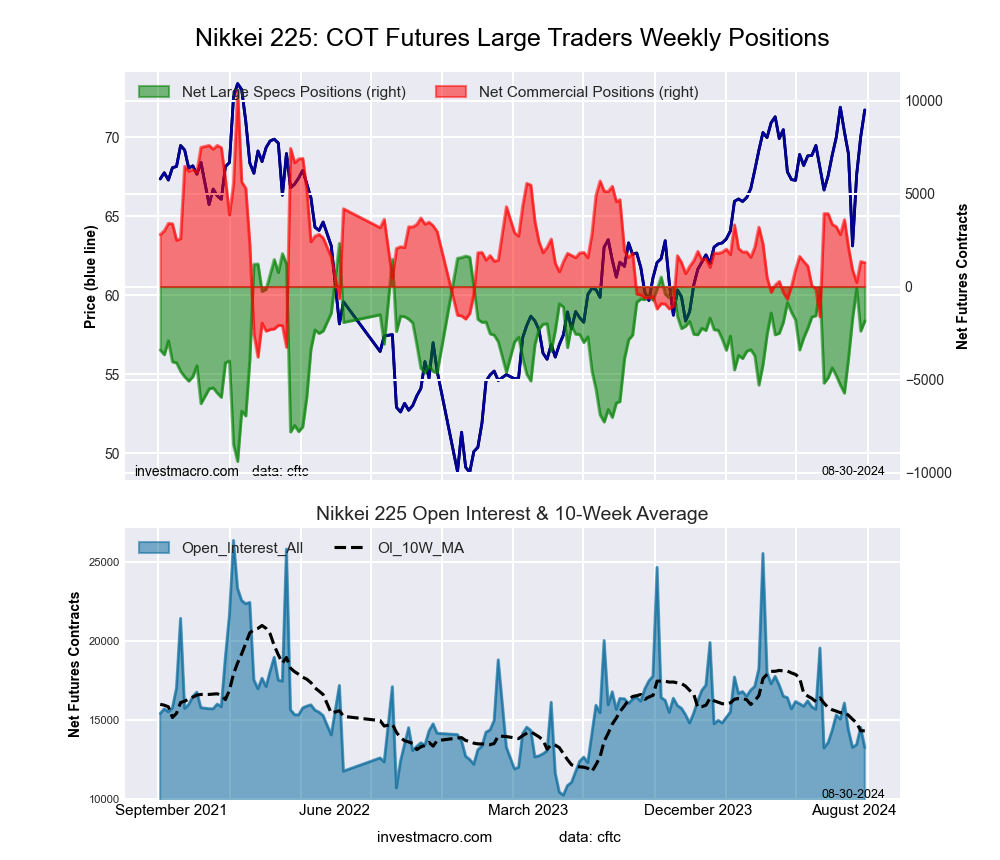
Nikkei Stock Average (USD) Futures:

Nikkei Stock Average (USD) Futures COT ChartThe Nikkei Stock Average (USD) large speculator standing this week reached a net position of -1,727 contracts in the data reported through Tuesday. This was a weekly boost of 2,136 contracts from the previous week which had a total of -3,863 net contracts.

This week’s current strength score (the trader positioning range over the past three years, measured from 0 to 100) shows the speculators are currently Bullish with a score of 65.4 percent. The commercials are Bearish with a score of 32.7 percent and the small traders (not shown in chart) are Bullish with a score of 59.2 percent.

Price Trend-Following Model: Strong Downtrend

Our weekly trend-following model classifies the current market price position as: Strong Downtrend. The current action for the model is considered to be: Hold – Maintain Short Position.

Nikkei Stock Average Futures StatisticsSPECULATORSCOMMERCIALSSMALL TRADERS
– Percent of Open Interest Longs:12.363.024.7
– Percent of Open Interest Shorts:25.356.318.4
– Net Position:-1,727889838
– Gross Longs:1,6258,3583,278
– Gross Shorts:3,3527,4692,440
– Long to Short Ratio:0.5 to 11.1 to 11.3 to 1
NET POSITION TREND:
– Strength Index Score (3 Year Range Pct):65.432.759.2
– Strength Index Reading (3 Year Range):BullishBearishBullish
NET POSITION MOVEMENT INDEX:
– 6-Week Change in Strength Index:27.1-21.1-2.8


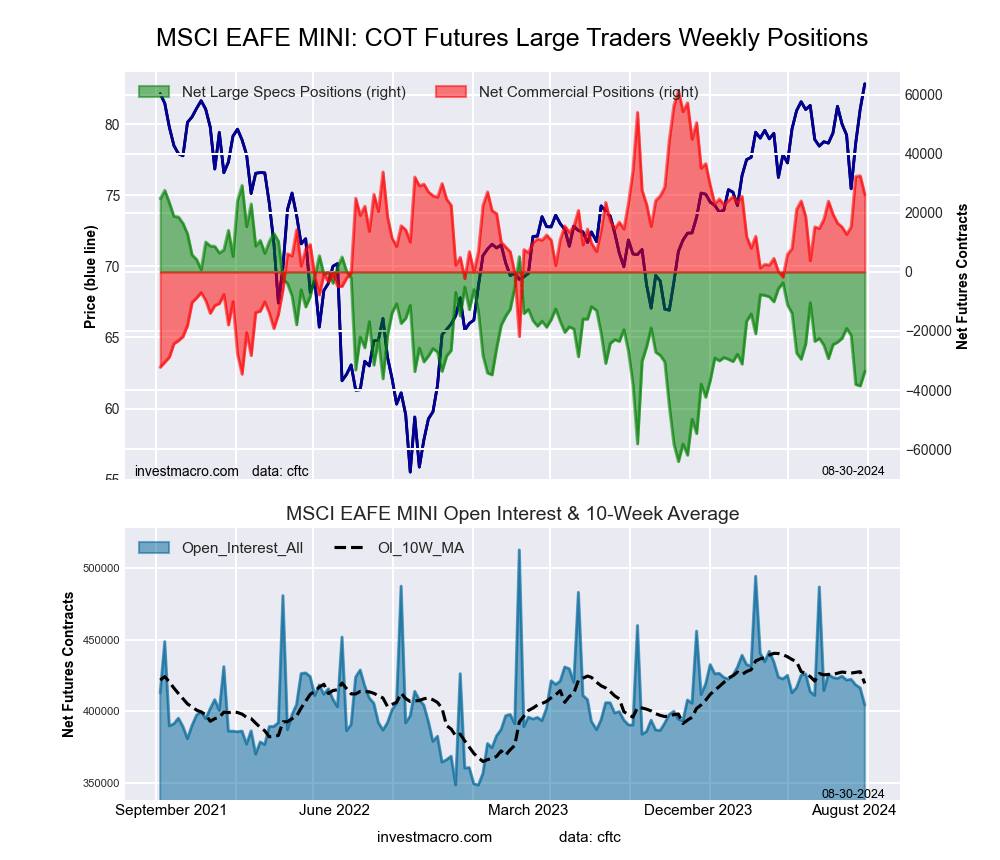
MSCI EAFE Mini Futures:

MSCI EAFE Mini Futures COT ChartThe MSCI EAFE Mini large speculator standing this week reached a net position of -21,455 contracts in the data reported through Tuesday. This was a weekly decline of -2,360 contracts from the previous week which had a total of -19,095 net contracts.

This week’s current strength score (the trader positioning range over the past three years, measured from 0 to 100) shows the speculators are currently Bearish with a score of 44.2 percent. The commercials are Bullish with a score of 52.4 percent and the small traders (not shown in chart) are Bearish with a score of 47.8 percent.

Price Trend-Following Model: Strong Downtrend

Our weekly trend-following model classifies the current market price position as: Strong Downtrend. The current action for the model is considered to be: New Sell – Short Position.

MSCI EAFE Mini Futures StatisticsSPECULATORSCOMMERCIALSSMALL TRADERS
– Percent of Open Interest Longs:7.489.72.6
– Percent of Open Interest Shorts:12.586.11.1
– Net Position:-21,45515,2806,175
– Gross Longs:31,139378,83310,919
– Gross Shorts:52,594363,5534,744
– Long to Short Ratio:0.6 to 11.0 to 12.3 to 1
NET POSITION TREND:
– Strength Index Score (3 Year Range Pct):44.252.447.8
– Strength Index Reading (3 Year Range):BearishBullishBearish
NET POSITION MOVEMENT INDEX:
– 6-Week Change in Strength Index:3.5-2.7-3.8


Article By InvestMacroReceive our weekly COT Newsletter

*COT Report: The COT data, released weekly to the public each Friday, is updated through the most recent Tuesday (data is 3 days old) and shows a quick view of how large speculators or non-commercials (for-profit traders) were positioned in the futures markets.

The CFTC categorizes trader positions according to commercial hedgers (traders who use futures contracts for hedging as part of the business), non-commercials (large traders who speculate to realize trading profits) and nonreportable traders (usually small traders/speculators) as well as their open interest (contracts open in the market at time of reporting). See CFTC criteria here.


The Bank of Mexico unexpectedly cut its interest rate. China’s consumer inflation is on the rise

By JustMarkets

At Thursday’s close, the Dow Jones Industrial Average (US30) was up 1.76%, while the S&P 500 Index (US500) added 2.30%. The NASDAQ Technology Index (US100) closed positive 2.87% on Thursday. Stocks rose on Thursday after the weekly number of US initial jobless claims fell more than expected, indicating the strength of the labor market and easing economic concerns following last Friday’s weaker-than-expected July payrolls report. In addition, chip stocks recovered some of Wednesday’s losses and rallied sharply on Thursday, boosting the overall market.

Bitcoin rose more than 10% and surpassed the $61,000 mark, hitting a one-week high. Earlier this week, bitcoin fell to nearly $49,000 as fears of a US recession and the unwinding of yen deals triggered a global sell-off in risky assets. Cryptocurrencies and other risk assets are gradually returning, as analysts say the sell-off was an overreaction. Bitcoin exchange-traded funds have also seen massive inflows in recent sessions after Morgan Stanley allowed financial advisers to recommend Bitcoin ETFs to clients.

On Thursday, analysts expressed shock over the Mexican central bank’s decision to cut interest rates on the same day that official data showed a sharp rise in domestic inflation. The Bank of Mexico cut its benchmark interest rate by 0.25% to 10.75% in August 2024, defying market expectations amid ongoing economic concerns. Global economic growth is expected to slow, and inflation in advanced economies is generally expected to decline. There was significant market volatility in Mexico, driven by the depreciation of the peso (USD/MXN) and rising government bond yields. Meanwhile, annual core inflation rose from 5.10% in June to 5.57% in July, mainly due to non-core inflation, while core inflation declined from 4.05% to 4.00%.

Equity markets in Europe were mostly down yesterday. Germany’s DAX (DE40) rose by 0.37%, France’s CAC 40 (FR40) closed down 0.26%, Spain’s IBEX 35 (ES35) lost 0.39%, and the UK’s FTSE 100 (UK100) closed negative 0.27% on Thursday.

The US natural gas (XNG/USD) prices eased losses and are trading near $2.1/MMBtu after the EIA reported a smaller-than-expected increase in storage inventories. The US utilities added 21 billion cubic feet of gas to storage last week, slightly below the market forecast of 22 billion cubic feet. According to the report, gas in storage is 14.9% above the 5-year average, down from 39% in March and 19% in June. Meanwhile, major US natural gas producers are planning further production cuts in the second half of 2024

Asian markets traded flat yesterday. Japan’s Nikkei 225 (JP225) decreased by 0.74%, China’s FTSE China A50 (CHA50) added 0.36%, Hong Kong’s Hang Seng (HK50) ended Thursday up 0.08%, and Australia’s ASX 200 (AU200) was negative 0.23%. Hong Kong stocks soared nearly 2% in early trading on Friday, rising for a third day as investors reacted to fresh data from China. Consumer prices in the country rose to 0.5% y/y in July, beating forecasts of 0.3% amid Beijing’s efforts to stimulate consumption. Meanwhile, producer prices fell by 0.8%, below the forecast of a 0.9% drop. In addition, there were signs that some global investors viewed China’s markets as a safe haven after Monday’s sell-off.

The Australian dollar rose to $0.66, hitting a two-week high, as easing fears of a US recession spurred gains in risk assets. The Australian dollar received support from hawkish central bank statements. Reserve Bank of Australia (RBA) Governor Michelle Bullock said they would not hesitate to raise interest rates again to fight inflation. She warned that Australia’s economic outlook remains highly uncertain and that the Board should remain vigilant against upside risks to inflation.

A summary of views from the Bank of Japan’s July policy meeting showed that some members favored raising rates further, with one saying they should eventually be brought to at least 1 percent.

S&P 500 (US500) 5,199.50 −40.53 (−0.77%)

Dow Jones (US30) 38,763.45 −234.21 (−0.60%)

DAX (DE40) 17,615.15 +260.83 (+1.50%)

FTSE 100 (UK100) 8,166.88 +140.19 (+1.75%)

USD Index 103.20 +0.24 (+0.23%)

Important events today:
  • – China Consumer Price Index (m/m) at 04:30 (GMT+3);
  • – China Producer Price Index (m/m) at 04:30 (GMT+3);
  • – German Consumer Price Index (m/m) at 09:00 (GMT+3);
  • – Canada Unemployment Rate (m/m) at 15:30 (GMT+3).

By JustMarkets


This article reflects a personal opinion and should not be interpreted as an investment advice, and/or offer, and/or a persistent request for carrying out financial transactions, and/or a guarantee, and/or a forecast of future events.

EUR/USD Stabilises Amid Fed Speculation and Absence of Major Economic Data

By RoboForex Analytical Department

The EUR/USD pair has found some stability at around 1.0921 this Friday, following a week marked by high volatility. Market participants have been adjusting their positions in response to speculations concerning the US economy’s potential rapid recession and subsequent expectations about the Federal Reserve’s response.

The broader market sentiment has increasingly leaned towards anticipating a significant rate cut by the Fed in September, possibly by 50 basis points. However, the validity of these expectations remains to be seen as the situation evolves.

Austan Goolsbee, President of the Federal Reserve Bank of Chicago, recently emphasised that the Federal Reserve’s mandate is not to respond to stock market fluctuations but to focus on its dual objectives of maximising employment and achieving price stability. He also reiterated that the Fed has set specific economic criteria to justify a rate reduction. Goolsbee’s remarks seem to have calmed some of the more erratic market movements.

With no significant economic data released this week, traders have been left to navigate the market based on speculative movements and minor indicators.

Technical analysis of EUR/USD

The H4 EUR/USD chart shows that the pair has completed an initial downward movement targeting the 1.0880 level, followed by a corrective phase towards 1.0944. Should this correction complete, a further decline to 1.0888 is anticipated. Breaking below this level could extend the downward trajectory towards 1.0830. The bearish outlook is supported by the MACD indicator, whose signal line is positioned above zero but trending downwards, indicating a potential continuation of the decline.

On the H1 chart, EUR/USD has formed a consolidation pattern around the 1.0913 mark. An upward breakout is expected, potentially driving the pair towards 1.0944, which is seen as a corrective move against the previous downtrend. Upon completion of this correction, the focus will shift to a new declining phase targeting 1.0888. This technical perspective is corroborated by the Stochastic oscillator, with its signal line poised to move from below the 80 level to around 20, suggesting an impending downward momentum.

Overall, the EUR/USD pair shows signs of temporary equilibrium as it navigates through speculative currents and awaits clearer directional cues from upcoming economic data or Federal Reserve communications.


Disclaimer

Any forecasts contained herein are based on the author’s particular opinion. This analysis may not be treated as trading advice. RoboForex bears no responsibility for trading results based on trading recommendations and reviews contained herein.

Week Ahead: US30 index still sensitive to US recession fears

By ForexTime 

  • Markets still obsessed with deciphering US recession risks
  • Home Depot, Walmart earnings offer pulse on US economy
  • Latest US inflation data also holds clues about Fed’s next moves
  • Economically-sensitive US30 stock index ready to punch above 50-day SMA resistance


Markets are still obsessed about the risks of a US recession.

Traders and investors worldwide are still licking their wounds from the recent plunge across global financial markets, following last Friday’s unexpected rise in the US unemployment rate (4.3% in July).

Against such a backdrop, next week’s US economic data and US earnings releases could shift market expectations surrounding a US recession, and whether the Fed will be forced to cut rates aggressively.


Tuesday, August 13

  • JPY: Japan July PPI
  • AUD: Australia August consumer and business confidence
  • GBP: UK June unemployment, July jobless claims
  • GER40 index: Germany August ZEW survey expectations
  • ZAR: South Africa 2Q unemployment
  • USD index: US July PPI; speech by Atlanta Fed President Raphael Bostic
  • US30 index: Home Depot earnings

Wednesday, August 14

  • NZD: RBNZ rate decision
  • UK100 index: UK July CPI
  • EU50 index: Eurozone 2Q GDP, June industrial production
  • ZAR: South Africa June retail sales
  • US500 index: US July CPI

Thursday, August 15

  • JP225 index: Japan 2Q GDP
  • AU2000 index: Australia July unemployment
  • CNH: China July home prices, industrial production, retail sales, jobless rate
  • GBP: UK 2Q GDP; June industrial production, trade balance
  • NOK: Norway rate decision
  • RUS2000 index: US weekly initial jobless claims; July retail sales and industrial production
  • US30 index: Walmart earnings; speeches by St. Louis Fed President Alberto Musalem, Philadelphia Fed President Patrick Harker
  • CHINAH index: Earnings from Alibaba, JD.com

Friday, August 16

  • SG20 index: Singapore July exports
  • GBP: UK July retail sales
  • TWN index: Taiwan 2Q GDP
  • US400 index: US August consumer sentiment; speech by Chicago Fed President Austan Goolsbee


For the coming week, we focus on the US30 stock index.

After all, the share prices of the 30 companies contained within this stock index are deemed to be more reflective of real economic conditions (as opposed to say growth/tech/AI stocks).

Hence, the imminent earnings releases by these major companies, along with the incoming top-tier economic data, could contribute to outsized trading opportunities for this stock index next week.

The events highlighted below may well determine if the US30 index can conquer its 50-day simple moving average (SMA) resistance that it’s battled with all week long.

US30 index battles 50-day SMA resistance


1) Tuesday, August 13th: Home Depot earnings (before US markets open)

The Home Depot is the world’s largest home improvement specialty retailer, operating over 2,300 stores across North America (including Canada and Mexico).

In other words …

Home Depot’s earnings are reflective of the strength of consumer spending.

Markets are set to interpret this retail giant’s earnings for signs if consumer spending is still resilient, or whether households are already reeling from high interest rates, persistent inflation, and recession fears.

Depending on the earnings release, markets forecast this stock could move by 5.5%, either up or down, once US markets reopen on Tuesday, just hours after the company’s earnings are released.

Home Depot accounts for 5.8% of the US30 index, making it the 4th biggest stock on the Dow Jones Industrial Average index / Dow / FXTM’s US30 index.

That means the market’s reaction to Home Depot’s earnings could sway the broader US30 index in tandem.

Note that Tuesday also features the release of the US producer price index (PPI) and a speech by Atlanta Fed President Raphael Bostic, either of which could also sway the US30 index, in addition to Home Depot’s earnings.


2) Wednesday, August 14th: US July consumer price index (CPI)

The CPI is a widely followed measure of inflation.

And we know that red-hot inflation has been the bane of the Federal Reserve in recent years, though the US central bank has since made substantial progress in quelling it.

However, has it been enough? Or will the Fed be forced to maintain its benchmark rates at its current 23-year high of 5.5%?

Economists predict a soft and manageable uplift to the incoming CPI figures:

  • CPI month-on-month (July 2024 vs. June 2024): 0.2%
    (if so, that would be a return to positive territory from June’s -0.1% month-on-month figure)
  • CPI core (excluding food and energy prices) month-on-month: 0.2%
    (if so, that would be slightly higher from June’s 0.1% month-on-month figure)
  • CPI year-on-year (July 2024 vs. July 2023): 3%
    (if so, that would match June’s 3% year-on-year figure)
  • CPI core year-on-year: 3.2%
    (if so, that would be slightly lower than June’s 3.3% core year-on-year figure)

This incoming inflation data would be read as they pertain to the likelihood of Fed rate cuts, given that the US central bank now has to juggle between subduing inflation and not causing too much damage to the US jobs market, now more so in light of the recent surprise jump in US unemployment.


POTENTIAL SCENARIOS

  • If the CPI comes in higher than expected, that may force the Fed to hold interest rates higher still while risking more damage to the US labour market.

    Should markets then perceive greater odds for a US recession, that could send the US30 index plummeting back below its 100-day SMA and towards its 200-day SMA.


  • If the CPI comes in lower than expected, that should allow the Fed to lower interest rates in September to shore up support for the US labour market.

    If markets then believe that US recession risks are subsiding, that could see the US30 index rejoicing as it punches past its 50-day SMA and perhaps reaching the 40,000 mark.


3) Thursday, August 15th: Walmart earnings (before US markets open)

Walmart is a retail behemoth that serves about 255 million customers per week across some 10,500 stores, drawing over 80% of its revenue from its US customers.

Depending on what Walmart announces, markets forecast this stock could move by 5%, either up or down, once US markets reopen on Thursday, just hours after the company’s earnings are released.

Despite its sheer presence in the physical world, Walmart “merely” accounts for 1.1% of the US30 index.

Still, given how its earnings are reflective of US consumer spending habits, the market may well interpret Walmart’s earnings as an indicator of the US economic outlook.

The shifting odds of a US recession, via Walmart’s earnings, are bound to impact the US30 index’s performance as well.

Note that Thursday also features the release of the weekly US initial jobless claims, as well as July’s retail sales and industrial production data, all of which could sway the US30 index as well, on top of Walmart’s earnings.


Forex-Time-LogoArticle by ForexTime

ForexTime Ltd (FXTM) is an award winning international online forex broker regulated by CySEC 185/12 www.forextime.com

Market “Olympics”: Best-performing financial assets so far in 2024

By ForexTime 

  • US Dollar still reigns, though perhaps not much longer
  • GBP: best-performing G10 currency vs. USD year-to-date (YTD)
  • NETH25: FXTM’s best-performing stock index YTD
  • Cocoa: FXTM’s best-performing commodity YTD
  • Nvidia: best-performing stock on the S&P 500 YTD
  • Solana: FXTM’s best-performing crypto YTD


We’re in the final stretch of the 2024 Olympics, set to end August 11th.

The United States is leading the Olympic medals tally after weeks of sporting conquests across disciplines and arenas.

In similar fashion, we scan across global financial markets and highlight the world champions of their respective asset classes (and within the FXTM universe), so far in 2024 (year-to-date).


G10 currency (vs. US dollar):

  • British Pound

Although GBPUSD is down about 0.3% so far this year, it’s still beating the rest of the G10 pack in terms of being the smallest year-to-date loser against the US dollar. Even the fast-recovering Japanese Yen remains in 6th place.

To be clear, the US Dollar index still boasts a year-to-date gain of 1.77% at the time of writing.

While King Dollar still reigns supreme, its gains may be wiped out over the rest of the year, if the Federal Reserve follows through with the aggressive US rate cuts that markets expect.

If US rates are lowered at a faster pace compared to its G10 peers, that could help push the likes of GBP into a positive year-to-date performance.


Stock Index:

  • NETH25

FXTM’s NETH25 stock index tracks the performance of the AEX index – the Amsterdam Exchange index.

The AEX index measures the overall performance of the 25 biggest and most actively traded shares on Euronext Amsterdam.

Led by semiconductor giant ASML – Europe’s largest tech company by market cap, also the biggest stock on the AEX index – ASML’s surge has also boosted its host index simultaneously.

Despite falling by as much as 8.9% since mid-July, amid the broader declines for global equities, the NETH25 index is still holding onto much of its gains garnered from earlier this year.

The NETH25 is still up about 11% on a year-to-date basis.

However, those year-to-date gains may be further eroded if there’s further selling across global equities amid fears of a US recession that darkens the global economic outlook, as well as lessened spending on semiconductors by AI-industry players.


Metal/Commodity:

  • Cocoa

This global commodity still holds a year-to-date advance of 103%, far beating the likes of gold (+16.9% YTD) and US crude oil (+5.1% YTD).

There has been a global shortage of cocoa, as evidenced by US inventories of cocoa beans falling to their lowest level in over 4 years.

However, such gains may not last.

Markets expect a recovery in west African production of cocoa to recover in the months ahead. The global cocoa market is projected to flip from a deficit into a surplus (more cocoa beans supplied than demanded by sweet-toothed consumers) next year.

With markets well aware of this outlook, no surprise that cocoa prices has only managed lower highs since April 2024, though retaining its triple-digit year-to-date gains, for now.

Overall, global commodities, from cocoa to crude oil, may well see further declines if a US recession is confirmed, along with still-sluggish Chinese economic growth, which combined to weigh down the global economy.


US Stock (on the S&P 500):

  • Nvidia

Much has already been made about how Nvidia has been a star performer on the US stock market in recent years.

It’s been on a seemingly unrelenting quest of posting new record highs at the height of the AI-mania, before crashing back down to earth in recent weeks.

Though having fallen by about 27% since its all-time high set on June 18th …

Nvidia still holds a year-to-date gain of nearly 100%

(99.7% to be more precise, before US markets open on August 8th).

This stock may yet recover back to its record highs, once the ongoing selloff abates.

Wall Street still predicts a 43% upside over the next 12 months, with a target price of $141.35.

If it gets there, that would be a new record high for Nvidia’s stocks in 2025, unless markets believe the artificial intelligence mania has been a lot more hype and its AI-fuelled profits have already peaked.


Cryptocurrency:

  • Solana

Solana’s year-to-date gains stand at 51.5% at the time of writing, exceeding Bitcoin’s YTD advance of 35%.

Given the respective debuts of Bitcoin ETFs and Ethereum ETFs earlier this year, the crypto market’s attentions have now turned to other cryptocurrencies that could be next in the ETF pipeline.

ETFs = Exchange-traded funds, which can be bought and sold like regular stocks on a centralised exchange. ETFs make it easier, and more secure, for investors (both retail and institutional) to gain access to the underlying crypto without having to directly purchase the digital asset.

If the US government turns increasingly pro crypto, especially if we see a return of President Trump to the White House after the November US Presidential elections, then cryptocurrencies stand to be restored to their recent peaks respectively.

Solana bulls (those betting that prices will rise) will be hoping that their favoured crypto could move back closer to the psychologically-important $200 level.


It remains to be seen which specific instrument will sit atop of their respective asset classes by the end of this year.

What’s more certain is that the remaining months of 2024 may yet bring more volatility, in light of heightened geopolitical tensions, fears of a US recession, as well as political uncertainties stemming from the US Presidential Elections.

That should produce large opportunities for traders and investors who remain alert to the macro picture across financial markets.


Forex-Time-LogoArticle by ForexTime

ForexTime Ltd (FXTM) is an award winning international online forex broker regulated by CySEC 185/12 www.forextime.com

RBI kept rates at 6.5%. The Canadian dollar is strengthening due to foreign currency inflows and rising oil prices

By JustMarkets

At Wednesday’s close, the Dow Jones Index (US30) was down 0.60%, while the S&P 500 Index (US500) decreased by 0.77%. The NASDAQ Technology Index (US100) closed negative 1.05%. Yesterday, chip stocks gave up early gains and retreated, which had a negative impact on the overall market.

Stocks on Wednesday initially went up on positivity from a rally in Japanese stocks amid dovish comments from Bank of Japan (BoJ) Deputy Governor Uchida, who pledged to refrain from raising interest rates amid volatile markets. Financial markets have been in turmoil since last week, when the BoJ unexpectedly raised interest rates, causing the yen to surge to a 7-month high against the dollar and contributing to a rapid unwinding of yen trading that pulled down risk assets around the world.

Airbnb (ABNB) closed down more than 13% after estimating third-quarter revenue of $3.67 billion to $3.73 billion, below consensus estimates of $3.84 billion, and warning of weaker demand from US vacationers. Illumina (ILMN) closed higher by more than 4% after reporting second-quarter revenue of $1.11 billion, above the consensus prognosis of $1.09 billion.

The Canadian dollar strengthened to 1.37 per US dollar, recovering from an eight-month low of 1.388 hit on August 1, thanks to an improving outlook for foreign exchange inflows and reduced fears of a US recession, which restored global risk appetite. A recovery in oil prices, driven by a sixth consecutive week of declines in US inventories and fears of supply disruptions from the Middle East, further supported the loonie. However, the recent rate cut by the Bank of Canada (BoC) and expectations of further easing of up to 150 basis points over the next year will create headwinds for the Canadian dollar.

Equity markets in Europe were mostly up yesterday. Germany’s DAX (DE40) rose by 1.50%, France’s CAC 40 (FR40) closed 1.91% higher, Spain’s IBEX 35 (ES35) added 2.01%, and the UK’s FTSE 100 (UK100) closed positive 1.75%.

WTI crude oil prices rose to around $75.5 per barrel on Thursday, rising for the third consecutive session, driven by a larger-than-expected decline in US crude inventories. EIA data for Wednesday showed crude inventories fell by 3.728 million barrels, the sixth consecutive weekly decline, well above the expected 0.4 million barrel drop. However, gasoline and distillate inventories rose over the period.

Asian markets traded flat yesterday. Japan’s Nikkei 225 (JP225) rose by 1.19%, China’s FTSE China A50 (CHA50) added 0.13%, Hong Kong’s Hang Seng (HK50) gained 1.38%, and Australia’s ASX 200 (AU200) was positive 0.25%.

The Reserve Bank of India (RBI) kept the benchmark repo rate at 6.5% for the ninth consecutive meeting in August 2024 to ensure inflation falls to the medium-term target of 4% while supporting growth, in line with market expectations. The latest move came after annual inflation accelerated to a four-month high of 5.08% in June 2024, driven by rising food prices, but remained within the RBI’s acceptable target range of 2–6% In addition, the Central Bank maintained its economic growth estimate for FY 2025 at 7.2%, keeping inflation expectations at 4.5%.

S&P 500 (US500) 5,199.50 −40.53 (−0.77%)

Dow Jones (US30) 38,763.45 −234.21 (−0.60%)

DAX (DE40) 17,615.15 +260.83 (+1.50%)

FTSE 100 (UK100) 8,166.88 +140.19 (+1.75%)

USD Index 103.20 +0.24 (+0.23%)

Important events today:
  • – Australia NAB Business Confidence (m/m) at 04:30 (GMT+3);
  • – China Trade Balance (m/m) at 06:00 (GMT+3);
  • – New Zealand Inflation Expectations (q/q) at 06:00 (GMT+3);
  • – US Initial Jobless Claims (m/m) at 15:30 (GMT+3);
  • – US Natural Gas Storage (w/w) at 17:30 (GMT+3).

By JustMarkets


This article reflects a personal opinion and should not be interpreted as an investment advice, and/or offer, and/or a persistent request for carrying out financial transactions, and/or a guarantee, and/or a forecast of future events.

Gold (XAU/USD) Recovers Amid Rate Cut Expectations

By RoboForex Analytical Department

Gold (XAU/USD) prices have rebounded to 2394 USD per troy ounce, paring previous losses as the likelihood of a US Federal Reserve rate cut increases. Market sentiment is increasingly cautious amid recession fears, influencing stock market dynamics and bolstering the appeal of non-yielding assets like gold.

Current market indicators, notably the CME FedWatch tool, suggest an almost certain probability of a rate reduction by the Federal Reserve in September. Such monetary easing typically enhances the allure of gold, which does not offer interest income.

Investor focus is now on upcoming US unemployment claims data, which will provide further insight into employment market conditions. Recent statistics from China revealed that the People’s Bank of China did not purchase gold bullion in July, marking the third consecutive month without an increase in gold reserves. This suggests a shift towards domestic economic stimulation as the Chinese economy faces challenges.

Ongoing tensions in the Middle East also underscore gold’s status as a safe-haven asset.

Technical analysis of XAU/USD

The H4 XAU/USD chart shows a declining trend towards the 2345.00 level, with a local target recently reached at 2364.23, followed by a correction to 2411.00. The market is anticipated to continue this downward trajectory towards 2355.80 before potentially rebounding to 2381.60. A further decline to 2345.00 is likely, aligning with the primary downtrend target. This bearish outlook is supported by the MACD indicator, which shows the signal line trending downwards from above zero.

On the H1 chart, gold is currently consolidating above 2381.60. A downward breakout towards 2355.80 is expected, which would serve as a local target. Subsequent retesting of 2381.60 from below may occur before the downward movement continues to 2345.00. This bearish scenario is corroborated by the Stochastic oscillator, with the signal line poised to drop from above 80, suggesting a potential decline.

As investors and traders navigate these dynamics, gold’s status as a hedge against uncertainty remains a key theme in its valuation.


Disclaimer

Any forecasts contained herein are based on the author’s particular opinion. This analysis may not be treated as trading advice. RoboForex bears no responsibility for trading results based on trading recommendations and reviews contained herein.

Verifying facts in the age of AI – librarians offer 5 strategies

By Tracy Bicknell-Holmes, Boise State University; Elaine Watson, Boise State University, and Memo Cordova, Boise State University 

The phenomenal growth in artificial intelligence tools has made it easy to create a story quickly, complicating a reader’s ability to determine if a news source or article is truthful or reliable. For instance, earlier this year, people were sharing an article about the supposed suicide of Israeli Prime Minister Benjamin Netanyahu’s psychiatrist as if it were real. It ended up being an AI-generated rewrite of a satirical piece from 2010.

The problem is widespread. According to a 2021 Pearson Institute/AP-NORC poll, “Ninety-five percent of Americans believe the spread of misinformation is a problem.” The Pearson Institute researches methods to reduce global conflicts.

As library scientists, we combat the increase in misinformation by teaching a number of ways to validate the accuracy of an article. These methods include the SIFT Method (Stop, Investigate, Find, Trace), the P.R.O.V.E.N. Source Evaluation method (Purpose, Relevance, Objectivity, Verifiability, Expertise and Newness), and lateral reading.

Lateral reading is a strategy for investigating a source by opening a new browser tab to conduct a search and consult other sources. Lateral reading involves cross-checking the information by researching the source rather than scrolling down the page.

Here are five techniques based on these methods to help readers determine news facts from fiction:

1. Research the author or organization

Search for information beyond the entity’s own website. What are others saying about it? Are there any red flags that lead you to question its credibility? Search the entity’s name in quotation marks in your browser and look for sources that critically review the organization or group. An organization’s “About” page might tell you who is on their board, their mission and their nonprofit status, but this information is typically written to present the organization in a positive light.

The P.R.O.V.E.N. Source Evaluation method includes a section called “Expertise,” which recommends that readers check the author’s credentials and affiliations. Do the authors have advanced degrees or expertise related to the topic? What else have they written? Who funds the organization and what are their affiliations? Do any of these affiliations reveal a potential conflict of interest? Might their writings be biased in favor of one particular viewpoint?

If any of this information is missing or questionable, you may want to stay away from this author or organization.

2. Use good search techniques

Become familiar with search techniques available in your favorite web browser, such as searching keywords rather than full sentences and limiting searches by domain names, such as .org, .gov, or .edu.

Another good technique is putting two or more words in quotation marks so the search engine finds the words next to each other in that order, such as “Pizzagate conspiracy.” This leads to more relevant results.

In an article published in Nature, a team of researchers wrote that “77% of search queries that used the headline or URL of a false/misleading article as a search query return at least one unreliable news link among the top ten results.”

A more effective search would be to identify the key concepts in the headline in question and search those individual words as keywords. For example, if the headline is “Video Showing Alien at Miami Mall Sparks Claims of Invasion,” readers could search: “Alien invasion” Miami mall.

3. Verify the source

Verify the original sources of the information. Was the information cited, paraphrased or quoted accurately? Can you find the same facts or statements in the original source? Purdue Global, Purdue University’s online university for working adults, recommends verifying citations and references that can also apply to news stories by checking that the sources are “easy to find, easy to access, and not outdated.” It also recommends checking the original studies or data cited for accuracy.

The SIFT Method echoes this in its recommendation to “trace claims, quotes, and media to the original context.” You cannot assume that re-reporting is always accurate.

4. Use fact-checking websites

Search fact-checking websites such as InfluenceWatch.org, Poynter.org, Politifact.com or Snopes.com to verify claims. What conclusions did the fact-checkers reach about the accuracy of the claims?

A Harvard Kennedy School Misinformation Review article found that the “high level of agreement” between fact-checking sites “enhances the credibility of fact checkers in the eyes of the public.”

5. Pause and reflect

Pause and reflect to see if what you have read has triggered a strong emotional response. An article in the journal Cognitive Research indicates that news items that cause strong emotions increase our tendency “to believe fake news stories.”

One online study found that the simple act of “pausing to think” and reflect on whether a headline is true or false may prevent a person from sharing false information. While the study indicated that pausing only decreases intentions to share by a small amount – 0.32 points on a 6-point scale – the authors argue that this could nonetheless cut down on the spread of fake news on social media.

Knowing how to identify and check for misinformation is an important part of being a responsible digital citizen. This skill is all the more important as AI becomes more prevalent.The Conversation

About the Authors:

Tracy Bicknell-Holmes, Library professor, Boise State University; Elaine Watson, Librarian and Associate Professor, Boise State University, and Memo Cordova, Library associate professor, Boise State University

This article is republished from The Conversation under a Creative Commons license. Read the original article.


Inflation-Resilient Stocks: Why Progressive (PGR) Stands Out

By The Ino.com Team

In July, U.S. consumer confidence unexpectedly ticked up, offering a glimmer of optimism despite ongoing concerns about inflation and rising borrowing costs. The Federal Reserve’s closely watched gauge revealed that inflation eased slightly in June, with the personal consumption expenditures price index inching up by just 0.1% on the month and 2.5% year-over-year. While this slightly improved from May’s 2.6% increase, inflation still hovers above the Fed’s long-term target of 2%, keeping the door open for a potential interest rate cut in September.

In such an inflationary environment, the insurance industry emerges as a safe harbor for investors seeking stability. Insurance isn’t just a safety net; it’s a lifeline for individuals and businesses alike, offering protection from unforeseen events and often fulfilling legal and financial requirements. The industry is notoriously competitive, with many insurers struggling to stand out. However, The Progressive Corporation (PGR) has distinguished itself by excelling in balancing risk and reward.

Progressive’s Strategy for Thriving in Inflationary Times

In recent years, the insurance sector has battled rising inflation, which has driven up repair and replacement costs and impacted profitability. Yet Progressive has adeptly navigated the storm. Since its public debut in 1971, the powerhouse automotive insurer has consistently aimed for a combined ratio of 96%, ensuring it makes $4 in profit for every $100 in premiums received.

While many auto insurers struggled with their worst loss ratios in two decades last year, PGR achieved a combined ratio of 94.5%. This year, they’ve done even better, with a combined ratio of 91.9% in the first half. This strong performance has translated into impressive stock returns, with shares up more than 70% over the past year and nearly 35% year-to-date.

For the second quarter that ended June 30, 2024, PGR’s net premiums earned increased 19% year-over-year to $17.21 billion. Its net income came in at $1.46 billion, or $2.48 per common share, up 322.3% and 335.1% year-over-year, respectively. The company generated total revenues of $35.38 billion year-to-date, compared to $29.66 billion in 2023.

Street expects PGR’s revenue and EPS for the third quarter (ending September 2024) to increase 21.1% and 25.5% year-over-year to $18.89 billion and $2.65, respectively. Moreover, the company has consistently surpassed consensus EPS estimates in each of the trailing four quarters, including the second quarter.

What sets Progressive apart is its innovative approach to insurance. As one of the pioneers in using telematics, or driver data, to price insurance policies, the company has leveraged technology to stay ahead of its competitors.

Moreover, PGR’s non-GAAP PEG ratio is a mere 0.06, indicating that despite its solid growth prospects, the stock is undervalued, making it an attractive option for growth-seeking investors. The company’s strong performance across different market conditions due to its beta of 0.36 further enhances its appeal.

Progressive’s conservative investment strategy, with a focus on shorter-dated debt investments, positions it well to benefit from sustained higher interest rates, making it a strong long-term hold for investors. Morgan Stanley analyst Bob Jian Huang forecasts that the company will capture over 18% of the market by 2028, thanks to its competitive strength and innovative edge.

Progressive vs. Allstate: Which Stock Offers Greater Investment Potential?

While Progressive has adeptly managed rising inflation and repair costs with innovative approaches like telematics, The Allstate Corporation (ALL) has faced its own set of challenges, particularly from natural disasters and high inflation. In 2023, U.S. home insurers experienced their worst underwriting losses this century, with net underwriting losses reaching an eye-watering $15.2 billion. This was largely due to increasing populations in high-risk areas like California and Texas, which exacerbated the impact of natural catastrophes.

To combat these pressures, Allstate has proposed a substantial 34% increase in homeowners’ insurance premiums. This move, pending approval from the California Department of Insurance, aims to mitigate the financial impact of escalating claims and weather-related damages. This isn’t unprecedented, as insurance companies, including State Farm, have also sought similar rate hikes based on claims history and market conditions.

Although this move mirrors PGR’s strategy of adjusting premiums to maintain profitability amidst rising costs, ALL’s focus has been more on addressing the financial stress from natural disasters rather than leveraging technology for competitive advantage.

Despite these hurdles, ALL shares have surged more than 52% over the past year and 22.3% year-to-date, demonstrating strong performance in a turbulent market.

Financially, the company has delivered solid results that are at par with Progressive’s financial performance. ALL’s consolidated net revenues for the second quarter ended June 30, 2024, increased 12.4% year-over-year to $15.71 billion. The company’s adjusted net income amounted to $429 million and $1.61 per share, compared to an adjusted net loss of $1.16 billion and $4.42 per share in the year-ago quarter, respectively. Furthermore, its property-liability insurance premiums earned rose 11.9% year-over-year to $13.34 billion.

Analysts expect ALL’s revenue for the quarter ending September 30, 2024, to increase 8.4% year-over-year to $15.71 billion. Its EPS for the same period is expected to increase 273.6% year-over-year to $3.03. It surpassed the consensus EPS estimates in three of the trailing four quarters.

Moreover, the company’s strong financial health enables it to consistently deliver value to its shareholders. With 13 years of consecutive dividend growth, ALL pays a $3.68 per share dividend annually, translating to a 2.12% yield on the current share price. Its four-year dividend yield is 2.49%. The company’s dividend payouts have grown at CAGRs of 10.3% and 13.5% over the past three and five years, respectively.

Allstate is currently trading at a relatively discounted valuation. The stock’s forward EV/Sales multiple stands at 0.87, which is below the industry average of 3.17x and its five-year median of 0.97x. This attractive valuation provides a margin of safety for investors, reducing downside risk while offering substantial upside potential.

Given these factors, Allstate presents a strong investment case. However, when comparing it to Progressive, ALL’s more traditional approach may not offer the same innovative edge. While both companies exhibit resilience and growth prospects, PGR’s forward-thinking strategies and consistent performance in diverse market conditions position it as the more compelling choice for those seeking robust long-term returns.

By Ino.com – See our Trader Blog, INO TV Free & Market Analysis Alerts

Source: Inflation-Resilient Stocks: Why Progressive (PGR) Stands Out

This Trend Will Likely Soon Rock the U.S. Financial System

Why monetary inflation has been shrinking

By Elliott Wave International

Nearly everyone who buys groceries, fills their car tank with gas, pays rent, buys car insurance and so on is talking about the high cost of living. And it’s true that consumer price inflation is higher today than before the pandemic – although, it’s nowhere near as high as it was two years ago, when the annual inflation rate spiked to a 40-year peak of 9.1%.

Since then, the pace of inflation has slowed way down. In fact, the latest reading of the Consumer Price Index, or CPI, came in at 3%, close to the Federal Reserve’s “ideal” target of 2% a year.

But that’s price inflation. There is another measure of inflation that has to do with money supply. It’s the so-called monetary inflation, or the supply of printed money. It has also declined over the past two years and is likely set to decrease even more. And while it sounds like a good trend, it’s actually the opposite.
Here’s insight from our just-published July Elliott Wave Theorist:

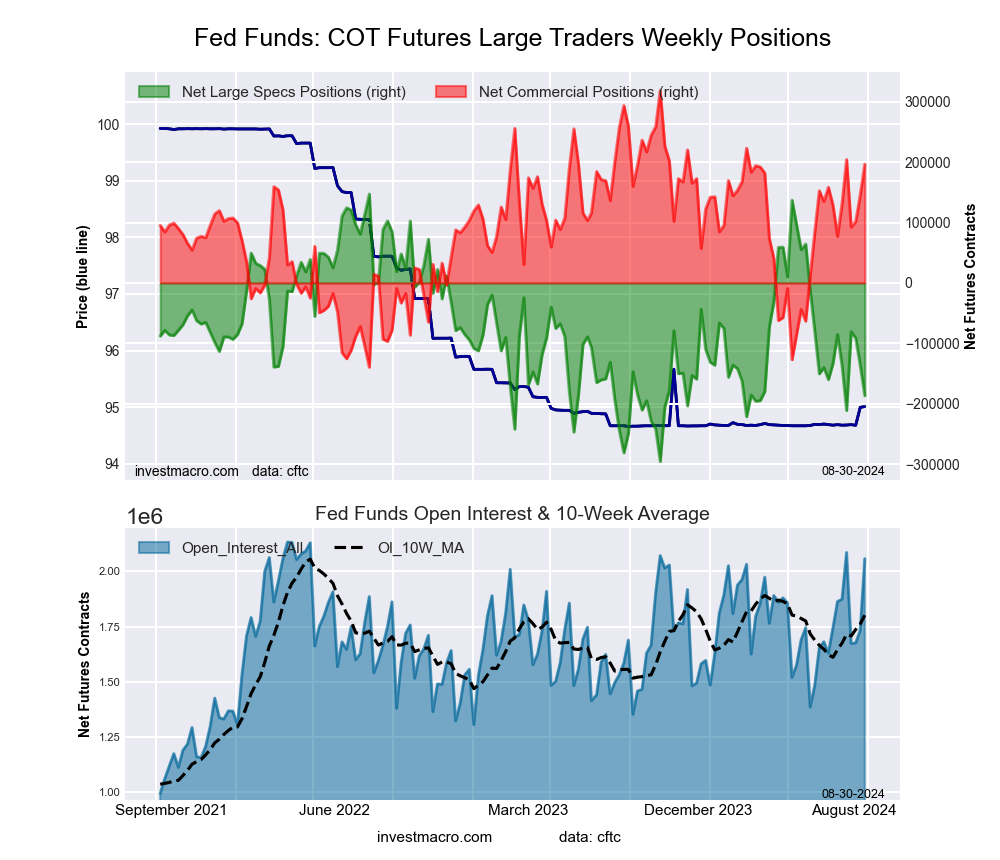
Monetary inflation … is unlikely to continue. Why? because since early 2022 the Fed’s clear aim has been to reduce the size of its balance sheet. Over the past two years, the value of the Fed’s assets, representing “printed” money, has gone from $8.94 trillion to $7.22 trillion, a decline of nearly 20 percent.
The July Elliott Wave Theorist continues:

This shrinkage of base money, moreover, has taken place even as total debt has expanded. This situation cannot maintain. The dichotomy will soon rock the financial system. It’s just a matter of when.

Indeed, U.S. household debt – which is part of that “total debt” The Theorist is referring to — grew by $800 million from 2022 to 2023, including a 16.6% growth in credit card debt, according to Marketwatch.

The financial website had this headline on June 20:

Americans Are Carrying Record Household Debt into 2024

Interestingly, Washington D.C. has the highest per capita credit card debt in the country.

And speaking of the nation’s capital, out of control spending has led to a national debt of nearly $35 trillion.

As CBS News noted earlier this year (March 1):

U.S. interest payments on its debt are set to exceed defense spending.

The Congressional Budget Office projects the annual interest on the debt will hit $1.4 trillion by 2033.

And this does not even consider the huge amount of debt at the state and local levels – as well as the debt of corporations.

U.S. household debt is growing and will only get bigger. In turn, so will the scale of the news coverage about “the importance of the household debt to economic activity.” Regardless of where in the world you live or invest, staying ahead of the trends in the U.S. stock market and economy is worth your while. Elliott Wave International has a free must-read issue on U.S stocks that I suggest you check out, on www.elliottwave.com.

This article was syndicated by Elliott Wave International and was originally published under the headline This Trend Will Likely Soon Rock the U.S. Financial System. EWI is the world’s largest market forecasting firm. Its staff of full-time analysts led by Chartered Market Technician Robert Prechter provides 24-hour-a-day market analysis to institutional and private investors around the world.