COT Metals Charts: Speculator Changes led lower by Gold & Platinum

By InvestMacro

Here are the latest charts and statistics for the Commitment of Traders (COT) data published by the Commodities Futures Trading Commission (CFTC).

The latest COT data is updated through Tuesday November 12th and shows a quick view of how large traders (for-profit speculators and commercial entities) were positioned in the futures markets.

Weekly Speculator Changes led lower by Gold & Platinum

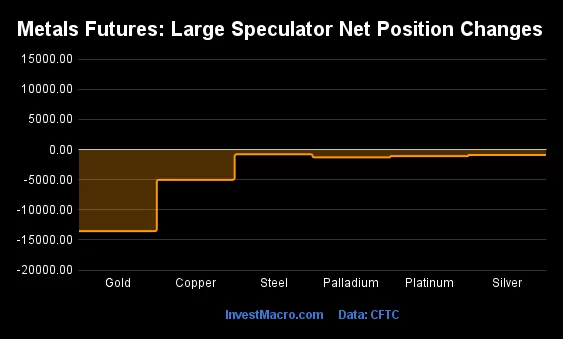
The COT metals markets speculator bets were lower this week as all of the six metals markets we cover lower speculator contracts.

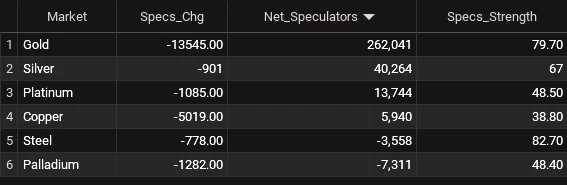
Leading markets with declines in speculator bets were Gold (-18,878 contracts) with Platinum (-8,808 contracts), Silver (-5,704 contracts), Copper (-2,825 contracts), Palladium (-2,646 contracts) and Steel (-394 contracts) also showing lower contracts for the week.

The metals markets have now seen multiple down weeks in a row with Copper recording six straight weeks of declines while Gold and Silver have fallen for three straight weeks of declines. Steel, Palladium and Platinum have also had two straight weeks of falling contracts as well. Despite the recent weakness, the metals markets are still in strong positions compared to their 3-Year ranges as all the markets have at least a 50 percent strength score or, in other words, the speculator positions are in the top half of their 3-Year ranges. Steel, Silver and Gold are in the top 70 percent of their ranges at the moment.


Metals Net Speculators Leaderboard

Legend: Weekly Speculators Change | Speculators Current Net Position | Speculators Strength Score compared to last 3-Years (0-100 range)


Strength Scores led by Steel & Silver

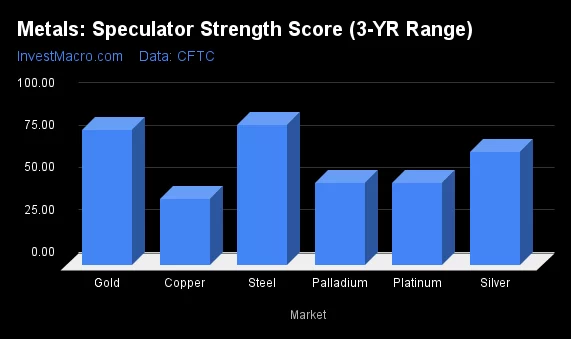
COT Strength Scores (a normalized measure of Speculator positions over a 3-Year range, from 0 to 100 where above 80 is Extreme-Bullish and below 20 is Extreme-Bearish) showed that Steel (93 percent) and Silver (76 percent) lead the metals markets this week. Gold (70 percent) comes in as the next highest in the weekly strength scores.

Copper (53 percent) comes in at the lowest strength level currently while the next lowest strength score was Palladium (56 percent).

Strength Statistics:
Gold (70.0 percent) vs Gold previous week (77.2 percent)
Silver (76.4 percent) vs Silver previous week (83.6 percent)
Copper (52.7 percent) vs Copper previous week (55.3 percent)
Platinum (63.8 percent) vs Platinum previous week (84.6 percent)
Palladium (55.7 percent) vs Palladium previous week (75.1 percent)
Steel (93.2 percent) vs Palladium previous week (94.7 percent)


Palladium & Steel top the 6-Week Strength Trends

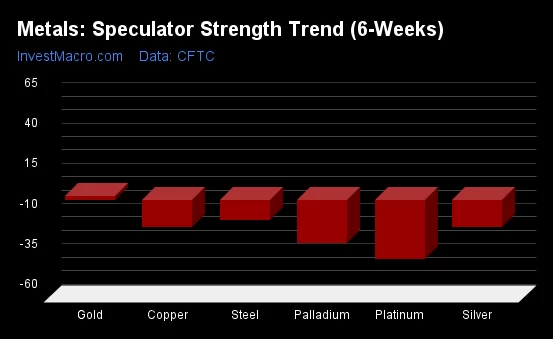
COT Strength Score Trends (or move index, calculates the 6-week changes in strength scores) showed that Palladium (11 percent) and Steel (7 percent) lead the past six weeks trends for metals.

Gold (-24 percent) leads the downside trend scores currently with Copper (-21 percent) and Platinum (-19 percent) as the next markets with lower trend scores.

Move Statistics:
Gold (-24.1 percent) vs Gold previous week (-22.8 percent)
Silver (-11.7 percent) vs Silver previous week (-11.2 percent)
Copper (-20.8 percent) vs Copper previous week (-8.8 percent)
Platinum (-18.7 percent) vs Platinum previous week (11.0 percent)
Palladium (11.4 percent) vs Palladium previous week (22.5 percent)
Steel (7.0 percent) vs Steel previous week (12.9 percent)


Individual Markets:

Gold Comex Futures:

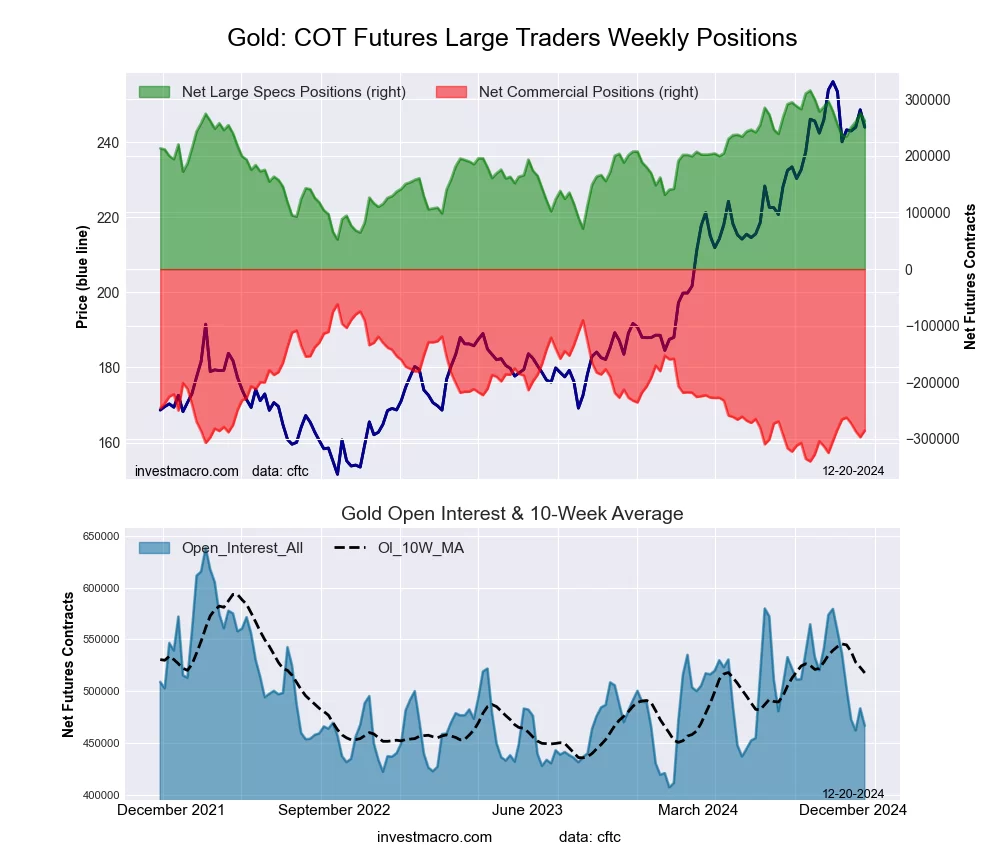
Gold Futures COT ChartThe Gold Comex Futures large speculator standing this week totaled a net position of 236,451 contracts in the data reported through Tuesday. This was a weekly decrease of -18,878 contracts from the previous week which had a total of 255,329 net contracts.

This week’s current strength score (the trader positioning range over the past three years, measured from 0 to 100) shows the speculators are currently Bullish with a score of 70.0 percent. The commercials are Bearish with a score of 26.7 percent and the small traders (not shown in chart) are Bullish with a score of 76.1 percent.

Price Trend-Following Model: Uptrend

Our weekly trend-following model classifies the current market price position as: Uptrend.

Gold Futures StatisticsSPECULATORSCOMMERCIALSSMALL TRADERS
– Percent of Open Interest Longs:59.014.110.6
– Percent of Open Interest Shorts:14.963.65.2
– Net Position:236,451-265,58229,131
– Gross Longs:316,22575,34756,838
– Gross Shorts:79,774340,92927,707
– Long to Short Ratio:4.0 to 10.2 to 12.1 to 1
NET POSITION TREND:
– Strength Index Score (3 Year Range Pct):70.026.776.1
– Strength Index Reading (3 Year Range):BullishBearishBullish
NET POSITION MOVEMENT INDEX:
– 6-Week Change in Strength Index:-24.122.35.5


Silver Comex Futures:

Silver Futures COT ChartThe Silver Comex Futures large speculator standing this week totaled a net position of 47,642 contracts in the data reported through Tuesday. This was a weekly reduction of -5,704 contracts from the previous week which had a total of 53,346 net contracts.

This week’s current strength score (the trader positioning range over the past three years, measured from 0 to 100) shows the speculators are currently Bullish with a score of 76.4 percent. The commercials are Bearish-Extreme with a score of 19.9 percent and the small traders (not shown in chart) are Bullish with a score of 66.3 percent.

Price Trend-Following Model: Weak Uptrend

Our weekly trend-following model classifies the current market price position as: Weak Uptrend.

Silver Futures StatisticsSPECULATORSCOMMERCIALSSMALL TRADERS
– Percent of Open Interest Longs:46.722.521.1
– Percent of Open Interest Shorts:14.468.27.7
– Net Position:47,642-67,40719,765
– Gross Longs:68,95133,19731,167
– Gross Shorts:21,309100,60411,402
– Long to Short Ratio:3.2 to 10.3 to 12.7 to 1
NET POSITION TREND:
– Strength Index Score (3 Year Range Pct):76.419.966.3
– Strength Index Reading (3 Year Range):BullishBearish-ExtremeBullish
NET POSITION MOVEMENT INDEX:
– 6-Week Change in Strength Index:-11.713.1-12.3


Copper Grade #1 Futures:

Copper Futures COT ChartThe Copper Grade #1 Futures large speculator standing this week totaled a net position of 20,845 contracts in the data reported through Tuesday. This was a weekly fall of -2,825 contracts from the previous week which had a total of 23,670 net contracts.

This week’s current strength score (the trader positioning range over the past three years, measured from 0 to 100) shows the speculators are currently Bullish with a score of 52.7 percent. The commercials are Bearish with a score of 44.2 percent and the small traders (not shown in chart) are Bullish with a score of 75.7 percent.

Price Trend-Following Model: Strong Downtrend

Our weekly trend-following model classifies the current market price position as: Strong Downtrend.

Copper Futures StatisticsSPECULATORSCOMMERCIALSSMALL TRADERS
– Percent of Open Interest Longs:40.433.48.8
– Percent of Open Interest Shorts:31.546.54.6
– Net Position:20,845-30,4139,568
– Gross Longs:93,94177,57520,369
– Gross Shorts:73,096107,98810,801
– Long to Short Ratio:1.3 to 10.7 to 11.9 to 1
NET POSITION TREND:
– Strength Index Score (3 Year Range Pct):52.744.275.7
– Strength Index Reading (3 Year Range):BullishBearishBullish
NET POSITION MOVEMENT INDEX:
– 6-Week Change in Strength Index:-20.817.611.6


Platinum Futures:

Platinum Futures COT ChartThe Platinum Futures large speculator standing this week totaled a net position of 20,233 contracts in the data reported through Tuesday. This was a weekly lowering of -8,808 contracts from the previous week which had a total of 29,041 net contracts.

This week’s current strength score (the trader positioning range over the past three years, measured from 0 to 100) shows the speculators are currently Bullish with a score of 63.8 percent. The commercials are Bearish with a score of 29.2 percent and the small traders (not shown in chart) are Bullish-Extreme with a score of 91.1 percent.

Price Trend-Following Model: Weak Uptrend

Our weekly trend-following model classifies the current market price position as: Weak Uptrend.

Platinum Futures StatisticsSPECULATORSCOMMERCIALSSMALL TRADERS
– Percent of Open Interest Longs:59.918.912.8
– Percent of Open Interest Shorts:37.250.93.6
– Net Position:20,233-28,4198,186
– Gross Longs:53,28316,82511,361
– Gross Shorts:33,05045,2443,175
– Long to Short Ratio:1.6 to 10.4 to 13.6 to 1
NET POSITION TREND:
– Strength Index Score (3 Year Range Pct):63.829.291.1
– Strength Index Reading (3 Year Range):BullishBearishBullish-Extreme
NET POSITION MOVEMENT INDEX:
– 6-Week Change in Strength Index:-18.711.940.7


Palladium Futures:

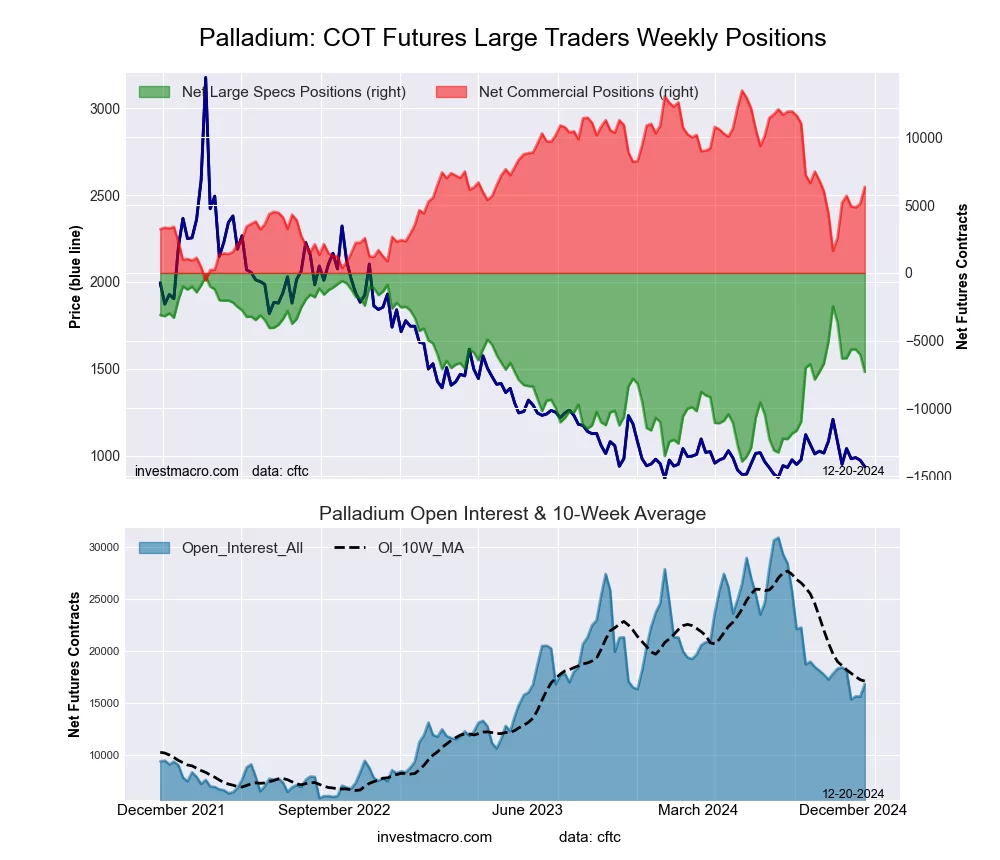
Palladium Futures COT ChartThe Palladium Futures large speculator standing this week totaled a net position of -6,313 contracts in the data reported through Tuesday. This was a weekly fall of -2,646 contracts from the previous week which had a total of -3,667 net contracts.

This week’s current strength score (the trader positioning range over the past three years, measured from 0 to 100) shows the speculators are currently Bullish with a score of 55.7 percent. The commercials are Bearish with a score of 41.0 percent and the small traders (not shown in chart) are Bullish-Extreme with a score of 88.0 percent.

Price Trend-Following Model: Weak Uptrend

Our weekly trend-following model classifies the current market price position as: Weak Uptrend.

Palladium Futures StatisticsSPECULATORSCOMMERCIALSSMALL TRADERS
– Percent of Open Interest Longs:25.348.413.5
– Percent of Open Interest Shorts:59.620.37.3
– Net Position:-6,3135,1831,130
– Gross Longs:4,6678,9192,480
– Gross Shorts:10,9803,7361,350
– Long to Short Ratio:0.4 to 12.4 to 11.8 to 1
NET POSITION TREND:
– Strength Index Score (3 Year Range Pct):55.741.088.0
– Strength Index Reading (3 Year Range):BullishBearishBullish-Extreme
NET POSITION MOVEMENT INDEX:
– 6-Week Change in Strength Index:11.4-16.536.7


Steel Futures Futures:

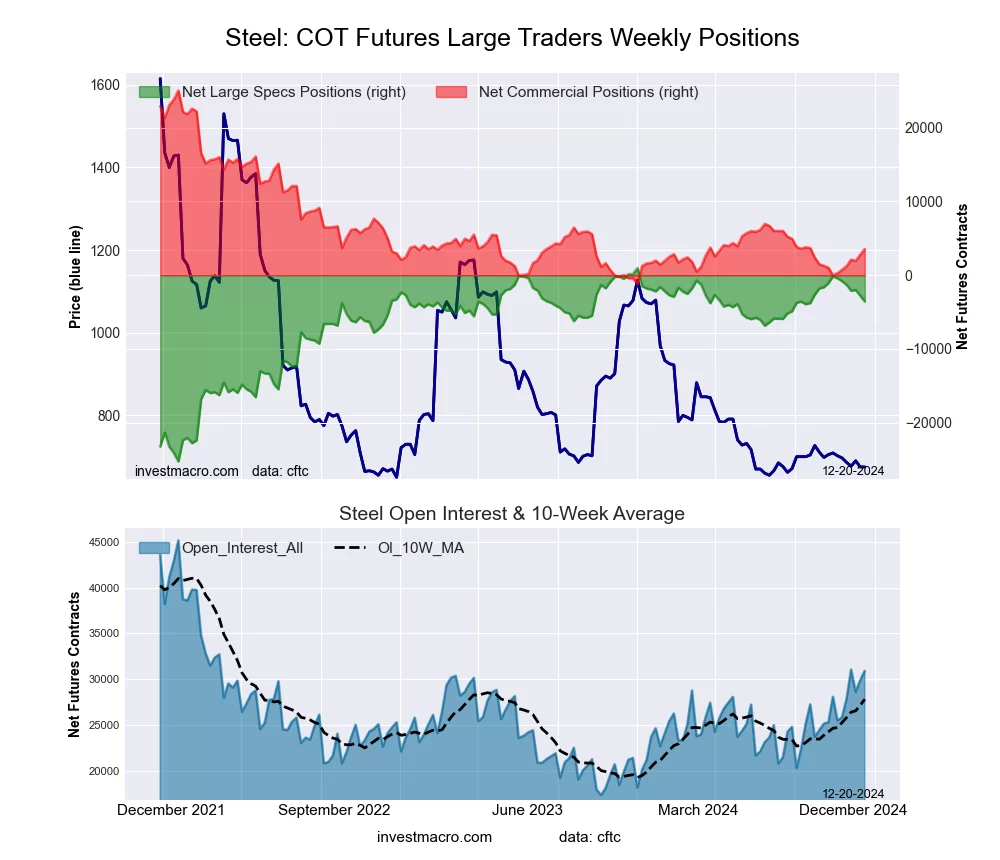
Steel Futures COT ChartThe Steel Futures large speculator standing this week totaled a net position of -808 contracts in the data reported through Tuesday. This was a weekly decrease of -394 contracts from the previous week which had a total of -414 net contracts.

This week’s current strength score (the trader positioning range over the past three years, measured from 0 to 100) shows the speculators are currently Bullish-Extreme with a score of 93.2 percent. The commercials are Bearish-Extreme with a score of 7.4 percent and the small traders (not shown in chart) are Bearish with a score of 41.2 percent.

Price Trend-Following Model: Weak Uptrend

Our weekly trend-following model classifies the current market price position as: Weak Uptrend.

Steel Futures StatisticsSPECULATORSCOMMERCIALSSMALL TRADERS
– Percent of Open Interest Longs:24.271.01.0
– Percent of Open Interest Shorts:27.368.20.7
– Net Position:-80872781
– Gross Longs:6,25718,343256
– Gross Shorts:7,06517,616175
– Long to Short Ratio:0.9 to 11.0 to 11.5 to 1
NET POSITION TREND:
– Strength Index Score (3 Year Range Pct):93.27.441.2
– Strength Index Reading (3 Year Range):Bullish-ExtremeBearish-ExtremeBearish
NET POSITION MOVEMENT INDEX:
– 6-Week Change in Strength Index:7.0-6.3-17.7


Article By InvestMacroReceive our weekly COT Newsletter

*COT Report: The COT data, released weekly to the public each Friday, is updated through the most recent Tuesday (data is 3 days old) and shows a quick view of how large speculators or non-commercials (for-profit traders) were positioned in the futures markets.

The CFTC categorizes trader positions according to commercial hedgers (traders who use futures contracts for hedging as part of the business), non-commercials (large traders who speculate to realize trading profits) and nonreportable traders (usually small traders/speculators) as well as their open interest (contracts open in the market at time of reporting). See CFTC criteria here.


COT Bonds Charts: Large Speculator bets led by 2-Year & Ultra Treasury Bonds

By InvestMacro

Here are the latest charts and statistics for the Commitment of Traders (COT) reports data published by the Commodities Futures Trading Commission (CFTC).

The latest COT data is updated through Tuesday November 12th and shows a quick view of how large traders (for-profit speculators and commercial hedgers) were positioned in the futures markets.

Weekly Speculator Changes led by 2-Year & Ultra Treasury Bonds

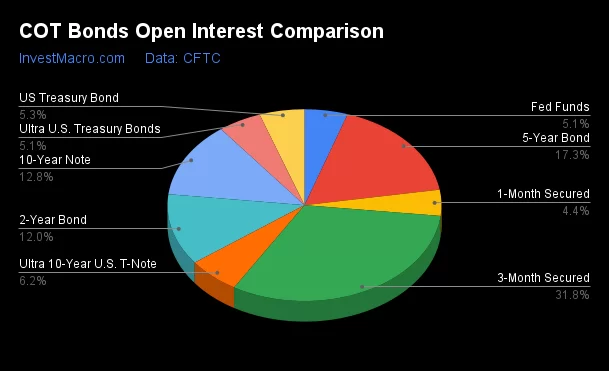
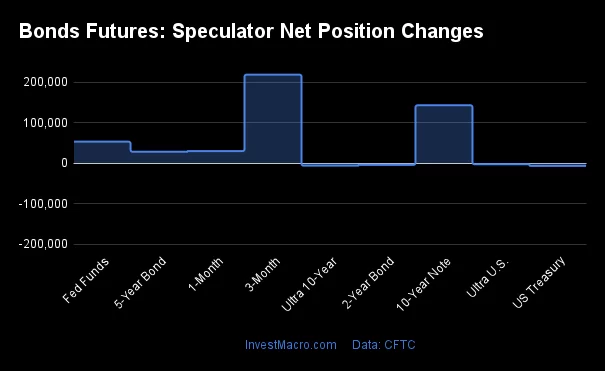
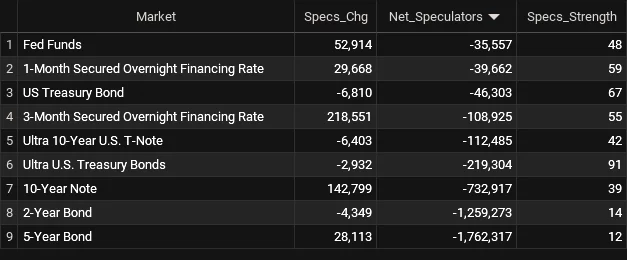
The COT bond market speculator bets were slightly lower this week as four out of the nine bond markets we cover had higher positioning while the other five markets had lower speculator contracts.

Leading the gains for the bond markets was the 2-Year Bonds (62,488 contracts) with the Ultra Treasury Bonds (23,124 contracts), the SOFR 1-Month (13,378 contracts) and the 10-Year Bonds (2,469 contracts) also showing positive weeks.

The bond markets with declines in speculator bets for the week were the SOFR 3-Months (-145,254 contracts), the 5-Year Bonds (-101,801 contracts), the Fed Funds (-21,463 contracts), the Ultra 10-Year Bonds (-16,352 contracts) and with the US Treasury Bonds (-4,017 contracts) also having lower bets on the week.


Bonds Net Speculators Leaderboard

Legend: Weekly Speculators Change | Speculators Current Net Position | Speculators Strength Score compared to last 3-Years (0-100 range)


Strength Scores led by Ultra Treasury Bonds & US Treasury Bonds

COT Strength Scores (a normalized measure of Speculator positions over a 3-Year range, from 0 to 100 where above 80 is Extreme-Bullish and below 20 is Extreme-Bearish) showed that the Ultra Treasury Bonds (99 percent) and the US Treasury Bonds (69 percent) lead the bond markets this week. The Fed Funds (55 percent) come in as the next highest in the weekly strength scores.

On the downside, the 5-Year Bonds (0 percent) and the 2-Year Bonds (4 percent) come in at the lowest strength level currently and are in Extreme-Bearish territory (below 20 percent).

Strength Statistics:
Fed Funds (55.1 percent) vs Fed Funds previous week (59.0 percent)
2-Year Bond (4.0 percent) vs 2-Year Bond previous week (0.0 percent)
5-Year Bond (0.0 percent) vs 5-Year Bond previous week (5.8 percent)
10-Year Bond (31.0 percent) vs 10-Year Bond previous week (30.8 percent)
Ultra 10-Year Bond (27.9 percent) vs Ultra 10-Year Bond previous week (31.7 percent)
US Treasury Bond (68.9 percent) vs US Treasury Bond previous week (70.3 percent)
Ultra US Treasury Bond (99.5 percent) vs Ultra US Treasury Bond previous week (88.8 percent)
SOFR 1-Month (35.1 percent) vs SOFR 1-Month previous week (31.8 percent)
SOFR 3-Months (47.9 percent) vs SOFR 3-Months previous week (55.4 percent)


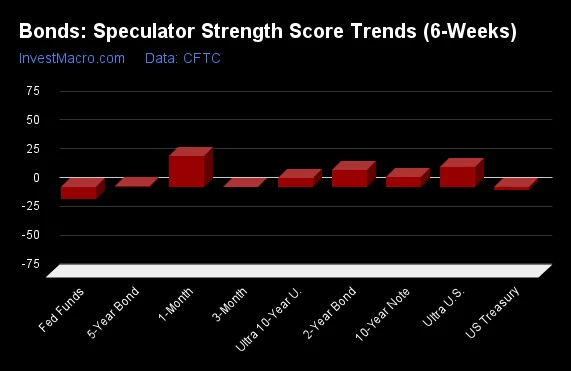
10-Year Bonds & US Treasury Bonds top the 6-Week Strength Trends

COT Strength Score Trends (or move index, calculates the 6-week changes in strength scores) showed that the 10-Year Bonds (31 percent) and the US Treasury Bonds (19 percent) lead the past six weeks trends for bonds.

The Fed Funds (-45 percent) and the SOFR 3-Months (-43 percent) lead the downside trend scores currently with the 5-Year Bonds (-18 percent) and the Ultra 10-Year Bonds (-18 percent) following next with lower trend scores.

Strength Trend Statistics:
Fed Funds (-44.9 percent) vs Fed Funds previous week (-35.5 percent)
2-Year Bond (-15.6 percent) vs 2-Year Bond previous week (-27.9 percent)
5-Year Bond (-18.0 percent) vs 5-Year Bond previous week (-12.1 percent)
10-Year Bond (31.0 percent) vs 10-Year Bond previous week (19.6 percent)
Ultra 10-Year Bond (-17.5 percent) vs Ultra 10-Year Bond previous week (-23.6 percent)
US Treasury Bond (19.1 percent) vs US Treasury Bond previous week (40.0 percent)
Ultra US Treasury Bond (10.1 percent) vs Ultra US Treasury Bond previous week (0.9 percent)
SOFR 1-Month (14.5 percent) vs SOFR 1-Month previous week (-1.4 percent)
SOFR 3-Months (-43.1 percent) vs SOFR 3-Months previous week (-40.7 percent)


30-Day Federal Funds Futures:

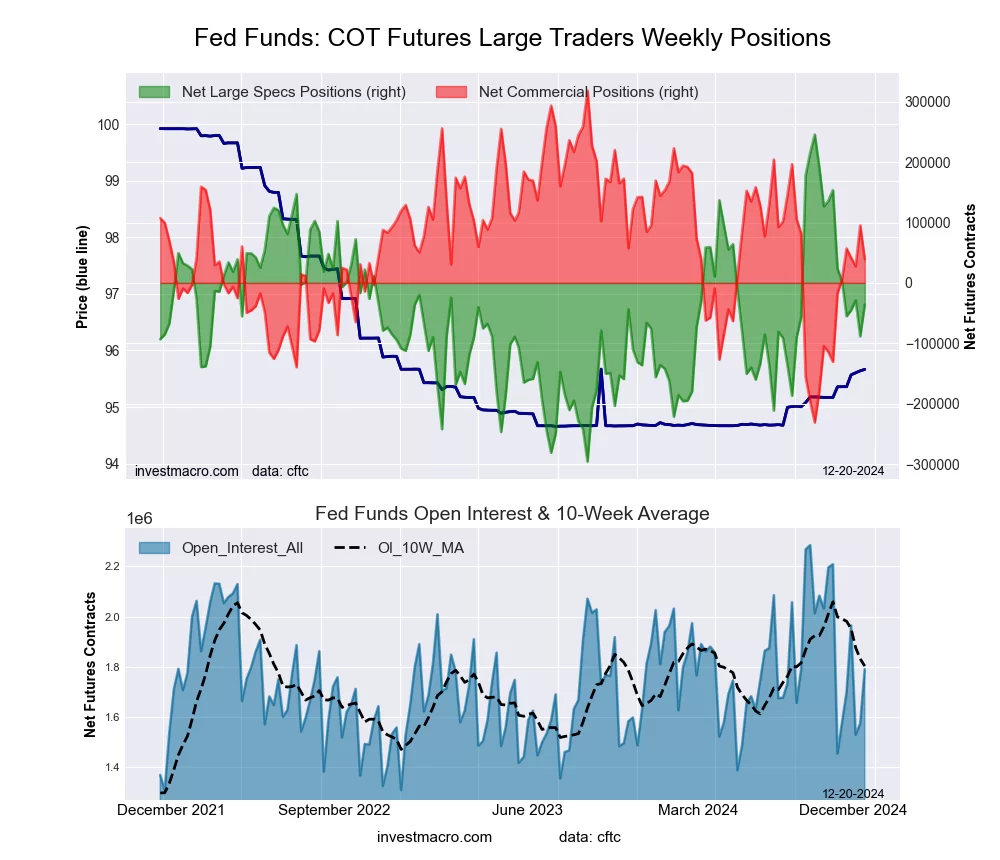
Federal Funds 30-Day Bonds Futures COT ChartThe 30-Day Federal Funds large speculator standing this week recorded a net position of 2,437 contracts in the data reported through Tuesday. This was a weekly reduction of -21,463 contracts from the previous week which had a total of 23,900 net contracts.

This week’s current strength score (the trader positioning range over the past three years, measured from 0 to 100) shows the speculators are currently Bullish with a score of 55.1 percent. The commercials are Bearish with a score of 43.2 percent and the small traders (not shown in chart) are Bullish with a score of 68.5 percent.

Price Trend-Following Model: Downtrend

Our weekly trend-following model classifies the current market price position as: Downtrend. The current action for the model is considered to be: Hold – Maintain Short Position.

30-Day Federal Funds StatisticsSPECULATORSCOMMERCIALSSMALL TRADERS
– Percent of Open Interest Longs:9.062.82.0
– Percent of Open Interest Shorts:8.862.42.6
– Net Position:2,4376,593-9,030
– Gross Longs:141,580990,05131,284
– Gross Shorts:139,143983,45840,314
– Long to Short Ratio:1.0 to 11.0 to 10.8 to 1
NET POSITION TREND:
– Strength Index Score (3 Year Range Pct):55.143.268.5
– Strength Index Reading (3 Year Range):BullishBearishBullish
NET POSITION MOVEMENT INDEX:
– 6-Week Change in Strength Index:-44.943.210.2


Secured Overnight Financing Rate (3-Month) Futures:

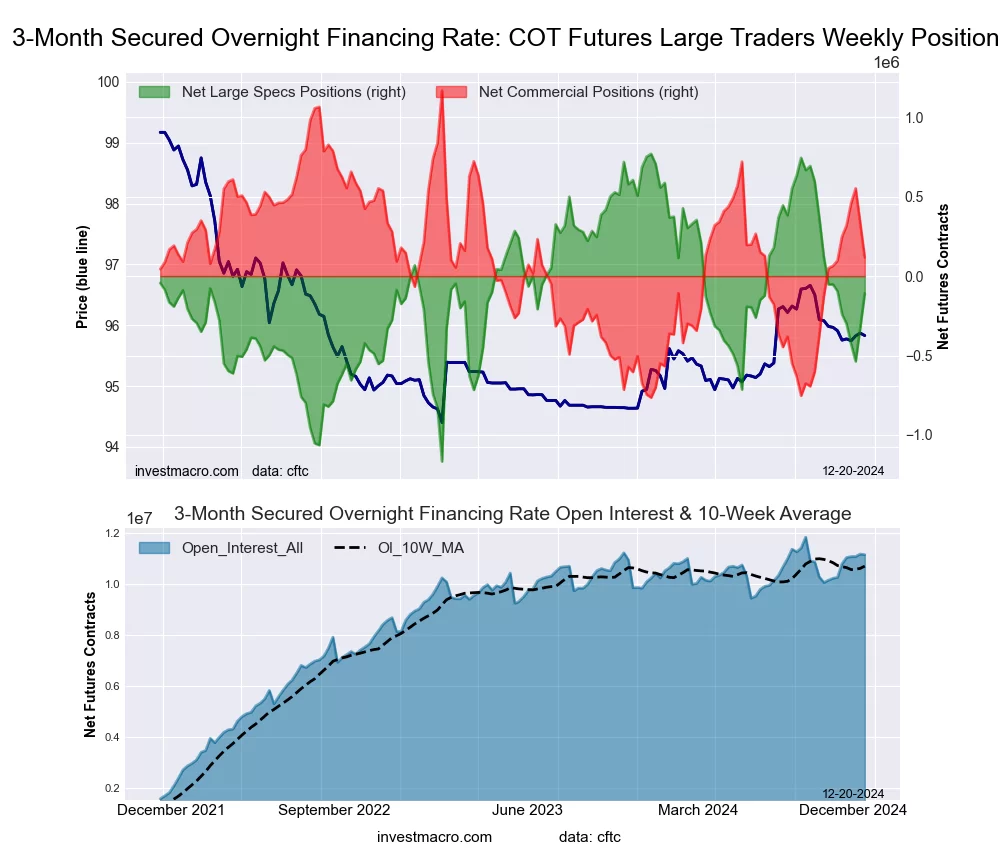
SOFR 3-Months Bonds Futures COT ChartThe Secured Overnight Financing Rate (3-Month) large speculator standing this week recorded a net position of -239,881 contracts in the data reported through Tuesday. This was a weekly decline of -145,254 contracts from the previous week which had a total of -94,627 net contracts.

This week’s current strength score (the trader positioning range over the past three years, measured from 0 to 100) shows the speculators are currently Bearish with a score of 47.9 percent. The commercials are Bullish with a score of 52.5 percent and the small traders (not shown in chart) are Bullish-Extreme with a score of 82.9 percent.

Price Trend-Following Model: Weak Uptrend

Our weekly trend-following model classifies the current market price position as: Weak Uptrend. The current action for the model is considered to be: Hold – Maintain Long Position.

SOFR 3-Months StatisticsSPECULATORSCOMMERCIALSSMALL TRADERS
– Percent of Open Interest Longs:13.458.70.3
– Percent of Open Interest Shorts:15.656.40.4
– Net Position:-239,881248,953-9,072
– Gross Longs:1,441,0646,328,02737,413
– Gross Shorts:1,680,9456,079,07446,485
– Long to Short Ratio:0.9 to 11.0 to 10.8 to 1
NET POSITION TREND:
– Strength Index Score (3 Year Range Pct):47.952.582.9
– Strength Index Reading (3 Year Range):BearishBullishBullish-Extreme
NET POSITION MOVEMENT INDEX:
– 6-Week Change in Strength Index:-43.144.0-9.1


Individual Bond Markets:

Secured Overnight Financing Rate (1-Month) Futures:

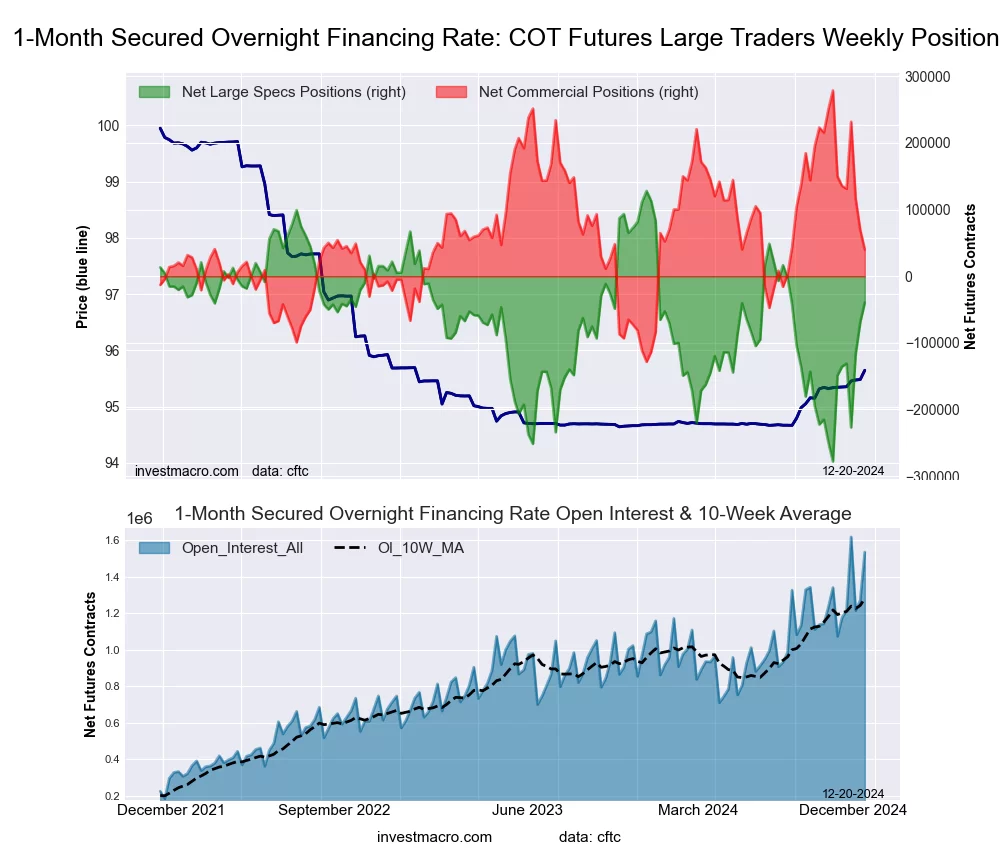
SOFR 1-Month Bonds Futures COT ChartThe Secured Overnight Financing Rate (1-Month) large speculator standing this week recorded a net position of -135,658 contracts in the data reported through Tuesday. This was a weekly advance of 13,378 contracts from the previous week which had a total of -149,036 net contracts.

This week’s current strength score (the trader positioning range over the past three years, measured from 0 to 100) shows the speculators are currently Bearish with a score of 35.1 percent. The commercials are Bullish with a score of 64.8 percent and the small traders (not shown in chart) are Bullish with a score of 56.8 percent.

Price Trend-Following Model: Uptrend

Our weekly trend-following model classifies the current market price position as: Uptrend.

SOFR 1-Month StatisticsSPECULATORSCOMMERCIALSSMALL TRADERS
– Percent of Open Interest Longs:12.465.00.0
– Percent of Open Interest Shorts:24.053.50.0
– Net Position:-135,658135,542116
– Gross Longs:146,041764,353207
– Gross Shorts:281,699628,81191
– Long to Short Ratio:0.5 to 11.2 to 12.3 to 1
NET POSITION TREND:
– Strength Index Score (3 Year Range Pct):35.164.856.8
– Strength Index Reading (3 Year Range):BearishBullishBullish
NET POSITION MOVEMENT INDEX:
– 6-Week Change in Strength Index:14.5-14.76.3


2-Year Treasury Note Futures:

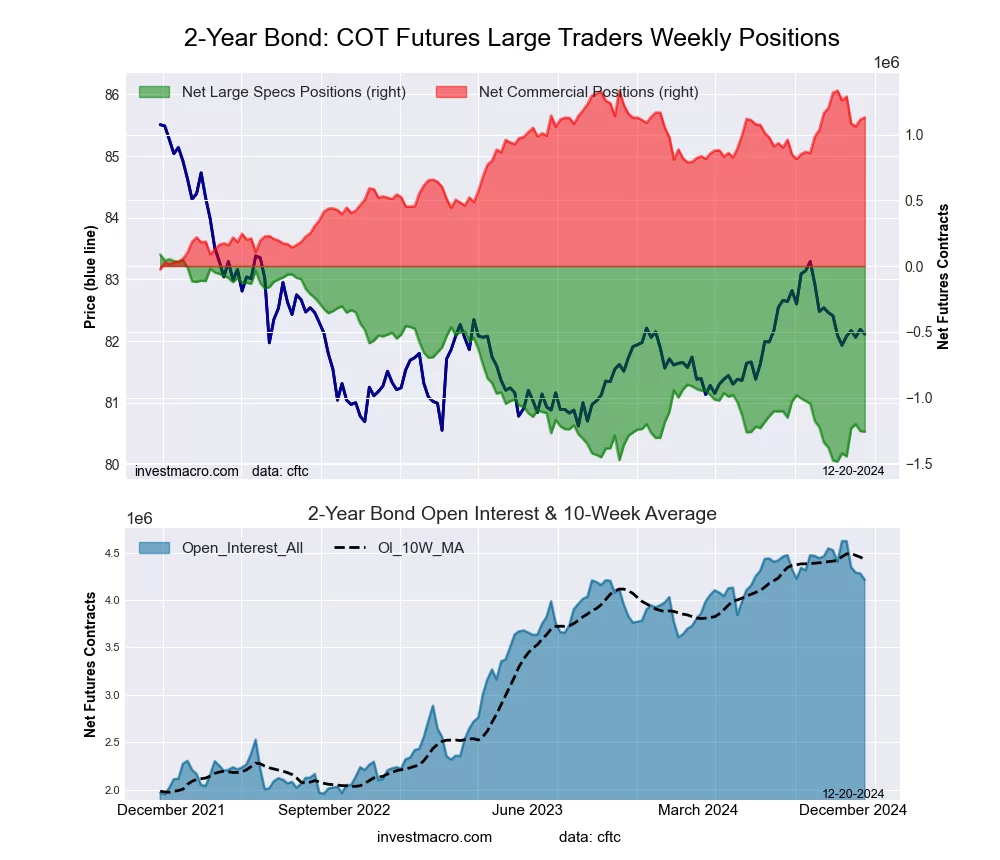
2-Year Treasury Bonds Futures COT ChartThe 2-Year Treasury Note large speculator standing this week recorded a net position of -1,423,871 contracts in the data reported through Tuesday. This was a weekly rise of 62,488 contracts from the previous week which had a total of -1,486,359 net contracts.

This week’s current strength score (the trader positioning range over the past three years, measured from 0 to 100) shows the speculators are currently Bearish-Extreme with a score of 4.0 percent. The commercials are Bullish-Extreme with a score of 94.6 percent and the small traders (not shown in chart) are Bullish-Extreme with a score of 87.5 percent.

Price Trend-Following Model: Weak Uptrend

Our weekly trend-following model classifies the current market price position as: Weak Uptrend.

2-Year Treasury Note StatisticsSPECULATORSCOMMERCIALSSMALL TRADERS
– Percent of Open Interest Longs:11.979.05.9
– Percent of Open Interest Shorts:42.751.72.4
– Net Position:-1,423,8711,260,796163,075
– Gross Longs:551,7543,651,061274,880
– Gross Shorts:1,975,6252,390,265111,805
– Long to Short Ratio:0.3 to 11.5 to 12.5 to 1
NET POSITION TREND:
– Strength Index Score (3 Year Range Pct):4.094.687.5
– Strength Index Reading (3 Year Range):Bearish-ExtremeBullish-ExtremeBullish-Extreme
NET POSITION MOVEMENT INDEX:
– 6-Week Change in Strength Index:-15.620.3-9.5


5-Year Treasury Note Futures:

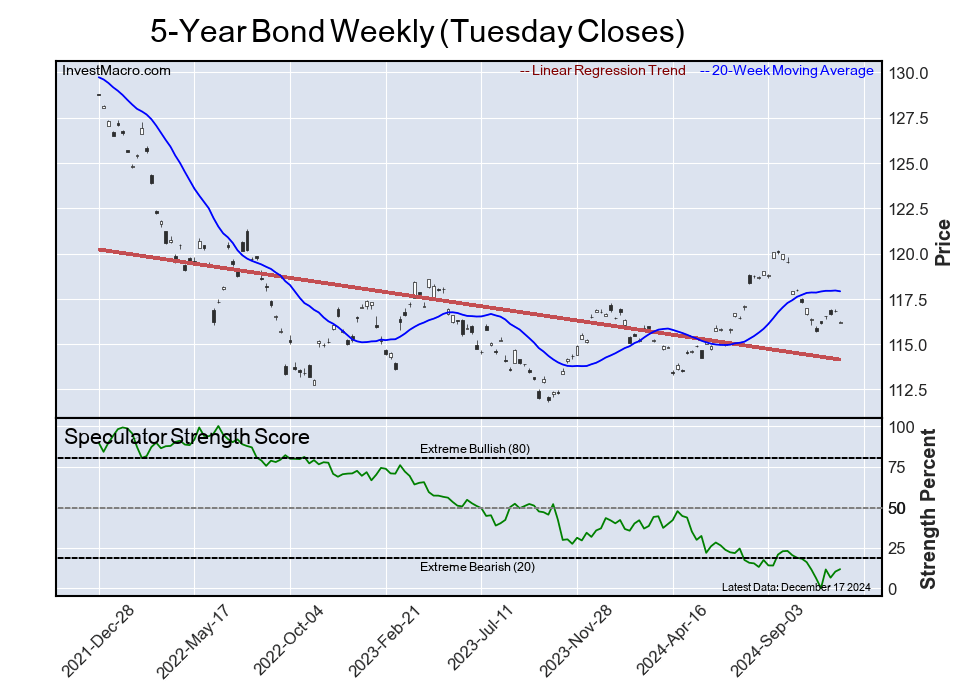
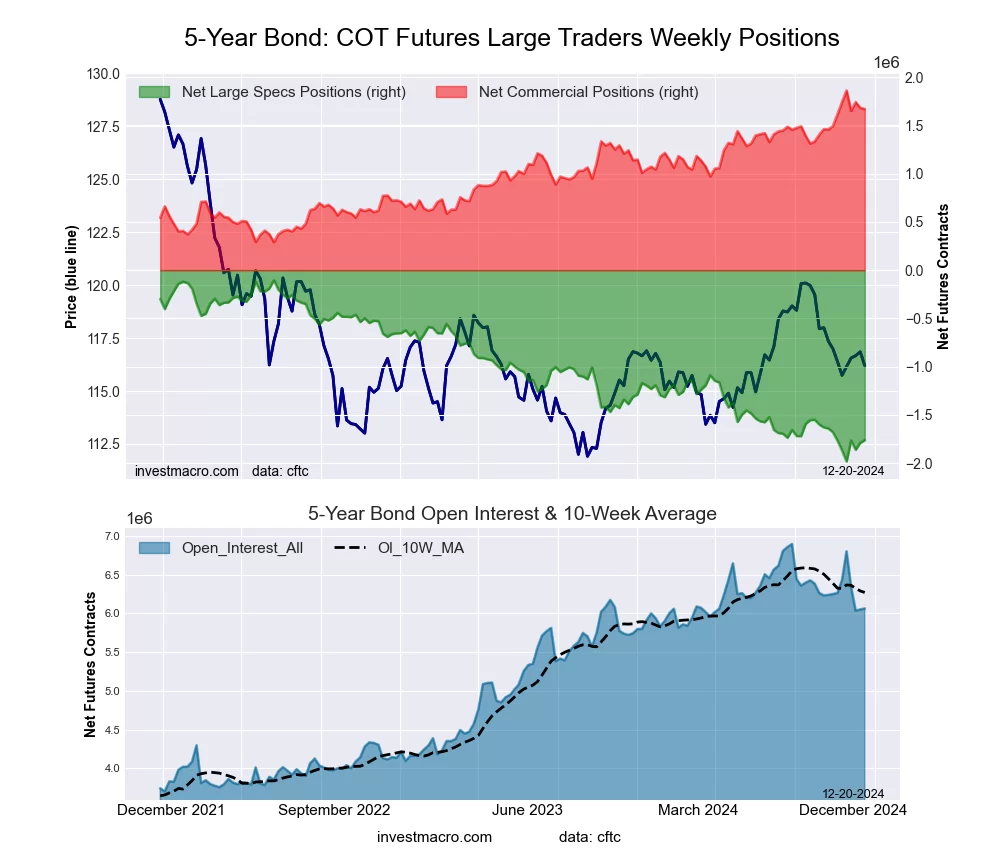
5-Year Treasury Bonds Futures COT ChartThe 5-Year Treasury Note large speculator standing this week recorded a net position of -1,869,210 contracts in the data reported through Tuesday. This was a weekly decline of -101,801 contracts from the previous week which had a total of -1,767,409 net contracts.

This week’s current strength score (the trader positioning range over the past three years, measured from 0 to 100) shows the speculators are currently Bearish-Extreme with a score of 0.0 percent. The commercials are Bullish-Extreme with a score of 100.0 percent and the small traders (not shown in chart) are Bullish with a score of 77.6 percent.

Price Trend-Following Model: Weak Uptrend

Our weekly trend-following model classifies the current market price position as: Weak Uptrend.

5-Year Treasury Note StatisticsSPECULATORSCOMMERCIALSSMALL TRADERS
– Percent of Open Interest Longs:6.984.96.5
– Percent of Open Interest Shorts:35.957.84.5
– Net Position:-1,869,2101,740,989128,221
– Gross Longs:441,1445,459,346415,574
– Gross Shorts:2,310,3543,718,357287,353
– Long to Short Ratio:0.2 to 11.5 to 11.4 to 1
NET POSITION TREND:
– Strength Index Score (3 Year Range Pct):0.0100.077.6
– Strength Index Reading (3 Year Range):Bearish-ExtremeBullish-ExtremeBullish
NET POSITION MOVEMENT INDEX:
– 6-Week Change in Strength Index:-18.028.0-16.1


10-Year Treasury Note Futures:

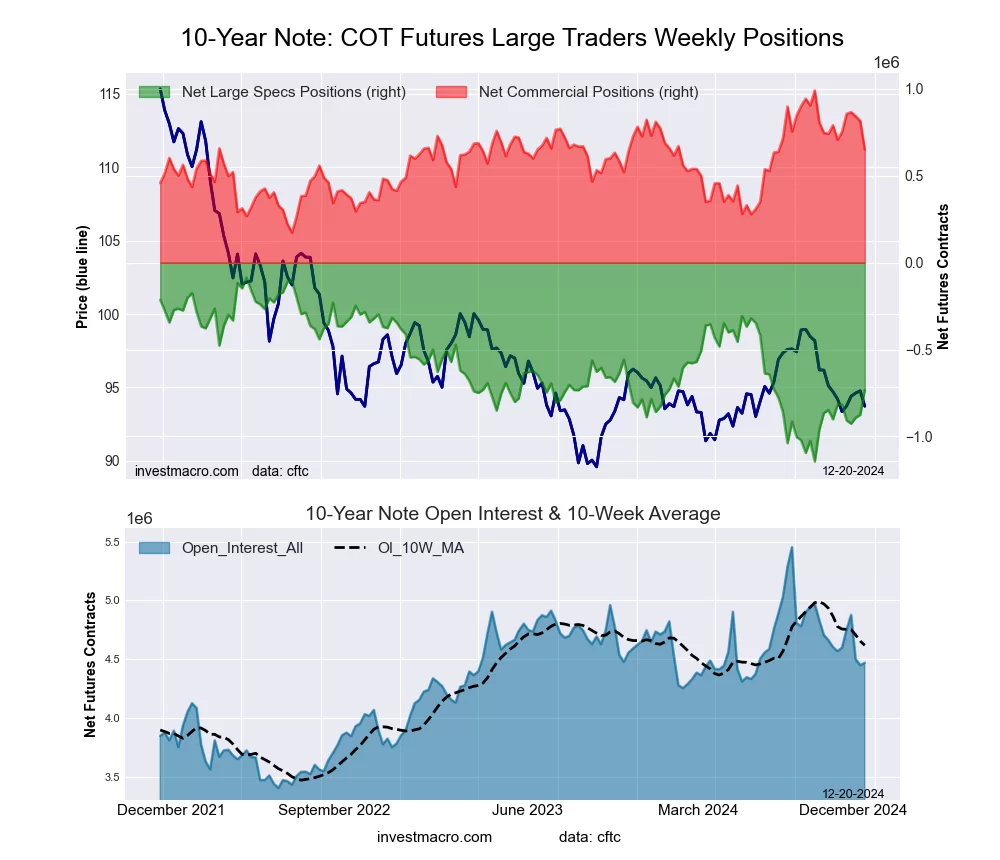
10-Year Treasury Notes Bonds Futures COT ChartThe 10-Year Treasury Note large speculator standing this week recorded a net position of -815,801 contracts in the data reported through Tuesday. This was a weekly gain of 2,469 contracts from the previous week which had a total of -818,270 net contracts.

This week’s current strength score (the trader positioning range over the past three years, measured from 0 to 100) shows the speculators are currently Bearish with a score of 31.0 percent. The commercials are Bullish with a score of 70.8 percent and the small traders (not shown in chart) are Bullish with a score of 79.3 percent.

Price Trend-Following Model: Strong Downtrend

Our weekly trend-following model classifies the current market price position as: Strong Downtrend.

10-Year Treasury Note StatisticsSPECULATORSCOMMERCIALSSMALL TRADERS
– Percent of Open Interest Longs:9.178.59.6
– Percent of Open Interest Shorts:26.962.18.3
– Net Position:-815,801752,02963,772
– Gross Longs:419,1603,608,341443,088
– Gross Shorts:1,234,9612,856,312379,316
– Long to Short Ratio:0.3 to 11.3 to 11.2 to 1
NET POSITION TREND:
– Strength Index Score (3 Year Range Pct):31.070.879.3
– Strength Index Reading (3 Year Range):BearishBullishBullish
NET POSITION MOVEMENT INDEX:
– 6-Week Change in Strength Index:31.0-29.2-19.4


Ultra 10-Year Notes Futures:

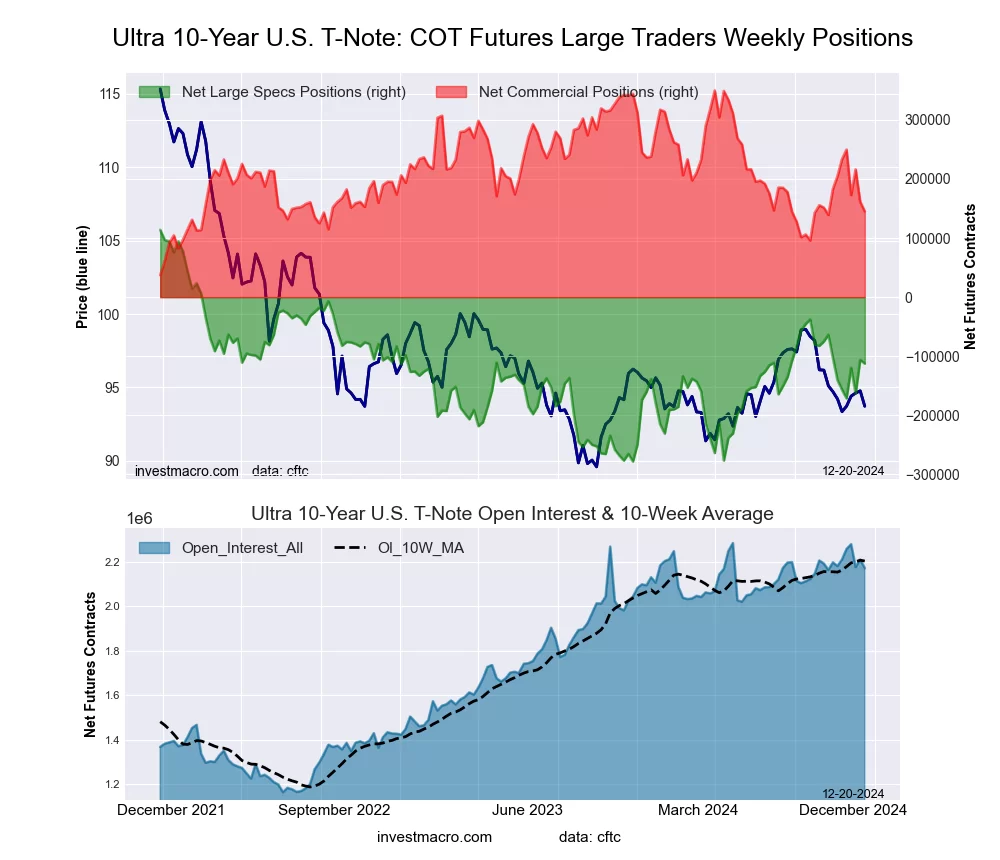
Ultra 10-Year Treasury Notes Bonds Futures COT ChartThe Ultra 10-Year Notes large speculator standing this week recorded a net position of -156,791 contracts in the data reported through Tuesday. This was a weekly lowering of -16,352 contracts from the previous week which had a total of -140,439 net contracts.

This week’s current strength score (the trader positioning range over the past three years, measured from 0 to 100) shows the speculators are currently Bearish with a score of 27.9 percent. The commercials are Bullish with a score of 63.0 percent and the small traders (not shown in chart) are Bullish with a score of 67.6 percent.

Price Trend-Following Model: Weak Uptrend

Our weekly trend-following model classifies the current market price position as: Weak Uptrend. The current action for the model is considered to be: Hold – Maintain Long Position.

Ultra 10-Year Notes StatisticsSPECULATORSCOMMERCIALSSMALL TRADERS
– Percent of Open Interest Longs:15.174.29.8
– Percent of Open Interest Shorts:22.263.613.3
– Net Position:-156,791233,234-76,443
– Gross Longs:332,7611,638,773217,334
– Gross Shorts:489,5521,405,539293,777
– Long to Short Ratio:0.7 to 11.2 to 10.7 to 1
NET POSITION TREND:
– Strength Index Score (3 Year Range Pct):27.963.067.6
– Strength Index Reading (3 Year Range):BearishBullishBullish
NET POSITION MOVEMENT INDEX:
– 6-Week Change in Strength Index:-17.528.8-8.4


US Treasury Bonds Futures:

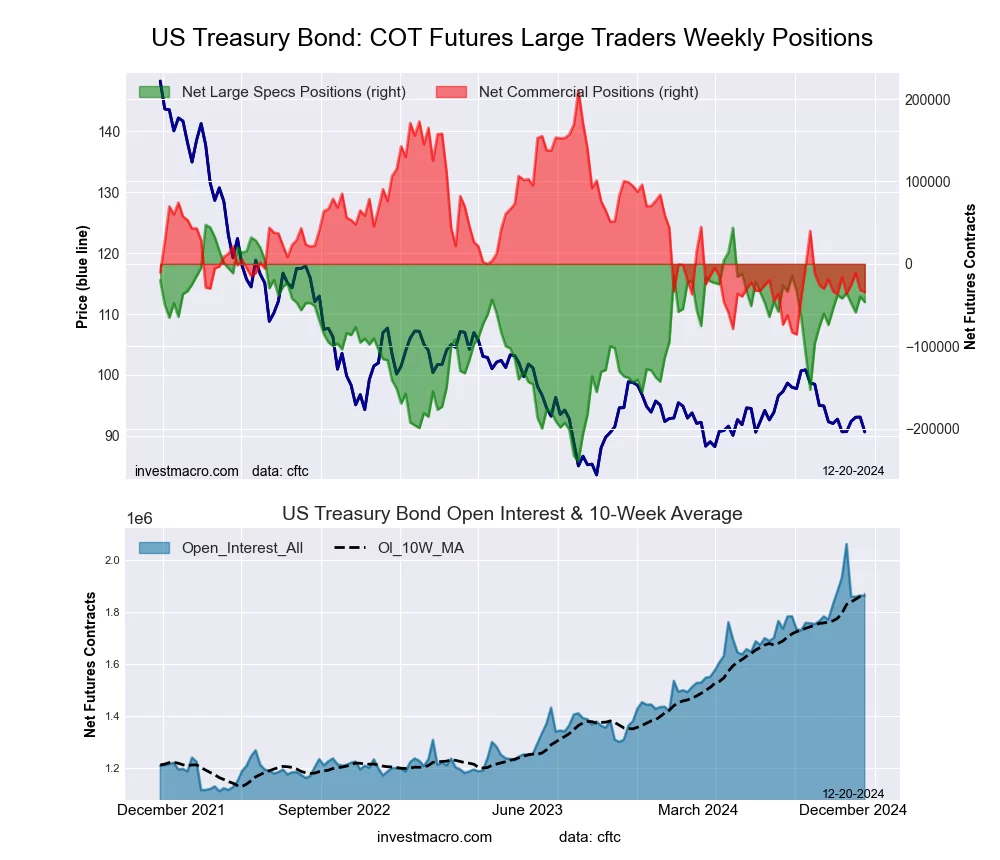
US Year Treasury Notes Long Bonds Futures COT ChartThe US Treasury Bonds large speculator standing this week recorded a net position of -41,768 contracts in the data reported through Tuesday. This was a weekly decrease of -4,017 contracts from the previous week which had a total of -37,751 net contracts.

This week’s current strength score (the trader positioning range over the past three years, measured from 0 to 100) shows the speculators are currently Bullish with a score of 68.9 percent. The commercials are Bearish with a score of 23.5 percent and the small traders (not shown in chart) are Bullish with a score of 58.7 percent.

Price Trend-Following Model: Strong Downtrend

Our weekly trend-following model classifies the current market price position as: Strong Downtrend.

US Treasury Bonds StatisticsSPECULATORSCOMMERCIALSSMALL TRADERS
– Percent of Open Interest Longs:22.063.710.2
– Percent of Open Interest Shorts:24.264.57.2
– Net Position:-41,768-16,08357,851
– Gross Longs:425,1581,230,934197,990
– Gross Shorts:466,9261,247,017140,139
– Long to Short Ratio:0.9 to 11.0 to 11.4 to 1
NET POSITION TREND:
– Strength Index Score (3 Year Range Pct):68.923.558.7
– Strength Index Reading (3 Year Range):BullishBearishBullish
NET POSITION MOVEMENT INDEX:
– 6-Week Change in Strength Index:19.1-1.3-34.6


Ultra US Treasury Bonds Futures:

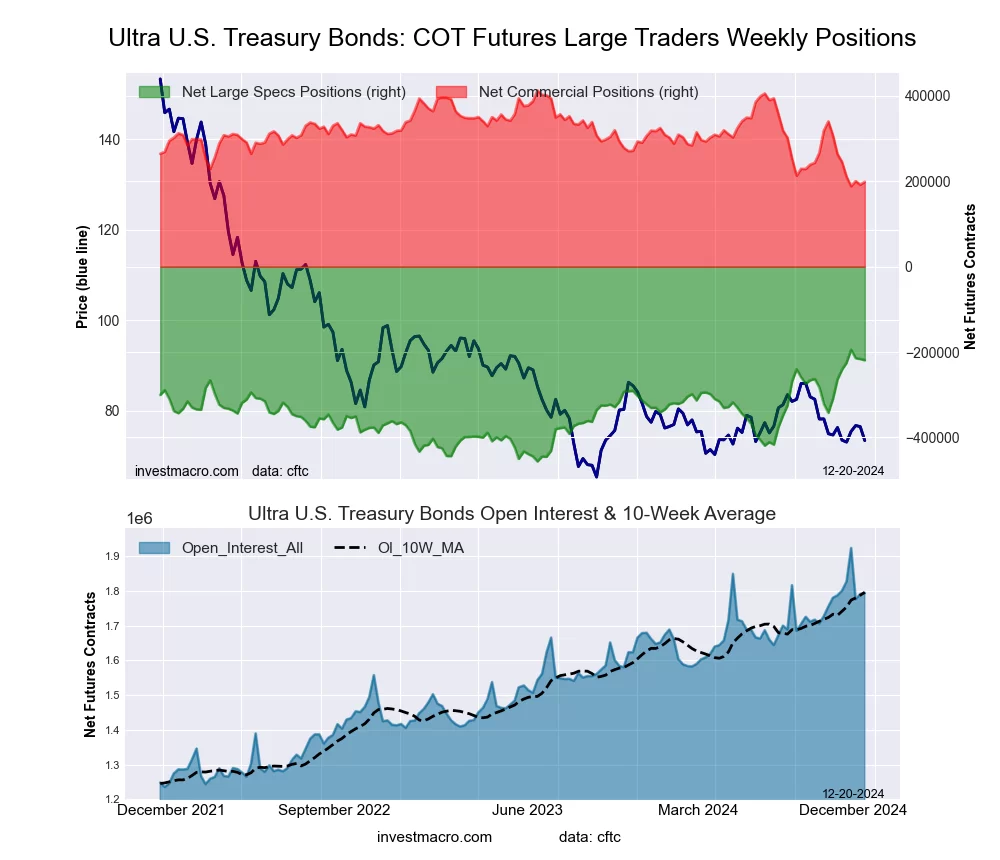
Ultra US Year Treasury Notes Long Bonds Futures COT ChartThe Ultra US Treasury Bonds large speculator standing this week recorded a net position of -241,284 contracts in the data reported through Tuesday. This was a weekly lift of 23,124 contracts from the previous week which had a total of -264,408 net contracts.

This week’s current strength score (the trader positioning range over the past three years, measured from 0 to 100) shows the speculators are currently Bullish-Extreme with a score of 99.5 percent. The commercials are Bearish-Extreme with a score of 16.3 percent and the small traders (not shown in chart) are Bearish-Extreme with a score of 0.0 percent.

Price Trend-Following Model: Strong Downtrend

Our weekly trend-following model classifies the current market price position as: Strong Downtrend.

Ultra US Treasury Bonds StatisticsSPECULATORSCOMMERCIALSSMALL TRADERS
– Percent of Open Interest Longs:9.278.99.7
– Percent of Open Interest Shorts:22.665.210.0
– Net Position:-241,284245,400-4,116
– Gross Longs:164,7341,420,045175,057
– Gross Shorts:406,0181,174,645179,173
– Long to Short Ratio:0.4 to 11.2 to 11.0 to 1
NET POSITION TREND:
– Strength Index Score (3 Year Range Pct):99.516.30.0
– Strength Index Reading (3 Year Range):Bullish-ExtremeBearish-ExtremeBearish-Extreme
NET POSITION MOVEMENT INDEX:
– 6-Week Change in Strength Index:10.11.1-34.0


Article By InvestMacroReceive our weekly COT Newsletter

*COT Report: The COT data, released weekly to the public each Friday, is updated through the most recent Tuesday (data is 3 days old) and shows a quick view of how large speculators or non-commercials (for-profit traders) were positioned in the futures markets.

The CFTC categorizes trader positions according to commercial hedgers (traders who use futures contracts for hedging as part of the business), non-commercials (large traders who speculate to realize trading profits) and nonreportable traders (usually small traders/speculators) as well as their open interest (contracts open in the market at time of reporting). See CFTC criteria here.

COT Soft Commodities Charts: Large Speculator bets led by Corn & Soybean Oil

By InvestMacro

Here are the latest charts and statistics for the Commitment of Traders (COT) reports data published by the Commodities Futures Trading Commission (CFTC).

The latest COT data is updated through Tuesday November 12th and shows a quick view of how large traders (for-profit speculators and commercial entities) were positioned in the futures markets.

Weekly Speculator Changes led by Corn & Soybean Oil

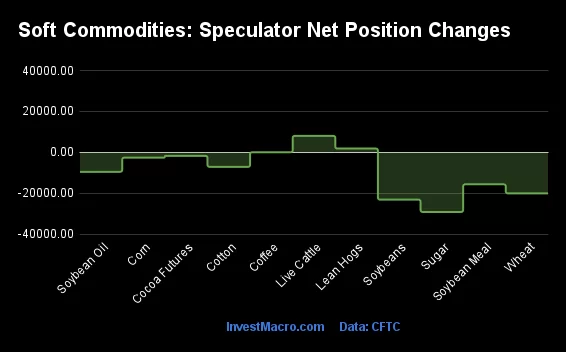
The COT soft commodities markets speculator bets were decisively higher this week as eight out of the eleven softs markets we cover had higher positioning while the other three markets had lower speculator contracts.

Leading the gains for the softs markets was  Corn (74,998 contracts) with Soybean Oil (20,687 contracts), Soybeans (11,870 contracts), Live Cattle (5,941 contracts), Coffee (5,491 contracts), Lean Hogs (4,541 contracts), Cocoa (1,603 contracts) and Cotton (955 contracts) also showing positive weeks.

The markets with the declines in speculator bets this week were Wheat (-15,988 contracts), Sugar (-10,099 contracts) and with Soybean Meal (-1,818 contracts) also seeing lower bets on the week.


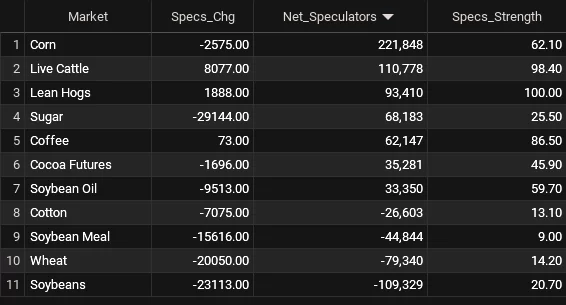
Soft Commodities Net Speculators Leaderboard

Legend: Weekly Speculators Change | Speculators Current Net Position | Speculators Strength Score compared to last 3-Years (0-100 range)


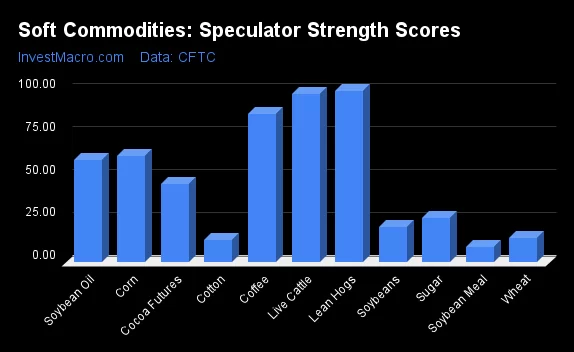
Strength Scores led by Lean Hogs, Soybean Oil & Coffee

COT Strength Scores (a normalized measure of Speculator positions over a 3-Year range, from 0 to 100 where above 80 is Extreme-Bullish and below 20 is Extreme-Bearish) showed that Lean Hogs (100 percent), Soybean Oil (95 percent) and Coffee (93 percent) lead the softs markets this week. Live Cattle (70 percent) and Corn (56 percent) come in as the next highest in the weekly strength scores.

On the downside, Cotton (23 percent) and Sugar (25 percent) come in at the lowest strength levels currently. The next lowest strength scores are the Soybeans (28 percent) and the Soybean Meal (33 percent).

Strength Statistics:
Corn (56.5 percent) vs Corn previous week (46.9 percent)
Sugar (25.4 percent) vs Sugar previous week (29.0 percent)
Coffee (92.6 percent) vs Coffee previous week (87.3 percent)
Soybeans (28.4 percent) vs Soybeans previous week (25.6 percent)
Soybean Oil (94.7 percent) vs Soybean Oil previous week (83.3 percent)
Soybean Meal (32.5 percent) vs Soybean Meal previous week (33.3 percent)
Live Cattle (70.4 percent) vs Live Cattle previous week (64.0 percent)
Lean Hogs (100.0 percent) vs Lean Hogs previous week (95.9 percent)
Cotton (22.6 percent) vs Cotton previous week (22.0 percent)
Cocoa (49.0 percent) vs Cocoa previous week (47.4 percent)
Wheat (42.3 percent) vs Wheat previous week (53.8 percent)


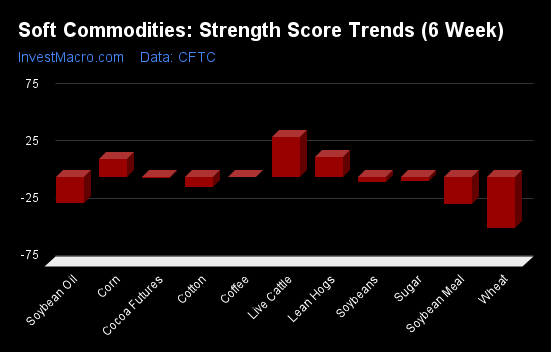
Lean Hogs & Live Cattle top the 6-Week Strength Trends

COT Strength Score Trends (or move index, calculates the 6-week changes in strength scores) showed that Lean Hogs (51 percent) and Live Cattle (34 percent) lead the past six weeks trends for soft commodities. Soybean Oil (26 percent) and Corn (24 percent) are the next highest positive movers in the latest trends data.

Soybean Meal (-38 percent) leads the downside trend scores currently with Wheat (-23 percent) and Sugar (-22 percent) following next with lower trend scores.

Strength Trend Statistics:
Corn (23.5 percent) vs Corn previous week (21.2 percent)
Sugar (-21.6 percent) vs Sugar previous week (-13.1 percent)
Coffee (0.6 percent) vs Coffee previous week (-5.4 percent)
Soybeans (-0.8 percent) vs Soybeans previous week (1.0 percent)
Soybean Oil (25.7 percent) vs Soybean Oil previous week (31.8 percent)
Soybean Meal (-37.5 percent) vs Soybean Meal previous week (-19.9 percent)
Live Cattle (34.4 percent) vs Live Cattle previous week (46.1 percent)
Lean Hogs (50.7 percent) vs Lean Hogs previous week (56.2 percent)
Cotton (-0.9 percent) vs Cotton previous week (2.6 percent)
Cocoa (-1.1 percent) vs Cocoa previous week (0.7 percent)
Wheat (-23.4 percent) vs Wheat previous week (-7.5 percent)


Individual Soft Commodities Markets:

CORN Futures:

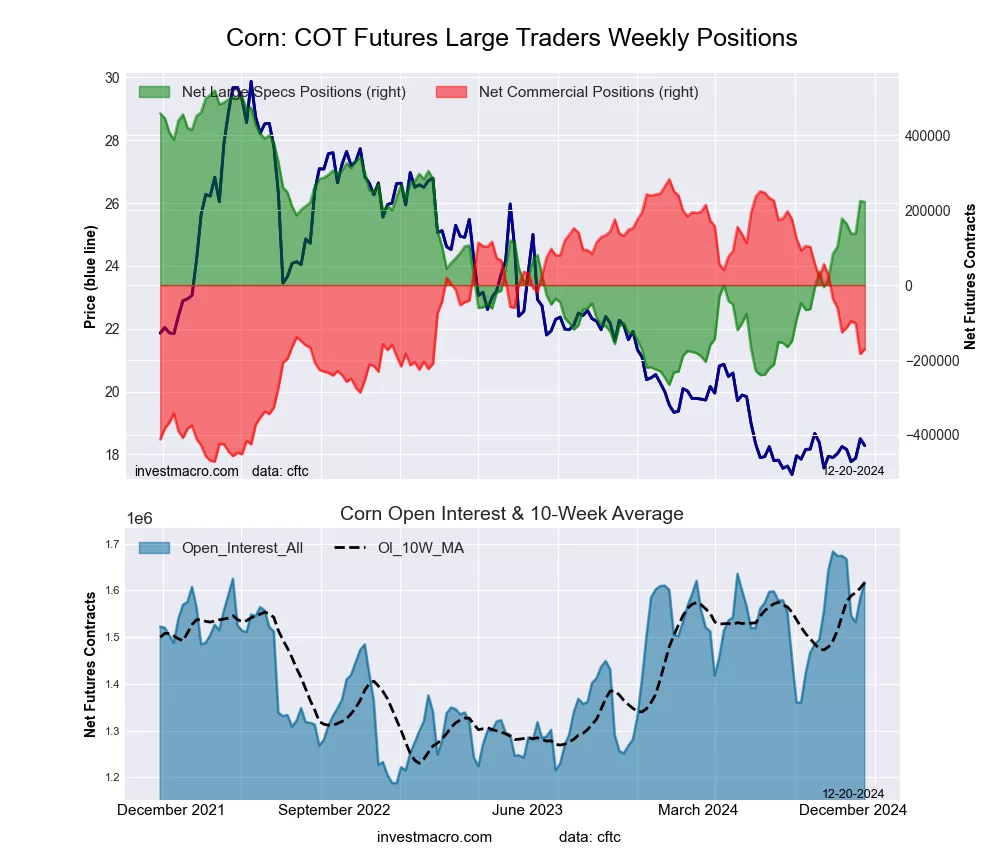
CORN Futures COT ChartThe CORN large speculator standing this week reached a net position of 177,646 contracts in the data reported through Tuesday. This was a weekly advance of 74,998 contracts from the previous week which had a total of 102,648 net contracts.

This week’s current strength score (the trader positioning range over the past three years, measured from 0 to 100) shows the speculators are currently Bullish with a score of 56.5 percent. The commercials are Bearish with a score of 45.8 percent and the small traders (not shown in chart) are Bearish with a score of 39.2 percent.

Price Trend-Following Model: Uptrend

Our weekly trend-following model classifies the current market price position as: Uptrend.

CORN Futures StatisticsSPECULATORSCOMMERCIALSSMALL TRADERS
– Percent of Open Interest Longs:26.045.67.8
– Percent of Open Interest Shorts:15.453.210.9
– Net Position:177,646-126,120-51,526
– Gross Longs:434,784763,888130,863
– Gross Shorts:257,138890,008182,389
– Long to Short Ratio:1.7 to 10.9 to 10.7 to 1
NET POSITION TREND:
– Strength Index Score (3 Year Range Pct):56.545.839.2
– Strength Index Reading (3 Year Range):BullishBearishBearish
NET POSITION MOVEMENT INDEX:
– 6-Week Change in Strength Index:23.5-24.3-2.0


SUGAR Futures:

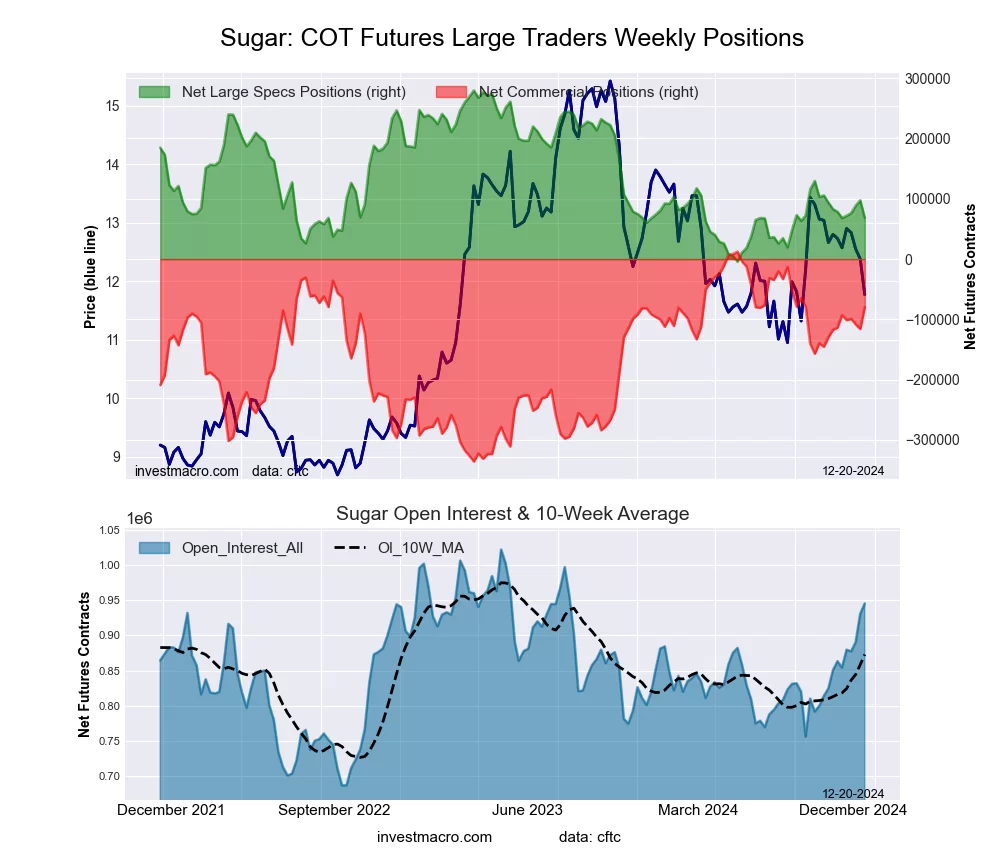
SUGAR Futures COT ChartThe SUGAR large speculator standing this week reached a net position of 68,122 contracts in the data reported through Tuesday. This was a weekly fall of -10,099 contracts from the previous week which had a total of 78,221 net contracts.

This week’s current strength score (the trader positioning range over the past three years, measured from 0 to 100) shows the speculators are currently Bearish with a score of 25.4 percent. The commercials are Bullish with a score of 69.7 percent and the small traders (not shown in chart) are Bullish with a score of 52.1 percent.

Price Trend-Following Model: Uptrend

Our weekly trend-following model classifies the current market price position as: Uptrend.

SUGAR Futures StatisticsSPECULATORSCOMMERCIALSSMALL TRADERS
– Percent of Open Interest Longs:25.050.68.9
– Percent of Open Interest Shorts:17.061.55.9
– Net Position:68,122-93,06424,942
– Gross Longs:213,319431,90375,606
– Gross Shorts:145,197524,96750,664
– Long to Short Ratio:1.5 to 10.8 to 11.5 to 1
NET POSITION TREND:
– Strength Index Score (3 Year Range Pct):25.469.752.1
– Strength Index Reading (3 Year Range):BearishBullishBullish
NET POSITION MOVEMENT INDEX:
– 6-Week Change in Strength Index:-21.618.3-3.2


COFFEE Futures:

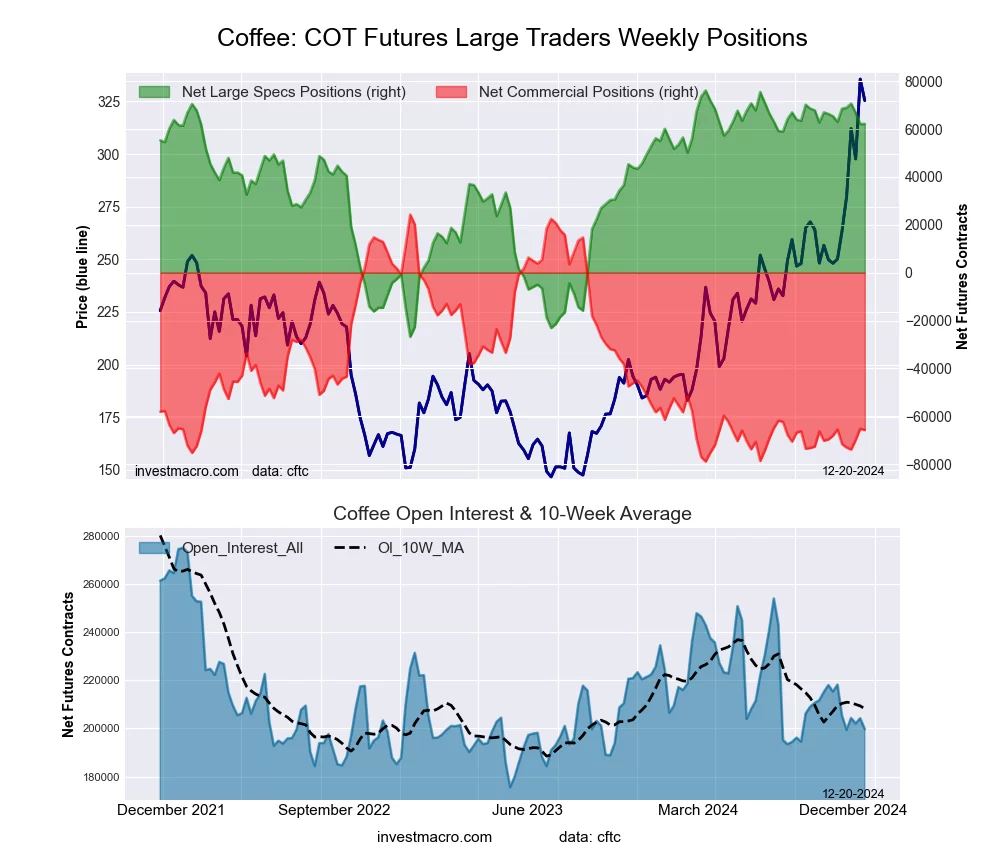
COFFEE Futures COT ChartThe COFFEE large speculator standing this week reached a net position of 68,468 contracts in the data reported through Tuesday. This was a weekly increase of 5,491 contracts from the previous week which had a total of 62,977 net contracts.

This week’s current strength score (the trader positioning range over the past three years, measured from 0 to 100) shows the speculators are currently Bullish-Extreme with a score of 92.6 percent. The commercials are Bearish-Extreme with a score of 7.0 percent and the small traders (not shown in chart) are Bullish with a score of 64.4 percent.

Price Trend-Following Model: Strong Uptrend

Our weekly trend-following model classifies the current market price position as: Strong Uptrend.

COFFEE Futures StatisticsSPECULATORSCOMMERCIALSSMALL TRADERS
– Percent of Open Interest Longs:37.838.74.3
– Percent of Open Interest Shorts:4.473.62.8
– Net Position:68,468-71,5683,100
– Gross Longs:77,57479,4508,905
– Gross Shorts:9,106151,0185,805
– Long to Short Ratio:8.5 to 10.5 to 11.5 to 1
NET POSITION TREND:
– Strength Index Score (3 Year Range Pct):92.67.064.4
– Strength Index Reading (3 Year Range):Bullish-ExtremeBearish-ExtremeBullish
NET POSITION MOVEMENT INDEX:
– 6-Week Change in Strength Index:0.61.0-26.7


SOYBEANS Futures:

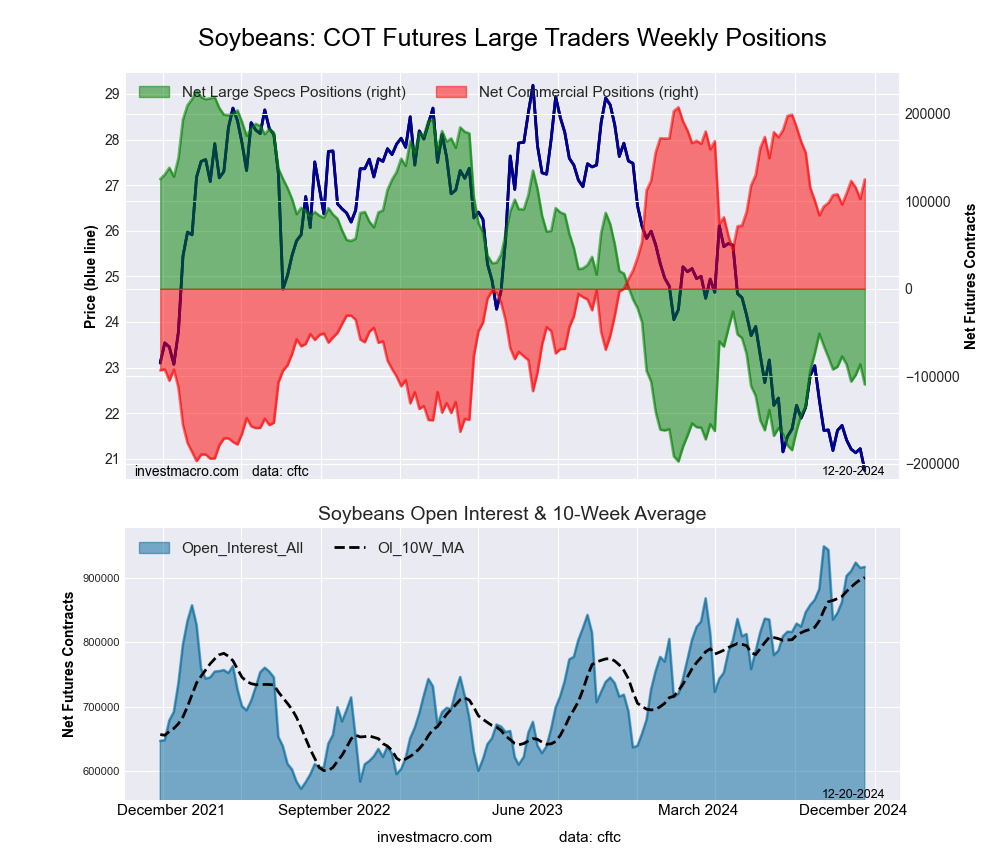
SOYBEANS Futures COT ChartThe SOYBEANS large speculator standing this week reached a net position of -77,113 contracts in the data reported through Tuesday. This was a weekly rise of 11,870 contracts from the previous week which had a total of -88,983 net contracts.

This week’s current strength score (the trader positioning range over the past three years, measured from 0 to 100) shows the speculators are currently Bearish with a score of 28.4 percent. The commercials are Bullish with a score of 72.5 percent and the small traders (not shown in chart) are Bullish with a score of 62.2 percent.

Price Trend-Following Model: Strong Downtrend

Our weekly trend-following model classifies the current market price position as: Strong Downtrend.

SOYBEANS Futures StatisticsSPECULATORSCOMMERCIALSSMALL TRADERS
– Percent of Open Interest Longs:18.757.75.6
– Percent of Open Interest Shorts:27.746.57.8
– Net Position:-77,11396,357-19,244
– Gross Longs:161,342497,24948,231
– Gross Shorts:238,455400,89267,475
– Long to Short Ratio:0.7 to 11.2 to 10.7 to 1
NET POSITION TREND:
– Strength Index Score (3 Year Range Pct):28.472.562.2
– Strength Index Reading (3 Year Range):BearishBullishBullish
NET POSITION MOVEMENT INDEX:
– 6-Week Change in Strength Index:-0.8-1.120.6


SOYBEAN OIL Futures:

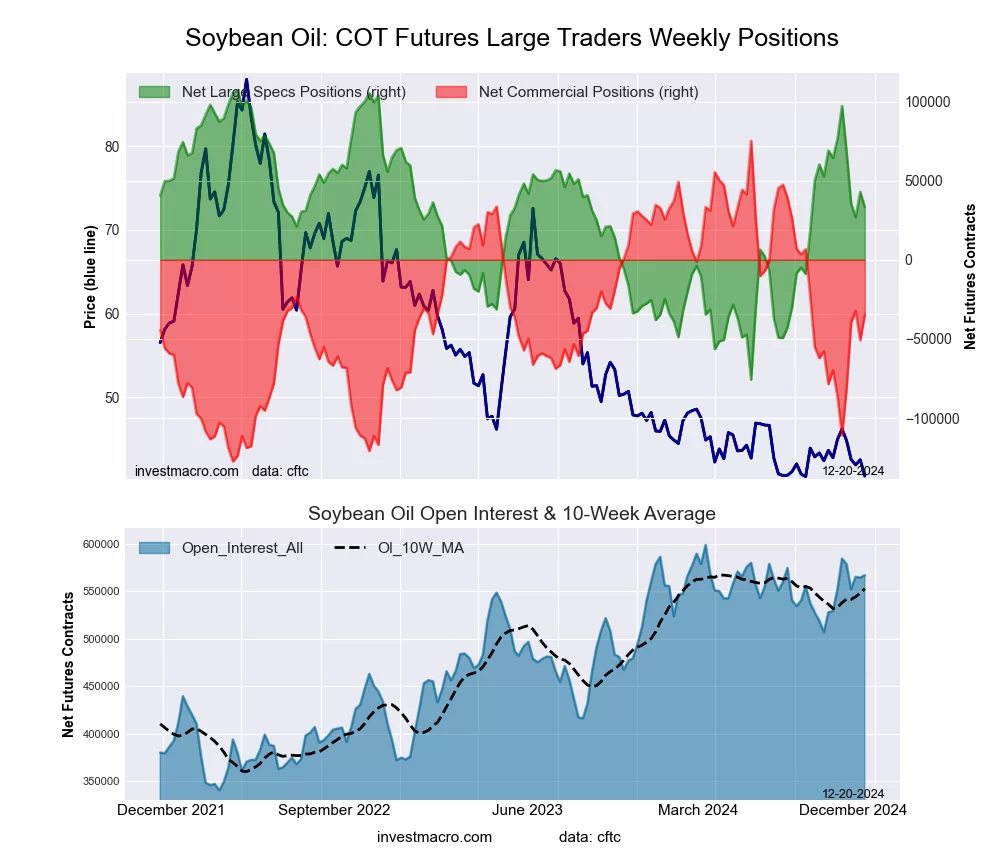
SOYBEAN OIL Futures COT ChartThe SOYBEAN OIL large speculator standing this week reached a net position of 97,225 contracts in the data reported through Tuesday. This was a weekly gain of 20,687 contracts from the previous week which had a total of 76,538 net contracts.

This week’s current strength score (the trader positioning range over the past three years, measured from 0 to 100) shows the speculators are currently Bullish-Extreme with a score of 94.7 percent. The commercials are Bearish-Extreme with a score of 8.2 percent and the small traders (not shown in chart) are Bullish with a score of 67.0 percent.

Price Trend-Following Model: Weak Downtrend

Our weekly trend-following model classifies the current market price position as: Weak Downtrend.

SOYBEAN OIL Futures StatisticsSPECULATORSCOMMERCIALSSMALL TRADERS
– Percent of Open Interest Longs:31.146.96.4
– Percent of Open Interest Shorts:14.565.84.1
– Net Position:97,225-110,88313,658
– Gross Longs:181,752274,08137,629
– Gross Shorts:84,527384,96423,971
– Long to Short Ratio:2.2 to 10.7 to 11.6 to 1
NET POSITION TREND:
– Strength Index Score (3 Year Range Pct):94.78.267.0
– Strength Index Reading (3 Year Range):Bullish-ExtremeBearish-ExtremeBullish
NET POSITION MOVEMENT INDEX:
– 6-Week Change in Strength Index:25.7-27.634.3


SOYBEAN MEAL Futures:

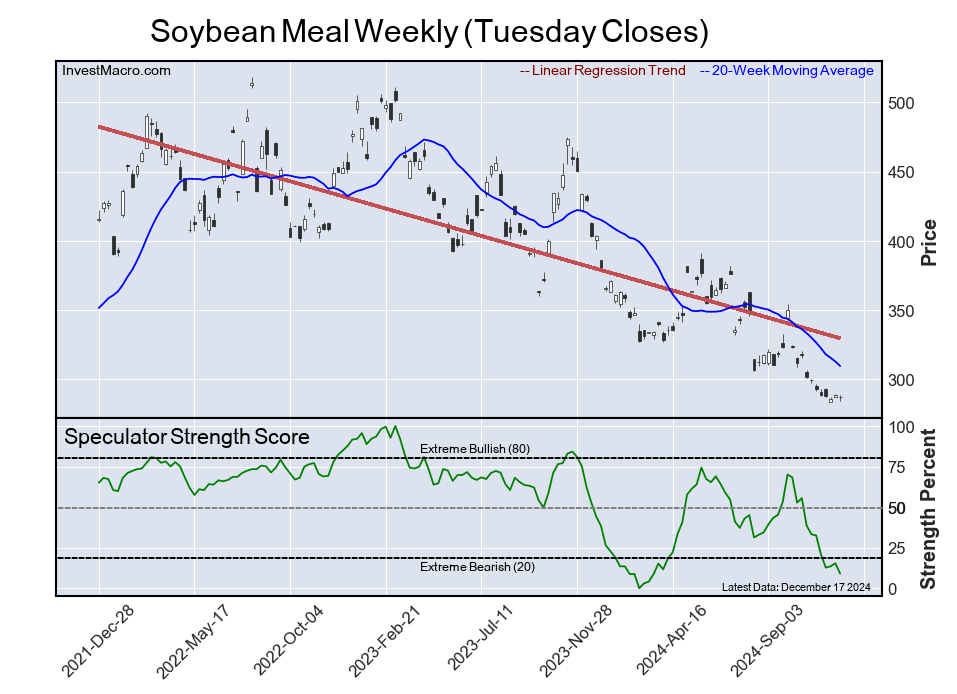
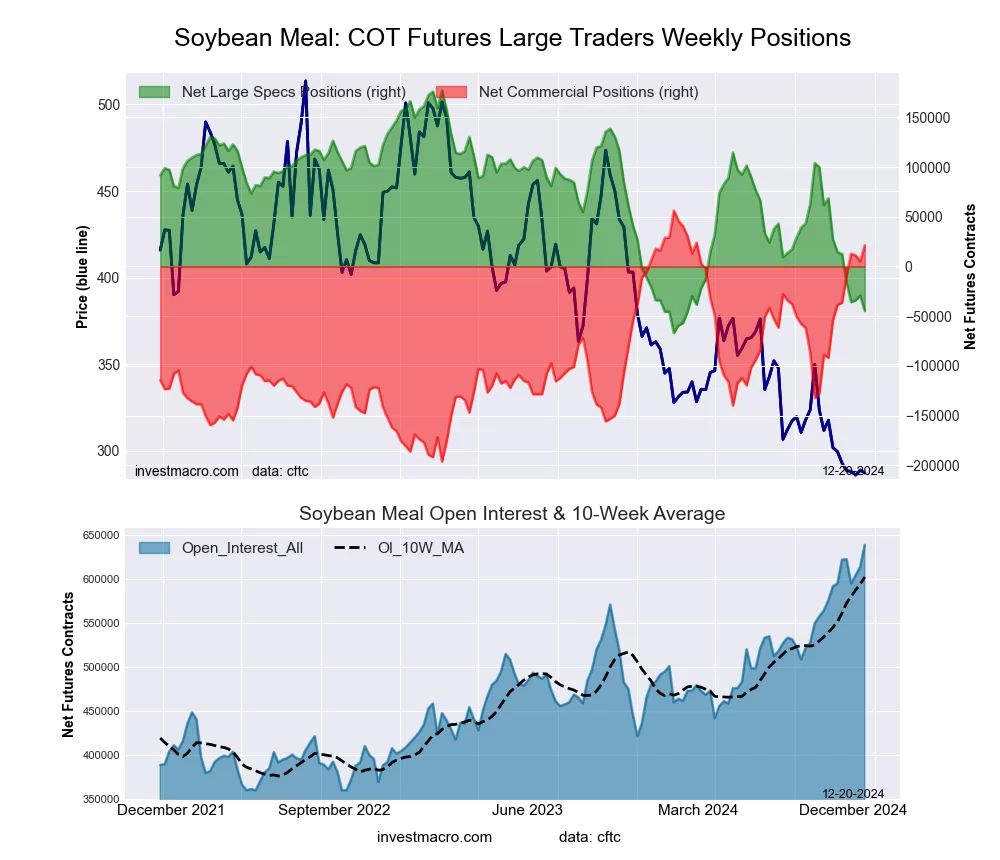
SOYBEAN MEAL Futures COT ChartThe SOYBEAN MEAL large speculator standing this week reached a net position of 12,506 contracts in the data reported through Tuesday. This was a weekly fall of -1,818 contracts from the previous week which had a total of 14,324 net contracts.

This week’s current strength score (the trader positioning range over the past three years, measured from 0 to 100) shows the speculators are currently Bearish with a score of 32.5 percent. The commercials are Bullish with a score of 63.2 percent and the small traders (not shown in chart) are Bullish with a score of 63.8 percent.

Price Trend-Following Model: Strong Downtrend

Our weekly trend-following model classifies the current market price position as: Strong Downtrend.

SOYBEAN MEAL Futures StatisticsSPECULATORSCOMMERCIALSSMALL TRADERS
– Percent of Open Interest Longs:23.845.79.6
– Percent of Open Interest Shorts:21.851.65.7
– Net Position:12,506-36,53724,031
– Gross Longs:147,784284,23559,719
– Gross Shorts:135,278320,77235,688
– Long to Short Ratio:1.1 to 10.9 to 11.7 to 1
NET POSITION TREND:
– Strength Index Score (3 Year Range Pct):32.563.263.8
– Strength Index Reading (3 Year Range):BearishBullishBullish
NET POSITION MOVEMENT INDEX:
– 6-Week Change in Strength Index:-37.537.8-17.8


LIVE CATTLE Futures:

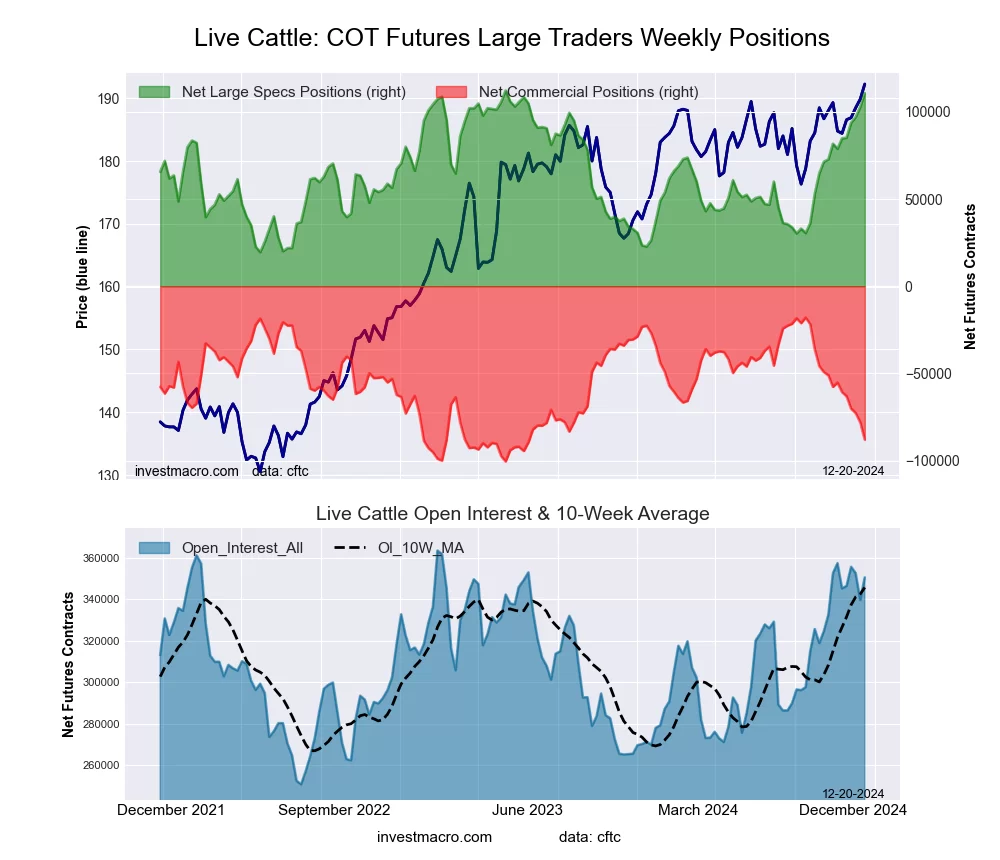
LIVE CATTLE Futures COT ChartThe LIVE CATTLE large speculator standing this week reached a net position of 84,779 contracts in the data reported through Tuesday. This was a weekly lift of 5,941 contracts from the previous week which had a total of 78,838 net contracts.

This week’s current strength score (the trader positioning range over the past three years, measured from 0 to 100) shows the speculators are currently Bullish with a score of 70.4 percent. The commercials are Bearish with a score of 48.3 percent and the small traders (not shown in chart) are Bearish-Extreme with a score of 0.0 percent.

Price Trend-Following Model: Weak Uptrend

Our weekly trend-following model classifies the current market price position as: Weak Uptrend.

LIVE CATTLE Futures StatisticsSPECULATORSCOMMERCIALSSMALL TRADERS
– Percent of Open Interest Longs:44.333.46.9
– Percent of Open Interest Shorts:19.750.913.8
– Net Position:84,779-60,663-24,116
– Gross Longs:152,817115,14023,645
– Gross Shorts:68,038175,80347,761
– Long to Short Ratio:2.2 to 10.7 to 10.5 to 1
NET POSITION TREND:
– Strength Index Score (3 Year Range Pct):70.448.30.0
– Strength Index Reading (3 Year Range):BullishBearishBearish-Extreme
NET POSITION MOVEMENT INDEX:
– 6-Week Change in Strength Index:34.4-29.7-28.6


LEAN HOGS Futures:

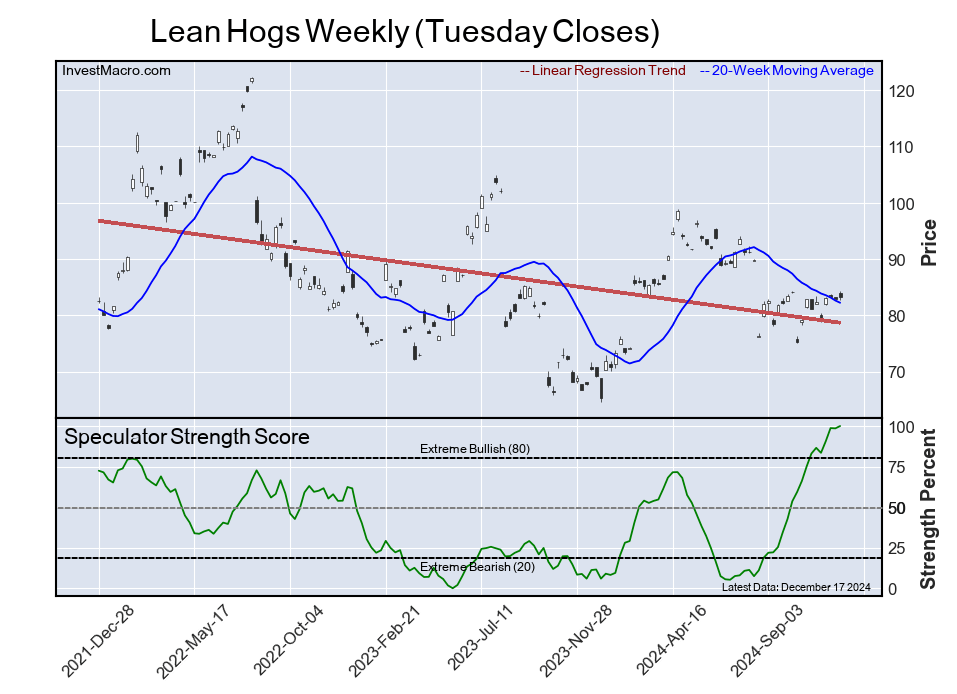
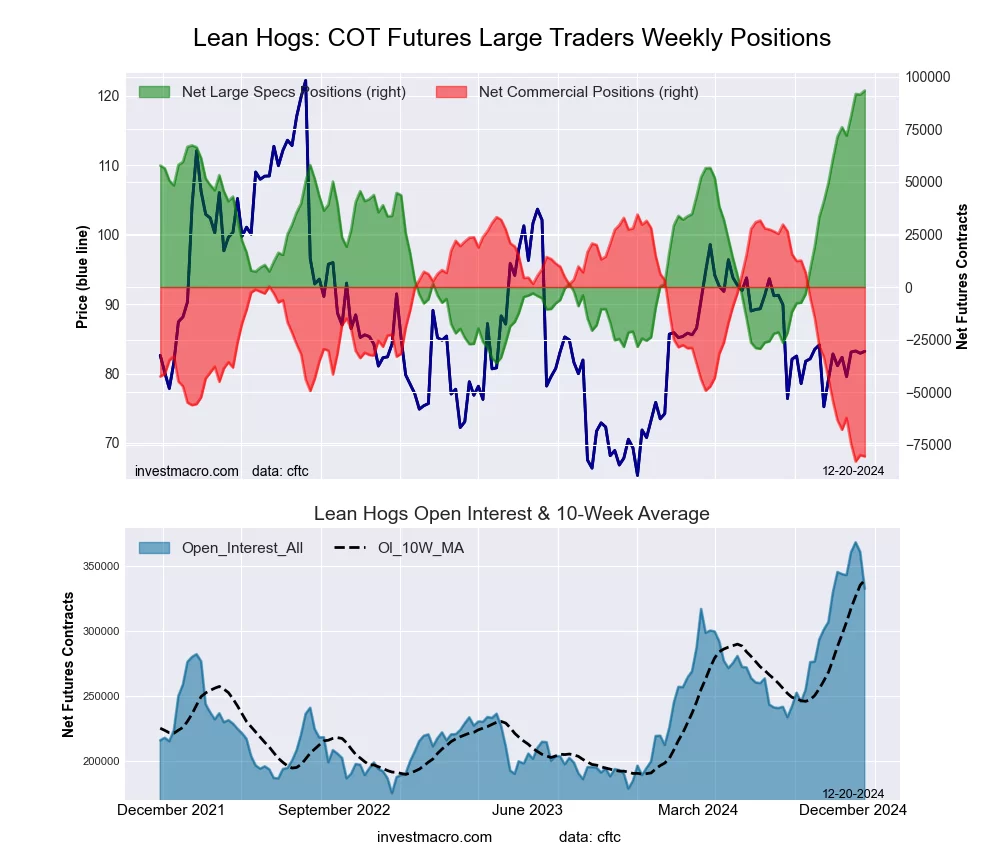
LEAN HOGS Futures COT ChartThe LEAN HOGS large speculator standing this week reached a net position of 75,982 contracts in the data reported through Tuesday. This was a weekly advance of 4,541 contracts from the previous week which had a total of 71,441 net contracts.

This week’s current strength score (the trader positioning range over the past three years, measured from 0 to 100) shows the speculators are currently Bullish-Extreme with a score of 100.0 percent. The commercials are Bearish-Extreme with a score of 0.0 percent and the small traders (not shown in chart) are Bearish with a score of 46.9 percent.

Price Trend-Following Model: Downtrend

Our weekly trend-following model classifies the current market price position as: Downtrend.

LEAN HOGS Futures StatisticsSPECULATORSCOMMERCIALSSMALL TRADERS
– Percent of Open Interest Longs:48.028.56.8
– Percent of Open Interest Shorts:26.048.39.1
– Net Position:75,982-67,843-8,139
– Gross Longs:165,26698,20523,318
– Gross Shorts:89,284166,04831,457
– Long to Short Ratio:1.9 to 10.6 to 10.7 to 1
NET POSITION TREND:
– Strength Index Score (3 Year Range Pct):100.00.046.9
– Strength Index Reading (3 Year Range):Bullish-ExtremeBearish-ExtremeBearish
NET POSITION MOVEMENT INDEX:
– 6-Week Change in Strength Index:50.7-52.0-16.2


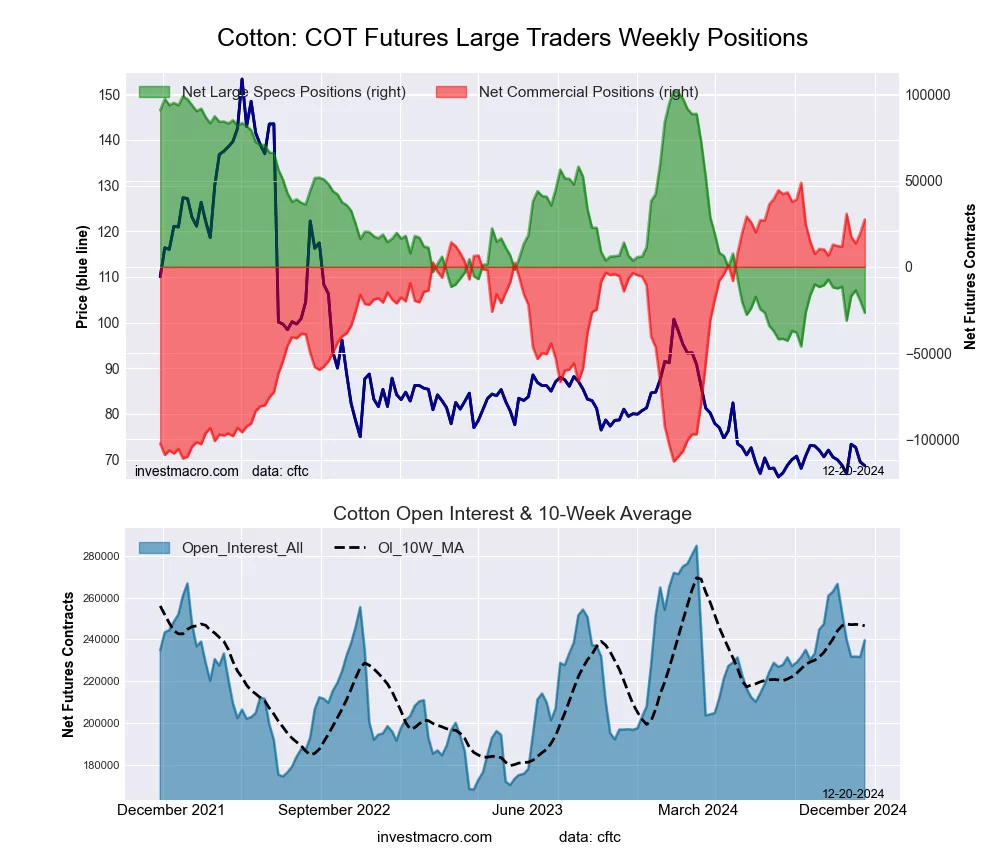
COTTON Futures:

COTTON Futures COT ChartThe COTTON large speculator standing this week reached a net position of -11,486 contracts in the data reported through Tuesday. This was a weekly boost of 955 contracts from the previous week which had a total of -12,441 net contracts.

This week’s current strength score (the trader positioning range over the past three years, measured from 0 to 100) shows the speculators are currently Bearish with a score of 22.6 percent. The commercials are Bullish with a score of 78.0 percent and the small traders (not shown in chart) are Bearish-Extreme with a score of 14.6 percent.

Price Trend-Following Model: Weak Uptrend

Our weekly trend-following model classifies the current market price position as: Weak Uptrend.

COTTON Futures StatisticsSPECULATORSCOMMERCIALSSMALL TRADERS
– Percent of Open Interest Longs:25.048.25.9
– Percent of Open Interest Shorts:29.543.66.0
– Net Position:-11,48611,808-322
– Gross Longs:63,281122,03614,854
– Gross Shorts:74,767110,22815,176
– Long to Short Ratio:0.8 to 11.1 to 11.0 to 1
NET POSITION TREND:
– Strength Index Score (3 Year Range Pct):22.678.014.6
– Strength Index Reading (3 Year Range):BearishBullishBearish-Extreme
NET POSITION MOVEMENT INDEX:
– 6-Week Change in Strength Index:-0.92.6-17.7


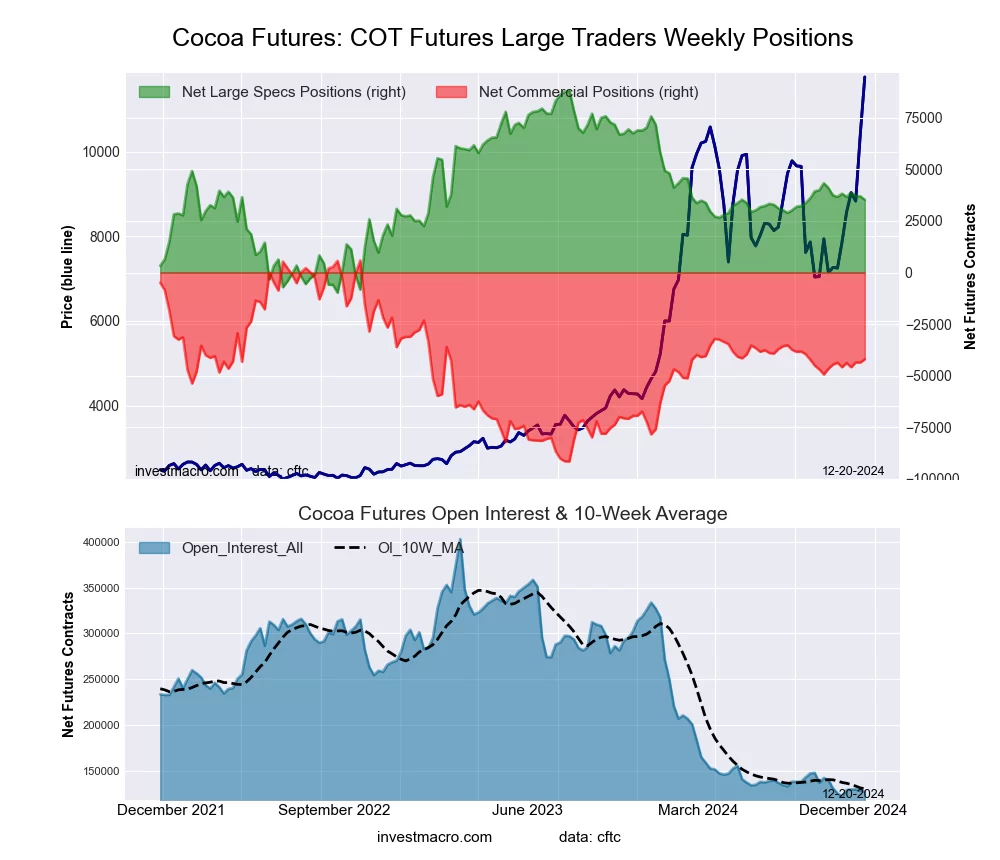
COCOA Futures:

COCOA Futures COT ChartThe COCOA large speculator standing this week reached a net position of 38,262 contracts in the data reported through Tuesday. This was a weekly rise of 1,603 contracts from the previous week which had a total of 36,659 net contracts.

This week’s current strength score (the trader positioning range over the past three years, measured from 0 to 100) shows the speculators are currently Bearish with a score of 49.0 percent. The commercials are Bearish with a score of 46.0 percent and the small traders (not shown in chart) are Bullish with a score of 77.3 percent.

Price Trend-Following Model: Weak Downtrend

Our weekly trend-following model classifies the current market price position as: Weak Downtrend.

COCOA Futures StatisticsSPECULATORSCOMMERCIALSSMALL TRADERS
– Percent of Open Interest Longs:42.436.710.4
– Percent of Open Interest Shorts:11.174.34.2
– Net Position:38,262-45,9087,646
– Gross Longs:51,89344,94012,752
– Gross Shorts:13,63190,8485,106
– Long to Short Ratio:3.8 to 10.5 to 12.5 to 1
NET POSITION TREND:
– Strength Index Score (3 Year Range Pct):49.046.077.3
– Strength Index Reading (3 Year Range):BearishBearishBullish
NET POSITION MOVEMENT INDEX:
– 6-Week Change in Strength Index:-1.1-0.816.2


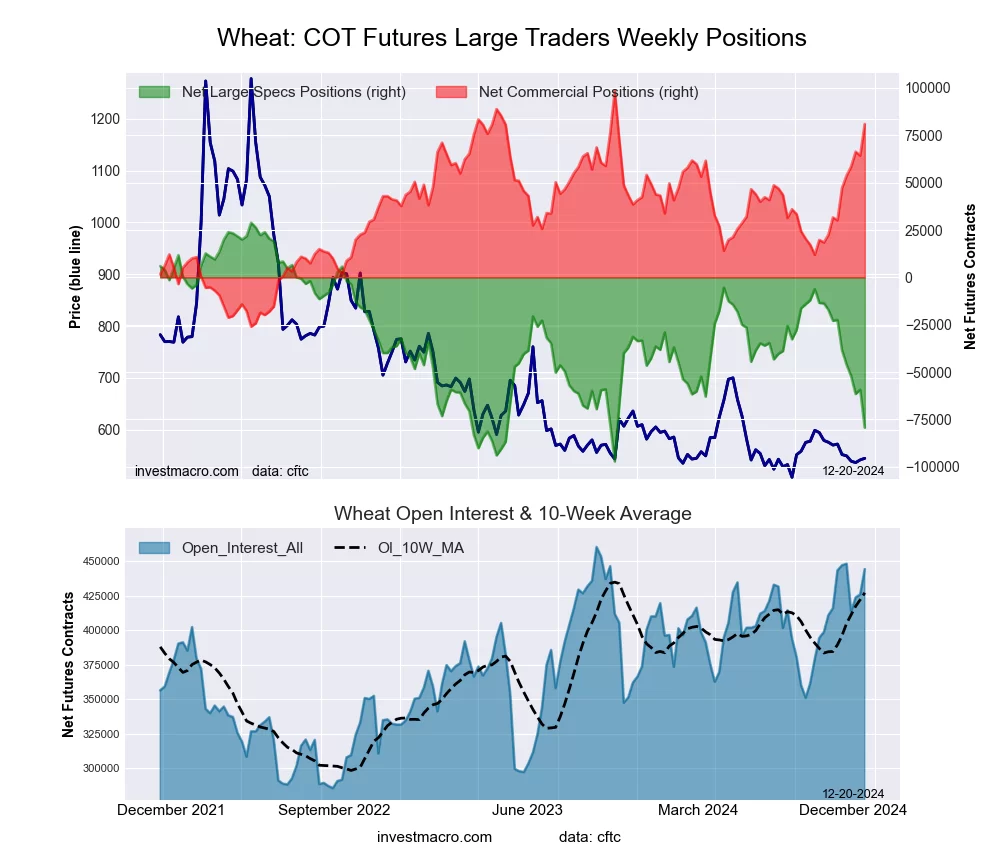
WHEAT Futures:

WHEAT Futures COT ChartThe WHEAT large speculator standing this week reached a net position of -38,529 contracts in the data reported through Tuesday. This was a weekly decrease of -15,988 contracts from the previous week which had a total of -22,541 net contracts.

This week’s current strength score (the trader positioning range over the past three years, measured from 0 to 100) shows the speculators are currently Bearish with a score of 42.3 percent. The commercials are Bullish with a score of 60.8 percent and the small traders (not shown in chart) are Bearish-Extreme with a score of 11.2 percent.

Price Trend-Following Model: Weak Uptrend

Our weekly trend-following model classifies the current market price position as: Weak Uptrend.

WHEAT Futures StatisticsSPECULATORSCOMMERCIALSSMALL TRADERS
– Percent of Open Interest Longs:23.739.57.1
– Percent of Open Interest Shorts:32.328.99.0
– Net Position:-38,52947,109-8,580
– Gross Longs:105,967176,33531,795
– Gross Shorts:144,496129,22640,375
– Long to Short Ratio:0.7 to 11.4 to 10.8 to 1
NET POSITION TREND:
– Strength Index Score (3 Year Range Pct):42.360.811.2
– Strength Index Reading (3 Year Range):BearishBullishBearish-Extreme
NET POSITION MOVEMENT INDEX:
– 6-Week Change in Strength Index:-23.426.7-15.2


Article By InvestMacroReceive our weekly COT Newsletter

*COT Report: The COT data, released weekly to the public each Friday, is updated through the most recent Tuesday (data is 3 days old) and shows a quick view of how large speculators or non-commercials (for-profit traders) were positioned in the futures markets.

The CFTC categorizes trader positions according to commercial hedgers (traders who use futures contracts for hedging as part of the business), non-commercials (large traders who speculate to realize trading profits) and nonreportable traders (usually small traders/speculators) as well as their open interest (contracts open in the market at time of reporting). See CFTC criteria here.

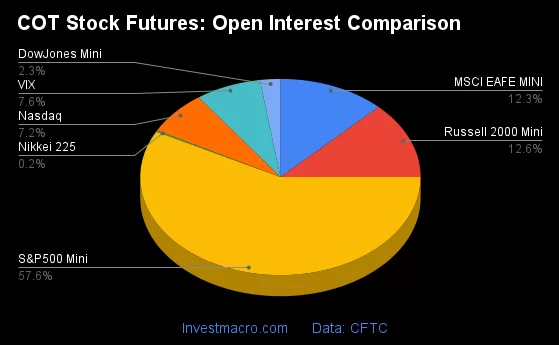
COT Stock Market Charts: Speculator Bets led by MSCI EAFE & VIX

By InvestMacro

Here are the latest charts and statistics for the Commitment of Traders (COT) data published by the Commodities Futures Trading Commission (CFTC).

The latest COT data is updated through Tuesday November 12th and shows a quick view of how large traders (for-profit speculators and commercial entities) were positioned in the futures markets.

Weekly Speculator Changes led by MSCI EAFE & VIX

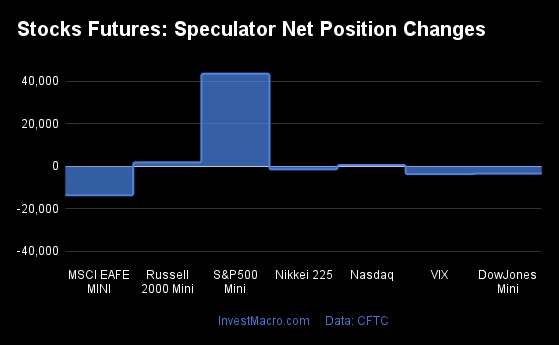
The COT stock markets speculator bets were higher this week as four out of the seven stock markets we cover had higher positioning while the other three markets had lower speculator contracts.

Leading the gains for the stock markets was the MSCI EAFE-Mini (17,352 contracts) with the VIX (12,245 contracts), the DowJones-Mini (735 contracts) and the Nasdaq-Mini (288 contracts) also showing positive weeks.

The markets with the declines in speculator bets this week were the S&P500-Mini (-88,439 contracts), the Nikkei 225 (-498 contracts) and with the Russell-Mini (-398 contracts) also registering lower bets on the week.


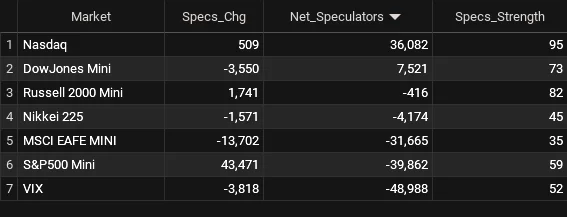
Stock Market Net Speculators Leaderboard

Legend: Weekly Speculators Change | Speculators Current Net Position | Speculators Strength Score compared to last 3-Years (0-100 range)


Strength Scores led by VIX & Russell-Mini

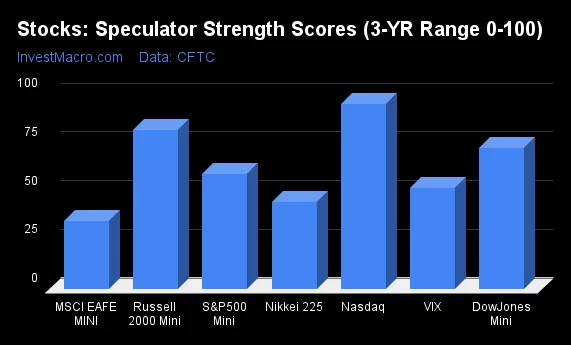
COT Strength Scores (a normalized measure of Speculator positions over a 3-Year range, from 0 to 100 where above 80 is Extreme-Bullish and below 20 is Extreme-Bearish) showed that the VIX (92 percent) and the Russell-Mini (88 percent) led the stock markets this week. The DowJones-Mini (83 percent) and S&P500-Mini (68 percent) came in as the next highest in the weekly strength scores.

On the downside, the MSCI EAFE-Mini (35 percent) comes in at the lowest strength level currently.

Strength Statistics:
VIX (92.3 percent) vs VIX previous week (81.3 percent)
S&P500-Mini (68.5 percent) vs S&P500-Mini previous week (81.7 percent)
DowJones-Mini (82.5 percent) vs DowJones-Mini previous week (81.3 percent)
Nasdaq-Mini (64.5 percent) vs Nasdaq-Mini previous week (64.1 percent)
Russell2000-Mini (87.7 percent) vs Russell2000-Mini previous week (88.0 percent)
Nikkei USD (59.2 percent) vs Nikkei USD previous week (63.4 percent)
EAFE-Mini (35.0 percent) vs EAFE-Mini previous week (16.4 percent)


VIX tops the 6-Week Strength Trends

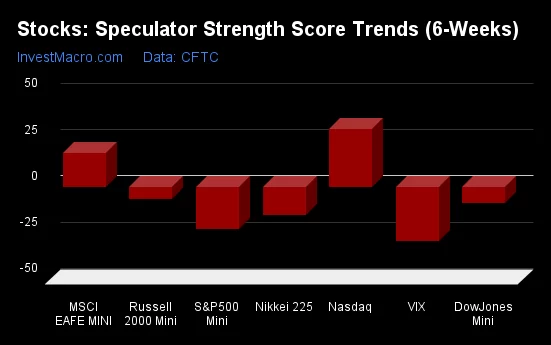
COT Strength Score Trends (or move index, calculates the 6-week changes in strength scores) showed that the VIX (10 percent) leads the past six weeks trends for the stock markets. The S&P500-Mini (3 percent) is the next highest positive mover in the latest trends data.

The Russell-Mini (-8 percent) leads the downside trend scores currently with the DowJones-Mini (-6 percent) coming in as the next market with lower trend scores.

Strength Trend Statistics:
VIX (10.4 percent) vs VIX previous week (-10.5 percent)
S&P500-Mini (2.6 percent) vs S&P500-Mini previous week (22.2 percent)
DowJones-Mini (-5.5 percent) vs DowJones-Mini previous week (-4.1 percent)
Nasdaq-Mini (0.5 percent) vs Nasdaq-Mini previous week (0.1 percent)
Russell2000-Mini (-8.2 percent) vs Russell2000-Mini previous week (-9.0 percent)
Nikkei USD (-6.3 percent) vs Nikkei USD previous week (16.2 percent)
EAFE-Mini (-2.7 percent) vs EAFE-Mini previous week (-14.0 percent)


Individual Stock Market Charts:

VIX Volatility Futures:

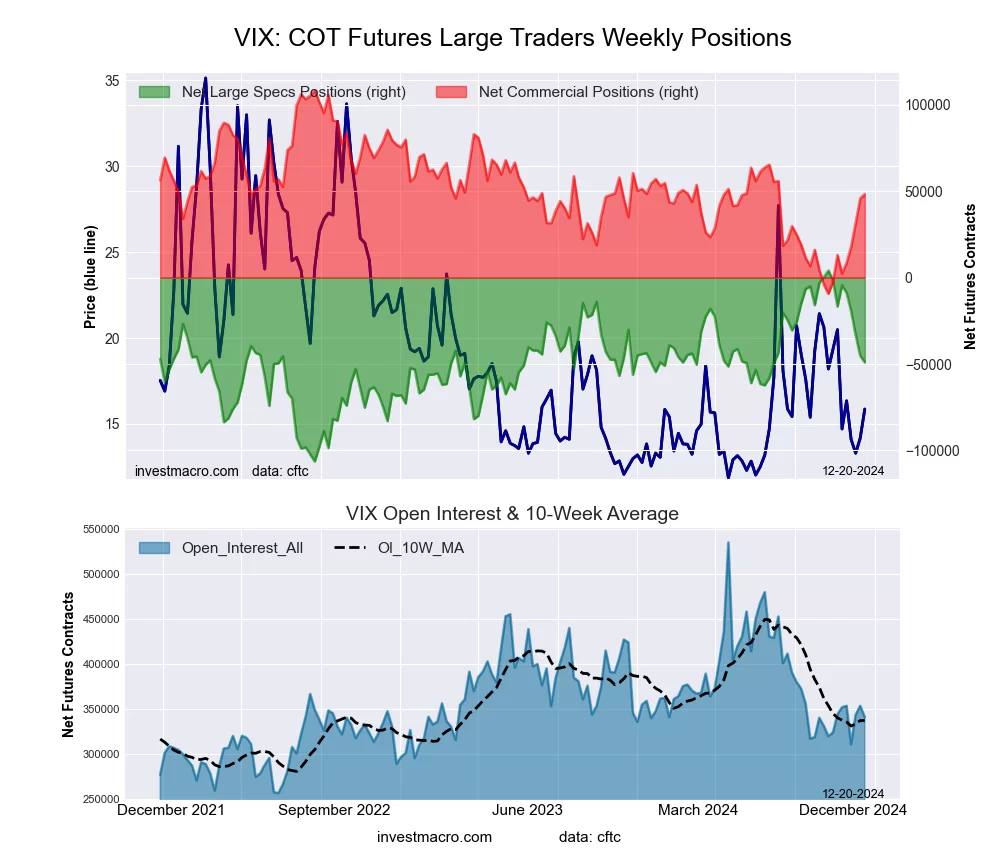
VIX Volatility Futures COT ChartThe VIX Volatility large speculator standing this week was a net position of -4,423 contracts in the data reported through Tuesday. This was a weekly boost of 12,245 contracts from the previous week which had a total of -16,668 net contracts.

This week’s current strength score (the trader positioning range over the past three years, measured from 0 to 100) shows the speculators are currently Bullish-Extreme with a score of 92.3 percent. The commercials are Bearish-Extreme with a score of 9.9 percent and the small traders (not shown in chart) are Bullish-Extreme with a score of 86.9 percent.

Price Trend-Following Model: Weak Uptrend

Our weekly trend-following model classifies the current market price position as: Weak Uptrend.

VIX Volatility Futures StatisticsSPECULATORSCOMMERCIALSSMALL TRADERS
– Percent of Open Interest Longs:23.839.58.4
– Percent of Open Interest Shorts:25.038.97.8
– Net Position:-4,4232,2632,160
– Gross Longs:83,713139,17729,674
– Gross Shorts:88,136136,91427,514
– Long to Short Ratio:0.9 to 11.0 to 11.1 to 1
NET POSITION TREND:
– Strength Index Score (3 Year Range Pct):92.39.986.9
– Strength Index Reading (3 Year Range):Bullish-ExtremeBearish-ExtremeBullish-Extreme
NET POSITION MOVEMENT INDEX:
– 6-Week Change in Strength Index:10.4-11.79.5


S&P500 Mini Futures:

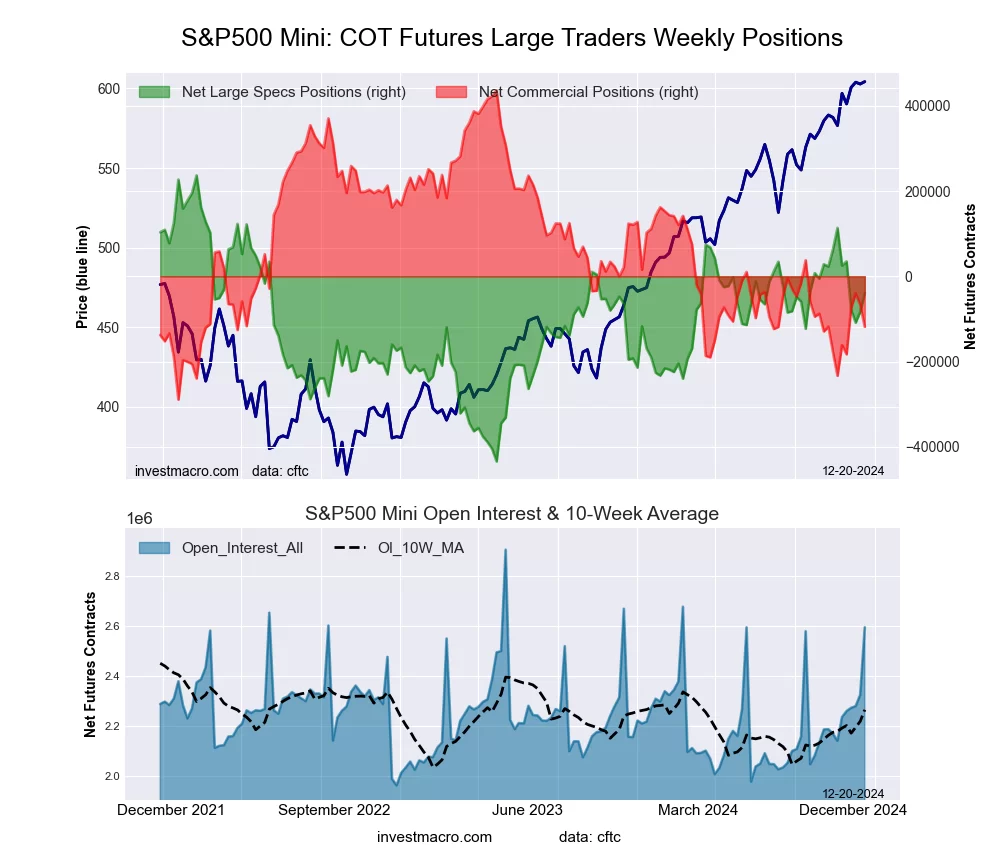
SP500 Mini Futures COT ChartThe S&P500 Mini large speculator standing this week was a net position of 25,001 contracts in the data reported through Tuesday. This was a weekly decrease of -88,439 contracts from the previous week which had a total of 113,440 net contracts.

This week’s current strength score (the trader positioning range over the past three years, measured from 0 to 100) shows the speculators are currently Bullish with a score of 68.5 percent. The commercials are Bearish-Extreme with a score of 17.7 percent and the small traders (not shown in chart) are Bullish-Extreme with a score of 100.0 percent.

Price Trend-Following Model: Uptrend

Our weekly trend-following model classifies the current market price position as: Uptrend.

S&P500 Mini Futures StatisticsSPECULATORSCOMMERCIALSSMALL TRADERS
– Percent of Open Interest Longs:16.168.912.9
– Percent of Open Interest Shorts:15.076.16.8
– Net Position:25,001-161,143136,142
– Gross Longs:360,9871,540,339288,150
– Gross Shorts:335,9861,701,482152,008
– Long to Short Ratio:1.1 to 10.9 to 11.9 to 1
NET POSITION TREND:
– Strength Index Score (3 Year Range Pct):68.517.7100.0
– Strength Index Reading (3 Year Range):BullishBearish-ExtremeBullish-Extreme
NET POSITION MOVEMENT INDEX:
– 6-Week Change in Strength Index:2.6-9.221.4


Dow Jones Mini Futures:

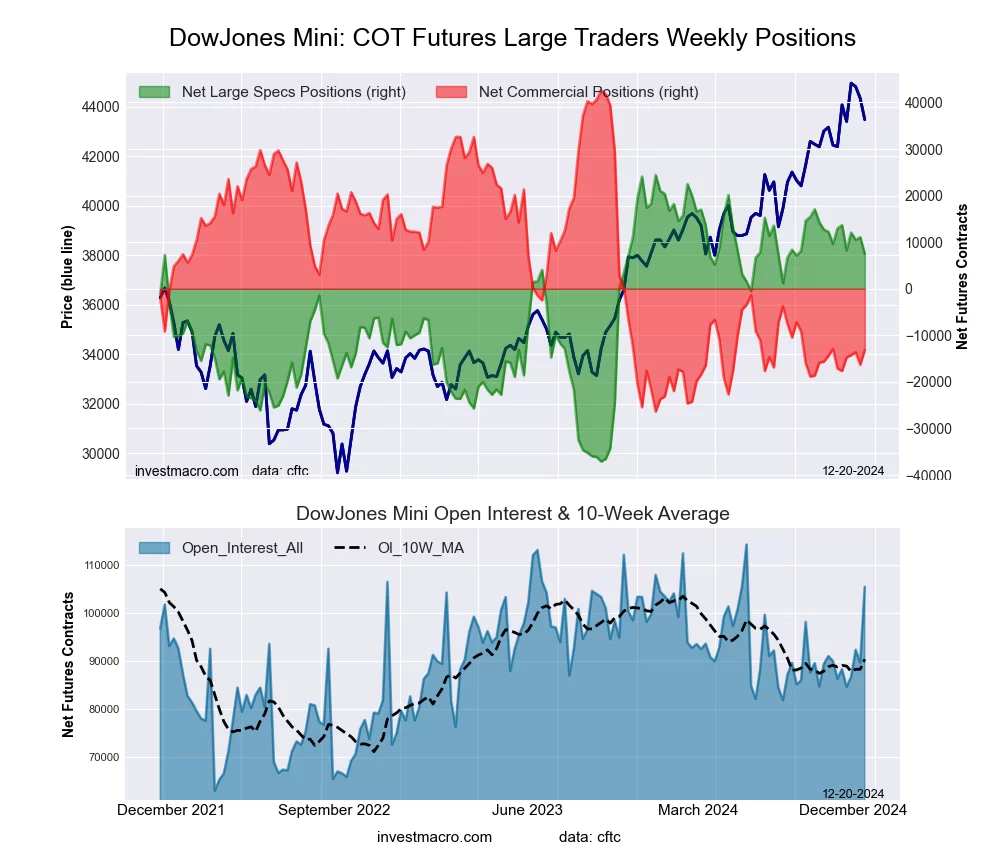
Dow Jones Mini Futures COT ChartThe Dow Jones Mini large speculator standing this week was a net position of 13,666 contracts in the data reported through Tuesday. This was a weekly advance of 735 contracts from the previous week which had a total of 12,931 net contracts.

This week’s current strength score (the trader positioning range over the past three years, measured from 0 to 100) shows the speculators are currently Bullish-Extreme with a score of 82.5 percent. The commercials are Bearish-Extreme with a score of 12.6 percent and the small traders (not shown in chart) are Bullish with a score of 78.6 percent.

Price Trend-Following Model: Strong Uptrend

Our weekly trend-following model classifies the current market price position as: Strong Uptrend.

Dow Jones Mini Futures StatisticsSPECULATORSCOMMERCIALSSMALL TRADERS
– Percent of Open Interest Longs:30.249.018.5
– Percent of Open Interest Shorts:14.768.914.0
– Net Position:13,666-17,6453,979
– Gross Longs:26,66443,23016,310
– Gross Shorts:12,99860,87512,331
– Long to Short Ratio:2.1 to 10.7 to 11.3 to 1
NET POSITION TREND:
– Strength Index Score (3 Year Range Pct):82.512.678.6
– Strength Index Reading (3 Year Range):Bullish-ExtremeBearish-ExtremeBullish
NET POSITION MOVEMENT INDEX:
– 6-Week Change in Strength Index:-5.51.414.5


Nasdaq Mini Futures:

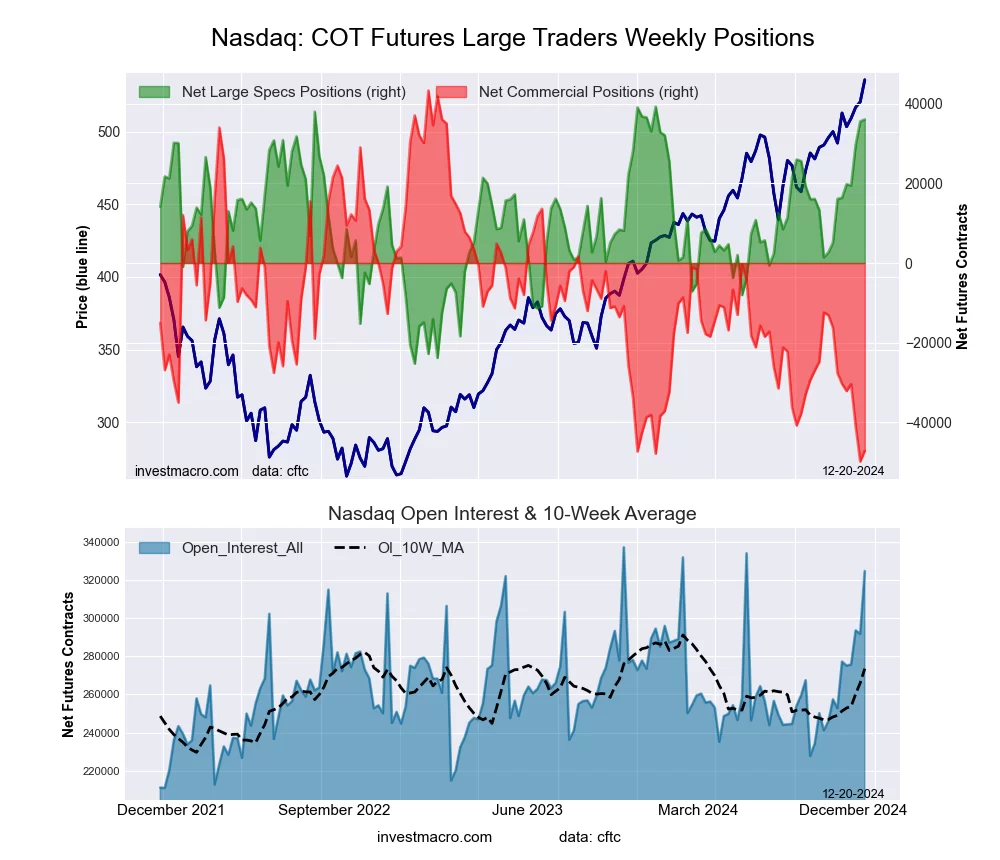
Nasdaq Mini Futures COT ChartThe Nasdaq Mini large speculator standing this week was a net position of 16,380 contracts in the data reported through Tuesday. This was a weekly increase of 288 contracts from the previous week which had a total of 16,092 net contracts.

This week’s current strength score (the trader positioning range over the past three years, measured from 0 to 100) shows the speculators are currently Bullish with a score of 64.5 percent. The commercials are Bearish-Extreme with a score of 19.2 percent and the small traders (not shown in chart) are Bullish-Extreme with a score of 81.2 percent.

Price Trend-Following Model: Strong Uptrend

Our weekly trend-following model classifies the current market price position as: Strong Uptrend.

Nasdaq Mini Futures StatisticsSPECULATORSCOMMERCIALSSMALL TRADERS
– Percent of Open Interest Longs:25.656.514.8
– Percent of Open Interest Shorts:19.767.49.7
– Net Position:16,380-30,36313,983
– Gross Longs:71,007156,58540,901
– Gross Shorts:54,627186,94826,918
– Long to Short Ratio:1.3 to 10.8 to 11.5 to 1
NET POSITION TREND:
– Strength Index Score (3 Year Range Pct):64.519.281.2
– Strength Index Reading (3 Year Range):BullishBearish-ExtremeBullish-Extreme
NET POSITION MOVEMENT INDEX:
– 6-Week Change in Strength Index:0.5-3.75.8


Russell 2000 Mini Futures:

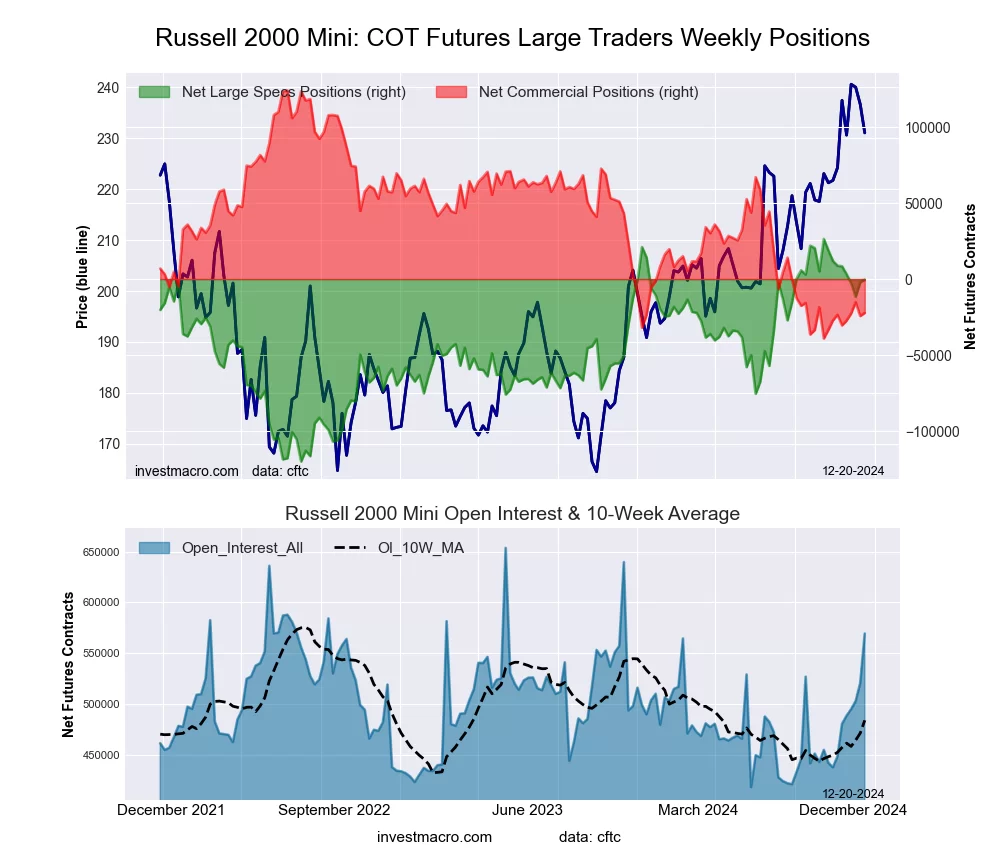
Russell 2000 Mini Futures COT ChartThe Russell 2000 Mini large speculator standing this week was a net position of 8,394 contracts in the data reported through Tuesday. This was a weekly decline of -398 contracts from the previous week which had a total of 8,792 net contracts.

This week’s current strength score (the trader positioning range over the past three years, measured from 0 to 100) shows the speculators are currently Bullish-Extreme with a score of 87.7 percent. The commercials are Bearish-Extreme with a score of 5.3 percent and the small traders (not shown in chart) are Bullish-Extreme with a score of 100.0 percent.

Price Trend-Following Model: Strong Uptrend

Our weekly trend-following model classifies the current market price position as: Strong Uptrend.

Russell 2000 Mini Futures StatisticsSPECULATORSCOMMERCIALSSMALL TRADERS
– Percent of Open Interest Longs:16.972.08.2
– Percent of Open Interest Shorts:15.178.33.6
– Net Position:8,394-30,42922,035
– Gross Longs:81,169346,13739,360
– Gross Shorts:72,775376,56617,325
– Long to Short Ratio:1.1 to 10.9 to 12.3 to 1
NET POSITION TREND:
– Strength Index Score (3 Year Range Pct):87.75.3100.0
– Strength Index Reading (3 Year Range):Bullish-ExtremeBearish-ExtremeBullish-Extreme
NET POSITION MOVEMENT INDEX:
– 6-Week Change in Strength Index:-8.21.929.0


Nikkei Stock Average (USD) Futures:

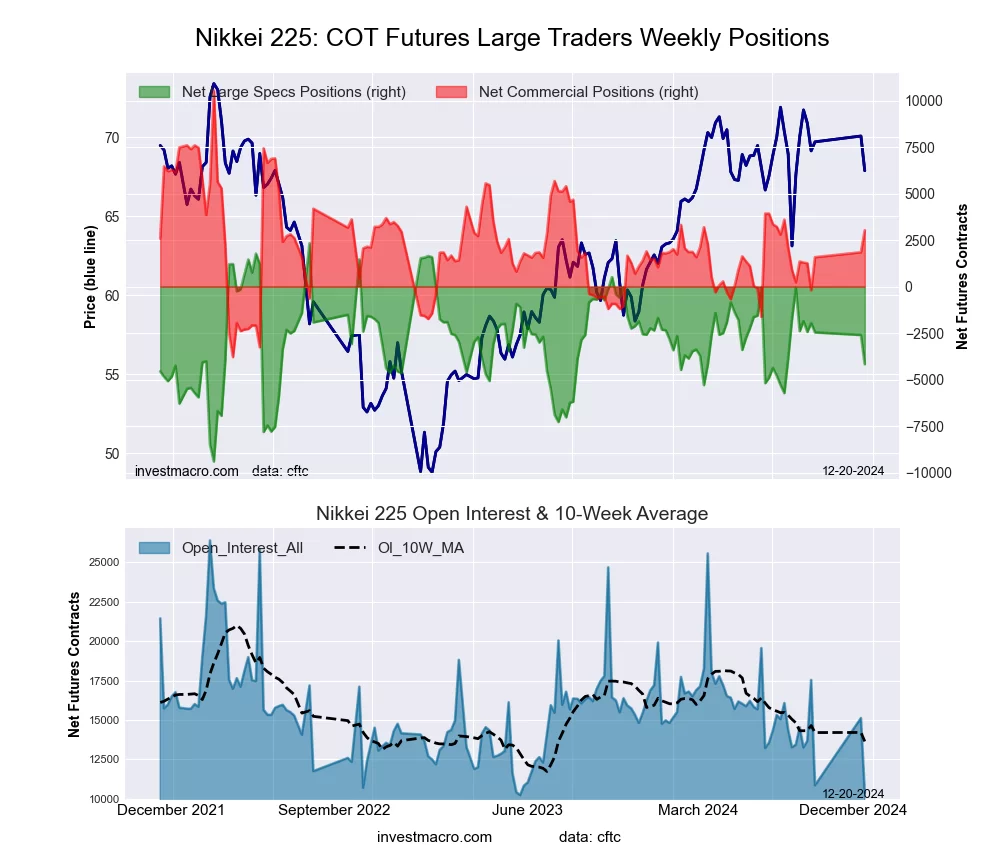
Nikkei Stock Average (USD) Futures COT ChartThe Nikkei Stock Average (USD) large speculator standing this week was a net position of -2,464 contracts in the data reported through Tuesday. This was a weekly decline of -498 contracts from the previous week which had a total of -1,966 net contracts.

This week’s current strength score (the trader positioning range over the past three years, measured from 0 to 100) shows the speculators are currently Bullish with a score of 59.2 percent. The commercials are Bearish with a score of 37.5 percent and the small traders (not shown in chart) are Bullish with a score of 60.1 percent.

Price Trend-Following Model: Weak Uptrend

Our weekly trend-following model classifies the current market price position as: Weak Uptrend.

Nikkei Stock Average Futures StatisticsSPECULATORSCOMMERCIALSSMALL TRADERS
– Percent of Open Interest Longs:2.070.227.7
– Percent of Open Interest Shorts:24.755.719.5
– Net Position:-2,4641,576888
– Gross Longs:2217,6203,008
– Gross Shorts:2,6856,0442,120
– Long to Short Ratio:0.1 to 11.3 to 11.4 to 1
NET POSITION TREND:
– Strength Index Score (3 Year Range Pct):59.237.560.1
– Strength Index Reading (3 Year Range):BullishBearishBullish
NET POSITION MOVEMENT INDEX:
– 6-Week Change in Strength Index:-6.34.81.0


MSCI EAFE Mini Futures:

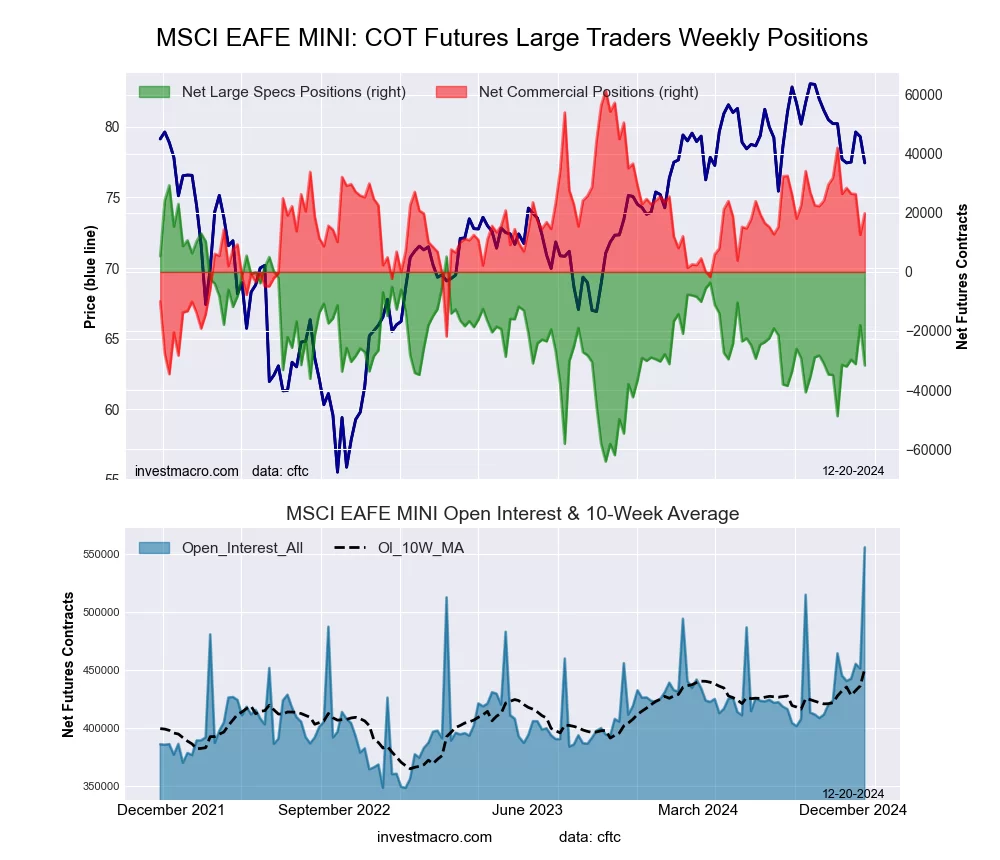
MSCI EAFE Mini Futures COT ChartThe MSCI EAFE Mini large speculator standing this week was a net position of -31,471 contracts in the data reported through Tuesday. This was a weekly gain of 17,352 contracts from the previous week which had a total of -48,823 net contracts.

This week’s current strength score (the trader positioning range over the past three years, measured from 0 to 100) shows the speculators are currently Bearish with a score of 35.0 percent. The commercials are Bullish with a score of 63.6 percent and the small traders (not shown in chart) are Bearish with a score of 42.2 percent.

Price Trend-Following Model: Weak Uptrend

Our weekly trend-following model classifies the current market price position as: Weak Uptrend.

MSCI EAFE Mini Futures StatisticsSPECULATORSCOMMERCIALSSMALL TRADERS
– Percent of Open Interest Longs:8.588.42.8
– Percent of Open Interest Shorts:15.682.41.7
– Net Position:-31,47126,4255,046
– Gross Longs:37,792393,52712,545
– Gross Shorts:69,263367,1027,499
– Long to Short Ratio:0.5 to 11.1 to 11.7 to 1
NET POSITION TREND:
– Strength Index Score (3 Year Range Pct):35.063.642.2
– Strength Index Reading (3 Year Range):BearishBullishBearish
NET POSITION MOVEMENT INDEX:
– 6-Week Change in Strength Index:-2.74.1-6.8


Article By InvestMacroReceive our weekly COT Newsletter

*COT Report: The COT data, released weekly to the public each Friday, is updated through the most recent Tuesday (data is 3 days old) and shows a quick view of how large speculators or non-commercials (for-profit traders) were positioned in the futures markets.

The CFTC categorizes trader positions according to commercial hedgers (traders who use futures contracts for hedging as part of the business), non-commercials (large traders who speculate to realize trading profits) and nonreportable traders (usually small traders/speculators) as well as their open interest (contracts open in the market at time of reporting). See CFTC criteria here.

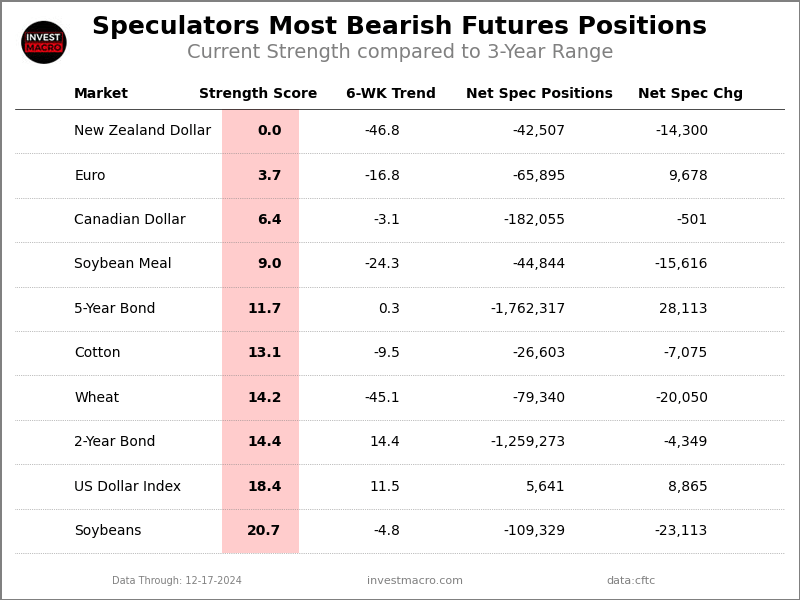
Speculator Extremes: Lean Hogs, Ultra T-Bonds, US Dollar & 5-Year lead Bullish & Bearish Positions

By InvestMacro

The latest update for the weekly Commitment of Traders (COT) report was released by the Commodity Futures Trading Commission (CFTC) on Friday for data ending on November 12th.

This weekly Extreme Positions report highlights the Most Bullish and Most Bearish Positions for the speculator category. Extreme positioning in these markets can foreshadow strong moves in the underlying market.

To signify an extreme position, we use the Strength Index (also known as the COT Index) of each instrument, a common method of measuring COT data. The Strength Index is simply a comparison of current trader positions against the range of positions over the previous 3 years. We use over 80 percent as extremely bullish and under 20 percent as extremely bearish. (Compare Strength Index scores across all markets in the data table or cot leaders table)


Here Are This Week’s Most Bullish Speculator Positions:

Lean Hogs


The Lean Hogs speculator position comes in as the most bullish extreme standing this week. The Lean Hogs speculator level is currently at a 100.0 percent score or maximum of its 3-year range.

The six-week trend for the percent strength score totaled 50.7 this week. The overall net speculator position was a total of 75,982 net contracts this week with a gain of 4,541 contract in the weekly speculator bets.


Speculators or Non-Commercials Notes:

Speculators, classified as non-commercial traders by the CFTC, are made up of large commodity funds, hedge funds and other significant for-profit participants. The Specs are generally regarded as trend-followers in their behavior towards price action – net speculator bets and prices tend to go in the same directions. These traders often look to buy when prices are rising and sell when prices are falling. To illustrate this point, many times speculator contracts can be found at their most extremes (bullish or bearish) when prices are also close to their highest or lowest levels.

These extreme levels can be dangerous for the large speculators as the trade is most crowded, there is less trading ammunition still sitting on the sidelines to push the trend further and prices have moved a significant distance. When the trend becomes exhausted, some speculators take profits while others look to also exit positions when prices fail to continue in the same direction. This process usually plays out over many months to years and can ultimately create a reverse effect where prices start to fall and speculators start a process of selling when prices are falling.


Ultra U.S. Treasury Bonds


The Ultra U.S. Treasury Bonds speculator position comes next in the extreme standings this week. The Ultra U.S. Treasury Bonds speculator level is now at a 99.5 percent score of its 3-year range.

The six-week trend for the percent strength score was 10.1 this week. The speculator position registered -241,284 net contracts this week with a weekly rise by 23,124 contracts in speculator bets.


Australian Dollar


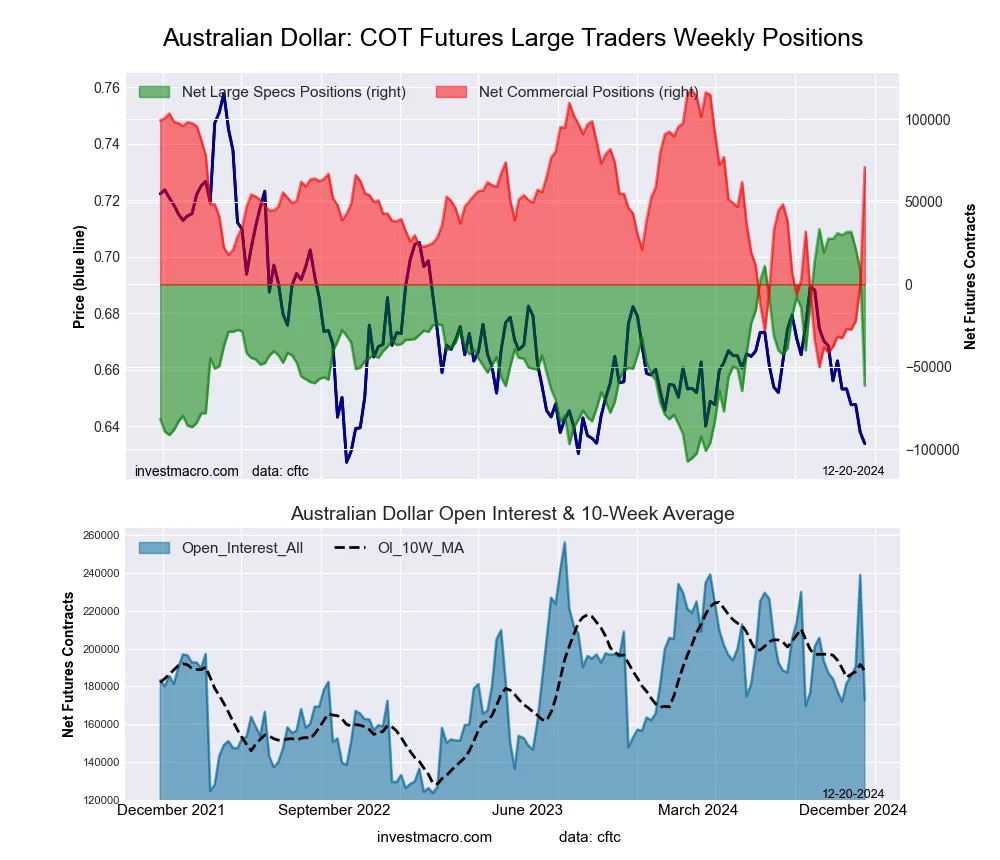
The Australian Dollar speculator position comes in third this week in the extreme standings. The Australian Dollar speculator level resides at a 97.4 percent score of its 3-year range.

The six-week trend for the speculator strength score came in at 10.8 this week. The overall speculator position was 29,795 net contracts this week with a small dip of -1,181 contracts in the weekly speculator bets.


Soybean Oil


The Soybean Oil speculator position comes up number four in the extreme standings this week. The Soybean Oil speculator level is at a 94.7 percent score of its 3-year range.

The six-week trend for the speculator strength score totaled a change of 25.7 this week. The overall speculator position was 97,225 net contracts this week with a boost of 20,687 contracts in the speculator bets.


Steel


The Steel speculator position rounds out the top five in this week’s bullish extreme standings. The Steel speculator level sits at a 93.2 percent score of its 3-year range. The six-week trend for the speculator strength score was 7.0 this week.

The speculator position was -808 net contracts this week with a decline of -394 contracts in the weekly speculator bets.


This Week’s Most Bearish Speculator Positions:

5-Year Bond


The 5-Year Bond speculator position comes in as the most bearish extreme standing this week. The 5-Year Bond speculator level is at a 0.0 percent score of its 3-year range.

The six-week trend for the speculator strength score was -18.0 this week. The overall speculator position was -1,869,210 net contracts this week with a drop by -101,801 contracts in the speculator bets.


US Dollar Index


The US Dollar Index speculator position comes in next for the most bearish extreme standing on the week. The US Dollar Index speculator level is at a 0.0 percent score of its 3-year range.

The six-week trend for the speculator strength score was -5.2 this week. The speculator position was -2,312 net contracts this week with a decrease by -2,407 contracts in the weekly speculator bets.


2-Year Bond


The 2-Year Bond speculator position comes in as third most bearish extreme standing of the week. The 2-Year Bond speculator level resides at a 4.0 percent score of its 3-year range.

The six-week trend for the speculator strength score was -15.6 this week. The overall speculator position was -1,423,871 net contracts this week with an increase of 62,488 contracts in the speculator bets.


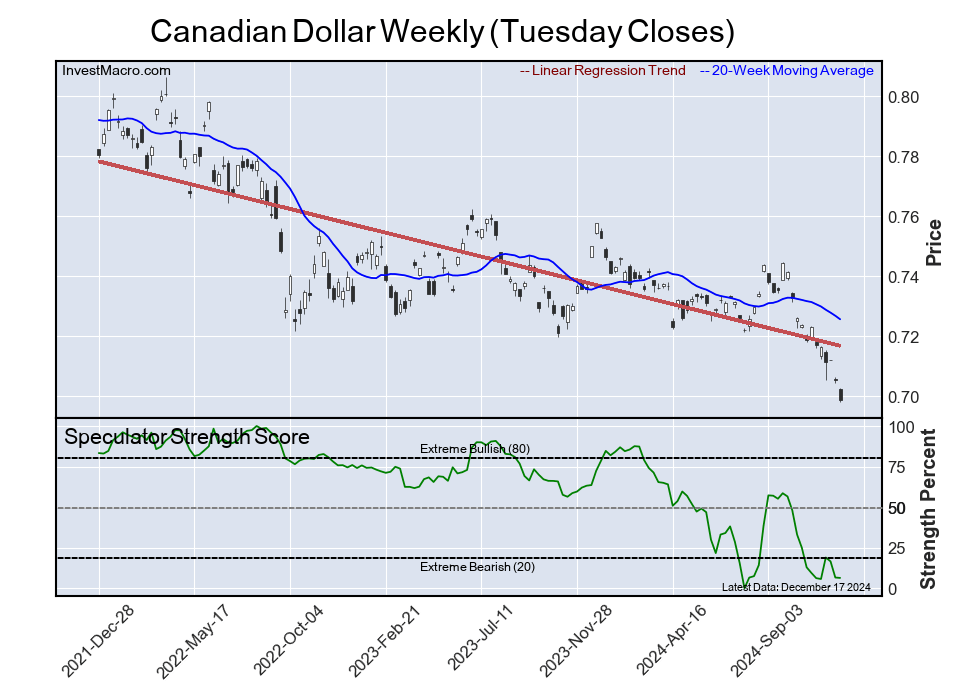
Canadian Dollar


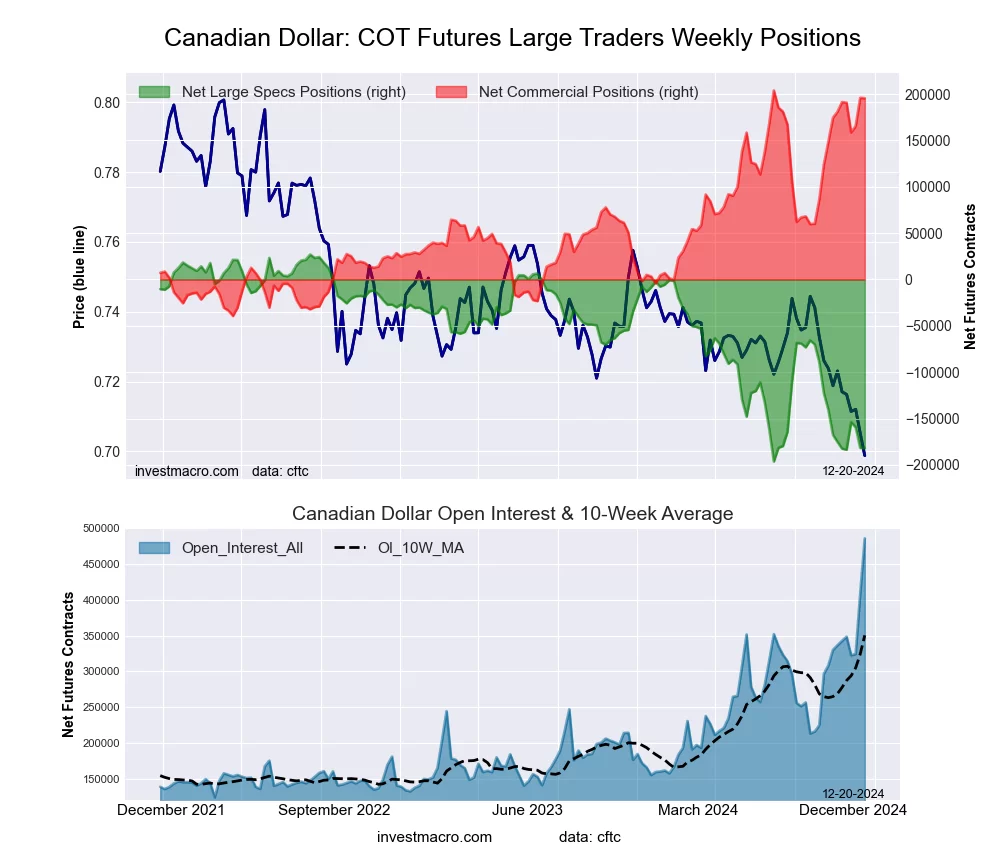
The Canadian Dollar speculator position comes in as this week’s fourth most bearish extreme standing. The Canadian Dollar speculator level is at a 6.2 percent score of its 3-year range.

The six-week trend for the speculator strength score was -50.4 this week. The speculator position was -182,389 net contracts this week with a weekly shortfall of -7,160 contracts in the weekly speculator bets.


E-mini SP MidCap400

Finally, the E-mini SP MidCap400 speculator position comes in as the fifth most bearish extreme standing for this week. The E-mini SP MidCap400 speculator level is at a 10.0 percent score of its 3-year range.

The six-week trend for the speculator strength score was -9.7 this week. The speculator position was -228 net contracts this week with a change of 575 contracts in the weekly speculator bets.


Article By InvestMacroReceive our weekly COT Newsletter

*COT Report: The COT data, released weekly to the public each Friday, is updated through the most recent Tuesday (data is 3 days old) and shows a quick view of how large speculators or non-commercials (for-profit traders) were positioned in the futures markets.

The CFTC categorizes trader positions according to commercial hedgers (traders who use futures contracts for hedging as part of the business), non-commercials (large traders who speculate to realize trading profits) and nonreportable traders (usually small traders/speculators) as well as their open interest (contracts open in the market at time of reporting). See CFTC criteria here.

The Dollar Index strengthened on Powell’s comments. The Bank of Mexico cut the rate to 10.25%

By JustMarkets

The Dow Jones (US30) decreased by 0.47% on Thursday. The S&P 500 Index (US500) was down 0.60%. The NASDAQ Technology Index (US100) lost 0.66%.

On Thursday, Fed Chairman Powell clarified that there was no need for an immediate rate cut, citing the economy’s strength, a robust labor market, and stable inflation. Powell’s comments echoed his colleagues, who favor a cautious approach to future rate cuts. As a consequence, markets have lost confidence in a December rate cut and now have a 58% chance of it happening, down from 80% before the speech. In addition, investors believe that the incoming Trump administration may push for higher trade tariffs, tax cuts, and higher budget deficits, which could lead to higher inflation and further limit the Fed’s ability to reduce borrowing costs.

The Walt Disney Company (DIS) is up more than 6%, topping the Dow Jones Industrials list, after reporting fourth-quarter adjusted EPS of $1.14, above the consensus of $1.10, and saying it expects high-single-digit adjusted EPS growth in fiscal 2025, above the consensus of 4%. Cisco Systems (CSCO) closed down more than 1% after estimating FY 2025 revenue of $55.3–56.3 billion, below the average consensus estimate of $55.88 billion.

The Bank of Mexico lowered its benchmark interest rate to 10.25% in November 2024, which was widely expected and in line with trends in major economies. The Central Bank eased monetary policy, noting improving trends in core inflation but remaining cautious due to risks of stagnant core inflation and potential currency depreciation. Overall inflation rose from 4.66% y/y in mid-September to 4.76% y/y in October due to a supply shock affecting non-core inflation, while core inflation eased to 3.8% y/y.

Equity markets in Europe were mostly up yesterday. Germany’s DAX (DE40) rose by 1.37%, France’s CAC 40 (FR40) closed 1.32% higher, Spain’s IBEX 35 (ES35) gained 1.29%, and the UK’s FTSE 100 (UK100) closed up 0.51%. The report on the ECB’s October 16–17 meeting was seen as dovish as policymakers believe inflation continues to fall. There was broad agreement that incoming data from the September meeting had increased confidence in the ongoing disinflation process and that inflation would converge toward the medium-term target.

WTI crude oil prices fell to as low as $68 a barrel on Friday, driven by concerns that the global oil market may be moving into a state of oversupply. On Thursday, the IEA predicted an oil surplus next year, attributing it to slowing demand growth in China and rising global production. The agency also noted that the surplus could become even more pronounced if OPEC+ follows through on plans to restore previously halted production. Additional pressure on commodities such as oil is being exerted by the strengthening dollar, which has risen to a two-year high, making dollar-priced commodities less attractive. In addition, EIA data showed that US crude oil inventories rose by 2.1 million barrels last week, exceeding the expected increase of 1.9 million.

The US natural gas prices (XNG/USD) fell below $2.9/MMBtu following the release of the EIA report on gas in storage. The data showed that US utilities added 42 billion cubic feet of natural gas to storage last week, slightly below the expected 43 Bcf. Gas in storage is now 6.1% above the seasonal norm. This is the fourth consecutive week of exceeding the seasonal norm, last seen in October 2022.

Silver prices stabilized near $30.30 an ounce on Friday but were still on track for a fourth straight weekly decline as a strengthening US dollar continued to weigh on the precious metal. The dollar’s rise was driven by expectations of a Federal Reserve rate cut following comments from Fed Chairman Jerome Powell on Thursday. Powell said the central bank was in no hurry to cut rates, citing a strong economy, stable labor market, and steady inflation.

Asian markets were mostly down yesterday with Japan’s Nikkei 225 (JP225) down 0.48%, China’s FTSE China A50 (CHA50) decreased by 0.99%, Hong Kong’s Hang Seng (HK50) lost 1.96%, and Australia’s ASX 200 (AU200) positive 0.31%.

China’s retail sales rose to 4.8% y/y from 3.2% in September and hit the highest growth since February, helped by the week-long holiday and the latest shopping festival. Meanwhile, the unemployment rate fell to a four-month low of 5.0%, according to the survey, and industrial production continued to rise, albeit at a slightly slower pace. The statistics agency also noted that confidence in the real estate market strengthened on the back of appropriate policies, leading to an increase in the number of transactions in the market and a move towards stabilization.

S&P 500 (US500) 5,949.17 −36.21 (−0.60%)

Dow Jones (US30) 43,750.86 −207.33 (−0.47%)

DAX (DE40) 19,263.70 +260.59 (+1.37%)

FTSE 100 (UK100) 8,071.19 +40.86 (+0.51%)

USD Index 106.87 +0.39 (+0.36%)

News feed for: 2024.11.15

  • Japan GDP (q/q) at 01:50 (GMT+2);
  • China Industrial Production (m/m) at 04:00 (GMT+2);
  • China Retail Sales (m/m) at 04:00 (GMT+2);
  • China Unemployment Rate (m/m) at 04:00 (GMT+2);
  • UK GDP (m/m) at 09:00 (GMT+2);
  • UK Industrial Production (m/m) at 09:00 (GMT+2);
  • Switzerland Producer Price Index (m/m) at 09:30 (GMT+2);
  • US Retail Sales (m/m) at 15:30 (GMT+2);
  • US Industrial Production (m/m) at 16:15 (GMT+2).

By JustMarkets


This article reflects a personal opinion and should not be interpreted as an investment advice, and/or offer, and/or a persistent request for carrying out financial transactions, and/or a guarantee, and/or a forecast of future events.

EURUSD Faces Decline as Fed Signals Firm Stance

By RoboForex Analytical Department

EURUSD plunged to a six-month low of 1.0543 on Friday amid strong support for the US dollar following the US presidential election and recent comments from Federal Reserve officials.

Federal Reserve Chair Jerome Powell’s recent statement underscored a cautious approach to cutting interest rates, citing persistent GDP growth, robust employment, and ongoing inflationary pressures. This stance suggests a possible delay or reduction in the anticipated rate cuts, contrasting with earlier market expectations favouring a rate reduction in December.

As Powell indicated a less accommodative monetary policy moving forward, the probability of a December rate cut has notably decreased, bolstering the US dollar’s appeal.

Technical analysis of EURUSD

H4 chart analysis: the EURUSD price has reached the 1.0500 level, forming what appears to be the latter half of a downward trend. Today, we expect consolidation range formation above this level. If the price breaks upwards, a corrective wave towards 1.0600 could occur. Subsequently, we expect the continuation of the downward impulse to the 1.0404 level. This bearish EURUSD outlook is supported by the MACD indicator, which remains below zero and is directed downwards.

H1 chart analysis: EURUSD is making a downward move towards 1.0404. After achieving this target, a corrective upward movement towards 1.0600 is possible, suggesting a temporary pause in the bearish trend. The Stochastic oscillator supporting this scenario is close to 80 and signals an imminent fall to 20, in line with the expected continuation of the downward movement.


Disclaimer

Any forecasts contained herein are based on the author’s particular opinion. This analysis may not be treated as trading advice. RoboForex bears no responsibility for trading results based on trading recommendations and reviews contained herein.

Week Ahead: Will Nvidia earnings seal stock’s 200% jump in 2024?

By ForexTime

  • Nvidia: world’s largest company with US$3.6 trillion market cap
  • Shares already soared 196.3% so far this year
  • Earnings due after US markets close Wed, Nov 20
  • Shares forecasted to move 8% up/down Thur, Nov. 21
  • Nvidia accounts for 15% of total global stock volatility


The world’s most-valuable company is about to unveil its latest quarterly earnings.

And when Nvidia speaks, stock markets worldwide listen, and react.

After all, Nvidia alone accounts for about 15% of the total volatility for stock markets worldwide.


Here are some other facts you may not know about this AI-posterchild:

  • Nvidia became the largest company in the world since November 5th – US election day.
    (it previously held that title for just 1 day, on June 18, 2024, when it briefly surpassed Apple’s market cap).
  • Nvidia is valued (market cap) at US$3.6 trillion at the time of writing (before US markets open on Friday, Nov. 15th).
  • Nvidia has almost tripled (+196.35%) so far in 2024, making it the:
    – best-performing stock on the Nasdaq 100
    – 3rd biggest year-to-date gainer on the S&P 500 (after Vistra Corp’s +260% and Palantir’s +245%).


Why has Nvidia’s stocks skyrocketed?

Answer = AI-mania.

Nvidia’s GPUs are sorely needed by many tech companies around the world to fuel their respective AI ambitions.

Microsoft, Alphabet, Meta, and Amazon combined are expected to spend US$200 billion this year alone on capital expenditures, including AI spending.

UBS Wealth Management predicts that AI-spending by Big Tech companies could even reach US$266 billion in 2025!

All that has translated into massive revenue and profits for Nvidia, which could grow even more in the years ahead.


Nvidia earnings due Wednesday, Nov. 20th

With all of that in mind, no surprise that traders and investors around the world are bracing for this high-impact event in the middle of a relatively light week on the global macroeconomic calendar:

Monday, November 18

  • SG20: Singapore October external trade
  • THB: Thailand 3Q GDP
  • USDInd: Speech by Chicago Fed President Austan Goolsbee

Tuesday, November 19

  • AUD: RBA policy minutes
  • EU50 index: Eurozone October CPI (final)
  • CAD: Canada October CPI

Wednesday, November 20

  • JP225 index: Japan October trade balance
  • CNH: China loan prime rates
  • GBP: UK October CPI, PPI
  • ZAR: South Africa September retail sales; October CPI
  • TWN index: Taiwan October exports
  • Nvidia earnings

Thursday, November 21

  • NOK: Norway 3Q GDP
  • EUR: Eurozone November consumer confidence
  • ZAR: South African Reserve Bank rate decision
  • Baidu earnings
  • US30 index: US weekly initial jobless claims; speeches by Cleveland Fed President Beth Hammack and Chicago Fed President Austan Goolsbee

Friday, November 22

  • JPY: Japan October national CPI; November PMIs
  • AU200 index: Australia November PMIs
  • GER40 index: Germany/Eurozone November PMIs
  • UK100 index: UK November PMIs and consumer confidence; October retail sales
  • TWN index: Taiwan October jobless rate
  • CAD: Canada September retail sales
  • RUS2000 index: US November PMIs, consumer sentiment (final)
  • MXN: Mexico 3Q GDP


Nvidia earnings: What to look out for

Here are Wall Street’s forecasts for some of Nvidia’s crucial Q3 financial figures:

  • Revenue: US$ 33.2 billion
  • Data Center revenue: US$ 29.1 billion
  • Gross profit margins: 75.5%
  • Net profits: US$ 18.54 billion
  • Earnings per share (EPS): $0.74


More importantly, given the forward-looking nature of financial markets (today’s prices reflect tomorrow’s hopes) …

Traders and investors are set to pay more attention to Nvidia’s guidance for future earnings.


For context, Nvidia’s Hopper GPUs have been a reliable engine for past and present earnings.

Nvidia’s revenues for the current 2025 fiscal year is expected to reach $125.6 billion double from the previous fiscal year.


However, Nvidia’s much-hyped Blackwell GPU family, despite a slight hiccup, appears to have overcome its recent delays.

That’s set to drive another 44% year-on-year climb for Nvidia’s revenue, reaching $181 billion for its 2026 fiscal year.

In short, markets are desperate to find out whether all is well with Blackwell (pun intended).


Blackwell Timeline:

  • Q4 2024: Blackwell GPUs to start shipping out
  • 2025: Blackwell production set to increase
  • Q1 2026: Blackwell GPUs forecasted to reach max output levels


How might Nvidia’s stocks react?

When US markets reopen on Thursday, November 21st, Nvidia’s shares are forecasted to move 8%, either up or down.

Of course, whether this stock climbs or falls will depend on Nvidia’s past and future earnings.

Nvidia’s stock prices could soar to a new record high if CEO Jensen Huang can further stoke market excitement with more details about its Blackwell ramp up in the years ahead.

Can Nvidia shares post new record high after Nov. 20th earnings announcement?


Potential Scenarios

Using prices at the time of writing (before US markets open on Friday, November 15th) …

  • an 8% upside could see Nvidia’s share price touching $158 next week for the first time in its history!
  • an 8% drop could see this stock faltering back into the mid-$130 region.

Given Nvidia’s already stunning surge so far this year, the bar has been set high for already hard-to-impress investors.

Recall that investors were left disappointed with Nvidia’s previous quarterly earnings announcement, resulting in a 6.4% drop on August 29th – the day after its last earnings release

If that sentiment is felt once more, that could translate into broader declines for US stock markets as well (watch the US500 and NAS100 stock indexes in particular).


For the longer term, Nvidia’s stocks are predicted to climb another 7.3% from current prices to eventually touch $157.73 over the next 12 months.

Of course, the above forecast is based on Bloomberg’s survey of Wall Street analysts prior to the upcoming earnings.

Should the AI-mania get another shot in the arm following Nvidia’s earnings, that $157.73 target price may be breached even by this Thursday.

And that would force Wall Street experts to scurry about making upward revisions to their 12-month target prices yet again, as they have done for much of the past couple of years.


Forex-Time-LogoArticle by ForexTime

ForexTime Ltd (FXTM) is an award winning international online forex broker regulated by CySEC 185/12 www.forextime.com
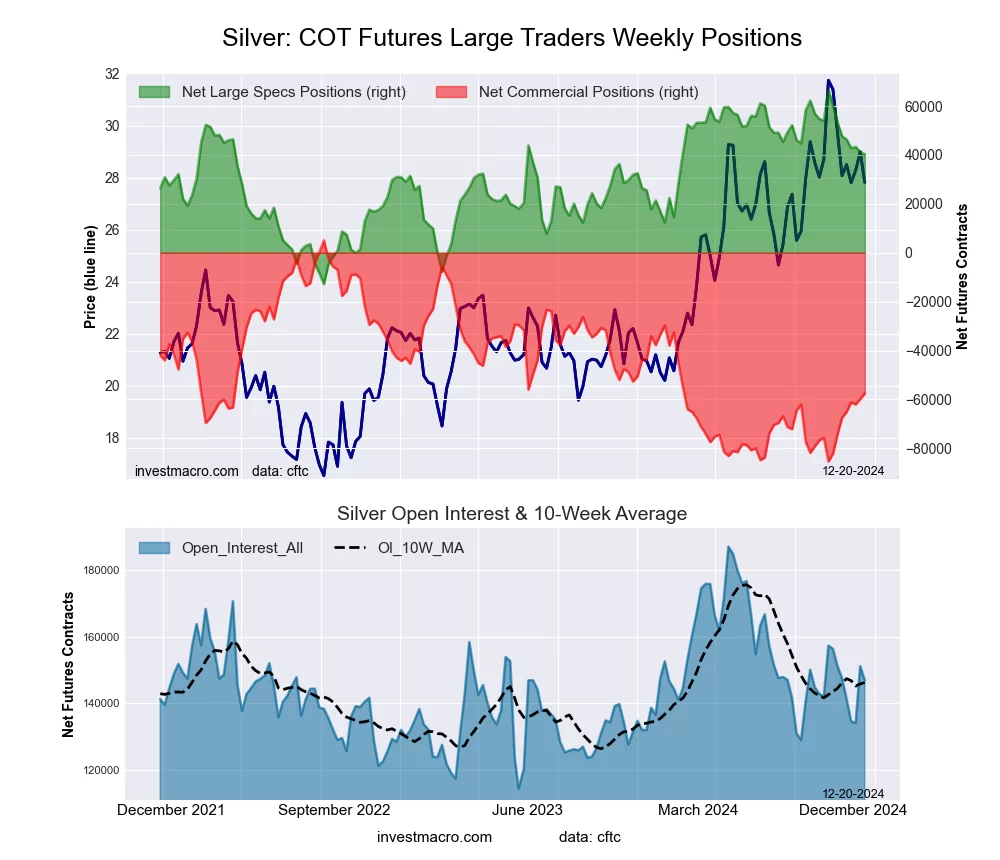
Gold Falls for the Fifth Consecutive Trading Session

By RoboForex Analytical Department 

On Thursday, the price of a troy ounce of Gold is lower, approaching 2,560.00 USD.

The current value of Gold is at an eight-week low, influenced by the strong US dollar. The market analyses the latest inflation statistics released in the US and draws rather ambitious conclusions.
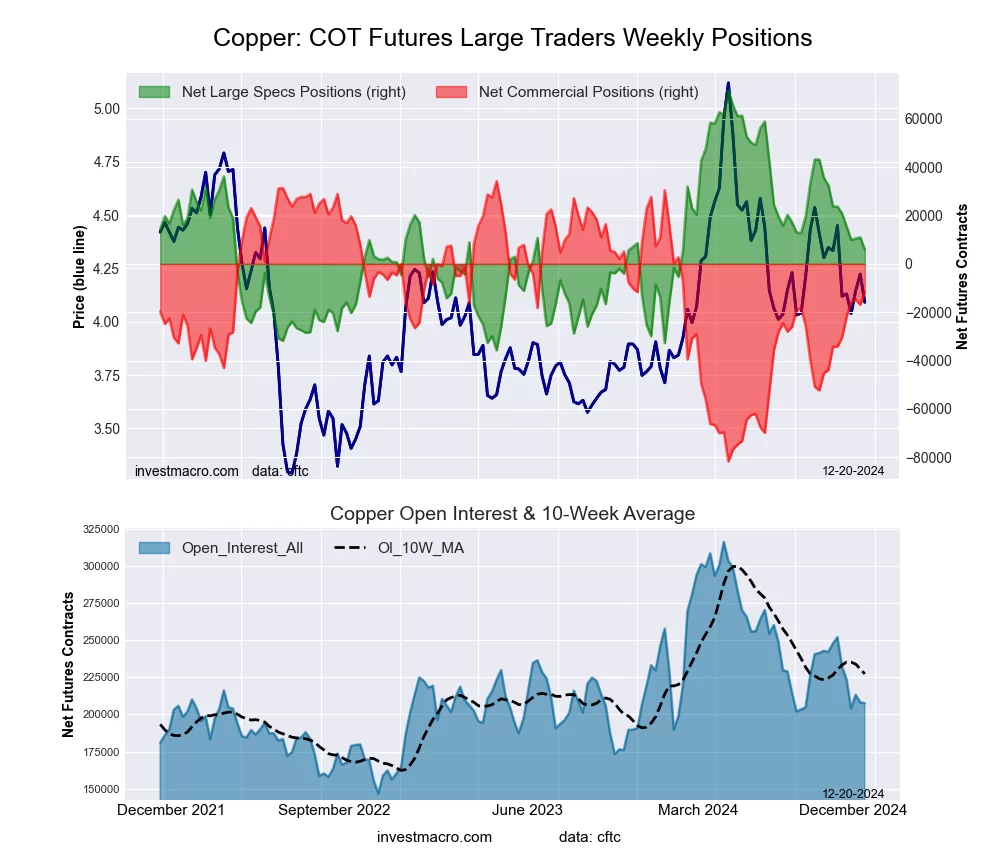
The inflation statistics came out within expectations. The only thing that might have hurt investors’ attention was the three-month inflation numbers, which rose on a year-on-year basis. Even so, the CPI data increases the likelihood of the Federal Reserve cutting interest rates in December. The odds of a rate cut are around 80%, up from less than 60% a couple of days ago.
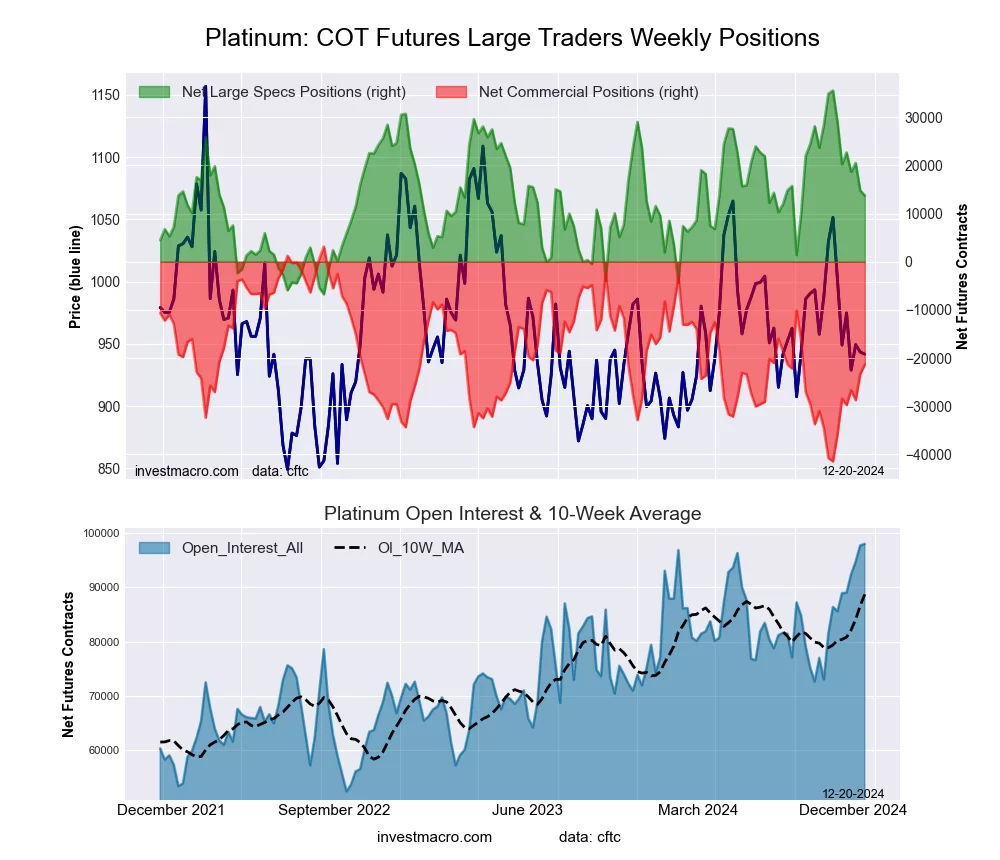
Since last Friday’s sell-off, the gold price has fallen by 4%. The stock exchange opinion is as follows: since Donald Trump will become the new US President, the Fed will be forced to stop the easing cycle sooner or later. This is due to the protectionist policies that Trump and his administration usually pursue, which can stoke inflation.

A strong US dollar will visibly weigh on the value of Gold and force the precious metal to retreat.

Technical analysis of XAUUSD

On the H4 chart of XAUUSD, the market has formed a consolidation range around the level of 2,608.00 and, with a downside exit, continues the development of the second half of the third wave of the trend to the level of 2511.65. After working off this level, we will consider the probability of the beginning of the correction wave to the level of 2,608.00 (test from below). After the correction is completed, we expect a new wave of decline to 2,430.00. Technically, this scenario is confirmed by the MACD indicator. Its signal line is under the zero level and is directed downwards.

On the H1 chart of XAUUSD, the market broke through the level of 2,590.00 downwards and reached 2,560.00. We expect the development of a compact consolidation range around this level. A correction link to 2,577.00 is possible in case of an upward exit. Conversely, in case of a downward exit, we will consider the continuation of the wave to the local target of 2,511.65. Technically, this scenario is confirmed by the Stochastic oscillator. Its signal line is under 50 and is directed downwards to 20.


Disclaimer

Any forecasts contained herein are based on the author’s particular opinion. This analysis may not be treated as trading advice. RoboForex bears no responsibility for trading results based on trading recommendations and reviews contained herein.

Countries spend huge sums on fossil fuel subsidies – why they’re so hard to eliminate

By Bruce Huber, University of Notre Dame 

Fossil fuels are the leading driver of climate change, yet they are still heavily subsidized by governments around the world.

Although many countries have explicitly promised to reduce fossil fuel subsidies to combat climate change, this has proven difficult to accomplish. As a result, fossil fuels remain relatively inexpensive, and their use and greenhouse gas emissions continue to grow.

I work in environmental and energy law and have studied the fossil fuel sector for years. Here’s how fossil fuel subsidies work and why they’re so stubborn.

What is a subsidy?

A subsidy is a financial benefit given by a government to an entity or industry. Some subsidies are relatively obvious, such as publicly funded crop insurance or research grants to help pharmaceutical companies develop new drugs.

Others are less visible. A tariff on an imported product, for example, can subsidize domestic manufacturers of that product. More controversially, some would argue that when a government fails to make an industry pay for damage it causes, such as air or water pollution, that also amounts to a subsidy.

Subsidies, especially in this broader sense, are widespread throughout the global economy. Many industries receive benefits through public policies that are denied to other industries in the same jurisdiction, such as tax breaks, relaxed regulations or trade supports.

Governments employ subsidies for political and practical reasons. Politically, subsidies are useful for striking bargains or shoring up political support. In democracies, they can mollify constituencies otherwise unwilling to agree to a policy change. The 2022 Inflation Reduction Act, for example, squeaked through Congress by subsidizing both renewable energy and oil and gas production.

Practically, subsidies can boost a promising young industry such as electric vehicles, attract business to a community or help a mature sector survive an economic downturn, as the auto industry bailout did in 2008. Of course, policies can outlive their original purpose; some of today’s petroleum subsidies can be traced to the Great Depression.

How are fossil fuels subsidized?

Fossil fuel subsidies take many forms around the world. For example:

  • In Saudi Arabia, fuel prices are set by the government rather than the market; price ceilings subsidize the price citizens pay for gasoline. The cost to state-owned oil producers there is offset by oil exports, which dwarf domestic consumption.
  • Indonesia also caps energy prices, then compensates state-owned energy companies for the losses they bear.
  • In the United States, oil companies can take a tax deduction for a large portion of their drilling costs.

Other subsidies are less direct, such as when governments underprice permits to mine or drill for fossil fuels or fail to collect all the taxes owed by fossil fuel producers.

Estimates of the total value of global fossil fuel subsidies vary considerably depending on whether analysts use a broad or narrow definition. The Organization for Economic Cooperation and Development, or OECD, calculated the annual total to be about US$1.5 trillion in 2022. Tche International Monetary Fund reported a number over four times higher, about $7 trillion.

Why do estimates of fossil fuel subsidies vary so dramatically?

Analysts disagree about whether subsidy tabulations should include environmental damage from the extraction and use of fossil fuels that is not incorporated into the fuel’s price. The IMF treats the costs of global warming, local air pollution and even traffic congestion and road damage as implicit subsidies because fossil fuel companies don’t pay to remedy these problems. The OECD omits these implicit benefits.

But whichever definition is applied, the combined effect of national policies on fossil fuel prices paid by consumers is dramatic.

Oil, for example, is traded on a global market, but the price per gallon of petrol varies enormously around the world, from about 10 cents in Iran, Libya and Venezuela – where it is heavily subsidized – to over $7 in Hong Kong, the Netherlands and much of Scandinavia, where fuel taxes counteract subsidies.

What is the world doing about fossil fuel subsidies?

Global leaders have acknowledged that subsidies for fossil fuels undermine efforts to address climate change because they make fossil fuels cheaper than they would be otherwise.

In 2009, the heads of the G20, which includes many of the world’s largest economies, issued a statement resolving to “rationalize and phase out over the medium term inefficient fossil fuel subsidies that encourage wasteful consumption.” Later that same year, the governments of the Asia-Pacific Economic Cooperation forum, or APEC, made an identical pledge.

In 2010, 10 other countries, including the Netherlands and New Zealand, formed the Friends of Fossil Fuel Subsidy Reform group to “build political consensus on the importance of fossil fuel subsidy reform.”

Yet these commitments have scarcely moved the needle. A major study of 157 countries between 2003 and 2015 found that governments “collectively made little or no progress” toward reducing subsidies. In fact, the OECD found that total global subsidies nearly doubled in both 2021 and 2022.

So why are fossil fuel subsidies hard to eliminate?

There are various reasons fossil fuel subsidies are hard to eliminate. Many subsidies directly affect the costs that fossil fuel producers face, so reducing subsidies tends to increase prices for consumers. Because fossil fuels touch nearly every economic sector, rising fuel costs elevate prices for countless goods and services.

Subsidy reform tends to be broadly felt and pervasively inflationary. And unless carefully designed, subsidy reductions can be regressive, forcing low-income residents to spend a larger percentage of their income on energy.

So, even in countries where there is widespread support for robust climate policies, reducing subsidies can be deeply unpopular and may even cause public unrest.

The 2021-22 spike in fossil fuel subsidies is illustrative. After Russia’s invasion of Ukraine, energy prices surged throughout Europe. Governments were quick to provide aid for their citizens, resulting in their largest fossil fuel subsidies ever. Forced to choose between climate goals and affordable energy, Europe overwhelmingly chose the latter.

Of course, economists note that increasing the price of fossil fuels can lower demand, reducing emissions that are driving climate change and harming the environment and human health. Seen in that light, price spikes present an opportunity for reform. As the IMF noted, when prices recede after a surge, it “provide[s] an opportune time to lock in pricing of carbon and local air pollution emissions without necessarily raising energy prices above recently experienced levels.”The Conversation

About the Author:

Bruce Huber, Professor of Law, University of Notre Dame

This article is republished from The Conversation under a Creative Commons license. Read the original article.