5 Large Cap Stocks are latest to be added to Watchlist in Q1 2025

By InvestMacro Research

The first quarter of 2025 is underway and we wanted to highlight some of the top companies that have been added to our Cosmic Rays Watchlist in the past week. The Cosmic Rays Watchlist is the output from our proprietary fundamental analysis algorithm.

The algo examines company fundamental metrics, earnings trends and overall sector strength trends. The aim is identify quality dividend-paying companies on the NYSE and Nasdaq stock exchanges. If a company scores over 50, it gets added to our Watchlist for further analysis.

We use this system as a stock market ideas generator and to update our Watchlist every quarter. However, be aware the fundamental system does not take the stock price as a direct element in our rating so one must compare each idea with their current stock prices (this is not a timing tool).

Many studies are consistently showing overvalued markets and that has to be taken into consideration with any stock market idea.

As with all investment ideas, past performance does not guarantee future results. A stock added to our list is not a recommendation to buy or sell the security.

Here we go with 5 of our Top Stocks scored in Q1 2025:


The Hartford Financial Services Group, Inc. (HIG):

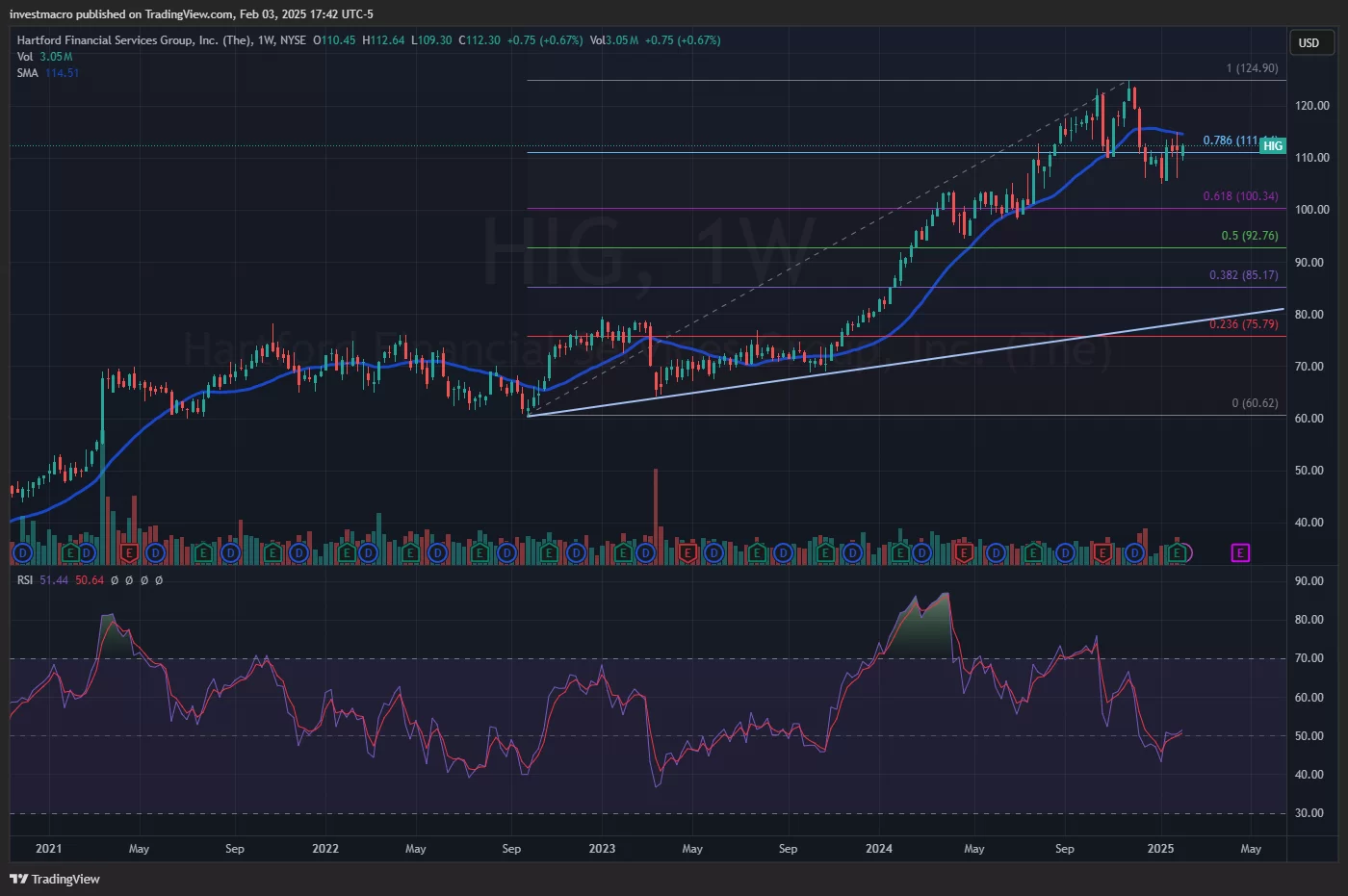
The Hartford Financial Services Group, Inc. (Symbol: HIG) was recently added to our Cosmic Rays WatchList. HIG scored a 66 in our fundamental rating system on February 3rd.

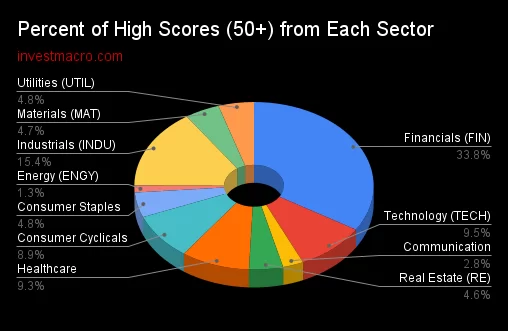
At time of writing, only 4.67% of stocks have scored a 60 or better out of a total of 11,112 scores in our earnings database. HIG has been a staple on our list, making the Watchlist a total of 7 times and the company’s score rose by 1 point from our last update. HIG is a Large Cap stock and part of the Financial Services sector. The industry focus for HIG is Insurance – Diversified.

HIG has beat earnings-per-share expectations two out of the past three quarters and has a dividend of close to 1.85 percent with a payout ratio near 20 percent. The HIG stock price has slightly under-performed the Financial Sector benchmark over the past 52 weeks with a 27.61 percent rise compared to the 31.35 benchmark return.

Company Description (courtesy of SEC.gov):

The Hartford Financial Services Group, Inc. provides insurance and financial services to individual and business customers in the United States, the United Kingdom, and internationally.

Company Website: https://www.thehartford.com


Asset vs Sector Benchmark:*P/E Ratio (TTM)*52-Week Price Return*Beta (S&P500)
– Stock: The Hartford Financial Services Group, Inc. (HIG)10.927.610.94
– Benchmark Symbol: XLF18.131.351.0


* Data through February 03, 2025


Northrop Grumman Corporation (NOC):

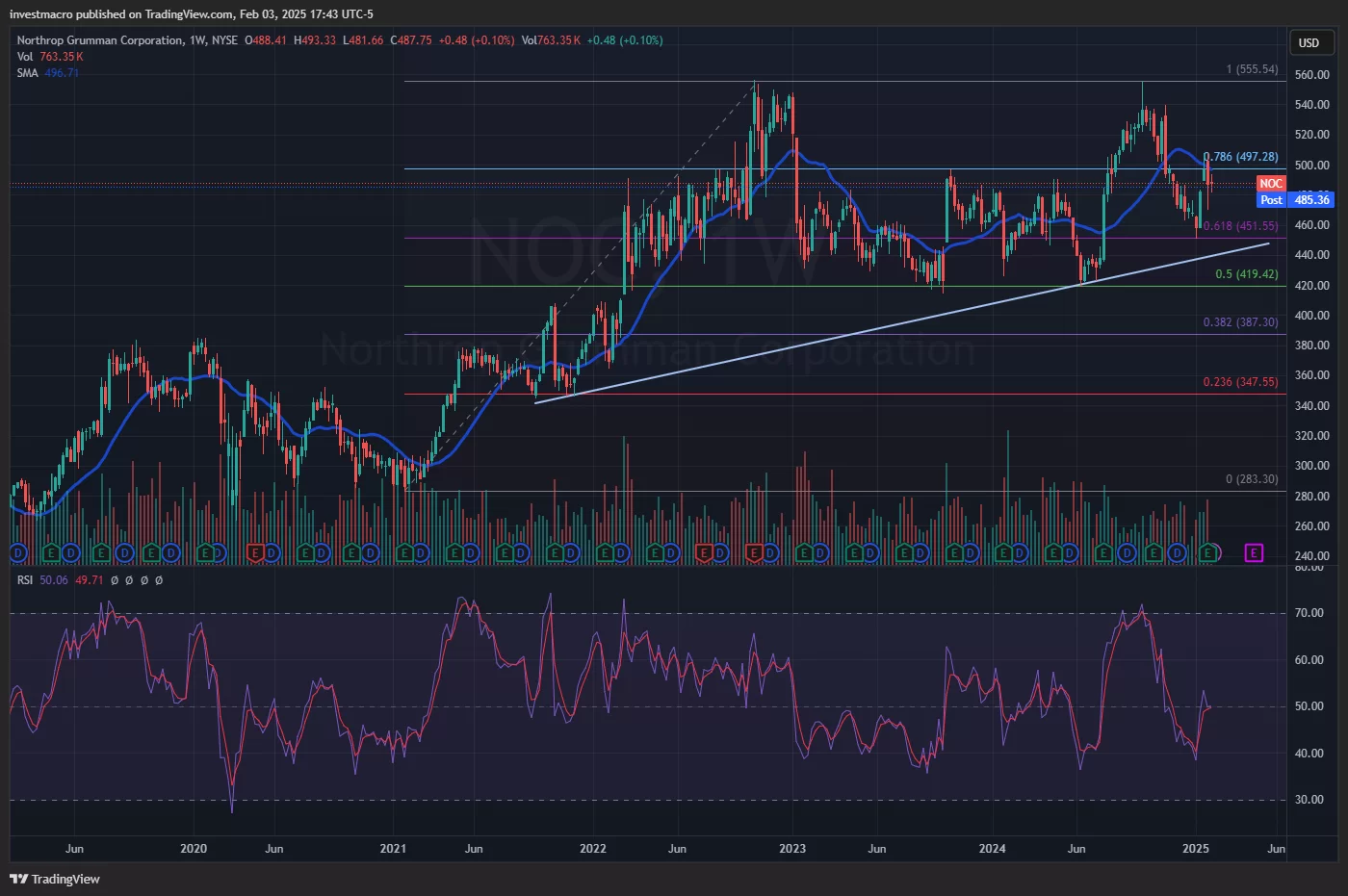
Northrop Grumman Corporation (Symbol: NOC) was recently added to our Cosmic Rays WatchList. NOC scored a 58 in our fundamental rating system on February 3rd.

At time of writing, only 8.03% of stocks have scored a 50 or better out of a total of 11,112 scores in our earnings database. This stock has made our Watchlist a total of 2 times and jumped by 113 system points from our last update. NOC is a Large Cap stock and part of the Industrials sector. The industry focus for NOC is Aerospace & Defense.

NOC has beat the earnings-per-share expectations in the past four quarters. Northrop’s dividend is currently at 1.68 percent and has a payout ratio around 30 percent at time of writing. The stock price has under-performed the Industrials Sector benchmark over the past 52 weeks with a 11.27 percent gain compared to the 21.27 benchmark return.

Company Description (courtesy of SEC.gov):

Northrop Grumman Corporation operates as an aerospace and defense company worldwide. The company’s Aeronautics Systems segment designs, develops, manufactures, integrates, and sustains aircraft systems.

Company Website: https://www.northropgrumman.com


Asset vs Sector Benchmark:*P/E Ratio (TTM)*52-Week Price Return*Beta (S&P500)
– Stock: Northrop Grumman Corporation (NOC)17.211.270.35
– Benchmark Symbol: XLI26.121.271.1


* Data through February 03, 2025


Teradyne, Inc. (TER):

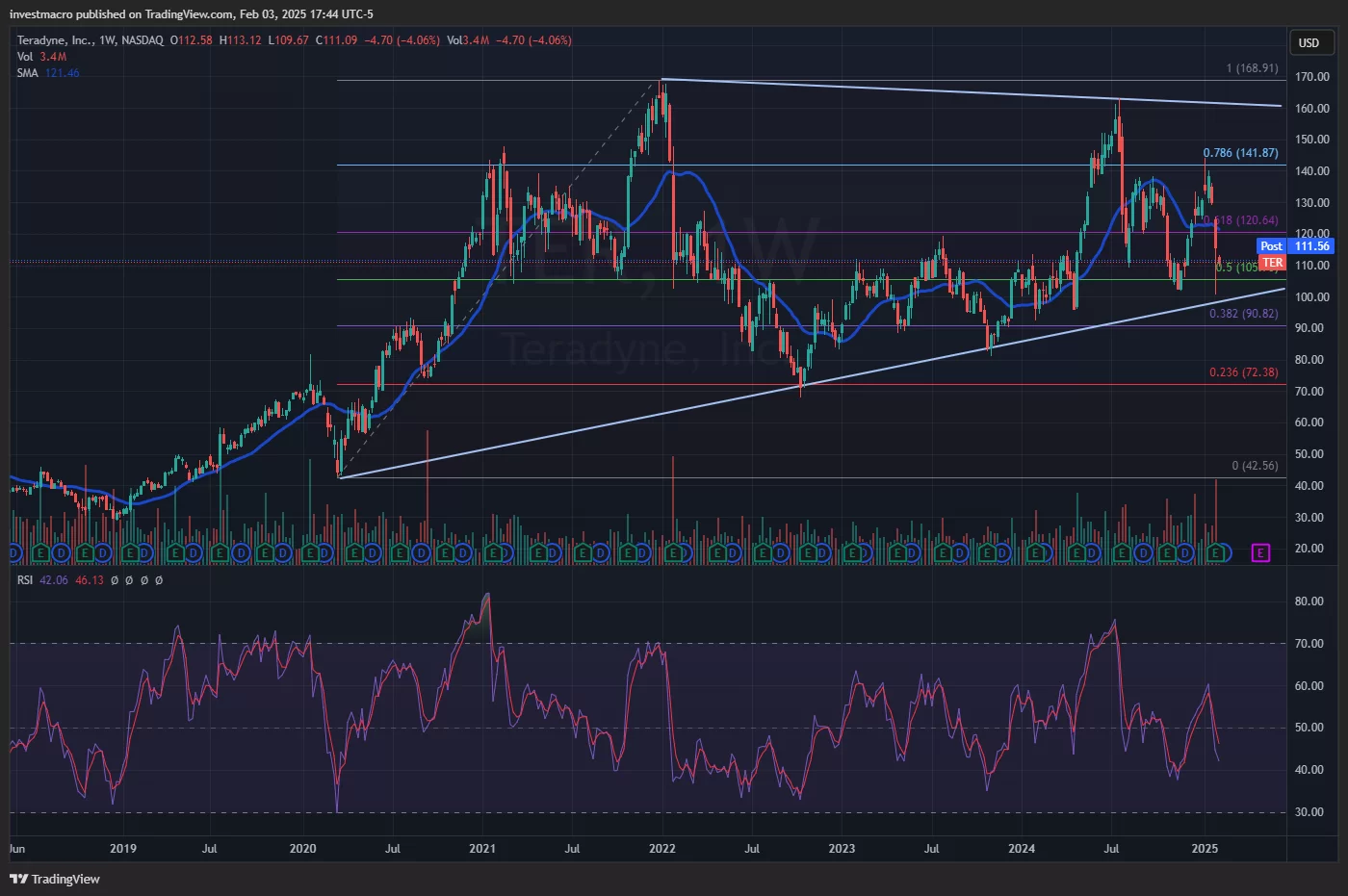
Teradyne, Inc. (Symbol: TER) was recently added to our Cosmic Rays WatchList. TER scored a 50 in our fundamental rating system on January 31st.

At time of writing, only 8.03% of stocks have scored a 50 or better out of a total of 11,112 scores in our earnings database. This stock has never been on our Watchlist previously and rose by 76 system points from our last update. TER is a Large Cap stock and part of the Technology sector. The industry focus for TER is Semiconductors.

Teradyne has beat the earnings-per-share expectations in each of the past four quarters. TER’s dividend is currently a modest 0.43 percent and has a payout ratio of around just 14 percent at time of writing. The stock price has under-performed the Technology Sector benchmark over the past 52 weeks with a 10.71 percent gain compared to the 14.25 benchmark return.

Company Description (courtesy of SEC.gov):

Teradyne, Inc. designs, develops, manufactures, sells, and supports automatic test equipment worldwide. The company operates through Semiconductor Test, System Test, Industrial Automation, and Wireless Test segments.

Company Website: https://www.teradyne.com


Asset vs Sector Benchmark:*P/E Ratio (TTM)*52-Week Price Return*Beta (S&P500)
– Stock: Teradyne, Inc. (TER)33.510.711.52
– Benchmark Symbol: XLK36.914.251.2


* Data through February 03, 2025


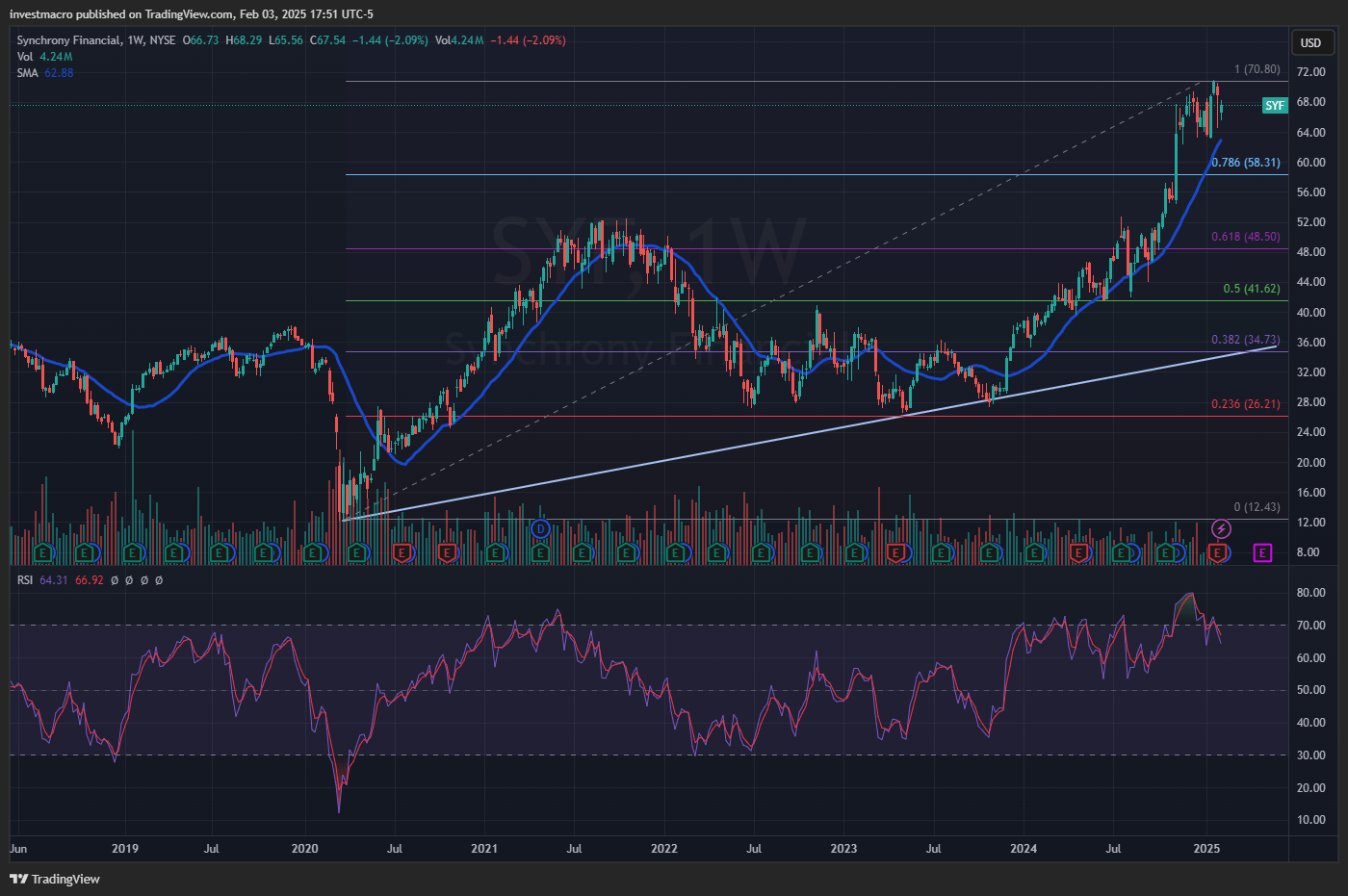
Synchrony Financial (SYF):

Synchrony Financial (Symbol: SYF) was recently added to our Cosmic Rays WatchList. SYF scored a 68 in our fundamental rating system on January 30th.

At time of writing, only 4.67% of stocks have scored a 60 or better out of a total of 11,112 scores in our earnings database. This stock has been on our Watchlist a total of 7 times and rose by 6 system points from our last update. SYF is a Large Cap stock and part of the Financial Services sector. The industry focus for SYF is Financial – Credit Services.

SYF missed their earnings-per-share expectations this quarter after beating expectations in the previous three quarters. Synchrony’s dividend is currently at approximately 1.50 percent and has a payout ratio of around just 12 percent at time of writing. The stock price has outperformed the Financial Sector benchmark over the past 52 weeks with a whopping 74.13 percent gain compared to the 31.35 percent benchmark return. SYF is currently trading near the top of its range with a recent overbought level on the weekly relative strength index (RSI).

Company Description (courtesy of SEC.gov):

Synchrony Financial, together with its subsidiaries, operates as a consumer financial services company in the United States. It provides credit products, such as credit cards, commercial credit products, and consumer installment loans.

Company Website: https://www.synchrony.com


Asset vs Sector Benchmark:*P/E Ratio (TTM)*52-Week Price Return*Beta (S&P500)
– Stock: Synchrony Financial (SYF)7.974.131.59
– Benchmark Symbol: XLF18.131.351.0


* Data through February 03, 2025


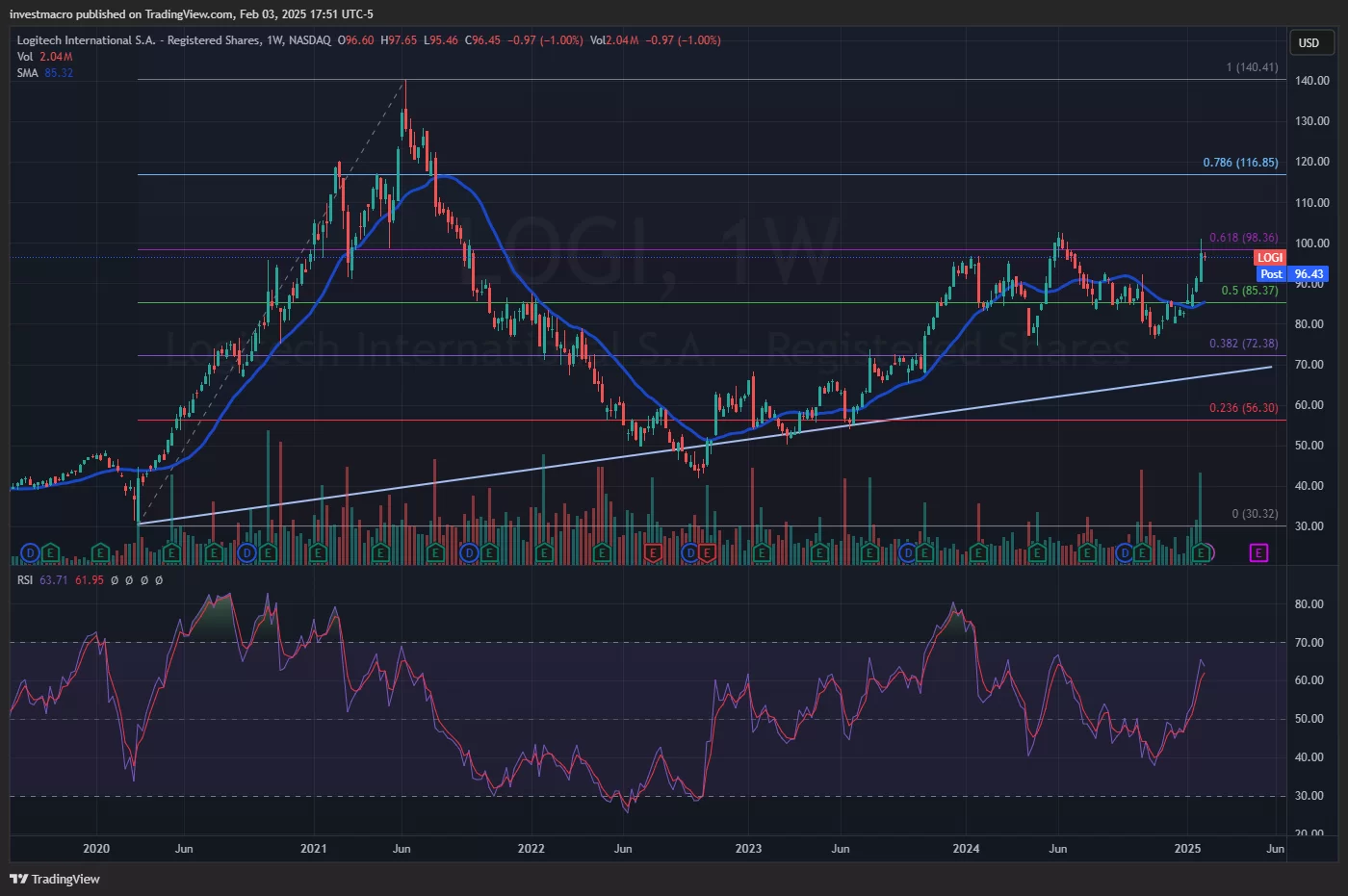
Logitech International S.A. (LOGI):

Logitech International S.A. (Symbol: LOGI) was recently added to our Cosmic Rays WatchList. LOGI scored a 65 in our fundamental rating system on January 30th.

At time of writing, only 4.67% of stocks have scored a 60 or better out of a total of 11,112 scores in our earnings database. This stock has made our Watchlist a total of 3 times and rose by 48 system points from our last update. LOGI is a Large Cap stock and part of the Technology sector. The industry focus for LOGI is Computer Hardware.

Logitech has beaten the earnings-per-share expectations for each of the past four quarters and has a dividend of close to 1.40 percent with a payout ratio currently near 28 percent. The LOGI stock price has ever-so-slightly outperformed the Technology Sector benchmark over the past 52 weeks with a 15.37 percent rise compared to the 14.25 percent benchmark return.

Company Description (courtesy of SEC.gov):

Logitech International S.A., through its subsidiaries, designs, manufactures, and markets products that connect people to digital and cloud experiences worldwide. The company offers pointing devices, such as wireless mouse; corded and cordless keyboards, living room keyboards, and keyboard-and-mouse combinations; PC webcams; and keyboards for tablets and smartphones, as well as other accessories for mobile devices.

Company Website: https://www.logitech.com


Asset vs Sector Benchmark:*P/E Ratio (TTM)*52-Week Price Return*Beta (S&P500)
– Stock: Logitech International S.A. (LOGI)22.715.370.56
– Benchmark Symbol: XLK36.914.251.2


* Data through February 03, 2025


By InvestMacro – Be sure to join our stock market newsletter to get our updates and to see more top companies we add to our stock watch list.

All information, stock ideas and opinions on this website are for general informational purposes only and do not constitute investment advice. Stock scores are a data driven process through company fundamentals and are not a recommendation to buy or sell a security. Company descriptions provided by sec.gov.

AI gives nonprogrammers a boost in writing computer code

By Leo Porter, University of California, San Diego and Daniel Zingaro, University of Toronto 

What do you think there are more of: professional computer programmers or computer users who do a little programming?

It’s the second group. There are millions of so-called end-user programmers. They’re not going into a career as a professional programmer or computer scientist. They’re going into business, teaching, law, or any number of professions – and they just need a little programming to be more efficient. The days of programmers being confined to software development companies are long gone.

If you’ve written formulas in Excel, filtered your email based on rules, modded a game, written a script in Photoshop, used R to analyze some data, or automated a repetitive work process, you’re an end-user programmer.

As educators who teach programming, we want to help students in fields other than computer science achieve their goals. But learning how to program well enough to write finished programs can be hard to accomplish in a single course because there is so much to learn about the programming language itself. Artificial intelligence can help.

Lost in the weeds

Learning the syntax of a programming language – for example, where to place colons and where indentation is required – takes a lot of time for many students. Spending time at the level of syntax is a waste for students who simply want to use coding to help solve problems rather than learn the skill of programming.

As a result, we feel our existing classes haven’t served these students well. Indeed, many students end up barely able to write small functions – short, discrete pieces of code – let alone write a full program that can help make their lives better.

Tools built on large language models such as GitHub Copilot may allow us to change these outcomes. These tools have already changed how professionals program, and we believe we can use them to help future end-user programmers write software that is meaningful to them.

These AIs almost always write syntactically correct code and can often write small functions based on prompts in plain English. Because students can use these tools to handle some of the lower-level details of programming, it frees them to focus on bigger-picture questions that are at the heart of writing software programs. Numerous universities now offer programming courses that use Copilot.

At the University of California, San Diego, we’ve created an introductory programming course primarily for those who are not computer science students that incorporates Copilot. In this course, students learn how to program with Copilot as their AI assistant, following the curriculum from our book. In our course, students learn high-level skills such as decomposing large tasks into smaller tasks, testing code to ensure its correctness, and reading and fixing buggy code.

Freed to solve problems

In this course, we’ve been giving students large, open-ended projects and couldn’t be happier with what they have created.

For example, in a project where students had to find and analyze online datasets, we had a neuroscience major create a data visualization tool that illustrated how age and other factors affected stroke risk. Or, for example, in another project, students were able to integrate their personal art into a collage, after applying filters that they had created using the programming language Python. These projects were well beyond the scope of what we could ask students to do before the advent of large language model AIs.

Given the rhetoric about how AI is ruining education by writing papers for students and doing their homework, you might be surprised to hear educators like us talking about its benefits. AI, like any other tool people have created, can be helpful in some circumstances and unhelpful in others.

In our introductory programming course with a majority of students who are not computer science majors, we see firsthand how AI can empower students in specific ways – and promises to expand the ranks of end-user programmers.The Conversation

About the Author:

Leo Porter, Teaching Professor of Computer Science and Engineering, University of California, San Diego and Daniel Zingaro, Associate Professor of Mathematical and Computational Sciences, University of Toronto

This article is republished from The Conversation under a Creative Commons license. Read the original article.


Trump suspended planned tariffs on Mexico and Canada after talks with their leaders

By JustMarkets

On Monday’s close, the Dow Jones Index (US30) was down 0.28%. The S&P 500 Index (US500) decreased by 0.76%. The Nasdaq Technology Index (US100) fell by 0.84%. Global stock markets came under pressure on Monday after President Trump on Saturday announced 25% tariffs on Canada and Mexico and 10% tariffs on China, and warned of impending European tariffs. The tariffs were due to take effect on Tuesday and could spark a trade war that threatens economic growth around the world. Goldman Sachs warned there was a risk of a 5% drop in US stocks due to the hit to corporate earnings, while RBC Capital Markets estimated a 5% to 10% drop in stocks. However, stocks recovered more than half of their losses after President Trump agreed late in the day to suspend planned tariffs on Mexico and Canada for a month after successful talks with their leaders.

The Canadian dollar strengthened to 1.45 per US dollar in February, rising from its lowest level in two years, after Prime Minister Trudeau confirmed that the imposition of US tariffs on Canadian goods would be suspended for at least 30 days. The postponement alleviated immediate concerns over potential trade disruptions, which had pressured the loonie due to fears of lower demand for Canadian exports and restricted foreign exchange inflows. Despite this, the CAD remains under pressure as Canadian GDP growth in December was just 0.2%, leaving the annualized growth rate for 2024 at a modest 1.4%.

The Mexican peso (USD/MXN) strengthened to 20.5 per US dollar, recovering after briefly falling to a three-year low after US President Trump delayed the imposition of tariffs against Mexico announced over the weekend. The US president cited talks with Mexican counterpart Sheinbaum and progress on the border issue, supporting bets that the restrictions will be avoided by the new deadline.

Equity markets in Europe were mostly down yesterday. Germany’s DAX (DE40) fell by 1.40%, France’s CAC 40 (FR40) closed down 1.20%, Spain’s IBEX 35 (ES35) lost 1.32%, and the UK’s FTSE 100 (UK100) closed down 1.04%.

WTI crude oil prices trimmed gains and traded near $73 per barrel after OPEC+ confirmed a gradual increase in production and removed the US Energy Information Administration (EIA) from its list of sources for monitoring production. The decision follows past tensions between OPEC+ and President Trump, who has previously pressured the group to increase supply to offset US sanctions on Iran. Since returning to office, Trump has again urged OPEC to release more oil, arguing that high prices support Russia’s war in Ukraine.

Silver (XAG/USD) topped $31.5 an ounce on Monday, near its highest since early December, amid easing trade war fears and optimism about improving demand for manufactured goods. Meanwhile, strong manufacturing data from ISM pointed to welcome momentum in US factory activity, which supported silver’s prospects as industrial demand, especially in electrification technologies. On the supply side, the Silver Institute recently predicted a fifth consecutive year of significant market shortages of the metal in 2025, driven by strong industrial demand and retail investment.

Asian markets were mostly falling yesterday. Japan’s Nikkei 225 (JP225) was down 2.66%, China’s FTSE China A50 (CHA50) lost 0.37%, Hong Kong’s Hang Seng (HK50) was 0.04% cheaper, and Australia’s ASX 200 (AU200) was negative 1.79%.

US President Donald Trump is set to speak to his Chinese counterpart Xi Jinping as early as this week as the two major economies work towards a deal to avoid wider trade tensions. On Monday, Beijing called on Washington for “frank dialogue and strengthened cooperation,” stressing that the tariffs are counterproductive and harmful to normal trade relations. Beijing also plans to sue the World Trade Organization.

S&P 500 (US500) 5,994.57 −45.96 (−0.76%)

Dow Jones (US30) 44,421.91 −122.75 (−0.28%)

DAX (DE40) 21,428.24 −303.81 (−1.40%)

FTSE 100 (UK100) 8,583.56 −90.40 (−1.04%)

USD Index 108.81 +0.44 (+0.41%)

News feed for: 2025.02.04

  • US JOLTs Job Openings (m/m) at 17:00 (GMT+2);
  • New Zealand Unemployment Rate (q/q) at 23:45 (GMT+2).

By JustMarkets


This article reflects a personal opinion and should not be interpreted as an investment advice, and/or offer, and/or a persistent request for carrying out financial transactions, and/or a guarantee, and/or a forecast of future events.

Australian Dollar Recovers, But Risks Remain High

By RoboForex Analytical Department 

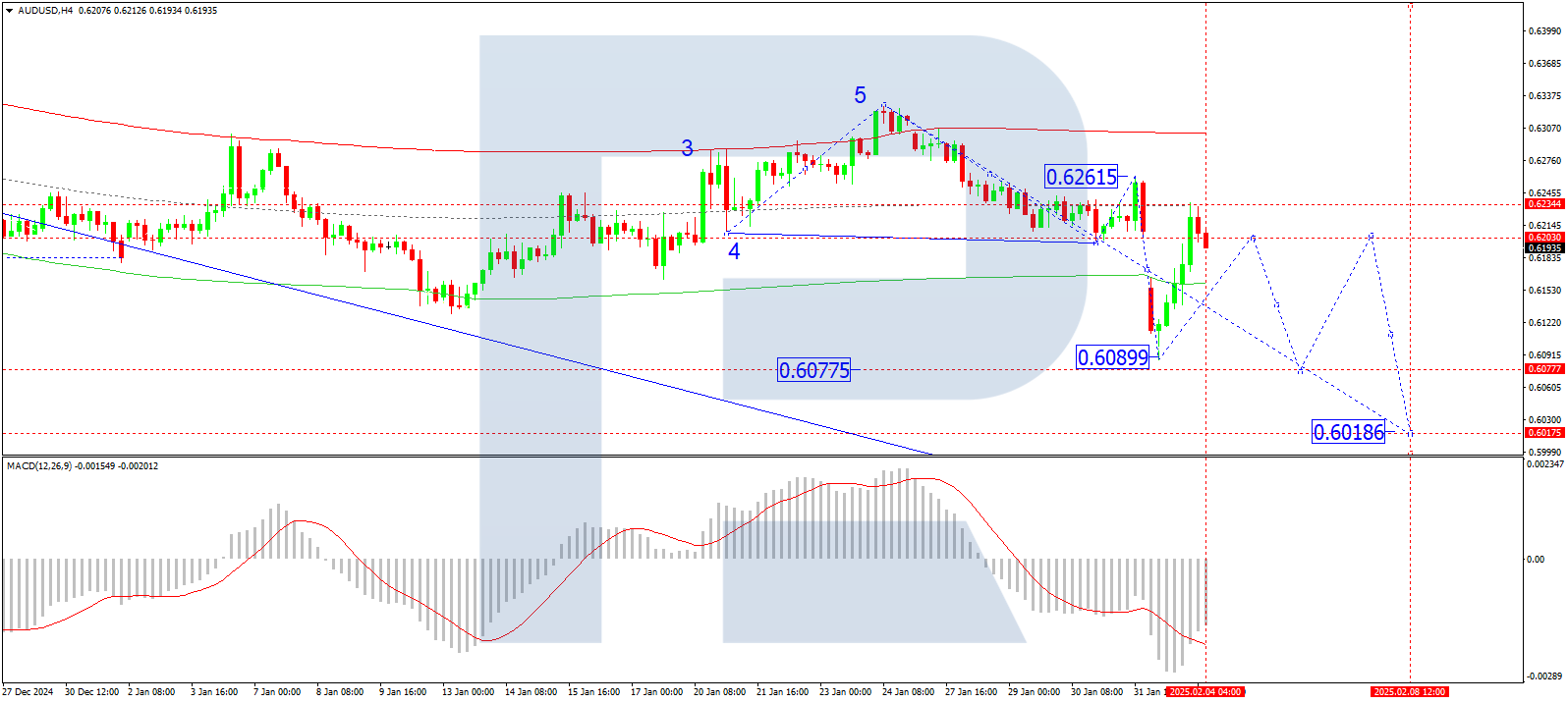
The AUD/USD pair rebounded to 0.6199 on Tuesday, recovering some losses. Earlier in the week, the Australian dollar tested multi-year lows as investors distanced themselves from riskier assets amid concerns over US tariffs on Canada, Mexico, and China.

A reprieve came as US President Donald Trump delayed the implementation of tariffs on Canada and Mexico for one month while negotiating with both countries. This pause improved sentiment for risk currencies, including the Australian dollar.

Key factors influencing AUD/USD

Despite this temporary relief, uncertainty remains, particularly regarding China, Australia’s largest trading partner. The newly announced US tariffs on Chinese goods take effect today, which could have significant economic consequences. Any updates related to China directly impact Australia’s economy and currency movements.

Adding to the uncertainty, Trump is set to meet with Chinese President Xi Jinping this week. While China is keen to avoid escalating trade tensions, the US administration will likely use the situation strategically to its advantage. The outcome of these discussions could shape risk sentiment in global markets.

On the domestic front, Australia’s trade balance data for December is scheduled for release on Thursday. This report will provide insights into the health of Australia’s export-driven economy and could influence the Reserve Bank of Australia’s (RBA) policy stance.

Technical analysis of AUD/USD

On the H4 chart, AUD/USD previously formed a downside wave to 0.6088, followed by a correction to 0.6233. Today, the market is expected to initiate another downward wave towards 0.6077. A potential corrective move back to 0.6230 may follow, forming a consolidation range. If the pair breaks upwards from this range, another correction towards 0.6290 is possible. However, if it breaks downwards, the downward wave to 0.6077 will likely continue. The MACD indicator supports this scenario, with its signal line positioned above the zero mark but pointing sharply downwards, indicating strong bearish momentum.

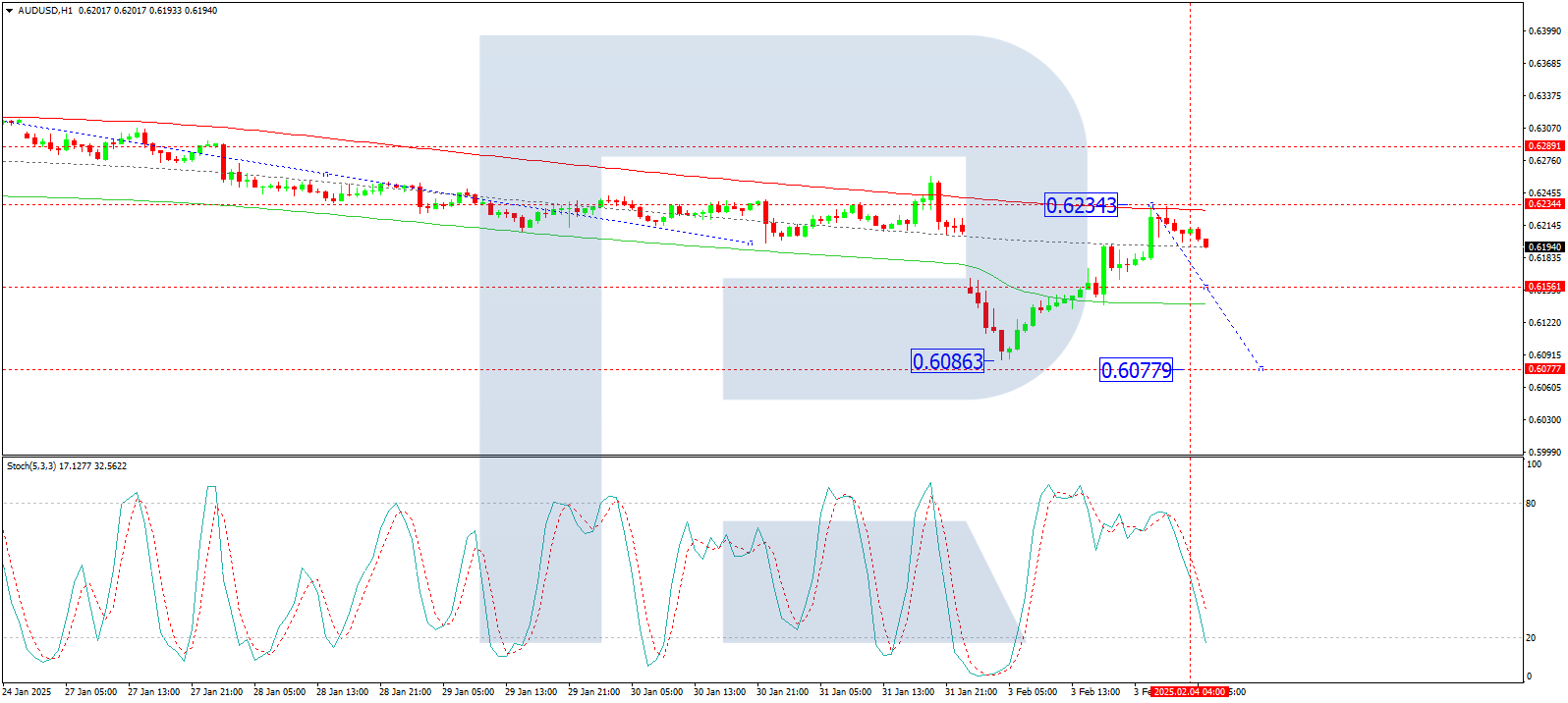
On the H1 chart, AUD/USD established a consolidation range near 0.6160 before breaking upwards to complete a correction at 0.6230. The next move is expected to be a new downward wave targeting 0.6150. If this level is breached, the pair could extend losses towards 0.6077. The Stochastic oscillator confirms this bearish outlook, with its signal line below 80 and trending downwards towards 20, indicating growing downside pressure.

Conclusion

The Australian dollar has staged a modest recovery, but risks remain elevated due to ongoing US-China trade tensions and uncertainty surrounding Australia’s economic outlook. While short-term technical indicators suggest the potential for further downside, the key levels to watch are 0.6150 and 0.6077. Market participants will closely monitor Trump’s meeting with Xi Jinping and Australia’s trade balance data for further directional cues.


Disclaimer

Any forecasts contained herein are based on the author’s particular opinion. This analysis may not be treated as trading advice. RoboForex bears no responsibility for trading results based on trading recommendations and reviews contained herein.

Trump’s tariff policy could lead to trade wars between key economies

By JustMarkets 

As of Friday, the Dow Jones (US30) was down 0.75% (for the week +0.90%). The S&P500 Index (US500) decreased by 0.50% (for the week +1.20%). The Nasdaq Technology Index (US100) is down 0.14% (for the week +2.28%). Stocks gave up an early rally on Friday and declined moderately. The long liquidation in stocks emerged on Friday afternoon when the White House denied a Reuters report that President Trump would delay imposing tariffs against Canada and Mexico until March 1.

Relations between longtime allies the US and Canada, which has the world’s longest land border, have reached a new low. Canadian Prime Minister Trudeau said he was imposing tariffs on 155 billion Canadian dollars ($107 billion) worth of US goods. He said tariffs on 30 billion Canadian dollars will take effect Tuesday, the same day as Trump’s tariffs, and duties on the remaining 125 billion Canadian dollars 21 days later. Trudeau’s announcement came just hours after Trump imposed 25 percent tariffs on Canadian and Mexican imports and 10 percent on goods from China, creating the risk of a trade war that economists say could slow global growth and stoke inflation.

The tariffs pose a significant threat to the commodity-linked CAD, as they could reduce currency demand and limit foreign exchange inflows. These tariff risks also add to pessimism about Mexico’s economic outlook, especially after its GDP contracted by 0.6% in Q4 2024. Meanwhile, diverging monetary policies between the hawkish US Federal Reserve and Mexico’s central bank, expected to cut rates further to stimulate economic recovery, have narrowed the yield differential, adding pressure on MXN.

Equity markets in Europe were mostly up on Friday. Germany’s DAX (DE40) rose by 0.02% (for the week +2.50%), France’s CAC 40 (FR40) closed up 0.11% (for the week +0.97%), Spain’s IBEX 35 (ES35) index fell by 0.41% (for the week +4.00%), and the UK’s FTSE 100 (UK100) closed 0.31% (for the week +2.02%) on Friday. The DAX index closed without significant changes on Friday, setting a new record high. Market participants were assessing key inflation data from Europe and the US and the latest corporate earnings reports. In Germany and France, core inflation came in below forecasts, indicating that price pressures are easing and reinforcing expectations that the ECB will continue to cut rates this year.

WTI crude oil prices rose to around $73.8 a barrel on Monday after US President Donald Trump imposed tariffs against Canada, Mexico, and China, raising concerns about possible supply disruptions. However, crude oil prices could face downward pressure in the near term. Imposing tariffs and subsequent retaliatory measures could trigger a wider trade war, hurting global economic growth and reducing energy demand.

Asian markets were predominantly up last week. Japan’s Nikkei 225 (JP225) fell by 2.59%, China’s FTSE China A50 (CHA50) gained 0.44%, Hong Kong’s Hang Seng (HK50) rose by 0.91%, and Australia’s ASX 200 (AU200) posted a positive 1.21% for the week. Hong Kong stocks fell 1.3% in early trading at the start of the new month, reversing gains from the previous three sessions when trading resumed after the New Year holiday amid widespread sector losses. Over the weekend, investors reacted as Donald Trump imposed sweeping tariffs against several countries, including China. Meanwhile, Beijing announced plans to challenge Trump’s decision at the WTO and take other countermeasures, adding to fears of a trade dispute between the two countries.

The Australian dollar fell about 2% to below $0.61, hitting its lowest since April 2020. New US tariffs heightened fears about a global trade war, triggering a sell-off in risk assets. While Australia has not been directly impacted by the new US tariffs, its economy, which relies heavily on exports and free trade, remains vulnerable to disruptions in global trade. Meanwhile, data showed a 0.1% decline in Australian retail sales for December, the first drop in nine months. The slowdown has further supported expectations of a dovish stance by the Reserve Bank of Australia, with many analysts predicting rate cuts could begin as early as this month.

On Monday, the New Zealand dollar fell by 2% to US$0.553, its lowest level since March 2020, as the threat of a global trade war weighed on risk sentiment. In addition, the Kiwi weakened further after China’s manufacturing PMI fell below expectations as China is New Zealand’s key trading partner. The prospect of further rate cuts by the Reserve Bank of New Zealand also weighed on the currency. The market is pricing in a 50 bps rate cut to 3.75% at the February 19 meeting and forecasts a rate cut to 3% over the next 12 months.

Indonesia’s annualized inflation rate for January 2025 fell to 0.76% from December’s 1.57%, the lowest since March 2000. Core inflation, which excludes managed and volatile food prices, accelerated to an 18-month high of 2.36%, beating growth estimates of 2.30%.

S&P 500 (US500) 6,040.53 −30.64 (−0.50%)

Dow Jones (US30) 44,544.66 −337.47 (−0.75%)

DAX (DE40) 21,732.05 +4.85 (+0.02%)

FTSE 100 (UK100) 8,673.96 +27.08 (+0.31%)

USD index 108.50 +0.70 (+0.65%)

News feed for: 2025.02.03

  • Australia Manufacturing PMI (m/m) at 00:00 (GMT+2);
  • Australia Retail Sales (m/m) at 02:30 (GMT+2);
  • Japan Manufacturing PMI (m/m) at 02:30 (GMT+2);
  • China Caixin Manufacturing PMI (m/m) at 03:45 (GMT+2);
  • Switzerland Manufacturing PMI (m/m) at 10:30 (GMT+2);
  • German Manufacturing PMI (m/m) at 10:55 (GMT+2);
  • Eurozone Manufacturing PMI (m/m) at 11:00 (GMT+2);
  • UK Manufacturing PMI (m/m) at 11:00 (GMT+2);
  • Eurozone Consumer Price Index (m/m) at 12:00 (GMT+2);
  • OPEC+ meeting at 13:00 (GMT+2);
  • US ISM Manufacturing PMI (m/m) at 17:00 (GMT+2).

By JustMarkets


This article reflects a personal opinion and should not be interpreted as an investment advice, and/or offer, and/or a persistent request for carrying out financial transactions, and/or a guarantee, and/or a forecast of future events.

Trump Tariffs: How are markets reacting? Here are 3 lessons for traders

By ForexTime 

  • Starting Feb 4th: 25% tariffs on Canada and Mexico; 10% on China
  • Dollar index (USDInd) returns towards 2-year high around 110.0
  • Canadian Dollar (CAD) tumbles to weakest against USD since 2003
  • NZD, AUD – China proxies – lead G10 declines against US dollar
  • Mexican Peso (MXN) sinks to near 3-year low (since March 2022)
  • Offshore Chinese Yuan (CNH) down 0.3%; all Asian currencies lower vs. USD
  • Gold falters from record high; US crude oil pares initial spike
  • US, European, Chinese stock indexes gapped down
  • Bitcoin briefly sank below $92k; smaller cryptos see double-digit declines
  • 3 Lessons: Traders must stay alert, have adequate capital, and move fast to seize on potential market opportunities


President Trump is following through on his tariff threats!

Starting 12:01 AM Eastern Standard time (5:01 AM GMT) on February 4th, 2025, the following levies will be imposed on US-bound imports from:

  • Canada = 25% (except energy products)
  • Mexico = 25%
  • China = 10%

Also, President Trump warned that tariffs against the EU “will definitely happen”.

Although POTUS intends to hold talks with Canada and Mexico later today, it would require something dramatic over the coming hours for Trump to reverse his decision before 12:01 AM EST.

The prospects of tit-for-tat trade wars, and a souring global economy, are hurting riskier assets across global financial markets.


How are markets reacting?

February has indeed kicked off with a bang, considering the incoming economy-dampening tariffs:


Currencies:

  • The US dollar index (USDInd)

    • soared back closer to its 2-year high around the psychological 110.0 mark.
    • skyrocketed as much as 1.3%, and if it holds, would be its biggest one-day gain since November 2024.
    • US dollar is widely seen as a “safe haven”, which helps protects investors’ wealth during times of heightened fear and uncertainty.
    • Trump’s tariffs are expected to reignite US inflation.

      – reawakened inflation may prevent the Federal Reserve from lowering US interest rates.

      – US dollar tends to strengthen when US interest rates remain higher than its major peers (Euro, UK, Canada, etc.)


  • Canadian dollar (CAD)

    • tumbled to its weakest levels since April 2003.
    • USDCAD is climbing 1.5% (stronger US dollar, weaker CAD), getting within a few pips of the 1.4800 level.
    • biggest loser among G10 currencies against the US dollar, down 2.2% so far in 2025.


  • AUDUSD and NZDUSD

    • biggest G10 losers vs. USD today
    • The Australian Dollar (AUD) and New Zealand Dollar (NZD) are now weaker by 1.27% and 1.37% against the US dollar respectively.
    • Antipodean currencies are widely seen as G10 proxies to China, given that the world’s second-largest economy, is the top trade partner for Australia and New Zealand respectively.


All G10 currencies initially weakened by over 1% against the US dollar today …

… except for safe havens Swiss Franc (CHF: down 0.7%), and the Japanese Yen (JPY: down 0.3%) at the time of writing.


  • Mexican Peso (MXN)

    • worst-performing LatAm currency today, down 2.2% against US dollar so far
    • 2nd-worst currency in the world against US dollar today (second to the Vanuatu Vatu, down 2.5%), as tracked by Bloomberg
    • down 1.7% year-to-date


  • Chinese Yuan (CNH)

    • down 2.2% against US dollar today
    • Onshore Yuan (CNY) due to resume trading on Tuesday, Feb 4th – after Chinese New Year break


Metals/Commodities:

  • Gold

    • XAUUSD is holding steady, despite initially falling about 0.5%
    • demand for “safe havens” is keeping bullion around its record high around $2800 posted just this past Friday, Jan 31st.

However, with major G10 currencies weakening against the stronger US dollar …

FXTM’s new, non-USD Gold pairs are actually gaining!

  • XAUCNH: up 0.2%
  • XAUGBP: up 0.6%
  • XAUEUR: up 1.0%
  • XAUAUD: up 1.1%

  • Crude oil

    • Initially, US crude surged by as much as 1.5% (using FXTM’s prices), at the thought of tariffs being imposed on suppliers of crude to the US:- 10% tariff on Canada’s 4 million barrels of crude shipped per day to the US

      25% tariff on Mexico’s 500,000 barrels of crude shipped per day to the US

    • Crude, which measures US-only prices (as opposed to Brent oil, which is the world’s benchmark for oil prices), then pared its initial spike.
    • With imported crude set to carry a heftier price tag, that is spurring on demand for US onshore oil – hence the initial spike up for Crude prices.


Stock Indexes:

  • US stock indices

    • US500, US30, NAS100, US400, RUS2000 – all gapped down.
    • US stock indexes are hurtling towards their respective year-to-date lows, these stock indexes are about to test widely-followed technical indicators known as simple moving averages (SMAs) for immediate support:

      US500 and NAS100: 100-day SMA

      US30: 50-day SMA

      – RUS2000: 200-day SMA


  • European stock indexes

    • EU50 gapped down from a 24-year high
    • GER40 and UK100 tumbled away from their respective record highs
    • FRA40 falls from 7-month high (since June 2024)


  • Asian stock indexes

    • JAP225, CHINAH, CN50, and HK50 – also gapped down
    • still adhering to the sideways price range since mid-2024.


Cryptocurrencies:

  • Bitcoin

    • briefly dipped below the $92,000 level – its lowest levels since mid-January.
    • However, at the time of writing, the world’s oldest crypto is now attempting to keep its head above $94k.
  • Smaller cryptos

    • Ethereum, Litecoin, Ripple, Bitcoin Cash, Dogecoin, etc. – are falling between 10-15% respectively.


Trump tariffs: 3 lessons for traders in navigating market volatility

Beyond the bloodbath, perhaps what’s more surprising is how markets actually reacted on this Monday, Feb. 3rd

After all, President Trump has made no secret of his tariff threats.

Markets are perhaps guilty of being too complacent over Trump’s tariff threats, hoping that Trump 2.0 would have adopted a more restrained approach with regards to his protectionist policies, and incurring less damage towards the global trade order.

Clearly, those rose-tinted glasses have been smashed over the weekend.

These incoming tariffs show that President Trump may be willing to incur some economic pain in forcing other countries to fall in line with his policies.


Still, amid the market turmoil, here are some crucial lessons for traders in navigating these Trump-fuelled market volatility:


1) Stay Alert

President Trump is of course renowned for his penchant to shock markets.

Hence, it’s imperative that traders and investors stay up to date with his next moves, including threats made verbally or via social media posts, as well as official announcements.


2) Manage Risks

  • Diversification: having positions across various instruments/assets to reduce risks and potentially offset losses).
  • Adequate Capital: ensure that you have enough cash to either keep your positions open, or live to see another day, when prices go against you. Never risk all your capital into one single trade, especially given these highly uncertain times.
  • KYRA – Know Your Risk Appetite: It’s important to know how much you’re willing to lose, in exchange for the chance at potential profits, before entering any trade.


3) Move fast

Being aware of these market moves is one thing; capitalising on them is another.

Traders who seize opportunities when they arise, taking advantage of fast-moving trends or price swings, stand to benefit amid this Trump-fuelled market volatility.

After all, CFD traders can potentially profit both when prices go up or down.

Quick decision-making and execution, without letting your emotions run amok, are key to potentially profiting in turbulent markets.

Otherwise, all market participants can do is watch and rue those missed opportunities.


Volatility creates opportunities

Markets have certainly been volatile in these early days of President Trump’s administration.

And to think that inauguration day was merely 2 weeks ago to the day (Monday, January 20th).

If this trend from these early days of Trump 2.0 persists through January 2029 – essentially, throughout Trump’s final term in office – there are bound to be a lot more outsized market opportunities ahead …

as long traders and investors remain alert, prudent, and strike during bouts of Trump-fuelled market volatility.


Forex-Time-LogoArticle by ForexTime

ForexTime Ltd (FXTM) is an award winning international online forex broker regulated by CySEC 185/12 www.forextime.com

Canadian dollar under pressure as US tariffs drive USD/CAD to a 22-year high

By RoboForex Analytical Department 

The USD/CAD pair surged above 1.4760 on Monday, reaching its highest level since April 2003. This sharp rise came in response to the US government’s decision to impose 25% tariffs on Canadian imports, significantly impacting the Loonie.

Key factors driving USD/CAD

The White House framed the tariffs as part of a broader policy to combat illegal immigration and illicit trade. However, the economic repercussions are immediate, particularly for Canada’s commodity-driven economy.

A separate 10% tariff has been applied to Canadian energy exports, a somewhat lower rate than initially expected. Similar tariffs were also introduced for Mexico, while Chinese goods now face a 10% import duty. In response, all affected countries have signalled plans for retaliatory measures.

For Canada, the new trade barriers pose a significant threat. With the economy heavily reliant on exports, reduced foreign demand could lower foreign currency inflows and further weaken the CAD.

Investors are now turning their attention to upcoming Canadian GDP data. December’s figures are expected to show 0.2% growth, translating to an annual expansion of 1.4%, aligning with the Bank of Canada’s (BoC) projections.

The BoC recently cut its benchmark interest rate by 25 basis points to 3.0% per annum and announced an end to its quantitative easing programme. Additionally, the central bank has indicated plans to resume asset purchases in March, further weighing on the Canadian dollar.

USD/CAD technical analysis

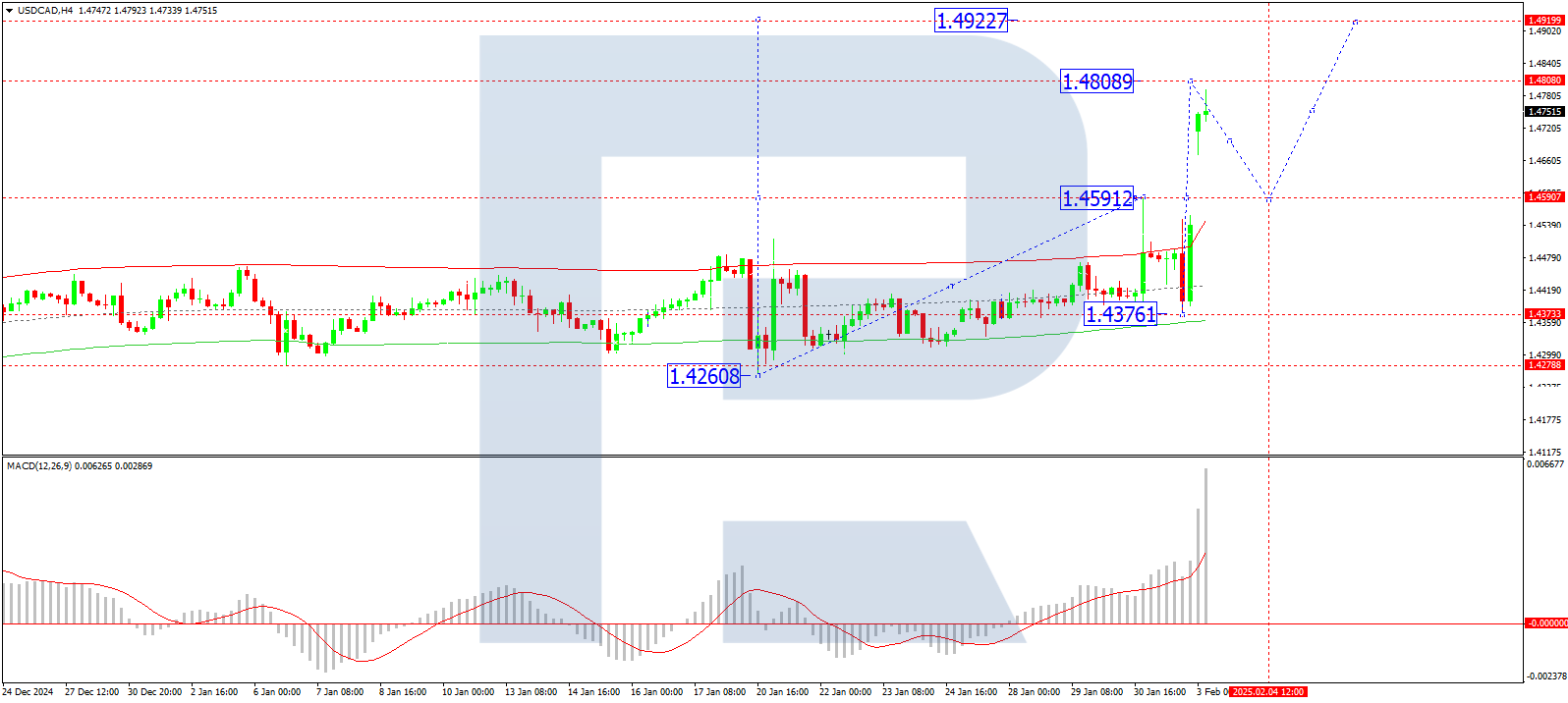
On the H4 chart, USD/CAD broke through 1.4591 and continues its upward wave. With this breakout, the path towards 1.4808 is now open, making it the next local target. After reaching this level, a correction towards 1.4591 is possible before a renewed growth wave targets 1.4919. The MACD indicator supports this outlook, with its signal line above zero and pointing sharply upwards, confirming bullish momentum.

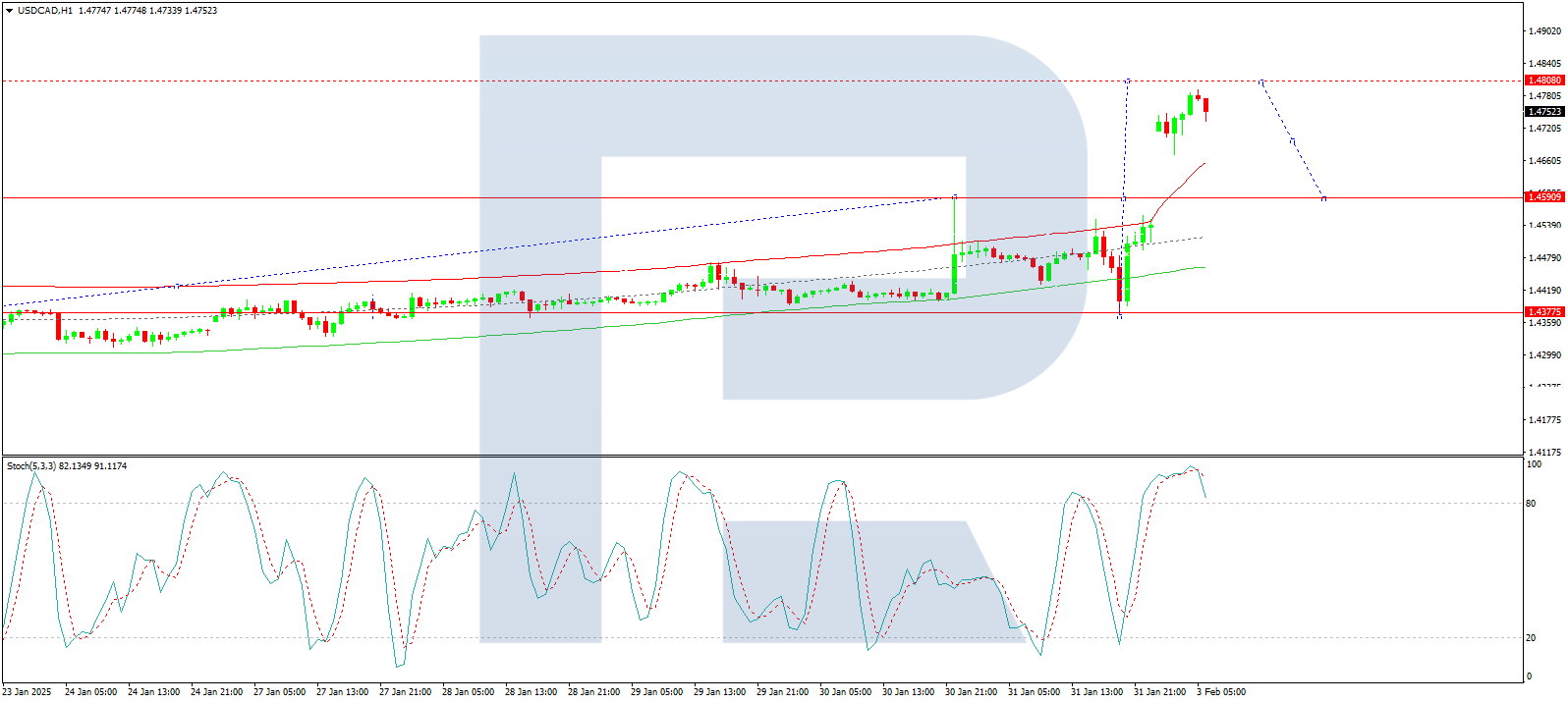
On the H1 chart, the pair has extended its upward structure to 1.4742 and is now consolidating around this level. A breakout from the consolidation range to the upside would signal a move towards 1.4808. However, if the pair breaks downwards, a correction to 1.4591 is possible before another attempt at the 1.4808 level. The Stochastic oscillator indicates a potential short-term pullback, with its signal line above 80 and preparing to decline towards 20.

Conclusion

The Canadian dollar remains under significant pressure as US trade tariffs drive uncertainty over future export demand. While technical indicators suggest further upside for USD/CAD towards 1.4808, a corrective move towards 1.4591 is also possible before another wave of growth. The market’s next key focus will be Canadian GDP data and any further developments on trade retaliation from affected countries, both of which could impact the pair’s trajectory.


Disclaimer

Any forecasts contained herein are based on the author’s particular opinion. This analysis may not be treated as trading advice. RoboForex bears no responsibility for trading results based on trading recommendations and reviews contained herein.

US Dollar Speculator bets continue to shine vs major currencies

By InvestMacro

Here are the latest charts and statistics for the Commitment of Traders (COT) data published by the Commodities Futures Trading Commission (CFTC).

The latest COT data is updated through Tuesday January 28th and shows a quick view of how large market participants (for-profit speculators and commercial traders) were positioned in the futures markets. All currency positions are in direct relation to the US dollar where, for example, a bet for the euro is a bet that the euro will rise versus the dollar while a bet against the euro will be a bet that the euro will decline versus the dollar.

Weekly Speculator Bets led by Japanese Yen & Mexican Peso
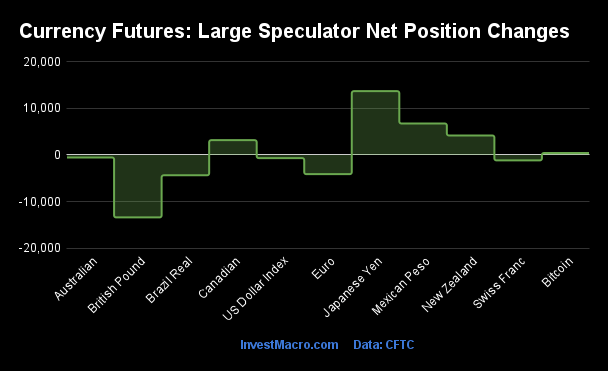
The COT currency market speculator bets were overall lower this week as five out of the eleven currency markets we cover had higher positioning while the other six markets had lower speculator contracts.

Leading the gains for the currency markets was the Japanese Yen (13,714 contracts), the Mexican Peso (6,768 contracts), the New Zealand Dollar (4,192 contracts), the Canadian Dollar (3,186 contracts) and with Bitcoin (426 contracts) also showing positive weeks.

The currencies seeing declines in speculator bets on the week were the British Pound (-13,415 contracts), the EuroFX (-4,118 contracts), the Brazilian Real (-4,363 contracts), the Swiss Franc (-1,163 contracts), the US Dollar Index (-672 contracts) and the Australian Dollar (-535 contracts) also registering lower bets on the week.

US Dollar Speculator bets continue to shine vs major currencies

Highlighting the COT currency’s data this week is current positioning for the US Dollar against the major currencies. Despite a small dip in the US Dollar Index positioning this week, the other major currencies are overwhelmingly in negative or bearish net positions versus the US Dollar. All major currency positions in the COT markets are in direct relation to the US Dollar and, currently, eight out of the nine foreign currency levels are in bearish territory.

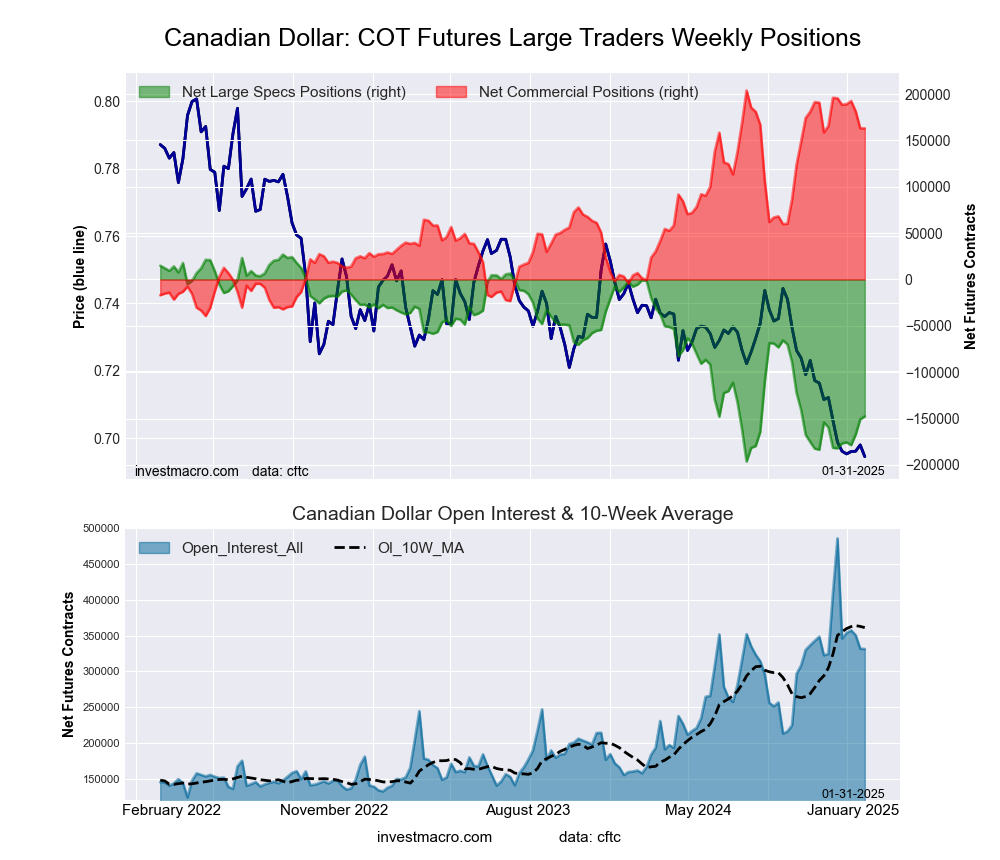
The most bearish position at the moment is the Canadian dollar at a total of -147,601 contracts. The CAD position has been over the -100,000 contract threshold for sixteen straight weeks and in twenty-eight out of the past thirty-four weeks. Overall, the CAD positioning has been in a continuous bearish level for seventy-eight straight weeks. The Canadian dollar exchange rate versus the Dollar has been falling sharply is currently at the lowest level since March of 2020 at the 0.6905 price.

The Australian dollar, New Zealand dollar, Swiss franc, Brazilian real and the Euro positions are all between -38,000 and -71,000 net speculator contracts this week. All of these currencies are in extreme bearish readings in the speculator strength scores which compares their current level to the past three years. The exchange rates for these currencies have all been in multi-year low-points as well over the past month except for the Swiss franc which has been trading around its 200-week moving average and the lowest level since May 2024.

The British pound sterling is not quite in an extreme bearish level but does remain in an overall bearish net standing at -21,672 contracts. The GBP exchange rate versus the Dollar is right under the 1.2400 threshold currently and recently touched the lowest level since 2023 near the 1.2100 exchange.

The Japanese yen which has seen its exchange rate at multi-decade lows for the past couple of years but is faring better than most of the other major currencies in speculator positioning. The JPY speculator bets are just at -959 contracts this week. The exchange rate does remain near the bottom of the range of the multi-decade lows but the speculator sentiment has come off the extremely negative levels from the past couple of years and has been helped out by the Bank of Japan’s latest monetary move of an interest rate increase.

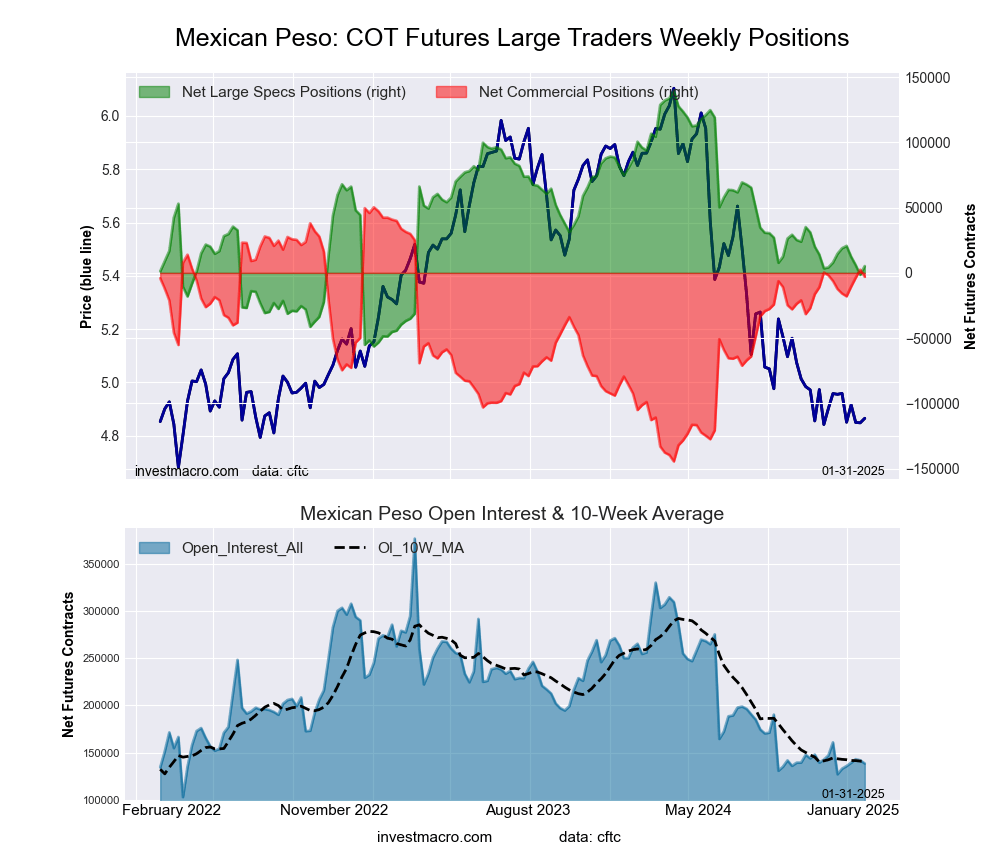
The only major currency with a bullish speculator position this week versus the Dollar is the Mexican peso. The peso has been the one currency with strong speculator positions over the past few years with positive or bullish levels dating back to March of 2023. Last week, on January 21st, the position dipped into a small bearish level but bounced back this week into a small bullish standing. The exchange rate for the peso has been on the decline from last summer and has fallen to the lowest levels since 2022 at the 0.4801 exchange rate price.


Currencies Net Speculators Leaderboard
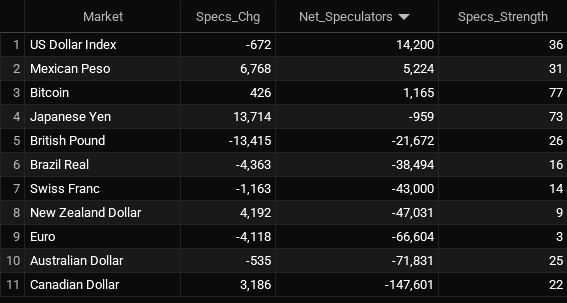
Legend: Weekly Speculators Change | Speculators Current Net Position | Speculators Strength Score compared to last 3-Years (0-100 range)


Strength Scores led by Bitcoin & Japanese Yen
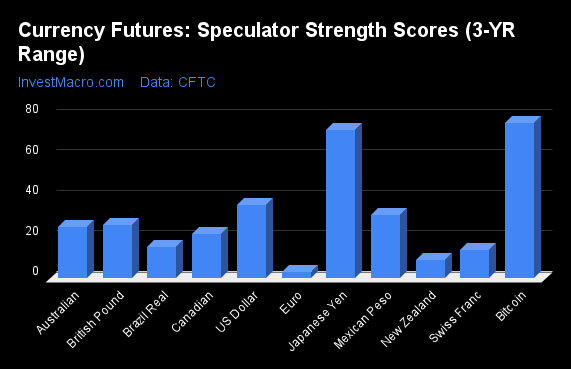
COT Strength Scores (a normalized measure of Speculator positions over a 3-Year range, from 0 to 100 where above 80 is Extreme-Bullish and below 20 is Extreme-Bearish) showed that Bitcoin (77 percent) and the Japanese Yen (73 percent) lead the currency markets this week.

On the downside, the EuroFX (3 percent), the New Zealand Dollar (9 percent), the Swiss Franc (14 percent) and the Brazilian Real (16 percent) come in at the lowest strength levels currently and are in Extreme-Bearish territory (below 20 percent).

3-Year Strength Statistics:
US Dollar Index (36.1 percent) vs US Dollar Index previous week (37.5 percent)
EuroFX (3.4 percent) vs EuroFX previous week (5.0 percent)
British Pound Sterling (26.4 percent) vs British Pound Sterling previous week (32.4 percent)
Japanese Yen (73.2 percent) vs Japanese Yen previous week (67.8 percent)
Swiss Franc (13.8 percent) vs Swiss Franc previous week (16.1 percent)
Canadian Dollar (21.8 percent) vs Canadian Dollar previous week (20.4 percent)
Australian Dollar (25.3 percent) vs Australian Dollar previous week (25.7 percent)
New Zealand Dollar (8.9 percent) vs New Zealand Dollar previous week (4.0 percent)
Mexican Peso (31.4 percent) vs Mexican Peso previous week (28.0 percent)
Brazilian Real (15.6 percent) vs Brazilian Real previous week (19.7 percent)
Bitcoin (76.7 percent) vs Bitcoin previous week (67.4 percent)


Bitcoin & US Dollar Index top the 6-Week Strength Trends
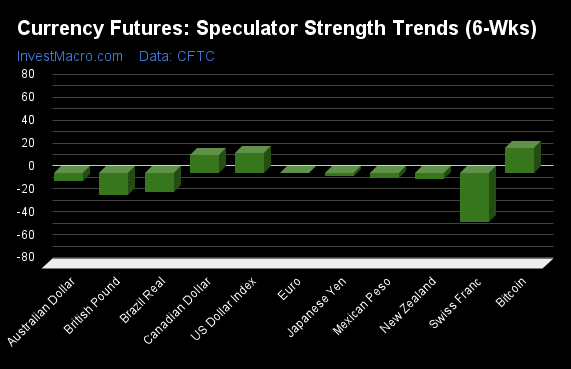
COT Strength Score Trends (or move index, calculates the 6-week changes in strength scores) showed that the Bitcoin (22 percent) and the US Dollar Index (18 percent) lead the past six weeks trends for the currencies. The Canadian Dollar (15 percent) is the next highest positive mover in the 3-Year trends data.

The Swiss Franc (-43 percent) leads the downside trend scores currently with the British Pound (-20 percent), Brazilian Real (-17 percent) and the Australian Dollar (-7 percent) following next with lower trend scores.

3-Year Strength Trends:
US Dollar Index (17.7 percent) vs US Dollar Index previous week (37.5 percent)
EuroFX (-0.3 percent) vs EuroFX previous week (5.0 percent)
British Pound Sterling (-19.5 percent) vs British Pound Sterling previous week (-15.9 percent)
Japanese Yen (-2.8 percent) vs Japanese Yen previous week (-16.2 percent)
Swiss Franc (-43.0 percent) vs Swiss Franc previous week (-13.9 percent)
Canadian Dollar (15.4 percent) vs Canadian Dollar previous week (13.8 percent)
Australian Dollar (-7.3 percent) vs Australian Dollar previous week (-56.6 percent)
New Zealand Dollar (-5.3 percent) vs New Zealand Dollar previous week (-27.0 percent)
Mexican Peso (-4.8 percent) vs Mexican Peso previous week (-4.8 percent)
Brazilian Real (-16.7 percent) vs Brazilian Real previous week (-16.8 percent)
Bitcoin (21.7 percent) vs Bitcoin previous week (31.8 percent)


Individual COT Forex Markets:

US Dollar Index Futures:
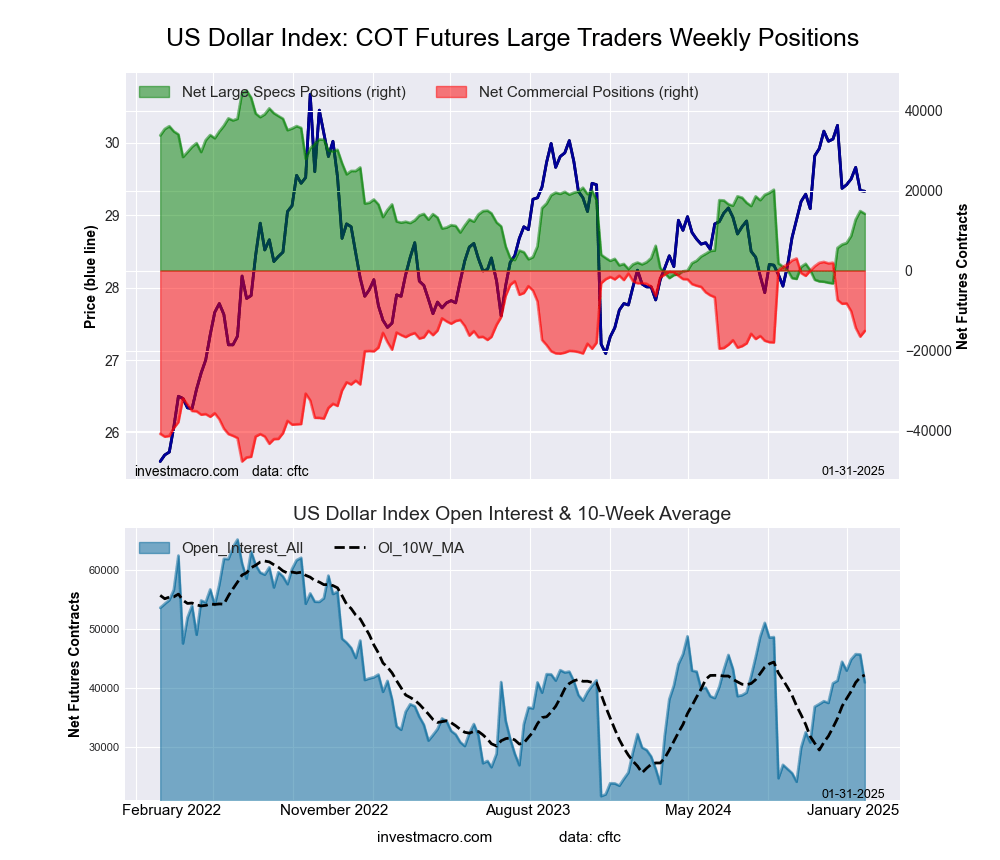
US Dollar Index Forex Futures COT ChartThe US Dollar Index large speculator standing this week was a net position of 14,200 contracts in the data reported through Tuesday. This was a weekly fall of -672 contracts from the previous week which had a total of 14,872 net contracts.

This week’s current strength score (the trader positioning range over the past three years, measured from 0 to 100) shows the speculators are currently Bearish with a score of 36.1 percent. The commercials are Bullish with a score of 64.3 percent and the small traders (not shown in chart) are Bearish with a score of 33.8 percent.

Price Trend-Following Model: Uptrend

Our weekly trend-following model classifies the current market price position as: Uptrend.

US DOLLAR INDEX StatisticsSPECULATORSCOMMERCIALSSMALL TRADERS
– Percent of Open Interest Longs:61.925.69.5
– Percent of Open Interest Shorts:27.362.47.3
– Net Position:14,200-15,106906
– Gross Longs:25,37210,4843,888
– Gross Shorts:11,17225,5902,982
– Long to Short Ratio:2.3 to 10.4 to 11.3 to 1
NET POSITION TREND:
– Strength Index Score (3 Year Range Pct):36.164.333.8
– Strength Index Reading (3 Year Range):BearishBullishBearish
NET POSITION MOVEMENT INDEX:
– 6-Week Change in Strength Index:17.7-15.3-8.6


Euro Currency Futures:

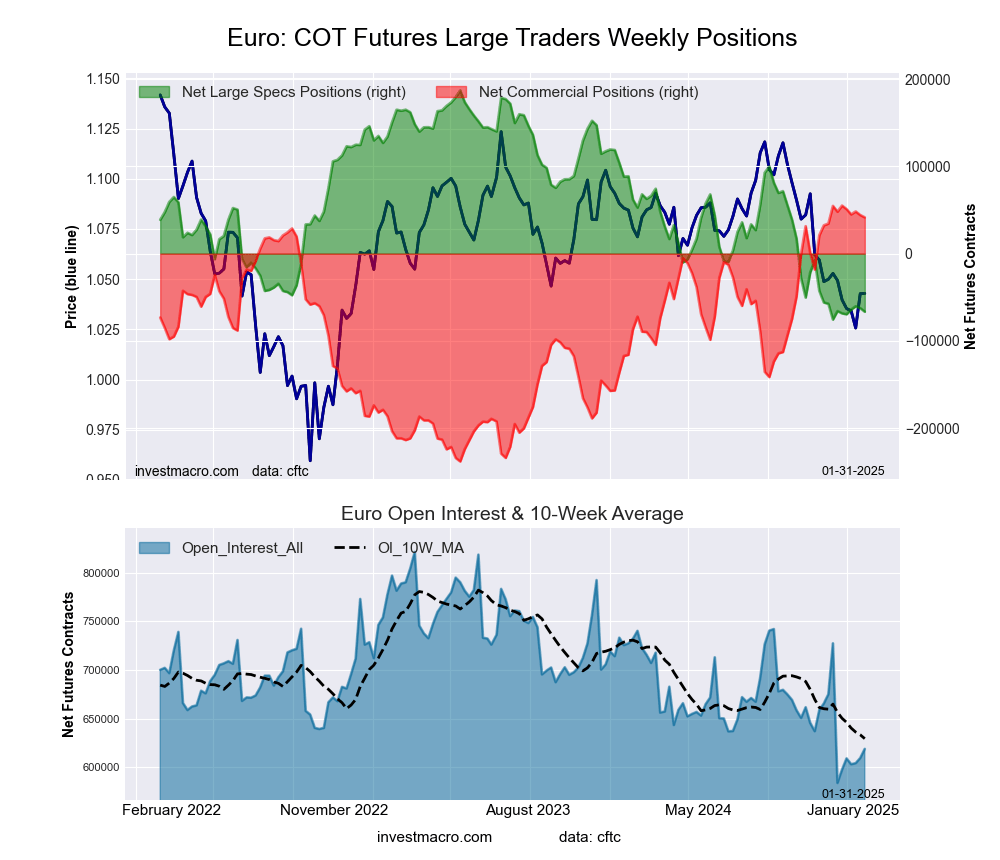
Euro Currency Futures COT ChartThe Euro Currency large speculator standing this week was a net position of -66,604 contracts in the data reported through Tuesday. This was a weekly lowering of -4,118 contracts from the previous week which had a total of -62,486 net contracts.

This week’s current strength score (the trader positioning range over the past three years, measured from 0 to 100) shows the speculators are currently Bearish-Extreme with a score of 3.4 percent. The commercials are Bullish-Extreme with a score of 95.4 percent and the small traders (not shown in chart) are Bearish with a score of 28.8 percent.

Price Trend-Following Model: Downtrend

Our weekly trend-following model classifies the current market price position as: Downtrend.

EURO Currency StatisticsSPECULATORSCOMMERCIALSSMALL TRADERS
– Percent of Open Interest Longs:24.857.312.3
– Percent of Open Interest Shorts:35.650.68.2
– Net Position:-66,60441,59525,009
– Gross Longs:153,660354,83075,982
– Gross Shorts:220,264313,23550,973
– Long to Short Ratio:0.7 to 11.1 to 11.5 to 1
NET POSITION TREND:
– Strength Index Score (3 Year Range Pct):3.495.428.8
– Strength Index Reading (3 Year Range):Bearish-ExtremeBullish-ExtremeBearish
NET POSITION MOVEMENT INDEX:
– 6-Week Change in Strength Index:-0.3-2.216.0


British Pound Sterling Futures:

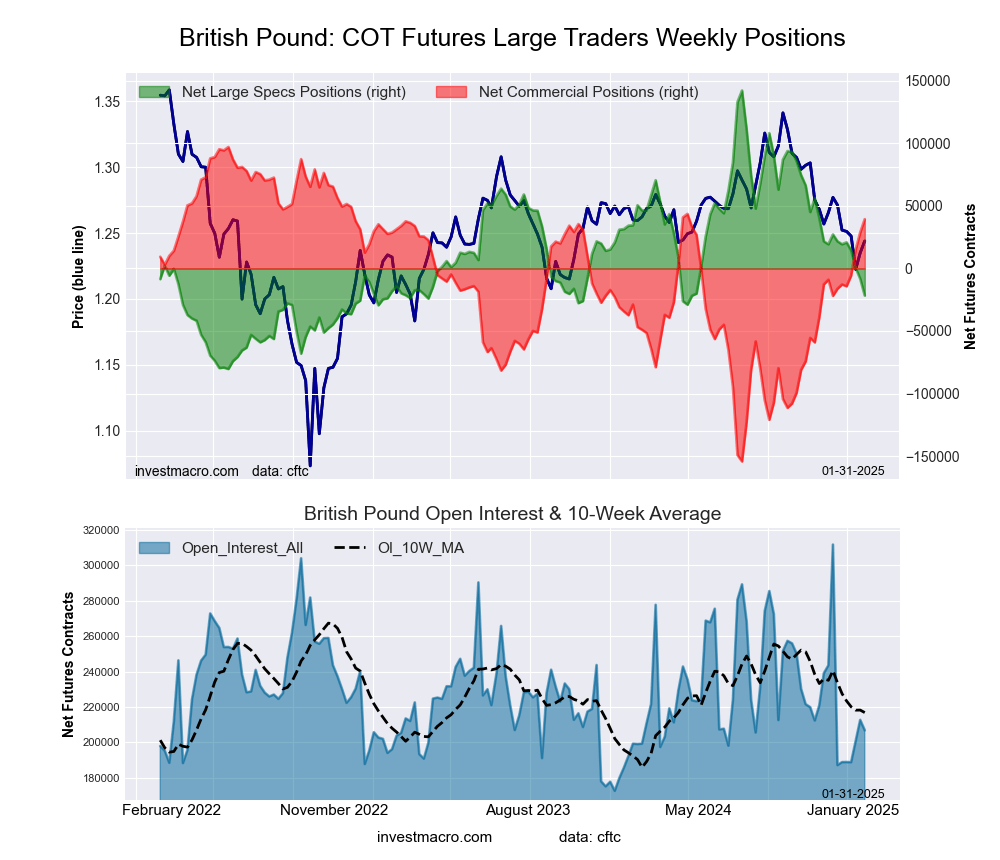
British Pound Sterling Futures COT ChartThe British Pound Sterling large speculator standing this week was a net position of -21,672 contracts in the data reported through Tuesday. This was a weekly lowering of -13,415 contracts from the previous week which had a total of -8,257 net contracts.

This week’s current strength score (the trader positioning range over the past three years, measured from 0 to 100) shows the speculators are currently Bearish with a score of 26.4 percent. The commercials are Bullish with a score of 77.0 percent and the small traders (not shown in chart) are Bearish with a score of 25.0 percent.

Price Trend-Following Model: Downtrend

Our weekly trend-following model classifies the current market price position as: Downtrend.

BRITISH POUND StatisticsSPECULATORSCOMMERCIALSSMALL TRADERS
– Percent of Open Interest Longs:28.758.710.2
– Percent of Open Interest Shorts:39.239.718.7
– Net Position:-21,67239,354-17,682
– Gross Longs:59,331121,42121,081
– Gross Shorts:81,00382,06738,763
– Long to Short Ratio:0.7 to 11.5 to 10.5 to 1
NET POSITION TREND:
– Strength Index Score (3 Year Range Pct):26.477.025.0
– Strength Index Reading (3 Year Range):BearishBullishBearish
NET POSITION MOVEMENT INDEX:
– 6-Week Change in Strength Index:-19.522.1-25.8


Japanese Yen Futures:

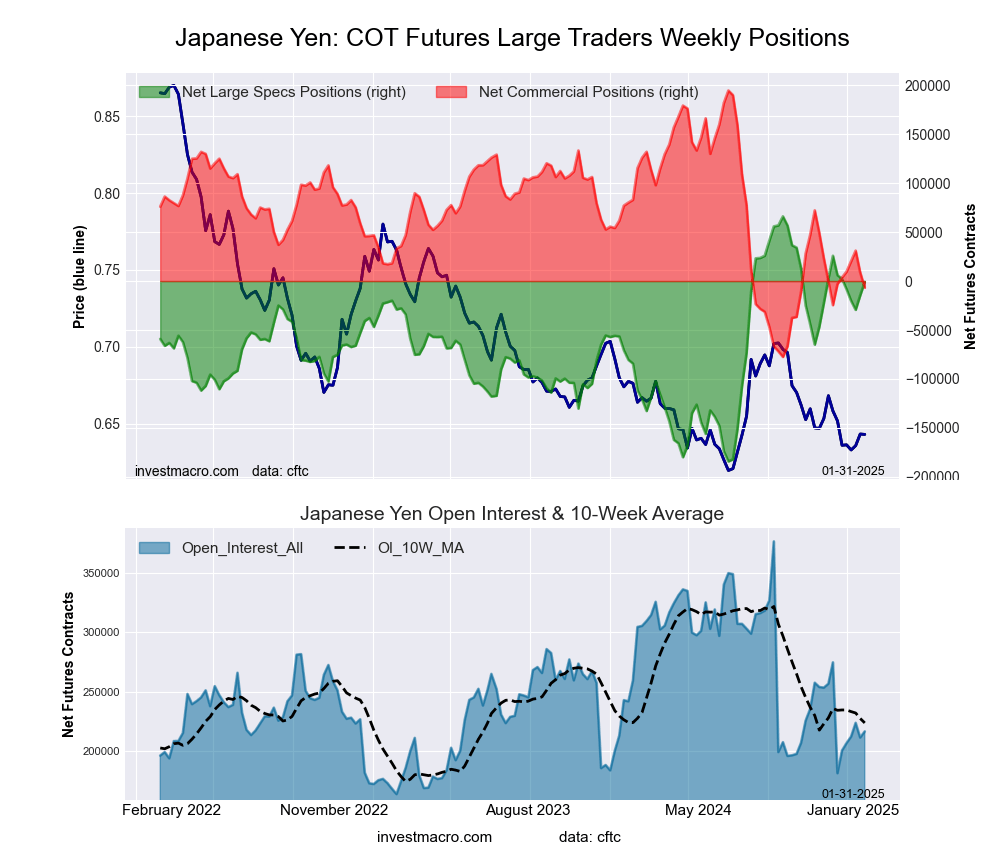
Japanese Yen Forex Futures COT ChartThe Japanese Yen large speculator standing this week was a net position of -959 contracts in the data reported through Tuesday. This was a weekly advance of 13,714 contracts from the previous week which had a total of -14,673 net contracts.

This week’s current strength score (the trader positioning range over the past three years, measured from 0 to 100) shows the speculators are currently Bullish with a score of 73.2 percent. The commercials are Bearish with a score of 26.0 percent and the small traders (not shown in chart) are Bullish-Extreme with a score of 82.3 percent.

Price Trend-Following Model: Downtrend

Our weekly trend-following model classifies the current market price position as: Downtrend.

JAPANESE YEN StatisticsSPECULATORSCOMMERCIALSSMALL TRADERS
– Percent of Open Interest Longs:44.731.720.4
– Percent of Open Interest Shorts:45.134.816.8
– Net Position:-959-6,7377,696
– Gross Longs:96,80968,68344,173
– Gross Shorts:97,76875,42036,477
– Long to Short Ratio:1.0 to 10.9 to 11.2 to 1
NET POSITION TREND:
– Strength Index Score (3 Year Range Pct):73.226.082.3
– Strength Index Reading (3 Year Range):BullishBearishBullish-Extreme
NET POSITION MOVEMENT INDEX:
– 6-Week Change in Strength Index:-2.8-1.325.6


Swiss Franc Futures:

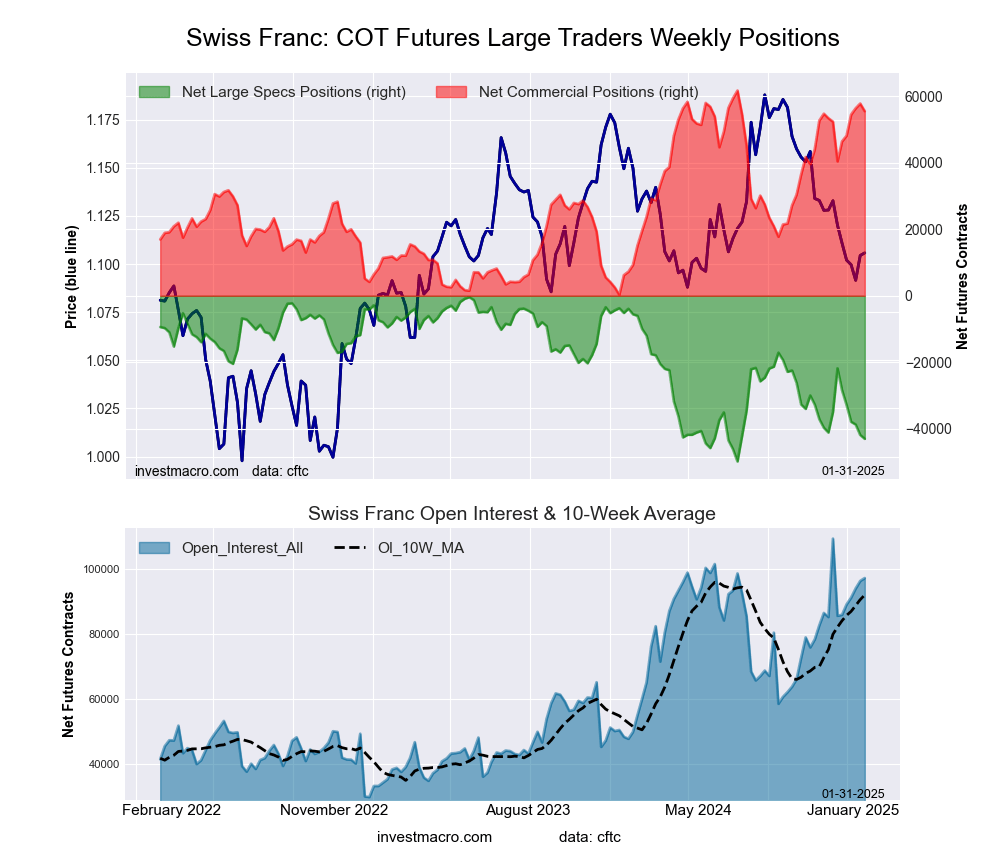
Swiss Franc Forex Futures COT ChartThe Swiss Franc large speculator standing this week was a net position of -43,000 contracts in the data reported through Tuesday. This was a weekly decline of -1,163 contracts from the previous week which had a total of -41,837 net contracts.

This week’s current strength score (the trader positioning range over the past three years, measured from 0 to 100) shows the speculators are currently Bearish-Extreme with a score of 13.8 percent. The commercials are Bullish-Extreme with a score of 89.9 percent and the small traders (not shown in chart) are Bearish with a score of 26.0 percent.

Price Trend-Following Model: Downtrend

Our weekly trend-following model classifies the current market price position as: Downtrend.

SWISS FRANC StatisticsSPECULATORSCOMMERCIALSSMALL TRADERS
– Percent of Open Interest Longs:5.185.88.7
– Percent of Open Interest Shorts:49.328.821.5
– Net Position:-43,00055,450-12,450
– Gross Longs:4,99683,4738,491
– Gross Shorts:47,99628,02320,941
– Long to Short Ratio:0.1 to 13.0 to 10.4 to 1
NET POSITION TREND:
– Strength Index Score (3 Year Range Pct):13.889.926.0
– Strength Index Reading (3 Year Range):Bearish-ExtremeBullish-ExtremeBearish
NET POSITION MOVEMENT INDEX:
– 6-Week Change in Strength Index:-43.024.526.0


Canadian Dollar Futures:

Canadian Dollar Forex Futures COT ChartThe Canadian Dollar large speculator standing this week was a net position of -147,601 contracts in the data reported through Tuesday. This was a weekly advance of 3,186 contracts from the previous week which had a total of -150,787 net contracts.

This week’s current strength score (the trader positioning range over the past three years, measured from 0 to 100) shows the speculators are currently Bearish with a score of 21.8 percent. The commercials are Bullish-Extreme with a score of 83.2 percent and the small traders (not shown in chart) are Bearish-Extreme with a score of 0.0 percent.

Price Trend-Following Model: Downtrend

Our weekly trend-following model classifies the current market price position as: Downtrend.

CANADIAN DOLLAR StatisticsSPECULATORSCOMMERCIALSSMALL TRADERS
– Percent of Open Interest Longs:6.483.48.0
– Percent of Open Interest Shorts:51.034.212.6
– Net Position:-147,601162,970-15,369
– Gross Longs:21,219276,25926,467
– Gross Shorts:168,820113,28941,836
– Long to Short Ratio:0.1 to 12.4 to 10.6 to 1
NET POSITION TREND:
– Strength Index Score (3 Year Range Pct):21.883.20.0
– Strength Index Reading (3 Year Range):BearishBullish-ExtremeBearish-Extreme
NET POSITION MOVEMENT INDEX:
– 6-Week Change in Strength Index:15.4-13.4-5.1


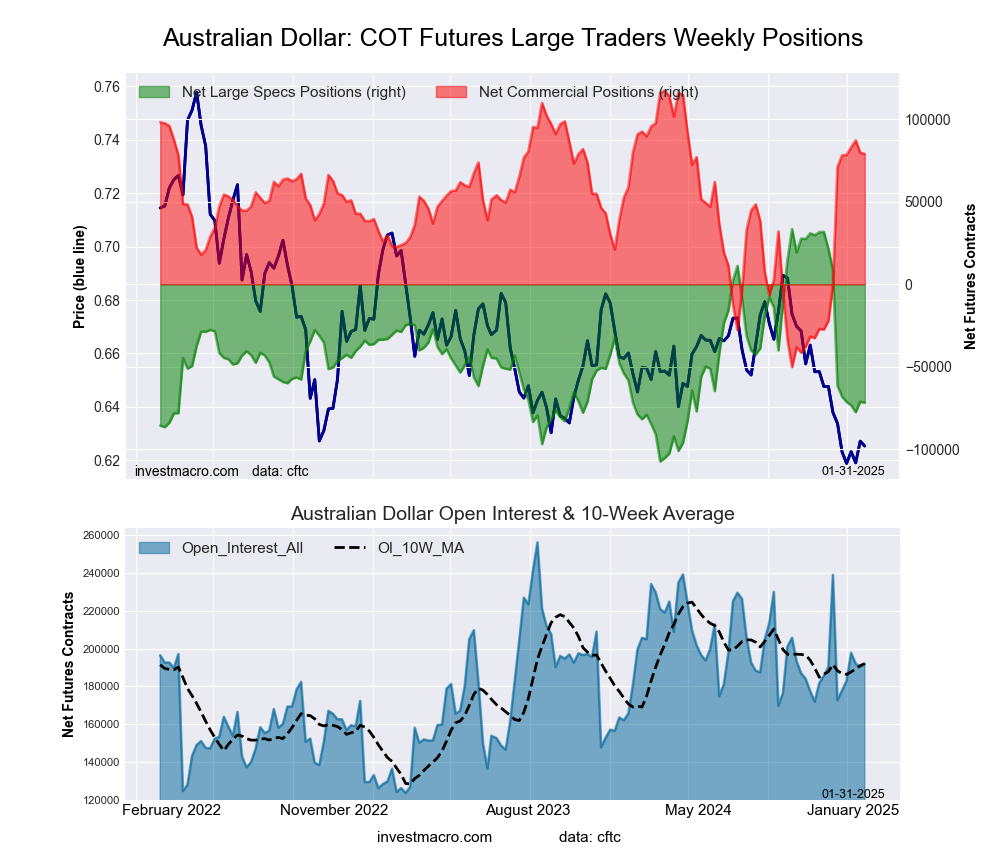
Australian Dollar Futures:

Australian Dollar Forex Futures COT ChartThe Australian Dollar large speculator standing this week was a net position of -71,831 contracts in the data reported through Tuesday. This was a weekly decline of -535 contracts from the previous week which had a total of -71,296 net contracts.

This week’s current strength score (the trader positioning range over the past three years, measured from 0 to 100) shows the speculators are currently Bearish with a score of 25.3 percent. The commercials are Bullish with a score of 77.0 percent and the small traders (not shown in chart) are Bearish with a score of 30.2 percent.

Price Trend-Following Model: Downtrend

Our weekly trend-following model classifies the current market price position as: Downtrend.

AUSTRALIAN DOLLAR StatisticsSPECULATORSCOMMERCIALSSMALL TRADERS
– Percent of Open Interest Longs:16.867.512.4
– Percent of Open Interest Shorts:54.226.316.2
– Net Position:-71,83179,001-7,170
– Gross Longs:32,196129,57423,866
– Gross Shorts:104,02750,57331,036
– Long to Short Ratio:0.3 to 12.6 to 10.8 to 1
NET POSITION TREND:
– Strength Index Score (3 Year Range Pct):25.377.030.2
– Strength Index Reading (3 Year Range):BearishBullishBearish
NET POSITION MOVEMENT INDEX:
– 6-Week Change in Strength Index:-7.34.76.3


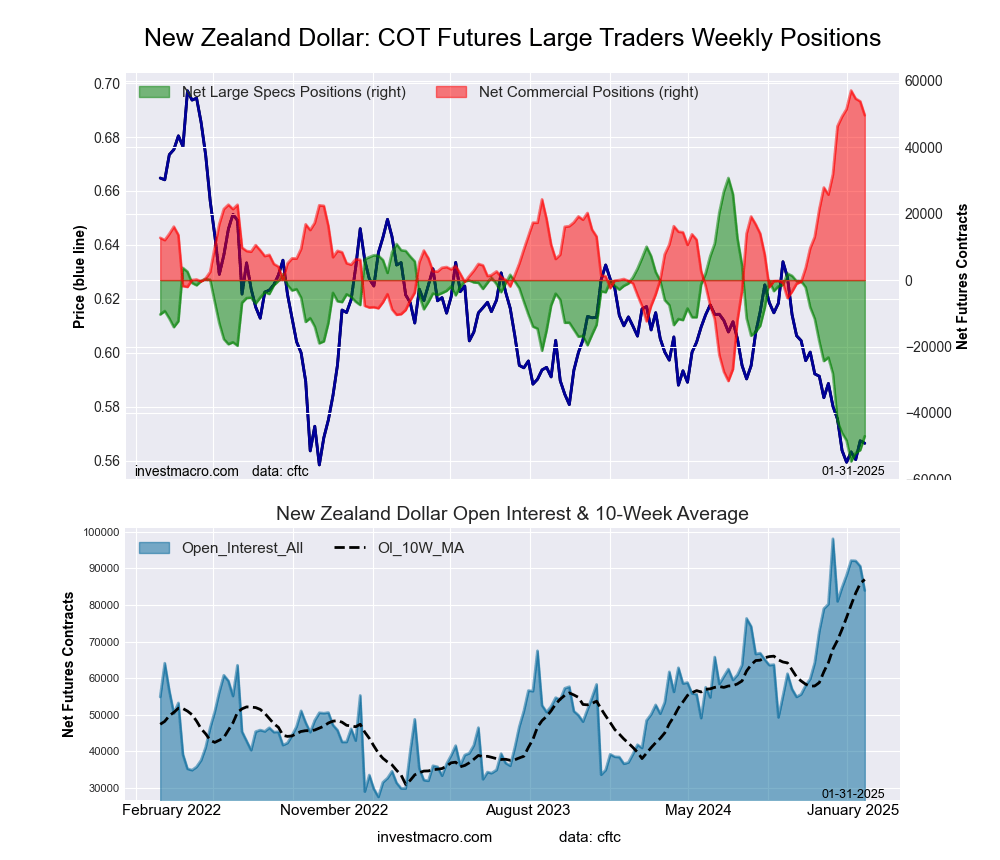
New Zealand Dollar Futures:

New Zealand Dollar Forex Futures COT ChartThe New Zealand Dollar large speculator standing this week was a net position of -47,031 contracts in the data reported through Tuesday. This was a weekly lift of 4,192 contracts from the previous week which had a total of -51,223 net contracts.

This week’s current strength score (the trader positioning range over the past three years, measured from 0 to 100) shows the speculators are currently Bearish-Extreme with a score of 8.9 percent. The commercials are Bullish-Extreme with a score of 91.5 percent and the small traders (not shown in chart) are Bearish with a score of 20.1 percent.

Price Trend-Following Model: Downtrend

Our weekly trend-following model classifies the current market price position as: Downtrend.

NEW ZEALAND DOLLAR StatisticsSPECULATORSCOMMERCIALSSMALL TRADERS
– Percent of Open Interest Longs:9.486.33.8
– Percent of Open Interest Shorts:65.427.26.9
– Net Position:-47,03149,651-2,620
– Gross Longs:7,89872,4683,201
– Gross Shorts:54,92922,8175,821
– Long to Short Ratio:0.1 to 13.2 to 10.5 to 1
NET POSITION TREND:
– Strength Index Score (3 Year Range Pct):8.991.520.1
– Strength Index Reading (3 Year Range):Bearish-ExtremeBullish-ExtremeBearish
NET POSITION MOVEMENT INDEX:
– 6-Week Change in Strength Index:-5.33.815.2


Mexican Peso Futures:

Mexican Peso Futures COT ChartThe Mexican Peso large speculator standing this week was a net position of 5,224 contracts in the data reported through Tuesday. This was a weekly boost of 6,768 contracts from the previous week which had a total of -1,544 net contracts.

This week’s current strength score (the trader positioning range over the past three years, measured from 0 to 100) shows the speculators are currently Bearish with a score of 31.4 percent. The commercials are Bullish with a score of 72.6 percent and the small traders (not shown in chart) are Bearish-Extreme with a score of 10.5 percent.

Price Trend-Following Model: Downtrend

Our weekly trend-following model classifies the current market price position as: Downtrend.

MEXICAN PESO StatisticsSPECULATORSCOMMERCIALSSMALL TRADERS
– Percent of Open Interest Longs:33.761.02.8
– Percent of Open Interest Shorts:29.963.24.4
– Net Position:5,224-3,023-2,201
– Gross Longs:46,60184,3883,854
– Gross Shorts:41,37787,4116,055
– Long to Short Ratio:1.1 to 11.0 to 10.6 to 1
NET POSITION TREND:
– Strength Index Score (3 Year Range Pct):31.472.610.5
– Strength Index Reading (3 Year Range):BearishBullishBearish-Extreme
NET POSITION MOVEMENT INDEX:
– 6-Week Change in Strength Index:-4.84.80.4


Brazilian Real Futures:

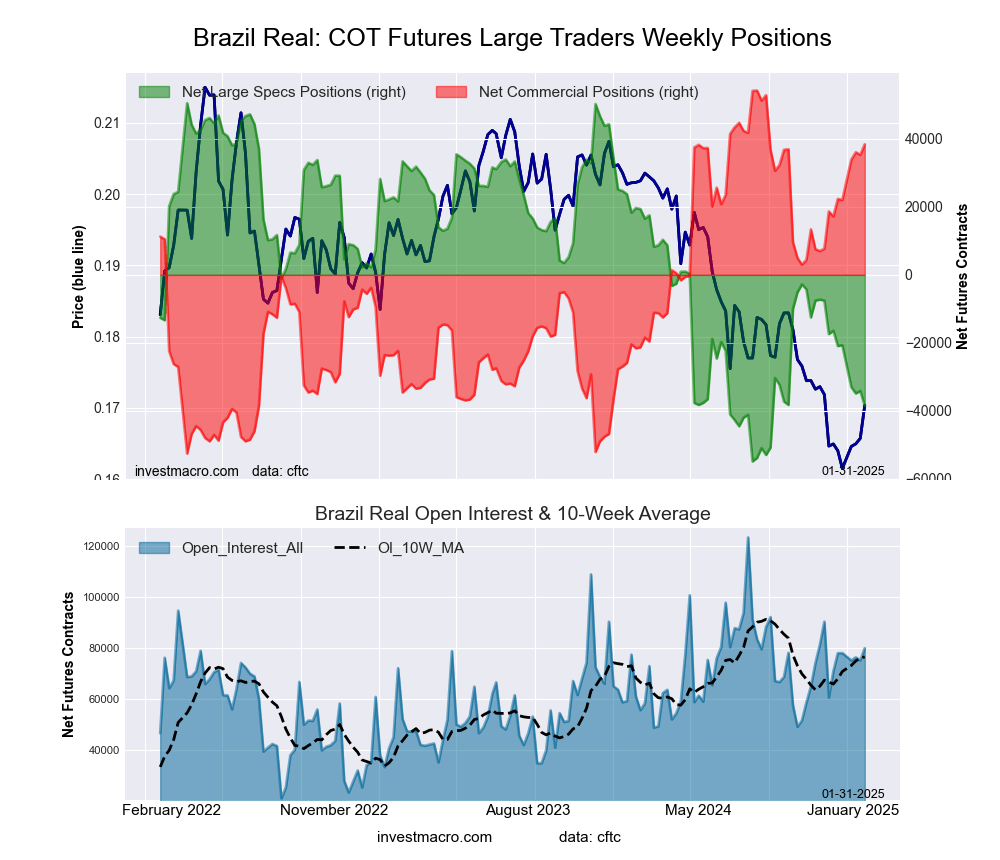
Brazil Real Futures COT ChartThe Brazilian Real large speculator standing this week was a net position of -38,494 contracts in the data reported through Tuesday. This was a weekly decline of -4,363 contracts from the previous week which had a total of -34,131 net contracts.

This week’s current strength score (the trader positioning range over the past three years, measured from 0 to 100) shows the speculators are currently Bearish-Extreme with a score of 15.6 percent. The commercials are Bullish-Extreme with a score of 85.2 percent and the small traders (not shown in chart) are Bearish with a score of 21.3 percent.

Price Trend-Following Model: Weak Downtrend

Our weekly trend-following model classifies the current market price position as: Weak Downtrend.

BRAZIL REAL StatisticsSPECULATORSCOMMERCIALSSMALL TRADERS
– Percent of Open Interest Longs:24.271.33.2
– Percent of Open Interest Shorts:72.423.23.1
– Net Position:-38,49438,40787
– Gross Longs:19,37256,9522,529
– Gross Shorts:57,86618,5452,442
– Long to Short Ratio:0.3 to 13.1 to 11.0 to 1
NET POSITION TREND:
– Strength Index Score (3 Year Range Pct):15.685.221.3
– Strength Index Reading (3 Year Range):Bearish-ExtremeBullish-ExtremeBearish
NET POSITION MOVEMENT INDEX:
– 6-Week Change in Strength Index:-16.715.18.3


Bitcoin Futures:

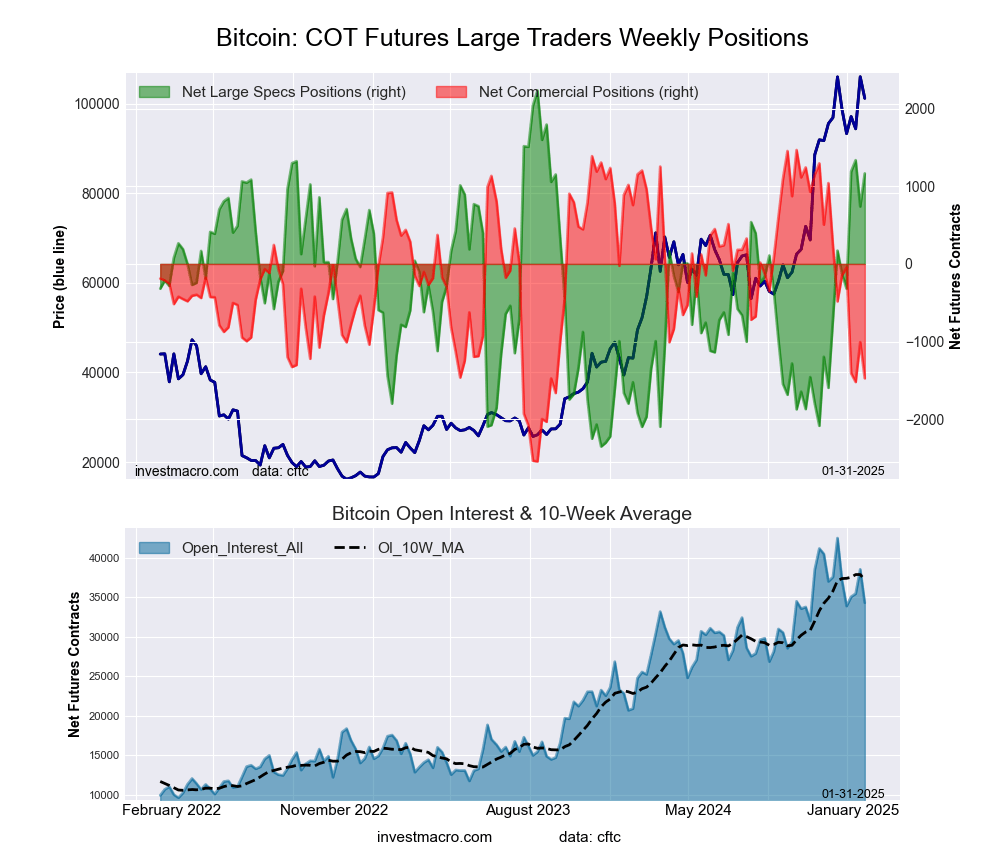
Bitcoin Crypto Futures COT ChartThe Bitcoin large speculator standing this week was a net position of 1,165 contracts in the data reported through Tuesday. This was a weekly rise of 426 contracts from the previous week which had a total of 739 net contracts.

This week’s current strength score (the trader positioning range over the past three years, measured from 0 to 100) shows the speculators are currently Bullish with a score of 76.7 percent. The commercials are Bearish with a score of 26.7 percent and the small traders (not shown in chart) are Bearish with a score of 33.1 percent.

Price Trend-Following Model: Uptrend

Our weekly trend-following model classifies the current market price position as: Uptrend.

BITCOIN StatisticsSPECULATORSCOMMERCIALSSMALL TRADERS
– Percent of Open Interest Longs:83.34.34.8
– Percent of Open Interest Shorts:79.98.63.9
– Net Position:1,165-1,473308
– Gross Longs:28,5931,4821,661
– Gross Shorts:27,4282,9551,353
– Long to Short Ratio:1.0 to 10.5 to 11.2 to 1
NET POSITION TREND:
– Strength Index Score (3 Year Range Pct):76.726.733.1
– Strength Index Reading (3 Year Range):BullishBearishBearish
NET POSITION MOVEMENT INDEX:
– 6-Week Change in Strength Index:21.7-24.7-0.3


Article By InvestMacroReceive our weekly COT Newsletter

*COT Report: The COT data, released weekly to the public each Friday, is updated through the most recent Tuesday (data is 3 days old) and shows a quick view of how large speculators or non-commercials (for-profit traders) were positioned in the futures markets.

The CFTC categorizes trader positions according to commercial hedgers (traders who use futures contracts for hedging as part of the business), non-commercials (large traders who speculate to realize trading profits) and nonreportable traders (usually small traders/speculators) as well as their open interest (contracts open in the market at time of reporting). See CFTC criteria here.

Speculator Extremes: Coffee, Sugar top weekly Bullish & Bearish Positions

By InvestMacro

The latest update for the weekly Commitment of Traders (COT) report was released by the Commodity Futures Trading Commission (CFTC) on Friday for data ending on January 28th.

This weekly Extreme Positions report highlights the Most Bullish and Most Bearish Positions for the speculator category. Extreme positioning in these markets can foreshadow strong moves in the underlying market.

To signify an extreme position, we use the Strength Index (also known as the COT Index) of each instrument, a common method of measuring COT data. The Strength Index is simply a comparison of current trader positions against the range of positions over the previous 3 years. We use over 80 percent as extremely bullish and under 20 percent as extremely bearish. (Compare Strength Index scores across all markets in the data table or cot leaders table)


Here Are This Week’s Most Bullish Speculator Positions:

Coffee


The Coffee speculator position comes in as the most bullish extreme standing this week. The Coffee speculator level is currently at a 100.0 percent maximum score of its 3-year range.

The six-week trend for the percent strength score totaled 13.9 this week. The overall net speculator position was a total of 76,520 net contracts this week with a rise of 2,229 contract in the weekly speculator bets.


Speculators or Non-Commercials Notes:

Speculators, classified as non-commercial traders by the CFTC, are made up of large commodity funds, hedge funds and other significant for-profit participants. The Specs are generally regarded as trend-followers in their behavior towards price action – net speculator bets and prices tend to go in the same directions. These traders often look to buy when prices are rising and sell when prices are falling. To illustrate this point, many times speculator contracts can be found at their most extremes (bullish or bearish) when prices are also close to their highest or lowest levels.

These extreme levels can be dangerous for the large speculators as the trade is most crowded, there is less trading ammunition still sitting on the sidelines to push the trend further and prices have moved a significant distance. When the trend becomes exhausted, some speculators take profits while others look to also exit positions when prices fail to continue in the same direction. This process usually plays out over many months to years and can ultimately create a reverse effect where prices start to fall and speculators start a process of selling when prices are falling.


1-Month Secured Overnight Financing Rate


The 1-Month Secured Overnight Financing Rate speculator position comes next in the extreme standings this week. The 1-Month Secured Overnight Financing Rate speculator level is now at a 96.3 percent score of its 3-year range.

The six-week trend for the percent strength score was 37.6 this week. The speculator position registered 112,967 net contracts this week with a weekly gain of 77,373 contracts in speculator bets.


Live Cattle


The Live Cattle speculator position comes in third this week in the extreme standings. The Live Cattle speculator level resides at a 95.9 percent score of its 3-year range.

The six-week trend for the speculator strength score came in at 8.0 this week. The overall speculator position was 119,044 net contracts this week with an increase of 312 contracts in the weekly speculator bets.


Gold


The Gold speculator position comes up number four in the extreme standings this week. The Gold speculator level is at a 93.9 percent score of its 3-year range.

The six-week trend for the speculator strength score totaled a change of 14.2 this week. The overall speculator position was 299,409 net contracts this week with a decrease of -1,375 contracts in the speculator bets.


US Treasury Bond


The US Treasury Bond speculator position rounds out the top five in this week’s bullish extreme standings. The US Treasury Bond speculator level sits at a 93.5 percent score of its 3-year range. The six-week trend for the speculator strength score was 26.1 this week.

The speculator position was 28,584 net contracts this week with a rise of 4,128 contracts in the weekly speculator bets.


This Week’s Most Bearish Speculator Positions:

Sugar


The Sugar speculator position comes in as the most bearish extreme standing this week. The Sugar speculator level is at a 0.7 percent score of its 3-year range.

The six-week trend for the speculator strength score was -31.4 this week. The overall speculator position was -29,434 net contracts this week with a boost of 2,033 contracts in the speculator bets.


Cotton


The Cotton speculator position comes in next for the most bearish extreme standing on the week. The Cotton speculator level is at a 2.5 percent score of its 3-year range.

The six-week trend for the speculator strength score was -10.7 this week. The speculator position was -42,428 net contracts this week with a subtraction of -2,477 contracts in the weekly speculator bets.


Euro


The Euro speculator position comes in as third most bearish extreme standing of the week. The Euro speculator level resides at a 3.4 percent score of its 3-year range.

The six-week trend for the speculator strength score was -0.3 this week. The overall speculator position was -66,604 net contracts this week with a decline of -4,118 contracts in the speculator bets.


Wheat


The Wheat speculator position comes in as this week’s fourth most bearish extreme standing. The Wheat speculator level is at a 4.8 percent score of its 3-year range.

The six-week trend for the speculator strength score was -9.3 this week. The speculator position was -91,111 net contracts this week with a drop by -18,102 contracts in the weekly speculator bets.


New Zealand Dollar


Finally, the New Zealand Dollar speculator position comes in as the fifth most bearish extreme standing for this week. The New Zealand Dollar speculator level is at a 8.9 percent score of its 3-year range.

The six-week trend for the speculator strength score was -5.3 this week. The speculator position was -47,031 net contracts this week with a gain of 4,192 contracts in the weekly speculator bets.


Article By InvestMacroReceive our weekly COT Newsletter

*COT Report: The COT data, released weekly to the public each Friday, is updated through the most recent Tuesday (data is 3 days old) and shows a quick view of how large speculators or non-commercials (for-profit traders) were positioned in the futures markets.

The CFTC categorizes trader positions according to commercial hedgers (traders who use futures contracts for hedging as part of the business), non-commercials (large traders who speculate to realize trading profits) and nonreportable traders (usually small traders/speculators) as well as their open interest (contracts open in the market at time of reporting). See CFTC criteria here.
COT Metals Charts: Weekly Speculator Bets led by Palladium

By InvestMacro

Here are the latest charts and statistics for the Commitment of Traders (COT) data published by the Commodities Futures Trading Commission (CFTC).

The latest COT data is updated through Tuesday January 28th and shows a quick view of how large traders (for-profit speculators and commercial entities) were positioned in the futures markets.

Weekly Speculator Bets led by Palladium

The COT metals markets speculator bets were decisively lower this week as just one out of the six metals markets we cover had higher positioning while the other five markets had lower speculator contracts.

The only metals market with a gain was Palladium with a rise of 952 contracts on the week.

The markets with declines in speculator bets for the week were Copper (-3,618 contracts), Silver (-3,112 contracts), Gold (-1,375 contracts), Platinum (-1,235 contracts) and with Steel (-251 contracts) also registering lower bets on the week.


Metals Net Speculators Leaderboard

Legend: Weekly Speculators Change | Speculators Current Net Position | Speculators Strength Score compared to last 3-Years (0-100 range)


Strength Scores led by Gold & Steel

COT Strength Scores (a normalized measure of Speculator positions over a 3-Year range, from 0 to 100 where above 80 is Extreme-Bullish and below 20 is Extreme-Bearish) showed that Gold (94 percent) and Steel (88 percent) lead the metals markets this week. Silver (72 percent) comes in as the next highest in the weekly strength scores.

On the downside, Copper (45 percent) and Platinum (48 percent) come in at the lowest strength level currently.

Strength Statistics:
Gold (93.9 percent) vs Gold previous week (94.5 percent)
Silver (72.2 percent) vs Silver previous week (76.1 percent)
Copper (45.4 percent) vs Copper previous week (48.8 percent)
Platinum (47.6 percent) vs Platinum previous week (50.5 percent)
Palladium (50.1 percent) vs Palladium previous week (43.1 percent)
Steel (88.4 percent) vs Palladium previous week (89.5 percent)


Gold & Copper top the 6-Week Strength Trends

COT Strength Score Trends (or move index, calculates the 6-week changes in strength scores) showed that Gold (14 percent) and Copper (7 percent) lead the past six weeks trends for metals. Steel (8 percent) is the next highest positive mover in the latest trends data.

Platinum (-1 percent) leads the downside trend scores currently.

Move Statistics:
Gold (14.2 percent) vs Gold previous week (9.6 percent)
Silver (5.2 percent) vs Silver previous week (8.0 percent)
Copper (6.6 percent) vs Copper previous week (5.3 percent)
Platinum (-0.9 percent) vs Platinum previous week (-0.5 percent)
Palladium (1.7 percent) vs Palladium previous week (-14.7 percent)
Steel (7.5 percent) vs Steel previous week (5.3 percent)


Individual Markets:

Gold Comex Futures:

Gold Futures COT ChartThe Gold Comex Futures large speculator standing this week recorded a net position of 299,409 contracts in the data reported through Tuesday. This was a weekly fall of -1,375 contracts from the previous week which had a total of 300,784 net contracts.

This week’s current strength score (the trader positioning range over the past three years, measured from 0 to 100) shows the speculators are currently Bullish-Extreme with a score of 93.9 percent. The commercials are Bearish-Extreme with a score of 5.8 percent and the small traders (not shown in chart) are Bullish with a score of 58.7 percent.

Price Trend-Following Model: Strong Uptrend

Our weekly trend-following model classifies the current market price position as: Strong Uptrend.

Gold Futures StatisticsSPECULATORSCOMMERCIALSSMALL TRADERS
– Percent of Open Interest Longs:58.619.18.5
– Percent of Open Interest Shorts:6.775.14.3
– Net Position:299,409-323,72224,313
– Gross Longs:338,371110,03449,224
– Gross Shorts:38,962433,75624,911
– Long to Short Ratio:8.7 to 10.3 to 12.0 to 1
NET POSITION TREND:
– Strength Index Score (3 Year Range Pct):93.95.858.7
– Strength Index Reading (3 Year Range):Bullish-ExtremeBearish-ExtremeBullish
NET POSITION MOVEMENT INDEX:
– 6-Week Change in Strength Index:14.2-13.94.0


Silver Comex Futures:

Silver Futures COT ChartThe Silver Comex Futures large speculator standing this week recorded a net position of 44,368 contracts in the data reported through Tuesday. This was a weekly decrease of -3,112 contracts from the previous week which had a total of 47,480 net contracts.

This week’s current strength score (the trader positioning range over the past three years, measured from 0 to 100) shows the speculators are currently Bullish with a score of 72.2 percent. The commercials are Bearish with a score of 27.8 percent and the small traders (not shown in chart) are Bearish with a score of 47.6 percent.

Price Trend-Following Model: Weak Downtrend

Our weekly trend-following model classifies the current market price position as: Weak Downtrend.

Silver Futures StatisticsSPECULATORSCOMMERCIALSSMALL TRADERS
– Percent of Open Interest Longs:45.222.017.0
– Percent of Open Interest Shorts:18.358.57.4
– Net Position:44,368-60,26815,900
– Gross Longs:74,65636,40428,119
– Gross Shorts:30,28896,67212,219
– Long to Short Ratio:2.5 to 10.4 to 12.3 to 1
NET POSITION TREND:
– Strength Index Score (3 Year Range Pct):72.227.847.6
– Strength Index Reading (3 Year Range):BullishBearishBearish
NET POSITION MOVEMENT INDEX:
– 6-Week Change in Strength Index:5.2-3.1-6.5


Copper Grade #1 Futures:

Copper Futures COT ChartThe Copper Grade #1 Futures large speculator standing this week recorded a net position of 13,045 contracts in the data reported through Tuesday. This was a weekly decrease of -3,618 contracts from the previous week which had a total of 16,663 net contracts.

This week’s current strength score (the trader positioning range over the past three years, measured from 0 to 100) shows the speculators are currently Bearish with a score of 45.4 percent. The commercials are Bullish with a score of 54.6 percent and the small traders (not shown in chart) are Bearish with a score of 49.9 percent.

Price Trend-Following Model: Weak Downtrend

Our weekly trend-following model classifies the current market price position as: Weak Downtrend.

Copper Futures StatisticsSPECULATORSCOMMERCIALSSMALL TRADERS
– Percent of Open Interest Longs:37.036.17.2
– Percent of Open Interest Shorts:31.443.94.9
– Net Position:13,045-18,3575,312
– Gross Longs:86,83184,78316,918
– Gross Shorts:73,786103,14011,606
– Long to Short Ratio:1.2 to 10.8 to 11.5 to 1
NET POSITION TREND:
– Strength Index Score (3 Year Range Pct):45.454.649.9
– Strength Index Reading (3 Year Range):BearishBullishBearish
NET POSITION MOVEMENT INDEX:
– 6-Week Change in Strength Index:6.6-5.7-3.0


Platinum Futures:

Platinum Futures COT ChartThe Platinum Futures large speculator standing this week recorded a net position of 13,373 contracts in the data reported through Tuesday. This was a weekly fall of -1,235 contracts from the previous week which had a total of 14,608 net contracts.

This week’s current strength score (the trader positioning range over the past three years, measured from 0 to 100) shows the speculators are currently Bearish with a score of 47.6 percent. The commercials are Bearish with a score of 49.3 percent and the small traders (not shown in chart) are Bullish with a score of 58.6 percent.

Price Trend-Following Model: Weak Downtrend

Our weekly trend-following model classifies the current market price position as: Weak Downtrend.

Platinum Futures StatisticsSPECULATORSCOMMERCIALSSMALL TRADERS
– Percent of Open Interest Longs:61.220.612.9
– Percent of Open Interest Shorts:43.746.24.9
– Net Position:13,373-19,4836,110
– Gross Longs:46,60015,6919,802
– Gross Shorts:33,22735,1743,692
– Long to Short Ratio:1.4 to 10.4 to 12.7 to 1
NET POSITION TREND:
– Strength Index Score (3 Year Range Pct):47.649.358.6
– Strength Index Reading (3 Year Range):BearishBearishBullish
NET POSITION MOVEMENT INDEX:
– 6-Week Change in Strength Index:-0.94.2-23.3


Palladium Futures:

Palladium Futures COT ChartThe Palladium Futures large speculator standing this week recorded a net position of -7,084 contracts in the data reported through Tuesday. This was a weekly gain of 952 contracts from the previous week which had a total of -8,036 net contracts.

This week’s current strength score (the trader positioning range over the past three years, measured from 0 to 100) shows the speculators are currently Bullish with a score of 50.1 percent. The commercials are Bullish with a score of 50.1 percent and the small traders (not shown in chart) are Bullish with a score of 63.1 percent.

Price Trend-Following Model: Weak Downtrend

Our weekly trend-following model classifies the current market price position as: Weak Downtrend.

Palladium Futures StatisticsSPECULATORSCOMMERCIALSSMALL TRADERS
– Percent of Open Interest Longs:32.847.311.7
– Percent of Open Interest Shorts:74.49.38.1
– Net Position:-7,0846,470614
– Gross Longs:5,5938,0582,000
– Gross Shorts:12,6771,5881,386
– Long to Short Ratio:0.4 to 15.1 to 11.4 to 1
NET POSITION TREND:
– Strength Index Score (3 Year Range Pct):50.150.163.1
– Strength Index Reading (3 Year Range):BullishBullishBullish
NET POSITION MOVEMENT INDEX:
– 6-Week Change in Strength Index:1.70.8-16.4


Steel Futures Futures:

Steel Futures COT ChartThe Steel Futures large speculator standing this week recorded a net position of -1,785 contracts in the data reported through Tuesday. This was a weekly fall of -251 contracts from the previous week which had a total of -1,534 net contracts.

This week’s current strength score (the trader positioning range over the past three years, measured from 0 to 100) shows the speculators are currently Bullish-Extreme with a score of 88.4 percent. The commercials are Bearish-Extreme with a score of 12.3 percent and the small traders (not shown in chart) are Bearish with a score of 39.8 percent.

Price Trend-Following Model: Weak Downtrend

Our weekly trend-following model classifies the current market price position as: Weak Downtrend.

Steel Futures StatisticsSPECULATORSCOMMERCIALSSMALL TRADERS
– Percent of Open Interest Longs:25.767.50.9
– Percent of Open Interest Shorts:31.961.50.7
– Net Position:-1,7851,71768
– Gross Longs:7,36719,372271
– Gross Shorts:9,15217,655203
– Long to Short Ratio:0.8 to 11.1 to 11.3 to 1
NET POSITION TREND:
– Strength Index Score (3 Year Range Pct):88.412.339.8
– Strength Index Reading (3 Year Range):Bullish-ExtremeBearish-ExtremeBearish
NET POSITION MOVEMENT INDEX:
– 6-Week Change in Strength Index:7.5-7.76.6


Article By InvestMacroReceive our weekly COT Newsletter

*COT Report: The COT data, released weekly to the public each Friday, is updated through the most recent Tuesday (data is 3 days old) and shows a quick view of how large speculators or non-commercials (for-profit traders) were positioned in the futures markets.

The CFTC categorizes trader positions according to commercial hedgers (traders who use futures contracts for hedging as part of the business), non-commercials (large traders who speculate to realize trading profits) and nonreportable traders (usually small traders/speculators) as well as their open interest (contracts open in the market at time of reporting). See CFTC criteria here.