COT Metals Charts: Speculator Changes led higher by Gold, Copper & Silver

By InvestMacro

Here are the latest charts and statistics for the Commitment of Traders (COT) data published by the Commodities Futures Trading Commission (CFTC).

The latest COT data is updated through Tuesday January 14th and shows a quick view of how large traders (for-profit speculators and commercial entities) were positioned in the futures markets.

Weekly Speculator Changes led by Gold, Copper & Silver

The COT metals markets speculator bets were decisively higher this week as five out of the six metals markets we cover had higher positioning while only one market had lower speculator contracts.

Leading the gains for the metals was Gold (24,452 contracts) with Copper (7,568 contracts), Silver (5,132 contracts), Palladium (784 contracts) and Steel (414 contracts) also coming in with positive weeks.

The market with a decline in speculator bets for the week was Platinum with a dip by -2,287 contracts over the period.


Metals Net Speculators Leaderboard

Legend: Weekly Speculators Change | Speculators Current Net Position | Speculators Strength Score compared to last 3-Years (0-100 range)


Strength Scores led by Steel & Gold

COT Strength Scores (a normalized measure of Speculator positions over a 3-Year range, from 0 to 100 where above 80 is Extreme-Bullish and below 20 is Extreme-Bearish) showed that Steel (88 percent) and Gold (86 percent) lead the metals markets this week.

On the downside, Palladium (41 percent) comes in at the lowest strength level currently.

Strength Statistics:
Gold (86.3 percent) vs Gold previous week (77.0 percent)
Silver (74.4 percent) vs Silver previous week (67.9 percent)
Copper (44.3 percent) vs Copper previous week (37.2 percent)
Platinum (52.8 percent) vs Platinum previous week (58.2 percent)
Palladium (40.9 percent) vs Palladium previous week (35.2 percent)
Steel (88.0 percent) vs Palladium previous week (86.4 percent)


Gold & Silver top the 6-Week Strength Trends

COT Strength Score Trends (or move index, calculates the 6-week changes in strength scores) showed that Gold (7 percent) and Silver (4 percent) lead the past six weeks trends for metals.

Palladium (-20 percent) leads the downside trend scores currently with Platinum (-12 percent) as the next market with lower trend scores.

Move Statistics:
Gold (7.5 percent) vs Gold previous week (1.7 percent)
Silver (3.6 percent) vs Silver previous week (-2.3 percent)
Copper (1.3 percent) vs Copper previous week (-5.3 percent)
Platinum (-11.6 percent) vs Platinum previous week (-1.9 percent)
Palladium (-19.7 percent) vs Palladium previous week (-25.4 percent)
Steel (-0.7 percent) vs Steel previous week (-1.9 percent)


Individual Markets:

Gold Comex Futures:

Gold Futures COT ChartThe Gold Comex Futures large speculator standing this week recorded a net position of 279,363 contracts in the data reported through Tuesday. This was a weekly lift of 24,452 contracts from the previous week which had a total of 254,911 net contracts.

This week’s current strength score (the trader positioning range over the past three years, measured from 0 to 100) shows the speculators are currently Bullish-Extreme with a score of 86.3 percent. The commercials are Bearish-Extreme with a score of 13.4 percent and the small traders (not shown in chart) are Bullish with a score of 54.3 percent.

Price Trend-Following Model: Strong Uptrend

Our weekly trend-following model classifies the current market price position as: Strong Uptrend.

Gold Futures StatisticsSPECULATORSCOMMERCIALSSMALL TRADERS
– Percent of Open Interest Longs:59.417.59.2
– Percent of Open Interest Shorts:6.374.94.8
– Net Position:279,363-302,45223,089
– Gross Longs:312,56892,07548,250
– Gross Shorts:33,205394,52725,161
– Long to Short Ratio:9.4 to 10.2 to 11.9 to 1
NET POSITION TREND:
– Strength Index Score (3 Year Range Pct):86.313.454.3
– Strength Index Reading (3 Year Range):Bullish-ExtremeBearish-ExtremeBullish
NET POSITION MOVEMENT INDEX:
– 6-Week Change in Strength Index:7.5-5.8-12.4


Silver Comex Futures:

Silver Futures COT ChartThe Silver Comex Futures large speculator standing this week recorded a net position of 46,080 contracts in the data reported through Tuesday. This was a weekly rise of 5,132 contracts from the previous week which had a total of 40,948 net contracts.

This week’s current strength score (the trader positioning range over the past three years, measured from 0 to 100) shows the speculators are currently Bullish with a score of 74.4 percent. The commercials are Bearish with a score of 28.4 percent and the small traders (not shown in chart) are Bearish with a score of 36.4 percent.

Price Trend-Following Model: Strong Downtrend

Our weekly trend-following model classifies the current market price position as: Strong Downtrend.

Silver Futures StatisticsSPECULATORSCOMMERCIALSSMALL TRADERS
– Percent of Open Interest Longs:47.621.518.0
– Percent of Open Interest Shorts:16.961.28.9
– Net Position:46,080-59,67613,596
– Gross Longs:71,51132,37927,024
– Gross Shorts:25,43192,05513,428
– Long to Short Ratio:2.8 to 10.4 to 12.0 to 1
NET POSITION TREND:
– Strength Index Score (3 Year Range Pct):74.428.436.4
– Strength Index Reading (3 Year Range):BullishBearishBearish
NET POSITION MOVEMENT INDEX:
– 6-Week Change in Strength Index:3.62.6-25.1


Copper Grade #1 Futures:

Copper Futures COT ChartThe Copper Grade #1 Futures large speculator standing this week recorded a net position of 11,838 contracts in the data reported through Tuesday. This was a weekly rise of 7,568 contracts from the previous week which had a total of 4,270 net contracts.

This week’s current strength score (the trader positioning range over the past three years, measured from 0 to 100) shows the speculators are currently Bearish with a score of 44.3 percent. The commercials are Bullish with a score of 57.9 percent and the small traders (not shown in chart) are Bearish with a score of 34.1 percent.

Price Trend-Following Model: Weak Downtrend

Our weekly trend-following model classifies the current market price position as: Weak Downtrend.

Copper Futures StatisticsSPECULATORSCOMMERCIALSSMALL TRADERS
– Percent of Open Interest Longs:40.636.67.4
– Percent of Open Interest Shorts:35.043.56.1
– Net Position:11,838-14,5432,705
– Gross Longs:84,90476,42615,377
– Gross Shorts:73,06690,96912,672
– Long to Short Ratio:1.2 to 10.8 to 11.2 to 1
NET POSITION TREND:
– Strength Index Score (3 Year Range Pct):44.357.934.1
– Strength Index Reading (3 Year Range):BearishBullishBearish
NET POSITION MOVEMENT INDEX:
– 6-Week Change in Strength Index:1.30.2-9.8


Platinum Futures:

Platinum Futures COT ChartThe Platinum Futures large speculator standing this week recorded a net position of 15,560 contracts in the data reported through Tuesday. This was a weekly reduction of -2,287 contracts from the previous week which had a total of 17,847 net contracts.

This week’s current strength score (the trader positioning range over the past three years, measured from 0 to 100) shows the speculators are currently Bullish with a score of 52.8 percent. The commercials are Bearish with a score of 47.3 percent and the small traders (not shown in chart) are Bearish with a score of 37.9 percent.

Price Trend-Following Model: Downtrend

Our weekly trend-following model classifies the current market price position as: Downtrend.

Platinum Futures StatisticsSPECULATORSCOMMERCIALSSMALL TRADERS
– Percent of Open Interest Longs:62.820.712.3
– Percent of Open Interest Shorts:42.047.85.9
– Net Position:15,560-20,3444,784
– Gross Longs:47,09815,5079,246
– Gross Shorts:31,53835,8514,462
– Long to Short Ratio:1.5 to 10.4 to 12.1 to 1
NET POSITION TREND:
– Strength Index Score (3 Year Range Pct):52.847.337.9
– Strength Index Reading (3 Year Range):BullishBearishBearish
NET POSITION MOVEMENT INDEX:
– 6-Week Change in Strength Index:-11.618.8-54.0


Palladium Futures:

Palladium Futures COT ChartThe Palladium Futures large speculator standing this week recorded a net position of -8,330 contracts in the data reported through Tuesday. This was a weekly boost of 784 contracts from the previous week which had a total of -9,114 net contracts.

This week’s current strength score (the trader positioning range over the past three years, measured from 0 to 100) shows the speculators are currently Bearish with a score of 40.9 percent. The commercials are Bullish with a score of 57.5 percent and the small traders (not shown in chart) are Bullish with a score of 73.3 percent.

Price Trend-Following Model: Downtrend

Our weekly trend-following model classifies the current market price position as: Downtrend.

Palladium Futures StatisticsSPECULATORSCOMMERCIALSSMALL TRADERS
– Percent of Open Interest Longs:38.644.811.2
– Percent of Open Interest Shorts:79.67.97.2
– Net Position:-8,3307,506824
– Gross Longs:7,8559,1142,279
– Gross Shorts:16,1851,6081,455
– Long to Short Ratio:0.5 to 15.7 to 11.6 to 1
NET POSITION TREND:
– Strength Index Score (3 Year Range Pct):40.957.573.3
– Strength Index Reading (3 Year Range):BearishBullishBullish
NET POSITION MOVEMENT INDEX:
– 6-Week Change in Strength Index:-19.719.01.1


Steel Futures Futures:

Steel Futures COT ChartThe Steel Futures large speculator standing this week recorded a net position of -2,183 contracts in the data reported through Tuesday. This was a weekly lift of 414 contracts from the previous week which had a total of -2,597 net contracts.

This week’s current strength score (the trader positioning range over the past three years, measured from 0 to 100) shows the speculators are currently Bullish-Extreme with a score of 88.0 percent. The commercials are Bearish-Extreme with a score of 12.7 percent and the small traders (not shown in chart) are Bearish with a score of 39.3 percent.

Price Trend-Following Model: Downtrend

Our weekly trend-following model classifies the current market price position as: Downtrend.

Steel Futures StatisticsSPECULATORSCOMMERCIALSSMALL TRADERS
– Percent of Open Interest Longs:26.068.01.0
– Percent of Open Interest Shorts:34.060.30.7
– Net Position:-2,1832,12063
– Gross Longs:7,14818,659263
– Gross Shorts:9,33116,539200
– Long to Short Ratio:0.8 to 11.1 to 11.3 to 1
NET POSITION TREND:
– Strength Index Score (3 Year Range Pct):88.012.739.3
– Strength Index Reading (3 Year Range):Bullish-ExtremeBearish-ExtremeBearish
NET POSITION MOVEMENT INDEX:
– 6-Week Change in Strength Index:-0.70.7-0.8


Article By InvestMacroReceive our weekly COT Newsletter

*COT Report: The COT data, released weekly to the public each Friday, is updated through the most recent Tuesday (data is 3 days old) and shows a quick view of how large speculators or non-commercials (for-profit traders) were positioned in the futures markets.

The CFTC categorizes trader positions according to commercial hedgers (traders who use futures contracts for hedging as part of the business), non-commercials (large traders who speculate to realize trading profits) and nonreportable traders (usually small traders/speculators) as well as their open interest (contracts open in the market at time of reporting). See CFTC criteria here.

COT Bonds Charts: Weekly Speculator Changes led by 10-Year & 5-Year Bonds

By InvestMacro

Here are the latest charts and statistics for the Commitment of Traders (COT) reports data published by the Commodities Futures Trading Commission (CFTC).

The latest COT data is updated through Tuesday January 14th and shows a quick view of how large traders (for-profit speculators and commercial hedgers) were positioned in the futures markets.

Weekly Speculator Changes led by 10-Year & 5-Year Bonds

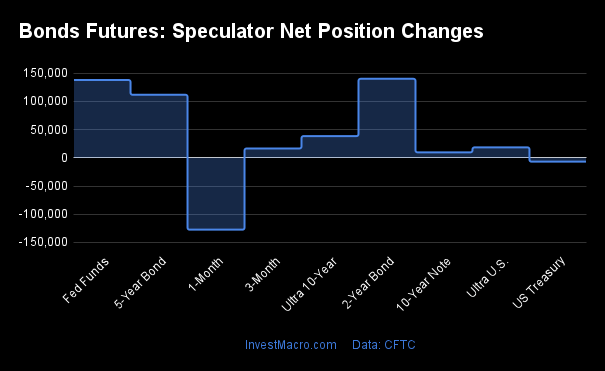
The COT bond market speculator bets were slightly higher this week as five out of the nine bond markets we cover had higher positioning while the other four markets had lower speculator contracts.

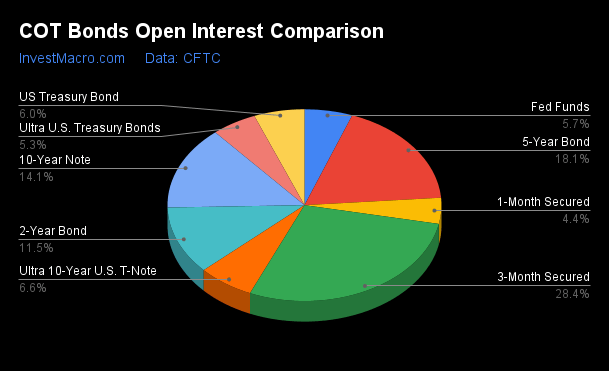
Leading the gains for the bond markets was the 10-Year Bonds (104,511 contracts) with the 5-Year Bonds (23,282 contracts), SOFR 1-Month (18,448 contracts), the US Treasury Bonds (16,879 contracts) and the Ultra Treasury Bonds (4,966 contracts) also recording positive weeks.

The bond markets with declines in speculator bets for the week were the SOFR 3-Months (-280,332 contracts), the 2-Year Bonds (-64,188 contracts), the Fed Funds (-19,504 contracts) and the Ultra 10-Year Bonds (-6,845 contracts) also seeing lower bets on the week.


Bonds Net Speculators Leaderboard
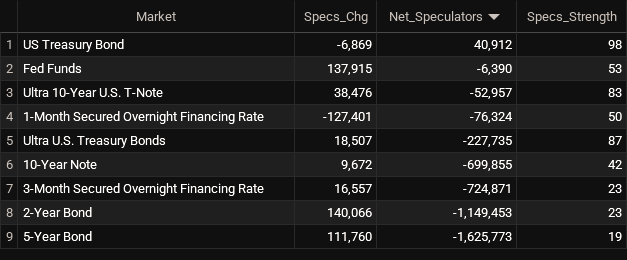
Legend: Weekly Speculators Change | Speculators Current Net Position | Speculators Strength Score compared to last 3-Years (0-100 range)


Strength Scores led by US Treasury Bonds & Ultra Treasury Bonds
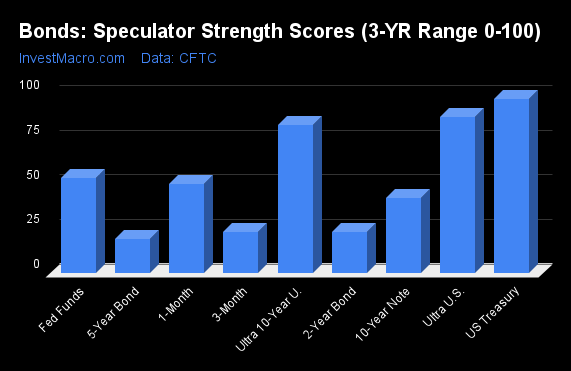
COT Strength Scores (a normalized measure of Speculator positions over a 3-Year range, from 0 to 100 where above 80 is Extreme-Bullish and below 20 is Extreme-Bearish) showed that the US Treasury Bonds (84 percent) and the Ultra Treasury Bonds (82 percent) lead the bond markets this week. The SOFR 1-Month (67 percent) comes in as the next highest in the weekly strength scores.

On the downside, the 5-Year Bond (11 percent) and the 2-Year Bonds (15 percent) come in at the lowest strength level currently and are in Extreme-Bearish territory (below 20 percent).

Strength Statistics:
Fed Funds (20.1 percent) vs Fed Funds previous week (23.7 percent)
2-Year Bond (14.9 percent) vs 2-Year Bond previous week (19.1 percent)
5-Year Bond (10.9 percent) vs 5-Year Bond previous week (9.7 percent)
10-Year Bond (54.4 percent) vs 10-Year Bond previous week (44.6 percent)
Ultra 10-Year Bond (37.0 percent) vs Ultra 10-Year Bond previous week (38.8 percent)
US Treasury Bond (83.5 percent) vs US Treasury Bond previous week (77.6 percent)
Ultra US Treasury Bond (81.8 percent) vs Ultra US Treasury Bond previous week (79.9 percent)
SOFR 1-Month (66.6 percent) vs SOFR 1-Month previous week (62.1 percent)
SOFR 3-Months (23.0 percent) vs SOFR 3-Months previous week (37.5 percent)


10-Year Bonds & SOFR 1-Month top the 6-Week Strength Trends

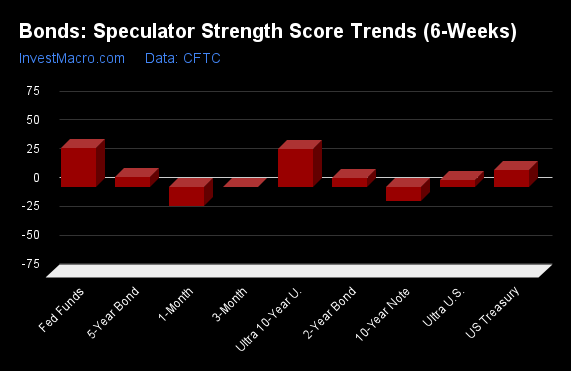
COT Strength Score Trends (or move index, calculates the 6-week changes in strength scores) showed that the 10-Year Bonds (31 percent) and the SOFR 1-Month (27 percent) lead the past six weeks trends for bonds. The US Treasury Bonds (20 percent) are the next highest positive movers in the latest trends data.

The Fed Funds (-29 percent) and the SOFR 3-Months (-10 percent) lead the downside trend scores currently.

Strength Trend Statistics:
Fed Funds (-29.2 percent) vs Fed Funds previous week (-22.6 percent)
2-Year Bond (-3.5 percent) vs 2-Year Bond previous week (2.7 percent)
5-Year Bond (4.4 percent) vs 5-Year Bond previous week (-1.9 percent)
10-Year Bond (30.6 percent) vs 10-Year Bond previous week (24.0 percent)
Ultra 10-Year Bond (6.2 percent) vs Ultra 10-Year Bond previous week (-3.7 percent)
US Treasury Bond (20.5 percent) vs US Treasury Bond previous week (10.7 percent)
Ultra US Treasury Bond (-10.7 percent) vs Ultra US Treasury Bond previous week (-20.1 percent)
SOFR 1-Month (26.9 percent) vs SOFR 1-Month previous week (49.5 percent)
SOFR 3-Months (-9.5 percent) vs SOFR 3-Months previous week (-0.6 percent)


30-Day Federal Funds Futures:
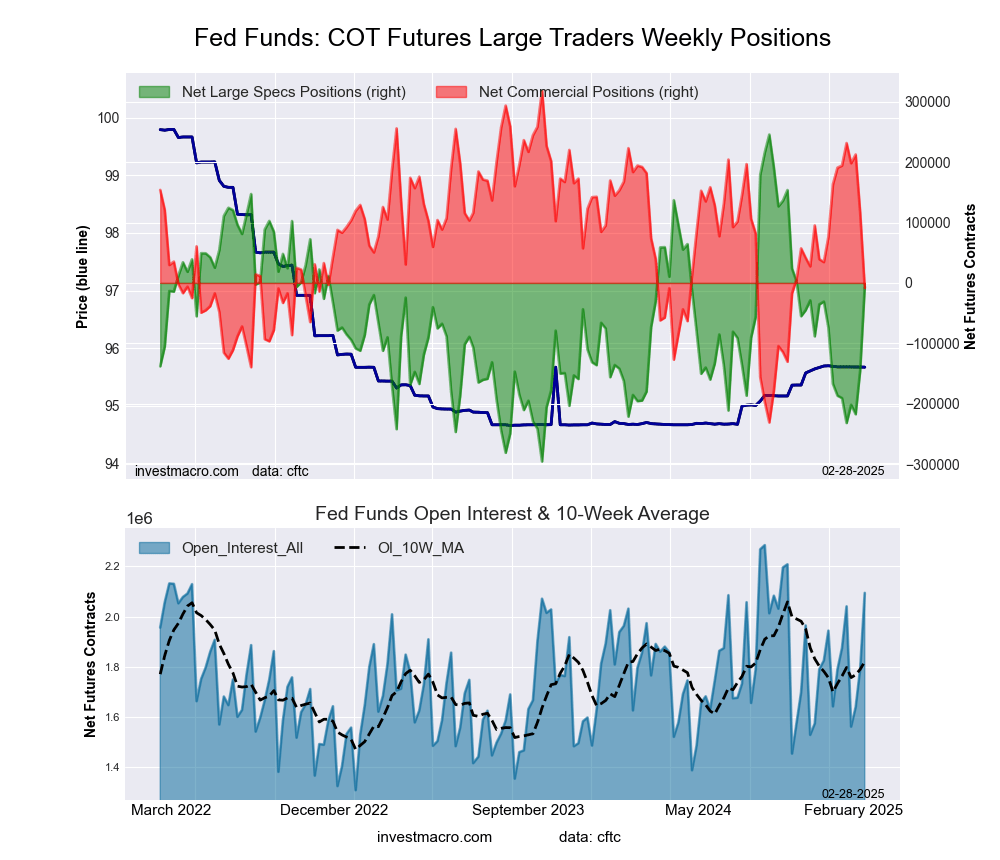
Federal Funds 30-Day Bonds Futures COT ChartThe 30-Day Federal Funds large speculator standing this week equaled a net position of -186,720 contracts in the data reported through Tuesday. This was a weekly fall of -19,504 contracts from the previous week which had a total of -167,216 net contracts.

This week’s current strength score (the trader positioning range over the past three years, measured from 0 to 100) shows the speculators are currently Bearish with a score of 20.1 percent. The commercials are Bullish with a score of 76.7 percent and the small traders (not shown in chart) are Bullish with a score of 77.6 percent.

Price Trend-Following Model: Downtrend

Our weekly trend-following model classifies the current market price position as: Downtrend. The current action for the model is considered to be: Hold – Maintain Short Position.

30-Day Federal Funds StatisticsSPECULATORSCOMMERCIALSSMALL TRADERS
– Percent of Open Interest Longs:10.570.92.0
– Percent of Open Interest Shorts:20.960.32.2
– Net Position:-186,720190,792-4,072
– Gross Longs:187,4981,268,97535,226
– Gross Shorts:374,2181,078,18339,298
– Long to Short Ratio:0.5 to 11.2 to 10.9 to 1
NET POSITION TREND:
– Strength Index Score (3 Year Range Pct):20.176.777.6
– Strength Index Reading (3 Year Range):BearishBullishBullish
NET POSITION MOVEMENT INDEX:
– 6-Week Change in Strength Index:-29.229.7-10.2


Secured Overnight Financing Rate (3-Month) Futures:
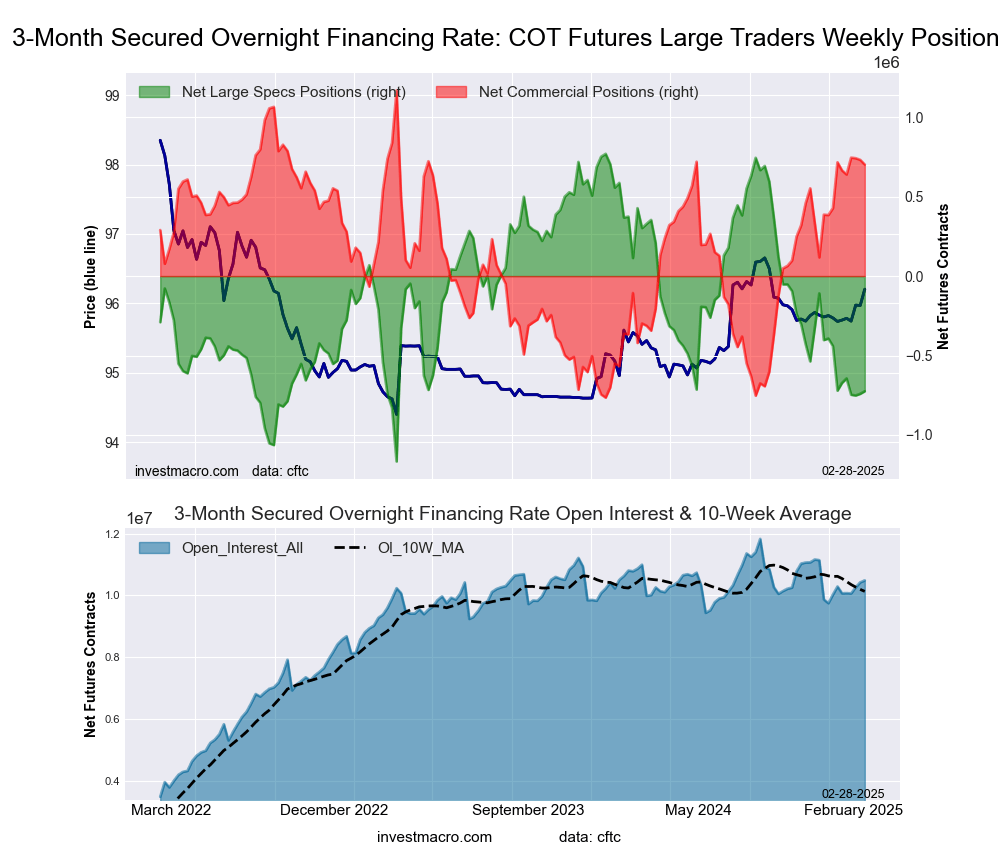
SOFR 3-Months Bonds Futures COT ChartThe Secured Overnight Financing Rate (3-Month) large speculator standing this week equaled a net position of -720,849 contracts in the data reported through Tuesday. This was a weekly decline of -280,332 contracts from the previous week which had a total of -440,517 net contracts.

This week’s current strength score (the trader positioning range over the past three years, measured from 0 to 100) shows the speculators are currently Bearish with a score of 23.0 percent. The commercials are Bullish with a score of 76.6 percent and the small traders (not shown in chart) are Bullish-Extreme with a score of 90.5 percent.

Price Trend-Following Model: Weak Uptrend

Our weekly trend-following model classifies the current market price position as: Weak Uptrend. The current action for the model is considered to be: Hold – Maintain Long Position.

SOFR 3-Months StatisticsSPECULATORSCOMMERCIALSSMALL TRADERS
– Percent of Open Interest Longs:11.961.10.2
– Percent of Open Interest Shorts:18.954.10.2
– Net Position:-720,849716,1084,741
– Gross Longs:1,221,3916,283,05024,000
– Gross Shorts:1,942,2405,566,94219,259
– Long to Short Ratio:0.6 to 11.1 to 11.2 to 1
NET POSITION TREND:
– Strength Index Score (3 Year Range Pct):23.076.690.5
– Strength Index Reading (3 Year Range):BearishBullishBullish-Extreme
NET POSITION MOVEMENT INDEX:
– 6-Week Change in Strength Index:-9.58.510.9


Individual Bond Markets:

Secured Overnight Financing Rate (1-Month) Futures:
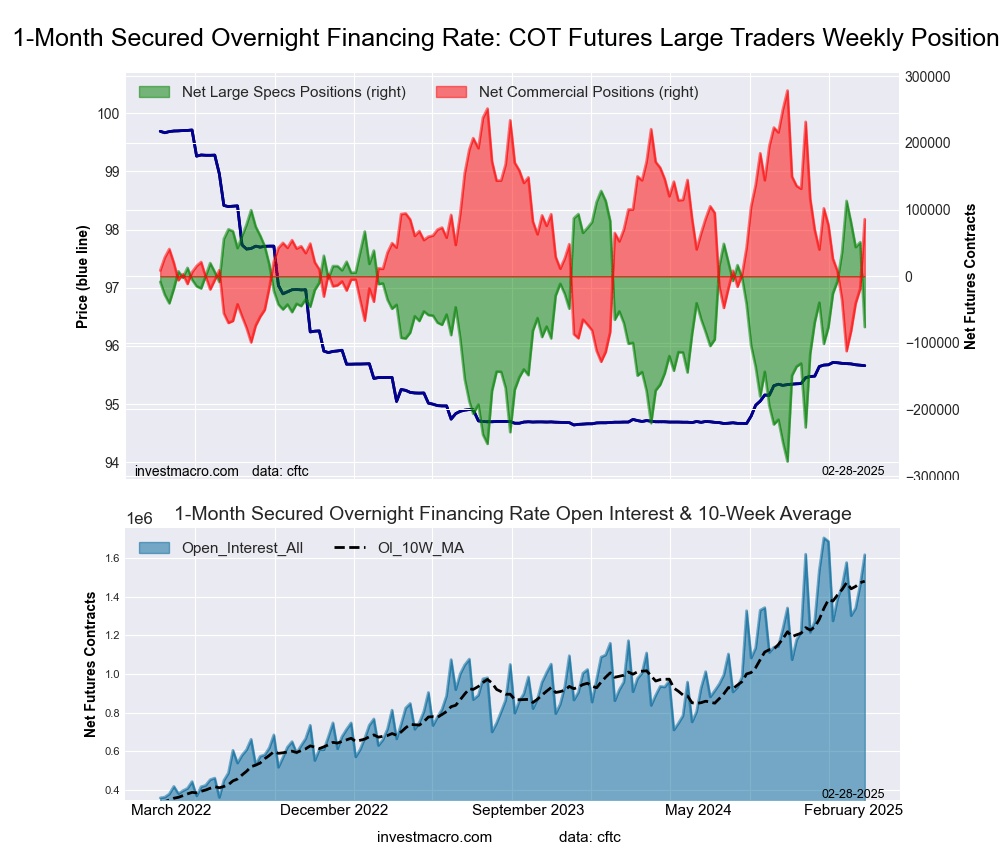
SOFR 1-Month Bonds Futures COT ChartThe Secured Overnight Financing Rate (1-Month) large speculator standing this week equaled a net position of -7,524 contracts in the data reported through Tuesday. This was a weekly advance of 18,448 contracts from the previous week which had a total of -25,972 net contracts.

This week’s current strength score (the trader positioning range over the past three years, measured from 0 to 100) shows the speculators are currently Bullish with a score of 66.6 percent. The commercials are Bearish with a score of 33.5 percent and the small traders (not shown in chart) are Bullish with a score of 54.0 percent.

Price Trend-Following Model: Uptrend

Our weekly trend-following model classifies the current market price position as: Uptrend.

SOFR 1-Month StatisticsSPECULATORSCOMMERCIALSSMALL TRADERS
– Percent of Open Interest Longs:24.861.30.0
– Percent of Open Interest Shorts:25.360.70.0
– Net Position:-7,5247,757-233
– Gross Longs:343,490849,795143
– Gross Shorts:351,014842,038376
– Long to Short Ratio:1.0 to 11.0 to 10.4 to 1
NET POSITION TREND:
– Strength Index Score (3 Year Range Pct):66.633.554.0
– Strength Index Reading (3 Year Range):BullishBearishBullish
NET POSITION MOVEMENT INDEX:
– 6-Week Change in Strength Index:26.9-26.7-3.0


2-Year Treasury Note Futures:

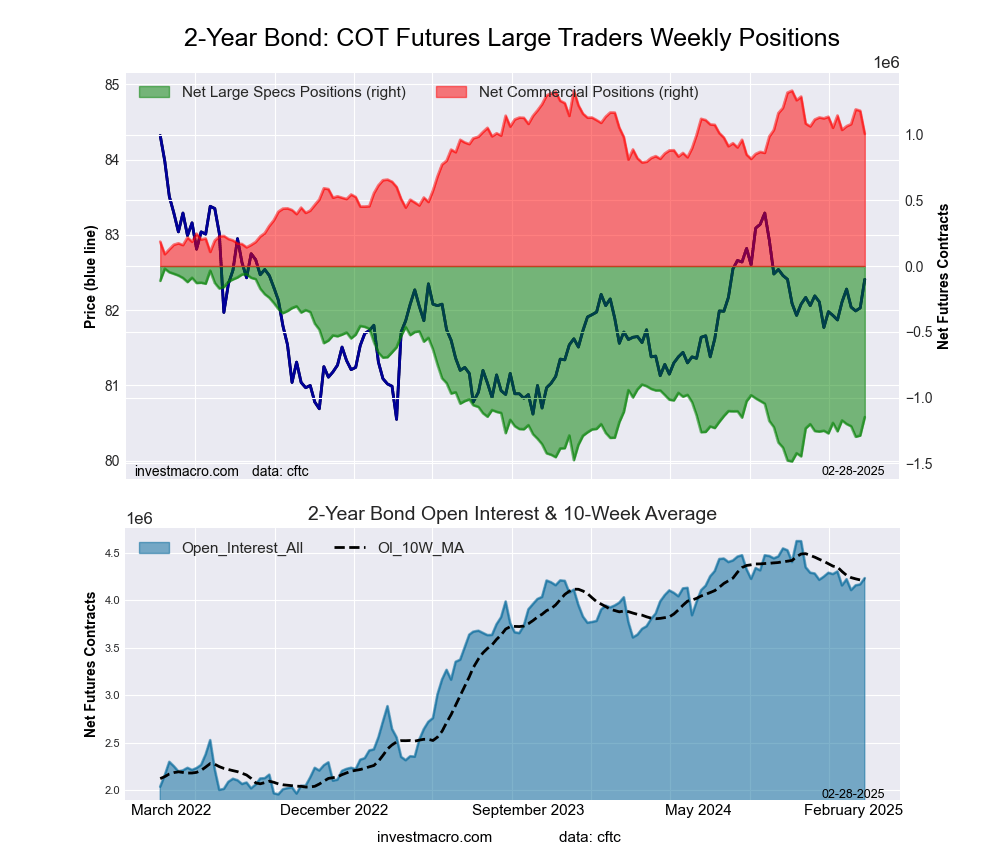
2-Year Treasury Bonds Futures COT ChartThe 2-Year Treasury Note large speculator standing this week equaled a net position of -1,257,206 contracts in the data reported through Tuesday. This was a weekly fall of -64,188 contracts from the previous week which had a total of -1,193,018 net contracts.

This week’s current strength score (the trader positioning range over the past three years, measured from 0 to 100) shows the speculators are currently Bearish-Extreme with a score of 14.9 percent. The commercials are Bullish-Extreme with a score of 85.4 percent and the small traders (not shown in chart) are Bullish with a score of 71.7 percent.

Price Trend-Following Model: Downtrend

Our weekly trend-following model classifies the current market price position as: Downtrend.

2-Year Treasury Note StatisticsSPECULATORSCOMMERCIALSSMALL TRADERS
– Percent of Open Interest Longs:13.376.65.9
– Percent of Open Interest Shorts:42.550.03.3
– Net Position:-1,257,2061,144,456112,750
– Gross Longs:570,3773,295,697252,707
– Gross Shorts:1,827,5832,151,241139,957
– Long to Short Ratio:0.3 to 11.5 to 11.8 to 1
NET POSITION TREND:
– Strength Index Score (3 Year Range Pct):14.985.471.7
– Strength Index Reading (3 Year Range):Bearish-ExtremeBullish-ExtremeBullish
NET POSITION MOVEMENT INDEX:
– 6-Week Change in Strength Index:-3.56.3-8.9


5-Year Treasury Note Futures:

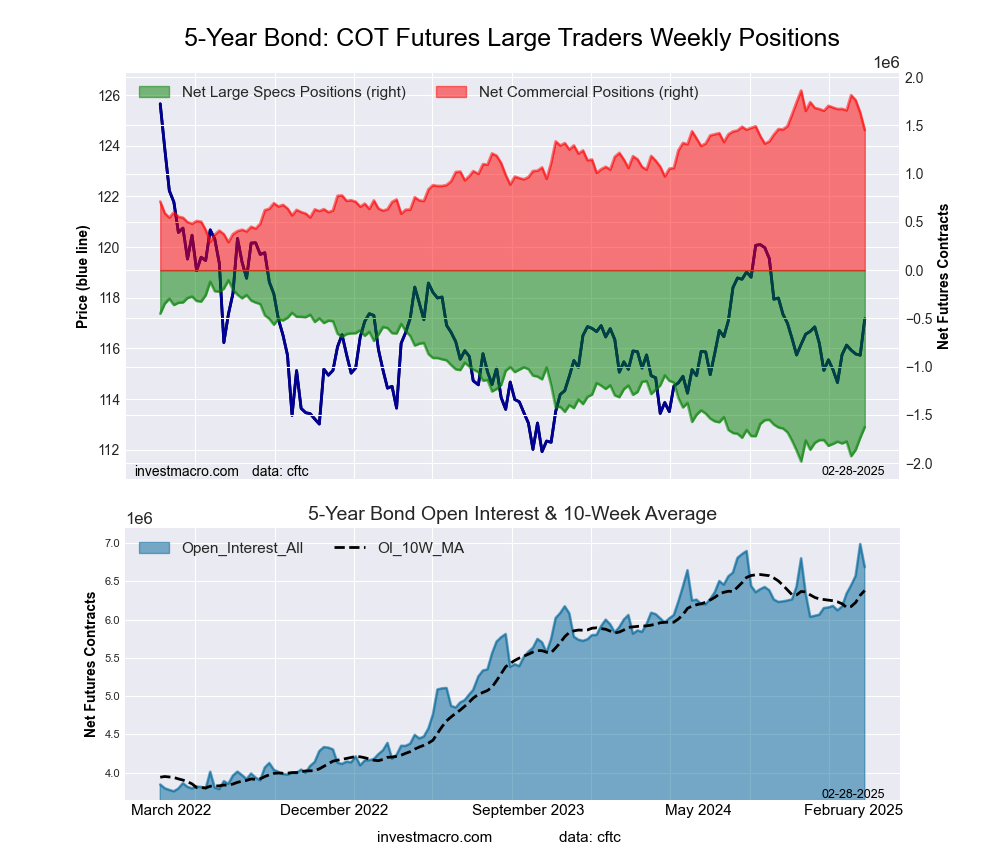
5-Year Treasury Bonds Futures COT ChartThe 5-Year Treasury Note large speculator standing this week equaled a net position of -1,777,621 contracts in the data reported through Tuesday. This was a weekly advance of 23,282 contracts from the previous week which had a total of -1,800,903 net contracts.

This week’s current strength score (the trader positioning range over the past three years, measured from 0 to 100) shows the speculators are currently Bearish-Extreme with a score of 10.9 percent. The commercials are Bullish-Extreme with a score of 87.8 percent and the small traders (not shown in chart) are Bullish with a score of 73.4 percent.

Price Trend-Following Model: Downtrend

Our weekly trend-following model classifies the current market price position as: Downtrend.

5-Year Treasury Note StatisticsSPECULATORSCOMMERCIALSSMALL TRADERS
– Percent of Open Interest Longs:5.985.16.7
– Percent of Open Interest Shorts:35.057.84.9
– Net Position:-1,777,6211,669,604108,017
– Gross Longs:362,0515,210,168407,806
– Gross Shorts:2,139,6723,540,564299,789
– Long to Short Ratio:0.2 to 11.5 to 11.4 to 1
NET POSITION TREND:
– Strength Index Score (3 Year Range Pct):10.987.873.4
– Strength Index Reading (3 Year Range):Bearish-ExtremeBullish-ExtremeBullish
NET POSITION MOVEMENT INDEX:
– 6-Week Change in Strength Index:4.4-4.6-2.2


10-Year Treasury Note Futures:

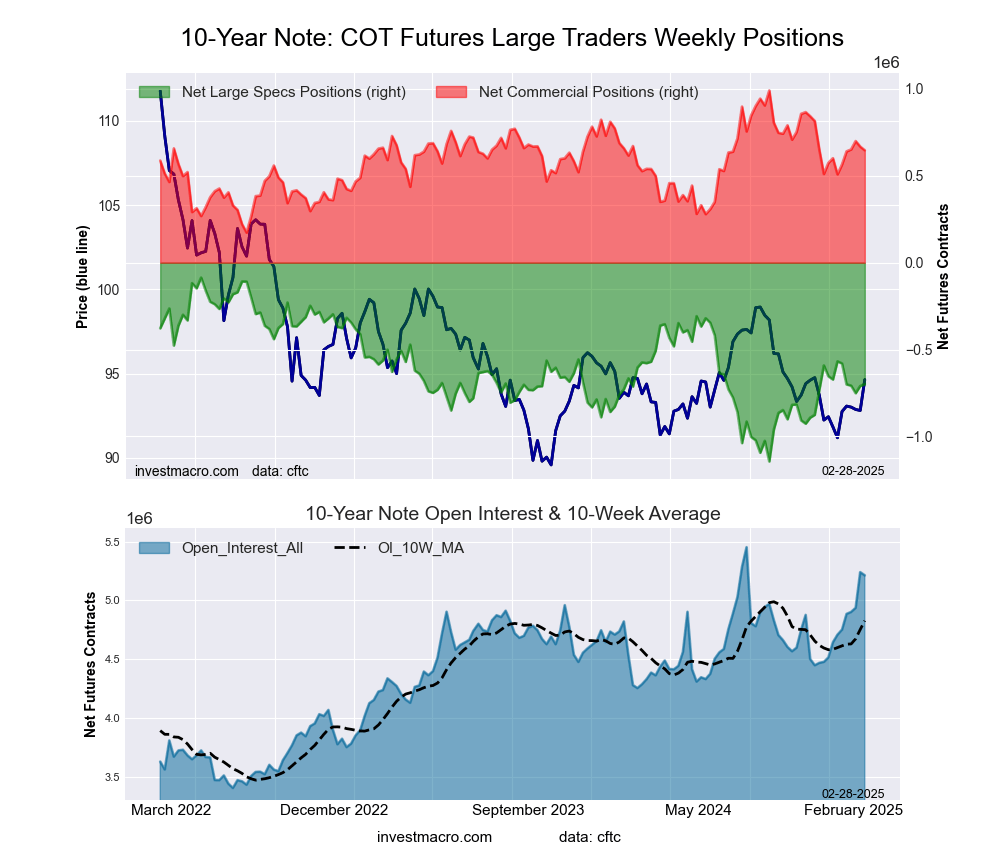
10-Year Treasury Notes Bonds Futures COT ChartThe 10-Year Treasury Note large speculator standing this week equaled a net position of -567,935 contracts in the data reported through Tuesday. This was a weekly boost of 104,511 contracts from the previous week which had a total of -672,446 net contracts.

This week’s current strength score (the trader positioning range over the past three years, measured from 0 to 100) shows the speculators are currently Bullish with a score of 54.4 percent. The commercials are Bearish with a score of 41.0 percent and the small traders (not shown in chart) are Bullish with a score of 77.8 percent.

Price Trend-Following Model: Downtrend

Our weekly trend-following model classifies the current market price position as: Downtrend.

10-Year Treasury Note StatisticsSPECULATORSCOMMERCIALSSMALL TRADERS
– Percent of Open Interest Longs:14.474.59.3
– Percent of Open Interest Shorts:26.563.78.1
– Net Position:-567,935508,31159,624
– Gross Longs:677,8113,505,753440,081
– Gross Shorts:1,245,7462,997,442380,457
– Long to Short Ratio:0.5 to 11.2 to 11.2 to 1
NET POSITION TREND:
– Strength Index Score (3 Year Range Pct):54.441.077.8
– Strength Index Reading (3 Year Range):BullishBearishBullish
NET POSITION MOVEMENT INDEX:
– 6-Week Change in Strength Index:30.6-40.92.3


Ultra 10-Year Notes Futures:

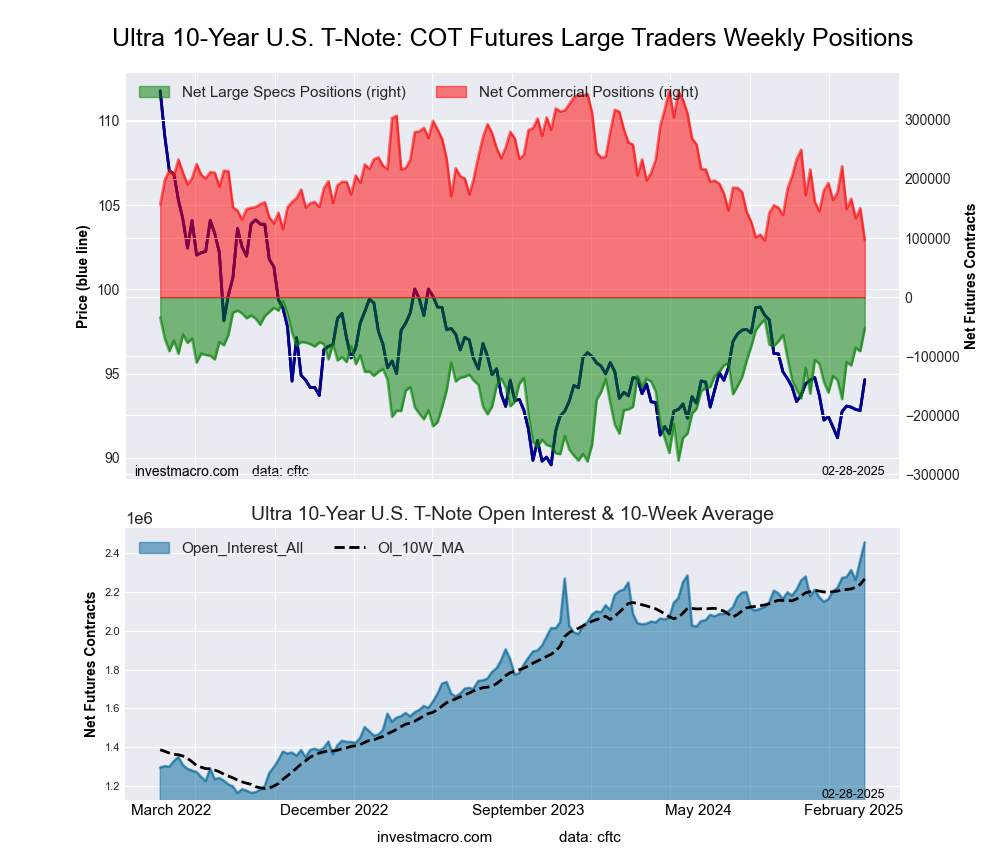
Ultra 10-Year Treasury Notes Bonds Futures COT ChartThe Ultra 10-Year Notes large speculator standing this week equaled a net position of -140,232 contracts in the data reported through Tuesday. This was a weekly decrease of -6,845 contracts from the previous week which had a total of -133,387 net contracts.

This week’s current strength score (the trader positioning range over the past three years, measured from 0 to 100) shows the speculators are currently Bearish with a score of 37.0 percent. The commercials are Bearish with a score of 35.7 percent and the small traders (not shown in chart) are Bullish-Extreme with a score of 89.3 percent.

Price Trend-Following Model: Weak Uptrend

Our weekly trend-following model classifies the current market price position as: Weak Uptrend. The current action for the model is considered to be: Hold – Maintain Long Position.

Ultra 10-Year Notes StatisticsSPECULATORSCOMMERCIALSSMALL TRADERS
– Percent of Open Interest Longs:13.874.810.5
– Percent of Open Interest Shorts:20.166.812.1
– Net Position:-140,232177,767-37,535
– Gross Longs:306,3851,660,363231,947
– Gross Shorts:446,6171,482,596269,482
– Long to Short Ratio:0.7 to 11.1 to 10.9 to 1
NET POSITION TREND:
– Strength Index Score (3 Year Range Pct):37.035.789.3
– Strength Index Reading (3 Year Range):BearishBearishBullish-Extreme
NET POSITION MOVEMENT INDEX:
– 6-Week Change in Strength Index:6.2-14.39.8


US Treasury Bonds Futures:

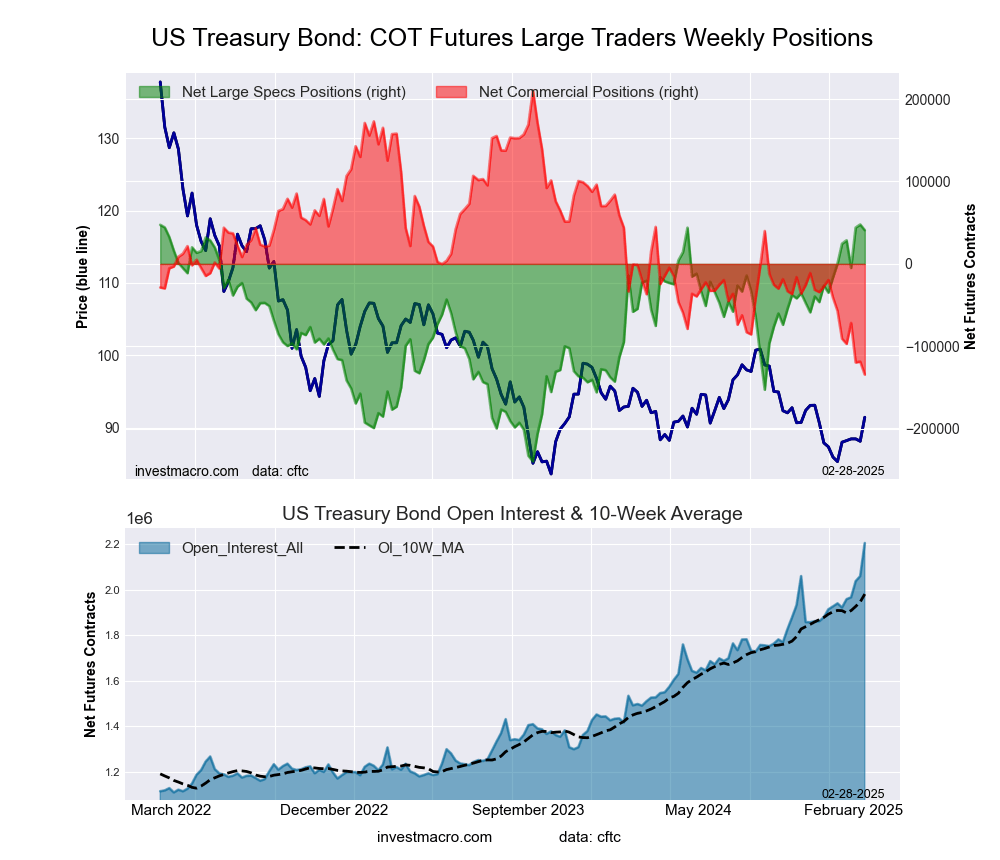
US Year Treasury Notes Long Bonds Futures COT ChartThe US Treasury Bonds large speculator standing this week equaled a net position of 52 contracts in the data reported through Tuesday. This was a weekly boost of 16,879 contracts from the previous week which had a total of -16,827 net contracts.

This week’s current strength score (the trader positioning range over the past three years, measured from 0 to 100) shows the speculators are currently Bullish-Extreme with a score of 83.5 percent. The commercials are Bearish-Extreme with a score of 9.7 percent and the small traders (not shown in chart) are Bullish with a score of 58.0 percent.

Price Trend-Following Model: Downtrend

Our weekly trend-following model classifies the current market price position as: Downtrend.

US Treasury Bonds StatisticsSPECULATORSCOMMERCIALSSMALL TRADERS
– Percent of Open Interest Longs:23.464.211.1
– Percent of Open Interest Shorts:23.467.18.1
– Net Position:52-56,83256,780
– Gross Longs:454,7571,245,292214,663
– Gross Shorts:454,7051,302,124157,883
– Long to Short Ratio:1.0 to 11.0 to 11.4 to 1
NET POSITION TREND:
– Strength Index Score (3 Year Range Pct):83.59.758.0
– Strength Index Reading (3 Year Range):Bullish-ExtremeBearish-ExtremeBullish
NET POSITION MOVEMENT INDEX:
– 6-Week Change in Strength Index:20.5-15.4-8.9


Ultra US Treasury Bonds Futures:

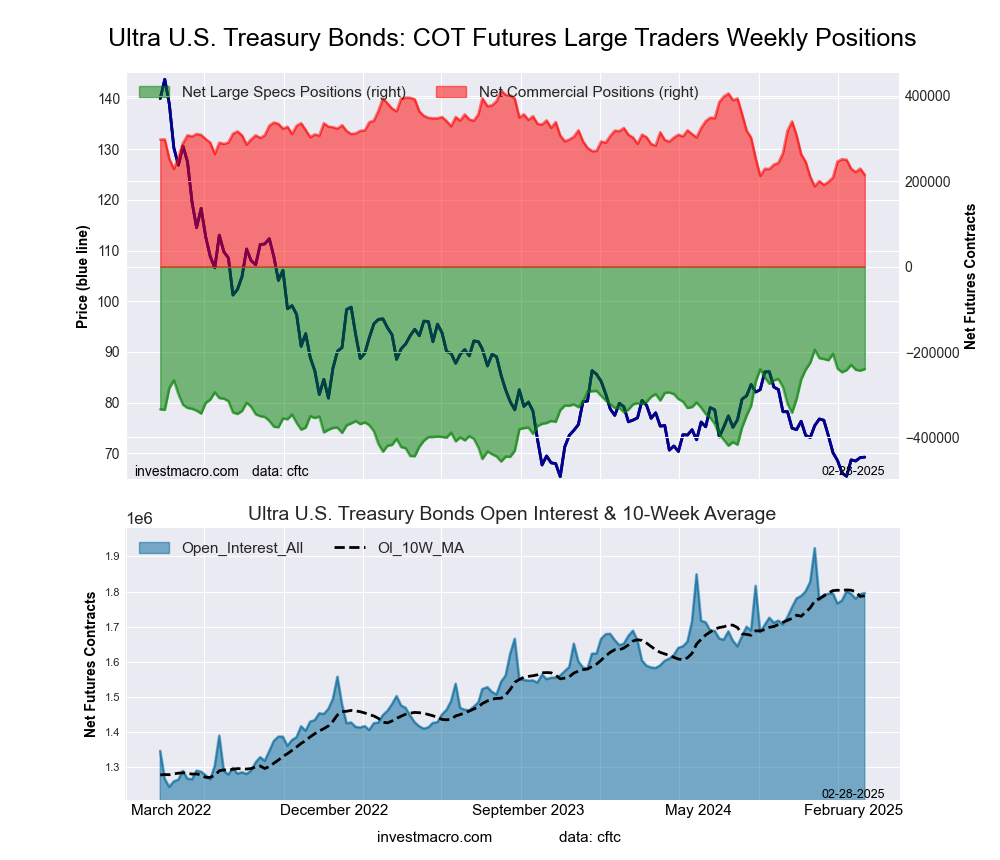
Ultra US Year Treasury Notes Long Bonds Futures COT ChartThe Ultra US Treasury Bonds large speculator standing this week equaled a net position of -242,422 contracts in the data reported through Tuesday. This was a weekly lift of 4,966 contracts from the previous week which had a total of -247,388 net contracts.

This week’s current strength score (the trader positioning range over the past three years, measured from 0 to 100) shows the speculators are currently Bullish-Extreme with a score of 81.8 percent. The commercials are Bearish with a score of 27.7 percent and the small traders (not shown in chart) are Bearish-Extreme with a score of 0.0 percent.

Price Trend-Following Model: Downtrend

Our weekly trend-following model classifies the current market price position as: Downtrend.

Ultra US Treasury Bonds StatisticsSPECULATORSCOMMERCIALSSMALL TRADERS
– Percent of Open Interest Longs:8.381.79.6
– Percent of Open Interest Shorts:21.767.810.1
– Net Position:-242,422250,327-7,905
– Gross Longs:149,1121,471,577173,518
– Gross Shorts:391,5341,221,250181,423
– Long to Short Ratio:0.4 to 11.2 to 11.0 to 1
NET POSITION TREND:
– Strength Index Score (3 Year Range Pct):81.827.70.0
– Strength Index Reading (3 Year Range):Bullish-ExtremeBearishBearish-Extreme
NET POSITION MOVEMENT INDEX:
– 6-Week Change in Strength Index:-10.722.2-29.2


Article By InvestMacroReceive our weekly COT Newsletter

*COT Report: The COT data, released weekly to the public each Friday, is updated through the most recent Tuesday (data is 3 days old) and shows a quick view of how large speculators or non-commercials (for-profit traders) were positioned in the futures markets.

The CFTC categorizes trader positions according to commercial hedgers (traders who use futures contracts for hedging as part of the business), non-commercials (large traders who speculate to realize trading profits) and nonreportable traders (usually small traders/speculators) as well as their open interest (contracts open in the market at time of reporting). See CFTC criteria here.

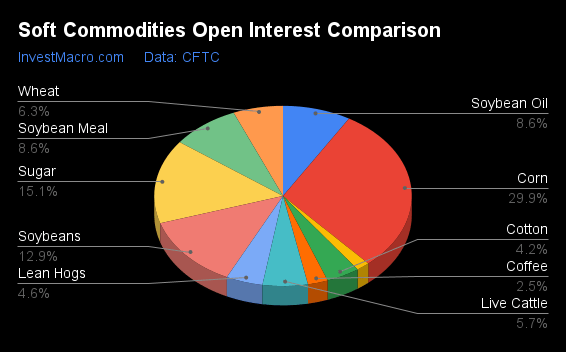
COT Soft Commodities Charts: Weekly Speculator Wagers led by Soybeans & Soybean Oil

By InvestMacro

Here are the latest charts and statistics for the Commitment of Traders (COT) reports data published by the Commodities Futures Trading Commission (CFTC).

The latest COT data is updated through Tuesday January 14th and shows a quick view of how large traders (for-profit speculators and commercial entities) were positioned in the futures markets.

Weekly Speculator Changes led by Soybeans & Soybean Oil

The COT soft commodities markets speculator bets were higher this week as seven out of the eleven softs markets we cover had higher positioning while the other four markets had lower speculator contracts.

Leading the gains for the softs markets was Soybeans (64,519 contracts) with Soybean Oil (28,603 contracts), Corn (28,262 contracts), Coffee (8,508 contracts), Live Cattle (4,740 contracts) and Lean Hogs (3,797 contracts) also coming in with a positive week.

The markets with the declines in speculator bets this week were Sugar (-35,665 contracts), Soybean Meal (-3,865 contracts), Cotton (-3,657 contracts), Wheat (-2,735 contracts) and with Cocoa (1,066 contracts) also registering lower bets on the week.


Soft Commodities Net Speculators Leaderboard

Legend: Weekly Speculators Change | Speculators Current Net Position | Speculators Strength Score compared to last 3-Years (0-100 range)


Strength Scores led by Live Cattle & Coffee

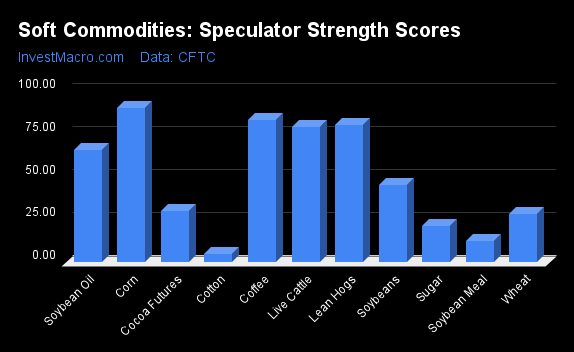
COT Strength Scores (a normalized measure of Speculator positions over a 3-Year range, from 0 to 100 where above 80 is Extreme-Bullish and below 20 is Extreme-Bearish) showed that Live Cattle (100 percent) and Coffee (97 percent) lead the softs markets this week. Lean Hogs (87 percent), Corn (78 percent) and Soybean Oil (60 percent) come in as the next highest in the weekly strength scores.

On the downside, Sugar (6 percent), Cotton (7 percent), Wheat (12 percent) and Soybean Meal (15 percent) come in at the lowest strength levels currently and are in Extreme-Bearish territory (below 20 percent).

Strength Statistics:
Corn (78.2 percent) vs Corn previous week (74.6 percent)
Sugar (6.4 percent) vs Sugar previous week (19.0 percent)
Coffee (96.7 percent) vs Coffee previous week (88.4 percent)
Soybeans (50.0 percent) vs Soybeans previous week (34.8 percent)
Soybean Oil (60.3 percent) vs Soybean Oil previous week (44.6 percent)
Soybean Meal (15.1 percent) vs Soybean Meal previous week (16.7 percent)
Live Cattle (100.0 percent) vs Live Cattle previous week (95.4 percent)
Lean Hogs (87.0 percent) vs Lean Hogs previous week (84.0 percent)
Cotton (7.0 percent) vs Cotton previous week (9.5 percent)
Cocoa (47.6 percent) vs Cocoa previous week (46.5 percent)
Wheat (11.9 percent) vs Wheat previous week (14.1 percent)


Soybeans & Corn top the 6-Week Strength Trends

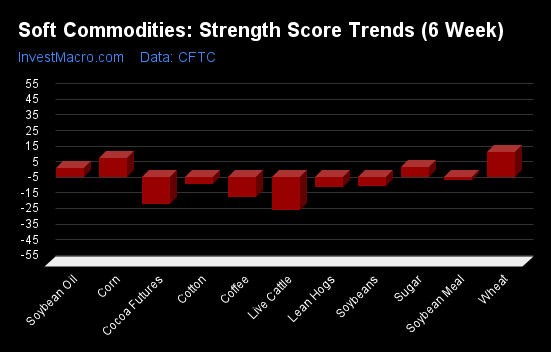
COT Strength Score Trends (or move index, calculates the 6-week changes in strength scores) showed that Soybeans (27 percent) and Corn (27 percent) lead the past six weeks trends for soft commodities. Live Cattle (25 percent), Coffee (6 percent) and Soybean Oil (4 percent) are the next highest positive movers in the latest trends data.

Sugar (-26 percent) leads the downside trend scores currently with Wheat (-16 percent), Cotton (-15 percent) and Lean Hogs (-12 percent) following next with lower trend scores.

Strength Trend Statistics:
Corn (26.8 percent) vs Corn previous week (23.3 percent)
Sugar (-26.1 percent) vs Sugar previous week (-9.3 percent)
Coffee (5.8 percent) vs Coffee previous week (-6.3 percent)
Soybeans (26.7 percent) vs Soybeans previous week (13.2 percent)
Soybean Oil (4.1 percent) vs Soybean Oil previous week (-16.3 percent)
Soybean Meal (1.6 percent) vs Soybean Meal previous week (4.0 percent)
Live Cattle (25.3 percent) vs Live Cattle previous week (23.9 percent)
Lean Hogs (-11.7 percent) vs Lean Hogs previous week (-6.6 percent)
Cotton (-14.9 percent) vs Cotton previous week (-10.2 percent)
Cocoa (-0.3 percent) vs Cocoa previous week (-3.0 percent)
Wheat (-16.4 percent) vs Wheat previous week (-21.7 percent)


Individual Soft Commodities Markets:

CORN Futures:

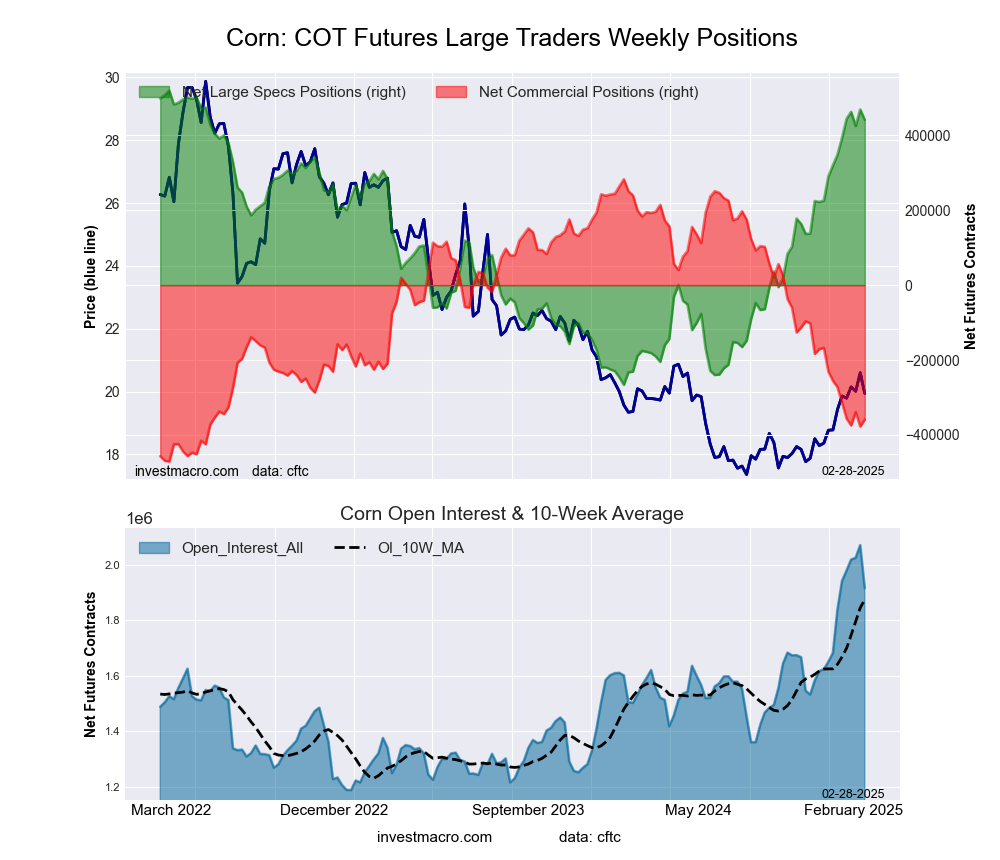
CORN Futures COT ChartThe CORN large speculator standing this week was a net position of 348,075 contracts in the data reported through Tuesday. This was a weekly advance of 28,262 contracts from the previous week which had a total of 319,813 net contracts.

This week’s current strength score (the trader positioning range over the past three years, measured from 0 to 100) shows the speculators are currently Bullish with a score of 78.2 percent. The commercials are Bearish with a score of 26.3 percent and the small traders (not shown in chart) are Bearish-Extreme with a score of 7.2 percent.

Price Trend-Following Model: Strong Uptrend

Our weekly trend-following model classifies the current market price position as: Strong Uptrend.

CORN Futures StatisticsSPECULATORSCOMMERCIALSSMALL TRADERS
– Percent of Open Interest Longs:29.043.86.3
– Percent of Open Interest Shorts:10.158.610.4
– Net Position:348,075-272,419-75,656
– Gross Longs:534,428805,779116,368
– Gross Shorts:186,3531,078,198192,024
– Long to Short Ratio:2.9 to 10.7 to 10.6 to 1
NET POSITION TREND:
– Strength Index Score (3 Year Range Pct):78.226.37.2
– Strength Index Reading (3 Year Range):BullishBearishBearish-Extreme
NET POSITION MOVEMENT INDEX:
– 6-Week Change in Strength Index:26.8-22.6-53.6


SUGAR Futures:

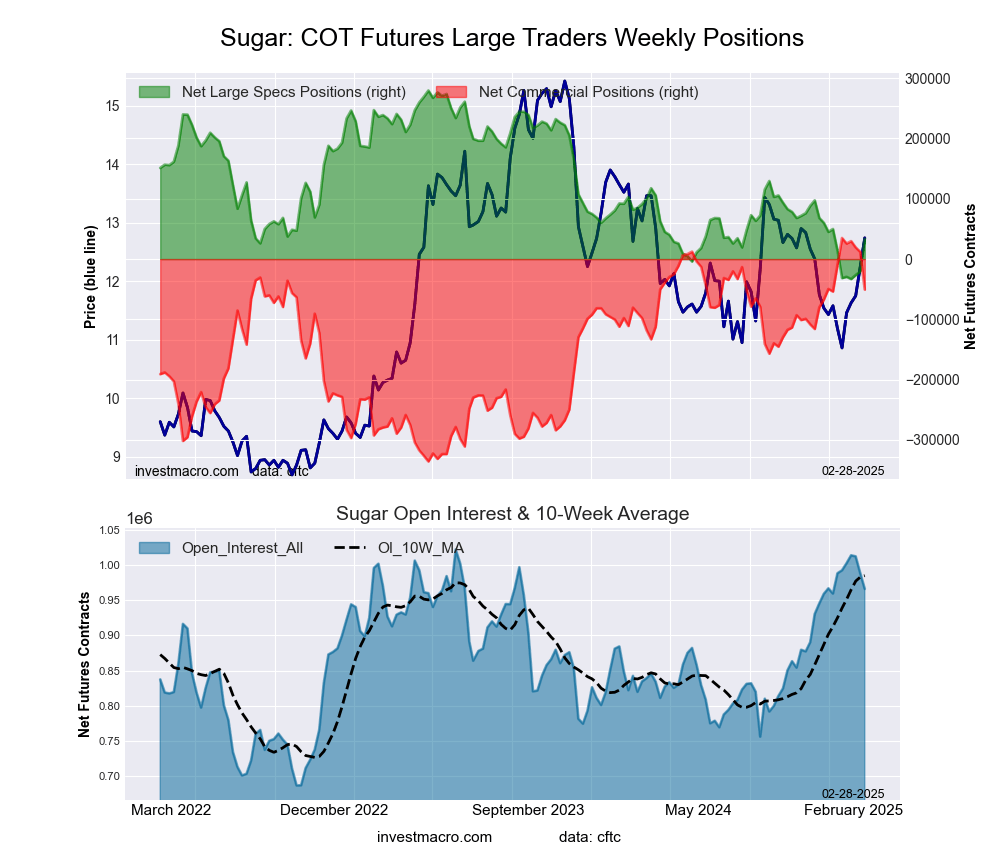
SUGAR Futures COT ChartThe SUGAR large speculator standing this week was a net position of 14,162 contracts in the data reported through Tuesday. This was a weekly reduction of -35,665 contracts from the previous week which had a total of 49,827 net contracts.

This week’s current strength score (the trader positioning range over the past three years, measured from 0 to 100) shows the speculators are currently Bearish-Extreme with a score of 6.4 percent. The commercials are Bullish-Extreme with a score of 93.6 percent and the small traders (not shown in chart) are Bearish-Extreme with a score of 14.1 percent.

Price Trend-Following Model: Strong Downtrend

Our weekly trend-following model classifies the current market price position as: Strong Downtrend.

SUGAR Futures StatisticsSPECULATORSCOMMERCIALSSMALL TRADERS
– Percent of Open Interest Longs:23.154.16.6
– Percent of Open Interest Shorts:21.755.27.0
– Net Position:14,162-9,913-4,249
– Gross Longs:228,583534,96264,921
– Gross Shorts:214,421544,87569,170
– Long to Short Ratio:1.1 to 11.0 to 10.9 to 1
NET POSITION TREND:
– Strength Index Score (3 Year Range Pct):6.493.614.1
– Strength Index Reading (3 Year Range):Bearish-ExtremeBullish-ExtremeBearish-Extreme
NET POSITION MOVEMENT INDEX:
– 6-Week Change in Strength Index:-26.128.3-31.6


COFFEE Futures:

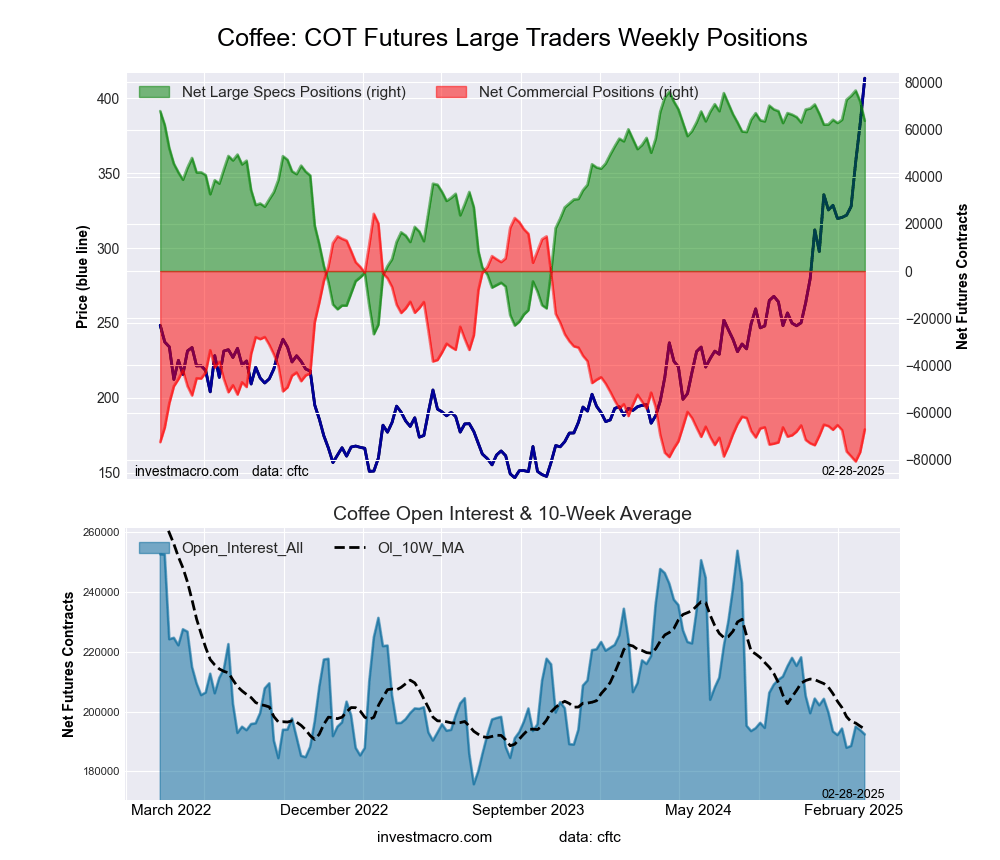
COFFEE Futures COT ChartThe COFFEE large speculator standing this week was a net position of 72,642 contracts in the data reported through Tuesday. This was a weekly advance of 8,508 contracts from the previous week which had a total of 64,134 net contracts.

This week’s current strength score (the trader positioning range over the past three years, measured from 0 to 100) shows the speculators are currently Bullish-Extreme with a score of 96.7 percent. The commercials are Bearish-Extreme with a score of 2.3 percent and the small traders (not shown in chart) are Bullish with a score of 75.3 percent.

Price Trend-Following Model: Uptrend

Our weekly trend-following model classifies the current market price position as: Uptrend.

COFFEE Futures StatisticsSPECULATORSCOMMERCIALSSMALL TRADERS
– Percent of Open Interest Longs:43.130.65.7
– Percent of Open Interest Shorts:4.471.33.7
– Net Position:72,642-76,4403,798
– Gross Longs:80,94457,47410,766
– Gross Shorts:8,302133,9146,968
– Long to Short Ratio:9.7 to 10.4 to 11.5 to 1
NET POSITION TREND:
– Strength Index Score (3 Year Range Pct):96.72.375.3
– Strength Index Reading (3 Year Range):Bullish-ExtremeBearish-ExtremeBullish
NET POSITION MOVEMENT INDEX:
– 6-Week Change in Strength Index:5.8-6.411.0


SOYBEANS Futures:

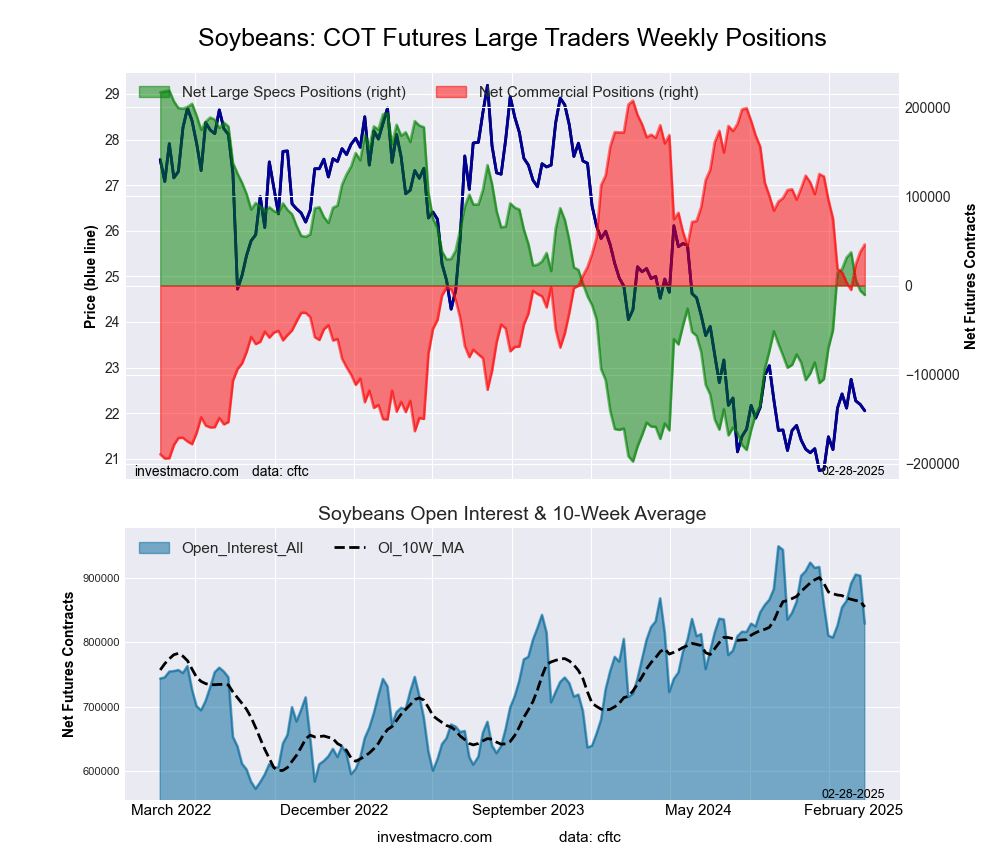
SOYBEANS Futures COT ChartThe SOYBEANS large speculator standing this week was a net position of 14,518 contracts in the data reported through Tuesday. This was a weekly gain of 64,519 contracts from the previous week which had a total of -50,001 net contracts.

This week’s current strength score (the trader positioning range over the past three years, measured from 0 to 100) shows the speculators are currently Bearish with a score of 50.0 percent. The commercials are Bullish with a score of 53.3 percent and the small traders (not shown in chart) are Bearish with a score of 26.6 percent.

Price Trend-Following Model: Weak Downtrend

Our weekly trend-following model classifies the current market price position as: Weak Downtrend.

SOYBEANS Futures StatisticsSPECULATORSCOMMERCIALSSMALL TRADERS
– Percent of Open Interest Longs:22.555.64.7
– Percent of Open Interest Shorts:20.853.48.7
– Net Position:14,51818,411-32,929
– Gross Longs:186,047459,14238,496
– Gross Shorts:171,529440,73171,425
– Long to Short Ratio:1.1 to 11.0 to 10.5 to 1
NET POSITION TREND:
– Strength Index Score (3 Year Range Pct):50.053.326.6
– Strength Index Reading (3 Year Range):BearishBullishBearish
NET POSITION MOVEMENT INDEX:
– 6-Week Change in Strength Index:26.7-24.1-41.1


SOYBEAN OIL Futures:

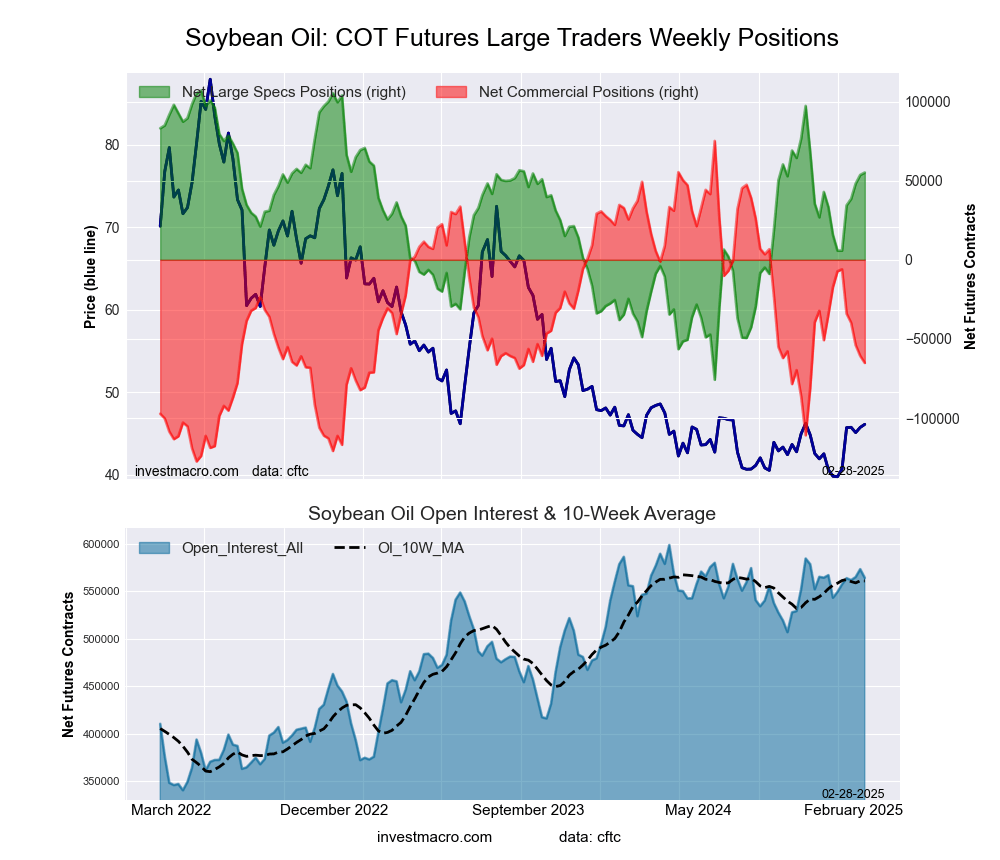
SOYBEAN OIL Futures COT ChartThe SOYBEAN OIL large speculator standing this week was a net position of 34,403 contracts in the data reported through Tuesday. This was a weekly gain of 28,603 contracts from the previous week which had a total of 5,800 net contracts.

This week’s current strength score (the trader positioning range over the past three years, measured from 0 to 100) shows the speculators are currently Bullish with a score of 60.3 percent. The commercials are Bearish with a score of 46.1 percent and the small traders (not shown in chart) are Bearish-Extreme with a score of 12.4 percent.

Price Trend-Following Model: Strong Uptrend

Our weekly trend-following model classifies the current market price position as: Strong Uptrend.

SOYBEAN OIL Futures StatisticsSPECULATORSCOMMERCIALSSMALL TRADERS
– Percent of Open Interest Longs:23.455.05.1
– Percent of Open Interest Shorts:17.361.05.2
– Net Position:34,403-33,971-432
– Gross Longs:132,019310,20428,665
– Gross Shorts:97,616344,17529,097
– Long to Short Ratio:1.4 to 10.9 to 11.0 to 1
NET POSITION TREND:
– Strength Index Score (3 Year Range Pct):60.346.112.4
– Strength Index Reading (3 Year Range):BullishBearishBearish-Extreme
NET POSITION MOVEMENT INDEX:
– 6-Week Change in Strength Index:4.1-0.8-22.7


SOYBEAN MEAL Futures:

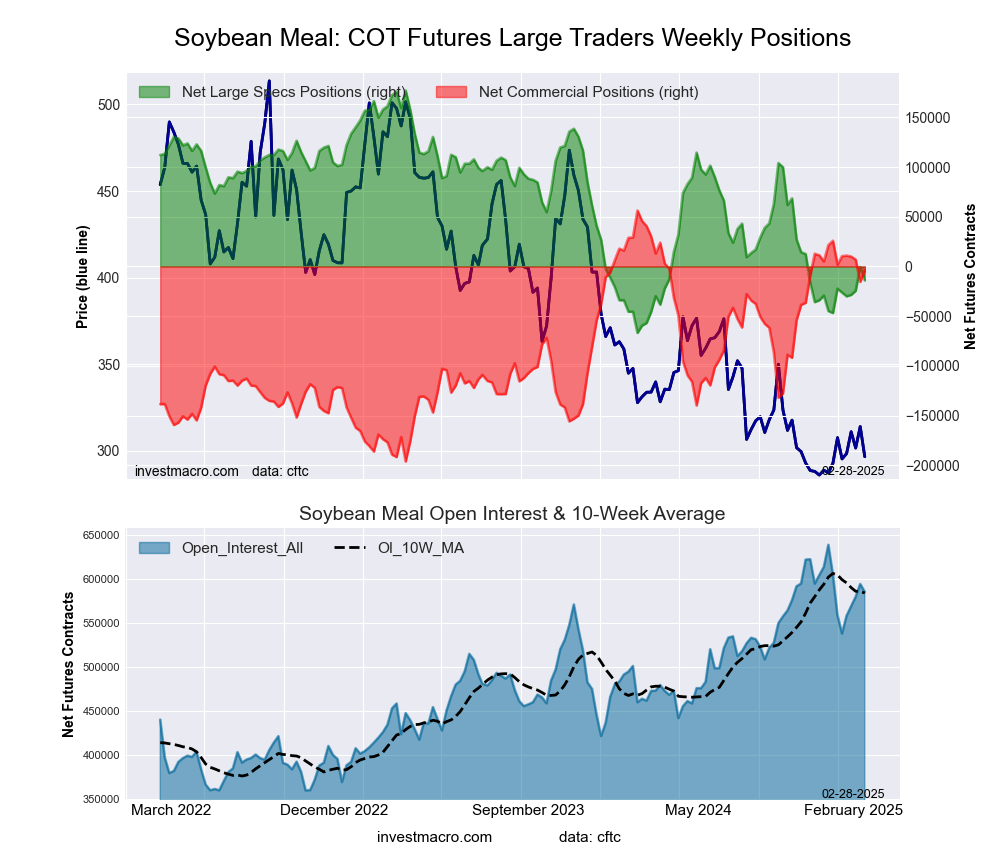
SOYBEAN MEAL Futures COT ChartThe SOYBEAN MEAL large speculator standing this week was a net position of -30,026 contracts in the data reported through Tuesday. This was a weekly decrease of -3,865 contracts from the previous week which had a total of -26,161 net contracts.

This week’s current strength score (the trader positioning range over the past three years, measured from 0 to 100) shows the speculators are currently Bearish-Extreme with a score of 15.1 percent. The commercials are Bullish-Extreme with a score of 82.0 percent and the small traders (not shown in chart) are Bearish with a score of 41.8 percent.

Price Trend-Following Model: Downtrend

Our weekly trend-following model classifies the current market price position as: Downtrend.

SOYBEAN MEAL Futures StatisticsSPECULATORSCOMMERCIALSSMALL TRADERS
– Percent of Open Interest Longs:17.550.09.0
– Percent of Open Interest Shorts:22.948.05.6
– Net Position:-30,02610,88219,144
– Gross Longs:97,806278,71350,339
– Gross Shorts:127,832267,83131,195
– Long to Short Ratio:0.8 to 11.0 to 11.6 to 1
NET POSITION TREND:
– Strength Index Score (3 Year Range Pct):15.182.041.8
– Strength Index Reading (3 Year Range):Bearish-ExtremeBullish-ExtremeBearish
NET POSITION MOVEMENT INDEX:
– 6-Week Change in Strength Index:1.6-0.1-16.2


LIVE CATTLE Futures:

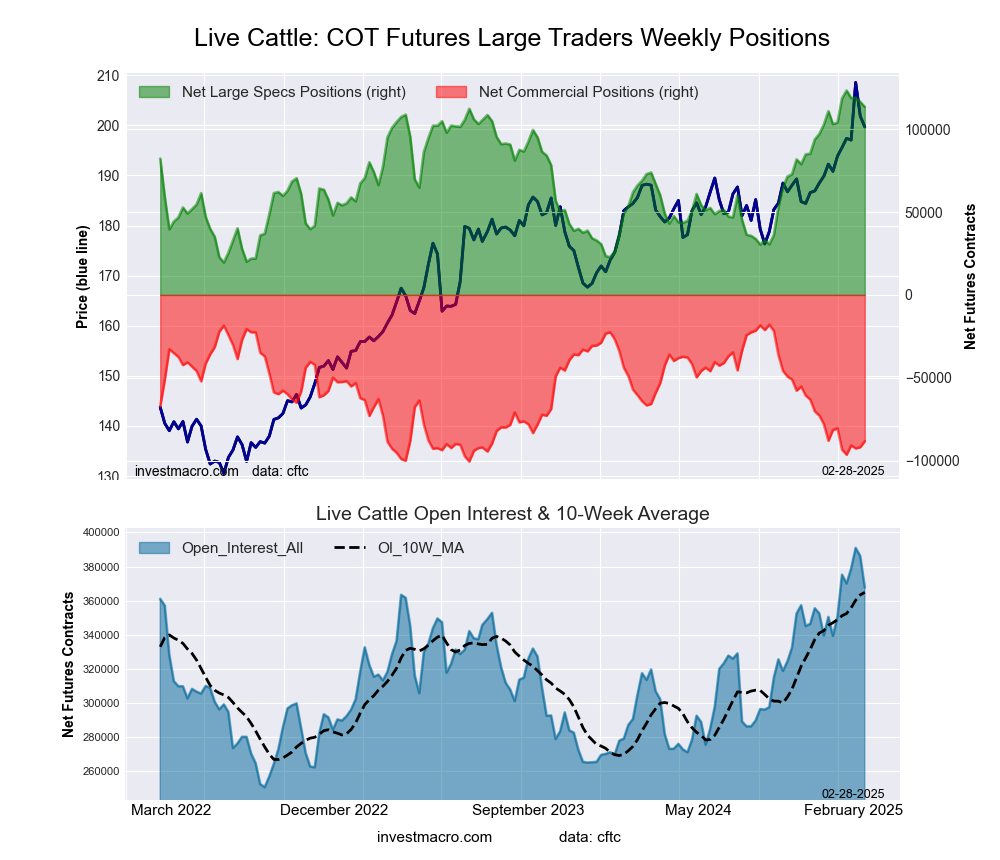
LIVE CATTLE Futures COT ChartThe LIVE CATTLE large speculator standing this week was a net position of 123,285 contracts in the data reported through Tuesday. This was a weekly rise of 4,740 contracts from the previous week which had a total of 118,545 net contracts.

This week’s current strength score (the trader positioning range over the past three years, measured from 0 to 100) shows the speculators are currently Bullish-Extreme with a score of 100.0 percent. The commercials are Bearish-Extreme with a score of 4.9 percent and the small traders (not shown in chart) are Bearish-Extreme with a score of 0.0 percent.

Price Trend-Following Model: Strong Uptrend

Our weekly trend-following model classifies the current market price position as: Strong Uptrend.

LIVE CATTLE Futures StatisticsSPECULATORSCOMMERCIALSSMALL TRADERS
– Percent of Open Interest Longs:51.927.17.0
– Percent of Open Interest Shorts:18.653.214.2
– Net Position:123,285-96,439-26,846
– Gross Longs:192,036100,39925,870
– Gross Shorts:68,751196,83852,716
– Long to Short Ratio:2.8 to 10.5 to 10.5 to 1
NET POSITION TREND:
– Strength Index Score (3 Year Range Pct):100.04.90.0
– Strength Index Reading (3 Year Range):Bullish-ExtremeBearish-ExtremeBearish-Extreme
NET POSITION MOVEMENT INDEX:
– 6-Week Change in Strength Index:25.3-28.7-8.8


LEAN HOGS Futures:

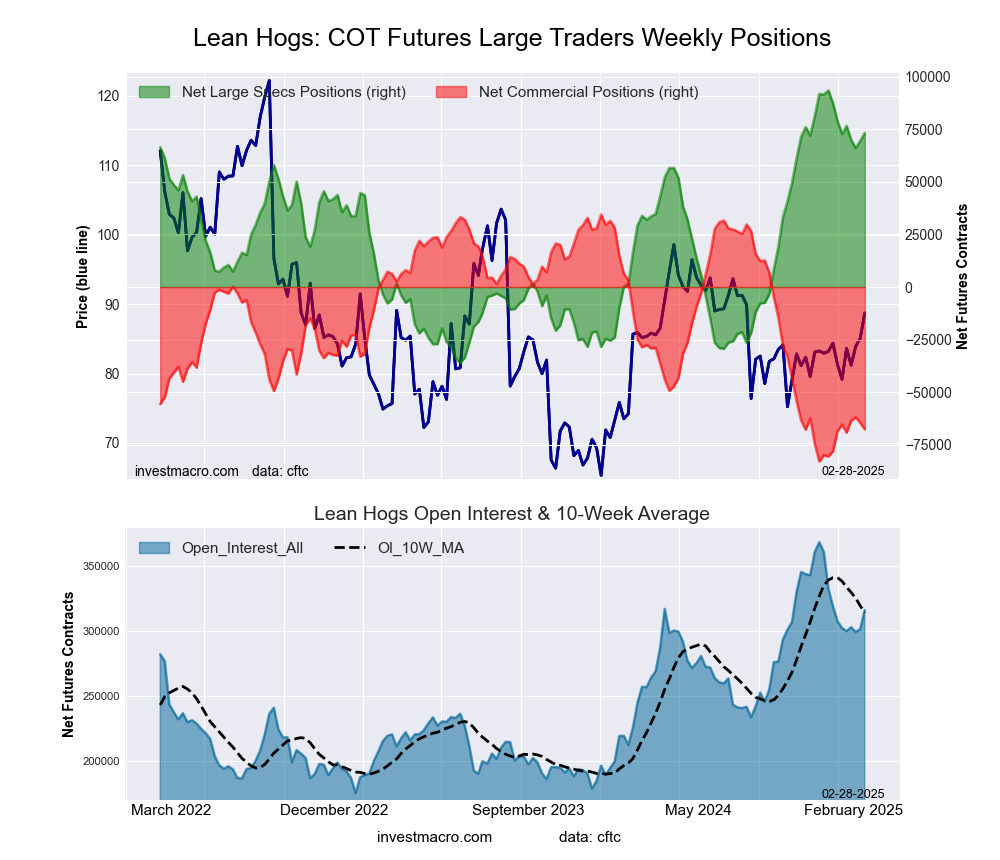
LEAN HOGS Futures COT ChartThe LEAN HOGS large speculator standing this week was a net position of 76,542 contracts in the data reported through Tuesday. This was a weekly increase of 3,797 contracts from the previous week which had a total of 72,745 net contracts.

This week’s current strength score (the trader positioning range over the past three years, measured from 0 to 100) shows the speculators are currently Bullish-Extreme with a score of 87.0 percent. The commercials are Bearish-Extreme with a score of 11.7 percent and the small traders (not shown in chart) are Bearish with a score of 34.4 percent.

Price Trend-Following Model: Uptrend

Our weekly trend-following model classifies the current market price position as: Uptrend.

LEAN HOGS Futures StatisticsSPECULATORSCOMMERCIALSSMALL TRADERS
– Percent of Open Interest Longs:43.232.77.3
– Percent of Open Interest Shorts:17.755.79.8
– Net Position:76,542-69,200-7,342
– Gross Longs:129,74198,04121,949
– Gross Shorts:53,199167,24129,291
– Long to Short Ratio:2.4 to 10.6 to 10.7 to 1
NET POSITION TREND:
– Strength Index Score (3 Year Range Pct):87.011.734.4
– Strength Index Reading (3 Year Range):Bullish-ExtremeBearish-ExtremeBearish
NET POSITION MOVEMENT INDEX:
– 6-Week Change in Strength Index:-11.711.78.8


COTTON Futures:

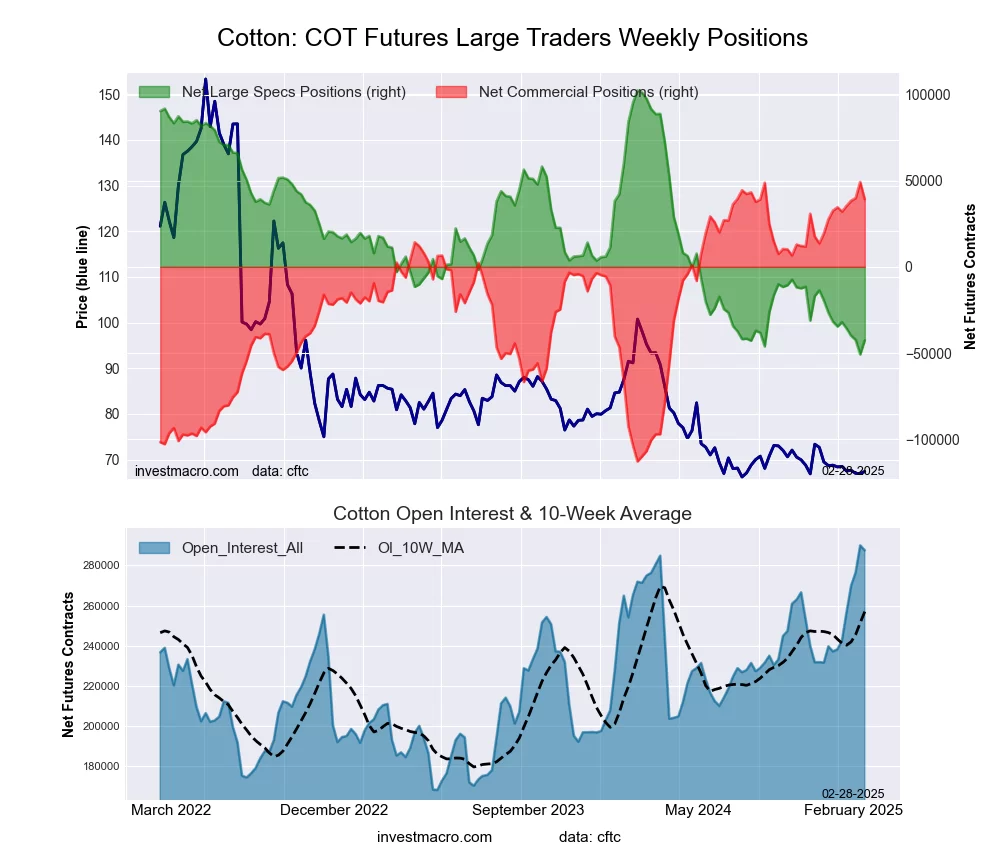
COTTON Futures COT ChartThe COTTON large speculator standing this week was a net position of -35,741 contracts in the data reported through Tuesday. This was a weekly decline of -3,657 contracts from the previous week which had a total of -32,084 net contracts.

This week’s current strength score (the trader positioning range over the past three years, measured from 0 to 100) shows the speculators are currently Bearish-Extreme with a score of 7.0 percent. The commercials are Bullish-Extreme with a score of 91.7 percent and the small traders (not shown in chart) are Bearish-Extreme with a score of 18.3 percent.

Price Trend-Following Model: Strong Downtrend

Our weekly trend-following model classifies the current market price position as: Strong Downtrend.

COTTON Futures StatisticsSPECULATORSCOMMERCIALSSMALL TRADERS
– Percent of Open Interest Longs:24.748.55.7
– Percent of Open Interest Shorts:38.634.75.6
– Net Position:-35,74135,448293
– Gross Longs:63,438124,56314,607
– Gross Shorts:99,17989,11514,314
– Long to Short Ratio:0.6 to 11.4 to 11.0 to 1
NET POSITION TREND:
– Strength Index Score (3 Year Range Pct):7.091.718.3
– Strength Index Reading (3 Year Range):Bearish-ExtremeBullish-ExtremeBearish-Extreme
NET POSITION MOVEMENT INDEX:
– 6-Week Change in Strength Index:-14.913.51.9


COCOA Futures:

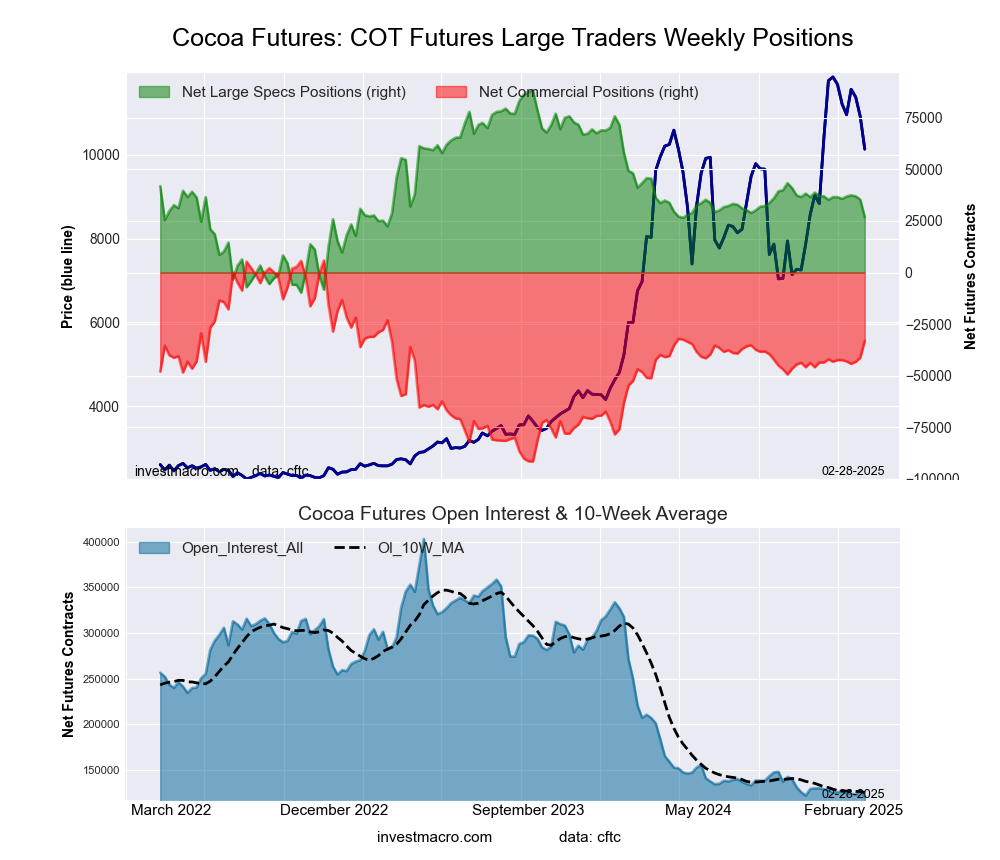
COCOA Futures COT ChartThe COCOA large speculator standing this week was a net position of 36,860 contracts in the data reported through Tuesday. This was a weekly gain of 1,066 contracts from the previous week which had a total of 35,794 net contracts.

This week’s current strength score (the trader positioning range over the past three years, measured from 0 to 100) shows the speculators are currently Bearish with a score of 47.6 percent. The commercials are Bearish with a score of 49.8 percent and the small traders (not shown in chart) are Bullish with a score of 65.3 percent.

Price Trend-Following Model: Strong Uptrend

Our weekly trend-following model classifies the current market price position as: Strong Uptrend.

COCOA Futures StatisticsSPECULATORSCOMMERCIALSSMALL TRADERS
– Percent of Open Interest Longs:39.438.69.0
– Percent of Open Interest Shorts:9.973.14.0
– Net Position:36,860-43,1016,241
– Gross Longs:49,21648,25011,182
– Gross Shorts:12,35691,3514,941
– Long to Short Ratio:4.0 to 10.5 to 12.3 to 1
NET POSITION TREND:
– Strength Index Score (3 Year Range Pct):47.649.865.3
– Strength Index Reading (3 Year Range):BearishBearishBullish
NET POSITION MOVEMENT INDEX:
– 6-Week Change in Strength Index:-0.30.5-1.6


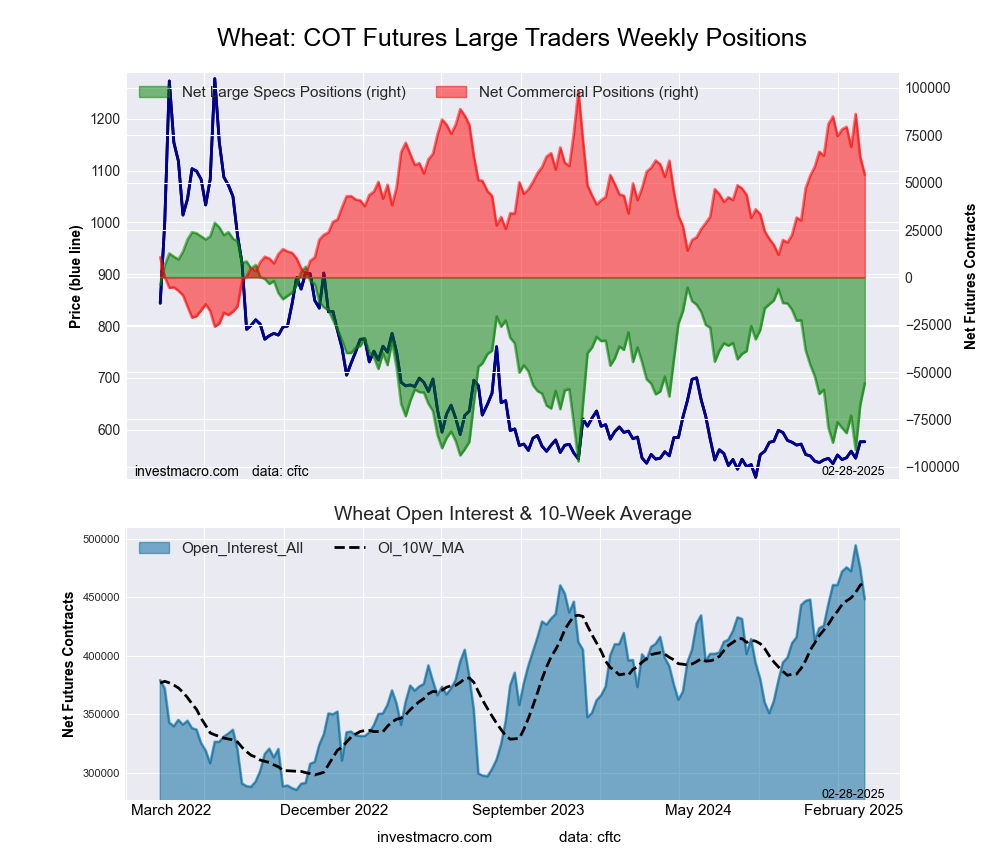
WHEAT Futures:

WHEAT Futures COT ChartThe WHEAT large speculator standing this week was a net position of -82,209 contracts in the data reported through Tuesday. This was a weekly decrease of -2,735 contracts from the previous week which had a total of -79,474 net contracts.

This week’s current strength score (the trader positioning range over the past three years, measured from 0 to 100) shows the speculators are currently Bearish-Extreme with a score of 11.9 percent. The commercials are Bullish-Extreme with a score of 84.6 percent and the small traders (not shown in chart) are Bullish with a score of 71.7 percent.

Price Trend-Following Model: Downtrend

Our weekly trend-following model classifies the current market price position as: Downtrend.

WHEAT Futures StatisticsSPECULATORSCOMMERCIALSSMALL TRADERS
– Percent of Open Interest Longs:29.234.57.1
– Percent of Open Interest Shorts:46.517.86.6
– Net Position:-82,20979,4852,724
– Gross Longs:138,772164,18233,946
– Gross Shorts:220,98184,69731,222
– Long to Short Ratio:0.6 to 11.9 to 11.1 to 1
NET POSITION TREND:
– Strength Index Score (3 Year Range Pct):11.984.671.7
– Strength Index Reading (3 Year Range):Bearish-ExtremeBullish-ExtremeBullish
NET POSITION MOVEMENT INDEX:
– 6-Week Change in Strength Index:-16.410.541.8


Article By InvestMacroReceive our weekly COT Newsletter

*COT Report: The COT data, released weekly to the public each Friday, is updated through the most recent Tuesday (data is 3 days old) and shows a quick view of how large speculators or non-commercials (for-profit traders) were positioned in the futures markets.

The CFTC categorizes trader positions according to commercial hedgers (traders who use futures contracts for hedging as part of the business), non-commercials (large traders who speculate to realize trading profits) and nonreportable traders (usually small traders/speculators) as well as their open interest (contracts open in the market at time of reporting). See CFTC criteria here.
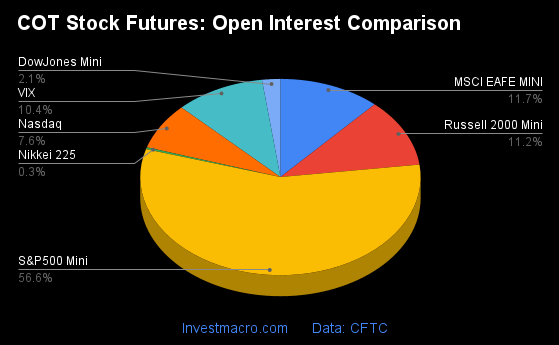
COT Stock Market Charts: Speculator Changes led higher by S&P500-Mini

By InvestMacro

Here are the latest charts and statistics for the Commitment of Traders (COT) data published by the Commodities Futures Trading Commission (CFTC).

The latest COT data is updated through Tuesday January 14th and shows a quick view of how large traders (for-profit speculators and commercial entities) were positioned in the futures markets.

Weekly Speculator Changes led by S&P500-Mini

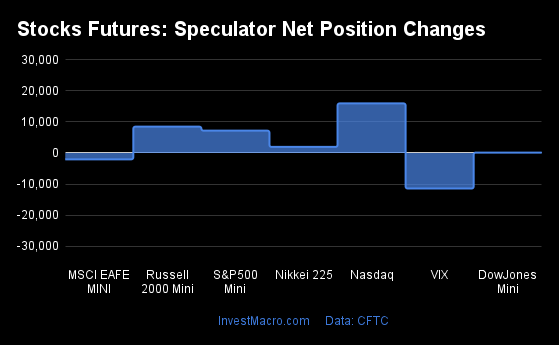
The COT stock markets speculator bets were slightly higher this week as four out of the seven stock markets we cover had higher positioning while the other three markets had lower speculator contracts.

Leading the gains for the stock markets was the S&P500-Mini (31,661 contracts) with the VIX (4,324 contracts), the Russell-Mini (2,089 contracts) and the Nikkei 225 (626 contracts) also showing positive weeks.

The markets with the declines in speculator bets this week were the Nasdaq-Mini (-8,236 contracts) with the DowJones-Mini (-1,313 contracts) and the MSCI EAFE-Mini (-244 contracts) also registering lower bets on the week.


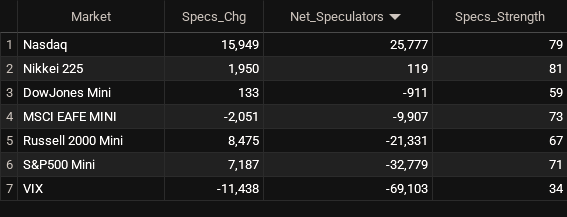
Stock Market Net Speculators Leaderboard

Legend: Weekly Speculators Change | Speculators Current Net Position | Speculators Strength Score compared to last 3-Years (0-100 range)


Strength Scores led by Russell-Mini & VIX

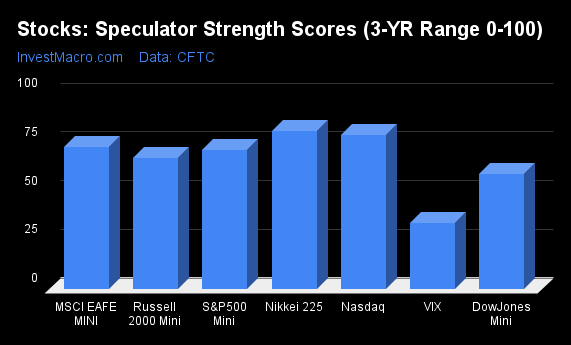
COT Strength Scores (a normalized measure of Speculator positions over a 3-Year range, from 0 to 100 where above 80 is Extreme-Bullish and below 20 is Extreme-Bearish) showed that the Russell-Mini (81 percent) and the VIX (72 percent) lead the stock markets this week. The DowJones-Mini (63 percent) comes in as the next highest in the weekly strength scores.

On the downside, the MSCI EAFE-Mini (43 percent) comes in at the lowest strength level currently.

Strength Statistics:
VIX (72.1 percent) vs VIX previous week (68.2 percent)
S&P500-Mini (60.2 percent) vs S&P500-Mini previous week (55.5 percent)
DowJones-Mini (62.7 percent) vs DowJones-Mini previous week (64.8 percent)
Nasdaq-Mini (55.5 percent) vs Nasdaq-Mini previous week (68.3 percent)
Russell2000-Mini (81.2 percent) vs Russell2000-Mini previous week (79.8 percent)
Nikkei USD (56.1 percent) vs Nikkei USD previous week (50.8 percent)
EAFE-Mini (42.6 percent) vs EAFE-Mini previous week (42.9 percent)


S&P500-Mini tops the 6-Week Strength Trends

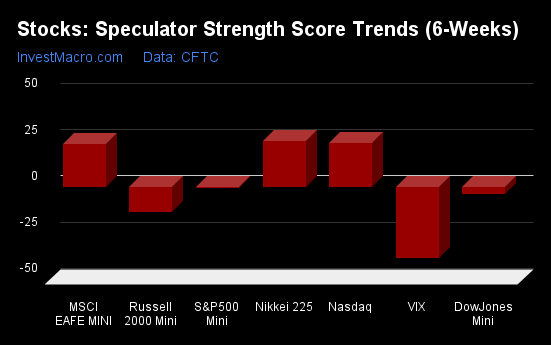
COT Strength Score Trends (or move index, calculates the 6-week changes in strength scores) showed that the S&P500-Mini (12 percent) leads the past six weeks trends for the stock markets. The Russell-Mini (7 percent) and the VIX (6 percent) are the next highest positive movers in the latest trends data.

The Nasdaq-Mini (-30 percent) leads the downside trend scores currently with the DowJones-Mini (-15 percent) coming in as the next market with lower trend scores.

Strength Trend Statistics:
VIX (5.9 percent) vs VIX previous week (-10.6 percent)
S&P500-Mini (11.6 percent) vs S&P500-Mini previous week (2.5 percent)
DowJones-Mini (-14.7 percent) vs DowJones-Mini previous week (-15.1 percent)
Nasdaq-Mini (-29.7 percent) vs Nasdaq-Mini previous week (-1.1 percent)
Russell2000-Mini (7.2 percent) vs Russell2000-Mini previous week (-0.4 percent)
Nikkei USD (-3.2 percent) vs Nikkei USD previous week (-13.6 percent)
EAFE-Mini (4.8 percent) vs EAFE-Mini previous week (3.4 percent)


Individual Stock Market Charts:

VIX Volatility Futures:

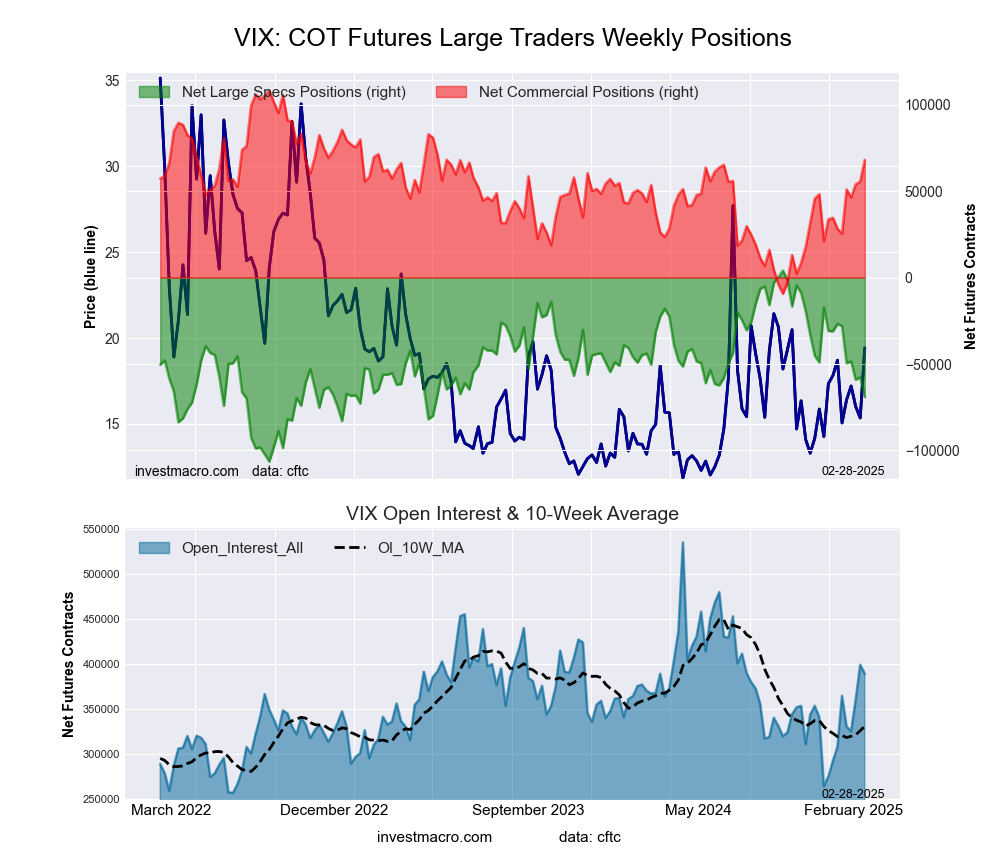
VIX Volatility Futures COT ChartThe VIX Volatility large speculator standing this week totaled a net position of -26,730 contracts in the data reported through Tuesday. This was a weekly increase of 4,324 contracts from the previous week which had a total of -31,054 net contracts.

This week’s current strength score (the trader positioning range over the past three years, measured from 0 to 100) shows the speculators are currently Bullish with a score of 72.1 percent. The commercials are Bearish with a score of 31.9 percent and the small traders (not shown in chart) are Bullish with a score of 72.0 percent.

Price Trend-Following Model: Downtrend

Our weekly trend-following model classifies the current market price position as: Downtrend.

VIX Volatility Futures StatisticsSPECULATORSCOMMERCIALSSMALL TRADERS
– Percent of Open Interest Longs:20.644.08.7
– Percent of Open Interest Shorts:29.334.99.2
– Net Position:-26,73028,181-1,451
– Gross Longs:63,637135,63626,958
– Gross Shorts:90,367107,45528,409
– Long to Short Ratio:0.7 to 11.3 to 10.9 to 1
NET POSITION TREND:
– Strength Index Score (3 Year Range Pct):72.131.972.0
– Strength Index Reading (3 Year Range):BullishBearishBullish
NET POSITION MOVEMENT INDEX:
– 6-Week Change in Strength Index:5.9-2.8-12.9


S&P500 Mini Futures:

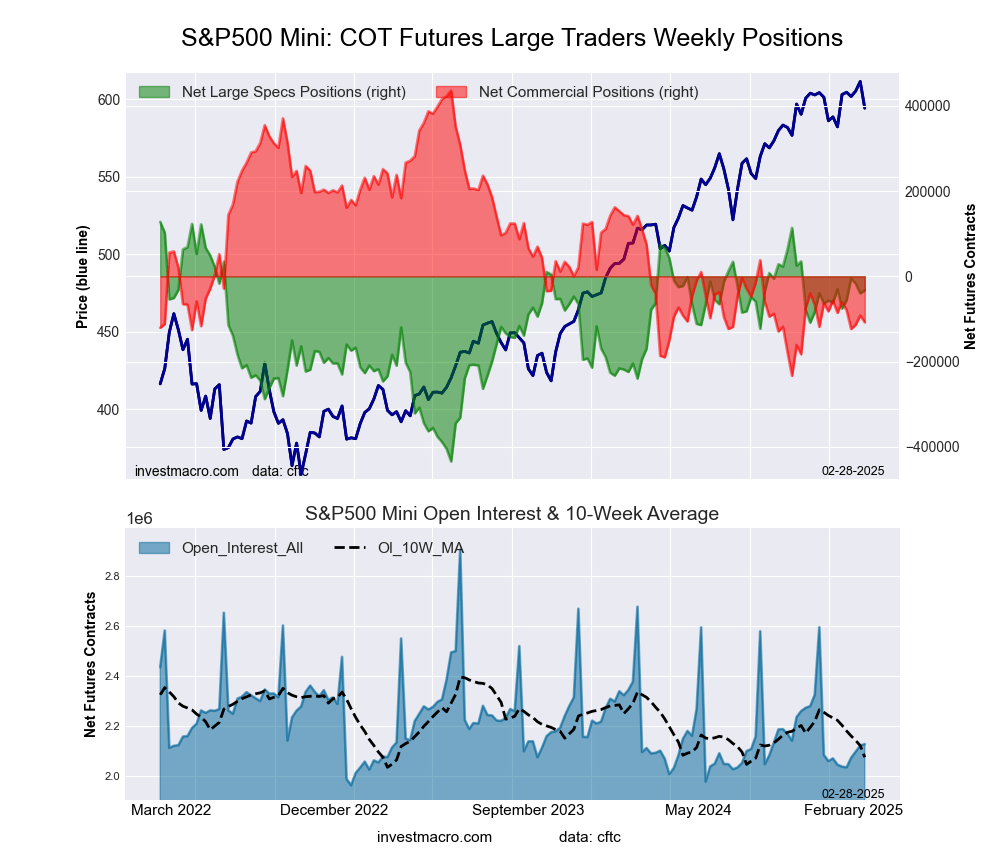
SP500 Mini Futures COT ChartThe S&P500 Mini large speculator standing this week totaled a net position of -30,542 contracts in the data reported through Tuesday. This was a weekly increase of 31,661 contracts from the previous week which had a total of -62,203 net contracts.

This week’s current strength score (the trader positioning range over the past three years, measured from 0 to 100) shows the speculators are currently Bullish with a score of 60.2 percent. The commercials are Bearish with a score of 28.1 percent and the small traders (not shown in chart) are Bullish-Extreme with a score of 83.3 percent.

Price Trend-Following Model: Uptrend

Our weekly trend-following model classifies the current market price position as: Uptrend.

S&P500 Mini Futures StatisticsSPECULATORSCOMMERCIALSSMALL TRADERS
– Percent of Open Interest Longs:12.571.613.1
– Percent of Open Interest Shorts:14.075.87.4
– Net Position:-30,542-85,660116,202
– Gross Longs:256,3581,462,893268,436
– Gross Shorts:286,9001,548,553152,234
– Long to Short Ratio:0.9 to 10.9 to 11.8 to 1
NET POSITION TREND:
– Strength Index Score (3 Year Range Pct):60.228.183.3
– Strength Index Reading (3 Year Range):BullishBearishBullish-Extreme
NET POSITION MOVEMENT INDEX:
– 6-Week Change in Strength Index:11.6-6.3-12.8


Dow Jones Mini Futures:

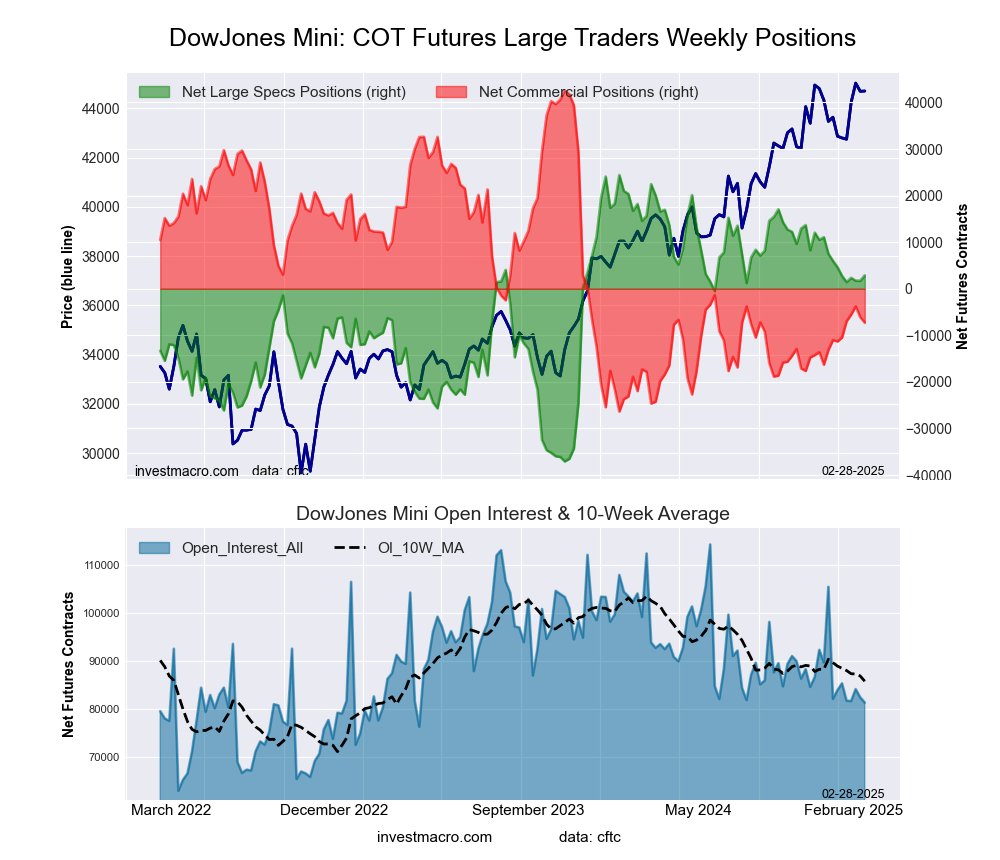
Dow Jones Mini Futures COT ChartThe Dow Jones Mini large speculator standing this week totaled a net position of 1,446 contracts in the data reported through Tuesday. This was a weekly fall of -1,313 contracts from the previous week which had a total of 2,759 net contracts.

This week’s current strength score (the trader positioning range over the past three years, measured from 0 to 100) shows the speculators are currently Bullish with a score of 62.7 percent. The commercials are Bearish with a score of 28.1 percent and the small traders (not shown in chart) are Bullish-Extreme with a score of 86.8 percent.

Price Trend-Following Model: Uptrend

Our weekly trend-following model classifies the current market price position as: Uptrend.

Dow Jones Mini Futures StatisticsSPECULATORSCOMMERCIALSSMALL TRADERS
– Percent of Open Interest Longs:18.061.719.3
– Percent of Open Interest Shorts:16.270.212.5
– Net Position:1,446-6,9605,514
– Gross Longs:14,67950,47915,757
– Gross Shorts:13,23357,43910,243
– Long to Short Ratio:1.1 to 10.9 to 11.5 to 1
NET POSITION TREND:
– Strength Index Score (3 Year Range Pct):62.728.186.8
– Strength Index Reading (3 Year Range):BullishBearishBullish-Extreme
NET POSITION MOVEMENT INDEX:
– 6-Week Change in Strength Index:-14.79.714.4


Nasdaq Mini Futures:

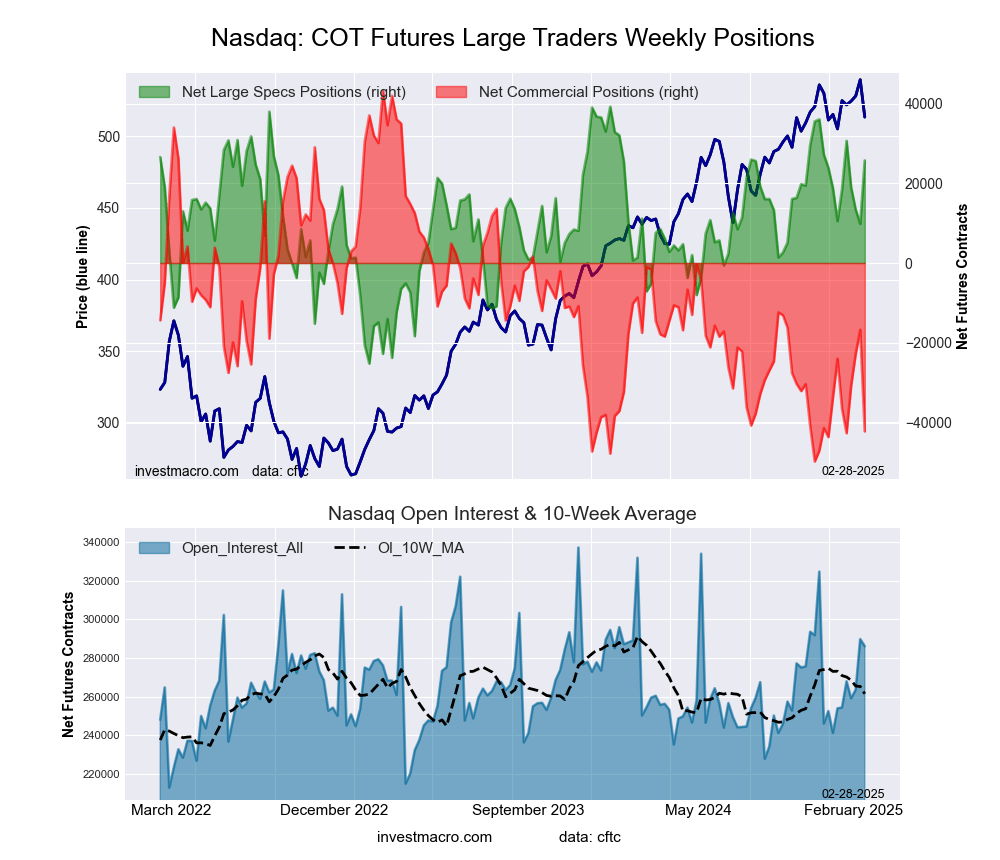
Nasdaq Mini Futures COT ChartThe Nasdaq Mini large speculator standing this week totaled a net position of 10,534 contracts in the data reported through Tuesday. This was a weekly reduction of -8,236 contracts from the previous week which had a total of 18,770 net contracts.

This week’s current strength score (the trader positioning range over the past three years, measured from 0 to 100) shows the speculators are currently Bullish with a score of 55.5 percent. The commercials are Bearish with a score of 27.7 percent and the small traders (not shown in chart) are Bullish-Extreme with a score of 80.3 percent.

Price Trend-Following Model: Uptrend

Our weekly trend-following model classifies the current market price position as: Uptrend.

Nasdaq Mini Futures StatisticsSPECULATORSCOMMERCIALSSMALL TRADERS
– Percent of Open Interest Longs:24.857.715.8
– Percent of Open Interest Shorts:20.667.210.4
– Net Position:10,534-24,05013,516
– Gross Longs:62,849146,45840,041
– Gross Shorts:52,315170,50826,525
– Long to Short Ratio:1.2 to 10.9 to 11.5 to 1
NET POSITION TREND:
– Strength Index Score (3 Year Range Pct):55.527.780.3
– Strength Index Reading (3 Year Range):BullishBearishBullish-Extreme
NET POSITION MOVEMENT INDEX:
– 6-Week Change in Strength Index:-29.718.14.3


Russell 2000 Mini Futures:

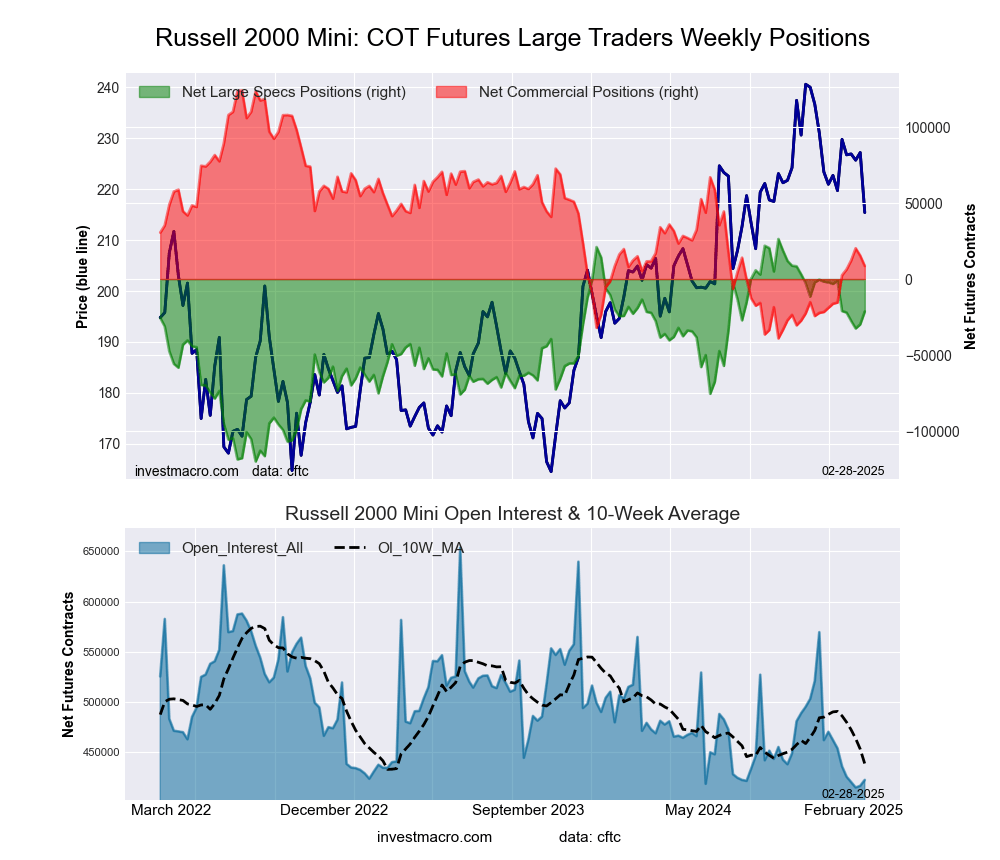
Russell 2000 Mini Futures COT ChartThe Russell 2000 Mini large speculator standing this week totaled a net position of -1,095 contracts in the data reported through Tuesday. This was a weekly increase of 2,089 contracts from the previous week which had a total of -3,184 net contracts.

This week’s current strength score (the trader positioning range over the past three years, measured from 0 to 100) shows the speculators are currently Bullish-Extreme with a score of 81.2 percent. The commercials are Bearish-Extreme with a score of 14.5 percent and the small traders (not shown in chart) are Bullish with a score of 71.1 percent.

Price Trend-Following Model: Uptrend

Our weekly trend-following model classifies the current market price position as: Uptrend.

Russell 2000 Mini Futures StatisticsSPECULATORSCOMMERCIALSSMALL TRADERS
– Percent of Open Interest Longs:14.973.37.7
– Percent of Open Interest Shorts:15.276.74.1
– Net Position:-1,095-15,45716,552
– Gross Longs:67,859332,60135,166
– Gross Shorts:68,954348,05818,614
– Long to Short Ratio:1.0 to 11.0 to 11.9 to 1
NET POSITION TREND:
– Strength Index Score (3 Year Range Pct):81.214.571.1
– Strength Index Reading (3 Year Range):Bullish-ExtremeBearish-ExtremeBullish
NET POSITION MOVEMENT INDEX:
– 6-Week Change in Strength Index:7.2-0.2-28.9


Nikkei Stock Average (USD) Futures:

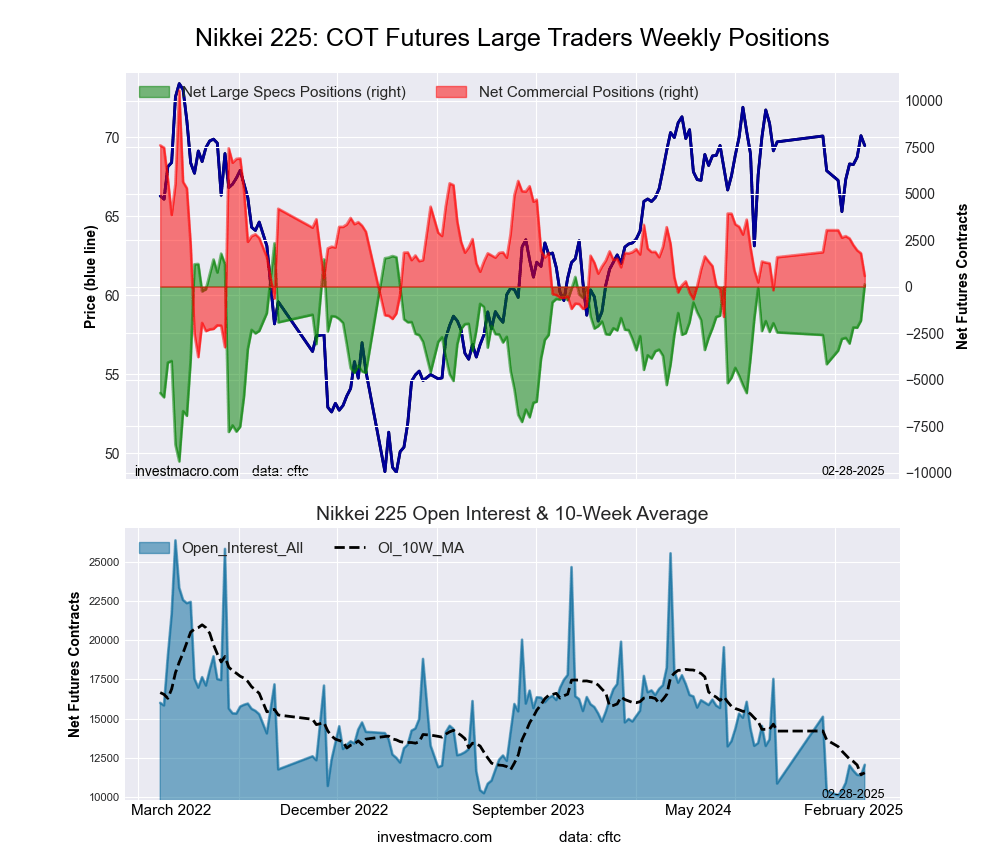
Nikkei Stock Average (USD) Futures COT ChartThe Nikkei Stock Average (USD) large speculator standing this week totaled a net position of -2,818 contracts in the data reported through Tuesday. This was a weekly gain of 626 contracts from the previous week which had a total of -3,444 net contracts.

This week’s current strength score (the trader positioning range over the past three years, measured from 0 to 100) shows the speculators are currently Bullish with a score of 56.1 percent. The commercials are Bearish with a score of 44.8 percent and the small traders (not shown in chart) are Bearish with a score of 46.8 percent.

Price Trend-Following Model: Strong Downtrend

Our weekly trend-following model classifies the current market price position as: Strong Downtrend.

Nikkei Stock Average Futures StatisticsSPECULATORSCOMMERCIALSSMALL TRADERS
– Percent of Open Interest Longs:9.170.520.4
– Percent of Open Interest Shorts:36.345.218.6
– Net Position:-2,8182,628190
– Gross Longs:9467,3172,117
– Gross Shorts:3,7644,6891,927
– Long to Short Ratio:0.3 to 11.6 to 11.1 to 1
NET POSITION TREND:
– Strength Index Score (3 Year Range Pct):56.144.846.8
– Strength Index Reading (3 Year Range):BullishBearishBearish
NET POSITION MOVEMENT INDEX:
– 6-Week Change in Strength Index:-3.29.6-19.1


MSCI EAFE Mini Futures:

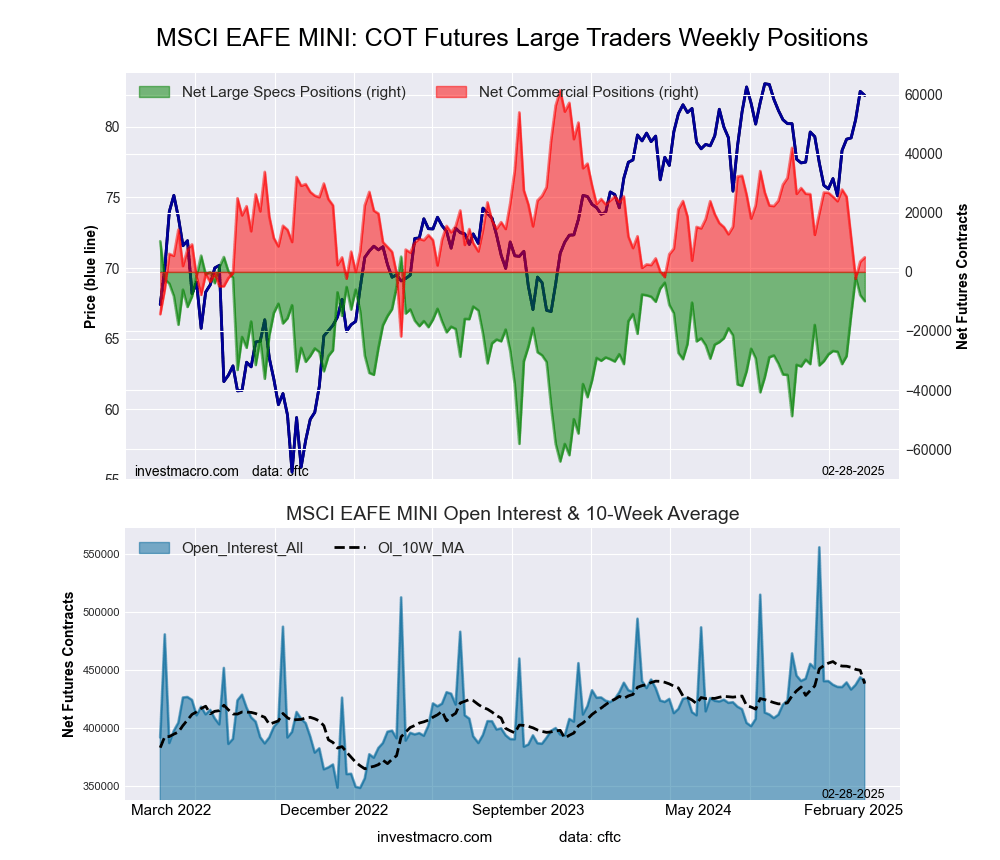
MSCI EAFE Mini Futures COT ChartThe MSCI EAFE Mini large speculator standing this week totaled a net position of -27,025 contracts in the data reported through Tuesday. This was a weekly reduction of -244 contracts from the previous week which had a total of -26,781 net contracts.

This week’s current strength score (the trader positioning range over the past three years, measured from 0 to 100) shows the speculators are currently Bearish with a score of 42.6 percent. The commercials are Bullish with a score of 58.2 percent and the small traders (not shown in chart) are Bearish with a score of 32.5 percent.

Price Trend-Following Model: Downtrend

Our weekly trend-following model classifies the current market price position as: Downtrend.

MSCI EAFE Mini Futures StatisticsSPECULATORSCOMMERCIALSSMALL TRADERS
– Percent of Open Interest Longs:8.388.72.4
– Percent of Open Interest Shorts:14.583.21.7
– Net Position:-27,02523,9353,090
– Gross Longs:36,119386,37310,665
– Gross Shorts:63,144362,4387,575
– Long to Short Ratio:0.6 to 11.1 to 11.4 to 1
NET POSITION TREND:
– Strength Index Score (3 Year Range Pct):42.658.232.5
– Strength Index Reading (3 Year Range):BearishBullishBearish
NET POSITION MOVEMENT INDEX:
– 6-Week Change in Strength Index:4.8-2.7-8.8


Article By InvestMacroReceive our weekly COT Newsletter

*COT Report: The COT data, released weekly to the public each Friday, is updated through the most recent Tuesday (data is 3 days old) and shows a quick view of how large speculators or non-commercials (for-profit traders) were positioned in the futures markets.

The CFTC categorizes trader positions according to commercial hedgers (traders who use futures contracts for hedging as part of the business), non-commercials (large traders who speculate to realize trading profits) and nonreportable traders (usually small traders/speculators) as well as their open interest (contracts open in the market at time of reporting). See CFTC criteria here.
Gold Soaring; Copper Back in Gear

Source: Michael Ballanger (1/16/25)

Michael Ballanger of GGM Advisory Inc. shares his thoughts on the current state of the market and one copper stock he believes is a Buy.

USD dollar index is up 0.20% to 109.130 this morning, with the 10-year yield down 2.84% to 4.652% and the 30-year yield down 2.13% to 4.879%.

Gold (+0.47%), silver (+0.68%), and copper (+0.28%) are all higher, while oil (-0.90%) is down $0.71 to $78.00/bbl. Stock index futures are mixed, with the DJIA (-0.21%) down 91.6, but the S&P 500 (+0.34%) up 4.1 points, and the NASDAQ (+0.34%) up 73 points. Risk barometer Bitcoin (+3.54%) is up $3,419 to $100.120.

Copper

Going into year-end, I was concerned that fears over the Trump tariffs would drive investors away from the bullish copper narrative and have a dampening effect on the junior copper developers and explorers and the mighty Freeport-McMoran (FCX:US), which I own as a long- term core position but which only just breached $40 yesterday and is still a good $15.00 off the 53-week high.

Last week, copper prices did a complete bullish reversal just as I was fully expecting a drop to the August lows under $3.90/lb. Instead, it turned just above $4.00 and screamed higher and, as of this morning, has breached the 200-dma by $4.35/lb. trading briskly up to $4.44. If it holds the 200-dma for another day or two, I see the May highs as the next resistance level at $5.19/lb.

I am finally prepared to re-enter the FCX:US trade.

In the GGMA Trading Account:

  • BUY 1,000 FCX:US at $40.00

For option traders:

  • BUY half-position FCX March $40 calls at $2.75

Gold / GDX:US

The superstar of 2024 is continuing its upward trajectory here in 2025 as gold is once again taking the lead in the commodities space. It doesn’t hurt that oil is rebounding off the 60-handle of late 2024, but as I wrote in the GGMA 2025 Forecast Issue, “While a global recession would take its toll on global copper demand, I have not veered for one iota of my bullish theme for gold bullion.” That opinion is bearing out as the knee-jerk reaction to the Trump election victory has now been fully shrugged off, with new highs on the immediate horizon. Prices turned higher just

before Christmas but did not receive the MACD “buy signal” until after New Year’s Da,y followed by bullish turns in the MFI and TRIX indicator,s which are now both on full “buy signals”. With an RSI at 59, the market has more room to advance before approaching overbought status,s so I am going to take a leap of faith and buy the March calls on GLD:US.

  • BUY GLD:US at $250.00 limit

For option traders:

  • BUY GLD March $250 calls at $7.00 limit Target: $15.00 by expiry


Important Disclosures:

  1. Michale Ballanger: I, or members of my immediate household or family, own securities of: All. I determined which companies would be included in this article based on my research and understanding of the sector.
  2. Statements and opinions expressed are the opinions of the author and not of Streetwise Reports, Street Smart, or their officers. The author is wholly responsible for the accuracy of the statements. Streetwise Reports was not paid by the author to publish or syndicate this article. Streetwise Reports requires contributing authors to disclose any shareholdings in, or economic relationships with, companies that they write about. Any disclosures from the author can be found  below. Streetwise Reports relies upon the authors to accurately provide this information and Streetwise Reports has no means of verifying its accuracy.
  3.  This article does not constitute investment advice and is not a solicitation for any investment. Streetwise Reports does not render general or specific investment advice and the information on Streetwise Reports should not be considered a recommendation to buy or sell any security. Each reader is encouraged to consult with his or her personal financial adviser and perform their own comprehensive investment research. By opening this page, each reader accepts and agrees to Streetwise Reports’ terms of use and full legal disclaimer. Streetwise Reports does not endorse or recommend the business, products, services or securities of any company.

For additional disclosures, please click here.

Michael Ballanger Disclosures

This letter makes no guarantee or warranty on the accuracy or completeness of the data provided. Nothing contained herein is intended or shall be deemed to be investment advice, implied or otherwise. This letter represents my views and replicates trades that I am making but nothing more than that. Always consult your registered advisor to assist you with your investments. I accept no liability for any loss arising from the use of the data contained on this letter. Options and junior mining stocks contain a high level of risk that may result in the loss of part or all invested capital and therefore are suitable for experienced and professional investors and traders only. One should be familiar with the risks involved in junior mining and options trading and we recommend consulting a financial adviser if you feel you do not understand the risks involved.

Week Ahead: Bitcoin to break records on Trump’s inauguration?

By ForexTime 

  • Bitcoin ↑ almost 10% YTD, adding to 120% gain in 2024
  • Trump expected to sign pro-crypto executive order
  • US data could influence Fed cut bets – impacting Bitcoin
  • Prices bullish on weekly channel but RSI overbought
  • Technical levels: $103,000 & $91,500

Bitcoin is up almost 10% this year after securing triple-digit gains in 2024.

Soft US inflation figures sent the “OG” crypto surging this week as Fed cut bets jumped.

With prices back above the psychological $100,000 level, the all-time high at $108,372.55 is the next key checkpoint.

Bitcoin could hit fresh records with the right catalyst. This may come in the form of Trump’s inauguration.

Beyond this major event, watch out for top-tier data releases and corporate earnings:

Monday, 20th January

  • CN50: China loan prime rates
  • JP225: Japan tertiary index, machinery orders, industrial production
  • Bitcoin: Donald Trump’s Inauguration
  • US markets closed: Martin Luther King Jr. federal holiday 
  • Annual World Economic Forum in Davos

Tuesday, 21st January

  • CAD: Canada CPI
  • GER40: Germany ZEW survey expectations
  • TWN: Taiwan export orders
  • GBP: UK jobless claims, unemployment
  • NAS100: Netflix earnings.

Wednesday, 22nd January

  • NZD: New Zealand CPI
  • EUR: ECB President Christine Lagarde speech – Davos
  • ZAR: South Africa retail sales, CPI
  • TWN: Taiwan jobless rate
  • USDInd: US Conference Board leading index

Thursday, 23rd January

  • CAD: Canada retail sales
  • EUR: Eurozone consumer confidence
  • JPY: Japan trade
  • TWN: Taiwan industrial production
  • US500: US jobless claims

Friday, 24th January

  • GER40: Germany HCOB Manufacturing & Services PMI
  • JPY: BoJ rate decision, Japan CPI
  • SG20: Singapore industrial production
  • TWN: Taiwan GDP
  • GBP: UK S&P Global Manufacturing & Services PMI
  • US30: US University of Michigan consumer sentiment, existing home sales, S&P Global Manufacturing & Services PMI

Bitcoin remains in a wide range on the weekly charts with support at $91,500 and resistance at $103,000.

Prices are trading well above the 21, 50 and 100 week SMA but the Relative Strength (RSI) Index signals that prices are heavily overbought.

At the current price of around $102,000, Bitcoin is trading roughly 6% away from its all-time high.

bitcin weekly

Here are 3 reasons to trade Bitcoin next week:

    1) Donald Trump’s inauguration

Donald Trump will be sworn in as the 47th U.S. President on January 20th.

On his first day, he expected to issue a series of executive orders, some of which are positive for cryptocurrencies.

These orders will make crypto a national priority, target debanking and could also include the creation of a national Bitcoin stockpile.

Market optimism around more industry regulations under Trump has propelled Bitcoin roughly 50% since Trump’s victory on November 5th.

The “OG” crypto could be set for another boost if the crypto community welcomes Trump’s executive orders.


    2) Key US data

The latest US inflation figures have revived hopes for Fed rate cuts in 2025.

Investors will keep a keen eye on the US jobless claims, consumer sentiment and PMI’s among other releases to gauge the strength of the US economy.

Traders are currently pricing in a Fed rate cut by July 2025, with the odds of another cut by December at 70%.

If the incoming US data influences Fed rate cut bets, it could move Bitcoin which has shown sensitivity to interest rates.


    3) Technical forces

Bitcoin is on breakout watch with resistance at $103,000 and support at $91,500.

  • A solid breakout and daily close above $103,000 could open a path back toward $108,372.5 and fresh all-time highs at $110,000 – a psychological level.
  • Should $103,000 prove reliable resistance, Bitcoin could slip back towards $100,000 and $91,500.

Bitcoin


Forex-Time-LogoArticle by ForexTime

ForexTime Ltd (FXTM) is an award winning international online forex broker regulated by CySEC 185/12 www.forextime.com

Gold-to-CPI Ratio Hits New All-Time High

Source: John Newell (1/15/25)

John Newell of John Newell & Associates takes a look at the gold-to-CPI ration as it hits new highs and examines what this means for inflation and living costs.

The Gold-to-CPI ratio, a key indicator of gold’s purchasing power relative to inflation, has recently reached a new all-time high.

This milestone reflects gold’s enduring role as a hedge against inflation, but it also serves as a reminder of the complex forces driving rising costs in today’s economy.

What Is the Gold-to-CPI Ratio?

The Gold-to-CPI ratio measures the price of gold divided by the Consumer Price Index (CPI), a common metric for tracking the cost of goods and services.

A rising ratio indicates that gold’s purchasing power is increasing faster than inflation, making it a strong hedge against rising costs.

Historically, this ratio has spiked during periods of economic turmoil, such as the late 1970s when inflation ran rampant, reaching levels that rival today’s economic challenges.

Understanding Inflation: Why Prices Rise

Inflation occurs when the purchasing power of money decreases, causing the price of goods and services to rise. One key driver is the overprinting of currency by governments. When too much money enters circulation, the supply of money outpaces economic productivity, eroding its value. This scenario often leads to higher prices for everyday necessities, from food to housing.

For example, during the COVID-19 pandemic, massive stimulus programs flooded economies with liquidity to prevent economic collapse. While these measures helped stave off immediate crises, they also contributed to inflationary pressures as demand surged while supply chains struggled to keep up.

Natural Disasters and Inflation: The Hidden Costs

Inflation isn’t just driven by monetary policy; natural disasters can also play a significant role in pushing up the cost of living. Take the recent fires in California as an example. Such disasters disrupt supply chains, destroy housing stock, and reduce agricultural output, driving up prices for basic necessities like food, housing, and energy.

In California, the destruction of homes and infrastructure has increased demand for materials and labor, pushing construction costs higher. Agricultural losses from fires have also reduced the availability of crops, causing food prices to spike. These localized inflationary pressures can ripple through the broader economy, compounding the challenges faced by households.

Gold as a Safe Haven

As inflation erodes the value of fiat currencies, gold’s appeal grows. Its status as a store of value is particularly evident during times of uncertainty when economic instability or geopolitical turmoil drives investors to seek safety.

The current high in the gold-to-CPI ratio underscores this trend, reflecting gold’s ability to outpace inflation and preserve wealth.

Looking Ahead

The Gold-to-CPI ratio reaching a new peak signals more than just the strength of gold; it highlights the broader economic forces shaping our lives.

From government policy to natural disasters, a range of factors are driving inflation and reshaping the global economy. For investors, this underscores the importance of diversifying portfolios and considering assets like gold to protect against the ongoing erosion of purchasing power.


Important Disclosures:

  1. Statements and opinions expressed are the opinions of the author and not of Streetwise Reports, Street Smart, or their officers. The author is wholly responsible for the accuracy of the statements. Streetwise Reports was not paid by the author to publish or syndicate this article. Streetwise Reports requires contributing authors to disclose any shareholdings in, or economic relationships with, companies that they write about. Any disclosures from the author can be found  below. Streetwise Reports relies upon the authors to accurately provide this information and Streetwise Reports has no means of verifying its accuracy.
  2. This article does not constitute investment advice and is not a solicitation for any investment. Streetwise Reports does not render general or specific investment advice and the information on Streetwise Reports should not be considered a recommendation to buy or sell any security. Each reader is encouraged to consult with his or her personal financial adviser and perform their own comprehensive investment research. By opening this page, each reader accepts and agrees to Streetwise Reports’ terms of use and full legal disclaimer. Streetwise Reports does not endorse or recommend the business, products, services or securities of any company.

For additional disclosures, please click here.

John Newell Disclaimer

As always it is important to note that investing in precious metals like silver carries risks, and market conditions can change violently with shock and awe tactics, that we have seen over the past 20 years. Before making any investment decisions, it’s advisable consult with a financial advisor if needed. Also the practice of conducting thorough research and to consider your investment goals and risk tolerance.

Soaring wealth inequality has remade the map of American prosperity

By Tom Kemeny, University of Toronto 

One need only glance at headlines about Jeff Bezos, Elon Musk and other super-wealthy individuals to understand that wealth in America is increasingly concentrated in fewer and fewer hands. Inequality is sharply on the rise.

Until now, however, little has been known about where the richest households are located, which cities are the most unequal and how these trends have evolved.

In a new analysis I conducted with my colleagues, we reveal where wealth is most concentrated within and between communities, cities and states. The result is GEOWEALTH-US – the first data that tracks the geography of wealth in the United States and how it has changed since 1960.

The overall picture is worrying. The wealthiest cities in the U.S. are now almost seven times richer than the poorest regions, a disparity that has almost doubled since 1960. Meanwhile, especially in urban coastal areas, wealth has become highly concentrated in the hands of a few. The picture from the geography of wealth suggests we are even more divided than we thought.

Mapping inequality

To measure wealth locally, we built precise models of household wealth, applying sophisticated machine learning techniques to data from the Federal Reserve’s survey of consumer finances.

We then used the models to estimate wealth among households in the decennial census and American community survey, where we can identify where people live.

Experts define wealth as the difference between the value of a household’s assets – cash, real estate and stocks, for example – and its liabilities, including mortgages, student loans and credit card debt. Wealth is also called “net worth.”

Using GEOWEALTH-US, we show that the wealth distribution across the U.S. has transformed since 1960. Inequality between the nation’s flourishing urban centers and other areas of the country, especially in parts of the South and Midwest, is higher than it has ever been over the previous 60 years.

The expansion of wealth inequality is a challenge to the American Dream: the notion that, with hard work, opportunity and prosperity are accessible to all.

Wealth enables choice and stability. Poorer households have more trouble providing the best nutrition and education for their children. Additionally, people growing up in lower-wealth households are less likely to spur innovation in a field or start successful new businesses. Wealth also profoundly affects one’s health, leaving the least wealthy in our society significantly more vulnerable to premature death and disability.

Large wealth gaps between places

We analyzed average household wealth across the U.S. between 1960 and 2022, using census-defined communities of about 100,000 residents.

At the community level, the lack of wealth can make a major difference in how well cities work for their residents.

People who grow up in wealthier places can reap benefits that span generations. As a result of property taxes and philanthropy, wealthier communities have greater resources for schools, health care, transportation and other infrastructure.

Good schools are one benefit of wealthy communities that may improve social mobility even for children born into poverty, studies suggest.

The map for 2022 reveals major disparities in typical (median) net worth across communities. Many of the least wealthy locations are in poor neighborhoods in some of America’s biggest cities – for instance, parts of the Bronx and East Harlem in New York, and areas of Houston and Milwaukee. A typical household in the five poorest communities had assets worth about $18,000. Many households in these locations held more debt than assets. Other wealth-poor areas of the country included parts of Baton Rouge, Louisiana, and Cincinnati, Ohio.

The wealthiest communities today tend to be found in urban coastal areas.

Palo Alto, California, and Nassau County, New York, are two of the nation’s five wealthiest places. The top five areas had median household net worth of nearly $1.7 million. That’s almost 90 times wealthier than the poorest five places.

These wealth divides help explain why, between 2019 and 2021, according to the school finance indicators database, the Palo Alto Unified School District in California spent about $7,000 more per student than the minimum required to achieve national benchmark test scores. Meanwhile, the East Baton Rouge school district spent almost $4,000 less per student than is required to meet those same national standards. Cincinnati Public Schools underspent by more than $9,000 per pupil.

Large wealth gaps within places

We also looked at wealth divides in cities and communities. Average wealth levels in a community matter, but so does their unequal distribution.

Inequality, especially when a community is racially diverse and spatially segregated, has been linked to underinvestment in public goods such as schools, roads and hospitals.

Our research identified large gaps in wealth within communities.

For example, in certain parts of California such as San Jose and Santa Monica, we found that the richest 10% of residents are about seven times wealthier than the median household. In contrast, in many parts of Utah and Minnesota, the wealthiest 10% of households are only about three times wealthier than the median household.

Coastal areas, then, are not simply wealthier than the rest of the country; wealth in these places is also less equally shared.

We also found that wealth is unequally distributed across many parts of the South. This reflects the legacy of slavery, discrimination and uneven economic development over generations.

Regardless of geography, across America we found that the most unequal places were likely to have larger populations of African Americans, Hispanics and other people of color. In these locations, white households were overrepresented among the wealthiest. Households of color, meanwhile, generally had much lower net worth.

The map of wealth is changing

Extensive testing shows that our model estimates wealth with a high level of accuracy. And by mapping household wealth rather than household income, which is what researchers more commonly use to assess economic well-being, we found that place-based divides are much worse than previously believed.

Our data shows that wealth gaps between places have grown much more than income gaps since 1960. By 2020, gaps in average wealth levels were about 60% higher than equivalent income gaps.

This appears to be driven by the changing economic fortunes of cities.

Average wealth levels in the San Francisco Bay Area, Seattle, New York and Boston have risen dramatically as these areas have cemented their leadership in high-technology sectors and finance.

The loss of manufacturing jobs, meanwhile, destroyed wealth in many American communities. In 1960, the industrial hub of Cleveland, Ohio, had among the highest levels of average household wealth in the country, according to our data. In 2020, Cleveland ranked 466th out of the 722 areas in our study.

Within cities, we also observed a rise in wealth concentration. In the Minneapolis metropolitan area, for instance, the share of total wealth held by the richest 0.1% of households has almost tripled, from about 3% in 1960 to almost 9% by 2020. This means that, compared with the past, just a few families there now own a much larger piece of the pie.

Ladder to success becoming harder to climb

Multiple factors may explain the growing pooling of wealth. They include the rising concentration of high-paying jobs in major metro areas and the explosive growth in housing values in these high-performing cities.

Changing federal tax policies have also favored the affluent at the expense of regular Americans.

If such policies continue under the next Trump administration, the divided geography of wealth may well grow worse – with significant consequences for U.S. democracy.The Conversation

About the Author:

Tom Kemeny, Associate Professor, Munk School of Global Affairs & Public Policy, University of Toronto

This article is republished from The Conversation under a Creative Commons license. Read the original article.

China’s GDP data beat expectations of 5%. Malaysia’s Q4 GDP growth slowed to 4.8%

By JustMarkets

The Dow Jones (US30) Index fell by 0.16% at the end of Thursday. The S&P500 Index (US500) was down 0.21%. The Nasdaq Technology Index (US100) decreased by 0.69%. Weakness in mega-cap technology stocks on Thursday impacted the broader market. Health insurance stocks also declined, hurting the broader market after UnitedHealth Group fell more than 6% after reporting weaker-than-expected fourth-quarter earnings. Bond yields declined slightly amid dovish comments from Fed Chief Waller, who said that if inflation is falling, rate cuts could be larger than the market expects, with 3-4 rate cuts possible this year if data is favorable.

The Canadian dollar weakened to 1.44 per dollar, approaching the January 2016 low of 1.445, driven by monetary policy divergence, weak domestic data, and geopolitical uncertainty. Aggressive rate cuts by the Bank of Canada (expected to be 25 bps lower this month) contrast with the Federal Reserve’s less lenient stance, contributing to a widening yield gap between US and Canadian government bonds, which draws capital to the US dollar, adding pressure on the loonie.

Equity markets in Europe were mostly up on Thursday. Germany’s DAX (DE40) rose by 0.39%, France’s CAC 40 (FR40) closed 2.14% higher, Spain’s IBEX 35 (ES35) index fell by 0.49%, and the UK’s FTSE 100 (UK100) closed 1.09% yesterday. The FTSE 100 (UK100) Index rose to a three-month high on Thursday, supported by investor optimism over a possible rate cut.

Silver (XAG/USD) slipped to $30.66 per ounce on Friday but maintained its trend for a third straight weekly gain, helped by a decline in US core inflation that reinforced expectations of further interest rate cuts by the Federal Reserve this year. However, despite the bullish momentum, silver prices remain below the 12-year high of $35 reached in October as concerns over uncertain industrial demand persist.

WTI crude oil prices rose above $79 a barrel on Friday, rebounding from the previous session’s losses and heading for a fourth straight weekly gain. The overnight drop was driven by speculation that President-elect Trump may ease sanctions on Russian energy exports as part of diplomatic efforts to resolve tensions between Russia and Ukraine. Reports of a cease-fire in the Middle East also helped lower the geopolitical risk premium.

The US natural gas prices (XNG/USD) eased slightly to $4.055/MMBtu after the EIA reported declining storage inventories in line with expectations. Federal data showed that utilities pulled 258 billion cubic feet of gas from storage in the week ended Jan. 10, well above the 150 Bcf in the same week last year and well above the five-year average of 128 Bcf. Analysts expect the next two January 17 and 24 reports to show further consumption above 200 Bcf amid rising heating demand.

Asian markets were mostly up. Japan’s Nikkei 225 (JP225) was up 0.33%, China’s FTSE China A50 (CHA50) was down 0.21%, Hong Kong’s Hang Seng (HK50) added 1.23% and Australia’s ASX 200 (AU200) was positive 1.38% for yesterday.

China’s economy grew at an annualized rate of 5.4% in the fourth quarter of 2024, accelerating from 4.6% in the third quarter and beating expectations of 5%. Industrial production and retail sales in December exceeded forecasts, while new home prices declined. The latest data did not indicate whether Beijing will take additional stimulus measures in the near term. However, state media reported that China’s central bank may lower the reserve requirement ratio for banks ahead of the Spring Festival later this month.

Malaysia’s economy grew at a 4.8% annualized rate in the fourth quarter of 2024, slowing from a 5.3% expansion in the previous quarter. On a seasonally adjusted basis, GDP grew by 2.5% in Q4, easing from an upwardly revised 4.6% growth in the previous quarter.

S&P 500 (US500) 5,937.34 −12.57 (−0.21%)

Dow Jones (US30) 43,153.13 −68.42 (−0.16%)

DAX (DE40) 20,655.39 +80.71 (+0.39%)

FTSE 100 (UK100) 8,391.90 +90.77 (+1.09%)

USD index 108.94 −0.15 (−0.14%)

News feed for: 2025.01.17

  • China GDP (m/m) at 04:00 (GMT+2);
  • China Industrial Production (m/m) at 04:00 (GMT+2);
  • China Retail Sales (m/m) at 04:00 (GMT+2);
  • China Unemployment Rate (m/m) at 04:00 (GMT+2);
  • UK Retail Sales (m/m) at 09:00 (GMT+2);
  • US Building Permits (m/m) at 15:30 (GMT+2);
  • US Industrial Production (m/m) at 16:15 (GMT+2).

By JustMarkets


This article reflects a personal opinion and should not be interpreted as an investment advice, and/or offer, and/or a persistent request for carrying out financial transactions, and/or a guarantee, and/or a forecast of future events.

Stocks rose sharply amid an unexpected slowdown in US inflation. Oil reached the $80 per barrel

By JustMarkets

The Dow Jones (US30) rose 1.65% on Wednesday. The S&P 500 Index (US500) gained 1.83%. The Nasdaq Technology Index (US100) jumped 2.31%. The core inflation rate rose for the third consecutive month to 2.9% in line with expectations, but the core rate unexpectedly slowed to 3.2%. The data added confidence that the Fed may continue to cut interest rates this year. In addition, corporate earnings results from major banks boosted investor sentiment. JPMorgan shares rose about 0.4% after beating earnings and revenue estimates and raising its 2025 net interest income outlook. Wells Fargo shares rose more than 3% after reporting higher earnings. Goldman Sachs climbed 4.8% on better-than-expected earnings and revenue, and BlackRock jumped nearly 2.5% as its assets reached a record $11.6 trillion.

The Canadian dollar strengthened to 1.43 per US dollar, hitting a one-month-high, as the US dollar weakened after weaker-than-expected core inflation figures dampened expectations of a prolonged continuation of high interest rates by the Federal Reserve. Meanwhile, rising crude oil prices and Canada’s status as the largest oil exporter to the US, bolstered by new US sanctions against Russian oil, improved the outlook for demand for the loonie.

The Mexican peso strengthened to 20.5 per US dollar, recovering after falling to a March 2022 low, as the US dollar weakened after lower-than-expected core inflation data dampened expectations of a prolonged continuation of high interest rates by the Federal Reserve. In addition, reports that President-elect Donald Trump’s administration may gradually impose tariffs to ease inflationary pressures eased fears of trade disruptions, lending support to the peso.

Equity markets in Europe were mostly up on Wednesday. Germany’s DAX (DE40) rose by 1.50%, France’s CAC 40 (FR40) closed 0.69% higher, Spain’s IBEX 35 (ES35) gained 1.25%, and the UK’s FTSE 100 (UK100) closed positive 1.21%. In France, the annual inflation rate for December 2024 was confirmed at 1.3%, in line with preliminary estimates and unchanged from the previous month. Among individual stocks, financial institutions led the gains, with AXA, BNP Paribas, Credit Agricole and Societe Generale up 1.6-3.1%.

Silver (XAG/USD) rose to $30.3 an ounce on Wednesday, hitting its highest level in a month, as a drop in US core inflation supported bets on a less tight Fed monetary policy. Still, uncertain demand for silver used in manufacturing has kept prices well below the 12-year high of $35 reached in October. Overcapacity in China’s solar panel industry has forced photovoltaic companies to sign up to the government’s self-discipline program to regulate supply, limiting the outlook for silver demand from the leading industry.

WTI crude oil prices climbed above $80 a barrel on Thursday, developing a 3% gain from the previous session and trading near the highest level since mid-July last year amid rising global supply risks. The IEA expects the oil market to be slightly tighter this year than previously estimated, and noted that new US sanctions against Russia and Iran could put additional pressure on the supply balance. The EIA data also showed an eighth consecutive weekly decline in commercial crude inventories, which hit their lowest level since April 2022. This is the longest streak of declines since 2021 and inventories are now at a six-year seasonal low.

Asian markets were mostly down yesterday. Japan’s Nikkei 225 (JP225) was down 0.08%, China’s FTSE China A50 (CHA50) decreased by 0.38%, Hong Kong’s Hang Seng (HK50) was up 0.34%, and Australia’s ASX 200 (AU200) was negative 0.22%.

The Australian dollar broke a three-day streak of gains as investors reacted to a mixed employment report. Although Australia’s unemployment rate rose slightly to 4% in December from 3.9% in November, employment growth exceeded expectations. Looking ahead, investors are focused on Australia’s fourth quarter inflation data due out later this month, which will be a key indicator ahead of the Reserve Bank of Australia’s upcoming monetary policy decision in February. Markets are currently pricing in a 70% chance that the RBA will cut its 4.35 percent monetary rate by 25 basis points next month.

S&P 500 (US500) 5,949.91 +107.00 (+1.83%)

Dow Jones (US30) 43,221.55 +703.27 (+1.65%)

DAX (DE40) 20,574.68 +303.35 (+1.50%)

FTSE 100 (UK100) 8,301.13 +99.59 (+1.21%)

USD Index 109.08 −0.19 (−0.18%)

News feed for: 2025.01.16

  • Japan Producer Price Index (m/m) at 01:50 (GMT+2);
  • Australia Unemployment Rate (m/m) at 02:30 (GMT+2);
  • UK GDP (m/m) at 09:00 (GMT+2);
  • UK Industrial Production (m/m) at 09:00 (GMT+2);
  • UK Manufacturing Production (m/m) at 09:00 (GMT+2);
  • UK Trade Balance (m/m) at 09:00 (GMT+2);
  • Eurozone Trade Balance (m/m) at 12:00 (GMT+2);
  • US Initial Jobless Claims (w/w) at 15:30 (GMT+2);
  • US Retail Sales (m/m) at 15:30 (GMT+2);
  • US Natural Gas Storage (w/w) at 17:30 (GMT+2).

By JustMarkets


This article reflects a personal opinion and should not be interpreted as an investment advice, and/or offer, and/or a persistent request for carrying out financial transactions, and/or a guarantee, and/or a forecast of future events.