Archive for Opinions – Page 95

Bonds COT Charts: February 21st data shows Speculator bets led by 10-Year Bonds & US Treasury Bonds

By InvestMacro

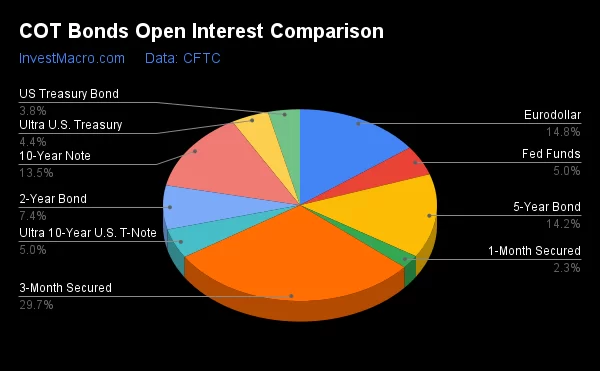
Here are the latest charts and statistics for the Commitment of Traders (COT) reports data published by the Commodities Futures Trading Commission (CFTC).

The latest COT data is updated through Tuesday February 21st and shows a quick view of how large traders (for-profit speculators and commercial hedgers) were positioned in the futures markets.

*** This data is still a few weeks behind the current data because the CFTC up-to-date data has been delayed due to a cybersecurity event that happened in early February to ION Cleared Derivatives (a subsidiary of ION Markets). This hack of ION has created a problem for the large trader positions to be reported and reconciled. The CFTC has back-filled some data over the past few weeks and will get the data back up to date in the coming weeks.

Weekly Speculator Changes led by 10-Year Bonds & US Treasury Bonds

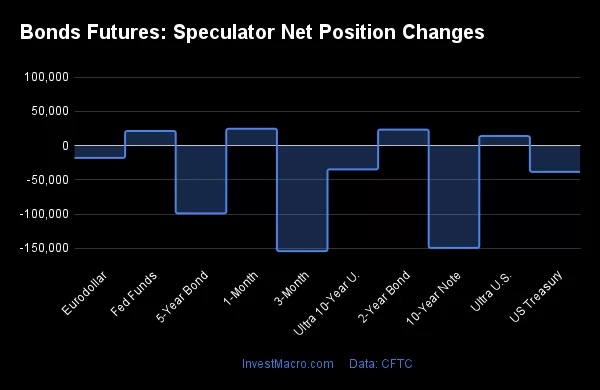
The COT bond market speculator bets were higher through February 21st as six out of the eight bond markets we cover had higher positioning while the other two markets had lower speculator contracts.

Leading the gains for the bond markets was the 10-Year Bonds (62,275 contracts) with the US Treasury Bonds (30,404 contracts), the Fed Funds (22,320 contracts), the Ultra Treasury Bonds (14,048 contracts), Eurodollar (24,267 contracts) and the 2-Year Bonds (3,194 contracts) also showing positive weeks.

The bond markets with declines in speculator bets for the week were the Ultra 10-Year Bonds (-18,345 contracts) and the 5-Year Bonds (-9,858 contracts) also registering lower bets on the week.


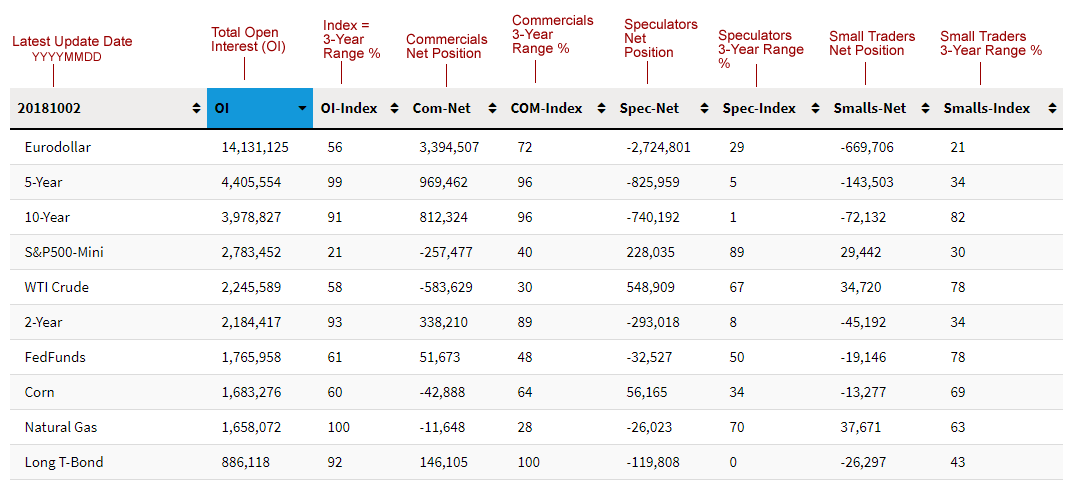
Data Snapshot of Bond Market Traders | Columns Legend
Feb-21-2023OIOI-IndexSpec-NetSpec-IndexCom-NetCOM-IndexSmalls-NetSmalls-Index
Eurodollar5,785,4340-1,008,528351,260,81664-252,28849
FedFunds1,810,07473-90,02429104,96973-14,94544
2-Year2,884,05371-693,4920657,11610036,37668
Long T-Bond1,307,31786-154,81634125,2855529,53186
10-Year4,335,63488-500,66011590,35792-89,69759
5-Year4,387,85184-599,24916631,38184-32,13272


Strength Scores led by Eurodollar & US Treasury Bonds

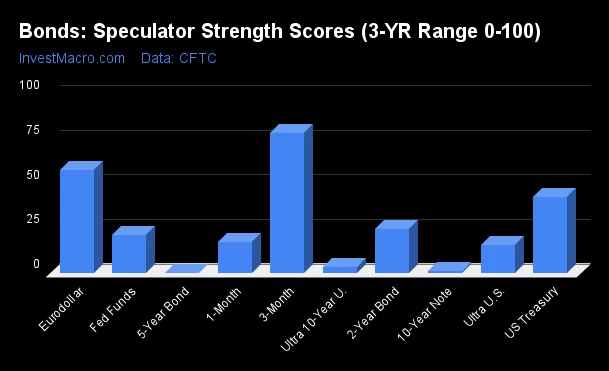
COT Strength Scores (a normalized measure of Speculator positions over a 3-Year range, from 0 to 100 where above 80 is Extreme-Bullish and below 20 is Extreme-Bearish) showed that the Eurodollar (35 percent) and the US Treasury Bonds (34 percent) led the bond markets through February 21st. The Fed Funds (29 percent) comes in as the next highest in the weekly strength scores.

On the downside, the Ultra 10-Year Bonds (0 percent), 2-Year Bonds (0 percent), 10-Year Bonds (11 percent), Ultra US Treasury Bond (13.4 percent) and the 5-Year Bond (16.1 percent) came in at the lowest strength levels and were in Extreme-Bearish territory (below 20 percent).

Strength Statistics:
Fed Funds (28.5 percent) vs Fed Funds previous week (25.8 percent)
2-Year Bond (0.4 percent) vs 2-Year Bond previous week (0.0 percent)
5-Year Bond (16.1 percent) vs 5-Year Bond previous week (17.3 percent)
10-Year Bond (11.1 percent) vs 10-Year Bond previous week (3.0 percent)
Ultra 10-Year Bond (0.0 percent) vs Ultra 10-Year Bond previous week (4.4 percent)
US Treasury Bond (34.2 percent) vs US Treasury Bond previous week (24.3 percent)
Ultra US Treasury Bond (13.4 percent) vs Ultra US Treasury Bond previous week (7.1 percent)
Eurodollar (34.6 percent) vs Eurodollar previous week (34.1 percent)


Fed Funds & 5-Year Bonds top the 6-Week Strength Trends

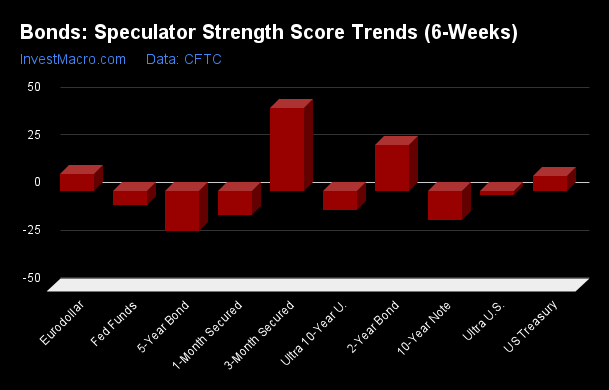
COT Strength Score Trends (or move index, calculates the 6-week changes in strength scores) showed that the Fed Funds (3 percent) and the 5-Year Bonds (3 percent) led the past six weeks trends for bonds through February 21st. The Eurodollar (1 percent) is the next highest positive movers in the latest trends data.

The 2-Year Bonds (-30 percent) leads the downside trend scores currently with the Ultra Treasury Bonds (-14 percent) and the 10-Year Bonds (-12 percent) following next with lower trend scores.

Strength Trend Statistics:
Fed Funds (2.8 percent) vs Fed Funds previous week (-0.5 percent)
2-Year Bond (-30.3 percent) vs 2-Year Bond previous week (-22.3 percent)
5-Year Bond (2.9 percent) vs 5-Year Bond previous week (7.7 percent)
10-Year Bond (-11.6 percent) vs 10-Year Bond previous week (-23.4 percent)
Ultra 10-Year Bond (-10.0 percent) vs Ultra 10-Year Bond previous week (-2.0 percent)
US Treasury Bond (0.8 percent) vs US Treasury Bond previous week (-5.2 percent)
Ultra US Treasury Bond (-14.2 percent) vs Ultra US Treasury Bond previous week (-23.4 percent)
Eurodollar (0.9 percent) vs Eurodollar previous week (-0.9 percent)


Individual Bond Markets:

3-Month Eurodollars Futures:

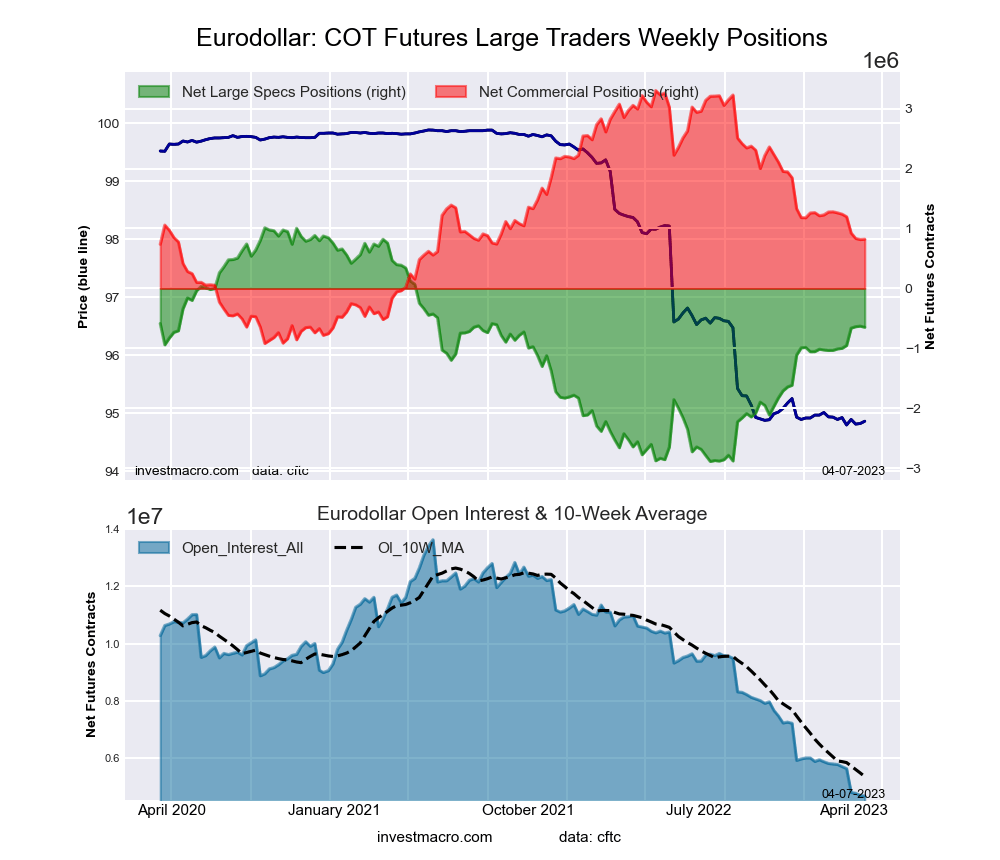
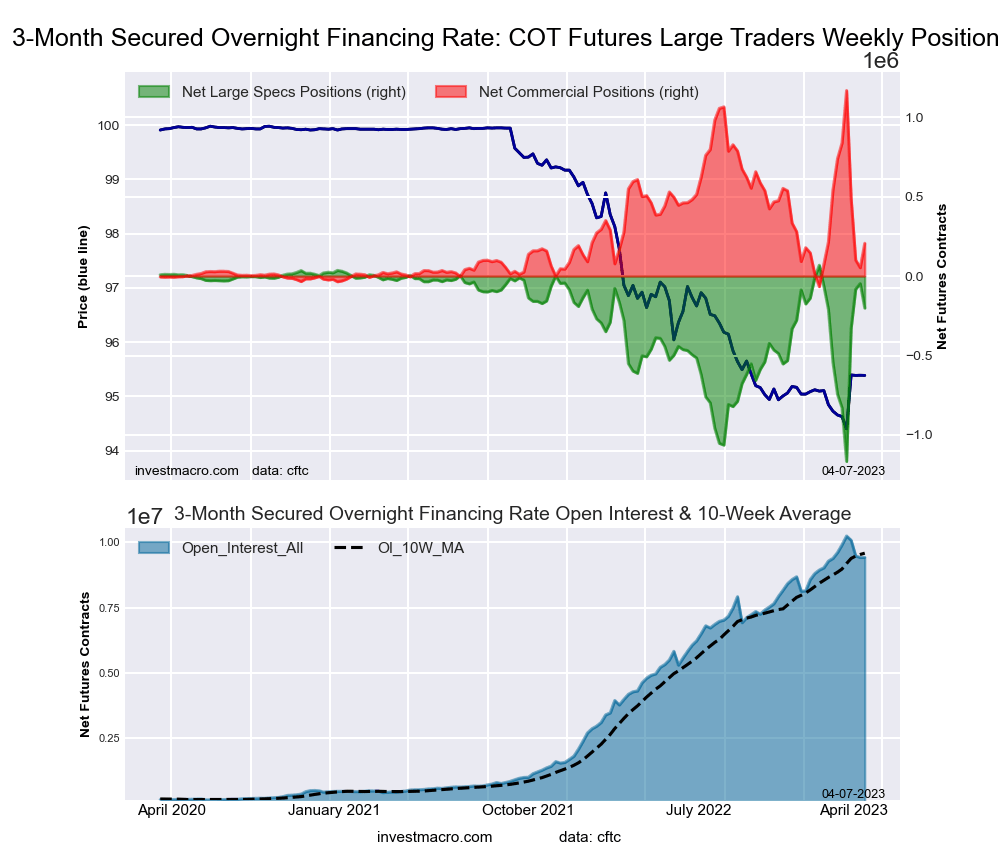
Eurodollar Bonds Futures COT ChartThe 3-Month Eurodollars large speculator standing the week came in at a net position of -1,008,528 contracts in the data reported through Tuesday February 21st. This was a weekly advance of 24,267 contracts from the previous week which had a total of -1,032,795 net contracts.

The week’s current strength score (the trader positioning range over the past three years, measured from 0 to 100) shows the speculators are currently Bearish with a score of 34.6 percent. The commercials are Bullish with a score of 63.7 percent and the small traders (not shown in chart) are Bearish with a score of 48.9 percent.

3-Month Eurodollars StatisticsSPECULATORSCOMMERCIALSSMALL TRADERS
– Percent of Open Interest Longs:9.767.84.6
– Percent of Open Interest Shorts:27.146.18.9
– Net Position:-1,008,5281,260,816-252,288
– Gross Longs:561,3433,925,149263,818
– Gross Shorts:1,569,8712,664,333516,106
– Long to Short Ratio:0.4 to 11.5 to 10.5 to 1
NET POSITION TREND:
– Strength Index Score (3 Year Range Pct):34.663.748.9
– Strength Index Reading (3 Year Range):BearishBullishBearish
NET POSITION MOVEMENT INDEX:
– 6-Week Change in Strength Index:0.90.0-10.8


30-Day Federal Funds Futures:

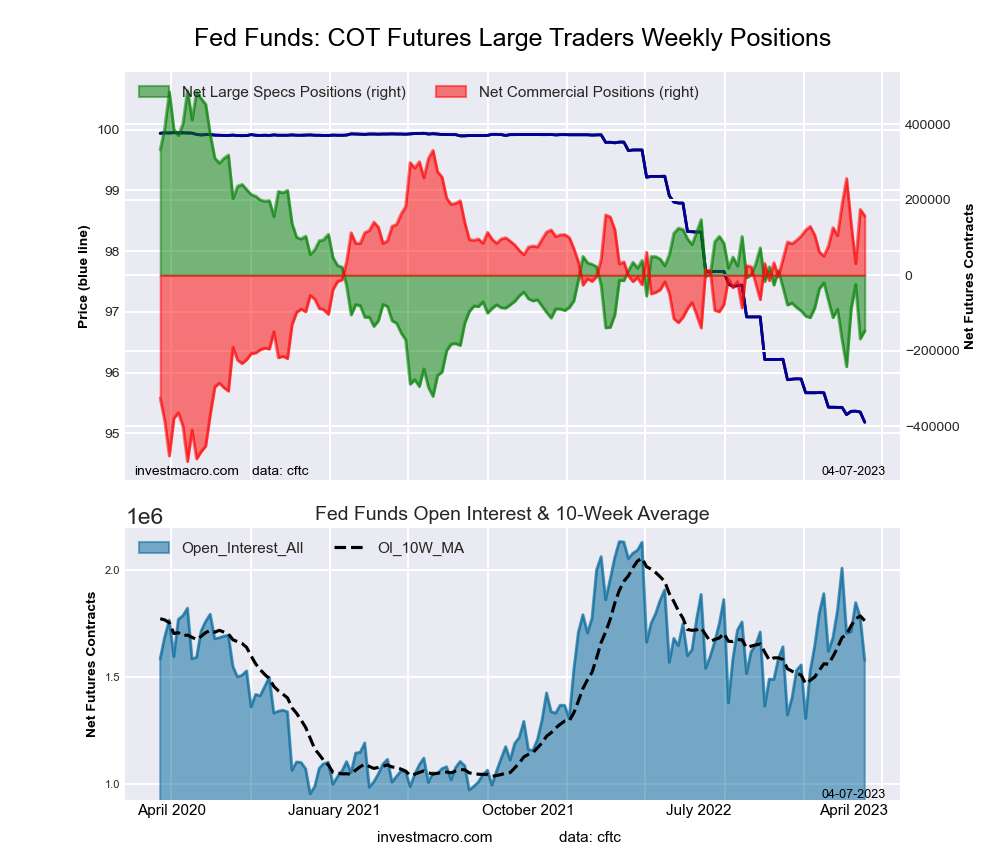
Federal Funds 30-Day Bonds Futures COT ChartThe 30-Day Federal Funds large speculator standing the week came in at a net position of -90,024 contracts in the data reported through Tuesday February 21st. This was a weekly increase of 22,320 contracts from the previous week which had a total of -112,344 net contracts.

The week’s current strength score (the trader positioning range over the past three years, measured from 0 to 100) shows the speculators are currently Bearish with a score of 28.5 percent. The commercials are Bullish with a score of 72.6 percent and the small traders (not shown in chart) are Bearish with a score of 44.1 percent.

30-Day Federal Funds StatisticsSPECULATORSCOMMERCIALSSMALL TRADERS
– Percent of Open Interest Longs:8.175.02.0
– Percent of Open Interest Shorts:13.169.22.9
– Net Position:-90,024104,969-14,945
– Gross Longs:146,3861,357,91036,925
– Gross Shorts:236,4101,252,94151,870
– Long to Short Ratio:0.6 to 11.1 to 10.7 to 1
NET POSITION TREND:
– Strength Index Score (3 Year Range Pct):28.572.644.1
– Strength Index Reading (3 Year Range):BearishBullishBearish
NET POSITION MOVEMENT INDEX:
– 6-Week Change in Strength Index:2.8-2.95.1


2-Year Treasury Note Futures:

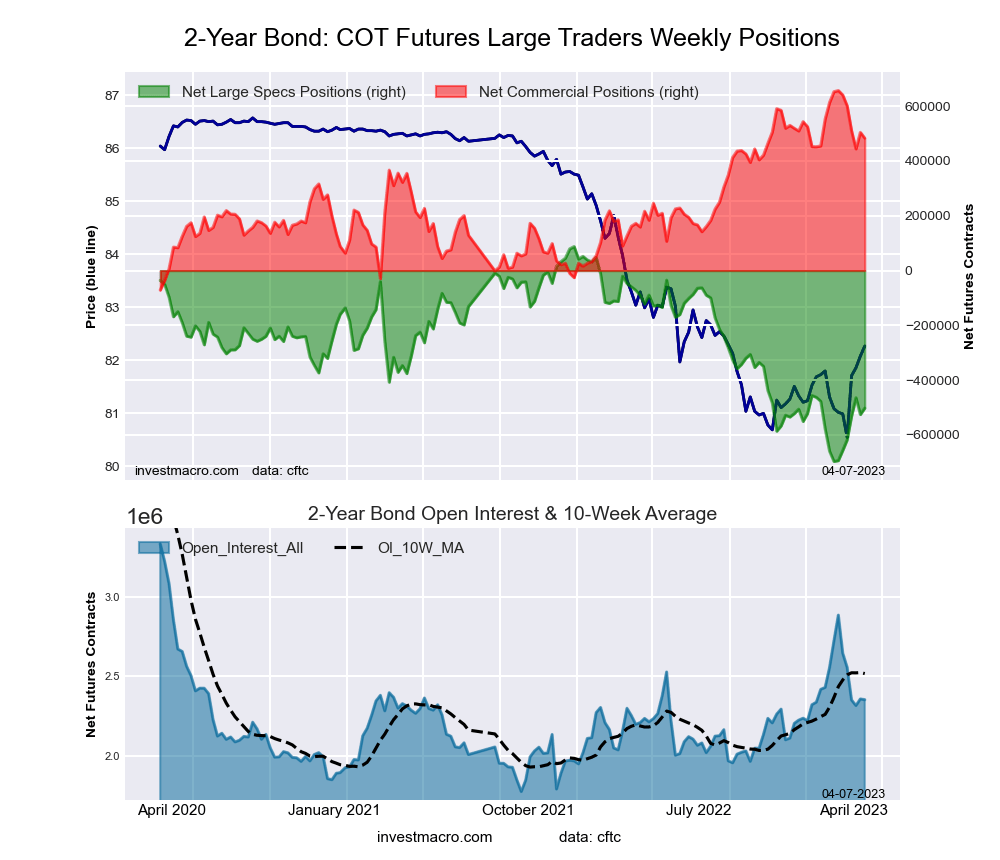
2-Year Treasury Bonds Futures COT ChartThe 2-Year Treasury Note large speculator standing the week came in at a net position of -693,492 contracts in the data reported through Tuesday February 21st. This was a weekly increase of 3,194 contracts from the previous week which had a total of -696,686 net contracts.

The week’s current strength score (the trader positioning range over the past three years, measured from 0 to 100) shows the speculators are currently Bearish-Extreme with a score of 0.4 percent. The commercials are Bullish-Extreme with a score of 100.0 percent and the small traders (not shown in chart) are Bullish with a score of 68.3 percent.

2-Year Treasury Note StatisticsSPECULATORSCOMMERCIALSSMALL TRADERS
– Percent of Open Interest Longs:6.779.411.3
– Percent of Open Interest Shorts:30.856.610.0
– Net Position:-693,492657,11636,376
– Gross Longs:193,9282,288,617325,019
– Gross Shorts:887,4201,631,501288,643
– Long to Short Ratio:0.2 to 11.4 to 11.1 to 1
NET POSITION TREND:
– Strength Index Score (3 Year Range Pct):0.4100.068.3
– Strength Index Reading (3 Year Range):Bearish-ExtremeBullish-ExtremeBullish
NET POSITION MOVEMENT INDEX:
– 6-Week Change in Strength Index:-30.328.114.6


5-Year Treasury Note Futures:

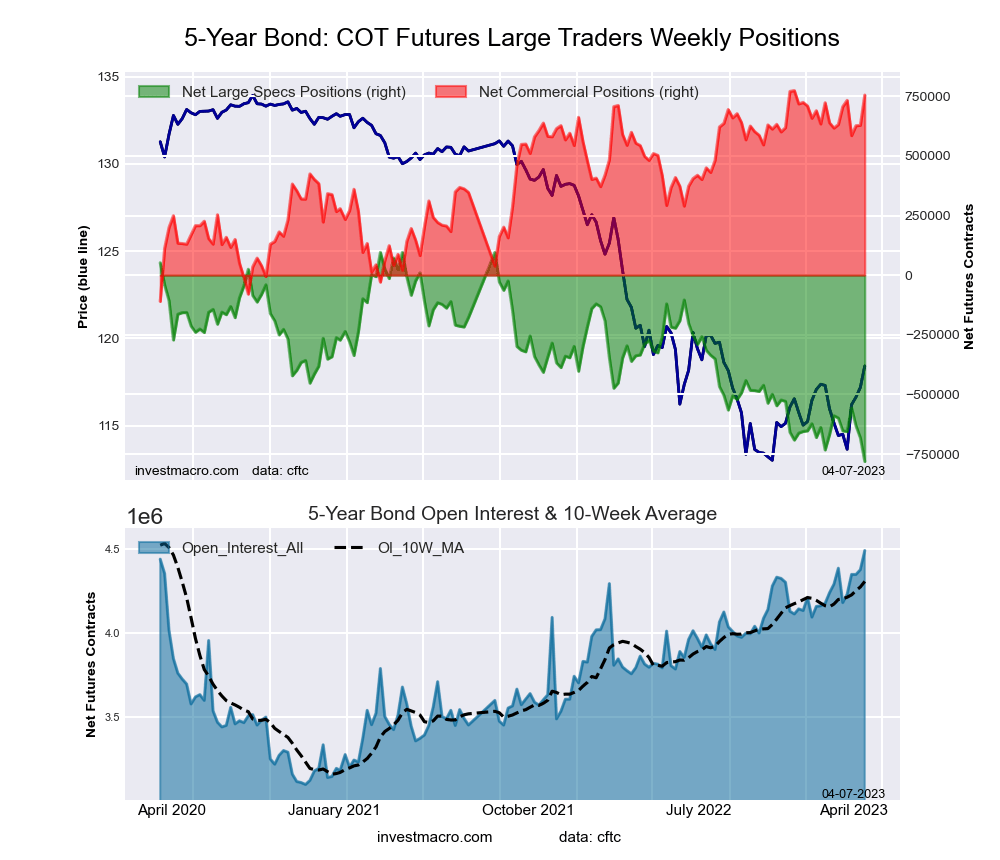
5-Year Treasury Bonds Futures COT ChartThe 5-Year Treasury Note large speculator standing the week came in at a net position of -599,249 contracts in the data reported through TuesdayFebruary 21st. This was a weekly decrease of -9,858 contracts from the previous week which had a total of -589,391 net contracts.

The week’s current strength score (the trader positioning range over the past three years, measured from 0 to 100) shows the speculators are currently Bearish-Extreme with a score of 16.1 percent. The commercials are Bullish-Extreme with a score of 83.9 percent and the small traders (not shown in chart) are Bullish with a score of 72.2 percent.

5-Year Treasury Note StatisticsSPECULATORSCOMMERCIALSSMALL TRADERS
– Percent of Open Interest Longs:7.680.59.2
– Percent of Open Interest Shorts:21.266.29.9
– Net Position:-599,249631,381-32,132
– Gross Longs:331,3293,534,403401,556
– Gross Shorts:930,5782,903,022433,688
– Long to Short Ratio:0.4 to 11.2 to 10.9 to 1
NET POSITION TREND:
– Strength Index Score (3 Year Range Pct):16.183.972.2
– Strength Index Reading (3 Year Range):Bearish-ExtremeBullish-ExtremeBullish
NET POSITION MOVEMENT INDEX:
– 6-Week Change in Strength Index:2.9-3.00.6


10-Year Treasury Note Futures:

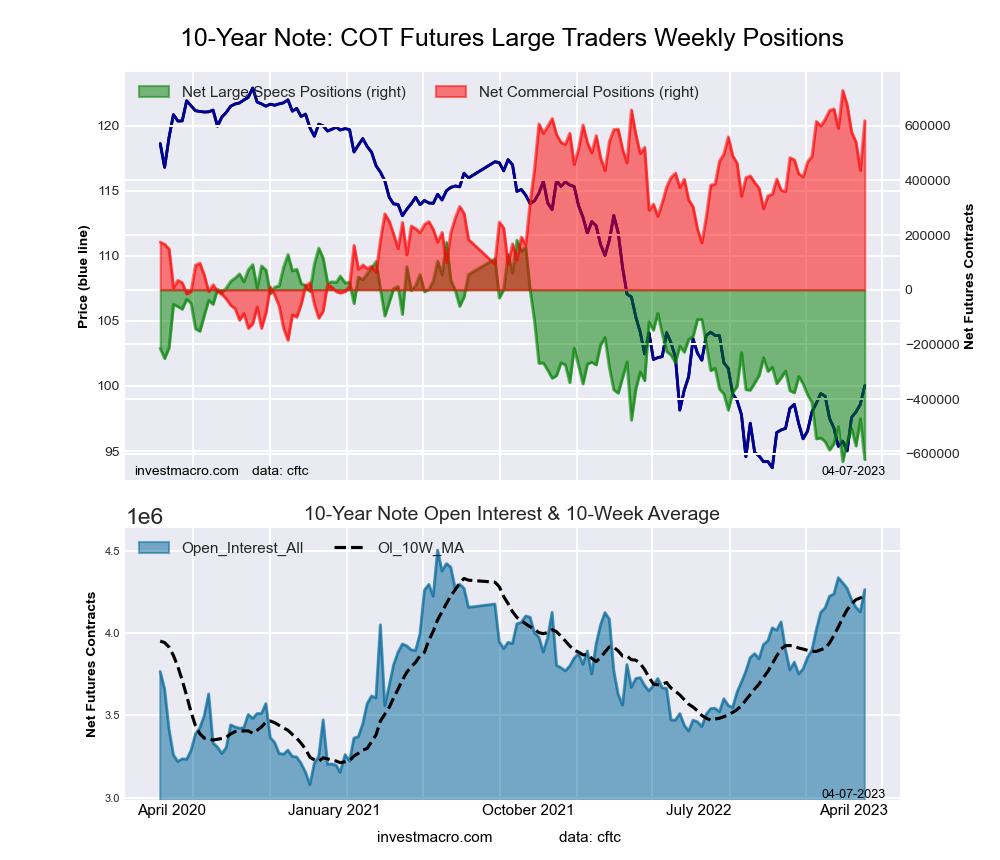
10-Year Treasury Notes Bonds Futures COT ChartThe 10-Year Treasury Note large speculator standing the week came in at a net position of -500,660 contracts in the data reported through Tuesday February 21st. This was a weekly rise of 62,275 contracts from the previous week which had a total of -562,935 net contracts.

The week’s current strength score (the trader positioning range over the past three years, measured from 0 to 100) shows the speculators are currently Bearish-Extreme with a score of 11.1 percent. The commercials are Bullish-Extreme with a score of 91.6 percent and the small traders (not shown in chart) are Bullish with a score of 58.8 percent.

10-Year Treasury Note StatisticsSPECULATORSCOMMERCIALSSMALL TRADERS
– Percent of Open Interest Longs:9.877.09.8
– Percent of Open Interest Shorts:21.363.411.9
– Net Position:-500,660590,357-89,697
– Gross Longs:423,1673,337,222425,774
– Gross Shorts:923,8272,746,865515,471
– Long to Short Ratio:0.5 to 11.2 to 10.8 to 1
NET POSITION TREND:
– Strength Index Score (3 Year Range Pct):11.191.658.8
– Strength Index Reading (3 Year Range):Bearish-ExtremeBullish-ExtremeBullish
NET POSITION MOVEMENT INDEX:
– 6-Week Change in Strength Index:-11.612.0-3.0


Ultra 10-Year Notes Futures:

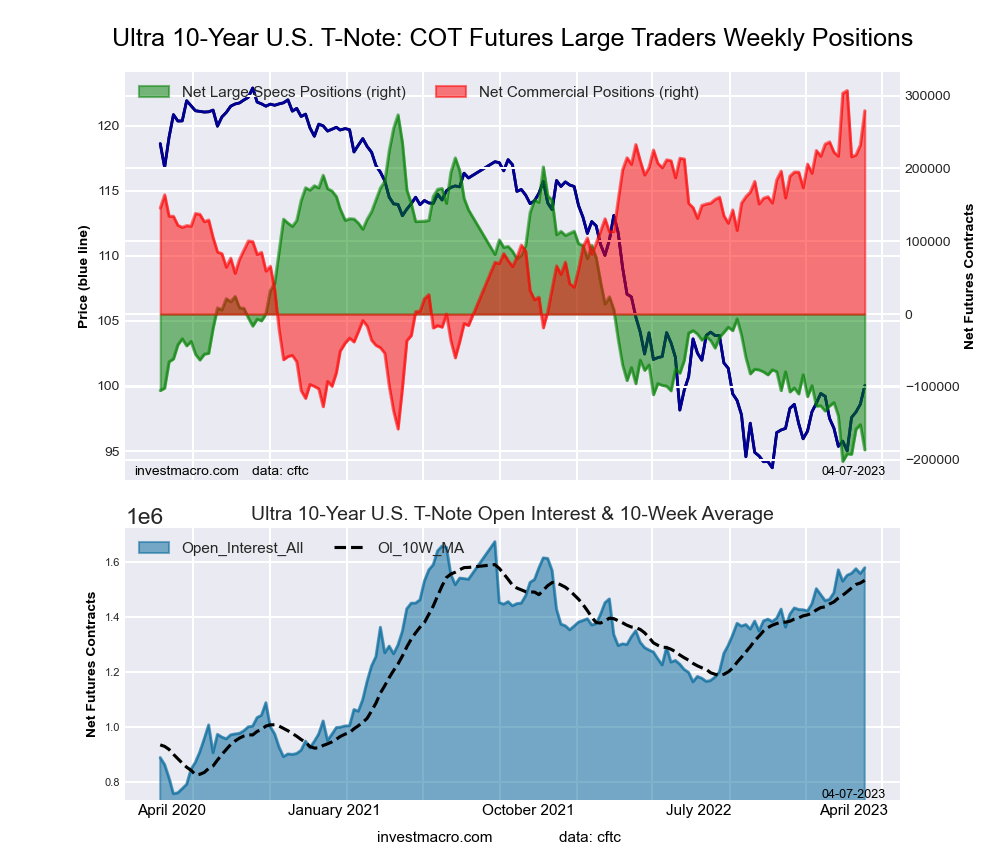
Ultra 10-Year Treasury Notes Bonds Futures COT ChartThe Ultra 10-Year Notes large speculator standing the week came in at a net position of -139,776 contracts in the data reported through Tuesday February 21st. This was a weekly decline of -18,345 contracts from the previous week which had a total of -121,431 net contracts.

The week’s current strength score (the trader positioning range over the past three years, measured from 0 to 100) shows the speculators are currently Bearish-Extreme with a score of 0.0 percent. The commercials are Bullish-Extreme with a score of 95.0 percent and the small traders (not shown in chart) are Bullish with a score of 75.8 percent.

Ultra 10-Year Notes StatisticsSPECULATORSCOMMERCIALSSMALL TRADERS
– Percent of Open Interest Longs:9.774.713.2
– Percent of Open Interest Shorts:18.660.918.1
– Net Position:-139,776216,868-77,092
– Gross Longs:152,3551,175,266207,505
– Gross Shorts:292,131958,398284,597
– Long to Short Ratio:0.5 to 11.2 to 10.7 to 1
NET POSITION TREND:
– Strength Index Score (3 Year Range Pct):0.095.075.8
– Strength Index Reading (3 Year Range):Bearish-ExtremeBullish-ExtremeBullish
NET POSITION MOVEMENT INDEX:
– 6-Week Change in Strength Index:-10.06.011.9


US Treasury Bonds Futures:

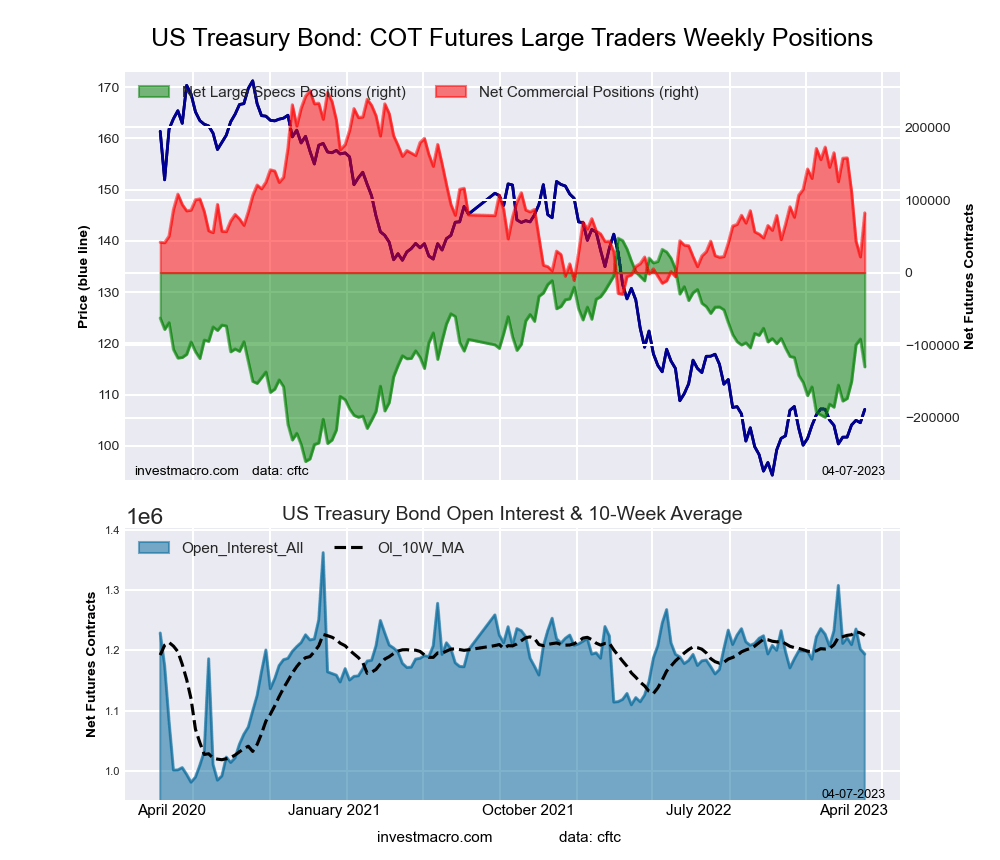
US Year Treasury Notes Long Bonds Futures COT ChartThe US Treasury Bonds large speculator standing the week came in at a net position of -154,816 contracts in the data reported through Tuesday February 21st. This was a weekly boost of 30,404 contracts from the previous week which had a total of -185,220 net contracts.

The week’s current strength score (the trader positioning range over the past three years, measured from 0 to 100) shows the speculators are currently Bearish with a score of 34.2 percent. The commercials are Bullish with a score of 55.3 percent and the small traders (not shown in chart) are Bullish-Extreme with a score of 86.1 percent.

US Treasury Bonds StatisticsSPECULATORSCOMMERCIALSSMALL TRADERS
– Percent of Open Interest Longs:6.674.315.5
– Percent of Open Interest Shorts:18.564.713.2
– Net Position:-154,816125,28529,531
– Gross Longs:86,475971,509202,158
– Gross Shorts:241,291846,224172,627
– Long to Short Ratio:0.4 to 11.1 to 11.2 to 1
NET POSITION TREND:
– Strength Index Score (3 Year Range Pct):34.255.386.1
– Strength Index Reading (3 Year Range):BearishBullishBullish-Extreme
NET POSITION MOVEMENT INDEX:
– 6-Week Change in Strength Index:0.8-1.61.7


Ultra US Treasury Bonds Futures:

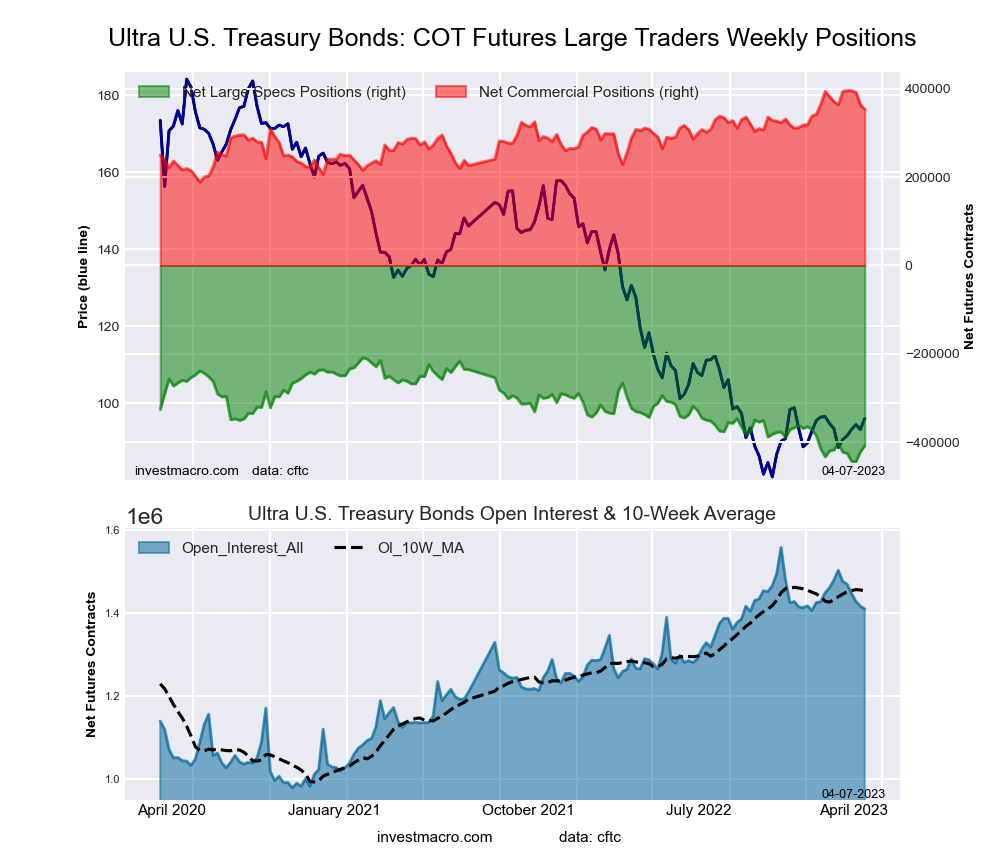
Ultra US Year Treasury Notes Long Bonds Futures COT ChartThe Ultra US Treasury Bonds large speculator standing the week came in at a net position of -403,372 contracts in the data reported through Tuesday February 21st. This was a weekly lift of 14,048 contracts from the previous week which had a total of -417,420 net contracts.

The week’s current strength score (the trader positioning range over the past three years, measured from 0 to 100) shows the speculators are currently Bearish-Extreme with a score of 13.4 percent. The commercials are Bullish-Extreme with a score of 85.4 percent and the small traders (not shown in chart) are Bullish with a score of 68.3 percent.

Ultra US Treasury Bonds StatisticsSPECULATORSCOMMERCIALSSMALL TRADERS
– Percent of Open Interest Longs:5.481.812.0
– Percent of Open Interest Shorts:32.357.69.4
– Net Position:-403,372363,97439,398
– Gross Longs:81,1671,228,622180,433
– Gross Shorts:484,539864,648141,035
– Long to Short Ratio:0.2 to 11.4 to 11.3 to 1
NET POSITION TREND:
– Strength Index Score (3 Year Range Pct):13.485.468.3
– Strength Index Reading (3 Year Range):Bearish-ExtremeBullish-ExtremeBullish
NET POSITION MOVEMENT INDEX:
– 6-Week Change in Strength Index:-14.212.55.5


Article By InvestMacroReceive our weekly COT Newsletter

*COT Report: The COT data, released weekly to the public each Friday, is updated through the most recent Tuesday (data is 3 days old) and shows a quick view of how large speculators or non-commercials (for-profit traders) were positioned in the futures markets.

The CFTC categorizes trader positions according to commercial hedgers (traders who use futures contracts for hedging as part of the business), non-commercials (large traders who speculate to realize trading profits) and nonreportable traders (usually small traders/speculators) as well as their open interest (contracts open in the market at time of reporting). See CFTC criteria here.

Economic growth doesn’t have to mean ‘more’ – consuming ‘better’ will also protect the planet

By Renaud Foucart, Lancaster University 

Around 30 years ago, many developed countries started a process of absolute decoupling of their emissions of CO₂ and energy use from economic growth. This means keeping emissions stable, or better yet, shrinking them, while still growing the economy.

As a result, GDP is now much higher than it was in 1990 in the UK, France, Germany and the US, but CO2 emissions are lower. This is not just because of the deindustrialisation of the west: emissions decrease even if we include our imports from countries like China.

This trend may be too little too late to avoid the worst consequences of climate change and the destruction of wildlife. But it is a testimony of perhaps the biggest misunderstanding about economics: that growth is a measure of how much an economy produces, rather than an imperfect account of the value of this production.

Emissions versus GDP

Fighting climate change requires a radical transformation of the economy to use less energy and resources. This means it could cause economic growth by making us consume “better”, not more. Putting a monetary value on protecting the Earth means people will pay the true cost of their consumption.

“Better” consumption of goods and services

The things we buy typically become more valuable if the perceived quality of a product increases. And research shows that consumers are willing to pay more if they believe a brand is more valuable, for example, because it is more ethical or environmentally friendly. This is the case for low-carbon energy sources, fairtrade chocolate, organic and local products – and it’s even more the case for people that care about how others see them. So if this means replacing a £1.89 pack of beef burgers with £12 bean and mushroom patties, economic growth will certainly be good for the planet.

The same can be said for the services people spend money on. In fact, as the economy becomes more dependent on services than products, this part of our consumption is even more important to “green”.

This is because much of today’s economic growth is not about measuring the value of the objects we buy. Two-thirds of the world’s GDP is constituted of services, and those are increasingly provided from our own homes as we work remotely. The environmental cost is then almost entirely composed of the energy needed to make the internet work – and there is a way to make that greener.

Sci-fi authors and futurists of the 1960s correctly predicted that we would live in a world of wireless communications, flat-screen TVs and sophisticated kitchen appliances, while fewer foresaw that younger generations would celebrate the return of sleeper trains in Europe. They would probably also be surprised at how many people find love via their phone, using online dating services. The fact that Match.com is worth more than car companies Mitsubishi and Mazda combined shows how our economy is changing towards consumption of services rather than traditional goods.

This does not mean that free markets and technology alone can save the world from climate change. Government intervention is also needed. In fact, one of the oldest and most accepted ideas in economics is the principle that consumers should not only pay for the cost of producing what they buy, but also for its cost to society. This means taxing pollution, the destruction of wildlife, unhealthy food, traffic congestion and the depletion of natural resources, rather than raising the same amount by taxing income.

This could also be a source of economic growth. Research shows taxing pollution generates a “double dividend”: it restores fair competition between polluting and non-polluting products, and it generates tax revenue to invest for everyone’s benefit. If the prohibitive cost of pollution and limited natural resources forces us to innovate, we can actually create value instead of destroying it.

Green policies as the future of growth

In this kind of world, sustained growth for the next century would mean the phasing out of fossil fuels and increased energy efficiency, and largely replacing meat production with plant and lab-based alternatives. But also more value created by services, addressing wellbeing, and creating cleaner air and water, healthier food and safer cities.

Indeed, 15-minute cities are more of an economist’s dream than a socialist utopia. Charging for the true cost of car use by heavily taxing noise and air pollution is textbook introductory economics. Reallocating public land towards humans and public transport saves time for everyone. On the other hand, adding roads simply creates more congestion, while public transport gets more efficient as more people use it. Less time spent in a car means more time for work and leisure.

And when it comes to artificial intelligence, just like machines and robots in the past, it will not kill jobs but give us more time and money to spend on leisure. This is economic growth.

The real challenge for growth is not defying the laws of physics with technology that magically allows us to produce more with the same or fewer resources. It is the ability of our societies to tax polluting activities and regulate the use of land and natural resources, while still being able to redistribute wealth. This is the ability to do better with less.

We also need to work out how to correctly account for everything we value. What is counted under GDP figures has already started to change over time to include things not directly measured by traditional markets.

Making the case for the preservation of nature means being able to put a number on it: taxing social costs but also recording the value of the use of our parks, forests and mountains. If those who care about protecting the environment do not fight to put the highest possible number on nature because they find the idea of valuing it in monetary terms repugnant, someone who does not care will do it.The Conversation

About the Author:

Renaud Foucart, Senior Lecturer in Economics, Lancaster University Management School, Lancaster University

This article is republished from The Conversation under a Creative Commons license. Read the original article.

Week Ahead: Say bye to EURUSD’s March gains?

By ForexTime 

Even as markets brace for the highly-anticipated US jobs report due later today (Friday, March 10th), the prudent investor/trader will already be keeping an eye on what’s to come:
Sunday, March 12

  • US daylight savings time ends

Tuesday, March 14

  • AUD: Australia February business confidence; March consumer confidence
  • GBP: UK January unemployment rate, February jobless claims
  • USD: US February consumer price index (CPI)

Wednesday, March 15

  • CNH: China February industrial production, retail sales, jobless rate
  • JPY: Bank of Japan meeting minutes
  • EUR: Eurozone January industrial production
  • GBP: UK Chancellor presents Spring Budget
  • USD: US February retail sales

Thursday, March 16

  • NZD: New Zealand 4Q GDP
  • AUD: Australia February unemployment, March inflation expectations
  • EUR: ECB rate decision
  • USD: US weekly jobless claims

Friday, March 17

  • EUR: Eurozone February CPI (final)
  • USD: US February industrial production, March consumer sentiment


Here are 3 reasons why we’re especially focusing on EURUSD for the coming week:


1) US inflation still stubborn?

The incoming CPI (consumer price index – which measures headline inflation) is set to be the next major risk event (after today’s NFP release) for the US dollar, and by extension, the rest of the FX universe.

This is also arguably the most important datapoint that the US central bank a.k.a. the Fed will take into account ahead of its upcoming policy meeting on 21-22 March.

The February CPI number due Tuesday is forecasted to come in at 6%, which would be:

  • lower than January’s 6.4%
  • but still three times higher than the Fed’s inflation target of 2%

A significantly higher-than-6% CPI number implies that the Fed has to send US interest rates much higher to quell still-stubborn inflation. Such an outlook should strengthen the US Dollar which in turn would drag EURUSD lower.

On the other hand, a lower-than-6% CPI suggests that the Fed does not have to be as aggressive as markets fear, which would offer much relief to markets and potentially send EURUSD higher.


2) ECB rate hike

A 50-basis point hike by the European Central Bank (ECB) is all but certain at its Thursday meeting.

Less known is how high the ECB has to ultimately send its benchmark rate to subdue its own inflationary pressures, noting that the Eurozone’s February core CPI (released on March 2nd) came in at a higher-than-expected 5.6% – a new record high!

As things stand, markets forecasting that the ECB’s deposit rate will peak at 4% by the end of 2023, from the current 2.5% ahead of next week’s decision.

That implies a further 150-bps in rate hikes (including next week’s 50-bps hike).

 And recall that, generally, the central bank that has more rate hikes in store (relative to the central bank’s peers) tends to see its currency strengthen.

Hence, markets will be more sensitive to what the ECB says about its plans for future adjustments to its benchmark rates:

  • If the ECB suggests strongly that another 50-bps hike is in store at its early-May rate decision, that should send the EURUSD higher either towards or above its 50-day simple moving average (SMA), depending on where EURUSD ends up after today’s US jobs report.
  • However, if the ECB strikes a more dovish tone and opens the door for a downshift towards a relatively smaller 25-bps hike for upcoming meetings, that could weigh on EURUSD and potentially drag it below its 100-day SMA and into sub-1.05 domain, depending on where this FX pair ends up by the weekend.


3) EURUSD’s 1-week implied volatility at year-to-date high

The EURUSD’s forecasted volatility over the next one-week period for has reached its highest levels so far in 2023.

The above chart lays bare just how sensitive the world’s most popularly traded FX pair is to the incoming US CPI print and also the ECB decision.


At the time of writing (and before the pivotal US jobs report due later today), Bloomberg’s FX model forecasts a 71% chance that EURUSD will trade within the 1.0411 – 1.0775 range over the upcoming week.

Although EURUSD has been in a downtrend since early February, printing a series of lower lows on the price charts, next week’s events would have major sway over EURUSD’s immediate fate.

Ultimately, EURUSD’s slim month-to-date gain of just 0.1% (at the time of writing) will either evaporate, or be added to, by the upcoming week’s events.


Key levels for EURUSD

RESISTANCE

  • 1.060 region: around 38.2% Fibonacci level from January 2021 – October 2022 drop
  • 21-day SMA
  • 1.069 region: resisted EURUSD bulls on several episodes since mid-December 2023
  • 50-day SMA


SUPPORT

  • 100-day SMA
  • 1.050 psychologically-important level
  • 1.04832 cycle low in January 2023
  • 1.04433 low on December 7th

Forex-Time-LogoArticle by ForexTime
ForexTime Ltd (FXTM) is an award winning international online forex broker regulated by CySEC 185/12 www.forextime.com

After oil: the challenge and promise of getting the world off fossil fuels – podcast

By Nehal El-Hadi, The Conversation and Daniel Merino, The Conversation 

Our dependence on fossil fuels is one of the biggest challenges to overcome in the fight against climate change. But production and consumption of fossil fuels is on the rise, and expected to peak within the next decade.

In this episode of The Conversation Weekly, we speak to two researchers who examine the political challenges of transitioning to a world after oil, and what it means for those states who rely on oil for resources.

Oil is not only used as a fuel, but is integral to everyday life through its applications in plastics, manufacturing processes, fabrics, paints and chemicals. In order to consider alternatives to oil, we need to be aware of the scale of its integration into our lives.

Caleb Wellum is an assistant professor of U.S. history at the University of Toronto Mississauga, Canada.

“I almost hesitate to say this, because this kind of depiction of deep dependence on oil has actually been a strategy of oil companies themselves to say, look, you can’t have a modern world, a modern way of life without oil,” Wellum points out. “So this is not to say it’s inescapable, but it’s to say that the challenges are significant to transitioning to some kind of after-oil.”

Defining that transition can be tricky, because it carries different stakes depending on how it is interpreted: does it mean continuing to extract oil “until the last drop,” or finding alternatives right now?

Wellum notes that the 1970s oil crisis was a significant moment in human history that helped shape our current consumption patterns. There was a debate between environmentalists and economists that signalled a moment at the crossroads for our current relationship with oil.

“I noticed there was a need to transition away from oil. And there was also a free market argument that argued the energy crisis was a sign of bad government policy of governments intervening in markets and making it inefficient,” he said. “Eventually, this market argument won out and there was no energy transition.”

There was a growing awareness of the environmental impact of the extraction and consumption of fossil fuels, and the urgent need to combat climate change to reduce global warming. And recently, governments around the world — including in countries dependent on oil revenues — are committing to finding energy alternatives.

Natalie Koch is a professor of human geography at the Geography Institute at the University of Heidelberg, Germany. Her research looks at how petrostates have presented spectacular alternative energy projects to distract from the need to move away from oil.

“There’s a focus on spectacular sustainability projects, and by that you see the scale and the size is just enormous. And that’s what spectacle does — it’s supposed to attract a lot of attention because the size range of the project is really quite impressive,” Koch said.

But these ambitious alternative energy projects aren’t all as they seem, she cautions. Koch describes how a solar farm in the desert in Morocco — one of the largest such projects in the world — is facing challenges because of the amount of water required.

A PBS report on the world’s largest solar farm in Morocco.

To transition to a world post-oil, whatever that may look like, requires more than successful and sustainable alternative technologies.

“There are a lot of factors that go into why it is that we’re dependent on oil, but they’re not just about the convenience of the source of energy,” Wellum points out. “It’s about political decisions.”

Listen to the full episode of The Conversation Weekly to find out more.

This episode of The Conversation Weekly was produced and written by Mend Mariwany, who is also the show’s executive producer. Sound design is by Eloise Stevens, and our theme music is by Neeta Sarl.

You can find us on Twitter @TC_Audio, on Instagram at @theconversationdotcom or via email. You can also sign up to The Conversation’s free emails here. A transcript of this episode will be available soon.

Listen to The Conversation Weekly via any of the apps listed above, download it directly via our RSS feed, or find out how else to listen here.The Conversation

About the Author:

Nehal El-Hadi, Science + Technology Editor & Co-Host of The Conversation Weekly Podcast, The Conversation and Daniel Merino, Associate Science Editor & Co-Host of The Conversation Weekly Podcast, The Conversation

This article is republished from The Conversation under a Creative Commons license. Read the original article.

Fed’s Powell warns of higher rates, investors urged not to forget other metrics

By George Prior

Federal Reserve Chair Jerome Powell’s high-stakes appearance before Congress should act as a reminder to investors to consider other metrics besides inflation and interest rates, says the CEO and founder of one of the world’s largest independent financial advisory, asset management and fintech organizations.

The observation from deVere Group’s Nigel Green follows the US central bank chief telling lawmakers on Tuesday that it will likely raise interest rates more than expected amid strong economic data and that it is prepared to move more aggressively if the “totality” of fresh reports suggests stronger measures are needed to tame inflation.

In a hearing before the Senate Banking Committee, Mr Powell said: “The latest economic data have come in stronger than expected, which suggests that the ultimate level of interest rates is likely to be higher than previously anticipated… If the totality of the data were to indicate that faster tightening is warranted, we would be prepared to increase the pace of rate hikes.”

Following the hearing, Nigel Green noted: “Investors were looking for clues from Powell as to whether he favours another 25-basis point rate increase at the next Federal Open Market Committee meeting, or if he might consider a heftier 50-basis point increase.

“The Fed chair was perhaps more hawkish than many analysts had expected, and stocks tumbled after he warned that interest rates could remain higher for longer.”

He continues: “Despite the hawkish tone, when in the decision-making process, I remind investors that even though there’s still a way to go, we’re likely closer than we have been to getting back to the central bank’s target and would urge them to focus more on earnings and margin than on inflation and interest rate news.

“If you’re serious about building wealth, you should be looking at sectors and companies that can maintain margin despite inflation and interest rate hikes.

“Margin is an often overlooked yet important metric for investors to consider when evaluating investment opportunities. It can provide insight into the company’s profitability, efficiency, and competitive advantages, and can impact investor sentiment and stock prices.”

In this environment of higher rates for longer than had previously been anticipated, some companies are going to find it difficult to maintain margin and, as we have recently seen, are failing to report earnings as had been expected.

“In other words, if costs are going up firms can’t maintain margin, so that company is unlikely to be a good investment until things change,” noted the deVere CEO in a recent media note.

He identified four key sectors that he expects to be resilient in this current environment.

“We’re looking at sectors that can maintain margin, despite inflation and interest rate hikes. These include healthcare, luxury goods, energy and agriculture.

“Healthcare is a robust sector as people will always need to stay healthy – this has come into focus more than ever since the pandemic. Also, despite wider market volatility, there’s strong earnings potential due to ageing populations and other demographic changes. Plus, healthcare is becoming increasingly tech-driven, which offers fresh opportunities.”

He went on to say: “Luxury goods can maintain margin due to the inherent aspirational ‘elite and exclusive’ aspect of the sector.

“We’ll look at energy because there’s a shortage of energy in the world right now.

“Agriculture is another one as populations in emerging markets around the world are eating more meat. As they eat more meat, there needs to be more grain produced.”

As ever, it’s critical that investors ensure their portfolios are suitably diversified across asset classes, sectors, currencies and regions so as to make the most of the considerable opportunities that will inevitably present themselves.

Following Powell’s appearance on Capitol Hill on Tuesday, Nigel Green concludes: “Of course, investors shouldn’t dismiss the Fed’s signals about future rate hikes, but they must also consider other investment metrics too, in particular, margin.”

About:

deVere Group is one of the world’s largest independent advisors of specialist global financial solutions to international, local mass affluent, and high-net-worth clients.  It has a network of more than 70 offices across the world, over 80,000 clients and $12bn under advisement

Trade Of The Week: Are Gold Bulls Back In Town?

By ForexTime 

After securing its best week since mid-January, could gold prices be gearing up for more upside?

The precious metal staged a solid rebound last week, climbing 2.5% due to dollar weakness and positive economic data from China. A pullback in Treasury yields last Friday fuelled upside gains, pushing prices closer to the 50-day Simple Moving Average around $1870. Price action suggests that bulls could be back in action after gold received a thorough beating last month. However, the key question is whether the current momentum will result in a bullish reversal or a dead cat bounce.

Revisiting our 2023 outlook, we discussed how gold could be one of the biggest winners this year based on expectations around the Federal Reserve pausing rate hikes down the line. In February, these expectations were tempered by robust jobs data and sticky inflation figures which fuelled fears about rates staying higher for longer. Nevertheless, sentiment towards gold may experience a positive shift this month if US economic data disappoints and inflation shows signs of cooling.

Taking a quick looking at the technical picture, gold turned bullish on the daily charts after breaking above the $1845 lower high. A strong daily close above the 50-day SMA could encourage an incline towards $1880 and $1900, respectively.

Big week for gold as Powell & NFP eyed

Watch this space as the events this week could either fuel gold’s upside momentum or end the party for bulls. All eyes will be on Fed Chair Jerome Powell’s Testimony and US jobs data which have the potential to inject the precious metal with explosive levels of volatility.

On Tuesday, Fed Chair Powell provides his semi-annual report to the Senate Banking Committee. Any hints or signals on the Fed potentially straying away from 25bp hikes in future meetings will most likely influence markets. Powell will address the House Financial Services Committee on Wednesday and is expected to reiterate a similar message. If Powell strikes a hawkish tone during Testimony, this could rekindle dollar strength and rate hike bets – ultimately dragging gold prices lower. Alternatively, a cautiously sounding Powell may cool rate hike bets, providing even more room for gold bulls to fight back.

It’s all about the US jobs report on Friday which could determine whether the dollar’s renewed strength is temporary or lasting. After the breathtaking 517,000 reading back in January, around 215,000 is projected for February. Another healthy jobs report may reinforce expectations around the Federal Reserve holding rates higher for longer. On the other hand, if the NFP report fails to meet expectations – the dollar is likely to tumble as investors pare back their rate hike bets.

Other factors influencing gold

It will be wise to keep an eye on the ADP’s monthly read and initial jobless claims which could act as an appetiser before the main course. On the geopolitical front, developments concerning Sino-US relations may add more spice and flavour to the precious metal – especially if investors become edgy. While escalating tensions could fuel risk aversion sweetening appetite for safe-haven assets, this also includes the dollar. As we have identified earlier, dollar strength tends to make things difficult for gold bulls.

Gold to see rebound or dead cat bounce?

Gold turned bullish on the daily charts after prices blasted above $1845 lower high. The precious metal trades above the 100-day and 200-day Simple Moving Average with bulls eyeing the 50-day SMA at $1870. A strong breakout and daily close above this level could encourage an incline toward $1880 and potentially beyond the psychological $1900 resistance level. On the other hand, if bulls are capped below the 50-day SMA or lose momentum around $1880 – this could trigger a move lower with $1825 and $1800 acting as key levels of interest. Ultimately, the pending key US economic reports and Powell’s testimony will most likely shape the outlook for gold this month.


Forex-Time-LogoArticle by ForexTime
ForexTime Ltd (FXTM) is an award winning international online forex broker regulated by CySEC 185/12 www.forextime.com

Week Ahead: Watch these 3 major FX pairs

By ForexTime

The FX world could see some heightened volatility if the US Dollar receives a double boost, along with any surprises out of G10 central banks in action over the coming week:

Monday, March 6

  • AUD: Australia February inflation gauge
  • EUR: Euro area January retail sales

Tuesday, March 7

  • AUD: Reserve Bank of Australia decision; Australia January external trade
  • CNH: China February external trade
  • EUR Germany January factory orders
  • USD: Fed Chair Jerome Powell testifies before Congress

Wednesday, March 8

  • AUD: RBA Governor Philip Lowe speech
  • EUR: Eurozone 4Q GDP (final); Germany January industrial production and retail sales; ECB President Christine Lagarde speech
  • US crude: EIA crude oil inventories
  • CAD: Bank of Canada rate decision
  • USD: Fed Chair Jerome Powell continues testimony before Congress

Thursday, March 9

  • JPY: Japan 4Q GDP (final)
  • CNH: China February CPI
  • USD: US weekly jobless claims; US President Joe Biden to release fiscal 2024 US budget

Friday, March 10

  • JPY: Bank of Japan rate decision; Japan February PPI
  • EUR: Germany February CPI (final)
  • GBP: UK January GDP, industrial production, and trade balance
  • CAD: Canada February jobs report
  • USD: US February nonfarm payrolls report


Of course, we must start with King Dollar, which is set to face two major catalysts:

  1. Fed Chair Powell’s 2-day testimony before Congress (March 7-8)

    The US dollar may climb higher if the boss of the world’s most influential central bank affirms that US interest rates have to be raised further in order to vanquish red-hot inflation.

  2. February US jobs report (Friday, March 10)

    Here are the forecasts for this widely-followed economic data:

    – Nonfarm payrolls: 215,000 (lower than January’s blockbuster 517,000 new jobs added)

    – Unemployment rate: 3.4% (matching pre-pandemic lows)

    – Average hourly earnings month-on-month growth: 0.3% (matching January’s 0.3% month-on-month growth)

The US dollar could grow stronger if the above data exceed market forecasts, especially if still-resilient US hiring along with faster earnings growth feed into inflationary pressures.

Still-stubborn inflation would then force the Fed into prolonging its policy tightening, despite already triggering 450 basis points in demand-destroying rate hikes.

And recall that currencies tend to be boosted by the prospects of its economy’s interest rates moving even higher than its peers.

Fed Chair Powell pressing home his hawkish policy bias US jobs report exceeds market expectations = double boost for Dollar bulls!


Moving beyond the USD side of the FX equation, here are three G10 FX pairs to keep an eye on next week:


1) USDJPY

The Japanese Yen is expected to be the most volatile among its G10 peers versus the US dollar over the next one week.


The one-week implied volatility for USDJPY is duly rising again in the lead up to the March 10th  Bank of Japan policy meeting – the last one for outgoing BoJ Governor Haruhiko Kuroda.

To be clear, markets aren’t expecting any policy changes (no rate hikes, no tweaks to yield curve control) for next week’s BoJ meeting.

Yet, traders are already on edge on rumours that Kuroda may deliver another surprise policy change as his final salvo before leaving the hot seat.


And why might Kuroda do just that?

Governor Kuroda may have to do the “dirty job” of rocking markets next week.

This would give markets time to digest an out-of-the-blue move, before handing over the reins of Japanese monetary policy in a calmer fashion to his successor, Kazuo Ueda, on April 9th.

Also, keep in mind that the BoJ has shown a penchant for shocking markets over the decades, including:

  • surprise rate hike on Christmas Day 1989
  • Kuroda’s bond purchase boost in 2014
  • Kuroda’s tweak to the yield curve control in December 2022

One final policy surprise before he steps down wouldn’t be uncharacteristic for Kuroda, and that could translate into big moves for the Japanese Yen.

Bloomberg FX model: 72% chance that USDJPY trades within 133.41 – 139.64 range next week.


2) AUDUSD

The Reserve Bank of Australia is expected to hike its cash rate by another 25 basis points, bringing it up to 3.6%.

However, the surprise slowdown in Australia’s January inflation data as well as last quarter’s (Q4 2022) GDP print suggest that the economy is already feeling the strain from the RBA’s rate hikes totaling 325 basis points since May 2022.

  • If the RBA actually stands pat on the cash rate, amid rising concerns of incurring too much economic damage, that may heap more downward pressure on AUDUSD.
  • On the other hand, if the RBA signals its intent to keep pressing ahead with even more rate hikes to cool down problematic inflation, that could see an uplift in AUDUSD.

Bloomberg FX model: 72% chance that AUDUSD trades within 0.6628 – 0.6867 range next week.


3) USDCAD

Referring back to the Bloomberg chart above of 1-week implied volatilities for G10 currencies vs. the US dollar …

The Canadian Dollar is set to have the mildest week relative to its G10 peers.

After all, Bank of Canada governor Tiff Macklem had already signaled a pause in rate hikes at the central bank’s previous meeting in January.

For next week’s meeting, the Bank of Canada is expected to stand pat on its benchmark rate, keeping it at 4.5% – its highest level in 15 years.


Then comes Canada’s jobs report on Friday.

Weaker-than-expected Canadian employment data, which then threatens to widen the policy gap between a BoC that’s on pause versus a still-aggressive Federal Reserve … could see the Canadian Dollar lose out on its title as the smallest-loser against the US dollar so far this year.

Bloomberg FX model: 72% chance that AUDUSD trades within 0.6628 – 0.6867 range next week.


Forex-Time-LogoArticle by ForexTime
ForexTime Ltd (FXTM) is an award winning international online forex broker regulated by CySEC 185/12 www.forextime.com

$1 trillion in the shade – the annual profits multinational corporations shift to tax havens continues to climb and climb

By Ludvig Wier, University of Copenhagen and Gabriel Zucman, University of California, Berkeley 

CC BY-NC-ND

About a decade ago, the world’s biggest economies agreed to crack down on multinational corporations’ abusive use of tax havens. This resulted in a 15-point action plan that aimed to curb practices that shielded a large chunk of corporate profits from tax authorities.

But, according to our estimates, it hasn’t worked. Instead of reining in the use of tax havens – countries such as the Bahamas and Cayman Islands with very low or no effective tax rates – the problem has only gotten worse.

By our reckoning, corporations shifted nearly US$1 trillion in profits earned outside of their home countries to tax havens in 2019, up from $616 billion in 2015, the year before the global tax haven plan was implemented by the group of 20 leading economies, also known as the G-20.

In a new study, we measured the excessive profits reported in tax havens that cannot be explained by ordinary economic activity such as employees, factories and research in that country. Our findings – which you can explore in more detail along with the data and an interactive map in our public database – show a striking pattern of artificial shifting of paper profits to tax havens by corporations, which has been relentless since the 1980s.

Global crackdown

The current effort to curb the legal corporate practice of using tax havens to avoid paying taxes began in June 2012, when world leaders at the G-20 meeting in Los Cabos, Mexico, agreed on the need to do something.

The Organization for Economic Cooperation and Development, a group of 37 democracies with market-based economies, developed a plan that consisted of 15 tangible actions it believed would significantly limit abusive corporate tax practices. These included creating a single set of international tax rules and cracking down on harmful tax practices.

In 2015, the G-20 adopted the plan officially, and implementation began across the world the following year.

In addition, following leaks like the Panama Papers and Paradise Papers – which shed light on dodgy corporate tax practices – public outrage led governments in the U.S. and Europe to initiate their own efforts to lower the incentive to shift profits to tax havens.

Profit-shifting soars

Our research shows all these efforts appear to have had little impact.

We found that the world’s biggest multinational businesses shifted 37% of the profits – or $969 billion – they earned in other countries (outside the headquarter country) to tax havens in 2019, up from about 20% in 2012 when G-20 leaders met in Los Cabos and agreed to crack down. The figure was less than 2% back in the 1970s. The main reasons for the large increase were the growth of the tax avoidance industry in the 1980s and U.S. policies that made it easier to shift profits from high-tax countries to tax havens.

We also estimate that the amount of corporate taxes lost as a result reached 10% of total corporate revenue in 2019, up from less than 0.1% in the 1970s.

In 2019, the total government tax loss globally was $250 billion. U.S. multinational corporations alone accounted for about half of that, followed by the U.K. and Germany.

Global minimum tax

How do policymakers fix this?

So far, the world as a whole has been trying to solve this problem by cutting or scrapping corporate taxes, albeit in a very gradual way. In the past 40 years, the global effective corporate tax rate has fallen from 23% to 17%. At the same time, governments have relied more heavily on consumption taxes, which are regressive and tend to increase income inequality.

But the root cause of profit-shifting is the incentives involved, such as generous or lenient corporate tax rates in other countries. If countries could agree on a global minimum corporate tax rate of, say, 20%, the problem of profit-shifting would, in our estimation, largely disappear, as tax havens would simply cease to exist.

This type of mechanism is exactly what more than 130 countries signed onto in 2021, with implementation of a 15% minimum tax set to begin in 2024 in the EU, U.K., Japan, Indonesia and many other countries. While the Biden administration has helped spearhead the global effort to implement the tax, the U.S. has notably not been able to get legislation through Congress.

Our research suggests implementing this type of tax reform is necessary to reverse the shift of ever-greater amounts of corporate profits going to tax havens – instead of being taxed by the governments where they operate and create value.The Conversation

About the Author:

Ludvig Wier, External Lecturer of Economics, University of Copenhagen and Gabriel Zucman, Associate Professor of Economics, University of California, Berkeley

This article is republished from The Conversation under a Creative Commons license. Read the original article.


The Year of Living Dangerously – Global Economic Prospects at a Turning Point

By Dan Steinbock

The year 2023 represents a turning point. If economic realities guide global prospects, it will be a positive turnaround. If geopolitics will continue to penalize economic prospects, a negative inflection point is more likely.

Recently, Kristalina Georgieva, Managing Director of the International Monetary Fund (IMF), suggested that the year 2023 could “represent a turning point, with inflation declining and growth bottoming out.” She based the prediction on economic assumptions. Unfortunately, we no longer live under an economic status quo.

Since the mid-2010s and the advanced economies’ trade protectionism, sanctions and militarization, geopolitics has driven global prospects, as it did in the interwar period. As long as these underlying conditions prevail, so will persistent inflation.

The year 2023 could represent a turning point. Not the kind Georgieva had in mind – but a negative reversal.

Poor economies driving global growth

While the latest IMF projections show global growth slowing to 2.9 percent this year, the IMF anticipates a modest rebound to 3.1 percent in 2024. But it is the emerging and developing economies that are providing the momentum.

In 2021-24, the share of global growth by the largest emerging and developing economies will climb from 63 to over 80 percent. Accordingly, the share of the advanced economies will almost halve to less than 20 percent (Figure 1).

Figure 1 Global growth, 2021-E2024

Source: IMF


Starting from a low base, India’s GDP is still barely an eighth relative to the US and its growth is now slowing from the 7% growth projected to 6.8% in the 2023/24 fiscal year, as the global slowdown is likely to hurt exports. However, China’s GDP is already three-fourths of that of the US and this year growth in the mainland (5.8-6.5%) could prove almost as fast as that of India (6.0-6.8%).

Together, China and India are likely to account for almost a third of global growth in 2023, as the major advanced economies are coping with recessionary conditions. Furthermore, the share of emerging and developing economies of global growth will progressively increase, whereas that of advanced economies will continue to fall as secular stagnation is spreading among them.

The Fed as a global risk

Global economic prospects have been further penalized by the US Federal Reserve’s ill-advised monetary policies, particularly since fall 2021. After years of easy money and rounds of quantitative easing, the Fed misread the market signals after mid-2021, when inflation started to climb rapidly, and Fed chairman Jerome Powell downplayed the threat of soaring prices calling them “transitionary.”

It was a fatal policy mistake, which a year ago led to my warning that US inflation was the global risk of 2022. With the onset of the proxy war only a month later, I predicted that the world economy would have to cope with the risk of stagflationary recession, compounded by energy and food inflation. The rest, as they say, is history.

In its February 2023 meeting, the Fed raised the interest rate to 4.5-4.8 percent, pushing borrowing costs to the highest since 2007. Recently, Powell warned of more rate hikes and seems to be aiming at a rate of 5.25 to 5.5 percent, thus flirting with a recession.

Rather than transitionary, inflation has proved sticky and persistent. Thanks to America’s central role of the US in the world economy, what happens in America won’t stay in America.

Rich economies’ geopolitics penalizes global growth

Recently, US stocks sank to their lowest levels in a month, with the S&P 500 Index dropping under 4000. Despite interest rate at almost 5 percent, the inflation rate, which soared close to 10 percent in summer 2022, slowed only to 6.4 percent in January.

After the US hit its $31.4 trillion debt limit set by Congress, Treasury Secretary Janet Yellen warned that a failure to make payments that are due “would undoubtedly cause a recession in the US economy and could cause a global financial crisis.” New debt limit can be enacted, but not without unsustainable debt-taking.

In January, euro area bank lending fell again amid downturn, while cash and liquid deposits declined for the first time ever, thanks to rapid rate hikes by the European Central Bank (ECB). The ECB analysts stressed that the euro area has “ shown remarkable economic resilience to the effects of the war [in Ukraine].” But that resilience is elusive because it’s also based on massive debt-taking.

Consumer price inflation was revised slightly higher to 8.6 percent year-on-year in January. That’s significantly below the peak of 11.1 percent in November, yet remains far above the ECB’s target of 2.0 percent. It is likely to result in half a percentage hike at the Bank’s mid-March meeting.

In Japan, inflation was negative until fall 2021. By January, it soared to 4.2 percent; the biggest increase since September 1981. Core inflation has been well above the Bank of Japan’s (BOJ) 2% target for nine months in a row. This is largely attributable to continued increases in the cost of fuel and raw materials. Hence, the market’s rising concern about global bond market spillovers if and when the BOJ’s new chief Kazuo Ueda will hike interest rates (Figure 2).

Figure 2 Inflation and interest rates: US, euro area, Japan, and China

Source: Tradingeconomics, Difference Group


China’s rebound offsets the Fed’s risks

When Chinese policymakers began to prepare the reopening of the world’s second-largest economy, many international observers warned it would unleash inflationary headwinds. But numbers do not back up the story.

China’s annual inflation rate rose to only 2.1 percent in January. Expectedly, prices of food jumped and those of non-food gained further on the back of the Lunar New Year festival and the removal of pandemic measures. Nonetheless, the inflation rate remains only half relative to Japan, a third to the US and a fifth compared to the euro area. 

At the eve of the Two Sessions, Chinese leaders pledged stronger growth. Recovery is taking hold and economic activity picking up pace with the country’s reopening. China’s GDP growth could soar to 5.5 to 6 percent in 2023, or over 6 percent on a quarter-to-quarter basis.

Internally, China’s emphasis on social policies promoting a moderately prosperous society supports rising purchasing power among new middle-income groups. External risks have been in part reduced by the misguided US trade wars and protectionism, which have compelled Chinese policy authorities to stress the importance of self-sufficiency. Spillovers will be significant in those economies that participate in China’s huge Belt and Road Initiative (BRI), and the Regional Comprehensive Economic Partnership (RCEP), the vast new trade bloc.

Global growth engines, without voice

The US, the euro area and Japan are struggling with secular stagnation and exporting runaway inflation. By contrast, China’s growth is accelerating while inflation remains in check. Its reopening could lift global GDP up to a stunning 1 percent in 2023.

Large emerging and developing economies are today’s global growth engines. Currently, their share of global growth exceeds 80 percent. While cyclical recession will end in the major advanced economies, their secular stagnation has barely begun. In the coming decade, the growth gap between the rich and poor economies won’t go away. It is positioned to deepen.

With broadening secular stagnation, the long-run economic growth in the major advanced economies will approach zero. Perhaps that’s why they are now so eager to use geopolitics and military muscle.

 About the Author:

Dr. Dan Steinbock is an internationally recognized strategist of the multipolar world and the founder of Difference Group. He has served at the India, China and America Institute (USA), Shanghai Institutes for International Studies (China) and the EU Center (Singapore). For more, see https://www.differencegroup.net


The original commentary was released by China-US Focus on March 1, 2023.


Trade Of The Week: AUDUSD Gearing Up For Bearish Breakout?

By ForexTime 

The past few weeks have certainly not been kind to the Australian Dollar.

It has weakened against every single G10 currency month-to-date despite the Reserve Bank of Australia’s (RBA) hawkish outlook. At the start of the month, the central bank raised its cash rate by 25bp to 3.35%, which was the highest level in over 10 years. However, the Aussie had shed roughly 5% against the dollar with prices wobbling above key support at 0.6700 as of writing.

Concerns remain elevated over the Australian economy thanks to slowing growth and rising interest rates. The country is still entangled in a fierce battle against soaring inflation with the annual rate climbing to 7.8% in Q4 2022 – its highest level since the first quarter in 1990. Given how stubbornly high inflation will most likely force RBA hawks to act further, recession risks are seen rising this year.

Taking a quick look at the technical picture, the AUDUSD remains under pressure on the monthly timeframe. The bearish engulfing candlestick formation signals further downside, with a strong bearish breakdown below 0.6700 opening the doors to lower levels.

The low down…

The AUDUSD has become a battleground for RBA & Fed hawks.

Although both central banks are hawkish, price action suggests that the Fed is winning the tug of war as mounting hike concerns and strong US economic data empower dollar bulls. Looking back at the RBA minutes, the central bank considered raising rates by 50bps before eventually proceeding with a 25bp hike in February. Despite the hawkish messaging and indication of more interest rate increases, Aussie bulls have failed to draw any major support.

On the other hand, the dollar has appreciated against every single G10 currency in February thanks to not only the robust jobs data but sticky inflation figures and repeatedly hawkish comments from Fed officials. Given how market expectations are currently elevated over US rates remaining higher for longer, this has boosted buying sentiment towards the USD in the short term. According to Bloomberg, the Fed is expected to raise interest rates by 25bp in March, April, and June before the hiking cycle comes to an end.

Big week for Australian Dollar

We could see some increased volatility on the AUD this week due to key economic reports.

Much attention will be directed toward the latest retail sales figures on Tuesday which could offer fresh insight into the health of the Australian economy. Given how consumption accounts for a handsome share of overall economic activity, this report could spark some action on the AUDUSD. Back in December, retail sales fell by 3.9% amid high cost-of-living pressures. Sales are forecast to rebound by 1.5% in January 2023.

The major risk event and potential market shaker for the AUD could be the GDP figures for the final quarter of 2022. Economic growth expanded by 5.9% in the third quarter of 2022 with markets projecting GDP to weaken to an annual rate of 2.7%. This major economic release also coincides with the latest monthly CPI figures which are expected to remain hot. In December, inflation rose to 8.4% with markets expecting prices to slightly cool to 8.1% in January. If not only the retail sales figures and GDP data disappoint, this may fuel recession fears – especially if inflation remains hot. A positive set of figures could boost buying sentiment towards the Aussie and soothe growth concerns, as the RBA continues to tackle rampant inflation.

Outside of Australia, the dollar may be influenced by the latest US consumer confidence, ISM Manufacturing, and weekly jobless claims data published this week.

AUDUSD wobbles above key support

It looks like the AUDUSD could be gearing up for a bearish breakdown if 0.6700 proves to be unreliable support. A strong daily close below this level may encourage a decline toward 0.6600 and 0.6420, respectively. Should prices experience a rebound from 0.6700, the next key level of interest can be found at 0.6870 – a level above not only the 50 but 200-day Simple Moving Average.


Forex-Time-LogoArticle by ForexTime
ForexTime Ltd (FXTM) is an award winning international online forex broker regulated by CySEC 185/12 www.forextime.com