Archive for Opinions – Page 96

COT Currencies: January 31st data shows Speculators raised Euro & New Zealand Dollar bets

By InvestMacro

Here are the latest charts and statistics for the Commitment of Traders (COT) data published by the Commodities Futures Trading Commission (CFTC).

The latest COT data is updated through Tuesday January 31st and shows a quick view of how large traders (for-profit speculators and commercial entities) were positioned in the futures markets.

*** This data is almost a month old because the CFTC up-to-date data has been delayed due to a cybersecurity event that happened in early February to ION Cleared Derivatives (a subsidiary of ION Markets). This hack of ION has created a problem for the large trader positions to be reported and reconciled. The CFTC states that they will be back-filling the data over the next couple weeks and will get the data back up to date.

Weekly Speculator Changes led by Euro & New Zealand Dollar

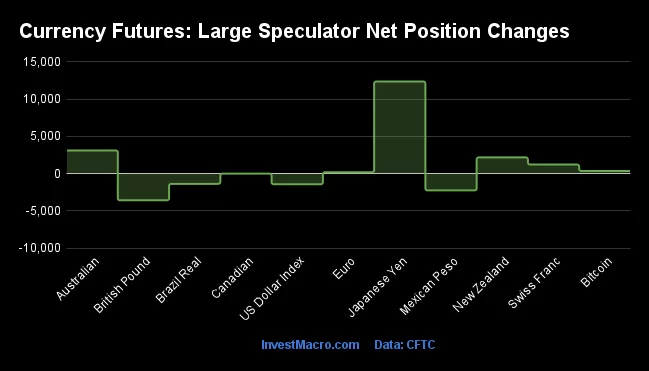
The COT currency market speculator bets were higher through January 31st as nine out of the eleven currency markets we cover had higher positioning while the other two markets had lower speculator contracts.

Leading the gains for the currency markets was the EuroFX (16,160 contracts) with the New Zealand Dollar (6,212 contracts), Canadian Dollar (528 contracts), British Pound (5,617 contracts), Mexican Peso (3,470 contracts), Australian Dollar (2,579 contracts), Swiss Franc (1,194 contracts), US Dollar Index (1,374 contracts) and the Japanese Yen (1,575 contracts) also showing positive weeks.

The currencies seeing declines in speculator bets for that week were the Brazilian Real (-1,188 contracts) and Bitcoin (-362 contracts).


Data Snapshot of Forex Market Traders | Columns Legend
Jan-31-2023OIOI-IndexSpec-NetSpec-IndexCom-NetCOM-IndexSmalls-NetSmalls-Index
USD Index38,1404116,53753-19,776443,23952
EUR796,738100150,50981-203,5891853,08064
GBP196,11335-18,3175328,66854-10,35138
JPY168,54031-20,0605718,179451,88157
CHF38,34530-8,3143311,81664-3,50246
CAD140,16724-30,184627,637922,54735
AUD136,30434-30,5925623,162367,43071
NZD34,587178,38677-8,8132642757
MXN285,48190-45,270940,804894,46684
RUB20,93047,54331-7,15069-39324
BRL72,0967021,59769-22,3433274670
Bitcoin17,54294-1,79946920087933


Strength Scores led by EuroFX & New Zealand Dollar

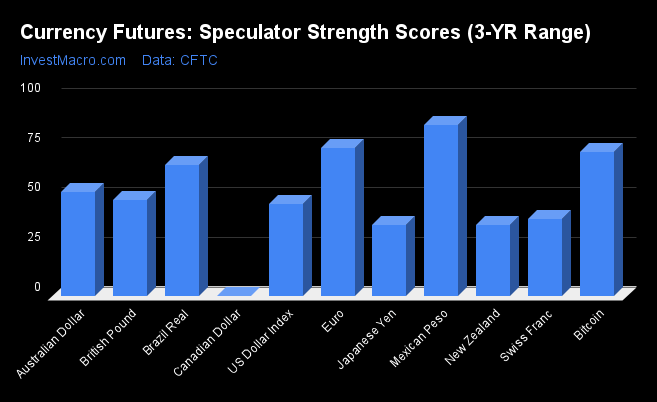
COT Strength Scores (a normalized measure of Speculator positions over a 3-Year range, from 0 to 100 where above 80 is Extreme-Bullish and below 20 is Extreme-Bearish) showed that the EuroFX (81 percent) and the New Zealand Dollar (77 percent) led the currency markets that week. The Brazilian Real (69 percent), Japanese Yen (57 percent) and the Australian Dollar (56 percent) came in as the next highest in the weekly strength scores.

On the downside, the Canadian Dollar (6 percent) and the Mexican Peso (9 percent) come in at the lowest strength levels and were in Extreme-Bearish territory (below 20 percent). The next lowest strength scores were the Swiss Franc (33 percent) and Bitcoin (46 percent).

Strength Statistics:
US Dollar Index (52.5 percent) vs US Dollar Index previous week (50.2 percent)
EuroFX (81.2 percent) vs EuroFX previous week (76.2 percent)
British Pound Sterling (53.3 percent) vs British Pound Sterling previous week (48.5 percent)
Japanese Yen (56.5 percent) vs Japanese Yen previous week (55.6 percent)
Swiss Franc (32.6 percent) vs Swiss Franc previous week (29.5 percent)
Canadian Dollar (5.8 percent) vs Canadian Dollar previous week (5.2 percent)
Australian Dollar (56.5 percent) vs Australian Dollar previous week (54.1 percent)
New Zealand Dollar (76.6 percent) vs New Zealand Dollar previous week (60.0 percent)
Mexican Peso (8.6 percent) vs Mexican Peso previous week (7.0 percent)
Brazilian Real (69.0 percent) vs Brazilian Real previous week (70.3 percent)
Bitcoin (45.6 percent) vs Bitcoin previous week (51.9 percent)


Brazilian Real & Japanese Yen topped the 6-Week Strength Trends

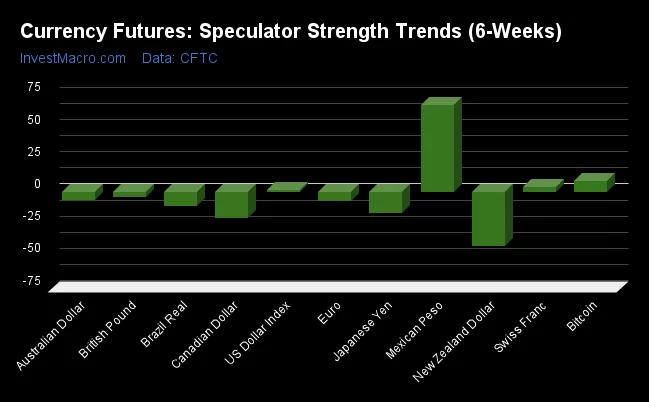
COT Strength Score Trends (or move index, calculates the 6-week changes in strength scores) showed that the Brazilian Real (21 percent) and the Japanese Yen (13 percent) led the six weeks trends for the currencies. The New Zealand Dollar (5 percent), the Mexican Peso (4 percent) and the EuroFX (3 percent) were the next highest positive movers in the latest trends data.

Bitcoin (-37 percent) led the downside trend scores with the Swiss Franc (-11 percent), British Pound (-11 percent) and the Canadian Dollar (-4 percent) following next with lower trend scores.

Strength Trend Statistics:
US Dollar Index (-0.4 percent) vs US Dollar Index previous week (-17.7 percent)
EuroFX (2.5 percent) vs EuroFX previous week (3.0 percent)
British Pound Sterling (-10.9 percent) vs British Pound Sterling previous week (1.5 percent)
Japanese Yen (12.8 percent) vs Japanese Yen previous week (19.4 percent)
Swiss Franc (-11.2 percent) vs Swiss Franc previous week (6.1 percent)
Canadian Dollar (-3.8 percent) vs Canadian Dollar previous week (-4.1 percent)
Australian Dollar (3.3 percent) vs Australian Dollar previous week (4.3 percent)
New Zealand Dollar (5.5 percent) vs New Zealand Dollar previous week (25.9 percent)
Mexican Peso (4.5 percent) vs Mexican Peso previous week (-42.2 percent)
Brazilian Real (20.7 percent) vs Brazilian Real previous week (20.7 percent)
Bitcoin (-36.9 percent) vs Bitcoin previous week (-24.4 percent)


Individual COT Forex Markets:

US Dollar Index Futures:
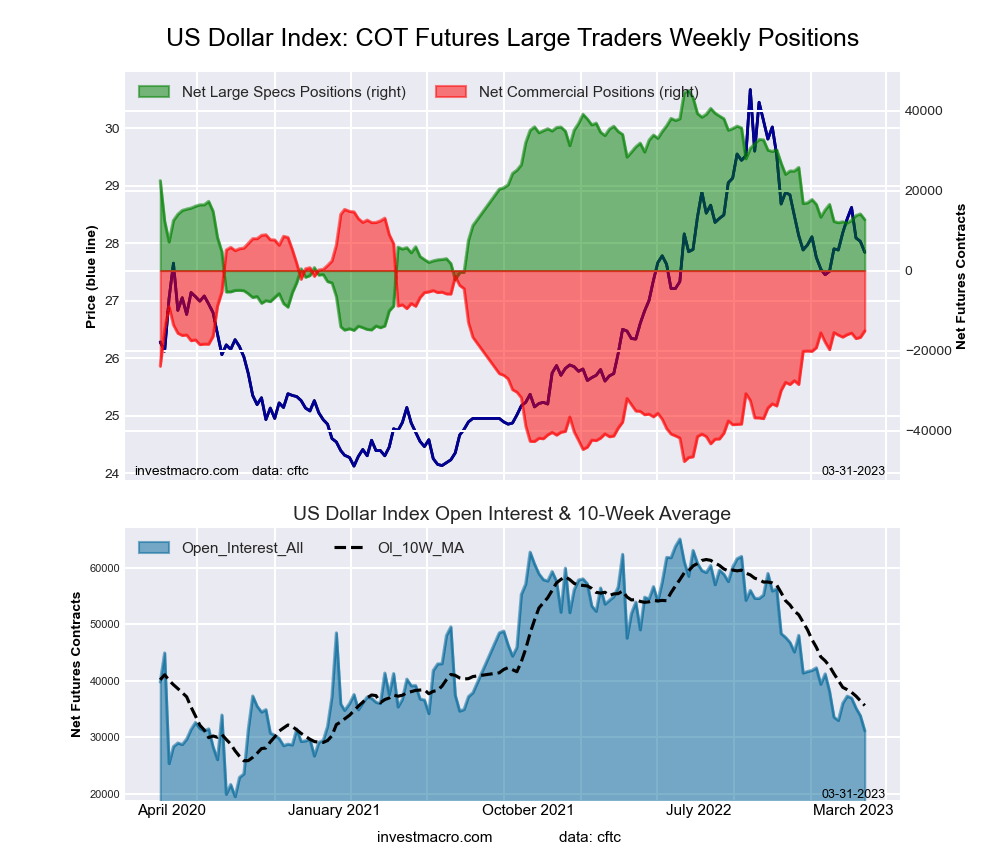
US Dollar Index Forex Futures COT ChartThe US Dollar Index large speculator standing for the week equaled a net position of 16,537 contracts in the data reported through Tuesday January 31st. This was a weekly gain of 1,374 contracts from the previous week which had a total of 15,163 net contracts.

This week’s current strength score (the trader positioning range over the past three years, measured from 0 to 100) shows the speculators are currently Bullish with a score of 52.5 percent. The commercials are Bearish with a score of 44.4 percent and the small traders (not shown in chart) are Bullish with a score of 52.0 percent.

US DOLLAR INDEX StatisticsSPECULATORSCOMMERCIALSSMALL TRADERS
– Percent of Open Interest Longs:76.62.716.5
– Percent of Open Interest Shorts:33.354.68.0
– Net Position:16,537-19,7763,239
– Gross Longs:29,2211,0426,309
– Gross Shorts:12,68420,8183,070
– Long to Short Ratio:2.3 to 10.1 to 12.1 to 1
NET POSITION TREND:
– Strength Index Score (3 Year Range Pct):52.544.452.0
– Strength Index Reading (3 Year Range):BullishBearishBullish
NET POSITION MOVEMENT INDEX:
– 6-Week Change in Strength Index:-0.40.7-2.2


Euro Currency Futures:

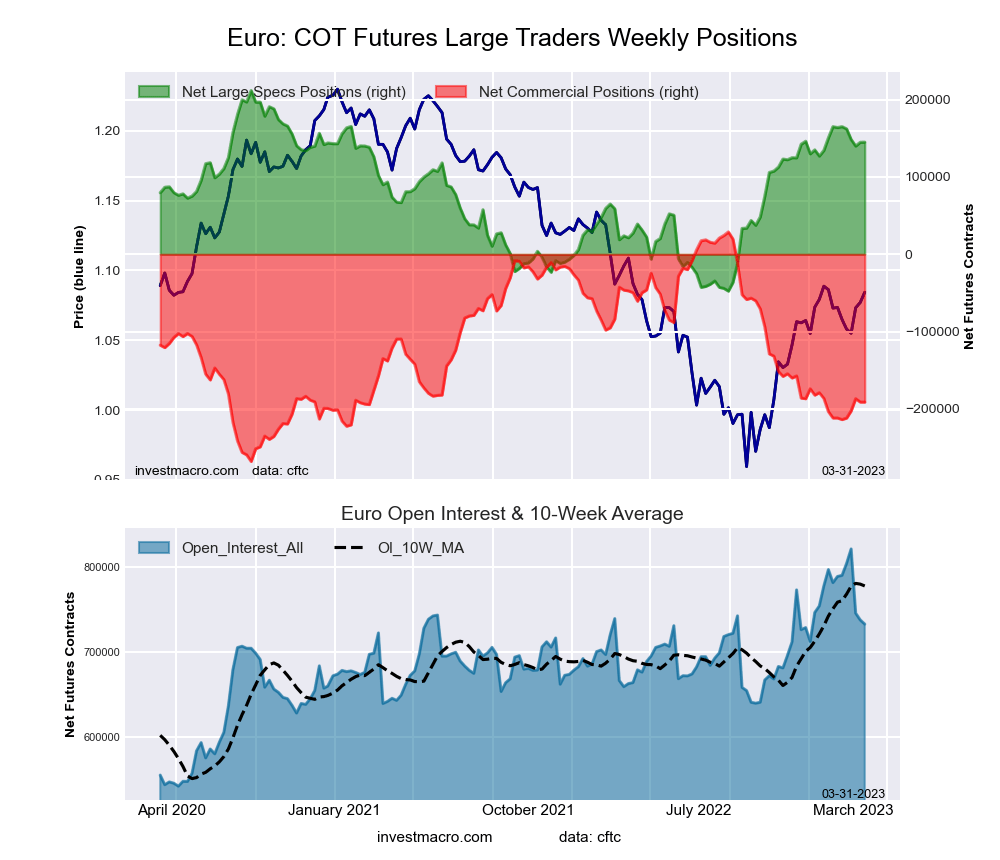
Euro Currency Futures COT ChartThe Euro Currency large speculator standing for the week equaled a net position of 150,509 contracts in the data reported. This was a weekly advance of 16,160 contracts from the previous week which had a total of 134,349 net contracts.

This week’s current strength score (the trader positioning range over the past three years, measured from 0 to 100) shows the speculators are currently Bullish-Extreme with a score of 81.2 percent. The commercials are Bearish-Extreme with a score of 18.3 percent and the small traders (not shown in chart) are Bullish with a score of 63.7 percent.

EURO Currency StatisticsSPECULATORSCOMMERCIALSSMALL TRADERS
– Percent of Open Interest Longs:31.055.312.0
– Percent of Open Interest Shorts:12.180.95.3
– Net Position:150,509-203,58953,080
– Gross Longs:246,755440,75695,671
– Gross Shorts:96,246644,34542,591
– Long to Short Ratio:2.6 to 10.7 to 12.2 to 1
NET POSITION TREND:
– Strength Index Score (3 Year Range Pct):81.218.363.7
– Strength Index Reading (3 Year Range):Bullish-ExtremeBearish-ExtremeBullish
NET POSITION MOVEMENT INDEX:
– 6-Week Change in Strength Index:2.5-5.014.9


British Pound Sterling Futures:

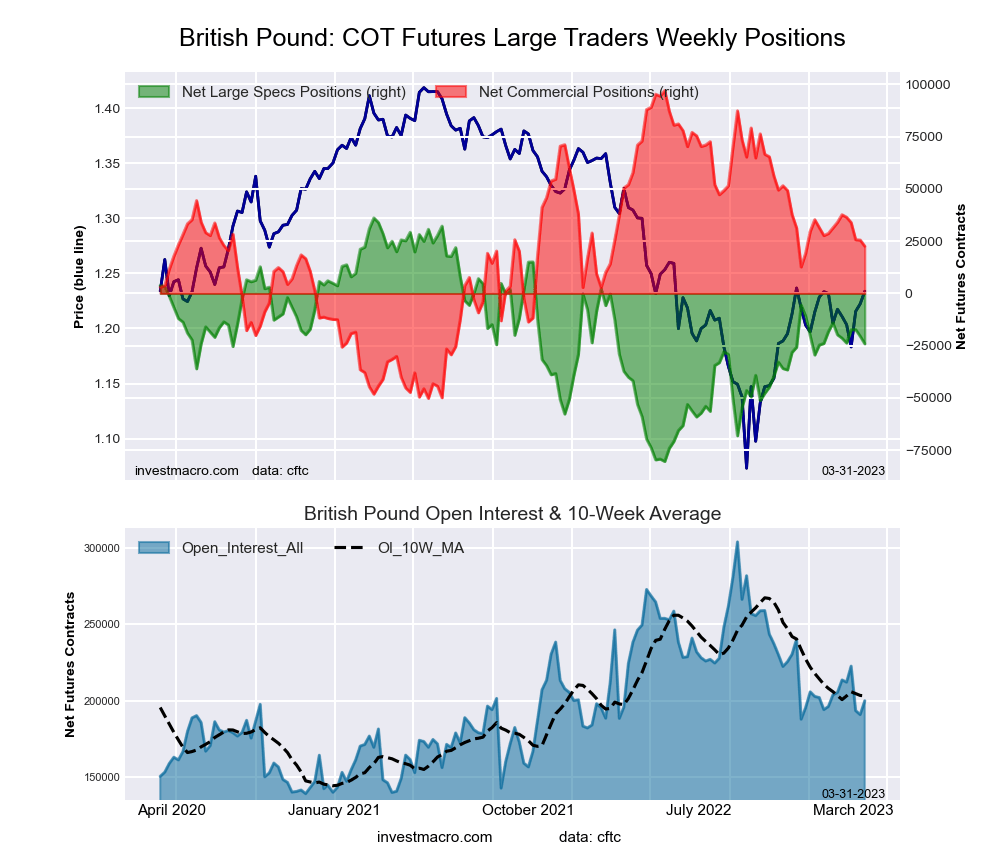
British Pound Sterling Futures COT ChartThe British Pound Sterling large speculator standing for the week equaled a net position of -18,317 contracts in the data reported. This was a weekly lift of 5,617 contracts from the previous week which had a total of -23,934 net contracts.

This week’s current strength score (the trader positioning range over the past three years, measured from 0 to 100) shows the speculators are currently Bullish with a score of 53.3 percent. The commercials are Bullish with a score of 53.6 percent and the small traders (not shown in chart) are Bearish with a score of 37.7 percent.

BRITISH POUND StatisticsSPECULATORSCOMMERCIALSSMALL TRADERS
– Percent of Open Interest Longs:18.566.512.5
– Percent of Open Interest Shorts:27.851.917.7
– Net Position:-18,31728,668-10,351
– Gross Longs:36,234130,37024,459
– Gross Shorts:54,551101,70234,810
– Long to Short Ratio:0.7 to 11.3 to 10.7 to 1
NET POSITION TREND:
– Strength Index Score (3 Year Range Pct):53.353.637.7
– Strength Index Reading (3 Year Range):BullishBullishBearish
NET POSITION MOVEMENT INDEX:
– 6-Week Change in Strength Index:-10.910.9-6.5


Japanese Yen Futures:

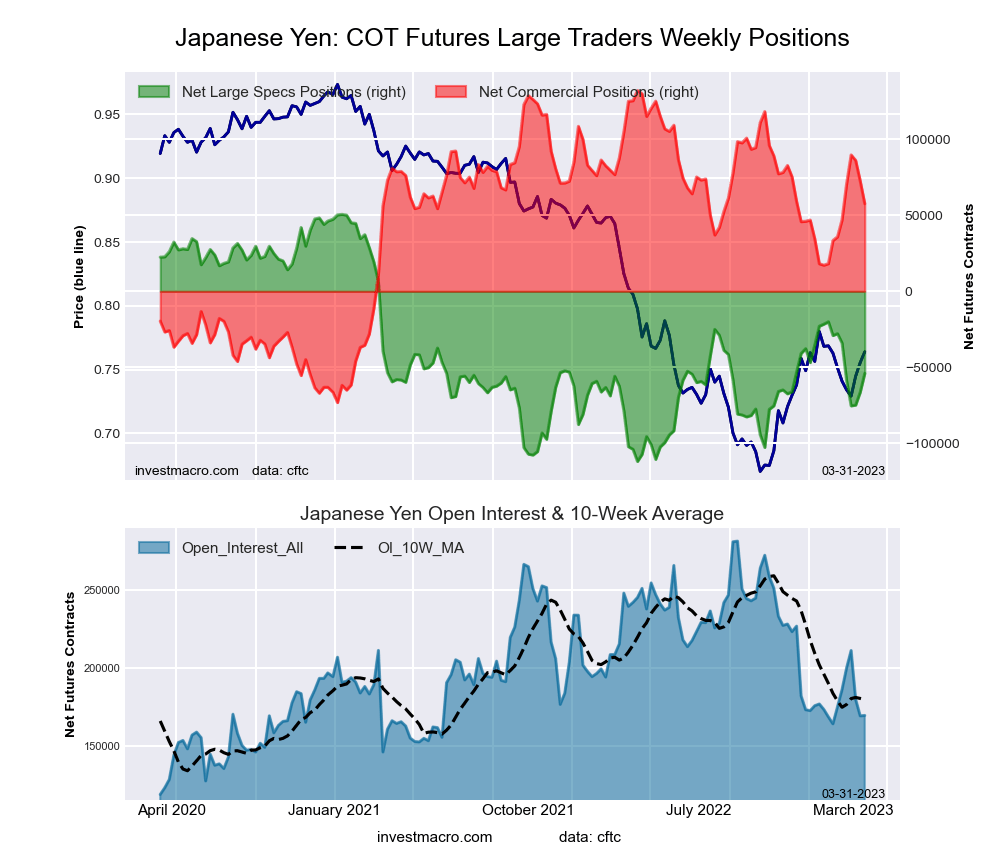
Japanese Yen Forex Futures COT ChartThe Japanese Yen large speculator standing for the week equaled a net position of -20,060 contracts in the data reported. This was a weekly rise of 1,575 contracts from the previous week which had a total of -21,635 net contracts.

This week’s current strength score (the trader positioning range over the past three years, measured from 0 to 100) shows the speculators are currently Bullish with a score of 56.5 percent. The commercials are Bearish with a score of 44.5 percent and the small traders (not shown in chart) are Bullish with a score of 57.3 percent.

JAPANESE YEN StatisticsSPECULATORSCOMMERCIALSSMALL TRADERS
– Percent of Open Interest Longs:13.467.918.5
– Percent of Open Interest Shorts:25.357.117.3
– Net Position:-20,06018,1791,881
– Gross Longs:22,550114,42331,108
– Gross Shorts:42,61096,24429,227
– Long to Short Ratio:0.5 to 11.2 to 11.1 to 1
NET POSITION TREND:
– Strength Index Score (3 Year Range Pct):56.544.557.3
– Strength Index Reading (3 Year Range):BullishBearishBullish
NET POSITION MOVEMENT INDEX:
– 6-Week Change in Strength Index:12.8-13.413.7


Swiss Franc Futures:

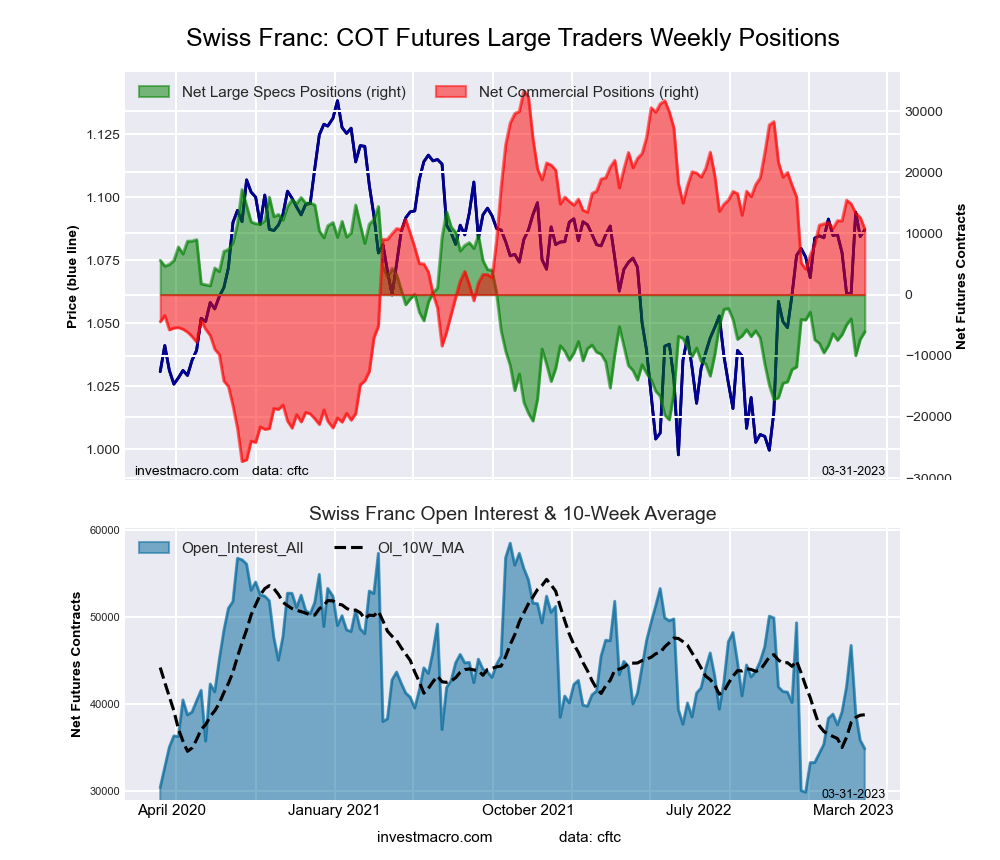
Swiss Franc Forex Futures COT ChartThe Swiss Franc large speculator standing for the week equaled a net position of -8,314 contracts in the data reported. This was a weekly advance of 1,194 contracts from the previous week which had a total of -9,508 net contracts.

This week’s current strength score (the trader positioning range over the past three years, measured from 0 to 100) shows the speculators are currently Bearish with a score of 32.6 percent. The commercials are Bullish with a score of 64.5 percent and the small traders (not shown in chart) are Bearish with a score of 45.7 percent.

SWISS FRANC StatisticsSPECULATORSCOMMERCIALSSMALL TRADERS
– Percent of Open Interest Longs:14.855.130.1
– Percent of Open Interest Shorts:36.524.239.3
– Net Position:-8,31411,816-3,502
– Gross Longs:5,66421,10911,549
– Gross Shorts:13,9789,29315,051
– Long to Short Ratio:0.4 to 12.3 to 10.8 to 1
NET POSITION TREND:
– Strength Index Score (3 Year Range Pct):32.664.545.7
– Strength Index Reading (3 Year Range):BearishBullishBearish
NET POSITION MOVEMENT INDEX:
– 6-Week Change in Strength Index:-11.211.0-8.1


Canadian Dollar Futures:

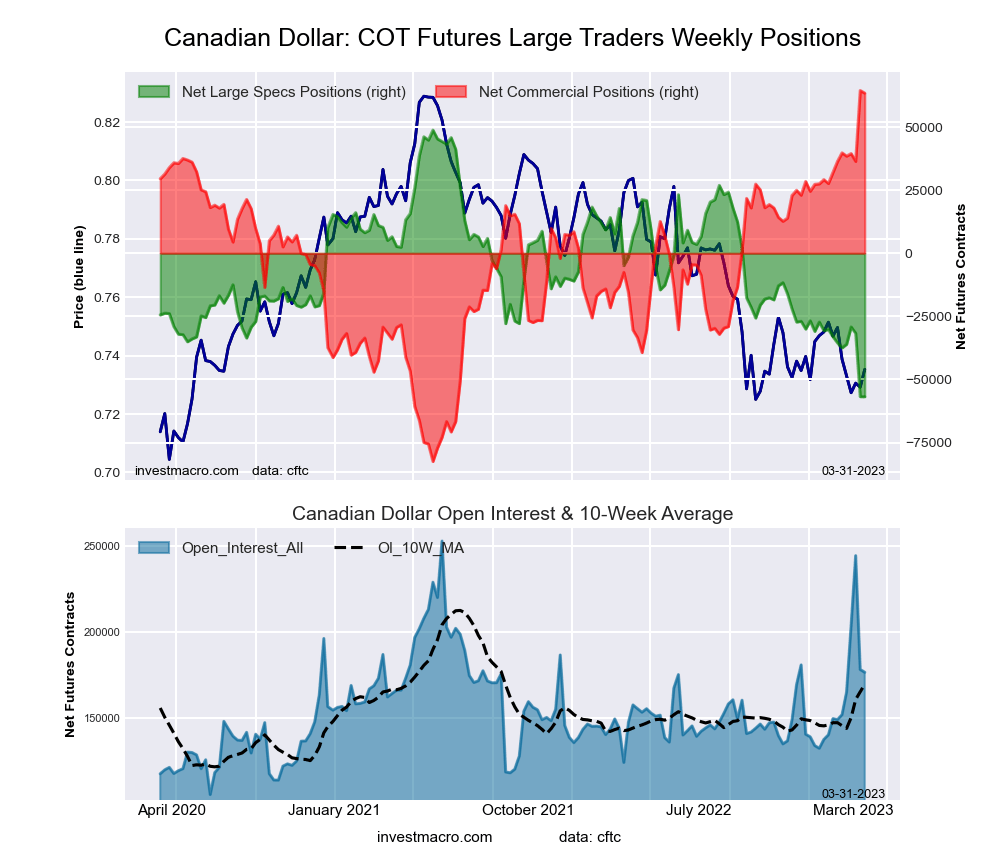
Canadian Dollar Forex Futures COT ChartThe Canadian Dollar large speculator standing for the week equaled a net position of -30,184 contracts in the data reported. This was a weekly rise of 528 contracts from the previous week which had a total of -30,712 net contracts.

This week’s current strength score (the trader positioning range over the past three years, measured from 0 to 100) shows the speculators are currently Bearish-Extreme with a score of 5.8 percent. The commercials are Bullish-Extreme with a score of 91.8 percent and the small traders (not shown in chart) are Bearish with a score of 35.2 percent.

CANADIAN DOLLAR StatisticsSPECULATORSCOMMERCIALSSMALL TRADERS
– Percent of Open Interest Longs:18.855.123.8
– Percent of Open Interest Shorts:40.435.422.0
– Net Position:-30,18427,6372,547
– Gross Longs:26,40477,29933,382
– Gross Shorts:56,58849,66230,835
– Long to Short Ratio:0.5 to 11.6 to 11.1 to 1
NET POSITION TREND:
– Strength Index Score (3 Year Range Pct):5.891.835.2
– Strength Index Reading (3 Year Range):Bearish-ExtremeBullish-ExtremeBearish
NET POSITION MOVEMENT INDEX:
– 6-Week Change in Strength Index:-3.83.9-2.9


Australian Dollar Futures:

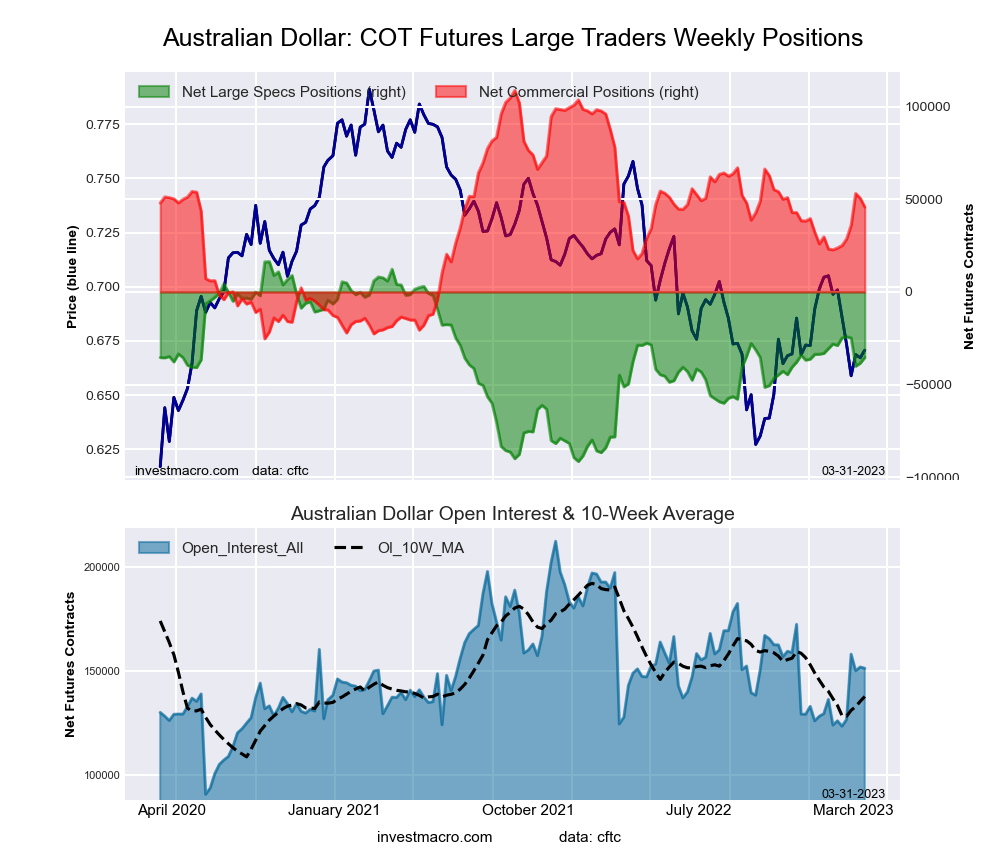
Australian Dollar Forex Futures COT ChartThe Australian Dollar large speculator standing for the week equaled a net position of -30,592 contracts in the data reported. This was a weekly gain of 2,579 contracts from the previous week which had a total of -33,171 net contracts.

This week’s current strength score (the trader positioning range over the past three years, measured from 0 to 100) shows the speculators are currently Bullish with a score of 56.5 percent. The commercials are Bearish with a score of 36.1 percent and the small traders (not shown in chart) are Bullish with a score of 70.6 percent.

AUSTRALIAN DOLLAR StatisticsSPECULATORSCOMMERCIALSSMALL TRADERS
– Percent of Open Interest Longs:26.753.418.0
– Percent of Open Interest Shorts:49.136.412.6
– Net Position:-30,59223,1627,430
– Gross Longs:36,33772,74124,573
– Gross Shorts:66,92949,57917,143
– Long to Short Ratio:0.5 to 11.5 to 11.4 to 1
NET POSITION TREND:
– Strength Index Score (3 Year Range Pct):56.536.170.6
– Strength Index Reading (3 Year Range):BullishBearishBullish
NET POSITION MOVEMENT INDEX:
– 6-Week Change in Strength Index:3.3-11.428.6


New Zealand Dollar Futures:

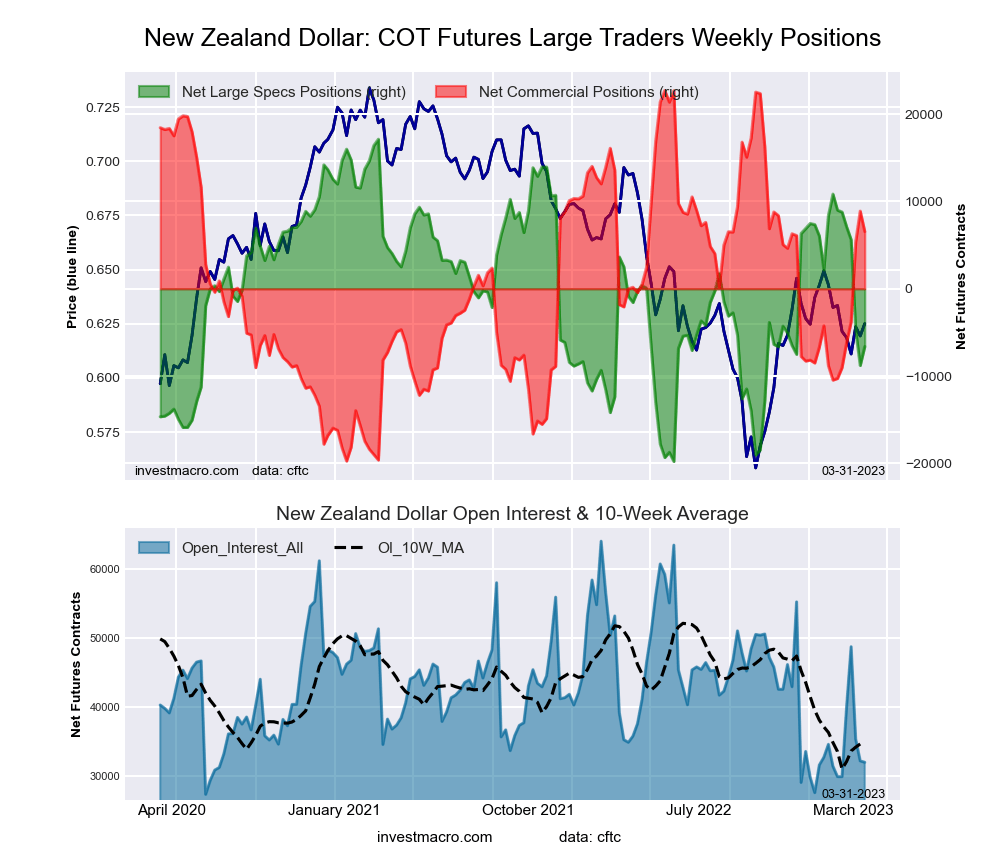
New Zealand Dollar Forex Futures COT ChartThe New Zealand Dollar large speculator standing for the week equaled a net position of 8,386 contracts in the data reported. This was a weekly increase of 6,212 contracts from the previous week which had a total of 2,174 net contracts.

This week’s current strength score (the trader positioning range over the past three years, measured from 0 to 100) shows the speculators are currently Bullish with a score of 76.6 percent. The commercials are Bearish with a score of 25.7 percent and the small traders (not shown in chart) are Bullish with a score of 56.6 percent.

NEW ZEALAND DOLLAR StatisticsSPECULATORSCOMMERCIALSSMALL TRADERS
– Percent of Open Interest Longs:44.539.813.5
– Percent of Open Interest Shorts:20.265.312.3
– Net Position:8,386-8,813427
– Gross Longs:15,37613,7624,674
– Gross Shorts:6,99022,5754,247
– Long to Short Ratio:2.2 to 10.6 to 11.1 to 1
NET POSITION TREND:
– Strength Index Score (3 Year Range Pct):76.625.756.6
– Strength Index Reading (3 Year Range):BullishBearishBullish
NET POSITION MOVEMENT INDEX:
– 6-Week Change in Strength Index:5.5-2.5-11.4


Mexican Peso Futures:

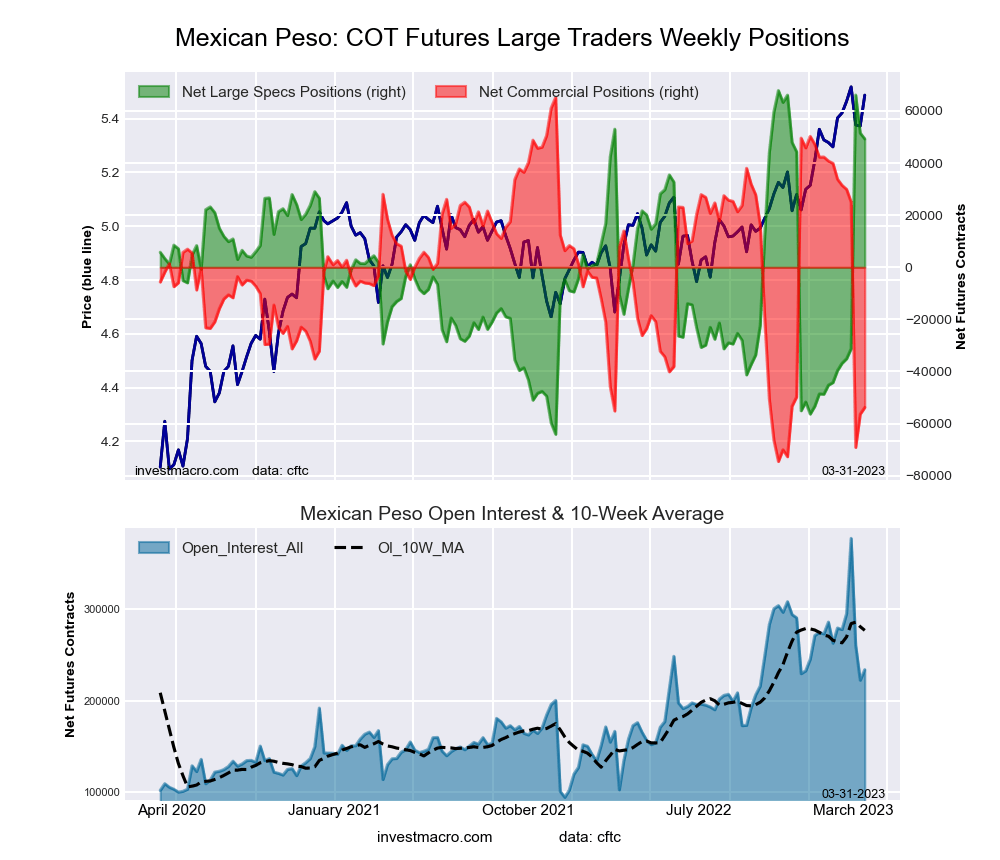
Mexican Peso Futures COT ChartThe Mexican Peso large speculator standing for the week equaled a net position of -45,270 contracts in the data reported. This was a weekly lift of 3,470 contracts from the previous week which had a total of -48,740 net contracts.

This week’s current strength score (the trader positioning range over the past three years, measured from 0 to 100) shows the speculators are currently Bearish-Extreme with a score of 8.6 percent. The commercials are Bullish-Extreme with a score of 89.2 percent and the small traders (not shown in chart) are Bullish-Extreme with a score of 84.1 percent.

MEXICAN PESO StatisticsSPECULATORSCOMMERCIALSSMALL TRADERS
– Percent of Open Interest Longs:55.041.92.7
– Percent of Open Interest Shorts:70.827.61.2
– Net Position:-45,27040,8044,466
– Gross Longs:156,950119,4807,841
– Gross Shorts:202,22078,6763,375
– Long to Short Ratio:0.8 to 11.5 to 12.3 to 1
NET POSITION TREND:
– Strength Index Score (3 Year Range Pct):8.689.284.1
– Strength Index Reading (3 Year Range):Bearish-ExtremeBullish-ExtremeBullish-Extreme
NET POSITION MOVEMENT INDEX:
– 6-Week Change in Strength Index:4.5-3.9-6.0


Brazilian Real Futures:

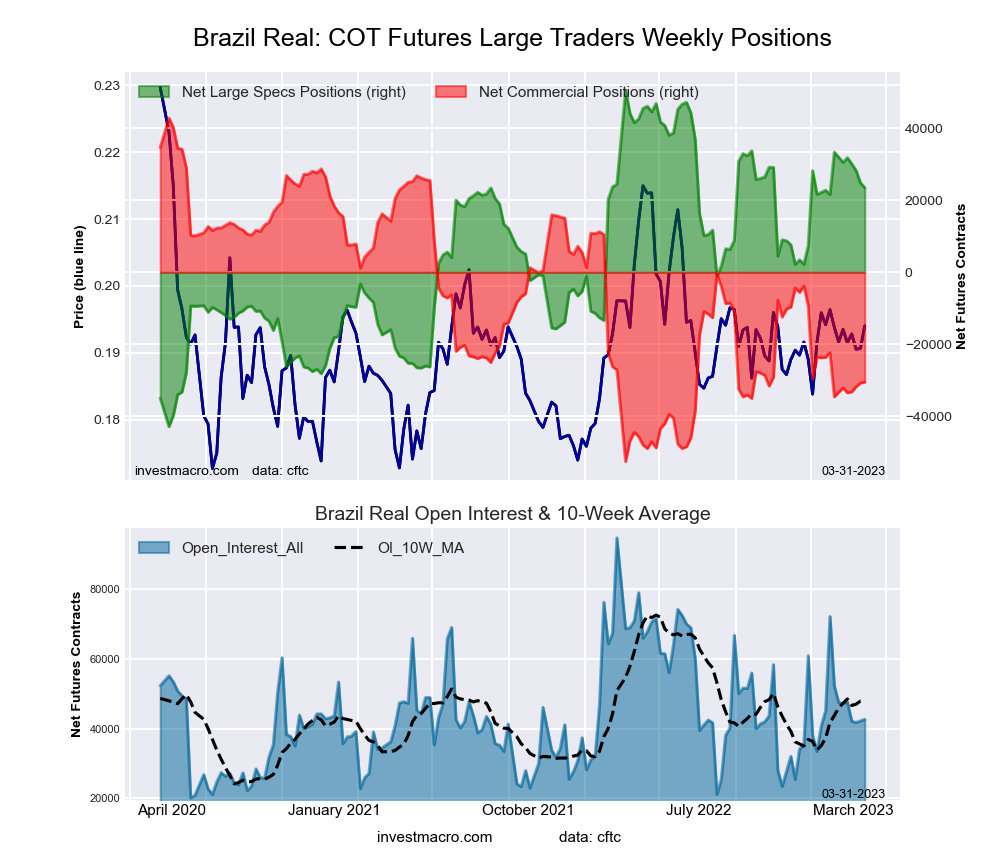
Brazil Real Futures COT ChartThe Brazilian Real large speculator standing for the week equaled a net position of 21,597 contracts in the data reported. This was a weekly lowering of -1,188 contracts from the previous week which had a total of 22,785 net contracts.

This week’s current strength score (the trader positioning range over the past three years, measured from 0 to 100) shows the speculators are currently Bullish with a score of 69.0 percent. The commercials are Bearish with a score of 31.7 percent and the small traders (not shown in chart) are Bullish with a score of 70.4 percent.

BRAZIL REAL StatisticsSPECULATORSCOMMERCIALSSMALL TRADERS
– Percent of Open Interest Longs:54.939.55.2
– Percent of Open Interest Shorts:25.070.54.2
– Net Position:21,597-22,343746
– Gross Longs:39,60928,4903,776
– Gross Shorts:18,01250,8333,030
– Long to Short Ratio:2.2 to 10.6 to 11.2 to 1
NET POSITION TREND:
– Strength Index Score (3 Year Range Pct):69.031.770.4
– Strength Index Reading (3 Year Range):BullishBearishBullish
NET POSITION MOVEMENT INDEX:
– 6-Week Change in Strength Index:20.7-19.5-8.9


Bitcoin Futures:

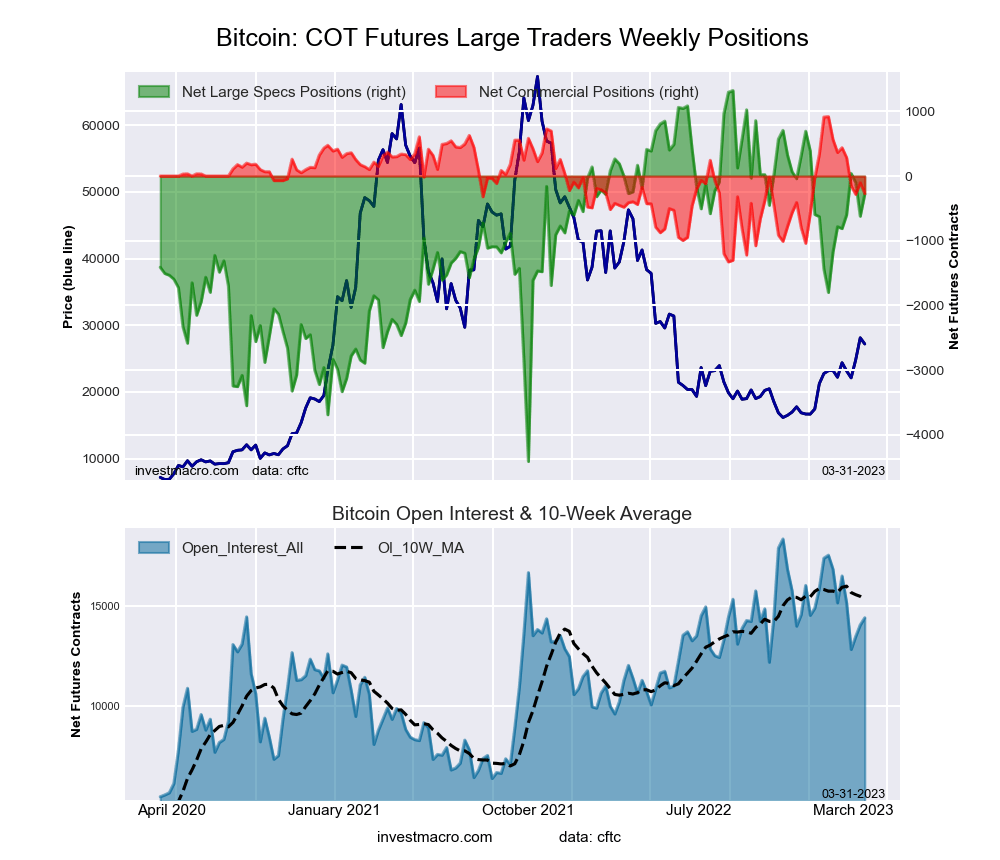
Bitcoin Crypto Futures COT ChartThe Bitcoin large speculator standing for the week equaled a net position of -1,799 contracts in the data reported. This was a weekly decline of -362 contracts from the previous week which had a total of -1,437 net contracts.

This week’s current strength score (the trader positioning range over the past three years, measured from 0 to 100) shows the speculators are currently Bearish with a score of 45.6 percent. The commercials are Bullish-Extreme with a score of 100.0 percent and the small traders (not shown in chart) are Bearish with a score of 32.9 percent.

BITCOIN StatisticsSPECULATORSCOMMERCIALSSMALL TRADERS
– Percent of Open Interest Longs:77.57.49.3
– Percent of Open Interest Shorts:87.82.14.3
– Net Position:-1,799920879
– Gross Longs:13,5991,2931,635
– Gross Shorts:15,398373756
– Long to Short Ratio:0.9 to 13.5 to 12.2 to 1
NET POSITION TREND:
– Strength Index Score (3 Year Range Pct):45.6100.032.9
– Strength Index Reading (3 Year Range):BearishBullish-ExtremeBearish
NET POSITION MOVEMENT INDEX:
– 6-Week Change in Strength Index:-36.976.39.1


Article By InvestMacroReceive our weekly COT Newsletter

*COT Report: The COT data, released weekly to the public each Friday, is updated through the most recent Tuesday (data is 3 days old) and shows a quick view of how large speculators or non-commercials (for-profit traders) were positioned in the futures markets.

The CFTC categorizes trader positions according to commercial hedgers (traders who use futures contracts for hedging as part of the business), non-commercials (large traders who speculate to realize trading profits) and nonreportable traders (usually small traders/speculators) as well as their open interest (contracts open in the market at time of reporting). See CFTC criteria here.


COT Metals Update: January 31st data shows Speculator Bets led by Gold & Silver

By InvestMacro

Here are the latest charts and statistics for the Commitment of Traders (COT) data published by the Commodities Futures Trading Commission (CFTC).

The latest COT data is updated through Tuesday January 31st and shows a quick view of how large traders (for-profit speculators and commercial entities) were positioned in the futures markets.

*** This data is almost a month old because the CFTC’s up-to-date data has been delayed due to a cybersecurity event that happened in early February to ION Cleared Derivatives (a subsidiary of ION Markets). This hack of ION has created a problem for the large trader positions to be reported and reconciled. The CFTC states that they will be back-filling the data over the next couple weeks and will get the data back up to date soon.

Weekly Speculator Changes led by Gold & Silver

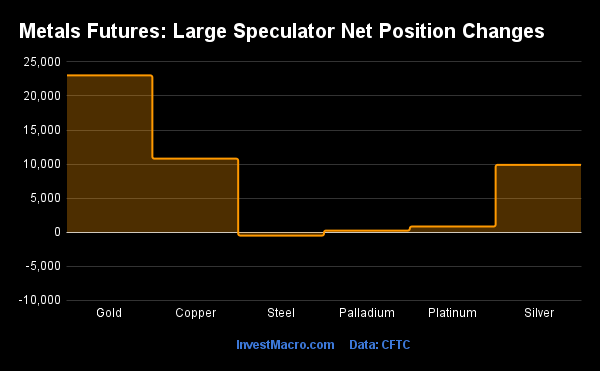
The COT metals markets speculator bets were lower on January 31st as two out of the five precious metals markets we cover had higher positioning while the other three markets had lower speculator contracts.

Leading the gains for the metals was Gold (2,608 contracts) with Silver (1,632 contracts) also showing a positive week.

The markets with declines in speculator bets for the week were Platinum (-4,124 contracts), Copper (-2,955 contracts) and Palladium (-974 contracts) also registering lower bets on the week.


Data Snapshot of Commodity Market Traders | Columns Legend
Jan-31-2023OIOI-IndexSpec-NetSpec-IndexCom-NetCOM-IndexSmalls-NetSmalls-Index
Gold471,64216160,28136-180,5206320,23931
Silver138,2631427,31644-40,4345713,11837
Copper224,8246117,21550-24,414487,19967
Palladium11,24534-4,27104,632100-36120
Platinum69,1214016,13733-22,213656,07649


Strength Scores led by Copper & Silver

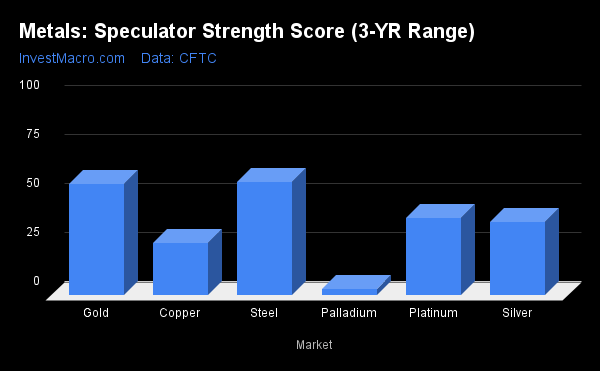
COT Strength Scores (a normalized measure of Speculator positions over a 3-Year range, from 0 to 100 where above 80 is Extreme-Bullish and below 20 is Extreme-Bearish) showed that Copper (50 percent) led the metals markets for that week. Silver (44 percent) came in as the next highest in the weekly strength scores.

On the downside, Palladium (0 percent) came in at the lowest strength level and was in Extreme-Bearish territory (below 20 percent). The next lowest strength score was Platinum (33 percent).

Strength Statistics:
Gold (35.9 percent) vs Gold previous week (35.0 percent)
Silver (44.2 percent) vs Silver previous week (42.4 percent)
Copper (50.0 percent) vs Copper previous week (52.4 percent)
Platinum (33.4 percent) vs Platinum previous week (39.4 percent)
Palladium (0.0 percent) vs Palladium previous week (10.3 percent)


Copper & Gold top the 6-Week Strength Trends

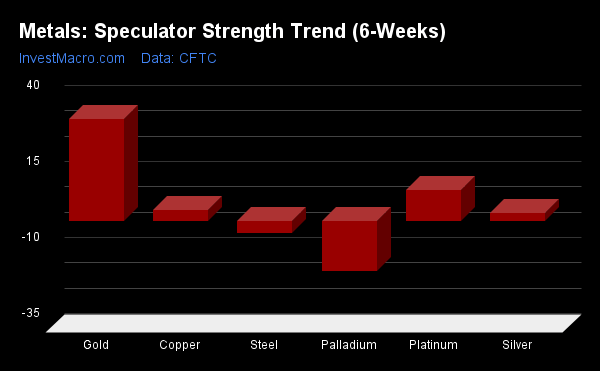
COT Strength Score Trends (or move index, calculates the 6-week changes in strength scores) showed that Copper (13 percent) led the six weeks trends for metals. Gold (10 percent) was the next highest positive mover in the latest trends data.

Palladium (-17 percent) led the downside trend scores with Platinum (-12 percent) and Silver (-2.7 percent) as the next markets with lower trend scores.

Move Statistics:
Gold (10.4 percent) vs Gold previous week (10.6 percent)
Silver (-2.7 percent) vs Silver previous week (3.2 percent)
Copper (13.1 percent) vs Copper previous week (14.0 percent)
Platinum (-11.5 percent) vs Platinum previous week (-11.9 percent)
Palladium (-17.4 percent) vs Palladium previous week (-25.6 percent)


Individual Markets:

Gold Comex Futures:

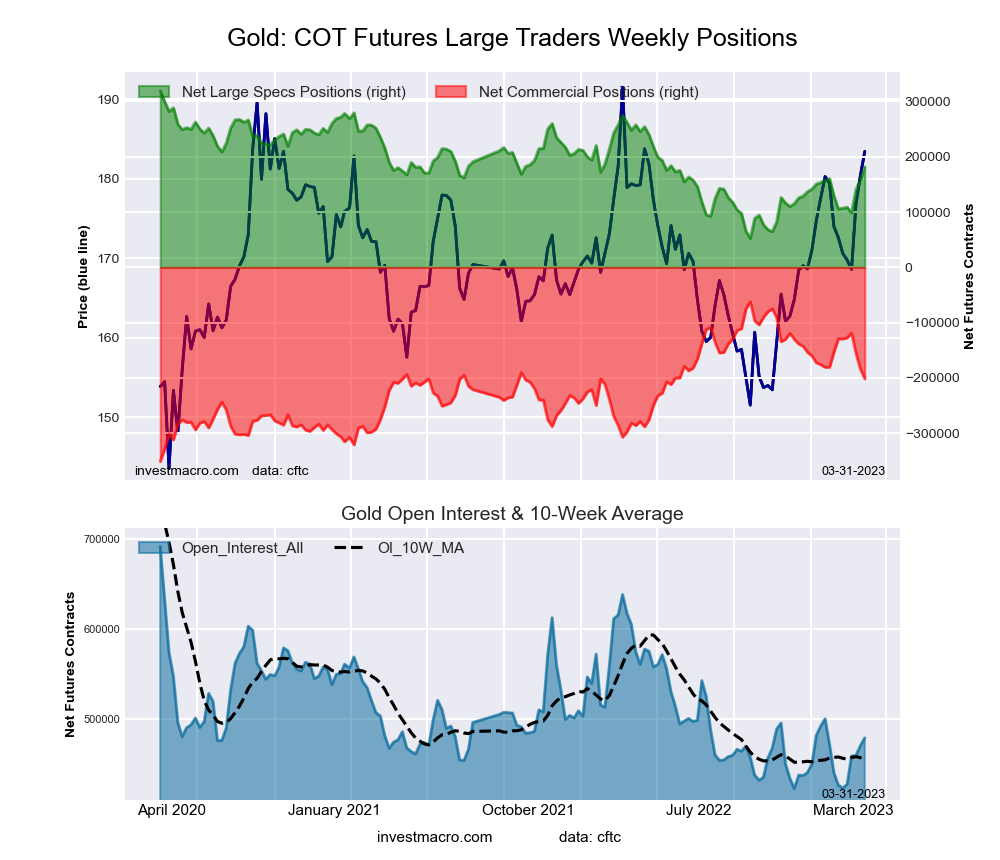
Gold Futures COT ChartThe Gold Comex Futures large speculator standing for the week recorded a net position of 160,281 contracts in the data reported through Tuesday January 31st. This was a weekly increase of 2,608 contracts from the previous week which had a total of 157,673 net contracts.

This week’s current strength score (the trader positioning range over the past three years, measured from 0 to 100) shows the speculators are currently Bearish with a score of 35.9 percent. The commercials are Bullish with a score of 63.4 percent and the small traders (not shown in chart) are Bearish with a score of 30.7 percent.

Gold Futures StatisticsSPECULATORSCOMMERCIALSSMALL TRADERS
– Percent of Open Interest Longs:54.425.59.3
– Percent of Open Interest Shorts:20.463.75.0
– Net Position:160,281-180,52020,239
– Gross Longs:256,417120,14743,984
– Gross Shorts:96,136300,66723,745
– Long to Short Ratio:2.7 to 10.4 to 11.9 to 1
NET POSITION TREND:
– Strength Index Score (3 Year Range Pct):35.963.430.7
– Strength Index Reading (3 Year Range):BearishBullishBearish
NET POSITION MOVEMENT INDEX:
– 6-Week Change in Strength Index:10.4-11.716.5


Silver Comex Futures:

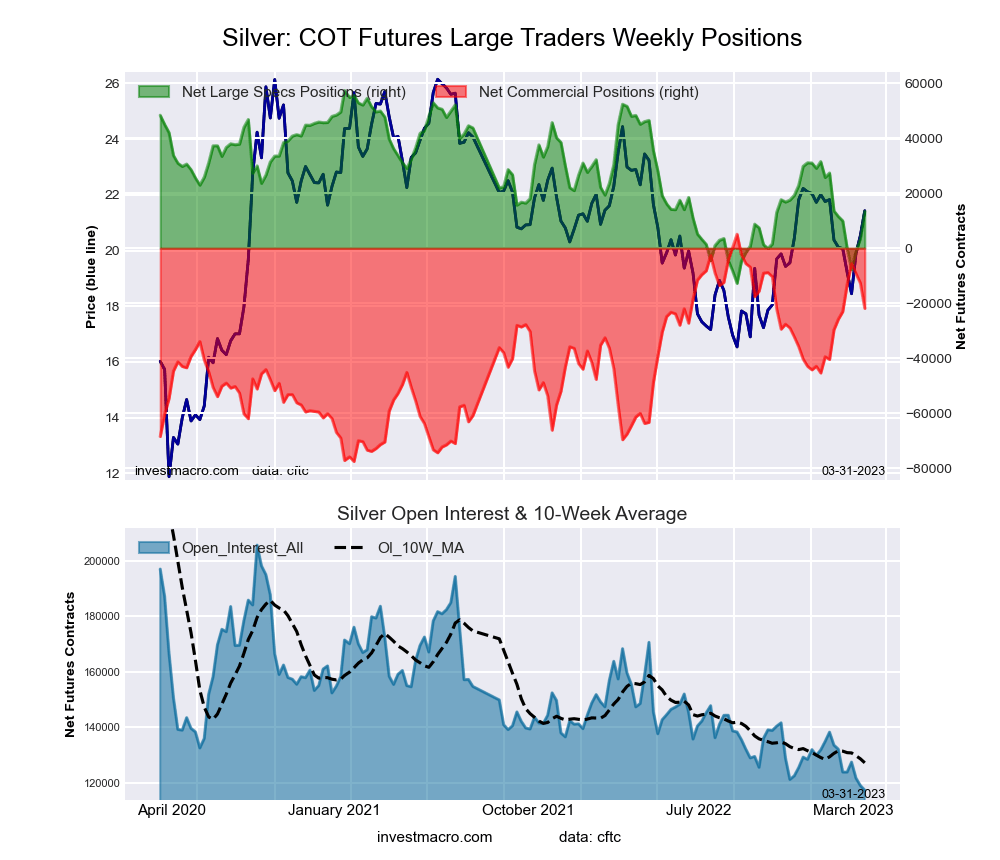
Silver Futures COT ChartThe Silver Comex Futures large speculator standing for the week recorded a net position of 27,316 contracts in the data reported. This was a weekly rise of 1,632 contracts from the previous week which had a total of 25,684 net contracts.

This week’s current strength score (the trader positioning range over the past three years, measured from 0 to 100) shows the speculators are currently Bearish with a score of 44.2 percent. The commercials are Bullish with a score of 57.0 percent and the small traders (not shown in chart) are Bearish with a score of 37.5 percent.

Silver Futures StatisticsSPECULATORSCOMMERCIALSSMALL TRADERS
– Percent of Open Interest Longs:39.734.717.8
– Percent of Open Interest Shorts:19.964.08.4
– Net Position:27,316-40,43413,118
– Gross Longs:54,86747,99724,665
– Gross Shorts:27,55188,43111,547
– Long to Short Ratio:2.0 to 10.5 to 12.1 to 1
NET POSITION TREND:
– Strength Index Score (3 Year Range Pct):44.257.037.5
– Strength Index Reading (3 Year Range):BearishBullishBearish
NET POSITION MOVEMENT INDEX:
– 6-Week Change in Strength Index:-2.7-0.113.7


Copper Grade #1 Futures:

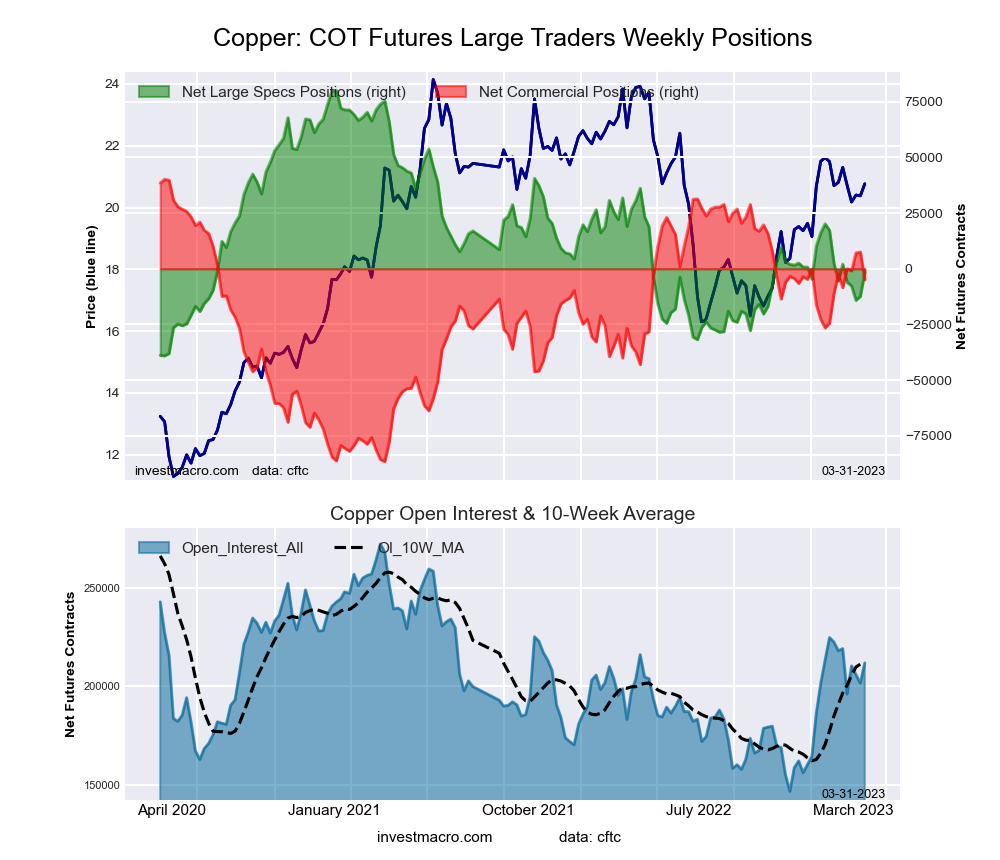
Copper Futures COT ChartThe Copper Grade #1 Futures large speculator standing for the week recorded a net position of 17,215 contracts in the data reported. This was a weekly decline of -2,955 contracts from the previous week which had a total of 20,170 net contracts.

This week’s current strength score (the trader positioning range over the past three years, measured from 0 to 100) shows the speculators are currently Bullish with a score of 50.0 percent. The commercials are Bearish with a score of 48.1 percent and the small traders (not shown in chart) are Bullish with a score of 66.9 percent.

Copper Futures StatisticsSPECULATORSCOMMERCIALSSMALL TRADERS
– Percent of Open Interest Longs:38.036.38.8
– Percent of Open Interest Shorts:30.347.25.6
– Net Position:17,215-24,4147,199
– Gross Longs:85,41081,69419,764
– Gross Shorts:68,195106,10812,565
– Long to Short Ratio:1.3 to 10.8 to 11.6 to 1
NET POSITION TREND:
– Strength Index Score (3 Year Range Pct):50.048.166.9
– Strength Index Reading (3 Year Range):BullishBearishBullish
NET POSITION MOVEMENT INDEX:
– 6-Week Change in Strength Index:13.1-16.225.8


Platinum Futures:

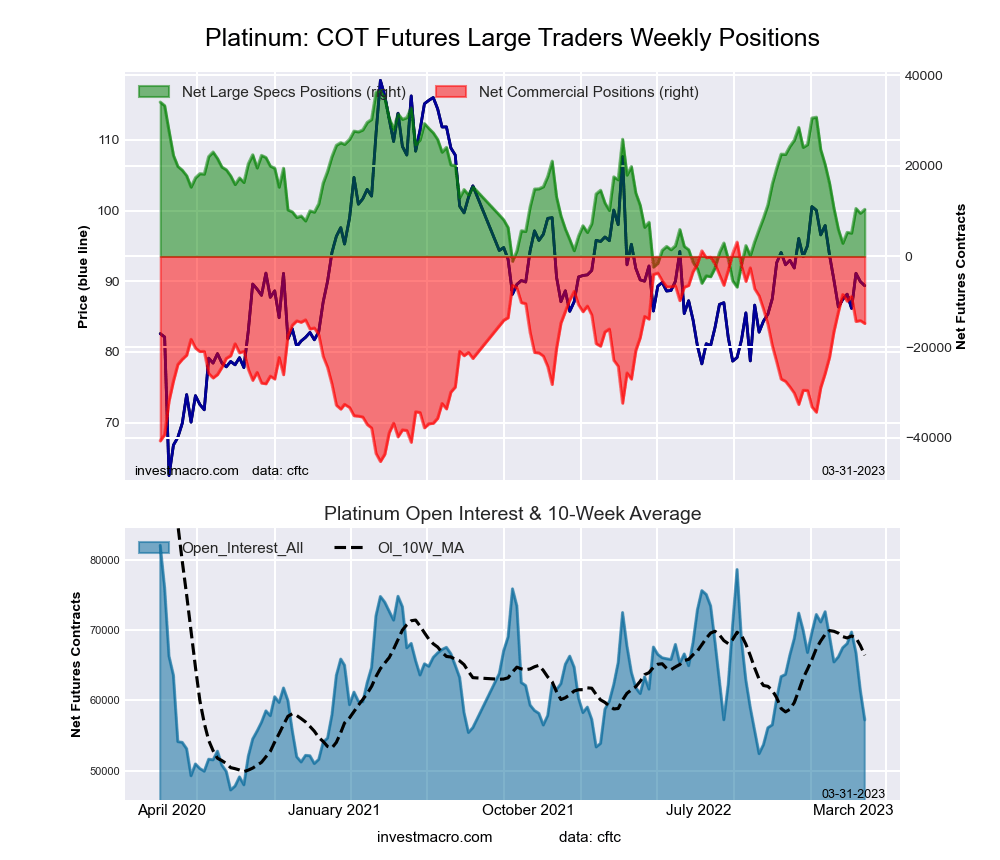
Platinum Futures COT ChartThe Platinum Futures large speculator standing for the week recorded a net position of 16,137 contracts in the data reported. This was a weekly reduction of -4,124 contracts from the previous week which had a total of 20,261 net contracts.

This week’s current strength score (the trader positioning range over the past three years, measured from 0 to 100) shows the speculators are currently Bearish with a score of 33.4 percent. The commercials are Bullish with a score of 65.5 percent and the small traders (not shown in chart) are Bearish with a score of 49.4 percent.

Platinum Futures StatisticsSPECULATORSCOMMERCIALSSMALL TRADERS
– Percent of Open Interest Longs:50.833.012.4
– Percent of Open Interest Shorts:27.465.13.6
– Net Position:16,137-22,2136,076
– Gross Longs:35,09822,8088,577
– Gross Shorts:18,96145,0212,501
– Long to Short Ratio:1.9 to 10.5 to 13.4 to 1
NET POSITION TREND:
– Strength Index Score (3 Year Range Pct):33.465.549.4
– Strength Index Reading (3 Year Range):BearishBullishBearish
NET POSITION MOVEMENT INDEX:
– 6-Week Change in Strength Index:-11.510.08.0


Palladium Futures:

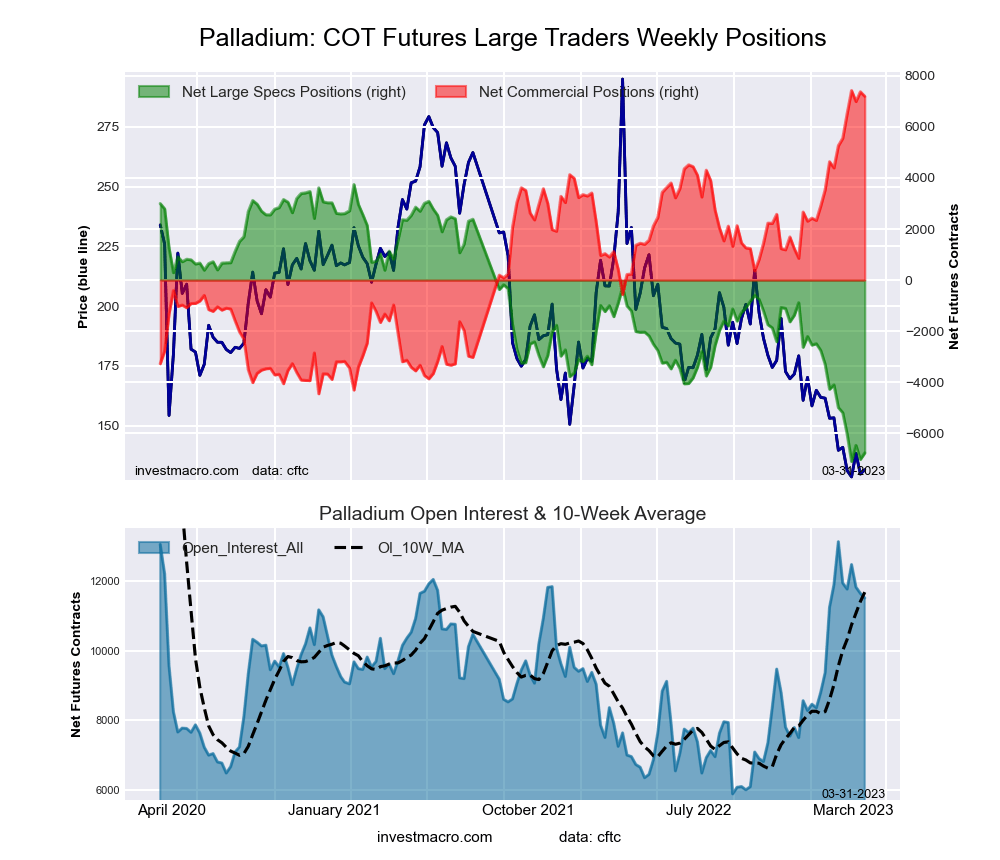
Palladium Futures COT ChartThe Palladium Futures large speculator standing for the week recorded a net position of -4,271 contracts in the data reported. This was a weekly reduction of -974 contracts from the previous week which had a total of -3,297 net contracts.

This week’s current strength score (the trader positioning range over the past three years, measured from 0 to 100) shows the speculators are currently Bearish-Extreme with a score of 0.0 percent. The commercials are Bullish-Extreme with a score of 100.0 percent and the small traders (not shown in chart) are Bearish with a score of 20.0 percent.

Palladium Futures StatisticsSPECULATORSCOMMERCIALSSMALL TRADERS
– Percent of Open Interest Longs:15.963.411.0
– Percent of Open Interest Shorts:53.922.214.2
– Net Position:-4,2714,632-361
– Gross Longs:1,7927,1311,238
– Gross Shorts:6,0632,4991,599
– Long to Short Ratio:0.3 to 12.9 to 10.8 to 1
NET POSITION TREND:
– Strength Index Score (3 Year Range Pct):0.0100.020.0
– Strength Index Reading (3 Year Range):Bearish-ExtremeBullish-ExtremeBearish
NET POSITION MOVEMENT INDEX:
– 6-Week Change in Strength Index:-17.419.5-19.5


Article By InvestMacroReceive our weekly COT Newsletter

*COT Report: The COT data, released weekly to the public each Friday, is updated through the most recent Tuesday (data is 3 days old) and shows a quick view of how large speculators or non-commercials (for-profit traders) were positioned in the futures markets.

The CFTC categorizes trader positions according to commercial hedgers (traders who use futures contracts for hedging as part of the business), non-commercials (large traders who speculate to realize trading profits) and nonreportable traders (usually small traders/speculators) as well as their open interest (contracts open in the market at time of reporting). See CFTC criteria here.

COT Bonds: January 31st data shows Speculators cut back on their bond bets

By InvestMacro

Here are the latest charts and statistics for the Commitment of Traders (COT) data published by the Commodities Futures Trading Commission (CFTC).

The latest COT data is updated through Tuesday January 31st and shows a quick view of how large traders (for-profit speculators and commercial entities) were positioned in the futures markets.

*** This data is almost a month old because the CFTC up-to-date data has been delayed due to a cybersecurity event that happened in early February to ION Cleared Derivatives (a subsidiary of ION Markets). This hack of ION has created a problem for the large trader positions to be reported and reconciled. The CFTC states that they will be back-filling the data over the next couple weeks and will get the data back up to date.

Weekly Speculator Changes led by Fed Funds

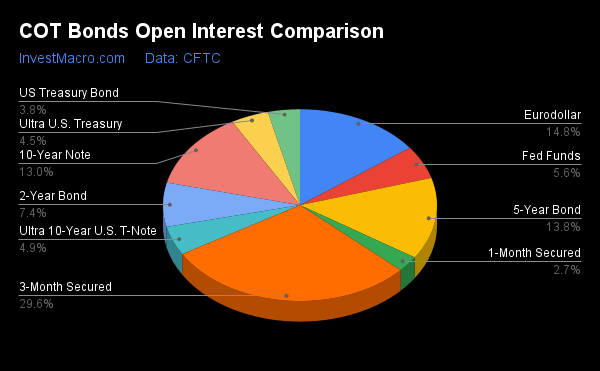
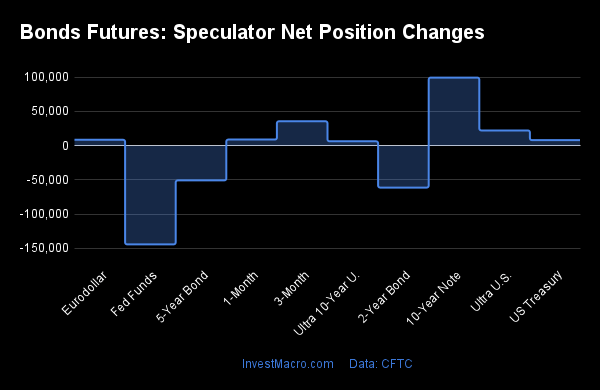
The COT bond market speculator bets were sharply lower for that week as just one out of the eight bond markets we cover had higher positioning while the other seven markets had lower speculator contracts.

Leading the gains for the bond markets was the Fed Funds with a gain of 15,702 contracts.

The bond markets with declines in speculator bets for the week were the 2-Year Bonds (-100,142 contracts), the 5-Year Bonds (-94,219 contracts), Ultra Treasury Bonds (-17,997 contracts), Ultra 10-Year Bonds (-7,222 contracts), US Treasury Bonds (-3,260 contracts), the Eurodollar (-12,402 contracts) and the 10-Year Bonds (-13,650 contracts) also registering lower bets through January 31st.


Data Snapshot of Bond Market Traders | Columns Legend
Jan-31-2023OIOI-IndexSpec-NetSpec-IndexCom-NetCOM-IndexSmalls-NetSmalls-Index
Eurodollar5,879,9180-1,026,275341,226,67963-200,40460
FedFunds1,889,65279-20,1283750,48766-30,3590
2-Year2,428,70329-577,1651552,8829424,28363
Long T-Bond1,226,43048-199,07620172,8357226,24173
10-Year4,151,85375-555,4710623,94396-68,47264
5-Year4,177,91961-732,9560722,9459410,01184


Strength Scores led by Fed Funds & Eurodollar

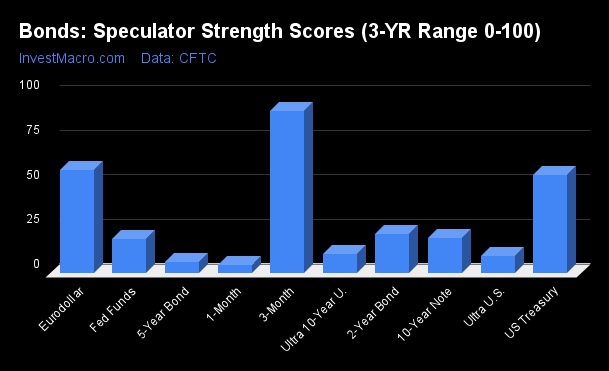
COT Strength Scores (a normalized measure of Speculator positions over a 3-Year range, from 0 to 100 where above 80 is Extreme-Bullish and below 20 is Extreme-Bearish) showed that the Fed Funds (37 percent) and the Eurodollar (34 percent) led the bond markets for that week. The US Treasury Bonds (20 percent) came in as the next highest in the weekly strength scores.

On the downside, the Ultra Treasury Bonds (0 percent), 5-Year Bonds (0 percent), Ultra 10-Year Bonds (0 percent), 10-Year Bond (0.0 percent), 2-Year Bond (1.4 percent) and the US Treasury Bond (19.8 percent) came in with the lowest strength levels and all were in Extreme-Bearish territory (below 20 percent).

Strength Statistics:
Fed Funds (37.1 percent) vs Fed Funds previous week (35.2 percent)
2-Year Bond (1.4 percent) vs 2-Year Bond previous week (16.2 percent)
5-Year Bond (0.0 percent) vs 5-Year Bond previous week (11.4 percent)
10-Year Bond (0.0 percent) vs 10-Year Bond previous week (1.9 percent)
Ultra 10-Year Bond (0.0 percent) vs Ultra 10-Year Bond previous week (1.8 percent)
US Treasury Bond (19.8 percent) vs US Treasury Bond previous week (20.9 percent)
Ultra US Treasury Bond (0.0 percent) vs Ultra US Treasury Bond previous week (8.0 percent)
Eurodollar (34.3 percent) vs Eurodollar previous week (34.5 percent)


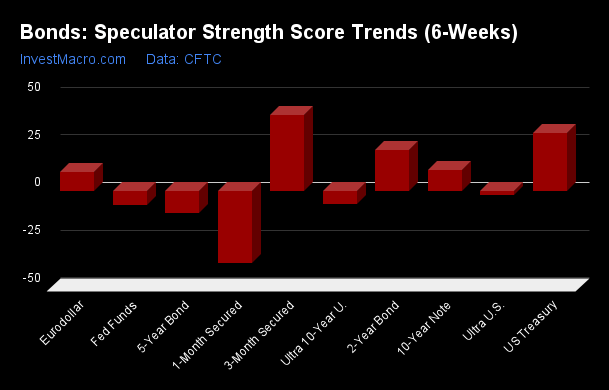
Fed Funds & Eurodollar top the 6-Week Strength Trends

COT Strength Score Trends (or move index, calculates the 6-week changes in strength scores) showed that the Fed Funds (8 percent) and the Eurodollar (2 percent) led the past six weeks trends for bonds.

The Ultra Treasury Bonds (-32 percent) led the downside trend scores with the 10-Year Bonds (-32 percent) and the US Treasury Bonds (-19 percent) following next with lower trend scores.

Strength Trend Statistics:
Fed Funds (8.1 percent) vs Fed Funds previous week (4.7 percent)
2-Year Bond (-10.5 percent) vs 2-Year Bond previous week (6.6 percent)
5-Year Bond (-8.5 percent) vs 5-Year Bond previous week (6.4 percent)
10-Year Bond (-32.4 percent) vs 10-Year Bond previous week (-22.4 percent)
Ultra 10-Year Bond (-5.8 percent) vs Ultra 10-Year Bond previous week (-6.0 percent)
US Treasury Bond (-18.8 percent) vs US Treasury Bond previous week (-25.7 percent)
Ultra US Treasury Bond (-31.9 percent) vs Ultra US Treasury Bond previous week (-21.5 percent)
Eurodollar (1.6 percent) vs Eurodollar previous week (11.1 percent)


Individual Bond Markets:

3-Month Eurodollars Futures:

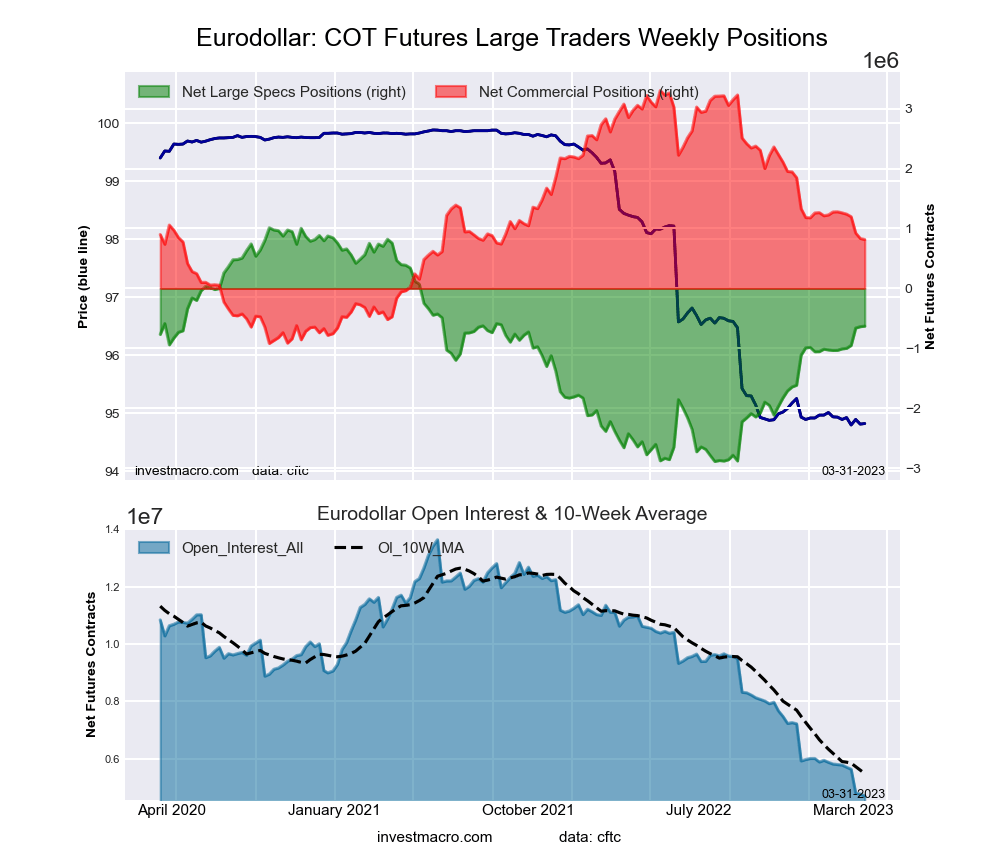
Eurodollar Bonds Futures COT ChartThe 3-Month Eurodollars large speculator standing for the week recorded a net position of -1,026,275 contracts in the data reported through Tuesday January 31st. This was a weekly fall of -12,402 contracts from the previous week which had a total of -1,013,873 net contracts.

This week’s current strength score (the trader positioning range over the past three years, measured from 0 to 100) shows the speculators are currently Bearish with a score of 34.3 percent. The commercials are Bullish with a score of 63.1 percent and the small traders (not shown in chart) are Bullish with a score of 60.4 percent.

3-Month Eurodollars StatisticsSPECULATORSCOMMERCIALSSMALL TRADERS
– Percent of Open Interest Longs:8.268.44.9
– Percent of Open Interest Shorts:25.647.68.3
– Net Position:-1,026,2751,226,679-200,404
– Gross Longs:480,3574,023,635289,015
– Gross Shorts:1,506,6322,796,956489,419
– Long to Short Ratio:0.3 to 11.4 to 10.6 to 1
NET POSITION TREND:
– Strength Index Score (3 Year Range Pct):34.363.160.4
– Strength Index Reading (3 Year Range):BearishBullishBullish
NET POSITION MOVEMENT INDEX:
– 6-Week Change in Strength Index:1.6-1.83.7


30-Day Federal Funds Futures:

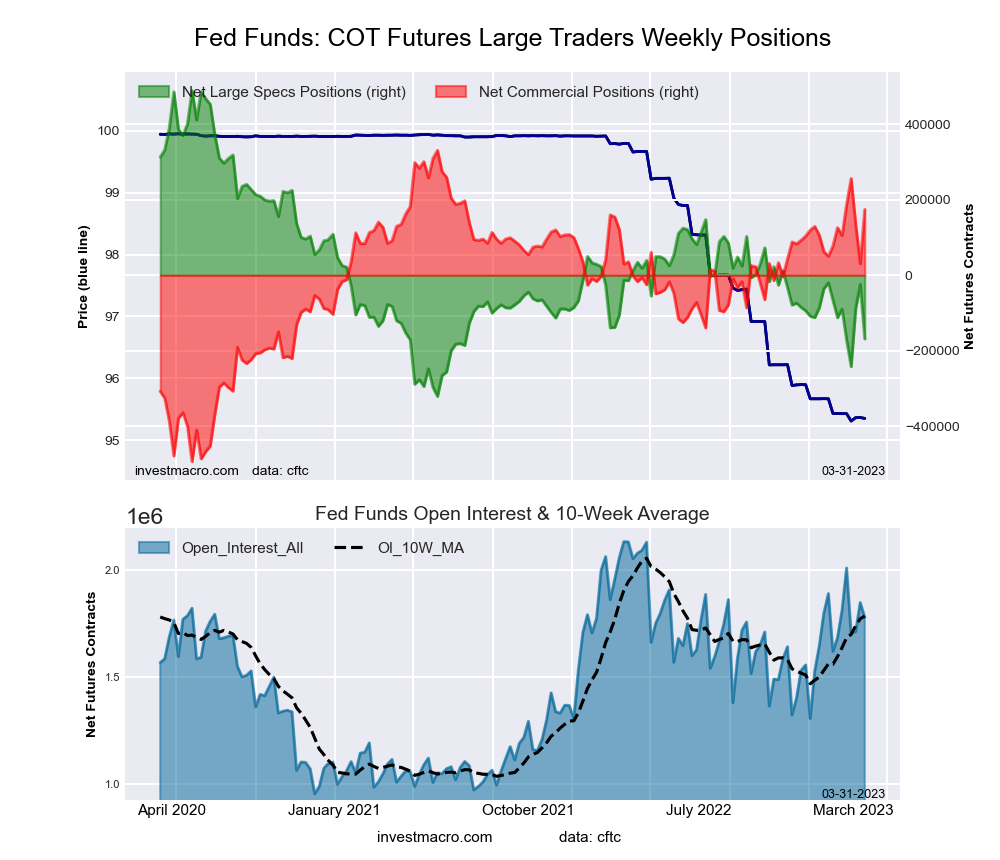
Federal Funds 30-Day Bonds Futures COT ChartThe 30-Day Federal Funds large speculator standing for the week recorded a net position of -20,128 contracts in the data reported. This was a weekly advance of 15,702 contracts from the previous week which had a total of -35,830 net contracts.

This week’s current strength score (the trader positioning range over the past three years, measured from 0 to 100) shows the speculators are currently Bearish with a score of 37.1 percent. The commercials are Bullish with a score of 66.0 percent and the small traders (not shown in chart) are Bearish-Extreme with a score of 0.0 percent.

30-Day Federal Funds StatisticsSPECULATORSCOMMERCIALSSMALL TRADERS
– Percent of Open Interest Longs:9.875.91.8
– Percent of Open Interest Shorts:10.973.33.4
– Net Position:-20,12850,487-30,359
– Gross Longs:185,3581,435,04234,298
– Gross Shorts:205,4861,384,55564,657
– Long to Short Ratio:0.9 to 11.0 to 10.5 to 1
NET POSITION TREND:
– Strength Index Score (3 Year Range Pct):37.166.00.0
– Strength Index Reading (3 Year Range):BearishBullishBearish-Extreme
NET POSITION MOVEMENT INDEX:
– 6-Week Change in Strength Index:8.1-5.1-55.8


2-Year Treasury Note Futures:

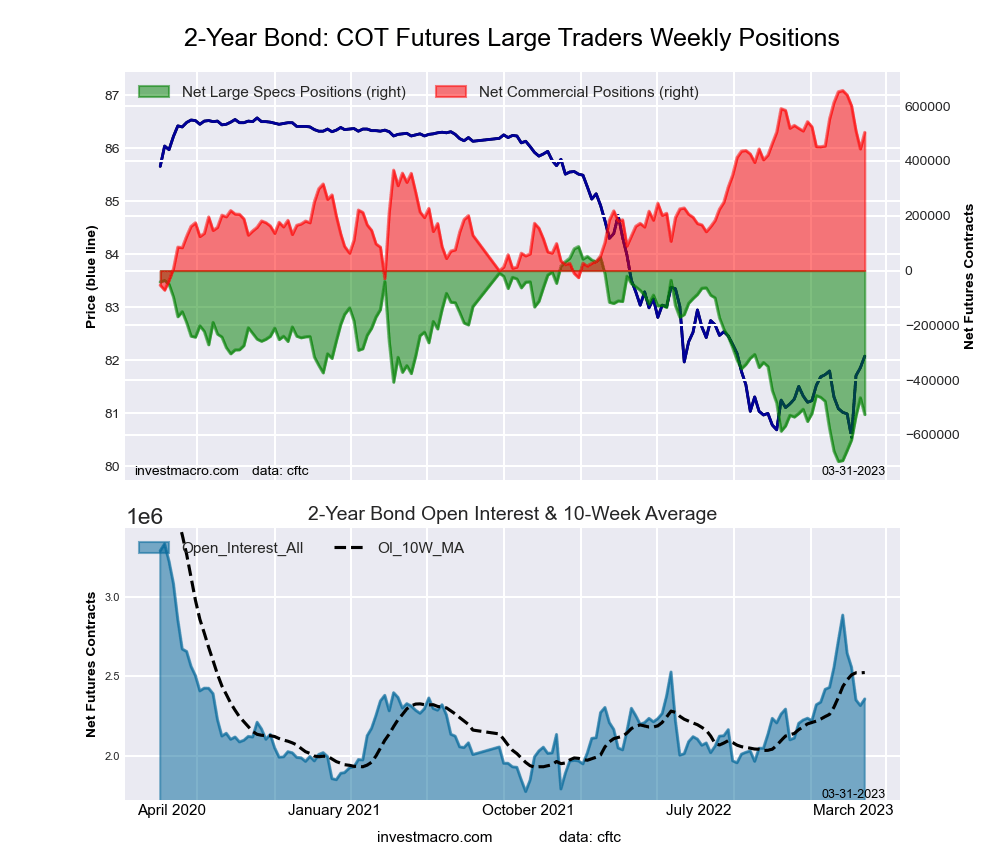
2-Year Treasury Bonds Futures COT ChartThe 2-Year Treasury Note large speculator standing for the week recorded a net position of -577,165 contracts in the data reported. This was a weekly decline of -100,142 contracts from the previous week which had a total of -477,023 net contracts.

This week’s current strength score (the trader positioning range over the past three years, measured from 0 to 100) shows the speculators are currently Bearish-Extreme with a score of 1.4 percent. The commercials are Bullish-Extreme with a score of 94.3 percent and the small traders (not shown in chart) are Bullish with a score of 62.9 percent.

2-Year Treasury Note StatisticsSPECULATORSCOMMERCIALSSMALL TRADERS
– Percent of Open Interest Longs:6.783.58.2
– Percent of Open Interest Shorts:30.560.77.2
– Net Position:-577,165552,88224,283
– Gross Longs:163,8602,027,636198,658
– Gross Shorts:741,0251,474,754174,375
– Long to Short Ratio:0.2 to 11.4 to 11.1 to 1
NET POSITION TREND:
– Strength Index Score (3 Year Range Pct):1.494.362.9
– Strength Index Reading (3 Year Range):Bearish-ExtremeBullish-ExtremeBullish
NET POSITION MOVEMENT INDEX:
– 6-Week Change in Strength Index:-10.56.612.4


5-Year Treasury Note Futures:

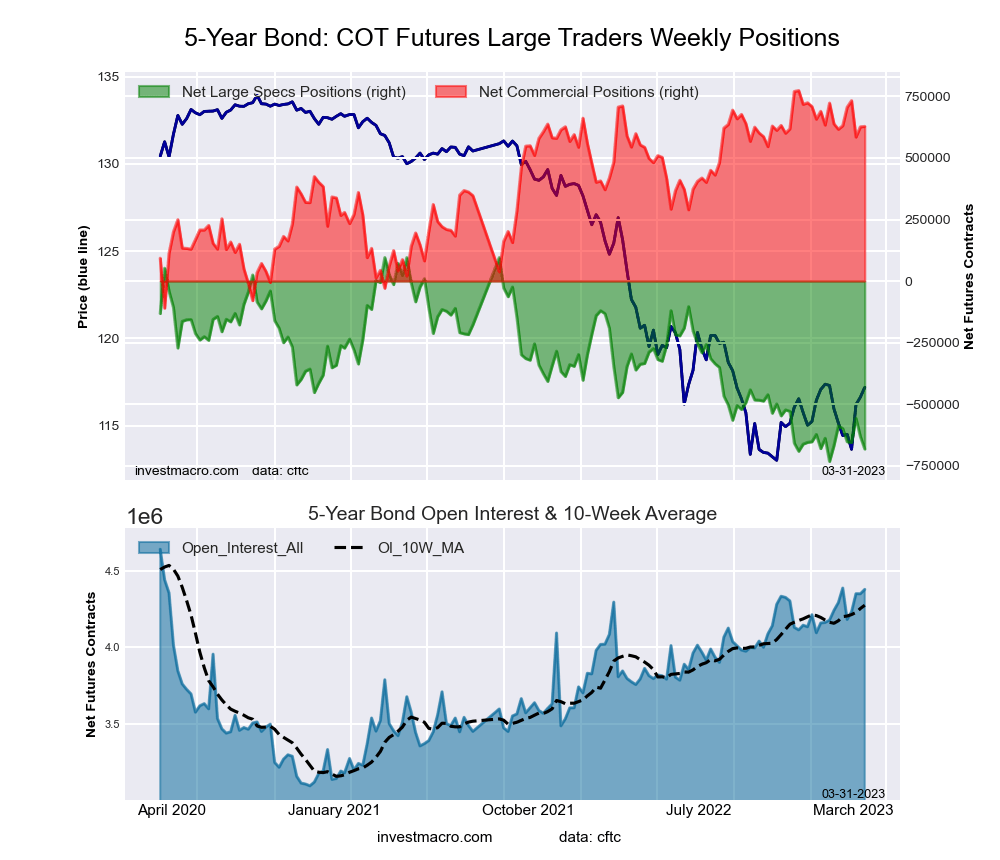
5-Year Treasury Bonds Futures COT ChartThe 5-Year Treasury Note large speculator standing for the week recorded a net position of -732,956 contracts in the data reported. This was a weekly decrease of -94,219 contracts from the previous week which had a total of -638,737 net contracts.

This week’s current strength score (the trader positioning range over the past three years, measured from 0 to 100) shows the speculators are currently Bearish-Extreme with a score of 0.0 percent. The commercials are Bullish-Extreme with a score of 94.2 percent and the small traders (not shown in chart) are Bullish-Extreme with a score of 83.8 percent.

5-Year Treasury Note StatisticsSPECULATORSCOMMERCIALSSMALL TRADERS
– Percent of Open Interest Longs:5.484.78.1
– Percent of Open Interest Shorts:22.967.47.9
– Net Position:-732,956722,94510,011
– Gross Longs:224,9853,538,717340,298
– Gross Shorts:957,9412,815,772330,287
– Long to Short Ratio:0.2 to 11.3 to 11.0 to 1
NET POSITION TREND:
– Strength Index Score (3 Year Range Pct):0.094.283.8
– Strength Index Reading (3 Year Range):Bearish-ExtremeBullish-ExtremeBullish-Extreme
NET POSITION MOVEMENT INDEX:
– 6-Week Change in Strength Index:-8.50.617.9


10-Year Treasury Note Futures:

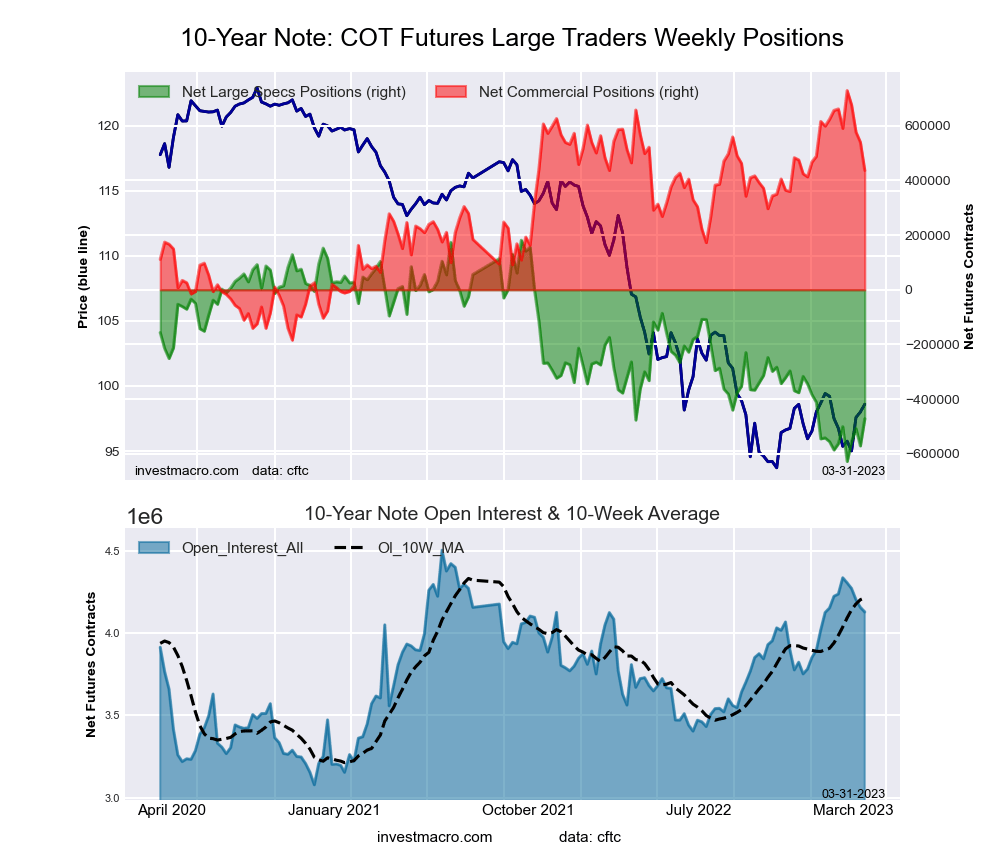
10-Year Treasury Notes Bonds Futures COT ChartThe 10-Year Treasury Note large speculator standing for the week recorded a net position of -555,471 contracts in the data reported. This was a weekly decrease of -13,650 contracts from the previous week which had a total of -541,821 net contracts.

This week’s current strength score (the trader positioning range over the past three years, measured from 0 to 100) shows the speculators are currently Bearish-Extreme with a score of 0.0 percent. The commercials are Bullish-Extreme with a score of 96.0 percent and the small traders (not shown in chart) are Bullish with a score of 63.8 percent.

10-Year Treasury Note StatisticsSPECULATORSCOMMERCIALSSMALL TRADERS
– Percent of Open Interest Longs:8.979.88.4
– Percent of Open Interest Shorts:22.264.810.1
– Net Position:-555,471623,943-68,472
– Gross Longs:367,7333,313,634349,227
– Gross Shorts:923,2042,689,691417,699
– Long to Short Ratio:0.4 to 11.2 to 10.8 to 1
NET POSITION TREND:
– Strength Index Score (3 Year Range Pct):0.096.063.8
– Strength Index Reading (3 Year Range):Bearish-ExtremeBullish-ExtremeBullish
NET POSITION MOVEMENT INDEX:
– 6-Week Change in Strength Index:-32.423.79.2


Ultra 10-Year Notes Futures:

Ultra 10-Year Treasury Notes Bonds Futures COT ChartThe Ultra 10-Year Notes large speculator standing for the week recorded a net position of -133,133 contracts in the data reported. This was a weekly fall of -7,222 contracts from the previous week which had a total of -125,911 net contracts.

This week’s current strength score (the trader positioning range over the past three years, measured from 0 to 100) shows the speculators are currently Bearish-Extreme with a score of 0.0 percent. The commercials are Bullish-Extreme with a score of 100.0 percent and the small traders (not shown in chart) are Bullish with a score of 60.5 percent.

Ultra 10-Year Notes StatisticsSPECULATORSCOMMERCIALSSMALL TRADERS
– Percent of Open Interest Longs:10.278.410.4
– Percent of Open Interest Shorts:19.362.417.3
– Net Position:-133,133233,431-100,298
– Gross Longs:148,7411,144,072152,412
– Gross Shorts:281,874910,641252,710
– Long to Short Ratio:0.5 to 11.3 to 10.6 to 1
NET POSITION TREND:
– Strength Index Score (3 Year Range Pct):0.0100.060.5
– Strength Index Reading (3 Year Range):Bearish-ExtremeBullish-ExtremeBullish
NET POSITION MOVEMENT INDEX:
– 6-Week Change in Strength Index:-5.89.8-9.9


US Treasury Bonds Futures:

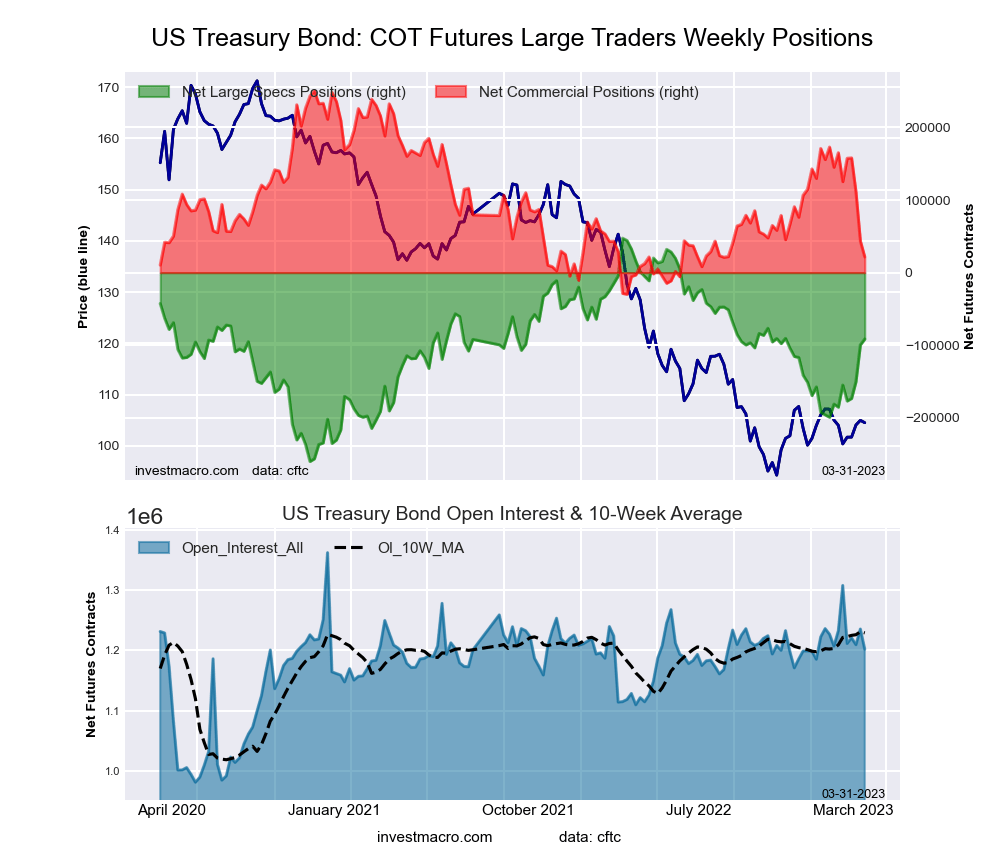
US Year Treasury Notes Long Bonds Futures COT ChartThe US Treasury Bonds large speculator standing for the week recorded a net position of -199,076 contracts in the data reported. This was a weekly fall of -3,260 contracts from the previous week which had a total of -195,816 net contracts.

This week’s current strength score (the trader positioning range over the past three years, measured from 0 to 100) shows the speculators are currently Bearish-Extreme with a score of 19.8 percent. The commercials are Bullish with a score of 72.2 percent and the small traders (not shown in chart) are Bullish with a score of 73.4 percent.

US Treasury Bonds StatisticsSPECULATORSCOMMERCIALSSMALL TRADERS
– Percent of Open Interest Longs:4.880.314.1
– Percent of Open Interest Shorts:21.066.211.9
– Net Position:-199,076172,83526,241
– Gross Longs:58,575984,869172,662
– Gross Shorts:257,651812,034146,421
– Long to Short Ratio:0.2 to 11.2 to 11.2 to 1
NET POSITION TREND:
– Strength Index Score (3 Year Range Pct):19.872.273.4
– Strength Index Reading (3 Year Range):Bearish-ExtremeBullishBullish
NET POSITION MOVEMENT INDEX:
– 6-Week Change in Strength Index:-18.823.6-6.7


Ultra US Treasury Bonds Futures:

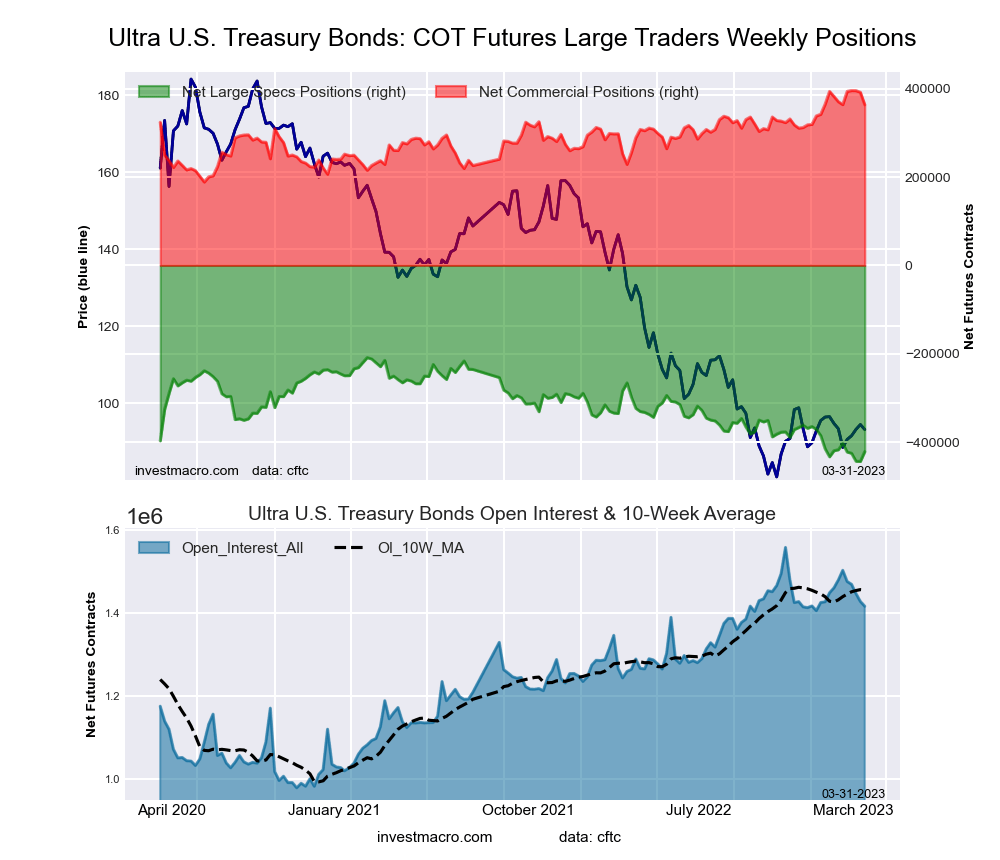
Ultra US Year Treasury Notes Long Bonds Futures COT ChartThe Ultra US Treasury Bonds large speculator standing for the week recorded a net position of -433,360 contracts in the data reported. This was a weekly fall of -17,997 contracts from the previous week which had a total of -415,363 net contracts.

This week’s current strength score (the trader positioning range over the past three years, measured from 0 to 100) shows the speculators are currently Bearish-Extreme with a score of 0.0 percent. The commercials are Bullish-Extreme with a score of 100.0 percent and the small traders (not shown in chart) are Bullish with a score of 66.0 percent.

Ultra US Treasury Bonds StatisticsSPECULATORSCOMMERCIALSSMALL TRADERS
– Percent of Open Interest Longs:3.485.211.2
– Percent of Open Interest Shorts:33.358.08.5
– Net Position:-433,360393,87839,482
– Gross Longs:48,9541,234,463162,321
– Gross Shorts:482,314840,585122,839
– Long to Short Ratio:0.1 to 11.5 to 11.3 to 1
NET POSITION TREND:
– Strength Index Score (3 Year Range Pct):0.0100.066.0
– Strength Index Reading (3 Year Range):Bearish-ExtremeBullish-ExtremeBullish
NET POSITION MOVEMENT INDEX:
– 6-Week Change in Strength Index:-31.939.8-8.5


Article By InvestMacroReceive our weekly COT Newsletter

*COT Report: The COT data, released weekly to the public each Friday, is updated through the most recent Tuesday (data is 3 days old) and shows a quick view of how large speculators or non-commercials (for-profit traders) were positioned in the futures markets.

The CFTC categorizes trader positions according to commercial hedgers (traders who use futures contracts for hedging as part of the business), non-commercials (large traders who speculate to realize trading profits) and nonreportable traders (usually small traders/speculators) as well as their open interest (contracts open in the market at time of reporting). See CFTC criteria here.

How the west is finally hitting back against China’s dominance of cleantech

By Michael Jacobs, University of Sheffield 

Climate change policy has entered a new era. The growing row between the United States and the European Union over the impacts of the new American green subsidy regime makes that all too clear. Yet in many ways, this story is ultimately about China.

For the last 20 years, developed countries have used three main types of policy to cut their greenhouse gas emissions. Renewable energy mandates have required electricity generators to invest in solar, wind, hydro and geothermal power. Emissions trading schemes for energy and industrial businesses put a price on carbon. And energy efficiency standards have been progressively improved on a whole range of products from vehicles and white goods to homes.

Applied across Europe and North America, this policy toolkit brought notable success. Developed countries’ emissions fell sharply, even with economic growth. Green technologies – from wind and solar to electric vehicles – fell in cost and improved in performance as demand for them rose.

A virtuous circle followed: climate policy increased demand for green technologies, which reduced costs, which allowed policy to be tightened, which stimulated demand and innovation further.

The rub

There were two problems, however. First, much of the economic benefit went to China. From 2010 onwards China rapidly became the world’s primary supplier of wind and solar technology, along with underpinning minerals like lithium, cobalt and rare earths.

China’s dominance reduced everyone’s costs. But it also meant that, as industrial jobs were lost in developed countries, they were not replaced by equivalents in the new energy sectors.

Second, climate policy began to create political opposition. As emissions targets tightened, countries started to see the costs reflected in consumer prices.

The most dramatic response emerged in France in 2018, when a relatively small increase in fuel duty led the so-called gilets jaunes (yellow jacket) protestors to block roads across the country for over a year, even after President Emmanuel Macron withdrew the tax. In the US, congressional opposition stymied President Barack Obama’s plans for a climate bill – including a modest carbon pricing scheme – for the whole of his presidency.

Joe Biden has learned the lesson. His Inflation Reduction Act (IRA), passed in 2022, offers climate carrots instead of sticks – and lots of them.

The act – which despite its name is almost entirely about climate change – offers a mammoth US$369 billion (£306 billion) of tax credits and other subsidies to companies making low-carbon investments and to consumers buying green products. Critically, to take advantage of subsidies, a significant proportion of materials and equipment used must be produced in North America.

The EU position

Orthodox economists deplore the IRA. Subsidies are much less efficient than taxes (not to say more expensive), and protectionism raises costs to consumers.

Yet to any politician, Biden’s approach looks like a no-brainer. Don’t penalise businesses with carbon levies: reward them with tax credits. Don’t allow the employment benefits of climate policy to leak overseas to China: ensure they stay at home. Nearly three-quarters of Americans backed the act, including over half of Republicans.

The EU is alarmed at the likely effects. There are al ready reports of European cleantech companies planning to transfer production to the US, while others may be kept out of US markets. The European Commission has threatened the US with legal action at the World Trade Organization for breaking free trade rules, and has already secured US concessions, including extending tax credits to foreign-made electric vehicles.

Even more significantly, the commission president Ursula von der Leyen has announced a “green deal industrial plan” for the EU. The core will be a Net Zero Industry Act relaxing rules on state aid and providing subsidies for cleantech investment. Meanwhile, a Critical Raw Materials Act will build partnerships with like-minded suppliers to reduce dependence on Chinese imports, mirroring what the recent EU and US chips acts do with semiconductors.

The broader context

Both the EU and US are therefore turning climate policy into industrial and trade strategy. One might ask what took them so long. China’s twelfth five year plan in 2010 first identified seven environmental “strategic industries” on which to focus economic development. It is not a coincidence that China rapidly came to dominate the new low carbon sectors: it was literally the plan.

The EU and US moves are a desperate attempt to catch up, with Japan and South Korea not far behind. And the strategy extends beyond their own continents. The new kids on this block are multi-billion dollar just energy transition partnerships which the EU, US and other western powers have recently negotiated with South Africa, Indonesia and Vietnam.

These “JET-Ps” aim to stimulate investment, not just in the renewables transition but also in domestic industrial capacity. Loans and guarantees provided by western governments aim to leverage much larger flows of private finance. The goal is for these countries to manufacture and export their own green technologies, charting a new path for economic development.

More such partnerships will likely be announced over the coming year. This is not altruism on western countries’ part, but an attempt to offer an alternative to China’s huge investments in the developing world.

What about the UK? These developments leave the British economy in a badly weakened position. The EU was the obvious partner in green industrial policy. On its own the UK is not nearly large enough to compete.

It creates a compelling case for a future UK government to do a green trade deal with the EU. In return for a financial contribution to the EU’s green innovation funds, the UK could rejoin the single market for environment goods and services.

Just a few years ago, climate change was a subset of environmental policy. Today it is a key dimension of both economic strategy and geopolitics. Given the extent of the economic transformation it demands, no-one should be surprised.The Conversation

About the Author:

Michael Jacobs, Professor of Political Economy, University of Sheffield

This article is republished from The Conversation under a Creative Commons license. Read the original article.

In rural America, right-to-repair laws are the leading edge of a pushback against growing corporate power

By Leland Glenna, Penn State 

As tractors became more sophisticated over the past two decades, the big manufacturers allowed farmers fewer options for repairs. Rather than hiring independent repair shops, farmers have increasingly had to wait for company-authorized dealers to arrive. Getting repairs could take days, often leading to lost time and high costs.

A new memorandum of understanding between the country’s largest farm equipment maker, John Deere Corp., and the American Farm Bureau Federation is now raising hopes that U.S. farmers will finally regain the right to repair more of their own equipment.

However, supporters of right-to-repair laws suspect a more sinister purpose: to slow the momentum of efforts to secure right-to-repair laws around the country.

Under the agreement, John Deere promises to give farmers and independent repair shops access to manuals, diagnostics and parts. But there’s a catch – the agreement isn’t legally binding, and, as part of the deal, the influential Farm Bureau promised not to support any federal or state right-to-repair legislation.


You can listen to more articles from The Conversation narrated by Noa.


The right-to-repair movement has become the leading edge of a pushback against growing corporate power. Intellectual property protections, whether patents on farm equipment, crops, computers or cellphones, have become more intense in recent decades and cover more territory, giving companies more control over what farmers and other consumers can do with the products they buy.

For farmers, few examples of those corporate constraints are more frustrating than repair restrictions and patent rights that prevent them from saving seeds from their own crops for future planting.

How a few companies became so powerful

The United States’ market economy requires competition to function properly, which is why U.S. antitrust policies were strictly enforced in the post-World War II era.

During the 1970s and 1980s, however, political leaders began following the advice of a group of economists at the University of Chicago and relaxed enforcement of federal antitrust policies. That led to a concentration of economic power in many sectors.

This concentration has become especially pronounced in agriculture, with a few companies consolidating market share in numerous areas, including seeds, pesticides and machinery, as well as commodity processing and meatpacking. One study in 2014 estimated that Monsanto, now owned by Bayer, was responsible for approximately 80% of the corn and 90% of the soybeans grown in the U.S. In farm machinery, John Deere and Kubota account for about a third of the market.

Market power often translates into political power, which means that those large companies can influence regulatory oversight, legal decisions, and legislation that furthers their economic interests – including securing more expansive and stricter intellectual property policies.

The right-to-repair movement

At its most basic level, right-to-repair legislation seeks to protect the end users of a product from anti-competitive activities by large companies. New York passed the first broad right-to-repair law, in 2022, and nearly two dozen states have active legislation – about half of them targeting farm equipment.

Whether the product is an automobile, smartphone or seed, companies can extract more profits if they can force consumers to purchase the company’s replacement parts or use the company’s exclusive dealership to repair the product.

One of the first cases that challenged the right to repair equipment was in 1939, when a company that was reselling refurbished spark plugs was sued by the Champion Spark Plug Co. for violating its patent rights. The Supreme Court agreed that Champion’s trademark had been violated, but it allowed resale of the refurbished spark plugs if “used” or “repaired” was stamped on the product.

Although courts have often sided with the end users in right-to-repair cases, large companies have vast legal and lobbying resources to argue for stricter patent protections. Consumer advocates contend that these protections prevent people from repairing and modifying the products they rightfully purchased.

The ostensible justification for patents, whether for equipment or seeds, is that they provide an incentive for companies to invest time and money in developing products because they know that they will have exclusive rights to sell their inventions once patented.

However, some scholars claim that recent legal and legislative changes to patents are instead limiting innovation and social benefits.

The problem with seed patents

The extension of utility patents to agricultural seeds illustrates how intellectual property policies have expanded and become more restrictive.

Patents have been around since the founding of the U.S., but agricultural crops were initially considered natural processes that couldn’t be patented. That changed in 1980 with the U.S. Supreme Court decision Diamond v. Chakrabarty. The case involved genetically engineered bacteria that could break down crude oil. The court’s ruling allowed inventors to secure patents on living organisms.

Half a decade later, the U.S. Patent Office extended patents to agricultural crops generated through transgenic breeding techniques, which inserts a gene from one species into the genome of another. One prominent example is the insertion of a gene into corn and cotton that enables the plant to produce its own pesticide. In 2001, the Supreme Court included conventionally bred crops in the category eligible for patenting.

Historically, farmers would save seeds that their crops generated and replant them the following season. They could also sell those seeds to other farmers. They lost the right to sell their seeds in 1970, when Congress passed the Plant Variety Protection Act. Utility patents, which grant an inventor exclusive right to produce a new or improved product, are even more restrictive.

Under a utility patent, farmers can no longer save seed for replanting on their own farms. University scientists even face restrictions on the kind of research they can perform on patented crops.

Because of the clear changes in intellectual property protections on agricultural crops over the years, researchers are able to evaluate whether those changes correlate with crop innovations – the primary justification used for patents. The short answer is that they do not.

One study revealed that companies have used intellectual property to enhance their market power more than to enhance innovations. In fact, some vegetable crops with few patent protections had more varietal innovations than crops with more patent protections.

How much does this cost farmers?

It can be difficult to estimate how much patented crops cost farmers. For example, farmers might pay more for the seeds but save money on pesticides or labor, and they might have higher yields. If market prices for the crop are high one year, the farmer might come out ahead, but if prices are low, the farmer might lose money. Crop breeders, meanwhile, envision substantial profits.

Similarly, it is difficult to calculate the costs farmers face from not having a right to repair their machinery. A machine breakdown that takes weeks to repair during harvest time could be catastrophic.

The nonprofit U.S. Public Interest Research Group calculated that U.S. consumers could save US$40 billion per year if they could repair electronics and appliances – about $330 per family.

The memorandum of understanding between John Deere and the Farm Bureau may be a step in the right direction, but it is not a substitute for right-to-repair legislation or the enforcement of antitrust policies.The Conversation

About the Author:

Leland Glenna, Professor of Rural Sociology and Science, Technology, and Society, Penn State

This article is republished from The Conversation under a Creative Commons license. Read the original article.

EU poised to copy US subsidies for green technology – new evidence from China shows how it could backfire

By Jun Du, Aston University and Holger Görg, Kiel Institute for the World Economy 

The EU is preparing to abandon its longstanding restrictions on state aid to take on US and Chinese subsidies over green technologies. European Commission president Ursula von der Leyen is spearheading a new commitment from EU leaders to “act decisively to ensure its long-term competitiveness, prosperity and role on the global stage”.

She has talked about the need to counter hidden subsidies from the Chinese, both in green tech and in other sectors, though the trigger for the EU’s new approach is really President Joe Biden’s Inflation Reduction Act (IRA). This has committed the US to a record US$369 billion (£305 billion) to green its economy, including using tax breaks and subsidies.

It effectively tears up the international consensus around not using state aid, embracing what the US has railed against for years. The Economist has said that globalisation is no longer about racing, but racing and tripping others.

The EU is now proposing to introduce its own tax credits and subsidies for cleantech companies, as well as fast-tracking regulation in this area.

Meanwhile, the UK has been coming under pressure from the likes of car manufacturers to respond. So far, it has been trying to find exemptions to the US’s general approach of only offering incentives to products made in America, while also claiming the UK has no need to subsidise these kinds of areas because it is already ahead.

The economics of this drift to protectionism are worrying. Our recent research on the effects of state subsidies in China suggest that such policies could do the US and EU economies more harm than good overall.

There’s a reason why the west has long avoided state aid.
Shaun Dakin/Unsplash

What the research says

Since the dawn of the industrial revolution, states have played a significant role in developing their economies. China is the recent prime example, where the use of subsidies to develop particular industries such as electric cars or solar panels has been highly visible.

India seems to be moving in the same direction. The government is paying half of the cost of making computer chips, among a variety of incentives to encourage investment in different sectors.

Equally, in the developed world, government procurement has driven many world-changing innovations. Whole sectors such as biotech and information technology relied on government procurement to get started. America’s Silicon Valley originally grew on the back of military contracts, for instance.

Research in this area does acknowledge a case for subsidising infant industries in which a country wants to specialise. China’s state subsidies in the steel and solar panel industries would be a good example.

Yet there is a price to be paid: the money a government spends means that less will be available for helping its citizens in other ways. For example Brazil’s wheat-industry subsidies in the 1980s were estimated to have produced a net loss of 15% to welfare spending.

Around the same time, it was estimated that if the EU removed the common agricultural policy, the extra money available for government spending could increase real incomes by between 0.3% and 3.5% as a proportion of GDP. Findings like these probably explain why the World Trade Organization has discouraged state aid for decades.

Consequences

The new green subsidies will create winners and losers at different levels. Within the EU, for example, it will un-level the playing field between member states. Those that can afford to spend more on their green tech industries will potentially crowd out those with less.

Even within a country, there’s unlikely to be a win-win. Our research team has recently published a paper about China’s subsidies, using a new approach that makes it possible to estimate the direct and indirect effects on subsidised and non-subsidised firms at the same time.

This is the first time anyone has looked at subsidies in this way. Our project looked at 1998-2007, since those were the years where the necessary data was available.

We found that subsidised firms become relatively more productive, thus making them more competitive. Yet firms that are not subsidised can see their productivity growth reduced.

The determining factor is whether they operate in a geographical cluster alongside subsidised firms. When more than a quarter of firms in a cluster in China were being subsidised, the remainder suffered.

Those losing out were typically foreign-owned firms and those owned by the Chinese state, while private Chinese firms were the beneficiaries.

When we aggregated all the data, it showed that this negative indirect effect tends to dominate. In other words, subsidies produce unintended losers and make the market less competitive and more inefficient as a whole.

The bottom line is, subsidies are not without problems, even for China. In the last decade we have seen what “losers” can do to an economy, or a society – think of movements towards populism and autocracy in many places.

Therefore, there needs to be a more thorough debate about the benefits and costs of subsidies before states apply them, and some carefully designed policies to prepare for the potential losers.The Conversation

About the Authors:

Jun Du, Professor of Economics, Centre Director of Centre for Business Prosperity (CBP), Aston University and Holger Görg, Acting President, Kiel Institute for the World Economy

This article is republished from The Conversation under a Creative Commons license. Read the original article.


Electrification: Generation, Transmission, and Storage

Source: Michael Ballanger  (2/20/23)

 Michael Ballanger of GGM Advisory Inc. reviews the energy market and metals associated with the “electrification movement.”

After a sharp reversal in sentiment at the start of the year, the junior explorers and developers (ex-lithium) have faded back into the same frustrating pattern of listlessness where either operational or exploration results deemed “spectacular” in past eras are instead treated as rare and valuable “liquidity events.” Just as the canine being fed by Mr. Pavlov learned to salivate upon the ringing of a bell just before dinner time, traders in the junior gold, silver, copper and most other base metal issues have learned that it is the first bid that gets hit after a positive news release that is the best bid to hit.

That is because the junior miners trade on the margin to the extent that is usually the first trade that sets the mood. It has gotten so bad that I actually received a note from a young trader that informed me of the “lousy results” at Marathon Gold’s Valentine Gold Project in Quebec. Quickly calling them up and noticing an intercept of 5 g/t Au over 18 meters, I asked the young man what made him think the results were “lousy.”

His reply was “Well, the stock was $1.21 the day of the release and it’s now $0.91. Results were obviously lousy.”

Notwithstanding that the results reported by MOZ were anything but “lousy”, it simply underscores how tape action controls the narrative on every single stock out there these days.

I was in a conversation with a prominent speaker and newsletter writer this week that told me that unless one is invested in the companies producing, developing, or hunting down metals associated with the electrification movement, the new generation of traders is largely disinterested.

He informed me that his subscriber base is down over 50% despite having some big success recently with Great Bear Resources Ltd. (GBR:TSX.V; GTBDF:OTCQX) taken out by Kinross Gold Corp. (K:TSX; KGC:NYSE) for around $30 in February 2022.

Rather than complain about it, I am reminded of an anecdote relayed to a group of us by veteran Wall Street Week Elf Julius Westheimer while we were attending the annual Securities Industry Associations (“SIA”) conference in which industry professionals conduct classes in various sectors of the securities industry.

It is very “blueblood” as it is held at the prestigious “Wharton School of Finance” in Philadelphia and they really milk that because when you leave, they present you with a graduation certificate (a “shingle”) that looks like a real Wharton certificate such that when you hang it on your wall, everybody figures you earned a post-graduate degree from Wharton, which you did not. Three weeks over three years at the SIA is nothing like six semesters at the Wharton.

The old Wall Street Week show came on every Friday night around 7:00 p.m. and in the late 70s, it was really the only TV news show that covered stocks and bonds. It aired on public TV in Maryland but was widely syndicated across North America and I believe Europe and was a “must watch” for any young broker trying to learn the trade.

It was on Wall Street Week on October 16, 1987, that the legendary money manager and author Martin Zweig told the host that he actually expected a market crash. The following Monday was the infamous Crash of ’87 where the Dow lost 23.7% in a single trading day.

While most of the Wall Street Week elves were either analysts or fund managers, they used Mr. Westheimer as their “token stock salesman”  as his area of specialization was managing retail customers. One of the crowd asked him how he could grow his book (increase the number of clients) and then peppered Julius with a bunch of the books he had read and courses he had taken at which point Julius held up his hand in a gesture of “Enough, already!” and proceeded to tell us all a story which describes not only the retail space in 1979 but also the systemic modus operandi of Wall Street since the first began shuffling paper on a New York curb in the 1800s.

One day, I was walking to work at Broad and Wall Streets when I noticed a chap trying to sell these yellow umbrellas out of a hand cart but each time a prospective buyer picked one up and examined it, they frowned and put it back. Now, across the street, another chap was selling the same brand of umbrella but they were blue umbrellas and these umbrellas were flying out of his cart so fast that his young son and to keep running back to their apartment for more inventory. The poor guy in the yellow umbrella cart sitting there with no customers flagged me down and ask me what I thought he could do to improve his sales. I said, “Go around the corner to O’Reilly Hardware and pick up a can of blue spray paint.” Because, ya see, down here we only sell what people want to buy.”

Now, the purists that view precious metals with an almost religious affection would never dream of dumping their stacks for something as abhorrent as copper or lithium or uranium because they think that yellow umbrellas are just as useful as blue umbrellas but where they would be in error is that Marketing 101 says you always need to know what one’s customer wants before embarking on a marketing program.

When you go down the “Most Actives” list for the TSX and TSX Venture exchanges these days, you do not find “Gunner Gold,” “Streaker Silver,” “Pugnacious Platinum” or “Parlay Palladium.”

You find the word “battery” or “lithium” in the names of those corporate issuers dominating the list of “Most Actives,” “Biggest Percentage Gainers” and “Volume Leaders.”

In 2020, my list of juniors was all gold and silver with one token uranium name. By 2023, the list is comprised of eight names with only one pure gold developer (Getchell Gold Corp.) a couple of silver names (that have copper and gold exposure) with the rest exclusively copper and lithium, with Volt Lithium Corp. the most recent addition.

I read the results of a poll of trader/investor types last week that asked participants to list the five most important metals in which they wished to invest. At the top by the widest of margins was lithium while at the nadir was silver. I should add that silver is also the least-trusted of all the metals with gold a close second.

With copper, uranium, nickel, and cobalt all lined up behind lithium as the favorites, it should come as no surprise because the new generation of investors/traders invests in thematic “story” stocks. They also invest as a collective thanks largely to their obsession with social media.

The popularity of these sub-sectors can be broken down into one word: “electrification.” Integral to the replacement of fossil fuels by electricity are three prerequisites:

  • New clean and 100% reliable sources of electricity are going to be needed. The only fuel that can deliver is uranium. Nuclear energy will be the source of the trillions of new megawatts required to complete the transition.
  • With the new supply of electricity being pumped into an antiquated grid, massive increases in the supply of those metals that transmit electricity are going to be required and the metal that has been the most commonly used is copper.
  • Once the new source of electricity provided by nuclear energy has been transmitted by the greatly-fortified copper wiring to households, businesses and vehicles, the need for storage particularly in the EV space is going to require lithium (lithium-ion batteries) along with nickel and cobalt.

Enhanced generation, increased transmission infrastructure, and storage capacity are going to demand huge increases in supply. Over the past five decades, the sector that has discovered the lion’s share of the new mineral deposits around the globe are the juniors which then get absorbed by the multinationals with help from their deep-pocketed investment bank pals.

Therein lies the opportunity for investors as we look out through the rest of the “Boring Twenties.” The younger generation of stock buyers could care less about “profligate government spending” or “currency debasement” that would require they use gold and silver as protection. They represent the “yellow umbrellas” of the day for these youngsters and since liquidity is critical for institutional participation, you will never get the volumes required in yellow umbrellas to create the excitement that the “electrification metals” (including nuclear fuel) can generate.

Of course, over time, this all can change as trends are always cyclical and people’s attitudes and preferences will ebb and flow depending on the impact of the “Narrative of the Day.”

For now, however, I just want to find opportunities that will make money. Unfortunately, we cannot take a silver explorer and turn it into a copper or lithium explorer with a can of blue spray paint. Julius Westheimer taught me to avoid the habit of offering products that the investing public simply does not want so I will heed his advice and instead seek out exploration and development plays that focus on the generation, transmission, and storage of electricity while keeping large barbell positions in gold and silver as hedges.

It was the last week of September when I executed my own personal “pivot” jumping off the bear bandwagon and into the neutral camp after the Bank of England decided to buy $5 billion worth of gilts. A couple of weeks later, I went from neutral to bullish but technically, I was about two weeks early in my “bottom” call as the 3,600 S&P level in late September gave way to the October 13th low at 3,491.

In a similar fashion, I went from bull to neutral on February 8th and then full bearish this week having put on a small put option position in the SPY:US. I did so because I got two sell signals within a week of each other with the major one being the bearish MACD crossover. It took Thursday’s 43-point drubbing to convincingly send the MACD into “sell” mode so just as I was a tad early back in September, I was again early in getting short. There is a line in the sand at the 4,050 level for the S&P but if it closes below that, I see 3,900 (100-dma) then the December low at 3,764.

Michael Ballanger Disclaimer:

This letter makes no guarantee or warranty on the accuracy or completeness of the data provided. Nothing contained herein is intended or shall be deemed to be investment advice, implied or otherwise. This letter represents my views and replicates trades that I am making but nothing more than that. Always consult your registered advisor to assist you with your investments. I accept no liability for any loss arising from the use of the data contained on this letter. Options and junior mining stocks contain a high level of risk that may result in the loss of part or all invested capital and therefore are suitable for experienced and professional investors and traders only. One should be familiar with the risks involved in junior mining and options trading and we recommend consulting a financial adviser if you feel you do not understand the risks involved.

Disclosures:

1) Michael J. Ballanger: I, or members of my immediate household or family, own securities of the following companies mentioned in this article: None.  I personally am, or members of my immediate household or family are, paid by the following companies mentioned in this article: My company, Bonaventure Explorations Ltd., has a consulting relationship with: None.

2) The following companies mentioned in this article are billboard sponsors of Streetwise Reports: None. Click here for important disclosures about sponsor fees. As of the date of this article, an affiliate of Streetwise Reports has a consulting relationship with: None. Please click here for more information.

3) Statements and opinions expressed are the opinions of the author and not of Streetwise Reports or its officers. The author is wholly responsible for the validity of the statements. The author was not paid by Streetwise Reports for this article. Streetwise Reports was not paid by the author to publish or syndicate this article. Streetwise Reports requires contributing authors to disclose any shareholdings in, or economic relationships with, companies that they write about. Streetwise Reports relies upon the authors to accurately provide this information and Streetwise Reports has no means of verifying its accuracy.

4) This article does not constitute investment advice. Each reader is encouraged to consult with his or her individual financial professional and any action a reader takes as a result of information presented here is his or her own responsibility. By opening this page, each reader accepts and agrees to Streetwise Reports’ terms of use and full legal disclaimer. This article is not a solicitation for investment. Streetwise Reports does not render general or specific investment advice and the information on Streetwise Reports should not be considered a recommendation to buy or sell any security. Streetwise Reports does not endorse or recommend the business, products, services or securities of any company mentioned on Streetwise Reports.

5) From time to time, Streetwise Reports LLC and its directors, officers, employees or members of their families, as well as persons interviewed for articles and interviews on the site, may have a long or short position in securities mentioned. Directors, officers, employees or members of their immediate families are prohibited from making purchases and/or sales of those securities in the open market or otherwise from the time of the decision to publish an article until three business days after the publication of the article. The foregoing prohibition does not apply to articles that in substance only restate previously published company releases.

Mid-Week Technical Outlook: USD Firms Ahead Of Fed Minutes

By ForexTime 

A sense of caution enveloped financial markets on Wednesday as geopolitical tensions and concerns about higher U.S. interest rates hit risk appetite.

Global stocks flashed red amid the risk-off sentiment while growing concerns over earnings misses further soured the mood. With investors adopting a guarded approach towards risk ahead of the Fed meeting minutes this evening, equity markets are likely to remain depressed in the near term. In the currency space, the dollar has strengthened against most G10 currencies while gold prices remain little changed.

The main risk event and potential market shaker will be the FOMC meeting minutes later today. Expect investors to comb through the minutes for fresh clues about the rate hike path. Ultimately, whatever tone the minute’s strike or fresh insight offered is likely to influence the dollar. In the meantime, markets remain tense with currency, commodity, and stock markets waiting for a fresh fundamental spark. Our focus today falls on G10 currencies with our tool of choice technical analysis.

Dollar Index on standby…

It’s been a choppy week for the Dollar Index (DXY). Prices have bounced within a narrow range with support at 103.60 and resistance around 104.30. A breakout could be on the horizon but this could need a fundamental trigger. Should prices break above 104.30, this may open a path toward 105.50. Alternatively, a break under 103.60 could see a selloff towards 103.00.

EURUSD wobbles above 1.0650

The EURUSD could be on the brink of a breakdown as prices wobble above the 1.0650 support. A solid break below this level could open the doors towards 1.0500. Should 1.0650 prove to be reliable support, a rebound back toward 1.0800 could be on the cards.

GBPUSD same old story

Nothing much has changed on the GBPUSD with support at 1.1950 and resistance at 1.2190. Given how prices experienced a sharp bounce from the 200-day SMA at 1.1950, the next key level of interest can be found at 1.2190. A breakout above this point may open a path toward 1.2450.

USDJPY bulls back in town?

USDJPY bulls may be back in action after pushing back above the 200-day SMA. There have been consistently higher highs and higher lows while prices are trading above the MACD. A solid close above the 100-day SMA could trigger a move higher toward 136.50. Should prices sink back under 134.50, the currency pair could test the 200-day SMA before sinking back towards 133.00.

Bonus: Gold

The path of least resistance for gold points south. Prices have been trending lower over the past few weeks despite the support at $1825. A strong breakdown below this level could open a path toward $1800. However, bears will need to fight support at not only the 100-day SMA but 200-day SMA. If prices can break back above the 50-day SMA, the next key level of interest can be found at $1860.


Forex-Time-LogoArticle by ForexTime
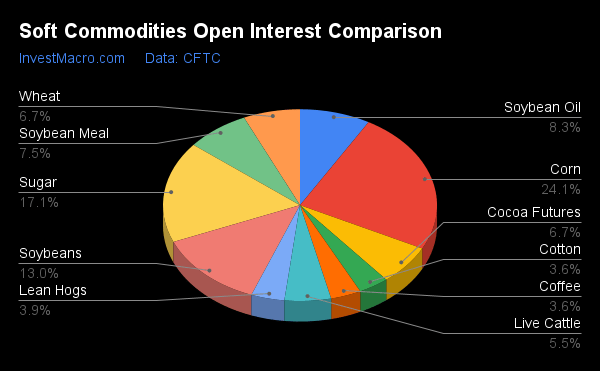
ForexTime Ltd (FXTM) is an award winning international online forex broker regulated by CySEC 185/12 www.forextime.com

China is now both a major headwind AND tailwind for global investors

By George Prior

China represents both major headwinds and tailwinds for global investors for the remaining first half of 2023, affirms the CEO and founder of one of the world’s largest independent financial advisory organizations.

The analysis from deVere Group’s Nigel Green comes after China’s foreign minister called on countries to “stop fuelling the fire” in Ukraine ahead of the first anniversary of the war on Friday, and as US President Joe Biden made a surprise visit to Kyiv this week.

It also follows US officials addressing the heightening tensions with China on Sunday after Secretary of State Antony Blinken met with Beijing’s top diplomat, Wang Yi, in Germany to discuss what it calls China’s high-altitude spy balloon and the nation’s approach to sending “lethal aid” to Russia.

Nigel Green says: “Whilst inflation remains an issue, China is now front and centre in investors’ minds.

“Currently, China represents both the major headwinds and tailwinds for global investors for the remaining first half of 2023 at least.”

The headwinds

“On the back of Biden’s trip, amongst other factors, China is accusing the US and Western allies of escalating tensions in Ukraine,” explains the deVere CEO.

“Meanwhile, US Secretary of State Antony Blinken has said Chinese firms were already providing ‘non-lethal support’ to Russia and new information suggested Beijing could provide ‘lethal support’ – which has been strongly denied by China.

“There are also real concerns amongst US allies about a possible military conflict between China and Taiwan, over which Beijing claims sovereignty.”

He continues: “In addition, there are broader worries about the decoupling of China and the US.

“There remains a deep economic interdependence between the United States and China, which has been growing for decades. But this appears to be slowing. We see this in the slowdown of commerce and investment, knowledge-sharing, and smaller global value chains, amongst other issues.

“The deceleration appears to have gained momentum amid the United States’ push to ‘contain’ China in terms of the strategic competition between the two. Also, President Xi Jinping recently reasserted China’s focus away from rapid growth and toward national self-sufficiency.

“All of these headwinds create uncertainty for investors around the world.”

The Tailwinds

“China’s faster-than-anticipated reopening after Covid-19 restrictions is going to deliver a major boost to the economy of China, which is the world’s second-largest, and global growth.

“The rebound will be delivered by significantly bolstering domestic Chinese demand which, in turn, will help regional economies given that neighbouring countries export more to China than many in the West.

“The reopening will positively impact commodity demand and prices, which will help many net exporters.

“Global growth will also be fuelled by renewed demand for international travel – and the associated economic benefit of it – to and from China.”

Nigel Green concludes: “As Beijing seeks to position itself as a force for peace between Russia and Ukraine, and as the economic superpower reopens following years of Covid restrictions, China is being watched with interest from global investors.”

About:

deVere Group is one of the world’s largest independent advisors of specialist global financial solutions to international, local mass affluent, and high-net-worth clients.  It has a network of more than 70 offices across the world, over 80,000 clients and $12bn under advisement.


Trade Of The Week: Will Data Heavy Week Trigger EURUSD Breakout?

By ForexTime 

Over the past two weeks, the EURUSD found itself trapped within a 150-pip range after bulls failed to conquer weekly resistance at 1.09.

It is worth keeping in mind that the euro remains supported by ECB hike expectations and improving sentiment towards the Eurozone economy after GDP unexpectedly grew in the final quarter of 2022. On the other hand, despite the dollar’s recent boost – the bigger picture has not changed with the Fed closer to a peak in rates in the coming few months. Essentially, the narrowing monetary policy divergence between the ECB & Fed suggests that the EURUSD is fundamentally bullish.

Regarding the technical picture, prices remain in an uptrend trend on the weekly charts. However, a technical pullback could be in play before bulls snatch back control.

The low down….

The EURUSD’s tumble over the past few weeks has been a dollar-strength theme, rather than a change in sentiment towards the euro.

Freakishly strong US economic data since the start of the month (NFP) coupled with a hot US CPI forced investors to re-evaluate Fed rate hike expectations. Markets expect the Fed to raise interest rates by 25bp in March with the Fed funds expected to peak around 5.3% by Summer. Given how the central bank is expected to pause and eventually start cutting rates in the longer term, dollar bulls may be rallying on weak foundations with bears lingering in the vicinity.

It is a different story for the ECB with markets pricing in a 50bp hike in March and a 35% probability of another 50bp move in April. However, with Eurozone inflation dropping for a third consecutive month, this has certainly impacted ECB hawks. Expect the euro to remain highly sensitive to economic data and ECB hike expectations over the next few months, especially if inflation continues to cool.

Big week for EURUSD?

The next few days could be eventful for the EUR and USD thanks to key economic data.

On Monday, investors will direct their attention toward the Eurozone consumer confidence figures for February which could influence appetite for the euro. Back in January, confidence slightly improved amid hopes of lower energy prices and government support preventing a recession. Should the figures for February, this could offer a slight boost to euro bulls.

It’s all about the Eurozone February ZEW survey and PMIs from not only Europe but the United States on Tuesday. The ZEW Indicator for the Euro Area rebounded by 40.3 points to 16.7 in January while the PMIs illustrated an encouraging picture in the same month. A similar theme for February will be warmly received by euro and dollar bulls.

Wednesday may be a big day for the USD due to the FOMC meeting minutes. Investors are expected to thoroughly comb through the minutes for more clues about the Feds rate hike path. Much focus will be on how hawkish the central bank was and whether a 50bp rate hike could have been a possibility. The overall tone of the minutes and any fresh insight into the path of future rates will most likely influence the dollar.

We have more economic data from both the Eurozone area and the United States on Thursday with the day kicking off with final January CPI figures from Europe. Annual inflation in the Euro area is forecast to fall to an eight-month low of 8.5% in January 2023 from the 9.2% witnessed last December. In the US, the weekly jobless claims, the second estimate of Q4 US GDP, and a speech from a Fed official will be in focus.

Investors are offered an appetiser on Friday in the form of the final German GDP figures and consumer confidence for March. But the main course will be the US January PCE Core deflator which is the Fed’s preferred measure of inflation. Any further signs of cooling inflation will most likely rekindle expectations around a less aggressive increase in rates by the Fed.

EURUSD: Keep an eye on the range

After failing to secure a weekly close below the 1.0650 support last week, the EURUSD remains trapped within a 150-pip range with resistance back at 1.0800.

The currency pair seems to be waiting for a potent fundamental catalyst and this could come in the form of key economic data this week. In the meantime, the EURUSD remains shaky on the daily charts with prices just below the 50-day SMA. A solid daily close below 1.0650 could signal a selloff towards 1.0500. Alternatively, should 1.0650 prove to be reliable support, prices may rebound back toward the 1.0800 resistance.


Forex-Time-LogoArticle by ForexTime
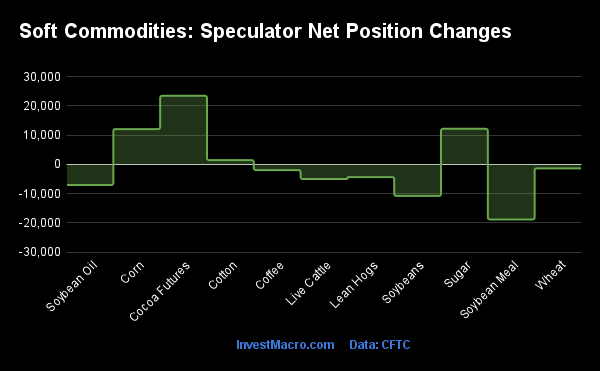
ForexTime Ltd (FXTM) is an award winning international online forex broker regulated by CySEC 185/12 www.forextime.com