Archive for Opinions – Page 94

Worst bank turmoil since 2008 means Federal Reserve is damned if it does and damned if it doesn’t in decision over interest rates

By Alexander Kurov, West Virginia University 

The Federal Reserve faces a pivotal decision on March 22, 2023: whether to continue its aggressive fight against inflation or put it on hold.

Making another big interest rate hike would risk exacerbating the global banking turmoil sparked by Silicon Valley Bank’s failure on March 10. Raising rates too little, or not at all as some are calling for, could not only lead to a resurgence in inflation, but it could cause investors to worry that the Fed believes the situation is even worse than they thought – resulting in more panic.

What’s a central banker to do?

As a finance scholar, I have studied the close link between Fed policy and financial markets. Let me just say I would not want to be a Fed policymaker right now.

Break it, you bought it

When the Fed starts hiking rates, it typically keeps at it until something breaks.

The U.S. central bank began its rate-hiking campaign early last year as inflation began to surge. After initially mistakenly calling inflation “transitory,” the Fed kicked into high gear and raised rates eight times from just 0.25% in early 2022 to 4.75% in February 2023. This is the fastest pace of rate increases since the early 1980s – and the Fed is not done yet.

Consumer prices were up 6% in February from a year earlier. While that’s down from a peak annual rate of 9% in June 2022, it’s still significantly above the Fed’s 2% inflation target.

But then something broke. Seemingly out of nowhere, Silicon Valley Bank, followed by Signature Bank, collapsed virtually overnight. They had over US$300 billion in assets between them and became the second- and third-largest banks to fail in U.S. history.

Panic quickly spread to other regional lenders, such as First Republic, and upset markets globally, raising the prospect of even bigger and more widespread bank failures. Even a $30 billion rescue of First Republic by its much larger peers, including JPMorgan Chase and Bank of America, failed to stem the growing unease.

If the Fed lifts interest rates more than markets expect – currently a 0.25 percentage point increase – it could prompt further anxiety. My research shows that interest rate changes have a much bigger effect on the stock market in bear markets – when there’s a prolonged decline in stock prices, as the U.S. is experiencing now – than in good times.

Making the SVB problem worse

What’s more, the Fed could make the problem that led to Silicon Valley Bank’s troubles even worse for other banks. That’s because the Fed is at least indirectly responsible for what happened.

Banks finance themselves mainly by taking in deposits. They then use those essentially short-term deposits to lend or make investments for longer terms at higher rates. But investing short-term deposits in longer-term securities – even ultra-safe U.S. Treasurys – creates what is known as interest rate risk.

That is, when interest rates go up, as they did throughout 2022, the values of existing bonds drop. SVB was forced to sell $21 billion worth of securities that lost value because of the Fed’s rate hikes at a loss of $1.8 billion, sparking its crisis. When SVB’s depositors got the wind of it and tried to withdraw $42 billion on March 9 alone – a classic bank run – it was over. The bank simply couldn’t meet the demands.

But the entire banking sector is sitting on hundreds of billions of dollars’ worth of unrealized losses – $620 billion as of Dec. 31, 2022. And if rates continue to go up, the value of these bonds will keep going down, which fundamentally weakens banks’ financial situation.

Risks of slowing down

While that may suggest it’s a no-brainer to put the rate hikes on hold, it’s not so simple.

Inflation has been a major problem plaguing the U.S. economy since 2021 as prices for homes, cars, food, energy and so much else jump for consumers. The last time consumer prices soared this much, in the early 1980s, the Fed had to raise rates so high that it sent the U.S. economy into recession – twice.

High inflation quickly cuts into how much stuff your money can buy. It also makes saving money more difficult because it eats at the value of your savings. When high inflation sticks around for a long time, it gets entrenched in expectations, making it very hard to control.

This is why the Fed jacked up rates so fast. And it’s unlikely it’s done enough to bring rates down to its 2% target, so a pause in lifting rates would mean inflation may stay higher for longer.

Moreover, stepping back from its one-year-old inflation campaign may send the wrong signal to investors. If central bankers show they are really concerned about a possible banking crisis, the market may think the Fed knows the financial system is in serious trouble and things are more dire than previously thought.

So what’s a Fed to do

At the very least, the complex global financial system is showing some cracks.

Three U.S. banks collapsed in a matter of days. Credit Suisse, a 166-year-old storied Swiss lender, was teetering on the edge until the government orchestrated a bargain sale to rival USB. A $30 billion rescue of regional U.S. lender First Republic was unable to arrest the drop in its shares. U.S. banks are requesting loans from the Fed like it’s 2008, when the financial system all but collapsed. And liquidity in the Treasury market – basically the blood that keeps financial markets pumping – is drying up.

Before Silicon Valley Bank’s collapse, interest rate futures were putting the odds of an increase in rates – either 0.25 or 0.5 percentage point – on March 22 at 100%. The odds of no increase at all have shot up to as high as 45% on March 15 before falling to 30% early on March 20, with the balance of probability on a 0.25 percentage point hike.

Increasing rates at a moment like this would mean putting more pressure on a structure that’s already under a lot of stress. And if things take a turn for the worse, the Fed would likely have to do a quick U-turn, which would seriously damage the Fed’s credibility and ability to do its job.

Fed officials are right to worry about fighting inflation, but they also don’t want to light the fuse of a financial crisis, which could send the U.S. into a recession. And I doubt it would be a mild one, like the kind economists have been worried the Fed’s inflation fight could cause. Recessions sparked by financial crises tend to be deep and long – putting many millions out of work.

What would normally be a routine Fed meeting is shaping up to be a high-wire balancing act.The Conversation

About the Author:

Alexander Kurov, Professor of Finance and Fred T. Tattersall Research Chair in Finance, West Virginia University

This article is republished from The Conversation under a Creative Commons license. Read the original article.

Trade Of The Week: Gold Prices Top $2000…What Next?

By ForexTime 

The explosive price action gold has displayed in recent days mirrors a speeding train reaching maximum velocity, with fundamental forces fuelling the upside momentum.

On Monday, gold punched above $2000 for the first time since March 2022 as concerns over the health of the banking system sweetened the appetite for safe-haven assets. This positive start builds on last week’s whooping 6.5% surge as mounting fears around Credit Suisse AG and the overall health of the banking system sent jitters across the board. A palpable sense of unease continues to linger across financial markets despite news over the emergency weekend sale of Credit Suisse AG to UBS Group AG. Contagion fears are rife and this will most likely accelerate the flight to safety, boosting attraction towards safe-haven gold.

Revisiting our 2023, we thoroughly discussed how gold could be one of the biggest winners these years based on speculation around the Fed pausing rate hikes. While gold prices have surged on contagion fears, the string of negative developments has also tempered expectations around the Fed keeping rates higher for longer. With gold hitting the psychological $2000 level, the key question is whether further upside could be on the cards or the party ends around this resistance.

Taking a quick looking at the technical picture, gold is heavily bullish on the daily charts. However, the $2000 level may be a tough nut to crack for bulls. The last time gold secured a weekly close above $2000 was back in August 2020.

The lowdown….

Gold has experienced a sharp change of fortune this month thanks to the market chaos triggered by the Silicon Valley Bank (SVB) collapse and Credit Suisse drama.

The horrible combination of events and growing fears around the banking system sent tremors across financial markets, leaving investors on edge. The wave of risk aversion prompted investors to scatter from riskier assets and rush to safe-haven destinations. Gold prices have gained over 8% this month not only due to contagion fears but expectations around the Fed adopting a less aggressive approach on rates to preserve the financial system.

Concerns over contagion risks and financial stability are likely to influence market sentiment and risk appetite. Any more negative news or developments could spark another wave of risk aversion – ultimately injecting gold bulls with fresh inspiration.

Keep an eye on the Fed meeting

Markets expect the Federal Reserve to raise interest rates by 25 basis points this month. However, this will be a tough meeting for the central bank as it decides whether to focus on macroeconomic data or the stability of the financial system following the SVB collapse and the Credit Suisse drama. There has been a lot of chatter around the recent string of negative developments empowering doves with traders now predicting a 65% chance of a 25bp hike in March – according to Fed Funds Futures.

If the Federal Reserve surprises markets by leaving rates unchanged, this could signal the end of the rate hike cycle with the next move being lower rates. Such a development is likely to send the dollar tumbling along with Treasury yields, which could see gold shine with renewed intensity. Whatever the outcome of the Fed meeting, it may influence gold’s outlook for the remainder of March and possibly beyond.

Can gold conquer $2000?

After bagging its biggest weekly gain since March 2020, gold bulls are clearly in a position of power. The precious metal is drawing strength from multiple sources, ranging from contagion fears, falling Fed hike bets, a softer dollar, and falling Treasury yields. The path of least resistance for the precious metal certainly points north, but can bulls conquer the $2000 level?

From a technical perspective, there have been consistently higher highs and higher lows while prices are trading above the 50, 100, and 200-day SMA. Given how $2000 has proved to be strong resistance in the past, bulls may need to put in the work to secure a solid weekly close above this point. Should $2000 prove to be too much for bulls to handle, prices may sink back toward $1955 before retesting $2000. A solid break above this psychological level may inspire a move higher toward $2070 and levels not seen since August 2020 above $2075.

If bears make a return and drag prices below $1955, the next point of interest can be found at $1935, $1915, and $1900, respectively.


Forex-Time-LogoArticle by ForexTime

ForexTime Ltd (FXTM) is an award winning international online forex broker regulated by CySEC 185/12 www.forextime.com

How the global banking crisis could prove to be good for markets

By George Prior

The banking crisis that spooked investors and sent shockwaves around the world could ultimately be beneficial for global financial markets, says the CEO and founder of one of the world’s largest independent financial advisory, asset management and fintech organizations.

The comments from deVere Group’s Nigel Green come after UBS agreed to buy the embattled Credit Suisse for $3.2 billion on Sunday, with the Swiss National Bank also pledging a loan of up to $108 billion to back-up the takeover.

It came just days after the second and third biggest bank failures, Silicon Valley Bank and Signature respectively, in US history in recent days.

He says: “The events of the past week or so have sent global markets reeling as investors feared a credit crunch, and other issues, last seen during the 2008 financial crisis.

“Despite the shockwaves, we expect that the banking crisis could ultimately prove to be beneficial for global markets for several reasons.”

He continued: “The emergency lifelines being thrown to banks by regulators and governments, among others, appear to have now halted contagion within the sector, largely containing the crisis from hitting other firms and other sectors.

“Global investors’ nerves will be calmed after the US Federal Reserve, the Bank of Canada, the Bank of England, the Bank of Japan, the European Central Bank and the Swiss National Bank in a coordinated statement, which came ahead of the opening of financial markets in Asia on Monday, all vowed to boost liquidity to ease pressures in the international financial system.

“It underscores the commitment to do whatever it takes to avert another wholesale crash. This brings the confidence and certainty that markets crave.”

A harsh spotlight has been focused on banks in the last week and while it has been for many of the wrong reasons, it has also “served to highlight to investors that the rules imposed in the wake of the 2008 financial crisis mean that most banks are in a strong position to withstand shocks,” says Nigel Green.

“It shows that most financial institutions have plenty of capital and more than enough liquidity to meet operational needs and withdrawals – and that what went wrong at Credit Suisse and SVB were decisions made by a handful of former senior execs.”

The deVere CEO goes on to add that the crunch in the banking sector and so-far avoided fallout for the wider global financial system strengthens the case that central banks will “ease up on interest rate hikes.”

He notes: “Central banks know that besides having to try and tame stubbornly high inflation, they also need to ensure financial stability.  The events of the last week which rocked confidence will certainly give them cause for pause.

“The stepping back from interest rate hikes will be welcomed by investors who are concerned that overtightening now – when monetary policy time lags are notoriously long – could steer the economy into a recession.”

Both the Federal Reserve and the Bank of England meet this week.

The deVere CEO concludes: “It’s been a bumpy ride over the past few days but successful contagion containment, the solid fundamentals of most banks, central banks rushing to inject liquidity, and the growing case for interest rate hikes to be paused will be cheered by global markets.

About:

deVere Group is one of the world’s largest independent advisors of specialist global financial solutions to international, local mass affluent, and high-net-worth clients.  It has a network of offices across the world, over 80,000 clients and $12bn under advisement.

Is Philippines sleepwalking into economic and geopolitical minefield

By Dan Steinbock

Amid the worst global volatility since 1945, Philippines may to be aligning its future with secular erosion, political divisions, militarization and nuclear risks.

Only some six years ago, the Duterte administration was still recalibrating its foreign policy to balance between Chinese development and US military cooperation. The Philippines, finally, stood to benefit from both great powers, as many ASEAN nations had done for years.

But those days are fading fast. And the timing couldn’t be worse. Manila seems to be positioning in a way that could result in elevated economic and geopolitical collateral damage. If that’s the case, it’s unwarranted. Other options do exist.

Militarization with US, elevated nuclear risks in the region

Last week, the Philippines and the United States announced the two will hold their largest Balikatan [“shoulder-to-shoulder” military] exercise in history, with 17,600 expected participants. Starting in mid-April, it will feature live fire, 12,000 US troops, 5,000 Philippine soldiers, over 110 from Australia and Japanese observers.

Officially, the focus will be on “maritime defense, coast defense, and maritime domain awareness.” Yet, leading US observers say the aim is to increase interoperability among the allies, to contain China’s rise and to optimize US flexibility in its regional military bases.

That, however, is likely to pave the way to a premature military conflict, which will then be used to boost elusive unity and legitimize further mobilization.

Worse, last week also saw the nuclear risks increase drastically as the US nuclear alliance with the UK and Australia (AUKUS) revealed a plan to launch a fleet of nuclear-powered submarines in the region.

Australia’s defense minister Richard Marles said the deal to buy nuclear-powered attack submarines from the US was necessary to counter the biggest conventional military buildup in the region since World War II. The deal will cost up to $245 billion over the next three decades and create 20,000 jobs.

What Marles left unsaid was that the primary beneficiary of the deal, which will delegate geopolitical risks away from the US to Australia and Asia, is the US Big Defense. And let’s be real: those jobs, which will not benefit Australia’s civilian economy, represent only 0.14% of its total labor force. Far worse, the deal could drag 26 million Australians, along with hundreds of millions of Asians, into a nuclear holocaust.

Foreign policy reversal

In the process, the stated Philippine foreign policy of “friend to all, enemy to none” appears to be dissolving, while the parallel domestic objective of “unifying the nation” is likely to be derailed. As the march of militarization proceeds, associated economic, political, military and ethnic tensions will increase accordingly. The path from Afghanistan and Iraq to Syria and Ukraine has been a series of colossal devastations. Should the same fate fall to Taiwan or the Philippines, the outcome is not likely to prove that different.

Worse, while the new, more malleable foreign policy could drag the Philippines into hostilities that the wide majority of the Filipinos oppose, it would also split the ASEAN.

Instead of opposing the AUKUS, which violates Philippine constitution, Southeast Asia Nuclear Weapon-Free Zone (SEANWFZ Treaty) and the UN nuclear weapon ban treaty that the government has ratified, Manila seems to be aligning its future with the very countries driving the arms races and nuclear proliferation in the region.

Furthermore, this alignment takes place at a historical moment when the economies of these allies are struggling with the worst economic challenges since 1945. Perhaps that’s why they now resort to misguided military mobilization, which is exploited as a diversionary technique to distract the governed and pacify the markets.

Cost-of-living crises in the West, rising volatility

US annual inflation rate, which had soared close to 10 percent in summer 2022, slowed only to 6.0 percent in February. Although the interest rate has been hiked to almost 5 percent, the US remains three times above the Fed’s target of 2%.

In euro area, the situation was worse as inflation remained 8.5 percent in February 2023 after peaking at 11.1 percent in November. Last week, The ECB raised interest rates by 0.5%, further pushing borrowing costs to the highest level since late 2008. Due to persistent inflation, the hikes are expected to continue.

Even in Japan, where inflation was negative until the fall of 2021, it soared to 4.3 percent in January 2023, the highest since 1981, and continues to rise. As a result, Japanese central bank’s new chief Kazuo Ueda will have to raise the interest rate in the coming months, which will further penalize the ailing consumption.

Despite a decade of historical fiscal packages, past monetary easing and massive debt-taking, British living standards are crumbling, French workers are rioting, Italy remains under colossal debt burden, and even in Germany the recession fears are returning.

If the SVB risks and contagion spreads…

The Fed raised the interest rate to 4.5-4.75 percent in its February 2023 meeting, still pushing borrowing costs to the highest since 2007. Despite increasing financial instability, Fed Chairman Jerome Powell warned of more rate hikes and seems to be aiming at 5.25 to 5.5 percent, thus flirting with a recession, or worse.

Indeed, new data shows that the collapse of Silicon Valley Bank (SVB) wasn’t an anomaly, but reflects systemic pressures in the US financial sector. Some 200 American banks face SVB-like risks. They do not have enough assets to pay all customers, even if half of uninsured depositors tried to withdraw their money.

Last week, the ratings agency Moody’s downgraded its outlook for the US banking system from stable to negative, due to the “rapidly deteriorating operating environment.”

These are the economies Manila is now pivoting to, possibly for years to come.

The lessons of history

Last time, the Philippines served as a battleground of the Great Powers, Japanese troops butchered at least 100,000 Filipino civilians in Manila, while the Battle of Manila caused massive civilian devastation: 100,000 killed and 250,000 in total casualties, thanks to Japanese atrocities and US firepower. Like Berlin and Warsaw, the city became one of the most devastated capitals.

Lessons of history: destroyed walled city of Intramuros (May 1945)

Source: Wikimedia Commons

During World War II, total Filipino deaths amounted to 560,000-1 million; almost 4.9% of the then-population. In relative terms, that’s far higher than the losses of the US (0.3%) or even Japan (3.9%); and higher than in Burma, China, Korea, or Malaya/Singapore. In Southeast Asia, the devastation was worse only in Indochina.

Today the destructive power of Philippine allies’ conventional and nuclear weapons is far, far more lethal than in 1945.

Without a genuine “friend to all, enemy to none” foreign policy, the inclusive rise of the Philippines is not viable.

About the Author:

Dr. Dan Steinbock is an internationally recognized strategist of the multipolar world and the founder of Difference Group. He has served at the India, China and America Institute (USA), Shanghai Institutes for International Studies (China) and the EU Center (Singapore). For more, see https://www.differencegroup.net

Silicon Valley Bank: how interest rates helped trigger its collapse and what central bankers should do next

By Charles Read, University of Cambridge 

A former prime minister of Britain, Harold Wilson, is famous for remarking that a week is a long time in politics. But in the world of finance, it seems everything can change in just two days.

Only 48 hours elapsed between a statement from US-based Silicon Valley Bank (SVB) on March 8 that it was seeking to raise US$2.5 billion (£2 billion) to repair a hole in its balance sheet, and the announcement by US regulator the Federal Deposit Insurance Corporation that the bank had collapsed.

At its peak in 2021, SVB was worth US$44 billion and managed over $200 billion in assets. America’s 16th largest deposit-taking institution just a week ago, it has now become the second biggest banking failure in US history. Only the collapse of Washington Mutual during the 2008 global financial crisis was larger.

Although SVB had been ailing for some time, the speed of its collapse took nearly all commentators – as well as its customers, mostly from the tech sector – by surprise. Tech firms around the world have their cash locked up in SVB deposits and were concerned about how they would pay their workers and their bills until government support was announced in the US, alongside HSBC’s deal to buy SVB’s UK arm.

And it looks like the run on SVB that heralded its collapse – by some metrics the fastest in history – is spreading to other institutions with similar characteristics. On March 12, two days after SVB’s collapse, regulators in New York closed Signature Bank, citing systemic risk.

But was what happened to SVB unpredictable, unpreventable and unavoidable? My research suggests not. My latest book about the history of financial crises, Calming the Storms: the Carry Trade, the Banking School and British Financial Crises Since 1825, was coincidentally launched the day before SVB failed and describes three situations in which a banking crisis may unfold.

Why SVB collapsed

One potential cause is when changes in interest rates between countries cause movements in capital flows to suddenly start or stop as investors chase better rates. This affects the availability of finance. This is what happened during the 2007 credit crunch that preceded the global financial crisis, but it wasn’t behind SVB’s collapse.

SVB’s failure does tie in with the other two situations I describe in my book.

The first is when interest rates rise rapidly. The cause may be a central bank reacting to a surge of inflation, a war or a tight labour market. Indeed, the Federal Reserve, alongside other central banks, has raised rates from a band of 0.25%-0.5% to 4.5%-4.75% over the past 12 months.

Higher rates tighten credit conditions. This makes it harder for financial institutions to finance themselves, while also damaging the value of their existing loans and assets.

The second is when short-term interest rates rise above long-term rates, as has happened in America over the past few months. During the pandemic, tech startups with spare cash from funding rounds in a world of easy money placed their deposits with SVB. With little demand for loans from this sector, SVB invested most of the money in long-term bonds – mostly mortgage-backed securities and US Treasuries.

In short, SVB was taking funds mainly on short-term deposit and tying them up in long-term investments. Then, over the past few months, short-term rates rose higher than the returns on longer-dated bonds (see chart below). This is because interest rates were soaring, thanks to the Fed’s rate hikes.

US interest rate changes

Line graph showing long- and short-term US interest rates rising over time, with short overtaking long in 2022.
Author provided from OECD data

With funding rounds harder to come by in a high-interest rate environment, tech firms began to withdraw and spend their deposits. At the same time, these higher rates resulted in falling prices for the bonds in which SVB had been investing. That squeezed SVB’s profit margins and put its balance sheet on shaky ground.

This situation was made worse because SVB needed to sell some of its longer-dated bonds at a loss to fund the deposits its customers were withdrawing from the bank. The news of the sales made depositors withdraw more funds, which had to be funded through more sales. A doom loop ensued.

The March 8 announcement that SVB was looking to raise US$2.5 billion to plug the hole in its balance sheet left by these asset fire sales triggered the bank run that finished it off.

Concerns about systemic risk

How worried should we be about the collapse of SVB? It is not a major player in the world’s financial system. It is also almost unique in modern banking in terms of its dependence on one sector for its client base and the vulnerability of its balance sheet to interest rate rises.

But even if SVB’s collapse does not trigger a wider financial crisis, it should serve as an important warning. Rapidly rising interest rates over the past year have made the global economy fragile.

The world’s central bankers are treading a narrowing path of trying to combat inflation without harming financial stability. Central bankers must manage interest rates more carefully, while regulators should discourage the finance sector from borrowing short to lend long without sufficient hedging of the risks this entails.

It is also important that central banks monitor the impact that interest rate differences and cross-border capital flows have on the credit that’s available to both banks and businesses. Even if the failures of SVB and Signature prove to be no more than “little local difficulties” (to quote another past UK prime minister, Harold Macmillan), the systemic risks that their collapse have highlighted can no longer be ignored.The Conversation

About the Author:

Charles Read, Fellow in Economics and History at Corpus Christi College, University of Cambridge

This article is republished from The Conversation under a Creative Commons license. Read the original article.

How to use free satellite data to monitor natural disasters and environmental changes

By Qiusheng Wu, University of Tennessee 

If you want to track changes in the Amazon rainforest, see the full expanse of a hurricane or figure out where people need help after a disaster, it’s much easier to do with the view from a satellite orbiting a few hundred miles above Earth.

Over 8,000 satellites are orbiting Earth today, capturing images like this, of the Louisiana coast.
NASA Earth Observatory

Traditionally, access to satellite data has been limited to researchers and professionals with expertise in remote sensing and image processing. However, the increasing availability of open-access data from government satellites such as Landsat and Sentinel, and free cloud-computing resources such as Amazon Web Services, Google Earth Engine and Microsoft Planetary Computer, have made it possible for just about anyone to gain insight into environmental changes underway.

I work with geospatial big data as a professor. Here’s a quick tour of where you can find satellite images, plus some free, fairly simple tools that anyone can use to create time-lapse animations from satellite images.

For example, state and urban planners – or people considering a new home – can watch over time how rivers have moved, construction crept into wildland areas or a coastline eroded.

A squiggly river moves surprisingly quickly over time.
Landsat time-lapse animations show the river dynamics in Pucallpa, Peru.
Qiusheng Wu, NASA Landsat
Animation shows the shoreline shrinking.
A Landsat time-lapse shows the shoreline retreat in the Parc Natural del Delta, Spain.
Qiusheng Wu, NASA Landsat

Environmental groups can monitor deforestation, the effects of climate change on ecosystems, and how other human activities like irrigation are shrinking bodies of water like Central Asia’s Aral Sea. And disaster managers, aid groups, scientists and anyone interested can monitor natural disasters such as volcanic eruptions and wildfires.

The lake, created by damming the river, has shrunk over time.
GOES images show the decline of the crucial Colorado River reservoir Lake Mead since the 1980s and the growth of neighboring Las Vegas.
Qiusheng Wu, NOAA GOES
A volcanic eruption bursts into view.
A GOES satellite time-lapse shows the Hunga Tonga volcanic eruption on Jan. 15, 2022.
Qiusheng Wu, NOAA GOES

Putting Landsat and Sentinel to work

There are over 8,000 satellites orbiting the Earth today. You can see a live map of them at keeptrack.space.

Some transmit and receive radio signals for communications. Others provide global positioning system (GPS) services for navigation. The ones we’re interested in are Earth observation satellites, which collect images of the Earth, day and night.

Landsat: The longest-running Earth satellite mission, Landsat, has been collecting imagery of the Earth since 1972. The latest satellite in the series, Landsat 9, was launched by NASA in September 2021.

In general, Landsat satellite data has a spatial resolution of about 100 feet (about 30 meters). If you think of pixels on a zoomed-in photo, each pixel would be 100 feet by 100 feet. Landsat has a temporal resolution of 16 days, meaning the same location on Earth is imaged approximately once every 16 days. With both Landsat 8 and 9 in orbit, we can get a global coverage of the Earth once every eight days. That makes comparisons easier.

Landsat data has been freely available to the public since 2008. During the Pakistan flood of 2022, scientists used Landsat data and free cloud-computing resources to determine the flood extent and estimated the total flooded area.

Images show how the flood covered about a third of Pakistan.
Landsat satellite images showing a side-by-side comparison of southern Pakistan in August 2021 (one year before the floods) and August 2022 (right)
Qiusheng Wu, NASA Landsat

Sentinel: Sentinel Earth observation satellites were launched by the European Space Agency (ESA) as part of the Copernicus program. Sentinel-2 satellites have been collecting optical imagery of the Earth since 2015 at a spatial resolution of 10 meters (33 feet) and a temporal resolution of 10 days.

GOES: The images you’ll see most often in U.S. weather forecasting come from NOAA’s Geostationary Operational Environmental Satellites, or GOES. They orbit above the equator at the same speed Earth rotates, so they can provide continuous monitoring of Earth’s atmosphere and surface, giving detailed information on weather, climate, and other environmental conditions. GOES-16 and GOES-17 can image the Earth at a spatial resolution of about 1.2 miles (2 kilometers) and a temporal resolution of five to 10 minutes.

Animation showing swirling clouds off the coast and the long river of moisture headed for California.
A GOES satellite shows an atmospheric river arriving on the West Coast in 2021.
Qiusheng Wu, GOES

How to create your own visualizations

In the past, creating a Landsat time-lapse animation of a specific area required extensive data processing skills and several hours or even days of work. However, nowadays, free and user-friendly programs are available to enable anyone to create animations with just a few clicks in an internet browser.

For instance, I created an interactive web app for my students that anyone can use to generate time-lapse animations quickly. The user zooms in on the map to find an area of interest, then draws a rectangle around the area to save it as a GeoJSON file – a file that contains the geographic coordinates of the chosen region. Then the user uploads the GeoJSON file to the web app, chooses the satellite to view from and the dates and submits it. It takes the app about 60 seconds to then produce a time-lapse animation.

How to create satellite time-lapse animations.

There are several other useful tools for easily creating satellite animations. Others to try include Snazzy-EE-TS-GIF, an Earth Engine App for creating Landsat animations, and Planetary Computer Explorer, an explorer for searching and visualizing satellite imagery interactively.The Conversation

About the Author:

Qiusheng Wu, Assistant Professor of Geography and Sustainability, University of Tennessee

This article is republished from The Conversation under a Creative Commons license. Read the original article.

Beware the Unintended Consequences

Source: Michael Ballanger  (3/13/23) 

In light of the Silicon Valley Bank collapse, Michael Ballanger of GGM Advisory Inc. reviews what he believes the Fed will do and what the unintended consequences of that might be. 

Since I suspect that every newsletter writer, blogger, financial journalist, and armchair strategist will be writing about the major story for the capital markets for 2023, I figured that I might as well too.

The story involves the sudden and shocking vaporization of a forty-year-old bank out of the West Coast, Silicon Valley Bank,  that had acted as the bagman for the bulk of the Silicon Valley start-ups and was ranked as the eighteenth largest bank in the United States with over US$212 billion in assets.

It was announced mid-week that they had been experiencing “difficulties” and were trying to complete a capital raise in order to shore up losses in their fixed income portfolio, but by Friday afternoon, it was learned that not only had they experienced losses due to declines in U.S. treasury prices, they were also experiencing a classic bank “run” where some US$42 billion was withdrawn by Thursday afternoon.

 The Great Financial Bailout of 2008

What was left was a negative equity position of almost a billion dollars, and THAT, my friends, is exactly where the major Wall Street banks were in 2008 before Congress flinched embarrassingly and bailed out the sorry lot.

The intrigue grows when one peels back the layers of this grotesque onion to find out that none other than the Master of Financial Shenanigans — JP Morgan Chase — the most-prosecuted and most-fined financial institution in the history of the world – was instrumental in inciting many SVB clients to remove their funds in favor of “the Jamie bank.”

Prominent venture capitalists advised their tech startups to withdraw money from Silicon Valley Bank, while mega institutions such as JP Morgan Chase & Co. sought to convince some SVB customers to move their funds Thursday by touting the safety of their assets. (Zerohedge — March 10th).

Needless to say, the impact of this major bank failure is going to be seen by many (but not me) as the event which will force the Fed to finally engage and that highly-coveted “pivot,” but it came to a tad late as stocks took it on the chin again on Friday with the S&P closing below that all-important “convergence zone” containing the three moving averages (200,100 and 50-day) as well as the uptrend line drawn off the Oct-Dec lows.

SVB’s demise is not going to cause one ripple in the Fed’s monetary policy despite the friendlier average hourly wages number and slightly-higher unemployment rate from Friday’s jobs report.

I emailed subscribers with a “Crash Alert” and tweeted out that yesterday felt a lot like Friday, October 16th, 1987, when many of the junior stock salesmen with whom I worked sat mesmerized by a tape that lost 103 Dow points in the final hour of trading.

While I have no idea what will happen when stocks re-open on Monday, the problems that led to the demise of Silicon Valley Bank can be found solidly embedded in the halls of the Marriner S. Eccles Building, which is located at the intersection of 20th St. and Constitution Avenue in Washington, D.C.

In case you are wondering, that is the workplace of the Chairman of the U.S. Federal Reserve Board, the Right Honorable Jerome Powell, whose anti-inflation monetary policy has been responsible for the largest and fastest interest rate increase in world history.

After the Great Financial Bailout of 2008, legislators brought in laws designed to force the banks to hold only “risk-free assets” with the assumption that U.S. Treasuries fit that bill admirably. Banks like (but not confined only to) Silicon Valley Bank were/are forced to hold treasury bonds of varying duration under law, but anyone that has ever owned leveraged bonds knows that when you own a 30-year bond and interest rates move against you (higher), the price of the bond declines.

Value at Risk

Whether it is the U.S. government or Toys R Us bond, it is the coupon (rate of interest), the duration (time until maturity), and the debit balance (leverage) that can torpedo you; it is not the credit quality of the issuer.

What It smells like to me is that someone at SVB forgot those courses he/she was supposed to take at the Harvard Business School on “hedging” because there is no bank or insurance company of which I know that runs a bond portfolio absent risk management tools such as “hedging” which involves the use of derivatives and which is absolutely critical, especially since Chairman Powell warned the Wall Street banks (for whom he toils) multiple times that he was going to start increasing rates and waited for what seemed like an eternity before he actually began the levitation process.

Whoever was responsible for keeping an eye on the “VAR” (“value at risk”) at SVB was obviously asleep at the switch unless what appeared to be acceptable prior to the bank run was suddenly and ruthlessly removed once the US$42 billion in withdrawals took hold.

Now, I do not wish to be “unfair,” but the graphic to the left shows the pleased countenance of one Joseph Gentile, Chief Administrative Officer at SVB Securities, and whether it should be classified as “bad luck” or “poor timing” or “serendipitous savagery,” he also held the title of Chief Financial Officer for Lehman Brothers, the only big U.S. bank that did not receive a bailout back in 2008 and proceeded to collapse in bankruptcy.

Perhaps the staffers at SVB thought that the chances of a Joseph Gentile being involved in two gargantuan financial collapses in one career would be analogous to receiving two shark bites on the same day that you get hit by lightning.

It might happen but probably not.

There exists little need to tear away any more layers of this topical onion in today’s missive other than to explain why it is markedly different than the events back in late September when the Bank of England was forced to reverse their QT decision in favor of a US$5 billion QE bailout for the British pension funds.

As you all recall, I had been pounding the table as a card-carrying bear looking for new lows in October when that seminal event was announced.

That weekend, I reversed course and proceeded to cover all shorts, liquidate all put options, and began to look at a long position in the S&P 500.

Thirteen days later, stocks began what amounted to a 20% pop terminating the move in very early February against ear-splitting protests from the entire hedge fund community, all of whom were positioned for an October CRASH but instead were taken out behind the financial woodshed and thrashed to within inches of their lives.

SVB’s demise is not going to cause one ripple in the Fed’s monetary policy despite the friendlier average hourly wages number and slightly-higher unemployment rate from Friday’s jobs report, and the reason is that a bank run instigated by a competitor bank resulting in a “technical default” will not be deemed as a “systemic risk” event and since the only occurrence that could alter the Fed’s monetary policy is just that, the Fed will take no action.

However, what MAY happen is that the events of last week may prompt a more pervasive rout of the regional banks, and if there is one thing upon which one may bank (forgive the bad pun), it is that just as there is never “only one cockroach,” those bond losses at SVB are present right across the global financial system and are NOT ring-fenced to one insignificant venture capital financial institution in California.

If stocks take out the December lows at SPX 3,764, the buy signal from the formerly-bullish January Barometer becomes impotent, sending traders limping to the safety of cash.

The trade was in acting late last week to “get defensive” in a hurry which we did, and we are now able to ride the move down to the test of those all-critical December lows.

Gold

Gold was all over the map last week but went out with a weekly “dragonfly doji” a powerful buy signal where you have a wide range of values but which ended with a strong rally that closes on the highs for the session — in this case, for the week.

I prefer to stay with gold because whereas early in the session, silver was vastly outperforming gold; it would wind up the day ahead only 2.18% versus gold up 2.08%. I see a test of the US$1,900 range by the end of the month, but if, in fact, I see further turmoil in the regional banks that spreads to the money-center banks and abroad, gold could catch a “fear trade” bid as traders move rapidly for the safety of non-paper assets.

Another positive was that the mining stocks (HUI) shrugged off the weakness in the broader market and had a decent day, up 1.36%, which, I should add, was what used to happen with bankable regularity back in the day when trading involved rules and where rules could not be broken.

Gold was always used as a hedge against volatility, and it worked beautifully until the walking carbon units (humans) were replaced by robots in the trading pits.

What I need to see next week is a gold market that divorces itself from the broad markets and has both silver and gold miners outperforming. The weekly COT report came in with yet another positive as Commercials continue to cover shorts as Large Specs liquidate, which will continue to happen as long as the net shorts for the bullion bank behemoths stays above 100k.

At the lows in December 2015, that number actually went positive (net long) very briefly, but it has not happened since.

I will be finding great amusement in reading the tweets and watching the blogs of the big power players on Wall Street, like Bill Ackman, who has a habit of whining at or near major turning points.

He has already launched one tweet begging “the government” to reverse the SVB event “before the opening on Monday” lest it turns into “look out below.”

This is classic lobbying by the same Wall Street carpetbaggers that wound up being rescued back in March 2020 and September 2008 instead of being monkey-hammered by margin calls like the rest of the world. I expect that the Jamie Dimons of the world will be calling for “regulatory action,” including a Fed pivot, in order to avoid stock market Armageddon and quarter-end bonus enhancements because their prop desk suddenly went south.

What was it that Santayana said about “the more things change?”

Good luck in 2023.


Michael Ballanger Disclaimer:

This letter makes no guarantee or warranty on the accuracy or completeness of the data provided. Nothing contained herein is intended or shall be deemed to be investment advice, implied or otherwise. This letter represents my views and replicates trades that I am making but nothing more than that. Always consult your registered advisor to assist you with your investments. I accept no liability for any loss arising from the use of the data contained on this letter. Options and junior mining stocks contain a high level of risk that may result in the loss of part or all invested capital and therefore are suitable for experienced and professional investors and traders only. One should be familiar with the risks involved in junior mining and options trading and we recommend consulting a financial adviser if you feel you do not understand the risks involved.

Disclosures:

1) Michael J. Ballanger: I, or members of my immediate household or family, own securities of the following companies mentioned in this article: None.  I personally am, or members of my immediate household or family are, paid by the following companies mentioned in this article: My company, Bonaventure Explorations Ltd., has a consulting relationship with: None.

2) The following companies mentioned in this article are billboard sponsors of Streetwise Reports: None. Click here for important disclosures about sponsor fees. As of the date of this article, an affiliate of Streetwise Reports has a consulting relationship with: None. Please click here for more information.

3) Statements and opinions expressed are the opinions of the author and not of Streetwise Reports or its officers. The author is wholly responsible for the validity of the statements. The author was not paid by Streetwise Reports for this article. Streetwise Reports was not paid by the author to publish or syndicate this article. Streetwise Reports requires contributing authors to disclose any shareholdings in, or economic relationships with, companies that they write about. Streetwise Reports relies upon the authors to accurately provide this information and Streetwise Reports has no means of verifying its accuracy.

4) This article does not constitute investment advice. Each reader is encouraged to consult with his or her individual financial professional and any action a reader takes as a result of information presented here is his or her own responsibility. By opening this page, each reader accepts and agrees to Streetwise Reports’ terms of use and full legal disclaimer. This article is not a solicitation for investment. Streetwise Reports does not render general or specific investment advice and the information on Streetwise Reports should not be considered a recommendation to buy or sell any security. Streetwise Reports does not endorse or recommend the business, products, services or securities of any company mentioned on Streetwise Reports.

5) From time to time, Streetwise Reports LLC and its directors, officers, employees or members of their families, as well as persons interviewed for articles and interviews on the site, may have a long or short position in securities mentioned. Directors, officers, employees or members of their immediate families are prohibited from making purchases and/or sales of those securities in the open market or otherwise from the time of the decision to publish an article until three business days after the publication of the article. The foregoing prohibition does not apply to articles that in substance only restate previously published company releases.

The collapse of Silicon Valley Bank rocks banking sector: Three takeaways

By George Prior

The collapse of Silicon Valley Bank (SVB) threatened to prompt a wider financial crisis and the authorities had no choice but to roll out emergency measures, says the CEO of one of the world’s largest independent financial advisory, asset management and fintech organizations.

The observation from Nigel Green of deVere Group comes as US regulators said that from Monday the failed bank’s customers will have access to all their deposits, and that they have set up a new facility to give banks access to emergency funds. The Federal Reserve has also taken steps to make it easier for banks to borrow from the central bank in emergencies.

He says there are three key takeaways from the SVB’s collapse.

First, “The authorities will get some stick, especially from the shareholders of SVB investors. The asset value of the bank itself is zero, and there’s no chance of a government bailout for shareholders.

“But the hands of the Fed, the Treasury and regulators, were forced into taking action in order to break the doom loop hitting the banking sector.

“A failure to act would have to be a dereliction of duty. If they hadn’t given customers access to their deposits from Monday, it would have resulted in a loss of confidence in the banking system, leading to a ‘run on the banks’ which, in turn, would have caused a liquidity crisis in the banking and broader financial system, potentially triggering a full-blown global financial crisis. The authorities couldn’t let this happen,” he explains.

Second, “It brings into question the Trump-era deregulation of banks. The decision to roll back Dodd-Frank’s ‘too big to fail’ rules, reducing both oversight and capital requirements, seems to have contributed to SVB’s collapse.

“It appears that the deregulation has allowed banks like SVB to take reckless risks. Now there needs to be a serious conversation about reversing the law to shore-up confidence and to avoid further collapses.”

Third, “It is now doubtful that the Fed will continue with its plan for aggressive interest rate hikes. The next hike was widely expected on March 22 following robust jobs data in January and February.

“We expect the stress in the banking sector, and the wider impact on confidence, now will give the central bank cause for pause on its rate hike program.

“Many will be asking: Was SVB – a major source of funding for US tech start-ups –  the first high profile victim of the Fed’s higher interest rates agenda?

The deVere CEO concludes: “The situation is moving quickly and despite the action taken by authorities, it isn’t over yet.

“Amongst other issues, there remain fears about contagion and there are real concerns that startups may be unable to pay their bills and salaries in coming days, venture investors may now find it hard to raise funds, and an already-pummelled sector could face a long rout.”

About:

deVere Group is one of the world’s largest independent advisors of specialist global financial solutions to international, local mass affluent, and high-net-worth clients.  It has a network of offices across the world, over 80,000 clients and $12bn under advisement.

Currency COT Charts: February 21st data shows Speculator bets led by Australian Dollar & Mexican Peso

By InvestMacro

Here are the latest charts and statistics for the Commitment of Traders (COT) data published by the Commodities Futures Trading Commission (CFTC).

The latest COT data is updated through Tuesday February 21st and shows a quick view of how large market participants (for-profit speculators and commercial traders) were positioned in the futures markets. All currency positions are in direct relation to the US dollar where, for example, a bet for the euro is a bet that the euro will rise versus the dollar while a bet against the euro will be a bet that the euro will decline versus the dollar.

*** This data is still a few weeks behind the current data because the CFTC up-to-date data has been delayed due to a cybersecurity event that happened in early February to ION Cleared Derivatives (a subsidiary of ION Markets). This hack of ION has created a problem for the large trader positions to be reported and reconciled. The CFTC has back-filled some data over the past few weeks and will get the data back up to date in the coming weeks.

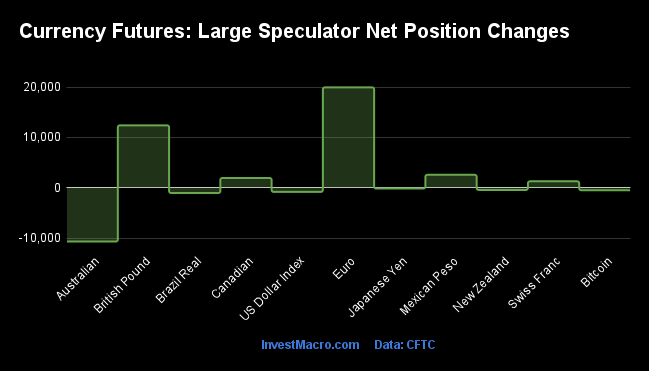
Weekly Speculator Changes led by Australian Dollar & Mexican Peso

The COT currency market speculator bets were lower through February 21st as five out of the eleven currency markets we cover had higher positioning while the other six markets had lower speculator contracts.

Leading the gains for the currency markets was the Australian Dollar (4,119 contracts) with the Mexican Peso (2,794 contracts), EuroFX (1,162 contracts), the US Dollar Index (224 contracts) and the Swiss Franc (948 contracts) also showing positive weeks.

The currencies seeing declines in speculator bets on the week were the Japanese Yen (-6,186 contracts), Canadian Dollar (-2,009 contracts), Brazilian Real (-1,409 contracts), the British Pound (-1,621 contracts), the New Zealand Dollar (-215 contracts) and Bitcoin (-29 contracts) also registering lower bets on the week.


Data Snapshot of Forex Market Traders | Columns Legend
Feb-21-2023OIOI-IndexSpec-NetSpec-IndexCom-NetCOM-IndexSmalls-NetSmalls-Index
USD Index36,0223612,19845-16,640494,44265
EUR789,89897165,06884-213,8181748,75057
GBP213,50245-21,4165137,64160-16,22526
JPY186,10041-34,0294846,88959-12,86027
CHF39,08733-6,5203712,05865-5,53839
CAD151,89632-37,503039,753100-2,25026
AUD123,45625-24,7886225,04938-26152
NZD29,88868,78878-9,0242523654
MXN277,35386-36,8731431,458835,41590
RUB20,93047,54331-7,15069-39324
BRL47,2473630,53379-32,115211,58280
Bitcoin16,50187-81263438037421


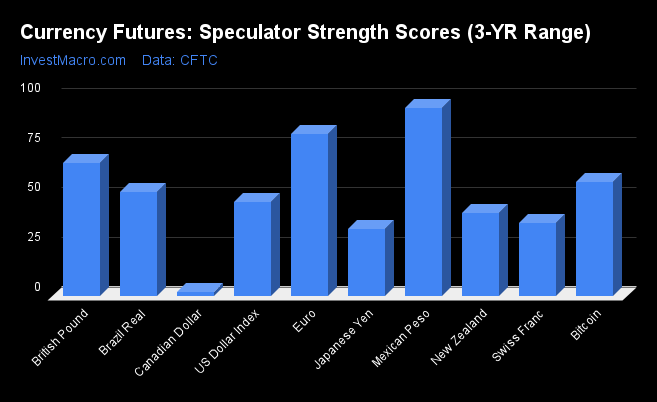
Strength Scores led by EuroFX & Brazilian Real

COT Strength Scores (a normalized measure of Speculator positions over a 3-Year range, from 0 to 100 where above 80 is Extreme-Bullish and below 20 is Extreme-Bearish) showed that the EuroFX (84 percent) and the Brazilian Real (79 percent) lead the currency markets through February 21st. The New Zealand Dollar (78 percent), Bitcoin (63 percent) and the Australian Dollar (62 percent) come in as the next highest in the weekly strength scores.

On the downside, the Canadian Dollar (0 percent) and the Mexican Peso (14 percent) come in at the lowest strength levels currently and are in Extreme-Bearish territory (below 20 percent). The next lowest strength scores are the Swiss Franc (37 percent) and the US Dollar Index (45 percent).

Strength Statistics:
US Dollar Index (45.3 percent) vs US Dollar Index previous week (44.9 percent)
EuroFX (84.4 percent) vs EuroFX previous week (84.0 percent)
British Pound Sterling (50.6 percent) vs British Pound Sterling previous week (52.0 percent)
Japanese Yen (47.9 percent) vs Japanese Yen previous week (51.7 percent)
Swiss Franc (37.4 percent) vs Swiss Franc previous week (34.9 percent)
Canadian Dollar (0.0 percent) vs Canadian Dollar previous week (2.3 percent)
Australian Dollar (61.9 percent) vs Australian Dollar previous week (58.0 percent)
New Zealand Dollar (77.7 percent) vs New Zealand Dollar previous week (78.3 percent)
Mexican Peso (14.0 percent) vs Mexican Peso previous week (12.5 percent)
Brazilian Real (78.6 percent) vs Brazilian Real previous week (80.1 percent)
Bitcoin (62.8 percent) vs Bitcoin previous week (63.3 percent)


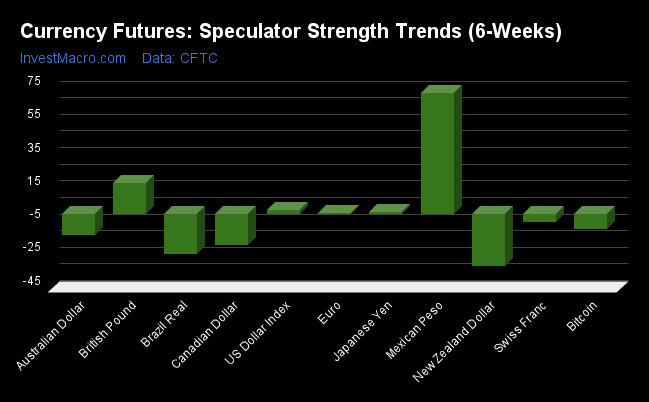
EuroFX & Brazilian Real top the 6-Week Strength Trends

COT Strength Score Trends (or move index, calculates the 6-week changes in strength scores) showed that the EuroFX (10 percent) and the Brazilian Real (9 percent) led the past six weeks trends for the currencies through February 21st. The Australian Dollar (8 percent), the Mexican Peso (8 percent) and the British Pound (7 percent) were the next highest positive movers in the latest trends data.

The Canadian Dollar (-8 percent) led the downside trend scores currently with the US Dollar Index (-7 percent), Bitcoin (-4 percent) and the Japanese Yen (1 percent) following next with lower trend scores.

Strength Trend Statistics:
US Dollar Index (-7.2 percent) vs US Dollar Index previous week (-9.7 percent)
EuroFX (10.1 percent) vs EuroFX previous week (11.4 percent)
British Pound Sterling (6.9 percent) vs British Pound Sterling previous week (0.4 percent)
Japanese Yen (0.8 percent) vs Japanese Yen previous week (11.7 percent)
Swiss Franc (2.2 percent) vs Swiss Franc previous week (-12.2 percent)
Canadian Dollar (-7.6 percent) vs Canadian Dollar previous week (-10.1 percent)
Australian Dollar (8.3 percent) vs Australian Dollar previous week (6.8 percent)
New Zealand Dollar (3.8 percent) vs New Zealand Dollar previous week (4.1 percent)
Mexican Peso (8.5 percent) vs Mexican Peso previous week (8.6 percent)
Brazilian Real (9.5 percent) vs Brazilian Real previous week (4.0 percent)
Bitcoin (-3.8 percent) vs Bitcoin previous week (-20.4 percent)


Individual COT Forex Markets:

US Dollar Index Futures:

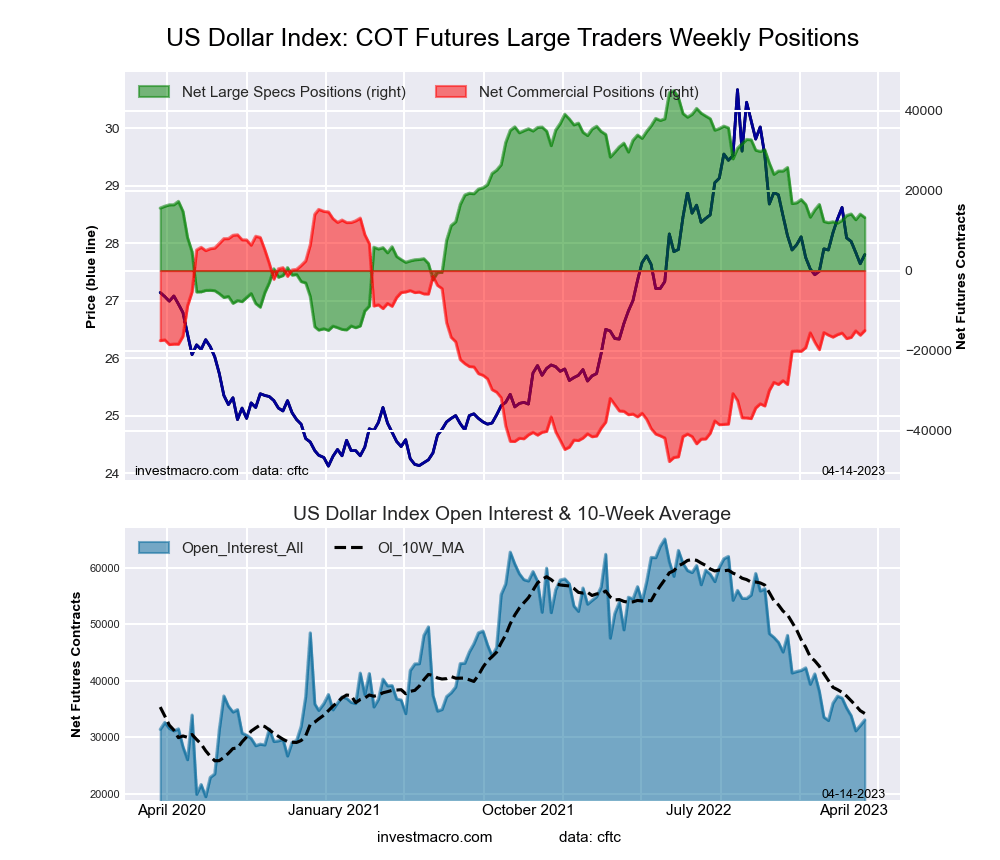
US Dollar Index Forex Futures COT ChartThe US Dollar Index large speculator standing equaled a net position of 12,198 contracts in the data reported through Tuesday February 21st. This was a weekly lift of 224 contracts from the previous week which had a total of 11,974 net contracts.

The week’s current strength score (the trader positioning range over the past three years, measured from 0 to 100) shows the speculators are currently Bearish with a score of 45.3 percent. The commercials are Bearish with a score of 49.3 percent and the small traders (not shown in chart) are Bullish with a score of 65.1 percent.

US DOLLAR INDEX StatisticsSPECULATORSCOMMERCIALSSMALL TRADERS
– Percent of Open Interest Longs:73.52.519.0
– Percent of Open Interest Shorts:39.648.76.6
– Net Position:12,198-16,6404,442
– Gross Longs:26,4699096,832
– Gross Shorts:14,27117,5492,390
– Long to Short Ratio:1.9 to 10.1 to 12.9 to 1
NET POSITION TREND:
– Strength Index Score (3 Year Range Pct):45.349.365.1
– Strength Index Reading (3 Year Range):BearishBearishBullish
NET POSITION MOVEMENT INDEX:
– 6-Week Change in Strength Index:-7.24.218.6


Euro Currency Futures:

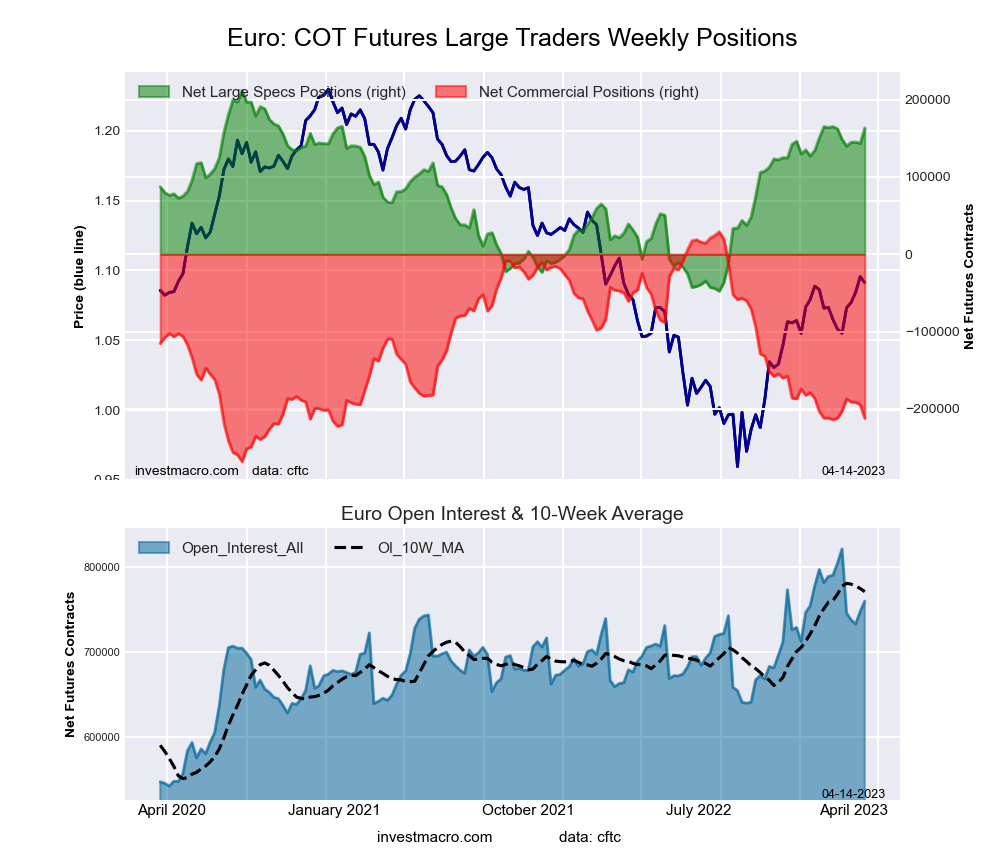
Euro Currency Futures COT ChartThe Euro Currency large speculator standing equaled a net position of 165,068 contracts in the data reported through Tuesday February 21st. This was a weekly boost of 1,162 contracts from the previous week which had a total of 163,906 net contracts.

The week’s current strength score (the trader positioning range over the past three years, measured from 0 to 100) shows the speculators are currently Bullish-Extreme with a score of 84.4 percent. The commercials are Bearish-Extreme with a score of 16.7 percent and the small traders (not shown in chart) are Bullish with a score of 56.8 percent.

EURO Currency StatisticsSPECULATORSCOMMERCIALSSMALL TRADERS
– Percent of Open Interest Longs:29.956.311.6
– Percent of Open Interest Shorts:9.083.45.4
– Net Position:165,068-213,81848,750
– Gross Longs:236,414444,65891,704
– Gross Shorts:71,346658,47642,954
– Long to Short Ratio:3.3 to 10.7 to 12.1 to 1
NET POSITION TREND:
– Strength Index Score (3 Year Range Pct):84.416.756.8
– Strength Index Reading (3 Year Range):Bullish-ExtremeBearish-ExtremeBullish
NET POSITION MOVEMENT INDEX:
– 6-Week Change in Strength Index:10.1-9.82.4


British Pound Sterling Futures:

British Pound Sterling Futures COT ChartThe British Pound Sterling large speculator standing equaled a net position of -21,416 contracts in the data reported through Tuesday February 21st. This was a weekly lowering of -1,621 contracts from the previous week which had a total of -19,795 net contracts.

The week’s current strength score (the trader positioning range over the past three years, measured from 0 to 100) shows the speculators are currently Bullish with a score of 50.6 percent. The commercials are Bullish with a score of 59.7 percent and the small traders (not shown in chart) are Bearish with a score of 26.2 percent.

BRITISH POUND StatisticsSPECULATORSCOMMERCIALSSMALL TRADERS
– Percent of Open Interest Longs:21.367.09.5
– Percent of Open Interest Shorts:31.349.417.1
– Net Position:-21,41637,641-16,225
– Gross Longs:45,475143,07720,231
– Gross Shorts:66,891105,43636,456
– Long to Short Ratio:0.7 to 11.4 to 10.6 to 1
NET POSITION TREND:
– Strength Index Score (3 Year Range Pct):50.659.726.2
– Strength Index Reading (3 Year Range):BullishBullishBearish
NET POSITION MOVEMENT INDEX:
– 6-Week Change in Strength Index:6.91.6-20.4


Japanese Yen Futures:

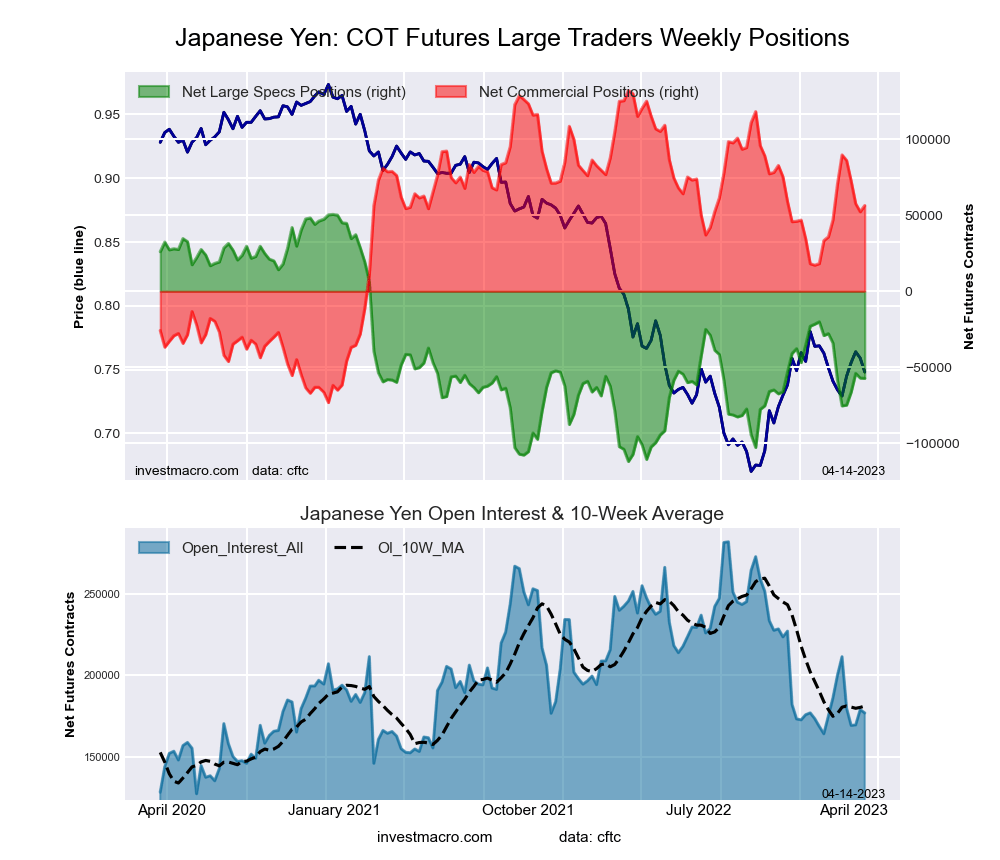
Japanese Yen Forex Futures COT ChartThe Japanese Yen large speculator standing totaled a net position of -34,029 contracts in the data reported through Tuesday February 21st. This was a weekly lowering of -6,186 contracts from the previous week which had a total of -27,843 net contracts.

The week’s current strength score (the trader positioning range over the past three years, measured from 0 to 100) shows the speculators are currently Bearish with a score of 47.9 percent. The commercials are Bullish with a score of 58.5 percent and the small traders (not shown in chart) are Bearish with a score of 27.3 percent.

JAPANESE YEN StatisticsSPECULATORSCOMMERCIALSSMALL TRADERS
– Percent of Open Interest Longs:17.568.112.4
– Percent of Open Interest Shorts:35.742.919.3
– Net Position:-34,02946,889-12,860
– Gross Longs:32,486126,77723,044
– Gross Shorts:66,51579,88835,904
– Long to Short Ratio:0.5 to 11.6 to 10.6 to 1
NET POSITION TREND:
– Strength Index Score (3 Year Range Pct):47.958.527.3
– Strength Index Reading (3 Year Range):BearishBullishBearish
NET POSITION MOVEMENT INDEX:
– 6-Week Change in Strength Index:0.86.0-27.9


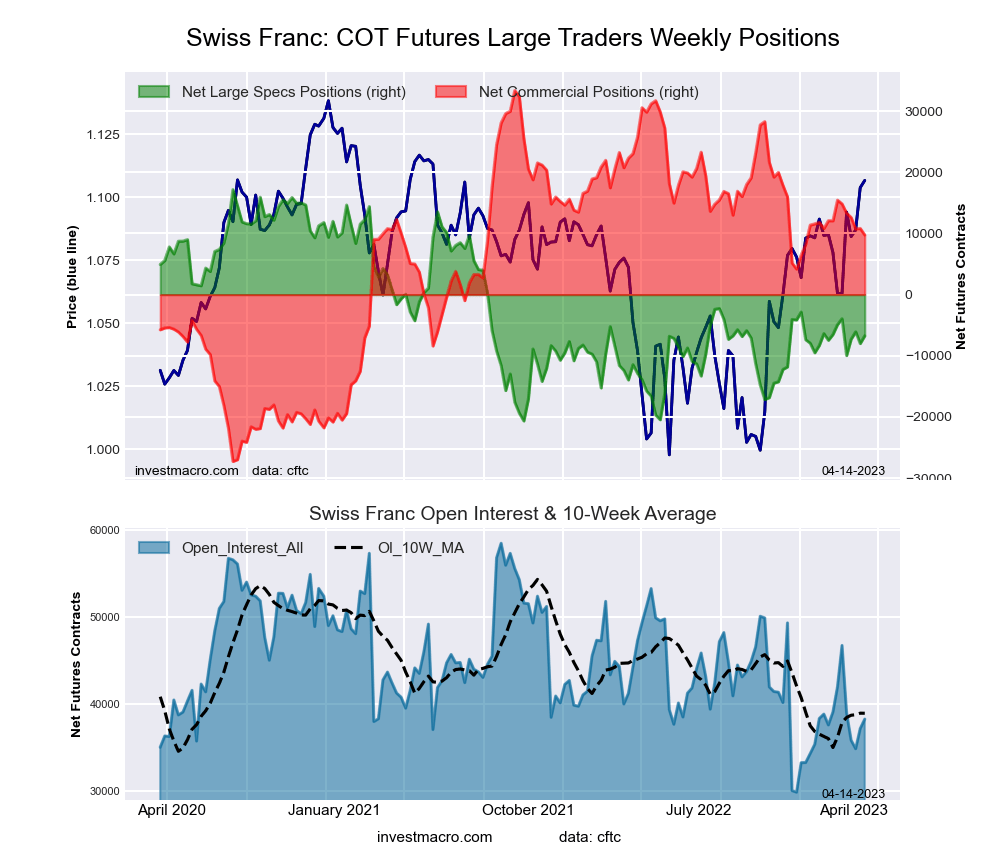
Swiss Franc Futures:

Swiss Franc Forex Futures COT ChartThe Swiss Franc large speculator standing amounted to a net position of -6,520 contracts in the data reported through Tuesday February 21st. This was a weekly rise of 948 contracts from the previous week which had a total of -7,468 net contracts.

The week’s current strength score (the trader positioning range over the past three years, measured from 0 to 100) shows the speculators are currently Bearish with a score of 37.4 percent. The commercials are Bullish with a score of 64.9 percent and the small traders (not shown in chart) are Bearish with a score of 38.8 percent.

SWISS FRANC StatisticsSPECULATORSCOMMERCIALSSMALL TRADERS
– Percent of Open Interest Longs:18.558.023.3
– Percent of Open Interest Shorts:35.227.137.5
– Net Position:-6,52012,058-5,538
– Gross Longs:7,24322,6689,110
– Gross Shorts:13,76310,61014,648
– Long to Short Ratio:0.5 to 12.1 to 10.6 to 1
NET POSITION TREND:
– Strength Index Score (3 Year Range Pct):37.464.938.8
– Strength Index Reading (3 Year Range):BearishBullishBearish
NET POSITION MOVEMENT INDEX:
– 6-Week Change in Strength Index:2.26.4-15.9


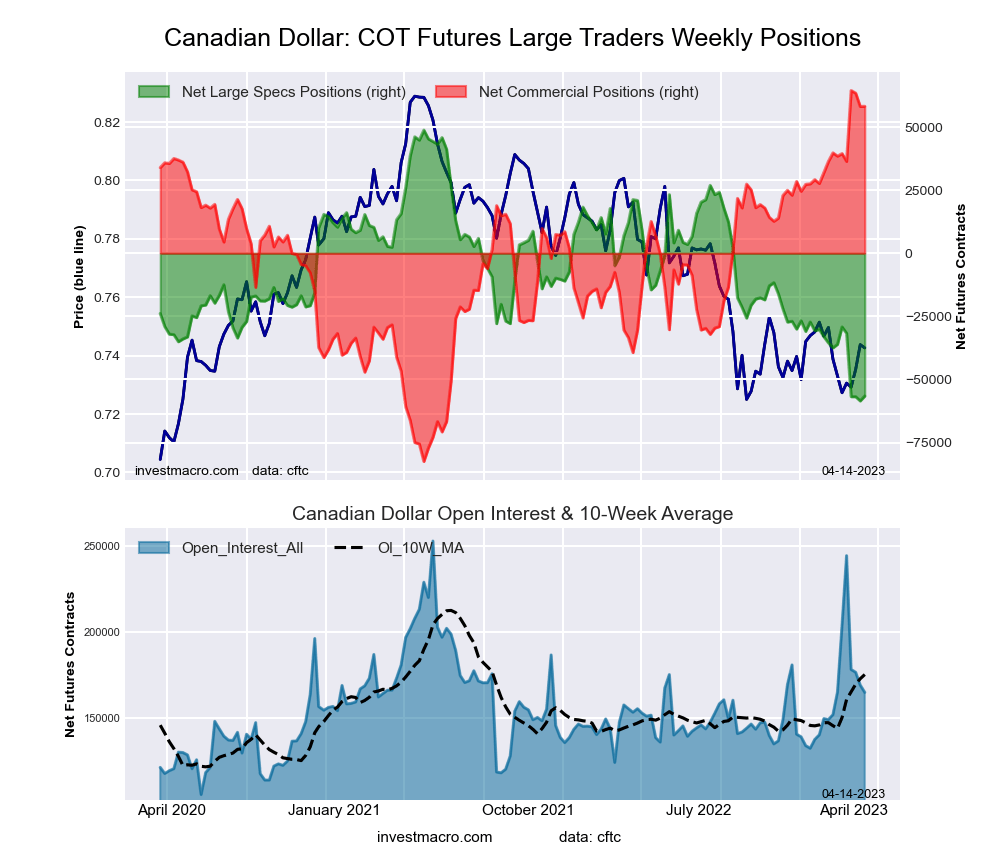
Canadian Dollar Futures:

Canadian Dollar Forex Futures COT ChartThe Canadian Dollar large speculator standing totaled a net position of -37,503 contracts in the data reported through Tuesday February 21st. This was a weekly reduction of -2,009 contracts from the previous week which had a total of -35,494 net contracts.

The week’s current strength score (the trader positioning range over the past three years, measured from 0 to 100) shows the speculators are currently Bearish-Extreme with a score of 0.0 percent. The commercials are Bullish-Extreme with a score of 100.0 percent and the small traders (not shown in chart) are Bearish with a score of 25.6 percent.

CANADIAN DOLLAR StatisticsSPECULATORSCOMMERCIALSSMALL TRADERS
– Percent of Open Interest Longs:14.459.623.0
– Percent of Open Interest Shorts:39.133.424.5
– Net Position:-37,50339,753-2,250
– Gross Longs:21,88990,48934,967
– Gross Shorts:59,39250,73637,217
– Long to Short Ratio:0.4 to 11.8 to 10.9 to 1
NET POSITION TREND:
– Strength Index Score (3 Year Range Pct):0.0100.025.6
– Strength Index Reading (3 Year Range):Bearish-ExtremeBullish-ExtremeBearish
NET POSITION MOVEMENT INDEX:
– 6-Week Change in Strength Index:-7.610.2-11.9


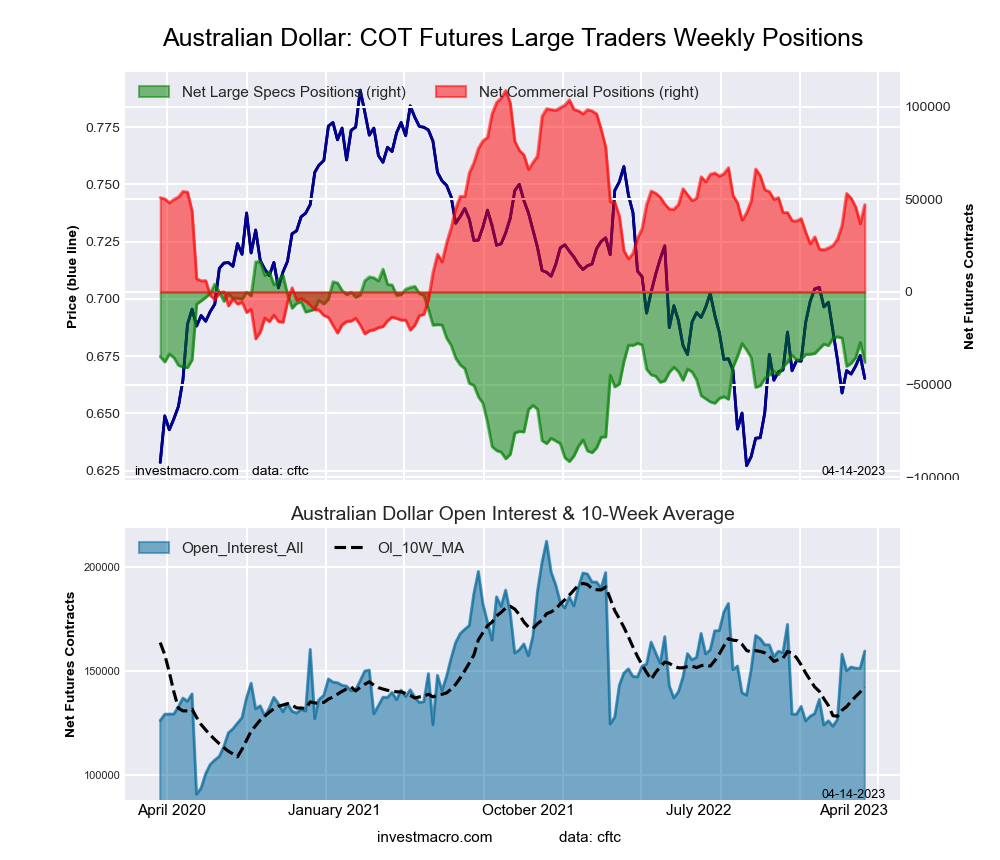
Australian Dollar Futures:

Australian Dollar Forex Futures COT ChartThe Australian Dollar large speculator standing was a net position of -24,788 contracts in the data reported through Tuesday February 21st. This was a weekly boost of 4,119 contracts from the previous week which had a total of -28,907 net contracts.

The week’s current strength score (the trader positioning range over the past three years, measured from 0 to 100) shows the speculators are currently Bullish with a score of 61.9 percent. The commercials are Bearish with a score of 37.6 percent and the small traders (not shown in chart) are Bullish with a score of 51.8 percent.

AUSTRALIAN DOLLAR StatisticsSPECULATORSCOMMERCIALSSMALL TRADERS
– Percent of Open Interest Longs:31.249.017.8
– Percent of Open Interest Shorts:51.328.818.0
– Net Position:-24,78825,049-261
– Gross Longs:38,49260,54321,994
– Gross Shorts:63,28035,49422,255
– Long to Short Ratio:0.6 to 11.7 to 11.0 to 1
NET POSITION TREND:
– Strength Index Score (3 Year Range Pct):61.937.651.8
– Strength Index Reading (3 Year Range):BullishBearishBullish
NET POSITION MOVEMENT INDEX:
– 6-Week Change in Strength Index:8.3-5.3-4.2


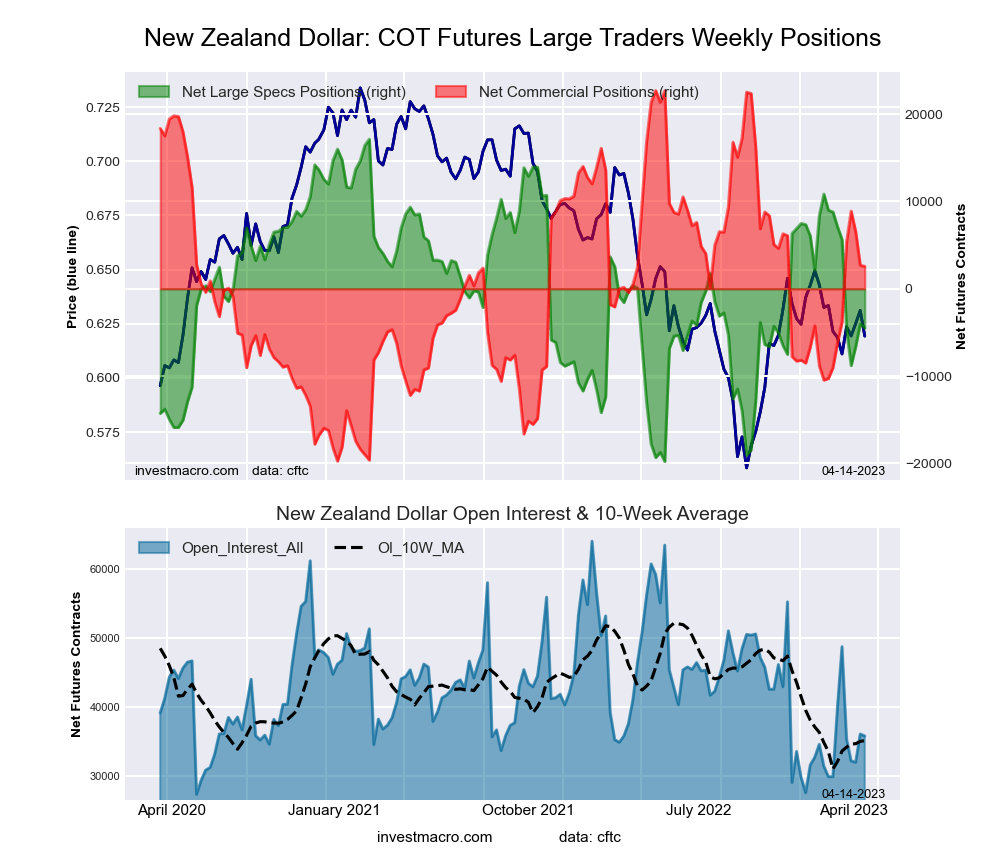
New Zealand Dollar Futures:

New Zealand Dollar Forex Futures COT ChartThe New Zealand Dollar large speculator standing amounted to a net position of 8,788 contracts in the data reported through Tuesday February 21st. This was a weekly fall of -215 contracts from the previous week which had a total of 9,003 net contracts.

The week’s current strength score (the trader positioning range over the past three years, measured from 0 to 100) shows the speculators are currently Bullish with a score of 77.7 percent. The commercials are Bearish with a score of 25.2 percent and the small traders (not shown in chart) are Bullish with a score of 54.4 percent.

NEW ZEALAND DOLLAR StatisticsSPECULATORSCOMMERCIALSSMALL TRADERS
– Percent of Open Interest Longs:52.130.013.5
– Percent of Open Interest Shorts:22.760.212.7
– Net Position:8,788-9,024236
– Gross Longs:15,5618,9654,026
– Gross Shorts:6,77317,9893,790
– Long to Short Ratio:2.3 to 10.5 to 11.1 to 1
NET POSITION TREND:
– Strength Index Score (3 Year Range Pct):77.725.254.4
– Strength Index Reading (3 Year Range):BullishBearishBullish
NET POSITION MOVEMENT INDEX:
– 6-Week Change in Strength Index:3.8-1.2-10.5


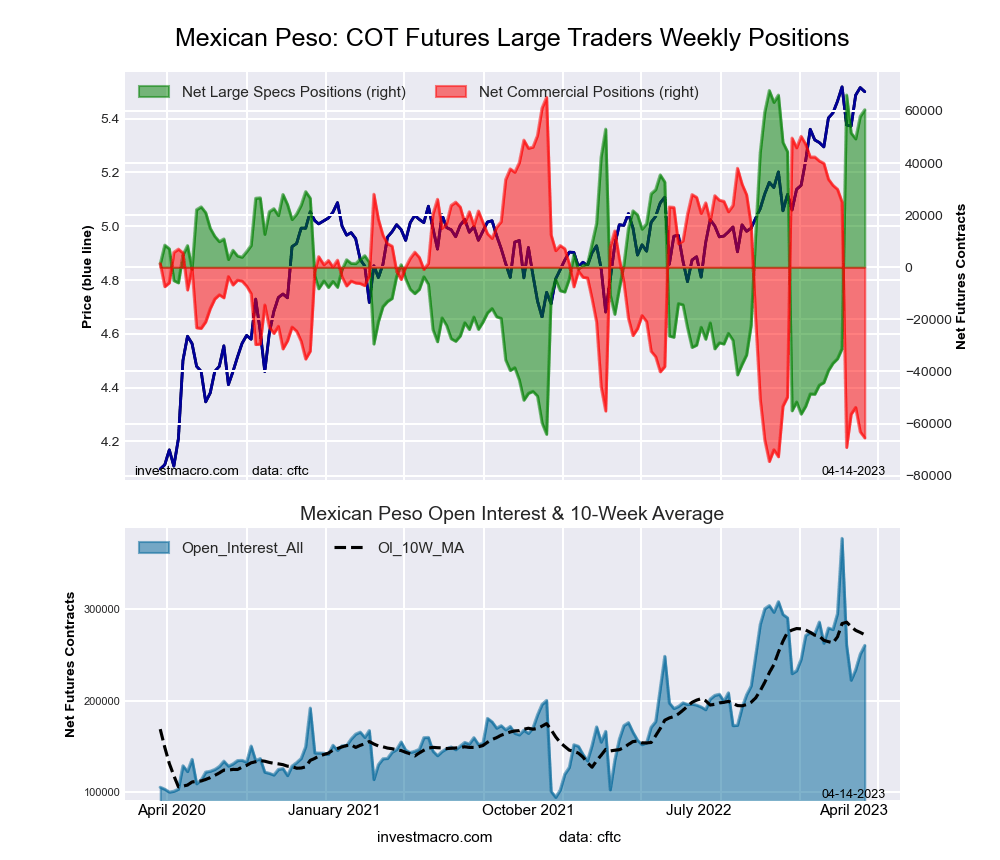
Mexican Peso Futures:

Mexican Peso Futures COT ChartThe Mexican Peso large speculator standing equaled a net position of -36,873 contracts in the data reported through Tuesday February 21st. This was a weekly advance of 2,794 contracts from the previous week which had a total of -39,667 net contracts.

The week’s current strength score (the trader positioning range over the past three years, measured from 0 to 100) shows the speculators are currently Bearish-Extreme with a score of 14.0 percent. The commercials are Bullish-Extreme with a score of 83.0 percent and the small traders (not shown in chart) are Bullish-Extreme with a score of 89.5 percent.

MEXICAN PESO StatisticsSPECULATORSCOMMERCIALSSMALL TRADERS
– Percent of Open Interest Longs:55.041.03.1
– Percent of Open Interest Shorts:68.329.71.2
– Net Position:-36,87331,4585,415
– Gross Longs:152,675113,8168,689
– Gross Shorts:189,54882,3583,274
– Long to Short Ratio:0.8 to 11.4 to 12.7 to 1
NET POSITION TREND:
– Strength Index Score (3 Year Range Pct):14.083.089.5
– Strength Index Reading (3 Year Range):Bearish-ExtremeBullish-ExtremeBullish-Extreme
NET POSITION MOVEMENT INDEX:
– 6-Week Change in Strength Index:8.5-7.9-4.4


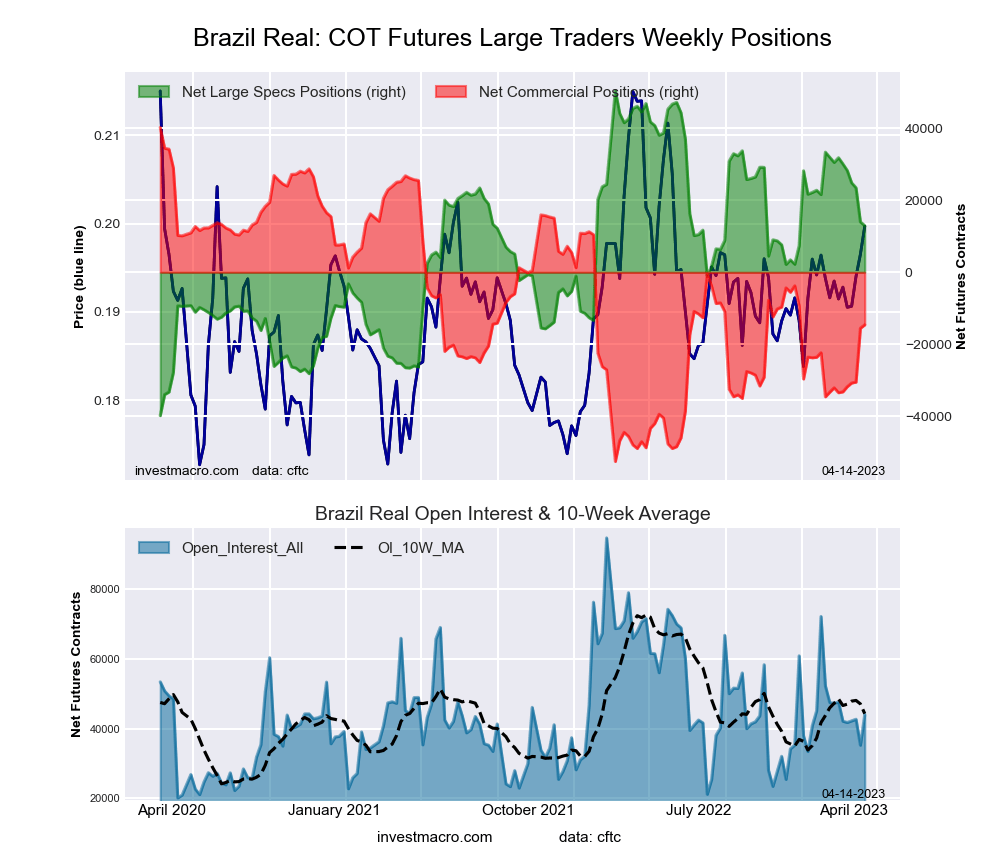
Brazilian Real Futures:

Brazil Real Futures COT ChartThe Brazilian Real large speculator standing equaled a net position of 30,533 contracts in the data reported through Tuesday February 21st. This was a weekly lowering of -1,409 contracts from the previous week which had a total of 31,942 net contracts.

The week’s current strength score (the trader positioning range over the past three years, measured from 0 to 100) shows the speculators are currently Bullish with a score of 78.6 percent. The commercials are Bearish with a score of 21.4 percent and the small traders (not shown in chart) are Bullish with a score of 79.8 percent.

BRAZIL REAL StatisticsSPECULATORSCOMMERCIALSSMALL TRADERS
– Percent of Open Interest Longs:74.417.77.9
– Percent of Open Interest Shorts:9.785.74.6
– Net Position:30,533-32,1151,582
– Gross Longs:35,1378,3573,733
– Gross Shorts:4,60440,4722,151
– Long to Short Ratio:7.6 to 10.2 to 11.7 to 1
NET POSITION TREND:
– Strength Index Score (3 Year Range Pct):78.621.479.8
– Strength Index Reading (3 Year Range):BullishBearishBullish
NET POSITION MOVEMENT INDEX:
– 6-Week Change in Strength Index:9.5-9.0-3.3


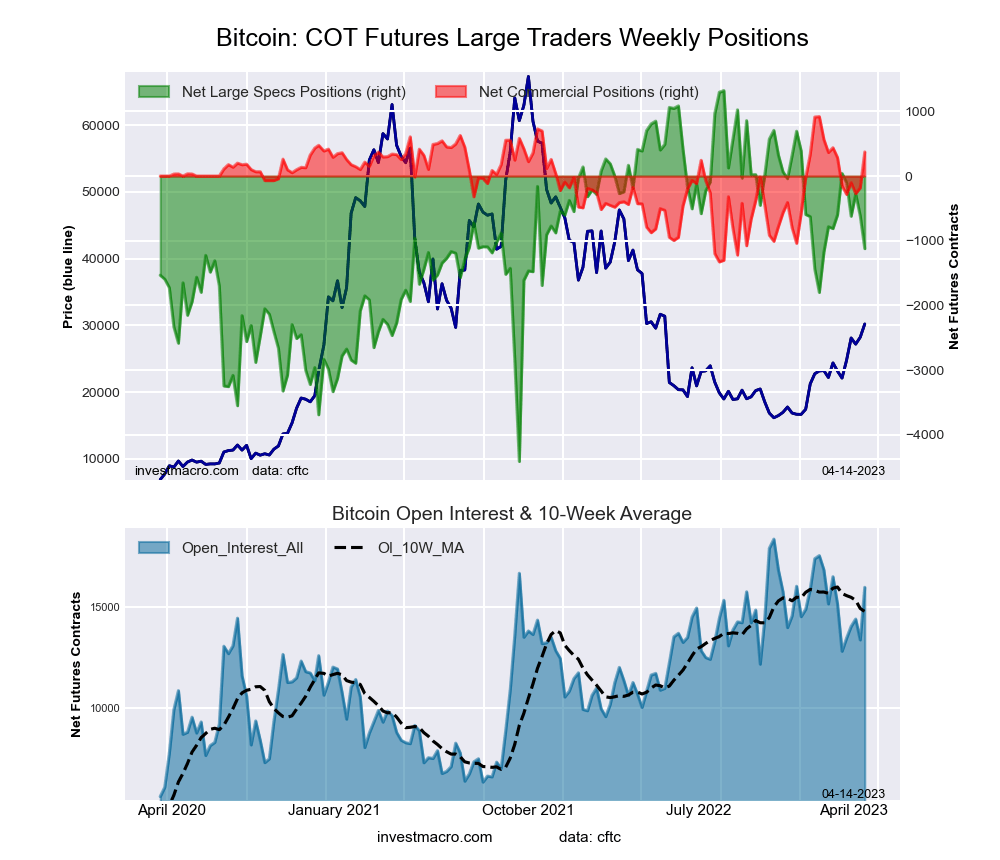
Bitcoin Futures:

Bitcoin Crypto Futures COT ChartThe Bitcoin large speculator standing was a net position of -812 contracts in the data reported through Tuesday February 21st. This was a weekly lowering of -29 contracts from the previous week which had a total of -783 net contracts.

The week’s current strength score (the trader positioning range over the past three years, measured from 0 to 100) shows the speculators are currently Bullish with a score of 62.8 percent. The commercials are Bullish with a score of 78.5 percent and the small traders (not shown in chart) are Bearish with a score of 21.4 percent.

BITCOIN StatisticsSPECULATORSCOMMERCIALSSMALL TRADERS
– Percent of Open Interest Longs:73.94.98.5
– Percent of Open Interest Shorts:78.82.36.2
– Net Position:-812438374
– Gross Longs:12,1888101,398
– Gross Shorts:13,0003721,024
– Long to Short Ratio:0.9 to 12.2 to 11.4 to 1
NET POSITION TREND:
– Strength Index Score (3 Year Range Pct):62.878.521.4
– Strength Index Reading (3 Year Range):BullishBullishBearish
NET POSITION MOVEMENT INDEX:
– 6-Week Change in Strength Index:-3.820.8-5.7


Article By InvestMacroReceive our weekly COT Newsletter

*COT Report: The COT data, released weekly to the public each Friday, is updated through the most recent Tuesday (data is 3 days old) and shows a quick view of how large speculators or non-commercials (for-profit traders) were positioned in the futures markets.

The CFTC categorizes trader positions according to commercial hedgers (traders who use futures contracts for hedging as part of the business), non-commercials (large traders who speculate to realize trading profits) and nonreportable traders (usually small traders/speculators) as well as their open interest (contracts open in the market at time of reporting). See CFTC criteria here.

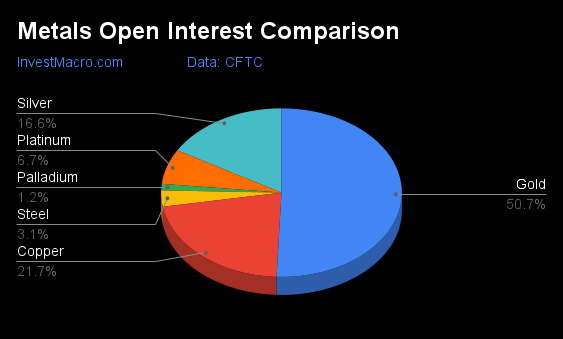
COT Metals Charts: February 21st data showed Speculator bets led by Copper & Gold
By InvestMacro

Here are the latest charts and statistics for the Commitment of Traders (COT) data published by the Commodities Futures Trading Commission (CFTC).
The latest COT data is updated through Tuesday February 21st and shows a quick view of how large traders (for-profit speculators and commercial entities) were positioned in the futures markets.
*** This data is still a few weeks behind the current data because the CFTC up-to-date data has been delayed due to a cybersecurity event that happened in early February to ION Cleared Derivatives (a subsidiary of ION Markets). This hack of ION has created a problem for the large trader positions to be reported and reconciled. The CFTC has back-filled some data over the past few weeks and will get the data back up to date in the coming weeks.

Weekly Speculator Changes led by Copper & Gold

The COT metals markets speculator bets were lower through February 21st as two out of the five precious metals markets we cover had higher positioning while the other three markets had lower speculator contracts.

Leading the gains for the metals was Copper (7,560 contracts) with Gold (1,572 contracts) also seeing a positive week.

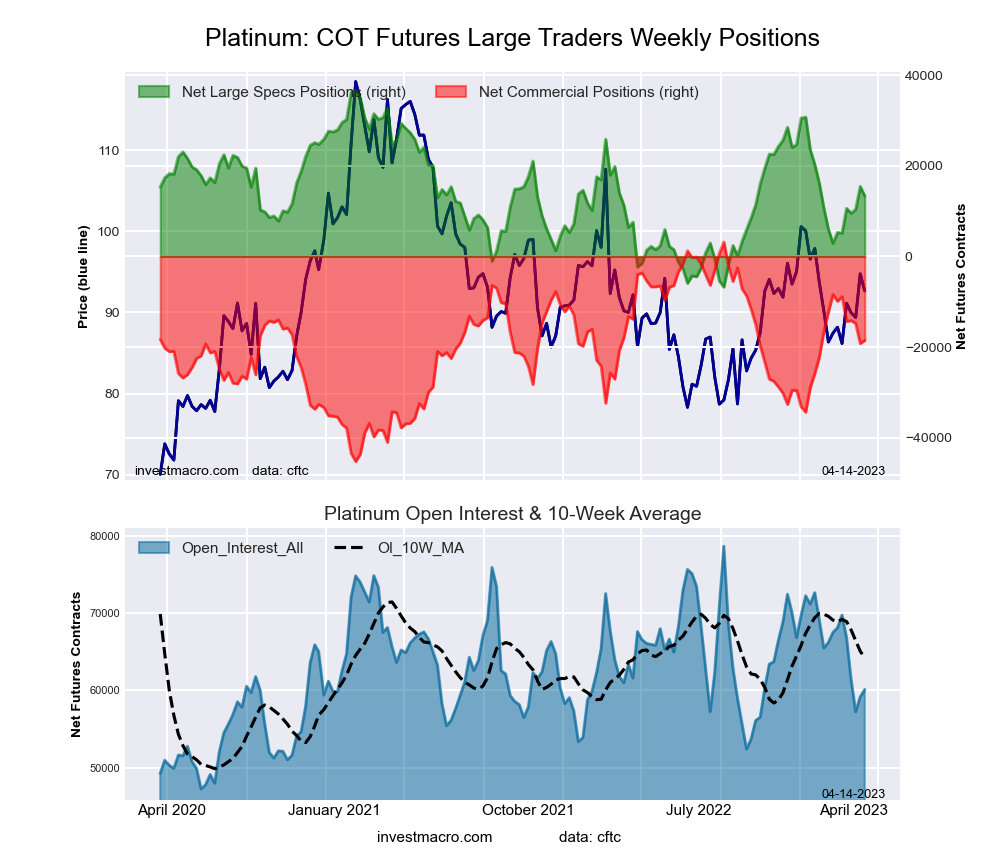
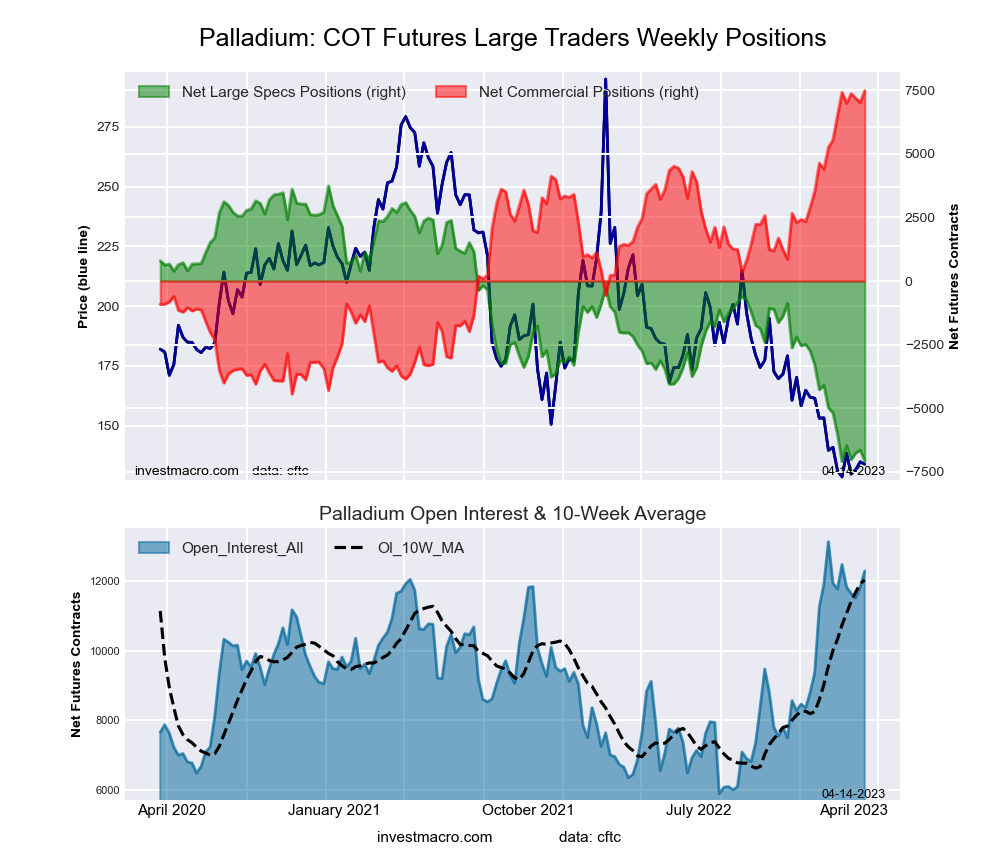
The markets with declines in speculator bets for the week were Platinum (-3,093 contracts), Silver (-1,604 contracts) and Palladium (-199 contracts) with also having lower bets through February 21st.


Data Snapshot of Commodity Market Traders | Columns Legend
Feb-21-2023OIOI-IndexSpec-NetSpec-IndexCom-NetCOM-IndexSmalls-NetSmalls-Index
Gold422,6480107,10121-129,3557722,25436
Silver123,90639,90232-23,0506613,14839
Copper219,205582,04935-8,510626,46163
Palladium11,94384-5,18805,552100-36420
Platinum67,499582,90522-8,394765,48942


Strength Scores led by Copper & Silver

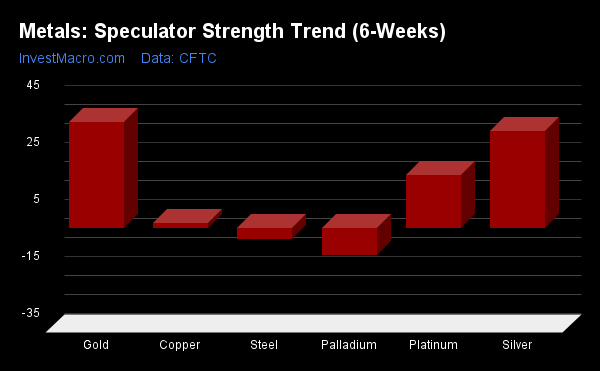
COT Strength Scores (a normalized measure of Speculator positions over a 3-Year range, from 0 to 100 where above 80 is Extreme-Bullish and below 20 is Extreme-Bearish) showed that the Copper (35 percent) led the metals markets through February 21st. Silver (32 percent) came in as the next highest in the weekly strength scores.

On the downside, Palladium (0 percent) comes in at the lowest strength level currently and is in Extreme-Bearish territory (below 20 percent). The next lowest strength score was Gold (21 percent).

Strength Statistics:
Gold (20.6 percent) vs Gold previous week (20.0 percent)
Silver (32.4 percent) vs Silver previous week (34.7 percent)
Copper (34.5 percent) vs Copper previous week (28.2 percent)
Platinum (22.3 percent) vs Platinum previous week (29.4 percent)
Palladium (0.0 percent) vs Palladium previous week (2.2 percent)

Copper & Gold top the 6-Week Strength Trends

COT Strength Score Trends (or move index, calculates the 6-week changes in strength scores) showed that Copper (-7 percent) led the past six weeks trends for metals through February 21st as all metals were in negative trend territory.

Platinum (-64 percent) led the downside trend scores with Palladium (-30 percent) as the next market with lower trend scores.

Move Statistics:
Gold (-16.2 percent) vs Gold previous week (-13.5 percent)
Silver (-27.3 percent) vs Silver previous week (-27.7 percent)
Copper (-6.9 percent) vs Copper previous week (-0.7 percent)
Platinum (-64.2 percent) vs Platinum previous week (-56.6 percent)
Palladium (-30.2 percent) vs Palladium previous week (-27.4 percent)


Individual Markets:

Gold Comex Futures:

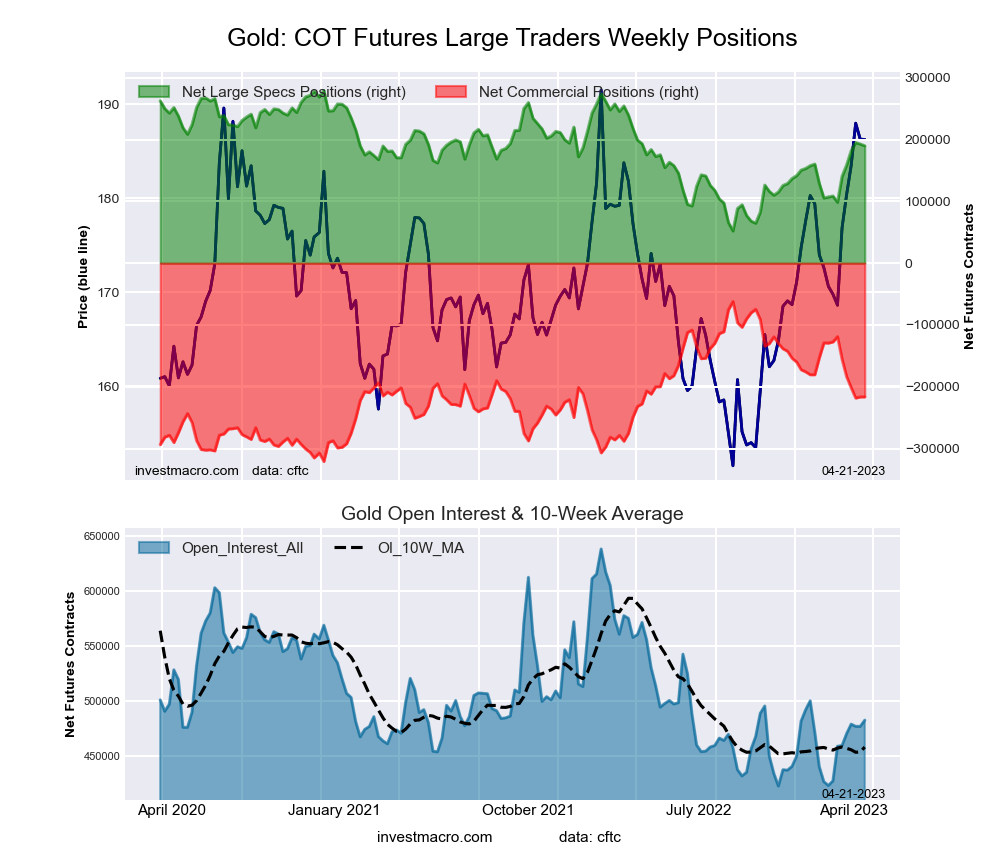
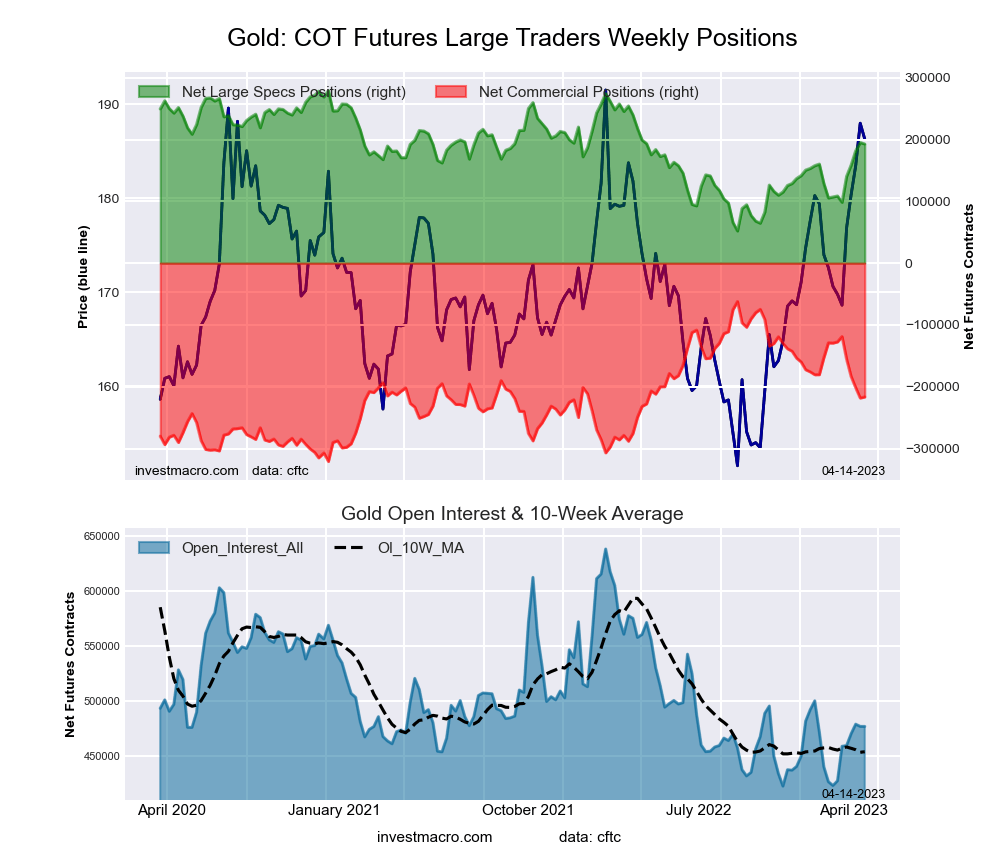
Gold Futures COT ChartThe Gold Comex Futures large speculator standing that week equaled a net position of 107,101 contracts in the data reported through Tuesday February 21st. This was a weekly rise of 1,572 contracts from the previous week which had a total of 105,529 net contracts.

The week’s current strength score (the trader positioning range over the past three years, measured from 0 to 100) shows the speculators are currently Bearish with a score of 20.6 percent. The commercials are Bullish with a score of 76.7 percent and the small traders (not shown in chart) are Bearish with a score of 35.7 percent.

Gold Futures StatisticsSPECULATORSCOMMERCIALSSMALL TRADERS
– Percent of Open Interest Longs:49.728.210.4
– Percent of Open Interest Shorts:24.458.85.1
– Net Position:107,101-129,35522,254
– Gross Longs:210,185119,04043,956
– Gross Shorts:103,084248,39521,702
– Long to Short Ratio:2.0 to 10.5 to 12.0 to 1
NET POSITION TREND:
– Strength Index Score (3 Year Range Pct):20.676.735.7
– Strength Index Reading (3 Year Range):BearishBullishBearish
NET POSITION MOVEMENT INDEX:
– 6-Week Change in Strength Index:-16.214.90.8


Silver Comex Futures:

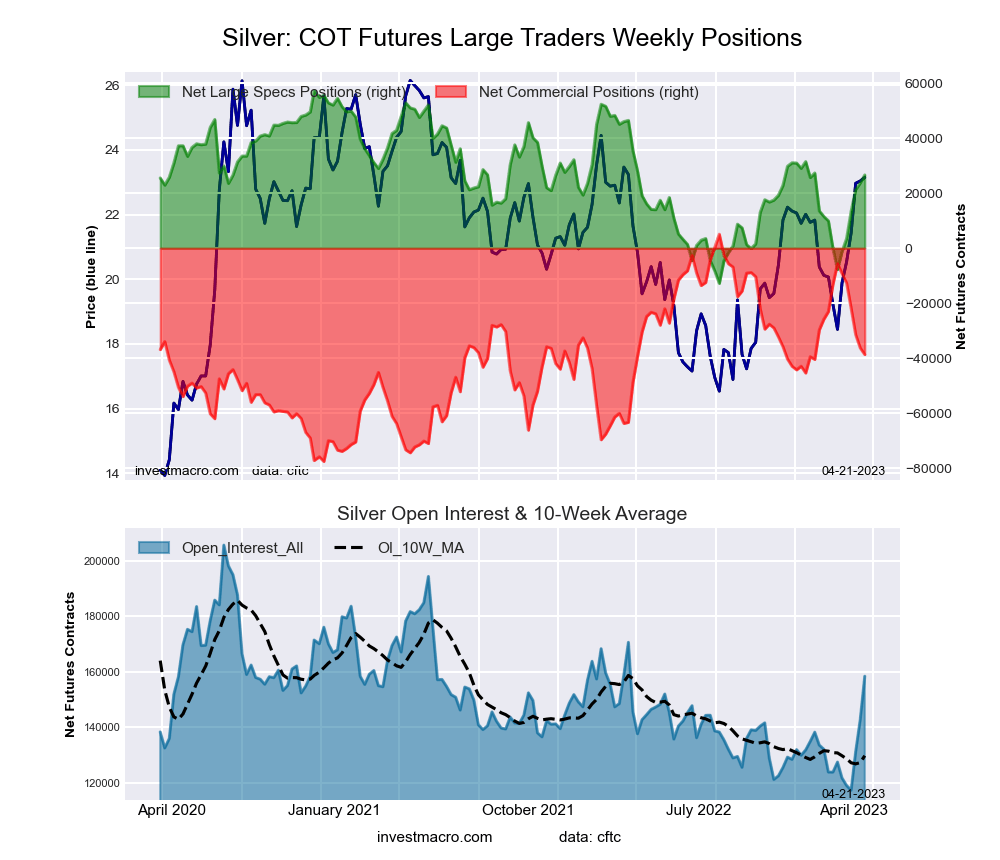
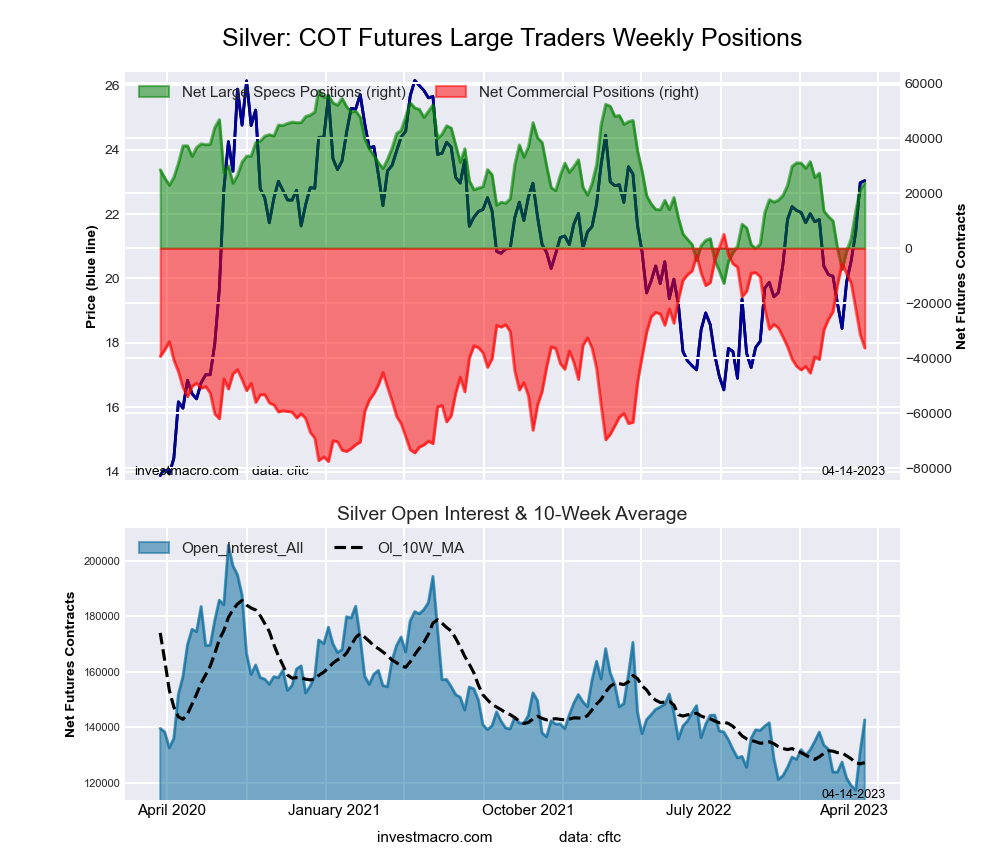
Silver Futures COT ChartThe Silver Comex Futures large speculator standing equaled a net position of 9,902 contracts in the data reported through Tuesday February 21st. This was a weekly reduction of -1,604 contracts from the previous week which had a total of 11,506 net contracts.

The week’s current strength score (the trader positioning range over the past three years, measured from 0 to 100) shows the speculators are currently Bearish with a score of 32.4 percent. The commercials are Bullish with a score of 66.0 percent and the small traders (not shown in chart) are Bearish with a score of 39.4 percent.

Silver Futures StatisticsSPECULATORSCOMMERCIALSSMALL TRADERS
– Percent of Open Interest Longs:36.336.619.9
– Percent of Open Interest Shorts:28.355.29.3
– Net Position:9,902-23,05013,148
– Gross Longs:44,98545,38824,663
– Gross Shorts:35,08368,43811,515
– Long to Short Ratio:1.3 to 10.7 to 12.1 to 1
NET POSITION TREND:
– Strength Index Score (3 Year Range Pct):32.466.039.4
– Strength Index Reading (3 Year Range):BearishBullishBearish
NET POSITION MOVEMENT INDEX:
– 6-Week Change in Strength Index:-27.324.1-4.3


Copper Grade #1 Futures:

Copper Futures COT ChartThe Copper Grade #1 Futures large speculator standing equaled a net position of 2,049 contracts in the data reported through Tuesday February 21st. This was a weekly boost of 7,560 contracts from the previous week which had a total of -5,511 net contracts.

The week’s current strength score (the trader positioning range over the past three years, measured from 0 to 100) shows the speculators are currently Bearish with a score of 34.5 percent. The commercials are Bullish with a score of 61.6 percent and the small traders (not shown in chart) are Bullish with a score of 62.6 percent.

Copper Futures StatisticsSPECULATORSCOMMERCIALSSMALL TRADERS
– Percent of Open Interest Longs:33.542.99.4
– Percent of Open Interest Shorts:32.546.86.4
– Net Position:2,049-8,5106,461
– Gross Longs:73,39594,04720,560
– Gross Shorts:71,346102,55714,099
– Long to Short Ratio:1.0 to 10.9 to 11.5 to 1
NET POSITION TREND:
– Strength Index Score (3 Year Range Pct):34.561.662.6
– Strength Index Reading (3 Year Range):BearishBullishBullish
NET POSITION MOVEMENT INDEX:
– 6-Week Change in Strength Index:-6.96.12.5


Platinum Futures:

Platinum Futures COT ChartThe Platinum Futures large speculator standing equaled a net position of 2,905 contracts in the data reported through Tuesday February 21st. This was a weekly decrease of -3,093 contracts from the previous week which had a total of 5,998 net contracts.

The week’s current strength score (the trader positioning range over the past three years, measured from 0 to 100) shows the speculators are currently Bearish with a score of 22.3 percent. The commercials are Bullish with a score of 76.1 percent and the small traders (not shown in chart) are Bearish with a score of 41.6 percent.

Platinum Futures StatisticsSPECULATORSCOMMERCIALSSMALL TRADERS
– Percent of Open Interest Longs:41.638.012.8
– Percent of Open Interest Shorts:37.350.44.7
– Net Position:2,905-8,3945,489
– Gross Longs:28,05825,6388,655
– Gross Shorts:25,15334,0323,166
– Long to Short Ratio:1.1 to 10.8 to 12.7 to 1
NET POSITION TREND:
– Strength Index Score (3 Year Range Pct):22.376.141.6
– Strength Index Reading (3 Year Range):BearishBullishBearish
NET POSITION MOVEMENT INDEX:
– 6-Week Change in Strength Index:-64.253.724.5


Palladium Futures:

Palladium Futures COT ChartThe Palladium Futures large speculator standing equaled a net position of -5,188 contracts in the data reported through Tuesday February 21st. This was a weekly decrease of -199 contracts from the previous week which had a total of -4,989 net contracts.

The week’s current strength score (the trader positioning range over the past three years, measured from 0 to 100) shows the speculators are currently Bearish-Extreme with a score of 0.0 percent. The commercials are Bullish-Extreme with a score of 100.0 percent and the small traders (not shown in chart) are Bearish-Extreme with a score of 19.8 percent.

Palladium Futures StatisticsSPECULATORSCOMMERCIALSSMALL TRADERS
– Percent of Open Interest Longs:16.068.311.5
– Percent of Open Interest Shorts:59.521.814.5
– Net Position:-5,1885,552-364
– Gross Longs:1,9138,1591,372
– Gross Shorts:7,1012,6071,736
– Long to Short Ratio:0.3 to 13.1 to 10.8 to 1
NET POSITION TREND:
– Strength Index Score (3 Year Range Pct):0.0100.019.8
– Strength Index Reading (3 Year Range):Bearish-ExtremeBullish-ExtremeBearish-Extreme
NET POSITION MOVEMENT INDEX:
– 6-Week Change in Strength Index:-30.232.2-31.1


Article By InvestMacroReceive our weekly COT Newsletter

*COT Report: The COT data, released weekly to the public each Friday, is updated through the most recent Tuesday (data is 3 days old) and shows a quick view of how large speculators or non-commercials (for-profit traders) were positioned in the futures markets.

The CFTC categorizes trader positions according to commercial hedgers (traders who use futures contracts for hedging as part of the business), non-commercials (large traders who speculate to realize trading profits) and nonreportable traders (usually small traders/speculators) as well as their open interest (contracts open in the market at time of reporting). See CFTC criteria here.