Archive for Opinions – Page 93

Mid-Week Technical Outlook: US Indices In Focus

By ForexTime 

European shares pulsed with life on Wednesday, echoing the upbeat mood in Asian markets after Chinese tech giant Alibaba announced it will split into six business groups.

Easing concerns over the banking sector has contributed to the overall risk-on mood with US futures signalling a positive open. After the chaos witness over the past few weeks, it seems like a sense of normality has returned to markets with the attention back on key economic data and risk events. The next few days could be even more eventful, especially for US markets due to Fed speeches, Senate hearings on Silicon Valley Bank, and the Fed’s preferred measure on inflation.

Given the string of data and risk events expected from the US economy, our attention today falls on US indices with the weapon of choice none other than technical analysis.

S&P 500 approaches 50-day SMA

It has been a choppy week for the SPX500 thanks to fundamental forces.

Prices are trading above the 200 and 100-day Simple Moving Average (SMA) but just below the 50-day SMA. A solid daily close and breakout above 4000 could encourage a move higher toward 4050. Beyond this point, prices may test 4090. Alternatively, sustained weakness under 4000 could trigger a decline towards 3930.

Nasdaq 100 trapped within a range

A major breakout could be on the horizon for the NQ100 index. Although the index is trading well above the 50, 100, and 200-day SMA, prices seem to be consolidating. Support can be found at 12500 and resistance at 12850. A major breakout above 12850 could inspire an incline towards 13200. Should prices slip back towards 12500, this could trigger a decline back toward the 50-day SMA at 12280.

Bonus: Dow Jones bulls gather momentum

The WSt30 index on the D1 time frame started a new uptrend when the market structure changed after a last lower bottom formed at 31411 on 15 March. This happened inside a weekly support zone where the bulls found the price attractive and demand started increasing.

After the lower bottom at 31411, the price broke through the 15 Simple Moving Average and the Momentum Oscillator started moving towards the 100 baseline. Alert technical traders might have noticed this early indication that the bulls might be starting to gather momentum.

A higher top and possible critical resistance level formed on 22 March at 32781 after which the bears tried to take back control of the market. The weekly support zone held however and on 24 March at 31743 the bulls took over again with a higher bottom forming. At this stage, the Momentum Oscillator also crossed the 100 baseline as confirmation of the bullish drive.

If the bulls maintain their momentum and the price breaks through the critical resistance level at 32781, then three possible price targets can be calculated from there. Applying the Fibonacci tool to the higher top at 32781 and dragging it to the higher bottom in the weekly support area at 31743, the following targets may be considered. The first target is likely at 33422 (161%), with the second price target feasible at 34460  (261.8%) if the bulls can manage to break through the weekly resistance level on the way there. The third and final target is possible at 36140 (423.6%) with yet another weekly resistance as a hurdle in the path of the bulls.

If the price at 31743 is broken, the bullish scenario is undone and the scenario has to be re-evaluated.

As long as bulls retain their momentum, the outlook for the WSt30 on the D1 time frame will continue to the demand side.


Forex-Time-LogoArticle by ForexTime

ForexTime Ltd (FXTM) is an award winning international online forex broker regulated by CySEC 185/12 www.forextime.com

Trade Of The Week: EURAUD Major Breakout On The Horizon?

By ForexTime 

If you have an appetite for volatility, then keep a close eye on the EURAUD!

The currency pair has rallied over 550 pips since the start of March with bulls smashing through key levels of resistance with the destructive force of a wrecking ball. After hitting a fresh 2023 high at 1.6254 last week and concluding on a firm note, the path of least resistance certainly points north.

Euro strength remains the primary driver behind the EURAUD’s incredible upside. We have seen the euro appreciate against most G10 currencies month-to-date.

On the other hand, the past few weeks have certainly not been kind to the Australian dollar thanks to risk aversion and concerns over the health of Australia’s economy.

This potent combination of euro strength and aussie weakness reinforced the bullish fundamental view for the EURAUD. Given how prices are also trading well above the 50, 100, and 200-day SMA, the technicals also favour more upside momentum. However, the key question is whether bulls have enough strength to conquer the weekly resistance at 1.6200. It is worth keeping in mind that the last time prices secured a weekly close above this point was back in August 2021.

The low down…

It has been an intense month for the EURAUD thanks to central bank meetings, key economic reports, and major risk events.

Earlier this month, the RBA delivered a dovish hike by moving ahead with a 25bp rate increase and signalling a potential pause in its 10-month tightening cycle. One week later, the European Central Bank hiked rates by 50bp, focusing on its fight against inflation despite the chaos revolving around Silicon Valley Bank. As the negative developments concerning the banking sector intensified with Credit Suisse hijacking the headlines, the risk-off sentiment hit appetite for the Australian dollar. Although some stability has returned to markets, lingering fears around the banking sector could keep the Australian dollar depressed. A weaker Aussie is likely to fuel the upside on the EURAUD.

 The week ahead…

We could see some increased activity on the AUD and EUR this week due to key economic reports.

Sentiment towards the German economy received a boost on Monday after the Ifo Business Climate indicator increased to 93.3 in March – the highest seen since February 2021. Given how this survey is seen as one of the best indicators for economic growth, it could support the euro in the near term.

Mid-week, the focus will be directed toward Australia’s February CPI report which is expected to show inflation easing to 7.2% from 7.4% in January. Signs of easing inflation pressures may support the argument for the RBA to pause its monetary tightening cycle in its April report. Ultimately, this development has the potential the weaken the Aussie further.

Germany’s latest inflation figures and Eurozone confidence data will be published on Thursday. The preliminary estimates are expected to reveal that inflation cooled to 7.3% in March from 8.7% in February.

The major risk event for the euro may be on Friday due to the Eurozone’s February unemployment and March inflation figures. Markets expect the rate of unemployment to remain unchanged at 6.7% in February. In regards to inflation, this is expected to fall sharply in March to 7.1% from 8.5% in the previous month. If the swift decline in inflation becomes reality, it will be interesting to see whether fuels speculation around the ECB pausing rates down the road.

Will EURAUD conquer weekly 1.6200 resistance?

It looks like the EURAUD could be gearing up for a bullish breakout if 1.6200 can be conquered. Although prices are firmly bullish on the daily charts, some consolidation is taking place as bulls and bears wait for a fresh fundamental spark. Minor support can be found at 1.6140 and minor resistance around 1.6250. A solid daily breakout and close above 1.6250 could inject bulls with enough strength to end the week above the key 1.6200 level. Such an outcome may open doors towards 1.6400 and 1.6550.

Alternatively, sustained weakness below 1.6200 could see prices slip back towards 1.6140 and 1.5900 – a level just above the 200-week Simple Moving Average.


Forex-Time-LogoArticle by ForexTime

ForexTime Ltd (FXTM) is an award winning international online forex broker regulated by CySEC 185/12 www.forextime.com

Currency Speculators drop their Canadian Dollar bets fall to 218-week low

By InvestMacro

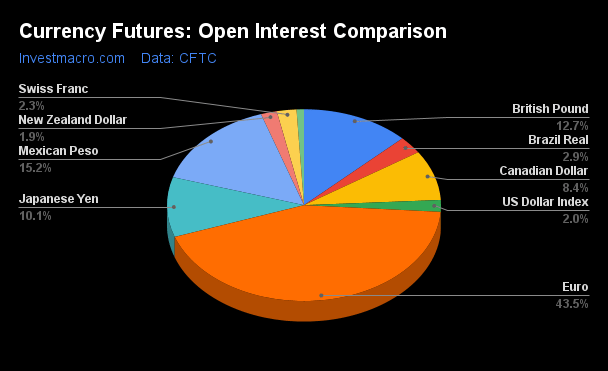
Here are the latest charts and statistics for the Commitment of Traders (COT) data published by the Commodities Futures Trading Commission (CFTC).

The latest COT data is updated through Tuesday March 21st and shows a quick view of how large market participants (for-profit speculators and commercial traders) were positioned in the futures markets. All currency positions are in direct relation to the US dollar where, for example, a bet for the euro is a bet that the euro will rise versus the dollar while a bet against the euro will be a bet that the euro will decline versus the dollar.

* This COT data is fully up-to-date after weeks of delays due to a cybersecurity event that happened in early February to ION Cleared Derivatives (a subsidiary of ION Markets). The hacking incident had disrupted the ability for the CFTC to report large trader positions.

Weekly Speculator Changes led by Japanese Yen & EuroFX

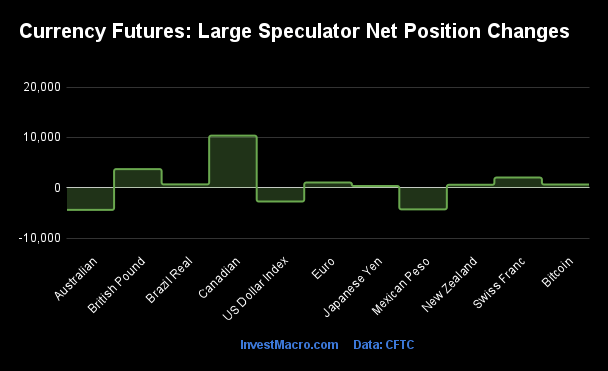
The COT currency market speculator bets were lower this week as five out of the eleven currency markets we cover had higher positioning while the other six markets had lower speculator contracts.

Leading the gains for the currency markets was the Japanese Yen (8,449 contracts) with the EuroFX (4,886 contracts), Swiss Franc (2,668 contracts), Australian Dollar (1,632 contracts) and the US Dollar Index (387 contracts) also showing positive weeks.

The currencies seeing declines in speculator bets on the week were the Canadian Dollar (-25,106 contracts) with the Mexican Peso (-14,597 contracts), the New Zealand Dollar (-4,042 contracts), the British Pound (-3,184 contracts), the Brazilian Real (-3,414 contracts) and Bitcoin (-519 contracts) also registering lower bets on the week.

CAD bets fall to 218-week low

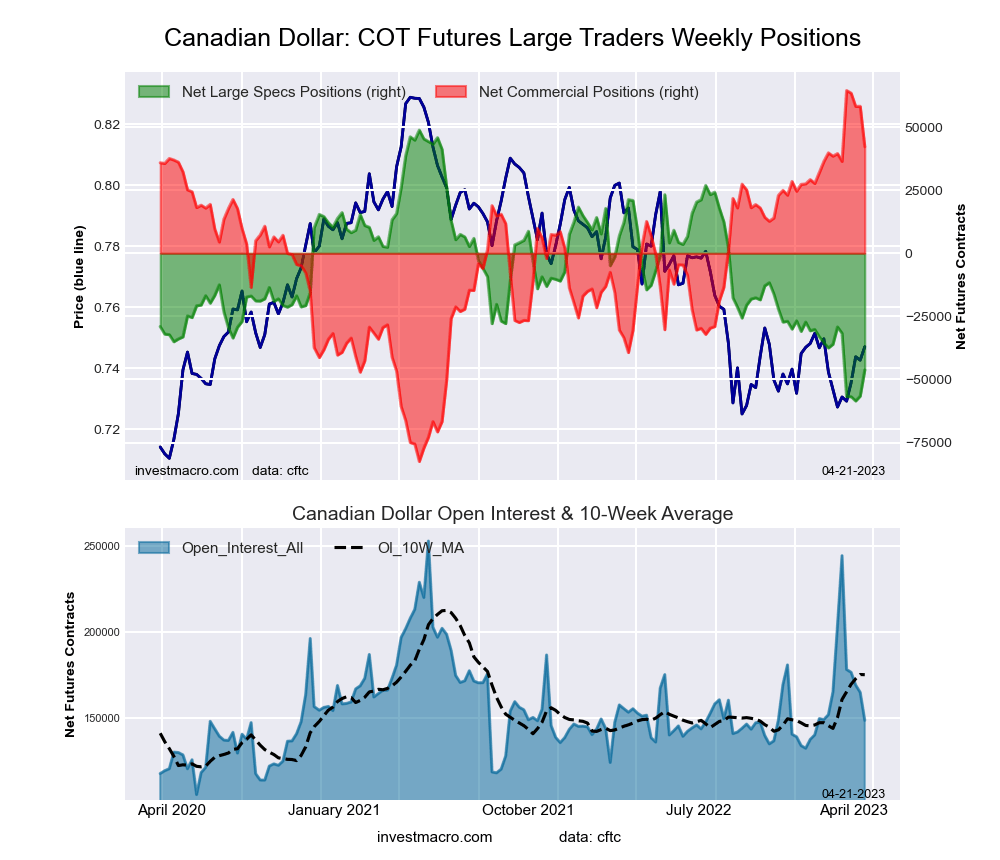
Highlighting the COT currency’s data this week is the bearishness of the speculator’s positioning in the Canadian dollar. Large speculative CAD positions fell this week by over -25,000 contracts and have now declined in five out of the past seven weeks. This recent bearishness has brought the overall net position (currently at -56,821 contracts) to the lowest level in the past 218 weeks, dating back all the way to January 15th of 2019. The CAD speculator strength score (range from 0 to 100) is currently at 0.0 percent while the 6-week speculator strength trend is at -22 percent.

The Canadian dollar exchange rate versus the US dollar has been in a downtrend to start 2023 with the CAD futures (front month) price sitting currently at 0.7287. The CAD futures opened 2023 around the 0.7382 exchange rate and reached its highest level in late January at 0.7541 before trending lower.


Data Snapshot of Forex Market Traders | Columns Legend
Mar-21-2023OIOI-IndexSpec-NetSpec-IndexCom-NetCOM-IndexSmalls-NetSmalls-Index
USD Index33,8193114,14449-16,708492,56445
EUR737,43770144,84274-191,1712646,32953
GBP190,79631-20,4985125,50651-5,00848
JPY169,18831-66,3452872,48471-6,13941
CHF35,83721-7,2973512,61166-5,31440
CAD178,18549-56,821064,449100-7,6286
AUD151,83650-38,4594950,55457-12,09523
NZD32,17913-8,783308,89667-11350
MXN222,1304551,53088-56,413134,88386
RUB20,93047,54331-7,15069-39324
BRL42,2223024,85767-30,775275,918100
Bitcoin14,04970-62166-103072429


Strength Scores led by Mexican Peso & EuroFX

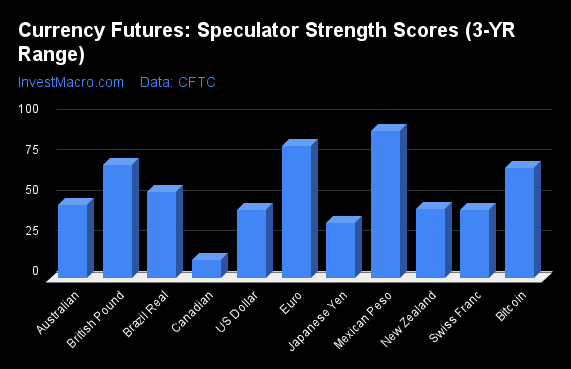
COT Strength Scores (a normalized measure of Speculator positions over a 3-Year range, from 0 to 100 where above 80 is Extreme-Bullish and below 20 is Extreme-Bearish) showed that the Mexican Peso (88 percent) and the EuroFX (74 percent) lead the currency markets this week. The Brazilian Real (67 percent), Bitcoin (66 percent) and the British Pound (51 percent) come in as the next highest in the weekly strength scores.

On the downside, the Canadian Dollar (0 percent) comes in at the lowest strength level currently and is in Extreme-Bearish territory (below 20 percent). The next lowest strength scores are the Japanese Yen (28 percent), New Zealand Dollar (30 percent) and the Swiss Franc (35 percent).

Strength Statistics:
US Dollar Index (48.5 percent) vs US Dollar Index previous week (47.9 percent)
EuroFX (74.2 percent) vs EuroFX previous week (72.3 percent)
British Pound Sterling (51.4 percent) vs British Pound Sterling previous week (54.1 percent)
Japanese Yen (28.0 percent) vs Japanese Yen previous week (22.8 percent)
Swiss Franc (35.3 percent) vs Swiss Franc previous week (28.3 percent)
Canadian Dollar (0.0 percent) vs Canadian Dollar previous week (23.8 percent)
Australian Dollar (49.2 percent) vs Australian Dollar previous week (47.7 percent)
New Zealand Dollar (29.8 percent) vs New Zealand Dollar previous week (40.7 percent)
Mexican Peso (87.6 percent) vs Mexican Peso previous week (98.7 percent)
Brazilian Real (67.4 percent) vs Brazilian Real previous week (71.7 percent)
Bitcoin (66.1 percent) vs Bitcoin previous week (75.2 percent)


Mexican Peso & Bitcoin top the 6-Week Strength Trends

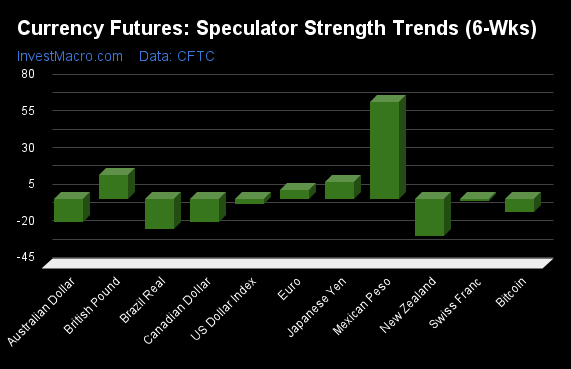
COT Strength Score Trends (or move index, calculates the 6-week changes in strength scores) showed that the Mexican Peso (73 percent) and Bitcoin (10 percent) lead the past six weeks trends for the currencies. The US Dollar Index (3 percent), the Swiss Franc (-2 percent) and the British Pound (-5 percent) are the next highest positive movers in the latest trends data.

The New Zealand Dollar (-53 percent) leads the downside trend scores currently with the Japanese Yen (-23 percent), Canadian Dollar (-22 percent) and the Brazilian Real (-11 percent) following next with lower trend scores.

Strength Trend Statistics:
US Dollar Index (3.1 percent) vs US Dollar Index previous week (-4.6 percent)
EuroFX (-7.8 percent) vs EuroFX previous week (-4.1 percent)
British Pound Sterling (-5.5 percent) vs British Pound Sterling previous week (0.9 percent)
Japanese Yen (-22.9 percent) vs Japanese Yen previous week (-33.7 percent)
Swiss Franc (-2.5 percent) vs Swiss Franc previous week (-4.4 percent)
Canadian Dollar (-22.5 percent) vs Canadian Dollar previous week (-1.4 percent)
Australian Dollar (-9.6 percent) vs Australian Dollar previous week (-8.8 percent)
New Zealand Dollar (-53.2 percent) vs New Zealand Dollar previous week (-35.6 percent)
Mexican Peso (72.6 percent) vs Mexican Peso previous week (84.4 percent)
Brazilian Real (-10.8 percent) vs Brazilian Real previous week (8.5 percent)
Bitcoin (9.7 percent) vs Bitcoin previous week (29.6 percent)


Individual COT Forex Markets:

US Dollar Index Futures:

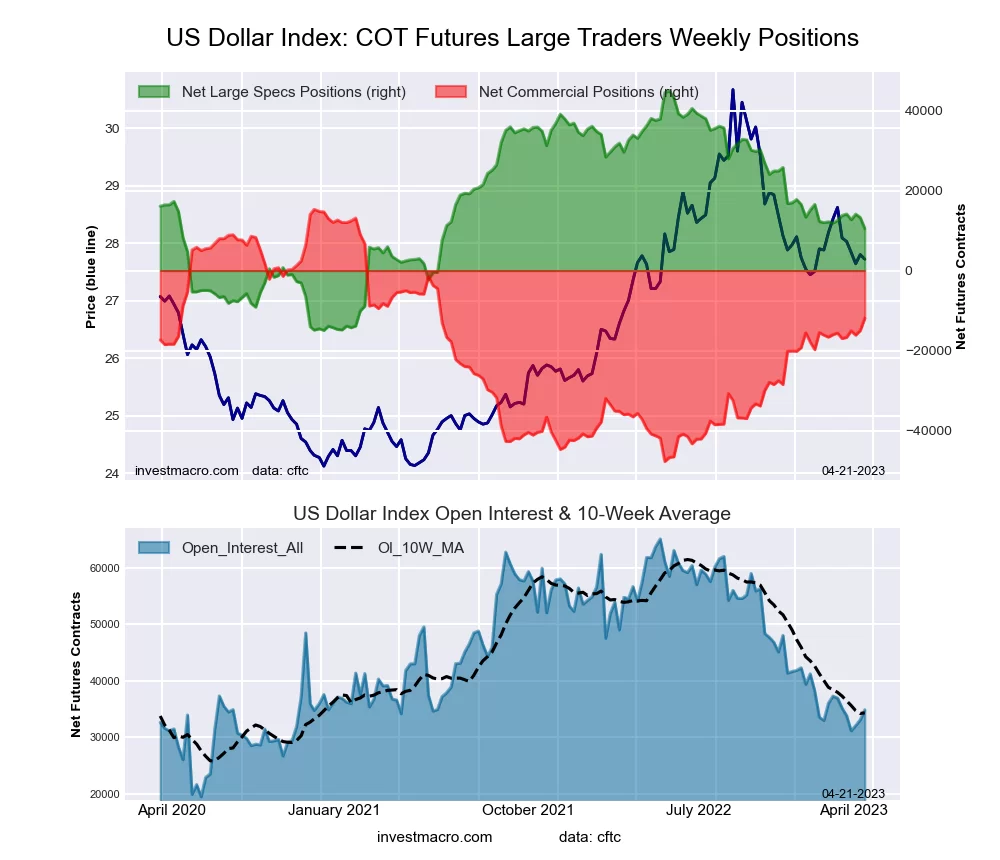
US Dollar Index Forex Futures COT ChartThe US Dollar Index large speculator standing this week came in at a net position of 14,144 contracts in the data reported through Tuesday. This was a weekly lift of 387 contracts from the previous week which had a total of 13,757 net contracts.

This week’s current strength score (the trader positioning range over the past three years, measured from 0 to 100) shows the speculators are currently Bearish with a score of 48.5 percent. The commercials are Bearish with a score of 49.2 percent and the small traders (not shown in chart) are Bearish with a score of 44.6 percent.

US DOLLAR INDEX StatisticsSPECULATORSCOMMERCIALSSMALL TRADERS
– Percent of Open Interest Longs:77.64.014.4
– Percent of Open Interest Shorts:35.853.46.8
– Net Position:14,144-16,7082,564
– Gross Longs:26,2581,3384,864
– Gross Shorts:12,11418,0462,300
– Long to Short Ratio:2.2 to 10.1 to 12.1 to 1
NET POSITION TREND:
– Strength Index Score (3 Year Range Pct):48.549.244.6
– Strength Index Reading (3 Year Range):BearishBearishBearish
NET POSITION MOVEMENT INDEX:
– 6-Week Change in Strength Index:3.1-1.9-7.3


Euro Currency Futures:

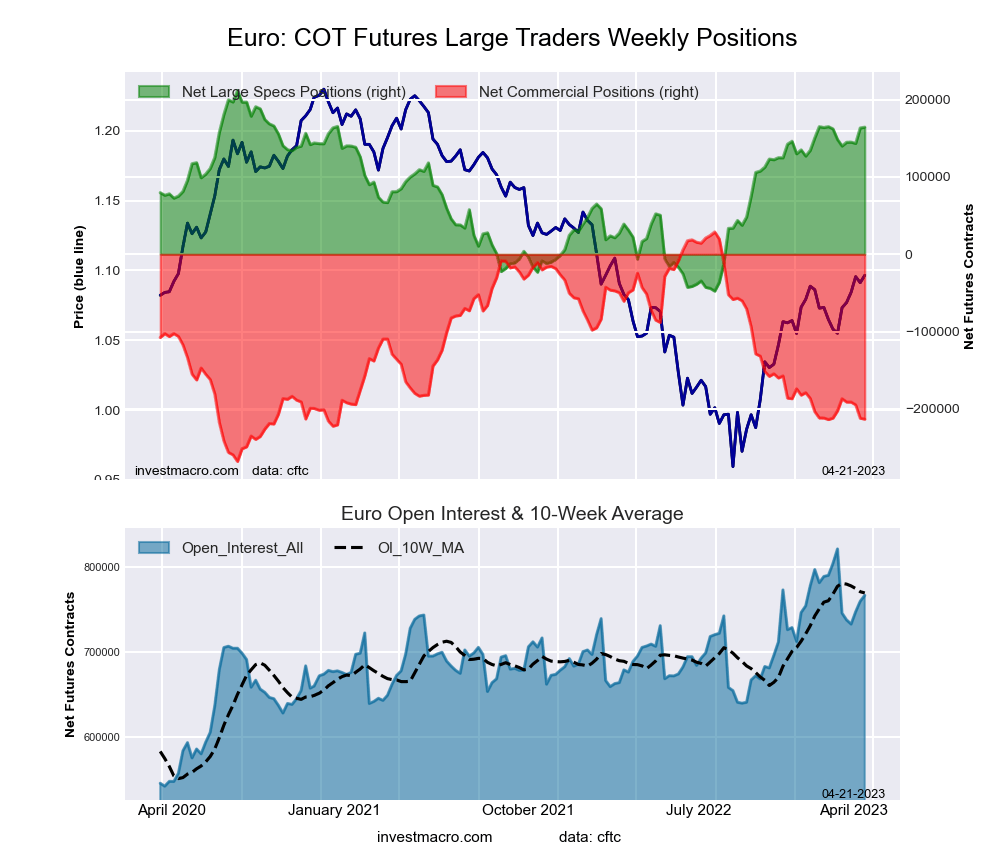
Euro Currency Futures COT ChartThe Euro Currency large speculator standing this week came in at a net position of 144,842 contracts in the data reported through Tuesday. This was a weekly boost of 4,886 contracts from the previous week which had a total of 139,956 net contracts.

This week’s current strength score (the trader positioning range over the past three years, measured from 0 to 100) shows the speculators are currently Bullish with a score of 74.2 percent. The commercials are Bearish with a score of 25.9 percent and the small traders (not shown in chart) are Bullish with a score of 52.9 percent.

EURO Currency StatisticsSPECULATORSCOMMERCIALSSMALL TRADERS
– Percent of Open Interest Longs:29.356.711.9
– Percent of Open Interest Shorts:9.682.65.6
– Net Position:144,842-191,17146,329
– Gross Longs:215,825417,80287,688
– Gross Shorts:70,983608,97341,359
– Long to Short Ratio:3.0 to 10.7 to 12.1 to 1
NET POSITION TREND:
– Strength Index Score (3 Year Range Pct):74.225.952.9
– Strength Index Reading (3 Year Range):BullishBearishBullish
NET POSITION MOVEMENT INDEX:
– 6-Week Change in Strength Index:-7.86.9-0.6


British Pound Sterling Futures:

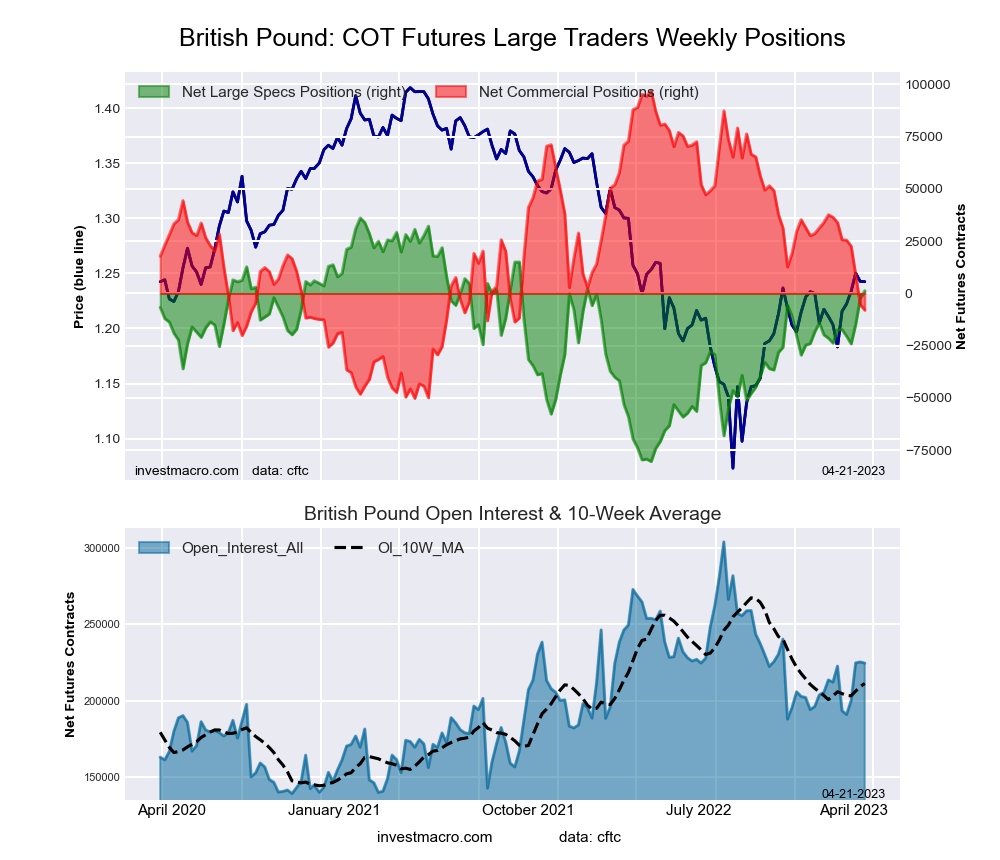
British Pound Sterling Futures COT ChartThe British Pound Sterling large speculator standing this week came in at a net position of -20,498 contracts in the data reported through Tuesday. This was a weekly reduction of -3,184 contracts from the previous week which had a total of -17,314 net contracts.

This week’s current strength score (the trader positioning range over the past three years, measured from 0 to 100) shows the speculators are currently Bullish with a score of 51.4 percent. The commercials are Bullish with a score of 51.4 percent and the small traders (not shown in chart) are Bearish with a score of 48.2 percent.

BRITISH POUND StatisticsSPECULATORSCOMMERCIALSSMALL TRADERS
– Percent of Open Interest Longs:15.067.612.3
– Percent of Open Interest Shorts:25.854.314.9
– Net Position:-20,49825,506-5,008
– Gross Longs:28,652129,03023,376
– Gross Shorts:49,150103,52428,384
– Long to Short Ratio:0.6 to 11.2 to 10.8 to 1
NET POSITION TREND:
– Strength Index Score (3 Year Range Pct):51.451.448.2
– Strength Index Reading (3 Year Range):BullishBullishBearish
NET POSITION MOVEMENT INDEX:
– 6-Week Change in Strength Index:-5.5-4.024.0


Japanese Yen Futures:

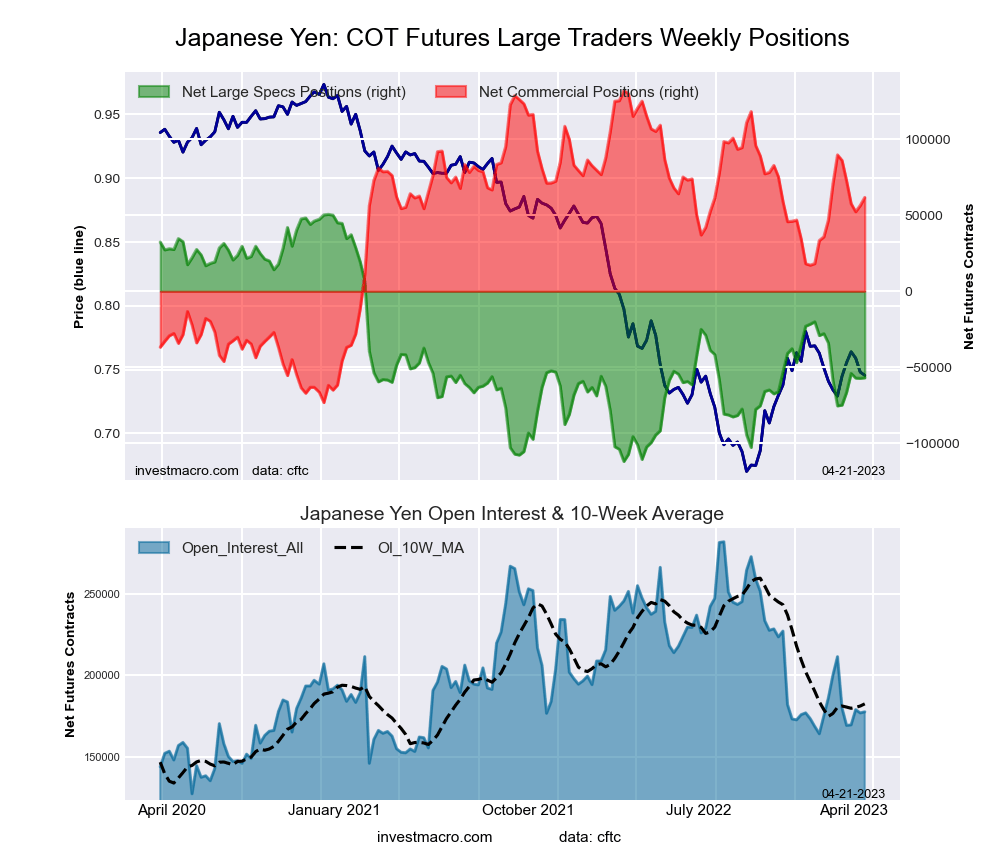
Japanese Yen Forex Futures COT ChartThe Japanese Yen large speculator standing this week came in at a net position of -66,345 contracts in the data reported through Tuesday. This was a weekly advance of 8,449 contracts from the previous week which had a total of -74,794 net contracts.

This week’s current strength score (the trader positioning range over the past three years, measured from 0 to 100) shows the speculators are currently Bearish with a score of 28.0 percent. The commercials are Bullish with a score of 71.0 percent and the small traders (not shown in chart) are Bearish with a score of 41.0 percent.

JAPANESE YEN StatisticsSPECULATORSCOMMERCIALSSMALL TRADERS
– Percent of Open Interest Longs:4.379.414.4
– Percent of Open Interest Shorts:43.536.618.0
– Net Position:-66,34572,484-6,139
– Gross Longs:7,255134,38924,336
– Gross Shorts:73,60061,90530,475
– Long to Short Ratio:0.1 to 12.2 to 10.8 to 1
NET POSITION TREND:
– Strength Index Score (3 Year Range Pct):28.071.041.0
– Strength Index Reading (3 Year Range):BearishBullishBearish
NET POSITION MOVEMENT INDEX:
– 6-Week Change in Strength Index:-22.919.1-3.8


Swiss Franc Futures:

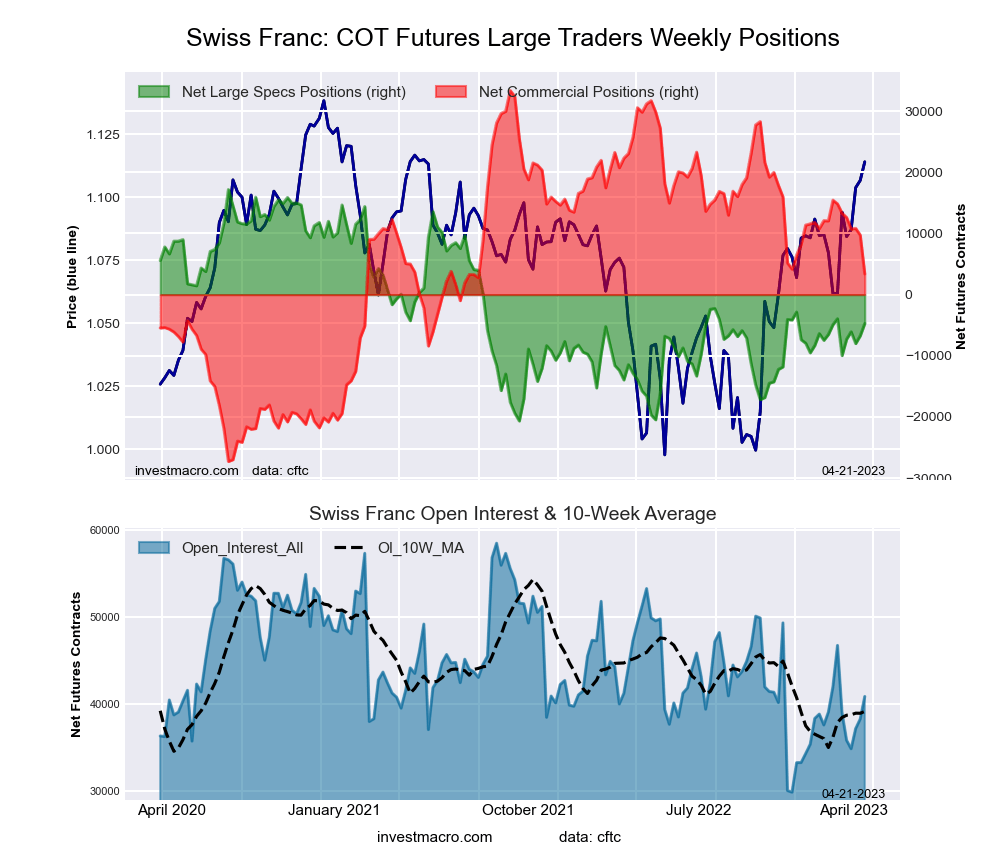
Swiss Franc Forex Futures COT ChartThe Swiss Franc large speculator standing this week came in at a net position of -7,297 contracts in the data reported through Tuesday. This was a weekly boost of 2,668 contracts from the previous week which had a total of -9,965 net contracts.

This week’s current strength score (the trader positioning range over the past three years, measured from 0 to 100) shows the speculators are currently Bearish with a score of 35.3 percent. The commercials are Bullish with a score of 65.8 percent and the small traders (not shown in chart) are Bearish with a score of 39.5 percent.

SWISS FRANC StatisticsSPECULATORSCOMMERCIALSSMALL TRADERS
– Percent of Open Interest Longs:13.554.627.8
– Percent of Open Interest Shorts:33.919.442.7
– Net Position:-7,29712,611-5,314
– Gross Longs:4,85319,5559,978
– Gross Shorts:12,1506,94415,292
– Long to Short Ratio:0.4 to 12.8 to 10.7 to 1
NET POSITION TREND:
– Strength Index Score (3 Year Range Pct):35.365.839.5
– Strength Index Reading (3 Year Range):BearishBullishBearish
NET POSITION MOVEMENT INDEX:
– 6-Week Change in Strength Index:-2.53.0-3.0


Canadian Dollar Futures:

Canadian Dollar Forex Futures COT ChartThe Canadian Dollar large speculator standing this week came in at a net position of -56,821 contracts in the data reported through Tuesday. This was a weekly decline of -25,106 contracts from the previous week which had a total of -31,715 net contracts.

This week’s current strength score (the trader positioning range over the past three years, measured from 0 to 100) shows the speculators are currently Bearish-Extreme with a score of 0.0 percent. The commercials are Bullish-Extreme with a score of 100.0 percent and the small traders (not shown in chart) are Bearish-Extreme with a score of 5.9 percent.

CANADIAN DOLLAR StatisticsSPECULATORSCOMMERCIALSSMALL TRADERS
– Percent of Open Interest Longs:10.671.716.7
– Percent of Open Interest Shorts:42.435.621.0
– Net Position:-56,82164,449-7,628
– Gross Longs:18,812127,79829,717
– Gross Shorts:75,63363,34937,345
– Long to Short Ratio:0.2 to 12.0 to 10.8 to 1
NET POSITION TREND:
– Strength Index Score (3 Year Range Pct):0.0100.05.9
– Strength Index Reading (3 Year Range):Bearish-ExtremeBullish-ExtremeBearish-Extreme
NET POSITION MOVEMENT INDEX:
– 6-Week Change in Strength Index:-22.522.1-19.5


Australian Dollar Futures:

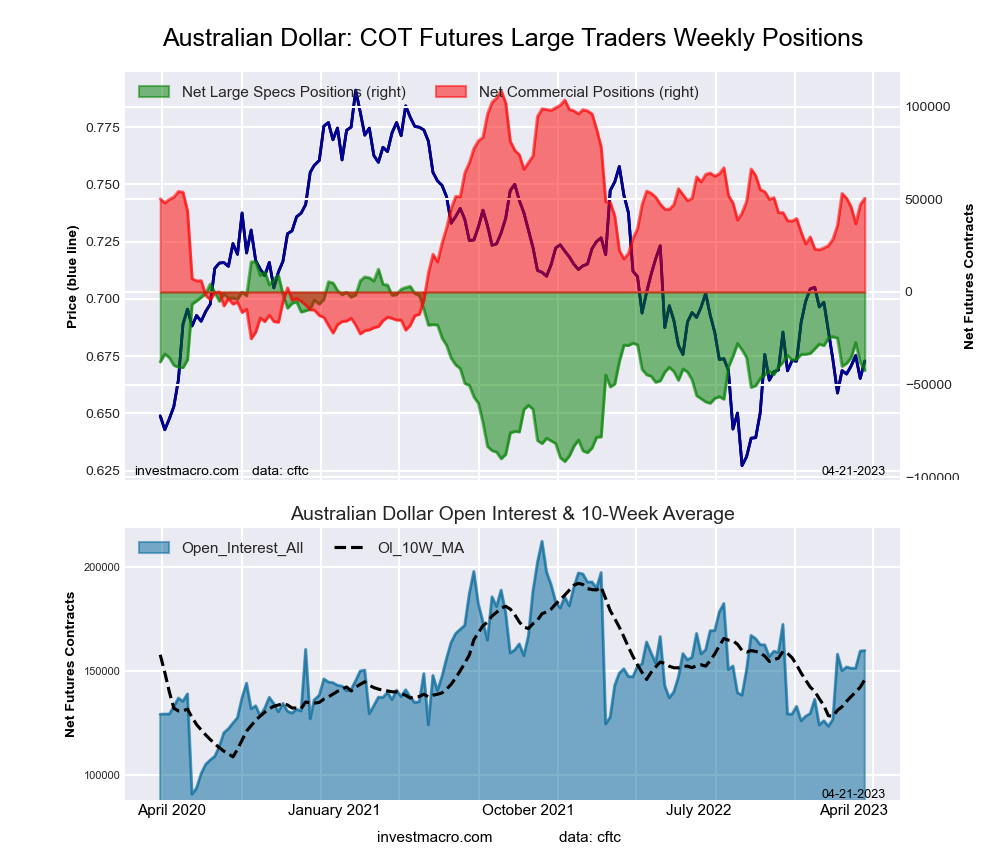
Australian Dollar Forex Futures COT ChartThe Australian Dollar large speculator standing this week came in at a net position of -38,459 contracts in the data reported through Tuesday. This was a weekly advance of 1,632 contracts from the previous week which had a total of -40,091 net contracts.

This week’s current strength score (the trader positioning range over the past three years, measured from 0 to 100) shows the speculators are currently Bearish with a score of 49.2 percent. The commercials are Bullish with a score of 56.6 percent and the small traders (not shown in chart) are Bearish with a score of 22.9 percent.

AUSTRALIAN DOLLAR StatisticsSPECULATORSCOMMERCIALSSMALL TRADERS
– Percent of Open Interest Longs:27.157.511.8
– Percent of Open Interest Shorts:52.524.219.8
– Net Position:-38,45950,554-12,095
– Gross Longs:41,18387,35417,905
– Gross Shorts:79,64236,80030,000
– Long to Short Ratio:0.5 to 12.4 to 10.6 to 1
NET POSITION TREND:
– Strength Index Score (3 Year Range Pct):49.256.622.9
– Strength Index Reading (3 Year Range):BearishBullishBearish
NET POSITION MOVEMENT INDEX:
– 6-Week Change in Strength Index:-9.620.8-42.6


New Zealand Dollar Futures:

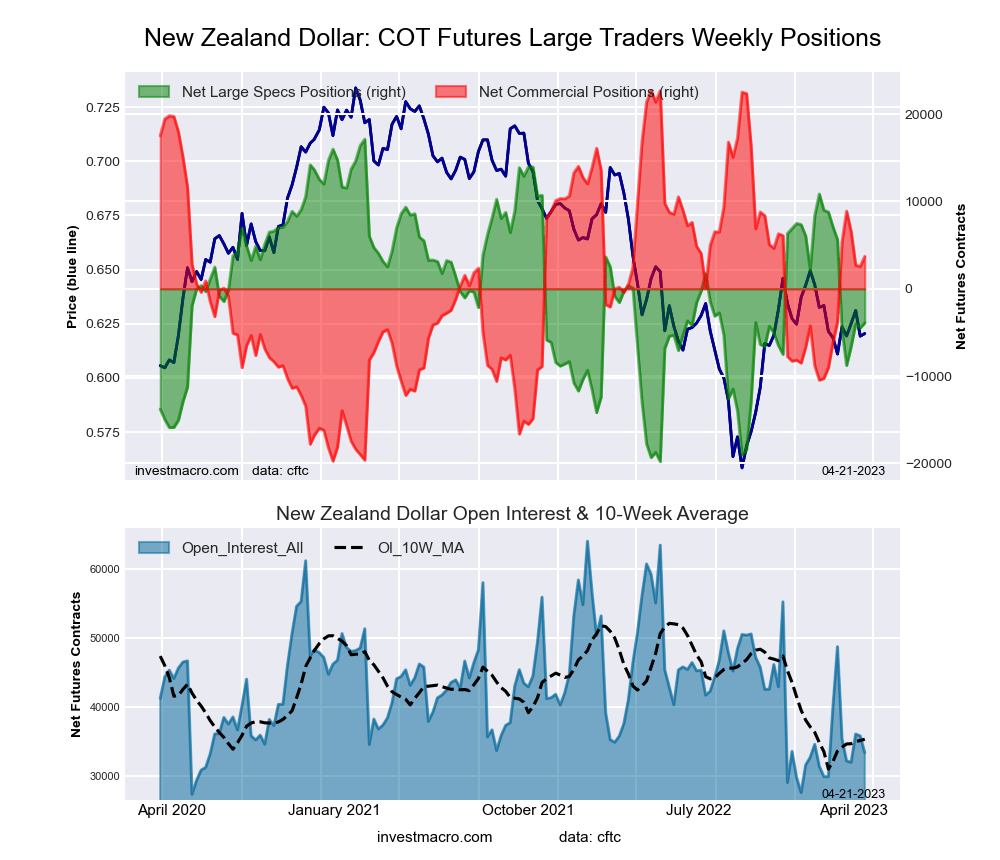
New Zealand Dollar Forex Futures COT ChartThe New Zealand Dollar large speculator standing this week came in at a net position of -8,783 contracts in the data reported through Tuesday. This was a weekly reduction of -4,042 contracts from the previous week which had a total of -4,741 net contracts.

This week’s current strength score (the trader positioning range over the past three years, measured from 0 to 100) shows the speculators are currently Bearish with a score of 29.8 percent. The commercials are Bullish with a score of 67.5 percent and the small traders (not shown in chart) are Bullish with a score of 50.3 percent.

NEW ZEALAND DOLLAR StatisticsSPECULATORSCOMMERCIALSSMALL TRADERS
– Percent of Open Interest Longs:21.067.010.5
– Percent of Open Interest Shorts:48.339.410.9
– Net Position:-8,7838,896-113
– Gross Longs:6,76521,5763,392
– Gross Shorts:15,54812,6803,505
– Long to Short Ratio:0.4 to 11.7 to 11.0 to 1
NET POSITION TREND:
– Strength Index Score (3 Year Range Pct):29.867.550.3
– Strength Index Reading (3 Year Range):BearishBullishBullish
NET POSITION MOVEMENT INDEX:
– 6-Week Change in Strength Index:-53.245.63.2


Mexican Peso Futures:

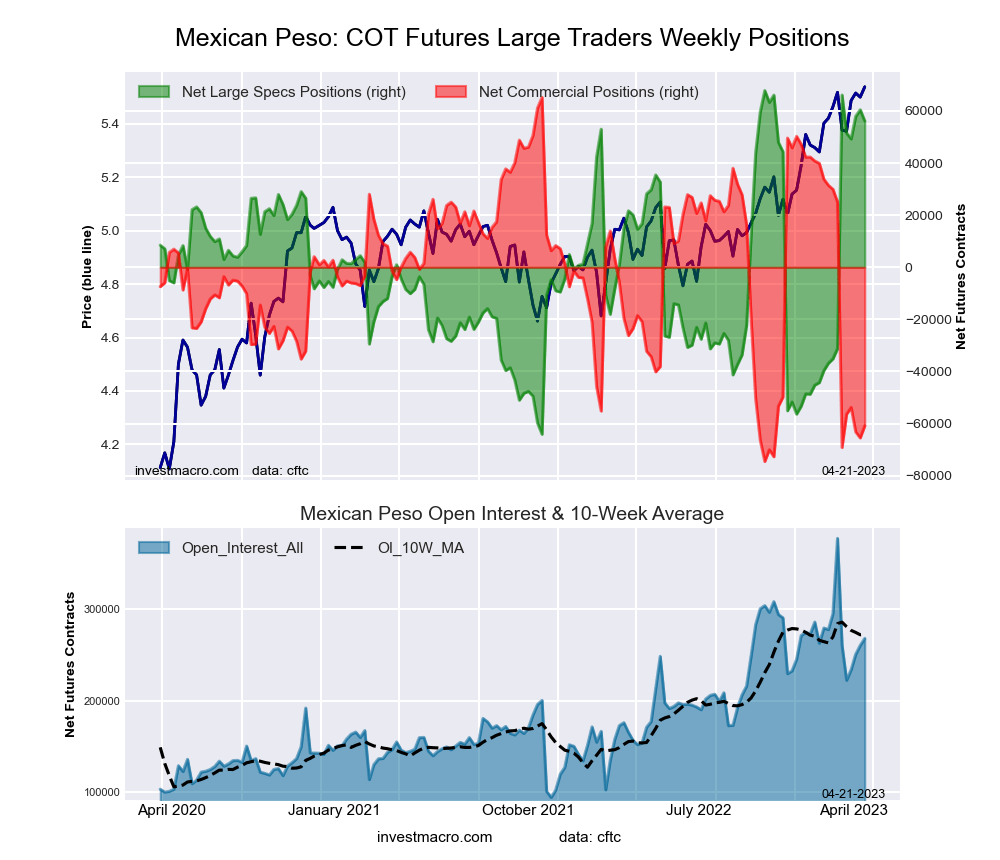
Mexican Peso Futures COT ChartThe Mexican Peso large speculator standing this week came in at a net position of 51,530 contracts in the data reported through Tuesday. This was a weekly fall of -14,597 contracts from the previous week which had a total of 66,127 net contracts.

This week’s current strength score (the trader positioning range over the past three years, measured from 0 to 100) shows the speculators are currently Bullish-Extreme with a score of 87.6 percent. The commercials are Bearish-Extreme with a score of 13.0 percent and the small traders (not shown in chart) are Bullish-Extreme with a score of 86.5 percent.

MEXICAN PESO StatisticsSPECULATORSCOMMERCIALSSMALL TRADERS
– Percent of Open Interest Longs:45.950.93.2
– Percent of Open Interest Shorts:22.776.31.0
– Net Position:51,530-56,4134,883
– Gross Longs:101,899113,0137,110
– Gross Shorts:50,369169,4262,227
– Long to Short Ratio:2.0 to 10.7 to 13.2 to 1
NET POSITION TREND:
– Strength Index Score (3 Year Range Pct):87.613.086.5
– Strength Index Reading (3 Year Range):Bullish-ExtremeBearish-ExtremeBullish-Extreme
NET POSITION MOVEMENT INDEX:
– 6-Week Change in Strength Index:72.6-68.92.9


Brazilian Real Futures:

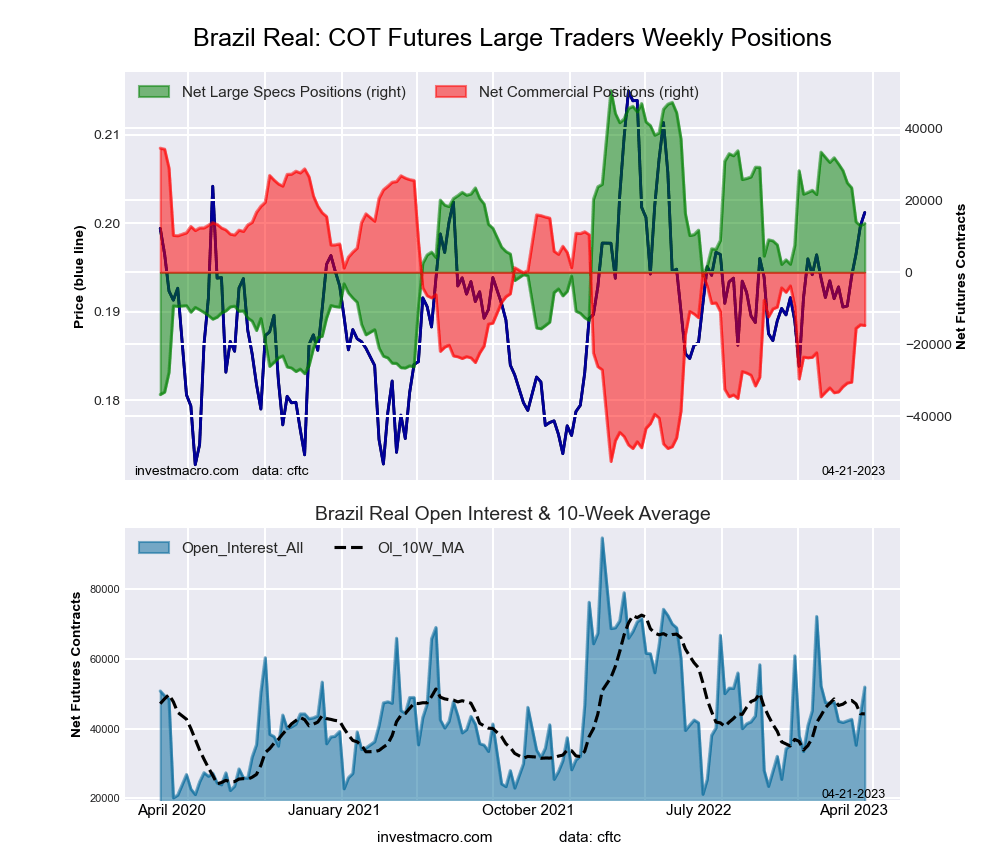
Brazil Real Futures COT ChartThe Brazilian Real large speculator standing this week came in at a net position of 24,857 contracts in the data reported through Tuesday. This was a weekly fall of -3,414 contracts from the previous week which had a total of 28,271 net contracts.

This week’s current strength score (the trader positioning range over the past three years, measured from 0 to 100) shows the speculators are currently Bullish with a score of 67.4 percent. The commercials are Bearish with a score of 26.7 percent and the small traders (not shown in chart) are Bullish-Extreme with a score of 100.0 percent.

BRAZIL REAL StatisticsSPECULATORSCOMMERCIALSSMALL TRADERS
– Percent of Open Interest Longs:65.617.516.9
– Percent of Open Interest Shorts:6.790.42.9
– Net Position:24,857-30,7755,918
– Gross Longs:27,6817,4017,140
– Gross Shorts:2,82438,1761,222
– Long to Short Ratio:9.8 to 10.2 to 15.8 to 1
NET POSITION TREND:
– Strength Index Score (3 Year Range Pct):67.426.7100.0
– Strength Index Reading (3 Year Range):BullishBearishBullish-Extreme
NET POSITION MOVEMENT INDEX:
– 6-Week Change in Strength Index:-10.84.741.0


Bitcoin Futures:

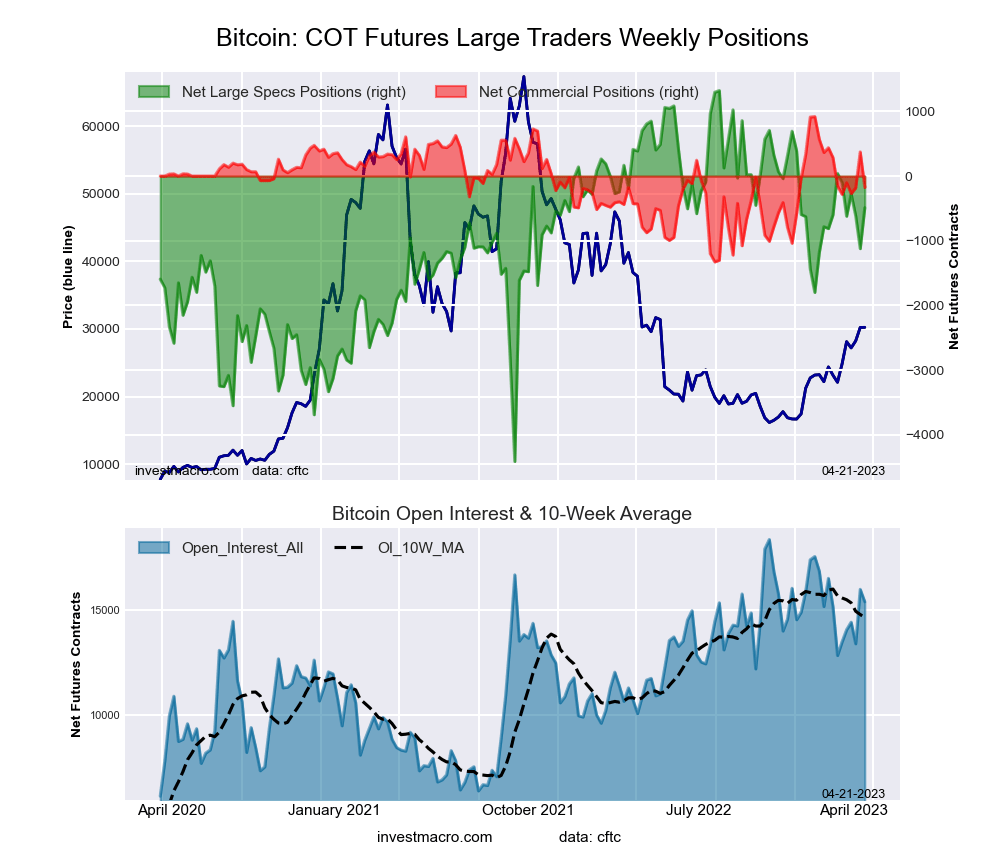
Bitcoin Crypto Futures COT ChartThe Bitcoin large speculator standing this week came in at a net position of -621 contracts in the data reported through Tuesday. This was a weekly reduction of -519 contracts from the previous week which had a total of -102 net contracts.

This week’s current strength score (the trader positioning range over the past three years, measured from 0 to 100) shows the speculators are currently Bullish with a score of 66.1 percent. The commercials are Bullish with a score of 54.5 percent and the small traders (not shown in chart) are Bearish with a score of 29.4 percent.

BITCOIN StatisticsSPECULATORSCOMMERCIALSSMALL TRADERS
– Percent of Open Interest Longs:77.23.110.3
– Percent of Open Interest Shorts:81.73.85.2
– Net Position:-621-103724
– Gross Longs:10,8514291,450
– Gross Shorts:11,472532726
– Long to Short Ratio:0.9 to 10.8 to 12.0 to 1
NET POSITION TREND:
– Strength Index Score (3 Year Range Pct):66.154.529.4
– Strength Index Reading (3 Year Range):BullishBullishBearish
NET POSITION MOVEMENT INDEX:
– 6-Week Change in Strength Index:9.7-29.82.6


Article By InvestMacroReceive our weekly COT Newsletter

*COT Report: The COT data, released weekly to the public each Friday, is updated through the most recent Tuesday (data is 3 days old) and shows a quick view of how large speculators or non-commercials (for-profit traders) were positioned in the futures markets.

The CFTC categorizes trader positions according to commercial hedgers (traders who use futures contracts for hedging as part of the business), non-commercials (large traders who speculate to realize trading profits) and nonreportable traders (usually small traders/speculators) as well as their open interest (contracts open in the market at time of reporting). See CFTC criteria here.

COT Metals Speculators pushed their Gold bullish bets to 7-week high

By InvestMacro

Here are the latest charts and statistics for the Commitment of Traders (COT) data published by the Commodities Futures Trading Commission (CFTC).

The latest COT data is updated through Tuesday March 21st and shows a quick view of how large traders (for-profit speculators and commercial entities) were positioned in the futures markets.

* This COT data is fully up-to-date after weeks of delays due to a cybersecurity event that happened in early February to ION Cleared Derivatives (a subsidiary of ION Markets). The hacking incident had disrupted the ability for the CFTC to report large trader positions.

Weekly Speculator Changes led by Silver & Gold

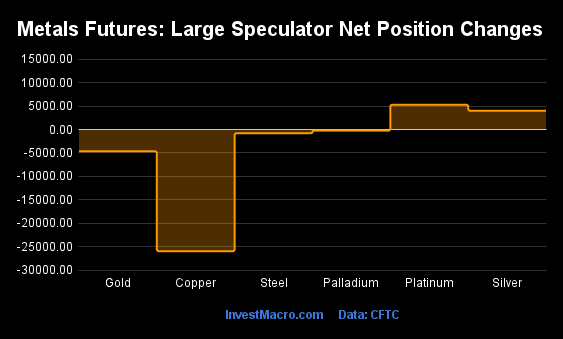
The COT metals markets speculator bets were higher this week as three out of the five precious metals markets we cover had higher positioning while the other two markets had lower speculator contracts.

Leading the gains for the metals was Gold (18,274 contracts) with Silver (4,681 contracts) and Copper (1,805 contracts) also showing positive weeks.

The markets with declines in speculator bets for the week were Platinum (-1,047 contracts) and Palladium (-550 contracts) also registering lower bets on the week.

Gold bets on the rise

Highlighting the COT metals data this week is the recent bullishness for the Gold speculative positions. The large speculator position in Gold futures advanced this week for a second straight week and for the fourth time out of the past five weeks. The Gold position has gone from a total net position of +105,529 contracts on February 14th to a new 7-week high at a total of +158,605 contracts this week with the five-week total of speculator bets showing a gain of +53,076 contracts. The speculator strength score (0 to 100 range) for Gold has risen to 47 percent while the 6-week speculator strength score trend has shown a rise of 13 percent.

The Gold futures price closed below the $1,995 price level this week after touching its highest point in just about a year over the $2,014.00 threshold on Monday. Gold has gained over 20 percent since its recent low levels in early November that saw the price fall to approximately $1,618.30.


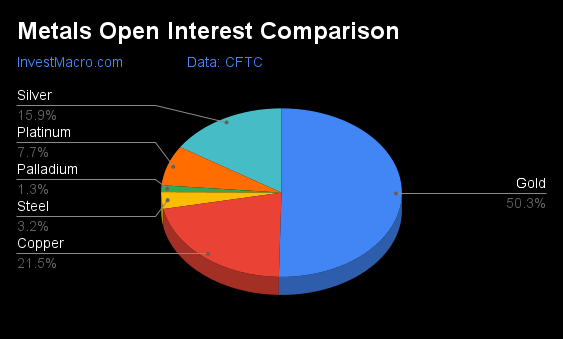
Data Snapshot of Commodity Market Traders | Columns Legend
Mar-21-2023OIOI-IndexSpec-NetSpec-IndexCom-NetCOM-IndexSmalls-NetSmalls-Index
Gold469,87422158,60547-183,5685324,96343
Silver119,08203,46223-12,681799,21917
Copper201,63644-12,351177,536804,81549
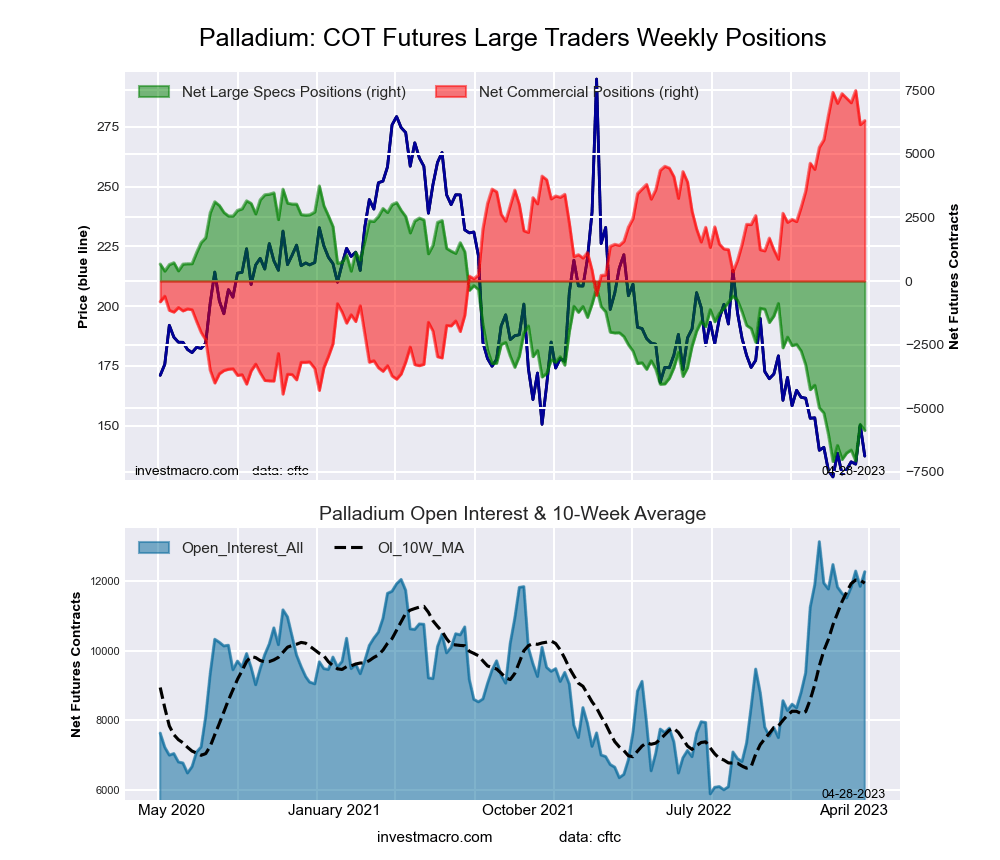
Palladium11,64780-7,01817,369100-35121
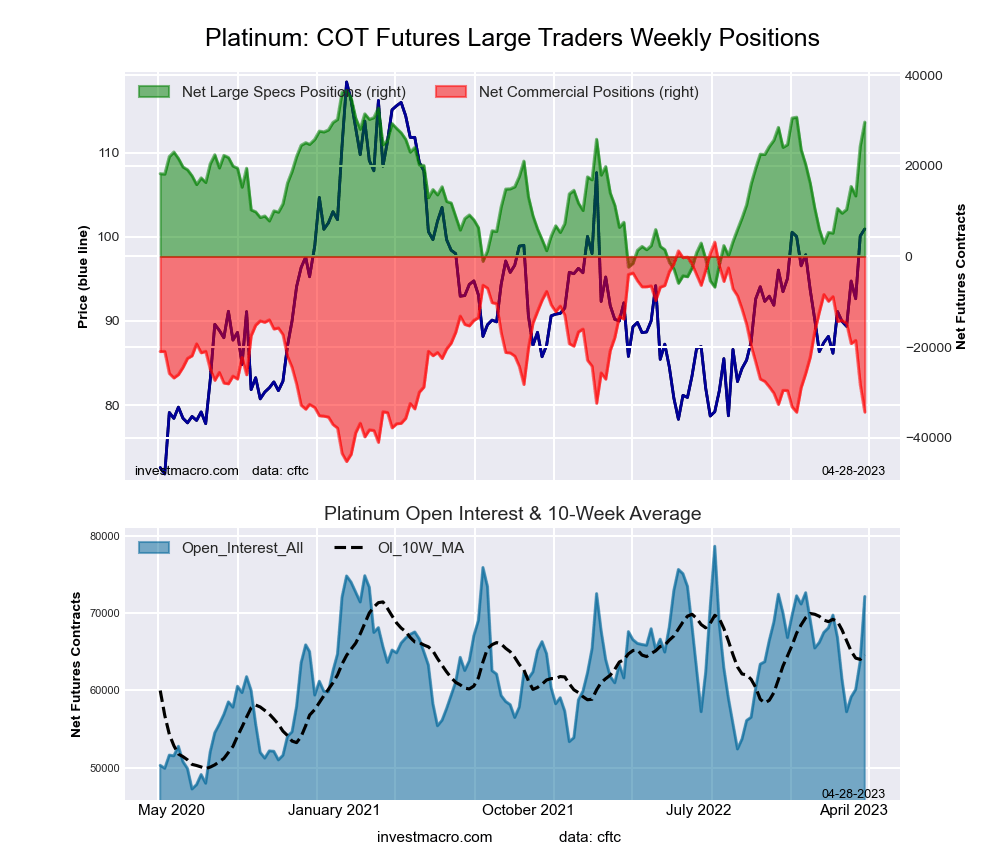
Platinum61,416459,52638-14,141644,61530


Strength Scores led by Gold & Platinum

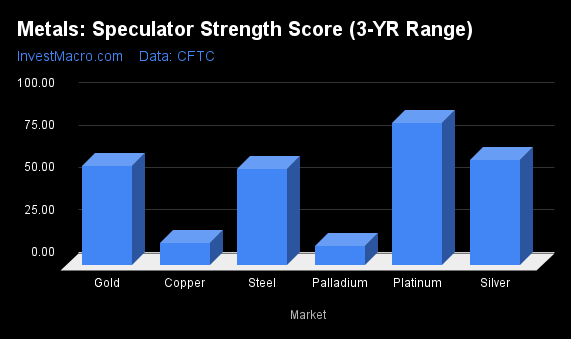
COT Strength Scores (a normalized measure of Speculator positions over a 3-Year range, from 0 to 100 where above 80 is Extreme-Bullish and below 20 is Extreme-Bearish) showed that the Gold (47 percent) leads the metals markets this week. Platinum (38 percent) comes in as the next highest in the weekly strength scores.

On the downside, Palladium (1 percent) and Copper (17 percent) come in at the lowest strength level currently and are in Extreme-Bearish territory (below 20 percent).

Strength Statistics:
Gold (46.9 percent) vs Gold previous week (38.8 percent)
Silver (23.2 percent) vs Silver previous week (16.5 percent)
Copper (17.4 percent) vs Copper previous week (15.8 percent)
Platinum (37.6 percent) vs Platinum previous week (40.0 percent)
Palladium (0.7 percent) vs Palladium previous week (5.8 percent)


Gold & Platinum top the 6-Week Strength Trends
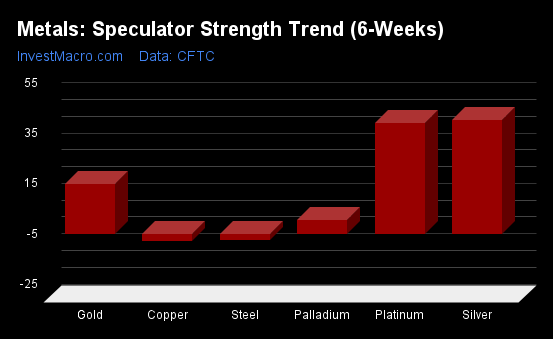
COT Strength Score Trends (or move index, calculates the 6-week changes in strength scores) showed that Gold (13 percent) leads the past six weeks trends and is the only positive mover for metals.

Palladium (-27 percent) leads the downside trend scores currently with Silver (-14 percent) as the next market with lowest trend scores.

Move Statistics:
Gold (13.1 percent) vs Gold previous week (-8.8 percent)
Silver (-14.4 percent) vs Silver previous week (-40.7 percent)
Copper (-13.3 percent) vs Copper previous week (-28.1 percent)
Platinum (-2.5 percent) vs Platinum previous week (-12.8 percent)
Palladium (-26.9 percent) vs Palladium previous week (-20.3 percent)


Individual Markets:

Gold Comex Futures:
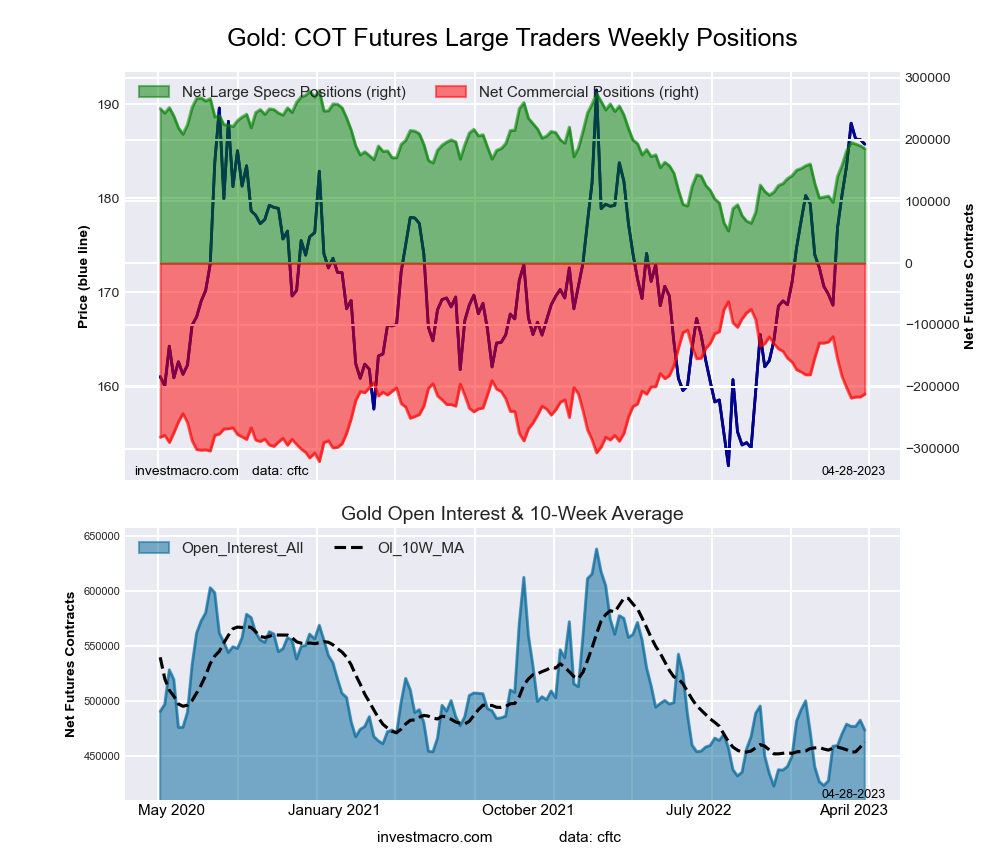
Gold Futures COT ChartThe Gold Comex Futures large speculator standing this week was a net position of 158,605 contracts in the data reported through Tuesday. This was a weekly rise of 18,274 contracts from the previous week which had a total of 140,331 net contracts.

This week’s current strength score (the trader positioning range over the past three years, measured from 0 to 100) shows the speculators are currently Bearish with a score of 46.9 percent. The commercials are Bullish with a score of 53.1 percent and the small traders (not shown in chart) are Bearish with a score of 42.5 percent.

Gold Futures StatisticsSPECULATORSCOMMERCIALSSMALL TRADERS
– Percent of Open Interest Longs:50.625.910.1
– Percent of Open Interest Shorts:16.965.04.8
– Net Position:158,605-183,56824,963
– Gross Longs:237,891121,67847,624
– Gross Shorts:79,286305,24622,661
– Long to Short Ratio:3.0 to 10.4 to 12.1 to 1
NET POSITION TREND:
– Strength Index Score (3 Year Range Pct):46.953.142.5
– Strength Index Reading (3 Year Range):BearishBullishBearish
NET POSITION MOVEMENT INDEX:
– 6-Week Change in Strength Index:13.1-11.82.0


Silver Comex Futures:

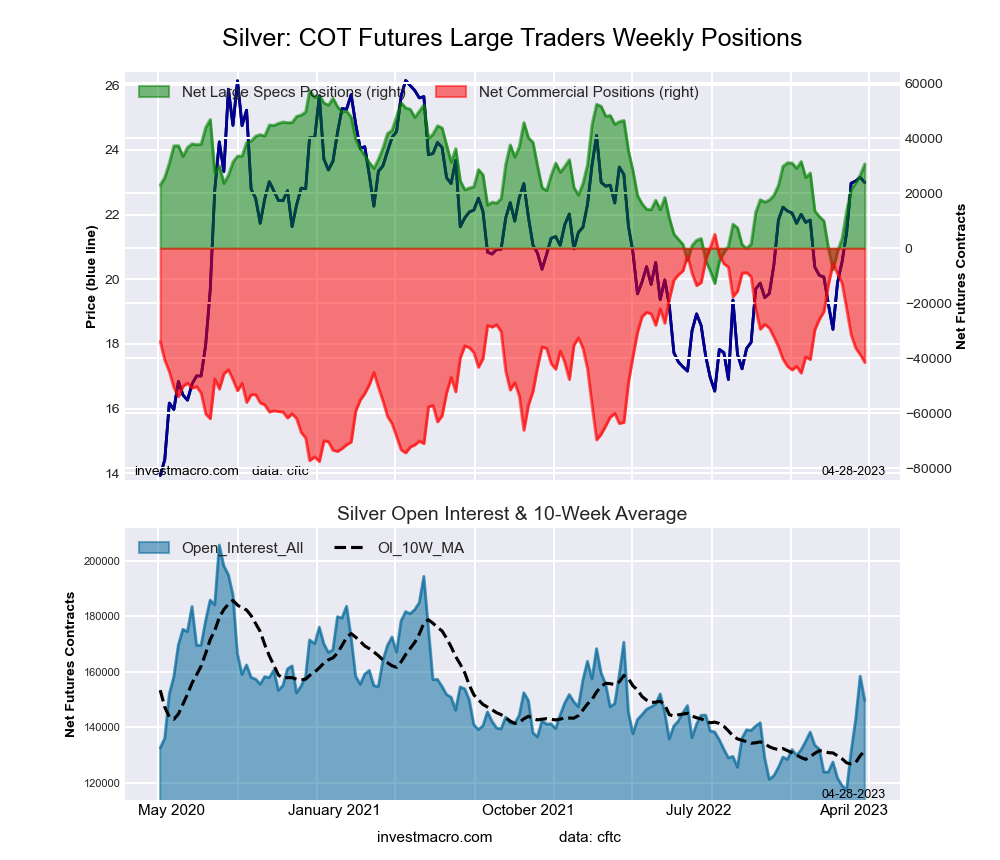
Silver Futures COT ChartThe Silver Comex Futures large speculator standing this week was a net position of 3,462 contracts in the data reported through Tuesday. This was a weekly lift of 4,681 contracts from the previous week which had a total of -1,219 net contracts.

This week’s current strength score (the trader positioning range over the past three years, measured from 0 to 100) shows the speculators are currently Bearish with a score of 23.2 percent. The commercials are Bullish with a score of 78.5 percent and the small traders (not shown in chart) are Bearish-Extreme with a score of 17.4 percent.

Silver Futures StatisticsSPECULATORSCOMMERCIALSSMALL TRADERS
– Percent of Open Interest Longs:34.740.918.8
– Percent of Open Interest Shorts:31.851.511.0
– Net Position:3,462-12,6819,219
– Gross Longs:41,32548,68522,328
– Gross Shorts:37,86361,36613,109
– Long to Short Ratio:1.1 to 10.8 to 11.7 to 1
NET POSITION TREND:
– Strength Index Score (3 Year Range Pct):23.278.517.4
– Strength Index Reading (3 Year Range):BearishBullishBearish-Extreme
NET POSITION MOVEMENT INDEX:
– 6-Week Change in Strength Index:-14.420.6-38.8


Copper Grade #1 Futures:

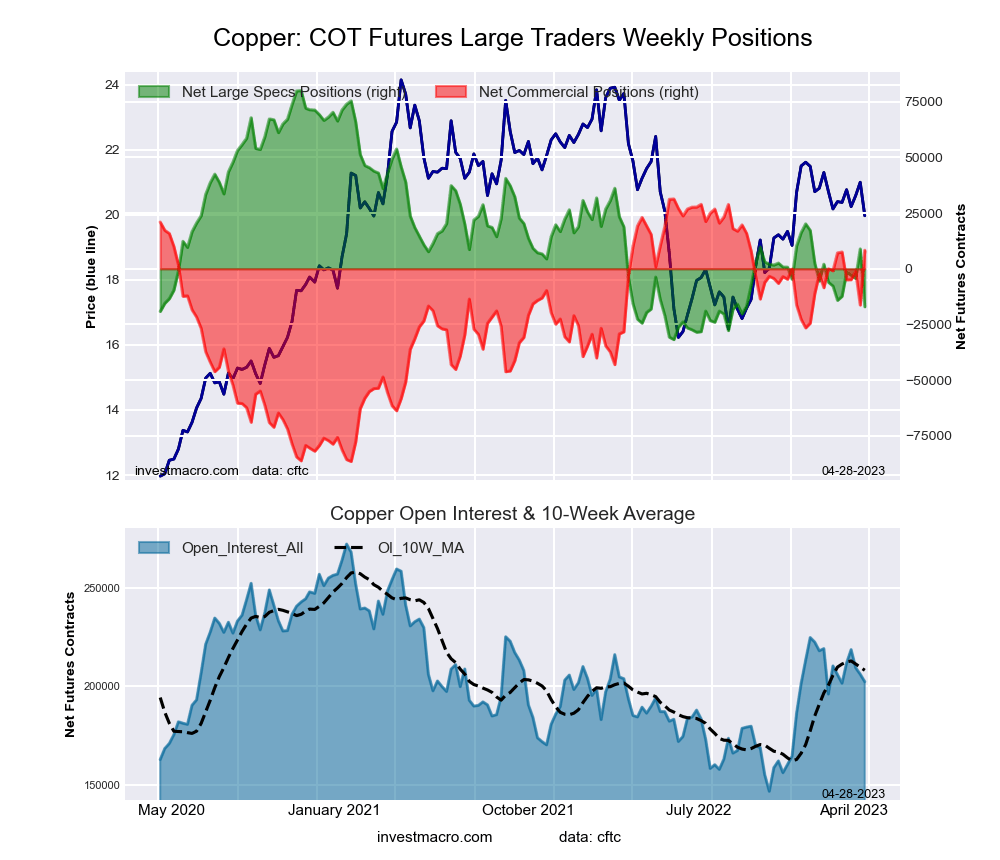
Copper Futures COT ChartThe Copper Grade #1 Futures large speculator standing this week was a net position of -12,351 contracts in the data reported through Tuesday. This was a weekly lift of 1,805 contracts from the previous week which had a total of -14,156 net contracts.

This week’s current strength score (the trader positioning range over the past three years, measured from 0 to 100) shows the speculators are currently Bearish-Extreme with a score of 17.4 percent. The commercials are Bullish with a score of 79.8 percent and the small traders (not shown in chart) are Bearish with a score of 49.2 percent.

Copper Futures StatisticsSPECULATORSCOMMERCIALSSMALL TRADERS
– Percent of Open Interest Longs:25.346.88.7
– Percent of Open Interest Shorts:31.543.16.3
– Net Position:-12,3517,5364,815
– Gross Longs:51,09594,35317,564
– Gross Shorts:63,44686,81712,749
– Long to Short Ratio:0.8 to 11.1 to 11.4 to 1
NET POSITION TREND:
– Strength Index Score (3 Year Range Pct):17.479.849.2
– Strength Index Reading (3 Year Range):Bearish-ExtremeBullishBearish
NET POSITION MOVEMENT INDEX:
– 6-Week Change in Strength Index:-13.315.9-24.3


Platinum Futures:

Platinum Futures COT ChartThe Platinum Futures large speculator standing this week was a net position of 9,526 contracts in the data reported through Tuesday. This was a weekly fall of -1,047 contracts from the previous week which had a total of 10,573 net contracts.

This week’s current strength score (the trader positioning range over the past three years, measured from 0 to 100) shows the speculators are currently Bearish with a score of 37.6 percent. The commercials are Bullish with a score of 64.2 percent and the small traders (not shown in chart) are Bearish with a score of 29.9 percent.

Platinum Futures StatisticsSPECULATORSCOMMERCIALSSMALL TRADERS
– Percent of Open Interest Longs:41.039.712.1
– Percent of Open Interest Shorts:25.562.84.6
– Net Position:9,526-14,1414,615
– Gross Longs:25,19924,3997,431
– Gross Shorts:15,67338,5402,816
– Long to Short Ratio:1.6 to 10.6 to 12.6 to 1
NET POSITION TREND:
– Strength Index Score (3 Year Range Pct):37.664.229.9
– Strength Index Reading (3 Year Range):BearishBullishBearish
NET POSITION MOVEMENT INDEX:
– 6-Week Change in Strength Index:-2.54.9-17.2


Palladium Futures:

Palladium Futures COT ChartThe Palladium Futures large speculator standing this week was a net position of -7,018 contracts in the data reported through Tuesday. This was a weekly fall of -550 contracts from the previous week which had a total of -6,468 net contracts.

This week’s current strength score (the trader positioning range over the past three years, measured from 0 to 100) shows the speculators are currently Bearish-Extreme with a score of 0.7 percent. The commercials are Bullish-Extreme with a score of 99.6 percent and the small traders (not shown in chart) are Bearish with a score of 20.6 percent.

Palladium Futures StatisticsSPECULATORSCOMMERCIALSSMALL TRADERS
– Percent of Open Interest Longs:14.073.010.6
– Percent of Open Interest Shorts:74.39.713.6
– Net Position:-7,0187,369-351
– Gross Longs:1,6338,4981,234
– Gross Shorts:8,6511,1291,585
– Long to Short Ratio:0.2 to 17.5 to 10.8 to 1
NET POSITION TREND:
– Strength Index Score (3 Year Range Pct):0.799.620.6
– Strength Index Reading (3 Year Range):Bearish-ExtremeBullish-ExtremeBearish
NET POSITION MOVEMENT INDEX:
– 6-Week Change in Strength Index:-26.925.1-3.5


Article By InvestMacroReceive our weekly COT Newsletter

*COT Report: The COT data, released weekly to the public each Friday, is updated through the most recent Tuesday (data is 3 days old) and shows a quick view of how large speculators or non-commercials (for-profit traders) were positioned in the futures markets.

The CFTC categorizes trader positions according to commercial hedgers (traders who use futures contracts for hedging as part of the business), non-commercials (large traders who speculate to realize trading profits) and nonreportable traders (usually small traders/speculators) as well as their open interest (contracts open in the market at time of reporting). See CFTC criteria here.
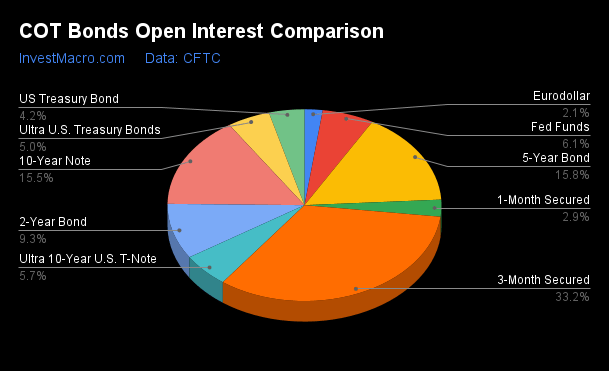
COT Bonds Speculators boosting 2-Year Bond bets after record low

By InvestMacro

Here are the latest charts and statistics for the Commitment of Traders (COT) reports data published by the Commodities Futures Trading Commission (CFTC).

The latest COT data is updated through Tuesday March 21st and shows a quick view of how large traders (for-profit speculators and commercial hedgers) were positioned in the futures markets.

* This COT data is fully up-to-date after weeks of delays due to a cybersecurity event that happened in early February to ION Cleared Derivatives (a subsidiary of ION Markets). The hacking incident had disrupted the ability for the CFTC to report large trader positions.

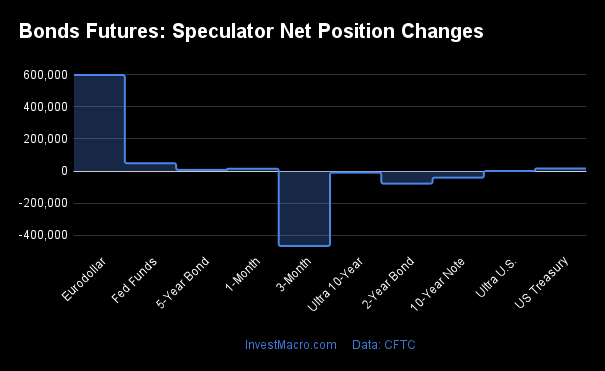
Weekly Speculator Changes led by 2-Year Bonds & Fed Funds

The COT bond market speculator bets were higher this week as five out of the eight bond markets we cover had higher positioning while the other three markets had lower speculator contracts.

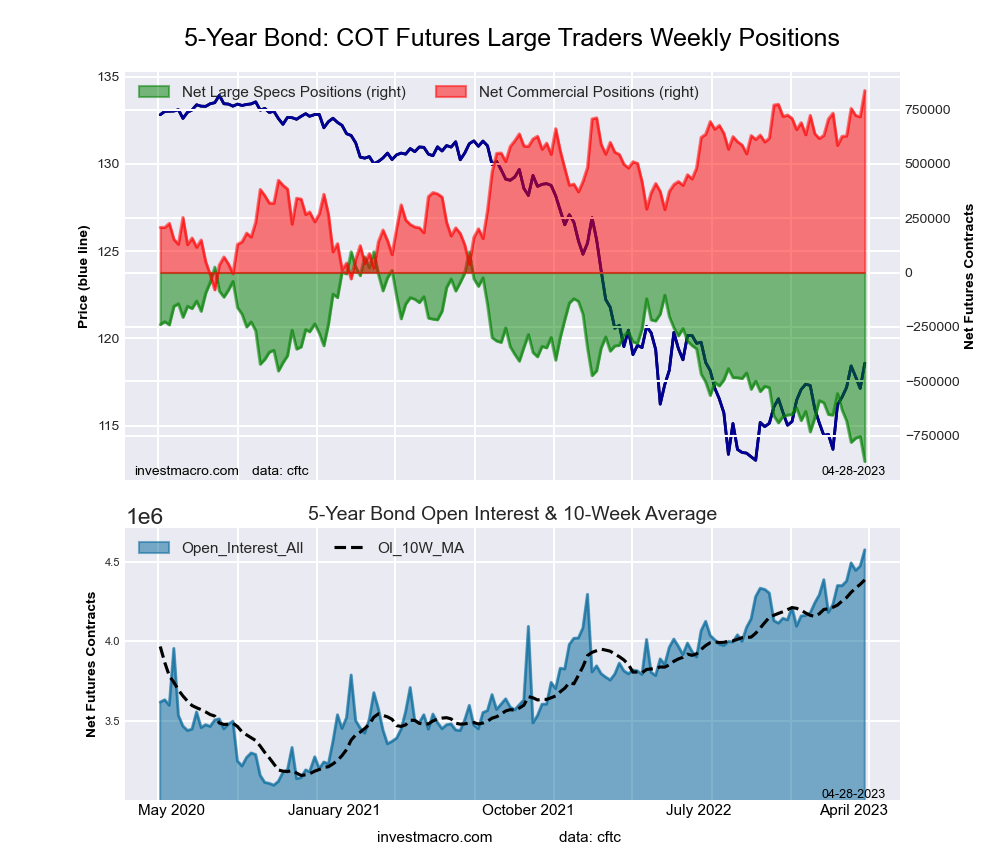
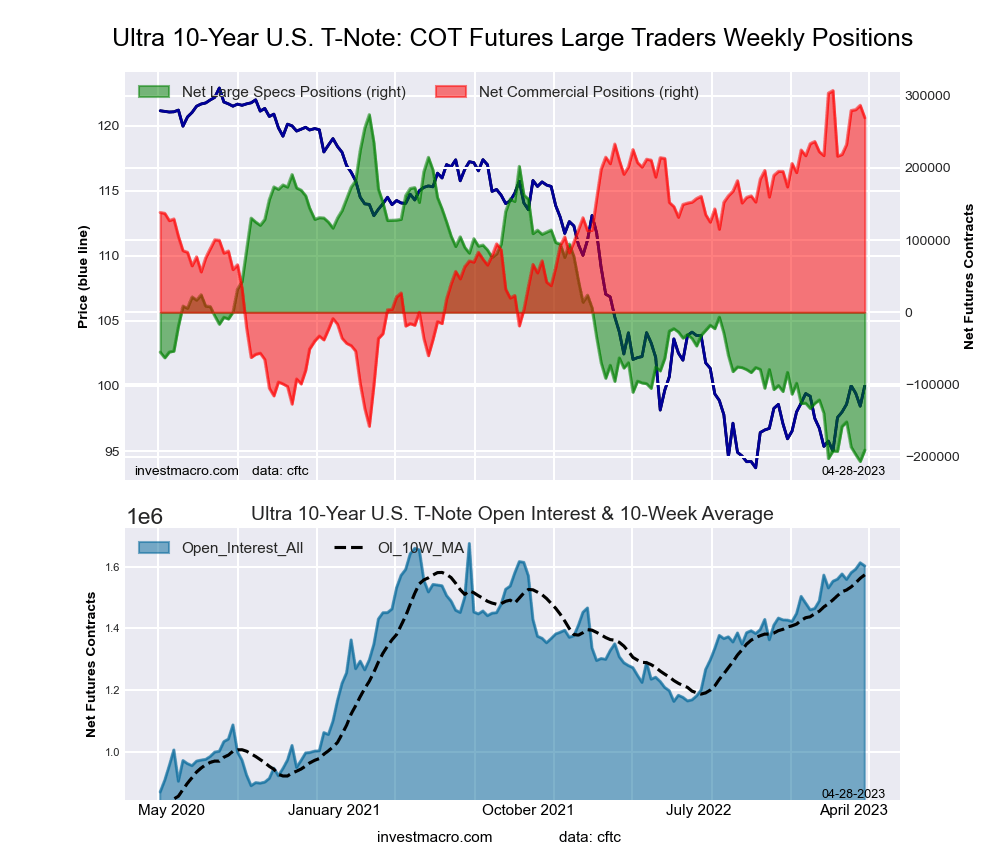
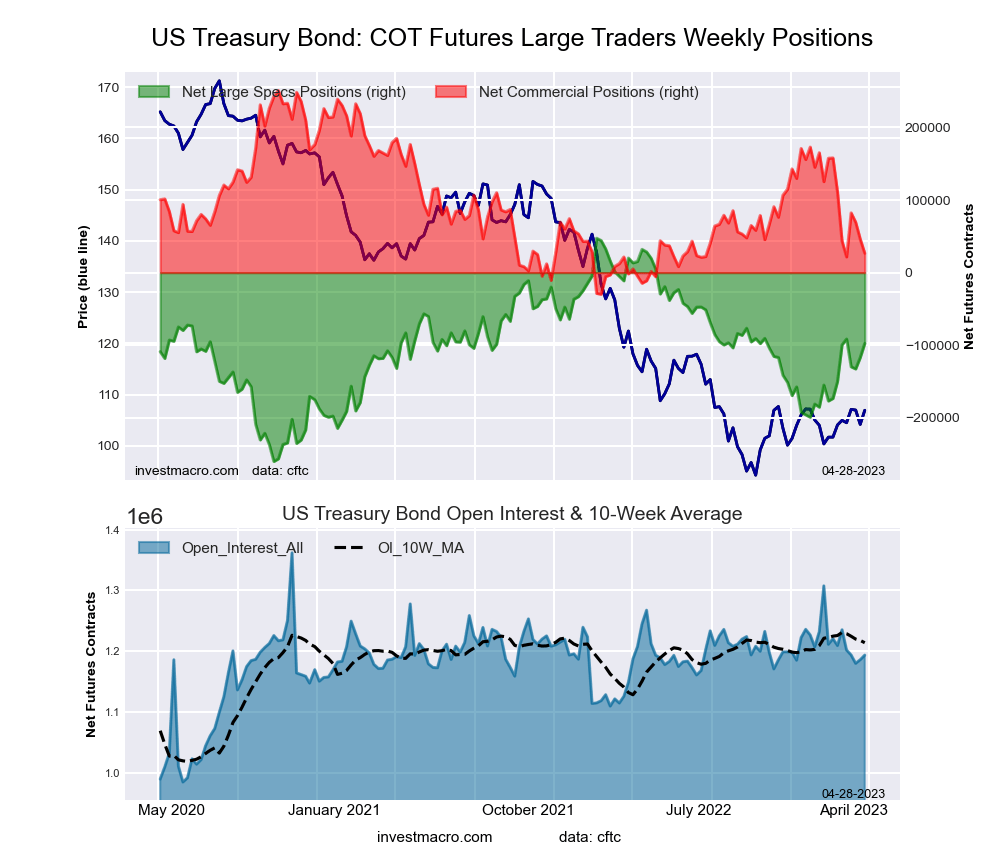
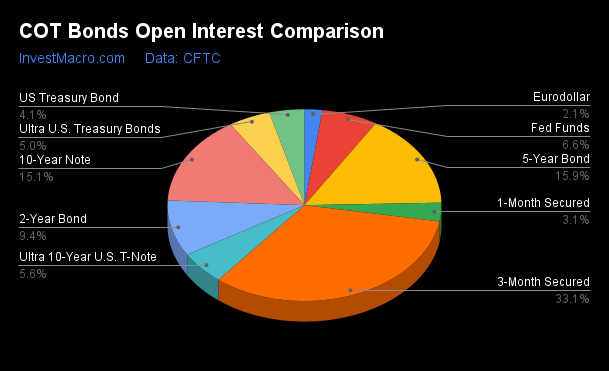
Leading the gains for the bond markets was the 2-Year Bonds (67,316 contracts) with the Fed Funds (64,355 contracts), US Treasury Bonds (50,579 contracts), the Ultra 10-Year Bonds (34,396 contracts) and the Eurodollar (23,399 contracts) also showing positive weeks.

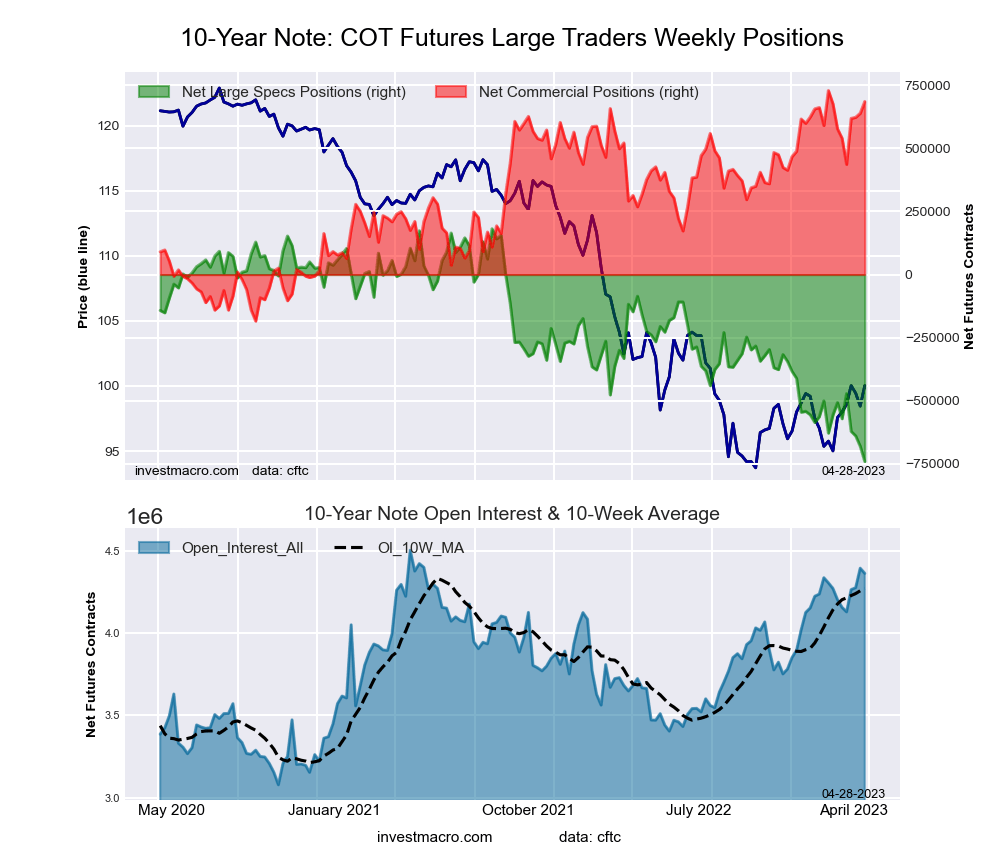
The bond markets with declines in speculator bets for the week were the 5-Year Bonds (-74,356 contracts), the 10-Year Bonds (-63,663 contracts) and the Ultra Treasury Bonds (-436 contracts) also registering lower bets on the week.

2-Year Bonds bets rising after record low

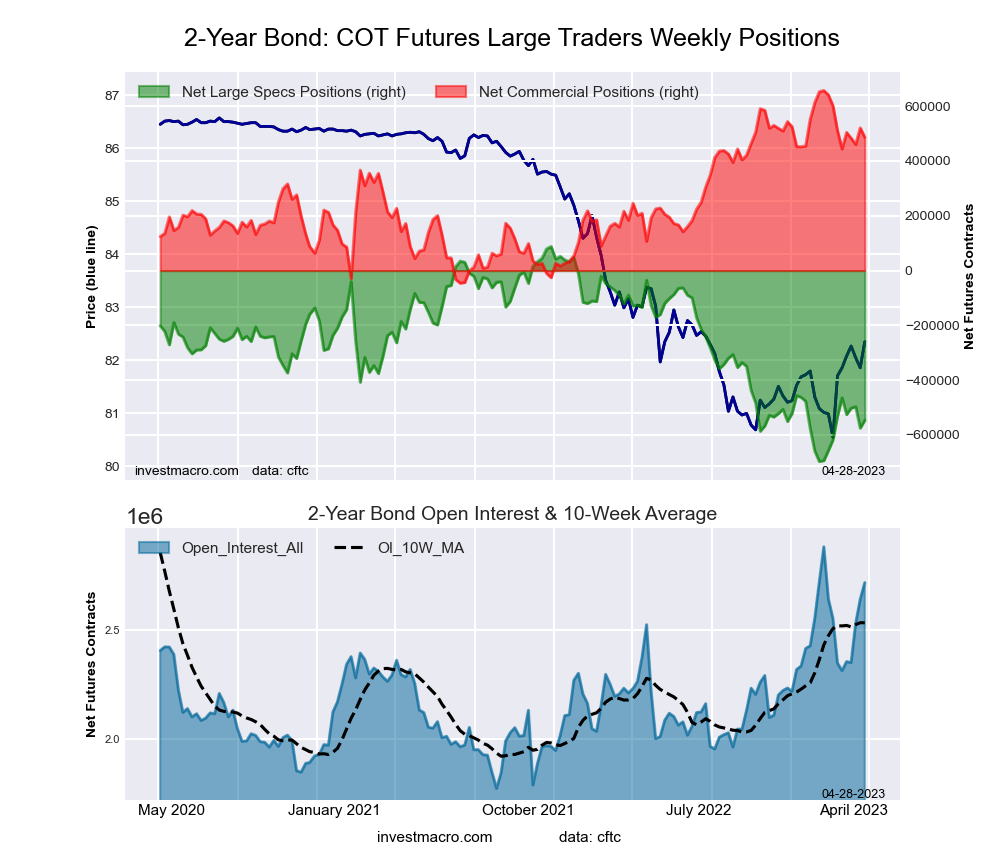
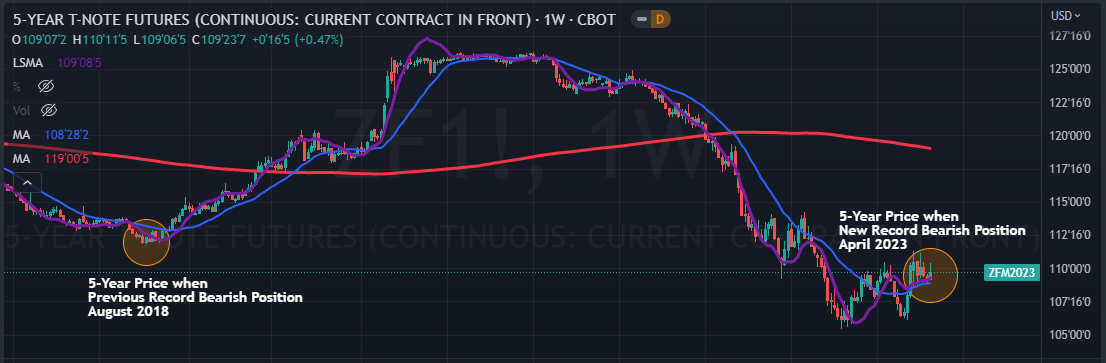
Highlighting the COT bond’s data this week is the rapid improvement of the speculator positioning in the 2-Year Bonds. Large speculative positions for the 2-Year Bond rose this week for a fifth consecutive week and by a total of 232,489 contracts in just the past five weeks. The 2-Year Bond speculator positions hit an all-time record low of -696,686 net contracts on February 14th before starting this recent five-week positive streak that has taken the current net position down to -464,197 contracts. This week’s net position marks the least bearish level of the past nine weeks.

The 2-Year Bond futures price have rebounded sharply over the past month due to a combination of a banking crisis and the sentiment that the Federal Reserve will slow or pause the pace of interest rate increases. According to the CME FedWatch Tool at the current time, traders expect the Fed to raise interest rates by 25 basis points in May but as the calendar progresses, traders are starting to forecast that the Fed will be cutting rates before the end of this year. Rate cuts would positively effect the bonds markets and especially the 2-Year as it is heavily influenced by Fed policy on the shorter end of the yield curve. This week the 2-Year Bond futures price closed near 103.29 and at the highest close since September.


Data Snapshot of Bond Market Traders | Columns Legend
Mar-21-2023OIOI-IndexSpec-NetSpec-IndexCom-NetCOM-IndexSmalls-NetSmalls-Index
Eurodollar4,779,1040-637,97158833,86942-195,89861
FedFunds1,847,79276-24,3523730,57864-6,22679
2-Year2,314,66449-464,19730444,0967020,10165
Long T-Bond1,235,09767-99,4135243,6172655,796100
10-Year4,155,76476-571,0297540,0677930,96291
5-Year4,350,30297-631,56812626,445835,12382


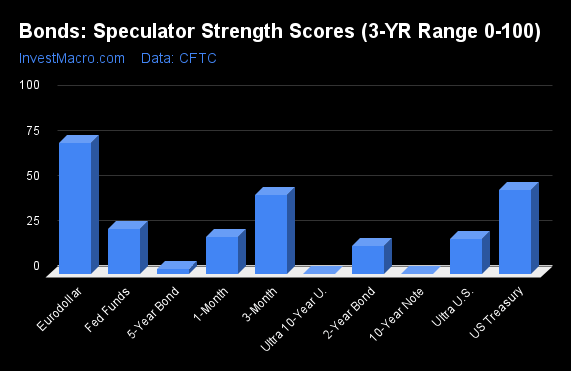
Strength Scores led by Eurodollar & US Treasury Bonds

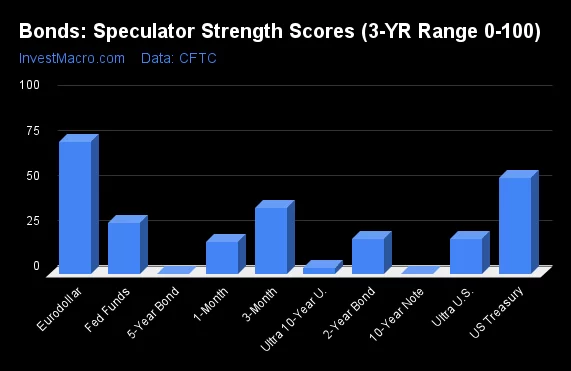
COT Strength Scores (a normalized measure of Speculator positions over a 3-Year range, from 0 to 100 where above 80 is Extreme-Bullish and below 20 is Extreme-Bearish) showed that the Eurodollar (58 percent) and the US Treasury Bonds (52 percent) lead the bond markets this week. The Fed Funds (37 percent) comes in as the next highest in the weekly strength scores.

On the downside, the Ultra Treasury Bonds (0 percent), the 10-Year Bonds (7 percent) and the Ultra 10-Year Bonds (9 percent) come in at the lowest strength level currently and are all in Extreme-Bearish territory (below 20 percent).

Strength Statistics:
Fed Funds (36.6 percent) vs Fed Funds previous week (28.7 percent)
2-Year Bond (29.6 percent) vs 2-Year Bond previous week (21.1 percent)
5-Year Bond (12.2 percent) vs 5-Year Bond previous week (21.2 percent)
10-Year Bond (7.0 percent) vs 10-Year Bond previous week (14.9 percent)
Ultra 10-Year Bond (9.3 percent) vs Ultra 10-Year Bond previous week (2.1 percent)
US Treasury Bond (52.2 percent) vs US Treasury Bond previous week (35.8 percent)
Ultra US Treasury Bond (0.0 percent) vs Ultra US Treasury Bond previous week (0.2 percent)
Eurodollar (57.7 percent) vs Eurodollar previous week (57.1 percent)


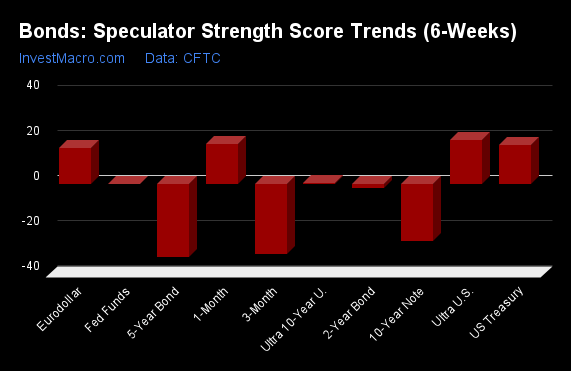
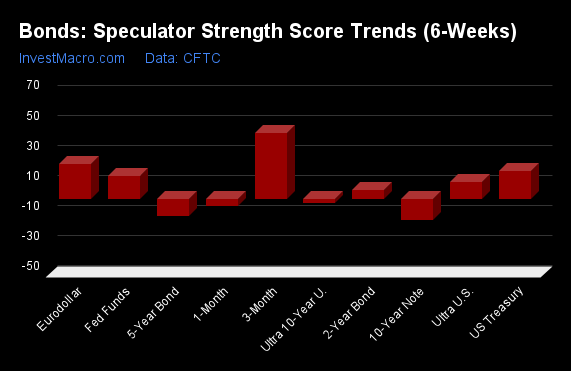
US Treasury Bonds & 2-Year Bonds top the 6-Week Strength Trends

COT Strength Score Trends (or move index, calculates the 6-week changes in strength scores) showed that the US Treasury Bonds (27 percent) and the 2-Year Bonds (25 percent) lead the past six weeks trends for bonds. The Eurodollar (10 percent) is the next highest positive movers in the latest trends data.

The Ultra Treasury Bonds (-10 percent) leads the downside trend scores currently with the Ultra 10-Year Bonds (-7 percent) following next with a lower trend score.

Strength Trend Statistics:
Fed Funds (5.2 percent) vs Fed Funds previous week (-8.5 percent)
2-Year Bond (24.8 percent) vs 2-Year Bond previous week (5.8 percent)
5-Year Bond (4.5 percent) vs 5-Year Bond previous week (21.2 percent)
10-Year Bond (1.8 percent) vs 10-Year Bond previous week (5.9 percent)
Ultra 10-Year Bond (-6.7 percent) vs Ultra 10-Year Bond previous week (-12.5 percent)
US Treasury Bond (26.5 percent) vs US Treasury Bond previous week (16.0 percent)
Ultra US Treasury Bond (-10.3 percent) vs Ultra US Treasury Bond previous week (-4.3 percent)
Eurodollar (10.2 percent) vs Eurodollar previous week (9.4 percent)


Individual Bond Markets:

3-Month Eurodollars Futures:

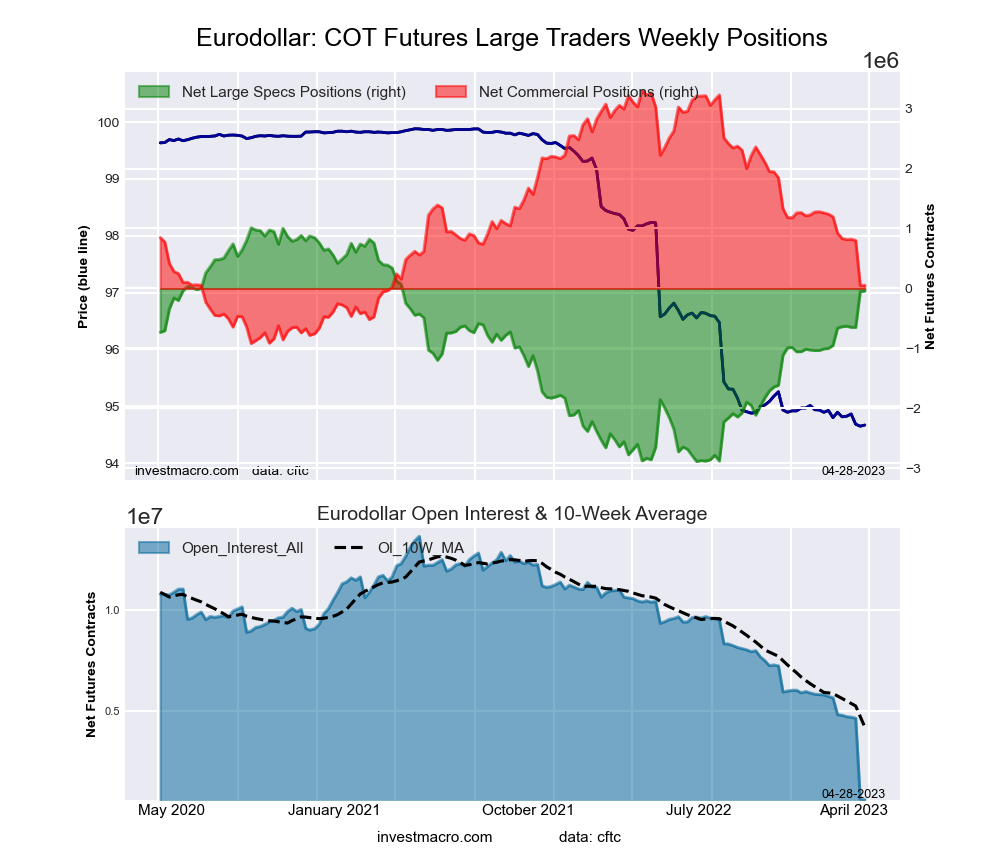
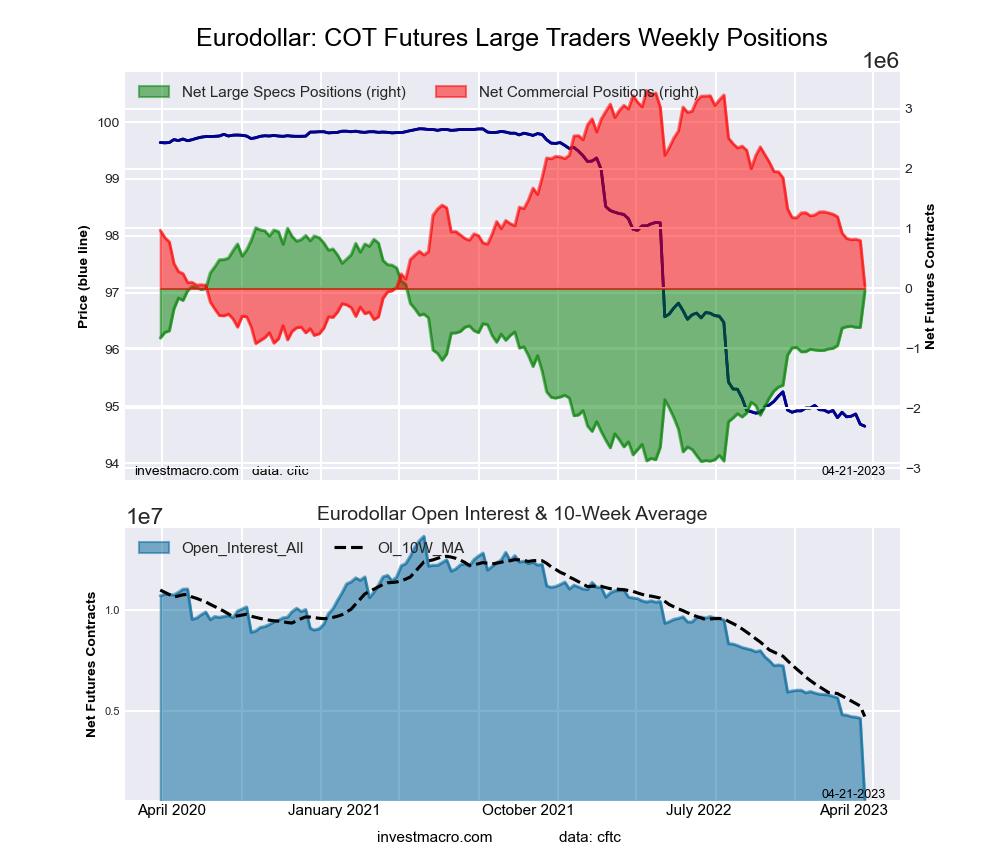
Eurodollar Bonds Futures COT ChartThe 3-Month Eurodollars large speculator standing this week was a net position of -637,971 contracts in the data reported through Tuesday. This was a weekly lift of 23,399 contracts from the previous week which had a total of -661,370 net contracts.

This week’s current strength score (the trader positioning range over the past three years, measured from 0 to 100) shows the speculators are currently Bullish with a score of 57.7 percent. The commercials are Bearish with a score of 41.5 percent and the small traders (not shown in chart) are Bullish with a score of 61.3 percent.

3-Month Eurodollars StatisticsSPECULATORSCOMMERCIALSSMALL TRADERS
– Percent of Open Interest Longs:7.066.85.3
– Percent of Open Interest Shorts:20.449.49.4
– Net Position:-637,971833,869-195,898
– Gross Longs:334,8193,193,023251,700
– Gross Shorts:972,7902,359,154447,598
– Long to Short Ratio:0.3 to 11.4 to 10.6 to 1
NET POSITION TREND:
– Strength Index Score (3 Year Range Pct):57.741.561.3
– Strength Index Reading (3 Year Range):BullishBearishBullish
NET POSITION MOVEMENT INDEX:
– 6-Week Change in Strength Index:10.2-10.59.9


30-Day Federal Funds Futures:

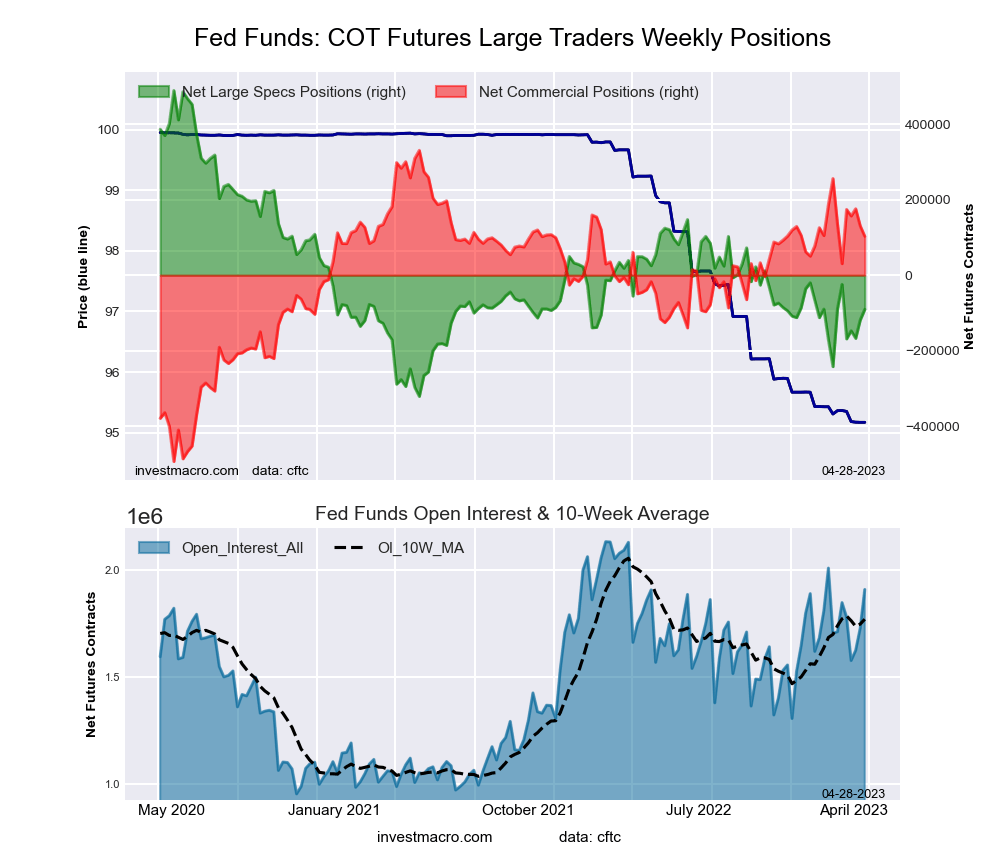
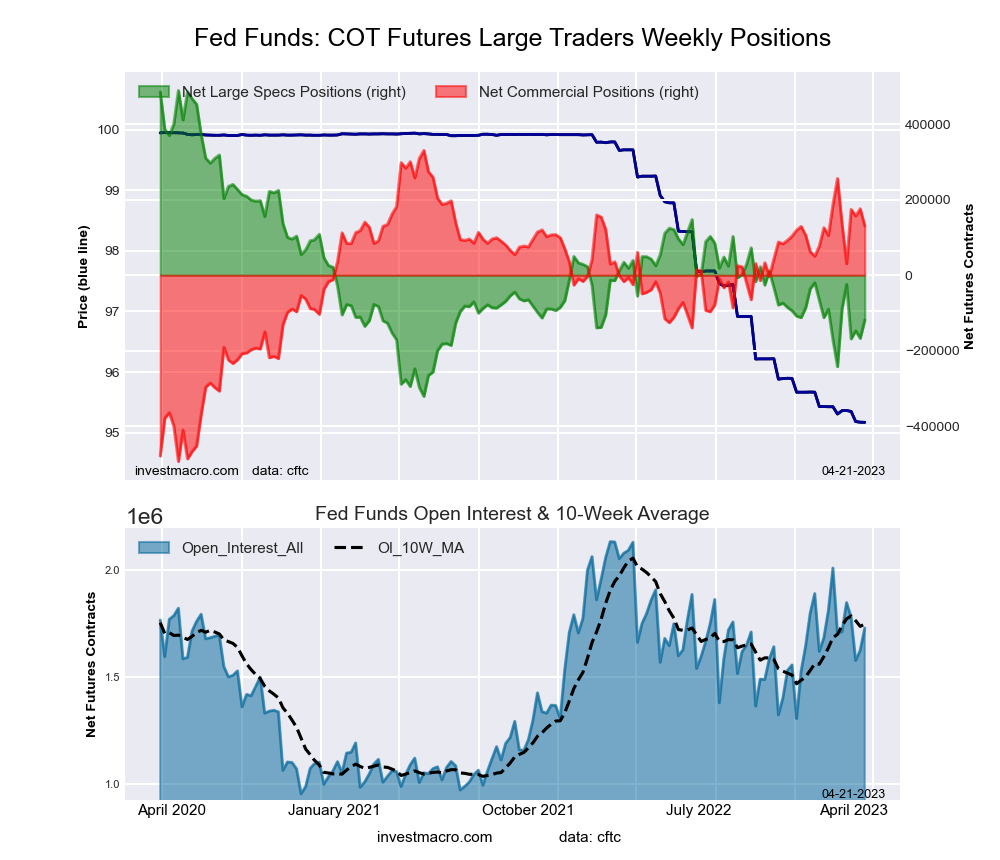
Federal Funds 30-Day Bonds Futures COT ChartThe 30-Day Federal Funds large speculator standing this week was a net position of -24,352 contracts in the data reported through Tuesday. This was a weekly gain of 64,355 contracts from the previous week which had a total of -88,707 net contracts.

This week’s current strength score (the trader positioning range over the past three years, measured from 0 to 100) shows the speculators are currently Bearish with a score of 36.6 percent. The commercials are Bullish with a score of 63.6 percent and the small traders (not shown in chart) are Bullish with a score of 78.8 percent.

30-Day Federal Funds StatisticsSPECULATORSCOMMERCIALSSMALL TRADERS
– Percent of Open Interest Longs:8.876.62.2
– Percent of Open Interest Shorts:10.174.92.6
– Net Position:-24,35230,578-6,226
– Gross Longs:161,9001,414,73841,466
– Gross Shorts:186,2521,384,16047,692
– Long to Short Ratio:0.9 to 11.0 to 10.9 to 1
NET POSITION TREND:
– Strength Index Score (3 Year Range Pct):36.663.678.8
– Strength Index Reading (3 Year Range):BearishBullishBullish
NET POSITION MOVEMENT INDEX:
– 6-Week Change in Strength Index:5.2-5.78.5


2-Year Treasury Note Futures:

2-Year Treasury Bonds Futures COT ChartThe 2-Year Treasury Note large speculator standing this week was a net position of -464,197 contracts in the data reported through Tuesday. This was a weekly advance of 67,316 contracts from the previous week which had a total of -531,513 net contracts.

This week’s current strength score (the trader positioning range over the past three years, measured from 0 to 100) shows the speculators are currently Bearish with a score of 29.6 percent. The commercials are Bullish with a score of 69.7 percent and the small traders (not shown in chart) are Bullish with a score of 65.4 percent.

2-Year Treasury Note StatisticsSPECULATORSCOMMERCIALSSMALL TRADERS
– Percent of Open Interest Longs:6.384.68.1
– Percent of Open Interest Shorts:26.465.57.3
– Net Position:-464,197444,09620,101
– Gross Longs:146,5301,959,237188,296
– Gross Shorts:610,7271,515,141168,195
– Long to Short Ratio:0.2 to 11.3 to 11.1 to 1
NET POSITION TREND:
– Strength Index Score (3 Year Range Pct):29.669.765.4
– Strength Index Reading (3 Year Range):BearishBullishBullish
NET POSITION MOVEMENT INDEX:
– 6-Week Change in Strength Index:24.8-24.0-12.2


5-Year Treasury Note Futures:

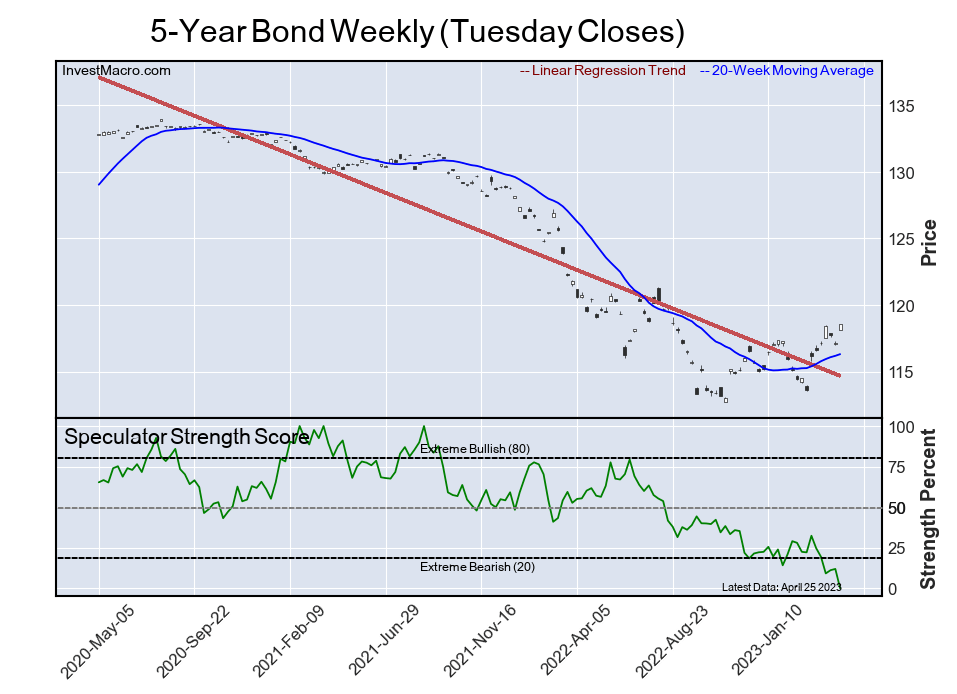
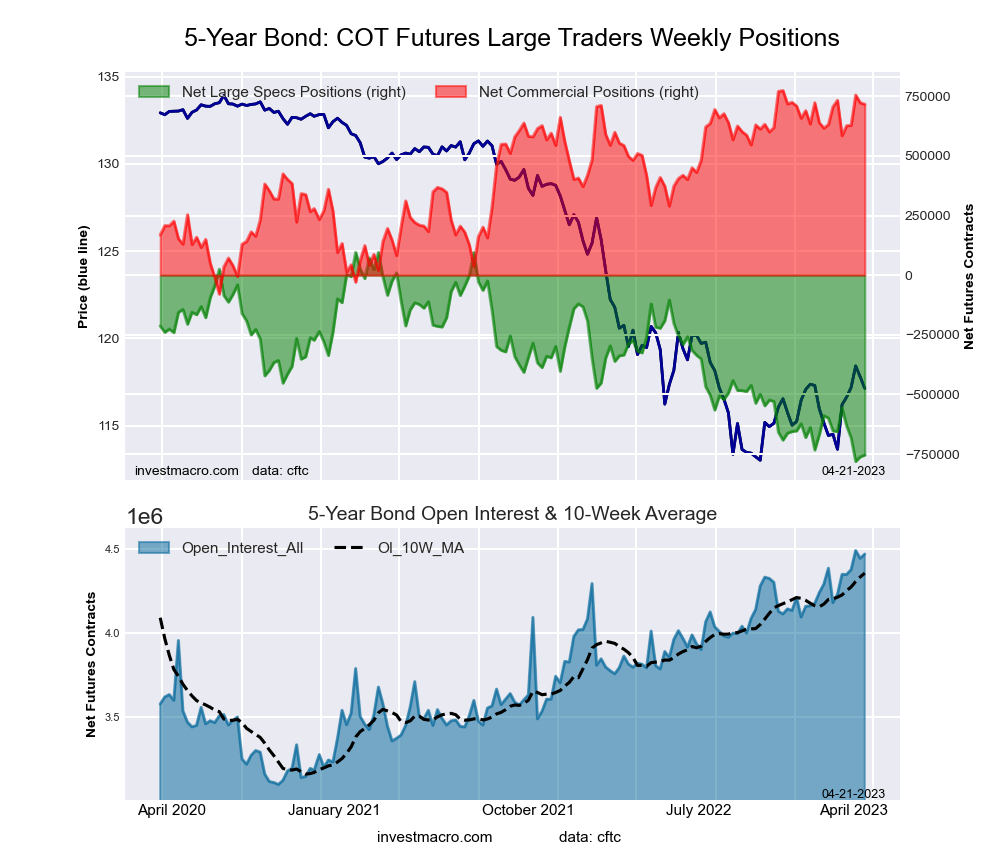
5-Year Treasury Bonds Futures COT ChartThe 5-Year Treasury Note large speculator standing this week was a net position of -631,568 contracts in the data reported through Tuesday. This was a weekly lowering of -74,356 contracts from the previous week which had a total of -557,212 net contracts.

This week’s current strength score (the trader positioning range over the past three years, measured from 0 to 100) shows the speculators are currently Bearish-Extreme with a score of 12.2 percent. The commercials are Bullish-Extreme with a score of 82.7 percent and the small traders (not shown in chart) are Bullish-Extreme with a score of 82.4 percent.

5-Year Treasury Note StatisticsSPECULATORSCOMMERCIALSSMALL TRADERS
– Percent of Open Interest Longs:8.982.47.7
– Percent of Open Interest Shorts:23.568.07.6
– Net Position:-631,568626,4455,123
– Gross Longs:389,0003,586,593335,724
– Gross Shorts:1,020,5682,960,148330,601
– Long to Short Ratio:0.4 to 11.2 to 11.0 to 1
NET POSITION TREND:
– Strength Index Score (3 Year Range Pct):12.282.782.4
– Strength Index Reading (3 Year Range):Bearish-ExtremeBullish-ExtremeBullish-Extreme
NET POSITION MOVEMENT INDEX:
– 6-Week Change in Strength Index:4.5-1.4-6.8


10-Year Treasury Note Futures:

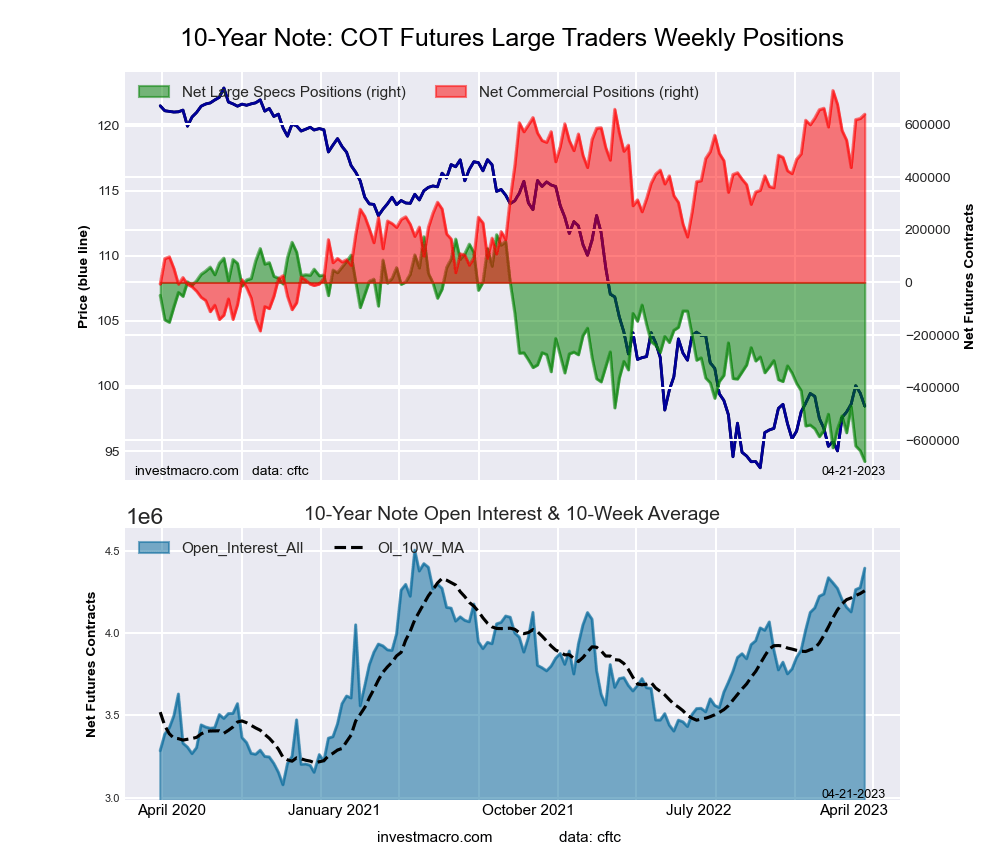
10-Year Treasury Notes Bonds Futures COT ChartThe 10-Year Treasury Note large speculator standing this week was a net position of -571,029 contracts in the data reported through Tuesday. This was a weekly reduction of -63,663 contracts from the previous week which had a total of -507,366 net contracts.

This week’s current strength score (the trader positioning range over the past three years, measured from 0 to 100) shows the speculators are currently Bearish-Extreme with a score of 7.0 percent. The commercials are Bullish with a score of 79.3 percent and the small traders (not shown in chart) are Bullish-Extreme with a score of 91.0 percent.

10-Year Treasury Note StatisticsSPECULATORSCOMMERCIALSSMALL TRADERS
– Percent of Open Interest Longs:9.180.19.0
– Percent of Open Interest Shorts:22.967.18.2
– Net Position:-571,029540,06730,962
– Gross Longs:379,1043,329,656372,551
– Gross Shorts:950,1332,789,589341,589
– Long to Short Ratio:0.4 to 11.2 to 11.1 to 1
NET POSITION TREND:
– Strength Index Score (3 Year Range Pct):7.079.391.0
– Strength Index Reading (3 Year Range):Bearish-ExtremeBullishBullish-Extreme
NET POSITION MOVEMENT INDEX:
– 6-Week Change in Strength Index:1.8-12.724.9


Ultra 10-Year Notes Futures:

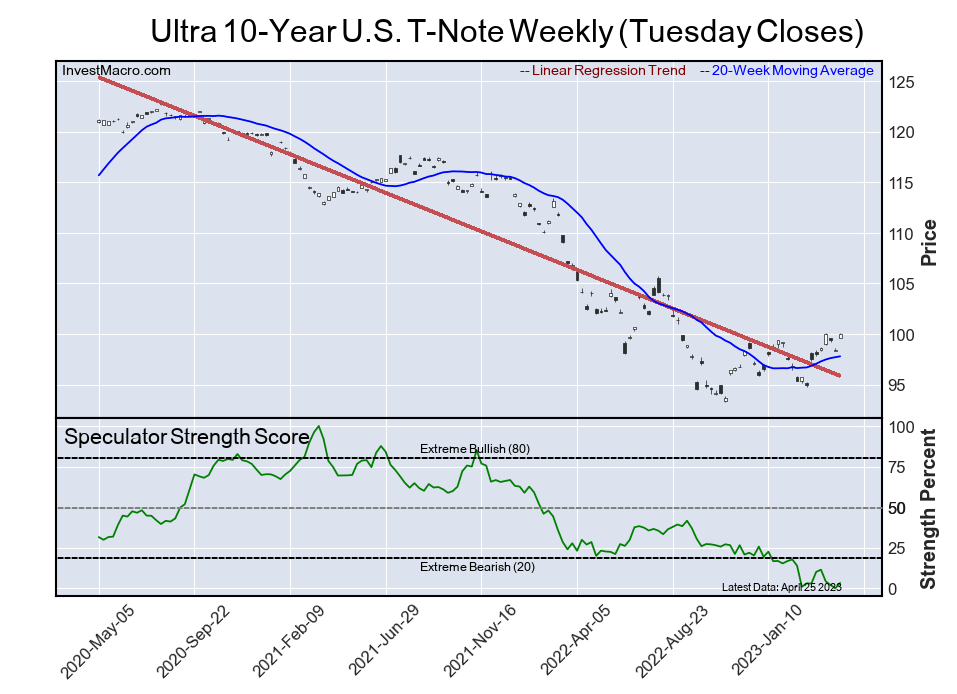
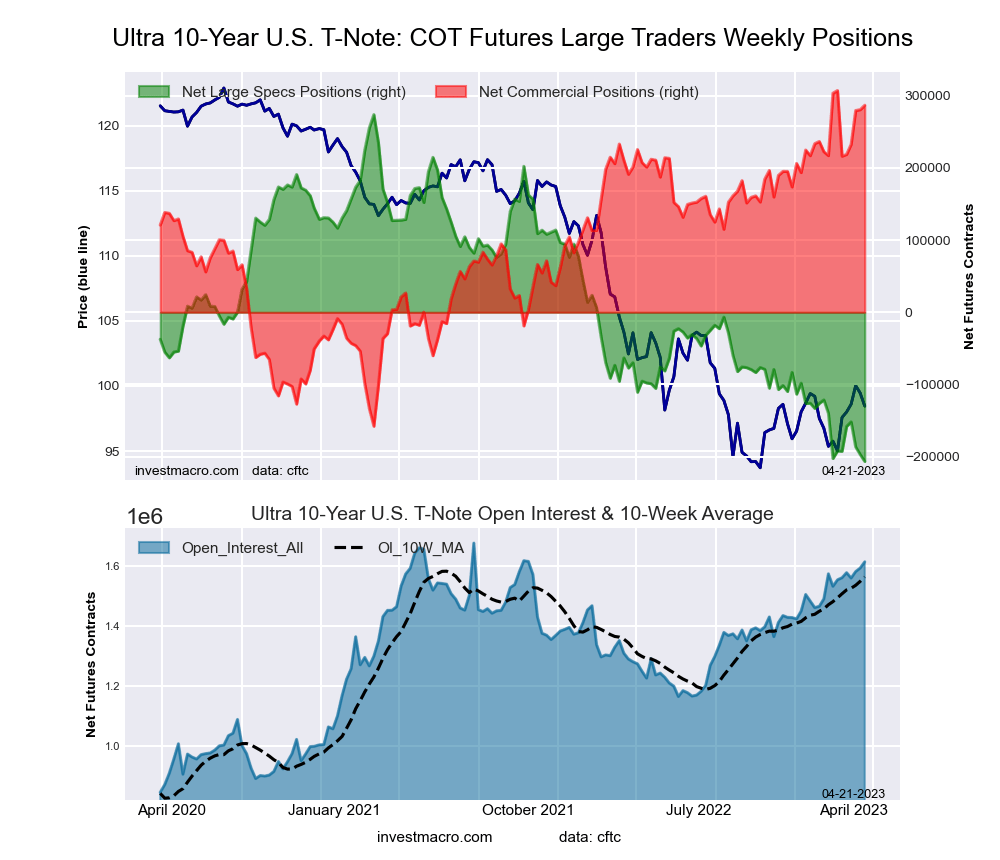
Ultra 10-Year Treasury Notes Bonds Futures COT ChartThe Ultra 10-Year Notes large speculator standing this week was a net position of -158,126 contracts in the data reported through Tuesday. This was a weekly boost of 34,396 contracts from the previous week which had a total of -192,522 net contracts.

This week’s current strength score (the trader positioning range over the past three years, measured from 0 to 100) shows the speculators are currently Bearish-Extreme with a score of 9.3 percent. The commercials are Bullish-Extreme with a score of 81.0 percent and the small traders (not shown in chart) are Bullish with a score of 78.1 percent.

Ultra 10-Year Notes StatisticsSPECULATORSCOMMERCIALSSMALL TRADERS
– Percent of Open Interest Longs:9.877.711.2
– Percent of Open Interest Shorts:19.863.815.0
– Net Position:-158,126218,538-60,412
– Gross Longs:153,8051,224,366176,050
– Gross Shorts:311,9311,005,828236,462
– Long to Short Ratio:0.5 to 11.2 to 10.7 to 1
NET POSITION TREND:
– Strength Index Score (3 Year Range Pct):9.381.078.1
– Strength Index Reading (3 Year Range):Bearish-ExtremeBullish-ExtremeBullish
NET POSITION MOVEMENT INDEX:
– 6-Week Change in Strength Index:-6.7-3.929.6


US Treasury Bonds Futures:

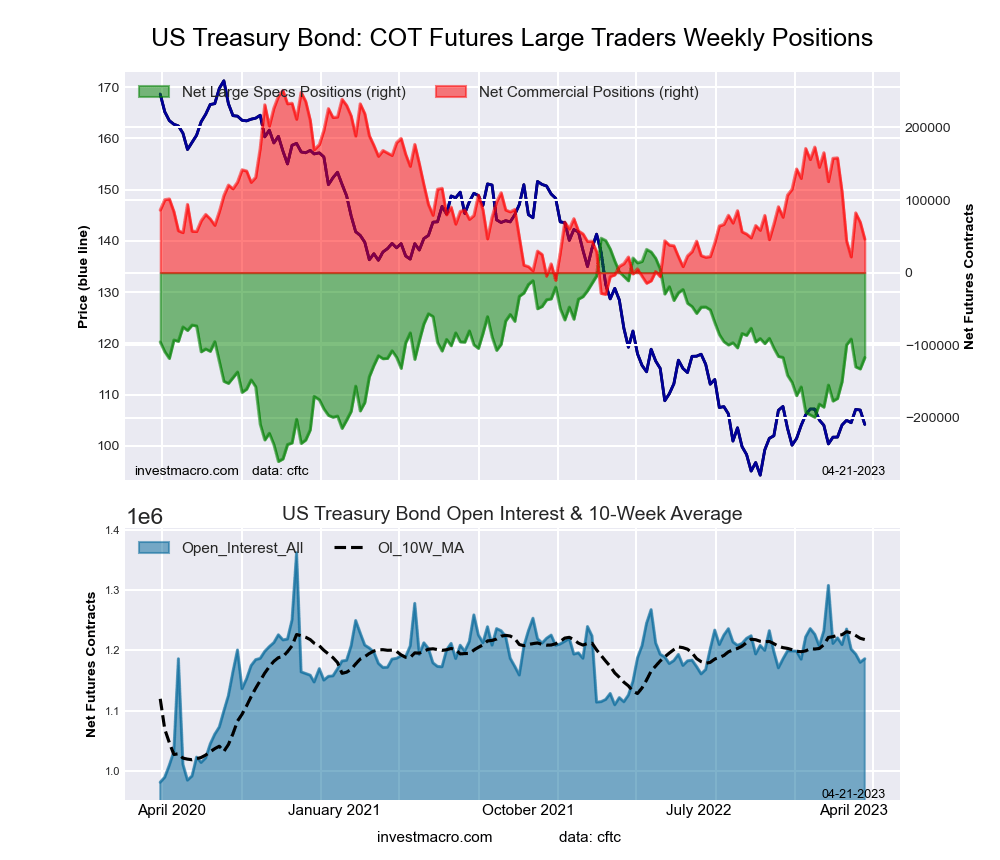
US Year Treasury Notes Long Bonds Futures COT ChartThe US Treasury Bonds large speculator standing this week was a net position of -99,413 contracts in the data reported through Tuesday. This was a weekly gain of 50,579 contracts from the previous week which had a total of -149,992 net contracts.

This week’s current strength score (the trader positioning range over the past three years, measured from 0 to 100) shows the speculators are currently Bullish with a score of 52.2 percent. The commercials are Bearish with a score of 26.2 percent and the small traders (not shown in chart) are Bullish-Extreme with a score of 100.0 percent.

US Treasury Bonds StatisticsSPECULATORSCOMMERCIALSSMALL TRADERS
– Percent of Open Interest Longs:8.377.713.7
– Percent of Open Interest Shorts:16.474.29.2
– Net Position:-99,41343,61755,796
– Gross Longs:102,678959,632169,332
– Gross Shorts:202,091916,015113,536
– Long to Short Ratio:0.5 to 11.0 to 11.5 to 1
NET POSITION TREND:
– Strength Index Score (3 Year Range Pct):52.226.2100.0
– Strength Index Reading (3 Year Range):BullishBearishBullish-Extreme
NET POSITION MOVEMENT INDEX:
– 6-Week Change in Strength Index:26.5-36.216.3


Ultra US Treasury Bonds Futures:

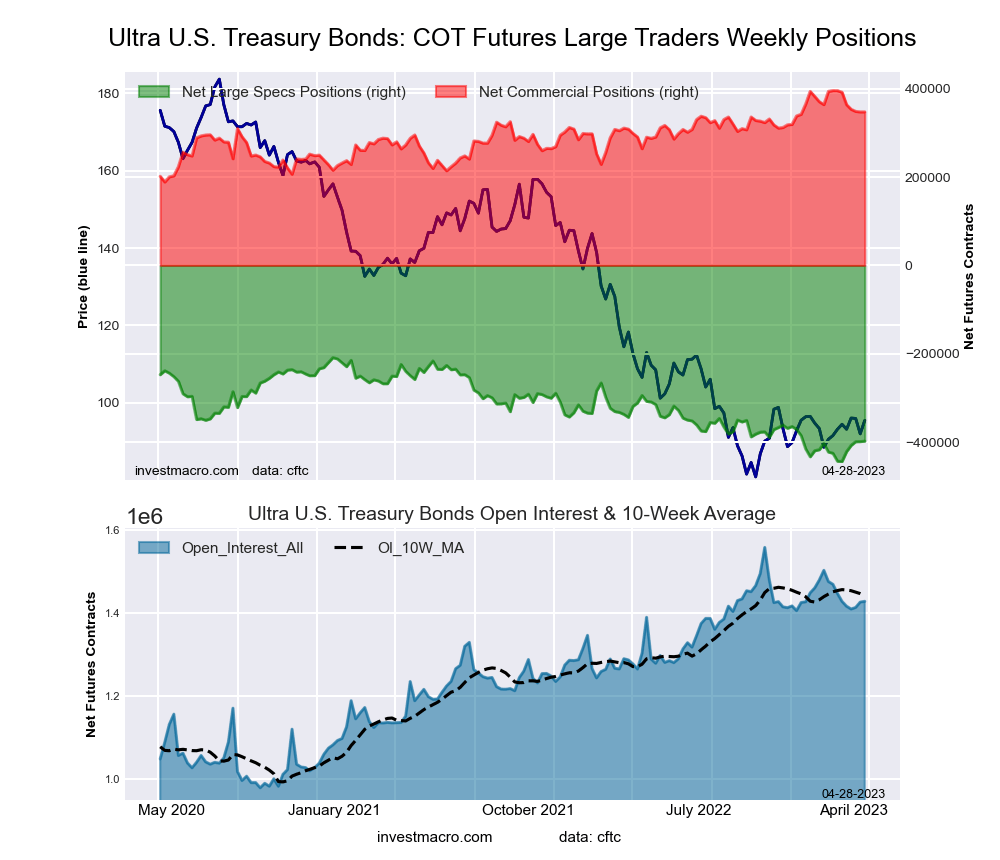
Ultra US Year Treasury Notes Long Bonds Futures COT ChartThe Ultra US Treasury Bonds large speculator standing this week was a net position of -443,962 contracts in the data reported through Tuesday. This was a weekly fall of -436 contracts from the previous week which had a total of -443,526 net contracts.

This week’s current strength score (the trader positioning range over the past three years, measured from 0 to 100) shows the speculators are currently Bearish-Extreme with a score of 0.0 percent. The commercials are Bullish-Extreme with a score of 98.1 percent and the small traders (not shown in chart) are Bullish-Extreme with a score of 91.8 percent.

Ultra US Treasury Bonds StatisticsSPECULATORSCOMMERCIALSSMALL TRADERS
– Percent of Open Interest Longs:4.484.611.0
– Percent of Open Interest Shorts:35.557.17.4
– Net Position:-443,962391,92752,035
– Gross Longs:62,3081,206,968157,069
– Gross Shorts:506,270815,041105,034
– Long to Short Ratio:0.1 to 11.5 to 11.5 to 1
NET POSITION TREND:
– Strength Index Score (3 Year Range Pct):0.098.191.8
– Strength Index Reading (3 Year Range):Bearish-ExtremeBullish-ExtremeBullish-Extreme
NET POSITION MOVEMENT INDEX:
– 6-Week Change in Strength Index:-10.34.614.8


Article By InvestMacroReceive our weekly COT Newsletter

*COT Report: The COT data, released weekly to the public each Friday, is updated through the most recent Tuesday (data is 3 days old) and shows a quick view of how large speculators or non-commercials (for-profit traders) were positioned in the futures markets.

The CFTC categorizes trader positions according to commercial hedgers (traders who use futures contracts for hedging as part of the business), non-commercials (large traders who speculate to realize trading profits) and nonreportable traders (usually small traders/speculators) as well as their open interest (contracts open in the market at time of reporting). See CFTC criteria here.
COT Large Speculators have dropped their Corn bullish bets to near 130-week lows

By InvestMacro

Here are the latest charts and statistics for the Commitment of Traders (COT) reports data published by the Commodities Futures Trading Commission (CFTC).

The latest COT data is updated through Tuesday March 21st and shows a quick view of how large traders (for-profit speculators and commercial entities) were positioned in the futures markets.

* This COT data is fully up-to-date after weeks of delays due to a cybersecurity event that happened in early February to ION Cleared Derivatives (a subsidiary of ION Markets). The hacking incident had disrupted the ability for the CFTC to report large trader positions.

Weekly Speculator Changes led by Corn, Coffee & Wheat

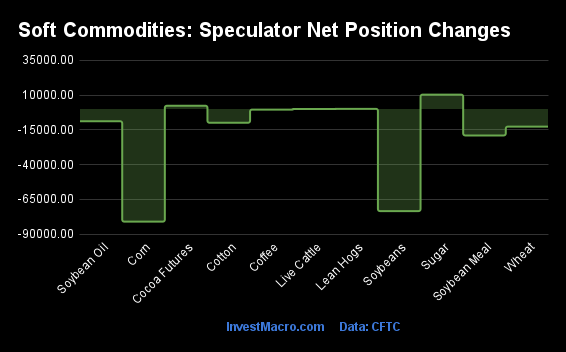
The COT soft commodities markets speculator bets were lower this week as five out of the eleven softs markets we cover had higher positioning while the other six markets had lower speculator contracts.

Leading the gains for the softs markets was Corn (15,699 contracts) with Coffee (6,386 contracts), Wheat (6,111 contracts), Cocoa (5,827 contracts) and Soybeans (3,793 contracts) also showing positive weeks.

The markets with the declines in speculator bets this week were Live Cattle (-25,773 contracts) with Soybean Meal (-24,378 contracts), Sugar (-20,487 contracts), Lean Hogs (-11,936 contracts), Cotton (-8,794 contracts) and Soybean Oil (-1,481 contracts) also seeing lower bets on the week.

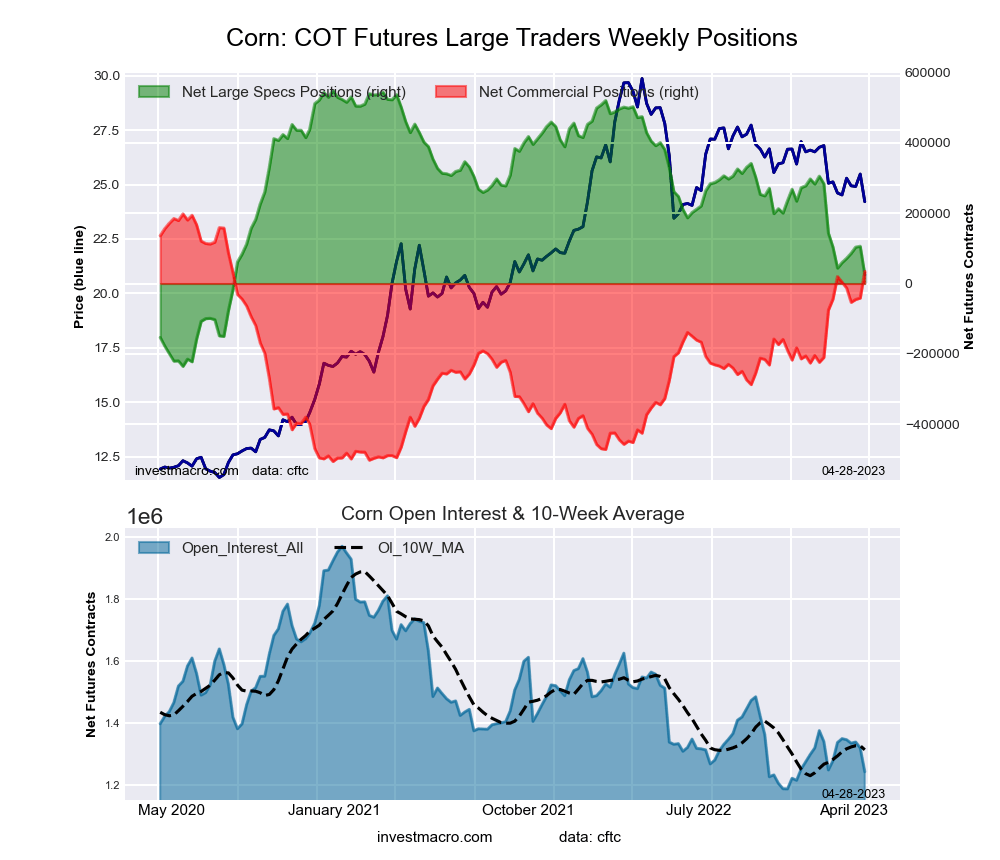
Highlighting the COT soft commodities data this week is the recent sharp decreases in the Corn speculator’s positioning. The large speculator bets for Corn have been in somewhat of a free-fall over the past five weeks (despite this week’s gain) as Corn bets have dropped for four out of the past five weeks and by a total of -245,236 contracts over that time-frame. The speculator positioning have sharply declined from a total of +304,712 contracts on February 14th to a total of just +59,476 contracts through Tuesday.

The last two weeks marked the first time that net positions have been under +100,000 contracts since September of 2020, a span of about 130 weeks. Corn’s speculator strength score level has dipped to 37.6 percent while its 6-week strength score trend has illuminated its recent weakness with a -28.5 percent trend score.

Corn’s futures price has risen for the past two weeks but is off the lofty heights of 2022 when prices reached highs in the 750-800 range. This week Corn closed out near the 644.00 level after bouncing off of support at the 600 level over the previous few weeks.


Data Snapshot of Commodity Market Traders | Columns Legend
Mar-21-2023OIOI-IndexSpec-NetSpec-IndexCom-NetCOM-IndexSmalls-NetSmalls-Index
WTI Crude1,791,90235154,3410-178,90410024,56340
Gold469,87422158,60547-183,5685324,96343
Silver119,08203,46223-12,681799,21917
Copper201,63644-12,351177,536804,81549
Palladium11,64780-7,01817,369100-35121
Platinum61,416459,52638-14,141644,61530
Natural Gas1,283,03765-144,68114113,4408531,24154
Brent149,30211-46,3492043,543782,80647
Heating Oil279,105289,82945-22,4776012,64842
Soybeans696,28026171,78757-141,84848-29,93922
Corn1,349,3722159,476383,79372-63,26915
Coffee201,0181318,69647-17,67358-1,0230
Sugar929,41855210,65666-258,5222947,86667
Wheat370,29749-59,2031259,32589-12290


Strength Scores led by Soybean Meal & Cocoa

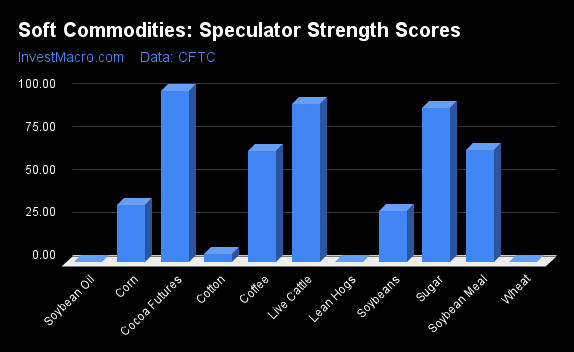
COT Strength Scores (a normalized measure of Speculator positions over a 3-Year range, from 0 to 100 where above 80 is Extreme-Bullish and below 20 is Extreme-Bearish) showed that Soybean Meal (77 percent) and Cocoa (76 percent) lead the softs markets this week. Sugar (66 percent), Soybeans (57 percent) and Live Cattle (56 percent) come in as the next highest in the weekly strength scores.

On the downside, Lean Hogs (0 percent), Cotton (0 percent), Soybean Oil (3 percent) and Wheat (12 percent) come in at the lowest strength levels currently and are all in Extreme-Bearish territory (below 20 percent).

Strength Statistics:
Corn (37.6 percent) vs Corn previous week (35.6 percent)
Sugar (66.3 percent) vs Sugar previous week (73.4 percent)
Coffee (46.6 percent) vs Coffee previous week (40.0 percent)
Soybeans (56.7 percent) vs Soybeans previous week (55.2 percent)
Soybean Oil (2.5 percent) vs Soybean Oil previous week (3.5 percent)
Soybean Meal (77.2 percent) vs Soybean Meal previous week (90.0 percent)
Live Cattle (56.2 percent) vs Live Cattle previous week (85.1 percent)
Lean Hogs (0.0 percent) vs Lean Hogs previous week (11.6 percent)
Cotton (0.0 percent) vs Cotton previous week (6.6 percent)
Cocoa (75.8 percent) vs Cocoa previous week (67.7 percent)
Wheat (11.7 percent) vs Wheat previous week (6.6 percent)


Cocoa & Coffee top the 6-Week Strength Trends

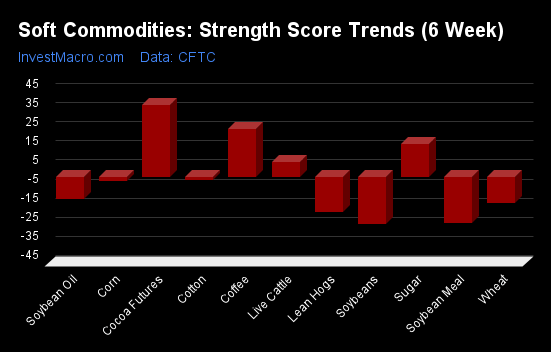
COT Strength Score Trends (or move index, calculates the 6-week changes in strength scores) showed that Cocoa (21 percent) and Coffee (17 percent) lead the past six weeks trends for soft commodities and represent the only two positive movers in the latest trends data.

Live Cattle (-28 percent) leads the downside trend scores currently with Corn (-28 percent), Cotton (-18 percent) and Soybean Oil (-18 percent) following next with lowest trend scores.

Strength Trend Statistics:
Corn (-28.5 percent) vs Corn previous week (-32.3 percent)
Sugar (-8.7 percent) vs Sugar previous week (-5.5 percent)
Coffee (17.0 percent) vs Coffee previous week (14.6 percent)
Soybeans (-1.2 percent) vs Soybeans previous week (-4.1 percent)
Soybean Oil (-17.9 percent) vs Soybean Oil previous week (-21.0 percent)
Soybean Meal (-14.5 percent) vs Soybean Meal previous week (-0.1 percent)
Live Cattle (-28.4 percent) vs Live Cattle previous week (20.5 percent)
Lean Hogs (-9.6 percent) vs Lean Hogs previous week (-2.1 percent)
Cotton (-17.6 percent) vs Cotton previous week (-14.8 percent)
Cocoa (21.3 percent) vs Cocoa previous week (9.5 percent)
Wheat (-10.7 percent) vs Wheat previous week (-21.0 percent)


Individual Soft Commodities Markets:

CORN Futures:

CORN Futures COT ChartThe CORN large speculator standing this week was a net position of 59,476 contracts in the data reported through Tuesday. This was a weekly gain of 15,699 contracts from the previous week which had a total of 43,777 net contracts.

This week’s current strength score (the trader positioning range over the past three years, measured from 0 to 100) shows the speculators are currently Bearish with a score of 37.6 percent. The commercials are Bullish with a score of 72.4 percent and the small traders (not shown in chart) are Bearish-Extreme with a score of 14.7 percent.

CORN Futures StatisticsSPECULATORSCOMMERCIALSSMALL TRADERS
– Percent of Open Interest Longs:24.249.58.4
– Percent of Open Interest Shorts:19.849.213.1
– Net Position:59,4763,793-63,269
– Gross Longs:327,137667,983113,622
– Gross Shorts:267,661664,190176,891
– Long to Short Ratio:1.2 to 11.0 to 10.6 to 1
NET POSITION TREND:
– Strength Index Score (3 Year Range Pct):37.672.414.7
– Strength Index Reading (3 Year Range):BearishBullishBearish-Extreme
NET POSITION MOVEMENT INDEX:
– 6-Week Change in Strength Index:-28.529.612.0


SUGAR Futures:

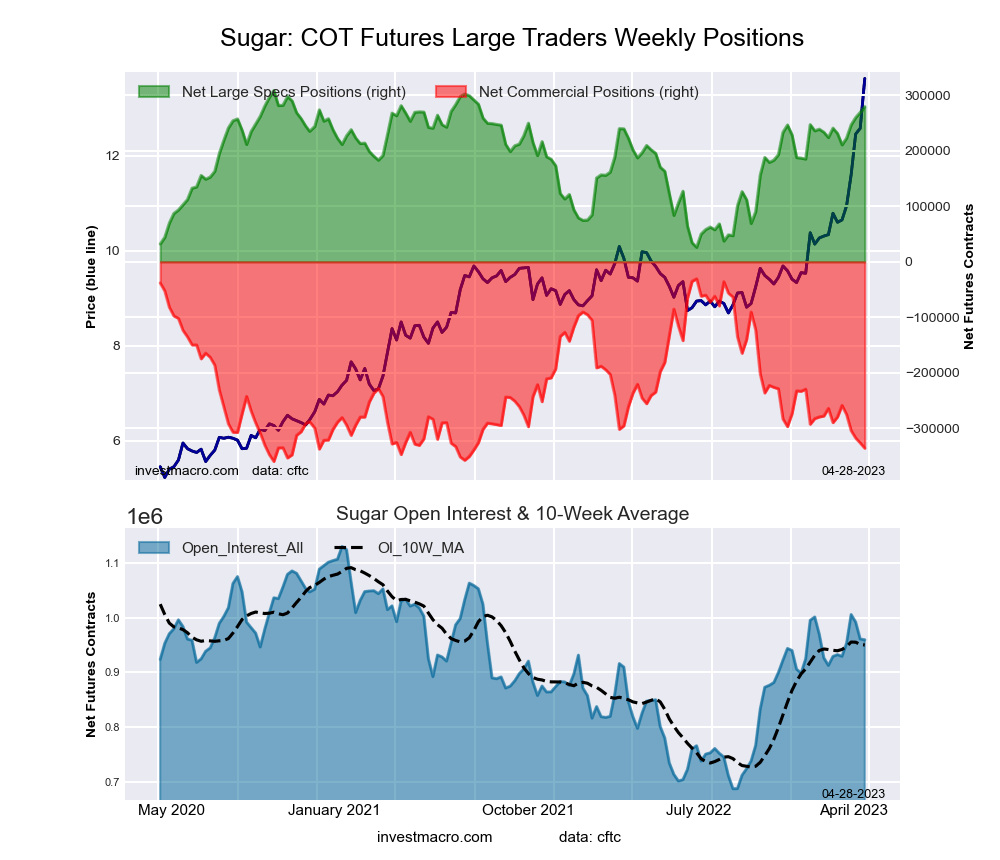
SUGAR Futures COT ChartThe SUGAR large speculator standing this week was a net position of 210,656 contracts in the data reported through Tuesday. This was a weekly reduction of -20,487 contracts from the previous week which had a total of 231,143 net contracts.

This week’s current strength score (the trader positioning range over the past three years, measured from 0 to 100) shows the speculators are currently Bullish with a score of 66.3 percent. The commercials are Bearish with a score of 29.0 percent and the small traders (not shown in chart) are Bullish with a score of 67.0 percent.

SUGAR Futures StatisticsSPECULATORSCOMMERCIALSSMALL TRADERS
– Percent of Open Interest Longs:32.638.110.9
– Percent of Open Interest Shorts:9.965.95.7
– Net Position:210,656-258,52247,866
– Gross Longs:302,634353,905101,185
– Gross Shorts:91,978612,42753,319
– Long to Short Ratio:3.3 to 10.6 to 11.9 to 1
NET POSITION TREND:
– Strength Index Score (3 Year Range Pct):66.329.067.0
– Strength Index Reading (3 Year Range):BullishBearishBullish
NET POSITION MOVEMENT INDEX:
– 6-Week Change in Strength Index:-8.76.81.9


COFFEE Futures:

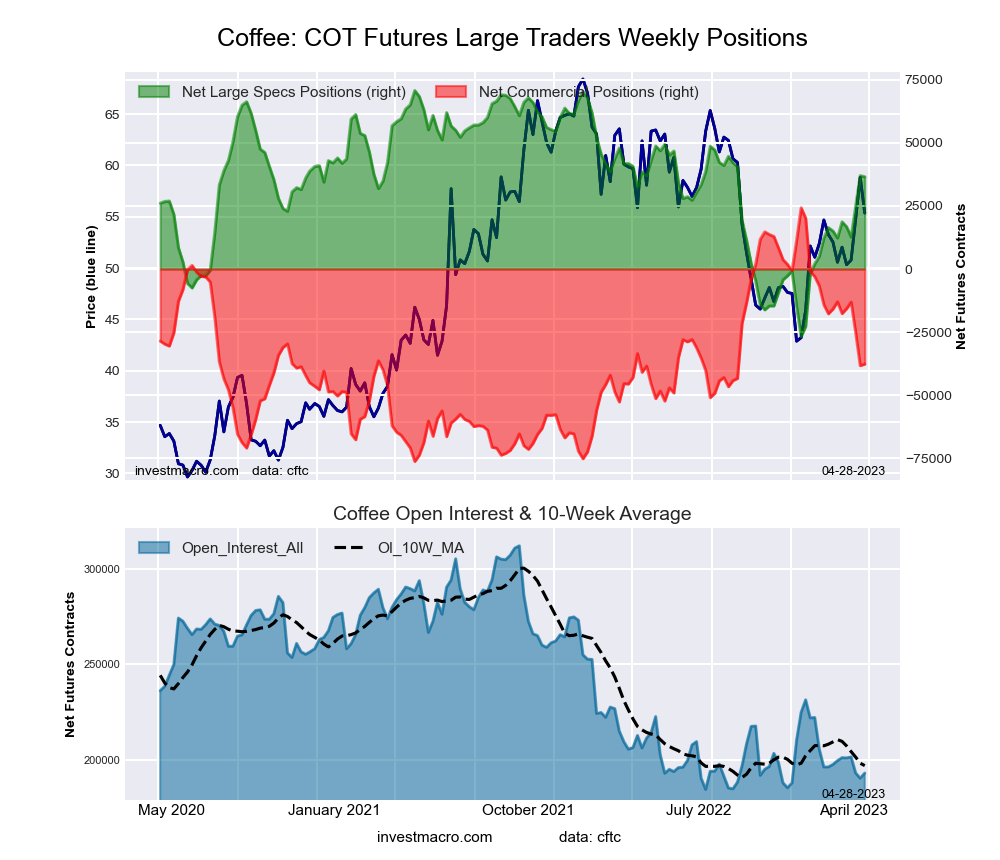
COFFEE Futures COT ChartThe COFFEE large speculator standing this week was a net position of 18,696 contracts in the data reported through Tuesday. This was a weekly gain of 6,386 contracts from the previous week which had a total of 12,310 net contracts.

This week’s current strength score (the trader positioning range over the past three years, measured from 0 to 100) shows the speculators are currently Bearish with a score of 46.6 percent. The commercials are Bullish with a score of 58.3 percent and the small traders (not shown in chart) are Bearish-Extreme with a score of 0.0 percent.

COFFEE Futures StatisticsSPECULATORSCOMMERCIALSSMALL TRADERS
– Percent of Open Interest Longs:21.449.63.7
– Percent of Open Interest Shorts:12.158.34.2
– Net Position:18,696-17,673-1,023
– Gross Longs:43,07299,6067,452
– Gross Shorts:24,376117,2798,475
– Long to Short Ratio:1.8 to 10.8 to 10.9 to 1
NET POSITION TREND:
– Strength Index Score (3 Year Range Pct):46.658.30.0
– Strength Index Reading (3 Year Range):BearishBullishBearish-Extreme
NET POSITION MOVEMENT INDEX:
– 6-Week Change in Strength Index:17.0-14.6-24.0


SOYBEANS Futures:

SOYBEANS Futures COT ChartThe SOYBEANS large speculator standing this week was a net position of 171,787 contracts in the data reported through Tuesday. This was a weekly lift of 3,793 contracts from the previous week which had a total of 167,994 net contracts.

This week’s current strength score (the trader positioning range over the past three years, measured from 0 to 100) shows the speculators are currently Bullish with a score of 56.7 percent. The commercials are Bearish with a score of 47.7 percent and the small traders (not shown in chart) are Bearish with a score of 21.9 percent.

SOYBEANS Futures StatisticsSPECULATORSCOMMERCIALSSMALL TRADERS
– Percent of Open Interest Longs:30.344.66.9
– Percent of Open Interest Shorts:5.664.911.2
– Net Position:171,787-141,848-29,939
– Gross Longs:210,762310,32547,727
– Gross Shorts:38,975452,17377,666
– Long to Short Ratio:5.4 to 10.7 to 10.6 to 1
NET POSITION TREND:
– Strength Index Score (3 Year Range Pct):56.747.721.9
– Strength Index Reading (3 Year Range):BullishBearishBearish
NET POSITION MOVEMENT INDEX:
– 6-Week Change in Strength Index:-1.2-2.818.4


SOYBEAN OIL Futures:

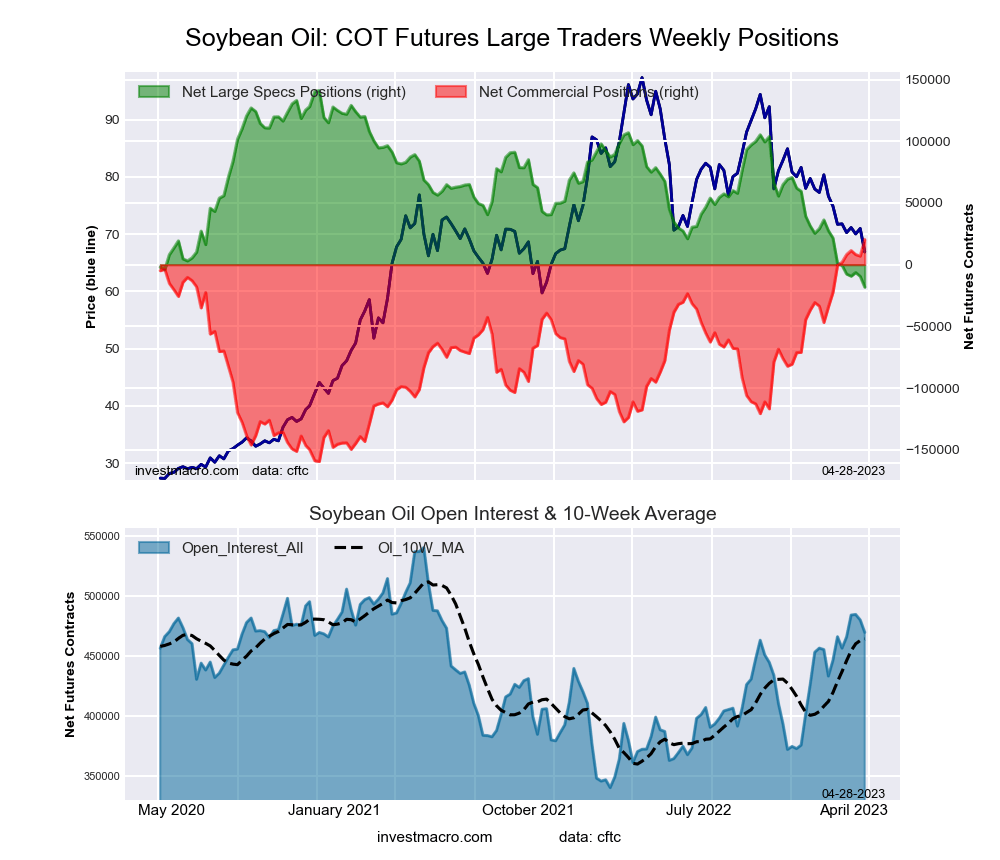
SOYBEAN OIL Futures COT ChartThe SOYBEAN OIL large speculator standing this week was a net position of -567 contracts in the data reported through Tuesday. This was a weekly fall of -1,481 contracts from the previous week which had a total of 914 net contracts.

This week’s current strength score (the trader positioning range over the past three years, measured from 0 to 100) shows the speculators are currently Bearish-Extreme with a score of 2.5 percent. The commercials are Bullish-Extreme with a score of 100.0 percent and the small traders (not shown in chart) are Bearish-Extreme with a score of 0.0 percent.

SOYBEAN OIL Futures StatisticsSPECULATORSCOMMERCIALSSMALL TRADERS
– Percent of Open Interest Longs:16.456.96.4
– Percent of Open Interest Shorts:16.556.56.7
– Net Position:-5671,924-1,357
– Gross Longs:74,741259,79629,346
– Gross Shorts:75,308257,87230,703
– Long to Short Ratio:1.0 to 11.0 to 11.0 to 1
NET POSITION TREND:
– Strength Index Score (3 Year Range Pct):2.5100.00.0
– Strength Index Reading (3 Year Range):Bearish-ExtremeBullish-ExtremeBearish-Extreme
NET POSITION MOVEMENT INDEX:
– 6-Week Change in Strength Index:-17.920.2-26.9


SOYBEAN MEAL Futures:

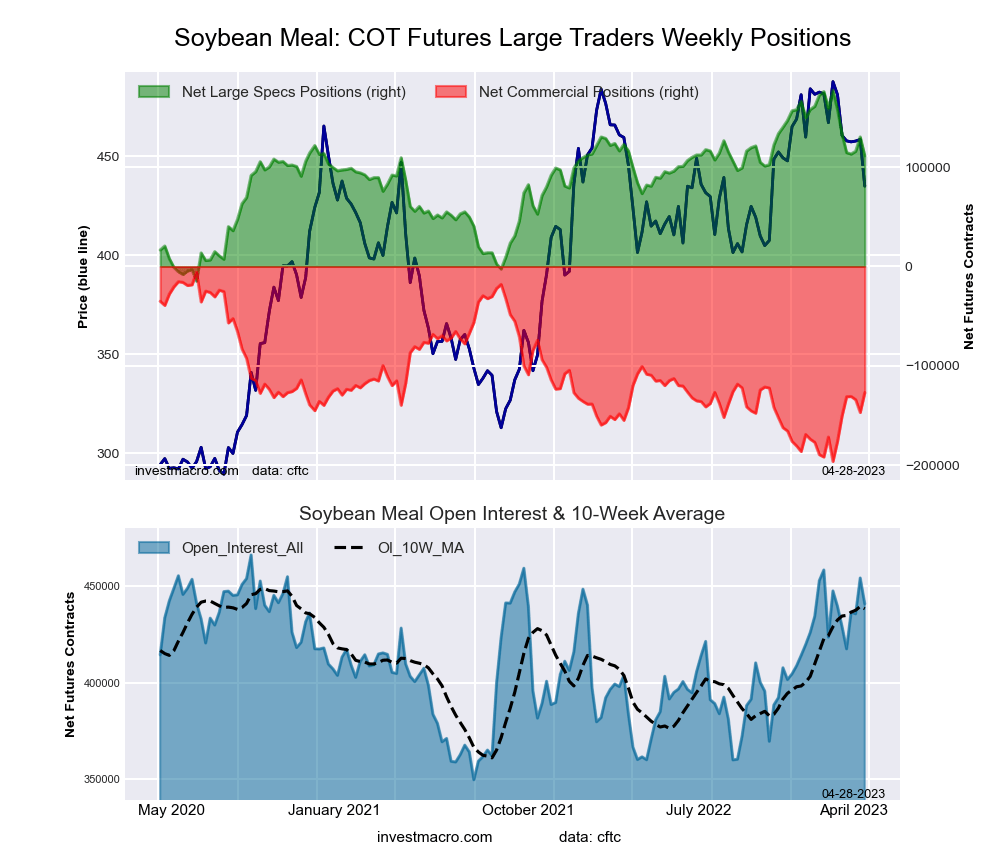
SOYBEAN MEAL Futures COT ChartThe SOYBEAN MEAL large speculator standing this week was a net position of 133,343 contracts in the data reported through Tuesday. This was a weekly decline of -24,378 contracts from the previous week which had a total of 157,721 net contracts.

This week’s current strength score (the trader positioning range over the past three years, measured from 0 to 100) shows the speculators are currently Bullish with a score of 77.2 percent. The commercials are Bearish with a score of 24.0 percent and the small traders (not shown in chart) are Bearish with a score of 24.0 percent.

SOYBEAN MEAL Futures StatisticsSPECULATORSCOMMERCIALSSMALL TRADERS
– Percent of Open Interest Longs:36.336.810.8
– Percent of Open Interest Shorts:5.271.86.8
– Net Position:133,343-150,41417,071
– Gross Longs:155,660157,93146,260
– Gross Shorts:22,317308,34529,189
– Long to Short Ratio:7.0 to 10.5 to 11.6 to 1
NET POSITION TREND:
– Strength Index Score (3 Year Range Pct):77.224.024.0
– Strength Index Reading (3 Year Range):BullishBearishBearish
NET POSITION MOVEMENT INDEX:
– 6-Week Change in Strength Index:-14.513.96.6


LIVE CATTLE Futures:

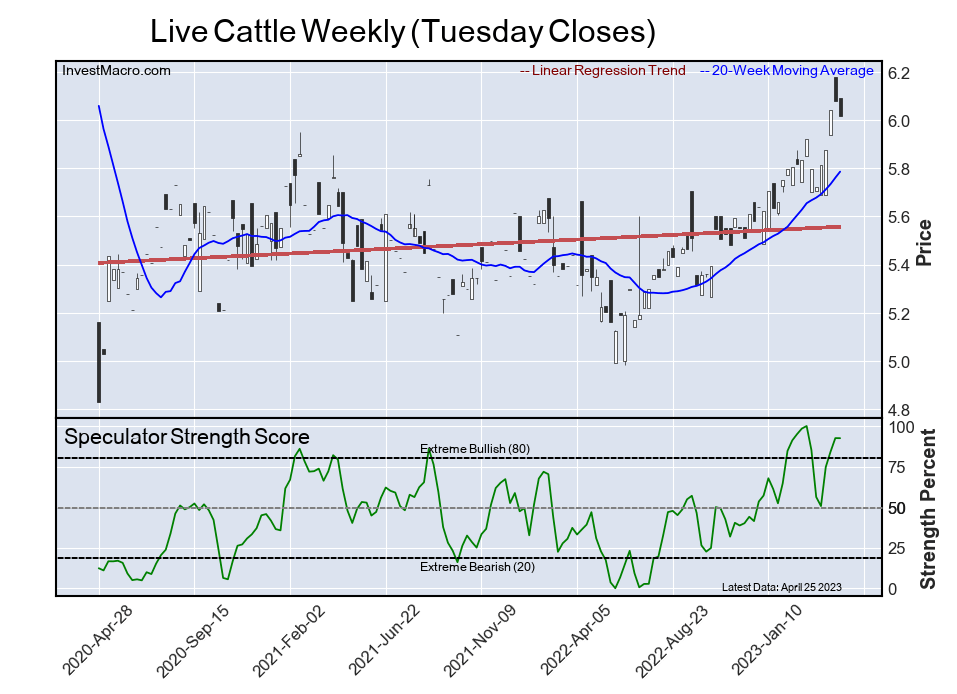
LIVE CATTLE Futures COT ChartThe LIVE CATTLE large speculator standing this week was a net position of 69,700 contracts in the data reported through Tuesday. This was a weekly reduction of -25,773 contracts from the previous week which had a total of 95,473 net contracts.

This week’s current strength score (the trader positioning range over the past three years, measured from 0 to 100) shows the speculators are currently Bullish with a score of 56.2 percent. The commercials are Bearish with a score of 39.2 percent and the small traders (not shown in chart) are Bullish with a score of 77.9 percent.

LIVE CATTLE Futures StatisticsSPECULATORSCOMMERCIALSSMALL TRADERS
– Percent of Open Interest Longs:37.528.011.8
– Percent of Open Interest Shorts:15.449.412.4
– Net Position:69,700-67,647-2,053
– Gross Longs:118,51888,37037,174
– Gross Shorts:48,818156,01739,227
– Long to Short Ratio:2.4 to 10.6 to 10.9 to 1
NET POSITION TREND:
– Strength Index Score (3 Year Range Pct):56.239.277.9
– Strength Index Reading (3 Year Range):BullishBearishBullish
NET POSITION MOVEMENT INDEX:
– 6-Week Change in Strength Index:-28.425.523.9


LEAN HOGS Futures:

LEAN HOGS Futures COT ChartThe LEAN HOGS large speculator standing this week was a net position of -17,653 contracts in the data reported through Tuesday. This was a weekly fall of -11,936 contracts from the previous week which had a total of -5,717 net contracts.

This week’s current strength score (the trader positioning range over the past three years, measured from 0 to 100) shows the speculators are currently Bearish-Extreme with a score of 0.0 percent. The commercials are Bullish-Extreme with a score of 100.0 percent and the small traders (not shown in chart) are Bullish-Extreme with a score of 99.0 percent.

LEAN HOGS Futures StatisticsSPECULATORSCOMMERCIALSSMALL TRADERS
– Percent of Open Interest Longs:28.836.611.4
– Percent of Open Interest Shorts:36.828.811.3
– Net Position:-17,65317,350303
– Gross Longs:63,40480,72325,180
– Gross Shorts:81,05763,37324,877
– Long to Short Ratio:0.8 to 11.3 to 11.0 to 1
NET POSITION TREND:
– Strength Index Score (3 Year Range Pct):0.0100.099.0
– Strength Index Reading (3 Year Range):Bearish-ExtremeBullish-ExtremeBullish-Extreme
NET POSITION MOVEMENT INDEX:
– 6-Week Change in Strength Index:-9.610.4-1.0


COTTON Futures:

COTTON Futures COT ChartThe COTTON large speculator standing this week was a net position of -11,582 contracts in the data reported through Tuesday. This was a weekly decline of -8,794 contracts from the previous week which had a total of -2,788 net contracts.

This week’s current strength score (the trader positioning range over the past three years, measured from 0 to 100) shows the speculators are currently Bearish-Extreme with a score of 0.0 percent. The commercials are Bullish-Extreme with a score of 100.0 percent and the small traders (not shown in chart) are Bearish-Extreme with a score of 0.0 percent.

COTTON Futures StatisticsSPECULATORSCOMMERCIALSSMALL TRADERS
– Percent of Open Interest Longs:26.150.75.9
– Percent of Open Interest Shorts:32.043.47.2
– Net Position:-11,58214,226-2,644
– Gross Longs:51,42699,63011,525
– Gross Shorts:63,00885,40414,169
– Long to Short Ratio:0.8 to 11.2 to 10.8 to 1
NET POSITION TREND:
– Strength Index Score (3 Year Range Pct):0.0100.00.0
– Strength Index Reading (3 Year Range):Bearish-ExtremeBullish-ExtremeBearish-Extreme
NET POSITION MOVEMENT INDEX:
– 6-Week Change in Strength Index:-17.619.5-32.6


COCOA Futures:

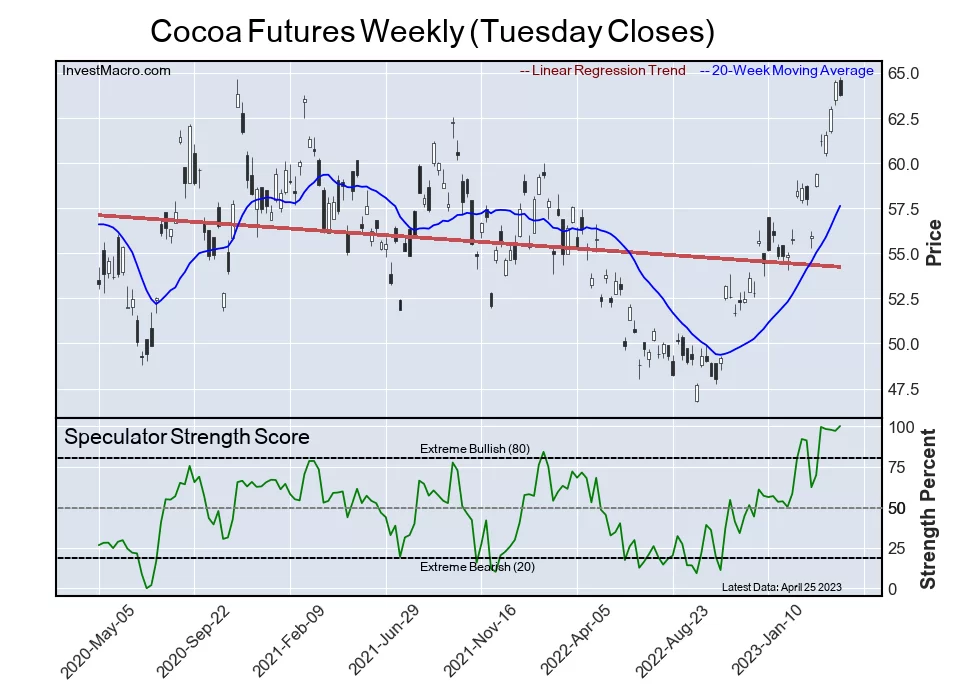
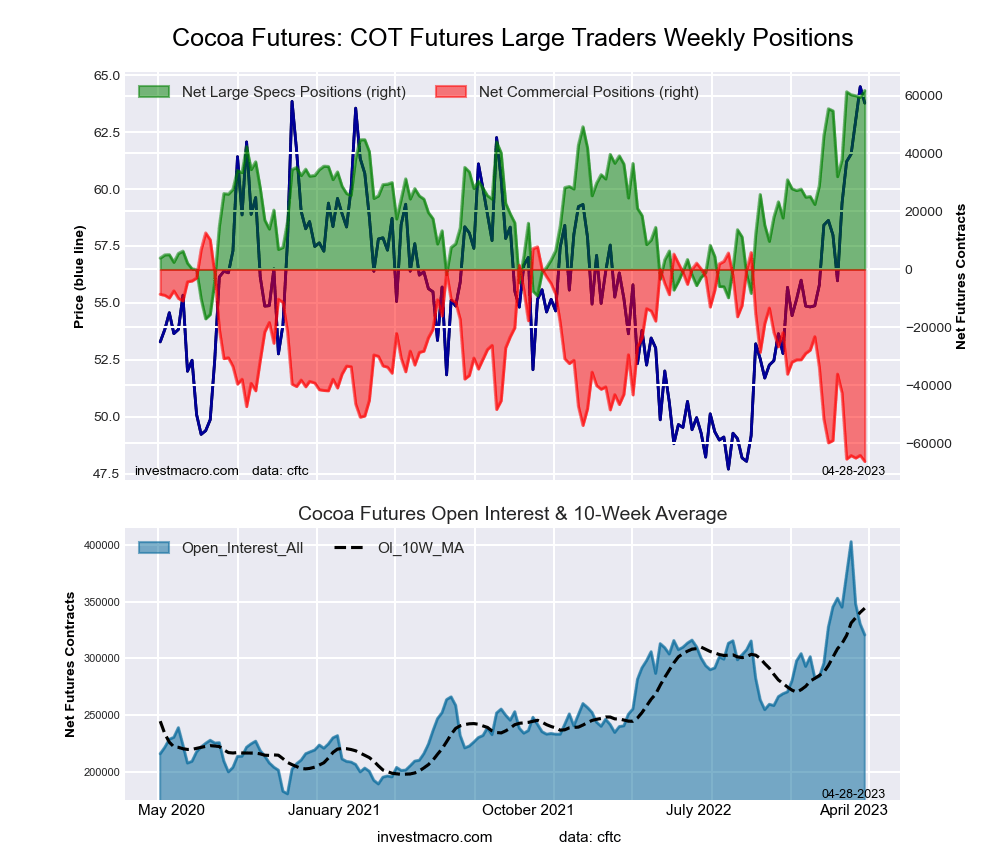
COCOA Futures COT ChartThe COCOA large speculator standing this week was a net position of 37,846 contracts in the data reported through Tuesday. This was a weekly lift of 5,827 contracts from the previous week which had a total of 32,019 net contracts.

This week’s current strength score (the trader positioning range over the past three years, measured from 0 to 100) shows the speculators are currently Bullish with a score of 75.8 percent. The commercials are Bearish with a score of 23.7 percent and the small traders (not shown in chart) are Bearish with a score of 44.5 percent.

COCOA Futures StatisticsSPECULATORSCOMMERCIALSSMALL TRADERS
– Percent of Open Interest Longs:28.041.54.5
– Percent of Open Interest Shorts:17.153.83.1
– Net Position:37,846-42,6364,790
– Gross Longs:96,676143,11515,642
– Gross Shorts:58,830185,75110,852
– Long to Short Ratio:1.6 to 10.8 to 11.4 to 1
NET POSITION TREND:
– Strength Index Score (3 Year Range Pct):75.823.744.5
– Strength Index Reading (3 Year Range):BullishBearishBearish
NET POSITION MOVEMENT INDEX:
– 6-Week Change in Strength Index:21.3-26.840.4


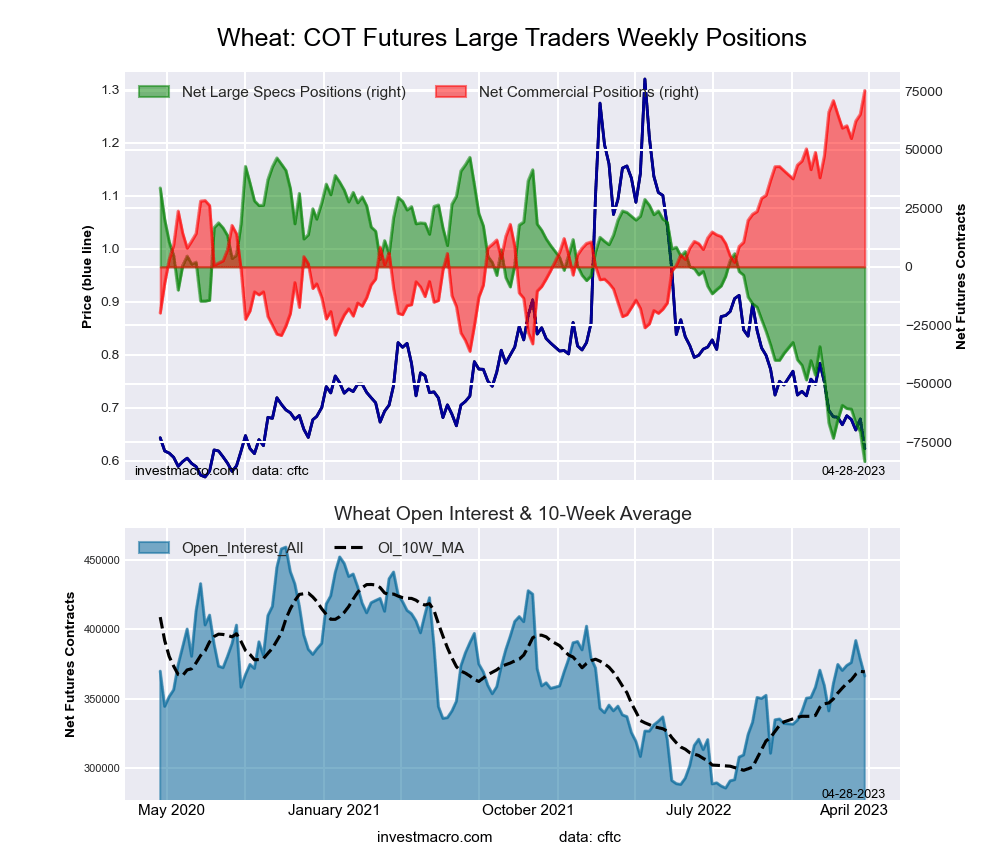
WHEAT Futures:

WHEAT Futures COT ChartThe WHEAT large speculator standing this week was a net position of -59,203 contracts in the data reported through Tuesday. This was a weekly gain of 6,111 contracts from the previous week which had a total of -65,314 net contracts.

This week’s current strength score (the trader positioning range over the past three years, measured from 0 to 100) shows the speculators are currently Bearish-Extreme with a score of 11.7 percent. The commercials are Bullish-Extreme with a score of 89.0 percent and the small traders (not shown in chart) are Bullish-Extreme with a score of 90.2 percent.

WHEAT Futures StatisticsSPECULATORSCOMMERCIALSSMALL TRADERS
– Percent of Open Interest Longs:28.435.99.7
– Percent of Open Interest Shorts:44.419.99.8
– Net Position:-59,20359,325-122
– Gross Longs:105,293133,06935,982
– Gross Shorts:164,49673,74436,104
– Long to Short Ratio:0.6 to 11.8 to 11.0 to 1
NET POSITION TREND:
– Strength Index Score (3 Year Range Pct):11.789.090.2
– Strength Index Reading (3 Year Range):Bearish-ExtremeBullish-ExtremeBullish-Extreme
NET POSITION MOVEMENT INDEX:
– 6-Week Change in Strength Index:-10.79.710.6


Article By InvestMacroReceive our weekly COT Newsletter

*COT Report: The COT data, released weekly to the public each Friday, is updated through the most recent Tuesday (data is 3 days old) and shows a quick view of how large speculators or non-commercials (for-profit traders) were positioned in the futures markets.

The CFTC categorizes trader positions according to commercial hedgers (traders who use futures contracts for hedging as part of the business), non-commercials (large traders who speculate to realize trading profits) and nonreportable traders (usually small traders/speculators) as well as their open interest (contracts open in the market at time of reporting). See CFTC criteria here.
Federal Reserve bows to bank-crisis fears with quarter-point rate hike, letting up a little in its fight against inflation

By Jeffery S. Bredthauer, University of Nebraska Omaha; Arabinda Basistha, West Virginia University; Joerg Bibow, Skidmore College, and Marketa Wolfe, Skidmore College 

The Federal Reserve raised interest rates by a quarter-point on March 22, 2023, bowing to market expectations that it would temper its aggressive program of rate hikes amid a still-brewing banking crisis.

The U.S. central bank lifted rates to a range of 4.75% to 5%, its ninth-straight increase since March 2022. As late as early March 2023, it appeared that the Fed was planning to resume last year’s full-throttle rate-hiking campaign after slowing down in February. But the collapse of Silicon Valley Bank on March 10 forced the central bank to take a step back.

So what does the Fed’s announcement tell us about where monetary policymakers think the economy – and inflation – are heading? A team of economists and finance scholars have weighed in to help make sense of it all.

Rate hike shows Fed confident in banking sector

Jeffery S. Bredthauer, University of Nebraska Omaha

This muted rate hike signals that the Fed is being cautious in order to steady the financial sector, which has been struggling since the collapse of Silicon Valley Bank on March 10, 2023. But the fact that the Fed raised rates at all acknowledges that the fight against inflation will need to continue.

While still an increase, it’s more of a pause, in my view, because until the recent banking turmoil, the central bank was expected to lift rates by a half-point. Inflation has remained stubbornly elevated even though the Fed had jacked up rates 4.5 percentage points before the latest hike, and Chair Jerome Powell made it clear in congressional testimony that he was intent on subduing the rise in prices.

But the aggressive rate rises left some regional banks like Silicon Valley Bank vulnerable because they drove down the value of tens of billions in assets they held. Silicon Valley failed because it didn’t have enough assets to meet withdrawals.

While the Fed and other regulators have acted to shore up the system by backstopping depositors and smaller financial institutions, the concern now is that there may be more banks in a similar predicament. The smaller rate hike should help ease some of these concerns.

Yet, the inflation battle must go on, and the Fed recognizes that strong demand continues to prop up consumer prices, particularly in the service sector. As such, I believe the Fed news shows that it has confidence in the banking system by continuing its interest rate hikes, albeit at a slower pace than had previously been expected.

And this is important. The greatest fear would be that spooked customers might irrationally start withdrawing money from banks because they fear a financial collapse – the classic bank run. That will not happen as long as there is faith in the banking system.

Drop in inflation gave Fed breathing room to ‘pause’

Joerg Bibow and Marketa Wolfe, Skidmore College

The Fed had two courses of action available when it came to setting rates. The first would have seen it continue aggressively raising rates, ignoring financial stability concerns – perhaps even seeing the hiking campaign as a sort of bloodletting that would squeeze inflation out of the economy. The second way forward would be to take a beat and see how the ongoing fragility in the banking sector plays out first.

Fortunately – in our view – the Fed did not choose the former.

While falling short of a total pause in raising interest rates – an option some market watchers had been calling for – the latest hike represents a substantial slowdown from the Fed’s previous plans, and therefore demonstrates the Fed’s caution in the face of a nascent banking situation.

It was able to do this in large part because there are clear signs inflation has come down.

As measured by the Personal Consumption Expenditure Price Index – the Fed’s preferred measure – inflation has declined from a 40-year high of 7% in June 2022 to 5.4% in January 2023.

And the main cause of the recent surge in inflation – COVID-19 supply chain disruptions – has eased. In addition, an upward wage-price spiral has not developed.

Furthermore, the banking turmoil might have already delivered an equivalent of another interest rate hike in terms of its impact on the economy.

Although inflation remains high by historical standards, the risk it will reaccelerate seems low. Altogether, this allowed the Fed to take a breath and deal with what’s going on in the banking sector.

Put another way, the Fed decided, with so much uncertainty about the impact the recent turmoil will have on the economy, the risk of causing more damage was greater than the risk of inflation.

Interest rates may peak soon

Arabinda Basistha, West Virginia University

A big question on Fed watchers’ minds has been when will the central bank stop raising rates or when will it settle on a “terminal” rate – that is, the level that monetary policymakers believe will ensure prices are stable.

That point may be just around the corner.

In September 2022, Powell said the Fed was trying to get to “a place where real rates are positive across the yield curve.”

Real interest rates are a measure of the real, inflation-adjusted cost of borrowing, which is calculated by subtracting expected inflation rates from nominal interest rates. A yield curve shows yields for bonds of different maturities.

Back in September, part of the yield curve was negative, meaning annual inflation was higher than the interest rates. Today, more of the curve has turned positive, which means the Fed is closer to Powell’s goal.

Moreover, Powell switched from declaring that “ongoing” rate rate hikes “will” be needed to the softer “some additional” increases “may be appropriate,” which suggests it sees the light at the end of the interest rate tunnel. Powell also acknowledged that the banking sector stress can work in a way similar to an interest rate hike by reducing inflationary pressures via lower business activity.

Overall, it seems that the Fed is much closer to its policy destination with one or two moderate interest rates increases left in this year, if inflation risks evolve according to expectations. I see a pause in interest rates as early as fall when they settle at a terminal rate of around 5.5%.The Conversation

About the Author:

Jeffery S. Bredthauer, Associate Professor Of Finance, Banking and Real Estate, University of Nebraska Omaha; Arabinda Basistha, Associate Professor of Economics, West Virginia University; Joerg Bibow, Professor of Economics, Skidmore College, and Marketa Wolfe, Associate Professor of Economics, Skidmore College

This article is republished from The Conversation under a Creative Commons license. Read the original article.

Mid-Week Technical Outlook: USD Shaky Ahead Of Fed Meeting

By ForexTime 

A sense of calm returned to financial markets on Wednesday as investors prepared for the highly anticipated Federal Reserve interest rate decision this evening.

Investors remain hopeful that the Fed could adopt a more cautious approach toward interest rates following the market chaos sparked by a collapse in Credit Suisse and two large U.S. regional banks. Although the recent market turmoil concerning Silicon Valley Bank and contagion fears have left investors on edge, U.S. inflation still remains at uncomfortable levels. Markets expect the Fed to raise interest rates by 25 basis points in March, but there is still widespread uncertainty over what to expect in Q2 and beyond.

As discussed earlier in the week, if the Federal Reserve decides to leave interest rates unchanged – this could signal the end of the rat hike cycle. Such a move could deal a heavy blow to the dollar which has already weakened against almost every G10 currency this week. Although markets widely expect the Fed to move ahead with a 25bp hike, the dollar could end up weakening if this decision is served in a dovish fashion.

Taking a look at the technical picture, the Dollar Index (DXY) remains under pressure. The recent closer below 103.00 could signal further downside with 102.30 and 102.00 key levels of interest. If prices can push back above 103.00, then bulls may target 104.00.

EURUSD kisses 1.0800

The EURUSD remains firmly bullish on the daily charts with prices touching the 1.0800 resistance. Bulls continue to draw strength from a weaker dollar with a breakout on the horizon. A solid daily close above the 1.0800 level could open the doors towards 1.0900. Should bears jump back into the scene, prices could sink back towards 1.0750.

GBPUSD breakout on the horizon?

Pound bulls were injected with fresh inspiration after hot UK inflation figures fuelled expectations around the Bank of England hiking rates. Prices rose unexpectedly in the UK last month, rising 10.4% from January’s 10.1% thanks to the rising cost of food, clothing, restaurants, and hotels. The GBPUSD surged towards 1.2300 and could push higher if the dollar remains shaky ahead of the Fed meeting. A solid move above 1.2300 could signal an incline towards 1.2420.

USDJPY rises ahead of FOMC

The improving market mood has rekindled risk sentiment, dulling the appetite for safe-haven assets like the Yen. Prices have edged higher today, extending the rebound from yesterday with bulls eyeing resistance around 133.30. However, this move higher could come to an abrupt end if a cautious Fed hits demand for the dollar. Looking at the technical picture, sustained weakness below 133.30 may encourage a decline back toward 132.50 and 131.20, respectively. Should 133.30 prove to be unreliable resistance, this could trigger an incline towards 134.30.

AUDUSD waits for catalyst

It’s all about the 0.6720 level on the AUDUSD. This pivotal level could determine whether the currency pair pushes higher or trades lower. Although a strong daily close above this point may open the doors toward 0.6800, more resistance can be found around the 100 and 200-day Simple Moving Averages. Alternatively, sustained weakness under this level could inspire a selloff back towards 0.6650 and 0.6560.


Forex-Time-LogoArticle by ForexTime

ForexTime Ltd (FXTM) is an award winning international online forex broker regulated by CySEC 185/12 www.forextime.com

The March to New Highs

Source: Michael Ballanger  (3/20/23)

Michael Ballanger of GGM Advisory Inc. shares his thoughts on the current state of the stock market, the Silicon Bank Failure, and what stocks he believes should be on your radar.

The week that ended in Saint Paddy’s Day celebrations around the world will be long remembered as the week in which investors around the world finally woke up to the terror of counterparty risk and bail-in confiscation. To the infinite chagrin of the Wall Street spin doctors, even the usually complacent and always obedient mainstream media were reporting what really happened at Silicon Valley Bank and Signature Bank as opposed to the trollop we were being fed about “mismanagement” and “lack of risk controls” and “excessive overconcentration.”

The immortal Richard Russell would always urge his subscribers to “follow the money” whenever an event popped out of the blue and shocked investors like a prominent figure disappearing or a corporate failure (like a bank), and in the case of all of these sudden and inexplicable bank runs, one must ask one’s self “Who benefitted?” in respect of not so much the failures but more so of the massive deposits that fled for the safety of the larger “Too Big to Fail” money-center behemoths that just may or may not have been the source of the rumors that led to the panic that caused the cataclysmic drop in deposits at both failed banks.

Stocks Are Cheap

Then, just as Wall Street was acclimatizing itself to the notion of revised deposit insurance levels and Fed backstopping of the smaller regional banks, along with saunters Credit Suisse, the crown jewel investment bank of the Land of the Watchmaking Gnomes of Zurich, getting monkey-hammered to new lows after the Saudi National Bank told them to “pound sand” after they were asked for a “liquidity injection” (bailout). That set off a whole new round of panic sales within the Eurozone banks and continued to feed and fan the fires of uncertainty across the pond, with even those supposedly stodgy Canadian banks caught in the crossfire.

Now, this is all revisionist mumbo-jumbo because all that really matters is how the events pertaining to the global banking fraternity affect central bank monetary policy — as in — will Powell not only pause but also pivot due to the systemic shocks felt in boardrooms and trading floors the world over last week. Christine Lagarde dismissed it as “elitist lobbying” and still proceeded with a 50 bps. hike in the European bank rate.

I usually watch BNN/Bloomberg during the day for its clarity rather than the one I watched on Friday morning (CNBC), and it took very little time for me to be reminded as to why I quit listening to the never-ending parade of stock market cheerleaders that they trot out in ten-minute segments all pretending to be “debating” the course of interest rates or inflation or sentiment, but they all arrive at one breathless conclusion — that stocks are cheap (!) but not for long.

Was the Silicon Bank Failure in the Same Vein as Chrysler?

The most difficult part of analyzing market corrections like this one is that events like those that transpired in the past two weeks are usually found at or near major turning points in both market direction and central bank policy.

For example, people think that the Great Bull Market that began in the 1980s found its bottom in August 1982, the month when Paul Volcker turned on the proverbial dime and suddenly hacked a half point off the Fed Funds rate, and it is true that stock surged from around Dow 875 to over 1,000 within a few weeks but what people fail to realize is that the real low was actually March of 1980 in a period in which the big worry was The Chrysler Corporation whose disastrous expansion into overseas markets during the

It is my belief that with the inflationary effects of the tight jobs market causing nightmares for the Fed, and since stocks are only down 18% from the January 2022 top, there really is very little justification for abandoning the current tight monetary policy.

The stagflation of the ’70s sent it into the crosshairs of bankruptcy. On May 10, 1980, United States Secretary of the Treasury G. William Miller announced the approval of nearly US$1.5 billion dollars in federal loan guarantees for the nearly bankrupt automaker.

At the time, it was the largest rescue package ever granted by the U.S. government to an American corporation but what it represented was what I call “seminal moments” in stock market history.

The moments usually mark the turn for either the very good or the very bad. Examples of this would include the big rally after JFK was killed in 1963, where, as perverse as it might have been thought, JFK tackling Big Oil and threatening to dismantle the Fed were no longer seen as depressants to stocks, hence the rally.

Converse to that event, a seemingly-bullish punctuation to the DotCom mania happened in January 2000 when media giant Time Warner and internet superstar upstart America Online announced that they would be merging in what eventually became the singular worst business combination in all of history. The surviving entity to this day is only one-seventh the value of the merged entities back in 2000.

The question remains: “Was the Silicon Bank failure a seminal moment in the same vein as Chrysler in 1980?”

The jury is most certainly out because Fed Chairman Powell has been seen wearing 6″ elevator shoes, shaving his head, and trying to acquire a taste for large Montezuma cigars while beating back the inflation beast as did a famous predecessor in the 1980-1982 period.

It is my belief that with the inflationary effects of the tight jobs market causing nightmares for the Fed, and since stocks are only down 18% from the January 2022 top, there really is very little justification for abandoning the current tight monetary policy.

I watched gold plunge 35.3% in 2008 only to advance over 180% to all-time highs after liquidity issues brought about forced selling in the metals just before the central banks bailed out the member banks with a money-printing exercise of orgasmic proportion.

Of course, with all the job cuts on Wall Street and the shrinking bonus pools at all the big investment banks, the wails of protest will be loud and often until the punch bowl gets refilled, and happy days are once again here.
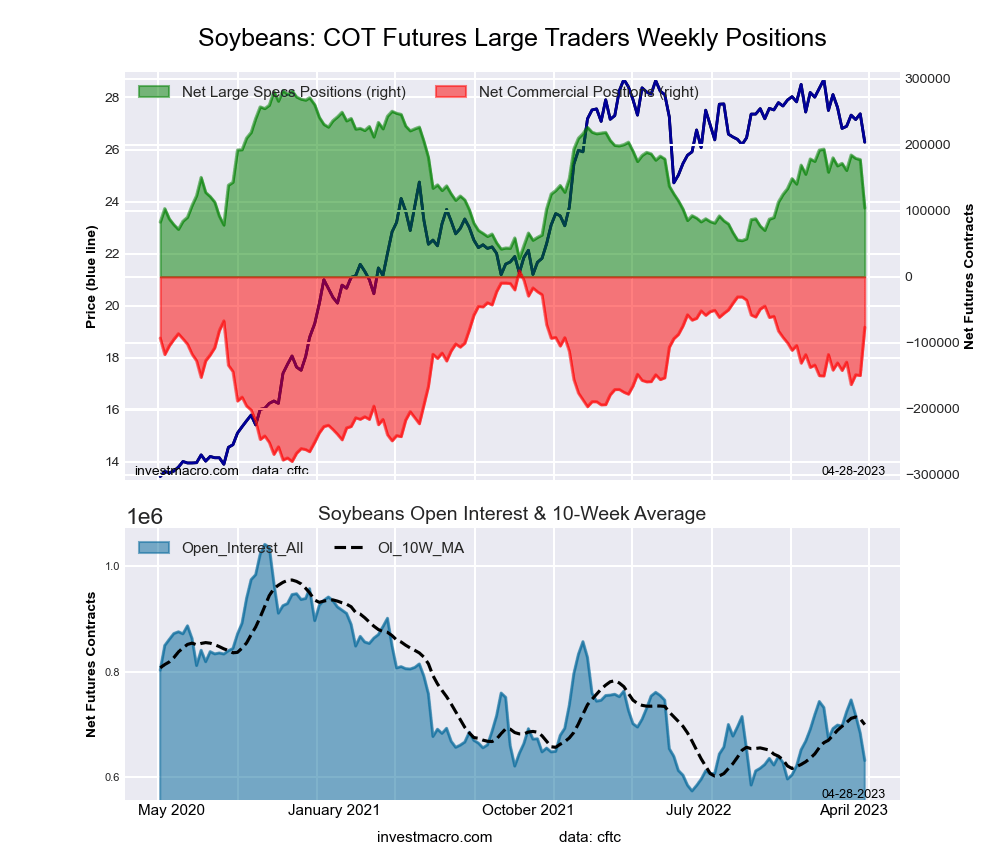
Unless one is a reader of minds or sayer of soothes, it is impossible to determine which was Powell goes next Wednesday so all I will do is look to the tea leaves in the bottom of the cup AND, of course, the charts, which have been a useful sextant with which to navigate the major averages. Last week was actually an “UP” week for stocks despite the volatility and the Friday drubbing.

With all of the negative headlines, it really did appear as though we were in the midst of a seminal moment where traders were buying the regional bank panic thinking that it was a 9/11, GFC, or Covid Crash moment lighting industrial blowtorches into the backsides of those stingy central bankers.

However, all that really occurred was a relief rally after the plunge to SPX 3,808, and while the RSI for the SPX failed to get below 30, MACD looked a tad oversold, which set up the move to the 200-dma at 3,940 above, which reside the 100 and 50-day m.a.’s as well as the big downtrend line off the February top.

Friday’s action negated Thursday’s close above the 200-dma which is now descending and resides at 3,936. I still believe that, at the very best, we can expect a successful retest of the December low at 3,764, but if that fails by month-end, then we are going to new lows below the October lows of 3,491.

Gold and Silver

In last week’s missive, I wrote:I see a test of the US$1,900 range by the end of the month, but if, in fact, I see further turmoil in the regional banks that spreads to the money-center banks and abroad, gold could catch a “fear trade” bid as traders move rapidly for the safety of non-paper assets.”

That “fear trade” bid came in like an Indian monsoon last week, with gold up over US$150/ounce, silver over US$1.20, and the HUI 29 points higher. With crude oil and copper down, color commentary by the pundits suggested that it was the slowing economy that was spooking the oil and copper pits, but from my vantage point, you would have expected the U.S. dollar (USD) to end the week on the lows, which it did not.

Whenever I see the performance triumvirate of gold chasing silver, silver chasing the PM equities (HUI), and PM equities decoupling from their anchorage to the USD and the SPX, I feel justified in adding to holdings. That is precisely what we got last week, and that silver put in a +4.88% move versus a +3.68% move for gold, but the stud of the day was the HUI which posted a +5.42% pop which, as I have been saying, for weeks now, will have a positive effect on our basket of junior miners.

My largest holding and top pick for the past few years, Getchell Gold Corp. (GTCH:CSE; GGLDF:OTCQB) added 12.28% Friday, a welcome relief for those of us that cannot begin to explain how that share price could trade down to US$9.20 per ounce of in-ground gold in mining-friendly Nevada as it did last week.

Their 2,059,900-ounce Fondaway Canyon (100%-owned) deposit is wide open to depth and along strike and is considered to have definite Tier One potential.

A couple of weeks ago, I suggested that Agnico Eagle Mines Ltd. (AEM:TSX; AEM:NYSE) in the low-mid US$40’s might be an interesting contrarian play due to the universal loathing being shown toward a group of companies with near-pristine balance sheets and strong income statements.

In the past two weeks, the number one input cost for miners — energy — has come under huge downside pressure falling 17.5% while their product is up 8.4%. That represents an expanding profit margin for the group, and here we are two weeks later, with AEM touching US$51.22 on Friday, and that is only after miners finally woke up on Thursday.

Another company that has caught my eye (thanks to my colleague and real technical analyst and market historian David Chapman) is Moneta Gold Inc. (MEAUF:OTCMKTS), formerly Moneta Porcupine Mines Inc. (ME:TSX), one of the first stocks I ever bought back in 1977

I used to follow it, but a bloated share structure and unremarkable asset mix kept me at a distance — until last week — when Chappie suggested I have a look. The first thing I asked was about the share structure, and to my surprise, I found that they went through a consolidation a while ago such that today there are a manageable 102,416,437 issued and a market cap of only US$102 million.

Digging deeper, I had forgotten that they always had a big land package in the heart of the Destour-Porcupine-Fault-Zone (“DPFZ”), a mineralized corridor within the legendary Abitibi-Greenstone Belt of northern Ontario and Quebec and have, in recent years significantly advanced the Tower Gold Project which includes a 17-km. strip of the DPFZ.

  • The current mineral resource estimate of 4.46 million ounces (“Moz”) indicated contained gold within 150.6 million tonnes (“Mt”) at a grade of 0.92 grams per tonne Au (“g/t”) and 8.29 Moz inferred contained ounces within 235.6 Mt at a grade of 1.09 g/t announced on September 7, 2022.

Adding 4.46 million ounces of indicated plus 8.28 million ounces inferred and you arrive at a global resource of 12.75 million ounces. From the Friday evening close of US$0.90, the company sports a market cap of US$91.7 million. Dividing the current market cap by the global resource of 12.75 million ounces, I arrive at a market cap per ounce of only US$7.19.

The company completed a Preliminary Economic Assessment in 2022 and arrived at the following:

  • The September 7, 2022, Preliminary Economic Assessment (“PEA”) demonstrated robust economics with C$1,459 million pre-tax Net Present Value of 5% (“NPV”), CA$1,066 million after-tax NPV5%, and a 31.7% after-tax Internal Rate of Return (“IRR”) at US$1,600/oz gold, and an exchange rate of US$0.78.
  • The PEA also demonstrated a CA$1,932 million cumulative after-tax cash flow, a mine life of 24 years, with average annual gold production of 261,014 oz in years one to 11 (192,666 oz for Life of Mine (“LOM”)) for 4,581,000 ounces total gold production LOM. Cash costs are estimated at US$910 per ounce, with all-in-sustaining costs (“AISC”) of US$1,073 per ounce of gold.

A Pre-feasibility Study is underway and expected to be completed next year which means ME qualifies as an advanced developer and a true proxy for rising gold prices. I was shocked to see the value-per-ounce come in at nearly US$7/ounce. I knew that gold miners were being thrown under buses these days as “value traps,” but between Getchell Gold at US$9.27/ounce last week and ME’s number, it really is astounding to see how universally detested the miners have become. My premise for owning Moneta Gold is buttressed by its location in the heart of a mining camp that has already produced over 85 million ounces since discoveries were first made in the 1800s.

Moneta is a sure-fire M&A candidate and is being added to the GGM Advisory portfolio as of Monday’s opening.

I Want To See Silver Outperform Gold

With the miners all catching a major league bid last week led by gold space, silver also caught fire.
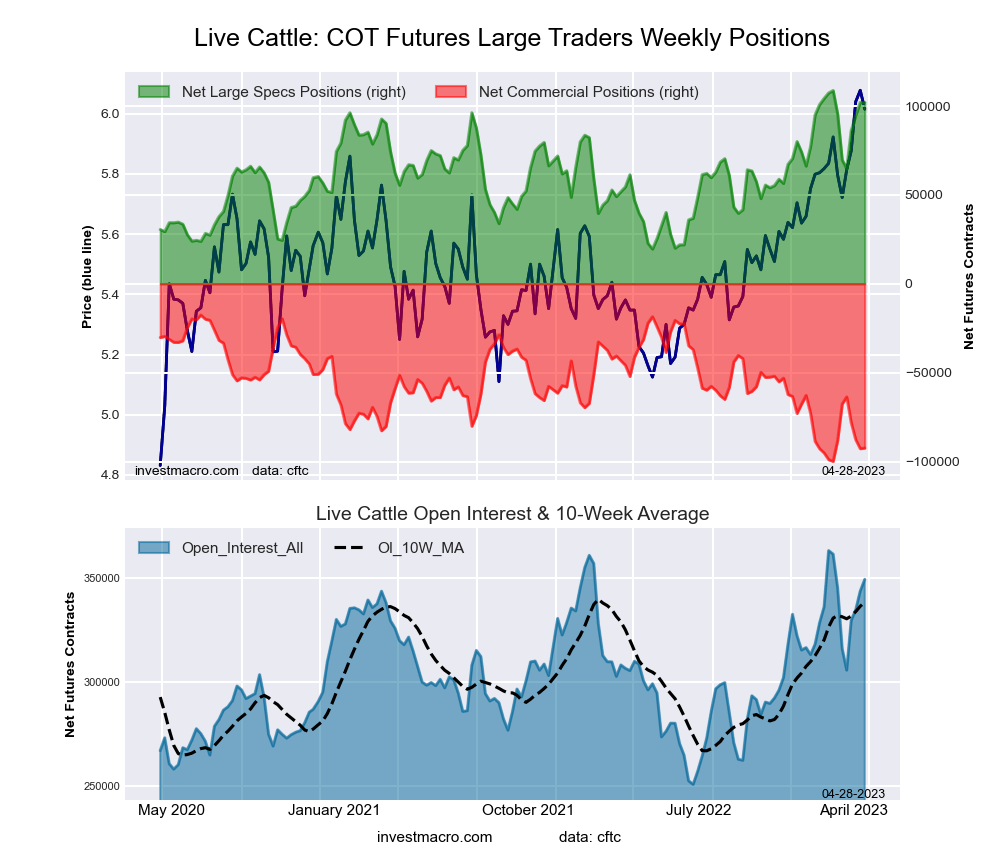
I want to see silver outperform gold right through to month’s end. From the chart of silver above, it is clear just how poorly silver has been relative to gold (and everything else, for that matter) since the beginning of 2021.

I excluded 2020 because of the myriad of stimulus-driven deformities that occurred, leaving us only the recovery period. It is imperative for the health of the entire metals complex that silver assumes “big dog” status and takes over the leadership of the rally.

The problem with making forecasts regarding silver is that I can get all of the bullish inputs to the price behavior correct (as I did back in 2020) and yet recoil in amazement (and horror) that the all-important price variable went south instead of north despite rampaging consumer prices, geopolitical turmoil, and central bank profligacy.

The Electrification Movement 

As for the Electrification Movement, there is one very important truism that reigns supreme within the context of even the noblest of undertakings. When stock markets go into panic mode, a carbon-free world takes second place in the preservation of capital. With the banking crisis going global, the battery metals all took it on the chin last week, with copper below US$4/lb. and lithium is now in full correction mode.
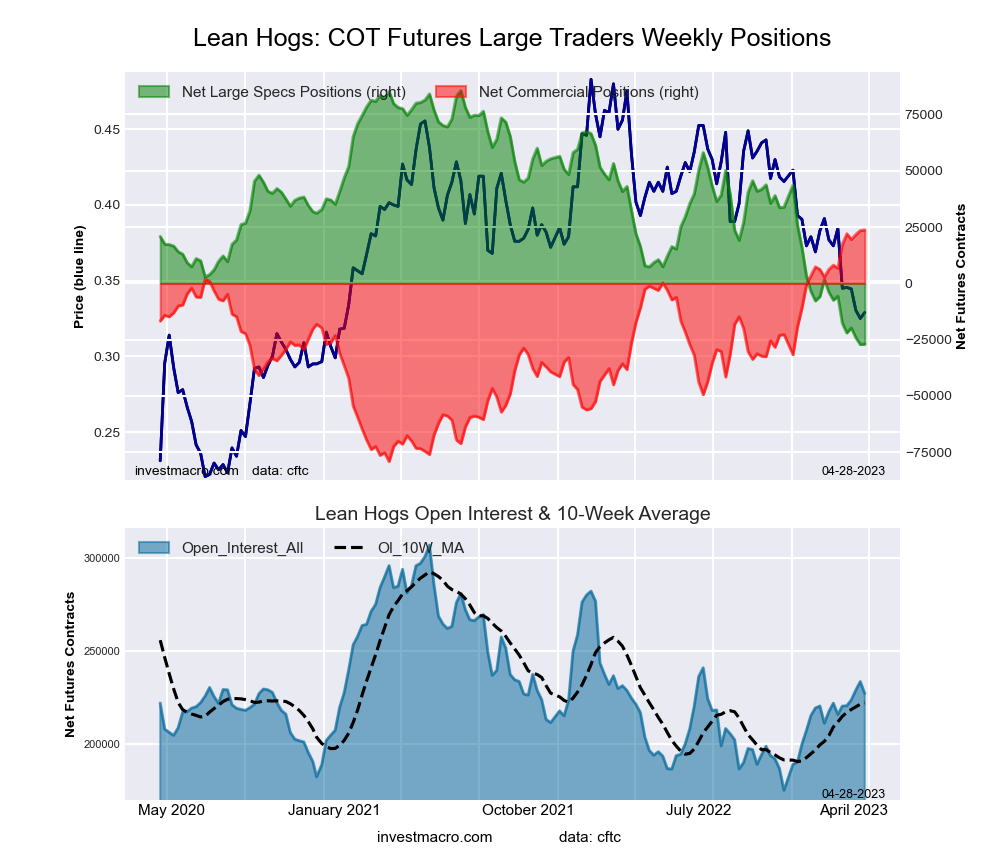
Poster child Patriot Battery Metals Inc. (PMET:CA) is still ahead 76.67% YTD while down 34.08% from the top seen in early February.
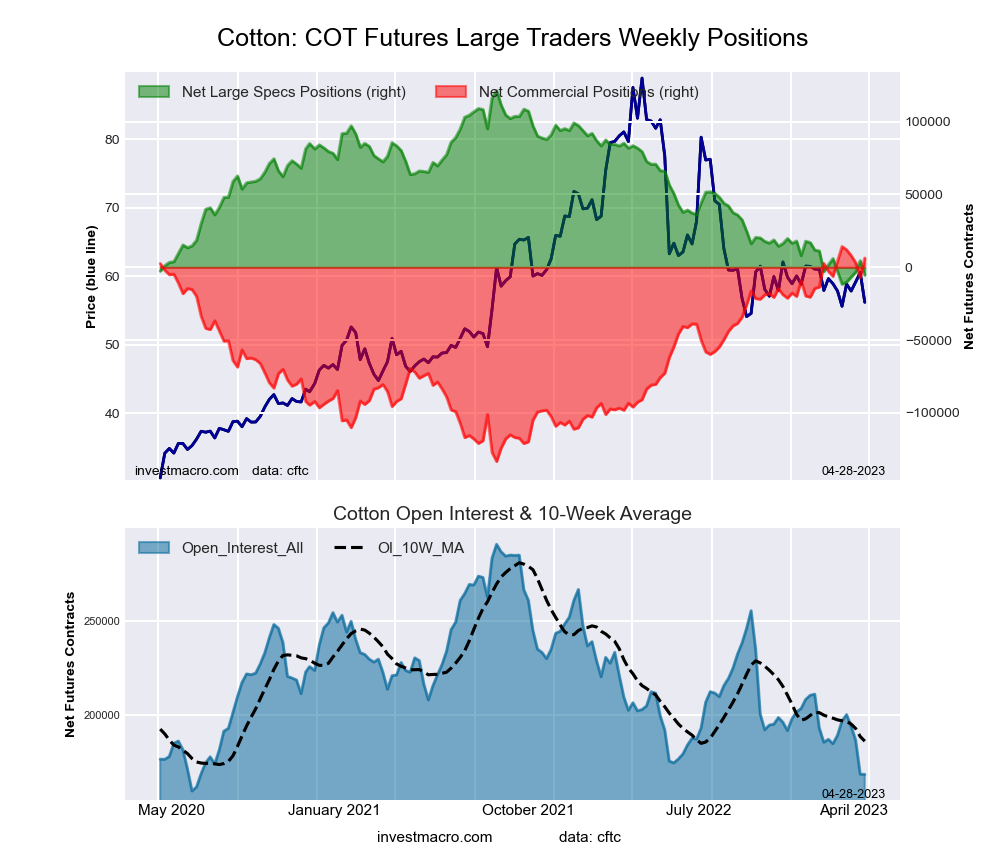
No changes to my thoughts on Allied Copper Corp. (CPR:TSX.V; CPRRF:OTCQB) / Volt Lithium (CPR:TSXV / CPRRF:US) (which I own), where I await the results of large-scale testing of their DLE Process (“Direct Lithium Extraction”) at Rainbow Lake Alberta. These results, if successful, will be a game-changing thunderbolt for CPR shareholders once markets settle down.

Volatility in US Treasury Market

Speaking of markets “settling down,” this weekend has been a constant bombardment of financial market grave-dancing because there are a great many of those very smart (and Street savvy) people I follow that have issued “crash alerts.” I have issued two via my Email Alert service urging everybody to “get defensive” by way of eliminating margin and raising cash.
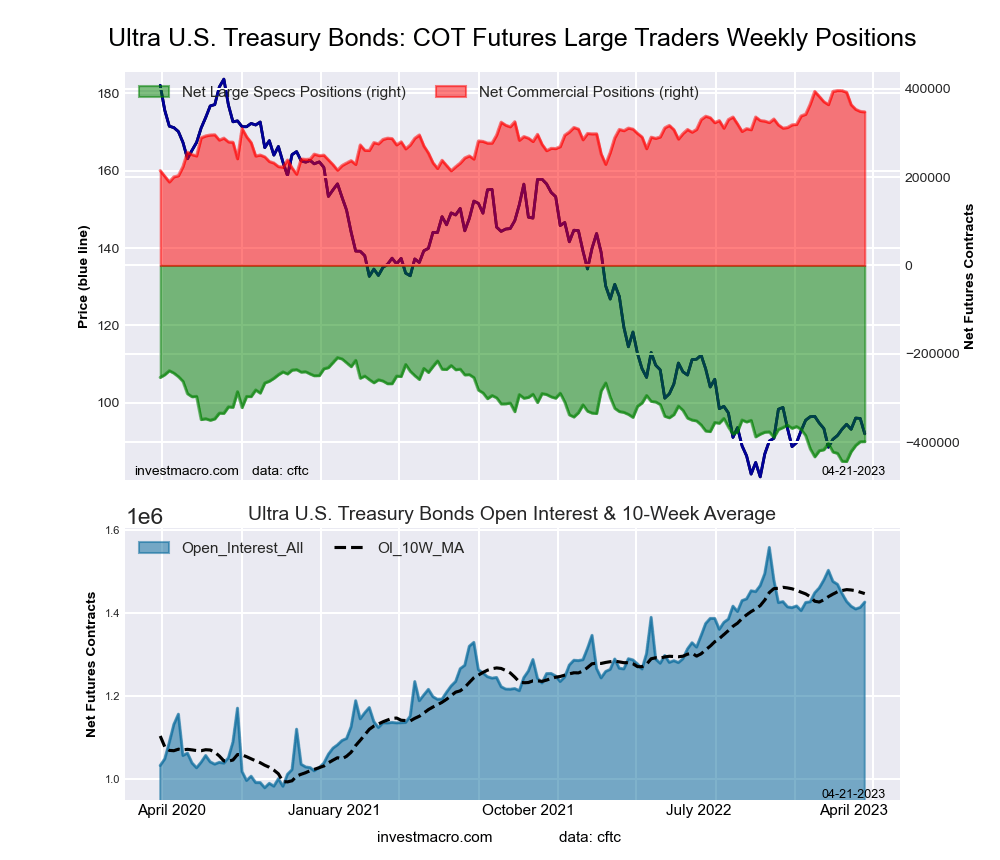
Now, markets may not crash at all, but since the conditions out there are so bizarre, with massive volatility in the U.S. treasury market, there is something very untoward happening. Treasury markets are supposed to be safe havens where investors go to hide in relative calm as the equity market tempest passes. Instead, the yield on the U.S. two-year treasury, sitting at 5.07% on March 7th, closed the week at 3.845%, which represents a 25% crash in the 2-year yield. That is unheard of.

In ancient Greek mythology, it was written in The Labours of Heracles that he destroyed the Lernean Hydra, a multi-headed reptilian beast, and to do so, Heracles enlisted the aid of his nephew Iolaus.

As Heracles severed each mortal head, Iolaus was set to the task of cauterizing the fresh wounds so that no new heads would emerge. This story of Heracles evokes images of today’s financial landscape where each time the regulators solve issues of a systemic nature, another one pops up, just like the Hydra’s heads, only in our story, there is no regulator, politician or Keynesian hero able to “cauterize the fresh wounds.”

There are a great many exciting and potentially-enriching stories out there, but the only one that matters at times like these are the ones that have happy endings without us losing all of our wealth because we failed to heed the storm clouds and plunging barometer.

Absent a coordinated rescue mission by central banks the world over, there are few reasons to be bullish on anything out there save gold and silver but need I remind you how those two “ultimate safe havens” acted during the 2008 G.F.C. and the more recent Covid Crash of March 2020.

They outperformed most other asset classes, but outperformance does not pay your electricity bill or college tuition if the price you paid is higher than where it was sold. “Get defensive” means one has cash that they are able to deploy in favor of depressed prices that occur only when liquidity needs supersede valuation metrics.
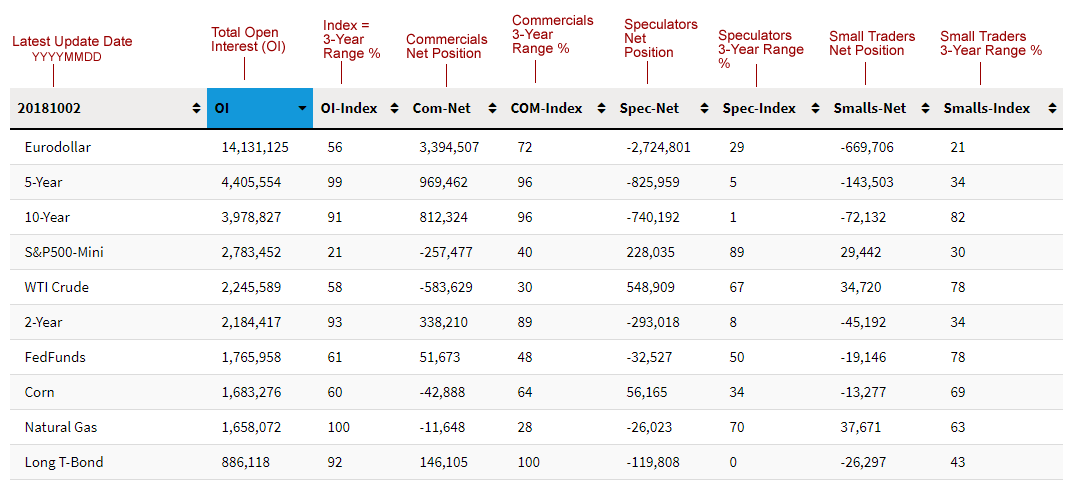
I watched gold plunge 35.3% in 2008 only to advance over 180% to all-time highs after liquidity issues brought about forced selling in the metals just before the central banks bailed out the member banks with a money-printing exercise of orgasmic proportion.

Carpe diem? No. Caveat emptor? Absolutely.


Michael Ballanger Disclaimer:

This letter makes no guarantee or warranty on the accuracy or completeness of the data provided. Nothing contained herein is intended or shall be deemed to be investment advice, implied or otherwise. This letter represents my views and replicates trades that I am making but nothing more than that. Always consult your registered advisor to assist you with your investments. I accept no liability for any loss arising from the use of the data contained on this letter. Options and junior mining stocks contain a high level of risk that may result in the loss of part or all invested capital and therefore are suitable for experienced and professional investors and traders only. One should be familiar with the risks involved in junior mining and options trading and we recommend consulting a financial adviser if you feel you do not understand the risks involved.

Disclosures:

1) Michael J. Ballanger: I, or members of my immediate household or family, own securities of the following companies mentioned in this article: Getchell Gold Corp., Patriot Battery Metals Inc., and Allied Copper Corp. I personally am, or members of my immediate household or family are, paid by the following companies mentioned in this article: My company, Bonaventure Explorations Ltd., has a consulting relationship with: None.

2) The following companies mentioned in this article are billboard sponsors of Streetwise Reports: None. Click here for important disclosures about sponsor fees. As of the date of this article, an affiliate of Streetwise Reports has a consulting relationship with: None. Please click here for more information.

3) Statements and opinions expressed are the opinions of the author and not of Streetwise Reports or its officers. The author is wholly responsible for the validity of the statements. The author was not paid by Streetwise Reports for this article. Streetwise Reports was not paid by the author to publish or syndicate this article. Streetwise Reports requires contributing authors to disclose any shareholdings in, or economic relationships with, companies that they write about. Streetwise Reports relies upon the authors to accurately provide this information and Streetwise Reports has no means of verifying its accuracy.

4) This article does not constitute investment advice. Each reader is encouraged to consult with his or her individual financial professional and any action a reader takes as a result of information presented here is his or her own responsibility. By opening this page, each reader accepts and agrees to Streetwise Reports’ terms of use and full legal disclaimer. This article is not a solicitation for investment. Streetwise Reports does not render general or specific investment advice and the information on Streetwise Reports should not be considered a recommendation to buy or sell any security. Streetwise Reports does not endorse or recommend the business, products, services or securities of any company mentioned on Streetwise Reports.

5) From time to time, Streetwise Reports LLC and its directors, officers, employees or members of their families, as well as persons interviewed for articles and interviews on the site, may have a long or short position in securities mentioned. Directors, officers, employees or members of their immediate families are prohibited from making purchases and/or sales of those securities in the open market or otherwise from the time of the decision to publish an article until three business days after the publication of the article. The foregoing prohibition does not apply to articles that in substance only restate previously published company releases. As of the date of this article, officers and/or employees of Streetwise Reports LLC (including members of their household) own securities of Agnico Eagle Mines Ltd. and Allied Copper Corp., companies mentioned in this article.

The Importance of Gold

Source: Streetwise Reports  (3/20/23)

James Turk of Goldmoney, the impetus behind The Gold Report here at Streetwise, explains why he believes gold and silver are imperative assets to own in this current economy and how you can get involved with them.

Starting his career in the 1960s working for Chase Manhattan Bank in Thailand, The Philippines, and Hong Kong, James Turk has a long history in the world of finance. In 2001, Turk started goldmoney.com with his eldest son, Geoffrey.

GoldMoney (XAU:TSX) focuses on precious metals buying and selling, storage, coin retailing, and gold jewelry manufacturing and sales through a subsidiary, Menē.com, aka Menē Inc. (MENE:TSX.V; MENEF:OTCMKTS).

The company has clients in over 100 countries around the world and currently safeguards over US$2 billion of assets owned by its clients. Overall, Goldmoney has a reputation for success that comes with the reputation held by James Turk.

However, people don’t know that while James Turk is the force behind Goldmoney, he was also the reason The Gold Report was started.

A Discussion in the Mountains

The conversation started in the mountains. Gordon Holmes, the CEO and founder of Streetwise Reports, and James had been friends for years. Then one day, Gordon invited James to share a bottle of wine at Lookout Ridge (Gordon’s winery in California).

As they spoke about the market over a glass of pinot, James asked Gordon why he hadn’t stepped into the gold market yet. Gordon was honest and relayed to him that he didn’t believe he knew enough about the market to be all that involved.

That is when James looked Gordon in the eye and told him, “You’ll figure it out.”

And The Gold Report was born.

Without that fortuitous meeting, Streetwise Reports as we know it may have never come to be.

Why Gold?

Goldmoney may have been started in 2001, but Turk’s interest in gold was fostered from a young age. Growing up, Turk’s father and grandparents shared stories of fleeing from Austria’s hyperinflation after World War I.

Because of this, Turk said, “I’ve always been of the view that gold and silver had an important role to play in economic activity and that accumulating gold and silver was a means of saving — a way to save purchasing power.”

He went on to say, “It’s never too late to save money, but it doesn’t make sense to save fiat currency anymore because of negative interest rates. In other words, if you deposit money into a bank at the end of the year, you have less purchasing power. Even though you’re earning interest income, the inflation rate is higher than the interest income that you’re earning. So you’ll never get ahead that way. With physical gold and silver, you won’t be earning interest income, but you’re going to preserve your purchasing power over time.”

This is one of the reasons Turk is such an ardent advocate for owning some precious metals in a diversified investment portfolio.

Gold After Nixon

In our wide-ranging discussion, Turk also touched on the value of the U.S. dollar compared to gold beginning with President Nixon.

“Living and working in a bank through the 1970s was, for me, a life-changing experience. And obviously, something I’m never going to forget. Worryingly, there are a lot of similarities today to what occurred back then. But there are also some differences too.”

Turk explained that in the 70s, easy money printing caused inflation to soar out of control. When Paul Volcker was appointed chairman of the Federal Reserve in 1979, he kept raising interest rates until inflation began to decline. He did this to save the U.S. dollar when faith in the currency was rapidly eroding.

Turk said, “I’ve always been of the view that gold and silver had an important role to play in economic activity and that accumulating gold and silver was a means of saving — a way to save purchasing power.”

Turk went on to say: “At the peak, the interest income you could earn over and above the inflation rate was 6%, which is phenomenally high because the natural interest rate is normally about 1%.

It was enough to rebuild confidence in the dollar. Volcker eventually brought inflation under control by decreasing — and this is important — decreasing the growth rate of the quantity of dollar currency. He never actually decreased the quantity of dollar currency. There was never any deflation. It was just disinflation, but what’s happening this time around is different.”

“The Federal Reserve cannot simply raise interest rates to levels that Volcker needed to bring down the inflation rate. There’s too much debt in the economy. So now, what the Fed is doing is decreasing the quantity of dollars. This could lead to a deflationary economic collapse.”

Turk noted, “Ultimately, in a deflationary economy, the debtors end up in trouble. The debt burden increases because the value of the currency increases. Also, liquidity disappears in a deflationary environment. Anyone who’s heavily leveraged — like a lot of the banks — tends to suffer in that type of environment, as occurred in the 1930s. So it’s a very important time to be focusing on gold and silver because regardless of whether it’s inflation or deflation, gold, and silver will get you through the turmoil to the other side of the valley.”

In 1971, Nixon closed the gold window breaking its formal link to the dollar. Since then, the dollar’s purchasing power has been eroding, but this process began much earlier. The dollar has lost 98.5% of its purchasing power since the creation of the Federal Reserve in 1913. In recent decades this debasement of the dollar has accelerated.

Measuring in Ounces

Turk went on to say that while we calculate the price of things using the dollar, we must also be using ounces of gold or silver to measure prices.

“When looking at the price of crude oil going back to 1950, you get different results depending on the measuring stick used. If you measure oil in terms of ounces of gold, the price of crude oil hasn’t changed much. An ounce of gold buys about the same amount of crude oil today as in 1950.This example shows how gold preserves purchasing power over the long term. It does this because gold is natural money. The quantity of the aboveground stock of gold increases at approximately the same rate as the world’s population and new wealth creation. Because these growth rates are consistent, gold retains its purchasing power.”

“Gold and silver are not investments; they’re money. Gold and silver didn’t increase your wealth — your purchasing power — over these seven decades. They preserved it, which is one of money’s most important functions.”

“I like to tell a story that I remember from growing up in the 1950s. I think is very meaningful.”

“My parents would drive the family car to the local gas station and fill it up for US$2. Back then, the paper currency was silver certificates. You could also pay with silver coins, for example, two silver dollars or four half dollars.”

“Today, US$2 doesn’t even buy a gallon of gas. But the market value of the silver content of those old coins will still fill up the family car.”

The following chart of crude oil prices shows how gold and silver preserve purchasing, but national currencies do not. Measured in dollars, crude oil is 30 times more expensive than it was in 1950. The British pound has fared even worse, with oil 69 times more expensive today in that currency.

“There is one key point that people need to understand,” he continued. “Gold and silver are not investments; they’re money. Gold and silver didn’t increase your wealth — your purchasing power — over these seven decades. They preserved it, which is one of money’s most important functions.”

“Sterile assets like precious metals don’t generate cash flow. When their price rises, purchasing power moves from people owning national currency to people owning precious metals. The precious metals have value because they are useful as money.”

“What’s more,” Turk continued, “they are money that is not based on anyone’s promise, so they don’t have counterparty risk. For that reason, they provide unconditional liquidity. Your purchasing power placed in gold and silver is not reliant upon some bank or a government promise. And by measuring goods, services, and your investment portfolio in terms of ounces, you’ll come up with an entirely different perspective.”

“It is meaningful to use gold to measure accumulated wealth. You are measuring purchasing power with money that has proven its ability to retain its purchasing power over long periods of time — as we can see in the chart of crude oil prices.”

The Decline of the US Dollar

As faith in gold’s purchasing power rises, we see that trust in the U.S. dollar erodes, especially in an inflationary environment.

Turk pointed out that “if you look at measures completed by private economists, the inflation rate is much, much higher than what the government reports. So regardless of who you rely on to measure inflation, the dollar is losing purchasing power every day.”

Will the dollar collapse and become obsolete?

Turk replied: “That involves predicting the future, and unfortunately, no one can predict the future. All you can do is be prepared as best you can for any eventuality. And given their track record going back thousands of years, owning some physical gold and silver is one way to do that. If worse comes to worst, you’ll be prepared and ready by owning some gold and silver so that your wealth is diversified.”

He also favors the shares of precious metal mining companies but advised: “Owning gold and silver is different from owning the shares of mining companies. The shares are investments, not money. Buying shares in mining companies requires the same amount of diligent attention that you apply to any investment. For example, you need to look at the quality of management, the company’s mining property, their financial accounts, country risk where they operate, and many other factors.”

“The mining shares, in my view, are undervalued. They are not tangible assets like gold and silver. I consider them to be ‘near tangible’ because the mining companies own tangible assets in the form of mines and equipment that produce tangible assets.”

How to Store Gold

If you wish to be prepared and get involved in tangible assets, knowing how to store them is imperative. With gold and silver, you have two options. You can either store it yourself or pay for a professional firm to safeguard them for you — this is where Goldmoney comes in.

Turk explained, “Through Goldmoney, customers can store their precious metals in vaults operated by specialized vaulting companies in different places around the world. You can choose among different countries, different political risks, and different geographic risks so that you can diversify. Again, there is no one right answer. But if there is an answer that comes close to being the right choice, it’s diversifying your assets as much as practical.”

When searching for professional storage, Turk pinpointed the importance of working with a company that does independent third-party audits. In this way, you have assurances of integrity that your assets are properly cared for. Goldmoney currently safeguards over US$2 billion in customer assets worldwide.

Money and Liberty: In the Pursuit of Happiness & The Theory of Natural Money

If you’d like to learn more about the importance of gold and silver and how to incorporate them into your portfolio, these and many more topics are covered in James Turk’s latest book, Money and Liberty: In the Pursuit of Happiness & The Theory of Natural Money.

Money and Liberty was published by Wood Lane Books in November 2021 and is available on Amazon. It has been praised as “an excellent and insightful book” that provides “a clear but detailed history of the relationship of sound money to human freedom.”


Disclosures:
1) Katherine DeGilio wrote this article for Streetwise Reports LLC. She or members of her household own securities of the following companies mentioned in the article: None. She or members of her household are paid by the following companies mentioned in this article: None.

2) The following companies mentioned in this article are billboard sponsors of Streetwise Reports: None. Click here for important disclosures about sponsor fees. As of the date of this article, an affiliate of Streetwise Reports has a consulting relationship with: None. Please click here for more information.

3) Statements and opinions expressed are the opinions of the author and not of Streetwise Reports or its officers. The author is wholly responsible for the validity of the statements. The author was not paid by Streetwise Reports for this article. Streetwise Reports was not paid by the author to publish or syndicate this article. Streetwise Reports requires contributing authors to disclose any shareholdings in, or economic relationships with, companies that they write about. Streetwise Reports relies upon the authors to accurately provide this information and Streetwise Reports has no means of verifying its accuracy.

4) This article does not constitute investment advice. Each reader is encouraged to consult with his or her individual financial professional and any action a reader takes as a result of information presented here is his or her own responsibility. By opening this page, each reader accepts and agrees to Streetwise Reports’ terms of use and full legal disclaimer. This article is not a solicitation for investment. Streetwise Reports does not render general or specific investment advice and the information on Streetwise Reports should not be considered a recommendation to buy or sell any security. Streetwise Reports does not endorse or recommend the business, products, services or securities of any company mentioned on Streetwise Reports.

5) From time to time, Streetwise Reports LLC and its directors, officers, employees or members of their families, as well as persons interviewed for articles and interviews on the site, may have a long or short position in securities mentioned. Directors, officers, employees or members of their immediate families are prohibited from making purchases and/or sales of those securities in the open market or otherwise from the time of the decision to publish an article until three business days after the publication of the article. The foregoing prohibition does not apply to articles that in substance only restate previously published company releases.