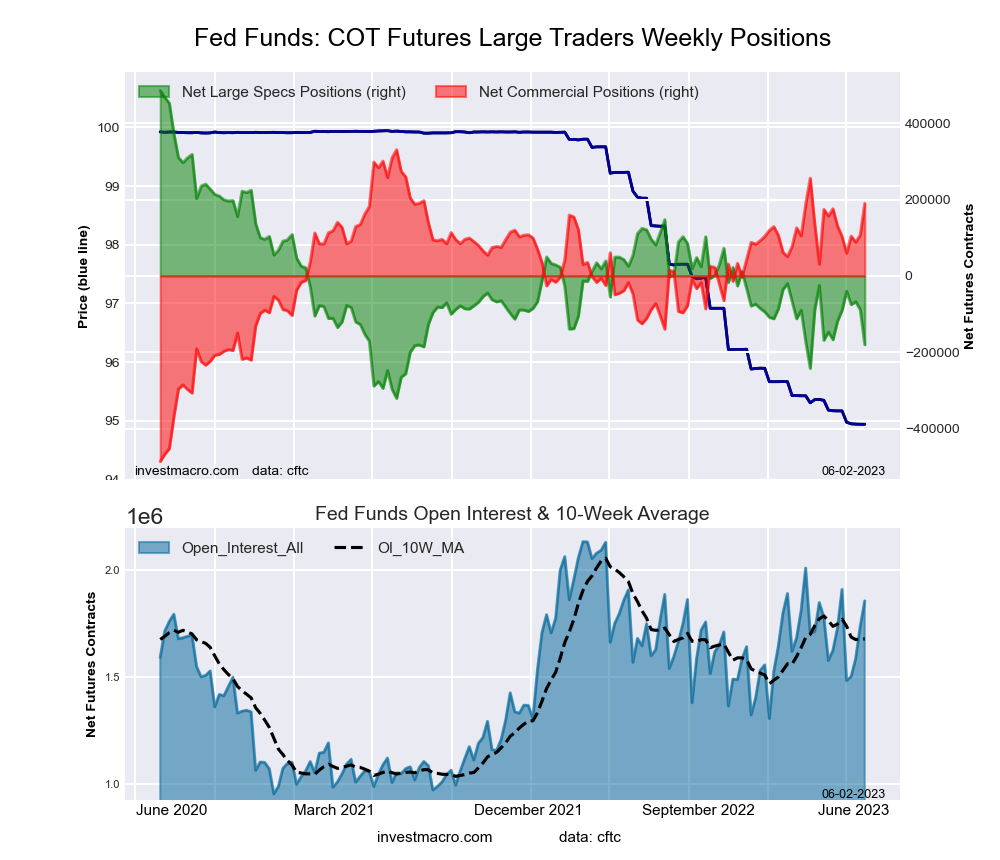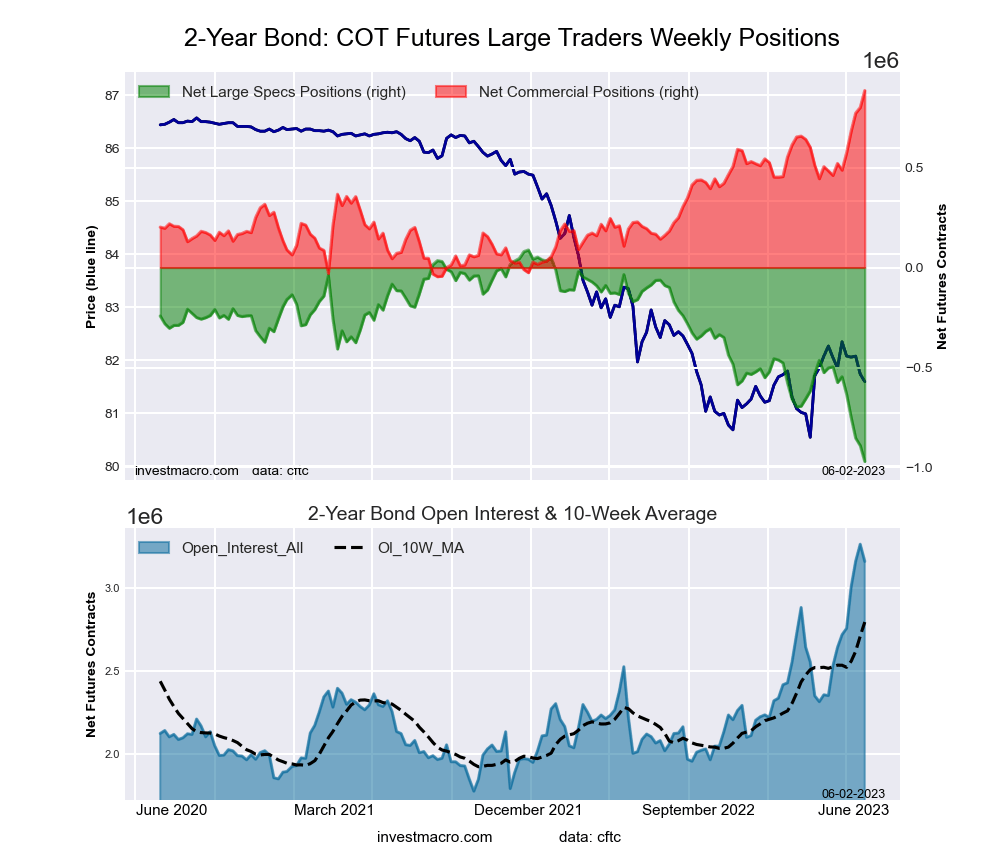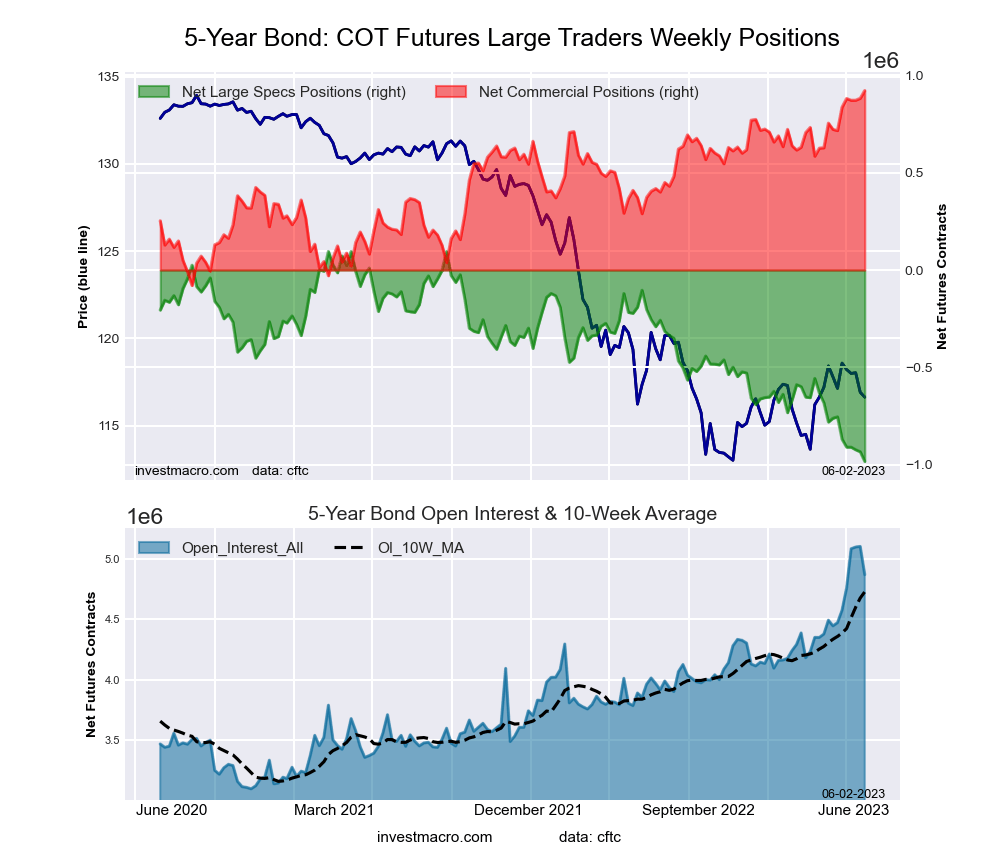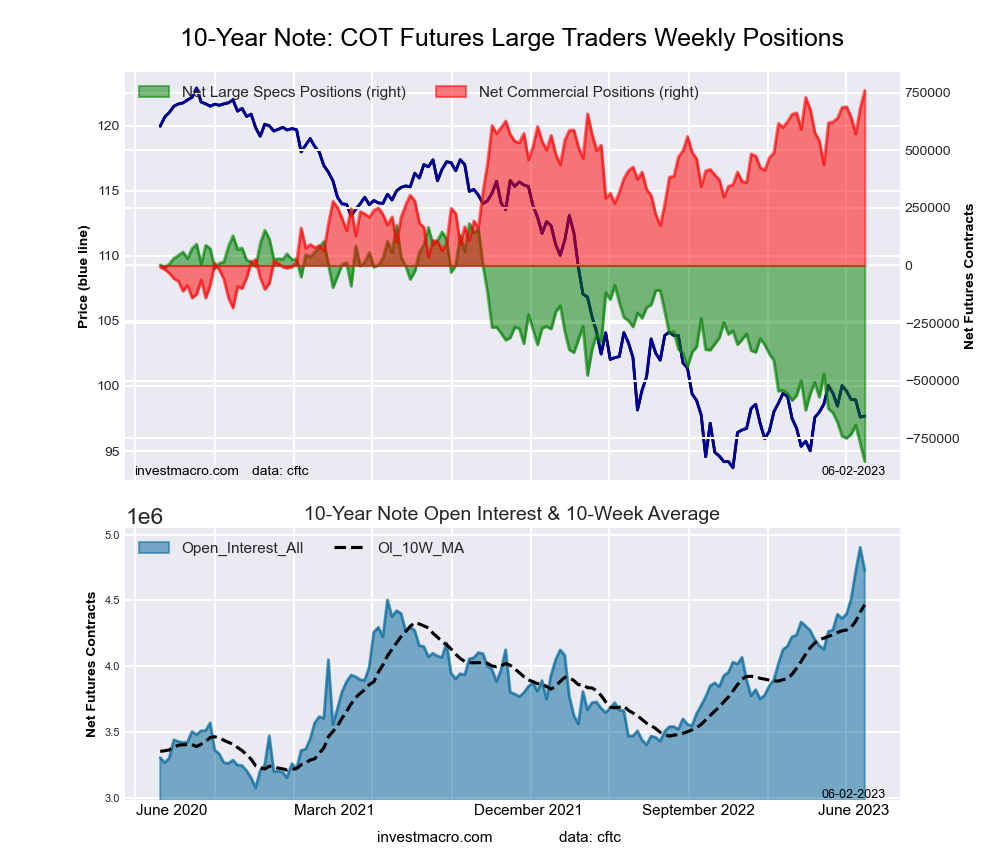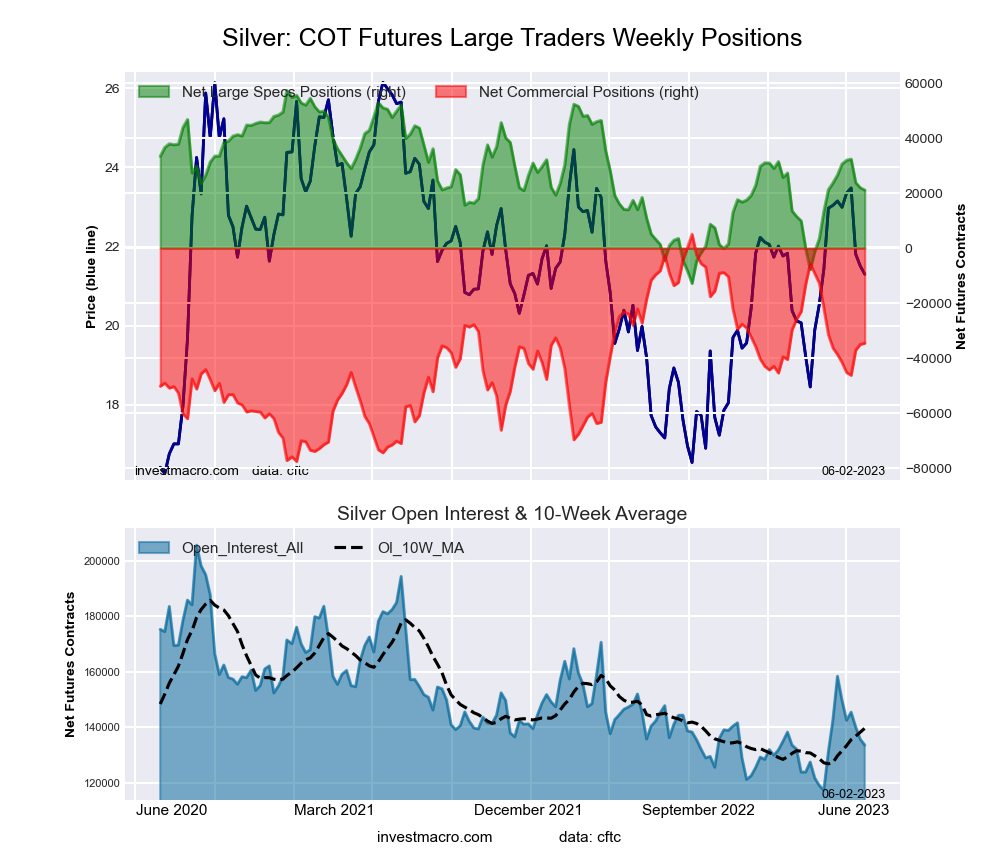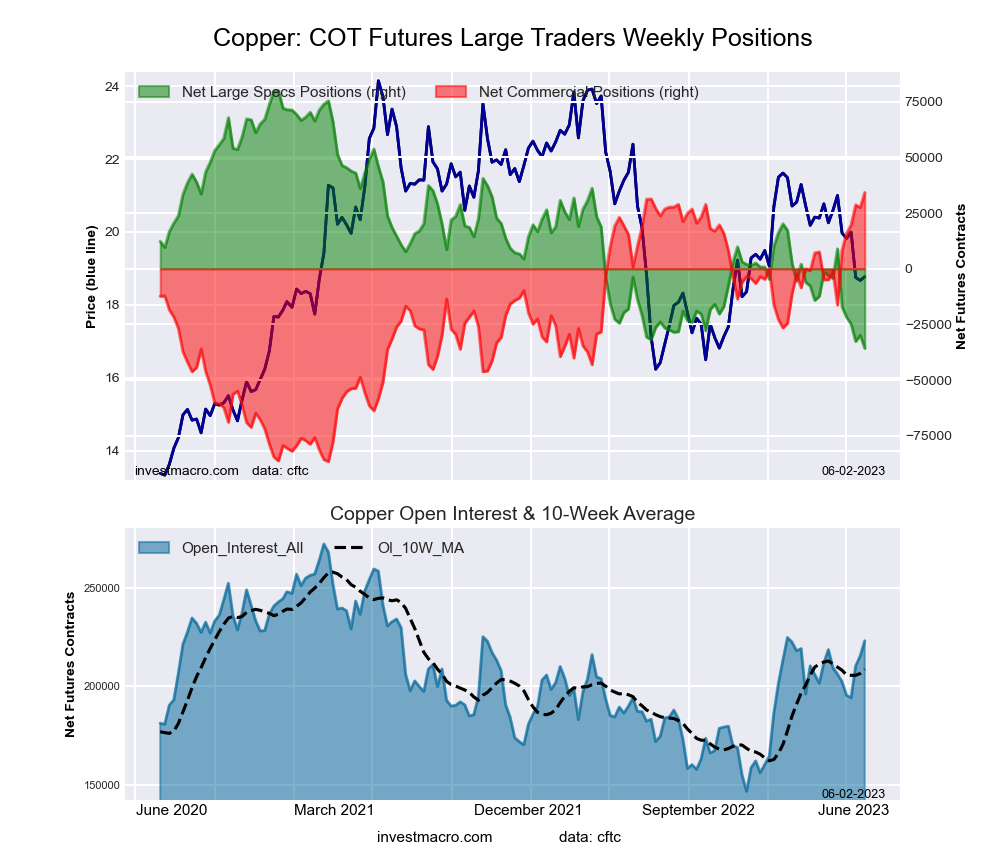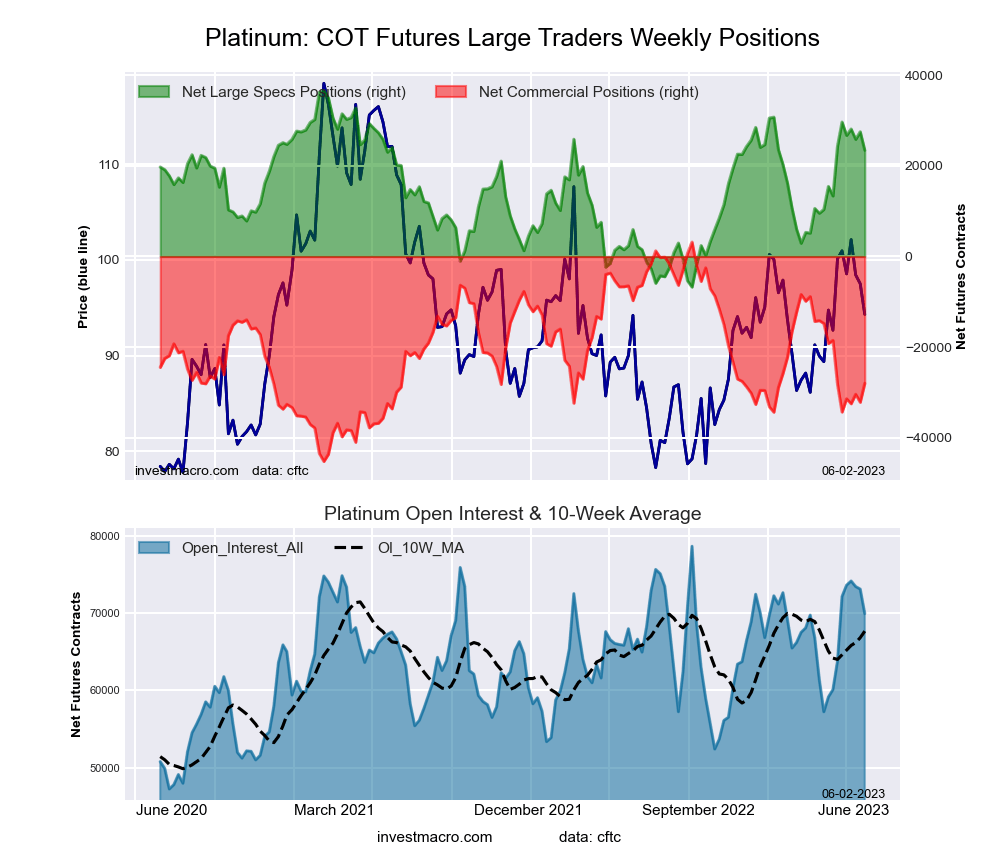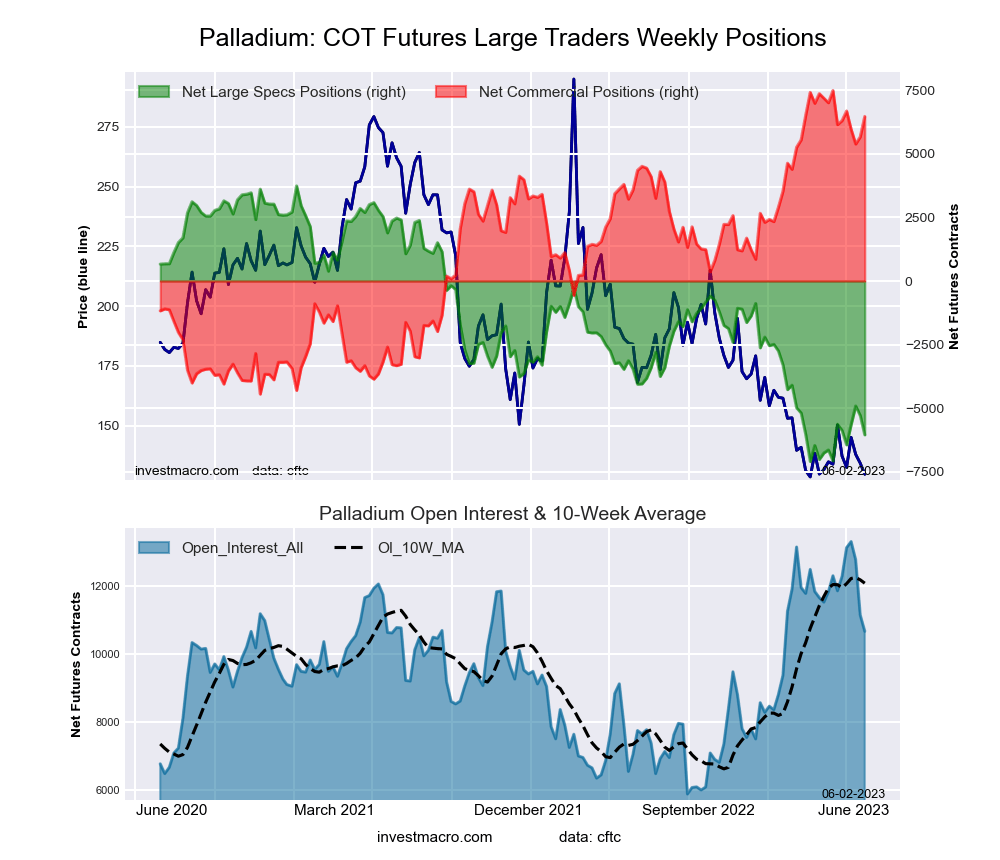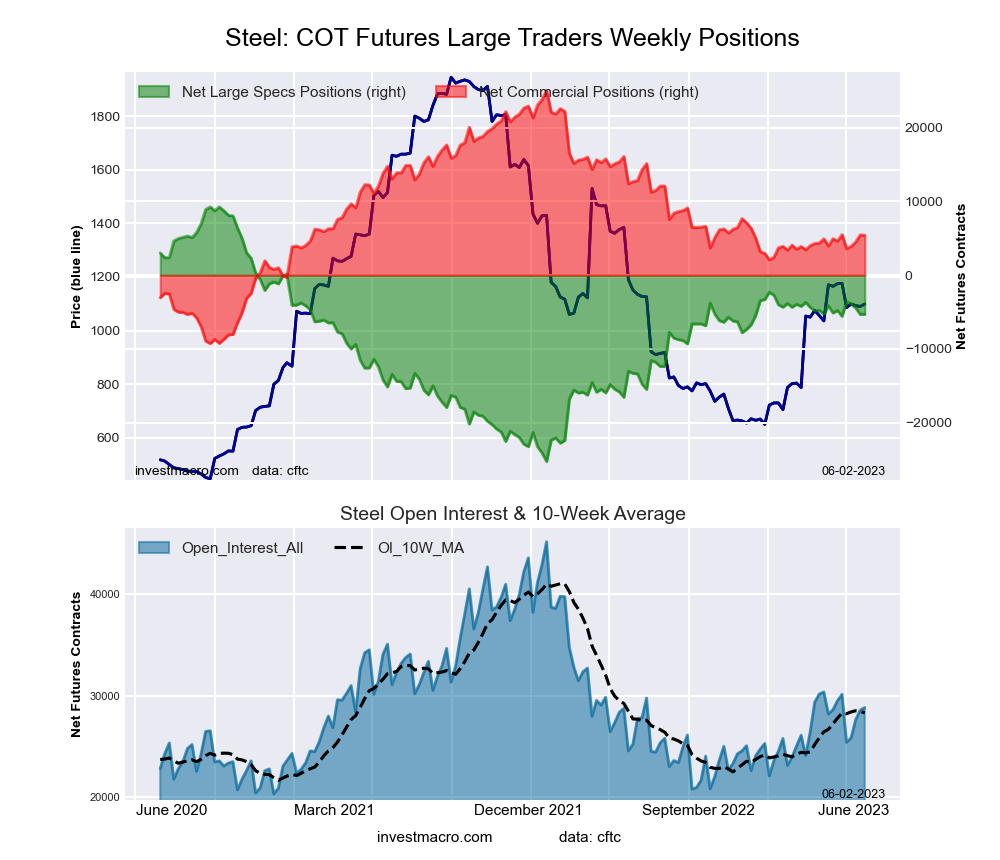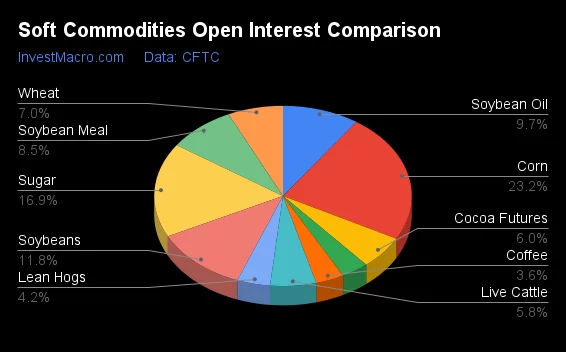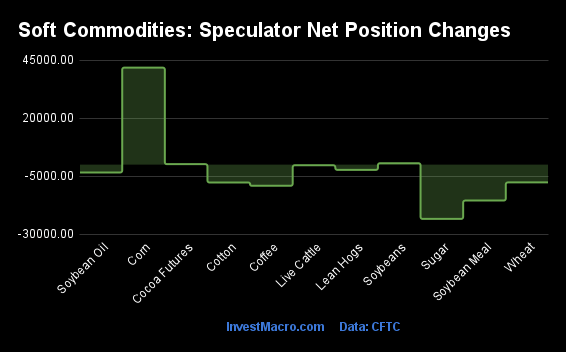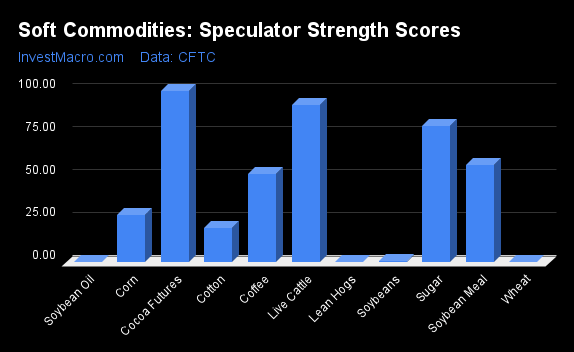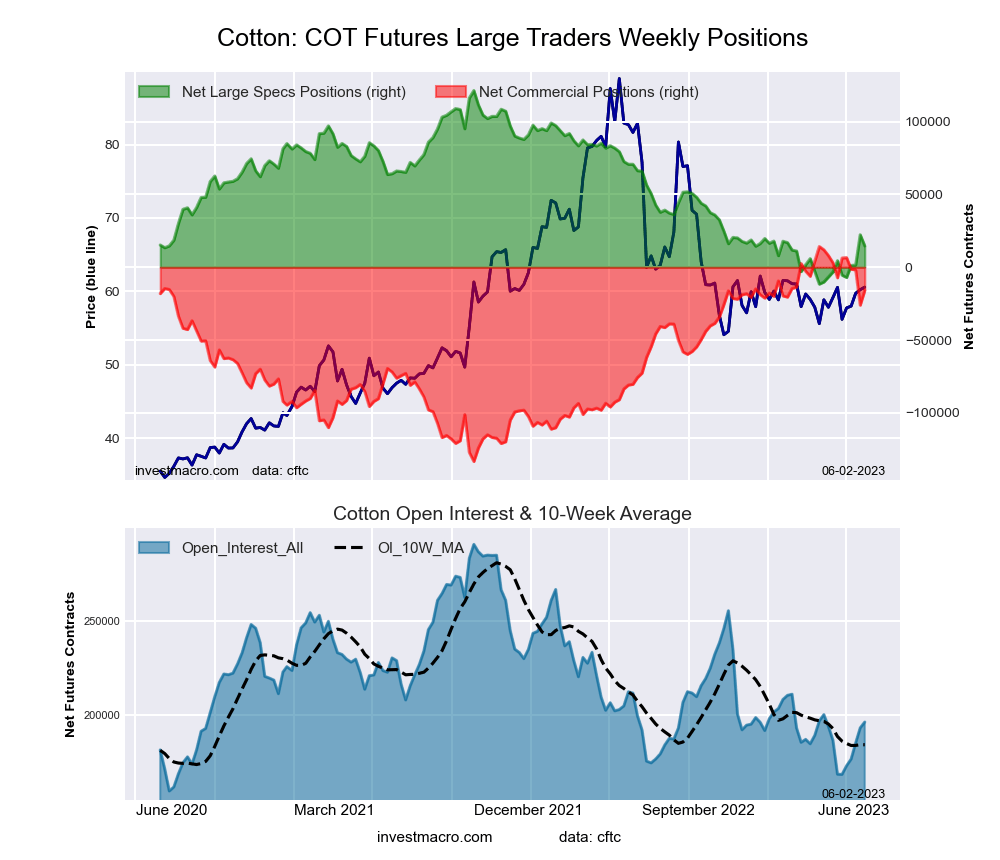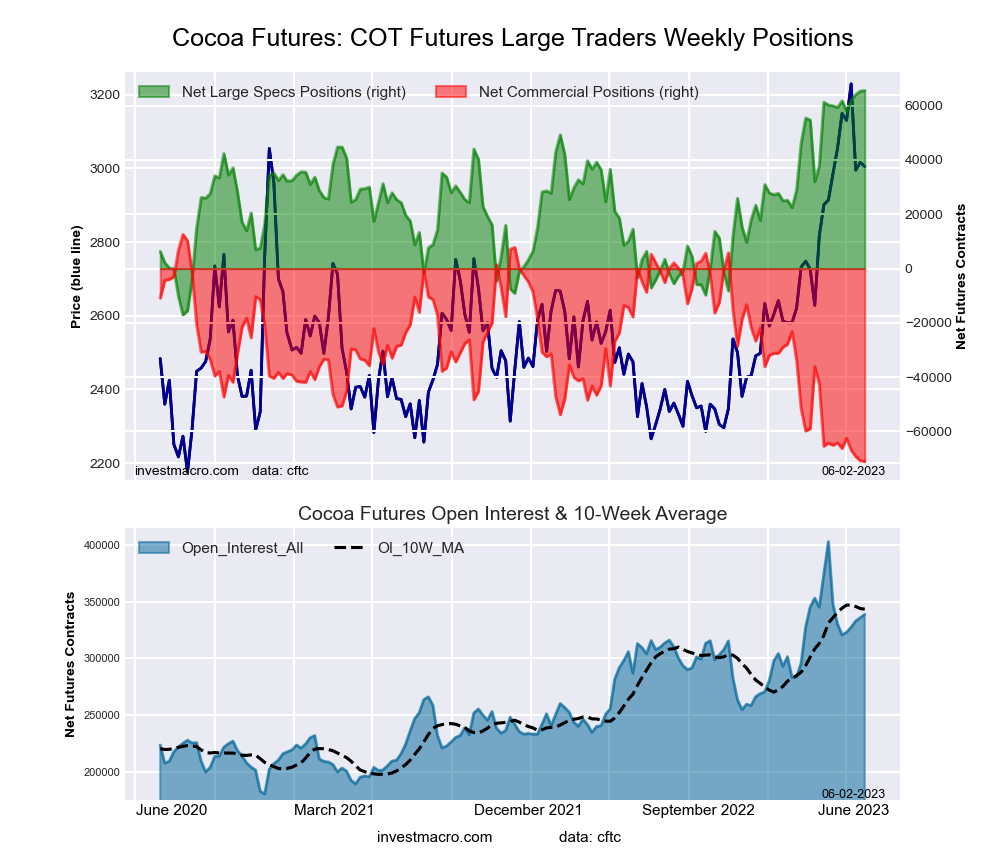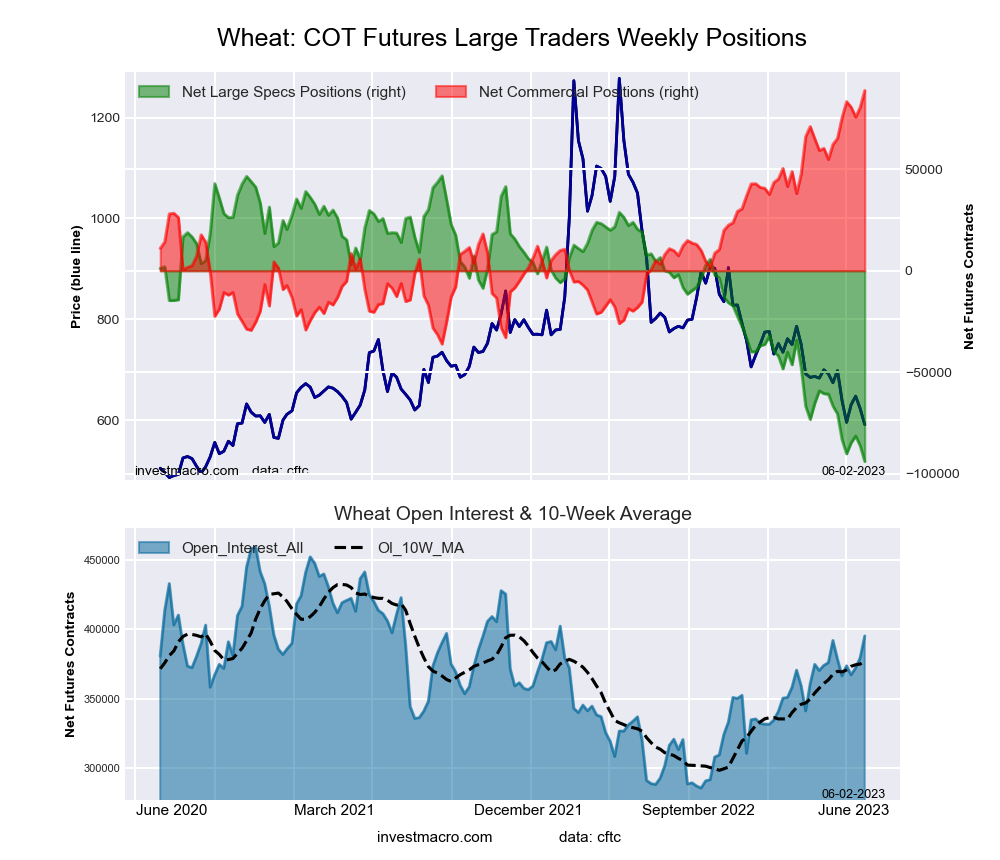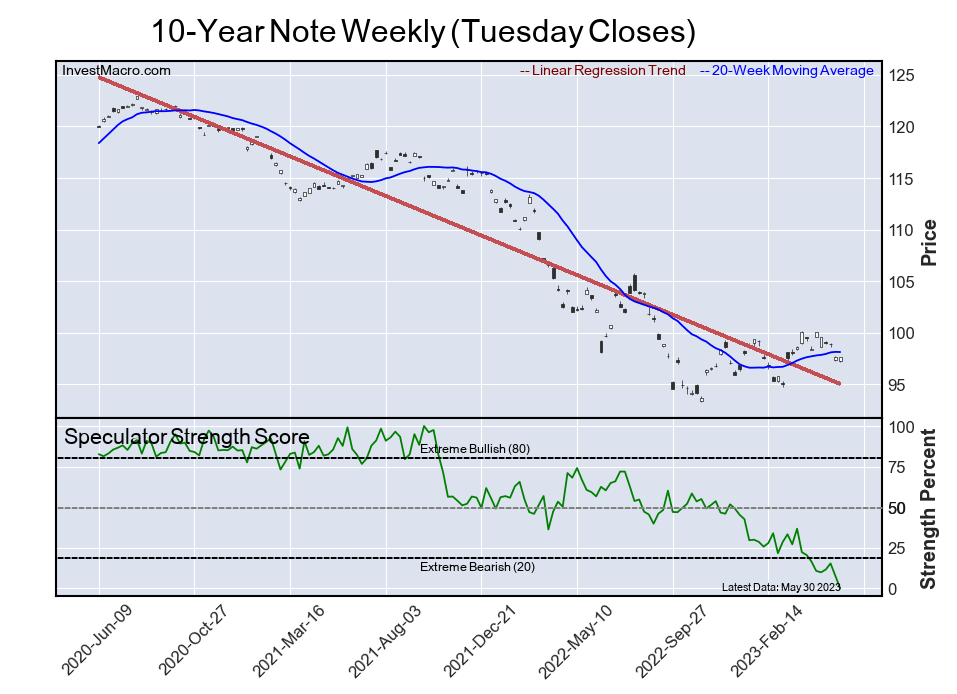
Archive for Opinions – Page 88

Fed rate hikes, recession fears and political backlash leave ESG investors at a crossroads

By Sehoon Kim, University of Florida 

The Federal Reserve raised interest rates again on May 3, 2023, by a quarter point, making it the Fed’s 10th rate hike since March 2022 in an ongoing fight to tame inflation. These rate hikes have been reverberating through the economy, raising prospects of a recession amid heightened concerns about the fragile state of banks.

The rate hikes are also rattling sustainability-focused investing, better known as ESG investing.

The trend toward ESG investing, which puts pressure on companies to meet environmental, social and governance benchmarks, has almost redefined asset management over the past decade. ESG funds today are a multitrillion-dollar market.

However, the high uncertainty around interest rates today, along with the prospects of a looming recession and a political backlash, has put the future of ESG investors at a crossroads.

I specialize in sustainable finance, and my recent work has documented the impact that tough economic times can have on ESG investing demand. Investments into U.S. sustainable mutual funds have visibly slowed since 2022, suffering their worst net flows in five years. Here are how three critical factors can affect investors’ zeal for socially conscious investing going forward.

Interest rate uncertainty

One of the primary arguments that big institutional investors like BlackRock make for ESG investing is that it creates long-term value for shareholders. Companies that pay careful attention to environmental, social and governance issues are believed to be better prepared for distant future risks, including regulatory risks and physical risks from climate change.

However, heightened uncertainty about interest rates poses a challenge today. That’s because higher rates can disproportionately affect the present value that investors assign to long-term investment outcomes. Let me explain.

Within the past year, the Federal Reserve has raised its benchmark lending rate from almost zero to a target range of 5% to 5.25% to combat inflation. In financial markets, higher interest rates lead to higher discount rates. That means that future cash generated by long-term investments is considered to be worth considerably less at today’s higher interest rates.

The more distant an asset’s value lies in the future, the more heavily it will be discounted in value when rates are high. So, long-duration investments – like most ESG investments – are especially sensitive to changes in interest rates.

This economic mechanism was also part of the backdrop of the recent rout in tech stocks and the series of bank failures that started with the collapse of Silicon Valley Bank.

Looming recession

Another factor that could affect ESG investing is the potential for an economic downturn.

As research shows, investors do not necessarily make ESG investments for greater long-term returns, but often for altruistic reasons or due to personal preferences to hold greener assets. For these ESG investors, a looming recession could change their perspective on these “luxuries.”

In an early warning about this possibility, a recent study I conducted with an economist at the Rotterdam School of Management found that retail investors showed signs of shying away from investing in sustainable mutual funds during the early months of the COVID-19 shock in 2020. This was a period when many households experienced layoffs and furloughs, which likely pushed them to set aside luxuries to prioritize protecting the values of their 401(k)s, IRAs and other investment portfolios.

In other words, investors may be all for ESG, except when times are tough.

Prominent economists, such as former Treasury Secretary Larry Summers, have warned of a likely recession as inflation and the Fed’s battle against it persist. The International Monetary Fund also lowered its global economic growth outlook from 3.4% in 2022 to 2.8% in 2023.

Political backlash

Finally, recent political friction and anti-ESG policies across states have started to create headwinds for pension funds and large institutions that serve them.

For example, Florida and Kansas passed laws in recent weeks and several other states including Texas and Kentucky have taken actions to restrict the ability of state public pension funds to invest in companies based on their ESG performance, citing concerns about fraudulent greenwashing and potential fiduciary duty violations, referring to the obligation institutional investors have to seek the highest returns for the lowest risk possible.

These restrictions can severely limit the capacity for ESG investing by institutional investors, which have played a significant role in driving the growth of ESG investing.

While concerns about greenwashing and high fees in ESG investing are not totally unwarranted, these political interventions can also have unintended consequences.

A recent study from economists at Wharton and the Federal Reserve Bank of Chicago found that a Texas law enacted in 2021 prohibiting municipalities from contracting with banks with ESG policies had a distorting side effect on those municipalities’ borrowing costs. The policy ended up raising the cost of public finance, meaning the law ultimately cost taxpayers.

Navigating the crossroads

As companies hold their 2023 annual meetings, the discussions among corporate officials, investors and stakeholders will serve as an important barometer for the current state and future of ESG investing.

Due to high interest rate uncertainty, prospects of a recession and political upheaval, ESG is under pressure. Perceived in recent years as a paradigm shift in how market mechanisms can address harms to society, stakeholders are now scrutinizing ESG investing with a critical lens regarding how strongly it can persist and how much impact it can have.

The next few years will be its most important stress test yet.The Conversation

About the Author:

Sehoon Kim, Assistant Professor of Finance, University of Florida

This article is republished from The Conversation under a Creative Commons license. Read the original article.


AI is helping astronomers make new discoveries and learn about the universe faster than ever before

By Chris Impey, University of Arizona 

The famous first image of a black hole just got two times sharper. A research team used artificial intelligence to dramatically improve upon its first image from 2019, which now shows the black hole at the center of the M87 galaxy as darker and bigger than the first image depicted.

I’m an astronomer who studies and has written about cosmology, black holes and exoplanets. Astronomers have been using AI for decades. In fact, in 1990, astronomers from the University of Arizona, where I am a professor, were among the first to use a type of AI called a neural network to study the shapes of galaxies.

Since then, AI has spread into every field of astronomy. As the technology has become more powerful, AI algorithms have begun helping astronomers tame massive data sets and discover new knowledge about the universe.

Better telescopes, more data

As long as astronomy has been a science, it has involved trying to make sense of the multitude of objects in the night sky. That was relatively simple when the only tools were the naked eye or a simple telescope, and all that could be seen were a few thousand stars and a handful of planets.

A hundred years ago, Edwin Hubble used newly built telescopes to show that the universe is filled with not just stars and clouds of gas, but countless galaxies. As telescopes have continued to improve, the sheer number of celestial objects humans can see and the amount of data astronomers need to sort through have both grown exponentially, too.

For example, the soon-to-be-completed Vera Rubin Observatory in Chile will make images so large that it would take 1,500 high-definition TV screens to view each one in its entirety. Over 10 years it is expected to generate 0.5 exabytes of data – about 50,000 times the amount of information held in all of the books contained within the Library of Congress.

There are 20 telescopes with mirrors larger than 20 feet (6 meters) in diameter. AI algorithms are the only way astronomers could ever hope to work through all of the data available to them today. There are a number of ways AI is proving useful in processing this data.

A sky filled with galaxies.
One of the earliest uses of AI in astronomy was to pick out the multitude of faint galaxies hidden in the background of images.
ESA/Webb, NASA & CSA, J. Rigby, CC BY

Picking out patterns

Astronomy often involves looking for needles in a haystack. About 99% of the pixels in an astronomical image contain background radiation, light from other sources or the blackness of space – only 1% have the subtle shapes of faint galaxies.

AI algorithms – in particular, neural networks that use many interconnected nodes and are able to learn to recognize patterns – are perfectly suited for picking out the patterns of galaxies. Astronomers began using neural networks to classify galaxies in the early 2010s. Now the algorithms are so effective that they can classify galaxies with an accuracy of 98%.

This story has been repeated in other areas of astronomy. Astronomers working on SETI, the Search for Extraterrestrial Intelligence, use radio telescopes to look for signals from distant civilizations. Early on, radio astronomers scanned charts by eye to look for anomalies that couldn’t be explained. More recently, researchers harnessed 150,000 personal computers and 1.8 million citizen scientists to look for artificial radio signals. Now, researchers are using AI to sift through reams of data much more quickly and thoroughly than people can. This has allowed SETI efforts to cover more ground while also greatly reducing the number of false positive signals.

Another example is the search for exoplanets. Astronomers discovered most of the 5,300 known exoplanets by measuring a dip in the amount of light coming from a star when a planet passes in front of it. AI tools can now pick out the signs of an exoplanet with 96% accuracy.

A planet near a dim red star.
AI tools can help astronomers discover new exoplanets like TRAPPIST-1 b.
NASA, ESA, CSA, Joseph Olmsted (STScI), CC BY

Making new discoveries

AI has proved itself to be excellent at identifying known objects – like galaxies or exoplanets – that astronomers tell it to look for. But it is also quite powerful at finding objects or phenomena that are theorized but have not yet been discovered in the real world.

Teams have used this approach to detect new exoplanets, learn about the ancestral stars that led to the formation and growth of the Milky Way, and predict the signatures of new types of gravitational waves.

To do this, astronomers first use AI to convert theoretical models into observational signatures – including realistic levels of noise. They then use machine learning to sharpen the ability of AI to detect the predicted phenomena.

Finally, radio astronomers have also been using AI algorithms to sift through signals that don’t correspond to known phenomena. Recently a team from South Africa found a unique object that may be a remnant of the explosive merging of two supermassive black holes. If this proves to be true, the data will allow a new test of general relativity – Albert Einstein’s description of space-time.

Two side-by-side images of an orange circular haze around a dark center.
The team that first imaged a black hole, at left, used AI to generate a sharper version of the image, at right, showing the black hole to be larger than originally thought.
Medeiros et al 2023, CC BY-ND

Making predictions and plugging holes

As in many areas of life recently, generative AI and large language models like ChatGPT are also making waves in the astronomy world.

The team that created the first image of a black hole in 2019 used a generative AI to produce its new image. To do so, it first taught an AI how to recognize black holes by feeding it simulations of many kinds of black holes. Then, the team used the AI model it had built to fill in gaps in the massive amount of data collected by the radio telescopes on the black hole M87.

Using this simulated data, the team was able to create a new image that is two times sharper than the original and is fully consistent with the predictions of general relativity.

Astronomers are also turning to AI to help tame the complexity of modern research. A team from the Harvard-Smithsonian Center for Astrophysics created a language model called astroBERT to read and organize 15 million scientific papers on astronomy. Another team, based at NASA, has even proposed using AI to prioritize astronomy projects, a process that astronomers engage in every 10 years.

As AI has progressed, it has become an essential tool for astronomers. As telescopes get better, as data sets get larger and as AIs continue to improve, it is likely that this technology will play a central role in future discoveries about the universe.The Conversation

About the Author:

Chris Impey, University Distinguished Professor of Astronomy, University of Arizona

This article is republished from The Conversation under a Creative Commons license. Read the original article.

Failing Federal Reserve makes mistake: deVere CEO

By George Prior 

The Federal Reserve has made a mistake by delivering a 25 basis-point interest rate hike amid ongoing financial market turmoil and recession red flags, warns the CEO of one of the world’s largest independent financial advisory, asset management and fintech organizations.

The grave warning from deVere Group’s Nigel Green comes as Fed Chair Jerome Powell at Wednesday’s meeting of the FOMC (Federal Open Market Committee) – the branch of the US central bank responsible for implementing monetary policy – confirmed a widely anticipated quarter percentage point hike, bringing the benchmark interest rate to 5-5.25%, the highest since 2006.

He notes: “The Fed failed early on with inflation due to its grand-scale inaction.  It was a hugely consequential miscalculation by the world’s most influential central bank.

“The Fed has now failed again, making another mistake, this latest interest rate hike, which could push the world’s largest economy not only into a short-term but a longer-term recession.

“Clearly, this would not only be a huge issue for the US, but the global economy too.”

The deVere CEO cites three primary reasons why he believes the US central bank is wrong to have raised rates this time.

“First, the crisis within the US financial system is still not over. There remain serious and legitimate concerns that after a string of bank failures, there could be more to come.

“The turmoil from the banking crisis is leading to a drop in bank lending, tightening the credit conditions for households and businesses. In turn, this will inevitably lead to a slowdown in economic activity and hiring.

“Chair Powell himself has said at a news conference that the bank turmoil had the equivalent impact of at least one quarter-point rate increase.

“The Fed’s interest rate hiking agenda has tightened financial conditions which, in part, led to the banking crisis, and now the banking crisis itself is going to put the squeeze on financial conditions even more.”

Nigel Green continues: “Second, the time lag for monetary policies is very long. It is said that it takes about 18 months to two years for the full effect of rate hikes to filter fully into the economy.

“Third, the bond market is suggesting a long and/or deep recession with its inverted yield curve. Yields are inversely related to bond prices.

“This is typically the sign of a coming recession – an inverted yield curve has emerged roughly a year before nearly all recessions since 1960.”

The chief executive says the Fed’s decision to hike rates is “set to deliberately plunge” the US consumer-led economy into a recession.

“It would appear that the central bank is prepared to increase its stranglehold on households and businesses and to “sacrifice parts of the economy” in order to tame inflation.

Nigel Green concludes: “The failing Fed has made another mistake.

“We can only hope now that this is their last rate hike for a while for the good of the real economy and to restore some of their own credibility.”

About:

deVere Group is one of the world’s largest independent advisors of specialist global financial solutions to international, local mass affluent, and high-net-worth clients.  It has a network of more than 70 offices across the world, over 80,000 clients and $12bn under advisement.

The ‘Cheat Sheet’ Economy

Source: Michael Ballanger  (5/1/23) 

Michael Ballanger of GGM Advisory Inc. shares his weekly public advisory with Streetwise Reports, reviewing the current state of the stock market, the gold sector, and a few companies he believes should be on your radar. 

It should come as no surprise to anyone that the big news item this week is that handlers for the 80-year-old U.S. President Joe Biden have been passing him “cheat sheets” with detailed instructions on how to conduct a White House press conference, complete with a full set of questions to be asked by the carefully-selected “audience” of reporters designed to float out a series of soft-coated questions whose responses have not only been scrutinized in advance by staff but time has been allocated for totally-scripted, rehearsed responses to be delivered in the guise of “off-the-cuff” repartee.

As I was watching Canadian Prime Minister Justin Trudeau denying media allegations about the forced COVID-19 vaccinations imposed upon the Canadian people causing the termination of employment for hundreds and hundreds of healthcare workers all in the name of “science,” I was reminded of the early days of the pandemic, where no politician barking orders to the Canadian electorate dared stand in front of a camera unless he/she had an array of health care “gurus” flanking them on either side, providing an “implied sanction” on the words being delivered on the efficacy of the “science” they were attempting to espouse.

Then, you have the famous FOMC press conferences where the same group of perhaps five honored members of the media led by CNBC’s Steve Leisman and the Wall Street Journal’s Nick Timiraos that consistently, without fail, deliver softball questions time after irritating time to Jay Powell then bragging about how their questions sent stocks soaring. Everywhere one turns, you run into crafted interviews and scripted press conferences, all designed to give the public the mistaken impression that our leaders — actually, our elected celebrities — are actors on a stage and little more.

Over the years, the blatant allocation of “pork” has escalated to a degree that politicians have become anesthetized to criticism such that public scrutiny is now deemed as, quite simply, the cost of doing business.

When I sit back and ruminate the pros and cons behind life in either a constitutional republic (U.S.A.) or a parliamentary democracy (Canada), I wind up running blindfolded in logistical circles in the middle of the room.

We were told from a very young age that we vote for politicians with character, resolve, love of country, and morality, but the process of achieving political power involves a very long series of chameleon-like metamorphoses by both voters and politicians.

The wide-eyed innocence of the idealistic political rookie and the first-time all-believing voter gets subverted from doing what is right into doing what is right “for me.” Politicians that are able to survive the wilderness of the political stump learn “The Art of Breaking Promises” while voters over the years grow to appreciate “The Wonders of Political Favour.”

Voters are today drawn to promises as opposed to ideals or policy positions while the baby-kissing crowd learns that the proliferation of promises is not unlike the nuclear arms race of the post-WWII period, where weaponry held by both the U.S. and the Soviet Union grew to multiple of what was required to vapourize each country.

In both the U.S. and Canada, parties in power enact policies designed to attract votes, and they know that there is no longer a need to keep such strategies in the closet, so to speak, because the term “pork barrel politics” has morphed into “container ship politics” as the price of re-election has skyrocketed thanks to a sharp-eyed (and well-trained) electorate.

Over the years, the blatant allocation of “pork” has escalated to a degree that politicians have become anesthetized to criticism such that public scrutiny is now deemed as, quite simply, the cost of doing business.

A Vicious Debt Spiral

Promising a new postal distribution center or a research facility to be paid for by public funding never runs the gauntlet of “How will we pay for it?” and instead simply falls under the purview of can-kicking, and therein lies the entire conundrum behind this vicious debt spiral.

Debt gets created because the electorate never gets hit with a sudden tax increase (which is political suicide for incumbents), and the political spenders can push repayment several decades out into the nebulae of time before it becomes a real-time concern.

So, if there are no governors to impose checks and balances on them governors, they will accede to our — the voters’ — demands and keep on spending wildly with money created by “keystroke ingenuity.” Sadly, that process has been ongoing for over four decades resulting in a global debt leviathan too large and unwieldy to ever be retired.

My children and grandchildren will need to sort out the ways and means to manage the upcoming fiscal crisis, and what they will determine is that blame must rest on the shoulders of the generation that created the crisis — the Babyboomers.

It is true that once the first nation defaults, the U.S. dollar will be caught up in a contagion, not unlike the 2020 pandemic.

The problem with that is that we Boomers were really quite visionary when we decided to create an irreversible tsunami of credit in much the same way that Stanley Kubrick’s brilliant “Dr. Strangelove (or How I Stopped Worrying and Grew to Love the Bomb)” depicted life in the Cold War ’60s where nuclear proliferation had gone berserk.

The lead character (Dr. Strangelove) created his personal doomsday machine that would annihilate all human life once the first bomb was dropped. The “first bomb dropping” in this allegory would be akin to the “first sovereign debt default,” where once set in motion, all counterparties (which is basically every nation on the planet) would be affected by the global debt contagion.

Nonetheless, it is true that once the first nation defaults, the U.S. dollar will be caught up in a contagion, not unlike the 2020 pandemic. No one is immune from a debt meltdown, and because the bulk of trade is conducted in the most heavily-leveraged currency in the world (and the one now known as the “global reserve currency”), the benefits of the Breton Woods Agreement, now a mere fragment of what it was once purported to provide, will transform itself from asset to liability in the stroke of a basis point.

A ‘Cheat Sheet’ Economy

We live in a “cheat sheet” economy where nothing is as it appears. Everything we read and hear, and watch emanates from one massive propaganda-generating “Thought Machine” that instructs us on diet, medicine, daily routine, sexuality, and morality, all delivered through the diabolical venue of technology.

All those futuristic movies from the 1960s and 1970s, like A Clockwork Orange and Soylent Green all had one recurring theme in that humanity was under strict control by a ruler or ruling class in what would certainly be a condemnation of authoritarian rule. In all aspects, authoritarian rule only works if one has a passive, compliant citizenry.

I have been adding to my holdings on recent weakness and consider Volt Lithium Corp. to be a “must-own” as the year progresses.

Whether it is food or drugs or government work programs, all measures designed to brainwash the populace into compliance and passivity are the function of an authoritarian state which is precisely why our leaders have teams of people managing their every traceable move, especially where cameras are present.

The politician’s image is now groomed and preened and preserved in all manners possible so that by election time, all distractions caused by ill-timed and unrehearsed replies to questions concerning policy have been swept away or prevented by way of cheat sheets.

All that remains are the promises seared into the memory banks of a well-targeted electorate as they enter the voting booth and pull the switch. It is an abomination and one which our founders would abhor.

Stocks

The U.S. economic data continues to both disappoint and confound, with the SPX still working a bearish MACD crossover from a few days back. These negative events have been effective harbingers since January 2022, and as I said last week, when it went bearish, it cannot override the bullish January Barometer, but it certainly can allow for a correction within the larger bullish major trend off what looks like the intermediate-term correction low of last October.

The sentiment is decidedly bearish, with the Twitterverse and the Blogosphere all rife with downbeat interviews with Ray Dalio or Stan Druckenmiller, but the most chilling is the current 3,200 target for the SPX by legendary Jeremy Grantham.

The contrast between what I get from the hard money crowd like Adam Taggart’s Wealtheon site and the CNBC party line is staggering, with the New Yorkers all strutting the bullish strut with tech stocks leading the charge, but the reality is that just a handful of stocks are leading the charge.

The last time market breadth was this weak was 1999 and 2019, and I remember 2019 and the aggravation that I went through because of the market’s inability to cave in. The Wall Street banks kept juicing the FANG stocks that held up the S&P sending the bears all scurrying for cover as squeeze after squeeze kept a chokehold on them.

Finally, it took the arrival of the pandemic to finally break the major trend, and down it all went until April when the Fed and the Treasury turned on the money spigots and flooded the world with cash.

Poor market breadth was a stalwart in the arsenal of another legendary market timer, Richard Russell, whose Proprietary Trend Index (“PTI”) focused heavily on the advance-decline figures over multiple time frames. I am currently a cautious bull but mindful of the need for keeping position sizes in check, as I will not bet against the MACD crossover of a few days ago.

I reduced position sizes as a result of the sell signal, but looking at the MACD tonight, another few days of strength like we had last week, and we could actually have a bullish MACD crossover. A bullish MACD reversal would be uncommon but not impossible, but if we do get one, there will be a wicked short squeeze setting up a potential blow-off top — or not.

One thing is without dispute: these are the toughest markets to trade that I have ever encountered, with a close resemblance to 2019.

Gold

Gold is on “standby” right now and will be until next Wednesday when the FOMC statement on interest rates is announced, followed by the Jerome Powell press conference.

Until then, I see little to talk about other than once the U.S. dollar index breaks the 100 level, I see the potential for a waterfall decline to the low 90s, which should take gold (and silver) to new all-time highs with gold getting their by summer and silver later as we approach the fall. It is my hope and prayer that such a development kicks the junior gold miners in the backside and assists in eliminating the huge discount at which they trade.

Getchell Gold Corp. (GTCH:CSE; GGLDF:OTCQB) is trading at US$9.95 per ounce of Nevada-based, in-ground gold (43101-compliant), a riddle wrapped inside a mystery inside an enigma (credit to Winston Churchill).

GTCH is not alone, as many of the gold developers have the same problem attracting retail and institutional investors for some ungodly reason, unlike lithium, which continues to be the darling of the battery metals space.

Speaking of lithium, top-ranked and top performer Allied Copper Corp. (CPR:TSX.V; CPRRF:OTCQB) completed its name change to Volt Lithium Corp. (VLT:TSV;VLTLF:US) and is now my top pick in the non-precious metals space.

They are now in pilot plant production, with the upcoming maiden resource estimate being eagerly awaited, as well as the results from the first large-scale volume of brines currently being processed. The Pro-forma, which assumes that bench test results are duplicated at the pilot plant operations, estimated over US$35 million of after-tax earnings by the end of June 2024.

So assuming no further dilution, that would put the per-share earnings number at US$0.2644.

It is my assertion that early evidence of recoverability rates for lithium carbonate and lithium hydroxide would result in a sharp rerating of VLT:TSV and move it quickly onto institutional radar screens.

At a US$32.9m market cap, it is more than fairly priced, and a look at performance relative to its peers is impressive.

I have been adding to my holdings on recent weakness and consider Volt Lithium Corp. to be a “must-own” as the year progresses.


Michael Ballanger Disclaimer:

This letter makes no guarantee or warranty on the accuracy or completeness of the data provided. Nothing contained herein is intended or shall be deemed to be investment advice, implied or otherwise. This letter represents my views and replicates trades that I am making but nothing more than that. Always consult your registered advisor to assist you with your investments. I accept no liability for any loss arising from the use of the data contained on this letter. Options and junior mining stocks contain a high level of risk that may result in the loss of part or all invested capital and therefore are suitable for experienced and professional investors and traders only. One should be familiar with the risks involved in junior mining and options trading and we recommend consulting a financial adviser if you feel you do not understand the risks involved.

Disclosures:

1) Michael J. Ballanger: I, or members of my immediate household or family, own securities of the following companies mentioned in this article: Allied Copper Corp./Volt Lithium Corp. and Getchell Gold Corp. I personally am, or members of my immediate household or family are, paid by the following companies mentioned in this article: None.

2) The following companies mentioned in this article are billboard sponsors of Streetwise Reports: None. Click here for important disclosures about sponsor fees. As of the date of this article, an affiliate of Streetwise Reports has a consulting relationship with: None. Please click here for more information.

3) Statements and opinions expressed are the opinions of the author and not of Streetwise Reports or its officers. The author is wholly responsible for the validity of the statements. The author was not paid by Streetwise Reports for this article. Streetwise Reports was not paid by the author to publish or syndicate this article. Streetwise Reports requires contributing authors to disclose any shareholdings in, or economic relationships with, companies that they write about. Streetwise Reports relies upon the authors to accurately provide this information and Streetwise Reports has no means of verifying its accuracy.

4) This article does not constitute investment advice. Each reader is encouraged to consult with his or her individual financial professional and any action a reader takes as a result of information presented here is his or her own responsibility. By opening this page, each reader accepts and agrees to Streetwise Reports’ terms of use and full legal disclaimer. This article is not a solicitation for investment. Streetwise Reports does not render general or specific investment advice and the information on Streetwise Reports should not be considered a recommendation to buy or sell any security. Streetwise Reports does not endorse or recommend the business, products, services or securities of any company mentioned on Streetwise Reports.

5) From time to time, Streetwise Reports LLC and its directors, officers, employees or members of their families, as well as persons interviewed for articles and interviews on the site, may have a long or short position in securities mentioned. Directors, officers, employees or members of their immediate families are prohibited from making purchases and/or sales of those securities in the open market or otherwise from the time of the decision to publish an article until three business days after the publication of the article. The foregoing prohibition does not apply to articles that in substance only restate previously published company releases. As of the date of this article, officers and/or employees of Streetwise Reports LLC (including members of their household) own securities of Allied Copper Corp./Volt Lithium Corp. and Getchell Gold Corp., companies mentioned in this article.


Twitter played a role in the collapse of Silicon Valley Bank – new research

By Tony Cookson, University of Colorado Boulder and Christoph Schiller, Arizona State University 

The Research Brief is a short take about interesting academic work.

The big idea

Prior to Silicon Valley Bank’s March 10, 2023, collapse, conversations on Twitter among investors about the bank spiked – helping fuel the SVB bank run. As we explain in our new working paper, “Social media as a bank run catalyst,” those tweets also destabilized other financial institutions with weak balance sheets.

The number of tweets mentioning “SIVB,” the bank’s stock ticker, increased sharply on March 9 around 9 a.m EST. That was roughly two and a half hours before tweets mentioning “SVB” or “Silicon Valley Bank,” which were part of a more general-interest discussion, began.

That spike in investor tweets coincided with the rapid drop in the bank’s stock price on March 9, which continued in after-hours trading and before the market opened the next morning. Trades in SVB’s stock were halted on March 10, the day the bank collapsed.

Together with several other colleagues, we grouped U.S. banks by the number of tweets posted about them and by their vulnerability to a potential bank run. To measure vulnerability, we multiplied losses the banks incurred due to the string of interest rate increases that began in March 2022 by the proportion of their deposits that were below the Federal Deposit Insurance Corp.‘s insurance limit of $250,000 per account.

We found that shares of banks with a lot of Twitter activity in January and February incurred much larger declines in March. This effect was stronger for the group of banks with the most vulnerability. One of them was First Republic Bank, which subsequently failed on May 1.

When we looked at what happened to the stocks of all the banks with vulnerable balance sheets from March 6 to March 13, the one-third of banks with the most tweets experienced declines in their share prices on average about twice as large as the others.

Why it matters

U.S. policymakers have acknowledged that social media may have played a role in Silicon Valley Bank’s demise.

Existing knowledge about bank runs comes mainly from banking distress during the Great Depression. Back then, word of mouth, media coverage and public signals, such as long lines outside of banks, spread panic among bank customers.

The breadth of the audience and the quick spread of ideas make social media distinct from newspapers and broadcast news since traditional media outlets mostly rely on one-way communication from official sources to the general public.

This will surely remain an important issue for banks, especially as other financial institutions face issues similar to those that felled SVB.

What other research is being done

A report on SVB’s failure that the Federal Reserve released on April 28 underscored many of the points we made in our paper. It highlights poor risk management by SVB in combination with a large fraction of depositors concentrated in the Silicon Valley startup community, who are often very active and highly connected on social media.

Another team of scholars, led by University of Pennsylvania finance professor Itamar Drechsler, determined that the recent growth of uninsured deposit accounts can destabilize banks.

As ongoing research by a team of researchers at Columbia University and the University of Chicago suggests, this risk may further be amplified by the rise of fully digital banks and mobile banking apps.

What is not known

Depositors who rapidy withdrew money from SVB also reportedly relied on private communication channels, such as group text messages, Slack and WhatsApp, as well as phone calls, to share their fears and concerns. But since there is no publicly available data, it is hard to find out what role those other less formal conversations played in precipitating the SVB bank run.The Conversation

About the Authors:

Tony Cookson, Associate Professor of Finance, University of Colorado Boulder and Christoph Schiller, Assistant Professor of Finance, Arizona State University

This article is republished from The Conversation under a Creative Commons license. Read the original article.

Mid-Week Technical Outlook: Oil Hammered Ahead Of Fed

By ForexTime 

Oil markets have been plunged into a bloodbath over the past 24 hours.

The global commodity shed almost 3% this morning, extending a 5% drop on Tuesday after disappointing US economic data fuelled fears of a recession. With oil bears drawing ample strength from weak US factory data and renewed concerns about the US banking sector, further downside could be on the cards ahead of the Fed decision later today.

In the meantime, it will be wise to keep a close eye on the pending US ISM numbers and data from the Energy Information Agency (EIA) this afternoon. If the reports reinforce fears around the US economy or the EIA data shows a rise in oil inventories, this could keep bears in the driving seat.

Looking at the technical picture, both WTI and Brent Crude are under intense pressure on the daily charts. WTI extended losses on Wednesday with bears smashing into the $70 level. A strong break and daily close below this point could open a path toward $67 and $64.33 – the lowest level hit this year. Should $70 or $67 prove to be reliable support, prices may experience a technical pullback toward $74 before resuming the downtrend.

It is a similar story for Brent. Prices are trading below the 50, 100, and 200-day SMA while the MACD trades below zero. The bearish trend is healthy with the next key level of interest found at 72.50. Below this point, prices could test $70 and potentially lower.

Since we are discussing commodities, gold secured a daily close above the $2015 resistance as downbeat US economic data and renewed banking fears sparked risk aversion. However, it may take a potent fundamental spark to push prices higher with all eyes on the Fed meeting this evening. Although the central bank is widely expected to hike rates by 25 basis points, investors will be looking for any confirmation that a pause in hikes is on the table. Whatever the outcome, it will certainly impact gold.

The solid breakout above $2015 may open the doors toward $2032 and $2047. Should prices slip back below $2000, this could trigger a decline towards $1970 and $1950, respectively.


Forex-Time-LogoArticle by ForexTime

ForexTime Ltd (FXTM) is an award winning international online forex broker regulated by CySEC 185/12 www.forextime.com

Trade of the Week: The return of $2k gold?

By ForexTime 

Spot gold has been trapped within a $46 range for the most part since April 17th.

Though finding support around the upper-$1900 levels over the past two weeks, the precious metal can scarcely keep its head above the psychologically-important $2,000 line.


However, this week’s events could go a long way in determining whether we’ll see an upside or downside breakout for spot gold.


Here’s a play-by-play on 4 fundamental events over four days that could greatly influence spot gold this week:

  • Tuesday, May 2nd: Eurozone April inflation

The Eurozone’s CPI (consumer price index), which measures the changes in headline inflation, is forecasted to print at 7%.

If so, that would be an uptick from the 6.9% registered in March.

However, if the official CPI figure drops notably below that 7% mark, suggesting that headline inflation is easing, that would erode expectations for more European Central Bank rate hikes.

And such a notion should weaken the Euro while boosting the US dollar, which in turn may drag spot gold prices lower in USD terms.

Lower-than-expected Eurozone inflation = weaker Euro = stronger US dollar = lower gold


  • Wednesday, May 3rd: Federal Reserve rate decision

The US central bank is likely to raise its benchmark rates by another 25-basis points (bps).

Anything else (no hike/50-bps hike) would be a massive shock to traders and investors worldwide!

However, more importantly, markets are desperate to know whether this week’s Fed rate hike is the final one of a series that began over a year ago.

Confirmation from Fed Chair Jerome Powell that US rates would’ve reached its peak this week could see gold prices resurfacing above the $2k mark.

After all, gold is a zero-yielding asset (investors don’t get paid for holding on to gold) and shudders at the thought of US interest rates moving even higher than expected.

Furthermore, if markets get the sense that Fed rate CUTS are growing likelier in the latter part of 2023, that could give gold further impetus to launch another attempt at a fresh record high!

Fed rate hikes are over/Fed rate cuts later in 2023 = weaker US dollar = a potential return of US$2k gold


  • Thursday, May 4th: European Central Bank rate decision

The ECB is widely expected to hike its own benchmark rates by another 25-bps (same size as the Fed’s rate hike).

However, if the ECB shocks markets with a larger 50-bps hike (11.5% chance of such a shocker), or if ECB President Christine Lagarde presses home policymakers’ intentions to keep hiking rates (especially if Tuesday’s Eurozone CPI greatly exceeds market expectations), then the same formula may be called into action once more:

More hawkish ECB = stronger Euro = weaker US dollar = higher gold prices in USD terms.


  • Friday, May 5th: US jobs report

The US nonfarm payrolls headline number has to greatly defy the market-forecasted 180,000 print in order for gold to drag gold lower.

Further signs of resilient hiring momentum, despite the 475-bps (excluding this week’s expected 25-bps hike) in Fed rate hikes that were intended to destroy demand since Q1 2022, would suggest that the Fed can ill afford to pause its rate-hike cycle after this week.

Also, if April’s unemployment rate stubbornly matches the 3.5% rate set in March, as opposed to ticking higher to 3.6% as per forecasts, would likely add to expectations that the Fed has to stay hawkish (press ahead with more rate hikes).

Stronger-than-expected NFP = more incoming Fed rate hikes = stronger US dollar = weaker gold prices


Key levels for spot gold

SUPPORT:

  • Mid-$1970s: lower bound of recent trading range
  • $1959.66: early-February cycle high
  • $1934 – $1949 range: March-early April support
  • 50-day simple moving average (SMA)

Still, spot gold may not have far to fall, as long as markets refuse to abandon hopes that the Fed will have to start lowering US interest rates later this year.


RESISTANCE:

  • $2,000: psychologically-important mark
  • $2032.14: April 5th intraday high
  • $2048.36: one-year high (since March 2022)


The longer it can stay above that $2k mark, the greater the chances of a fresh record high for spot gold!


At the time of writing, Bloomberg’s model points to a 72% chance that spot gold will trade within the $1938.57 – $2031.73 range over the next one-week period.

The pivotal events due in the days ahead may also have a great influence on how gold performs in the weeks and months ahead.


Forex-Time-LogoArticle by ForexTime

ForexTime Ltd (FXTM) is an award winning international online forex broker regulated by CySEC 185/12 www.forextime.com

Generative AI is forcing people to rethink what it means to be authentic

By Victor R. Lee, Stanford University 

It turns out that pop stars Drake and The Weeknd didn’t suddenly drop a new track that went viral on TikTok and YouTube in April 2023. The photograph that won an international photography competition that same month wasn’t a real photograph. And the image of Pope Francis sporting a Balenciaga jacket that appeared in March 2023? That was also a fake.

All were made with the help of generative AI, the new technology that can generate humanlike text, audio and images on demand through programs such as ChatGPT, Midjourney and Bard, among others.

There’s certainly something unsettling about the ease with which people can be duped by these fakes, and I see it as a harbinger of an authenticity crisis that raises some difficult questions.

How will voters know whether a video of a political candidate saying something offensive was real or generated by AI? Will people be willing to pay artists for their work when AI can create something visually stunning? Why follow certain authors when stories in their writing style will be freely circulating on the internet?

I’ve been seeing the anxiety play out all around me at Stanford University, where I’m a professor and also lead a large generative AI and education initiative.

With text, image, audio and video all becoming easier for anyone to produce through new generative AI tools, I believe people are going to need to reexamine and recalibrate how authenticity is judged in the first place.

Fortunately, social science offers some guidance.

The many faces of authenticity

Long before generative AI and ChatGPT rose to the fore, people had been probing what makes something feel authentic.

When a real estate agent is gushing over a property they are trying to sell you, are they being authentic or just trying to close the deal? Is that stylish acquaintance wearing authentic designer fashion or a mass-produced knock-off? As you mature, how do you discover your authentic self?

These are not just philosophical exercises. Neuroscience research has shown that believing a piece of art is authentic will activate the brain’s reward centers in ways that viewing something you’ve been told is a forgery won’t.

Authenticity also matters because it is a social glue that reinforces trust. Take the social media misinformation crisis, in which fake news has been inadvertently spread and authentic news decreed fake.

In short, authenticity matters, for both individuals and society as a whole.

But what actually makes something feel authentic?

Psychologist George Newman has explored this question in a series of studies. He found that there are three major dimensions of authenticity.

One of those is historical authenticity, or whether an object is truly from the time, place and person someone claims it to be. An actual painting made by Rembrandt would have historical authenticity; a modern forgery would not.

A second dimension of authenticity is the kind that plays out when, say, a restaurant in Japan offers exceptional and authentic Neapolitan pizza. Their pizza was not made in Naples or imported from Italy. The chef who prepared it may not have a drop of Italian blood in their veins. But the ingredients, appearance and taste may match really well with what tourists would expect to find at a great restaurant in Naples. Newman calls that categorical authenticity.

And finally, there is the authenticity that comes from our values and beliefs. This is the kind that many voters find wanting in politicians and elected leaders who say one thing but do another. It is what admissions officers look for in college essays.

In my own research, I’ve also seen that authenticity can relate to our expectations about what tools and activities are involved in creating things.

For example, when you see a piece of custom furniture that claims to be handmade, you probably assume that it wasn’t literally made by hand – that all sorts of modern tools were nonetheless used to cut, shape and attach each piece. Similarly, if an architect uses computer software to help draw up building plans, you still probably think of the product as legitimate and original. This is because there’s a general understanding that those tools are part of what it takes to make those products.

In most of your quick judgments of authenticity, you don’t think much about these dimensions. But with generative AI, you will need to.

That’s because back when it took a lot of time to produce original new content, there was a general assumption that it required skill to create – that it only could have been made by skilled individuals putting in a lot of effort and acting with the best of intentions.

These are not safe assumptions anymore.

How to deal with the looming authenticity crisis

Generative AI thrives on exploiting people’s reliance on categorical authenticity by producing material that looks like “the real thing.”

So it’ll be important to disentangle historical and categorical authenticity in your own thinking. Just because a recording sounds exactly like Drake – that is, it fits the category expectations for Drake’s music – it does not mean that Drake actually recorded it. The great essay that was turned in for a college writing class assignment may not actually be from a student laboring to craft sentences for hours on a word processor.

If it looks like a duck, walks like a duck and quacks like a duck, everyone will need to consider that it may not have actually hatched from an egg.

Also, it’ll be important for everyone to get up to speed on what these new generative AI tools really can and can’t do. I think this will involve ensuring that people learn about AI in schools and in the workplace, and having open conversations about how creative processes will change with AI being broadly available.

Writing papers for school in the future will not necessarily mean that students have to meticulously form each and every sentence; there are now tools that can help them think of ways to phrase their ideas. And creating an amazing picture won’t require exceptional hand-eye coordination or mastery of Adobe Photoshop and Adobe Illustrator.

Finally, in a world where AI operates as a tool, society is going to have to consider how to establish guardrails. These could take the form of regulations, or the creation of norms within certain fields for disclosing how and when AI has been used.

Does AI get credited as a co-author on writing? Is it disallowed on certain types of documents or for certain grade levels in school? Does entering a piece of art into a competition require a signed statement that the artist did not use AI to create their submission? Or does there need to be new, separate competitions that expressly invite AI-generated work?

These questions are tricky. It may be tempting to simply deem generative AI an unacceptable aid, in the same way that calculators are forbidden in some math classes.

However, sequestering new technology risks imposing arbitrary limits on human creative potential. Would the expressive power of images be what it is now if photography had been deemed an unfair use of technology? What if Pixar films were deemed ineligible for the Academy Awards because people thought computer animation tools undermined their authenticity?

The capabilities of generative AI have surprised many and will challenge everyone to think differently. But I believe humans can use AI to expand the boundaries of what is possible and create interesting, worthwhile – and, yes, authentic – works of art, writing and design.The Conversation

About the Author:

Victor R. Lee, Associate Professor of Learning Sciences and Technology Design in Education, Stanford University

This article is republished from The Conversation under a Creative Commons license. Read the original article.

Euro Currency Speculators boost their bullish bets to 133-week high

By InvestMacro

Here are the latest charts and statistics for the Commitment of Traders (COT) data published by the Commodities Futures Trading Commission (CFTC).

The latest COT data is updated through Tuesday April 25th and shows a quick view of how large market participants (for-profit speculators and commercial traders) were positioned in the futures markets. All currency positions are in direct relation to the US dollar where, for example, a bet for the euro is a bet that the euro will rise versus the dollar while a bet against the euro will be a bet that the euro will decline versus the dollar.

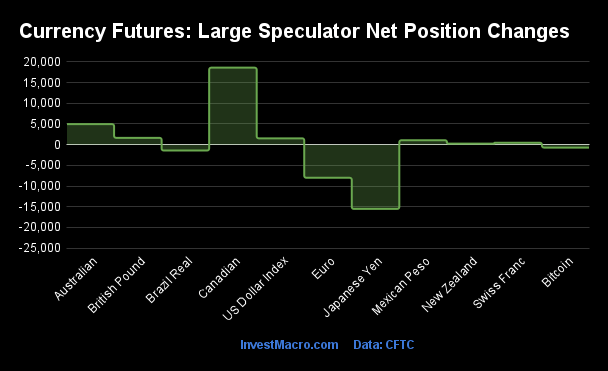
Weekly Speculator Changes led by EuroFX & British Pound

The COT currency market speculator bets were higher this week as nine out of the eleven currency markets we cover had higher positioning while the other two markets had lower speculator contracts.

Leading the gains for the currency markets was the EuroFX (5,039 contracts), British Pound (4,537 contracts), Brazilian Real (3,223 contracts), the Australian Dollar (2,894 contracts), the Canadian Dollar (2,442 contracts), the US Dollar Index (226 contracts), Swiss Franc (1,064 contracts), Bitcoin (196 contracts) and the New Zealand Dollar (652 contracts) also recording positive weeks.

The currencies seeing declines in speculator bets on the week were the Japanese Yen (-11,875 contracts) and the Mexican Peso (-2,043 contracts) seeing lower bets on the week.

Euro Speculators boost their bullish bets to 133-week high

Highlighting the COT currency’s data this week is the rising bullishness of the speculator’s positioning in the Euro Currency. Euro speculator bets turned from bearish to bullish on September 20th of 2022 and have steadily increased in positive sentiment. The Euro positions have now been above the +100,000 contract threshold for 26 straight weeks, the best streak since 2021.

This week, the large speculative Euro positions went higher for a third consecutive week and for the fifth time in the past six weeks. Euro weekly positions have now increased by a total of +29,444 contracts over these past six weeks. This positive sentiment has pushed the overall bullish standing to the highest level in 133-weeks, dating back to October 6th of 2020.

The Euro exchange rate against the US Dollar has also been on the rise and this week hit it’s highest level since March of 2022 above the 1.11 exchange level. Since late-February, the Euro has had higher weekly closes in seven out of the past nine weeks and is now higher by over 15 percent since it’s multi-decade low of 0.9592 in September.


Data Snapshot of Forex Market Traders | Columns Legend
Apr-25-2023OIOI-IndexSpec-NetSpec-IndexCom-NetCOM-IndexSmalls-NetSmalls-Index
USD Index34,4413310,73943-12,711561,97238
EUR772,88283169,40084-224,4371555,03767
GBP231,666565,83974-10,530274,69167
JPY184,04137-68,7442772,62571-3,88146
CHF41,73641-3,656452,7014995561
CAD151,78631-43,7911445,87887-2,08718
AUD178,75772-39,4624853,74659-14,28418
NZD36,60325-3,252453,92856-67644
MXN267,2766154,12890-58,607114,47984
RUB20,93047,54331-7,15069-39324
BRL78,7487816,81957-16,34345-47640
Bitcoin14,06464-29372-296058926


Strength Scores led by Mexican Peso & EuroFX

COT Strength Scores (a normalized measure of Speculator positions over a 3-Year range, from 0 to 100 where above 80 is Extreme-Bullish and below 20 is Extreme-Bearish) showed that the Mexican Peso (90 percent) and the EuroFX (84 percent) lead the currency markets this week. The British Pound (74 percent), Bitcoin (72 percent) and the Brazilian Real (57 percent) come in as the next highest in the weekly strength scores.

On the downside, the Canadian Dollar (14 percent) comes in at the lowest strength levels currently and is in Extreme-Bearish territory (below 20 percent). The next lowest strength scores are the Japanese Yen (27 percent), the US Dollar Index (43 percent) and the New Zealand Dollar (45 percent).

Strength Statistics:
US Dollar Index (42.8 percent) vs US Dollar Index previous week (42.5 percent)
EuroFX (83.7 percent) vs EuroFX previous week (81.7 percent)
British Pound Sterling (74.0 percent) vs British Pound Sterling previous week (70.1 percent)
Japanese Yen (26.5 percent) vs Japanese Yen previous week (33.9 percent)
Swiss Franc (44.9 percent) vs Swiss Franc previous week (42.1 percent)
Canadian Dollar (13.7 percent) vs Canadian Dollar previous week (11.4 percent)
Australian Dollar (48.2 percent) vs Australian Dollar previous week (45.6 percent)
New Zealand Dollar (44.8 percent) vs New Zealand Dollar previous week (43.0 percent)
Mexican Peso (89.6 percent) vs Mexican Peso previous week (91.1 percent)
Brazilian Real (57.2 percent) vs Brazilian Real previous week (53.1 percent)
Bitcoin (71.8 percent) vs Bitcoin previous week (68.4 percent)


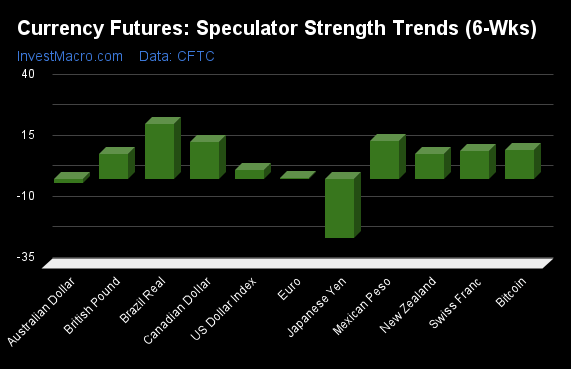
British Pound & Swiss Franc top the 6-Week Strength Trends

COT Strength Score Trends (or move index, calculates the 6-week changes in strength scores) showed that the British Pound (20 percent) and the Swiss Franc (17 percent) lead the past six weeks trends for the currencies. The EuroFX (11 percent), the Japanese Yen (4 percent) and the New Zealand Dollar (4 percent) are the next highest positive movers in the latest trends data.

The Brazilian Real (-15 percent) leads the downside trend scores currently with the Canadian Dollar (-11 percent), Mexican Peso (-9 percent) and the US Dollar Index (-5 percent) following next with lower trend scores.

Strength Trend Statistics:
US Dollar Index (-5.0 percent) vs US Dollar Index previous week (-3.4 percent)
EuroFX (11.3 percent) vs EuroFX previous week (6.1 percent)
British Pound Sterling (19.9 percent) vs British Pound Sterling previous week (16.1 percent)
Japanese Yen (3.7 percent) vs Japanese Yen previous week (11.4 percent)
Swiss Franc (16.7 percent) vs Swiss Franc previous week (-2.0 percent)
Canadian Dollar (-11.3 percent) vs Canadian Dollar previous week (-15.9 percent)
Australian Dollar (0.6 percent) vs Australian Dollar previous week (-16.3 percent)
New Zealand Dollar (4.0 percent) vs New Zealand Dollar previous week (-25.8 percent)
Mexican Peso (-9.1 percent) vs Mexican Peso previous week (66.2 percent)
Brazilian Real (-14.6 percent) vs Brazilian Real previous week (-21.0 percent)
Bitcoin (-3.3 percent) vs Bitcoin previous week (-9.2 percent)


Individual COT Forex Markets:

US Dollar Index Futures:

US Dollar Index Forex Futures COT ChartThe US Dollar Index large speculator standing this week came in at a net position of 10,739 contracts in the data reported through Tuesday. This was a weekly gain of 226 contracts from the previous week which had a total of 10,513 net contracts.

This week’s current strength score (the trader positioning range over the past three years, measured from 0 to 100) shows the speculators are currently Bearish with a score of 42.8 percent. The commercials are Bullish with a score of 55.6 percent and the small traders (not shown in chart) are Bearish with a score of 38.1 percent.

US DOLLAR INDEX StatisticsSPECULATORSCOMMERCIALSSMALL TRADERS
– Percent of Open Interest Longs:70.110.015.2
– Percent of Open Interest Shorts:38.946.99.4
– Net Position:10,739-12,7111,972
– Gross Longs:24,1493,4325,219
– Gross Shorts:13,41016,1433,247
– Long to Short Ratio:1.8 to 10.2 to 11.6 to 1
NET POSITION TREND:
– Strength Index Score (3 Year Range Pct):42.855.638.1
– Strength Index Reading (3 Year Range):BearishBullishBearish
NET POSITION MOVEMENT INDEX:
– 6-Week Change in Strength Index:-5.06.8-13.9


Euro Currency Futures:

Euro Currency Futures COT ChartThe Euro Currency large speculator standing this week came in at a net position of 169,400 contracts in the data reported through Tuesday. This was a weekly increase of 5,039 contracts from the previous week which had a total of 164,361 net contracts.

This week’s current strength score (the trader positioning range over the past three years, measured from 0 to 100) shows the speculators are currently Bullish-Extreme with a score of 83.7 percent. The commercials are Bearish-Extreme with a score of 14.7 percent and the small traders (not shown in chart) are Bullish with a score of 66.8 percent.

EURO Currency StatisticsSPECULATORSCOMMERCIALSSMALL TRADERS
– Percent of Open Interest Longs:31.554.212.3
– Percent of Open Interest Shorts:9.683.25.1
– Net Position:169,400-224,43755,037
– Gross Longs:243,516418,84294,777
– Gross Shorts:74,116643,27939,740
– Long to Short Ratio:3.3 to 10.7 to 12.4 to 1
NET POSITION TREND:
– Strength Index Score (3 Year Range Pct):83.714.766.8
– Strength Index Reading (3 Year Range):Bullish-ExtremeBearish-ExtremeBullish
NET POSITION MOVEMENT INDEX:
– 6-Week Change in Strength Index:11.3-12.713.0


British Pound Sterling Futures:

British Pound Sterling Futures COT ChartThe British Pound Sterling large speculator standing this week came in at a net position of 5,839 contracts in the data reported through Tuesday. This was a weekly increase of 4,537 contracts from the previous week which had a total of 1,302 net contracts.

This week’s current strength score (the trader positioning range over the past three years, measured from 0 to 100) shows the speculators are currently Bullish with a score of 74.0 percent. The commercials are Bearish with a score of 26.9 percent and the small traders (not shown in chart) are Bullish with a score of 67.2 percent.

BRITISH POUND StatisticsSPECULATORSCOMMERCIALSSMALL TRADERS
– Percent of Open Interest Longs:25.655.013.5
– Percent of Open Interest Shorts:23.159.511.5
– Net Position:5,839-10,5304,691
– Gross Longs:59,405127,30631,336
– Gross Shorts:53,566137,83626,645
– Long to Short Ratio:1.1 to 10.9 to 11.2 to 1
NET POSITION TREND:
– Strength Index Score (3 Year Range Pct):74.026.967.2
– Strength Index Reading (3 Year Range):BullishBearishBullish
NET POSITION MOVEMENT INDEX:
– 6-Week Change in Strength Index:19.9-24.625.7


Japanese Yen Futures:

Japanese Yen Forex Futures COT ChartThe Japanese Yen large speculator standing this week came in at a net position of -68,744 contracts in the data reported through Tuesday. This was a weekly fall of -11,875 contracts from the previous week which had a total of -56,869 net contracts.

This week’s current strength score (the trader positioning range over the past three years, measured from 0 to 100) shows the speculators are currently Bearish with a score of 26.5 percent. The commercials are Bullish with a score of 71.1 percent and the small traders (not shown in chart) are Bearish with a score of 45.6 percent.

JAPANESE YEN StatisticsSPECULATORSCOMMERCIALSSMALL TRADERS
– Percent of Open Interest Longs:7.473.516.5
– Percent of Open Interest Shorts:44.834.118.6
– Net Position:-68,74472,625-3,881
– Gross Longs:13,680135,33030,358
– Gross Shorts:82,42462,70534,239
– Long to Short Ratio:0.2 to 12.2 to 10.9 to 1
NET POSITION TREND:
– Strength Index Score (3 Year Range Pct):26.571.145.6
– Strength Index Reading (3 Year Range):BearishBullishBearish
NET POSITION MOVEMENT INDEX:
– 6-Week Change in Strength Index:3.7-6.514.9


Swiss Franc Futures:

Swiss Franc Forex Futures COT ChartThe Swiss Franc large speculator standing this week came in at a net position of -3,656 contracts in the data reported through Tuesday. This was a weekly rise of 1,064 contracts from the previous week which had a total of -4,720 net contracts.

This week’s current strength score (the trader positioning range over the past three years, measured from 0 to 100) shows the speculators are currently Bearish with a score of 44.9 percent. The commercials are Bearish with a score of 49.4 percent and the small traders (not shown in chart) are Bullish with a score of 60.8 percent.

SWISS FRANC StatisticsSPECULATORSCOMMERCIALSSMALL TRADERS
– Percent of Open Interest Longs:15.744.036.4
– Percent of Open Interest Shorts:24.537.634.2
– Net Position:-3,6562,701955
– Gross Longs:6,55618,37415,210
– Gross Shorts:10,21215,67314,255
– Long to Short Ratio:0.6 to 11.2 to 11.1 to 1
NET POSITION TREND:
– Strength Index Score (3 Year Range Pct):44.949.460.8
– Strength Index Reading (3 Year Range):BearishBearishBullish
NET POSITION MOVEMENT INDEX:
– 6-Week Change in Strength Index:16.7-17.514.6


Canadian Dollar Futures:

Canadian Dollar Forex Futures COT ChartThe Canadian Dollar large speculator standing this week came in at a net position of -43,791 contracts in the data reported through Tuesday. This was a weekly lift of 2,442 contracts from the previous week which had a total of -46,233 net contracts.

This week’s current strength score (the trader positioning range over the past three years, measured from 0 to 100) shows the speculators are currently Bearish-Extreme with a score of 13.7 percent. The commercials are Bullish-Extreme with a score of 87.4 percent and the small traders (not shown in chart) are Bearish-Extreme with a score of 18.2 percent.

CANADIAN DOLLAR StatisticsSPECULATORSCOMMERCIALSSMALL TRADERS
– Percent of Open Interest Longs:16.061.819.8
– Percent of Open Interest Shorts:44.931.621.1
– Net Position:-43,79145,878-2,087
– Gross Longs:24,29593,78429,997
– Gross Shorts:68,08647,90632,084
– Long to Short Ratio:0.4 to 12.0 to 10.9 to 1
NET POSITION TREND:
– Strength Index Score (3 Year Range Pct):13.787.418.2
– Strength Index Reading (3 Year Range):Bearish-ExtremeBullish-ExtremeBearish-Extreme
NET POSITION MOVEMENT INDEX:
– 6-Week Change in Strength Index:-11.36.55.7


Australian Dollar Futures:

Australian Dollar Forex Futures COT ChartThe Australian Dollar large speculator standing this week came in at a net position of -39,462 contracts in the data reported through Tuesday. This was a weekly rise of 2,894 contracts from the previous week which had a total of -42,356 net contracts.

This week’s current strength score (the trader positioning range over the past three years, measured from 0 to 100) shows the speculators are currently Bearish with a score of 48.2 percent. The commercials are Bullish with a score of 59.0 percent and the small traders (not shown in chart) are Bearish-Extreme with a score of 17.6 percent.

AUSTRALIAN DOLLAR StatisticsSPECULATORSCOMMERCIALSSMALL TRADERS
– Percent of Open Interest Longs:30.355.310.6
– Percent of Open Interest Shorts:52.425.318.6
– Net Position:-39,46253,746-14,284
– Gross Longs:54,24198,90018,987
– Gross Shorts:93,70345,15433,271
– Long to Short Ratio:0.6 to 12.2 to 10.6 to 1
NET POSITION TREND:
– Strength Index Score (3 Year Range Pct):48.259.017.6
– Strength Index Reading (3 Year Range):BearishBullishBearish-Extreme
NET POSITION MOVEMENT INDEX:
– 6-Week Change in Strength Index:0.60.5-3.0


New Zealand Dollar Futures:

New Zealand Dollar Forex Futures COT ChartThe New Zealand Dollar large speculator standing this week came in at a net position of -3,252 contracts in the data reported through Tuesday. This was a weekly lift of 652 contracts from the previous week which had a total of -3,904 net contracts.

This week’s current strength score (the trader positioning range over the past three years, measured from 0 to 100) shows the speculators are currently Bearish with a score of 44.8 percent. The commercials are Bullish with a score of 55.7 percent and the small traders (not shown in chart) are Bearish with a score of 43.9 percent.

NEW ZEALAND DOLLAR StatisticsSPECULATORSCOMMERCIALSSMALL TRADERS
– Percent of Open Interest Longs:35.752.89.5
– Percent of Open Interest Shorts:44.642.111.3
– Net Position:-3,2523,928-676
– Gross Longs:13,07019,3343,465
– Gross Shorts:16,32215,4064,141
– Long to Short Ratio:0.8 to 11.3 to 10.8 to 1
NET POSITION TREND:
– Strength Index Score (3 Year Range Pct):44.855.743.9
– Strength Index Reading (3 Year Range):BearishBullishBearish
NET POSITION MOVEMENT INDEX:
– 6-Week Change in Strength Index:4.0-3.4-0.5


Mexican Peso Futures:

Mexican Peso Futures COT ChartThe Mexican Peso large speculator standing this week came in at a net position of 54,128 contracts in the data reported through Tuesday. This was a weekly decline of -2,043 contracts from the previous week which had a total of 56,171 net contracts.

This week’s current strength score (the trader positioning range over the past three years, measured from 0 to 100) shows the speculators are currently Bullish-Extreme with a score of 89.6 percent. The commercials are Bearish-Extreme with a score of 11.4 percent and the small traders (not shown in chart) are Bullish-Extreme with a score of 84.1 percent.

MEXICAN PESO StatisticsSPECULATORSCOMMERCIALSSMALL TRADERS
– Percent of Open Interest Longs:49.847.22.8
– Percent of Open Interest Shorts:29.569.11.1
– Net Position:54,128-58,6074,479
– Gross Longs:133,098126,0717,451
– Gross Shorts:78,970184,6782,972
– Long to Short Ratio:1.7 to 10.7 to 12.5 to 1
NET POSITION TREND:
– Strength Index Score (3 Year Range Pct):89.611.484.1
– Strength Index Reading (3 Year Range):Bullish-ExtremeBearish-ExtremeBullish-Extreme
NET POSITION MOVEMENT INDEX:
– 6-Week Change in Strength Index:-9.17.68.2


Brazilian Real Futures:

Brazil Real Futures COT ChartThe Brazilian Real large speculator standing this week came in at a net position of 16,819 contracts in the data reported through Tuesday. This was a weekly rise of 3,223 contracts from the previous week which had a total of 13,596 net contracts.

This week’s current strength score (the trader positioning range over the past three years, measured from 0 to 100) shows the speculators are currently Bullish with a score of 57.2 percent. The commercials are Bearish with a score of 44.6 percent and the small traders (not shown in chart) are Bearish with a score of 40.2 percent.

BRAZIL REAL StatisticsSPECULATORSCOMMERCIALSSMALL TRADERS
– Percent of Open Interest Longs:50.444.45.0
– Percent of Open Interest Shorts:29.065.25.6
– Net Position:16,819-16,343-476
– Gross Longs:39,66834,9863,942
– Gross Shorts:22,84951,3294,418
– Long to Short Ratio:1.7 to 10.7 to 10.9 to 1
NET POSITION TREND:
– Strength Index Score (3 Year Range Pct):57.244.640.2
– Strength Index Reading (3 Year Range):BullishBearishBearish
NET POSITION MOVEMENT INDEX:
– 6-Week Change in Strength Index:-14.619.0-31.8


Bitcoin Futures:

Bitcoin Crypto Futures COT ChartThe Bitcoin large speculator standing this week came in at a net position of -293 contracts in the data reported through Tuesday. This was a weekly rise of 196 contracts from the previous week which had a total of -489 net contracts.

This week’s current strength score (the trader positioning range over the past three years, measured from 0 to 100) shows the speculators are currently Bullish with a score of 71.8 percent. The commercials are Bearish with a score of 45.9 percent and the small traders (not shown in chart) are Bearish with a score of 26.3 percent.

BITCOIN StatisticsSPECULATORSCOMMERCIALSSMALL TRADERS
– Percent of Open Interest Longs:68.02.99.7
– Percent of Open Interest Shorts:70.15.05.5
– Net Position:-293-296589
– Gross Longs:9,5664101,364
– Gross Shorts:9,859706775
– Long to Short Ratio:1.0 to 10.6 to 11.8 to 1
NET POSITION TREND:
– Strength Index Score (3 Year Range Pct):71.845.926.3
– Strength Index Reading (3 Year Range):BullishBearishBearish
NET POSITION MOVEMENT INDEX:
– 6-Week Change in Strength Index:-3.3-0.64.6


Article By InvestMacroReceive our weekly COT Newsletter

*COT Report: The COT data, released weekly to the public each Friday, is updated through the most recent Tuesday (data is 3 days old) and shows a quick view of how large speculators or non-commercials (for-profit traders) were positioned in the futures markets.

The CFTC categorizes trader positions according to commercial hedgers (traders who use futures contracts for hedging as part of the business), non-commercials (large traders who speculate to realize trading profits) and nonreportable traders (usually small traders/speculators) as well as their open interest (contracts open in the market at time of reporting). See CFTC criteria here.

Metals Speculators raise Platinum bullish bets to 20-week high

By InvestMacro

Here are the latest charts and statistics for the Commitment of Traders (COT) data published by the Commodities Futures Trading Commission (CFTC).
The latest COT data is updated through Tuesday April 25th and shows a quick view of how large traders (for-profit speculators and commercial entities) were positioned in the futures markets.

Weekly Speculator Changes led by Platinum & Silver

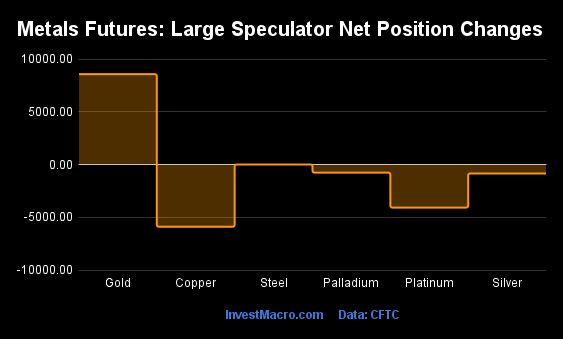
The COT metals markets speculator bets were lower this week as two out of the six metals markets we cover had higher positioning while the other four markets had lower speculator contracts.

Leading the gains for the metals was Platinum (5,298 contracts) with Silver (4,008 contracts) also showing a positive week.

The markets with declines in speculator bets for the week were Copper (-25,976 contracts), Gold (-4,629 contracts), Steel (-785 contracts) and Palladium (-240 contracts) seeing lower bets on the week.

Speculators increase Platinum bullish bets to 20-week high

Highlighting the COT metals data this week is the rise in bullish bets for the Platinum speculative positions. The large speculator position in Platinum futures rose by over +5,000 contracts this week and are higher for the fourth time in the past five weeks as well as higher in six out of the past nine weeks.

A total of +20,091 contracts have been added to the net speculator position over the past five-week period, bringing the current standing to the most bullish level in twenty weeks, dating back to January 10th. Overall, the Platinum positioning has now been in bullish territory for thirty-two straight weeks.

The Platinum futures price recently hit its highest level in over a year with a high of $1102.00 on April 23rd. This marked the best level since March 9th of 2022 when prices reached all the way to $1197.00.

This week, however, Platinum gave back some of its gains and prices fell for the first time in the past five weeks and closed at the $1090.10 threshold. Despite this week’s decline, Platinum overall has risen by over twenty percent since it’s most recent low of $904 in February.


Data Snapshot of Commodity Market Traders | Columns Legend
Apr-25-2023OIOI-IndexSpec-NetSpec-IndexCom-NetCOM-IndexSmalls-NetSmalls-Index
Gold473,20924185,26459-211,9284226,66447
Silver149,6923730,60362-41,5234410,92027
Copper202,42244-17,042138,304808,73874
Palladium12,27088-5,877116,30990-43216
Platinum72,1257929,61784-34,316234,69931


Strength Scores led by Platinum & Silver

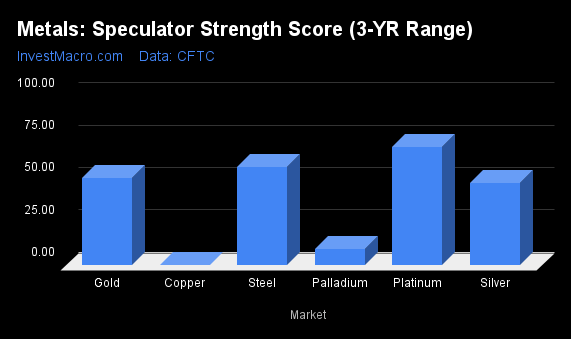
COT Strength Scores (a normalized measure of Speculator positions over a 3-Year range, from 0 to 100 where above 80 is Extreme-Bullish and below 20 is Extreme-Bearish) showed that Platinum (84 percent) and Silver (62 percent) lead the metals markets this week.

On the downside, Palladium (11 percent) and Copper (13 percent) come in at the lowest strength level currently and are in Extreme-Bearish territory (below 20 percent).

Strength Statistics:
Gold (58.6 percent) vs Gold previous week (60.6 percent)
Silver (61.9 percent) vs Silver previous week (56.2 percent)
Copper (13.2 percent) vs Copper previous week (36.4 percent)
Platinum (83.9 percent) vs Platinum previous week (71.7 percent)
Palladium (11.3 percent) vs Palladium previous week (13.5 percent)
Steel (57.0 percent) vs Palladium previous week (59.3 percent)


Silver & Platinum top the 6-Week Strength Trends

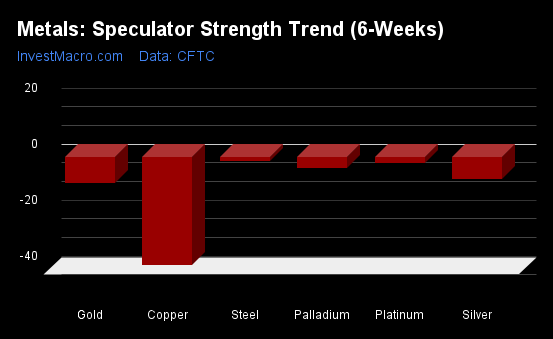
COT Strength Score Trends (or move index, calculates the 6-week changes in strength scores) showed that Silver (45 percent) and Platinum (44 percent) lead the past six weeks trends for metals.

Copper (-3 percent) leads the downside trend scores currently with Steel (-2 percent) as the next market with lower trend scores.

Move Statistics:
Gold (19.8 percent) vs Gold previous week (40.2 percent)
Silver (45.4 percent) vs Silver previous week (49.1 percent)
Copper (-2.6 percent) vs Copper previous week (14.9 percent)
Platinum (44.0 percent) vs Platinum previous week (44.3 percent)
Palladium (5.5 percent) vs Palladium previous week (13.5 percent)
Steel (-2.2 percent) vs Steel previous week (-1.2 percent)


Individual Markets:

Gold Comex Futures:

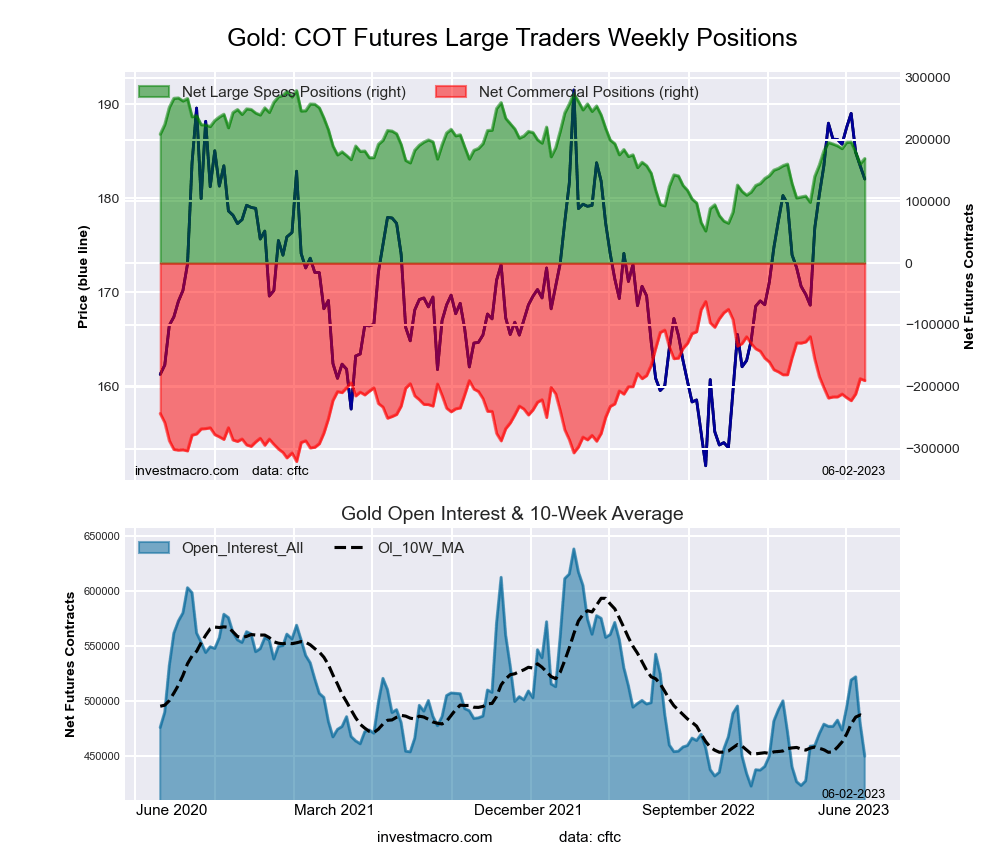
Gold Futures COT ChartThe Gold Comex Futures large speculator standing this week equaled a net position of 185,264 contracts in the data reported through Tuesday. This was a weekly fall of -4,629 contracts from the previous week which had a total of 189,893 net contracts.

This week’s current strength score (the trader positioning range over the past three years, measured from 0 to 100) shows the speculators are currently Bullish with a score of 58.6 percent. The commercials are Bearish with a score of 42.1 percent and the small traders (not shown in chart) are Bearish with a score of 46.8 percent.

Gold Futures StatisticsSPECULATORSCOMMERCIALSSMALL TRADERS
– Percent of Open Interest Longs:53.526.310.8
– Percent of Open Interest Shorts:14.471.15.2
– Net Position:185,264-211,92826,664
– Gross Longs:253,186124,51851,048
– Gross Shorts:67,922336,44624,384
– Long to Short Ratio:3.7 to 10.4 to 12.1 to 1
NET POSITION TREND:
– Strength Index Score (3 Year Range Pct):58.642.146.8
– Strength Index Reading (3 Year Range):BullishBearishBearish
NET POSITION MOVEMENT INDEX:
– 6-Week Change in Strength Index:19.8-21.829.0


Silver Comex Futures:

Silver Futures COT ChartThe Silver Comex Futures large speculator standing this week equaled a net position of 30,603 contracts in the data reported through Tuesday. This was a weekly lift of 4,008 contracts from the previous week which had a total of 26,595 net contracts.

This week’s current strength score (the trader positioning range over the past three years, measured from 0 to 100) shows the speculators are currently Bullish with a score of 61.9 percent. The commercials are Bearish with a score of 43.6 percent and the small traders (not shown in chart) are Bearish with a score of 27.0 percent.

Silver Futures StatisticsSPECULATORSCOMMERCIALSSMALL TRADERS
– Percent of Open Interest Longs:44.230.716.2
– Percent of Open Interest Shorts:23.758.48.9
– Net Position:30,603-41,52310,920
– Gross Longs:66,14545,90724,230
– Gross Shorts:35,54287,43013,310
– Long to Short Ratio:1.9 to 10.5 to 11.8 to 1
NET POSITION TREND:
– Strength Index Score (3 Year Range Pct):61.943.627.0
– Strength Index Reading (3 Year Range):BullishBearishBearish
NET POSITION MOVEMENT INDEX:
– 6-Week Change in Strength Index:45.4-39.12.6


Copper Grade #1 Futures:

Copper Futures COT ChartThe Copper Grade #1 Futures large speculator standing this week equaled a net position of -17,042 contracts in the data reported through Tuesday. This was a weekly fall of -25,976 contracts from the previous week which had a total of 8,934 net contracts.

This week’s current strength score (the trader positioning range over the past three years, measured from 0 to 100) shows the speculators are currently Bearish-Extreme with a score of 13.2 percent. The commercials are Bullish-Extreme with a score of 80.5 percent and the small traders (not shown in chart) are Bullish with a score of 73.6 percent.

Copper Futures StatisticsSPECULATORSCOMMERCIALSSMALL TRADERS
– Percent of Open Interest Longs:28.345.610.4
– Percent of Open Interest Shorts:36.741.56.1
– Net Position:-17,0428,3048,738
– Gross Longs:57,22492,29421,052
– Gross Shorts:74,26683,99012,314
– Long to Short Ratio:0.8 to 11.1 to 11.7 to 1
NET POSITION TREND:
– Strength Index Score (3 Year Range Pct):13.280.573.6
– Strength Index Reading (3 Year Range):Bearish-ExtremeBullish-ExtremeBullish
NET POSITION MOVEMENT INDEX:
– 6-Week Change in Strength Index:-2.61.010.7


Platinum Futures:

Platinum Futures COT ChartThe Platinum Futures large speculator standing this week equaled a net position of 29,617 contracts in the data reported through Tuesday. This was a weekly increase of 5,298 contracts from the previous week which had a total of 24,319 net contracts.

This week’s current strength score (the trader positioning range over the past three years, measured from 0 to 100) shows the speculators are currently Bullish-Extreme with a score of 83.9 percent. The commercials are Bearish with a score of 22.5 percent and the small traders (not shown in chart) are Bearish with a score of 31.1 percent.

Platinum Futures StatisticsSPECULATORSCOMMERCIALSSMALL TRADERS
– Percent of Open Interest Longs:57.225.410.5
– Percent of Open Interest Shorts:16.173.04.0
– Net Position:29,617-34,3164,699
– Gross Longs:41,24018,3027,597
– Gross Shorts:11,62352,6182,898
– Long to Short Ratio:3.5 to 10.3 to 12.6 to 1
NET POSITION TREND:
– Strength Index Score (3 Year Range Pct):83.922.531.1
– Strength Index Reading (3 Year Range):Bullish-ExtremeBearishBearish
NET POSITION MOVEMENT INDEX:
– 6-Week Change in Strength Index:44.0-41.312.6


Palladium Futures:

Palladium Futures COT ChartThe Palladium Futures large speculator standing this week equaled a net position of -5,877 contracts in the data reported through Tuesday. This was a weekly decline of -240 contracts from the previous week which had a total of -5,637 net contracts.

This week’s current strength score (the trader positioning range over the past three years, measured from 0 to 100) shows the speculators are currently Bearish-Extreme with a score of 11.3 percent. The commercials are Bullish-Extreme with a score of 90.1 percent and the small traders (not shown in chart) are Bearish-Extreme with a score of 15.7 percent.

Palladium Futures StatisticsSPECULATORSCOMMERCIALSSMALL TRADERS
– Percent of Open Interest Longs:11.668.19.4
– Percent of Open Interest Shorts:59.516.712.9
– Net Position:-5,8776,309-432
– Gross Longs:1,4288,3611,152
– Gross Shorts:7,3052,0521,584
– Long to Short Ratio:0.2 to 14.1 to 10.7 to 1
NET POSITION TREND:
– Strength Index Score (3 Year Range Pct):11.390.115.7
– Strength Index Reading (3 Year Range):Bearish-ExtremeBullish-ExtremeBearish-Extreme
NET POSITION MOVEMENT INDEX:
– 6-Week Change in Strength Index:5.5-5.75.3


Steel Futures Futures:

Steel Futures COT ChartThe Steel Futures large speculator standing this week equaled a net position of -5,564 contracts in the data reported through Tuesday. This was a weekly lowering of -785 contracts from the previous week which had a total of -4,779 net contracts.

This week’s current strength score (the trader positioning range over the past three years, measured from 0 to 100) shows the speculators are currently Bullish with a score of 57.0 percent. The commercials are Bearish with a score of 43.0 percent and the small traders (not shown in chart) are Bearish with a score of 27.8 percent.

Steel Futures StatisticsSPECULATORSCOMMERCIALSSMALL TRADERS
– Percent of Open Interest Longs:11.977.90.8
– Percent of Open Interest Shorts:30.459.70.6
– Net Position:-5,5645,49965
– Gross Longs:3,59523,482244
– Gross Shorts:9,15917,983179
– Long to Short Ratio:0.4 to 11.3 to 11.4 to 1
NET POSITION TREND:
– Strength Index Score (3 Year Range Pct):57.043.027.8
– Strength Index Reading (3 Year Range):BullishBearishBearish
NET POSITION MOVEMENT INDEX:
– 6-Week Change in Strength Index:-2.23.5-58.1


Article By InvestMacroReceive our weekly COT Newsletter

*COT Report: The COT data, released weekly to the public each Friday, is updated through the most recent Tuesday (data is 3 days old) and shows a quick view of how large speculators or non-commercials (for-profit traders) were positioned in the futures markets.

The CFTC categorizes trader positions according to commercial hedgers (traders who use futures contracts for hedging as part of the business), non-commercials (large traders who speculate to realize trading profits) and nonreportable traders (usually small traders/speculators) as well as their open interest (contracts open in the market at time of reporting). See CFTC criteria here.