Archive for Opinions – Page 115

Nobel Prizes, election outcomes and sports championships – prediction markets try to foresee the future

By Daniel O’Leary, University of Southern California 

Who will win Nobel Prizes in 2022? Wikipedia posits a handful of contenders for Physiology or Medicine, about 20 different possible winners for the Peace Prize and several dozen potential winners of the Literature Prize. But since the Swedish Academy never announces nominees in advance, there are few insights indicating who will win, or even if the eventual winner is on a given list.

Are there ways to predict the future winners?

The Delphi approach, named after the oracle in ancient Greece, gathers multiple rounds of opinions from a group of experts to generate a prediction. Gambling firms provide betting odds on the likelihood that specific competitors will win. Crowdsourced competitions, such as the Yahoo Soccer World Cup “Pick-Em,” have participants predict individual contest winners and then aggregate the results.

Another approach is a prediction market that provides insight into what people expect will happen in the future by creating a stock market-like environment to capture the “wisdom of the crowd.” Groups and crowds often are collectively smarter than individuals when many independent opinions are combined.

As an accounting and information systems professor at the University of Southern California, I investigate issues related to the crowd both in my research and in my teaching. Here’s how prediction markets harness what the crowd thinks to forecast the future.

The wisdom of the market

In prediction markets, participants buy and sell stocks. Each stock’s price is tied to a different event happening in the future. Information about the future is captured in the stock prices.

For instance, in a prediction market focused on the Nobel Peace Prize, maybe Greta Thunberg is trading at $0.10 while Pope Francis is trading at $0.15, and the stocks for the entire group of candidates add up to sum to $1. The prices reflect the traders’ aggregated beliefs about the probability of their winning – a higher price means a higher perceived likelihood of winning.

Prediction markets have various ways of setting stock prices. The Iowa Electronic Markets took following approach during the 2020 U.S. presidential election:

  • Stock DEM2020 pays off $1 if the Democratic candidate wins, and $0 otherwise,
  • Stock REP2020 pays off $1 if the Republican candidate wins, and $0 otherwise.

The stock prices capture the probabilities of each candidate winning, in two mutually exclusive events. If the price of DEM2020 is $0.52, then that is treated as the probability of that event occurring – a 52% chance. If DEM2020 is $0.52, then REP2020 is $0.48.

Prediction markets may use real money, or they can use play money. Google’s market used what it called “Goobles,” while the Hollywood Stock Exchange uses Hollywood Dollars. The Iowa Electronic Markets and PredictIt, both sponsored by universities, use real money. Researchers have found that there are no differences in the performance of markets using real money versus those using play money.

Although using play money makes it possible for many people to participate, one potential challenge for prediction markets that don’t use real money is gaining and maintaining interested participants. Despite using different devices to keep up engagement, such as leader boards indicating who has accumulated the biggest portfolio, there is literally no money on the table to keep participants interested in the market.

Participants bring their knowledge to the market

Prediction markets and crowdsourcing do not function in a vacuum.

Researchers have found that information about events finds its way into the prediction processes from various sources. For example, when I analyzed the relationship between the betting odds and the Yahoo Pick-Em crowd’s guesses for the 2014 FIFA World Cup, I found that there was no statistical difference between the proportion of correct guesses in each. My conclusion is that either the crowd’s guesses incorporated the betting odds information or the crowd’s guesses added up to the same result by some other means.

Generally, prediction markets use play money or are run by non-profit universities to study markets, elections and human decision making. Although gambling houses can take bets for many activities, external prediction markets are more restricted in the activities they can be used to investigate, and are typically limited to elections. However, internal prediction markets – run within a corporation, for instance – can explore almost any topic of interest.

Typically, prediction markets function better with informed participants. Although using so-called inside information is illegal in some markets, including the New York Stock Exchange, there generally are no such limitations in prediction markets, or other crowdsourcing approaches. If those with inside information were to participate in a prediction market, it would likely lead to more accurate stock prices, as insiders make trades informed by their knowledge. However, if others find out that a participant has inside information, then they may very well try to gain access to that info, follow the insider’s actions or even decide to leave the unfair market.

The accuracy of prediction markets depends on many factors, including who is in the market, what their biases are and how heterogeneous the participants are. Accuracy can also depend on how many people are in the market – more is generally better – and the extent to which they are informed about the events of interest.

Researchers have found that prediction markets have outperformed polls in presidential elections roughly 75% of the time. But accurate results are not guaranteed. For example, prediction markets did not correctly predict that Donald Trump would win the U.S. presidency in 2016.

Who will be in Stockholm for the ceremony?

In 2011, Harvard University economics faculty had a real-money prediction market site, referred to as “the world’s most accurate prediction market.” The site had been used for predicting the Nobel Prize in Economics, but Harvard advised the site to shut down.

I couldn’t find any current public prediction markets active for the 2022 Nobel Prizes.

For the moment, perhaps the closest to participating in a Nobel prediction market would be to place a bet at one of the gambling houses that takes bets on the Nobel Prizes. Or find a Nobel Prize Pick-Em site, propose such an event to an existing prediction market or build your own prediction market using some of the available software.

If you know of one, let me know, I want to play.The Conversation

About the Author:

Daniel O’Leary, Professor of Accounting and Information Systems, University of Southern California

This article is republished from The Conversation under a Creative Commons license. Read the original article.

How bonds work and why everyone is talking about them right now: a finance expert explains

By David McMillan, University of Stirling 

– The Bank of England is buying bonds again. Just as it was about to start selling the debt it had accumulated as part of its last effort to support the economy during the COVID-19 pandemic, the central bank has been forced to announce a new scheme to shore up investor confidence.

The bank’s £65 billion short-term spree aims to address the slump in bond prices caused by investors rushing to sell after the government’s recent mini-budget. This led to a surge in bond yields that hiked borrowing costs for the government and spread to pensions, housing and the general economy. So far, it has had a limited initial impact on the markets.

We asked an expert in finance to explain what’s going on in bond markets.

What is a bond and what is the difference between bond prices and yields?

A bond is essentially a tradeable IOU. It’s a loan that investors make to issuers such as companies or governments (UK government bonds are often called gilts). A bond has a price at which it can be sold and a yield, which is an annual amount the investor receives for holding the bond, a bit like interest on a savings account, and is expressed as a percentage of the current price.

When the price of a bond falls, it signals less demand for the bond because fewer investors want to own it. At the same time, the yield rises, which represents a higher cost of borrowing for companies or governments that issued the bond because this is what they have to pay to investors.

In the days since the government’s mini-budget, yields on 10-year Treasury bonds – which are issued by the UK government – increased from approximately 3.5% to 4.52% – the highest since the 2007-2008 global financial crisis. The expectation of continued increases prompted the recent intervention by the Bank of England.

UK government 10-year bond yields

Line chart showing UK 10-year bond or gilt yields, August - September 2022
United Kingdom 10-year bond yield.
Investing.com / Tradingview

What causes bond yields to move?

To understand this, it is important to bear in mind that, while people often talk about the interest rate, there are actually a number of rates. This includes the rate at which the central bank lends to commercial banks (the base rate), the rate that banks lend to each other (the interbank rate), the rate that the government borrows at (Treasury yields) and the rate at which households and firms borrow (commercial loans and mortgages).

When the Bank of England changes the base rate, this cascades through all these rates. As such, the Bank of England carefully considers the state of the economy – that is, growth and inflation – when deciding on the base rate.

When an economy is growing, interest rates and bond yields tend to rise. The occurs for several reasons. Investors sell bonds to buy riskier assets with better returns. Firms and households also look to borrow more money in a growing economy, for example, to invest in new machinery or to move home. More demand for borrowing means lenders can charge higher interest on their loans.

Higher inflation often accompanies economic growth because of the increase in demand for goods and services. This tightens supply and causes prices to rise (including wages for labour). The Bank of England, which is mandated by the government to try to keep inflation as close to 2% as possible, will respond to higher inflation by raising base rates, which, as noted, feeds through to the different rates.

Investors will often anticipate the increase in base rates and look to act before it goes up by selling Treasury bonds and buying alternative, higher return, assets. This causes bond yields to rise further. As a result, the Treasury bond yield is often seen as a predictor of future Bank of England base rate changes.

So, if yields are rising, does this mean that investors are expecting future economic growth in the UK?

No, not at the moment. When the government raises money by issuing bonds, it does so over a range of time periods (called maturities), from one day to 30 years. When an economy is expected to grow, the yield on longer-term bonds will be higher than the yield on shorter-term bonds.

This relationship between yields across different maturities is referred to as the term structure or yield curve. An upward sloping yield curve implies a growing economy. At the moment, the UK yield curve is flat, or even downward-sloping across some maturities. My research shows that a falling yield curve is a good predictor of a coming recession.

Yield curve for UK government bonds

Line graph showing downward-sloping yield curve for UK gilts
UK gilts 40-year yield curve. *The curve on the day of the previous MPC meeting is provided as reference point.
Bloomberg Finance L.P., Tradeweb and Bank of England calculations

It’s important to remember that these different yields act as a benchmark for commercial lending rates of equivalent lengths. The approximate jump to 4.5% in 2-year and 5-year yields has been reflected in mortgage rates, which is why some lenders have pulled available mortgage deals recently while they reassess the lending rates charged to households.

But if the UK economy is not expected to perform well, why have bond yields been rising after the chancellor’s mini-budget announcement?

The rising bond yields we are seeing relate to an additional factor: the amount of government debt. The mini-budget introduced tax cuts and increased spending and investors know the government will need to increase borrowing to meet these commitments. Some estimates put potential government borrowing at £190 billion due to this plan.

An increase in the amount a homeowner borrows versus the value of their home (called the loan-to-value) causes the mortgage rate charged to the borrower to rise. Similarly, an increase in the amount of bonds that the government will be looking to sell (the amount it wants to borrow) will push down the price of existing bonds, increasing yields. More importantly, more debt without growth raises the risk level of the UK economy.

Anticipating this, investors triggered a large-scale bond sell-off after the government’s mini-budget announcement. This contributed to the fall in the value of the pound as investors selling UK Treasury bonds bought US bonds instead, essentially swapping pounds for dollars.

So will the Bank of England’s plan work?

The intervention will have a short-term positive impact, which started as soon as it was announced. But the bank is really only buying time. Any ultimate success depends on the government restoring investor confidence in its economic plans.

Unfortunately, rising yields and borrowing costs for the UK economy is the price we are now paying for the government’s recent fiscal announcement.The Conversation

About the Author:

David McMillan, Professor in Finance, University of Stirling

This article is republished from The Conversation under a Creative Commons license. Read the original article.

Solar geoengineering might work, but local temperatures could keep rising for years

By Patrick W. Keys, Colorado State University; Curtis Bell, US Naval War College; Elizabeth A. Barnes, Colorado State University; James W. Hurrell, Colorado State University, and Noah Diffenbaugh, Stanford University 

Imagine a future where, despite efforts to reduce greenhouse gas emissions quickly, parts of the world have become unbearably hot. Some governments might decide to “geoengineer” the planet by spraying substances into the upper atmosphere to form fine reflective aerosols – a process known as stratospheric aerosol injection.

Theoretically, those tiny particles would reflect a little more sunlight back to space, dampening the effects of global warming. Some people envision it having the effect of a volcanic eruption, like Mount Pinatubo in 1991, which cooled the planet by about half a degree Celsius on average for many months. However, like that eruption, the effects could vary widely across the surface of the globe.

How quickly might you expect to notice your local temperatures falling? One year? Five years? Ten years?

What if your local temperatures seem to be going up?

As it turns out, that is exactly what could happen. While modeling studies show that stratospheric aerosol injection could stop global temperatures from increasing further, our research shows that temperatures locally or regionally might continue to increase over the following few years. This insight is essential for the general public and policymakers to understand so that climate policies are evaluated fairly and interpreted based on the best available science.

Why local temperatures might continue to rise

In an article published in the Proceedings of the National Academy of Sciences on Sept. 27, 2022, we explore how the effectiveness of stratospheric aerosol injection could be hidden by the natural variability of Earth’s climate.

Natural climate variability refers to variations in climate that are not driven by humans, such as chaotic, unpredictable interactions within and between the ocean, atmosphere, land and sea ice. One example of natural climate variability is the El Niño Southern Oscillation phenomena. During an El Niño year – or its opposite, La Niña – many parts of the world experience warmer or cooler conditions than they might otherwise. These are inescapable features of Earth’s climate system.

We looked at 10 climate model simulations that include stratospheric aerosol injection and analyzed the temperatures that people might experience over a 10-year period if enough aerosols were added to limit the rise in global temperatures to 1.5 degrees Celsius (2.7 F) above preindustrial levels, the U.N. Paris climate agreement goal.

Illustration shows effects of blocking solar energy at different layers of the atmosphere.
Some potential methods limiting the amount of solar energy in the atmosphere.
Chelsea Thompson, NOAA/CIRES

We found that a substantial fraction of the Earth’s population could experience continued warming even as average temperatures decreased at a global scale, with as much as 55% still experiencing rising temperatures for a decade after stratospheric aerosol injection begins.

This could be true in parts of the largest and richest countries in the world, including the United States, China, India and parts of Europe. The very countries that have the ability to attempt stratospheric aerosol injection in the future could be those most likely to still see temperatures rise.

Consequences are still poorly understood

Many different types of solar radiation modification have been proposed, but most experts consider stratospheric aerosol injection to be both the most effective and least expensive approach.

The basic idea would be to produce tiny, reflective particles in part of the stratosphere between about 12 and 16 miles (20 and 25 kilometers) in altitude – which is above where airplanes typically fly. While some science fiction stories suggest that rockets might be used to do this, most experts think that modified aircraft would be required to distribute aerosols both high enough and consistently enough.

In 2021, the U.S. National Academies of Sciences, Engineering, and Medicine released a report on the topic of solar radiation modification, including stratospheric aerosol injection. The report was written by a committee of climate scientists, economists, lawyers and others. The group came to the conclusion that the U.S. should fund research on the topic. It recommended this in part because the consequences of solar radiation modification were still poorly understood.

This lack of understanding is quite a risk, since it remains unknown what might happen if the world pursues strategies like stratospheric aerosol injection, let alone if a specific country or organization decides to pursue these interventions by itself.

Pros and cons of solar geoengineering. The Economist via YouTube.

In our view, research into the potential consequences of stratospheric aerosol injection should include studies to examine potential changes in crop yields, shifts in global rainfall patterns or changes in critical regions of the Earth’s biosphere, like the Amazon rainforest. The fact is that we don’t know very well what would happen with stratospheric aerosol injection – which is why research on this topic is so critical.

Reducing emissions is fundamental to curb climate change

We want to be absolutely clear that we are not advocating for the actual use of stratospheric aerosol injection.

The most direct way to avoid the uncertainty of solar radiation modification strategies like stratospheric aerosol injection is to address the root cause of global warming. That, as documented by many scientific studies, will require the aggressive reduction of emissions of carbon dioxide, methane and other greenhouse gases into the atmosphere.The Conversation

About the Authors:

Patrick W. Keys, Assistant Professor, Department of Atmospheric Science, Colorado State University; Curtis Bell, Associate Professor of Maritime Security and Governance, US Naval War College; Elizabeth A. Barnes, Professor of Atmospheric Science, Colorado State University; James W. Hurrell, Professor and Scott Presidential Chair in Environmental Science and Engineering, Colorado State University, and Noah Diffenbaugh, Professor of Earth System Science, Stanford University

This article is republished from The Conversation under a Creative Commons license. Read the original article.


Mid-Week Technical Outlook: Dollar Dominates FX Space

By ForexTime 

The mighty dollar hit fresh multi-decade highs this morning as more hawkish Fed speakers and rising Treasury yields injected bulls with fresh inspiration.

Major currencies have been crushed by the dollar’s meteoric rise this month with the British Pound and New Zealand dollar shedding over 8%. Given how the dollar continues to draw strength from aggressive rate hike bets, geopolitical tensions, and positive US economic data – more upside could be on the cards.

With more Fed officials scheduled to speak this week, this may translate to more volatility on the dollar. Where there is volatility, there are potential opportunities.

Our focus today will be mainly on USD crosses with the tool of choice none other than technical analysis.

DXY bulls unstoppable?

The dollar’s appreciation over the past few days has been phenomenal. Bulls remain supported by key fundamental forces with the technicals signalling further upside. Prices are trading around 114.70 as of writing with the next key point of interest at 115.00. A strong breakout above this level may open the doors towards 115.34 and 118.75. Should 115.00 prove to be strong resistance, a decline back towards 113.30 and 111.60.

EURUSD eyes 0.9500

An appreciating dollar has dragged the EURUSD well below parity. Prices are heavily bearish on the daily timeframe with the candlesticks respecting a bearish channel. A strong breakdown below 0.9500 could open a path towards 0.9300. If 0.9500 proves to be tough support to crack, a rebound back towards 0.9900 and parity could become reality.

GBPUSD preparing to resume selloff

It’s been a rough week for the GBPUSD. After hitting an all-time low on Monday, we saw the currency stage a sharp rebound. Nevertheless, prices remain heavily bearish with a break back below 1.0600 suggesting a decline towards 1.0520 and 1.0350, respectively. Should prices rebound back towards 1.0850, the currency pair could test 1.1000 and 1.1350.

AUDUSD bears eye 0.6200

Aussie bears remain in the driving seat as the currency pair descends lower with each passing day. There have been consistently lower lows and lower highs while the MACD trades to the downside. A strong breakdown below 0.6350 could encourage a decline towards 0.6270 and 0.6200.

USDJPY breakout on the horizon

It’s all about the 145.00 level on the USDJPY. A stronger dollar could encourage bulls to conquer this resistance, opening the doors towards 147.00 and higher. Given how this level has stood the test of time. A rejection from this point could result in the USDJPY trading back within its current range.

NZDUSD rebound in the process?

After dropping over 500 pips this month, could the NZDUSD be preparing for a rebound? There have been consistently lower lows and lower highs while the MACD trades to the downside. Prices recently staged a strong rebound from the 0.5560 level with bulls eyeing 0.5720 and 0.5800, respectively, below 0.55600 – prices may sink towards 0.5500.


Forex-Time-LogoArticle by ForexTime

ForexTime Ltd (FXTM) is an award winning international online forex broker regulated by CySEC 185/12 www.forextime.com

5 steps you can take to manage a hike in interest rates

By Bomikazi Zeka, University of Canberra 

The governor of the South African Reserve Bank recently announced an increase in the lending rate by 75 basis points. This means the repo rate (the rate at which the central bank lends money to commercial banks) will increase from 5.5% to 6.25% and the prime rate (the rate commercial banks charge their clients when lending them money) rises from 9.0% to 9.75%.

South Africa isn’t alone. Countries across the continent – and the world – have also been hiking rates to manage rising prices. South Africa is the most recent African country to hike rates. Others have included Ghana and Nigeria. And more hikes are expected in the coming weeks.

From a personal finance perspective, increased interest rates have implications for anyone with a mortgage, vehicle financing, student loan or any other form of debt. Higher interest rates translate to higher debt repayments. For instance, in South Africa the monthly repayment on a R1 million home loan, with a repayment term of 20 years, will increase from R8,997 to R9,485.

Many households are feeling the financial pinch caused by the rising cost of living. Low-income households are the most vulnerable to high food costs. But middle-income earners don’t fare any better. A recent report on South Africa by the consultancy PwC highlighted that 40% of this cohort’s expenditure is allocated to food and 20% goes towards housing and utilities.

But the time to fix the roof is indeed while the sun is still shining. Before the economic situation goes from bad to worse, the impact of rising prices – and rising interest rates – can be mitigated in a combination of ways. Here are five steps you should consider taking.

Five things you can do

Debt: Try to pay off as much of your debt as possible. As interest rates rise, so do debt repayments. Loans could be tying up funds that could better service another area of your finances.

Another important consideration is that the risk of defaulting on your debt repayments increases during financially difficult times. If default occurs, it would spell bad news for your credit rating, which would jeopardise the ability to take out a loan in the future.

If taking on more debt is necessary, knowing your credit score and assessing whether the debt works for you or against you may be the tipping point in the decision to take on more debt, particularly when interest rates are up.

Shop around for the best rate: Investing in the property market is a lifelong goal for many. New entrants in the housing market should resist the temptation to accept the first mortgage offer that comes their way. Many banks are not explicit in sharing this information but your “home bank” should give you the best offer because they want to keep all your business in house.

Banks are in competition with one another to be your home loan provider and the better offer is, more often than not, the one that’s below prime.

Track your finances: Many may think of budgeting as the equivalent of wearing a financial straitjacket. But tracking your finances provides another way for finding opportunities to cut expenses and increase savings. Consider the opportunity cost of not budgeting. Without monitoring your cashflow, it becomes nearly impossible to make contingencies for unplanned expenses. Most people also save what’s left after spending, instead of spending what remains after saving. While the intention to save may exist, intentions alone won’t get the job done.

Clearly demarcating how much you will put away in savings can make a huge difference in the long run. Many households are more financially vulnerable than they think. In fact, most families are one medical emergency away from being financially devastated. Just think of the doctor’s consultation fees (or worse, specialist referral fees), ambulance call-out fees and out-of-pocket expenditure. With or without medical aid, making provisions for the unforeseen occurs through budgeting.

Negotiate insurance premiums: Another unspoken financial hack that could save a little is negotiating the increase in your annual insurance premiums. If you haven’t claimed from your insurer within the financial year, you can turn this to your favour in stalling the premium increase. And if you have many assets covered by the same insurer (for example, vehicle and household contents), then this too can work for you. While it may not make a world of a difference, as the expression goes, “a single grain of rice can tip the scale”.

Think savings-plus: Opportunities exist to generate a second income stream from financial markets despite poor investor sentiment. Investments in interest-earning securities can be a useful method of generating passive income from idle cash. Interest-earning securities provide income based on market-related fixed interest rates throughout the investment period until the investment period comes to an end, while also guaranteeing that the capital amount invested is protected.

While you’re encouraged to have a savings fund, it’s also important to consider the trade-off between how much you have in short-term versus long-term savings instruments. For example, in the case of South Africa, with a minimum investment amount of R1,000, and a fixed interest rate of 8.25% for a two-year investment period, local retail bonds are a safe investment alternative for those with low risk appetites and looking to put idle cash at work.

The point here is not to promote one savings product over another, but to re-think how to earn passive income from existing funds.

Long-term game

It may be too soon to tell whether the economy will go into a recession, but if it does happen, we will eventually get out it. The long-term social and economic effects of the hike in interest rates can be persistent, which is why planning and preparation are paramount to remaining financially afloat during these challenging times.The Conversation

About the Author:

Bomikazi Zeka, Assistant Professor in Finance and Financial Planning, University of Canberra

This article is republished from The Conversation under a Creative Commons license. Read the original article.

Euro Speculator bets go bullish for 3rd week to lead the COT Changes

By InvestMacro

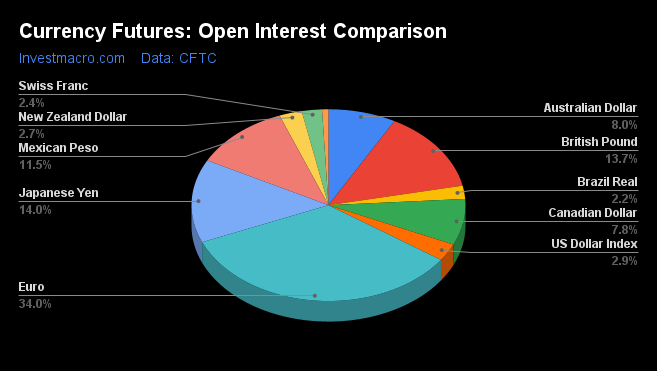
Forex Currency Futures Open Interest Comparison

Here are the latest charts and statistics for the Commitment of Traders (COT) reports data published by the Commodities Futures Trading Commission (CFTC).

The latest COT data is updated through Tuesday September 20th and shows a quick view of how large market participants (for-profit speculators and commercial traders) were positioned in the futures markets. All currency positions are in direct relation to the US dollar where, for example, a bet for the euro is a bet that the euro will rise versus the dollar while a bet against the euro will be a bet that the euro will decline versus the dollar.

This data is through Tuesday and one day before the US Federal Reserve lifted the benchmark interest rate by 75 basis points to a range of 3 to 3.25 percent.

Euro & British pound lead Weekly Speculator Changes

The COT currency market speculator bets were slightly lower this week as five out of the eleven currency markets we cover had higher positioning while the other six markets had lower speculator contracts.

Leading the gains for the currency markets was the Euro (45,286 contracts) with the Australian dollar (17,294 contracts), the British pound sterling (13,243 contracts), the Swiss franc (565 contracts) and Bitcoin (451 contracts) also showing a positive week.

The currencies leading the declines in speculator bets this week were the Canadian dollar (-10,369 contracts) with the US Dollar Index (-7,738 contracts), the New Zealand dollar (-7,288 contracts), the Mexican peso (-2,652 contracts), the Japanese yen (-588 contracts) and the Brazilian real (-584 contracts) also registering lower bets on the week.

Highlighting the COT Forex data this week was the sharp change in speculator positioning for the Euro again this week. The speculative positioning for the Euro jumped by a total of +45,286 contracts this week following last week’s gain of +24,512 contracts and a rise of +11,327 contracts in the week before that.

Overall, Euro speculator positions have risen by +81,125 contracts in just the past three weeks and have now taken the speculator standing out of bearish territory for the first time in fifteen weeks (current net position of +33,449 contracts). This is a surprising turnabout for this market because speculators (especially in currencies) have tended to be trend-followers historically. They buy when prices are rising and sell when prices are falling.

The Euro has been on a historic decline with prices hitting levels below parity that have not been touched for approximately twenty years. However, the Euro futures speculators have been going the opposite way and increasing their bullish positioning as the currency falls. Will this positioning hold up? Are the speculators buying at the right time (betting on catching the low)? These interesting questions will resolve themselves in the future but it is an example of a current situation that shows that markets and traders can change their tune or flip usual behavior on its head, at least in the short-term.

The Euro price, meanwhile, followed through lower to close out the week. The EURUSD currency pair fell by more than 3 percent and ended the week at the 0.9692 exchange rate – the lowest level since October of 2002.


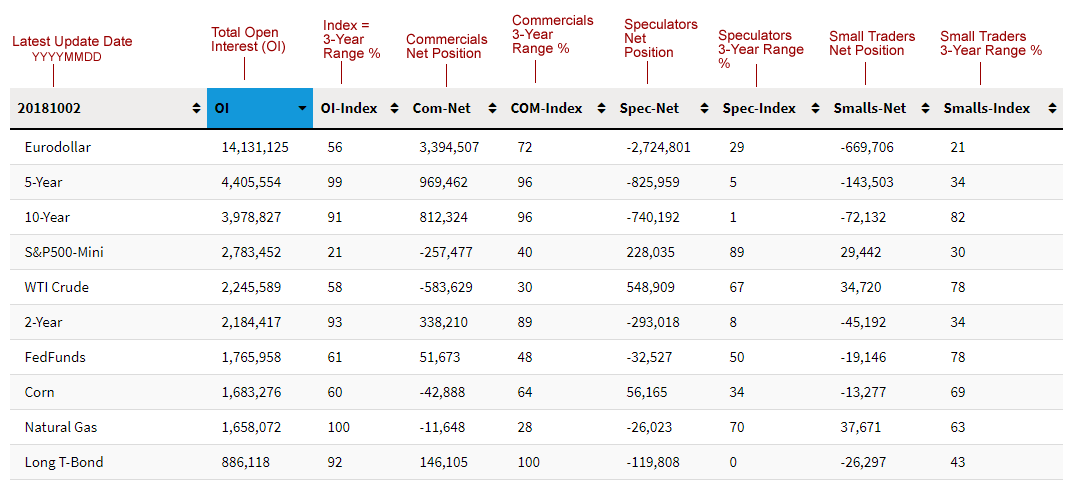
Data Snapshot of Forex Market Traders | Columns Legend
Sep-20-2022OIOI-IndexSpec-NetSpec-IndexCom-NetCOM-IndexSmalls-NetSmalls-Index
USD Index54,2927627,93172-30,775272,84448
EUR657,9526333,44945-52,3106118,8616
GBP266,29577-54,8432273,48884-18,6458
JPY250,89281-81,2801997,51383-16,23320
CHF40,93723-6,7403912,98664-6,24636
CAD160,314372,0564289269-2,94824
AUD150,54445-40,5564752,12858-11,57224
NZD47,88439-12,5895016,79156-4,2023
MXN172,65036-28,0331523,741834,29261
RUB20,93047,54331-7,15069-39324
BRL51,5004232,36982-34,071181,70285
Bitcoin13,8808057787-812023518


Bitcoin and Brazilian Real lead Strength Scores

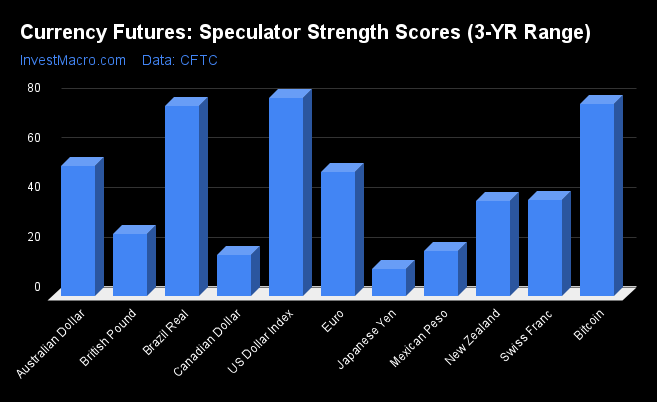
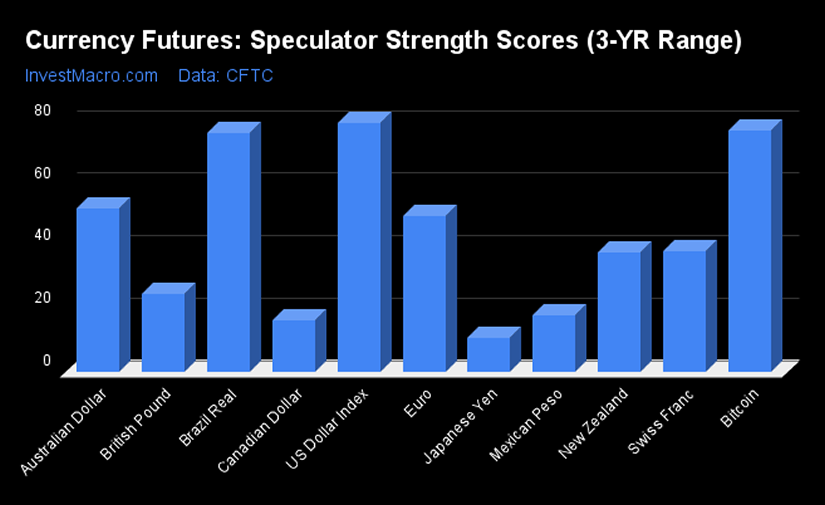
Strength Scores (a normalized measure of Speculator positions over a 3-Year range, from 0 to 100 where above 80 is extreme bullish and below 20 is extreme bearish) show that Bitcoin (87.0 percent) and the Brazilian Real (82.2 percent) lead the currency markets this week near the top of their respective ranges and are both in bullish extreme positions (above 80 percent). The US Dollar Index (71.5 percent) comes in as the next highest in the currency markets in strength scores.

On the downside, the Mexican Peso (15.4 percent) and the Japanese Yen (18.8 percent) come in at the lowest strength level currently and are both in extreme bearish positions.


Strength Statistics:
US Dollar Index (71.5 percent) vs US Dollar Index previous week (84.4 percent)
EuroFX (45.3 percent) vs EuroFX previous week (31.4 percent)
British Pound Sterling (21.9 percent) vs British Pound Sterling previous week (10.6 percent)
Japanese Yen (18.8 percent) vs Japanese Yen previous week (19.2 percent)
Swiss Franc (39.4 percent) vs Swiss Franc previous week (38.0 percent)
Canadian Dollar (41.7 percent) vs Canadian Dollar previous week (53.3 percent)
Australian Dollar (47.2 percent) vs Australian Dollar previous week (31.2 percent)
New Zealand Dollar (50.1 percent) vs New Zealand Dollar previous week (62.4 percent)
Mexican Peso (15.4 percent) vs Mexican Peso previous week (16.5 percent)
Brazilian Real (82.2 percent) vs Brazilian Real previous week (82.8 percent)
Bitcoin (87.0 percent) vs Bitcoin previous week (79.1 percent)

Brazilian Real, Euro and Aussie lead the Strength Trends

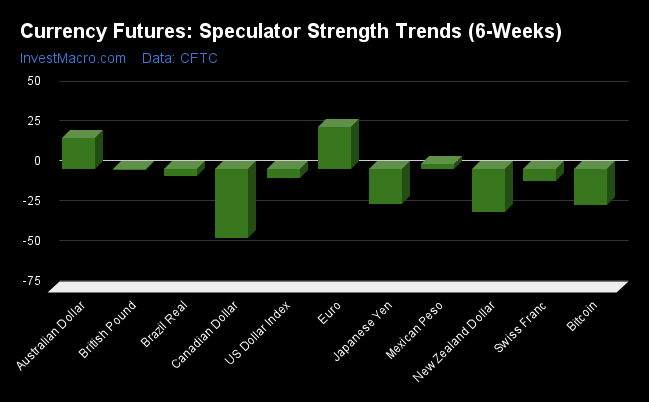
Strength Score Trends (or move index, calculates the 6-week changes in strength scores) showed that the Brazilian Real (30.1 percent) leads the past six weeks trends for the currency markets this week. The EuroFX (20.9 percent), the Australian Dollar (15.8 percent), Bitcoin (14.1 percent) and the Swiss Franc (7.7 percent) fill out the rest of the positive movers in the latest trends data.

The Japanese Yen (-34.6 percent),  Canadian Dollar (-21.5 percent), New Zealand Dollar (-20.7 percent) and the US Dollar Index (-17.9 percent) were the leaders in the downside trend scores this week.


Strength Trend Statistics:
US Dollar Index (-17.9 percent) vs US Dollar Index previous week (-6.1 percent)
EuroFX (20.9 percent) vs EuroFX previous week (8.3 percent)
British Pound Sterling (-17.5 percent) vs British Pound Sterling previous week (-10.0 percent)
Japanese Yen (-34.6 percent) vs Japanese Yen previous week (-23.4 percent)
Swiss Franc (7.7 percent) vs Swiss Franc previous week (15.2 percent)
Canadian Dollar (-21.5 percent) vs Canadian Dollar previous week (-8.8 percent)
Australian Dollar (15.8 percent) vs Australian Dollar previous week (-1.8 percent)
New Zealand Dollar (-20.7 percent) vs New Zealand Dollar previous week (-6.3 percent)
Mexican Peso (-0.2 percent) vs Mexican Peso previous week (-1.0 percent)
Brazilian Real (30.1 percent) vs Brazilian Real previous week (33.5 percent)
Bitcoin (14.1 percent) vs Bitcoin previous week (12.3 percent)


Individual COT Forex Markets:

US Dollar Index Futures:
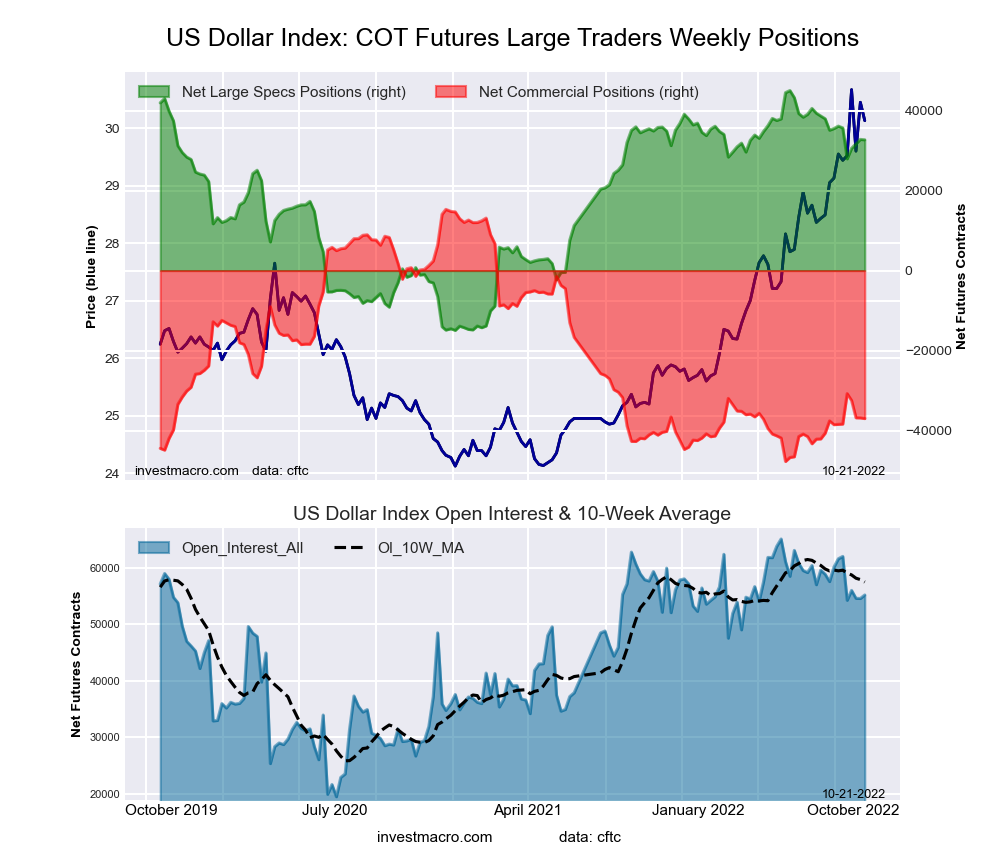
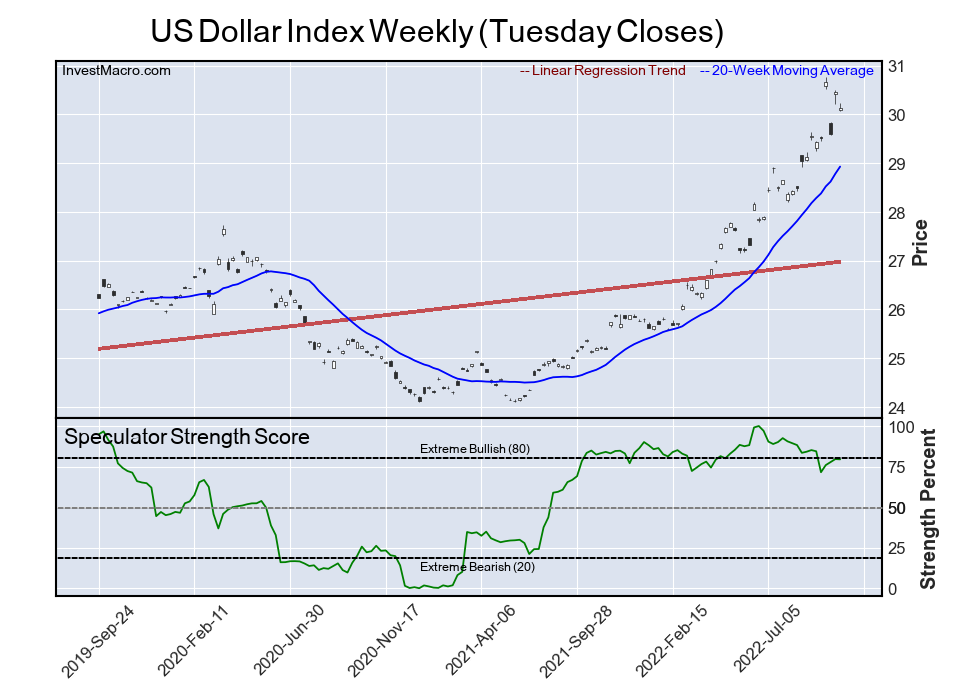
US Dollar Index Forex Futures COT ChartThe US Dollar Index large speculator standing this week reached a net position of 27,931 contracts in the data reported through Tuesday. This was a weekly decline of -7,738 contracts from the previous week which had a total of 35,669 net contracts.

This week’s current strength score (the trader positioning range over the past three years, measured from 0 to 100) shows the speculators are currently Bullish with a score of 71.5 percent. The commercials are Bearish with a score of 26.9 percent and the small traders (not shown in chart) are Bearish with a score of 47.6 percent.

US DOLLAR INDEX StatisticsSPECULATORSCOMMERCIALSSMALL TRADERS
– Percent of Open Interest Longs:84.24.110.1
– Percent of Open Interest Shorts:32.760.84.9
– Net Position:27,931-30,7752,844
– Gross Longs:45,7042,2265,479
– Gross Shorts:17,77333,0012,635
– Long to Short Ratio:2.6 to 10.1 to 12.1 to 1
NET POSITION TREND:
– Strength Index Score (3 Year Range Pct):71.526.947.6
– Strength Index Reading (3 Year Range):BullishBearishBearish
NET POSITION MOVEMENT INDEX:
– 6-Week Change in Strength Index:-17.918.0-6.8


Euro Currency Futures:

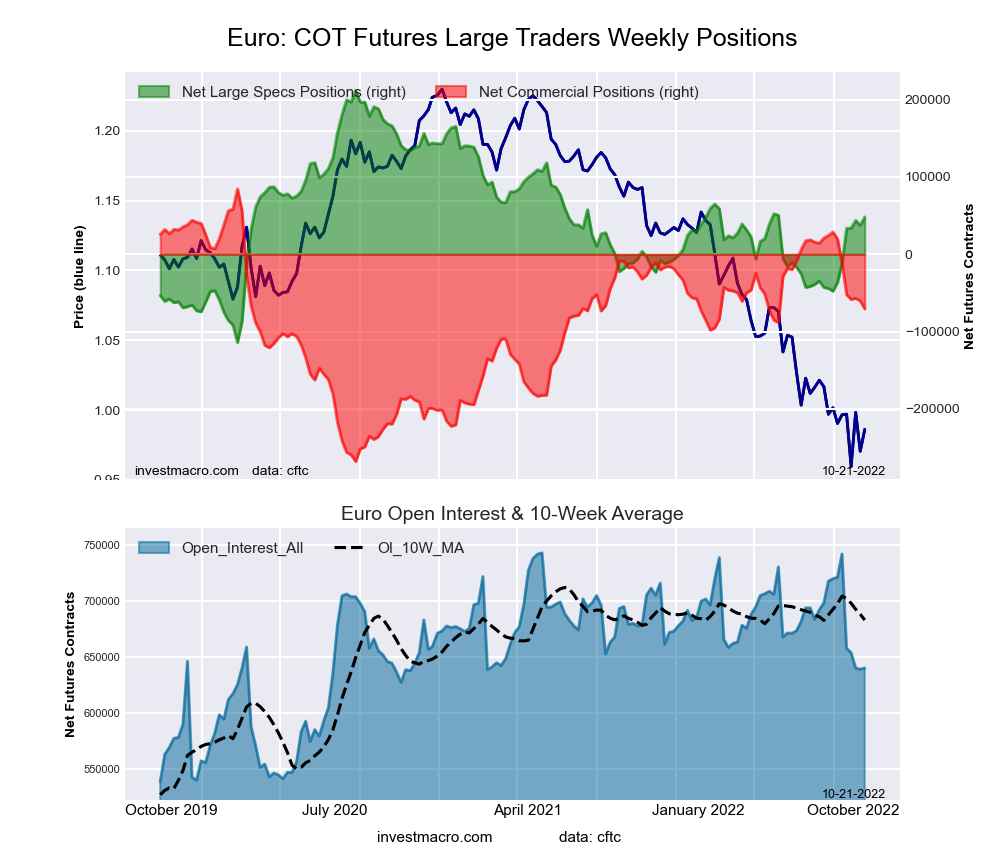
Euro Currency Futures COT ChartThe Euro Currency large speculator standing this week reached a net position of 33,449 contracts in the data reported through Tuesday. This was a weekly advance of 45,286 contracts from the previous week which had a total of -11,837 net contracts.

This week’s current strength score (the trader positioning range over the past three years, measured from 0 to 100) shows the speculators are currently Bearish with a score of 45.3 percent. The commercials are Bullish with a score of 61.2 percent and the small traders (not shown in chart) are Bearish-Extreme with a score of 5.7 percent.

EURO Currency StatisticsSPECULATORSCOMMERCIALSSMALL TRADERS
– Percent of Open Interest Longs:31.453.911.5
– Percent of Open Interest Shorts:26.361.98.6
– Net Position:33,449-52,31018,861
– Gross Longs:206,564354,89175,546
– Gross Shorts:173,115407,20156,685
– Long to Short Ratio:1.2 to 10.9 to 11.3 to 1
NET POSITION TREND:
– Strength Index Score (3 Year Range Pct):45.361.25.7
– Strength Index Reading (3 Year Range):BearishBullishBearish-Extreme
NET POSITION MOVEMENT INDEX:
– 6-Week Change in Strength Index:20.9-18.9-2.1


British Pound Sterling Futures:

British Pound Sterling Futures COT ChartThe British Pound Sterling large speculator standing this week reached a net position of -54,843 contracts in the data reported through Tuesday. This was a weekly rise of 13,243 contracts from the previous week which had a total of -68,086 net contracts.

This week’s current strength score (the trader positioning range over the past three years, measured from 0 to 100) shows the speculators are currently Bearish with a score of 21.9 percent. The commercials are Bullish-Extreme with a score of 84.0 percent and the small traders (not shown in chart) are Bearish-Extreme with a score of 8.4 percent.

BRITISH POUND StatisticsSPECULATORSCOMMERCIALSSMALL TRADERS
– Percent of Open Interest Longs:15.574.18.2
– Percent of Open Interest Shorts:36.146.515.2
– Net Position:-54,84373,488-18,645
– Gross Longs:41,289197,34621,738
– Gross Shorts:96,132123,85840,383
– Long to Short Ratio:0.4 to 11.6 to 10.5 to 1
NET POSITION TREND:
– Strength Index Score (3 Year Range Pct):21.984.08.4
– Strength Index Reading (3 Year Range):BearishBullish-ExtremeBearish-Extreme
NET POSITION MOVEMENT INDEX:
– 6-Week Change in Strength Index:-17.514.6-2.4


Japanese Yen Futures:

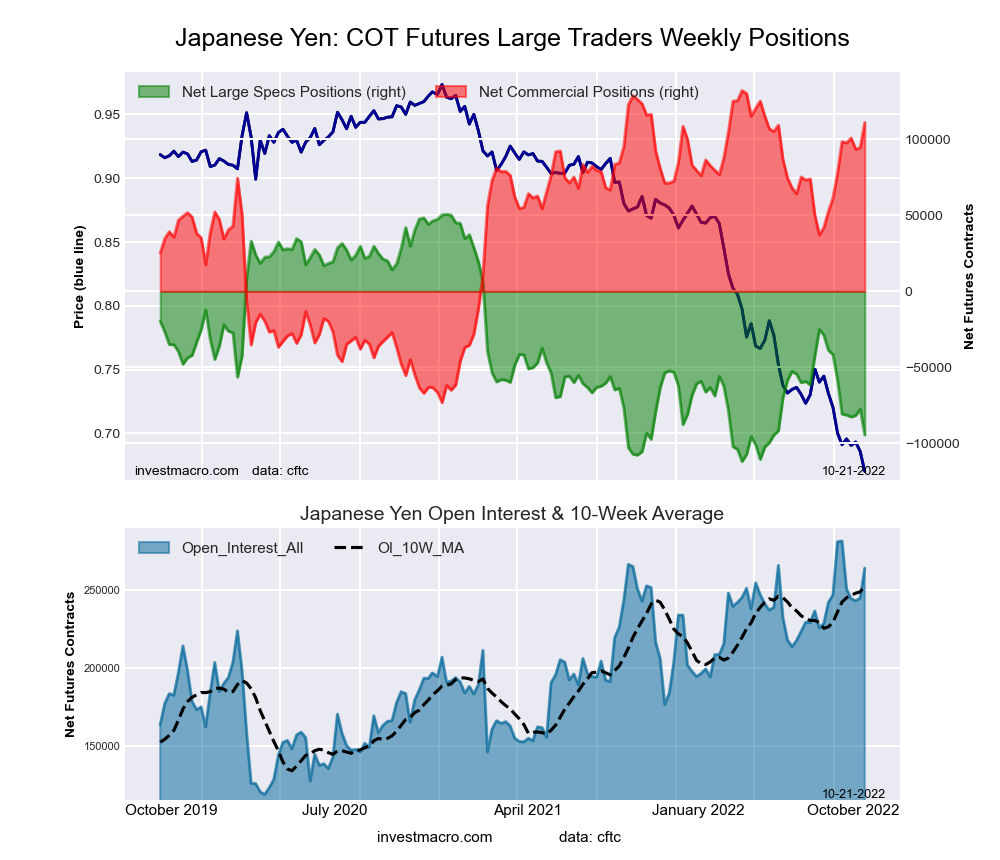
Japanese Yen Forex Futures COT ChartThe Japanese Yen large speculator standing this week reached a net position of -81,280 contracts in the data reported through Tuesday. This was a weekly fall of -588 contracts from the previous week which had a total of -80,692 net contracts.

This week’s current strength score (the trader positioning range over the past three years, measured from 0 to 100) shows the speculators are currently Bearish-Extreme with a score of 18.8 percent. The commercials are Bullish-Extreme with a score of 83.2 percent and the small traders (not shown in chart) are Bearish with a score of 20.5 percent.

JAPANESE YEN StatisticsSPECULATORSCOMMERCIALSSMALL TRADERS
– Percent of Open Interest Longs:13.975.88.9
– Percent of Open Interest Shorts:46.337.015.4
– Net Position:-81,28097,513-16,233
– Gross Longs:34,767190,26722,337
– Gross Shorts:116,04792,75438,570
– Long to Short Ratio:0.3 to 12.1 to 10.6 to 1
NET POSITION TREND:
– Strength Index Score (3 Year Range Pct):18.883.220.5
– Strength Index Reading (3 Year Range):Bearish-ExtremeBullish-ExtremeBearish
NET POSITION MOVEMENT INDEX:
– 6-Week Change in Strength Index:-34.629.5-8.7


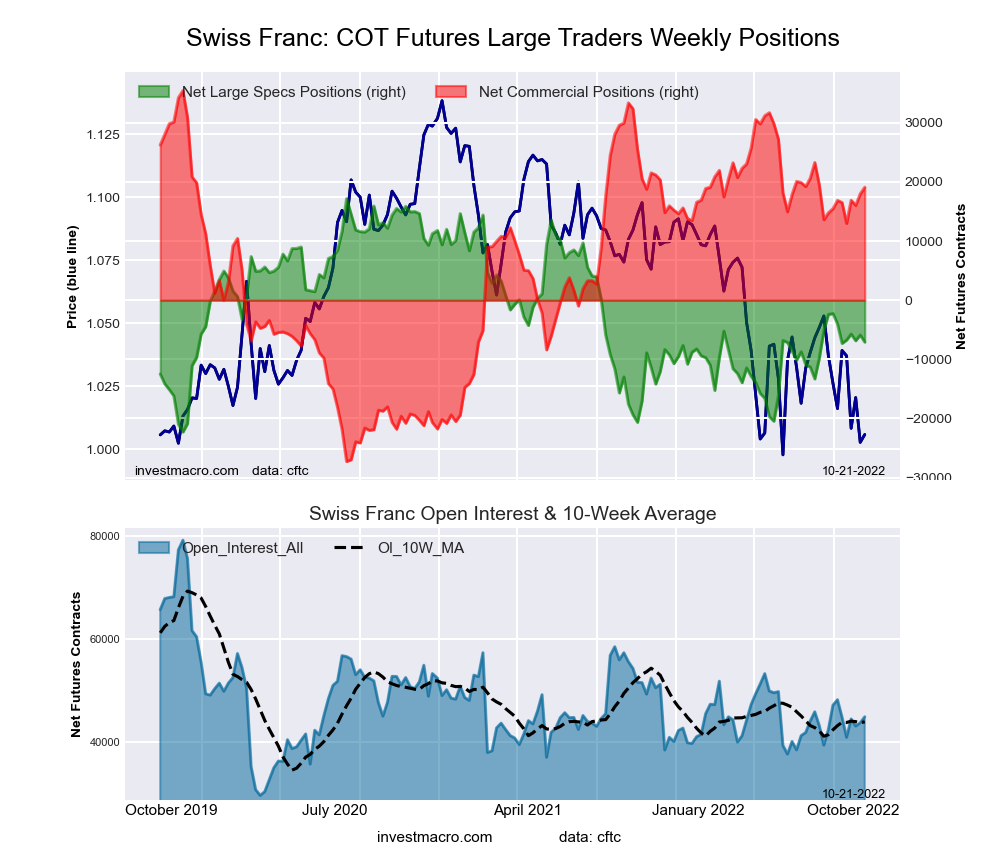
Swiss Franc Futures:

Swiss Franc Forex Futures COT ChartThe Swiss Franc large speculator standing this week reached a net position of -6,740 contracts in the data reported through Tuesday. This was a weekly lift of 565 contracts from the previous week which had a total of -7,305 net contracts.

This week’s current strength score (the trader positioning range over the past three years, measured from 0 to 100) shows the speculators are currently Bearish with a score of 39.4 percent. The commercials are Bullish with a score of 64.2 percent and the small traders (not shown in chart) are Bearish with a score of 36.4 percent.

SWISS FRANC StatisticsSPECULATORSCOMMERCIALSSMALL TRADERS
– Percent of Open Interest Longs:20.054.525.5
– Percent of Open Interest Shorts:36.422.840.7
– Net Position:-6,74012,986-6,246
– Gross Longs:8,16722,30910,421
– Gross Shorts:14,9079,32316,667
– Long to Short Ratio:0.5 to 12.4 to 10.6 to 1
NET POSITION TREND:
– Strength Index Score (3 Year Range Pct):39.464.236.4
– Strength Index Reading (3 Year Range):BearishBullishBearish
NET POSITION MOVEMENT INDEX:
– 6-Week Change in Strength Index:7.7-10.311.6


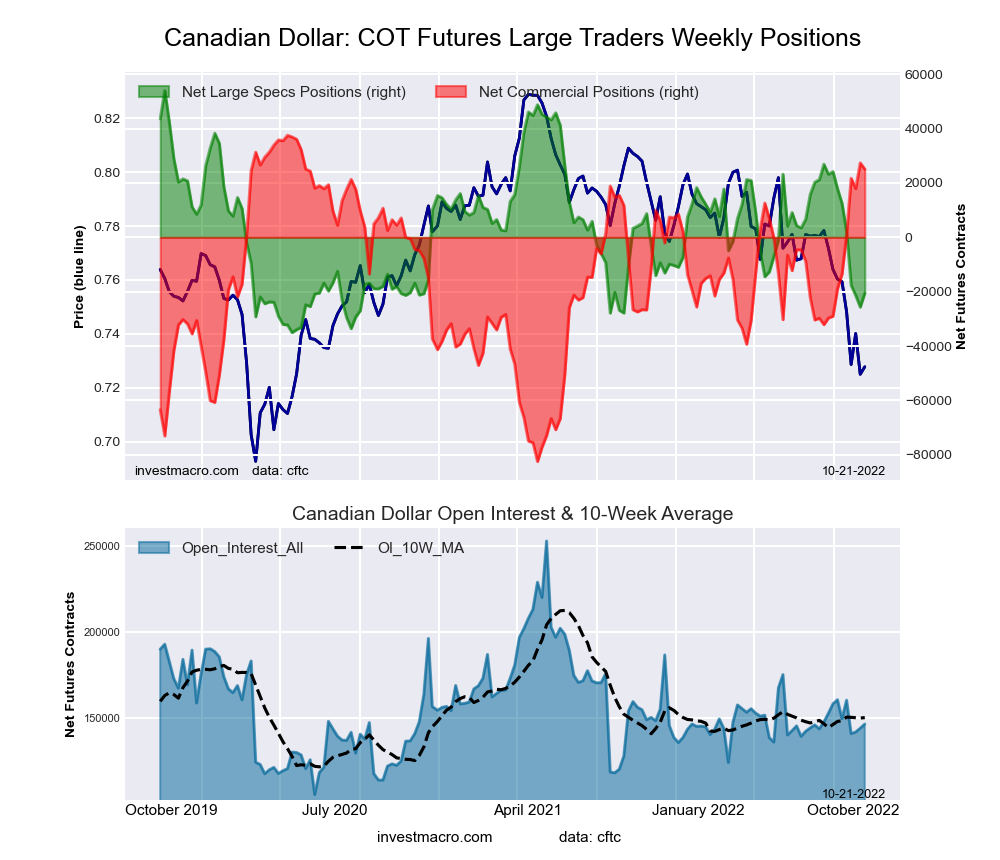
Canadian Dollar Futures:

Canadian Dollar Forex Futures COT ChartThe Canadian Dollar large speculator standing this week reached a net position of 2,056 contracts in the data reported through Tuesday. This was a weekly decrease of -10,369 contracts from the previous week which had a total of 12,425 net contracts.

This week’s current strength score (the trader positioning range over the past three years, measured from 0 to 100) shows the speculators are currently Bearish with a score of 41.7 percent. The commercials are Bullish with a score of 69.5 percent and the small traders (not shown in chart) are Bearish with a score of 24.2 percent.

CANADIAN DOLLAR StatisticsSPECULATORSCOMMERCIALSSMALL TRADERS
– Percent of Open Interest Longs:29.945.721.2
– Percent of Open Interest Shorts:28.645.223.0
– Net Position:2,056892-2,948
– Gross Longs:47,91373,29833,975
– Gross Shorts:45,85772,40636,923
– Long to Short Ratio:1.0 to 11.0 to 10.9 to 1
NET POSITION TREND:
– Strength Index Score (3 Year Range Pct):41.769.524.2
– Strength Index Reading (3 Year Range):BearishBullishBearish
NET POSITION MOVEMENT INDEX:
– 6-Week Change in Strength Index:-21.525.5-23.1


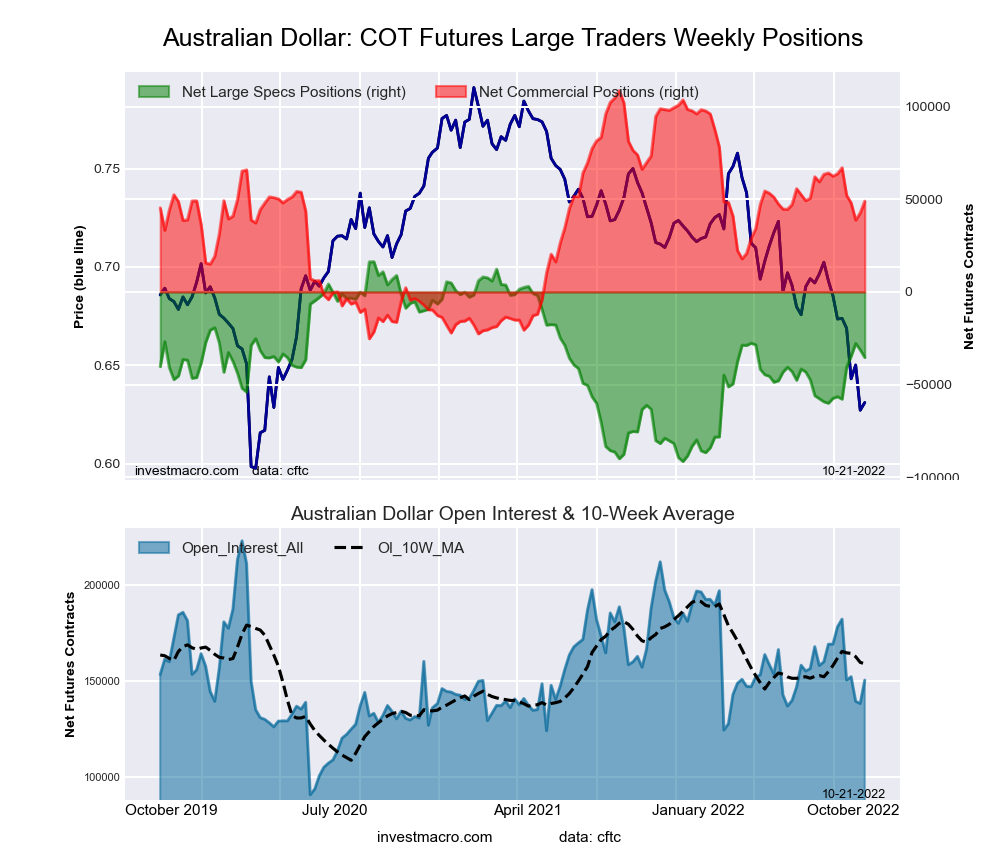
Australian Dollar Futures:

Australian Dollar Forex Futures COT ChartThe Australian Dollar large speculator standing this week reached a net position of -40,556 contracts in the data reported through Tuesday. This was a weekly lift of 17,294 contracts from the previous week which had a total of -57,850 net contracts.

This week’s current strength score (the trader positioning range over the past three years, measured from 0 to 100) shows the speculators are currently Bearish with a score of 47.2 percent. The commercials are Bullish with a score of 57.8 percent and the small traders (not shown in chart) are Bearish with a score of 24.2 percent.

AUSTRALIAN DOLLAR StatisticsSPECULATORSCOMMERCIALSSMALL TRADERS
– Percent of Open Interest Longs:25.861.710.3
– Percent of Open Interest Shorts:52.727.117.9
– Net Position:-40,55652,128-11,572
– Gross Longs:38,79792,90015,434
– Gross Shorts:79,35340,77227,006
– Long to Short Ratio:0.5 to 12.3 to 10.6 to 1
NET POSITION TREND:
– Strength Index Score (3 Year Range Pct):47.257.824.2
– Strength Index Reading (3 Year Range):BearishBullishBearish
NET POSITION MOVEMENT INDEX:
– 6-Week Change in Strength Index:15.8-5.5-23.7


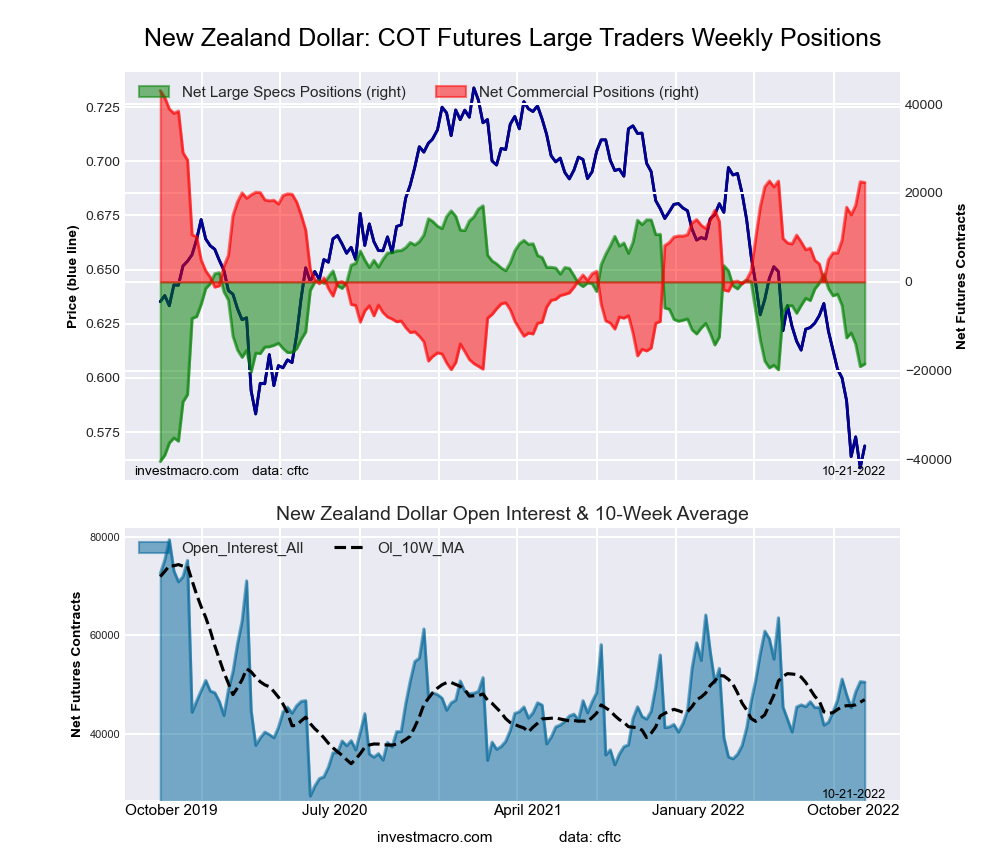
New Zealand Dollar Futures:

New Zealand Dollar Forex Futures COT ChartThe New Zealand Dollar large speculator standing this week reached a net position of -12,589 contracts in the data reported through Tuesday. This was a weekly lowering of -7,288 contracts from the previous week which had a total of -5,301 net contracts.

This week’s current strength score (the trader positioning range over the past three years, measured from 0 to 100) shows the speculators are currently Bullish with a score of 50.1 percent. The commercials are Bullish with a score of 56.3 percent and the small traders (not shown in chart) are Bearish-Extreme with a score of 3.3 percent.

NEW ZEALAND DOLLAR StatisticsSPECULATORSCOMMERCIALSSMALL TRADERS
– Percent of Open Interest Longs:24.369.85.3
– Percent of Open Interest Shorts:50.634.714.1
– Net Position:-12,58916,791-4,202
– Gross Longs:11,64633,4082,544
– Gross Shorts:24,23516,6176,746
– Long to Short Ratio:0.5 to 12.0 to 10.4 to 1
NET POSITION TREND:
– Strength Index Score (3 Year Range Pct):50.156.33.3
– Strength Index Reading (3 Year Range):BullishBullishBearish-Extreme
NET POSITION MOVEMENT INDEX:
– 6-Week Change in Strength Index:-20.719.6-5.0


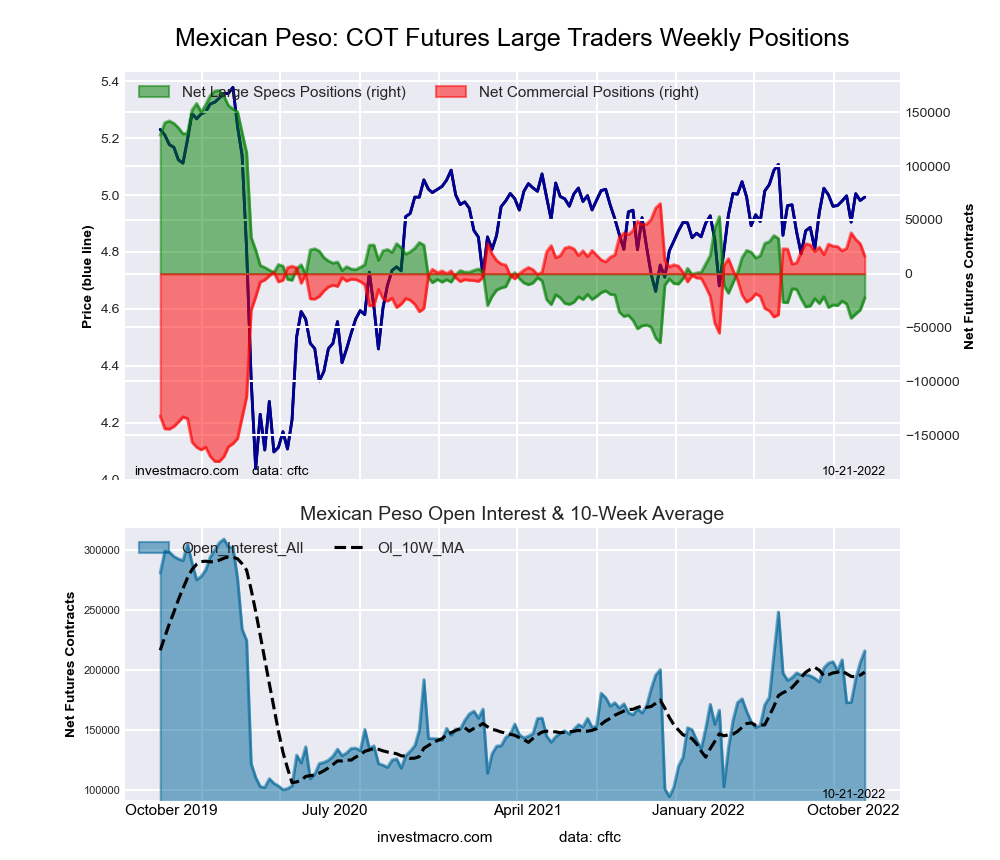
Mexican Peso Futures:

Mexican Peso Futures COT ChartThe Mexican Peso large speculator standing this week reached a net position of -28,033 contracts in the data reported through Tuesday. This was a weekly fall of -2,652 contracts from the previous week which had a total of -25,381 net contracts.

This week’s current strength score (the trader positioning range over the past three years, measured from 0 to 100) shows the speculators are currently Bearish-Extreme with a score of 15.4 percent. The commercials are Bullish-Extreme with a score of 82.7 percent and the small traders (not shown in chart) are Bullish with a score of 61.2 percent.

MEXICAN PESO StatisticsSPECULATORSCOMMERCIALSSMALL TRADERS
– Percent of Open Interest Longs:56.038.94.3
– Percent of Open Interest Shorts:72.225.21.8
– Net Position:-28,03323,7414,292
– Gross Longs:96,67167,2017,445
– Gross Shorts:124,70443,4603,153
– Long to Short Ratio:0.8 to 11.5 to 12.4 to 1
NET POSITION TREND:
– Strength Index Score (3 Year Range Pct):15.482.761.2
– Strength Index Reading (3 Year Range):Bearish-ExtremeBullish-ExtremeBullish
NET POSITION MOVEMENT INDEX:
– 6-Week Change in Strength Index:-0.2-0.45.9


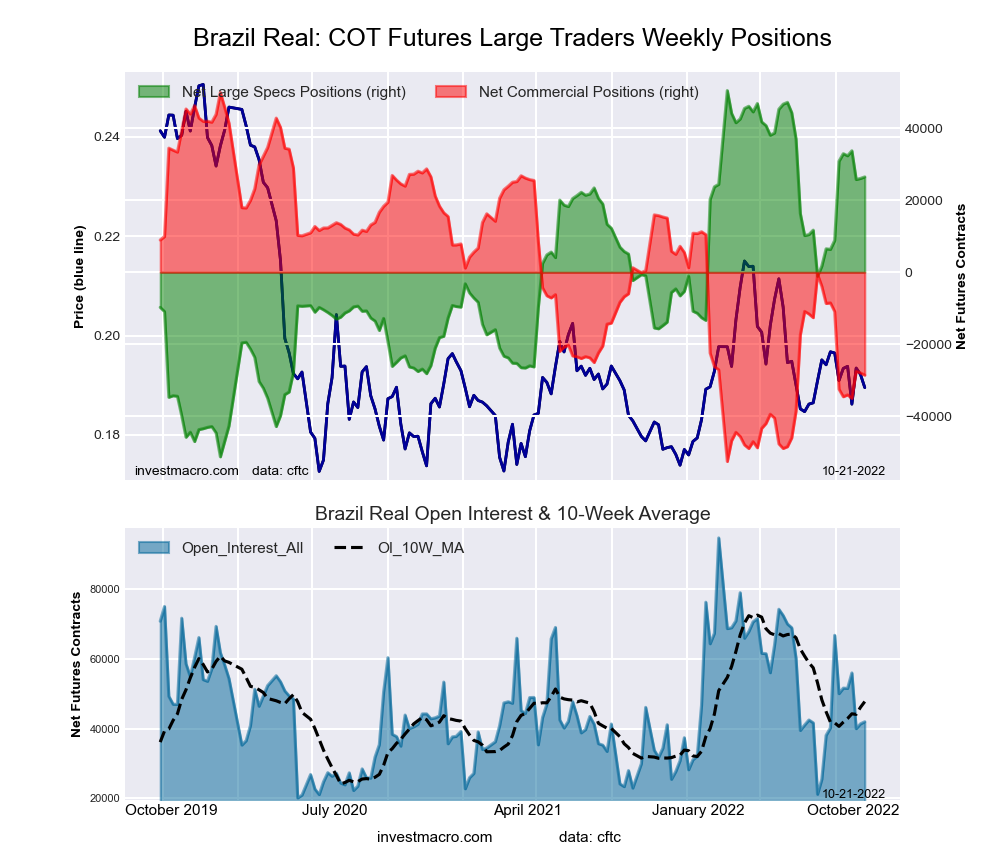
Brazilian Real Futures:

Brazil Real Futures COT ChartThe Brazilian Real large speculator standing this week reached a net position of 32,369 contracts in the data reported through Tuesday. This was a weekly lowering of -584 contracts from the previous week which had a total of 32,953 net contracts.

This week’s current strength score (the trader positioning range over the past three years, measured from 0 to 100) shows the speculators are currently Bullish-Extreme with a score of 82.2 percent. The commercials are Bearish-Extreme with a score of 18.0 percent and the small traders (not shown in chart) are Bullish-Extreme with a score of 84.7 percent.

BRAZIL REAL StatisticsSPECULATORSCOMMERCIALSSMALL TRADERS
– Percent of Open Interest Longs:81.512.46.0
– Percent of Open Interest Shorts:18.778.62.7
– Net Position:32,369-34,0711,702
– Gross Longs:41,9796,4103,109
– Gross Shorts:9,61040,4811,407
– Long to Short Ratio:4.4 to 10.2 to 12.2 to 1
NET POSITION TREND:
– Strength Index Score (3 Year Range Pct):82.218.084.7
– Strength Index Reading (3 Year Range):Bullish-ExtremeBearish-ExtremeBullish-Extreme
NET POSITION MOVEMENT INDEX:
– 6-Week Change in Strength Index:30.1-29.4-5.3


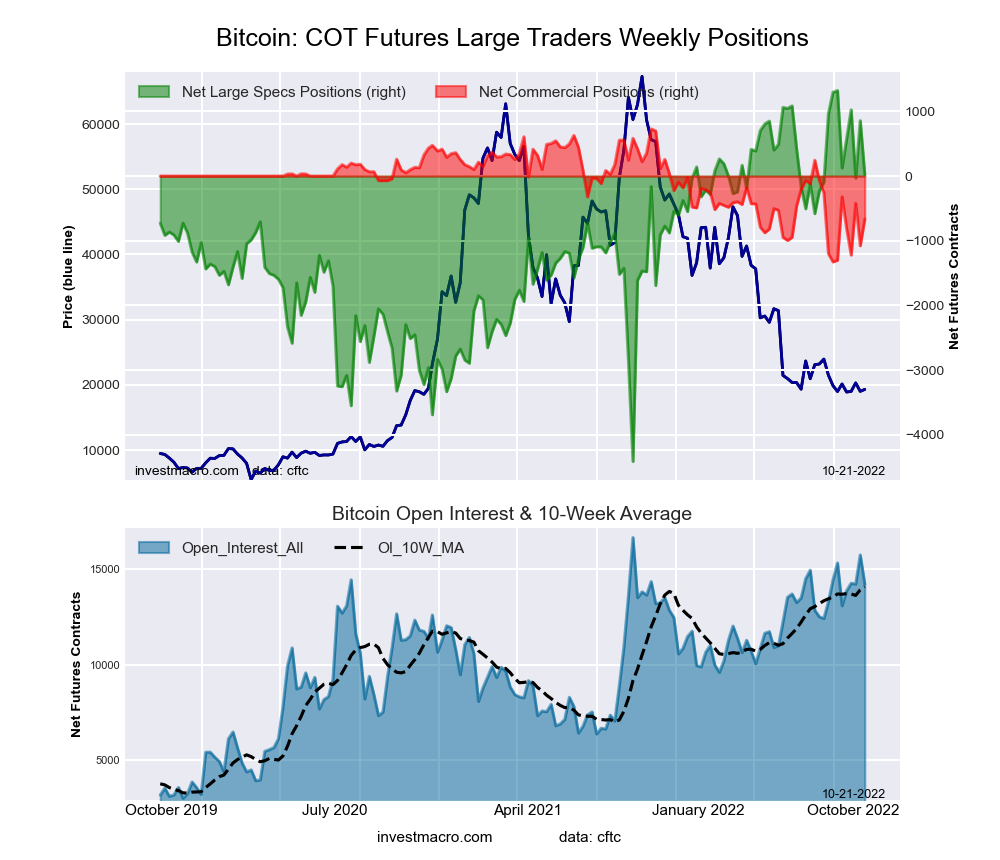
Bitcoin Futures:

Bitcoin Crypto Futures COT ChartThe Bitcoin large speculator standing this week reached a net position of 577 contracts in the data reported through Tuesday. This was a weekly advance of 451 contracts from the previous week which had a total of 126 net contracts.

This week’s current strength score (the trader positioning range over the past three years, measured from 0 to 100) shows the speculators are currently Bullish-Extreme with a score of 87.0 percent. The commercials are Bearish with a score of 25.0 percent and the small traders (not shown in chart) are Bearish-Extreme with a score of 18.3 percent.

BITCOIN StatisticsSPECULATORSCOMMERCIALSSMALL TRADERS
– Percent of Open Interest Longs:80.41.88.0
– Percent of Open Interest Shorts:76.27.66.3
– Net Position:577-812235
– Gross Longs:11,1572451,107
– Gross Shorts:10,5801,057872
– Long to Short Ratio:1.1 to 10.2 to 11.3 to 1
NET POSITION TREND:
– Strength Index Score (3 Year Range Pct):87.025.018.3
– Strength Index Reading (3 Year Range):Bullish-ExtremeBearishBearish-Extreme
NET POSITION MOVEMENT INDEX:
– 6-Week Change in Strength Index:14.1-36.0-1.5


Article By InvestMacroReceive our weekly COT Newsletter

*COT Report: The COT data, released weekly to the public each Friday, is updated through the most recent Tuesday (data is 3 days old) and shows a quick view of how large speculators or non-commercials (for-profit traders) were positioned in the futures markets.

The CFTC categorizes trader positions according to commercial hedgers (traders who use futures contracts for hedging as part of the business), non-commercials (large traders who speculate to realize trading profits) and nonreportable traders (usually small traders/speculators) as well as their open interest (contracts open in the market at time of reporting). See CFTC criteria here.

Soybean Meal and Gold Top Bullish & Bearish COT Speculator Extremes Positions

By InvestMacro

The latest update for the weekly Commitment of Traders (COT) report was released by the Commodity Futures Trading Commission (CFTC) on Friday for data ending on September 20th.

This weekly Extreme Positions report highlights the Top Most Bullish and Top Most Bearish Positions for the speculator category. Extreme positioning in these markets can foreshadow strong moves in the underlying market.

To signify an extreme position, we use the Strength Index (also known as the COT Index) of each instrument, a common method of measuring COT data. The Strength Index is simply a comparison of current trader positions against the range of positions over the previous 3 years using a range from 0 to 100. We use over 80 percent as extremely bullish and under 20 percent as extremely bearish. You can compare Strength Index scores across all markets in the data tables or cot leaders table.


Speculators or Non-Commercials Notes:

Speculators, classified as non-commercial traders by the CFTC, are made up of large commodity funds, hedge funds and other significant for-profit participants. The Specs are generally regarded as trend-followers in their behavior towards price action – net speculator bets and prices tend to go in the same directions. These traders often look to buy when prices are rising and sell when prices are falling. To illustrate this point, many times speculator contracts can be found at their most extremes (bullish or bearish) when prices are also close to their highest or lowest levels.

These extreme levels can be dangerous for the large speculators as the trade is most crowded, there is less trading ammunition still sitting on the sidelines to push the trend further and prices have moved a significant distance. When the trend becomes exhausted, some speculators take profits while others look to also exit positions when prices fail to continue in the same direction. This process usually plays out over many months to years and can ultimately create a reverse effect where prices start to fall and speculators start a process of selling when prices are falling.


Here Are This Week’s Most Bullish Speculator Positions:

Soybean Meal

soybean meal speculator extreme levels

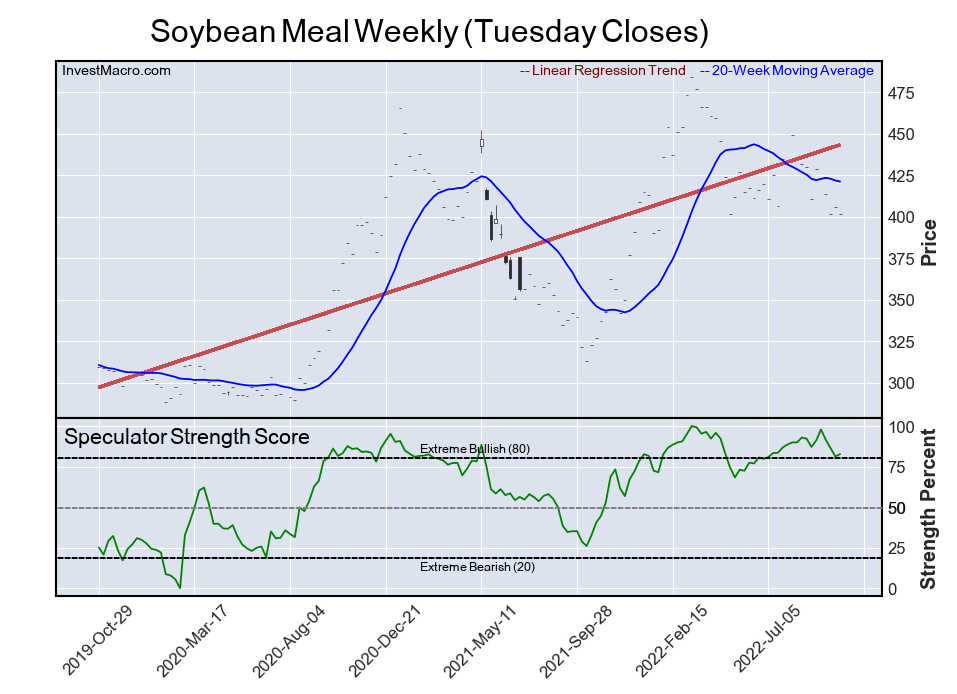
Soybean Meal comes in at the most bullish extreme standing this week as speculator bets have been on a strong rise in this market. The Soybean Meal speculator level is currently right near the top of its 3-year range with at a 97.9 percent score.

Overall, the Soybean Meal position of +126,470 net speculator contracts is the most bullish position of the past twenty-six weeks.


Bitcoin

bitcoin speculator extreme positions

The Bitcoin speculator trader’s futures position comes in as the second most bullish extreme standing this week. The Bitcoin speculator level is currently at a 87 percent score of its 3-year range.

The speculator position totaled 577 net contracts this week which was a change by 451 contracts from last week.


Brazilian Real

Brazilian Real Speculator Extreme

The Brazil Real speculator trader’s futures position comes next in the extreme standings this week as traders have been adding to their bullish positioning in recent weeks. The BRL speculator level is now at an 82 percent score of its 3-year range.

The speculator position was 32,369 net contracts this week and saw a small dip by -584 contracts from last week. The speculator gross long position was a total of 41,979 contracts versus the total speculator gross short position of 9,610 contracts.


This Week’s Most Bearish Speculator Positions:

Gold

gold cot speculator extreme

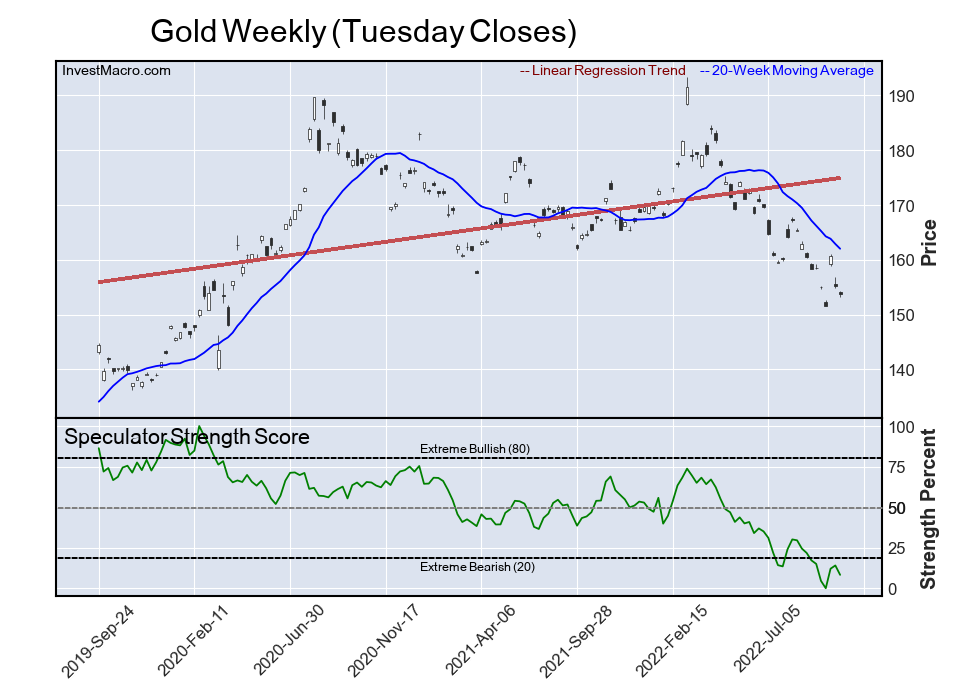
The Gold speculator trader’s futures position comes in as the most bearish extreme standing this week as traders have been bailing sharply out of their futures positions. The Gold speculator level has fallen to a zero percent score of its 3-year range. This means that speculator sentiment is at its lowest level of the past three years currently.

The speculator position was 65,722 net contracts this week, a weekly drop of -31,622 contracts from last week and the lowest level in the past 178 weeks.


Russell 2000 Mini

Russell 2000 Mini Speculator Extremes Positions

The Russell 2000 Mini stock market is the next up in bearish extreme positioning this week. The Russell 2000 Mini is at just a 7.4 percent score of its 3-year range.

Speculative traders have been increasing their bearish bets for the Russell Mini for three straight weeks and the current net position (-106,838 net contracts) has now fallen to the most bearish level of the past five weeks.


WTI Crude Oil

wti crude cot speculator extreme

The WTI Crude Oil speculator trader’s futures position comes in next for the most bearish extreme standing on the week. The WTI Crude speculator level is at an 8 percent score out of its 3-year range.

The speculator position was 239,878 net contracts this week which was a change by 12,821 contracts from last week.


5-Year Bond

five year bond cot speculator extreme

The 5-Year Bond speculator trader’s futures position comes in as fourth most bearish extreme standing of the week. The 5-Year speculator level resides at an 11 percent score out of its 3-year range and the overall 5-Year Bond net position has been in a bearish position since April of 2021.

The overall net speculator position was a total of -493,804 net contracts this week and rose by a total of +27,655 contracts from last week.


Article By InvestMacroReceive our weekly COT Newsletter

*COT Report: The COT data, released weekly to the public each Friday, is updated through the most recent Tuesday (data is 3 days old) and shows a quick view of how large speculators or non-commercials (for-profit traders) were positioned in the futures markets.

The CFTC categorizes trader positions according to commercial hedgers (traders who use futures contracts for hedging as part of the business), non-commercials (large traders who speculate to realize trading profits) and nonreportable traders (usually small traders/speculators) as well as their open interest (contracts open in the market at time of reporting). See CFTC criteria here.


Large drop in Gold Speculator bets leads COT Metals Changes

By InvestMacro

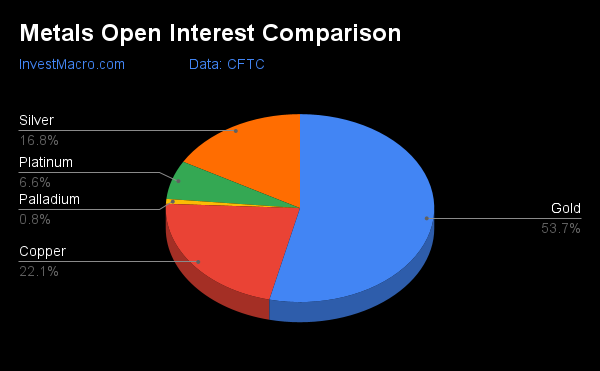
Metals Open Interest Comparison

Here are the latest charts and statistics for the Commitment of Traders (COT) data published by the Commodities Futures Trading Commission (CFTC).

The latest COT data is updated through Tuesday September 20th and shows a quick view of how large traders (for-profit speculators and commercial entities) were positioned in the futures markets.

Large drop in Gold bets leads Weekly Speculator Changes

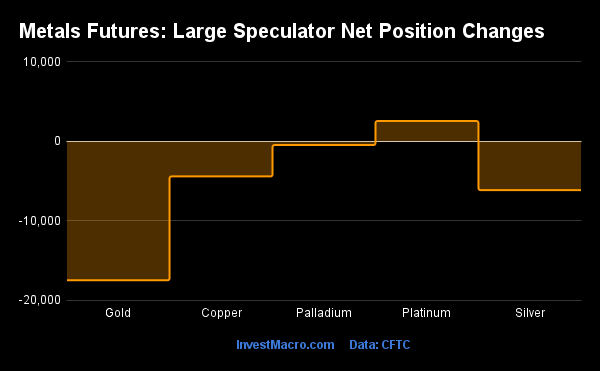
Metals Futures Large Speculator Net Position Changes

The COT precious metals speculator bets were higher overall this week as three out of the five metals markets we cover had higher positioning this week while the other two markets had lower contracts.

Leading the gains for the precious metals markets was Platinum (4,269 contracts) with Silver (3,000 contracts) and Palladium (192 contracts) also showing positive weeks.

The metals markets leading the declines in speculator bets this week were Gold (-31,622 contracts) with Copper (-1,300 contracts) also registering lower bets on the week.

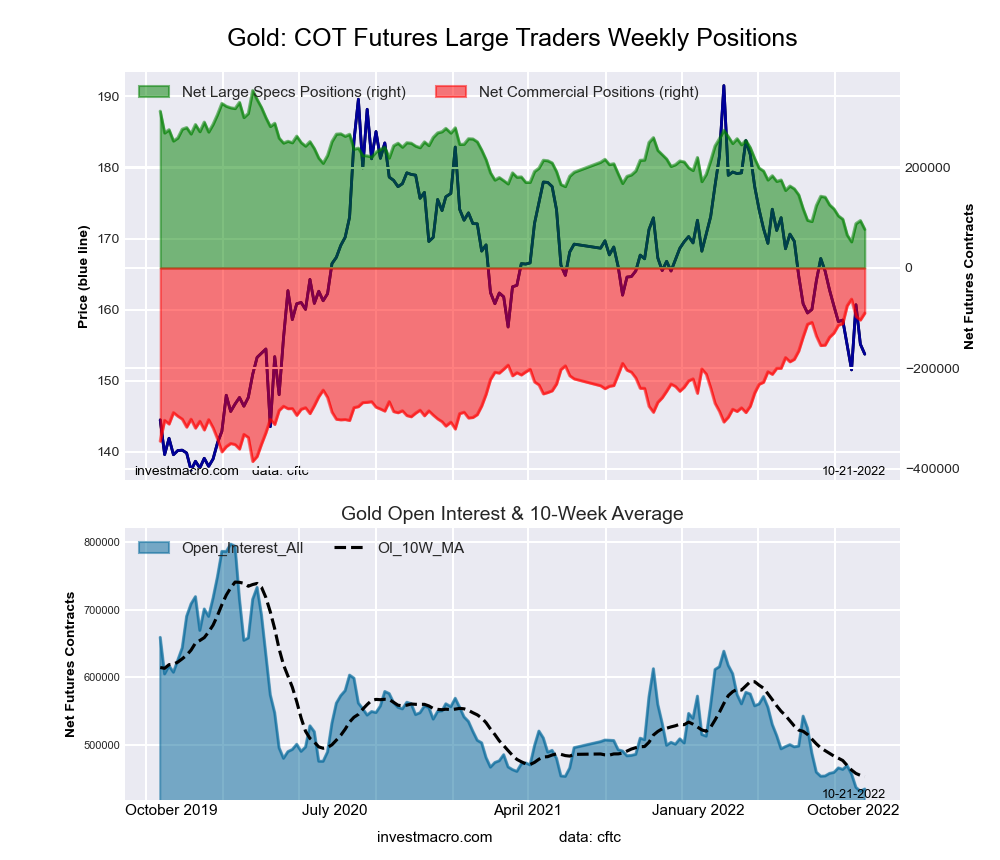
Highlighting the COT Metals data this week was the sharp and continued decline in the Gold futures bets. Speculators dropped their Gold net positions this week by largest one-week amount in the past thirty-three weeks. The Gold position has now fallen for six straight weeks and by a total of -77,129 contracts over that 6-week time period. This bearishness has pushed the overall net positioning to a total of just +65,722 contracts, marking the lowest overall standing for Gold since April 23rd of 2019, a span of 178 weeks. The current investing environment has been a challenging one for Gold and the futures price this week touched the lowest level since April of 2020. Gold closed the week down over 1.6% and right around the $1,655.60 level.


Data Snapshot of Commodity Market Traders | Columns Legend
Sep-20-2022OIOI-IndexSpec-NetSpec-IndexCom-NetCOM-IndexSmalls-NetSmalls-Index
WTI Crude1,481,5451239,8788-261,5689421,69036
Gold469,395565,7220-75,4281009,7060
Silver132,1070-1,64012-5,629907,2694
Copper163,0584-20,2862223,21582-2,9298
Palladium5,9931-1,081171,26182-18033
Platinum62,900272,39012-5,496893,1065
Natural Gas960,2361-155,71132121,3086934,40362
Brent164,02511-37,9034836,732541,17125
Heating Oil292,6343214,09763-25,9414411,84439
Soybeans656,3101884,77339-55,48570-29,28822
Corn1,330,8419305,67769-241,23838-64,4396
Coffee191,433541,07274-42,998301,92617
Sugar744,972837,34544-35,86061-1,4856
Wheat285,5670-4,029149,98274-5,95380


Strength Scores

Strength scores (a measure of the 3-Year range of Speculator positions, from 0 to 100 where above 80 is extreme bullish and below 20 is extreme bearish) showed that Copper (21.7 percent) leads the metals markets with a score that is just outside an extreme bearish position of under 20 percent.

All of the other metals markets we cover continue to have scores under 20 percent with Gold at the lowest with 0.0 percent or the lowest level in three years. Silver (12.3 percent) is up over three percent from last week followed by Platinum (12.3 percent) and Palladium (16.8 percent). Platinum and Palladium are also higher than last week’s scores.


Strength Statistics:
Gold (0.0 percent) vs Gold previous week (11.0 percent)
Silver (12.3 percent) vs Silver previous week (9.0 percent)
Copper (21.7 percent) vs Copper previous week (22.7 percent)
Platinum (12.3 percent) vs Platinum previous week (6.6 percent)
Palladium (16.8 percent) vs Palladium previous week (15.7 percent)

Strength Trends

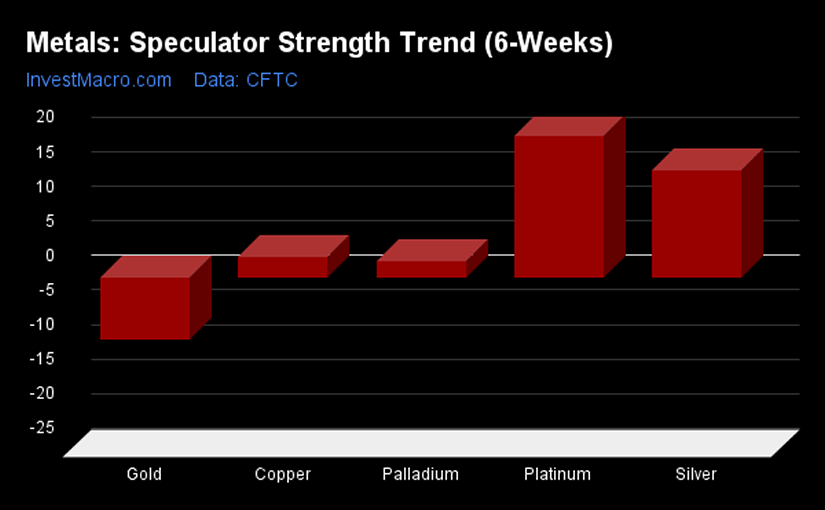
Strength Score Trends (or move index, calculates the 6-week changes in strength scores) showed that Copper (6.4 percent) leads the past six weeks trends for metals this week. Palladium (5.0 percent) and Platinum (2.1 percent) fill out the other positive movers in the latest trends data.

Gold (-26.8 percent) leads the downside trend scores with a big negative jump from last week’s -9.4 percent trend score and is followed by Silver at a trend score of -5.0 percent.

Metals Speculator Strength Trend (6-Weeks)
Move Statistics:
Gold (-26.8 percent) vs Gold previous week (-9.4 percent)
Silver (-5.0 percent) vs Silver previous week (-6.2 percent)
Copper (6.4 percent) vs Copper previous week (6.6 percent)
Platinum (2.1 percent) vs Platinum previous week (0.9 percent)
Palladium (5.0 percent) vs Palladium previous week (7.2 percent)


Individual COT Metals Market Charts:

Gold Comex Futures:

Gold Futures COT ChartThe Gold Comex Futures large speculator standing this week came in at a net position of 65,722 contracts in the data reported through Tuesday. This was a weekly fall of -31,622 contracts from the previous week which had a total of 97,344 net contracts.

This week’s current strength score (the trader positioning range over the past three years, measured from 0 to 100) shows the speculators are currently Bearish-Extreme with a score of 0.0 percent. The commercials are Bullish-Extreme with a score of 100.0 percent and the small traders (not shown in chart) are Bearish-Extreme with a score of 0.0 percent.

Gold Futures StatisticsSPECULATORSCOMMERCIALSSMALL TRADERS
– Percent of Open Interest Longs:45.730.28.6
– Percent of Open Interest Shorts:31.746.36.6
– Net Position:65,722-75,4289,706
– Gross Longs:214,557141,86240,500
– Gross Shorts:148,835217,29030,794
– Long to Short Ratio:1.4 to 10.7 to 11.3 to 1
NET POSITION TREND:
– Strength Index Score (3 Year Range Pct):0.0100.00.0
– Strength Index Reading (3 Year Range):Bearish-ExtremeBullish-ExtremeBearish-Extreme
NET POSITION MOVEMENT INDEX:
– 6-Week Change in Strength Index:-26.825.5-5.2


Silver Comex Futures:

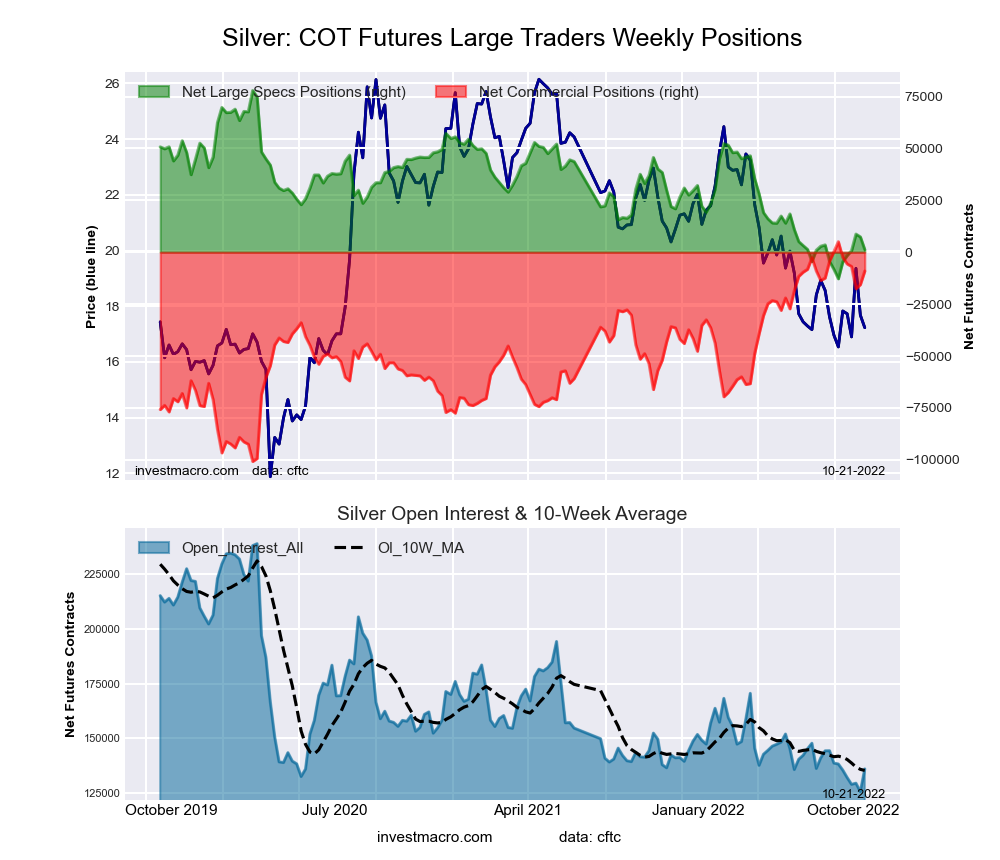
Silver Futures COT ChartThe Silver Comex Futures large speculator standing this week came in at a net position of -1,640 contracts in the data reported through Tuesday. This was a weekly lift of 3,000 contracts from the previous week which had a total of -4,640 net contracts.

This week’s current strength score (the trader positioning range over the past three years, measured from 0 to 100) shows the speculators are currently Bearish-Extreme with a score of 12.3 percent. The commercials are Bullish-Extreme with a score of 89.9 percent and the small traders (not shown in chart) are Bearish-Extreme with a score of 4.2 percent.

Silver Futures StatisticsSPECULATORSCOMMERCIALSSMALL TRADERS
– Percent of Open Interest Longs:39.638.316.2
– Percent of Open Interest Shorts:40.842.610.7
– Net Position:-1,640-5,6297,269
– Gross Longs:52,32350,66121,383
– Gross Shorts:53,96356,29014,114
– Long to Short Ratio:1.0 to 10.9 to 11.5 to 1
NET POSITION TREND:
– Strength Index Score (3 Year Range Pct):12.389.94.2
– Strength Index Reading (3 Year Range):Bearish-ExtremeBullish-ExtremeBearish-Extreme
NET POSITION MOVEMENT INDEX:
– 6-Week Change in Strength Index:-5.07.5-16.6


Copper Grade #1 Futures:

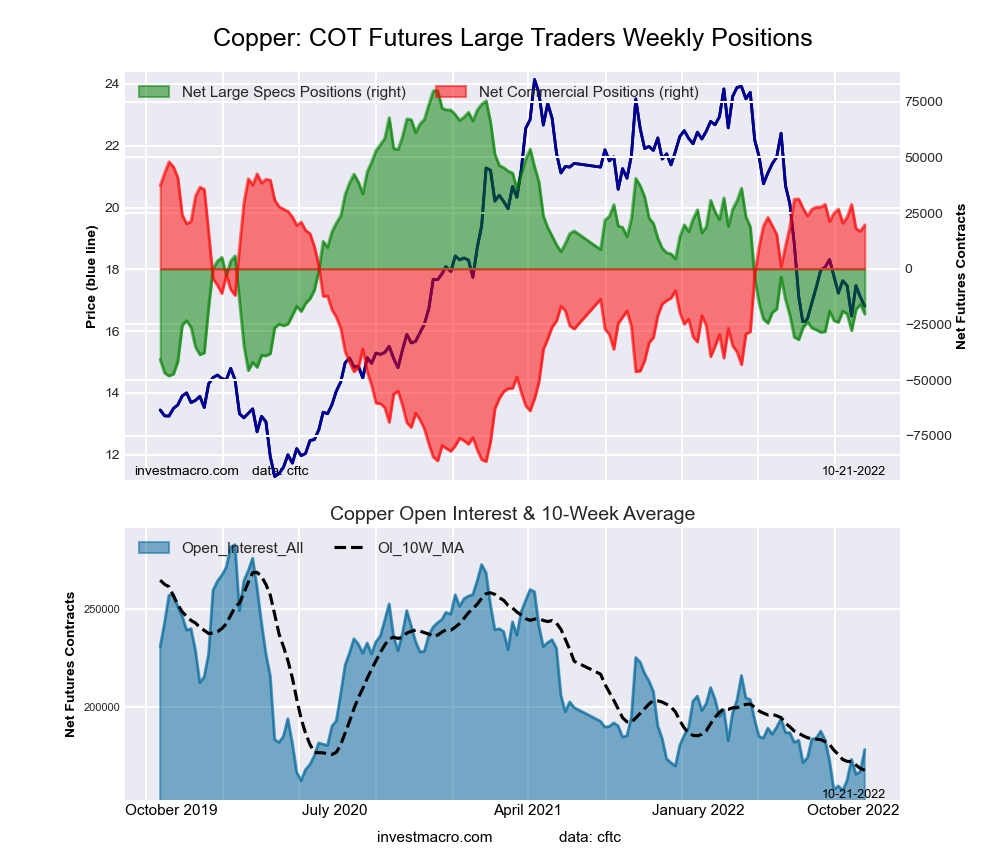
Copper Futures COT ChartThe Copper Grade #1 Futures large speculator standing this week came in at a net position of -20,286 contracts in the data reported through Tuesday. This was a weekly decrease of -1,300 contracts from the previous week which had a total of -18,986 net contracts.

This week’s current strength score (the trader positioning range over the past three years, measured from 0 to 100) shows the speculators are currently Bearish with a score of 21.7 percent. The commercials are Bullish-Extreme with a score of 81.6 percent and the small traders (not shown in chart) are Bearish-Extreme with a score of 8.4 percent.

Copper Futures StatisticsSPECULATORSCOMMERCIALSSMALL TRADERS
– Percent of Open Interest Longs:28.750.78.1
– Percent of Open Interest Shorts:41.136.59.9
– Net Position:-20,28623,215-2,929
– Gross Longs:46,77382,69313,179
– Gross Shorts:67,05959,47816,108
– Long to Short Ratio:0.7 to 11.4 to 10.8 to 1
NET POSITION TREND:
– Strength Index Score (3 Year Range Pct):21.781.68.4
– Strength Index Reading (3 Year Range):BearishBullish-ExtremeBearish-Extreme
NET POSITION MOVEMENT INDEX:
– 6-Week Change in Strength Index:6.4-3.3-21.4


Platinum Futures:

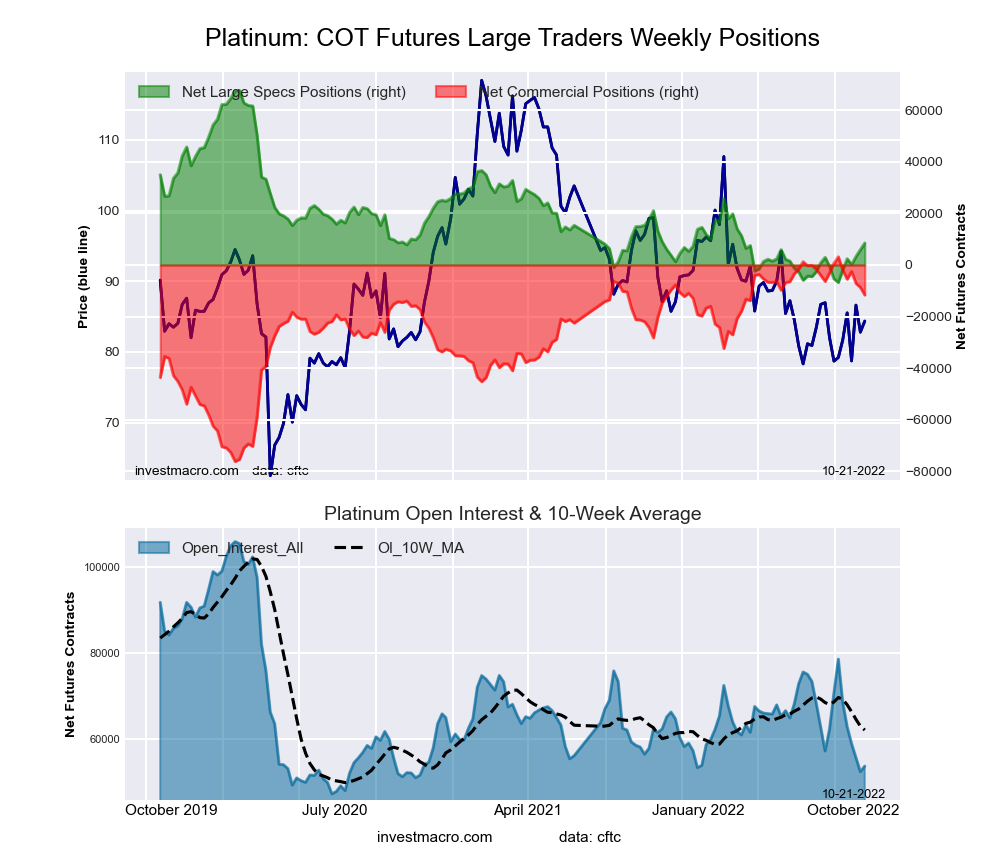
Platinum Futures COT ChartThe Platinum Futures large speculator standing this week came in at a net position of 2,390 contracts in the data reported through Tuesday. This was a weekly gain of 4,269 contracts from the previous week which had a total of -1,879 net contracts.

This week’s current strength score (the trader positioning range over the past three years, measured from 0 to 100) shows the speculators are currently Bearish-Extreme with a score of 12.3 percent. The commercials are Bullish-Extreme with a score of 89.1 percent and the small traders (not shown in chart) are Bearish-Extreme with a score of 5.2 percent.

Platinum Futures StatisticsSPECULATORSCOMMERCIALSSMALL TRADERS
– Percent of Open Interest Longs:44.138.611.8
– Percent of Open Interest Shorts:40.347.36.9
– Net Position:2,390-5,4963,106
– Gross Longs:27,75624,2817,432
– Gross Shorts:25,36629,7774,326
– Long to Short Ratio:1.1 to 10.8 to 11.7 to 1
NET POSITION TREND:
– Strength Index Score (3 Year Range Pct):12.389.15.2
– Strength Index Reading (3 Year Range):Bearish-ExtremeBullish-ExtremeBearish-Extreme
NET POSITION MOVEMENT INDEX:
– 6-Week Change in Strength Index:2.1-1.8-1.4


Palladium Futures:

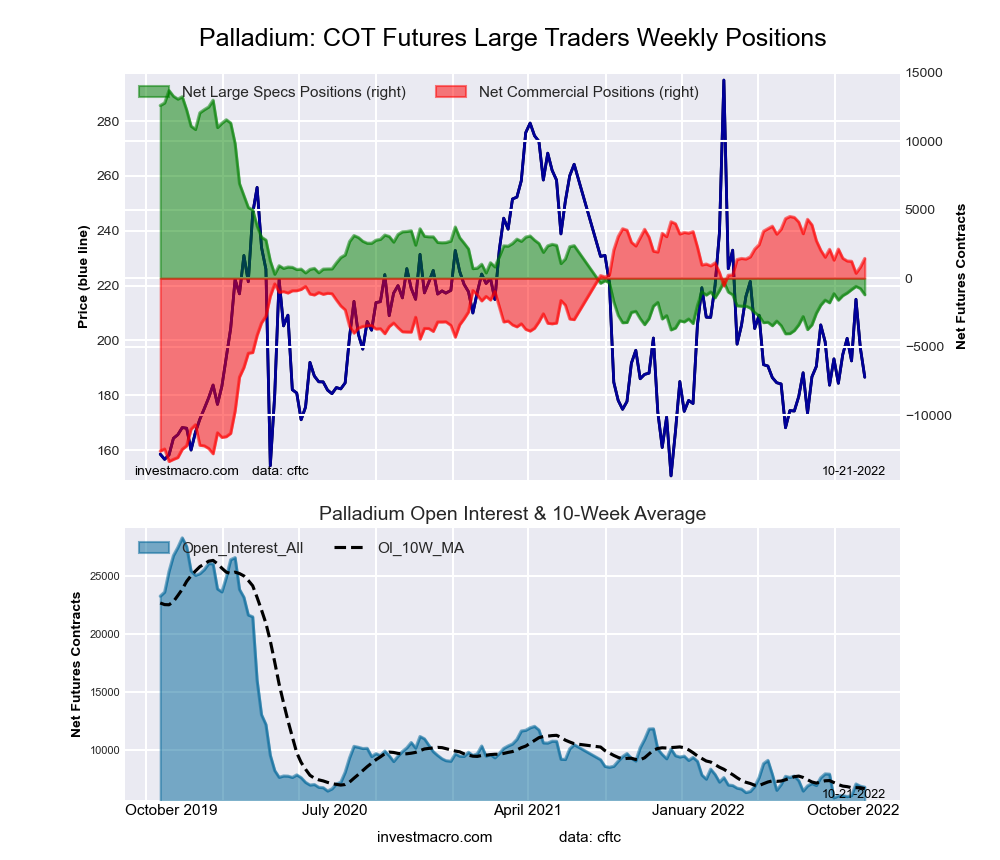
Palladium Futures COT ChartThe Palladium Futures large speculator standing this week came in at a net position of -1,081 contracts in the data reported through Tuesday. This was a weekly advance of 192 contracts from the previous week which had a total of -1,273 net contracts.

This week’s current strength score (the trader positioning range over the past three years, measured from 0 to 100) shows the speculators are currently Bearish-Extreme with a score of 16.8 percent. The commercials are Bullish-Extreme with a score of 81.8 percent and the small traders (not shown in chart) are Bearish with a score of 33.4 percent.

Palladium Futures StatisticsSPECULATORSCOMMERCIALSSMALL TRADERS
– Percent of Open Interest Longs:22.959.915.5
– Percent of Open Interest Shorts:40.938.918.5
– Net Position:-1,0811,261-180
– Gross Longs:1,3713,592930
– Gross Shorts:2,4522,3311,110
– Long to Short Ratio:0.6 to 11.5 to 10.8 to 1
NET POSITION TREND:
– Strength Index Score (3 Year Range Pct):16.881.833.4
– Strength Index Reading (3 Year Range):Bearish-ExtremeBullish-ExtremeBearish
NET POSITION MOVEMENT INDEX:
– 6-Week Change in Strength Index:5.0-4.4-6.1


Article By InvestMacroReceive our weekly COT Newsletter

*COT Report: The COT data, released weekly to the public each Friday, is updated through the most recent Tuesday (data is 3 days old) and shows a quick view of how large speculators or non-commercials (for-profit traders) were positioned in the futures markets.

The CFTC categorizes trader positions according to commercial hedgers (traders who use futures contracts for hedging as part of the business), non-commercials (large traders who speculate to realize trading profits) and nonreportable traders (usually small traders/speculators) as well as their open interest (contracts open in the market at time of reporting). See CFTC criteria here.

S&P500 Mini Futures led the Stock Market Speculator Bets before Fed Rate hike

By InvestMacro

Stock Market Open Interest

Here are the latest charts and statistics for the Commitment of Traders (COT) data published by the Commodities Futures Trading Commission (CFTC).

The latest COT data is updated through Tuesday September 20th and shows a quick view of how large traders (for-profit speculators and commercial entities) were positioned in the futures markets.

The COT data this week is from the day before the US Federal Reserve raised the benchmark interest rate 75 basis points to the 3 to 3.25 percent range. This data shows the trader positioning prior to the rate hike and considering the way the stock markets have gone since Wednesday, positions could have been reversed shortly after.

S&P500 Mini & VIX lead the Weekly Speculator Changes

Stocks Futures Speculator Net Position Changes

The COT stock market speculator bets were slightly lower through Tuesday as three out of the seven stock markets we cover had higher positioning this week while the other four markets had lower contracts.

Leading the gains for stock markets was the S&P500 Mini (61,553 contracts) with the VIX (16,728 contracts) and MSCI EAFE Mini (1,723 contracts) also showing positive weeks.

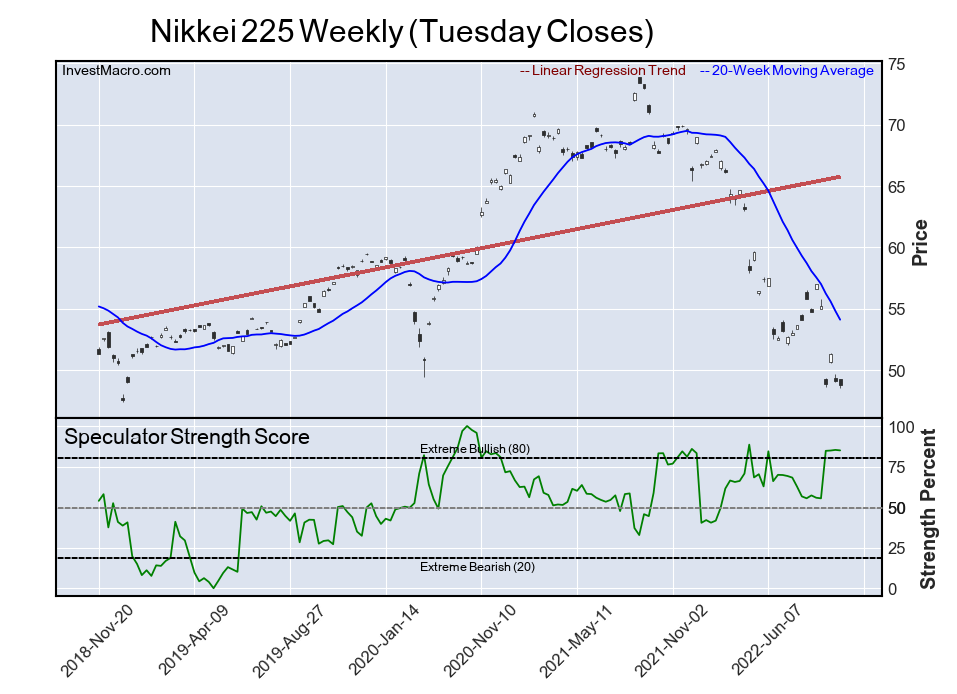
The stock markets with declines in speculator bets this week were the Nasdaq Mini (-8,321 contracts), Russell 2000 Mini (-7,686 contracts), Dow Jones Industrial Average Mini (-3,748 contracts) and the Nikkei 225 USD (-78 contracts) also registering lower bets on the week.

Highlighting the COT stocks data was the SP500 Mini speculator bets that jumped this week by over +60,000 contracts. This was the fourth week in the past five weeks that bets had improved for the SP-Mini. The positioning was likely heavily influenced by the Fed interest rate decision coming the day after (Wednesday) the data was collected. Digging into the data showed that the positive result for the SP500 Mini net positioning was due to a large number of traders reducing their gross short positions (by -75,190 contracts) on Tuesday. Speculators also reduced their gross long positions but by a much smaller number for the week (by -13,637 contracts). Overall, the SP500 Mini net position at -219,451 contracts remains extremely bearish and has been in a negative bearish position for the past fourteen straight weeks, dating back to June 21st.


Data Snapshot of Stock Market Traders | Columns Legend
Sep-20-2022OIOI-IndexSpec-NetSpec-IndexCom-NetCOM-IndexSmalls-NetSmalls-Index
S&P500-Mini2,141,0221-219,45116313,69892-94,2477
Nikkei 22514,15110-4,641552,949441,69250
Nasdaq-Mini271,815553,4857721,58240-25,0674
DowJones-Mini65,49021-15,4341815,84080-40636
VIX345,34140-81,7986890,84233-9,04448
Nikkei 225 Yen42,355181043418,61174-18,71536


Strength Scores

Strength Scores (a normalized measure of Speculator positions over a 3-Year range, from 0 to 100 where above 80 is extreme bullish and below 20 is extreme bearish) showed that the Nasdaq-Mini (77.0 percent) and the VIX (68.3 percent) lead the stock markets for the week. The Nikkei USD (55.4 percent) comes in as the next highest stocks market in strength scores.

On the downside, the Russell2000-Mini (7.4 percent), the S&P500-Mini (15.5 percent) and the DowJones-Mini (17.8 percent) come in at the lowest strength levels and are all in extreme bearish territory (below 20 percent).

Stock Strength Scores

Strength Statistics:
VIX (68.3 percent) vs VIX previous week (59.9 percent)
S&P500-Mini (15.5 percent) vs S&P500-Mini previous week (4.1 percent)
DowJones-Mini (17.8 percent) vs DowJones-Mini previous week (22.9 percent)
Nasdaq-Mini (77.0 percent) vs Nasdaq-Mini previous week (81.6 percent)
Russell2000-Mini (7.4 percent) vs Russell2000-Mini previous week (11.7 percent)
Nikkei USD (55.4 percent) vs Nikkei USD previous week (55.8 percent)
EAFE-Mini (22.4 percent) vs EAFE-Mini previous week (20.5 percent)

Strength Trends

Strength Score Trends (or move index, calculates the 6-week changes in strength scores) showed that the VIX (8.2 percent) and the EAFE-Mini (7.8 percent) lead the past six weeks trends for stocks this week. The S&P500-Mini (4.6 percent) and the Russell2000-Mini (3.4 percent) fill out the other positive movers in the latest trends data.

The Nikkei USD (-12.8 percent) leads the downside trend scores currently while the next market with lower trend scores were the Nasdaq-Mini (-9.8 percent) followed by the DowJones-Mini (-3.6 percent).

Stocks Strength Trends

Strength Trend Statistics:
VIX (8.2 percent) vs VIX previous week (0.2 percent)
S&P500-Mini (4.6 percent) vs S&P500-Mini previous week (-9.1 percent)
DowJones-Mini (-3.6 percent) vs DowJones-Mini previous week (9.0 percent)
Nasdaq-Mini (-9.8 percent) vs Nasdaq-Mini previous week (-7.2 percent)
Russell2000-Mini (3.4 percent) vs Russell2000-Mini previous week (11.7 percent)
Nikkei USD (-12.8 percent) vs Nikkei USD previous week (-13.4 percent)
EAFE-Mini (7.8 percent) vs EAFE-Mini previous week (15.4 percent)


Individual Markets:

VIX Volatility Futures:

VIX Volatility Futures COT ChartThe VIX Volatility large speculator standing this week recorded a net position of -81,798 contracts in the data reported through Tuesday. This was a weekly boost of 16,728 contracts from the previous week which had a total of -98,526 net contracts.

This week’s current strength score (the trader positioning range over the past three years, measured from 0 to 100) shows the speculators are currently Bullish with a score of 68.3 percent. The commercials are Bearish with a score of 33.3 percent and the small traders (not shown in chart) are Bearish with a score of 47.5 percent.

VIX Volatility Futures StatisticsSPECULATORSCOMMERCIALSSMALL TRADERS
– Percent of Open Interest Longs:13.056.66.3
– Percent of Open Interest Shorts:36.730.38.9
– Net Position:-81,79890,842-9,044
– Gross Longs:45,066195,41321,807
– Gross Shorts:126,864104,57130,851
– Long to Short Ratio:0.4 to 11.9 to 10.7 to 1
NET POSITION TREND:
– Strength Index Score (3 Year Range Pct):68.333.347.5
– Strength Index Reading (3 Year Range):BullishBearishBearish
NET POSITION MOVEMENT INDEX:
– 6-Week Change in Strength Index:8.2-6.0-20.0


S&P500 Mini Futures:

SP500 Mini Futures COT ChartThe S&P500 Mini large speculator standing this week recorded a net position of -219,451 contracts in the data reported through Tuesday. This was a weekly gain of 61,553 contracts from the previous week which had a total of -281,004 net contracts.

This week’s current strength score (the trader positioning range over the past three years, measured from 0 to 100) shows the speculators are currently Bearish-Extreme with a score of 15.5 percent. The commercials are Bullish-Extreme with a score of 92.3 percent and the small traders (not shown in chart) are Bearish-Extreme with a score of 6.6 percent.

S&P500 Mini Futures StatisticsSPECULATORSCOMMERCIALSSMALL TRADERS
– Percent of Open Interest Longs:10.378.68.6
– Percent of Open Interest Shorts:20.663.913.0
– Net Position:-219,451313,698-94,247
– Gross Longs:221,1581,681,942184,903
– Gross Shorts:440,6091,368,244279,150
– Long to Short Ratio:0.5 to 11.2 to 10.7 to 1
NET POSITION TREND:
– Strength Index Score (3 Year Range Pct):15.592.36.6
– Strength Index Reading (3 Year Range):Bearish-ExtremeBullish-ExtremeBearish-Extreme
NET POSITION MOVEMENT INDEX:
– 6-Week Change in Strength Index:4.60.2-5.5


Dow Jones Mini Futures:

Dow Jones Mini Futures COT ChartThe Dow Jones Mini large speculator standing this week recorded a net position of -15,434 contracts in the data reported through Tuesday. This was a weekly decline of -3,748 contracts from the previous week which had a total of -11,686 net contracts.

This week’s current strength score (the trader positioning range over the past three years, measured from 0 to 100) shows the speculators are currently Bearish-Extreme with a score of 17.8 percent. The commercials are Bullish-Extreme with a score of 80.2 percent and the small traders (not shown in chart) are Bearish with a score of 36.3 percent.

Dow Jones Mini Futures StatisticsSPECULATORSCOMMERCIALSSMALL TRADERS
– Percent of Open Interest Longs:23.458.417.8
– Percent of Open Interest Shorts:47.034.218.5
– Net Position:-15,43415,840-406
– Gross Longs:15,31638,24011,687
– Gross Shorts:30,75022,40012,093
– Long to Short Ratio:0.5 to 11.7 to 11.0 to 1
NET POSITION TREND:
– Strength Index Score (3 Year Range Pct):17.880.236.3
– Strength Index Reading (3 Year Range):Bearish-ExtremeBullish-ExtremeBearish
NET POSITION MOVEMENT INDEX:
– 6-Week Change in Strength Index:-3.6-1.821.7


Nasdaq Mini Futures:

Nasdaq Mini Futures COT ChartThe Nasdaq Mini large speculator standing this week recorded a net position of 3,485 contracts in the data reported through Tuesday. This was a weekly decrease of -8,321 contracts from the previous week which had a total of 11,806 net contracts.

This week’s current strength score (the trader positioning range over the past three years, measured from 0 to 100) shows the speculators are currently Bullish with a score of 77.0 percent. The commercials are Bearish with a score of 39.8 percent and the small traders (not shown in chart) are Bearish-Extreme with a score of 4.4 percent.

Nasdaq Mini Futures StatisticsSPECULATORSCOMMERCIALSSMALL TRADERS
– Percent of Open Interest Longs:27.160.910.5
– Percent of Open Interest Shorts:25.853.019.7
– Net Position:3,48521,582-25,067
– Gross Longs:73,741165,61928,531
– Gross Shorts:70,256144,03753,598
– Long to Short Ratio:1.0 to 11.1 to 10.5 to 1
NET POSITION TREND:
– Strength Index Score (3 Year Range Pct):77.039.84.4
– Strength Index Reading (3 Year Range):BullishBearishBearish-Extreme
NET POSITION MOVEMENT INDEX:
– 6-Week Change in Strength Index:-9.814.0-9.9


Russell 2000 Mini Futures:

Russell 2000 Mini Futures COT ChartThe Russell 2000 Mini large speculator standing this week recorded a net position of -106,838 contracts in the data reported through Tuesday. This was a weekly lowering of -7,686 contracts from the previous week which had a total of -99,152 net contracts.

This week’s current strength score (the trader positioning range over the past three years, measured from 0 to 100) shows the speculators are currently Bearish-Extreme with a score of 7.4 percent. The commercials are Bullish-Extreme with a score of 91.6 percent and the small traders (not shown in chart) are Bearish with a score of 24.2 percent.

Russell 2000 Mini Futures StatisticsSPECULATORSCOMMERCIALSSMALL TRADERS
– Percent of Open Interest Longs:6.188.74.1
– Percent of Open Interest Shorts:26.368.34.3
– Net Position:-106,838107,880-1,042
– Gross Longs:32,486470,31921,997
– Gross Shorts:139,324362,43923,039
– Long to Short Ratio:0.2 to 11.3 to 11.0 to 1
NET POSITION TREND:
– Strength Index Score (3 Year Range Pct):7.491.624.2
– Strength Index Reading (3 Year Range):Bearish-ExtremeBullish-ExtremeBearish
NET POSITION MOVEMENT INDEX:
– 6-Week Change in Strength Index:3.4-5.010.9


Nikkei Stock Average (USD) Futures:

Nikkei Stock Average (USD) Futures COT ChartThe Nikkei Stock Average (USD) large speculator standing this week recorded a net position of -4,641 contracts in the data reported through Tuesday. This was a weekly decline of -78 contracts from the previous week which had a total of -4,563 net contracts.

This week’s current strength score (the trader positioning range over the past three years, measured from 0 to 100) shows the speculators are currently Bullish with a score of 55.4 percent. The commercials are Bearish with a score of 44.4 percent and the small traders (not shown in chart) are Bearish with a score of 49.6 percent.

Nikkei Stock Average Futures StatisticsSPECULATORSCOMMERCIALSSMALL TRADERS
– Percent of Open Interest Longs:12.253.334.2
– Percent of Open Interest Shorts:45.032.522.3
– Net Position:-4,6412,9491,692
– Gross Longs:1,7297,5484,844
– Gross Shorts:6,3704,5993,152
– Long to Short Ratio:0.3 to 11.6 to 11.5 to 1
NET POSITION TREND:
– Strength Index Score (3 Year Range Pct):55.444.449.6
– Strength Index Reading (3 Year Range):BullishBearishBearish
NET POSITION MOVEMENT INDEX:
– 6-Week Change in Strength Index:-12.8-1.337.0


MSCI EAFE Mini Futures:

MSCI EAFE Mini Futures COT ChartThe MSCI EAFE Mini large speculator standing this week recorded a net position of -15,709 contracts in the data reported through Tuesday. This was a weekly lift of 1,723 contracts from the previous week which had a total of -17,432 net contracts.

This week’s current strength score (the trader positioning range over the past three years, measured from 0 to 100) shows the speculators are currently Bearish with a score of 22.4 percent. The commercials are Bullish with a score of 78.9 percent and the small traders (not shown in chart) are Bearish with a score of 31.5 percent.

MSCI EAFE Mini Futures StatisticsSPECULATORSCOMMERCIALSSMALL TRADERS
– Percent of Open Interest Longs:5.392.12.0
– Percent of Open Interest Shorts:9.388.51.7
– Net Position:-15,70914,2601,449
– Gross Longs:20,659360,9398,009
– Gross Shorts:36,368346,6796,560
– Long to Short Ratio:0.6 to 11.0 to 11.2 to 1
NET POSITION TREND:
– Strength Index Score (3 Year Range Pct):22.478.931.5
– Strength Index Reading (3 Year Range):BearishBullishBearish
NET POSITION MOVEMENT INDEX:
– 6-Week Change in Strength Index:7.8-6.7-7.9


Article By InvestMacroReceive our weekly COT Newsletter

*COT Report: The COT data, released weekly to the public each Friday, is updated through the most recent Tuesday (data is 3 days old) and shows a quick view of how large speculators or non-commercials (for-profit traders) were positioned in the futures markets.

The CFTC categorizes trader positions according to commercial hedgers (traders who use futures contracts for hedging as part of the business), non-commercials (large traders who speculate to realize trading profits) and nonreportable traders (usually small traders/speculators) as well as their open interest (contracts open in the market at time of reporting). See CFTC criteria here.

Why FX markets react to central banks?

By ForexTime 

This week has been jam-packed with major central bank decisions that have triggered wild swings across FX markets.

Here’s a quick catch up:

  • US Federal Reserve: hiked by 75 basis points
  • Bank of Japan: left benchmark rate unchanged
  • Swiss National Bank: hiked by 75 basis points
  • Central Bank of Norway: hiked by 50 basis points
  • Bank of England: hiked by 50 basis points

READ MORE: (Sept 19 article) Trade of the Week: GBPUSD to sink further?

For an example as to how much a central bank can influence FX markets, consider how the equally-weighted USD Index (which measures the dollar’s moves against six other G10 currencies) has punched its way to a fresh two-year high, trading at levels not seen since the onset of the pandemic.

Such a spike in the US dollar came after the US central bank, also the world’s most influential central bank, informed markets that it has to push US interest rates higher than expected in order to combat stubbornly-high inflation.

With so much action going on across FX markets, here’s a timely reminder of the basics surrounding how central banks impact FX markets.

First, let’s begin with …

What is a central bank?

A central bank is an institution that manages a country’s currency and money supply.

It also helps the economy achieve certain goals, such as keeping unemployment stable and low while ensuring price stability (keeping inflation under control).

What’s the main problem for central banks right now?

Currently, the number one problem facing most central banks around the world: red-hot inflation!

That is to say, the central bank’s is trying hard to make sure that the prices that consumers are paying don’t rise too much too fast.

Of course, the central bank wants to protect the public and make sure consumers can continue spending money to help grow the economy.

Otherwise:

  • When things get too expensive, consumers may not be able to afford as much goods and services, which may lead to lowered spending.
  • When overall spending sees a big drop in an economy, that would negatively affect the income that businesses and producers can get.
  • Less income for companies may translate into cost-cutting measures (e.g. job cuts) in order for the business to try and survive.

In short, inflation that’s out-of-control is bad news for the economy.

How are central banks trying to control inflation?

The main way that most central banks try and subdued red-hot inflation is by raising interest rates.

Here’s how it works:

Higher interest rates = lower demand / lower money supply = slower inflation

However, there’s a dark side to interest rate hikes as well.

If a central bank raises its benchmark rate(s) too high, too fast, that may destroy demand levels (drastically lowered spending) in an economy to the point that there’s a recession!

Hence it’s a tricky balancing act that central banks face right now.

They have to raise interest rates high enough to subdue inflation, but not do it too much so as to incur too much pain for the economy (e.g. too many jobs lost).

So how does all this impact currency markets?

Here are three key ways:

  1. Economic performance

Markets reward the currency of the economy that can better withstand these higher interest rates.

For example, the US dollar has surged to its highest levels against the British Pound since 1985, even though both the US Federal Reserve and the Bank of England have been raising interest rates.

Because markets believe that the US economy is better withstanding this ongoing rate hikes, better than the UK economy that’s facing its worst cost-of-living crisis in a generation, there has been more demand for the US dollar relative to the British Pound.

Hence, no surprise that GBPUSD has now reached its lowest levels since 1985.


  1. Yields

When a central bank raises its interest rates, investors also sell off its government bonds.

When the prices of these bonds fall, their yields rise.

NOTE: Yields are a measure of how much an investor can earn from a particular asset.

Hence, the country whose bonds offer a higher yield then attracts more investors, who then demand more of that country’s currency in order to purchase its assets.

In fewer words, generally speaking, higher yields = stronger currency.

This is especially evident in USDJPY which has soared to its highest levels since 1998 earlier, almost touching the 146.0 mark before pulling back today.

When you consider the following yields on offer:

  • US 10-year Treasuries: 3.53%
  • Japanese 10-year government bonds: 0.228%

Given this massive gap between US and Japanese yields, no surprise that investors have been flocking to the US dollar and less so the Japanese Yen.


  1. Currency intervention

A currency that weakens drastically can also have negative consequences.

For one, it makes imports more expensive, which means consumers in that country have to fork out more money to buy imported goods and services.

Again, when prices go up, demand/spending goes down.

Hence, a central bank may intervene to support its currency, like the Bank of Japan announced today (Thursday, sept 22nd).

And sometimes, markets are ready to react to the mere though of currency intervention, and not the actual “intervening” in and of itself, as was the case with the Swiss National Bank today.


With all that said, hopefully it is now clear what central bankers say and do often do have a massive impact on FX markets, as we’ve seen all of this week.

And there are more key decisions and announcements to be made in the months to come, seeing as this global battle against inflation is far from over.

So make sure you keep watching this space for the latest developments surrounding upcoming central bank decisions.


Forex-Time-LogoArticle by ForexTime
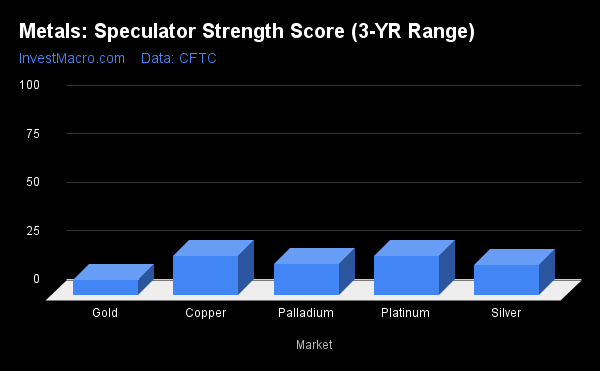
ForexTime Ltd (FXTM) is an award winning international online forex broker regulated by CySEC 185/12 www.forextime.com