Archive for Opinions – Page 116

Fed keeps focus on US economy as the world tilts toward a recession that it may be contributing to

By D. Brian Blank, Mississippi State University 

The U.S. Federal Reserve holds inordinate sway over the world’s economies – yet it acts, in some ways, like they don’t really matter.

Its power is primarily because of the dominance of the U.S. dollar, which soared in recent months as the Fed’s aggressive interest rate hikes made the greenback more attractive to investors. But this has a downside for other countries because it is fueling inflation, raising the cost of borrowing and increasing the risk of a global recession.

If you only paid attention to the words of Fed Chair Jerome Powell, however, you probably would have no idea this is happening. He hasn’t said a peep in his public speeches about the significant risks to the global economy as central banks jack up interest rates to tame inflation – including the Fed’s 0.75 percentage point increase on Sept. 21, 2022.

This may seem a bit odd that the Fed would appear to be so blasé about the global economy that it arguably leads. Yet as a finance scholar, I believe it makes perfect sense – though there are risks.

The Fed’s domestic focus

The Federal Reserve is mandated to focus on the U.S. economy, and it takes this job very seriously.

While central banks are aware of all global economic data, they focus on their own economies, helping them do what is best for their own nations. In the U.S., that means the Fed is focused on improving the American economy through
stable prices and full employment.

As a result, when the U.S. economy is slowing too quickly and people are losing jobs, such as early in the pandemic, the Fed lowers interest rates – no matter the impact on other countries. Similarly, when the economy is growing but consumer prices are rising too fast, the central bank raises interest rates.

And its global impact

Yet it’s unavoidable that the Fed’s policies will influence economies, companies and citizens in virtually every country in the world.

While all central banks influence the rest of the world, the Fed has a much larger impact because of the size of the U.S. economy – it remains by far the largest in absolute terms – and the prominence of the U.S. dollar in international markets and trade.

Approximately half of the world’s international debt is denominated in dollars, which means countries need to pay interest and principle on what they borrow in greenbacks. The dollar has soared almost 15% this year relative to a basket of foreign currencies, largely as a result of the Fed interest rate hikes that began in March. That means it’s, on average, 15% more expensive to finance those dollar-denominated debts – and for some countries, it could be a lot more.

Moreover, about 60% of all global foreign exchange reserves – that’s the money central banks hold to protect the value of their own currencies – are in dollars. And since most major commodities like oil and gold are priced in dollars, a stronger dollar makes everything cost a lot more for businesses and consumers in every country.

Finally, when U.S. interest rates are high relative to those in other countries, more foreign investment flocks to the U.S. to get more bang for their buck. Since there’s only so much money to go around, this drains investment from other economies, especially emerging markets. And it means they have to raise interest rates to keep foreign direct investment flowing into their countries, which can hurt their local economies.

Risks in a global world

Unfortunately, focusing solely on the domestic economy has its own risks.

It may sound cliche, but we do live in a global, interconnected world – something demonstrated powerfully by the COVID-19 pandemic and the supply chain issues that repeatedly rippled across the world. American businesses depend on other countries for supplies, workers and consumers.
That means even if the Fed manages a proverbial soft landing and is able to reduce inflation without causing a recession, a global downturn may still ultimately reach American shores. This could threaten much of the Fed’s success if the global slowdown results in international instability or food insecurity.

So while I believe the Fed is correct to keep its focus on the U.S. economy and lift rates as much as it deems necessary, I’ll be looking closely at the central bank’s economic projections. If the data shows the U.S. economy’s inflation problems diminishing, the Fed may be able to begin to think a bit less about what’s happening in its own backyard and more about the impact of its policies on the rest of the world.The Conversation

About the Author:

D. Brian Blank, Assistant Professor of Finance, Mississippi State University

This article is republished from The Conversation under a Creative Commons license. Read the original article.


Mid-Week Technical Outlook: G10 Currencies

By ForexTime

A wave of risk aversion whacked financial markets on Wednesday after President Vladimir Putin declared a partial mobilization over Ukraine and accused the West of ‘nuclear blackmail’.

This negative development hit stocks as investors rushed to safe-haven destinations like the dollar, gold, and government bonds. With tensions likely to escalate between Russia and Ukraine following the latest news, risk-off may remain the name of the game ahead of the Federal Reserve rate decision this evening.

We have a couple of potential trading opportunities on our radar that could be triggered by not only the Fed but BoE and key economic reports this week. Our focus will fall on G10 currencies and our tool of choice will be none other than technical analysis.

DXY gearing for a breakout?

Heightened geopolitical tensions injected dollar bulls with fresh inspiration this morning. A hawkish Federal Reserve could feed the beast, pushing the Dollar Index (DXY) beyond 110.78 before the end of today! Such a development could encourage a further incline towards 111.00 and 112.50, respectively. A move back below 109.14 may result in a selloff back to 107.75.

EURUSD slams into 0.9900

Bears are knocking on 0.9900’s door and may force their way through this support if the dollar continues to appreciate. The EURUSD is under a lot of pressure with bears enjoying the ride downhill. A solid breakdown below 0.9900 could encourage a selloff towards 0.9700.

GBPUSD builds downside momentum

The BoE decision ON Thursday will heavily influence the GBPUSD near-term outlook. A hawkish central bank that moves ahead with a jumbo rate hike could throw pound bulls a lifeline. However, upside gains are likely to be capped by growth fears. Prices have the potential to sink lower if a daily close below 1.1350 is secured.

USDJPY trapped within range

Over the past few days, the USDJPY has been trapped within a 300-pip range with support at 142.00 and resistance at 145.00. The trend is bullish with prices trading above the 50, 100, and 200 SMA. A solid breakout above 145.00 could inspire a move towards 146.00 and higher. If prices sink back towards 142.00, we can see the USDJPY challenge at 139.50.

AUDUSD breaks below 0.6700

A stronger dollar continues to drag the AUDUSD lower. Should prices descend below 0.6650, this could trigger a selloff to 0.6520. For bulls to jump back in, prices need to trade back above 0.6700 with 0.6850 acting as a key level of interest.

Bonus: S&P 500

Appetite for riskier assets has been hit by mounting geopolitical tensions. This may translate to more losses on the S&P 500 which remains bearish on the daily charts. A strong move below 3810 could result in a selloff towards 3700 and 3636. If bulls can push prices back above 3905, expect a potential incline towards 3945 and the 100-day SMA at 4000.

Bonus: Gold

How gold performs this week will be heavily influenced by the Fed meeting on Wednesday evening. As highlighted earlier, the precious metal remains under pressure and could be in store for more punishment if the dollar and Treasury yields jump. A move below $1655 could swing open the floodgates, dragging prices towards $1600 and lower.


Forex-Time-LogoArticle by ForexTime
ForexTime Ltd (FXTM) is an award winning international online forex broker regulated by CySEC 185/12 www.forextime.com

One year on, El Salvador’s Bitcoin experiment has proven a spectacular failure

By John Hawkins, University of Canberra 

A year ago, El Salvador became the first country to make Bitcoin legal tender – alongside the US dollar, which the Central American country adopted in 2001 to replace its own currency, the colón.

President Nayib Bukele, a cryptocurrency enthusiast, promoted the initiative as one that would deliver multiple economic benefits.

Making Bitcoin legal tender, he said, would attract foreign investment, generate jobs and help “push humanity at least a tiny bit into the right direction”.

His ambitions extended to building an entire “Bitcoin city” – a tax-free haven funded by issuing US$1 billion in government bonds. The plan was to spend half the bond revenue on the city, and the other half on buying Bitcoin, with assumed profits then being used to repay the bondholders.

Now, a year on, there’s more than enough evidence to conclude Bukele – who has also called himself “the world’s coolest dictator” in response to criticisms of his creeping authoritarianism – had no idea what he was doing.

This bold financial experiment has proven to be an almost complete failure.

Making Bitcoin legal tender

Making Bitcoin legal tender meant much more than allowing Bitcoin to be used for transactions. That was already possible, as it is in most (but far from all) countries.

If a Salvadoran wanted to pay for something in bitcoins, and the recipient was willing to accept them, they could.

But Bukele wanted more. Making bitcoins legal tender meant a payee had to accept them. As the 2021 legislation stated, “every economic agent must accept Bitcoin as payment when offered to him by whoever acquires a good or service”.

To encourage Bitcoin uptake, the government created an app called “Chivo Wallet” (“chivo” is slang for “cool”) to trade bitcoins for dollars without transaction fees. It also came preloaded with US$30 as a bonus (the median weekly income is about US$360).

Yet despite the law and these incentives, Bitcoin has not been embraced.

Greeted with little enthusiasm

A nationally representative survey of 1,800 Salvadoran households in February indicated just 20% of the population was using Chivo Wallet for Bitcoin transactions. More than double that number downloaded the app, but only to claim the US$30.

Among respondents who identified as business owners, just 20% said they were accepting bitcoins as payment. These were typically large companies (among the top 10% of companies by size).


Business acceptance of Bitcoin in El Salvador

NBER Working Paper 29968, CC BY

A survey for the El Salvador Chamber of Commerce in March found only 14% of businesses were transacting using Bitcoin.

Making huge losses

Fortunately for Salvadorans, nothing has come of the US$1 billion Bitcoin bonds scheme. But the Bukele government has still spent more than US$100 million buying bitcoins – which are now worth less than US$50 million.

When Bukele announced his plans in July 2021, Bitcoin’s value was about US$35,000. By the time the legislation came into effect, on September 7 2021, it was about US$45,000. Two months later, it peaked at US$64,400.

Now it is trading at around US$20,000.

Bukele has made self-congratulatory tweets about “buying the dip” but almost all the bitcoins bought by the government have been for more than US$30,000, at an average price of more than US$40,000.

A year ago, Bukele was urging his citizens to hold their money in bitcoins. For anyone who did, the losses would be devastating.

Flawed analyses

Bukele’s misunderstanding of Bitcoin – and economics more generally – has been demonstrated repeatedly.

In June 2021 he tweeted: “Bitcoin has a market cap of US$680 billion. If 1% of it is invested in El Salvador, that would increase our GDP by 25%.”

This suggests he seemed to think Bitcoin was some sort of investment fund. It also showed he did not understand GDP. Foreign investment is not a component of GDP. There has been no surge in foreign investment nor GDP.

In a January 2022 tweet he argued a “gigantic price increase is just a matter of time” because there will only ever be 21 million bitcoins while there are 50 million millionaires in the world. “Imagine when each one of them decides they should own at least ONE #Bitcoin,” he proclaimed. Bitcoin’s value has since halved.

The rest of the world is not impressed

The Bitcoin plan has adversely affected El Salvador’s credit rating and relations with the International Monetary Fund. With investors more wary of lending to the country, local borrowers have had to offer higher interest rates.

In January the IMF urged El Salvador to reverse Bitcoin’s legal lender status because of the “large risks for financial and market integrity, financial stability and consumer protection”. Bitcoin is notorious for its use in scams and other illegal activities, as well as its volatility.

Bukele tweeted a dismissive response involving a Simpsons-themed meme.


El Salvador’s President Nayib Bukele’s response to the IMF’s warnings about the risk of making Bitcoin legal tender.
Twitter, CC BY

This seems particularly rash, given El Salvador has been seeking a loan of more than $1 billion from the IMF.

International credit rating agencies Fitch has downgraded El Salvador’s credit rating this year, citing concerns about its Bitcoin policies.

No other country with its own currency, not even ones such as Zimbabwe and Venezuela with discredited currencies, has followed suit and made Bitcoin legal tender.

Given El Salvador’s record, it is is unikely any ever will.The Conversation

About the Author:

John Hawkins, Senior Lecturer, Canberra School of Politics, Economics and Society, University of Canberra

This article is republished from The Conversation under a Creative Commons license. Read the original article.


COT Forex Speculator Changes led by Japanese Yen, British Pound Sterling & Euro

By InvestMacro

Here are the latest charts and statistics for the Commitment of Traders (COT) data published by the Commodities Futures Trading Commission (CFTC).

The latest COT data is updated through Tuesday September 13th and shows a quick view of how large market participants (for-profit speculators and commercial traders) were positioned in the futures markets. All currency positions are in direct relation to the US dollar where, for example, a bet for the euro is a bet that the euro will rise versus the dollar while a bet against the euro will be a bet that the euro will decline versus the dollar.

Weekly Speculator Changes led lower by Japanese Yen & British Pound Sterling

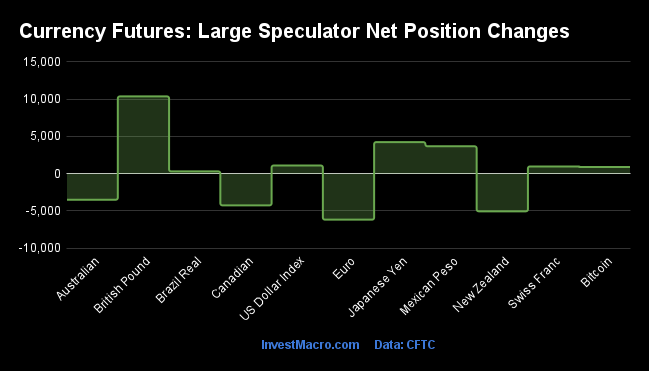
The COT currency market speculator bets were mostly lower this week as just three out of the eleven currency markets we cover had higher positioning while the other eight markets had lower speculator contracts.

Leading the gains for the currency markets was the Euro (24,512 contracts) with the Mexican peso (4,079 contracts) and the Brazilian real (2,093 contracts) also showing a positive weeks.

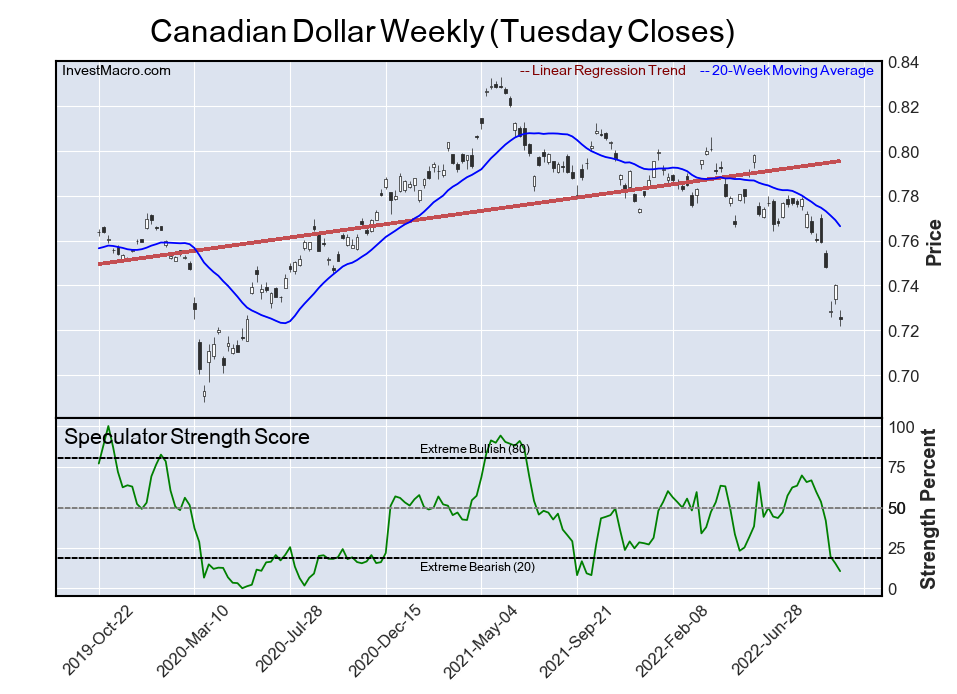
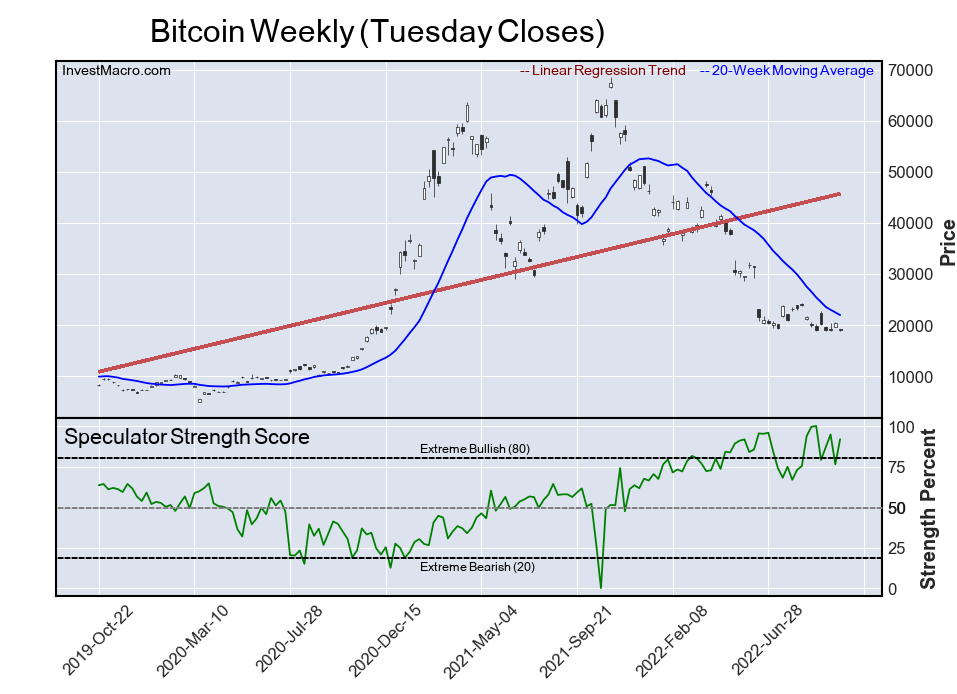
The currencies leading the declines in speculator bets this week were the Japanese yen (-22,503 contracts) and the British pound sterling (-17,654 contracts) with the Canadian dollar (-5,485 contracts), Swiss franc (-3,268 contracts), New Zealand dollar (-2,555 contracts), Australian dollar (-1,350 contracts), Bitcoin (-1,196 contracts) and the US Dollar Index (-438 contracts) also registering lower bets on the week.

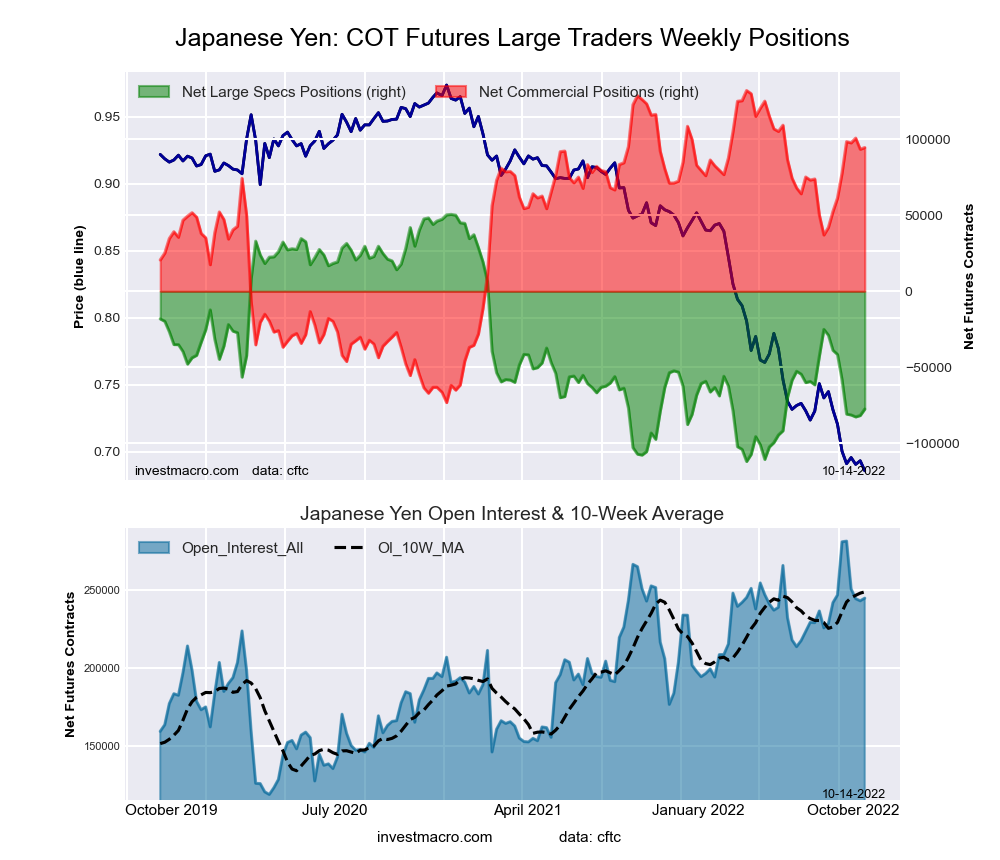
Highlighting the COT currencies this week was the further deterioration of the Japanese yen speculative positions. The yen speculator bets have now fallen for five straight weeks and by a total of -55,660 contracts over that period. This recent weakness followed an improvement in the yen positions in ten out of the previous thirteen weeks through August 9th. The overall speculator standing this week has dipped to the most bearish level of the past fourteen weeks, dating back to June 7th. The USDJPY currency pair has continued to see the dollar surge against the yen with the USDJPY above the 142.90 exchange rate to end the week. The pair has hit a high right below the 145.00 level for two straight weeks which is the highest exchange rate for the dollar versus the yen since September of 1998.

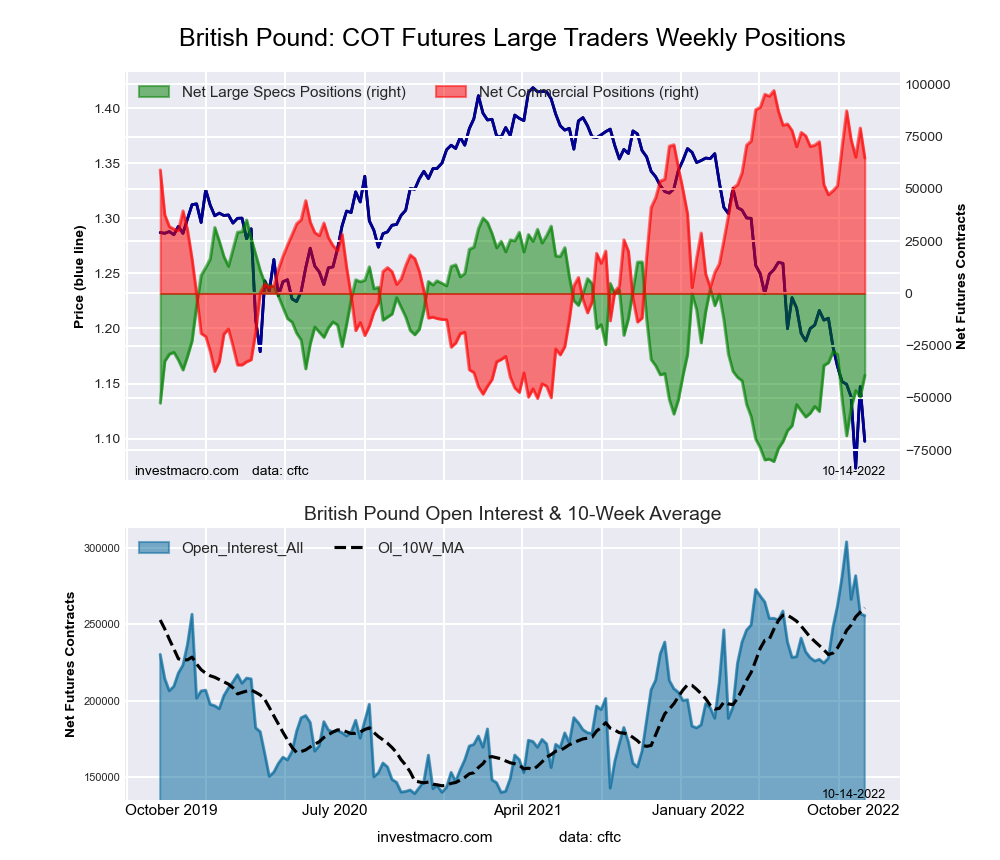
The British pound sterling speculator positions fell for a third consecutive week this week. The sterling bets have now declined by a total of -40,120 contracts over the past three weeks to bring the overall standing to a 14-week low. The GBPUSD currency pair has also dropped to a multi-decade low against the US dollar with the pound hitting a 37-year low this week. The GBPUSD closed the week just above the 1.1400 exchange rate after falling in four out of the past five weeks.

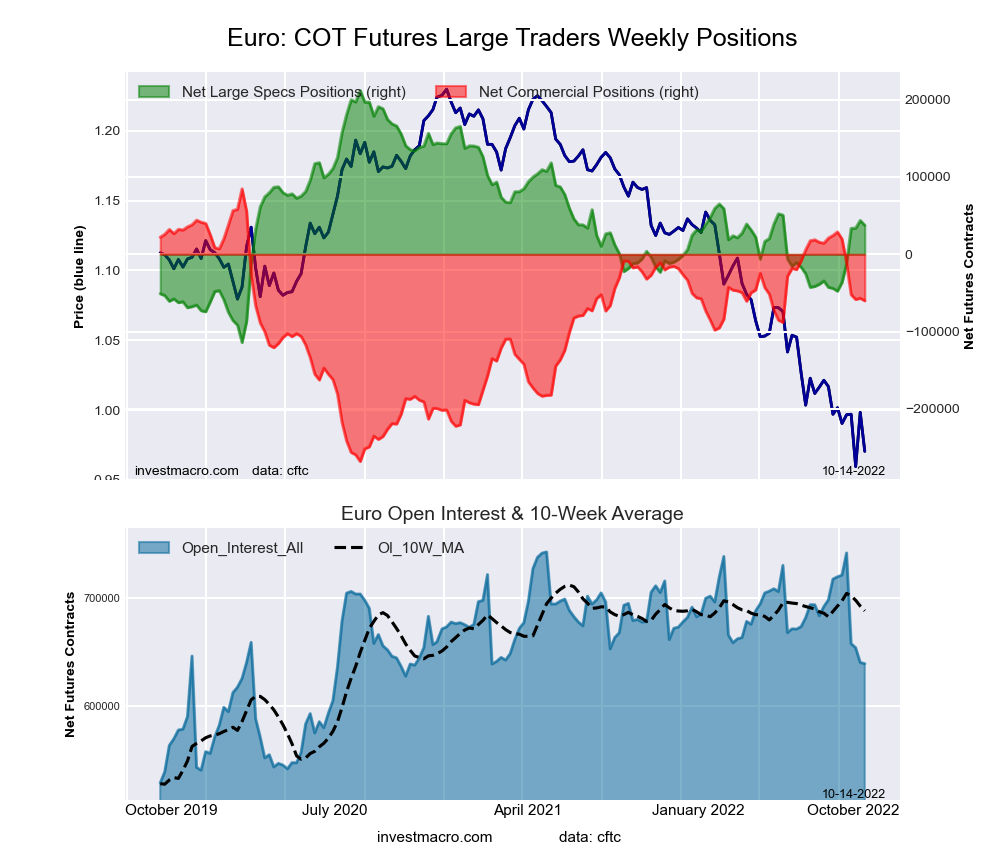
On the positive side of the COT data this week is the Euro. The European common currency bounced back this week with a strong +24,512 contracts and has now risen for two straight weeks. This recent improvement has taken the overall speculator standing to a level of just -11,837 contracts. With the EURUSD currency pair trading virtually at parity as it closed the week at the 1.0017 exchange rate, it is an interesting situation trying to read the large trader positioning. The speculators, especially in currencies, usually exhibit trend following behavior and would be expected to have a position of at least -100,000 contracts in this type of environment.

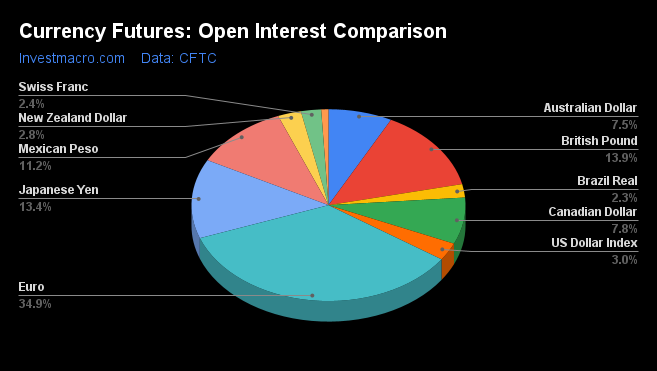
This could mean the speculators feel that the parity level will be close to the bottom for this pair and it is too risky to add to the short positioning. Or, the speculator short positioning could start to rise if the pair keeps its downtrend below parity. One thing for sure is that there are a huge amount of positions open in the market currently. The open interest level this week of 742,244 contracts is in the 99th percentile of the past three years. We know from open interest analysis that many times turning points coincide with peaks in open interest. However, with a possible recession for the Eurozone on the way combined with strong inflationary pressures and a potential energy crisis from the Russia-Ukraine war, the fundamental backdrop is very cloudy. It will undoubtedly take some time but will be very interesting to see how the large trader positioning and situation resolves itself.


Data Snapshot of Forex Market Traders | Columns Legend
Sep-13-2022OIOI-IndexSpec-NetSpec-IndexCom-NetCOM-IndexSmalls-NetSmalls-Index
USD Index62,0779335,66984-38,380152,71146
EUR742,244100-11,83731-11,4237323,26013
GBP303,965100-68,0861187,32592-19,2397
JPY281,716100-80,6921998,29984-17,60718
CHF44,85331-7,3053816,51270-9,20726
CAD149,5563012,42553-13,476571,05132
AUD182,28769-57,8503167,01869-9,16830
NZD51,07946-5,301629,40845-4,1074
MXN208,40353-25,3811721,333824,04860
RUB20,93047,54331-7,15069-39324
BRL51,5824232,95383-34,577181,62484
Bitcoin13,0897412679-320019417


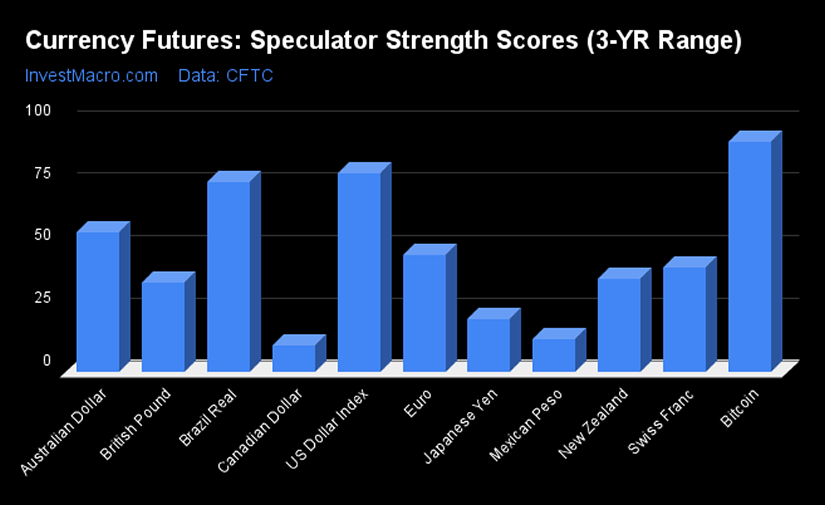
Strength Scores led by US Dollar Index & Brazilian Real

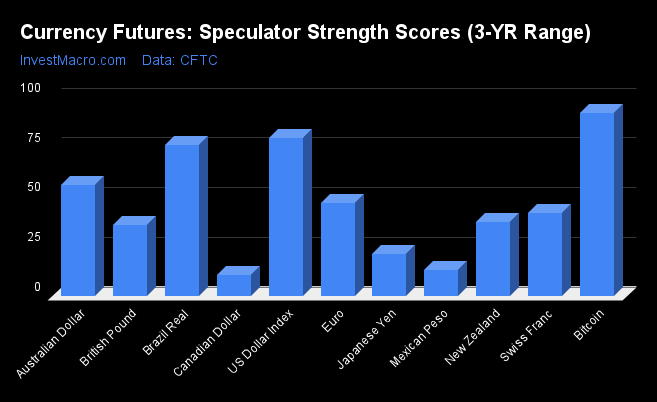
Strength Scores (a normalized measure of Speculator positions over a 3-Year range, from 0 to 100 where above 80 is extreme bullish and below 20 is extreme bearish) showed that the US Dollar Index (84.4 percent) and the Brazilian Real (82.8 percent) lead the currency markets near the top of their respective ranges and both are in bullish extreme positions (above 80 percent). Bitcoin (79.1 percent) comes in as the next highest in the currency markets in strength scores followed by the New Zealand Dollar (62.4 percent).

On the downside, the British Pound Sterling (10.9 percent), Mexican Peso (16.5 percent) and the Japanese Yen (19.2 percent) all come in at the lowest strength levels and all three are in bearish extreme levels (below 20 percent).


Strength Statistics:
US Dollar Index (84.4 percent) vs US Dollar Index previous week (85.2 percent)
EuroFX (31.4 percent) vs EuroFX previous week (23.8 percent)
British Pound Sterling (10.9 percent) vs British Pound Sterling previous week (26.0 percent)
Japanese Yen (19.2 percent) vs Japanese Yen previous week (33.0 percent)
Swiss Franc (38.0 percent) vs Swiss Franc previous week (46.3 percent)
Canadian Dollar (53.3 percent) vs Canadian Dollar previous week (59.5 percent)
Australian Dollar (31.2 percent) vs Australian Dollar previous week (32.4 percent)
New Zealand Dollar (62.4 percent) vs New Zealand Dollar previous week (66.7 percent)
Mexican Peso (16.5 percent) vs Mexican Peso previous week (14.8 percent)
Brazil Real (82.8 percent) vs Brazil Real previous week (80.7 percent)
Bitcoin (79.1 percent) vs Bitcoin previous week (100.0 percent)

Brazilian Real leads the 6-Week Strength Trends

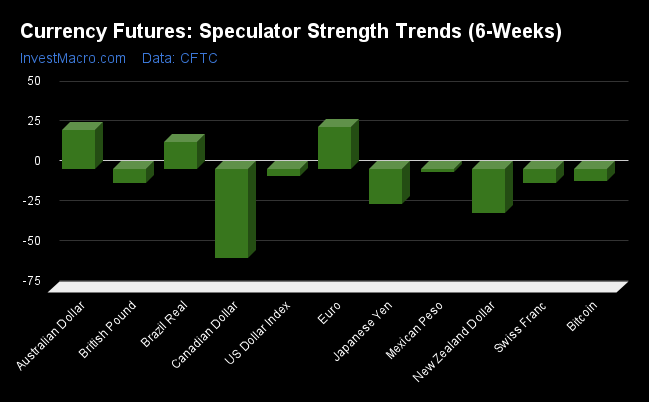
Strength Score Trends (or move index, calculates the 6-week changes in strength scores) show that the Brazilian Real (33.5 percent) leads the past six weeks trends for the currency markets this week. The Swiss Franc (15.2 percent), Bitcoin (12.3 percent) and the Euro (8.3 percent) fill out the only other positive movers in the latest trends data.

The Japanese Yen (-23.4 percent) leads the downside trend scores currently while the next market with lower trend scores were the British Pound Sterling (-10.0 percent) followed by the Canadian Dollar (-8.8 percent), the New Zealand Dollar (-6.3 percent) and the US Dollar Index (-6.1 percent).


Strength Trend Statistics:
US Dollar Index (-6.1 percent) vs US Dollar Index previous week (-7.4 percent)
EuroFX (8.3 percent) vs EuroFX previous week (1.6 percent)
British Pound Sterling (-10.0 percent) vs British Pound Sterling previous week (3.0 percent)
Japanese Yen (-23.4 percent) vs Japanese Yen previous week (2.0 percent)
Swiss Franc (15.2 percent) vs Swiss Franc previous week (18.4 percent)
Canadian Dollar (-8.8 percent) vs Canadian Dollar previous week (2.4 percent)
Australian Dollar (-1.8 percent) vs Australian Dollar previous week (-8.5 percent)
New Zealand Dollar (-6.3 percent) vs New Zealand Dollar previous week (2.4 percent)
Mexican Peso (-1.0 percent) vs Mexican Peso previous week (0.2 percent)
Brazil Real (33.5 percent) vs Brazil Real previous week (18.8 percent)
Bitcoin (12.3 percent) vs Bitcoin previous week (25.2 percent)


Individual Markets:

US Dollar Index Futures:

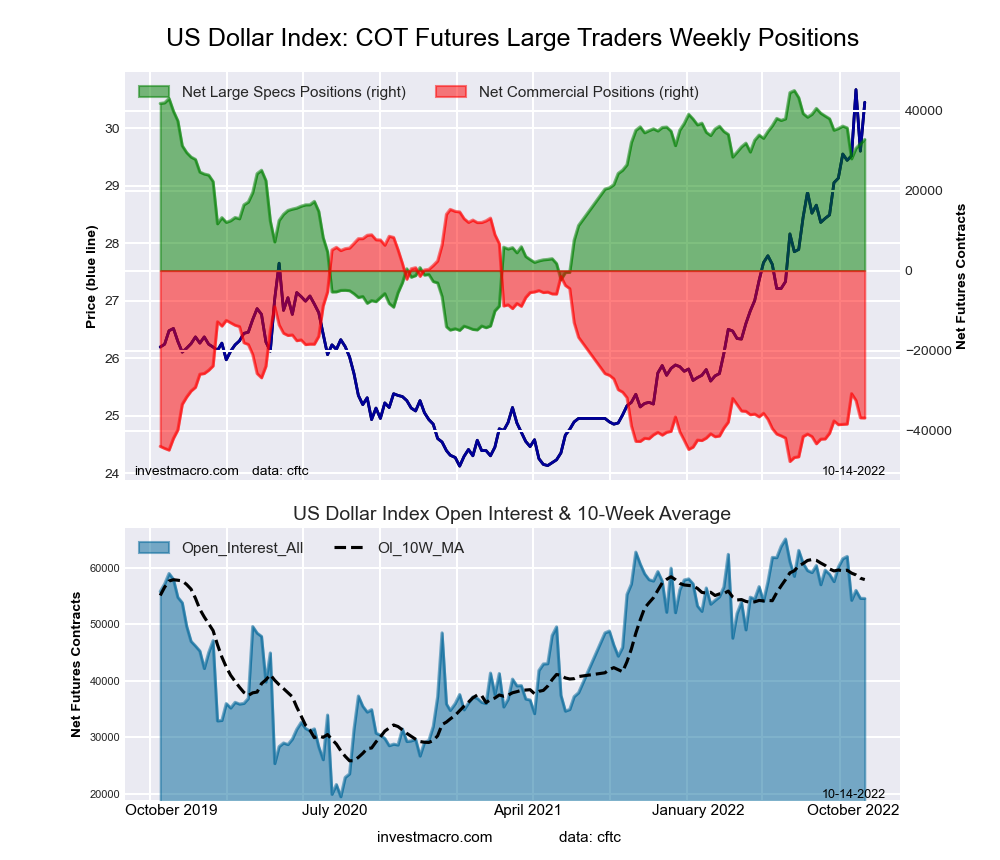
US Dollar Index Forex Futures COT ChartThe US Dollar Index large speculator standing this week came in at a net position of 35,669 contracts in the data reported through Tuesday. This was a weekly decline of -438 contracts from the previous week which had a total of 36,107 net contracts.

This week’s current strength score (the trader positioning range over the past three years, measured from 0 to 100) shows the speculators are currently Bullish-Extreme with a score of 84.4 percent. The commercials are Bearish-Extreme with a score of 14.8 percent and the small traders (not shown in chart) are Bearish with a score of 46.2 percent.

US DOLLAR INDEX StatisticsSPECULATORSCOMMERCIALSSMALL TRADERS
– Percent of Open Interest Longs:78.99.18.6
– Percent of Open Interest Shorts:21.470.94.2
– Net Position:35,669-38,3802,711
– Gross Longs:48,9845,6475,342
– Gross Shorts:13,31544,0272,631
– Long to Short Ratio:3.7 to 10.1 to 12.0 to 1
NET POSITION TREND:
– Strength Index Score (3 Year Range Pct):84.414.846.2
– Strength Index Reading (3 Year Range):Bullish-ExtremeBearish-ExtremeBearish
NET POSITION MOVEMENT INDEX:
– 6-Week Change in Strength Index:-6.16.0-1.1


Euro Currency Futures:

Euro Currency Futures COT ChartThe Euro Currency large speculator standing this week came in at a net position of -11,837 contracts in the data reported through Tuesday. This was a weekly boost of 24,512 contracts from the previous week which had a total of -36,349 net contracts.

This week’s current strength score (the trader positioning range over the past three years, measured from 0 to 100) shows the speculators are currently Bearish with a score of 31.4 percent. The commercials are Bullish with a score of 72.8 percent and the small traders (not shown in chart) are Bearish-Extreme with a score of 12.9 percent.

EURO Currency StatisticsSPECULATORSCOMMERCIALSSMALL TRADERS
– Percent of Open Interest Longs:28.055.312.0
– Percent of Open Interest Shorts:29.656.88.8
– Net Position:-11,837-11,42323,260
– Gross Longs:207,778410,36488,806
– Gross Shorts:219,615421,78765,546
– Long to Short Ratio:0.9 to 11.0 to 11.4 to 1
NET POSITION TREND:
– Strength Index Score (3 Year Range Pct):31.472.812.9
– Strength Index Reading (3 Year Range):BearishBullishBearish-Extreme
NET POSITION MOVEMENT INDEX:
– 6-Week Change in Strength Index:8.3-7.6-0.1


British Pound Sterling Futures:

British Pound Sterling Futures COT ChartThe British Pound Sterling large speculator standing this week came in at a net position of -68,086 contracts in the data reported through Tuesday. This was a weekly decrease of -17,654 contracts from the previous week which had a total of -50,432 net contracts.

This week’s current strength score (the trader positioning range over the past three years, measured from 0 to 100) shows the speculators are currently Bearish-Extreme with a score of 10.9 percent. The commercials are Bullish-Extreme with a score of 92.4 percent and the small traders (not shown in chart) are Bearish-Extreme with a score of 7.1 percent.

BRITISH POUND StatisticsSPECULATORSCOMMERCIALSSMALL TRADERS
– Percent of Open Interest Longs:13.576.47.0
– Percent of Open Interest Shorts:35.947.713.3
– Net Position:-68,08687,325-19,239
– Gross Longs:41,129232,34621,161
– Gross Shorts:109,215145,02140,400
– Long to Short Ratio:0.4 to 11.6 to 10.5 to 1
NET POSITION TREND:
– Strength Index Score (3 Year Range Pct):10.992.47.1
– Strength Index Reading (3 Year Range):Bearish-ExtremeBullish-ExtremeBearish-Extreme
NET POSITION MOVEMENT INDEX:
– 6-Week Change in Strength Index:-10.09.9-7.0


Japanese Yen Futures:

Japanese Yen Forex Futures COT ChartThe Japanese Yen large speculator standing this week came in at a net position of -80,692 contracts in the data reported through Tuesday. This was a weekly decline of -22,503 contracts from the previous week which had a total of -58,189 net contracts.

This week’s current strength score (the trader positioning range over the past three years, measured from 0 to 100) shows the speculators are currently Bearish-Extreme with a score of 19.2 percent. The commercials are Bullish-Extreme with a score of 83.6 percent and the small traders (not shown in chart) are Bearish-Extreme with a score of 17.7 percent.

JAPANESE YEN StatisticsSPECULATORSCOMMERCIALSSMALL TRADERS
– Percent of Open Interest Longs:14.075.48.2
– Percent of Open Interest Shorts:42.640.514.5
– Net Position:-80,69298,299-17,607
– Gross Longs:39,323212,37523,186
– Gross Shorts:120,015114,07640,793
– Long to Short Ratio:0.3 to 11.9 to 10.6 to 1
NET POSITION TREND:
– Strength Index Score (3 Year Range Pct):19.283.617.7
– Strength Index Reading (3 Year Range):Bearish-ExtremeBullish-ExtremeBearish-Extreme
NET POSITION MOVEMENT INDEX:
– 6-Week Change in Strength Index:-23.423.4-20.5


Swiss Franc Futures:

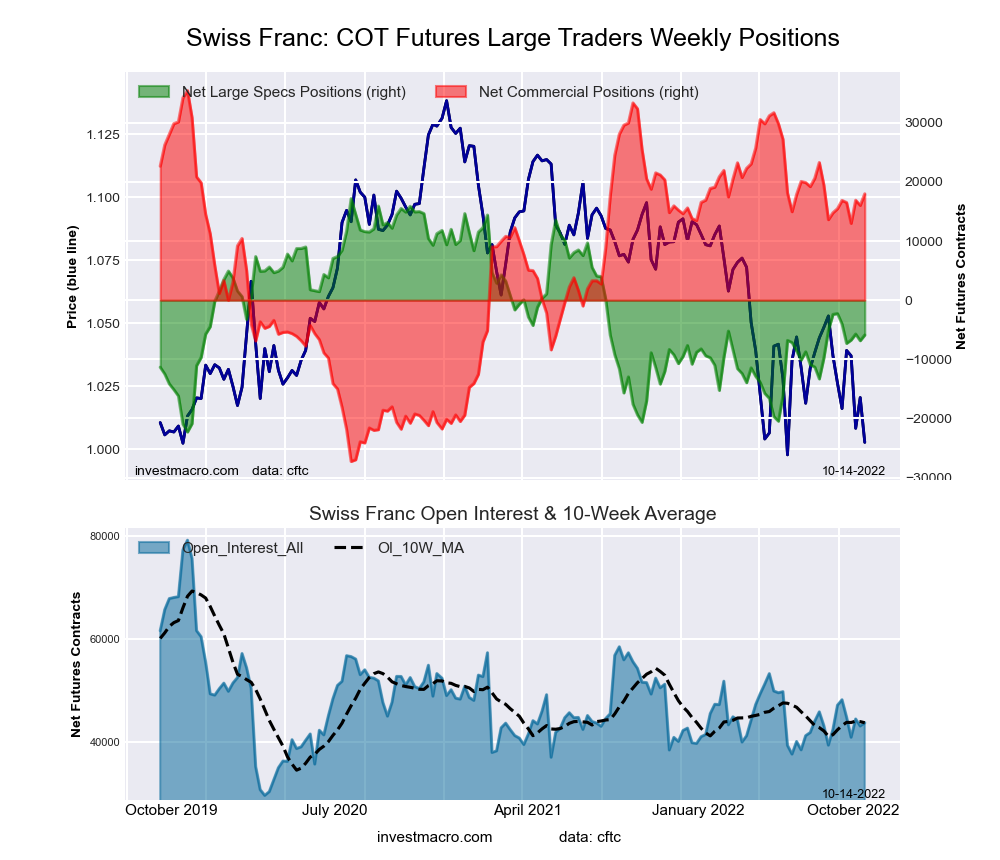
Swiss Franc Forex Futures COT ChartThe Swiss Franc large speculator standing this week came in at a net position of -7,305 contracts in the data reported through Tuesday. This was a weekly decrease of -3,268 contracts from the previous week which had a total of -4,037 net contracts.

This week’s current strength score (the trader positioning range over the past three years, measured from 0 to 100) shows the speculators are currently Bearish with a score of 38.0 percent. The commercials are Bullish with a score of 69.8 percent and the small traders (not shown in chart) are Bearish with a score of 26.4 percent.

SWISS FRANC StatisticsSPECULATORSCOMMERCIALSSMALL TRADERS
– Percent of Open Interest Longs:17.260.220.9
– Percent of Open Interest Shorts:33.523.441.4
– Net Position:-7,30516,512-9,207
– Gross Longs:7,70426,9889,355
– Gross Shorts:15,00910,47618,562
– Long to Short Ratio:0.5 to 12.6 to 10.5 to 1
NET POSITION TREND:
– Strength Index Score (3 Year Range Pct):38.069.826.4
– Strength Index Reading (3 Year Range):BearishBullishBearish
NET POSITION MOVEMENT INDEX:
– 6-Week Change in Strength Index:15.2-10.82.6


Canadian Dollar Futures:

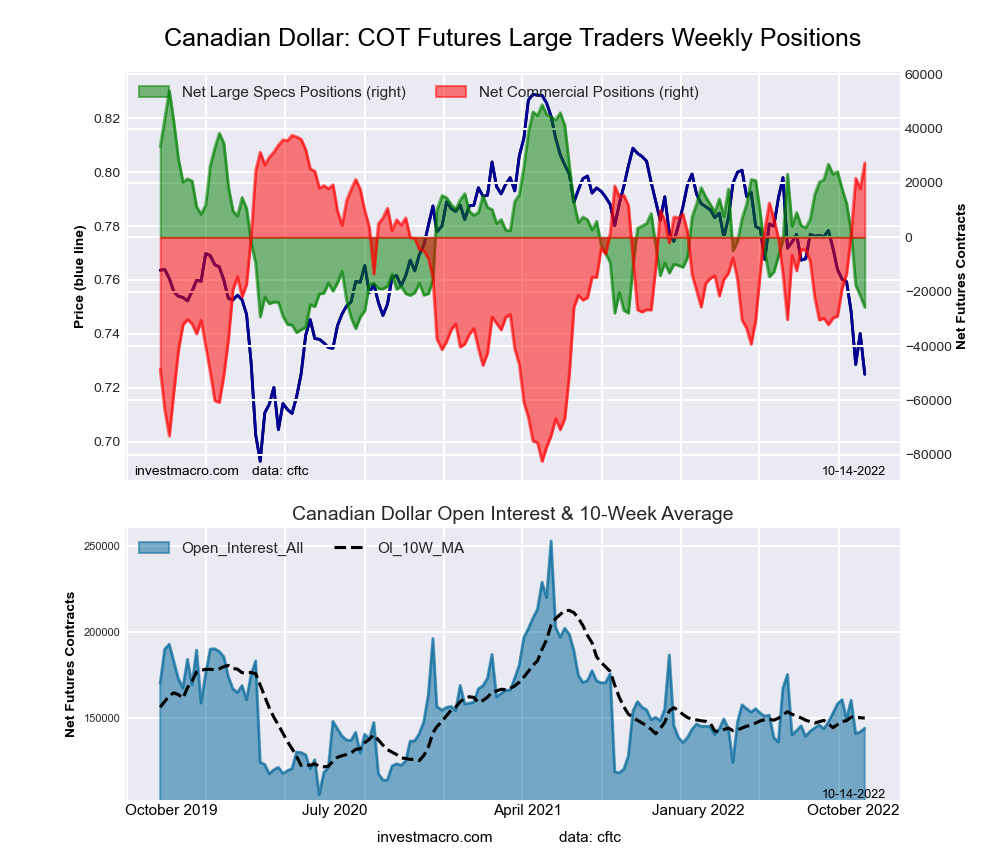
Canadian Dollar Forex Futures COT ChartThe Canadian Dollar large speculator standing this week came in at a net position of 12,425 contracts in the data reported through Tuesday. This was a weekly lowering of -5,485 contracts from the previous week which had a total of 17,910 net contracts.

This week’s current strength score (the trader positioning range over the past three years, measured from 0 to 100) shows the speculators are currently Bullish with a score of 53.3 percent. The commercials are Bullish with a score of 57.5 percent and the small traders (not shown in chart) are Bearish with a score of 32.2 percent.

CANADIAN DOLLAR StatisticsSPECULATORSCOMMERCIALSSMALL TRADERS
– Percent of Open Interest Longs:32.244.720.7
– Percent of Open Interest Shorts:23.953.720.0
– Net Position:12,425-13,4761,051
– Gross Longs:48,10266,86630,933
– Gross Shorts:35,67780,34229,882
– Long to Short Ratio:1.3 to 10.8 to 11.0 to 1
NET POSITION TREND:
– Strength Index Score (3 Year Range Pct):53.357.532.2
– Strength Index Reading (3 Year Range):BullishBullishBearish
NET POSITION MOVEMENT INDEX:
– 6-Week Change in Strength Index:-8.814.1-18.3


Australian Dollar Futures:

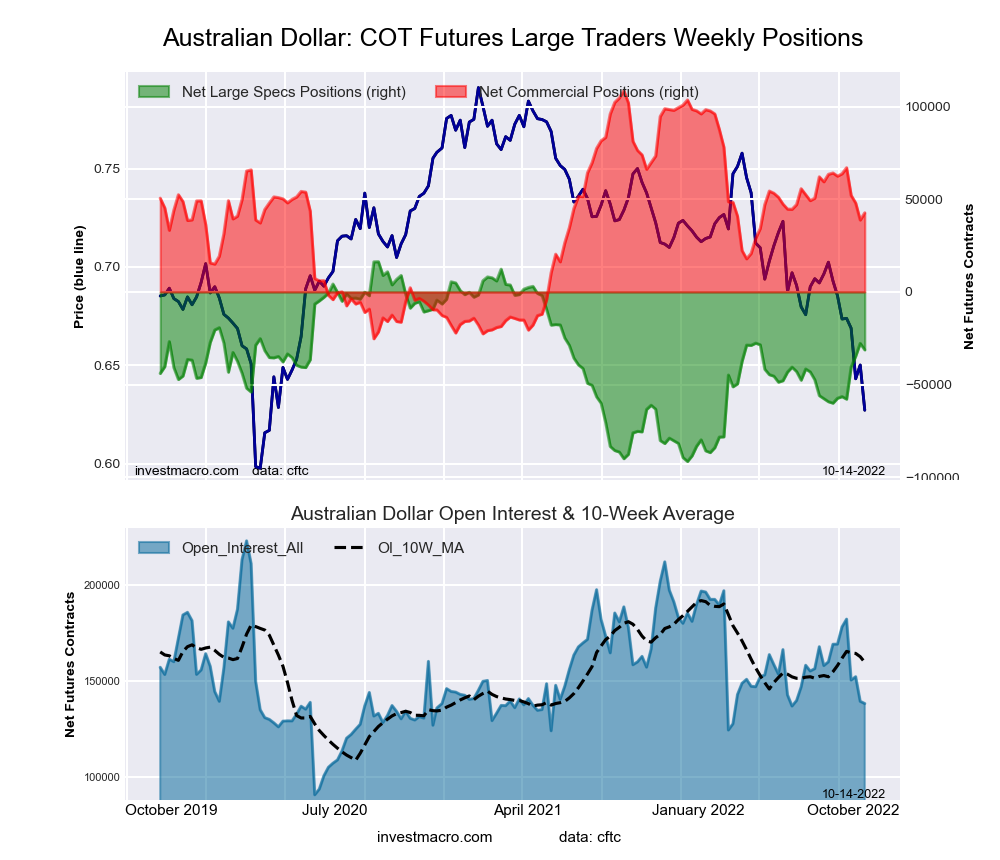
Australian Dollar Forex Futures COT ChartThe Australian Dollar large speculator standing this week came in at a net position of -57,850 contracts in the data reported through Tuesday. This was a weekly lowering of -1,350 contracts from the previous week which had a total of -56,500 net contracts.

This week’s current strength score (the trader positioning range over the past three years, measured from 0 to 100) shows the speculators are currently Bearish with a score of 31.2 percent. The commercials are Bullish with a score of 68.9 percent and the small traders (not shown in chart) are Bearish with a score of 30.1 percent.

AUSTRALIAN DOLLAR StatisticsSPECULATORSCOMMERCIALSSMALL TRADERS
– Percent of Open Interest Longs:16.066.012.1
– Percent of Open Interest Shorts:47.829.317.1
– Net Position:-57,85067,018-9,168
– Gross Longs:29,218120,39322,049
– Gross Shorts:87,06853,37531,217
– Long to Short Ratio:0.3 to 12.3 to 10.7 to 1
NET POSITION TREND:
– Strength Index Score (3 Year Range Pct):31.268.930.1
– Strength Index Reading (3 Year Range):BearishBullishBearish
NET POSITION MOVEMENT INDEX:
– 6-Week Change in Strength Index:-1.83.7-7.3


New Zealand Dollar Futures:

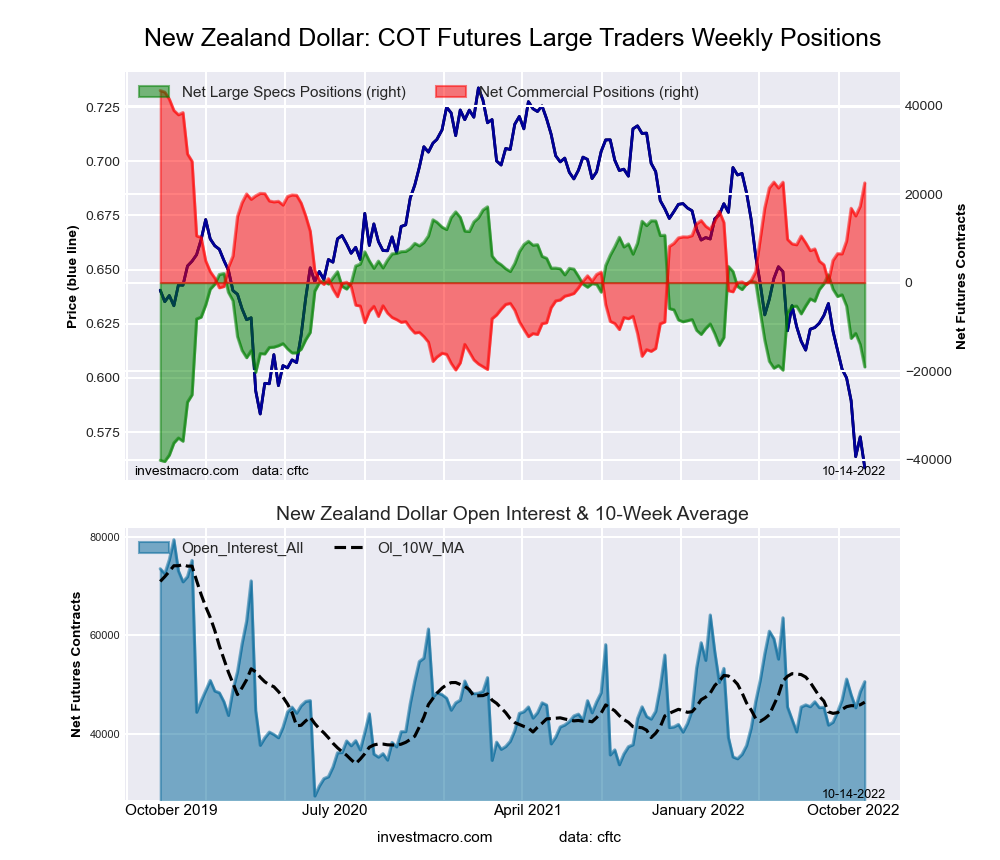
New Zealand Dollar Forex Futures COT ChartThe New Zealand Dollar large speculator standing this week came in at a net position of -5,301 contracts in the data reported through Tuesday. This was a weekly decrease of -2,555 contracts from the previous week which had a total of -2,746 net contracts.

This week’s current strength score (the trader positioning range over the past three years, measured from 0 to 100) shows the speculators are currently Bullish with a score of 62.4 percent. The commercials are Bearish with a score of 44.9 percent and the small traders (not shown in chart) are Bearish-Extreme with a score of 4.4 percent.

NEW ZEALAND DOLLAR StatisticsSPECULATORSCOMMERCIALSSMALL TRADERS
– Percent of Open Interest Longs:35.153.84.9
– Percent of Open Interest Shorts:45.535.312.9
– Net Position:-5,3019,408-4,107
– Gross Longs:17,94927,4582,498
– Gross Shorts:23,25018,0506,605
– Long to Short Ratio:0.8 to 11.5 to 10.4 to 1
NET POSITION TREND:
– Strength Index Score (3 Year Range Pct):62.444.94.4
– Strength Index Reading (3 Year Range):BullishBearishBearish-Extreme
NET POSITION MOVEMENT INDEX:
– 6-Week Change in Strength Index:-6.37.0-9.5


Mexican Peso Futures:

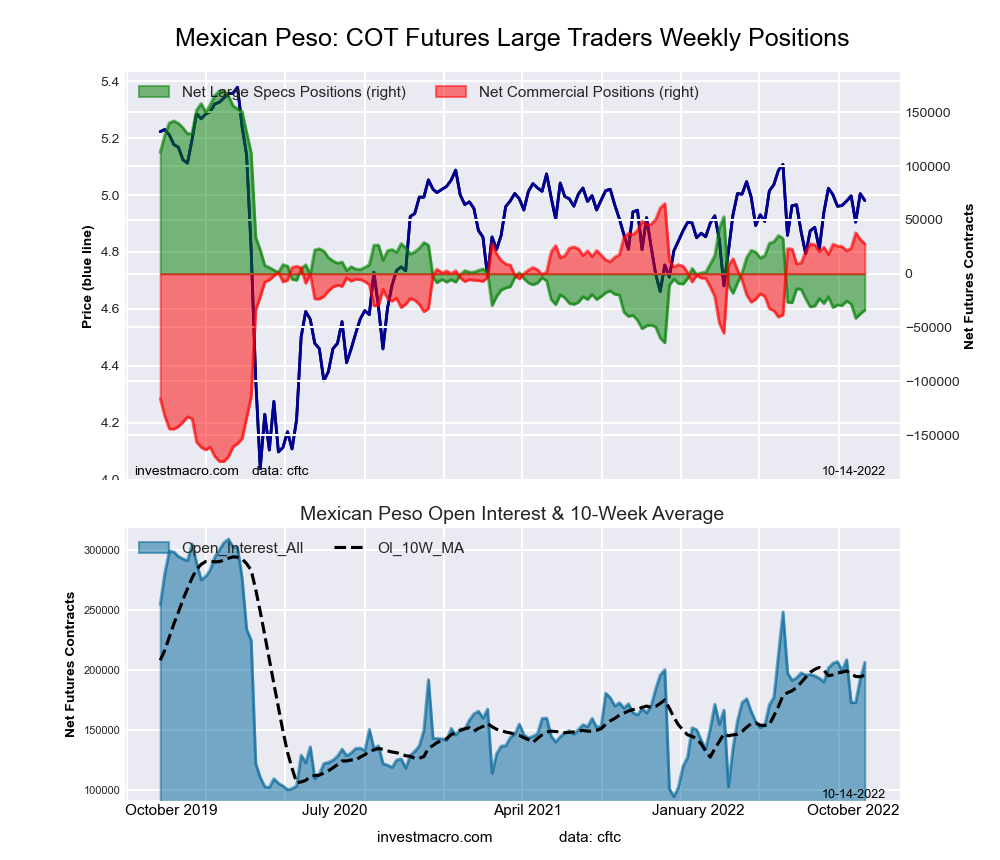
Mexican Peso Futures COT ChartThe Mexican Peso large speculator standing this week came in at a net position of -25,381 contracts in the data reported through Tuesday. This was a weekly boost of 4,079 contracts from the previous week which had a total of -29,460 net contracts.

This week’s current strength score (the trader positioning range over the past three years, measured from 0 to 100) shows the speculators are currently Bearish-Extreme with a score of 16.5 percent. The commercials are Bullish-Extreme with a score of 81.7 percent and the small traders (not shown in chart) are Bullish with a score of 60.2 percent.

MEXICAN PESO StatisticsSPECULATORSCOMMERCIALSSMALL TRADERS
– Percent of Open Interest Longs:49.842.83.6
– Percent of Open Interest Shorts:62.032.61.6
– Net Position:-25,38121,3334,048
– Gross Longs:103,77289,2607,469
– Gross Shorts:129,15367,9273,421
– Long to Short Ratio:0.8 to 11.3 to 12.2 to 1
NET POSITION TREND:
– Strength Index Score (3 Year Range Pct):16.581.760.2
– Strength Index Reading (3 Year Range):Bearish-ExtremeBullish-ExtremeBullish
NET POSITION MOVEMENT INDEX:
– 6-Week Change in Strength Index:-1.00.37.2


Brazilian Real Futures:

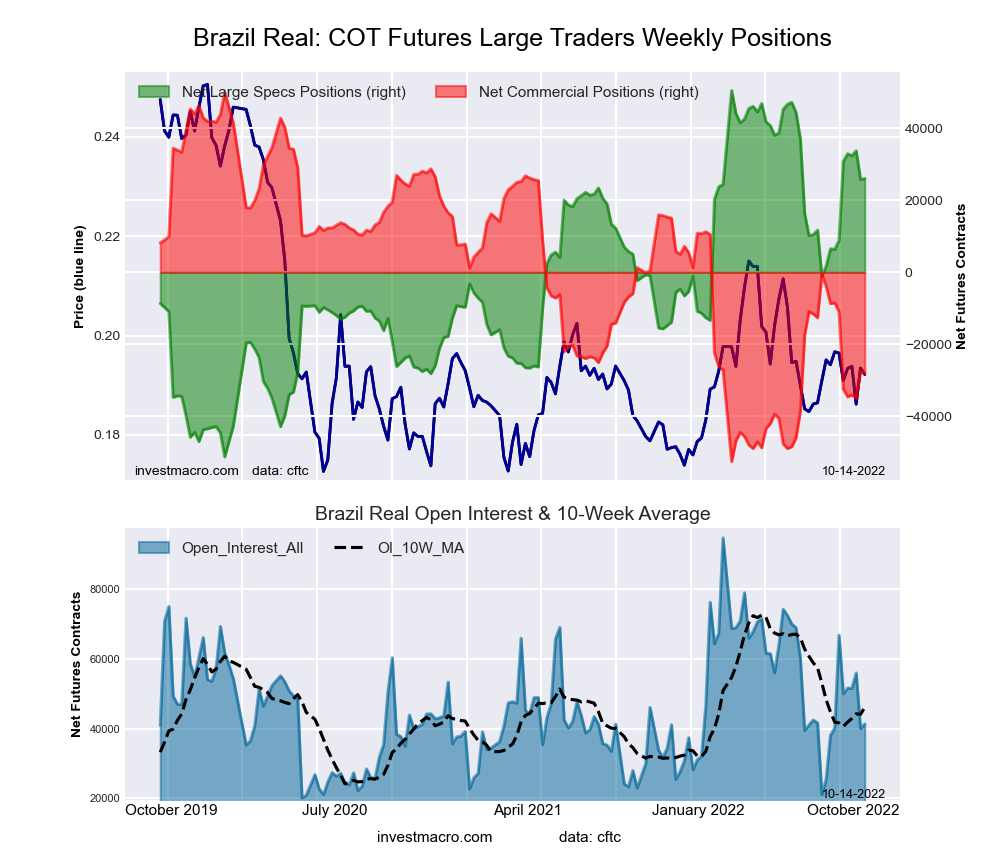
Brazil Real Futures COT ChartThe Brazilian Real large speculator standing this week came in at a net position of 32,953 contracts in the data reported through Tuesday. This was a weekly gain of 2,093 contracts from the previous week which had a total of 30,860 net contracts.

This week’s current strength score (the trader positioning range over the past three years, measured from 0 to 100) shows the speculators are currently Bullish-Extreme with a score of 82.8 percent. The commercials are Bearish-Extreme with a score of 17.5 percent and the small traders (not shown in chart) are Bullish-Extreme with a score of 83.8 percent.

BRAZIL REAL StatisticsSPECULATORSCOMMERCIALSSMALL TRADERS
– Percent of Open Interest Longs:81.812.06.2
– Percent of Open Interest Shorts:17.979.03.1
– Net Position:32,953-34,5771,624
– Gross Longs:42,1926,1863,203
– Gross Shorts:9,23940,7631,579
– Long to Short Ratio:4.6 to 10.2 to 12.0 to 1
NET POSITION TREND:
– Strength Index Score (3 Year Range Pct):82.817.583.8
– Strength Index Reading (3 Year Range):Bullish-ExtremeBearish-ExtremeBullish-Extreme
NET POSITION MOVEMENT INDEX:
– 6-Week Change in Strength Index:33.5-33.2-0.8


Bitcoin Futures:

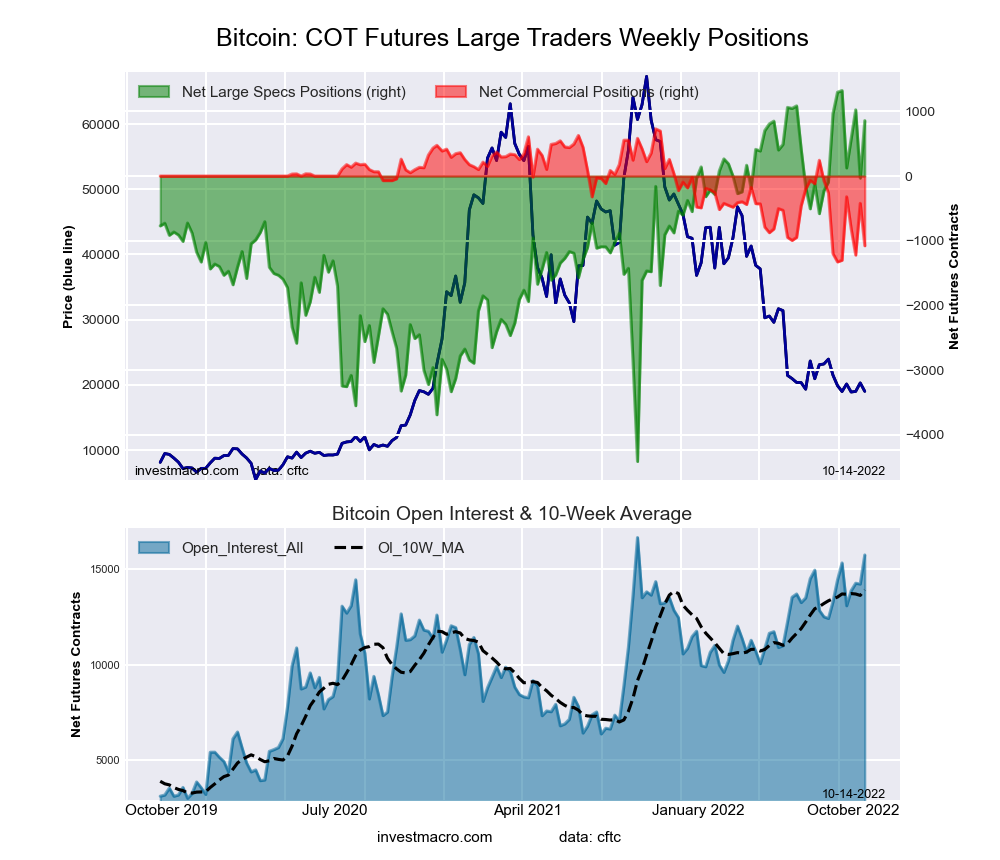
Bitcoin Crypto Futures COT ChartThe Bitcoin large speculator standing this week came in at a net position of 126 contracts in the data reported through Tuesday. This was a weekly lowering of -1,196 contracts from the previous week which had a total of 1,322 net contracts.

This week’s current strength score (the trader positioning range over the past three years, measured from 0 to 100) shows the speculators are currently Bullish with a score of 79.1 percent. The commercials are Bearish with a score of 49.0 percent and the small traders (not shown in chart) are Bearish-Extreme with a score of 17.3 percent.

BITCOIN StatisticsSPECULATORSCOMMERCIALSSMALL TRADERS
– Percent of Open Interest Longs:78.44.27.2
– Percent of Open Interest Shorts:77.56.65.7
– Net Position:126-320194
– Gross Longs:10,268546944
– Gross Shorts:10,142866750
– Long to Short Ratio:1.0 to 10.6 to 11.3 to 1
NET POSITION TREND:
– Strength Index Score (3 Year Range Pct):79.149.017.3
– Strength Index Reading (3 Year Range):BullishBearishBearish-Extreme
NET POSITION MOVEMENT INDEX:
– 6-Week Change in Strength Index:12.3-27.4-3.3


Article By InvestMacroReceive our weekly COT Reports by Email

*COT Report: The COT excel data, released weekly to the public each Friday, is updated through the most recent Tuesday (data is 3 days old) and shows a quick view of how large speculators or non-commercials (for-profit traders) were positioned in the futures markets.

The CFTC categorizes trader positions according to commercial hedgers (traders who use futures contracts for hedging as part of the business), non-commercials (large traders who speculate to realize trading profits) and nonreportable traders (usually small traders/speculators) as well as their open interest (contracts open in the market at time of reporting). See CFTC criteria here.


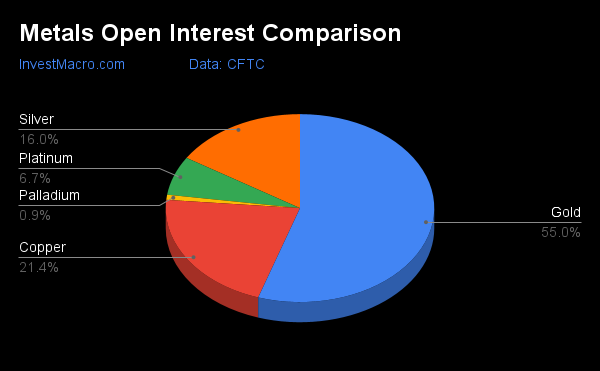
Weekly COT Metals Speculator bets led higher by Silver, Copper & Platinum

By InvestMacro

Here are the latest charts and statistics for the Commitment of Traders (COT) reports data published by the Commodities Futures Trading Commission (CFTC).

The latest COT data is updated through Tuesday September 13th and shows a quick view of how large traders (for-profit speculators and commercial hedgers) were positioned in the futures markets.

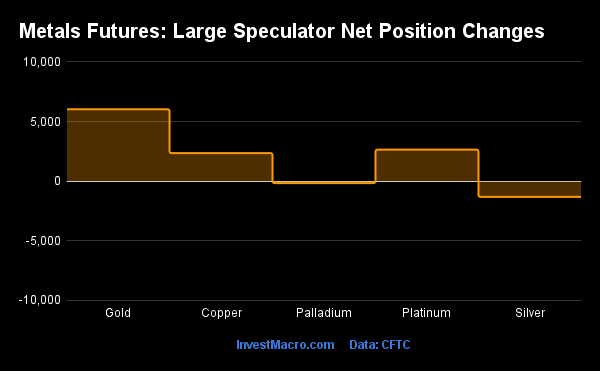
Weekly Speculator Changes led higher by Silver, Copper & Platinum

The COT precious metals speculator bets were higher this week as four out of the five metals markets we cover had higher positioning this week with just one market having decreasing contracts.

Leading the gains for the precious metals markets was Silver (8,144 contracts) with Copper (5,004 contracts), Platinum (4,872 contracts) and Palladium (329 contracts) also showing positive weeks.

The metals markets leading the declines in speculator bets this week was Gold with a decline of -6,513 contracts the week.

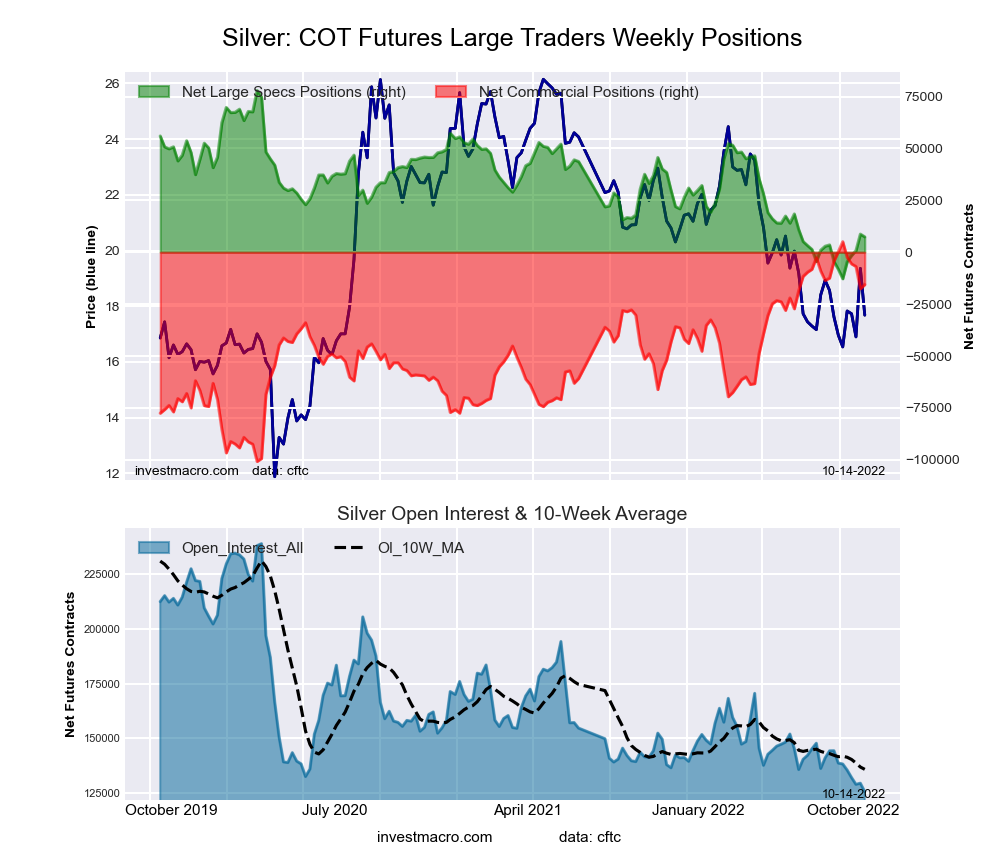
Highlighting the COT metals data this week was Silver’s gain that stopped a streak of three straight weeks of declines. Silver speculator positions had fallen by a total of -16,292 contracts in the past three weeks to drop to the most bearish level since May 28th of 2019, a span of 171 weeks. The Silver price has been showing resilience between the $18 to $20 range over the past twelve weeks and closed this week over the $19.30 price level.


Data Snapshot of Commodity Market Traders | Columns Legend
Sep-13-2022OIOI-IndexSpec-NetSpec-IndexCom-NetCOM-IndexSmalls-NetSmalls-Index
WTI Crude1,498,0593227,0574-244,0079816,95028
Gold463,674397,3442-110,9389913,5949
Silver135,5303-4,6409-2,551937,1914
Copper157,9000-18,9862320,51280-1,52616
Palladium6,0851-1,273161,45583-18233
Platinum68,57436-1,8797-2,051933,93017
Natural Gas977,1164-145,71535110,7946634,92163
Brent164,41512-39,0234634,919514,10465
Heating Oil290,9163116,06466-31,3533815,28951
Soybeans643,0181592,11042-61,42468-30,68619
Corn1,310,4116294,56968-234,17939-60,3908
Coffee197,6571042,26775-44,360292,09319
Sugar751,873968,33051-79,4265311,09622
Wheat287,0460-8,128812,97778-4,84985


Strength Scores

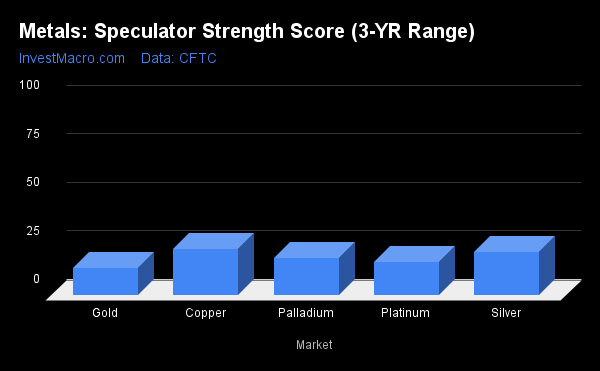
Strength scores (a measure of the 3-Year range of Speculator positions, from 0 to 100 where above 80 is extreme bullish and below 20 is extreme bearish) showed that Copper (22.7 percent) leads the metals markets and is just out of a bearish extreme level (below 20 percent).

On the downside, all the other markets are currently below 20 percent and in bearish extreme positions. Gold (1.8 percent) continues to be at the lowest strength level and near the bottom of it 3-Year range. Platinum (6.6 percent), Silver (9.0 percent) and Palladium (15.7 percent) are the next lowest markets.


Strength Statistics:
Gold (1.8 percent) vs Gold previous week (4.3 percent)
Silver (9.0 percent) vs Silver previous week (0.0 percent)
Copper (22.7 percent) vs Copper previous week (18.8 percent)
Platinum (6.6 percent) vs Platinum previous week (0.0 percent)
Palladium (15.7 percent) vs Palladium previous week (13.8 percent)

Strength Trends led by Palladium and Copper

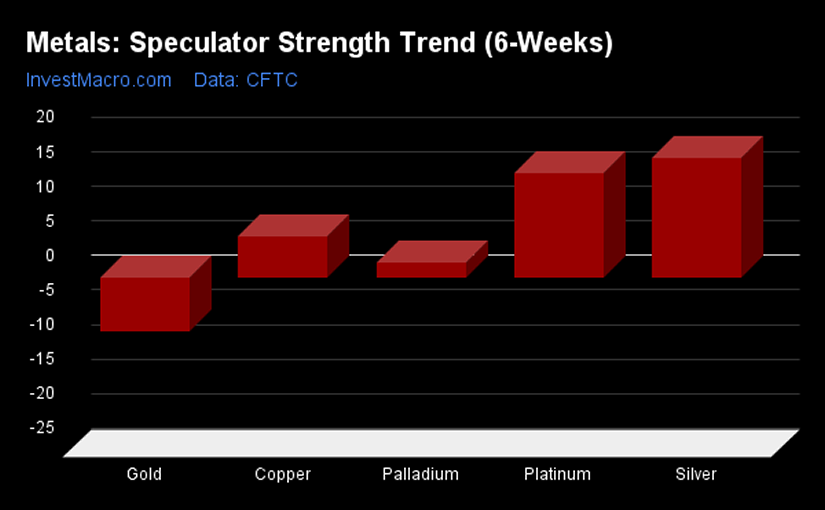
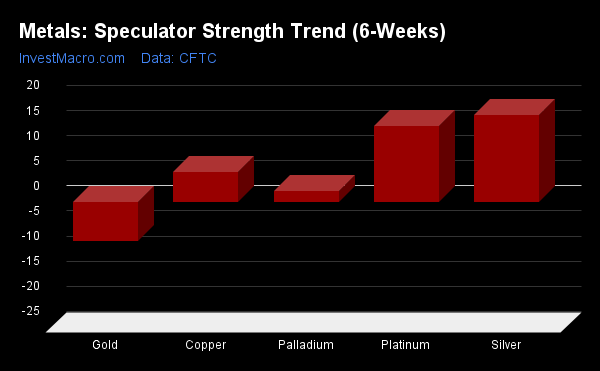
Strength Score Trends (or move index, calculates the 6-week changes in strength scores) showed that Palladium (7.2 percent) leads the past six weeks trends for metals this week. Copper (6.6 percent) and Platinum (0.9 percent) are the only other positive movers in the latest trends data.

Gold (-10.3 percent) leads the downside trend scores currently followed by Silver with a -6.2 percent trend score.


Move Statistics:
Gold (-10.3 percent) vs Gold previous week (4.3 percent)
Silver (-6.2 percent) vs Silver previous week (-9.1 percent)
Copper (6.6 percent) vs Copper previous week (2.0 percent)
Platinum (0.9 percent) vs Platinum previous week (-3.1 percent)
Palladium (7.2 percent) vs Palladium previous week (10.2 percent)


Individual Markets:

Gold Comex Futures:

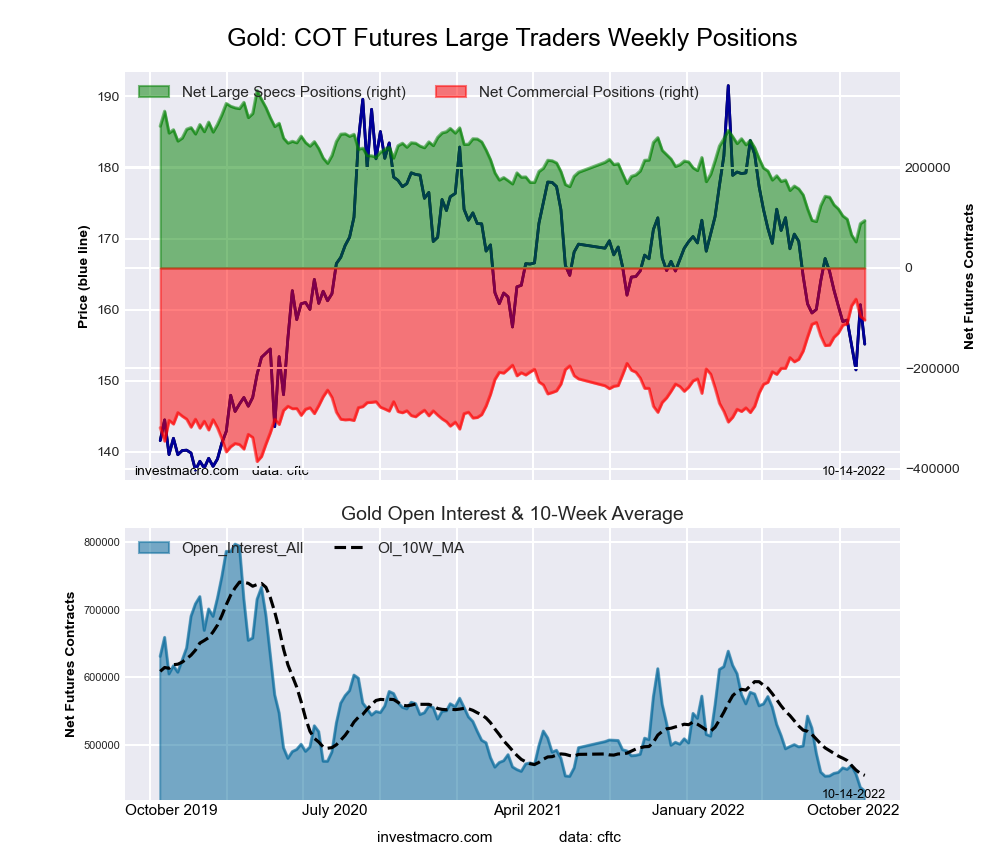
Gold Futures COT ChartThe Gold Comex Futures large speculator standing this week totaled a net position of 97,344 contracts in the data reported through Tuesday. This was a weekly decrease of -6,513 contracts from the previous week which had a total of 103,857 net contracts.

This week’s current strength score (the trader positioning range over the past three years, measured from 0 to 100) shows the speculators are currently Bearish-Extreme with a score of 1.8 percent. The commercials are Bullish-Extreme with a score of 99.1 percent and the small traders (not shown in chart) are Bearish-Extreme with a score of 9.0 percent.

Gold Futures StatisticsSPECULATORSCOMMERCIALSSMALL TRADERS
– Percent of Open Interest Longs:48.727.48.7
– Percent of Open Interest Shorts:27.751.35.8
– Net Position:97,344-110,93813,594
– Gross Longs:225,932126,95040,556
– Gross Shorts:128,588237,88826,962
– Long to Short Ratio:1.8 to 10.5 to 11.5 to 1
NET POSITION TREND:
– Strength Index Score (3 Year Range Pct):1.899.19.0
– Strength Index Reading (3 Year Range):Bearish-ExtremeBullish-ExtremeBearish-Extreme
NET POSITION MOVEMENT INDEX:
– 6-Week Change in Strength Index:-10.38.96.3


Silver Comex Futures:

Silver Futures COT ChartThe Silver Comex Futures large speculator standing this week totaled a net position of -4,640 contracts in the data reported through Tuesday. This was a weekly advance of 8,144 contracts from the previous week which had a total of -12,784 net contracts.

This week’s current strength score (the trader positioning range over the past three years, measured from 0 to 100) shows the speculators are currently Bearish-Extreme with a score of 9.0 percent. The commercials are Bullish-Extreme with a score of 92.8 percent and the small traders (not shown in chart) are Bearish-Extreme with a score of 3.8 percent.

Silver Futures StatisticsSPECULATORSCOMMERCIALSSMALL TRADERS
– Percent of Open Interest Longs:39.438.216.1
– Percent of Open Interest Shorts:42.840.110.8
– Net Position:-4,640-2,5517,191
– Gross Longs:53,37351,82221,808
– Gross Shorts:58,01354,37314,617
– Long to Short Ratio:0.9 to 11.0 to 11.5 to 1
NET POSITION TREND:
– Strength Index Score (3 Year Range Pct):9.092.83.8
– Strength Index Reading (3 Year Range):Bearish-ExtremeBullish-ExtremeBearish-Extreme
NET POSITION MOVEMENT INDEX:
– 6-Week Change in Strength Index:-6.26.2-4.4


Copper Grade #1 Futures:

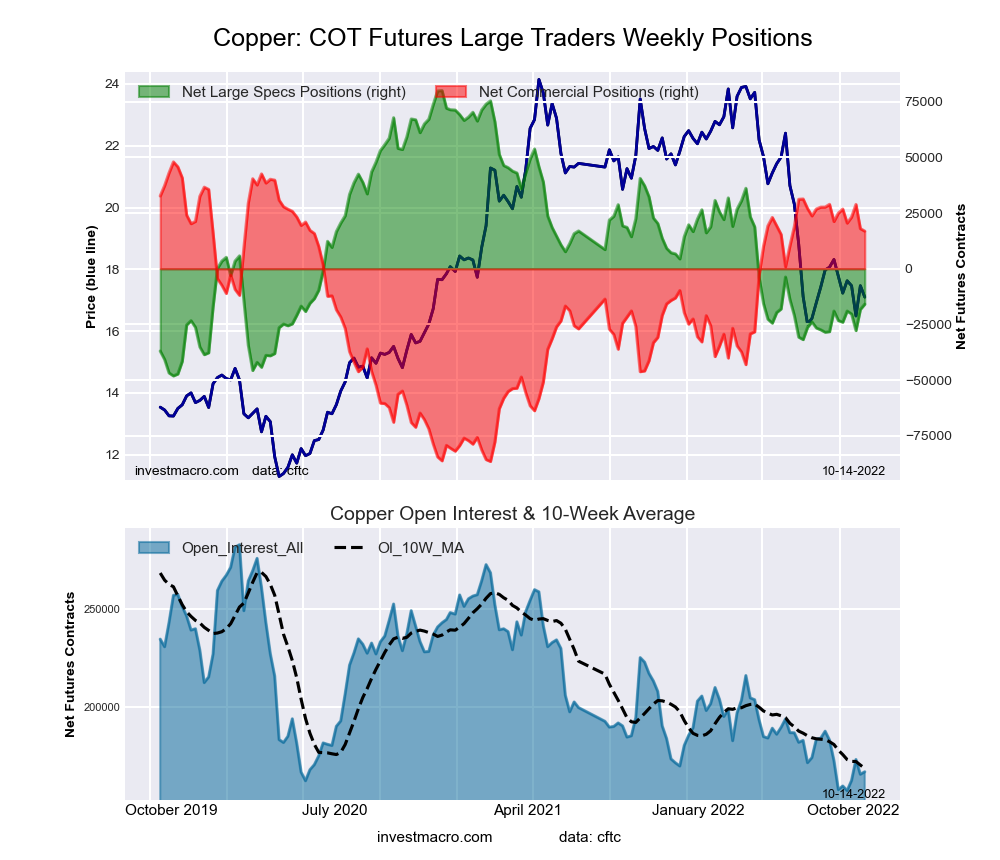
Copper Futures COT ChartThe Copper Grade #1 Futures large speculator standing this week totaled a net position of -18,986 contracts in the data reported through Tuesday. This was a weekly advance of 5,004 contracts from the previous week which had a total of -23,990 net contracts.

This week’s current strength score (the trader positioning range over the past three years, measured from 0 to 100) shows the speculators are currently Bearish with a score of 22.7 percent. The commercials are Bullish with a score of 79.6 percent and the small traders (not shown in chart) are Bearish-Extreme with a score of 16.5 percent.

Copper Futures StatisticsSPECULATORSCOMMERCIALSSMALL TRADERS
– Percent of Open Interest Longs:28.249.88.7
– Percent of Open Interest Shorts:40.336.89.7
– Net Position:-18,98620,512-1,526
– Gross Longs:44,57478,68213,738
– Gross Shorts:63,56058,17015,264
– Long to Short Ratio:0.7 to 11.4 to 10.9 to 1
NET POSITION TREND:
– Strength Index Score (3 Year Range Pct):22.779.616.5
– Strength Index Reading (3 Year Range):BearishBullishBearish-Extreme
NET POSITION MOVEMENT INDEX:
– 6-Week Change in Strength Index:6.6-5.3-7.3


Platinum Futures:

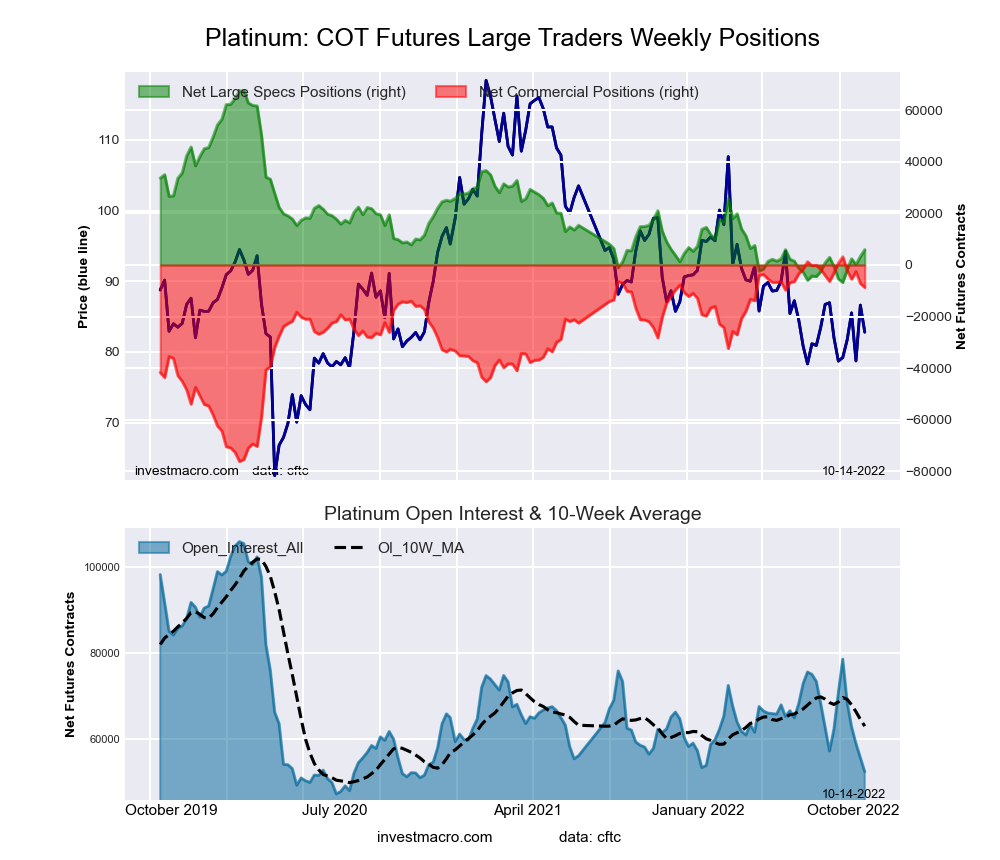
Platinum Futures COT ChartThe Platinum Futures large speculator standing this week totaled a net position of -1,879 contracts in the data reported through Tuesday. This was a weekly rise of 4,872 contracts from the previous week which had a total of -6,751 net contracts.

This week’s current strength score (the trader positioning range over the past three years, measured from 0 to 100) shows the speculators are currently Bearish-Extreme with a score of 6.6 percent. The commercials are Bullish-Extreme with a score of 93.4 percent and the small traders (not shown in chart) are Bearish-Extreme with a score of 16.8 percent.

Platinum Futures StatisticsSPECULATORSCOMMERCIALSSMALL TRADERS
– Percent of Open Interest Longs:44.638.611.0
– Percent of Open Interest Shorts:47.341.65.3
– Net Position:-1,879-2,0513,930
– Gross Longs:30,55226,4737,567
– Gross Shorts:32,43128,5243,637
– Long to Short Ratio:0.9 to 10.9 to 12.1 to 1
NET POSITION TREND:
– Strength Index Score (3 Year Range Pct):6.693.416.8
– Strength Index Reading (3 Year Range):Bearish-ExtremeBullish-ExtremeBearish-Extreme
NET POSITION MOVEMENT INDEX:
– 6-Week Change in Strength Index:0.9-0.4-4.5


Palladium Futures:

Palladium Futures COT ChartThe Palladium Futures large speculator standing this week totaled a net position of -1,273 contracts in the data reported through Tuesday. This was a weekly advance of 329 contracts from the previous week which had a total of -1,602 net contracts.

This week’s current strength score (the trader positioning range over the past three years, measured from 0 to 100) shows the speculators are currently Bearish-Extreme with a score of 15.7 percent. The commercials are Bullish-Extreme with a score of 82.9 percent and the small traders (not shown in chart) are Bearish with a score of 33.3 percent.

Palladium Futures StatisticsSPECULATORSCOMMERCIALSSMALL TRADERS
– Percent of Open Interest Longs:22.761.115.0
– Percent of Open Interest Shorts:43.637.217.9
– Net Position:-1,2731,455-182
– Gross Longs:1,3823,720910
– Gross Shorts:2,6552,2651,092
– Long to Short Ratio:0.5 to 11.6 to 10.8 to 1
NET POSITION TREND:
– Strength Index Score (3 Year Range Pct):15.782.933.3
– Strength Index Reading (3 Year Range):Bearish-ExtremeBullish-ExtremeBearish
NET POSITION MOVEMENT INDEX:
– 6-Week Change in Strength Index:7.2-7.20.1


Article By InvestMacroReceive our weekly COT Reports by Email

*COT Report: The COT data, released weekly to the public each Friday, is updated through the most recent Tuesday (data is 3 days old) and shows a quick view of how large speculators or non-commercials (for-profit traders) were positioned in the futures markets.

The CFTC categorizes trader positions according to commercial hedgers (traders who use futures contracts for hedging as part of the business), non-commercials (large traders who speculate to realize trading profits) and nonreportable traders (usually small traders/speculators) as well as their open interest (contracts open in the market at time of reporting). See CFTC criteria here.

Why is gold back below $1700?

By ForexTime

Spot gold is currently trading below the psychologically-important $1700 level, and is on course towards revisiting the lows seen in mid-June.


Here are more data points that make for gloomy reading for gold bulls (those hoping that gold prices will climb):

  • Gold has fallen by 7.8% so far this year
  • Gold has suffered 5 straight months of declines (April – August), its longest monthly losing streak since 2018
  • Bullion-backed ETFs have lowered their gold holdings for a 13th consecutive day (i.e. investors are ditching gold)

So why has gold performed so poorly so far in 2022?

It’s all down to the Federal Reserve.

And here’s a quick summary of what you’re about to read:

More Fed rate hikes = stronger US dollar / higher US Treasury yields = lower gold

To better understand the forces that are driving gold prices lower, read on.

Why is the Fed raising interest rates?

The US Federal Reserve has been raising interest rates as the central bank’s main policy weapon against stubbornly persistent inflation.

The August consumer price index (used to measure the headline inflation rate) released earlier this week showed a higher-than-expected 8.3% growth.

While that 8.3% number is lower than June’s 9.1% CPI, it’s still about 4 times higher than the Fed’s 2% inflation target.

In other words, inflation is still stubbornly high despite the Fed having already hiked rates by 225 basis points since March, and counting, to try and bring that inflation down.

The inflation data suggests that the Fed has to hike rates even higher:

  • Markets are forecasting a 25% chance of a 100 basis point hike at its FOMC policy meeting next week.
    If such a gargantuan move happens, that 100bps move would be 4 times bigger than the usual 25bps adjustments per policy meeting typically employed by major central bankers, at least over the past few decades.
  • Markets currently expect US interest rates to peak at around 4.4%, from the current 2.5%, excluding next week’s expected hike.
    That’s a major shift compared to expectations as of just last week, when markets expect US rates to peak at 4%.
    With these updated expectations, that suggests another 190 basis points more that US interest rates could climb.

How do Fed rate hikes influence gold prices?

Here’s a oversimplified narrative for how the above works:

  1. Fed sends US interest rates higher, investors then ditch US Treasuries, pushing Treasury prices lower.
  2. As US Treasury prices fall, their yields go up (investors get paid a higher interest from holding on to those US government bonds).
  3. When US Treasury yields go up, they eventually become more attractive to foreign investors.
  4. These investors then buy up the US dollar, so they can purchase more US assets.

But when the US dollar/yields climb, gold becomes less appealing because of these two features for the precious metal:

  1. Gold is a zero-yielding asset.
    Investors do not get paid any income for holding on to gold.

    Hence, when investors are promised higher yields on US Treasuries, they tend to favor lending their money to the US government in return for those higher interest payments, as opposed to parking their money in gold which does not pay interest.

  2. Also, gold has an inverse relationship with the US dollar.
    When the dollar goes up, gold typically goes down, and vice versa.

    This is because, when foreign investors need to use more of their currency to buy the more-expensive US dollar in order to purchase gold (the precious metal’s benchmark price is denominated in US dollars), those expensive price tags then make gold less appealing.

    ECONS 101: Demand falls when prices go up.


Here’s a chart showing how much the US dollar has risen this year, as measures by the DXY (the benchmark index used to measure the US dollar’s overall performance against its G10 peers) which is now at its highest levels since 2002.

READ MORE:


So where to next for gold?

At least gold bulls can take heart from the price action since mid-2020, whereby forays below $1700 have proved short-lived.

As you can see on the weekly chart below, quite a few notable support levels can be seen in a wide range between $1660.03 – $1685.15.

Gold’s 200-week simple moving average (SMA) also hovers in this region ($1676 at the time of writing). This major technical indicator potentially offering support as well.

In other words, gold may not have that much further to fall, provided these support levels close by do hold up.


However, once you strip away the wild price swings at the onset of the global pandemic, there appears to be little by way of major support before hurtling down to sub-$1600 levels.

Alternatively, one could employ the price action from back in the 2011-2013 period to draw support levels.

Though bear in mind, support levels from a decade ago are less relevant to today’s markets, given the substantially different market and macroeconomic environment that we currently find ourselves (e.g. US inflation being at its highest in over 40 years).


Overall, gold’s safe haven status has clearly been eroded by the Fed’s ongoing rate-hiking cycle.

Despite the still-raging war in the Ukraine, along with rising fears of a looming global recession, the precious metal’s traditional role as a way to preserve investors’ wealth has been found lacking, in light of the downward pressures stemming from rising US yields and the dollar.


Ultimately, gold’s immediate fortunes will likely depend on how high markets expect the Fed to send interest rates.

As things stand, markets are forecasting that US interest rates will peak at 4.4% by March, from the 2.5% currently (before next week’s highly-anticipated FOMC rate decision).

If markets believe that the Fed has to send interest rates even higher past 4.4% in order to subdue the inflation beast, that should heap more downward pressure on gold prices.


Forex-Time-LogoArticle by ForexTime
ForexTime Ltd (FXTM) is an award winning international online forex broker regulated by CySEC 185/12 www.forextime.com

The Merge is here: the most important crypto event since Bitcoin’s launch?

By George Prior 

The Ethereum Merge is a “landmark, historic moment” for the entire cryptocurrency market that will be a “major catalyst” driving prices higher in the long term, predicts the CEO of one of the world’s largest independent financial advisory, asset management and fintech organizations.

The bullish prediction from deVere Group’s Nigel Green comes as the long-awaited so-called Merge of the world’s second-largest crypto, Ethereum, has just happened.

The Merge is a major overhaul and switch over to a new operating model that will use 99.9% less energy and will reduce supply of the crypto.

He says: “The years-in-the-making Merge, a network-wide, grand scale upgrade is here.

“This is far-reaching overhaul of the most commercially important blockchain in the digital asset ecosystem is probably the most important, landmark event in crypto history, since the launch of Bitcoin.

“It transforms Ethereum from a proof-of-work to a proof-of-stake mechanism, which lowers transaction costs, enables the network to process more transactions in a shorter amount of time, and will slash energy consumption by a massive 99%.”

The deVere CEO and high-profile cryptocurrency advocate predicts that the “historic occurrence” will fuel prices across the market.

“Whilst some of the news has been priced-in already, let there be no mistake: this event will be a major catalyst driving prices higher in the long term,” he affirms.

“The slashing of energy consumption will be the main reason as it will become significantly more appealing to institutional investors, who bring with them enormous capital, expertise and reputational pull.

“Those institutional investors who have been sitting on the sidelines are now likely to move in.”

He goes on to add: “Besides having a more positive climate impact, The Merge’s effect of reducing supply, cutting costs and speeding up transactions will also appeal to both individuals and institutions.

“Due to the significance of The Merge, we expect the developments to bolster prices across the wider crypto market to some degree.”

Nigel Green has for many years spoken about the potential of Ethereum.  He has previously spoken in the media about it “being more useful than Bitcoin and having tech advantages over its better-known rival.”

He concludes: “The Merge represents a major boost not just for Ethereum but for blockchain technology itself.

“This is a momentous day for crypto.”

About:

deVere Group is one of the world’s largest independent advisors of specialist global financial solutions to international, local mass affluent, and high-net-worth clients.  It has a network of more than 70 offices across the world, over 80,000 clients and $12bn under advisement.


Fed likely to stay the course on interest rate hike as inflation ticks up but gas prices ease

By Edouard Wemy, Clark University 

The Federal Reserve received mixed news in the latest data on U.S. inflation as it mulls another rate hike.

Consumer prices rose 8.3% in August from a year earlier, data released on Sept. 13, 2022, shows. While this pace is down from the 8.5% annual gain experienced in July, it’s still higher than what some economists had expected.

The increase comes despite efforts by the U.S. central bank to tamp down the rising cost of living by repeatedly upping baseline interest rates to slow the economy.

It will give the Fed encouragement to opt for a third straight 0.75 percentage point interest rate hike when it meets Sept. 20-21. But despite suggestions that the rate-setters might apply the economy’s brakes more aggressively – by means of a full 1 percentage point rate jump – I believe this is unlikely based on which goods went up in price and which did not in the latest data.

On a month-to-month basis, the categories of food and shelter saw some of the steepest gains. Food prices increased by 0.8% in August, with eating out jumping at a higher rate than buying groceries. Although this will disappoint consumers hoping to see a drop in food prices, August’s data does at least show that the rate of increase is slowing – down from gains of over 1% in recent months.

The same isn’t true for shelter, which rose 0.7% in August, the biggest one-month increase since 1990.

On their own, these increases would be cause for concern for the Fed – suggesting that attempts to cool inflation through rate hikes haven’t worked. But elsewhere there is one big indicator that overall inflation may soon be heading south: gas prices.

The gasoline index dropped by 10.6% in August, one of the biggest one-month declines ever, following a drop of 7.7% in July.

This is likely the result of a number of factors, both global in the shape of an easing in the supply issues that had driven costs up, and national with Americans changing their travel habits and driving less to minimize the effects of earlier gas price increases. This change in behavior has translated into lower demand and contributed to an overall decline in prices.

And the thing about gas prices is that any change has a knock-on effect on the prices of other commodities. Lower gas prices should mean the cost of transporting goods, including food, will go down over time. This should eventually bring down grocery bills.

Similarly, lower gas prices will eventually filter into energy costs. Lower energy bills may be a relief to renters and homeowners alike. As to rent inflation, that is trickier for the Fed to manage. More interest rate hikes should dampen the property market, but making it harder for people to buy homes means the demand for rental units increases – something that would put more upward pressure on rents. All this puts the Fed in a very tricky situation.

Although the latest inflation report wasn’t exactly what monetary policymakers at the Fed would have been looking for, I don’t believe it suggests that its policy of late hasn’t worked.

Overall the consumer price index increased at a slower pace than in recent months. And given that gas prices have declined, the Fed will likely want to wait and see what effect this has on inflation before deciding to get more aggressive with rate increases.The Conversation

About the Author:

Edouard Wemy, Assistant Professor of Economics, Clark University

This article is republished from The Conversation under a Creative Commons license. Read the original article.

Mid-Week Technical Outlook: Indices

By ForexTime 

A sense of normality returned to financial markets on Wednesday after the utter chaos witnessed in the previous session.

The hotter-than-expected US inflation report detonated explosive levels of volatility across the board as fears intensified over the Fed triggering a recession to control inflation. US consumer prices rose 8.3% in the year to August, down from July’s 8.5% number but higher than the 8.1% market forecast. Traders have priced in the chance for a 75 basis point US rate hike in September and November following the smoking hot inflation figures. This development reinvigorated dollar bulls, sending the Dollar Index (DXY) back above 109.50 while gold prices smashed into the $1700 psychological support.

This afternoon our focus falls on the global equity space, especially US indices which remain highly sensitive to inflation data and Fed rate hike expectations.

S&P 500 smashes into support zone

The S&P 500 smashed into the 3945 level with the destructive force of a wreaking ball.  Prices cut through the 50-day and 100-day Simple Moving Averages, erasing three days of gains. It is safe to say that bears are back in control with a strong break below 3945 opening a path towards 3905. A strong decline below this point could open a path towards 3810. Further weakness below this point may trigger a selloff towards 3700.

Nasdaq wobbles above 12000

Just like the S&P 500, the Nasdaq tumbled like a house of cards yesterday. Prices created a heavily bearish candle on the daily charts with 12000 acting as a key point of interest. A solid breakdown below 12000 could open the doors towards 11500 and 11208, respectively. Should 12000 prove to be reliable support, an incline back towards 12300 and the 50/100 Simple Moving Averages.

FTSE 100 signals further downside

After cutting through the 50, 100, and 200-day Simple Moving Averages – bears could step into higher gear on the FTSE100. The trend is turning bearish with the recent break below 7300 suggesting a steeper decline towards 7150. If this level is unable to contain bears, prices have the potential to retest the 7000 level. Alternatively, a move back above 7300 could signal a rebound that takes prices back towards the 200-day SMA and 7400, respectively.

EURO STOXX 50 back within range

This index remains trapped within a range with resistance at 3650 and support around 3450. After prices failed to break above 3650, bears seized the driving seat – taking the Euro Stoxx 50 back towards 3550. Given how recession fears continue to gnaw at risk sentiment, this may cap gains across the equity space. The negative momentum may take prices back towards 3450 and 3400, respectively.

Nifty 50 pushes against resistance

The Nifty 50 remains bullish on the daily charts as there have been consistently higher highs and higher lows. The MACD is trading above zero with bulls currently eyeing the 18050-resistance level. A strong breakout above this point could encourage a further incline towards 18500. Should 18050 prove to be reliable resistance, a decline back towards 17700 and lower could be on the cards.


Forex-Time-LogoArticle by ForexTime
ForexTime Ltd (FXTM) is an award winning international online forex broker regulated by CySEC 185/12 www.forextime.com
Gold/Silver Ratio Shows S&P 500 Is On The Edge

By Ino.com
It’s time to update the S&P 500 index chart as it emerged inch-perfect since the last update in July.

SP500 Weekly Chart

Source: TradingView
 

To refresh your memory, I kept the main paths untouched and added new crucial highlights.

The idea of the upcoming breakout of the Falling Wedge pattern (blue converging trendlines) was posted right on time on the Blog as it played out instantly. Indeed, the Bullish Divergence of the RSI indicator with the price chart played out as planned supporting the breakup of the pattern’s resistance.

The majority of readers got it right choosing the red path as a primary scenario. The price action has been amazingly accurate in the 61.8% Fibonacci retracement area where the price failed to overcome the barrier and reversed to the downside from the minor top of $4,325 following the red zigzag.

I added the 52-week simple moving average (purple) to show you how strong the double resistance was at the $4,347-$4,349 level.

The next support is located in the valley in June at $3,637.

After the minor top has been established, we can make a calculated projection of the downside target. It is located at $3,143, where the current leg down would travel the same distance as the previous leg down.

This time, I also added the time target (orange) based on the earlier move, which took 23 bars to unfold. It falls on the end of January 2023. The Fed might take a break lifting the interest rate then. More often than not the time it takes second leg to emerge doesn’t match with the initial move. However, it is still good to have this benchmark.

The $4,325 mark has turned to be a resistance now as the index could still build a more complex structure to the upside reviving the green path.

Now let me reveal the reason behind the title of this post in the next chart.

Gold/Silver Ratio VS SP500

Source: TradingView
 

This is this comparison chart of the gold/silver ratio (red) and the S&P 500 index (blue). The idea is simple; the red line shows the risk-off mode when it moves up as safe-haven gold becomes more valuable than the industrial silver. The risk-on mode is active in the opposite direction and the S&P 500 index starts to grow.

There is a long period of unconventional monetary policy that interrupted the link when both gold/silver ratio and the index has been growing. However, we could still distinct several local areas where this opposite correlation works very well in spite of the large uptrend. Since 2020, this link is back to normal with visible crossovers and opposite extremes.

The S&P 500 index is clearly on the edge now as it has been very close to crossing the red line down lately.

We can see that the gold/silver ratio has a lot of room for further growth to retest the all-time high of 113 oz. It could be a 24% rise of the ratio.

The risk-off mode would reach its climax then putting a huge pressure on the stock market. The relevant drop of 24% in the S&P 500 could hit the $3,090 mark, which coincides with the downside target calculated in the first chart of the index above.

Intelligent trades!

Aibek Burabayev
INO.com Contributor

Disclosure: This contributor has no positions in any stocks mentioned in this article. This article is the opinion of the contributor themselves. The above is a matter of opinion provided for general information purposes only and is not intended as investment advice. This contributor is not receiving compensation (other than from INO.com) for their opinion.

By Ino.com – See our Trader Blog, INO TV Free & Market Analysis Alerts

Source: Gold/Silver Ratio Shows S&P 500 Is On The Edge