Archive for Financial News – Page 98

AUD/USD Struggles for Stability: Chances are Slim

By RoboForex Analytical Department 

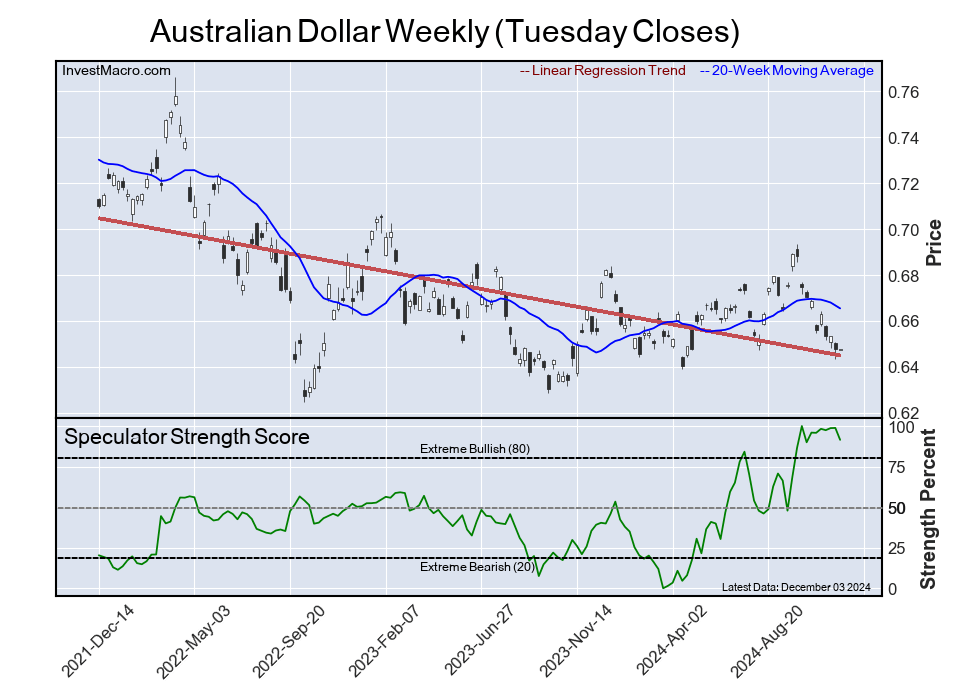
The AUD/USD pair is attempting a recovery toward 0.6681, though the prospects seem uncertain as the pair remains near a six-week low. The strengthening of the US dollar and the rise in US Treasury yields, driven by expectations of a confident victory for Donald Trump in the upcoming US presidential election, are weighing heavily on the Australian dollar.

Despite ongoing expectations for interest rate cuts by the US Federal Reserve in November and December, signs of stability in the US economy further bolster the US dollar. However, the market is tempering its expectations for further monetary easing next year.

On the domestic front, Australia’s recent labour market data was positive. September figures showed a job increase of 64.1k, significantly above the forecasted 25.0k. The unemployment rate held steady at 4.1%. Investors are now looking forward to upcoming PMI data, which could provide further insights into the health of Australia’s economy.

Despite these positive domestic indicators, China’s influence remains a critical factor for the Australian dollar, given its role as Australia’s primary trading partner. The market has deemed recent stimulus measures in China insufficient, adding to the challenges for the AUD.

Technical analysis of AUD/USD

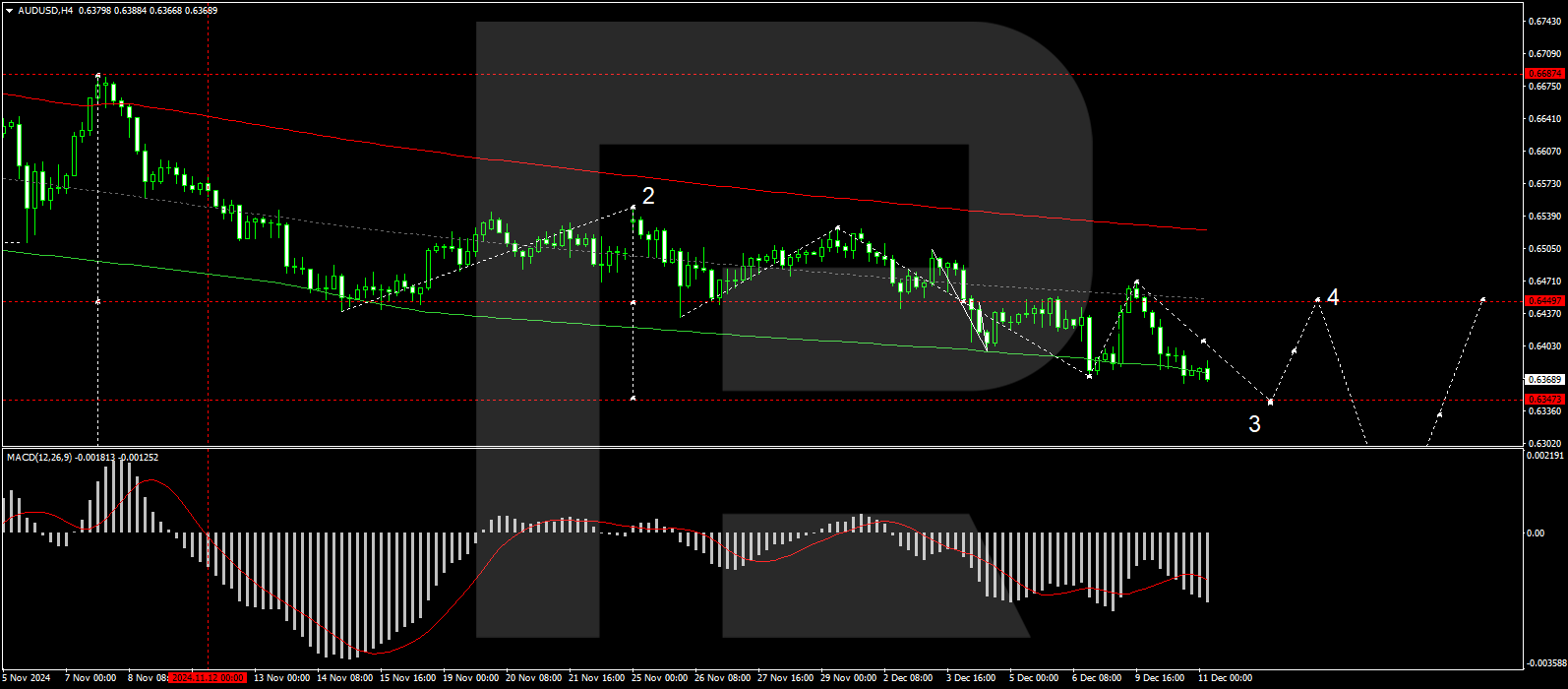
The AUD/USD is downward towards the target level of 0.6636. Upon reaching this target, the market may form a new consolidation range at these lows. If an upward breakout occurs, a correction towards 0.6790 might be considered. The MACD indicator supports this scenario, with its signal line below zero and poised for potential growth, suggesting a possible shift in momentum.

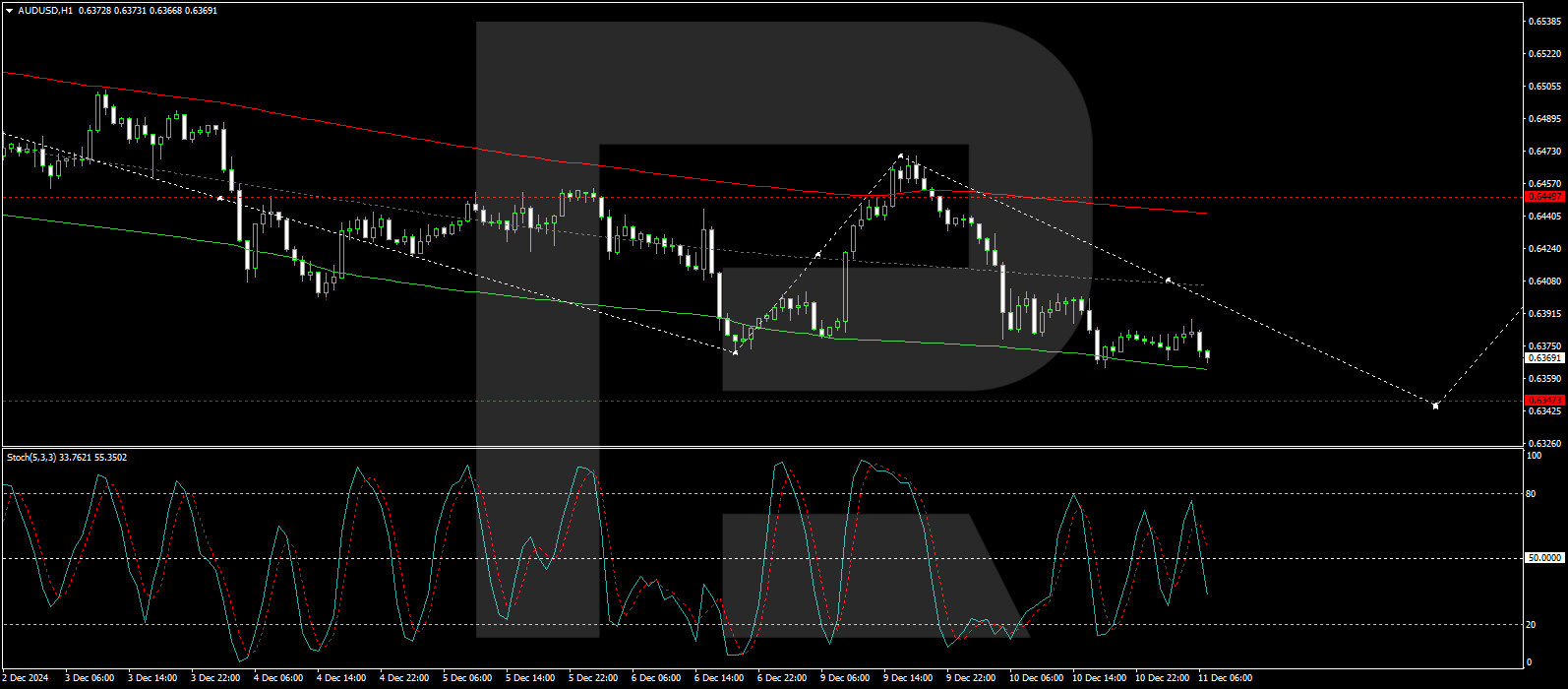
On the hourly chart, AUD/USD has completed a downward wave to 0.6650, followed by a correction to 0.6690. Another downward movement towards 0.6636 is anticipated today. A subsequent growth wave towards 0.6722 may develop if this level is reached. The Stochastic oscillator backs this outlook, with its signal line currently above 80 but expected to descend sharply towards 20, indicating the potential for further downward movement before any recovery.

Disclaimer

Any forecasts contained herein are based on the author’s particular opinion. This analysis may not be treated as trading advice. RoboForex bears no responsibility for trading results based on trading recommendations and reviews contained herein.

Oil prices were down by 10% in 2 weeks, and natural gas lost 19%. The PBoC cut interest rates

By JustMarkets

The Dow Jones (US30) Index was up 0.09% on Friday (+1.11% for the week). The S&P 500 Index (US500) was up 0.40% (for the week +0.60%). The NASDAQ Technology Index (US100) closed positive 0.63% (for the week +0.34%).

Atlanta Federal Reserve Bank President Raphael Bostic said he was in no hurry to cut interest rates to the so-called neutral level, emphasizing that policymakers intend to achieve the 2% inflation target. The Atlanta Fed chief reiterated that the central bank’s benchmark rate is still “somewhat above” the level at which it neither stimulates nor slows the economy, which he estimated at 3% to 3.5%. Bostic also said he expects inflation to fall to the Fed’s target level by the end of next year.

Netflix (NFLX) shares are up 11% after better-than-expected third-quarter earnings, revenue, and subscriber growth.

The world’s Central Bank governors and finance ministers will gather in Washington today for the annual meeting of the International Monetary Fund and the World Bank to discuss how countries can cope with low growth and high debt levels. Last week, the IMF warned that global public debt is expected to exceed $100 billion by the end of this year, driven by rising debt in the US and China. High debt levels could trigger a negative market reaction and limit budgetary efforts to respond to economic shocks.

Equity markets in Europe rose steadily on Friday. Germany’s DAX (DE40) rose by 0.38% (for the week +1.28%), France’s CAC 40 (FR40) closed 0.39% higher (for the week +0.39%), Spain’s IBEX 35 (ES35) gained 0.17% (for the week +1.78%), and the UK’s FTSE 100 (UK100) lost 0.32% (for the week +1.27%). European stocks closed solidly higher, helped by projections that the ECB will continue to cut key interest rates. Markets expect rates to be cut by 25 basis points at each meeting until mid-2025.

WTI crude oil prices fell by 2% to $69.2 a barrel, the biggest weekly decline since early September, falling more than 8%. The decline was driven by weakening demand estimates from OPEC and the IEA, slowing economic growth in China, and signs of easing geopolitical tensions in the Middle East. Both OPEC and the International Energy Agency (IEA) lowered their demand projections for 2024 and 2025. Output at China’s refineries declined for the sixth consecutive month, impacted by weak fuel demand and the rise of electric vehicles (EVs). Meanwhile, US crude oil production hit another record last week, although prices were supported by lower US crude inventories and better-than-expected US retail sales in September. In addition, investors are keeping a close eye on the possible development of the conflict between Israel and Iran, which could affect the global oil supply.

For the week, natural gas prices (XNG/USD) fell about 11% after falling 8% the week before. Traders are increasingly skeptical that extreme cold weather this winter will cause prices to spike. Gas production in the lower 48 states fell slightly in October, and production in 2024 could decline for the first time since 2020.

Asian markets were mostly down last week. Japan’s Nikkei 225 (JP225) fell by 1.65%, China’s FTSE China A50 (CHA50) lost 1.80%, Hong Kong’s Hang Seng (HK50) decreased by 2.00%, and Australia’s ASX 200 (AU200) was negative 0.87%.

Bank of Japan (BoJ) officials see no need to rush to raise interest rates this month, while they retain the option of raising rates at a later date if inflation remains in line with prognoses. Officials see only a small risk that prices will significantly exceed the Central Bank’s quarterly estimates set in July, reducing the need to act quickly. The Bank of Japan is expected to leave its benchmark rate unchanged at 0.25% at its policy meeting that ends October 31.

Traders reacted with restraint to the People’s Bank of China’s (PBoC) recent monetary easing, which sent rates to new record lows. The one-year LPR, which serves as a benchmark for most corporate and household loans, was cut by 25 bps, while the five-year LPR, often used as a benchmark for mortgages, was also cut by 25 bps to 3.6%. The decision followed PBOC head Pan Gongsheng’s announcement last week of a 20–25 bps LPR cut and his suggestion that the RRR for commercial banks could be further reduced in 4Q2.

S&P 500 (US500) 5,864.67 +23.20 (+0.40%)

Dow Jones (US30) 43,275.91 +36.86 (+0.09%)

DAX (DE40) 19,657.37 +73.98 (+0.38%)

FTSE 100 (UK100) 8,358.25 −26.88 (−0.32%)

USD Index 103.46 −0.36 (−0.35%)

News feed for: 2024.10.21

  • China PBoC Loan Prime Rate (m/m) at 04:15 (GMT+3);
  • German Producer Price Index (m/m) at 09:00 (GMT+3);
  • US FOMC Member Kashkari Speaks at 20:00 (GMT+3);
  • IMF/World Bank Annual Meetings (All Day).

By JustMarkets


This article reflects a personal opinion and should not be interpreted as an investment advice, and/or offer, and/or a persistent request for carrying out financial transactions, and/or a guarantee, and/or a forecast of future events.

Gold Hits New Record Amid Geopolitical Tensions and US Election Uncertainty

By RoboForex Analytical Department

Gold prices surged to a new record high of 2,729 USD per troy ounce on Monday, driven by escalating conflicts in the Middle East and the heightened uncertainty surrounding the upcoming US presidential election. These persistent geopolitical factors, particularly the closely contested race between Donald Trump and Kamala Harris, have bolstered investor demand for safe-haven assets like gold.

The intensification of hostilities in the Middle East, particularly with Israel’s ongoing discussions about further actions against Iran, has significantly influenced market sentiment. Despite calls from US President Joe Biden for a ceasefire, Israel’s reluctance to make concessions has only added to the geopolitical tensions affecting global markets.

As the US election day on 5 November approaches, investors are increasingly repositioning their portfolios, favouring the stability and security that gold provides during political uncertainty. Preliminary polls indicate that the election could be one of the closest in recent history, further enhancing gold’s appeal as a protective investment.

Market analysts are now revising their expectations for gold upwards, with some speculating that prices could reach 3,000 USD per troy ounce by Q4 2025. This optimistic outlook is further supported by the surge in interest in silver, which has reached its highest price since 2012 due to similar bullish sentiments in the precious metals market.

Technical analysis of gold (XAU/USD)

The gold market has successfully breached the 2,685 level, paving the way for upward movement. After achieving a local high of 2,732, the market is currently targeting the 2,757 level. A corrective pullback to at least 2,700 is anticipated before potentially resuming the upward trajectory towards 2,757. This bullish outlook is supported by the MACD indicator, whose signal line is significantly above zero and climbing, indicating strong upward momentum.

On the hourly chart, gold has established a growth wave, peaking at 2,732, with a consolidation pattern forming just below this level. A downward correction towards 2,700 is expected shortly. Upon completing this correction, the market may initiate another upward phase, targeting a retest of 2,733, potentially extending towards 2,757. The Stochastic oscillator corroborates this scenario, currently positioned above 80 but pointing downwards, suggesting a brief consolidation or correction may occur before further gains.


Disclaimer

Any forecasts contained herein are based on the author’s particular opinion. This analysis may not be treated as trading advice. RoboForex bears no responsibility for trading results based on trading recommendations and reviews contained herein.

COT Metals Charts: Speculator bets led by Gold & Platinum

By InvestMacro

Here are the latest charts and statistics for the Commitment of Traders (COT) data published by the Commodities Futures Trading Commission (CFTC).

The latest COT data is updated through Tuesday October 15th and shows a quick view of how large traders (for-profit speculators and commercial entities) were positioned in the futures markets.

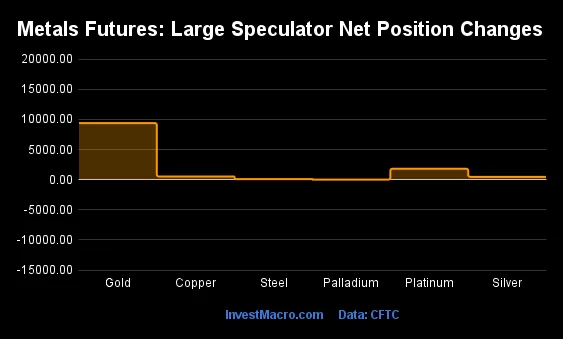
Weekly Speculator Changes led by Gold & Platinum

The COT metals markets speculator bets were overall higher this week as four out of the six metals markets we cover had higher positioning while the other two markets had lower speculator contracts.

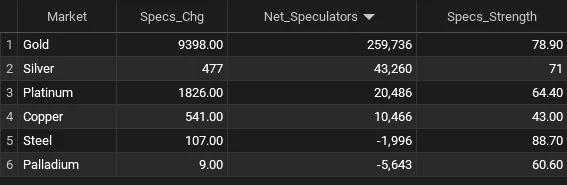
Leading the gains for the metals was Gold (8,254 contracts) with Platinum (4,730 contracts), Palladium (619 contracts), and Steel (159 contracts) also showing positive weeks.

The markets with declines in speculator bets for the week were Copper (-7,574 contracts) with Silver (-683 contracts) registering lower bets on the week as well.


Metals Net Speculators Leaderboard

Legend: Weekly Speculators Change | Speculators Current Net Position | Speculators Strength Score compared to last 3-Years (0-100 range)


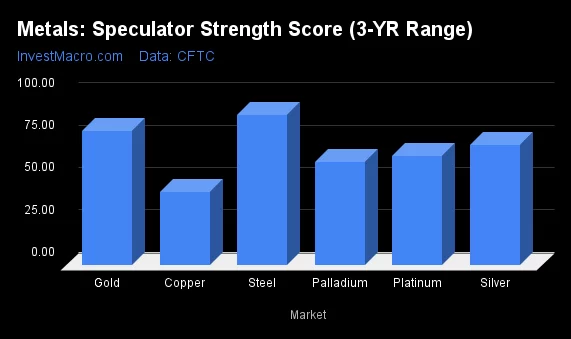
Strength Scores led by Platinum & Steel

COT Strength Scores (a normalized measure of Speculator positions over a 3-Year range, from 0 to 100 where above 80 is Extreme-Bullish and below 20 is Extreme-Bearish) showed that Platinum (94 percent) and Steel (90 percent) lead the metals markets this week. Silver (89 percent) and Gold (89 percent) come in as the next highest in the weekly strength scores.

Palladium (53 percent) comes in at the lowest strength level currently but remains higher than its 3-Year midpoint (50 percent).

Strength Statistics:
Gold (89.0 percent) vs Gold previous week (85.9 percent)
Silver (89.1 percent) vs Silver previous week (90.0 percent)
Copper (66.3 percent) vs Copper previous week (73.4 percent)
Platinum (93.8 percent) vs Platinum previous week (81.2 percent)
Palladium (52.9 percent) vs Palladium previous week (48.4 percent)
Steel (90.0 percent) vs Palladium previous week (89.4 percent)


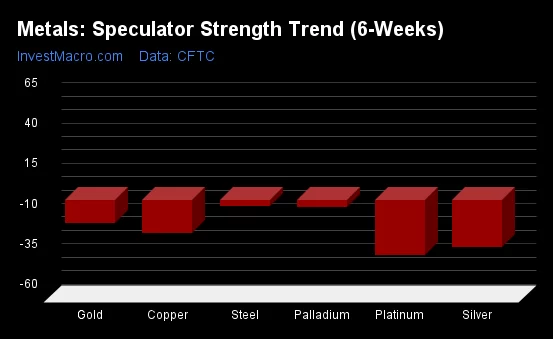
Platinum & Palladium top the 6-Week Strength Trends

COT Strength Score Trends (or move index, calculates the 6-week changes in strength scores) showed that Platinum (72 percent) and Palladium (36 percent) lead the past six weeks trends for metals.

Gold (-0.4 percent) leads the downside trend scores currently with the only negative trend.

Move Statistics:
Gold (-0.4 percent) vs Gold previous week (-6.2 percent)
Silver (10.6 percent) vs Silver previous week (3.4 percent)
Copper (21.0 percent) vs Copper previous week (24.2 percent)
Platinum (72.1 percent) vs Platinum previous week (21.2 percent)
Palladium (36.2 percent) vs Palladium previous week (33.3 percent)
Steel (8.0 percent) vs Steel previous week (11.8 percent)


Individual Markets:

Gold Comex Futures:

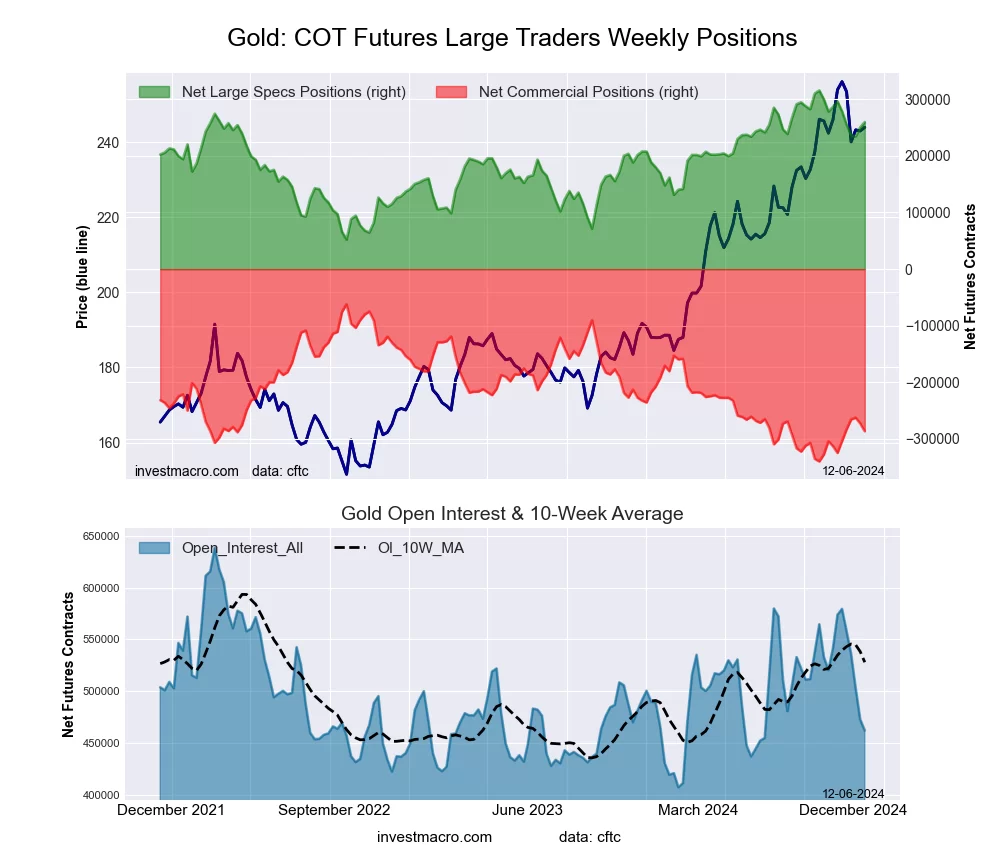
Gold Futures COT ChartThe Gold Comex Futures large speculator standing this week recorded a net position of 286,434 contracts in the data reported through Tuesday. This was a weekly lift of 8,254 contracts from the previous week which had a total of 278,180 net contracts.

This week’s current strength score (the trader positioning range over the past three years, measured from 0 to 100) shows the speculators are currently Bullish-Extreme with a score of 89.0 percent. The commercials are Bearish-Extreme with a score of 9.7 percent and the small traders (not shown in chart) are Bullish with a score of 65.6 percent.

Price Trend-Following Model: Strong Uptrend

Our weekly trend-following model classifies the current market price position as: Strong Uptrend.

Gold Futures StatisticsSPECULATORSCOMMERCIALSSMALL TRADERS
– Percent of Open Interest Longs:66.112.99.3
– Percent of Open Interest Shorts:13.170.74.5
– Net Position:286,434-312,65826,224
– Gross Longs:357,49470,02850,490
– Gross Shorts:71,060382,68624,266
– Long to Short Ratio:5.0 to 10.2 to 12.1 to 1
NET POSITION TREND:
– Strength Index Score (3 Year Range Pct):89.09.765.6
– Strength Index Reading (3 Year Range):Bullish-ExtremeBearish-ExtremeBullish
NET POSITION MOVEMENT INDEX:
– 6-Week Change in Strength Index:-0.4-0.36.8


Silver Comex Futures:

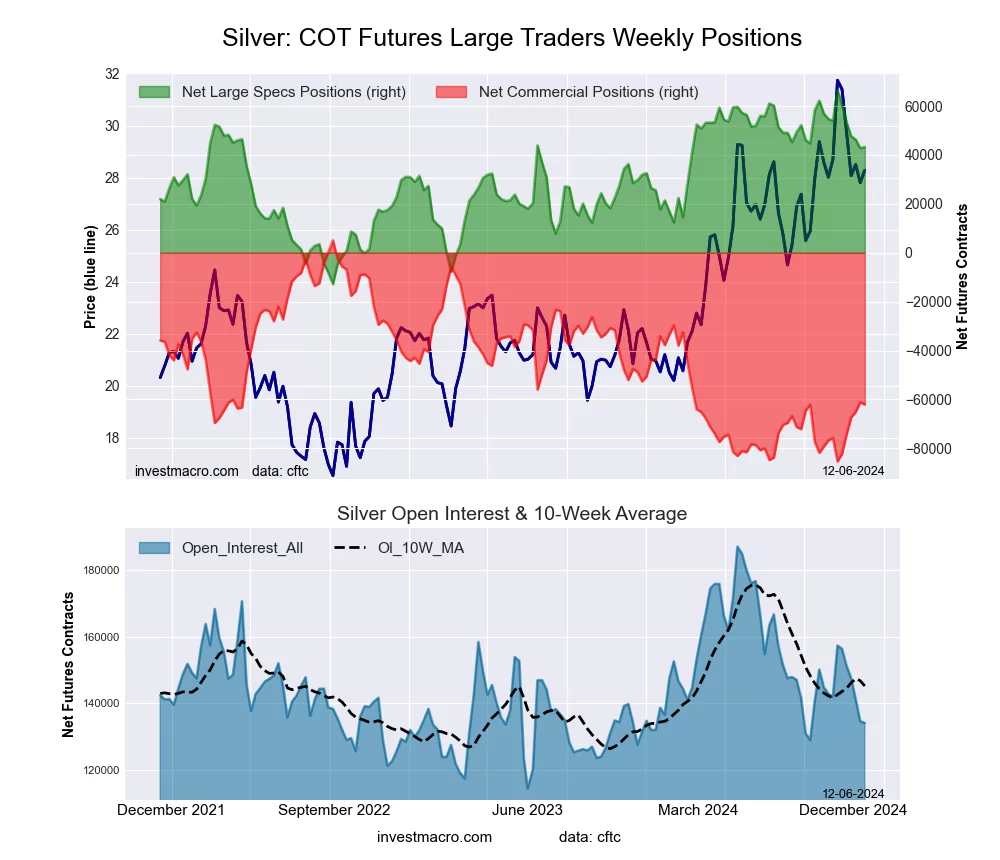
Silver Futures COT ChartThe Silver Comex Futures large speculator standing this week recorded a net position of 54,032 contracts in the data reported through Tuesday. This was a weekly decrease of -683 contracts from the previous week which had a total of 54,715 net contracts.

This week’s current strength score (the trader positioning range over the past three years, measured from 0 to 100) shows the speculators are currently Bullish-Extreme with a score of 89.1 percent. The commercials are Bearish-Extreme with a score of 10.1 percent and the small traders (not shown in chart) are Bullish with a score of 75.8 percent.

Price Trend-Following Model: Strong Uptrend

Our weekly trend-following model classifies the current market price position as: Strong Uptrend.

Silver Futures StatisticsSPECULATORSCOMMERCIALSSMALL TRADERS
– Percent of Open Interest Longs:49.321.122.3
– Percent of Open Interest Shorts:11.374.57.0
– Net Position:54,032-75,75821,726
– Gross Longs:70,02429,91331,621
– Gross Shorts:15,992105,6719,895
– Long to Short Ratio:4.4 to 10.3 to 13.2 to 1
NET POSITION TREND:
– Strength Index Score (3 Year Range Pct):89.110.175.8
– Strength Index Reading (3 Year Range):Bullish-ExtremeBearish-ExtremeBullish
NET POSITION MOVEMENT INDEX:
– 6-Week Change in Strength Index:10.6-12.515.8


Copper Grade #1 Futures:

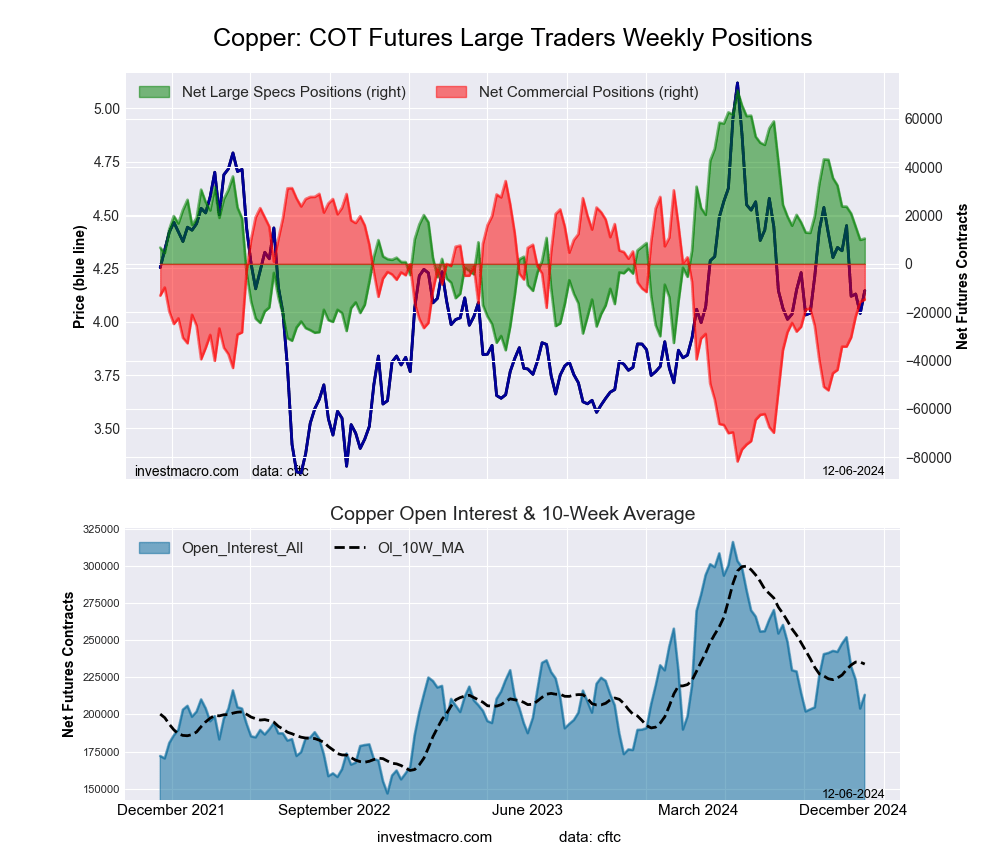
Copper Futures COT ChartThe Copper Grade #1 Futures large speculator standing this week recorded a net position of 35,522 contracts in the data reported through Tuesday. This was a weekly lowering of -7,574 contracts from the previous week which had a total of 43,096 net contracts.

This week’s current strength score (the trader positioning range over the past three years, measured from 0 to 100) shows the speculators are currently Bullish with a score of 66.3 percent. The commercials are Bearish with a score of 31.5 percent and the small traders (not shown in chart) are Bullish with a score of 76.4 percent.

Price Trend-Following Model: Downtrend

Our weekly trend-following model classifies the current market price position as: Downtrend.

Copper Futures StatisticsSPECULATORSCOMMERCIALSSMALL TRADERS
– Percent of Open Interest Longs:40.831.08.1
– Percent of Open Interest Shorts:26.249.74.1
– Net Position:35,522-45,2199,697
– Gross Longs:99,03675,37219,752
– Gross Shorts:63,514120,59110,055
– Long to Short Ratio:1.6 to 10.6 to 12.0 to 1
NET POSITION TREND:
– Strength Index Score (3 Year Range Pct):66.331.576.4
– Strength Index Reading (3 Year Range):BullishBearishBullish
NET POSITION MOVEMENT INDEX:
– 6-Week Change in Strength Index:21.0-22.622.4


Platinum Futures:

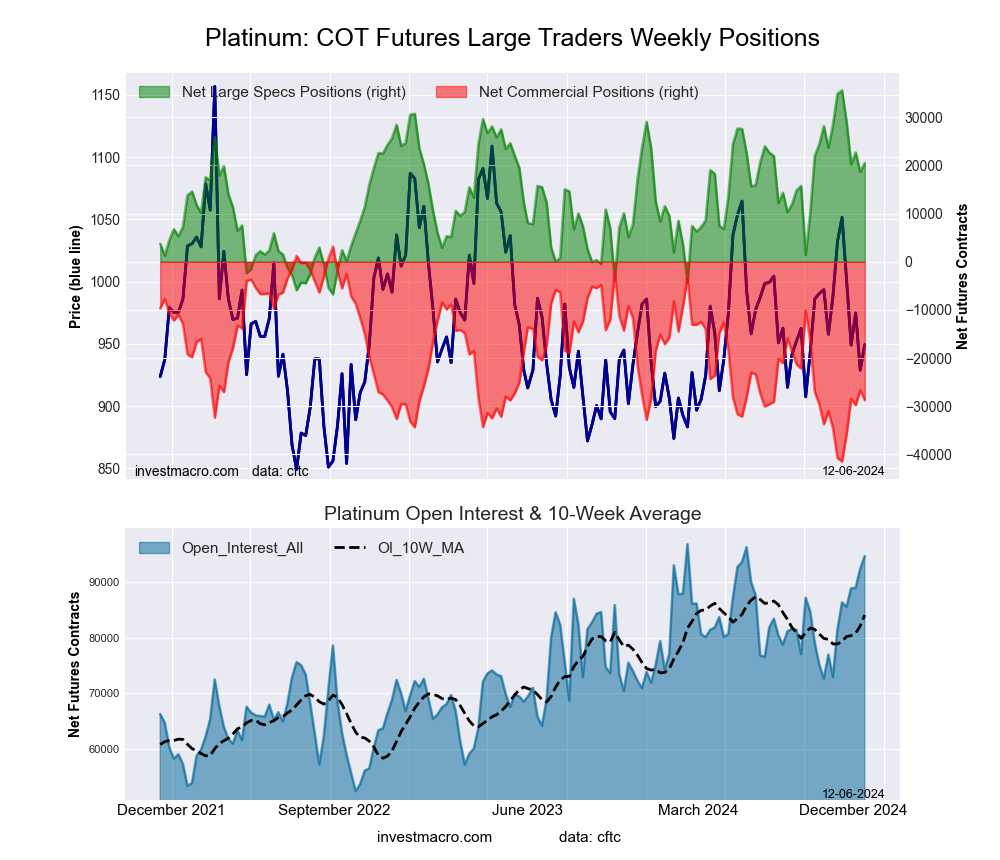
Platinum Futures COT ChartThe Platinum Futures large speculator standing this week recorded a net position of 28,387 contracts in the data reported through Tuesday. This was a weekly increase of 4,730 contracts from the previous week which had a total of 23,657 net contracts.

This week’s current strength score (the trader positioning range over the past three years, measured from 0 to 100) shows the speculators are currently Bullish-Extreme with a score of 93.8 percent. The commercials are Bearish-Extreme with a score of 0.0 percent and the small traders (not shown in chart) are Bullish with a score of 59.3 percent.

Price Trend-Following Model: Weak Downtrend

Our weekly trend-following model classifies the current market price position as: Weak Downtrend.

Platinum Futures StatisticsSPECULATORSCOMMERCIALSSMALL TRADERS
– Percent of Open Interest Longs:63.819.412.1
– Percent of Open Interest Shorts:24.966.83.7
– Net Position:28,387-34,5396,152
– Gross Longs:46,52314,1718,855
– Gross Shorts:18,13648,7102,703
– Long to Short Ratio:2.6 to 10.3 to 13.3 to 1
NET POSITION TREND:
– Strength Index Score (3 Year Range Pct):93.80.059.3
– Strength Index Reading (3 Year Range):Bullish-ExtremeBearish-ExtremeBullish
NET POSITION MOVEMENT INDEX:
– 6-Week Change in Strength Index:72.1-64.7-40.7


Palladium Futures:

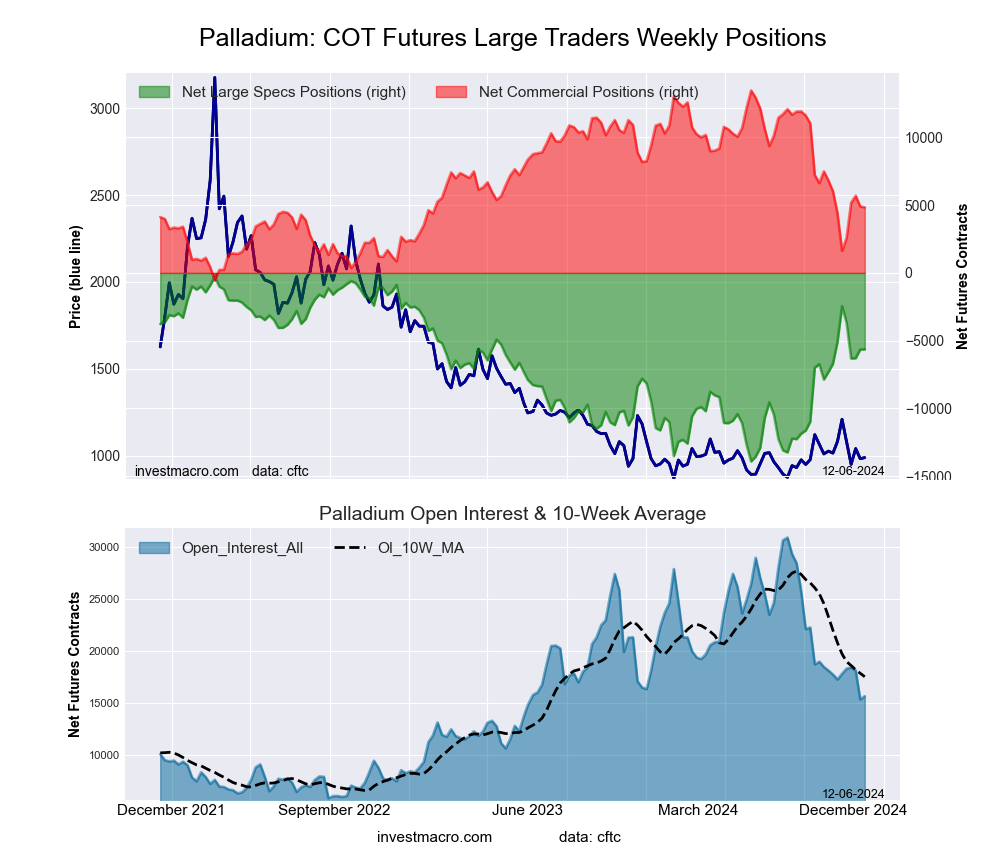
Palladium Futures COT ChartThe Palladium Futures large speculator standing this week recorded a net position of -6,698 contracts in the data reported through Tuesday. This was a weekly advance of 619 contracts from the previous week which had a total of -7,317 net contracts.

This week’s current strength score (the trader positioning range over the past three years, measured from 0 to 100) shows the speculators are currently Bullish with a score of 52.9 percent. The commercials are Bearish with a score of 47.0 percent and the small traders (not shown in chart) are Bullish with a score of 65.6 percent.

Price Trend-Following Model: Strong Uptrend

Our weekly trend-following model classifies the current market price position as: Strong Uptrend.

Palladium Futures StatisticsSPECULATORSCOMMERCIALSSMALL TRADERS
– Percent of Open Interest Longs:25.658.011.2
– Percent of Open Interest Shorts:63.424.07.4
– Net Position:-6,6986,032666
– Gross Longs:4,53710,2941,987
– Gross Shorts:11,2354,2621,321
– Long to Short Ratio:0.4 to 12.4 to 11.5 to 1
NET POSITION TREND:
– Strength Index Score (3 Year Range Pct):52.947.065.6
– Strength Index Reading (3 Year Range):BullishBearishBullish
NET POSITION MOVEMENT INDEX:
– 6-Week Change in Strength Index:36.2-39.931.6


Steel Futures Futures:

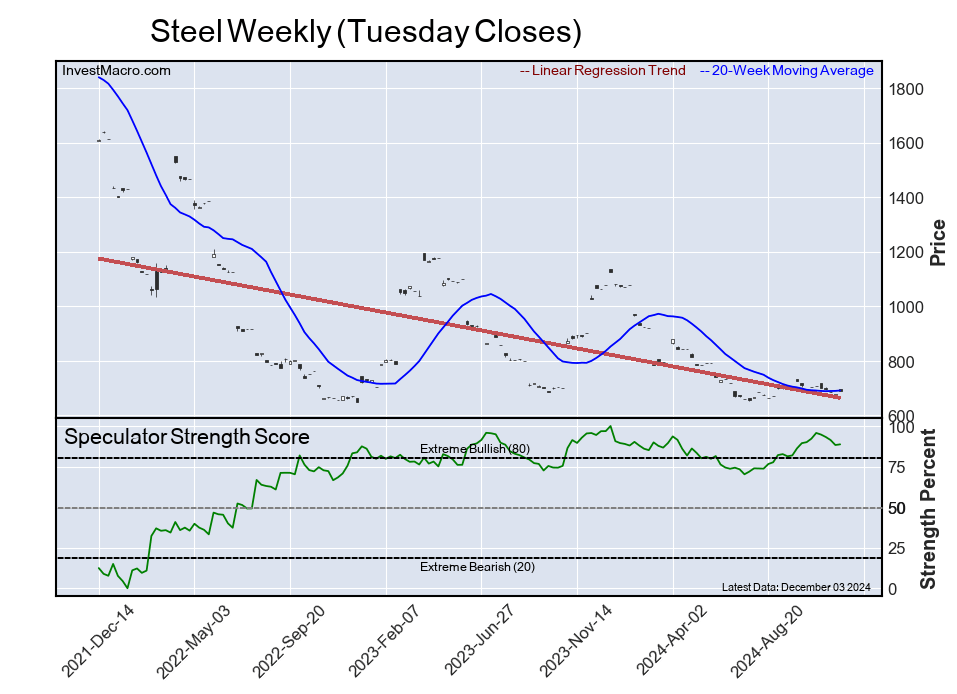
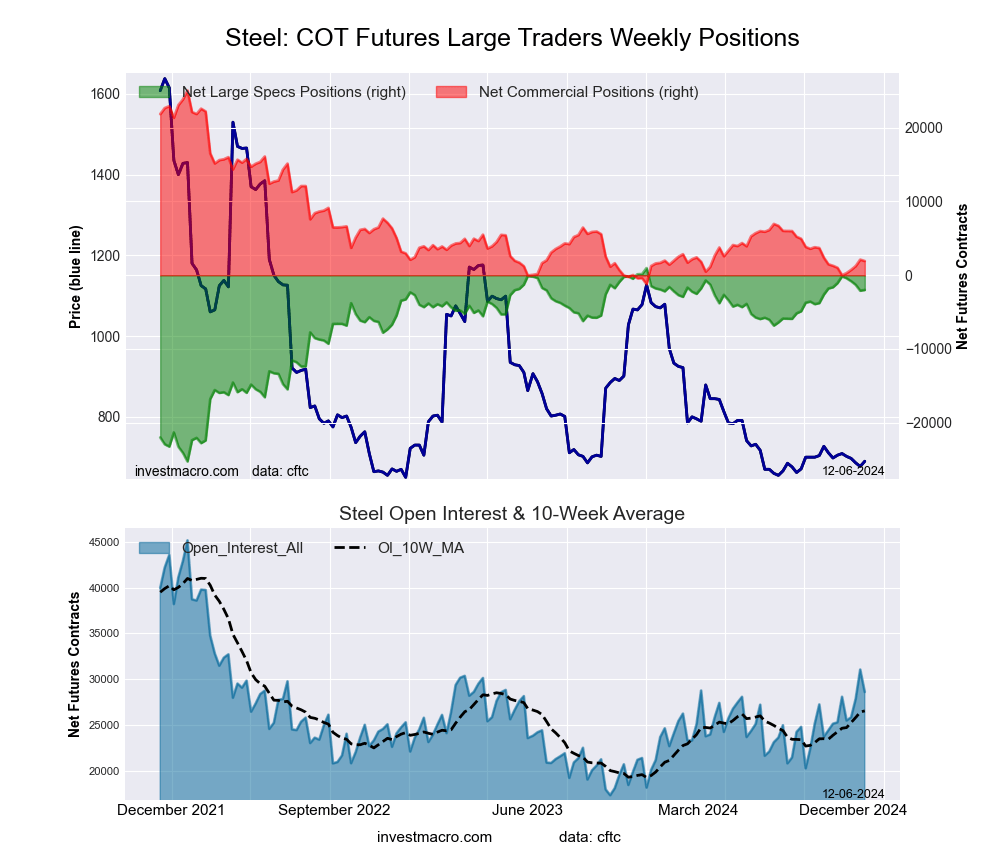
Steel Futures COT ChartThe Steel Futures large speculator standing this week recorded a net position of -1,642 contracts in the data reported through Tuesday. This was a weekly boost of 159 contracts from the previous week which had a total of -1,801 net contracts.

This week’s current strength score (the trader positioning range over the past three years, measured from 0 to 100) shows the speculators are currently Bullish-Extreme with a score of 90.0 percent. The commercials are Bearish-Extreme with a score of 9.5 percent and the small traders (not shown in chart) are Bullish with a score of 71.9 percent.

Price Trend-Following Model: Uptrend

Our weekly trend-following model classifies the current market price position as: Uptrend.

Steel Futures StatisticsSPECULATORSCOMMERCIALSSMALL TRADERS
– Percent of Open Interest Longs:22.569.91.9
– Percent of Open Interest Shorts:29.164.80.5
– Net Position:-1,6421,281361
– Gross Longs:5,66817,562481
– Gross Shorts:7,31016,281120
– Long to Short Ratio:0.8 to 11.1 to 14.0 to 1
NET POSITION TREND:
– Strength Index Score (3 Year Range Pct):90.09.571.9
– Strength Index Reading (3 Year Range):Bullish-ExtremeBearish-ExtremeBullish
NET POSITION MOVEMENT INDEX:
– 6-Week Change in Strength Index:8.0-9.750.9


Article By InvestMacroReceive our weekly COT Newsletter

*COT Report: The COT data, released weekly to the public each Friday, is updated through the most recent Tuesday (data is 3 days old) and shows a quick view of how large speculators or non-commercials (for-profit traders) were positioned in the futures markets.

The CFTC categorizes trader positions according to commercial hedgers (traders who use futures contracts for hedging as part of the business), non-commercials (large traders who speculate to realize trading profits) and nonreportable traders (usually small traders/speculators) as well as their open interest (contracts open in the market at time of reporting). See CFTC criteria here.

COT Bonds Charts: Speculator bets led by 10-Year & US Treasury Bonds

By InvestMacro

Here are the latest charts and statistics for the Commitment of Traders (COT) reports data published by the Commodities Futures Trading Commission (CFTC).

The latest COT data is updated through Tuesday October 15th and shows a quick view of how large traders (for-profit speculators and commercial hedgers) were positioned in the futures markets.

Weekly Speculator Changes led by 10-Year Bonds & US Treasury Bonds

The COT bond market speculator bets were overall lower this week as four out of the nine bond markets we cover had higher positioning while the other five markets had lower speculator contracts.

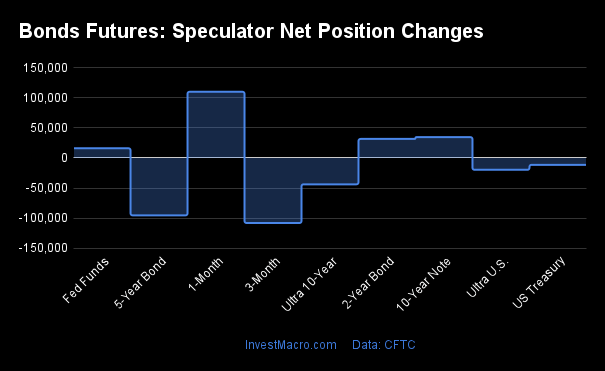
Leading the gains for the bond markets was the 10-Year Bonds (95,064 contracts) with the US Treasury Bonds (15,997 contracts), the Ultra 10-Year Bonds (7,419 contracts) and the SOFR 1-Month (7,304 contracts) showing positive weeks as well.

The bond markets with declines in speculator bets for the week were the SOFR 3-Months (-246,502 contracts), the 2-Year Bonds (-117,224 contracts), the Fed Funds (-64,706 contracts), the 5-Year Bonds (-29,699 contracts) and the Ultra Treasury Bonds (-38,975 contracts) also registering lower bets on the week.


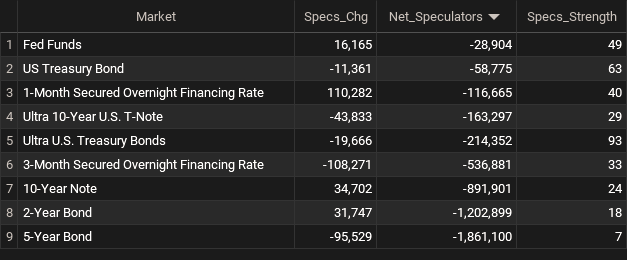
Bonds Net Speculators Leaderboard

Legend: Weekly Speculators Change | Speculators Current Net Position | Speculators Strength Score compared to last 3-Years (0-100 range)


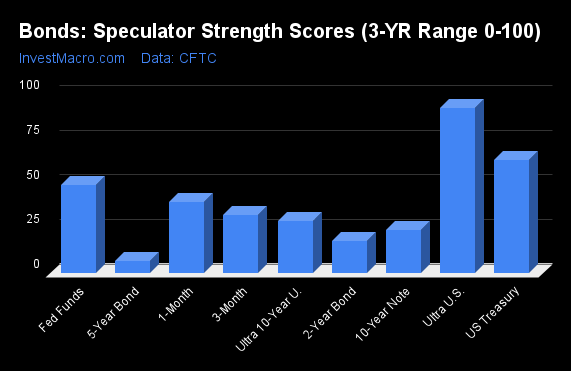
Strength Scores led by Fed Funds & SOFR 3-Months

COT Strength Scores (a normalized measure of Speculator positions over a 3-Year range, from 0 to 100 where above 80 is Extreme-Bullish and below 20 is Extreme-Bearish) showed that the Fed Funds (78 percent) and the SOFR 3-Months (67 percent) lead the bond markets this week. The US Treasury Bonds (63 percent) come in as the next highest in the weekly strength scores.

On the downside, the 5-Year Bonds (7 percent), the 2-Year Bonds (9 percent) and the SOFR 1-Month (10 percent) come in at the lowest strength level currently and are in Extreme-Bearish territory (below 20 percent).

Strength Statistics:
Fed Funds (78.0 percent) vs Fed Funds previous week (90.0 percent)
2-Year Bond (8.6 percent) vs 2-Year Bond previous week (16.0 percent)
5-Year Bond (6.5 percent) vs 5-Year Bond previous week (8.4 percent)
10-Year Bond (26.4 percent) vs 10-Year Bond previous week (17.4 percent)
Ultra 10-Year Bond (42.3 percent) vs Ultra 10-Year Bond previous week (40.7 percent)
US Treasury Bond (62.5 percent) vs US Treasury Bond previous week (57.0 percent)
Ultra US Treasury Bond (62.5 percent) vs Ultra US Treasury Bond previous week (80.6 percent)
SOFR 1-Month (9.6 percent) vs SOFR 1-Month previous week (7.7 percent)
SOFR 3-Months (66.6 percent) vs SOFR 3-Months previous week (79.3 percent)


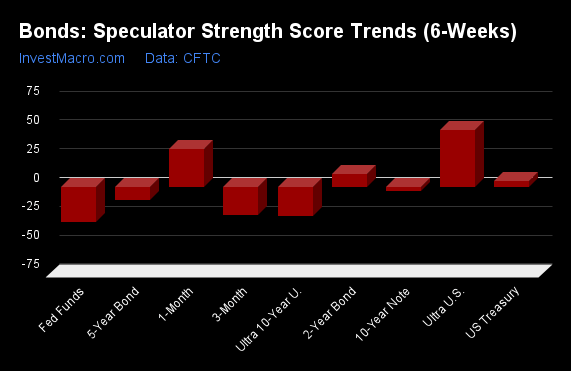
Fed Funds & 10-Year Bonds top the 6-Week Strength Trends

COT Strength Score Trends (or move index, calculates the 6-week changes in strength scores) showed that the Fed Funds (40 percent) and the 10-Year Bonds (13 percent) lead the past six weeks trends for bonds. The 5-Year Bonds (5 percent) are the next highest positive movers in the latest trends data.

The SOFR 1-Month (-29 percent), the SOFR 3-Months (-26 percent) and the 2-Year Bonds (-23 percent) lead the downside trend scores currently.

Strength Trend Statistics:
Fed Funds (40.2 percent) vs Fed Funds previous week (69.8 percent)
2-Year Bond (-23.0 percent) vs 2-Year Bond previous week (-12.5 percent)
5-Year Bond (5.4 percent) vs 5-Year Bond previous week (3.4 percent)
10-Year Bond (13.0 percent) vs 10-Year Bond previous week (-4.3 percent)
Ultra 10-Year Bond (1.8 percent) vs Ultra 10-Year Bond previous week (5.3 percent)
US Treasury Bond (-9.5 percent) vs US Treasury Bond previous week (-21.6 percent)
Ultra US Treasury Bond (-37.5 percent) vs Ultra US Treasury Bond previous week (-5.8 percent)
SOFR 1-Month (-29.2 percent) vs SOFR 1-Month previous week (-47.6 percent)
SOFR 3-Months (-26.3 percent) vs SOFR 3-Months previous week (-9.4 percent)


30-Day Federal Funds Futures:

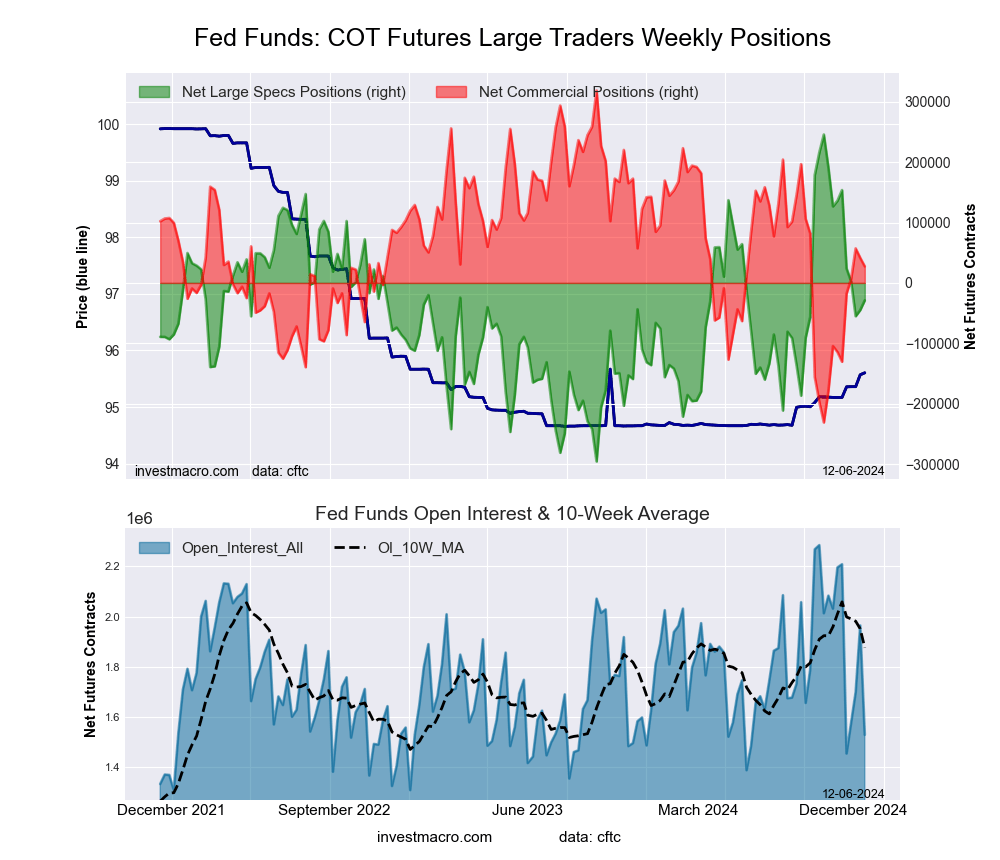
Federal Funds 30-Day Bonds Futures COT ChartThe 30-Day Federal Funds large speculator standing this week totaled a net position of 126,765 contracts in the data reported through Tuesday. This was a weekly decrease of -64,706 contracts from the previous week which had a total of 191,471 net contracts.

This week’s current strength score (the trader positioning range over the past three years, measured from 0 to 100) shows the speculators are currently Bullish with a score of 78.0 percent. The commercials are Bearish with a score of 23.0 percent and the small traders (not shown in chart) are Bearish with a score of 44.3 percent.

Price Trend-Following Model: Downtrend

Our weekly trend-following model classifies the current market price position as: Downtrend. The current action for the model is considered to be: Hold – Maintain Short Position.

30-Day Federal Funds StatisticsSPECULATORSCOMMERCIALSSMALL TRADERS
– Percent of Open Interest Longs:20.854.61.6
– Percent of Open Interest Shorts:14.659.82.7
– Net Position:126,765-104,535-22,230
– Gross Longs:422,5431,109,59631,783
– Gross Shorts:295,7781,214,13154,013
– Long to Short Ratio:1.4 to 10.9 to 10.6 to 1
NET POSITION TREND:
– Strength Index Score (3 Year Range Pct):78.023.044.3
– Strength Index Reading (3 Year Range):BullishBearishBearish
NET POSITION MOVEMENT INDEX:
– 6-Week Change in Strength Index:40.2-38.3-12.5


Secured Overnight Financing Rate (3-Month) Futures:

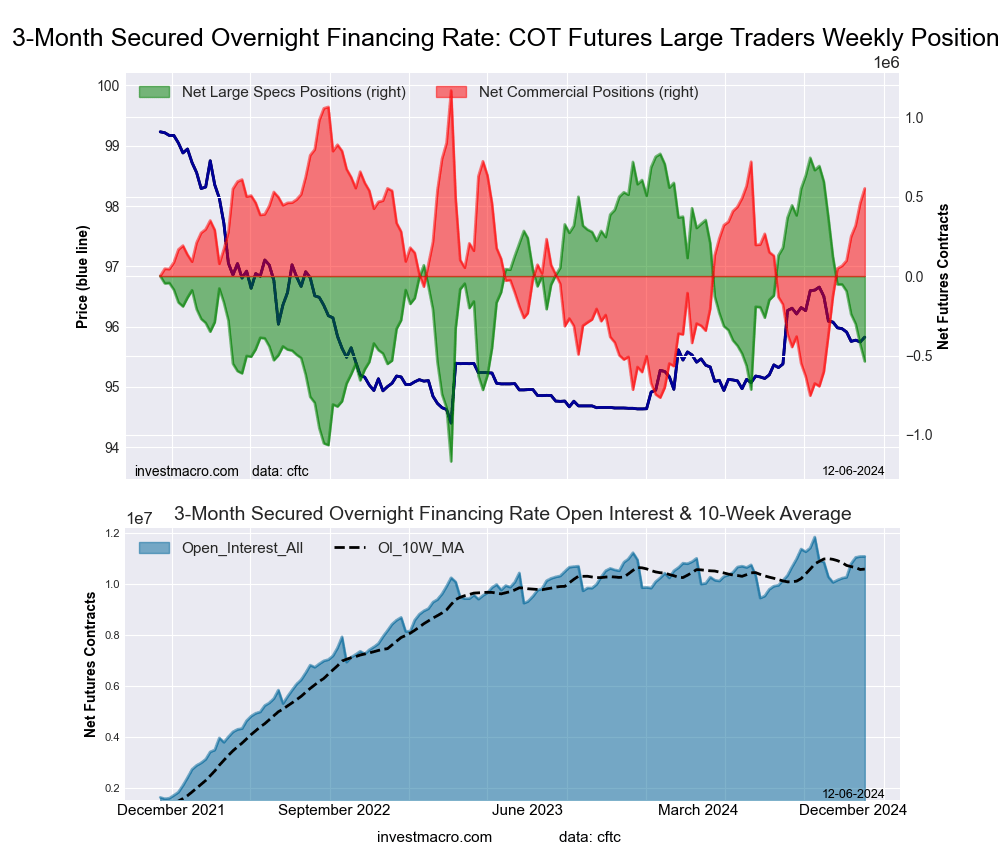
SOFR 3-Months Bonds Futures COT ChartThe Secured Overnight Financing Rate (3-Month) large speculator standing this week totaled a net position of 121,918 contracts in the data reported through Tuesday. This was a weekly reduction of -246,502 contracts from the previous week which had a total of 368,420 net contracts.

This week’s current strength score (the trader positioning range over the past three years, measured from 0 to 100) shows the speculators are currently Bullish with a score of 66.6 percent. The commercials are Bearish with a score of 33.0 percent and the small traders (not shown in chart) are Bullish-Extreme with a score of 90.8 percent.

Price Trend-Following Model: Weak Uptrend

Our weekly trend-following model classifies the current market price position as: Weak Uptrend. The current action for the model is considered to be: Hold – Maintain Long Position.

SOFR 3-Months StatisticsSPECULATORSCOMMERCIALSSMALL TRADERS
– Percent of Open Interest Longs:14.558.30.4
– Percent of Open Interest Shorts:13.359.60.3
– Net Position:121,918-127,3295,411
– Gross Longs:1,459,0405,861,02535,753
– Gross Shorts:1,337,1225,988,35430,342
– Long to Short Ratio:1.1 to 11.0 to 11.2 to 1
NET POSITION TREND:
– Strength Index Score (3 Year Range Pct):66.633.090.8
– Strength Index Reading (3 Year Range):BullishBearishBullish-Extreme
NET POSITION MOVEMENT INDEX:
– 6-Week Change in Strength Index:-26.326.13.3


Individual Bond Markets:

Secured Overnight Financing Rate (1-Month) Futures:

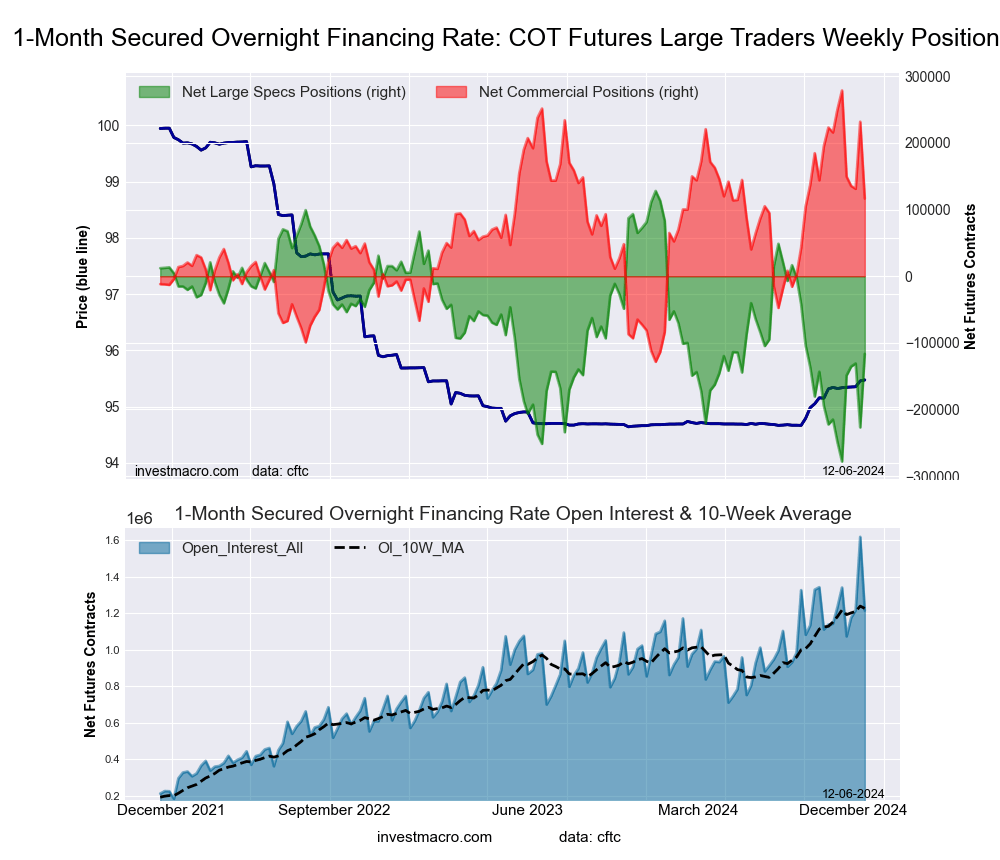
SOFR 1-Month Bonds Futures COT ChartThe Secured Overnight Financing Rate (1-Month) large speculator standing this week totaled a net position of -215,156 contracts in the data reported through Tuesday. This was a weekly boost of 7,304 contracts from the previous week which had a total of -222,460 net contracts.

This week’s current strength score (the trader positioning range over the past three years, measured from 0 to 100) shows the speculators are currently Bearish-Extreme with a score of 9.6 percent. The commercials are Bullish-Extreme with a score of 90.6 percent and the small traders (not shown in chart) are Bullish with a score of 51.7 percent.

Price Trend-Following Model: Strong Uptrend

Our weekly trend-following model classifies the current market price position as: Strong Uptrend.

SOFR 1-Month StatisticsSPECULATORSCOMMERCIALSSMALL TRADERS
– Percent of Open Interest Longs:12.367.10.0
– Percent of Open Interest Shorts:31.148.20.1
– Net Position:-215,156215,684-528
– Gross Longs:140,428766,626556
– Gross Shorts:355,584550,9421,084
– Long to Short Ratio:0.4 to 11.4 to 10.5 to 1
NET POSITION TREND:
– Strength Index Score (3 Year Range Pct):9.690.651.7
– Strength Index Reading (3 Year Range):Bearish-ExtremeBullish-ExtremeBullish
NET POSITION MOVEMENT INDEX:
– 6-Week Change in Strength Index:-29.229.20.9


2-Year Treasury Note Futures:

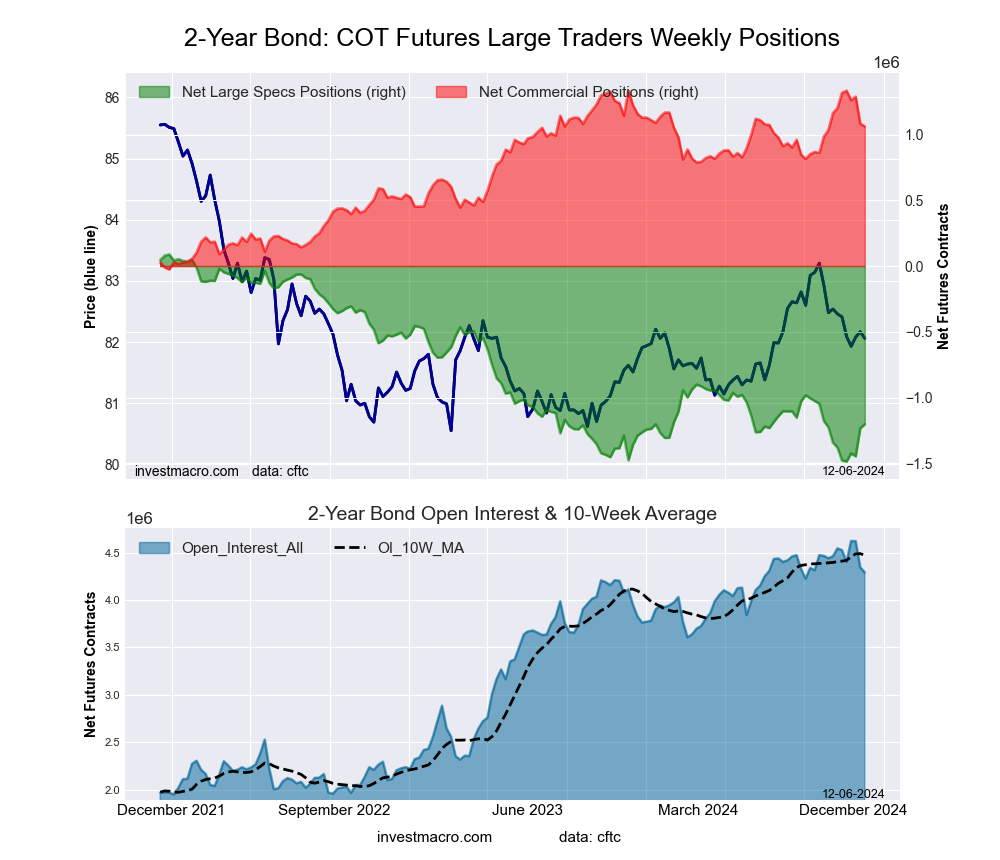
2-Year Treasury Bonds Futures COT ChartThe 2-Year Treasury Note large speculator standing this week totaled a net position of -1,342,260 contracts in the data reported through Tuesday. This was a weekly reduction of -117,224 contracts from the previous week which had a total of -1,225,036 net contracts.

This week’s current strength score (the trader positioning range over the past three years, measured from 0 to 100) shows the speculators are currently Bearish-Extreme with a score of 8.6 percent. The commercials are Bullish-Extreme with a score of 87.4 percent and the small traders (not shown in chart) are Bullish-Extreme with a score of 92.6 percent.

Price Trend-Following Model: Uptrend

Our weekly trend-following model classifies the current market price position as: Uptrend.

2-Year Treasury Note StatisticsSPECULATORSCOMMERCIALSSMALL TRADERS
– Percent of Open Interest Longs:12.579.36.2
– Percent of Open Interest Shorts:42.653.22.2
– Net Position:-1,342,2601,162,975179,285
– Gross Longs:557,7153,535,657276,550
– Gross Shorts:1,899,9752,372,68297,265
– Long to Short Ratio:0.3 to 11.5 to 12.8 to 1
NET POSITION TREND:
– Strength Index Score (3 Year Range Pct):8.687.492.6
– Strength Index Reading (3 Year Range):Bearish-ExtremeBullish-ExtremeBullish-Extreme
NET POSITION MOVEMENT INDEX:
– 6-Week Change in Strength Index:-23.025.63.6


5-Year Treasury Note Futures:

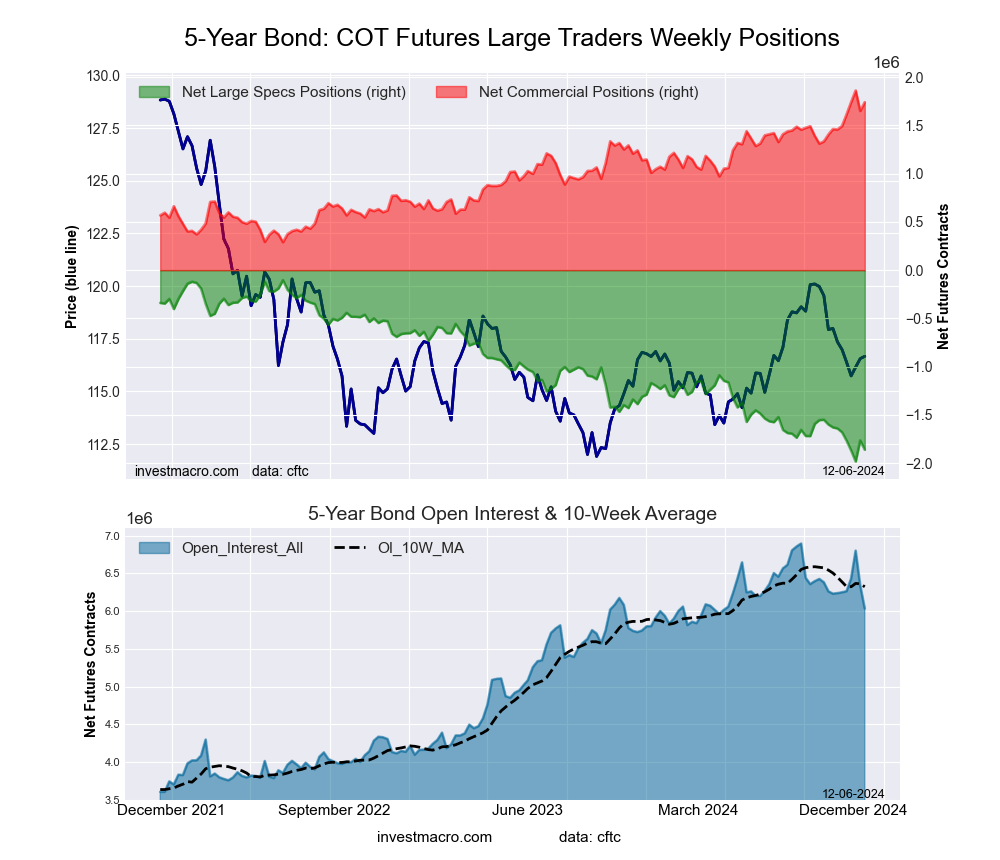
5-Year Treasury Bonds Futures COT ChartThe 5-Year Treasury Note large speculator standing this week totaled a net position of -1,630,024 contracts in the data reported through Tuesday. This was a weekly decline of -29,699 contracts from the previous week which had a total of -1,600,325 net contracts.

This week’s current strength score (the trader positioning range over the past three years, measured from 0 to 100) shows the speculators are currently Bearish-Extreme with a score of 6.5 percent. The commercials are Bullish-Extreme with a score of 97.6 percent and the small traders (not shown in chart) are Bullish-Extreme with a score of 84.9 percent.

Price Trend-Following Model: Uptrend

Our weekly trend-following model classifies the current market price position as: Uptrend.

5-Year Treasury Note StatisticsSPECULATORSCOMMERCIALSSMALL TRADERS
– Percent of Open Interest Longs:7.384.27.0
– Percent of Open Interest Shorts:33.460.84.3
– Net Position:-1,630,0241,461,880168,144
– Gross Longs:452,5895,248,489437,087
– Gross Shorts:2,082,6133,786,609268,943
– Long to Short Ratio:0.2 to 11.4 to 11.6 to 1
NET POSITION TREND:
– Strength Index Score (3 Year Range Pct):6.597.684.9
– Strength Index Reading (3 Year Range):Bearish-ExtremeBullish-ExtremeBullish-Extreme
NET POSITION MOVEMENT INDEX:
– 6-Week Change in Strength Index:5.4-1.1-13.8


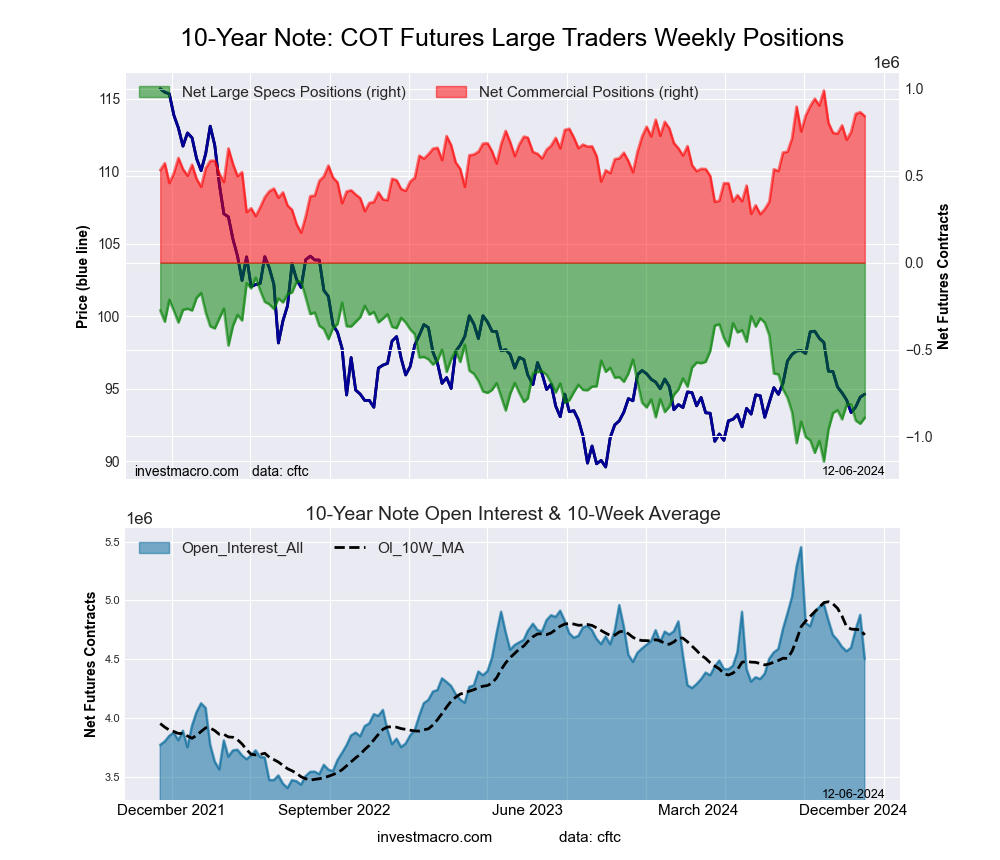
10-Year Treasury Note Futures:

10-Year Treasury Notes Bonds Futures COT ChartThe 10-Year Treasury Note large speculator standing this week totaled a net position of -865,065 contracts in the data reported through Tuesday. This was a weekly lift of 95,064 contracts from the previous week which had a total of -960,129 net contracts.

This week’s current strength score (the trader positioning range over the past three years, measured from 0 to 100) shows the speculators are currently Bearish with a score of 26.4 percent. The commercials are Bullish with a score of 70.3 percent and the small traders (not shown in chart) are Bullish-Extreme with a score of 91.6 percent.

Price Trend-Following Model: Weak Uptrend

Our weekly trend-following model classifies the current market price position as: Weak Uptrend.

10-Year Treasury Note StatisticsSPECULATORSCOMMERCIALSSMALL TRADERS
– Percent of Open Interest Longs:10.278.39.7
– Percent of Open Interest Shorts:28.562.47.2
– Net Position:-865,065747,361117,704
– Gross Longs:477,9303,684,020458,041
– Gross Shorts:1,342,9952,936,659340,337
– Long to Short Ratio:0.4 to 11.3 to 11.3 to 1
NET POSITION TREND:
– Strength Index Score (3 Year Range Pct):26.470.391.6
– Strength Index Reading (3 Year Range):BearishBullishBullish-Extreme
NET POSITION MOVEMENT INDEX:
– 6-Week Change in Strength Index:13.0-12.2-7.7


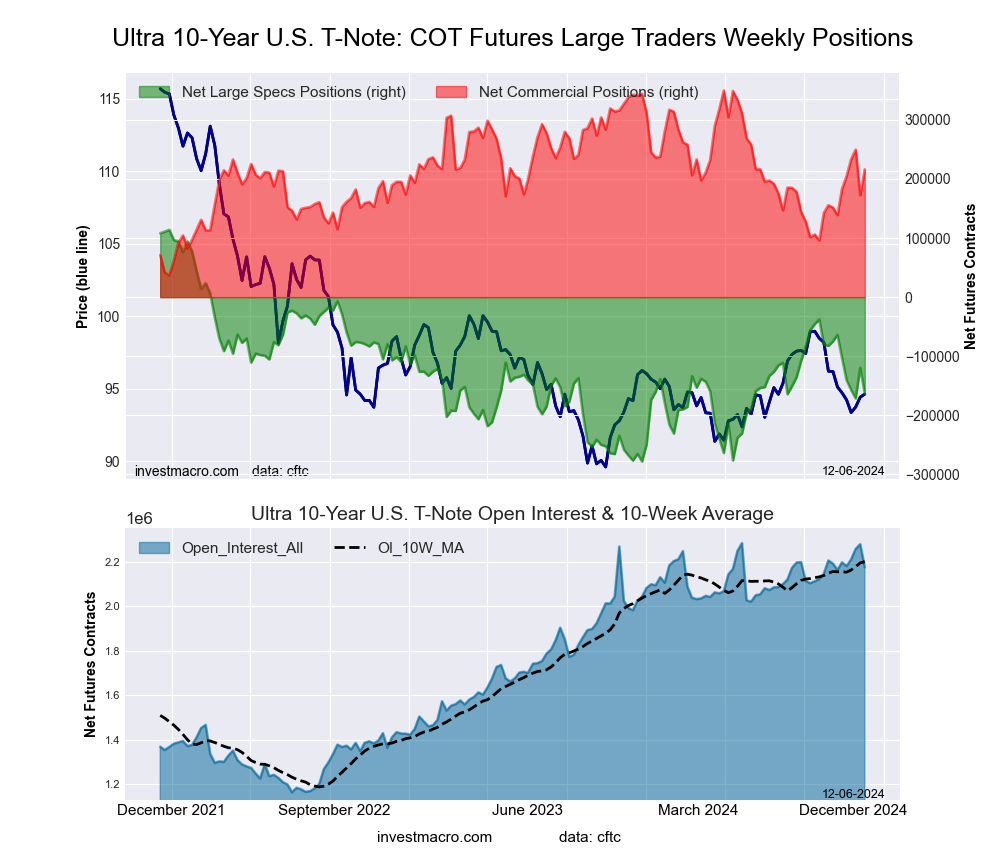
Ultra 10-Year Notes Futures:

Ultra 10-Year Treasury Notes Bonds Futures COT ChartThe Ultra 10-Year Notes large speculator standing this week totaled a net position of -75,048 contracts in the data reported through Tuesday. This was a weekly gain of 7,419 contracts from the previous week which had a total of -82,467 net contracts.

This week’s current strength score (the trader positioning range over the past three years, measured from 0 to 100) shows the speculators are currently Bearish with a score of 42.3 percent. The commercials are Bearish with a score of 46.2 percent and the small traders (not shown in chart) are Bullish with a score of 67.6 percent.

Price Trend-Following Model: Weak Uptrend

Our weekly trend-following model classifies the current market price position as: Weak Uptrend. The current action for the model is considered to be: Hold – Maintain Long Position.

Ultra 10-Year Notes StatisticsSPECULATORSCOMMERCIALSSMALL TRADERS
– Percent of Open Interest Longs:16.273.59.3
– Percent of Open Interest Shorts:19.766.612.8
– Net Position:-75,048151,418-76,370
– Gross Longs:355,8721,610,178204,283
– Gross Shorts:430,9201,458,760280,653
– Long to Short Ratio:0.8 to 11.1 to 10.7 to 1
NET POSITION TREND:
– Strength Index Score (3 Year Range Pct):42.346.267.6
– Strength Index Reading (3 Year Range):BearishBearishBullish
NET POSITION MOVEMENT INDEX:
– 6-Week Change in Strength Index:1.86.4-18.9


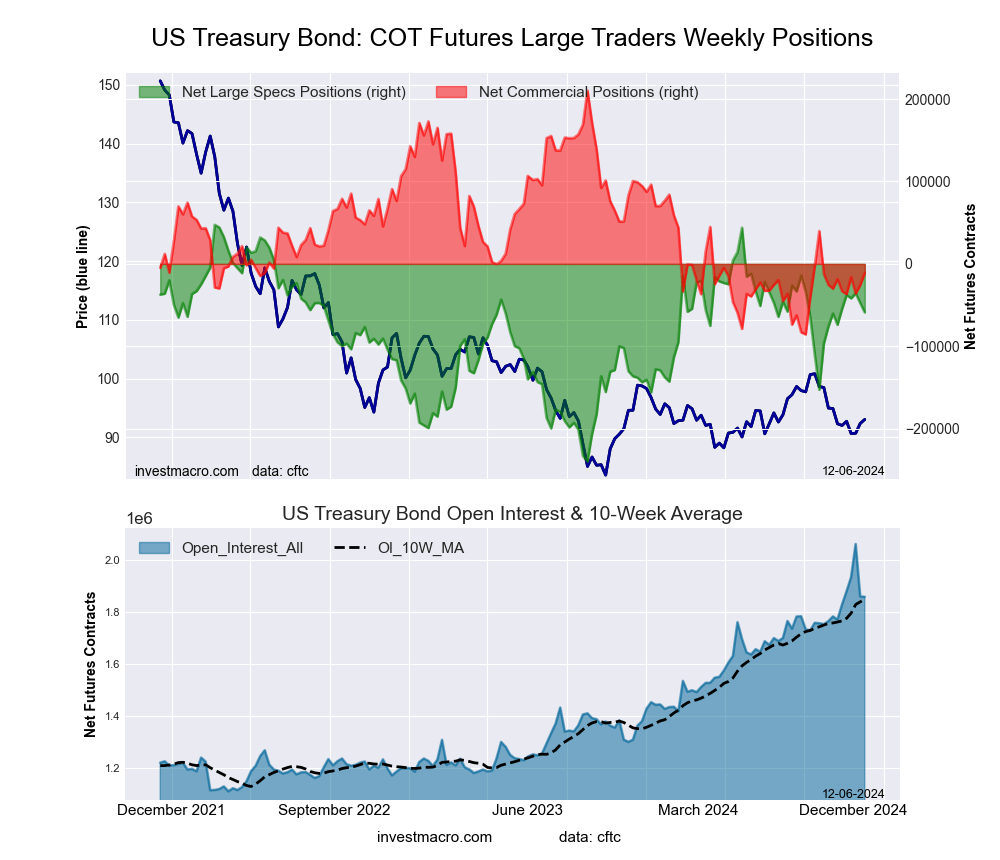
US Treasury Bonds Futures:

US Year Treasury Notes Long Bonds Futures COT ChartThe US Treasury Bonds large speculator standing this week totaled a net position of -60,178 contracts in the data reported through Tuesday. This was a weekly lift of 15,997 contracts from the previous week which had a total of -76,175 net contracts.

This week’s current strength score (the trader positioning range over the past three years, measured from 0 to 100) shows the speculators are currently Bullish with a score of 62.5 percent. The commercials are Bearish-Extreme with a score of 18.7 percent and the small traders (not shown in chart) are Bullish-Extreme with a score of 80.7 percent.

Price Trend-Following Model: Weak Uptrend

Our weekly trend-following model classifies the current market price position as: Weak Uptrend.

US Treasury Bonds StatisticsSPECULATORSCOMMERCIALSSMALL TRADERS
– Percent of Open Interest Longs:21.864.412.9
– Percent of Open Interest Shorts:25.266.17.8
– Net Position:-60,178-30,07390,251
– Gross Longs:388,1581,148,257229,519
– Gross Shorts:448,3361,178,330139,268
– Long to Short Ratio:0.9 to 11.0 to 11.6 to 1
NET POSITION TREND:
– Strength Index Score (3 Year Range Pct):62.518.780.7
– Strength Index Reading (3 Year Range):BullishBearish-ExtremeBullish-Extreme
NET POSITION MOVEMENT INDEX:
– 6-Week Change in Strength Index:-9.518.7-19.3


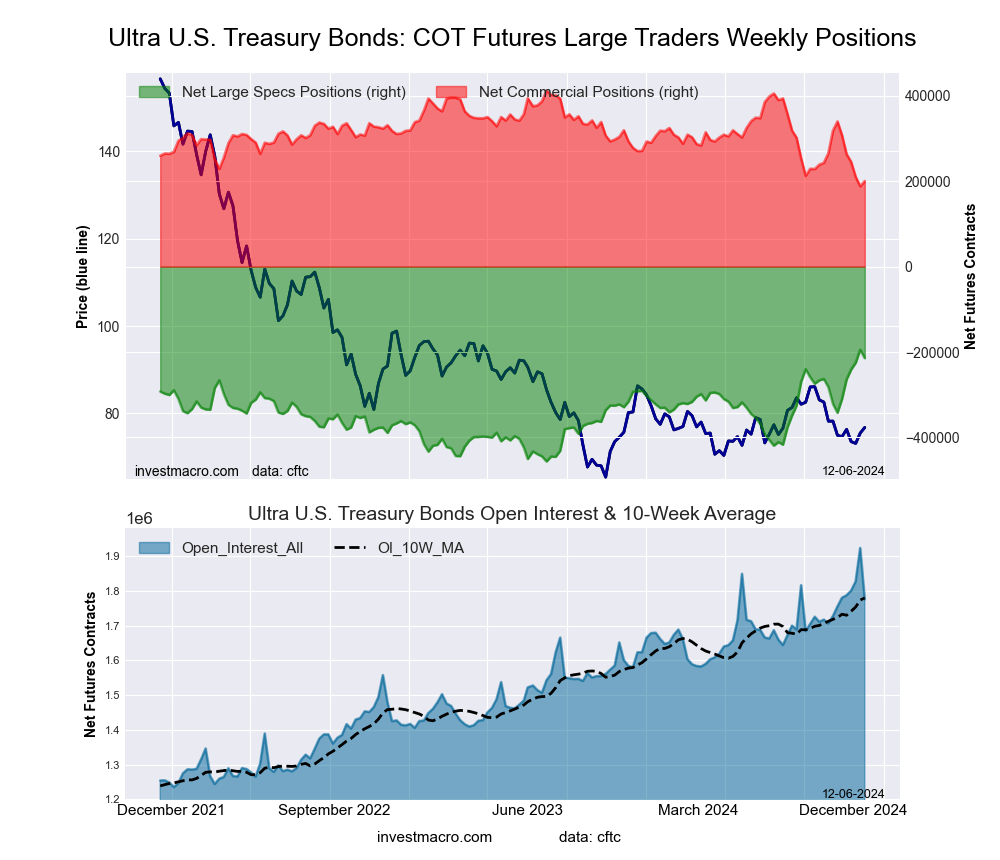
Ultra US Treasury Bonds Futures:

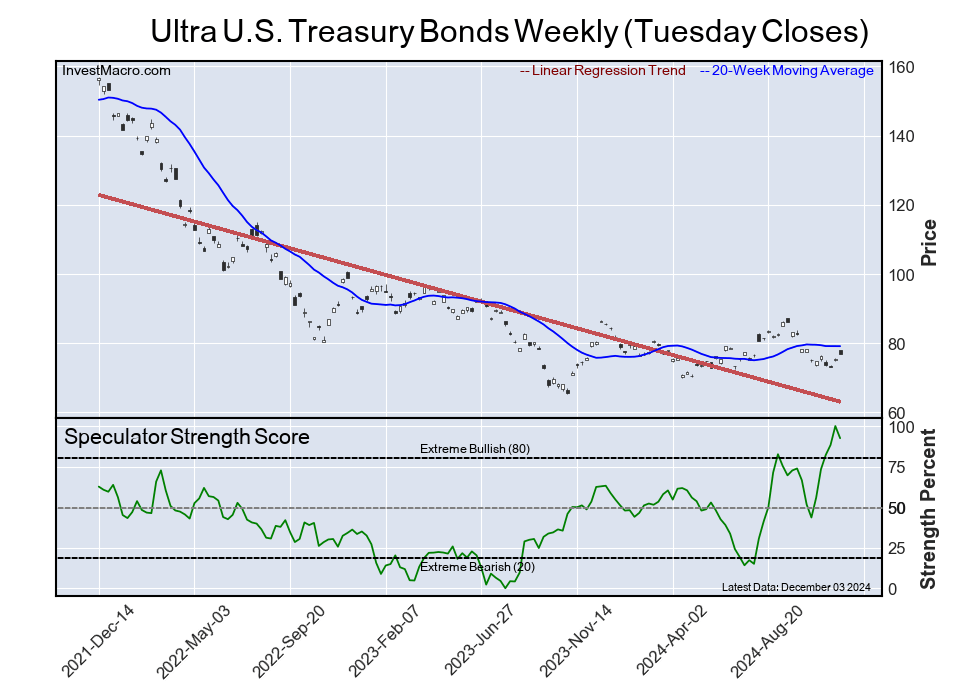
Ultra US Year Treasury Notes Long Bonds Futures COT ChartThe Ultra US Treasury Bonds large speculator standing this week totaled a net position of -321,226 contracts in the data reported through Tuesday. This was a weekly reduction of -38,975 contracts from the previous week which had a total of -282,251 net contracts.

This week’s current strength score (the trader positioning range over the past three years, measured from 0 to 100) shows the speculators are currently Bullish with a score of 62.5 percent. The commercials are Bullish with a score of 52.9 percent and the small traders (not shown in chart) are Bearish-Extreme with a score of 9.4 percent.

Price Trend-Following Model: Weak Uptrend

Our weekly trend-following model classifies the current market price position as: Weak Uptrend.

Ultra US Treasury Bonds StatisticsSPECULATORSCOMMERCIALSSMALL TRADERS
– Percent of Open Interest Longs:9.580.210.2
– Percent of Open Interest Shorts:28.161.710.0
– Net Position:-321,226318,5422,684
– Gross Longs:164,2821,384,793175,351
– Gross Shorts:485,5081,066,251172,667
– Long to Short Ratio:0.3 to 11.3 to 11.0 to 1
NET POSITION TREND:
– Strength Index Score (3 Year Range Pct):62.552.99.4
– Strength Index Reading (3 Year Range):BullishBullishBearish-Extreme
NET POSITION MOVEMENT INDEX:
– 6-Week Change in Strength Index:-37.552.9-35.0


Article By InvestMacroReceive our weekly COT Newsletter

*COT Report: The COT data, released weekly to the public each Friday, is updated through the most recent Tuesday (data is 3 days old) and shows a quick view of how large speculators or non-commercials (for-profit traders) were positioned in the futures markets.

The CFTC categorizes trader positions according to commercial hedgers (traders who use futures contracts for hedging as part of the business), non-commercials (large traders who speculate to realize trading profits) and nonreportable traders (usually small traders/speculators) as well as their open interest (contracts open in the market at time of reporting). See CFTC criteria here.
COT Soft Commodities Charts: Speculator bets led by Lean Hogs & Live Cattle

By InvestMacro

Here are the latest charts and statistics for the Commitment of Traders (COT) reports data published by the Commodities Futures Trading Commission (CFTC).

The latest COT data is updated through Tuesday October 15th and shows a quick view of how large traders (for-profit speculators and commercial entities) were positioned in the futures markets.

Weekly Speculator Changes led by Lean Hogs & Live Cattle

The COT soft commodities markets speculator bets were slightly higher this week as six out of the eleven softs markets we cover had higher positioning while the other five markets had lower speculator contracts.

Leading the gains for the softs markets was Lean Hogs (7,337 contracts) with Live Cattle (6,658 contracts), Coffee (4,235 contracts), Cocoa (3,376 contracts), Sugar (2,387 contracts) and Cotton (999 contracts) also recording positive weeks.

The markets with declines in speculator bets were Corn (-41,223 contracts), Soybean Meal (-37,962 contracts), Soybeans (-14,193 contracts), Soybean Oil (-7,454 contracts) and with Wheat (-216 contracts) also seeing lower bets on the week.


Soft Commodities Net Speculators Leaderboard

Legend: Weekly Speculators Change | Speculators Current Net Position | Speculators Strength Score compared to last 3-Years (0-100 range)


Strength Scores led by Coffee & Lean Hogs

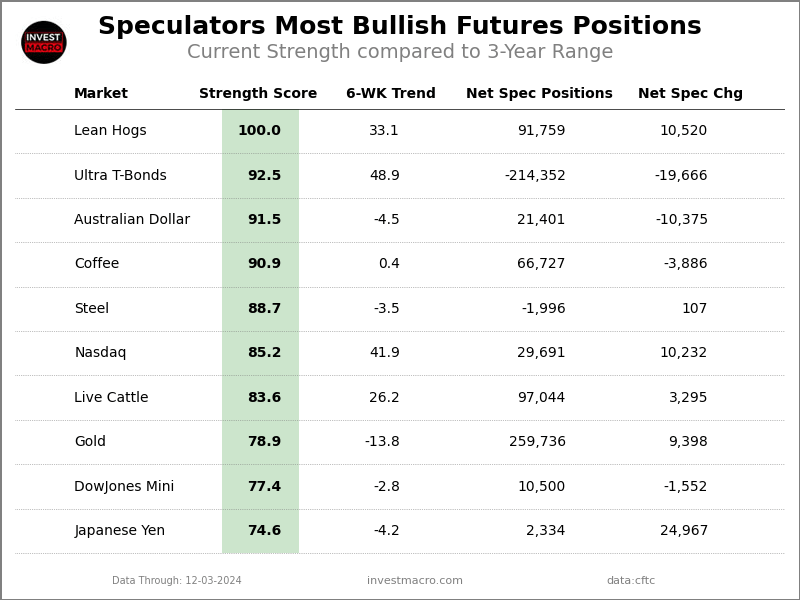
COT Strength Scores (a normalized measure of Speculator positions over a 3-Year range, from 0 to 100 where above 80 is Extreme-Bullish and below 20 is Extreme-Bearish) showed that Coffee (91 percent) and Lean Hogs (74 percent) lead the softs markets this week. Soybean Oil (70 percent), Wheat (60 percent) and Live Cattle (56 percent) come in as the next highest in the weekly strength scores.

On the downside, Cotton (23 percent) and Soybeans (31 percent) come in at the lowest strength levels currently.

Strength Statistics:
Corn (33.2 percent) vs Corn previous week (38.5 percent)
Sugar (38.6 percent) vs Sugar previous week (37.8 percent)
Coffee (91.1 percent) vs Coffee previous week (87.0 percent)
Soybeans (31.1 percent) vs Soybeans previous week (34.5 percent)
Soybean Oil (70.4 percent) vs Soybean Oil previous week (74.4 percent)
Soybean Meal (52.8 percent) vs Soybean Meal previous week (68.4 percent)
Live Cattle (56.0 percent) vs Live Cattle previous week (48.8 percent)
Lean Hogs (74.2 percent) vs Lean Hogs previous week (67.1 percent)
Cotton (22.9 percent) vs Cotton previous week (22.3 percent)
Cocoa (54.1 percent) vs Cocoa previous week (50.7 percent)
Wheat (60.2 percent) vs Wheat previous week (60.4 percent)


Lean Hogs & Live Cattle top the 6-Week Strength Trends

COT Strength Score Trends (or move index, calculates the 6-week changes in strength scores) showed that Lean Hogs (47 percent) and Live Cattle (44 percent) lead the past six weeks trends for soft commodities. Soybean Oil (33 percent), Soybeans (23 percent) and Cotton (18 percent) are the next highest positive movers in the latest trends data.

There are no markets with negative or lower trend scores this week.

Strength Trend Statistics:
Corn (10.9 percent) vs Corn previous week (23.5 percent)
Sugar (11.5 percent) vs Sugar previous week (19.5 percent)
Coffee (2.9 percent) vs Coffee previous week (-4.1 percent)
Soybeans (22.8 percent) vs Soybeans previous week (31.4 percent)
Soybean Oil (33.4 percent) vs Soybean Oil previous week (49.3 percent)
Soybean Meal (13.5 percent) vs Soybean Meal previous week (34.0 percent)
Live Cattle (44.3 percent) vs Live Cattle previous week (33.4 percent)
Lean Hogs (46.8 percent) vs Lean Hogs previous week (43.6 percent)
Cotton (17.8 percent) vs Cotton previous week (16.5 percent)
Cocoa (11.6 percent) vs Cocoa previous week (9.9 percent)
Wheat (10.1 percent) vs Wheat previous week (13.8 percent)


Individual Soft Commodities Markets:

CORN Futures:

CORN Futures COT ChartThe CORN large speculator standing this week equaled a net position of -5,152 contracts in the data reported through Tuesday. This was a weekly fall of -41,223 contracts from the previous week which had a total of 36,071 net contracts.

This week’s current strength score (the trader positioning range over the past three years, measured from 0 to 100) shows the speculators are currently Bearish with a score of 33.2 percent. The commercials are Bullish with a score of 69.9 percent and the small traders (not shown in chart) are Bearish with a score of 40.0 percent.

Price Trend-Following Model: Downtrend

Our weekly trend-following model classifies the current market price position as: Downtrend.

CORN Futures StatisticsSPECULATORSCOMMERCIALSSMALL TRADERS
– Percent of Open Interest Longs:21.446.48.4
– Percent of Open Interest Shorts:21.842.811.6
– Net Position:-5,15256,118-50,966
– Gross Longs:333,139721,807130,045
– Gross Shorts:338,291665,689181,011
– Long to Short Ratio:1.0 to 11.1 to 10.7 to 1
NET POSITION TREND:
– Strength Index Score (3 Year Range Pct):33.269.940.0
– Strength Index Reading (3 Year Range):BearishBullishBearish
NET POSITION MOVEMENT INDEX:
– 6-Week Change in Strength Index:10.9-8.9-24.6


SUGAR Futures:

SUGAR Futures COT ChartThe SUGAR large speculator standing this week equaled a net position of 105,473 contracts in the data reported through Tuesday. This was a weekly gain of 2,387 contracts from the previous week which had a total of 103,086 net contracts.

This week’s current strength score (the trader positioning range over the past three years, measured from 0 to 100) shows the speculators are currently Bearish with a score of 38.6 percent. The commercials are Bullish with a score of 54.7 percent and the small traders (not shown in chart) are Bullish with a score of 71.5 percent.

Price Trend-Following Model: Strong Uptrend

Our weekly trend-following model classifies the current market price position as: Strong Uptrend.

SUGAR Futures StatisticsSPECULATORSCOMMERCIALSSMALL TRADERS
– Percent of Open Interest Longs:28.746.910.4
– Percent of Open Interest Shorts:15.864.85.5
– Net Position:105,473-145,33239,859
– Gross Longs:233,674382,06084,478
– Gross Shorts:128,201527,39244,619
– Long to Short Ratio:1.8 to 10.7 to 11.9 to 1
NET POSITION TREND:
– Strength Index Score (3 Year Range Pct):38.654.771.5
– Strength Index Reading (3 Year Range):BearishBullishBullish
NET POSITION MOVEMENT INDEX:
– 6-Week Change in Strength Index:11.5-19.144.0


COFFEE Futures:

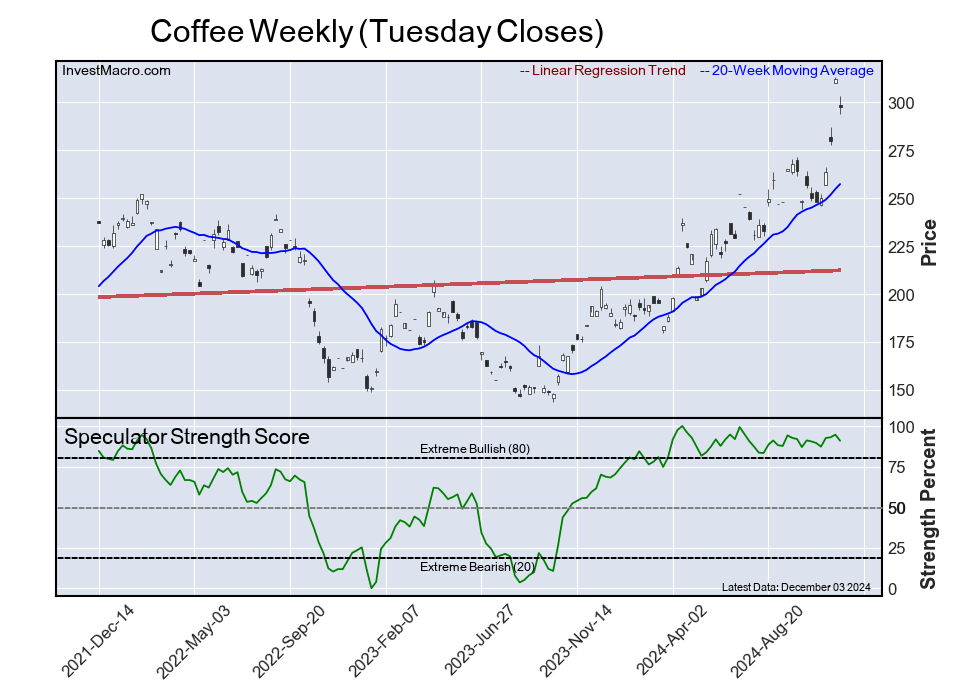
COFFEE Futures COT ChartThe COFFEE large speculator standing this week equaled a net position of 66,950 contracts in the data reported through Tuesday. This was a weekly increase of 4,235 contracts from the previous week which had a total of 62,715 net contracts.

This week’s current strength score (the trader positioning range over the past three years, measured from 0 to 100) shows the speculators are currently Bullish-Extreme with a score of 91.1 percent. The commercials are Bearish-Extreme with a score of 8.4 percent and the small traders (not shown in chart) are Bullish with a score of 66.4 percent.

Price Trend-Following Model: Uptrend

Our weekly trend-following model classifies the current market price position as: Uptrend.

COFFEE Futures StatisticsSPECULATORSCOMMERCIALSSMALL TRADERS
– Percent of Open Interest Longs:36.939.43.9
– Percent of Open Interest Shorts:5.872.12.4
– Net Position:66,950-70,1753,225
– Gross Longs:79,36684,8338,415
– Gross Shorts:12,416155,0085,190
– Long to Short Ratio:6.4 to 10.5 to 11.6 to 1
NET POSITION TREND:
– Strength Index Score (3 Year Range Pct):91.18.466.4
– Strength Index Reading (3 Year Range):Bullish-ExtremeBearish-ExtremeBullish
NET POSITION MOVEMENT INDEX:
– 6-Week Change in Strength Index:2.9-3.36.1


SOYBEANS Futures:

SOYBEANS Futures COT ChartThe SOYBEANS large speculator standing this week equaled a net position of -65,379 contracts in the data reported through Tuesday. This was a weekly lowering of -14,193 contracts from the previous week which had a total of -51,186 net contracts.

This week’s current strength score (the trader positioning range over the past three years, measured from 0 to 100) shows the speculators are currently Bearish with a score of 31.1 percent. The commercials are Bullish with a score of 72.0 percent and the small traders (not shown in chart) are Bearish with a score of 37.4 percent.

Price Trend-Following Model: Strong Downtrend

Our weekly trend-following model classifies the current market price position as: Strong Downtrend.

SOYBEANS Futures StatisticsSPECULATORSCOMMERCIALSSMALL TRADERS
– Percent of Open Interest Longs:16.360.15.1
– Percent of Open Interest Shorts:23.250.28.1
– Net Position:-65,37994,150-28,771
– Gross Longs:154,755569,89048,476
– Gross Shorts:220,134475,74077,247
– Long to Short Ratio:0.7 to 11.2 to 10.6 to 1
NET POSITION TREND:
– Strength Index Score (3 Year Range Pct):31.172.037.4
– Strength Index Reading (3 Year Range):BearishBullishBearish
NET POSITION MOVEMENT INDEX:
– 6-Week Change in Strength Index:22.8-22.4-16.2


SOYBEAN OIL Futures:

SOYBEAN OIL Futures COT ChartThe SOYBEAN OIL large speculator standing this week equaled a net position of 52,805 contracts in the data reported through Tuesday. This was a weekly lowering of -7,454 contracts from the previous week which had a total of 60,259 net contracts.

This week’s current strength score (the trader positioning range over the past three years, measured from 0 to 100) shows the speculators are currently Bullish with a score of 70.4 percent. The commercials are Bearish with a score of 34.4 percent and the small traders (not shown in chart) are Bearish with a score of 33.3 percent.

Price Trend-Following Model: Downtrend

Our weekly trend-following model classifies the current market price position as: Downtrend.

SOYBEAN OIL Futures StatisticsSPECULATORSCOMMERCIALSSMALL TRADERS
– Percent of Open Interest Longs:28.148.86.1
– Percent of Open Interest Shorts:17.760.25.2
– Net Position:52,805-57,7774,972
– Gross Longs:142,778247,43731,176
– Gross Shorts:89,973305,21426,204
– Long to Short Ratio:1.6 to 10.8 to 11.2 to 1
NET POSITION TREND:
– Strength Index Score (3 Year Range Pct):70.434.433.3
– Strength Index Reading (3 Year Range):BullishBearishBearish
NET POSITION MOVEMENT INDEX:
– 6-Week Change in Strength Index:33.4-31.913.9


SOYBEAN MEAL Futures:

SOYBEAN MEAL Futures COT ChartThe SOYBEAN MEAL large speculator standing this week equaled a net position of 61,885 contracts in the data reported through Tuesday. This was a weekly reduction of -37,962 contracts from the previous week which had a total of 99,847 net contracts.

This week’s current strength score (the trader positioning range over the past three years, measured from 0 to 100) shows the speculators are currently Bullish with a score of 52.8 percent. The commercials are Bearish with a score of 42.5 percent and the small traders (not shown in chart) are Bullish with a score of 77.0 percent.

Price Trend-Following Model: Downtrend

Our weekly trend-following model classifies the current market price position as: Downtrend.

SOYBEAN MEAL Futures StatisticsSPECULATORSCOMMERCIALSSMALL TRADERS
– Percent of Open Interest Longs:26.142.59.6
– Percent of Open Interest Shorts:15.158.24.9
– Net Position:61,885-88,82226,937
– Gross Longs:147,108239,35154,329
– Gross Shorts:85,223328,17327,392
– Long to Short Ratio:1.7 to 10.7 to 12.0 to 1
NET POSITION TREND:
– Strength Index Score (3 Year Range Pct):52.842.577.0
– Strength Index Reading (3 Year Range):BullishBearishBullish
NET POSITION MOVEMENT INDEX:
– 6-Week Change in Strength Index:13.5-15.123.9


LIVE CATTLE Futures:

LIVE CATTLE Futures COT ChartThe LIVE CATTLE large speculator standing this week equaled a net position of 71,418 contracts in the data reported through Tuesday. This was a weekly rise of 6,658 contracts from the previous week which had a total of 64,760 net contracts.

This week’s current strength score (the trader positioning range over the past three years, measured from 0 to 100) shows the speculators are currently Bullish with a score of 56.0 percent. The commercials are Bullish with a score of 62.1 percent and the small traders (not shown in chart) are Bearish-Extreme with a score of 0.0 percent.

Price Trend-Following Model: Weak Downtrend

Our weekly trend-following model classifies the current market price position as: Weak Downtrend.

LIVE CATTLE Futures StatisticsSPECULATORSCOMMERCIALSSMALL TRADERS
– Percent of Open Interest Longs:41.734.27.3
– Percent of Open Interest Shorts:19.749.314.2
– Net Position:71,418-49,211-22,207
– Gross Longs:135,289110,88823,845
– Gross Shorts:63,871160,09946,052
– Long to Short Ratio:2.1 to 10.7 to 10.5 to 1
NET POSITION TREND:
– Strength Index Score (3 Year Range Pct):56.062.10.0
– Strength Index Reading (3 Year Range):BullishBullishBearish-Extreme
NET POSITION MOVEMENT INDEX:
– 6-Week Change in Strength Index:44.3-37.4-42.5


LEAN HOGS Futures:

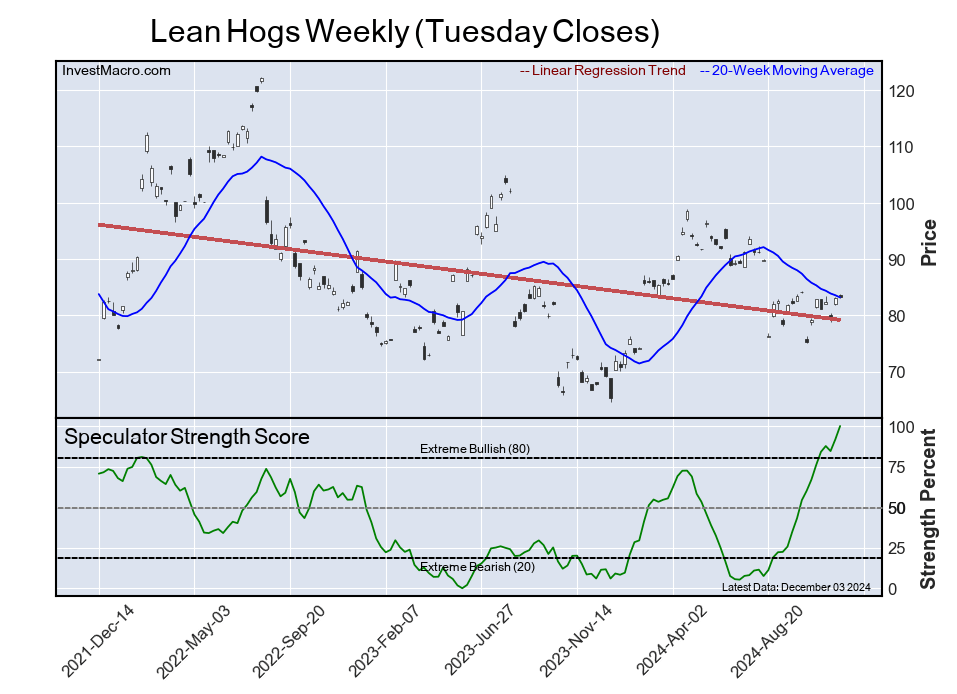
LEAN HOGS Futures COT ChartThe LEAN HOGS large speculator standing this week equaled a net position of 40,642 contracts in the data reported through Tuesday. This was a weekly gain of 7,337 contracts from the previous week which had a total of 33,305 net contracts.

This week’s current strength score (the trader positioning range over the past three years, measured from 0 to 100) shows the speculators are currently Bullish with a score of 74.2 percent. The commercials are Bearish with a score of 25.2 percent and the small traders (not shown in chart) are Bullish with a score of 50.4 percent.

Price Trend-Following Model: Strong Downtrend

Our weekly trend-following model classifies the current market price position as: Strong Downtrend.

LEAN HOGS Futures StatisticsSPECULATORSCOMMERCIALSSMALL TRADERS
– Percent of Open Interest Longs:42.234.26.6
– Percent of Open Interest Shorts:28.745.39.0
– Net Position:40,642-33,303-7,339
– Gross Longs:127,041103,00119,861
– Gross Shorts:86,399136,30427,200
– Long to Short Ratio:1.5 to 10.8 to 10.7 to 1
NET POSITION TREND:
– Strength Index Score (3 Year Range Pct):74.225.250.4
– Strength Index Reading (3 Year Range):BullishBearishBullish
NET POSITION MOVEMENT INDEX:
– 6-Week Change in Strength Index:46.8-50.4-12.3


COTTON Futures:

COTTON Futures COT ChartThe COTTON large speculator standing this week equaled a net position of -10,642 contracts in the data reported through Tuesday. This was a weekly gain of 999 contracts from the previous week which had a total of -11,641 net contracts.

This week’s current strength score (the trader positioning range over the past three years, measured from 0 to 100) shows the speculators are currently Bearish with a score of 22.9 percent. The commercials are Bullish with a score of 77.2 percent and the small traders (not shown in chart) are Bearish-Extreme with a score of 19.3 percent.

Price Trend-Following Model: Strong Uptrend

Our weekly trend-following model classifies the current market price position as: Strong Uptrend.

COTTON Futures StatisticsSPECULATORSCOMMERCIALSSMALL TRADERS
– Percent of Open Interest Longs:26.049.85.6
– Percent of Open Interest Shorts:30.345.75.4
– Net Position:-10,64210,163479
– Gross Longs:64,409123,13913,752
– Gross Shorts:75,051112,97613,273
– Long to Short Ratio:0.9 to 11.1 to 11.0 to 1
NET POSITION TREND:
– Strength Index Score (3 Year Range Pct):22.977.219.3
– Strength Index Reading (3 Year Range):BearishBullishBearish-Extreme
NET POSITION MOVEMENT INDEX:
– 6-Week Change in Strength Index:17.8-17.18.8


COCOA Futures:

COCOA Futures COT ChartThe COCOA large speculator standing this week equaled a net position of 43,312 contracts in the data reported through Tuesday. This was a weekly lift of 3,376 contracts from the previous week which had a total of 39,936 net contracts.

This week’s current strength score (the trader positioning range over the past three years, measured from 0 to 100) shows the speculators are currently Bullish with a score of 54.1 percent. The commercials are Bearish with a score of 42.4 percent and the small traders (not shown in chart) are Bullish with a score of 64.2 percent.

Price Trend-Following Model: Strong Downtrend

Our weekly trend-following model classifies the current market price position as: Strong Downtrend.

COCOA Futures StatisticsSPECULATORSCOMMERCIALSSMALL TRADERS
– Percent of Open Interest Longs:40.533.97.6
– Percent of Open Interest Shorts:10.168.63.3
– Net Position:43,312-49,4196,107
– Gross Longs:57,76348,38410,781
– Gross Shorts:14,45197,8034,674
– Long to Short Ratio:4.0 to 10.5 to 12.3 to 1
NET POSITION TREND:
– Strength Index Score (3 Year Range Pct):54.142.464.2
– Strength Index Reading (3 Year Range):BullishBearishBullish
NET POSITION MOVEMENT INDEX:
– 6-Week Change in Strength Index:11.6-11.0-3.4


WHEAT Futures:

WHEAT Futures COT ChartThe WHEAT large speculator standing this week equaled a net position of -13,714 contracts in the data reported through Tuesday. This was a weekly decline of -216 contracts from the previous week which had a total of -13,498 net contracts.

This week’s current strength score (the trader positioning range over the past three years, measured from 0 to 100) shows the speculators are currently Bullish with a score of 60.2 percent. The commercials are Bearish with a score of 39.0 percent and the small traders (not shown in chart) are Bearish with a score of 32.1 percent.

Price Trend-Following Model: Weak Downtrend

Our weekly trend-following model classifies the current market price position as: Weak Downtrend.

WHEAT Futures StatisticsSPECULATORSCOMMERCIALSSMALL TRADERS
– Percent of Open Interest Longs:27.236.77.5
– Percent of Open Interest Shorts:30.632.18.7
– Net Position:-13,71418,433-4,719
– Gross Longs:108,406146,20930,075
– Gross Shorts:122,120127,77634,794
– Long to Short Ratio:0.9 to 11.1 to 10.9 to 1
NET POSITION TREND:
– Strength Index Score (3 Year Range Pct):60.239.032.1
– Strength Index Reading (3 Year Range):BullishBearishBearish
NET POSITION MOVEMENT INDEX:
– 6-Week Change in Strength Index:10.1-11.45.1


Article By InvestMacroReceive our weekly COT Newsletter

*COT Report: The COT data, released weekly to the public each Friday, is updated through the most recent Tuesday (data is 3 days old) and shows a quick view of how large speculators or non-commercials (for-profit traders) were positioned in the futures markets.

The CFTC categorizes trader positions according to commercial hedgers (traders who use futures contracts for hedging as part of the business), non-commercials (large traders who speculate to realize trading profits) and nonreportable traders (usually small traders/speculators) as well as their open interest (contracts open in the market at time of reporting). See CFTC criteria here.

COT Stock Market Charts: Speculator bets led by S&P500 & Russell 2000 Minis

By InvestMacro

Here are the latest charts and statistics for the Commitment of Traders (COT) data published by the Commodities Futures Trading Commission (CFTC).

The latest COT data is updated through Tuesday October 15th and shows a quick view of how large traders (for-profit speculators and commercial entities) were positioned in the futures markets.

Weekly Speculator Changes led by S&P500-Mini & Russell 2000-Mini

The COT stock markets speculator bets were lower this week as four out of the seven stock markets we cover had higher positioning while the other four markets had lower speculator contracts.

Leading the gains for the stock markets was the S&P500-Mini (33,779 contracts) with the Russell-Mini (21,330 contracts) and the VIX (3,330 contracts) also showing positive weeks.

The markets with the declines in speculator bets this week were the Nasdaq-Mini (-11,891 contracts), MSCI EAFE-Mini (-2,773 contracts), the DowJones-Mini (-1,570 contracts) and the Nikkei 225 (-498 contracts) also registering lower bets on the week.


Stock Market Net Speculators Leaderboard

Legend: Weekly Speculators Change | Speculators Current Net Position | Speculators Strength Score compared to last 3-Years (0-100 range)


Strength Scores led by VIX & Russell-Mini

COT Strength Scores (a normalized measure of Speculator positions over a 3-Year range, from 0 to 100 where above 80 is Extreme-Bullish and below 20 is Extreme-Bearish) showed that the VIX (100 percent) and the Russell-Mini (100 percent) lead the stock markets this week. The DowJones-Mini (81 percent) and S&P500-Mini (69 percent) come in as the next highest in the weekly strength scores.

On the downside, the MSCI EAFE-Mini (35 percent) comes in at the lowest strength level currently while the next lowest strength score is the Nasdaq-Mini (41 percent).

Strength Statistics:
VIX (100.0 percent) vs VIX previous week (96.9 percent)
S&P500-Mini (68.9 percent) vs S&P500-Mini previous week (63.9 percent)
DowJones-Mini (81.0 percent) vs DowJones-Mini previous week (83.5 percent)
Nasdaq-Mini (41.3 percent) vs Nasdaq-Mini previous week (59.8 percent)
Russell2000-Mini (100.0 percent) vs Russell2000-Mini previous week (85.4 percent)
Nikkei USD (59.2 percent) vs Nikkei USD previous week (63.4 percent)
EAFE-Mini (35.4 percent) vs EAFE-Mini previous week (38.4 percent)


VIX & Russell-Mini top the 6-Week Strength Trends

COT Strength Score Trends (or move index, calculates the 6-week changes in strength scores) showed that the VIX (25 percent) leads the past six weeks trends for the stock markets. The Russell-Mini (18 percent), the S&P500-Mini (11 percent) and the DowJones-Mini (9 percent) are the next highest positive movers in the latest trends data.

The Nasdaq-Mini (-38 percent) leads the downside trend scores currently with the Nikkei USD (-6 percent) coming in as the next market with lower trend scores.

Strength Trend Statistics:
VIX (24.6 percent) vs VIX previous week (25.7 percent)
S&P500-Mini (11.5 percent) vs S&P500-Mini previous week (11.4 percent)
DowJones-Mini (9.1 percent) vs DowJones-Mini previous week (9.6 percent)
Nasdaq-Mini (-38.1 percent) vs Nasdaq-Mini previous week (-12.6 percent)
Russell2000-Mini (17.8 percent) vs Russell2000-Mini previous week (13.9 percent)
Nikkei USD (-6.3 percent) vs Nikkei USD previous week (16.2 percent)
EAFE-Mini (-5.4 percent) vs EAFE-Mini previous week (5.8 percent)


Individual Stock Market Charts:

VIX Volatility Futures:

VIX Volatility Futures COT ChartThe VIX Volatility large speculator standing this week was a net position of 322 contracts in the data reported through Tuesday. This was a weekly boost of 3,330 contracts from the previous week which had a total of -3,008 net contracts.

This week’s current strength score (the trader positioning range over the past three years, measured from 0 to 100) shows the speculators are currently Bullish-Extreme with a score of 100.0 percent. The commercials are Bearish-Extreme with a score of 0.0 percent and the small traders (not shown in chart) are Bullish-Extreme with a score of 100.0 percent.

Price Trend-Following Model: Uptrend

Our weekly trend-following model classifies the current market price position as: Uptrend.

VIX Volatility Futures StatisticsSPECULATORSCOMMERCIALSSMALL TRADERS
– Percent of Open Interest Longs:28.339.78.3
– Percent of Open Interest Shorts:28.240.97.2
– Net Position:322-4,0113,689
– Gross Longs:93,877131,46627,394
– Gross Shorts:93,555135,47723,705
– Long to Short Ratio:1.0 to 11.0 to 11.2 to 1
NET POSITION TREND:
– Strength Index Score (3 Year Range Pct):100.00.0100.0
– Strength Index Reading (3 Year Range):Bullish-ExtremeBearish-ExtremeBullish-Extreme
NET POSITION MOVEMENT INDEX:
– 6-Week Change in Strength Index:24.6-25.511.9


S&P500 Mini Futures:

SP500 Mini Futures COT ChartThe S&P500 Mini large speculator standing this week was a net position of 28,135 contracts in the data reported through Tuesday. This was a weekly lift of 33,779 contracts from the previous week which had a total of -5,644 net contracts.

This week’s current strength score (the trader positioning range over the past three years, measured from 0 to 100) shows the speculators are currently Bullish with a score of 68.9 percent. The commercials are Bearish with a score of 22.0 percent and the small traders (not shown in chart) are Bullish-Extreme with a score of 90.2 percent.

Price Trend-Following Model: Strong Uptrend

Our weekly trend-following model classifies the current market price position as: Strong Uptrend.

S&P500 Mini Futures StatisticsSPECULATORSCOMMERCIALSSMALL TRADERS
– Percent of Open Interest Longs:16.069.712.4
– Percent of Open Interest Shorts:14.775.67.8
– Net Position:28,135-129,397101,262
– Gross Longs:350,2271,522,232271,343
– Gross Shorts:322,0921,651,629170,081
– Long to Short Ratio:1.1 to 10.9 to 11.6 to 1
NET POSITION TREND:
– Strength Index Score (3 Year Range Pct):68.922.090.2
– Strength Index Reading (3 Year Range):BullishBearishBullish-Extreme
NET POSITION MOVEMENT INDEX:
– 6-Week Change in Strength Index:11.5-11.32.2


Dow Jones Mini Futures:

Dow Jones Mini Futures COT ChartThe Dow Jones Mini large speculator standing this week was a net position of 12,716 contracts in the data reported through Tuesday. This was a weekly lowering of -1,570 contracts from the previous week which had a total of 14,286 net contracts.

This week’s current strength score (the trader positioning range over the past three years, measured from 0 to 100) shows the speculators are currently Bullish-Extreme with a score of 81.0 percent. The commercials are Bearish-Extreme with a score of 15.5 percent and the small traders (not shown in chart) are Bullish with a score of 72.4 percent.

Price Trend-Following Model: Strong Uptrend

Our weekly trend-following model classifies the current market price position as: Strong Uptrend.

Dow Jones Mini Futures StatisticsSPECULATORSCOMMERCIALSSMALL TRADERS
– Percent of Open Interest Longs:26.255.816.5
– Percent of Open Interest Shorts:12.073.313.2
– Net Position:12,716-15,6652,949
– Gross Longs:23,41449,85814,714
– Gross Shorts:10,69865,52311,765
– Long to Short Ratio:2.2 to 10.8 to 11.3 to 1
NET POSITION TREND:
– Strength Index Score (3 Year Range Pct):81.015.572.4
– Strength Index Reading (3 Year Range):Bullish-ExtremeBearish-ExtremeBullish
NET POSITION MOVEMENT INDEX:
– 6-Week Change in Strength Index:9.1-12.317.5


Nasdaq Mini Futures:

Nasdaq Mini Futures COT ChartThe Nasdaq Mini large speculator standing this week was a net position of 1,404 contracts in the data reported through Tuesday. This was a weekly decline of -11,891 contracts from the previous week which had a total of 13,295 net contracts.

This week’s current strength score (the trader positioning range over the past three years, measured from 0 to 100) shows the speculators are currently Bearish with a score of 41.3 percent. The commercials are Bearish with a score of 38.9 percent and the small traders (not shown in chart) are Bullish with a score of 75.5 percent.

Price Trend-Following Model: Strong Uptrend

Our weekly trend-following model classifies the current market price position as: Strong Uptrend.

Nasdaq Mini Futures StatisticsSPECULATORSCOMMERCIALSSMALL TRADERS
– Percent of Open Interest Longs:20.361.516.4
– Percent of Open Interest Shorts:19.766.611.8
– Net Position:1,404-12,40911,005
– Gross Longs:48,843148,31539,446
– Gross Shorts:47,439160,72428,441
– Long to Short Ratio:1.0 to 10.9 to 11.4 to 1
NET POSITION TREND:
– Strength Index Score (3 Year Range Pct):41.338.975.5
– Strength Index Reading (3 Year Range):BearishBearishBullish
NET POSITION MOVEMENT INDEX:
– 6-Week Change in Strength Index:-38.131.1-7.3


Russell 2000 Mini Futures:

Russell 2000 Mini Futures COT ChartThe Russell 2000 Mini large speculator standing this week was a net position of 26,337 contracts in the data reported through Tuesday. This was a weekly advance of 21,330 contracts from the previous week which had a total of 5,007 net contracts.

This week’s current strength score (the trader positioning range over the past three years, measured from 0 to 100) shows the speculators are currently Bullish-Extreme with a score of 100.0 percent. The commercials are Bearish-Extreme with a score of 0.0 percent and the small traders (not shown in chart) are Bullish with a score of 71.7 percent.

Price Trend-Following Model: Strong Uptrend

Our weekly trend-following model classifies the current market price position as: Strong Uptrend.

Russell 2000 Mini Futures StatisticsSPECULATORSCOMMERCIALSSMALL TRADERS
– Percent of Open Interest Longs:20.869.76.9
– Percent of Open Interest Shorts:15.078.34.1
– Net Position:26,337-39,01512,678
– Gross Longs:94,562317,47631,364
– Gross Shorts:68,225356,49118,686
– Long to Short Ratio:1.4 to 10.9 to 11.7 to 1
NET POSITION TREND:
– Strength Index Score (3 Year Range Pct):100.00.071.7
– Strength Index Reading (3 Year Range):Bullish-ExtremeBearish-ExtremeBullish
NET POSITION MOVEMENT INDEX:
– 6-Week Change in Strength Index:17.8-16.21.1


Nikkei Stock Average (USD) Futures:

Nikkei Stock Average (USD) Futures COT ChartThe Nikkei Stock Average (USD) large speculator standing this week was a net position of -2,464 contracts in the data reported through Tuesday. This was a weekly reduction of -498 contracts from the previous week which had a total of -1,966 net contracts.

This week’s current strength score (the trader positioning range over the past three years, measured from 0 to 100) shows the speculators are currently Bullish with a score of 59.2 percent. The commercials are Bearish with a score of 37.5 percent and the small traders (not shown in chart) are Bullish with a score of 60.1 percent.

Price Trend-Following Model: Uptrend

Our weekly trend-following model classifies the current market price position as: Uptrend.

Nikkei Stock Average Futures StatisticsSPECULATORSCOMMERCIALSSMALL TRADERS
– Percent of Open Interest Longs:2.070.227.7
– Percent of Open Interest Shorts:24.755.719.5
– Net Position:-2,4641,576888
– Gross Longs:2217,6203,008
– Gross Shorts:2,6856,0442,120
– Long to Short Ratio:0.1 to 11.3 to 11.4 to 1
NET POSITION TREND:
– Strength Index Score (3 Year Range Pct):59.237.560.1
– Strength Index Reading (3 Year Range):BullishBearishBullish
NET POSITION MOVEMENT INDEX:
– 6-Week Change in Strength Index:-6.34.81.0


MSCI EAFE Mini Futures:

MSCI EAFE Mini Futures COT ChartThe MSCI EAFE Mini large speculator standing this week was a net position of -31,047 contracts in the data reported through Tuesday. This was a weekly lowering of -2,773 contracts from the previous week which had a total of -28,274 net contracts.

This week’s current strength score (the trader positioning range over the past three years, measured from 0 to 100) shows the speculators are currently Bearish with a score of 35.4 percent. The commercials are Bullish with a score of 61.1 percent and the small traders (not shown in chart) are Bullish with a score of 51.6 percent.

Price Trend-Following Model: Uptrend

Our weekly trend-following model classifies the current market price position as: Uptrend.

MSCI EAFE Mini Futures StatisticsSPECULATORSCOMMERCIALSSMALL TRADERS
– Percent of Open Interest Longs:7.988.73.2
– Percent of Open Interest Shorts:15.482.81.5
– Net Position:-31,04724,1126,935
– Gross Longs:32,341365,04713,105
– Gross Shorts:63,388340,9356,170
– Long to Short Ratio:0.5 to 11.1 to 12.1 to 1
NET POSITION TREND:
– Strength Index Score (3 Year Range Pct):35.461.151.6
– Strength Index Reading (3 Year Range):BearishBullishBullish
NET POSITION MOVEMENT INDEX:
– 6-Week Change in Strength Index:-5.46.3-5.1


Article By InvestMacroReceive our weekly COT Newsletter

*COT Report: The COT data, released weekly to the public each Friday, is updated through the most recent Tuesday (data is 3 days old) and shows a quick view of how large speculators or non-commercials (for-profit traders) were positioned in the futures markets.

The CFTC categorizes trader positions according to commercial hedgers (traders who use futures contracts for hedging as part of the business), non-commercials (large traders who speculate to realize trading profits) and nonreportable traders (usually small traders/speculators) as well as their open interest (contracts open in the market at time of reporting). See CFTC criteria here.

PBoC launches new stimulus for the economy. Silver hits two-month high

By JustMarkets

Stock indices traded mixed on Thursday. The Dow Jones Index (US30) was up 0.37% on Thursday. The S&P 500 Index (US500) was down 0.02%. The NASDAQ Technology Index (US100) closed positive 0.08%. A recovery in chip stocks supported the broader market after Taiwan Semiconductor Manufacturing, the main chip maker for Nvidia and Apple, eased concerns about chip demand by reporting a better-than-expected 54% increase in Q3 net profit and raising its 2024 revenue growth target. Stronger-than-expected economic news from the US on weekly jobless claims and retail sales in September supported equities as it boosted confidence in the US economy and improved prospects for a soft landing. The US weekly initial jobless claims unexpectedly fell by 19,000 to 241,000, showing a stronger labor market than expectations for a rise to 259,000. September retail sales rose by 0.4% m/m, stronger than expectations of 0.3% m/m.

Netflix’s (NFLX) shares are up about 4% after the streaming video company estimates higher earnings for next year. The company reported third-quarter EPS of $5.40, compared to the Wall Street consensus projection of $5.12.

Equity markets in Europe rallied on Thursday. Germany’s DAX (DE40) rose by 0.77%, France’s CAC 40 (FR40) closed 1.22% higher, Spain’s IBEX 35 (ES35) lost 0.77%, and the UK’s FTSE 100 (UK100) closed up 0.67%.

Denmark’s Central Bank, like its European counterpart (ECB), cut its benchmark interest rate by 25 basis points to protect its currency peg. The Nationalbanken, which does not hold scheduled meetings, cut its current account rate to 2.85% from 3.1%, it said Thursday. It is the third easing for the Scandinavian country this year. The Nationalbanken, whose mandate is to maintain a fixed exchange rate against the euro, usually echoes the ECB’s rate decisions. However, it can deviate from them if the krone becomes too weak or strong. Since early last year, it has kept Denmark’s key rate 40 basis points lower than the eurozone rate to weaken the Danish currency. The Central Bank officially keeps the krone within a 2.25 percent band of 7.46038 per euro, although it targets a narrower limit in practice.

Silver (XAG/USD) prices climbed above $32 an ounce to a two-week high on Friday, following gold prices higher as uncertainty surrounding the upcoming US election and rising tensions in the Middle East spurred demand for the precious metals. Less than three weeks before the US presidential election, former President Donald Trump and Vice President Kamala Harris are tied in the polls, with market estimates leaning slightly in favor of a Trump victory. In the Middle East, Israeli troops killed Hamas leader Yahya Sinwar, heightening fears of a wider regional conflict.

WTI crude oil prices were trading near $71 a barrel on Friday. The IEA recently lowered its demand estimates, signaling the possibility of a global glut, while OPEC cut its projections for the third consecutive month, mainly citing weaker demand from China.

Asian markets were mostly down yesterday. Japan’s Nikkei 225 (JP225) fell by 0.69%, China’s FTSE China A50 (CHA50) lost 1.40%, Hong Kong’s Hang Seng (HK50) decreased by 1.02%, and Australia’s ASX 200 (AU200) was positive 0.86%.

China’s Central Bank (PBoC) launched a lending program to support share buybacks of qualified companies and opened a swap fund to boost liquidity for financial firms. The PBoC also announced that it may lower banks’ reserve requirements by the end of the year, depending on liquidity conditions. These unexpected moves were a welcome relief for investors as the recent stimulus rally lost momentum following Beijing’s inconclusive fiscal policy plans. Meanwhile, data released on Friday showed China’s economy grew more than expected in the third quarter but at the slowest pace since the first quarter of 2023. The country also reported better-than-expected figures for retail sales, industrial production, and fixed asset investment.

S&P 500 (US500) 5,841.47 −1.00 (−0.02%)

Dow Jones (US30) 43,239.05 +161.35 (+0.37%)

DAX (DE40) 19,583.39 +150.58 (+0.77%)

FTSE 100 (UK100) 8,385.13 +56.06 (+0.67%)

USD Index 103.77 +0.18 (+0.17%)

News feed for: 2024.10.18

  • Japan National Consumer Price Index (m/m) at 02:30 (GMT+3);
  • China GDP (q/q) at 05:00 (GMT+3);
  • China Retail Sales (m/m) at 05:00 (GMT+3);
  • China Industrial Production (m/m) at 05:00 (GMT+3);
  • China Unemployment Rate (m/m) at 05:00 (GMT+3);
  • UK Retail Sales (m/m) at 09:00 (GMT+3);
  • US Building Permits (m/m) at 15:30 (GMT+3);
  • US FOMC Member Bostic Speaks (m/m) at 16:30 (GMT+3);
  • US FOMC Member Kashkari Speaks (m/m) at 17:00 (GMT+3).

By JustMarkets


This article reflects a personal opinion and should not be interpreted as an investment advice, and/or offer, and/or a persistent request for carrying out financial transactions, and/or a guarantee, and/or a forecast of future events.

USDJPY Adjusts Amid Mixed Signals from Japan’s Economic Data

By RoboForex Analytical Department 

USD/JPY is experiencing a correction phase following two days of gains, as mixed economic signals emerge from Japan. Despite ongoing expectations for monetary tightening by the Bank of Japan (BoJ), the yen faces downward pressure from a slowdown in domestic inflation, which could potentially dampen the urgency for immediate rate hikes.

In September, Japan’s consumer prices increased by 2.5% year-on-year, marking a decrease from the 3.0% inflation rate recorded in August. This slowdown is the first since March and represents the lowest inflation level since April of this year. The core inflation index, a key metric for the BoJ, rose by 2.4%, down from 2.8% in August, yet has remained above the BoJ’s target of 2.0% for 30 consecutive months. Notably, inflation excluding food and energy was recorded at 2.1% in September, a slight increase from 2.0% in August.

Recent comments from BoJ board member Seiji Adachi suggest a preference for moderate rate adjustments, reflecting concerns over global economic uncertainty and the domestic pace of wage increases. Additionally, the yen’s persistent weakness has drawn attention from Japan’s Chief Monetary Representative Atsushi Mimura, who reiterated the government’s focus on monitoring exchange rate fluctuations and its stance against excessive volatility.

USD/JPY technical analysis

The USD/JPY pair recently achieved a peak at 150.30 and is now forming a decline towards 149.75, testing this level from above. Looking ahead, we anticipate a potential resurgence towards 151.15. A successful breach of this level could open the way to 152.09. Conversely, a drop below 149.70 could trigger a further correction down to 147.70. The MACD indicator supports this potential upward trajectory, with the signal line positioned above zero and poised to reach new highs.

On the hourly chart, USD/JPY has established a consolidation range between 149.75 and 150.30. The current market dynamics suggest a correction towards 149.75. Following this correction, the likelihood of a rebound to 150.65 appears feasible, setting the stage for an extended rise to 151.15. This bullish outlook is corroborated by the Stochastic oscillator, with its signal line advancing from 20 towards 80, indicating a strengthening momentum for upward movement.


Disclaimer

Any forecasts contained herein are based on the author’s particular opinion. This analysis may not be treated as trading advice. RoboForex bears no responsibility for trading results based on trading recommendations and reviews contained herein.

Week Ahead: Tesla kicks off Big Tech earnings

By ForexTime

  • Tesla ↑ almost 60% from 2024 low
  • Earnings released on 23rd October after US market close
  • Impact of price cuts & Q4 outlook in focus
  • Shares could move 6.2% ↑ or ↓ post earnings
  • Technical levels – 50 & 100-day SMA, $213.00

The week ahead is stacked with top-tier data releases, speeches by policymakers, and more quarterly earnings from the largest companies in the world:

Monday, 21st October

  • CN50: China loan prime rates
  • TWN: Taiwan export orders
  • USDInd: US Conference Board leading index, Fed speeches

Tuesday, 22nd October

  • NZD: New Zealand trade
  • EU50: ECB President Christine Lagarde interview
  • UK100: BOE Governor Andrew Bailey speech

Wednesday, 23rd October

  • CAD: BoC rate decision
  • EU50: Eurozone consumer confidence, ECB President Lagarde speech
  • SG20: Singapore CPI
  • ZAR: South Africa CPI
  • TWN: Taiwan industrial production
  • US30: US existing home sales, Fed Beige book, Boeing earnings
  • NAS100: Tesla earnings

Thursday, 24th October

  • EU50: Eurozone/Germany PMIs
  • TWN: Taiwan jobless rate
  • UK100: UK S&P Global Manufacturing and Services PMI, Barclays earnings
  • RUS2000:  US jobless claims, S&P Global PMIs

Friday, 25th October  

  • CAD: Canada retail sales
  • EU50: Germany IFO business climate
  • JP225: Japan Tokyo CPI
  • SG20: Singapore industrial production, home prices
  • US400: US durable goods, University of Michigan consumer sentiment

Earnings season is in full swing with solid results from the biggest US banks supporting Wall Street. US equity markets could be injected with fresh volatility when big tech companies report their earnings.

One of the world’s largest EV manufacturers with a market cap of over $700 billion will be in focus.

Tesla shares have had a rough year, rebounding from a mid-April rout but still down over 10% in 2024. The company’s stock tumbled in the week ending 11th October after Elon Musk’s Robotaxi unveiling disappointed investors who had hoped for more concrete details.

Still, Tesla shares are up almost 60% from their 2024 low and could push higher or lower depending on how markets react to the latest earnings.

  • When will earnings be published?

Tesla reports its third-quarter earnings on Wednesday 23rd October after US markets close.  

  • Market expectations

The EV manufacturing is forecast to post earnings of $0.60 per share compared to $0.66 a year ago.

Quarterly revenues are seen rising to $25.4 billion from $23.4 billion in the prior year – equating to an 8.5% increase.

  • What to watch out for

Tesla has already published its delivery figures for Q3, revealing that 462,890 vehicles were delivered – a 6.4% increase from last year. While this was below market estimates, it still marked the company’s first quarter of growth in 2024.

Back in April, Tesla announced a fresh round of price cuts in several major markets. It will be interesting to see how this impacted profitability in Q3.

A boost from any recovery in China after reports earlier this month revealed sales of Tesla’s China-made electric vehicles rose 19.2% in September year-on-year.

Earlier this month, there were reports of top executive departures from the company. Investors may comb through the earnings to see how what this could mean for operations.

Any updates on Tesla’s full self-driving software and outlook for the final quarter of 2024 could help investors gauge its business outlook.

  • How will Tesla react to earnings?

Markets are forecasting a 6.2% move, either Up or Down, for Tesla stocks post earnings.

  • Technical picture

Tesla shares are under pressure on the daily timeframe as there have been consistently lower lows and lower highs. Prices are trading below the 50-day SMA but support may be offered by the 100 and 200-day SMA. In addition, the Relative Strength Index (RSI) is venturing toward 30 – signalling that prices may be oversold.

  • A decline below the 100-day SMA may open a path toward $213.0 and the 200-day SMA at $201.50.
  • Should $213.00 prove to be reliable support, this could send prices toward the 50-day SMA, $232.50 and $250.

Tesla


Forex-Time-LogoArticle by ForexTime

ForexTime Ltd (FXTM) is an award winning international online forex broker regulated by CySEC 185/12 www.forextime.com