Archive for Financial News – Page 77

The German Index set another high. The GDP of Malaysia and Singapore show steady growth

By JustMarkets

At the end of Thursday, the Dow Jones Index (US30) rose by 0.77%. The S&P 500 Index (US500) was up 1.04%. The Nasdaq Technology Index (US100) is up 1.43%. Stocks found support after Thursday’s release of the January Producer Price Index (PPI) report, which bodes well for the upcoming PCE Price Index report. The US PPI for January rose by 3.5% y/y, stronger than expectations of 3.3% y/y and the largest increase in nearly 2 years. January PPI excluding food and energy rose 3.6% y/y, stronger than expectations of 3.3% y/y. US weekly initial jobless claims fell by 7,000 to 213,000, indicating a stronger labor market than expected at 216,000. Lower bond yields also sparked a rally in microchip stocks, which helped boost the overall market.

The Canadian dollar strengthened above 1.43 per US dollar, hitting a near two-month high, as the Bank of Canada softened its dovish stance. The Bank of Canada’s latest meeting minutes highlighted concerns that lingering uncertainty over potential US tariffs, which are expected to affect business investment and spur inflation, caused policymakers to refrain from making interest rate estimates.

Equity markets in Europe were mostly up on Thursday. Germany’s DAX (DE40) rose by 2.09%, France’s CAC 40 (FR40) closed 1.52% higher, Spain’s IBEX 35 (ES35) added 0.19%, and the UK’s FTSE 100 (UK100) closed up 0.49%. The DAX Index rose sharply on Thursday, setting a new record, marking the fourth day of gains. Market sentiment remained upbeat amid strong corporate earnings and optimism about a possible end to the war in Ukraine, although caution remained on US trade policy. On the corporate front, Rheinmetall shares jumped more than 9% and led the index. Automakers also advanced strongly, with Volkswagen, BMW, Mercedes Benz, and Porsche adding between 4% and 6%. German technology conglomerate Siemens was also among the leaders, rising nearly 6% after reporting better-than-expected first-quarter earnings.

WTI crude oil prices settled at $71.3 a barrel on Friday amid rising fuel demand and a delay in US plans to impose tariffs. According to JPMorgan, global oil demand rose to 103.4 million barrels per day in February, up 1.4 million barrels per day from a year earlier. Crude oil could see a small gain this week, the first since mid-January.

The US natural gas (XNG/USD) prices climbed above $3.76/MMBtu, the highest in three weeks, thanks to higher LNG exports, lower output, and prognoses of colder weather. In addition, the EIA reported that US utilities withdrew 100 Bcf of natural gas from storage in the week ended February 7, bringing total inventories down to 2,297 Bcf, above the expected 92 Bcf.

Asian markets were mostly down yesterday. Japan’s Nikkei 225 (JP225) rose by 1.28%, China’s FTSE China A50 (CHA50) gained 0.47%, Hong Kong’s Hang Seng (HK50) climbed 0.20%, and Australia’s ASX 200 (AU200) was positive 0.05%.

The People’s Bank of China (PBOC) said in its fourth-quarter monetary policy implementation report that it will adjust policy at the right time to support the economy. The Central Bank recognized strengthening external factors, weak domestic demand, and various potential risks. To address these challenges, the Central Bank plans to use a full range of monetary policy tools, including interest rates and the bank reserve requirement ratio. It also emphasized that the scope and timing of policy measures will be adjusted depending on domestic and global economic conditions.

The New Zealand dollar rose to around US$0.569 on Friday, extending gains from the previous session, helped by a weaker US dollar after President Donald Trump delayed the imposition of significant duties. He said retaliatory tariffs would only take effect after the White House considers appropriate tariff levels for each country. Domestically, the RBNZ is expected to cut rates by 50 bps next week to 3.75%, with markets expecting another 75 bps cut this year.

Malaysia’s economy grew by 5% year-on-year in Q4 2024, beating initial estimates of 4.8% but slowing from an upwardly revised 5.4% in the previous quarter. This is the slowest growth in the past three quarters. Net trade made a positive contribution to GDP, with exports rising 8.5% and imports increasing 5.7%. On a seasonally adjusted quarterly basis, the economy contracted by 1.1%, the first contraction since Q4 2023, following a revised 1.8% growth in Q3. For the full year, Malaysia’s GDP grew by 5.1%.

Singapore’s economy grew 5% year-on-year in Q4 2024, slowing from 5.7% growth in Q3. For the full year, the economy grew by 4.4%, exceeding the 1.8% growth recorded in 2023.

S&P 500 (US500) 6,115.07 +63.10 (+1.04%)

Dow Jones (US30) 44,711.43 +342.87 (+0.77%)

DAX (DE40) 22,612.02 +463.99 (+2.09%)

FTSE 100 (UK100) 8,764.72 −42.72 (−0.49%)

USD Index 107.12 −0.20 (−0.18%)

News feed for: 2025.02.14

  • Switzerland Producer Price Index (m/m) at 09:30 (GMT+2);
  • Eurozone GDP (q/q) at 12:00 (GMT+2);
  • US Retail Sales (m/m) at 15:30 (GMT+2);
  • US Industrial Production (m/m) at 16:15 (GMT+2).

By JustMarkets


This article reflects a personal opinion and should not be interpreted as an investment advice, and/or offer, and/or a persistent request for carrying out financial transactions, and/or a guarantee, and/or a forecast of future events.

EUR/USD significantly rises as risks diminish

By RoboForex Analytical Department 

EUR/USD climbed to 1.0453 on Friday, reaching a two-week high and maintaining stability.

Key drivers behind EUR/USD movement

The euro’s gains accelerated after US President Donald Trump signed a memorandum to review retaliatory duties without immediately imposing new tariffs. This decision eased investor concerns, reducing fears of an aggressive US response that could have added to inflationary pressures. With no immediate trade retaliations, markets view inflation risks as stabilising, reducing uncertainty around the Federal Reserve’s monetary policy.

Additionally, geopolitical tensions appear to be easing, lowering the risk premium in the currency market and further supporting EUR/USD.

However, doubts remain regarding the monetary policy divergence between the Federal Reserve and the European Central Bank (ECB). While the Fed continues to be cautious, showing little urgency to cut interest rates, the ECB is actively considering rate cuts. This policy mismatch is expected to weigh on the euro in the long term.

Technical analysis of EUR/USD

On the H4 chart, EUR/USD extended its growth wave towards 1.0466 before forming a consolidation range below this level. The pair has now broken downward from this range, opening the potential for a decline towards 1.0372. Once this target is reached, a corrective move towards 1.0416 is likely. The MACD indicator supports this scenario, with its signal line at high levels, suggesting an imminent pullback to lower lows.

On the H1 chart, EUR/USD completed its growth wave to 1.0466 and is now consolidating in a narrow range. A downward breakout is expected, initially targeting 1.0420, followed by a potential correction towards 1.0444. In the longer term, another downward wave will likely develop, targeting 1.0394 and extending towards 1.0372. The Stochastic oscillator confirms this bearish outlook, with its signal line positioned below 50 and trending towards 20, indicating growing downside pressure.

Conclusion

While EUR/USD has gained on reduced trade war risks and stabilising inflation fears, the pair is now facing a short-term correction. The monetary policy divergence between the Fed and ECB remains a key factor that could limit further upside for the euro. Technically, a pullback towards 1.0372 is likely in the short term, with potential corrective bounces towards 1.0416 and 1.0444 before the next downward wave. Market participants will continue monitoring US trade policy updates and Fed rate expectations for further direction.

Disclaimer

Any forecasts contained herein are based on the author’s particular opinion. This analysis may not be treated as trading advice. RoboForex bears no responsibility for trading results based on trading recommendations and reviews contained herein.

Week Ahead: Trump’s trade war threatens UK100’s record run

By ForexTime 

  • UK100 ↑ 7% year-to-date
  • One of best-performing indices in FXTM’s universe YTD
  • Trump’s tariffs + UK data + BoE Bailey = volatility?
  • UK jobs data sparked moves of ↑ 1.2% & ↓ 1.4% over past year
  • Technical levels: 8846, 8800 & 8655

President Donald Trump has announced sweeping reciprocal tariffs on numerous trading partners!

These join the already imposed 10% tariffs on Chinese goods and 25% duties on all US steel and aluminium imports next month.

While Trump’s new tariffs raise the prospect of a global trade war, the delayed implementation could open doors to possible negotiations.

Beyond the trade drama, central bank decisions, high-impact data and corporate earnings will be in focus in the week ahead:

Monday, 17th February

  • US markets closed: Presidents Day holiday
  • JP225: Japan GDP, tertiary industry index
  • SG20: Singapore trade
  • USDInd: Philadelphia Fed President Patrick Harker, Fed Governor Michelle Bowman speech

Tuesday, 18th February

  • AU200: RBA rate decision
  • CAD: Canada CPI
  • GER40: Germany ZEW survey
  • UK100: UK jobless claims, unemployment, BoE Governor Andrew Bailey speech
  • US500: US Empire manufacturing, San Francisco Fed President Mary Daly speech

Wednesday, 19th February

  • CN50: China property prices
  • JP225: Japan machinery orders, trade
  • NZD: New Zealand rate decision
  • ZAR: South Africa CPI, retail sales
  • UK100: UK CPI
  • USDInd: US FOMC minutes

Thursday, 20th February

  • AUD: Australia unemployment
  • CN50: China loan prime rates
  • EUR: Eurozone consumer confidence, ECB 2024 financial statements
  • TWN: Taiwan export orders
  • US30: US initial jobless claims, Walmart earnings, Fed speech

Friday, 21st February

  • CAD: Canada retail sales, BoC Governor Tiff Macklem speech
  • GER40: Germany HCOB manufacturing & services PMI
  • JP225: Japan CPI
  • UK100: UK Retail sales, S&P Global manufacturing & services PMI
  • RUS2000: US S&P Global manufacturing & services PMI, University of Michigan consumer sentiment

FXTM’s UK100 is in focus after recently touching a fresh all-time high at 8846.1.

UK100

Note: UK100 tracks the FTSE100 index – the benchmark measuring the stock performance of the 100 largest listed companies on the London Stock Exchange.

The Index has gained over 7% year-to-date, outperforming most of its global peers in the FXTM universe.

  • GER40:  +13.6%
  • EU50: +12.3%
  • NETH25: 8%
  • US500: +4%
  • NAS100: +4.9%
  • RUS2000: +2.3%
  • JP225: -1.9%
  • TWN: 0.5%

A weaker pound and expectations around lower UK interest rates remain key drivers behind the UK100’s positive year-to-date gains.

Note: Over 80% of the revenues from FTSE100 companies come from outside of the UK. When the pound depreciates, it results in higher revenues for those companies that acquire sales from overseas – pushing the UK100 higher as a result. The same is true vice versa.

After notching repeated record highs, could Trump’s tariff war or souring sentiment towards the UK economy threaten UK100 bulls?


Here are 3 factors that could move the UK100 in the week ahead:

    1) Trump’s reciprocal tariffs

The UK could be thrown into the firing line if Trump’s reciprocal tariffs target countries using a VAT tax. Such tariffs could negatively impact the British economy, souring appetite for riskier assets.

Note: Value Added Tax (VAT) is a tax added to the sale of goods and services in the UK. In the United Kingdom, the standard VAT rate is 20%.

  • If Trump targets the UK economy, this may expose the UK100 to downside risks.
  • However, if the UK is not targeted the UK100 may see a relief rally as an element of uncertainty is removed.


    2) UK data + BoE Bailey speech

A string of top-tier data and a speech by Bank of England Governor Andrew Bailey may influence bets around BoE rate cuts.

  • Tuesday, 18th February: UK January jobs data, BoE Governor Bailey speech

The incoming UK jobs data should provide fresh insight into the health of the UK labour forces. BoE Bailey’s speech could provide fresh insight into future policy moves.

Traders are currently pricing a 93% probability of a 25bp BoE cut by May.

Over the past 12 months, the UK jobs data has triggered upside moves of as much as 1.2% or declines of 1.4% in a 6-hour window post-release.

  • Wednesday, 19th February: UK January CPI

The consumer price index, which measures headline inflation could offer clues about when the BoE will cut rates.

Annual inflation is expected to jump 2.8% from 2.5% in the previous month, while the core reading is seeing rising 3.6% to 3.2%. The month-on-month print is forecast to drop 0.3%.

Over the past 12 months, the UK CPI has triggered upside moves of as much as 1.0% or declines of 0.7% in a 6-hour window post-release.

  • Friday, 21st February: UK Retail sales, S&P Global PMI’s

Overall, these data releases could provide insight into the health of the UK economy.

Over the past 12 months, the UK retail sales has triggered upside moves of as much as 1.3% or declines of 1.2% in a 6-hour window post-release.


    3) Technical forces

The UK100 is firmly bullish on the daily charts with prices above the 21, 50, 100 and 200-day SMA. However, the Relative Strength Index indicates prices are flirting near overbought territory.

  • A solid daily close above 8800, could open a path toward 8846.1, 8850 and 8900.
  • Sustained weakness below 8800 may trigger a decline toward 8655 and the 21-day SMA at 8633.

UK100


Forex-Time-LogoArticle by ForexTime

ForexTime Ltd (FXTM) is an award winning international online forex broker regulated by CySEC 185/12 www.forextime.com

Today, traders’ attention is focused on the US inflation data

By JustMarkets

The Dow Jones Index (US30) rose by 0.28% on Tuesday. The S&P 500 Index (US500) added 0.03%. The Nasdaq Technology Index (US100) was down 0.29%. The US stocks had a mixed session on Tuesday as investors weighed Fed Chairman Jerome Powell’s cautious stance on interest rates and President Trump’s new 25% tariffs, which fueled fears of a potential trade war.

Today, markets will focus on the US inflation report for January, which is expected to be unchanged from December at 2.9% y/y, while core CPI is expected to fall to 3.1% y/y from 3.2% in December. Also on Wednesday, Fed Chairman Powell will testify on the economy and monetary policy before the House Financial Services Committee. Markets rate the odds of a 25 bps rate cut at the next FOMC meeting on March 18–19 at 6%.

Tesla (TSLA) stock price fell more than 6% and topped the list of losers in the Nasdaq 100. Technical selling weighed on Tesla after it fell below its 100-day moving average. Humana (HUM) closed down more than 3% after expecting 2025 adjusted EPS of $15.88, which was weaker than the consensus estimate of $16.09.

The Canadian dollar stabilized near 1.43 per US dollar, continuing its recovery from the 22-year low of 1.455 recorded on January 31. This was helped by a strong labor market, which reduced the need for the Bank of Canada to cut rates. Unemployment fell to 6.6% in January, easing fears of labor market weakness noted by the Bank of Canada. The currency’s recovery was also aided by a temporary pause in the imposition of 25% tariffs on Canadian exports, which was secured by Prime Minister Trudeau for further negotiations. In addition, rising crude oil prices amid supply concerns boosted demand for the commodity-linked loonie.

Equity markets in Europe were mostly up on Tuesday. Germany’s DAX (DE40) rose by 0.58%, France’s CAC 40 (FR40) closed 0.28% higher, Spain’s IBEX 35 (ES35) added 0.52%, and the UK’s FTSE 100 (UK100) closed up 0.11%. European equities closed solidly higher, continuing their strong momentum on Tuesday as strong corporate results reinforced the view that European equities have a favorable valuation compared to North American peers, while markets assessed the impact of new US tariffs on European corporate giants. In the heavy discretionary sector, Ferrari shares jumped 2.8% and continued their momentum after the earnings release, while Kering shares rose by 1.3%. On the other hand, UniCredit shares fell by 1% after the release of results.

WTI crude oil prices fell to around $73 a barrel on Wednesday, interrupting three days of gains after an industry report showed a sharp rise in US crude inventories. API data showed US crude inventories rose by 9 million barrels last week, well above the expected 2.8 million increase, which would be the biggest increase in a year if official data is confirmed today. Traders also remained cautious amid escalating trade tensions and broader economic uncertainty.

Asian markets were mostly down yesterday. Japan’s Nikkei 225 (JP225) was not trading yesterday, China’s FTSE China A50 (CHA50) was down 0.29%, Hong Kong’s Hang Seng (HK50) decreased by 1.06%, while Australia’s ASX 200 (AU200) was positive 0.01%. Hong Kong stocks soared 1.8% to 21685 in early trading on Wednesday. The Hang Seng hit its highest level in four months after China’s cabinet pledged to boost spending and attract foreign investment ahead of the annual legislative meeting in March.

The Australian dollar strengthened above US$0.63 on Wednesday, hitting its highest level in eight weeks, as traders largely reacted to the latest tariffs imposed by US President Donald Trump. Markets also adjusted their expectations on the impact of tariff escalation on inflation as they awaited the release of the latest US Consumer Price Index report. Domestically, investors continued to monitor the Reserve Bank of Australia’s monetary policy outlook. It is increasingly likely that the RBA will start cutting interest rates as early as this month as inflation weakens and signs of slowing economic growth emerge.

The Indian rupee posted its biggest one-day gain in nearly two years on Tuesday, rebounding from a series of record lows, bringing its monthly realized volatility to 4.4%, the highest level since April 2023. Despite the recovery, pressures remain due to a widening trade deficit, high crude oil prices and global risk aversion.

S&P 500 (US500) 6,068.50 +2.06 (+0.034%)

Dow Jones (US30) 44,593.65 +123.24 (+0.28%)

DAX (DE40) 22,037.83 +126.09 (+0.58%)

FTSE 100 (UK100) 8,777.39 +9.59 (+0.11%)

USD Index 107.91 -0.41 (-0.37%)

News feed for: 2025.02.12

  • Indian Inflation Rate (m/m) at 12:30 (GMT+2);
  • US Consumer Price Index (m/m) at 15:30 (GMT+2);
  • US Fed Chair Powell Testimony at 17:00 (GMT+2);
  • US Crude Oil Reserves (w/w) at 17:30 (GMT+2).

By JustMarkets


This article reflects a personal opinion and should not be interpreted as an investment advice, and/or offer, and/or a persistent request for carrying out financial transactions, and/or a guarantee, and/or a forecast of future events.

The pound’s rally stalls as investors await fresh economic data

By RoboForex Analytical Department

GBP/USD is consolidating around 1.2447 on Wednesday as traders hold back, awaiting key UK economic data releases later this week.

Key factors influencing GBP/USD

Earlier this week, the British pound faced pressure after Bank of England (BoE) policymaker Catherine Mann shifted to a more dovish stance. She stated that weak domestic demand reduces inflation risks, marking a notable change from her previously hawkish position.

Mann now believes consumer spending is slowing, limiting businesses’ ability to raise prices, and contributing to a faster-than-expected decline in inflationary pressures.

The BoE expects inflation to rise to 3.7% by the end of 2025, up from 2.5% in December 2024. Meanwhile, UK GDP growth forecasts have been lowered to 0.75% for 2025, down from the earlier estimate of 1.5%.

Investors are now awaiting key UK macroeconomic data, including:

December GDP estimate

Preliminary Q4 2024 economic growth data

End-of-year industrial production figures

Externally, the pound is also under pressure from a stronger US dollar. However, compared to other major currencies, GBP remains relatively stable.

Technical analysis of GBP/USD

On the H4 chart, GBP/USD declined to 1.2332, followed by a correction to 1.2458. After reaching this level, a new downside wave is expected towards 1.2279. A narrow consolidation range is likely to form around this level. If the price breaks below this range, the next targets will be 1.2100 and 1.2020, signalling a continued bearish trend. The MACD indicator supports this outlook, with its signal line positioned below zero and pointing downward, indicating a continuation of the downtrend.

On the H1 chart, GBP/USD completed a correction to 1.2458. The market is now expected to resume its downward movement towards 1.2279. The Stochastic oscillator confirms this scenario, with its signal line above 80 and trending sharply downwards towards 20, suggesting increasing bearish momentum.

Conclusion

GBP/USD is in a consolidation phase, with market participants awaiting key UK economic data. Weakening domestic demand and shifting expectations regarding the Bank of England’s (BOE) policy are weighing on the pound, while external pressure from a stronger USD adds to its downside risks. Technically, further declines are expected towards 1.2279, with the potential for deeper losses to 1.2100 and 1.2020 if the economic data disappoints. Market focus remains on upcoming UK macroeconomic releases, which will determine the next significant move for GBP/USD.

Disclaimer

Any forecasts contained herein are based on the author’s particular opinion. This analysis may not be treated as trading advice. RoboForex bears no responsibility for trading results based on trading recommendations and reviews contained herein.

25% tariffs on imports of steel and aluminum in the US provoke the growth of metals

By JustMarkets

At the end of Monday, the Dow Jones Index (US30) rose by 0.38%. The S&P 500 Index (US500) gained 0.67%. The Nasdaq Technology Index (US100) was up 1.24%. Stock indices rose moderately on Monday thanks to gains in US metals and mining stocks after President Trump imposed 25% tariffs on US steel and aluminum imports. The tariff hike also drove gold prices to a record high and copper to a four-month high. Strengthening shares of chip companies also supported the broader market’s gains.

Shares of Uber Technologies (UBER) closed higher by more than 5%, adding to last Friday’s 6% rally after Pershing Square Capital Management announced it had acquired 30.3 million shares of the company. McDonald’s (MCD) is up more than 4% and led the Dow Jones Industrials after reporting an unexpected 0.5% increase in fourth-quarter comparable sales, which was better than the consensus expectations of a 0.93% decline. Illumina (ILMN) was down more than 5% after Barclays downgraded the stock to “underweight” from “equal weight” with a $100 price target.

Equity markets in Europe were mostly up on Monday. Germany’s DAX (DE40) rose by 0.57%, France’s CAC 40 (FR40) closed 0.42% higher, Spain’s IBEX 35 (ES35) added 0.16%, and the UK’s FTSE 100 (UK100) closed 0.77% higher. The FTSE 100 index rose to a record high of 8749, thanks to a 7.3% rise in BP shares after it was revealed that activist investor Elliott Management had increased its stake in the company in a bid to address its underperformance. On the news, BP shares closed at their highest level since July. Across sectors, oil and gas stocks rose more than 2%, while precious metals miners gained about 3.6% thanks to higher oil and gold prices.

ECB Vice President Guindos warned that the imposition of tariffs by the US would cause a “supply shock” that would “fundamentally” affect the expansion of the global economy.

WTI crude prices held above $72 a barrel on Tuesday, maintaining a nearly 2% gain from the previous session, helped by signs of declining Russian supply and rising supply risks. Russian oil production in January was reportedly even lower than the OPEC+ quota, and new US sanctions are targeting individuals and tankers carrying Iranian oil to China to put pressure on Tehran. In addition, Trump called on Israel to end its truce with Hamas if hostages are not returned this weekend, raising the threat of renewed conflict as both sides accuse each other of violating the agreement.

The price of silver (XAG/USD) remained just below $32 an ounce on Tuesday, holding near three-month highs amid rising demand for the precious metal following the imposition of the latest US tariffs. The US President Donald Trump signed an executive order imposing 25% tariffs on steel and aluminum imports “without exceptions or exemptions,” sparking concerns over inflation and a potential escalation of the global trade war. In addition, silver prices were supported by expectations of stronger industrial demand, particularly from the renewable energy sector, as well as prognoses of continued supply shortages.

Platinum (XPT/USD) prices rose to $1,020 per ounce, approaching the three-month high of $1,032 reached on January 31 and up more than 12% YTD. The rally in the precious metals market is being driven by rising demand for safe-haven commodities and monetary easing by major central banks, temporarily offsetting the slowdown in demand.

Asian markets were predominantly rising yesterday. Japan’s Nikkei 225 (JP225) rose by 0.05%, China’s FTSE China A50 (CHA50) gained 1.30%, Hong Kong’s Hang Seng (HK50) rose 1.84%, and Australia’s ASX 200 (AU200) was negative 0.34%.

The Australian dollar held near two-week highs on Tuesday, supported by rising commodity prices. In Australia, a private survey showed a small rise in Consumer Confidence in February, although it remained in pessimistic territory due to concerns over household shortfalls and continued cost of living pressures. Markets are keeping a close eye on the possible start of the Reserve Bank of Australia’s easing cycle this month as domestic inflation weakens and signs of slowing economic growth emerge.

S&P 500 (US500) 6,066.44 +40.45 (+0.67%)

Dow Jones (US30) 44,470.41 +167.01 (+0.38%)

DAX (DE40) 21,911.74 +124.74 (+0.57%)

FTSE 100 (UK100) 8,767.80 +67.27 (+0.77%)

USD Index 108.33 +0.01 (+0.01%)

News feed for: 2025.02.11

  • Australia NAB Business Confidence (m/m) at 02:30 (GMT+2);
  • UK BoE Gov Bailey Speaks at 14:15 (GMT+2);
  • US Fed Chair Powell Testimony at 17:00 (GMT+2).

By JustMarkets


This article reflects a personal opinion and should not be interpreted as an investment advice, and/or offer, and/or a persistent request for carrying out financial transactions, and/or a guarantee, and/or a forecast of future events.

Drilling down: Key factors that could impact oil prices this week

By ForexTime 

  • Oil prices ↑ almost 2% this week
  • Russian/Iran supply concerns overshadow Trump’s tariff
  • EIA, OPEC and IEA monthly oil market reports in focus
  • Brent: US CPI sparked moves of ↑ 1.9% & ↓ 1.2% over past year
  • Technical levels: 200-day SMA, $76.00 and $74.00

Oil benchmarks are up almost 2% this week as tighter Russian crude supply overshadowed fears around Trump’s expanding tariffs.

Data from Russia revealed that production in January slipped below the nation’s OPEC+ quota. This adds to the rising concerns over supply following US sanctions on Iran’s oil exports.

Mounting geopolitical tensions in the Middle East amid Trump’s involvement could compound supply fears, fuelling oil’s upside gains.

Brent has climbed above $76.00, while WTI crude is trading at $73 as of writing.

Despite the recent rebound, Trump’s tariff drama could create obstacles down the road.

Trump recently imposed 25% tariffs on US steel and aluminium imports, scheduled to take effect on March 12.

He also plans to slap reciprocal tariffs sometime this week that will affect ‘everyone’.

Higher tariffs could threaten global growth, hitting demand for oil and resulting in lower prices. This uncertainty may force OPEC+ to delay increasing production beyond April 2025.

Regarding the week ahead, oil could be rocked by a cocktail of high-risk events.

Three of the most influential oil forecasters – EIA, OPEC and EIA will publish their latest monthly market outlooks. Fed Chair Jerome Powell’s 2-day testimony and the latest US CPI could inject oil prices with additional volatility.

Here is what you need to know:


    1) Oil monthly market outlooks

The Energy Information Administration (EIA) is scheduled to publish its monthly oil market on Tuesday afternoon.

On Wednesday, OPEC will publish its latest oil market report and on Thursday the International Energy Agency (IEA) releases its own.

Any fresh insight into the outlook for oil markets and demand forecasts among other themes may move Brent/Crude prices.


    2) Powell’s 2-day testimony & US CPI

As highlighted in our week ahead report, Powell’s testimony and the US CPI data may influence Fed cut bets.

Lower US interest rates could stimulate economic growth, fueling oil demand. Lower rates may also weaken the dollar, boosting oil which is priced in dollars. The same is true vice versa.

Over the past 12 months, the US CPI has triggered upside moves on Brent of as much as 1.9% or declines of 1.2% in a 6-hour window post-release.


    3) Technical forces

Brent has staged a solid rebound from $74 with prices trading above the 50 and 100-day SMA.

  • A solid daily close above $76 could encourage a move toward the 200-day SMA at $77.50 and $78.40.
  • Should prices slip back below $76, bears may target the 50-day and 100-day SMA before retesting $74.

Brent


Forex-Time-LogoArticle by ForexTime

ForexTime Ltd (FXTM) is an award winning international online forex broker regulated by CySEC 185/12 www.forextime.com

Yen’s rally stalls but may resume soon

By RoboForex Analytical Department

USD/JPY is consolidating near 151.96 after a temporary pause in the yen’s recent strength.

Key market factors

At the beginning of the week, the Japanese yen weakened against the US dollar as the greenback reacted to fresh US trade tariffs.

US President Donald Trump recently signed an executive order imposing a 25% tariff on steel and aluminium imports, with no exemptions for partner countries. This decision has triggered fears of a global trade war, which could, in turn, limit the Federal Reserve’s ability to cut interest rates further.

Despite this, the yen appreciated by 2% against the USD last week, driven by increasing market expectations that the Bank of Japan (BoJ) will continue its monetary tightening cycle.

BoJ policymaker Naoki Tamura reinforced this view last Thursday by suggesting that the central bank should move towards an interest rate of at least 1% in the second half of fiscal 2025. Recent Japanese economic data supports this hawkish stance, with rising wages and household spending providing a solid foundation for further rate hikes.

Technical analysis of USD/JPY

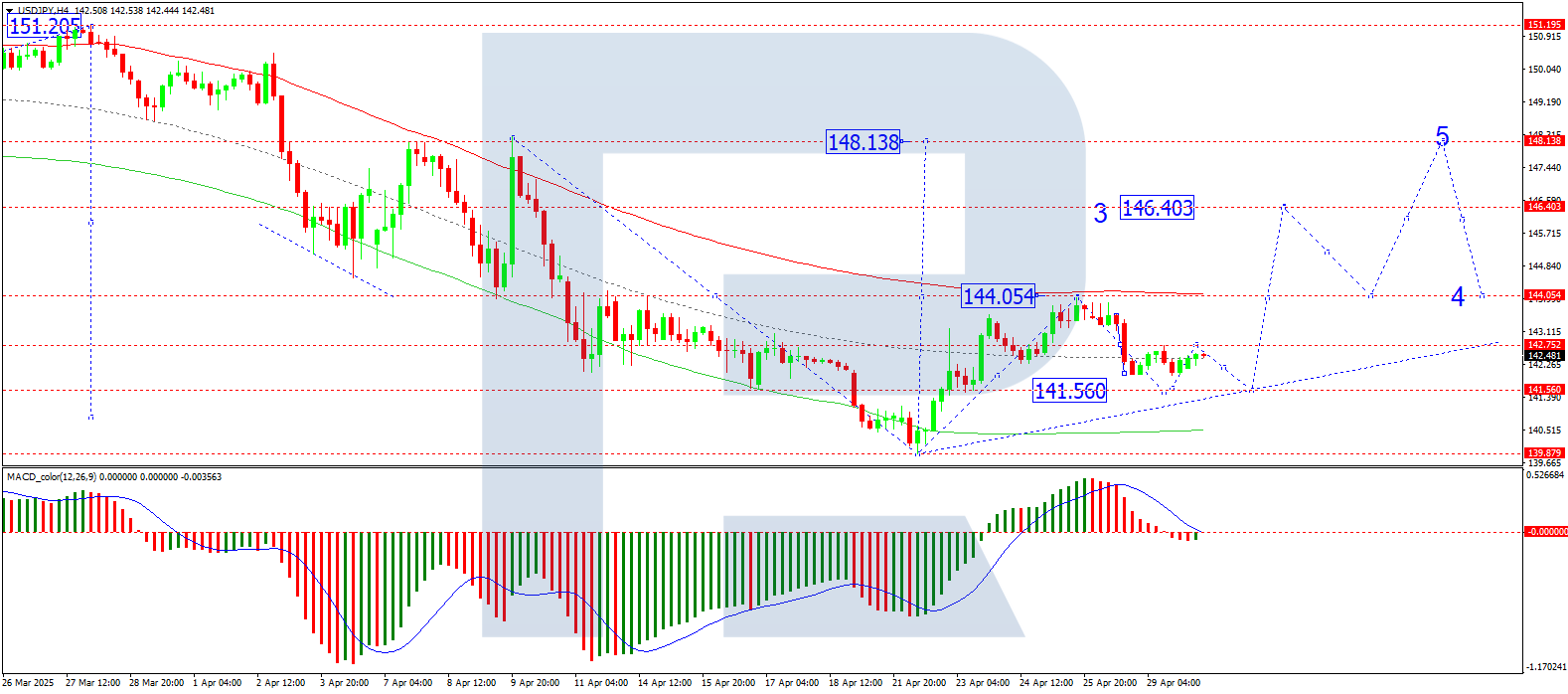
On the H4 chart, USD/JPY formed a consolidation range around 151.90 after a downward move. A break below this range is expected, targeting 148.80, with a potential continuation to 148.38. This level serves as a local target. Once the wave completes, a corrective move towards 151.90 is possible before the broader downtrend resumes, aiming for 145.50. The MACD indicator confirms this scenario, with its signal line below zero and sharply downwards, suggesting ongoing bearish momentum.

On the H1 chart, the market is developing a downward wave towards 148.40, with consolidation around 151.90. A downside breakout would confirm the continuation of the second phase of the decline. After reaching 148.40, a corrective move back to 151.90 could materialise. The Stochastic oscillator supports this outlook, with its signal line below 80 and sharply downward, indicating bearish pressure.

Conclusion

The Japanese yen’s rally has paused, but further gains remain likely, supported by expectations of continued BoJ tightening. Technical indicators suggest that USD/JPY may break lower towards 148.40, with further downside potential towards 145.50. The yen’s trajectory will depend on BoJ policy signals and further developments in US trade policy, particularly how global markets respond to Trump’s tariffs.


Disclaimer

Any forecasts contained herein are based on the author’s particular opinion. This analysis may not be treated as trading advice. RoboForex bears no responsibility for trading results based on trading recommendations and reviews contained herein.

Trump’s tariff intimidation continues to rattle markets

By JustMarkets

At Friday’s close, the Dow Jones Index (US30) decreased by 0.99% (for the week +0.08%). The S&P 500 Index (US500) lost 0.95% (for the week +0.94%). The Nasdaq Technology Index (US100) fell by 1.30% (for the week +1.93%). Stocks in the US declined during the afternoon session as investors grappled with new tariff concerns, inflation worries and the latest jobs report. Markets moved sharply lower following reports that President Trump is considering retaliatory tariffs, which could lead to higher rates for US trading partners. Investors were further worried by the University of Michigan’s consumer sentiment report, which showed that annual inflation expectations rose to 4.3%, the highest since November 2023. Meanwhile, the January jobs report showed that the US economy added 143,000 jobs, slightly below expectations, but the unemployment rate fell to 4.0%.

The US President Donald Trump said on Sunday he would announce additional 25% tariffs on all US steel and aluminum imports, as well as impose retaliatory duties on what he considers unfair trade practices. Canada, Brazil, Mexico, Mexico, South Korea and Vietnam are the largest exporters of steel to the US, government data show. Canada is also the largest exporter of aluminum to the United States.

The Canadian dollar traded near 1.43 per US dollar, rebounding from 22-year lows of 1.455 hit on January 31, as strong labor market data limited the need for the Bank of Canada to cut rates. Canada’s unemployment rate fell to 6.6% in January from 6.7% in December, defying expectations of a rise to 6.8% and easing fears of labor market weakness highlighted by the Bank of Canada. However, Ivey’s PMI fell to 47.1 from 54.7, well below expectations of 53, the lowest reading since December 2020 and reinforcing expectations of policy easing. In addition to the dovish outlook, the Bank of Canada plans to resume asset purchases in March, aiming to reinstate bond purchases in the secondary market by 2026.

Mexico’s annual inflation rate slowed for a third month in January 2025, hitting a four-year low of 3.59%, slightly below market projections of 3.61%. The rate is now below the top end of the Central Bank’s target range of 2% to 4%. The annualized core inflation rate rose to 3.66% in January from December’s 3.65%, but fell short of market estimates of 3.70%.

Equity markets in Europe were mostly down on Friday. Germany’s DAX (DE40) fell by 0.53% (for the week +2.28%), France’s CAC 40 (FR40) closed down 0.43% (for the week +2.40%), Spain’s IBEX 35 (ES35) lost 0.33% (for the week +4.67%), and the UK’s FTSE 100 (UK100) closed negative 0.31% (for the week +0.31%). German industrial production fell more than expected at the end of 2024, recording the largest decline in five months. On the Eurozone corporate front, L’Oréal fell more than 4% after reporting its slowest quarterly sales growth since the pandemic. Porsche also fell nearly 7% after announcing asset impairments and a 2025 sales estimates that fell short of expectations.

Silver rose to $32.5 an ounce on Friday, its highest in three months, on the prospect of weaker financial conditions, higher demand for inputs and tight supply. Traders remain bullish on multiple Fed rate cuts this year. The ECB, BoE, RBNZ and RBI are also on a softer policy stance.

WTI crude oil prices rose 0.5% to reach $71/bbl on Friday after new sanctions were imposed on Iran’s oil exports, but gains were limited by US President Donald Trump’s escalating trade dispute with China and the threat of new tariffs against other countries. Despite these gains, the benchmark recorded its third consecutive weekly decline, down around 2%, mainly due to escalating trade tensions caused by President Trump’s recent announcements of imposing tariffs against China and other countries. Analysts have expressed concerns that these trade disputes could dampen global economic growth and consequently reduce oil demand.

The US natural gas prices (XNG/USD) were down slightly at $3.35/MMBtu on Friday, but are up nearly 10% this week. The increase was driven by higher LNG exports and prognoses of colder weather expected to boost heating demand. Gas flows to LNG export plants also increased to 15.1 Bcf/d in February from 14.6 Bcf/d in January, close to December’s record.

Asian markets were mostly falling last week. Japan’s Nikkei 225 (JP225) fell by 0.37%, China’s FTSE China A50 (CHA50) rose by 1.92%, Hong Kong’s Hang Seng (HK50) gained 5.41%, and Australia’s ASX 200 (AU200) was negative 0.24%.

China’s annualized inflation rate for January 2025 rose to 0.5% from 0.1% in December, beating the market consensus expectations of 0.4%. This is the highest rate since August 2024, driven by seasonal effects associated with the Lunar New Year celebrations at the end of the month. The latest result also reflected the impact of recent government stimulus measures and the Central Bank’s supportive monetary policy aimed at helping the economy. Core consumer prices excluding food and energy rose by 0.6% y/y, the highest in 7 months. Producer prices in China were 2.3% y/y in January 2025, maintaining the same pace as the previous month and beating market estimates of 2.1%. This was the 28th consecutive month of producer price deflation.

S&P 500 (US500) 6,025.99 −57.58 (−0.95%)

Dow Jones (US30) 44,303.40 −444.23 (−0.99%)

DAX (DE40) 21,787.00 −115.42 (−0.53%)

FTSE 100 (UK100) 8,700.53 −26.75 (−0.31%)

USD Index 108.10 +0.41 (+0.38%)

News feed for: 2025.02.10

  • Norway Inflation Rate (m/m) at 09:00 (GMT+2);
  • Eurozone ECB President Lagarde Speech at 16:00 (GMT+2).

By JustMarkets


This article reflects a personal opinion and should not be interpreted as an investment advice, and/or offer, and/or a persistent request for carrying out financial transactions, and/or a guarantee, and/or a forecast of future events.

Japanese Yen Speculators push yen bets into new bullish position

By InvestMacro

Here are the latest charts and statistics for the Commitment of Traders (COT) data published by the Commodities Futures Trading Commission (CFTC).

The latest COT data is updated through Tuesday February 4th and shows a quick view of how large market participants (for-profit speculators and commercial traders) were positioned in the futures markets. All currency positions are in direct relation to the US dollar where, for example, a bet for the euro is a bet that the euro will rise versus the dollar while a bet against the euro will be a bet that the euro will decline versus the dollar.

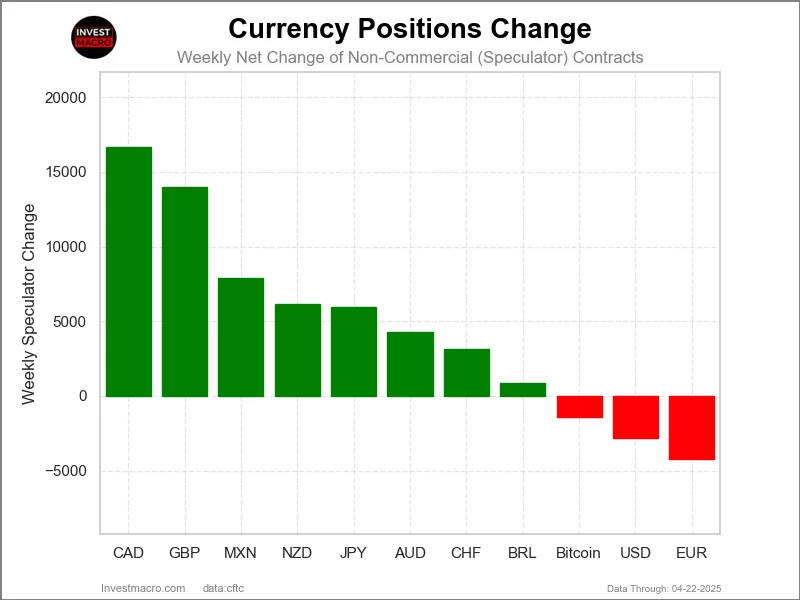
Weekly Speculator Changes led by Brazilian Real & Japanese Yen

The COT currency market speculator bets were higher this week as seven out of the eleven currency markets we cover had higher positioning while the other four markets had lower speculator contracts.

Leading the gains for the currency markets was the Brazilian Real (38,736 contracts) with the Japanese Yen (19,727 contracts), the British Pound (10,349 contracts), the EuroFX (7,990 contracts), the Mexican Peso (7,038 contracts), the Swiss Franc (742 contracts) and the US Dollar Index (339 contracts) also showing positive weeks.

The currencies seeing declines in speculator bets on the week were the Canadian Dollar (-12,843 contracts), the Australian Dollar (-3,478 contracts), the New Zealand Dollar (-2,059 contracts) and with Bitcoin (-379 contracts) also registering lower bets on the week.

Japanese Yen Speculators push yen bets into new bullish position

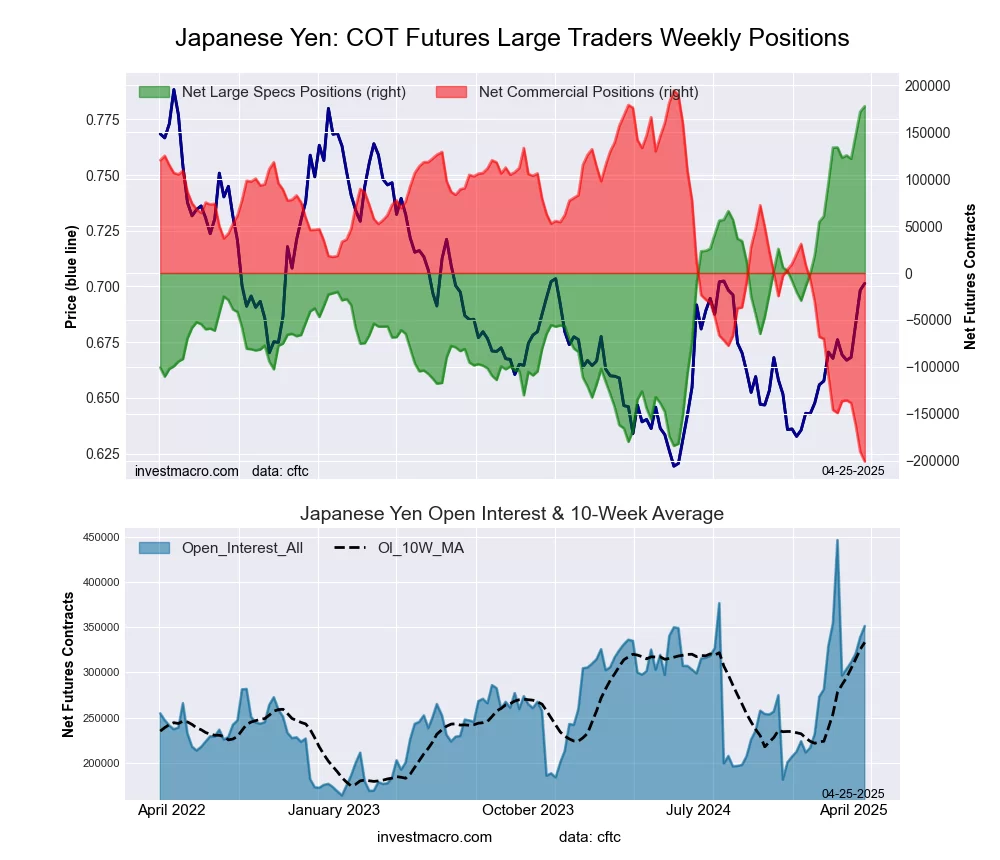
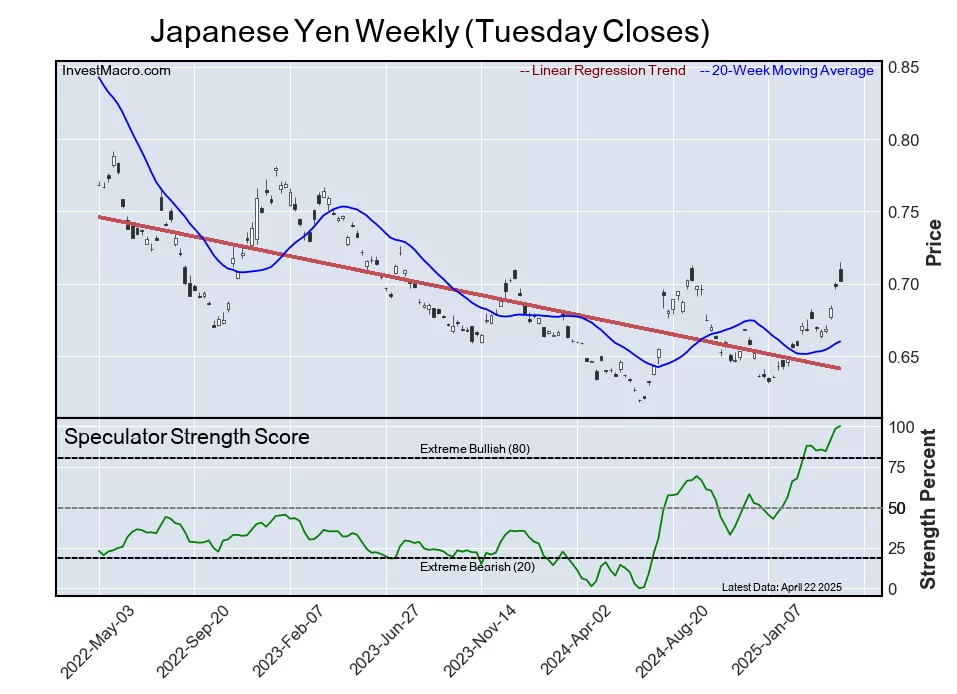
Highlighting the COT currency’s data this week is the renewal in bullish bets for the Japanese yen speculators. Large speculative yen positions gained for a third consecutive week this week and has risen by a total of +48,179 contracts over these past three weeks.

This renewed sentiment for the yen has pushed the net position (currently at +18,768 contracts) to the most positive level in the past eight weeks. The yen speculator bets had recently spent four weeks in bullish territory in December before dropping back into negative territory in January.

The yen has had extremely bearish speculator positioning over the past four years (basically since March of 2021) and very often had over -100,000 net speculator weekly contracts as policy divergences between the US Federal Reserve and the Bank of Japan caused the yen exchange rate to drop to multi-decade lows versus the American currency.

The BOJ recently raised their interest rate by 25 basis points in January from 0.25 percent to 0.50 percent as inflation is poised to pickup, according to the BOJ. This increase moved the rate to the highest level since 2008, underscoring the rare move.

The yen exchange rate, overall, has continued to trend near the bottom of its range from the past few years but has managed to gain versus the US Dollar for the past four weeks in a row. The USDJPY currency pair trades at 151.42 to end the week after hitting support right below 159.00 in late-January. Since then, the USDJPY has seen yen strength with a break below support at 155.00 and currently trades around a major support/resistance level around 152.00 that could determine the short-term direction of the pair.


Currencies Net Speculators Leaderboard

Legend: Weekly Speculators Change | Speculators Current Net Position | Speculators Strength Score compared to last 3-Years (0-100 range)


Strength Scores led by Japanese Yen & Bitcoin

COT Strength Scores (a normalized measure of Speculator positions over a 3-Year range, from 0 to 100 where above 80 is Extreme-Bullish and below 20 is Extreme-Bearish) showed that the Japanese Yen (81 percent) and the Bitcoin (68 percent) lead the currency markets this week. The Brazilian Real (52 percent), US Dollar Index (37 percent) and the Mexican Peso (35 percent) come in as the next highest in the weekly strength scores.

On the downside, the New Zealand Dollar (6 percent), the EuroFX (6 percent), the Swiss Franc (15 percent) and the Canadian Dollar (16 percent) come in at the lowest strength levels currently and are in Extreme-Bearish territory (below 20 percent).

3-Year Strength Statistics:
US Dollar Index (36.8 percent) vs US Dollar Index previous week (36.1 percent)
EuroFX (6.5 percent) vs EuroFX previous week (3.4 percent)
British Pound Sterling (31.0 percent) vs British Pound Sterling previous week (26.4 percent)
Japanese Yen (81.1 percent) vs Japanese Yen previous week (73.2 percent)
Swiss Franc (15.3 percent) vs Swiss Franc previous week (13.8 percent)
Canadian Dollar (16.1 percent) vs Canadian Dollar previous week (21.8 percent)
Australian Dollar (22.9 percent) vs Australian Dollar previous week (25.3 percent)
New Zealand Dollar (6.5 percent) vs New Zealand Dollar previous week (8.9 percent)
Mexican Peso (35.0 percent) vs Mexican Peso previous week (31.4 percent)
Brazilian Real (52.3 percent) vs Brazilian Real previous week (15.6 percent)
Bitcoin (68.4 percent) vs Bitcoin previous week (76.7 percent)


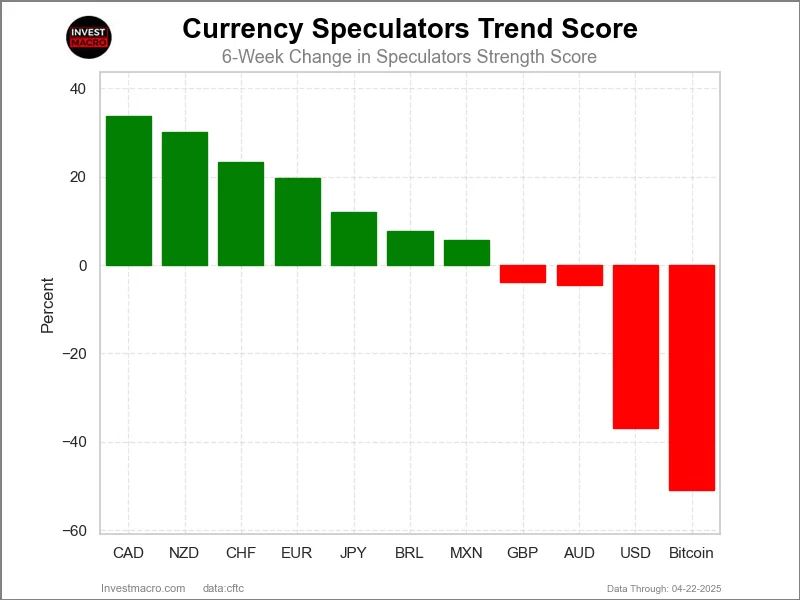
Brazilian Real & Bitcoin top the 6-Week Strength Trends

COT Strength Score Trends (or move index, calculates the 6-week changes in strength scores) showed that the Brazilian Real (20 percent) and the Bitcoin (20 percent) lead the past six weeks trends for the currencies. The US Dollar Index (17 percent), the Japanese Yen (7 percent) and the Canadian Dollar (7 percent) are the next highest positive movers in the 3-Year trends data.

The Swiss Franc (-28 percent) leads the downside trend scores currently with the British Pound (-14 percent), Australian Dollar (-5 percent) and the New Zealand Dollar (-4 percent) following next with lower trend scores.

3-Year Strength Trends:
US Dollar Index (16.7 percent) vs US Dollar Index previous week (17.7 percent)
EuroFX (3.8 percent) vs EuroFX previous week (-0.3 percent)
British Pound Sterling (-13.8 percent) vs British Pound Sterling previous week (-19.5 percent)
Japanese Yen (6.6 percent) vs Japanese Yen previous week (-2.8 percent)
Swiss Franc (-28.1 percent) vs Swiss Franc previous week (-43.0 percent)
Canadian Dollar (7.3 percent) vs Canadian Dollar previous week (15.4 percent)
Australian Dollar (-5.1 percent) vs Australian Dollar previous week (-7.3 percent)
New Zealand Dollar (-3.6 percent) vs New Zealand Dollar previous week (-5.3 percent)
Mexican Peso (-3.4 percent) vs Mexican Peso previous week (-4.8 percent)
Brazilian Real (19.9 percent) vs Brazilian Real previous week (-16.7 percent)
Bitcoin (20.0 percent) vs Bitcoin previous week (21.7 percent)


Individual COT Forex Markets:

US Dollar Index Futures:

US Dollar Index Forex Futures COT ChartThe US Dollar Index large speculator standing this week equaled a net position of 14,539 contracts in the data reported through Tuesday. This was a weekly advance of 339 contracts from the previous week which had a total of 14,200 net contracts.

This week’s current strength score (the trader positioning range over the past three years, measured from 0 to 100) shows the speculators are currently Bearish with a score of 36.8 percent. The commercials are Bullish with a score of 62.7 percent and the small traders (not shown in chart) are Bearish with a score of 41.7 percent.

Price Trend-Following Model: Weak Uptrend

Our weekly trend-following model classifies the current market price position as: Weak Uptrend.

US DOLLAR INDEX StatisticsSPECULATORSCOMMERCIALSSMALL TRADERS
– Percent of Open Interest Longs:63.524.39.8
– Percent of Open Interest Shorts:26.964.36.3
– Net Position:14,539-15,9141,375
– Gross Longs:25,2039,6303,885
– Gross Shorts:10,66425,5442,510
– Long to Short Ratio:2.4 to 10.4 to 11.5 to 1
NET POSITION TREND:
– Strength Index Score (3 Year Range Pct):36.862.741.7
– Strength Index Reading (3 Year Range):BearishBullishBearish
NET POSITION MOVEMENT INDEX:
– 6-Week Change in Strength Index:16.7-15.0-5.0


Euro Currency Futures:

Euro Currency Futures COT ChartThe Euro Currency large speculator standing this week equaled a net position of -58,614 contracts in the data reported through Tuesday. This was a weekly increase of 7,990 contracts from the previous week which had a total of -66,604 net contracts.

This week’s current strength score (the trader positioning range over the past three years, measured from 0 to 100) shows the speculators are currently Bearish-Extreme with a score of 6.5 percent. The commercials are Bullish-Extreme with a score of 93.6 percent and the small traders (not shown in chart) are Bearish with a score of 22.4 percent.

Price Trend-Following Model: Downtrend

Our weekly trend-following model classifies the current market price position as: Downtrend.

EURO Currency StatisticsSPECULATORSCOMMERCIALSSMALL TRADERS
– Percent of Open Interest Longs:26.456.512.1
– Percent of Open Interest Shorts:35.950.68.5
– Net Position:-58,61436,47122,143
– Gross Longs:162,554348,35474,337
– Gross Shorts:221,168311,88352,194
– Long to Short Ratio:0.7 to 11.1 to 11.4 to 1
NET POSITION TREND:
– Strength Index Score (3 Year Range Pct):6.593.622.4
– Strength Index Reading (3 Year Range):Bearish-ExtremeBullish-ExtremeBearish
NET POSITION MOVEMENT INDEX:
– 6-Week Change in Strength Index:3.8-6.419.5


British Pound Sterling Futures:

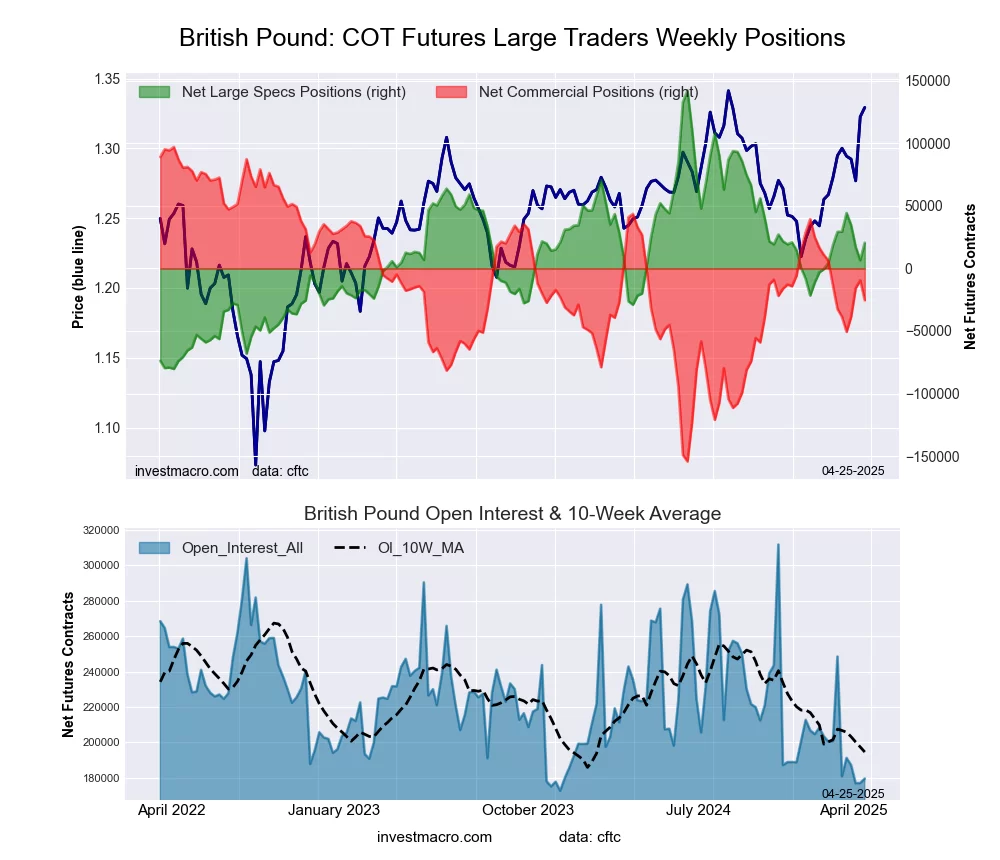
British Pound Sterling Futures COT ChartThe British Pound Sterling large speculator standing this week equaled a net position of -11,323 contracts in the data reported through Tuesday. This was a weekly lift of 10,349 contracts from the previous week which had a total of -21,672 net contracts.

This week’s current strength score (the trader positioning range over the past three years, measured from 0 to 100) shows the speculators are currently Bearish with a score of 31.0 percent. The commercials are Bullish with a score of 71.3 percent and the small traders (not shown in chart) are Bearish with a score of 33.4 percent.

Price Trend-Following Model: Downtrend

Our weekly trend-following model classifies the current market price position as: Downtrend.

BRITISH POUND StatisticsSPECULATORSCOMMERCIALSSMALL TRADERS
– Percent of Open Interest Longs:32.054.511.2
– Percent of Open Interest Shorts:37.542.317.9
– Net Position:-11,32325,029-13,706
– Gross Longs:65,442111,61922,951
– Gross Shorts:76,76586,59036,657
– Long to Short Ratio:0.9 to 11.3 to 10.6 to 1
NET POSITION TREND:
– Strength Index Score (3 Year Range Pct):31.071.333.4
– Strength Index Reading (3 Year Range):BearishBullishBearish
NET POSITION MOVEMENT INDEX:
– 6-Week Change in Strength Index:-13.815.1-15.2


Japanese Yen Futures:

Japanese Yen Forex Futures COT ChartThe Japanese Yen large speculator standing this week equaled a net position of 18,768 contracts in the data reported through Tuesday. This was a weekly rise of 19,727 contracts from the previous week which had a total of -959 net contracts.

This week’s current strength score (the trader positioning range over the past three years, measured from 0 to 100) shows the speculators are currently Bullish-Extreme with a score of 81.1 percent. The commercials are Bearish-Extreme with a score of 17.2 percent and the small traders (not shown in chart) are Bullish-Extreme with a score of 92.5 percent.

Price Trend-Following Model: Weak Downtrend

Our weekly trend-following model classifies the current market price position as: Weak Downtrend.

JAPANESE YEN StatisticsSPECULATORSCOMMERCIALSSMALL TRADERS
– Percent of Open Interest Longs:45.130.421.2
– Percent of Open Interest Shorts:37.043.616.1
– Net Position:18,768-30,68311,915
– Gross Longs:104,68470,41849,277
– Gross Shorts:85,916101,10137,362
– Long to Short Ratio:1.2 to 10.7 to 11.3 to 1
NET POSITION TREND:
– Strength Index Score (3 Year Range Pct):81.117.292.5
– Strength Index Reading (3 Year Range):Bullish-ExtremeBearish-ExtremeBullish-Extreme
NET POSITION MOVEMENT INDEX:
– 6-Week Change in Strength Index:6.6-12.643.4


Swiss Franc Futures:

Swiss Franc Forex Futures COT ChartThe Swiss Franc large speculator standing this week equaled a net position of -42,258 contracts in the data reported through Tuesday. This was a weekly gain of 742 contracts from the previous week which had a total of -43,000 net contracts.

This week’s current strength score (the trader positioning range over the past three years, measured from 0 to 100) shows the speculators are currently Bearish-Extreme with a score of 15.3 percent. The commercials are Bullish-Extreme with a score of 89.6 percent and the small traders (not shown in chart) are Bearish with a score of 23.5 percent.

Price Trend-Following Model: Downtrend

Our weekly trend-following model classifies the current market price position as: Downtrend.

SWISS FRANC StatisticsSPECULATORSCOMMERCIALSSMALL TRADERS
– Percent of Open Interest Longs:5.485.68.6
– Percent of Open Interest Shorts:48.529.221.9
– Net Position:-42,25855,303-13,045
– Gross Longs:5,24283,8738,424
– Gross Shorts:47,50028,57021,469
– Long to Short Ratio:0.1 to 12.9 to 10.4 to 1
NET POSITION TREND:
– Strength Index Score (3 Year Range Pct):15.389.623.5
– Strength Index Reading (3 Year Range):Bearish-ExtremeBullish-ExtremeBearish
NET POSITION MOVEMENT INDEX:
– 6-Week Change in Strength Index:-28.114.521.0


Canadian Dollar Futures:

Canadian Dollar Forex Futures COT ChartThe Canadian Dollar large speculator standing this week equaled a net position of -160,444 contracts in the data reported through Tuesday. This was a weekly reduction of -12,843 contracts from the previous week which had a total of -147,601 net contracts.

This week’s current strength score (the trader positioning range over the past three years, measured from 0 to 100) shows the speculators are currently Bearish-Extreme with a score of 16.1 percent. The commercials are Bullish-Extreme with a score of 86.4 percent and the small traders (not shown in chart) are Bearish-Extreme with a score of 12.8 percent.

Price Trend-Following Model: Downtrend

Our weekly trend-following model classifies the current market price position as: Downtrend.

CANADIAN DOLLAR StatisticsSPECULATORSCOMMERCIALSSMALL TRADERS
– Percent of Open Interest Longs:5.984.57.4
– Percent of Open Interest Shorts:52.135.310.4
– Net Position:-160,444170,842-10,398
– Gross Longs:20,421293,32325,707
– Gross Shorts:180,865122,48136,105
– Long to Short Ratio:0.1 to 12.4 to 10.7 to 1
NET POSITION TREND:
– Strength Index Score (3 Year Range Pct):16.186.412.8
– Strength Index Reading (3 Year Range):Bearish-ExtremeBullish-ExtremeBearish-Extreme
NET POSITION MOVEMENT INDEX:
– 6-Week Change in Strength Index:7.3-7.23.3


Australian Dollar Futures:

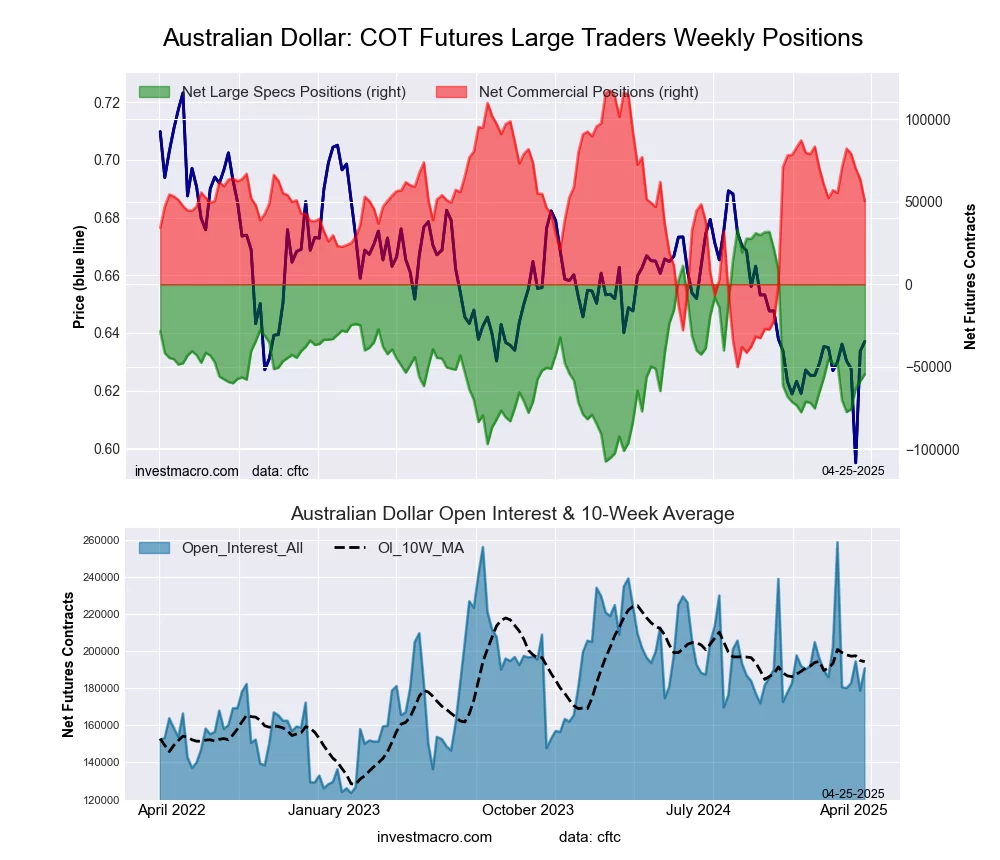
Australian Dollar Forex Futures COT ChartThe Australian Dollar large speculator standing this week equaled a net position of -75,309 contracts in the data reported through Tuesday. This was a weekly lowering of -3,478 contracts from the previous week which had a total of -71,831 net contracts.

This week’s current strength score (the trader positioning range over the past three years, measured from 0 to 100) shows the speculators are currently Bearish with a score of 22.9 percent. The commercials are Bullish with a score of 79.7 percent and the small traders (not shown in chart) are Bearish with a score of 27.5 percent.

Price Trend-Following Model: Downtrend

Our weekly trend-following model classifies the current market price position as: Downtrend.

AUSTRALIAN DOLLAR StatisticsSPECULATORSCOMMERCIALSSMALL TRADERS
– Percent of Open Interest Longs:17.268.111.0
– Percent of Open Interest Shorts:54.027.315.0
– Net Position:-75,30983,501-8,192
– Gross Longs:35,330139,49422,568
– Gross Shorts:110,63955,99330,760
– Long to Short Ratio:0.3 to 12.5 to 10.7 to 1
NET POSITION TREND:
– Strength Index Score (3 Year Range Pct):22.979.727.5
– Strength Index Reading (3 Year Range):BearishBullishBearish
NET POSITION MOVEMENT INDEX:
– 6-Week Change in Strength Index:-5.13.24.8


New Zealand Dollar Futures:

New Zealand Dollar Forex Futures COT ChartThe New Zealand Dollar large speculator standing this week equaled a net position of -49,090 contracts in the data reported through Tuesday. This was a weekly decline of -2,059 contracts from the previous week which had a total of -47,031 net contracts.

This week’s current strength score (the trader positioning range over the past three years, measured from 0 to 100) shows the speculators are currently Bearish-Extreme with a score of 6.5 percent. The commercials are Bullish-Extreme with a score of 93.8 percent and the small traders (not shown in chart) are Bearish with a score of 20.6 percent.

Price Trend-Following Model: Downtrend

Our weekly trend-following model classifies the current market price position as: Downtrend.

NEW ZEALAND DOLLAR StatisticsSPECULATORSCOMMERCIALSSMALL TRADERS
– Percent of Open Interest Longs:9.985.74.1
– Percent of Open Interest Shorts:68.424.27.2
– Net Position:-49,09051,675-2,585
– Gross Longs:8,32771,9893,459
– Gross Shorts:57,41720,3146,044
– Long to Short Ratio:0.1 to 13.5 to 10.6 to 1
NET POSITION TREND:
– Strength Index Score (3 Year Range Pct):6.593.820.6
– Strength Index Reading (3 Year Range):Bearish-ExtremeBullish-ExtremeBearish
NET POSITION MOVEMENT INDEX:
– 6-Week Change in Strength Index:-3.62.88.2


Mexican Peso Futures:

Mexican Peso Futures COT ChartThe Mexican Peso large speculator standing this week equaled a net position of 12,262 contracts in the data reported through Tuesday. This was a weekly rise of 7,038 contracts from the previous week which had a total of 5,224 net contracts.

This week’s current strength score (the trader positioning range over the past three years, measured from 0 to 100) shows the speculators are currently Bearish with a score of 35.0 percent. The commercials are Bullish with a score of 69.3 percent and the small traders (not shown in chart) are Bearish-Extreme with a score of 7.5 percent.

Price Trend-Following Model: Downtrend

Our weekly trend-following model classifies the current market price position as: Downtrend.

MEXICAN PESO StatisticsSPECULATORSCOMMERCIALSSMALL TRADERS
– Percent of Open Interest Longs:42.354.02.1
– Percent of Open Interest Shorts:33.860.64.0
– Net Position:12,262-9,518-2,744
– Gross Longs:61,45978,5643,020
– Gross Shorts:49,19788,0825,764
– Long to Short Ratio:1.2 to 10.9 to 10.5 to 1
NET POSITION TREND:
– Strength Index Score (3 Year Range Pct):35.069.37.5
– Strength Index Reading (3 Year Range):BearishBullishBearish-Extreme
NET POSITION MOVEMENT INDEX:
– 6-Week Change in Strength Index:-3.43.21.6


Brazilian Real Futures:

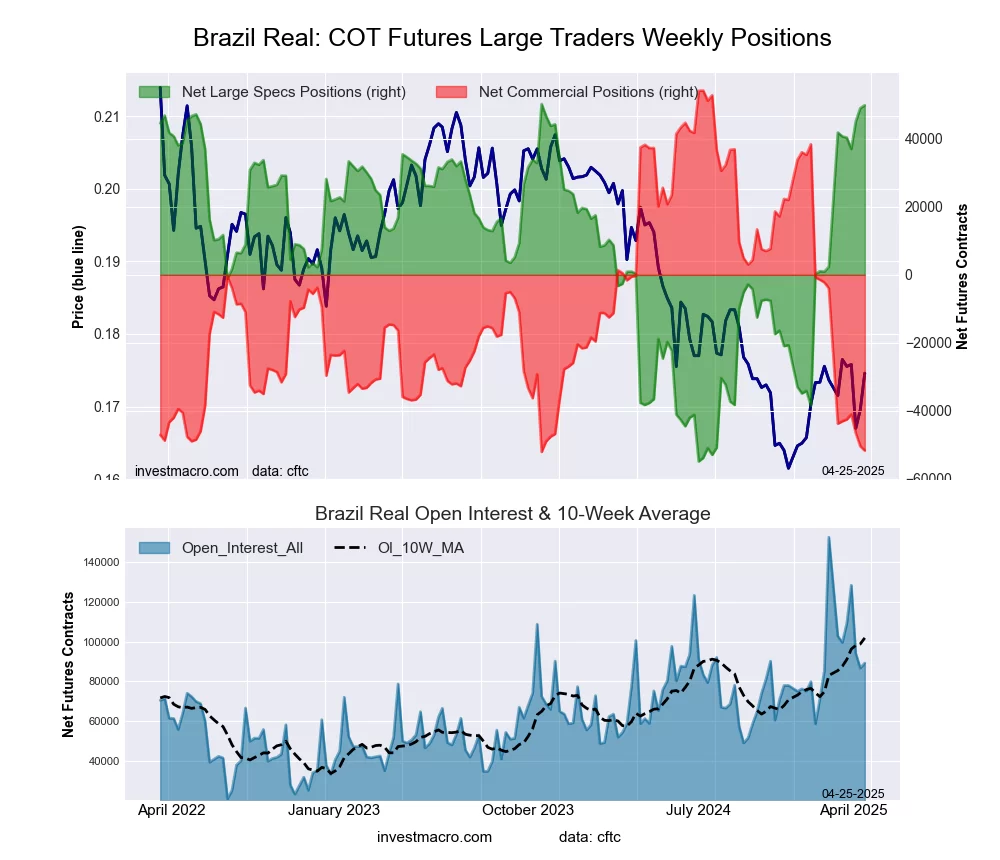
Brazil Real Futures COT ChartThe Brazilian Real large speculator standing this week equaled a net position of 242 contracts in the data reported through Tuesday. This was a weekly rise of 38,736 contracts from the previous week which had a total of -38,494 net contracts.

This week’s current strength score (the trader positioning range over the past three years, measured from 0 to 100) shows the speculators are currently Bullish with a score of 52.3 percent. The commercials are Bearish with a score of 48.5 percent and the small traders (not shown in chart) are Bearish with a score of 23.6 percent.

Price Trend-Following Model: Weak Downtrend

Our weekly trend-following model classifies the current market price position as: Weak Downtrend.

BRAZIL REAL StatisticsSPECULATORSCOMMERCIALSSMALL TRADERS
– Percent of Open Interest Longs:56.836.95.1
– Percent of Open Interest Shorts:56.438.14.3
– Net Position:242-723481
– Gross Longs:33,40221,6713,007
– Gross Shorts:33,16022,3942,526
– Long to Short Ratio:1.0 to 11.0 to 11.2 to 1
NET POSITION TREND:
– Strength Index Score (3 Year Range Pct):52.348.523.6
– Strength Index Reading (3 Year Range):BullishBearishBearish
NET POSITION MOVEMENT INDEX:
– 6-Week Change in Strength Index:19.9-21.310.4


Bitcoin Futures:

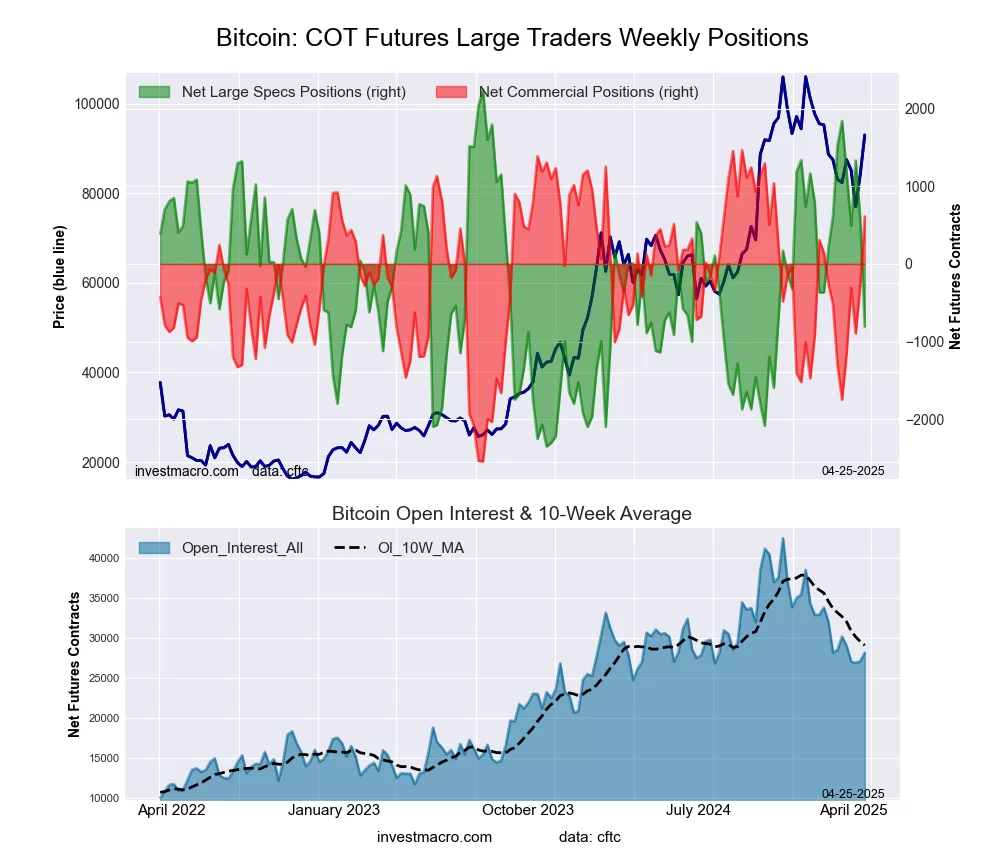
Bitcoin Crypto Futures COT ChartThe Bitcoin large speculator standing this week equaled a net position of 786 contracts in the data reported through Tuesday. This was a weekly decrease of -379 contracts from the previous week which had a total of 1,165 net contracts.

This week’s current strength score (the trader positioning range over the past three years, measured from 0 to 100) shows the speculators are currently Bullish with a score of 68.4 percent. The commercials are Bearish with a score of 40.5 percent and the small traders (not shown in chart) are Bearish with a score of 20.0 percent.

Price Trend-Following Model: Uptrend

Our weekly trend-following model classifies the current market price position as: Uptrend.

BITCOIN StatisticsSPECULATORSCOMMERCIALSSMALL TRADERS
– Percent of Open Interest Longs:83.84.74.0
– Percent of Open Interest Shorts:81.47.53.6
– Net Position:786-918132
– Gross Longs:27,5701,5441,329
– Gross Shorts:26,7842,4621,197
– Long to Short Ratio:1.0 to 10.6 to 11.1 to 1
NET POSITION TREND:
– Strength Index Score (3 Year Range Pct):68.440.520.0
– Strength Index Reading (3 Year Range):BullishBearishBearish
NET POSITION MOVEMENT INDEX:
– 6-Week Change in Strength Index:20.0-19.3-10.6


Article By InvestMacroReceive our weekly COT Newsletter

*COT Report: The COT data, released weekly to the public each Friday, is updated through the most recent Tuesday (data is 3 days old) and shows a quick view of how large speculators or non-commercials (for-profit traders) were positioned in the futures markets.

The CFTC categorizes trader positions according to commercial hedgers (traders who use futures contracts for hedging as part of the business), non-commercials (large traders who speculate to realize trading profits) and nonreportable traders (usually small traders/speculators) as well as their open interest (contracts open in the market at time of reporting). See CFTC criteria here.