Archive for Financial News – Page 48

COT Metals Charts: Gold Speculator Bets rise to highest since March

By InvestMacro

Metals Open Interest COT Chart
Here are the latest charts and statistics for the Commitment of Traders (COT) data published by the Commodities Futures Trading Commission (CFTC).

The latest COT data is updated through Tuesday July 22nd and shows a quick view of how large traders (for-profit speculators and commercial entities) were positioned in the futures markets.

Weekly Speculator Changes led by Gold & Steel

Metals Net Positions COT Chart
The COT metals markets speculator bets were decisively higher this week as five out of the six metals markets we cover had higher positioning while the other one markets had lower speculator contracts.

Leading the gains for the metals was Gold (39,923 contracts) with Platinum (1,373 contracts), Palladium (1,281 contracts), Silver (1,172 contracts) and Steel (112 contracts) also seeing positive weeks.

The only market with a decline in speculator bets for the week was Copper with a dip by -902 contracts.

Gold Speculator Bets rise to highest since March

The gold speculator position rose this week for a fourth consecutive week and for the eighth time in the past ten weeks. This week’s boost by +39,923 contracts marked the highest one-week gain in over a year and brings the 10-week advance by speculator bets to over +91,000 contracts.

This boost in speculator bets for gold puts the current speculator net position, currently at +253,038 contracts, at the highest level in the past 18 weeks, dating back to March 18th.

Major metals prices this week were mixed

– Copper rose by over 3% for the week.
– Steel went higher by over 1.3%.
– Silver also saw just a small gain.
– Gold was down by -0.32%.
– Palladium and Platinum fell by almost -2% over the past week.


Metals Data:

Metals Table COT Chart
Legend: Weekly Speculators Change | Speculators Current Net Position | Speculators Strength Score compared to last 3-Years (0-100 range)


Strength Scores led by Silver & Palladium

Metals Strength Scores COT Chart
COT Strength Scores (a normalized measure of Speculator positions over a 3-Year range, from 0 to 100 where above 80 is Extreme-Bullish and below 20 is Extreme-Bearish) showed that Silver (92 percent) and Palladium (87 percent) lead the metals markets this week. Gold (76 percent) comes in as the next highest in the weekly strength scores.

Strength Statistics:
Gold (76.3 percent) vs Gold previous week (61.2 percent)
Silver (91.8 percent) vs Silver previous week (90.3 percent)
Copper (70.3 percent) vs Copper previous week (71.2 percent)
Platinum (64.8 percent) vs Platinum previous week (61.6 percent)
Palladium (87.2 percent) vs Palladium previous week (77.6 percent)
Steel (68.4 percent) vs Palladium previous week (67.7 percent)


Palladium & Gold top the 6-Week Strength Trends

Metals Trends COT Chart
COT Strength Score Trends (or move index, calculates the 6-week changes in strength scores) showed that Palladium (26 percent) and Gold (25 percent) lead the past six weeks trends for metals. Copper (13 percent) is the next highest positive mover in the latest trends data.

Platinum (-15 percent) leads the downside trend scores currently with Silver (-8 percent) as the next market with lower trend scores.

Move Statistics:
Gold (24.9 percent) vs Gold previous week (9.6 percent)
Silver (-7.5 percent) vs Silver previous week (-1.7 percent)
Copper (12.5 percent) vs Copper previous week (15.5 percent)
Platinum (-14.9 percent) vs Platinum previous week (-1.8 percent)
Palladium (26.3 percent) vs Palladium previous week (27.9 percent)
Steel (9.9 percent) vs Steel previous week (13.8 percent)


Individual Markets:

Gold Comex Futures:

Gold Futures COT ChartThe Gold Comex Futures large speculator standing this week totaled a net position of 253,038 contracts in the data reported through Tuesday. This was a weekly advance of 39,923 contracts from the previous week which had a total of 213,115 net contracts.

This week’s current strength score (the trader positioning range over the past three years, measured from 0 to 100) shows the speculators are currently Bullish with a score of 76.3 percent. The commercials are Bearish with a score of 20.7 percent and the small traders (not shown in chart) are Bullish with a score of 72.0 percent.

Price Trend-Following Model: Uptrend

Our weekly trend-following model classifies the current market price position as: Uptrend.

Gold Futures StatisticsSPECULATORSCOMMERCIALSSMALL TRADERS
– Percent of Open Interest Longs:63.715.711.0
– Percent of Open Interest Shorts:12.073.45.1
– Net Position:253,038-282,33729,299
– Gross Longs:311,94976,72654,052
– Gross Shorts:58,911359,06324,753
– Long to Short Ratio:5.3 to 10.2 to 12.2 to 1
NET POSITION TREND:
– Strength Index Score (3 Year Range Pct):76.320.772.0
– Strength Index Reading (3 Year Range):BullishBearishBullish
NET POSITION MOVEMENT INDEX:
– 6-Week Change in Strength Index:24.9-21.5-20.1


Silver Comex Futures:

Silver Futures COT ChartThe Silver Comex Futures large speculator standing this week totaled a net position of 60,620 contracts in the data reported through Tuesday. This was a weekly rise of 1,172 contracts from the previous week which had a total of 59,448 net contracts.

This week’s current strength score (the trader positioning range over the past three years, measured from 0 to 100) shows the speculators are currently Bullish-Extreme with a score of 91.8 percent. The commercials are Bearish-Extreme with a score of 7.4 percent and the small traders (not shown in chart) are Bullish with a score of 60.7 percent.

Price Trend-Following Model: Strong Uptrend

Our weekly trend-following model classifies the current market price position as: Strong Uptrend.

Silver Futures StatisticsSPECULATORSCOMMERCIALSSMALL TRADERS
– Percent of Open Interest Longs:49.321.218.4
– Percent of Open Interest Shorts:14.466.87.7
– Net Position:60,620-79,22718,607
– Gross Longs:85,67836,80331,942
– Gross Shorts:25,058116,03013,335
– Long to Short Ratio:3.4 to 10.3 to 12.4 to 1
NET POSITION TREND:
– Strength Index Score (3 Year Range Pct):91.87.460.7
– Strength Index Reading (3 Year Range):Bullish-ExtremeBearish-ExtremeBullish
NET POSITION MOVEMENT INDEX:
– 6-Week Change in Strength Index:-7.57.1-2.0


Copper Grade #1 Futures:

Copper Futures COT ChartThe Copper Grade #1 Futures large speculator standing this week totaled a net position of 39,822 contracts in the data reported through Tuesday. This was a weekly decline of -902 contracts from the previous week which had a total of 40,724 net contracts.

This week’s current strength score (the trader positioning range over the past three years, measured from 0 to 100) shows the speculators are currently Bullish with a score of 70.3 percent. The commercials are Bearish with a score of 35.4 percent and the small traders (not shown in chart) are Bearish with a score of 22.5 percent.

Price Trend-Following Model: Strong Uptrend

Our weekly trend-following model classifies the current market price position as: Strong Uptrend.

Copper Futures StatisticsSPECULATORSCOMMERCIALSSMALL TRADERS
– Percent of Open Interest Longs:34.029.06.9
– Percent of Open Interest Shorts:16.646.86.6
– Net Position:39,822-40,614792
– Gross Longs:77,63766,21515,779
– Gross Shorts:37,815106,82914,987
– Long to Short Ratio:2.1 to 10.6 to 11.1 to 1
NET POSITION TREND:
– Strength Index Score (3 Year Range Pct):70.335.422.5
– Strength Index Reading (3 Year Range):BullishBearishBearish
NET POSITION MOVEMENT INDEX:
– 6-Week Change in Strength Index:12.5-8.9-19.0


Platinum Futures:

Platinum Futures COT ChartThe Platinum Futures large speculator standing this week totaled a net position of 20,675 contracts in the data reported through Tuesday. This was a weekly rise of 1,373 contracts from the previous week which had a total of 19,302 net contracts.

This week’s current strength score (the trader positioning range over the past three years, measured from 0 to 100) shows the speculators are currently Bullish with a score of 64.8 percent. The commercials are Bearish with a score of 39.1 percent and the small traders (not shown in chart) are Bearish with a score of 37.2 percent.

Price Trend-Following Model: Strong Uptrend

Our weekly trend-following model classifies the current market price position as: Strong Uptrend.

Platinum Futures StatisticsSPECULATORSCOMMERCIALSSMALL TRADERS
– Percent of Open Interest Longs:60.819.611.1
– Percent of Open Interest Shorts:38.046.17.4
– Net Position:20,675-24,0253,350
– Gross Longs:55,18017,77310,028
– Gross Shorts:34,50541,7986,678
– Long to Short Ratio:1.6 to 10.4 to 11.5 to 1
NET POSITION TREND:
– Strength Index Score (3 Year Range Pct):64.839.137.2
– Strength Index Reading (3 Year Range):BullishBearishBearish
NET POSITION MOVEMENT INDEX:
– 6-Week Change in Strength Index:-14.917.6-17.9


Palladium Futures:

Palladium Futures COT ChartThe Palladium Futures large speculator standing this week totaled a net position of -2,300 contracts in the data reported through Tuesday. This was a weekly boost of 1,281 contracts from the previous week which had a total of -3,581 net contracts.

This week’s current strength score (the trader positioning range over the past three years, measured from 0 to 100) shows the speculators are currently Bullish-Extreme with a score of 87.2 percent. The commercials are Bearish-Extreme with a score of 4.5 percent and the small traders (not shown in chart) are Bullish-Extreme with a score of 89.1 percent.

Price Trend-Following Model: Strong Uptrend

Our weekly trend-following model classifies the current market price position as: Strong Uptrend.

Palladium Futures StatisticsSPECULATORSCOMMERCIALSSMALL TRADERS
– Percent of Open Interest Longs:43.235.315.2
– Percent of Open Interest Shorts:54.230.78.7
– Net Position:-2,3009521,348
– Gross Longs:8,9917,3413,155
– Gross Shorts:11,2916,3891,807
– Long to Short Ratio:0.8 to 11.1 to 11.7 to 1
NET POSITION TREND:
– Strength Index Score (3 Year Range Pct):87.24.589.1
– Strength Index Reading (3 Year Range):Bullish-ExtremeBearish-ExtremeBullish-Extreme
NET POSITION MOVEMENT INDEX:
– 6-Week Change in Strength Index:26.3-27.65.1


Steel Futures Futures:

Steel Futures COT ChartThe Steel Futures large speculator standing this week totaled a net position of 550 contracts in the data reported through Tuesday. This was a weekly lift of 112 contracts from the previous week which had a total of 438 net contracts.

This week’s current strength score (the trader positioning range over the past three years, measured from 0 to 100) shows the speculators are currently Bullish with a score of 68.4 percent. The commercials are Bearish with a score of 31.4 percent and the small traders (not shown in chart) are Bullish with a score of 66.3 percent.

Price Trend-Following Model: Downtrend

Our weekly trend-following model classifies the current market price position as: Downtrend.

Steel Futures StatisticsSPECULATORSCOMMERCIALSSMALL TRADERS
– Percent of Open Interest Longs:24.769.11.7
– Percent of Open Interest Shorts:22.772.10.8
– Net Position:550-788238
– Gross Longs:6,61418,476459
– Gross Shorts:6,06419,264221
– Long to Short Ratio:1.1 to 11.0 to 12.1 to 1
NET POSITION TREND:
– Strength Index Score (3 Year Range Pct):68.431.466.3
– Strength Index Reading (3 Year Range):BullishBearishBullish
NET POSITION MOVEMENT INDEX:
– 6-Week Change in Strength Index:9.9-10.38.3


Article By InvestMacroReceive our weekly COT Newsletter

*COT Report: The COT data, released weekly to the public each Friday, is updated through the most recent Tuesday (data is 3 days old) and shows a quick view of how large speculators or non-commercials (for-profit traders) were positioned in the futures markets.

The CFTC categorizes trader positions according to commercial hedgers (traders who use futures contracts for hedging as part of the business), non-commercials (large traders who speculate to realize trading profits) and nonreportable traders (usually small traders/speculators) as well as their open interest (contracts open in the market at time of reporting). See CFTC criteria here.

COT Bonds Charts: Speculator Bets led by 2-Year Bonds & Treasury Bonds

By InvestMacro

Bonds Market Open Interest Comparison
Here are the latest charts and statistics for the Commitment of Traders (COT) reports data published by the Commodities Futures Trading Commission (CFTC).

The latest COT data is updated through Tuesday July 22nd and shows a quick view of how large traders (for-profit speculators and commercial hedgers) were positioned in the futures markets.

Weekly Speculator Changes led by 2-Year Bonds & Treasury Bonds

Bonds Market Net Speculators Positions
The COT bond market speculator bets were slightly higher this week as five out of the nine bond markets we cover had higher positioning while the other four markets had lower speculator contracts.

Leading the gains for the bond markets was the 2-Year Bonds (51,208 contracts) with the US Treasury Bonds (47,265 contracts), the 5-Year Bonds (35,604 contracts), the 10-Year Bonds (22,843 contracts) and the SOFR 3-Months (7,373 contracts) also showing higher weeks.

The bond markets with declines in speculator bets for the week were the SOFR 1-Month (-14,444 contracts), the Ultra 10-Year Bonds (-14,211 contracts), the Ultra Treasury Bonds (-3,725 contracts) and the Fed Funds (-219 contracts)also registering lower bets on the week.

Bonds prices slightly up 

The bond market prices on the week saw the longer U.S. Treasury bonds trending higher with gains of over 1%.

The 10-year Notes were higher by almost half a percent, while the 5-year, the 2-year, the Fed funds, and the 3-month overnight financing rate bonds were slightly higher on the week.

The 1-month secured overnight financing rate was the only bond with a weekly fall.


Bonds Data:

Bonds Market Speculators Data Table
Legend: Open Interest | Speculators Current Net Position | Weekly Specs Change | Specs Strength Score compared to last 3-Years (0-100 range)


Strength Scores led by Ultra Treasury Bonds & Fed Funds

Bonds Market Strength Index Comparison
COT Strength Scores (a normalized measure of Speculator positions over a 3-Year range, from 0 to 100 where above 80 is Extreme-Bullish and below 20 is Extreme-Bearish) showed that the Ultra Treasury Bonds (84 percent) and the Fed Funds (65 percent) lead the bond markets this week. The US Treasury Bonds (55 percent) comes in as the next highest in the weekly strength scores.

On the downside, the 5-Year Bond (2 percent), the Ultra 10-Year Bonds (4 percent) and the 2-Year Bonds (17 percent) come in at the lowest strength level currently and are in Extreme-Bearish territory (below 20 percent).

Strength Statistics:
Fed Funds (64.7 percent) vs Fed Funds previous week (64.7 percent)
2-Year Bond (17.1 percent) vs 2-Year Bond previous week (13.4 percent)
5-Year Bond (2.1 percent) vs 5-Year Bond previous week (0.5 percent)
10-Year Bond (43.1 percent) vs 10-Year Bond previous week (40.6 percent)
Ultra 10-Year Bond (3.7 percent) vs Ultra 10-Year Bond previous week (7.3 percent)
US Treasury Bond (54.5 percent) vs US Treasury Bond previous week (38.1 percent)
Ultra US Treasury Bond (84.0 percent) vs Ultra US Treasury Bond previous week (85.4 percent)
SOFR 1-Month (28.2 percent) vs SOFR 1-Month previous week (31.8 percent)
SOFR 3-Months (35.5 percent) vs SOFR 3-Months previous week (35.1 percent)


SOFR 3-Months & Fed Funds top the 6-Week Strength Trends

Bonds Market Trend Index Comparison
COT Strength Score Trends (or move index, calculates the 6-week changes in strength scores) showed that the SOFR 3-Months (34 percent) and the Fed Funds (30 percent) lead the past six weeks trends for bonds.

The SOFR 1-Month (-22 percent), the Ultra Treasury Bonds (-11 percent) and the Ultra 10-Year Bonds (-6 percent) leads the downside trend scores currently with the 2-Year Bonds (-5 percent) and the 10-Year Bonds (-3 percent) following next with lower trend scores.

Strength Trend Statistics:
Fed Funds (29.7 percent) vs Fed Funds previous week (36.8 percent)
2-Year Bond (-4.9 percent) vs 2-Year Bond previous week (-11.2 percent)
5-Year Bond (0.0 percent) vs 5-Year Bond previous week (-5.0 percent)
10-Year Bond (-2.8 percent) vs 10-Year Bond previous week (-7.3 percent)
Ultra 10-Year Bond (-6.0 percent) vs Ultra 10-Year Bond previous week (-1.9 percent)
US Treasury Bond (-1.1 percent) vs US Treasury Bond previous week (-9.7 percent)
Ultra US Treasury Bond (-10.7 percent) vs Ultra US Treasury Bond previous week (-0.1 percent)
SOFR 1-Month (-21.9 percent) vs SOFR 1-Month previous week (-31.6 percent)
SOFR 3-Months (33.7 percent) vs SOFR 3-Months previous week (22.9 percent)


30-Day Federal Funds Futures:

Federal Funds 30-Day Bonds Futures COT ChartThe 30-Day Federal Funds large speculator standing this week totaled a net position of 54,525 contracts in the data reported through Tuesday. This was a weekly fall of -219 contracts from the previous week which had a total of 54,744 net contracts.

This week’s current strength score (the trader positioning range over the past three years, measured from 0 to 100) shows the speculators are currently Bullish with a score of 64.7 percent. The commercials are Bearish with a score of 28.0 percent and the small traders (not shown in chart) are Bullish-Extreme with a score of 91.8 percent.

Price Trend-Following Model: Downtrend

Our weekly trend-following model classifies the current market price position as: Downtrend.

30-Day Federal Funds StatisticsSPECULATORSCOMMERCIALSSMALL TRADERS
– Percent of Open Interest Longs:20.460.52.9
– Percent of Open Interest Shorts:17.964.11.9
– Net Position:54,525-77,02922,504
– Gross Longs:440,4991,303,75262,363
– Gross Shorts:385,9741,380,78139,859
– Long to Short Ratio:1.1 to 10.9 to 11.6 to 1
NET POSITION TREND:
– Strength Index Score (3 Year Range Pct):64.728.091.8
– Strength Index Reading (3 Year Range):BullishBearishBullish-Extreme
NET POSITION MOVEMENT INDEX:
– 6-Week Change in Strength Index:29.7-31.012.3


Secured Overnight Financing Rate (3-Month) Futures:

SOFR 3-Months Bonds Futures COT ChartThe Secured Overnight Financing Rate (3-Month) large speculator standing this week totaled a net position of -479,775 contracts in the data reported through Tuesday. This was a weekly increase of 7,373 contracts from the previous week which had a total of -487,148 net contracts.

This week’s current strength score (the trader positioning range over the past three years, measured from 0 to 100) shows the speculators are currently Bearish with a score of 35.5 percent. The commercials are Bullish with a score of 65.2 percent and the small traders (not shown in chart) are Bullish with a score of 70.3 percent.

Price Trend-Following Model: Weak Uptrend

Our weekly trend-following model classifies the current market price position as: Weak Uptrend.

SOFR 3-Months StatisticsSPECULATORSCOMMERCIALSSMALL TRADERS
– Percent of Open Interest Longs:12.759.30.5
– Percent of Open Interest Shorts:16.855.00.6
– Net Position:-479,775495,967-16,192
– Gross Longs:1,471,0926,885,62357,425
– Gross Shorts:1,950,8676,389,65673,617
– Long to Short Ratio:0.8 to 11.1 to 10.8 to 1
NET POSITION TREND:
– Strength Index Score (3 Year Range Pct):35.565.270.3
– Strength Index Reading (3 Year Range):BearishBullishBullish
NET POSITION MOVEMENT INDEX:
– 6-Week Change in Strength Index:33.7-32.2-14.6


Individual Bond Markets:

Secured Overnight Financing Rate (1-Month) Futures:

SOFR 1-Month Bonds Futures COT ChartThe Secured Overnight Financing Rate (1-Month) large speculator standing this week totaled a net position of -163,451 contracts in the data reported through Tuesday. This was a weekly lowering of -14,444 contracts from the previous week which had a total of -149,007 net contracts.

This week’s current strength score (the trader positioning range over the past three years, measured from 0 to 100) shows the speculators are currently Bearish with a score of 28.2 percent. The commercials are Bullish with a score of 70.6 percent and the small traders (not shown in chart) are Bullish with a score of 75.9 percent.

Price Trend-Following Model: Weak Uptrend

Our weekly trend-following model classifies the current market price position as: Weak Uptrend.

SOFR 1-Month StatisticsSPECULATORSCOMMERCIALSSMALL TRADERS
– Percent of Open Interest Longs:12.668.50.4
– Percent of Open Interest Shorts:23.757.70.1
– Net Position:-163,451159,0694,382
– Gross Longs:185,6991,011,1976,250
– Gross Shorts:349,150852,1281,868
– Long to Short Ratio:0.5 to 11.2 to 13.3 to 1
NET POSITION TREND:
– Strength Index Score (3 Year Range Pct):28.270.675.9
– Strength Index Reading (3 Year Range):BearishBullishBullish
NET POSITION MOVEMENT INDEX:
– 6-Week Change in Strength Index:-21.919.817.2


2-Year Treasury Note Futures:

2-Year Treasury Bonds Futures COT ChartThe 2-Year Treasury Note large speculator standing this week totaled a net position of -1,248,652 contracts in the data reported through Tuesday. This was a weekly increase of 51,208 contracts from the previous week which had a total of -1,299,860 net contracts.

This week’s current strength score (the trader positioning range over the past three years, measured from 0 to 100) shows the speculators are currently Bearish-Extreme with a score of 17.1 percent. The commercials are Bullish-Extreme with a score of 81.0 percent and the small traders (not shown in chart) are Bullish with a score of 71.3 percent.

Price Trend-Following Model: Weak Downtrend

Our weekly trend-following model classifies the current market price position as: Weak Downtrend.

2-Year Treasury Note StatisticsSPECULATORSCOMMERCIALSSMALL TRADERS
– Percent of Open Interest Longs:14.377.25.8
– Percent of Open Interest Shorts:42.851.72.8
– Net Position:-1,248,6521,115,887132,765
– Gross Longs:627,2083,380,466253,553
– Gross Shorts:1,875,8602,264,579120,788
– Long to Short Ratio:0.3 to 11.5 to 12.1 to 1
NET POSITION TREND:
– Strength Index Score (3 Year Range Pct):17.181.071.3
– Strength Index Reading (3 Year Range):Bearish-ExtremeBullish-ExtremeBullish
NET POSITION MOVEMENT INDEX:
– 6-Week Change in Strength Index:-4.95.70.8


5-Year Treasury Note Futures:

5-Year Treasury Bonds Futures COT ChartThe 5-Year Treasury Note large speculator standing this week totaled a net position of -2,469,924 contracts in the data reported through Tuesday. This was a weekly lift of 35,604 contracts from the previous week which had a total of -2,505,528 net contracts.

This week’s current strength score (the trader positioning range over the past three years, measured from 0 to 100) shows the speculators are currently Bearish-Extreme with a score of 2.1 percent. The commercials are Bullish-Extreme with a score of 97.1 percent and the small traders (not shown in chart) are Bullish-Extreme with a score of 82.6 percent.

Price Trend-Following Model: Strong Uptrend

Our weekly trend-following model classifies the current market price position as: Strong Uptrend.

5-Year Treasury Note StatisticsSPECULATORSCOMMERCIALSSMALL TRADERS
– Percent of Open Interest Longs:7.083.96.4
– Percent of Open Interest Shorts:42.451.13.8
– Net Position:-2,469,9242,290,033179,891
– Gross Longs:488,6335,860,765447,110
– Gross Shorts:2,958,5573,570,732267,219
– Long to Short Ratio:0.2 to 11.6 to 11.7 to 1
NET POSITION TREND:
– Strength Index Score (3 Year Range Pct):2.197.182.6
– Strength Index Reading (3 Year Range):Bearish-ExtremeBullish-ExtremeBullish-Extreme
NET POSITION MOVEMENT INDEX:
– 6-Week Change in Strength Index:0.0-0.73.0


10-Year Treasury Note Futures:

10-Year Treasury Notes Bonds Futures COT ChartThe 10-Year Treasury Note large speculator standing this week totaled a net position of -749,534 contracts in the data reported through Tuesday. This was a weekly gain of 22,843 contracts from the previous week which had a total of -772,377 net contracts.

This week’s current strength score (the trader positioning range over the past three years, measured from 0 to 100) shows the speculators are currently Bearish with a score of 43.1 percent. The commercials are Bullish with a score of 53.6 percent and the small traders (not shown in chart) are Bullish with a score of 69.9 percent.

Price Trend-Following Model: Weak Downtrend

Our weekly trend-following model classifies the current market price position as: Weak Downtrend.

10-Year Treasury Note StatisticsSPECULATORSCOMMERCIALSSMALL TRADERS
– Percent of Open Interest Longs:11.877.38.9
– Percent of Open Interest Shorts:27.363.67.0
– Net Position:-749,534660,27789,257
– Gross Longs:567,9733,730,048428,586
– Gross Shorts:1,317,5073,069,771339,329
– Long to Short Ratio:0.4 to 11.2 to 11.3 to 1
NET POSITION TREND:
– Strength Index Score (3 Year Range Pct):43.153.669.9
– Strength Index Reading (3 Year Range):BearishBullishBullish
NET POSITION MOVEMENT INDEX:
– 6-Week Change in Strength Index:-2.82.03.6


Ultra 10-Year Notes Futures:

Ultra 10-Year Treasury Notes Bonds Futures COT ChartThe Ultra 10-Year Notes large speculator standing this week totaled a net position of -393,327 contracts in the data reported through Tuesday. This was a weekly lowering of -14,211 contracts from the previous week which had a total of -379,116 net contracts.

This week’s current strength score (the trader positioning range over the past three years, measured from 0 to 100) shows the speculators are currently Bearish-Extreme with a score of 3.7 percent. The commercials are Bullish-Extreme with a score of 98.3 percent and the small traders (not shown in chart) are Bearish with a score of 48.8 percent.

Price Trend-Following Model: Weak Uptrend

Our weekly trend-following model classifies the current market price position as: Weak Uptrend.

Ultra 10-Year Notes StatisticsSPECULATORSCOMMERCIALSSMALL TRADERS
– Percent of Open Interest Longs:10.479.59.3
– Percent of Open Interest Shorts:26.760.312.2
– Net Position:-393,327463,537-70,210
– Gross Longs:251,8161,920,013223,556
– Gross Shorts:645,1431,456,476293,766
– Long to Short Ratio:0.4 to 11.3 to 10.8 to 1
NET POSITION TREND:
– Strength Index Score (3 Year Range Pct):3.798.348.8
– Strength Index Reading (3 Year Range):Bearish-ExtremeBullish-ExtremeBearish
NET POSITION MOVEMENT INDEX:
– 6-Week Change in Strength Index:-6.012.6-19.5


US Treasury Bonds Futures:

US Year Treasury Notes Long Bonds Futures COT ChartThe US Treasury Bonds large speculator standing this week totaled a net position of -82,879 contracts in the data reported through Tuesday. This was a weekly lift of 47,265 contracts from the previous week which had a total of -130,144 net contracts.

This week’s current strength score (the trader positioning range over the past three years, measured from 0 to 100) shows the speculators are currently Bullish with a score of 54.5 percent. The commercials are Bearish with a score of 37.1 percent and the small traders (not shown in chart) are Bullish with a score of 72.2 percent.

Price Trend-Following Model: Downtrend

Our weekly trend-following model classifies the current market price position as: Downtrend.

US Treasury Bonds StatisticsSPECULATORSCOMMERCIALSSMALL TRADERS
– Percent of Open Interest Longs:9.076.313.1
– Percent of Open Interest Shorts:13.676.78.1
– Net Position:-82,879-6,24389,122
– Gross Longs:160,5791,368,819234,183
– Gross Shorts:243,4581,375,062145,061
– Long to Short Ratio:0.7 to 11.0 to 11.6 to 1
NET POSITION TREND:
– Strength Index Score (3 Year Range Pct):54.537.172.2
– Strength Index Reading (3 Year Range):BullishBearishBullish
NET POSITION MOVEMENT INDEX:
– 6-Week Change in Strength Index:-1.10.9-0.1


Ultra US Treasury Bonds Futures:

Ultra US Year Treasury Notes Long Bonds Futures COT ChartThe Ultra US Treasury Bonds large speculator standing this week totaled a net position of -232,343 contracts in the data reported through Tuesday. This was a weekly lowering of -3,725 contracts from the previous week which had a total of -228,618 net contracts.

This week’s current strength score (the trader positioning range over the past three years, measured from 0 to 100) shows the speculators are currently Bullish-Extreme with a score of 84.0 percent. The commercials are Bearish with a score of 31.5 percent and the small traders (not shown in chart) are Bearish-Extreme with a score of 14.2 percent.

Price Trend-Following Model: Downtrend

Our weekly trend-following model classifies the current market price position as: Downtrend.

Ultra US Treasury Bonds StatisticsSPECULATORSCOMMERCIALSSMALL TRADERS
– Percent of Open Interest Longs:7.581.59.4
– Percent of Open Interest Shorts:19.469.69.4
– Net Position:-232,343233,192-849
– Gross Longs:146,2601,589,126183,117
– Gross Shorts:378,6031,355,934183,966
– Long to Short Ratio:0.4 to 11.2 to 11.0 to 1
NET POSITION TREND:
– Strength Index Score (3 Year Range Pct):84.031.514.2
– Strength Index Reading (3 Year Range):Bullish-ExtremeBearishBearish-Extreme
NET POSITION MOVEMENT INDEX:
– 6-Week Change in Strength Index:-10.77.68.9


Article By InvestMacroReceive our weekly COT Newsletter

*COT Report: The COT data, released weekly to the public each Friday, is updated through the most recent Tuesday (data is 3 days old) and shows a quick view of how large speculators or non-commercials (for-profit traders) were positioned in the futures markets.

The CFTC categorizes trader positions according to commercial hedgers (traders who use futures contracts for hedging as part of the business), non-commercials (large traders who speculate to realize trading profits) and nonreportable traders (usually small traders/speculators) as well as their open interest (contracts open in the market at time of reporting). See CFTC criteria here.

COT Soft Commodities Charts: Speculator Bets led by Soybeans, Soybean Oil & Wheat

By InvestMacro

Speculators OI Softs
Here are the latest charts and statistics for the Commitment of Traders (COT) reports data published by the Commodities Futures Trading Commission (CFTC).

The latest COT data is updated through Tuesday July 22nd and shows a quick view of how large traders (for-profit speculators and commercial entities) were positioned in the futures markets.

Weekly Speculator Changes led by Soybeans, Soybean Oil & Wheat

Speculators Nets Softs
The COT soft commodities markets speculator bets were slightly lower this week as five out of the eleven softs markets we cover had higher positioning while the other six markets had lower speculator contracts.

Leading the gains for the softs markets was Soybeans (20,739 contracts) with Soybean Oil (12,389 contracts), Wheat (11,612 contracts), Soybean Meal (6,164 contracts) and Live Cattle (4,413 contracts) also showing positive weeks.

The markets with the declines in speculator bets this week were Sugar (-7,630 contracts), Lean Hogs (-7,623 contracts), Corn (-4,426 contracts), Cocoa (-3,491 contracts), Cotton (-2,167 contracts) and Coffee (-16 contracts) with also registering lower bets on the week.

Soft Commodities Prices down over the week

The soft commodities market prices were down across the board, with Live Cattle being the only market that had a positive week.

Soybean Meal dropped by almost -4%, Cocoa by over -3%, and Sugar was down by -2.5%. Soybeans, Coffee, Wheat, and Corn were also down by over -1 percent.

Over the past 30 days, Coffee is down by over -13%, followed by Soybean Meal which is lower by almost -9%. On the positive side, Cocoa is up by 14% in the last 30 days, followed by Soybean Oil which is up by over 10% in the same time frame.


Soft Commodities Data:

Speculators Table Softs
Legend: Weekly Speculators Change | Speculators Current Net Position | Speculators Strength Score compared to last 3-Years (0-100 range)


Strength Scores led by Live Cattle & Soybean Oil

Speculators Strength Softs
COT Strength Scores (a normalized measure of Speculator positions over a 3-Year range, from 0 to 100 where above 80 is Extreme-Bullish and below 20 is Extreme-Bearish) showed that Live Cattle (85 percent), Lean Hogs (84 percent)  and Soybean Oil (84 percent) lead the softs markets this week. Soybeans (60 percent) and Coffee (56 percent) come in as the next highest in the weekly strength scores.

On the downside, Sugar (2 percent), Soybean Meal (5 percent), Cocoa (19 percent) and Corn (18 percent) come in at the lowest strength levels currently and are in Extreme-Bearish territory (below 20 percent).

Strength Statistics:
Corn (18.0 percent) vs Corn previous week (18.6 percent)
Sugar (2.1 percent) vs Sugar previous week (4.3 percent)
Coffee (56.0 percent) vs Coffee previous week (56.0 percent)
Soybeans (59.7 percent) vs Soybeans previous week (54.4 percent)
Soybean Oil (84.1 percent) vs Soybean Oil previous week (77.3 percent)
Soybean Meal (5.0 percent) vs Soybean Meal previous week (2.7 percent)
Live Cattle (85.3 percent) vs Live Cattle previous week (81.0 percent)
Lean Hogs (84.1 percent) vs Lean Hogs previous week (89.8 percent)
Cotton (21.2 percent) vs Cotton previous week (22.5 percent)
Cocoa (18.5 percent) vs Cocoa previous week (22.0 percent)
Wheat (51.9 percent) vs Wheat previous week (42.5 percent)


Wheat & Soybean Oil top the 6-Week Strength Trends

Speculators Trend Softs
COT Strength Score Trends (or move index, calculates the 6-week changes in strength scores) showed that Wheat (32 percent) and Soybean Oil (19 percent) lead the past six weeks trends for soft commodities. Cotton (6 percent) is the next highest positive mover in the latest trends data.

Sugar (-12 percent) leads the downside trend scores currently with Cocoa (-11 percent), Soybean Meal (-10 percent) and Soybeans (-9 percent) following next with lower trend scores.

Strength Trend Statistics:
Corn (-5.2 percent) vs Corn previous week (-6.6 percent)
Sugar (-11.6 percent) vs Sugar previous week (-13.9 percent)
Coffee (-6.0 percent) vs Coffee previous week (-3.8 percent)
Soybeans (-8.8 percent) vs Soybeans previous week (-11.4 percent)
Soybean Oil (19.5 percent) vs Soybean Oil previous week (12.3 percent)
Soybean Meal (-9.7 percent) vs Soybean Meal previous week (-9.6 percent)
Live Cattle (-6.3 percent) vs Live Cattle previous week (1.2 percent)
Lean Hogs (-3.6 percent) vs Lean Hogs previous week (12.3 percent)
Cotton (5.7 percent) vs Cotton previous week (4.4 percent)
Cocoa (-11.1 percent) vs Cocoa previous week (-7.8 percent)
Wheat (32.3 percent) vs Wheat previous week (25.5 percent)


Individual Soft Commodities Markets:

CORN Futures:

CORN Futures COT ChartThe CORN large speculator standing this week totaled a net position of -133,883 contracts in the data reported through Tuesday. This was a weekly reduction of -4,426 contracts from the previous week which had a total of -129,457 net contracts.

This week’s current strength score (the trader positioning range over the past three years, measured from 0 to 100) shows the speculators are currently Bearish-Extreme with a score of 18.0 percent. The commercials are Bullish-Extreme with a score of 82.3 percent and the small traders (not shown in chart) are Bullish with a score of 69.7 percent.

Price Trend-Following Model: Strong Downtrend

Our weekly trend-following model classifies the current market price position as: Strong Downtrend.

CORN Futures StatisticsSPECULATORSCOMMERCIALSSMALL TRADERS
– Percent of Open Interest Longs:19.443.79.4
– Percent of Open Interest Shorts:28.332.611.6
– Net Position:-133,883165,523-31,640
– Gross Longs:289,307652,507141,014
– Gross Shorts:423,190486,984172,654
– Long to Short Ratio:0.7 to 11.3 to 10.8 to 1
NET POSITION TREND:
– Strength Index Score (3 Year Range Pct):18.082.369.7
– Strength Index Reading (3 Year Range):Bearish-ExtremeBullish-ExtremeBullish
NET POSITION MOVEMENT INDEX:
– 6-Week Change in Strength Index:-5.27.7-14.7


SUGAR Futures:

SUGAR Futures COT ChartThe SUGAR large speculator standing this week totaled a net position of -59,729 contracts in the data reported through Tuesday. This was a weekly fall of -7,630 contracts from the previous week which had a total of -52,099 net contracts.

This week’s current strength score (the trader positioning range over the past three years, measured from 0 to 100) shows the speculators are currently Bearish-Extreme with a score of 2.1 percent. The commercials are Bullish-Extreme with a score of 99.0 percent and the small traders (not shown in chart) are Bearish-Extreme with a score of 3.8 percent.

Price Trend-Following Model: Downtrend

Our weekly trend-following model classifies the current market price position as: Downtrend.

SUGAR Futures StatisticsSPECULATORSCOMMERCIALSSMALL TRADERS
– Percent of Open Interest Longs:22.953.17.2
– Percent of Open Interest Shorts:29.844.88.6
– Net Position:-59,72972,031-12,302
– Gross Longs:198,761460,20962,484
– Gross Shorts:258,490388,17874,786
– Long to Short Ratio:0.8 to 11.2 to 10.8 to 1
NET POSITION TREND:
– Strength Index Score (3 Year Range Pct):2.199.03.8
– Strength Index Reading (3 Year Range):Bearish-ExtremeBullish-ExtremeBearish-Extreme
NET POSITION MOVEMENT INDEX:
– 6-Week Change in Strength Index:-11.611.1-7.5


COFFEE Futures:

COFFEE Futures COT ChartThe COFFEE large speculator standing this week totaled a net position of 31,117 contracts in the data reported through Tuesday. This was a weekly decline of -16 contracts from the previous week which had a total of 31,133 net contracts.

This week’s current strength score (the trader positioning range over the past three years, measured from 0 to 100) shows the speculators are currently Bullish with a score of 56.0 percent. The commercials are Bearish with a score of 46.6 percent and the small traders (not shown in chart) are Bearish with a score of 29.6 percent.

Price Trend-Following Model: Strong Downtrend

Our weekly trend-following model classifies the current market price position as: Strong Downtrend.

COFFEE Futures StatisticsSPECULATORSCOMMERCIALSSMALL TRADERS
– Percent of Open Interest Longs:32.541.14.5
– Percent of Open Interest Shorts:12.261.94.1
– Net Position:31,117-31,817700
– Gross Longs:49,72262,7816,915
– Gross Shorts:18,60594,5986,215
– Long to Short Ratio:2.7 to 10.7 to 11.1 to 1
NET POSITION TREND:
– Strength Index Score (3 Year Range Pct):56.046.629.6
– Strength Index Reading (3 Year Range):BullishBearishBearish
NET POSITION MOVEMENT INDEX:
– 6-Week Change in Strength Index:-6.07.6-31.2


SOYBEANS Futures:

SOYBEANS Futures COT ChartThe SOYBEANS large speculator standing this week totaled a net position of 36,033 contracts in the data reported through Tuesday. This was a weekly increase of 20,739 contracts from the previous week which had a total of 15,294 net contracts.

This week’s current strength score (the trader positioning range over the past three years, measured from 0 to 100) shows the speculators are currently Bullish with a score of 59.7 percent. The commercials are Bearish with a score of 39.1 percent and the small traders (not shown in chart) are Bullish with a score of 66.5 percent.

Price Trend-Following Model: Uptrend

Our weekly trend-following model classifies the current market price position as: Uptrend.

SOYBEANS Futures StatisticsSPECULATORSCOMMERCIALSSMALL TRADERS
– Percent of Open Interest Longs:20.352.05.1
– Percent of Open Interest Shorts:16.354.07.0
– Net Position:36,033-18,411-17,622
– Gross Longs:182,121466,69845,428
– Gross Shorts:146,088485,10963,050
– Long to Short Ratio:1.2 to 11.0 to 10.7 to 1
NET POSITION TREND:
– Strength Index Score (3 Year Range Pct):59.739.166.5
– Strength Index Reading (3 Year Range):BullishBearishBullish
NET POSITION MOVEMENT INDEX:
– 6-Week Change in Strength Index:-8.810.7-13.9


SOYBEAN OIL Futures:

SOYBEAN OIL Futures COT ChartThe SOYBEAN OIL large speculator standing this week totaled a net position of 76,514 contracts in the data reported through Tuesday. This was a weekly boost of 12,389 contracts from the previous week which had a total of 64,125 net contracts.

This week’s current strength score (the trader positioning range over the past three years, measured from 0 to 100) shows the speculators are currently Bullish-Extreme with a score of 84.1 percent. The commercials are Bearish-Extreme with a score of 15.7 percent and the small traders (not shown in chart) are Bullish-Extreme with a score of 89.9 percent.

Price Trend-Following Model: Strong Uptrend

Our weekly trend-following model classifies the current market price position as: Strong Uptrend.

SOYBEAN OIL Futures StatisticsSPECULATORSCOMMERCIALSSMALL TRADERS
– Percent of Open Interest Longs:22.745.16.3
– Percent of Open Interest Shorts:10.659.34.2
– Net Position:76,514-90,09013,576
– Gross Longs:143,743285,70539,958
– Gross Shorts:67,229375,79526,382
– Long to Short Ratio:2.1 to 10.8 to 11.5 to 1
NET POSITION TREND:
– Strength Index Score (3 Year Range Pct):84.115.789.9
– Strength Index Reading (3 Year Range):Bullish-ExtremeBearish-ExtremeBullish-Extreme
NET POSITION MOVEMENT INDEX:
– 6-Week Change in Strength Index:19.5-22.040.7


SOYBEAN MEAL Futures:

SOYBEAN MEAL Futures COT ChartThe SOYBEAN MEAL large speculator standing this week totaled a net position of -73,578 contracts in the data reported through Tuesday. This was a weekly rise of 6,164 contracts from the previous week which had a total of -79,742 net contracts.

This week’s current strength score (the trader positioning range over the past three years, measured from 0 to 100) shows the speculators are currently Bearish-Extreme with a score of 5.0 percent. The commercials are Bullish-Extreme with a score of 96.3 percent and the small traders (not shown in chart) are Bullish with a score of 60.9 percent.

Price Trend-Following Model: Strong Downtrend

Our weekly trend-following model classifies the current market price position as: Strong Downtrend.

SOYBEAN MEAL Futures StatisticsSPECULATORSCOMMERCIALSSMALL TRADERS
– Percent of Open Interest Longs:18.749.88.4
– Percent of Open Interest Shorts:29.542.15.3
– Net Position:-73,57852,67220,906
– Gross Longs:127,091339,11857,005
– Gross Shorts:200,669286,44636,099
– Long to Short Ratio:0.6 to 11.2 to 11.6 to 1
NET POSITION TREND:
– Strength Index Score (3 Year Range Pct):5.096.360.9
– Strength Index Reading (3 Year Range):Bearish-ExtremeBullish-ExtremeBullish
NET POSITION MOVEMENT INDEX:
– 6-Week Change in Strength Index:-9.710.0-1.7


LIVE CATTLE Futures:

LIVE CATTLE Futures COT ChartThe LIVE CATTLE large speculator standing this week totaled a net position of 108,858 contracts in the data reported through Tuesday. This was a weekly gain of 4,413 contracts from the previous week which had a total of 104,445 net contracts.

This week’s current strength score (the trader positioning range over the past three years, measured from 0 to 100) shows the speculators are currently Bullish-Extreme with a score of 85.3 percent. The commercials are Bearish-Extreme with a score of 17.5 percent and the small traders (not shown in chart) are Bearish-Extreme with a score of 17.0 percent.

Price Trend-Following Model: Strong Uptrend

Our weekly trend-following model classifies the current market price position as: Strong Uptrend.

LIVE CATTLE Futures StatisticsSPECULATORSCOMMERCIALSSMALL TRADERS
– Percent of Open Interest Longs:49.228.37.7
– Percent of Open Interest Shorts:22.249.613.3
– Net Position:108,858-86,017-22,841
– Gross Longs:198,499114,34930,934
– Gross Shorts:89,641200,36653,775
– Long to Short Ratio:2.2 to 10.6 to 10.6 to 1
NET POSITION TREND:
– Strength Index Score (3 Year Range Pct):85.317.517.0
– Strength Index Reading (3 Year Range):Bullish-ExtremeBearish-ExtremeBearish-Extreme
NET POSITION MOVEMENT INDEX:
– 6-Week Change in Strength Index:-6.310.2-7.2


LEAN HOGS Futures:

LEAN HOGS Futures COT ChartThe LEAN HOGS large speculator standing this week totaled a net position of 75,180 contracts in the data reported through Tuesday. This was a weekly lowering of -7,623 contracts from the previous week which had a total of 82,803 net contracts.

This week’s current strength score (the trader positioning range over the past three years, measured from 0 to 100) shows the speculators are currently Bullish-Extreme with a score of 84.1 percent. The commercials are Bearish-Extreme with a score of 15.3 percent and the small traders (not shown in chart) are Bearish with a score of 48.4 percent.

Price Trend-Following Model: Uptrend

Our weekly trend-following model classifies the current market price position as: Uptrend.

LEAN HOGS Futures StatisticsSPECULATORSCOMMERCIALSSMALL TRADERS
– Percent of Open Interest Longs:44.829.36.2
– Percent of Open Interest Shorts:22.350.47.7
– Net Position:75,180-70,335-4,845
– Gross Longs:149,57797,90920,708
– Gross Shorts:74,397168,24425,553
– Long to Short Ratio:2.0 to 10.6 to 10.8 to 1
NET POSITION TREND:
– Strength Index Score (3 Year Range Pct):84.115.348.4
– Strength Index Reading (3 Year Range):Bullish-ExtremeBearish-ExtremeBearish
NET POSITION MOVEMENT INDEX:
– 6-Week Change in Strength Index:-3.64.3-3.4


COTTON Futures:

COTTON Futures COT ChartThe COTTON large speculator standing this week totaled a net position of -27,250 contracts in the data reported through Tuesday. This was a weekly reduction of -2,167 contracts from the previous week which had a total of -25,083 net contracts.

This week’s current strength score (the trader positioning range over the past three years, measured from 0 to 100) shows the speculators are currently Bearish with a score of 21.2 percent. The commercials are Bullish-Extreme with a score of 80.1 percent and the small traders (not shown in chart) are Bearish with a score of 24.7 percent.

Price Trend-Following Model: Downtrend

Our weekly trend-following model classifies the current market price position as: Downtrend.

COTTON Futures StatisticsSPECULATORSCOMMERCIALSSMALL TRADERS
– Percent of Open Interest Longs:29.447.75.1
– Percent of Open Interest Shorts:41.835.45.0
– Net Position:-27,25026,936314
– Gross Longs:64,278104,38111,166
– Gross Shorts:91,52877,44510,852
– Long to Short Ratio:0.7 to 11.3 to 11.0 to 1
NET POSITION TREND:
– Strength Index Score (3 Year Range Pct):21.280.124.7
– Strength Index Reading (3 Year Range):BearishBullish-ExtremeBearish
NET POSITION MOVEMENT INDEX:
– 6-Week Change in Strength Index:5.7-5.74.2


COCOA Futures:

COCOA Futures COT ChartThe COCOA large speculator standing this week totaled a net position of 8,332 contracts in the data reported through Tuesday. This was a weekly decrease of -3,491 contracts from the previous week which had a total of 11,823 net contracts.

This week’s current strength score (the trader positioning range over the past three years, measured from 0 to 100) shows the speculators are currently Bearish-Extreme with a score of 18.5 percent. The commercials are Bullish-Extreme with a score of 81.4 percent and the small traders (not shown in chart) are Bullish with a score of 59.3 percent.

Price Trend-Following Model: Strong Uptrend

Our weekly trend-following model classifies the current market price position as: Strong Uptrend.

COCOA Futures StatisticsSPECULATORSCOMMERCIALSSMALL TRADERS
– Percent of Open Interest Longs:25.442.411.1
– Percent of Open Interest Shorts:16.455.56.9
– Net Position:8,332-12,2723,940
– Gross Longs:23,63139,49210,378
– Gross Shorts:15,29951,7646,438
– Long to Short Ratio:1.5 to 10.8 to 11.6 to 1
NET POSITION TREND:
– Strength Index Score (3 Year Range Pct):18.581.459.3
– Strength Index Reading (3 Year Range):Bearish-ExtremeBullish-ExtremeBullish
NET POSITION MOVEMENT INDEX:
– 6-Week Change in Strength Index:-11.113.5-24.7


WHEAT Futures:

WHEAT Futures COT ChartThe WHEAT large speculator standing this week totaled a net position of -53,909 contracts in the data reported through Tuesday. This was a weekly increase of 11,612 contracts from the previous week which had a total of -65,521 net contracts.

This week’s current strength score (the trader positioning range over the past three years, measured from 0 to 100) shows the speculators are currently Bullish with a score of 51.9 percent. The commercials are Bullish with a score of 52.8 percent and the small traders (not shown in chart) are Bearish with a score of 21.0 percent.

Price Trend-Following Model: Strong Downtrend

Our weekly trend-following model classifies the current market price position as: Strong Downtrend.

WHEAT Futures StatisticsSPECULATORSCOMMERCIALSSMALL TRADERS
– Percent of Open Interest Longs:29.435.67.0
– Percent of Open Interest Shorts:41.821.88.4
– Net Position:-53,90960,291-6,382
– Gross Longs:128,140155,13230,392
– Gross Shorts:182,04994,84136,774
– Long to Short Ratio:0.7 to 11.6 to 10.8 to 1
NET POSITION TREND:
– Strength Index Score (3 Year Range Pct):51.952.821.0
– Strength Index Reading (3 Year Range):BullishBullishBearish
NET POSITION MOVEMENT INDEX:
– 6-Week Change in Strength Index:32.3-30.1-37.1


Article By InvestMacroReceive our weekly COT Newsletter

*COT Report: The COT data, released weekly to the public each Friday, is updated through the most recent Tuesday (data is 3 days old) and shows a quick view of how large speculators or non-commercials (for-profit traders) were positioned in the futures markets.

The CFTC categorizes trader positions according to commercial hedgers (traders who use futures contracts for hedging as part of the business), non-commercials (large traders who speculate to realize trading profits) and nonreportable traders (usually small traders/speculators) as well as their open interest (contracts open in the market at time of reporting). See CFTC criteria here.

Strong Alphabet report pushes indices to new highs; US-Canada tariff talks stall

By JustMarkets 

On Thursday, the US stocks traded mixed: the Dow Jones Index (US30) fell by 0.70%. The S&P 500 (US500) rose by 0.07%, and the tech-heavy Nasdaq (US100) closed higher by 0.25%. The S&P 500 and Nasdaq 100 both ended Thursday at record highs, supported by strong earnings from Alphabet, which boosted investor confidence in AI-related investments.

Alphabet shares rose by 1% after the company beat Q2 expectations and raised its capital expenditure forecast for 2025 by $10 billion, lifting other tech giants like Microsoft, Nvidia, and Amazon. Tesla fell by 7.9% after CEO Elon Musk warned of challenging quarters ahead. Markets also focused on an unexpected visit by President Trump to the Federal Reserve, where he increased pressure on Chairman Powell regarding interest rates. Meanwhile, trade negotiations remained a key topic: progress was reported in talks with the EU, Japan, and South Korea, although Trump stated that tariffs would not fall below 15%.

The Canadian dollar traded near 1.36 per US dollar, rebounding sharply from the July 17 low of 1.374, aided by a weakening US dollar as optimism returned around US trade deals with Japan and the EU, possibly preventing tariff escalation. Rising crude oil prices also supported Canada’s export revenues and lent further strength to the loonie. However, the rally paused as markets shifted focus to the looming August 1 tariff deadline, with US-Canada talks deadlocked. At the same time, stronger June retail sales likely support domestic growth expectations and increase pressure on the Bank of Canada to extend its easing cycle.

European stock markets traded higher yesterday. Germany’s DAX (DE40) rose by 0.23%, France’s CAC 40 (FR40) closed down 0.41%, Spain’s IBEX35 (ES35) gained 1.34%, and the UK’s FTSE 100 (UK100) ended the day 0.85% higher. On Thursday, European stocks closed higher as markets evaluated the outlook for EU trade and monetary policy. The ECB kept interest rates unchanged and noted that disinflation is progressing in line with its previous forecasts. The central bank also stated that more information on economic developments is needed for further policy clarity. Nevertheless, markets trimmed expectations for rate cuts this year after ECB President Christine Lagarde said that cuts might be unjustified. Meanwhile, reports emerged that the US is likely to agree to reduce tariffs on the EU to 15%, the lowest level applied to other countries, amid a trade deal that EU diplomats are close to finalizing.

The UK’s GfK Consumer Confidence Index fell to 19 in July 2025 from 18 in June, pulling back from a six-month high as households became more cautious amid growing concerns about taxes and inflation. Finance Minister Rachel Reeves is expected to raise taxes for the second consecutive year in her upcoming budget, after Prime Minister Keir Starmer scrapped previous plans to cut billions in welfare spending. Amid uncertainty, households boosted savings, with GfK’s savings index jumping 7 points to 34, its highest since November 2007, reflecting a shift toward financial prudence.

Hopes that easing trade tensions will support global economic growth helped ease concerns over future oil demand. WTI crude prices rose 1.2% to $66 per barrel on Thursday, breaking a four-day losing streak. On the supply side, US crude inventories fell by 3.2 million barrels last week, more than double analysts’ expectations, signaling strong demand.

Asian markets mostly advanced yesterday. Japan’s Nikkei 225 (JP225) rose by 1.59%, China’s FTSE China A50 (CHA50) gained 0.11%, Hong Kong’s Hang Seng (HK50) increased by 0.51%, while Australia’s ASX 200 (AU200) declined by 0.32%.

In New Zealand, markets are pricing in a roughly 75% chance that the Reserve Bank of New Zealand will cut its official cash rate by 25 basis points from 3.25% at its August meeting, though investors suspect it may be near the end of the easing cycle. Meanwhile, RBNZ Chief Economist Paul Conway said Thursday that the central bank is prepared to lower rates further if price pressures continue to ease as expected, warning that US tariffs could weigh on economic growth and inflation. This week, the New Zealand dollar rose by 1%, ending a two-week losing streak.

The Australian dollar fell to around 0.658 USD on Friday, extending losses from the previous session as investors remained cautious ahead of next week’s key inflation data releases. Both monthly and quarterly inflation figures are expected, which could play a pivotal role in shaping the Reserve Bank of Australia’s monetary policy outlook. RBA Governor Michele Bullock recently emphasized that the central bank is not ready to cut interest rates until stronger evidence emerges that inflation is sustainably returning to its 2.5% target, defending the RBA’s slow and steady approach.

S&P 500 (US500) 6,363.35 +4.44 (+0.07%)

Dow Jones (US30) 44,693.91 −316.38 (−0.70%)

DAX (DE40) 24,295.93 +55.11 (+0.23%)

FTSE 100 (UK100) 9,138.37 +76.88 (+0.85%)

USD index 97.52 +0.31 (+0.32%)

News feed for: 2025.07.25

  • Japan Tokyo Core CPI (m/m) at 02:30 (GMT+3);
  • UK Retail Sales (m/m) at 09:00 (GMT+3);
  • German Ifo Business Climate (m/m) at 11:00 (GMT+3);
  • US Core Durable Goods Orders (m/m) at 15:30 (GMT+3).

By JustMarkets


This article reflects a personal opinion and should not be interpreted as an investment advice, and/or offer, and/or a persistent request for carrying out financial transactions, and/or a guarantee, and/or a forecast of future events.

Oil prices have been declining for four consecutive days. Natural gas prices have fallen to a two-month low

By JustMarkets 

On Wednesday, the US stocks closed with solid gains: the Dow Jones (US30) rose by 1.14%, the S&P 500 (US500) increased by 0.78%, and the tech-heavy Nasdaq (US100) closed up 0.61%. The US equities extended their gains on Wednesday following reports that the US would agree to a trade deal with the EU, building on previous momentum from a deal with Japan. Reports indicate that the US is close to reaching an agreement to lower tariffs on EU goods from 30% to 15%, aligning with the measures taken with Japan and reinforcing expectations that aggressive tariffs will be scaled back by August. Optimistic corporate earnings also supported the indices.

European stock markets traded higher yesterday. Germany’s DAX (DE40) rose by 0.83%, France’s CAC 40 (FR40) ended up 1.37%, Spain’s IBEX35 (ES35) gained 0.19%, and the UK’s FTSE 100 (UK100) closed 0.42% higher. European stocks ended Wednesday with a strong rebound, breaking a three-day losing streak, amid expectations that the US might agree to lower tariff rates after reaching a new trade deal with Japan. Progress on automotive tariffs, which heavily impact car manufacturers, drove gains in the shares of BMW, Stellantis, Mercedes-Benz, and Volkswagen, rising between 4% and 9%. Additionally, UniCredit jumped 3.5% after releasing its earnings, although the bank confirmed it had abandoned its planned acquisition of Banco BPM due to opposition from Rome.

WTI crude oil prices fell to $65 per barrel on Wednesday, marking a fourth straight day of declines, as investors focused on US trade negotiations. Treasury Secretary Scott Bessent said he would meet with Chinese officials in Stockholm next week to discuss an extension of the trade truce, possibly including Chinese purchases of Russian and Iranian oil under sanctions. Meanwhile, US government data showed crude inventories fell by 3.17 million barrels last week, exceeding expectations. Despite the sharper-than-expected inventory drop, oil prices remain under pressure due to concerns that ongoing tariff tensions could weaken global demand, even as OPEC+ increases production.

The US natural gas prices fell by more than 5% to below $3.10 per MMBtu, the lowest level since April 22, pressured by near-record production levels and expectations for milder weather than previously expected. Despite summer heat, analysts expect record output to continue supporting robust storage replenishment. Current inventories are already 6% above seasonal norms.

Asian markets mostly rose yesterday. Japan’s Nikkei 225 (JP225) jumped by 3.51%, China’s FTSE China A50 (CHA50) increased by 0.30%, Hong Kong’s Hang Seng (HK50) gained 1.62%, and Australia’s ASX 200 (AU200) posted a 0.69% rise.

On Tuesday, the Hang Seng Index closed at 25,538, marking its fourth consecutive gain and reaching its highest level in nearly four years. The rally was driven by broad sectoral gains and optimism ahead of a scheduled US-China meeting in Stockholm next week, the third round of talks aimed at extending the tariff truce. Bullish sentiment was further fueled by reports that daily trading volume on Chinese stock markets surged to a nearly five-month high, while margin financing reached its highest level in nearly four months. Meanwhile, Beijing recently approved the construction of a massive hydroelectric power plant in Tibet.

Stocks in Singapore rose to 4,252 in early Thursday trading, posting their 14th consecutive session of gains, following Wall Street’s rally on Wednesday after the US reached trade deals with the EU. Data released Wednesday showed that overall inflation in June remained at its lowest level since February 2021, with core inflation steady at 0.6%, below expectations and within the Monetary Authority of Singapore’s annual target range of 0.5% to 1.5%. These solid figures followed last week’s data showing stronger-than-expected Q2 GDP growth and the fastest export growth in 11 months.

S&P 500 (US500) 6,358.91 +49.29 (+0.78%)

Dow Jones (US30) 45,010.29 +507.85 (+1.14%)

DAX (DE40) 24,240.82 +198.92 (+0.83%)

FTSE 100 (UK100) 9,061.49 +37.68 (+0.42%)

USD Index 97.21 −0.18 (−0.18%)

News feed for: 2025.07.24

  • Australia Manufacturing PMI (m/m) at 02:00 (GMT+3);
  • Australia Services PMI (m/m) at 02:00 (GMT+3);
  • Japan Manufacturing PMI (m/m) at 03:30 (GMT+3);
  • Japan Services PMI (m/m) at 03:30 (GMT+3);
  • Germany GfK Consumer Confidence (m/m) at 09:00 (GMT+3);
  • Germany Manufacturing PMI (m/m) at 10:30 (GMT+3);
  • Germany Services PMI (m/m) at 10:30 (GMT+3);
  • Eurozone Manufacturing PMI (m/m) at 11:00 (GMT+3);
  • Eurozone Services PMI (m/m) at 11:00 (GMT+3);
  • UK Manufacturing PMI (m/m) at 11:30 (GMT+3);
  • UK Services PMI (m/m) at 11:30 (GMT+3);
  • Eurozone ECB Interest Rate Decision at 15:15 (GMT+3);
  • Eurozone ECB Monetary Policy Statement at 15:15 (GMT+3);
  • Canada Retail Sales (m/m) at 15:30 (GMT+3);
  • US Initial Jobless Claims (w/w) at 15:30 (GMT+3);
  • Eurozone ECB Press Conference at 15:45 (GMT+3);
  • US Manufacturing PMI (m/m) at 16:45 (GMT+3);
  • US Services PMI (m/m) at 16:45 (GMT+3);
  • US New Home Sales (m/m) at 17:00 (GMT+3);
  • US Natural Gas Storage (w/w) at 17:30 (GMT+3).

By JustMarkets


This article reflects a personal opinion and should not be interpreted as an investment advice, and/or offer, and/or a persistent request for carrying out financial transactions, and/or a guarantee, and/or a forecast of future events.

Pound Strengthens: Trade Tariffs and Economic Data Boost GBP/USD

By RoboForex Analytical Department

The GBP/USD pair climbed to a two-week high on Thursday, holding near 1.3578, bolstered by improved global risk sentiment following the US-Japan trade agreement.

The deal, which replaces previously proposed 25% tariffs with a 15% levy, also includes the creation of a $550 billion investment fund to support the US economy. President Donald Trump hailed the agreement as mutually beneficial, further lifting market confidence.

Investors are now turning their attention to key UK economic indicators. PMI forecasts suggest the smallest contraction in manufacturing activity in six months, accompanied by the sharpest rise in services sector growth in nearly a year. Retail sales are also expected to rebound, aided by recent warm weather.

However, concerns linger after the UK reported a June budget deficit of £20.7 billion – the second-highest June figure since 1993. Rising inflation-linked bond repayments pushed debt servicing costs to £16.4 billion, adding pressure on public finances.

Amid these developments, speculation is mounting that Chancellor Rachel Reeves could announce tax increases as early as the autumn to address fiscal challenges.

Technical Analysis: GBP/USD

H4 Chart:

On the H4 chart, GBP/USD completed an upward wave to 1.3535, forming a consolidation range around this level. A breakout above this range could extend gains towards 1.3593. However, a subsequent correction downwards to 1.3530 remains possible. This scenario is supported by the MACD indicator, where the signal line sits above zero and is pointing firmly upward.

H1 Chart:

The H1 chart shows the pair finding support at 1.3462, with the current growth wave reaching its initial target of 1.3585. A short-term pullback to 1.3530 may occur before another upward move towards 1.3593. The Stochastic oscillator aligns with this outlook, as its signal line hovers below 5 and is trending downward towards 20.

Conclusion

The GBP/USD rally reflects an improvement in risk sentiment and anticipation of stronger UK economic data. However, fiscal concerns and technical indicators suggest potential volatility ahead. Traders should monitor PMI releases and fiscal policy announcements for further direction.


Disclaimer

Any forecasts contained herein are based on the author’s particular opinion. This analysis may not be treated as trading advice. RoboForex bears no responsibility for trading results based on trading recommendations and reviews contained herein.

European indices under pressure amid tariff concerns. Japan and the Philippines signed a tariff deal with the US

By JustMarkets 

On Tuesday, the US stocks closed mixed: the Dow Jones (US30) rose by 0.40%, the S&P 500 (US500) gained 0.06%, while the tech-heavy Nasdaq (US100) closed lower by 0.39%. Semiconductor stocks weighed on the Nasdaq, with Nvidia down 2.4% and Broadcom falling 3.3% after reports that a major AI initiative involving SoftBank and OpenAI had stalled. Lockheed Martin (-10.8%) and Philip Morris (-8.2%) saw sharp declines following disappointing results. General Motors (-8%) also warned of a deeper profit decline due to tariffs, following a 32% drop in Q2, which amplified investor concerns about the impact of trade policy.

On the trade front, President Trump announced a deal with the Philippines, involving a 19% tariff rate, though confirmation from Manila is still pending. Meanwhile, Treasury Secretary Scott Bessent stated that the US will likely extend tariffs on China and plans to meet with Chinese officials next week in Stockholm.

The Mexican peso stabilized at 18.68 per US dollar, close to its yearly high of 18.60 reached on July 10, supported by a weaker dollar globally, continued duty-free access under USMCA, and attractive domestic interest rate differentials. Mexico has so far avoided retaliatory tariffs due to President Trump’s temporary suspension of new duties, which has boosted export competitiveness and eased current account pressures.

European stock markets traded mixed yesterday. Germany’s DAX (DE40) fell by 1.09%, France’s CAC 40 (FR40) closed 0.69% lower, Spain’s IBEX35 (ES35) gained 0.07%, and the UK’s FTSE 100 (UK100) also ended 0.07% higher. European stocks closed lower for the third straight day amid ongoing concerns about potential US tariffs. Treasury Secretary Bessent noted that White House officials prioritize favorable trade deals rather than rushing to meet the August 1 deadline, potentially paving the way for 30% tariffs on EU goods before negotiations conclude.

WTI crude oil prices rose to $66 per barrel on Wednesday after three days of declines, supported by progress in US trade talks that improved sentiment on demand prospects. Another bullish signal came from the US Energy Secretary, who stated that the government may consider sanctions on Russian oil to help end the war in Ukraine. Further support came from US crude inventories, which fell by 0.6 million barrels last week, ending a three-week streak of increases and indicating stronger demand. However, distillate inventories increased. Traders now await the release of official inventory data due later today.

Asian markets mostly rose yesterday. Japan’s Nikkei 225 (JP225) edged down 0.11%, while China’s FTSE China A50 (CHA50) rose by 0.74%, Hong Kong’s Hang Seng (HK50) climbed 0.54%, and Australia’s ASX 200 (AU200) gained 0.10%.

The Australian dollar rose to 0.656 USD on Wednesday, marking its fourth consecutive session of gains, supported by improving global trade sentiment. Domestically, recent data showed the Westpac Leading Index slowed to 0.03% in June, reflecting weaker momentum due to falling commodity prices and reduced work hours. Markets also digested the cautious tone of the Reserve Bank, as meeting minutes showed policymakers favor gradual policy easing and prefer to wait for clearer signs of inflation cooling. Attention now turns to PMI data due later today for insights into July’s business conditions.

On Wednesday, the offshore yuan rose to 7.16 per dollar, its highest level in more than two weeks, as investors closely monitored developments in US-China trade relations. On Tuesday, Treasury Secretary Scott Bessent announced that American and Chinese officials will meet next week in Stockholm for a third round of high-level talks. The ongoing negotiations aim to reach a temporary trade truce to ease tensions in the escalating tariff dispute, which has already led both countries to impose triple-digit tariffs, raising fears of a major disruption in bilateral trade.

President Donald Trump also announced the signing of a trade agreement with Japan, which includes a 15% tariff on Japanese exports to the US. He also stated that Japan will invest $550 billion in the US and open its markets to key American products.

S&P 500 (US500) 6,309.62 +4.02 (+0.06%)

Dow Jones (US30) 44,502.44 +179.37 (+0.40%)

DAX (DE40) 24,041.90 −265.90 (−1.09%)

FTSE 100 (UK100) 9,023.81 +10.82 (+0.12%)

USD Index 97.37 −0.48 (−0.49%)

News feed for: 2025.07.23

  • Singapore Inflation Rate (m/m) at 08:00 (GMT+3);
  • US Existing Home Sales (m/m) at 17:00 (GMT+3);
  • US Crude Oil Reserves (w/w) at 17:30 (GMT+3).

By JustMarkets


This article reflects a personal opinion and should not be interpreted as an investment advice, and/or offer, and/or a persistent request for carrying out financial transactions, and/or a guarantee, and/or a forecast of future events.

USD/JPY Falls as Japan and US Reach Trade Agreement

By RoboForex Analytical Department

The USD/JPY pair dropped to 146.91 on Wednesday, marking a one-week low, following news that the US and Japan have finalised a trade deal.

US President Donald Trump announced that the agreement will impose a 15% tariff on Japanese exports to the US. Additionally, Japan has committed to investing $550 billion into the US economy while granting American goods greater access to key sectors of its domestic market.

Japanese Prime Minister Shigeru Ishiba confirmed his awareness of the negotiations but refrained from disclosing specifics, stressing his commitment to protecting “national interests.” Japanese media reports suggest Ishiba may consider resigning depending on the outcome of the tariff discussions.

Political uncertainty in Japan has intensified after the ruling coalition lost its majority in the upper house of parliament last weekend. This comes amid mounting pressure from US trade policy, further destabilising the yen’s position.

The combination of domestic political instability and external economic pressures has disrupted the yen’s typical role as a safe-haven asset, leaving the currency vulnerable to further fluctuations.

Technical Analysis: USD/JPY

H4 Chart:

On the H4 chart, USD/JPY continues to consolidate around 147.07, with the range now extending downward to 146.20. The pair has retested 147.07 from above today, and we anticipate another potential decline toward 145.05, with a further downside target at 144.60. This bearish scenario is supported by the MACD indicator, where the signal line remains below zero and points firmly downward.

H1 Chart:

On the H1 chart, USD/JPY is forming a consolidation range near 147.07. We expect a possible upward extension to 147.37 before another drop toward 146.30. A downward breakout from this range could open the path for a deeper decline to 145.05. This outlook is reinforced by the Stochastic oscillator, with its signal line below 80 and trending downward.

Conclusion

The USD/JPY pair remains under pressure amid trade-related developments and political uncertainty in Japan. Traders should monitor key support levels (145.05, 144.60) for potential bearish continuation, while any recovery above 147.37 could signal a short-term rebound.


Disclaimer

Any forecasts contained herein are based on the author’s particular opinion. This analysis may not be treated as trading advice. RoboForex bears no responsibility for trading results based on trading recommendations and reviews contained herein.

Stock indices are once again hitting all-time highs. Natural gas prices fell by more than 6%

By JustMarkets 

At the end of Monday, the Dow Jones Index (US30) declined by 0.04%. The S&P 500 Index (US500) gained 0.14%. The Nasdaq Technology Index (US100) closed higher by 0.50%. The S&P 500 and Nasdaq 100 indexes closed at record highs on Monday as optimism over strong corporate earnings outweighed lingering trade tensions. Growth in mega-large tech companies, such as Alphabet, Amazon, and Meta, fueled the rally. Alphabet rose by 2.7% ahead of Wednesday’s earnings report. Verizon shares also rose by 4% after the release of a strong quarterly report, fueling hopes for continued earnings growth. So far, more than 85% of companies reporting on the S&P 500 have beaten expectations, with the large technology industry expected to provide most of the projected 6–7% earnings growth this quarter. Investor sentiment remained upbeat despite uncertainty over tariffs. Commerce Secretary Howard Lutnick again called August 1 a “hard deadline” for compliance, although negotiations could continue beyond that.

Equity markets in Europe were mostly up yesterday. Germany’s DAX (DE40) rose by 0.08%, France’s CAC 40 (FR40) closed down 0.31%, Spain’s IBEX35 (ES35) added 0.30%, and the UK’s FTSE 100 (UK100) closed positive 0.23%. European stocks posted modest losses on Monday as markets continued to assess the outlook for EU trade. The US authorities maintained their threat to impose 30% tariffs on EU exports, while the EU Commission continued to negotiate lower duty rates until August 1. At the same time, the EU also signaled that aggressive retaliatory measures would follow in the absence of an agreement, risking escalation of tensions and price hikes in the bloc. Luxury giants led the session’s losses, with Hermes, LVMH, and Ferrari falling 0.5–1.6%. Meanwhile, Stellantis lost 1.5% despite reporting a loss of more than €2.3 billion in the first half of the year due to restructuring costs and US tariffs. In addition, Ryanair jumped 5.7% after reporting that its first-quarter net profit more than doubled.

WTI crude oil prices held near the 67.1 dollar per barrel mark on Monday. The focus remained on US-EU trade talks ahead of potential US tariffs on EU imports from August 1, while the EU stepped up pressure on Russia with its 18th package of sanctions. The new measures include lower price caps on Russian crude, restrictions on the supply of oil products, and a ban on a major Indian refinery using Russian crude. China has responded to EU sanctions targeting its banks and firms by vowing to protect its interests. Meanwhile, Iran will hold nuclear talks with EU countries this Friday amid threats of renewed international sanctions.

The US natural gas (XNG/USD) prices fell more than 6% to $3.34/MMBtu on Monday, reversing part of the 7% gain made last week as prices were pressured by high supply and lower demand expectations. Production reached a new record in July, averaging 107.0 billion cubic feet per day (bcf/day), surpassing the previous June high of 106.4 bcf/day. This surge in production allowed energy companies to pump 46 bcf into storage during the week ended July 11, well above both the 18 bcf added during the same week last year and the five-year average of 41 bcf. As a result, total gas inventories are now 6.2% above the seasonal norm.

Silver prices (XAG/USD) rose to $38.9 an ounce, the highest level since August 2011, as the US dollar and Treasury yields declined amid concerns about ongoing trade talks and growing expectations of a Federal Reserve rate cut. Fed spokesman Christopher Waller reiterated his support for easing rates in July, citing a weakening labor market and lower inflation risks. He also downplayed the inflationary impact of rates, calling it temporary, and stated that there are no signs of rising inflation expectations, giving the Fed room to act. Further support for silver came from China, where the Ministry of Industry pledged to stabilize growth in key sectors such as machinery, automobiles, and electrical equipment. This initiative is aimed at modernizing production and is expected to boost demand for metals.

Asian markets traded yesterday without any single dynamics. Japanese Nikkei 225 (JP225) fell by 0.21%, Chinese FTSE China A50 (CHA50) rose by 0.33%, Hong Kong Hang Seng (HK50) rose by 0.68%, and the Australian ASX 200 (AU200) yesterday showed a negative result of 1.02%.

The Reserve Bank of Australia (RBA) considered a third rate cut in four meetings, but ultimately stayed on hold, deeming such a move inconsistent with a strategy of cautious and gradual easing, minutes of the July meeting showed. A minority of the Council’s representatives supported a rate cut, citing downside risks to global economic growth and weak domestic GDP, which could lead to a faster decline in inflation than previously expected.

Hong Kong’s annualized inflation rate fell to 1.4% in June 2025 from 1.9% in the previous month, the slowest pace in three months. On a month-on-month basis, consumer prices were unchanged in June after falling 0.3% in May.

Malaysia’s annualized inflation rate for June 2025 was 1.1%, slightly below the market consensus and May’s 1.2%. This is the lowest rate since February 2021. Core inflation, which excludes volatile fresh food and administrative prices, held at 1.8% y/y for the second month, remaining at the highest level since November 2023.

S&P 500 (US500) 6,305.60 +8.81 (+0.14%)

Dow Jones (US30) 44,323.07 −19.12 (−0.04%)

DAX (DE40) 24,307.80 +18.29 (+0.075%)

FTSE 100 (UK100) 9,012.99 +20.87 (+0.23%)

USD Index 97.86 −0.62 (−0.63%)

News feed for: 2025.07.22

  • Australia Monetary Policy Meeting Minutes at 04:30 (GMT+3);
  • UK BoE Gov Bailey Speaks at 12:15 (GMT+3);
  • US Fed Chair Powell Speaks at 15:30 (GMT+3);
  • US Richmond Manufacturing Index (m/m) at 17:00 (GMT+3).

By JustMarkets


This article reflects a personal opinion and should not be interpreted as an investment advice, and/or offer, and/or a persistent request for carrying out financial transactions, and/or a guarantee, and/or a forecast of future events.

EUR/USD Rises as Investors Remain Cautious Amid Mounting Risks

By RoboForex Analytical Department

The EUR/USD pair climbed higher, settling near 1.1688 by Tuesday, as investors adopted a cautious stance ahead of key trade negotiation updates. The looming 1 August deadline –set by the US for new trade agreements – has kept markets on edge.

US Treasury Secretary Scott Bessent remarked on Monday that the quality of trade deals takes precedence over strict deadlines for the current administration. He added that President Donald Trump may extend the deadline for countries demonstrating constructive progress in negotiations.

Market attention has now shifted to an upcoming speech by Federal Reserve Chair Jerome Powell in Washington. Investors are keen for any signals regarding future interest rate policy.

Despite mounting pressure from Trump for a rate cut, markets remain sceptical that such a move will materialise in the next Fed meeting.

With a light economic calendar at the start of the week, traders are focusing on broader macroeconomic factors.

Technical Analysis: EUR/USD

H4 Chart:
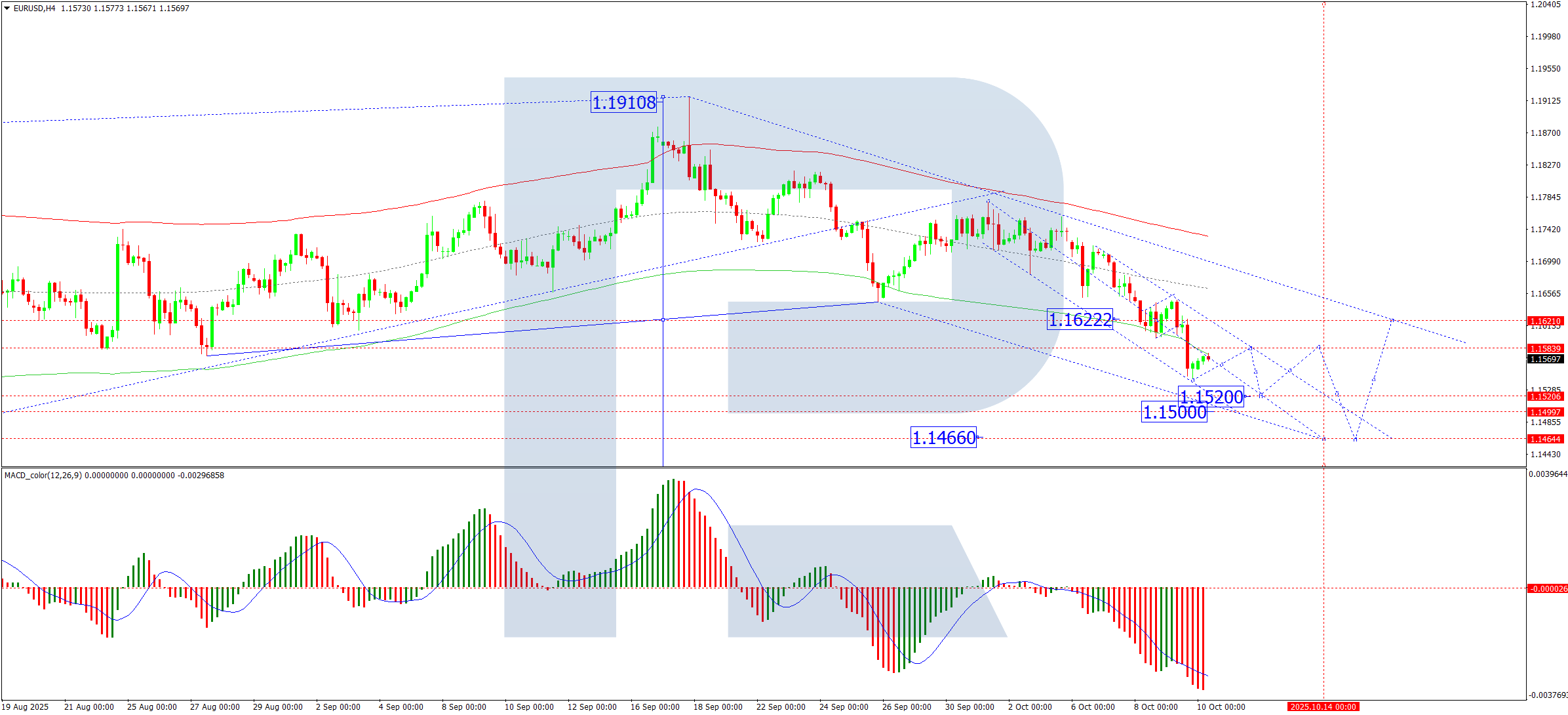
On the H4 chart, EUR/USD formed a consolidation range near 1.1640. Breaking upwards, the pair achieved its local correction target at 1.1716. Today, we anticipate a pullback towards 1.1640 (testing from above), followed by another upside move to 1.1726, where the correction’s potential is likely to be exhausted.

Subsequently, we expect a fresh decline towards 1.1560, with further downside potential to 1.1488. This scenario is supported by the MACD indicator, where the signal line remains above zero and is trending upwards.

H1 Chart:

On the H1 chart, the pair has met its local growth target at 1.1716, with the entire upward move seen as a correction to the prior downtrend. Today, a decline towards 1.1640 is probable, followed by another rise to 1.1726.

This outlook is confirmed by the Stochastic oscillator, where the signal line sits below 50 and is trending downward towards 20.

Conclusion

While EUR/USD shows short-term bullish momentum, the broader trend remains bearish, with key resistance levels likely to cap gains before another downward move unfolds.


Disclaimer

Any forecasts contained herein are based on the author’s particular opinion. This analysis may not be treated as trading advice. RoboForex bears no responsibility for trading results based on trading recommendations and reviews contained herein.