Archive for Financial News – Page 170

COT Bonds Charts: Weekly Speculator Bets led by 10-Year & 5-Year Bonds

By InvestMacro | COT | Data Tables | COT Leaders | Downloads | COT Newsletter

Here are the latest charts and statistics for the Commitment of Traders (COT) reports data published by the Commodities Futures Trading Commission (CFTC).

The latest COT data is updated through Tuesday October 24th and shows a quick view of how large traders (for-profit speculators and commercial hedgers) were positioned in the futures markets.

Weekly Speculator Changes led by 10-Year & 5-Year Bonds

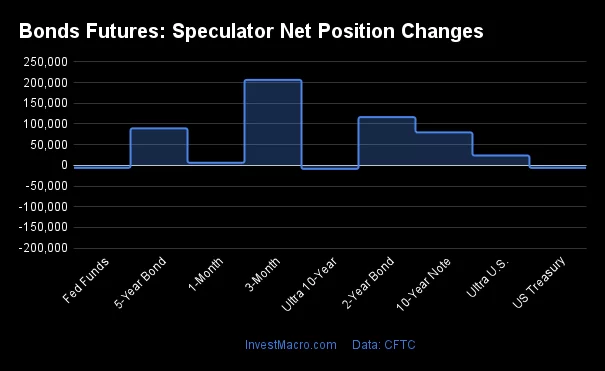
The COT bond market speculator bets were higher this week as five out of the eight bond markets we cover had higher positioning while the other three markets had lower speculator contracts.

Leading the gains for the bond markets was the 10-Year Bonds (147,378 contracts) with the 5-Year Bonds (122,184 contracts), the Fed Funds (89,836 contracts), the SOFR 3-Months (62,572 contracts) and US Treasury Bonds (46,218 contracts) also having positive weeks.

The bond markets with declines in speculator bets for the week were the 2-Year Bonds (-69,613 contracts), the Ultra 10-Year Bonds (-8,704 contracts) and the Ultra Treasury Bonds (-2,065 contracts) also seeing lower bets on the week.


Data Snapshot of Bond Market Traders | Columns Legend
Oct-24-2023OIOI-IndexSpec-NetSpec-IndexCom-NetCOM-IndexSmalls-NetSmalls-Index
SOFR-3-Months10,262,75696283,81387-284,0651325288
FedFunds2,014,70990-205,83425226,92478-21,09050
2-Year4,207,274100-1,424,31201,297,860100126,45296
Long T-Bond1,366,75880-136,2384092,1234344,11581
10-Year4,626,64984-563,36228467,0016596,36194
5-Year5,571,03991-1,008,90318946,8017962,10287


Strength Scores led by SOFR 3-Months & US Treasury Bonds

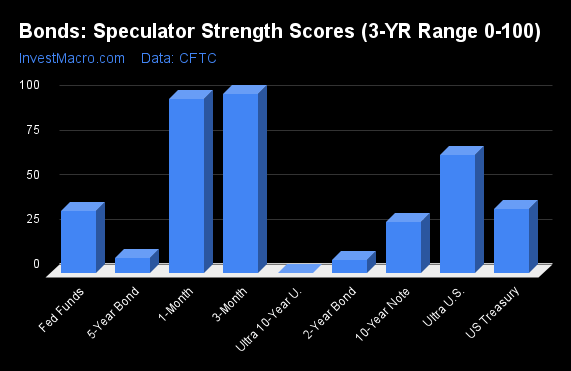
COT Strength Scores (a normalized measure of Speculator positions over a 3-Year range, from 0 to 100 where above 80 is Extreme-Bullish and below 20 is Extreme-Bearish) showed that the SOFR 3-Months (87 percent) leads the bond markets this week. The US Treasury Bonds (40 percent) and the Ultra Treasury Bonds (38 percent) come in as the next highest in the strength scores.

On the downside, the 2-Year Bonds (0 percent), the Ultra 10-Year Bonds (1 percent) and the 5-Year Bonds (18 percent) come in at the lowest strength levels currently and are all in Extreme-Bearish territory (below 20 percent).

Strength Statistics:
Fed Funds (24.6 percent) vs Fed Funds previous week (5.4 percent)
2-Year Bond (0.0 percent) vs 2-Year Bond previous week (4.6 percent)
5-Year Bond (18.3 percent) vs 5-Year Bond previous week (9.3 percent)
10-Year Bond (27.8 percent) vs 10-Year Bond previous week (13.5 percent)
Ultra 10-Year Bond (0.7 percent) vs Ultra 10-Year Bond previous week (2.3 percent)
US Treasury Bond (39.5 percent) vs US Treasury Bond previous week (24.3 percent)
Ultra US Treasury Bond (37.5 percent) vs Ultra US Treasury Bond previous week (38.4 percent)
SOFR 3-Months (87.1 percent) vs SOFR 3-Months previous week (83.3 percent)


US Treasury Bonds & 10-Year Bonds top the 6-Week Strength Trends

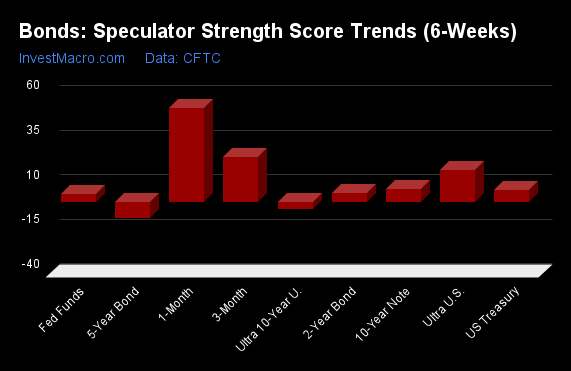
COT Strength Score Trends (or move index, calculates the 6-week changes in strength scores) showed that the US Treasury Bonds (19 percent) and the 10-Year Bonds (18 percent) lead the past six weeks trends for bonds. The Ultra Treasury Bonds (5 percent) and the are the next highest positive movers in the latest trends data.

The Ultra 10-Year Bonds (-20 percent) and the 2-Year Bonds (-12 percent) lead the downside trend scores this week.

Strength Trend Statistics:
Fed Funds (-4.5 percent) vs Fed Funds previous week (-31.8 percent)
2-Year Bond (-12.2 percent) vs 2-Year Bond previous week (-9.0 percent)
5-Year Bond (1.6 percent) vs 5-Year Bond previous week (-5.5 percent)
10-Year Bond (17.5 percent) vs 10-Year Bond previous week (7.8 percent)
Ultra 10-Year Bond (-19.6 percent) vs Ultra 10-Year Bond previous week (-12.2 percent)
US Treasury Bond (18.6 percent) vs US Treasury Bond previous week (5.2 percent)
Ultra US Treasury Bond (5.4 percent) vs Ultra US Treasury Bond previous week (6.8 percent)
SOFR 3-Months (-2.0 percent) vs SOFR 3-Months previous week (-3.1 percent)


Secured Overnight Financing Rate (3-Month) Futures:

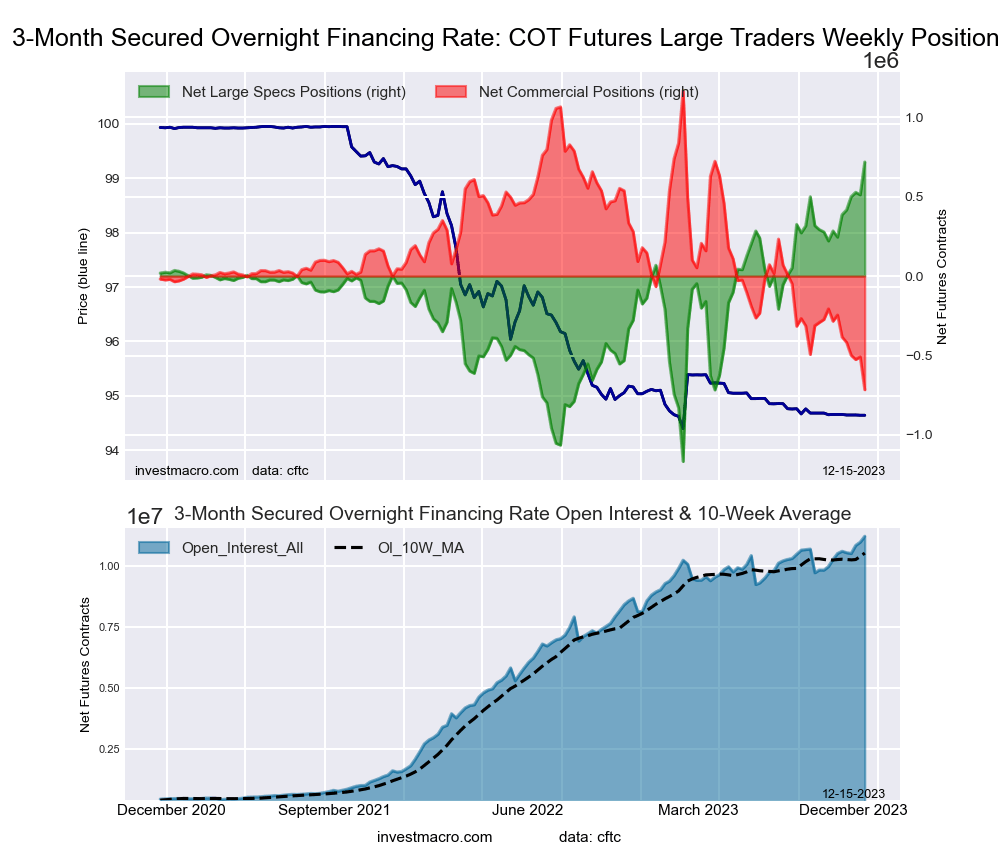
SOFR 3-Months Bonds Futures COT ChartThe Secured Overnight Financing Rate (3-Month) large speculator standing this week equaled a net position of 283,813 contracts in the data reported through Tuesday. This was a weekly lift of 62,572 contracts from the previous week which had a total of 221,241 net contracts.

This week’s current strength score (the trader positioning range over the past three years, measured from 0 to 100) shows the speculators are currently Bullish-Extreme with a score of 87.1 percent. The commercials are Bearish-Extreme with a score of 12.6 percent and the small traders (not shown in chart) are Bullish-Extreme with a score of 88.0 percent.

Price Trend-Following Model: Weak Uptrend

Our weekly trend-following model classifies the current market price position as: Weak Uptrend. The current action for the model is considered to be: Hold – Maintain Long Position.

SOFR 3-Months StatisticsSPECULATORSCOMMERCIALSSMALL TRADERS
– Percent of Open Interest Longs:20.456.20.4
– Percent of Open Interest Shorts:17.759.00.4
– Net Position:283,813-284,065252
– Gross Longs:2,097,6455,767,00939,391
– Gross Shorts:1,813,8326,051,07439,139
– Long to Short Ratio:1.2 to 11.0 to 11.0 to 1
NET POSITION TREND:
– Strength Index Score (3 Year Range Pct):87.112.688.0
– Strength Index Reading (3 Year Range):Bullish-ExtremeBearish-ExtremeBullish-Extreme
NET POSITION MOVEMENT INDEX:
– 6-Week Change in Strength Index:-2.01.81.8


30-Day Federal Funds Futures:

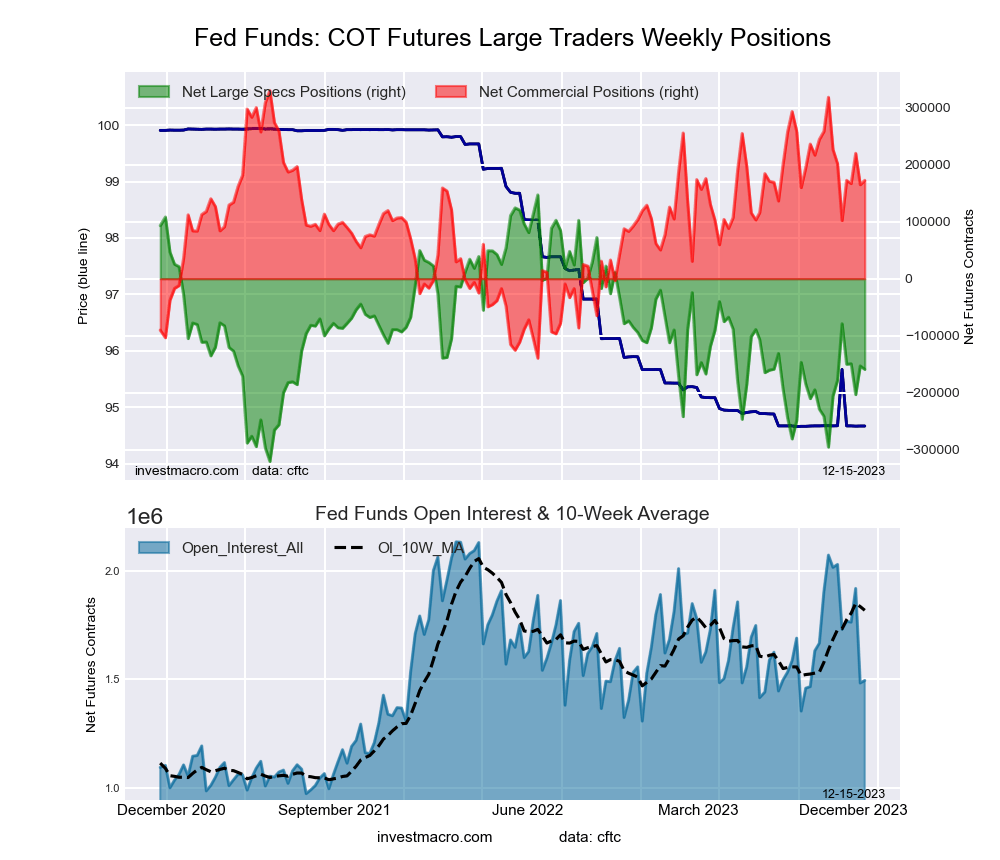
Federal Funds 30-Day Bonds Futures COT ChartThe 30-Day Federal Funds large speculator standing this week equaled a net position of -205,834 contracts in the data reported through Tuesday. This was a weekly increase of 89,836 contracts from the previous week which had a total of -295,670 net contracts.

This week’s current strength score (the trader positioning range over the past three years, measured from 0 to 100) shows the speculators are currently Bearish with a score of 24.6 percent. The commercials are Bullish with a score of 78.0 percent and the small traders (not shown in chart) are Bearish with a score of 49.6 percent.

Price Trend-Following Model: Downtrend

Our weekly trend-following model classifies the current market price position as: Downtrend. The current action for the model is considered to be: Hold – Maintain Short Position.

30-Day Federal Funds StatisticsSPECULATORSCOMMERCIALSSMALL TRADERS
– Percent of Open Interest Longs:8.074.81.7
– Percent of Open Interest Shorts:18.263.52.7
– Net Position:-205,834226,924-21,090
– Gross Longs:160,6151,506,97133,662
– Gross Shorts:366,4491,280,04754,752
– Long to Short Ratio:0.4 to 11.2 to 10.6 to 1
NET POSITION TREND:
– Strength Index Score (3 Year Range Pct):24.678.049.6
– Strength Index Reading (3 Year Range):BearishBullishBearish
NET POSITION MOVEMENT INDEX:
– 6-Week Change in Strength Index:-4.56.8-21.6


2-Year Treasury Note Futures:

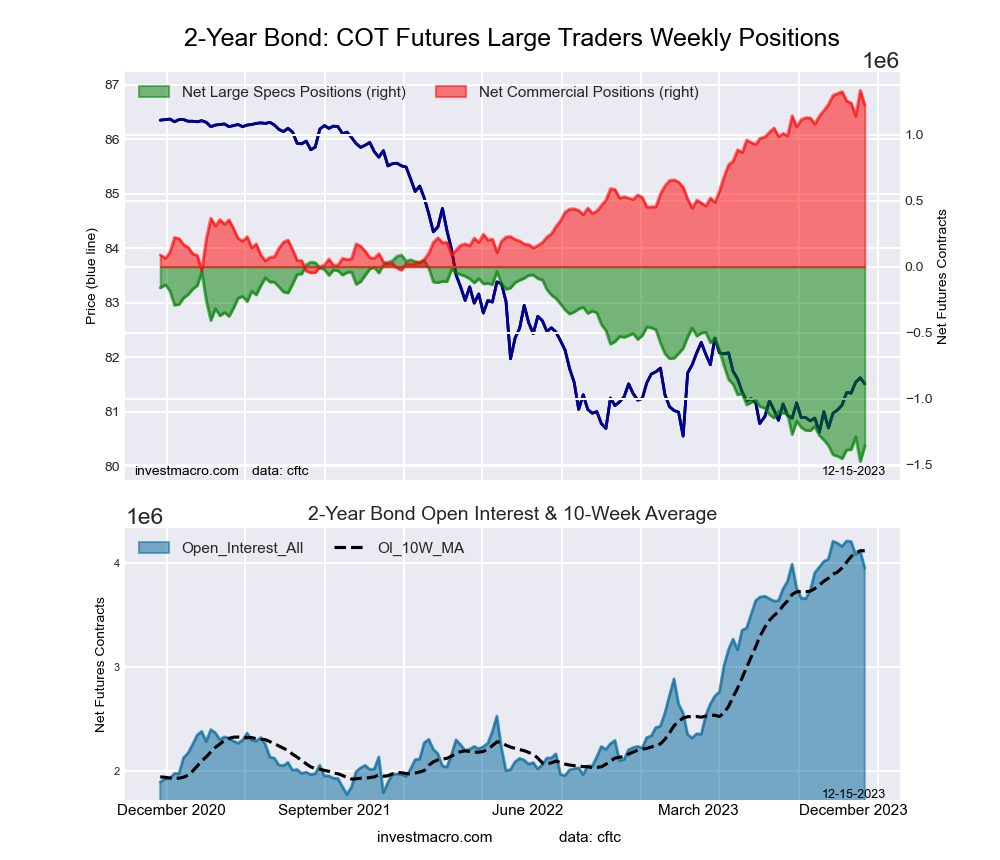
2-Year Treasury Bonds Futures COT ChartThe 2-Year Treasury Note large speculator standing this week equaled a net position of -1,424,312 contracts in the data reported through Tuesday. This was a weekly lowering of -69,613 contracts from the previous week which had a total of -1,354,699 net contracts.

This week’s current strength score (the trader positioning range over the past three years, measured from 0 to 100) shows the speculators are currently Bearish-Extreme with a score of 0.0 percent. The commercials are Bullish-Extreme with a score of 100.0 percent and the small traders (not shown in chart) are Bullish-Extreme with a score of 95.9 percent.

Price Trend-Following Model: Weak Downtrend

Our weekly trend-following model classifies the current market price position as: Weak Downtrend. The current action for the model is considered to be: Hold – Maintain Short Position.

2-Year Treasury Note StatisticsSPECULATORSCOMMERCIALSSMALL TRADERS
– Percent of Open Interest Longs:10.282.16.3
– Percent of Open Interest Shorts:44.151.23.3
– Net Position:-1,424,3121,297,860126,452
– Gross Longs:429,9783,452,942267,147
– Gross Shorts:1,854,2902,155,082140,695
– Long to Short Ratio:0.2 to 11.6 to 11.9 to 1
NET POSITION TREND:
– Strength Index Score (3 Year Range Pct):0.0100.095.9
– Strength Index Reading (3 Year Range):Bearish-ExtremeBullish-ExtremeBullish-Extreme
NET POSITION MOVEMENT INDEX:
– 6-Week Change in Strength Index:-12.212.66.1


5-Year Treasury Note Futures:

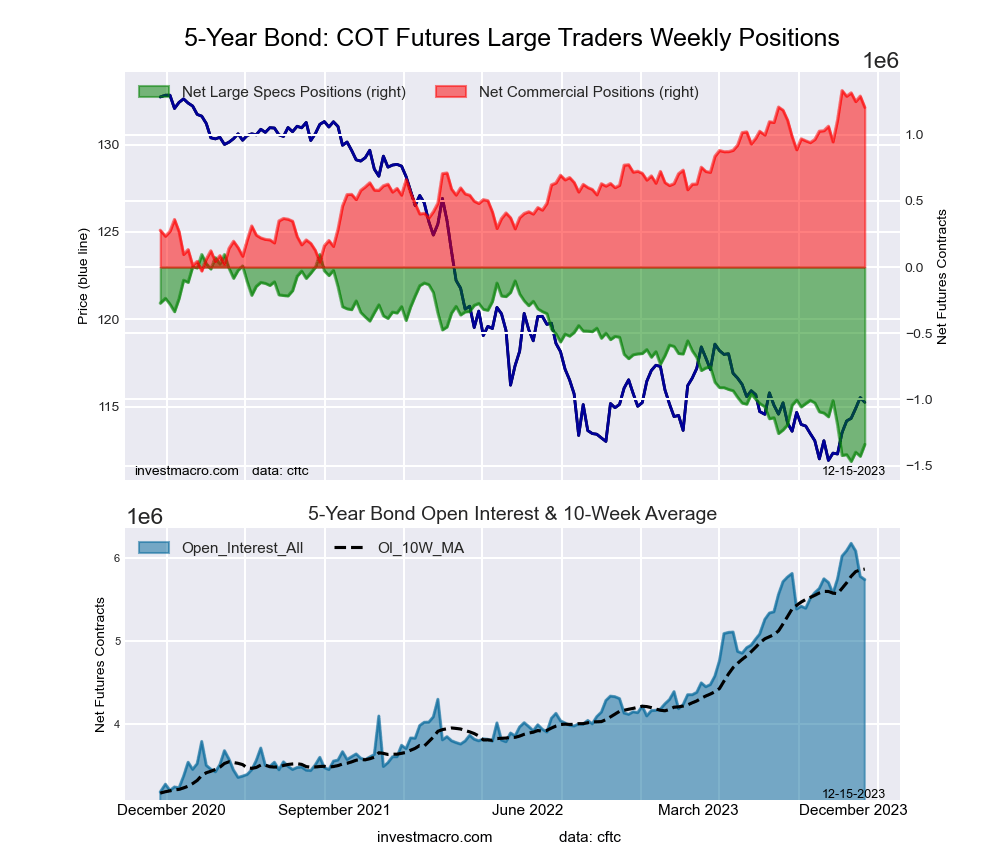
5-Year Treasury Bonds Futures COT ChartThe 5-Year Treasury Note large speculator standing this week equaled a net position of -1,008,903 contracts in the data reported through Tuesday. This was a weekly rise of 122,184 contracts from the previous week which had a total of -1,131,087 net contracts.

This week’s current strength score (the trader positioning range over the past three years, measured from 0 to 100) shows the speculators are currently Bearish-Extreme with a score of 18.3 percent. The commercials are Bullish with a score of 78.8 percent and the small traders (not shown in chart) are Bullish-Extreme with a score of 86.5 percent.

Price Trend-Following Model: Downtrend

Our weekly trend-following model classifies the current market price position as: Downtrend. The current action for the model is considered to be: Hold – Maintain Short Position.

5-Year Treasury Note StatisticsSPECULATORSCOMMERCIALSSMALL TRADERS
– Percent of Open Interest Longs:9.482.07.1
– Percent of Open Interest Shorts:27.565.06.0
– Net Position:-1,008,903946,80162,102
– Gross Longs:524,7374,567,066395,064
– Gross Shorts:1,533,6403,620,265332,962
– Long to Short Ratio:0.3 to 11.3 to 11.2 to 1
NET POSITION TREND:
– Strength Index Score (3 Year Range Pct):18.378.886.5
– Strength Index Reading (3 Year Range):Bearish-ExtremeBullishBullish-Extreme
NET POSITION MOVEMENT INDEX:
– 6-Week Change in Strength Index:1.6-0.6-3.5


10-Year Treasury Note Futures:

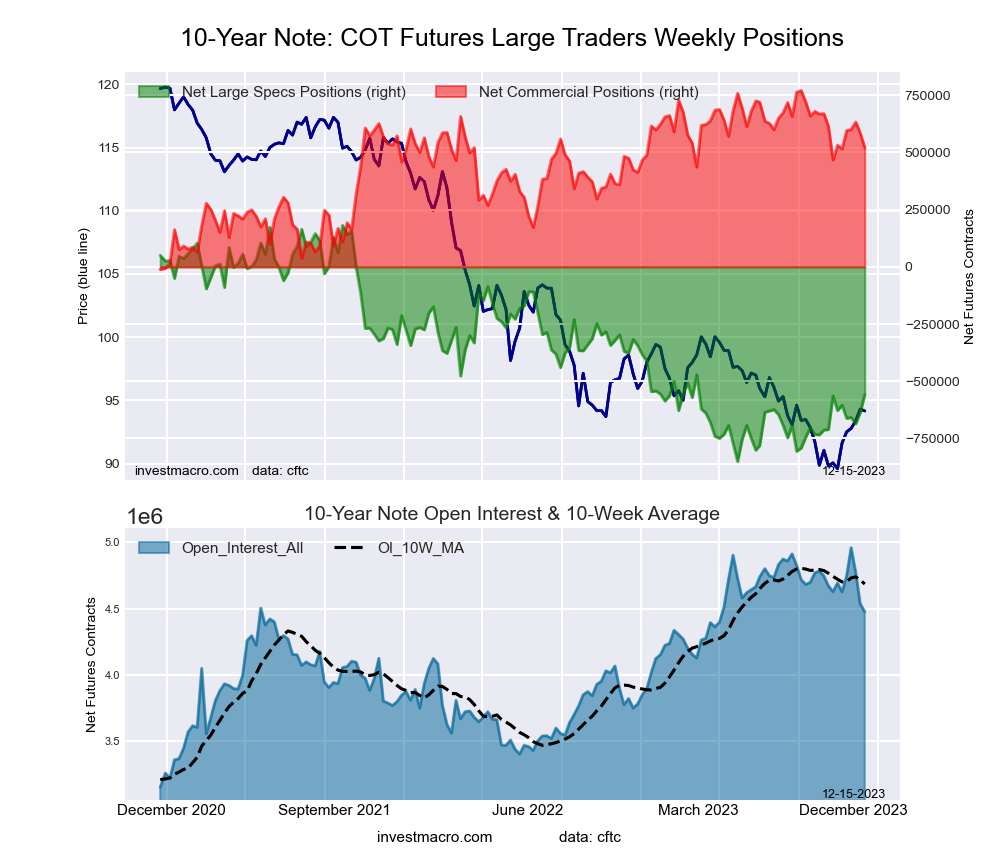
10-Year Treasury Notes Bonds Futures COT ChartThe 10-Year Treasury Note large speculator standing this week equaled a net position of -563,362 contracts in the data reported through Tuesday. This was a weekly lift of 147,378 contracts from the previous week which had a total of -710,740 net contracts.

This week’s current strength score (the trader positioning range over the past three years, measured from 0 to 100) shows the speculators are currently Bearish with a score of 27.8 percent. The commercials are Bullish with a score of 65.3 percent and the small traders (not shown in chart) are Bullish-Extreme with a score of 94.5 percent.

Price Trend-Following Model: Strong Downtrend

Our weekly trend-following model classifies the current market price position as: Strong Downtrend. The current action for the model is considered to be: Hold – Maintain Short Position.

10-Year Treasury Note StatisticsSPECULATORSCOMMERCIALSSMALL TRADERS
– Percent of Open Interest Longs:11.777.09.5
– Percent of Open Interest Shorts:23.966.97.4
– Net Position:-563,362467,00196,361
– Gross Longs:542,3243,562,693438,802
– Gross Shorts:1,105,6863,095,692342,441
– Long to Short Ratio:0.5 to 11.2 to 11.3 to 1
NET POSITION TREND:
– Strength Index Score (3 Year Range Pct):27.865.394.5
– Strength Index Reading (3 Year Range):BearishBullishBullish-Extreme
NET POSITION MOVEMENT INDEX:
– 6-Week Change in Strength Index:17.5-29.015.7


Ultra 10-Year Notes Futures:

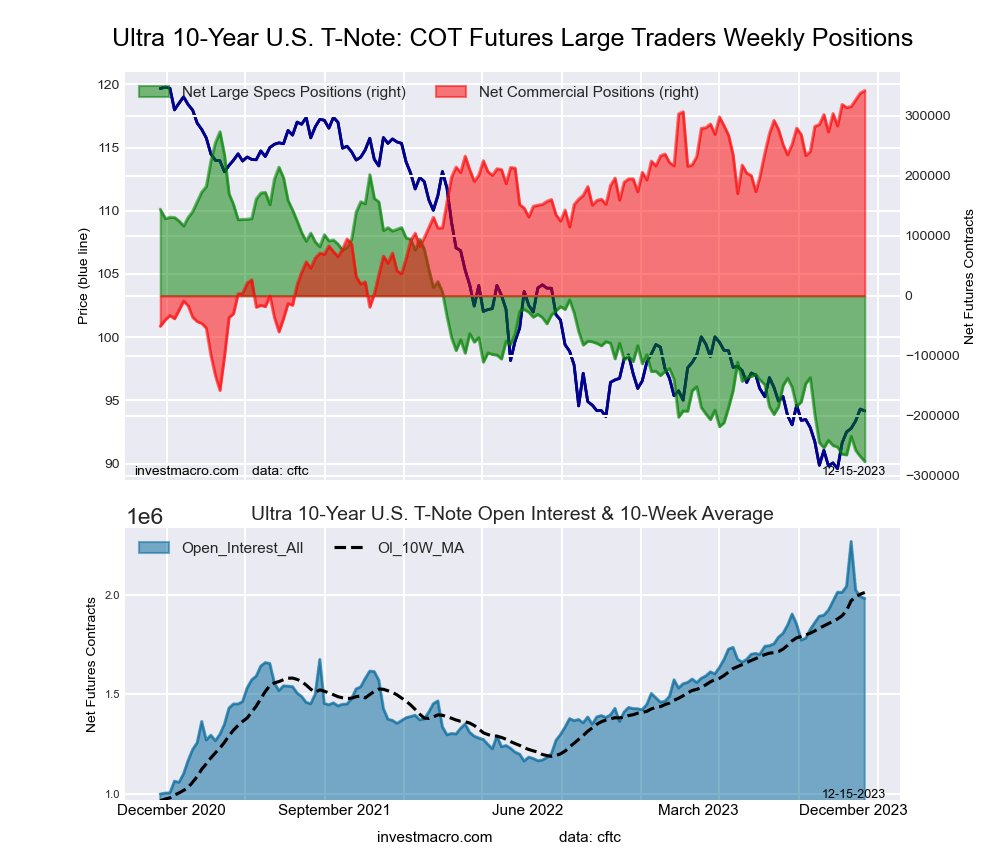
Ultra 10-Year Treasury Notes Bonds Futures COT ChartThe Ultra 10-Year Notes large speculator standing this week equaled a net position of -249,869 contracts in the data reported through Tuesday. This was a weekly reduction of -8,704 contracts from the previous week which had a total of -241,165 net contracts.

This week’s current strength score (the trader positioning range over the past three years, measured from 0 to 100) shows the speculators are currently Bearish-Extreme with a score of 0.7 percent. The commercials are Bullish-Extreme with a score of 99.4 percent and the small traders (not shown in chart) are Bullish-Extreme with a score of 81.8 percent.

Price Trend-Following Model: Weak Uptrend

Our weekly trend-following model classifies the current market price position as: Weak Uptrend. The current action for the model is considered to be: Hold – Maintain Long Position.

Ultra 10-Year Notes StatisticsSPECULATORSCOMMERCIALSSMALL TRADERS
– Percent of Open Interest Longs:9.977.410.8
– Percent of Open Interest Shorts:22.662.013.5
– Net Position:-249,869304,036-54,167
– Gross Longs:194,3921,523,392212,339
– Gross Shorts:444,2611,219,356266,506
– Long to Short Ratio:0.4 to 11.2 to 10.8 to 1
NET POSITION TREND:
– Strength Index Score (3 Year Range Pct):0.799.481.8
– Strength Index Reading (3 Year Range):Bearish-ExtremeBullish-ExtremeBullish-Extreme
NET POSITION MOVEMENT INDEX:
– 6-Week Change in Strength Index:-19.615.119.8


US Treasury Bonds Futures:

US Year Treasury Notes Long Bonds Futures COT ChartThe US Treasury Bonds large speculator standing this week equaled a net position of -136,238 contracts in the data reported through Tuesday. This was a weekly gain of 46,218 contracts from the previous week which had a total of -182,456 net contracts.

This week’s current strength score (the trader positioning range over the past three years, measured from 0 to 100) shows the speculators are currently Bearish with a score of 39.5 percent. The commercials are Bearish with a score of 43.5 percent and the small traders (not shown in chart) are Bullish-Extreme with a score of 80.5 percent.

Price Trend-Following Model: Strong Downtrend

Our weekly trend-following model classifies the current market price position as: Strong Downtrend. The current action for the model is considered to be: Hold – Maintain Short Position.

US Treasury Bonds StatisticsSPECULATORSCOMMERCIALSSMALL TRADERS
– Percent of Open Interest Longs:6.977.013.8
– Percent of Open Interest Shorts:16.870.210.6
– Net Position:-136,23892,12344,115
– Gross Longs:93,7361,051,787189,136
– Gross Shorts:229,974959,664145,021
– Long to Short Ratio:0.4 to 11.1 to 11.3 to 1
NET POSITION TREND:
– Strength Index Score (3 Year Range Pct):39.543.580.5
– Strength Index Reading (3 Year Range):BearishBearishBullish-Extreme
NET POSITION MOVEMENT INDEX:
– 6-Week Change in Strength Index:18.6-21.63.0


Ultra US Treasury Bonds Futures:

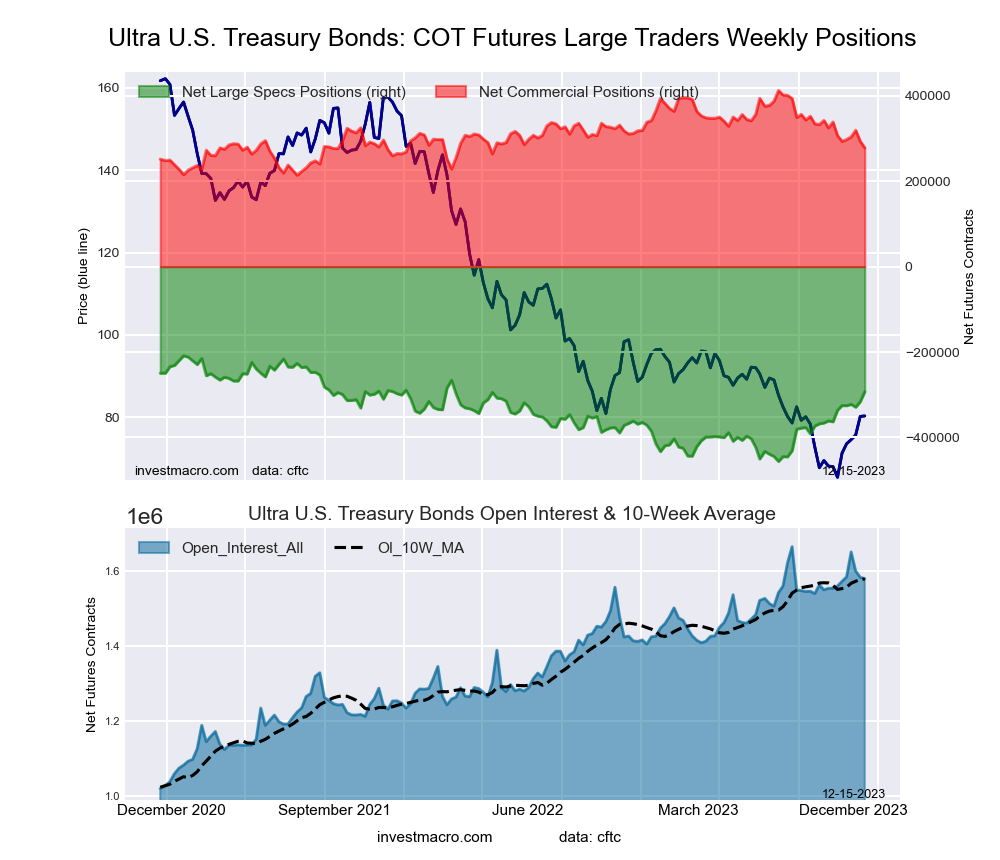
Ultra US Year Treasury Notes Long Bonds Futures COT ChartThe Ultra US Treasury Bonds large speculator standing this week equaled a net position of -363,546 contracts in the data reported through Tuesday. This was a weekly lowering of -2,065 contracts from the previous week which had a total of -361,481 net contracts.

This week’s current strength score (the trader positioning range over the past three years, measured from 0 to 100) shows the speculators are currently Bearish with a score of 37.5 percent. The commercials are Bullish with a score of 64.2 percent and the small traders (not shown in chart) are Bullish with a score of 60.5 percent.

Price Trend-Following Model: Strong Downtrend

Our weekly trend-following model classifies the current market price position as: Strong Downtrend. The current action for the model is considered to be: Hold – Maintain Short Position.

Ultra US Treasury Bonds StatisticsSPECULATORSCOMMERCIALSSMALL TRADERS
– Percent of Open Interest Longs:6.082.911.0
– Percent of Open Interest Shorts:29.361.19.4
– Net Position:-363,546338,82024,726
– Gross Longs:92,6551,288,162170,435
– Gross Shorts:456,201949,342145,709
– Long to Short Ratio:0.2 to 11.4 to 11.2 to 1
NET POSITION TREND:
– Strength Index Score (3 Year Range Pct):37.564.260.5
– Strength Index Reading (3 Year Range):BearishBullishBullish
NET POSITION MOVEMENT INDEX:
– 6-Week Change in Strength Index:5.4-2.4-7.9


Article By InvestMacroReceive our weekly COT Reports by Email

*COT Report: The COT data, released weekly to the public each Friday, is updated through the most recent Tuesday (data is 3 days old) and shows a quick view of how large speculators or non-commercials (for-profit traders) were positioned in the futures markets.

The CFTC categorizes trader positions according to commercial hedgers (traders who use futures contracts for hedging as part of the business), non-commercials (large traders who speculate to realize trading profits) and nonreportable traders (usually small traders/speculators) as well as their open interest (contracts open in the market at time of reporting).See CFTC criteria here.

All information and opinions on this website and contained in this article are for general informational purposes only and do not constitute investment advice.

COT Stock Market Charts: Weekly Speculator Bets led by S&P500-Mini & VIX

By InvestMacro | COT | Data Tables | COT Leaders | Downloads | COT Newsletter

Here are the latest charts and statistics for the Commitment of Traders (COT) data published by the Commodities Futures Trading Commission (CFTC).

The latest COT data is updated through Tuesday October 24th and shows a quick view of how large traders (for-profit speculators and commercial entities) were positioned in the futures markets.

Weekly Speculator Changes led by S&P500-Mini & the VIX

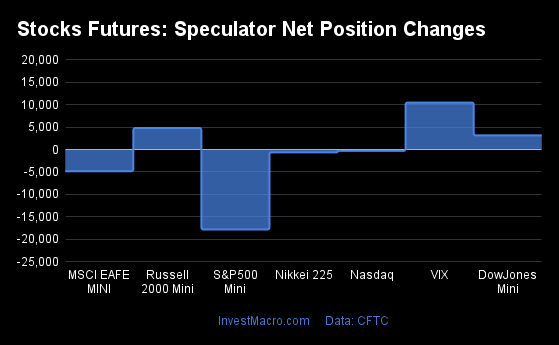
The COT stock markets speculator bets were slightly higher this week as four out of the seven stock markets we cover had higher positioning while the other three markets had lower speculator contracts.

Leading the gains for the stock markets was a big jump by the S&P500-Mini (73,363 contracts) with the VIX (1,351 contracts), the Russell-Mini (1,301 contracts) and the Nikkei 225 (127 contracts) also showing positive weeks.

The markets with the declines in speculator bets were led this week by the Nasdaq-Mini (-11,651 contracts), the MSCI EAFE-Mini (-2,280 contracts) and the DowJones-Mini (-749 contracts) also registering lower bets on the week.


Data Snapshot of Stock Market Traders | Columns Legend
Oct-24-2023OIOI-IndexSpec-NetSpec-IndexCom-NetCOM-IndexSmalls-NetSmalls-Index
S&P500-Mini2,158,4521710,18566-34,7363524,55147
Nikkei 22515,32614-2,12852695401,43346
Nasdaq-Mini253,055392,69743-4,366391,66974
DowJones-Mini104,58172-35,960039,64999-3,68926
VIX344,31844-21,5949526,0583-4,46474
Nikkei 225 Yen53,712427,280579,59937-16,87953


Strength Scores led by VIX & S&P500-Mini

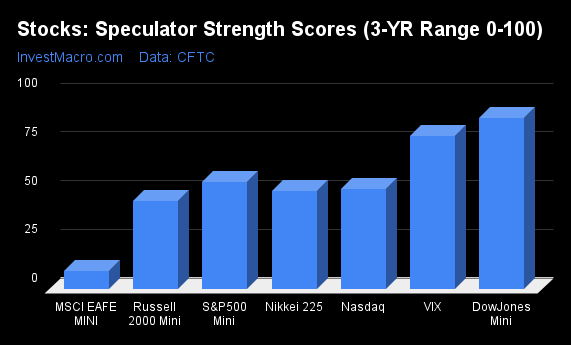
COT Strength Scores (a normalized measure of Speculator positions over a 3-Year range, from 0 to 100 where above 80 is Extreme-Bullish and below 20 is Extreme-Bearish) showed that the VIX (95 percent) and the S&P500-Mini (66 percent) were the leaders for the stock markets this week. The Nikkei 225 (52 percent) came in as the next highest in the weekly strength scores.

On the downside, the DowJones-Mini (0 percent) was at the lowest strength level and is in Extreme-Bearish territory (below 20 percent). The next lowest strength score is the MSCI EAFE-Mini (27 percent).

Strength Statistics:
VIX (95.3 percent) vs VIX previous week (94.4 percent)
S&P500-Mini (66.3 percent) vs S&P500-Mini previous week (55.3 percent)
DowJones-Mini (0.0 percent) vs DowJones-Mini previous week (1.7 percent)
Nasdaq-Mini (43.1 percent) vs Nasdaq-Mini previous week (61.0 percent)
Russell2000-Mini (45.5 percent) vs Russell2000-Mini previous week (44.7 percent)
Nikkei USD (51.8 percent) vs Nikkei USD previous week (50.9 percent)
EAFE-Mini (26.7 percent) vs EAFE-Mini previous week (28.9 percent)


MSCI EAFE-Mini & S&P500-Mini top the 6-Week Strength Trends

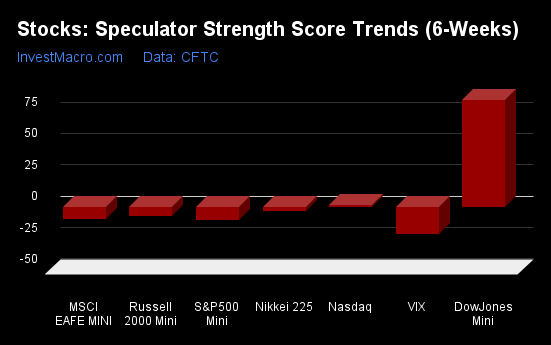
COT Strength Score Trends (or move index, calculates the 6-week changes in strength scores) showed that the MSCI EAFE-Mini (27 percent) leads the past six weeks trends for the stock markets. The S&P500-Mini (19 percent), the VIX (12 percent) and the Russell-Mini (12 percent) are the next highest positive movers in the latest trends data.

The DowJones-Mini (-51 percent) leads the downside trend scores currently with the Nikkei 225 (-19 percent) coming in as the next lowest market.

Strength Trend Statistics:
VIX (11.9 percent) vs VIX previous week (13.3 percent)
S&P500-Mini (18.9 percent) vs S&P500-Mini previous week (12.1 percent)
DowJones-Mini (-51.1 percent) vs DowJones-Mini previous week (-52.0 percent)
Nasdaq-Mini (-9.8 percent) vs Nasdaq-Mini previous week (1.2 percent)
Russell2000-Mini (11.7 percent) vs Russell2000-Mini previous week (15.7 percent)
Nikkei USD (-18.6 percent) vs Nikkei USD previous week (-14.8 percent)
EAFE-Mini (26.7 percent) vs EAFE-Mini previous week (9.5 percent)


Individual Stock Market Charts:

VIX Volatility Futures:

VIX Volatility Futures COT ChartThe VIX Volatility large speculator standing this week was a net position of -21,594 contracts in the data reported through Tuesday. This was a weekly lift of 1,351 contracts from the previous week which had a total of -22,945 net contracts.

This week’s current strength score (the trader positioning range over the past three years, measured from 0 to 100) shows the speculators are currently Bullish-Extreme with a score of 95.3 percent. The commercials are Bearish-Extreme with a score of 2.5 percent and the small traders (not shown in chart) are Bullish with a score of 73.7 percent.

Price Trend-Following Model: Strong Uptrend

Our weekly trend-following model classifies the current market price position as: Strong Uptrend. The current action for the model is considered to be: Hold – Maintain Long Position.

VIX Volatility Futures StatisticsSPECULATORSCOMMERCIALSSMALL TRADERS
– Percent of Open Interest Longs:25.747.57.2
– Percent of Open Interest Shorts:32.040.08.5
– Net Position:-21,59426,058-4,464
– Gross Longs:88,500163,68224,682
– Gross Shorts:110,094137,62429,146
– Long to Short Ratio:0.8 to 11.2 to 10.8 to 1
NET POSITION TREND:
– Strength Index Score (3 Year Range Pct):95.32.573.7
– Strength Index Reading (3 Year Range):Bullish-ExtremeBearish-ExtremeBullish
NET POSITION MOVEMENT INDEX:
– 6-Week Change in Strength Index:11.9-9.4-18.9


S&P500 Mini Futures:

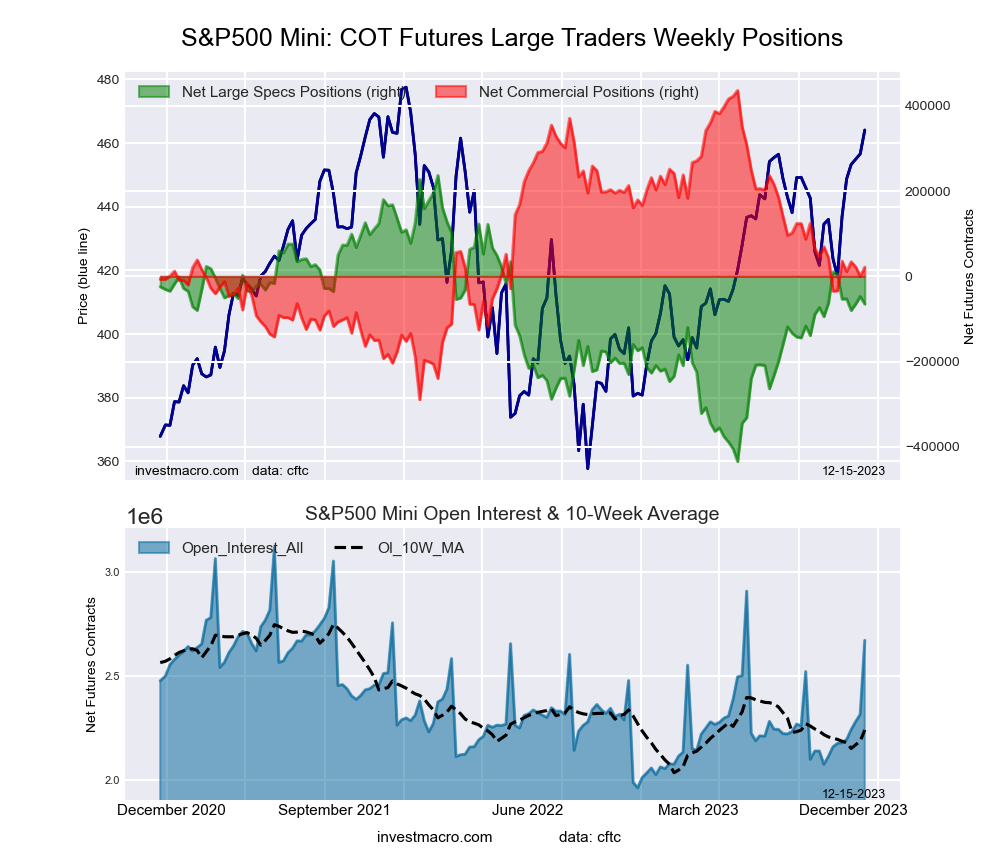
SP500 Mini Futures COT ChartThe S&P500 Mini large speculator standing this week was a net position of 10,185 contracts in the data reported through Tuesday. This was a weekly rise of 73,363 contracts from the previous week which had a total of -63,178 net contracts.

This week’s current strength score (the trader positioning range over the past three years, measured from 0 to 100) shows the speculators are currently Bullish with a score of 66.3 percent. The commercials are Bearish with a score of 35.1 percent and the small traders (not shown in chart) are Bearish with a score of 47.0 percent.

Price Trend-Following Model: Strong Downtrend

Our weekly trend-following model classifies the current market price position as: Strong Downtrend. The current action for the model is considered to be: Hold – Maintain Short Position.

S&P500 Mini Futures StatisticsSPECULATORSCOMMERCIALSSMALL TRADERS
– Percent of Open Interest Longs:13.172.411.5
– Percent of Open Interest Shorts:12.674.010.4
– Net Position:10,185-34,73624,551
– Gross Longs:282,6041,562,074248,407
– Gross Shorts:272,4191,596,810223,856
– Long to Short Ratio:1.0 to 11.0 to 11.1 to 1
NET POSITION TREND:
– Strength Index Score (3 Year Range Pct):66.335.147.0
– Strength Index Reading (3 Year Range):BullishBearishBearish
NET POSITION MOVEMENT INDEX:
– 6-Week Change in Strength Index:18.9-16.8-1.9


Dow Jones Mini Futures:

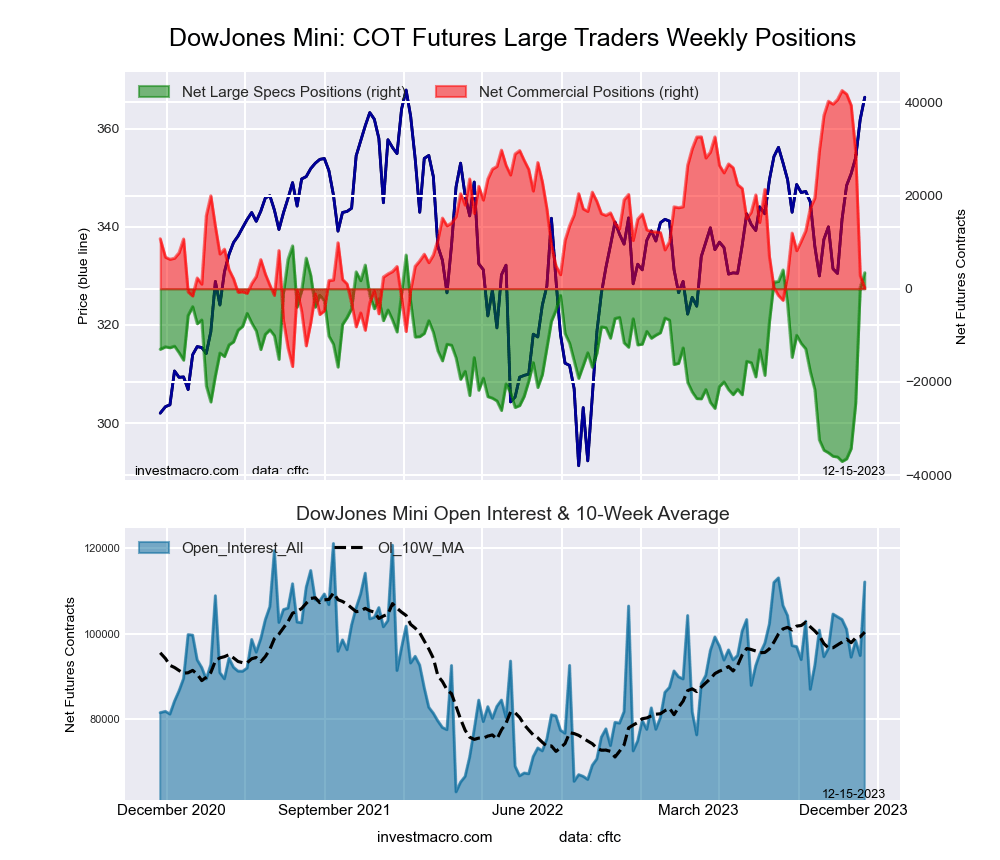
Dow Jones Mini Futures COT ChartThe Dow Jones Mini large speculator standing this week was a net position of -35,960 contracts in the data reported through Tuesday. This was a weekly reduction of -749 contracts from the previous week which had a total of -35,211 net contracts.

This week’s current strength score (the trader positioning range over the past three years, measured from 0 to 100) shows the speculators are currently Bearish-Extreme with a score of 0.0 percent. The commercials are Bullish-Extreme with a score of 98.9 percent and the small traders (not shown in chart) are Bearish with a score of 25.9 percent.

Price Trend-Following Model: Strong Downtrend

Our weekly trend-following model classifies the current market price position as: Strong Downtrend. The current action for the model is considered to be: Hold – Maintain Short Position.

Dow Jones Mini Futures StatisticsSPECULATORSCOMMERCIALSSMALL TRADERS
– Percent of Open Interest Longs:24.165.110.4
– Percent of Open Interest Shorts:58.427.113.9
– Net Position:-35,96039,649-3,689
– Gross Longs:25,15968,03410,893
– Gross Shorts:61,11928,38514,582
– Long to Short Ratio:0.4 to 12.4 to 10.7 to 1
NET POSITION TREND:
– Strength Index Score (3 Year Range Pct):0.098.925.9
– Strength Index Reading (3 Year Range):Bearish-ExtremeBullish-ExtremeBearish
NET POSITION MOVEMENT INDEX:
– 6-Week Change in Strength Index:-51.147.8-20.2


Nasdaq Mini Futures:

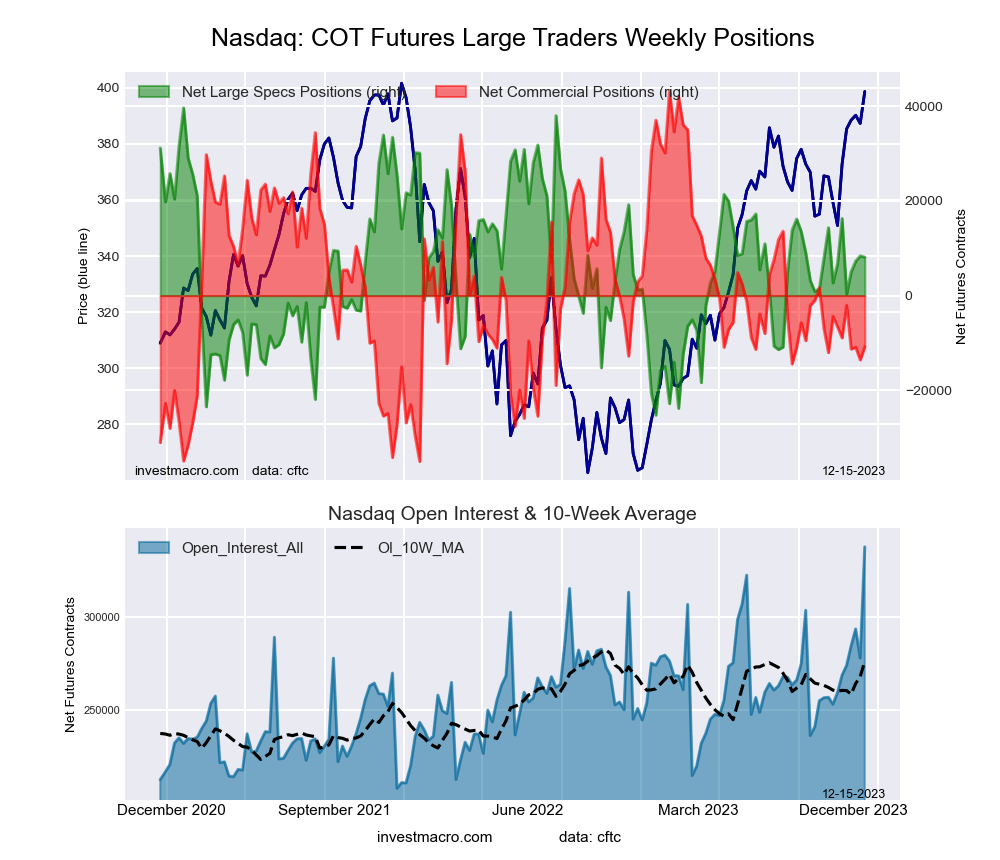
Nasdaq Mini Futures COT ChartThe Nasdaq Mini large speculator standing this week was a net position of 2,697 contracts in the data reported through Tuesday. This was a weekly fall of -11,651 contracts from the previous week which had a total of 14,348 net contracts.

This week’s current strength score (the trader positioning range over the past three years, measured from 0 to 100) shows the speculators are currently Bearish with a score of 43.1 percent. The commercials are Bearish with a score of 39.1 percent and the small traders (not shown in chart) are Bullish with a score of 73.7 percent.

Price Trend-Following Model: Strong Downtrend

Our weekly trend-following model classifies the current market price position as: Strong Downtrend. The current action for the model is considered to be: Hold – Maintain Short Position.

Nasdaq Mini Futures StatisticsSPECULATORSCOMMERCIALSSMALL TRADERS
– Percent of Open Interest Longs:27.356.015.0
– Percent of Open Interest Shorts:26.257.714.3
– Net Position:2,697-4,3661,669
– Gross Longs:69,019141,58937,947
– Gross Shorts:66,322145,95536,278
– Long to Short Ratio:1.0 to 11.0 to 11.0 to 1
NET POSITION TREND:
– Strength Index Score (3 Year Range Pct):43.139.173.7
– Strength Index Reading (3 Year Range):BearishBearishBullish
NET POSITION MOVEMENT INDEX:
– 6-Week Change in Strength Index:-9.86.63.0


Russell 2000 Mini Futures:

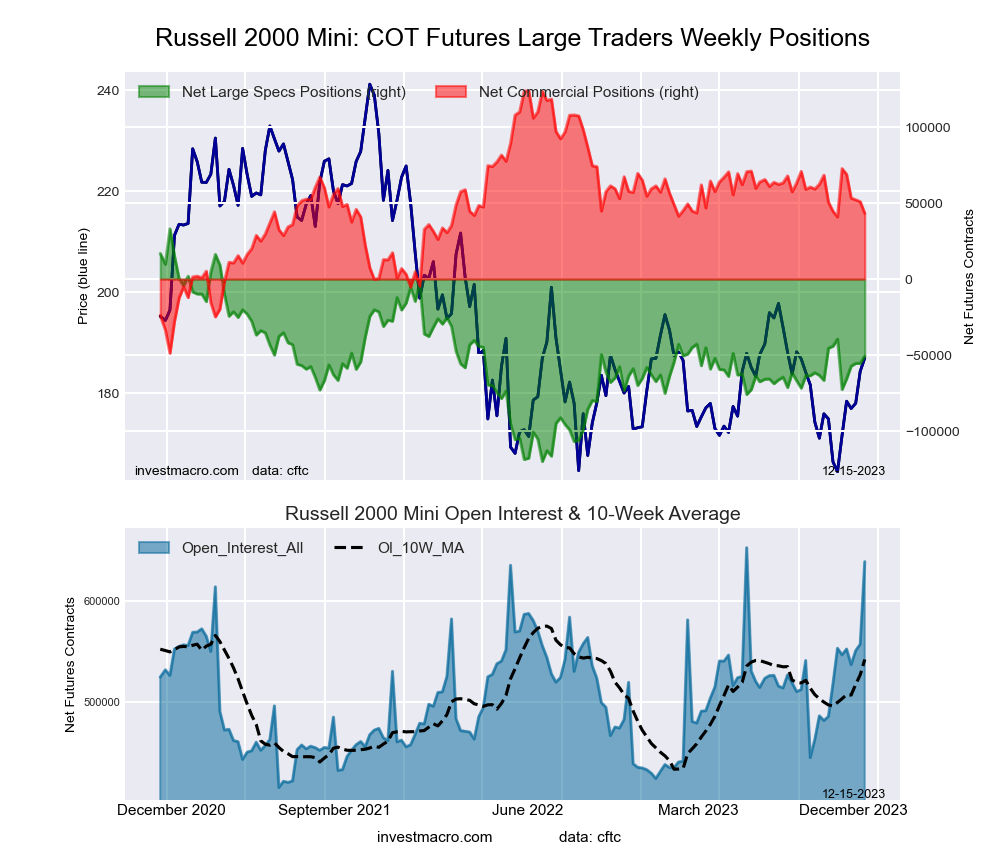
Russell 2000 Mini Futures COT ChartThe Russell 2000 Mini large speculator standing this week was a net position of -44,171 contracts in the data reported through Tuesday. This was a weekly rise of 1,301 contracts from the previous week which had a total of -45,472 net contracts.

This week’s current strength score (the trader positioning range over the past three years, measured from 0 to 100) shows the speculators are currently Bearish with a score of 45.5 percent. The commercials are Bullish with a score of 55.5 percent and the small traders (not shown in chart) are Bearish with a score of 25.4 percent.

Price Trend-Following Model: Strong Downtrend

Our weekly trend-following model classifies the current market price position as: Strong Downtrend. The current action for the model is considered to be: Hold – Maintain Short Position.

Russell 2000 Mini Futures StatisticsSPECULATORSCOMMERCIALSSMALL TRADERS
– Percent of Open Interest Longs:14.079.84.6
– Percent of Open Interest Shorts:22.571.24.6
– Net Position:-44,17144,537-366
– Gross Longs:72,617413,48123,620
– Gross Shorts:116,788368,94423,986
– Long to Short Ratio:0.6 to 11.1 to 11.0 to 1
NET POSITION TREND:
– Strength Index Score (3 Year Range Pct):45.555.525.4
– Strength Index Reading (3 Year Range):BearishBullishBearish
NET POSITION MOVEMENT INDEX:
– 6-Week Change in Strength Index:11.7-8.1-15.3


Nikkei Stock Average (USD) Futures:

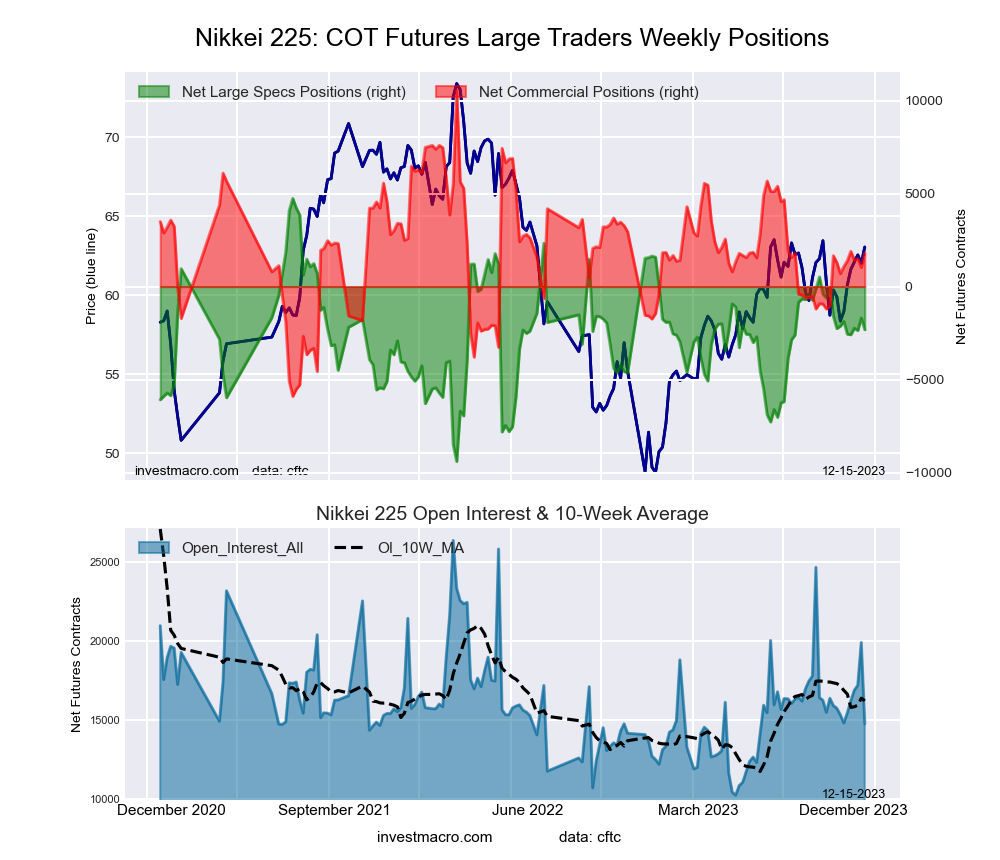
Nikkei Stock Average (USD) Futures COT ChartThe Nikkei Stock Average (USD) large speculator standing this week was a net position of -2,128 contracts in the data reported through Tuesday. This was a weekly rise of 127 contracts from the previous week which had a total of -2,255 net contracts.

This week’s current strength score (the trader positioning range over the past three years, measured from 0 to 100) shows the speculators are currently Bullish with a score of 51.8 percent. The commercials are Bearish with a score of 40.1 percent and the small traders (not shown in chart) are Bearish with a score of 46.3 percent.

Price Trend-Following Model: Strong Downtrend

Our weekly trend-following model classifies the current market price position as: Strong Downtrend. The current action for the model is considered to be: Hold – Maintain Short Position.

Nikkei Stock Average Futures StatisticsSPECULATORSCOMMERCIALSSMALL TRADERS
– Percent of Open Interest Longs:5.870.224.1
– Percent of Open Interest Shorts:19.765.614.7
– Net Position:-2,1286951,433
– Gross Longs:88410,7543,688
– Gross Shorts:3,01210,0592,255
– Long to Short Ratio:0.3 to 11.1 to 11.6 to 1
NET POSITION TREND:
– Strength Index Score (3 Year Range Pct):51.840.146.3
– Strength Index Reading (3 Year Range):BullishBearishBearish
NET POSITION MOVEMENT INDEX:
– 6-Week Change in Strength Index:-18.69.812.9


MSCI EAFE Mini Futures:

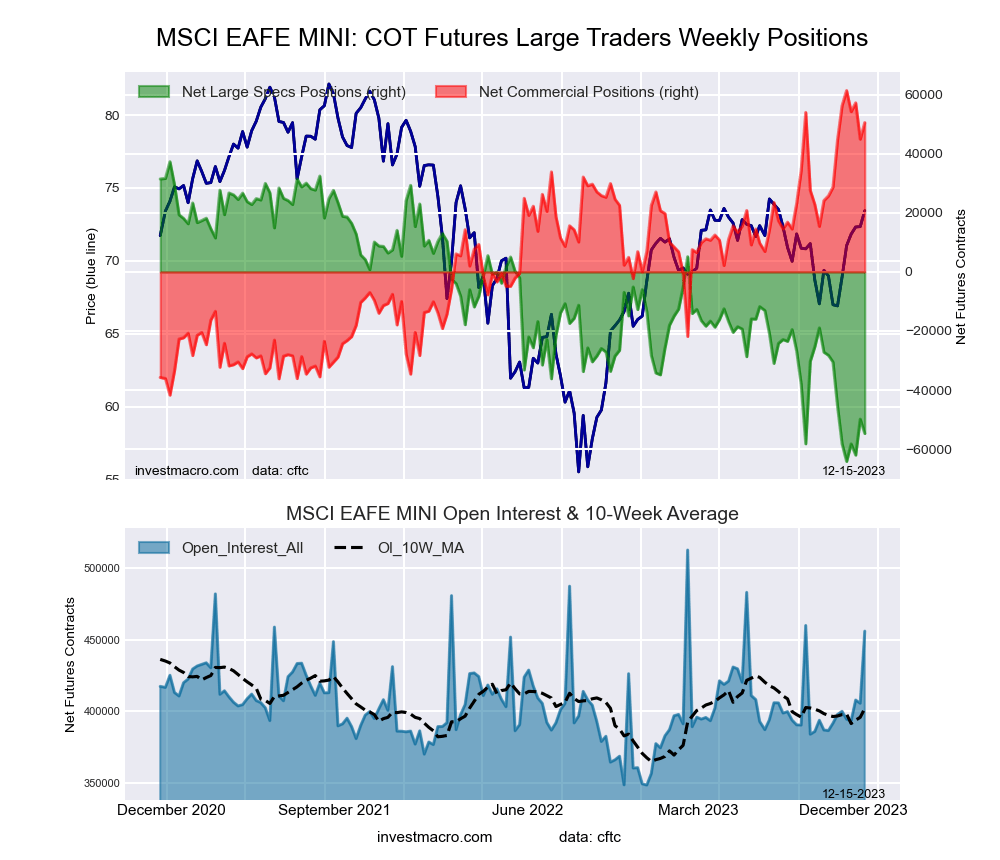
MSCI EAFE Mini Futures COT ChartThe MSCI EAFE Mini large speculator standing this week was a net position of -30,499 contracts in the data reported through Tuesday. This was a weekly decrease of -2,280 contracts from the previous week which had a total of -28,219 net contracts.

This week’s current strength score (the trader positioning range over the past three years, measured from 0 to 100) shows the speculators are currently Bearish with a score of 26.7 percent. The commercials are Bullish with a score of 75.4 percent and the small traders (not shown in chart) are Bearish with a score of 26.0 percent.

Price Trend-Following Model: Strong Downtrend

Our weekly trend-following model classifies the current market price position as: Strong Downtrend. The current action for the model is considered to be: Hold – Maintain Short Position.

MSCI EAFE Mini Futures StatisticsSPECULATORSCOMMERCIALSSMALL TRADERS
– Percent of Open Interest Longs:6.590.02.6
– Percent of Open Interest Shorts:14.382.72.2
– Net Position:-30,49928,7001,799
– Gross Longs:25,471352,59410,247
– Gross Shorts:55,970323,8948,448
– Long to Short Ratio:0.5 to 11.1 to 11.2 to 1
NET POSITION TREND:
– Strength Index Score (3 Year Range Pct):26.775.426.0
– Strength Index Reading (3 Year Range):BearishBullishBearish
NET POSITION MOVEMENT INDEX:
– 6-Week Change in Strength Index:26.7-24.6-11.8


Article By InvestMacroReceive our weekly COT Reports by Email

*COT Report: The COT data, released weekly to the public each Friday, is updated through the most recent Tuesday (data is 3 days old) and shows a quick view of how large speculators or non-commercials (for-profit traders) were positioned in the futures markets.

The CFTC categorizes trader positions according to commercial hedgers (traders who use futures contracts for hedging as part of the business), non-commercials (large traders who speculate to realize trading profits) and nonreportable traders (usually small traders/speculators) as well as their open interest (contracts open in the market at time of reporting).See CFTC criteria here.

All information and opinions on this website and contained in this article are for general informational purposes only and do not constitute investment advice.

COT Soft Commodities Charts: Speculator Bets led by Soybean Meal & Coffee

By InvestMacro | COT | Data Tables | COT Leaders | Downloads | COT Newsletter

Here are the latest charts and statistics for the Commitment of Traders (COT) reports data published by the Commodities Futures Trading Commission (CFTC).

The latest COT data is updated through Tuesday October 24th and shows a quick view of how large traders (for-profit speculators and commercial entities) were positioned in the futures markets.

Weekly Speculator Changes led by Soybean Meal & Coffee

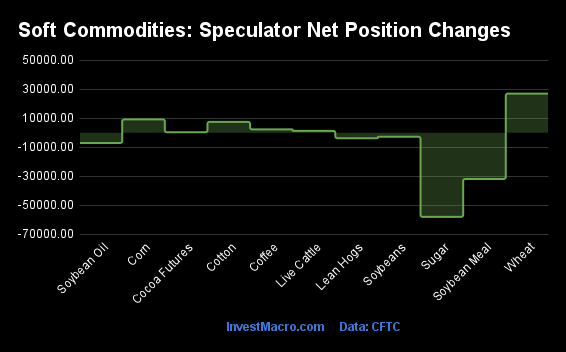
The COT soft commodities markets speculator bets were higher this week as six out of the eleven softs markets we cover had higher positioning while the other five markets had lower speculator contracts.

Leading the gains for the softs markets was Soybean Meal (30,388 contracts) with Coffee (18,396 contracts), Corn (14,274 contracts), Soybeans (9,349 contracts), Wheat (9,296 contracts and Cocoa (5,528 contracts) also showing positive weeks.

The markets with the declines in speculator bets this week were Live Cattle (-21,450 contracts) with Cotton (-10,557 contracts), Soybean Oil (-9,666 contracts), Lean Hogs (-5,806 contracts) and Sugar (-3,264 contracts) also registering lower bets on the week.


Data Snapshot of Commodity Market Traders | Columns Legend
Oct-24-2023OIOI-IndexSpec-NetSpec-IndexCom-NetCOM-IndexSmalls-NetSmalls-Index
WTI Crude1,628,04421300,76541-340,9585940,19360
Gold463,47619149,38543-165,8736016,48822
Silver123,9801224,33253-34,5705210,23823
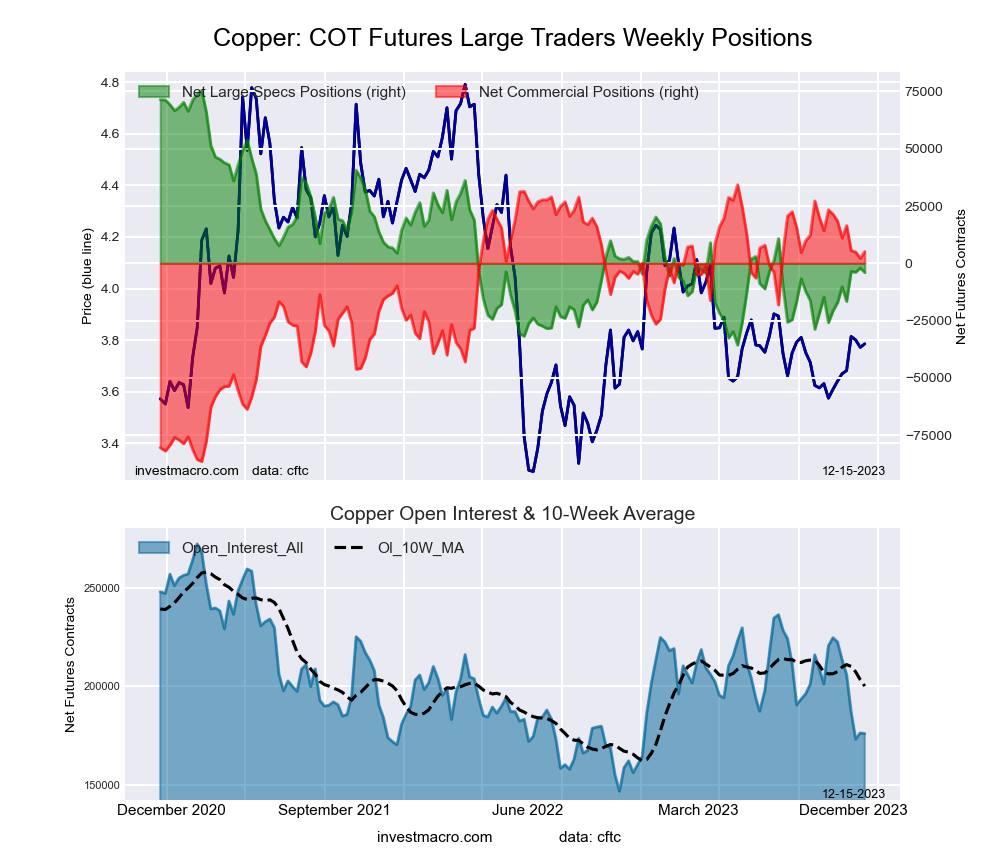
Copper224,70462-20,7601321,40189-64114
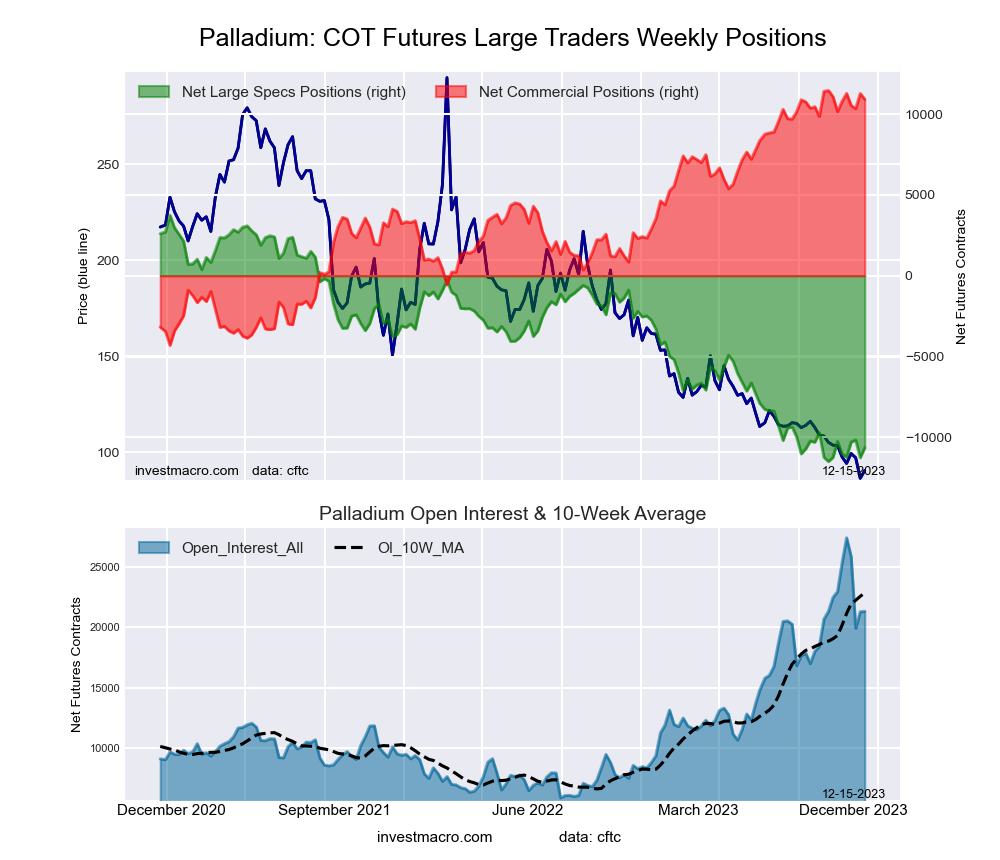
Palladium22,459100-11,240211,0859815551
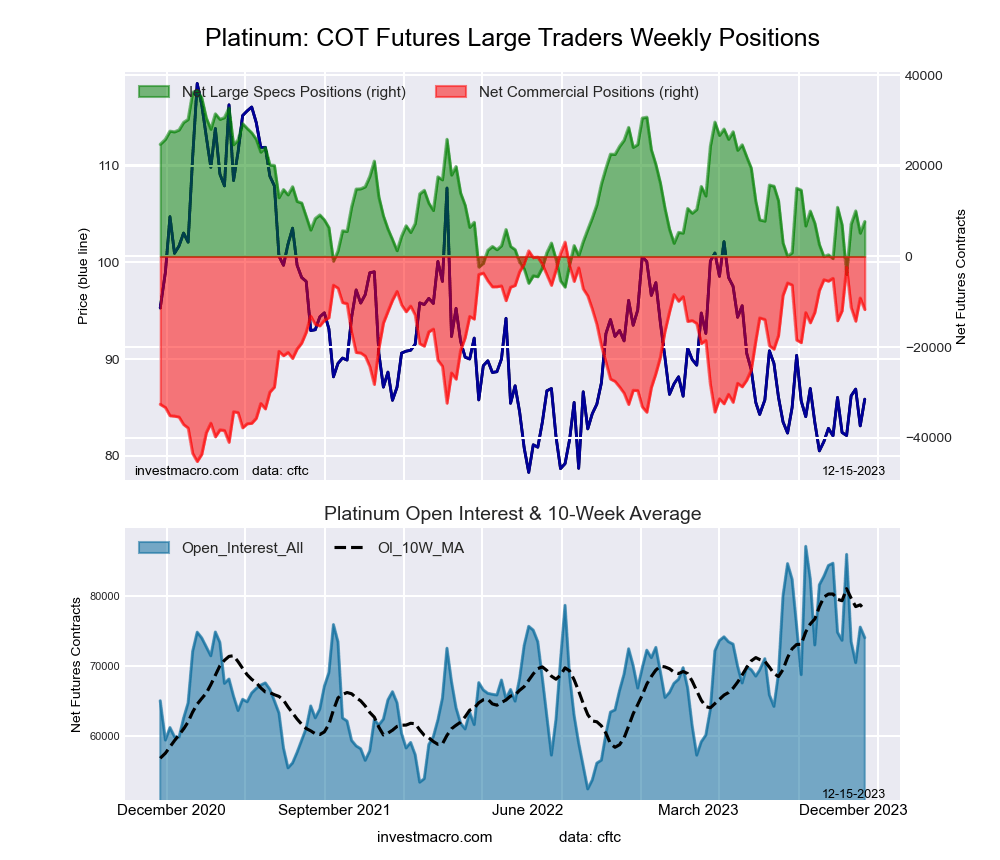
Platinum84,61093-48014-4,832835,31239
Natural Gas1,211,45051-70,2724751,2215719,05125
Brent127,0948-38,1713734,548633,62360
Heating Oil322,7914531,98881-51,4712819,48363
Soybeans814,7266336,4545-24,48388-11,97175
Corn1,401,89827-48,2801183,03490-34,75483
Coffee199,6461818,20846-18,11358-9511
Sugar857,66138224,69572-271,6962647,00164
Wheat435,68586-59,9472456,978742,96980


Strength Scores led by Cocoa & Sugar

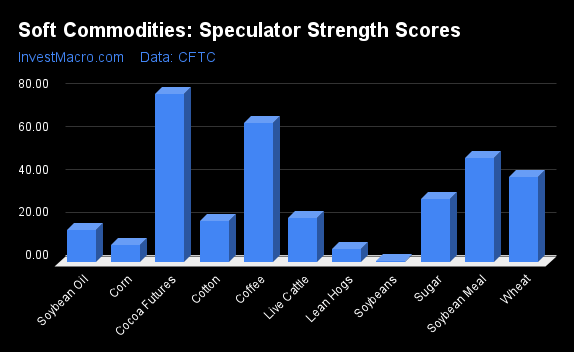
COT Strength Scores (a normalized measure of Speculator positions over a 3-Year range, from 0 to 100 where above 80 is Extreme-Bullish and below 20 is Extreme-Bearish) showed that Cocoa (89 percent) and Sugar (72 percent) led the softs markets this week. Soybean Meal (61 percent), Coffee (46 percent) and Live Cattle (40 percent) come in as the next highest in the weekly strength scores.

On the downside, Soybeans (5 percent), Corn (11 percent) and Lean Hogs (13 percent) come in at the lowest strength levels currently and are in Extreme-Bearish territory (below 20 percent).

Strength Statistics:
Corn (10.5 percent) vs Corn previous week (8.4 percent)
Sugar (71.9 percent) vs Sugar previous week (73.1 percent)
Coffee (46.1 percent) vs Coffee previous week (27.2 percent)
Soybeans (5.4 percent) vs Soybeans previous week (1.8 percent)
Soybean Oil (36.2 percent) vs Soybean Oil previous week (41.8 percent)
Soybean Meal (60.6 percent) vs Soybean Meal previous week (43.7 percent)
Live Cattle (40.3 percent) vs Live Cattle previous week (63.4 percent)
Lean Hogs (12.6 percent) vs Lean Hogs previous week (17.4 percent)
Cotton (25.8 percent) vs Cotton previous week (33.7 percent)
Cocoa (88.5 percent) vs Cocoa previous week (82.9 percent)
Wheat (24.2 percent) vs Wheat previous week (17.6 percent)


Coffee & Soybean Meal top the 6-Week Strength Trends

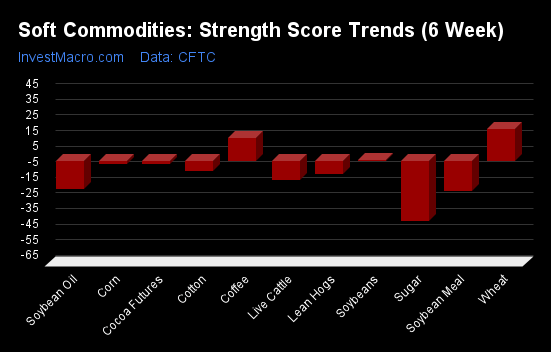
COT Strength Score Trends (or move index, calculates the 6-week changes in strength scores) showed that Coffee (36 percent) and Soybean Meal (10 percent) lead the past six weeks trends for soft commodities. Corn (6 percent) is the next highest positive movers in the latest trends data.

Live Cattle (-39 percent) leads the downside trend scores currently with Cotton (-22 percent), Soybeans (-19 percent) and Lean Hogs (-16 percent) following next with lower trend scores.

Strength Trend Statistics:
Corn (6.0 percent) vs Corn previous week (-2.5 percent)
Sugar (-7.1 percent) vs Sugar previous week (-2.7 percent)
Coffee (35.7 percent) vs Coffee previous week (18.7 percent)
Soybeans (-18.8 percent) vs Soybeans previous week (-23.2 percent)
Soybean Oil (-8.6 percent) vs Soybean Oil previous week (-8.8 percent)
Soybean Meal (10.0 percent) vs Soybean Meal previous week (-9.4 percent)
Live Cattle (-38.5 percent) vs Live Cattle previous week (-8.8 percent)
Lean Hogs (-16.4 percent) vs Lean Hogs previous week (-7.2 percent)
Cotton (-21.6 percent) vs Cotton previous week (-17.4 percent)
Cocoa (-10.8 percent) vs Cocoa previous week (-15.0 percent)
Wheat (-7.3 percent) vs Wheat previous week (-16.2 percent)


Individual Soft Commodities Markets:

CORN Futures:
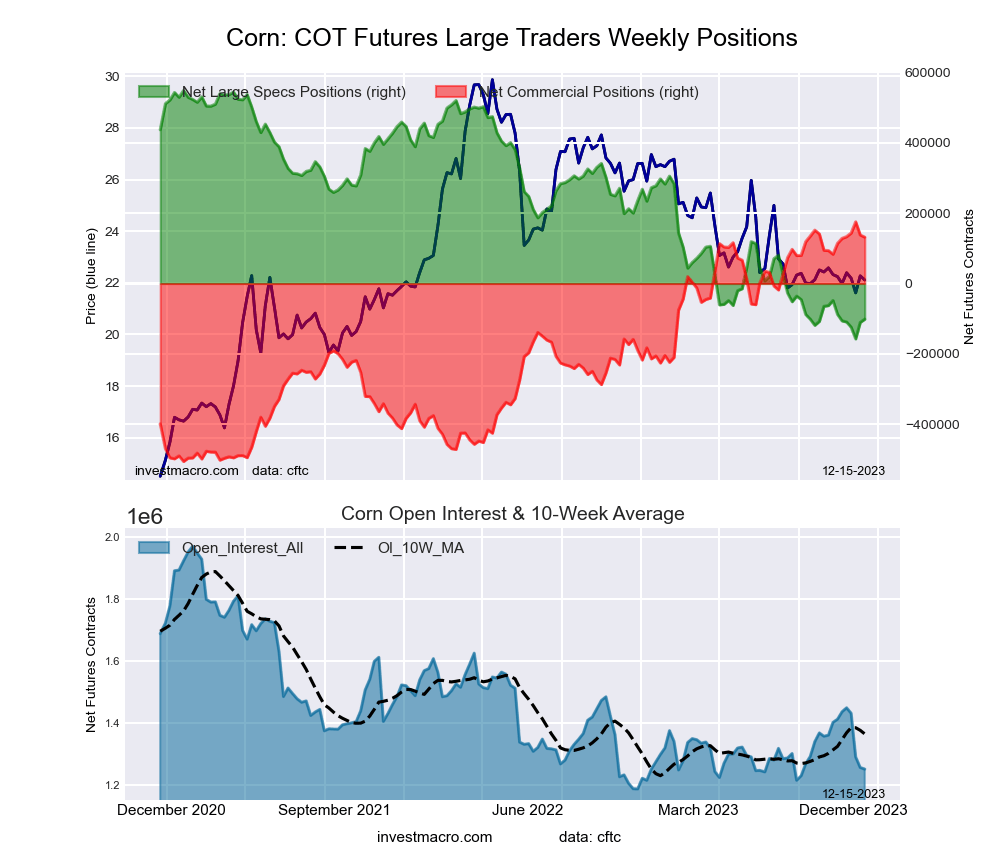
CORN Futures COT ChartThe CORN large speculator standing this week recorded a net position of -48,280 contracts in the data reported through Tuesday. This was a weekly advance of 14,274 contracts from the previous week which had a total of -62,554 net contracts.

This week’s current strength score (the trader positioning range over the past three years, measured from 0 to 100) shows the speculators are currently Bearish-Extreme with a score of 10.5 percent. The commercials are Bullish-Extreme with a score of 89.6 percent and the small traders (not shown in chart) are Bullish-Extreme with a score of 82.9 percent.

Price Trend-Following Model: Downtrend

Our weekly trend-following model classifies the current market price position as: Downtrend. The current action for the model is considered to be: Hold – Maintain Short Position.

CORN Futures StatisticsSPECULATORSCOMMERCIALSSMALL TRADERS
– Percent of Open Interest Longs:20.246.69.9
– Percent of Open Interest Shorts:23.640.712.4
– Net Position:-48,28083,034-34,754
– Gross Longs:283,037653,322139,285
– Gross Shorts:331,317570,288174,039
– Long to Short Ratio:0.9 to 11.1 to 10.8 to 1
NET POSITION TREND:
– Strength Index Score (3 Year Range Pct):10.589.682.9
– Strength Index Reading (3 Year Range):Bearish-ExtremeBullish-ExtremeBullish-Extreme
NET POSITION MOVEMENT INDEX:
– 6-Week Change in Strength Index:6.0-5.5-7.0


SUGAR Futures:

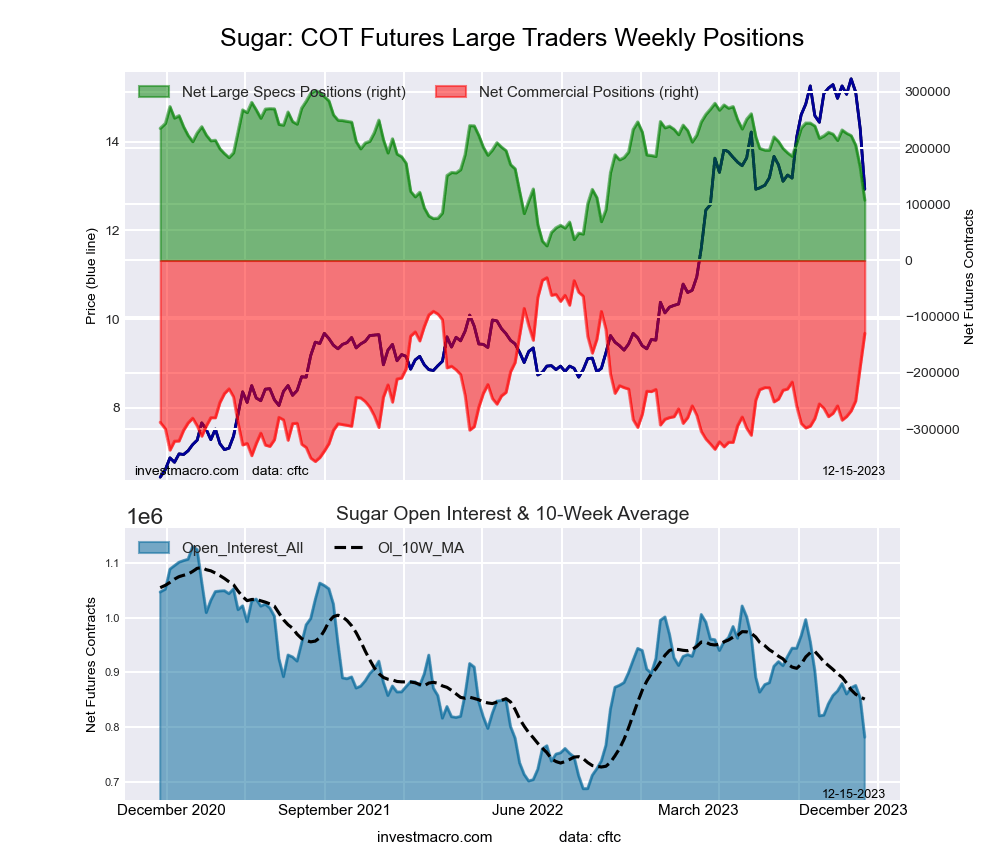
SUGAR Futures COT ChartThe SUGAR large speculator standing this week recorded a net position of 224,695 contracts in the data reported through Tuesday. This was a weekly reduction of -3,264 contracts from the previous week which had a total of 227,959 net contracts.

This week’s current strength score (the trader positioning range over the past three years, measured from 0 to 100) shows the speculators are currently Bullish with a score of 71.9 percent. The commercials are Bearish with a score of 26.2 percent and the small traders (not shown in chart) are Bullish with a score of 63.8 percent.

Price Trend-Following Model: Uptrend

Our weekly trend-following model classifies the current market price position as: Uptrend. The current action for the model is considered to be: Hold – Maintain Long Position.

SUGAR Futures StatisticsSPECULATORSCOMMERCIALSSMALL TRADERS
– Percent of Open Interest Longs:37.438.210.8
– Percent of Open Interest Shorts:11.269.95.3
– Net Position:224,695-271,69647,001
– Gross Longs:320,884328,05592,632
– Gross Shorts:96,189599,75145,631
– Long to Short Ratio:3.3 to 10.5 to 12.0 to 1
NET POSITION TREND:
– Strength Index Score (3 Year Range Pct):71.926.263.8
– Strength Index Reading (3 Year Range):BullishBearishBullish
NET POSITION MOVEMENT INDEX:
– 6-Week Change in Strength Index:-7.18.0-8.3


COFFEE Futures:

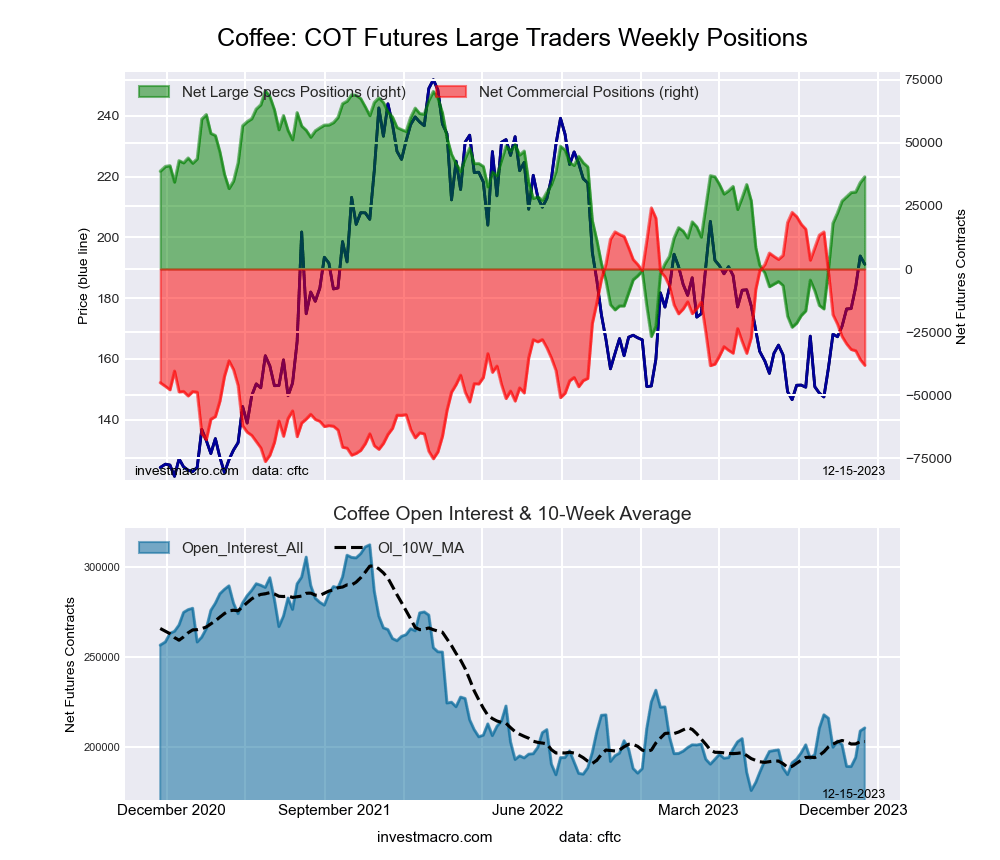
COFFEE Futures COT ChartThe COFFEE large speculator standing this week recorded a net position of 18,208 contracts in the data reported through Tuesday. This was a weekly increase of 18,396 contracts from the previous week which had a total of -188 net contracts.

This week’s current strength score (the trader positioning range over the past three years, measured from 0 to 100) shows the speculators are currently Bearish with a score of 46.1 percent. The commercials are Bullish with a score of 57.9 percent and the small traders (not shown in chart) are Bearish-Extreme with a score of 11.5 percent.

Price Trend-Following Model: Weak Downtrend

Our weekly trend-following model classifies the current market price position as: Weak Downtrend. The current action for the model is considered to be: Hold – Maintain Short Position.

COFFEE Futures StatisticsSPECULATORSCOMMERCIALSSMALL TRADERS
– Percent of Open Interest Longs:27.642.75.2
– Percent of Open Interest Shorts:18.551.85.2
– Net Position:18,208-18,113-95
– Gross Longs:55,11385,25110,332
– Gross Shorts:36,905103,36410,427
– Long to Short Ratio:1.5 to 10.8 to 11.0 to 1
NET POSITION TREND:
– Strength Index Score (3 Year Range Pct):46.157.911.5
– Strength Index Reading (3 Year Range):BearishBullishBearish-Extreme
NET POSITION MOVEMENT INDEX:
– 6-Week Change in Strength Index:35.7-33.7-10.4


SOYBEANS Futures:

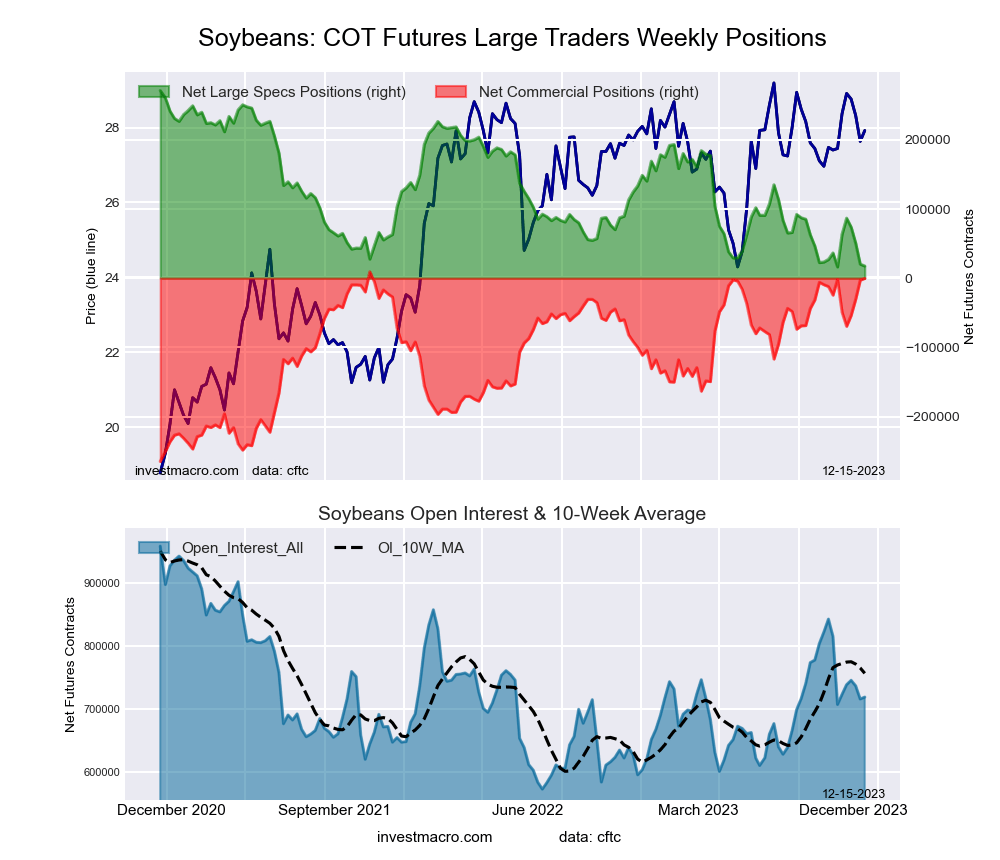
SOYBEANS Futures COT ChartThe SOYBEANS large speculator standing this week recorded a net position of 36,454 contracts in the data reported through Tuesday. This was a weekly advance of 9,349 contracts from the previous week which had a total of 27,105 net contracts.

This week’s current strength score (the trader positioning range over the past three years, measured from 0 to 100) shows the speculators are currently Bearish-Extreme with a score of 5.4 percent. The commercials are Bullish-Extreme with a score of 88.4 percent and the small traders (not shown in chart) are Bullish with a score of 75.3 percent.

Price Trend-Following Model: Weak Uptrend

Our weekly trend-following model classifies the current market price position as: Weak Uptrend. The current action for the model is considered to be: Hold – Maintain Long Position.

SOYBEANS Futures StatisticsSPECULATORSCOMMERCIALSSMALL TRADERS
– Percent of Open Interest Longs:16.654.37.0
– Percent of Open Interest Shorts:12.157.38.5
– Net Position:36,454-24,483-11,971
– Gross Longs:135,138442,21957,078
– Gross Shorts:98,684466,70269,049
– Long to Short Ratio:1.4 to 10.9 to 10.8 to 1
NET POSITION TREND:
– Strength Index Score (3 Year Range Pct):5.488.475.3
– Strength Index Reading (3 Year Range):Bearish-ExtremeBullish-ExtremeBullish
NET POSITION MOVEMENT INDEX:
– 6-Week Change in Strength Index:-18.815.211.6


SOYBEAN OIL Futures:

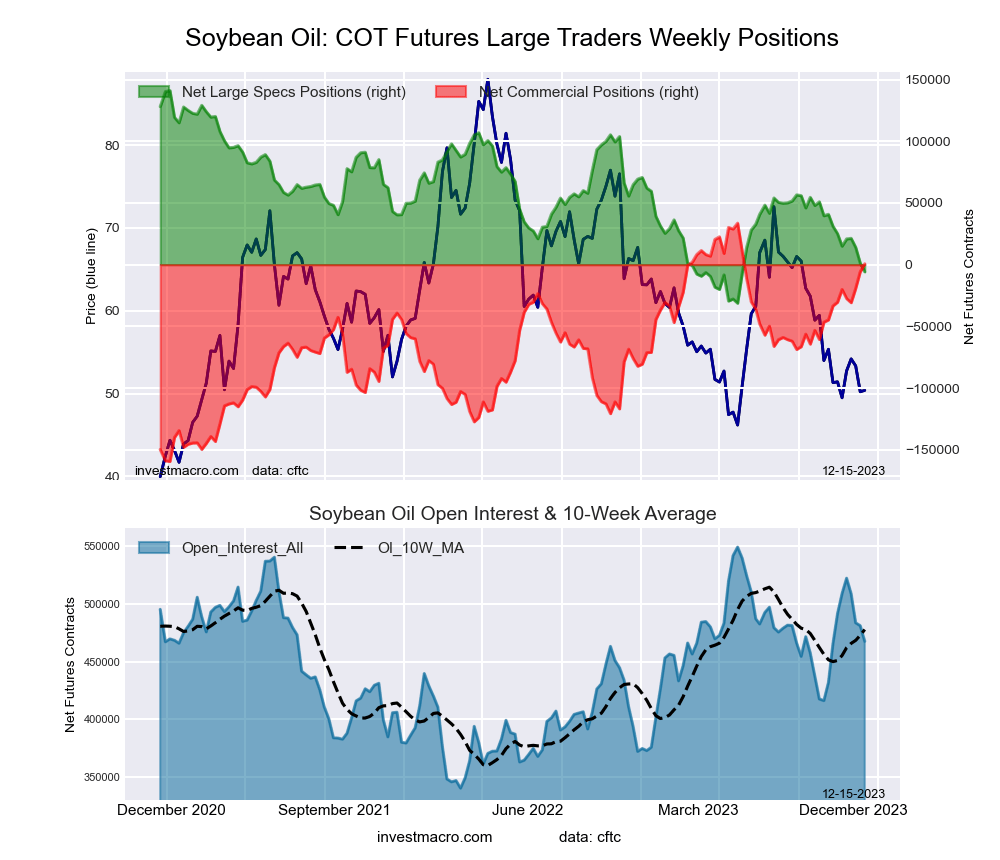
SOYBEAN OIL Futures COT ChartThe SOYBEAN OIL large speculator standing this week recorded a net position of 31,139 contracts in the data reported through Tuesday. This was a weekly decline of -9,666 contracts from the previous week which had a total of 40,805 net contracts.

This week’s current strength score (the trader positioning range over the past three years, measured from 0 to 100) shows the speculators are currently Bearish with a score of 36.2 percent. The commercials are Bullish with a score of 65.3 percent and the small traders (not shown in chart) are Bearish with a score of 22.2 percent.

Price Trend-Following Model: Strong Downtrend

Our weekly trend-following model classifies the current market price position as: Strong Downtrend. The current action for the model is considered to be: Hold – Maintain Short Position.

SOYBEAN OIL Futures StatisticsSPECULATORSCOMMERCIALSSMALL TRADERS
– Percent of Open Interest Longs:21.248.46.6
– Percent of Open Interest Shorts:14.555.66.1
– Net Position:31,139-33,4622,323
– Gross Longs:98,579225,46930,536
– Gross Shorts:67,440258,93128,213
– Long to Short Ratio:1.5 to 10.9 to 11.1 to 1
NET POSITION TREND:
– Strength Index Score (3 Year Range Pct):36.265.322.2
– Strength Index Reading (3 Year Range):BearishBullishBearish
NET POSITION MOVEMENT INDEX:
– 6-Week Change in Strength Index:-8.611.8-29.9


SOYBEAN MEAL Futures:

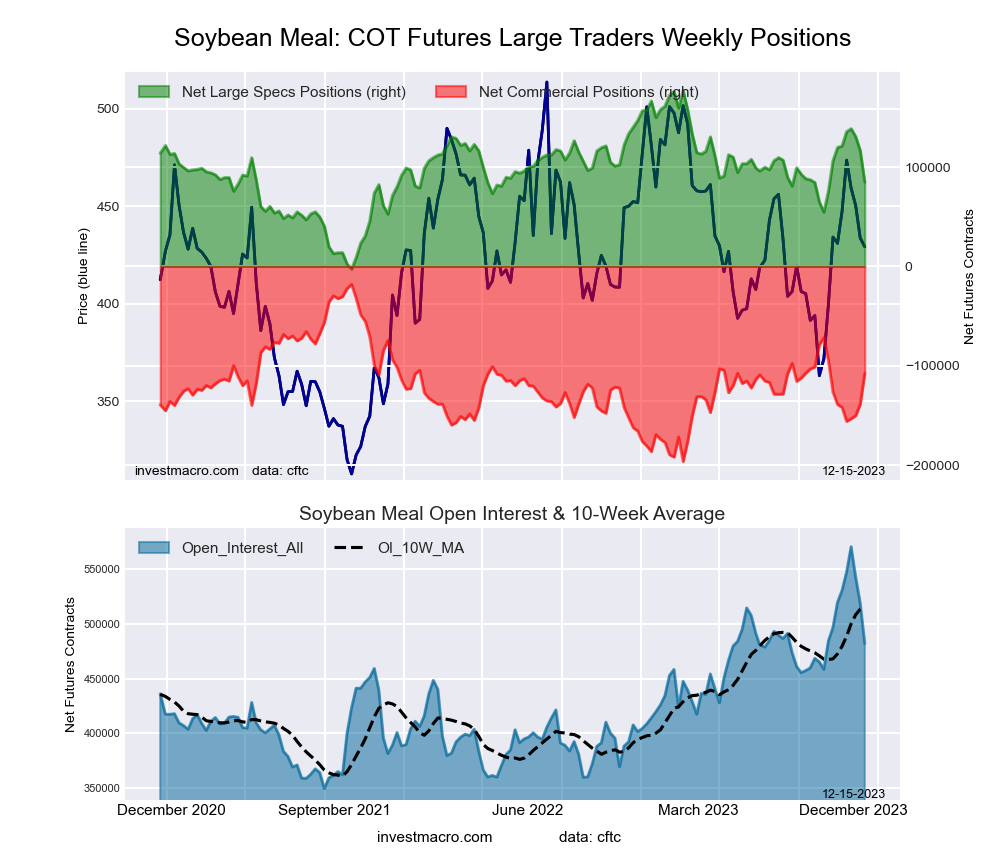
SOYBEAN MEAL Futures COT ChartThe SOYBEAN MEAL large speculator standing this week recorded a net position of 106,326 contracts in the data reported through Tuesday. This was a weekly gain of 30,388 contracts from the previous week which had a total of 75,938 net contracts.

This week’s current strength score (the trader positioning range over the past three years, measured from 0 to 100) shows the speculators are currently Bullish with a score of 60.6 percent. The commercials are Bearish with a score of 39.1 percent and the small traders (not shown in chart) are Bearish with a score of 45.7 percent.

Price Trend-Following Model: Weak Downtrend

Our weekly trend-following model classifies the current market price position as: Weak Downtrend. The current action for the model is considered to be: Hold – Maintain Short Position.

SOYBEAN MEAL Futures StatisticsSPECULATORSCOMMERCIALSSMALL TRADERS
– Percent of Open Interest Longs:26.538.210.1
– Percent of Open Interest Shorts:5.163.76.1
– Net Position:106,326-126,45020,124
– Gross Longs:131,878189,96550,190
– Gross Shorts:25,552316,41530,066
– Long to Short Ratio:5.2 to 10.6 to 11.7 to 1
NET POSITION TREND:
– Strength Index Score (3 Year Range Pct):60.639.145.7
– Strength Index Reading (3 Year Range):BullishBearishBearish
NET POSITION MOVEMENT INDEX:
– 6-Week Change in Strength Index:10.0-10.85.1


LIVE CATTLE Futures:

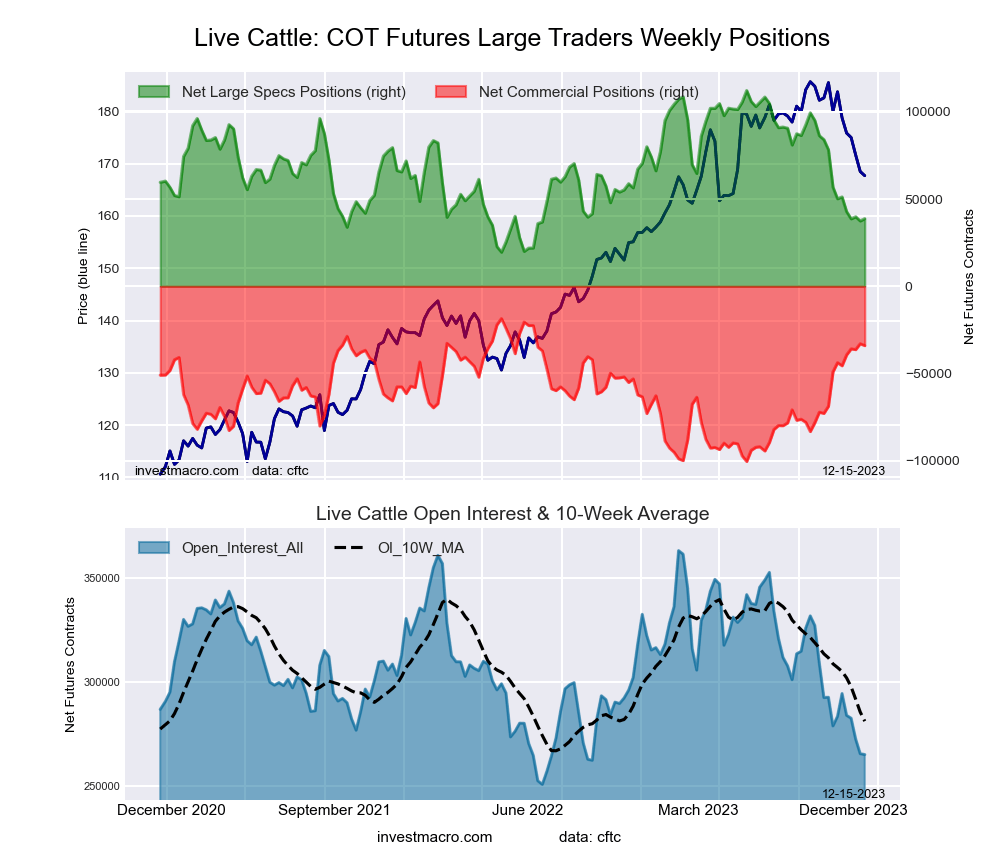
LIVE CATTLE Futures COT ChartThe LIVE CATTLE large speculator standing this week recorded a net position of 56,857 contracts in the data reported through Tuesday. This was a weekly lowering of -21,450 contracts from the previous week which had a total of 78,307 net contracts.

This week’s current strength score (the trader positioning range over the past three years, measured from 0 to 100) shows the speculators are currently Bearish with a score of 40.3 percent. The commercials are Bullish with a score of 62.7 percent and the small traders (not shown in chart) are Bearish with a score of 48.5 percent.

Price Trend-Following Model: Uptrend

Our weekly trend-following model classifies the current market price position as: Uptrend. The current action for the model is considered to be: Hold – Maintain Long Position.

LIVE CATTLE Futures StatisticsSPECULATORSCOMMERCIALSSMALL TRADERS
– Percent of Open Interest Longs:36.934.69.5
– Percent of Open Interest Shorts:16.552.312.3
– Net Position:56,857-49,115-7,742
– Gross Longs:102,83296,61826,491
– Gross Shorts:45,975145,73334,233
– Long to Short Ratio:2.2 to 10.7 to 10.8 to 1
NET POSITION TREND:
– Strength Index Score (3 Year Range Pct):40.362.748.5
– Strength Index Reading (3 Year Range):BearishBullishBearish
NET POSITION MOVEMENT INDEX:
– 6-Week Change in Strength Index:-38.535.336.2


LEAN HOGS Futures:

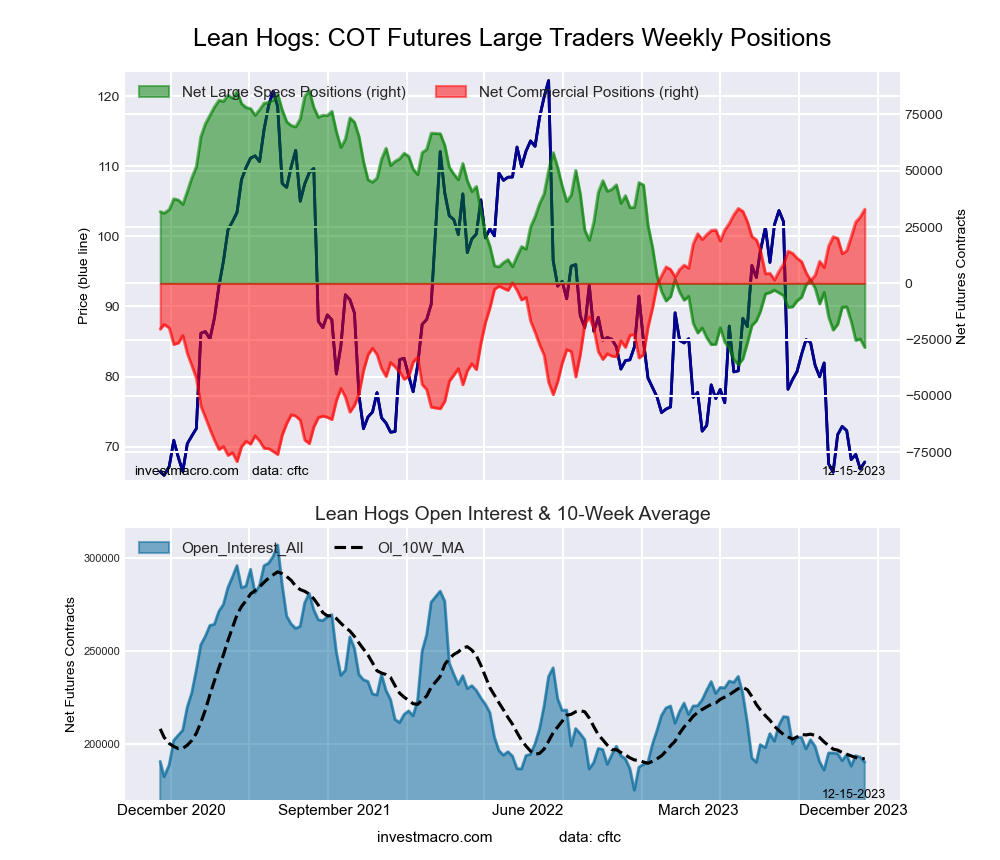
LEAN HOGS Futures COT ChartThe LEAN HOGS large speculator standing this week recorded a net position of -20,721 contracts in the data reported through Tuesday. This was a weekly reduction of -5,806 contracts from the previous week which had a total of -14,915 net contracts.

This week’s current strength score (the trader positioning range over the past three years, measured from 0 to 100) shows the speculators are currently Bearish-Extreme with a score of 12.6 percent. The commercials are Bullish-Extreme with a score of 88.8 percent and the small traders (not shown in chart) are Bullish-Extreme with a score of 83.6 percent.

Price Trend-Following Model: Strong Downtrend

Our weekly trend-following model classifies the current market price position as: Strong Downtrend. The current action for the model is considered to be: Hold – Maintain Short Position.

LEAN HOGS Futures StatisticsSPECULATORSCOMMERCIALSSMALL TRADERS
– Percent of Open Interest Longs:27.939.510.2
– Percent of Open Interest Shorts:38.528.910.1
– Net Position:-20,72120,67150
– Gross Longs:54,41476,96619,814
– Gross Shorts:75,13556,29519,764
– Long to Short Ratio:0.7 to 11.4 to 11.0 to 1
NET POSITION TREND:
– Strength Index Score (3 Year Range Pct):12.688.883.6
– Strength Index Reading (3 Year Range):Bearish-ExtremeBullish-ExtremeBullish-Extreme
NET POSITION MOVEMENT INDEX:
– 6-Week Change in Strength Index:-16.414.218.1


COTTON Futures:

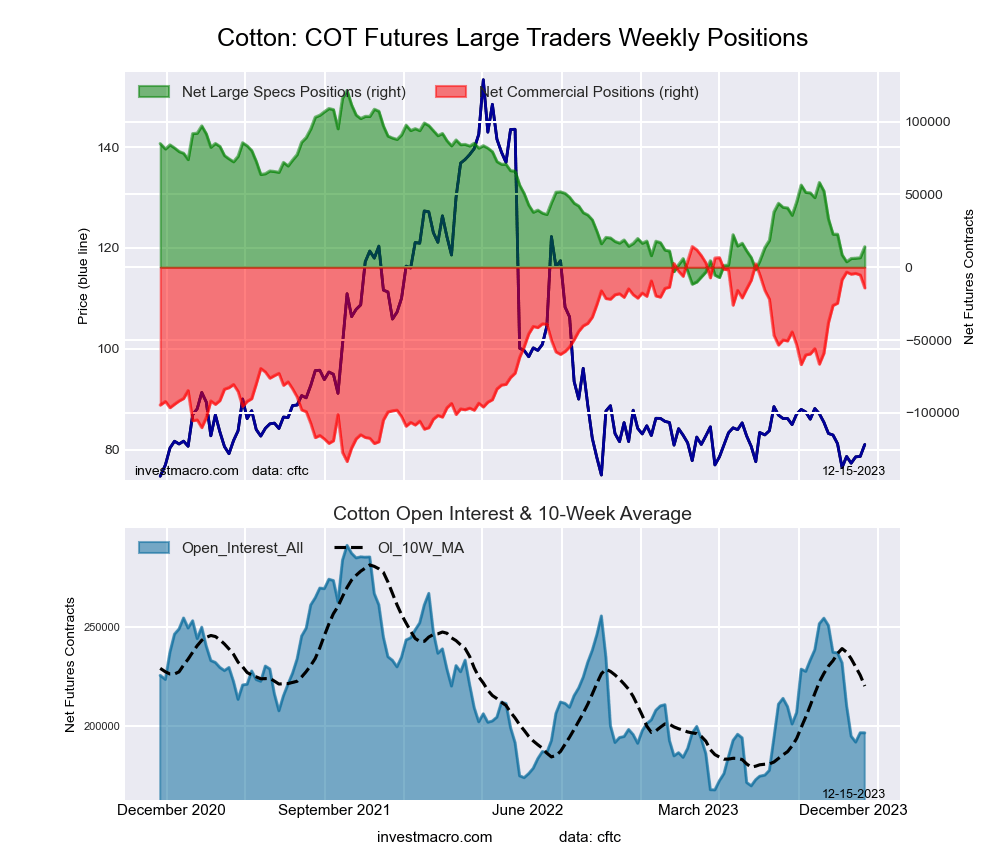
COTTON Futures COT ChartThe COTTON large speculator standing this week recorded a net position of 22,680 contracts in the data reported through Tuesday. This was a weekly lowering of -10,557 contracts from the previous week which had a total of 33,237 net contracts.

This week’s current strength score (the trader positioning range over the past three years, measured from 0 to 100) shows the speculators are currently Bearish with a score of 25.8 percent. The commercials are Bullish with a score of 72.6 percent and the small traders (not shown in chart) are Bearish with a score of 37.5 percent.

Price Trend-Following Model: Weak Uptrend

Our weekly trend-following model classifies the current market price position as: Weak Uptrend. The current action for the model is considered to be: Hold – Maintain Long Position.

COTTON Futures StatisticsSPECULATORSCOMMERCIALSSMALL TRADERS
– Percent of Open Interest Longs:27.249.15.8
– Percent of Open Interest Shorts:17.660.14.3
– Net Position:22,680-26,2153,535
– Gross Longs:64,477116,37013,814
– Gross Shorts:41,797142,58510,279
– Long to Short Ratio:1.5 to 10.8 to 11.3 to 1
NET POSITION TREND:
– Strength Index Score (3 Year Range Pct):25.872.637.5
– Strength Index Reading (3 Year Range):BearishBullishBearish
NET POSITION MOVEMENT INDEX:
– 6-Week Change in Strength Index:-21.623.0-32.0


COCOA Futures:

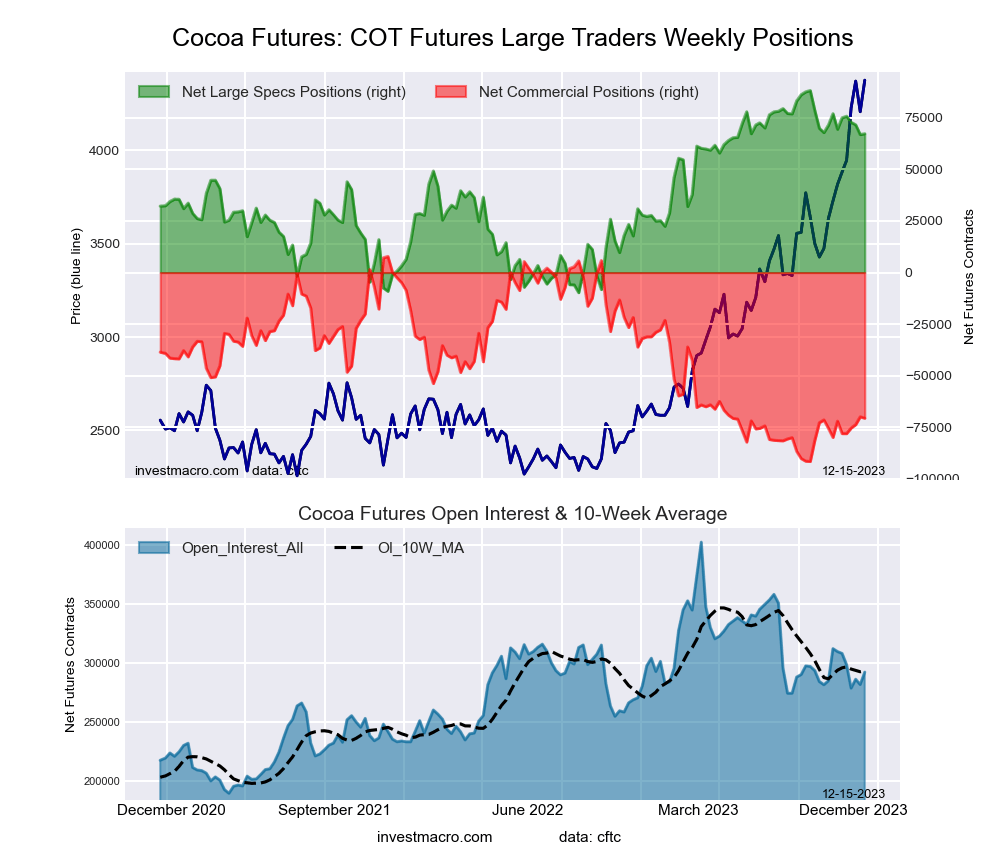
COCOA Futures COT ChartThe COCOA large speculator standing this week recorded a net position of 77,020 contracts in the data reported through Tuesday. This was a weekly rise of 5,528 contracts from the previous week which had a total of 71,492 net contracts.

This week’s current strength score (the trader positioning range over the past three years, measured from 0 to 100) shows the speculators are currently Bullish-Extreme with a score of 88.5 percent. The commercials are Bearish-Extreme with a score of 11.7 percent and the small traders (not shown in chart) are Bearish with a score of 25.9 percent.

Price Trend-Following Model: Strong Uptrend

Our weekly trend-following model classifies the current market price position as: Strong Uptrend. The current action for the model is considered to be: Hold – Maintain Long Position.

COCOA Futures StatisticsSPECULATORSCOMMERCIALSSMALL TRADERS
– Percent of Open Interest Longs:41.226.64.8
– Percent of Open Interest Shorts:16.552.33.9
– Net Position:77,020-79,9602,940
– Gross Longs:128,61183,20714,982
– Gross Shorts:51,591163,16712,042
– Long to Short Ratio:2.5 to 10.5 to 11.2 to 1
NET POSITION TREND:
– Strength Index Score (3 Year Range Pct):88.511.725.9
– Strength Index Reading (3 Year Range):Bullish-ExtremeBearish-ExtremeBearish
NET POSITION MOVEMENT INDEX:
– 6-Week Change in Strength Index:-10.811.6-9.3


WHEAT Futures:

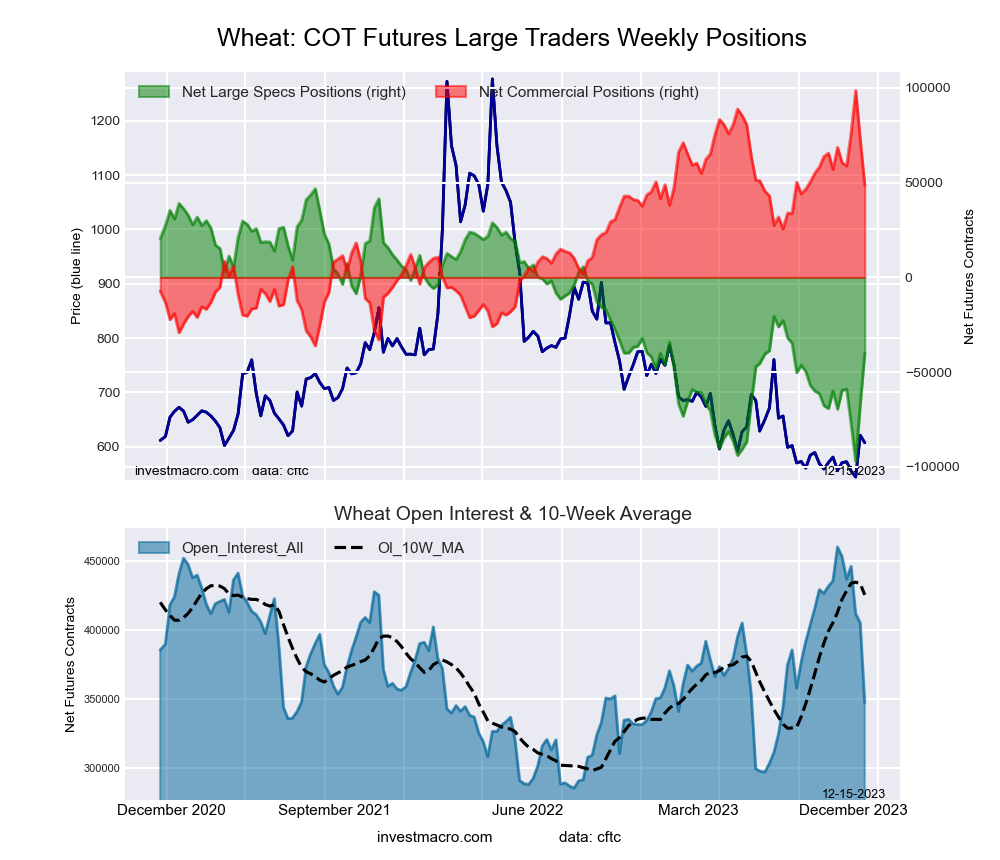
WHEAT Futures COT ChartThe WHEAT large speculator standing this week recorded a net position of -59,947 contracts in the data reported through Tuesday. This was a weekly boost of 9,296 contracts from the previous week which had a total of -69,243 net contracts.

This week’s current strength score (the trader positioning range over the past three years, measured from 0 to 100) shows the speculators are currently Bearish with a score of 24.2 percent. The commercials are Bullish with a score of 74.5 percent and the small traders (not shown in chart) are Bullish with a score of 79.9 percent.

Price Trend-Following Model: Downtrend

Our weekly trend-following model classifies the current market price position as: Downtrend. The current action for the model is considered to be: Hold – Maintain Short Position.

WHEAT Futures StatisticsSPECULATORSCOMMERCIALSSMALL TRADERS
– Percent of Open Interest Longs:28.034.58.8
– Percent of Open Interest Shorts:41.721.48.1
– Net Position:-59,94756,9782,969
– Gross Longs:121,807150,41238,208
– Gross Shorts:181,75493,43435,239
– Long to Short Ratio:0.7 to 11.6 to 11.1 to 1
NET POSITION TREND:
– Strength Index Score (3 Year Range Pct):24.274.579.9
– Strength Index Reading (3 Year Range):BearishBullishBullish
NET POSITION MOVEMENT INDEX:
– 6-Week Change in Strength Index:-7.38.4-0.5


Article By InvestMacroReceive our weekly COT Reports by Email

*COT Report: The COT data, released weekly to the public each Friday, is updated through the most recent Tuesday (data is 3 days old) and shows a quick view of how large speculators or non-commercials (for-profit traders) were positioned in the futures markets.

The CFTC categorizes trader positions according to commercial hedgers (traders who use futures contracts for hedging as part of the business), non-commercials (large traders who speculate to realize trading profits) and nonreportable traders (usually small traders/speculators) as well as their open interest (contracts open in the market at time of reporting).See CFTC criteria here.

All information and opinions on this website and contained in this article are for general informational purposes only and do not constitute investment advice.

The cryptocurrency market digest (BTC). Overview for 27.10.2023

By RoboForex.com

The BTC exchange rate has dropped to 34,173 USD by Friday.

This is exactly as expected: the quotes have accounted for all the existing drivers, and new ones have not come. That is why the market stopped.

The market looks ready to develop the scenario with a correction to 29,500 USD. After BTC reaches this target, an increase to 31,200 USD and 32,000 USD might become possible.

The cryptocurrency market capitalisation remains at 1.26 trillion USD. The BTC share has dropped to 53.0%, while the ETH share stands at 17.2%.

BTC capitalisation exceeds Tesla parameters

Total market weight of BTC amounts to 677.23 billion USD this week. To compare, Tesla market capitalisation is 675 billion USD and that of Eli Lilly is 556 billion USD.

BTC search volume has skyrocketed

This week, the number of search queries “buy BTC” in the UK has topped up 826%. In the US, the query is formulated as “should I buy BTC now”. The number of such search queries has added 250%.

ChatGPT forecasts BTC prices by Halloween

Market participants would not stop trying to use AI opportunities for working on exchange platforms. Now they are focused on the forecasts of the BTC price on Halloween made by the ChatGPT bot. AI insists that the most popular coins over this period will be BTC, ETH, BNB, and SOL.

Article By RoboForex.com

Attention!
Forecasts presented in this section only reflect the author s private opinion and should not be considered as guidance for trading. RoboForex LP bears no responsibility for trading results based on trading recommendations described in these analytical reviews.

Japan is setting the stage for a monetary policy review. Falling tech companies are dragging the broad market

By JustMarkets

As of Thursday’s stock market close, the Dow Jones Index (US30) decreased by 0.76%, while the S&P 500 Index (US500) fell by 1.18%. The NASDAQ Technology Index (US100) closed yesterday negative by 1.76%. Stock indices continued to fall yesterday due to weak reports from major technology companies. Shares of Meta Platforms (META) fell more than 5% after weak ad revenue. Meanwhile, shares of Alphabet (GOOG) fell another 2.6%, complementing Wednesday’s 9.28% drop amid a disappointing cloud computing revenue report. Amazon (AMZN) reported third-quarter results that beat Wall Street forecasts as growth in the company’s cloud business continues to stabilize. But the stock price was barely affected by the report.

Stocks also declined yesterday due to tensions in the Middle East following a report that Israel conducted a limited tank invasion of the Gaza Strip before withdrawing troops. Markets expect an all-out ground attack by Israel, which could lead to an expansion of the war to include Hezbollah.

The US economy grew by 4.9% in the third quarter, with households and construction contributing significantly to growth. However, the unfavorable factors facing the economy and the household sector in particular are intensifying, so economists expect growth to slow to 1.5% in the last three months of the year. Also strong is the 4.7% rise in US durable goods orders for September, which is much stronger than expectations of rising by 1.9%. US weekly jobless claims rose by 10,000 to 210,000, indicating a slightly weaker labor market compared to expectations for a rise to 207,000.

Equity markets in Europe were mostly down yesterday. Germany’s DAX (DE40) fell by 1.08%, France’s CAC 40 (FR40) lost 0.38% on Thursday, Spain’s IBEX 35 (ES35) decreased by 0.28%, and the UK’s FTSE 100 (UK100) closed negative by 0.81%.

The European Central Bank (ECB) left key rates unchanged on Thursday, in line with market expectations: the deposit rate at 4.00% and the main refinancing rate at 4.50%. Markets had expected the ECB to suspend its rate hike regime on Thursday, given the weakness in the eurozone economy and the recent rise in European bond yields. There is only a 5% chance of an ECB rate hike at the December meeting, but markets are forecasting an ECB rate cut in 2024.

Natural gas prices rose on Thursday amid a bullish EIA report and forecasts of colder-than-normal weather for next week. Natural gas prices received support from global supply concerns after Chevron shut down a natural gas field in Israel over security concerns related to the conflict between Israel and Hamas. As a result of the supply cut, Egypt said it was reviewing plans to export LNG to Europe.

Asian markets were predominantly falling yesterday. Japan’s Nikkei 225 (JP225) fell by 2.14%, FTSE China A50 (CHA50) added 0.63%, Hong Kong’s Hang Seng (HK50) ended the day down by 0.24%, and Australia’s ASX 200 (AU200) ended Thursday negative by 0.61%. Uncertainty over the war between Israel and Hamas and rising yields led Asian indices lower this week, while anticipation of a series of central bank meetings next week also made investors largely risk-averse.

With the Bank of Japan conducting another FX intervention yesterday, markets expect the BoJ to consider a change in yield curve management policy next week with an adjustment to the outlook. The latest data showed that Tokyo’s inflation rose more than expected in October, indicating that inflation is picking up again in the country and could lead to a more hawkish bias from the BoJ at its meeting next Tuesday.

S&P 500 (F)(US500) 4,137.23 −49.54 (−1.18%)

Dow Jones (US30) 32,784.30 −251.63 (−0.76%)

DAX (DE40)  14,731.05 −161.13 (−1.08%)

FTSE 100 (UK100) 7,354.57 −59.77 (−0.81%)

USD Index  106.65 +0.12 (+0.11%)

News feed for 2023.10.27:
  • – Japan Unemployment Rate (m/m) at 02:30 (GMT+3);
  • – Japan Tokyo Core CPI (m/m) at 02:30 (GMT+3);
  • – Australia Producer Price Index at 03:30 (GMT+3);
  • – US PCE Price index (m/m) at 15:30 (GMT+3);
  • – US FOMC Member Barr Speaks at 16:00 (GMT+3);
  • – US Michigan Consumer Sentiment (m/m) at 17:00 (GMT+3).

By JustMarkets


This article reflects a personal opinion and should not be interpreted as an investment advice, and/or offer, and/or a persistent request for carrying out financial transactions, and/or a guarantee, and/or a forecast of future events.

Extreme weather could burn many investment portfolios by mid-century

By Noël Amenc, EDHEC Business School; Abhishek Gupta, EDHEC Business School; Bertrand Jayles, EDHEC Business School; Darwin Marcelo, EDHEC Business School; Frédéric Blanc-Brude, EDHEC Business School; Leonard Lum, EDHEC Business School; Nishtha Manocha, EDHEC Business School, and Qinyu Goh, EDHEC Business School 

Climate change is one of the most pressing challenges facing humanity today, with potentially severe implications for infrastructure assets. Infrastructure investments such as roads, bridges, ports, airports, and power plants have long lifetimes, typically spanning several decades, and are designed to operate under specific climatic conditions. However, climate change is causing more frequent and intense extreme weather events, such as floods, droughts, heat waves, and storms, which can damage or disrupt infrastructure assets. These physical risks can lead to direct losses, increased maintenance costs, and lower asset values.

At the same time, climate change induces changes in policy, technology, and consumer preferences that can impact the value of infrastructure assets. This is known as transition risks. For example, new regulations and carbon-pricing schemes could make carbon-intensive infrastructure assets less attractive or even “stranded”, leading to significant financial losses . Additionally, changes in consumer behaviour, such as a shift toward electric vehicles or renewable energy sources, could render certain infrastructure assets obsolete.

50% potential loss of value

If the energy transition has a cost for private investors (transition risks), so does climate change (physical risks). Extreme weather events, which experts predict will increase over the next few years, thus greatly increase the risk of losing value in portfolios.

In an August 2023 study, “It’s getting physical”, EDHEC Infrastructure and Private Assets Research Institute shows that some investors could see the value of their portfolio fall by more than 50% before 2050. The average investor’s portfolio, which generally holds around 10 assets, could drop by a quarter.

The reason is that over the past two decades, institutional investors – such as insurance companies, mutual and pension funds – have been allocating more and more capital to private infrastructure companies, which operate motorway toll roads, airports, power stations, bridges, pipelines, wind and photovoltaic farms, and so on. This represents a total value of 4.1 trillion dollars in the 25 most active markets. These markets include sectors like renewable energy projects, sustainable infrastructure development, clean technology ventures, electric vehicle manufacturing, carbon offset trading, and green real estate investment, among others. These infrastructures are particularly exposed to climate risks.

In the aftermath of the Covid-19 pandemic, public spending on physical infrastructure has persistently failed to keep up with economic growth; the United States spends only 2.3% of its GDP on infrastructure, compared to 5% for European countries and 8% for China. Still, private-investor exposure appears to be considerable.

27% loss of value on average

To measure the likely losses of infrastructure investors, we randomly constructed thousands of portfolios. To do this, we included hundreds of assets belonging to infrastructure investments across eight industrial superclasses, including transport (air, rail and road), power generation (gas- and coal-fired, nuclear, etc.), renewable energy (wind, solar, hydroelectric, etc.), network utilities (electricity, gas or water distribution), water resources (oil, gas or water pipelines, gas or liquid storage), etc. For all these assets, it is possible to obtain information on the associated climate risks in EDHEC’s InfraMetrics database.

Overall, we observed a high concentration of risk. Most infrastructure investors generally have few assets in their portfolios (between 5 and 20 on average). Their portfolios are poorly diversified, with a relatively limited number of assets held directly by each investor.

Furthermore, portfolios containing infrastructure assets are often concentrated in a single sector – for example, wind farms. In practical terms, an investor who started building a portfolio in 2018 and plans to hold the assets for another 30 years is exposed to losses solely due to physical risks ranging from -54% to -10%, depending on the number of assets held.

In addition, the loss in value of assets exposed to climate change is -27% on average [by 2050]. In a scenario where temperatures rise faster than expected, they could reach 54% for the most-concentrated portfolios. For instance, the “Hot House World” scenario predicts a rise in temperatures of about 3.2ºC above pre-industrial levels by 2100.

Some sectors are also more exposed to climate risks than others. In the transport sector, for example, the loss in net asset value would be four times greater than in the renewable energies sector. Investors in developed countries – in particular the United States, Europe and Australia and others – are the most exposed to losses in value worldwide. Indeed, the more valuable assets are concentrated in a given location, the greater the risk of value destruction.

More inaction, even greater risk

This study shows the scale of the potential losses that investors will have to face. And that’s before the 2050 deadline, as long as climate change predictions remain unchanged. Without action from governments and other stakeholders, climate risks could have a major impact on the overall value of investments, and on the economy as a whole.

However, there is still a glimmer of hope: if the stakeholders manage to organise an effective transition to a low-carbon economy, the losses mentioned in the article could be halved for all investors. All that remains – and this is undoubtedly the most difficult part – is to take action.The Conversation

About the Authors:

Noël Amenc, Professeur de finance, EDHEC Business School; Abhishek Gupta, Associate Director at the EDHEC Infrastructure Institute, EDHEC Business School; Bertrand Jayles, Senior Sustainability Data Scientist, EDHEC Infrastructure & Private Assets Research Institute, EDHEC Business School; Darwin Marcelo, Project Director at the EDHEC Infrastructure & Private Assets Research Institute, EDHEC Business School; Frédéric Blanc-Brude, Directeur de l’EDHEC Infrastructure Institute, EDHEC Business School; Leonard Lum, Data analyst, EDHECinfra, EDHEC Business School; Nishtha Manocha, EDHECinfra Senior Research Engineer, EDHEC Business School, and Qinyu Goh, MSc Urban Science, Sustainability Data Scientist at the EDHEC Infrastructure & Private Assets Research Institute, EDHEC Business School

This article is republished from The Conversation under a Creative Commons license. Read the original article.

RoboMarkets Integrates Acuity Trading’s Advanced AI Technologies to Enhance Client Offerings

October 26, 2023

Limassol, Cyprus

RoboMarkets, a European brokerage company, has announced a strategic partnership with Acuity Trading, renowned for its advanced AI-driven trading technologies. This alliance emphasises RoboMarkets’ commitment to offering its retail and professional clients refined, alternative perspectives on the financial market, ensuring they maintain a competitive edge in their trading endeavours.

In its effort to empower its traders with augmented trading experiences, RoboMarkets is poised to integrate Acuity’s innovative AI-driven tools, including the Economic Calendar, AnalysisIQ, and AssetIQ. This collaboration enriches the decision-making capabilities of RoboMarkets’ traders and underscores the Company’s commitment to offering a comprehensive perspective on the financial market.

RoboMarkets’ traders will gain access to advanced tools including:

  • Acuity’s AI-Powered Economic Calendar: this tool offers real-time insights. It equips traders to navigate market volatilities and uncertainties with AI-enhanced filtering and vivid indicators, transforming these challenges into actionable trading opportunities.
  • Acuity’s AnalysisIQ: this technology, originating from Signal Centre and acquired by Acuity in 2021, operates under FCA regulation. It provides traders with professional, dependable market research and trade signals, bolstering their trading strategies and decision-making processes.
  • AssetIQ: this robust research tool provides traders with a comprehensive, unified view of global market assets, ensuring that the latest and most relevant data is always available to assist them in making informed trading decisions.

RoboMarkets has consistently aimed to continually enhance its offerings and provide clients with innovative tools based on the latest technological breakthroughs. The partnership with Acuity Trading underscores RoboMarkets’ commitment to continuously refining its offerings with cutting-edge tools.

As a CySEC-regulated entity, RoboMarkets remains steadfast in prioritising the evolving needs of its traders. With a diverse range of over 3,000 instruments, including US Stocks and ETFs, available for trading and investment, the Company reinforces its dedication to maintaining a leading position in the trading industry by integrating with Acuity Trading’s innovative tools.

About RoboMarkets

RoboMarkets is a financial brokerage company operating under CySEC license No. 191/13. RoboMarkets offers investment services in many European countries and provides traders working in financial markets with access to its proprietary platforms. Visit www.robomarkets.com to find out more about the Company’s products.

About Acuity Trading

Acuity Trading revolutionised the online trading experience for millions of investors with the introduction of visual news and sentiment tools in 2013. Today, Acuity continues to lead the fintech market with alpha generating alternative data and highly engaging trading tools using the latest in AI research and technology. Acuity’s team of academics, scientists, news, and market professionals are dedicated to delivering highly effective data products that bring value to investors of all levels and experience. Flexible delivery options include APIs, MT4/5, plug and play widgets and third-party automation services.

“Risk Warning: CFDs are complex instruments and come with a high risk of losing money rapidly due to leverage. 69.88% of retail investor accounts lose money when trading CFDs with this provider. You should consider whether you understand how CFDs work and whether you can afford to take the high risk of losing your money.”

Murrey Math Lines 26.10.2023 (USDCHF, XAUUSD)

By RoboForex.com

USDCHF, “US Dollar vs Swiss Franc”

USDCHF quotes are below the 200-day Moving Average on H4, revealing the prevalence of a downtrend. The RSI is approaching the resistance line. In this case, a downward breakout of the 3/8 (0.8977) level is expected, followed by a decline to the support at 1/8 (0.8850). The scenario can be cancelled by rising above 4/8 (0.9033), which could lead to a trend reversal and growth to the resistance at 5/8 (0.9094).

USDCHF
Risk Warning: the result of previous trading operations do not guarantee the same results in the future

On M15, an additional signal confirming the decline could be a breakout of the lower boundary of the VoltyChannel.

USDCHF
Risk Warning: the result of previous trading operations do not guarantee the same results in the future

XAUUSD, “Gold vs US Dollar”

Gold quotes and the RSI are nearing their overbought areas on H4. In this situation, a test of 8/8 (2000.00) is expected, followed by a rebound from it and a decline to the support at 6/8 (1937.50). The scenario can be cancelled by rising above 8/8 (2000.00). In this case, the price might reach the resistance at +1/8 (2031.25).

XAUUSD
Risk Warning: the result of previous trading operations do not guarantee the same results in the future

On M15, a breakout of the lower boundary of the VoltyChannel could increase the probability of a price decline.

XAUUSD

Article By RoboForex.com

Attention!
Forecasts presented in this section only reflect the author s private opinion and should not be considered as guidance for trading. RoboForex LP bears no responsibility for trading results based on trading recommendations described in these analytical reviews.

Euro shaky ahead of ECB meeting

By ForexTime 

  • ECB expected to pause on rate hikes
  • Inflationary pressures have eased in Europe
  • However, economic outlook paints gloomy picture
  • Hawkish messaging may leave doors open to December hike
  • EURUSD back within range, potential breakout on horizon.

As far as markets are concerned, the European Central Bank (ECB) is expected to leave rates unchanged in October for the first time in over a year, amid signs of cooling inflation. Over the past few months, price pressures have eased in Europe, with the headline rate falling to 4.3% in September, which was the lowest since October 2021.

ECB officials signalled at their previous September meeting that rates were high enough to bring inflation back towards the 2% target. However, concerns are rising about the worsening economic outlook, along with geopolitical tensions in the Middle East.  Indeed, the string of recent disappointing data paints a gloomy picture with recession fears rife as high rates impact households and businesses.

Investors will pay close attention to any fresh clues the ECB has to offer on monetary policy for the rest of 2023 and beyond. Should the ECB communicate that rates will remain higher for longer, this could leave the door open for one final hike in December. As of writing, traders are pricing in only around a 10% probability of an ECB rate hike by December with the odds of a rate cut by April roughly 50%.

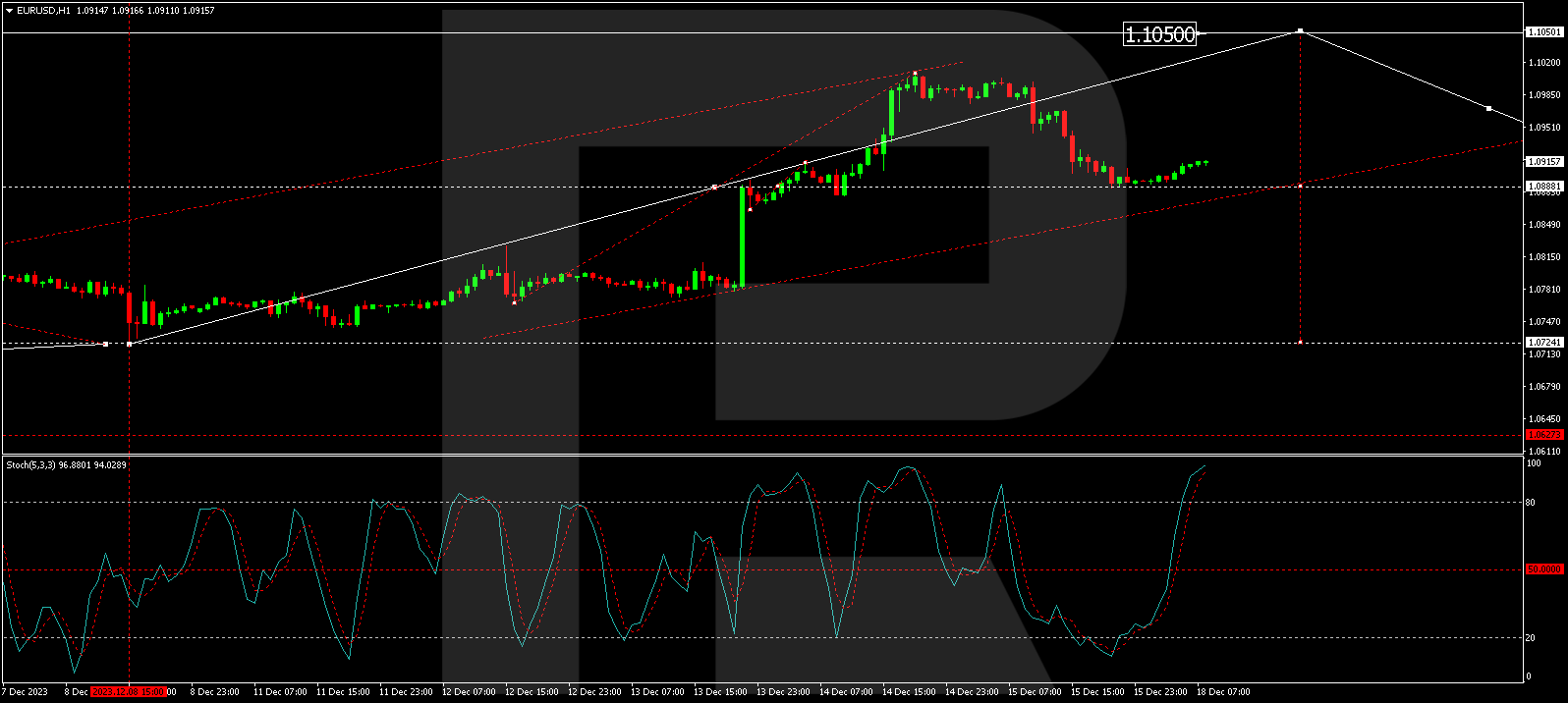
Looking at the technical picture, EURUSD remains under pressure on the daily charts.

Prices are back within a wide range with support at 1.0450 and resistance at 1.0630. The euro could find itself under fresh pressure if the ECB strikes a cautious tone and hints that no more hikes are expected down the road. This may drag the EURUSD back towards the 1.0450 support level as a result.

Should the central bank strike a hawkish note, this could push EURUSD back towards 1.0630 and beyond as bets increase on a December rate move.


Forex-Time-LogoArticle by ForexTime
ForexTime Ltd (FXTM) is an award winning international online forex broker regulated by CySEC 185/12 www.forextime.com
Thermoelectric Generator Prototype Could Improve EVs, Solar Power

Source: Streetwise Reports  (10/19/23)

An improved tellurium-based thermoelectric generator being tested in Canada could increase the efficiency of electric vehicles, solar power, and combustible engines. Researchers say the markets are expanding.

First Tellurium Corp. (FTEL:CSE; FSTTF:OTCQB) announced an improved tellurium-based thermoelectric generator that could increase the efficiency of electric vehicles (EVs), solar power generation, and combustible engines.

The prototype was developed in the United States by First Tellurium’s 51%-owned thermoelectric-focused research and development company, 1406975 BC Ltd.
The generator is being delivered to Vancouver for further testing, the company said.
“Tellurium’s advantages for heat-to-energy conversion have long been recognized and understood,” said First Tellurium President and Chief Executive Officer Tyrone Docherty. “With the pressing need to increase the efficiency of alternative energy sources and both electric and combustion vehicles, we are in a strategic position to advance tellurium’s thermoelectric applications and contribute to the worldwide shift away from fossil fuels.”

The research company aims to explore new uses for tellurium and develop improved thermoelectric generators for the renewable and automotive industries.

“Completion of this prototype marks the next step of many towards what we believe will be innovative and valuable thermoelectric applications for tellurium,” Docherty said. “The generator, in its initial testing and development, has demonstrated potentially significant improvements in the conversion of heat to energy. We look forward to advancing the technology through further testing and research.”

The global market for thermoelectric generators was valued at US$472.5 million in 2020, according to Allied Market Research. It is forecasted to grow to more than US$1.4 billion by 2030, growing at a compound annual growth rate (CAGR) of 11.8% from 2021 to 2030.

“Increase in demand for fuel-efficient vehicles and implementation of stringent government regulations to curb the emission of carbon dioxide act as the key driving forces of the global thermoelectric generator market,” Allied Market Research noted.

The Catalyst: Finding New Ways to Generate Power for Green Economy

Tellurium (Te) is one of the least common elements on Earth, according to the U.S. Geological Survey. In addition to thermoelectric applications, it’s also used in solar photovoltaic (solar PV) panels, lithium batteries, vulcanizing rubber, tinting glass, and manufacturing rewritable CDs and DVDs.

The element’s role as a semiconductor has increased its use in solar PV panels, the company said.

Recent International Energy Agency (IEA) forecasts show that solar PV technology will generate more power by 2027 than any other source. The market for Te is expected to grow by about 60 metric tons (about 10% of current production) from 2020 to 2024, according to research by Technavio.

“Factors such as increasing urban population, rise in disposable income, strong supply chain, and high internet penetration are driving the growth of the global consumer electronics market,” the research firm said in a release. “The increase in demand for consumer electronics will, in turn, drive the demand for tellurium over the forecast period.”

Technical Analyst Clive Maund recently named First Tellurium as a part of his 8 Stocks that are Rated Immediate Buys list.

First Solar is spending big to increase its module capacity, which is sure to strain the tellurium market. According to researchers at the Institute of Environmental Science and Technology at the Autonomous University of Barcelona, annual demand for the mineral could jump 70%.

First Tellurium’s Deer Horn site in British Columbia is known to have the only positive preliminary economic assessment (PEA) for a tellurium project in North America and was named a world-class project by solar panel maker First Solar Inc. (FSLR:NYSE)

In addition, the company’s Klondike tellurium project in Colorado is considered America’s top tellurium exploration project and was previously owned by First Solar as a potential source of raw tellurium for its solar panels.

Technical Analyst Clive Maund recently named First Tellurium as a part of his 8 Stocks that are Rated Immediate Buys list.

“First Tellurium has been bumping along the bottom in recent months with heavy buying late in May and again late last month, that drove the Accumulation line sharply higher, suggesting that it is readying to advance,” Maund wrote. “Longer-term charts show big support in the (CA$0.10) area, from which it has repeatedly rallied, underpinning the price, and with it still only at 12 cents, it looks like a Strong Speculative Buy here. Even if it only makes it up to the top of the trading range of the past 18 months, it will double from here.”

Mineralized Systems Connected

An induced polarization (IP) geophysical survey last month followed upsampling, prospecting, and mapping at Deer Horn in 2022 and 2023 to extend the mineralized zone of the copper-gold porphyry and gold-silver-tellurium vein systems there to more than 17 kilometers, the company said.

The company will use the information and work from the previous two years to formulate a much larger drilling program next year.

Streetwise Ownership Overview*

First Tellurium Corp. (FTEL:CSE; FSTTF:OTCQB)

Retail: 89%
Management/Insiders: 11%
89%
11%
*Share Structure as of 7/21/2023


“Our prospecting, mapping, and sampling over the past two years has given us an extensive base of information to support the drilling and IP survey,” Docherty said. “What we have learned is that both the copper-gold porphyry target and gold-silver-tellurium vein system extend much farther than we first understood. Even more important is the discovery last month that the two mineralized systems are connected, supporting the premise that the property could support a large copper-gold porphyry across ground that has never been explored.”

Ownership and Share Structure

According to the company, 11% of First Tellurium is owned by management and insiders.

Docherty owns 10.6% or 7.7 million shares, Director Josef Anthony Steve Fogarassy has 1.38% or 1 million shares, and Director Lyle Allen Schwabe has 0.73% or 0.53 million shares. There are no institutional investors, and the rest is retail.

The company has a market cap of CA$8.66 million, with about 73 million shares outstanding and 63.3 million free-floating. It trades in a 52-week range of CA$0.245 and CA$0.085.


Important Disclosures:

  1. First Tellurium Corp. has a consulting relationship with an affiliate of Streetwise Reports, and pays a monthly consulting fee between US$8,000 and US$20,000.
  2. As of the date of this article, officers and/or employees of Streetwise Reports LLC (including members of their household) own securities of First Tellurium Corp.
  3. Steve Sobek wrote this article for Streetwise Reports LLC and provides services to Streetwise Reports as an employee.
  4. The article does not constitute investment advice. Each reader is encouraged to consult with his or her individual financial professional. By opening this page, each reader accepts and agrees to Streetwise Reports’ terms of use and full legal disclaimer. This article is not a solicitation for investment. Streetwise Reports does not render general or specific investment advice and the information on Streetwise Reports should not be considered a recommendation to buy or sell any security. Streetwise Reports does not endorse or recommend the business, products, services or securities of any company mentioned on Streetwise Reports.

For additional disclosures, please click here.