Archive for Financial News – Page 150

COT Metals Charts: Speculator Bets led by Copper & Silver

By InvestMacro

Here are the latest charts and statistics for the Commitment of Traders (COT) data published by the Commodities Futures Trading Commission (CFTC).

The latest COT data is updated through Tuesday March 19th and shows a quick view of how large traders (for-profit speculators and commercial entities) were positioned in the futures markets.

Weekly Speculator Bets led by Copper & Silver

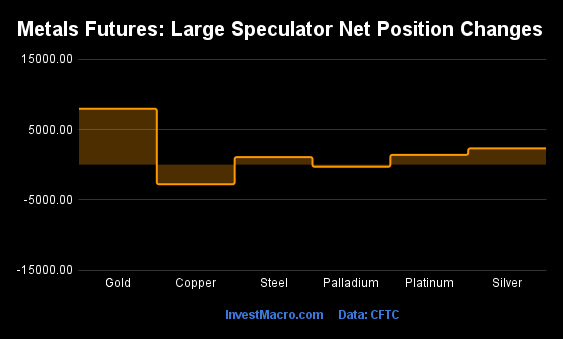
The COT metals markets speculator bets were mixed this week as three out of the six metals markets we cover had higher positioning while two markets had lower speculator contracts and one market had no change in weekly contracts.

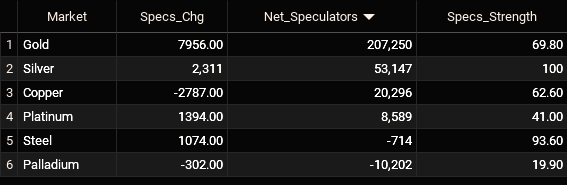
Leading the gains for the metals was Copper (26,498 contracts) with Silver (11,457 contracts) and Palladium (562 contracts) also experiencing positive contract weeks.

The market leading the declines in speculator bets was Platinum (-1,139 contracts) with Steel (-289 contracts) also showing lower bets on the week.

Gold (0 contracts) saw a very rare unchanged position for the week, according to the CFTC data.


Metals Net Speculators Leaderboard

Legend: Weekly Speculators Change | Speculators Current Net Position | Speculators Strength Score compared to last 3-Years (0-100 range)


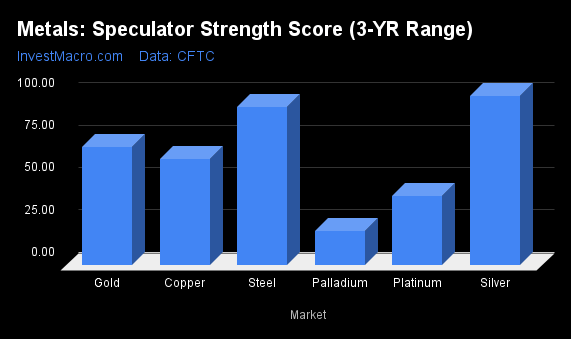
Strength Scores led by Silver & Steel

COT Strength Scores (a normalized measure of Speculator positions over a 3-Year range, from 0 to 100 where above 80 is Extreme-Bullish and below 20 is Extreme-Bearish) showed that Silver (99 percent) and Steel (87 percent) lead the metals markets this week. Copper (76 percent) comes in as the next highest in the weekly strength scores.

On the downside, Palladium (21 percent) and Platinum (33 percent) come in at the lowest strength levels currently.

Strength Statistics:
Gold (67.3 percent) vs Gold previous week (67.3 percent)
Silver (99.4 percent) vs Silver previous week (81.9 percent)
Copper (75.6 percent) vs Copper previous week (46.0 percent)
Platinum (33.0 percent) vs Platinum previous week (35.9 percent)
Palladium (21.0 percent) vs Palladium previous week (17.7 percent)
Steel (86.7 percent) vs Palladium previous week (87.8 percent)


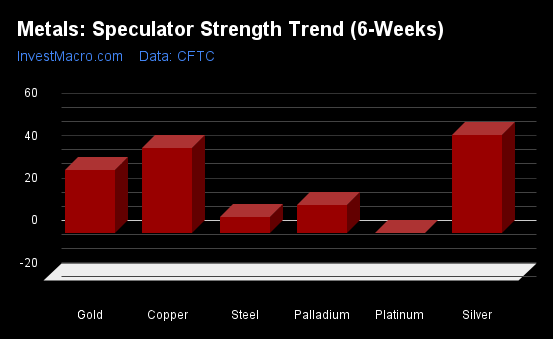
Silver & Copper top the 6-Week Strength Trends

COT Strength Score Trends (or move index, calculates the 6-week changes in strength scores) showed that Silver (54 percent) and Copper (51 percent) lead the past six weeks trends for metals.

Platinum (-8 percent) leads the downside trend scores currently with Steel (-4 percent) as the next market with lower trend scores.

Move Statistics:
Gold (17.9 percent) vs Gold previous week (24.2 percent)
Silver (54.2 percent) vs Silver previous week (29.8 percent)
Copper (51.0 percent) vs Copper previous week (15.7 percent)
Platinum (-8.2 percent) vs Platinum previous week (-10.5 percent)
Palladium (5.9 percent) vs Palladium previous week (0.7 percent)
Steel (-3.5 percent) vs Steel previous week (-0.2 percent)


Individual Markets:

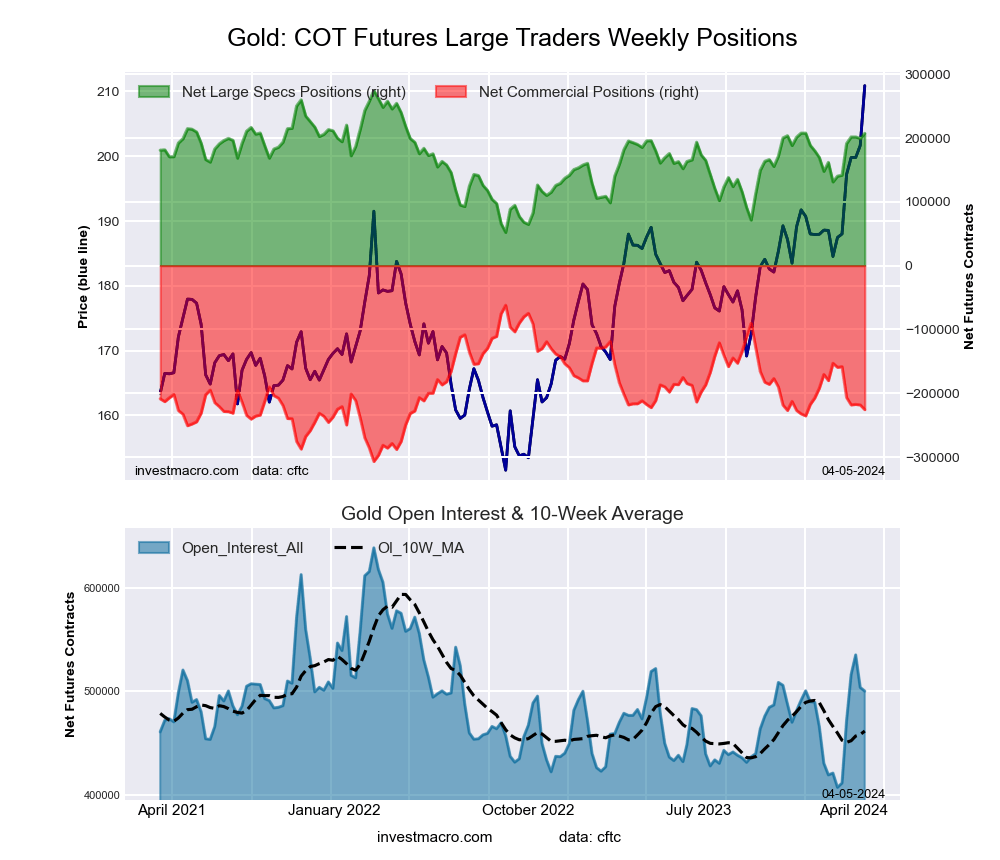
Gold Comex Futures:

Gold Futures COT ChartThe Gold Comex Futures large speculator standing this week came in at a net position of 201,602 contracts in the data reported through Tuesday. This was a weekly fall of 0 contracts from the previous week which had a total of 201,602 net contracts.

This week’s current strength score (the trader positioning range over the past three years, measured from 0 to 100) shows the speculators are currently Bullish with a score of 67.3 percent. The commercials are Bearish with a score of 36.5 percent and the small traders (not shown in chart) are Bearish with a score of 25.3 percent.

Price Trend-Following Model: Strong Uptrend

Our weekly trend-following model classifies the current market price position as: Strong Uptrend. The current action for the model is considered to be: Hold – Maintain Long Position.

Gold Futures StatisticsSPECULATORSCOMMERCIALSSMALL TRADERS
– Percent of Open Interest Longs:52.125.89.2
– Percent of Open Interest Shorts:14.466.56.2
– Net Position:201,602-217,53015,928
– Gross Longs:278,732138,10249,131
– Gross Shorts:77,130355,63233,203
– Long to Short Ratio:3.6 to 10.4 to 11.5 to 1
NET POSITION TREND:
– Strength Index Score (3 Year Range Pct):67.336.525.3
– Strength Index Reading (3 Year Range):BullishBearishBearish
NET POSITION MOVEMENT INDEX:
– 6-Week Change in Strength Index:17.9-15.2-8.3


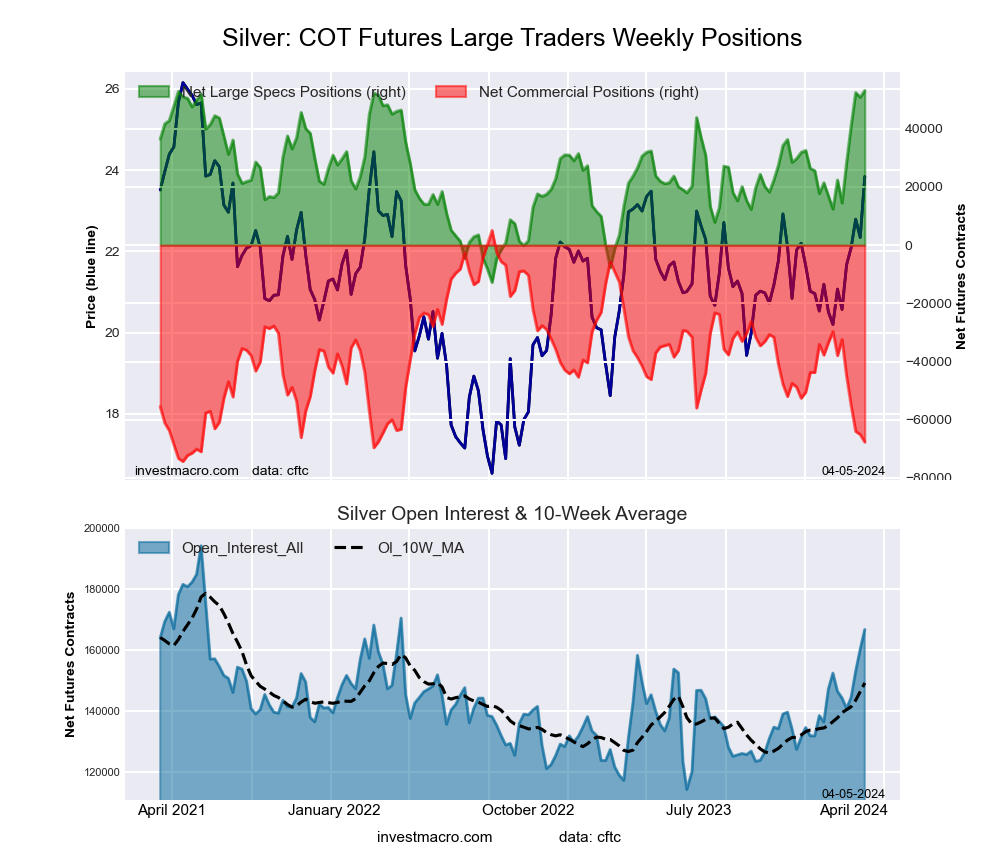
Silver Comex Futures:

Silver Futures COT ChartThe Silver Comex Futures large speculator standing this week came in at a net position of 52,435 contracts in the data reported through Tuesday. This was a weekly rise of 11,457 contracts from the previous week which had a total of 40,978 net contracts.

This week’s current strength score (the trader positioning range over the past three years, measured from 0 to 100) shows the speculators are currently Bullish-Extreme with a score of 99.4 percent. The commercials are Bearish-Extreme with a score of 13.0 percent and the small traders (not shown in chart) are Bearish with a score of 30.7 percent.

Price Trend-Following Model: Strong Uptrend

Our weekly trend-following model classifies the current market price position as: Strong Uptrend. The current action for the model is considered to be: Hold – Maintain Long Position.

Silver Futures StatisticsSPECULATORSCOMMERCIALSSMALL TRADERS
– Percent of Open Interest Longs:50.726.017.5
– Percent of Open Interest Shorts:16.567.810.0
– Net Position:52,435-64,01711,582
– Gross Longs:77,63239,87626,859
– Gross Shorts:25,197103,89315,277
– Long to Short Ratio:3.1 to 10.4 to 11.8 to 1
NET POSITION TREND:
– Strength Index Score (3 Year Range Pct):99.413.030.7
– Strength Index Reading (3 Year Range):Bullish-ExtremeBearish-ExtremeBearish
NET POSITION MOVEMENT INDEX:
– 6-Week Change in Strength Index:54.2-38.4-28.1


Copper Grade #1 Futures:

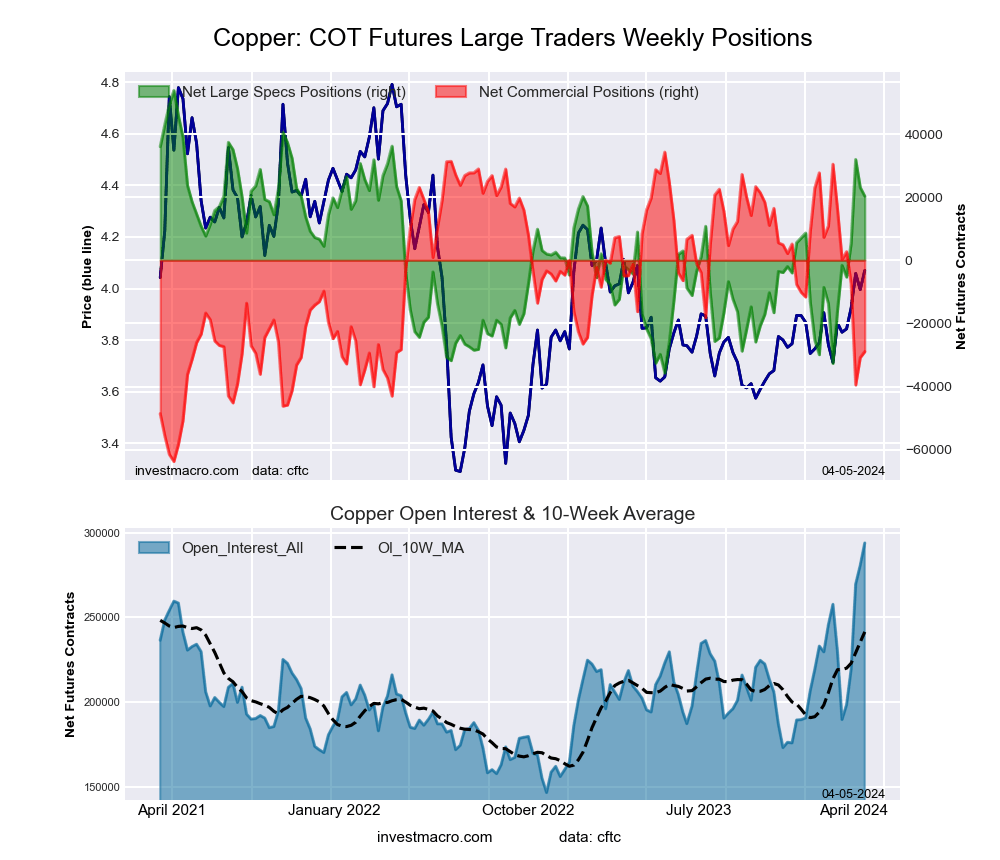
Copper Futures COT ChartThe Copper Grade #1 Futures large speculator standing this week came in at a net position of 31,925 contracts in the data reported through Tuesday. This was a weekly rise of 26,498 contracts from the previous week which had a total of 5,427 net contracts.

This week’s current strength score (the trader positioning range over the past three years, measured from 0 to 100) shows the speculators are currently Bullish with a score of 75.6 percent. The commercials are Bearish with a score of 24.7 percent and the small traders (not shown in chart) are Bullish with a score of 66.3 percent.

Price Trend-Following Model: Strong Uptrend

Our weekly trend-following model classifies the current market price position as: Strong Uptrend. The current action for the model is considered to be: Hold – Maintain Long Position.

Copper Futures StatisticsSPECULATORSCOMMERCIALSSMALL TRADERS
– Percent of Open Interest Longs:46.126.78.1
– Percent of Open Interest Shorts:34.341.35.3
– Net Position:31,925-39,5027,577
– Gross Longs:124,31671,93421,878
– Gross Shorts:92,391111,43614,301
– Long to Short Ratio:1.3 to 10.6 to 11.5 to 1
NET POSITION TREND:
– Strength Index Score (3 Year Range Pct):75.624.766.3
– Strength Index Reading (3 Year Range):BullishBearishBullish
NET POSITION MOVEMENT INDEX:
– 6-Week Change in Strength Index:51.0-51.430.0


Platinum Futures:

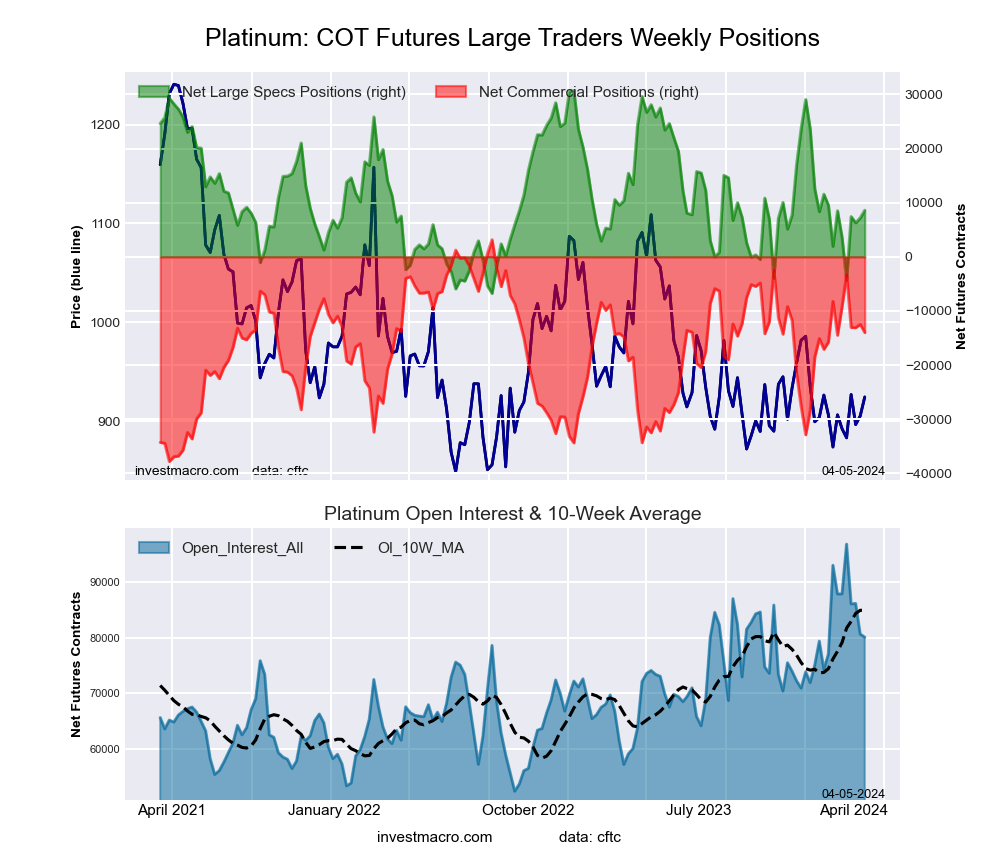
Platinum Futures COT ChartThe Platinum Futures large speculator standing this week came in at a net position of 6,280 contracts in the data reported through Tuesday. This was a weekly decrease of -1,139 contracts from the previous week which had a total of 7,419 net contracts.

This week’s current strength score (the trader positioning range over the past three years, measured from 0 to 100) shows the speculators are currently Bearish with a score of 33.0 percent. The commercials are Bullish with a score of 63.2 percent and the small traders (not shown in chart) are Bullish with a score of 59.0 percent.

Price Trend-Following Model: Strong Downtrend

Our weekly trend-following model classifies the current market price position as: Strong Downtrend. The current action for the model is considered to be: Hold – Maintain Short Position.

Platinum Futures StatisticsSPECULATORSCOMMERCIALSSMALL TRADERS
– Percent of Open Interest Longs:49.423.712.7
– Percent of Open Interest Shorts:42.138.94.8
– Net Position:6,280-13,0786,798
– Gross Longs:42,54020,41310,934
– Gross Shorts:36,26033,4914,136
– Long to Short Ratio:1.2 to 10.6 to 12.6 to 1
NET POSITION TREND:
– Strength Index Score (3 Year Range Pct):33.063.259.0
– Strength Index Reading (3 Year Range):BearishBullishBullish
NET POSITION MOVEMENT INDEX:
– 6-Week Change in Strength Index:-8.26.08.0


Palladium Futures:

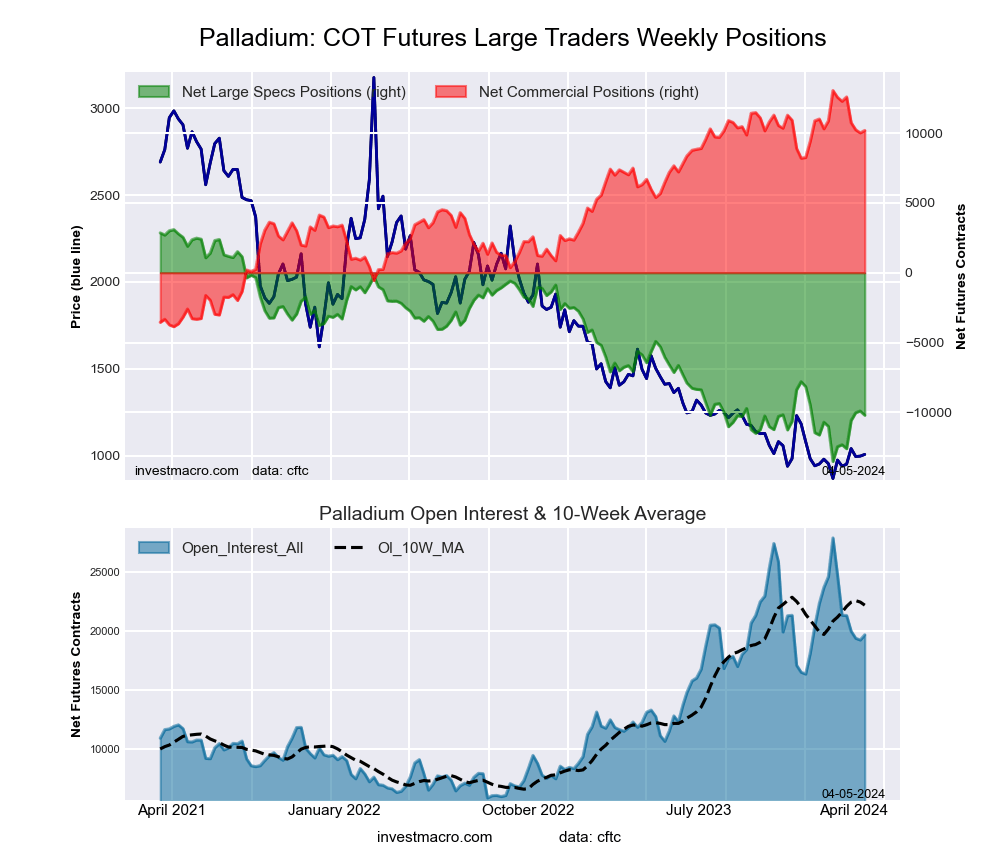
Palladium Futures COT ChartThe Palladium Futures large speculator standing this week came in at a net position of -10,019 contracts in the data reported through Tuesday. This was a weekly increase of 562 contracts from the previous week which had a total of -10,581 net contracts.

This week’s current strength score (the trader positioning range over the past three years, measured from 0 to 100) shows the speculators are currently Bearish with a score of 21.0 percent. The commercials are Bullish-Extreme with a score of 83.4 percent and the small traders (not shown in chart) are Bearish with a score of 28.8 percent.

Price Trend-Following Model: Downtrend

Our weekly trend-following model classifies the current market price position as: Downtrend. The current action for the model is considered to be: Hold – Maintain Short Position.

Palladium Futures StatisticsSPECULATORSCOMMERCIALSSMALL TRADERS
– Percent of Open Interest Longs:22.963.57.9
– Percent of Open Interest Shorts:74.610.69.0
– Net Position:-10,01910,234-215
– Gross Longs:4,42712,2921,528
– Gross Shorts:14,4462,0581,743
– Long to Short Ratio:0.3 to 16.0 to 10.9 to 1
NET POSITION TREND:
– Strength Index Score (3 Year Range Pct):21.083.428.8
– Strength Index Reading (3 Year Range):BearishBullish-ExtremeBearish
NET POSITION MOVEMENT INDEX:
– 6-Week Change in Strength Index:5.9-3.8-20.3


Steel Futures Futures:

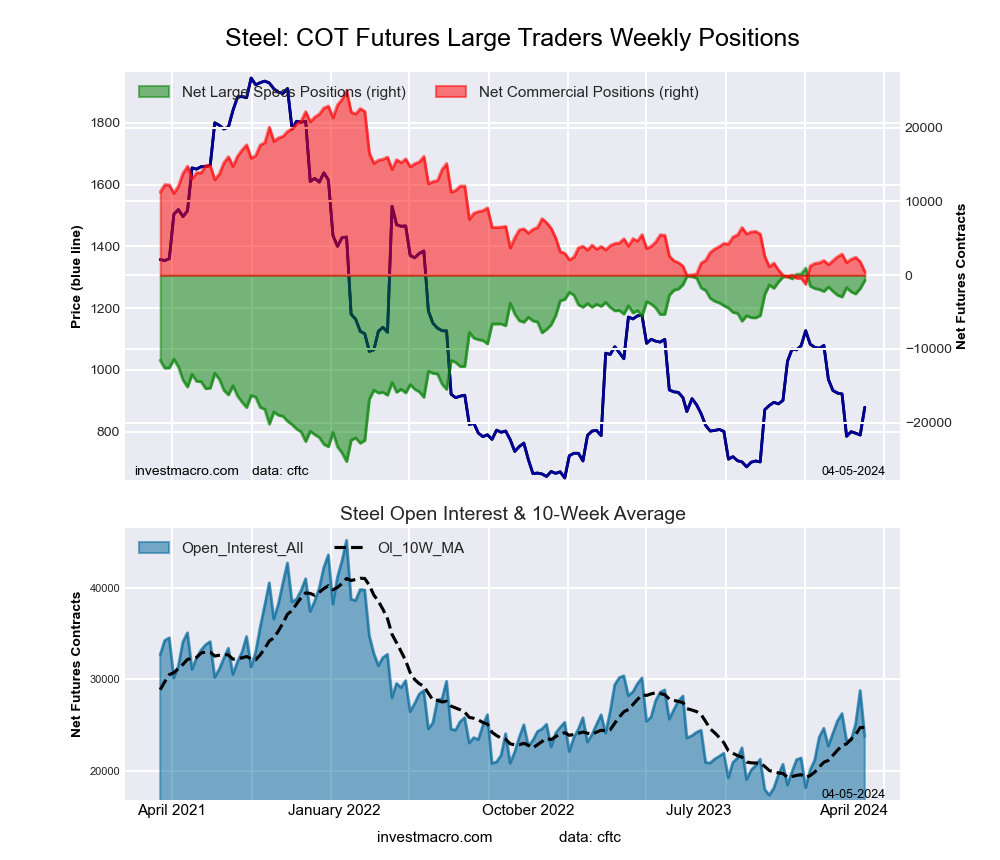
Steel Futures COT ChartThe Steel Futures large speculator standing this week came in at a net position of -2,526 contracts in the data reported through Tuesday. This was a weekly decline of -289 contracts from the previous week which had a total of -2,237 net contracts.

This week’s current strength score (the trader positioning range over the past three years, measured from 0 to 100) shows the speculators are currently Bullish-Extreme with a score of 86.7 percent. The commercials are Bearish-Extreme with a score of 13.8 percent and the small traders (not shown in chart) are Bearish with a score of 44.3 percent.

Price Trend-Following Model: Strong Downtrend

Our weekly trend-following model classifies the current market price position as: Strong Downtrend. The current action for the model is considered to be: Hold – Maintain Short Position.

Steel Futures StatisticsSPECULATORSCOMMERCIALSSMALL TRADERS
– Percent of Open Interest Longs:9.183.71.3
– Percent of Open Interest Shorts:19.274.10.9
– Net Position:-2,5262,417109
– Gross Longs:2,29321,012323
– Gross Shorts:4,81918,595214
– Long to Short Ratio:0.5 to 11.1 to 11.5 to 1
NET POSITION TREND:
– Strength Index Score (3 Year Range Pct):86.713.844.3
– Strength Index Reading (3 Year Range):Bullish-ExtremeBearish-ExtremeBearish
NET POSITION MOVEMENT INDEX:
– 6-Week Change in Strength Index:-3.53.8-6.2


Article By InvestMacroReceive our weekly COT Newsletter

*COT Report: The COT data, released weekly to the public each Friday, is updated through the most recent Tuesday (data is 3 days old) and shows a quick view of how large speculators or non-commercials (for-profit traders) were positioned in the futures markets.

The CFTC categorizes trader positions according to commercial hedgers (traders who use futures contracts for hedging as part of the business), non-commercials (large traders who speculate to realize trading profits) and nonreportable traders (usually small traders/speculators) as well as their open interest (contracts open in the market at time of reporting). See CFTC criteria here.

The Swiss National Bank unexpectedly cut the interest rate. Oil declines amid attempts to de-escalate the conflict in the Middle East

By JustMarkets

At Thursday’s close of the stock exchange, the Dow Jones Index (US30) rose by 0.68%. The S&P 500 Index (US500) was up 0.32%. The NASDAQ Technology Index (US100) closed positive 0.20%. Stocks continued Wednesday’s rally on Thursday, with all three major US indices hitting new all-time highs. Stocks rose amid forecasts for a Fed rate cut this year after the FOMC maintained its projections for a 75 bps interest rate cut this year on Wednesday. Stock indices also found support amid stronger-than-expected US economic reports suggesting the US economy is resilient, bolstering prospects for a soft landing for the economy.

US weekly jobless claims unexpectedly fell from 2,000 to 210,000, indicating a strengthening labor market compared to expectations of a rise to 213,000. S&P Manufacturing PMI for March rose by 0.3 to a 2-year high of 52.5, stronger than expectations for a decline to 51.8. US home sales for February unexpectedly rose 9.5% to 4.38 million, stronger than expected for a decrease to 3.95 million.

Broadcom (AVGO) shares are up more than 5% after Cowen upgraded the stock to Outperform with a $1,500 price target. Apple’s (AAPL) stock price fell more than 4% and topped the list of losers on the Dow Jones Industrials after the US Department of Justice and 16 attorneys general sued the company, accusing it of violating antitrust laws.

Equity markets in Europe rose steadily yesterday. Germany’s DAX (DE40) added 0.91%, France’s CAC 40 (FR40) gained 0.22%, Spain’s IBEX 35 (ES35) rose by 1.07%, and the UK’s FTSE 100 (UK100) closed positive 1.88%.

The Bank of England (BOE) voted 8:1 to keep the official bank rate at 5.25%, with BOE Governor Bailey stating that the bank “has not yet reached the point where we can cut interest rates.” GfK’s UK consumer confidence indicator unexpectedly came in at 21 in March 2024, unchanged from February and missing market expectations for a slight improvement to 19 as the cost of living crisis and broader economic uncertainty continue to dampen sentiment.

The Swiss franc fell sharply against the dollar and other currencies following the Swiss National Bank’s (SNB) decision to cut interest rates by 25 basis points (bps) to 1.50% at its March meeting on Thursday. The SNB decided to cut interest rates in response to a significant decline in inflation and growth over the past year. The SNB expects inflation to average 1.9% in 2024. Inflation is currently well below this forecast at 1.2%.

WTI crude futures fell to around $80.5 a barrel on Friday, declining for the third consecutive session, as the possibility of a ceasefire in Gaza that could ease supply concerns weighed on oil prices. The US is ready to bring a draft UN resolution calling for an immediate and sustained ceasefire in Gaza to a Security Council vote on Friday. The US Secretary of State Anthony Blinken also said Thursday that he believes peace talks in Qatar can succeed.

Asian markets were predominantly rising yesterday. Japan’s Nikkei 225 (JP225) rose by 2.03%, China’s FTSE China A50 (CHA50) gained 0.51% on Thursday, Hong Kong’s Hang Seng (HK50) added 1.93% on the day, and Australia’s ASX 200 (AU200) was positive 1.12%.

The offshore yuan weakened to 7.25 per dollar, falling to its lowest level in four months on bets that China will further ease policy to support the economy. A senior central bank official recently said the People’s Bank of China (PBoC) has room to further reduce banks’ reserve requirement ratios and other policy tools. Investors await data on manufacturing and services activity in China in the coming weeks to gauge the health of the world’s second-largest economy.

The New Zealand dollar slid to US $0.60, falling to its lowest level in four months, as the US dollar rebounded amid growing expectations that US interest rates could remain elevated for longer even as they begin to fall in other major economies. There were also hopes that the RBNZ may cut the official money rate sooner than forecast as the economy is in a technical recession following an unexpected contraction in Q4 GDP.

S&P 500 (US500) 5,241.53 +16.91 (+0.32%)

Dow Jones (US30) 39,781.37 +269.24 (+0.68%)

DAX (DE40) 18,179.25 +164.12 (+0.91%)

FTSE 100 (UK100) 7,882.55 +145.17 (+1.88%)

USD Index 104.01 +0.57 (+0.55%)

Important events today:
  • – Japan National Core CPI (m/m) at 01:30 (GMT+2);
  • – UK Retail Sales (m/m) at 09:00 (GMT+2);
  • – German Ifo Business Climate Index (m/m) at 11:00 (GMT+2);
  • – Canada Retail Sales (m/m) at 14:30 (GMT+2);
  • – US Fed Chair Powell Speaks at 15:00 (GMT+2);
  • – US FOMC Member Bostic Speaks at 22:00 (GMT+2).

By JustMarkets


This article reflects a personal opinion and should not be interpreted as an investment advice, and/or offer, and/or a persistent request for carrying out financial transactions, and/or a guarantee, and/or a forecast of future events.

GBP/USD Faces Sharp Decline Amid BoE’s Monetary Policy Stance

By RoboForex Analytical Department

As of Friday, the GBP/USD pair hovered around 1.2642, following a substantial decline. The Bank of England (BoE) has yet to find reasons to lower the interest rate, indicating intentions to maintain high rates for an extended period to support the necessary inflation level in the country. The BoE’s monetary policy remains restrictive.

In its latest meeting, the Bank of England kept the interest rate steady at 5.25% annually, unchanged from previous sessions.

The BoE’s primary inflation target is 2%. Official forecasts suggest that the Consumer Price Index in the UK will likely reach this target by Q2 2024, with no immediate changes in monetary attitudes anticipated.

The market was “disappointed” that the BoE did not introduce any new policies, given that key central banks worldwide have started (at least verbally) to move towards tightening monetary conditions. The BoE remains an outlier, sticking to a conservative “wait-and-see” approach.

The BoE will likely continue with its current strategy. It will wait to see the outcomes of interest rate hikes by the US Federal Reserve and the European Central Bank (ECB) and observe currency reactions before considering any steps towards tightening based on the inflation trend.

Technical analysis of GBP/USD

The H4 chart of GBP/USD is developing the fifth wave of decline towards the level of 1.2594. After that, a potential correction to 1.2742 is considered, with a continued downward trend expected. The MACD oscillator supports this scenario, with its signal line below zero and continuing downward towards new lows.

On the H1 chart, a declining wave structure towards 1.2615 is forming. After reaching this level, a potential rise to 1.2698 could occur, followed by a decline to 1.2594. The Stochastic oscillator confirms this scenario, with its signal line below 20 and sharply directed downwards.

Disclaimer

Any forecasts contained herein are based on the author’s particular opinion. This analysis may not be treated as trading advice. RoboForex bears no responsibility for trading results based on trading recommendations and reviews contained herein.

The US Federal Reserve expectedly kept rates unchanged. New Zealand remains in a technical recession.

By JustMarkets

As of Wednesday’s stock market close, the Dow Jones Index (US30) was up 1.03%. The S&P 500 Index (US500) added 0.89%. The NASDAQ Technology Index (US100) closed positive 1.25%. The US stocks closed at record highs on Wednesday after the US Federal Reserve left its outlook for interest rate cuts unchanged.

The FOMC left the federal funds rate unchanged at a 23-year high of 5.5% for the fifth consecutive meeting in March 2024, matching market expectations. Policymakers added that they did not believe it would be appropriate to reduce the target range until there is confidence that inflation is moving steadily toward 2%. The median expectations of FOMC members suggest 75 basis points of rate cuts this year. The dot plot also points to three rate cuts in 2025, one fewer than in December, despite a slight upward revision to PCE inflation. However, the sharp upward revision to US GDP forecasts continued to support US equities, reflecting this year’s rally away from the Fed’s restrictive policies. The FOMC also said it will continue to shrink its monthly balance sheet by $95 billion. Fed Chair Powell said it is appropriate to begin easing “at some point this year” and that recent inflation data indicate the Fed was correct to wait before cutting interest rates.

The Bank of Canada’s Board of Governors expects a possible rate cut in 2024 if economic trends match forecasts, but internal disagreements over timing and inflation risks remain. BoC Governor Tiff Macklem remains cautious about an immediate rate adjustment due to concerns about core inflation. The bank forecasts weak growth in the first quarter to gradually pick up to 1% by the end of the year, while inflation is expected to hover around 3% in the first half of 2024, then fall to 2.5% in the second half and eventually return to the 2% target by 2025.

Equity markets in Europe traded flat on Wednesday. Germany’s DAX (DE40) added 0.15%, France’s CAC 40 (FR40) fell by 0.48% yesterday, Spain’s IBEX 35 (ES35) rose by 0.48%, and the UK’s FTSE 100 (UK100) closed negative 0.01%.

ECB President Christine Lagarde joined other European policymakers in calling June a likely month to start discussing ECB rate cuts. However, she cautioned that the ECB would not commit to a predetermined number of rate cuts as the decision depends on incoming data.

WTI crude oil prices fell about 2% to $81 a barrel on Wednesday, moving away from four-month highs reached on Tuesday. Investors locked in some gains after strong oil prices. Meanwhile, EIA data showed that US crude inventories unexpectedly fell by 1.95 million, the largest in two months, as refiners continued to ramp up activity.

The US natural gas (XNG) prices fell below $1.7 per MMBtu, near their lowest monthly level, amid pessimistic demand and high domestic supply. The Freeport LNG export plant in Texas announced that two of its three liquefaction lines will be taken offline before May, delaying a period of low capacity at a key plant. These developments will prevent the US from exporting additional natural gas through the LNG plant, reducing the supply of the commodity for domestic consumption.

Asian markets were predominantly up yesterday. Japan’s Nikkei 225 (JP225) was not trading yesterday, China’s FTSE China A50 (CHA50) was up 0.04% on Wednesday, Hong Kong’s Hang Seng (HK50) added 0.08% on the day, and Australia’s ASX 200 (AU200) was positive 0.10%.

Economists say the Bank of Japan (BoJ) may raise rates amid an improving economic outlook in the coming months. In addition, Japan’s Finance Minister Suzuki said that the government is monitoring currency movements with a “great sense of urgency” after the yen broke through the 151 per dollar mark. In other words, the government is not ruling out currency intervention to support the exchange rate.

New Zealand’s economy contracted 0.3% in the December quarter of 2023 from a year earlier, after contracting 0.6% in the prior period, falling short of market estimates of 0.1% growth. New Zealand’s technical recession persists. Markets have raised expectations of a rate cut by the Reserve Bank of New Zealand (RBNZ), and there is now a 55% chance of such a move in July. A quarter-point cut in the RBNZ rate is also fully forecast for August.

The Australian dollar rose to $0.66, hitting its highest level in a week, helped by stronger-than-expected employment data from the country. The latest data showed that Australian employment rose by 116,500 in February, well above market forecasts that expected a 40,000 increase. The unemployment rate also fell to a five-month low of 3.7% last month, better than market expectations of 4%.

S&P 500 (US500) 5,224.62 +46.11 (+0.89%)

Dow Jones (US30) 39,512.13 +401.37 (+1.03%)

DAX (DE40) 18,015.13 +27.64 (+0.15%)

FTSE 100 (UK100) 7,737.38 −0.92 (−0.01%)

USD Index 103.39 −0.04 (−0.04%)

Important events today:
  • – Australia Manufacturing PMI (m/m) at 00:00 (GMT+2);
  • – Australia Services PMI (m/m) at 00:00 (GMT+2);
  • – Japan Trade Balance (m/m) at 01:50 (GMT+2);
  • – Australia Unemployment Rate (m/m) at 02:30 (GMT+2);
  • – Japan Manufacturing PMI (m/m) at 02:30 (GMT+2);
  • – Japan Services PMI (m/m) at 02:30 (GMT+2);
  • – Hong Kong Inflation Rate (m/m) at 10:30 (GMT+2);
  • – Switzerland SNB Interest Rate Decision at 10:30 (GMT+2);
  • – Switzerland SNB Monetary Policy Assessment at 10:30 (GMT+2);
  • – German Manufacturing PMI (m/m) at 10:30 (GMT+2);
  • – German Services PMI (m/m) at 10:30 (GMT+2);
  • – Switzerland SNB Press Conference at 11:00 (GMT+2);
  • – Norway Interest Rate Decision at 11:00 (GMT+2);
  • – Eurozone Manufacturing PMI (m/m) at 11:00 (GMT+2);
  • – Eurozone Services PMI (m/m) at 11:00 (GMT+2);
  • – UK Manufacturing PMI (m/m) at 11:30 (GMT+2);
  • – UK Services PMI (m/m) at 11:30 (GMT+2);
  • – UK BoE Interest Rate Decision at 14:00 (GMT+2);
  • – UK BoE MPC Meeting Minutes at 14:00 (GMT+2);
  • – US Initial Jobless Claims (w/w) at 14:30 (GMT+2);
  • – US Manufacturing PMI (m/m) at 15:45 (GMT+2);
  • – US Services PMI (m/m) at 15:45 (GMT+2);
  • – US Existing Home Sales (m/m) at 16:00 (GMT+2);
  • – US Natural Gas Storage (w/w) at 16:30 (GMT+2);
  • – New Zealand Trade Balance (q/q) at 23:45 (GMT+2).

By JustMarkets


This article reflects a personal opinion and should not be interpreted as an investment advice, and/or offer, and/or a persistent request for carrying out financial transactions, and/or a guarantee, and/or a forecast of future events.

EUR/USD Plunges Following Fed’s Decision on Interest Rate Cuts

By RoboForex Analytical Department

The EUR/USD pair soared to a weekly high of 1.0933 on Thursday following the Federal Reserve System’s announcement of three interest rate cuts planned for 2024. These adjustments will reduce borrowing costs by 75 basis points.

The interest rate remains at 5.5% annually, its highest in 23 years, and has been unchanged for five consecutive meetings.

Federal Reserve Chair Jerome Powell noted that the regulator plans to reduce the rate this year, likely achieving a 75-basis point reduction over three stages by the end of 2024.

The Fed also continues its balance sheet contraction plan, not reinvesting proceeds from matured bonds and having no plans to sell bonds from its portfolio.

The Fed’s outlook was relatively optimistic this time, expecting the American economy to grow by 2.1% quarter-on-quarter in Q1 2024. Although the Consumer Price Index is decreasing, it is still high, and the employment market is strong due to new job creation.

The Fed’s inflation target remains at 2%, with risks to expectations seen as balanced.

EUR/USD technical analysis

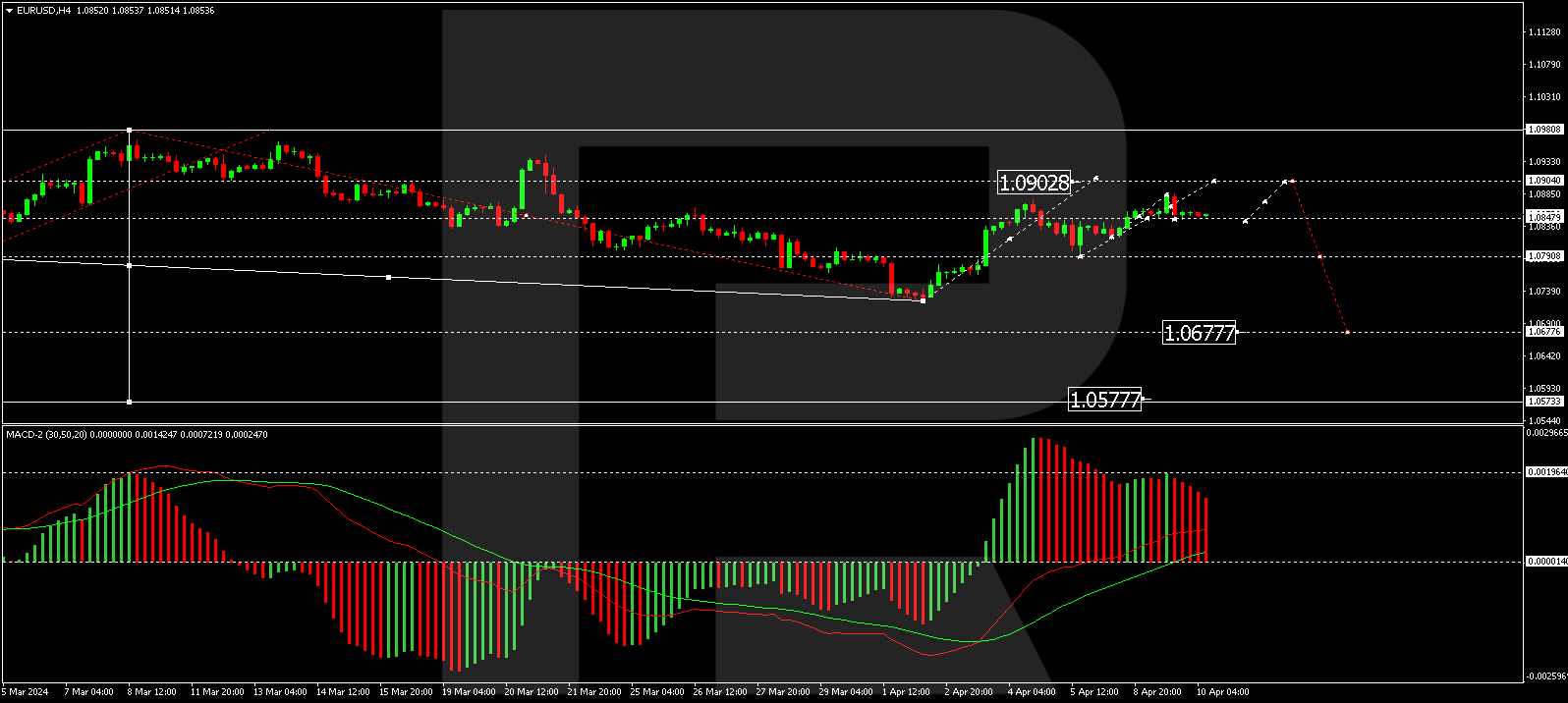
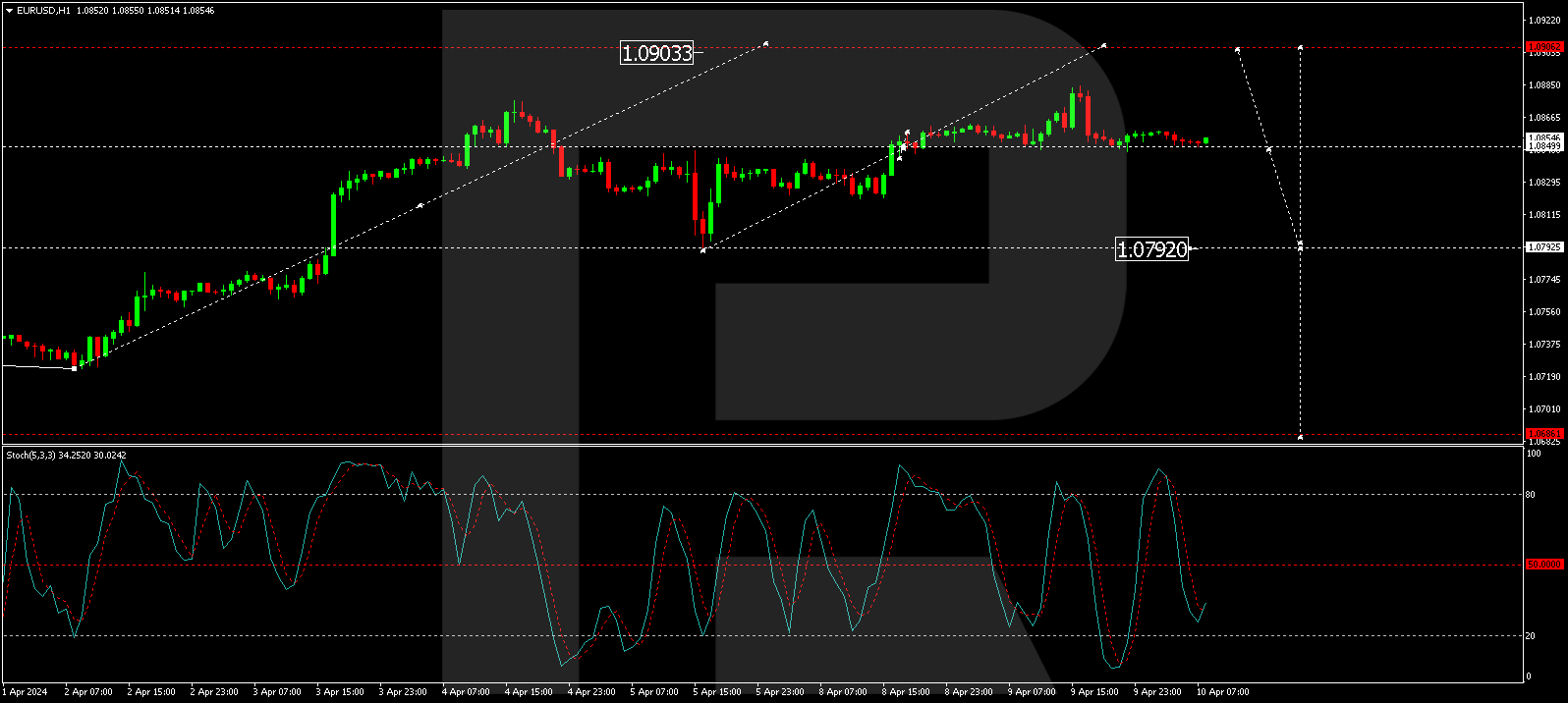
Influenced by the news, the H4 EUR/USD chart found support at 1.0836, leading to a correction. Today, the price is anticipated to reach 1.0944, followed by a subsequent downward movement targeting 1.0818. The MACD indicator supports this scenario, with its signal line below zero, indicating further declines to new lows.

On the H1 EUR/USD chart, a corrective growth structure towards 1.0940 has formed. After reaching this level, a decline to 1.0888 is possible, followed by a potential rise to 1.0944. Then, a new downward wave to 1.0818, the first target, may begin. The Stochastic oscillator, with its signal line below 50, indicates a continuation of the decline towards 20.


Disclaimer

Any forecasts contained herein are based on the author’s particular opinion. This analysis may not be treated as trading advice. RoboForex bears no responsibility for trading results based on trading recommendations and reviews contained herein.

Japanese Yen (USD/JPY) Hits Four-Month Low

By RoboForex Analytical Department

The USD/JPY pair surged to a four-month high as investors recalibrated their expectations for the Bank of Japan’s future actions. The consensus is now that the BoJ’s monetary policy will remain accommodative, even with the shift away from negative interest rates.

On Tuesday, the Bank of Japan announced its first interest rate hike in 17 years, indicating its expectation to observe favorable fiscal conditions for some time. However, the yen remains under pressure due to the significant interest rate differential between Japan and the United States.

Japan’s negative interest rate period extended over eight years. The recent decision marks a historic move following a prolonged phase of quantitative monetary easing.

The market generally believes that the Bank of Japan’s transition to a stable monetary policy is far from complete. This perspective is supported by the BoJ’s “soft” statements and the subsequent reaction of the JPY.

The yen plunged by 1% against the US dollar immediately following the BoJ’s decision and continues to weaken. The upward trend in the USD/JPY pair began in early January 2024 and has remained strong.

USD/JPY technical analysis

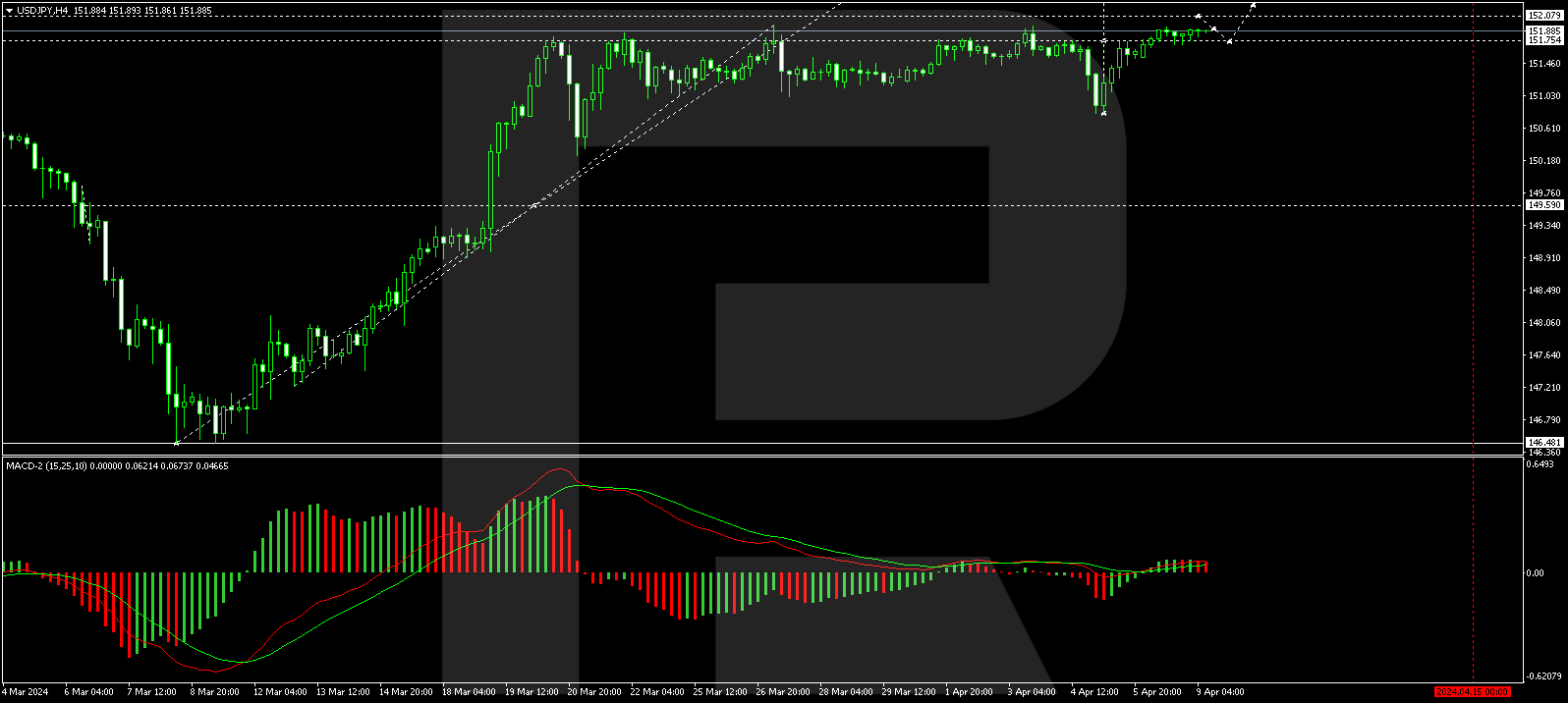
The H4 USD/JPY chart shows a consolidation range formed around the 149.13 level. With an upward breakout, the pair continues to develop a growth wave towards 151.77. A correction phase to 150.00 could follow, then a rise to 152.60. The MACD oscillator supports this scenario, with its signal line strictly pointing upwards and aiming for new highs.

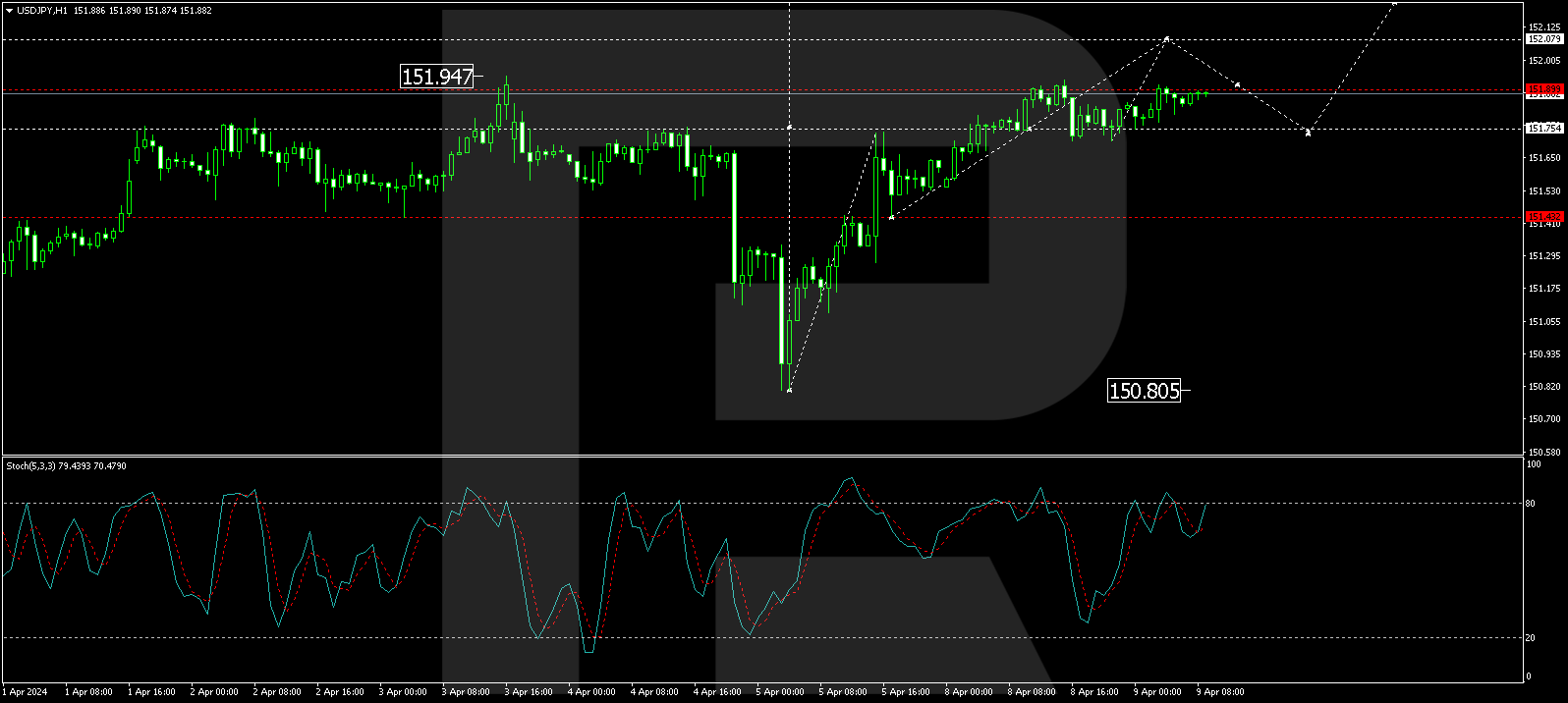
On the H1 USD/JPY chart, a narrow consolidation range has developed around the 150.40 level. Exiting upwards from this range, the growth wave continues towards 151.78. After reaching this level, a potential correction back to 150.40 (testing from above) is considered, followed by a new growth structure towards 152.60. The Stochastic oscillator corroborates this scenario, with its signal line above the 80 mark and preparing to drop to 50.


Disclaimer

Any forecasts contained herein are based on the author’s particular opinion. This analysis may not be treated as trading advice. RoboForex bears no responsibility for trading results based on trading recommendations and reviews contained herein.

Canadian dollar declines amid falling inflation. PBoC kept rates at current levels

By JustMarkets

As of Tuesday’s stock market close, the Dow Jones Index (US30) was up 0.83%, the S&P 500 Index (US500) added 0.56%, and the NASDAQ Technology Index (US100) closed positive 0.39%.

The Federal Open Market Committee (FOMC) will hold its Wednesday monetary policy meeting today. The Fed had initially planned to begin cutting rates in March. However, stronger than expected US inflation data (primarily producer inflation – PPI) raised concerns that the central bank may delay an interest rate cut further. As a result, the likelihood of a rate cut was pushed back first to May and then to June. Markets currently estimate the probability of a 25 bps rate cut at the March FOMC meeting at 1%, at the next meeting on May 1 at 9%, and at the June 12 meeting at 59%. The rate is expected to remain at 5.5% at the current meeting, but investors’ main focus will be the press conference. Investors will be paying attention to any clues about the prospects for a central bank rate cut, the strength of the US economy, and the possibility of an inflationary rebound. If Jerome Powell begins to back away from a rate cut this summer, it could put further pressure on the indices.

Semiconductor stocks came under pressure Tuesday after Nvidia (NVDA) unveiled new, more powerful chips for artificial intelligence. As a result, Advanced Micro Devices (AMD) shares fell more than 4%. In addition, shares of Marvell Technology (MRVL) are down more than 3%, and Intel (INTC) is down more than 1%.

Canada’s annual inflation rate slowed to 2.8% in February 2024 from 2.9% in January 2024 and was the lowest since June 2023. This result also contradicts market expectations of 3.1%, giving the Bank of Canada (BoC) more room to start easing monetary policy in the year’s second half. The Canadian dollar fell below 1.36 per dollar, hitting a nearly four-month low.

Equity markets in Europe were mostly up on Tuesday. Germany’s DAX (DE40) added 0.31%, France’s CAC 40 (FR40) gained 0.65%, Spain’s IBEX 35 (ES35) rose 0.99%, and the UK’s FTSE 100 (UK100) closed positive 0.20%. European indices rose yesterday, helped by positive Eurozone wage data. Labor costs rose slowly over a year, spurring speculation that the ECB may consider cutting interest rates later this year.

The ZEW survey of German economic growth expectations rose 11.8 to a two-year high of 31.7, beating expectations of 20.5. The German Economic Sentiment Index (ZEW) gauges the sentiment of institutional investors. It is a key indicator of business conditions. A reading above expectations is seen as positive for the European economy.

ECB Vice President Gindos said, “The ECB hasn’t yet discussed anything about future rate moves. The evolution of wages is key, and in June, we will also have our new projections and be ready to decide when to adjust our policy stance based on the data we see.” Swaps put the odds of a 25 bps ECB rate cut at 6% for the next meeting on April 11 and 82% for the June 6 meeting.

WTI crude prices fell to $82.5 a barrel on Wednesday, retreating slightly from recent highs, as investors closed some of their gains after a strong rally in oil prices ahead of the US Federal Reserve’s decision. Iraq announced plans to cut oil exports to 3.3 million bpd in the coming months to meet its OPEC+ quota, while Saudi Arabia cut crude exports for the second consecutive month. At the same time, economic data from China, including strong industrial production and retail sales figures, reinforced expectations of rising demand from the world’s largest oil importer.

Asian markets were predominantly rising yesterday. Japan’s Nikkei 225 (JP225) ended the day up 0.66%, China’s FTSE China A50 (CHA50) rose by 0.23% on Tuesday, Hong Kong’s Hang Seng (HK50) ended the day down 1.24%, and Australia’s ASX 200 (AU200) was positive 0.36%.

On Wednesday, the People’s Bank of China (PBoC) left the one-year and five-year prime rates unchanged at 3.45% and 3.95% respectively. The one-year LPR is the benchmark for most residential and corporate loans, while the five-year LPR determines most real estate mortgages. Both rates are at record lows as China’s central bank seeks to stimulate an economic turnaround amid adversity in the real estate sector and record-low consumer confidence.

S&P 500 (US500) 5,178.51 +29.09 (+0.56%)

Dow Jones (US30) 39,110.76 +320.33 (+0.83%)

DAX (DE40) 17,987.49 +54.81 (+0.31%)

FTSE 100 (UK100) 7,738.30 +15.75 (+0.20%)

USD Index 103.80 +0.37 (+0.36%)

Important events today:
  • – China PBoC Loan Prime Rate at 03:15 (GMT+2);
  • – UK Consumer Price Index (m/m) at 09:00 (GMT+2);
  • – UK Producer Price Index (m/m) at 09:00 (GMT+2);
  • – Eurozone ECB President Lagarde Speaks at 10:45 (GMT+2);
  • – US Crude Oil Reserves (w/w) at 16:30 (GMT+2);
  • – US FOMC Economic Projections at 20:00 (GMT+2);
  • – US Fed Interest Rate Decision at 20:00 (GMT+2);
  • – US FOMC Statement at 20:00 (GMT+2);
  • – US FOMC Press Conference at 20:30 (GMT+2);
  • – New Zealand GDP (q/q) at 23:45 (GMT+2).

By JustMarkets


This article reflects a personal opinion and should not be interpreted as an investment advice, and/or offer, and/or a persistent request for carrying out financial transactions, and/or a guarantee, and/or a forecast of future events.

Crude: Capped below weekly resistance?

By ForexTime 

  • Crude up almost 2% this week
  • Watch out for EIA report & Fed decision
  • Weekly resistance at $83.64
  • Possible bearish scenario on H4
  • Key levels of interest at $81.25

Our focus falls on US crude oil which is currently hovering around levels not seen in over four months!

The global commodity is up almost 2% this week thanks to geopolitical tensions, Iraq’s pledge to cut crude exports, and the American Petroleum Institute (API) reporting a fall in US crude stockpiles.

Watch this space because more volatility could be on the cards due to the incoming Energy Information Administration (EIA) report and highly anticipated Fed rate decision. 

While the central bank is widely expected to leave rates unchanged, all eyes will be on the dot projection and Powell’s press conference for clues on rate cut timings.

  • Oil prices could extend gains if the central bank strikes a dovish tone and signals that three rate cuts are still on the cards in 2024.
  • However, if the Fed sounds more hawkish than expected, signaling that US rates will remain higher for longer – oil bears may enter the scene as the dollar appreciates.

Looking at the technical picture, crude oil is currently busy with a strong impulse wave that exploded out of a previous slow and steady uptrend.

The price almost reached a weekly resistance level. This might create a short opportunity on the lower time frames.

On the 4-hour chart, an extended uptrend can be seen with a correction wave in progress. The price is close to the weekly resistance level and the manual trendline has been broken. The longer price cycle Moving Average Convergence Divergence (MACD) Oscillators is still bullish, but the signal line has been broken and this might hint at a possible overbought scenario. A market that is in an overbought state may well slow down and then a possible reversal can be on the books.

This will need to be confirmed by a lower top and then a lower bottom.

If this does happen, a possible scenario can be seen in the chart below.

When the price reaches the $81.25 level, a possible short scenario will become feasible.

Attaching a modified Fibonacci tool to the trigger level at $81.25 and dragging it above the weekly resistance level at $83.80, four conservative targets can be established:

  • First target at $80.22

  • Second target at $79.71

  • Third price target at $78.69

  • Fourth and last price target at $77.41

If the price breaks past $83.80, this opportunity is no longer valid.


Forex-Time-LogoArticle by ForexTime
ForexTime Ltd (FXTM) is an award winning international online forex broker regulated by CySEC 185/12 www.forextime.com

The Bank of Japan is finally out of negative rate territory. The RBA left the rate unchanged but removed the hawkish bias

By JustMarkets

The Dow Jones Index (US30) was up 0.20% at Monday’s stock market close. The S&P 500 Index (US500) added 0.63%. The NASDAQ Technology Index (US100) closed positive 0.82%. Tesla (TSLA) stock price rose more than 6% and led the S&P 500 and Nasdaq 100 stocks higher after the company announced on website X that it would raise the price of all US Model Y vehicles by $1,000 on April 1. Alphabet (GOOGL) stock is up more than 4% after it was reported that Apple is in talks to embed Google’s Gemini artificial intelligence search engine into the iPhone.

Canada’s inflation report will be released today. No changes in the figures are expected, so the Canadian dollar will likely be affected by volatility. However, any deviations from the consensus forecast could trigger a strong rally. Remember that when inflation rises, the domestic currency tends to strengthen on expectations of a more hawkish central bank stance.

Equity markets in Europe were mostly down on Monday. Germany’s DAX (DE40) was down 0.02%, France’s CAC 40 (FR40) fell by 0.20% yesterday, Spain’s IBEX 35 (ES35) decreased by 0.01% and the UK’s FTSE 100 (UK100) closed negative 0.06%.

ECB Governing Council spokesman de Kos said yesterday that the ECB has achieved its goal of bringing inflation to 2%, which is compatible with an interest rate cut in the near term. Swaps put the odds of a 25 bps ECB rate cut at 7% at the next meeting on April 11 and 80% at the June 6 meeting.

Silver gained support yesterday on the back of global economic news on Monday. This news showed that February industrial production in China rose more than expected and that the March NAHB housing market index in the US unexpectedly rose, which is favorable for industrial metals demand.

Asian markets were up yesterday. Japan’s Nikkei 225 (JP225) ended the day up 2.67%, China’s FTSE China A50 (CHA50) added 0.57%, Hong Kong’s Hang Seng (HK50) jumped by 0.97% on the day, and Australia’s ASX 200 (AU200) was positive 0.07%. Chinese stocks rose on Monday as data showed that retail sales, industrial production, and fixed asset investment in China rose more than expected in the year’s first two months. Traders now await tomorrow’s People’s Bank of China’s (PBoC) decision on one-year and five-year loans. No changes are expected, but volatility on Asian indices could rise markedly.

The Bank of Japan (BoJ) raised interest rates to 0% from 0.1% for the first time since 2007, ending eight years of negative rates amid rising wages and high inflation. The central bank also abandoned its policy of controlling the yield curve, no longer targeting 10-year bond yields. In addition, the board agreed to stop buying ETFs and J-REITs and to gradually reduce its purchases of commercial paper and corporate bonds, with plans to stop buying bonds completely in about a year.

The Reserve Bank of Australia (RBA) left rates unchanged at 4.35%, as expected, but retracted its previous warning that further rate hikes were not ruled out. This indicates confidence that inflation will continue to fall and raises bets that the RBA may start cutting rates later this year. Markets are pricing in the first rate cut in August, predicting 40 basis points of overall easing this year.

S&P 500 (US500) 5,149.42 +32.33 (+0.63%)

Dow Jones (US30) 38,790.43 +75.66 (+0.20%)

DAX (DE40) 17,932.68 −3.97 (−0.02%)

FTSE 100 (UK100) 7,722.55 −4.87 (−0.06%)

USD Index 103.58 +0.15 (+0.15%)

Important events today:
  • – Japan BoJ Interest Rate Decision at 04:30 (GMT+2);
  • – Japan BoJ Monetary Policy Statement at 04:30 (GMT+2);
  • – Australia RBA Interest Rate Decision at 05:30 (GMT+2);
  • – Australia RBA Rate Statement at 05:30 (GMT+2);
  • – German ZEW Economic Sentiment (m/m) at 12:00 (GMT+2);
  • – Eurozone ZEW Economic Sentiment (m/m) at 12:00 (GMT+2);
  • – US Building Permits (m/m) at 14:30 (GMT+2);
  • – Canada Consumer Price Index (m/m) at 14:30 (GMT+2).

By JustMarkets


This article reflects a personal opinion and should not be interpreted as an investment advice, and/or offer, and/or a persistent request for carrying out financial transactions, and/or a guarantee, and/or a forecast of future events.

SG20 index: more dividends, less volatility

By ForexTime

  • FXTM launches brand new SG20 stock index
  • SG20 has highest dividend yield of all FXTM stock indices
  • SG20: most stable Asian stock index within FXTM universe
  • SG20 has strong positive correlation with spot gold
  • Wall Street forecasts that this stock index could rise by another 14%


FXTM’s new SG20 index may be enticing for range traders who enjoy consistent cash payouts.


What is a stock index?

Imagine a stock index being a basket of many different stocks.

The index measures the overall performance of those stocks inside that “basket”.


What does the SG20 stock index track?

FXTMs SG20 stock index tracks the performance of the MSCI Singapore Index.

Note that this MSCI Singapore index is not the same as the benchmark Straits Times index, which is maintained by the FTSE.

This MSCI Singapore index aims to capture the overall performance of 22 different large- and mid-cap stocks in Singapore.

Together, those 22 stocks make up about 85% of the entire Singaporean stock market.


3 key things to know about the SG20 index:


1) Singaporean banks are the largest members of this index

Singapore is a city-state that is also known for its status as a “safe haven”, especially for the Asian region.

As a result, its financial sector tends to attract outsized fund inflows, benefitting its banks.

No surprise then that DBS Group, OBCB Bank, and UOB, combine to make up nearly half (48.17%) of the entire SG20 index.


2) Least volatile Asian stock index within FXTM universe

Of the 6 different Asian stock indices, the SG20 index has the lowest 30-day volatility figure, as of today (Tuesday, March 19th).

  • SDG20: 10.9
  • TWN: 13.2
  • JP225: 15.8
  • CN50: 17.1
  • HK50: 23.6
  • CHINAH: 27.5


Here are more data points to showcase the SG20 index’s relative stability:

  • SG20 index is faring better than Singapore’s benchmark Straits Times index

The SG20 index is up 1.25% so far in 2024.

Compare that to Singapore’s benchmark stock index (FTSE Straits Times index), which has dropped by by more than 2% so far in 2024.

While the performance of Singaporean stocks are in stark contrast to the many stock indices around the world that have printed fresh record highs this year …

SG20 index appears to putting in a relatively steady shift so far this year.
 

  • SG20 index has a strong correlation with gold

To buffer the notion of Singapore as a “safe haven”, this SG20 index tends to mirror the performance of another famed “safe haven” asset: gold.

Over any given 5-day period from the past 20 years, both XAUUSD (gold) and this SG20 index have moved in the same direction 51% of the time (positive correlation.

NOTE: According to Bloomberg data, gold and SG20 have a positive correlation of 0.51, over a rolling 5-day period from the past 20 years. A number of 0.5 or higher indicates a strong correlation.


3) SG20 has highest dividend yield of all FXTM Stock Indices

Over the past 12 months, this SG20 index has paid out a dividend yield of 4.7% (based on current prices).

That’s significantly higher than the dividend yields currently offered by other popular stock indices (based on current prices):

  • UK100: 4%
  • EU50: 2.9%
  • JP225: 1.6%
  • US500: 1.4%
  • NAS100: 0.8%


But wait, there’s more!

Over the next 12 months, Wall Street analysts forecast that members of the SG20 index will pay out EVEN MORE dividends.

This is expected to bring the forward 12-month yield up to 4.9%.


What is a “dividend yield”?

Dividend yield is a % number representing how much money an investor gets for buying and holding an asset.

The higher the yield, the more dividends the investor receives, as a ratio of what was originally invested.

Dividends are cash rewards that are given by companies (in this case, companies that are included in the SG20 index) to its shareholders.

Hence, holders of assets linked to the SG20 index, such as Exchange-Traded Funds (ETF) or even Contracts for Differences (CFD), often are entitled to similar dividends as well.


Where’s SG20 headed next?

Over the next 12 months, Wall Street analysts predict this SG20 index could return to the 330 mark.

From current prices, this implies about 14% in potential gains.

For proper context, a number around 330 would only restore the SG20 index to levels not seen since 2022.

That would still pale in comparison to the SG20 index’s all-time intraday high of 481.23 posted 10th October 2007, before the Global Financial Crisis.


SG20 bulls (those hoping that prices will rise) will be hoping that the Asian “safe haven” economy can continue registering steady growth, benefitting the city-state’s financial sector along the way.

If such an outlook proves true, then …

Traders and investors may yet enjoy more gains amid less-volatile prices, while collecting healthy dividends along the way.


Forex-Time-LogoArticle by ForexTime
ForexTime Ltd (FXTM) is an award winning international online forex broker regulated by CySEC 185/12 www.forextime.com