Archive for Financial News – Page 132

Target Thursdays: UK100, Wheat & EURUSD hit targets!

By ForexTime

  • UK100 bulls bag 770 points
  • Wheat “throwback” rewards bears
  • EURUSD secures all bearish targets

Here are how these discussed instruments performed this week:


    1) UK100 touches fresh record high

  • Where and when was Target Price (TP) published?

In our week ahead article published on Friday, 3rd May:

We were bullish on the UK100 and suggested that a solid “close above 8200 may encourage a move toward the next psychological level at 8300”


  • What happened since TP was published?

After hitting a fresh all-time high last Friday, the index extended gains on Tuesday after the bank holiday at the start of the week.

A weaker pound and optimism around the Bank of England (BoE) cutting interest rates down the road have turbocharged FTSE100 bulls.

Note: UK100 could see more volatility this week due to the upcoming BoE meeting and Q1 GDP figures


  • How much in potential profits?

Those who took advantage of a move above 8223 would have been rewarded 770 points.


    2) Wheat ready to resume upside?

  • Where and when was Target Price (TP) published?

Earlier in the week, we discussed how FXTM’S new commodity Wheat could push higher due to fundamental forces.

However, we cautioned that “prices may experience a technical throwback” with “sustained weakness below 629 opening a path towards 615….”


  • What happened since TP was published?

Wheat prices slipped on Wednesday, tumbling towards the 615 level before prices rebounded back towards 629.

Note: The soft commodity could see more volatility this week due to the WASDE report on Friday.


  • How much in potential profits?

Traders who took advantage of the breakdown below 629 and exited at 615 would have caught a roughly 2% move to the downside.


    3) EURUSD hits all bearish targets

  • Where and when was Target Price (TP) published?

This technical scenario (EURUSD) is based on the FXTM Signals that are released once a day, before the opening of the U.S. trading session.

These signals are designed around a trading instrument’s most influential factor – PRICE – making them a powerful asset to your trading strategy.

It can be found in the MyFXTM profile under Trading Services… FXTM Trading Signals.


  • What happened since TP was published?

The EURUSD fell as the dollar appreciated across the board.

Market caution and hawkish comments from a Fed official seem to be supporting the greenback.


  • How much in potential profits?

EURUSD has hit all its profit targets.

Traders who entered at 1.07418 and exited at the final target level of 1.07271 would have gained roughly 15 pips.

Feel like you missed out on these profits?

You can keep following our “Daily Market Analysis” for fresh trading ideas and opportunities across global financial markets.


Forex-Time-LogoArticle by ForexTime

ForexTime Ltd (FXTM) is an award winning international online forex broker regulated by CySEC 185/12 www.forextime.com

USDSEK: Golden cross on the horizon?

By ForexTime 

  • USDSEK jumps on Riksbank cut
  • Currency pair in megaphone pattern
  • Key point of reference at golden 161.8 Fib level
  • Potential golden cross on horizon
  • Other key levels at 11.0678 and 10.8333

The USDSEK punched above 10.9 on Wednesday after Sweden’s central bank cut rates for the first time in eight years!

In an expected move, the Riksbank trimmed its policy rate by 25 basis points to 3.75% and signalled two more cuts in the second half of 2024. This makes Sweden’s Riksbank the second major one after the Swiss National Bank to cut interest rates.

As of writing, traders see a 67% probability of another 25 basis point Riksbank cut by June with this fully priced in by August.

The Riksbank dovish stance contrasts with the US Federal Reserve which has struggled to cut rates in the face of sticky inflation.

Incoming data from the US this week is likely to influence bets around when the Fed will join the rate cut club.

At 12:30, GMT, the Unemployment claims data out of the US is expected to show 212,00 individuals filed for unemployment for the first time during the past week. If so, this will signal a relatively healthy labor market and continue to weaken bets of near-term rate cuts.

Technically speaking,

USDSEK is in a broadening pattern, also known as a megaphone.

In a broadening pattern, price peaks and valleys, are bounded by two diverging trendlines.

USDSEK is in a 3-day rally (coming off the support of the megaphone) and may be heading for the upper trendline of the pattern at 11.0678.

Golden cross on the horizon?

Interestingly, the 50-day SMA is close to crossing above the 200-day SMA.

This price phenomenon is called a “golden cross” and is used as an early “warning” sign to show that price could rally further.

When we add the Fibonacci retracement tool, drawn from November 30th 2023 high (10.5387) to December 27th 2023 low (9.9043), we see 10.9309 at the golden fib (161.8%)  ratio acting as resistance and a point of reference.

A strong close above this level may open the floodgates for USDSEK bulls (those looking to see the minor pair rally).

However, USDSEK bears (those looking to see a decline in the pair) will have their eyes set on the following levels.

  • 10.8333: the 21-day SMA

  • 10.7079: the lower trendline of the broadening pattern

Finally, the Relative Strength Index, – an indicator that shows overbought and over-sold zones- is above the 50-point mid-way line and pointing upwards towards the overbought zone, signaling a bullish sentiment in the asset.


Forex-Time-LogoArticle by ForexTime

ForexTime Ltd (FXTM) is an award winning international online forex broker regulated by CySEC 185/12 www.forextime.com

Oil prices are rising amid rumors of increased production by OPEC countries. European indices are growing amid the “dovish” position of the ECB

By JustMarkets

The US stock indices traded mixed on Tuesday. The Dow Jones Index (US30) rose by 0.08%, while the S&P 500 Index (US500) gained 0.13%. The NASDAQ Technology Index (US100) closed negative 0.10% yesterday. Minneapolis Fed President Kashkari’s comments on Tuesday were hawkish when he said that given the latest inflation data, he doubts that Fed policy is restrictive enough to bring price growth back to the Fed’s 2% target. He added that the Fed will likely keep interest rates unchanged “for an extended period” until it is satisfied that inflation will align with the target. Investors await further comments from the central bank and Friday’s Michigan consumer sentiment index to better understand how rates will move.

First-quarter earnings results were mostly better than expected, which is favorable for the stock. First-quarter earnings are expected to be up 6.5% YoY, well above the 3.8% forecast before the reporting season.

Equity markets in Europe mostly went up yesterday. Germany’s DAX (DE40) rose by 1.40%, France’s CAC 40 (FR40) closed 0.99% higher, Spain’s IBEX 35 (ES35) added 1.50%, and the UK’s FTSE 100 (UK100) gained 1.22%.

ECB Governing Council representative De Cos said that the ECB may cut interest rates in June if inflation persists. On the back of positive economic news from the Eurozone, European indices were supported on Tuesday. Eurozone retail sales for March rose by 0.8% m/m, which exceeded expectations of 0.7% m/m and was the largest increase in a year and a half. German factory orders for March unexpectedly fell by 0.4% m/m, weaker than expectations of 0.4% m/m. German trade news was better than expected: exports for March added 0.9% m/m, stronger than expectations of 0.3% m/m. In addition, imports for March unexpectedly rose by 0.3% m/m, stronger than expectations of 1.0% m/m.

WTI crude oil prices fell to $78 per barrel on Wednesday, back to their lowest levels in nearly two months after reports that Russian Deputy Prime Minister Alexander Novak said OPEC+ may consider increasing oil production. The group of major producers will meet on June 1 to decide on production policy for the year’s second half. The current supply agreement, which takes about 2.2 million barrels a day off the market, expires at the end of June.

Asian markets were mostly up on Wednesday. Japan’s Nikkei 225 (JP225) closed up 1.57% yesterday, China’s FTSE China A50 (CHA50) added 0.25% for the day, Hong Kong’s Hang Seng (HK50) was down 0.53% for the day, and Australia’s ASX 200 (AU200) was positive 1.44%.

The Hang Seng (HK50) attempted to near its highest level in eight months as traders focused on Chinese President Xi Jinping’s visit to Europe this week and how trade relations will develop despite ongoing inspections of various sectors. On the fiscal front, Beijing will allocate billions of yuan to upgrade infrastructure in China’s cities over the next three years. Meanwhile, foreign exchange reserves in China fell more than expected to US$3.20 trillion in April, and Hong Kong’s fell to the lowest level in six months, US $416.4 billion.

Finance Minister Shun’ichi Suzuki repeated a warning that authorities are ready to respond to excessive currency volatility. At the same time, Bank of Japan Governor Kazuo Ueda said they will study the impact of yen movements on inflation to guide policy decisions. Analysts say the intervention will only give the authorities some time, given the sharp interest rate differential between Japan and the US.

S&P 500 (US500) 5,187.70 +6.96 (+0.13%)

Dow Jones (US30) 38,884.26 +31.99 (+0.082%)

DAX (DE40) 18,430.05 +254.84 (+1.40%)

FTSE 100 (UK100) 8,313.67 +100.18 (+1.22%)

USD Index 105.37 +0.32 (+0.32%)

Important events today:
  • – German Industrial Production (m/m) at 09:00 (GMT+3);
  • – US Crude Oil Reserves (w/w) at 17:30 (GMT+3);
  • – US FOMC Member Cook Speaks at 20:30 (GMT+3).

By JustMarkets


This article reflects a personal opinion and should not be interpreted as an investment advice, and/or offer, and/or a persistent request for carrying out financial transactions, and/or a guarantee, and/or a forecast of future events.

Japanese yen weakens despite government warnings

By RoboForex Analytical Department

The USD/JPY pair is on the rise again this Wednesday, recovering more than half of its previous losses despite ongoing warnings from Japanese authorities about sharp fluctuations in the yen. Finance Minister Shunichi Suzuki reiterated today that the government is prepared to act against excessive currency volatility. Additionally, Bank of Japan Governor Kazuo Ueda noted that the BoJ is assessing the impact of yen movements on inflation to inform future decisions better.

Last week, the yen strengthened by 5.2%, a move that the market largely attributes to financial interventions. While there has been no official confirmation of these measures, the market’s interpretation is bolstered by data from the Bank of Japan, which indicates approximately 60 billion USD in expenditures. These actions are likely aimed at stabilising the national currency’s value

However, these interventions only provided a brief respite for the authorities. The yen’s decline remains primarily influenced by the significant interest rate differential between the US Federal Reserve and the Bank of Japan. With rates at 5.5% and 0%, respectively, this disparity continues to exert downward pressure on the yen, and as long as it persists, the currency is likely to remain weak.

USD/JPY technical analysis

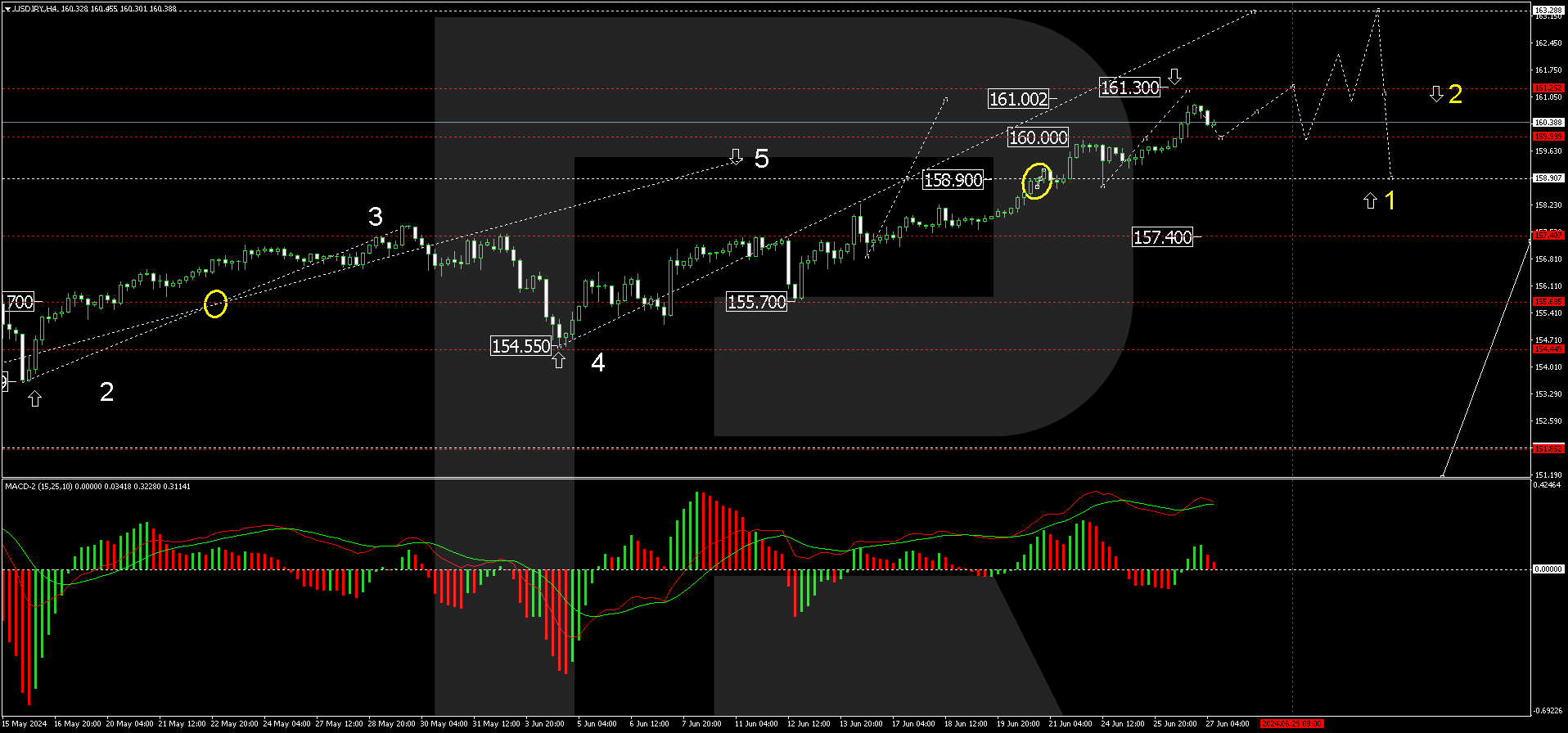
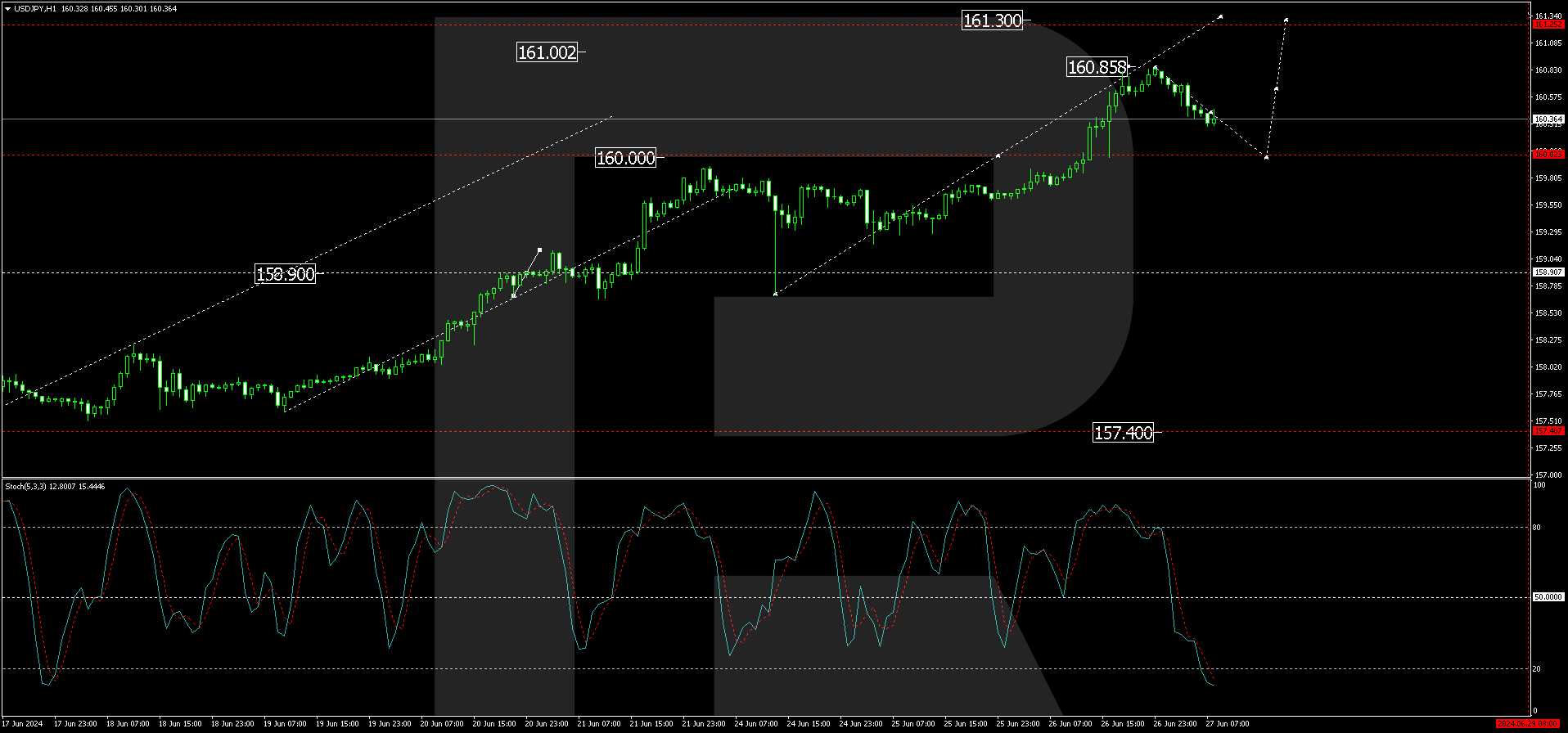
On the H4 chart, USD/JPY is currently forming a wave of decline towards 151.40. The local target of 151.86 has already been reached. The market is now correcting from the previous wave of decline and is expected to reach at least 156.00. After this correction, a new phase of decline towards 151.40 may begin. This scenario is technically supported by the MACD oscillator, whose signal line is below zero but directed upwards.

On the H1 chart, USD/JPY has formed a consolidation range around the 154.00 level, with an anticipated upward breakout leading to a correction towards 156.00. Currently, a growth link to 155.88 is forming. Following this, a potential decline back to 154.00 (testing from above) may occur before possibly rising again to 156.00. The Stochastic oscillator confirms this technical outlook, with its signal line above 80 and poised for a decline.


Disclaimer

Any forecasts contained herein are based on the author’s particular opinion. This analysis may not be treated as trading advice. RoboForex bears no responsibility for trading results based on trading recommendations and reviews contained herein.

Brent crude oil experiences modest uptick amid mixed market signals

By RoboForex Analytical Department

Brent crude oil is seeing a slight increase on Tuesday, priced around $83.57 per barrel. The market remains close to two-month lows, caught between optimism for a peaceful resolution to the Middle East conflict and concerns over crude oil inventories in the United States.

The primary focus in the stock market currently revolves around the ongoing negotiations between Israel and Hamas, facilitated by Egypt. However, these talks have hit an impasse, and there are renewed signs of conflict from both parties. Israel has expressed dissatisfaction, stating that the terms offered do not meet its demands, thereby complicating diplomatic efforts.

Despite these challenges, the ongoing conflict in the Middle East contributes to supporting energy prices due to fears of potential disruptions in raw material supplies. On the demand side, Saudi Arabia has recently increased its oil selling prices to Asian buyers, indicating an expectation of robust demand, particularly during the upcoming summer. This adjustment is often seen when a producer is confident about expanding demand, with Saudi Arabia likely counting on strong consumption from China, the world’s leading oil importer.

Brent technical analysis

On the H4 chart, Brent has achieved the local target of the growth wave at 91.50. The correction towards 82.70 is nearing completion, and we anticipate the formation of a consolidation range above this level. Should the price break upwards from this range, a new wave of growth towards $95.00 could be initiated. This bullish scenario is technically supported by the MACD indicator, which shows the signal line at the lows under the zero mark, indicating potential growth to new highs.

On the H1 chart, the structure of the fifth wave of correction to 82.70 has been formed. A consolidation range has developed above this level, and we expect a growth link to 84.44. Should this level be surpassed, it could open the potential for a growth wave to 85.70, which is the initial target. This technical outlook is corroborated by the Stochastic oscillator, with its signal line above 20 and prepared to ascend to 80.


Disclaimer

Any forecasts contained herein are based on the author’s particular opinion. This analysis may not be treated as trading advice. RoboForex bears no responsibility for trading results based on trading recommendations and reviews contained herein.

FXTM’s Wheat: Touches fresh 2024 high!

By ForexTime

  • Wheat kisses new 2024 high
  • Watch out for WASDE report on Friday
  • Bulls back in control on D1 charts
  • Key levels at 638, 629 and 615

FXTM’s new Wheat commodity is in the spotlight after hitting a fresh 2024 high on Tuesday!

Prices hit the 638 level this morning as fundamentals powered bulls.

Note: Wheat is priced per bushel. One bushel is equivalent to 60 pounds.

The soft commodity could see more action this week ahead of the highly anticipated WASDE report.

Note: WASDE is the abbreviation for The World Agricultural Supply and Demand Estimates.

This report is published by the United States Department of Agriculture (USDA).

But before we take a deep dive into the world of Wheat, here are the basics:

What is Wheat?

Wheat is a widely cultivated grain that is consumed across the world.

It is the main ingredient for many foods, ranging from bread, biscuits, cereals, and cakes among many other foods.

What does FXTM’s Wheat track

FXTM’s Wheat tracks the Chicago Soft Red Winter (SRW) futures.

This is the most actively traded wheat contract in the US and the global standard wheat benchmark in the world.

Some fun facts:

  • One of the oldest crops in the world
  • 6 classes of wheat grown across the US
  • China is the largest wheat producer
  • Russia is the biggest wheat exporter
  • Gained over 8% month-to-date

The lowdown…

Wheat prices have been appreciating in recent weeks.

The soft commodity has gained over 13% since the start of April due to worries about dry weather in key exporting countries.

A lack of rain in Russia, the world’s largest wheat supplier has fuelled concerns over global production.

The bigger picture

The world’s Wheat stockpiles have contracted over the past four years.

Russia’s war in Ukraine along with other geopolitical developments and negative weather conditions in key exporting regions have hit global wheat stocks.

This has fuelled concerns over a tightening between the supply and demand of wheat.

Why this is an important week

All eyes will be on the USDA’s World Agriculture Supply and Demand Estimate report due on Friday.

This may offer investors fresh insight into the production and stocks of key grain for 2024.

Should the report show a decline in wheat production, this could push prices higher.

Technical outlook…

Bulls have made their presence known on the daily charts, with prices flirting around the 2024 high.

Still, prices may experience a technical throwback before the uptrend resumes.

Looking at the H1 charts, prices are under pressure with 629 acting as a resistance level.

  • Sustained weakness below this point may open a path towards 615, 50 SMA, and 595.
  • Should prices push back above 629, this could trigger a move back towards 638 and the next psychological level at 650.


Forex-Time-LogoArticle by ForexTime

ForexTime Ltd (FXTM) is an award winning international online forex broker regulated by CySEC 185/12 www.forextime.com

The RBA kept all monetary policy settings. Oil rises amid the breakdown of negotiations between Israel and Hamas

By JustMarkets

At Monday’s close, the Dow Jones (US30) Index added 0.46%, while the S&P 500 (US500) Index was up 1.46%. The NASDAQ Technology Index (US100) closed positive 1.19% yesterday.

The Dollar Index stabilized above 105 on Tuesday as investors continued to assess the Federal Reserve’s monetary policy outlook in light of the central bank’s recent comments. New York Fed Chairman John Williams said decisions on interest rate cuts will be made based on incoming data. At the same time, Federal Reserve Bank of Richmond Chairman Thomas Barkin expressed confidence that inflation will fall to 2% as the full effect of a rate hike materializes. Markets estimate the odds of a 25 bps rate cut at 10% at the June 12 FOMC meeting and 34% at the July 31 meeting.

Equity markets in Europe were mostly up. Germany’s DAX (DE40) rose by 0.96%, France’s CAC 40 (FR40) closed 0.49% higher, Spain’s IBEX 35 (ES35) added 0.58%, and the UK’s FTSE 100 (UK100) was not trading yesterday.

ECB Chief Economist Lane said the latest Eurozone data gives him confidence that inflation is returning to the ECB’s 2% target, raising the likelihood of a first interest rate cut in June. ECB Governing Council spokesman Simkus said he expects the ECB to cut interest rates three times this year, starting with a planned move in June. These are strengthening factors for European indices.

WTI crude oil prices rose to $79 a barrel on Tuesday, extending gains from the previous session, as ceasefire talks between Israel and Hamas appeared to have stalled. Hamas agreed to the mediators’ ceasefire proposal on Monday, but Israel said the terms did not meet its demands. The ongoing conflict in the Middle East has supported oil prices amid concerns it could disrupt crude supplies from the region. On the demand side, Saudi Arabia raised official selling prices for its crude oil sold to Asia, Northwest Europe, and the Mediterranean in June amid forecasts of strong oil demand this summer.

Asian markets were mostly rising on Monday. Japan’s Nikkei 225 (JP225) was not trading yesterday, China’s FTSE China A50 (CHA50) added 1.50% for the day, Hong Kong’s Hang Seng (HK50) was up 0.55% for the day and Australia’s ASX 200 (AU200) was positive 0.70%.

Hong Kong stocks fell to 18,480 in morning deals on Thursday, falling for the first time in 11 sessions due to losses in most sectors, particularly technology, consumer discretionary, and financials. Traders profited after the Hang Seng Index hit its highest level in 8 months. Vigilance was also heightened ahead of several key data releases from China this week, including April trade and inflation data.

As expected, the Reserve Bank of Australia (RBA) left the money rate unchanged at 4.35% at its May meeting. The central bank kept borrowing costs unchanged for the fourth consecutive meeting, acknowledging that the return of inflation to target is unlikely to be smooth. The Council added that it needs to make sure prices move towards the 2-3% range while remaining vigilant on upside risks and reiterated that it would neither rule in nor rule out anything as it would rely on data and risk assessment. In doing so, the RBA will keep an eye on the global economy, domestic demand trends, and the inflation and labor market outlook. The ASX 200 (AU200) hit a one-month high on the back of the decision.

S&P 500 (US500) 5,180.74 +52.95 (+1.03%)

Dow Jones (US30) 38,852.27 +176.59 (+0.46%)

DAX (DE40) 18,175.21 +173.61 (+0.96%)

FTSE 100 (UK100) 8,213.49  +41.34 (+0.51%)

USD Index 105.11 +0.08 (+0.07%)

Important events today:
  • – Japan Services PMI (m/m) at 03:30 (GMT+3);
  • – Australia RBA Interest Rate Decision at 07:30 (GMT+3);
  • – Australia RBA Monetary Policy Report at 07:30 (GMT+3);
  • – German Trade Balance (m/m) at 09:00 (GMT+3);
  • – UK Services PMI (m/m) at 11:30 (GMT+3);
  • – Canada Ivey PMI (m/m) at 17:00 (GMT+3).

By JustMarkets


This article reflects a personal opinion and should not be interpreted as an investment advice, and/or offer, and/or a persistent request for carrying out financial transactions, and/or a guarantee, and/or a forecast of future events.

Investors expect a hawkish stance from the RBA. Natural gas prices returned to growth

By JustMarkets 

On Friday, the Dow Jones (US30) was up 1.18% (for the week +1.03%), while the S&P 500 (US500) was up 1.26% (for the week +0.27%). The NASDAQ Technology Index (US100) closed positive 1.99% (for the week +0.93%). The US stocks rose thanks to a weaker-than-expected April employment report, which increased expectations of a Federal Reserve interest rate cut in September.

The US jobs report recorded a 175,000 increase in Non-farm payroll employment for April, compared to the consensus forecast of 240,000, while March data was revised slightly upward to 315,000 from 303,000. In the household survey, the unemployment rate rose to 3.9% from 3.8%, with a slight increase in employment. Average hourly earnings rose 0/2% for the month, slightly below expectations of 0.3%, with year-over-year growth slowing to 3.9% from 4.1%. The data suggests the labor market is cooling, and wage pressures are slowing. According to economists, given the current situation, the US Fed will likely start cutting rates in September.

Canada’s services PMI for April 2024 came in at 49.3, up from March’s 46.4. This is the highest reading since June but is still indicative of contraction. The slower decline in activity is partly due to a stabilization in new orders. The latest data showed no change in new work, ending eight months of contraction.

Equity markets in Europe were mostly up on Friday. The German DAX (DE40) rose by 0.59% (for the week +0.45%), the French CAC 40 (FR40) closed Friday up 0.54% (for the week -1.42%), the Spanish IBEX 35 (ES35) declined 0.16% (for the week -1.72%), the British FTSE 100 (UK100) closed positive 0.51% (for the week +0.90%).

The S&P Global UK Services PMI for April 2024 jumped to 55 from 53.1 the previous month, indicating a sixth consecutive period of growth at the sharpest pace in over a year. Service providers saw a sharp increase in new orders amid changing economic conditions for clients. Combined with a decline in work backlogs, business activity also increased significantly. Based on signs of recovering customer demand, upcoming marketing initiatives, and long-term expansion plans, companies remained optimistic about the outlook for business activity in the coming year.

The Eurozone unemployment rate for March 2024 was a record low of 6.5%, in line with market expectations and the previous three months. The unemployed fell by 94 thousand from the previous month to 11.087 million. Among the major Eurozone countries, Spain recorded the highest unemployment rate at 11.7%, followed by France at 7.3% and Italy at 7.2%. In contrast, Germany recorded the lowest rate of 3.2%. A year earlier, the unemployment rate was slightly higher at 6.6%.

Norges Bank (NB) kept its key interest rate unchanged at 4.5% in May 2024 for the third consecutive time, in line with market expectations, and said the rate will remain at the current level “for some time.” Norway’s central bank said monetary policy is tight enough to have a tightening effect on the economy, keeping growth low and enough to bring inflation back to target within a “reasonable time horizon.” However, policymakers noted they would be willing to hold another rate hike if monetary conditions were insufficient to bring inflation back to the bank’s target level.

The US natural gas (XNG) prices rose more than 5% to above $2.1 per mmbbl on Friday, nearing a three-month high thanks to rising exports and production cuts. Major energy giants like EQT and Chesapeake Energy have cut drilling and production, leading to a 9% decline in US gas output this year. Gas production fell to 98.1 Bcf/d in April from a record 105.5 Bcf/d in December 2023 and continued to decline in May.

Asian markets were mostly up last week. Japan’s Nikkei 225 (JP225) rose by 0.45%, China’s FTSE China A50 (CHA50) decreased by 0.25% for the week, Hong Kong’s Hang Seng (HK50) jumped by 6.57% for the week, and Australia’s ASX 200 (AU200) was positive 0.55%.

The Australian dollar holds above $0.66, which is near its strongest level in two months, as investors await the Reserve Bank of Australia’s (RBA) policy decision this week. The central bank is expected to leave interest rates unchanged, but markets are betting it will take a more hawkish stance due to recent strong domestic inflation figures. Australia’s inflation rate fell to 3.6% in the first quarter from 4.1% in the previous quarter, slowing for the fifth consecutive quarter but beating forecasts of 3.4%.

S&P 500 (US500) 5,127.79 +63.59 (+1.26%)

Dow Jones (US30) 38,675.68 +450.02 (+1.18%)

DAX (DE40) 18,001.60 +105.10 (+0.59%)

FTSE 100 (UK100) 8,213.49 +41.34 (+0.51%)

USD Index 105.08 -0.22 (-0.21%)

Important events today:
  • – China Caixin Services PMI (m/m) at 04:45 (GMT+3);
  • – Germany Services PMI (m/m) at 10:55 (GMT+3);
  • – Eurozone Services PMI (m/m) at 11:00 (GMT+3);
  • – Eurozone Producer Price Index (m/m) at 12:00 (GMT+3);
  • – SNB Board Member Jordan Speaks at 15:25 (GMT+3);
  • – US FOMC Member Barkin Speaks at 20:00 (GMT+3);
  • – US FOMC Member Williams Speaks at 20:00 (GMT+3).

By JustMarkets


This article reflects a personal opinion and should not be interpreted as an investment advice, and/or offer, and/or a persistent request for carrying out financial transactions, and/or a guarantee, and/or a forecast of future events.

Trade Of The Week: Ripple ready to create waves?

By ForexTime

  • Ripple waits on SEC response
  • Crypto ↓ 12% year-to-date
  • Rangebound on D1 timeframe
  • Key levels of interest 0.5675, 0.5350 & 0.4750
  • Breakout on the horizon?

Our focus falls on Ripple due to the legal drama with the US Securities and Exchange Commission (SEC).

This could be a big week for the crypto depending on how markets react to the SEC’s reply to the ongoing lawsuit.

But before we discuss how to take advantage of this opportunity, here are the basics:

What is Ripple?

Ripple is a money transfer network created to serve the needs of financial services.

XRPUSD is a tailored cryptocurrency to work on the Ripple network.

When was it created?

Ripple was founded in 2004 as Ripplepay but the first XRP ledger was launched in 2012.

Why should you care? 

Ripple created the XRP token with the goal of solving a real-world problem with blockchain and Cryptocurrency.

Some fun facts about XRP:

  • You can’t mine Ripple.
  • The total supply of XRP is capped at 100 billion.
  • Around 55 billion are in circulation.
  • It’s down 12% year-to-date.
  • Over 70% away from its all-time high.

The lowdown…

In December 2020, the SEC sued Ripple for selling digital tokens without registering the token.

Fast-forward to today, although these claims have been partially dismissed by the court – the SEC has asked that Ripple Labs be fined a whopping $2 billion.

This has evolved into an ongoing legal battle, creating much uncertainty over the outlook for Ripple.

The bigger picture

How this legal standoff between Ripple and SEC plays out could significantly impact Ripple’s outlook and market regulation in the wider crypto space.

The SEC must file a sealed reply brief by Monday 6th May and the redacted version (excluding sensitive information) for the public by Wednesday 8th May.

Note: In the lawsuit, the SEC proposed a $2billion fine but Ripple has countered with a much lower settlement of $10 million. 

What does this mean?

After over 3 years, the SEC vs Ripple saga could be coming to an end.

The next major step is for the court to decide on the financial penalty size with the final ruling expected between July and September 2024. 

A bright spot

Last month, Ripple announced plans to launch a stablecoin pegged 1:1 to the US dollar in 2024. 

Note: A stablecoin is a form of digital asset that can be used to make payments. 

Should this become a reality, it could boost the utility of XRP – potentially leading to higher prices. Last Friday, Ripple’s CTO David Schwartz announced that more information about the stablecoin will be presented in mid-June.

Focusing on this week…

It’s all about the SEC’s reply to the ongoing lawsuit:

  • A favorable response from the SEC may reduce the odds of a hefty fine –  potentially boosting XRP.
  • If the SEC presses on with the $2 billion fine and the court case drags on, this could hit XRP.

Looking at the technical…

XRPUSD remains choppy on the daily charts with bulls and bears locked in a fierce tug-of-war.

Support can be found at 0.4750 while resistance is at 0.6650. Still, prices seem to be pushing higher after creating a 2024 low at 0.4059 back in mid-April. However, prices are trading below the 50, 100, and 200-day SMA. 

  • A solid breakout and daily close above 0.5675 could inspire a move toward the 200-day SMA and 0.6650.
  • Should prices slip back below 0.5350 could trigger a decline towards 0.4750. 


Forex-Time-LogoArticle by ForexTime

ForexTime Ltd (FXTM) is an award winning international online forex broker regulated by CySEC 185/12 www.forextime.com

COT Metals Charts: Speculator bets led by Gold & Steel

By InvestMacro

Here are the latest charts and statistics for the Commitment of Traders (COT) data published by the Commodities Futures Trading Commission (CFTC).

The latest COT data is updated through Tuesday April 30th and shows a quick view of how large traders (for-profit speculators and commercial entities) were positioned in the futures markets.

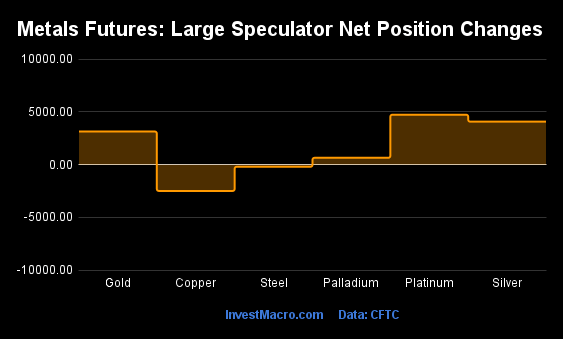
Weekly Speculator Changes led by Gold & Steel

The COT metals markets speculator bets were lower this week as two out of the six metals markets we cover had higher positioning while the other four markets had lower speculator contracts.

Leading the gains for the metals was Gold (1,319 contracts) with Steel (1,136 contracts) also recording a positive contract week.

The markets with declines in speculator bets for the week were Silver (-4,846 contracts), Palladium (-1,912 contracts), Platinum (-667 contracts) and with Copper (-330 contracts) also registering lower bets on the week.


Metals Net Speculators Leaderboard
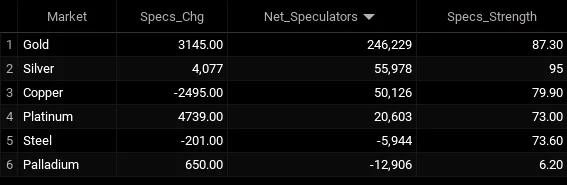
Legend: Weekly Speculators Change | Speculators Current Net Position | Speculators Strength Score compared to last 3-Years (0-100 range)


Strength Scores led by Copper & Silver

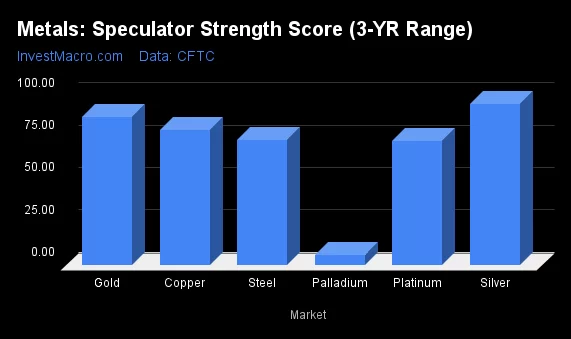
COT Strength Scores (a normalized measure of Speculator positions over a 3-Year range, from 0 to 100 where above 80 is Extreme-Bullish and below 20 is Extreme-Bearish) showed that Copper (100 percent), Silver (93 percent) and Steel (86 percent) lead the metals markets this week. Gold (68 percent) comes in as the next highest in the weekly strength scores.

On the downside, Palladium (15 percent) comes in at the lowest strength level currently and is in Extreme-Bearish territory (below 20 percent). The next lowest strength score was Platinum (36 percent).

Strength Statistics:
Gold (68.4 percent) vs Gold previous week (67.8 percent)
Silver (93.3 percent) vs Silver previous week (100.0 percent)
Copper (99.6 percent) vs Copper previous week (100.0 percent)
Platinum (36.2 percent) vs Platinum previous week (38.0 percent)
Palladium (15.0 percent) vs Palladium previous week (26.7 percent)
Steel (86.2 percent) vs Palladium previous week (81.8 percent)


Copper tops the 6-Week Strength Trends

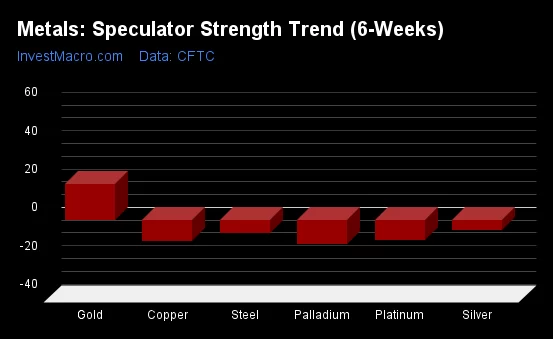
COT Strength Score Trends (or move index, calculates the 6-week changes in strength scores) showed that Copper (28 percent) leads the past six weeks trends for metals. Silver (3 percent) is the next highest positive mover in the latest trends data.

Palladium (-6 percent) leads the downside trend scores currently with Steel (-1 percent) as the next market with lower trend scores.

Move Statistics:
Gold (1.2 percent) vs Gold previous week (0.6 percent)
Silver (2.9 percent) vs Silver previous week (25.5 percent)
Copper (27.8 percent) vs Copper previous week (56.3 percent)
Platinum (1.4 percent) vs Platinum previous week (0.1 percent)
Palladium (-6.5 percent) vs Palladium previous week (8.7 percent)
Steel (-0.5 percent) vs Steel previous week (-6.0 percent)


Individual Markets:

Gold Comex Futures:
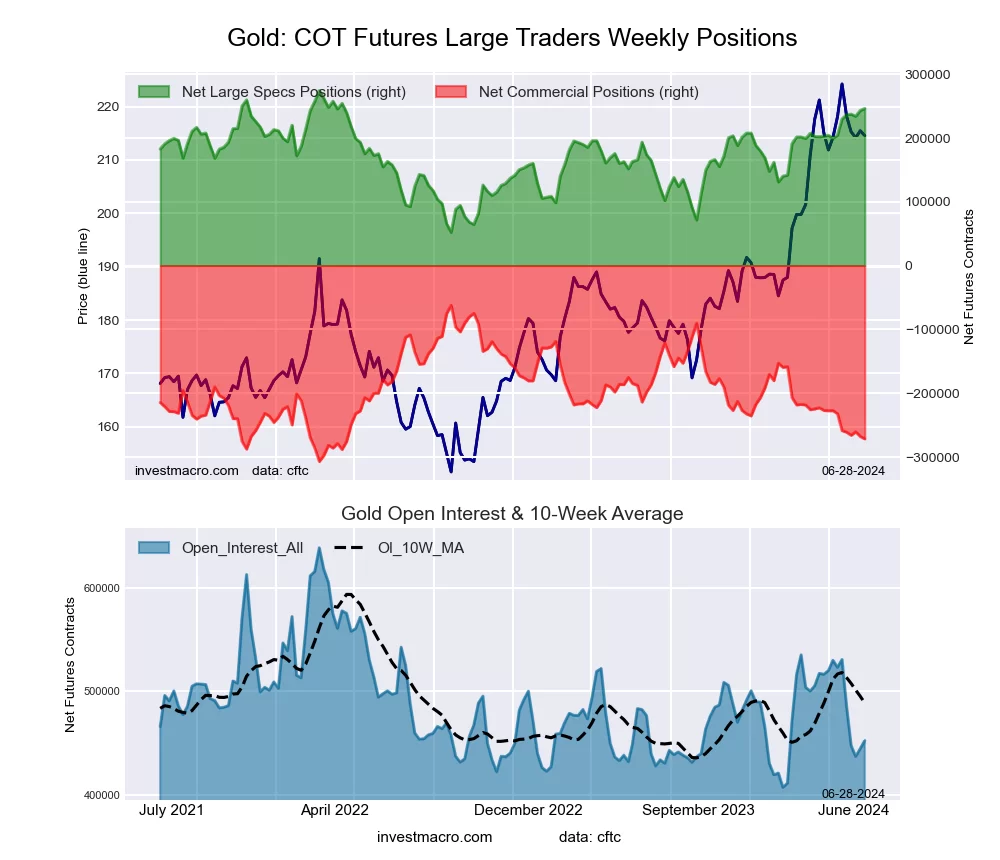
Gold Futures COT ChartThe Gold Comex Futures large speculator standing this week was a net position of 204,210 contracts in the data reported through Tuesday. This was a weekly lift of 1,319 contracts from the previous week which had a total of 202,891 net contracts.
This week’s current strength score (the trader positioning range over the past three years, measured from 0 to 100) shows the speculators are currently Bullish with a score of 68.4 percent. The commercials are Bearish with a score of 32.5 percent and the small traders (not shown in chart) are Bearish with a score of 49.0 percent.

Price Trend-Following Model: Uptrend

Our weekly trend-following model classifies the current market price position as: Uptrend. The current action for the model is considered to be: Hold – Maintain Long Position.

Gold Futures StatisticsSPECULATORSCOMMERCIALSSMALL TRADERS
– Percent of Open Interest Longs:53.624.49.7
– Percent of Open Interest Shorts:14.468.25.2
– Net Position:204,210-227,49823,288
– Gross Longs:278,850126,92550,274
– Gross Shorts:74,640354,42326,986
– Long to Short Ratio:3.7 to 10.4 to 11.9 to 1
NET POSITION TREND:
– Strength Index Score (3 Year Range Pct):68.432.549.0
– Strength Index Reading (3 Year Range):BullishBearishBearish
NET POSITION MOVEMENT INDEX:
– 6-Week Change in Strength Index:1.2-4.123.6


Silver Comex Futures:

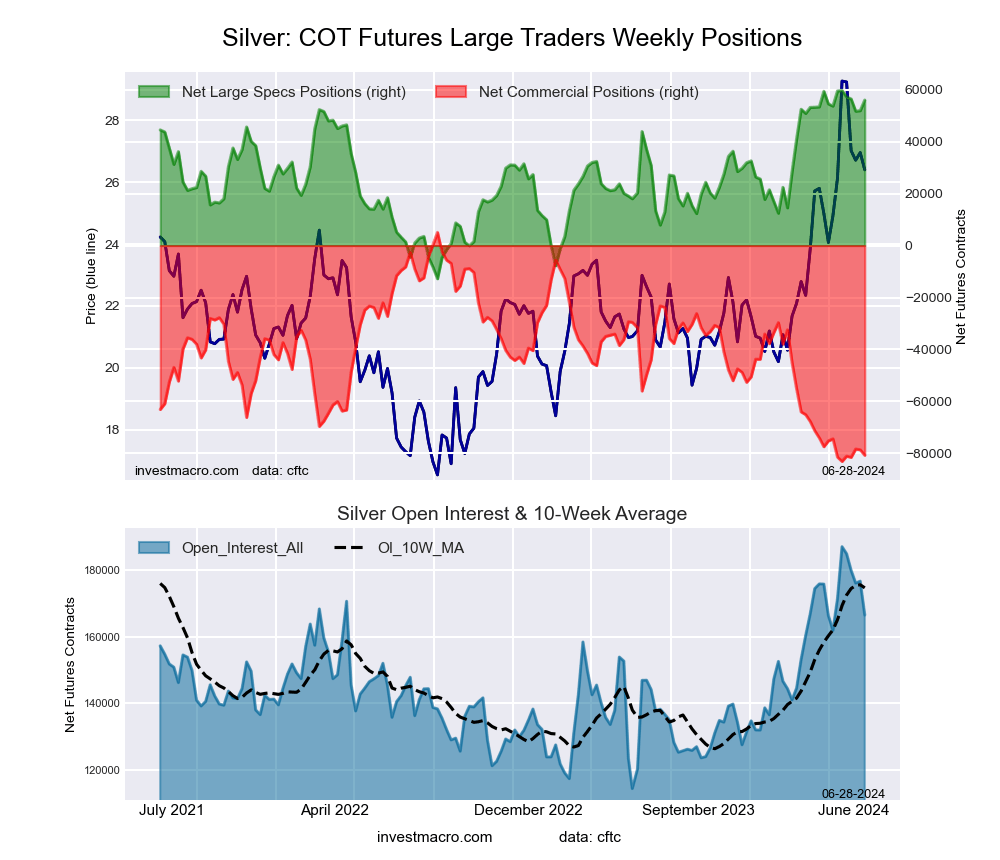
Silver Futures COT ChartThe Silver Comex Futures large speculator standing this week was a net position of 54,494 contracts in the data reported through Tuesday. This was a weekly decline of -4,846 contracts from the previous week which had a total of 59,340 net contracts.

This week’s current strength score (the trader positioning range over the past three years, measured from 0 to 100) shows the speculators are currently Bullish-Extreme with a score of 93.3 percent. The commercials are Bearish-Extreme with a score of 2.7 percent and the small traders (not shown in chart) are Bullish-Extreme with a score of 81.7 percent.

Price Trend-Following Model: Uptrend

Our weekly trend-following model classifies the current market price position as: Uptrend. The current action for the model is considered to be: Hold – Maintain Long Position.

Silver Futures StatisticsSPECULATORSCOMMERCIALSSMALL TRADERS
– Percent of Open Interest Longs:50.024.519.4
– Percent of Open Interest Shorts:17.269.77.0
– Net Position:54,494-75,19620,702
– Gross Longs:83,09440,74532,309
– Gross Shorts:28,600115,94111,607
– Long to Short Ratio:2.9 to 10.4 to 12.8 to 1
NET POSITION TREND:
– Strength Index Score (3 Year Range Pct):93.32.781.7
– Strength Index Reading (3 Year Range):Bullish-ExtremeBearish-ExtremeBullish-Extreme
NET POSITION MOVEMENT INDEX:
– 6-Week Change in Strength Index:2.9-13.651.1


Copper Grade #1 Futures:

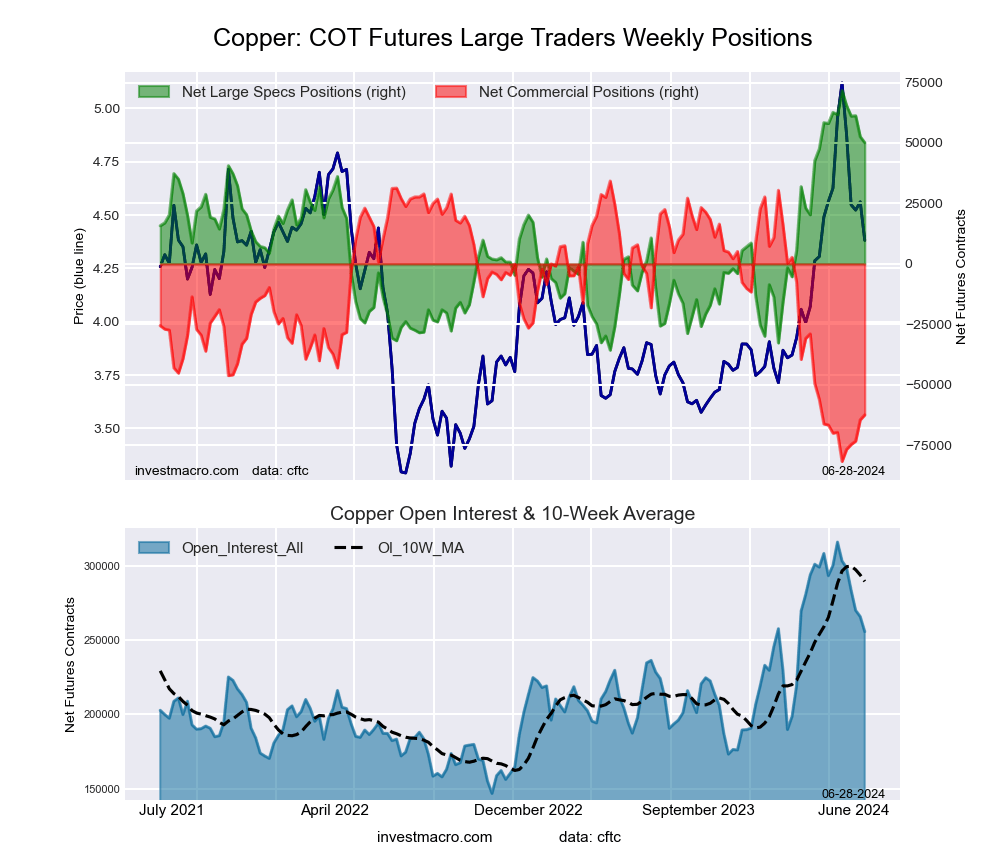
Copper Futures COT ChartThe Copper Grade #1 Futures large speculator standing this week was a net position of 58,064 contracts in the data reported through Tuesday. This was a weekly decline of -330 contracts from the previous week which had a total of 58,394 net contracts.

This week’s current strength score (the trader positioning range over the past three years, measured from 0 to 100) shows the speculators are currently Bullish-Extreme with a score of 99.6 percent. The commercials are Bearish-Extreme with a score of 0.0 percent and the small traders (not shown in chart) are Bullish with a score of 72.6 percent.

Price Trend-Following Model: Strong Uptrend

Our weekly trend-following model classifies the current market price position as: Strong Uptrend. The current action for the model is considered to be: Hold – Maintain Long Position.

Copper Futures StatisticsSPECULATORSCOMMERCIALSSMALL TRADERS
– Percent of Open Interest Longs:52.122.57.9
– Percent of Open Interest Shorts:32.345.25.0
– Net Position:58,064-66,6428,578
– Gross Longs:152,80766,10523,247
– Gross Shorts:94,743132,74714,669
– Long to Short Ratio:1.6 to 10.5 to 11.6 to 1
NET POSITION TREND:
– Strength Index Score (3 Year Range Pct):99.60.072.6
– Strength Index Reading (3 Year Range):Bullish-ExtremeBearish-ExtremeBullish
NET POSITION MOVEMENT INDEX:
– 6-Week Change in Strength Index:27.8-26.96.3


Platinum Futures:

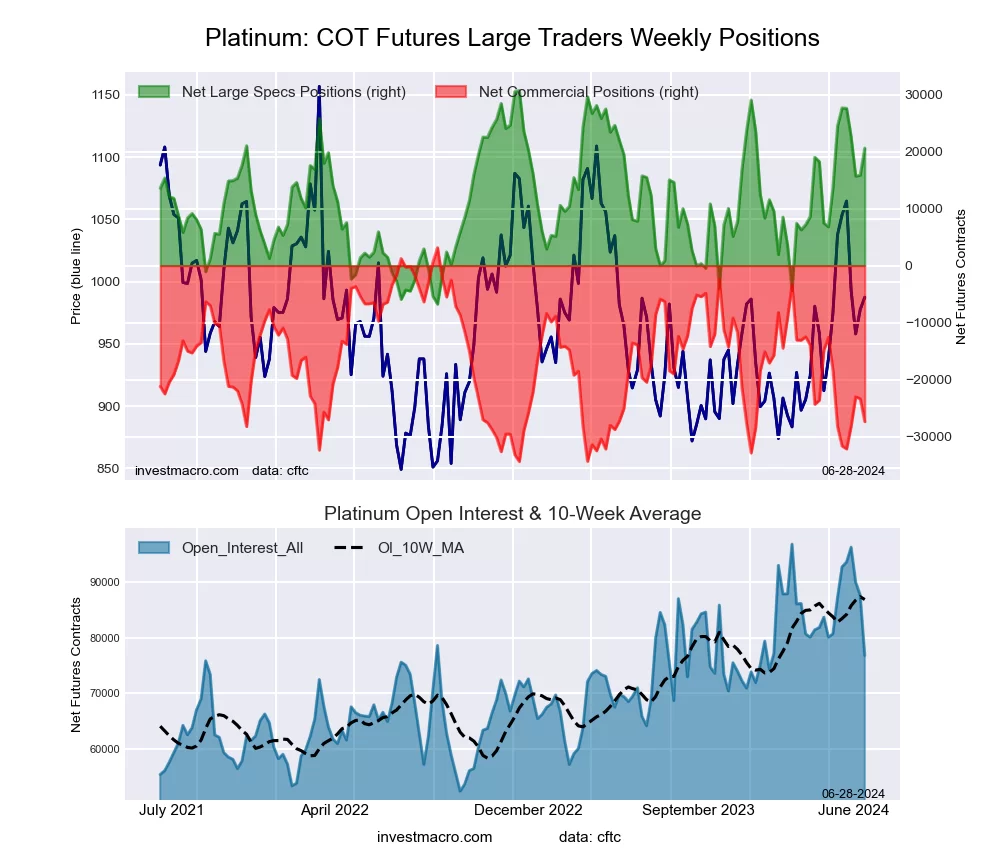
Platinum Futures COT ChartThe Platinum Futures large speculator standing this week was a net position of 6,797 contracts in the data reported through Tuesday. This was a weekly lowering of -667 contracts from the previous week which had a total of 7,464 net contracts.

This week’s current strength score (the trader positioning range over the past three years, measured from 0 to 100) shows the speculators are currently Bearish with a score of 36.2 percent. The commercials are Bullish with a score of 60.6 percent and the small traders (not shown in chart) are Bearish with a score of 45.3 percent.

Price Trend-Following Model: Weak Downtrend

Our weekly trend-following model classifies the current market price position as: Weak Downtrend. The current action for the model is considered to be: Hold – Maintain Short Position.

Platinum Futures StatisticsSPECULATORSCOMMERCIALSSMALL TRADERS
– Percent of Open Interest Longs:53.125.611.4
– Percent of Open Interest Shorts:44.641.34.2
– Net Position:6,797-12,5705,773
– Gross Longs:42,53220,5529,143
– Gross Shorts:35,73533,1223,370
– Long to Short Ratio:1.2 to 10.6 to 12.7 to 1
NET POSITION TREND:
– Strength Index Score (3 Year Range Pct):36.260.645.3
– Strength Index Reading (3 Year Range):BearishBullishBearish
NET POSITION MOVEMENT INDEX:
– 6-Week Change in Strength Index:1.41.3-13.6


Palladium Futures:

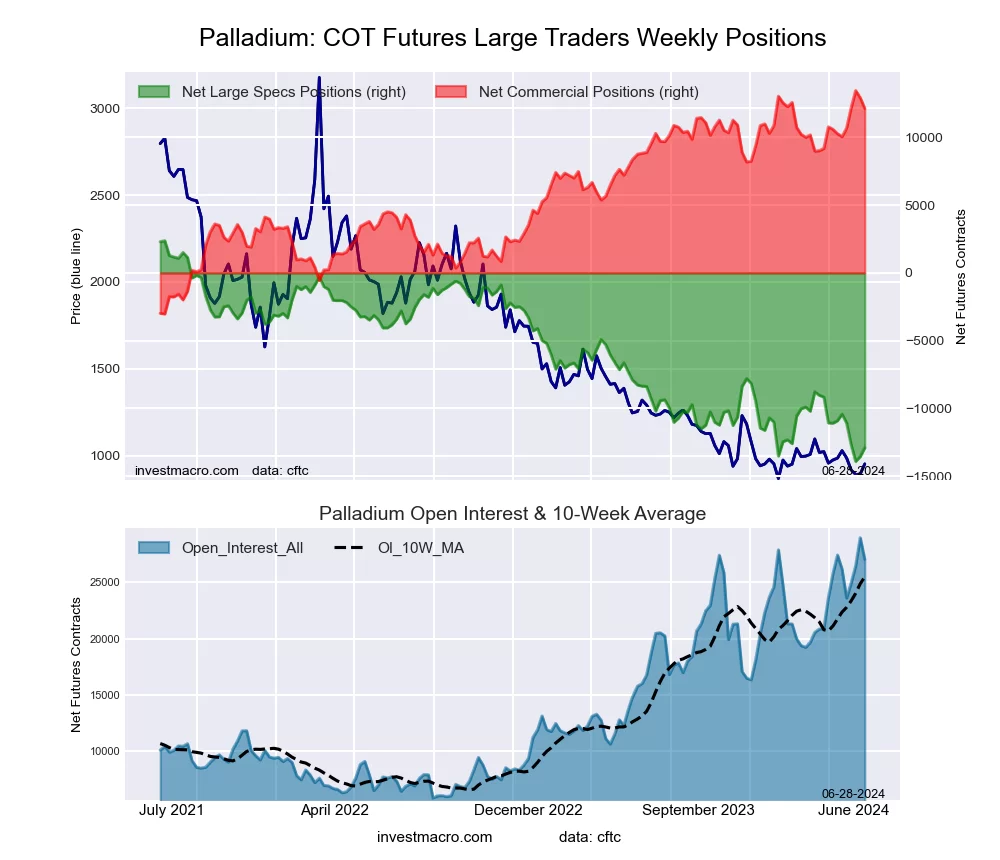
Palladium Futures COT ChartThe Palladium Futures large speculator standing this week was a net position of -11,070 contracts in the data reported through Tuesday. This was a weekly decline of -1,912 contracts from the previous week which had a total of -9,158 net contracts.

This week’s current strength score (the trader positioning range over the past three years, measured from 0 to 100) shows the speculators are currently Bearish-Extreme with a score of 15.0 percent. The commercials are Bullish-Extreme with a score of 86.5 percent and the small traders (not shown in chart) are Bullish with a score of 59.1 percent.

Price Trend-Following Model: Strong Downtrend

Our weekly trend-following model classifies the current market price position as: Strong Downtrend. The current action for the model is considered to be: Hold – Maintain Short Position.

Palladium Futures StatisticsSPECULATORSCOMMERCIALSSMALL TRADERS
– Percent of Open Interest Longs:23.056.28.5
– Percent of Open Interest Shorts:69.810.67.3
– Net Position:-11,07010,780290
– Gross Longs:5,43313,2942,011
– Gross Shorts:16,5032,5141,721
– Long to Short Ratio:0.3 to 15.3 to 11.2 to 1
NET POSITION TREND:
– Strength Index Score (3 Year Range Pct):15.086.559.1
– Strength Index Reading (3 Year Range):Bearish-ExtremeBullish-ExtremeBullish
NET POSITION MOVEMENT INDEX:
– 6-Week Change in Strength Index:-6.53.330.3


Steel Futures Futures:

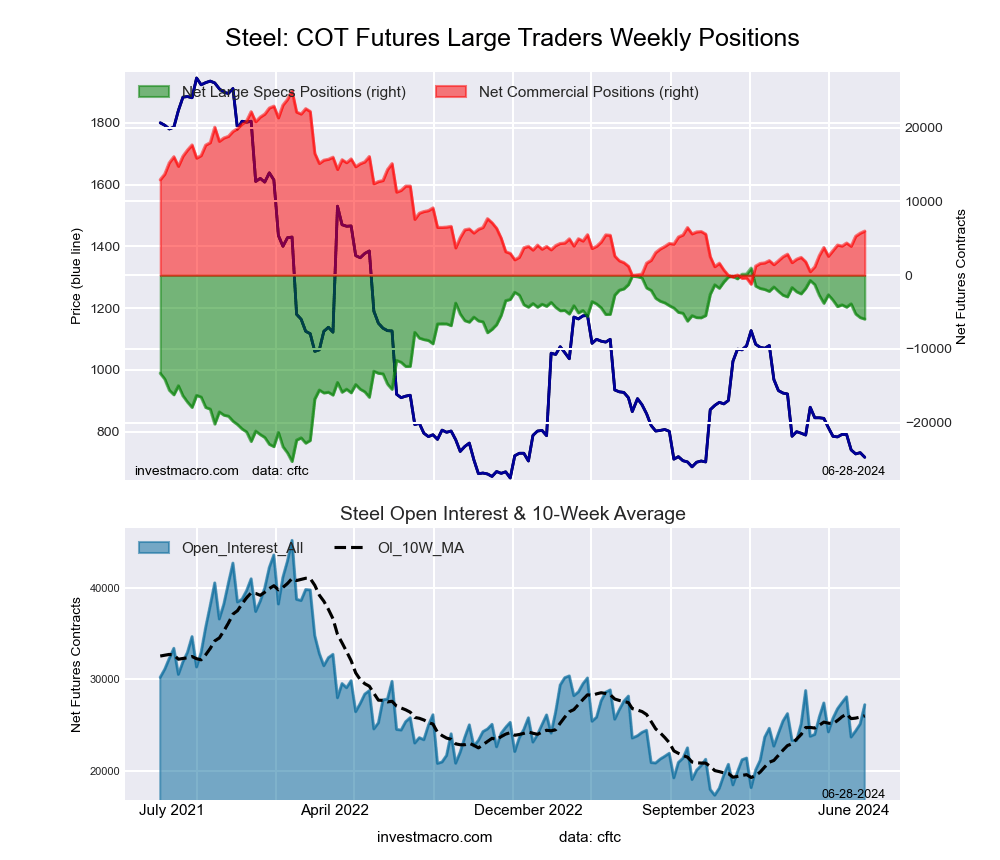
Steel Futures COT ChartThe Steel Futures large speculator standing this week was a net position of -2,663 contracts in the data reported through Tuesday. This was a weekly increase of 1,136 contracts from the previous week which had a total of -3,799 net contracts.

This week’s current strength score (the trader positioning range over the past three years, measured from 0 to 100) shows the speculators are currently Bullish-Extreme with a score of 86.2 percent. The commercials are Bearish-Extreme with a score of 14.4 percent and the small traders (not shown in chart) are Bearish with a score of 42.5 percent.

Price Trend-Following Model: Downtrend

Our weekly trend-following model classifies the current market price position as: Downtrend. The current action for the model is considered to be: Hold – Maintain Short Position.

Steel Futures StatisticsSPECULATORSCOMMERCIALSSMALL TRADERS
– Percent of Open Interest Longs:15.080.31.5
– Percent of Open Interest Shorts:25.969.71.1
– Net Position:-2,6632,57192
– Gross Longs:3,62919,477357
– Gross Shorts:6,29216,906265
– Long to Short Ratio:0.6 to 11.2 to 11.3 to 1
NET POSITION TREND:
– Strength Index Score (3 Year Range Pct):86.214.442.5
– Strength Index Reading (3 Year Range):Bullish-ExtremeBearish-ExtremeBearish
NET POSITION MOVEMENT INDEX:
– 6-Week Change in Strength Index:-0.50.6-1.9


Article By InvestMacroReceive our weekly COT Newsletter

*COT Report: The COT data, released weekly to the public each Friday, is updated through the most recent Tuesday (data is 3 days old) and shows a quick view of how large speculators or non-commercials (for-profit traders) were positioned in the futures markets.

The CFTC categorizes trader positions according to commercial hedgers (traders who use futures contracts for hedging as part of the business), non-commercials (large traders who speculate to realize trading profits) and nonreportable traders (usually small traders/speculators) as well as their open interest (contracts open in the market at time of reporting). See CFTC criteria here.