Archive for Financial News – Page 131

Trade of the Week: CHINAH to extend lead as Asia’s winner?

By ForexTime 

  • CHINAH overtakes JP225 in year-to-date gains
  • Earnings from Tencent, Meituan, Alibaba etc. may cause CHINAH to climb/fall
  • Traders also watching China rate decision and US CPI
  • CHINAH at risk of technical pullback, despite bullish “golden cross”
  • CHINAH forecasted to climb another 15.3% over next 12 months


There’s a new winner among FXTM’s Asian stock indices!

The CHINAH stock index has now overtaken the JP225 index, with the latter previously holding the most year-to-date gains among major stock indices worldwide throughout Q1 (January-March) 2024.

However, CHINAH has been on a tear, climbing as much as 19.75% since that mid-April trough.

NOTE: FXTM’s CHINAH stock index mirrors the performance of the underlying Hang Seng China Enterprises index.
It tracks 50 of the largest and most liquid stocks from Mainland China that are listed in Hong Kong.


Following the surge in recent weeks, CHINAH is now trading at its highest levels since August 2023.


For reference, here’s the current year-to-date standings among FXTM’s Asian stock indices:

  • CHINAH: +17.2%
  • JP225: +14.1%
  • TWN: +13.1%
  • HK50: +12.1%
  • CN50: +9.9%
  • SG20: +6.7%


Why are China’s stock markets climbing?

Chinese stocks have been boosted by hopes that the government is stepping in to support the economy.

Much has already been made about how China, the world’s second-largest economy, have faltered in its post-pandemic recovery, lagging behind other major economies.

China’s sluggish economic performance in turn weighed down its stock markets, with the Hang Seng China Enterprises index posting 4 consecutive years of declines!

But now, with Beijing’s boosters on the way, such optimism is in turn fuelling a recovery in Chinese stock indices.

Just today (Monday, May 13th), China’s Ministry of Finance announced the sale of about 1 trillion yuan (about US$138 billion) in government bonds, beginning this Friday (May 17th) through November.

The 1 trillion yuan raised from this bond sales – only the 4th of its kind in 26 years – will be used to support China’s economic growth.

The news is sending CHINAH 0.6% higher today!


What could move CHINAH higher/lower this week?


1) Chinese stocks’ earnings: May 14th – 16th

8 of the CHINAH stock index’s 50 members are due to report their respective quarterly earnings this week.

This lineup includes 3 of the 4 biggest members of the Hang Seng China Enterprises index, namely Tencent, Meituan, and Alibaba.

These 8 reporting companies combined account for 30% of the entire CHINAH stock index!

Hence, the market’s overall reaction to these upcoming earnings announcements, either positive or negative, could move the broader stock index up/down as well.


2) China policy rate: Wednesday, May 15th

The People’s Bank of China (PBoC) is expected to maintain its one-year medium-term lending facility (MLF) rate unchanged at 2.5%.

Although the Chinese economy could do with even more support, from both the government (fiscal policy) as well as the central bank (monetary policy), the PBoC may want to hold off on lowering this rate so as not to further weaken the Chinese Yuan currency.

In the unlikely event of a surprise rate cut by the PBoC this week, that’s likely to jolt the CHINAH stock index even higher!


3) US April consumer price index (CPI): Wednesday, May 15th

The consumer price index (CPI) is a widely used gauge to measure a country’s inflation rate.

The US CPI is one of the most closely-watched economic data that could rock financial assets around the world, including FX markets, gold, and stock indexes!

After all, the world’s most-important central bank, the US Federal Reserve, currently finds itself in an ongoing battle in slowing down still-stubborn inflation in the world’s largest economy.


Here are the forecasts from economists for this week’s US CPI prints

  • CPI month-on-month (April 2024 vs. March 2024): 0.4%
    If so, that would match March’s 0.4% month-on-month figure
  • CPI year-on-year (April 2024 vs. April 2023): 3.4%
    If so, that would be slightly lower than March’s 3.5% year-on-year figure
  • Core CPI (excluding food and energy prices) month-on-month: 0.3%
    If so, that would be slightly lower than March’s 0.4% month-on-month figure
  • Core CPI year-on-year: 3.6%
    If so, that would be lower than March’s 3.8% year-on-year figure

Higher-than-expected CPI figures may drag down stock indexes around the world, including the CHINAH (and vice versa).


Key levels this week

POTENTIAL RESISTANCE:

  • 6877: cycle high from mid-June 2023
  • 7000: psychologically-important level


POTENTIAL SUPPORT:

  • 6417.9: May 8th intraday low (recent technical pullback)
  • 6200: psychological round number; April 30th closing price; 21-day simple moving average


Beware of potential technical pullback

Note that the 14-day relative strength index (RSI) is already above the 70 level which marks “overbought” territory.

Hence, from a technical perspective, a slight pullback may be in order.

However, once CHINAH can clear some of the froth from its recent ascent, this stock index may well resume its uptrend, provided that this week’s fundamental events do support the upside scenario.


“Golden cross” offers technical bullish signal?

Looking at first chart above, the CHINAH recently formed a “golden cross”.

A “golden cross” is a technical pattern when an asset’s 50-day simple moving average (SMA) crosses above its 200-day counterpart.

A “golden cross” is often used as a technical sign that the asset’s prices can climb further: a “bullish” signal.


However, recent “golden crosses” had produced mixed results:

  • Late January 2023

The last time that the Hang Seng China Enterprises index formed a “golden cross”, it didn’t go as planned.

This stock index fell by 36.4% in the 12 months (January 2023 until January 2024) after the last “golden cross” was formed.


  • Late-November 2020

Still, the “golden cross” prior did adhere to the textbook scenario.

The Hang Seng China Enterprises index soared by 16.2% between November 2020 through February 2021.


How much higher can CHINAH go?

Analysts forecast that the Hang Seng China Enterprises index can climb by a further 15.3% and flirt with the 7800 level in 12 months from now (by May 2025).

If so, that would restore the CHINAH stock index back to its end-June 2022 peak!


However, the road back to such heights will be measured one step at a time.

This week’s events may well determine whether CHINA is firmly on the path upwards.


Forex-Time-LogoArticle by ForexTime

ForexTime Ltd (FXTM) is an award winning international online forex broker regulated by CySEC 185/12 www.forextime.com

The German index has hit an all-time high. China sees rising consumer inflation

By JustMarkets

On Friday, the Dow Jones (US30) Index gained 0.32% (for the week +1.94%), while the S&P 500 (US500) Index gained 0.16% (for the week +1.56%). The NASDAQ Technology Index (US100) closed negative 0.03% (for the week +0.82%).

On Friday, several FOMC officials gave their comments on plans. Fed Chair Michelle Bowman said that the Fed needs to maintain confidence in inflation by moving cautiously and deliberately toward our 2% target. She said the Fed needs to keep rates unchanged for a while longer. In addition, Atlanta Fed President Raphael Bostic told Reuters in an interview that he expects only one 25 bps rate cut this year, which will come at the end of the year. Dallas Fed President Lorie Logan said it was too early to consider a rate cut. Minneapolis Fed President Neel Kashkari said the Fed is waiting to see if inflation slows. He also said he did not rule out the need for another rate hike, although he noted that the bar would be high for such a decision. Chicago Fed President Austan Goolsbee, who takes a less hawkish view, said there is little evidence that inflation has stalled at 3%.

The University of Michigan’s preliminary May Consumer Sentiment Index fell 9.8 points to a 6-month low of 67.4, weaker than market expectations. At the same time, US consumers’ inflation expectations rose. The expected inflation indicator from the University of Michigan for May rose by 0.3 points to 3.5% from April’s 3.2% and was stronger than expectations of an unchanged 3.2%. In addition, the May 5–10-year inflation expectations indicator rose to 3.1% from April’s 3.0%.

Equity markets in Europe were mostly up on Friday. The German DAX (DE40) rose by 0.46% (for the week +4.29%), the French CAC 40 (FR40) closed Friday up 0.38% (for the week +3.05%), the Spanish IBEX 35 (ES35) added 0.50% (for the week +2.09%), the British FTSE 100 (UK100) closed positive 0.63% (for the week +3.20%).

The DAX (DE40) index gained nearly 0.5% on Friday to close at a record high of 18,773, extending its weekly gain to 4.3% as investors remain optimistic that major central banks will soon begin cutting interest rates. Minutes from the ECB’s latest meeting coincided with the current view that the Central Bank should cut rates in June as the cycle’s governor agreed that inflation is approaching the target faster. Positive corporate developments also boosted sentiment. Siemens shares jumped by 2.3%, closing at an all-time high among the leaders.

WTI crude oil prices fell below $78 a barrel on Monday, extending losses from the previous session as uncertainty over demand pressured the market. Oil prices fell more than 1% on Friday as US Federal Reserve officials signaled that interest rates could remain elevated for a long time, dampening growth and fuel demand in the world’s top oil consumer. Meanwhile, investors are looking ahead to the upcoming OPEC meeting in early June, where the group is expected to extend supply cuts for the year’s second half.

Asian markets were mostly up last week. Japan’s Nikkei 225 (JP225) rose by 0.59%, China’s FTSE China A50 (CHA50) lost 0.32% for the week, Hong Kong’s Hang Seng (HK50) gained 2.57% for the week, and Australia’s ASX 200 (AU200) was positive 1.57%.

China’s annualized inflation rate for April 2024 rose to 0.3% compared to market estimates and March’s 0.1%. This was the third consecutive month of rising consumer inflation amid a continued recovery in domestic demand despite a fragile economic recovery. On the other hand, producer prices in China fell to 2.5% y/y in April 2024, compared to market forecasts of a 2.3% y/y drop following a 2.8% y/y decline in March. The figure marked the 19th consecutive month of factory price declines, underscoring continued economic uncertainty despite numerous support measures from the government. The offshore yuan depreciated around 7.24 per dollar, reacting to key economic data from China.

The NAB Australia Business Confidence Index for April 2024 stood at 1, unchanged for the second consecutive month and below its long-term average. Weak sentiment in retail, wholesale trade, and mining offset leisure and personal services, construction, and manufacturing improvements.

S&P 500 (US500) 5,222.68 +8.60 (+0.16%)

Dow Jones (US30) 39,512.84 +125.08 (+0.32%)

DAX (DE40) 18,772.85 +86.25 (+0.46%)

FTSE 100 (UK100) 8,433.76 +52.41 (+0.63%)

USD Index 105.31 +0.09 (+0.09%)

Important events today:
  • – Australia NAB Business Confidence (m/m) at 04:30 (GMT+3);
  • – New Zealand Inflation Expectations (m/m) at 06:00 (GMT+3);
  • – Canada Building Permits (m/m) at 15:30 (GMT+3);
  • – US FOMC Member Mester Speaks at 16:00 (GMT+3);
  • – Switzerland SNB Chairman Thomas Jordan speaks at 19:45 (GMT+3).

By JustMarkets


This article reflects a personal opinion and should not be interpreted as an investment advice, and/or offer, and/or a persistent request for carrying out financial transactions, and/or a guarantee, and/or a forecast of future events.

Brent crude oil faces downward pressure amid demand uncertainties

By RoboForex Analytical Department

The price of Brent crude oil is currently experiencing a downturn, trading around 82.55 USD per barrel this Monday. The primary concern affecting the market today is the uncertainty surrounding demand levels, exerting significant pressure on the commodity.

Recent statements from representatives of the US Federal Reserve have led to expectations that interest rates may remain elevated for an extended period. This prospect of sustained high rates is likely to dampen economic growth, which could, in turn, negatively impact fuel demand from American consumers. The likelihood that the Fed will maintain current lending rates throughout the year is considered relatively high.

Additionally, data released on Friday showed a marked decline in US consumer confidence, reinforcing concerns that the economy might be losing its growth momentum. As we approach the summer season, traditionally a peak period for fuel consumption, the latest reports indicate rising stocks of petrol and distillates in the US. However, demand appears lacklustre, contradicting typical seasonal trends.

The next OPEC meeting is scheduled for early June. The group is expected to extend its production quotas into the second half of the year, a decision that could further impact oil price movements.

Brent technical analysis

The Brent H4 chart’s initial growth impulse to 84.24 has been completed, and the subsequent correction wave nearing 82.02 is almost finished. We anticipate the formation of a consolidation range above this level. If the price breaks upwards from this range, a growth to the level of 85.00 is expected, potentially extending to 88.00. This bullish scenario is technically supported by the MACD indicator, whose signal line is below zero but pointing upwards from the lows.

On the H1 chart, after completing the growth structure to 84.24, the market has finalised its correction at 82.02. A consolidation range above this level is expected to form. A breakout upwards from this range could initiate a new growth wave towards 85.00. The Stochastic oscillator corroborates this potential upward movement, with its signal line currently above 20 and aiming towards 80, suggesting a bullish momentum could be building.

Disclaimer

Any forecasts contained herein are based on the author’s particular opinion. This analysis may not be treated as trading advice. RoboForex bears no responsibility for trading results based on trading recommendations and reviews contained herein.

COT Metals Charts: Speculator bets led by Platinum & Copper

By InvestMacro

Here are the latest charts and statistics for the Commitment of Traders (COT) data published by the Commodities Futures Trading Commission (CFTC).

The latest COT data is updated through Tuesday May 7th and shows a quick view of how large traders (for-profit speculators and commercial entities) were positioned in the futures markets.

Weekly Speculator Changes led by Platinum & Copper

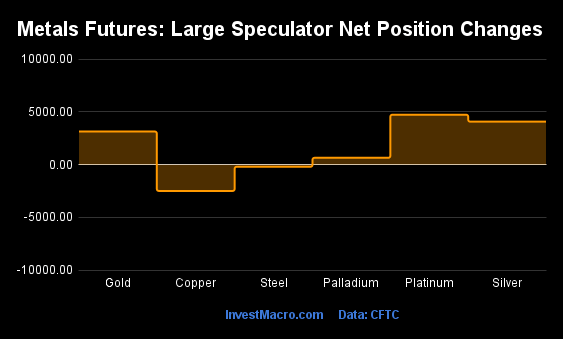
The COT metals markets speculator bets were lower this week as just two out of the six metals markets we cover had higher positioning while the other four markets had lower speculator contracts.

Leading the gains for the metals was Platinum (6,863 contracts) with Copper (4,584 contracts) also showing a positive week.

The markets with declines in speculator bets for the week were Gold (-4,643 contracts), Silver (-842 contracts), Steel (-720 contracts) and with Palladium (-18 contracts) also registering lower bets on the week.


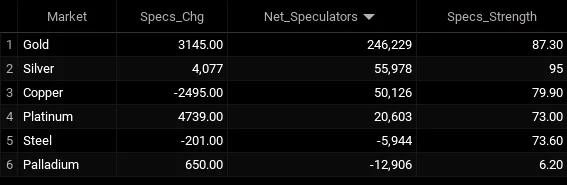
Metals Net Speculators Leaderboard

Legend: Weekly Speculators Change | Speculators Current Net Position | Speculators Strength Score compared to last 3-Years (0-100 range)


Strength Scores led by Copper & Silver

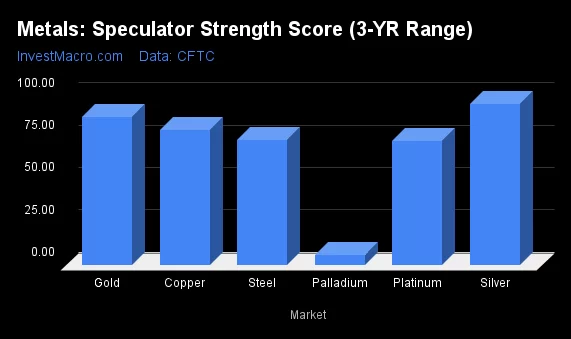
COT Strength Scores (a normalized measure of Speculator positions over a 3-Year range, from 0 to 100 where above 80 is Extreme-Bullish and below 20 is Extreme-Bearish) showed that Copper (100 percent) and Silver (92 percent) lead the metals markets this week.

On the downside, Palladium (15 percent) comes in at the lowest strength level currently and is in Extreme-Bearish territory (below 20 percent).

Strength Statistics:
Gold (66.3 percent) vs Gold previous week (68.4 percent)
Silver (92.1 percent) vs Silver previous week (93.3 percent)
Copper (100.0 percent) vs Copper previous week (95.3 percent)
Platinum (54.5 percent) vs Platinum previous week (36.2 percent)
Palladium (15.1 percent) vs Palladium previous week (15.2 percent)
Steel (83.4 percent) vs Palladium previous week (86.2 percent)


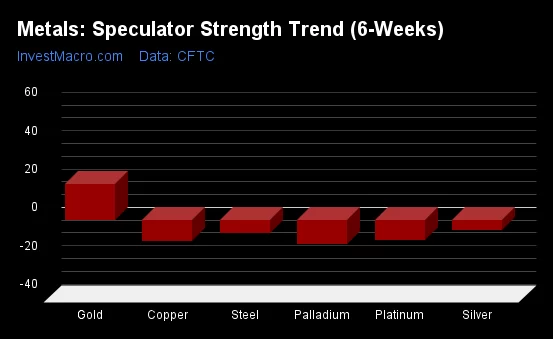
Copper & Platinum top the 6-Week Strength Trends

COT Strength Score Trends (or move index, calculates the 6-week changes in strength scores) showed that Copper (40 percent) and Platinum (17 percent) lead the past six weeks trends for metals.

Palladium (-7 percent) leads the downside trend scores currently with Steel (-6 percent) as the next market with lower trend scores.

Move Statistics:
Gold (0.1 percent) vs Gold previous week (1.2 percent)
Silver (3.9 percent) vs Silver previous week (2.9 percent)
Copper (40.2 percent) vs Copper previous week (26.6 percent)
Platinum (17.3 percent) vs Platinum previous week (1.4 percent)
Palladium (-7.4 percent) vs Palladium previous week (-6.5 percent)
Steel (-6.1 percent) vs Steel previous week (-0.5 percent)


Individual Markets:

Gold Comex Futures:

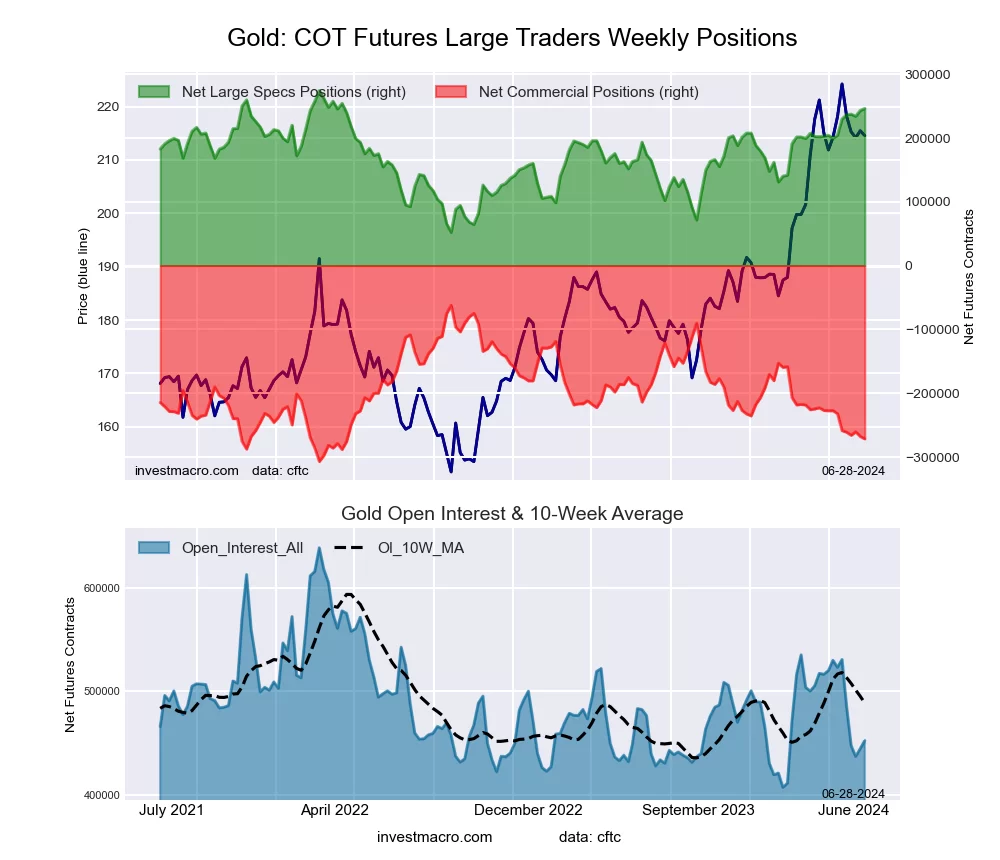
Gold Futures COT ChartThe Gold Comex Futures large speculator standing this week came in at a net position of 199,567 contracts in the data reported through Tuesday. This was a weekly fall of -4,643 contracts from the previous week which had a total of 204,210 net contracts.

This week’s current strength score (the trader positioning range over the past three years, measured from 0 to 100) shows the speculators are currently Bullish with a score of 66.3 percent. The commercials are Bearish with a score of 32.5 percent and the small traders (not shown in chart) are Bullish with a score of 63.1 percent.

Price Trend-Following Model: Strong Uptrend

Our weekly trend-following model classifies the current market price position as: Strong Uptrend. The current action for the model is considered to be: Hold – Maintain Long Position.

Gold Futures StatisticsSPECULATORSCOMMERCIALSSMALL TRADERS
– Percent of Open Interest Longs:51.423.610.3
– Percent of Open Interest Shorts:13.766.55.1
– Net Position:199,567-227,26627,699
– Gross Longs:272,144124,89954,701
– Gross Shorts:72,577352,16527,002
– Long to Short Ratio:3.7 to 10.4 to 12.0 to 1
NET POSITION TREND:
– Strength Index Score (3 Year Range Pct):66.332.563.1
– Strength Index Reading (3 Year Range):BullishBearishBullish
NET POSITION MOVEMENT INDEX:
– 6-Week Change in Strength Index:0.1-3.627.8


Silver Comex Futures:

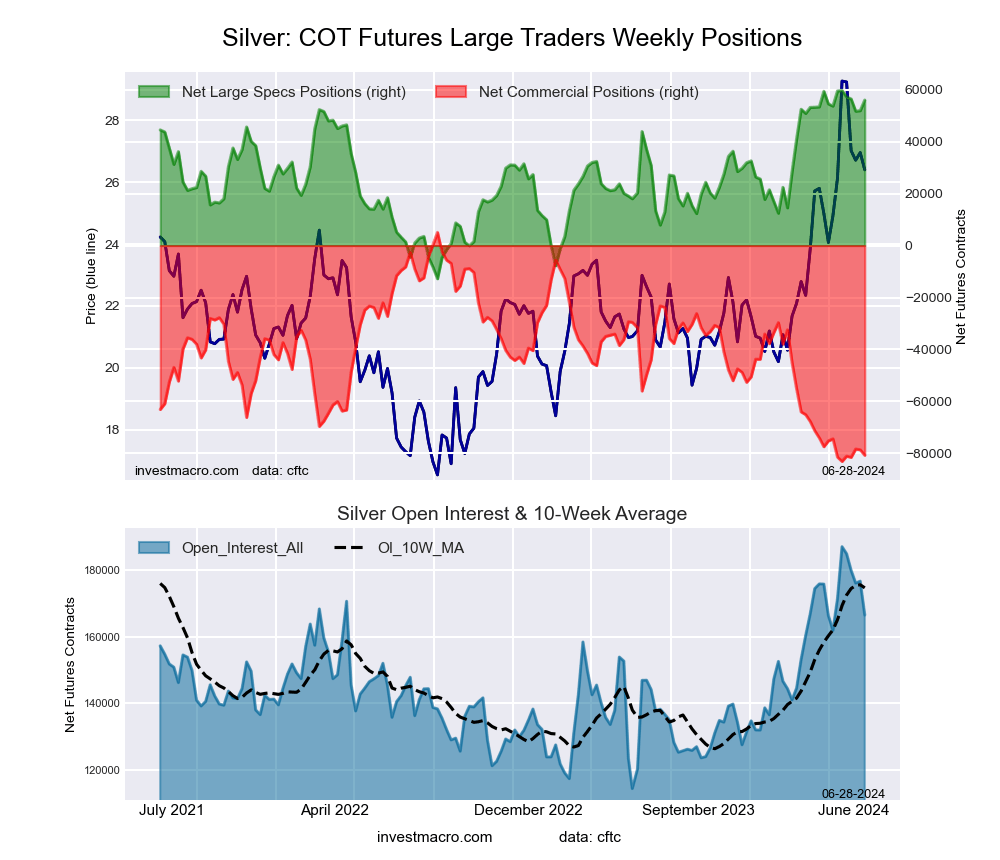
Silver Futures COT ChartThe Silver Comex Futures large speculator standing this week came in at a net position of 53,652 contracts in the data reported through Tuesday. This was a weekly lowering of -842 contracts from the previous week which had a total of 54,494 net contracts.

This week’s current strength score (the trader positioning range over the past three years, measured from 0 to 100) shows the speculators are currently Bullish-Extreme with a score of 92.1 percent. The commercials are Bearish-Extreme with a score of 3.6 percent and the small traders (not shown in chart) are Bullish-Extreme with a score of 82.1 percent.

Price Trend-Following Model: Strong Uptrend

Our weekly trend-following model classifies the current market price position as: Strong Uptrend. The current action for the model is considered to be: Hold – Maintain Long Position.

Silver Futures StatisticsSPECULATORSCOMMERCIALSSMALL TRADERS
– Percent of Open Interest Longs:50.424.220.0
– Percent of Open Interest Shorts:17.370.27.2
– Net Position:53,652-74,41520,763
– Gross Longs:81,65039,22532,441
– Gross Shorts:27,998113,64011,678
– Long to Short Ratio:2.9 to 10.3 to 12.8 to 1
NET POSITION TREND:
– Strength Index Score (3 Year Range Pct):92.13.682.1
– Strength Index Reading (3 Year Range):Bullish-ExtremeBearish-ExtremeBullish-Extreme
NET POSITION MOVEMENT INDEX:
– 6-Week Change in Strength Index:3.9-11.336.5


Copper Grade #1 Futures:

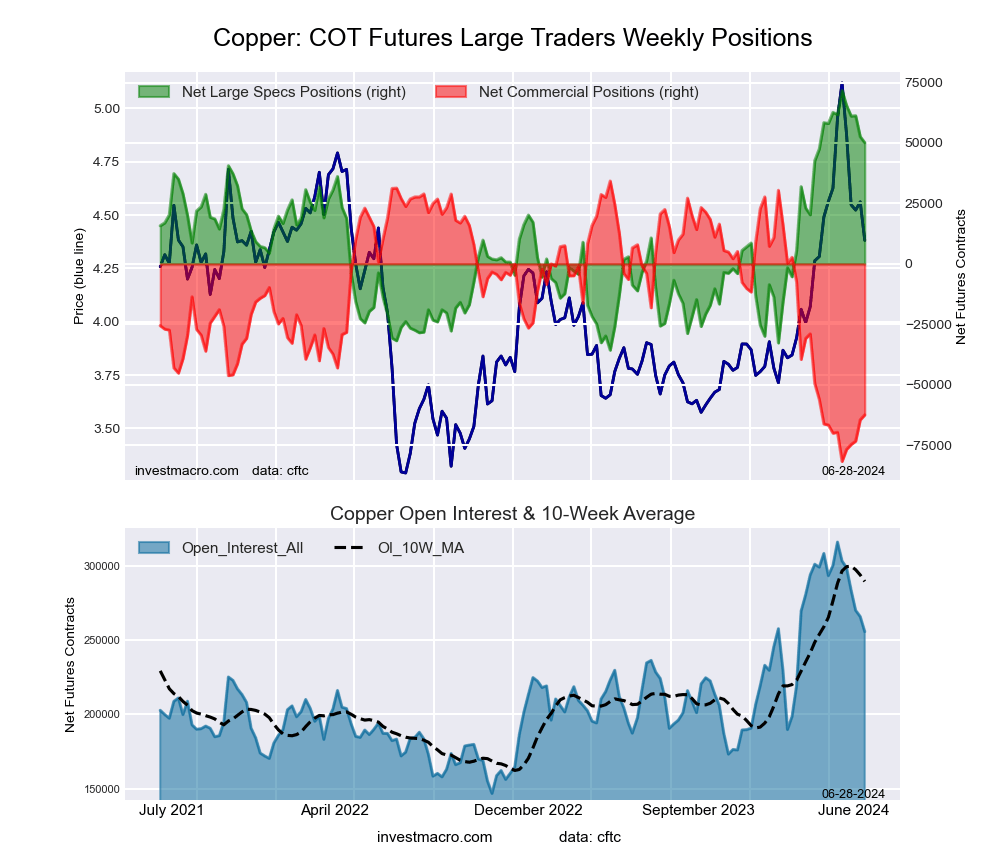
Copper Futures COT ChartThe Copper Grade #1 Futures large speculator standing this week came in at a net position of 62,648 contracts in the data reported through Tuesday. This was a weekly lift of 4,584 contracts from the previous week which had a total of 58,064 net contracts.

This week’s current strength score (the trader positioning range over the past three years, measured from 0 to 100) shows the speculators are currently Bullish-Extreme with a score of 100.0 percent. The commercials are Bearish-Extreme with a score of 0.0 percent and the small traders (not shown in chart) are Bullish with a score of 64.9 percent.

Price Trend-Following Model: Strong Uptrend

Our weekly trend-following model classifies the current market price position as: Strong Uptrend. The current action for the model is considered to be: Hold – Maintain Long Position.

Copper Futures StatisticsSPECULATORSCOMMERCIALSSMALL TRADERS
– Percent of Open Interest Longs:53.321.47.5
– Percent of Open Interest Shorts:32.544.75.1
– Net Position:62,648-70,0127,364
– Gross Longs:160,14764,28022,549
– Gross Shorts:97,499134,29215,185
– Long to Short Ratio:1.6 to 10.5 to 11.5 to 1
NET POSITION TREND:
– Strength Index Score (3 Year Range Pct):100.00.064.9
– Strength Index Reading (3 Year Range):Bullish-ExtremeBearish-ExtremeBullish
NET POSITION MOVEMENT INDEX:
– 6-Week Change in Strength Index:40.2-37.6-2.5


Platinum Futures:

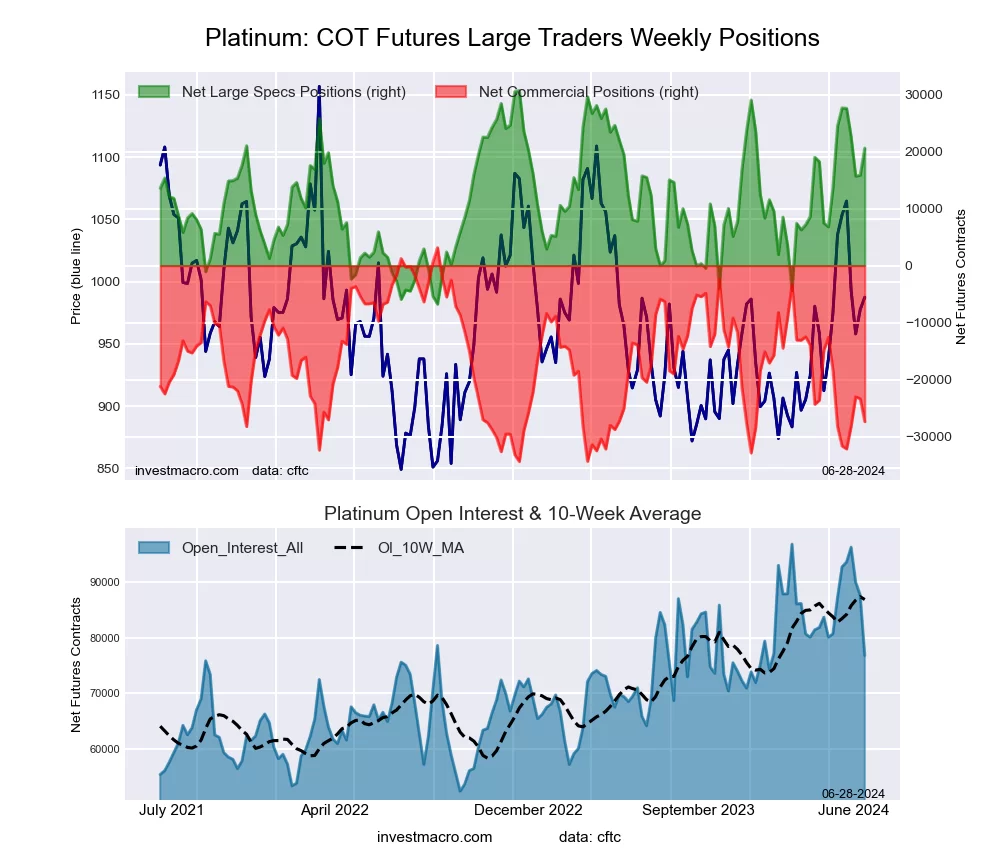
Platinum Futures COT ChartThe Platinum Futures large speculator standing this week came in at a net position of 13,660 contracts in the data reported through Tuesday. This was a weekly advance of 6,863 contracts from the previous week which had a total of 6,797 net contracts.

This week’s current strength score (the trader positioning range over the past three years, measured from 0 to 100) shows the speculators are currently Bullish with a score of 54.5 percent. The commercials are Bearish with a score of 44.7 percent and the small traders (not shown in chart) are Bearish with a score of 30.9 percent.

Price Trend-Following Model: Strong Uptrend

Our weekly trend-following model classifies the current market price position as: Strong Uptrend. The current action for the model is considered to be: New Buy – Long Position.

Platinum Futures StatisticsSPECULATORSCOMMERCIALSSMALL TRADERS
– Percent of Open Interest Longs:56.124.510.7
– Percent of Open Interest Shorts:39.147.24.9
– Net Position:13,660-18,3484,688
– Gross Longs:45,23219,7328,620
– Gross Shorts:31,57238,0803,932
– Long to Short Ratio:1.4 to 10.5 to 12.2 to 1
NET POSITION TREND:
– Strength Index Score (3 Year Range Pct):54.544.730.9
– Strength Index Reading (3 Year Range):BullishBearishBearish
NET POSITION MOVEMENT INDEX:
– 6-Week Change in Strength Index:17.3-15.1-7.9


Palladium Futures:

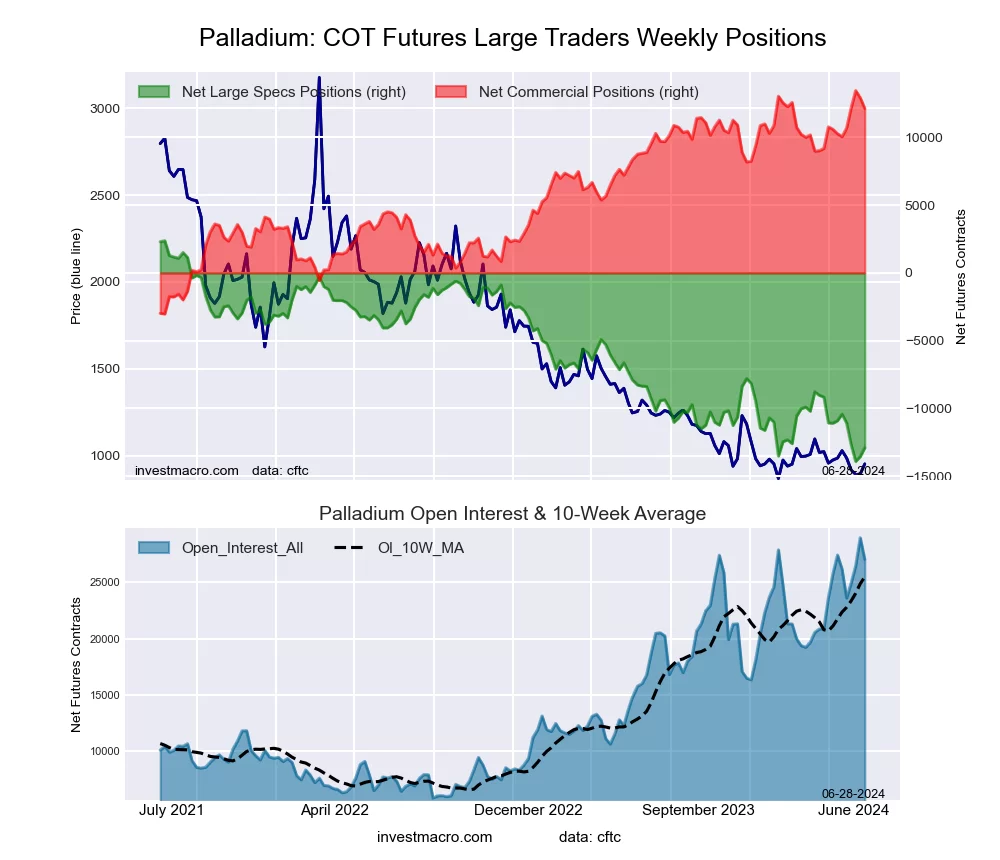
Palladium Futures COT ChartThe Palladium Futures large speculator standing this week came in at a net position of -11,088 contracts in the data reported through Tuesday. This was a weekly decrease of -18 contracts from the previous week which had a total of -11,070 net contracts.

This week’s current strength score (the trader positioning range over the past three years, measured from 0 to 100) shows the speculators are currently Bearish-Extreme with a score of 15.1 percent. The commercials are Bullish-Extreme with a score of 85.1 percent and the small traders (not shown in chart) are Bullish with a score of 71.0 percent.

Price Trend-Following Model: Downtrend

Our weekly trend-following model classifies the current market price position as: Downtrend. The current action for the model is considered to be: Hold – Maintain Short Position.

Palladium Futures StatisticsSPECULATORSCOMMERCIALSSMALL TRADERS
– Percent of Open Interest Longs:22.651.38.7
– Percent of Open Interest Shorts:65.710.26.8
– Net Position:-11,08810,600488
– Gross Longs:5,82313,2202,230
– Gross Shorts:16,9112,6201,742
– Long to Short Ratio:0.3 to 15.0 to 11.3 to 1
NET POSITION TREND:
– Strength Index Score (3 Year Range Pct):15.185.171.0
– Strength Index Reading (3 Year Range):Bearish-ExtremeBullish-ExtremeBullish
NET POSITION MOVEMENT INDEX:
– 6-Week Change in Strength Index:-7.43.636.1


Steel Futures Futures:

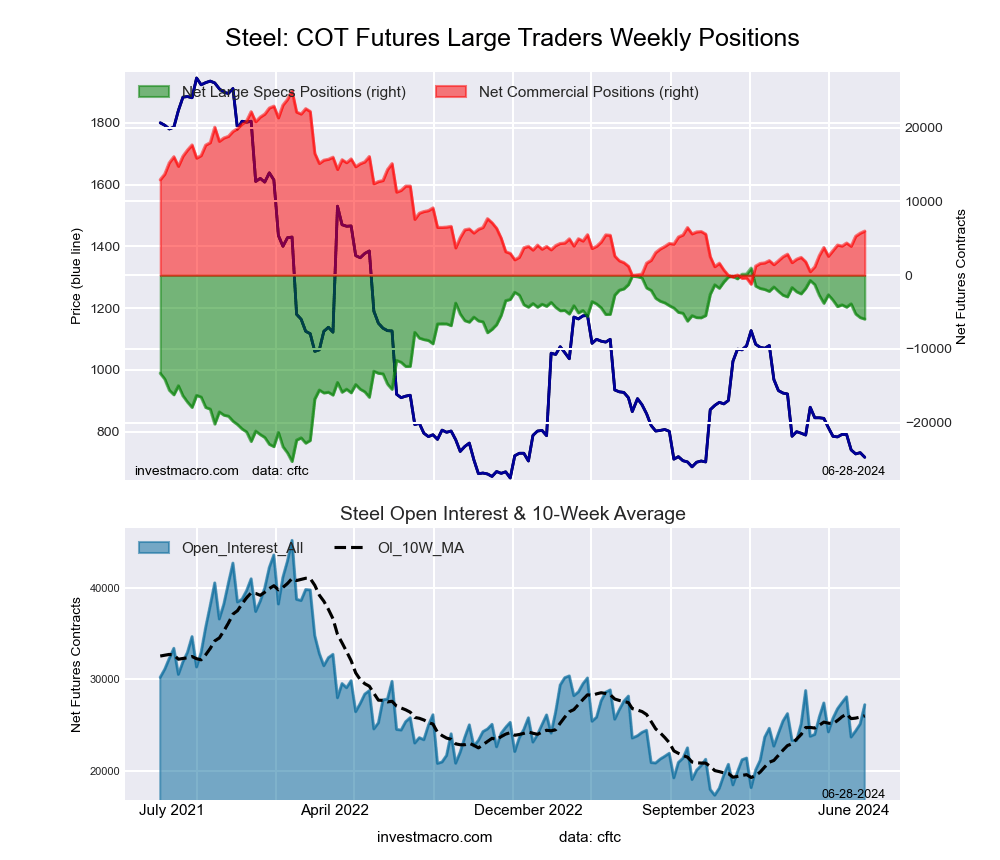
Steel Futures COT ChartThe Steel Futures large speculator standing this week came in at a net position of -3,383 contracts in the data reported through Tuesday. This was a weekly lowering of -720 contracts from the previous week which had a total of -2,663 net contracts.

This week’s current strength score (the trader positioning range over the past three years, measured from 0 to 100) shows the speculators are currently Bullish-Extreme with a score of 83.4 percent. The commercials are Bearish-Extreme with a score of 17.3 percent and the small traders (not shown in chart) are Bearish with a score of 37.6 percent.

Price Trend-Following Model: Downtrend

Our weekly trend-following model classifies the current market price position as: Downtrend. The current action for the model is considered to be: Hold – Maintain Short Position.

Steel Futures StatisticsSPECULATORSCOMMERCIALSSMALL TRADERS
– Percent of Open Interest Longs:14.080.41.4
– Percent of Open Interest Shorts:27.267.41.2
– Net Position:-3,3833,33548
– Gross Longs:3,60620,678362
– Gross Shorts:6,98917,343314
– Long to Short Ratio:0.5 to 11.2 to 11.2 to 1
NET POSITION TREND:
– Strength Index Score (3 Year Range Pct):83.417.337.6
– Strength Index Reading (3 Year Range):Bullish-ExtremeBearish-ExtremeBearish
NET POSITION MOVEMENT INDEX:
– 6-Week Change in Strength Index:-6.15.88.9


Article By InvestMacroReceive our weekly COT Newsletter

*COT Report: The COT data, released weekly to the public each Friday, is updated through the most recent Tuesday (data is 3 days old) and shows a quick view of how large speculators or non-commercials (for-profit traders) were positioned in the futures markets.

The CFTC categorizes trader positions according to commercial hedgers (traders who use futures contracts for hedging as part of the business), non-commercials (large traders who speculate to realize trading profits) and nonreportable traders (usually small traders/speculators) as well as their open interest (contracts open in the market at time of reporting). See CFTC criteria here.

COT Bonds Charts: Speculator bets led by Fed Funds & Ultra 10-Year Bonds

By InvestMacro

Here are the latest charts and statistics for the Commitment of Traders (COT) reports data published by the Commodities Futures Trading Commission (CFTC).

The latest COT data is updated through Tuesday May 7th and shows a quick view of how large traders (for-profit speculators and commercial hedgers) were positioned in the futures markets.

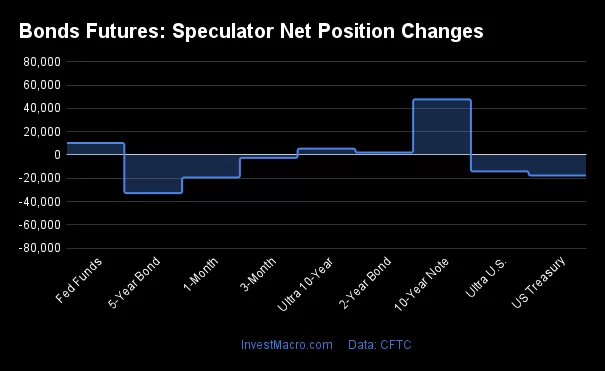
Weekly Speculator Changes led by Fed Funds & Ultra 10-Year Bonds

The COT bond market speculator bets were lower this week as just two out of the eight bond markets we cover had higher positioning while the other six markets had lower speculator contracts.

Leading the gains for the bond markets was the Fed Funds (126,619 contracts) with the Ultra 10-Year Bonds (49,384 contracts) also having a positive week.

The bond markets with declines in speculator bets for the week were the 10-Year Bonds (-48,655 contracts), the 5-Year Bonds (-17,251 contracts), the SOFR 3-Months (-24,279 contracts), the Ultra Treasury Bonds (-5,970 contracts), the 2-Year Bonds (-5,790 contracts) and the US Treasury Bonds (-1,555 contracts) also recording lower bets on the week.


Bonds Net Speculators Leaderboard
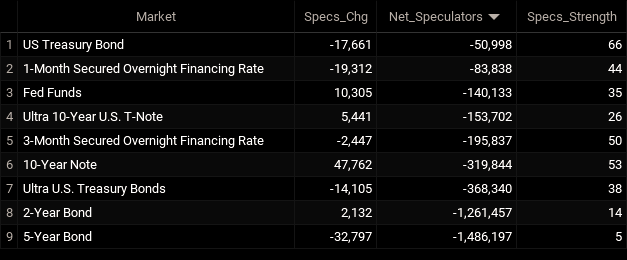
Legend: Weekly Speculators Change | Speculators Current Net Position | Speculators Strength Score compared to last 3-Years (0-100 range)


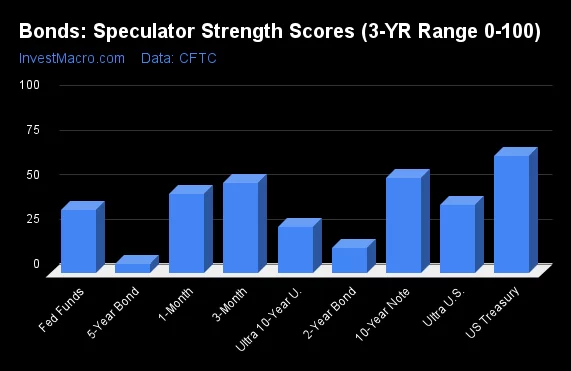
Strength Scores led by Fed Funds & US Treasury Bonds

COT Strength Scores (a normalized measure of Speculator positions over a 3-Year range, from 0 to 100 where above 80 is Extreme-Bullish and below 20 is Extreme-Bearish) showed that the Fed Funds (98 percent) and the US Treasury Bonds (75 percent) lead the bond markets this week. The Ultra Treasury Bonds (58 percent) come in as the next highest in the weekly strength scores.

On the downside, the Ultra 10-Year Bonds (13 percent) and the 5-Year Bonds (19 percent) come in at the lowest strength level currently and are in Extreme-Bearish territory (below 20 percent). The next lowest strength scores were the 2-Year Bonds (29 percent) and the 10-Year Bonds (38 percent).

Strength Statistics:
Fed Funds (97.8 percent) vs Fed Funds previous week (70.8 percent)
2-Year Bond (29.0 percent) vs 2-Year Bond previous week (29.4 percent)
5-Year Bond (19.5 percent) vs 5-Year Bond previous week (20.6 percent)
10-Year Bond (38.1 percent) vs 10-Year Bond previous week (42.6 percent)
Ultra 10-Year Bond (12.9 percent) vs Ultra 10-Year Bond previous week (2.9 percent)
US Treasury Bond (74.9 percent) vs US Treasury Bond previous week (75.4 percent)
Ultra US Treasury Bond (58.5 percent) vs Ultra US Treasury Bond previous week (60.9 percent)
SOFR 3-Months (42.7 percent) vs SOFR 3-Months previous week (44.0 percent)


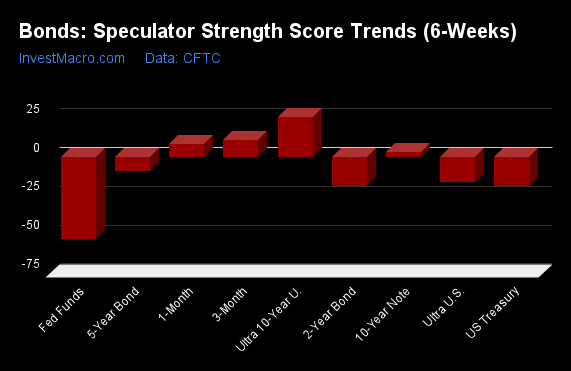
Fed Funds top the 6-Week Strength Trends

COT Strength Score Trends (or move index, calculates the 6-week changes in strength scores) showed that the Fed Funds (68 percent) leads the past six weeks trends for bonds. The 10-Year Bonds (9 percent) are the next highest positive mover in the latest trends data.

The SOFR 3-Months (-35 percent) and the Ultra 10-Year Bonds (-16 percent) lead the downside trend scores currently with the Ultra Treasury Bonds (-7 percent) and the 2-Year Bonds (-7 percent) following next with lower trend scores.

Strength Trend Statistics:
Fed Funds (67.7 percent) vs Fed Funds previous week (43.8 percent)
2-Year Bond (-6.9 percent) vs 2-Year Bond previous week (-7.3 percent)
5-Year Bond (-0.9 percent) vs 5-Year Bond previous week (0.7 percent)
10-Year Bond (9.0 percent) vs 10-Year Bond previous week (13.2 percent)
Ultra 10-Year Bond (-15.5 percent) vs Ultra 10-Year Bond previous week (-22.4 percent)
US Treasury Bond (-1.4 percent) vs US Treasury Bond previous week (-0.2 percent)
Ultra US Treasury Bond (-7.3 percent) vs Ultra US Treasury Bond previous week (-2.3 percent)
SOFR 3-Months (-34.5 percent) vs SOFR 3-Months previous week (-31.9 percent)


Secured Overnight Financing Rate (3-Month) Futures:
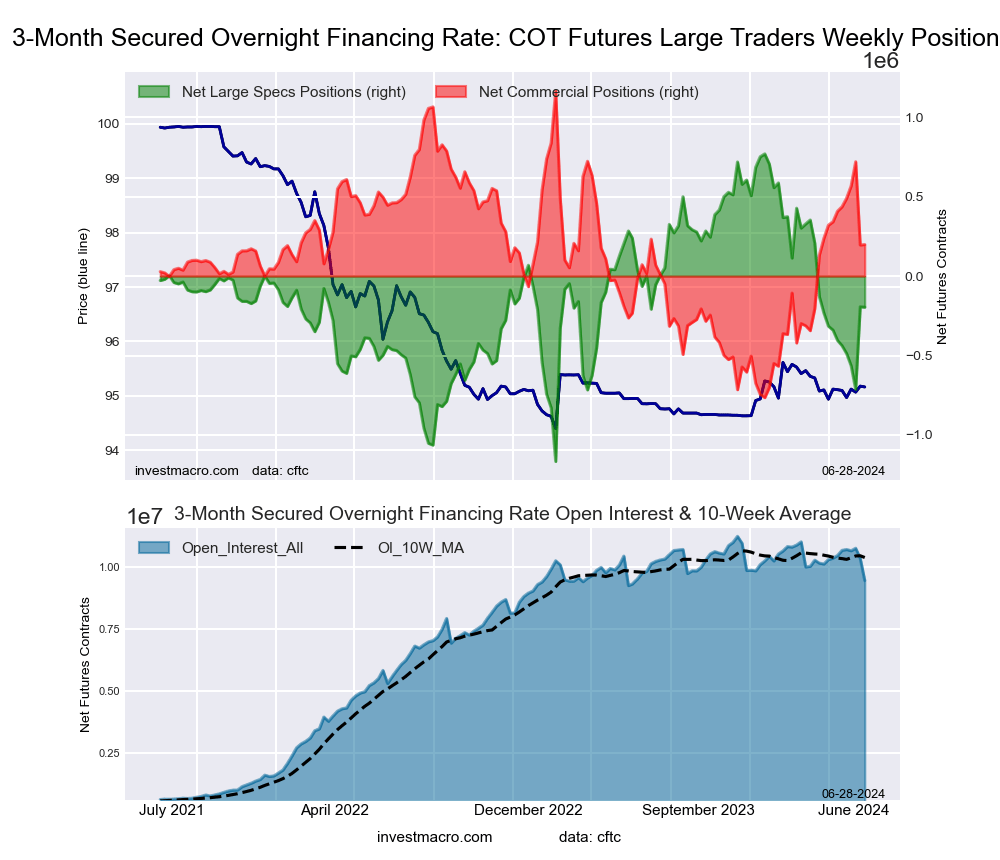
SOFR 3-Months Bonds Futures COT ChartThe Secured Overnight Financing Rate (3-Month) large speculator standing this week came in at a net position of -339,562 contracts in the data reported through Tuesday. This was a weekly decrease of -24,279 contracts from the previous week which had a total of -315,283 net contracts.

This week’s current strength score (the trader positioning range over the past three years, measured from 0 to 100) shows the speculators are currently Bearish with a score of 42.7 percent. The commercials are Bullish with a score of 57.3 percent and the small traders (not shown in chart) are Bullish-Extreme with a score of 86.7 percent.

Price Trend-Following Model: Weak Uptrend

Our weekly trend-following model classifies the current market price position as: Weak Uptrend. The current action for the model is considered to be: Hold – Maintain Long Position.

SOFR 3-Months StatisticsSPECULATORSCOMMERCIALSSMALL TRADERS
– Percent of Open Interest Longs:14.059.40.4
– Percent of Open Interest Shorts:17.356.10.4
– Net Position:-339,562341,716-2,154
– Gross Longs:1,446,2136,144,80936,213
– Gross Shorts:1,785,7755,803,09338,367
– Long to Short Ratio:0.8 to 11.1 to 10.9 to 1
NET POSITION TREND:
– Strength Index Score (3 Year Range Pct):42.757.386.7
– Strength Index Reading (3 Year Range):BearishBullishBullish-Extreme
NET POSITION MOVEMENT INDEX:
– 6-Week Change in Strength Index:-34.533.97.5


30-Day Federal Funds Futures:

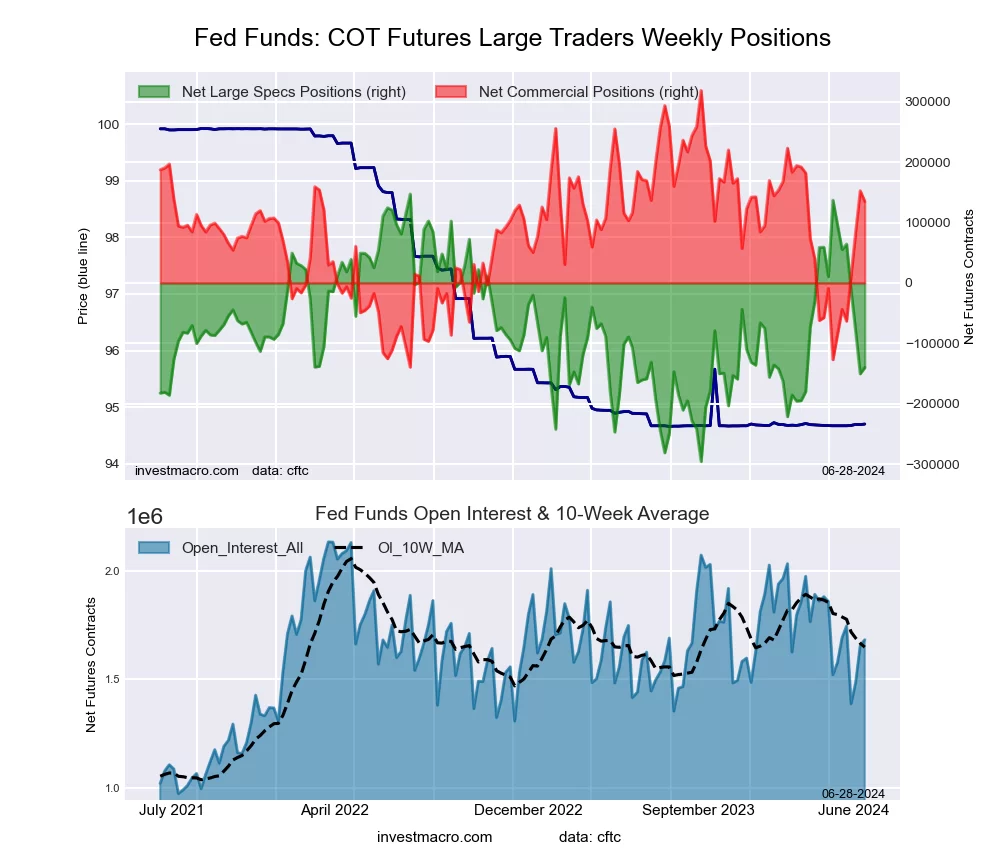
Federal Funds 30-Day Bonds Futures COT ChartThe 30-Day Federal Funds large speculator standing this week came in at a net position of 136,965 contracts in the data reported through Tuesday. This was a weekly lift of 126,619 contracts from the previous week which had a total of 10,346 net contracts.

This week’s current strength score (the trader positioning range over the past three years, measured from 0 to 100) shows the speculators are currently Bullish-Extreme with a score of 97.8 percent. The commercials are Bearish-Extreme with a score of 2.7 percent and the small traders (not shown in chart) are Bullish with a score of 71.5 percent.

Price Trend-Following Model: Downtrend

Our weekly trend-following model classifies the current market price position as: Downtrend. The current action for the model is considered to be: Hold – Maintain Short Position.

30-Day Federal Funds StatisticsSPECULATORSCOMMERCIALSSMALL TRADERS
– Percent of Open Interest Longs:23.554.82.0
– Percent of Open Interest Shorts:14.463.22.6
– Net Position:136,965-127,034-9,931
– Gross Longs:356,452833,17430,131
– Gross Shorts:219,487960,20840,062
– Long to Short Ratio:1.6 to 10.9 to 10.8 to 1
NET POSITION TREND:
– Strength Index Score (3 Year Range Pct):97.82.771.5
– Strength Index Reading (3 Year Range):Bullish-ExtremeBearish-ExtremeBullish
NET POSITION MOVEMENT INDEX:
– 6-Week Change in Strength Index:67.7-65.7-15.7


2-Year Treasury Note Futures:

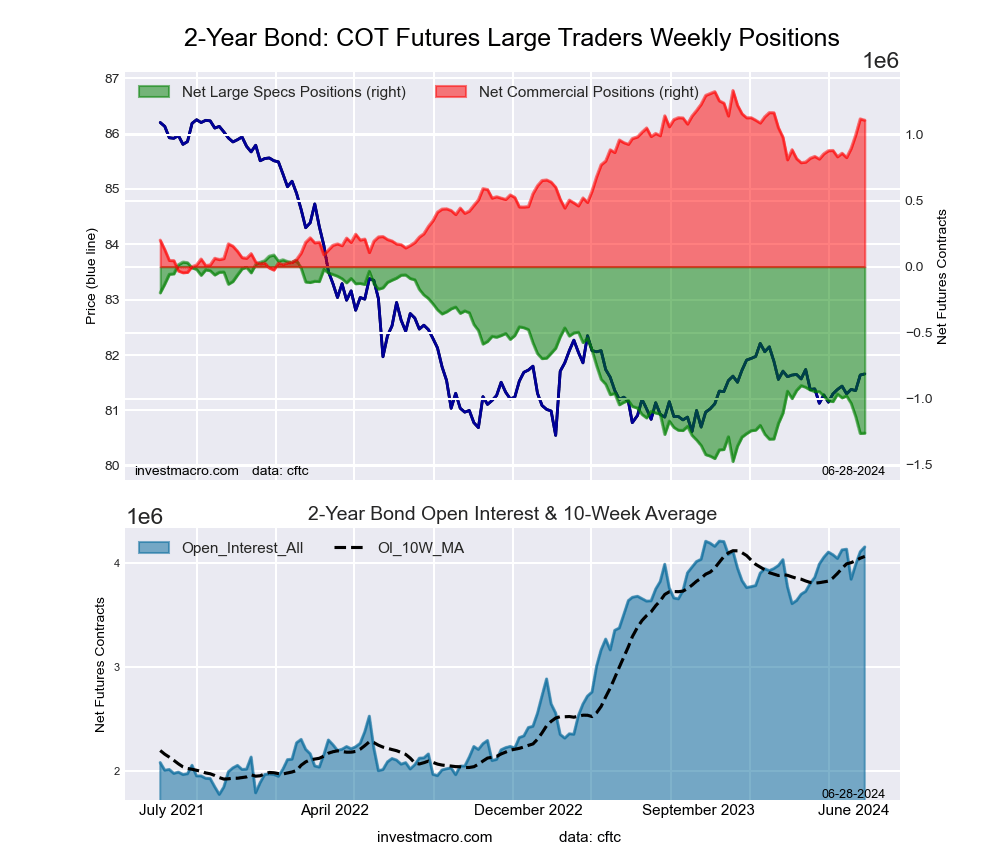
2-Year Treasury Bonds Futures COT ChartThe 2-Year Treasury Note large speculator standing this week came in at a net position of -1,022,233 contracts in the data reported through Tuesday. This was a weekly fall of -5,790 contracts from the previous week which had a total of -1,016,443 net contracts.

This week’s current strength score (the trader positioning range over the past three years, measured from 0 to 100) shows the speculators are currently Bearish with a score of 29.0 percent. The commercials are Bullish with a score of 67.1 percent and the small traders (not shown in chart) are Bullish-Extreme with a score of 97.9 percent.

Price Trend-Following Model: Downtrend

Our weekly trend-following model classifies the current market price position as: Downtrend. The current action for the model is considered to be: Hold – Maintain Short Position.

2-Year Treasury Note StatisticsSPECULATORSCOMMERCIALSSMALL TRADERS
– Percent of Open Interest Longs:12.779.26.6
– Percent of Open Interest Shorts:37.757.63.1
– Net Position:-1,022,233880,495141,738
– Gross Longs:516,3333,230,397269,053
– Gross Shorts:1,538,5662,349,902127,315
– Long to Short Ratio:0.3 to 11.4 to 12.1 to 1
NET POSITION TREND:
– Strength Index Score (3 Year Range Pct):29.067.197.9
– Strength Index Reading (3 Year Range):BearishBullishBullish-Extreme
NET POSITION MOVEMENT INDEX:
– 6-Week Change in Strength Index:-6.96.47.7


5-Year Treasury Note Futures:

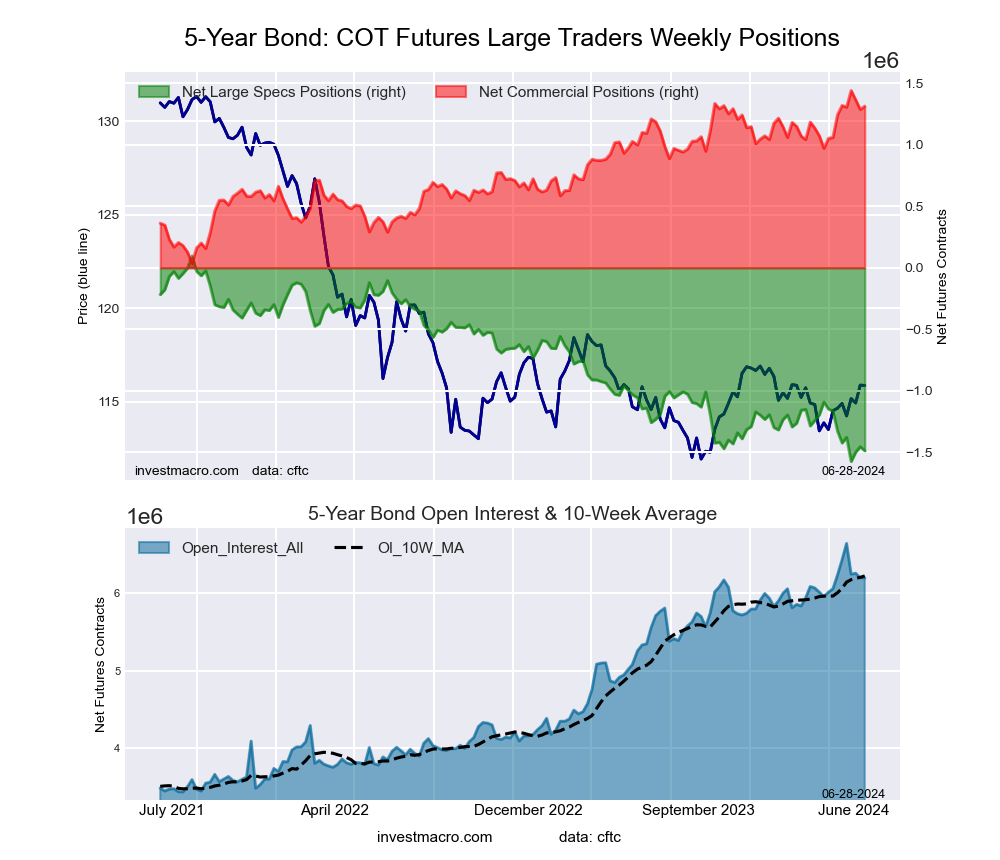
5-Year Treasury Bonds Futures COT ChartThe 5-Year Treasury Note large speculator standing this week came in at a net position of -1,163,849 contracts in the data reported through Tuesday. This was a weekly decline of -17,251 contracts from the previous week which had a total of -1,146,598 net contracts.

This week’s current strength score (the trader positioning range over the past three years, measured from 0 to 100) shows the speculators are currently Bearish-Extreme with a score of 19.5 percent. The commercials are Bullish with a score of 78.8 percent and the small traders (not shown in chart) are Bullish-Extreme with a score of 85.0 percent.

Price Trend-Following Model: Downtrend

Our weekly trend-following model classifies the current market price position as: Downtrend. The current action for the model is considered to be: Hold – Maintain Short Position.

5-Year Treasury Note StatisticsSPECULATORSCOMMERCIALSSMALL TRADERS
– Percent of Open Interest Longs:8.083.27.1
– Percent of Open Interest Shorts:27.265.75.4
– Net Position:-1,163,8491,059,427104,422
– Gross Longs:483,0305,038,983429,855
– Gross Shorts:1,646,8793,979,556325,433
– Long to Short Ratio:0.3 to 11.3 to 11.3 to 1
NET POSITION TREND:
– Strength Index Score (3 Year Range Pct):19.578.885.0
– Strength Index Reading (3 Year Range):Bearish-ExtremeBullishBullish-Extreme
NET POSITION MOVEMENT INDEX:
– 6-Week Change in Strength Index:-0.91.3-0.7


10-Year Treasury Note Futures:

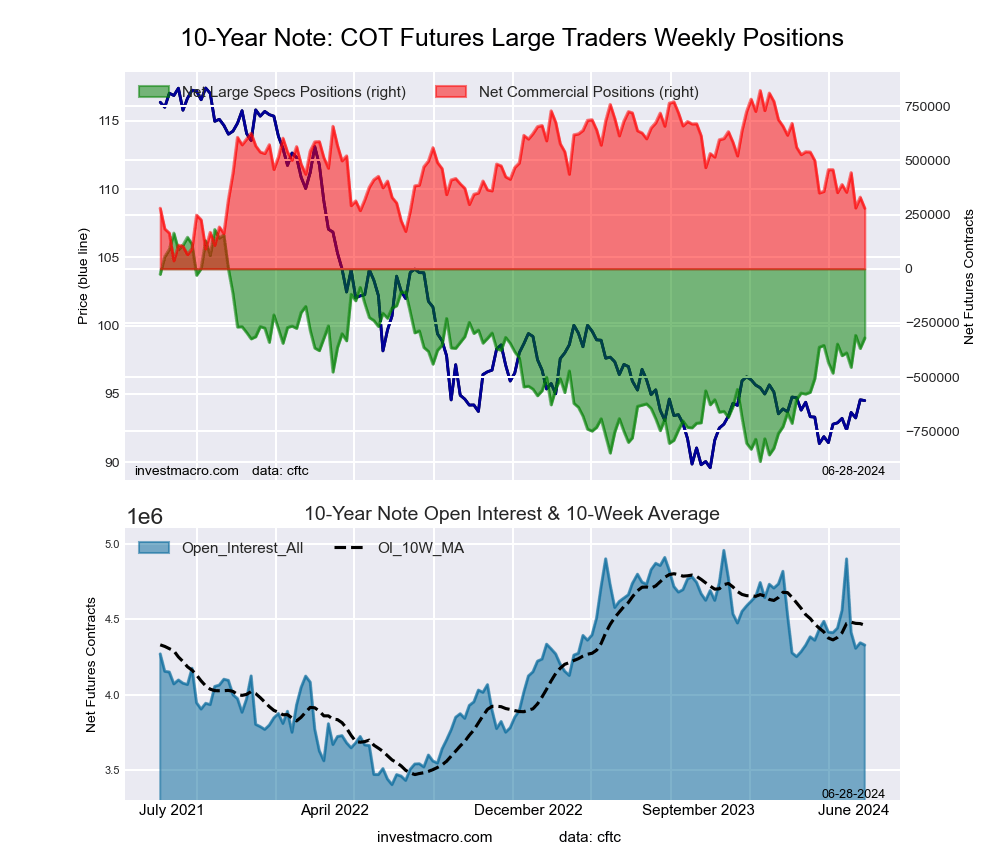
10-Year Treasury Notes Bonds Futures COT ChartThe 10-Year Treasury Note large speculator standing this week came in at a net position of -481,620 contracts in the data reported through Tuesday. This was a weekly decline of -48,655 contracts from the previous week which had a total of -432,965 net contracts.

This week’s current strength score (the trader positioning range over the past three years, measured from 0 to 100) shows the speculators are currently Bearish with a score of 38.1 percent. The commercials are Bullish with a score of 53.5 percent and the small traders (not shown in chart) are Bullish with a score of 78.8 percent.

Price Trend-Following Model: Downtrend

Our weekly trend-following model classifies the current market price position as: Downtrend. The current action for the model is considered to be: Hold – Maintain Short Position.

10-Year Treasury Note StatisticsSPECULATORSCOMMERCIALSSMALL TRADERS
– Percent of Open Interest Longs:10.377.99.3
– Percent of Open Interest Shorts:21.267.68.8
– Net Position:-481,620457,22224,398
– Gross Longs:455,9243,437,718411,798
– Gross Shorts:937,5442,980,496387,400
– Long to Short Ratio:0.5 to 11.2 to 11.1 to 1
NET POSITION TREND:
– Strength Index Score (3 Year Range Pct):38.153.578.8
– Strength Index Reading (3 Year Range):BearishBullishBullish
NET POSITION MOVEMENT INDEX:
– 6-Week Change in Strength Index:9.0-10.6-3.0


Ultra 10-Year Notes Futures:

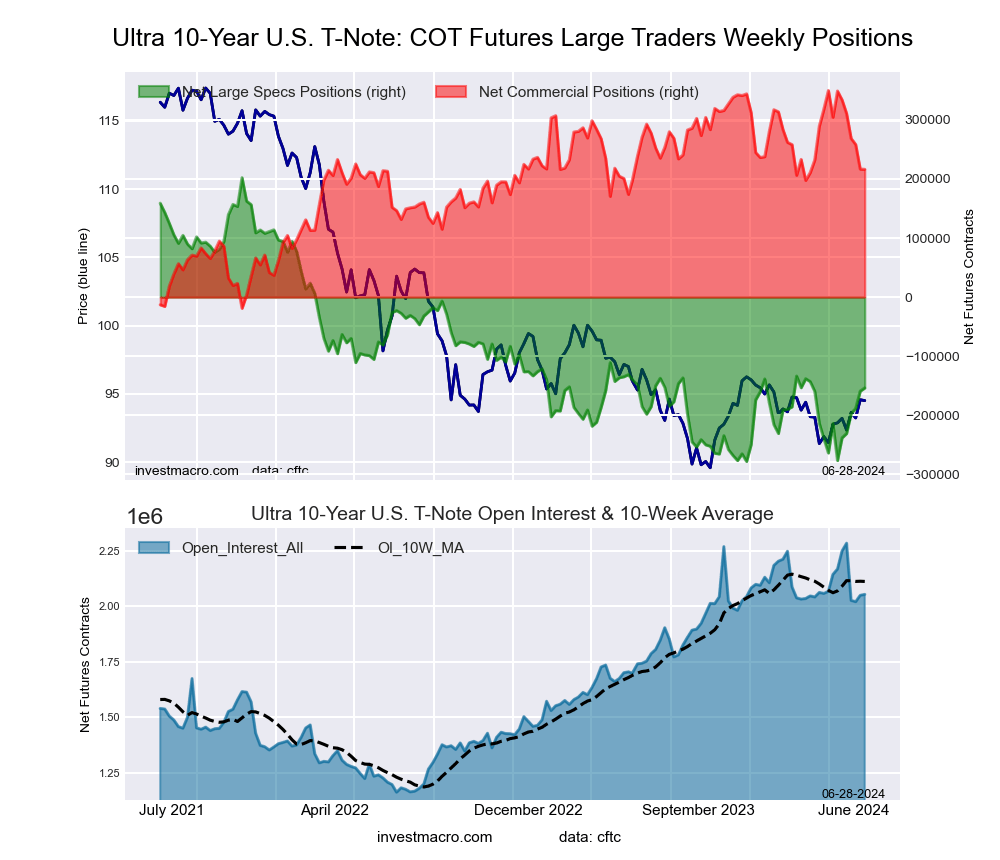
Ultra 10-Year Treasury Notes Bonds Futures COT ChartThe Ultra 10-Year Notes large speculator standing this week came in at a net position of -214,299 contracts in the data reported through Tuesday. This was a weekly gain of 49,384 contracts from the previous week which had a total of -263,683 net contracts.

This week’s current strength score (the trader positioning range over the past three years, measured from 0 to 100) shows the speculators are currently Bearish-Extreme with a score of 12.9 percent. The commercials are Bullish-Extreme with a score of 89.0 percent and the small traders (not shown in chart) are Bullish with a score of 60.5 percent.

Price Trend-Following Model: Weak Uptrend

Our weekly trend-following model classifies the current market price position as: Weak Uptrend. The current action for the model is considered to be: Hold – Maintain Long Position.

Ultra 10-Year Notes StatisticsSPECULATORSCOMMERCIALSSMALL TRADERS
– Percent of Open Interest Longs:12.576.39.6
– Percent of Open Interest Shorts:22.562.113.8
– Net Position:-214,299304,341-90,042
– Gross Longs:268,0501,635,316205,566
– Gross Shorts:482,3491,330,975295,608
– Long to Short Ratio:0.6 to 11.2 to 10.7 to 1
NET POSITION TREND:
– Strength Index Score (3 Year Range Pct):12.989.060.5
– Strength Index Reading (3 Year Range):Bearish-ExtremeBullish-ExtremeBullish
NET POSITION MOVEMENT INDEX:
– 6-Week Change in Strength Index:-15.526.1-18.2


US Treasury Bonds Futures:

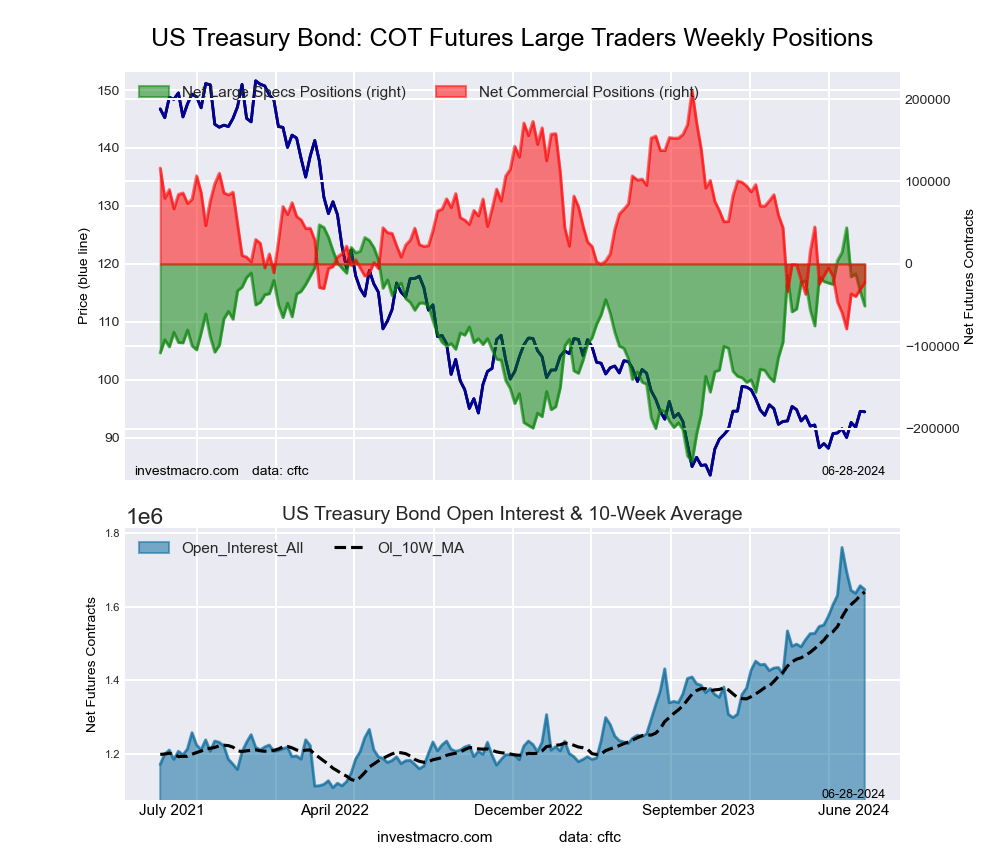
US Year Treasury Notes Long Bonds Futures COT ChartThe US Treasury Bonds large speculator standing this week came in at a net position of -24,669 contracts in the data reported through Tuesday. This was a weekly lowering of -1,555 contracts from the previous week which had a total of -23,114 net contracts.

This week’s current strength score (the trader positioning range over the past three years, measured from 0 to 100) shows the speculators are currently Bullish with a score of 74.9 percent. The commercials are Bearish-Extreme with a score of 8.8 percent and the small traders (not shown in chart) are Bullish with a score of 76.7 percent.

Price Trend-Following Model: Downtrend

Our weekly trend-following model classifies the current market price position as: Downtrend. The current action for the model is considered to be: Hold – Maintain Short Position.

US Treasury Bonds StatisticsSPECULATORSCOMMERCIALSSMALL TRADERS
– Percent of Open Interest Longs:16.769.612.6
– Percent of Open Interest Shorts:18.270.510.2
– Net Position:-24,669-14,89039,559
– Gross Longs:267,9181,116,846202,830
– Gross Shorts:292,5871,131,736163,271
– Long to Short Ratio:0.9 to 11.0 to 11.2 to 1
NET POSITION TREND:
– Strength Index Score (3 Year Range Pct):74.98.876.7
– Strength Index Reading (3 Year Range):BullishBearish-ExtremeBullish
NET POSITION MOVEMENT INDEX:
– 6-Week Change in Strength Index:-1.48.8-13.2


Ultra US Treasury Bonds Futures:

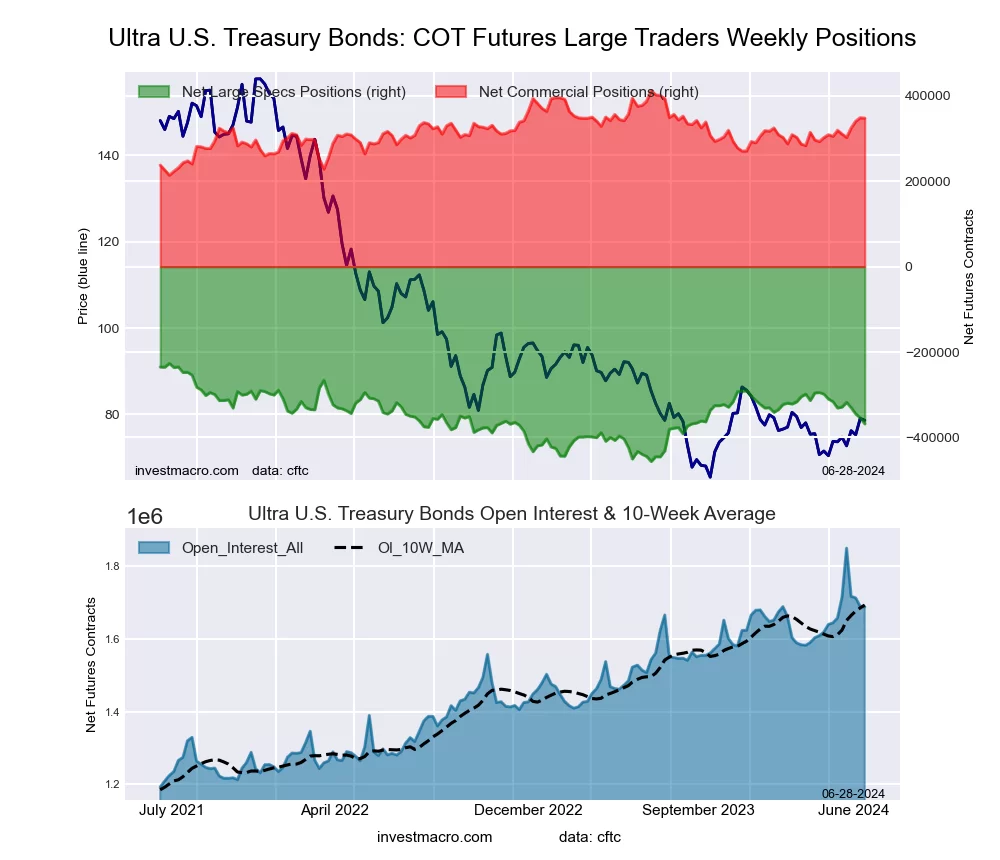
Ultra US Year Treasury Notes Long Bonds Futures COT ChartThe Ultra US Treasury Bonds large speculator standing this week came in at a net position of -316,115 contracts in the data reported through Tuesday. This was a weekly fall of -5,970 contracts from the previous week which had a total of -310,145 net contracts.

This week’s current strength score (the trader positioning range over the past three years, measured from 0 to 100) shows the speculators are currently Bullish with a score of 58.5 percent. The commercials are Bearish with a score of 45.9 percent and the small traders (not shown in chart) are Bearish with a score of 46.8 percent.

Price Trend-Following Model: Downtrend

Our weekly trend-following model classifies the current market price position as: Downtrend. The current action for the model is considered to be: Hold – Maintain Short Position.

Ultra US Treasury Bonds StatisticsSPECULATORSCOMMERCIALSSMALL TRADERS
– Percent of Open Interest Longs:9.079.810.8
– Percent of Open Interest Shorts:28.261.310.1
– Net Position:-316,115305,24810,867
– Gross Longs:147,9861,312,271176,682
– Gross Shorts:464,1011,007,023165,815
– Long to Short Ratio:0.3 to 11.3 to 11.1 to 1
NET POSITION TREND:
– Strength Index Score (3 Year Range Pct):58.545.946.8
– Strength Index Reading (3 Year Range):BullishBearishBearish
NET POSITION MOVEMENT INDEX:
– 6-Week Change in Strength Index:-7.310.8-3.8


Article By InvestMacroReceive our weekly COT Newsletter

*COT Report: The COT data, released weekly to the public each Friday, is updated through the most recent Tuesday (data is 3 days old) and shows a quick view of how large speculators or non-commercials (for-profit traders) were positioned in the futures markets.

The CFTC categorizes trader positions according to commercial hedgers (traders who use futures contracts for hedging as part of the business), non-commercials (large traders who speculate to realize trading profits) and nonreportable traders (usually small traders/speculators) as well as their open interest (contracts open in the market at time of reporting). See CFTC criteria here.


COT Stock Market Charts: Speculator bets led by DowJones & Russell 2000

By InvestMacro

Here are the latest charts and statistics for the Commitment of Traders (COT) data published by the Commodities Futures Trading Commission (CFTC).

The latest COT data is updated through Tuesday May 7th and shows a quick view of how large traders (for-profit speculators and commercial entities) were positioned in the futures markets.

Weekly Speculator Changes led by DowJones & Russell 2000

The COT stock markets speculator bets were lower this week as three out of the seven stock markets we cover had higher positioning while the other four markets had lower speculator contracts.

Leading the gains for the stock markets was the DowJones-Mini (3,466 contracts) with the Russell-Mini (2,289 contracts) and the Nasdaq-Mini (1,633 contracts) also showing positive weeks.

The markets with the declines in speculator bets this week were S&P500-Mini (-52,828 contracts), the VIX (-16,446 contracts), the MSCI EAFE-Mini (-2,851 contracts) and the Nikkei 225 (-1,616 contracts) also seeing lower bets on the week.


Stock Market Net Speculators Leaderboard

Legend: Weekly Speculators Change | Speculators Current Net Position | Speculators Strength Score compared to last 3-Years (0-100 range)


Strength Scores led by DowJones-Mini & VIX

COT Strength Scores (a normalized measure of Speculator positions over a 3-Year range, from 0 to 100 where above 80 is Extreme-Bullish and below 20 is Extreme-Bearish) showed that the DowJones-Mini (74 percent) and the VIX (73 percent) lead the stock markets this week. The S&P500-Mini (63 percent) comes in as the next highest in the weekly strength scores.

On the downside, the Nasdaq-Mini (46 percent) comes in at the lowest strength level currently.

Strength Statistics:
VIX (73.0 percent) vs VIX previous week (90.8 percent)
S&P500-Mini (63.3 percent) vs S&P500-Mini previous week (71.2 percent)
DowJones-Mini (74.4 percent) vs DowJones-Mini previous week (68.8 percent)
Nasdaq-Mini (46.0 percent) vs Nasdaq-Mini previous week (43.5 percent)
Russell2000-Mini (58.1 percent) vs Russell2000-Mini previous week (56.5 percent)
Nikkei USD (51.1 percent) vs Nikkei USD previous week (64.9 percent)
EAFE-Mini (51.9 percent) vs EAFE-Mini previous week (54.9 percent)


S&P500-Mini & Nasdaq-Mini top the 6-Week Strength Trends

COT Strength Score Trends (or move index, calculates the 6-week changes in strength scores) showed that the S&P500-Mini (24 percent) leads the past six weeks trends for the stock markets. The Nasdaq-Mini (18 percent) and the VIX (5 percent) are the next highest positive movers in the latest trends data.

The DowJones-Mini (-18 percent) leads the downside trend scores currently with the Russell-Mini (-12 percent) coming in as the next market with lower trend scores.

Strength Trend Statistics:
VIX (5.4 percent) vs VIX previous week (24.2 percent)
S&P500-Mini (23.8 percent) vs S&P500-Mini previous week (35.4 percent)
DowJones-Mini (-18.5 percent) vs DowJones-Mini previous week (-28.1 percent)
Nasdaq-Mini (17.9 percent) vs Nasdaq-Mini previous week (-13.0 percent)
Russell2000-Mini (-11.7 percent) vs Russell2000-Mini previous week (-19.0 percent)
Nikkei USD (-7.0 percent) vs Nikkei USD previous week (-3.2 percent)
EAFE-Mini (-6.3 percent) vs EAFE-Mini previous week (-3.6 percent)


Individual Stock Market Charts:

VIX Volatility Futures:

VIX Volatility Futures COT ChartThe VIX Volatility large speculator standing this week recorded a net position of -38,879 contracts in the data reported through Tuesday. This was a weekly lowering of -16,446 contracts from the previous week which had a total of -22,433 net contracts.

This week’s current strength score (the trader positioning range over the past three years, measured from 0 to 100) shows the speculators are currently Bullish with a score of 73.0 percent. The commercials are Bearish with a score of 25.1 percent and the small traders (not shown in chart) are Bullish-Extreme with a score of 83.0 percent.

Price Trend-Following Model: Weak Uptrend

Our weekly trend-following model classifies the current market price position as: Weak Uptrend. The current action for the model is considered to be: Hold – Maintain Long Position.

VIX Volatility Futures StatisticsSPECULATORSCOMMERCIALSSMALL TRADERS
– Percent of Open Interest Longs:24.442.57.5
– Percent of Open Interest Shorts:34.032.28.1
– Net Position:-38,87941,509-2,630
– Gross Longs:98,258171,48630,089
– Gross Shorts:137,137129,97732,719
– Long to Short Ratio:0.7 to 11.3 to 10.9 to 1
NET POSITION TREND:
– Strength Index Score (3 Year Range Pct):73.025.183.0
– Strength Index Reading (3 Year Range):BullishBearishBullish-Extreme
NET POSITION MOVEMENT INDEX:
– 6-Week Change in Strength Index:5.4-2.4-14.3


S&P500 Mini Futures:

SP500 Mini Futures COT ChartThe S&P500 Mini large speculator standing this week recorded a net position of -9,695 contracts in the data reported through Tuesday. This was a weekly reduction of -52,828 contracts from the previous week which had a total of 43,133 net contracts.

This week’s current strength score (the trader positioning range over the past three years, measured from 0 to 100) shows the speculators are currently Bullish with a score of 63.3 percent. The commercials are Bearish with a score of 26.8 percent and the small traders (not shown in chart) are Bullish with a score of 78.7 percent.

Price Trend-Following Model: Uptrend

Our weekly trend-following model classifies the current market price position as: Uptrend. The current action for the model is considered to be: Hold – Maintain Long Position.

S&P500 Mini Futures StatisticsSPECULATORSCOMMERCIALSSMALL TRADERS
– Percent of Open Interest Longs:12.970.713.8
– Percent of Open Interest Shorts:13.475.48.6
– Net Position:-9,695-95,129104,824
– Gross Longs:262,7781,436,696280,192
– Gross Shorts:272,4731,531,825175,368
– Long to Short Ratio:1.0 to 10.9 to 11.6 to 1
NET POSITION TREND:
– Strength Index Score (3 Year Range Pct):63.326.878.7
– Strength Index Reading (3 Year Range):BullishBearishBullish
NET POSITION MOVEMENT INDEX:
– 6-Week Change in Strength Index:23.8-23.44.0


Dow Jones Mini Futures:

Dow Jones Mini Futures COT ChartThe Dow Jones Mini large speculator standing this week recorded a net position of 8,664 contracts in the data reported through Tuesday. This was a weekly lift of 3,466 contracts from the previous week which had a total of 5,198 net contracts.

This week’s current strength score (the trader positioning range over the past three years, measured from 0 to 100) shows the speculators are currently Bullish with a score of 74.4 percent. The commercials are Bearish with a score of 22.5 percent and the small traders (not shown in chart) are Bullish with a score of 54.5 percent.

Price Trend-Following Model: Strong Uptrend

Our weekly trend-following model classifies the current market price position as: Strong Uptrend. The current action for the model is considered to be: Hold – Maintain Long Position.

Dow Jones Mini Futures StatisticsSPECULATORSCOMMERCIALSSMALL TRADERS
– Percent of Open Interest Longs:20.861.514.8
– Percent of Open Interest Shorts:11.573.212.5
– Net Position:8,664-10,8472,183
– Gross Longs:19,30557,06113,773
– Gross Shorts:10,64167,90811,590
– Long to Short Ratio:1.8 to 10.8 to 11.2 to 1
NET POSITION TREND:
– Strength Index Score (3 Year Range Pct):74.422.554.5
– Strength Index Reading (3 Year Range):BullishBearishBullish
NET POSITION MOVEMENT INDEX:
– 6-Week Change in Strength Index:-18.519.4-10.0


Nasdaq Mini Futures:

Nasdaq Mini Futures COT ChartThe Nasdaq Mini large speculator standing this week recorded a net position of 4,405 contracts in the data reported through Tuesday. This was a weekly increase of 1,633 contracts from the previous week which had a total of 2,772 net contracts.

This week’s current strength score (the trader positioning range over the past three years, measured from 0 to 100) shows the speculators are currently Bearish with a score of 46.0 percent. The commercials are Bearish with a score of 40.8 percent and the small traders (not shown in chart) are Bullish-Extreme with a score of 85.0 percent.

Price Trend-Following Model: Uptrend

Our weekly trend-following model classifies the current market price position as: Uptrend. The current action for the model is considered to be: Hold – Maintain Long Position.

Nasdaq Mini Futures StatisticsSPECULATORSCOMMERCIALSSMALL TRADERS
– Percent of Open Interest Longs:27.752.817.3
– Percent of Open Interest Shorts:25.957.414.7
– Net Position:4,405-10,6336,228
– Gross Longs:65,234124,25140,762
– Gross Shorts:60,829134,88434,534
– Long to Short Ratio:1.1 to 10.9 to 11.2 to 1
NET POSITION TREND:
– Strength Index Score (3 Year Range Pct):46.040.885.0
– Strength Index Reading (3 Year Range):BearishBearishBullish-Extreme
NET POSITION MOVEMENT INDEX:
– 6-Week Change in Strength Index:17.9-10.5-4.8


Russell 2000 Mini Futures:

Russell 2000 Mini Futures COT ChartThe Russell 2000 Mini large speculator standing this week recorded a net position of -38,000 contracts in the data reported through Tuesday. This was a weekly rise of 2,289 contracts from the previous week which had a total of -40,289 net contracts.

This week’s current strength score (the trader positioning range over the past three years, measured from 0 to 100) shows the speculators are currently Bullish with a score of 58.1 percent. The commercials are Bearish with a score of 40.8 percent and the small traders (not shown in chart) are Bullish with a score of 50.4 percent.

Price Trend-Following Model: Strong Uptrend

Our weekly trend-following model classifies the current market price position as: Strong Uptrend. The current action for the model is considered to be: Hold – Maintain Long Position.

Russell 2000 Mini Futures StatisticsSPECULATORSCOMMERCIALSSMALL TRADERS
– Percent of Open Interest Longs:15.576.06.2
– Percent of Open Interest Shorts:23.769.24.9
– Net Position:-38,00031,6386,362
– Gross Longs:72,277353,89129,050
– Gross Shorts:110,277322,25322,688
– Long to Short Ratio:0.7 to 11.1 to 11.3 to 1
NET POSITION TREND:
– Strength Index Score (3 Year Range Pct):58.140.850.4
– Strength Index Reading (3 Year Range):BullishBearishBullish
NET POSITION MOVEMENT INDEX:
– 6-Week Change in Strength Index:-11.712.8-12.0


Nikkei Stock Average (USD) Futures:

Nikkei Stock Average (USD) Futures COT ChartThe Nikkei Stock Average (USD) large speculator standing this week recorded a net position of -3,407 contracts in the data reported through Tuesday. This was a weekly fall of -1,616 contracts from the previous week which had a total of -1,791 net contracts.

This week’s current strength score (the trader positioning range over the past three years, measured from 0 to 100) shows the speculators are currently Bullish with a score of 51.1 percent. The commercials are Bearish with a score of 40.9 percent and the small traders (not shown in chart) are Bullish with a score of 66.2 percent.

Price Trend-Following Model: Weak Uptrend

Our weekly trend-following model classifies the current market price position as: Weak Uptrend. The current action for the model is considered to be: Hold – Maintain Long Position.

Nikkei Stock Average Futures StatisticsSPECULATORSCOMMERCIALSSMALL TRADERS
– Percent of Open Interest Longs:9.166.624.2
– Percent of Open Interest Shorts:30.456.513.1
– Net Position:-3,4071,6211,786
– Gross Longs:1,46510,6753,885
– Gross Shorts:4,8729,0542,099
– Long to Short Ratio:0.3 to 11.2 to 11.9 to 1
NET POSITION TREND:
– Strength Index Score (3 Year Range Pct):51.140.966.2
– Strength Index Reading (3 Year Range):BullishBearishBullish
NET POSITION MOVEMENT INDEX:
– 6-Week Change in Strength Index:-7.010.3-12.0


MSCI EAFE Mini Futures:

MSCI EAFE Mini Futures COT ChartThe MSCI EAFE Mini large speculator standing this week recorded a net position of -13,996 contracts in the data reported through Tuesday. This was a weekly lowering of -2,851 contracts from the previous week which had a total of -11,145 net contracts.

This week’s current strength score (the trader positioning range over the past three years, measured from 0 to 100) shows the speculators are currently Bullish with a score of 51.9 percent. The commercials are Bearish with a score of 45.2 percent and the small traders (not shown in chart) are Bearish with a score of 47.3 percent.

Price Trend-Following Model: Strong Uptrend

Our weekly trend-following model classifies the current market price position as: Strong Uptrend. The current action for the model is considered to be: Hold – Maintain Long Position.

MSCI EAFE Mini Futures StatisticsSPECULATORSCOMMERCIALSSMALL TRADERS
– Percent of Open Interest Longs:6.090.53.1
– Percent of Open Interest Shorts:9.488.51.6
– Net Position:-13,9967,9126,084
– Gross Longs:24,945373,54312,596
– Gross Shorts:38,941365,6316,512
– Long to Short Ratio:0.6 to 11.0 to 11.9 to 1
NET POSITION TREND:
– Strength Index Score (3 Year Range Pct):51.945.247.3
– Strength Index Reading (3 Year Range):BullishBearishBearish
NET POSITION MOVEMENT INDEX:
– 6-Week Change in Strength Index:-6.35.53.4


Article By InvestMacroReceive our weekly COT Newsletter

*COT Report: The COT data, released weekly to the public each Friday, is updated through the most recent Tuesday (data is 3 days old) and shows a quick view of how large speculators or non-commercials (for-profit traders) were positioned in the futures markets.

The CFTC categorizes trader positions according to commercial hedgers (traders who use futures contracts for hedging as part of the business), non-commercials (large traders who speculate to realize trading profits) and nonreportable traders (usually small traders/speculators) as well as their open interest (contracts open in the market at time of reporting). See CFTC criteria here.

COT Soft Commodities Charts: Speculator bets led by Corn & Soybeans

By InvestMacro

Here are the latest charts and statistics for the Commitment of Traders (COT) reports data published by the Commodities Futures Trading Commission (CFTC).

The latest COT data is updated through Tuesday May 7th and shows a quick view of how large traders (for-profit speculators and commercial entities) were positioned in the futures markets.

Weekly Speculator Changes led by Corn & Soybeans

The COT soft commodities markets speculator bets were slightly lower this week as five out of the eleven softs markets we cover had higher positioning while the other six markets had lower speculator contracts.

Leading the gains for the softs markets was Corn (112,070 contracts) with Soybeans (102,295 contracts), Soybean Meal (41,851 contracts), Wheat (6,671 contracts) and Soybean Oil (4,889 contracts) also showing positive weeks.

The markets with the declines in speculator bets this week were Lean Hogs (-13,582 contracts), Sugar (-11,744 contracts), Cotton (-11,086 contracts), Coffee (-5,713 contracts), Live Cattle (-328 contracts) and with Cocoa (-590 contracts) also registering lower bets on the week.


Soft Commodities Net Speculators Leaderboard

Legend: Weekly Speculators Change | Speculators Current Net Position | Speculators Strength Score compared to last 3-Years (0-100 range)


Strength Scores led by Coffee & Lean Hogs

COT Strength Scores (a normalized measure of Speculator positions over a 3-Year range, from 0 to 100 where above 80 is Extreme-Bullish and below 20 is Extreme-Bearish) showed that Coffee (87 percent) and Lean Hogs (61 percent) lead the softs markets this week. Soybean Meal (58 percent) and Wheat (55 percent) come in as the next highest in the weekly strength scores.

On the downside, Sugar (1 percent), Soybean Oil (3 percent) and Cotton (15 percent) come in at the lowest strength levels currently and are in Extreme-Bearish territory (below 20 percent).

Strength Statistics:
Corn (29.9 percent) vs Corn previous week (15.6 percent)
Sugar (0.9 percent) vs Sugar previous week (5.2 percent)
Coffee (87.2 percent) vs Coffee previous week (92.7 percent)
Soybeans (32.2 percent) vs Soybeans previous week (8.2 percent)
Soybean Oil (3.0 percent) vs Soybean Oil previous week (0.0 percent)
Soybean Meal (57.7 percent) vs Soybean Meal previous week (40.6 percent)
Live Cattle (25.8 percent) vs Live Cattle previous week (26.2 percent)
Lean Hogs (61.2 percent) vs Lean Hogs previous week (72.3 percent)
Cotton (14.8 percent) vs Cotton previous week (23.2 percent)
Cocoa (37.1 percent) vs Cocoa previous week (37.7 percent)
Wheat (55.2 percent) vs Wheat previous week (50.5 percent)


Soybean Meal & Wheat top the 6-Week Strength Trends

COT Strength Score Trends (or move index, calculates the 6-week changes in strength scores) showed that Soybean Meal (43 percent) and Wheat (31 percent) lead the past six weeks trends for soft commodities. Soybeans (22 percent), Corn (19 percent) and Coffee (7 percent) are the next highest positive movers in the latest trends data.

Cotton (-61 percent) leads the downside trend scores currently with Soybean Oil (-26 percent), Sugar (-26 percent) and Live Cattle (-25 percent) following next with lower trend scores.

Strength Trend Statistics:
Corn (18.7 percent) vs Corn previous week (4.1 percent)
Sugar (-26.0 percent) vs Sugar previous week (-18.5 percent)
Coffee (6.7 percent) vs Coffee previous week (17.9 percent)
Soybeans (22.0 percent) vs Soybeans previous week (1.2 percent)
Soybean Oil (-26.1 percent) vs Soybean Oil previous week (-22.2 percent)
Soybean Meal (42.5 percent) vs Soybean Meal previous week (31.9 percent)
Live Cattle (-25.3 percent) vs Live Cattle previous week (-32.3 percent)
Lean Hogs (3.0 percent) vs Lean Hogs previous week (15.0 percent)
Cotton (-60.6 percent) vs Cotton previous week (-54.5 percent)
Cocoa (-10.0 percent) vs Cocoa previous week (-18.8 percent)
Wheat (30.5 percent) vs Wheat previous week (21.9 percent)


Individual Soft Commodities Markets:

CORN Futures:

CORN Futures COT ChartThe CORN large speculator standing this week was a net position of -31,354 contracts in the data reported through Tuesday. This was a weekly lift of 112,070 contracts from the previous week which had a total of -143,424 net contracts.

This week’s current strength score (the trader positioning range over the past three years, measured from 0 to 100) shows the speculators are currently Bearish with a score of 29.9 percent. The commercials are Bullish with a score of 70.0 percent and the small traders (not shown in chart) are Bullish with a score of 74.0 percent.

Price Trend-Following Model: Weak Downtrend

Our weekly trend-following model classifies the current market price position as: Weak Downtrend. The current action for the model is considered to be: Hold – Maintain Short Position.

CORN Futures StatisticsSPECULATORSCOMMERCIALSSMALL TRADERS
– Percent of Open Interest Longs:21.442.79.6
– Percent of Open Interest Shorts:23.638.811.3
– Net Position:-31,35456,642-25,288
– Gross Longs:311,911621,487139,562
– Gross Shorts:343,265564,845164,850
– Long to Short Ratio:0.9 to 11.1 to 10.8 to 1
NET POSITION TREND:
– Strength Index Score (3 Year Range Pct):29.970.074.0
– Strength Index Reading (3 Year Range):BearishBullishBullish
NET POSITION MOVEMENT INDEX:
– 6-Week Change in Strength Index:18.7-18.3-11.5


SUGAR Futures:

SUGAR Futures COT ChartThe SUGAR large speculator standing this week was a net position of 28,561 contracts in the data reported through Tuesday. This was a weekly decline of -11,744 contracts from the previous week which had a total of 40,305 net contracts.

This week’s current strength score (the trader positioning range over the past three years, measured from 0 to 100) shows the speculators are currently Bearish-Extreme with a score of 0.9 percent. The commercials are Bullish-Extreme with a score of 100.0 percent and the small traders (not shown in chart) are Bearish-Extreme with a score of 12.0 percent.

Price Trend-Following Model: Strong Downtrend

Our weekly trend-following model classifies the current market price position as: Strong Downtrend. The current action for the model is considered to be: Hold – Maintain Short Position.

SUGAR Futures StatisticsSPECULATORSCOMMERCIALSSMALL TRADERS
– Percent of Open Interest Longs:24.253.18.0
– Percent of Open Interest Shorts:20.856.18.4
– Net Position:28,561-25,176-3,385
– Gross Longs:200,063438,21265,992
– Gross Shorts:171,502463,38869,377
– Long to Short Ratio:1.2 to 10.9 to 11.0 to 1
NET POSITION TREND:
– Strength Index Score (3 Year Range Pct):0.9100.012.0
– Strength Index Reading (3 Year Range):Bearish-ExtremeBullish-ExtremeBearish-Extreme
NET POSITION MOVEMENT INDEX:
– 6-Week Change in Strength Index:-26.027.9-28.3


COFFEE Futures:

COFFEE Futures COT ChartThe COFFEE large speculator standing this week was a net position of 62,877 contracts in the data reported through Tuesday. This was a weekly decline of -5,713 contracts from the previous week which had a total of 68,590 net contracts.

This week’s current strength score (the trader positioning range over the past three years, measured from 0 to 100) shows the speculators are currently Bullish-Extreme with a score of 87.2 percent. The commercials are Bearish-Extreme with a score of 12.4 percent and the small traders (not shown in chart) are Bullish with a score of 61.5 percent.

Price Trend-Following Model: Uptrend

Our weekly trend-following model classifies the current market price position as: Uptrend. The current action for the model is considered to be: Hold – Maintain Long Position.

COFFEE Futures StatisticsSPECULATORSCOMMERCIALSSMALL TRADERS
– Percent of Open Interest Longs:37.435.24.1
– Percent of Open Interest Shorts:9.864.22.7
– Net Position:62,877-66,0393,162
– Gross Longs:85,05479,8969,211
– Gross Shorts:22,177145,9356,049
– Long to Short Ratio:3.8 to 10.5 to 11.5 to 1
NET POSITION TREND:
– Strength Index Score (3 Year Range Pct):87.212.461.5
– Strength Index Reading (3 Year Range):Bullish-ExtremeBearish-ExtremeBullish
NET POSITION MOVEMENT INDEX:
– 6-Week Change in Strength Index:6.7-8.121.4


SOYBEANS Futures:

SOYBEANS Futures COT ChartThe SOYBEANS large speculator standing this week was a net position of -60,048 contracts in the data reported through Tuesday. This was a weekly rise of 102,295 contracts from the previous week which had a total of -162,343 net contracts.

This week’s current strength score (the trader positioning range over the past three years, measured from 0 to 100) shows the speculators are currently Bearish with a score of 32.2 percent. The commercials are Bullish with a score of 69.1 percent and the small traders (not shown in chart) are Bullish with a score of 73.9 percent.

Price Trend-Following Model: Weak Downtrend

Our weekly trend-following model classifies the current market price position as: Weak Downtrend. The current action for the model is considered to be: Hold – Maintain Short Position.

SOYBEANS Futures StatisticsSPECULATORSCOMMERCIALSSMALL TRADERS
– Percent of Open Interest Longs:16.657.46.9
– Percent of Open Interest Shorts:24.747.48.8
– Net Position:-60,04874,323-14,275
– Gross Longs:123,324426,27751,042
– Gross Shorts:183,372351,95465,317
– Long to Short Ratio:0.7 to 11.2 to 10.8 to 1
NET POSITION TREND:
– Strength Index Score (3 Year Range Pct):32.269.173.9
– Strength Index Reading (3 Year Range):BearishBullishBullish
NET POSITION MOVEMENT INDEX:
– 6-Week Change in Strength Index:22.0-21.4-4.0


SOYBEAN OIL Futures:

SOYBEAN OIL Futures COT ChartThe SOYBEAN OIL large speculator standing this week was a net position of -51,553 contracts in the data reported through Tuesday. This was a weekly gain of 4,889 contracts from the previous week which had a total of -56,442 net contracts.

This week’s current strength score (the trader positioning range over the past three years, measured from 0 to 100) shows the speculators are currently Bearish-Extreme with a score of 3.0 percent. The commercials are Bullish-Extreme with a score of 97.3 percent and the small traders (not shown in chart) are Bearish-Extreme with a score of 18.7 percent.

Price Trend-Following Model: Strong Downtrend

Our weekly trend-following model classifies the current market price position as: Strong Downtrend. The current action for the model is considered to be: Hold – Maintain Short Position.

SOYBEAN OIL Futures StatisticsSPECULATORSCOMMERCIALSSMALL TRADERS
– Percent of Open Interest Longs:20.753.35.5
– Percent of Open Interest Shorts:30.044.15.3
– Net Position:-51,55350,3511,202
– Gross Longs:113,697293,06630,181
– Gross Shorts:165,250242,71528,979
– Long to Short Ratio:0.7 to 11.2 to 11.0 to 1
NET POSITION TREND:
– Strength Index Score (3 Year Range Pct):3.097.318.7
– Strength Index Reading (3 Year Range):Bearish-ExtremeBullish-ExtremeBearish-Extreme
NET POSITION MOVEMENT INDEX:
– 6-Week Change in Strength Index:-26.124.4-7.6


SOYBEAN MEAL Futures:

SOYBEAN MEAL Futures COT ChartThe SOYBEAN MEAL large speculator standing this week was a net position of 73,970 contracts in the data reported through Tuesday. This was a weekly advance of 41,851 contracts from the previous week which had a total of 32,119 net contracts.

This week’s current strength score (the trader positioning range over the past three years, measured from 0 to 100) shows the speculators are currently Bullish with a score of 57.7 percent. The commercials are Bearish with a score of 39.9 percent and the small traders (not shown in chart) are Bullish with a score of 52.1 percent.

Price Trend-Following Model: Weak Downtrend

Our weekly trend-following model classifies the current market price position as: Weak Downtrend. The current action for the model is considered to be: Hold – Maintain Short Position.

SOYBEAN MEAL Futures StatisticsSPECULATORSCOMMERCIALSSMALL TRADERS
– Percent of Open Interest Longs:30.640.110.2
– Percent of Open Interest Shorts:14.461.05.5
– Net Position:73,970-95,40521,435
– Gross Longs:139,373182,60546,648
– Gross Shorts:65,403278,01025,213
– Long to Short Ratio:2.1 to 10.7 to 11.9 to 1
NET POSITION TREND:
– Strength Index Score (3 Year Range Pct):57.739.952.1
– Strength Index Reading (3 Year Range):BullishBearishBullish
NET POSITION MOVEMENT INDEX:
– 6-Week Change in Strength Index:42.5-43.021.3


LIVE CATTLE Futures:

LIVE CATTLE Futures COT ChartThe LIVE CATTLE large speculator standing this week was a net position of 43,475 contracts in the data reported through Tuesday. This was a weekly decline of -328 contracts from the previous week which had a total of 43,803 net contracts.

This week’s current strength score (the trader positioning range over the past three years, measured from 0 to 100) shows the speculators are currently Bearish with a score of 25.8 percent. The commercials are Bullish with a score of 77.1 percent and the small traders (not shown in chart) are Bullish with a score of 57.0 percent.

Price Trend-Following Model: Weak Uptrend

Our weekly trend-following model classifies the current market price position as: Weak Uptrend. The current action for the model is considered to be: Hold – Maintain Long Position.

LIVE CATTLE Futures StatisticsSPECULATORSCOMMERCIALSSMALL TRADERS
– Percent of Open Interest Longs:35.536.19.6
– Percent of Open Interest Shorts:19.649.811.9
– Net Position:43,475-37,324-6,151
– Gross Longs:96,84498,46926,308
– Gross Shorts:53,369135,79332,459
– Long to Short Ratio:1.8 to 10.7 to 10.8 to 1
NET POSITION TREND:
– Strength Index Score (3 Year Range Pct):25.877.157.0
– Strength Index Reading (3 Year Range):BearishBullishBullish
NET POSITION MOVEMENT INDEX:
– 6-Week Change in Strength Index:-25.326.59.1


LEAN HOGS Futures:

LEAN HOGS Futures COT ChartThe LEAN HOGS large speculator standing this week was a net position of 38,356 contracts in the data reported through Tuesday. This was a weekly fall of -13,582 contracts from the previous week which had a total of 51,938 net contracts.

This week’s current strength score (the trader positioning range over the past three years, measured from 0 to 100) shows the speculators are currently Bullish with a score of 61.2 percent. The commercials are Bearish with a score of 40.0 percent and the small traders (not shown in chart) are Bullish with a score of 53.8 percent.

Price Trend-Following Model: Uptrend

Our weekly trend-following model classifies the current market price position as: Uptrend. The current action for the model is considered to be: Hold – Maintain Long Position.

LEAN HOGS Futures StatisticsSPECULATORSCOMMERCIALSSMALL TRADERS
– Percent of Open Interest Longs:34.535.57.6
– Percent of Open Interest Shorts:21.346.49.8
– Net Position:38,356-31,763-6,593
– Gross Longs:100,612103,75922,074
– Gross Shorts:62,256135,52228,667
– Long to Short Ratio:1.6 to 10.8 to 10.8 to 1
NET POSITION TREND:
– Strength Index Score (3 Year Range Pct):61.240.053.8
– Strength Index Reading (3 Year Range):BullishBearishBullish
NET POSITION MOVEMENT INDEX:
– 6-Week Change in Strength Index:3.0-2.6-3.6


COTTON Futures:

COTTON Futures COT ChartThe COTTON large speculator standing this week was a net position of 8,136 contracts in the data reported through Tuesday. This was a weekly fall of -11,086 contracts from the previous week which had a total of 19,222 net contracts.

This week’s current strength score (the trader positioning range over the past three years, measured from 0 to 100) shows the speculators are currently Bearish-Extreme with a score of 14.8 percent. The commercials are Bullish-Extreme with a score of 85.0 percent and the small traders (not shown in chart) are Bearish-Extreme with a score of 15.0 percent.

Price Trend-Following Model: Strong Downtrend

Our weekly trend-following model classifies the current market price position as: Strong Downtrend. The current action for the model is considered to be: New Sell – Short Position.

COTTON Futures StatisticsSPECULATORSCOMMERCIALSSMALL TRADERS
– Percent of Open Interest Longs:31.244.25.9
– Percent of Open Interest Shorts:27.448.06.0
– Net Position:8,136-7,960-176
– Gross Longs:66,14193,74112,568
– Gross Shorts:58,005101,70112,744
– Long to Short Ratio:1.1 to 10.9 to 11.0 to 1
NET POSITION TREND:
– Strength Index Score (3 Year Range Pct):14.885.015.0
– Strength Index Reading (3 Year Range):Bearish-ExtremeBullish-ExtremeBearish-Extreme
NET POSITION MOVEMENT INDEX:
– 6-Week Change in Strength Index:-60.660.5-52.8


COCOA Futures:

COCOA Futures COT ChartThe COCOA large speculator standing this week was a net position of 26,562 contracts in the data reported through Tuesday. This was a weekly fall of -590 contracts from the previous week which had a total of 27,152 net contracts.

This week’s current strength score (the trader positioning range over the past three years, measured from 0 to 100) shows the speculators are currently Bearish with a score of 37.1 percent. The commercials are Bullish with a score of 59.5 percent and the small traders (not shown in chart) are Bullish with a score of 62.7 percent.

Price Trend-Following Model: Uptrend

Our weekly trend-following model classifies the current market price position as: Uptrend. The current action for the model is considered to be: Hold – Maintain Long Position.

COCOA Futures StatisticsSPECULATORSCOMMERCIALSSMALL TRADERS
– Percent of Open Interest Longs:30.235.17.9
– Percent of Open Interest Shorts:12.257.13.9
– Net Position:26,562-32,4955,933
– Gross Longs:44,57951,82911,641
– Gross Shorts:18,01784,3245,708
– Long to Short Ratio:2.5 to 10.6 to 12.0 to 1
NET POSITION TREND:
– Strength Index Score (3 Year Range Pct):37.159.562.7
– Strength Index Reading (3 Year Range):BearishBullishBullish
NET POSITION MOVEMENT INDEX:
– 6-Week Change in Strength Index:-10.09.9-1.0


WHEAT Futures:

WHEAT Futures COT ChartThe WHEAT large speculator standing this week was a net position of -17,785 contracts in the data reported through Tuesday. This was a weekly gain of 6,671 contracts from the previous week which had a total of -24,456 net contracts.

This week’s current strength score (the trader positioning range over the past three years, measured from 0 to 100) shows the speculators are currently Bullish with a score of 55.2 percent. The commercials are Bearish with a score of 46.8 percent and the small traders (not shown in chart) are Bearish with a score of 26.1 percent.

Price Trend-Following Model: Weak Downtrend

Our weekly trend-following model classifies the current market price position as: Weak Downtrend. The current action for the model is considered to be: Hold – Maintain Short Position.

WHEAT Futures StatisticsSPECULATORSCOMMERCIALSSMALL TRADERS
– Percent of Open Interest Longs:33.236.66.8
– Percent of Open Interest Shorts:38.029.39.3
– Net Position:-17,78527,005-9,220
– Gross Longs:122,686135,19325,281
– Gross Shorts:140,471108,18834,501
– Long to Short Ratio:0.9 to 11.2 to 10.7 to 1
NET POSITION TREND:
– Strength Index Score (3 Year Range Pct):55.246.826.1
– Strength Index Reading (3 Year Range):BullishBearishBearish
NET POSITION MOVEMENT INDEX:
– 6-Week Change in Strength Index:30.5-25.7-40.2


Article By InvestMacroReceive our weekly COT Newsletter

*COT Report: The COT data, released weekly to the public each Friday, is updated through the most recent Tuesday (data is 3 days old) and shows a quick view of how large speculators or non-commercials (for-profit traders) were positioned in the futures markets.

The CFTC categorizes trader positions according to commercial hedgers (traders who use futures contracts for hedging as part of the business), non-commercials (large traders who speculate to realize trading profits) and nonreportable traders (usually small traders/speculators) as well as their open interest (contracts open in the market at time of reporting). See CFTC criteria here.

Natural gas prices are rising amid falling inventories. The Bank of England expectedly kept the rate

By JustMarkets

Yesterday, the Dow Jones Index (US30) gained 0.85%, the S&P 500 Index (US500) added 0.51%, and the NASDAQ Technology Index (US100) closed positive 0.27%. Stock index prices found support on Thursday as bond yields fell after US weekly jobless claims rose more than expected to an 8-month high, boosting hopes that the Federal Reserve will soon cut interest rates earlier.

US weekly jobless claims rose 22,000 to an 8.5-month high of 231,000, indicating a weak labor market compared to expectations of 212,000. On Thursday, hawkish comments from San Francisco Fed President Daly had a slightly negative impact on equities towards the end of the day when she stated that interest rates are currently holding back the economy. Still, inflation may take “more time” to return to the Fed’s target level.

Equinix (EQIX) climbed more than 11% and topped the list of top gainers in the S&P 500 after reporting adjusted first-quarter earnings of $992 million, above the consensus forecast of $976.9 million. Airbnb (ABNB) was down more than 6% and topped the list of Nasdaq 100 losers after reporting second-quarter revenue of $2.68, weaker than the consensus forecast of $2.74 billion.

First-quarter earnings results were mostly better than expected, which is favorable for the stock. First-quarter earnings are expected to grow 6.5% YoY, well above the 3.8% forecast.

Equity markets in Europe mostly went up yesterday. Germany’s DAX (DE40) rose by 1.02%, France’s CAC 40 (FR40) closed higher by 0.69%, Spain’s IBEX 35 (ES35) fell by 0.92%, and the UK’s FTSE 100 (UK100) gained 0.33%.

As expected, the Bank of England (BOE) kept its key rate unchanged at 5.25% for the sixth consecutive meeting and said the risks of continued inflation are diminishing. BOE Governor Bailey said, “It’s likely that we will need to cut the bank rate over the coming quarters and make monetary policy less restrictive over the forecast period, possibly more so than currently priced into market rates.” He added that a change in the bank rate in June “is neither ruled out nor a fait accompli.”

Precious metals prices closed higher on Thursday, with gold hitting a 1-week high and silver hitting a 2-week high. Silver prices rose on Thursday, which was a sign of stronger demand for industrial metals in China. The Chinese trade news showed that China’s exports and imports rose more than expected.

WTI crude futures climbed to $80 a barrel on Friday, rising for the third consecutive session and posting a strong weekly gain amid an improving global demand outlook and ongoing hostilities in the Middle East, which helped boost oil prices. On Thursday, data showed that China’s crude oil imports rose in April, with strong trade figures in the world’s largest crude importer signaling improving demand.

The US natural gas (XNG) prices rose more than 5% on Thursday to surpass $2.3 MMBtu, the highest in nearly four months. The rise was helped by a smaller-than-expected increase in gas in storage, reinforcing expectations of strong demand over the next two weeks and production cuts. The US inventories added 79 billion cubic feet (bcf) of gas to storage last week, while the market had expected an increase of 87 bcf.

Asian markets were mixed on Thursday. Japan’s Nikkei 225 (JP225) closed negative 0.34% yesterday, China’s FTSE China A50 (CHA50) was up 0.30% for the day, Hong Kong’s Hang Seng (HK50) was up 1.22% for the day, and Australia’s ASX 200 (AU200) was negative 1.06%.

Malaysia’s unemployment rate fell to 3.3% in March 2024 from 3.5% in the corresponding month last year, returning to pre-pandemic levels for the fifth consecutive month. The number of unemployed fell 3.8% year-on-year to 566.6k, while employment rose 1.9% to a record high of 16.53 million.

In New Zealand, the RBNZ is expected to keep the interest rate at 5.5% at its meeting later this month. This stance aligns with the OECD’s recent call for the central bank to maintain a restrictive policy until there are clearer signs that inflation is moving towards the target. In addition, the country’s manufacturing sector showed tentative signs of recovery in April despite the protracted economic downturn.

S&P 500 (US500) 5,214.08 +26.41 (+0.51%)

Dow Jones (US30) 39,387.76 +331.37 (+0.85%)

DAX (DE40) 18,686.60 +188.22 (+1.02%)

FTSE 100 (UK100) 8,381.35 +27.30 (+0.33%)

USD Index 105.23 -0.32 (-0.30%)

Important events today:
  • – UK GDP (m/m) at 09:00 (GMT+3);
  • – UK Industrial Production (m/m) at 09:00 (GMT+3);
  • – UK Manufacturing Production (m/m) at 09:00 (GMT+3);
  • – UK Trade Balance (m/m) at 09:00 (GMT+3);
  • – Eurozone ECB Monetary Policy Meeting Accounts at 14:30 (GMT+3);
  • – Canada Unemployment Rate (m/m) at 15:30 (GMT+3);
  • – US FOMC Member Bowman Speaks at 16:00 (GMT+3);
  • – US Michigan Consumer Sentiment (m/m) at 17:00 (GMT+3).

By JustMarkets


This article reflects a personal opinion and should not be interpreted as an investment advice, and/or offer, and/or a persistent request for carrying out financial transactions, and/or a guarantee, and/or a forecast of future events.

Strong data on China’s trade balance fuels Asian indices

By JustMarkets

US stock indices showed mixed performance on Wednesday, with the Dow Jones Industrials Index hitting a 1-month high. The Dow Jones (US30) Index rose by 0.44%, while the S&P 500 (US500) Index was virtually unchanged for the day. The NASDAQ Technology Index (US100) closed negative 0.18% yesterday. Hawkish comments from the Fed and a rise in bond yields on Wednesday pressured stocks. On Wednesday, Boston Fed Bank President Susan Collins emphasized the need to cool the US economy to meet the central bank’s 2% inflation target. Markets estimate the odds of a 25 bps rate cut at 10% for the June 12 FOMC meeting, 34% for the next meeting on July 31, and 66% for the September meeting.

Lyft shares are up more than 6% after the company reported better-than-expected first-quarter gross orders and forecast second-quarter gross orders above consensus. On the negative side, Uber Technologies fell more than 5% after reporting Q1 gross orders below consensus and forecasting weaker-than-expected gross orders in Q2.

Equity markets in Europe mostly went up yesterday. Germany’s DAX (DE40) rose by 0.37%, France’s CAC 40 (FR40) closed 0.69% higher, Spain’s IBEX 35 (ES35) added 0.65%, and the UK’s FTSE 100 (UK100) gained 0.49%.

The Bank of England (BoE) will hold a monetary policy meeting today. The Bank of England is expected to leave the interest rate at 5.25%, keeping the forward guidance unchanged and leaving options open regarding the timing of a rate cut. This will cause traders and investors to shift their attention to Bank of England Governor Bailey’s speech at the press conference. If the press conference does not clarify the timing of the first rate cut, the UK index will likely come under pressure. However, if Bailey hints that the first rate cut will take place in late summer, presumably at the August meeting, it could hurt to give the index an additional boost.

WTI crude oil prices rose above $79 a barrel on Thursday, extending gains from the previous session. Official data showed a decline in US crude inventories, suggesting a tightening of supply. EIA data showed US crude inventories fell by 1.361 million barrels last week, a reversal from a 7.265 million barrel jump in the previous period, as refinery activity picked up. The outlook for OPEC+ production policy also remains highly uncertain ahead of the group’s June 1 meeting.

Asian markets were mostly up on Wednesday. Japan’s Nikkei 225 (JP225) closed negative 1.63% yesterday, China’s FTSE China A50 (CHA50) was down 0.61% for the day, Hong Kong’s Hang Seng (HK50) lost 0.90% for the day, and Australia’s ASX 200 (AU200) was positive 0.14%. But mainland Chinese stocks hit new multi-month highs as investors reacted to China’s trade data for April. The data showed that Chinese imports jumped 8.4% in April from a year earlier, beating predictions of 5.4%. Exports also rose 1.5%, above the 1% increase expected by analysts. The latest data was a pleasant surprise amid growing concerns that the US may impose additional tariffs on Chinese goods.

Hong Kong stocks were up 0.75% in early trading on Thursday, rising for the first time in three sessions. The city is reportedly working to attract a new set of investors from Saudi Arabia to replace investors from the US and Europe at a time of rising geopolitical tensions. The move comes after China said last month it would support companies holding IPOs in Hong Kong.

S&P 500 (US500) 5,187.67 −0.03 (−0.01%)

Dow Jones (US30) 39,056.39 +172.13 (+0.44%)

DAX (DE40) 18,498.38 +68.33 (+0.37%)

FTSE 100 (UK100) 8,354.05 +40.38 (+0.49%)

USD Index 105.51 +0.10 (+0.09%)

Important events today:
  • – China Trade Balance (m/m) at 06:00 (GMT+3);
  • – UK BoE Interest Rate Decision at 14:00 (GMT+3);
  • – UK BOE Monetary Policy Report at 14:00 (GMT+3);
  • – UK BoE Gov Bailey Speaks at 14:30 (GMT+3);
  • – US Initial Jobless Claims (w/w) at 15:30 (GMT+3);
  • – US Natural Gas Storage (w/w) at 17:30 (GMT+3).

By JustMarkets


This article reflects a personal opinion and should not be interpreted as an investment advice, and/or offer, and/or a persistent request for carrying out financial transactions, and/or a guarantee, and/or a forecast of future events.

How does the brain think?

By Jennifer Robinson, Auburn University

Curious Kids is a series for children of all ages. If you have a question you’d like an expert to answer, send it to [email protected].


How does the brain think? – Tom, age 16, San Diego, California


Have you ever wondered how your brain creates thoughts or why something randomly popped into your head? It may seem like magic – but actually the brain is like a supercomputer inside your head that helps you think, learn and make decisions.

Imagine your brain as a busy city with lots of streets and buildings. Each part of the brain has a specific job to do, just like certain areas of a city or certain buildings serve different purposes. When you have a thought, it’s like a message traveling through the city, passing from one area to another.

As a professor of psychology and neuroscience, I have studied the brain for almost 20 years. Neurologists, neuroscientists and neurosurgeons work every day to understand the brain better. And there’s still a lot to learn.

Your brain has four major compartments, and each compartment has lots of “buildings.”

Practice and repetition create skills

The neuron is a key player in the brain – these are tiny cells that send and receive signals and messages so they can communicate with each other.

Your brain has somewhere between 80 billion and 100 billion neurons. Neurons tend to group together to form neural tracts, which would be like the streets and highways in the city analogy. When you have a thought, neurons in your brain fire up and create electrical impulses. These impulses tend to travel along similar pathways and release tiny chemicals called neurotransmitters along the way.

These neurotransmitters are like the construction crew that builds the roads, making it easier for the messages to be delivered. You can imagine it as a dirt road, but as more traffic – that is, neuron signals – travel the dirt road, the road gets upgraded to a paved street. If the traffic continues, it gets upgraded to a highway.

As you learn new things and experience the world around you, these connections grow stronger. For example, when you are learning to ride a bike, you may be unsteady and find it hard to coordinate all of the different muscles along with your ability to balance. But the more you practice, the more the neurons controlling your muscles and your ability to balance fire together, which makes it much easier as you practice. Neurons are wiring together and forming neural networks.

That’s why practice and repetition are important for improving your skills, whether playing the piano or learning a language. Neural networks are created and then strengthened the more times they communicate together. Scientists have a saying in this field: “Neurons that fire together wire together.” Certain thinking or behavior patterns can be chalked up to this kind of repeated synchronized activity.

Developing creativity

You are conscious of only a very small portion of the information your brain takes in. It is constantly receiving input from your senses – sights, sounds, tastes, smells and touch. When you see a cute puppy or hear your favorite song, your senses send signals to the brain, triggering a chain reaction of thoughts and emotions.

The brain also stores memories, which are like files in a computer that you can access whenever you need them. Memories help shape your thoughts and influence how you see the world.

If you remember a fun day at the beach, it might make you feel happy and relaxed. If you smell an apple pie, it may remind you of your grandma’s baking. These thoughts are triggered because these pleasant associations have been formed in your brain, and through repetition, strengthened over time.

Creativity is another superpower of the brain. When you let your imagination run wild, your brain can come up with new ideas, stories and inventions. Artists, writers and scientists all use their creative brains to explore new possibilities and solve problems.

Have you ever experienced a “eureka” moment when a brilliant idea pops into your head out of nowhere? That’s your brain’s way of connecting the dots and coming up with a solution.

Walnuts, leafy greens, chickpeas and berries are on the list of brain foods.

Keeping your brain healthy

Most scientists agree that sleep is really important for your brain to process information from the day and to allow it to rest and form new connections. A lot of people find that they have new ideas or thoughts after a good night’s sleep. The opposite is true, too – without enough sleep, you may feel like you can’t think straight.

Along with enough sleep, eat healthy foods and exercise. Just like a car needs fuel to run smoothly, your brain needs nutrients and oxygen to function at its best and to boost your thinking power.

Activities that challenge you are also great: reading, doing puzzles, playing music, making art, doing math, writing essays and book reports and journaling. Positive thinking also helps. Keep in mind that whatever you are consuming – what you’re eating or what you’re watching, listening to or reading – has the power to influence your brain.

Conversely, smoking cigarettes, vaping, drinking alcohol and using drugs kills brain cells. So might head injuries that can occur when playing sports such as football, soccer and bicycling – but wearing a helmet can make a big difference.

The brain is a fascinating organ that works tirelessly to create thoughts, memories and ideas. As technology continues to improve, scientists will learn more and more about how biological processes give rise to our conscious experiences. The challenges of learning about the brain are like a neuroscientific moonshot – we have a long way to go before we completely understand how it works.


Hello, curious kids! Do you have a question you’d like an expert to answer? Ask an adult to send your question to [email protected]. Please tell us your name, age and the city where you live.

And since curiosity has no age limit – adults, let us know what you’re wondering, too. We won’t be able to answer every question, but we will do our best.The Conversation

Jennifer Robinson, Professor of Psychology, Auburn University

This article is republished from The Conversation under a Creative Commons license. Read the original article.