Archive for Financial News – Page 126

New Zealand Dollar shows stability amid US economic concerns

By RoboForex Analytical Department 

The NZD/USD pair is stable, consolidating around 0.6189 on Wednesday. The New Zealand dollar maintains a sideways trend and appears relatively robust in the current market environment.

Recent pressure on the US dollar, triggered by disappointing employment statistics, has led to speculation that the US Federal Reserve might reduce interest rates after the September meeting. The Job Openings and Labor Turnover Survey (JOLTS) revealed a decline in job openings to 8.059 million in April, the lowest since February 2021, indicating a cooling employment market. These developments are of significant concern for the Fed, suggesting a need to adjust monetary policy to support employment.

Market attention is now turning to the upcoming May private sector jobs data from ADP, which is expected to provide further insights into labour market conditions. The week will culminate with a comprehensive set of employment market statistics on Friday.

Regarding the Reserve Bank of New Zealand (RBNZ), there are no expectations of an interest rate cut until at least mid-2025. The RBNZ is expected to maintain a stable policy to allow for a thorough data assessment.

Technical analysis of NZD/USD

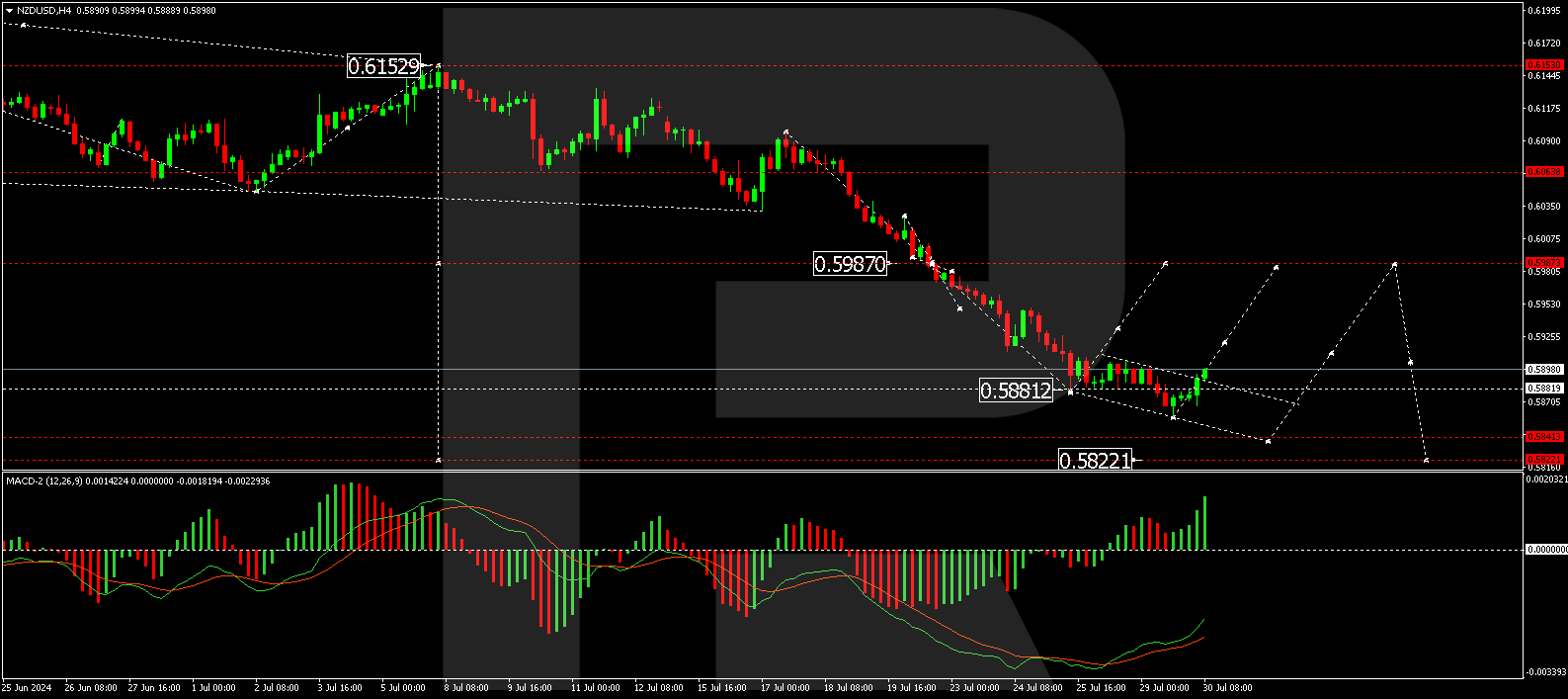
On the H4 chart, the NZD/USD pair is evolving within a broad consolidation range around the 0.6136 level. A recent growth impulse has reached 0.6197. Today, a potential decline to 0.6137 is expected, which could test from below. Following this correction, a new wave of decline may initiate, targeting the 0.6136 level, potentially extending to 0.6070 if this level is breached. The MACD indicator supports this bearish outlook, with its signal line below zero and pointed downwards. The notable divergence between the chart peaks and the indicator further reinforces this analysis.

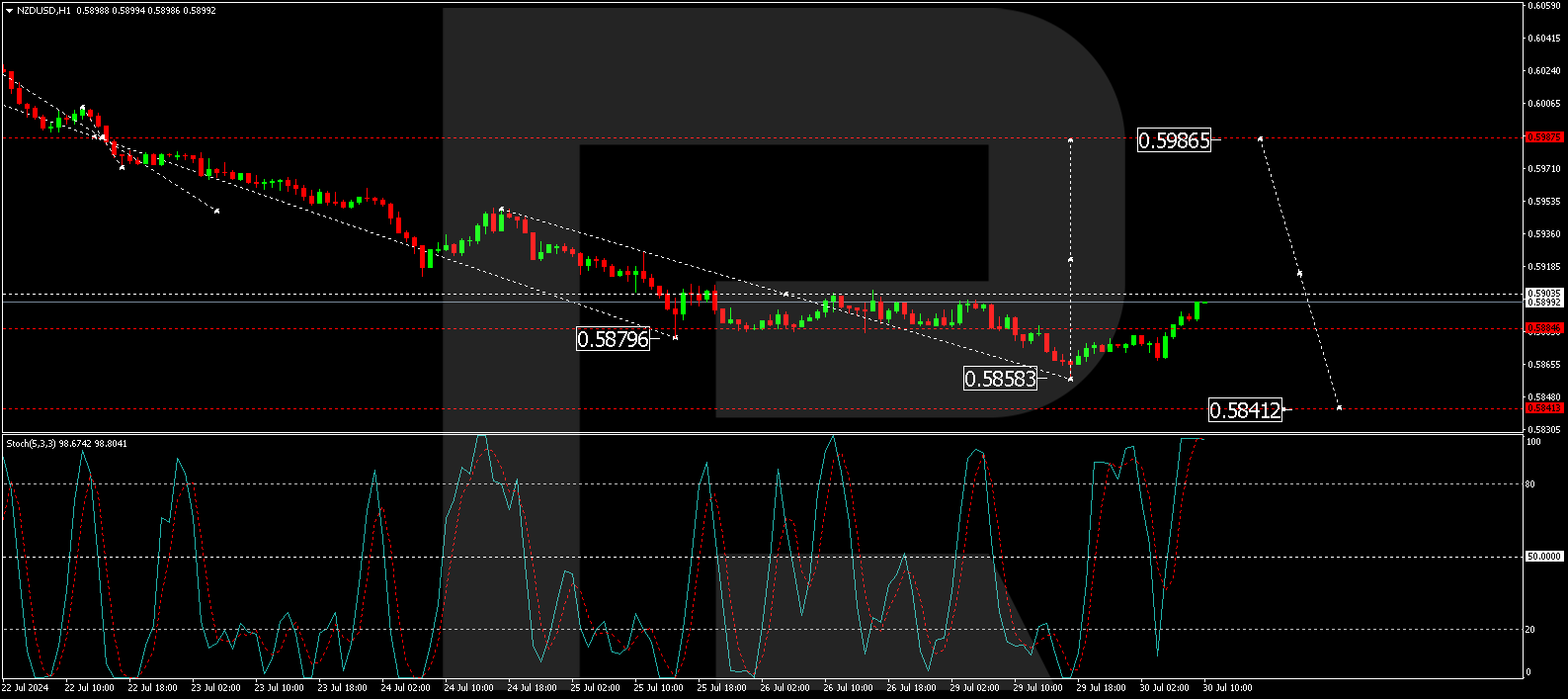
On the H1 chart, the pair showed a downward impulse to 0.6155, followed by a correction to 0.6191. Today, the market may execute an impulse to 0.6160, with the potential for a further decline to 0.6140 and an extension towards 0.6080, the first target of the downward wave. This scenario is technically validated by the Stochastic oscillator, with its signal line currently above 80 but trending sharply downward.

Market outlook

As the NZD/USD pair continues to show resilience amidst fluctuating US economic indicators, it is crucial for investors to closely monitor incoming data, particularly from the US employment market, which could significantly influence the Fed’s next steps. The stability of the New Zealand dollar, supported by the RBNZ’s steady policy stance, contrasts the potential volatility in the US dollar as fiscal and monetary policy expectations evolve.

Disclaimer

Any forecasts contained herein are based on the author’s particular opinion. This analysis may not be treated as trading advice. RoboForex bears no responsibility for trading results based on trading recommendations and reviews contained herein.

FXTM’s Sugar: Hits 3-week high

By ForexTime

  • Sugar ↑ almost 3% month-to-date
  • Roughly 25% away from 2024 high
  • H1 prices bullish but RSI overbought
  • Technical levels – 19.08, 18.90 and 18.50

Check this out, FXTM’s new Sugar commodity has just touched a fresh three-week high!

After wobbling near multi-week lows, prices clipped above 18.90 cents per pound on Tuesday.

Note: Sugar is priced per pound.

Before we break down the fundamentals, here are some fun facts about sugar:

  • Been around for over 10,000 years
  • Introduced in the West as a “spice”
  • Brazil is the biggest producer 
  • We are all wired to crave sugar!
  • Gained almost 3% month-to-date


What is Sugar?

It is a sweet substance obtained from plants such as sugarcane or sugar beets.

Sugar is a very versatile ingredient, used for drinks, cereals, sweets, cakes, jams, and so on.

What does FXTM’s Sugar track?

FXTM’s Sugar tracks the Sugar No. 11 futures, the world benchmark for raw sugar trading.

The lowdown?

Sugar prices are down almost 10% year-to-date.

The soft commodity initially gained 17% in January amid concerns that El Nino weather patterns could disrupt global sugar production.  Fears over severe weather conditions in the world’s two largest producers (Brazil & India) sent prices above 24.00 cents per pound.

Since then, sugar has been under pressure – posting four consecutive months of losses thanks to improving supply prospects.

The bigger picture…

An improving supply outlook from Brazil and a potentially longer monsoon season in India could boost global sugar production.

This may lead to lower sugar prices, especially when factoring in how these two countries account for over 40% of world production.

Conversely, India has extended its sugar export restrictions beyond October 2024. But this could change if the current elections result in a change of leadership and trade policies.

What does this mean?

According to the United States Department of Agriculture (USDA), global consumption of sugar is forecast to rise to a new record high of 179.0 million tons in 2024.

However, global production is also forecast to hit 186.0 million tons this year. This potential surplus of 7.0 million tons could limit upside gains for sugar.

Technical Outlook

Sugar is trending higher on the H1 timeframe with prices above the 50, 100, and 200 SMA. However, the Relative Strength Index (RSI) has crossed above 70 – indicating that prices are overbought.

  • Sustained weakness below 18.90 could open a path towards 18.50 and 18.10.
  • A strong break above 18.90 may see bulls challenge 19.08 and 19.30.


Forex-Time-LogoArticle by ForexTime

ForexTime Ltd (FXTM) is an award winning international online forex broker regulated by CySEC 185/12 www.forextime.com

Japanese yen strengthens unexpectedly against US dollar

By RoboForex Analytical Department

The USD/JPY pair unexpectedly declined last night due to a weakening US dollar. Currently, it is hovering around 156.33.

Japanese Finance Minister Shunichi Suzuki highlighted the government’s recent interventions to support the yen, significantly impacting the market. Official data reveals that throughout April, Japan spent approximately 9.79 trillion yen (62.2 billion USD) on efforts to stabilise the national currency.

Suzuki pointed out that the interventions aimed to mitigate excessive fluctuations in the currency market. He affirmed that Japan would continue to monitor the forex market and act against disorderly movements vigilantly, expressing satisfaction with the effects of these measures. This marks the first time the Japanese authorities have acknowledged their market interventions conducted in late April and early May.

The yen’s strengthening is also bolstered by the recent depreciation of the US dollar, driven by market anticipations of a potential earlier rate cut by the US Federal Reserve. As expectations grow for softened US monetary policy, the dollar has declined, boosting other currencies, including the yen.

USD/JPY technical analysis

On the H4 chart, USD/JPY completed a correction wave, reaching 157.70. A new wave of decline aiming for 153.77 is forming. Once this target is reached, a potential correction to 155.44 (testing from below) may follow, preceding a further decline towards 149.70. The bearish outlook is technically supported by the MACD indicator, with its signal line below zero and pointing sharply downwards.

On the H1 chart, the correction phase to 157.47 has concluded, and a downward impulse towards 155.44 is underway. Following this, a correction to 156.45 (testing from below) could occur, potentially leading to a further drop to 155.22, the primary target. This scenario is technically confirmed by the Stochastic oscillator, whose signal line is positioned above 80 and is anticipated to drop to 20.

Summary

The yen’s unexpected strengthening reflects a complex interplay of domestic interventions and broader market reactions to shifts in US monetary policy. Given the ongoing adjustments in global economic expectations and central bank policies, investors and traders should closely monitor these developments, as further fluctuations in the USD/JPY pair are likely.

Disclaimer

Any forecasts contained herein are based on the author’s particular opinion. This analysis may not be treated as trading advice. RoboForex bears no responsibility for trading results based on trading recommendations and reviews contained herein.

Oil prices decreased for the 5th consecutive session. AI companies support the NASDAQ index

By JustMarkets

At Monday’s close, the Dow Jones Index (US30) was down 0.30%, while the S&P 500 Index (US500) added 0.11%. The NASDAQ Technology Index (US100) closed positive 0.56% yesterday. The general market’s gains were limited as economic concerns pressured stocks after activity in the US manufacturing sector unexpectedly declined last month. In addition, energy stocks came under pressure after WTI crude oil prices fell more than 3% to a 3-month low. However, the strengthening of technology stocks helped the sector’s growth. Nvidia (NVDA), for example, closed up more than 4% and led chip stocks higher after the company announced at the Computex conference in Taiwan a new generation of artificial intelligence chips by 2025 and a next-generation platform under development called Rubin by 2026.

Minneapolis Fed President Kashkari’s comments were hawkish. They supported the dollar when he said the Fed will likely hold interest rates for an “extended period” until new economic data convinces policymakers that inflation is declining. Markets estimate the odds of a 25 bps rate cut at 1% at the June 11-12 FOMC meeting, 15% at the next meeting on July 30-31, and 51% at the next September 17-18 meeting.

Equity markets in Europe mostly went up yesterday. Germany’s DAX (DE40) rose by 0.60%, France’s CAC 40 (FR40) closed higher by 0.06%, Spain’s IBEX 35 (ES35) added 0.66%, and the UK’s FTSE 100 (UK100) closed negative 0.15% on Monday.

European equity markets opened lower on Tuesday, following a global decline among global peers as disappointing US industrial production data weighed on market sentiment. Investors are also cautiously awaiting the European Central Bank’s decision this week, which is expected to cut interest rates for the first time since 2019. Meanwhile, markets will see if last week’s Eurozone inflation data will influence the ECB’s decision.

On Monday, silver (XAGUSD) gained support on strengthening manufacturing activity in China after the May Caixin PMI rose by 0.3 to 51.7, the highest reading in 23 months and a positive for industrial metals demand.

WTI crude oil prices fell below $74 a barrel on Tuesday, dropping for the fifth consecutive session to the lowest level in four months amid concerns that global supply could increase later this year. OPEC+ agreed on Sunday to extend most supply cuts through 2025 but opened the door for voluntary cuts by eight member countries to be phased out starting in October. More than 500,000 barrels a day are expected to return to the market by December, and 1.8 million barrels a day by June 2025.

Asian markets were predominantly up yesterday. Japan’s Nikkei 225 (JP225) gained 1.13% over yesterday, China’s FTSE China A50 (CHA50) climbed 0.55%, Hong Kong’s Hang Seng (HK50) rose by 1.79%, and Australia’s ASX 200 (AU200) was positive 0.77%.

On Tuesday, the S&P/ASX 200 Index (AU200) fell 0.05% to below 7,760, interrupting two days of gains. This was helped by losses in mining and energy stocks amid lower commodity prices. Investors are also awaiting Australian GDP data this week to gauge the current state of the economy and potential implications for domestic monetary policy.

S&P 500 (US500) 5,283.40 +5.89 (+0.11%)

Dow Jones (US30) 38,571.03 −115.29 (−0.30%)

DAX (DE40) 18,608.16 +110.22 (+0.60%)

FTSE 100 (UK100) 8,262.75 −12.63 (−0.15%)

USD Index 104.11 −0.56 (−0.54%)

Important events today:
  • – Switzerland Consumer Price Index (m/m) at 09:30 (GMT+3);
  • – German Unemployment Rate (m/m) at 10:55 (GMT+3);
  • – US JOLTs Job Openings (m/m) at 17:00 (GMT+3).

By JustMarkets


This article reflects a personal opinion and should not be interpreted as an investment advice, and/or offer, and/or a persistent request for carrying out financial transactions, and/or a guarantee, and/or a forecast of future events.

OPEC+ extending key oil production cuts

By JustMarkets

On Friday, the Dow Jones (US30) Index gained 1.51% (for the week -1.03%), while the S&P 500 (US500) Index was up by 0.80% (for the week -0.07%). The NASDAQ Technology Index (US100) closed negative 0.01% (for the week -0.31%). Stocks rallied sharply in the last 20 minutes of the session on Friday, reversing losses seen earlier in the day. The volatility arose partly due to the last trading day of the month and the rebalancing of some stock indexes.

On Friday, the US equity indices received support from a 4.6 bps decline in 10-year T-note yields on the back of the expected US PCE deflator, which kept hopes alive for a Fed interest rate cut later this year. The April PCE deflator report of 0.3% m/m and 2.7% y/y was unchanged from March and in line with market expectations. The April report on core PCE deflator 0.2% m/m and 2.8% y/y also matched market expectations. The nominal and real PCE deflators are still well above the Fed’s 2% inflation target, but these measures are at least near or at 3-year lows. The PCE deflator is the Fed’s preferred measure of inflation.

Dell Technologies (DELL) fell 17.87% after reporting earnings that were below expectations and undermined high hopes for the company’s artificial intelligence server products.

Equity markets in Europe were mostly up on Friday. Germany’s DAX (DE40) rose by 0.01% (for the week -1.10%), France’s CAC 40 (FR40) closed up 0.18% (for the week -1.18%), Spain’s IBEX 35 (ES35) fell by 0.14% (for the week +0.55%), and the UK’s FTSE 100 (UK100) closed positive 0.54% (for the week -0.77%).

Eurozone government bond yields rose on Friday amid a disappointing Eurozone CPI report. The preliminary Eurozone CPI for May rose to 2.6% y/y from 2.4% in April and was slightly stronger than market expectations of 2.5%. Eurozone preliminary core CPI for May rose to 2.9% y/y from 2.7% in April and was stronger than market expectations of 2.7%. After this week’s meeting, Friday’s CPI report dampened expectations of a further ECB rate cut. Swaps estimate the probability of a 25 bps ECB rate cut at the next meeting on June 6 at 96%. If the ECB cuts rates by 25 bps this week as expected, markets expect a 0% probability of another rate cut at the next meeting on July 18 and a 50% probability of a rate cut at the September 12 meeting.

OPEC+ has extended production cuts in an attempt to support a fragile market and has also set a date for oil production to resume later this year. This includes a voluntary production cut of 3.66 million bpd expiring at the end of 2024 and extending another round of cuts of 2.2 million bpd through the end of the third quarter of this year. Meanwhile, eight OPEC+ countries have said they plan to phase out additional cuts of 2.2 million bpd annually from October 2024 to September 2025.

Asian markets were mostly up last week. Japan’s Nikkei 225 (JP225) was down 0.72% for the week, China’s FTSE China A50 (CHA50) decreased by 0.89% for the week, Hong Kong’s Hang Seng (HK50) lost 2.83% for the week, and Australia’s ASX 200 (AU200) was positive 0.96%.

The offshore yuan fell to 7.263 per dollar, primarily due to seasonal demand for foreign currency, which puts downward pressure on the exchange rate. Such demand usually occurs between May and August, when Chinese companies listed overseas must buy foreign currencies to pay dividends to their shareholders abroad, forcing them to sell yuan.

The Caixin China Manufacturing PMI rose to 51.7 in May 2024 from 51.4 in April, beating forecasts of 51.5. It was the seventh straight month of growth in factory activity and the fastest pace since June 2022, as output rose by the most in 23 months amid a rise in new orders.

Indonesia’s annual inflation rate for May 2024 eased to 2.84% from 3.0% in April, beating market expectations of 2.94%. It was the lowest since February and remained within the central bank’s target range of 1.5% to 3.5% as food prices rose the least since January (6.18% vs. 7.04% in April).

The S&P Global Vietnam Manufacturing PMI stood at 50.3 in May 2024, unchanged from the previous month. This marked the second consecutive month of increased activity at enterprises because of strong growth in new orders and accelerating output growth. Foreign sales increased, albeit to a lesser extent than total new orders. Although employment declined for the second consecutive month, work in progress remained stable, and purchasing activity picked up again as demand for products increased.

S&P 500 (US500) 5,277.51 +42.03 (+0.80%)

Dow Jones (US30) 38,686.32 +574.84 (+1.51%)

DAX (DE40) 18,497.94 +1.15 (+0.01%)

FTSE 100 (UK100) 8,275.38 +44.33 (+0.54%)

USD Index 104.63 −0.09 (−0.09%)

Important events today:
  • – Australia Manufacturing PMI (m/m) at 02:00 (GMT+3);
  • – Japan Manufacturing PMI (m/m) at 03:30 (GMT+3);
  • – Caixin China Manufacturing PMI (m/m) at 04:45 (GMT+3);
  • – Switzerland Manufacturing PMI (m/m) at 10:30 (GMT+3);
  • – German Manufacturing PMI (m/m) at 10:55 (GMT+3);
  • – Eurozone Manufacturing PMI (m/m) at 11:00 (GMT+3);
  • – UK Manufacturing PMI (m/m) at 11:30 (GMT+3);
  • – US ISM Manufacturing PMI (m/m) at 17:00 (GMT+3).

By JustMarkets


This article reflects a personal opinion and should not be interpreted as an investment advice, and/or offer, and/or a persistent request for carrying out financial transactions, and/or a guarantee, and/or a forecast of future events.

Trade of the Week: USDInd seeks fresh directional catalyst

By ForexTime 

  • USDInd ends May ↓1.7%
  • ECB meeting & NFP in focus
  • Over past year ECB triggered moves of 0.6% ↑ or ↓
  • Trapped in D1 range since mid-May
  • Technical levels – 105.20 and 104.20

After bouncing within a 1000-point range since mid-May, FXTM’s USDInd is on breakout watch!

A high-risk cocktail featuring the European Central Bank (ECB) and US jobs report could rock the index this week.

Note: FXTM’s USDInd tracks the US Dollar Index.  This measures how the dollar performs against a basket of six different G10 currencies, including the Euro, British Pound, Japanese Yen, and Canadian dollar.

Interestingly, the dollar depreciated against every single G10 currency in May.

Three heavy-hitting events in May knocked the dollar.

Starting from the dovish Fed meeting, soft US April jobs report, and cooler-than-expected CPI print. Last Friday, the Fed’s preferred inflation gauge – core PCE also printed below market forecasts, keeping the doors open for lower interest rates in 2024.

With all the above said, here are 3 reasons why the USDInd could see significant moves this week:

    1) ECB rate decision

The ECB is widely expected to cut interest rates by 25 basis points at its meeting on Thursday, June 6th.

So, the focus will be on the press conference for fresh insight into what to expect in H2, especially after Germany and Eurozone inflation edged up in May.

Note: The Euro accounts for almost 60% of the US Dollar Index weighting. A weaker euro tends to push the index higher and vice versa.

As of writing, traders are pricing in a 90% probability of a second 25-basis point cut by October with the odds of a third cut by the end of 2024 around 40%.

  • The USDInd could push higher if the ECB strikes a dovish tone, and signals further cuts down the road.
  • Should the central bank sound more hawkish and signal a “one and done” rate cut for 2024, this may send the USDInd lower.

Fun fact: Over the past 12 months, the ECB rate decision has sparked upside moves as much as 0.6% or declines of 0.6% in the 6 hours post-release.


    2) US May NFP report

This major economic release is likely to influence expectations around when the Fed cuts rates in 2024.

Markets expect the US economy to have created 190k jobs in May, compared to the 175k in the previous month while the unemployment rate is expected to remain steady at 3.9%.

Traders are currently pricing in a 60% probability of a 25-basis point cut by September with this jumping to over 90% by November.

  • A soft jobs report that boosts Fed cut bets may send the USDInd lower.
  • If the jobs data prints above market forecasts, this may push the USDInd higher.

Fun fact: Over the past 12 months, the US jobs report has trigged up moves as much as 0.4% or declines of 0.6% in the 6 hours after release.

    3) Technical forces

Prices remain in a range on the daily charts with support at 104.20 and resistance at 105.20.  

  • A sold breakout above 105.20 may signal a move towards 105.60.
  • Should prices slip below 104.20, bears may be encouraged to target 103.90.


Forex-Time-LogoArticle by ForexTime

ForexTime Ltd (FXTM) is an award winning international online forex broker regulated by CySEC 185/12 www.forextime.com

COT Soft Commodities Charts: Speculator bets led by Soybean Meal & Soybeans

By InvestMacro

Here are the latest charts and statistics for the Commitment of Traders (COT) reports data published by the Commodities Futures Trading Commission (CFTC).

The latest COT data is updated through Tuesday May 28th and shows a quick view of how large traders (for-profit speculators and commercial entities) were positioned in the futures markets.

Weekly Speculator Changes led by Soybean Meal & Soybeans

The COT soft commodities markets speculator bets were higher this week as seven out of the eleven softs markets we cover had higher positioning while the other four markets had lower speculator contracts.

Leading the gains for the softs markets was Soybean Meal (25,247 contracts) with Soybeans (19,074 contracts), Live Cattle (10,199 contracts), Soybean Oil (8,014 contracts), Cotton (7,870 contracts), Cocoa (3,679 contracts) and Coffee (3,647 contracts) also showing positive weeks.

The markets with the declines in speculator bets this week were Corn (-9,805 contracts), Lean Hogs (-9,200 contracts), Sugar (-3,316 contracts) and with Wheat (-1,871 contracts) also registering lower bets on the week.


Soft Commodities Net Speculators Leaderboard

Legend: Weekly Speculators Change | Speculators Current Net Position | Speculators Strength Score compared to last 3-Years (0-100 range)


Strength Scores led by Coffee & Soybean Meal

COT Strength Scores (a normalized measure of Speculator positions over a 3-Year range, from 0 to 100 where above 80 is Extreme-Bullish and below 20 is Extreme-Bearish) showed that Coffee (87 percent) and Soybean Meal (74 percent) lead the softs markets this week. Wheat (58 percent) comes in as the next highest in the weekly strength scores.

On the downside, Sugar (0 percent), Cotton (14 percent) and Soybean Oil (17 percent) come in at the lowest strength levels currently and are in Extreme-Bearish territory (below 20 percent).

Strength Statistics:
Corn (27.3 percent) vs Corn previous week (28.6 percent)
Sugar (0.0 percent) vs Sugar previous week (1.1 percent)
Coffee (87.3 percent) vs Coffee previous week (83.8 percent)
Soybeans (40.4 percent) vs Soybeans previous week (35.9 percent)
Soybean Oil (17.2 percent) vs Soybean Oil previous week (12.3 percent)
Soybean Meal (74.4 percent) vs Soybean Meal previous week (64.0 percent)
Live Cattle (44.6 percent) vs Live Cattle previous week (33.6 percent)
Lean Hogs (40.9 percent) vs Lean Hogs previous week (48.5 percent)
Cotton (14.5 percent) vs Cotton previous week (8.6 percent)
Cocoa (43.2 percent) vs Cocoa previous week (39.4 percent)
Wheat (57.5 percent) vs Wheat previous week (58.8 percent)


Soybean Meal & Soybeans top the 6-Week Strength Trends

COT Strength Score Trends (or move index, calculates the 6-week changes in strength scores) showed that Soybean Meal (52 percent) and Soybeans (34 percent) lead the past six weeks trends for soft commodities. Wheat (34 percent), Corn (20 percent) and Live Cattle (19 percent) are the next highest positive movers in the latest trends data.

Lean Hogs (-35 percent) leads the downside trend scores currently with Cotton (-34 percent), Sugar (-19 percent) and Coffee (-13 percent) following next with lower trend scores.

Strength Trend Statistics:
Corn (19.5 percent) vs Corn previous week (18.9 percent)
Sugar (-19.3 percent) vs Sugar previous week (-32.7 percent)
Coffee (-12.7 percent) vs Coffee previous week (-13.8 percent)
Soybeans (34.4 percent) vs Soybeans previous week (26.8 percent)
Soybean Oil (3.8 percent) vs Soybean Oil previous week (-15.7 percent)
Soybean Meal (52.2 percent) vs Soybean Meal previous week (45.7 percent)
Live Cattle (19.2 percent) vs Live Cattle previous week (1.8 percent)
Lean Hogs (-35.2 percent) vs Lean Hogs previous week (-24.1 percent)
Cotton (-33.6 percent) vs Cotton previous week (-54.8 percent)
Cocoa (-1.3 percent) vs Cocoa previous week (-6.1 percent)
Wheat (33.7 percent) vs Wheat previous week (27.7 percent)


Individual Soft Commodities Markets:

CORN Futures:

CORN Futures COT ChartThe CORN large speculator standing this week was a net position of -51,632 contracts in the data reported through Tuesday. This was a weekly fall of -9,805 contracts from the previous week which had a total of -41,827 net contracts.

This week’s current strength score (the trader positioning range over the past three years, measured from 0 to 100) shows the speculators are currently Bearish with a score of 27.3 percent. The commercials are Bullish with a score of 74.6 percent and the small traders (not shown in chart) are Bullish with a score of 55.4 percent.

Price Trend-Following Model: Weak Uptrend

Our weekly trend-following model classifies the current market price position as: Weak Uptrend. The current action for the model is considered to be: Hold – Maintain Long Position.

CORN Futures StatisticsSPECULATORSCOMMERCIALSSMALL TRADERS
– Percent of Open Interest Longs:21.942.29.2
– Percent of Open Interest Shorts:25.336.311.7
– Net Position:-51,63290,934-39,302
– Gross Longs:337,903650,550141,411
– Gross Shorts:389,535559,616180,713
– Long to Short Ratio:0.9 to 11.2 to 10.8 to 1
NET POSITION TREND:
– Strength Index Score (3 Year Range Pct):27.374.655.4
– Strength Index Reading (3 Year Range):BearishBullishBullish
NET POSITION MOVEMENT INDEX:
– 6-Week Change in Strength Index:19.5-16.4-39.8


SUGAR Futures:

SUGAR Futures COT ChartThe SUGAR large speculator standing this week was a net position of 5,105 contracts in the data reported through Tuesday. This was a weekly decrease of -3,316 contracts from the previous week which had a total of 8,421 net contracts.

This week’s current strength score (the trader positioning range over the past three years, measured from 0 to 100) shows the speculators are currently Bearish-Extreme with a score of 0.0 percent. The commercials are Bullish-Extreme with a score of 100.0 percent and the small traders (not shown in chart) are Bearish-Extreme with a score of 2.2 percent.

Price Trend-Following Model: Strong Downtrend

Our weekly trend-following model classifies the current market price position as: Strong Downtrend. The current action for the model is considered to be: Hold – Maintain Short Position.

SUGAR Futures StatisticsSPECULATORSCOMMERCIALSSMALL TRADERS
– Percent of Open Interest Longs:23.253.57.3
– Percent of Open Interest Shorts:22.752.68.8
– Net Position:5,1058,283-13,388
– Gross Longs:203,331468,23263,624
– Gross Shorts:198,226459,94977,012
– Long to Short Ratio:1.0 to 11.0 to 10.8 to 1
NET POSITION TREND:
– Strength Index Score (3 Year Range Pct):0.0100.02.2
– Strength Index Reading (3 Year Range):Bearish-ExtremeBullish-ExtremeBearish-Extreme
NET POSITION MOVEMENT INDEX:
– 6-Week Change in Strength Index:-19.316.0-1.4


COFFEE Futures:

COFFEE Futures COT ChartThe COFFEE large speculator standing this week was a net position of 63,033 contracts in the data reported through Tuesday. This was a weekly rise of 3,647 contracts from the previous week which had a total of 59,386 net contracts.

This week’s current strength score (the trader positioning range over the past three years, measured from 0 to 100) shows the speculators are currently Bullish-Extreme with a score of 87.3 percent. The commercials are Bearish-Extreme with a score of 12.1 percent and the small traders (not shown in chart) are Bullish with a score of 65.5 percent.

Price Trend-Following Model: Strong Uptrend

Our weekly trend-following model classifies the current market price position as: Strong Uptrend. The current action for the model is considered to be: Hold – Maintain Long Position.

COFFEE Futures StatisticsSPECULATORSCOMMERCIALSSMALL TRADERS
– Percent of Open Interest Longs:34.735.04.0
– Percent of Open Interest Shorts:7.763.42.6
– Net Position:63,033-66,3723,339
– Gross Longs:81,14681,8739,381
– Gross Shorts:18,113148,2456,042
– Long to Short Ratio:4.5 to 10.6 to 11.6 to 1
NET POSITION TREND:
– Strength Index Score (3 Year Range Pct):87.312.165.5
– Strength Index Reading (3 Year Range):Bullish-ExtremeBearish-ExtremeBullish
NET POSITION MOVEMENT INDEX:
– 6-Week Change in Strength Index:-12.712.18.6


SOYBEANS Futures:

SOYBEANS Futures COT ChartThe SOYBEANS large speculator standing this week was a net position of -25,908 contracts in the data reported through Tuesday. This was a weekly increase of 19,074 contracts from the previous week which had a total of -44,982 net contracts.

This week’s current strength score (the trader positioning range over the past three years, measured from 0 to 100) shows the speculators are currently Bearish with a score of 40.4 percent. The commercials are Bullish with a score of 62.2 percent and the small traders (not shown in chart) are Bullish with a score of 62.2 percent.

Price Trend-Following Model: Uptrend

Our weekly trend-following model classifies the current market price position as: Uptrend. The current action for the model is considered to be: Hold – Maintain Long Position.

SOYBEANS Futures StatisticsSPECULATORSCOMMERCIALSSMALL TRADERS
– Percent of Open Interest Longs:16.157.26.8
– Percent of Open Interest Shorts:19.451.79.2
– Net Position:-25,90844,728-18,820
– Gross Longs:129,688459,81754,827
– Gross Shorts:155,596415,08973,647
– Long to Short Ratio:0.8 to 11.1 to 10.7 to 1
NET POSITION TREND:
– Strength Index Score (3 Year Range Pct):40.462.262.2
– Strength Index Reading (3 Year Range):BearishBullishBullish
NET POSITION MOVEMENT INDEX:
– 6-Week Change in Strength Index:34.4-31.4-28.2


SOYBEAN OIL Futures:

SOYBEAN OIL Futures COT ChartThe SOYBEAN OIL large speculator standing this week was a net position of -28,264 contracts in the data reported through Tuesday. This was a weekly lift of 8,014 contracts from the previous week which had a total of -36,278 net contracts.

This week’s current strength score (the trader positioning range over the past three years, measured from 0 to 100) shows the speculators are currently Bearish-Extreme with a score of 17.2 percent. The commercials are Bullish-Extreme with a score of 81.3 percent and the small traders (not shown in chart) are Bearish with a score of 41.2 percent.

Price Trend-Following Model: Downtrend

Our weekly trend-following model classifies the current market price position as: Downtrend. The current action for the model is considered to be: Hold – Maintain Short Position.

SOYBEAN OIL Futures StatisticsSPECULATORSCOMMERCIALSSMALL TRADERS
– Percent of Open Interest Longs:20.253.95.7
– Percent of Open Interest Shorts:25.250.14.5
– Net Position:-28,26421,2647,000
– Gross Longs:112,590300,74031,971
– Gross Shorts:140,854279,47624,971
– Long to Short Ratio:0.8 to 11.1 to 11.3 to 1
NET POSITION TREND:
– Strength Index Score (3 Year Range Pct):17.281.341.2
– Strength Index Reading (3 Year Range):Bearish-ExtremeBullish-ExtremeBearish
NET POSITION MOVEMENT INDEX:
– 6-Week Change in Strength Index:3.8-6.622.4


SOYBEAN MEAL Futures:

SOYBEAN MEAL Futures COT ChartThe SOYBEAN MEAL large speculator standing this week was a net position of 114,521 contracts in the data reported through Tuesday. This was a weekly advance of 25,247 contracts from the previous week which had a total of 89,274 net contracts.

This week’s current strength score (the trader positioning range over the past three years, measured from 0 to 100) shows the speculators are currently Bullish with a score of 74.4 percent. The commercials are Bearish with a score of 22.3 percent and the small traders (not shown in chart) are Bullish with a score of 69.5 percent.

Price Trend-Following Model: Strong Uptrend

Our weekly trend-following model classifies the current market price position as: Strong Uptrend. The current action for the model is considered to be: Hold – Maintain Long Position.

SOYBEAN MEAL Futures StatisticsSPECULATORSCOMMERCIALSSMALL TRADERS
– Percent of Open Interest Longs:35.235.810.7
– Percent of Open Interest Shorts:11.165.25.4
– Net Position:114,521-139,80325,282
– Gross Longs:167,296170,31050,943
– Gross Shorts:52,775310,11325,661
– Long to Short Ratio:3.2 to 10.5 to 12.0 to 1
NET POSITION TREND:
– Strength Index Score (3 Year Range Pct):74.422.369.5
– Strength Index Reading (3 Year Range):BullishBearishBullish
NET POSITION MOVEMENT INDEX:
– 6-Week Change in Strength Index:52.2-54.545.6


LIVE CATTLE Futures:

LIVE CATTLE Futures COT ChartThe LIVE CATTLE large speculator standing this week was a net position of 60,855 contracts in the data reported through Tuesday. This was a weekly advance of 10,199 contracts from the previous week which had a total of 50,656 net contracts.

This week’s current strength score (the trader positioning range over the past three years, measured from 0 to 100) shows the speculators are currently Bearish with a score of 44.6 percent. The commercials are Bullish with a score of 61.9 percent and the small traders (not shown in chart) are Bearish with a score of 30.5 percent.

Price Trend-Following Model: Uptrend

Our weekly trend-following model classifies the current market price position as: Uptrend. The current action for the model is considered to be: Hold – Maintain Long Position.

LIVE CATTLE Futures StatisticsSPECULATORSCOMMERCIALSSMALL TRADERS
– Percent of Open Interest Longs:40.832.89.2
– Percent of Open Interest Shorts:20.049.813.0
– Net Position:60,855-49,742-11,113
– Gross Longs:119,35695,95226,865
– Gross Shorts:58,501145,69437,978
– Long to Short Ratio:2.0 to 10.7 to 10.7 to 1
NET POSITION TREND:
– Strength Index Score (3 Year Range Pct):44.661.930.5
– Strength Index Reading (3 Year Range):BearishBullishBearish
NET POSITION MOVEMENT INDEX:
– 6-Week Change in Strength Index:19.2-16.8-21.7


LEAN HOGS Futures:

LEAN HOGS Futures COT ChartThe LEAN HOGS large speculator standing this week was a net position of 13,662 contracts in the data reported through Tuesday. This was a weekly fall of -9,200 contracts from the previous week which had a total of 22,862 net contracts.

This week’s current strength score (the trader positioning range over the past three years, measured from 0 to 100) shows the speculators are currently Bearish with a score of 40.9 percent. The commercials are Bullish with a score of 60.4 percent and the small traders (not shown in chart) are Bullish with a score of 63.8 percent.

Price Trend-Following Model: Uptrend

Our weekly trend-following model classifies the current market price position as: Uptrend. The current action for the model is considered to be: Hold – Maintain Long Position.

LEAN HOGS Futures StatisticsSPECULATORSCOMMERCIALSSMALL TRADERS
– Percent of Open Interest Longs:29.839.37.8
– Percent of Open Interest Shorts:24.842.79.4
– Net Position:13,662-9,301-4,361
– Gross Longs:81,944108,35021,540
– Gross Shorts:68,282117,65125,901
– Long to Short Ratio:1.2 to 10.9 to 10.8 to 1
NET POSITION TREND:
– Strength Index Score (3 Year Range Pct):40.960.463.8
– Strength Index Reading (3 Year Range):BearishBullishBullish
NET POSITION MOVEMENT INDEX:
– 6-Week Change in Strength Index:-35.236.212.9


COTTON Futures:

COTTON Futures COT ChartThe COTTON large speculator standing this week was a net position of 7,678 contracts in the data reported through Tuesday. This was a weekly rise of 7,870 contracts from the previous week which had a total of -192 net contracts.

This week’s current strength score (the trader positioning range over the past three years, measured from 0 to 100) shows the speculators are currently Bearish-Extreme with a score of 14.5 percent. The commercials are Bullish-Extreme with a score of 84.8 percent and the small traders (not shown in chart) are Bearish-Extreme with a score of 18.8 percent.

Price Trend-Following Model: Strong Downtrend

Our weekly trend-following model classifies the current market price position as: Strong Downtrend. The current action for the model is considered to be: Hold – Maintain Short Position.

COTTON Futures StatisticsSPECULATORSCOMMERCIALSSMALL TRADERS
– Percent of Open Interest Longs:30.744.85.4
– Percent of Open Interest Shorts:27.448.45.2
– Net Position:7,678-8,136458
– Gross Longs:70,382102,57312,272
– Gross Shorts:62,704110,70911,814
– Long to Short Ratio:1.1 to 10.9 to 11.0 to 1
NET POSITION TREND:
– Strength Index Score (3 Year Range Pct):14.584.818.8
– Strength Index Reading (3 Year Range):Bearish-ExtremeBullish-ExtremeBearish-Extreme
NET POSITION MOVEMENT INDEX:
– 6-Week Change in Strength Index:-33.632.4-19.1


COCOA Futures:

COCOA Futures COT ChartThe COCOA large speculator standing this week was a net position of 32,570 contracts in the data reported through Tuesday. This was a weekly gain of 3,679 contracts from the previous week which had a total of 28,891 net contracts.

This week’s current strength score (the trader positioning range over the past three years, measured from 0 to 100) shows the speculators are currently Bearish with a score of 43.2 percent. The commercials are Bullish with a score of 53.5 percent and the small traders (not shown in chart) are Bullish with a score of 62.1 percent.

Price Trend-Following Model: Uptrend

Our weekly trend-following model classifies the current market price position as: Uptrend. The current action for the model is considered to be: Hold – Maintain Long Position.

COCOA Futures StatisticsSPECULATORSCOMMERCIALSSMALL TRADERS
– Percent of Open Interest Longs:31.734.67.5
– Percent of Open Interest Shorts:10.459.73.7
– Net Position:32,570-38,4255,855
– Gross Longs:48,41652,94111,504
– Gross Shorts:15,84691,3665,649
– Long to Short Ratio:3.1 to 10.6 to 12.0 to 1
NET POSITION TREND:
– Strength Index Score (3 Year Range Pct):43.253.562.1
– Strength Index Reading (3 Year Range):BearishBullishBullish
NET POSITION MOVEMENT INDEX:
– 6-Week Change in Strength Index:-1.32.1-6.8


WHEAT Futures:

WHEAT Futures COT ChartThe WHEAT large speculator standing this week was a net position of -14,393 contracts in the data reported through Tuesday. This was a weekly fall of -1,871 contracts from the previous week which had a total of -12,522 net contracts.

This week’s current strength score (the trader positioning range over the past three years, measured from 0 to 100) shows the speculators are currently Bullish with a score of 57.5 percent. The commercials are Bearish with a score of 42.5 percent and the small traders (not shown in chart) are Bearish with a score of 36.5 percent.

Price Trend-Following Model: Strong Uptrend

Our weekly trend-following model classifies the current market price position as: Strong Uptrend. The current action for the model is considered to be: Hold – Maintain Long Position.

WHEAT Futures StatisticsSPECULATORSCOMMERCIALSSMALL TRADERS
– Percent of Open Interest Longs:29.836.17.6
– Percent of Open Interest Shorts:33.231.19.2
– Net Position:-14,39321,208-6,815
– Gross Longs:127,585154,24732,381
– Gross Shorts:141,978133,03939,196
– Long to Short Ratio:0.9 to 11.2 to 10.8 to 1
NET POSITION TREND:
– Strength Index Score (3 Year Range Pct):57.542.536.5
– Strength Index Reading (3 Year Range):BullishBearishBearish
NET POSITION MOVEMENT INDEX:
– 6-Week Change in Strength Index:33.7-30.0-35.3


Article By InvestMacroReceive our weekly COT Newsletter

*COT Report: The COT data, released weekly to the public each Friday, is updated through the most recent Tuesday (data is 3 days old) and shows a quick view of how large speculators or non-commercials (for-profit traders) were positioned in the futures markets.

The CFTC categorizes trader positions according to commercial hedgers (traders who use futures contracts for hedging as part of the business), non-commercials (large traders who speculate to realize trading profits) and nonreportable traders (usually small traders/speculators) as well as their open interest (contracts open in the market at time of reporting). See CFTC criteria here.

COT Metals Charts: Weekly Speculator Changes led by Gold

By InvestMacro

Here are the latest charts and statistics for the Commitment of Traders (COT) data published by the Commodities Futures Trading Commission (CFTC).

The latest COT data is updated through Tuesday May 28th and shows a quick view of how large traders (for-profit speculators and commercial entities) were positioned in the futures markets.

Weekly Speculator Changes led by Gold

The COT metals markets speculator bets were lower this week as just one out of the six metals markets we cover had higher positioning while the other five markets had lower speculator contracts.

Leading the gains for the metals was Gold with a total rise of 6,779 contracts for the week.

The markets with declines in speculator bets for the week were Copper (-6,172 contracts), Silver (-2,461 contracts), Palladium (-655 contracts), Steel (-314 contracts) and  Platinum (-82 contracts) also registering lower bets on the week.


Metals Net Speculators Leaderboard

Legend: Weekly Speculators Change | Speculators Current Net Position | Speculators Strength Score compared to last 3-Years (0-100 range)


Strength Scores led by Silver & Copper

COT Strength Scores (a normalized measure of Speculator positions over a 3-Year range, from 0 to 100 where above 80 is Extreme-Bullish and below 20 is Extreme-Bearish) showed that Silver (97 percent), Copper (94 percent), Platinum (92 percent), Gold (83 percent) and Steel (80 percent) lead the metals markets this week and are all in Extreme-Bullish territory.

On the downside, Palladium (15 percent) comes in at the lowest strength level currently and is in Extreme-Bearish territory (below 20 percent).

Strength Statistics:
Gold (83.0 percent) vs Gold previous week (79.9 percent)
Silver (96.6 percent) vs Silver previous week (100.0 percent)
Copper (94.3 percent) vs Copper previous week (100.0 percent)
Platinum (91.6 percent) vs Platinum previous week (91.8 percent)
Palladium (15.2 percent) vs Palladium previous week (19.3 percent)
Steel (79.8 percent) vs Palladium previous week (81.0 percent)


Platinum & Copper top the 6-Week Strength Trends

COT Strength Score Trends (or move index, calculates the 6-week changes in strength scores) showed that Platinum (25 percent) and Copper (17 percent) lead the past six weeks trends for metals. Gold (16 percent) is the next highest positive mover in the latest trends data.

Palladium (-13 percent) leads the downside trend scores currently with Steel (-6 percent) as the next market with lower trend scores.

Move Statistics:
Gold (15.6 percent) vs Gold previous week (12.3 percent)
Silver (5.3 percent) vs Silver previous week (8.9 percent)
Copper (16.7 percent) vs Copper previous week (27.0 percent)
Platinum (24.9 percent) vs Platinum previous week (23.1 percent)
Palladium (-12.8 percent) vs Palladium previous week (-10.4 percent)
Steel (-6.1 percent) vs Steel previous week (-10.5 percent)


Individual Markets:

Gold Comex Futures:

Gold Futures COT ChartThe Gold Comex Futures large speculator standing this week was a net position of 236,585 contracts in the data reported through Tuesday. This was a weekly gain of 6,779 contracts from the previous week which had a total of 229,806 net contracts.

This week’s current strength score (the trader positioning range over the past three years, measured from 0 to 100) shows the speculators are currently Bullish-Extreme with a score of 83.0 percent. The commercials are Bearish-Extreme with a score of 18.8 percent and the small traders (not shown in chart) are Bullish with a score of 52.4 percent.

Price Trend-Following Model: Uptrend

Our weekly trend-following model classifies the current market price position as: Uptrend. The current action for the model is considered to be: Hold – Maintain Long Position.

Gold Futures StatisticsSPECULATORSCOMMERCIALSSMALL TRADERS
– Percent of Open Interest Longs:59.122.510.6
– Percent of Open Interest Shorts:10.376.25.6
– Net Position:236,585-260,95024,365
– Gross Longs:286,737109,18151,528
– Gross Shorts:50,152370,13127,163
– Long to Short Ratio:5.7 to 10.3 to 11.9 to 1
NET POSITION TREND:
– Strength Index Score (3 Year Range Pct):83.018.852.4
– Strength Index Reading (3 Year Range):Bullish-ExtremeBearish-ExtremeBullish
NET POSITION MOVEMENT INDEX:
– 6-Week Change in Strength Index:15.6-15.611.3


Silver Comex Futures:

Silver Futures COT ChartThe Silver Comex Futures large speculator standing this week was a net position of 57,183 contracts in the data reported through Tuesday. This was a weekly fall of -2,461 contracts from the previous week which had a total of 59,644 net contracts.

This week’s current strength score (the trader positioning range over the past three years, measured from 0 to 100) shows the speculators are currently Bullish-Extreme with a score of 96.6 percent. The commercials are Bearish-Extreme with a score of 2.3 percent and the small traders (not shown in chart) are Bullish-Extreme with a score of 100.0 percent.

Price Trend-Following Model: Strong Uptrend

Our weekly trend-following model classifies the current market price position as: Strong Uptrend. The current action for the model is considered to be: Hold – Maintain Long Position.

Silver Futures StatisticsSPECULATORSCOMMERCIALSSMALL TRADERS
– Percent of Open Interest Longs:49.624.819.3
– Percent of Open Interest Shorts:18.768.76.4
– Net Position:57,183-81,07223,889
– Gross Longs:91,73045,93035,705
– Gross Shorts:34,547127,00211,816
– Long to Short Ratio:2.7 to 10.4 to 13.0 to 1
NET POSITION TREND:
– Strength Index Score (3 Year Range Pct):96.62.3100.0
– Strength Index Reading (3 Year Range):Bullish-ExtremeBearish-ExtremeBullish-Extreme
NET POSITION MOVEMENT INDEX:
– 6-Week Change in Strength Index:5.3-8.018.1


Copper Grade #1 Futures:

Copper Futures COT ChartThe Copper Grade #1 Futures large speculator standing this week was a net position of 65,522 contracts in the data reported through Tuesday. This was a weekly decline of -6,172 contracts from the previous week which had a total of 71,694 net contracts.

This week’s current strength score (the trader positioning range over the past three years, measured from 0 to 100) shows the speculators are currently Bullish-Extreme with a score of 94.3 percent. The commercials are Bearish-Extreme with a score of 4.3 percent and the small traders (not shown in chart) are Bullish-Extreme with a score of 90.9 percent.

Price Trend-Following Model: Uptrend

Our weekly trend-following model classifies the current market price position as: Uptrend. The current action for the model is considered to be: Hold – Maintain Long Position.

Copper Futures StatisticsSPECULATORSCOMMERCIALSSMALL TRADERS
– Percent of Open Interest Longs:51.426.78.1
– Percent of Open Interest Shorts:29.552.44.3
– Net Position:65,522-76,75411,232
– Gross Longs:153,73979,82124,148
– Gross Shorts:88,217156,57512,916
– Long to Short Ratio:1.7 to 10.5 to 11.9 to 1
NET POSITION TREND:
– Strength Index Score (3 Year Range Pct):94.34.390.9
– Strength Index Reading (3 Year Range):Bullish-ExtremeBearish-ExtremeBullish-Extreme
NET POSITION MOVEMENT INDEX:
– 6-Week Change in Strength Index:16.7-17.817.4


Platinum Futures:

Platinum Futures COT ChartThe Platinum Futures large speculator standing this week was a net position of 27,567 contracts in the data reported through Tuesday. This was a weekly reduction of -82 contracts from the previous week which had a total of 27,649 net contracts.

This week’s current strength score (the trader positioning range over the past three years, measured from 0 to 100) shows the speculators are currently Bullish-Extreme with a score of 91.6 percent. The commercials are Bearish-Extreme with a score of 5.9 percent and the small traders (not shown in chart) are Bearish with a score of 29.8 percent.

Price Trend-Following Model: Strong Uptrend

Our weekly trend-following model classifies the current market price position as: Strong Uptrend. The current action for the model is considered to be: Hold – Maintain Long Position.

Platinum Futures StatisticsSPECULATORSCOMMERCIALSSMALL TRADERS
– Percent of Open Interest Longs:62.318.910.1
– Percent of Open Interest Shorts:32.853.35.2
– Net Position:27,567-32,1404,573
– Gross Longs:58,27217,7259,420
– Gross Shorts:30,70549,8654,847
– Long to Short Ratio:1.9 to 10.4 to 11.9 to 1
NET POSITION TREND:
– Strength Index Score (3 Year Range Pct):91.65.929.8
– Strength Index Reading (3 Year Range):Bullish-ExtremeBearish-ExtremeBearish
NET POSITION MOVEMENT INDEX:
– 6-Week Change in Strength Index:24.9-22.7-10.8


Palladium Futures:

Palladium Futures COT ChartThe Palladium Futures large speculator standing this week was a net position of -11,079 contracts in the data reported through Tuesday. This was a weekly fall of -655 contracts from the previous week which had a total of -10,424 net contracts.

This week’s current strength score (the trader positioning range over the past three years, measured from 0 to 100) shows the speculators are currently Bearish-Extreme with a score of 15.2 percent. The commercials are Bullish-Extreme with a score of 85.6 percent and the small traders (not shown in chart) are Bullish with a score of 65.6 percent.

Price Trend-Following Model: Weak Uptrend

Our weekly trend-following model classifies the current market price position as: Weak Uptrend. The current action for the model is considered to be: Hold – Maintain Long Position.

Palladium Futures StatisticsSPECULATORSCOMMERCIALSSMALL TRADERS
– Percent of Open Interest Longs:26.555.78.8
– Percent of Open Interest Shorts:73.510.47.1
– Net Position:-11,07910,681398
– Gross Longs:6,25713,1392,078
– Gross Shorts:17,3362,4581,680
– Long to Short Ratio:0.4 to 15.3 to 11.2 to 1
NET POSITION TREND:
– Strength Index Score (3 Year Range Pct):15.285.665.6
– Strength Index Reading (3 Year Range):Bearish-ExtremeBullish-ExtremeBullish
NET POSITION MOVEMENT INDEX:
– 6-Week Change in Strength Index:-12.810.123.3


Steel Futures Futures:

Steel Futures COT ChartThe Steel Futures large speculator standing this week was a net position of -4,329 contracts in the data reported through Tuesday. This was a weekly reduction of -314 contracts from the previous week which had a total of -4,015 net contracts.

This week’s current strength score (the trader positioning range over the past three years, measured from 0 to 100) shows the speculators are currently Bullish with a score of 79.8 percent. The commercials are Bearish with a score of 21.2 percent and the small traders (not shown in chart) are Bearish with a score of 29.0 percent.

Price Trend-Following Model: Downtrend

Our weekly trend-following model classifies the current market price position as: Downtrend. The current action for the model is considered to be: Hold – Maintain Short Position.

Steel Futures StatisticsSPECULATORSCOMMERCIALSSMALL TRADERS
– Percent of Open Interest Longs:13.279.81.2
– Percent of Open Interest Shorts:28.764.21.3
– Net Position:-4,3294,360-31
– Gross Longs:3,71922,396344
– Gross Shorts:8,04818,036375
– Long to Short Ratio:0.5 to 11.2 to 10.9 to 1
NET POSITION TREND:
– Strength Index Score (3 Year Range Pct):79.821.229.0
– Strength Index Reading (3 Year Range):BullishBearishBearish
NET POSITION MOVEMENT INDEX:
– 6-Week Change in Strength Index:-6.16.5-10.5


Article By InvestMacroReceive our weekly COT Newsletter

*COT Report: The COT data, released weekly to the public each Friday, is updated through the most recent Tuesday (data is 3 days old) and shows a quick view of how large speculators or non-commercials (for-profit traders) were positioned in the futures markets.

The CFTC categorizes trader positions according to commercial hedgers (traders who use futures contracts for hedging as part of the business), non-commercials (large traders who speculate to realize trading profits) and nonreportable traders (usually small traders/speculators) as well as their open interest (contracts open in the market at time of reporting). See CFTC criteria here.

COT Bonds Charts: Speculator bets led by 5-Year Bonds & US Treasury Bonds

By InvestMacro

Here are the latest charts and statistics for the Commitment of Traders (COT) reports data published by the Commodities Futures Trading Commission (CFTC).

The latest COT data is updated through Tuesday May 28th and shows a quick view of how large traders (for-profit speculators and commercial hedgers) were positioned in the futures markets.

Weekly Speculator Changes led by 5-Year Bonds & US Treasury Bonds

The COT bond market speculator bets were higher this week as seven out of the eight bond markets we cover had higher positioning while the other one markets had lower speculator contracts.

Leading the gains for the bond markets was the 5-Year Bonds (45,688 contracts) with the US Treasury Bonds (29,660 contracts), the 2-Year Bonds (13,850 contracts), the 10-Year Bonds (12,797 contracts),the Ultra Treasury Bonds (10,849 contracts), the Fed Funds (9,032 contracts) and with the Ultra 10-Year Bonds (7,379 contracts) also showing a positive week.

The only bond market with a decline in speculator bets was the SOFR 3-Months with a decrease of -49,251 contracts on the week.


Bonds Net Speculators Leaderboard

Legend: Weekly Speculators Change | Speculators Current Net Position | Speculators Strength Score compared to last 3-Years (0-100 range)


Strength Scores led by US Treasury Bonds & Fed Funds

COT Strength Scores (a normalized measure of Speculator positions over a 3-Year range, from 0 to 100 where above 80 is Extreme-Bullish and below 20 is Extreme-Bearish) showed that the US Treasury Bonds (99 percent) and the Fed Funds (82 percent) lead the bond markets this week. The Ultra Treasury Bonds (58 percent) comes in as the next highest in the weekly strength scores.

On the downside, the 5-Year Bonds (6 percent) and the Ultra 10-Year Bonds (10 percent) come in at the lowest strength level currently and are in Extreme-Bearish territory (below 20 percent). The next lowest strength scores were the 2-Year Bonds (32 percent) and the SOFR 3-Months (35 percent).

Strength Statistics:
Fed Funds (82.3 percent) vs Fed Funds previous week (80.4 percent)
2-Year Bond (31.7 percent) vs 2-Year Bond previous week (30.8 percent)
5-Year Bond (5.9 percent) vs 5-Year Bond previous week (2.9 percent)
10-Year Bond (46.8 percent) vs 10-Year Bond previous week (45.6 percent)
Ultra 10-Year Bond (9.6 percent) vs Ultra 10-Year Bond previous week (8.1 percent)
US Treasury Bond (98.8 percent) vs US Treasury Bond previous week (88.4 percent)
Ultra US Treasury Bond (57.6 percent) vs Ultra US Treasury Bond previous week (53.1 percent)
SOFR 3-Months (35.1 percent) vs SOFR 3-Months previous week (37.6 percent)


US Treasury Bonds & Fed Funds top the 6-Week Strength Trends

COT Strength Score Trends (or move index, calculates the 6-week changes in strength scores) showed that the US Treasury Bonds (21 percent) leads the past six weeks trends for bonds. The Fed Funds (1 percent) are the next highest positive mover in the latest trends data.

The SOFR 3-Months (-19 percent), the 5-Year Bonds (-12 percent) and the Ultra Treasury Bonds (-10 percent) lead the downside trend scores currently.

Strength Trend Statistics:
Fed Funds (1.2 percent) vs Fed Funds previous week (18.4 percent)
2-Year Bond (-2.1 percent) vs 2-Year Bond previous week (-3.0 percent)
5-Year Bond (-11.7 percent) vs 5-Year Bond previous week (-11.7 percent)
10-Year Bond (-2.4 percent) vs 10-Year Bond previous week (9.9 percent)
Ultra 10-Year Bond (-3.5 percent) vs Ultra 10-Year Bond previous week (-16.0 percent)
US Treasury Bond (20.8 percent) vs US Treasury Bond previous week (31.1 percent)
Ultra US Treasury Bond (-9.7 percent) vs Ultra US Treasury Bond previous week (-13.8 percent)
SOFR 3-Months (-18.6 percent) vs SOFR 3-Months previous week (-33.4 percent)


Secured Overnight Financing Rate (3-Month) Futures:

SOFR 3-Months Bonds Futures COT ChartThe Secured Overnight Financing Rate (3-Month) large speculator standing this week came in at a net position of -487,408 contracts in the data reported through Tuesday. This was a weekly reduction of -49,251 contracts from the previous week which had a total of -438,157 net contracts.

This week’s current strength score (the trader positioning range over the past three years, measured from 0 to 100) shows the speculators are currently Bearish with a score of 35.1 percent. The commercials are Bullish with a score of 64.9 percent and the small traders (not shown in chart) are Bullish-Extreme with a score of 86.5 percent.

Price Trend-Following Model: Weak Uptrend

Our weekly trend-following model classifies the current market price position as: Weak Uptrend. The current action for the model is considered to be: Hold – Maintain Long Position.

SOFR 3-Months StatisticsSPECULATORSCOMMERCIALSSMALL TRADERS
– Percent of Open Interest Longs:13.160.20.3
– Percent of Open Interest Shorts:17.655.60.4
– Net Position:-487,408489,903-2,495
– Gross Longs:1,397,2516,434,23435,655
– Gross Shorts:1,884,6595,944,33138,150
– Long to Short Ratio:0.7 to 11.1 to 10.9 to 1
NET POSITION TREND:
– Strength Index Score (3 Year Range Pct):35.164.986.5
– Strength Index Reading (3 Year Range):BearishBullishBullish-Extreme
NET POSITION MOVEMENT INDEX:
– 6-Week Change in Strength Index:-18.618.60.5


30-Day Federal Funds Futures:

Federal Funds 30-Day Bonds Futures COT ChartThe 30-Day Federal Funds large speculator standing this week came in at a net position of 64,283 contracts in the data reported through Tuesday. This was a weekly rise of 9,032 contracts from the previous week which had a total of 55,251 net contracts.

This week’s current strength score (the trader positioning range over the past three years, measured from 0 to 100) shows the speculators are currently Bullish-Extreme with a score of 82.3 percent. The commercials are Bearish-Extreme with a score of 16.2 percent and the small traders (not shown in chart) are Bullish-Extreme with a score of 88.9 percent.

Price Trend-Following Model: Downtrend

Our weekly trend-following model classifies the current market price position as: Downtrend. The current action for the model is considered to be: Hold – Maintain Short Position.

30-Day Federal Funds StatisticsSPECULATORSCOMMERCIALSSMALL TRADERS
– Percent of Open Interest Longs:20.156.92.0
– Percent of Open Interest Shorts:16.460.52.0
– Net Position:64,283-63,229-1,054
– Gross Longs:350,244992,02534,238
– Gross Shorts:285,9611,055,25435,292
– Long to Short Ratio:1.2 to 10.9 to 11.0 to 1
NET POSITION TREND:
– Strength Index Score (3 Year Range Pct):82.316.288.9
– Strength Index Reading (3 Year Range):Bullish-ExtremeBearish-ExtremeBullish-Extreme
NET POSITION MOVEMENT INDEX:
– 6-Week Change in Strength Index:1.2-0.2-8.7


2-Year Treasury Note Futures:

2-Year Treasury Bonds Futures COT ChartThe 2-Year Treasury Note large speculator standing this week came in at a net position of -979,819 contracts in the data reported through Tuesday. This was a weekly lift of 13,850 contracts from the previous week which had a total of -993,669 net contracts.

This week’s current strength score (the trader positioning range over the past three years, measured from 0 to 100) shows the speculators are currently Bearish with a score of 31.7 percent. The commercials are Bullish with a score of 63.2 percent and the small traders (not shown in chart) are Bullish-Extreme with a score of 100.0 percent.

Price Trend-Following Model: Downtrend

Our weekly trend-following model classifies the current market price position as: Downtrend. The current action for the model is considered to be: Hold – Maintain Short Position.

2-Year Treasury Note StatisticsSPECULATORSCOMMERCIALSSMALL TRADERS
– Percent of Open Interest Longs:11.876.97.7
– Percent of Open Interest Shorts:35.556.94.0
– Net Position:-979,819826,543153,276
– Gross Longs:488,4753,175,073317,155
– Gross Shorts:1,468,2942,348,530163,879
– Long to Short Ratio:0.3 to 11.4 to 11.9 to 1
NET POSITION TREND:
– Strength Index Score (3 Year Range Pct):31.763.2100.0
– Strength Index Reading (3 Year Range):BearishBullishBullish-Extreme
NET POSITION MOVEMENT INDEX:
– 6-Week Change in Strength Index:-2.10.88.3


5-Year Treasury Note Futures:

5-Year Treasury Bonds Futures COT ChartThe 5-Year Treasury Note large speculator standing this week came in at a net position of -1,377,117 contracts in the data reported through Tuesday. This was a weekly boost of 45,688 contracts from the previous week which had a total of -1,422,805 net contracts.

This week’s current strength score (the trader positioning range over the past three years, measured from 0 to 100) shows the speculators are currently Bearish-Extreme with a score of 5.9 percent. The commercials are Bullish-Extreme with a score of 97.7 percent and the small traders (not shown in chart) are Bullish with a score of 78.1 percent.

Price Trend-Following Model: Downtrend

Our weekly trend-following model classifies the current market price position as: Downtrend. The current action for the model is considered to be: Hold – Maintain Short Position.

5-Year Treasury Note StatisticsSPECULATORSCOMMERCIALSSMALL TRADERS
– Percent of Open Interest Longs:5.981.77.3
– Percent of Open Interest Shorts:26.662.16.2
– Net Position:-1,377,1171,304,94172,176
– Gross Longs:390,6365,430,187485,314
– Gross Shorts:1,767,7534,125,246413,138
– Long to Short Ratio:0.2 to 11.3 to 11.2 to 1
NET POSITION TREND:
– Strength Index Score (3 Year Range Pct):5.997.778.1
– Strength Index Reading (3 Year Range):Bearish-ExtremeBullish-ExtremeBullish
NET POSITION MOVEMENT INDEX:
– 6-Week Change in Strength Index:-11.717.9-10.5


10-Year Treasury Note Futures:

10-Year Treasury Notes Bonds Futures COT ChartThe 10-Year Treasury Note large speculator standing this week came in at a net position of -388,175 contracts in the data reported through Tuesday. This was a weekly advance of 12,797 contracts from the previous week which had a total of -400,972 net contracts.

This week’s current strength score (the trader positioning range over the past three years, measured from 0 to 100) shows the speculators are currently Bearish with a score of 46.8 percent. The commercials are Bearish with a score of 40.2 percent and the small traders (not shown in chart) are Bullish-Extreme with a score of 81.1 percent.

Price Trend-Following Model: Downtrend

Our weekly trend-following model classifies the current market price position as: Downtrend. The current action for the model is considered to be: Hold – Maintain Short Position.

10-Year Treasury Note StatisticsSPECULATORSCOMMERCIALSSMALL TRADERS
– Percent of Open Interest Longs:10.271.89.9
– Percent of Open Interest Shorts:18.164.69.2
– Net Position:-388,175353,16935,006
– Gross Longs:498,3203,520,410485,757
– Gross Shorts:886,4953,167,241450,751
– Long to Short Ratio:0.6 to 11.1 to 11.1 to 1
NET POSITION TREND:
– Strength Index Score (3 Year Range Pct):46.840.281.1
– Strength Index Reading (3 Year Range):BearishBearishBullish-Extreme
NET POSITION MOVEMENT INDEX:
– 6-Week Change in Strength Index:-2.40.45.0


Ultra 10-Year Notes Futures:

Ultra 10-Year Treasury Notes Bonds Futures COT ChartThe Ultra 10-Year Notes large speculator standing this week came in at a net position of -230,765 contracts in the data reported through Tuesday. This was a weekly advance of 7,379 contracts from the previous week which had a total of -238,144 net contracts.

This week’s current strength score (the trader positioning range over the past three years, measured from 0 to 100) shows the speculators are currently Bearish-Extreme with a score of 9.6 percent. The commercials are Bullish-Extreme with a score of 90.5 percent and the small traders (not shown in chart) are Bullish with a score of 66.5 percent.

Price Trend-Following Model: Weak Uptrend

Our weekly trend-following model classifies the current market price position as: Weak Uptrend. The current action for the model is considered to be: Hold – Maintain Long Position.

Ultra 10-Year Notes StatisticsSPECULATORSCOMMERCIALSSMALL TRADERS
– Percent of Open Interest Longs:11.373.69.6
– Percent of Open Interest Shorts:21.460.013.1
– Net Position:-230,765310,709-79,944
– Gross Longs:257,5691,680,482220,053
– Gross Shorts:488,3341,369,773299,997
– Long to Short Ratio:0.5 to 11.2 to 10.7 to 1
NET POSITION TREND:
– Strength Index Score (3 Year Range Pct):9.690.566.5
– Strength Index Reading (3 Year Range):Bearish-ExtremeBullish-ExtremeBullish
NET POSITION MOVEMENT INDEX:
– 6-Week Change in Strength Index:-3.55.2-2.5


US Treasury Bonds Futures:

US Year Treasury Notes Long Bonds Futures COT ChartThe US Treasury Bonds large speculator standing this week came in at a net position of 43,836 contracts in the data reported through Tuesday. This was a weekly gain of 29,660 contracts from the previous week which had a total of 14,176 net contracts.

This week’s current strength score (the trader positioning range over the past three years, measured from 0 to 100) shows the speculators are currently Bullish-Extreme with a score of 98.8 percent. The commercials are Bearish-Extreme with a score of 0.0 percent and the small traders (not shown in chart) are Bullish with a score of 70.5 percent.

Price Trend-Following Model: Downtrend

Our weekly trend-following model classifies the current market price position as: Downtrend. The current action for the model is considered to be: Hold – Maintain Short Position.

US Treasury Bonds StatisticsSPECULATORSCOMMERCIALSSMALL TRADERS
– Percent of Open Interest Longs:16.466.812.1
– Percent of Open Interest Shorts:13.871.410.1
– Net Position:43,836-78,79834,962
– Gross Longs:278,5021,131,701205,371
– Gross Shorts:234,6661,210,499170,409
– Long to Short Ratio:1.2 to 10.9 to 11.2 to 1
NET POSITION TREND:
– Strength Index Score (3 Year Range Pct):98.80.070.5
– Strength Index Reading (3 Year Range):Bullish-ExtremeBearish-ExtremeBullish
NET POSITION MOVEMENT INDEX:
– 6-Week Change in Strength Index:20.8-18.7-4.4


Ultra US Treasury Bonds Futures:

Ultra US Year Treasury Notes Long Bonds Futures COT ChartThe Ultra US Treasury Bonds large speculator standing this week came in at a net position of -318,068 contracts in the data reported through Tuesday. This was a weekly increase of 10,849 contracts from the previous week which had a total of -328,917 net contracts.

This week’s current strength score (the trader positioning range over the past three years, measured from 0 to 100) shows the speculators are currently Bullish with a score of 57.6 percent. The commercials are Bearish with a score of 44.6 percent and the small traders (not shown in chart) are Bullish with a score of 50.6 percent.

Price Trend-Following Model: Downtrend

Our weekly trend-following model classifies the current market price position as: Downtrend. The current action for the model is considered to be: Hold – Maintain Short Position.

Ultra US Treasury Bonds StatisticsSPECULATORSCOMMERCIALSSMALL TRADERS
– Percent of Open Interest Longs:8.274.812.6
– Percent of Open Interest Shorts:25.458.411.7
– Net Position:-318,068302,72115,347
– Gross Longs:152,4661,383,342232,468
– Gross Shorts:470,5341,080,621217,121
– Long to Short Ratio:0.3 to 11.3 to 11.1 to 1
NET POSITION TREND:
– Strength Index Score (3 Year Range Pct):57.644.650.6
– Strength Index Reading (3 Year Range):BullishBearishBullish
NET POSITION MOVEMENT INDEX:
– 6-Week Change in Strength Index:-9.74.913.2


Article By InvestMacroReceive our weekly COT Newsletter

*COT Report: The COT data, released weekly to the public each Friday, is updated through the most recent Tuesday (data is 3 days old) and shows a quick view of how large speculators or non-commercials (for-profit traders) were positioned in the futures markets.

The CFTC categorizes trader positions according to commercial hedgers (traders who use futures contracts for hedging as part of the business), non-commercials (large traders who speculate to realize trading profits) and nonreportable traders (usually small traders/speculators) as well as their open interest (contracts open in the market at time of reporting). See CFTC criteria here.

COT Stock Market Charts: Speculator bets led by S&P500 & VIX

By InvestMacro

Here are the latest charts and statistics for the Commitment of Traders (COT) data published by the Commodities Futures Trading Commission (CFTC).

The latest COT data is updated through Tuesday May 28th and shows a quick view of how large traders (for-profit speculators and commercial entities) were positioned in the futures markets.

Weekly Speculator Changes led by S&P500 & VIX

The COT stock markets speculator bets were higher this week as five out of the seven stock markets we cover had higher positioning while the other two markets had lower speculator contracts.

Leading the gains for the stock markets was with the S&P500-Mini (20,566 contracts), the VIX (8,648 contracts), the MSCI EAFE-Mini (5,188 contracts), the Russell-Mini (3,739 contracts) and the Nikkei 225 (609 contracts) also showing a positive week.

The markets with the declines in speculator bets this week were the Nasdaq-Mini (-8,444 contracts) with the DowJones-Mini (-6,965 contracts) also registering lower bets on the week.


Stock Market Net Speculators Leaderboard

Legend: Weekly Speculators Change | Speculators Current Net Position | Speculators Strength Score compared to last 3-Years (0-100 range)


Strength Scores led by DowJones-Mini

COT Strength Scores (a normalized measure of Speculator positions over a 3-Year range, from 0 to 100 where above 80 is Extreme-Bullish and below 20 is Extreme-Bearish) showed that the DowJones-Mini (82 percent) leads the stock markets this week. The VIX (69 percent) and Nikkei 225 (66 percent) came in as the next highest in the weekly strength scores.

On the downside, the Nasdaq-Mini (33 percent) comes in at the lowest strength level currently while the next lowest strength score is the MSCI EAFE-Mini (41 percent).

Strength Statistics:
VIX (68.9 percent) vs VIX previous week (59.5 percent)
S&P500-Mini (64.4 percent) vs S&P500-Mini previous week (61.3 percent)
DowJones-Mini (81.7 percent) vs DowJones-Mini previous week (93.0 percent)
Nasdaq-Mini (33.4 percent) vs Nasdaq-Mini previous week (46.5 percent)
Russell2000-Mini (61.1 percent) vs Russell2000-Mini previous week (58.4 percent)
Nikkei USD (66.2 percent) vs Nikkei USD previous week (61.0 percent)
EAFE-Mini (41.2 percent) vs EAFE-Mini previous week (35.8 percent)


Russell-Mini top the 6-Week Strength Trends

COT Strength Score Trends (or move index, calculates the 6-week changes in strength scores) showed that the Russell-Mini (3 percent) leads the past six weeks trends for the stock markets.

The VIX (-22 percent) leads the downside trend scores currently with the MSCI EAFE-Mini (-19 percent) coming in as the next market with lower trend scores.

Strength Trend Statistics:
VIX (-21.9 percent) vs VIX previous week (-21.7 percent)
S&P500-Mini (-11.4 percent) vs S&P500-Mini previous week (6.0 percent)
DowJones-Mini (-0.9 percent) vs DowJones-Mini previous week (5.1 percent)
Nasdaq-Mini (-19.0 percent) vs Nasdaq-Mini previous week (-4.4 percent)
Russell2000-Mini (3.3 percent) vs Russell2000-Mini previous week (-7.1 percent)
Nikkei USD (-6.7 percent) vs Nikkei USD previous week (-2.8 percent)
EAFE-Mini (-19.4 percent) vs EAFE-Mini previous week (-20.1 percent)


Individual Stock Market Charts:

VIX Volatility Futures:

VIX Volatility Futures COT ChartThe VIX Volatility large speculator standing this week reached a net position of -42,744 contracts in the data reported through Tuesday. This was a weekly lift of 8,648 contracts from the previous week which had a total of -51,392 net contracts.

This week’s current strength score (the trader positioning range over the past three years, measured from 0 to 100) shows the speculators are currently Bullish with a score of 68.9 percent. The commercials are Bearish with a score of 25.0 percent and the small traders (not shown in chart) are Bullish-Extreme with a score of 100.0 percent.

Price Trend-Following Model: Strong Uptrend

Our weekly trend-following model classifies the current market price position as: Strong Uptrend. The current action for the model is considered to be: Hold – Maintain Long Position.

VIX Volatility Futures StatisticsSPECULATORSCOMMERCIALSSMALL TRADERS
– Percent of Open Interest Longs:20.540.87.5
– Percent of Open Interest Shorts:31.030.57.1
– Net Position:-42,74441,3981,346
– Gross Longs:82,966165,14330,267
– Gross Shorts:125,710123,74528,921
– Long to Short Ratio:0.7 to 11.3 to 11.0 to 1
NET POSITION TREND:
– Strength Index Score (3 Year Range Pct):68.925.0100.0
– Strength Index Reading (3 Year Range):BullishBearishBullish-Extreme
NET POSITION MOVEMENT INDEX:
– 6-Week Change in Strength Index:-21.916.824.6


S&P500 Mini Futures:

SP500 Mini Futures COT ChartThe S&P500 Mini large speculator standing this week reached a net position of -2,208 contracts in the data reported through Tuesday. This was a weekly advance of 20,566 contracts from the previous week which had a total of -22,774 net contracts.

This week’s current strength score (the trader positioning range over the past three years, measured from 0 to 100) shows the speculators are currently Bullish with a score of 64.4 percent. The commercials are Bearish with a score of 25.3 percent and the small traders (not shown in chart) are Bullish-Extreme with a score of 80.0 percent.

Price Trend-Following Model: Uptrend

Our weekly trend-following model classifies the current market price position as: Uptrend. The current action for the model is considered to be: Hold – Maintain Long Position.

S&P500 Mini Futures StatisticsSPECULATORSCOMMERCIALSSMALL TRADERS
– Percent of Open Interest Longs:15.269.013.3
– Percent of Open Interest Shorts:15.373.88.3
– Net Position:-2,208-105,944108,152
– Gross Longs:330,9371,503,708289,071
– Gross Shorts:333,1451,609,652180,919
– Long to Short Ratio:1.0 to 10.9 to 11.6 to 1
NET POSITION TREND:
– Strength Index Score (3 Year Range Pct):64.425.380.0
– Strength Index Reading (3 Year Range):BullishBearishBullish-Extreme
NET POSITION MOVEMENT INDEX:
– 6-Week Change in Strength Index:-11.411.1-1.6


Dow Jones Mini Futures:

Dow Jones Mini Futures COT ChartThe Dow Jones Mini large speculator standing this week reached a net position of 13,144 contracts in the data reported through Tuesday. This was a weekly decrease of -6,965 contracts from the previous week which had a total of 20,109 net contracts.

This week’s current strength score (the trader positioning range over the past three years, measured from 0 to 100) shows the speculators are currently Bullish-Extreme with a score of 81.7 percent. The commercials are Bearish-Extreme with a score of 12.6 percent and the small traders (not shown in chart) are Bullish with a score of 65.9 percent.

Price Trend-Following Model: Weak Uptrend

Our weekly trend-following model classifies the current market price position as: Weak Uptrend. The current action for the model is considered to be: Hold – Maintain Long Position.

Dow Jones Mini Futures StatisticsSPECULATORSCOMMERCIALSSMALL TRADERS
– Percent of Open Interest Longs:22.954.915.9
– Percent of Open Interest Shorts:9.473.111.3
– Net Position:13,144-17,6544,510
– Gross Longs:22,28553,40115,471
– Gross Shorts:9,14171,05510,961
– Long to Short Ratio:2.4 to 10.8 to 11.4 to 1
NET POSITION TREND:
– Strength Index Score (3 Year Range Pct):81.712.665.9
– Strength Index Reading (3 Year Range):Bullish-ExtremeBearish-ExtremeBullish
NET POSITION MOVEMENT INDEX:
– 6-Week Change in Strength Index:-0.9-1.78.4


Nasdaq Mini Futures:

Nasdaq Mini Futures COT ChartThe Nasdaq Mini large speculator standing this week reached a net position of -3,726 contracts in the data reported through Tuesday. This was a weekly lowering of -8,444 contracts from the previous week which had a total of 4,718 net contracts.

This week’s current strength score (the trader positioning range over the past three years, measured from 0 to 100) shows the speculators are currently Bearish with a score of 33.4 percent. The commercials are Bearish with a score of 45.2 percent and the small traders (not shown in chart) are Bullish-Extreme with a score of 95.3 percent.

Price Trend-Following Model: Uptrend

Our weekly trend-following model classifies the current market price position as: Uptrend. The current action for the model is considered to be: Hold – Maintain Long Position.

Nasdaq Mini Futures StatisticsSPECULATORSCOMMERCIALSSMALL TRADERS
– Percent of Open Interest Longs:26.954.417.3
– Percent of Open Interest Shorts:28.457.013.2
– Net Position:-3,726-6,68310,409
– Gross Longs:68,402138,38743,934
– Gross Shorts:72,128145,07033,525
– Long to Short Ratio:0.9 to 11.0 to 11.3 to 1
NET POSITION TREND:
– Strength Index Score (3 Year Range Pct):33.445.295.3
– Strength Index Reading (3 Year Range):BearishBearishBullish-Extreme
NET POSITION MOVEMENT INDEX:
– 6-Week Change in Strength Index:-19.012.32.6


Russell 2000 Mini Futures:

Russell 2000 Mini Futures COT ChartThe Russell 2000 Mini large speculator standing this week reached a net position of -33,845 contracts in the data reported through Tuesday. This was a weekly advance of 3,739 contracts from the previous week which had a total of -37,584 net contracts.

This week’s current strength score (the trader positioning range over the past three years, measured from 0 to 100) shows the speculators are currently Bullish with a score of 61.1 percent. The commercials are Bearish with a score of 37.8 percent and the small traders (not shown in chart) are Bullish with a score of 51.9 percent.

Price Trend-Following Model: Uptrend

Our weekly trend-following model classifies the current market price position as: Uptrend. The current action for the model is considered to be: Hold – Maintain Long Position.

Russell 2000 Mini Futures StatisticsSPECULATORSCOMMERCIALSSMALL TRADERS
– Percent of Open Interest Longs:17.773.55.9
– Percent of Open Interest Shorts:25.067.74.5
– Net Position:-33,84527,0366,809
– Gross Longs:82,901343,51427,628
– Gross Shorts:116,746316,47820,819
– Long to Short Ratio:0.7 to 11.1 to 11.3 to 1
NET POSITION TREND:
– Strength Index Score (3 Year Range Pct):61.137.851.9
– Strength Index Reading (3 Year Range):BullishBearishBullish
NET POSITION MOVEMENT INDEX:
– 6-Week Change in Strength Index:3.3-4.58.2


Nikkei Stock Average (USD) Futures:

Nikkei Stock Average (USD) Futures COT ChartThe Nikkei Stock Average (USD) large speculator standing this week reached a net position of -1,636 contracts in the data reported through Tuesday. This was a weekly gain of 609 contracts from the previous week which had a total of -2,245 net contracts.

This week’s current strength score (the trader positioning range over the past three years, measured from 0 to 100) shows the speculators are currently Bullish with a score of 66.2 percent. The commercials are Bearish with a score of 26.8 percent and the small traders (not shown in chart) are Bullish with a score of 63.9 percent.

Price Trend-Following Model: Uptrend

Our weekly trend-following model classifies the current market price position as: Uptrend. The current action for the model is considered to be: Hold – Maintain Long Position.

Nikkei Stock Average Futures StatisticsSPECULATORSCOMMERCIALSSMALL TRADERS
– Percent of Open Interest Longs:11.561.525.5
– Percent of Open Interest Shorts:21.961.215.5
– Net Position:-1,636491,587
– Gross Longs:1,8239,7394,033
– Gross Shorts:3,4599,6902,446
– Long to Short Ratio:0.5 to 11.0 to 11.6 to 1
NET POSITION TREND:
– Strength Index Score (3 Year Range Pct):66.226.863.9
– Strength Index Reading (3 Year Range):BullishBearishBullish
NET POSITION MOVEMENT INDEX:
– 6-Week Change in Strength Index:-6.75.10.9


MSCI EAFE Mini Futures:

MSCI EAFE Mini Futures COT ChartThe MSCI EAFE Mini large speculator standing this week reached a net position of -24,369 contracts in the data reported through Tuesday. This was a weekly gain of 5,188 contracts from the previous week which had a total of -29,557 net contracts.

This week’s current strength score (the trader positioning range over the past three years, measured from 0 to 100) shows the speculators are currently Bearish with a score of 41.2 percent. The commercials are Bullish with a score of 56.3 percent and the small traders (not shown in chart) are Bearish with a score of 45.1 percent.

Price Trend-Following Model: Uptrend

Our weekly trend-following model classifies the current market price position as: Uptrend. The current action for the model is considered to be: Hold – Maintain Long Position.

MSCI EAFE Mini Futures StatisticsSPECULATORSCOMMERCIALSSMALL TRADERS
– Percent of Open Interest Longs:7.089.62.9
– Percent of Open Interest Shorts:12.785.21.6
– Net Position:-24,36918,7425,627
– Gross Longs:29,861381,75612,467
– Gross Shorts:54,230363,0146,840
– Long to Short Ratio:0.6 to 11.1 to 11.8 to 1
NET POSITION TREND:
– Strength Index Score (3 Year Range Pct):41.256.345.1
– Strength Index Reading (3 Year Range):BearishBullishBearish
NET POSITION MOVEMENT INDEX:
– 6-Week Change in Strength Index:-19.419.10.5


Article By InvestMacroReceive our weekly COT Newsletter

*COT Report: The COT data, released weekly to the public each Friday, is updated through the most recent Tuesday (data is 3 days old) and shows a quick view of how large speculators or non-commercials (for-profit traders) were positioned in the futures markets.

The CFTC categorizes trader positions according to commercial hedgers (traders who use futures contracts for hedging as part of the business), non-commercials (large traders who speculate to realize trading profits) and nonreportable traders (usually small traders/speculators) as well as their open interest (contracts open in the market at time of reporting). See CFTC criteria here.