Archive for Financial News – Page 113

COT Bonds Charts: Speculator Bets led by SOFR 3-Months & Fed Funds

By InvestMacro

Here are the latest charts and statistics for the Commitment of Traders (COT) reports data published by the Commodities Futures Trading Commission (CFTC).

The latest COT data is updated through Tuesday August 6th and shows a quick view of how large traders (for-profit speculators and commercial hedgers) were positioned in the futures markets.

Weekly Speculator Changes led by SOFR 3-Months & Fed Funds

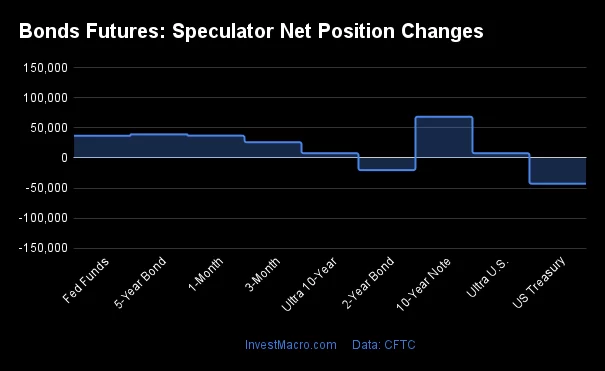
The COT bond market speculator bets were overall lower this week as just three out of the eight bond markets we cover had higher positioning while the other five markets had lower speculator contracts.

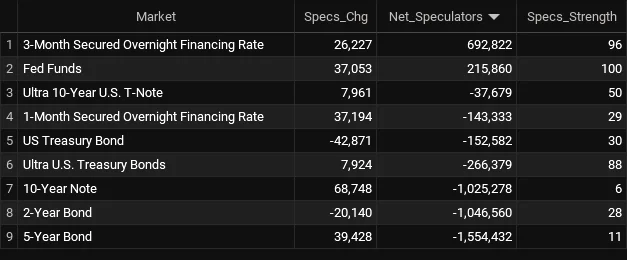
Leading the gains for the bond markets was the SOFR 3-Months (188,386 contracts) with the Fed Funds (130,472 contracts) and the Ultra Treasury Bonds (40,384 contracts) also recording positive weeks.

The bond markets with declines in speculator bets for the week were the Ultra 10-Year Bonds (-53,266 contracts), the 10-Year Bonds (-47,738 contracts), the 5-Year Bonds (-32,038 contracts), the US Treasury Bonds (-11,936 contracts) and with the 2-Year Bonds (-1,539 contracts) also registering lower bets on the week.


Bonds Net Speculators Leaderboard

Legend: Weekly Speculators Change | Speculators Current Net Position | Speculators Strength Score compared to last 3-Years (0-100 range)


Strength Scores led by SOFR 3-Months & US Treasury Bonds

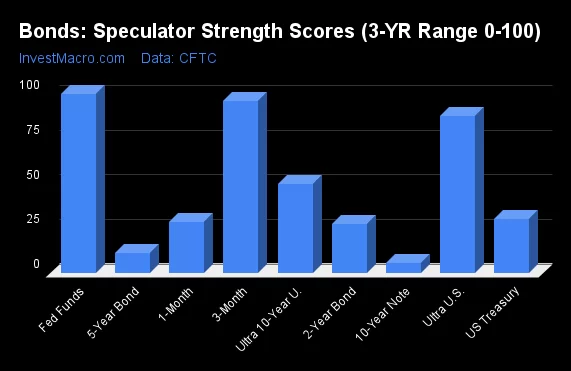
COT Strength Scores (a normalized measure of Speculator positions over a 3-Year range, from 0 to 100 where above 80 is Extreme-Bullish and below 20 is Extreme-Bearish) showed that the SOFR 3-Months (79 percent) and the US Treasury Bonds (63 percent) lead the bond markets this week.

On the downside, the 5-Year Bonds (0 percent) and the 10-Year Bonds (11 percent) come in at the lowest strength level currently and are in Extreme-Bearish territory (below 20 percent). The next lowest strength scores were the Ultra 10-Year Bonds (24 percent) and the 2-Year Bonds (24 percent).

Strength Statistics:
Fed Funds (48.5 percent) vs Fed Funds previous week (19.0 percent)
2-Year Bond (23.7 percent) vs 2-Year Bond previous week (23.8 percent)
5-Year Bond (0.0 percent) vs 5-Year Bond previous week (1.8 percent)
10-Year Bond (10.6 percent) vs 10-Year Bond previous week (15.0 percent)
Ultra 10-Year Bond (23.7 percent) vs Ultra 10-Year Bond previous week (34.8 percent)
US Treasury Bond (63.3 percent) vs US Treasury Bond previous week (67.5 percent)
Ultra US Treasury Bond (38.2 percent) vs Ultra US Treasury Bond previous week (18.8 percent)
SOFR 3-Months (79.2 percent) vs SOFR 3-Months previous week (69.5 percent)


SOFR 3-Months & Fed Funds top the 6-Week Strength Trends

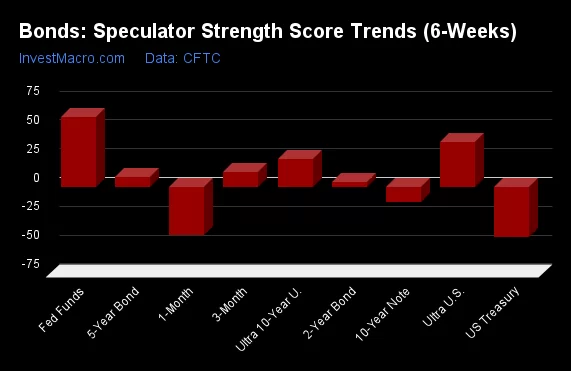
COT Strength Score Trends (or move index, calculates the 6-week changes in strength scores) showed that the SOFR 3-Months (29 percent) and the Fed Funds (13 percent) lead the past six weeks trends for bonds. The 2-Year Bonds (10 percent) are the next highest positive movers in the latest trends data.

The 10-Year Bonds (-43 percent) leads the downside trend scores currently with the 5-Year Bonds (-11 percent), the Ultra Treasury Bonds (-4 percent) and the Ultra 10-Year Bonds (-2 percent) following next with lower trend scores.

Strength Trend Statistics:
Fed Funds (13.4 percent) vs Fed Funds previous week (-13.7 percent)
2-Year Bond (10.0 percent) vs 2-Year Bond previous week (10.2 percent)
5-Year Bond (-11.3 percent) vs 5-Year Bond previous week (-11.4 percent)
10-Year Bond (-42.6 percent) vs 10-Year Bond previous week (-33.7 percent)
Ultra 10-Year Bond (-2.2 percent) vs Ultra 10-Year Bond previous week (10.0 percent)
US Treasury Bond (-2.4 percent) vs US Treasury Bond previous week (-4.4 percent)
Ultra US Treasury Bond (-4.0 percent) vs Ultra US Treasury Bond previous week (-30.0 percent)
SOFR 3-Months (29.1 percent) vs SOFR 3-Months previous week (19.2 percent)


Secured Overnight Financing Rate (3-Month) Futures:

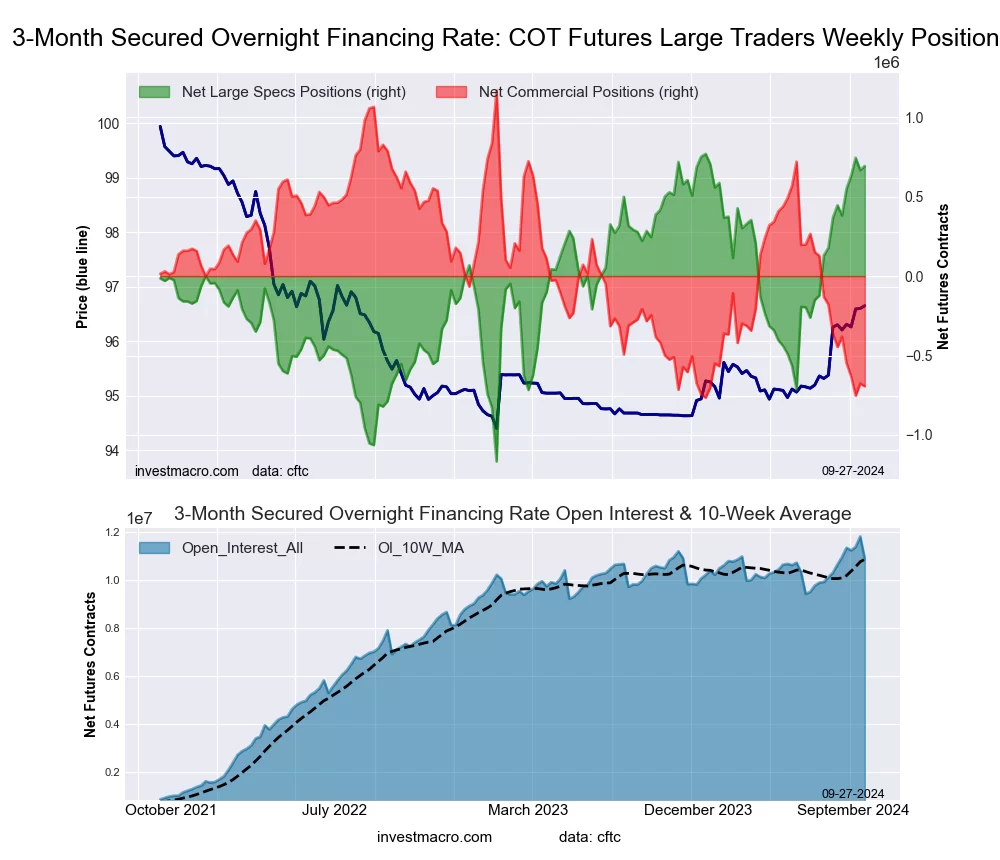
SOFR 3-Months Bonds Futures COT ChartThe Secured Overnight Financing Rate (3-Month) large speculator standing this week was a net position of 367,148 contracts in the data reported through Tuesday. This was a weekly increase of 188,386 contracts from the previous week which had a total of 178,762 net contracts.

This week’s current strength score (the trader positioning range over the past three years, measured from 0 to 100) shows the speculators are currently Bullish with a score of 79.2 percent. The commercials are Bearish with a score of 20.8 percent and the small traders (not shown in chart) are Bullish-Extreme with a score of 85.8 percent.

Price Trend-Following Model: Weak Uptrend

Our weekly trend-following model classifies the current market price position as: Weak Uptrend. The current action for the model is considered to be: Hold – Maintain Long Position.

SOFR 3-Months StatisticsSPECULATORSCOMMERCIALSSMALL TRADERS
– Percent of Open Interest Longs:17.555.30.3
– Percent of Open Interest Shorts:13.958.80.4
– Net Position:367,148-363,366-3,782
– Gross Longs:1,802,1255,707,45132,720
– Gross Shorts:1,434,9776,070,81736,502
– Long to Short Ratio:1.3 to 10.9 to 10.9 to 1
NET POSITION TREND:
– Strength Index Score (3 Year Range Pct):79.220.885.8
– Strength Index Reading (3 Year Range):BullishBearishBullish-Extreme
NET POSITION MOVEMENT INDEX:
– 6-Week Change in Strength Index:29.1-29.1-0.5


30-Day Federal Funds Futures:

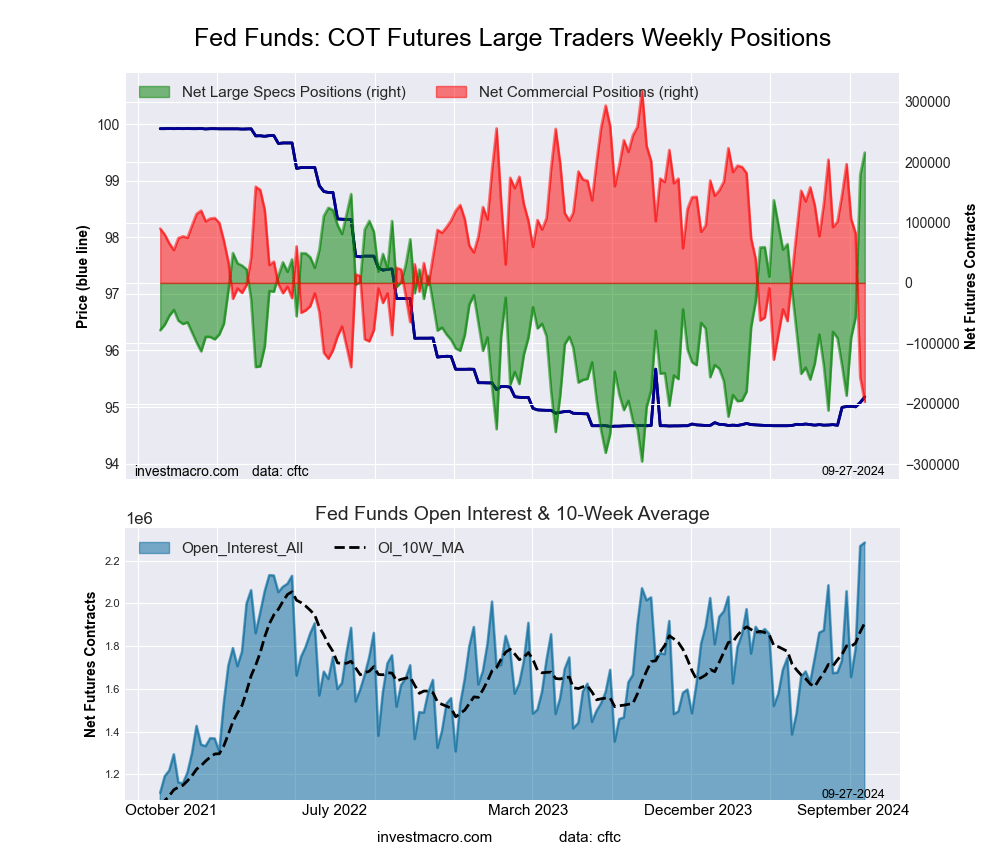
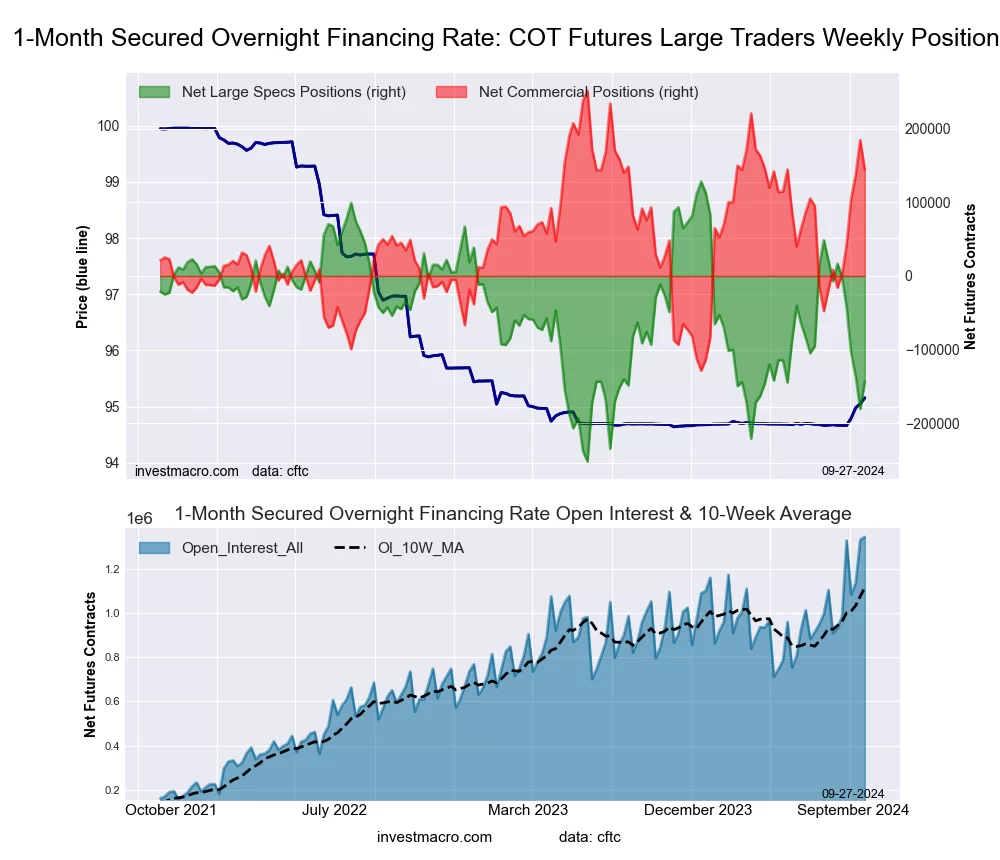
Federal Funds 30-Day Bonds Futures COT ChartThe 30-Day Federal Funds large speculator standing this week was a net position of -80,844 contracts in the data reported through Tuesday. This was a weekly gain of 130,472 contracts from the previous week which had a total of -211,316 net contracts.

This week’s current strength score (the trader positioning range over the past three years, measured from 0 to 100) shows the speculators are currently Bearish with a score of 48.5 percent. The commercials are Bullish with a score of 50.6 percent and the small traders (not shown in chart) are Bullish with a score of 63.8 percent.

Price Trend-Following Model: Downtrend

Our weekly trend-following model classifies the current market price position as: Downtrend. The current action for the model is considered to be: Hold – Maintain Short Position.

30-Day Federal Funds StatisticsSPECULATORSCOMMERCIALSSMALL TRADERS
– Percent of Open Interest Longs:11.571.91.6
– Percent of Open Interest Shorts:16.366.32.3
– Net Position:-80,84492,469-11,625
– Gross Longs:192,0471,202,58926,862
– Gross Shorts:272,8911,110,12038,487
– Long to Short Ratio:0.7 to 11.1 to 10.7 to 1
NET POSITION TREND:
– Strength Index Score (3 Year Range Pct):48.550.663.8
– Strength Index Reading (3 Year Range):BearishBullishBullish
NET POSITION MOVEMENT INDEX:
– 6-Week Change in Strength Index:13.4-9.3-30.9


2-Year Treasury Note Futures:

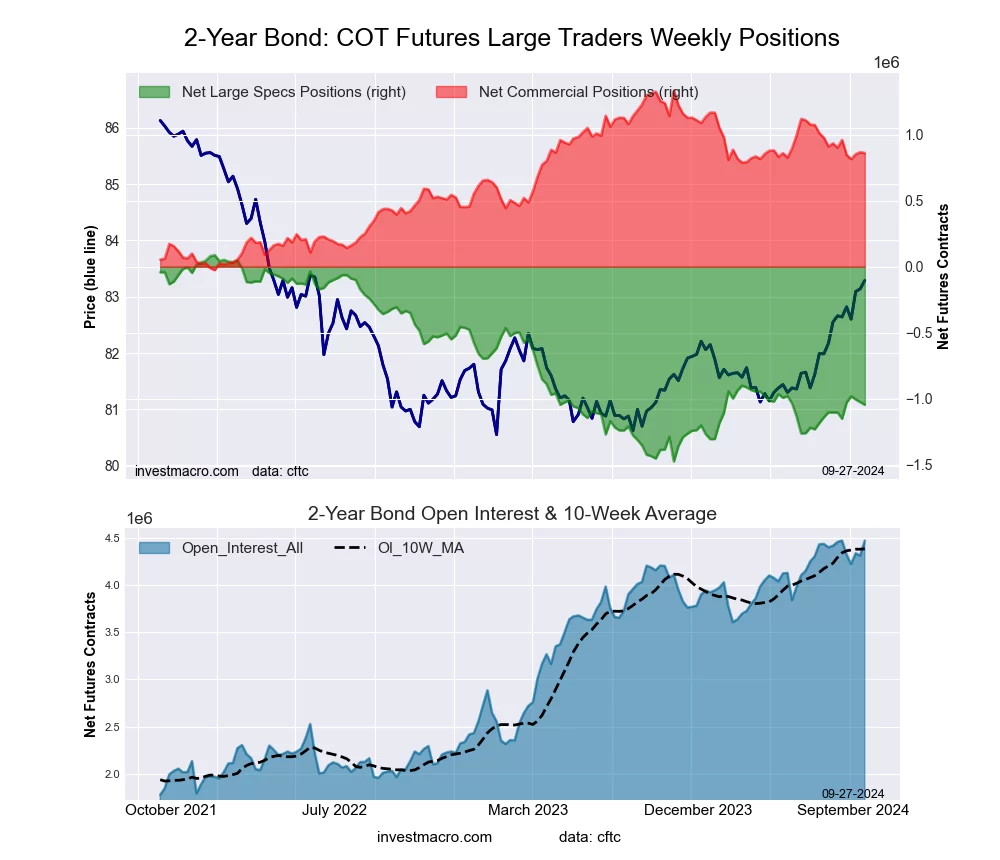
2-Year Treasury Bonds Futures COT ChartThe 2-Year Treasury Note large speculator standing this week was a net position of -1,105,211 contracts in the data reported through Tuesday. This was a weekly decrease of -1,539 contracts from the previous week which had a total of -1,103,672 net contracts.

This week’s current strength score (the trader positioning range over the past three years, measured from 0 to 100) shows the speculators are currently Bearish with a score of 23.7 percent. The commercials are Bullish with a score of 70.9 percent and the small traders (not shown in chart) are Bullish-Extreme with a score of 93.0 percent.

Price Trend-Following Model: Strong Uptrend

Our weekly trend-following model classifies the current market price position as: Strong Uptrend. The current action for the model is considered to be: Hold – Maintain Long Position.

2-Year Treasury Note StatisticsSPECULATORSCOMMERCIALSSMALL TRADERS
– Percent of Open Interest Longs:16.275.76.7
– Percent of Open Interest Shorts:41.254.62.8
– Net Position:-1,105,211934,125171,086
– Gross Longs:716,3113,346,171293,877
– Gross Shorts:1,821,5222,412,046122,791
– Long to Short Ratio:0.4 to 11.4 to 12.4 to 1
NET POSITION TREND:
– Strength Index Score (3 Year Range Pct):23.770.993.0
– Strength Index Reading (3 Year Range):BearishBullishBullish-Extreme
NET POSITION MOVEMENT INDEX:
– 6-Week Change in Strength Index:10.0-12.76.2


5-Year Treasury Note Futures:

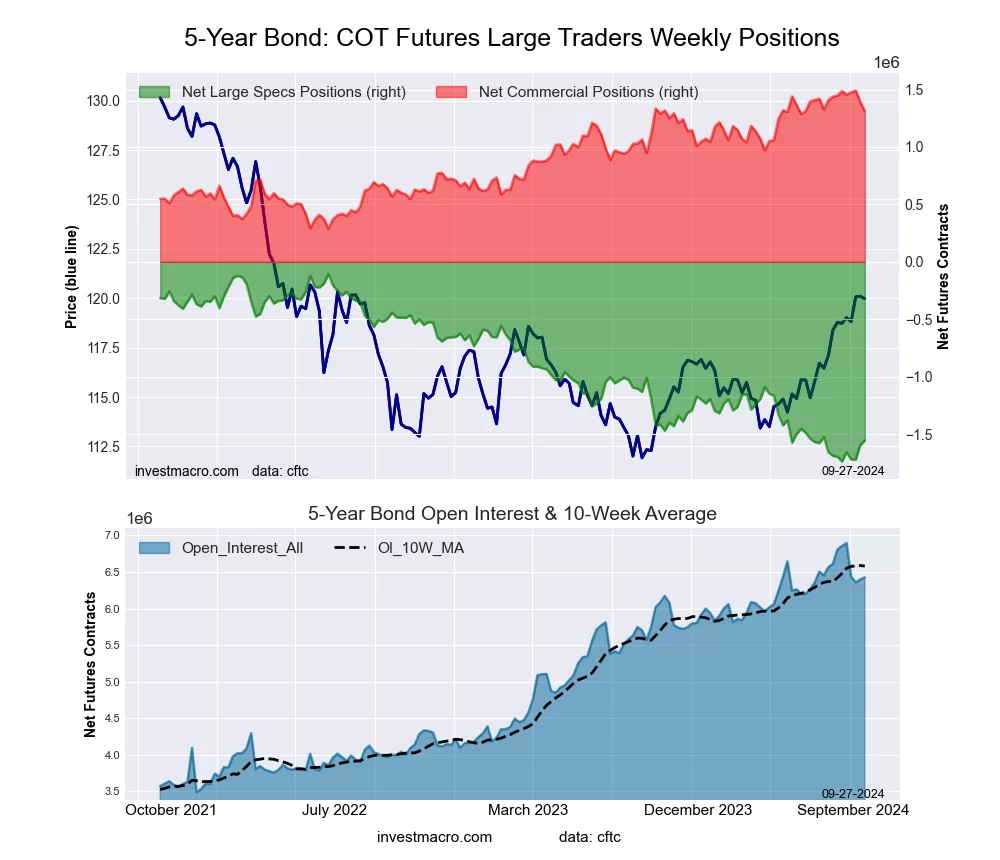
5-Year Treasury Bonds Futures COT ChartThe 5-Year Treasury Note large speculator standing this week was a net position of -1,688,076 contracts in the data reported through Tuesday. This was a weekly reduction of -32,038 contracts from the previous week which had a total of -1,656,038 net contracts.

This week’s current strength score (the trader positioning range over the past three years, measured from 0 to 100) shows the speculators are currently Bearish-Extreme with a score of 0.0 percent. The commercials are Bullish-Extreme with a score of 99.8 percent and the small traders (not shown in chart) are Bullish-Extreme with a score of 100.0 percent.

Price Trend-Following Model: Strong Uptrend

Our weekly trend-following model classifies the current market price position as: Strong Uptrend. The current action for the model is considered to be: Hold – Maintain Long Position.

5-Year Treasury Note StatisticsSPECULATORSCOMMERCIALSSMALL TRADERS
– Percent of Open Interest Longs:8.782.77.3
– Percent of Open Interest Shorts:34.361.03.5
– Net Position:-1,688,0761,437,325250,751
– Gross Longs:578,5215,469,735485,210
– Gross Shorts:2,266,5974,032,410234,459
– Long to Short Ratio:0.3 to 11.4 to 12.1 to 1
NET POSITION TREND:
– Strength Index Score (3 Year Range Pct):0.099.8100.0
– Strength Index Reading (3 Year Range):Bearish-ExtremeBullish-ExtremeBullish-Extreme
NET POSITION MOVEMENT INDEX:
– 6-Week Change in Strength Index:-11.38.914.2


10-Year Treasury Note Futures:

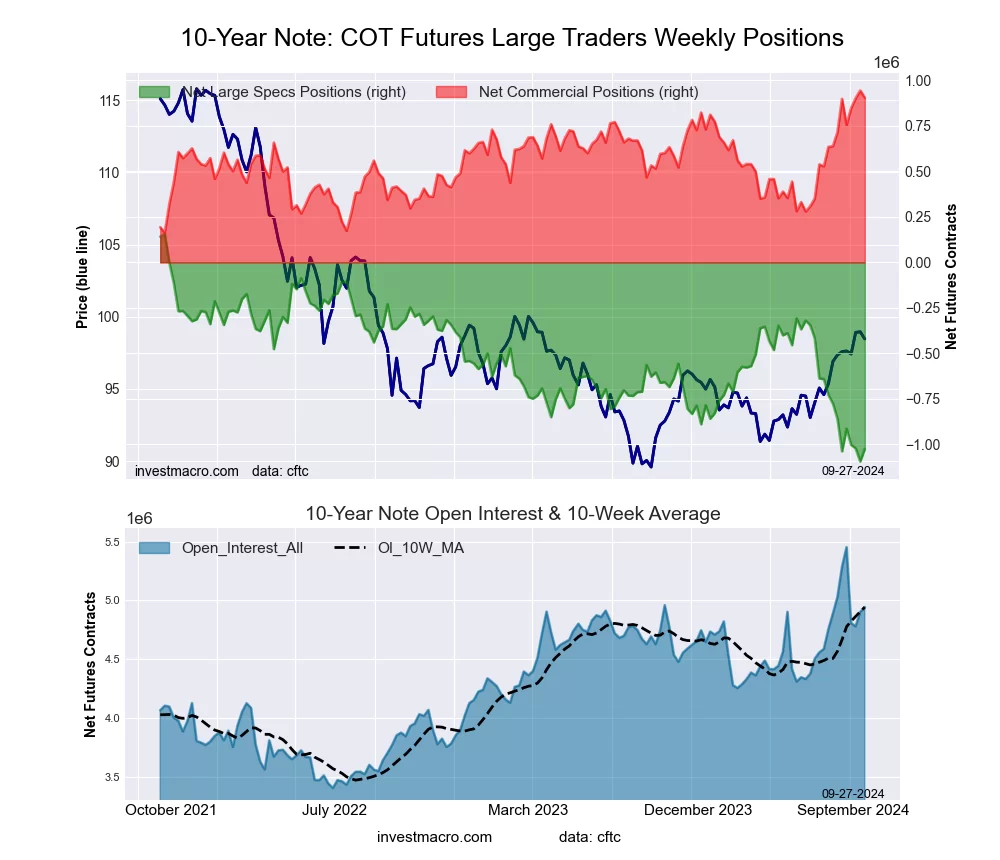
10-Year Treasury Notes Bonds Futures COT ChartThe 10-Year Treasury Note large speculator standing this week was a net position of -776,208 contracts in the data reported through Tuesday. This was a weekly decline of -47,738 contracts from the previous week which had a total of -728,470 net contracts.

This week’s current strength score (the trader positioning range over the past three years, measured from 0 to 100) shows the speculators are currently Bearish-Extreme with a score of 10.6 percent. The commercials are Bullish with a score of 75.7 percent and the small traders (not shown in chart) are Bullish-Extreme with a score of 100.0 percent.

Price Trend-Following Model: Strong Uptrend

Our weekly trend-following model classifies the current market price position as: Strong Uptrend. The current action for the model is considered to be: Hold – Maintain Long Position.

10-Year Treasury Note StatisticsSPECULATORSCOMMERCIALSSMALL TRADERS
– Percent of Open Interest Longs:9.078.79.5
– Percent of Open Interest Shorts:24.965.76.7
– Net Position:-776,208638,673137,535
– Gross Longs:441,7213,848,733464,829
– Gross Shorts:1,217,9293,210,060327,294
– Long to Short Ratio:0.4 to 11.2 to 11.4 to 1
NET POSITION TREND:
– Strength Index Score (3 Year Range Pct):10.675.7100.0
– Strength Index Reading (3 Year Range):Bearish-ExtremeBullishBullish-Extreme
NET POSITION MOVEMENT INDEX:
– 6-Week Change in Strength Index:-42.647.520.4


Ultra 10-Year Notes Futures:

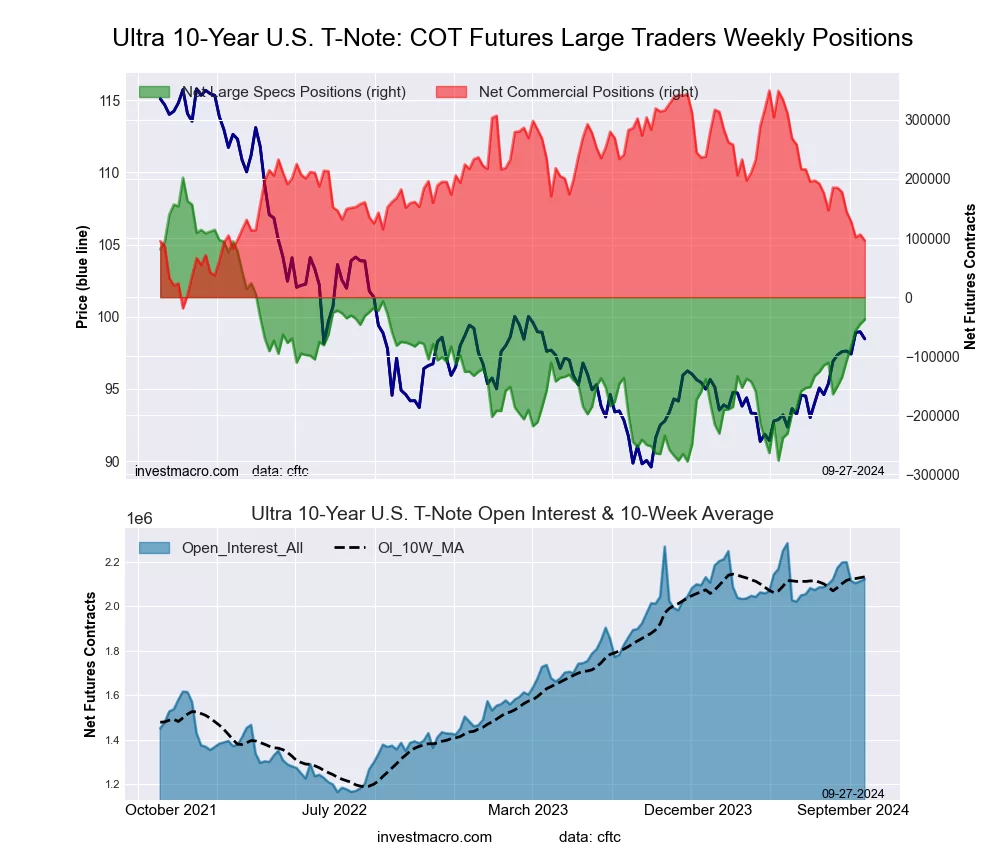
Ultra 10-Year Treasury Notes Bonds Futures COT ChartThe Ultra 10-Year Notes large speculator standing this week was a net position of -164,257 contracts in the data reported through Tuesday. This was a weekly decline of -53,266 contracts from the previous week which had a total of -110,991 net contracts.

This week’s current strength score (the trader positioning range over the past three years, measured from 0 to 100) shows the speculators are currently Bearish with a score of 23.7 percent. The commercials are Bullish with a score of 55.4 percent and the small traders (not shown in chart) are Bullish-Extreme with a score of 100.0 percent.

Price Trend-Following Model: Weak Uptrend

Our weekly trend-following model classifies the current market price position as: Weak Uptrend. The current action for the model is considered to be: Hold – Maintain Long Position.

Ultra 10-Year Notes StatisticsSPECULATORSCOMMERCIALSSMALL TRADERS
– Percent of Open Interest Longs:12.275.610.7
– Percent of Open Interest Shorts:19.966.911.7
– Net Position:-164,257185,201-20,944
– Gross Longs:258,6001,603,637226,243
– Gross Shorts:422,8571,418,436247,187
– Long to Short Ratio:0.6 to 11.1 to 10.9 to 1
NET POSITION TREND:
– Strength Index Score (3 Year Range Pct):23.755.4100.0
– Strength Index Reading (3 Year Range):BearishBullishBullish-Extreme
NET POSITION MOVEMENT INDEX:
– 6-Week Change in Strength Index:-2.2-8.424.3


US Treasury Bonds Futures:

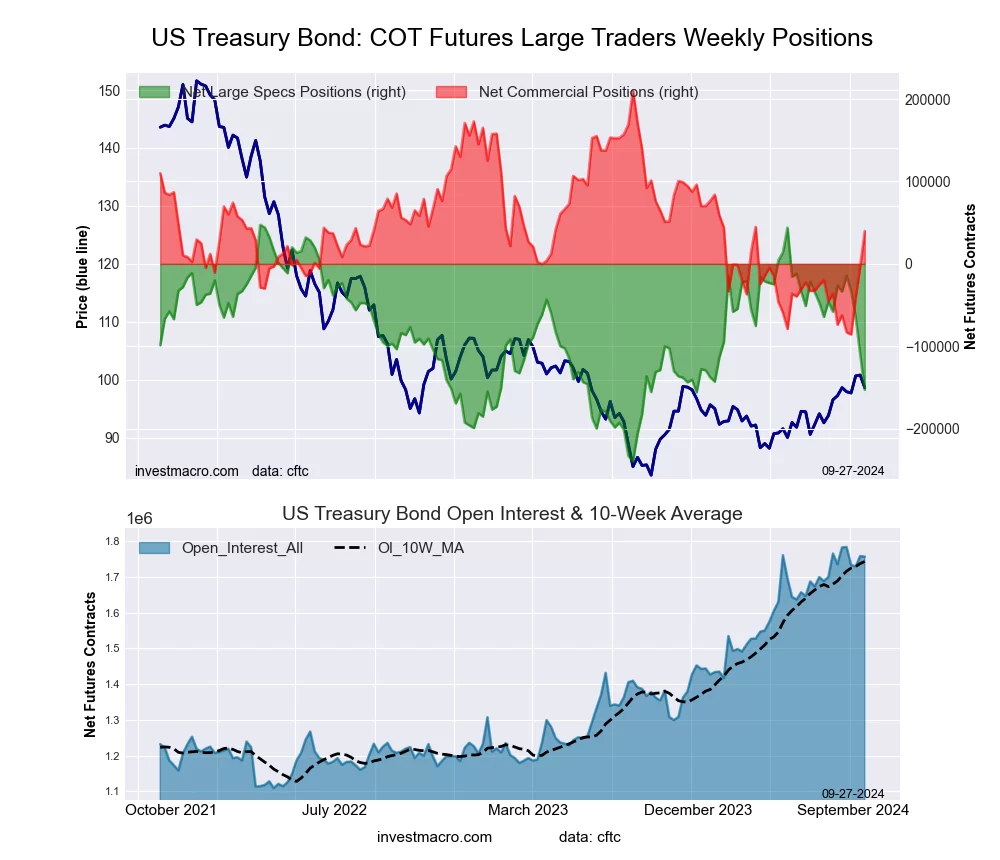
US Year Treasury Notes Long Bonds Futures COT ChartThe US Treasury Bonds large speculator standing this week was a net position of -57,855 contracts in the data reported through Tuesday. This was a weekly reduction of -11,936 contracts from the previous week which had a total of -45,919 net contracts.

This week’s current strength score (the trader positioning range over the past three years, measured from 0 to 100) shows the speculators are currently Bullish with a score of 63.3 percent. The commercials are Bearish-Extreme with a score of 14.7 percent and the small traders (not shown in chart) are Bullish-Extreme with a score of 100.0 percent.

Price Trend-Following Model: Strong Uptrend

Our weekly trend-following model classifies the current market price position as: Strong Uptrend. The current action for the model is considered to be: Hold – Maintain Long Position.

US Treasury Bonds StatisticsSPECULATORSCOMMERCIALSSMALL TRADERS
– Percent of Open Interest Longs:19.266.313.3
– Percent of Open Interest Shorts:22.568.37.9
– Net Position:-57,855-36,17294,027
– Gross Longs:339,2711,169,182233,863
– Gross Shorts:397,1261,205,354139,836
– Long to Short Ratio:0.9 to 11.0 to 11.7 to 1
NET POSITION TREND:
– Strength Index Score (3 Year Range Pct):63.314.7100.0
– Strength Index Reading (3 Year Range):BullishBearish-ExtremeBullish-Extreme
NET POSITION MOVEMENT INDEX:
– 6-Week Change in Strength Index:-2.4-4.716.8


Ultra US Treasury Bonds Futures:

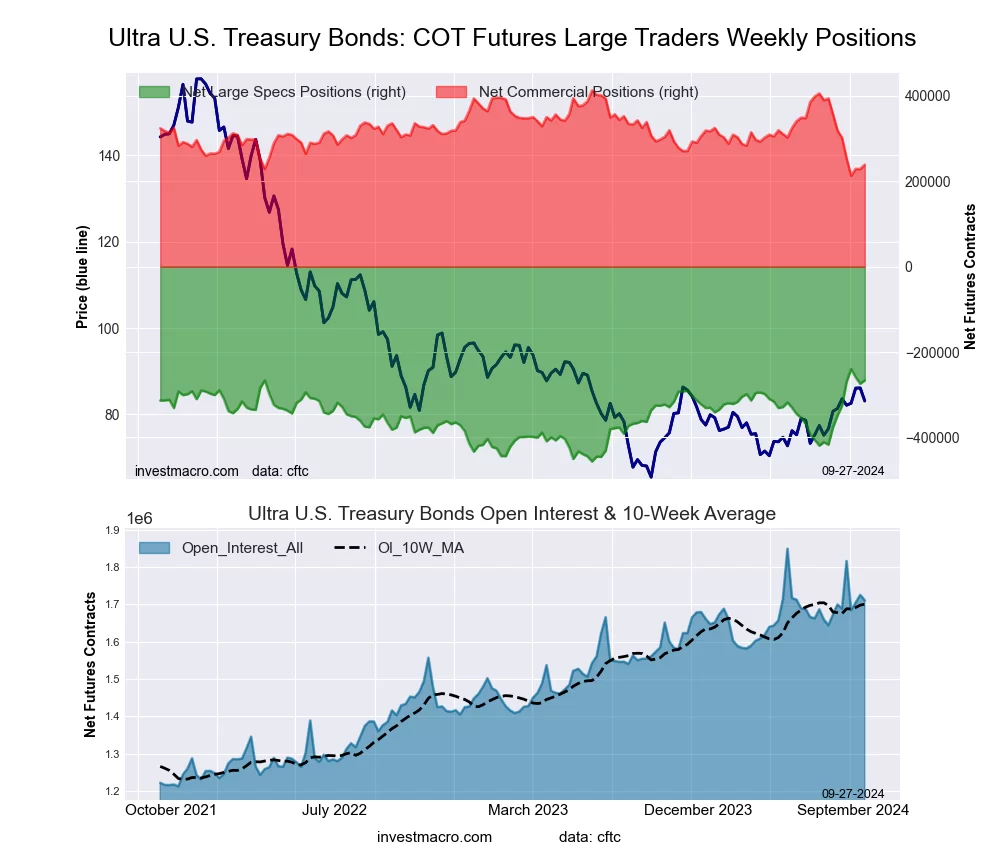
Ultra US Year Treasury Notes Long Bonds Futures COT ChartThe Ultra US Treasury Bonds large speculator standing this week was a net position of -376,662 contracts in the data reported through Tuesday. This was a weekly rise of 40,384 contracts from the previous week which had a total of -417,046 net contracts.

This week’s current strength score (the trader positioning range over the past three years, measured from 0 to 100) shows the speculators are currently Bearish with a score of 38.2 percent. The commercials are Bullish with a score of 70.1 percent and the small traders (not shown in chart) are Bearish with a score of 38.3 percent.

Price Trend-Following Model: Strong Uptrend

Our weekly trend-following model classifies the current market price position as: Strong Uptrend. The current action for the model is considered to be: Hold – Maintain Long Position.

Ultra US Treasury Bonds StatisticsSPECULATORSCOMMERCIALSSMALL TRADERS
– Percent of Open Interest Longs:9.579.610.5
– Percent of Open Interest Shorts:32.158.29.3
– Net Position:-376,662357,68518,977
– Gross Longs:159,6831,330,555174,995
– Gross Shorts:536,345972,870156,018
– Long to Short Ratio:0.3 to 11.4 to 11.1 to 1
NET POSITION TREND:
– Strength Index Score (3 Year Range Pct):38.270.138.3
– Strength Index Reading (3 Year Range):BearishBullishBearish
NET POSITION MOVEMENT INDEX:
– 6-Week Change in Strength Index:-4.05.4-2.0


Article By InvestMacroReceive our weekly COT Newsletter

*COT Report: The COT data, released weekly to the public each Friday, is updated through the most recent Tuesday (data is 3 days old) and shows a quick view of how large speculators or non-commercials (for-profit traders) were positioned in the futures markets.

The CFTC categorizes trader positions according to commercial hedgers (traders who use futures contracts for hedging as part of the business), non-commercials (large traders who speculate to realize trading profits) and nonreportable traders (usually small traders/speculators) as well as their open interest (contracts open in the market at time of reporting). See CFTC criteria here.

COT Soft Commodities Charts: Speculator Bets led by Corn & Soybeans

By InvestMacro

Here are the latest charts and statistics for the Commitment of Traders (COT) reports data published by the Commodities Futures Trading Commission (CFTC).

The latest COT data is updated through Tuesday August 6th and shows a quick view of how large traders (for-profit speculators and commercial entities) were positioned in the futures markets.

Weekly Speculator Changes led by Corn & Soybeans

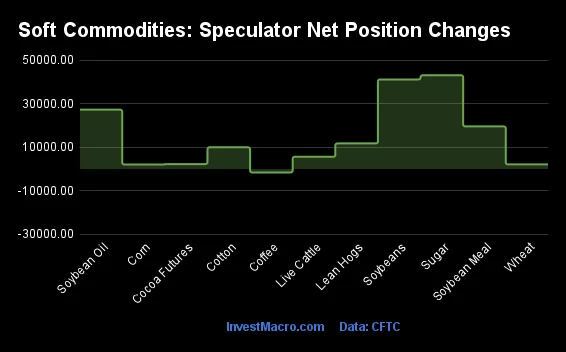
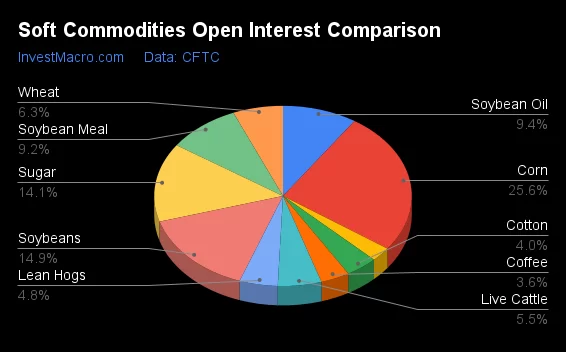
The COT soft commodities markets speculator bets were slightly lower this week as five out of the eleven softs markets we cover had higher positioning while the other six markets had lower speculator contracts.

Leading the gains for the softs markets was Corn (60,473 contracts) with Soybeans (8,772 contracts), Soybean Meal (5,397 contracts), Wheat (2,873 contracts) and Lean Hogs (705 contracts) also showing positive weeks.

The markets with the declines in speculator bets this week were Live Cattle (-14,702 contracts), Soybean Oil (-12,288 contracts), Sugar (-10,664 contracts), Cotton (-4,567 contracts), Coffee (-3,809 contracts) and with Cocoa (-1,773 contracts) also registering lower bets on the week.


Soft Commodities Net Speculators Leaderboard
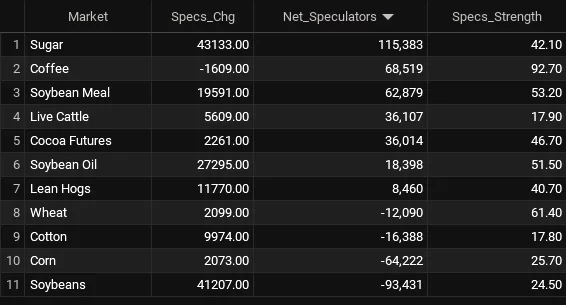
Legend: Weekly Speculators Change | Speculators Current Net Position | Speculators Strength Score compared to last 3-Years (0-100 range)


Strength Scores led by Coffee

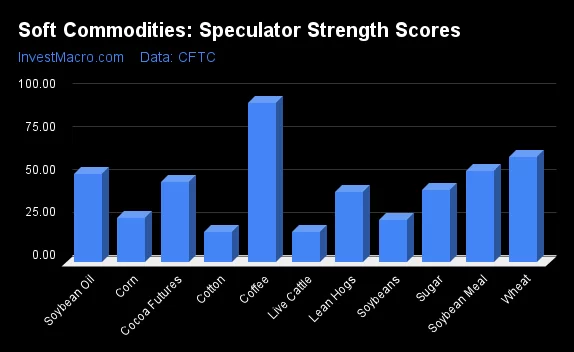
COT Strength Scores (a normalized measure of Speculator positions over a 3-Year range, from 0 to 100 where above 80 is Extreme-Bullish and below 20 is Extreme-Bearish) showed that Coffee (84 percent) leads the softs markets this week.

On the downside, Cotton (0 percent), Soybeans (9 percent), Sugar (10 percent), Lean Hogs (13 percent), Corn (15 percent) and Soybean Oil (15 percent) come in at the lowest strength levels currently and are in Extreme-Bearish territory (below 20 percent).

Strength Statistics:
Corn (14.5 percent) vs Corn previous week (6.8 percent)
Sugar (9.7 percent) vs Sugar previous week (13.2 percent)
Coffee (83.6 percent) vs Coffee previous week (87.3 percent)
Soybeans (9.0 percent) vs Soybeans previous week (6.9 percent)
Soybean Oil (14.5 percent) vs Soybean Oil previous week (21.3 percent)
Soybean Meal (45.1 percent) vs Soybean Meal previous week (42.9 percent)
Live Cattle (27.8 percent) vs Live Cattle previous week (43.6 percent)
Lean Hogs (13.0 percent) vs Lean Hogs previous week (12.4 percent)
Cotton (0.0 percent) vs Cotton previous week (2.8 percent)
Cocoa (41.7 percent) vs Cocoa previous week (43.5 percent)
Wheat (39.5 percent) vs Wheat previous week (37.5 percent)


Soybean Oil & Lean Hogs top the 6-Week Strength Trends
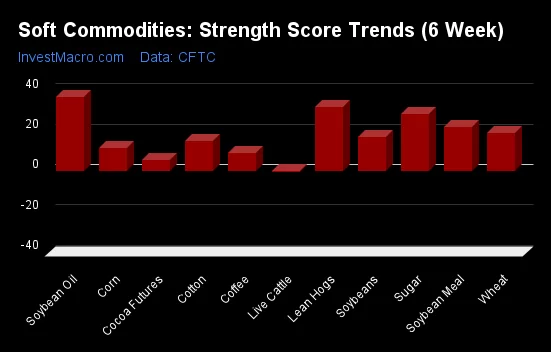
COT Strength Score Trends (or move index, calculates the 6-week changes in strength scores) showed that Soybean Oil (15 percent) and Lean Hogs (4 percent) lead the past six weeks trends for soft commodities. Wheat (3 percent), Corn (2 percent) and Cocoa (2 percent) are the next highest positive movers in the latest trends data.

Soybean Meal (-19 percent) leads the downside trend scores currently with Cotton (-11 percent), Coffee (-11 percent) and Soybeans (-11 percent) following next with lower trend scores.

Strength Trend Statistics:
Corn (2.3 percent) vs Corn previous week (-17.3 percent)
Sugar (-3.7 percent) vs Sugar previous week (5.9 percent)
Coffee (-11.2 percent) vs Coffee previous week (-4.4 percent)
Soybeans (-11.3 percent) vs Soybeans previous week (-22.1 percent)
Soybean Oil (14.5 percent) vs Soybean Oil previous week (5.6 percent)
Soybean Meal (-19.2 percent) vs Soybean Meal previous week (-26.1 percent)
Live Cattle (-3.7 percent) vs Live Cattle previous week (8.1 percent)
Lean Hogs (4.4 percent) vs Lean Hogs previous week (-6.5 percent)
Cotton (-11.0 percent) vs Cotton previous week (-5.9 percent)
Cocoa (1.8 percent) vs Cocoa previous week (-0.9 percent)
Wheat (2.9 percent) vs Wheat previous week (-11.6 percent)


Individual Soft Commodities Markets:

CORN Futures:
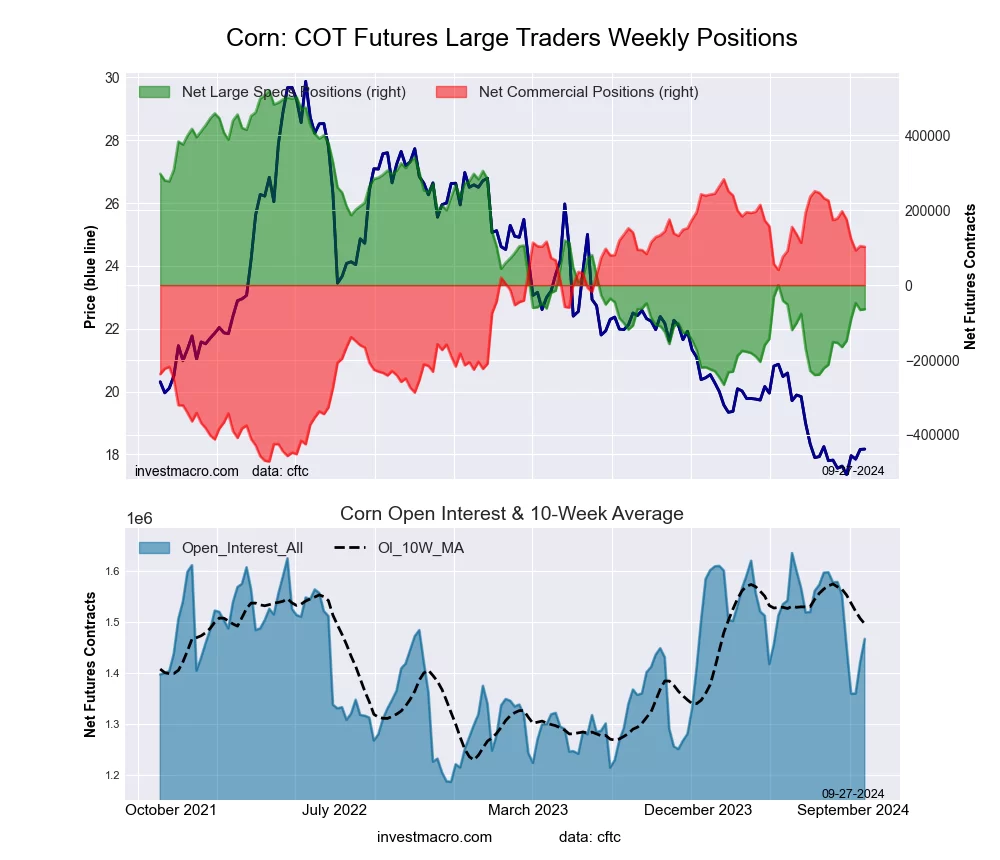
CORN Futures COT ChartThe CORN large speculator standing this week reached a net position of -151,969 contracts in the data reported through Tuesday. This was a weekly boost of 60,473 contracts from the previous week which had a total of -212,442 net contracts.

This week’s current strength score (the trader positioning range over the past three years, measured from 0 to 100) shows the speculators are currently Bearish-Extreme with a score of 14.5 percent. The commercials are Bullish-Extreme with a score of 85.5 percent and the small traders (not shown in chart) are Bullish with a score of 79.0 percent.

Price Trend-Following Model: Strong Downtrend

Our weekly trend-following model classifies the current market price position as: Strong Downtrend. The current action for the model is considered to be: Hold – Maintain Short Position.

CORN Futures StatisticsSPECULATORSCOMMERCIALSSMALL TRADERS
– Percent of Open Interest Longs:20.344.79.3
– Percent of Open Interest Shorts:29.933.710.7
– Net Position:-151,969173,479-21,510
– Gross Longs:320,403705,379147,095
– Gross Shorts:472,372531,900168,605
– Long to Short Ratio:0.7 to 11.3 to 10.9 to 1
NET POSITION TREND:
– Strength Index Score (3 Year Range Pct):14.585.579.0
– Strength Index Reading (3 Year Range):Bearish-ExtremeBullish-ExtremeBullish
NET POSITION MOVEMENT INDEX:
– 6-Week Change in Strength Index:2.3-2.73.5


SUGAR Futures:

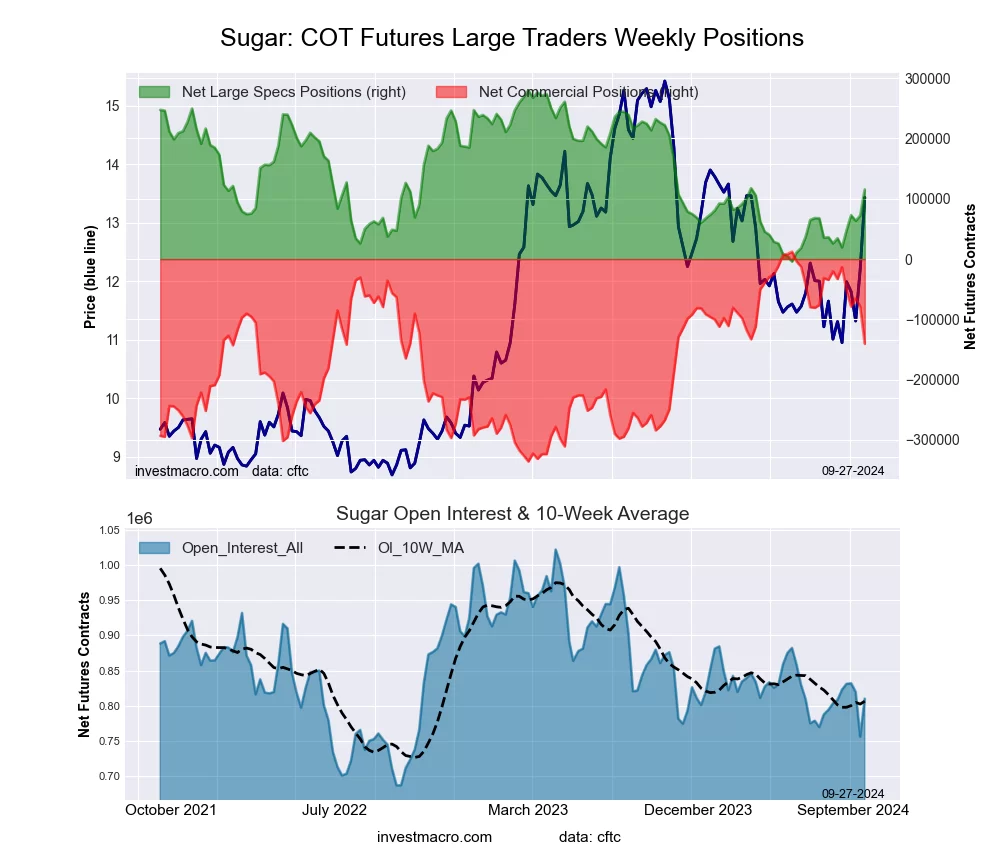
SUGAR Futures COT ChartThe SUGAR large speculator standing this week reached a net position of 25,815 contracts in the data reported through Tuesday. This was a weekly reduction of -10,664 contracts from the previous week which had a total of 36,479 net contracts.

This week’s current strength score (the trader positioning range over the past three years, measured from 0 to 100) shows the speculators are currently Bearish-Extreme with a score of 9.7 percent. The commercials are Bullish-Extreme with a score of 91.2 percent and the small traders (not shown in chart) are Bearish-Extreme with a score of 12.4 percent.

Price Trend-Following Model: Downtrend

Our weekly trend-following model classifies the current market price position as: Downtrend. The current action for the model is considered to be: Hold – Maintain Short Position.

SUGAR Futures StatisticsSPECULATORSCOMMERCIALSSMALL TRADERS
– Percent of Open Interest Longs:23.355.27.5
– Percent of Open Interest Shorts:20.157.78.2
– Net Position:25,815-20,274-5,541
– Gross Longs:186,989443,36460,431
– Gross Shorts:161,174463,63865,972
– Long to Short Ratio:1.2 to 11.0 to 10.9 to 1
NET POSITION TREND:
– Strength Index Score (3 Year Range Pct):9.791.212.4
– Strength Index Reading (3 Year Range):Bearish-ExtremeBullish-ExtremeBearish-Extreme
NET POSITION MOVEMENT INDEX:
– 6-Week Change in Strength Index:-3.76.2-15.2


COFFEE Futures:

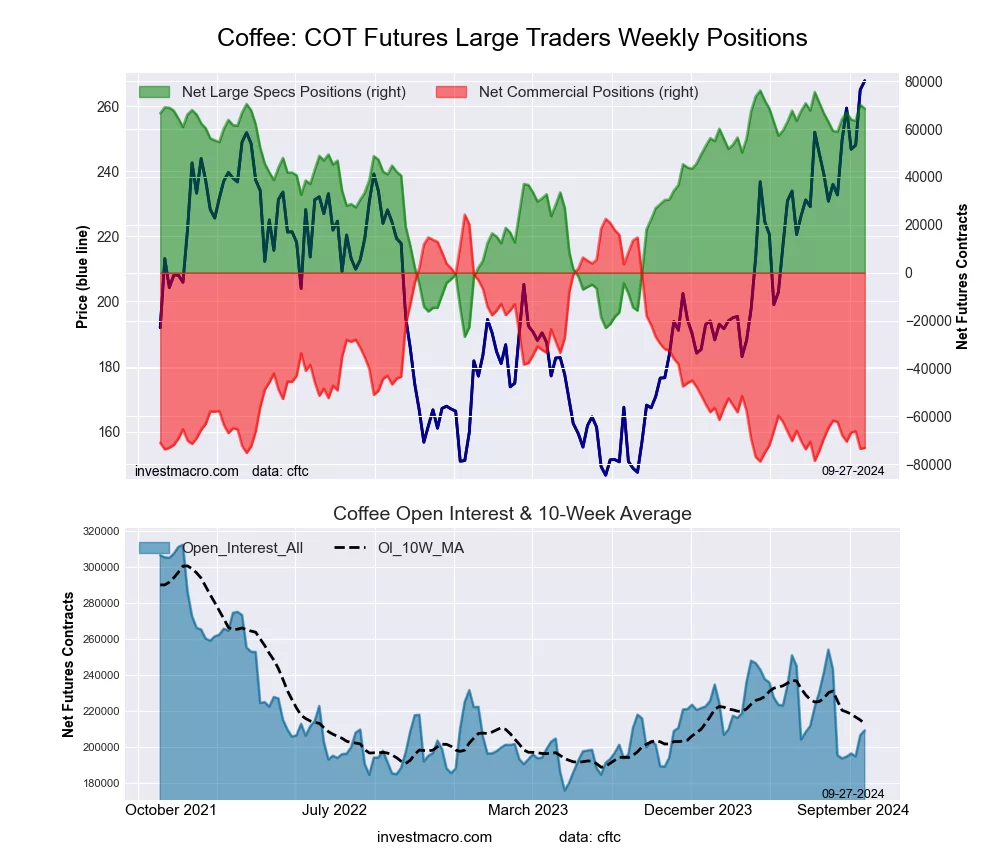
COFFEE Futures COT ChartThe COFFEE large speculator standing this week reached a net position of 59,207 contracts in the data reported through Tuesday. This was a weekly decrease of -3,809 contracts from the previous week which had a total of 63,016 net contracts.

This week’s current strength score (the trader positioning range over the past three years, measured from 0 to 100) shows the speculators are currently Bullish-Extreme with a score of 83.6 percent. The commercials are Bearish-Extreme with a score of 16.6 percent and the small traders (not shown in chart) are Bullish with a score of 56.0 percent.

Price Trend-Following Model: Strong Uptrend

Our weekly trend-following model classifies the current market price position as: Strong Uptrend. The current action for the model is considered to be: Hold – Maintain Long Position.

COFFEE Futures StatisticsSPECULATORSCOMMERCIALSSMALL TRADERS
– Percent of Open Interest Longs:29.741.63.4
– Percent of Open Interest Shorts:5.467.02.4
– Net Position:59,207-61,7712,564
– Gross Longs:72,262101,0598,330
– Gross Shorts:13,055162,8305,766
– Long to Short Ratio:5.5 to 10.6 to 11.4 to 1
NET POSITION TREND:
– Strength Index Score (3 Year Range Pct):83.616.656.0
– Strength Index Reading (3 Year Range):Bullish-ExtremeBearish-ExtremeBullish
NET POSITION MOVEMENT INDEX:
– 6-Week Change in Strength Index:-11.211.6-6.9


SOYBEANS Futures:

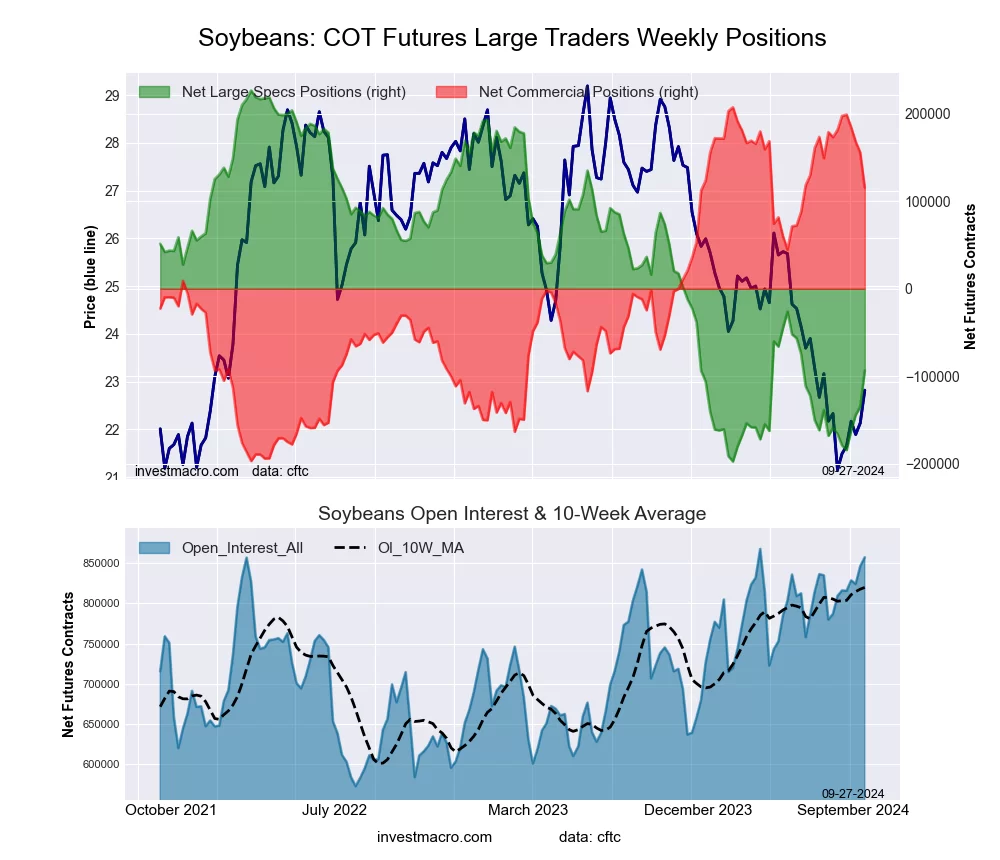
SOYBEANS Futures COT ChartThe SOYBEANS large speculator standing this week reached a net position of -159,128 contracts in the data reported through Tuesday. This was a weekly rise of 8,772 contracts from the previous week which had a total of -167,900 net contracts.

This week’s current strength score (the trader positioning range over the past three years, measured from 0 to 100) shows the speculators are currently Bearish-Extreme with a score of 9.0 percent. The commercials are Bullish-Extreme with a score of 91.6 percent and the small traders (not shown in chart) are Bullish with a score of 75.7 percent.

Price Trend-Following Model: Strong Downtrend

Our weekly trend-following model classifies the current market price position as: Strong Downtrend. The current action for the model is considered to be: Hold – Maintain Short Position.

SOYBEANS Futures StatisticsSPECULATORSCOMMERCIALSSMALL TRADERS
– Percent of Open Interest Longs:14.161.55.3
– Percent of Open Interest Shorts:34.439.57.1
– Net Position:-159,128173,211-14,083
– Gross Longs:111,259484,22741,958
– Gross Shorts:270,387311,01656,041
– Long to Short Ratio:0.4 to 11.6 to 10.7 to 1
NET POSITION TREND:
– Strength Index Score (3 Year Range Pct):9.091.675.7
– Strength Index Reading (3 Year Range):Bearish-ExtremeBullish-ExtremeBullish
NET POSITION MOVEMENT INDEX:
– 6-Week Change in Strength Index:-11.313.6-18.3


SOYBEAN OIL Futures:

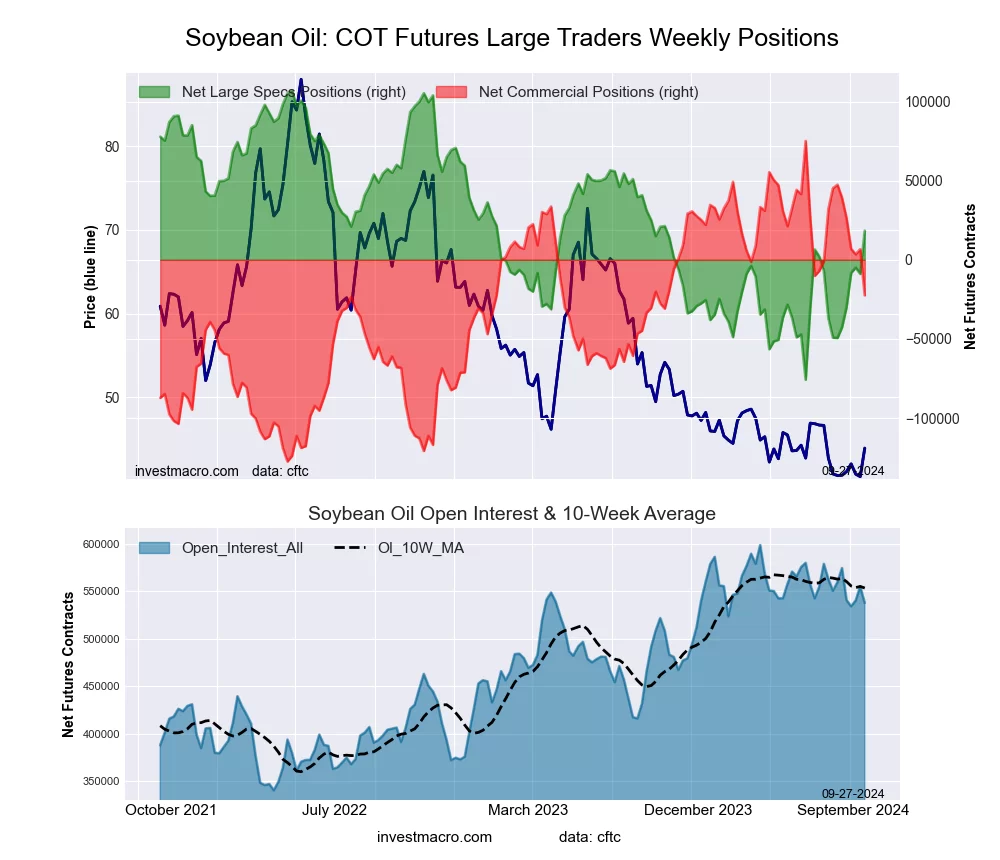
SOYBEAN OIL Futures COT ChartThe SOYBEAN OIL large speculator standing this week reached a net position of -49,166 contracts in the data reported through Tuesday. This was a weekly fall of -12,288 contracts from the previous week which had a total of -36,878 net contracts.

This week’s current strength score (the trader positioning range over the past three years, measured from 0 to 100) shows the speculators are currently Bearish-Extreme with a score of 14.5 percent. The commercials are Bullish-Extreme with a score of 85.3 percent and the small traders (not shown in chart) are Bearish with a score of 29.1 percent.

Price Trend-Following Model: Strong Downtrend

Our weekly trend-following model classifies the current market price position as: Strong Downtrend. The current action for the model is considered to be: Hold – Maintain Short Position.

SOYBEAN OIL Futures StatisticsSPECULATORSCOMMERCIALSSMALL TRADERS
– Percent of Open Interest Longs:21.053.15.5
– Percent of Open Interest Shorts:29.944.94.8
– Net Position:-49,16645,2853,881
– Gross Longs:115,500292,56530,057
– Gross Shorts:164,666247,28026,176
– Long to Short Ratio:0.7 to 11.2 to 11.1 to 1
NET POSITION TREND:
– Strength Index Score (3 Year Range Pct):14.585.329.1
– Strength Index Reading (3 Year Range):Bearish-ExtremeBullish-ExtremeBearish
NET POSITION MOVEMENT INDEX:
– 6-Week Change in Strength Index:14.5-14.712.5


SOYBEAN MEAL Futures:

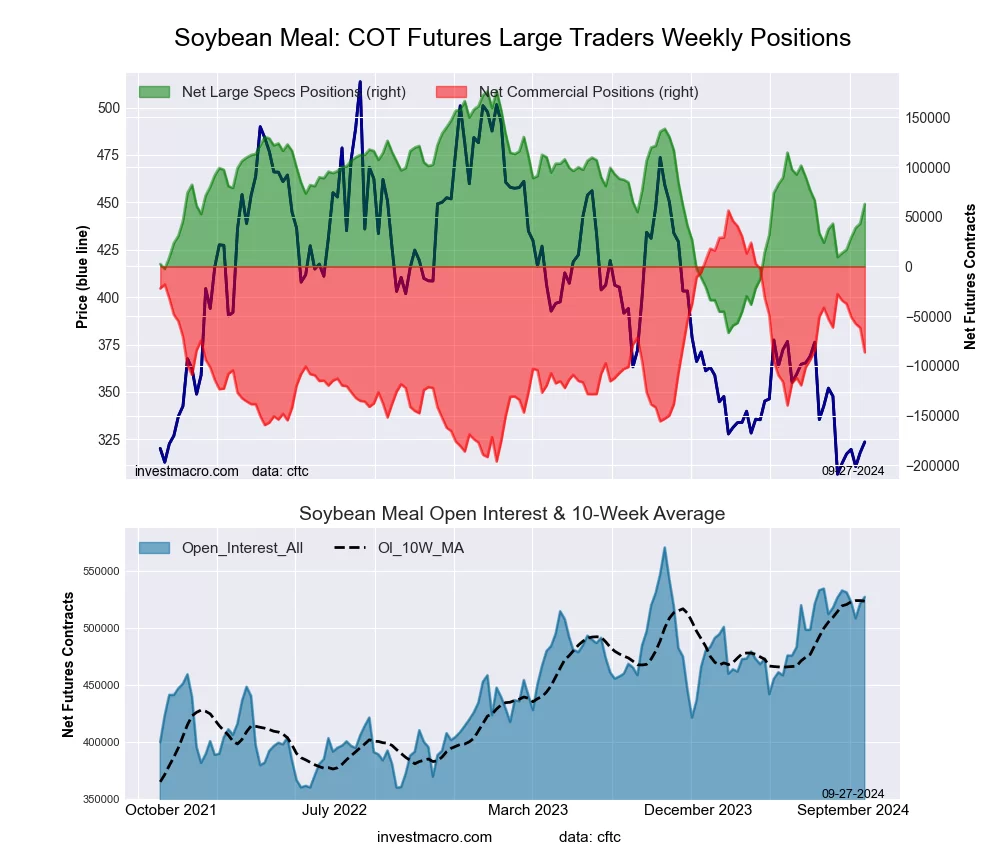
SOYBEAN MEAL Futures COT ChartThe SOYBEAN MEAL large speculator standing this week reached a net position of 43,091 contracts in the data reported through Tuesday. This was a weekly boost of 5,397 contracts from the previous week which had a total of 37,694 net contracts.

This week’s current strength score (the trader positioning range over the past three years, measured from 0 to 100) shows the speculators are currently Bearish with a score of 45.1 percent. The commercials are Bullish with a score of 53.4 percent and the small traders (not shown in chart) are Bearish with a score of 37.8 percent.

Price Trend-Following Model: Weak Uptrend

Our weekly trend-following model classifies the current market price position as: Weak Uptrend. The current action for the model is considered to be: Hold – Maintain Long Position.

SOYBEAN MEAL Futures StatisticsSPECULATORSCOMMERCIALSSMALL TRADERS
– Percent of Open Interest Longs:24.343.19.1
– Percent of Open Interest Shorts:16.055.05.6
– Net Position:43,091-61,35118,260
– Gross Longs:125,998223,11947,203
– Gross Shorts:82,907284,47028,943
– Long to Short Ratio:1.5 to 10.8 to 11.6 to 1
NET POSITION TREND:
– Strength Index Score (3 Year Range Pct):45.153.437.8
– Strength Index Reading (3 Year Range):BearishBullishBearish
NET POSITION MOVEMENT INDEX:
– 6-Week Change in Strength Index:-19.215.930.1


LIVE CATTLE Futures:

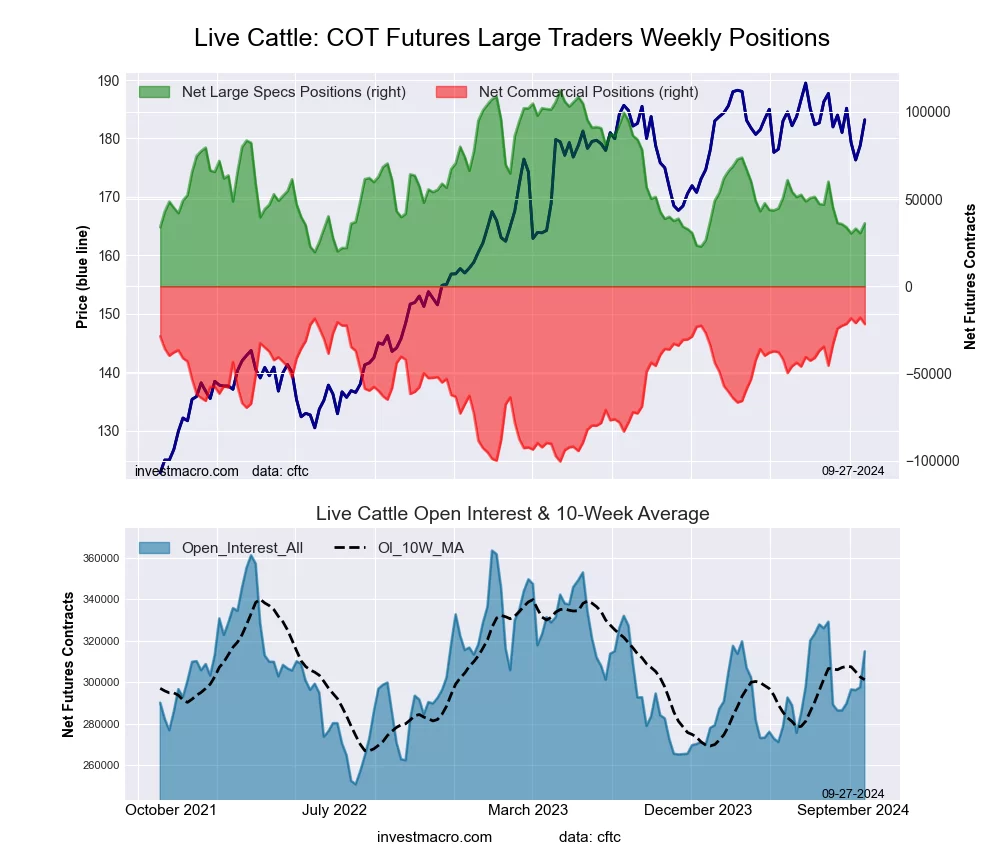
LIVE CATTLE Futures COT ChartThe LIVE CATTLE large speculator standing this week reached a net position of 45,272 contracts in the data reported through Tuesday. This was a weekly fall of -14,702 contracts from the previous week which had a total of 59,974 net contracts.

This week’s current strength score (the trader positioning range over the past three years, measured from 0 to 100) shows the speculators are currently Bearish with a score of 27.8 percent. The commercials are Bullish-Extreme with a score of 81.7 percent and the small traders (not shown in chart) are Bearish with a score of 27.2 percent.

Price Trend-Following Model: Weak Uptrend

Our weekly trend-following model classifies the current market price position as: Weak Uptrend. The current action for the model is considered to be: Hold – Maintain Long Position.

LIVE CATTLE Futures StatisticsSPECULATORSCOMMERCIALSSMALL TRADERS
– Percent of Open Interest Longs:37.632.510.0
– Percent of Open Interest Shorts:21.944.114.1
– Net Position:45,272-33,544-11,728
– Gross Longs:108,65594,05228,946
– Gross Shorts:63,383127,59640,674
– Long to Short Ratio:1.7 to 10.7 to 10.7 to 1
NET POSITION TREND:
– Strength Index Score (3 Year Range Pct):27.881.727.2
– Strength Index Reading (3 Year Range):BearishBullish-ExtremeBearish
NET POSITION MOVEMENT INDEX:
– 6-Week Change in Strength Index:-3.78.6-19.0


LEAN HOGS Futures:

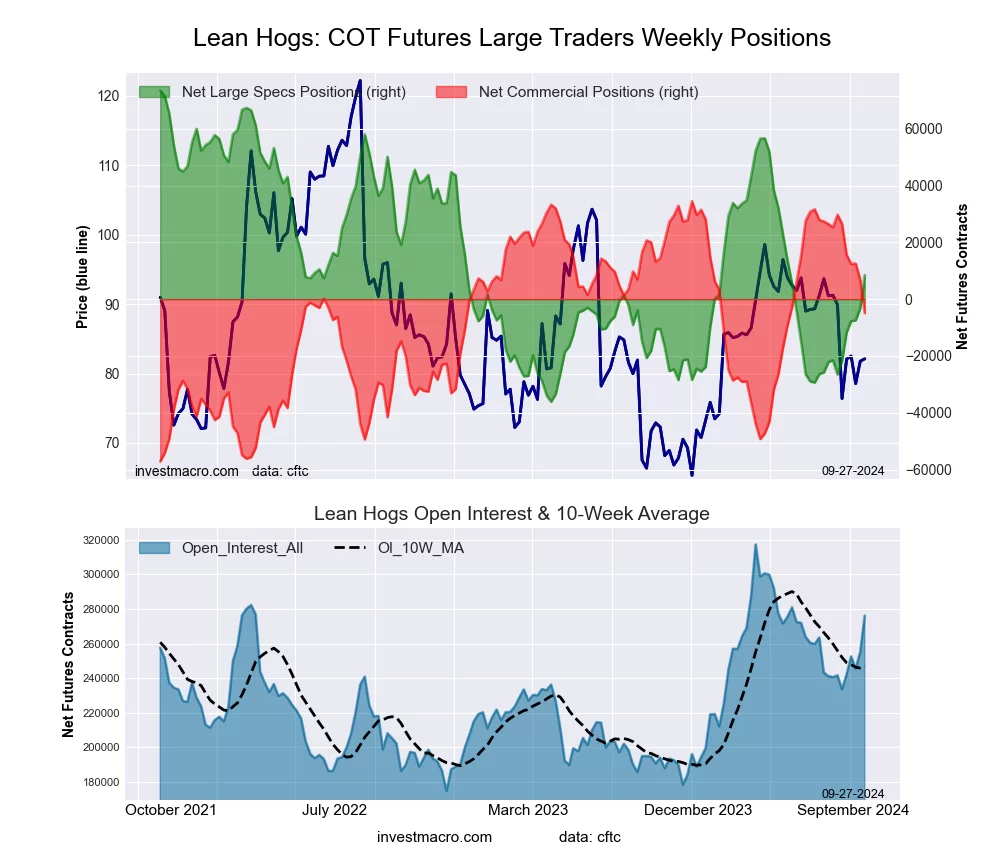
LEAN HOGS Futures COT ChartThe LEAN HOGS large speculator standing this week reached a net position of -21,490 contracts in the data reported through Tuesday. This was a weekly increase of 705 contracts from the previous week which had a total of -22,195 net contracts.

This week’s current strength score (the trader positioning range over the past three years, measured from 0 to 100) shows the speculators are currently Bearish-Extreme with a score of 13.0 percent. The commercials are Bullish-Extreme with a score of 90.3 percent and the small traders (not shown in chart) are Bullish with a score of 66.4 percent.

Price Trend-Following Model: Weak Uptrend

Our weekly trend-following model classifies the current market price position as: Weak Uptrend. The current action for the model is considered to be: Hold – Maintain Long Position.

LEAN HOGS Futures StatisticsSPECULATORSCOMMERCIALSSMALL TRADERS
– Percent of Open Interest Longs:36.439.56.1
– Percent of Open Interest Shorts:45.329.07.7
– Net Position:-21,49025,276-3,786
– Gross Longs:87,50395,08714,748
– Gross Shorts:108,99369,81118,534
– Long to Short Ratio:0.8 to 11.4 to 10.8 to 1
NET POSITION TREND:
– Strength Index Score (3 Year Range Pct):13.090.366.4
– Strength Index Reading (3 Year Range):Bearish-ExtremeBullish-ExtremeBullish
NET POSITION MOVEMENT INDEX:
– 6-Week Change in Strength Index:4.4-2.5-11.5


COTTON Futures:

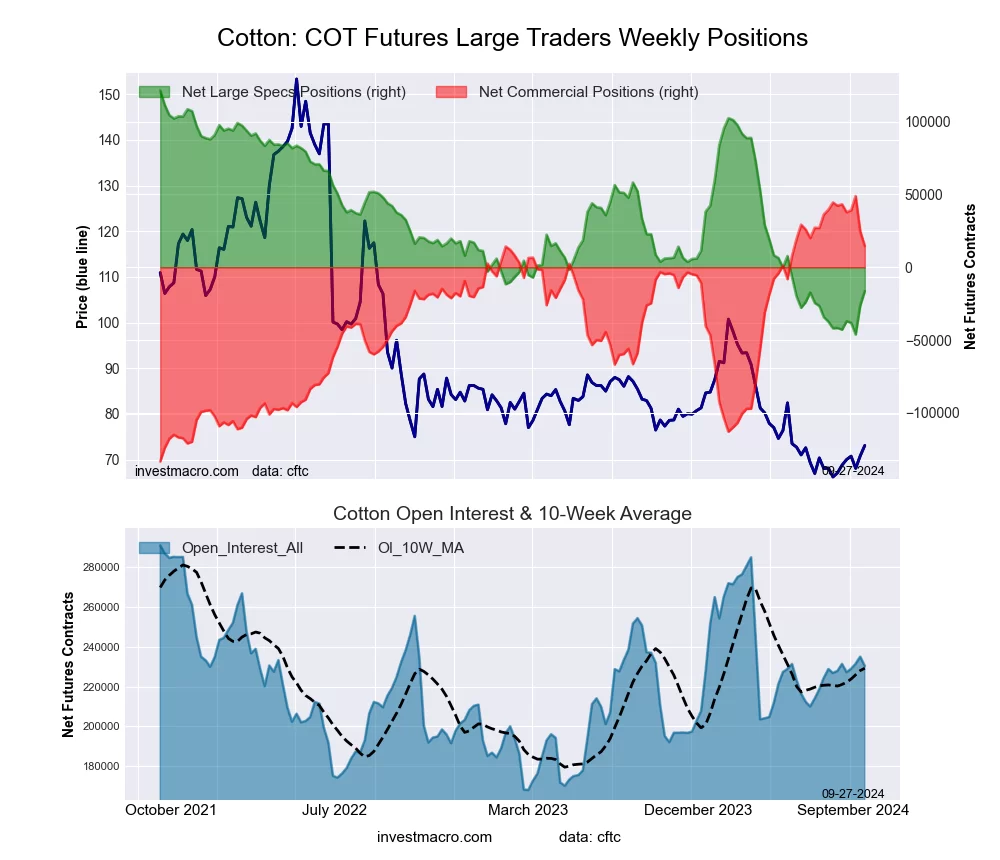
COTTON Futures COT ChartThe COTTON large speculator standing this week reached a net position of -41,908 contracts in the data reported through Tuesday. This was a weekly decline of -4,567 contracts from the previous week which had a total of -37,341 net contracts.

This week’s current strength score (the trader positioning range over the past three years, measured from 0 to 100) shows the speculators are currently Bearish-Extreme with a score of 0.0 percent. The commercials are Bullish-Extreme with a score of 100.0 percent and the small traders (not shown in chart) are Bearish-Extreme with a score of 1.0 percent.

Price Trend-Following Model: Downtrend

Our weekly trend-following model classifies the current market price position as: Downtrend. The current action for the model is considered to be: Hold – Maintain Short Position.

COTTON Futures StatisticsSPECULATORSCOMMERCIALSSMALL TRADERS
– Percent of Open Interest Longs:26.550.85.4
– Percent of Open Interest Shorts:45.031.26.5
– Net Position:-41,90844,447-2,539
– Gross Longs:60,131115,17812,254
– Gross Shorts:102,03970,73114,793
– Long to Short Ratio:0.6 to 11.6 to 10.8 to 1
NET POSITION TREND:
– Strength Index Score (3 Year Range Pct):0.0100.01.0
– Strength Index Reading (3 Year Range):Bearish-ExtremeBullish-ExtremeBearish-Extreme
NET POSITION MOVEMENT INDEX:
– 6-Week Change in Strength Index:-11.010.5-4.1


COCOA Futures:

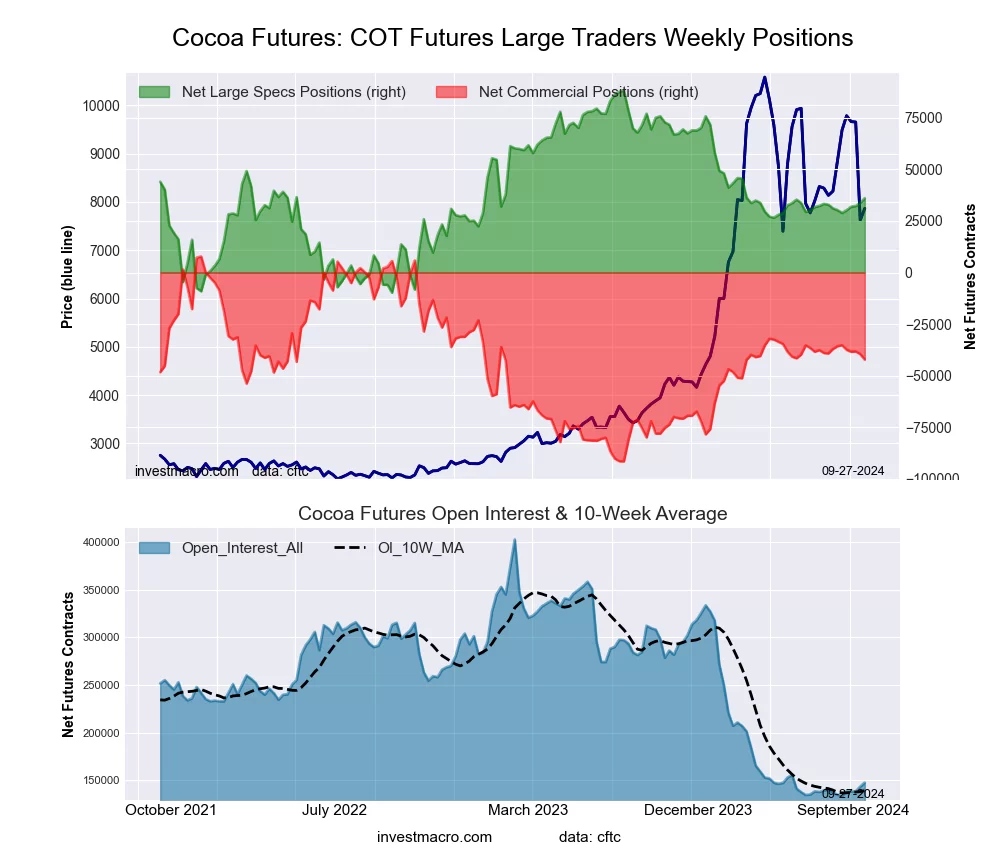
COCOA Futures COT ChartThe COCOA large speculator standing this week reached a net position of 31,097 contracts in the data reported through Tuesday. This was a weekly decline of -1,773 contracts from the previous week which had a total of 32,870 net contracts.

This week’s current strength score (the trader positioning range over the past three years, measured from 0 to 100) shows the speculators are currently Bearish with a score of 41.7 percent. The commercials are Bullish with a score of 54.9 percent and the small traders (not shown in chart) are Bullish with a score of 63.1 percent.

Price Trend-Following Model: Downtrend

Our weekly trend-following model classifies the current market price position as: Downtrend. The current action for the model is considered to be: Hold – Maintain Short Position.

COCOA Futures StatisticsSPECULATORSCOMMERCIALSSMALL TRADERS
– Percent of Open Interest Longs:36.135.58.7
– Percent of Open Interest Shorts:13.562.54.3
– Net Position:31,097-37,0735,976
– Gross Longs:49,60248,71011,944
– Gross Shorts:18,50585,7835,968
– Long to Short Ratio:2.7 to 10.6 to 12.0 to 1
NET POSITION TREND:
– Strength Index Score (3 Year Range Pct):41.754.963.1
– Strength Index Reading (3 Year Range):BearishBullishBullish
NET POSITION MOVEMENT INDEX:
– 6-Week Change in Strength Index:1.8-1.7-0.1


WHEAT Futures:

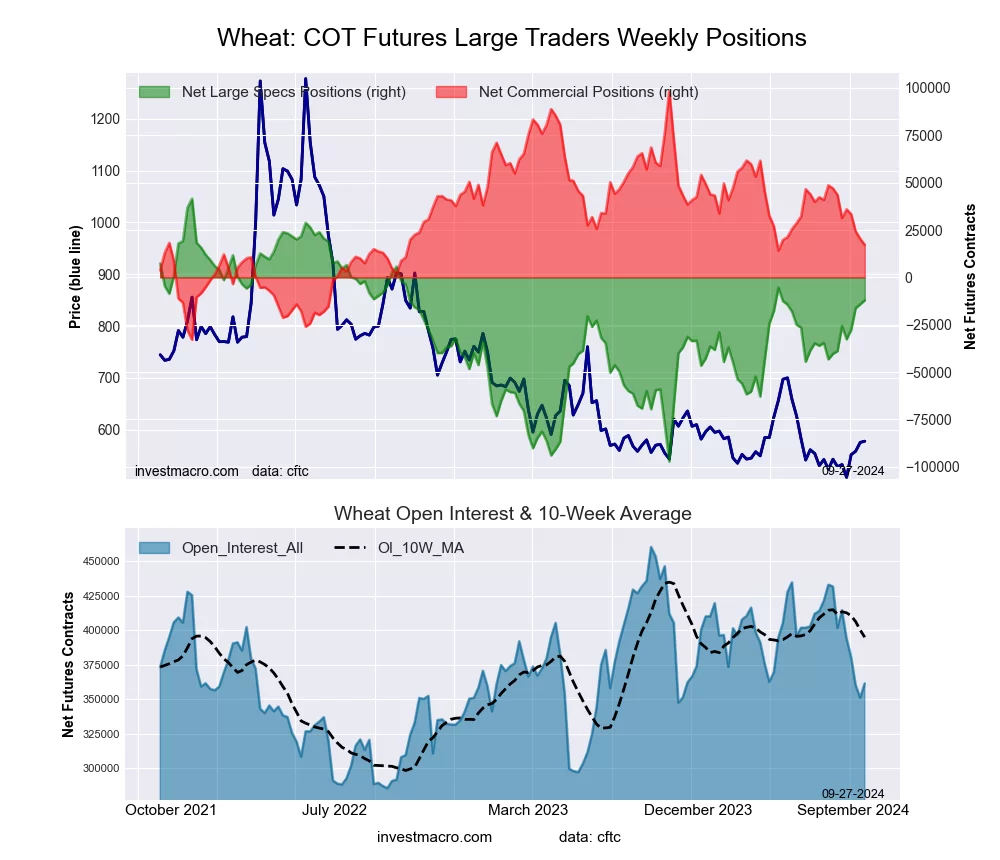
WHEAT Futures COT ChartThe WHEAT large speculator standing this week reached a net position of -40,385 contracts in the data reported through Tuesday. This was a weekly lift of 2,873 contracts from the previous week which had a total of -43,258 net contracts.

This week’s current strength score (the trader positioning range over the past three years, measured from 0 to 100) shows the speculators are currently Bearish with a score of 39.5 percent. The commercials are Bullish with a score of 61.6 percent and the small traders (not shown in chart) are Bearish with a score of 29.7 percent.

Price Trend-Following Model: Strong Downtrend

Our weekly trend-following model classifies the current market price position as: Strong Downtrend. The current action for the model is considered to be: Hold – Maintain Short Position.

WHEAT Futures StatisticsSPECULATORSCOMMERCIALSSMALL TRADERS
– Percent of Open Interest Longs:28.338.97.0
– Percent of Open Interest Shorts:37.728.08.5
– Net Position:-40,38546,947-6,562
– Gross Longs:122,142167,81830,313
– Gross Shorts:162,527120,87136,875
– Long to Short Ratio:0.8 to 11.4 to 10.8 to 1
NET POSITION TREND:
– Strength Index Score (3 Year Range Pct):39.561.629.7
– Strength Index Reading (3 Year Range):BearishBullishBearish
NET POSITION MOVEMENT INDEX:
– 6-Week Change in Strength Index:2.90.3-22.2


Article By InvestMacroReceive our weekly COT Newsletter
*COT Report: The COT data, released weekly to the public each Friday, is updated through the most recent Tuesday (data is 3 days old) and shows a quick view of how large speculators or non-commercials (for-profit traders) were positioned in the futures markets.

The CFTC categorizes trader positions according to commercial hedgers (traders who use futures contracts for hedging as part of the business), non-commercials (large traders who speculate to realize trading profits) and nonreportable traders (usually small traders/speculators) as well as their open interest (contracts open in the market at time of reporting). See CFTC criteria here.

COT Stock Market Charts: Speculator Bets led by Russell & S&P 500

By InvestMacro

Here are the latest charts and statistics for the Commitment of Traders (COT) data published by the Commodities Futures Trading Commission (CFTC).

The latest COT data is updated through Tuesday August 6th and shows a quick view of how large traders (for-profit speculators and commercial entities) were positioned in the futures markets.

Weekly Speculator Changes led by Russell & S&P 500

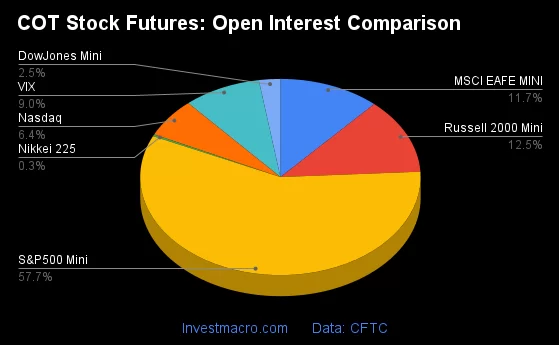
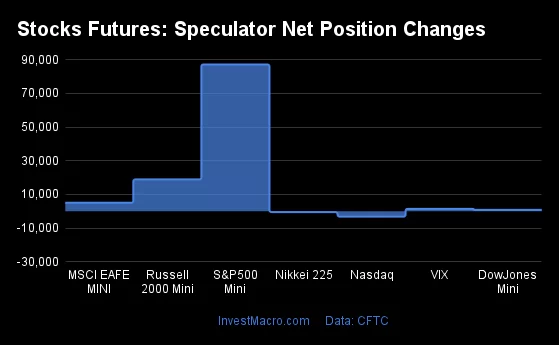
The COT stock markets speculator bets were higher this week as five out of the seven stock markets we cover had higher positioning while the other two markets had lower speculator contracts.

Leading the gains for the stock markets was the Russell-Mini (31,390 contracts), the S&P500-Mini (22,034 contracts), the Nasdaq-Mini (10,189 contracts), the VIX (6,108 contracts) and the Nikkei 225 (2,136 contracts) also showing positive weeks.

The markets with the declines in speculator bets this week were the MSCI EAFE-Mini (-2,360 contracts) and with the DowJones-Mini (-6,169 contracts) also registering lower bets on the week.


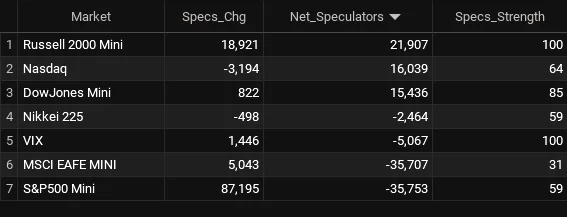
Stock Market Net Speculators Leaderboard

Legend: Weekly Speculators Change | Speculators Current Net Position | Speculators Strength Score compared to last 3-Years (0-100 range)


Strength Scores led by Russell-Mini & DowJones-Mini

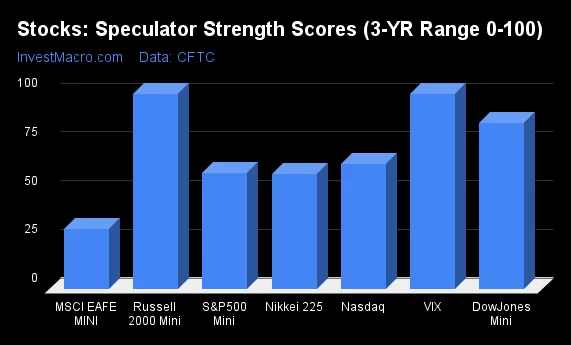
COT Strength Scores (a normalized measure of Speculator positions over a 3-Year range, from 0 to 100 where above 80 is Extreme-Bullish and below 20 is Extreme-Bearish) showed that the Russell-Mini (83 percent) and the DowJones-Mini (72 percent) lead the stock markets this week. The S&P500-Mini (70 percent) and VIX (68 percent) come in as the next highest in the weekly strength scores.

The MSCI EAFE-Mini (44 percent) comes in at the lowest strength level currently.

Strength Statistics:
VIX (68.0 percent) vs VIX previous week (61.4 percent)
S&P500-Mini (69.8 percent) vs S&P500-Mini previous week (66.5 percent)
DowJones-Mini (72.3 percent) vs DowJones-Mini previous week (82.3 percent)
Nasdaq-Mini (58.7 percent) vs Nasdaq-Mini previous week (42.9 percent)
Russell2000-Mini (83.3 percent) vs Russell2000-Mini previous week (61.0 percent)
Nikkei USD (65.4 percent) vs Nikkei USD previous week (47.2 percent)
EAFE-Mini (44.2 percent) vs EAFE-Mini previous week (46.7 percent)


Russell-Mini & Nikkei 225 top the 6-Week Strength Trends

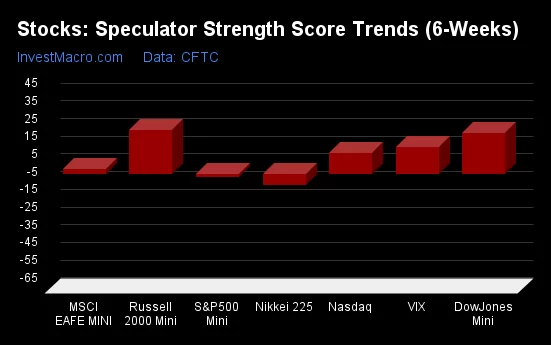
COT Strength Score Trends (or move index, calculates the 6-week changes in strength scores) showed that the Russell-Mini (34 percent) leads the past six weeks trends for the stock markets. The Nikkei 225 (27 percent), the VIX (19 percent) and the S&P500-Mini (15 percent) are the next highest positive movers in the latest trends data.

Strength Trend Statistics:
VIX (18.9 percent) vs VIX previous week (-0.2 percent)
S&P500-Mini (14.8 percent) vs S&P500-Mini previous week (18.8 percent)
DowJones-Mini (12.8 percent) vs DowJones-Mini previous week (19.5 percent)
Nasdaq-Mini (8.1 percent) vs Nasdaq-Mini previous week (9.7 percent)
Russell2000-Mini (33.6 percent) vs Russell2000-Mini previous week (16.9 percent)
Nikkei USD (27.1 percent) vs Nikkei USD previous week (11.3 percent)
EAFE-Mini (3.5 percent) vs EAFE-Mini previous week (3.5 percent)


Individual Stock Market Charts:

VIX Volatility Futures:

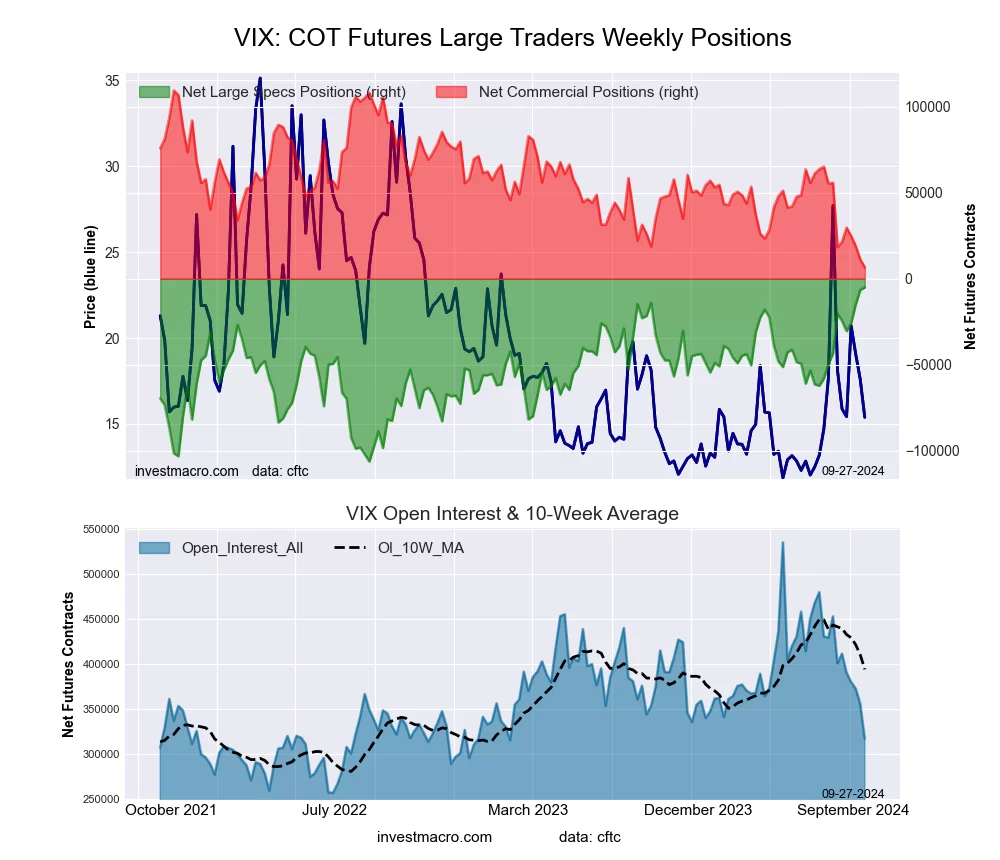
VIX Volatility Futures COT ChartThe VIX Volatility large speculator standing this week reached a net position of -43,545 contracts in the data reported through Tuesday. This was a weekly boost of 6,108 contracts from the previous week which had a total of -49,653 net contracts.

This week’s current strength score (the trader positioning range over the past three years, measured from 0 to 100) shows the speculators are currently Bullish with a score of 68.0 percent. The commercials are Bearish with a score of 40.9 percent and the small traders (not shown in chart) are Bearish with a score of 32.5 percent.

Price Trend-Following Model: Strong Uptrend

Our weekly trend-following model classifies the current market price position as: Strong Uptrend. The current action for the model is considered to be: Hold – Maintain Long Position.

VIX Volatility Futures StatisticsSPECULATORSCOMMERCIALSSMALL TRADERS
– Percent of Open Interest Longs:22.051.16.3
– Percent of Open Interest Shorts:31.638.79.0
– Net Position:-43,54555,847-12,302
– Gross Longs:99,536231,32628,694
– Gross Shorts:143,081175,47940,996
– Long to Short Ratio:0.7 to 11.3 to 10.7 to 1
NET POSITION TREND:
– Strength Index Score (3 Year Range Pct):68.040.932.5
– Strength Index Reading (3 Year Range):BullishBearishBearish
NET POSITION MOVEMENT INDEX:
– 6-Week Change in Strength Index:18.9-8.5-48.2


S&P500 Mini Futures:

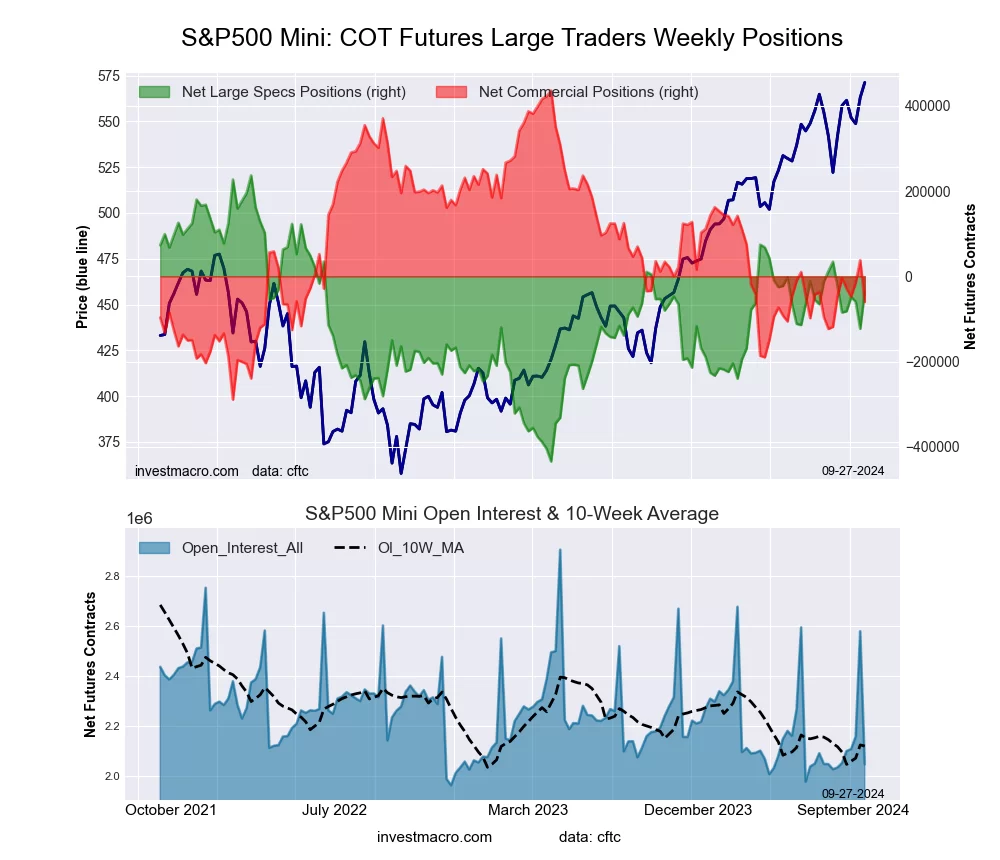
SP500 Mini Futures COT ChartThe S&P500 Mini large speculator standing this week reached a net position of 33,990 contracts in the data reported through Tuesday. This was a weekly lift of 22,034 contracts from the previous week which had a total of 11,956 net contracts.

This week’s current strength score (the trader positioning range over the past three years, measured from 0 to 100) shows the speculators are currently Bullish with a score of 69.8 percent. The commercials are Bearish with a score of 23.5 percent and the small traders (not shown in chart) are Bullish with a score of 72.2 percent.

Price Trend-Following Model: Uptrend

Our weekly trend-following model classifies the current market price position as: Uptrend. The current action for the model is considered to be: Hold – Maintain Long Position.

S&P500 Mini Futures StatisticsSPECULATORSCOMMERCIALSSMALL TRADERS
– Percent of Open Interest Longs:16.169.512.4
– Percent of Open Interest Shorts:14.475.38.2
– Net Position:33,990-118,57584,585
– Gross Longs:326,3761,407,615250,827
– Gross Shorts:292,3861,526,190166,242
– Long to Short Ratio:1.1 to 10.9 to 11.5 to 1
NET POSITION TREND:
– Strength Index Score (3 Year Range Pct):69.823.572.2
– Strength Index Reading (3 Year Range):BullishBearishBullish
NET POSITION MOVEMENT INDEX:
– 6-Week Change in Strength Index:14.8-10.0-10.8


Dow Jones Mini Futures:

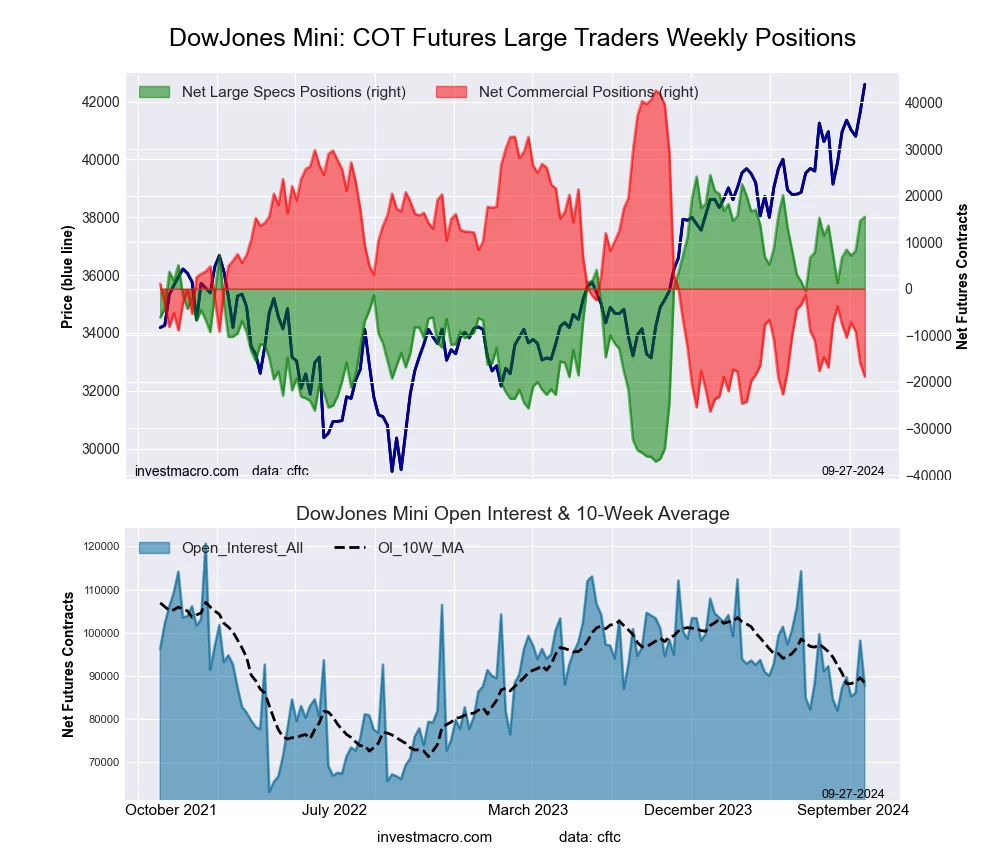
Dow Jones Mini Futures COT ChartThe Dow Jones Mini large speculator standing this week reached a net position of 7,369 contracts in the data reported through Tuesday. This was a weekly fall of -6,169 contracts from the previous week which had a total of 13,538 net contracts.

This week’s current strength score (the trader positioning range over the past three years, measured from 0 to 100) shows the speculators are currently Bullish with a score of 72.3 percent. The commercials are Bearish with a score of 27.6 percent and the small traders (not shown in chart) are Bearish with a score of 47.1 percent.

Price Trend-Following Model: Uptrend

Our weekly trend-following model classifies the current market price position as: Uptrend. The current action for the model is considered to be: Hold – Maintain Long Position.

Dow Jones Mini Futures StatisticsSPECULATORSCOMMERCIALSSMALL TRADERS
– Percent of Open Interest Longs:25.457.514.6
– Percent of Open Interest Shorts:16.766.114.7
– Net Position:7,369-7,321-48
– Gross Longs:21,48448,53612,361
– Gross Shorts:14,11555,85712,409
– Long to Short Ratio:1.5 to 10.9 to 11.0 to 1
NET POSITION TREND:
– Strength Index Score (3 Year Range Pct):72.327.647.1
– Strength Index Reading (3 Year Range):BullishBearishBearish
NET POSITION MOVEMENT INDEX:
– 6-Week Change in Strength Index:12.8-8.7-10.0


Nasdaq Mini Futures:

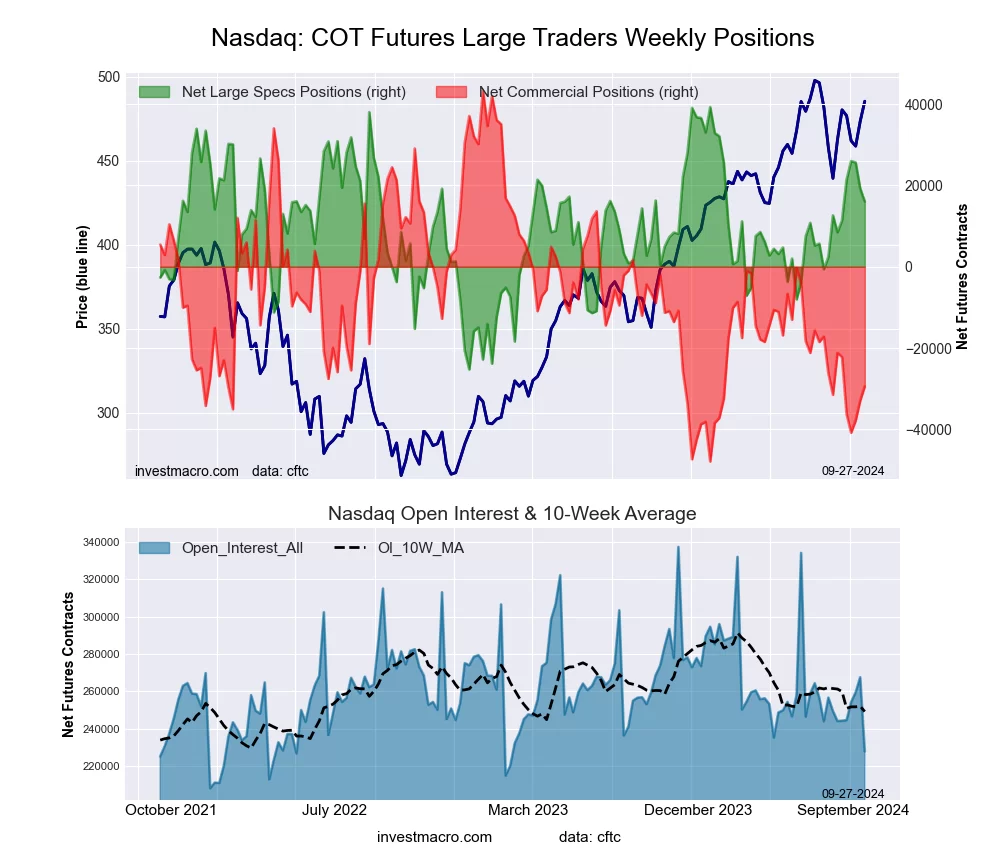
Nasdaq Mini Futures COT ChartThe Nasdaq Mini large speculator standing this week reached a net position of 12,611 contracts in the data reported through Tuesday. This was a weekly increase of 10,189 contracts from the previous week which had a total of 2,422 net contracts.

This week’s current strength score (the trader positioning range over the past three years, measured from 0 to 100) shows the speculators are currently Bullish with a score of 58.7 percent. The commercials are Bearish-Extreme with a score of 18.0 percent and the small traders (not shown in chart) are Bullish-Extreme with a score of 90.6 percent.

Price Trend-Following Model: Weak Uptrend

Our weekly trend-following model classifies the current market price position as: Weak Uptrend. The current action for the model is considered to be: Hold – Maintain Long Position.

Nasdaq Mini Futures StatisticsSPECULATORSCOMMERCIALSSMALL TRADERS
– Percent of Open Interest Longs:20.460.017.4
– Percent of Open Interest Shorts:15.372.69.8
– Net Position:12,611-31,50118,890
– Gross Longs:50,888149,54443,363
– Gross Shorts:38,277181,04524,473
– Long to Short Ratio:1.3 to 10.8 to 11.8 to 1
NET POSITION TREND:
– Strength Index Score (3 Year Range Pct):58.718.090.6
– Strength Index Reading (3 Year Range):BullishBearish-ExtremeBullish-Extreme
NET POSITION MOVEMENT INDEX:
– 6-Week Change in Strength Index:8.1-14.515.3


Russell 2000 Mini Futures:

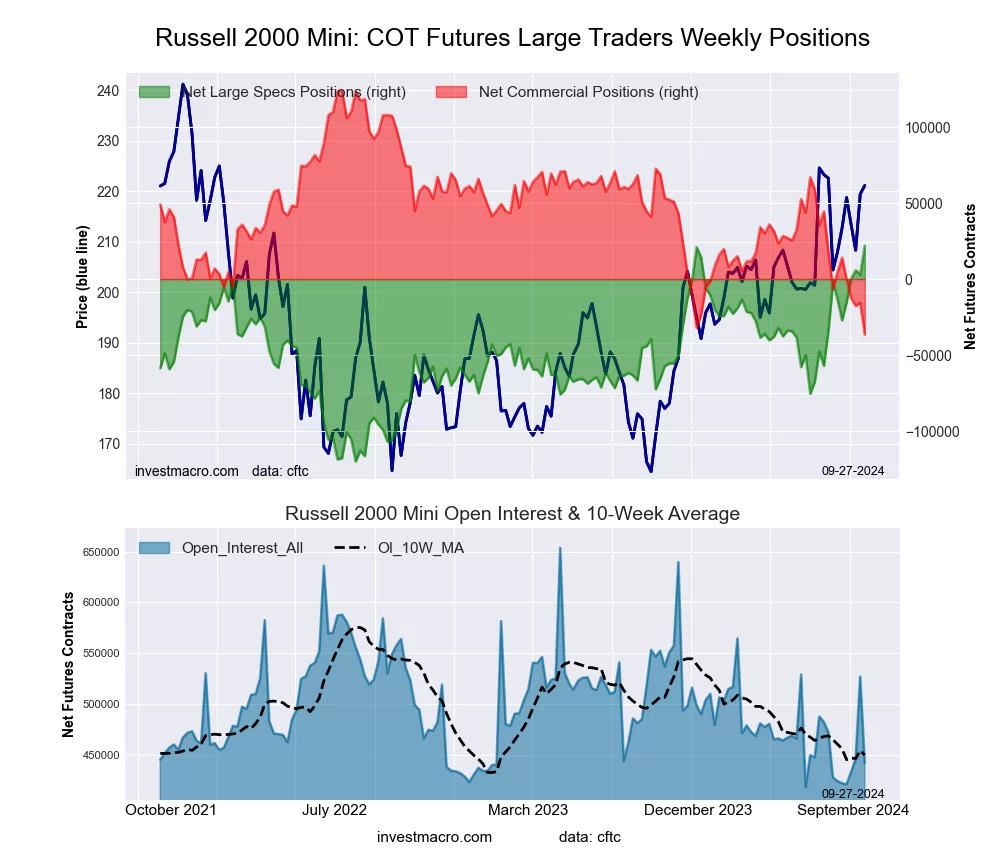
Russell 2000 Mini Futures COT ChartThe Russell 2000 Mini large speculator standing this week reached a net position of -2,595 contracts in the data reported through Tuesday. This was a weekly boost of 31,390 contracts from the previous week which had a total of -33,985 net contracts.

This week’s current strength score (the trader positioning range over the past three years, measured from 0 to 100) shows the speculators are currently Bullish-Extreme with a score of 83.3 percent. The commercials are Bearish-Extreme with a score of 16.3 percent and the small traders (not shown in chart) are Bullish with a score of 59.6 percent.

Price Trend-Following Model: Uptrend

Our weekly trend-following model classifies the current market price position as: Uptrend. The current action for the model is considered to be: Hold – Maintain Long Position.

Russell 2000 Mini Futures StatisticsSPECULATORSCOMMERCIALSSMALL TRADERS
– Percent of Open Interest Longs:16.474.97.1
– Percent of Open Interest Shorts:17.076.45.0
– Net Position:-2,595-6,5029,097
– Gross Longs:70,303320,58830,609
– Gross Shorts:72,898327,09021,512
– Long to Short Ratio:1.0 to 11.0 to 11.4 to 1
NET POSITION TREND:
– Strength Index Score (3 Year Range Pct):83.316.359.6
– Strength Index Reading (3 Year Range):Bullish-ExtremeBearish-ExtremeBullish
NET POSITION MOVEMENT INDEX:
– 6-Week Change in Strength Index:33.6-32.29.2


Nikkei Stock Average (USD) Futures:

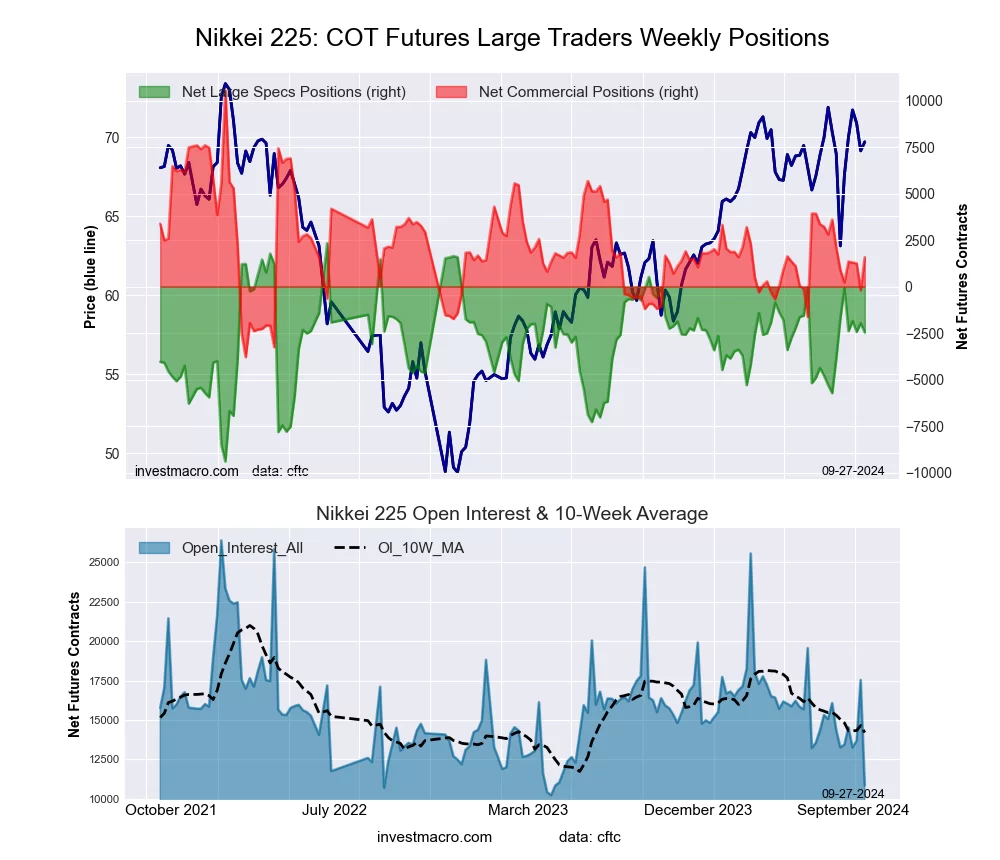
Nikkei Stock Average (USD) Futures COT ChartThe Nikkei Stock Average (USD) large speculator standing this week reached a net position of -1,727 contracts in the data reported through Tuesday. This was a weekly boost of 2,136 contracts from the previous week which had a total of -3,863 net contracts.

This week’s current strength score (the trader positioning range over the past three years, measured from 0 to 100) shows the speculators are currently Bullish with a score of 65.4 percent. The commercials are Bearish with a score of 32.7 percent and the small traders (not shown in chart) are Bullish with a score of 59.2 percent.

Price Trend-Following Model: Strong Downtrend

Our weekly trend-following model classifies the current market price position as: Strong Downtrend. The current action for the model is considered to be: Hold – Maintain Short Position.

Nikkei Stock Average Futures StatisticsSPECULATORSCOMMERCIALSSMALL TRADERS
– Percent of Open Interest Longs:12.363.024.7
– Percent of Open Interest Shorts:25.356.318.4
– Net Position:-1,727889838
– Gross Longs:1,6258,3583,278
– Gross Shorts:3,3527,4692,440
– Long to Short Ratio:0.5 to 11.1 to 11.3 to 1
NET POSITION TREND:
– Strength Index Score (3 Year Range Pct):65.432.759.2
– Strength Index Reading (3 Year Range):BullishBearishBullish
NET POSITION MOVEMENT INDEX:
– 6-Week Change in Strength Index:27.1-21.1-2.8


MSCI EAFE Mini Futures:

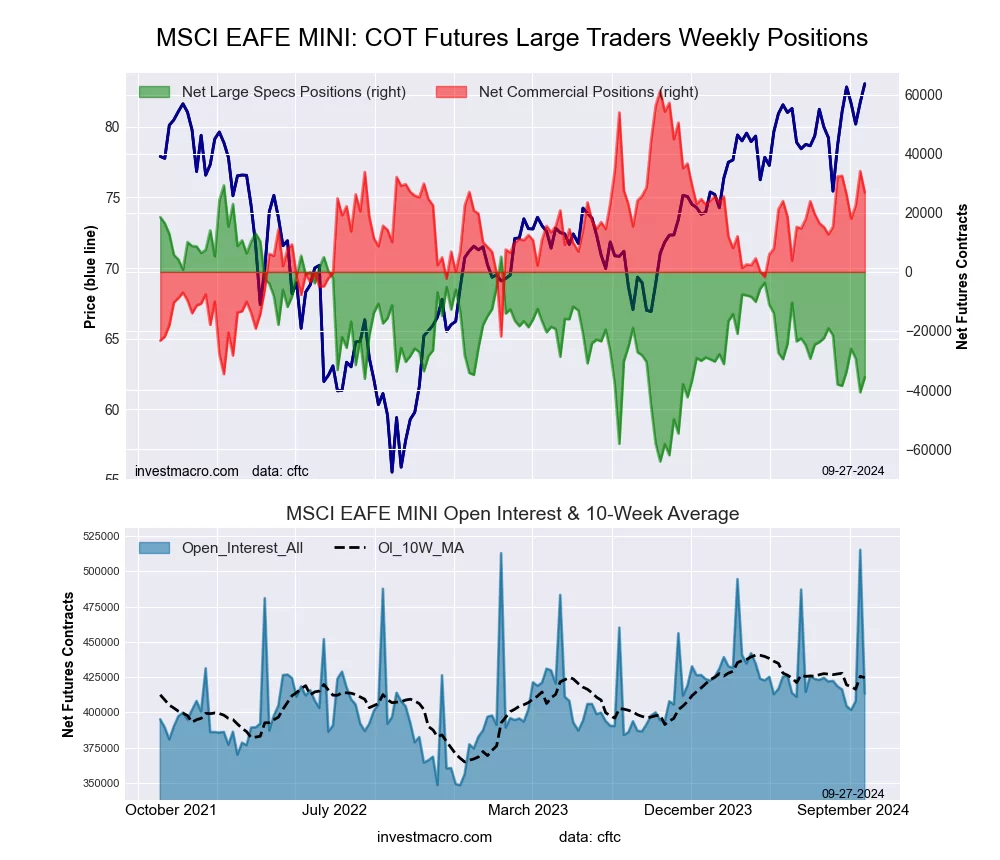
MSCI EAFE Mini Futures COT ChartThe MSCI EAFE Mini large speculator standing this week reached a net position of -21,455 contracts in the data reported through Tuesday. This was a weekly decline of -2,360 contracts from the previous week which had a total of -19,095 net contracts.

This week’s current strength score (the trader positioning range over the past three years, measured from 0 to 100) shows the speculators are currently Bearish with a score of 44.2 percent. The commercials are Bullish with a score of 52.4 percent and the small traders (not shown in chart) are Bearish with a score of 47.8 percent.

Price Trend-Following Model: Strong Downtrend

Our weekly trend-following model classifies the current market price position as: Strong Downtrend. The current action for the model is considered to be: New Sell – Short Position.

MSCI EAFE Mini Futures StatisticsSPECULATORSCOMMERCIALSSMALL TRADERS
– Percent of Open Interest Longs:7.489.72.6
– Percent of Open Interest Shorts:12.586.11.1
– Net Position:-21,45515,2806,175
– Gross Longs:31,139378,83310,919
– Gross Shorts:52,594363,5534,744
– Long to Short Ratio:0.6 to 11.0 to 12.3 to 1
NET POSITION TREND:
– Strength Index Score (3 Year Range Pct):44.252.447.8
– Strength Index Reading (3 Year Range):BearishBullishBearish
NET POSITION MOVEMENT INDEX:
– 6-Week Change in Strength Index:3.5-2.7-3.8


Article By InvestMacroReceive our weekly COT Newsletter
*COT Report: The COT data, released weekly to the public each Friday, is updated through the most recent Tuesday (data is 3 days old) and shows a quick view of how large speculators or non-commercials (for-profit traders) were positioned in the futures markets.

The CFTC categorizes trader positions according to commercial hedgers (traders who use futures contracts for hedging as part of the business), non-commercials (large traders who speculate to realize trading profits) and nonreportable traders (usually small traders/speculators) as well as their open interest (contracts open in the market at time of reporting). See CFTC criteria here.

The Bank of Mexico unexpectedly cut its interest rate. China’s consumer inflation is on the rise

By JustMarkets

At Thursday’s close, the Dow Jones Industrial Average (US30) was up 1.76%, while the S&P 500 Index (US500) added 2.30%. The NASDAQ Technology Index (US100) closed positive 2.87% on Thursday. Stocks rose on Thursday after the weekly number of US initial jobless claims fell more than expected, indicating the strength of the labor market and easing economic concerns following last Friday’s weaker-than-expected July payrolls report. In addition, chip stocks recovered some of Wednesday’s losses and rallied sharply on Thursday, boosting the overall market.

Bitcoin rose more than 10% and surpassed the $61,000 mark, hitting a one-week high. Earlier this week, bitcoin fell to nearly $49,000 as fears of a US recession and the unwinding of yen deals triggered a global sell-off in risky assets. Cryptocurrencies and other risk assets are gradually returning, as analysts say the sell-off was an overreaction. Bitcoin exchange-traded funds have also seen massive inflows in recent sessions after Morgan Stanley allowed financial advisers to recommend Bitcoin ETFs to clients.

On Thursday, analysts expressed shock over the Mexican central bank’s decision to cut interest rates on the same day that official data showed a sharp rise in domestic inflation. The Bank of Mexico cut its benchmark interest rate by 0.25% to 10.75% in August 2024, defying market expectations amid ongoing economic concerns. Global economic growth is expected to slow, and inflation in advanced economies is generally expected to decline. There was significant market volatility in Mexico, driven by the depreciation of the peso (USD/MXN) and rising government bond yields. Meanwhile, annual core inflation rose from 5.10% in June to 5.57% in July, mainly due to non-core inflation, while core inflation declined from 4.05% to 4.00%.

Equity markets in Europe were mostly down yesterday. Germany’s DAX (DE40) rose by 0.37%, France’s CAC 40 (FR40) closed down 0.26%, Spain’s IBEX 35 (ES35) lost 0.39%, and the UK’s FTSE 100 (UK100) closed negative 0.27% on Thursday.

The US natural gas (XNG/USD) prices eased losses and are trading near $2.1/MMBtu after the EIA reported a smaller-than-expected increase in storage inventories. The US utilities added 21 billion cubic feet of gas to storage last week, slightly below the market forecast of 22 billion cubic feet. According to the report, gas in storage is 14.9% above the 5-year average, down from 39% in March and 19% in June. Meanwhile, major US natural gas producers are planning further production cuts in the second half of 2024

Asian markets traded flat yesterday. Japan’s Nikkei 225 (JP225) decreased by 0.74%, China’s FTSE China A50 (CHA50) added 0.36%, Hong Kong’s Hang Seng (HK50) ended Thursday up 0.08%, and Australia’s ASX 200 (AU200) was negative 0.23%. Hong Kong stocks soared nearly 2% in early trading on Friday, rising for a third day as investors reacted to fresh data from China. Consumer prices in the country rose to 0.5% y/y in July, beating forecasts of 0.3% amid Beijing’s efforts to stimulate consumption. Meanwhile, producer prices fell by 0.8%, below the forecast of a 0.9% drop. In addition, there were signs that some global investors viewed China’s markets as a safe haven after Monday’s sell-off.

The Australian dollar rose to $0.66, hitting a two-week high, as easing fears of a US recession spurred gains in risk assets. The Australian dollar received support from hawkish central bank statements. Reserve Bank of Australia (RBA) Governor Michelle Bullock said they would not hesitate to raise interest rates again to fight inflation. She warned that Australia’s economic outlook remains highly uncertain and that the Board should remain vigilant against upside risks to inflation.

A summary of views from the Bank of Japan’s July policy meeting showed that some members favored raising rates further, with one saying they should eventually be brought to at least 1 percent.

S&P 500 (US500) 5,199.50 −40.53 (−0.77%)

Dow Jones (US30) 38,763.45 −234.21 (−0.60%)

DAX (DE40) 17,615.15 +260.83 (+1.50%)

FTSE 100 (UK100) 8,166.88 +140.19 (+1.75%)

USD Index 103.20 +0.24 (+0.23%)

Important events today:
  • – China Consumer Price Index (m/m) at 04:30 (GMT+3);
  • – China Producer Price Index (m/m) at 04:30 (GMT+3);
  • – German Consumer Price Index (m/m) at 09:00 (GMT+3);
  • – Canada Unemployment Rate (m/m) at 15:30 (GMT+3).

By JustMarkets


This article reflects a personal opinion and should not be interpreted as an investment advice, and/or offer, and/or a persistent request for carrying out financial transactions, and/or a guarantee, and/or a forecast of future events.

EUR/USD Stabilises Amid Fed Speculation and Absence of Major Economic Data

By RoboForex Analytical Department

The EUR/USD pair has found some stability at around 1.0921 this Friday, following a week marked by high volatility. Market participants have been adjusting their positions in response to speculations concerning the US economy’s potential rapid recession and subsequent expectations about the Federal Reserve’s response.

The broader market sentiment has increasingly leaned towards anticipating a significant rate cut by the Fed in September, possibly by 50 basis points. However, the validity of these expectations remains to be seen as the situation evolves.

Austan Goolsbee, President of the Federal Reserve Bank of Chicago, recently emphasised that the Federal Reserve’s mandate is not to respond to stock market fluctuations but to focus on its dual objectives of maximising employment and achieving price stability. He also reiterated that the Fed has set specific economic criteria to justify a rate reduction. Goolsbee’s remarks seem to have calmed some of the more erratic market movements.

With no significant economic data released this week, traders have been left to navigate the market based on speculative movements and minor indicators.

Technical analysis of EUR/USD

The H4 EUR/USD chart shows that the pair has completed an initial downward movement targeting the 1.0880 level, followed by a corrective phase towards 1.0944. Should this correction complete, a further decline to 1.0888 is anticipated. Breaking below this level could extend the downward trajectory towards 1.0830. The bearish outlook is supported by the MACD indicator, whose signal line is positioned above zero but trending downwards, indicating a potential continuation of the decline.

On the H1 chart, EUR/USD has formed a consolidation pattern around the 1.0913 mark. An upward breakout is expected, potentially driving the pair towards 1.0944, which is seen as a corrective move against the previous downtrend. Upon completion of this correction, the focus will shift to a new declining phase targeting 1.0888. This technical perspective is corroborated by the Stochastic oscillator, with its signal line poised to move from below the 80 level to around 20, suggesting an impending downward momentum.

Overall, the EUR/USD pair shows signs of temporary equilibrium as it navigates through speculative currents and awaits clearer directional cues from upcoming economic data or Federal Reserve communications.


Disclaimer

Any forecasts contained herein are based on the author’s particular opinion. This analysis may not be treated as trading advice. RoboForex bears no responsibility for trading results based on trading recommendations and reviews contained herein.

RBI kept rates at 6.5%. The Canadian dollar is strengthening due to foreign currency inflows and rising oil prices

By JustMarkets

At Wednesday’s close, the Dow Jones Index (US30) was down 0.60%, while the S&P 500 Index (US500) decreased by 0.77%. The NASDAQ Technology Index (US100) closed negative 1.05%. Yesterday, chip stocks gave up early gains and retreated, which had a negative impact on the overall market.

Stocks on Wednesday initially went up on positivity from a rally in Japanese stocks amid dovish comments from Bank of Japan (BoJ) Deputy Governor Uchida, who pledged to refrain from raising interest rates amid volatile markets. Financial markets have been in turmoil since last week, when the BoJ unexpectedly raised interest rates, causing the yen to surge to a 7-month high against the dollar and contributing to a rapid unwinding of yen trading that pulled down risk assets around the world.

Airbnb (ABNB) closed down more than 13% after estimating third-quarter revenue of $3.67 billion to $3.73 billion, below consensus estimates of $3.84 billion, and warning of weaker demand from US vacationers. Illumina (ILMN) closed higher by more than 4% after reporting second-quarter revenue of $1.11 billion, above the consensus prognosis of $1.09 billion.

The Canadian dollar strengthened to 1.37 per US dollar, recovering from an eight-month low of 1.388 hit on August 1, thanks to an improving outlook for foreign exchange inflows and reduced fears of a US recession, which restored global risk appetite. A recovery in oil prices, driven by a sixth consecutive week of declines in US inventories and fears of supply disruptions from the Middle East, further supported the loonie. However, the recent rate cut by the Bank of Canada (BoC) and expectations of further easing of up to 150 basis points over the next year will create headwinds for the Canadian dollar.

Equity markets in Europe were mostly up yesterday. Germany’s DAX (DE40) rose by 1.50%, France’s CAC 40 (FR40) closed 1.91% higher, Spain’s IBEX 35 (ES35) added 2.01%, and the UK’s FTSE 100 (UK100) closed positive 1.75%.

WTI crude oil prices rose to around $75.5 per barrel on Thursday, rising for the third consecutive session, driven by a larger-than-expected decline in US crude inventories. EIA data for Wednesday showed crude inventories fell by 3.728 million barrels, the sixth consecutive weekly decline, well above the expected 0.4 million barrel drop. However, gasoline and distillate inventories rose over the period.

Asian markets traded flat yesterday. Japan’s Nikkei 225 (JP225) rose by 1.19%, China’s FTSE China A50 (CHA50) added 0.13%, Hong Kong’s Hang Seng (HK50) gained 1.38%, and Australia’s ASX 200 (AU200) was positive 0.25%.

The Reserve Bank of India (RBI) kept the benchmark repo rate at 6.5% for the ninth consecutive meeting in August 2024 to ensure inflation falls to the medium-term target of 4% while supporting growth, in line with market expectations. The latest move came after annual inflation accelerated to a four-month high of 5.08% in June 2024, driven by rising food prices, but remained within the RBI’s acceptable target range of 2–6% In addition, the Central Bank maintained its economic growth estimate for FY 2025 at 7.2%, keeping inflation expectations at 4.5%.

S&P 500 (US500) 5,199.50 −40.53 (−0.77%)

Dow Jones (US30) 38,763.45 −234.21 (−0.60%)

DAX (DE40) 17,615.15 +260.83 (+1.50%)

FTSE 100 (UK100) 8,166.88 +140.19 (+1.75%)

USD Index 103.20 +0.24 (+0.23%)

Important events today:
  • – Australia NAB Business Confidence (m/m) at 04:30 (GMT+3);
  • – China Trade Balance (m/m) at 06:00 (GMT+3);
  • – New Zealand Inflation Expectations (q/q) at 06:00 (GMT+3);
  • – US Initial Jobless Claims (m/m) at 15:30 (GMT+3);
  • – US Natural Gas Storage (w/w) at 17:30 (GMT+3).

By JustMarkets


This article reflects a personal opinion and should not be interpreted as an investment advice, and/or offer, and/or a persistent request for carrying out financial transactions, and/or a guarantee, and/or a forecast of future events.

Gold (XAU/USD) Recovers Amid Rate Cut Expectations

By RoboForex Analytical Department

Gold (XAU/USD) prices have rebounded to 2394 USD per troy ounce, paring previous losses as the likelihood of a US Federal Reserve rate cut increases. Market sentiment is increasingly cautious amid recession fears, influencing stock market dynamics and bolstering the appeal of non-yielding assets like gold.

Current market indicators, notably the CME FedWatch tool, suggest an almost certain probability of a rate reduction by the Federal Reserve in September. Such monetary easing typically enhances the allure of gold, which does not offer interest income.

Investor focus is now on upcoming US unemployment claims data, which will provide further insight into employment market conditions. Recent statistics from China revealed that the People’s Bank of China did not purchase gold bullion in July, marking the third consecutive month without an increase in gold reserves. This suggests a shift towards domestic economic stimulation as the Chinese economy faces challenges.

Ongoing tensions in the Middle East also underscore gold’s status as a safe-haven asset.

Technical analysis of XAU/USD

The H4 XAU/USD chart shows a declining trend towards the 2345.00 level, with a local target recently reached at 2364.23, followed by a correction to 2411.00. The market is anticipated to continue this downward trajectory towards 2355.80 before potentially rebounding to 2381.60. A further decline to 2345.00 is likely, aligning with the primary downtrend target. This bearish outlook is supported by the MACD indicator, which shows the signal line trending downwards from above zero.

On the H1 chart, gold is currently consolidating above 2381.60. A downward breakout towards 2355.80 is expected, which would serve as a local target. Subsequent retesting of 2381.60 from below may occur before the downward movement continues to 2345.00. This bearish scenario is corroborated by the Stochastic oscillator, with the signal line poised to drop from above 80, suggesting a potential decline.

As investors and traders navigate these dynamics, gold’s status as a hedge against uncertainty remains a key theme in its valuation.


Disclaimer

Any forecasts contained herein are based on the author’s particular opinion. This analysis may not be treated as trading advice. RoboForex bears no responsibility for trading results based on trading recommendations and reviews contained herein.

This Trend Will Likely Soon Rock the U.S. Financial System

Why monetary inflation has been shrinking

By Elliott Wave International

Nearly everyone who buys groceries, fills their car tank with gas, pays rent, buys car insurance and so on is talking about the high cost of living. And it’s true that consumer price inflation is higher today than before the pandemic – although, it’s nowhere near as high as it was two years ago, when the annual inflation rate spiked to a 40-year peak of 9.1%.

Since then, the pace of inflation has slowed way down. In fact, the latest reading of the Consumer Price Index, or CPI, came in at 3%, close to the Federal Reserve’s “ideal” target of 2% a year.

But that’s price inflation. There is another measure of inflation that has to do with money supply. It’s the so-called monetary inflation, or the supply of printed money. It has also declined over the past two years and is likely set to decrease even more. And while it sounds like a good trend, it’s actually the opposite.

Here’s insight from our just-published July Elliott Wave Theorist:

Monetary inflation … is unlikely to continue. Why? because since early 2022 the Fed’s clear aim has been to reduce the size of its balance sheet. Over the past two years, the value of the Fed’s assets, representing “printed” money, has gone from $8.94 trillion to $7.22 trillion, a decline of nearly 20 percent.

The July Elliott Wave Theorist continues:

This shrinkage of base money, moreover, has taken place even as total debt has expanded. This situation cannot maintain. The dichotomy will soon rock the financial system. It’s just a matter of when.

Indeed, U.S. household debt – which is part of that “total debt” The Theorist is referring to — grew by $800 million from 2022 to 2023, including a 16.6% growth in credit card debt, according to Marketwatch.

The financial website had this headline on June 20:

Americans Are Carrying Record Household Debt into 2024

Interestingly, Washington D.C. has the highest per capita credit card debt in the country.

And speaking of the nation’s capital, out of control spending has led to a national debt of nearly $35 trillion.

As CBS News noted earlier this year (March 1):

U.S. interest payments on its debt are set to exceed defense spending.

The Congressional Budget Office projects the annual interest on the debt will hit $1.4 trillion by 2033.

And this does not even consider the huge amount of debt at the state and local levels – as well as the debt of corporations.

U.S. household debt is growing and will only get bigger. In turn, so will the scale of the news coverage about “the importance of the household debt to economic activity.” Regardless of where in the world you live or invest, staying ahead of the trends in the U.S. stock market and economy is worth your while. Elliott Wave International has a free must-read issue on U.S stocks that I suggest you check out, on www.elliottwave.com.

This article was syndicated by Elliott Wave International and was originally published under the headline This Trend Will Likely Soon Rock the U.S. Financial System. EWI is the world’s largest market forecasting firm. Its staff of full-time analysts led by Chartered Market Technician Robert Prechter provides 24-hour-a-day market analysis to institutional and private investors around the world.

Brent Oil Price Analysis: Anticipating a Correction

By RoboForex Analytical Department

Brent crude oil’s price increased to 76.88 USD per barrel on Wednesday, continuing to rise for the second consecutive session. This rebound helps mitigate previous losses, which were part of a broader market risk aversion phase.

Current market dynamics

Investor concerns about energy supply disruptions are heightening due to political developments in Hamas and ongoing unrest affecting Libya’s Sharara oil field. These factors contribute to apprehensions about potential threats to oil supply from the Middle East.

Additionally, the latest data from the American Petroleum Institute (API) indicated a modest rise in US oil inventories, less than market forecasts, which had anticipated a more considerable increase. This was the first inventory build in five weeks, adding a layer of complexity to market dynamics.

Broader economic concerns, including fears of a US recession and weak Chinese demand, continue to exert downward pressure on oil prices.

Technical analysis of Brent

The H4 chart suggests that Brent is progressing towards the 78.12 USD level. After reaching this target, a pullback to 76.33 USD could occur, potentially setting the stage for another upward movement towards 79.85 USD and extending to 81.37 USD. The MACD indicator supports this bullish scenario, with the signal line positioned for upward momentum from current lows.

On the H1 chart, Brent has established a consolidation range of around 76.33 USD. An upward breakout towards 78.12 USD is anticipated. Once this target is achieved, a retracement to 76.33 USD might follow. The Stochastic oscillator is poised near the 80 level, suggesting an impending downturn, which aligns with the expected corrective phase following the initial rise.


Market outlook

Investors should monitor further geopolitical developments and additional inventory reports, which could significantly influence oil price movements. The upcoming Federal Reserve communications and economic indicators will also be crucial in shaping market sentiment, especially concerning the potential for economic slowdowns, which could impact oil demand.

Disclaimer

Any forecasts contained herein are based on the author’s particular opinion. This analysis may not be treated as trading advice. RoboForex bears no responsibility for trading results based on trading recommendations and reviews contained herein.

Panic selling of indices is over. New Zealand’s rising unemployment brings the RBNZ easing cycle closer

By JustMarkets

At Tuesday’s close, the Dow Jones (US30) Index was up 0.76%, while the S&P 500 (US500) Index was up 1.04%. The NASDAQ Technology Index (US100) closed positive 1.03%. US stocks recovered strongly on Tuesday, rebounding after a three-day sell-off. Dip buyers emerged yesterday, pushing stocks higher after Monday’s sharp decline. The sharp rise in Japanese stocks today provided support for US stocks. All sectors were up, with real estate and technology leading the way. Japan’s Nikkei Stock Index (JP225) rose more than 10% today as a weaker yen sparked a rally in Japanese exporters after the Bank of Japan (BoJ) said it will hold a trilateral meeting with the Ministry of Finance and the Financial Services Agency in Tokyo to discuss international markets.

Nvidia (NVDA) shares are up more than 5% after New Street Research upgraded the stock to “buy” from “neutral” with a $120 price target. Uber Technologies (UBER) is up more than 7% after reporting second-quarter gross orders of $39.95 billion, better than the consensus estimate of $39.70 billion Palantir Technologies (PLTR) is up more than 10% after reporting second-quarter revenue of $678.1 million, better than the consensus of $652.8 million, and raising its full-year revenue outlook
The US trade deficit narrowed to $73.1 billion in June from a revised $75.1 billion in May but was larger than expectations of $72.5 billion and a negative for second-quarter GDP. The market consensus expects second-quarter earnings for S&P 500 companies to rise 9% year-over-year. About half of the companies in the S&P 500 have already reported. According to Bloomberg data, most of the companies that reported beat consensus on earnings, but only 43% beat revenue expectations, the lowest in five years.
Equity markets in Europe traded mixed yesterday. Germany’s DAX (DE40) rose by 0.09%, France’s CAC 40 (FR40) closed down 0.27%, Spain’s IBEX 35 (ES35) fell 0.32%, and the UK’s FTSE 100 (UK100) closed positive 0.23%. Eurozone retail sales fell by 0.3% m/m in June, weaker than expectations of 0.1% m/m and the biggest decline in 6 months. German factory orders rose by 3.9% m/m in June, which was stronger than expectations of 0.5% m/m and was the largest increase in the last 6 months. Swaps discount the probability of a 25bp ECB rate cut at the September 12 meeting to 100%.

The US crude oil inventories rose by 4.495 million barrels in the week ended August 2, 2024, after declining by 4.495 million barrels in the previous week, data from API’s weekly statistical bulletin showed. This marked the fifth consecutive week of decline in crude inventories and was below market expectations of a 0.85 million barrel increase.

Asian markets traded flat yesterday. Japan’s Nikkei 225 (JP225) was up 10.23%, China’s FTSE China A50 (CHA50) was down 0.66%, Hong Kong’s Hang Seng (HK50) lost 0.31% by Tuesday’s close, while Australia’s ASX 200 (AU200) was positive 0.41%.

The offshore yuan slipped to 7.18 per dollar, falling short of the seven-month peak reached earlier this week, as traders reacted to the latest economic data from China. On Wednesday, China reported a trade surplus of $84.65 billion for July 2024, up from $80.22 billion in the same month a year earlier but short of market expectations of $99 billion. Exports rose 7% year-on-year in July, below the 9.7% growth estimate and the slowest growth since April. In contrast, imports posted the fastest growth rate since April, rising 7.2% from a year earlier and well ahead of the prognosis of 3.5% increase.

New Zealand’s unemployment rate rose to 4.6% in the three months to June 2024, following an upwardly revised 4.4% in the previous quarter. This is the highest rate since the first quarter of 2021 and slightly below market expectations of 4.7%. This will increase the likelihood of an earlier rate cut by the RBNZ and will harm the kiwi.

S&P 500 (US500) 5,240.03 +53.70 (+1.04%)

Dow Jones (US30) 38,997.66 +294.39 (+0.76%)

DAX (DE40) 17,354.32 +15.32 (+0.09%)

FTSE 100 (UK100) 8,026.69 +18.46 (+0.23%)

USD Index 102.96 +0.27 (+0.26%)

Important events today:
  • – New Zealand Unemployment Rate (q/q) at 01:45 (GMT+3);
  • – German Industrial Production (m/m) at 09:00 (GMT+3);
  • – German Trade Balance (m/m) at 09:00 (GMT+3);
  • – Canada Ivey PMI (m/m) at 17:00 (GMT+3);
  • – US Crude Oil Reserves (w/w) at 17:30 (GMT+3).

By JustMarkets


This article reflects a personal opinion and should not be interpreted as an investment advice, and/or offer, and/or a persistent request for carrying out financial transactions, and/or a guarantee, and/or a forecast of future events.