Archive for Financial News – Page 109

NZD/USD Reaches Annual High Amid USD Weakness

By RoboForex Analytical Department

The NZD/USD pair has climbed to the highest level since 15 January 2024, continuing its trajectory within an ascending channel towards a target of 0.6233. The New Zealand dollar’s growth is primarily fuelled by the weakening US dollar, mirroring trends observed with other currencies such as the AUD and CAD.

Investor sentiment is buoyed by the anticipation that the US Federal Reserve will begin easing monetary policy at its September meeting. Debates about whether the rate cut will be 25 or 50 basis points are ongoing. The decision is seen as imminent given the current inflationary environment in the US and the need to support the employment market.

Conversely, the Reserve Bank of New Zealand (RBNZ) has already taken proactive steps by lowering its interest rate earlier this month. The RBNZ has also signalled a potential reduction in lending costs by up to 75 basis points by year-end, marking a fairly aggressive stance on rates. This transparent approach to monetary policy is helping to shape market expectations and bolster the NZD.

Technical analysis of NZD/USD

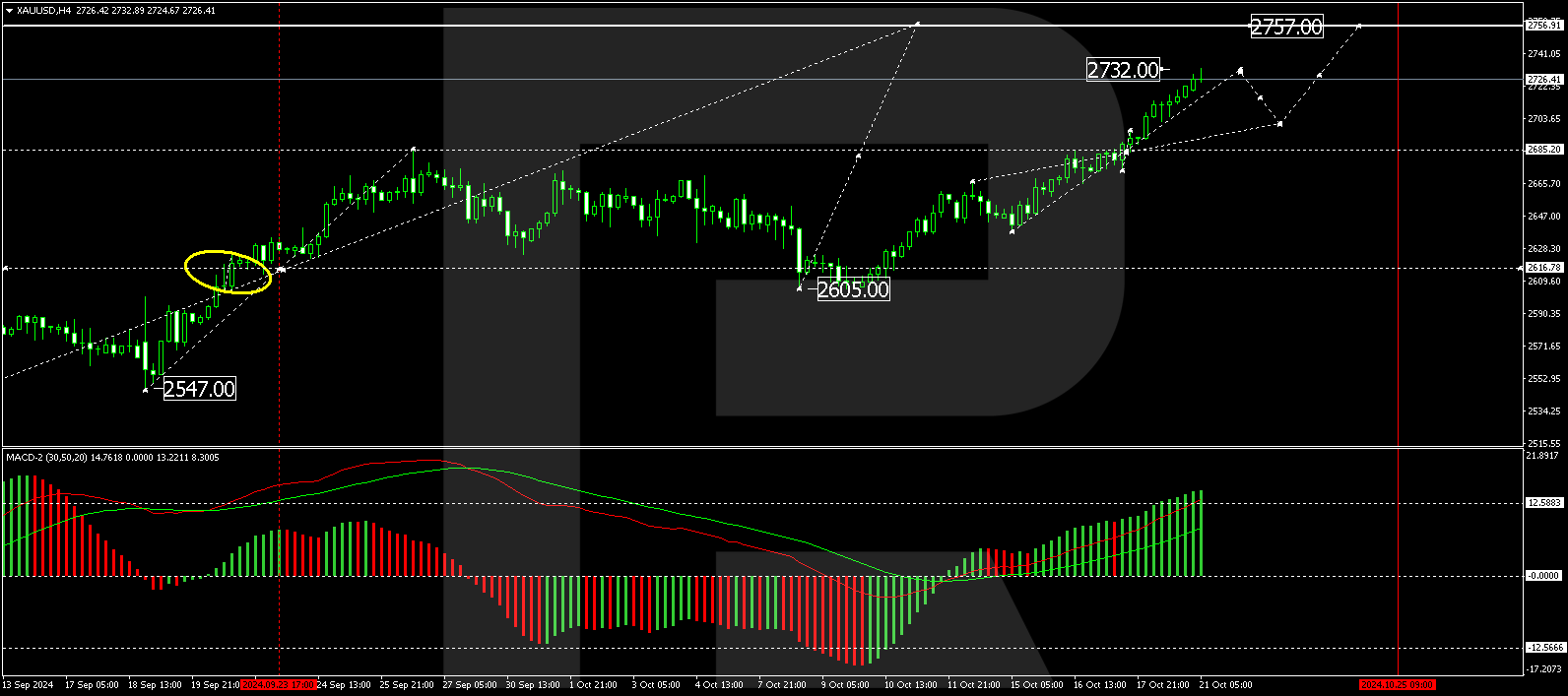
On the H4 chart, NZD/USD has completed a growth wave to 0.6250 and is now forming the initial decline phase towards 0.6128. After reaching this target, a corrective movement to 0.6191 might occur, testing it from below before initiating a further decline to 0.6065 and possibly extending to 0.6000. The MACD indicator, positioned above zero but trending downwards, supports this bearish outlook.

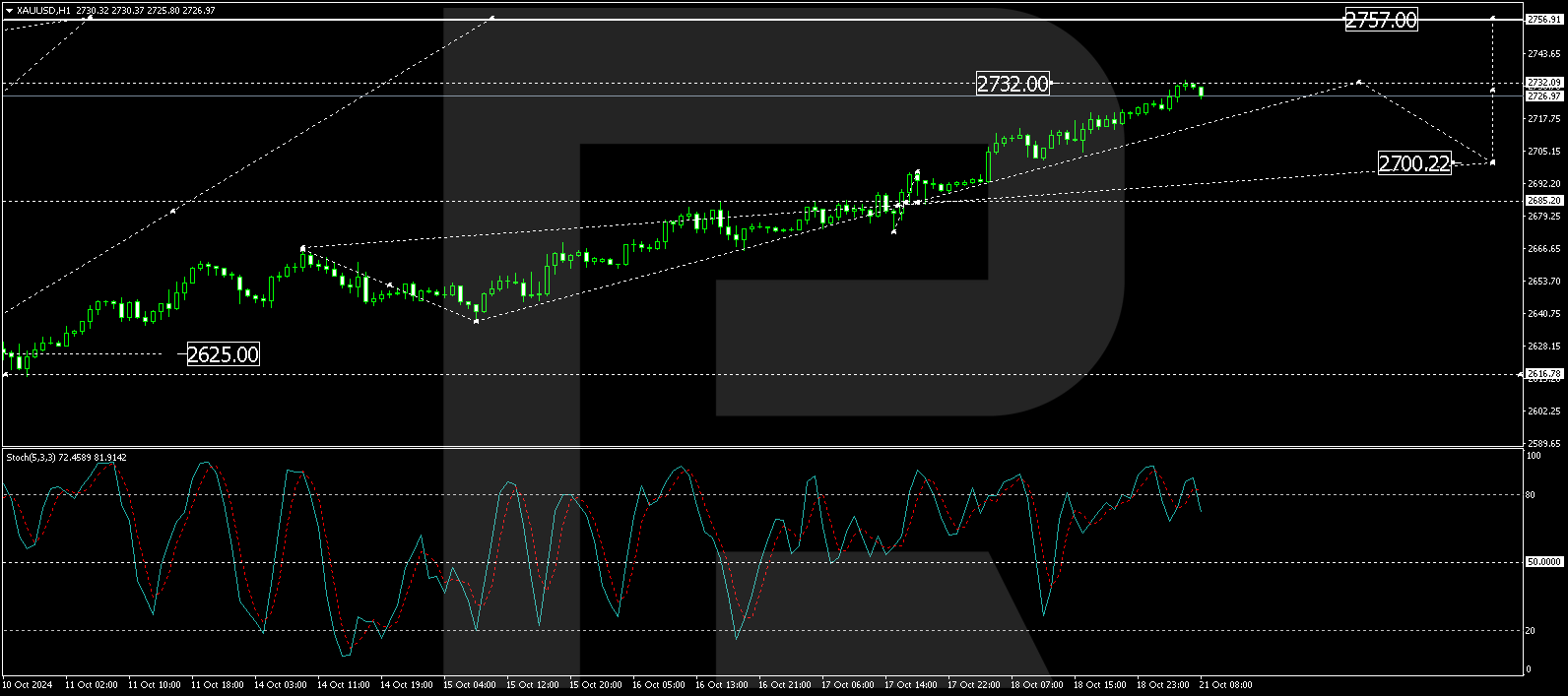
On the H1 chart, the pair is currently developing a decline structure towards 0.6222. Following this, a brief uptick to 0.6238 is expected, potentially leading to a consolidation around this level. A downward exit from this consolidation could signal the continuation of the downward trend towards 0.6128. This scenario is corroborated by the Stochastic oscillator, with its signal line below 50 and aiming towards 20, indicating a likely continuation of the downward movement.


Disclaimer

Any forecasts contained herein are based on the author’s particular opinion. This analysis may not be treated as trading advice. RoboForex bears no responsibility for trading results based on trading recommendations and reviews contained herein.

Major New Upleg Starting in Copper?

Source: Clive Maund (8/27/24)

Technical Analyst Clive Maund shares an update where he explains why now is a great time to buy all things copper.

Copper looks ready for its next big runup, which could be massive. It has been performing very well indeed technically, as we can see on its latest 6-month chart below.

We turned bullish on it a little early a few weeks back at the time when it was at the Left Shoulder low of what has turned out to be a fine small Head-and-Shoulders bottom — after such a heavy correction, it was entitled to spend some time forming an intermediate reversal pattern.

That it has done, and as we can see on the chart, it is now complete — and according to Bloomberg yesterday morning, copper is now starting to break out, both from the H&S bottom and from the corrective downtrend, which at this point are coincident.

THIS THEREFORE IS A GOOD POINT TO BUY COPPER AND ALL THINGS COPPER.


Important Disclosures:

  1. Statements and opinions expressed are the opinions of the author and not of Streetwise Reports, Street Smart, or their officers. The author is wholly responsible for the accuracy of the statements. Streetwise Reports was not paid by the author to publish or syndicate this article. Streetwise Reports requires contributing authors to disclose any shareholdings in, or economic relationships with, companies that they write about. Any disclosures from the author can be found  below. Streetwise Reports relies upon the authors to accurately provide this information and Streetwise Reports has no means of verifying its accuracy.
  2. This article does not constitute investment advice and is not a solicitation for any investment. Streetwise Reports does not render general or specific investment advice and the information on Streetwise Reports should not be considered a recommendation to buy or sell any security. Each reader is encouraged to consult with his or her personal financial adviser and perform their own comprehensive investment research. By opening this page, each reader accepts and agrees to Streetwise Reports’ terms of use and full legal disclaimer. Streetwise Reports does not endorse or recommend the business, products, services or securities of any company.

For additional disclosures, please click here.

Clivemaund.com Disclosures

The above represents the opinion and analysis of Mr. Maund, based on data available to him, at the time of writing. Mr. Maund’s opinions are his own, and are not a recommendation or an offer to buy or sell securities. As trading and investing in any financial markets may involve serious risk of loss, Mr. Maund recommends that you consult with a qualified investment advisor, one licensed by appropriate regulatory agencies in your legal jurisdiction, and do your own due diligence and research when making any kind of a transaction with financial ramifications. Although a qualified and experienced stock market analyst, Clive Maund is not a Registered Securities Advisor. Therefore Mr. Maund’s opinions on the market and stocks cannot be construed as a recommendation or solicitation to buy and sell securities.

Oil prices jumped amid increased geopolitical risk in the Middle East. Investors focus on the Australian inflation data

By JustMarkets

At Monday’s close, the Dow Jones (US30) Index was up 0.16%, while the S&P 500 (US500) Index was down 0.32%. The NASDAQ Technology Index (US100) closed negative 0.85%.

On Monday, San Francisco Fed Chair Mary Daly said that “the time to adjust policy is now.” Richmond FRB President Barkin said he still sees upside risks to inflation, although he supports “lower” interest rates as the labor market cools. Markets rate the odds of a 25bp rate cut at the September 17–18 FOMC meeting at 100% and a 50bp rate cut at 36%.

Equity markets in Europe were mostly down yesterday. Germany’s DAX (DE40) fell 0.08%, France’s CAC 40 (FR40) closed up 0.18%, Spain’s IBEX 35 (ES35) fell 0.11%, and the UK’s FTSE 100 (UK100) was not trading on Monday. European stocks closed subdued on Monday, weakly holding on to the previous week’s highs, as markets continued to assess the extent to which consolidated expectations of an imminent rate cut by the Federal Reserve will affect European borrowing costs. Ifo’s German business climate indicator fell for the fourth straight time in August, matching market expectations and adding to concerns after preliminary estimates of the economy contracting in the second quarter and reflecting further pessimism among German consumers.

WTI crude oil prices rose more than 3% on Monday, surpassing the $77 a barrel mark, marking the third straight session of gains on concerns about supply risk amid escalating tensions in the Middle East. Over the weekend, intense rocket exchanges between Israel and Hezbollah heightened fears that the wider regional conflict will affect oil supplies. In addition, market sentiment was boosted by expectations of looser monetary policy after Federal Reserve Chairman Jerome Powell hinted at a possible interest rate cut, driven by concerns about the labor market and progress toward the 2% inflation target.

Asian markets were predominantly up yesterday. Japan’s Nikkei 225 (JP225) was down 0.66%, China’s FTSE China A50 (CHA50) added 0.07%, Hong Kong’s Hang Seng (HK50) gained 1.06%, and Australia’s ASX 200 (AU200) was positive 0.76%.

Australia’s consumer inflation report will be released as early as tomorrow. Inflation is expected to fall from 3.8% to 3.4% y/y. Reserve Bank of Australia (RBA) policymakers want to see further declines before abandoning the hawkish bias. Any signs of easing inflationary pressures could have a negative impact on the Australian dollar (AUD), which rose to the highest levels in more than a year amid the RBA’s hawkish stance. RBA chief Michele Bullock recently said that despite signs of weakening inflation, it is “premature” to consider cutting interest rates. Therefore, if consumer prices for July turn out to be worse than expected, it will only strengthen the opinion of policymakers and further support the Australian currency.

S&P 500 (US500) 5,616.84 −17.77 (−0.32%)

Dow Jones (US30) 41,240.52 +65.44 (+0.16%)

DAX (DE40) 18,617.02 −16.08 (−0.086%)

FTSE 100 (UK100) 8,327.78 0 (0%)

USD Index 100.86 +0.14 (+0.14%)

Important events today:
  • – German GDP (q/q) at 09:00 (GMT+3);
  • – US CB Consumer Confidence (m/m) at 17:00 (GMT+3).

By JustMarkets


This article reflects a personal opinion and should not be interpreted as an investment advice, and/or offer, and/or a persistent request for carrying out financial transactions, and/or a guarantee, and/or a forecast of future events.

US30 index hits record intraday high!

By ForexTime

  • US30 posted highest-ever intraday price on Monday, August 26th
  • US stock markets cheer incoming Fed rate cuts
  • US30/Dow index could climb another 7% by August 2025
  • Technicals: US30 yet to reach “overbought” conditions
  • This week’s key events: Nvidia earnings, US jobless claims


The US30 stock index has just hit a new record high.

Yesterday (Monday, August 26th), this US stock index printed a price of 41468.5, surpassing its July 18th intraday peak of 41,448.5 by exactly 20 index points.

If the US30 index can register a closing price on the daily timeframe candlesticks above 41,313.7 from July 17th – then would also set a highest-ever closing price.

NOTE: The closing price is a widely used measure to often determine whether an asset has reached a record high.

Overall, US stock indexes have staged a stunning rebound from its sheer drop since mid-July through early August!

Dow hits new all-time intraday high


What is the US30 stock index?

The US30 stock index tracks the benchmark Dow Jones Industrial Average a.k.a. the “Dow”.

The Dow index is like a basket of stocks, with 30 different companies representing major industries across the US economy.

Among those 30 companies are popular names such as Apple, Microsoft, McDonald’s, Coca Cola, Visa, JPMorgan, Goldman Sachs, NIKE, Boeing, Walt Disney, and many more.

In short, if most of these 30 stocks go up, then the price of the basket/index goes up too, and vice versa.


Why is the US30 stock index rising?

Generally, stocks (and other riskier assets) tend to move higher at the thought of interest rates coming down.

This is because, lowered interest rates are intended to help support economic activity e.g. when a household has to pay less interest on its debt, it has more money to spend at McDonald’s, NIKE, and even Disney.

With that in mind, Fed Chair Jerome Powell declared at his Jackson Hole speech last Friday (August 23rd) that …

“The time has come for policy to adjust”.

That means the Fed is ready to start cutting interest rates at its next FOMC policy meeting on September 17-18th.

Hence, this stock index (along with its members’ share prices) has been rising, not waiting around till the actual rate cuts materialise.

After all, markets are forward looking in nature: today’s prices reflect tomorrow’s hopes.


What could move this index this week?

Note that the 30 stocks within the Dow’s “basket” are more sensitive to the economy.

That means the Dow tends to rise as its 30 member stocks earn more revenue and profits when the economy is doing well, and vice versa.

Such sensitivity to the economic cycle is in contrast to the big tech/growth companies that can still earn profits from continuous AI spending or even during recession during the global pandemic.

With all that in mind, for the rest of this week, the US30 is set to react to major US economic data announcements:

  • Tuesday, August 27th: @ 2:00PM GMT: US August consumer confidence and business conditions
  • Wednesday, August 28th: Nvidia earnings (after US markets close)
  • Thursday, August 29th @ 12:30PM GMT: US weekly initial jobless claims, 2Q GDP (second estimate)
  • Friday, August 30th @ 12:30PM GMT: US July PCE data (the Fed’s preferred inflation measure), personal income and spending

From the list above, arguably the initial jobless claims and Nvidia’s earnings should hold greater influence over the UXS30 index.

After all, Nvidia has been widely dubbed as the world’s most-important stock.

Also, the state of the US jobs market can truly shape market expectations for the size of the Fed’s September rate cut (25-basis points or 50-basis points cut?).


POTENTIAL SCENARIOS:

  • BULLISH: The US30 index should set a new record high if Nvidia can buffer hopes that its AI-fuelled future earnings are still growing, coupled with robust US economic data.

    Judging by another technical indicator, the 14-day relative strength index (RSI), the US30 has yet to officially reach “overbought” conditions (when the RSI touches 70 or higher).

This suggests that the US30 index still has room to climb even further into never-seen-before territory.


  • BEARISH: The US30 index could see an immediate retreat to around the 40,770 – 40,780 region for immediate support, or perhaps even its 21-day simple moving average (SMA).

    Such swift declines could be triggered if Nvidia delivers a massively disappointing earnings outlook, coupled with US economic data that stokes recession fears.


Over the longer term, Wall Street forecasts that the Dow can climb another 7% over the next 12 month, crossing above the 44k mark by August 2025.

However, the US30 index is bound to deliver plenty of shorter-term trading opportunities, as it seeks its next move from the current record highs.


Forex-Time-LogoArticle by ForexTime

ForexTime Ltd (FXTM) is an award winning international online forex broker regulated by CySEC 185/12 www.forextime.com

Japanese Yen Gains as USD Weakens and BOJ Signals Possible Rate Hike

By RoboForex Analytical Department

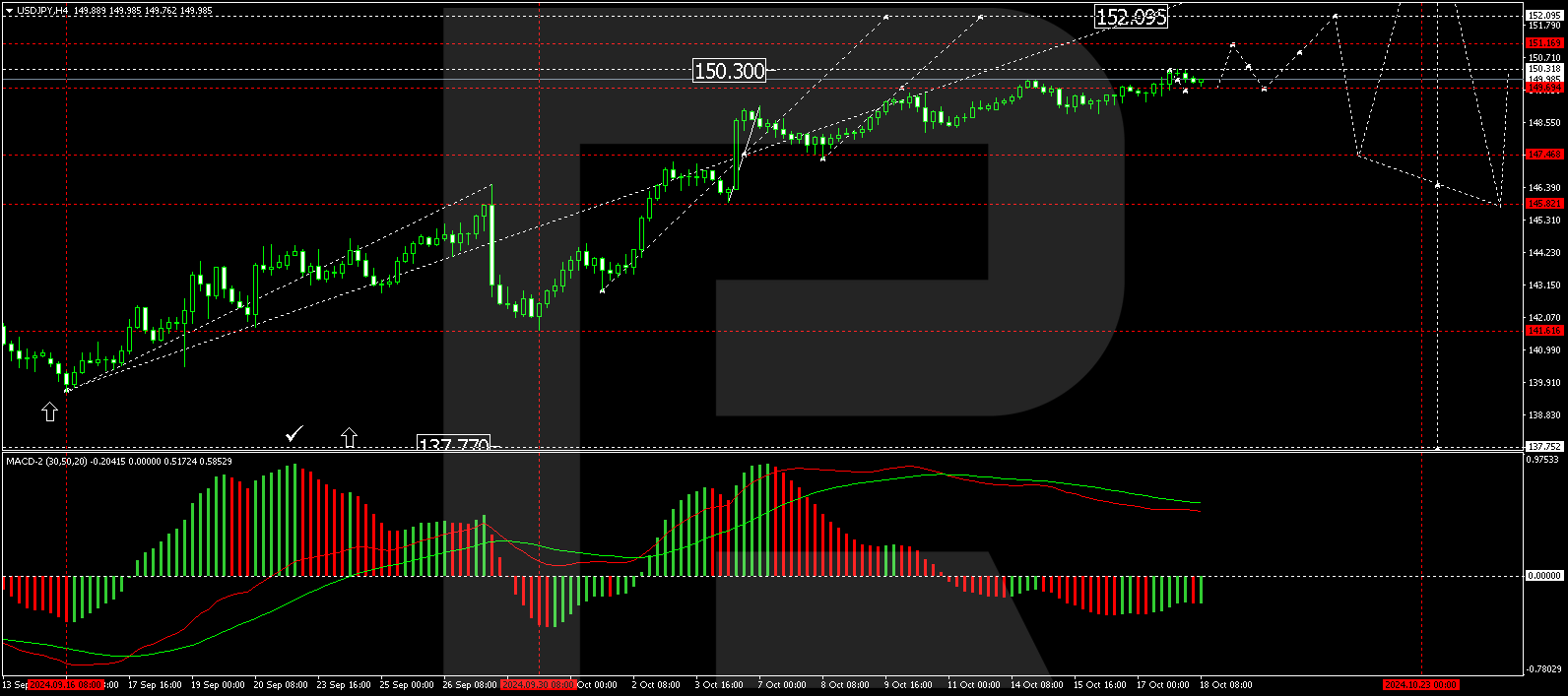
The Japanese yen has shown a notable strengthening, with the USD/JPY pair dropping to 143.99 on Monday, marking a three-week low. This movement is primarily driven by the weakness of the US dollar and significant remarks from the Bank of Japan (BOJ) and the US Federal Reserve.

Market dynamics and Central Bank signals

The recent hawkish comments from Kazuo Ueda, the Governor of the Bank of Japan, have garnered significant attention. Last Friday, Ueda hinted that the BOJ might adjust its monetary policy if economic forecasts align with current trends. The market interpreted this statement as a potential precursor to an interest rate hike, especially in light of Japan’s core consumer price index rising for the third consecutive month to 2.7% in July, with overall inflation holding steady at 2.8%.

Conversely, Jerome Powell, Chair of the US Federal Reserve, adopted a more dovish stance, indicating that it might be time to revise US monetary policy due to increasing risks to the labour market. This suggests that the Fed could begin easing monetary policy as soon as September, a move that contrasts sharply with the potential tightening in Japan. These shifts in monetary policy outlooks have significantly shaped forex forecasts for the USD/JPY pair.

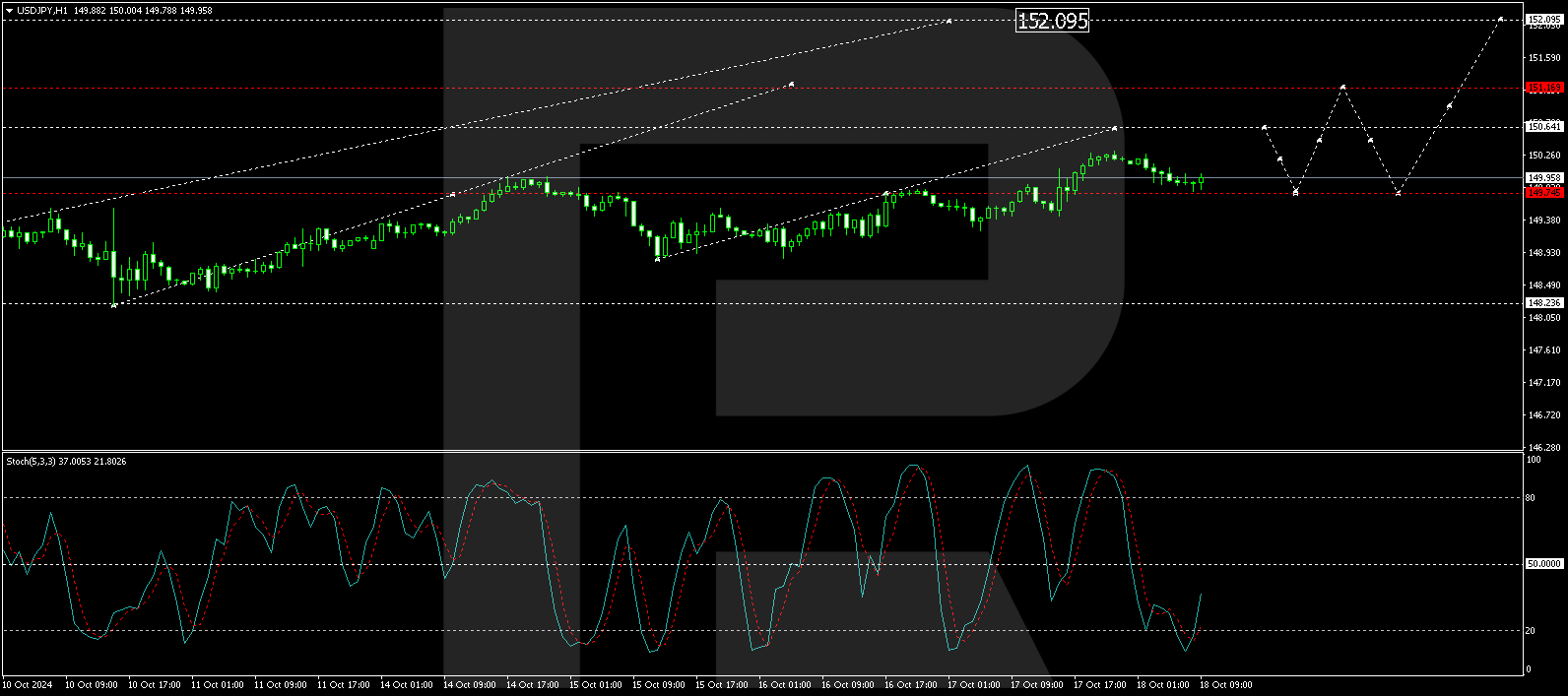
Technical analysis of USD/JPY

The USD/JPY formed a consolidation range around the 146.70 level before moving downward to 143.50. There may be a temporary rise to 144.55, but a further decline to 142.88 could follow. The MACD indicator supports this bearish outlook, with its signal line below zero and trending downward.

The pair has completed a downward structure to 143.44. A corrective move towards 144.55 is possible, potentially extending to 145.70 as a test from below. Following this, a decline to 142.88 might occur. The Stochastic oscillator, currently above 50, suggests a rise to 80 before the next downward phase.

Summary

The USD/JPY pair is experiencing downward pressure due to a combination of USD weakness and potential monetary policy adjustments from the BOJ. As market dynamics evolve with central bank policies and economic indicators, the yen could see further gains if the BOJ shifts towards a tighter monetary stance in response to rising inflation.


Disclaimer

Any forecasts contained herein are based on the author’s particular opinion. This analysis may not be treated as trading advice. RoboForex bears no responsibility for trading results based on trading recommendations and reviews contained herein.

Powell’s dovish comments support indices’ growth. Silver rises after gold

By JustMarkets

On Friday, the Dow Jones (US30) gained 1.14% (for the week +1.24%), while the S&P 500 (US500) gained 1.15% (for the week +1.39%). The NASDAQ Technology Index (US100) closed positive 1.47% (for the week +1.29%).

Speaking at the Fed’s annual symposium at Jackson Hole on Friday, Fed Chairman Jerome Powell recognized recent progress on inflation and said that “the time has come for policy adjustments.” The chairman noted that the US labor market is cooling rapidly following the release of a softer July employment report and downward revisions to the jobs data. Powell also noted that the FOMC has further strengthened its confidence that inflation is slowing to the 2% target, suggesting it is time to adjust monetary policy toward less tight conditions. In addition, Atlanta Fed President Bostic said late last week that more than one Fed interest rate cut may be needed before the end of the year.

The Canadian dollar rose to 1.35 per US dollar in August, the strongest in five months, as new evidence of the Fed’s dovish stance pressured the US dollar. Fed Chairman Jerome Powell said in a speech that a weak labor market and slowing US inflation require a quick response from the US Central Bank in the form of a less tight monetary policy, which boosted G10 currencies against the US dollar. The urgency in Powell’s rhetoric was enough to offset dovish expectations for the Bank of Canada, which has already begun a cycle of rate cuts to address growth and a moderate labor market domestically. The unemployment rate is holding at 6.4%, the highest in two years, with net employment falling and the lowest labor force participation rate since 1998.

Equity markets in Europe were mostly up on Friday. Germany’s DAX (DE40) gained 0.76% (for the week +1.75%), France’s CAC 40 (FR40) closed higher by 0.70% (for the week +1.77%), Spain’s IBEX 35 (ES35) added 1.09% (for the week +2.82%), and the UK’s FTSE 100 (UK100) closed up 0.48% (for the week +0.20%).

Silver (XAG/USD) traded above $29.5 per ounce in late August, near its highest levels in five weeks, as Federal Reserve Chairman Jerome Powell reinforced hopes of an interest rate cut in September. The US Central Bank is expected to begin easing policy in September, but the market remains divided over the size of the first-rate cut. Overall, traders are pricing in about 100 basis points of rate cuts at the Fed’s three remaining meetings this year. Precious metals also received support from increased safe-haven flows after Hezbollah launched rocket attacks on Israel over the weekend.

WTI crude oil prices rose to around $75.4 a barrel on Monday, rising for a third straight session, driven by concerns over supply risks amid escalating fears of a broader conflict in the Middle East.

Asian markets were mostly up last week. Japan’s Nikkei 225 (JP225) rose by 1.32%, China’s FTSE China A50 (CHA50) added 0.22%, Hong Kong’s Hang Seng (HK50) gained 0.24% over 5 trading days, and Australia’s ASX 200 (AU200) posted a positive 0.66%.

The Australian dollar traded near $0.68, moving towards the strongest levels this year, as the Reserve Bank of Australia’s (RBA) hawkish monetary policy outlook contrasted with dovish signals from the Federal Reserve. Minutes from the RBA’s last meeting showed that the money rate will remain stable for an extended period. RBA Governor Michele Bullock also recently said that despite signs of weakening inflation, it is “premature” to consider cutting interest rates.

In New Zealand, the Reserve Bank (RBNZ) began its easing cycle with a rate cut this month and has announced an upcoming cut. Markets expect aggressive easing before the end of the year, with traders estimating additional quarter-point rate cuts in October and November.

Pavel Durov, the billionaire co-founder and CEO of messaging app Telegram, was arrested at the Bourget airport outside of Paris Saturday evening. According to the report, Durov, 39, was traveling aboard his private jet after arriving from Azerbaijan, which triggered a French search warrant issued by the OFMIN of the French judicial police due to his inclusion in a wanted persons file (FPR). Durov was detained by the National Anti-Fraud Office (ONAF) over the alleged facilitation of various crimes, including terrorism, narcotics trafficking, and fraud. He faces up to 20 years in prison if convicted.

S&P 500 (US500) 5,634.61 +63.97 (+1.15%)

Dow Jones (US30) 41,175.08 +462.30 (+1.14%)

DAX (DE40) 18,633.10 +139.71 (+0.76%)

FTSE 100 (UK100) 8,327.78 +39.78 (+0.48%)

USD Index 100.68 −0.83 (−0.82%)

Important events today:
  • – German Ifo Business Climate (m/m) at 11:00 (GMT+3);
  • – US Durable Goods Orders (m/m) at 15:30 (GMT+3).

By JustMarkets


This article reflects a personal opinion and should not be interpreted as an investment advice, and/or offer, and/or a persistent request for carrying out financial transactions, and/or a guarantee, and/or a forecast of future events.

COT Metals Charts: Gold leads Speculator Bets higher

By InvestMacro

Here are the latest charts and statistics for the Commitment of Traders (COT) data published by the Commodities Futures Trading Commission (CFTC).

The latest COT data is updated through Tuesday August 20th and shows a quick view of how large traders (for-profit speculators and commercial entities) were positioned in the futures markets.

Gold leads Speculator Bets higher

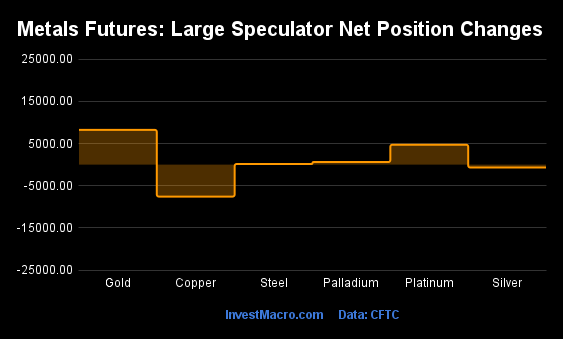
The COT metals markets speculator bets were overall higher this week as five out of the six metals markets we cover had higher positioning while the other one markets had lower speculator contracts.

Leading the gains for the metals was Gold (23,989 contracts) with Copper (4,477 contracts), Silver (4,035 contracts), Platinum (2,887 contracts) and Steel (750 contracts) also showing positive weeks.

The market with declines in speculator bets was Palladium with a small dip by -41 contracts on the week.


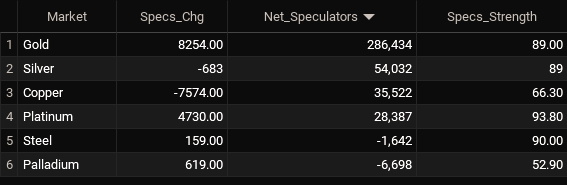
Metals Net Speculators Leaderboard

Legend: Weekly Speculators Change | Speculators Current Net Position | Speculators Strength Score compared to last 3-Years (0-100 range)


Strength Scores led by Gold & Silver

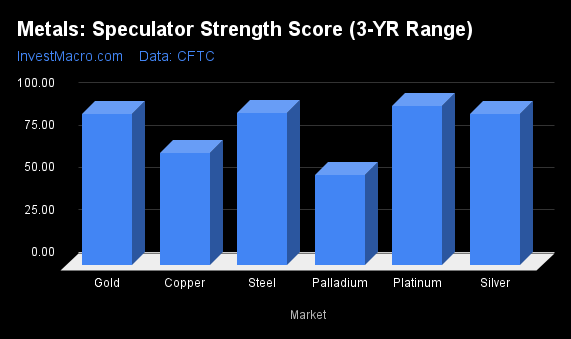
COT Strength Scores (a normalized measure of Speculator positions over a 3-Year range, from 0 to 100 where above 80 is Extreme-Bullish and below 20 is Extreme-Bearish) showed that Gold (100 percent) and Silver (84 percent) lead the metals markets this week. Steel (77 percent) comes in as the next highest in the weekly strength scores.

On the downside, Palladium (12 percent) comes in at the lowest strength level currently and is in Extreme-Bearish territory (below 20 percent).

Strength Statistics:
Gold (100.0 percent) vs Gold previous week (90.0 percent)
Silver (84.1 percent) vs Silver previous week (78.6 percent)
Copper (52.1 percent) vs Copper previous week (48.0 percent)
Platinum (57.6 percent) vs Platinum previous week (49.9 percent)
Palladium (12.0 percent) vs Palladium previous week (12.3 percent)
Steel (76.6 percent) vs Palladium previous week (73.7 percent)


Gold & Steel top the 6-Week Strength Trends

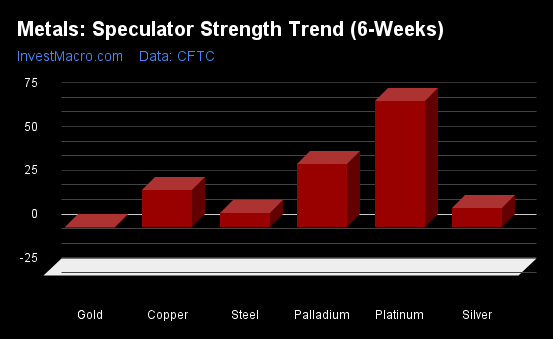
COT Strength Score Trends (or move index, calculates the 6-week changes in strength scores) showed that Gold (15 percent) and Steel (3 percent) lead the past six weeks trends for metals.

Copper (-33 percent), Platinum (-21 percent) and Palladium (-20 percent) lead the downside trend scores currently.

Move Statistics:
Gold (15.3 percent) vs Gold previous week (10.8 percent)
Silver (-15.9 percent) vs Silver previous week (-14.3 percent)
Copper (-33.3 percent) vs Copper previous week (-31.1 percent)
Platinum (-20.9 percent) vs Platinum previous week (-32.1 percent)
Palladium (-19.7 percent) vs Palladium previous week (-11.2 percent)
Steel (3.3 percent) vs Steel previous week (-0.6 percent)


Individual Markets:

Gold Comex Futures:

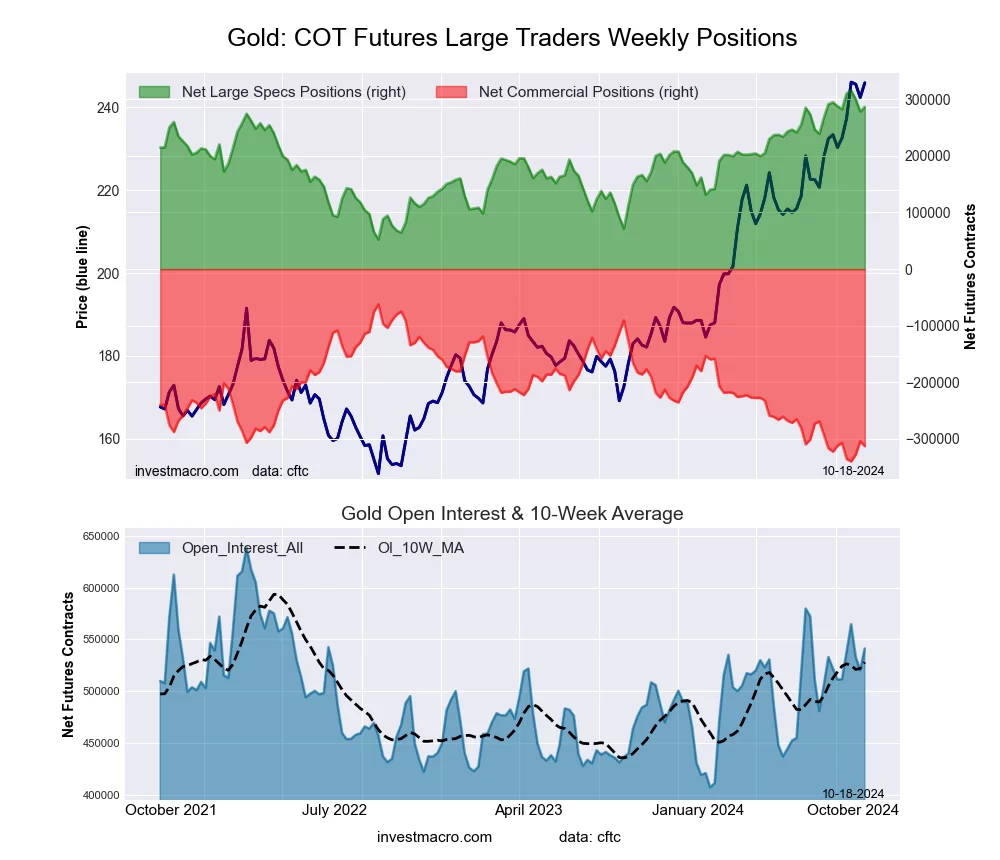
Gold Futures COT ChartThe Gold Comex Futures large speculator standing this week reached a net position of 291,253 contracts in the data reported through Tuesday. This was a weekly rise of 23,989 contracts from the previous week which had a total of 267,264 net contracts.

This week’s current strength score (the trader positioning range over the past three years, measured from 0 to 100) shows the speculators are currently Bullish-Extreme with a score of 100.0 percent. The commercials are Bearish-Extreme with a score of 0.0 percent and the small traders (not shown in chart) are Bullish with a score of 62.1 percent.

Price Trend-Following Model: Strong Uptrend

Our weekly trend-following model classifies the current market price position as: Strong Uptrend. The current action for the model is considered to be: Hold – Maintain Long Position.

Gold Futures StatisticsSPECULATORSCOMMERCIALSSMALL TRADERS
– Percent of Open Interest Longs:66.716.29.9
– Percent of Open Interest Shorts:12.175.65.2
– Net Position:291,253-316,50625,253
– Gross Longs:355,55186,23252,918
– Gross Shorts:64,298402,73827,665
– Long to Short Ratio:5.5 to 10.2 to 11.9 to 1
NET POSITION TREND:
– Strength Index Score (3 Year Range Pct):100.00.062.1
– Strength Index Reading (3 Year Range):Bullish-ExtremeBearish-ExtremeBullish
NET POSITION MOVEMENT INDEX:
– 6-Week Change in Strength Index:15.3-14.1-2.2


Silver Comex Futures:

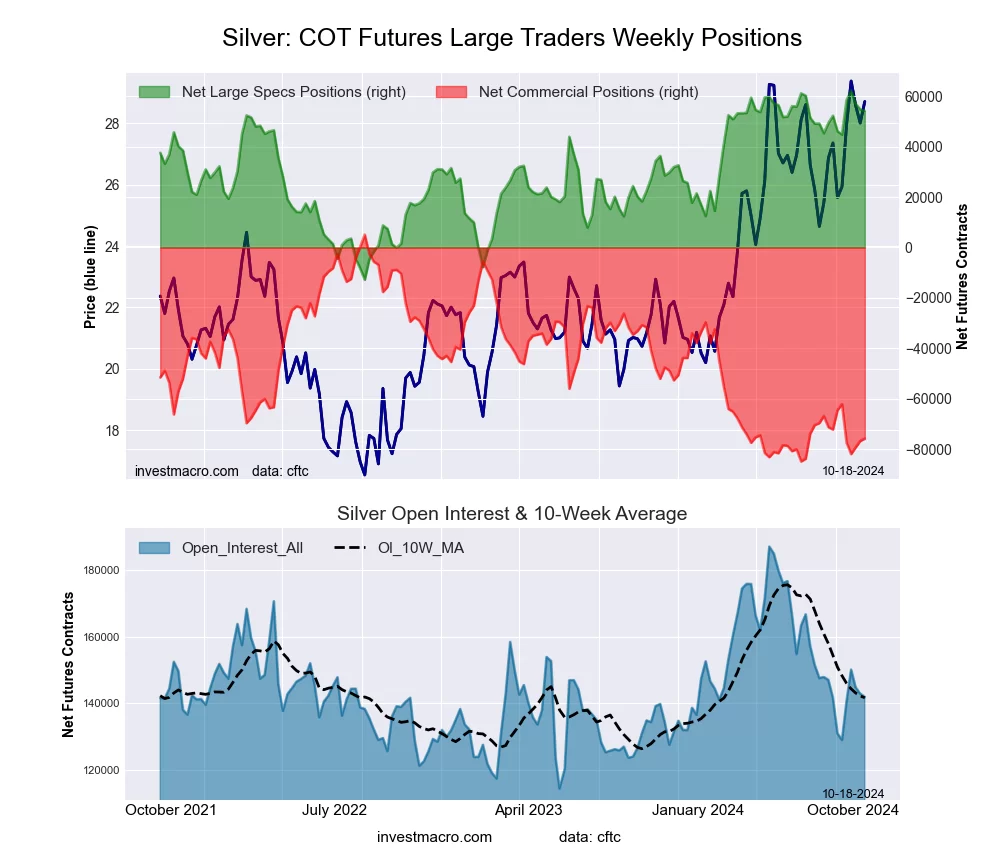
Silver Futures COT ChartThe Silver Comex Futures large speculator standing this week reached a net position of 49,324 contracts in the data reported through Tuesday. This was a weekly gain of 4,035 contracts from the previous week which had a total of 45,289 net contracts.

This week’s current strength score (the trader positioning range over the past three years, measured from 0 to 100) shows the speculators are currently Bullish-Extreme with a score of 84.1 percent. The commercials are Bearish-Extreme with a score of 15.1 percent and the small traders (not shown in chart) are Bullish with a score of 76.7 percent.

Price Trend-Following Model: Strong Uptrend

Our weekly trend-following model classifies the current market price position as: Strong Uptrend. The current action for the model is considered to be: Hold – Maintain Long Position.

Silver Futures StatisticsSPECULATORSCOMMERCIALSSMALL TRADERS
– Percent of Open Interest Longs:43.524.321.9
– Percent of Open Interest Shorts:9.972.77.0
– Net Position:49,324-71,22821,904
– Gross Longs:63,93035,69932,230
– Gross Shorts:14,606106,92710,326
– Long to Short Ratio:4.4 to 10.3 to 13.1 to 1
NET POSITION TREND:
– Strength Index Score (3 Year Range Pct):84.115.176.7
– Strength Index Reading (3 Year Range):Bullish-ExtremeBearish-ExtremeBullish
NET POSITION MOVEMENT INDEX:
– 6-Week Change in Strength Index:-15.915.1-8.9


Copper Grade #1 Futures:

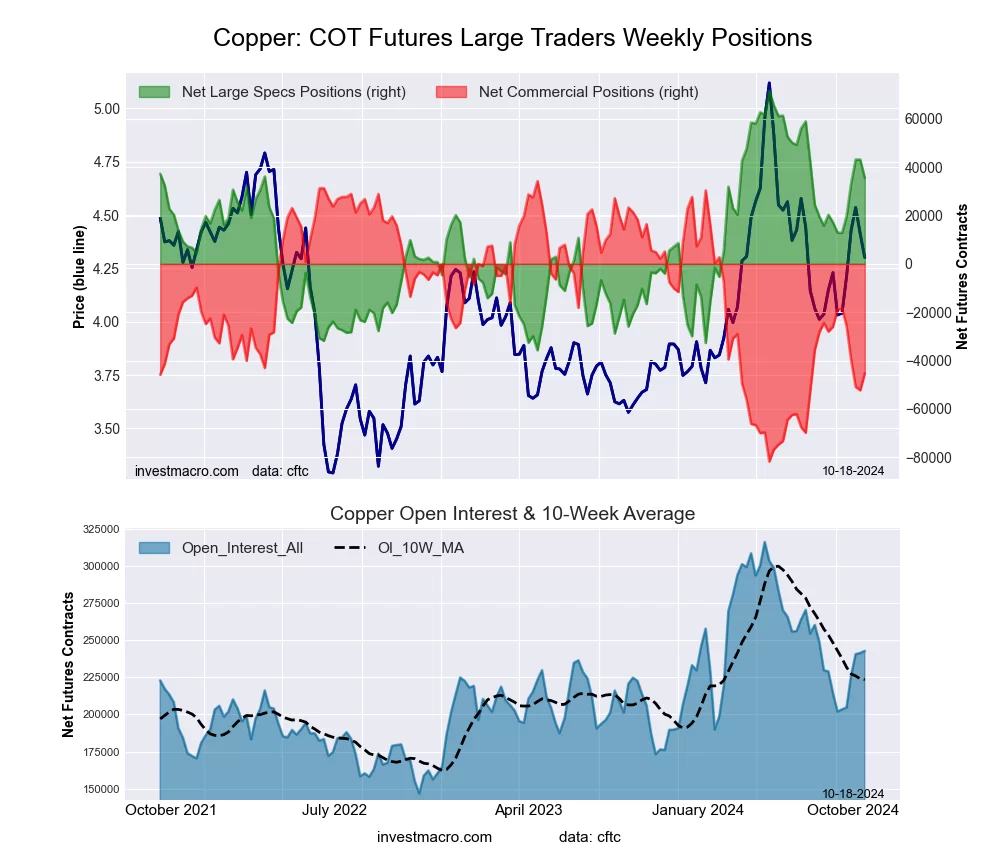
Copper Futures COT ChartThe Copper Grade #1 Futures large speculator standing this week reached a net position of 20,274 contracts in the data reported through Tuesday. This was a weekly advance of 4,477 contracts from the previous week which had a total of 15,797 net contracts.

This week’s current strength score (the trader positioning range over the past three years, measured from 0 to 100) shows the speculators are currently Bullish with a score of 52.1 percent. The commercials are Bearish with a score of 46.3 percent and the small traders (not shown in chart) are Bullish with a score of 64.5 percent.

Price Trend-Following Model: Strong Downtrend

Our weekly trend-following model classifies the current market price position as: Strong Downtrend. The current action for the model is considered to be: Hold – Maintain Short Position.

Copper Futures StatisticsSPECULATORSCOMMERCIALSSMALL TRADERS
– Percent of Open Interest Longs:40.131.88.4
– Percent of Open Interest Shorts:31.344.15.1
– Net Position:20,274-28,0057,731
– Gross Longs:91,83572,87419,316
– Gross Shorts:71,561100,87911,585
– Long to Short Ratio:1.3 to 10.7 to 11.7 to 1
NET POSITION TREND:
– Strength Index Score (3 Year Range Pct):52.146.364.5
– Strength Index Reading (3 Year Range):BullishBearishBullish
NET POSITION MOVEMENT INDEX:
– 6-Week Change in Strength Index:-33.334.1-22.9


Platinum Futures:

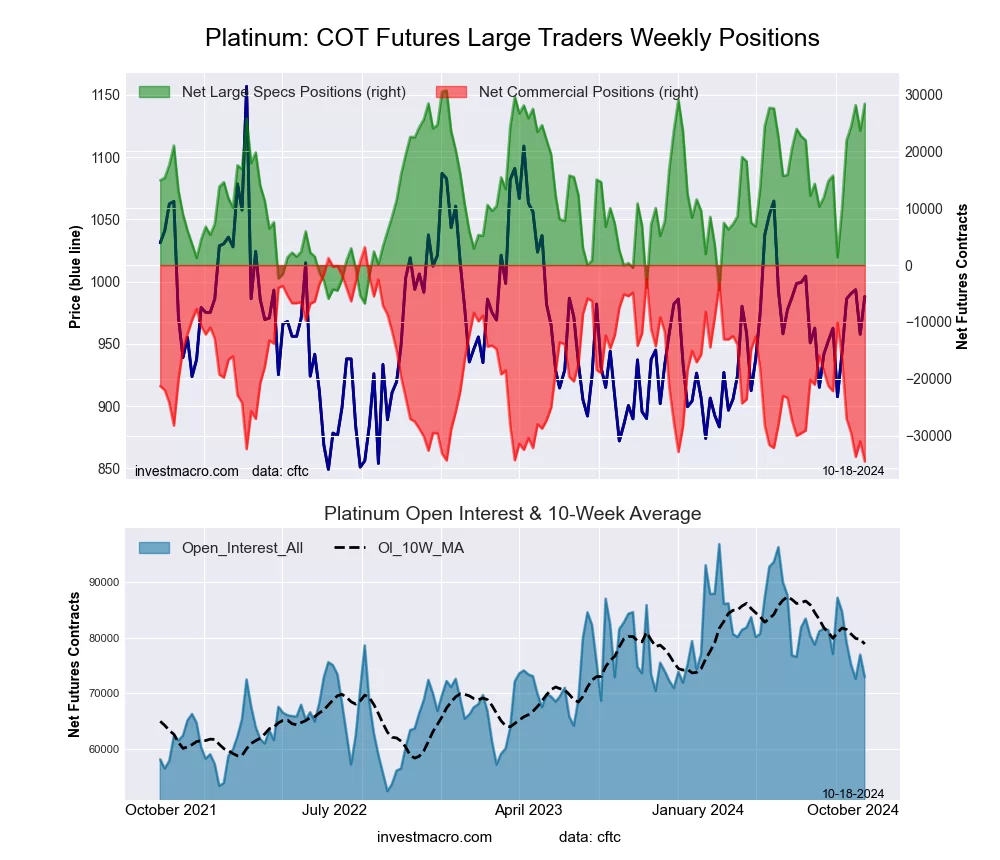
Platinum Futures COT ChartThe Platinum Futures large speculator standing this week reached a net position of 14,826 contracts in the data reported through Tuesday. This was a weekly boost of 2,887 contracts from the previous week which had a total of 11,939 net contracts.

This week’s current strength score (the trader positioning range over the past three years, measured from 0 to 100) shows the speculators are currently Bullish with a score of 57.6 percent. The commercials are Bearish with a score of 34.9 percent and the small traders (not shown in chart) are Bullish with a score of 72.9 percent.

Price Trend-Following Model: Strong Downtrend

Our weekly trend-following model classifies the current market price position as: Strong Downtrend. The current action for the model is considered to be: New Sell – Short Position.

Platinum Futures StatisticsSPECULATORSCOMMERCIALSSMALL TRADERS
– Percent of Open Interest Longs:56.522.912.4
– Percent of Open Interest Shorts:38.349.04.4
– Net Position:14,826-21,2736,447
– Gross Longs:45,98018,61610,054
– Gross Shorts:31,15439,8893,607
– Long to Short Ratio:1.5 to 10.5 to 12.8 to 1
NET POSITION TREND:
– Strength Index Score (3 Year Range Pct):57.634.972.9
– Strength Index Reading (3 Year Range):BullishBearishBullish
NET POSITION MOVEMENT INDEX:
– 6-Week Change in Strength Index:-20.922.1-8.0


Palladium Futures:

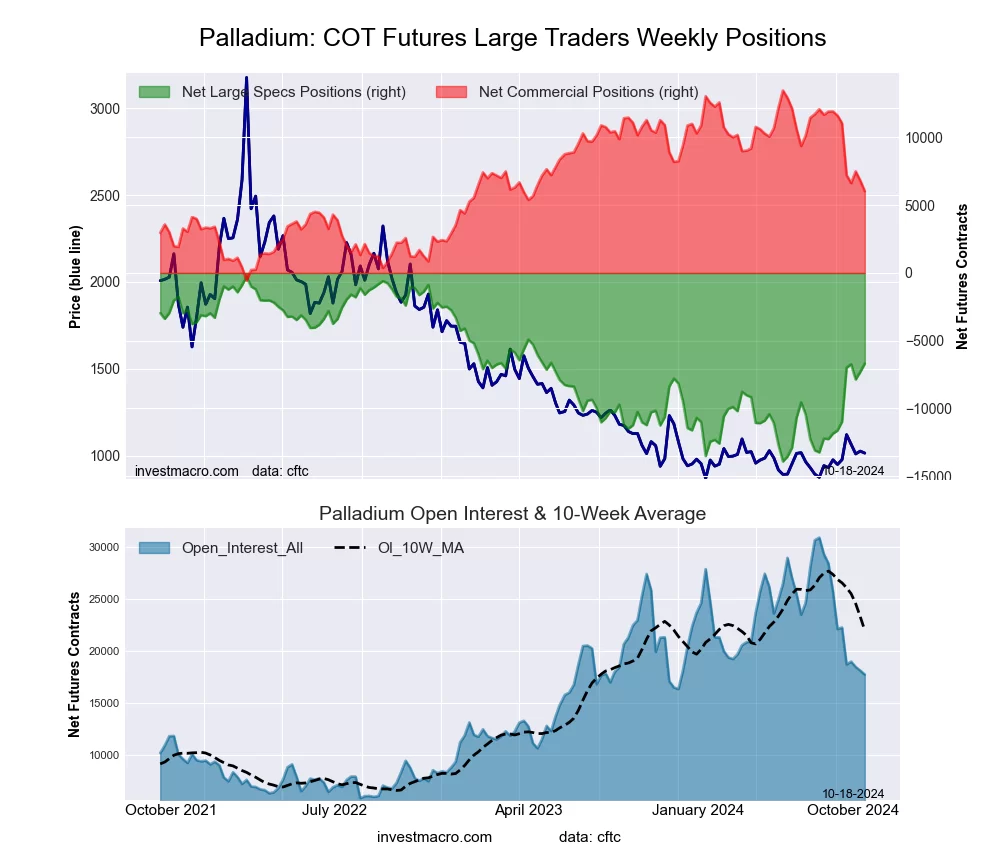
Palladium Futures COT ChartThe Palladium Futures large speculator standing this week reached a net position of -12,265 contracts in the data reported through Tuesday. This was a weekly decline of -41 contracts from the previous week which had a total of -12,224 net contracts.

This week’s current strength score (the trader positioning range over the past three years, measured from 0 to 100) shows the speculators are currently Bearish-Extreme with a score of 12.0 percent. The commercials are Bullish-Extreme with a score of 88.9 percent and the small traders (not shown in chart) are Bullish with a score of 50.7 percent.

Price Trend-Following Model: Weak Downtrend

Our weekly trend-following model classifies the current market price position as: Weak Downtrend. The current action for the model is considered to be: Hold – Maintain Short Position.

Palladium Futures StatisticsSPECULATORSCOMMERCIALSSMALL TRADERS
– Percent of Open Interest Longs:29.751.26.9
– Percent of Open Interest Shorts:72.99.35.6
– Net Position:-12,26511,908357
– Gross Longs:8,44014,5431,952
– Gross Shorts:20,7052,6351,595
– Long to Short Ratio:0.4 to 15.5 to 11.2 to 1
NET POSITION TREND:
– Strength Index Score (3 Year Range Pct):12.088.950.7
– Strength Index Reading (3 Year Range):Bearish-ExtremeBullish-ExtremeBullish
NET POSITION MOVEMENT INDEX:
– 6-Week Change in Strength Index:-19.718.18.2


Steel Futures Futures:

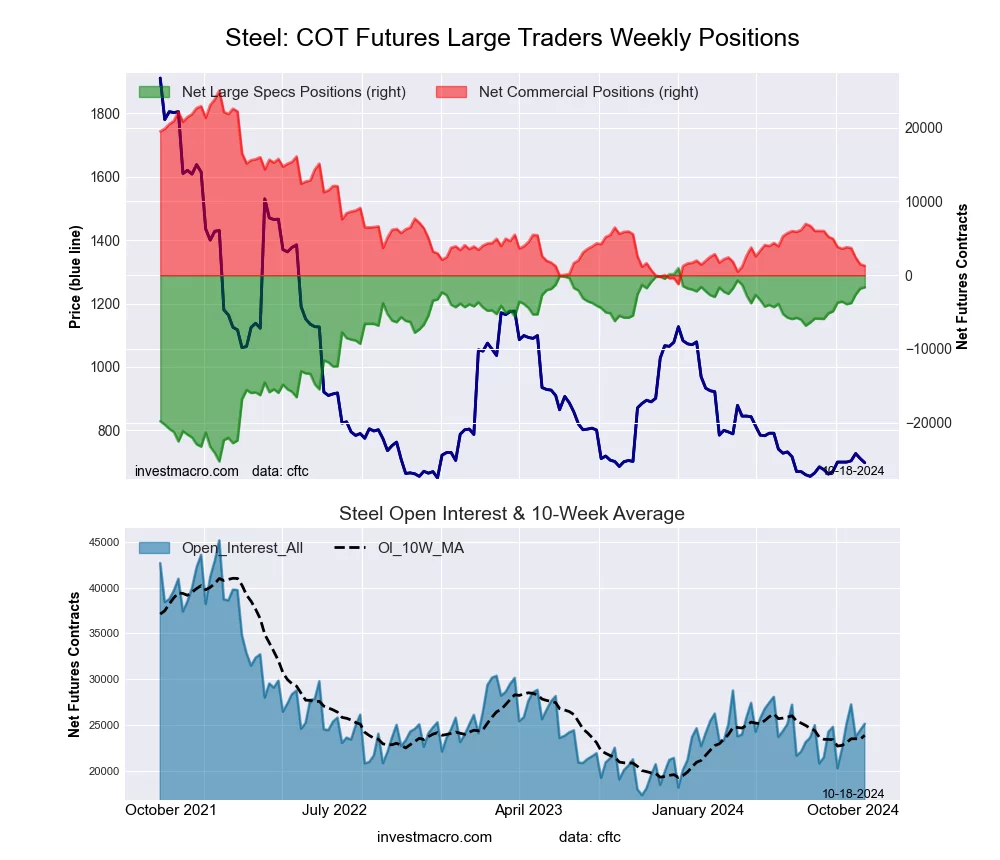
Steel Futures COT ChartThe Steel Futures large speculator standing this week reached a net position of -5,171 contracts in the data reported through Tuesday. This was a weekly increase of 750 contracts from the previous week which had a total of -5,921 net contracts.

This week’s current strength score (the trader positioning range over the past three years, measured from 0 to 100) shows the speculators are currently Bullish with a score of 76.6 percent. The commercials are Bearish with a score of 24.5 percent and the small traders (not shown in chart) are Bearish with a score of 27.8 percent.

Price Trend-Following Model: Downtrend

Our weekly trend-following model classifies the current market price position as: Downtrend. The current action for the model is considered to be: Hold – Maintain Short Position.

Steel Futures StatisticsSPECULATORSCOMMERCIALSSMALL TRADERS
– Percent of Open Interest Longs:12.977.00.7
– Percent of Open Interest Shorts:34.255.40.9
– Net Position:-5,1715,213-42
– Gross Longs:3,12918,655177
– Gross Shorts:8,30013,442219
– Long to Short Ratio:0.4 to 11.4 to 10.8 to 1
NET POSITION TREND:
– Strength Index Score (3 Year Range Pct):76.624.527.8
– Strength Index Reading (3 Year Range):BullishBearishBearish
NET POSITION MOVEMENT INDEX:
– 6-Week Change in Strength Index:3.3-3.57.3


Article By InvestMacroReceive our weekly COT Newsletter

*COT Report: The COT data, released weekly to the public each Friday, is updated through the most recent Tuesday (data is 3 days old) and shows a quick view of how large speculators or non-commercials (for-profit traders) were positioned in the futures markets.

The CFTC categorizes trader positions according to commercial hedgers (traders who use futures contracts for hedging as part of the business), non-commercials (large traders who speculate to realize trading profits) and nonreportable traders (usually small traders/speculators) as well as their open interest (contracts open in the market at time of reporting). See CFTC criteria here.

COT Bonds Charts: Speculator Bets led by Ultra Treasury Bonds & Ultra 10-Year Bonds

By InvestMacro

Here are the latest charts and statistics for the Commitment of Traders (COT) reports data published by the Commodities Futures Trading Commission (CFTC).

The latest COT data is updated through Tuesday August 20th and shows a quick view of how large traders (for-profit speculators and commercial hedgers) were positioned in the futures markets.

Weekly Speculator Changes led by Ultra Treasury Bonds & Ultra 10-Year Bonds

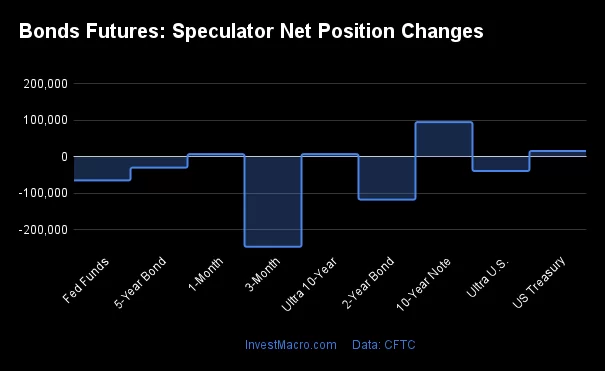
The COT bond market speculator bets were lower this week as just two out of the eight bond markets we cover had higher positioning while the other six markets had lower speculator contracts.

Leading the gains for the bond markets was the Ultra Treasury Bonds (23,519 contracts) with the Ultra 10-Year Bonds (15,073 contracts) also showing a positive week.

The bond markets with declines in speculator bets for the week were the 10-Year Bonds (-177,869 contracts), the SOFR 3-Months (-63,211 contracts), the 2-Year Bonds (-47,974 contracts), the Fed Funds (-45,221 contracts), the 5-Year Bonds (-41,738 contracts) and with the US Treasury Bonds (-7,165 contracts) also registering lower bets on the week.


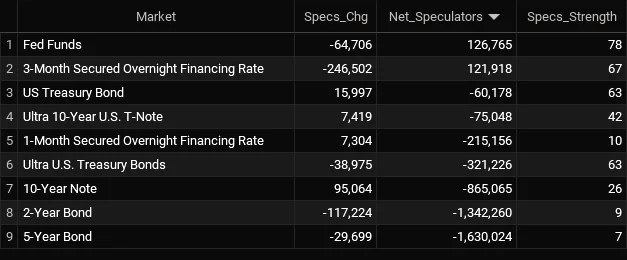
Bonds Net Speculators Leaderboard

Legend: Weekly Speculators Change | Speculators Current Net Position | Speculators Strength Score compared to last 3-Years (0-100 range)


Strength Scores led by SOFR 3-Months & US Treasury Bonds

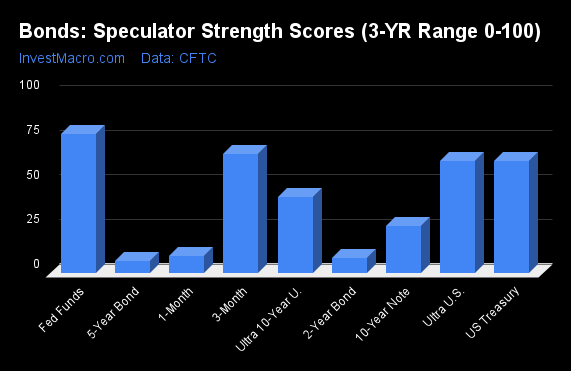
COT Strength Scores (a normalized measure of Speculator positions over a 3-Year range, from 0 to 100 where above 80 is Extreme-Bullish and below 20 is Extreme-Bearish) showed that the SOFR 3-Months (80 percent) and the US Treasury Bonds (72 percent) lead the bond markets this week. The Ultra Treasury Bonds (69 percent) comes in as the next highest in the weekly strength scores.

On the downside, the 5-Year Bonds (0 percent) and the 10-Year Bonds (0 percent) come in at the lowest strength level currently and are in Extreme-Bearish territory (below 20 percent). The next lowest strength scores were the 2-Year Bonds (21 percent) and the Ultra 10-Year Bonds (30 percent).

Strength Statistics:
Fed Funds (35.9 percent) vs Fed Funds previous week (46.2 percent)
2-Year Bond (20.7 percent) vs 2-Year Bond previous week (23.8 percent)
5-Year Bond (0.0 percent) vs 5-Year Bond previous week (2.4 percent)
10-Year Bond (0.0 percent) vs 10-Year Bond previous week (14.6 percent)
Ultra 10-Year Bond (29.7 percent) vs Ultra 10-Year Bond previous week (26.5 percent)
US Treasury Bond (71.8 percent) vs US Treasury Bond previous week (74.3 percent)
Ultra US Treasury Bond (68.8 percent) vs Ultra US Treasury Bond previous week (56.4 percent)
SOFR 3-Months (80.0 percent) vs SOFR 3-Months previous week (83.3 percent)


Ultra Treasury Bonds & SOFR 3-Months top the 6-Week Strength Trends

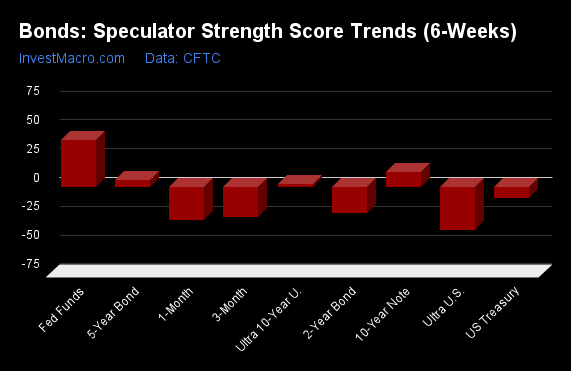
COT Strength Score Trends (or move index, calculates the 6-week changes in strength scores) showed that the Ultra Treasury Bonds (42 percent) and the SOFR 3-Months (27 percent) lead the past six weeks trends for bonds. The 2-Year Bonds (5 percent) and the  are the next highest positive movers in the latest trends data.

The 10-Year Bonds (-51 percent) leads the downside trend scores currently with the 5-Year Bonds (-10 percent) and the Fed Funds (-1 percent) following next with lower trend scores.

Strength Trend Statistics:
Fed Funds (-0.7 percent) vs Fed Funds previous week (15.5 percent)
2-Year Bond (5.1 percent) vs 2-Year Bond previous week (7.4 percent)
5-Year Bond (-9.9 percent) vs 5-Year Bond previous week (-9.2 percent)
10-Year Bond (-50.9 percent) vs 10-Year Bond previous week (-42.2 percent)
Ultra 10-Year Bond (-0.5 percent) vs Ultra 10-Year Bond previous week (0.3 percent)
US Treasury Bond (0.3 percent) vs US Treasury Bond previous week (-1.6 percent)
Ultra US Treasury Bond (42.2 percent) vs Ultra US Treasury Bond previous week (23.2 percent)
SOFR 3-Months (27.5 percent) vs SOFR 3-Months previous week (36.5 percent)


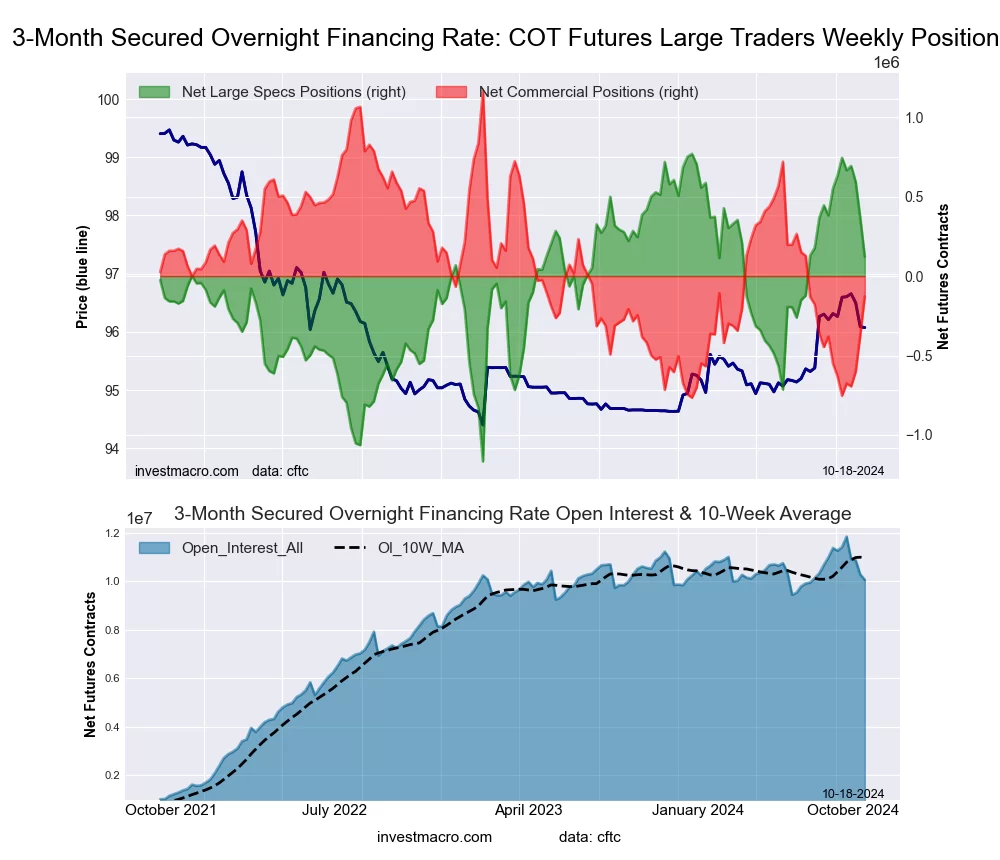
Secured Overnight Financing Rate (3-Month) Futures:

SOFR 3-Months Bonds Futures COT ChartThe Secured Overnight Financing Rate (3-Month) large speculator standing this week was a net position of 381,853 contracts in the data reported through Tuesday. This was a weekly reduction of -63,211 contracts from the previous week which had a total of 445,064 net contracts.

This week’s current strength score (the trader positioning range over the past three years, measured from 0 to 100) shows the speculators are currently Bullish with a score of 80.0 percent. The commercials are Bearish-Extreme with a score of 19.9 percent and the small traders (not shown in chart) are Bullish-Extreme with a score of 87.2 percent.

Price Trend-Following Model: Weak Uptrend

Our weekly trend-following model classifies the current market price position as: Weak Uptrend. The current action for the model is considered to be: Hold – Maintain Long Position.

SOFR 3-Months StatisticsSPECULATORSCOMMERCIALSSMALL TRADERS
– Percent of Open Interest Longs:15.455.20.4
– Percent of Open Interest Shorts:11.958.70.4
– Net Position:381,853-380,583-1,270
– Gross Longs:1,686,9806,061,55138,761
– Gross Shorts:1,305,1276,442,13440,031
– Long to Short Ratio:1.3 to 10.9 to 11.0 to 1
NET POSITION TREND:
– Strength Index Score (3 Year Range Pct):80.019.987.2
– Strength Index Reading (3 Year Range):BullishBearish-ExtremeBullish-Extreme
NET POSITION MOVEMENT INDEX:
– 6-Week Change in Strength Index:27.5-27.5-0.6


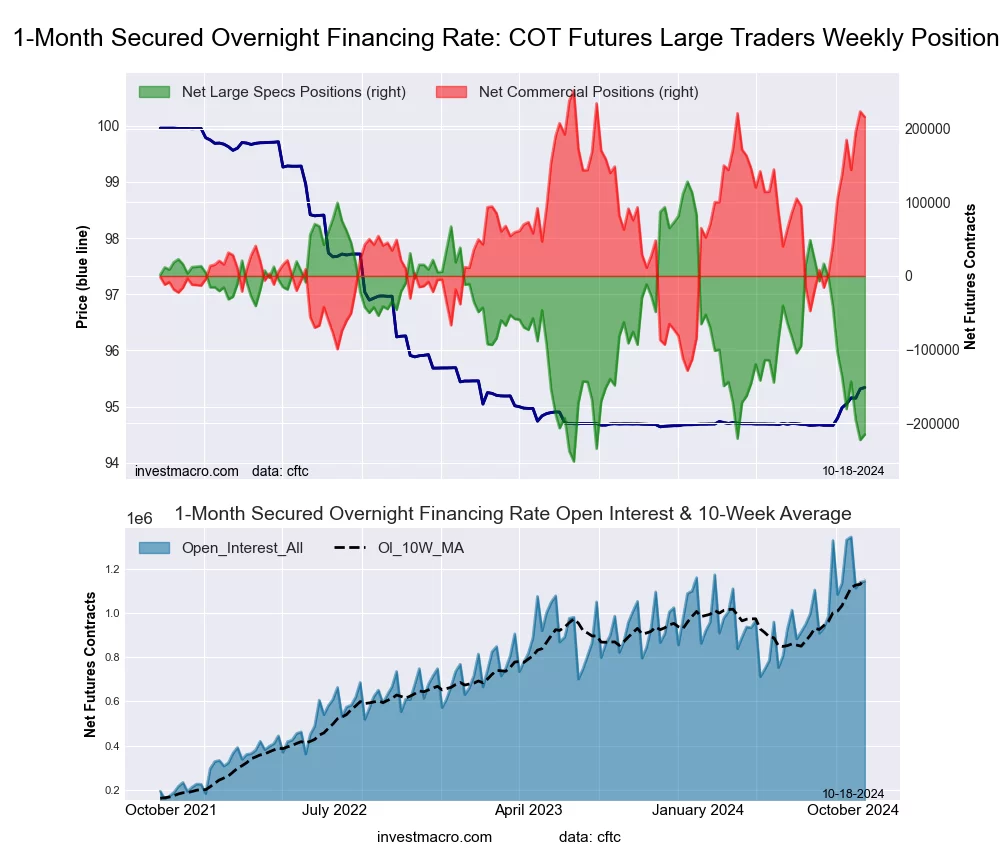
30-Day Federal Funds Futures:

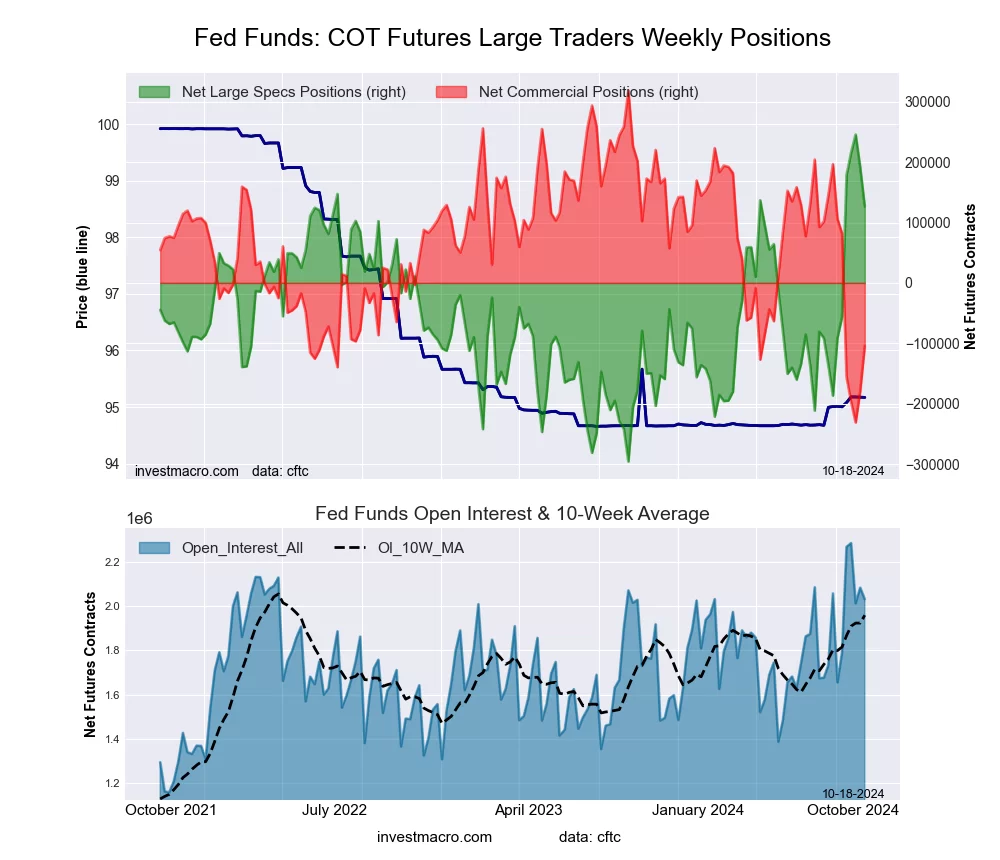
Federal Funds 30-Day Bonds Futures COT ChartThe 30-Day Federal Funds large speculator standing this week was a net position of -136,512 contracts in the data reported through Tuesday. This was a weekly decline of -45,221 contracts from the previous week which had a total of -91,291 net contracts.

This week’s current strength score (the trader positioning range over the past three years, measured from 0 to 100) shows the speculators are currently Bearish with a score of 35.9 percent. The commercials are Bullish with a score of 62.2 percent and the small traders (not shown in chart) are Bullish with a score of 68.4 percent.

Price Trend-Following Model: Downtrend

Our weekly trend-following model classifies the current market price position as: Downtrend. The current action for the model is considered to be: Hold – Maintain Short Position.

30-Day Federal Funds StatisticsSPECULATORSCOMMERCIALSSMALL TRADERS
– Percent of Open Interest Longs:8.575.31.7
– Percent of Open Interest Shorts:16.466.92.2
– Net Position:-136,512145,612-9,100
– Gross Longs:147,0091,304,23528,950
– Gross Shorts:283,5211,158,62338,050
– Long to Short Ratio:0.5 to 11.1 to 10.8 to 1
NET POSITION TREND:
– Strength Index Score (3 Year Range Pct):35.962.268.4
– Strength Index Reading (3 Year Range):BearishBullishBullish
NET POSITION MOVEMENT INDEX:
– 6-Week Change in Strength Index:-0.73.7-25.6


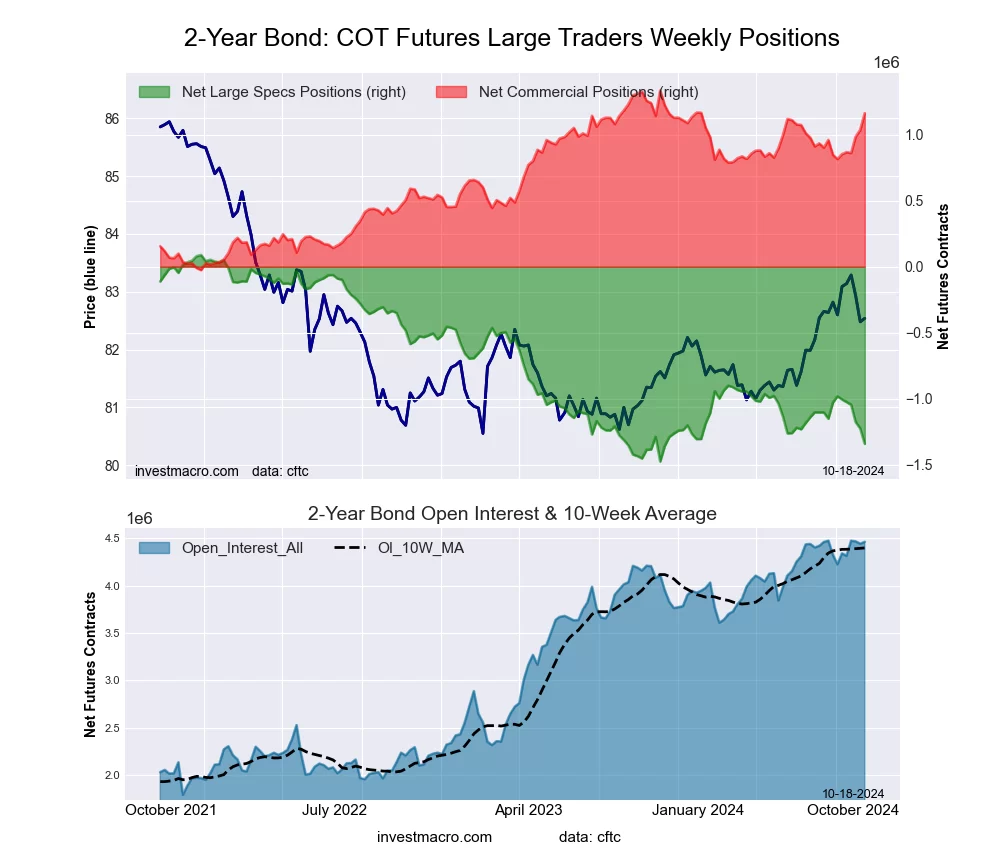
2-Year Treasury Note Futures:

2-Year Treasury Bonds Futures COT ChartThe 2-Year Treasury Note large speculator standing this week was a net position of -1,152,580 contracts in the data reported through Tuesday. This was a weekly fall of -47,974 contracts from the previous week which had a total of -1,104,606 net contracts.

This week’s current strength score (the trader positioning range over the past three years, measured from 0 to 100) shows the speculators are currently Bearish with a score of 20.7 percent. The commercials are Bullish with a score of 72.5 percent and the small traders (not shown in chart) are Bullish-Extreme with a score of 96.7 percent.

Price Trend-Following Model: Strong Uptrend

Our weekly trend-following model classifies the current market price position as: Strong Uptrend. The current action for the model is considered to be: Hold – Maintain Long Position.

2-Year Treasury Note StatisticsSPECULATORSCOMMERCIALSSMALL TRADERS
– Percent of Open Interest Longs:14.576.86.9
– Percent of Open Interest Shorts:40.355.42.6
– Net Position:-1,152,580960,037192,543
– Gross Longs:648,7673,436,139307,340
– Gross Shorts:1,801,3472,476,102114,797
– Long to Short Ratio:0.4 to 11.4 to 12.7 to 1
NET POSITION TREND:
– Strength Index Score (3 Year Range Pct):20.772.596.7
– Strength Index Reading (3 Year Range):BearishBullishBullish-Extreme
NET POSITION MOVEMENT INDEX:
– 6-Week Change in Strength Index:5.1-8.310.6


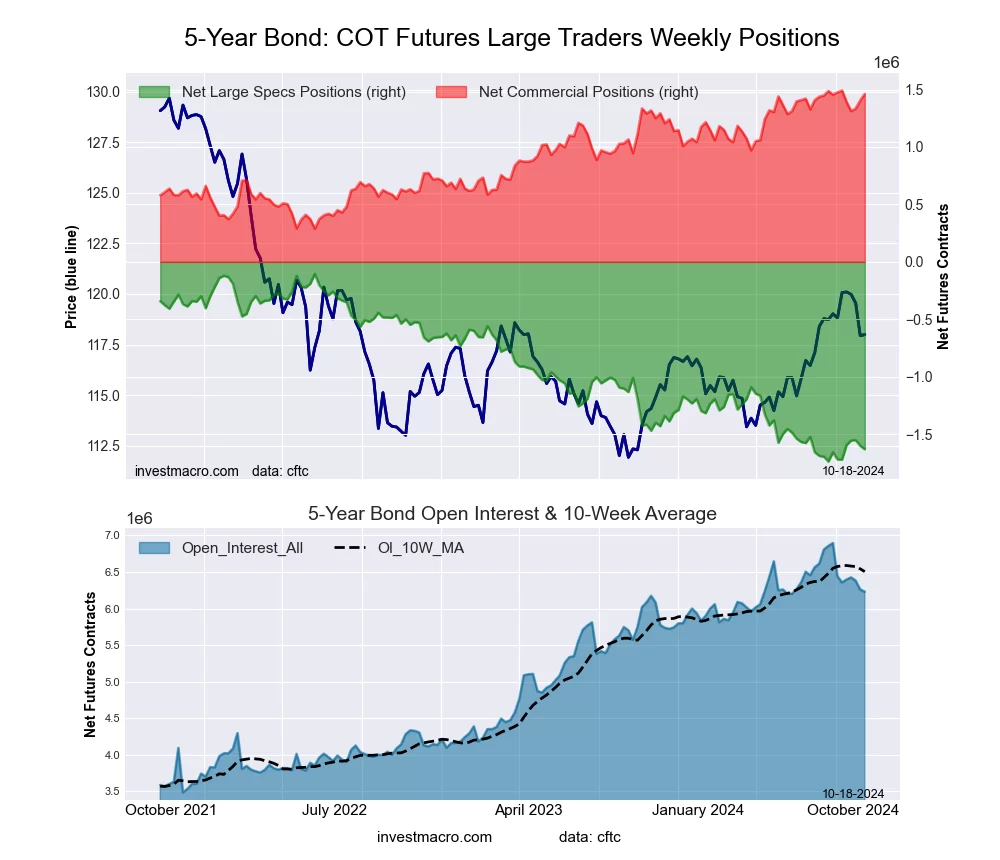
5-Year Treasury Note Futures:

5-Year Treasury Bonds Futures COT ChartThe 5-Year Treasury Note large speculator standing this week was a net position of -1,736,810 contracts in the data reported through Tuesday. This was a weekly fall of -41,738 contracts from the previous week which had a total of -1,695,072 net contracts.

This week’s current strength score (the trader positioning range over the past three years, measured from 0 to 100) shows the speculators are currently Bearish-Extreme with a score of 0.0 percent. The commercials are Bullish-Extreme with a score of 100.0 percent and the small traders (not shown in chart) are Bullish-Extreme with a score of 99.9 percent.

Price Trend-Following Model: Strong Uptrend

Our weekly trend-following model classifies the current market price position as: Strong Uptrend. The current action for the model is considered to be: Hold – Maintain Long Position.

5-Year Treasury Note StatisticsSPECULATORSCOMMERCIALSSMALL TRADERS
– Percent of Open Interest Longs:8.582.17.1
– Percent of Open Interest Shorts:33.960.43.5
– Net Position:-1,736,8101,486,515250,295
– Gross Longs:586,0305,625,205488,422
– Gross Shorts:2,322,8404,138,690238,127
– Long to Short Ratio:0.3 to 11.4 to 12.1 to 1
NET POSITION TREND:
– Strength Index Score (3 Year Range Pct):0.0100.099.9
– Strength Index Reading (3 Year Range):Bearish-ExtremeBullish-ExtremeBullish-Extreme
NET POSITION MOVEMENT INDEX:
– 6-Week Change in Strength Index:-9.95.916.8


10-Year Treasury Note Futures:

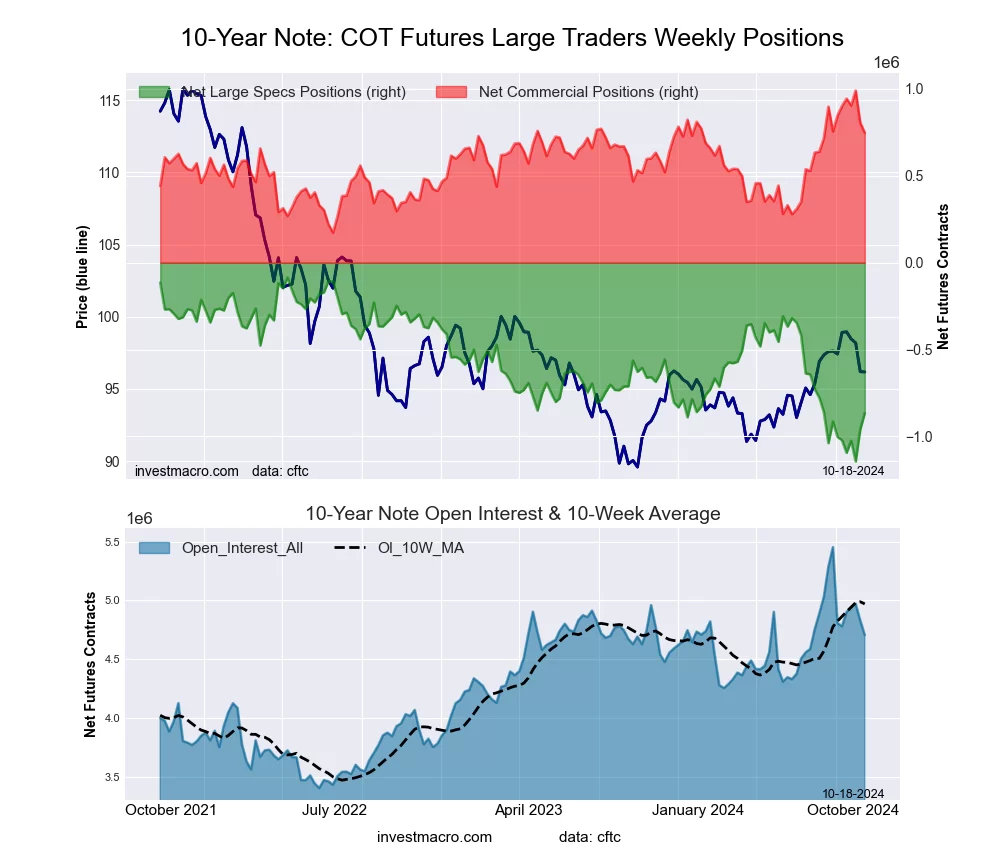
10-Year Treasury Notes Bonds Futures COT ChartThe 10-Year Treasury Note large speculator standing this week was a net position of -1,038,112 contracts in the data reported through Tuesday. This was a weekly decrease of -177,869 contracts from the previous week which had a total of -860,243 net contracts.

This week’s current strength score (the trader positioning range over the past three years, measured from 0 to 100) shows the speculators are currently Bearish-Extreme with a score of 0.0 percent. The commercials are Bullish-Extreme with a score of 100.0 percent and the small traders (not shown in chart) are Bullish-Extreme with a score of 99.0 percent.

Price Trend-Following Model: Strong Uptrend

Our weekly trend-following model classifies the current market price position as: Strong Uptrend. The current action for the model is considered to be: Hold – Maintain Long Position.

10-Year Treasury Note StatisticsSPECULATORSCOMMERCIALSSMALL TRADERS
– Percent of Open Interest Longs:7.878.39.3
– Percent of Open Interest Shorts:27.461.36.7
– Net Position:-1,038,112898,127139,985
– Gross Longs:411,6294,134,790493,072
– Gross Shorts:1,449,7413,236,663353,087
– Long to Short Ratio:0.3 to 11.3 to 11.4 to 1
NET POSITION TREND:
– Strength Index Score (3 Year Range Pct):0.0100.099.0
– Strength Index Reading (3 Year Range):Bearish-ExtremeBullish-ExtremeBullish-Extreme
NET POSITION MOVEMENT INDEX:
– 6-Week Change in Strength Index:-50.967.915.0


Ultra 10-Year Notes Futures:

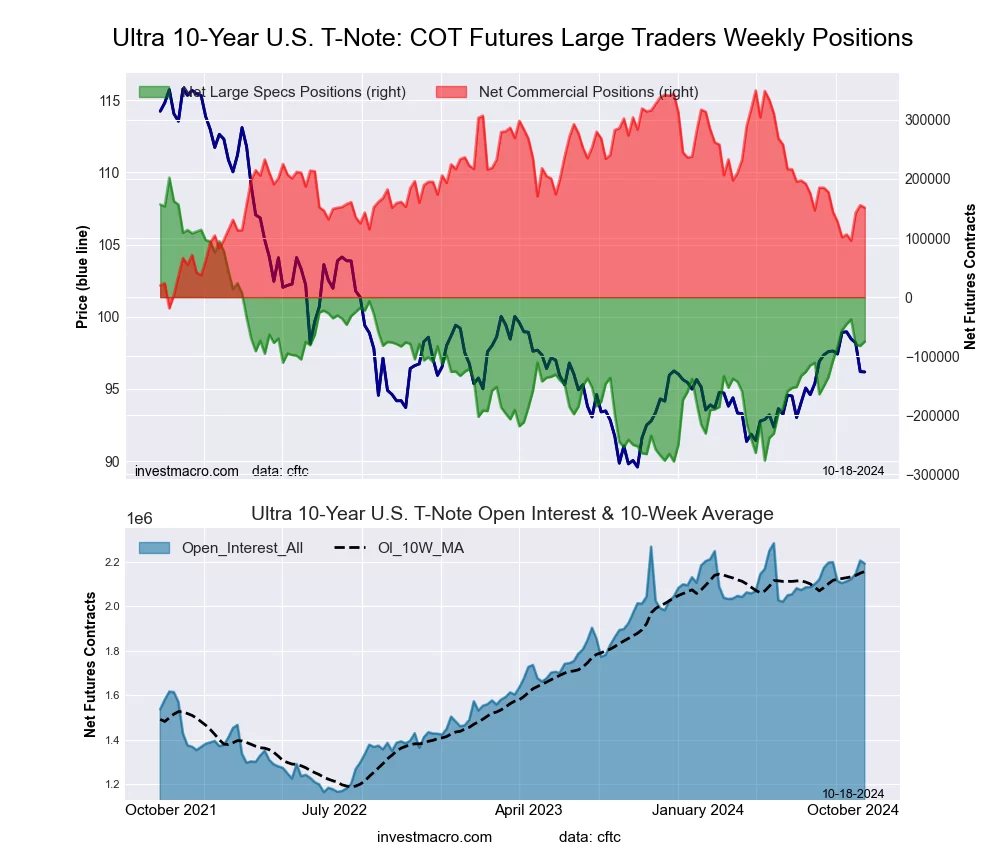
Ultra 10-Year Treasury Notes Bonds Futures COT ChartThe Ultra 10-Year Notes large speculator standing this week was a net position of -135,560 contracts in the data reported through Tuesday. This was a weekly gain of 15,073 contracts from the previous week which had a total of -150,633 net contracts.

This week’s current strength score (the trader positioning range over the past three years, measured from 0 to 100) shows the speculators are currently Bearish with a score of 29.7 percent. The commercials are Bullish with a score of 53.4 percent and the small traders (not shown in chart) are Bullish-Extreme with a score of 87.6 percent.

Price Trend-Following Model: Weak Uptrend

Our weekly trend-following model classifies the current market price position as: Weak Uptrend. The current action for the model is considered to be: Hold – Maintain Long Position.

Ultra 10-Year Notes StatisticsSPECULATORSCOMMERCIALSSMALL TRADERS
– Percent of Open Interest Longs:13.374.410.3
– Percent of Open Interest Shorts:19.466.312.2
– Net Position:-135,560177,795-42,235
– Gross Longs:291,1561,634,861225,405
– Gross Shorts:426,7161,457,066267,640
– Long to Short Ratio:0.7 to 11.1 to 10.8 to 1
NET POSITION TREND:
– Strength Index Score (3 Year Range Pct):29.753.487.6
– Strength Index Reading (3 Year Range):BearishBullishBullish-Extreme
NET POSITION MOVEMENT INDEX:
– 6-Week Change in Strength Index:-0.5-5.312.7


US Treasury Bonds Futures:

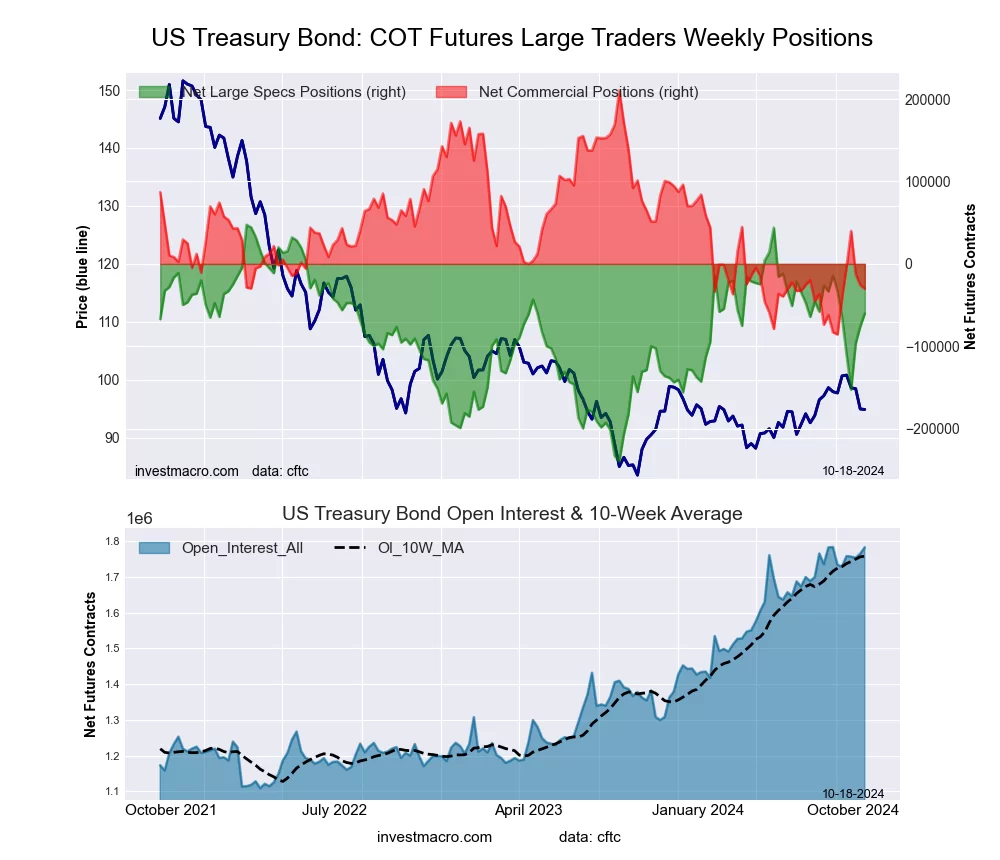
US Year Treasury Notes Long Bonds Futures COT ChartThe US Treasury Bonds large speculator standing this week was a net position of -33,495 contracts in the data reported through Tuesday. This was a weekly decrease of -7,165 contracts from the previous week which had a total of -26,330 net contracts.

This week’s current strength score (the trader positioning range over the past three years, measured from 0 to 100) shows the speculators are currently Bullish with a score of 71.8 percent. The commercials are Bearish-Extreme with a score of 5.7 percent and the small traders (not shown in chart) are Bullish-Extreme with a score of 96.7 percent.

Price Trend-Following Model: Strong Uptrend

Our weekly trend-following model classifies the current market price position as: Strong Uptrend. The current action for the model is considered to be: Hold – Maintain Long Position.

US Treasury Bonds StatisticsSPECULATORSCOMMERCIALSSMALL TRADERS
– Percent of Open Interest Longs:19.663.112.9
– Percent of Open Interest Shorts:21.566.67.6
– Net Position:-33,495-62,34595,840
– Gross Longs:349,7581,123,590230,592
– Gross Shorts:383,2531,185,935134,752
– Long to Short Ratio:0.9 to 10.9 to 11.7 to 1
NET POSITION TREND:
– Strength Index Score (3 Year Range Pct):71.85.796.7
– Strength Index Reading (3 Year Range):BullishBearish-ExtremeBullish-Extreme
NET POSITION MOVEMENT INDEX:
– 6-Week Change in Strength Index:0.3-10.422.6


Ultra US Treasury Bonds Futures:

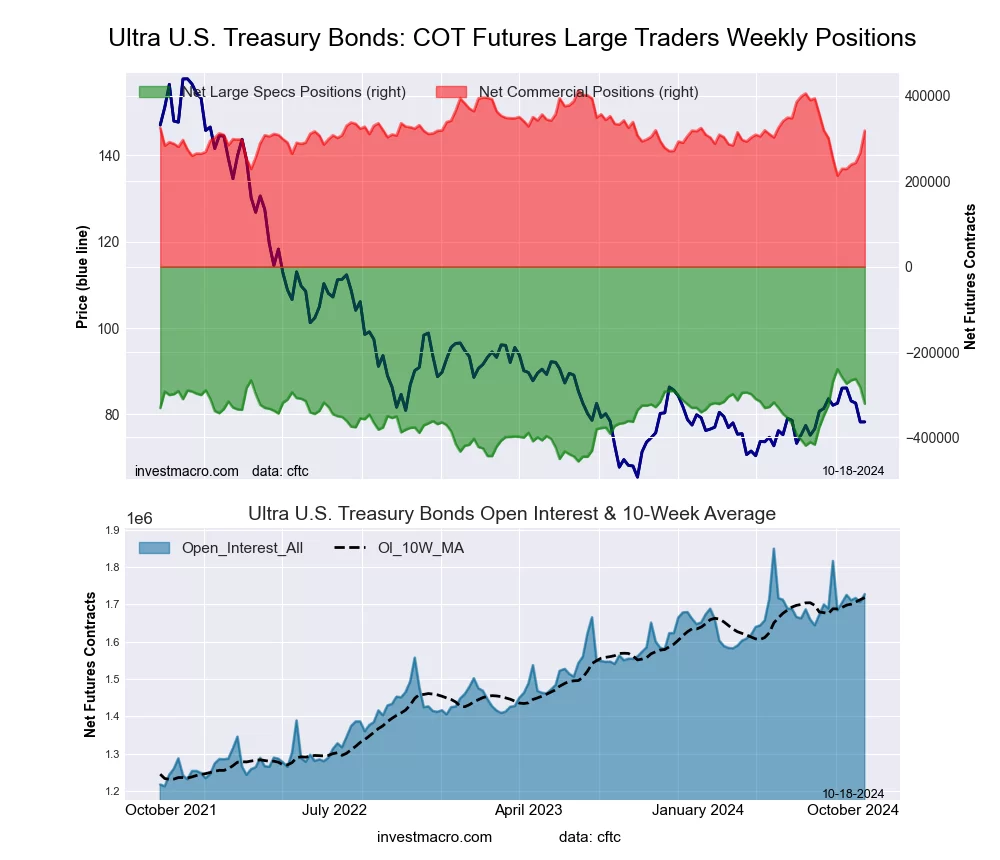
Ultra US Year Treasury Notes Long Bonds Futures COT ChartThe Ultra US Treasury Bonds large speculator standing this week was a net position of -325,614 contracts in the data reported through Tuesday. This was a weekly rise of 23,519 contracts from the previous week which had a total of -349,133 net contracts.

This week’s current strength score (the trader positioning range over the past three years, measured from 0 to 100) shows the speculators are currently Bullish with a score of 68.8 percent. The commercials are Bearish with a score of 39.8 percent and the small traders (not shown in chart) are Bearish with a score of 44.4 percent.

Price Trend-Following Model: Strong Uptrend

Our weekly trend-following model classifies the current market price position as: Strong Uptrend. The current action for the model is considered to be: Hold – Maintain Long Position.

Ultra US Treasury Bonds StatisticsSPECULATORSCOMMERCIALSSMALL TRADERS
– Percent of Open Interest Longs:8.977.310.9
– Percent of Open Interest Shorts:28.259.49.5
– Net Position:-325,614301,90923,705
– Gross Longs:150,2861,305,478184,173
– Gross Shorts:475,9001,003,569160,468
– Long to Short Ratio:0.3 to 11.3 to 11.1 to 1
NET POSITION TREND:
– Strength Index Score (3 Year Range Pct):68.839.844.4
– Strength Index Reading (3 Year Range):BullishBearishBearish
NET POSITION MOVEMENT INDEX:
– 6-Week Change in Strength Index:42.2-52.621.2


Article By InvestMacroReceive our weekly COT Newsletter

*COT Report: The COT data, released weekly to the public each Friday, is updated through the most recent Tuesday (data is 3 days old) and shows a quick view of how large speculators or non-commercials (for-profit traders) were positioned in the futures markets.

The CFTC categorizes trader positions according to commercial hedgers (traders who use futures contracts for hedging as part of the business), non-commercials (large traders who speculate to realize trading profits) and nonreportable traders (usually small traders/speculators) as well as their open interest (contracts open in the market at time of reporting). See CFTC criteria here.

COT Soft Commodities Charts: Speculator Bets led by Wheat & Soybean Oil

By InvestMacro

Here are the latest charts and statistics for the Commitment of Traders (COT) reports data published by the Commodities Futures Trading Commission (CFTC).

The latest COT data is updated through Tuesday August 20th and shows a quick view of how large traders (for-profit speculators and commercial entities) were positioned in the futures markets.

Weekly Speculator Changes led by Wheat & Soybean Oil

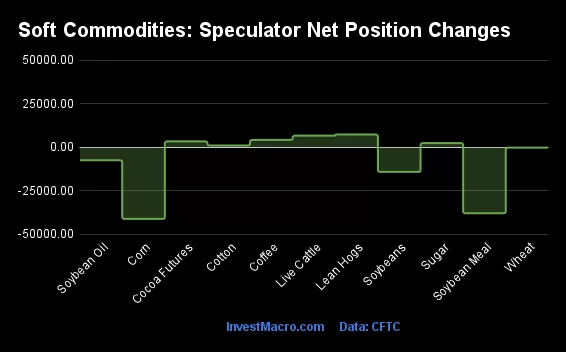
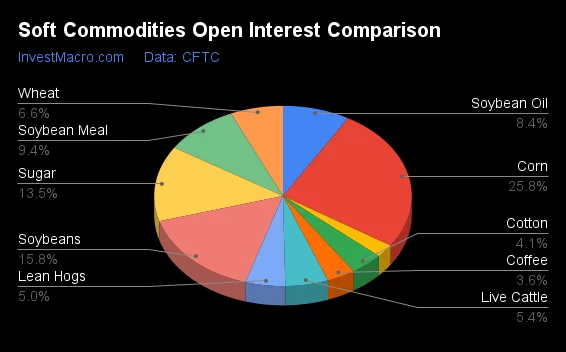
The COT soft commodities markets speculator bets were slightly lower this week as five out of the eleven softs markets we cover had higher positioning while the other six markets had lower speculator contracts.

Leading the gains for the softs markets was Wheat (13,199 contracts) with Soybean Oil (6,693 contracts), Coffee (5,218 contracts), Lean Hogs (4,692 contracts) and Soybean Meal (4,159 contracts) also showing positive weeks.

The markets with the declines in speculator bets this week were Sugar (-15,258 contracts) with Soybeans (-13,170 contracts), Corn (-11,291 contracts), Cocoa (-1,380 contracts), Cotton (-1,158 contracts) and with Live Cattle (-615 contracts) also registering lower bets on the week.


Soft Commodities Net Speculators Leaderboard
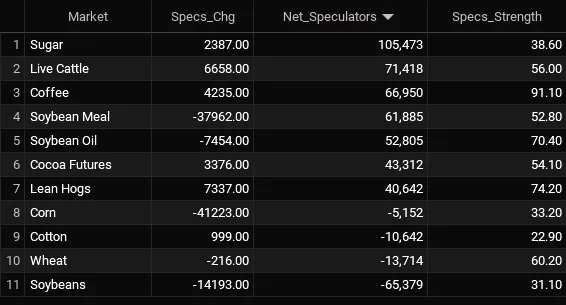
Legend: Weekly Speculators Change | Speculators Current Net Position | Speculators Strength Score compared to last 3-Years (0-100 range)


Strength Scores led by Coffee & Wheat

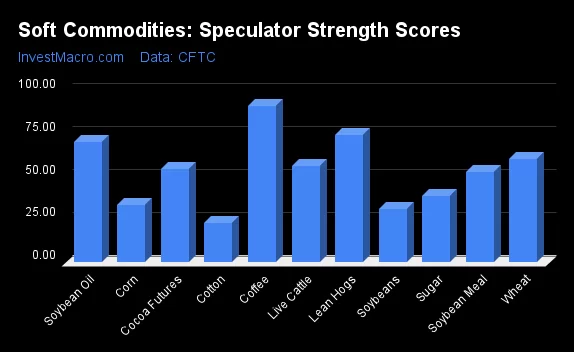
COT Strength Scores (a normalized measure of Speculator positions over a 3-Year range, from 0 to 100 where above 80 is Extreme-Bullish and below 20 is Extreme-Bearish) showed that Coffee (88 percent) leads the softs markets this week. Wheat (52 percent) comes in as the next highest in the weekly strength scores.

On the downside, Cotton (0 percent), Soybeans (4 percent), Sugar (8 percent), Corn (13 percent), Lean Hogs (13 percent), Live Cattle (17 percent) and Soybean Oil (18 percent) come in at the lowest strength levels currently and are in Extreme-Bearish territory (below 20 percent).

Strength Statistics:
Corn (12.8 percent) vs Corn previous week (14.3 percent)
Sugar (7.9 percent) vs Sugar previous week (13.1 percent)
Coffee (88.4 percent) vs Coffee previous week (83.3 percent)
Soybeans (4.3 percent) vs Soybeans previous week (7.4 percent)
Soybean Oil (18.1 percent) vs Soybean Oil previous week (14.4 percent)
Soybean Meal (33.0 percent) vs Soybean Meal previous week (31.3 percent)
Live Cattle (17.3 percent) vs Live Cattle previous week (18.0 percent)
Lean Hogs (12.7 percent) vs Lean Hogs previous week (8.6 percent)
Cotton (0.0 percent) vs Cotton previous week (0.7 percent)
Cocoa (39.4 percent) vs Cocoa previous week (40.8 percent)
Wheat (51.6 percent) vs Wheat previous week (42.0 percent)


Corn tops the 6-Week Strength Trends

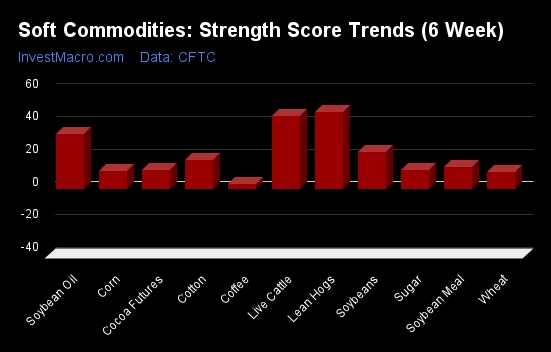
COT Strength Score Trends (or move index, calculates the 6-week changes in strength scores) showed that Corn (10 percent), Lean Hogs (7 percent) and Wheat (7 percent) lead the past six weeks trends for soft commodities.

Soybean Oil (-27 percent) leads the downside trend scores currently with Soybean Meal (-22 percent), Live Cattle (-17 percent) and Sugar (-16 percent) following next with lower trend scores.

Strength Trend Statistics:
Corn (9.5 percent) vs Corn previous week (9.5 percent)
Sugar (-16.5 percent) vs Sugar previous week (-10.3 percent)
Coffee (-11.0 percent) vs Coffee previous week (-8.6 percent)
Soybeans (-6.8 percent) vs Soybeans previous week (-10.3 percent)
Soybean Oil (-26.9 percent) vs Soybean Oil previous week (-10.2 percent)
Soybean Meal (-21.6 percent) vs Soybean Meal previous week (-27.6 percent)
Live Cattle (-16.9 percent) vs Live Cattle previous week (-15.5 percent)
Lean Hogs (6.7 percent) vs Lean Hogs previous week (2.2 percent)
Cotton (-11.2 percent) vs Cotton previous week (-14.8 percent)
Cocoa (-2.9 percent) vs Cocoa previous week (0.1 percent)
Wheat (6.5 percent) vs Wheat previous week (-0.2 percent)


Individual Soft Commodities Markets:

CORN Futures:
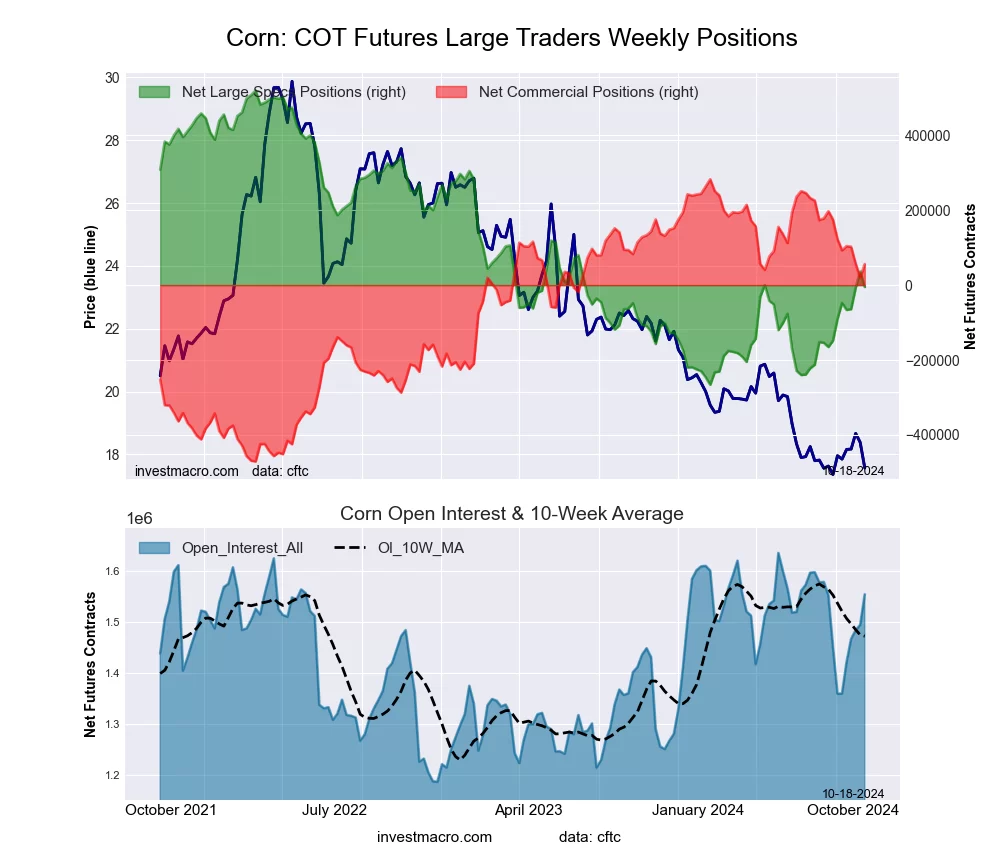
CORN Futures COT ChartThe CORN large speculator standing this week totaled a net position of -165,296 contracts in the data reported through Tuesday. This was a weekly decline of -11,291 contracts from the previous week which had a total of -154,005 net contracts.

This week’s current strength score (the trader positioning range over the past three years, measured from 0 to 100) shows the speculators are currently Bearish-Extreme with a score of 12.8 percent. The commercials are Bullish-Extreme with a score of 88.7 percent and the small traders (not shown in chart) are Bullish with a score of 65.3 percent.

Price Trend-Following Model: Strong Downtrend

Our weekly trend-following model classifies the current market price position as: Strong Downtrend. The current action for the model is considered to be: Hold – Maintain Short Position.

CORN Futures StatisticsSPECULATORSCOMMERCIALSSMALL TRADERS
– Percent of Open Interest Longs:20.644.99.1
– Percent of Open Interest Shorts:31.232.211.1
– Net Position:-165,296197,121-31,825
– Gross Longs:319,844697,858140,896
– Gross Shorts:485,140500,737172,721
– Long to Short Ratio:0.7 to 11.4 to 10.8 to 1
NET POSITION TREND:
– Strength Index Score (3 Year Range Pct):12.888.765.3
– Strength Index Reading (3 Year Range):Bearish-ExtremeBullish-ExtremeBullish
NET POSITION MOVEMENT INDEX:
– 6-Week Change in Strength Index:9.5-7.1-28.1


SUGAR Futures:

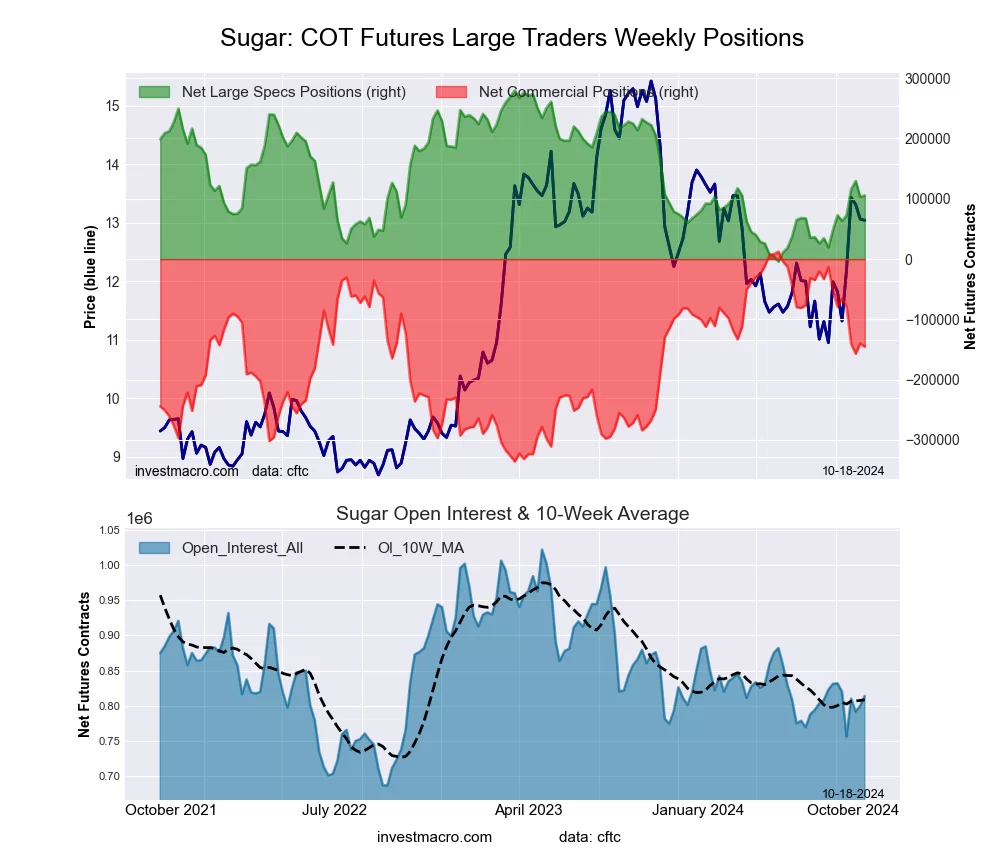
SUGAR Futures COT ChartThe SUGAR large speculator standing this week totaled a net position of 19,304 contracts in the data reported through Tuesday. This was a weekly fall of -15,258 contracts from the previous week which had a total of 34,562 net contracts.

This week’s current strength score (the trader positioning range over the past three years, measured from 0 to 100) shows the speculators are currently Bearish-Extreme with a score of 7.9 percent. The commercials are Bullish-Extreme with a score of 92.7 percent and the small traders (not shown in chart) are Bearish-Extreme with a score of 11.8 percent.

Price Trend-Following Model: Downtrend

Our weekly trend-following model classifies the current market price position as: Downtrend. The current action for the model is considered to be: Hold – Maintain Short Position.

SUGAR Futures StatisticsSPECULATORSCOMMERCIALSSMALL TRADERS
– Percent of Open Interest Longs:22.954.27.5
– Percent of Open Interest Shorts:20.555.88.3
– Net Position:19,304-13,294-6,010
– Gross Longs:188,316446,31462,107
– Gross Shorts:169,012459,60868,117
– Long to Short Ratio:1.1 to 11.0 to 10.9 to 1
NET POSITION TREND:
– Strength Index Score (3 Year Range Pct):7.992.711.8
– Strength Index Reading (3 Year Range):Bearish-ExtremeBullish-ExtremeBearish-Extreme
NET POSITION MOVEMENT INDEX:
– 6-Week Change in Strength Index:-16.519.2-24.5


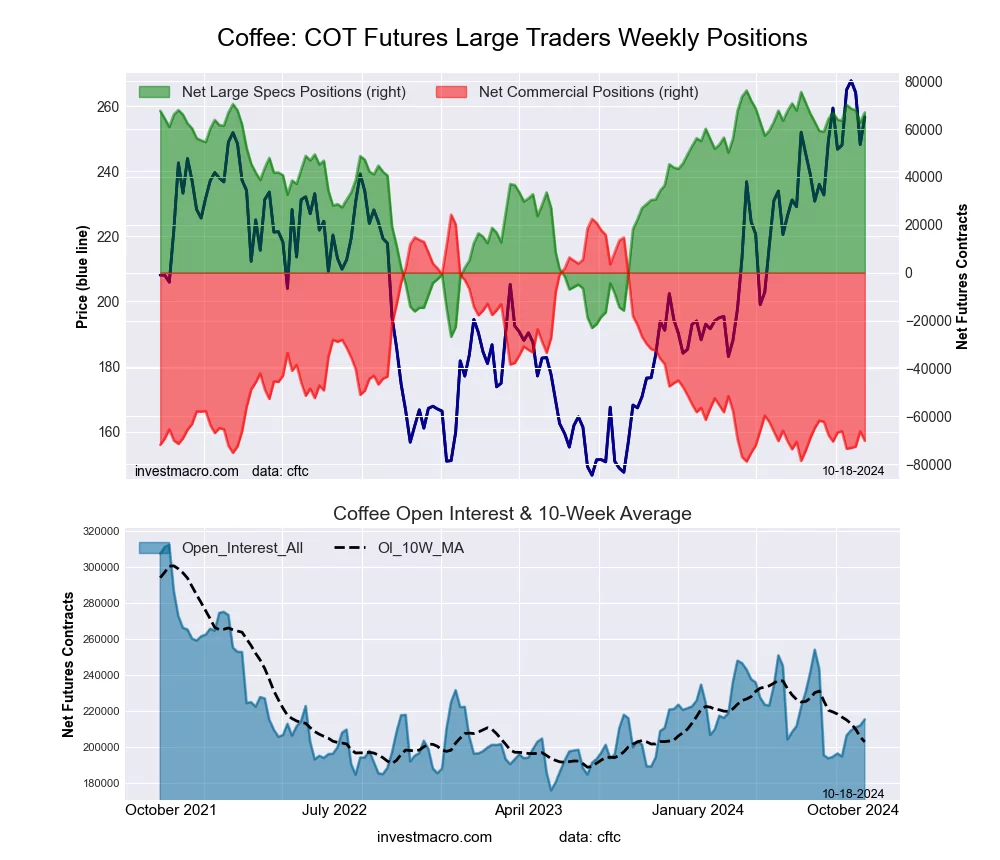
COFFEE Futures:

COFFEE Futures COT ChartThe COFFEE large speculator standing this week totaled a net position of 64,158 contracts in the data reported through Tuesday. This was a weekly rise of 5,218 contracts from the previous week which had a total of 58,940 net contracts.

This week’s current strength score (the trader positioning range over the past three years, measured from 0 to 100) shows the speculators are currently Bullish-Extreme with a score of 88.4 percent. The commercials are Bearish-Extreme with a score of 10.8 percent and the small traders (not shown in chart) are Bullish with a score of 71.8 percent.

Price Trend-Following Model: Strong Uptrend

Our weekly trend-following model classifies the current market price position as: Strong Uptrend. The current action for the model is considered to be: Hold – Maintain Long Position.

COFFEE Futures StatisticsSPECULATORSCOMMERCIALSSMALL TRADERS
– Percent of Open Interest Longs:40.938.84.3
– Percent of Open Interest Shorts:7.773.82.4
– Net Position:64,158-67,7373,579
– Gross Longs:79,03274,9798,296
– Gross Shorts:14,874142,7164,717
– Long to Short Ratio:5.3 to 10.5 to 11.8 to 1
NET POSITION TREND:
– Strength Index Score (3 Year Range Pct):88.410.871.8
– Strength Index Reading (3 Year Range):Bullish-ExtremeBearish-ExtremeBullish
NET POSITION MOVEMENT INDEX:
– 6-Week Change in Strength Index:-11.010.56.5


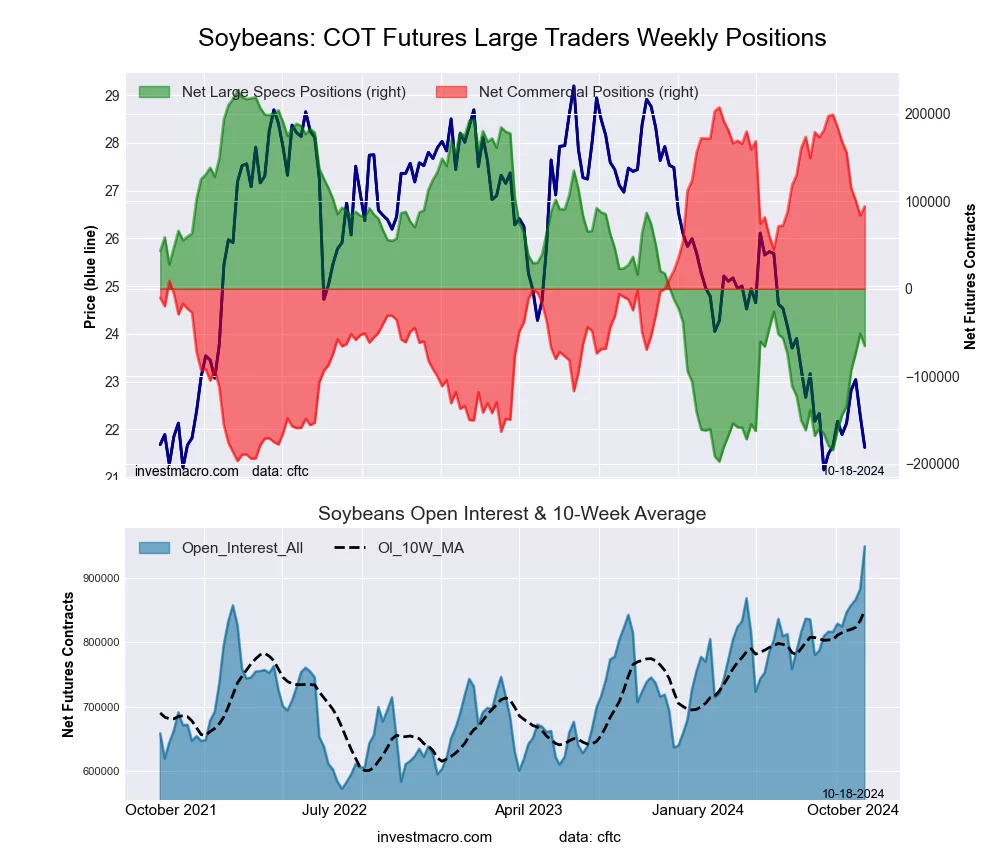
SOYBEANS Futures:

SOYBEANS Futures COT ChartThe SOYBEANS large speculator standing this week totaled a net position of -178,893 contracts in the data reported through Tuesday. This was a weekly reduction of -13,170 contracts from the previous week which had a total of -165,723 net contracts.

This week’s current strength score (the trader positioning range over the past three years, measured from 0 to 100) shows the speculators are currently Bearish-Extreme with a score of 4.3 percent. The commercials are Bullish-Extreme with a score of 97.6 percent and the small traders (not shown in chart) are Bullish with a score of 64.0 percent.

Price Trend-Following Model: Strong Downtrend

Our weekly trend-following model classifies the current market price position as: Strong Downtrend. The current action for the model is considered to be: Hold – Maintain Short Position.

SOYBEANS Futures StatisticsSPECULATORSCOMMERCIALSSMALL TRADERS
– Percent of Open Interest Longs:13.062.74.9
– Percent of Open Interest Shorts:34.938.57.2
– Net Position:-178,893197,454-18,561
– Gross Longs:105,737511,62639,933
– Gross Shorts:284,630314,17258,494
– Long to Short Ratio:0.4 to 11.6 to 10.7 to 1
NET POSITION TREND:
– Strength Index Score (3 Year Range Pct):4.397.664.0
– Strength Index Reading (3 Year Range):Bearish-ExtremeBullish-ExtremeBullish
NET POSITION MOVEMENT INDEX:
– 6-Week Change in Strength Index:-6.89.1-20.9


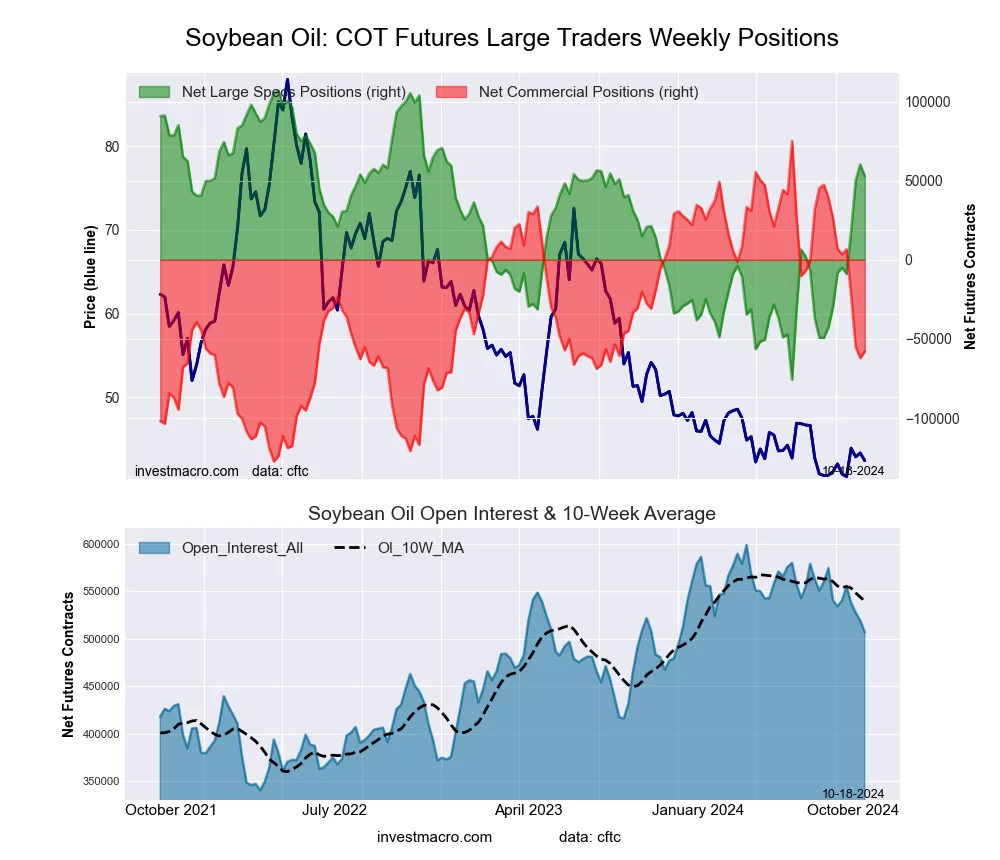
SOYBEAN OIL Futures:

SOYBEAN OIL Futures COT ChartThe SOYBEAN OIL large speculator standing this week totaled a net position of -42,670 contracts in the data reported through Tuesday. This was a weekly gain of 6,693 contracts from the previous week which had a total of -49,363 net contracts.

This week’s current strength score (the trader positioning range over the past three years, measured from 0 to 100) shows the speculators are currently Bearish-Extreme with a score of 18.1 percent. The commercials are Bullish-Extreme with a score of 82.3 percent and the small traders (not shown in chart) are Bearish with a score of 27.7 percent.

Price Trend-Following Model: Strong Downtrend

Our weekly trend-following model classifies the current market price position as: Strong Downtrend. The current action for the model is considered to be: Hold – Maintain Short Position.

SOYBEAN OIL Futures StatisticsSPECULATORSCOMMERCIALSSMALL TRADERS
– Percent of Open Interest Longs:23.353.25.3
– Percent of Open Interest Shorts:30.746.44.7
– Net Position:-42,67039,1493,521
– Gross Longs:133,857305,93430,612
– Gross Shorts:176,527266,78527,091
– Long to Short Ratio:0.8 to 11.1 to 11.1 to 1
NET POSITION TREND:
– Strength Index Score (3 Year Range Pct):18.182.327.7
– Strength Index Reading (3 Year Range):Bearish-ExtremeBullish-ExtremeBearish
NET POSITION MOVEMENT INDEX:
– 6-Week Change in Strength Index:-26.924.3-0.6


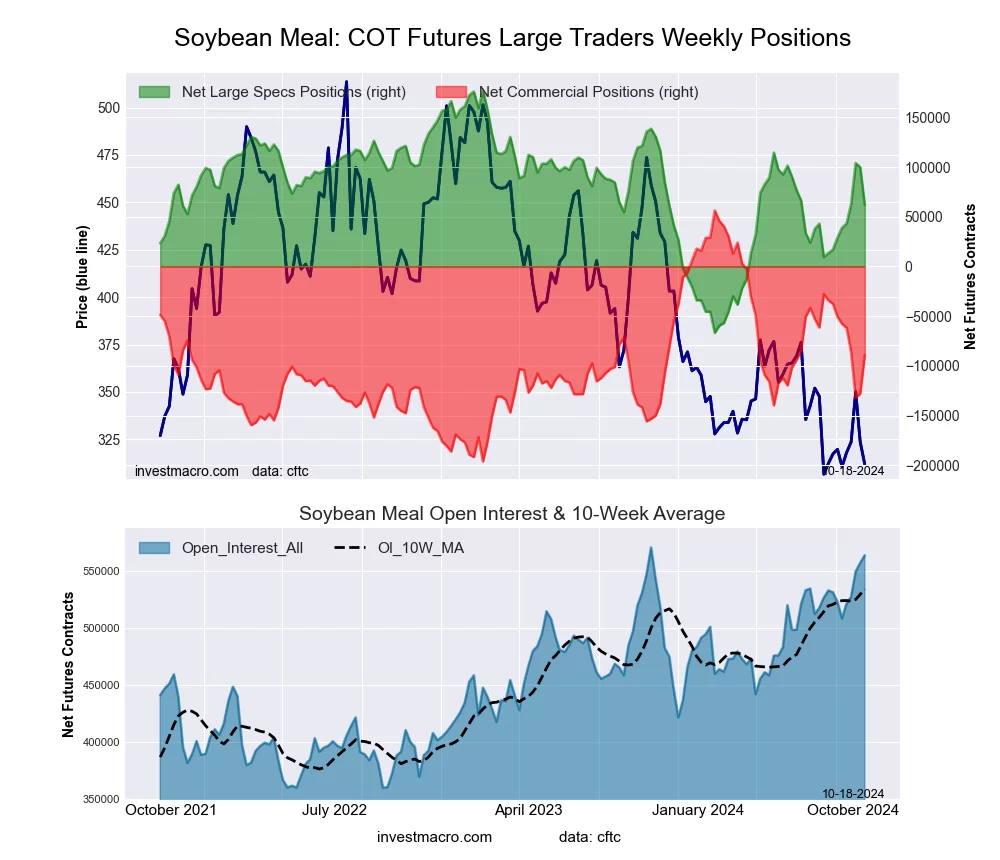
SOYBEAN MEAL Futures:

SOYBEAN MEAL Futures COT ChartThe SOYBEAN MEAL large speculator standing this week totaled a net position of 13,574 contracts in the data reported through Tuesday. This was a weekly lift of 4,159 contracts from the previous week which had a total of 9,415 net contracts.

This week’s current strength score (the trader positioning range over the past three years, measured from 0 to 100) shows the speculators are currently Bearish with a score of 33.0 percent. The commercials are Bullish with a score of 64.2 percent and the small traders (not shown in chart) are Bearish with a score of 48.5 percent.

Price Trend-Following Model: Strong Downtrend

Our weekly trend-following model classifies the current market price position as: Strong Downtrend. The current action for the model is considered to be: Hold – Maintain Short Position.

SOYBEAN MEAL Futures StatisticsSPECULATORSCOMMERCIALSSMALL TRADERS
– Percent of Open Interest Longs:22.246.49.3
– Percent of Open Interest Shorts:19.652.85.4
– Net Position:13,574-34,19720,623
– Gross Longs:118,191247,39349,516
– Gross Shorts:104,617281,59028,893
– Long to Short Ratio:1.1 to 10.9 to 11.7 to 1
NET POSITION TREND:
– Strength Index Score (3 Year Range Pct):33.064.248.5
– Strength Index Reading (3 Year Range):BearishBullishBearish
NET POSITION MOVEMENT INDEX:
– 6-Week Change in Strength Index:-21.619.911.5


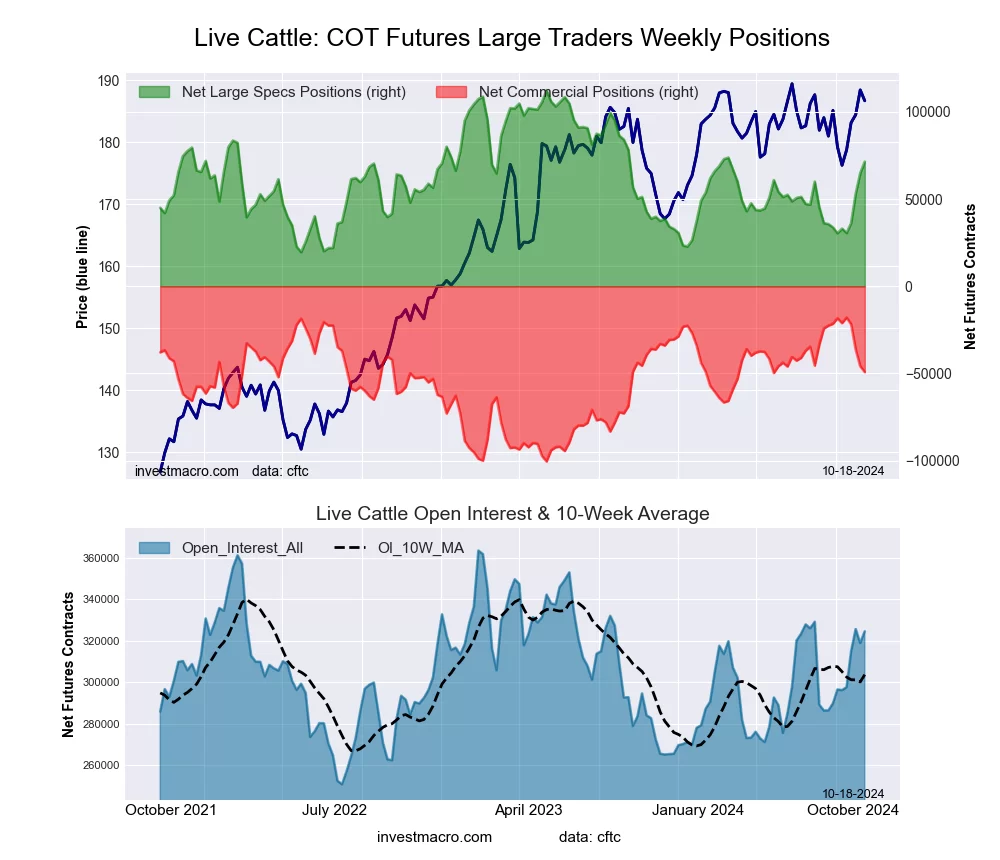
LIVE CATTLE Futures:

LIVE CATTLE Futures COT ChartThe LIVE CATTLE large speculator standing this week totaled a net position of 35,622 contracts in the data reported through Tuesday. This was a weekly reduction of -615 contracts from the previous week which had a total of 36,237 net contracts.

This week’s current strength score (the trader positioning range over the past three years, measured from 0 to 100) shows the speculators are currently Bearish-Extreme with a score of 17.3 percent. The commercials are Bullish-Extreme with a score of 95.1 percent and the small traders (not shown in chart) are Bearish with a score of 20.4 percent.

Price Trend-Following Model: Weak Uptrend

Our weekly trend-following model classifies the current market price position as: Weak Uptrend. The current action for the model is considered to be: Hold – Maintain Long Position.

LIVE CATTLE Futures StatisticsSPECULATORSCOMMERCIALSSMALL TRADERS
– Percent of Open Interest Longs:34.336.09.7
– Percent of Open Interest Shorts:21.943.914.2
– Net Position:35,622-22,612-13,010
– Gross Longs:98,255103,18927,738
– Gross Shorts:62,633125,80140,748
– Long to Short Ratio:1.6 to 10.8 to 10.7 to 1
NET POSITION TREND:
– Strength Index Score (3 Year Range Pct):17.395.120.4
– Strength Index Reading (3 Year Range):Bearish-ExtremeBullish-ExtremeBearish
NET POSITION MOVEMENT INDEX:
– 6-Week Change in Strength Index:-16.922.5-14.9


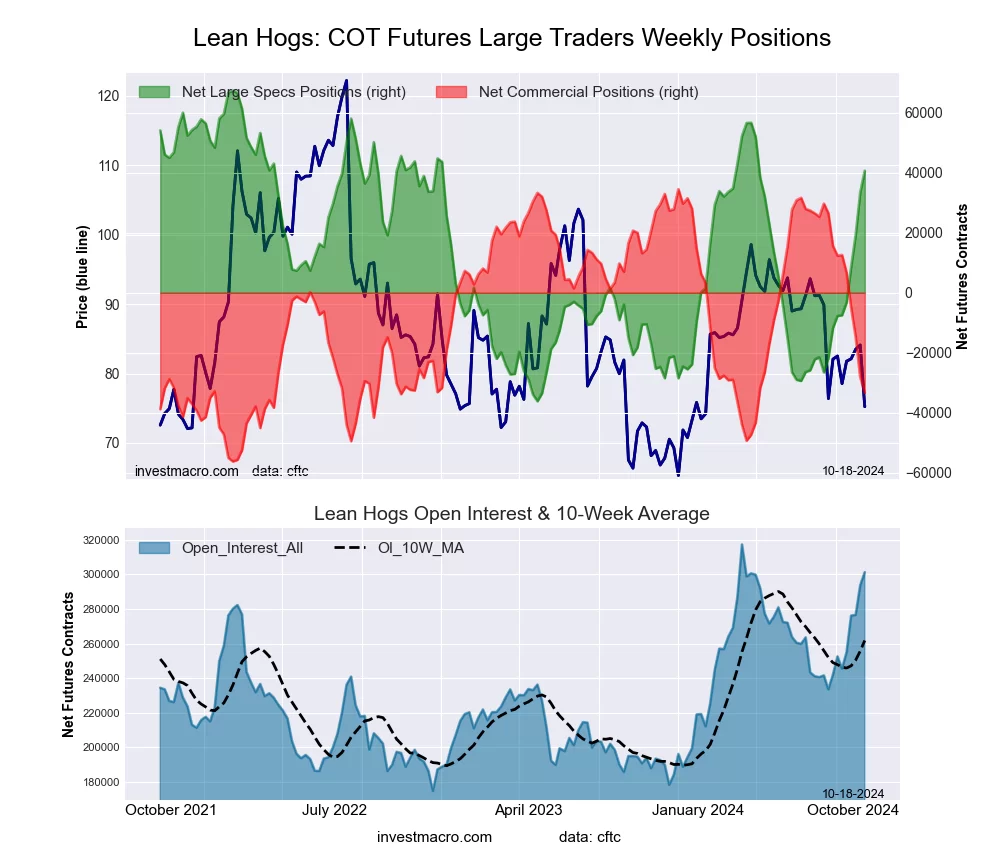
LEAN HOGS Futures:

LEAN HOGS Futures COT ChartThe LEAN HOGS large speculator standing this week totaled a net position of -21,796 contracts in the data reported through Tuesday. This was a weekly boost of 4,692 contracts from the previous week which had a total of -26,488 net contracts.

This week’s current strength score (the trader positioning range over the past three years, measured from 0 to 100) shows the speculators are currently Bearish-Extreme with a score of 12.7 percent. The commercials are Bullish-Extreme with a score of 91.6 percent and the small traders (not shown in chart) are Bullish with a score of 62.2 percent.

Price Trend-Following Model: Strong Downtrend

Our weekly trend-following model classifies the current market price position as: Strong Downtrend. The current action for the model is considered to be: Hold – Maintain Short Position.

LEAN HOGS Futures StatisticsSPECULATORSCOMMERCIALSSMALL TRADERS
– Percent of Open Interest Longs:36.939.16.1
– Percent of Open Interest Shorts:46.327.78.1
– Net Position:-21,79626,506-4,710
– Gross Longs:86,24791,22514,296
– Gross Shorts:108,04364,71919,006
– Long to Short Ratio:0.8 to 11.4 to 10.8 to 1
NET POSITION TREND:
– Strength Index Score (3 Year Range Pct):12.791.662.2
– Strength Index Reading (3 Year Range):Bearish-ExtremeBullish-ExtremeBullish
NET POSITION MOVEMENT INDEX:
– 6-Week Change in Strength Index:6.7-5.4-11.0


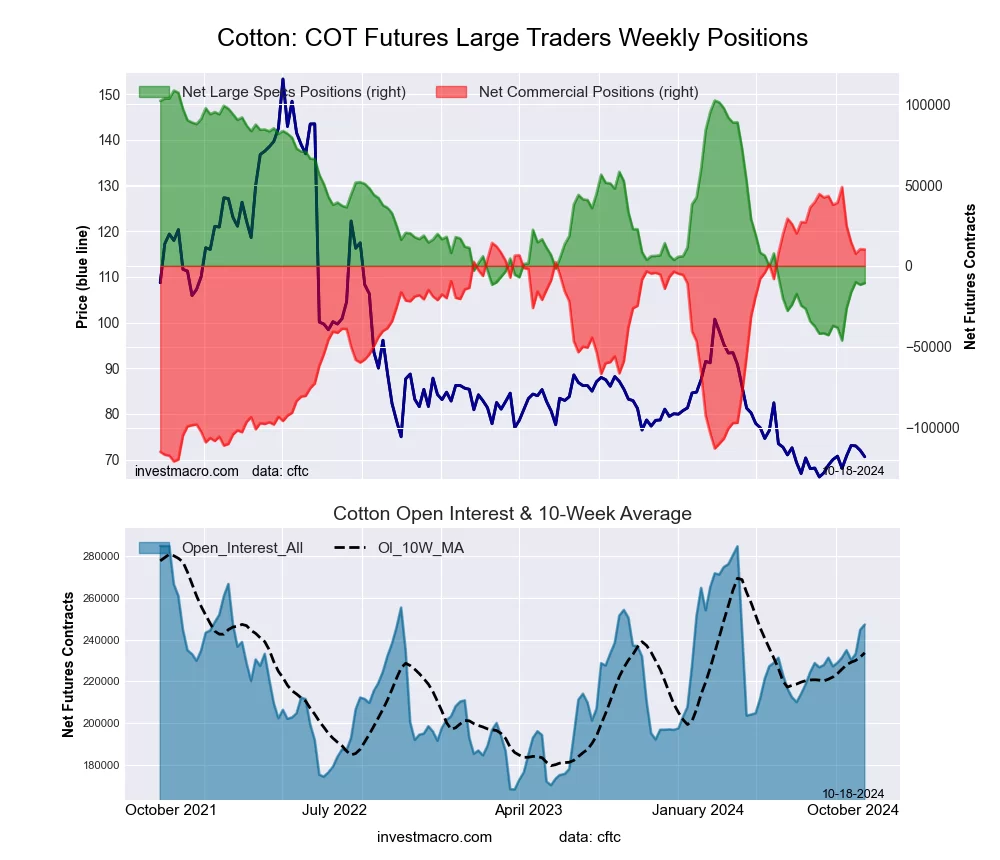
COTTON Futures:

COTTON Futures COT ChartThe COTTON large speculator standing this week totaled a net position of -42,828 contracts in the data reported through Tuesday. This was a weekly decrease of -1,158 contracts from the previous week which had a total of -41,670 net contracts.

This week’s current strength score (the trader positioning range over the past three years, measured from 0 to 100) shows the speculators are currently Bearish-Extreme with a score of 0.0 percent. The commercials are Bullish-Extreme with a score of 99.3 percent and the small traders (not shown in chart) are Bearish-Extreme with a score of 14.0 percent.

Price Trend-Following Model: Downtrend

Our weekly trend-following model classifies the current market price position as: Downtrend. The current action for the model is considered to be: Hold – Maintain Short Position.

COTTON Futures StatisticsSPECULATORSCOMMERCIALSSMALL TRADERS
– Percent of Open Interest Longs:25.249.55.8
– Percent of Open Interest Shorts:43.730.85.9
– Net Position:-42,82843,223-395
– Gross Longs:58,393114,52113,326
– Gross Shorts:101,22171,29813,721
– Long to Short Ratio:0.6 to 11.6 to 11.0 to 1
NET POSITION TREND:
– Strength Index Score (3 Year Range Pct):0.099.314.0
– Strength Index Reading (3 Year Range):Bearish-ExtremeBullish-ExtremeBearish-Extreme
NET POSITION MOVEMENT INDEX:
– 6-Week Change in Strength Index:-11.29.113.3


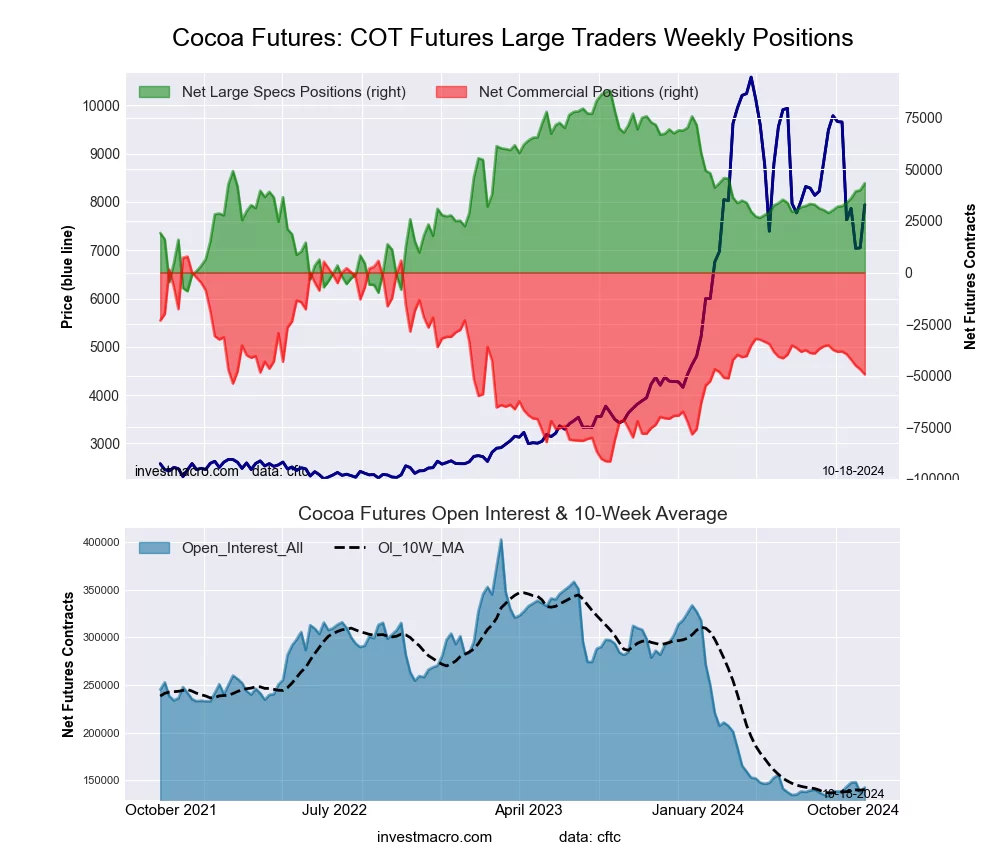
COCOA Futures:

COCOA Futures COT ChartThe COCOA large speculator standing this week totaled a net position of 28,888 contracts in the data reported through Tuesday. This was a weekly reduction of -1,380 contracts from the previous week which had a total of 30,268 net contracts.

This week’s current strength score (the trader positioning range over the past three years, measured from 0 to 100) shows the speculators are currently Bearish with a score of 39.4 percent. The commercials are Bullish with a score of 56.7 percent and the small traders (not shown in chart) are Bullish with a score of 66.5 percent.

Price Trend-Following Model: Weak Downtrend

Our weekly trend-following model classifies the current market price position as: Weak Downtrend. The current action for the model is considered to be: Hold – Maintain Short Position.

COCOA Futures StatisticsSPECULATORSCOMMERCIALSSMALL TRADERS
– Percent of Open Interest Longs:38.930.38.8
– Percent of Open Interest Shorts:17.356.74.0
– Net Position:28,888-35,2706,382
– Gross Longs:51,92340,36911,703
– Gross Shorts:23,03575,6395,321
– Long to Short Ratio:2.3 to 10.5 to 12.2 to 1
NET POSITION TREND:
– Strength Index Score (3 Year Range Pct):39.456.766.5
– Strength Index Reading (3 Year Range):BearishBullishBullish
NET POSITION MOVEMENT INDEX:
– 6-Week Change in Strength Index:-2.93.2-2.6


WHEAT Futures:

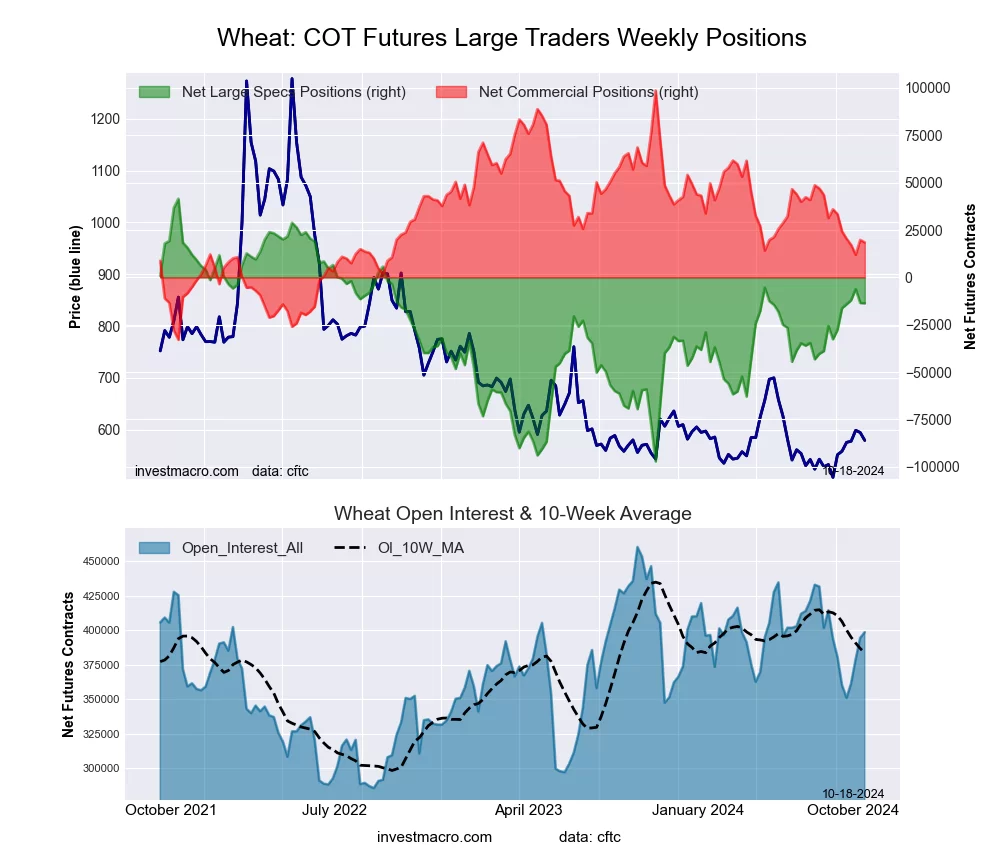
WHEAT Futures COT ChartThe WHEAT large speculator standing this week totaled a net position of -25,706 contracts in the data reported through Tuesday. This was a weekly lift of 13,199 contracts from the previous week which had a total of -38,905 net contracts.

This week’s current strength score (the trader positioning range over the past three years, measured from 0 to 100) shows the speculators are currently Bullish with a score of 51.6 percent. The commercials are Bearish with a score of 48.9 percent and the small traders (not shown in chart) are Bearish with a score of 34.2 percent.

Price Trend-Following Model: Strong Downtrend

Our weekly trend-following model classifies the current market price position as: Strong Downtrend. The current action for the model is considered to be: Hold – Maintain Short Position.

WHEAT Futures StatisticsSPECULATORSCOMMERCIALSSMALL TRADERS
– Percent of Open Interest Longs:32.433.97.8
– Percent of Open Interest Shorts:38.626.39.1
– Net Position:-25,70631,360-5,654
– Gross Longs:134,387140,44132,167
– Gross Shorts:160,093109,08137,821
– Long to Short Ratio:0.8 to 11.3 to 10.9 to 1
NET POSITION TREND:
– Strength Index Score (3 Year Range Pct):51.648.934.2
– Strength Index Reading (3 Year Range):BullishBearishBearish
NET POSITION MOVEMENT INDEX:
– 6-Week Change in Strength Index:6.5-6.5-2.8


Article By InvestMacroReceive our weekly COT Newsletter

*COT Report: The COT data, released weekly to the public each Friday, is updated through the most recent Tuesday (data is 3 days old) and shows a quick view of how large speculators or non-commercials (for-profit traders) were positioned in the futures markets.

The CFTC categorizes trader positions according to commercial hedgers (traders who use futures contracts for hedging as part of the business), non-commercials (large traders who speculate to realize trading profits) and nonreportable traders (usually small traders/speculators) as well as their open interest (contracts open in the market at time of reporting). See CFTC criteria here.


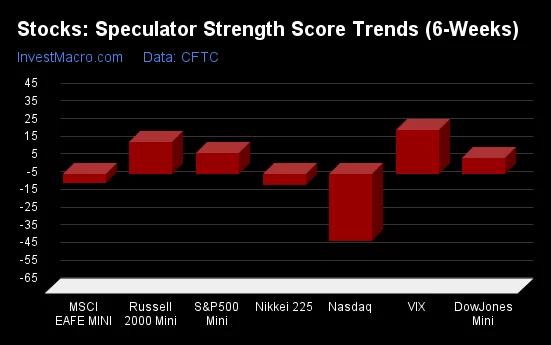
COT Stock Market Charts: Speculator Bets led by DowJones & Nasdaq

By InvestMacro

Here are the latest charts and statistics for the Commitment of Traders (COT) data published by the Commodities Futures Trading Commission (CFTC).
The latest COT data is updated through Tuesday August 20th and shows a quick view of how large traders (for-profit speculators and commercial entities) were positioned in the futures markets.

Weekly Speculator Changes led by DowJones & Nasdaq

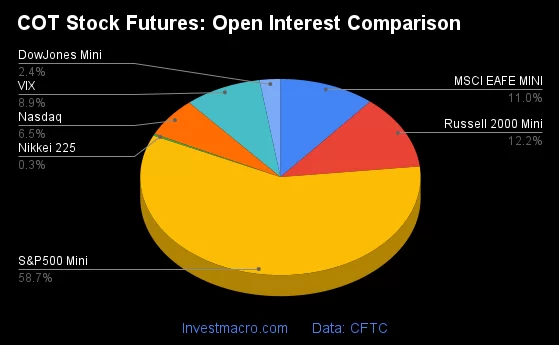
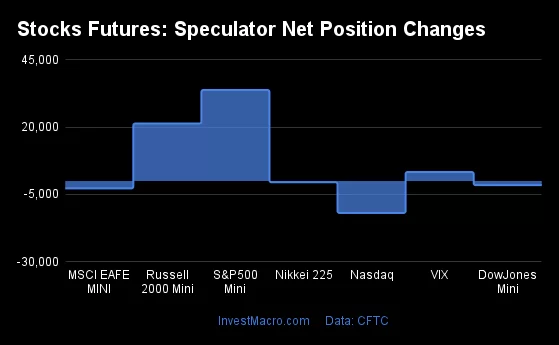
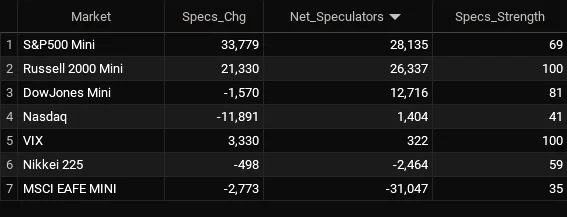
The COT stock markets speculator bets were lower this week as two out of the seven stock markets we cover had higher positioning while the other five markets had lower speculator contracts.

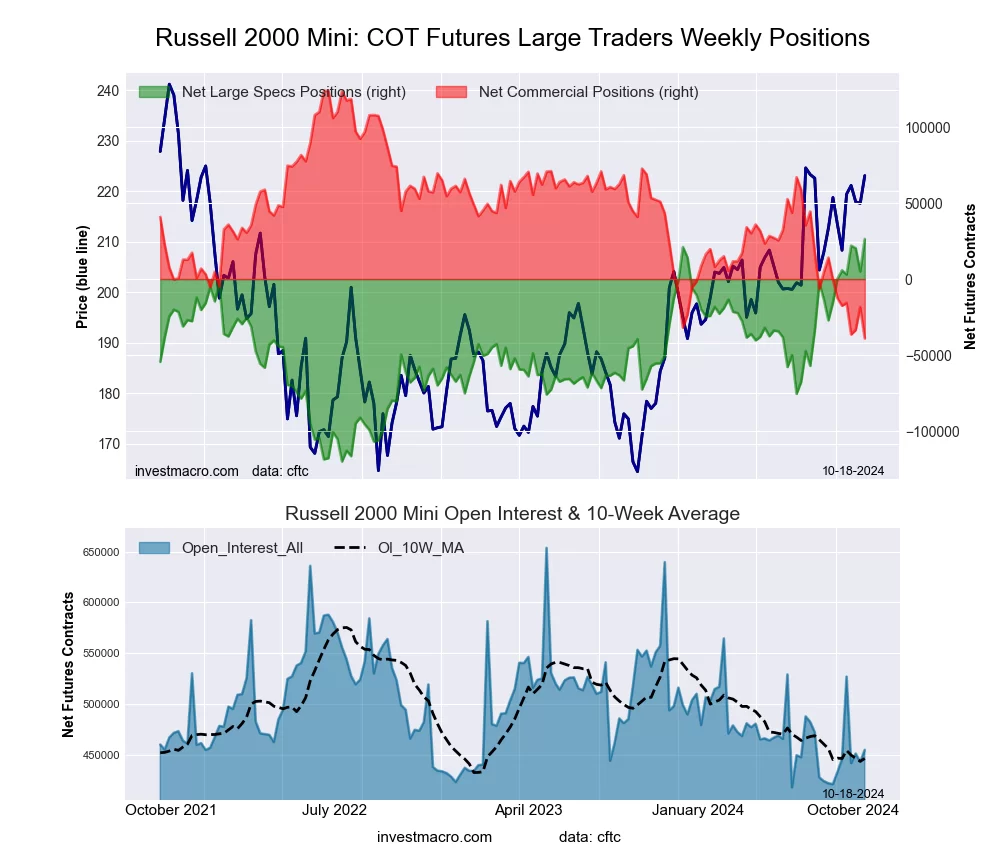
Leading the gains for the stock markets was the DowJones-Mini (5,491 contracts) with the Nasdaq-Mini (2,897 contracts) also showing positive weeks.

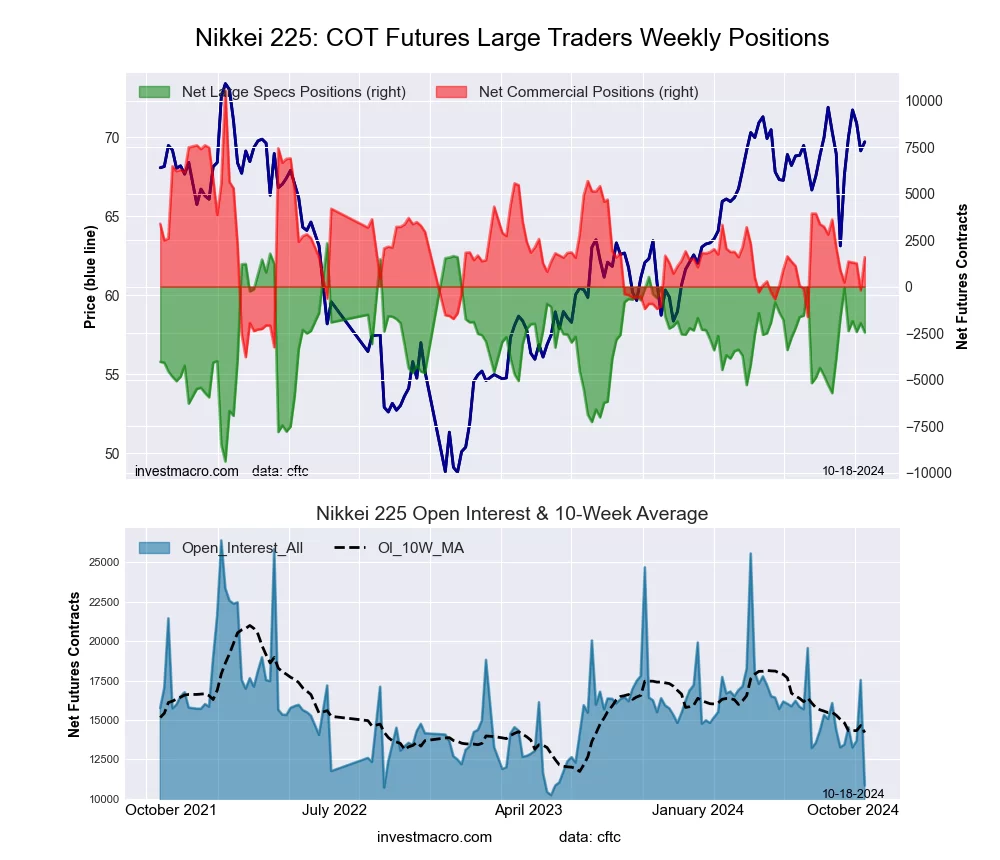
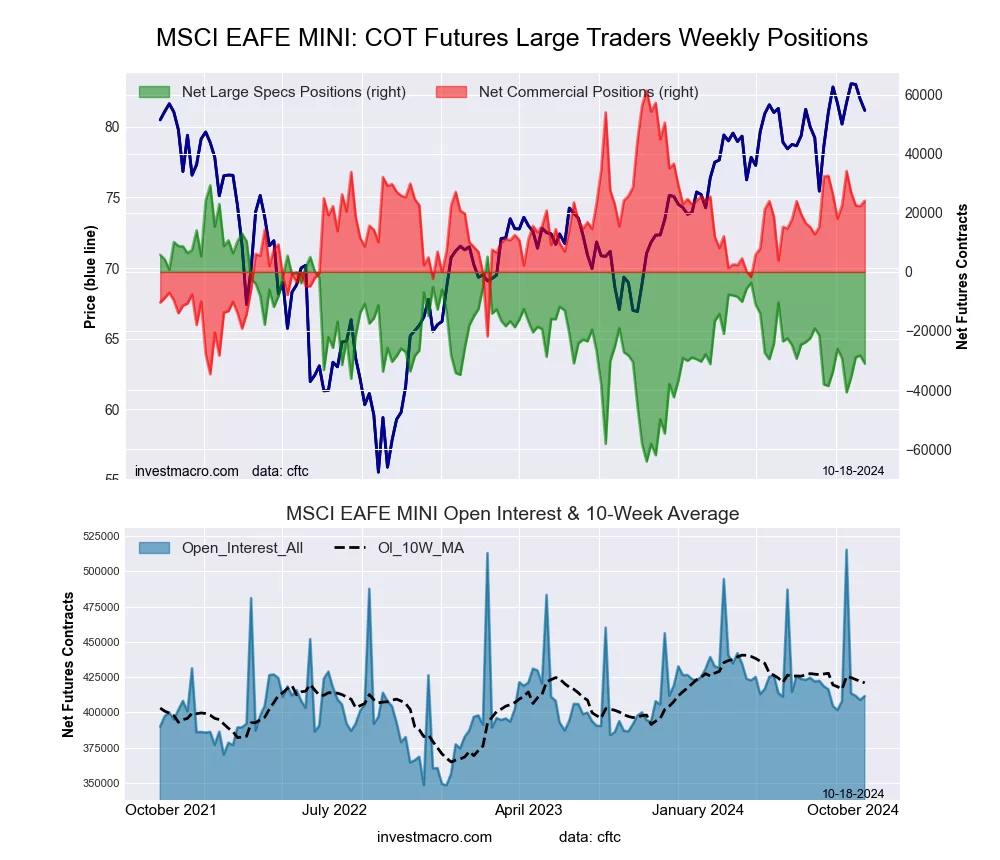
The markets with the declines in speculator bets this week were the S&P500-Mini (-61,352 contracts), the Russell-Mini (-13,871 contracts), the VIX (-4,330 contracts), the Nikkei 225 (-2,316 contracts) and with the MSCI EAFE-Mini (-461 contracts) also registering lower bets on the week.


Stock Market Net Speculators Leaderboard

Legend: Weekly Speculators Change | Speculators Current Net Position | Speculators Strength Score compared to last 3-Years (0-100 range)


Strength Scores led by VIX & DowJones-Mini

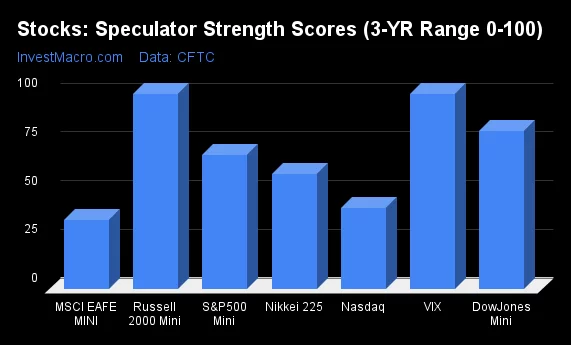
COT Strength Scores (a normalized measure of Speculator positions over a 3-Year range, from 0 to 100 where above 80 is Extreme-Bullish and below 20 is Extreme-Bearish) showed that the VIX (89 percent) and the DowJones-Mini (71 percent) lead the stock markets this week. The Russell-Mini (66 percent) and Nikkei 225 (60 percent) come in as the next highest in the weekly strength scores.

On the downside, the MSCI EAFE-Mini (27 percent) comes in at the lowest strength level currently.

Strength Statistics:
VIX (88.5 percent) vs VIX previous week (93.2 percent)
S&P500-Mini (52.1 percent) vs S&P500-Mini previous week (61.2 percent)
DowJones-Mini (71.2 percent) vs DowJones-Mini previous week (62.3 percent)
Nasdaq-Mini (56.8 percent) vs Nasdaq-Mini previous week (52.3 percent)
Russell2000-Mini (65.9 percent) vs Russell2000-Mini previous week (75.7 percent)
Nikkei USD (59.8 percent) vs Nikkei USD previous week (79.5 percent)
EAFE-Mini (27.4 percent) vs EAFE-Mini previous week (27.9 percent)


VIX & Russell-Mini top the 6-Week Strength Trends

COT Strength Score Trends (or move index, calculates the 6-week changes in strength scores) showed that the VIX (40 percent) leads the past six weeks trends for the stock markets. The Russell-Mini (29 percent), the Nikkei 225 (20 percent) and the Nasdaq-Mini (10 percent) are the next highest positive movers in the latest trends data.

The MSCI EAFE-Mini (-15 percent) leads the downside trend scores currently with the S&P500-Mini (-4 percent) coming in as the next market with lower trend scores.

Strength Trend Statistics:
VIX (39.9 percent) vs VIX previous week (35.9 percent)
S&P500-Mini (-4.4 percent) vs S&P500-Mini previous week (-1.7 percent)
DowJones-Mini (-1.7 percent) vs DowJones-Mini previous week (-8.9 percent)
Nasdaq-Mini (9.6 percent) vs Nasdaq-Mini previous week (-3.6 percent)
Russell2000-Mini (28.7 percent) vs Russell2000-Mini previous week (44.1 percent)
Nikkei USD (20.5 percent) vs Nikkei USD previous week (36.6 percent)
EAFE-Mini (-14.9 percent) vs EAFE-Mini previous week (-9.4 percent)


Individual Stock Market Charts:

VIX Volatility Futures:

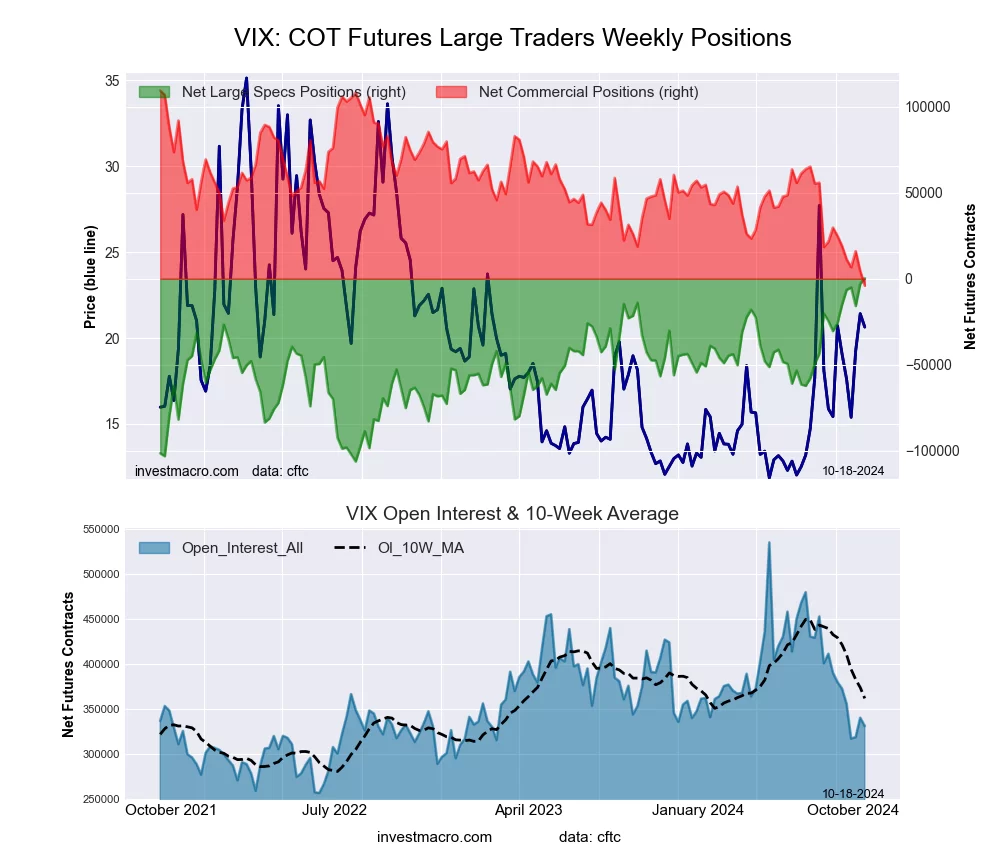
VIX Volatility Futures COT ChartThe VIX Volatility large speculator standing this week recorded a net position of -24,592 contracts in the data reported through Tuesday. This was a weekly lowering of -4,330 contracts from the previous week which had a total of -20,262 net contracts.

This week’s current strength score (the trader positioning range over the past three years, measured from 0 to 100) shows the speculators are currently Bullish-Extreme with a score of 88.5 percent. The commercials are Bearish-Extreme with a score of 3.4 percent and the small traders (not shown in chart) are Bullish-Extreme with a score of 100.0 percent.

Price Trend-Following Model: Strong Uptrend

Our weekly trend-following model classifies the current market price position as: Strong Uptrend. The current action for the model is considered to be: Hold – Maintain Long Position.

VIX Volatility Futures StatisticsSPECULATORSCOMMERCIALSSMALL TRADERS
– Percent of Open Interest Longs:18.247.07.9
– Percent of Open Interest Shorts:24.241.77.2
– Net Position:-24,59221,5313,061
– Gross Longs:75,004193,34832,701
– Gross Shorts:99,596171,81729,640
– Long to Short Ratio:0.8 to 11.1 to 11.1 to 1
NET POSITION TREND:
– Strength Index Score (3 Year Range Pct):88.53.4100.0
– Strength Index Reading (3 Year Range):Bullish-ExtremeBearish-ExtremeBullish-Extreme
NET POSITION MOVEMENT INDEX:
– 6-Week Change in Strength Index:39.9-43.612.8


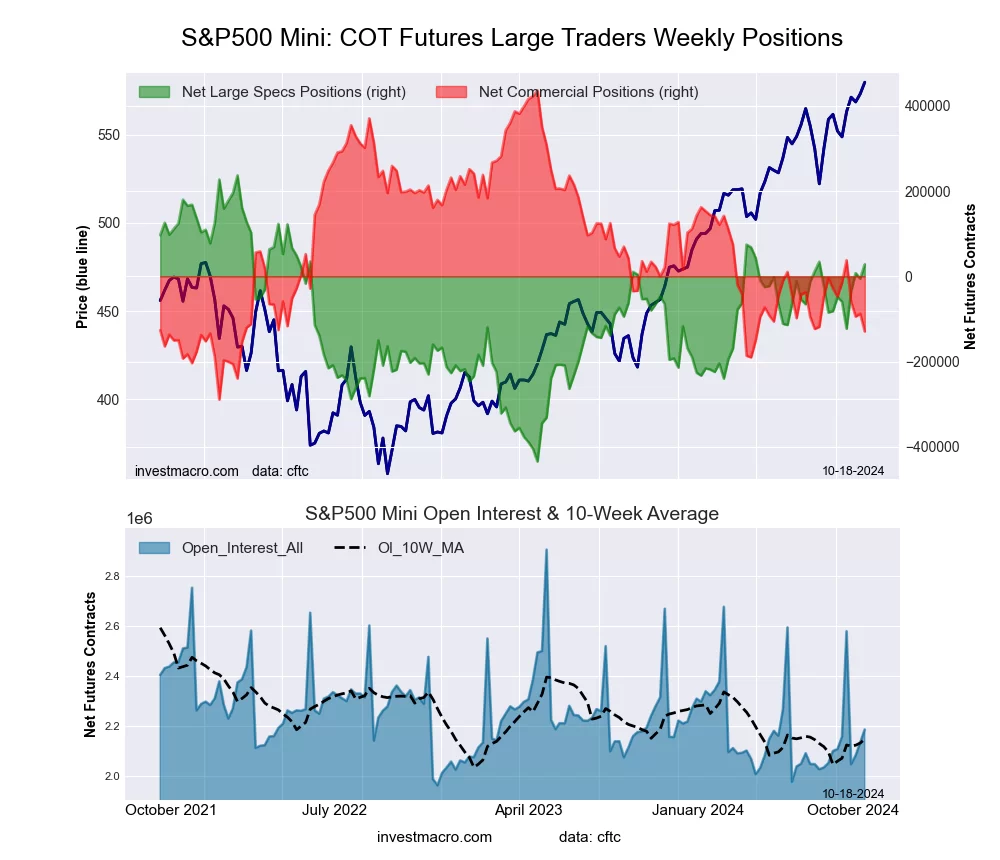
S&P500 Mini Futures:

SP500 Mini Futures COT ChartThe S&P500 Mini large speculator standing this week recorded a net position of -84,803 contracts in the data reported through Tuesday. This was a weekly fall of -61,352 contracts from the previous week which had a total of -23,451 net contracts.

This week’s current strength score (the trader positioning range over the past three years, measured from 0 to 100) shows the speculators are currently Bullish with a score of 52.1 percent. The commercials are Bearish with a score of 39.3 percent and the small traders (not shown in chart) are Bullish with a score of 74.1 percent.

Price Trend-Following Model: Strong Uptrend

Our weekly trend-following model classifies the current market price position as: Strong Uptrend. The current action for the model is considered to be: Hold – Maintain Long Position.

S&P500 Mini Futures StatisticsSPECULATORSCOMMERCIALSSMALL TRADERS
– Percent of Open Interest Longs:13.570.112.7
– Percent of Open Interest Shorts:17.770.48.3
– Net Position:-84,803-4,33989,142
– Gross Longs:277,6341,438,541260,164
– Gross Shorts:362,4371,442,880171,022
– Long to Short Ratio:0.8 to 11.0 to 11.5 to 1
NET POSITION TREND:
– Strength Index Score (3 Year Range Pct):52.139.374.1
– Strength Index Reading (3 Year Range):BullishBearishBullish
NET POSITION MOVEMENT INDEX:
– 6-Week Change in Strength Index:-4.45.3-3.6


Dow Jones Mini Futures:

Dow Jones Mini Futures COT ChartThe Dow Jones Mini large speculator standing this week recorded a net position of 6,728 contracts in the data reported through Tuesday. This was a weekly advance of 5,491 contracts from the previous week which had a total of 1,237 net contracts.

This week’s current strength score (the trader positioning range over the past three years, measured from 0 to 100) shows the speculators are currently Bullish with a score of 71.2 percent. The commercials are Bearish with a score of 27.2 percent and the small traders (not shown in chart) are Bullish with a score of 52.0 percent.

Price Trend-Following Model: Strong Uptrend

Our weekly trend-following model classifies the current market price position as: Strong Uptrend. The current action for the model is considered to be: Hold – Maintain Long Position.

Dow Jones Mini Futures StatisticsSPECULATORSCOMMERCIALSSMALL TRADERS
– Percent of Open Interest Longs:25.856.715.6
– Percent of Open Interest Shorts:18.165.414.6
– Net Position:6,728-7,610882
– Gross Longs:22,50749,41913,628
– Gross Shorts:15,77957,02912,746
– Long to Short Ratio:1.4 to 10.9 to 11.1 to 1
NET POSITION TREND:
– Strength Index Score (3 Year Range Pct):71.227.252.0
– Strength Index Reading (3 Year Range):BullishBearishBullish
NET POSITION MOVEMENT INDEX:
– 6-Week Change in Strength Index:-1.75.0-12.5


Nasdaq Mini Futures:

Nasdaq Mini Futures COT ChartThe Nasdaq Mini large speculator standing this week recorded a net position of 11,381 contracts in the data reported through Tuesday. This was a weekly boost of 2,897 contracts from the previous week which had a total of 8,484 net contracts.

This week’s current strength score (the trader positioning range over the past three years, measured from 0 to 100) shows the speculators are currently Bullish with a score of 56.8 percent. The commercials are Bearish with a score of 28.2 percent and the small traders (not shown in chart) are Bullish with a score of 75.2 percent.

Price Trend-Following Model: Uptrend

Our weekly trend-following model classifies the current market price position as: Uptrend. The current action for the model is considered to be: Hold – Maintain Long Position.

Nasdaq Mini Futures StatisticsSPECULATORSCOMMERCIALSSMALL TRADERS
– Percent of Open Interest Longs:22.858.516.0
– Percent of Open Interest Shorts:18.167.611.5
– Net Position:11,381-22,20510,824
– Gross Longs:55,674142,78338,994
– Gross Shorts:44,293164,98828,170
– Long to Short Ratio:1.3 to 10.9 to 11.4 to 1
NET POSITION TREND:
– Strength Index Score (3 Year Range Pct):56.828.275.2
– Strength Index Reading (3 Year Range):BullishBearishBullish
NET POSITION MOVEMENT INDEX:
– 6-Week Change in Strength Index:9.6-7.10.6


Russell 2000 Mini Futures:

Russell 2000 Mini Futures COT ChartThe Russell 2000 Mini large speculator standing this week recorded a net position of -27,127 contracts in the data reported through Tuesday. This was a weekly fall of -13,871 contracts from the previous week which had a total of -13,256 net contracts.

This week’s current strength score (the trader positioning range over the past three years, measured from 0 to 100) shows the speculators are currently Bullish with a score of 65.9 percent. The commercials are Bearish with a score of 29.5 percent and the small traders (not shown in chart) are Bullish with a score of 73.0 percent.

Price Trend-Following Model: Strong Uptrend

Our weekly trend-following model classifies the current market price position as: Strong Uptrend. The current action for the model is considered to be: Hold – Maintain Long Position.

Russell 2000 Mini Futures StatisticsSPECULATORSCOMMERCIALSSMALL TRADERS
– Percent of Open Interest Longs:15.376.07.4
– Percent of Open Interest Shorts:21.772.74.3
– Net Position:-27,12714,05713,070
– Gross Longs:64,562321,26331,232
– Gross Shorts:91,689307,20618,162
– Long to Short Ratio:0.7 to 11.0 to 11.7 to 1
NET POSITION TREND:
– Strength Index Score (3 Year Range Pct):65.929.573.0
– Strength Index Reading (3 Year Range):BullishBearishBullish
NET POSITION MOVEMENT INDEX:
– 6-Week Change in Strength Index:28.7-28.714.3


Nikkei Stock Average (USD) Futures:

Nikkei Stock Average (USD) Futures COT ChartThe Nikkei Stock Average (USD) large speculator standing this week recorded a net position of -2,391 contracts in the data reported through Tuesday. This was a weekly reduction of -2,316 contracts from the previous week which had a total of -75 net contracts.

This week’s current strength score (the trader positioning range over the past three years, measured from 0 to 100) shows the speculators are currently Bullish with a score of 59.8 percent. The commercials are Bearish with a score of 35.8 percent and the small traders (not shown in chart) are Bullish with a score of 63.2 percent.

Price Trend-Following Model: Strong Uptrend

Our weekly trend-following model classifies the current market price position as: Strong Uptrend. The current action for the model is considered to be: New Buy – Long Position.

Nikkei Stock Average Futures StatisticsSPECULATORSCOMMERCIALSSMALL TRADERS
– Percent of Open Interest Longs:15.860.024.2
– Percent of Open Interest Shorts:32.350.717.0
– Net Position:-2,3911,3421,049
– Gross Longs:2,2958,7113,523
– Gross Shorts:4,6867,3692,474
– Long to Short Ratio:0.5 to 11.2 to 11.4 to 1
NET POSITION TREND:
– Strength Index Score (3 Year Range Pct):59.835.863.2
– Strength Index Reading (3 Year Range):BullishBearishBullish
NET POSITION MOVEMENT INDEX:
– 6-Week Change in Strength Index:20.5-13.1-10.0


MSCI EAFE Mini Futures:

MSCI EAFE Mini Futures COT ChartThe MSCI EAFE Mini large speculator standing this week recorded a net position of -38,563 contracts in the data reported through Tuesday. This was a weekly decline of -461 contracts from the previous week which had a total of -38,102 net contracts.

This week’s current strength score (the trader positioning range over the past three years, measured from 0 to 100) shows the speculators are currently Bearish with a score of 27.4 percent. The commercials are Bullish with a score of 69.9 percent and the small traders (not shown in chart) are Bearish with a score of 46.9 percent.

Price Trend-Following Model: Strong Uptrend

Our weekly trend-following model classifies the current market price position as: Strong Uptrend. The current action for the model is considered to be: Hold – Maintain Long Position.

MSCI EAFE Mini Futures StatisticsSPECULATORSCOMMERCIALSSMALL TRADERS
– Percent of Open Interest Longs:6.690.13.0
– Percent of Open Interest Shorts:15.982.31.6
– Net Position:-38,56332,5566,007
– Gross Longs:27,458375,14312,596
– Gross Shorts:66,021342,5876,589
– Long to Short Ratio:0.4 to 11.1 to 11.9 to 1
NET POSITION TREND:
– Strength Index Score (3 Year Range Pct):27.469.946.9
– Strength Index Reading (3 Year Range):BearishBullishBearish
NET POSITION MOVEMENT INDEX:
– 6-Week Change in Strength Index:-14.913.54.8


Article By InvestMacroReceive our weekly COT Newsletter

*COT Report: The COT data, released weekly to the public each Friday, is updated through the most recent Tuesday (data is 3 days old) and shows a quick view of how large speculators or non-commercials (for-profit traders) were positioned in the futures markets.

The CFTC categorizes trader positions according to commercial hedgers (traders who use futures contracts for hedging as part of the business), non-commercials (large traders who speculate to realize trading profits) and nonreportable traders (usually small traders/speculators) as well as their open interest (contracts open in the market at time of reporting). See CFTC criteria here.