COT Soft Commodities Charts: Lean Hogs & Live Cattle lead Speculator Bets

By InvestMacro

Speculators OI Softs
Here are the latest charts and statistics for the Commitment of Traders (COT) reports data published by the Commodities Futures Trading Commission (CFTC).

The latest COT data is updated through Tuesday June 10th and shows a quick view of how large traders (for-profit speculators and commercial entities) were positioned in the futures markets.

Weekly Speculator Changes led by Lean Hogs & Live Cattle

Speculators Nets Softs
The COT soft commodities markets speculator bets were slightly higher this week as six out of the eleven softs markets we cover had higher positioning while the other five markets had lower speculator contracts.

Leading the gains for the softs markets was Lean Hogs (13,426 contracts) with Live Cattle (11,892 contracts), Soybeans (10,449 contracts), Soybean Meal (6,403 contracts), Wheat (3,211 contracts) and Coffee (2,289 contracts) also showing positive weeks.

The markets with the declines in speculator bets this week were Sugar (-15,671 contracts), Corn (-14,435 contracts), Cotton (-4,430 contracts), Soybean Oil (-685 contracts) and with Cocoa (-232 contracts) also registering lower bets on the week.

Price changes for the week:

– Soybean oil: up almost 6%
– Soybeans: higher by almost 2%
– Lean hogs: rose 1.4%
– Soybean meal: up 1%
– Coffee: down almost 4%
– Cocoa: down almost 3.5%
– Sugar, live cattle, wheat, corn: down over 1%
– Cotton: down almost half a percent


Soft Commodities Data:

Speculators Table Softs
Legend: Weekly Speculators Change | Speculators Current Net Position | Speculators Strength Score compared to last 3-Years (0-100 range)


Strength Scores led by Live Cattle & Lean Hogs

Speculators Strength Softs
COT Strength Scores (a normalized measure of Speculator positions over a 3-Year range, from 0 to 100 where above 80 is Extreme-Bullish and below 20 is Extreme-Bearish) showed that Live Cattle (92 percent) and Lean Hogs (90 percent) lead the softs markets this week. Soybeans (69 percent), Soybean Oil (65 percent) and Coffee (62 percent) come in as the next highest in the weekly strength scores.

On the downside, Sugar (4 percent), Soybean Meal (8 percent), Cotton (15 percent) and the Wheat (18 percent) come in at the lowest strength levels currently and are in Extreme-Bearish territory (below 20 percent).

Strength Statistics:
Corn (23.2 percent) vs Corn previous week (25.2 percent)
Sugar (4.3 percent) vs Sugar previous week (9.4 percent)
Coffee (62.0 percent) vs Coffee previous week (59.8 percent)
Soybeans (68.5 percent) vs Soybeans previous week (65.9 percent)
Soybean Oil (64.6 percent) vs Soybean Oil previous week (65.0 percent)
Soybean Meal (7.7 percent) vs Soybean Meal previous week (5.0 percent)
Live Cattle (91.8 percent) vs Live Cattle previous week (80.3 percent)
Lean Hogs (89.6 percent) vs Lean Hogs previous week (79.3 percent)
Cotton (15.5 percent) vs Cotton previous week (18.2 percent)
Cocoa (29.6 percent) vs Cocoa previous week (29.8 percent)
Wheat (17.7 percent) vs Wheat previous week (15.3 percent)


Lean Hogs & Wheat top the 6-Week Strength Trends

Speculators Trend Softs
COT Strength Score Trends (or move index, calculates the 6-week changes in strength scores) showed that Lean Hogs (35 percent) and Wheat (17 percent) lead the past six weeks trends for soft commodities. Live Cattle (12 percent), Soybeans (3 percent) and Soybean Meal (2 percent) are the next highest positive movers in the latest trends data.

Corn (-37 percent) leads the downside trend scores currently with Sugar (-19 percent), Soybean Oil (-16 percent) and Cotton (-15 percent) following next with lower trend scores.

Strength Trend Statistics:
Corn (-36.9 percent) vs Corn previous week (-41.0 percent)
Sugar (-18.6 percent) vs Sugar previous week (-11.9 percent)
Coffee (-11.6 percent) vs Coffee previous week (-5.8 percent)
Soybeans (2.8 percent) vs Soybeans previous week (1.1 percent)
Soybean Oil (-16.0 percent) vs Soybean Oil previous week (-10.2 percent)
Soybean Meal (2.3 percent) vs Soybean Meal previous week (-9.7 percent)
Live Cattle (11.7 percent) vs Live Cattle previous week (4.1 percent)
Lean Hogs (34.9 percent) vs Lean Hogs previous week (27.2 percent)
Cotton (-15.2 percent) vs Cotton previous week (-4.4 percent)
Cocoa (1.9 percent) vs Cocoa previous week (4.0 percent)
Wheat (16.7 percent) vs Wheat previous week (-2.3 percent)


Individual Soft Commodities Markets:

CORN Futures:

CORN Futures COT ChartThe CORN large speculator standing this week resulted in a net position of -95,494 contracts in the data reported through Tuesday. This was a weekly lowering of -14,435 contracts from the previous week which had a total of -81,059 net contracts.

This week’s current strength score (the trader positioning range over the past three years, measured from 0 to 100) shows the speculators are currently Bearish with a score of 23.2 percent. The commercials are Bullish with a score of 74.5 percent and the small traders (not shown in chart) are Bullish-Extreme with a score of 84.4 percent.

Price Trend-Following Model: Downtrend

Our weekly trend-following model classifies the current market price position as: Downtrend.

CORN Futures StatisticsSPECULATORSCOMMERCIALSSMALL TRADERS
– Percent of Open Interest Longs:19.945.99.5
– Percent of Open Interest Shorts:25.938.810.7
– Net Position:-95,494114,551-19,057
– Gross Longs:321,967740,542153,928
– Gross Shorts:417,461625,991172,985
– Long to Short Ratio:0.8 to 11.2 to 10.9 to 1
NET POSITION TREND:
– Strength Index Score (3 Year Range Pct):23.274.584.4
– Strength Index Reading (3 Year Range):BearishBullishBullish-Extreme
NET POSITION MOVEMENT INDEX:
– 6-Week Change in Strength Index:-36.936.932.3


SUGAR Futures:

SUGAR Futures COT ChartThe SUGAR large speculator standing this week resulted in a net position of -19,515 contracts in the data reported through Tuesday. This was a weekly lowering of -15,671 contracts from the previous week which had a total of -3,844 net contracts.

This week’s current strength score (the trader positioning range over the past three years, measured from 0 to 100) shows the speculators are currently Bearish-Extreme with a score of 4.3 percent. The commercials are Bullish-Extreme with a score of 97.7 percent and the small traders (not shown in chart) are Bearish-Extreme with a score of 11.3 percent.

Price Trend-Following Model: Strong Downtrend

Our weekly trend-following model classifies the current market price position as: Strong Downtrend.

SUGAR Futures StatisticsSPECULATORSCOMMERCIALSSMALL TRADERS
– Percent of Open Interest Longs:24.151.47.9
– Percent of Open Interest Shorts:26.248.58.7
– Net Position:-19,51526,368-6,853
– Gross Longs:217,346464,70671,741
– Gross Shorts:236,861438,33878,594
– Long to Short Ratio:0.9 to 11.1 to 10.9 to 1
NET POSITION TREND:
– Strength Index Score (3 Year Range Pct):4.397.711.3
– Strength Index Reading (3 Year Range):Bearish-ExtremeBullish-ExtremeBearish-Extreme
NET POSITION MOVEMENT INDEX:
– 6-Week Change in Strength Index:-18.616.5-3.9


COFFEE Futures:

COFFEE Futures COT ChartThe COFFEE large speculator standing this week resulted in a net position of 37,306 contracts in the data reported through Tuesday. This was a weekly advance of 2,289 contracts from the previous week which had a total of 35,017 net contracts.

This week’s current strength score (the trader positioning range over the past three years, measured from 0 to 100) shows the speculators are currently Bullish with a score of 62.0 percent. The commercials are Bearish with a score of 38.9 percent and the small traders (not shown in chart) are Bullish with a score of 60.8 percent.

Price Trend-Following Model: Strong Downtrend

Our weekly trend-following model classifies the current market price position as: Strong Downtrend.

COFFEE Futures StatisticsSPECULATORSCOMMERCIALSSMALL TRADERS
– Percent of Open Interest Longs:30.840.95.9
– Percent of Open Interest Shorts:7.366.04.3
– Net Position:37,306-39,8462,540
– Gross Longs:48,93165,0479,338
– Gross Shorts:11,625104,8936,798
– Long to Short Ratio:4.2 to 10.6 to 11.4 to 1
NET POSITION TREND:
– Strength Index Score (3 Year Range Pct):62.038.960.8
– Strength Index Reading (3 Year Range):BullishBearishBullish
NET POSITION MOVEMENT INDEX:
– 6-Week Change in Strength Index:-11.611.8-6.2


SOYBEANS Futures:

SOYBEANS Futures COT ChartThe SOYBEANS large speculator standing this week resulted in a net position of 70,396 contracts in the data reported through Tuesday. This was a weekly advance of 10,449 contracts from the previous week which had a total of 59,947 net contracts.

This week’s current strength score (the trader positioning range over the past three years, measured from 0 to 100) shows the speculators are currently Bullish with a score of 68.5 percent. The commercials are Bearish with a score of 28.4 percent and the small traders (not shown in chart) are Bullish-Extreme with a score of 80.4 percent.

Price Trend-Following Model: Weak Downtrend

Our weekly trend-following model classifies the current market price position as: Weak Downtrend.

SOYBEANS Futures StatisticsSPECULATORSCOMMERCIALSSMALL TRADERS
– Percent of Open Interest Longs:22.248.46.1
– Percent of Open Interest Shorts:14.055.27.5
– Net Position:70,396-58,118-12,278
– Gross Longs:190,383415,95152,035
– Gross Shorts:119,987474,06964,313
– Long to Short Ratio:1.6 to 10.9 to 10.8 to 1
NET POSITION TREND:
– Strength Index Score (3 Year Range Pct):68.528.480.4
– Strength Index Reading (3 Year Range):BullishBearishBullish-Extreme
NET POSITION MOVEMENT INDEX:
– 6-Week Change in Strength Index:2.8-5.221.4


SOYBEAN OIL Futures:

SOYBEAN OIL Futures COT ChartThe SOYBEAN OIL large speculator standing this week resulted in a net position of 41,254 contracts in the data reported through Tuesday. This was a weekly fall of -685 contracts from the previous week which had a total of 41,939 net contracts.

This week’s current strength score (the trader positioning range over the past three years, measured from 0 to 100) shows the speculators are currently Bullish with a score of 64.6 percent. The commercials are Bearish with a score of 37.6 percent and the small traders (not shown in chart) are Bearish with a score of 49.2 percent.

Price Trend-Following Model: Strong Uptrend

Our weekly trend-following model classifies the current market price position as: Strong Uptrend.

SOYBEAN OIL Futures StatisticsSPECULATORSCOMMERCIALSSMALL TRADERS
– Percent of Open Interest Longs:21.149.85.6
– Percent of Open Interest Shorts:14.057.94.6
– Net Position:41,254-47,0325,778
– Gross Longs:122,719289,84032,315
– Gross Shorts:81,465336,87226,537
– Long to Short Ratio:1.5 to 10.9 to 11.2 to 1
NET POSITION TREND:
– Strength Index Score (3 Year Range Pct):64.637.649.2
– Strength Index Reading (3 Year Range):BullishBearishBearish
NET POSITION MOVEMENT INDEX:
– 6-Week Change in Strength Index:-16.017.2-24.6


SOYBEAN MEAL Futures:

SOYBEAN MEAL Futures COT ChartThe SOYBEAN MEAL large speculator standing this week resulted in a net position of -48,116 contracts in the data reported through Tuesday. This was a weekly boost of 6,403 contracts from the previous week which had a total of -54,519 net contracts.

This week’s current strength score (the trader positioning range over the past three years, measured from 0 to 100) shows the speculators are currently Bearish-Extreme with a score of 7.7 percent. The commercials are Bullish-Extreme with a score of 88.4 percent and the small traders (not shown in chart) are Bullish with a score of 62.6 percent.

Price Trend-Following Model: Downtrend

Our weekly trend-following model classifies the current market price position as: Downtrend.

SOYBEAN MEAL Futures StatisticsSPECULATORSCOMMERCIALSSMALL TRADERS
– Percent of Open Interest Longs:19.649.69.1
– Percent of Open Interest Shorts:27.645.25.6
– Net Position:-48,11626,91021,206
– Gross Longs:119,357301,66455,209
– Gross Shorts:167,473274,75434,003
– Long to Short Ratio:0.7 to 11.1 to 11.6 to 1
NET POSITION TREND:
– Strength Index Score (3 Year Range Pct):7.788.462.6
– Strength Index Reading (3 Year Range):Bearish-ExtremeBullish-ExtremeBullish
NET POSITION MOVEMENT INDEX:
– 6-Week Change in Strength Index:2.3-3.416.7


LIVE CATTLE Futures:

LIVE CATTLE Futures COT ChartThe LIVE CATTLE large speculator standing this week resulted in a net position of 115,175 contracts in the data reported through Tuesday. This was a weekly boost of 11,892 contracts from the previous week which had a total of 103,283 net contracts.

This week’s current strength score (the trader positioning range over the past three years, measured from 0 to 100) shows the speculators are currently Bullish-Extreme with a score of 91.8 percent. The commercials are Bearish-Extreme with a score of 7.3 percent and the small traders (not shown in chart) are Bearish with a score of 24.2 percent.

Price Trend-Following Model: Strong Uptrend

Our weekly trend-following model classifies the current market price position as: Strong Uptrend.

LIVE CATTLE Futures StatisticsSPECULATORSCOMMERCIALSSMALL TRADERS
– Percent of Open Interest Longs:51.227.08.4
– Percent of Open Interest Shorts:21.551.413.8
– Net Position:115,175-94,472-20,703
– Gross Longs:198,415104,79332,758
– Gross Shorts:83,240199,26553,461
– Long to Short Ratio:2.4 to 10.5 to 10.6 to 1
NET POSITION TREND:
– Strength Index Score (3 Year Range Pct):91.87.324.2
– Strength Index Reading (3 Year Range):Bullish-ExtremeBearish-ExtremeBearish
NET POSITION MOVEMENT INDEX:
– 6-Week Change in Strength Index:11.7-14.1-1.8


LEAN HOGS Futures:

LEAN HOGS Futures COT ChartThe LEAN HOGS large speculator standing this week resulted in a net position of 80,002 contracts in the data reported through Tuesday. This was a weekly gain of 13,426 contracts from the previous week which had a total of 66,576 net contracts.

This week’s current strength score (the trader positioning range over the past three years, measured from 0 to 100) shows the speculators are currently Bullish-Extreme with a score of 89.6 percent. The commercials are Bearish-Extreme with a score of 6.1 percent and the small traders (not shown in chart) are Bullish with a score of 51.7 percent.

Price Trend-Following Model: Strong Uptrend

Our weekly trend-following model classifies the current market price position as: Strong Uptrend.

LEAN HOGS Futures StatisticsSPECULATORSCOMMERCIALSSMALL TRADERS
– Percent of Open Interest Longs:42.527.47.1
– Percent of Open Interest Shorts:20.548.28.3
– Net Position:80,002-75,715-4,287
– Gross Longs:154,80699,96726,019
– Gross Shorts:74,804175,68230,306
– Long to Short Ratio:2.1 to 10.6 to 10.9 to 1
NET POSITION TREND:
– Strength Index Score (3 Year Range Pct):89.66.151.7
– Strength Index Reading (3 Year Range):Bullish-ExtremeBearish-ExtremeBullish
NET POSITION MOVEMENT INDEX:
– 6-Week Change in Strength Index:34.9-35.1-23.9


COTTON Futures:

COTTON Futures COT ChartThe COTTON large speculator standing this week resulted in a net position of -36,670 contracts in the data reported through Tuesday. This was a weekly lowering of -4,430 contracts from the previous week which had a total of -32,240 net contracts.

This week’s current strength score (the trader positioning range over the past three years, measured from 0 to 100) shows the speculators are currently Bearish-Extreme with a score of 15.5 percent. The commercials are Bullish-Extreme with a score of 85.8 percent and the small traders (not shown in chart) are Bearish with a score of 20.6 percent.

Price Trend-Following Model: Downtrend

Our weekly trend-following model classifies the current market price position as: Downtrend.

COTTON Futures StatisticsSPECULATORSCOMMERCIALSSMALL TRADERS
– Percent of Open Interest Longs:27.248.25.8
– Percent of Open Interest Shorts:43.132.35.9
– Net Position:-36,67036,928-258
– Gross Longs:63,049111,61013,415
– Gross Shorts:99,71974,68213,673
– Long to Short Ratio:0.6 to 11.5 to 11.0 to 1
NET POSITION TREND:
– Strength Index Score (3 Year Range Pct):15.585.820.6
– Strength Index Reading (3 Year Range):Bearish-ExtremeBullish-ExtremeBearish
NET POSITION MOVEMENT INDEX:
– 6-Week Change in Strength Index:-15.212.917.6


COCOA Futures:

COCOA Futures COT ChartThe COCOA large speculator standing this week resulted in a net position of 19,238 contracts in the data reported through Tuesday. This was a weekly decrease of -232 contracts from the previous week which had a total of 19,470 net contracts.

This week’s current strength score (the trader positioning range over the past three years, measured from 0 to 100) shows the speculators are currently Bearish with a score of 29.6 percent. The commercials are Bullish with a score of 67.9 percent and the small traders (not shown in chart) are Bullish-Extreme with a score of 84.0 percent.

Price Trend-Following Model: Downtrend

Our weekly trend-following model classifies the current market price position as: Downtrend.

COCOA Futures StatisticsSPECULATORSCOMMERCIALSSMALL TRADERS
– Percent of Open Interest Longs:32.936.611.9
– Percent of Open Interest Shorts:13.662.05.7
– Net Position:19,238-25,4286,190
– Gross Longs:32,87736,61311,881
– Gross Shorts:13,63962,0415,691
– Long to Short Ratio:2.4 to 10.6 to 12.1 to 1
NET POSITION TREND:
– Strength Index Score (3 Year Range Pct):29.667.984.0
– Strength Index Reading (3 Year Range):BearishBullishBullish-Extreme
NET POSITION MOVEMENT INDEX:
– 6-Week Change in Strength Index:1.9-3.820.1


WHEAT Futures:

WHEAT Futures COT ChartThe WHEAT large speculator standing this week resulted in a net position of -93,863 contracts in the data reported through Tuesday. This was a weekly gain of 3,211 contracts from the previous week which had a total of -97,074 net contracts.

This week’s current strength score (the trader positioning range over the past three years, measured from 0 to 100) shows the speculators are currently Bearish-Extreme with a score of 17.7 percent. The commercials are Bullish-Extreme with a score of 85.2 percent and the small traders (not shown in chart) are Bullish with a score of 58.1 percent.

Price Trend-Following Model: Downtrend

Our weekly trend-following model classifies the current market price position as: Downtrend.

WHEAT Futures StatisticsSPECULATORSCOMMERCIALSSMALL TRADERS
– Percent of Open Interest Longs:24.638.28.4
– Percent of Open Interest Shorts:45.817.08.3
– Net Position:-93,86393,573290
– Gross Longs:108,768168,70437,049
– Gross Shorts:202,63175,13136,759
– Long to Short Ratio:0.5 to 12.2 to 11.0 to 1
NET POSITION TREND:
– Strength Index Score (3 Year Range Pct):17.785.258.1
– Strength Index Reading (3 Year Range):Bearish-ExtremeBullish-ExtremeBullish
NET POSITION MOVEMENT INDEX:
– 6-Week Change in Strength Index:16.7-12.5-38.4


Article By InvestMacroReceive our weekly COT Newsletter

*COT Report: The COT data, released weekly to the public each Friday, is updated through the most recent Tuesday (data is 3 days old) and shows a quick view of how large speculators or non-commercials (for-profit traders) were positioned in the futures markets.

The CFTC categorizes trader positions according to commercial hedgers (traders who use futures contracts for hedging as part of the business), non-commercials (large traders who speculate to realize trading profits) and nonreportable traders (usually small traders/speculators) as well as their open interest (contracts open in the market at time of reporting). See CFTC criteria here.


Platinum, Palladium, Silver Making Big Turns Versus Gold

Source: Barry Dawes (6/13/25) 

Barry Dawes of Martin Place Securities shares his thoughts on the precious metal markets and their stocks and has a warning.

  • Gold seems to be peaking for now
  • 96% bullishness is a warning sign
  • Other commodities ready to move higher
  • CRB Index moving higher again
  • White precious metals heading higher: silver, platinum, palladium

Watch nickel very closely. Copper is set to move higher

Best plays for PGMs: CHN, ZIM

For Silver: LGM

For Nickel: CHN, WMG

GOLD

This still might be resolved to the upside but it is making heavy weather of it this week.

Bullishness for Nth American gold stocks is 96% and neither Newmont nor Barrick look strong.

Short term uptrend broken

Close to testing longer term parabola

GOLD STOCKS

No follow through after new high spike.

Everyone is bullish!

No one left to buy.

No follow through after new high spike

Needs a correction after a big 6 month move higher

SILVER

Hot money from gold has headed here to silver.

That 100:1 gold:silver ratio was too high.  Silver at just 1% of the gold price.

PLATINUM

EVs batteries and ICE catalysts are still fighting it out but Platinum is running a multiyear deficit and prices will have to rise further.

Platinum was grossly oversold vs gold.

A big catch up to come.

PALLADIUM

Palladium is also running a multiyear deficit so current prices are quite unsustainable.

Palladium had that `irregular ‘ B wave new high before declining in 5 waves down to complet Wave 2.

Wave 3 to new highs should follow.

Zimplats (ZIM.ASX) is a strong turnaround as PGM prices turn up.

Chalice (CHN.ASX) will be the principal beneficiary of rising palladium prices.

Watch also for nickel prices.

NICKEL

Indonesian nickel production from saprolite/laterite sources has also is share of unprofitable operations at current nickel prices so closures are likely.

It seems Indonesia has the ESG bug at present so environmental regulations on tailings and on new mining areas are likely to interrupt growth plans.

So much of Western nickel sulphide mine production has closed so if demand keeps rising for stainless steel (~67% of nickel usage) the that surplus in 2025 should turn to deficit in 2026.

A break of this downtrend seems imminent.

Something has to happen here.

Nickel vs gold.

WMG

A higher nickel price will help CHN but also WMG.

CHN’s new metallurgical flowsheet is showing 50 -56% recovery for its 0.24-0.27% Ni ores in Years 1-4 and 30-45% for 0.15-0.17% Ni in later years.

Mulga Tank will be a far cleaner nickel-only ore feed at 0.27% ( and probably much higher in early years starter pits) so perhaps met work might be able to achieve >50% nickel recovery which would have a  major benefit to project profitability.

WMG also has an active drilling program ahead in the September quarter.

WMG 2021-2025 weekly


Important Disclosures:

  1. Barry Dawes: I, or members of my immediate household or family, own securities of: All of the stocks listed in this article, including Zimplats, Chalice Mining, and Western Mines Group. I determined which companies would be included in this article based on my research and understanding of the sector.
  2. Statements and opinions expressed are the opinions of the author and not of Streetwise Reports, Street Smart, or their officers. The author is wholly responsible for the accuracy of the statements. Streetwise Reports was not paid by the author to publish or syndicate this article. Streetwise Reports requires contributing authors to disclose any shareholdings in, or economic relationships with, companies that they write about. Any disclosures from the author can be found  below. Streetwise Reports relies upon the authors to accurately provide this information and Streetwise Reports has no means of verifying its accuracy.
  3.  This article does not constitute investment advice and is not a solicitation for any investment. Streetwise Reports does not render general or specific investment advice and the information on Streetwise Reports should not be considered a recommendation to buy or sell any security. Each reader is encouraged to consult with his or her personal financial adviser and perform their own comprehensive investment research. By opening this page, each reader accepts and agrees to Streetwise Reports’ terms of use and full legal disclaimer. Streetwise Reports does not endorse or recommend the business, products, services or securities of any company.

`For additional disclosures, please click here.

You’re probably richer than you think because of the safety net – but you’d have more of that hidden wealth if you lived in Norway

By Robert Manduca, University of Michigan 

How wealthy are you?

Like most people, you probably would do some math before answering this question. You would add up the money in your bank accounts, the value of your investments and any equity in a home you own, then subtract your debts, such as mortgages and car loans.

But many economists believe this approach, known as calculating your net worth, leaves out a big chunk of your wealth: the benefits you’ll get in the future from Social Security, if you live in the United States, or similar government benefits programs that help retirees pay their bills in other countries.

As a sociologist who studies income and wealth inequality, I wanted to figure out just how much government safety net programs are worth to their recipients, and whether they truly can substitute for private savings.

A $40 trillion trove

A team of researchers recently estimated that future Social Security payments amounted to more than US$40 trillion as of 2019 – about $123,000 for everyone in the U.S. That huge number, which is not adjusted for inflation, was nearly one-third of the $110 trillion of Americans’ collective net worth in that year.

In a recent peer-reviewed study, published in April 2025 in Socio-Economic Review, I found that even this expanded definition of wealth leaves some important things out: unemployment insurance, the child tax credit and other widely available benefits. People who have access to these programs don’t have to dip into their savings as much when unexpected costs come up.

Social Security is by far the largest of these programs. As of 2019, the typical worker nearing retirement had banked about $412,000 in future Social Security benefits, I found – nearly as much as the $472,000 in private retirement savings such workers had. This estimate doesn’t include Social Security benefits to orphans, widows or people with disabilities.

The value of Social Security retirement benefits varies according to workers’ income and work history, ranging from $271,000 for the poorest 10% of recipients to $669,000 for the richest 10%.

Benefits from smaller safety net programs can also add up. Because some programs differ by state, I analyzed California and Texas, the two largest states. In California, I calculated that the average 45-year-old worker can count on almost $12,000 in unemployment insurance over 26 weeks, while in Texas the same worker would be eligible for more than $15,000 over the same period.

Meanwhile, under current law, many families having a child in 2025 can expect to receive about $29,000 through the federal child tax credit over the course of that kid’s lifetime.

Texas doesn’t mandate paid family leave, but California requires that each parent receive eight weeks of their salary. That’s worth another $13,000 to a family earning $90,000 a year – the median in my study – and more if the parents have higher incomes.

Where there’s even more hidden wealth

These somewhat hidden sources of wealth are worth far more in many other countries, especially Scandinavian ones. Norway provides a useful contrast.

The typical Norwegian worker retires with more than $510,000 in public pension wealth, I calculated. The exact amount they collect will vary depending on what they’ve earned and how long they live, as is the case with Social Security. But, unlike in the U.S., if they get sick, Norwegians are eligible for a up to a year of paid sick leave – worth about $57,000 to the median worker.

Norwegians can get unemployment insurance benefits for almost two years, amounting to $70,000 for the average worker, depending on their wages. And the combination of Norway’s child benefit and parental leave is worth between $60,000 and $80,000 from the time each child is born until they turn 18, depending on the parents’ exact income.

In the past few years, researchers have estimated the wealth value of public pensions – though not other government benefits – in several countries, including Australia, Austria, Germany, Poland and Switzerland, among others.

In many nations, this value rivals or exceeds that of all stocks, real estate and other private assets held by their residents combined.

Because so many people are eligible for Social Security or its equivalent public pension programs in other countries, there is also much less inequality in total retirement wealth than in standard measures of net worth.

Wealth vs. income

Wealth is much more unequally distributed than income just about everywhere. In the United States, for example, the richest 5% of the population has 32% of all income, but 70% of all wealth.

Wealth inequality has grown over time, and the Black-white wealth gap in the United States is particularly large. While typical Black families have incomes that are about 56% of what white families earn, they own only 18% as much wealth as the typical white family.

For these reasons, many politicians, scholars and activists have proposed ambitious policies to reduce inequality in private wealth, such as a wealth tax. Another idea gaining in popularity is to start issuing “baby bonds,” which give each newborn a prefunded savings account.

Wealth embedded in government benefits offers a complementary method of addressing wealth inequality. Even today, when Social Security and similar pension programs in other places are counted alongside private savings, inequality in retirement wealth is much lower than in privately held wealth alone.

Less flexible source of wealth

To be sure, the wealth you’re eventually due through Social Security and other government programs isn’t the same as the private assets you might own.

You can’t sell or borrow against your future Social Security benefits to meet an unexpected expense or make a down payment on a home. And if you die before reaching retirement age, you won’t receive any payments from the Social Security system yourself, although your spouse or heirs may be eligible for survivor benefits.

Also, government programs are not set in stone. Eligibility requirements can change, and benefit levels can be cut.

For instance, if the Social Security trust fund is depleted, retirees could see their benefits decline. But private wealth is also never guaranteed to last: Stock values can fluctuate wildly, and inflation erodes the value of any cash you’ve saved over time.

For these reasons, having a combination of private savings and government benefits offers the most promising way for everyone to prepare for their future. This can also help society address wealth inequality.The Conversation

About the Author:

Robert Manduca, Assistant Professor of Sociology, University of Michigan

This article is republished from The Conversation under a Creative Commons license. Read the original article.

Week Ahead: Dollar braces for massive week of risk events

By ForexTime 

  • FXTM’s USDInd ↓ 1% MTD 
  • Geopolitical risk + Fed decision = fresh volatility? 
  • Over past year Fed decision triggered moves of ↑ 0.4% & ↓ 0.8% 
  • GBP + JPY + CHF + SEK = 33% of USDInd weight
  • Technical levels: 98.00, 98.70 and 50-day SMA 

Escalating tensions in the Middle East have put financial markets in a chokehold, with investors steering clear of riskier assets.

Israel attacked Iran’s nuclear program sites early Friday morning. In response, Iran has launched over 100 drones.

Mounting geopolitical risk, major central bank decisions and top-tier data could provide fresh trading opportunities in the week ahead:

Sunday, 15th June 

  • G7 Leaders’s Summit

Monday, 16th June 

  • CN50: China retail sales, industrial production
  • USDInd: US Empire Manufacturing

Tuesday, 17th June 

  • GER40: Germany ZEW survey expectations
  • JPY: BoJ rate decision
  • NZD: New Zealand food prices
  • US500: US retail sales, business inventories, industrial production

Wednesday, 18th June

  • EUR: Eurozone CPI
  • JP225: Japan machinery orders, trade
  • ZAR: South Africa retail sales, CPI
  • SEK: Sweden rate decision
  • UK100: UK CPI
  • US500: Fed decision, initial jobless claims

Thursday, 19th June

  • AUD: Australia unemployment
  • NZD: New Zealand GDP
  • CHF: Switzerland rate decision
  • TWN: Taiwan rate decision
  • GBP: BoE rate decision
  • Juneteenth federal holiday in US – equity markets closed

Friday, 20th June

  • CN50: China loan prime rates
  • CAD: Canada retail sales, materials prices
  • EU50: Eurozone consumer confidence
  • JPY: Japan CPI
  • UK100: UK retail sales
  • RUS2000: US Conf. Board leading index, Philadelphia Fed services

The spotlight shines on FXTM’s USDInd, which is attempting to rebound from a 3-year low. 

Imagen
USD455

Note: FXTM’s USDInd measures how the dollar performs against a basket of six different G10 currencies, including the Euro, British Pound, Japanese Yen, and Canadian dollar, Swedish krona & Swiss franc. 


Here is how they are weighted:

  • Euro: 57.6%
  • JPY: 13.6% 
  • GBP: 11.9% 
  • CAD: 9.1% 
  • SEK: 4.2%
  • CHF: 3.6%

Geopolitical tensions and central bank decisions could spell fresh volatility for the USDInd.

Here are 4 reasons why:


1) Israel-Iran conflict

A major escalation of tensions in the Middle East has sparked a risk-off mood, with uncertainty fuelling appetite for safe-haven assets.

  • Should the situation worsen and risk spilling over into a wider conflict, investors may rush toward safe-haven destinations like the US dollar.
  • Signs of easing tensions may lift the market mood, weakening the dollar as appetite for safe-haven assets cools.


2) Fed rate decision

The Federal Reserve is widely expected to leave interest rates unchanged in June, but the updated dot plot and Jerome Powell’s press conference may shape the dollar’s outlook.

Note: The latest US CPI report increased less than expected in May with traders currently pricing in 2 Fed cuts for 2025. To add, the Fed is not expected to cut rates until September 2025. 

  • The USDInd could jump if the updated “dot plot” signals only one rate cut in 2025 and Powell strikes a hawkish note.
  • Should Powell strike a dovish note and signal lower rates down the line, the dollar may weaken.

Over the past 12 months, the Fed decision has triggered upside moves on the USDInd of as much as 0.4% or declines of 0.8% in a 6-hour window post-release.

Note: The US Empire Manufacturing report on Monday, US retail sales report on Tuesday, initial jobless claims on Wednesday and US Conf. Board leading index published Friday may influence the dollar’s performance. 


3) BoE, BoJ, SNB & Riksbank decisions

The Bank of England, Bank of Japan, Swedish National Bank and Riksbank all have their policy decisions. Markets expect the BoE and BoJ to leave rates unchanged, but both the SNB and Riksbank are expected to cut rates.

It is worth noting that the GBP, JPY, SEK and CHF make up roughly 33% of the USDInd weighting. 

So, these central bank decisions could translate to additional volatility for the USDInd.


4) Technical forces

FXTM’s USDInd is respecting a bearish channel on the daily charts. However, the Relative Strength Index is close to 30 – signalling that prices are nearly oversold.

  • A solid breakout and daily close above 98.70 could signal a move back toward the 50-day SMA at 100.00 and 100.80.
  • Sustained weakness below 98.00 could see prices decline back toward 97.65, 97.00 and 96.00 – a level not seen since February 2022.
Imagen
DXY4555

Forex-Time-LogoArticle by ForexTime

ForexTime Ltd (FXTM) is an award winning international online forex broker regulated by CySEC 185/12 www.forextime.com

Oil prices jumped to $75 per barrel. Israel attacked Iran’s nuclear infrastructure

By JustMarkets 

At the end of the trading day, the Dow Jones Index (US30) rose by 0.24%. The S&P500 (US500) Index rose by 0.38%. The Nasdaq (US100) technology index closed higher by 0.24%, helped by a 13% rise in Oracle shares after strong quarterly results and an encouraging forecast for cloud technology growth driven by demand for AI. However, Boeing shares fell 4.7% after the fatal crash of Air India’s Dreamliner aircraft, which put pressure on the Dow Jones index.

Economic data showed further signs of weakening inflation: the producer price index rose by only 0.1% in May, raising hopes for a Federal Reserve rate cut this year. President Trump reiterated that he insists on a significant rate cut and confirmed plans to send letters regarding tariffs to US trading partners, expressing confidence that trade relations with China will be normalized. Initial jobless claims in the US for the first week of June remained at 248,000, unchanged from the previous week’s revised figure and defying market expectations of a decline to 240,000. The figure remained at its highest level since early October 2024, signaling the first signs of easing in the labor market amid ongoing economic uncertainty.

In June, the Canadian dollar rose to around 1.36 per US dollar, its strongest level in eight months, primarily due to the weakening of the US dollar resulting from lower-than-expected inflation in the US and a reassessment of Fed policy. Domestically, the Bank of Canada’s decision in June to hold rates steady, abandoning its tightening bias, underscored a shift toward neutrality, narrowing the policy gap with the Fed and boosting the loonie.

Bitcoin fell to around US$103,700, continuing the losses of recent sessions and reaching a two-week low, as escalating geopolitical tensions and economic uncertainty triggered risk aversion. Israel’s preemptive strike on Iran and its declaration of a state of emergency increased the risk of imminent Iranian retaliation. In addition to broader market risks, President Donald Trump threatened new tariffs as the deadline for trade deals approached in early July.

European stock markets were mostly lower yesterday. The German DAX (DE40) fell by 0.74%, the French CAC 40 (FR40) closed down 0.14%, the Spanish IBEX35 (ES35) lost 0.32%, and the British FTSE 100 (UK100) closed 0.23%. President Donald Trump announced plans to send letters to major trading partners within a week or two, specifying unilateral tariffs that would be imposed. This move added uncertainty to global trade dynamics. However, Treasury Secretary Scott Bessent said that the 90-day pause on reciprocal tariffs could be extended for countries showing “goodwill” in negotiations.

On Friday, WTI crude oil futures jumped to around $75 per barrel, reaching their highest level since January, driven by fears of supply disruptions after Israel launched a preemptive strike on Iran. The prospect of a wider Middle East conflict threatens to disrupt the Strait of Hormuz, a key route through which about 20% of the world’s oil flows.

Asian markets declined yesterday. Japan’s Nikkei 225 (JP225) fell by 0.65%, China’s FTSE China A50 (CHA50) lost 0.25%, Hong Kong’s Hang Seng (HK50) fell by 1.36%, and Australia’s ASX 200 (AU200) showed a negative result of 0.31% on Thursday.

The Australian dollar fell to $0.649 on Friday, reversing the previous session’s gains amid weakening risk sentiment amid escalating tensions in the Middle East. The sharp escalation followed Israel’s preemptive strike on Iran, targeting Tehran’s nuclear program and vowing to continue operations until the threat is neutralized. This move fueled fears of retaliation by Iran and a broader regional conflict, putting pressure on risk-sensitive currencies such as the Australian dollar.

S&P 500 (US500) 6,045.23 +22.99 (+0.38%)

Dow Jones (US30) 42,967.62 +101.85 (+0.24%)

DAX (DE40) 23,771.45 −177.45 (−0.74%)

FTSE 100 (UK100) 8,884.92 +20.57 (+0.23%)

USD index 97.93 −0.70 (−0.70%)

News feed for: 2025.06.13

  • Japan Industrial Production (m/m) at 07:30 (GMT+3);
  • German Consumer Price Index (m/m) at 09:00 (GMT+3);
  • Eurozone Trade Balance (m/m) at 12:00 (GMT+3);
  • US Michigan Consumer Sentiment (m/m) at 17:00 (GMT+3).

By JustMarkets


This article reflects a personal opinion and should not be interpreted as an investment advice, and/or offer, and/or a persistent request for carrying out financial transactions, and/or a guarantee, and/or a forecast of future events.

The World Bank downgraded its global economic growth expectations. The Australian Index renewed its historical maximum

By JustMarkets 

At the end of the trading day, the Dow Jones Index (US30) rose by 0.25%. The S&P 500 Index (US500) gained 0.55%. The Nasdaq Technology Index (US100) closed higher by 0.66%. The US stocks rose on Tuesday as investors kept a close eye on trade talks between the US and China, boosted by comments from Commerce Secretary Howard Lutnick, who said the talks were going “very, very well”. Energy led sector gains, followed by consumer staples and health care, while industrials lagged. Technology stocks were strong, with Tesla jumping 5.7% and leading the large-company gains.

The World Bank downgraded its 2025 global growth expectations to 2.3% from 2.7% projected in January, which would be the weakest in 17 years except for the 2009 and 2020 recessions. For 2026, global growth is expected at 2.4%, also below the 2.7% previously expected. According to the bank, global growth is slowing due to a significant increase in trade barriers and the pervasive impact of global policy uncertainty. The US GDP growth expectations for 2025 was revised downward to 1.4% from 2.3% in January. Projections for China were left unchanged at 4.5%. The Eurozone and Japan are expected to grow by 0.7%, down 0.3 pp and 0.5 pp respectively. India’s GDP is expected to grow by 6.3% (vs. 6.7%), while Mexico’s growth has also been revised down to 0.2% from 1.5%.

Equity markets in Europe traded flat yesterday. Germany’s DAX (DE40) fell by 0.77%, France’s CAC 40 (FR40) closed higher by 0.17%, Spain’s IBEX35 (ES35) lost 0.21%, and the UK’s FTSE 100 (UK100) closed positive 0.24%.

WTI crude oil prices fell below $65 a barrel on Wednesday, extending losses from the previous session, pressured by higher expectations for global inventory growth. In its latest short-term prognosis, the EIA predicts oil inventories growth will average 0.8 million barrels per day in 2025, up 0.4 million barrels per day from last month. According to the EIA, slowing oil demand growth combined with rising production is expected to cause global production to exceed consumption.

Asian markets traded flat yesterday. Japan’s Nikkei 225 (JP225) was up 0.32%, China’s FTSE China A50 (CHA50) was down 0.18%, Hong Kong’s Hang Seng (HK50) was 0.08% cheaper and Australia’s ASX 200 (AU200) was positive 0.84%.

The ASX 200 Index (AU200) rose 0.4% to 8,620 on Wednesday, hitting a new record high amid optimism over US-China trade talks and hopes of further RBA rate cuts. Markets now estimate a 97% chance of a 25bp rate cut in July, with futures suggesting an overall rate easing of 75bp to 3.1% by the end of the year. This sentiment came after a string of weak economic data, including GDP growth of just 0.2%. Additional pressure came from a strengthening US dollar ahead of key US inflation data due for release today, which could affect the Fed’s rate outlook.

S&P 500 (US500) 6,038.81 +32.93 (+0.55%)

Dow Jones (US30) 42,866.87 +105.11 (+0.25%)

DAX (DE40) 23,987.56 −186.76 (−0.77%)

FTSE 100 (UK100) 8,853.08 +20.80 (+0.24%)

USD Index 99.04 +0.10 (+0.10%)

News feed for: 2025.06.11

  • Japan Producer Price Index (m/m) at 02:50 (GMT+3);
  • US Consumer Price Index (m/m) at 15:30 (GMT+3);
  • US Crude Oil Inventories (w/w) at 17:30 (GMT+3).

By JustMarkets


This article reflects a personal opinion and should not be interpreted as an investment advice, and/or offer, and/or a persistent request for carrying out financial transactions, and/or a guarantee, and/or a forecast of future events.

USD/JPY continues to climb: the yen loses its safe-haven appeal

By RoboForex Analytical Department 

The USD/JPY pair remains in an uptrend, trading around 145.00 on Wednesday and nearing a two-week low for the yen. The Japanese currency is under continued pressure as demand for safe-haven assets fades, fuelled by growing optimism over US-China trade negotiations.

Trade optimism undermines yen demand

Positive signals from the US-China trade talks have eased market tensions. After two days of meetings, both delegations described the dialogue as productive, with discussions expected to continue today. Reports suggest that diplomats have reached a preliminary agreement on implementing the Geneva Consensus. Under the agreement, China could ease export restrictions on rare earth metals, while the US might loosen controls on advanced technology sales to China.

This improving external backdrop has diminished the appeal of the yen as a safe-haven asset, contributing to the continued strength of the dollar against it.

Domestically, Japan’s producer price inflation rose 3.2% y/y in May, marking the slowest growth in eight months. This suggests easing cost pressures in production, which could reduce the urgency for aggressive monetary tightening.

Still, Bank of Japan Governor Kazuo Ueda reaffirmed in parliament on Tuesday that the central bank remains prepared to implement a new rate hike, provided there is confidence in the sustainability of core inflation around the 2% target.

Technical analysis of USD/JPY

On the H4 chart, USD/JPY is moving upwards from support at 144.00, targeting 145.50, which is expected to be reached today. After hitting this level, a pullback to 144.00 is anticipated. Should the pair break below 144.00, the next move may extend to 142.20, with the possibility of continuing further to 140.50. A breakout above 145.50 would open the door to 146.25. The MACD indicator supports the bullish view, with its signal line above zero and pointing sharply upwards within the histogram zone.

On the H1 chart, the pair is building an upward wave structure towards 145.50, which is likely to be fulfilled today. A corrective move to 144.00 is expected to follow. The pair remains in a broad consolidation range around these levels. The Stochastic oscillator also confirms this scenario, with its signal line above 50 and heading towards 80, indicating continued upward momentum in the short term.

Conclusion

USD/JPY continues to rise as risk appetite grows, and trade-related optimism diminishes the appeal of the yen. While positive domestic data and a willing BoJ support the yen longer term, the near-term technical setup remains bullish. Key resistance lies at 145.50 and 146.25, while a potential pullback could find support at 144.00, with deeper levels at 142.20 and 140.50 if the trend reverses.


Disclaimer

Any forecasts contained herein are based on the author’s particular opinion. This analysis may not be treated as trading advice. RoboForex bears no responsibility for trading results based on trading recommendations and reviews contained herein.

The Mexican peso rose to a nine-month high. WTI crude oil is trading above $65 per barrel

By JustMarkets 

The US stocks closed mostly higher on Monday as trade talks between the US and China began in London, reviving hopes for a tariff truce. At the end of the trading day, the Dow Jones Index (US30) fell by 0.03%. The S&P 500 Index (US500) rose by 0.09%. The Nasdaq technology Index (US100) closed higher by 0.31%. The prospect of a breakthrough contributed to improved market sentiment: consumer, commodity, and technology stocks rose, while financial companies lagged behind.

The US consumer inflation expectations for the coming year fell to 3.2% in May 2025 from 3.6% in April, the lowest level in the last three months. At the same time, inflation expectations for the three-year horizon fell by 0.2% to 3.0%, and inflation expectations for the five-year horizon fell by 0.1% to 2.6%.

The Mexican peso rose to 19.10 per US dollar, its strongest level in the last nine months, thanks to the Bank of Mexico’s hawkish expectations and a softer US dollar. In May, core inflation rose to 4.42%, the highest level in six months, while headline inflation accelerated to 4.06%, an 11-year high, limiting the possibility of a rate cut in the near future.

European stock markets were mostly lower yesterday. The German DAX (DE40) fell by 0.54%, the French CAC 40 (FR40) closed down 0.17%, the Spanish IBEX35 (ES35) added 0.03%, and the British FTSE 100 (UK100) closed down 0.06%. In Europe, markets are preparing for a tense week, with the release of US inflation data and final CPI data for Germany, France, Spain, and Italy, which could influence expectations regarding Central Bank actions. In May 2025, UK retail sales rose by only 0.6% in comparable prices, significantly below market expectations of 2.7% growth, compared to April’s 6.8% increase. This is the slowest pace of growth in the last six months, as rising prices and higher monthly bills continue to put pressure on household budgets.

On Monday, WTI crude oil prices rose to $65 per barrel, the highest in two months, thanks to optimism about trade talks between the US and China and seasonal demand growth. The peak summer travel season is approaching, which typically increases fuel consumption and supports prices. Geopolitical tensions added pressure to prices as Russia launched major drone and missile strikes on Kyiv after Ukraine struck Russian air bases, increasing the risk of expanded sanctions on Russian energy exports.

Asian markets traded without a single trend yesterday. Japan’s Nikkei 225 (JP225) rose by 0.92%, China’s FTSE China A50 (CHA50) lost 0.17%, Hong Kong’s Hang Seng (HK50) added 1.63%, and the Australian ASX 200 (AU200) showed a negative result of 0.27%.

On Tuesday, the New Zealand dollar fell to 0.603 US dollars, reversing the previous session’s gains, as the US dollar regained strength on optimism about trade negotiations between the US and China. It is widely expected that the Reserve Bank of New Zealand (RBNZ) will slow the pace of rate cuts despite the deterioration in economic expectations. The policy decision in May signaled that the easing cycle may be coming to an end, and markets now expect the RBNZ to keep rates on hold in July and possibly make a final cut in August.

The NAB Business Confidence Index in Australia rose to 2 in May 2025 from negative 1 in April, turning positive for the first time since January and reaching its highest level in four months. Sentiment improved in most sectors, except for manufacturing, mining, and wholesale trade. However, business conditions deteriorated again (0 vs. 2 in April). The Westpac-Melbourne Institute’s Consumer Sentiment Index rose 0.5% month-on-month to 92.6 in June 2025, slowing sharply from 2.2% growth in May amid ongoing uncertainty over global trade. Nevertheless, this is the fourth increase this year, driven by the Reserve Bank’s May rate cut and signs of easing inflation.

S&P 500 (US500) 6,005.88 +5.52 (+0.09%)

Dow Jones (US30) 42,761.76 −1.11 (−0.03%)

DAX (DE40) 24,174.32 24,174.32 −130.14 (−0.54%)

FTSE 100 (UK100) 8,832.28 −5.63 (−0.06%)

USD Index 99.02 −0.17 (−0.17%)

News feed for: 2025.06.10

  • Australia Westpac Consumer Confidence at 03:30 (GMT+3);
  • Australia NAB Business Confidence at 04:30 (GMT+3);
  • Norway Inflation Rate (m/m) at 09:00 (GMT+3);
  • UK Average Earnings Index (m/m) at 09:00 (GMT+3);
  • UK Claimant Count Change (m/m) at 09:00 (GMT+3);
  • UK Unemployment Rate (m/m) at 09:00 (GMT+3).

By JustMarkets


This article reflects a personal opinion and should not be interpreted as an investment advice, and/or offer, and/or a persistent request for carrying out financial transactions, and/or a guarantee, and/or a forecast of future events.

Gold under pressure again as risk appetite improves

By RoboForex Analytical Department 

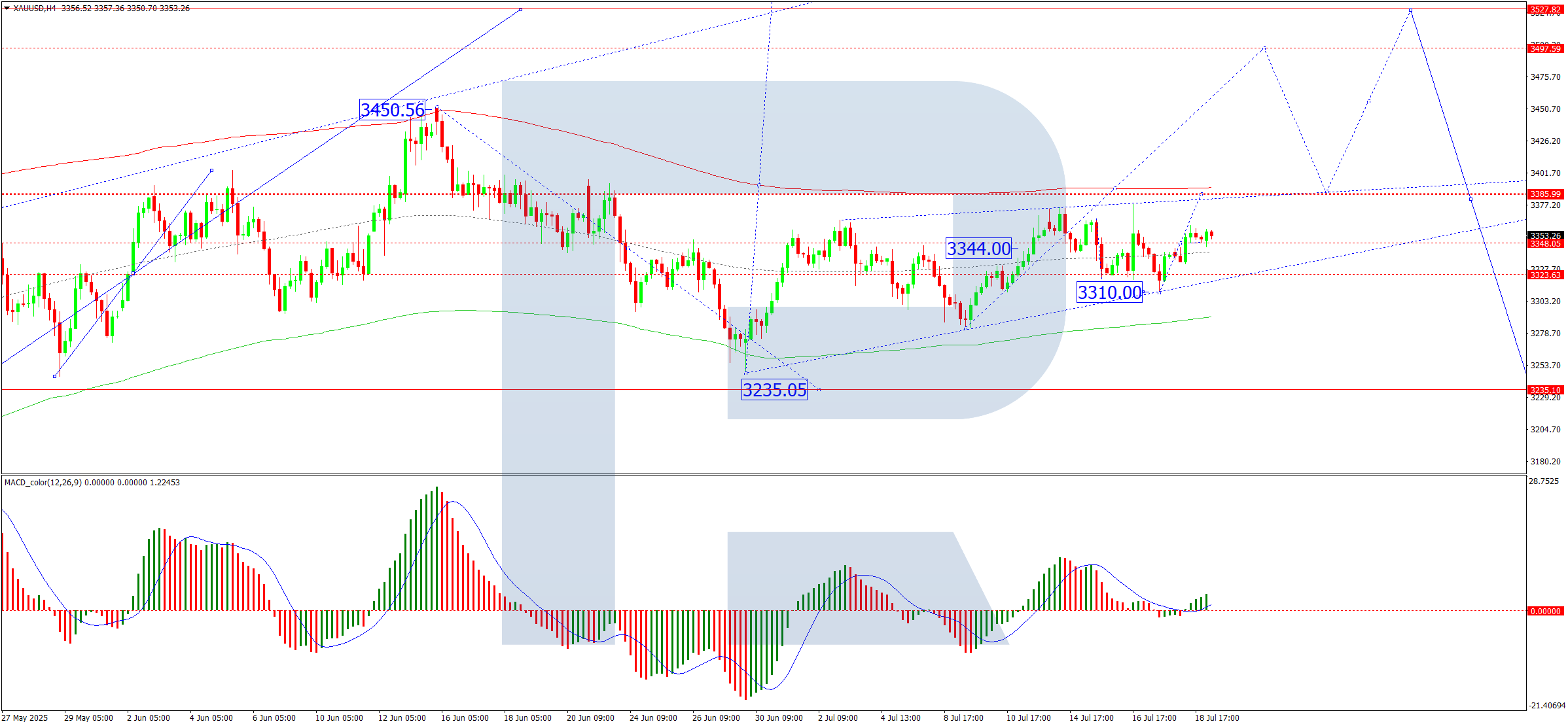
The price of gold declined to 3,307 USD per troy ounce on Tuesday as investor appetite for risk increased amid growing optimism over a potential de-escalation in US-China trade tensions.

Trade optimism weakens demand for safe-haven assets

The improvement in market sentiment stems from the high-level trade talks between the US and China, which began in London on Monday and continue today. Both sides are working to stabilise a fragile truce, with discussions now extending beyond tariffs to include strategic materials such as rare earth elements.

US Treasury Secretary Scott Bessent described Monday’s session as “a good meeting”, while Commerce Secretary Howard Lutnick called the talks “fruitful”. These positive signals are fuelling hopes for a normalisation of relations between the world’s two largest economies, thereby reducing the appeal of defensive assets like gold.

Investors are also closely watching upcoming US inflation reports, which will include both consumer and producer price indices. These data points could provide crucial insight into the Federal Reserve’s future monetary policy stance.

Meanwhile, a survey by the Federal Reserve Bank of New York, released on Monday, showed that Americans’ inflation expectations declined in May while confidence in personal finances improved, adding to the overall risk-on sentiment.

Technical analysis of XAU/USD

On the H4 chart, XAU/USD is developing a corrective structure targeting 3,263 USD. Once this correction is complete, a new upward wave towards 3,419 USD is expected. The MACD indicator supports this view, with its signal line positioned below zero and pointing sharply downwards, indicating a short-term bearish phase within a broader bullish setup.

On the H1 chart, the market formed a consolidation range around 3,331 USD, then broke downwards, reaching the local target at 3,294 USD. A subsequent correction to 3,333 USD has now been fulfilled. Today, the development of a fifth-wave structure is anticipated to reach 3,263 USD. Following this move, gold is expected to resume its growth towards 3,419 USD. The Stochastic oscillator confirms the current outlook, with its signal line below 50 and heading sharply towards 20, signalling continued downward momentum in the short term.

Conclusion

Gold remains under pressure as improving geopolitical sentiment and a better economic outlook dampen demand for safe-haven assets. Near-term technicals indicate further downside towards 3,263 USD, followed by a potential bullish reversal targeting 3,419 USD. Key drivers in the coming sessions will include US inflation data and progress in the US-China trade negotiations.


Disclaimer

Any forecasts contained herein are based on the author’s particular opinion. This analysis may not be treated as trading advice. RoboForex bears no responsibility for trading results based on trading recommendations and reviews contained herein.

Why the global tax system needs fixing – podcast

By Mend Mariwany, The Conversation

For decades, multinational corporations have used sophisticated strategies to shift profits away from where they do business. As a result, countries around the world lose an estimated US$500 billion annually in unpaid taxes, with developing nations hit particularly hard.

In the first of two episodes for The Conversation Weekly podcast called The 15% solution, we explore how companies have exploited loopholes in the global tax system. The episode features insights from Annette Alstadsæter, director of the Centre for Tax Research at the Norwegian University of Life Sciences, and Tarcisio Diniz Magalhaes, a professor of tax law at the University of Antwerp in Belgium.

The problem goes beyond clever accounting. Our international tax rules were built for an industrial age where companies were physically present where they operated. But today’s tech giants can generate billions in revenue from users around the world, without having a single employee or office there, leaving those nations unable to tax those profits at all.

In 2021, after years of international negotiations, the Organisation for Economic Co-operation and Development unveiled a global tax deal designed to address tax avoidance through a minimum corporate tax rate of 15%. But will this new framework actually work? And what happens when major economies refuse to participate?

Across two episodes, The 15% solution explores why a new global tax regime is needed, whether it can fix a broken system, and what’s at stake if it fails. Part two will be published on June 6.


This episode of The Conversation Weekly was written and produced by Mend Mariwany. Gemma Ware is the executive producer. Mixing and sound design by Eloise Stevens and theme music by Neeta Sarl.

Newsclips in this episode from NBC News, France24, BBC News, DW News and TRT World.

Listen to The Conversation Weekly via any of the apps listed above, download it directly via our RSS feed or find out how else to listen here. A transcript of this episode is available on Apple Podcasts.The Conversation

Mend Mariwany, Producer, The Conversation Weekly Podcast, The Conversation

This article is republished from The Conversation under a Creative Commons license. Read the original article.