How was the wheel invented? Computer simulations reveal the unlikely birth of a world-changing technology nearly 6,000 years ago

By Kai James, Georgia Institute of Technology 

Imagine you’re a copper miner in southeastern Europe in the year 3900 B.C.E. Day after day you haul copper ore through the mine’s sweltering tunnels.

You’ve resigned yourself to the grueling monotony of mining life. Then one afternoon, you witness a fellow worker doing something remarkable.

With an odd-looking contraption, he casually transports the equivalent of three times his body weight on a single trip. As he returns to the mine to fetch another load, it suddenly dawns on you that your chosen profession is about to get far less taxing and much more lucrative.

What you don’t realize: You’re witnessing something that will change the course of history – not just for your tiny mining community, but for all of humanity.

AI-generated image of a wheeled cart inside a mine tunnel.
An illustration of what the original mine carts used in the Carpathian mountains may have looked like in 3900 B.C.E.
Kai James via DALL·E

Despite the wheel’s immeasurable impact, no one is certain as to who invented it, or when and where it was first conceived. The hypothetical scenario described above is based on a 2015 theory that miners in the Carpathian Mountains – in present-day Hungary – first invented the wheel nearly 6,000 years ago as a means to transport copper ore.

The theory is supported by the discovery of more than 150 miniaturized wagons by archaeologists working in the region. These pint-sized, four-wheeled models were made from clay, and their outer surfaces were engraved with a wickerwork pattern reminiscent of the basketry used by mining communities at the time. Carbon dating later revealed that these wagons are the earliest known depictions of wheeled transport to date.

This theory also raises a question of particular interest to me, an aerospace engineer who studies the science of engineering design. How did an obscure, scientifically naive mining society discover the wheel, when highly advanced civilizations, such as the ancient Egyptians, did not?

A controversial idea

It has long been assumed that wheels evolved from simple wooden rollers. But until recently no one could explain how or why this transformation took place. What’s more, beginning in the 1960s, some researchers started to express strong doubts about the roller-to-wheel theory.

After all, for rollers to be useful, they require flat, firm terrain and a path free of inclines and sharp curves. Furthermore, once the cart passes them, used rollers need to be continually brought around to the front of the line to keep the cargo moving. For all these reasons, the ancient world used rollers sparingly. According to the skeptics, rollers were too rare and too impractical to have been the starting point for the evolution of the wheel.

But a mine – with its enclosed, human-made passageways – would have provided favorable conditions for rollers. This factor, among others, compelled my team to revisit the roller hypothesis.

Flow chart showing the key stages of the evolution from rollers to wheels.
Key stages in the evolution of the first wheels, beginning from simple rollers and eventually arriving at a wheel-and-axle structure in which a slender axle is connected to large solid discs, or wheels, on both ends.
Kai James

A turning point

The transition from rollers to wheels requires two key innovations. The first is a modification of the cart that carries the cargo. The cart’s base must be outfitted with semicircular sockets, which hold the rollers in place. This way, as the operator pulls the cart, the rollers are pulled along with it.

This innovation may have been motivated by the confined nature of the mine environment, where having to periodically carry used rollers back around to the front of the cart would have been especially onerous.

The discovery of socketed rollers represented a turning point in the evolution of the wheel and paved the way for the second and most important innovation. This next step involved a change to the rollers themselves. To understand how and why this change occurred, we turned to physics and computer-aided engineering.

Simulating the wheel’s evolution

To begin our investigation, we created a computer program designed to simulate the evolution from a roller to a wheel. Our hypothesis was that this transformation was driven by a phenomenon called “mechanical advantage.” This same principle allows pliers to amplify a user’s grip strength by providing added leverage. Similarly, if we could modify the shape of the roller to generate mechanical advantage, this would amplify the user’s pushing force, making it easier to advance the cart.

Our algorithm worked by modeling hundreds of potential roller shapes and evaluating how each one performed, both in terms of mechanical advantage and structural strength. The latter was used to determine whether a given roller would break under the weight of the cargo. As predicted, the algorithm ultimately converged upon the familiar wheel-and-axle shape, which it determined to be optimal.

This diagram shows twelve illustrations, progressing from images of rollers to a wheel-and-axle structure.
A computer simulation of the evolution from a roller to a wheel-and-axle structure. Each image represents a design evaluated by the algorithm. The search ultimately converges upon the familiar wheel-and-axle design.
Kai James

During the execution of the algorithm, each new design performed slightly better than its predecessor. We believe a similar evolutionary process played out with the miners 6,000 years ago.

It is unclear what initially prompted the miners to explore alternative roller shapes. One possibility is that friction at the roller-socket interface caused the surrounding wood to wear away, leading to a slight narrowing of the roller at the point of contact. Another theory is that the miners began thinning out the rollers so that their carts could pass over small obstructions on the ground.

Either way, thanks to mechanical advantage, this narrowing of the axle region made the carts easier to push. As time passed, better-performing designs were repeatedly favored over the others, and new rollers were crafted to mimic these top performers.

Consequently, the rollers became more and more narrow, until all that remained was a slender bar capped on both ends by large discs. This rudimentary structure marks the birth of what we now refer to as “the wheel.”

According to our theory, there was no precise moment at which the wheel was invented. Rather, just like the evolution of species, the wheel emerged gradually from an accumulation of small improvements.

This is just one of the many chapters in the wheel’s long and ongoing evolution. More than 5,000 years after the contributions of the Carpathian miners, a Parisian bicycle mechanic invented radial ball bearings, which once again revolutionized wheeled transportation.

Ironically, ball bearings are conceptually identical to rollers, the wheel’s evolutionary precursor. Ball bearings form a ring around the axle, creating a rolling interface between the axle and the wheel hub, thereby circumventing friction. With this innovation, the evolution of the wheel came full circle.

This example also shows how the wheel’s evolution, much like its iconic shape, traces a circuitous path – one with no clear beginning, no end, and countless quiet revolutions along the way.The Conversation

About the Author:

Kai James, Professor of Aerospace Engineering, Georgia Institute of Technology

This article is republished from The Conversation under a Creative Commons license. Read the original article.


Optimism about easing geopolitical tensions boosted investor sentiment

By JustMarkets 

At the end of Monday, the Dow Jones Industrial Average (US30) Index rose by 0.75%. The S&P 500 (US500) Index rose by 0.94%. The Nasdaq (US100) Technology Index closed higher by 1.42%. The US stocks rose on Monday as optimism about easing geopolitical tensions boosted investor sentiment, while attention shifted to the Federal Reserve’s decision on Wednesday, with markets widely expecting rates to remain unchanged. These reports reinforced hopes for an end to the Iran-Israel conflict, which led to lower oil prices and triggered a rise in risk appetite.

The US Federal Reserve will begin a two-day meeting on Tuesday, and interest rates are expected to remain unchanged at around 4.5% following the meeting on Wednesday. However, the main focus will be on whether the Central Bank will signal future rate cuts, especially given falling inflation in the US and signs of an economic slowdown. Until now, the Central Bank has largely maintained that interest rates will remain unchanged in the near term. However, weak inflation data in recent months, combined with signs of a cooling labor market and slowing economic growth, have fueled bets that the Fed may change its tone in the coming months.

The Mexican peso (MXN) strengthened to 18.90 per US dollar, its strongest level since August, amid a broad sell-off of the dollar and hawkish expectations regarding the Bank of Mexico. Domestically, an unexpected rise in core inflation to 4.42% in May prompted Bank of Mexico policymakers to advocate for a pause in the easing cycle, contingent on data, which bolstered support for the peso’s yield.

In June, the Canadian dollar (CAD) strengthened to 1.35 per US dollar, its strongest level in eight months, as a broad sell-off in the US dollar coincided with rising crude oil prices. The rise in oil prices directly increased Canada’s energy export revenues, which provided strong support for the loonie. Investors are also paying attention to the G7 summit, where coordinated measures will be taken to resolve global issues, from the Middle East and Ukraine to trade frictions, as well as a tense week of decisions by central banks.

European stock markets were mostly up on Monday. The German DAX (DE40) rose by 0.78%, the French CAC 40 (FR40) closed up 0.75%, the Spanish IBEX35 (ES35) jumped 1.44%, and the British FTSE 100 (UK100) closed positive 0.28%. European stocks closed with solid gains yesterday, ending five consecutive sessions of losses, as easing concerns that military action between Israel and Iran could disrupt the global economy lifted stocks around the world. Reports indicated that Tehran was ready to resume nuclear talks with the United States to demonstrate its willingness to de-escalate the exchange of blows with Israel, raising hopes that the conflict would not hamper global economic activity and energy prices. Markets also positioned themselves in anticipation of important monetary policy decisions this week, chief among them those of the Bank of England, the SNB, the Riksbank, Norges Bank, as well as the Fed and the Bank of Japan outside Europe.

On Monday, the Swiss government lowered its growth expectations for 2025 and 2026 as the export-oriented economy braces for the fallout from the global trade war. The Swiss economy, traditionally one of the most stable in Europe, is expected to grow by 1.3% in 2025, down from the government’s March expectations of 1.4%.

WTI oil prices fell by 1.7% to $71.80 per barrel on Monday, pausing a sharp 7% rise on Friday as reports emerged that Iran was seeking to ease tensions with Israel and resume nuclear talks. The decline followed an overnight surge to $77.49 after Israeli strikes on Iran’s South Pars gas field and an oil storage facility near Tehran. Despite the flare-up, market sentiment improved on hopes that the conflict would be contained and not cause significant damage to energy infrastructure or key shipping routes. Traffic through the Strait of Hormuz declined only slightly: 111 ships passed through on June 15, compared with 116 on June 12, indicating minimal disruption to oil supplies. Analysts expect the conflict to be short-lived and to help prevent further price spikes.

Asian markets mostly rose yesterday. Japan’s Nikkei 225 (JP225) rose by 1.26%, the Chinese FTSE China A50 (CHA50) gained 0.23%, the Hong Kong Hang Seng (HK50) added 0.70%, and the Australian ASX 200 (AU200) showed a positive result of 0.01%.

At its June meeting, the Bank of Japan left its key short-term interest rate unchanged at 0.5%, keeping it at its highest level since 2008, in line with market expectations. The unanimous decision underscored the Central Bank’s cautious stance amid escalating geopolitical risks and ongoing uncertainty over US tariff policy, which continues to pose a threat to global economic growth. Meanwhile, as part of its gradual policy normalization, the Bank of Japan confirmed its plan to reduce purchases of Japanese government bonds by 400 billion yen each quarter until March 2026.

S&P 500 (US500) 6,033.11 +56.14 (0.94%)

Dow Jones (US30) 42,515.09 +317.30 (0.75%)

DAX (DE40) 23,699.12 +182.89 (0.78%)

FTSE 100 (UK100) 8,875.22 +24.59 (0.28%)

USD Index 98.13 -0.01 (-0.01%)

News feed for: 2025.06.17

  • Japan BoJ Interest Rate Decision at 06:00 (GMT+3);
  • Japan BoJ Rate Statement at 06:00 (GMT+3);
  • Japan BoJ Press Conference at 07:30 (GMT+3);
  • German ZEW Economic Sentiment (m/m) at 12:00 (GMT+3);
  • Eurozone ZEW Economic Sentiment (m/m) at 12:00 (GMT+3);
  • US Retail Sales (m/m) at 15:30 (GMT+3);
  • US Industrial Production (m/m) at 16:15 (GMT+3).

By JustMarkets


This article reflects a personal opinion and should not be interpreted as an investment advice, and/or offer, and/or a persistent request for carrying out financial transactions, and/or a guarantee, and/or a forecast of future events.

EUR/USD rises as the US dollar struggles to hold ground

By RoboForex Analytical Department 

The EUR/USD pair continues its gradual climb, reaching 1.1562 on Tuesday despite local support for the US dollar stemming from renewed geopolitical tensions.

Geopolitics and Fed expectations in focus

The greenback experienced a temporary surge in demand as tensions escalated in the Middle East, prompting a rise in safe-haven assets. This followed US President Donald Trump’s call for the complete evacuation of Tehran and renewed pressure on Iran to accept his nuclear deal proposal.

Meanwhile, market attention has now shifted to the Federal Reserve meeting, which begins today and concludes on Wednesday evening. While the Fed is widely expected to keep interest rates unchanged, investors are seeking fresh forward guidance, especially given the recent softening of expectations for future rate cuts.

Persistent inflation concerns, driven by elevated oil prices and lingering uncertainty in the trade sector, are further shaping sentiment.

Today’s key macroeconomic releases include US retail sales and industrial production figures for May, while in the eurozone, the focus is on the ZEW economic expectations index for June.

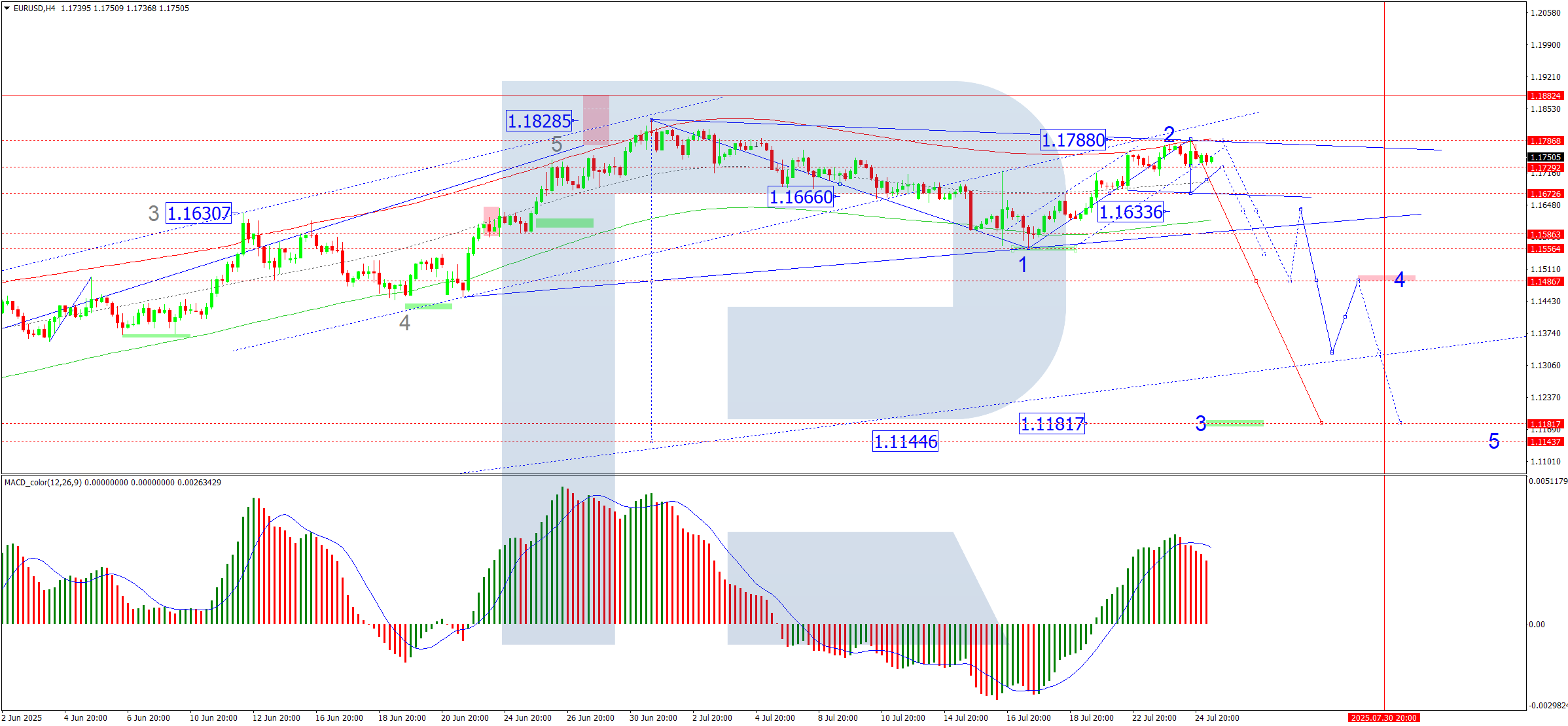
Technical analysis of EUR/USD

On the H4 chart, EUR/USD is forming a consolidation range at the top of the upward trend. A possible expansion towards 1.1645 cannot be excluded. Subsequently, a decline towards the lower boundary of the range at 1.1490 is anticipated. A break below 1.1490 would open the path for a new downward wave towards 1.1275, which is the first main target. The MACD indicator supports this outlook – its signal line remains above zero but has exited the histogram zone and is expected to descend back to the zero line, confirming a weakening upward impulse.

On the H1 chart, the market is consolidating around the 1.1570 level. The local growth target at 1.1614 has already been fulfilled, followed by a technical retest of 1.1542 from above. The next expected move is a growth link to 1.1645. A broad consolidation range around 1.1570 continues to take shape. The main scenario anticipates a decline towards 1.1456 once the growth structure is complete. This view is confirmed by the Stochastic oscillator, with its signal line above 50 and heading sharply towards 80, indicating room for further short-term upside before a reversal.

Conclusion

EUR/USD remains supported in the short term amid geopolitical uncertainty and softening Fed rate expectations, with key resistance at 1.1645 and support at 1.1490 and 1.1456. A sustained break below these levels could trigger a deeper correction towards 1.1275. For now, technical signals indicate a continuation of the consolidation phase, with one more upward impulse likely before a reversal sets in.


Disclaimer

Any forecasts contained herein are based on the author’s particular opinion. This analysis may not be treated as trading advice. RoboForex bears no responsibility for trading results based on trading recommendations and reviews contained herein.

Will AI take your job? The answer could hinge on the 4 S’s of the technology’s advantages over humans

By Bruce Schneier, Harvard Kennedy School and Nathan Sanders, Harvard University 

If you’ve worried that AI might take your job, deprive you of your livelihood, or maybe even replace your role in society, it probably feels good to see the latest AI tools fail spectacularly. If AI recommends glue as a pizza topping, then you’re safe for another day.

But the fact remains that AI already has definite advantages over even the most skilled humans, and knowing where these advantages arise — and where they don’t — will be key to adapting to the AI-infused workforce.

AI will often not be as effective as a human doing the same job. It won’t always know more or be more accurate. And it definitely won’t always be fairer or more reliable. But it may still be used whenever it has an advantage over humans in one of four dimensions: speed, scale, scope and sophistication. Understanding these dimensions is the key to understanding AI-human replacement.

Speed

First, speed. There are tasks that humans are perfectly good at but are not nearly as fast as AI. One example is restoring or upscaling images: taking pixelated, noisy or blurry images and making a crisper and higher-resolution version. Humans are good at this; given the right digital tools and enough time, they can fill in fine details. But they are too slow to efficiently process large images or videos.

AI models can do the job blazingly fast, a capability with important industrial applications. AI-based software is used to enhance satellite and remote sensing data, to compress video files, to make video games run better with cheaper hardware and less energy, to help robots make the right movements, and to model turbulence to help build better internal combustion engines.

Real-time performance matters in these cases, and the speed of AI is necessary to enable them.

Scale

The second dimension of AI’s advantage over humans is scale. AI will increasingly be used in tasks that humans can do well in one place at a time, but that AI can do in millions of places simultaneously. A familiar example is ad targeting and personalization. Human marketers can collect data and predict what types of people will respond to certain advertisements. This capability is important commercially; advertising is a trillion-dollar market globally.

AI models can do this for every single product, TV show, website and internet user. This is how the modern ad-tech industry works. Real-time bidding markets price the display ads that appear alongside the websites you visit, and advertisers use AI models to decide when they want to pay that price – thousands of times per second.

Scope

Next, scope. AI can be advantageous when it does more things than any one person could, even when a human might do better at any one of those tasks. Generative AI systems such as ChatGPT can engage in conversation on any topic, write an essay espousing any position, create poetry in any style and language, write computer code in any programming language, and more. These models may not be superior to skilled humans at any one of these things, but no single human could outperform top-tier generative models across them all.

It’s the combination of these competencies that generates value. Employers often struggle to find people with talents in disciplines such as software development and data science who also have strong prior knowledge of the employer’s domain. Organizations are likely to continue to rely on human specialists to write the best code and the best persuasive text, but they will increasingly be satisfied with AI when they just need a passable version of either.

How AI is affecting the job market.

Sophistication

Finally, sophistication. AIs can consider more factors in their decisions than humans can, and this can endow them with superhuman performance on specialized tasks. Computers have long been used to keep track of a multiplicity of factors that compound and interact in ways more complex than a human could trace. The 1990s chess-playing computer systems such as Deep Blue succeeded by thinking a dozen or more moves ahead.

Modern AI systems use a radically different approach: Deep learning systems built from many-layered neural networks take account of complex interactions – often many billions – among many factors. Neural networks now power the best chess-playing models and most other AI systems.

Chess is not the only domain where eschewing conventional rules and formal logic in favor of highly sophisticated and inscrutable systems has generated progress. The stunning advance of AlphaFold2, the AI model of structural biology whose creators Demis Hassabis and John Jumper were recognized with the Nobel Prize in chemistry in 2024, is another example.

This breakthrough replaced traditional physics-based systems for predicting how sequences of amino acids would fold into three-dimensional shapes with a 93 million-parameter model, even though it doesn’t account for physical laws. That lack of real-world grounding is not desirable: No one likes the enigmatic nature of these AI systems, and scientists are eager to understand better how they work.

But the sophistication of AI is providing value to scientists, and its use across scientific fields has grown exponentially in recent years.

Context matters

Those are the four dimensions where AI can excel over humans. Accuracy still matters. You wouldn’t want to use an AI that makes graphics look glitchy or targets ads randomly – yet accuracy isn’t the differentiator. The AI doesn’t need superhuman accuracy. It’s enough for AI to be merely good and fast, or adequate and scalable. Increasing scope often comes with an accuracy penalty, because AI can generalize poorly to truly novel tasks. The 4 S’s are sometimes at odds. With a given amount of computing power, you generally have to trade off scale for sophistication.

Even more interestingly, when an AI takes over a human task, the task can change. Sometimes the AI is just doing things differently. Other times, AI starts doing different things. These changes bring new opportunities and new risks.

For example, high-frequency trading isn’t just computers trading stocks faster; it’s a fundamentally different kind of trading that enables entirely new strategies, tactics and associated risks. Likewise, AI has developed more sophisticated strategies for the games of chess and Go. And the scale of AI chatbots has changed the nature of propaganda by allowing artificial voices to overwhelm human speech.

It is this “phase shift,” when changes in degree may transform into changes in kind, where AI’s impacts to society are likely to be most keenly felt. All of this points to the places that AI can have a positive impact. When a system has a bottleneck related to speed, scale, scope or sophistication, or when one of these factors poses a real barrier to being able to accomplish a goal, it makes sense to think about how AI could help.

Equally, when speed, scale, scope and sophistication are not primary barriers, it makes less sense to use AI. This is why AI auto-suggest features for short communications such as text messages can feel so annoying. They offer little speed advantage and no benefit from sophistication, while sacrificing the sincerity of human communication.

Many deployments of customer service chatbots also fail this test, which may explain their unpopularity. Companies invest in them because of their scalability, and yet the bots often become a barrier to support rather than a speedy or sophisticated problem solver.

Where the advantage lies

Keep this in mind when you encounter a new application for AI or consider AI as a replacement for or an augmentation to a human process. Looking for bottlenecks in speed, scale, scope and sophistication provides a framework for understanding where AI provides value, and equally where the unique capabilities of the human species give us an enduring advantage.The Conversation

About the Author:

Bruce Schneier, Adjunct Lecturer in Public Policy, Harvard Kennedy School and Nathan Sanders, Affiliate, Berkman Klein Center for Internet & Society, Harvard University

This article is republished from The Conversation under a Creative Commons license. Read the original article.


Risk appetite has fallen sharply amid the conflict between Israel and Iran

By JustMarkets 

The US stocks fell sharply on Friday amid weakening risk appetite after Iran condemned Israel’s airstrikes as a “declaration of war” and responded with missile strikes. The strikes targeted Iran’s nuclear and military facilities, significantly increasing geopolitical tensions and causing concern in global markets. At the end of Friday, the Dow Jones Index (US30) fell by 1.79% (-1.38% for the week). The S&P 500 (US500) Index fell by 1.13% (-0.46% for the week). The Nasdaq (US100) Technology Index closed lower by 1.29% (-0.68% for the week). Financial and technology companies led the losses: Nvidia fell by 2.1%, Apple declined by 1.4%, and Visa and Mastercard fell by more than 4%. Airline stocks also fell: American, Delta, and United declined by 4.5–5%. Meanwhile, energy and defense stocks did well as oil prices jumped nearly 7%. On the other hand, inflation expectations showed a noticeable improvement: inflation expectations for the year ahead fell sharply to 5.1% in June from 6.6% in May, while long-term inflation expectations fell for the second month in a row, dropping to 4.1% from 4.2%.

European stock markets were mostly down on Friday. The German DAX (DE40) fell by 1.07% (-3.03% for the week), the French CAC 40 (FR40) closed down 1.04% (-1.43% for the week), the Spanish IBEX35 (ES35) lost 1.27% (-2.23% for the week), and the British FTSE 100 (UK100) closed down 0.39% (+0.14% for the week). The Eurozone trade surplus in April 2025 fell to €9.9 billion from €13.6 billion a year earlier and was below market expectations of €18.2 billion. This also marked a sharp decline from March’s record high of €37.3 billion, with the decline mainly due to a sharp reduction in the chemical products surplus following the introduction of new US tariffs. European stock markets opened cautiously on Monday as investors monitored the escalating conflict between Israel and Iran, which risks escalating into a broader regional crisis. Military action continued over the weekend, with both countries striking energy infrastructure, causing oil prices to rise further. Iran also warned that it could block the Strait of Hormuz, a key bottleneck for global oil supplies.

The Swiss franc traded at around 0.81 per US dollar, close to its highest levels since 2011, amid a broad flight to safety triggered by escalating tensions in the Middle East. In addition to geopolitical risk, several other factors contributed to the strengthening of the franc, which has risen by about 10% this year. These include uncertainty over President Trump’s trade policy and a broad weakening of the dollar caused by lower inflation data and growing concerns about the US economic and fiscal outlook. Domestically, the Swiss National Bank (SNB) may soon reintroduce negative interest rates. Markets widely expect the SNB to cut its key rate this week.

WTI oil prices jumped by 7.2% on Friday and settled just below $73 per barrel on Friday. On Monday, oil prices continued to rise to $75 per barrel. Israel launched an attack on the giant South Pars gas field in the Persian Gulf over the weekend, forcing the production platform to shut down, following airstrikes on Iran’s nuclear facilities and military leadership last week. Although the strikes have not yet led to a halt in Iranian oil exports, markets fear the worst-case scenario, in which Tehran disrupts supplies through the Strait of Hormuz, a vital shipping route.

Asian markets were mostly down last week. Japan’s Nikkei 225 (JP225) fell 0.51%, China’s FTSE China A50 (CHA50) declined 0.29%, Hong Kong’s Hang Seng (HK50) fell 0.35%, and Australia’s ASX 200 (AU200) showed a positive result of 0.10% over the past week. Hong Kong stocks are down for the third consecutive session, despite strong economic data from China. Mainland retail sales in May grew at their fastest pace in 15 months, while industrial production grew at its slowest pace in six months, and the unemployment rate fell to a six-month low.

S&P 500 (US500) 5,976.97 −68.29 (−1.13%)

Dow Jones (US30) 42,197.79 −769.83 (−1.79%)

DAX (DE40) 23,516.23 −255.22 (−1.07%)

FTSE 100 (UK100) 8,850.63 −34.29 (−0.39%)

USD Index 98.14 +0.22 (+0.22%)

News feed for: 2025.06.16

  • China Industrial Production (m/m) at 05:00 (GMT+3);
  • China Retail Sales (m/m) at 05:00 (GMT+3);
  • China Unemployment Rate (m/m) at 05:00 (GMT+3);
  • Switzerland Producer Price Index (m/m) at 09:30 (GMT+3).

By JustMarkets


This article reflects a personal opinion and should not be interpreted as an investment advice, and/or offer, and/or a persistent request for carrying out financial transactions, and/or a guarantee, and/or a forecast of future events.

Gold hits record highs as risk aversion dominates the market

By RoboForex Analytical Department 

The price of gold surged to a new record on Monday, reaching 3,446 USD per troy ounce, approaching the peaks seen in April. The rise reflects intensified demand for safe-haven assets as investors react to heightened geopolitical tensions and a broadly weaker US dollar.

Geopolitical fears and monetary policy in focus

The ongoing conflict between Israel and Iran has escalated, prompting fears of a broader geopolitical fallout in the region. This environment is driving capital into defensive assets, such as gold, as risk appetite continues to wane.

Meanwhile, markets are shifting their attention to this week’s US Federal Reserve meeting, which begins on Tuesday and concludes on Wednesday evening. While the Fed is expected to hold interest rates steady, investors will closely watch for any forward guidance on rate cuts, especially following the release of weaker-than-expected US inflation data, which has reinforced speculation of a policy easing as early as September.

Additionally, market participants are awaiting details on President Donald Trump’s next wave of tariffs, which the White House is reportedly preparing to implement in the coming weeks. These trade measures are key in evaluating the broader economic outlook.

The US dollar remains under pressure, which continues to support the bullish momentum in gold.

Technical analysis of XAU/USD

On the H4 chart, XAU/USD has completed the fifth wave of growth, reaching a peak at 3,450 USD. A new decline towards 3,400 USD is now expected. If this support is breached, the trend may extend further down to 3,350 USD. The MACD indicator supports this bearish outlook, with its signal line above zero, exiting the histogram zone and suggesting a potential reversal towards new lows.

On the H1 chart, the pair is building a downward wave structure targeting 3,400 USD. The price is currently testing the lower boundary of the consolidation range at the top of the wave. After reaching 3,400 USD, a correction towards 3,424 USD is anticipated, likely followed by the development of a new downward wave towards 3,375 USD, considered the next local target. The Stochastic oscillator supports this view, with its signal line below 50 and heading towards 20, indicating growing bearish momentum.

Conclusion

Gold remains strongly supported by geopolitical instability, a weak dollar, and dovish monetary policy expectations. While the asset is trading near record highs, technical indicators suggest a potential short-term pullback towards 3,400 USD and possibly deeper to 3,375-3,350 USD. However, the overall bullish trend remains intact as long as risk-off sentiment prevails and macro uncertainty lingers.


Disclaimer

Any forecasts contained herein are based on the author’s particular opinion. This analysis may not be treated as trading advice. RoboForex bears no responsibility for trading results based on trading recommendations and reviews contained herein.

Euro Speculator Bets rise for 3rd Week to 9-Month High

By InvestMacro

Speculators OI FX Futures COT Chart

Open Interest Levels show where open contracts are in the markets.

Here are the latest charts and statistics for the Commitment of Traders (COT) data published by the Commodities Futures Trading Commission (CFTC).

The latest COT data is updated through Tuesday June 10th and shows a quick view of how large market participants (for-profit speculators and commercial traders) were positioned in the futures markets. All currency positions are in direct relation to the US dollar where, for example, a bet for the euro is a bet that the euro will rise versus the dollar while a bet against the euro will be a bet that the euro will decline versus the dollar.

Weekly Speculator Changes led by British Pound & Canadian Dollar

Speculators Nets FX Futures COT Chart
The COT currency market speculator bets were overall higher this week as eight out of the eleven currency markets we cover had higher positioning while the other three markets had lower speculator contracts.

Leading the gains for the currency markets was the British Pound (16,419 contracts) with the Canadian Dollar (15,303 contracts), the EuroFX (10,261 contracts), the Brazilian Real (8,508 contracts), the Swiss Franc (4,798 contracts), New Zealand Dollar (2,439 contracts), the US Dollar Index (785 contracts) and also Bitcoin (303 contracts) showing positive weeks.

The currencies seeing declines in speculator bets on the week were the Australian Dollar (-6,789 contracts), the Japanese Yen (-6,554 contracts) and the Mexican Peso (-1,723 contracts) seeing lower bets on the week.

Euro Speculator Bets rise for 3rd Week to 9-Month High

Currency Data Highlights this week include the Euro and the British pound sterling seeing stronger speculator positioning that has pushed the overall net positions to multi-month highs.

Euro FX Positions rise to 40-week high
– Euro positions rose by over 10,000 contracts this week, marking the fourth increase in the last six weeks.
– Speculators’ Euro positions have risen for 13 out of the last 17 weeks, totaling a change of +157,450 contracts over that time-frame.
– The Euro positions have increased from negative contracts in mid-February to over 93,000 contracts this week, the highest level for Euro speculators since September 3, 2024, when the net position was over 100,000 contracts.

British Pound Sterling
– British Pound Sterling contracts jumped by over 16,000 positions this week.
– Speculator bets on the Pound Sterling have risen in 5 out of the last 8 weeks, totaling over +45,000 contracts in that period.
– The Pound Sterling speculator position is currently at its highest level since November with the current standing above the 50,000 contract level.

Canadian Dollar
– Canadian Dollar speculator bets increased by over 15,000 contracts this week.
– The overall standing for the Canadian Dollar, however, remains bearish at -93,140 contracts level.

Japanese Yen
– The Japanese Yen contracts fell by over 6,000 contracts this week as yen speculator bets have been cooling off.
– The Yen position has decreased for 6 consecutive weeks after reaching an all-time high in April above +179,000 contracts.

Swiss Franc
– Swiss Franc contracts rose by almost 5,000 contracts this week.
– Over the last 10 weeks, Swiss Franc positions have improved in 7 out of the last 10 weeks, reducing the overall bearish level by almost half (from approximately -42,000 to -21,000 contracts).

U.S. Dollar Index
– The U.S. Dollar index positions slightly improved this week and have now risen for five straight weeks (following declines in 8 out of previous 11 weeks)
– The current standing is currently still a small, bullish position of just +1,402 net contracts.

Market Price Changes this week:

Currency markets saw the euro and Swiss franc both rise by over 1%. The Mexican peso, Bitcoin, and the Canadian dollar each gained nearly 1%. The Brazilian real, Japanese yen, and British pound all increased by around 0.5%. The U.S. Dollar index, however, was the week’s biggest loser, dropping nearly 1%.


Currencies Data:

Speculators FX Futures COT Data Table
Legend: Open Interest | Speculators Current Net Position | Weekly Specs Change | Specs Strength Score compared to last 3-Years (0-100 range)


Strength Scores led by Japanese Yen & Brazilian Real

Speculators Strength Scores FX Futures COT Chart
COT Strength Scores (a normalized measure of Speculator positions over a 3-Year range, from 0 to 100 where above 80 is Extreme-Bullish and below 20 is Extreme-Bearish) showed that the Japanese Yen (90 percent) and the Brazilian Real (76 percent) lead the currency markets this week. The EuroFX (64 percent), Mexican Peso (61 percent) and the Swiss Franc (58 percent) come in as the next highest in the weekly strength scores.

On the downside, Bitcoin (7 percent) and the US Dollar Index (10 percent) come in at the lowest strength levels currently and are in Extreme-Bearish territory (below 20 percent).

3-Year Strength Statistics:
US Dollar Index (9.6 percent) vs US Dollar Index previous week (8.0 percent)
EuroFX (64.2 percent) vs EuroFX previous week (60.3 percent)
British Pound Sterling (56.9 percent) vs British Pound Sterling previous week (49.1 percent)
Japanese Yen (90.5 percent) vs Japanese Yen previous week (92.3 percent)
Swiss Franc (57.8 percent) vs Swiss Franc previous week (48.1 percent)
Canadian Dollar (46.2 percent) vs Canadian Dollar previous week (39.4 percent)
Australian Dollar (26.7 percent) vs Australian Dollar previous week (31.5 percent)
New Zealand Dollar (39.9 percent) vs New Zealand Dollar previous week (37.1 percent)
Mexican Peso (60.7 percent) vs Mexican Peso previous week (61.6 percent)
Brazilian Real (76.4 percent) vs Brazilian Real previous week (69.5 percent)
Bitcoin (7.5 percent) vs Bitcoin previous week (0.9 percent)


British Pound & EuroFX top the 6-Week Strength Trends

Speculators Trends FX Futures COT Chart
COT Strength Score Trends (or move index, calculates the 6-week changes in strength scores) showed that the British Pound (13 percent) and the EuroFX (7 percent) lead the past six weeks trends for the currencies. The Swiss Franc (6 percent), the US Dollar Index (4 percent) and the Mexican Peso (2 percent) are the next highest positive movers in the 3-Year trends data.

The Brazilian Real (-24 percent) leads the downside trend scores currently with Bitcoin (-17 percent), the Australian Dollar (-14 percent) and the Canadian Dollar (-12 percent) following next with lower trend scores.

3-Year Strength Trends:
US Dollar Index (3.8 percent) vs US Dollar Index previous week (3.3 percent)
EuroFX (6.6 percent) vs EuroFX previous week (6.8 percent)
British Pound Sterling (13.2 percent) vs British Pound Sterling previous week (7.0 percent)
Japanese Yen (-9.5 percent) vs Japanese Yen previous week (-7.3 percent)
Swiss Franc (6.2 percent) vs Swiss Franc previous week (-1.2 percent)
Canadian Dollar (-11.6 percent) vs Canadian Dollar previous week (-18.5 percent)
Australian Dollar (-14.2 percent) vs Australian Dollar previous week (-6.1 percent)
New Zealand Dollar (0.3 percent) vs New Zealand Dollar previous week (3.7 percent)
Mexican Peso (1.6 percent) vs Mexican Peso previous week (11.9 percent)
Brazilian Real (-23.6 percent) vs Brazilian Real previous week (-15.5 percent)
Bitcoin (-17.0 percent) vs Bitcoin previous week (-32.9 percent)


Individual COT Forex Markets:

US Dollar Index Futures:

US Dollar Index Forex Futures COT ChartThe US Dollar Index large speculator standing this week recorded a net position of 1,402 contracts in the data reported through Tuesday. This was a weekly boost of 785 contracts from the previous week which had a total of 617 net contracts.

This week’s current strength score (the trader positioning range over the past three years, measured from 0 to 100) shows the speculators are currently Bearish-Extreme with a score of 9.6 percent. The commercials are Bullish-Extreme with a score of 93.9 percent and the small traders (not shown in chart) are Bearish-Extreme with a score of 11.8 percent.

Price Trend-Following Model: Downtrend

Our weekly trend-following model classifies the current market price position as: Downtrend.

US DOLLAR INDEX StatisticsSPECULATORSCOMMERCIALSSMALL TRADERS
– Percent of Open Interest Longs:55.524.07.6
– Percent of Open Interest Shorts:51.024.112.1
– Net Position:1,402-35-1,367
– Gross Longs:17,0277,3442,345
– Gross Shorts:15,6257,3793,712
– Long to Short Ratio:1.1 to 11.0 to 10.6 to 1
NET POSITION TREND:
– Strength Index Score (3 Year Range Pct):9.693.911.8
– Strength Index Reading (3 Year Range):Bearish-ExtremeBullish-ExtremeBearish-Extreme
NET POSITION MOVEMENT INDEX:
– 6-Week Change in Strength Index:3.8-3.2-3.6


Euro Currency Futures:

Euro Currency Futures COT ChartThe Euro Currency large speculator standing this week recorded a net position of 93,025 contracts in the data reported through Tuesday. This was a weekly boost of 10,261 contracts from the previous week which had a total of 82,764 net contracts.

This week’s current strength score (the trader positioning range over the past three years, measured from 0 to 100) shows the speculators are currently Bullish with a score of 64.2 percent. The commercials are Bearish with a score of 29.7 percent and the small traders (not shown in chart) are Bullish-Extreme with a score of 100.0 percent.

Price Trend-Following Model: Uptrend

Our weekly trend-following model classifies the current market price position as: Uptrend.

EURO Currency StatisticsSPECULATORSCOMMERCIALSSMALL TRADERS
– Percent of Open Interest Longs:25.855.412.6
– Percent of Open Interest Shorts:14.374.15.5
– Net Position:93,025-151,25658,231
– Gross Longs:208,754449,157102,489
– Gross Shorts:115,729600,41344,258
– Long to Short Ratio:1.8 to 10.7 to 12.3 to 1
NET POSITION TREND:
– Strength Index Score (3 Year Range Pct):64.229.7100.0
– Strength Index Reading (3 Year Range):BullishBearishBullish-Extreme
NET POSITION MOVEMENT INDEX:
– 6-Week Change in Strength Index:6.6-6.75.5


British Pound Sterling Futures:

British Pound Sterling Futures COT ChartThe British Pound Sterling large speculator standing this week recorded a net position of 51,634 contracts in the data reported through Tuesday. This was a weekly lift of 16,419 contracts from the previous week which had a total of 35,215 net contracts.

This week’s current strength score (the trader positioning range over the past three years, measured from 0 to 100) shows the speculators are currently Bullish with a score of 56.9 percent. The commercials are Bearish with a score of 38.8 percent and the small traders (not shown in chart) are Bullish-Extreme with a score of 81.0 percent.

Price Trend-Following Model: Uptrend

Our weekly trend-following model classifies the current market price position as: Uptrend.

BRITISH POUND StatisticsSPECULATORSCOMMERCIALSSMALL TRADERS
– Percent of Open Interest Longs:51.928.416.9
– Percent of Open Interest Shorts:27.856.712.7
– Net Position:51,634-60,5628,928
– Gross Longs:111,07660,66536,199
– Gross Shorts:59,442121,22727,271
– Long to Short Ratio:1.9 to 10.5 to 11.3 to 1
NET POSITION TREND:
– Strength Index Score (3 Year Range Pct):56.938.881.0
– Strength Index Reading (3 Year Range):BullishBearishBullish-Extreme
NET POSITION MOVEMENT INDEX:
– 6-Week Change in Strength Index:13.2-12.86.7


Japanese Yen Futures:

Japanese Yen Forex Futures COT ChartThe Japanese Yen large speculator standing this week recorded a net position of 144,595 contracts in the data reported through Tuesday. This was a weekly lowering of -6,554 contracts from the previous week which had a total of 151,149 net contracts.

This week’s current strength score (the trader positioning range over the past three years, measured from 0 to 100) shows the speculators are currently Bullish-Extreme with a score of 90.5 percent. The commercials are Bearish-Extreme with a score of 8.3 percent and the small traders (not shown in chart) are Bullish-Extreme with a score of 100.0 percent.

Price Trend-Following Model: Uptrend

Our weekly trend-following model classifies the current market price position as: Uptrend.

JAPANESE YEN StatisticsSPECULATORSCOMMERCIALSSMALL TRADERS
– Percent of Open Interest Longs:47.434.013.9
– Percent of Open Interest Shorts:10.277.67.6
– Net Position:144,595-169,07724,482
– Gross Longs:184,195132,04454,124
– Gross Shorts:39,600301,12129,642
– Long to Short Ratio:4.7 to 10.4 to 11.8 to 1
NET POSITION TREND:
– Strength Index Score (3 Year Range Pct):90.58.3100.0
– Strength Index Reading (3 Year Range):Bullish-ExtremeBearish-ExtremeBullish-Extreme
NET POSITION MOVEMENT INDEX:
– 6-Week Change in Strength Index:-9.58.34.1


Swiss Franc Futures:

Swiss Franc Forex Futures COT ChartThe Swiss Franc large speculator standing this week recorded a net position of -21,268 contracts in the data reported through Tuesday. This was a weekly rise of 4,798 contracts from the previous week which had a total of -26,066 net contracts.

This week’s current strength score (the trader positioning range over the past three years, measured from 0 to 100) shows the speculators are currently Bullish with a score of 57.8 percent. The commercials are Bearish with a score of 31.9 percent and the small traders (not shown in chart) are Bullish-Extreme with a score of 84.8 percent.

Price Trend-Following Model: Uptrend

Our weekly trend-following model classifies the current market price position as: Uptrend.

SWISS FRANC StatisticsSPECULATORSCOMMERCIALSSMALL TRADERS
– Percent of Open Interest Longs:10.662.519.3
– Percent of Open Interest Shorts:35.139.717.7
– Net Position:-21,26819,8421,426
– Gross Longs:9,24054,33116,806
– Gross Shorts:30,50834,48915,380
– Long to Short Ratio:0.3 to 11.6 to 11.1 to 1
NET POSITION TREND:
– Strength Index Score (3 Year Range Pct):57.831.984.8
– Strength Index Reading (3 Year Range):BullishBearishBullish-Extreme
NET POSITION MOVEMENT INDEX:
– 6-Week Change in Strength Index:6.2-8.810.1


Canadian Dollar Futures:

Canadian Dollar Forex Futures COT ChartThe Canadian Dollar large speculator standing this week recorded a net position of -93,143 contracts in the data reported through Tuesday. This was a weekly advance of 15,303 contracts from the previous week which had a total of -108,446 net contracts.

This week’s current strength score (the trader positioning range over the past three years, measured from 0 to 100) shows the speculators are currently Bearish with a score of 46.2 percent. The commercials are Bullish with a score of 52.3 percent and the small traders (not shown in chart) are Bearish with a score of 49.5 percent.

Price Trend-Following Model: Strong Uptrend

Our weekly trend-following model classifies the current market price position as: Strong Uptrend.

CANADIAN DOLLAR StatisticsSPECULATORSCOMMERCIALSSMALL TRADERS
– Percent of Open Interest Longs:6.877.49.5
– Percent of Open Interest Shorts:39.145.88.9
– Net Position:-93,14391,2071,936
– Gross Longs:19,651223,28527,489
– Gross Shorts:112,794132,07825,553
– Long to Short Ratio:0.2 to 11.7 to 11.1 to 1
NET POSITION TREND:
– Strength Index Score (3 Year Range Pct):46.252.349.5
– Strength Index Reading (3 Year Range):BearishBullishBearish
NET POSITION MOVEMENT INDEX:
– 6-Week Change in Strength Index:-11.66.728.8


Australian Dollar Futures:

Australian Dollar Forex Futures COT ChartThe Australian Dollar large speculator standing this week recorded a net position of -69,944 contracts in the data reported through Tuesday. This was a weekly fall of -6,789 contracts from the previous week which had a total of -63,155 net contracts.

This week’s current strength score (the trader positioning range over the past three years, measured from 0 to 100) shows the speculators are currently Bearish with a score of 26.7 percent. The commercials are Bullish with a score of 68.0 percent and the small traders (not shown in chart) are Bullish with a score of 65.4 percent.

Price Trend-Following Model: Strong Uptrend

Our weekly trend-following model classifies the current market price position as: Strong Uptrend.

AUSTRALIAN DOLLAR StatisticsSPECULATORSCOMMERCIALSSMALL TRADERS
– Percent of Open Interest Longs:10.768.511.9
– Percent of Open Interest Shorts:41.940.09.2
– Net Position:-69,94463,7706,174
– Gross Longs:23,997153,54126,785
– Gross Shorts:93,94189,77120,611
– Long to Short Ratio:0.3 to 11.7 to 11.3 to 1
NET POSITION TREND:
– Strength Index Score (3 Year Range Pct):26.768.065.4
– Strength Index Reading (3 Year Range):BearishBullishBullish
NET POSITION MOVEMENT INDEX:
– 6-Week Change in Strength Index:-14.28.913.3


New Zealand Dollar Futures:

New Zealand Dollar Forex Futures COT ChartThe New Zealand Dollar large speculator standing this week recorded a net position of -21,235 contracts in the data reported through Tuesday. This was a weekly rise of 2,439 contracts from the previous week which had a total of -23,674 net contracts.

This week’s current strength score (the trader positioning range over the past three years, measured from 0 to 100) shows the speculators are currently Bearish with a score of 39.9 percent. The commercials are Bullish with a score of 57.5 percent and the small traders (not shown in chart) are Bullish with a score of 59.2 percent.

Price Trend-Following Model: Strong Uptrend

Our weekly trend-following model classifies the current market price position as: Strong Uptrend.

NEW ZEALAND DOLLAR StatisticsSPECULATORSCOMMERCIALSSMALL TRADERS
– Percent of Open Interest Longs:11.873.95.8
– Percent of Open Interest Shorts:38.747.65.2
– Net Position:-21,23520,783452
– Gross Longs:9,31258,2944,562
– Gross Shorts:30,54737,5114,110
– Long to Short Ratio:0.3 to 11.6 to 11.1 to 1
NET POSITION TREND:
– Strength Index Score (3 Year Range Pct):39.957.559.2
– Strength Index Reading (3 Year Range):BearishBullishBullish
NET POSITION MOVEMENT INDEX:
– 6-Week Change in Strength Index:0.3-0.62.9


Mexican Peso Futures:

Mexican Peso Futures COT ChartThe Mexican Peso large speculator standing this week recorded a net position of 62,726 contracts in the data reported through Tuesday. This was a weekly fall of -1,723 contracts from the previous week which had a total of 64,449 net contracts.

This week’s current strength score (the trader positioning range over the past three years, measured from 0 to 100) shows the speculators are currently Bullish with a score of 60.7 percent. The commercials are Bearish with a score of 40.3 percent and the small traders (not shown in chart) are Bearish with a score of 40.4 percent.

Price Trend-Following Model: Strong Uptrend

Our weekly trend-following model classifies the current market price position as: Strong Uptrend.

MEXICAN PESO StatisticsSPECULATORSCOMMERCIALSSMALL TRADERS
– Percent of Open Interest Longs:54.831.83.5
– Percent of Open Interest Shorts:20.168.31.8
– Net Position:62,726-65,9103,184
– Gross Longs:99,01757,4396,351
– Gross Shorts:36,291123,3493,167
– Long to Short Ratio:2.7 to 10.5 to 12.0 to 1
NET POSITION TREND:
– Strength Index Score (3 Year Range Pct):60.740.340.4
– Strength Index Reading (3 Year Range):BullishBearishBearish
NET POSITION MOVEMENT INDEX:
– 6-Week Change in Strength Index:1.6-2.36.8


Brazilian Real Futures:

Brazil Real Futures COT ChartThe Brazilian Real large speculator standing this week recorded a net position of 39,301 contracts in the data reported through Tuesday. This was a weekly increase of 8,508 contracts from the previous week which had a total of 30,793 net contracts.

This week’s current strength score (the trader positioning range over the past three years, measured from 0 to 100) shows the speculators are currently Bullish with a score of 76.4 percent. The commercials are Bearish with a score of 22.2 percent and the small traders (not shown in chart) are Bearish with a score of 41.0 percent.

Price Trend-Following Model: Strong Uptrend

Our weekly trend-following model classifies the current market price position as: Strong Uptrend.

BRAZIL REAL StatisticsSPECULATORSCOMMERCIALSSMALL TRADERS
– Percent of Open Interest Longs:64.529.94.7
– Percent of Open Interest Shorts:23.275.01.0
– Net Position:39,301-42,8723,571
– Gross Longs:61,32128,4344,511
– Gross Shorts:22,02071,306940
– Long to Short Ratio:2.8 to 10.4 to 14.8 to 1
NET POSITION TREND:
– Strength Index Score (3 Year Range Pct):76.422.241.0
– Strength Index Reading (3 Year Range):BullishBearishBearish
NET POSITION MOVEMENT INDEX:
– 6-Week Change in Strength Index:-23.622.27.5


Bitcoin Futures:

Bitcoin Crypto Futures COT ChartThe Bitcoin large speculator standing this week recorded a net position of -2,009 contracts in the data reported through Tuesday. This was a weekly gain of 303 contracts from the previous week which had a total of -2,312 net contracts.

This week’s current strength score (the trader positioning range over the past three years, measured from 0 to 100) shows the speculators are currently Bearish-Extreme with a score of 7.5 percent. The commercials are Bullish-Extreme with a score of 95.4 percent and the small traders (not shown in chart) are Bullish with a score of 51.2 percent.

Price Trend-Following Model: Strong Uptrend

Our weekly trend-following model classifies the current market price position as: Strong Uptrend.

BITCOIN StatisticsSPECULATORSCOMMERCIALSSMALL TRADERS
– Percent of Open Interest Longs:81.97.35.1
– Percent of Open Interest Shorts:88.51.54.2
– Net Position:-2,0091,741268
– Gross Longs:24,7812,1981,529
– Gross Shorts:26,7904571,261
– Long to Short Ratio:0.9 to 14.8 to 11.2 to 1
NET POSITION TREND:
– Strength Index Score (3 Year Range Pct):7.595.451.2
– Strength Index Reading (3 Year Range):Bearish-ExtremeBullish-ExtremeBullish
NET POSITION MOVEMENT INDEX:
– 6-Week Change in Strength Index:-17.018.4-2.5


Article By InvestMacroReceive our weekly COT Newsletter

*COT Report: The COT data, released weekly to the public each Friday, is updated through the most recent Tuesday (data is 3 days old) and shows a quick view of how large speculators or non-commercials (for-profit traders) were positioned in the futures markets.

The CFTC categorizes trader positions according to commercial hedgers (traders who use futures contracts for hedging as part of the business), non-commercials (large traders who speculate to realize trading profits) and nonreportable traders (usually small traders/speculators) as well as their open interest (contracts open in the market at time of reporting). See CFTC criteria here.

Speculator Extremes: Brent Oil, Silver and 5-Year Bonds lead Bullish & Bearish Positions

By InvestMacro

The latest update for the weekly Commitment of Traders (COT) report was released by the Commodity Futures Trading Commission (CFTC) on Friday for data ending on June 10th.

This weekly Extreme Positions report highlights the Most Bullish and Most Bearish Positions for the speculator category. Extreme positioning in these markets can foreshadow strong moves in the underlying market.

To signify an extreme position, we use the Strength Index (also known as the COT Index) of each instrument, a common method of measuring COT data. The Strength Index is simply a comparison of current trader positions against the range of positions over the previous 3 years. We use over 80 percent as extremely bullish and under 20 percent as extremely bearish. (Compare Strength Index scores across all markets in the data table or cot leaders table)


Here Are This Week’s Most Bullish Speculator Positions:

Brent Oil

Extreme Bullish Leader
The Brent Oil speculator position comes in as the most bullish extreme standing this week as the Brent speculator level is currently at a 100 percent score of its 3-year range.

The six-week trend for the percent strength score totaled a rise of 40 points this week. The overall net speculator position was a total of 13,216 net contracts this week with a rise of 2,936 contract in the weekly speculator bets.


Speculators or Non-Commercials Notes:

Speculators, classified as non-commercial traders by the CFTC, are made up of large commodity funds, hedge funds and other significant for-profit participants. The Specs are generally regarded as trend-followers in their behavior towards price action – net speculator bets and prices tend to go in the same directions. These traders often look to buy when prices are rising and sell when prices are falling. To illustrate this point, many times speculator contracts can be found at their most extremes (bullish or bearish) when prices are also close to their highest or lowest levels.

These extreme levels can be dangerous for the large speculators as the trade is most crowded, there is less trading ammunition still sitting on the sidelines to push the trend further and prices have moved a significant distance. When the trend becomes exhausted, some speculators take profits while others look to also exit positions when prices fail to continue in the same direction. This process usually plays out over many months to years and can ultimately create a reverse effect where prices start to fall and speculators start a process of selling when prices are falling.


Silver

Extreme Bullish Leader
The Silver speculator position comes in tied with Brent at the top of the extreme standings this week. The Silver speculator level is also at a 100 percent or maximum score of its 3-year range.

The six-week trend for the percent strength score was a gain of 21 points this week. The speculator position registered 66,650 net contracts this week with a weekly boost of 5,880 contracts in speculator bets.


Ultra U.S. Treasury Bonds

Extreme Bullish Leader
The Ultra U.S. Treasury Bonds speculator position comes in third this week in the extreme standings. The Ultra Long T-Bond speculator level resides at a 97 percent score of its 3-year range.

The six-week trend for the speculator strength score came in at 18 points this week. The overall speculator position was -203,747 net contracts this week with a jump of 24,696 contracts in the weekly speculator bets.


Live Cattle

Extreme Bullish Leader
The Live Cattle speculator position comes up number four in this week’s bullish extreme standings. The Live Cattle speculator level sits at a 92 percent score of its 3-year range. The six-week trend for the speculator strength score was 12 points this week.

The speculator position was 115,175 net contracts this week with a jump of 11,892 contracts in the weekly speculator bets.


Japanese Yen


The Japanese yen speculator position rounds out the top five in the extreme standings this week. The Japanese yen speculator level is at a 91 percent score of its 3-year range.

The six-week trend for the speculator strength score totaled a change of -10 points this week. The overall speculator position was 144,595 net contracts this week with a decline of -6,554 contracts in the speculator bets.


This Week’s Most Bearish Speculator Positions:

5-Year Bond

Extreme Bearish Leader
The 5-Year Bond speculator position comes in as the most bearish extreme standing this week. The 5-Year speculator level is at a 0 percent or minimum score of its 3-year range.

The six-week trend for the speculator strength score was -8 points this week. The overall speculator position was -2,470,920 net contracts this week with a drop by -74,384 contracts in the speculator bets.


Ultra 10-Year U.S. T-Note

Extreme Bearish Leader
The Ultra 10-Year U.S. T-Note speculator position comes in next for the most bearish extreme standing on the week as the speculator level is at just a 1 percent score of its 3-year range.

The six-week trend for the speculator strength score was -40 points this week. The speculator position was -369,282 net contracts this week with a small gain of 2,306 contracts in the weekly speculator bets.


3-Month Secured Overnight Financing Rate

Extreme Bearish Leader
The 3-Month Secured Overnight Financing Rate speculator position comes in as third most bearish extreme standing of the week. The SOFR 3-Months speculator level resides at a 2 percent score of its 3-year range.

The six-week trend for the speculator strength score was -29 points this week. The overall speculator position was -1,132,456 net contracts this week with a reduction by -202,389 contracts in the speculator bets.


Sugar

Extreme Bearish Leader
The Sugar speculator position comes in as this week’s fourth most bearish extreme standing. The Sugar speculator level is at a 4 percent score of its 3-year range.

The six-week trend for the speculator strength score was -19 points this week. The speculator position was -19,515 net contracts this week with a shortfall of -15,671 contracts in the weekly speculator bets.


Bitcoin

Extreme Bearish Leader
Finally, the Bitcoin speculator position comes in as the fifth most bearish extreme standing for this week. The Bitcoin speculator level is at a 7 percent score of its 3-year range.

The six-week trend for the speculator strength score was -17 points this week. The speculator position was -2,009 net contracts this week with an increase of 303 contracts in the weekly speculator bets.


Article By InvestMacroReceive our weekly COT Newsletter

*COT Report: The COT data, released weekly to the public each Friday, is updated through the most recent Tuesday (data is 3 days old) and shows a quick view of how large speculators or non-commercials (for-profit traders) were positioned in the futures markets.

The CFTC categorizes trader positions according to commercial hedgers (traders who use futures contracts for hedging as part of the business), non-commercials (large traders who speculate to realize trading profits) and nonreportable traders (usually small traders/speculators) as well as their open interest (contracts open in the market at time of reporting). See CFTC criteria here.

COT Metals Charts: Bets led higher by Platinum & Silver

By InvestMacro

Metals Open Interest COT Chart
Here are the latest charts and statistics for the Commitment of Traders (COT) data published by the Commodities Futures Trading Commission (CFTC).

The latest COT data is updated through Tuesday June 10th and shows a quick view of how large traders (for-profit speculators and commercial entities) were positioned in the futures markets.

Weekly Speculator Changes led by Platinum & Silver

Metals Net Positions COT Chart
The COT metals markets speculator bets were overall higher this week as five out of the six metals markets we cover had higher positioning while one market had lower speculator contracts.

Leading the gains for the metals was Platinum (6,930 contracts) with Silver (5,880 contracts), Copper (2,257 contracts), Palladium (1,485 contracts) and also Steel (666 contracts) showing positive weeks.

The market with declines in speculator bets for the week was Gold with a small decline of -424 contracts on the week.

Metals Markets Price Changes:

In the metals market prices, platinum rose strongly with a gain of over 5%. Gold followed with an increase of more than 3.5%, and silver edged up by nearly 1%. Conversely, palladium and copper saw declines of 1% and 1.5%, respectively, while steel dropped significantly by over 6%.


Metals Data:

Metals Table COT Chart
Legend: Weekly Speculators Change | Speculators Current Net Position | Speculators Strength Score compared to last 3-Years (0-100 range)


Strength Scores led by Silver & Platinum

Metals Strength Scores COT Chart

COT Strength Scores (a normalized measure of Speculator positions over a 3-Year range, from 0 to 100 where above 80 is Extreme-Bullish and below 20 is Extreme-Bearish) showed that Silver (100 percent) and Platinum (80 percent) lead the metals markets this week. Steel (71 percent) comes in as the next highest in the weekly strength scores.

Gold (51 percent) comes in at the lowest strength level currently but is above the 3-Year midpoint of 50 percent.

Strength Statistics:
Gold (51.4 percent) vs Gold previous week (51.6 percent)
Silver (100.0 percent) vs Silver previous week (92.6 percent)
Copper (57.8 percent) vs Copper previous week (55.7 percent)
Platinum (79.8 percent) vs Platinum previous week (63.4 percent)
Palladium (60.9 percent) vs Palladium previous week (49.7 percent)
Steel (71.0 percent) vs Palladium previous week (67.7 percent)


Platinum & Palladium top the 6-Week Strength Trends

Metals Trends COT Chart

COT Strength Score Trends (or move index, calculates the 6-week changes in strength scores) showed that Platinum (40 percent) and Palladium (38 percent) lead the past six weeks trends for metals. Silver (21 percent), Gold (9 percent) and Copper (7 percent) are the next highest positive movers in the latest trends data.

Steel (-7 percent) leads the downside trend scores currently.

Move Statistics:
Gold (9.2 percent) vs Gold previous week (4.8 percent)
Silver (21.0 percent) vs Silver previous week (20.2 percent)
Copper (6.5 percent) vs Copper previous week (-0.6 percent)
Platinum (40.2 percent) vs Platinum previous week (34.0 percent)
Palladium (38.4 percent) vs Palladium previous week (26.7 percent)
Steel (-7.5 percent) vs Steel previous week (-12.9 percent)


Individual Markets:

Gold Comex Futures:

Gold Futures COT ChartThe Gold Comex Futures large speculator standing this week resulted in a net position of 187,481 contracts in the data reported through Tuesday. This was a weekly lowering of -424 contracts from the previous week which had a total of 187,905 net contracts.

This week’s current strength score (the trader positioning range over the past three years, measured from 0 to 100) shows the speculators are currently Bullish with a score of 51.4 percent. The commercials are Bearish with a score of 42.1 percent and the small traders (not shown in chart) are Bullish-Extreme with a score of 100.0 percent.

Price Trend-Following Model: Strong Uptrend

Our weekly trend-following model classifies the current market price position as: Strong Uptrend.

Gold Futures StatisticsSPECULATORSCOMMERCIALSSMALL TRADERS
– Percent of Open Interest Longs:59.016.412.9
– Percent of Open Interest Shorts:14.069.84.5
– Net Position:187,481-222,71835,237
– Gross Longs:245,99568,43254,008
– Gross Shorts:58,514291,15018,771
– Long to Short Ratio:4.2 to 10.2 to 12.9 to 1
NET POSITION TREND:
– Strength Index Score (3 Year Range Pct):51.442.1100.0
– Strength Index Reading (3 Year Range):BullishBearishBullish-Extreme
NET POSITION MOVEMENT INDEX:
– 6-Week Change in Strength Index:9.2-11.528.7


Silver Comex Futures:

Silver Futures COT ChartThe Silver Comex Futures large speculator standing this week resulted in a net position of 66,650 contracts in the data reported through Tuesday. This was a weekly lift of 5,880 contracts from the previous week which had a total of 60,770 net contracts.

This week’s current strength score (the trader positioning range over the past three years, measured from 0 to 100) shows the speculators are currently Bullish-Extreme with a score of 100.0 percent. The commercials are Bearish-Extreme with a score of 0.0 percent and the small traders (not shown in chart) are Bullish with a score of 62.7 percent.

Price Trend-Following Model: Strong Uptrend

Our weekly trend-following model classifies the current market price position as: Strong Uptrend.

Silver Futures StatisticsSPECULATORSCOMMERCIALSSMALL TRADERS
– Percent of Open Interest Longs:48.920.019.1
– Percent of Open Interest Shorts:10.669.28.2
– Net Position:66,650-85,66119,011
– Gross Longs:85,19234,87133,366
– Gross Shorts:18,542120,53214,355
– Long to Short Ratio:4.6 to 10.3 to 12.3 to 1
NET POSITION TREND:
– Strength Index Score (3 Year Range Pct):100.00.062.7
– Strength Index Reading (3 Year Range):Bullish-ExtremeBearish-ExtremeBullish
NET POSITION MOVEMENT INDEX:
– 6-Week Change in Strength Index:21.0-18.1-1.5


Copper Grade #1 Futures:

Copper Futures COT ChartThe Copper Grade #1 Futures large speculator standing this week resulted in a net position of 26,351 contracts in the data reported through Tuesday. This was a weekly gain of 2,257 contracts from the previous week which had a total of 24,094 net contracts.

This week’s current strength score (the trader positioning range over the past three years, measured from 0 to 100) shows the speculators are currently Bullish with a score of 57.8 percent. The commercials are Bearish with a score of 44.3 percent and the small traders (not shown in chart) are Bearish with a score of 41.5 percent.

Price Trend-Following Model: Uptrend

Our weekly trend-following model classifies the current market price position as: Uptrend.

Copper Futures StatisticsSPECULATORSCOMMERCIALSSMALL TRADERS
– Percent of Open Interest Longs:34.829.88.0
– Percent of Open Interest Shorts:22.144.46.1
– Net Position:26,351-30,2843,933
– Gross Longs:72,10161,69116,679
– Gross Shorts:45,75091,97512,746
– Long to Short Ratio:1.6 to 10.7 to 11.3 to 1
NET POSITION TREND:
– Strength Index Score (3 Year Range Pct):57.844.341.5
– Strength Index Reading (3 Year Range):BullishBearishBearish
NET POSITION MOVEMENT INDEX:
– 6-Week Change in Strength Index:6.5-8.819.6


Platinum Futures:

Platinum Futures COT ChartThe Platinum Futures large speculator standing this week resulted in a net position of 26,979 contracts in the data reported through Tuesday. This was a weekly gain of 6,930 contracts from the previous week which had a total of 20,049 net contracts.

This week’s current strength score (the trader positioning range over the past three years, measured from 0 to 100) shows the speculators are currently Bullish with a score of 79.8 percent. The commercials are Bearish with a score of 21.5 percent and the small traders (not shown in chart) are Bullish with a score of 55.1 percent.

Price Trend-Following Model: Strong Uptrend

Our weekly trend-following model classifies the current market price position as: Strong Uptrend.

Platinum Futures StatisticsSPECULATORSCOMMERCIALSSMALL TRADERS
– Percent of Open Interest Longs:62.916.211.3
– Percent of Open Interest Shorts:35.848.26.4
– Net Position:26,979-31,8814,902
– Gross Longs:62,72816,16911,302
– Gross Shorts:35,74948,0506,400
– Long to Short Ratio:1.8 to 10.3 to 11.8 to 1
NET POSITION TREND:
– Strength Index Score (3 Year Range Pct):79.821.555.1
– Strength Index Reading (3 Year Range):BullishBearishBullish
NET POSITION MOVEMENT INDEX:
– 6-Week Change in Strength Index:40.2-38.20.5


Palladium Futures:

Palladium Futures COT ChartThe Palladium Futures large speculator standing this week resulted in a net position of -5,808 contracts in the data reported through Tuesday. This was a weekly boost of 1,485 contracts from the previous week which had a total of -7,293 net contracts.

This week’s current strength score (the trader positioning range over the past three years, measured from 0 to 100) shows the speculators are currently Bullish with a score of 60.9 percent. The commercials are Bearish with a score of 32.1 percent and the small traders (not shown in chart) are Bullish-Extreme with a score of 87.5 percent.

Price Trend-Following Model: Strong Uptrend

Our weekly trend-following model classifies the current market price position as: Strong Uptrend.

Palladium Futures StatisticsSPECULATORSCOMMERCIALSSMALL TRADERS
– Percent of Open Interest Longs:41.939.513.7
– Percent of Open Interest Shorts:71.916.07.3
– Net Position:-5,8084,5701,238
– Gross Longs:8,1247,6612,653
– Gross Shorts:13,9323,0911,415
– Long to Short Ratio:0.6 to 12.5 to 11.9 to 1
NET POSITION TREND:
– Strength Index Score (3 Year Range Pct):60.932.187.5
– Strength Index Reading (3 Year Range):BullishBearishBullish-Extreme
NET POSITION MOVEMENT INDEX:
– 6-Week Change in Strength Index:38.4-41.514.5


Steel Futures Futures:

Steel Futures COT ChartThe Steel Futures large speculator standing this week resulted in a net position of -878 contracts in the data reported through Tuesday. This was a weekly increase of 666 contracts from the previous week which had a total of -1,544 net contracts.

This week’s current strength score (the trader positioning range over the past three years, measured from 0 to 100) shows the speculators are currently Bullish with a score of 71.0 percent. The commercials are Bearish with a score of 29.5 percent and the small traders (not shown in chart) are Bullish with a score of 57.9 percent.

Price Trend-Following Model: Weak Uptrend

Our weekly trend-following model classifies the current market price position as: Weak Uptrend.

Steel Futures StatisticsSPECULATORSCOMMERCIALSSMALL TRADERS
– Percent of Open Interest Longs:25.369.60.9
– Percent of Open Interest Shorts:28.067.40.4
– Net Position:-878707171
– Gross Longs:8,13522,383298
– Gross Shorts:9,01321,676127
– Long to Short Ratio:0.9 to 11.0 to 12.3 to 1
NET POSITION TREND:
– Strength Index Score (3 Year Range Pct):71.029.557.9
– Strength Index Reading (3 Year Range):BullishBearishBullish
NET POSITION MOVEMENT INDEX:
– 6-Week Change in Strength Index:-7.56.427.2


Article By InvestMacroReceive our weekly COT Newsletter

*COT Report: The COT data, released weekly to the public each Friday, is updated through the most recent Tuesday (data is 3 days old) and shows a quick view of how large speculators or non-commercials (for-profit traders) were positioned in the futures markets.

The CFTC categorizes trader positions according to commercial hedgers (traders who use futures contracts for hedging as part of the business), non-commercials (large traders who speculate to realize trading profits) and nonreportable traders (usually small traders/speculators) as well as their open interest (contracts open in the market at time of reporting). See CFTC criteria here.

COT Bonds Charts: Fed Funds and Ultra Treasury Bonds lead Speculator Bets this week

By InvestMacro

Bonds Market Open Interest Comparison
Here are the latest charts and statistics for the Commitment of Traders (COT) reports data published by the Commodities Futures Trading Commission (CFTC).

The latest COT data is updated through Tuesday June 10th and shows a quick view of how large traders (for-profit speculators and commercial hedgers) were positioned in the futures markets.

Weekly Speculator Changes led by Fed Funds & Ultra Treasury Bonds

Bonds Market Net Speculators Positions
The COT bond market speculator bets were slightly lower this week as four out of the nine bond markets we cover had higher positioning while the other five markets had lower speculator contracts.

Leading the gains for the bond markets was the Fed Funds (38,246 contracts) with the Ultra Treasury Bonds (24,696 contracts), the US Treasury Bonds (22,628 contracts) and the Ultra 10-Year Bonds (2,306 contracts) also seeing positive weeks.

The bond markets with declines in speculator bets for the week were the SOFR 3-Months (-202,389 contracts), the 5-Year Bonds (-74,384 contracts), the SOFR 1-Month (-53,898 contracts), the 2-Year Bonds (-36,591 contracts) and with the 10-Year Bonds (-18,845 contracts) also having lower bets on the week.

Bonds Price Changes:

– US Treasury Long bonds: up over 1%
– 10-year bond: up just under 1%
– 5-year bond: up 0.5%
– 2-year bond: up 0.25%
– Fed bonds and shorter duration bonds: basically unchanged


Bonds Data:

Bonds Market Speculators Data Table
Legend: Open Interest | Speculators Current Net Position | Weekly Specs Change | Specs Strength Score compared to last 3-Years (0-100 range)


Strength Scores led by Ultra Treasury Bonds & US Treasury Bonds

Bonds Market Strength Index Comparison
COT Strength Scores (a normalized measure of Speculator positions over a 3-Year range, from 0 to 100 where above 80 is Extreme-Bullish and below 20 is Extreme-Bearish) showed that the Ultra Treasury Bonds (97 percent) and the US Treasury Bonds (56 percent) lead the bond markets this week. The SOFR 1-Month (50 percent) comes in as the next highest in the weekly strength scores.

On the downside, the 5-Year Bond (0 percent), the Ultra 10-Year Bonds (1 percent) and the SOFR 3-Months (2 percent) come in at the lowest strength level currently and are in Extreme-Bearish territory (below 20 percent).

Strength Statistics:
Fed Funds (34.9 percent) vs Fed Funds previous week (27.9 percent)
2-Year Bond (21.5 percent) vs 2-Year Bond previous week (24.1 percent)
5-Year Bond (0.0 percent) vs 5-Year Bond previous week (3.1 percent)
10-Year Bond (40.5 percent) vs 10-Year Bond previous week (42.4 percent)
Ultra 10-Year Bond (0.6 percent) vs Ultra 10-Year Bond previous week (0.0 percent)
US Treasury Bond (55.6 percent) vs US Treasury Bond previous week (47.8 percent)
Ultra US Treasury Bond (96.5 percent) vs Ultra US Treasury Bond previous week (87.1 percent)
SOFR 1-Month (50.1 percent) vs SOFR 1-Month previous week (63.4 percent)
SOFR 3-Months (1.8 percent) vs SOFR 3-Months previous week (12.2 percent)


Ultra Treasury Bonds & 10-Year Bonds top the 6-Week Strength Trends

Bonds Market Trend Index Comparison
COT Strength Score Trends (or move index, calculates the 6-week changes in strength scores) showed that the Ultra Treasury Bonds (18 percent) and the 10-Year Bonds (14 percent) lead the past six weeks trends for bonds.

The Ultra 10-Year Bond (-41 percent), the SOFR 3-Months (-29 percent) and the SOFR 1-Month (-14 percent) leads the downside trend scores currently.

Strength Trend Statistics:
Fed Funds (0.2 percent) vs Fed Funds previous week (-24.4 percent)
2-Year Bond (1.8 percent) vs 2-Year Bond previous week (10.8 percent)
5-Year Bond (-7.5 percent) vs 5-Year Bond previous week (-8.7 percent)
10-Year Bond (14.2 percent) vs 10-Year Bond previous week (19.4 percent)
Ultra 10-Year Bond (-40.5 percent) vs Ultra 10-Year Bond previous week (-55.8 percent)
US Treasury Bond (2.0 percent) vs US Treasury Bond previous week (1.8 percent)
Ultra US Treasury Bond (18.2 percent) vs Ultra US Treasury Bond previous week (7.3 percent)
SOFR 1-Month (-13.6 percent) vs SOFR 1-Month previous week (14.8 percent)
SOFR 3-Months (-29.3 percent) vs SOFR 3-Months previous week (-26.2 percent)


30-Day Federal Funds Futures:

Federal Funds 30-Day Bonds Futures COT ChartThe 30-Day Federal Funds large speculator standing this week recorded a net position of -106,475 contracts in the data reported through Tuesday. This was a weekly lift of 38,246 contracts from the previous week which had a total of -144,721 net contracts.

This week’s current strength score (the trader positioning range over the past three years, measured from 0 to 100) shows the speculators are currently Bearish with a score of 34.9 percent. The commercials are Bullish with a score of 59.0 percent and the small traders (not shown in chart) are Bullish with a score of 79.5 percent.

Price Trend-Following Model: Downtrend

Our weekly trend-following model classifies the current market price position as: Downtrend.

30-Day Federal Funds StatisticsSPECULATORSCOMMERCIALSSMALL TRADERS
– Percent of Open Interest Longs:13.667.72.9
– Percent of Open Interest Shorts:19.962.22.1
– Net Position:-106,47593,22313,252
– Gross Longs:230,8491,149,92249,699
– Gross Shorts:337,3241,056,69936,447
– Long to Short Ratio:0.7 to 11.1 to 11.4 to 1
NET POSITION TREND:
– Strength Index Score (3 Year Range Pct):34.959.079.5
– Strength Index Reading (3 Year Range):BearishBullishBullish
NET POSITION MOVEMENT INDEX:
– 6-Week Change in Strength Index:0.20.1-2.5


Secured Overnight Financing Rate (3-Month) Futures:

SOFR 3-Months Bonds Futures COT ChartThe Secured Overnight Financing Rate (3-Month) large speculator standing this week recorded a net position of -1,132,456 contracts in the data reported through Tuesday. This was a weekly decline of -202,389 contracts from the previous week which had a total of -930,067 net contracts.

This week’s current strength score (the trader positioning range over the past three years, measured from 0 to 100) shows the speculators are currently Bearish-Extreme with a score of 1.8 percent. The commercials are Bullish-Extreme with a score of 97.5 percent and the small traders (not shown in chart) are Bullish-Extreme with a score of 91.0 percent.

Price Trend-Following Model: Weak Uptrend

Our weekly trend-following model classifies the current market price position as: Weak Uptrend.

SOFR 3-Months StatisticsSPECULATORSCOMMERCIALSSMALL TRADERS
– Percent of Open Interest Longs:11.063.20.4
– Percent of Open Interest Shorts:20.653.70.3
– Net Position:-1,132,4561,118,67313,783
– Gross Longs:1,291,1497,445,46651,781
– Gross Shorts:2,423,6056,326,79337,998
– Long to Short Ratio:0.5 to 11.2 to 11.4 to 1
NET POSITION TREND:
– Strength Index Score (3 Year Range Pct):1.897.591.0
– Strength Index Reading (3 Year Range):Bearish-ExtremeBullish-ExtremeBullish-Extreme
NET POSITION MOVEMENT INDEX:
– 6-Week Change in Strength Index:-29.328.67.4


Individual Bond Markets:

Secured Overnight Financing Rate (1-Month) Futures:

SOFR 1-Month Bonds Futures COT ChartThe Secured Overnight Financing Rate (1-Month) large speculator standing this week recorded a net position of -74,749 contracts in the data reported through Tuesday. This was a weekly fall of -53,898 contracts from the previous week which had a total of -20,851 net contracts.

This week’s current strength score (the trader positioning range over the past three years, measured from 0 to 100) shows the speculators are currently Bullish with a score of 50.1 percent. The commercials are Bullish with a score of 50.9 percent and the small traders (not shown in chart) are Bullish with a score of 58.7 percent.

Price Trend-Following Model: Strong Uptrend

Our weekly trend-following model classifies the current market price position as: Strong Uptrend.

SOFR 1-Month StatisticsSPECULATORSCOMMERCIALSSMALL TRADERS
– Percent of Open Interest Longs:15.861.50.1
– Percent of Open Interest Shorts:22.154.80.5
– Net Position:-74,74978,663-3,914
– Gross Longs:186,662725,8341,456
– Gross Shorts:261,411647,1715,370
– Long to Short Ratio:0.7 to 11.1 to 10.3 to 1
NET POSITION TREND:
– Strength Index Score (3 Year Range Pct):50.150.958.7
– Strength Index Reading (3 Year Range):BullishBullishBullish
NET POSITION MOVEMENT INDEX:
– 6-Week Change in Strength Index:-13.614.0-3.8


2-Year Treasury Note Futures:

2-Year Treasury Bonds Futures COT ChartThe 2-Year Treasury Note large speculator standing this week recorded a net position of -1,180,516 contracts in the data reported through Tuesday. This was a weekly reduction of -36,591 contracts from the previous week which had a total of -1,143,925 net contracts.

This week’s current strength score (the trader positioning range over the past three years, measured from 0 to 100) shows the speculators are currently Bearish with a score of 21.5 percent. The commercials are Bullish with a score of 76.2 percent and the small traders (not shown in chart) are Bullish with a score of 70.4 percent.

Price Trend-Following Model: Weak Uptrend

Our weekly trend-following model classifies the current market price position as: Weak Uptrend.

2-Year Treasury Note StatisticsSPECULATORSCOMMERCIALSSMALL TRADERS
– Percent of Open Interest Longs:14.877.66.1
– Percent of Open Interest Shorts:44.651.12.8
– Net Position:-1,180,5161,050,501130,015
– Gross Longs:585,3983,073,993242,461
– Gross Shorts:1,765,9142,023,492112,446
– Long to Short Ratio:0.3 to 11.5 to 12.2 to 1
NET POSITION TREND:
– Strength Index Score (3 Year Range Pct):21.576.270.4
– Strength Index Reading (3 Year Range):BearishBullishBullish
NET POSITION MOVEMENT INDEX:
– 6-Week Change in Strength Index:1.8-1.9-1.0


5-Year Treasury Note Futures:

5-Year Treasury Bonds Futures COT ChartThe 5-Year Treasury Note large speculator standing this week recorded a net position of -2,470,920 contracts in the data reported through Tuesday. This was a weekly fall of -74,384 contracts from the previous week which had a total of -2,396,536 net contracts.

This week’s current strength score (the trader positioning range over the past three years, measured from 0 to 100) shows the speculators are currently Bearish-Extreme with a score of 0.0 percent. The commercials are Bullish-Extreme with a score of 100.0 percent and the small traders (not shown in chart) are Bullish-Extreme with a score of 80.9 percent.

Price Trend-Following Model: Uptrend

Our weekly trend-following model classifies the current market price position as: Uptrend.

5-Year Treasury Note StatisticsSPECULATORSCOMMERCIALSSMALL TRADERS
– Percent of Open Interest Longs:6.185.46.1
– Percent of Open Interest Shorts:42.551.53.6
– Net Position:-2,470,9202,303,366167,554
– Gross Longs:416,3955,797,061414,640
– Gross Shorts:2,887,3153,493,695247,086
– Long to Short Ratio:0.1 to 11.7 to 11.7 to 1
NET POSITION TREND:
– Strength Index Score (3 Year Range Pct):0.0100.080.9
– Strength Index Reading (3 Year Range):Bearish-ExtremeBullish-ExtremeBullish-Extreme
NET POSITION MOVEMENT INDEX:
– 6-Week Change in Strength Index:-7.511.1-10.4


10-Year Treasury Note Futures:

10-Year Treasury Notes Bonds Futures COT ChartThe 10-Year Treasury Note large speculator standing this week recorded a net position of -724,101 contracts in the data reported through Tuesday. This was a weekly decline of -18,845 contracts from the previous week which had a total of -705,256 net contracts.

This week’s current strength score (the trader positioning range over the past three years, measured from 0 to 100) shows the speculators are currently Bearish with a score of 40.5 percent. The commercials are Bullish with a score of 57.8 percent and the small traders (not shown in chart) are Bullish with a score of 71.6 percent.

Price Trend-Following Model: Weak Uptrend

Our weekly trend-following model classifies the current market price position as: Weak Uptrend.

10-Year Treasury Note StatisticsSPECULATORSCOMMERCIALSSMALL TRADERS
– Percent of Open Interest Longs:11.477.59.1
– Percent of Open Interest Shorts:26.863.97.5
– Net Position:-724,101645,72678,375
– Gross Longs:541,6923,667,589431,976
– Gross Shorts:1,265,7933,021,863353,601
– Long to Short Ratio:0.4 to 11.2 to 11.2 to 1
NET POSITION TREND:
– Strength Index Score (3 Year Range Pct):40.557.871.6
– Strength Index Reading (3 Year Range):BearishBullishBullish
NET POSITION MOVEMENT INDEX:
– 6-Week Change in Strength Index:14.2-8.6-21.7


Ultra 10-Year Notes Futures:

Ultra 10-Year Treasury Notes Bonds Futures COT ChartThe Ultra 10-Year Notes large speculator standing this week recorded a net position of -369,282 contracts in the data reported through Tuesday. This was a weekly gain of 2,306 contracts from the previous week which had a total of -371,588 net contracts.

This week’s current strength score (the trader positioning range over the past three years, measured from 0 to 100) shows the speculators are currently Bearish-Extreme with a score of 0.6 percent. The commercials are Bullish-Extreme with a score of 92.0 percent and the small traders (not shown in chart) are Bullish with a score of 72.9 percent.

Price Trend-Following Model: Weak Uptrend

Our weekly trend-following model classifies the current market price position as: Weak Uptrend.

Ultra 10-Year Notes StatisticsSPECULATORSCOMMERCIALSSMALL TRADERS
– Percent of Open Interest Longs:10.379.09.6
– Percent of Open Interest Shorts:26.161.211.6
– Net Position:-369,282416,219-46,937
– Gross Longs:238,8721,840,747223,564
– Gross Shorts:608,1541,424,528270,501
– Long to Short Ratio:0.4 to 11.3 to 10.8 to 1
NET POSITION TREND:
– Strength Index Score (3 Year Range Pct):0.692.072.9
– Strength Index Reading (3 Year Range):Bearish-ExtremeBullish-ExtremeBullish
NET POSITION MOVEMENT INDEX:
– 6-Week Change in Strength Index:-40.551.2-21.9


US Treasury Bonds Futures:

US Year Treasury Notes Long Bonds Futures COT ChartThe US Treasury Bonds large speculator standing this week recorded a net position of -79,745 contracts in the data reported through Tuesday. This was a weekly increase of 22,628 contracts from the previous week which had a total of -102,373 net contracts.

This week’s current strength score (the trader positioning range over the past three years, measured from 0 to 100) shows the speculators are currently Bullish with a score of 55.6 percent. The commercials are Bearish with a score of 36.2 percent and the small traders (not shown in chart) are Bullish with a score of 78.6 percent.

Price Trend-Following Model: Strong Downtrend

Our weekly trend-following model classifies the current market price position as: Strong Downtrend.

US Treasury Bonds StatisticsSPECULATORSCOMMERCIALSSMALL TRADERS
– Percent of Open Interest Longs:10.375.513.3
– Percent of Open Interest Shorts:14.976.18.1
– Net Position:-79,745-9,50389,248
– Gross Longs:177,3281,304,982229,114
– Gross Shorts:257,0731,314,485139,866
– Long to Short Ratio:0.7 to 11.0 to 11.6 to 1
NET POSITION TREND:
– Strength Index Score (3 Year Range Pct):55.636.278.6
– Strength Index Reading (3 Year Range):BullishBearishBullish
NET POSITION MOVEMENT INDEX:
– 6-Week Change in Strength Index:2.0-0.5-3.0


Ultra US Treasury Bonds Futures:

Ultra US Year Treasury Notes Long Bonds Futures COT ChartThe Ultra US Treasury Bonds large speculator standing this week recorded a net position of -203,747 contracts in the data reported through Tuesday. This was a weekly boost of 24,696 contracts from the previous week which had a total of -228,443 net contracts.

This week’s current strength score (the trader positioning range over the past three years, measured from 0 to 100) shows the speculators are currently Bullish-Extreme with a score of 96.5 percent. The commercials are Bearish with a score of 23.8 percent and the small traders (not shown in chart) are Bearish-Extreme with a score of 0.0 percent.

Price Trend-Following Model: Strong Downtrend

Our weekly trend-following model classifies the current market price position as: Strong Downtrend.

Ultra US Treasury Bonds StatisticsSPECULATORSCOMMERCIALSSMALL TRADERS
– Percent of Open Interest Longs:7.282.28.8
– Percent of Open Interest Shorts:17.971.09.3
– Net Position:-203,747213,290-9,543
– Gross Longs:136,9211,562,597167,180
– Gross Shorts:340,6681,349,307176,723
– Long to Short Ratio:0.4 to 11.2 to 10.9 to 1
NET POSITION TREND:
– Strength Index Score (3 Year Range Pct):96.523.80.0
– Strength Index Reading (3 Year Range):Bullish-ExtremeBearishBearish-Extreme
NET POSITION MOVEMENT INDEX:
– 6-Week Change in Strength Index:18.2-1.7-46.8


Article By InvestMacroReceive our weekly COT Newsletter

*COT Report: The COT data, released weekly to the public each Friday, is updated through the most recent Tuesday (data is 3 days old) and shows a quick view of how large speculators or non-commercials (for-profit traders) were positioned in the futures markets.

The CFTC categorizes trader positions according to commercial hedgers (traders who use futures contracts for hedging as part of the business), non-commercials (large traders who speculate to realize trading profits) and nonreportable traders (usually small traders/speculators) as well as their open interest (contracts open in the market at time of reporting). See CFTC criteria here.