USD/JPY to Quickly Return to Growth: Momentum Favours the US Dollar

By Analytical Department RoboForex

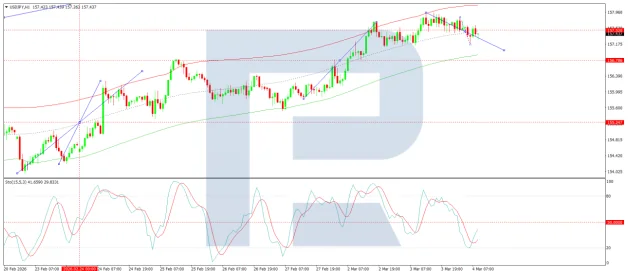
USD/JPY paused briefly midweek after a series of solid gains, currently trading at 157.59. The Japanese currency remains under pressure from a strengthening US dollar amid concerns that a prolonged conflict in the Middle East could keep energy prices elevated and heighten inflation risks.

The market has also revised its expectations for Federal Reserve rate cuts, shifting the likelihood of a reduction from July to September. Amid escalating geopolitical tensions, the dollar has emerged as a primary safe-haven asset, particularly as the US-Israel military operation against Iran enters its fifth phase.

US President Donald Trump suggested that the strikes could lead to a change of power in Iran. However, any new regime might prove equally problematic, underscoring the uncertainty surrounding the conflict’s outcome.

Japanese Finance Minister Satsuki Katayama reiterated that currency interventions remain a potential tool to support the yen. According to her, authorities are monitoring exchange rate dynamics with heightened urgency and are coordinating their actions with the US.

Technical Analysis

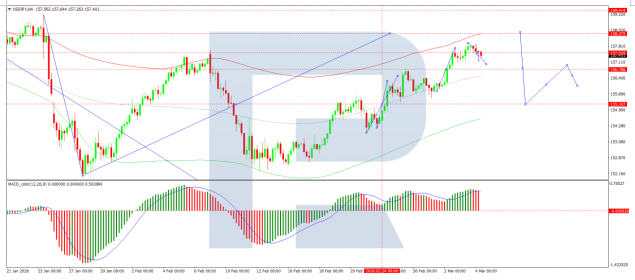
On the H4 USD/JPY chart, the market is forming a consolidation range around 157.00, which is currently extending to 157.92. A decline to test the 157.00 level from above is expected today. Following this, a potential growth leg towards 158.06 is likely. Technically, this scenario is supported by the MACD indicator, whose signal line is well above the zero line and pointing firmly downward.

On the H1 chart, USD/JPY is forming a downward wave pattern, targeting the 157.00 level, with a possible extension to 156.66, and further growth towards 158.38 anticipated thereafter. Technically, this scenario is confirmed by the Stochastic oscillator, with its signal line above the 20 level and pointing firmly downward.

Conclusion

USD/JPY’s brief consolidation appears temporary, with the broader trend favouring further upside for the dollar. Geopolitical tensions in the Middle East have reinforced the dollar’s safe-haven status, pushing back expectations for Fed rate cuts and creating a supportive backdrop for the pair. Despite verbal intervention warnings from Japanese officials, the technical outlook suggests USD/JPY is poised to resume its upward trajectory once the current correction runs its course.


Disclaimer

Any forecasts contained herein are based on the author’s particular opinion. This analysis may not be treated as trading advice. RoboForex bears no responsibility for trading results based on trading recommendations and reviews contained herein.

European equities plunge amid Persian Gulf military conflict

By JustMarkets 

The US stock market demonstrated impressive resilience on Monday: after a morning plunge, the indices almost completely recouped their losses. By the end of the day, the Dow Jones (US30) decreased by 0.15%. The S&P 500 (US500) gained 0.04%. The tech-heavy NASDAQ (US100) closed higher by 0.13%. The recovery was driven by a powerful wave of “buy-the-dip” activity focused on tech giants with massive liquidity reserves – Nvidia and Microsoft rose by 2.9% and 1.5%, respectively. Investors view “Big Tech” as a kind of “safe haven” within the technology sector, capable of weathering periods of high geopolitical turbulence.

Additional support came from the defense and energy sectors, which were direct beneficiaries of the escalation in the Middle East. Northrop Grumman shares soared 6% in response to the launch of Operation “Epic Fury,” while Exxon Mobil added 1.1% amid the oil rally caused by the blockade of the Strait of Hormuz.
The Canadian dollar (CAD) fell to 1.37 against the US dollar, testing a monthly low. The uniqueness of the situation lies in the fact that the “loonie” failed to benefit from the 8% spike in oil prices triggered by the blockade of the Strait of Hormuz and the death of Ayatollah Khamenei. Normally, the Canadian currency rises alongside energy prices, but the current dominance of the US dollar as the world’s primary haven and Canada’s internal economic issues have completely neutralized the “oil factor.” Fundamental pressure on the currency intensified following the release of Q4 GDP data, which confirmed a 0.6% contraction of the Canadian economy – the worst performance since the 2020 pandemic. Even the fact that the manufacturing PMI reached a 13-month high in February (51 points) failed to encourage investors.

Stock markets in Europe fell sharply. The German DAX (DE40) dropped 2.56%, the French CAC 40 (FR40) closed down 2.17%, the Spanish IBEX 35 (ES35) fell 2.64%, and the British FTSE 100 (UK100) closed down 1.20%. The German DAX 40 showed the worst performance among major European floors, crashing to 24,672 – the lowest closing level since early February. The decline affected almost all sectors of the German economy, as investors fear that the escalation of war in the Middle East and the blockade of the Strait of Hormuz will lead to a new round of inflation and indefinitely delay ECB interest rate cuts.

The most devastating blow hit the tourism and aviation sectors. Lufthansa shares plummeted 4.6% (with the drop exceeding 6% at one point) due to mass flight cancellations to the region and a sharp increase in jet fuel costs. The situation is even worse for the travel giant TUI, whose stock crashed nearly 9%. Investors are pricing in not only operational losses from tour disruptions but also the risk of a global decline in demand for long-haul travel under “wartime” uncertainty.
The silver (XAG) market saw a dramatic reversal: after a 3% rising morning surge, quotes collapsed by more than 6%, ending trade near $28. This “bearish” maneuver was caused by a sharp shift in market priorities. While gold maintained its safe-haven status, silver suffered due to its industrial nature. The blockade of the Strait of Hormuz and the death of Ayatollah Khamenei created a real threat of a global energy crisis. An additional blow came from US macroeconomic statistics: the jump in the ISM Manufacturing Prices Index to 70.5 (an 11.5-point increase) shocked markets, signaling a new wave of inflation. This triggered a spike in 10-year Treasury yields and pushed the US dollar Index to a five-week high.

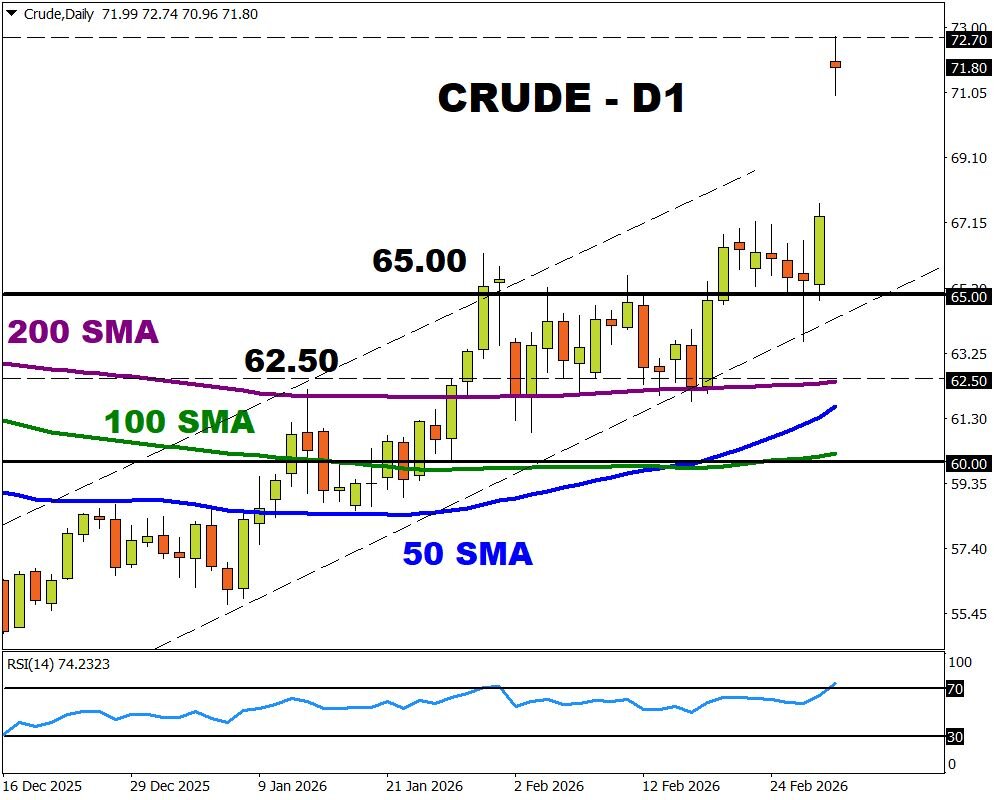
WTI oil prices demonstrated explosive growth, soaring by more than 12% at one point to a high since June of last year. Although quotes stabilized around $71-$72 by the close of the session, the market remains in a state of unprecedented shock. The main trigger was the de facto halt of shipping through the Strait of Hormuz. Insurance companies began mass-canceling policies or raising premiums to prohibitive levels (up to 0.4% of the vessel’s value), forcing more than 150 tankers to anchor and wait for safety.

The situation was exacerbated by a direct attack on Saudi Arabia’s energy infrastructure. Drones struck the kingdom’s largest refinery in Ras Tanura (capacity 550,000 barrels per day). Although the fire was quickly localized, Saudi Aramco was forced to temporarily shut down the facility for safety reasons. This incident confirmed analysts’ worst fears: that Iranian retaliatory strikes would target not only US military logistics but also critical nodes of the world’s energy supply. With 20% of global oil passing through the closed strait, analysts at JPMorgan and Goldman Sachs warn: if the blockade lasts more than three weeks, oil prices will inevitably break the $100 per barrel level, creating an “inflationary tsunami” for the global economy.

Asian markets traded with mixed dynamics yesterday. The Japanese Nikkei 225 (JP225) decreased by 1.35% during the session, the FTSE China A50 (CHA50) rose by 0.30%, the Hong Kong Hang Seng (HK50) dropped 2.14%, and the Australian ASX 200 (AU200) showed a positive result of 0.03%.

The Australian dollar (AUD) recovered to $0.71, partially offsetting Monday’s sharp fall. The driver of this growth was the hawkish rhetoric of RBA Governor Michele Bullock, who, against the backdrop of the Middle East crisis, shifted from a policy of patience to a readiness for action. Bullock explicitly warned that the surge in oil prices due to the conflict surrounding Iran carries serious inflationary risks for Australia and confirmed that the regulator would consider a rate hike at the March meeting. This triggered a revision of market expectations: the probability of a 25-basis-point hike in March is now estimated at 28%, with full policy tightening expected by May.

S&P 500 (US500) 6,881.62 +2.74 (+0.04%)

Dow Jones (US30) 48,904.78 −73.14 (−0.15%)

DAX (DE40) 24,638.00 −646.26 (−2.56%)

FTSE 100 (UK100) 10,780.11 −130.44 (−1.20%)

USD Index 98.54 +0.93% (+0.95%)

News feed for: 2026.03.03

  • Japan Unemployment Rate (m/m) at 01:30 (GMT+2); – JPY (MED)
  • Japan BOJ Gov Ueda Speaks at 06:00 (GMT+2); – JPY (LOW)
  • Eurozone Consumer Price Index (m/m) at 12:00 (GMT+2); – EUR (MED)
  • UK Annual Budget Release at 14:30 (GMT+2). – GBP (MED)

By JustMarkets


This article reflects a personal opinion and should not be interpreted as an investment advice, and/or offer, and/or a persistent request for carrying out financial transactions, and/or a guarantee, and/or a forecast of future events.

The oil price surge is just one symptom of a supply chain network that is not fit for this age of global tensions

By Maryam Lotfi, Cardiff University 

The escalating conflict between Iran, the US and Israel has taken a critical turn. The strait of Hormuz – one of the most important shipping routes for oil and gas – is facing significant disruption. The strait is the main route connecting Persian Gulf ports in Iran and some of the region’s other oil producers to the open ocean.

The strikes on Iran are already having tangible effects: energy flows are slowing, markets are reacting and supply chains are under pressure. This is not just a regional conflict – it is a global supply chain crisis unfolding in real time.

As an expert on supply chains, I am acutely aware of how central the strait is – not only for the stability of the region but also to the functioning of the global economy.

This narrow corridor is one of the world’s most critical chokepoints – around a fifth of the world’s oil passes through the strait daily. Its sudden disruption represents a “chokepoint failure” – a breakdown at a critical node that triggers cascading effects across global systems.

Tanker traffic has dropped sharply, with vessels waiting in surrounding waters as ship owners reassess the risks. Oil prices surged in response to the strikes and the threat to shipping routes. Analysts have warned that prices could climb significantly higher if the disruption persists.

But crucially, this reaction was not driven solely by actual shortages. Markets respond to uncertainty itself. The mere possibility that several million barrels per day could be disrupted is enough to push prices up, even before supply is properly hit. This reflects a broader feature of geopolitical risk: expectations and perceptions can be as economically powerful as material disruptions.

Because energy underpins almost every sector, these price increases transmit rapidly through supply chains. Higher fuel costs raise transportation expenses, increase production costs and ultimately feed into inflation across goods and services that eventually land with consumers.

The strategic importance of the Gulf states

The disruption is not confined to the strait. Instability across the wider Gulf region also affects the United Arab Emirates, as well as other strategically important energy producers and logistics hubs, such as Qatar, Kuwait and Saudi Arabia.

This dimension matters because the Gulf functions not only as an energy supplier but also as a crossroads in global trade and logistics.

Ports such as Dubai handle vast volumes of international shipping, linking Asia, Europe and Africa. As tensions spread, the reliability of these logistics systems is increasingly called into question.

The result is a shift to more widespread insecurity, where both energy flows and trade infrastructure – things like major container ports, shipping lanes, export terminals and storage facilities – are simultaneously at risk.

Energy is the heart of global supply chains. Manufacturing depends on electricity and fuel, transport relies on oil-based logistics and agriculture depends heavily on natural gas-derived fertilisers. When energy flows are disrupted or become more expensive, the effects propagate across entire networks.

Research on geopolitical crises shows that disruptions to key inputs such as oil and gas quickly translate into broader supply chain instability. This affects production, trade and the availability of goods far beyond the conflict zone. The Iran crisis reflects this dynamic. What begins as disruption in a maritime corridor can become a global economic issue within days.

For decades, global supply chains have been optimised for efficiency. This means that they concentrate sourcing and production in regions that minimise costs. This model has delivered large economic benefits, but it has also created weaknesses in the structure.

The concentration of energy flowing through a single chokepoint such as the strait of Hormuz exemplifies this trade-off. When it is disrupted, the system lacks resilience.

In response, supply chains are likely to accelerate efforts to diversify and invest in alternative energy routes and sources. Countries that are heavily dependent on oil transiting through the Gulf will seek to expand strategic reserves, diversify their import routes and invest in pipelines that bypass maritime chokepoints.

But at the same time, geopolitical instability strengthens the case for renewable energy, electrification and regional energy integration. Expanding solar, wind and green hydrogen capacity reduces exposure to concentrated fossil fuel corridors. And cross-border electricity connections can improve flexibility during shocks. In this sense, resilience is also an energy transition issue.

At the same time, instability in conflict-hit regions can fuel the rise of informal and illegal supply chains, particularly where governance is weakened. These can include things like unregulated oil trading, goods being smuggled through informal maritime routes and labour exploitation hidden within subcontracting chains.

What’s more, supply chains themselves are increasingly shaped by geopolitical forces, as states use trade, energy and logistics networks as instruments of power.

For consumers, this could mean greater price volatility, shortages and reduced choice as firms adjust sourcing strategies in response to sanctions, trade restrictions or security risks. In some cases, it may also mean higher costs over the long term, as businesses prioritise resilience over efficiency.

A turning point for globalisation?

The situation in the strait of Hormuz may mark a turning point in how global supply chains are understood. It has shone a light on a fundamental tension at the heart of globalisation. Efficiency depends on sourcing and production being concentrated in a few locations, but resilience depends on diversification. When critical links in the chain fail, the consequences extend far beyond their immediate location.

This war demonstrates that supply chains are not merely economic systems. They are deeply embedded in geopolitical realities. The challenge ahead is not simply to manage disruption, but to redesign supply chains and energy sources for a world in which geopolitical risk is no longer exceptional, but structural.The Conversation

About the Author:

Maryam Lotfi, Senior Lecturer in Sustainable Supply Chain Management, Cardiff University

This article is republished from The Conversation under a Creative Commons license. Read the original article.


Gold Rallies for Fifth Day, With External Risks Mounting

By Analytical Department RoboForex

Gold rose to 5,350 USD per ounce on Tuesday, marking its fifth consecutive session of gains. Demand for safe-haven assets continues to grow amid the escalating conflict in the Middle East.

President Donald Trump stated that the United States will continue its strikes on Iran until the country loses its ability to pose a threat. According to him, the conflict could last a month or “much longer.” In response, Iran has announced the closure of the Strait of Hormuz and threatened attacks on ships passing through this strategically vital energy corridor.

The worsening conflict has triggered a sharp rise in oil prices and intensified fears of accelerating US inflation. This has led to selling in US government bonds and a reassessment of expectations for further Federal Reserve rate cuts.

The market is now shifting its forecast for the next Fed rate cut to September, later than previously anticipated.

Technical Analysis

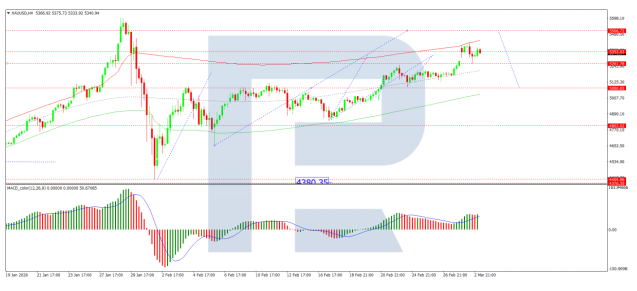
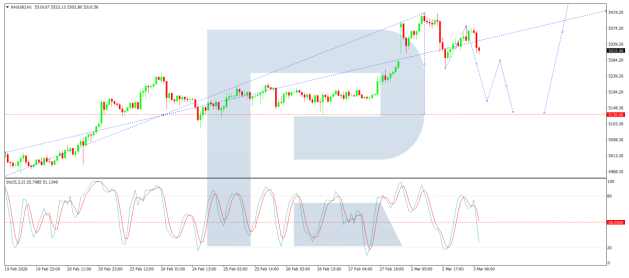
On the H4 XAU/USD chart, the market is forming a consolidation range around the 5,353 USD level. A downside breakout would open the way for a continuation of the correction towards 5,130 USD. Conversely, an upside breakout would open up potential for a wave towards the 5,599 USD level. The MACD indicator confirms the current momentum, with its signal line at highs and pointing strictly upwards.

On the H1 chart, the market has broken below the 5,333 USD level, suggesting a continuation of the trend towards 5,166 USD, with the potential for the wave to extend further to 5,130 USD. The stochastic oscillator supports this scenario, with its signal line remaining above the 80 level and under pressure to turn lower towards the 20 level.

Conclusion

Gold’s rally to record highs reflects escalating demand for safe-haven assets amid intensifying geopolitical risks in the Middle East. The conflict has not only boosted bullion but also lifted oil prices and stoked concerns about inflation, prompting markets to push back expectations for Fed rate cuts. While the short-term technical outlook remains bullish, traders are watching for potential corrections following such a strong upward move.


Disclaimer

Any forecasts contained herein are based on the author’s particular opinion. This analysis may not be treated as trading advice. RoboForex bears no responsibility for trading results based on trading recommendations and reviews contained herein.

Strait of Hormuz: if the Iran conflict shuts world’s most important oil chokepoint, global economic chaos could follow

By Sarah Schiffling, Hanken School of Economics 

The reported sinking of several Iranian warships by US missiles in the Gulf of Oman serves as a reminder of the maritime aspect of the conflict which began February 28 with a barrage of Israeli and American missiles targeting Iran. Two other vessels, believed to be tankers, have also been reported as having been hit by missiles, of an as yet undetermined source, in the vicinity of the Strait of Hormuz, underlining the importance of this vital shipping lane – which is likely to play an key part in all sides’ calculations.

Full details have yet to emerge of the incidents. But there are already signs that the strait will become a major focus of concern because of the huge implications should the conflict disrupt maritime traffic through this the narrow outlet of the Persian Gulf. Ships crossing the Strait of Hormuz carry around one-fifth of global oil supplies. That’s about 20 million barrels per day. This makes the strait the most critical energy chokepoint.

There are a small number of strategic passageways, or chokepoints on which global trade depends and which are vulnerable to disruption. Any disruption reverberates instantly through global markets and supply chains. With conflict raging in Iran and attacks across the Middle East, traders, governments and businesses will be watching oil prices closely as the markets open.

After Israel and the US launched attacks on Iran on February 28, prompting retaliatory strikes across the region from Iran, Tehran broadcast to vessels in the region claiming that the Strait of Hormuz was closed.

Although the shipping lanes are only about two miles wide, actually physically closing them would be difficult to achieve. The most decisive action Tehran could take would be to mine the shipping lanes. With the large US naval presence in the area, this would be very difficult for Iran to achieve.

But a formal blockade is not necessary to stop traffic. When perceived threat levels rise, ships stay away. Big shipping companies such as Hapag Lloyd and CMA CGA have already suspended transit through the strait and advised their ships to proceed to shelter.

Vessel tracking already shows reduced movements in the Strait of Hormuz. Ships are waiting to enter or exit the Persian Gulf or diverting away from the region. An advisory from the United Kingdom Maritime Trade Operations (UKMTO) Centre has warned of the “increased risk of miscalculation or misidentification, particularly in proximity to military units”.

Several ports have suspended operations after debris from an intercepted missile sparked a fire at Dubai’s Jebel Ali Port. While other ports continue to operate, the risk and uncertainty are disrupting shipping in the region.

Supply chain disruption

Hormuz is dominated by oil tankers and liquid natural gas carriers, so disruption directly hits global energy supplies. In addition, a lesser-known dependency is that one-third of the world’s fertiliser trade passes through the strait. Both energy and agricultural supply chains have already been destabilised by the Ukraine war. Further price rises could have far-reaching consequences.

Map of Straits of Hormuz
The Strait of Hormuz is one of the world’s most important waterways, with 20% of the global trade in oil flowing through a narrow maritime channel.
Wikimedia Commons

The main destinations for oil and gas flowing through Hormuz are China, India, Japan, and South Korea. India, which imports about half of its crude oil through the strait, has activated contingency plans to safeguard energy supplies.

But apart from amassing strategic national stockpiles to weather immediate disruptions, there may be limited alternatives for countries dependent on getting their energy supplies through the strait. Saudi Arabia and the UAE have some pipelines for both oil and gas that can bypass the Hormuz. There is an estimated spare capacity of 2.6 million barrels per day for these pipelines. But that’s a fraction of what is normally shipped through the strait.

Oil and gas are traded globally. So even countries whose energy needs are not met by imports from the Persian Gulf will be affected by price increases. Oil prices are expected to increase to up to US$100 (£74) per barrel when markets open on Monday. Opec has agreed to modestly boost oil output in a bid to stabilise markets. But the group of oil producing countries has limited options as key members are affected by the fallout of the attacks on Iran.

Energy price increases will hit consumers directly when filling up their cars or heating their homes. They also affect companies across a wide range of industries. This has the potential to cause further supply chain disruptions.

Supply chains rely on predictability. The persistent geopolitical uncertainty has complicated operations worldwide. Limited alternatives make the de facto closure of the Strait of Hormuz all the more impactful. The longer the disruption persists, the more significant and structural the economic damage will become.

Potential for escalation

There is still a potential for a catastrophic escalation in the Strait of Hormuz. The sinking of a tanker would have dramatic consequences for the environment and would likely halt navigation for an extended period of time.

But prolonged instability may also prove destructive for the global economy.
Previously, Iran closing the strait was seen as unlikely considering the global backlash and economic harm to Iran itself. But with regime change now the stated goal of the US-Israeli attacks, the cost of holding the world economy hostage might seem justified to the rulers in Tehran.The Conversation

About the Author: 

Sarah Schiffling, Deputy Director of the HUMLOG (Humanitarian Logistics and Supply Chain Management Research) Institute, Hanken School of Economics

This article is republished from The Conversation under a Creative Commons license. Read the original article.

Iran Crisis: A Dangerous Turning Point

By ForexTime 

  • US-Israel strikes kill Iran’s supreme leader
  • Oil benchmarks surge over 10% on Sunday open
  • Safe-haven assets Gold/Silver also gap higher
  • Risk-off may be name of game ahead of packed week
  • Cheat sheet of potential winners and losers

Over the weekend, US–Israel strikes killed Iran’s Supreme Leader, Ayatollah Ali Khamenei – a dangerous turning point in an already distressed region.

Tehran fired back at Israel and hit US bases across the Gulf.

This explosive development came as a surprise, given there was an agreement to hold further talks over the coming weeks.

With missiles still flying, the risk of a full-blown regional escalation is growing by the minute.

And this was reflected on Sunday when markets opened with sharp gaps from Friday’s close amid the chaos.

  • BRENT: ↑ 8%
  • WTI: ↑7%
  • XAUUSD: ↑2%
  • XAGUSD: ↑1%

Note: Prices shown represent the gap from Friday’s close.

Here’s a cheat sheet of assets that could win/lose:


POTENTIAL WINNERS:

  • VIX (Volatility Index)

The primary beneficiary as market fear spikes; prices may surge as investors hedge against a wider regional conflict.

  • Safe-haven assets – (XAUUSD, XAGUSD, JPY, CHF, USD)

As risk aversion intensifies, investors may rush to safe-haven destinations.

  • Oil benchmarks – (WTI, Brent)

The US-Israeli war against Iran has plunged the global crude market into turmoil, with the effective closure of the critical Strait of Hormuz fuelling supply side fears.


POTENTIAL LOSERS:

  • Global equities – (CN50, EU50, UK100, US500, NAS100, US30)

As investors scramble for safety amid the chaos, global equities may face fresh selling pressure.

  • Bitcoin, Ethereum, Altcoins

Overall uncertainty and caution may repel investors from cryptos in favour of precious metals or safe-haven FX currencies.

There have been reports that Trump intends to engage in new talks with Iran’s new leadership.

Nevertheless, the Iran crisis has entered a new phase which could mean heightened levels of volatility over the next few days to weeks.

And with volatility comes opportunity.

Don’t miss out.


Forex-Time-LogoArticle by ForexTime


ForexTime Ltd (FXTM) is an award winning international online forex broker regulated by CySEC 185/12 www.forextime.com

Oil prices have seen their largest surge in 4 years amid the military conflict in the Persian Gulf.

By JustMarkets 

On Friday, trading on the US stock market ended with a decline. By the end of Friday, the Dow Jones (US30) Index fell by 1.05% (-1.15% for the week). The S&P 500 (US500) dropped by 0.43% (-0.38% for the week). The tech-heavy NASDAQ (US100) closed lower by 0.30% (+0.51% for the week). The primary blow was a “hot” Producer Price Index (PPI) report, where the core figure jumped by 0.8%, confirming that companies are actively passing increased tariff costs onto consumers. This sharply reduced the chances of Fed easing, and the escalation in the Persian Gulf added fuel to the fire, sending oil prices and inflation expectations skyrocketing.

Market tranquility was shattered over the weekend. On February 28, 2026, the United States and Israel launched a large-scale military operation, “Epic Fury,” against Iran. In response, Tehran launched missile strikes on US bases in the UAE, Qatar, and Kuwait, while the Islamic Revolutionary Guard Corps announced the closure of the Strait of Hormuz. As up to 30% of global seaborne oil trade passes through this route, experts predict oil prices could jump to $100 per barrel. This creates a risk of a new wave of stagflation for Europe and other nations.

European equity markets mostly rose. The German (DE40) fell 0.02% (+0.86% for the week), the French CAC 40 (FR40) closed down 0.47% (+1.29% for the week), the Spanish IBEX 35 (ES35) dropped 0.73% (+0.73% for the week), and the British FTSE 100 (UK100) closed up 0.59% (+2.31% for the week). However, European exchanges opened with a crash. Markets are reacting to the critical escalation in the Middle East: the death of Iran’s Supreme Leader Ayatollah Ali Khamenei and the de facto blockade of the Strait of Hormuz have threatened Europe’s energy security. Amid record-low gas reserves in underground storage facilities, the spike in energy prices intensifies stagflation risks, forcing investors to price in a more hawkish ECB policy. The macroeconomic backdrop remains concerning: while inflation in Germany slowed in February, its acceleration in France and Spain gives the regulator little cause for optimism. Money markets now price the probability of a rate cut by year-end at just 30%.

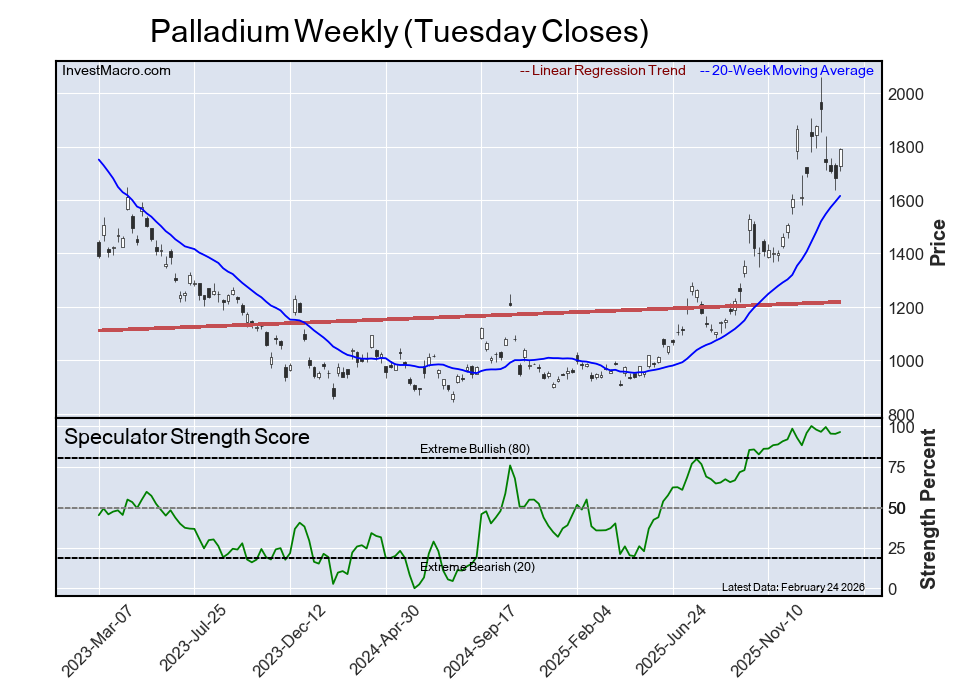
Palladium (XPD) prices jumped above $1,800 per ounce, reaching a monthly high amid the large-scale military conflict in the Middle East. The death of Iran’s Supreme Leader and Donald Trump’s tough rhetoric regarding the continuation of Operation “Epic Fury” triggered panic buying of precious metals. Geopolitical chaos has collided with an acute supply deficit: production disruptions in South Africa and the risk of new sanctions against Russian exports (which account for about 40% of the global market) threaten long-term supply chain ruptures for the automotive industry. Future price dynamics will depend on dollar stability and Friday’s Non-farm Payrolls report. If the US labor market remains strong, the dollar will continue to rise, potentially limiting the palladium rally.

WTI oil prices jumped over 6%, settling above $71 per barrel (after a brief 10% spike). This is an eight-month high triggered by the start of Operation “Epic Fury” – unprecedented strikes by the US and Israel on Iran on February 28. Markets are pricing in the risk of a total blockade of the Strait of Hormuz, through which approximately 20% of global oil supplies flow. Against the backdrop of the escalation, the OPEC+ decision made on Sunday appears extremely cautious: the alliance will increase production in April by only 206,000 barrels per day. This is half the previously discussed volume (up to 548,000 bpd) and clearly insufficient to offset the potential loss of Iranian exports. Investors await the US market open, where a supply deficit combined with a rising geopolitical premium could push quotes to the $80-85 level as early as this week.

Asian markets traded with mixed dynamics last week. The Japanese Nikkei 225 (JP225) rose 3.60% for the week, the Chinese FTSE China A50 (CHA50) fell 1.47%, the Hong Kong Hang Seng (HK50) dropped 1.30%, and the Australian ASX 200 (AU200) showed a positive 5-day result of 1.03%.

The Hang Seng Index plunged 667 points (-2.5%), hitting a six-week low. The sell-off was triggered by the sharp escalation of the war: following the deaths of three US service members, Donald Trump vowed “revenge” and pledged to continue Operation “Epic Fury” until Iran’s military potential is fully destroyed. The confirmed death of Ayatollah Khamenei and the blockade of the Strait of Hormuz threatened global oil supplies, causing a collapse in tech giants and airline stocks due to fuel crisis fears. Mainland Chinese indices served as a partial counterweight, showing moderate growth. Investors are betting on the “Two Sessions” of the NPC starting March 4: amidst a new major war in the Middle East, the market expects Beijing to sharply increase government spending on technological sovereignty and the launch of the 15th Five-Year Plan (2026-2030).

The Australian dollar (AUD) fell to $0.70, completely erasing last week’s gains. As a typical “risk-on” currency, the “aussie” suffered from a global flight to safety (US dollar and gold). Direct Iranian strikes on US bases in Gulf countries and Jordan, alongside the blockade of the Strait of Hormuz, have jeopardized global supply chains to which Australia’s economy is highly sensitive. Domestic statistics added pressure: Australia’s Manufacturing PMI was revised down to 51.0 – a four-month low.

S&P 500 (US500) 6,878.88 −29.98 (−0.43%)

Dow Jones (US30) 48,977.92 −521.28 (−1.05%)

DAX (DE40) 25,284.26 −4.76 (−0.02%)

FTSE 100 (UK100) 10,910.55 +63.85 (+0.59%)

USD Index 97.65 −0.15% (−0.15%)

News feed for: 2026.03.02

  • Australia Manufacturing PMI (m/m) at 00:00 (GMT+2); – AUD (MED)
  • Japan Manufacturing PMI (m/m) at 02:30 (GMT+2); – JPY (MED)
  • German Retail Sales (m/m) at 09:00 (GMT+2); – EUR (MED)
  • Switzerland Retail Sales (m/m) at 09:30 (GMT+2); – CHF (MED)
  • Switzerland Manufacturing PMI (m/m) at 09:30 (GMT+2); – CHF (LOW)
  • Eurozone Manufacturing PMI (m/m) at 11:00 (GMT+2); – EUR (MED)
  • UK Manufacturing PMI (m/m) at 11:30 (GMT+2); – GBP (MED)
  • Eurozone ECB President Lagarde Speaks at 16:00 (GMT+2); – EUR (LOW)
  • Canada Manufacturing PMI (m/m) at 16:30 (GMT+2); – CAD (MED)
  • US ISM Manufacturing PMI (m/m) at 17:00 (GMT+2); – USD (MED)
  • Australia RBA Gov Bullock Speaks at 23:10 (GMT+2). – AUD (LOW)

By JustMarkets


This article reflects a personal opinion and should not be interpreted as an investment advice, and/or offer, and/or a persistent request for carrying out financial transactions, and/or a guarantee, and/or a forecast of future events.

EUR/USD Reacts to Geopolitics and Data: Week Opens Nervously

By Analytical Department RoboForex

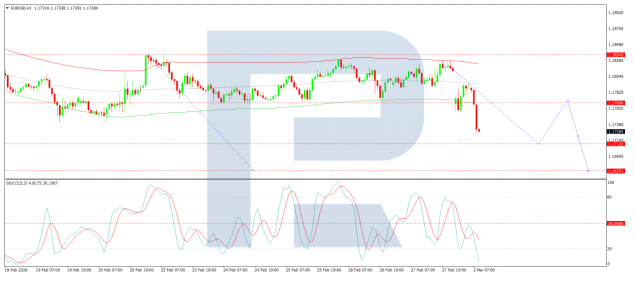
EUR/USD rose to 1.1790 on Monday. The US dollar attempted to strengthen, but part of its rally was subsequently pared back. Demand for safe-haven assets intensified over the weekend amid an escalation of the conflict in the Middle East.

The US and Israel conducted strikes on Iran, resulting in the death of the country’s supreme leader, Ayatollah Ali Khamenei. Reports also emerged of the effective closure of the Strait of Hormuz, a crucial route for global oil supplies. Tehran has responded with attacks on American targets in the region, fuelling fears of a broader conflict.

Additional support for the dollar came from US producer inflation data. January’s PPI rose more sharply than expected, suggesting that companies are passing on tariff-related costs to consumers, which complicates the outlook for a potential Federal Reserve rate cut.

Nevertheless, the market continues to price in two 25-basis-point rate cuts from the Fed this year. The prevailing sentiment is that volatility and geopolitical risks could eventually force the central bank to ease its monetary policy.

Technical Analysis

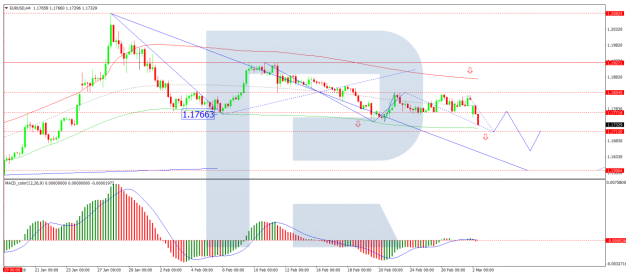
On the H4 chart of EUR/USD, the market is forming a consolidation range around the 1.1834 level. A downside breakout is expected, with the decline continuing to 1.1712, and the potential for the trend to extend further to 1.1590. Technically, this bearish scenario is confirmed by the MACD indicator, whose signal line is below zero and pointing firmly downwards, reflecting sustained bearish momentum.

On the H1 chart, the market is forming the structure of the next downward wave towards 1.1712. After reaching this level, a corrective rise to 1.1768 is anticipated, followed by the start of a new downward wave to 1.1650. Technically, this scenario is supported by the Stochastic oscillator, with its signal line below 50 and pointing firmly downwards towards the 20 level.

Conclusion

The euro is navigating a complex landscape, with safe-haven flows and geopolitical tensions in the Middle East initially boosting the US dollar, while hotter-than-expected US PPI data adds another layer of uncertainty to Fed policy. Although the market still anticipates rate cuts later this year, the immediate technical outlook for EUR/USD appears bearish, suggesting further downside in the short term.


Disclaimer

Any forecasts contained herein are based on the author’s particular opinion. This analysis may not be treated as trading advice. RoboForex bears no responsibility for trading results based on trading recommendations and reviews contained herein.

Currency Speculators push Aussie Bets Higher, Euro & GBP Bets fall this week

By InvestMacro

Speculators OI FX Futures COT Chart

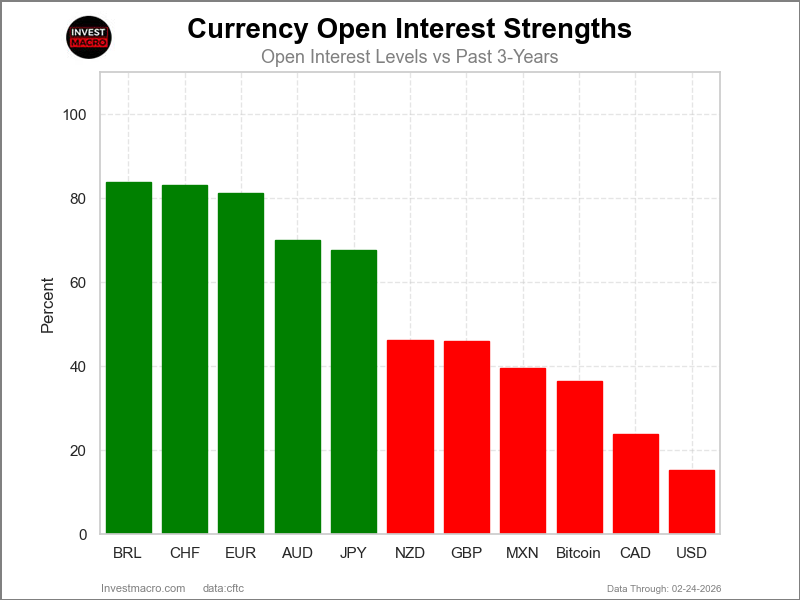
Open Interest Strength Levels show where current Open Futures Contracts are highest and lowest (higher interest can fuel trends and setup for more potential moves & vice versa) for currency markets.


Here are the latest charts and statistics for the Commitment of Traders (COT) data published by the Commodities Futures Trading Commission (CFTC).

The latest COT data is updated through Tuesday February 24th and shows a quick view of how large market participants (for-profit speculators and commercial traders) were positioned in the futures markets. All currency positions are in direct relation to the US dollar where, for example, a bet for the euro is a bet that the euro will rise versus the dollar while a bet against the euro will be a bet that the euro will decline versus the dollar.

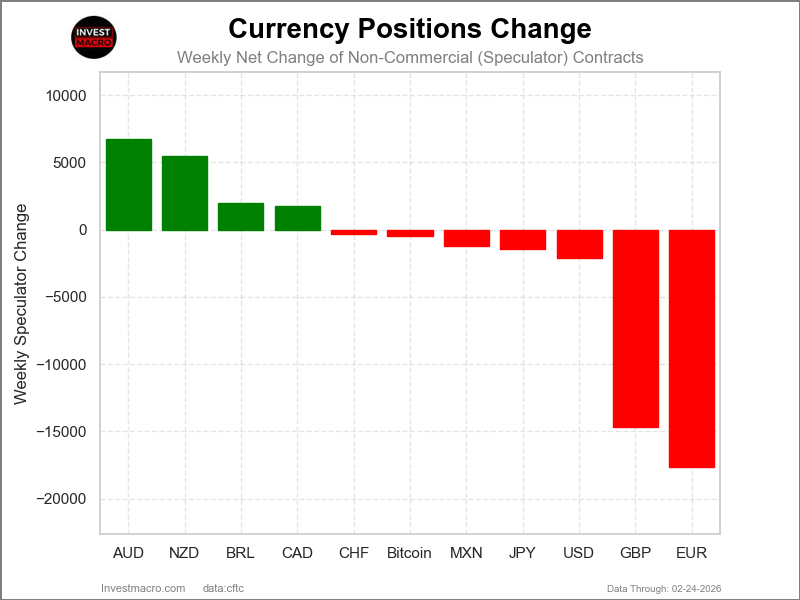
Weekly Speculator Changes led by Australian Dollar & New Zealand Dollar
Speculators Nets FX Futures COT Chart
The COT currency market speculator bets were overall lower this week as just four out of the eleven currency markets we cover had higher positioning while the other seven markets had lower speculator contracts.

Leading the gains for the currency markets was the Australian Dollar (6,713 contracts) with the New Zealand Dollar (5,446 contracts), the Brazilian Real (2,012 contracts) and the Canadian Dollar (1,752 contracts) also seeing gaining weeks.

The currencies seeing declines in speculator bets on the week were the EuroFX (-17,624 contracts), the British Pound (-14,668 contracts), the US Dollar Index (-2,117 contracts), the Japanese Yen (-1,416 contracts), the Mexican Peso (-1,242 contracts), Bitcoin (-466 contracts) and with the Swiss Franc (-305 contracts) also recording lower bets on the week.

Speculators push Aussie Bets Higher, Euro & GBP Bets fall this week

Highlighting the currency speculator positioning for last week through Tuesday was the continued bullishness for speculators in the Australian dollar. The New Zealand dollar speculator bets continued to improve despite being bearish while the Euro bets took a breather and the British pound speculator position went increasingly bearish.

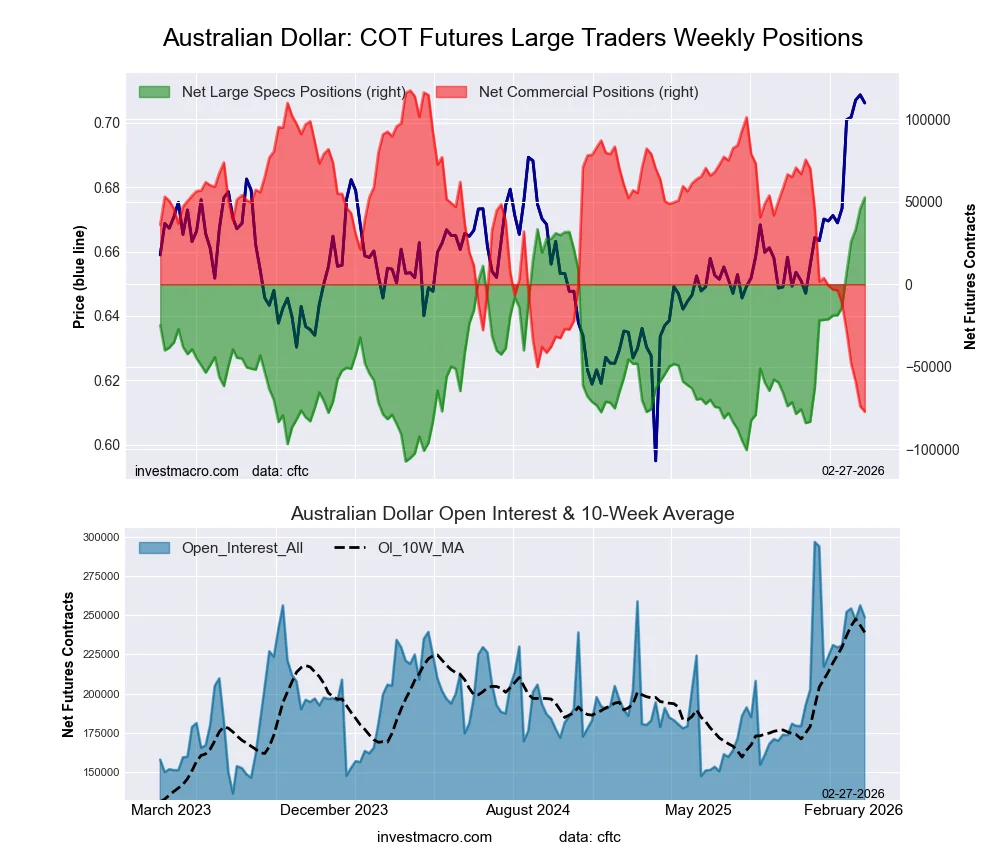
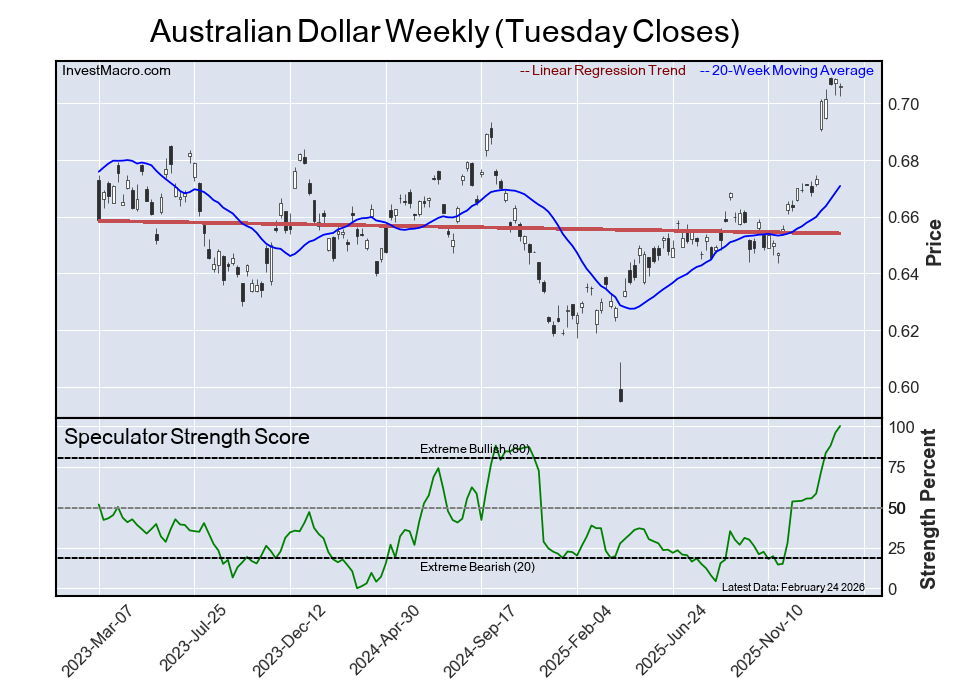
First off, the Australian dollar speculator position rose this week for a 13th consecutive week, with speculator positions adding a total of +136,820 net contracts over that time period. This has taken the Australian dollar net position from a total of -84,176 contracts on November 25th to this week’s net position of 52,644 contracts. This is the best level for the Australian dollar net position since October 24th of 2017, a span of 435 weeks. The Australian dollar in the foreign exchange market has continued to rally since the beginning of the year and is up by almost 6.50 percent since the start of 2026. Since the AUD lows in February of last year, the Australian dollar has risen by over 16 percent against the US dollar. The Aussie has been able to hold above the major 0.7000 level and closed out the week above the 0.7100 exchange rate. The AUD has been having its highest weekly closes at the highest levels since early 2023.

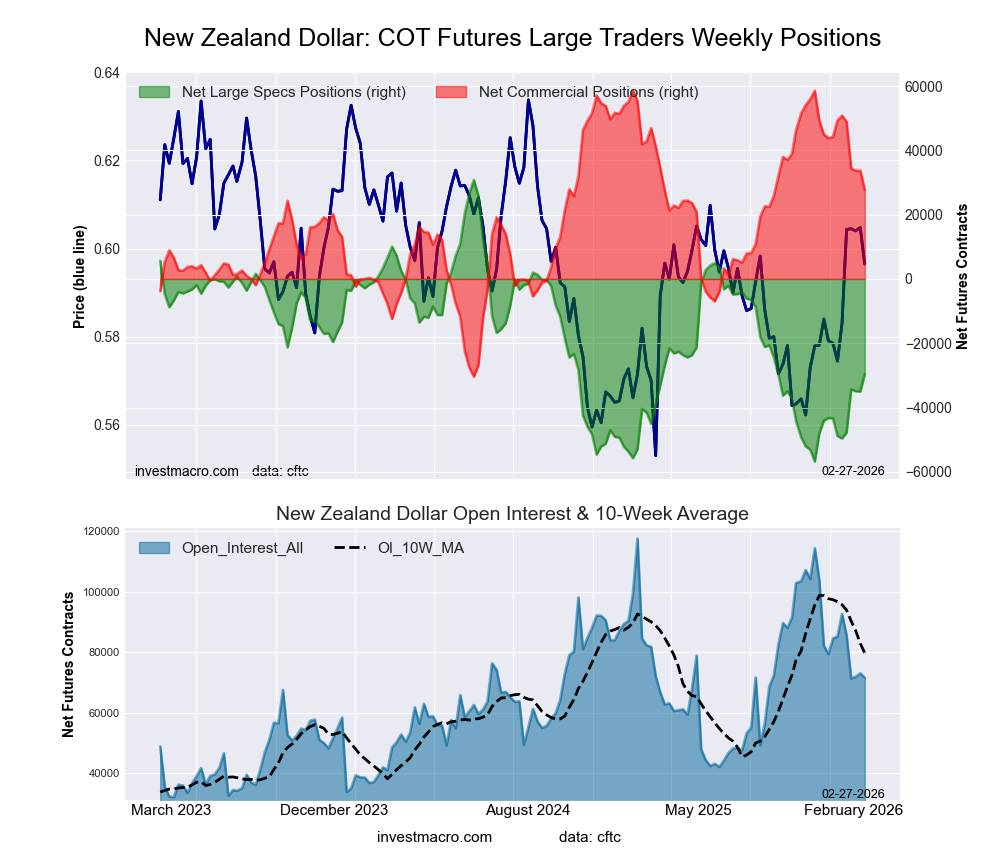
The New Zealand dollar speculator position has been improving steadily, with weekly speculator bets improving in six out of the last eleven weeks for an eleven-week gain of 27,214 net contracts. These gains date back to December 9th when the net position totaled -56,781 net contracts, which was the all-time low or most bearish level in history for the NZD speculator positions. Since then, the bets have been improving and this week reached a -29,567 net contract level, the best level or least bearish standing of the past twenty weeks. In the spot price market, the NZD has been up in six out of the past seven weeks and is currently trading right around the major psychological level of 0.6000 threshold, which also coincides with the two hundred weekly moving average.

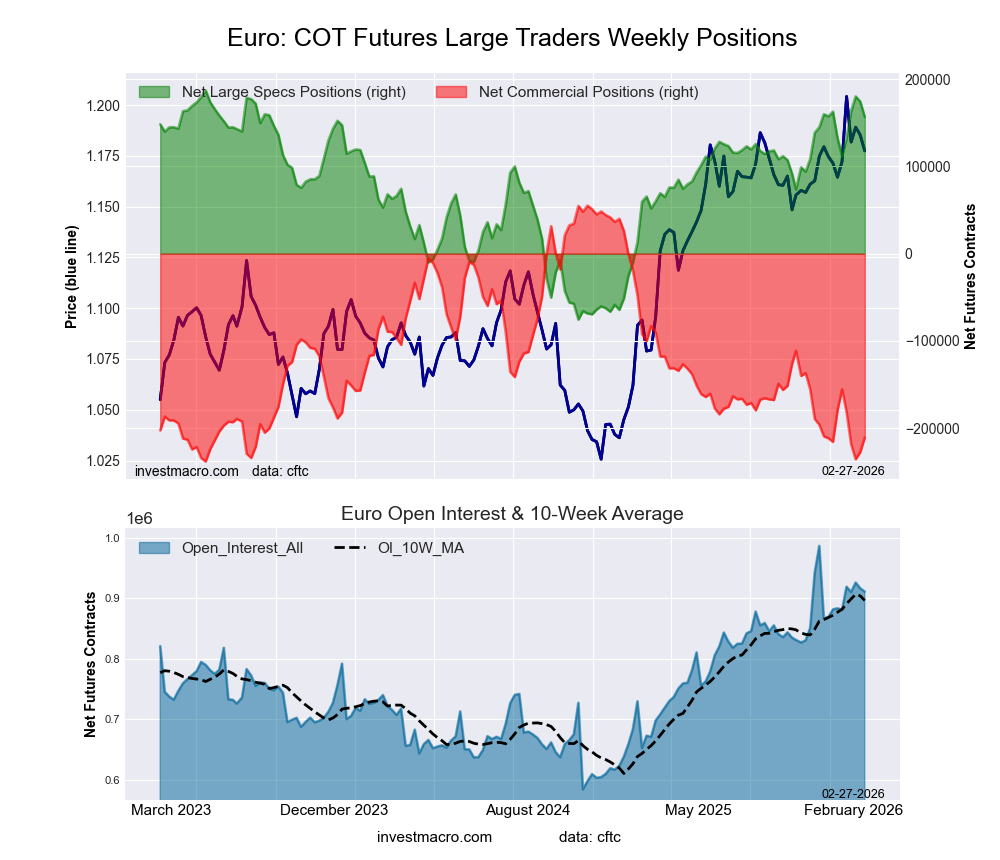
Euro speculator bets took a breather this week and fell for a second consecutive week. The Euro speculator positions have been mixed over the last ten weeks, with five weeks of falling speculator bets and five weeks of gaining speculator bets. Although the net change over the last ten weeks has been roughly a +12,000 net contracts. Overall, the speculator positioning for the Euro remains highly bullish with this week’s net position over +156,000 contracts. This marks the 13th consecutive week that the net position has been over +100,000 net contracts, and this is the 33rd out of the last 37 weeks that the net position has been over +100,000 net contracts. In the forex markets, the Euro closed over the 1.1820 level this week after seeing a small weekly gain. Continued overhead and major resistance resides at 1.2000, while there is support at the 1.1750 level, as well as the 1.1600 level below.

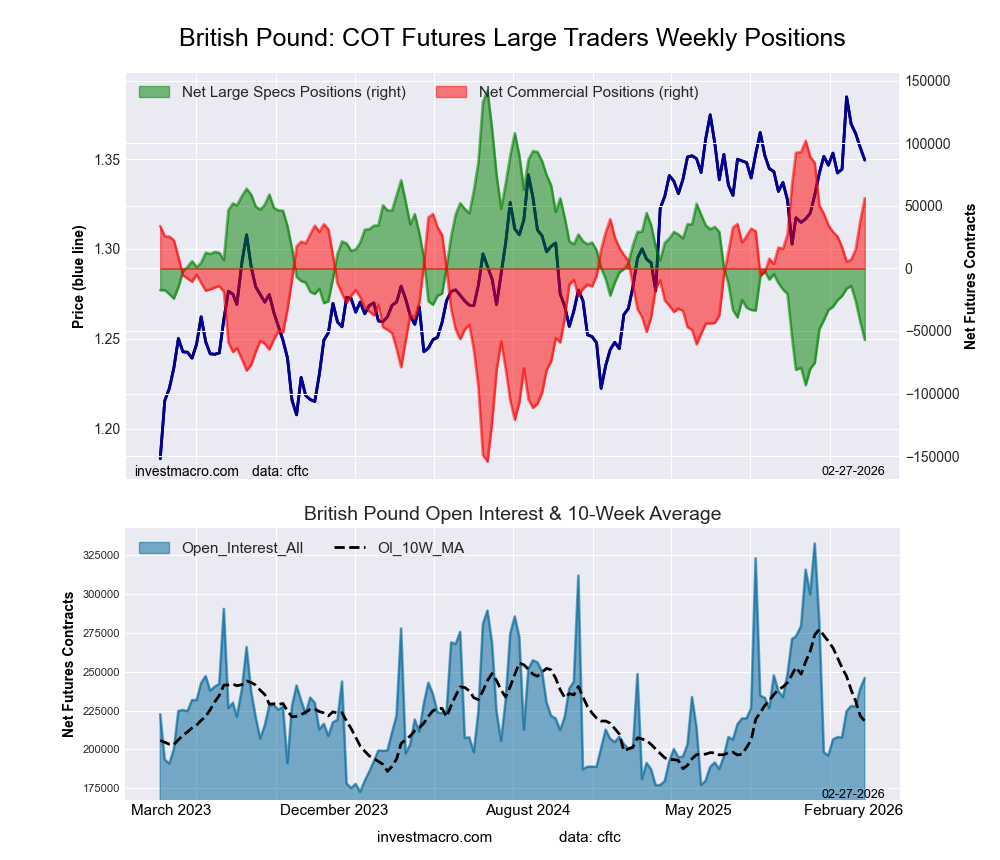
The British pound sterling saw its third week of strong bearish positioning and has now dropped by over -43,000 net contracts in the past three weeks. Previously, the British pound sterling had seen ten straight weeks of gains, so these last three weeks have cooled off that streak of bets. This week’s net position of negative -57,072 net contracts is the most bearish level of the past eleven weeks. Overall, the British pound sterling has been in bearish territory for 31 consecutive weeks dating back to July 2025. In the foreign exchange markets, the British pound sterling closed out the week at the 1.3480 level and has fallen for three out of the past four weeks. Currently, the bulls and the bears are battling it out around the 1.3500 area to see if this currency is gonna continue higher or take a breather and retreat lower. Since the beginning of 2025, the British pound has been up by approximately 11 percent against the US dollar in that time-frame.

The US dollar index bets dipped this week following four consecutive weeks of gains that had brought the US dollar index net position into a small bullish level last week. Last week’s pop up into the bullish level was the first time since June 2025 that the US dollar index had seen a bullish net contract position, a span of 36 weeks. This week’s dollar index speculator position dipped by over -2,100 contracts, bringing the overall net positioning to -1,789 net contracts. Essentially, this is a neutral position for speculator contracts and shows there is no dominant trend in where the speculators are leaning, with uncertainty as to whether we go up or down from here. In the Forex markets, the USD index had a small dip this week in price and is settling in and consolidating around the 97.50 exchange rate. The USD index has overhead resistance at the 98.00 level, while there is also strong support below as prices have bounced off the 96.50 level at least three times since June and have been unable to hold below that level for any amount of time.

Brazilian Real leads Currency Market Price Performance

This week’s five-day price performance was led by the Brazilian real, which rose by over one percent with a 1.03 percent gain on the week. The Swiss franc came in second with a 0.91 percent increase, followed by the Australian dollar, which rose by 0.50 percent on the week.

The New Zealand dollar was higher by 0.40 percent, followed by the Canadian dollar, which saw an uptick by 0.35 percent. The Euro was marginally higher at 0.32 percent.

On the downside, Bitcoin saw a -3.02 percent shortfall on the week. The Mexican peso was down by -0.62 percent, followed by the Japanese yen with a similar -0.61 percent decline. The US dollar index was lower by -0.11 percent, and the British pound was virtually unchanged with a small edge lower by -0.02 percent.

Over the past thirty days, the Australian dollar has been the standout performer with a 6.49 percent gain over that period. The Brazilian real has been up by 4.87 percent while the Swiss franc has been higher by 4.55 percent and the New Zealand dollar has also floated higher by 4.29 percent in the 30-day time-frame.


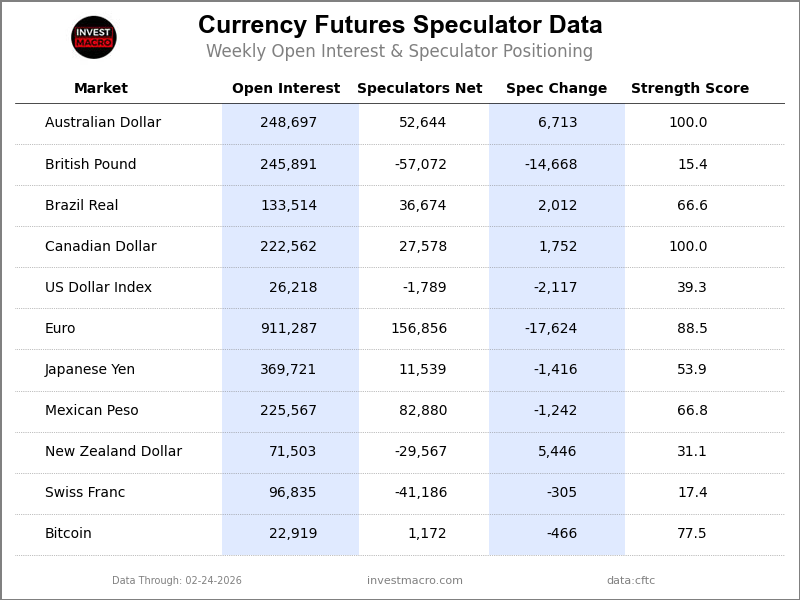
Currencies Data:
Speculators FX Futures COT Data Table
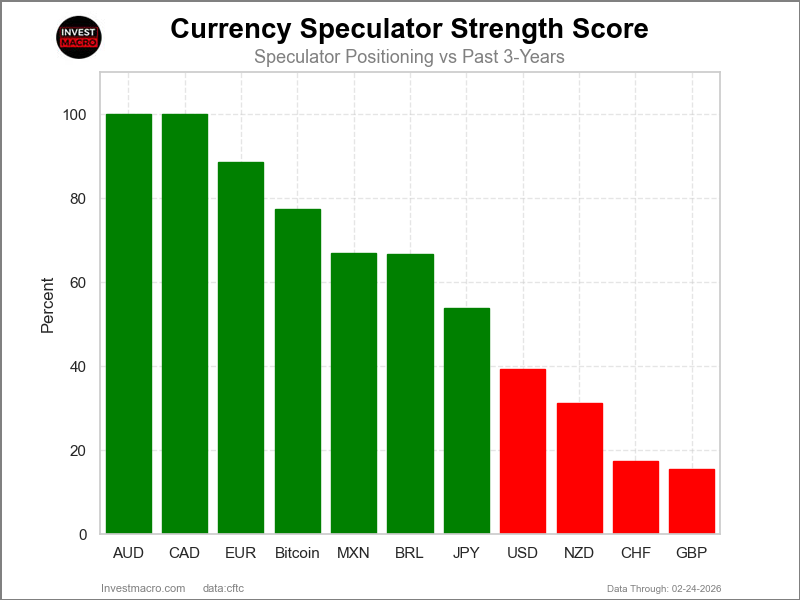
Legend: Open Interest | Speculators Current Net Position | Weekly Specs Change | Specs Strength Score compared to last 3-Years (0-100 range)


Strength Scores led by Canadian Dollar & Australian Dollar
Speculators Strength Scores FX Futures COT Chart
COT Strength Scores (a normalized measure of Speculator positions over a 3-Year range, from 0 to 100 where above 80 is Extreme-Bullish and below 20 is Extreme-Bearish, a 50 score is right down the middle of the past 3-Years) showed that the Canadian Dollar (100 percent) and the Australian Dollar (100 percent) lead the currency markets this week. The EuroFX (88 percent), Bitcoin (78 percent) and the Mexican Peso (67 percent) come in as the next highest in the weekly strength scores.

On the downside, the British Pound (15 percent) and the Swiss Franc (17 percent) come in at the lowest strength levels currently and are both in Extreme-Bearish territory (below 20 percent). The next lowest strength scores are the New Zealand Dollar (31 percent) and the US Dollar Index (39 percent).

3-Year Strength Statistics:
US Dollar Index (39.3 percent) vs US Dollar Index previous week (45.0 percent)
EuroFX (88.5 percent) vs EuroFX previous week (95.2 percent)
British Pound Sterling (15.4 percent) vs British Pound Sterling previous week (21.6 percent)
Japanese Yen (53.9 percent) vs Japanese Yen previous week (54.3 percent)
Swiss Franc (17.4 percent) vs Swiss Franc previous week (18.1 percent)
Canadian Dollar (100.0 percent) vs Canadian Dollar previous week (99.2 percent)
Australian Dollar (100.0 percent) vs Australian Dollar previous week (95.8 percent)
New Zealand Dollar (31.1 percent) vs New Zealand Dollar previous week (24.9 percent)
Mexican Peso (66.8 percent) vs Mexican Peso previous week (67.5 percent)
Brazilian Real (66.6 percent) vs Brazilian Real previous week (63.0 percent)
Bitcoin (77.5 percent) vs Bitcoin previous week (87.4 percent)


Australian Dollar & Canadian Dollar top the 6-Week Strength Trends
Speculators Trends FX Futures COT Chart
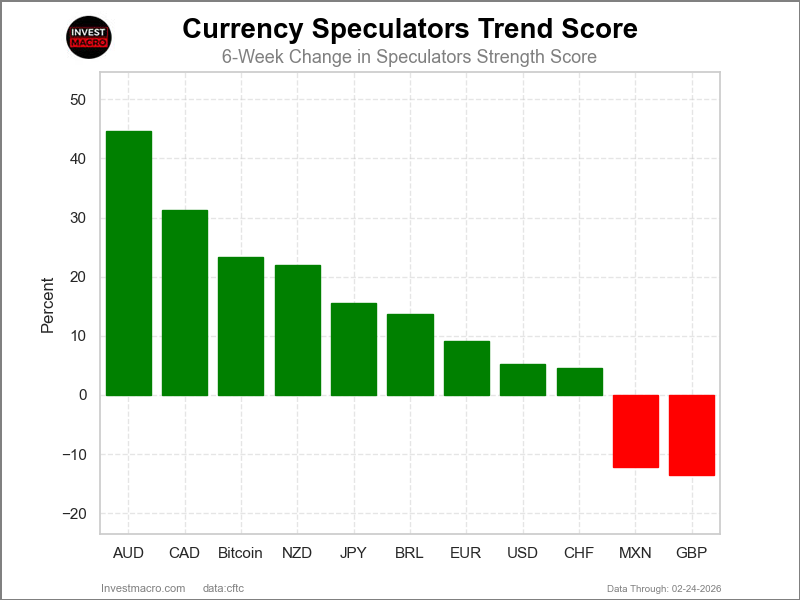
COT Strength Score Trends (or move index, calculates the 6-week changes in strength scores) showed that the Australian Dollar (45 percent) and the Canadian Dollar (31 percent) lead the past six weeks trends for the currencies. Bitcoin (23 percent), the New Zealand Dollar (22 percent) and the Japanese Yen (16 percent) are the next highest positive movers in the 3-Year trends data.

The British Pound (-14 percent) leads the downside trend scores currently with the Mexican Peso (-12 percent) following next with a lower trend score.

3-Year Strength Trends:
US Dollar Index (5.2 percent) vs US Dollar Index previous week (11.2 percent)
EuroFX (9.2 percent) vs EuroFX previous week (4.4 percent)
British Pound Sterling (-13.5 percent) vs British Pound Sterling previous week (-5.0 percent)
Japanese Yen (15.6 percent) vs Japanese Yen previous week (1.1 percent)
Swiss Franc (4.5 percent) vs Swiss Franc previous week (-1.2 percent)
Canadian Dollar (31.2 percent) vs Canadian Dollar previous week (29.7 percent)
Australian Dollar (44.6 percent) vs Australian Dollar previous week (40.5 percent)
New Zealand Dollar (22.0 percent) vs New Zealand Dollar previous week (9.5 percent)
Mexican Peso (-12.1 percent) vs Mexican Peso previous week (-14.7 percent)
Brazilian Real (13.7 percent) vs Brazilian Real previous week (-7.6 percent)
Bitcoin (23.4 percent) vs Bitcoin previous week (50.3 percent)


Individual COT Forex Markets:

US Dollar Index Futures:
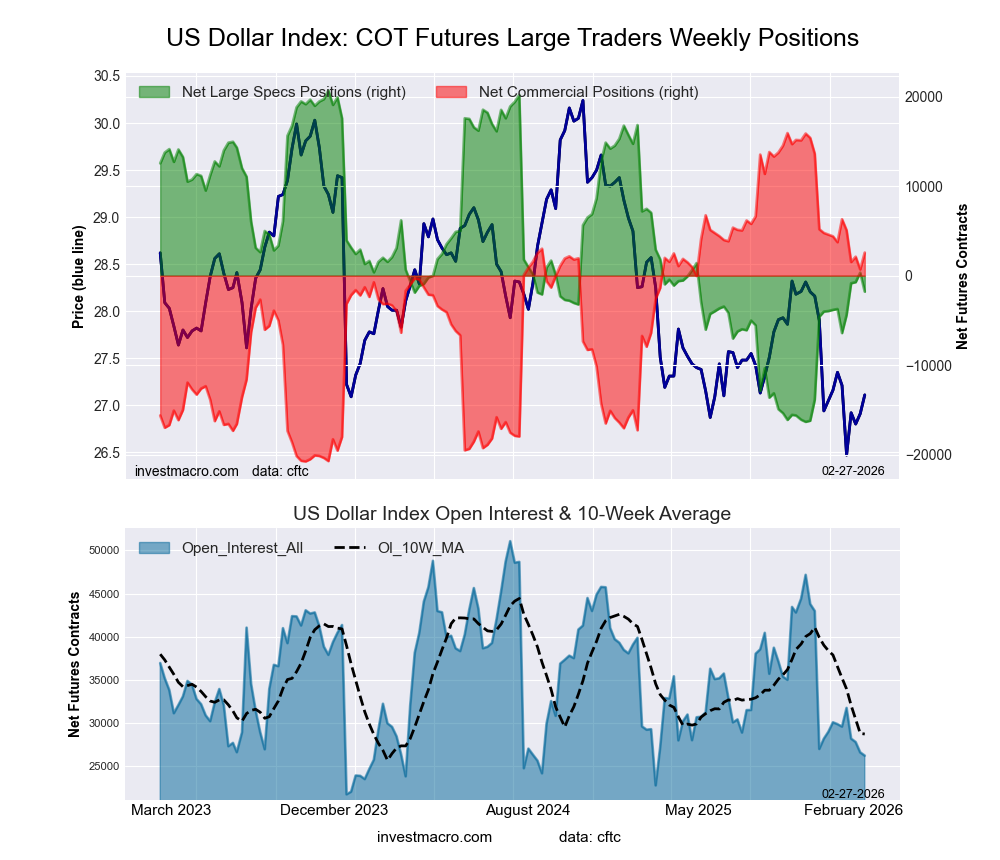
US Dollar Index Forex Futures COT ChartThe US Dollar Index large speculator standing this week came in at a net position of -1,789 contracts in the data reported through Tuesday. This was a weekly reduction of -2,117 contracts from the previous week which had a total of 328 net contracts.

This week’s current strength score (the trader positioning range over the past three years, measured from 0 to 100) shows the speculators are currently Bearish with a score of 39.3 percent. The commercials are Bullish with a score of 63.6 percent and the small traders (not shown in chart) are Bearish with a score of 25.1 percent.

Price Trend-Following Model: Downtrend

Our weekly trend-following model classifies the current market price position as: Downtrend.

US DOLLAR INDEX StatisticsSPECULATORSCOMMERCIALSSMALL TRADERS
– Percent of Open Interest Longs:50.731.78.1
– Percent of Open Interest Shorts:57.521.911.1
– Net Position:-1,7892,582-793
– Gross Longs:13,2958,3122,119
– Gross Shorts:15,0845,7302,912
– Long to Short Ratio:0.9 to 11.5 to 10.7 to 1
NET POSITION TREND:
– Strength Index Score (3 Year Range Pct):39.363.625.1
– Strength Index Reading (3 Year Range):BearishBullishBearish
NET POSITION MOVEMENT INDEX:
– 6-Week Change in Strength Index:5.2-3.2-13.7


Euro Currency Futures:

Euro Currency Futures COT ChartThe Euro Currency large speculator standing this week came in at a net position of 156,856 contracts in the data reported through Tuesday. This was a weekly fall of -17,624 contracts from the previous week which had a total of 174,480 net contracts.

This week’s current strength score (the trader positioning range over the past three years, measured from 0 to 100) shows the speculators are currently Bullish-Extreme with a score of 88.5 percent. The commercials are Bearish-Extreme with a score of 9.3 percent and the small traders (not shown in chart) are Bullish-Extreme with a score of 88.6 percent.

Price Trend-Following Model: Uptrend

Our weekly trend-following model classifies the current market price position as: Uptrend.

EURO Currency StatisticsSPECULATORSCOMMERCIALSSMALL TRADERS
– Percent of Open Interest Longs:32.454.710.2
– Percent of Open Interest Shorts:15.177.84.3
– Net Position:156,856-210,90354,047
– Gross Longs:294,873498,04493,336
– Gross Shorts:138,017708,94739,289
– Long to Short Ratio:2.1 to 10.7 to 12.4 to 1
NET POSITION TREND:
– Strength Index Score (3 Year Range Pct):88.59.388.6
– Strength Index Reading (3 Year Range):Bullish-ExtremeBearish-ExtremeBullish-Extreme
NET POSITION MOVEMENT INDEX:
– 6-Week Change in Strength Index:9.2-10.614.6


British Pound Sterling Futures:

British Pound Sterling Futures COT ChartThe British Pound Sterling large speculator standing this week came in at a net position of -57,072 contracts in the data reported through Tuesday. This was a weekly fall of -14,668 contracts from the previous week which had a total of -42,404 net contracts.

This week’s current strength score (the trader positioning range over the past three years, measured from 0 to 100) shows the speculators are currently Bearish-Extreme with a score of 15.4 percent. The commercials are Bullish-Extreme with a score of 82.1 percent and the small traders (not shown in chart) are Bullish with a score of 55.6 percent.

Price Trend-Following Model: Uptrend

Our weekly trend-following model classifies the current market price position as: Uptrend.

BRITISH POUND StatisticsSPECULATORSCOMMERCIALSSMALL TRADERS
– Percent of Open Interest Longs:27.355.211.9
– Percent of Open Interest Shorts:50.532.411.5
– Net Position:-57,07256,176896
– Gross Longs:67,213135,80429,236
– Gross Shorts:124,28579,62828,340
– Long to Short Ratio:0.5 to 11.7 to 11.0 to 1
NET POSITION TREND:
– Strength Index Score (3 Year Range Pct):15.482.155.6
– Strength Index Reading (3 Year Range):Bearish-ExtremeBullish-ExtremeBullish
NET POSITION MOVEMENT INDEX:
– 6-Week Change in Strength Index:-13.512.02.9


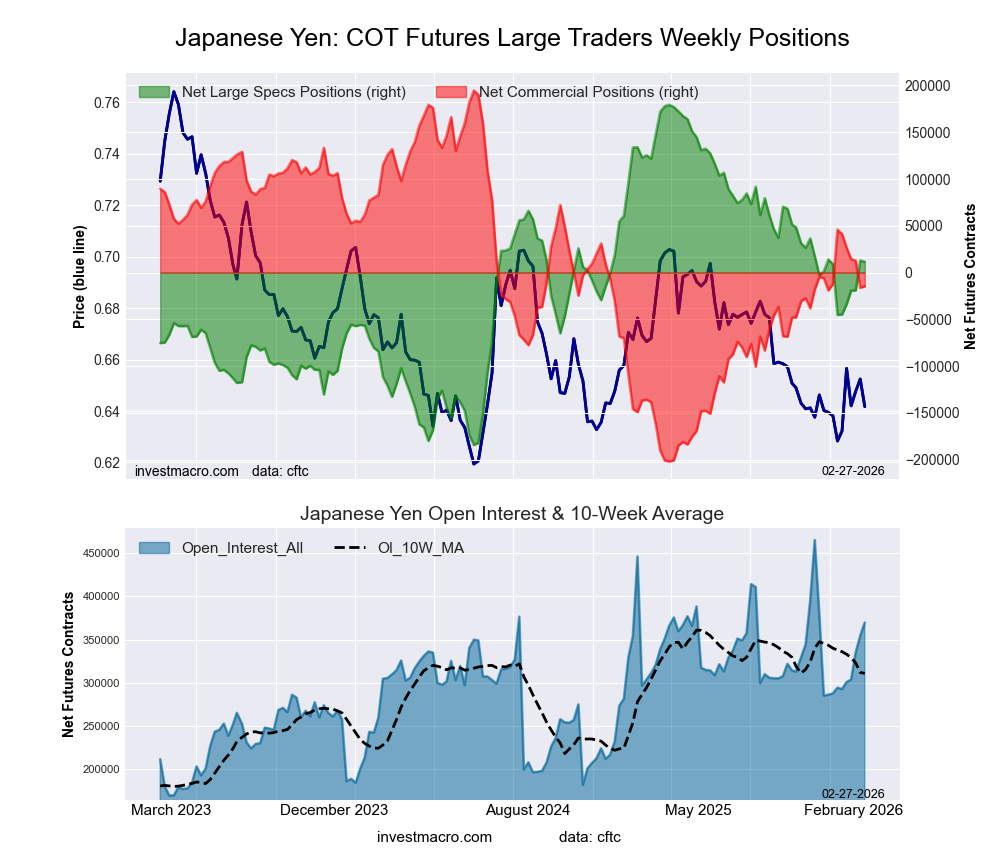
Japanese Yen Futures:

Japanese Yen Forex Futures COT ChartThe Japanese Yen large speculator standing this week came in at a net position of 11,539 contracts in the data reported through Tuesday. This was a weekly fall of -1,416 contracts from the previous week which had a total of 12,955 net contracts.

This week’s current strength score (the trader positioning range over the past three years, measured from 0 to 100) shows the speculators are currently Bullish with a score of 53.9 percent. The commercials are Bearish with a score of 47.2 percent and the small traders (not shown in chart) are Bearish with a score of 45.1 percent.

Price Trend-Following Model: Downtrend

Our weekly trend-following model classifies the current market price position as: Downtrend.

JAPANESE YEN StatisticsSPECULATORSCOMMERCIALSSMALL TRADERS
– Percent of Open Interest Longs:40.438.410.5
– Percent of Open Interest Shorts:37.342.49.7
– Net Position:11,539-14,7293,190
– Gross Longs:149,364141,91838,952
– Gross Shorts:137,825156,64735,762
– Long to Short Ratio:1.1 to 10.9 to 11.1 to 1
NET POSITION TREND:
– Strength Index Score (3 Year Range Pct):53.947.245.1
– Strength Index Reading (3 Year Range):BullishBearishBearish
NET POSITION MOVEMENT INDEX:
– 6-Week Change in Strength Index:15.6-15.39.9


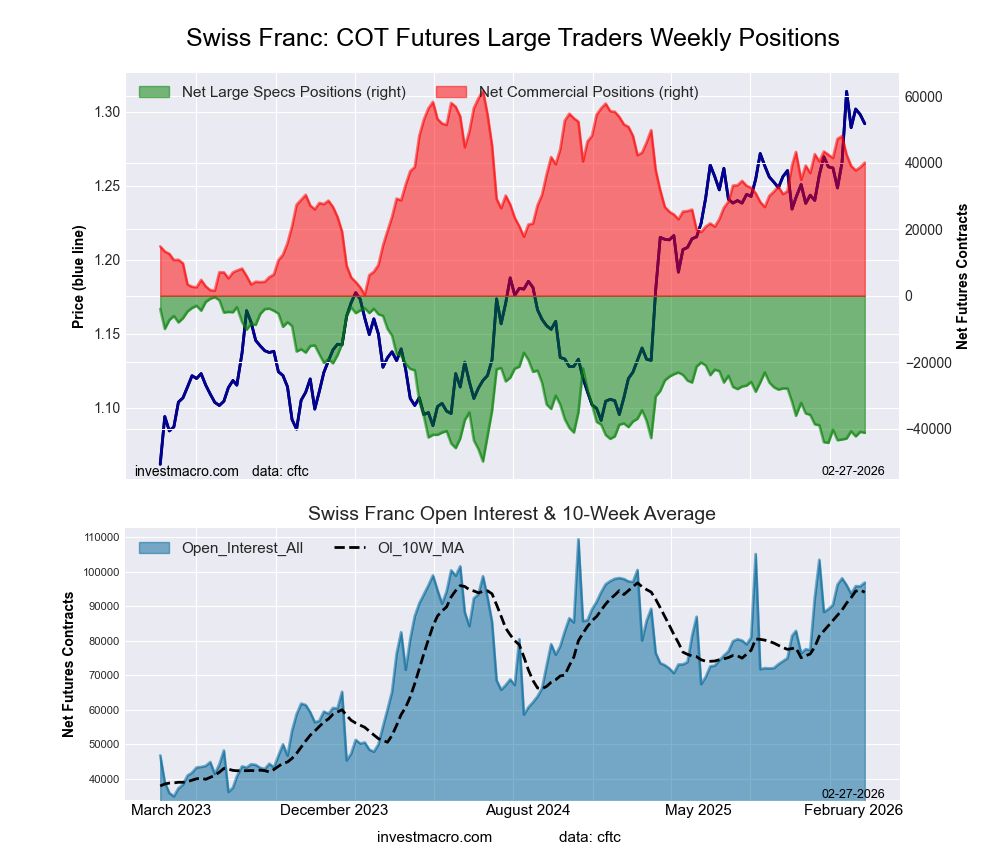
Swiss Franc Futures:

Swiss Franc Forex Futures COT ChartThe Swiss Franc large speculator standing this week came in at a net position of -41,186 contracts in the data reported through Tuesday. This was a weekly reduction of -305 contracts from the previous week which had a total of -40,881 net contracts.

This week’s current strength score (the trader positioning range over the past three years, measured from 0 to 100) shows the speculators are currently Bearish-Extreme with a score of 17.4 percent. The commercials are Bullish with a score of 64.7 percent and the small traders (not shown in chart) are Bullish-Extreme with a score of 83.8 percent.

Price Trend-Following Model: Strong Uptrend

Our weekly trend-following model classifies the current market price position as: Strong Uptrend.

SWISS FRANC StatisticsSPECULATORSCOMMERCIALSSMALL TRADERS
– Percent of Open Interest Longs:11.969.019.0
– Percent of Open Interest Shorts:54.427.617.8
– Net Position:-41,18640,0071,179
– Gross Longs:11,52566,77818,411
– Gross Shorts:52,71126,77117,232
– Long to Short Ratio:0.2 to 12.5 to 11.1 to 1
NET POSITION TREND:
– Strength Index Score (3 Year Range Pct):17.464.783.8
– Strength Index Reading (3 Year Range):Bearish-ExtremeBullishBullish-Extreme
NET POSITION MOVEMENT INDEX:
– 6-Week Change in Strength Index:4.5-11.721.0


Canadian Dollar Futures:

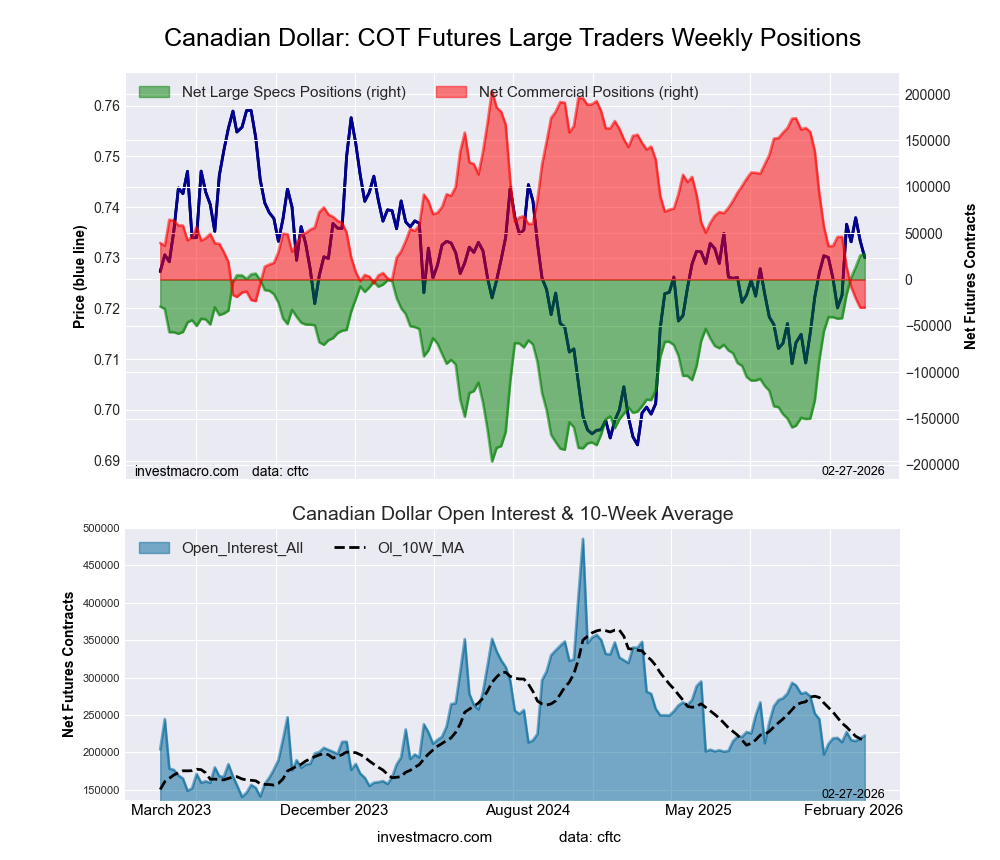
Canadian Dollar Forex Futures COT ChartThe Canadian Dollar large speculator standing this week came in at a net position of 27,578 contracts in the data reported through Tuesday. This was a weekly lift of 1,752 contracts from the previous week which had a total of 25,826 net contracts.

This week’s current strength score (the trader positioning range over the past three years, measured from 0 to 100) shows the speculators are currently Bullish-Extreme with a score of 100.0 percent. The commercials are Bearish-Extreme with a score of 0.0 percent and the small traders (not shown in chart) are Bullish with a score of 52.8 percent.

Price Trend-Following Model: Uptrend

Our weekly trend-following model classifies the current market price position as: Uptrend.

CANADIAN DOLLAR StatisticsSPECULATORSCOMMERCIALSSMALL TRADERS
– Percent of Open Interest Longs:41.742.313.6
– Percent of Open Interest Shorts:29.355.912.4
– Net Position:27,578-30,2602,682
– Gross Longs:92,81294,07430,230
– Gross Shorts:65,234124,33427,548
– Long to Short Ratio:1.4 to 10.8 to 11.1 to 1
NET POSITION TREND:
– Strength Index Score (3 Year Range Pct):100.00.052.8
– Strength Index Reading (3 Year Range):Bullish-ExtremeBearish-ExtremeBullish
NET POSITION MOVEMENT INDEX:
– 6-Week Change in Strength Index:31.2-32.517.4


Australian Dollar Futures:

Australian Dollar Forex Futures COT ChartThe Australian Dollar large speculator standing this week came in at a net position of 52,644 contracts in the data reported through Tuesday. This was a weekly increase of 6,713 contracts from the previous week which had a total of 45,931 net contracts.

This week’s current strength score (the trader positioning range over the past three years, measured from 0 to 100) shows the speculators are currently Bullish-Extreme with a score of 100.0 percent. The commercials are Bearish-Extreme with a score of 0.0 percent and the small traders (not shown in chart) are Bullish-Extreme with a score of 92.7 percent.

Price Trend-Following Model: Strong Uptrend

Our weekly trend-following model classifies the current market price position as: Strong Uptrend.

AUSTRALIAN DOLLAR StatisticsSPECULATORSCOMMERCIALSSMALL TRADERS
– Percent of Open Interest Longs:48.930.317.1
– Percent of Open Interest Shorts:27.861.47.2
– Net Position:52,644-77,31324,669
– Gross Longs:121,66175,38042,604
– Gross Shorts:69,017152,69317,935
– Long to Short Ratio:1.8 to 10.5 to 12.4 to 1
NET POSITION TREND:
– Strength Index Score (3 Year Range Pct):100.00.092.7
– Strength Index Reading (3 Year Range):Bullish-ExtremeBearish-ExtremeBullish-Extreme
NET POSITION MOVEMENT INDEX:
– 6-Week Change in Strength Index:44.6-37.84.7


New Zealand Dollar Futures:

New Zealand Dollar Forex Futures COT ChartThe New Zealand Dollar large speculator standing this week came in at a net position of -29,567 contracts in the data reported through Tuesday. This was a weekly boost of 5,446 contracts from the previous week which had a total of -35,013 net contracts.

This week’s current strength score (the trader positioning range over the past three years, measured from 0 to 100) shows the speculators are currently Bearish with a score of 31.1 percent. The commercials are Bullish with a score of 65.2 percent and the small traders (not shown in chart) are Bullish with a score of 77.2 percent.

Price Trend-Following Model: Strong Uptrend

Our weekly trend-following model classifies the current market price position as: Strong Uptrend.

NEW ZEALAND DOLLAR StatisticsSPECULATORSCOMMERCIALSSMALL TRADERS
– Percent of Open Interest Longs:19.470.27.0
– Percent of Open Interest Shorts:60.731.64.3
– Net Position:-29,56727,6571,910
– Gross Longs:13,83950,2265,009
– Gross Shorts:43,40622,5693,099
– Long to Short Ratio:0.3 to 12.2 to 11.6 to 1
NET POSITION TREND:
– Strength Index Score (3 Year Range Pct):31.165.277.2
– Strength Index Reading (3 Year Range):BearishBullishBullish
NET POSITION MOVEMENT INDEX:
– 6-Week Change in Strength Index:22.0-24.431.5


Mexican Peso Futures:

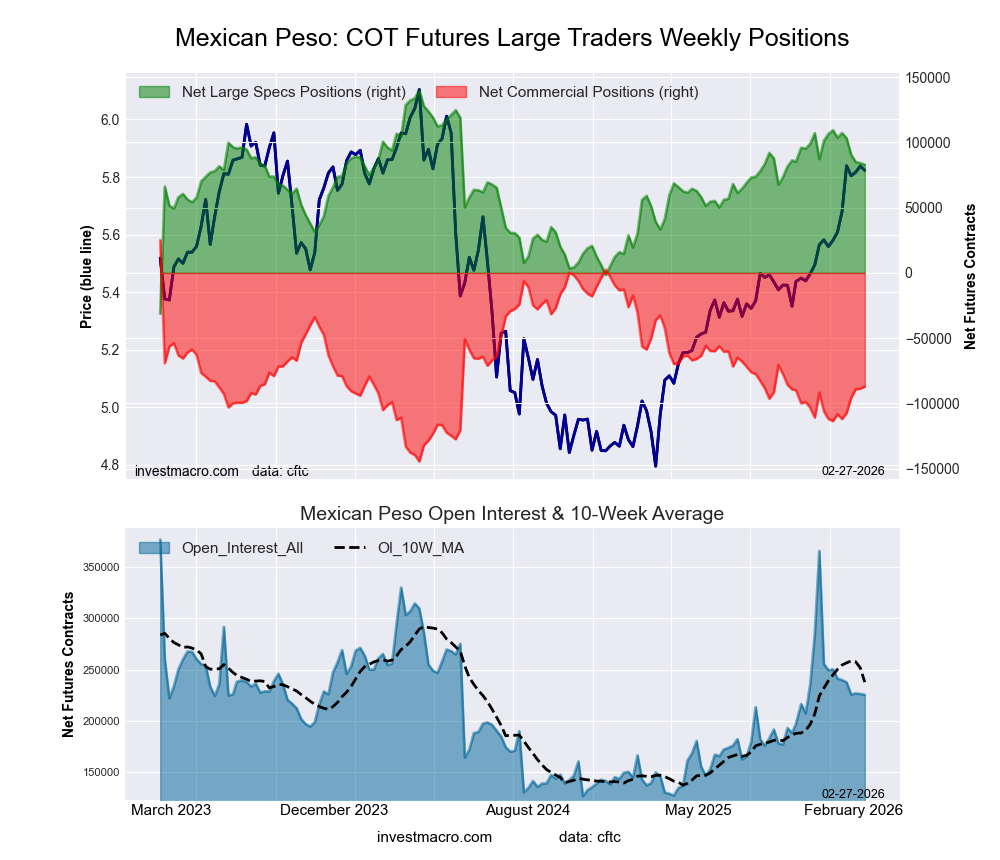
Mexican Peso Futures COT ChartThe Mexican Peso large speculator standing this week came in at a net position of 82,880 contracts in the data reported through Tuesday. This was a weekly lowering of -1,242 contracts from the previous week which had a total of 84,122 net contracts.

This week’s current strength score (the trader positioning range over the past three years, measured from 0 to 100) shows the speculators are currently Bullish with a score of 66.8 percent. The commercials are Bearish with a score of 33.8 percent and the small traders (not shown in chart) are Bearish with a score of 46.3 percent.

Price Trend-Following Model: Uptrend

Our weekly trend-following model classifies the current market price position as: Uptrend.

MEXICAN PESO StatisticsSPECULATORSCOMMERCIALSSMALL TRADERS
– Percent of Open Interest Longs:55.937.73.1
– Percent of Open Interest Shorts:19.176.31.3
– Net Position:82,880-87,1274,247
– Gross Longs:126,00985,0187,071
– Gross Shorts:43,129172,1452,824
– Long to Short Ratio:2.9 to 10.5 to 12.5 to 1
NET POSITION TREND:
– Strength Index Score (3 Year Range Pct):66.833.846.3
– Strength Index Reading (3 Year Range):BullishBearishBearish
NET POSITION MOVEMENT INDEX:
– 6-Week Change in Strength Index:-12.112.4-2.1


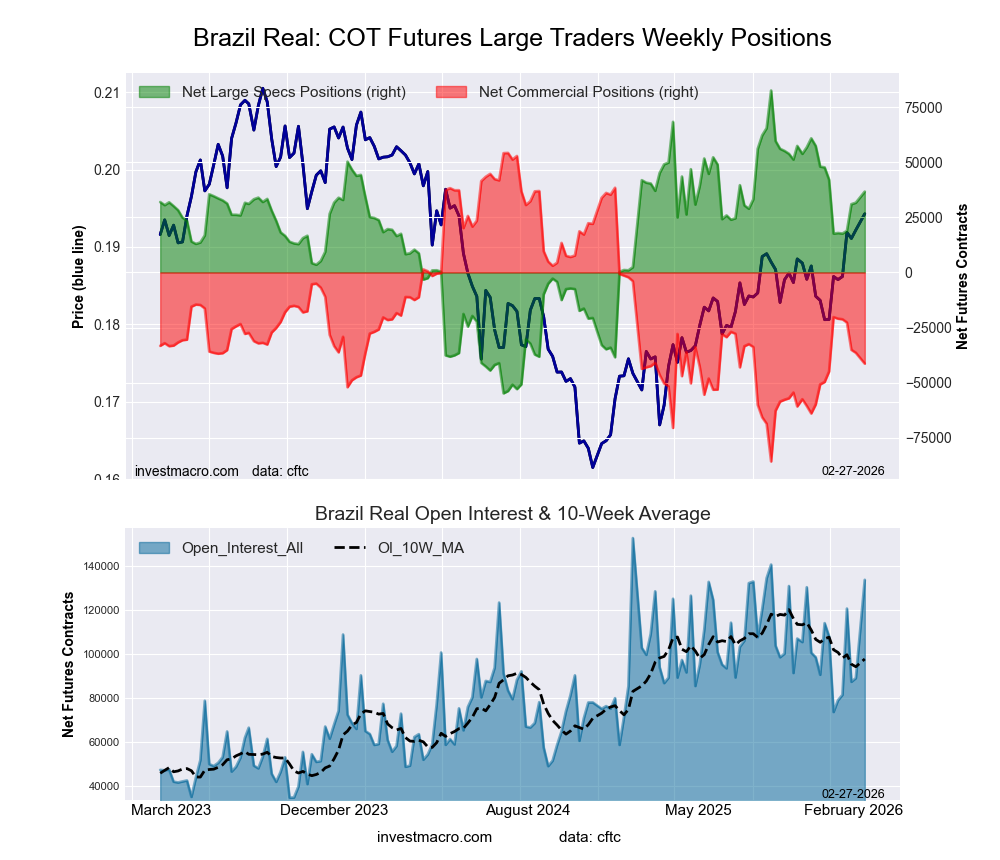
Brazilian Real Futures:

Brazil Real Futures COT ChartThe Brazilian Real large speculator standing this week came in at a net position of 36,674 contracts in the data reported through Tuesday. This was a weekly rise of 2,012 contracts from the previous week which had a total of 31,643 net contracts.

This week’s current strength score (the trader positioning range over the past three years, measured from 0 to 100) shows the speculators are currently Bullish with a score of 66.6 percent. The commercials are Bearish with a score of 31.7 percent and the small traders (not shown in chart) are Bearish with a score of 47.5 percent.

Price Trend-Following Model: Strong Uptrend

Our weekly trend-following model classifies the current market price position as: Strong Uptrend.

BRAZIL REAL StatisticsSPECULATORSCOMMERCIALSSMALL TRADERS
– Percent of Open Interest Longs:53.538.44.3
– Percent of Open Interest Shorts:26.069.40.8
– Net Position:36,674-41,3944,720
– Gross Longs:71,43151,2775,780
– Gross Shorts:34,75792,6711,060
– Long to Short Ratio:2.1 to 10.6 to 15.5 to 1
NET POSITION TREND:
– Strength Index Score (3 Year Range Pct):66.631.747.5
– Strength Index Reading (3 Year Range):BullishBearishBearish
NET POSITION MOVEMENT INDEX:
– 6-Week Change in Strength Index:13.7-14.69.0


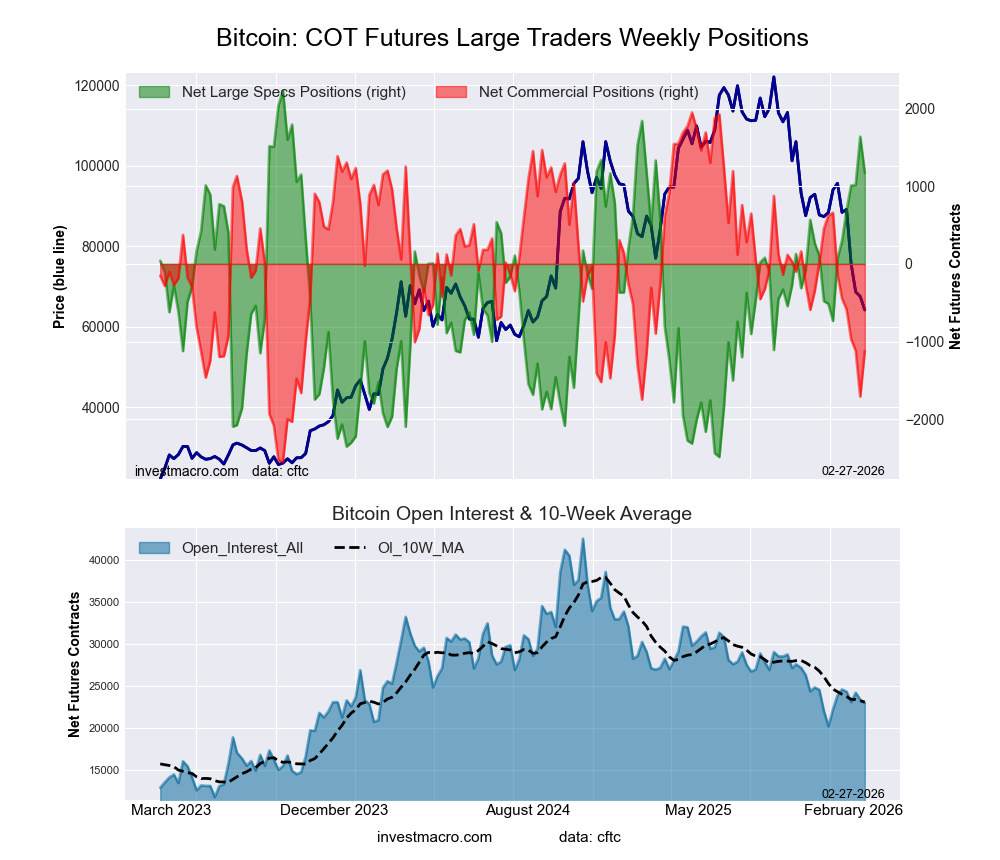
Bitcoin Futures:

Bitcoin Crypto Futures COT ChartThe Bitcoin large speculator standing this week came in at a net position of 1,172 contracts in the data reported through Tuesday. This was a weekly reduction of -466 contracts from the previous week which had a total of 1,638 net contracts.

This week’s current strength score (the trader positioning range over the past three years, measured from 0 to 100) shows the speculators are currently Bullish with a score of 77.5 percent. The commercials are Bearish with a score of 31.7 percent and the small traders (not shown in chart) are Bearish with a score of 34.6 percent.

Price Trend-Following Model: Strong Downtrend

Our weekly trend-following model classifies the current market price position as: Strong Downtrend.

BITCOIN StatisticsSPECULATORSCOMMERCIALSSMALL TRADERS
– Percent of Open Interest Longs:71.62.15.1
– Percent of Open Interest Shorts:66.57.05.3
– Net Position:1,172-1,120-52
– Gross Longs:16,4104851,162
– Gross Shorts:15,2381,6051,214
– Long to Short Ratio:1.1 to 10.3 to 11.0 to 1
NET POSITION TREND:
– Strength Index Score (3 Year Range Pct):77.531.734.6
– Strength Index Reading (3 Year Range):BullishBearishBearish
NET POSITION MOVEMENT INDEX:
– 6-Week Change in Strength Index:23.4-22.0-6.1


Article By InvestMacroReceive our weekly COT Newsletter

*COT Report: The COT data, released weekly to the public each Friday, is updated through the most recent Tuesday (data is 3 days old) and shows a quick view of how large speculators or non-commercials (for-profit traders) were positioned in the futures markets.

The CFTC categorizes trader positions according to commercial hedgers (traders who use futures contracts for hedging as part of the business), non-commercials (large traders who speculate to realize trading profits) and nonreportable traders (usually small traders/speculators) as well as their open interest (contracts open in the market at time of reporting). See CFTC criteria here.

Speculator Extremes: AUD, CAD, Natural Gas & Sugar lead Bullish & Bearish Positions

By InvestMacro

The latest update for the weekly Commitment of Traders (COT) report was released by the Commodity Futures Trading Commission (CFTC) on Friday for data ending on February 24th.

This weekly Extreme Positions report highlights the Most Bullish and Most Bearish Positions for the speculator category. Extreme positioning in these markets can foreshadow strong moves in the underlying market.

To signify an extreme position, we use the Strength Index (also known as the COT Index) of each instrument, a common method of measuring COT data. The Strength Index is simply a comparison of current trader positions against the range of positions over the previous 3 years. We use over 80 percent as extremely bullish and under 20 percent as extremely bearish. (Compare Strength Index scores across all markets in the data table or cot leaders table)


Extreme Bullish Speculator Table


Here Are This Week’s Most Bullish Speculator Positions:

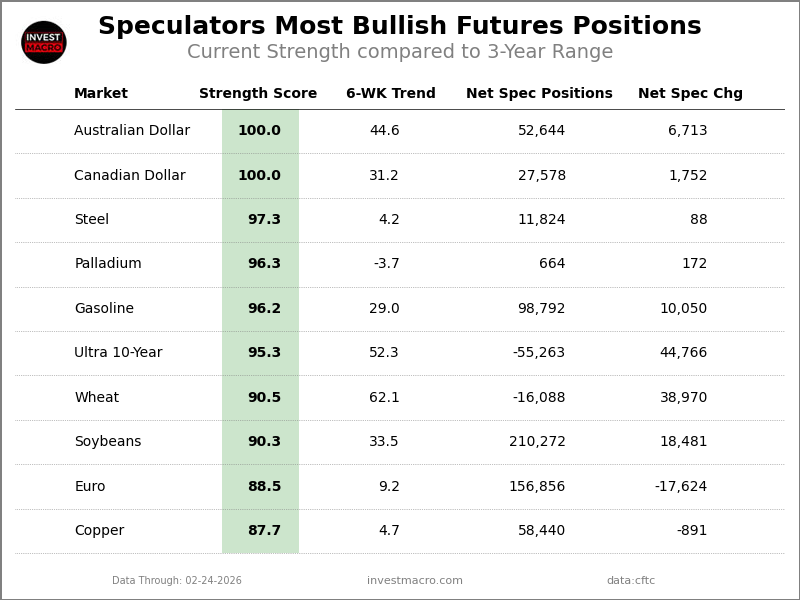
Australian Dollar

Extreme Bullish Leader
The Australian Dollar speculator position comes in tied as the most bullish extreme standing for a second straight this week as the AUD speculator level is currently at a maximum 100 percent score of its 3-year range.

The six-week trend for the percent strength score totaled a strong gain by 45 percentage points this week. The overall net speculator position was a total of 52,644 net contracts this week with an advance by 6,713 contract in the weekly speculator bets.


Speculators or Non-Commercials Notes:

Speculators, classified as non-commercial traders by the CFTC, are made up of large commodity funds, hedge funds and other significant for-profit participants. The Specs are generally regarded as trend-followers in their behavior towards price action – net speculator bets and prices tend to go in the same directions. These traders often look to buy when prices are rising and sell when prices are falling. To illustrate this point, many times speculator contracts can be found at their most extremes (bullish or bearish) when prices are also close to their highest or lowest levels.

These extreme levels can be dangerous for the large speculators as the trade is most crowded, there is less trading ammunition still sitting on the sidelines to push the trend further and prices have moved a significant distance. When the trend becomes exhausted, some speculators take profits while others look to also exit positions when prices fail to continue in the same direction. This process usually plays out over many months to years and can ultimately create a reverse effect where prices start to fall and speculators start a process of selling when prices are falling.


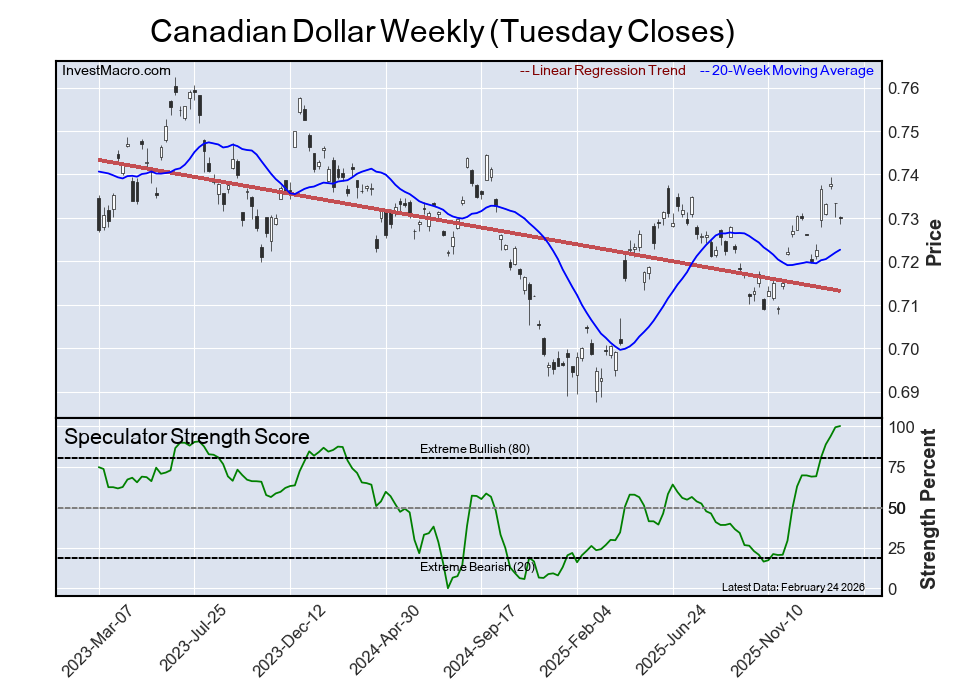
Canadian Dollar

Extreme Bullish Leader
The Canadian Dollar speculator position also comes in tied as the most bullish extreme standing once again this week as well. The CAD speculator level is also at a maximum 100 percent score of its 3-year range.

The six-week trend for the percent strength score was a jump by 31 percentage points this week while the speculator position registered 27,578 net contracts this week with a modest increase by 1,752 contracts in speculator bets.


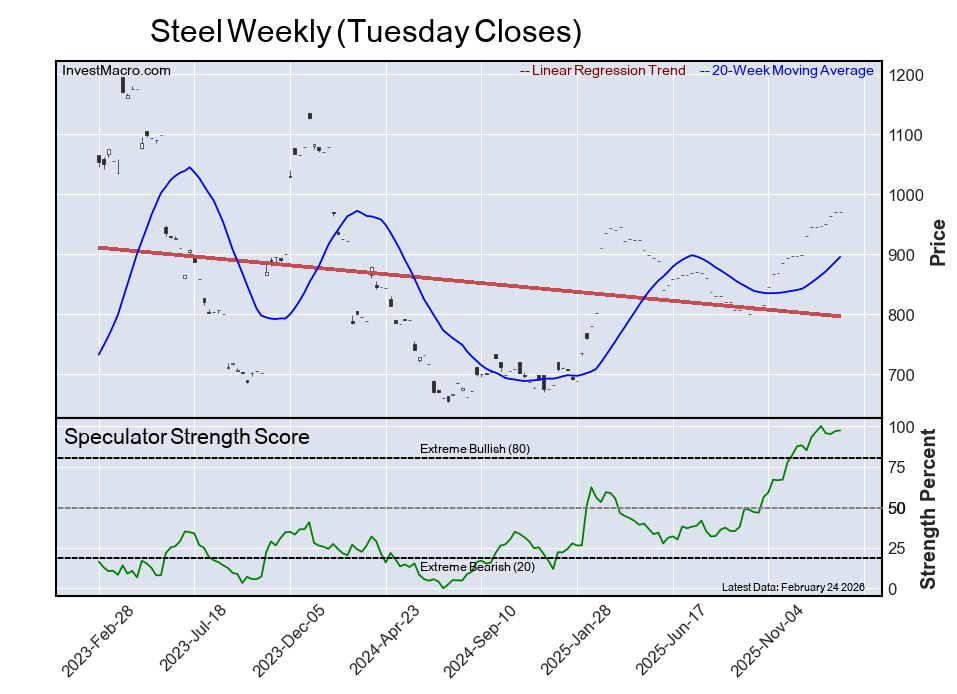
Steel

Extreme Bullish Leader
The Steel speculator position comes in third this week in the extreme standings with the Steel speculator level residing at a 97 percent score of its 3-year range.

The six-week trend for the speculator strength score came in at a rise by 4 percentage points this week. The overall speculator position was 11,824 net contracts this week with a slight uptick by 88 contracts in the weekly speculator bets.


Palladium

Extreme Bullish Leader
The Palladium speculator position comes up number four in the extreme standings this week. The Palladium speculator level is at a 96 percent score of its 3-year range and the six-week trend for the speculator strength score totaled a decline of -4 percentage points this week.

The overall net speculator position was 664 net contracts this week with a small gain of 172 contracts in the speculator bets.


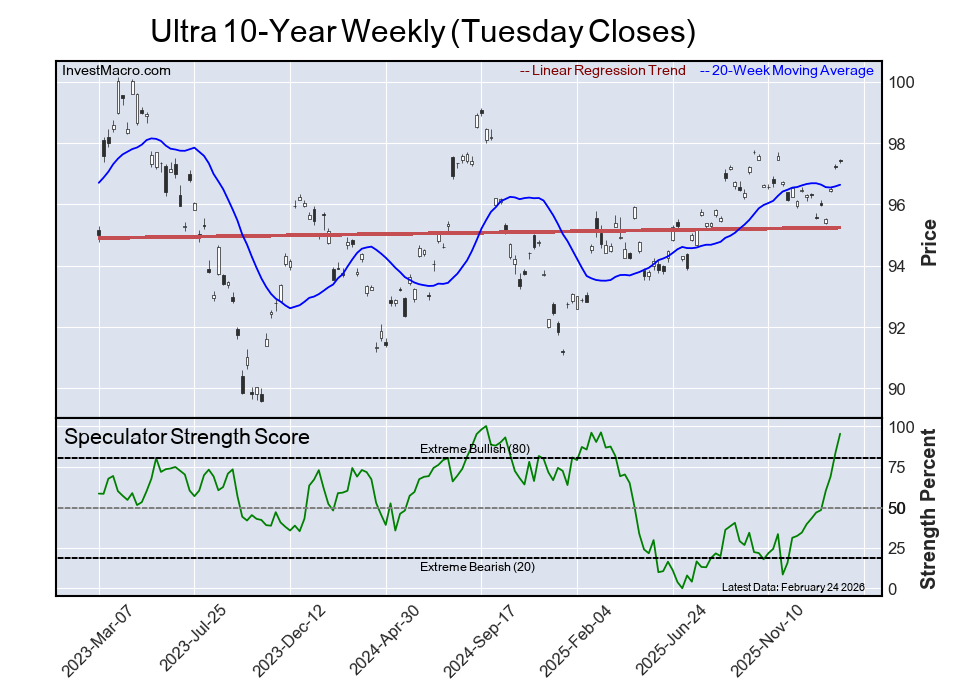
Ultra 10-Year

Extreme Bullish Leader
The Ultra 10-Year speculator position rounds out the top five in this week’s bullish extreme standings with the Ultra 10-Year speculator level sitting at a 95 percent score of its 3-year range.

The six-week trend for the speculator strength score was a huge jump by 52 percentage points this week. The speculator position was -55,263 net contracts this week with a gain of 44,766 contracts in the weekly speculator bets.


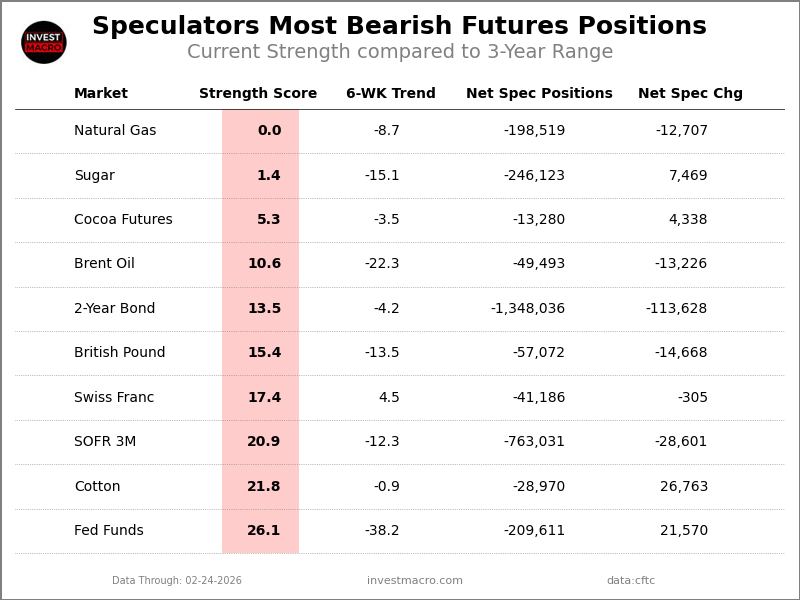
The Most Bearish Speculator Positions of the Week:

Extreme Bearish Speculator Table


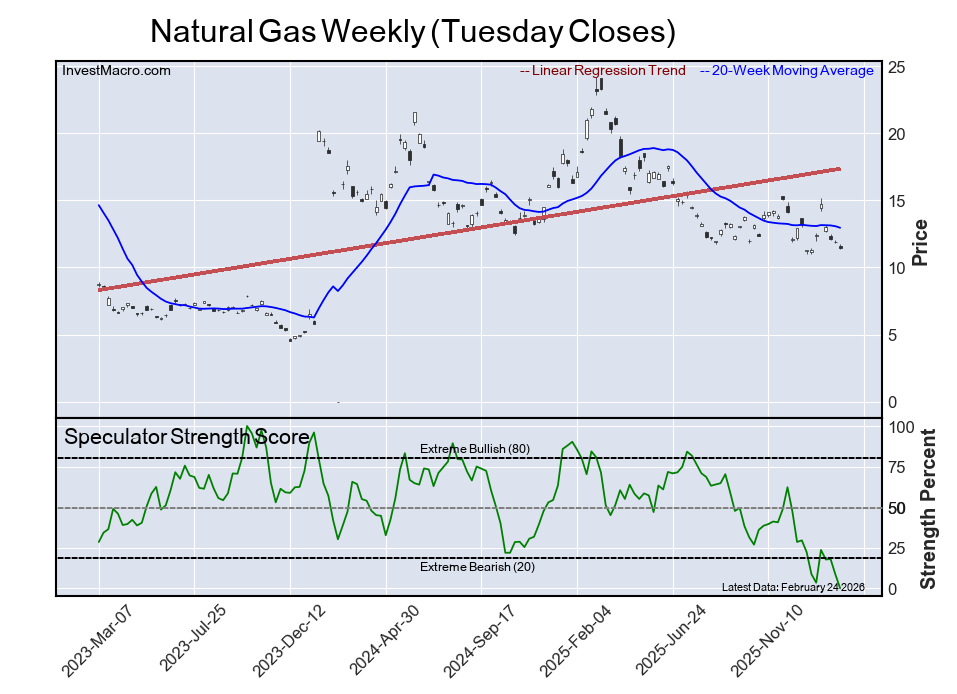
Natural Gas

Extreme Bearish Leader
The Natural Gas speculator position comes in as the most bearish extreme standing this week as the Natural Gas speculator level is at a minimum 0 percent score of its 3-year range.

The six-week trend for the strength score was a decrease by -9 percentage points this week while the overall speculator position was -198,519 net contracts this week with a fall of -12,707 contracts in the speculator bets.


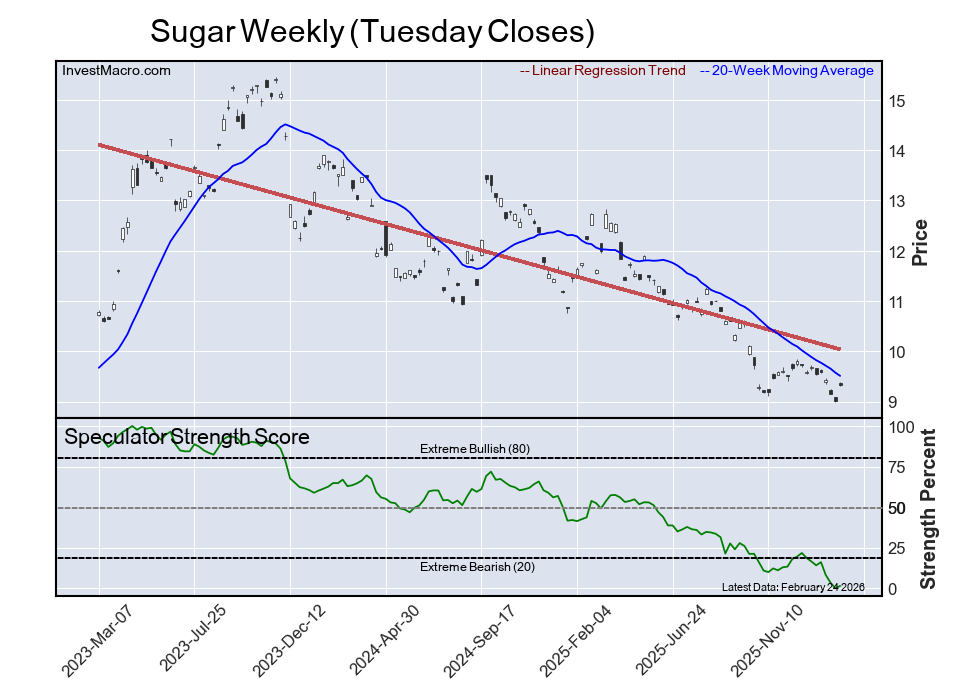
Sugar

Extreme Bearish Leader
The Sugar speculator position comes in a close second for the most bearish extreme standing on the week with the Sugar speculator level sitting at a 1 percent score of its 3-year range.

The six-week trend for the strength score was a decrease by -15 percentage points this week while the speculator position was -246,123 net contracts this week with a gain of 7,469 contracts in the weekly speculator bets.


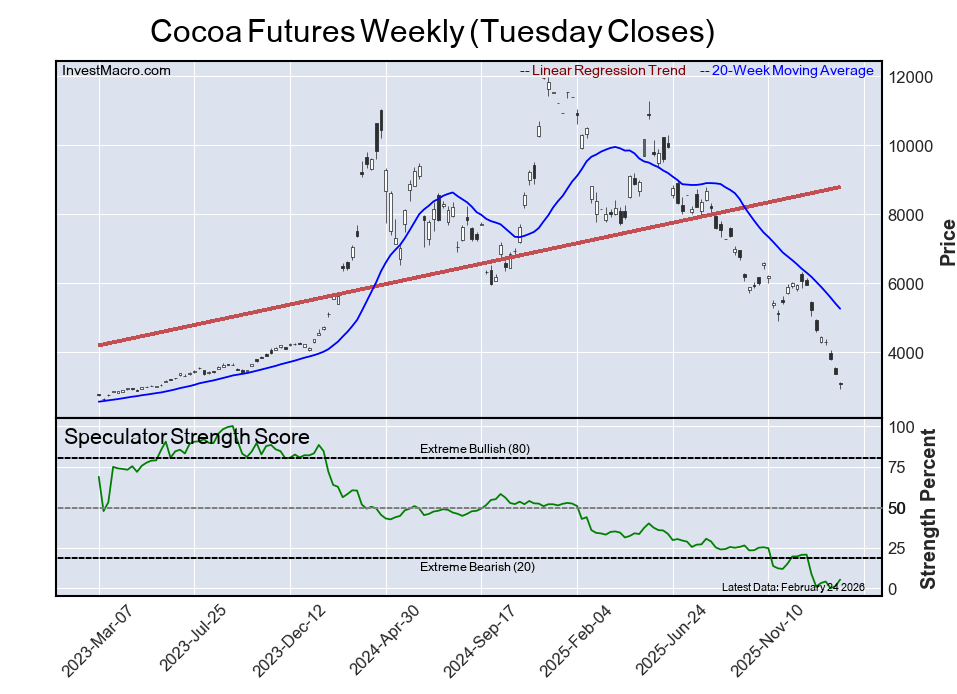
Cocoa Futures

Extreme Bearish Leader
The Cocoa Futures speculator position comes in as third most bearish extreme standing of the week as the Cocoa speculator level resides at just a 5 percent score of its 3-year range.

The six-week trend for the strength score was a dip by -4 percentage points this week and the overall speculator position was -13,280 net contracts this week with a rise of 4,338 contracts in the speculator bets.


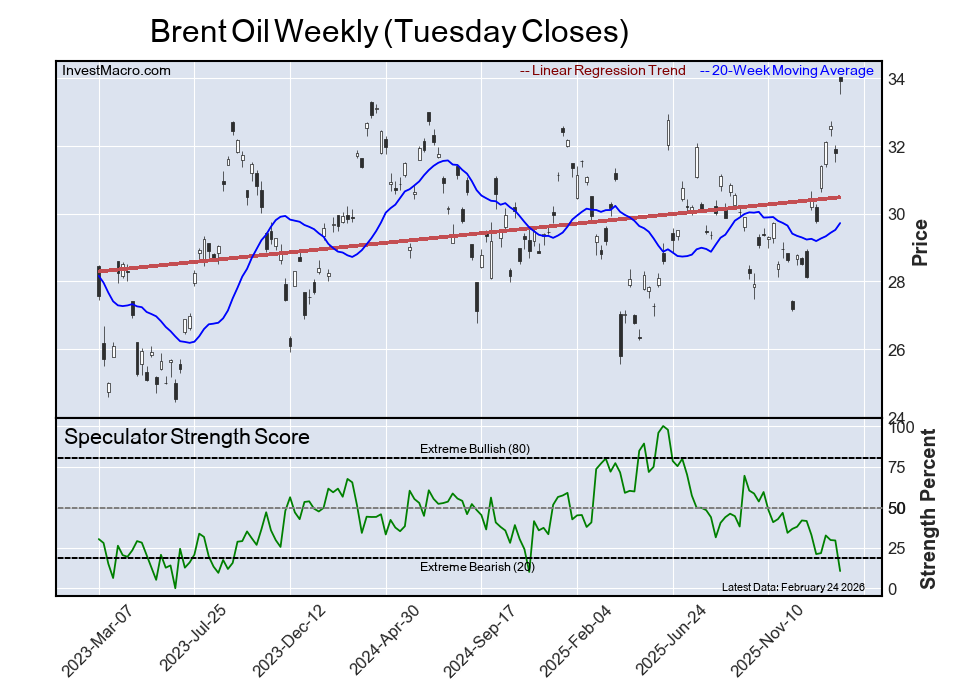
Brent Oil

Extreme Bearish Leader
The Brent Oil speculator position comes in as this week’s fourth most bearish extreme standing with the Brent speculator level at an 11 percent score of its 3-year range.

The six-week trend for the speculator strength score was a decline by -22 percentage points this week. The speculator position was -49,493 net contracts this week and had a decline of -13,226 contracts in the weekly speculator bets.


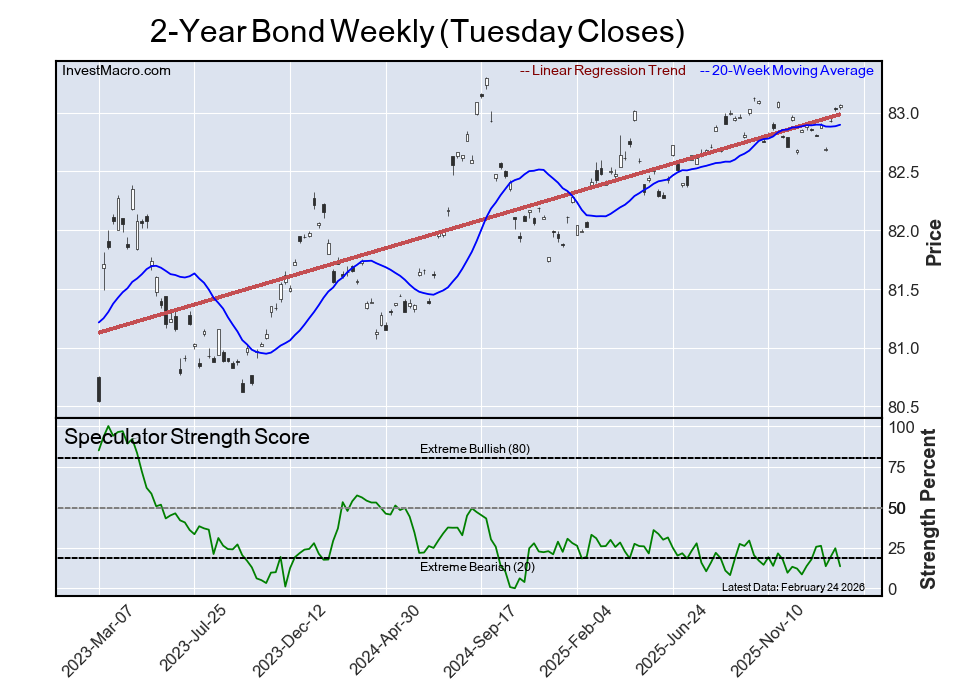
2-Year Bond

Extreme Bearish Leader
Next, the 2-Year Bond speculator position comes in as the fifth most bearish extreme standing for this week. The 2-Year speculator level is at just a 14 percent score of its 3-year range.

The six-week trend for the speculator strength score was a dip by -4 percentage points this week and the speculator position was -1,348,036 net contracts this week with a drop of -113,628 contracts in the weekly speculator bets.


Article By InvestMacroReceive our weekly COT Newsletter

*COT Report: The COT data, released weekly to the public each Friday, is updated through the most recent Tuesday (data is 3 days old) and shows a quick view of how large speculators or non-commercials (for-profit traders) were positioned in the futures markets.

The CFTC categorizes trader positions according to commercial hedgers (traders who use futures contracts for hedging as part of the business), non-commercials (large traders who speculate to realize trading profits) and nonreportable traders (usually small traders/speculators) as well as their open interest (contracts open in the market at time of reporting). See CFTC criteria here.