Jobs are up! Wages are up! So why am I as an economist so gloomy?

By Edouard Wemy, Clark University 

In any other time, the jobs news that came down on Dec. 2, 2022, would be reason for cheer.

The U.S. added 263,000 nonfarm jobs in November, leaving the unemployment rate at a low 3.7%. Moreover, wages are up – with average hourly pay jumping 5.1% compared with a year earlier.

So why am I not celebrating? Oh, yes: inflation.

The rosy employment figures come despite repeated efforts by the Federal Reserve to tame the job market and the wider economy in general in its fight against the worst inflation in decades. The Fed has now increased the base interest rate six times in 2022, going from a historic low of about zero to a range of 3.75% to 4% today. Another hike is expected on Dec. 13. Yet inflation remains stubbornly high, and currently sits at an annual rate of 7.7%.

The economic rationale behind hiking rates is that it increases the cost of doing business for companies. This in turn acts as brake on the economy, which should cool inflation.

But that doesn’t appear to be happening. A closer dive into November’s jobs report reveals why.

It shows that the labor force participation rate – how many working-age Americans have a job or are seeking one – is stuck at just over 62.1%. As the report notes, that figure is “little changed” in November and has shown “little net change since early this year.” In fact, it is down 1.3 percentage points from pre-COVID-19 pandemic levels.

This suggests that the heating up of the labor market is being driven by supply-side issues. That is, there aren’t enough people to fill the jobs being advertised.

Companies still want to hire – as the above-expected job gains indicate. But with fewer people actively looking for work in the U.S., companies are having to go the extra yard to be attractive to job seekers. And that means offering higher wages. And higher wages – they were up 5.1% in November from a year earlier – contribute to spiraling inflation.

This puts the Fed in a very difficult position. Simply put, there is not an awful lot it can do about supply-side issues in the labor market. The main monetary tool it has to affect jobs is rate hikes, which make it more costly to do business, which should have an impact on hiring. But that only affects the demand side – that is, employers and recruitment policies.

So where does this leave the possibility of further rate hikes? Viewing this as an economist, it suggests that the Fed might be eyeing a base rate jump of more than 75 basis points on Dec. 13, rather than a softening of its policies as Chair Jerome Powell had suggested as recently as Nov. 30. Yes, this still would not ease the labor supply problem that is encouraging wage growth, but it might serve to cool the wider economy nonetheless.

The problem is, this would increase the chances of also pushing the U.S. economy into a recession – and it could be a pretty nasty recession.

Wage growth still trails behind inflation, and for one reason or another people have been opting out of the labor market. The logical assumption to make is that to make up for both these factors, American families have been dipping into their savings.

Statistics back this up. The personal saving rate – that is, the chunk of income left after paying taxes and spending money – has fallen steeply, down to 2.3% in December from 9.3% before the pandemic. In fact, it is at its lowest rate since 2005.

So, yes, employment is robust. But the money being earned is eroded by soaring inflation. Meanwhile, the safety net of savings that families might need is getting smaller.

In short, people are not prepared for the recession that might be lurking around the corner.

And this is why I am gloomy.The Conversation

About the Author:

Edouard Wemy, Assistant Professor of Economics, Clark University

This article is republished from The Conversation under a Creative Commons license. Read the original article.

Japanese Candlesticks Analysis 05.12.2022 (XAUUSD, NZDUSD, GBPUSD)

By RoboForex.com

XAUUSD, “Gold vs US Dollar”

At the support level, gold has formed a Hammer reversal pattern. Currently, the pair is going by the signal in an ascending wave. The goal of growth might be 1835.50. Upon testing the resistance level, the pair might break through it and continue the uptrend. However, the quotes may pull back to 1790.00 before further growth.

XAUUSD
Risk Warning: the result of previous trading operations do not guarantee the same results in the future

NZDUSD, “New Zealand Dollar vs US Dollar”

On H4, at the support level, gold has formed a Hammer reversal pattern. Currently, the pair may go by the signal in an ascending wave. The goal of growth might be 0.6505. After the resistance level is broken away, the quotes may get a chance to continue the uptrend. However, the price may pull back to 0.6380 before further growth.

NZDUSD
Risk Warning: the result of previous trading operations do not guarantee the same results in the future

GBPUSD, “Great Britain Pound vs US Dollar”

On H4, at the support level, gold has formed a Hammer reversal pattern. Currently, the pair is going by the signal in an ascending wave. The goal of the growth may be the resistance level of 1.2465. However, the price may pull back to 1.2200 before continuing the uptrend.

GBPUSD

Article By RoboForex.com

Attention!
Forecasts presented in this section only reflect the author’s private opinion and should not be considered as guidance for trading. RoboForex LP bears no responsibility for trading results based on trading recommendations described in these analytical reviews.

Murrey Math Lines 05.12.2022 (EURUSD, GBPUSD)

By RoboForex.com

EURUSD, “Euro vs US Dollar”

On H4, the quotes are above the 200-day Moving Average, which signifies prevalence of an uptrend. However, the RSI is nearing the overbought area. As a result, the quotes are expected to test 7/8 (1.0620), a bounce off it, and falling to the support level of 5/8 (1.0376). The scenario can be cancelled by rising over 7/8 (1.0620), in which case the pair should continue growing and reach 8/8 (1.0742).

EURUSDH4
Risk Warning: the result of previous trading operations do not guarantee the same results in the future

On M15, the lower line of VoltyChannel is too far from the current price, so a signal to fall will be a bounce off 7/8 (1.0620) on H4.

EURUSD_M15
Risk Warning: the result of previous trading operations do not guarantee the same results in the future

GBPUSD, “Great Britain Pound vs US Dollar”

The situation of the GBPUSD chart is similar. On H4, the quotes are above the 200-day Moving Average, and the RSI is nearing the overbought area. A test of 7/8 (1.2451) is expected, followed by a bounce off it and falling to the support level of 5/8 (1.1962). The scenario can be cancelled by rising over the resistance level of 7/8 (1.2451), which might provoke further growth to 8/8 (1.2695).

GBPUSD_H4
Risk Warning: the result of previous trading operations do not guarantee the same results in the future

On M15, the lower line of VoltyChannel is too far from the current price, so a signal to fall will be a bounce off 7/8 (1.2451) on H4.

GBPUSD_M15

Article By RoboForex.com

Attention!
Forecasts presented in this section only reflect the author’s private opinion and should not be considered as guidance for trading. RoboForex LP bears no responsibility for trading results based on trading recommendations described in these analytical reviews.

The Analytical Overview of the Main Currency Pairs on 2022.12.05

By JustMarkets

The EUR/USD currency pair

Technical indicators of the currency pair:
  • Prev Open: 1.0525
  • Prev Close: 1.0539
  • % chg. over the last day: +0.13 %

On Friday, investors were looking for signs of weakness in the US labor market, especially wages, as a precursor to a faster slowdown in inflation, which would allow the Fed to slow down and eventually halt its current rate hike cycle. But the NFP data surprised again, and the October data was revised upward, highlighting that the US labor market continues to show signs of high resilience despite tightening financial conditions. This, in turn, gives the Fed room for another major hike, although there is less than a 20% chance of such a scenario.

Trading recommendations
  • Support levels: 1.0543, 1.491, 1.0446, 1.0361, 1.0332, 1.0284, 1.0193
  • Resistance levels: 1.0610

The trend on the EUR/USD currency pair on the hourly time frame is bullish. The price is trading above the moving averages, and the MACD indicator is in the positive zone, but with signs of stopping in the form of divergence. Buy trades are best considered after a slight correction to the support levels of 1.0543 or 1.0491, but with additional confirmation. Sell deals can be considered from the resistance level of 1.0610, but it is better with confirmation in the form of reverse initiative.

Alternative scenario: if the price breaks down through the support level of 1.0332 and fixes below it, the downtrend will likely resume.

EUR/USD
News feed for 2022.12.05:
  • – Eurozone ECB President Lagarde Speaks at 03:45 (GMT+3);
  • – Spanish Services PMI (m/m) at 10:15 (GMT+3);
  • – Italian Services PMI (m/m) at 10:45 (GMT+3);
  • –– French Services PMI (m/m) at 10:50 (GMT+3);
  • – German Services PMI (m/m) at 10:55 (GMT+3);
  • – Eurozone Services PMI (m/m) at 11:00 (GMT+3);
  • – Eurozone Retail Sales (m/m) at 12:00 (GMT+3);
  • – US ISM Services PMI (m/m) at 17:00 (GMT+3).

The GBP/USD currency pair

Technical indicators of the currency pair:
  • Prev Open: 1.2242
  • Prev Close: 1.2291
  • % chg. over the last day: +0.40 %

Financial markets gave British Prime Minister Rishi Sunak a pretty easy start. The Bank of England will meet for the last time this year on December 15. Swati Dhingra of the bank’s monetary policy committee said late last week that the Bank of England’s benchmark interest rate must peak no higher than 4.5% if the central bank wants to avoid a deepening and prolonged recession. For now, the Bank of England is holding the rate at 3%, compared with the RBNZ’s 4.25%, the US Fed’s 4.00%, and the Bank of Canada’s 3.75%.

Trading recommendations
  • Support levels: 1.2224, 1.2016, 1.1964, 1.1684, 1.1476, 1.1418
  • Resistance levels: 1.2381, 1.2431

From the technical point of view, the trend on the GBP/USD currency pair on the hourly time frame is bullish. The price is trading above the moving levels. The MACD indicator is in the positive zone, and there are signs of divergence, which indicates the weakness of the buyers. Under such market conditions, it is better to look for buy deals from the support level of 1.2224, but with confirmation. Sell trades are best to look for on intraday time frames from resistance levels of 1.2381, but also better with confirmation in the form of a reverse initiative or a false breakdown.

Alternative scenario: if the price breaks down of the 1.1965 support level and fixes below it, the downtrend will likely resume.

GBP/USD
News feed for 2022.12.05:
  • – UK Services PMI (m/m) at 11:30 (GMT+3).

The USD/JPY currency pair

Technical indicators of the currency pair:
  • Prev Open: 135.28
  • Prev Close: 134.31
  • % chg. over the last day: -0.72 %

As market participants focused on strong wage growth and solid US employment data, the USD/JPY pair jumped on Friday after the NFP release. However, another 50 basis point hike is expected at the December FOMC meeting. Given that the Bank of Japan will maintain an ultra-soft policy at least until spring 2023, analysts expect a new wave of USD/JPY growth amid a widening of the difference between the interest rates of the US Federal Reserve and the Bank of Japan.

Trading recommendations
  • Support levels: 135.20, 133.53
  • Resistance levels: 137.65, 139.09, 140.75, 143.17, 145.16

From the technical point of view, the medium-term trend on the currency pair USD/JPY is bearish. The MACD indicator is in the negative zone, but on the higher time frames, the divergence is formed, which indicates the weakness of the sellers. Under such market conditions, buy trades can be sought on the intraday time frames from the support level of 134.26, but only with confirmation, since the level has already been tested. Sell deals could be sought from the resistance level of 135.11 or 137.65, provided there is a reversal.

Alternative scenario: If the price fixes above 139.08, the uptrend will likely resume.

USD/JPY
News feed for 2022.12.05:
  • – Japan Services PMI (m/m) at 03:30 (GMT+3).

The USD/CAD currency pair

Technical indicators of the currency pair:
  • Prev Open: 1.3430
  • Prev Close: 1.3471
  • % chg. over the last day: +0.31 %

The Bank of Canada has a tough decision to make at its upcoming policy meeting on December 7. Governor Tiff Macklem argues that further rate hikes are needed to bring inflation under control, but the central bank is facing criticism as there are signs of a slowing economy. Therefore, it is very likely that the Bank of Canada will raise the rate by 0.25%. But there could be surprises, as Tiff Macklem wants to keep up with the US Fed, and the US central bank is planning a 0.5% rate hike. Robust employment data could justify a potential 50 basis point hike by the Bank of Canada.

Trading recommendations
  • Support levels: 1.3386, 1.3360, 1.3281, 1.3212
  • Resistance levels: 1.3446, 1.3479, 1.3522, 1.3658, 1.3682, 1.3776, 1.3855

From the point of view of technical analysis, the trend on the USD/CAD currency pair has changed to bullish. The price failed to break down through the priority change level. The MACD indicator is in the negative zone, but sellers’ pressure is weak. Buy trades should be considered on the lower time frames from the support level of 1.3386, but with additional confirmation. For sell deals, it is better to consider the resistance level of 1.3446 but with confirmation in the form of reverse initiative.

Alternative scenario: if the price breaks down and consolidates below the support level of 1.3386, the downtrend will likely resume.

USD/CAD
There is no news feed for today.

By JustMarkets


This article reflects a personal opinion and should not be interpreted as an investment advice, and/or offer, and/or a persistent request for carrying out financial transactions, and/or a guarantee, and/or a forecast of future events.

EUR Decided to Sky-Rocket

By RoboForex Analytical Department

On Monday, the market major has reached 1.0580. It must be realized, that this is not because the euro is strong but because the dollar is weak. Investors are undermining the USD, treading on statistics and upcoming decisions of the US Federal Reserve System.

The labour market in the US remains vigorous. In November, the unemployment rate remained at 3.7%, and the NFP grew by 263 thousand instead of 200 thousand forecast. Average hourly wage increased by 5.1% y/y upon growing by 4.6% in October.

All this makes the employment picture quite stable and gives us an idea that the US business withstands the growing expenses on crediting quite efficiently. The wage fund has expanded, which hinders the market idea about the interest rate growing by 50 base points in December.

With all this background, the USD is really unstable, which is obvious in the quotes.

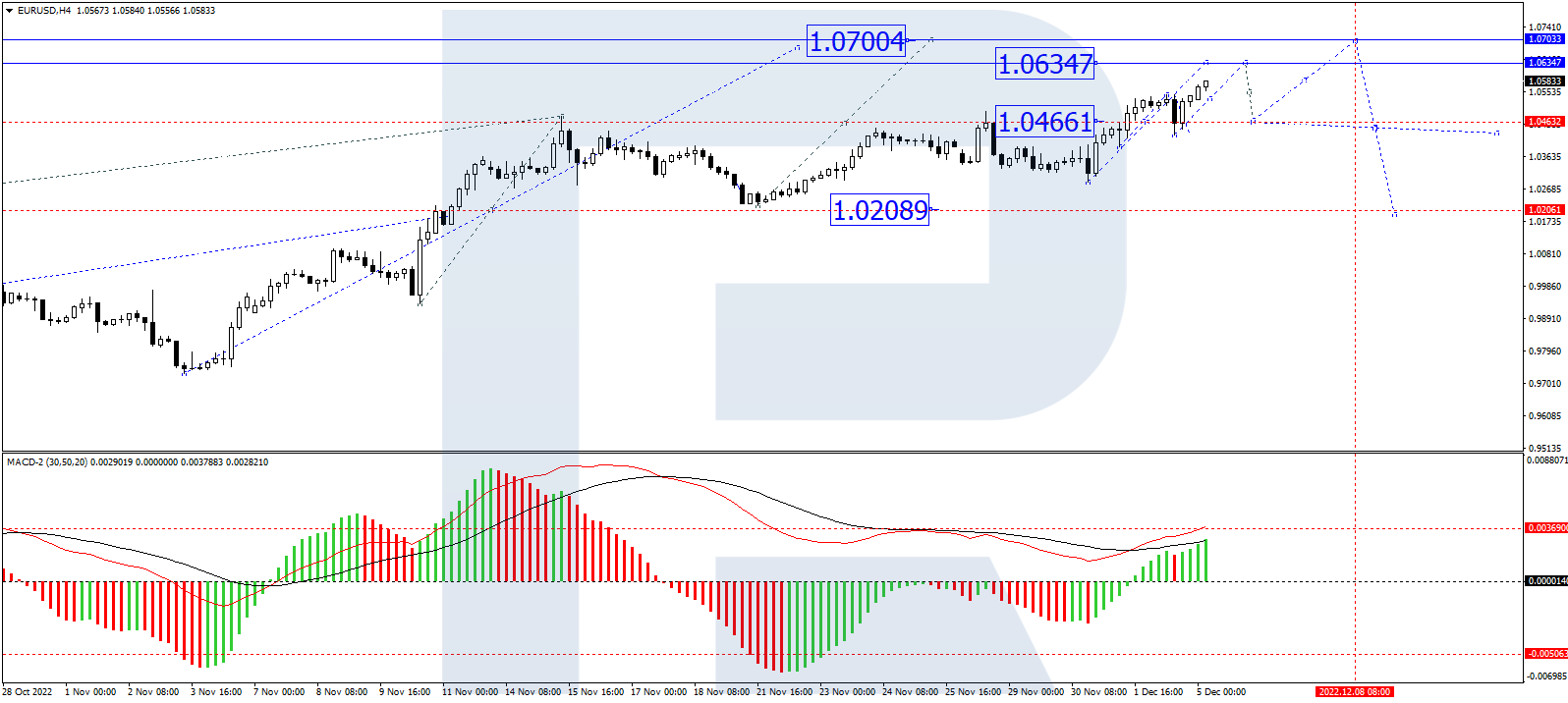
On H4, the currency pair has formed a consolidation range around 1.0466. Today the market is trying to break it upwards. The structure of growth is expected to extend to 1.0634, and after it is reached, a link of correction to 1.0464 is not excluded, followed by growth to 1.0703. Technically, this scenario is confirmed by the MACD: its line is directed strictly upwards, which suggests further growth.

On H1, the pair has completed an impulse of growth to 1.0531. Today the market has formed a consolidation range around it, and with an escape upwards, it extends the structure of growth to 1.0634. Technically, the scenario is confirmed by the Stochastic oscillator. Its signal line is above 80 and shows no evidence of decline as yet.

Disclaimer

Any forecasts contained herein are based on the author’s particular opinion. This analysis may not be treated as trading advice. RoboForex bears no responsibility for trading results based on trading recommendations and reviews contained herein.

China eases Covid restrictions. The dollar index fell to a 5-month low amid expectations of a rate hike slowdown

By JustMarkets

Fed Chairman Jerome Powell said last week that it might be time to slow rate hikes, raising hopes that the Central Bank is near the end of its tightening cycle. But Friday’s jobs report that hiring remained high last month while average hourly earnings rose. The US non-farm payrolls report (NFP) beat market expectations with 263,000 new jobs created compared to the expected 200,000. The unemployment rate remained unchanged at 3.7%, while average hourly earnings rose to 5.1% year-over-year against expectations of 4.6% and a revised higher October rate of 4.9%. This suggests that the labor market remains strong, giving the Fed room for another major hike, although there is less than a 20% chance of such a scenario.

At the close of the stock market on Friday, the Dow Jones Index (US30) increased by 0.10% (+0.45% for the week), while the S&P 500 Index (US500) decreased by 0.12% (+1.66% for the week). Tech Index NASDAQ (US100) was down by 0.18% (+2.82% for the week). Despite the slight decline on Friday, all three indices closed the week on a profit.

Equity markets in Europe mostly rallied last week. German DAX (DE30) gained 0.27% (+0.40% for the week), French CAC 40 (FR40) lost 0.17% (+0.96% for the week), Spanish IBEX 35 (ES35) was down 0.30% (+0.06% for the week), British FTSE 100 (UK100) closed 0.03% (+0.93% for the week).

European Central Bank President Christine Lagarde is scheduled to appear twice this week ahead of this year’s key ECB policy meeting on December 15. Markets are leaning toward a 50 basis point rate hike at the ECB’s upcoming meeting after data last week showed that Eurozone inflation fell much more than expected in November. European Central Bank officials in Germany and France said over the weekend that the ECB would return inflation to 2% by the end of 2024 or 2025. National governments have used hundreds of billions of euros to protect companies and households from rising energy prices, which bankers said could undermine their efforts to rein in inflation. Nagel and Villeroy called for a return to a more balanced budget in the near future.

Representatives of OPEC+, which includes the Organization of the Petroleum Exporting Countries, and its allies, including Russia, met Sunday to discuss production targets after the G7 countries agreed to cap Russian oil prices. On Friday, the G7 nations and Australia agreed to cap the price of Russian offshore crude at $60 a barrel to deprive President Vladimir Putin of revenue to fund the invasion of Ukraine. Many OPEC analysts and ministers say the cap is ineffective because Moscow sells most of its oil to countries such as China and India. So far, OPEC+ countries have agreed to stick to their oil production targets at a meeting on Sunday. Russian Deputy Prime Minister Alexander Novak said Sunday that Russia would rather cut production than deliver oil under a price cap.

Asian markets traded flat last week. Japan’s Nikkei 225 (JP225) declined 1.57% over the week, Hong Kong’s Hang Seng (HK50) jumped by 9.85% last week, and Australia’s S&P/ASX 200 (AU200) was up 0.58%. Most Asian markets are trading sideways on Monday amid some uncertainty over US monetary policy after strong wage data, while Chinese stocks are rising as the government loosened restrictions imposed on COVID. Hong Kong stocks have also significantly outperformed their Chinese counterparts in the last month as the city rolled back its COVID policies early.

In the commodities market, futures on silver (+8.98%), copper (+6.27), WTI oil (+5.32%), palladium (+4.56%), platinum (+3.8%), cotton (+3.68%), and gold (+3.27%) showed the biggest gains over the week. Futures on natural gas (-15.12%), lumber (-6.23%), wheat (-4.64%), corn (-3.69%), and orange juice (-3.18%) showed the biggest drops.

S&P 500 (F) (US500) 4,071.70 −4.87 (−0.12%)

Dow Jones (US30) 34,429.88 +34.87 (+0.10%)

DAX (DE40) 14,529.39 +39.09 (+0.27%)

FTSE 100 (UK100) 7,556.23 −2.266 (−0.030%)

USD Index 104.51 −0.22 (−0.21%)

Important events for today:
  • – Japan Services PMI (m/m) at 03:30 (GMT+3);
  • – Eurozone ECB President Lagarde Speaks at 03:45 (GMT+3);
  • – China Caixin Services PMI (m/m) at 04:45 (GMT+3);
  • – Spanish Services PMI (m/m) at 10:15 (GMT+3);
  • – Italian Services PMI (m/m) at 10:45 (GMT+3);
  • – French Services PMI (m/m) at 10:50 (GMT+3);
  • – German Services PMI (m/m) at 10:55 (GMT+3);
  • – Eurozone Services PMI (m/m) at 11:00 (GMT+3);
  • – UK Services PMI (m/m) at 11:30 (GMT+3);
  • – Eurozone Retail Sales (m/m) at 12:00 (GMT+3);
  • – US ISM Services PMI (m/m) at 17:00 (GMT+3).

By JustMarkets


This article reflects a personal opinion and should not be interpreted as an investment advice, and/or offer, and/or a persistent request for carrying out financial transactions, and/or a guarantee, and/or a forecast of future events.

Jiang Zemin propelled China’s economic rise in the world, leaving his successors to deal with the massive inequality that followed

By Edward Cunningham, Harvard Kennedy School 

By the summer of 1989, a series of problems were threatening China’s stability. Soaring inflation was undermining the economy at home while the violent suppression of Tiananmen Square demonstrations had left it largely a pariah state abroad. Yet within a few years the nation rebounded – beginning two decades of high economic growth, membership in the largest trading club in the world and international acceptance on the global stage.

That transition came thanks in no small part to an underestimated, Soviet-trained electrical engineer – former Chinese President Jiang Zemin, who died on Nov. 30, 2022, at the age of 96.

I first traveled to and studied in China in 1992. At that time, the still powerful former leader Deng Xiaoping was publicly criticizing Jiang’s more conservative approach to the economy in a series of visits and talks he gave during what became known as Deng’s “Southern Tour.” Eventually Jiang fell in line and supported Deng’s liberalization measures and the idea of economic transformation. Yet while Jiang’s subsequent policies laid a strong foundation for China’s growth, they also likely sowed the seeds of excess that set the stage for current President Xi Jinping’s rise.

The grand experiment

Jiang was picked to lead the country as general secretary in June 1989, after the ouster of former leader Zhao Ziyang for Zhao’s conciliatory approach towards the Tiananmen Square protesters.

Within three years Jiang embarked on a grand experiment together with Deng and then-Vice Premier Zhu Rongji, which required Jiang to do what others had been unable or unwilling to do: force the restructuring of inefficient state-owned enterprises in a wide range of sectors. This resulted in the laying off of millions of workers who had expected such jobs to be lifelong “iron rice bowls.”

From 1998 to 2002, approximately 34 million people were fired as China privatized hundreds of state-owned enterprises and shuttered thousands more.

This concerted effort proved an important and necessary step toward preparing Chinese companies for more direct market competition and integration with the world economy by the turn of the century.

Ascending on the world stage

Jiang’s real influence began upon Deng’s death in February 1997.

In July of that year, he presided over the handover of Hong Kong to the mainland. He then proved an able leader during the macroeconomic storm of the Asian financial crisis that began that same month. China quickly recovered and by 2001 had both acceded to the World Trade Organization and won the bid to host the 2008 Summer Olympic Games.

By 2002 China’s economy had grown to represent over 4% of the global economy. Jiang sought to reinforce such economic dynamism through more formal means, and revised the constitution that same year to formally allow corporate elite and private business entrepreneurs into the Chinese Communist Party.

Growing inequality

This economic liberalization was paired with housing privatization policies. Combined, they spurred the creation of a burgeoning middle class and large-scale private wealth generation.

What was missing, though, was adequate regulation to provide a check on the often-wild results of unbridled growth. Economic inequalities grew dramatically in the 1990s and on through 2005, when Jiang formally relinquished his final title as the head of the military.

This created large social fissures, as rampant corruption began to permeate central and local governments, crime rates rose, and even the military itself got into business schemes. Local governments resorted to rafts of arbitrary and extra-budgetary fees levied on citizens to pay for critical public goods and services, as well as infrastructure, which had eroded over time.

Return of the state

Jiang’s successors needed to respond to the problems his policies created. They did so by elevating the role of the state in social and economic life, promoting what they described as a more “balanced development” model.

Hu Jintao, who succeeded Jiang, focused resources and policy priorities on transferring more resources to the poorer regions of China, shoring up a weak medical and social insurance system and promulgating more egalitarian measures as part of a “putting people first” program. In just five years, the percentage of China’s population covered by health insurance more than doubled, from 43% in 2006 to 95% in 2011.

Hu also moderated Jiang’s growth at any cost focus, pushing through policies that provided assistance to groups who had not benefited as much from China’s economic reforms, such as migrants, the rural poor and laid-off urban workers.

Xi has provided a more pointed response to what he likely views as the costs of Jiang’s governance. While continuing the shift toward greater centralization, he has deepened and widened the state’s role in not only the economy but other spheres of Chinese life, such as society and the military.

A smooth transition?

But Jiang’s legacy is more than just soaring economic growth and staggering inequality. It is also important to note that the end of his leadership marked China’s first orderly transition of political power since the founding of the People’s Republic of China in 1949.

That precedent was, and continues to be, important. While he initially maintained some influence for several years after formally stepping down as general secretary, Jiang’s most singular legacy may be showing the world – and the Chinese people – that smooth transitions of power were indeed possible. Whether they still are possible remains an open question.The Conversation

About the Author:

Edward Cunningham, Director of Ash Center China Programs, Harvard Kennedy School

This article is republished from The Conversation under a Creative Commons license. Read the original article.


Currency Speculators up their Mexican Peso bets higher for 8th time in 9 weeks

By InvestMacro

Here are the latest charts and statistics for the Commitment of Traders (COT) data published by the Commodities Futures Trading Commission (CFTC).

The latest COT data is updated through Tuesday November 29th and shows a quick view of how large market participants (for-profit speculators and commercial traders) were positioned in the futures markets. All currency positions are in direct relation to the US dollar where, for example, a bet for the euro is a bet that the euro will rise versus the dollar while a bet against the euro will be a bet that the euro will decline versus the dollar.

Weekly Speculator Changes
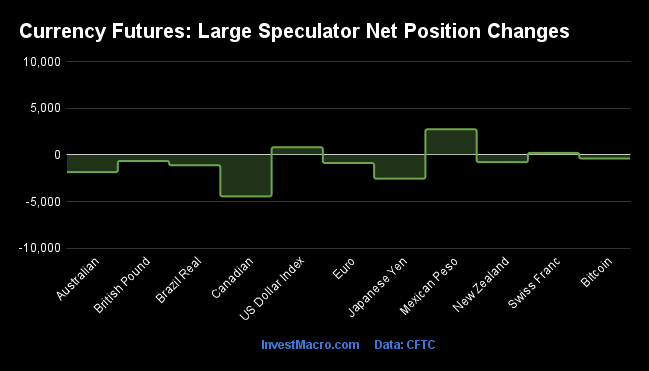
The COT currency market speculator bets were overall lower this week as three out of the eleven currency markets we cover had higher positioning while the other eight markets had lower speculator contracts.

Leading the gains for the currency markets was the Mexican peso (2,767 contracts) with the US Dollar Index (827 contracts) and the Swiss franc (229 contracts) also showing a positive week.

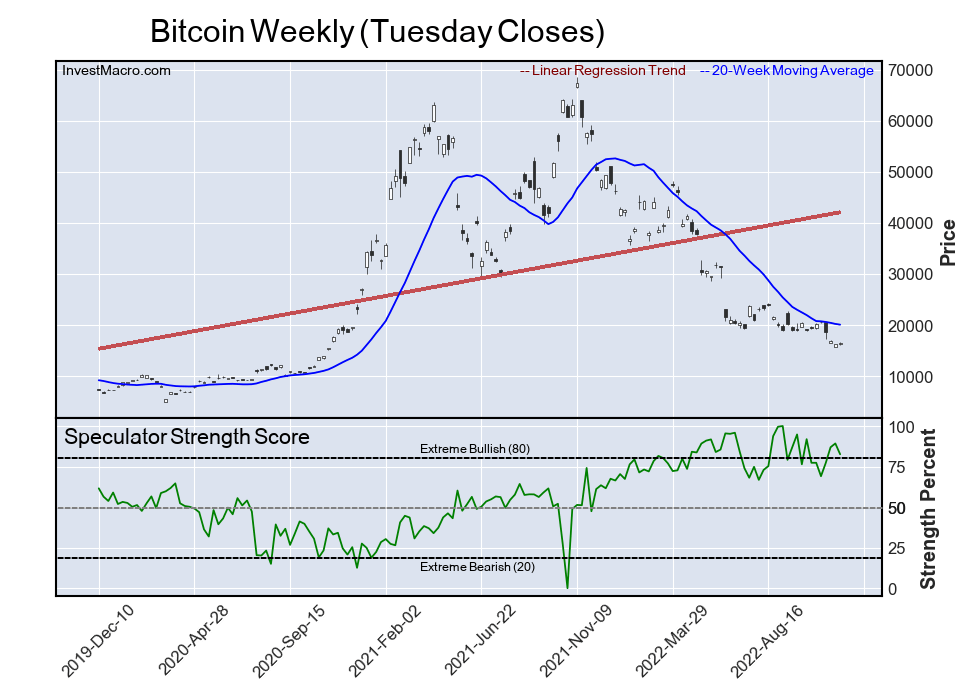
The currencies leading the declines in speculator bets this week were the Canadian dollar (-4,444 contracts) and the Japanese yen (-2,544 contracts) with the Australian dollar (-1,844 contracts), the Brazilian real (-1,099 contracts), the Euro (-865 contracts), the New Zealand dollar (-770 contracts), the British pound sterling (-642 contracts) and Bitcoin (-382 contracts) also registering lower bets on the week.

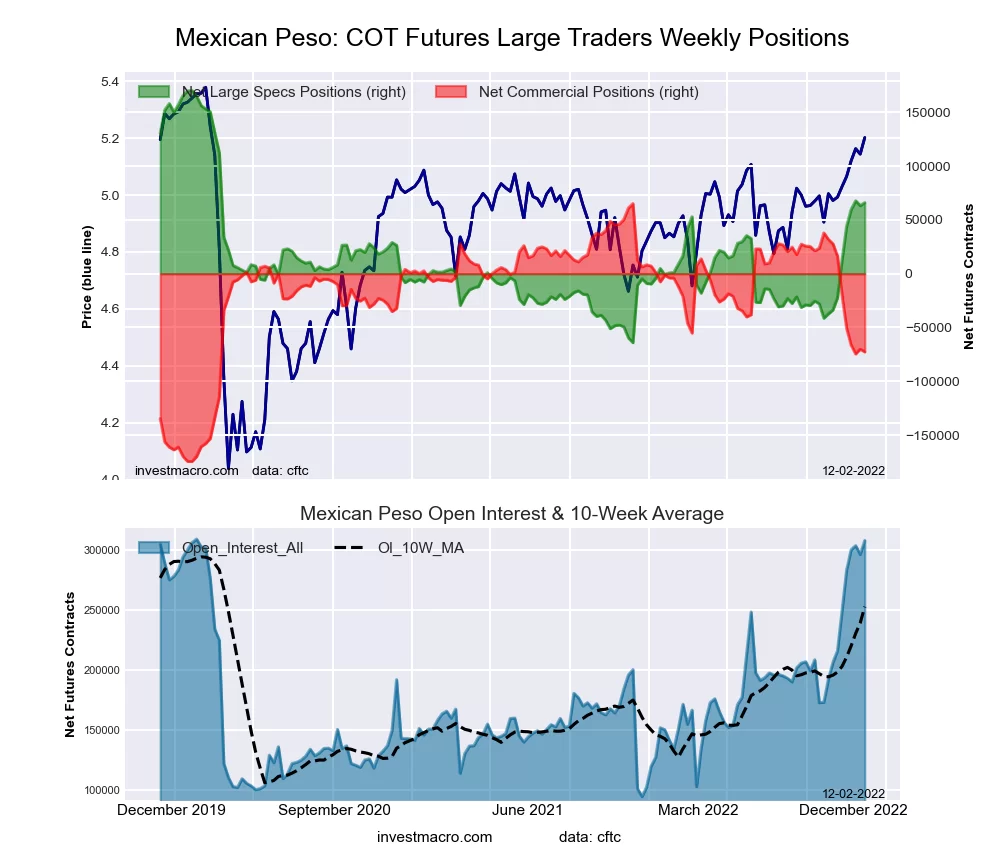
Highlighting the COT currency data this week is the rising Mexican peso positioning. Large speculators boosted their bullish bets for the Mexican peso this week for the eighth time out of the past nine weeks. Peso bets have now improved by a total of +107,408 contracts over that nine-week period going from a standing of -41,322 contracts on September 27th to +66,086 contracts through Tuesday.

The peso positioning has been helped out by the rising interest rates in Mexico that have reached 10 percent with expectations of another 50 basis point increase in December. Peso prices have also been on the rise higher against the US Dollar recently and are up by over 6 percent (vs USD) since late-September. The peso is also one of the rare currencies to be up overall against the US Dollar in 2022.


Data Snapshot of Forex Market Traders | Columns Legend
Nov-29-2022OIOI-IndexSpec-NetSpec-IndexCom-NetCOM-IndexSmalls-NetSmalls-Index
USD Index46,8366024,89266-28,492313,60056
EUR695,77677122,24773-154,5853232,33831
GBP225,48052-36,5843849,23268-12,64833
JPY228,32867-67,3942782,66976-15,27522
CHF41,36025-14,2471719,97078-5,72338
CAD136,65421-16,1162313,951802,16534
AUD159,37852-44,6304350,90657-6,27637
NZD46,18039-5,054484,6415241356
MXN307,7339966,08656-72,759426,67371
RUB20,93047,54331-7,15069-39324
BRL32,057167,63756-9,659442,02285
Bitcoin16,8329032483-780045623


Bitcoin, EuroFX lead Strength Scores

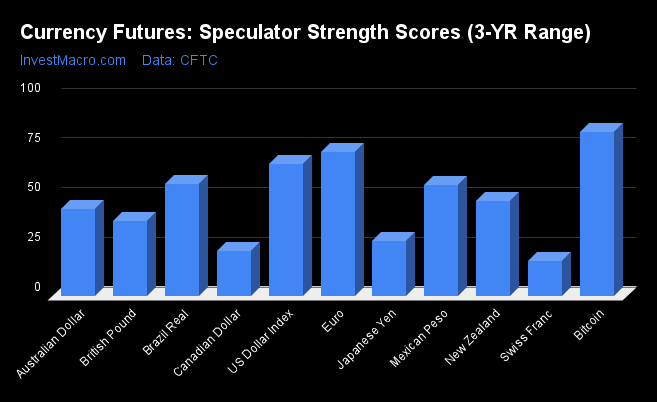
Strength Scores (a normalized measure of Speculator positions over a 3-Year range, from 0 to 100 where above 80 is extreme bullish and below 20 is extreme bearish) show that Bitcoin (82.6 percent) and the EuroFX (72.5 percent) lead the currency markets at the top of their respective ranges and are both in bullish extreme positions. The US Dollar Index (66.4 percent) comes in as the next highest in the currency markets in strength scores but the Dollar has been losing steam over the past weeks and months.

On the downside, the Swiss Franc (17.4 percent) comes in at the lowest strength level currently and is in a bearish extreme level (below 20 percent).

Strength Statistics:
US Dollar Index (66.4 percent) vs US Dollar Index previous week (65.1 percent)
EuroFX (72.5 percent) vs EuroFX previous week (72.8 percent)
British Pound Sterling (37.6 percent) vs British Pound Sterling previous week (38.2 percent)
Japanese Yen (27.4 percent) vs Japanese Yen previous week (28.9 percent)
Swiss Franc (17.4 percent) vs Swiss Franc previous week (16.8 percent)
Canadian Dollar (22.6 percent) vs Canadian Dollar previous week (27.9 percent)
Australian Dollar (43.5 percent) vs Australian Dollar previous week (45.2 percent)
New Zealand Dollar (47.8 percent) vs New Zealand Dollar previous week (49.6 percent)
Mexican Peso (55.5 percent) vs Mexican Peso previous week (54.3 percent)
Brazilian Real (56.0 percent) vs Brazilian Real previous week (57.2 percent)
Bitcoin (82.6 percent) vs Bitcoin previous week (89.3 percent)

Strength Trends led by Mexican Peso
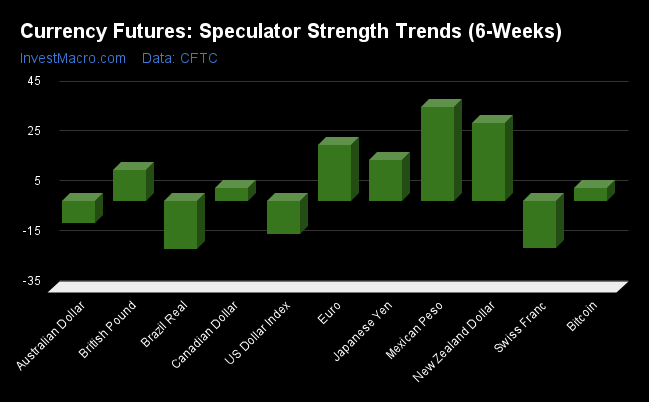
Strength Score Trends (or move index, calculates the 6-week changes in strength scores) showed that the Mexican Peso (37.7 percent) leads the past six weeks trends for the currency markets this week. The New Zealand Dollar (31.5 percent), the EuroFX (22.7 percent) and the Japanese Yen (16.6 percent) fill out the next top movers in the latest trends data.

The Brazilian Real (-19.3 percent) and the Swiss Franc (-18.8 percent) lead the downside trend scores currently while the next market with lower trend scores was the US Dollar Index (-13.0 percent).

Strength Trend Statistics:
US Dollar Index (-13.0 percent) vs US Dollar Index previous week (-14.5 percent)
EuroFX (22.7 percent) vs EuroFX previous week (26.3 percent)
British Pound Sterling (12.6 percent) vs British Pound Sterling previous week (2.8 percent)
Japanese Yen (16.6 percent) vs Japanese Yen previous week (7.7 percent)
Swiss Franc (-18.8 percent) vs Swiss Franc previous week (-22.6 percent)
Canadian Dollar (5.3 percent) vs Canadian Dollar previous week (16.7 percent)
Australian Dollar (-8.6 percent) vs Australian Dollar previous week (-10.7 percent)
New Zealand Dollar (31.5 percent) vs New Zealand Dollar previous week (34.8 percent)
Mexican Peso (37.7 percent) vs Mexican Peso previous week (41.4 percent)
Brazilian Real (-19.3 percent) vs Brazilian Real previous week (-17.8 percent)
Bitcoin (5.3 percent) vs Bitcoin previous week (-2.6 percent)


Individual COT Forex Markets:

US Dollar Index Futures:
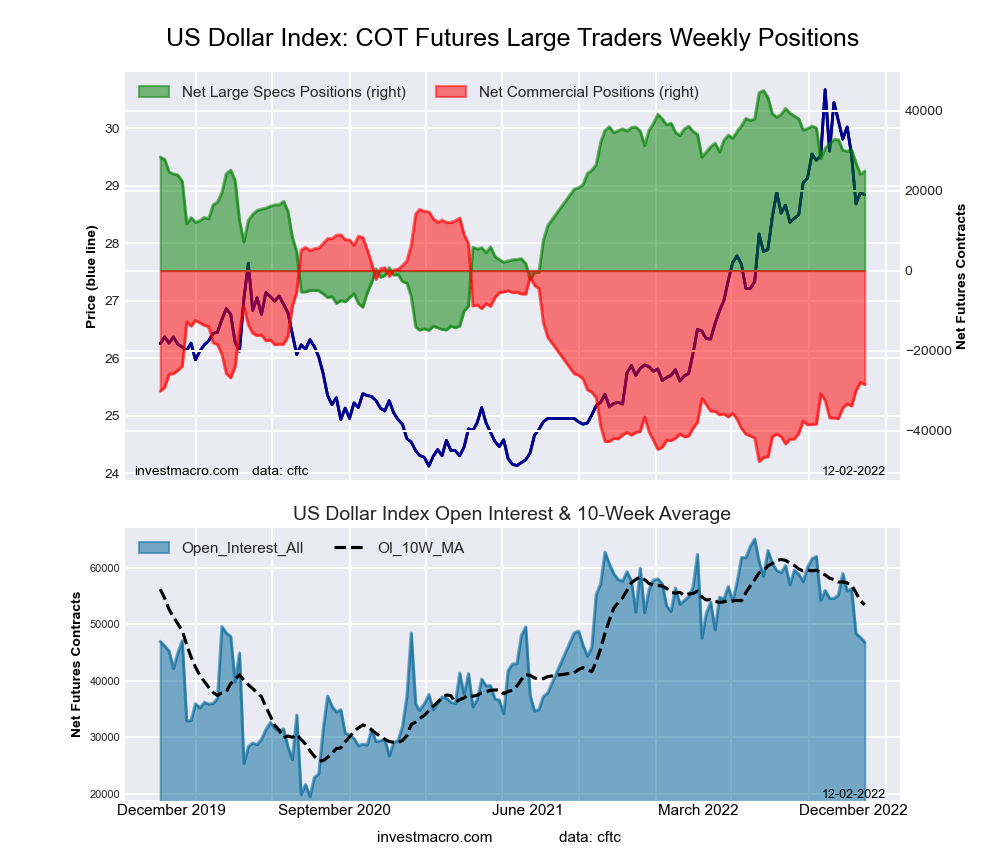
US Dollar Index Forex Futures COT ChartThe US Dollar Index large speculator standing this week recorded a net position of 24,892 contracts in the data reported through Tuesday. This was a weekly lift of 827 contracts from the previous week which had a total of 24,065 net contracts.

This week’s current strength score (the trader positioning range over the past three years, measured from 0 to 100) shows the speculators are currently Bullish with a score of 66.4 percent. The commercials are Bearish with a score of 30.5 percent and the small traders (not shown in chart) are Bullish with a score of 55.9 percent.

US DOLLAR INDEX StatisticsSPECULATORSCOMMERCIALSSMALL TRADERS
– Percent of Open Interest Longs:79.64.413.2
– Percent of Open Interest Shorts:26.465.35.5
– Net Position:24,892-28,4923,600
– Gross Longs:37,2792,0796,199
– Gross Shorts:12,38730,5712,599
– Long to Short Ratio:3.0 to 10.1 to 12.4 to 1
NET POSITION TREND:
– Strength Index Score (3 Year Range Pct):66.430.555.9
– Strength Index Reading (3 Year Range):BullishBearishBullish
NET POSITION MOVEMENT INDEX:
– 6-Week Change in Strength Index:-13.013.5-7.9


Euro Currency Futures:

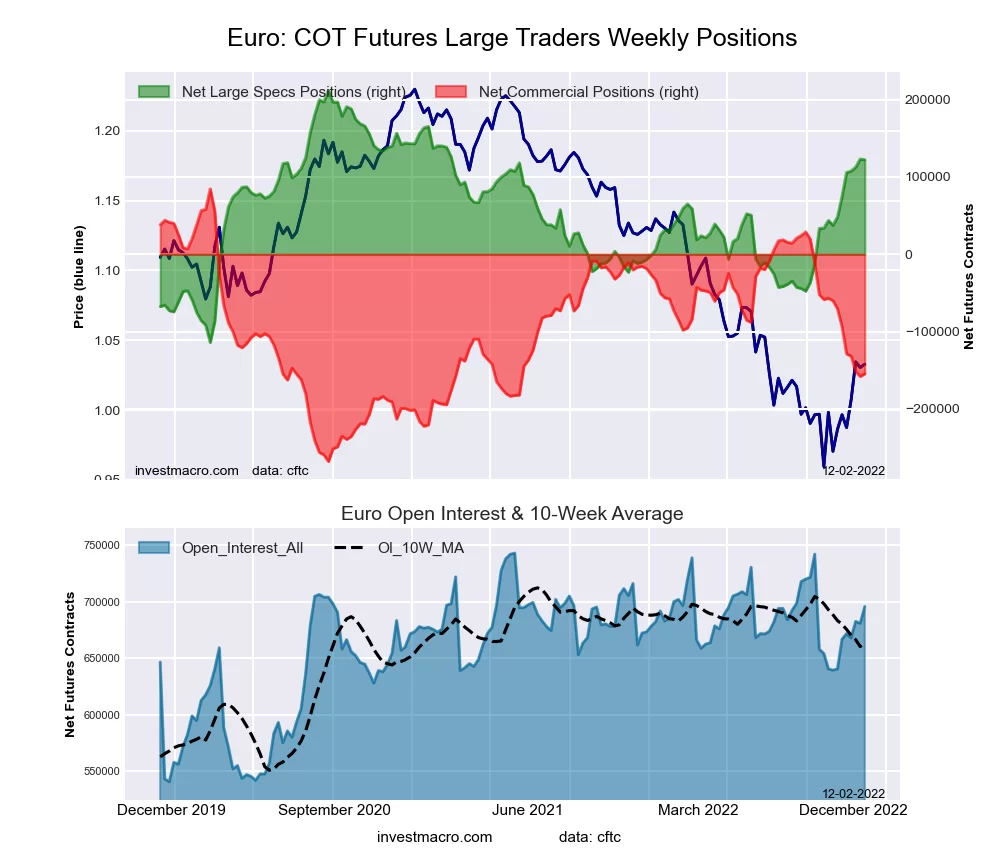
Euro Currency Futures COT ChartThe Euro Currency large speculator standing this week recorded a net position of 122,247 contracts in the data reported through Tuesday. This was a weekly reduction of -865 contracts from the previous week which had a total of 123,112 net contracts.

This week’s current strength score (the trader positioning range over the past three years, measured from 0 to 100) shows the speculators are currently Bullish with a score of 72.5 percent. The commercials are Bearish with a score of 32.2 percent and the small traders (not shown in chart) are Bearish with a score of 30.6 percent.

EURO Currency StatisticsSPECULATORSCOMMERCIALSSMALL TRADERS
– Percent of Open Interest Longs:34.751.311.8
– Percent of Open Interest Shorts:17.173.57.1
– Net Position:122,247-154,58532,338
– Gross Longs:241,122356,90581,867
– Gross Shorts:118,875511,49049,529
– Long to Short Ratio:2.0 to 10.7 to 11.7 to 1
NET POSITION TREND:
– Strength Index Score (3 Year Range Pct):72.532.230.6
– Strength Index Reading (3 Year Range):BullishBearishBearish
NET POSITION MOVEMENT INDEX:
– 6-Week Change in Strength Index:22.7-23.815.8


British Pound Sterling Futures:

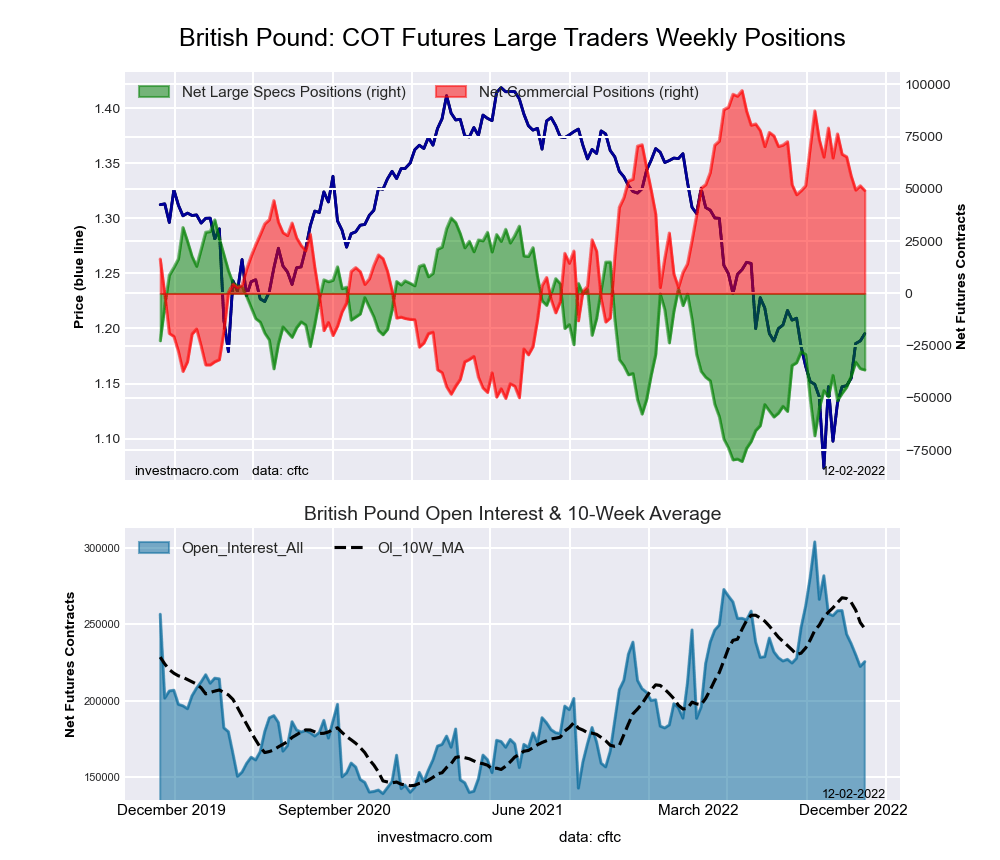
British Pound Sterling Futures COT ChartThe British Pound Sterling large speculator standing this week recorded a net position of -36,584 contracts in the data reported through Tuesday. This was a weekly fall of -642 contracts from the previous week which had a total of -35,942 net contracts.

This week’s current strength score (the trader positioning range over the past three years, measured from 0 to 100) shows the speculators are currently Bearish with a score of 37.6 percent. The commercials are Bullish with a score of 67.5 percent and the small traders (not shown in chart) are Bearish with a score of 33.2 percent.

BRITISH POUND StatisticsSPECULATORSCOMMERCIALSSMALL TRADERS
– Percent of Open Interest Longs:11.576.49.5
– Percent of Open Interest Shorts:27.854.515.1
– Net Position:-36,58449,232-12,648
– Gross Longs:26,000172,19921,363
– Gross Shorts:62,584122,96734,011
– Long to Short Ratio:0.4 to 11.4 to 10.6 to 1
NET POSITION TREND:
– Strength Index Score (3 Year Range Pct):37.667.533.2
– Strength Index Reading (3 Year Range):BearishBullishBearish
NET POSITION MOVEMENT INDEX:
– 6-Week Change in Strength Index:12.6-18.424.4


Japanese Yen Futures:

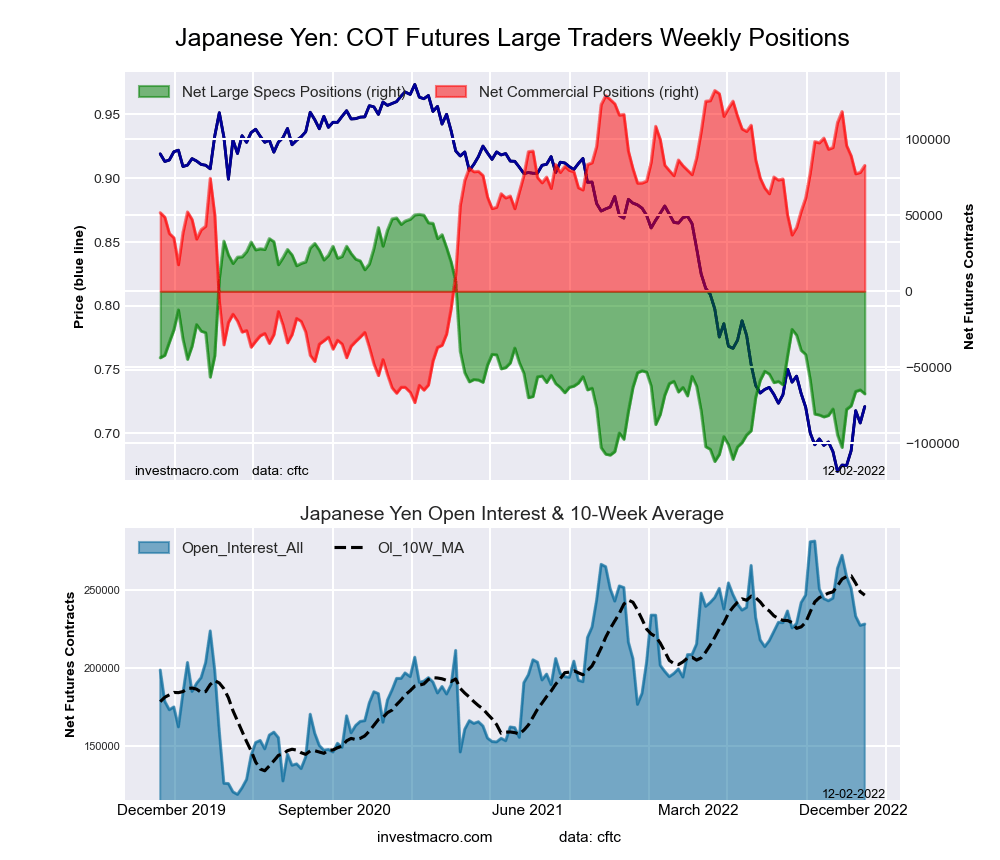
Japanese Yen Forex Futures COT ChartThe Japanese Yen large speculator standing this week recorded a net position of -67,394 contracts in the data reported through Tuesday. This was a weekly lowering of -2,544 contracts from the previous week which had a total of -64,850 net contracts.

This week’s current strength score (the trader positioning range over the past three years, measured from 0 to 100) shows the speculators are currently Bearish with a score of 27.4 percent. The commercials are Bullish with a score of 76.0 percent and the small traders (not shown in chart) are Bearish with a score of 22.4 percent.

JAPANESE YEN StatisticsSPECULATORSCOMMERCIALSSMALL TRADERS
– Percent of Open Interest Longs:12.376.29.8
– Percent of Open Interest Shorts:41.840.016.5
– Net Position:-67,39482,669-15,275
– Gross Longs:28,125173,95922,403
– Gross Shorts:95,51991,29037,678
– Long to Short Ratio:0.3 to 11.9 to 10.6 to 1
NET POSITION TREND:
– Strength Index Score (3 Year Range Pct):27.476.022.4
– Strength Index Reading (3 Year Range):BearishBullishBearish
NET POSITION MOVEMENT INDEX:
– 6-Week Change in Strength Index:16.6-13.72.5


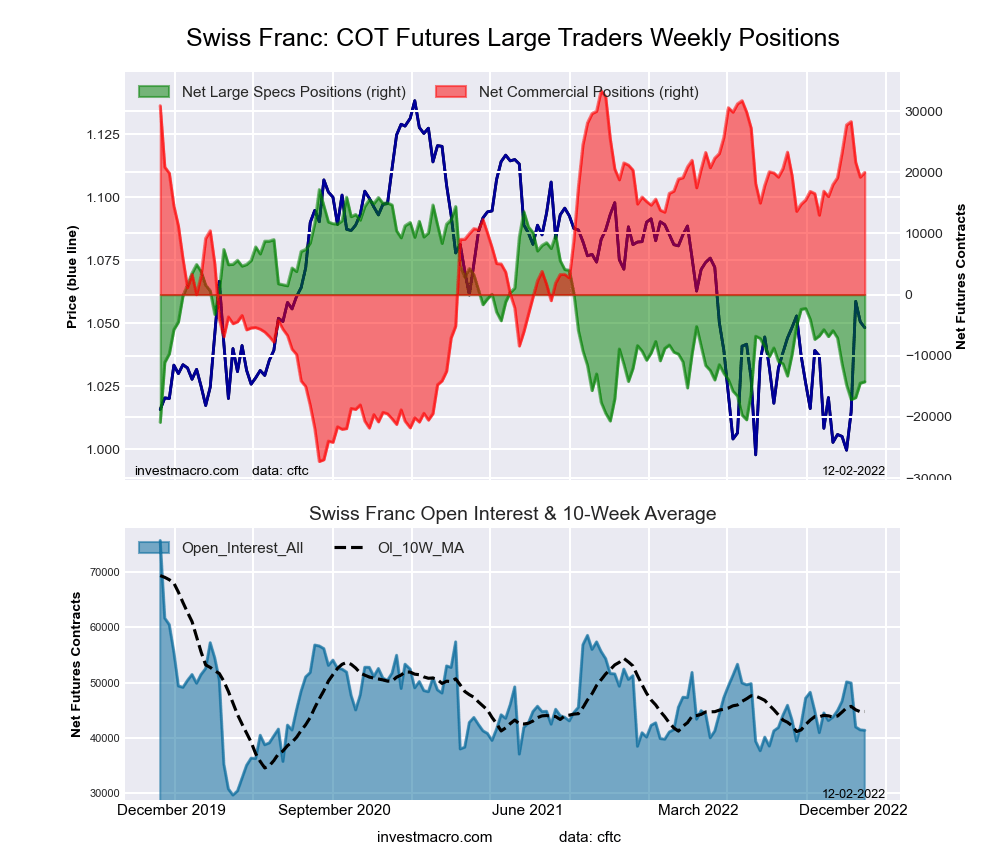
Swiss Franc Futures:

Swiss Franc Forex Futures COT ChartThe Swiss Franc large speculator standing this week recorded a net position of -14,247 contracts in the data reported through Tuesday. This was a weekly rise of 229 contracts from the previous week which had a total of -14,476 net contracts.

This week’s current strength score (the trader positioning range over the past three years, measured from 0 to 100) shows the speculators are currently Bearish-Extreme with a score of 17.4 percent. The commercials are Bullish with a score of 77.9 percent and the small traders (not shown in chart) are Bearish with a score of 38.2 percent.

SWISS FRANC StatisticsSPECULATORSCOMMERCIALSSMALL TRADERS
– Percent of Open Interest Longs:3.669.725.9
– Percent of Open Interest Shorts:38.021.439.7
– Net Position:-14,24719,970-5,723
– Gross Longs:1,48828,81410,696
– Gross Shorts:15,7358,84416,419
– Long to Short Ratio:0.1 to 13.3 to 10.7 to 1
NET POSITION TREND:
– Strength Index Score (3 Year Range Pct):17.477.938.2
– Strength Index Reading (3 Year Range):Bearish-ExtremeBullishBearish
NET POSITION MOVEMENT INDEX:
– 6-Week Change in Strength Index:-18.81.421.3


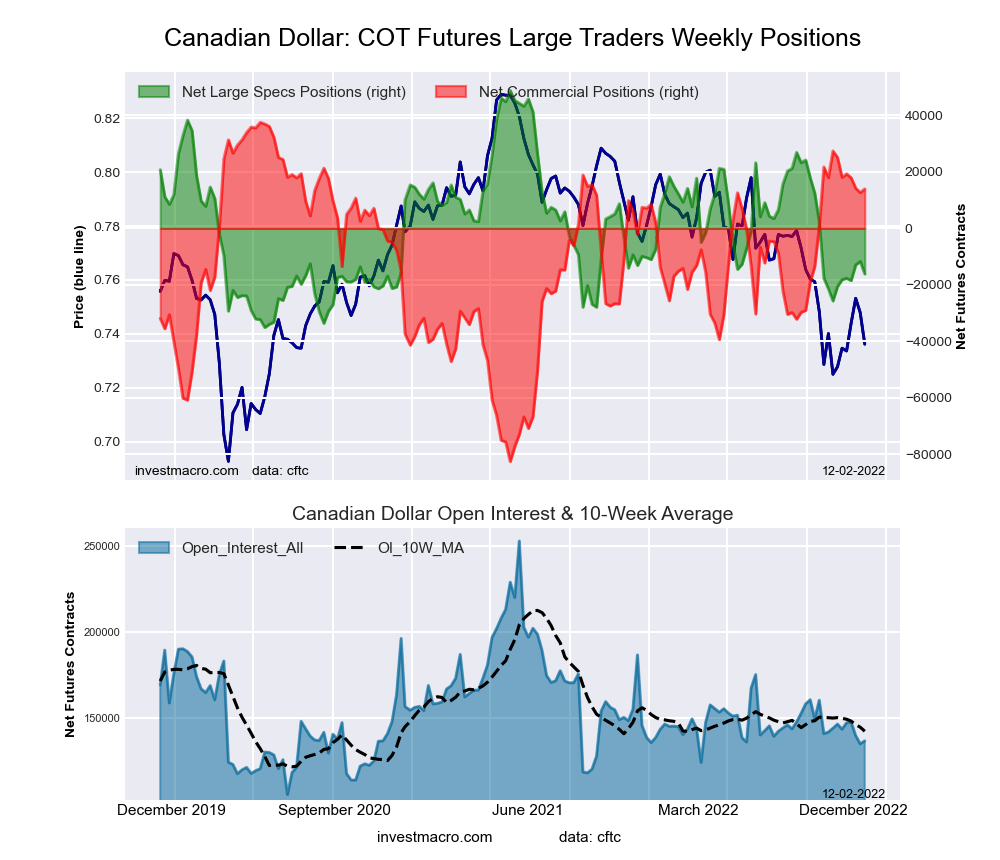
Canadian Dollar Futures:

Canadian Dollar Forex Futures COT ChartThe Canadian Dollar large speculator standing this week recorded a net position of -16,116 contracts in the data reported through Tuesday. This was a weekly lowering of -4,444 contracts from the previous week which had a total of -11,672 net contracts.

This week’s current strength score (the trader positioning range over the past three years, measured from 0 to 100) shows the speculators are currently Bearish with a score of 22.6 percent. The commercials are Bullish-Extreme with a score of 80.4 percent and the small traders (not shown in chart) are Bearish with a score of 34.5 percent.

CANADIAN DOLLAR StatisticsSPECULATORSCOMMERCIALSSMALL TRADERS
– Percent of Open Interest Longs:25.748.524.4
– Percent of Open Interest Shorts:37.538.322.8
– Net Position:-16,11613,9512,165
– Gross Longs:35,12366,30433,375
– Gross Shorts:51,23952,35331,210
– Long to Short Ratio:0.7 to 11.3 to 11.1 to 1
NET POSITION TREND:
– Strength Index Score (3 Year Range Pct):22.680.434.5
– Strength Index Reading (3 Year Range):BearishBullish-ExtremeBearish
NET POSITION MOVEMENT INDEX:
– 6-Week Change in Strength Index:5.3-9.313.5


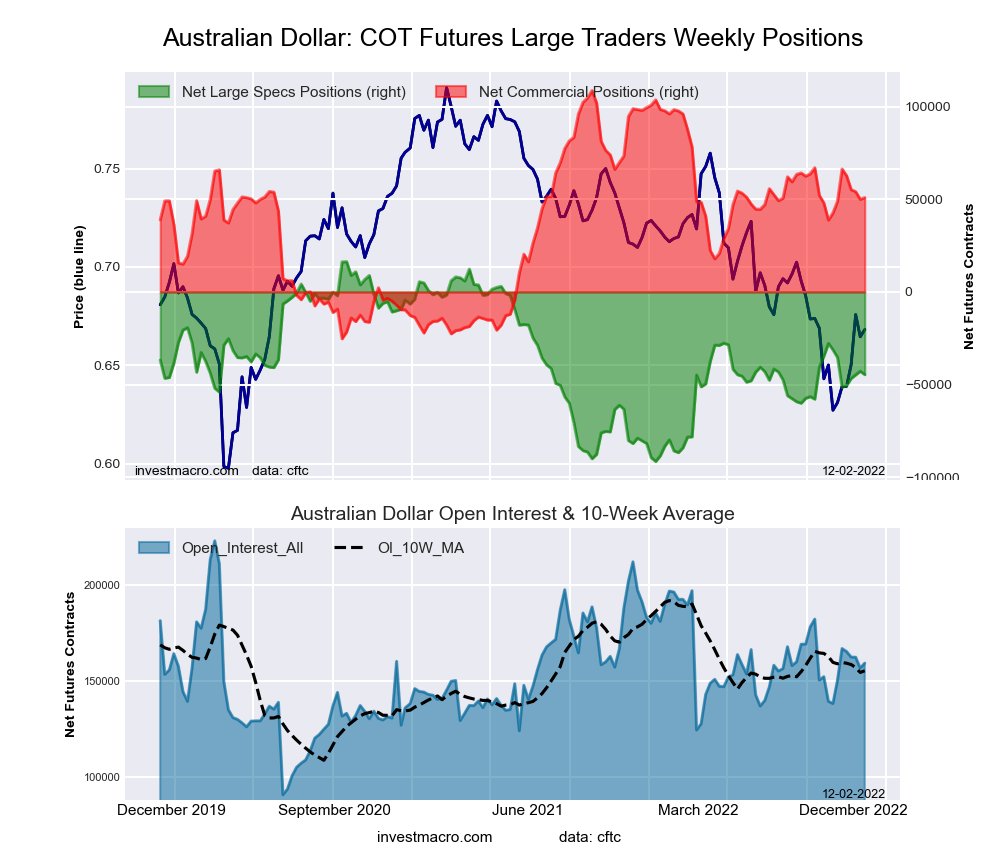
Australian Dollar Futures:

Australian Dollar Forex Futures COT ChartThe Australian Dollar large speculator standing this week recorded a net position of -44,630 contracts in the data reported through Tuesday. This was a weekly fall of -1,844 contracts from the previous week which had a total of -42,786 net contracts.

This week’s current strength score (the trader positioning range over the past three years, measured from 0 to 100) shows the speculators are currently Bearish with a score of 43.5 percent. The commercials are Bullish with a score of 56.9 percent and the small traders (not shown in chart) are Bearish with a score of 37.1 percent.

AUSTRALIAN DOLLAR StatisticsSPECULATORSCOMMERCIALSSMALL TRADERS
– Percent of Open Interest Longs:22.065.69.8
– Percent of Open Interest Shorts:50.033.613.8
– Net Position:-44,63050,906-6,276
– Gross Longs:35,045104,50615,698
– Gross Shorts:79,67553,60021,974
– Long to Short Ratio:0.4 to 11.9 to 10.7 to 1
NET POSITION TREND:
– Strength Index Score (3 Year Range Pct):43.556.937.1
– Strength Index Reading (3 Year Range):BearishBullishBearish
NET POSITION MOVEMENT INDEX:
– 6-Week Change in Strength Index:-8.61.417.9


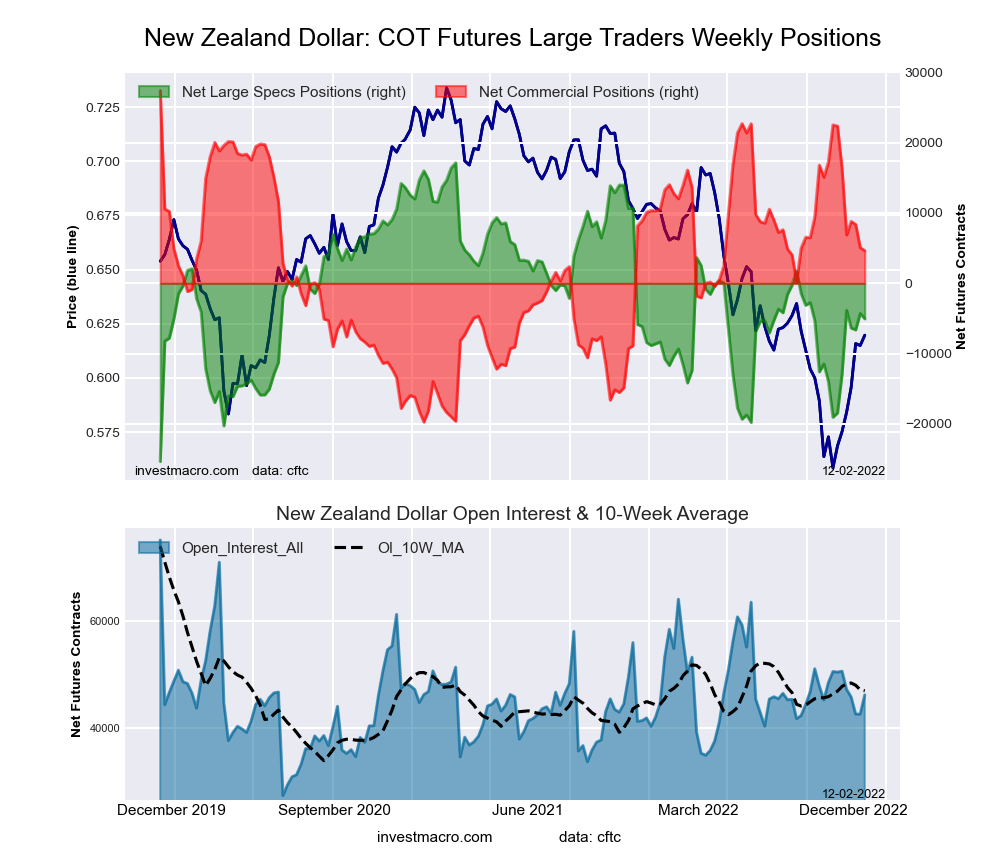
New Zealand Dollar Futures:

New Zealand Dollar Forex Futures COT ChartThe New Zealand Dollar large speculator standing this week recorded a net position of -5,054 contracts in the data reported through Tuesday. This was a weekly decline of -770 contracts from the previous week which had a total of -4,284 net contracts.

This week’s current strength score (the trader positioning range over the past three years, measured from 0 to 100) shows the speculators are currently Bearish with a score of 47.8 percent. The commercials are Bullish with a score of 51.7 percent and the small traders (not shown in chart) are Bullish with a score of 56.4 percent.

NEW ZEALAND DOLLAR StatisticsSPECULATORSCOMMERCIALSSMALL TRADERS
– Percent of Open Interest Longs:40.850.28.0
– Percent of Open Interest Shorts:51.840.17.1
– Net Position:-5,0544,641413
– Gross Longs:18,85523,1623,691
– Gross Shorts:23,90918,5213,278
– Long to Short Ratio:0.8 to 11.3 to 11.1 to 1
NET POSITION TREND:
– Strength Index Score (3 Year Range Pct):47.851.756.4
– Strength Index Reading (3 Year Range):BearishBullishBullish
NET POSITION MOVEMENT INDEX:
– 6-Week Change in Strength Index:31.5-37.649.7


Mexican Peso Futures:

Mexican Peso Futures COT ChartThe Mexican Peso large speculator standing this week recorded a net position of 66,086 contracts in the data reported through Tuesday. This was a weekly lift of 2,767 contracts from the previous week which had a total of 63,319 net contracts.

This week’s current strength score (the trader positioning range over the past three years, measured from 0 to 100) shows the speculators are currently Bullish with a score of 55.5 percent. The commercials are Bearish with a score of 42.5 percent and the small traders (not shown in chart) are Bullish with a score of 71.3 percent.

MEXICAN PESO StatisticsSPECULATORSCOMMERCIALSSMALL TRADERS
– Percent of Open Interest Longs:64.932.03.0
– Percent of Open Interest Shorts:43.455.60.8
– Net Position:66,086-72,7596,673
– Gross Longs:199,74498,3229,226
– Gross Shorts:133,658171,0812,553
– Long to Short Ratio:1.5 to 10.6 to 13.6 to 1
NET POSITION TREND:
– Strength Index Score (3 Year Range Pct):55.542.571.3
– Strength Index Reading (3 Year Range):BullishBearishBullish
NET POSITION MOVEMENT INDEX:
– 6-Week Change in Strength Index:37.7-37.12.8


Brazilian Real Futures:

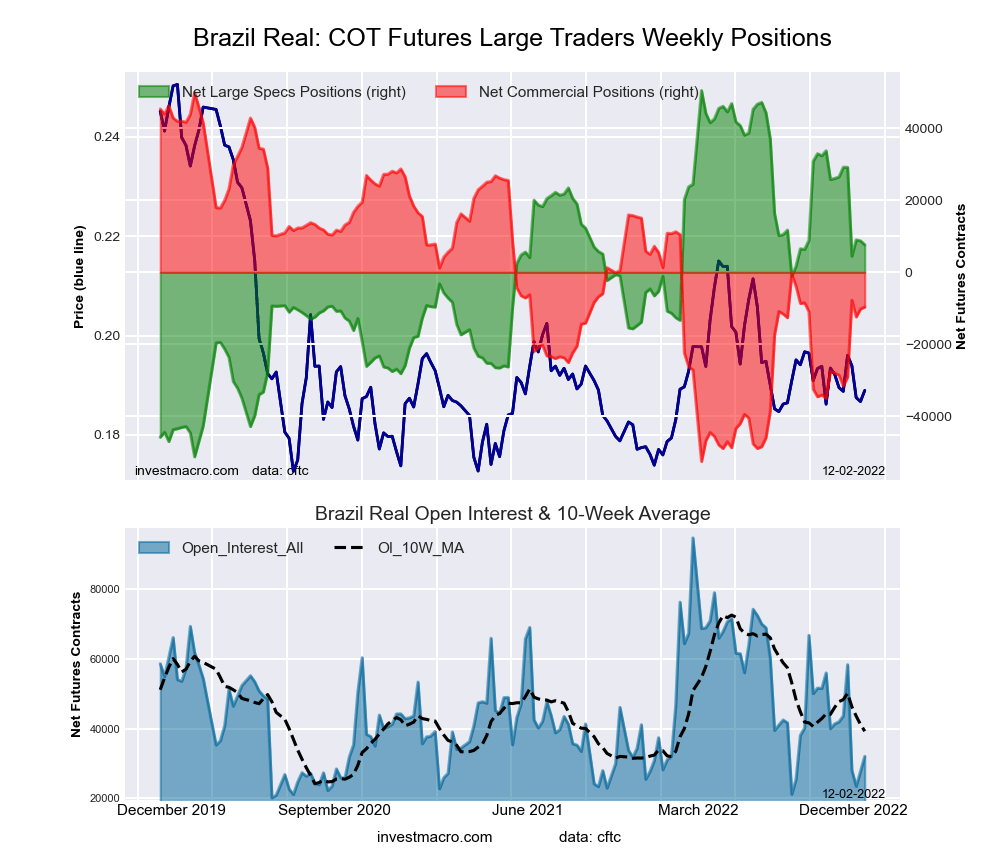
Brazil Real Futures COT ChartThe Brazilian Real large speculator standing this week recorded a net position of 7,637 contracts in the data reported through Tuesday. This was a weekly fall of -1,099 contracts from the previous week which had a total of 8,736 net contracts.

This week’s current strength score (the trader positioning range over the past three years, measured from 0 to 100) shows the speculators are currently Bullish with a score of 56.0 percent. The commercials are Bearish with a score of 43.6 percent and the small traders (not shown in chart) are Bullish-Extreme with a score of 84.7 percent.

BRAZIL REAL StatisticsSPECULATORSCOMMERCIALSSMALL TRADERS
– Percent of Open Interest Longs:51.536.011.4
– Percent of Open Interest Shorts:27.666.15.1
– Net Position:7,637-9,6592,022
– Gross Longs:16,50011,5413,666
– Gross Shorts:8,86321,2001,644
– Long to Short Ratio:1.9 to 10.5 to 12.2 to 1
NET POSITION TREND:
– Strength Index Score (3 Year Range Pct):56.043.684.7
– Strength Index Reading (3 Year Range):BullishBearishBullish-Extreme
NET POSITION MOVEMENT INDEX:
– 6-Week Change in Strength Index:-19.319.2-0.7


Bitcoin Futures:

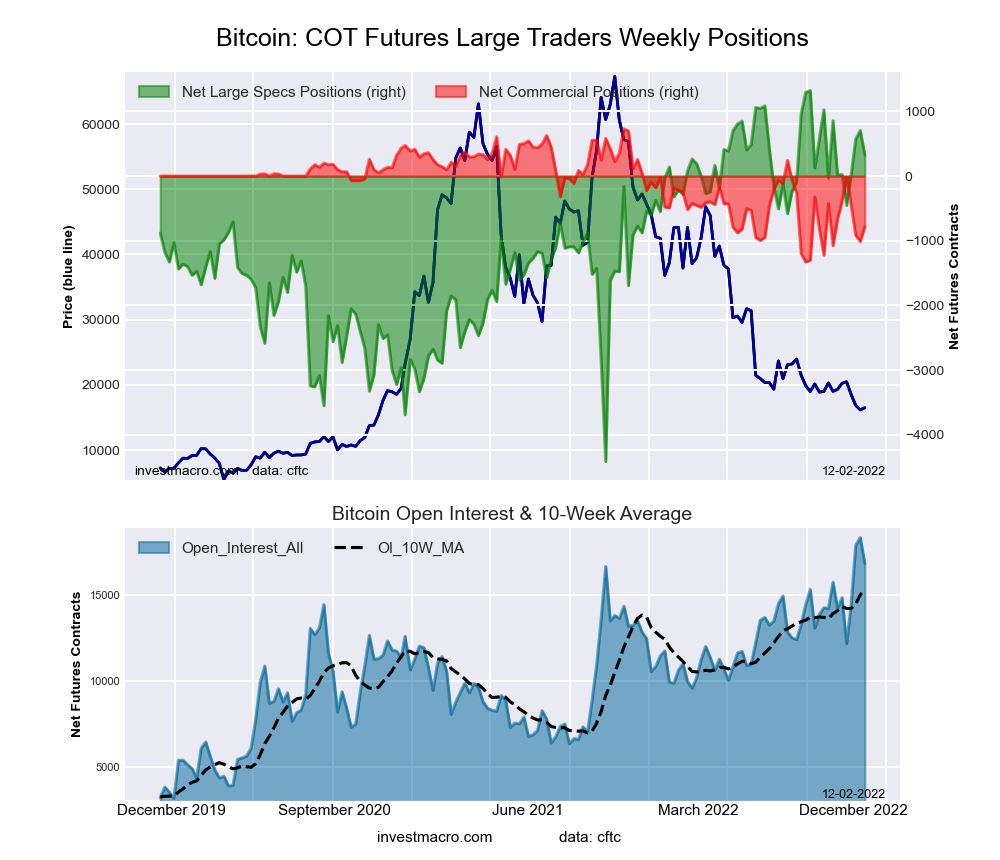
Bitcoin Crypto Futures COT ChartThe Bitcoin large speculator standing this week recorded a net position of 324 contracts in the data reported through Tuesday. This was a weekly lowering of -382 contracts from the previous week which had a total of 706 net contracts.

This week’s current strength score (the trader positioning range over the past three years, measured from 0 to 100) shows the speculators are currently Bullish-Extreme with a score of 82.6 percent. The commercials are Bearish with a score of 26.6 percent and the small traders (not shown in chart) are Bearish with a score of 23.3 percent.

BITCOIN StatisticsSPECULATORSCOMMERCIALSSMALL TRADERS
– Percent of Open Interest Longs:81.90.87.3
– Percent of Open Interest Shorts:80.05.44.6
– Net Position:324-780456
– Gross Longs:13,7831271,236
– Gross Shorts:13,459907780
– Long to Short Ratio:1.0 to 10.1 to 11.6 to 1
NET POSITION TREND:
– Strength Index Score (3 Year Range Pct):82.626.623.3
– Strength Index Reading (3 Year Range):Bullish-ExtremeBearishBearish
NET POSITION MOVEMENT INDEX:
– 6-Week Change in Strength Index:5.3-5.6-4.3


Article By InvestMacroReceive our weekly COT Newsletter

*COT Report: The COT data, released weekly to the public each Friday, is updated through the most recent Tuesday (data is 3 days old) and shows a quick view of how large speculators or non-commercials (for-profit traders) were positioned in the futures markets.

The CFTC categorizes trader positions according to commercial hedgers (traders who use futures contracts for hedging as part of the business), non-commercials (large traders who speculate to realize trading profits) and nonreportable traders (usually small traders/speculators) as well as their open interest (contracts open in the market at time of reporting). See CFTC criteria here.

COT Speculator Extremes: Bloomberg Commodity Index, Wheat lead weekly Bullish & Bearish Positions

By InvestMacro 

The latest update for the weekly Commitment of Traders (COT) report was released by the Commodity Futures Trading Commission (CFTC) on Friday for data ending on November 29th.

This weekly Extreme Positions report highlights the Top Most Bullish and Top Most Bearish Positions for the speculator category. Extreme positioning in these markets can foreshadow strong moves in the underlying market.

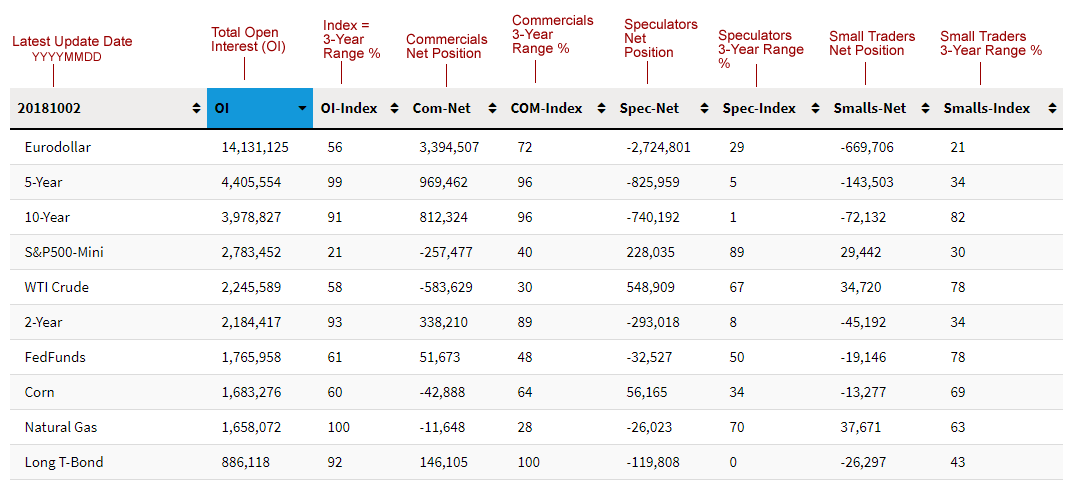
To signify an extreme position, we use the Strength Index (also known as the COT Index) of each instrument, a common method of measuring COT data. The Strength Index is simply a comparison of current trader positions against the range of positions over the previous 3 years. We use over 80 percent as extremely bullish and under 20 percent as extremely bearish. (Compare Strength Index scores across all markets in the data table or cot leaders table)


Speculators or Non-Commercials Notes:

Speculators, classified as non-commercial traders by the CFTC, are made up of large commodity funds, hedge funds and other significant for-profit participants. The Specs are generally regarded as trend-followers in their behavior towards price action – net speculator bets and prices tend to go in the same directions. These traders often look to buy when prices are rising and sell when prices are falling. To illustrate this point, many times speculator contracts can be found at their most extremes (bullish or bearish) when prices are also close to their highest or lowest levels.

These extreme levels can be dangerous for the large speculators as the trade is most crowded, there is less trading ammunition still sitting on the sidelines to push the trend further and prices have moved a significant distance. When the trend becomes exhausted, some speculators take profits while others look to also exit positions when prices fail to continue in the same direction. This process usually plays out over many months to years and can ultimately create a reverse effect where prices start to fall and speculators start a process of selling when prices are falling.


Here Are This Week’s Most Bullish Speculator Positions:

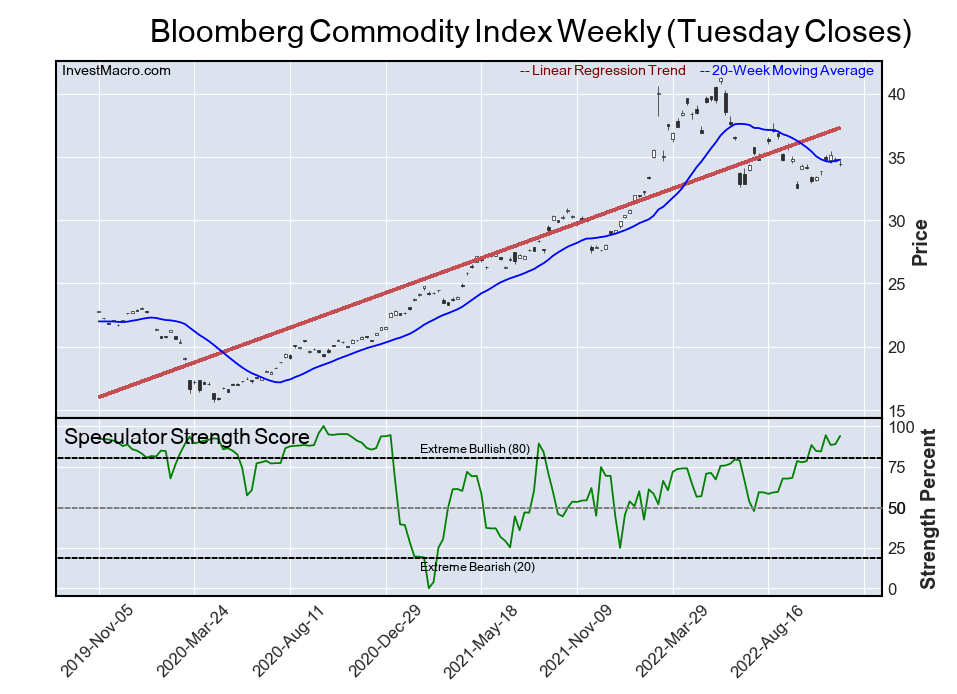
Bloomberg Commodity Index

The Bloomberg Commodity Index speculator position comes in as the most bullish extreme standing this week. The Bloomberg Commodity Index speculator level is currently at a 93.9 percent score of its 3-year range.

The overall net speculator position totaled -3,559 net contracts this week. This market usually has a bearish speculator position and currently it is at the lower end of its range that has averaged a weekly position of -10,636 contracts in 2022.


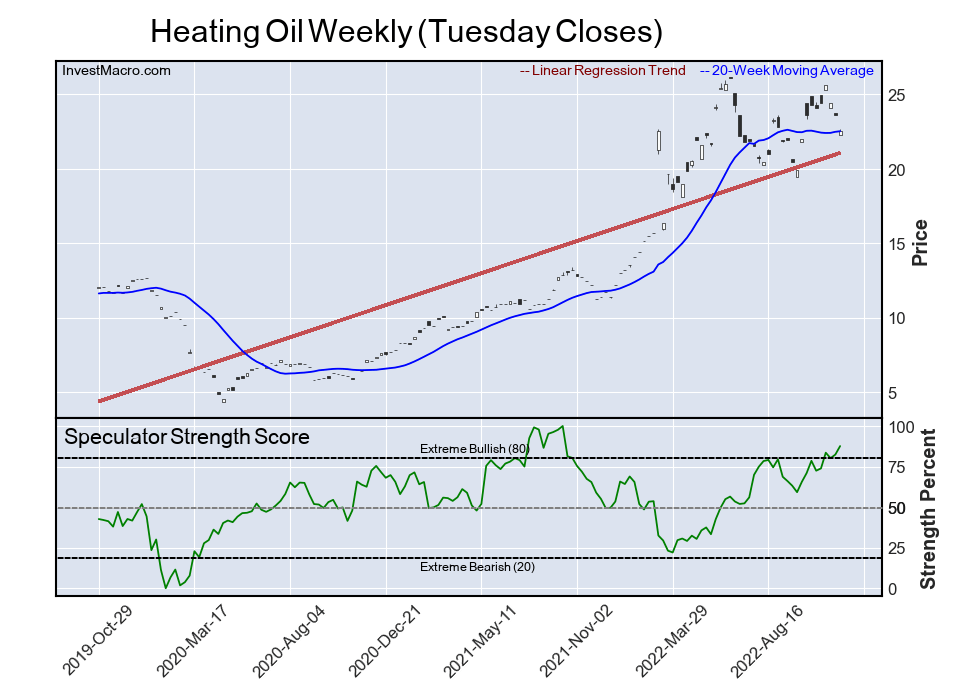
Heating Oil

The Heating Oil speculator position comes next in the extreme standings this week. The Heating Oil speculator level is now at a 87.6 percent score of its 3-year range.

The speculator position was 30,733 net contracts this week after rising by 3,561 contracts for the week.


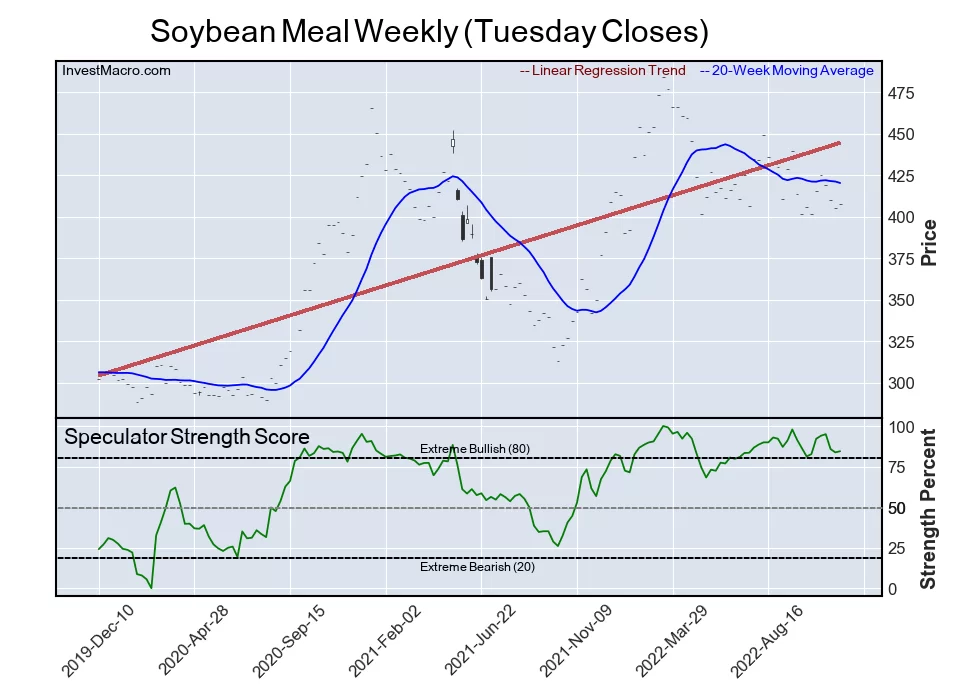
Soybean Meal

The Soybean Meal speculator position comes in third this week in the extreme standings. The Soybean Meal speculator level resides at a 84.5 percent score of its 3-year range.

The speculator position was 102,339 net contracts this week and edged up by 1,269 contracts through Tuesday.


Bitcoin

The Bitcoin speculator position comes up number four in the extreme standings this week. The Bitcoin speculator level is at a 82.6 percent score of its 3-year range.

The speculator position was a total of 324 net contracts this week after falling by -382 speculator contracts this week.


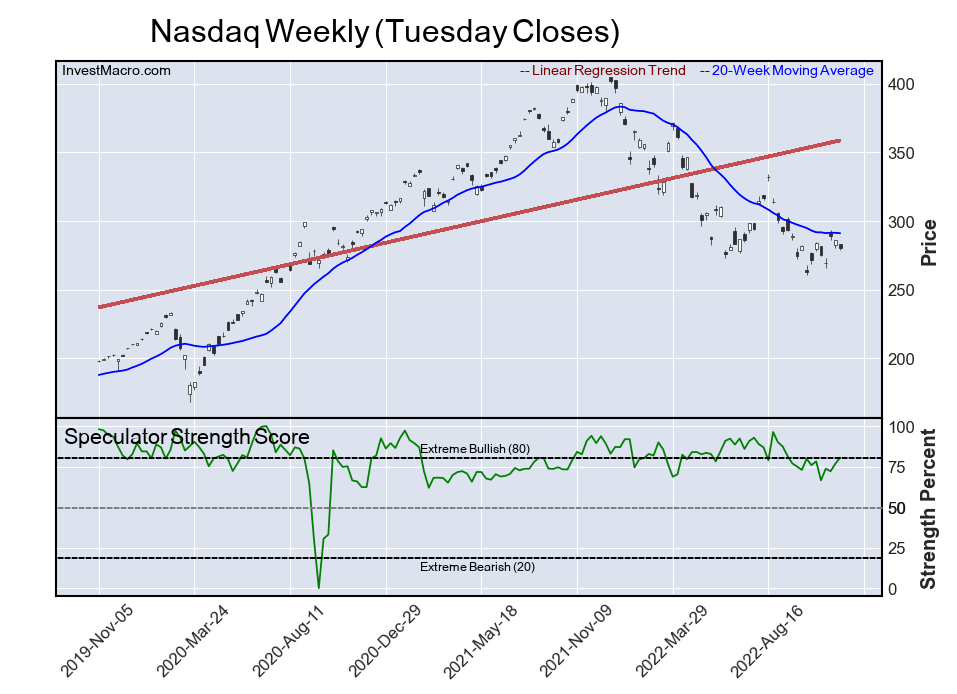
Nasdaq

The Nasdaq speculator position rounds out the top five in this week’s bullish extreme standings. The Nasdaq speculator level sits at a 80.5 percent score of its 3-year range.

The speculator position was 9,755 net contracts this week and saw an increase of 6,709 contracts through Tuesday.


This Week’s Most Bearish Speculator Positions:

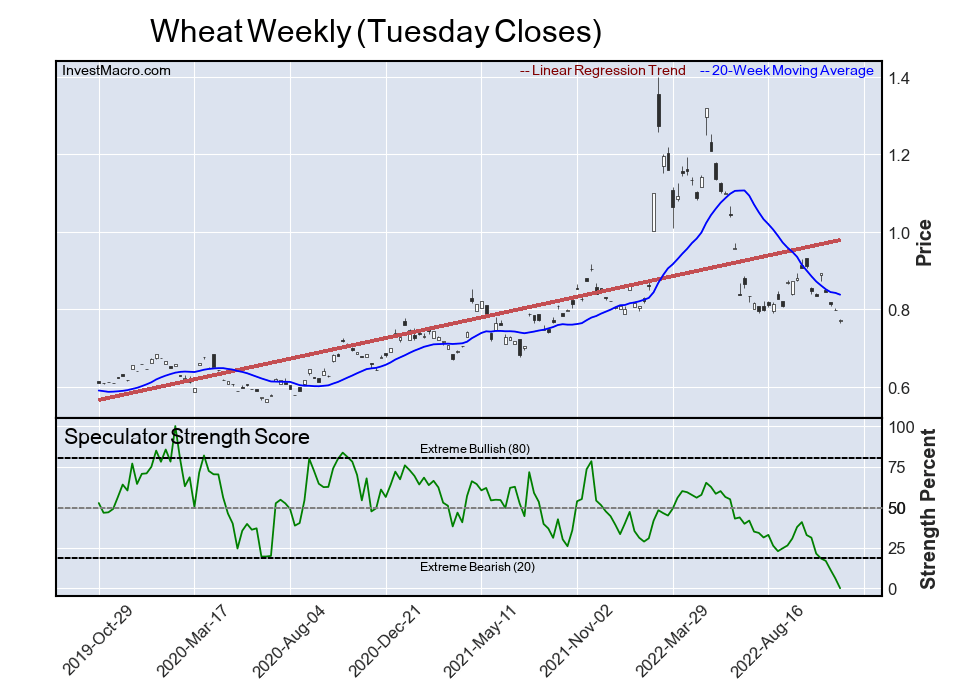
Wheat

The Wheat speculator position comes in as the most bearish extreme standing this week. The Wheat speculator level is at a 0.0 percent score of its 3-year range.

The speculator position was -33,305 net contracts this week as the position fell by -5,787 contracts this week.


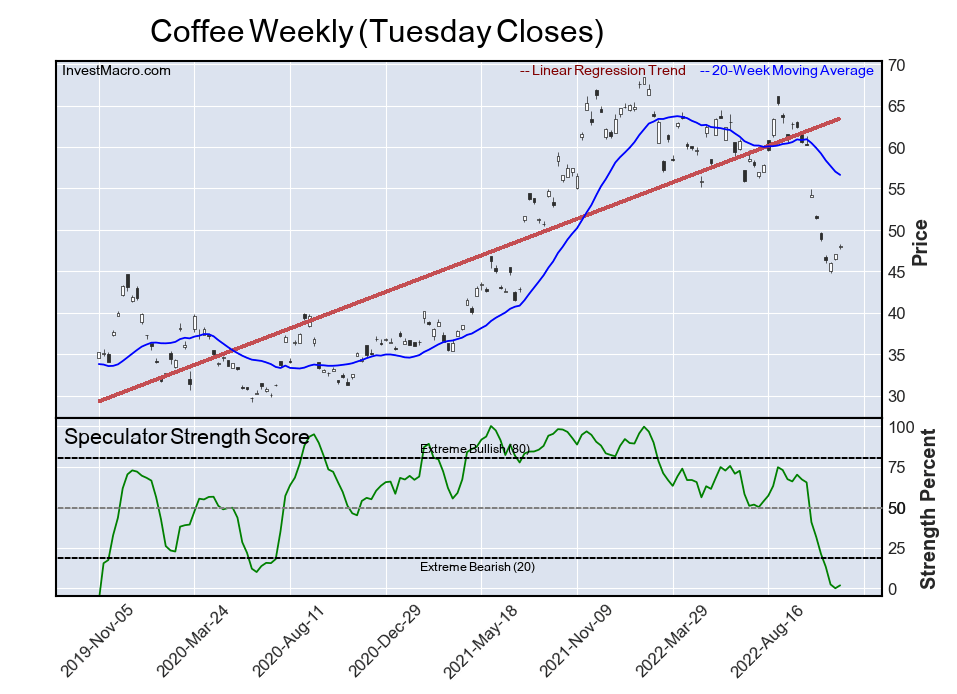
Coffee

The Coffee speculator position comes in next for the most bearish extreme standing on the week. The Coffee speculator level is at a 1.8 percent score of its 3-year range.

The speculator position was a total of -14,636 net contracts this week. Coffee bets rose by 1,550 contracts this week but had fallen for the previous eight straight weeks.


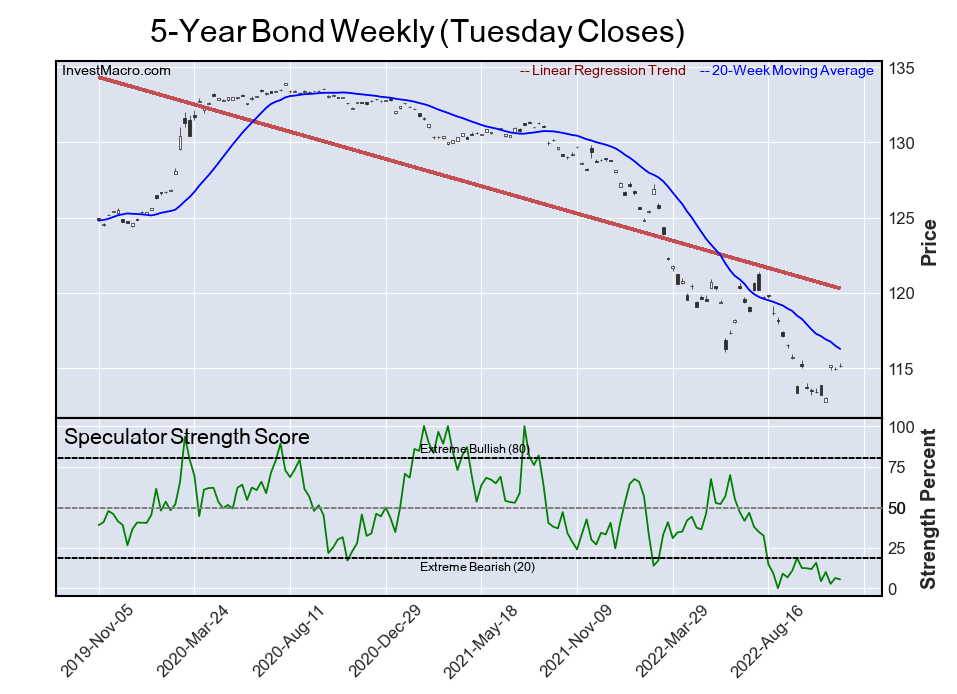
5-Year Bond

The 5-Year Bond speculator position comes in as third most bearish extreme standing of the week. The 5-Year Bond speculator level resides at a 5.5 percent score of its 3-year range.

The speculator position was -529,349 net contracts this week and saw a dip by -5,695 contracts for the week.


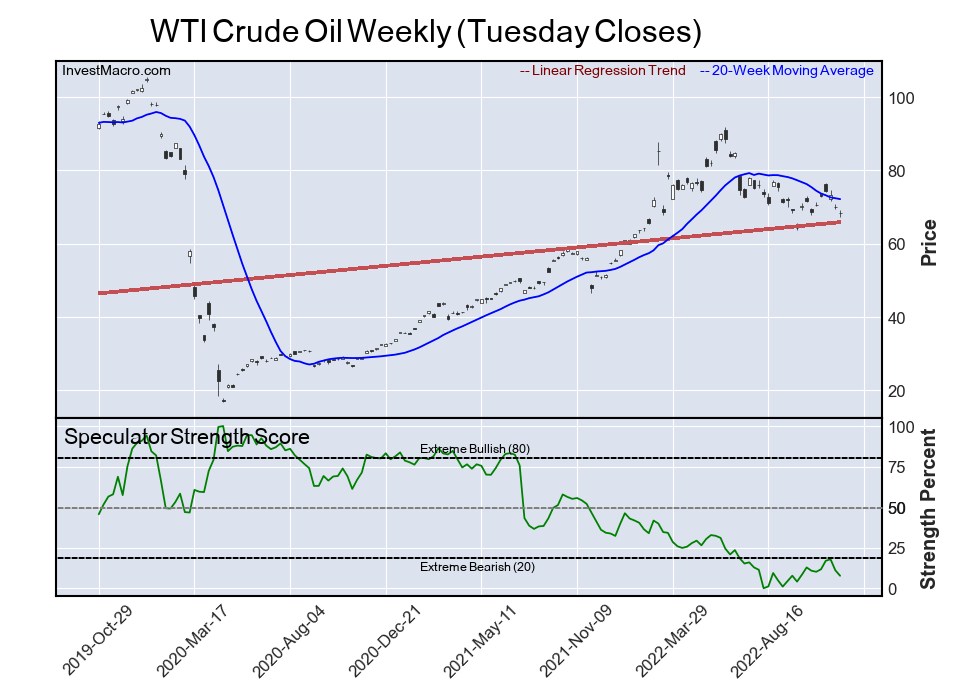
WTI Crude Oil

The WTI Crude Oil speculator position comes in as this week’s next most bearish extreme standing. The WTI Crude Oil speculator level is at a 7.7 percent score of its 3-year range.

The speculator position was 239,739 net contracts this week after a decline of -12,736 contracts through Tuesday’s data cutoff.


Article By InvestMacroReceive our weekly COT Newsletter

*COT Report: The COT data, released weekly to the public each Friday, is updated through the most recent Tuesday (data is 3 days old) and shows a quick view of how large speculators or non-commercials (for-profit traders) were positioned in the futures markets.

The CFTC categorizes trader positions according to commercial hedgers (traders who use futures contracts for hedging as part of the business), non-commercials (large traders who speculate to realize trading profits) and nonreportable traders (usually small traders/speculators) as well as their open interest (contracts open in the market at time of reporting). See CFTC criteria here.

Platinum Speculators raise their bullish bets to 38-week high

By InvestMacro

Here are the latest charts and statistics for the Commitment of Traders (COT) data published by the Commodities Futures Trading Commission (CFTC).
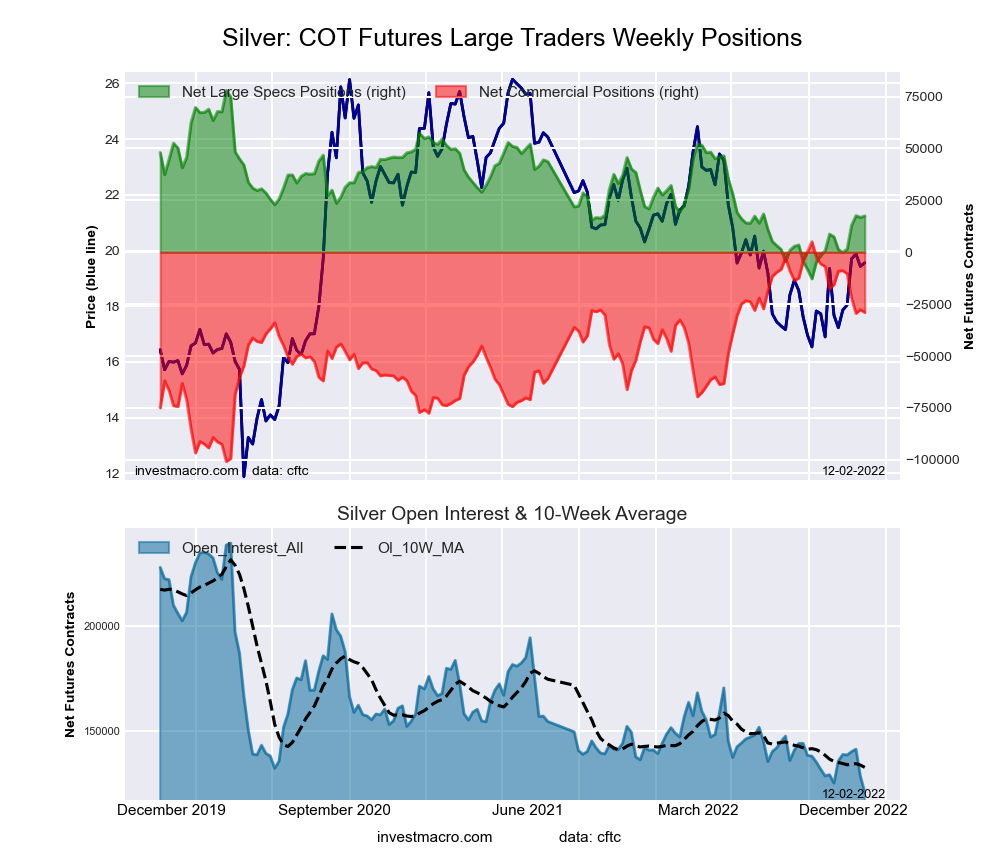
The latest COT data is updated through Tuesday November 29th and shows a quick view of how large traders (for-profit speculators and commercial entities) were positioned in the futures markets.

Weekly Speculator Changes led by Platinum

The COT precious metals speculator bets were a little lower this week as two out of the five metals markets we cover had higher positioning this week while three markets had lower contracts.

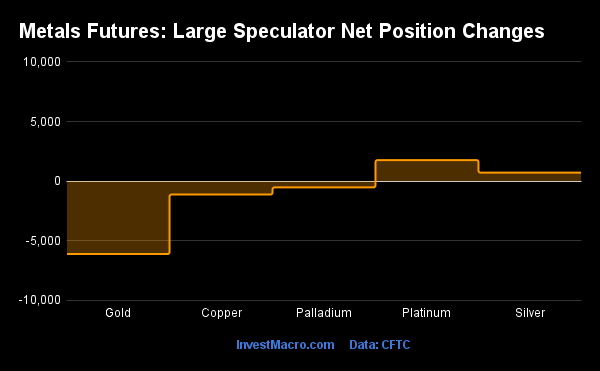
Leading the gains for the precious metals markets was Platinum (1,769 contracts) with Silver (717 contracts) also showing a positive week.

The metals markets leading the declines in speculator bets this week were Gold (-6,110 contracts) with Copper (-1,120 contracts) and Palladium (-523 contracts) also registering lower bets on the week.

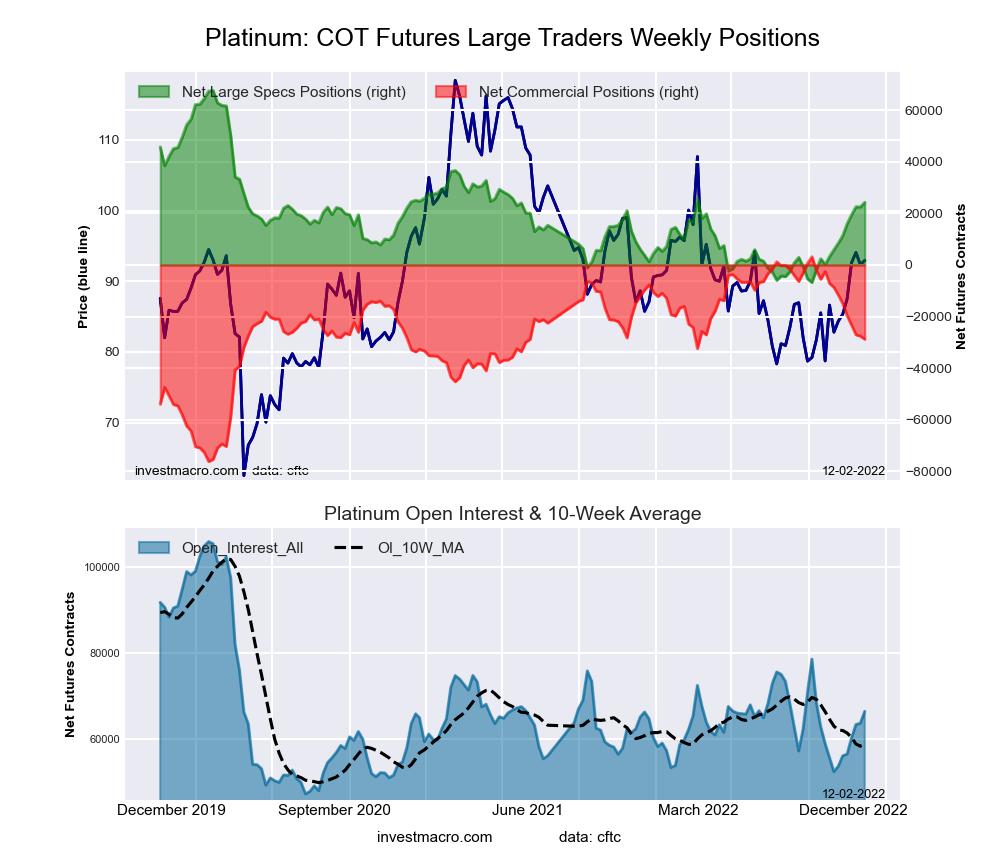
Highlighting the COT metals data this week is the continued bullishness of Platinum positions. The large speculator standing in Platinum futures rose this week by +1,769 contracts. Speculator bets have now gained in eight out of the past nine weeks with a total rise of +24,098 contracts over that period. This has pushed the overall speculator’s bullish level for Platinum to its highest level in the past thirty-eight weeks, dating back to March 8th when the net position totaled +25,833 contracts.

Platinum futures prices have also been on the rise since hitting a September low near the $800.00 level. Platinum futures closed out this week right around the $1,026.60 level for an approximate  gain by 28 percent since the September 1st low.


Data Snapshot of Commodity Market Traders | Columns Legend
Nov-29-2022OIOI-IndexSpec-NetSpec-IndexCom-NetCOM-IndexSmalls-NetSmalls-Index
WTI Crude1,412,1211239,7398-262,6549322,91537
Gold433,6611110,00319-119,233829,2303
Silver121,258017,48333-28,9976811,51426
Copper146,76001,98438-3,362641,37833
Palladium7,5378-1,631141,68784-5638
Platinum66,4683324,25942-28,762604,50328
Natural Gas985,0107-163,42930136,1917427,23845
Brent155,50015-32,0875729,424422,66345
Heating Oil266,8292330,73388-48,2552017,52259
Soybeans634,7541387,20840-61,55168-25,65728
Corn1,226,4100270,24265-231,16939-39,07321
Coffee196,3659-14,636213,6959994112
Sugar876,30934179,03556-222,6073943,57262
Wheat310,66710-33,305037,024100-3,71991


Strength Scores led by Platinum & Copper

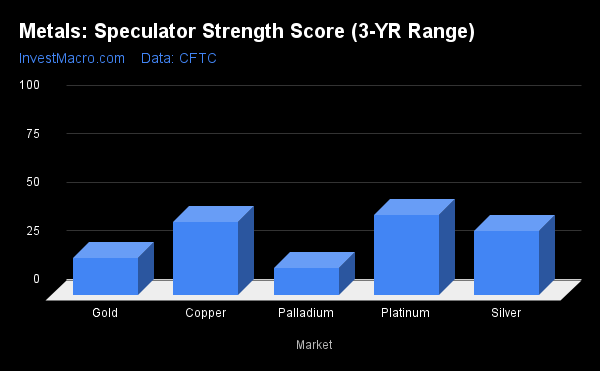
Strength scores (a measure of the 3-Year range of Speculator positions, from 0 to 100 where above 80 is extreme bullish and below 20 is extreme bearish) show that Platinum (41.7 percent) and Copper (37.9 percent) lead the metals category at the moment. Silver (33.4 percent) comes in as the next highest metals market in strength scores.

On the downside, Palladium (14.2 percent) and Gold (19.2 percent) are at the lowest strength levels currently and are both in extreme bearish levels.

Strength Statistics:
Gold (19.2 percent) vs Gold previous week (21.2 percent)
Silver (33.4 percent) vs Silver previous week (32.6 percent)
Copper (37.9 percent) vs Copper previous week (38.8 percent)
Platinum (41.7 percent) vs Platinum previous week (39.3 percent)
Palladium (14.2 percent) vs Palladium previous week (17.3 percent)

Platinum tops Strength Trends

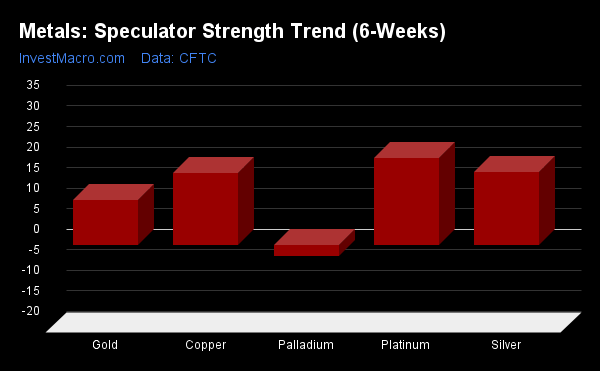
Strength Score Trends (or move index, calculates the 6-week changes in strength scores) show that Platinum (21.2 percent) leads the past six weeks trends for metals this week. Silver (17.9 percent), Copper (17.7 percent) and Gold (11.0 percent) are also positive movers in the latest trends data.

Palladium (-2.5 percent) leads the downside trend scores currently.

Move Statistics:
Gold (11.0 percent) vs Gold previous week (7.2 percent)
Silver (17.9 percent) vs Silver previous week (10.3 percent)
Copper (17.7 percent) vs Copper previous week (15.1 percent)
Platinum (21.2 percent) vs Platinum previous week (22.3 percent)
Palladium (-2.5 percent) vs Palladium previous week (-2.1 percent)


Individual Markets:

Gold Comex Futures:

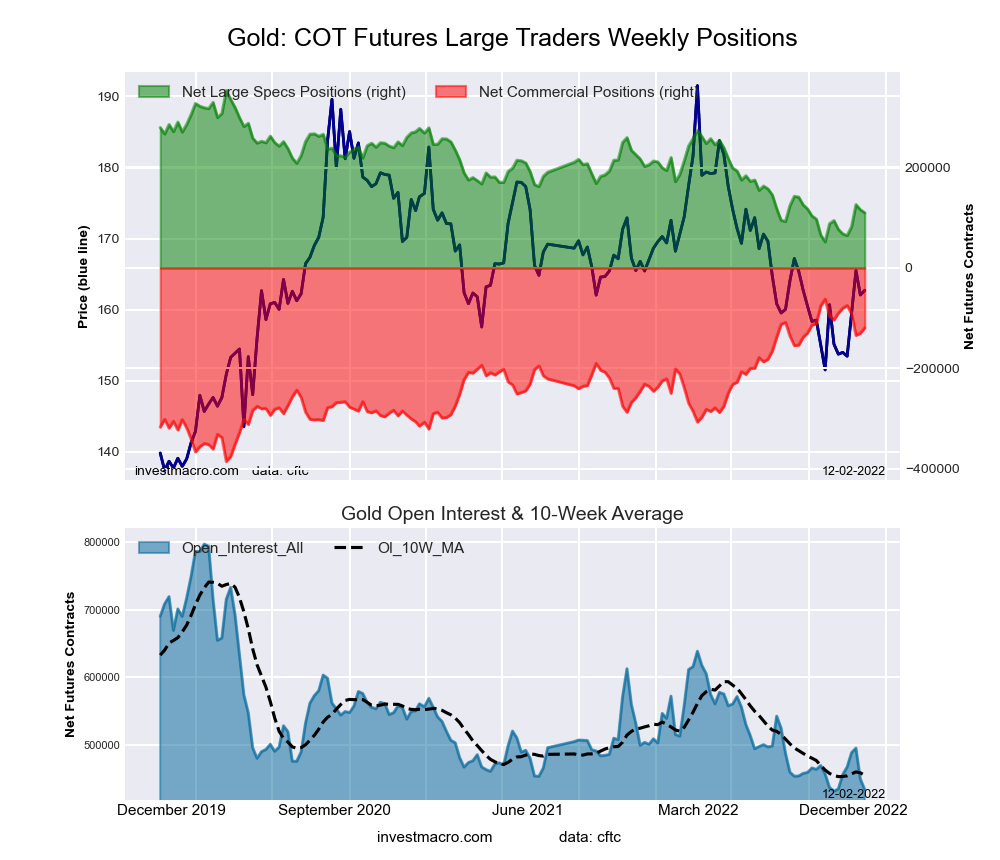
Gold Futures COT ChartThe Gold Comex Futures large speculator standing this week equaled a net position of 110,003 contracts in the data reported through Tuesday. This was a weekly decrease of -6,110 contracts from the previous week which had a total of 116,113 net contracts.

This week’s current strength score (the trader positioning range over the past three years, measured from 0 to 100) shows the speculators are currently Bearish-Extreme with a score of 19.2 percent. The commercials are Bullish-Extreme with a score of 82.3 percent and the small traders (not shown in chart) are Bearish-Extreme with a score of 3.0 percent.

Gold Futures StatisticsSPECULATORSCOMMERCIALSSMALL TRADERS
– Percent of Open Interest Longs:48.230.97.8
– Percent of Open Interest Shorts:22.958.45.7
– Net Position:110,003-119,2339,230
– Gross Longs:209,161134,18433,946
– Gross Shorts:99,158253,41724,716
– Long to Short Ratio:2.1 to 10.5 to 11.4 to 1
NET POSITION TREND:
– Strength Index Score (3 Year Range Pct):19.282.33.0
– Strength Index Reading (3 Year Range):Bearish-ExtremeBullish-ExtremeBearish-Extreme
NET POSITION MOVEMENT INDEX:
– 6-Week Change in Strength Index:11.0-9.0-9.7


Silver Comex Futures:

Silver Futures COT ChartThe Silver Comex Futures large speculator standing this week equaled a net position of 17,483 contracts in the data reported through Tuesday. This was a weekly boost of 717 contracts from the previous week which had a total of 16,766 net contracts.

This week’s current strength score (the trader positioning range over the past three years, measured from 0 to 100) shows the speculators are currently Bearish with a score of 33.4 percent. The commercials are Bullish with a score of 67.8 percent and the small traders (not shown in chart) are Bearish with a score of 26.0 percent.

Silver Futures StatisticsSPECULATORSCOMMERCIALSSMALL TRADERS
– Percent of Open Interest Longs:39.938.218.3
– Percent of Open Interest Shorts:25.562.18.8
– Net Position:17,483-28,99711,514
– Gross Longs:48,44146,27022,150
– Gross Shorts:30,95875,26710,636
– Long to Short Ratio:1.6 to 10.6 to 12.1 to 1
NET POSITION TREND:
– Strength Index Score (3 Year Range Pct):33.467.826.0
– Strength Index Reading (3 Year Range):BearishBullishBearish
NET POSITION MOVEMENT INDEX:
– 6-Week Change in Strength Index:17.9-18.817.8


Copper Grade #1 Futures:

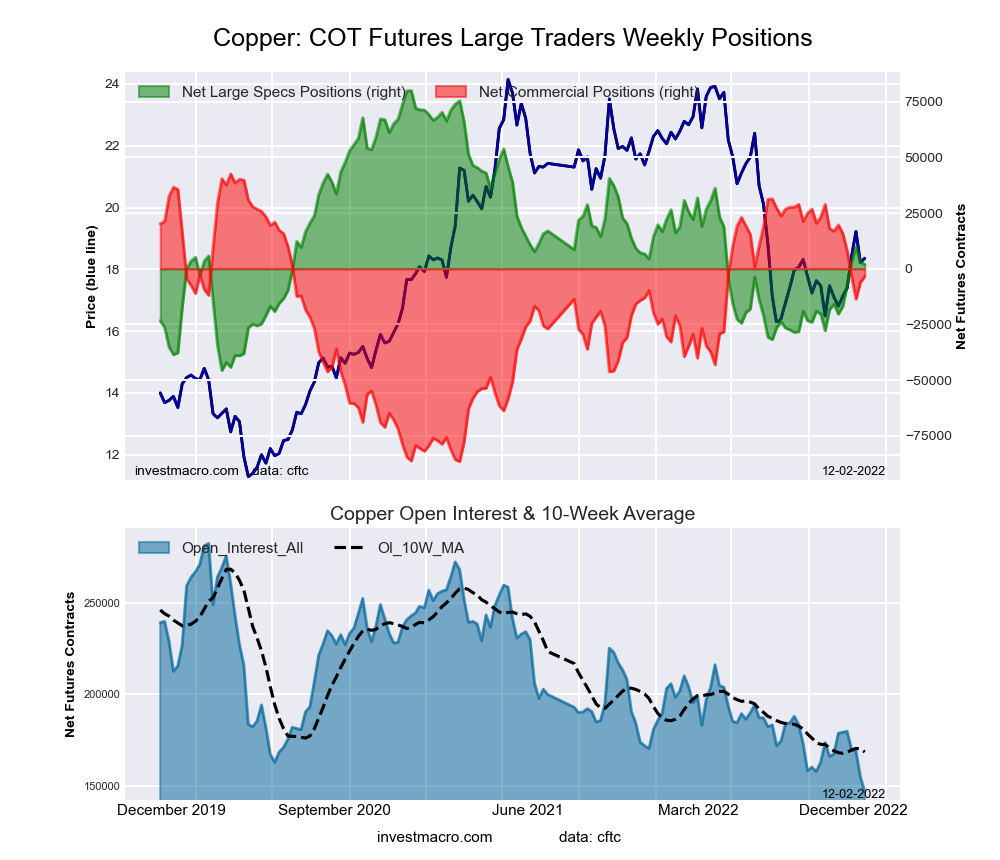
Copper Futures COT ChartThe Copper Grade #1 Futures large speculator standing this week equaled a net position of 1,984 contracts in the data reported through Tuesday. This was a weekly reduction of -1,120 contracts from the previous week which had a total of 3,104 net contracts.

This week’s current strength score (the trader positioning range over the past three years, measured from 0 to 100) shows the speculators are currently Bearish with a score of 37.9 percent. The commercials are Bullish with a score of 64.4 percent and the small traders (not shown in chart) are Bearish with a score of 33.3 percent.

Copper Futures StatisticsSPECULATORSCOMMERCIALSSMALL TRADERS
– Percent of Open Interest Longs:35.043.19.2
– Percent of Open Interest Shorts:33.745.48.3
– Net Position:1,984-3,3621,378
– Gross Longs:51,43363,19613,549
– Gross Shorts:49,44966,55812,171
– Long to Short Ratio:1.0 to 10.9 to 11.1 to 1
NET POSITION TREND:
– Strength Index Score (3 Year Range Pct):37.964.433.3
– Strength Index Reading (3 Year Range):BearishBullishBearish
NET POSITION MOVEMENT INDEX:
– 6-Week Change in Strength Index:17.7-17.94.5


Platinum Futures:

Platinum Futures COT ChartThe Platinum Futures large speculator standing this week equaled a net position of 24,259 contracts in the data reported through Tuesday. This was a weekly lift of 1,769 contracts from the previous week which had a total of 22,490 net contracts.

This week’s current strength score (the trader positioning range over the past three years, measured from 0 to 100) shows the speculators are currently Bearish with a score of 41.7 percent. The commercials are Bullish with a score of 59.8 percent and the small traders (not shown in chart) are Bearish with a score of 28.5 percent.

Platinum Futures StatisticsSPECULATORSCOMMERCIALSSMALL TRADERS
– Percent of Open Interest Longs:53.129.811.1
– Percent of Open Interest Shorts:16.673.14.4
– Net Position:24,259-28,7624,503
– Gross Longs:35,26819,8247,400
– Gross Shorts:11,00948,5862,897
– Long to Short Ratio:3.2 to 10.4 to 12.6 to 1
NET POSITION TREND:
– Strength Index Score (3 Year Range Pct):41.759.828.5
– Strength Index Reading (3 Year Range):BearishBullishBearish
NET POSITION MOVEMENT INDEX:
– 6-Week Change in Strength Index:21.2-21.618.2


Palladium Futures:

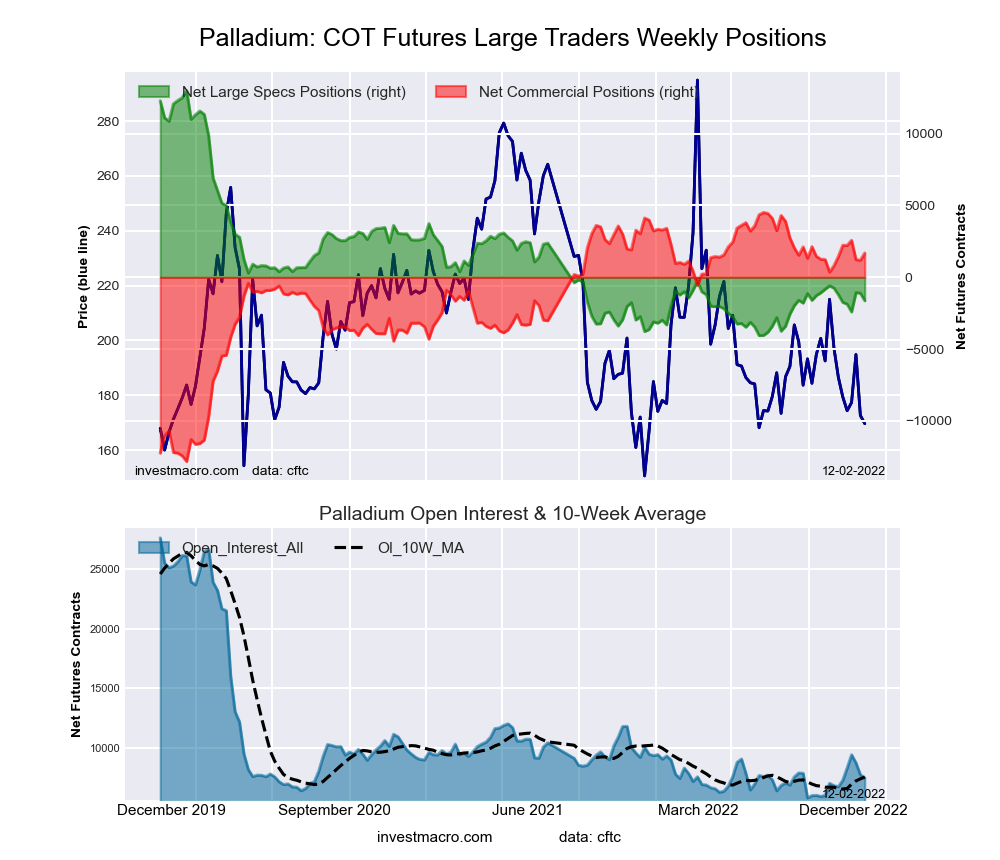
Palladium Futures COT ChartThe Palladium Futures large speculator standing this week equaled a net position of -1,631 contracts in the data reported through Tuesday. This was a weekly lowering of -523 contracts from the previous week which had a total of -1,108 net contracts.

This week’s current strength score (the trader positioning range over the past three years, measured from 0 to 100) shows the speculators are currently Bearish-Extreme with a score of 14.2 percent. The commercials are Bullish-Extreme with a score of 83.7 percent and the small traders (not shown in chart) are Bearish with a score of 38.3 percent.

Palladium Futures StatisticsSPECULATORSCOMMERCIALSSMALL TRADERS
– Percent of Open Interest Longs:30.452.414.1
– Percent of Open Interest Shorts:52.030.014.8
– Net Position:-1,6311,687-56
– Gross Longs:2,2893,9511,061
– Gross Shorts:3,9202,2641,117
– Long to Short Ratio:0.6 to 11.7 to 10.9 to 1
NET POSITION TREND:
– Strength Index Score (3 Year Range Pct):14.283.738.3
– Strength Index Reading (3 Year Range):Bearish-ExtremeBullish-ExtremeBearish
NET POSITION MOVEMENT INDEX:
– 6-Week Change in Strength Index:-2.51.410.8


Article By InvestMacroReceive our weekly COT Newsletter

*COT Report: The COT data, released weekly to the public each Friday, is updated through the most recent Tuesday (data is 3 days old) and shows a quick view of how large speculators or non-commercials (for-profit traders) were positioned in the futures markets.

The CFTC categorizes trader positions according to commercial hedgers (traders who use futures contracts for hedging as part of the business), non-commercials (large traders who speculate to realize trading profits) and nonreportable traders (usually small traders/speculators) as well as their open interest (contracts open in the market at time of reporting). See CFTC criteria here.