Mid-Week Technical Outlook: Safe Haven Currencies

By ForexTime 

The mood across financial markets turned gloomy on Wednesday as disappointing data from China fuelled fears about slowing global economic growth.

European equities were mixed amid the risk-off sentiment while safe-haven currencies appreciated as investors rushed to safety. Generally, safe-haven currencies like the USD, CHF, JPY, and to a lesser degree even EUR are expected to shine during periods of uncertainty. However, their status tends to be tested thanks to shifting market dynamics and developments at home. Our focus today falls on safe-haven currencies with the tool of choice being nothing but technical analysis.

Euro bulls are certainly on a roll today. We can see a similar theme with the Swiss franc which has gained against most of its counterparts. However, the USD is showing a mixed performance, while the Japanese Yen seems to be getting no love at all.

Equally weighted USD technical bounce?

After dipping below the 200-day SMA last week, the equally-weighted USD index has experienced a rebound back toward 1.1950. A strong daily close above this point could threaten the current bearish channel with the next key level found at 1.2184 – a point below the 100-day SMA. Should 1.1950 prove to be reliable resistance, prices may decline back towards 1.1740.

Equally weighted EUR remains bullish

As the subtitle says, FXTM’s equally weighted Euro index remains bullish on the daily charts. There have been consistently higher highs and higher lows while prices are trading above the MACD. A strong breakout and daily close above 1.26650 could open the doors towards 1.2740. If prices dip back below 1.2550, the next level of interest can be found at 1.2400.

EURJPY hits 50-day SMA

The EURJPY may be back on the rise after support was found above the 100-day SMA. Prices remain in a bullish trend despite periods of weakness with bulls breaking above 144.00. If the upside gains momentum, the next key level of interest can be found at 145.60. If bears re-enter the scene, the EURJPY could descend back towards 141.50.

USDCHF eyes 0.9350

Bears remain in control on the daily charts as there have been consistently lower lows and lower highs. Prices are approaching the 0.9350 support level as of writing. A strong break below this point could trigger a selloff towards 0.9300. Alternatively, a move back above 0.9430 could signal a rally toward 0.9550.

JPY Index back below 100-day SMA

The Japanese Yen index remains choppy and trapped within a pretty wide range on the daily charts with support at 80.15 and resistance at 84.00. Prices are trading below the 100-day SMA and currently balancing above 82.20 as of writing. Weakness below this point could encourage a decline toward 81.30 and 80.15, respectively. A rebound may open a path back towards 83.00 and beyond.


Forex-Time-LogoArticle by ForexTime

ForexTime Ltd (FXTM) is an award winning international online forex broker regulated by CySEC 185/12 www.forextime.com

A Slumbering Inflation Hedge at Slave Lake

Source: Streetwise Reports  (12/5/22)

With inflation on the rise, investor attention has shifted to more tangible assets such as zinc-lead. With a positive relationship with locals and good ESG, Slave Lake Zinc Corp. may be one company you want to add to your radar.

Inflation generally drives smart investors into tangible assets, and few assets are more tangible than ore-bearing ground. Hard to steal and easy to profit from, rich mining claims often provide the perfect, slow-but-steady appreciation to counterbalance the bipolar nature of the equities market.

In-ground zinc-lead, in particular, has become a prized commodity among investors seeking to diversify around the vagaries of commercial exchanges.

Zinc-lead “is among the most important of base metals, constituting an essential requirement of a country’s industrial development,” explained analyst Rick Mills on November 22, 2022.

Zinc-lead “is among the most important of base metals, constituting an essential requirement of a country’s industrial development,” explained analyst Rick Mills on November 22, 2022. “The two metals keep us powered and sheltered, yet the zinc-lead sector has not seen a major discovery in over two decades, leading to concerns over resource depletion.”

Reporting on November 17, 2022, Echelon Capital Markets stated that BCA Research’s Chief Commodity and Energy Strategist Robert Ryan “noted that risks to the global demand picture have prompted a continued decline in copper prices year-to-date, with inventories at exchanges extending their downtrend prompting expectations for tight supply over the coming decade.”

The report goes on to explain funds raised for base metals increased 17% month-over-month to US$262,000,000 in October on rapidly expanding transaction volume. Currently, zinc is sitting at around US$1.38 per lb and lead at US$0.97, which is quite rich for the metals, and one company, in particular, to keep watch on isSlave Lake Zinc Corp. (SLZ:CSE).

Slave Lake’s name comes from the lake itself, and the company’s large claim lies somewhat south of this eponymous feature of the northern Canadian landscape.

The claim is in an area briefly mined for lead and zinc at the end of the second world war, but the owners at the time halted production after the market for the metals cratered in the 1950s.

American Yellowknife Mines, which operated the mine then, identified 67,950 tons grading 7.64% Zinc, 3.12% lead, 0.13% copper, and 8.22 grams per tonne (8.22 g/pt) silver near the Shaft Zone, an area that includes a headframe and underground drifting of over 400 meters into various smaller pits.

This zone includes drilling down to 200 meters, with complete mineralization found the whole way down. Samples from the pits contained 10% to 27% zinc plus lead. The existing 55-meter deep three-compartment shaft has a drift station at 45 meters providing access to a seam assayed at 55% lead, 13.5% zinc, and 84.4 g/t silver.

The Catalyst: Zinc Growing in Popularity

Unlike in the 1950s, zinc is now a money metal. It’s used to make pennies, is an important element of nutrition, and is a prime candidate to replace lithium in batteries as part of the green revolution.

Technical analyst Clive Maund opined that “with the company looking set to move forward, the move looks like the beginning of a new uptrend following the tedious downtrend from the highs of last April, and it is viewed as a speculative Buy here.”

Of course, these uses are all somewhat niche compared to the metal’s primary industrial use in the galvanization process. Zinc is important enough that governments in both the U.S. and Canada designate it as a critical material.

Currently, Slave Lake is fully permitted with a has a Type A Land Use permit and Type B Water license to have a 49-person, 3-drill operation to begin with, which allows it to move forward immediately, further de-risking the company’s plans moving forward. Funding-dependent, the company could potentially start drilling tomorrow.

However, as it stands, Slave Lake Zinc Corp. is not producing any materials for sale.

Instead, the company is continuing to expand its claim as it does further geological work to map out the footprint of a large, high-quality hydrothermal formation.

“At this stage, we are highly focused on diminishing risk,” explained Slave Lake Zinc Corp.’s CEO, Ritch Wigham. He’s recently overseen the company’s expansion from a 600-acre claim to one that’s over 18,000 acres or 76.25 sqkm and has been busy acquiring permits and developing a strong “right of first refusal” working relationship with members of the local community.

Positive Relationships and ESG

Slave Lake Zinc Corp. is one of only two companies that have successfully negotiated the multi-year, international process required to allow tribal lands in Canada to revert to Crown ownership and be claimed by commercial producers.

“We can confirm that Slave Lake Zinc and the NWTMN have a positive working relationship, as provided for in the Collaboration Agreement between the NWTMN and Slave Lake Zinc,” explained Dr. Ronald Yaworsky of KHL Consulting, speaking on behalf of the nation itself. “Slave Lake Zinc has been respectful and proactive in [its] engagement

In addition to the considerable goodwill and rich in-ground reserves he has ferreted out, Wigham says the claim’s close proximity (about 37 miles) to the Taltson hydroelectric plant will allow for an ESG-forward, hydrocarbon-free operation once the mine is up and running.

Wigham’s strategy is to continue building the claim’s value by mitigating the risks any processor would face when taking on the site and ramping up to full production.

As it currently stands, Slave Lake Zinc Corp. is a basic buy-and-hold play for those interested in buying unexploited base metal reserves to hedge against either inflation or an equities market downturn. The company plans to start a comprehensive drilling program early next year to quantify in-ground reserves better and explore claim expansion opportunities.

On November 9, 2022, technical analyst Clive Maund opined that “with the company looking set to move forward, the move [up on Nov 8th, 2022] looks like the beginning of a new uptrend following the tedious downtrend from the highs of last April, and it is viewed as a speculative Buy here, and especially on any near-term dips.”

Ownership, Coverage, and Share Structure

Source: Slave Lake Zinc Corp.

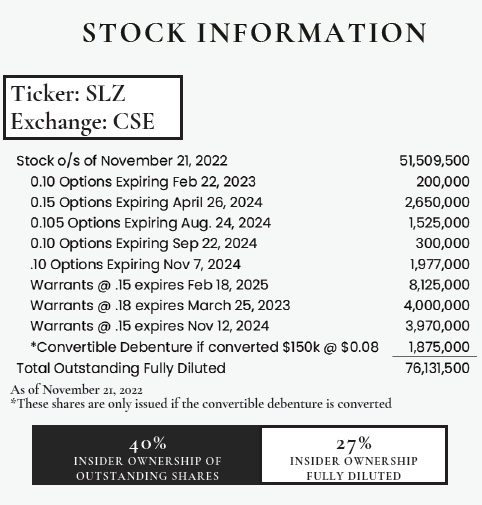
Company management owns approximately 20.8 million shares — 40% of outstanding shares, or 27% on a fully diluted basis. There are no institutional investors on record, and all of the outstanding stock is retail except for the CA$150,000.00 balance of the debenture outstanding.

Technical analyst Clive Maund of Clivemaund.com follows this stock. Click See More Live Data” to view more of what he is saying.

The company has roughly CA$300,000 in the bank and is burning CA$25,000/month at current operating levels.

Slave Lake also has 6,652,000 options in the CA$0.10 to CA$0.15 price range expiring between Feb 22, 2023, and Nov 7, 2024, as well as 16,095,000 warrants ranging from CA$0.15 to CA$0.18 expiring between March 25, 2023, and Feb 18, 2025.

An additional CA$150,000 in CA$0.08 convertible debenture financing adds another 1,875,000 potential claims. The total outstanding fully diluted share count is 76,131,500.

Slave Lake Zinc Corp. has a market cap of around US$3.153 million, with 51,509,500 shares outstanding, and it trades in the 52-week range of US$0.0115 and US$0.1429.

Disclosures:
1) Owen Ferguson wrote this article for Streetwise Reports LLC and provides services to Streetwise Reports as an independent contractor. He or members of his household own securities of the following companies mentioned in the article: None. He or members of his household are paid by the following companies mentioned in this article: None.

2) The following companies mentioned in this article are billboard sponsors of Streetwise Reports: None. Click here for important disclosures about sponsor fees. The information provided above is for informational purposes only and is not a recommendation to buy or sell any security. As of the date of this article, an affiliate of Streetwise Reports has a consulting relationship with Slave Lake Zinc Corp. Please click here for more information.

3) Statements and opinions expressed are the opinions of the author and not of Streetwise Reports or its officers. The author is wholly responsible for the validity of the statements. The author was not paid by Streetwise Reports for this article. Streetwise Reports was not paid by the author to publish or syndicate this article. Streetwise Reports requires contributing authors to disclose any shareholdings in, or economic relationships with, companies that they write about. Streetwise Reports relies upon the authors to accurately provide this information and Streetwise Reports has no means of verifying its accuracy.

4) This article does not constitute investment advice. Each reader is encouraged to consult with his or her individual financial professional and any action a reader takes as a result of information presented here is his or her own responsibility. By opening this page, each reader accepts and agrees to Streetwise Reports’ terms of use and full legal disclaimerThis article is not a solicitation for investment. Streetwise Reports does not render general or specific investment advice and the information on Streetwise Reports should not be considered a recommendation to buy or sell any security. Streetwise Reports does not endorse or recommend the business, products, services or securities of any company mentioned on Streetwise Reports.

5) From time to time, Streetwise Reports LLC and its directors, officers, employees or members of their families, as well as persons interviewed for articles and interviews on the site, may have a long or short position in securities mentioned. Directors, officers, employees or members of their immediate families are prohibited from making purchases and/or sales of those securities in the open market or otherwise from the time of the decision to publish an article until three business days after the publication of the article. The foregoing prohibition does not apply to articles that in substance only restate previously published company releases. As of the date of this article, officers and/or employees of Streetwise Reports LLC (including members of their household) own securities of Slave Lake Zinc Corp., a company mentioned in this article.

Forex Technical Analysis & Forecast 07.12.2022

By RoboForex.com

EURUSD, “Euro vs US Dollar”

The currency pair completed an impulse of decline to 1.0460. Today a consolidation range is forming around this level. An escape downwards and further decline to 1.0388 is expected. After this level is reached, growth to 1.0460 may begin.

EURUSD
Risk Warning: the result of previous trading operations do not guarantee the same results in the future

GBPUSD, “Great Britain Pound vs US Dollar”

The currency pair continues developing a wave of decline to 1.2095. After this level is reached, growth to 1.2205 should begin, followed by a decline to 1.2066.

GBPUSD
Risk Warning: the result of previous trading operations do not guarantee the same results in the future

USDJPY, “US Dollar vs Japanese Yen”

The currency pair continues growing to 137.85. After this level is reached, we expect a decline to 135.75, from where the trend might continue to 134.10.

USDJPY
Risk Warning: the result of previous trading operations do not guarantee the same results in the future

USDCHF, “US Dollar vs Swiss Franc”

The currency pair continues developing the wave of growth to 0.9457. Then a decline to 0.9388 might start, from where the wave might continue to 0.9320.

USDCHF
Risk Warning: the result of previous trading operations do not guarantee the same results in the future

AUDUSD, “Australian Dollar vs US Dollar”

The currency pair completed a structure of decline to 0.6699. Today the market is forming a consolidation range around this level. With an escape upwards, a pathway for a correction to 0.6755 will open. With an escape downwards, a pathway to 0.6654 will open.

AUDUSD
Risk Warning: the result of previous trading operations do not guarantee the same results in the future

BRENT

Crude oil performed an impulse of decline to 79.00. At the moment, the market is forming a consolidation range above this level. Next, the quotes might escape the range upwards to 83.20, fall to 78.20, and grow again to 84.00, from where the trend may continue to 89.50.

BRENT
Risk Warning: the result of previous trading operations do not guarantee the same results in the future

XAUUSD, “Gold vs US Dollar”

Gold is forming a consolidation range around 1773.00. With an escape upwards, a pathway to 1782.00 will open, from where the quotes should decline to 1755.00. With an escape downwards, a pathway directly to 1755.00 should open.

GOLD
Risk Warning: the result of previous trading operations do not guarantee the same results in the future

S&P 500

The stock index is forming a consolidation range around 3972.2. An escape downwards and trend continuation to 3862.7 are expected. After this level is reached, a link of correction to 3972.2 is not excluded. Then a decline to 3840.8 is expected.

S&P 500

Article By RoboForex.com

Attention!
Forecasts presented in this section only reflect the author’s private opinion and should not be considered as guidance for trading. RoboForex LP bears no responsibility for trading results based on trading recommendations described in these analytical reviews.

The cryptocurrency market digest (BTC). Overview for 07.12.2022

By RoboForex.com

The BTC is being dragged down again. On Wednesday, the leading crypto is declining to 16,827 USD. And while yesterday there was a good chance to return above the resistance level of 17,200 USD, today this scenario just has no reason to be considered realistic.

There is no correlation with the US stock markets, neither there is any connection to the real situation around. The crypto market is in a standby mode.

The risk factor is the same: trust and safety issues. After the epic crash of the FXT exchange and some problems with Genesis, investors tend to doubt everything they see.

Capitalisation of the crypto market today is 837.97 billion USD; the BTC takes up 38.5%, the ETH — 17.9%.

Director general of ICE: crypto must be regulated as securities

Jeffrey Sprecher, director general of ICE, the operator of the NYSE, thinks that cryptocurrencies need to be regulated like securities are. This method would provide optimum protection to clients. Moreover, nothing has to be developed from scratch: all the legislation already exists.

Amber Group: new layoffs

A crypto broker from Hong Kong, the Amber Group, initiated new layoffs again. It had to run to decreasing the financial load and stopped looking for new investors due to the sudden death of its head. It was reported earlier that the company planned to attract 3 billion USD.

Bitwave attracted 15 million USD

The Bitwave platform (Crypto accounting, tax and compliance) gathered 15 million USD in a serious A round of financing. The project needs finance to launch new products, including Bitwave Institutional. It is aimed for helping organisations that store and carry out transactions and use digital assets.

Article By RoboForex.com

Attention!
Forecasts presented in this section only reflect the author’s private opinion and should not be considered as guidance for trading. RoboForex LP bears no responsibility for trading results based on trading recommendations described in these analytical reviews.

The Analytical Overview of the Main Currency Pairs on 2022.12.07

By JustMarkets

The EUR/USD currency pair

Technical indicators of the currency pair:
  • Prev Open: 1.0484
  • Prev Close: 1.0463
  • % chg. over the last day: -0.20 %

European Central Bank spokesman Constantinos Herodotou said on Tuesday that interest rates will continue to rise but are now “very close” to their neutral level. ECB policymakers are repeating the same mantra without saying anything specific. That’s their style. Analysts are leaning that the ECB will raise the interest rate by 0.5% at next week’s meeting.

Trading recommendations
  • Support levels: 1.0446, 1.0361, 1.0332, 1.0284, 1.0193
  • Resistance levels: 1.0494, 1.0543, 1.0610

The trend on the EUR/USD currency pair on the hourly time frame is bullish. The price is trading below the levels of moving averages, the MACD indicator is in the negative zone, and there are signs of sellers’ weakness. Buy trades are best considered from the support levels of 1.0446 or 1.0361, but with additional confirmation. Sell deals can be considered from the resistance level of 1.0494, but it is better with confirmation in the form of reverse initiative.

Alternative scenario: if the price breaks down through the support level of 1.0332 and fixes below it, the downtrend will likely resume.

EUR/USD
News feed for 2022.12.07:
  • – German Industrial Production (m/m) at 09:00 (GMT+3);
  • – Eurozone GDP (q/q) at 12:00 (GMT+3).

The GBP/USD currency pair

Technical indicators of the currency pair:
  • Prev Open: 1.2173
  • Prev Close: 1.2132
  • % chg. over the last day: -0.33 %

The UK Construction Business Activity Index fell to a three-month low. Business expectations were the weakest since May 2020. Rising interest rates, higher borrowing costs, and worries about the economic outlook reduced construction activity. The UK economic outlook remains bleak, but the new government is doing everything it can to cushion the falling economy. Analysts believe that economic indicators will decline until spring-summer 2023, after which they will reach a low and then begin a slow recovery.

Trading recommendations
  • Support levels: 1.2117, 1.2016, 1.1964, 1.1684, 1.1476, 1.1418
  • Resistance levels: 1.2199, 1.2254, 1.2381, 1.2431

From the technical point of view, the trend on the GBP/USD currency pair on the hourly time frame is bullish. The price is trading below the moving levels. The MACD indicator is in the negative zone, there is a slight sellers’ pressure inside the day, but the divergence indicates that correction will be completed soon. Under such market conditions, it is better to look for buy deals from the support level of 1.2127, but with confirmation. Sell trades are best to look for on intraday time frames from the resistance levels of 1.2199, but also better with confirmation in the form of a reverse initiative or a false breakout.

Alternative scenario: if the price breaks down from the 1.1965 support level and fixes below it, the downtrend will likely resume.

GBP/USD
There is no news feed for today.

The USD/JPY currency pair

Technical indicators of the currency pair:
  • Prev Open: 136.71
  • Prev Close: 137.04
  • % chg. over the last day: +0.24 %

Japan’s largest labor union decided last week to call for a wage increase of about 5% next spring, the highest demand in 28 years. The move indicates that Japan intends to fight rising prices by regulating wage levels rather than by changing monetary policy. Bank of Japan spokesman Nakamura also said yesterday that the central bank would continue to maintain a soft monetary policy.

Trading recommendations
  • Support levels: 135.34, 133.53
  • Resistance levels: 137.65, 139.09, 140.75, 143.17, 145.16

From the technical point of view, the medium-term trend on the currency pair USD/JPY is bearish. But the MACD indicator is in the positive zone, and buyers’ pressure prevails during the day. Under such market conditions, buy trades can be sought on the intraday time frames from the support level of 135.34 or from the uptrend line, but only with confirmation. Sell deals can be sought from the resistance level of 137.65, provided there is a reverse reaction.

Alternative scenario: If the price fixes above 139.08, the uptrend will likely resume.

USD/JPY
There is no news feed for today.

The USD/CAD currency pair

Technical indicators of the currency pair:
  • Prev Open: 1.3590
  • Prev Close: 1.3650
  • % chg. over the last day: +0.44 %

The Bank of Canada will have an important monetary policy meeting today. Higher inflation, strong economic activity, and a super tight labor market are arguments for another 50 basis point rate hike. Nonetheless, recession fears are on the rise, which means that a rate hike looks close. Traders are counting on a 73% chance of a 25 basis point rate hike by the Bank of Canada.

Trading recommendations
  • Support levels: 1.3520, 1.3438, 1.3386, 1.3360, 1.3281, 1.3212
  • Resistance levels: 1.3658, 1.3682, 1.3776, 1.3855

From the point of view of technical analysis, the trend on the USD/CAD currency pair has changed to bullish. The price is trading above the moving averages. The MACD indicator is in the positive zone, but there are signs of divergence. Buy trades should be considered after a slight pullback from the support level 1.3520, but with additional confirmation. For sell deals, it is better to consider the resistance level of 1.3658 but with confirmation in the form of reverse initiative.

Alternative scenario: if the price breaks down and consolidates below the support level of 1.3386, the downtrend will likely resume.

USD/CAD
News feed for 2022.12.07:
  • – Canada BoC Interest Rate Decision at 17:00 (GMT+3);
  • – Canada BoC Rate Statement at 17:00 (GMT+3);
  • – US Crude Oil Reserves (w/w) at 17:30 (GMT+3).

By JustMarkets


This article reflects a personal opinion and should not be interpreted as an investment advice, and/or offer, and/or a persistent request for carrying out financial transactions, and/or a guarantee, and/or a forecast of future events.

Rare Earths Co. Drills Deepest Hole Yet in B.C.

Source: Streetwise Reports  (12/5/22)

Defense Metals Corp. has now released results from 10 of 18 holes in its 5,500m drill program this year.

Defense Metals Corp. (DEFN:TSX.V; DFMTF:OTCQB; 35D:FSE) has released results from the deepest hole it’s drilled yet at its Wicheeda rare earth element (REE) deposit in British Columbia.

Hole WI22-72 totaled 374 meters, terminating 360 meters below the surface and 150 meters below the pit shell and intersecting high-grade mineralized dolomite carbonate from surface grading 3.02% total rare earth oxides (TREO) over 55 meters.

Assays also returned a broader zone of 2.56% TREO over 122 meters.

With assays from 10 of 18 holes in the 5,500-meter drilling program still pending, results from this year and data from 2021 will be incorporated in a preliminary feasibility study (PFS) for the 100%-company-owned site.

“The 2022 Wicheeda Deposit resource infill drilling continues to yield high-grade REE intercepts from surface exceeding 3% TREO,” wrote analyst Mark Reichman.

“The 2022 Wicheeda Deposit resource infill drilling continues to yield high-grade REE intercepts from surface exceeding 3% TREO,” wrote analyst Mark Reichman in a Nov. 23 note for Noble Capital Markets.

“Results from the 2022 drilling are expected to contribute greatly toward upgrading resource categories in support of the preliminary feasibility study which is expected to be completed by the fourth quarter of 2023.”

Defense Metals Chief Executive Officer and Director Craig Taylor said the drill results “are doubly significant in that they represent the deepest test of the Wicheeda Deposit to date, which yielded a broad mixed lithology interval averaging nearly two times the mineral resource cutoff grade ending 50 meters below the current pit shell. The fact that we continue to see potentially economic REE grades at these depths is extremely encouraging.”

The company also announced a private placement that is expected to close this week to raise up to CA$6 million to advance the project.

The offering consisted of the sale of up to 12.5 million common shares of the company that qualified as flow-through shares (FT) at a price of CA$0.28 per FT share and up to 11.4 million units at a price of CA$0.22 per unit.

Each unit consists of one common share and one-half of a common share purchase warrant.

The Catalyst

Reichman said he expected the PFS to potentially extend the resource and the mine’s life past 19 years.

Analyst Michael Gray of Agentis Capital said, Wicheeda was well-located with access to key infrastructure and “could become a globally significant producer” of REEs.

“The 2022 resource infill drilling continues to yield high-grade REE intercepts from surface exceeding 3% TREO,” Reichman wrote.

“The recent drill results are significant in that they represent the deepest drilling to test the Wicheeda Deposit to date, yielding a broad mixed lithology interval averaging nearly two times the mineral resource cut-off grade ending 50 meters below the current pit shell.”

Analyst Michael Gray of Agentis Capital recently initiated coverage on the company, saying Wicheeda was well-located with access to key infrastructure and “could become a globally significant producer” of REEs. He set a 12-month valuation of CA$3.50 for the stock.

“DEFN is a best-of-breed North American REE developer that is well-positioned to its leverage growing global REE demand and government support to become part of a North American REE critical metals supply chain,” Gray wrote.

The World Needs REEs

Defense Metals hopes to produce as much as 10% of the world’s light REEs to reduce reliance on China, which has about 85% of the world’s REE processing capacity. Political issues between the United States, China, and Taiwan put that vital supply at risk, as well as pressure from within China itself.

REEs are in high demand in the new green economy for purifying water, MRIs, fertilizers, weapons, research, wind turbines, computers, and permanent magnet motors for electric vehicles (EVs).

A preliminary economic assessment (PEA) for Wicheeda in 2021 showed an after-tax net present value of CA$512 million. Its 43-101 technical report showed a 5 million tonne indicated resource at 2.95% total rare earth oxides (TREO) and a 29.5 million tonne inferred resource averaging 1.83% TREO.

Results from another core hole, WI22-70, were released this fall. Drilling there intersected 2.5% of total TREO over 113 meters. DEFN also intersected a broad zone of mineralized dolomite carbonatite averaging 2.14% TREO over 221 meters, including an interval of 3.52% TREO over 111 meters, at hole WI22-69.

Wicheeda could help fill the resource gap with China, Reichman said. “The assay results released thus far have been outstanding,” he wrote.

Ownership, Coverage, and Share Structure

Three money managers — Marquest Asset Management, U.S. Global Investors, and Probity/Qwest Funds — own a small percentage of the company. The rest is retail.

Currently, the analysts covering Defense Metals Corp. include Reichman and Gray. Newsletter writers Clive Maund and Bob Moriarty also follow the stock. You can see all the analyst and newsletter coverage by clicking “See More Live Data” in the data box above.

Defense Metals has a market cap of CA$39.43 million with 183.4 million shares outstanding, 140.6 million of them free floating. It trades in a 52-week range of CA$0.36 and CA$0.165.

Disclosures:

1) Steve Sobek wrote this article for Streetwise Reports LLC. He or members of his household own securities of the following companies mentioned in the article: None. He and members of his household are paid by the following companies mentioned in this article: None.

2) The following companies mentioned in this article are billboard sponsors of Streetwise Reports: Defense Metals Corp. Click here for important disclosures about sponsor fees. As of the date of this article, an affiliate of Streetwise Reports has a consulting relationship with Defense Metals Corp. Please click here for more information. The information provided above is for informational purposes only and is not a recommendation to buy or sell any security.

3) The article does not constitute investment advice. Each reader is encouraged to consult with his or her individual financial professional and any action a reader takes as a result of information presented here is his or her own responsibility. By opening this page, each reader accepts and agrees to Streetwise Reports’ terms of use and full legal disclaimer. This article is not a solicitation for investment. Streetwise Reports does not render general or specific investment advice and the information on Streetwise Reports should not be considered a recommendation to buy or sell any security. Streetwise Reports does not endorse or recommend the business, products, services or securities of any company mentioned on Streetwise Reports.

4) From time to time, Streetwise Reports LLC and its directors, officers, employees, or members of their families, as well as persons interviewed for articles and interviews on the site, may have a long or short position in securities mentioned. Directors, officers, employees or members of their immediate families are prohibited from making purchases and/or sales of those securities in the open market or otherwise from the time of the decision to publish an article until three business days after the publication of the article. The foregoing prohibition does not apply to articles that in substance only restate previously published company releases. As of the date of this article, officers and/or employees of Streetwise Reports LLC (including members of their household) own securities of Defense Metals Corp., a company mentioned in this article.

Banks are predicting a recession next year. Santa Claus rally postponed

By JustMarkets

Instead of a Santa Claus rally, the US stock indices have been under selling pressure in recent days. As the stock market closed Tuesday, the Dow Jones Index (US30) decreased by 1.03%, and the S&P 500 Index (US500) lost 1.44%. The technology Index NASDAQ (US100) was down by 2.00% yesterday. All three indices closed negative.

After strong jobs and services data in recent days, traders and investors are reassessing the risks and probabilities of how the Fed will act next and how much it will raise rates in the future. Analysts point to a 91% chance that the US central bank could raise rates by 50 basis points at its December 13-14 meeting, with rates expected to peak at 4.98% in May 2023. Concerns about lower economic growth come amid disappointing forecasts from banks such as Bank of America, J.P. Morgan, and BlackRock, which predict a recession in 2023.

The CEO of Bank of America Corp (BAC) predicted moderate negative growth for three-quarters of next year, while JPMorgan Chase (JPM) Governor Jamie Dimon said inflation would reduce consumer purchasing power and that inflation will be moderate or more pronounced. That said, there is a recession ahead of everyone. Analysts at BlackRock (BLK) believe an aggressive tightening of monetary policy by the US Federal Reserve to combat stubbornly high price increases could trigger an economic slowdown in 2023.

Shares of Meta Platforms Inc (META) fell by 6.8% yesterday after reports that European Union regulators ruled that the company should not require users to consent to personalized advertising based on their digital activity.

Stock markets in Europe were mostly down yesterday. German DAX (DE30) decreased by 0.72%, French CAC 40 (FR40) lost 0.14%, Spanish IBEX 35 (ES35) fell by 0.46%, and British FTSE 100 (UK100) closed on Tuesday down by 0.61%.

The UK Construction Business Activity Index fell to a three-month low. Business expectations were the weakest since May 2020. Rising interest rates, higher borrowing costs, and worries about the economic outlook reduced construction activity. The UK economic outlook remains bleak, but the new government is doing everything it can to cushion the falling economy. Analysts believe that economic indicators will decline until spring-summer 2023, after which they will reach a low point and then begin a slow recovery.

The Eurozone will have revised GDP data today. Growth in the region has slowed in recent months due to high energy costs and rising interest rates, and this trend is likely to continue until the end of the first quarter of 2023. On the other hand, the imposition of a ceiling on Russian oil, which went into effect on Monday, may soon begin to show its impact on Europe’s energy market in the direction of lower prices.

Europe’s energy market in the direction of lower prices. Tuesday’s drop was the biggest daily drop in oil prices since late September. Russia has said it will not sell oil to anyone who signs up to a price ceiling. Oil markets are likely to remain volatile in the near term due to news about COVID in China and the policies of the US and European central banks.

Asian markets were mostly down yesterday. Japan’s Nikkei 225 (JP225) gained 0.24%, Hong Kong’s Hang Seng (HK50) ended the day down by 0.40%, and Australia’s S&P/ASX 200 (AU200) fell by 0.47%.

Major Chinese cities have already loosened some travel restrictions and testing requirements in the face of a pronounced economic slowdown. Data released earlier Wednesday showed that the country’s foreign trade is in its worst condition since 2020.

Bank of Japan Governor Kuroda stated that the Bank of Japan is aiming for a steady and stable inflation target of 2%, accompanied by wage growth. Japan’s largest labor union decided last week to call for a wage increase of about 5% next spring, the highest demand in 28 years. The move indicates that Japan intends to fight rising prices by regulating wage levels rather than by changing monetary policy.

Australia’s GDP grew just 0.6% in the third quarter, below the previous figure of 0.9% and below the expected 0.7%. On the one hand, this is the fourth consecutive quarter of positive growth; on the other hand, it is the weakest over the past year. Annual GDP rose by 5.9% but below the 6.2% forecast. According to RBA forecasts, GDP is expected to continue to decline through 2024.

S&P 500 (F) (US500) 3,941.26 −57.58 (−1.44%)

Dow Jones (US30) 33,596.34 −350.76 (−1.03%)

DAX (DE40) 14,343.19 −104.42 (−0.72%)

FTSE 100 (UK100) 7,521.39 −46.15 (−0.61%)

USD Index 105.58 +0.29 (+0.28%)

Important events for today:
  • – Australia GDP (q/q) at 02:30 (GMT+3);
  • – China Trade Balance (m/m) at 05:00 (GMT+3);
  • – Switzerland Unemployment Rate (m/m) at 08:45 (GMT+3);
  • – German Industrial Production (m/m) at 09:00 (GMT+3);
  • – Eurozone GDP (q/q) at 12:00 (GMT+3);
  • – Canada BoC Interest Rate Decision at 17:00 (GMT+3);
  • – Canada BoC Rate Statement at 17:00 (GMT+3);
  • – US Crude Oil Reserves (w/w) at 17:30 (GMT+3).

By JustMarkets


This article reflects a personal opinion and should not be interpreted as an investment advice, and/or offer, and/or a persistent request for carrying out financial transactions, and/or a guarantee, and/or a forecast of future events.

Welcome to the New Golden Bull

Source: Michael Ballanger  (12/5/22)

 Expert Michael Ballanger of GGM Advisory Inc. reviews Andrew Ross Sorkin’s decision to interview SBF in a global broadcast, Fed Chairman Jerome Powell’s November 30th email alert, and the price of gold as it advances to tell you where he believes the market is heading and what you should look out for.

I will discuss gold in a few paragraphs, but first. . .

Andrew Ross Sorkin

At the exact moment where I thought I could move on from this incessant preoccupation with FTX founder Sam Bankman-Fried, along comes one of the Wall Street media “royalty,” author of the book Too Big to Fail and a regular morning anchor on CNBC, Andrew Ross Sorkin, who makes the fateful decision to interview SBF in a global broadcast effectively allowing the alleged mastermind of the largest “misallocation” of customer funds in history a virtually unchallenged opportunity to pre-plead his case.

Notwithstanding the softball questions and buddy-buddy repartee between them, Sorkin and the NT Times audience actually applauded Bankman-Fried at the end of the interview.

Granted that the young man has not been indicted for any crime yet, these media gluttons are free to take whatever cash he transferred their way in return for the venue. They were (and still are) free to do anything they so choose with him because he is innocent until proven guilty, despite the admissions of the comingling of customer funds with that of his private trading entity, Alameda, as well as failure to adequately explain why he felt it excusable to buy tens of millions of dollars of real estate and put it in his own name or that of his parents.

The only reason I bring this up lies in the now-famous quote by the late, brilliant comedian George Carlin, when he said in reference to the elites that run the nation, “It is one big club, and you ain’t in it!”

Now, I am not going to continue to beat this dead mule as it truly serves no purpose but what I will say is that I find these interviews in poor taste at best and obscenely greed-driven at worst with the determination of legality to be decided at a later date.

To think that political parties on both sides of the aisle were given enormous amounts of campaign funding as well as all of the media companies, is an absolute abomination and an abject conflict of interest of staggering proportions.

The only reason I bring this up lies in the now-famous quote by the late, brilliant comedian George Carlin, when he said in reference to the elites that run the nation, “It is one big club, and you ain’t in it!”

To have such a prominent Wall Street cheerleader like Ross-Sorkin sit there and serve up overhand smashes for the fully-prepared SBF was, at least for me, an offense. It makes one wonder just how much the average investor is getting played by the Wall Street titans that control the behemoth software programs that are able to identify trades nanoseconds before they occur.

As my late friend and technical analyst Ian McAvity used to say, “In the hold of every sunken ship, you will always find a chart.”

It makes you wonder whether the bid offer for a particular security is real and whether the research report recommending an issuer is the product of actual research (as in “unbiased”) or whether it is part of an investment banking agreement where the only research generated with positive tilts are those attached to banking fees.

Plus ça change, plus c’est la meme chose,” (The more things change, the more they remain the same.) wrote French writer Alphonse Karr and in the case of Wall Street, it is a most-fitting and very apropos phrase for describing an event that mirrors the unbridled hubris of the 2001 DotCom crash and the 2008 Subprime crash, two of the most recent examples of Wall Street Gone Wild under the influence of the most powerful narcotic known to mankind — greed.

I want this chapter to be the last in the sequence, but until someone actually goes to jail for white-collar crimes of ever-increasing magnitude and audacity, it is an exercise in futility.

The Fed Concerned About Overtightening

Moving along, this week was dominated by Fed Chairman Jerome Powell, so I will provide a sample of Email Alert 2022-109 sent to subscribers on Thursday morning pre-opening:

“I am concerned about overtightening.”

Jerome Powell, November 30th, 2022

Yesterday afternoon, one solitary word  — “overtightening” —  sent the Dow Jones Industrials up 2.18% on the hope and prayer that the rate-hike cycle is soon coming to a close.

The S&P 500 popped 3.09%, with the NASDAQ an impressive 4.41% as the beaten-up technology issues caught a hefty, short-covering bid. That he reaffirmed the Fed’s intention to continue increasing — as opposed to lowering — borrowing costs means nothing when the bulls decide to charge.

What I take to the bank about yesterday’s reaction to Powell’s speech is that it was most certainly not his preferred outcome because rising stock prices are in direct opposition to the stated goal of reducing demand in the economy.

I have often referred to the asymmetrical wealth effect, which was first introduced in the 1980s and assumes that rising equity prices have a positive effect on consumer spending habits. A big year-end rally that begins at the end of November will give the holiday shopping season a boost from improved month-end statements and portfolio values.

Gold Advancing

The good news for me was that while everyone was mesmerized with stocks, the gold and silver markets advanced 1.28% and 4.45%, respectively, in response to Powell’s “overtightening” fears.

In markets dominated by apprehension, knee-jerk reactions tend to be overblown by abnormally-large short positions and/or FOMO (fear of missing out), but while I think that applies to stocks, it was not the case for the precious metals, where an orderly advance simply gathered steam as the session wore on.

What is usually absent from the gold and silver markets is next-day follow-through, so to have gold nudging up against US$1,800 resistance and silver blowing through US$22.00 resistance is encouraging (verging upon exciting).”
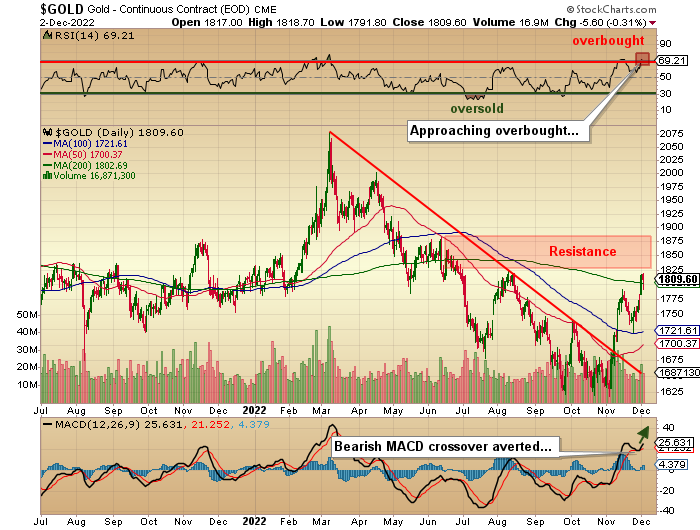
The highlighted part is particularly important as Thursday saw an extremely powerful follow-through, with February gold punching out through that US$1,800 resistance and actually settling at US$1,815.30.

From the CME pit session close Wednesday to the pit session close Thursday saw a US$55.30/ounce pop, which broke it out through the 200-DMA as well.

The next two resistance levels are US$1,825 and US$1,875, but with the RSI settling on Thursday at US$71.22, gold moved into an overbought condition and in need of a sideways consolidation with which to work it off while holding US$1,800.

Mind you, it should be known that coming off the COVID crash lows of March 2020, gold stayed in overbought condition for eleven days, with RSI eventually topping out at US$91.57.

As I have been discussing for the better part of twenty years, the prices for precious metals are inextricably linked to the U.S. dollar because all commodities are priced in the reserve currency of the globe.

It is akin to a “peg” only because if your domestic currency is the British pound and you step into the London Metals Exchange to buy a carload of gold, you are paying the dollar quote, not the pound quote.

Weakness in non-dollar units of exchange will buy less gold per unit and vice-versa.
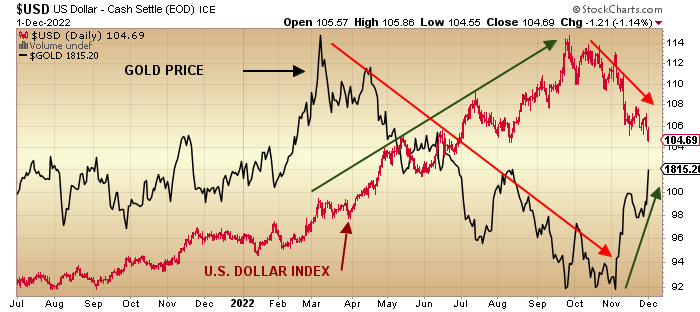
This chart is a clear illustration of the near 1:1 inverse correlation between gold and the U.S. greenback, with tops in the dollar on September 28 and November 3 coinciding perfectly with lows in gold US$1,622 and US$1,618 before embarking on the current almost US$200 per ounce rally.

To try to map out the course for gold and the dollar for the next six months is more an exercise in mindreading rather than an analysis of the economic or geopolitical landscapes.

There are just so many possible policy alternatives, all being weighed upon by domestic and foreign policy agendas related to inflation, oil prices, and partisan politics, that you have to read multiple minds to achieve accuracy.

Since mind reading is only possible if one wears a cape and goes by the title of “The Amazing Kreskin,” I depend on the predictive power of technical analysis to guide me in the general vicinity of accuracy because all of those head-and-shoulders tops and bottoms and ascending cup-and-handle mumbo-jumbo “signals” are simply clues to the mystery and not the ultimate solution.

As my late friend and technical analyst Ian McAvity used to say, “In the hold of every sunken ship, you will always find a chart.”

In all successful starts to bull moves in the precious metals, you need a combination of positive events occurring simultaneously. You need the more speculative assets classes to outperform the more conservative — i.e. junior gold miners (GDXJ:US) outperforming senior gold miners (GDX:US) and silver (SLV:US) outperforming gold (GLD:US) with the shares outperforming the metals.

This is exactly what we have seen off the September 28 lows all coincident with U.S. dollar weakness and declining bond yields.

Gold Versus the Basket

There used to be an expression about a certain profession that went like this:

How do you tell if a <insert profession> is lying?”

“His lips are moving.”

Well, the profession that has earned that reputation is now all central bank governors, presidents, and vice presidents, with the chairman being the leader.

As the former head of the European Central bank, Jean-Claude Juncker, once said, “When it becomes serious, you have to lie.” So with the global economy, with particular emphasis on the U.S. economy, decelerating rapidly, I would surmise that we have reached the point of “seriousness.”

Jerome Powell addressed the Brookings Institute on Wednesday afternoon, and despite reiterating all of his warnings about “higher for longer” (interest rate levels and duration), the infinitesimal wisdom of stock markets determined that Mr. Powell was “lying” and decided that the “pivot” was “on” and that seasonality would trump policy into year-end selling dollars and buying stocks and gold and bonds as if this was April of 2020.

Only time will tell, but I learned a long time ago that markets that spit in the eye of the consensus view are markets that should not be faded (sold).

This creates a monumental problem for the Fed (as discussed earlier), but it creates an even greater problem for me in that despite the awesome technical set-up for the precious metals as we move into December, one word out of Powell’s mouth at the December 14 FOMC meeting could derail the dollar decline and stock/gold/bond rally in a New York minute.

On the other hand, what if the events of September 28 in London, where the Band of England was forced to reverse their QT course and instead launch a QE rescue mission for their pension funds, was a precursor of systemic risks to the global financial system due — once again — to the excessive use of leverage in meeting yield requirements?

If that event is what is spooking Powell & Company, then the “pivot” actually began in clandestine fashion in late September, with all markets around the globe looking far beyond the futile jawboning of the Fed and its “honored representatives.”

Only time will tell, but I learned a long time ago that markets that spit in the eye of the consensus view are markets that should not be faded (sold).

The Friday Jobs Report came in hotter than expectations but failed to derail a major chunk of the weekly gains, most of which came after the Powell speech. I find it hilarious that a mere two days after the narrative turns “pivot positive” due to that one word — “overtighten” — a jobs report that is a lagging indicator of economic activity brings about yet another 180-degree shift in sentiment.

I suspect that in a couple of weeks, the NFP will come in under consensus with revisions to Friday’s report knocking it back to a “miss.” However, profits were taken before the Powell speech, so I am now looking for a suitable re-entry point in anticipation of a continuation of the seasonal rally into year-end.

I suspect that in a couple of weeks, the NFP will come in under consensus with revisions to Friday’s report knocking it back to a “miss.” However, profits were taken before the Powell speech, so I am now looking for a suitable re-entry point in anticipation of a continuation of the seasonal rally into year-end.

With the Dow actually up after being down US$350 on the opening, it did a complete 180 — to my absolute AWE — and closed up US$34.78 to add 82 points for the week. Astounding, but not unexpected for followers of my weekly diatribe . . .

I suspect that in a couple of weeks, the NFP will come in under consensus with revisions to Friday’s report knocking it back to a “miss.” However, profits were taken before the Powell speech, so I am now looking for a suitable re-entry point in anticipation of a continuation of the seasonal rally into year-end.

Ditto the precious metals, where I have been looking to add aggressively on dips under US$1,800 and did today with the early plunge under US$1,800. For an old gold trader like me, trained in the late 80’s bull market where a lifelong narcotic was injected into my bloodstream, the action in gold is reminiscent of the period 2009-2021 for tech stocks — all dips are bought, and no pops are sold (at least for long).

Silver went out with a US$0.57/ounce gain on a day where all other white metals (palladium, platinum) lost 2.48% and 2.80%, respectively. Copper also had not only a decent day; it had a decent week giving me great confidence in the outlook for 2023 for all these metals AND for the junior wannabes that are either searching for or developing them.

Today’s resiliency for all markets in the face of a hostile jobs report and in the face of overbought market conditions reeks of too many portfolio managers (not yet born when the market crashed in ’87) underweight equities and panicking to get back into “fully-invested” mode.

If this trend accelerates, there might be an EPIC short squeeze into year-end that could rival the one that nailed those fuzzy-cheeked whiz kids back in April of 2020 when they were certain that the global pandemic was going to throw us into the 1930s again, which was EXACTLY what I was told by one of the kiddies in 2008 after junior stocks all crashed.

It never happened then, and it won’t happen now as the BIG MONEY wants a rally, and that is all one needs to know.

End of story.

Michael Ballanger Disclaimer:

This letter makes no guarantee or warranty on the accuracy or completeness of the data provided. Nothing contained herein is intended or shall be deemed to be investment advice, implied or otherwise. This letter represents my views and replicates trades that I am making but nothing more than that. Always consult your registered advisor to assist you with your investments. I accept no liability for any loss arising from the use of the data contained on this letter. Options and junior mining stocks contain a high level of risk that may result in the loss of part or all invested capital and therefore are suitable for experienced and professional investors and traders only. One should be familiar with the risks involved in junior mining and options trading and we recommend consulting a financial adviser if you feel you do not understand the risks involved.

Disclosures:
1) Statements and opinions expressed are the opinions of Michael Ballanger and not of Streetwise Reports or its officers. Michael Ballanger is wholly responsible for the validity of the statements. Streetwise Reports was not involved in any aspect of the article preparation. Michael Ballanger was not paid by Streetwise Reports LLC for this article. Streetwise Reports was not paid by the author to publish or syndicate this article.

2) The following companies mentioned in this article are billboard sponsors of Streetwise Reports: None. Click here for important disclosures about sponsor fees. The information provided above is for informational purposes only and is not a recommendation to buy or sell any security.

3) This article does not constitute investment advice. Each reader is encouraged to consult with his or her individual financial professional and any action a reader takes as a result of information presented here is his or her own responsibility. By opening this page, each reader accepts and agrees to Streetwise Reports’ terms of use and full legal disclaimer. This article is not a solicitation for investment. Streetwise Reports does not render general or specific investment advice and the information on Streetwise Reports should not be considered a recommendation to buy or sell any security. Streetwise Reports does not endorse or recommend the business, products, services or securities of any company mentioned on Streetwise Reports.

4) From time to time, Streetwise Reports LLC and its directors, officers, employees or members of their families, as well as persons interviewed for articles and interviews on the site, may have a long or short position in securities mentioned. Directors, officers, employees or members of their immediate families are prohibited from making purchases and/or sales of those securities in the open market or otherwise from the time of the decision to publish an article until three business days after the publication of the article. The foregoing prohibition does not apply to articles that in substance only restate previously published company releases.

Sentiment Hit By Rekindled Fed Hike Bets

By ForexTime 

Asian shares were under attack on Tuesday, following the negative cues from Wall Street overnight as unexpectedly strong US data revived expectations of the Fed raising rates more than expected.

European futures are pointing to a mixed open this morning amid the shaky sentiment and lack of risk appetite. This overall market caution could trickle back down to US indices, empowering US equity bears ahead of a light week of data for financial markets. In the currency universe, the dollar pushed higher, dragging most G10 currencies lower while gold tumbled back below $1780. Oil bears seem to be in control as investors juggle the impact of the new EU sanctions, the OPEC+ meeting over the weekend, and the strong US economic data.

Overnight, the Reserve Bank of Australia (RBA) raised its key interest rate by 25 basis points as widely expected. Given how the central bank left the door open to further hikes down the road, this has offered some support to the Australian dollar. However, signs of easing inflationary pressures may raise hopes that prices have peaked. Back in October, inflation cooled to 6.9% compared to 7.3% year-on-year in September. With the central bank potentially adopting a less aggressive approach towards rates as the tightening cycle approaches an end, this could eventually hit the Australian dollar.

Dollar receives a lifeline?

Over the past few weeks, the dollar has been bruised and battered by expectations around the Federal Reserve adopting a less aggressive approach towards interest rate hikes. It has depreciated against every single G10 currency since the start of the fourth quarter as long dollar positioning eased and the DXY index shifted in favour of the bears. However, buying sentiment towards the world’s reserve currency received a slight boost yesterday after the ISM services PMI data surprised to the upside, further fuelling bets that the Fed could keep its foot on the rate rise pedal. While the central bank is widely expected to hike interest rates by 50bps next week, continued strength in the labour markets and signs of inflation regaining momentum could lead to a higher peak or “terminal” rate than anticipated.

Looking at the technicals, the DXY is trading below the 200-day SMA and 105.50 resistance level. A breakout above this point could encourage more upside towards 107.00 and 107.85, respectively.

Currency spotlight – USDCAD

USDCAD is edging higher ahead of the Bank of Canada’s final rate decision for 2022 on Wednesday, which analysts expect to conclude with a 25bp rate hike. However, money markets price in a 68% chance of a 50bp move after better-than-expected Q3 GDP and the tight labour market.

Looking at the technical picture, the USDCAD remains fairly neutral on the daily charts with support found at 1.3390 and resistance at 1.3620. A breakout could be on the horizon with the BoC meeting acting as the directional catalyst.

Commodity spotlight – Gold

Gold crumbled yesterday, cutting through key levels like a hot knife through butter thanks to a stronger dollar, renewed Fed hike bets, and the easing of China’s Covid zero policies.

The precious metal fell roughly 1.6% and has found itself back within the November range. Support can be found at $1735 and resistance at $1785. Given how bears seem to be in a position of power, prices could test the lower part of the range soon. Below this level, a decline toward $1700 could be on the cards.


Forex-Time-LogoArticle by ForexTime

ForexTime Ltd (FXTM) is an award winning international online forex broker regulated by CySEC 185/12 www.forextime.com

Trade of the week: USDCAD Waits For BoC Rate Decision

By ForexTime

This could be a wild week for the USDCAD due to the Bank of Canada’s (BoC) rate decision on Wednesday.

A sense of tension can already be felt when observing the currency pair which remains wedged within a small range on the hourly timeframe. The USDCAD’s choppy price action and indecision are likely based on last Friday’s jobs report from both the United States and Canada which sent prices on a mini rollercoaster ride.

US employers added more jobs than expected in November, signalling that demand for new workers remained robust despite the Federal Reserve’s war against soaring inflation. Non-farm Payrolls rose by 263,000 in November, smashing the 200,000 estimates but below the upwardly revised 284,000 increase seen in October. In Canada, it was a tepid picture with the economy only adding 10,100 jobs. Although this was the third straight month of increase, the small increase was seen as having limited impacts on the Bank of Canada’s rate decision for December.

Sentiment remains bearish toward the Canadian economy with most economists expecting the country to descend into a technical recession in 2023. With the BoC already shifting into lower gear on rate hikes, this could translate to further Loonie weakness for the rest of 2022 – especially combined with the gloomy sentiment.

Before we discuss what to expect from the USDCAD over the next few days, it is worth keeping in mind that prices remain in a bearish trend on the daily charts. A minor breakout/down could be on the horizon which may pave a path south or north depending on how markets react to the final BoC rate decision for 2022.

The low down…

After peaking at 8.1% back in June 2022, Canada’s annual inflation rate has slowed over the past few months with the current rate at 6.9% in October.

Signs of easing inflationary pressures have encouraged the BoC to adopt a less aggressive approach toward rates. In fact, the central bank is widely expected to hike rates by only 25 basis points on Wednesday which could be the final one before taking a pause. The Canadian economy expanded at an annualized 2.9% on quarter in Q3 2022, which exceeded the forecast of 3.2% and marked a fifth consecutive quarter of growth. Looking ahead, economic growth is forecasted to cool to 0.5% in Q4 according to Bloomberg which will result in GDP expanding by 3.3% in 2022. In the first quarter of 2023, growth is seen contracting -0.5%. With the road ahead for the Canadian economy rocky, this may hit buying sentiment toward the Canadian dollar.

The week ahead…

It’s all about the BoC rate final rate decision for 2022 on Wednesday, December 7th which is expected to conclude with a 25 basis-point rate hike. This decision is widely expected despite the better-than-expected Q3 GDP and somewhat tight labour market.

However, much attention will be directed toward the press conference by Governor Macklem which could provide key insight into the monetary policy path for 2023. Although economic data has been painting a positive picture since the October meeting, most economists expect the country to descend into a technical recession in 2023. This sentiment is likely to keep BoC hawks at bay, reducing the possibility of a surprise 50 basis-point hike.

Other factors to watch out for…

The oil-linked Canadian Dollar (CAD) appreciated on Monday, drawing strength from OPEC’s Sunday meeting.

Oil prices edged higher after OPEC+ decided to stick with the game plan to cut output. Although production was kept unchanged, the cartel stated that it would take “immediate” action if needed to stabilise global oil markets. Another factor supporting the Loonie is the European Union imposing a price cap on Russian oil. These factors could keep the Canadian dollar buoyed ahead of the BoC rate decision.

What next for the USDCAD?

On the daily chart, the USDCAD remains in a bearish trend with prices currently bouncing within a small range. Prices are trading below the 50-day SMA but still above both the 100-day and 200-day. A solid breakdown below 1.3390 could encourage a decline toward 1.3230 and 1.3050, respectively. Should prices break above 1.3500, bulls could be inspired to challenge 1.3600 and 1.3750.


Forex-Time-LogoArticle by ForexTime

ForexTime Ltd (FXTM) is an award winning international online forex broker regulated by CySEC 185/12 www.forextime.com