‘Peak opportunity’ in Q1 is when investors could be rewarded

By George Prior

Economic ‘peak opportunity’ is likely to be late Quarter 1 for most major developed economies, and when investors might be rewarded for taking the plunge, predicts the CEO and founder of one of the world’s largest independent financial advisory, asset management and fintech organizations.

The prediction from deVere Group’s Nigel Green comes as global investors review their portfolios with their advisers for the year ahead.

He says: “Economic ‘peak opportunity’ might come late in the first quarter.

“Until then, unemployment will be rising and there will still be aggressive language from the central banks on the need to stamp out inflation – which by then will be sharply down from current levels, especially as demand for staff is falling fast and this will help ease wage inflation, but it will still be well above the 2% target set by the central banks.

“This is, perhaps, when stocks will reach their cyclical bottom, and when investors might be rewarded for taking the plunge.”

The second quarter of the year might see risk assets start to price in a cyclical upturn in the G7 economies.

“The assets that have fallen hardest between now and then may be the strongest performers during this recovery rally, with the best performing days probably at the start,” noted Nigel Green.

“There will be cyclically-sensitive sectors, such as industrials, consumer discretionary and autos.”

What might trigger this recovery? “Probably central banks’ ending of rate hikes, and easing of rhetoric on inflation, as it slowly makes its way down to the 2% target rate in the major western economies, companies cutting back fast, together with signs of economic stabilisation.”

Investors should remain diversified, affirms the CEO of deVere. There is no ‘right way’ to approach investing, since each individual’s attitude to risk, and time horizon, differs. However, a disciplined approach to putting money into the markets, that ignores current trends, when the outlook for corporate earnings and interest rates is so opaque. Investors should remain diversified in multi-asset portfolios, that offer exposure to equities, bonds and alternative asset classes.

“Holding cash is tempting, but it suggests an ability to ‘time the market’, to invest it at an optimum point in the cycle, and this is nearly always impossible.  Investors should be starting to position themselves for the cyclical upturn,” he concludes.

About:

deVere Group is one of the world’s largest independent advisors of specialist global financial solutions to international, local mass affluent, and high-net-worth clients.  It has a network of more than 70 offices across the world, over 80,000 clients and $12bn under advisement.

EUR Is Vigorous Again

By RoboForex Analytical Department

The first week of the year was really volatile for the market major. On Monday, it recovered and secured near 1.0680.

The reason for the nervous reaction was publication of the minutes of the US Fed’s meeting. The document mentioned inadequacy of emotional conclusions based on just the Fed’s decision to fight with inflation. As a result of all this, the USD got stronger.

Next, December reports on the US labour market came out. The unemployment rate dropped to 3.5%, though no changes had been anticipated. The NFP grew to 223 thousand instead of 200 thousand expected. The average wage growth decreased to 0.3% m/m from 0.6%. All this was good, but later the ISM report was released, and it demonstrated a serious decline in December. This sent the USD down – it could not ignore the fact that the economy keeps slowing down.

On H4, EUR/USD completed a wave of decline to 1.0482. Today the market has completed an impulse of growth to 1.0635. At the moment, the market has formed a consolidation range around this level. With an escape upwards, a pathway for a wave of growth to 1.0766 opened. After the pair reaches the level, a correction to 1.0635 should begin, followed by growth to 1.0785. Technically, this scenario is confirmed by the MACD: its signal line is directed strictly upwards, which suggests the continuation of a wave of growth.

On H1, EUR/USD has formed an impulse of growth to 1.0634. The market has formed a consolidation range around it. With an escape upwards, a pathway for the wave of growth to 1.0766 opened. The goal is local. Technically, the scenario is confirmed by the Stochastic oscillator. Its signal line is above 80. After the target level is reached, a link f decline to 50 is expected.

Disclaimer

Any forecasts contained herein are based on the author’s particular opinion. This analysis may not be treated as trading advice. RoboForex bears no responsibility for trading results based on trading recommendations and reviews contained herein.

Trade Of The Week: Gold Eyes Key US Inflation Data

By ForexTime 

Gold is certainly glittering, gaining 2.3% in the first full trading week of 2023 alone.

The precious metal continues to draw ample strength from a softer dollar, falling Treasury yields, and growing expectations of a less hawkish Federal Reserve. Last Friday’s mixed US jobs report added fuel to the bullish momentum, resulting in a weekly close above resistance at $1860.

In our 2023 outlook, we discussed how gold could be one of the biggest winners in 2023 due to the shifting market dynamics and fundamental themes. Well, it looks like bulls are wasting no time in our marking their territory, pushing the precious metal to levels not seen since May 2022.

Regarding December’s jobs data, it offered conflicting signals as NFP exceeded expectations by rising 223,000k but wage growth slowed, and weekly working hours continued to fall. The slowing wage growth fuelled speculation around the Fed slowing its rate hikes – dealing a blow to the dollar which was already on the verge of a “death cross” technical pattern on the daily charts. Ultimately, this was a welcome development for zero-yielding gold.

Taking a quick peek at the technical picture, gold remains firmly bullish on the daily timeframe. The upside momentum could propel prices towards the psychological $1900 if the fundamentals remain in favour of bulls.

US Inflation report in focus

Inflation in the United States slowed for a fifth straight month to 7.1% in November, the lowest level since December 2021. Persistent signs of easing inflationary pressures in the world’s largest economy have somewhat brightened the market mood and fuelled speculation around a less hawkish Fed.

According to Bloomberg, December’s inflation data is expected to show annual inflation cooling to 6.5%. Should expectations become reality, this will mark the sixth straight monthly decline and the lowest since October 2021. Given the market sensitivity to anything relating to inflation, this could result in explosive levels of volatility across financial markets.

More signs of falling inflation may fuel talks around the Federal Reserve veering to smaller rate hikes. Currently, traders are currently pricing in a 27% probability of a 50-basis point rate hike in February. When considering gold’s zero-yielding nature, this is certainly a welcome development for the metal which could support upside gains.

Alternatively, a hotter-than-expected CPI report could revive aggressive rate hike bets as investors question whether inflation is plateauing. Such a development could see gold prices weaken as the dollar bounces back along with Treasury yields.

Other factors to watch out for…

Other than the highly anticipated US CPI report on Thursday, there are a couple of reports and Fed speeches this week that could influence gold prices.

On Monday, Atlanta Fed President Raphael Bostic will be under the spotlight. All eyes will be on Fed Chair Jerome Powell on Tuesday as he speaks during an international symposium at Riksbank in Stockholm. More Fed members are due to speak on Thursday with the US January consumer sentiment report on Friday ending the week. Should Fed members strike a hawkish note, this could weigh on gold prices. Alternatively, any whiff of caution or appearance of doves may boost gold’s allure.

Gold bulls switch into higher gear…

Gold bulls remain in a position of power with their feet pressed aggressively on the accelerator. Prices are firmly bullish on the daily timeframe with $1900 acting as the first key level of interest. A move above this level could encourage an incline towards $1920 and $1958, respectively. Should bulls run out of steam, prices may dip back below $1860 – opening the doors towards $1840, $1814, and $1800, respectively.


Forex-Time-LogoArticle by ForexTime

ForexTime Ltd (FXTM) is an award winning international online forex broker regulated by CySEC 185/12 www.forextime.com

Forex Technical Analysis & Forecast for January 2023

By RoboForex.com

EURUSD, “Euro vs US Dollar”

The currency pair has completed a wave of correction to 1.0510. The market has got support there, and the wave of growth might continue to 1.0804. The goal is local. After it is reached, a link of correction to 1.0222 is not excluded. Then a new structure of growth to 1.0900 should develop.

EURUSD
Risk Warning: the result of previous trading operations do not guarantee the same results in the future

GBPUSD, “Great Britain Pound vs US Dollar”

The currency pair completed a wave of correction to 1.1840. Upon getting support there, the market continues developing a wave of growth to 1.2320. After this level is reached, a new link of correction to 1.2220 is not excluded, followed by growth to 1.2777.

GBPUSD
Risk Warning: the result of previous trading operations do not guarantee the same results in the future

USDJPY, “US Dollar vs Japanese Yen”

The currency pair completed a wave of decline to 129.70. At the moment, the market has formed an impulse of growth to 134.76. Today it has completed a link of decline to 131.71. A consolidation range is expected to form around this level. With an escape downwards, another structure of decline to 128.73 may develop. With an escape upwards, the wave of growth might continue to 138.51.

USDJPY
Risk Warning: the result of previous trading operations do not guarantee the same results in the future

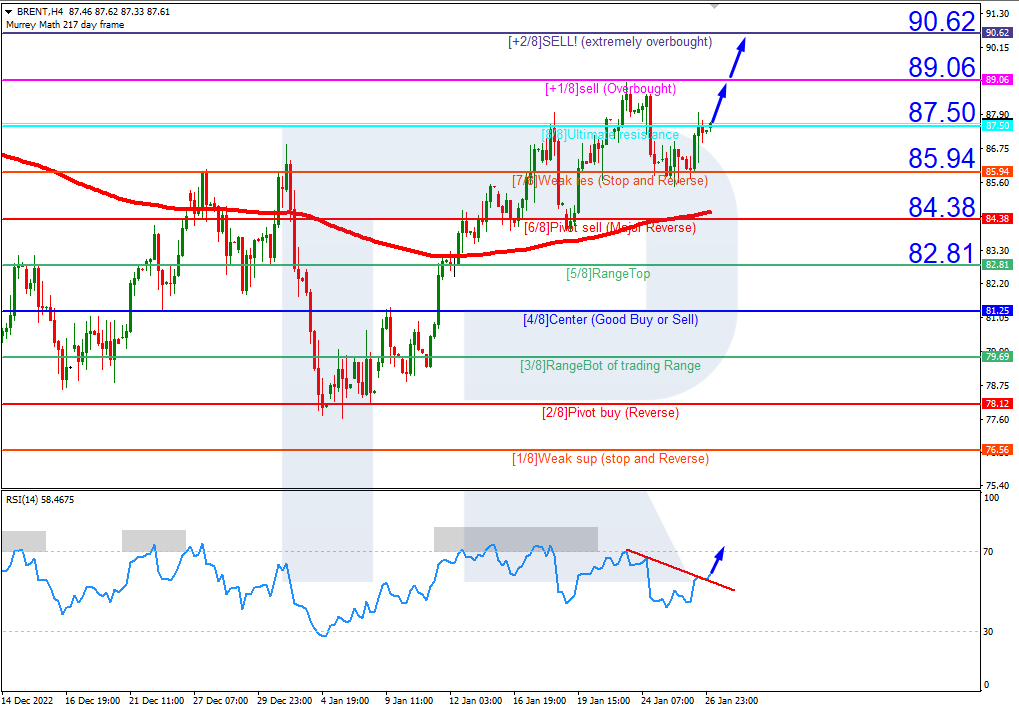
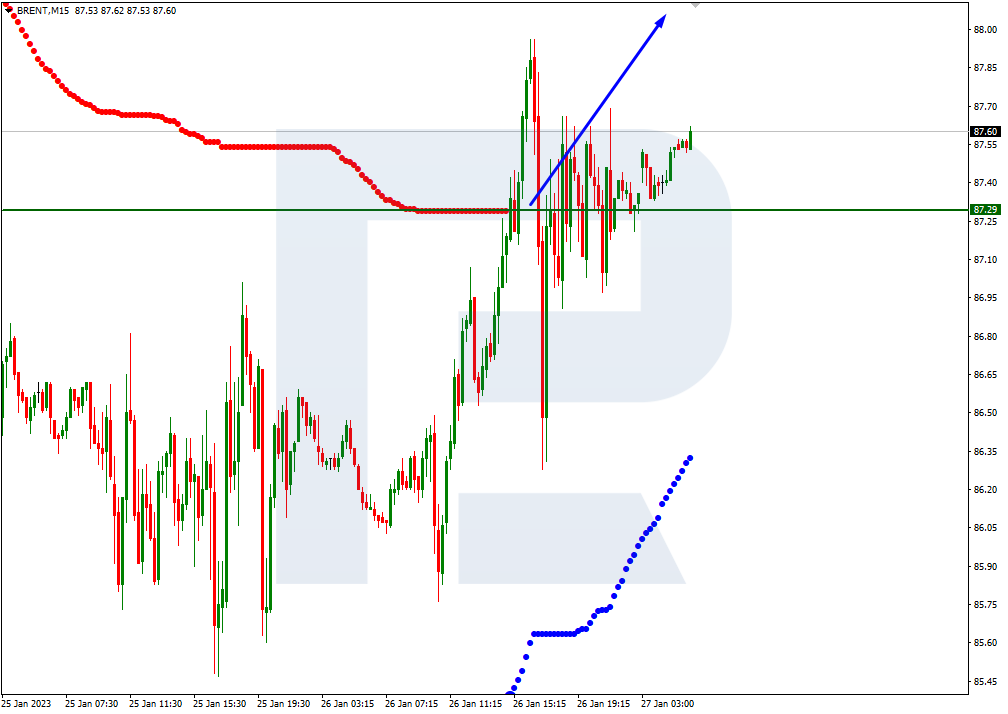
BRENT

Crude oil has completed a wave of correction to 86.40 and a link of growth to 82.60. After this level is reached, a decline to 72.60 might follow. Then a wave of growth to 100.00 might develop, from where the wave might continue to 127.45.

BRENT
Risk Warning: the result of previous trading operations do not guarantee the same results in the future

XAUUSD, “Gold vs US Dollar”

Gold has corrected to 1833.30. Getting support there, the market is developing a wave of growth. The quotes might then reach 1900.00, after which a correction to 1800.00 might follow.

GOLD
Risk Warning: the result of previous trading operations do not guarantee the same results in the future

S&P 500

The stock index has completed an impulse of decline to 3763.0. Today the market is forming a link of correction. Growth to 3953.4 looks possible. After this level is reached, the quotes might fall to 3550.5, then grow to 3752.0, and then decline to 3344.0.

S&P 500

Article By RoboForex.com

Attention!
Forecasts presented in this section only reflect the author’s private opinion and should not be considered as guidance for trading. RoboForex LP bears no responsibility for trading results based on trading recommendations described in these analytical reviews.

Ichimoku Cloud Analysis 09.01.2023 (EURUSD, BRENT, USDCAD)

By RoboForex.com

EURUSD, “Euro vs US Dollar”

The currency pair is pushing off the upper border of the descending channel. The instrument is going above the Ichimoku Cloud, which suggests an uptrend. A test of the lower border of the Cloud at 1.0605 is expected, followed by growth to 1.0810. An additional signal confirming the growth will be a bounce off the upper border of the descending channel. The scenario can be cancelled by a breakaway of the lower border of the Cloud and securing under 1.0555, which will mean further falling to 1.0465.

EURUSD
Risk Warning: the result of previous trading operations do not guarantee the same results in the future

BRENT

Crude oil is testing the signal lines of the indicator. The instrument is going below the Ichimoku Cloud, which suggests a downtrend. A test of the Kijun-Sen line at 81.00 is expected, followed by falling to 72.65. An additional signal confirming the decline will be a bounce off the upper border of the descending channel. The scenario can be cancelled by a breakaway of the upper border of the Cloud and securing above 85.00, which will mean further growth to 90.00.

BRENT
Risk Warning: the result of previous trading operations do not guarantee the same results in the future

USDCAD, “US Dollar vs Canadian Dollar”

The pair has secured under the lower border of the descending channel. The instrument is going below the Ichimoku Cloud, which suggests a downtrend. A test of the broken border of the channel at 1.3430 is expected, followed by falling to 1.3255. An additional signal confirming the decline will be a bounce off the lower border of the bearish channel. The scenario can be cancelled by a breakaway of the upper border of the Cloud and securing above 1.3655, which will mean further growth to 1.3620.

USDCAD

Article By RoboForex.com

Attention!
Forecasts presented in this section only reflect the author’s private opinion and should not be considered as guidance for trading. RoboForex LP bears no responsibility for trading results based on trading recommendations described in these analytical reviews.

The Analytical Overview of the Main Currency Pairs on 2023.01.09

By JustMarkets

The EUR/USD currency pair

Technical indicators of the currency pair:
  • Prev Open: 1.0516
  • Prev Close: 1.0644
  • % chg. over the last day: +1.22 %

Falling energy prices in the Eurozone (especially natural gas prices) helped weaken the overall inflation rate. On an annualized basis, the Eurozone’s overall inflation rate fell from 10.1% to 9.2%. Core inflation (which excludes food and energy prices) also fell from 5.1% to 5.0% year over year. But the detailed report indicates that price pressures in non-energy sectors are rising, especially for food. This indicates that inflation is still strong.

Trading recommendations
  • Support levels: 1.0650, 1.0589, 1.0535, 1.0497, 1.0480, 1.0361, 1.0332, 1.0284
  • Resistance levels: 1.0695

The trend on the EUR/USD currency pair on the hourly time frame is still bullish. The price is trading above the moving averages. The MACD indicator is in the positive zone, but there are signs of overbought, so it is worth waiting for a correction to find good entry points. Under such market conditions, buy trades are best considered from the support level 1.0650 or 1.0589 with confirmation on intraday timeframes. Sell deals can be considered from the resistance level of 1.0695 but better with confirmation in the form of a reverse initiative or a false breakout

Alternative scenario: if the price breaks down through the support level of 1.0497 and fixes below it, the downtrend will likely resume.

EUR/USD
News feed for 2023.01.09:
  • – German Industrial Production (m/m) at 09:00 (GMT+2);
  • – Eurozone Unemployment Rate (m/m) at 12:00 (GMT+2).

The GBP/USD currency pair

Technical indicators of the currency pair:
  • Prev Open: 1.1906
  • Prev Close: 1.2091
  • % chg. over the last day: +1.55 %

The non-farm report showed that the US economy added 223,000 jobs, higher than the expected 200,000. The unemployment rate fell to 3.5% from 3.7%, while average hourly earnings fell to 4.6% from a revised 4.8% decline. As the US labor market remains resilient, the Fed can expect to raise rates longer to keep inflation in check. But the dollar Index unexpectedly fell on a strong US labor market report, and this could be a “false” move, as a strong labor market, along with further rate hikes, is the foundation for a stronger dollar. Analysts still expect January and February to be strong months for the dollar and weak for the GBP.

Trading recommendations
  • Support levels: 1.2100, 1.2000, 1.1928, 1.1875, 1.1684, 1.1476, 1.1418
  • Resistance levels: 1.2193, 1.2308, 1.2431, 1.2519

From the technical point of view, the trend on the GBP/USD currency pair on the hourly time frame has changed to bullish. The price has broken through the priority change level and is trading above the moving averages. The MACD indicator is in the positive zone, and the pressure of buyers remains. Under such market conditions, it is better to look for buy trades on intraday time frames from the support level of 1.2100, but with confirmation. Sell trades are best sought from the resistance level of 1.2193 but also better with a confirmation in the form of a false breakout.

Alternative scenario: if the price breaks down through the 1.1875 support level and fixes above it, the downtrend will likely resume.

GBP/USD
There is no news feed for today.

The USD/JPY currency pair

Technical indicators of the currency pair:
  • Prev Open: 133.40
  • Prev Close: 132.08
  • % chg. over the last day: -0.99 %

Japanese Prime Minister Fumio Kishida said Sunday that his government and the Central Bank should discuss their relationship in guiding economic policy after he picks a new governor for the Bank of Japan (BOJ) in April. This raises the possibility that the government may reconsider its plan to work with the Central Bank and would lay the groundwork for an exit from the BOJ’s ultra-free monetary policy. Japan’s core consumer prices are at 3.7%, and analysts expect inflation to remain above the 2% target in the coming months, making a policy shift after the BOJ governor is re-elected even more likely.

Trading recommendations
  • Support levels: 131.12, 130.58, 129.65
  • Resistance levels: 132.89, 133.29, 134.45, 135.88, 137.03, 138.00, 139.09

From the technical point of view, the medium-term trend on the currency pair USD/JPY is bullish. The price is now trading below the moving averages, while the MACD indicator has become negative, indicating the sellers’ pressure inside the day. The decline now looks like a corrective wave before a new momentum. Buy trades are best considered from 131.12 or 130.58 support levels, but only with intraday confirmation. Sell deals can be searched for from the level of resistance of 132.89 under the condition of a reverse reaction or false breakout.

Alternative scenario: If the price fixes below the support level of 130.58, the downtrend will likely resume.

USD/JPY
There is no news feed for today.

The USD/CAD currency pair

Technical indicators of the currency pair:
  • Prev Open: 1.3565
  • Prev Close: 1.3443
  • % chg. over the last day: -0.91 %

The latest labor market data showed that Canada’s unemployment rate fell from 5.1% to 5.0%, with 627,000 more jobs in Canada now than before the pandemic. Most of the job growth came in the 4th quarter of 2022. But it should be noted that the country’s manufacturing levels are declining. Job growth with rising wages and falling production is an inflationary path for the economy. Therefore, the Bank of Canada will continue raising interest rates to “cool down” the labor market. A 0.25% rate hike is expected at the Bank of Canada’s next meeting.

Trading recommendations
  • Support levels: 1.3386, 1.3362, 1.3212
  • Resistance levels: 1.3492, 1.3513, 1.3561, 1.3594, 1.3632, 1.3700

From the point of view of technical analysis, the trend on the USD/CAD currency pair has changed to bearish. The price has again consolidated below the moving averages and below the key support level. The MACD indicator became negative, but it indicates a divergence when the price reached the support level. Buy trades should be considered from the support level of 1.3386, but only with short targets, as entry is against the main priority. Sell deals are best looked for on intraday time frames from the resistance level of 1.3513 or 1.3561, but with confirmation in the form of a reverse initiative on the lower timeframes or a false breakout.

Alternative scenario: if the price breaks out and consolidates above the resistance level of 1.3632, the uptrend will likely resume.

USD/CAD
News feed for 2023.01.09:
  • – Canada Unemployment Rate (m/m) at 15:30 (GMT+2);
  • – Canada Ivey PMI (m/m) at 17:00 (GMT+2).

By JustMarkets


This article reflects a personal opinion and should not be interpreted as an investment advice, and/or offer, and/or a persistent request for carrying out financial transactions, and/or a guarantee, and/or a forecast of future events.

China is opening its borders. The US labor market remains solid

By JustMarkets

The US stock market ended Friday’s trading higher on the back of a dollar Index drop after key data on the US labor market. The non-farm report showed the US economy added 223,000 jobs, higher than the expected 200,000. The unemployment rate fell to 3.5% from 3.7%, while average hourly earnings fell to 4.6% from a revised decline of 4.8%. As the US labor market remains resilient, the Fed can count on further rate hikes to keep inflation in check. The dollar index unexpectedly fell on a strong US labor market report, and this could be a “false” move as a strong labor market, along with further rate hikes, is the foundation for a stronger dollar. At the close of the stock market on Friday, the Dow Jones index (US30) increased by 2.13% (+1.54% for the week), and the S&P 500 index (US500) added 2.28% (+1.72% for the week). The NASDAQ Technology Index (US100) gained 2.56% on Friday (+1.94% for the week). All three indices closed in positive territory last week.

Last week’s FOMC report showed that Fed policymakers increased the final interest rate range, and the non-farm payrolls report showed that the labor market remains resilient. Together, these 2 factors point to further interest rate hikes in the first half of 2023. A key factor will be the inflation data on January 12.

On Sunday in California, hundreds of thousands of homes and businesses were without power due to a severe storm. On Saturday, the NWS Weather Alert warned that the cumulative effect of successive heavy rains since late December could cause rivers to reach record highs and cause flooding in much of central California.

Stock markets in Europe were mostly up Friday. German DAX (DE30) gained 1.20% (+4.41% for the week), French CAC 40 (FR40) added 1.47% (+5.21% for the week), Spanish IBEX 35 (ES35) jumped by 1.00% (+4.78% for the week), British FTSE 100 (UK100) was up 0.87% (+2.49% for the week).

Falling energy prices in the Eurozone (especially natural gas prices) helped weaken the overall inflation rate. The overall inflation rate fell from 10.1% to 9.2% on an annualized basis. Core inflation (which excludes food and energy prices) also fell from 5.1% to 5.0% year over year. But the detailed report indicates that price pressures in non-energy sectors are rising, especially for food. This indicates that inflation is still strong. The next two months will be critical, as many businesses traditionally change prices early in the year.

Consequently, it is possible that core inflation will continue to rise. Consumption remains under pressure, and retail sales have been declining for quite some time, businesses continue to adjust their prices upward. The ECB has taken a very hawkish stance and is likely to keep the pace of rate hikes at 50 bp in February and March.

Asian markets traded mixed last week. Japan’s Nikkei 225 (JP225) decreased by 0.39%, China’s FTSE China A50  CHA50) was up 0.81%, Hong Kong’s Hang Seng (HK50) ended the week up 4.80%, India’s NIFTY 50 (IND50) decreased by 1.34%, and Australia’s S&P/ASX 200 (AU200) ended the week up 1.24% positive.

China on Saturday marked the first day of “Chun Yun,” the 40-day lunar New Year period. This Lunar New Year public holiday, which officially begins on January 21, will be the first since 2020 with no restrictions on domestic travel. Also, on Sunday, China will reopen its border with Hong Kong. China’s Ministry of Transportation expects more than 2 billion passengers to travel over the next 40 days. Investors hope the reopening will eventually revive the economy. Ultimately, it is likely to have an impact on oil prices. Demand for oil in China usually rises every year after the Lunar New Year. The increase in demand is a signal for rising oil prices.

In the commodities market, futures on copper (+2.97%), cotton (+2.76%), gold (+2.43%), and platinum (+1.99%) showed the biggest gains last week. Futures on natural gas (-15.96%), gasoline (-9.05%), Brent oil (-8.51%), WTI oil (-8.14%), wheat (-6.19%), sugar (-5.34%), coffee (-5.29%), corn (-3.72%) and lumber (-2.95%) showed the biggest drop.

S&P 500 (F) (US500) 3,895.08 +66.02  (+1.72%)

Dow Jones (US30) 33,630.61 +509.00 (+1.54%)

DAX (DE40) 14,610.02 +173.71 (+1.20%)

FTSE 100 (UK100) 7,699.49 +66.04 (+0.87%)

USD Index 103.91 -1.13 (-1.08%)

Important events for today:
  • – Switzerland Unemployment Rate (m/m) at 08:45 (GMT+2);
  • – German Industrial Production (m/m) at 09:00 (GMT+2);
  • – Eurozone Unemployment Rate (m/m) at 12:00 (GMT+2);
  • – Canada Building Permits (m/m) at 15:30 (GMT+2).

By JustMarkets


This article reflects a personal opinion and should not be interpreted as an investment advice, and/or offer, and/or a persistent request for carrying out financial transactions, and/or a guarantee, and/or a forecast of future events.

Large Currency Speculators trimmed Euro bullish bets after run to 100-week high

By InvestMacro

Here are the latest charts and statistics for the Commitment of Traders (COT) data published by the Commodities Futures Trading Commission (CFTC).

The latest COT data is updated through Tuesday January 3rd and shows a quick view of how large market participants (for-profit speculators and commercial traders) were positioned in the futures markets. All currency positions are in direct relation to the US dollar where, for example, a bet for the euro is a bet that the euro will rise versus the dollar while a bet against the euro will be a bet that the euro will decline versus the dollar.

Weekly Speculator Changes led by the Brazilian Real & Canadian Dollar

The COT currency market speculator bets were higher this week as six out of the eleven currency markets we cover had higher positioning while the other five markets had lower speculator contracts.

Leading the gains for the currency markets was the Brazilian Real (20,796 contracts) with the Canadian Dollar (3,267 contracts), the Swiss Franc (1,277 contracts), the US Dollar Index (820 contracts), New Zealand Dollar (573 contracts) and the Australian Dollar (524 contracts) also having positive weeks.

The currencies seeing declines in speculator bets on the week were the EuroFX (-16,247 contracts) with the British Pound (-9,414 contracts), Japanese Yen (-9,134 contracts), Mexican Peso (-4,650 contracts) and Bitcoin (-304 contracts) also registering lower bets on the week.

Highlighting the COT currencies data is this week’s breather in the highly bullish Euro currency speculator positioning. The large speculator bets for the Euro dropped this week by the most in the past twenty-four weeks. This week’s shortfall, however, follows a strong bullish run that had seen positions rise in fourteen out of the previous seventeen weeks, going from a total of -47,676 contracts on August 30th to a new 100-week high last week at a total of +146,621 contracts and the highest since January of 2021. Despite this week’s decline, the Euro positions have now been above +100,000 contracts for the past ten weeks which marks the best run since 2021.

The Euro price has been in an uptrend since bottoming in September and has shot higher against the US Dollar since US inflationary data has started to cool. The Euro/US Dollar exchange rate closed just below the 1.0700 level this week after having been right at parity (1.0000) as recently as November 22nd.


Data Snapshot of Forex Market Traders | Columns Legend
Jan-03-2023OIOI-IndexSpec-NetSpec-IndexCom-NetCOM-IndexSmalls-NetSmalls-Index
USD Index41,8504917,76155-20,204442,44343
EUR712,03074129,91575-174,0812744,16649
GBP205,72240-20,3015229,69254-9,39140
JPY172,59033-46,8644046,773589154
CHF33,25012-2,854476,43156-3,57745
CAD138,99523-26,7661024,541892,22535
AUD132,96032-36,2675139,59548-3,32844
NZD29,77367,48074-8,1702769060
MXN245,02970-56,376350,262946,11494
RUB20,93047,54331-7,15069-39324
BRL37,9872428,21176-29,648241,43778
Bitcoin14,5307438984-578018917


Strength Scores led by Bitcoin & Brazilian Real

COT Strength Scores (a normalized measure of Speculator positions over a 3-Year range, from 0 to 100 where above 80 is Extreme-Bullish and below 20 is Extreme-Bearish) showed that the Bitcoin (84 percent) and the Brazilian Real (76 percent) lead the currency markets this week. The EuroFX (75 percent), New Zealand Dollar (74 percent) and the US Dollar Index (55 percent) come in as the next highest in the weekly strength scores.

On the downside, the Mexican Peso (3 percent) and the Canadian Dollar (10 percent) come in at the lowest strength levels currently and are in Extreme-Bearish territory (below 20 percent). The next lowest strength scores are the Japanese Yen (40 percent) and the Swiss Franc (47 percent).

Strength Statistics:
US Dollar Index (54.6 percent) vs US Dollar Index previous week (53.2 percent)
EuroFX (74.9 percent) vs EuroFX previous week (79.9 percent)
British Pound Sterling (51.6 percent) vs British Pound Sterling previous week (59.7 percent)
Japanese Yen (40.0 percent) vs Japanese Yen previous week (45.6 percent)
Swiss Franc (47.1 percent) vs Swiss Franc previous week (43.7 percent)
Canadian Dollar (9.9 percent) vs Canadian Dollar previous week (6.0 percent)
Australian Dollar (51.2 percent) vs Australian Dollar previous week (50.7 percent)
New Zealand Dollar (74.2 percent) vs New Zealand Dollar previous week (72.7 percent)
Mexican Peso (3.3 percent) vs Mexican Peso previous week (5.3 percent)
Brazilian Real (76.1 percent) vs Brazilian Real previous week (53.9 percent)
Bitcoin (83.7 percent) vs Bitcoin previous week (89.0 percent)


Swiss Franc & New Zealand Dollar top the 6-Week Strength Trends

COT Strength Score Trends (or move index, calculates the 6-week changes in strength scores) showed that the Swiss Franc (31 percent) and the New Zealand Dollar (31 percent) lead the past six weeks trends for the currencies. The Brazilian Real (21 percent), the British Pound (13 percent) and the Japanese Yen (11 percent) are the next highest positive movers in the latest trends data.

The Mexican Peso (-51 percent) leads the downside trend scores currently with the Canadian Dollar (-18 percent), US Dollar Index (-11 percent) and Bitcoin (-6 percent) following next with lower trend scores.

Strength Trend Statistics:
US Dollar Index (-10.5 percent) vs US Dollar Index previous week (-16.5 percent)
EuroFX (2.1 percent) vs EuroFX previous week (10.3 percent)
British Pound Sterling (13.4 percent) vs British Pound Sterling previous week (18.8 percent)
Japanese Yen (11.1 percent) vs Japanese Yen previous week (17.3 percent)
Swiss Franc (30.7 percent) vs Swiss Franc previous week (33.6 percent)
Canadian Dollar (-18.0 percent) vs Canadian Dollar previous week (-20.4 percent)
Australian Dollar (6.0 percent) vs Australian Dollar previous week (7.4 percent)
New Zealand Dollar (31.5 percent) vs New Zealand Dollar previous week (36.2 percent)
Mexican Peso (-51.0 percent) vs Mexican Peso previous week (-51.0 percent)
Brazilian Real (20.9 percent) vs Brazilian Real previous week (-1.7 percent)
Bitcoin (-5.5 percent) vs Bitcoin previous week (2.1 percent)


Individual COT Forex Markets:

US Dollar Index Futures:

US Dollar Index Forex Futures COT ChartThe US Dollar Index large speculator standing this week resulted in a net position of 17,761 contracts in the data reported through Tuesday. This was a weekly lift of 820 contracts from the previous week which had a total of 16,941 net contracts.

This week’s current strength score (the trader positioning range over the past three years, measured from 0 to 100) shows the speculators are currently Bullish with a score of 54.6 percent. The commercials are Bearish with a score of 43.7 percent and the small traders (not shown in chart) are Bearish with a score of 43.2 percent.

US DOLLAR INDEX StatisticsSPECULATORSCOMMERCIALSSMALL TRADERS
– Percent of Open Interest Longs:79.33.813.2
– Percent of Open Interest Shorts:36.852.17.4
– Net Position:17,761-20,2042,443
– Gross Longs:33,1711,5885,538
– Gross Shorts:15,41021,7923,095
– Long to Short Ratio:2.2 to 10.1 to 11.8 to 1
NET POSITION TREND:
– Strength Index Score (3 Year Range Pct):54.643.743.2
– Strength Index Reading (3 Year Range):BullishBearishBearish
NET POSITION MOVEMENT INDEX:
– 6-Week Change in Strength Index:-10.512.3-15.8


Euro Currency Futures:

Euro Currency Futures COT ChartThe Euro Currency large speculator standing this week resulted in a net position of 129,915 contracts in the data reported through Tuesday. This was a weekly decline of -16,247 contracts from the previous week which had a total of 146,162 net contracts.

This week’s current strength score (the trader positioning range over the past three years, measured from 0 to 100) shows the speculators are currently Bullish with a score of 74.9 percent. The commercials are Bearish with a score of 26.6 percent and the small traders (not shown in chart) are Bearish with a score of 49.4 percent.

EURO Currency StatisticsSPECULATORSCOMMERCIALSSMALL TRADERS
– Percent of Open Interest Longs:31.354.812.0
– Percent of Open Interest Shorts:13.079.25.8
– Net Position:129,915-174,08144,166
– Gross Longs:222,543389,86185,209
– Gross Shorts:92,628563,94241,043
– Long to Short Ratio:2.4 to 10.7 to 12.1 to 1
NET POSITION TREND:
– Strength Index Score (3 Year Range Pct):74.926.649.4
– Strength Index Reading (3 Year Range):BullishBearishBearish
NET POSITION MOVEMENT INDEX:
– 6-Week Change in Strength Index:2.1-4.614.9


British Pound Sterling Futures:

British Pound Sterling Futures COT ChartThe British Pound Sterling large speculator standing this week resulted in a net position of -20,301 contracts in the data reported through Tuesday. This was a weekly reduction of -9,414 contracts from the previous week which had a total of -10,887 net contracts.

This week’s current strength score (the trader positioning range over the past three years, measured from 0 to 100) shows the speculators are currently Bullish with a score of 51.6 percent. The commercials are Bullish with a score of 54.3 percent and the small traders (not shown in chart) are Bearish with a score of 39.6 percent.

BRITISH POUND StatisticsSPECULATORSCOMMERCIALSSMALL TRADERS
– Percent of Open Interest Longs:21.265.810.8
– Percent of Open Interest Shorts:31.151.315.3
– Net Position:-20,30129,692-9,391
– Gross Longs:43,625135,31422,168
– Gross Shorts:63,926105,62231,559
– Long to Short Ratio:0.7 to 11.3 to 10.7 to 1
NET POSITION TREND:
– Strength Index Score (3 Year Range Pct):51.654.339.6
– Strength Index Reading (3 Year Range):BullishBullishBearish
NET POSITION MOVEMENT INDEX:
– 6-Week Change in Strength Index:13.4-14.812.1


Japanese Yen Futures:

Japanese Yen Forex Futures COT ChartThe Japanese Yen large speculator standing this week resulted in a net position of -46,864 contracts in the data reported through Tuesday. This was a weekly lowering of -9,134 contracts from the previous week which had a total of -37,730 net contracts.

This week’s current strength score (the trader positioning range over the past three years, measured from 0 to 100) shows the speculators are currently Bearish with a score of 40.0 percent. The commercials are Bullish with a score of 58.5 percent and the small traders (not shown in chart) are Bullish with a score of 53.6 percent.

JAPANESE YEN StatisticsSPECULATORSCOMMERCIALSSMALL TRADERS
– Percent of Open Interest Longs:14.768.315.8
– Percent of Open Interest Shorts:41.941.215.7
– Net Position:-46,86446,77391
– Gross Longs:25,377117,95927,267
– Gross Shorts:72,24171,18627,176
– Long to Short Ratio:0.4 to 11.7 to 11.0 to 1
NET POSITION TREND:
– Strength Index Score (3 Year Range Pct):40.058.553.6
– Strength Index Reading (3 Year Range):BearishBullishBullish
NET POSITION MOVEMENT INDEX:
– 6-Week Change in Strength Index:11.1-15.327.1


Swiss Franc Futures:

Swiss Franc Forex Futures COT ChartThe Swiss Franc large speculator standing this week resulted in a net position of -2,854 contracts in the data reported through Tuesday. This was a weekly gain of 1,277 contracts from the previous week which had a total of -4,131 net contracts.

This week’s current strength score (the trader positioning range over the past three years, measured from 0 to 100) shows the speculators are currently Bearish with a score of 47.1 percent. The commercials are Bullish with a score of 55.6 percent and the small traders (not shown in chart) are Bearish with a score of 45.4 percent.

SWISS FRANC StatisticsSPECULATORSCOMMERCIALSSMALL TRADERS
– Percent of Open Interest Longs:19.948.931.0
– Percent of Open Interest Shorts:28.529.641.8
– Net Position:-2,8546,431-3,577
– Gross Longs:6,63216,27410,322
– Gross Shorts:9,4869,84313,899
– Long to Short Ratio:0.7 to 11.7 to 10.7 to 1
NET POSITION TREND:
– Strength Index Score (3 Year Range Pct):47.155.645.4
– Strength Index Reading (3 Year Range):BearishBullishBearish
NET POSITION MOVEMENT INDEX:
– 6-Week Change in Strength Index:30.7-21.13.9


Canadian Dollar Futures:

Canadian Dollar Forex Futures COT ChartThe Canadian Dollar large speculator standing this week resulted in a net position of -26,766 contracts in the data reported through Tuesday. This was a weekly lift of 3,267 contracts from the previous week which had a total of -30,033 net contracts.

This week’s current strength score (the trader positioning range over the past three years, measured from 0 to 100) shows the speculators are currently Bearish-Extreme with a score of 9.9 percent. The commercials are Bullish-Extreme with a score of 89.2 percent and the small traders (not shown in chart) are Bearish with a score of 34.6 percent.

CANADIAN DOLLAR StatisticsSPECULATORSCOMMERCIALSSMALL TRADERS
– Percent of Open Interest Longs:18.355.822.9
– Percent of Open Interest Shorts:37.638.221.3
– Net Position:-26,76624,5412,225
– Gross Longs:25,49777,62431,870
– Gross Shorts:52,26353,08329,645
– Long to Short Ratio:0.5 to 11.5 to 11.1 to 1
NET POSITION TREND:
– Strength Index Score (3 Year Range Pct):9.989.234.6
– Strength Index Reading (3 Year Range):Bearish-ExtremeBullish-ExtremeBearish
NET POSITION MOVEMENT INDEX:
– 6-Week Change in Strength Index:-18.09.96.5


Australian Dollar Futures:

Australian Dollar Forex Futures COT ChartThe Australian Dollar large speculator standing this week resulted in a net position of -36,267 contracts in the data reported through Tuesday. This was a weekly gain of 524 contracts from the previous week which had a total of -36,791 net contracts.

This week’s current strength score (the trader positioning range over the past three years, measured from 0 to 100) shows the speculators are currently Bullish with a score of 51.2 percent. The commercials are Bearish with a score of 48.4 percent and the small traders (not shown in chart) are Bearish with a score of 44.3 percent.

AUSTRALIAN DOLLAR StatisticsSPECULATORSCOMMERCIALSSMALL TRADERS
– Percent of Open Interest Longs:26.556.213.4
– Percent of Open Interest Shorts:53.826.415.9
– Net Position:-36,26739,595-3,328
– Gross Longs:35,20874,72417,847
– Gross Shorts:71,47535,12921,175
– Long to Short Ratio:0.5 to 12.1 to 10.8 to 1
NET POSITION TREND:
– Strength Index Score (3 Year Range Pct):51.248.444.3
– Strength Index Reading (3 Year Range):BullishBearishBearish
NET POSITION MOVEMENT INDEX:
– 6-Week Change in Strength Index:6.0-7.89.5


New Zealand Dollar Futures:

New Zealand Dollar Forex Futures COT ChartThe New Zealand Dollar large speculator standing this week resulted in a net position of 7,480 contracts in the data reported through Tuesday. This was a weekly advance of 573 contracts from the previous week which had a total of 6,907 net contracts.

This week’s current strength score (the trader positioning range over the past three years, measured from 0 to 100) shows the speculators are currently Bullish with a score of 74.2 percent. The commercials are Bearish with a score of 27.2 percent and the small traders (not shown in chart) are Bullish with a score of 59.6 percent.

NEW ZEALAND DOLLAR StatisticsSPECULATORSCOMMERCIALSSMALL TRADERS
– Percent of Open Interest Longs:44.941.612.9
– Percent of Open Interest Shorts:19.869.010.6
– Net Position:7,480-8,170690
– Gross Longs:13,36612,3783,842
– Gross Shorts:5,88620,5483,152
– Long to Short Ratio:2.3 to 10.6 to 11.2 to 1
NET POSITION TREND:
– Strength Index Score (3 Year Range Pct):74.227.259.6
– Strength Index Reading (3 Year Range):BullishBearishBullish
NET POSITION MOVEMENT INDEX:
– 6-Week Change in Strength Index:31.5-31.216.9


Mexican Peso Futures:

Mexican Peso Futures COT ChartThe Mexican Peso large speculator standing this week resulted in a net position of -56,376 contracts in the data reported through Tuesday. This was a weekly decline of -4,650 contracts from the previous week which had a total of -51,726 net contracts.

This week’s current strength score (the trader positioning range over the past three years, measured from 0 to 100) shows the speculators are currently Bearish-Extreme with a score of 3.3 percent. The commercials are Bullish-Extreme with a score of 93.8 percent and the small traders (not shown in chart) are Bullish-Extreme with a score of 93.6 percent.

MEXICAN PESO StatisticsSPECULATORSCOMMERCIALSSMALL TRADERS
– Percent of Open Interest Longs:53.543.03.3
– Percent of Open Interest Shorts:76.622.50.8
– Net Position:-56,37650,2626,114
– Gross Longs:131,201105,4018,078
– Gross Shorts:187,57755,1391,964
– Long to Short Ratio:0.7 to 11.9 to 14.1 to 1
NET POSITION TREND:
– Strength Index Score (3 Year Range Pct):3.393.893.6
– Strength Index Reading (3 Year Range):Bearish-ExtremeBullish-ExtremeBullish-Extreme
NET POSITION MOVEMENT INDEX:
– 6-Week Change in Strength Index:-51.050.2-3.6


Brazilian Real Futures:

Brazil Real Futures COT ChartThe Brazilian Real large speculator standing this week resulted in a net position of 28,211 contracts in the data reported through Tuesday. This was a weekly rise of 20,796 contracts from the previous week which had a total of 7,415 net contracts.

This week’s current strength score (the trader positioning range over the past three years, measured from 0 to 100) shows the speculators are currently Bullish with a score of 76.1 percent. The commercials are Bearish with a score of 24.0 percent and the small traders (not shown in chart) are Bullish with a score of 78.1 percent.

BRAZIL REAL StatisticsSPECULATORSCOMMERCIALSSMALL TRADERS
– Percent of Open Interest Longs:84.57.38.2
– Percent of Open Interest Shorts:10.385.44.4
– Net Position:28,211-29,6481,437
– Gross Longs:32,1052,7793,096
– Gross Shorts:3,89432,4271,659
– Long to Short Ratio:8.2 to 10.1 to 11.9 to 1
NET POSITION TREND:
– Strength Index Score (3 Year Range Pct):76.124.078.1
– Strength Index Reading (3 Year Range):BullishBearishBullish
NET POSITION MOVEMENT INDEX:
– 6-Week Change in Strength Index:20.9-20.4-0.2


Bitcoin Futures:

Bitcoin Crypto Futures COT ChartThe Bitcoin large speculator standing this week resulted in a net position of 389 contracts in the data reported through Tuesday. This was a weekly fall of -304 contracts from the previous week which had a total of 693 net contracts.

This week’s current strength score (the trader positioning range over the past three years, measured from 0 to 100) shows the speculators are currently Bullish-Extreme with a score of 83.7 percent. The commercials are Bearish with a score of 36.4 percent and the small traders (not shown in chart) are Bearish-Extreme with a score of 17.2 percent.

BITCOIN StatisticsSPECULATORSCOMMERCIALSSMALL TRADERS
– Percent of Open Interest Longs:80.80.57.6
– Percent of Open Interest Shorts:78.24.56.3
– Net Position:389-578189
– Gross Longs:11,747731,103
– Gross Shorts:11,358651914
– Long to Short Ratio:1.0 to 10.1 to 11.2 to 1
NET POSITION TREND:
– Strength Index Score (3 Year Range Pct):83.736.417.2
– Strength Index Reading (3 Year Range):Bullish-ExtremeBearishBearish-Extreme
NET POSITION MOVEMENT INDEX:
– 6-Week Change in Strength Index:-5.521.0-2.6


Article By InvestMacroReceive our weekly COT Newsletter

*COT Report: The COT data, released weekly to the public each Friday, is updated through the most recent Tuesday (data is 3 days old) and shows a quick view of how large speculators or non-commercials (for-profit traders) were positioned in the futures markets.

The CFTC categorizes trader positions according to commercial hedgers (traders who use futures contracts for hedging as part of the business), non-commercials (large traders who speculate to realize trading profits) and nonreportable traders (usually small traders/speculators) as well as their open interest (contracts open in the market at time of reporting). See CFTC criteria here.

Speculator Extremes: Soybean Meal & Ultra 10-Year Bonds lead weekly Bullish & Bearish Positions

By InvestMacro 

The latest update for the weekly Commitment of Traders (COT) report was released by the Commodity Futures Trading Commission (CFTC) on Friday for data ending on January 3rd.

This weekly Extreme Positions report highlights the Most Bullish and Most Bearish Positions for the speculator category. Extreme positioning in these markets can foreshadow strong moves in the underlying market.

To signify an extreme position, we use the Strength Index (also known as the COT Index) of each instrument, a common method of measuring COT data. The Strength Index is simply a comparison of current trader positions against the range of positions over the previous 3 years. We use over 80 percent as extremely bullish and under 20 percent as extremely bearish. (Compare Strength Index scores across all markets in the data table or cot leaders table)


Here Are This Week’s Most Bullish Speculator Positions:

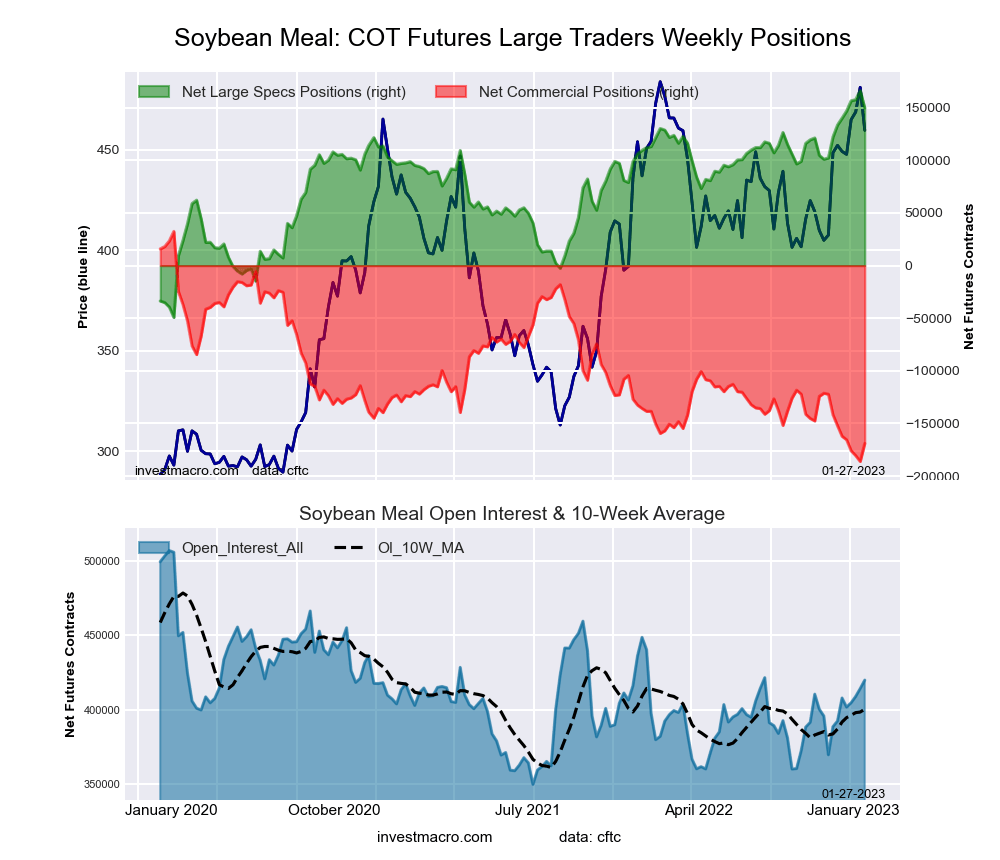
Soybean Meal


The Soybean Meal speculator position comes in as the most bullish extreme standing this week. The Soybean Meal speculator level is currently at a 100.0 percent score of its 3-year range.

The six-week trend for the percent strength score totaled a gain of 27.0 this week. The overall net speculator position was a total of 156,568 net contracts this week with a rise of 9,695 contracts in this week’s speculator bets.


Bloomberg Commodity Index


The Bloomberg Commodity Index speculator position comes next in the extreme standings this week. The Bloomberg Commodity Index speculator level is now at a 91.0 percent score of its 3-year range.

The six-week trend for the percent strength score was a small gain of 2.2 this week. The speculator position registered -4,301 net contracts this week with a weekly decline of -980 contracts in speculator bets.


Bitcoin


The Bitcoin speculator position comes in third this week in the extreme standings. The Bitcoin speculator level resides at a 83.7 percent score of its 3-year range.

The six-week trend for the speculator strength score came in at -5.5 this week. The speculator position was 389 net contracts this week with a change of -304 contracts in this week’s speculator bets.


Brazil Real


The Brazil Real speculator position comes up number four in the extreme standings this week. The Brazil Real speculator level is at a 76.1 percent score of its 3-year range.

The six-week trend for the speculator strength score totaled a change of 20.9 this week. The speculator position was 28,211 net contracts this week with a rise by 20,796 contracts in this week’s speculator bets.


Nasdaq


The Nasdaq speculator position rounds out the top five in this week’s bullish extreme standings. The Nasdaq speculator level sits at a 75.8 percent score of its 3-year range.

The six-week trend for the speculator strength score was -0.9 this week. The speculator position was 1,362 net contracts this week with a small gain of 190 contracts in this week’s speculator bets.


This Week’s Most Bearish Speculator Positions:

Ultra 10-Year U.S. T-Note


The Ultra 10-Year U.S. T-Note speculator position comes in as the most bearish extreme standing this week. The Ultra 10-Year U.S. T-Note speculator level is at a 0.0 percent score of its 3-year range.

The six-week trend for the speculator strength score was -2.1 this week. The speculator position was -113,357 net contracts this week with a shortfall of -30,091 contracts in this week’s speculator bets.


Mexican Peso

The Mexican Peso speculator position comes in next for the most bearish extreme standing on the week. The Mexican Peso speculator level is at a 3.3 percent score of its 3-year range.

The six-week trend for the speculator strength score was -51.0 this week. The overall speculator position was -56,376 net contracts this week with a decrease of -4,650 contracts in this week’s speculator bets.


WTI Crude Oil


The WTI Crude Oil speculator position comes in as third most bearish extreme standing of the week. The WTI Crude Oil speculator level resides at a 4.5 percent score of its 3-year range.

The six-week trend for the speculator strength score was -6.6 this week. The speculator position was 227,607 net contracts this week with a drop by -20,011 contracts in this week’s speculator bets.


5-Year Bond


The 5-Year Bond speculator position comes in as this week’s fourth most bearish extreme standing. The 5-Year Bond speculator level is at a 4.9 percent score of its 3-year range.

The six-week trend for the speculator strength score was -16.4 this week. The overall speculator position was -652,919 net contracts this week with a small rise by 2,609 contracts in this week’s speculator bets.


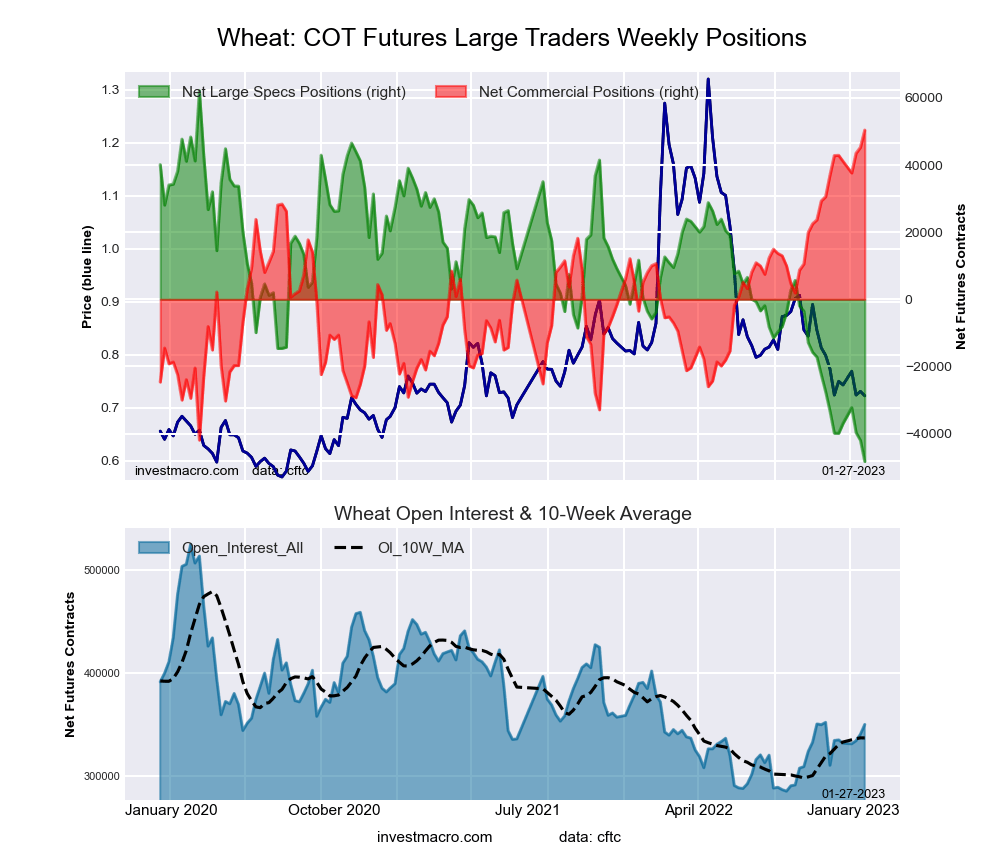
Wheat


Finally, the Wheat speculator position comes in as the fifth most bearish extreme standing for this week. The Wheat speculator level is at a 7.5 percent score of its 3-year range.

The six-week trend for the speculator strength score was -4.7 this week. The speculator position was -32,291 net contracts this week with an increase by 3,998 contracts in this week’s speculator bets.


Speculators or Non-Commercials Notes:

Speculators, classified as non-commercial traders by the CFTC, are made up of large commodity funds, hedge funds and other significant for-profit participants. The Specs are generally regarded as trend-followers in their behavior towards price action – net speculator bets and prices tend to go in the same directions. These traders often look to buy when prices are rising and sell when prices are falling. To illustrate this point, many times speculator contracts can be found at their most extremes (bullish or bearish) when prices are also close to their highest or lowest levels.

These extreme levels can be dangerous for the large speculators as the trade is most crowded, there is less trading ammunition still sitting on the sidelines to push the trend further and prices have moved a significant distance. When the trend becomes exhausted, some speculators take profits while others look to also exit positions when prices fail to continue in the same direction. This process usually plays out over many months to years and can ultimately create a reverse effect where prices start to fall and speculators start a process of selling when prices are falling.


Article By InvestMacroReceive our weekly COT Newsletter

*COT Report: The COT data, released weekly to the public each Friday, is updated through the most recent Tuesday (data is 3 days old) and shows a quick view of how large speculators or non-commercials (for-profit traders) were positioned in the futures markets.

The CFTC categorizes trader positions according to commercial hedgers (traders who use futures contracts for hedging as part of the business), non-commercials (large traders who speculate to realize trading profits) and nonreportable traders (usually small traders/speculators) as well as their open interest (contracts open in the market at time of reporting). See CFTC criteria here.


Metals Speculators push their Platinum bullish bets to 91-week high

By InvestMacro

Here are the latest charts and statistics for the Commitment of Traders (COT) data published by the Commodities Futures Trading Commission (CFTC).

The latest COT data is updated through Tuesday January 3rd and shows a quick view of how large traders (for-profit speculators and commercial entities) were positioned in the futures markets.

Weekly Speculator Changes led by Platinum & Gold

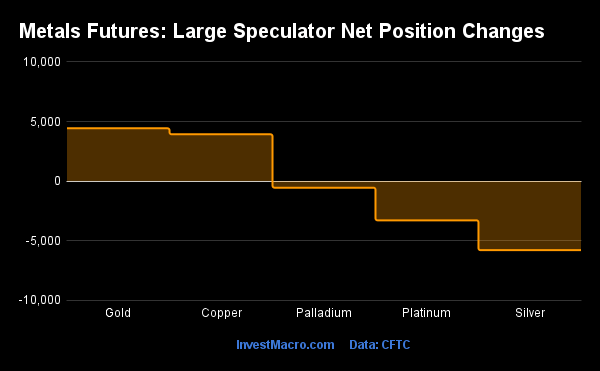
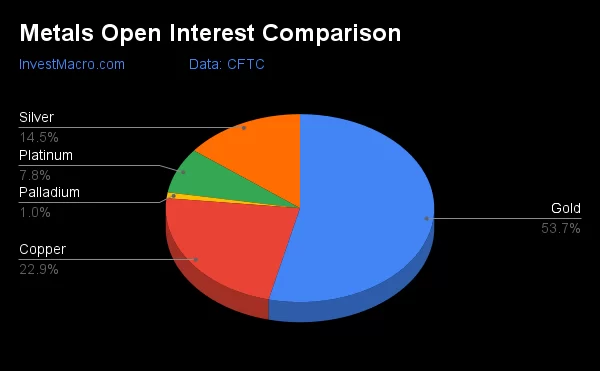
The COT metals markets speculator bets were lower this week as just two out of the five precious metals markets we cover had higher positioning while the other three markets had lower speculator contracts.

Leading the gains for the metals was Platinum (5,837 contracts) with Gold (4,786 contracts) also showing a positive week.

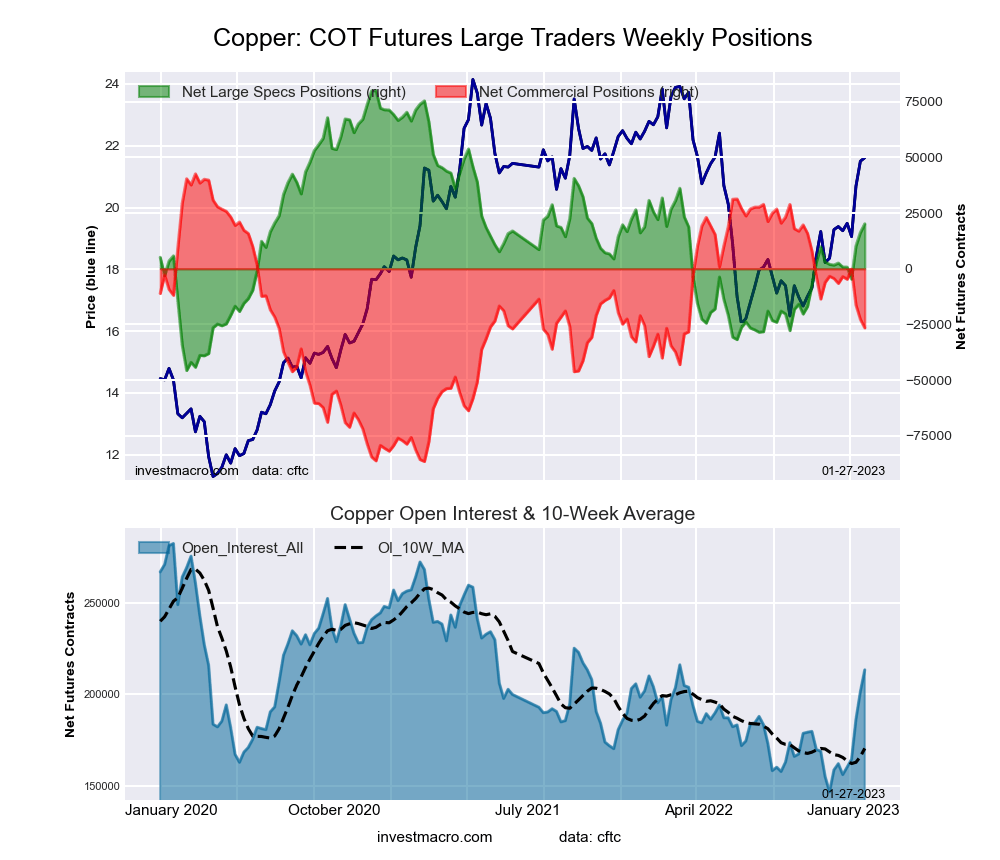
The markets with declines in speculator bets for the week were Copper (-5,399 contracts), Palladium (-336 contracts) and Silver (-93 contracts) registering lower bets on the week.

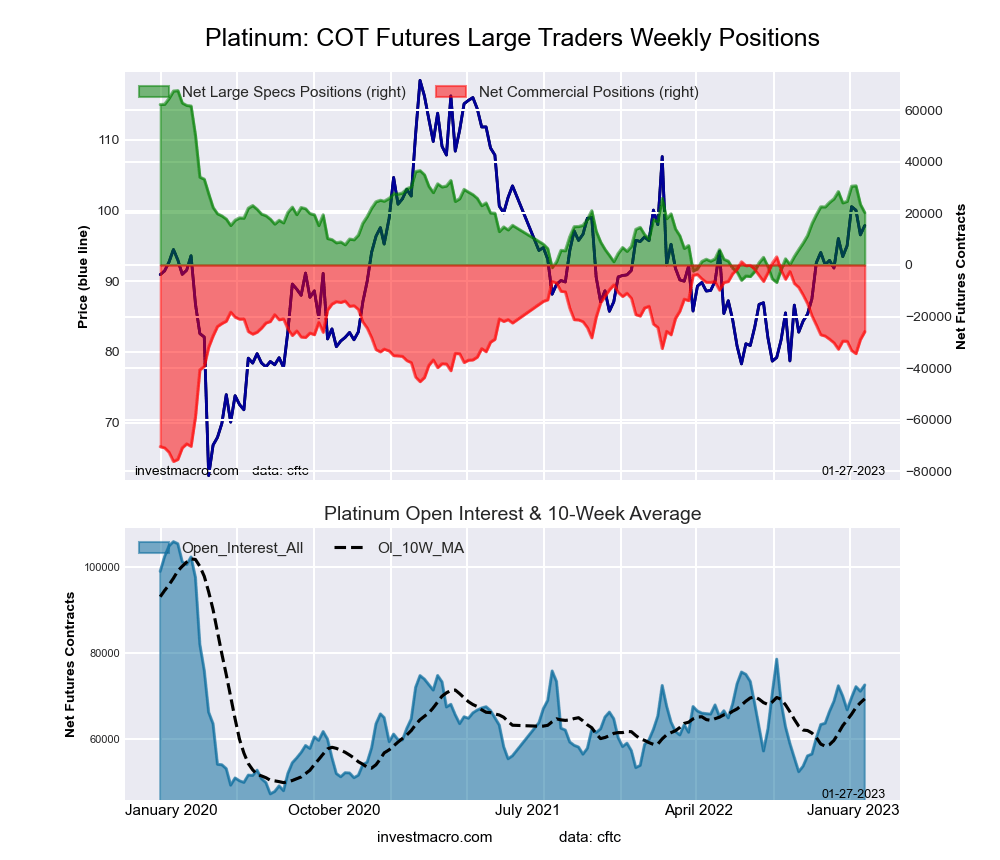
Highlighting the COT metals data this week is the continued gains in bets for the Platinum positions. The large speculator position in Platinum futures rose this week for a second straight week and for the fifth time over the past six weeks. Over the past fourteen weeks, Platinum bets have been higher in twelve of those weeks. The speculator position (sitting at +30,503 contracts) has now risen to the most bullish level since April 6th of 2021, a span of 91 weeks.

Platinum prices have been moving higher since hitting a multi-year low in early September as well. Since falling to a low just beneath $800 on September 1st, Platinum futures have been in a strong uptrend and closed this week above the $1100 price level for an almost 40 percent rise (since Sept. 1st) and the highest weekly close since March 2022.


Data Snapshot of Commodity Market Traders | Columns Legend
Jan-03-2023OIOI-IndexSpec-NetSpec-IndexCom-NetCOM-IndexSmalls-NetSmalls-Index
Gold449,3937141,66630-159,9747018,30826
Silver131,990930,93448-44,2115313,27737
Copper164,59413-4,67533-163674,83853
Palladium8,45612-2,542102,4228712049
Platinum69,6873830,50350-33,157542,6544


Strength Scores led by Platinum & Silver

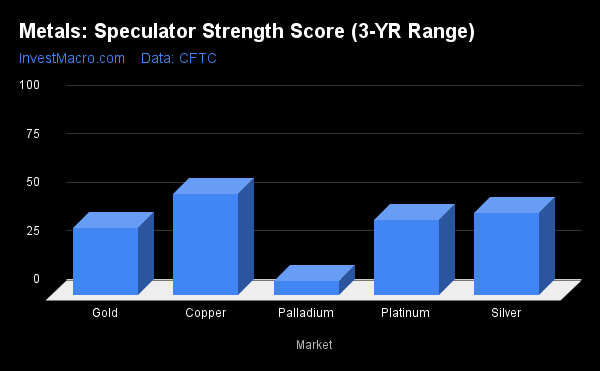
COT Strength Scores (a normalized measure of Speculator positions over a 3-Year range, from 0 to 100 where above 80 is Extreme-Bullish and below 20 is Extreme-Bearish) showed that the Platinum (50 percent) leads the metals markets this week. Silver (48 percent) comes in as the next highest in the weekly strength scores.

On the downside, Palladium (10 percent) comes in at the lowest strength level currently and is in Extreme-Bearish territory (below 20 percent). The next lowest strength score was Gold (30 percent).

Strength Statistics:
Gold (29.7 percent) vs Gold previous week (28.1 percent)
Silver (48.2 percent) vs Silver previous week (48.3 percent)
Copper (32.6 percent) vs Copper previous week (36.9 percent)
Platinum (50.1 percent) vs Platinum previous week (42.3 percent)
Palladium (9.8 percent) vs Palladium previous week (12.0 percent)


Silver & Platinum top the 6-Week Strength Trends

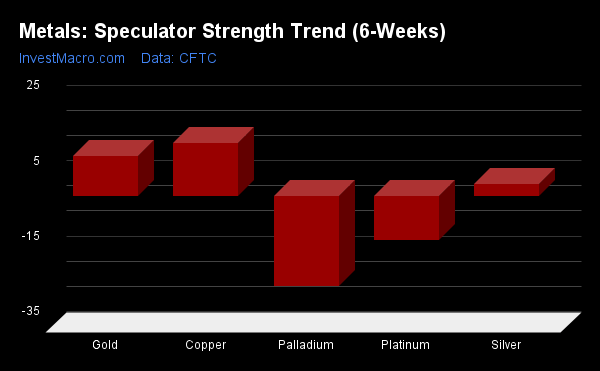
COT Strength Score Trends (or move index, calculates the 6-week changes in strength scores) showed that Silver (16 percent) leads the past six weeks trends for metals. Platinum (11 percent) is the next highest positive mover in the latest trends data.

Palladium (-9 percent) leads the downside trend scores currently with Copper (-6 percent) as the next market with lower trend scores.

Move Statistics:
Gold (8.5 percent) vs Gold previous week (3.5 percent)
Silver (15.6 percent) vs Silver previous week (14.8 percent)
Copper (-6.2 percent) vs Copper previous week (-7.2 percent)
Platinum (10.8 percent) vs Platinum previous week (2.9 percent)
Palladium (-9.3 percent) vs Palladium previous week (-7.4 percent)


Individual Markets:

Gold Comex Futures:
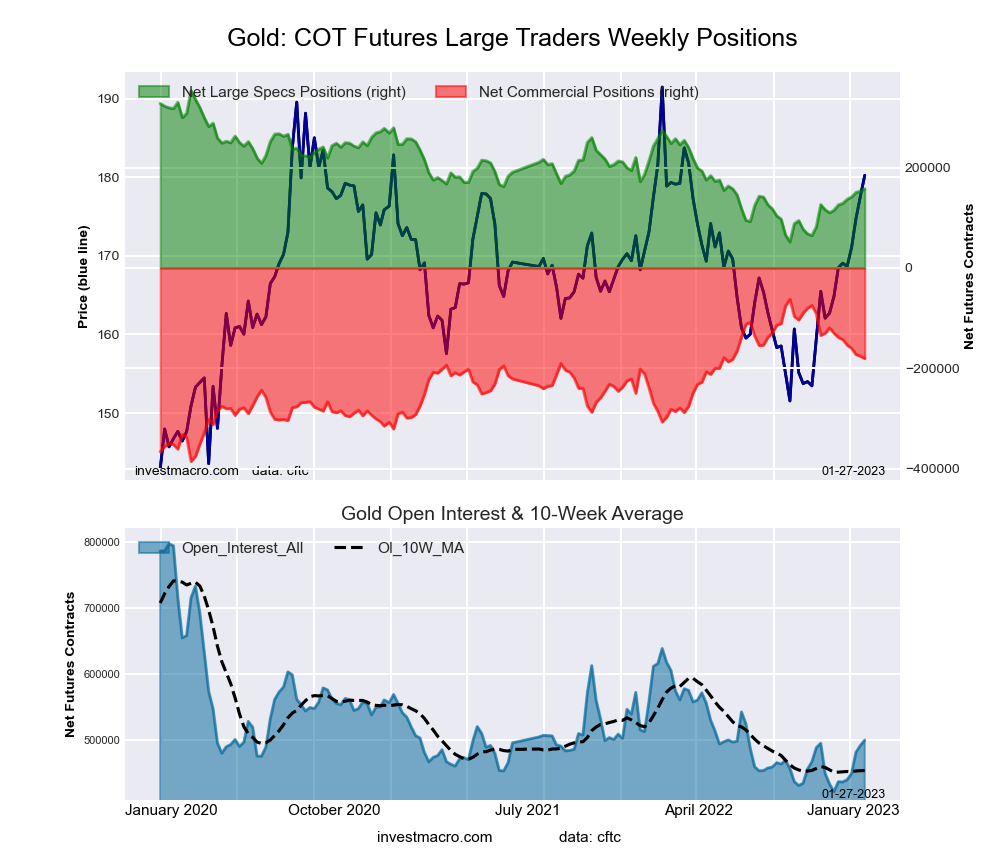
Gold Futures COT ChartThe Gold Comex Futures large speculator standing this week was a net position of 141,666 contracts in the data reported through Tuesday. This was a weekly lift of 4,786 contracts from the previous week which had a total of 136,880 net contracts.

This week’s current strength score (the trader positioning range over the past three years, measured from 0 to 100) shows the speculators are currently Bearish with a score of 29.7 percent. The commercials are Bullish with a score of 69.8 percent and the small traders (not shown in chart) are Bearish with a score of 25.8 percent.

Gold Futures StatisticsSPECULATORSCOMMERCIALSSMALL TRADERS
– Percent of Open Interest Longs:51.425.39.4
– Percent of Open Interest Shorts:19.860.95.3
– Net Position:141,666-159,97418,308
– Gross Longs:230,801113,52042,337
– Gross Shorts:89,135273,49424,029
– Long to Short Ratio:2.6 to 10.4 to 11.8 to 1
NET POSITION TREND:
– Strength Index Score (3 Year Range Pct):29.769.825.8
– Strength Index Reading (3 Year Range):BearishBullishBearish
NET POSITION MOVEMENT INDEX:
– 6-Week Change in Strength Index:8.5-9.211.0


Silver Comex Futures:

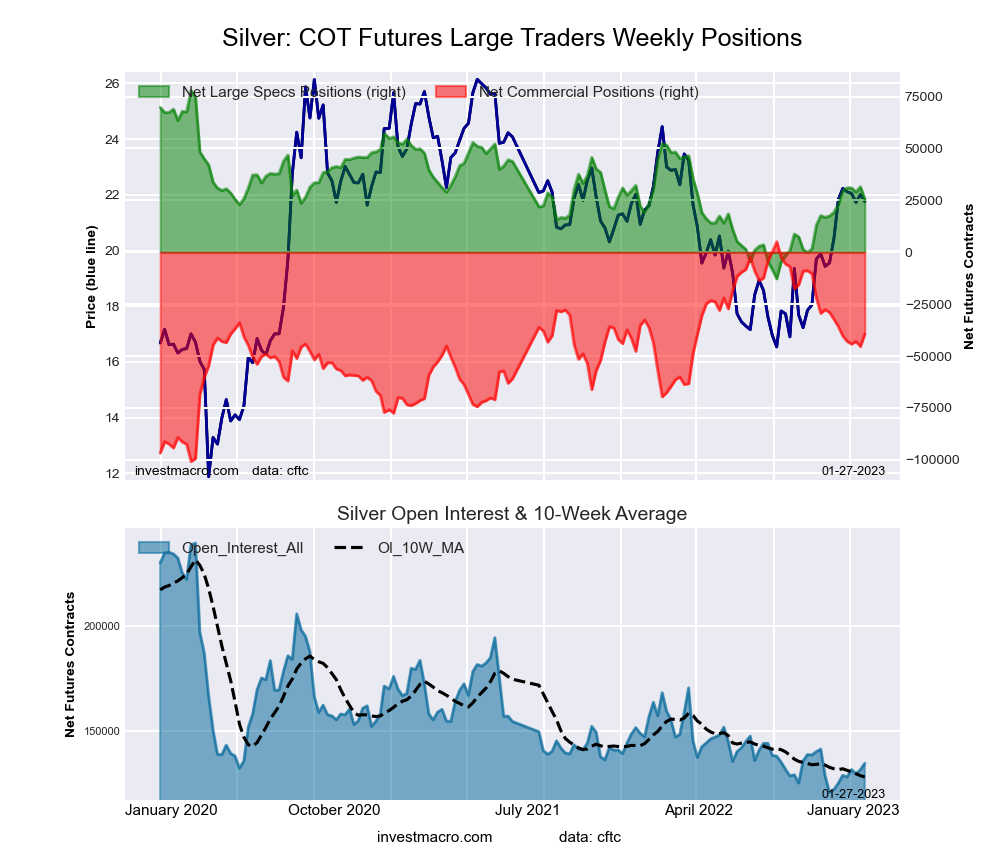
Silver Futures COT ChartThe Silver Comex Futures large speculator standing this week was a net position of 30,934 contracts in the data reported through Tuesday. This was a weekly reduction of -93 contracts from the previous week which had a total of 31,027 net contracts.

This week’s current strength score (the trader positioning range over the past three years, measured from 0 to 100) shows the speculators are currently Bearish with a score of 48.2 percent. The commercials are Bullish with a score of 53.5 percent and the small traders (not shown in chart) are Bearish with a score of 36.5 percent.

Silver Futures StatisticsSPECULATORSCOMMERCIALSSMALL TRADERS
– Percent of Open Interest Longs:43.833.517.9
– Percent of Open Interest Shorts:20.467.07.8
– Net Position:30,934-44,21113,277
– Gross Longs:57,80144,22923,576
– Gross Shorts:26,86788,44010,299
– Long to Short Ratio:2.2 to 10.5 to 12.3 to 1
NET POSITION TREND:
– Strength Index Score (3 Year Range Pct):48.253.536.5
– Strength Index Reading (3 Year Range):BearishBullishBearish
NET POSITION MOVEMENT INDEX:
– 6-Week Change in Strength Index:15.6-15.712.2


Copper Grade #1 Futures:

Copper Futures COT ChartThe Copper Grade #1 Futures large speculator standing this week was a net position of -4,675 contracts in the data reported through Tuesday. This was a weekly lowering of -5,399 contracts from the previous week which had a total of 724 net contracts.

This week’s current strength score (the trader positioning range over the past three years, measured from 0 to 100) shows the speculators are currently Bearish with a score of 32.6 percent. The commercials are Bullish with a score of 66.9 percent and the small traders (not shown in chart) are Bullish with a score of 53.3 percent.

Copper Futures StatisticsSPECULATORSCOMMERCIALSSMALL TRADERS
– Percent of Open Interest Longs:34.741.910.4
– Percent of Open Interest Shorts:37.642.07.4
– Net Position:-4,675-1634,838
– Gross Longs:57,19168,90517,079
– Gross Shorts:61,86669,06812,241
– Long to Short Ratio:0.9 to 11.0 to 11.4 to 1
NET POSITION TREND:
– Strength Index Score (3 Year Range Pct):32.666.953.3
– Strength Index Reading (3 Year Range):BearishBullishBullish
NET POSITION MOVEMENT INDEX:
– 6-Week Change in Strength Index:-6.24.610.6


Platinum Futures:

Platinum Futures COT ChartThe Platinum Futures large speculator standing this week was a net position of 30,503 contracts in the data reported through Tuesday. This was a weekly lift of 5,837 contracts from the previous week which had a total of 24,666 net contracts.

This week’s current strength score (the trader positioning range over the past three years, measured from 0 to 100) shows the speculators are currently Bullish with a score of 50.1 percent. The commercials are Bullish with a score of 54.2 percent and the small traders (not shown in chart) are Bearish-Extreme with a score of 3.9 percent.

Platinum Futures StatisticsSPECULATORSCOMMERCIALSSMALL TRADERS
– Percent of Open Interest Longs:59.626.99.9
– Percent of Open Interest Shorts:15.974.56.1
– Net Position:30,503-33,1572,654
– Gross Longs:41,55518,7346,879
– Gross Shorts:11,05251,8914,225
– Long to Short Ratio:3.8 to 10.4 to 11.6 to 1
NET POSITION TREND:
– Strength Index Score (3 Year Range Pct):50.154.23.9
– Strength Index Reading (3 Year Range):BullishBullishBearish-Extreme
NET POSITION MOVEMENT INDEX:
– 6-Week Change in Strength Index:10.8-7.1-31.8


Palladium Futures:

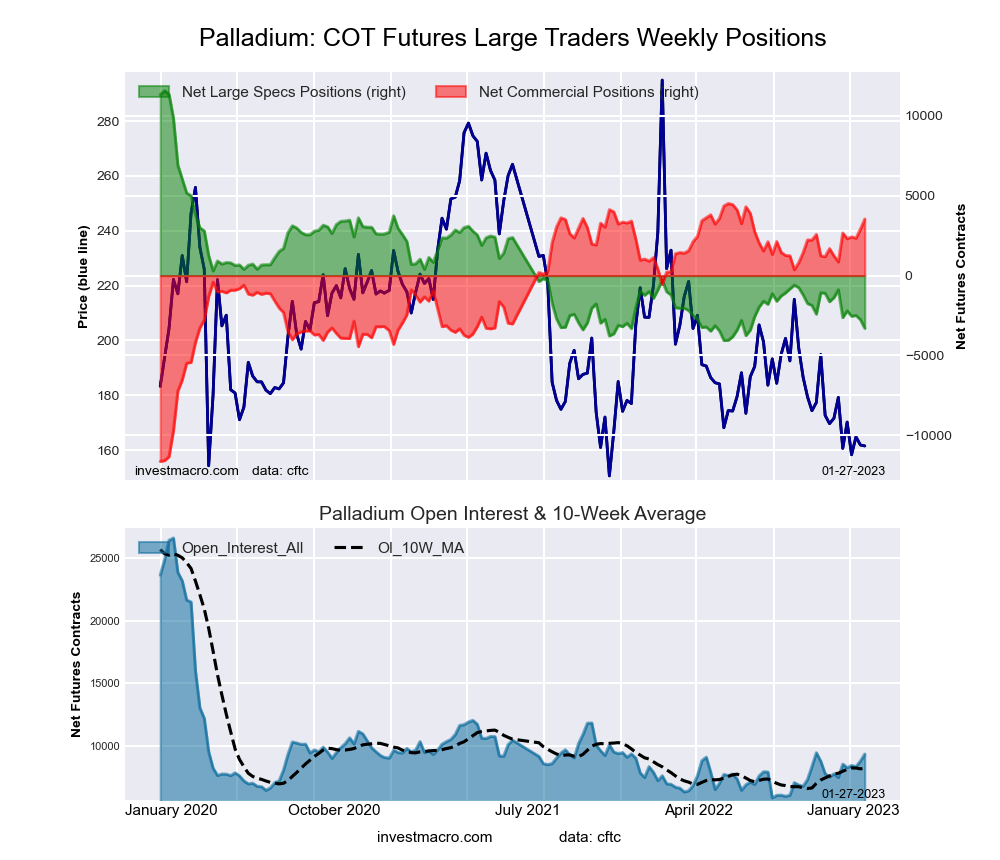
Palladium Futures COT ChartThe Palladium Futures large speculator standing this week was a net position of -2,542 contracts in the data reported through Tuesday. This was a weekly reduction of -336 contracts from the previous week which had a total of -2,206 net contracts.

This week’s current strength score (the trader positioning range over the past three years, measured from 0 to 100) shows the speculators are currently Bearish-Extreme with a score of 9.8 percent. The commercials are Bullish-Extreme with a score of 86.8 percent and the small traders (not shown in chart) are Bearish with a score of 48.9 percent.

Palladium Futures StatisticsSPECULATORSCOMMERCIALSSMALL TRADERS
– Percent of Open Interest Longs:25.155.615.0
– Percent of Open Interest Shorts:55.126.913.6
– Net Position:-2,5422,422120
– Gross Longs:2,1204,7001,270
– Gross Shorts:4,6622,2781,150
– Long to Short Ratio:0.5 to 12.1 to 11.1 to 1
NET POSITION TREND:
– Strength Index Score (3 Year Range Pct):9.886.848.9
– Strength Index Reading (3 Year Range):Bearish-ExtremeBullish-ExtremeBearish
NET POSITION MOVEMENT INDEX:
– 6-Week Change in Strength Index:-9.37.811.9


Article By InvestMacroReceive our weekly COT Newsletter

*COT Report: The COT data, released weekly to the public each Friday, is updated through the most recent Tuesday (data is 3 days old) and shows a quick view of how large speculators or non-commercials (for-profit traders) were positioned in the futures markets.

The CFTC categorizes trader positions according to commercial hedgers (traders who use futures contracts for hedging as part of the business), non-commercials (large traders who speculate to realize trading profits) and nonreportable traders (usually small traders/speculators) as well as their open interest (contracts open in the market at time of reporting). See CFTC criteria here.