Speculator Extremes: MXN Peso, Cocoa, Lean Hogs & 2-Year lead Bullish & Bearish Positions

By InvestMacro 

The latest update for the weekly Commitment of Traders (COT) report was released by the Commodity Futures Trading Commission (CFTC) on Friday for data ending on May 16th.

This weekly Extreme Positions report highlights the Most Bullish and Most Bearish Positions for the speculator category. Extreme positioning in these markets can foreshadow strong moves in the underlying market.

To signify an extreme position, we use the Strength Index (also known as the COT Index) of each instrument, a common method of measuring COT data. The Strength Index is simply a comparison of current trader positions against the range of positions over the previous 3 years. We use over 80 percent as extremely bullish and under 20 percent as extremely bearish. (Compare Strength Index scores across all markets in the data table or cot leaders table)


Here Are This Week’s Most Bullish Speculator Positions:

Mexican Peso

The Mexican Peso speculator position comes in as the most bullish extreme standing this week. The Mexican Peso speculator level is currently at a 100.0 percent score of its 3-year range.

The six-week trend for the percent strength score totaled 11.4 this week. The overall net speculator position was a total of 73,635 net contracts this week with a gain of 3,603 contract in the weekly speculator bets.


Bloomberg Commodity Index

The Bloomberg Commodity Index speculator position comes next in the extreme standings this week. The Bloomberg Commodity Index speculator level is now at a 100.0 percent score of its 3-year range.

The six-week trend for the percent strength score was 9.6 this week. The speculator position registered -1,697 net contracts this week with a weekly rise of 404 contracts in speculator bets.


Cocoa Futures

The Cocoa Futures speculator position comes in third this week in the extreme standings. The Cocoa Futures speculator level resides at a 100.0 percent score of its 3-year range.

The six-week trend for the speculator strength score came in at 4.7 this week. The overall speculator position was 64,055 net contracts this week with a gain of 2,026 contracts in the weekly speculator bets.


Bitcoin

The Bitcoin speculator position comes up number four in the extreme standings this week. The Bitcoin speculator level is at a 94.6 percent score of its 3-year range.

The six-week trend for the speculator strength score totaled a change of 28.4 this week. The overall speculator position was 1,011 net contracts this week with an increase of 588 contracts in the speculator bets.


Live Cattle

The Live Cattle speculator position rounds out the top five in this week’s bullish extreme standings. The Live Cattle speculator level sits at a 92.6 percent score of its 3-year range. The six-week trend for the speculator strength score was 17.9 this week.

The speculator position was 102,116 net contracts this week with a rise of 4,279 contracts in the weekly speculator bets.


This Week’s Most Bearish Speculator Positions:

Lean Hogs

The Lean Hogs speculator position comes in as the most bearish extreme standing this week. The Lean Hogs speculator level is at a 0.0 percent score of its 3-year range.

The six-week trend for the speculator strength score was -7.8 this week. The overall speculator position was -28,734 net contracts this week with a decline of -2,659 contracts in the speculator bets.


Soybean Oil

The Soybean Oil speculator position comes in next for the most bearish extreme standing on the week. The Soybean Oil speculator level is at a 0.0 percent score of its 3-year range.

The six-week trend for the speculator strength score was -11.8 this week. The speculator position was -29,483 net contracts this week with a drop of -21,208 contracts in the weekly speculator bets.


2-Year Bond

The 2-Year Bond speculator position comes in as third most bearish extreme standing of the week. The 2-Year Bond speculator level resides at a 0.0 percent score of its 3-year range.

The six-week trend for the speculator strength score was -37.3 this week. The overall speculator position was -853,575 net contracts this week with a decrease of -103,690 contracts in the speculator bets.


S&P500 Mini

The S&P500 Mini speculator position comes in as this week’s fourth most bearish extreme standing. The S&P500 Mini speculator level is at a 0.0 percent score of its 3-year range.

The six-week trend for the speculator strength score was -10.8 this week. The speculator position was -388,721 net contracts this week with a shortfall of -12,698 contracts in the weekly speculator bets.


5-Year Bond

Finally, the 5-Year Bond speculator position comes in as the fifth most bearish extreme standing for this week. The 5-Year Bond speculator level is at a 0.0 percent score of its 3-year range.

The six-week trend for the speculator strength score was -14.0 this week. The speculator position was -923,913 net contracts this week with a drop of -13,271 contracts in the weekly speculator bets.


Article By InvestMacroReceive our weekly COT Newsletter

Speculators or Non-Commercials Notes:

Speculators, classified as non-commercial traders by the CFTC, are made up of large commodity funds, hedge funds and other significant for-profit participants. The Specs are generally regarded as trend-followers in their behavior towards price action – net speculator bets and prices tend to go in the same directions. These traders often look to buy when prices are rising and sell when prices are falling. To illustrate this point, many times speculator contracts can be found at their most extremes (bullish or bearish) when prices are also close to their highest or lowest levels.

These extreme levels can be dangerous for the large speculators as the trade is most crowded, there is less trading ammunition still sitting on the sidelines to push the trend further and prices have moved a significant distance. When the trend becomes exhausted, some speculators take profits while others look to also exit positions when prices fail to continue in the same direction. This process usually plays out over many months to years and can ultimately create a reverse effect where prices start to fall and speculators start a process of selling when prices are falling.


*COT Report: The COT data, released weekly to the public each Friday, is updated through the most recent Tuesday (data is 3 days old) and shows a quick view of how large speculators or non-commercials (for-profit traders) were positioned in the futures markets.

The CFTC categorizes trader positions according to commercial hedgers (traders who use futures contracts for hedging as part of the business), non-commercials (large traders who speculate to realize trading profits) and nonreportable traders (usually small traders/speculators) as well as their open interest (contracts open in the market at time of reporting). See CFTC criteria here.

ChatGPT-powered Wall Street: The benefits and perils of using artificial intelligence to trade stocks and other financial instruments

By Pawan Jain, West Virginia University 

Artificial Intelligence-powered tools, such as ChatGPT, have the potential to revolutionize the efficiency, effectiveness and speed of the work humans do.

And this is true in financial markets as much as in sectors like health care, manufacturing and pretty much every other aspect of our lives.

I’ve been researching financial markets and algorithmic trading for 14 years. While AI offers lots of benefits, the growing use of these technologies in financial markets also points to potential perils. A look at Wall Street’s past efforts to speed up trading by embracing computers and AI offers important lessons on the implications of using them for decision-making.

Program trading fuels Black Monday

In the early 1980s, fueled by advancements in technology and financial innovations such as derivatives, institutional investors began using computer programs to execute trades based on predefined rules and algorithms. This helped them complete large trades quickly and efficiently.

Back then, these algorithms were relatively simple and were primarily used for so-called index arbitrage, which involves trying to profit from discrepancies between the price of a stock index – like the S&P 500 – and that of the stocks it’s composed of.

As technology advanced and more data became available, this kind of program trading became increasingly sophisticated, with algorithms able to analyze complex market data and execute trades based on a wide range of factors. These program traders continued to grow in number on the largey unregulated trading freeways – on which over a trillion dollars worth of assets change hands every day – causing market volatility to increase dramatically.

Eventually this resulted in the massive stock market crash in 1987 known as Black Monday. The Dow Jones Industrial Average suffered what was at the time the biggest percentage drop in its history, and the pain spread throughout the globe.

In response, regulatory authorities implemented a number of measures to restrict the use of program trading, including circuit breakers that halt trading when there are significant market swings and other limits. But despite these measures, program trading continued to grow in popularity in the years following the crash.

HFT: Program trading on steroids

Fast forward 15 years, to 2002, when the New York Stock Exchange introduced a fully automated trading system. As a result, program traders gave way to more sophisticated automations with much more advanced technology: High-frequency trading.

HFT uses computer programs to analyze market data and execute trades at extremely high speeds. Unlike program traders that bought and sold baskets of securities over time to take advantage of an arbitrage opportunity – a difference in price of similar securities that can be exploited for profit – high-frequency traders use powerful computers and high-speed networks to analyze market data and execute trades at lightning-fast speeds. High-frequency traders can conduct trades in approximately one 64-millionth of a second, compared with the several seconds it took traders in the 1980s.

These trades are typically very short term in nature and may involve buying and selling the same security multiple times in a matter of nanoseconds. AI algorithms analyze large amounts of data in real time and identify patterns and trends that are not immediately apparent to human traders. This helps traders make better decisions and execute trades at a faster pace than would be possible manually.

Another important application of AI in HFT is natural language processing, which involves analyzing and interpreting human language data such as news articles and social media posts. By analyzing this data, traders can gain valuable insights into market sentiment and adjust their trading strategies accordingly.

Benefits of AI trading

These AI-based, high-frequency traders operate very differently than people do.

The human brain is slow, inaccurate and forgetful. It is incapable of quick, high-precision, floating-point arithmetic needed for analyzing huge volumes of data for identifying trade signals. Computers are millions of times faster, with essentially infallible memory, perfect attention and limitless capability for analyzing large volumes of data in split milliseconds.

And, so, just like most technologies, HFT provides several benefits to stock markets.

These traders typically buy and sell assets at prices very close to the market price, which means they don’t charge investors high fees. This helps ensure that there are always buyers and sellers in the market, which in turn helps to stabilize prices and reduce the potential for sudden price swings.

High-frequency trading can also help to reduce the impact of market inefficiencies by quickly identifying and exploiting mispricing in the market. For example, HFT algorithms can detect when a particular stock is undervalued or overvalued and execute trades to take advantage of these discrepancies. By doing so, this kind of trading can help to correct market inefficiencies and ensure that assets are priced more accurately.

The downsides

But speed and efficiency can also cause harm.

HFT algorithms can react so quickly to news events and other market signals that they can cause sudden spikes or drops in asset prices.

Additionally, HFT financial firms are able to use their speed and technology to gain an unfair advantage over other traders, further distorting market signals. The volatility created by these extremely sophisticated AI-powered trading beasts led to the so-called flash crash in May 2010, when stocks plunged and then recovered in a matter of minutes – erasing and then restoring about $1 trillion in market value.

Since then, volatile markets have become the new normal. In 2016 research, two co-authors and I found that volatility – a measure of how rapidly and unpredictably prices move up and down – increased significantly after the introduction of HFT.

The speed and efficiency with which high-frequency traders analyze the data mean that even a small change in market conditions can trigger a large number of trades, leading to sudden price swings and increased volatility.

In addition, research I published with several other colleagues in 2021 shows that most high-frequency traders use similar algorithms, which increases the risk of market failure. That’s because as the number of these traders increases in the marketplace, the similarity in these algorithms can lead to similar trading decisions.

This means that all of the high-frequency traders might trade on the same side of the market if their algorithms release similar trading signals. That is, they all might try to sell in case of negative news or buy in case of positive news. If there is no one to take the other side of the trade, markets can fail.

Enter ChatGPT

That brings us to a new world of ChatGPT-powered trading algorithms and similar programs. They could take the problem of too many traders on the same side of a deal and make it even worse.

In general, humans, left to their own devices, will tend to make a diverse range of decisions. But if everyone’s deriving their decisions from a similar artificial intelligence, this can limit the diversity of opinion.

Consider an extreme, nonfinancial situation in which everyone depends on ChatGPT to decide on the best computer to buy. Consumers are already very prone to herding behavior, in which they tend to buy the same products and models. For example, reviews on Yelp, Amazon and so on motivate consumers to pick among a few top choices.

Since decisions made by the generative AI-powered chatbot are based on past training data, there would be a similarity in the decisions suggested by the chatbot. It is highly likely that ChatGPT would suggest the same brand and model to everyone. This might take herding to a whole new level and could lead to shortages in certain products and service as well as severe price spikes.

This becomes more problematic when the AI making the decisions is informed by biased and incorrect information. AI algorithms can reinforce existing biases when systems are trained on biased, old or limited data sets. And ChatGPT and similar tools have been criticized for making factual errors.

In addition, since market crashes are relatively rare, there isn’t much data on them. Since generative AIs depend on data training to learn, their lack of knowledge about them could make them more likely to happen.

For now, at least, it seems most banks won’t be allowing their employees to take advantage of ChatGPT and similar tools. Citigroup, Bank of America, Goldman Sachs and several other lenders have already banned their use on trading-room floors, citing privacy concerns.

But I strongly believe banks will eventually embrace generative AI, once they resolve concerns they have with it. The potential gains are too significant to pass up – and there’s a risk of being left behind by rivals.

But the risks to financial markets, the global economy and everyone are also great, so I hope they tread carefully.The Conversation

About the Author:

Pawan Jain, Assistant Professor of Finance, West Virginia University

This article is republished from The Conversation under a Creative Commons license. Read the original article.


The cryptocurrency market digest (BTC). Overview for 19.05.2023

By RoboForex.com

The BTC rate on Friday remains near 26,930 USD. The weekly growth is 2.5%.

The lack of consensus between the US Congress and the White House on the public debt issue is making investors cautious. As the correlation between the Nasdaq and S&P 500 indices and the BTC is restored, everything happening in the US stock market is directly connected.

The support level of 26,500 USD is still watched closely. It is important for the market to secure above 27,000 USD to develop an uptrend towards 29,800 USD.

The capitalisation of the crypto market remains at 1.124 trillion USD. BTC’s share has decreased to 46.3% and ETH’s share to 19.3%.

MicroStrategy is interested in Bitcoin Ordinals capabilities

MicroStrategy is exploring the potential of the Bitcoin Ordinals protocol to effectively use an innovative approach. This protocol is widely used for issuing NFTs, but MicroStrategy believes that its potential is much broader.

Lagrange Labs has raised 4 million USD

Lagrange Labs startup has raised 4 million USD in the pre-seed funding round for the development of the ZK system. The fundraising was led by the 1kx company. The ZK idea involves secure communication between different blockchain networks.

Article By RoboForex.com

Attention!
Forecasts presented in this section only reflect the author’s private opinion and should not be considered as guidance for trading. RoboForex LP bears no responsibility for trading results based on trading recommendations described in these analytical reviews.

Stock markets soar, investors warned of complacency

By George Prior

Stock markets are buoyant on optimism that the US will raise its debt ceiling, avoiding a default and global economic fallout, but investors now need to avoid complacency, warns the CEO and founder of one of the world’s largest independent financial advisory, asset management and fintech organizations.

The warning from deVere Group’s Nigel Green comes as Wall Street’s S&P 500 index and the Nasdaq Composite both reached their highest levels since August 2022, up 0.9% and 1.5%, respectively, on Thursday.

Meanwhile, Asia-Pacific markets rose on Friday and European markets are set to do the same at the open. US futures are also ticking higher.

The deVere CEO says: “A huge sense of relief is sweeping across stock markets after US policymakers said that a bill to raise the debt ceiling in the world’s largest economy may be put to a vote next week, raising the possibility of a deal to avoid a government default and the serious global economic repercussions that would follow.

“The reports coming out of Washington help restore confidence, stability and certainty – which markets thrive on – as they indicate that the US government will continue to meet its financial commitments.”

He continues: “However, investors must avoid complacency.

“While stock markets are enjoying this wave of buoyancy, with investors appearing to be looking beyond the current interest rate cycle and ahead to the next upswing in the economic cycle, core major bond markets continue to be marked by inverted yield curves, which suggest a recession is looming.

“The inverted yield curve indicates a recession is ahead because it’s a sign of a tight credit market and weak economic growth. The inversion has preceded most US recessions – which, of course, have a huge drag on the global economy – since 1950.

“With this disconnect between stocks and bonds, investors should brace themselves for significant volatility in global financial markets over the next few weeks. We could see a 10% correction.”

deVere believes that four key sectors would be mostly resilient in a recession. These include commodities, such as oil, as their prices typically rise in response to inflation; consumer staples like food, and hygiene products, as demand is likely to remain relatively stable; healthcare, as it provides essential services that are less affected by economic cycles; and utilities, including electricity, gas, and water as demand will also be typically consistent.

“While a resolution of the debt ceiling crisis may provide a temporary relief rally, it doesn’t guarantee sustained market growth or shield against other market risks.

“Investors need to be alive to the real challenges potentially coming down the track that could hit their returns if their portfolios are not properly diversified.”

About:

deVere Group is one of the world’s largest independent advisors of specialist global financial solutions to international, local mass affluent, and high-net-worth clients.  It has a network of more than 70 offices across the world, over 80,000 clients and $12bn under advisement.

Week Ahead: 4 Reasons To Closely Watch Gold

By ForexTime 

Gold prices could see some heightened volatility over the coming week due to US debt limit negotiations, the Fed minutes and key US economic data.

The past few days have certainly been rough for the precious metal with prices heading for their biggest weekly drop since February.

Before we take a deep dive into what factors may influence gold in the week ahead, here is a list of key economic reports and events to keep a close eye on:

Monday, May 22

  • CNY: China loan prime rates
  • EUR: Eurozone consumer confidence
  • USD: Fed speeches

Tuesday, May 23

  • EUR: Eurozone S&P Global Eurozone Manufacturing & Services PMI
  • GBP: S&P Global/ CIPS UK Manufacturing PMI
  • USD: US new home sales, Dallas Fed President Lorie Logan speech

Wednesday, May 24

  • NZD: Reserve Bank of New Zealand rate decision
  • EUR: Germany May IFO business climate
  • GBP: UK April CPI, Bank of England Governor Andrew Bailey speech
  • USD: Fed minutes

Thursday, May 25

  • EUR: Germany Q1 GDP (final)
  • USD: US initial jobless claims, Q1 GDP Annualised QoQ (second)

Friday, May 26

  • AUD: Australia April retail sales
  • JPY: Japan May Tokyo CPI
  • USD: US April PCE report, University of Michigan consumer sentiment   

Now, here are 4 reasons why we’re keeping a close eye on Gold:

  1. US Debt limit negotiations

The US Debt limit saga remains a hot topic that continues to influence global market sentiment.

To be clear, markets are not expecting the United States to default with traders pricing a less than 10% chance of it happening. Recent reports suggest that US President Joe Biden and top congressional Republican Kevin McCarthy are edging closer to a deal, with hopes rising over an agreement in principle by this weekend.

  • Gold prices could tumble further if there is a breakthrough in negotiations with the jump in risk appetite and potential boost to the dollar dragging prices towards the $1900 level.
  • Any hiccups in debt ceiling talks or further delays that shrink the window to strike a deal could send investors rushing back towards gold safe embrace. A wave of risk aversion and dollar weakness could push prices back above the psychological $2000 level.

Click here for more information about the US debt ceiling crisis.

  1. Fed minutes and speeches

The minutes from the latest Federal Reserve policy meeting and speeches from Fed officials could offer more clues about the central bank’s next move.

After raising interest rates by 25 basis points in May, the Federal Reserve signalled a potential pause. The minutes could offer more insight into the thinking of policymakers and how united they were around the idea of 5.25% being the peak level of rates. Should the minutes strike an overall dovish note, this may reinforce expectations around the Fed being done with rate hikes with the next move being a cut. However, a divide between participants could leave room for future hikes, especially if economic data warrants. It may also be wise to watch out for speeches from Fed officials in the first half of the week.

  • Gold bulls could fight back if the Fed minutes come across as dovish, with cautious Fed officials supporting any upside gains.
  • Any whiff of hawks or mention of additional hikes in the minutes may drag gold prices, with hawkish speeches from Fed officials rubbing salt into the wound.
  1. US April PCE report

The Fed’s preferred inflation gauge, the Core Personal Consumption Expenditure will be closely scrutinized by investors, especially after the central bank stressed that incoming data would influence monetary policy decisions.

Markets expect the April PCE report to show headline prices accelerated 0.3% month-over-month after March’s 0.1% increase while the core PCE deflator is forecast to rise 0.3%, same as March. The core personal consumption expenditures price index for projected to rise 4.5% year-over-year in April, down from the 4.6% seen in March.

Ultimately, more signs of cooling inflationary pressures could strengthen the argument around the Fed cutting interest rates late into the year. Traders are currently pricing in a 95% probability of a 25-basis point cut by the November Fed meeting, according to Fed funds futures.

  1. Gold breaches key support

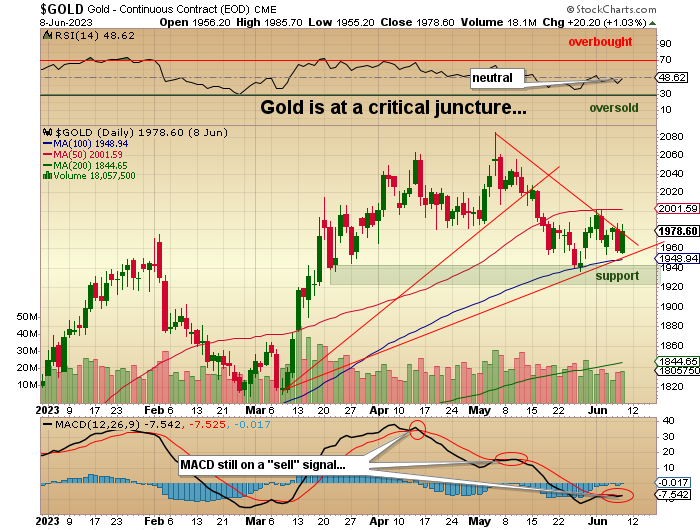
After securing a solid daily close below the $1970 level, bears have the freedom to run rampant in the week ahead.

Sustained weakness below this level could open a path back towards $1945 and $1900, respectively. If bulls are able to fight back and claw prices back above the psychological $2000 level, gold could test $2032 and $2045. Although the technicals favour further downside, the fundamentals could easily throw bulls a lifeline. Watch this space.


Forex-Time-LogoArticle by ForexTime

ForexTime Ltd (FXTM) is an award winning international online forex broker regulated by CySEC 185/12 www.forextime.com

Core inflation in Japan rose again to a 40-year high. Gold falls amid rising US government bonds

By JustMarkets

US stock indices rose yesterday, despite the growth of the dollar index. At the close of the stock market yesterday, the Dow Jones Index (US30) gained 0.34%, the S&P 500 Index (US500) added 0.94%, and the Nasdaq Technology Index (US100) jumped by 1.51%.

White House economic adviser Lael Brainard said Thursday that a default on the $31.4 trillion US debt would lead to a recession in the US economy. Brainard also pointed out that Biden’s negotiating team has been instructed not to agree to any Republican proposal to raise the debt ceiling that would deprive Americans of health care or plunge any of them into poverty. Republicans, who are threatening to default on the government, are trying to convince Democrats to accept tougher job requirements for some federal aid programs, as well as cut spending in exchange for lifting the borrowing limit.

“Hawkish” Fed officials (Laurie Logan and James Bullard) oppose a June rate hike pause. On Thursday, interest rate futures markets showed a 33.3% chance of a rate hike in June, up from a 90% chance just a week ago. Fed governor and vice presidential candidate Philip Jefferson, speaking Thursday, also said that while progress on inflation is slowing, it is too early to feel the full impact of these rapid rate hikes. Powell is scheduled to speak on Friday, and investors expect him to update his views in light of new economic data.

Shares of Walmart Inc (WMT) jumped by 1.3% after the largest US retailer reported first-quarter sales were up 8%.

Stock markets in Europe were mostly up yesterday. Germany’s DAX (DE30) added 1.33%, France’s CAC 40 (FR40) decreased by 0.64% yesterday, Spain’s IBEX 35 (ES35) was up 0.17% Thursday, Britain’s FTSE 100 (UK100) closed the day positive 0.25%.

The Turkish lira fell to a record low against the dollar on Thursday after incumbent President Tayyip Erdogan’s lead in the presidential election came as a surprise, while the country’s sovereign dollar bonds stabilized after a three-day drop following the election.

Oil fell by 1% Thursday as the dollar continued to rise on expectations of uncertainty in talks over a higher US government debt ceiling. The oil refineries in China in April increased by 18.9% compared to last year. Chinese refineries maintained a high growth rate to meet recovering domestic fuel demand and build stocks ahead of the summer tourist season.

The US dollar approached a six-month high against the yen on Friday amid rising US Treasury bond yields as uncertainty over debt ceiling talks in Washington raised expectations of higher interest rates. Gold has an inverse correlation to the dollar index and government bond yields, which is why it fell for a third straight day. But UBS analysts predict gold will reach $2,100 by the end of 2023 and $2,200 an ounce by March 2024, urging investors to keep the yellow metal in their portfolios.

Asian markets traded flat yesterday. Japan’s Nikkei 225 (JP225) gained 1.60% yesterday, China’s FTSE China A50 (CHA50) lost 0.26% over the day, Hong Kong’s Hang Seng (HK50) gained 0.85%, India’s NIFTY 50 (IND50) was 0.28% lower, while Australian S&P/ASX 200 (AU200) closed positive 0.52%.

Japan’s nationwide core consumer price index rose from 3.1% to 3.4% year-over-year, returning to 40-year highs after declining in the first quarter and foreshadowing increased pressure on the Bank of Japan to finally tighten policy this year.

Preliminary polls suggest that the Reserve Bank of New Zealand (RBNZ) will raise interest rates by another plus 0.25% at its May 24 meeting, but there will be a pause after that. The country’s largest banks, ANZ, ASB, Bank of New Zealand, Kiwi Bank, and Westpac, are also expecting a 25 basis point increase next week. Although the RBNZ was one of the first major global central banks to tighten monetary policy, inflation in the first quarter is still 6.7%, more than three times the RBNZ target of 2.0%.

S&P 500 (F) (US500) 4,198.05 +39.28 (+0.94%)

Dow Jones (US30)33,535.91 +115.14 (+0.34%)

DAX (DE40) 16,163.36 +212.06 (+1.33%)

FTSE 100 (UK100) 7,742.30 +19.07 (+0.25%)

USD Index 103.53 +0.65 +0.63%

Important events for today:
  • – New Zealand Trade Balance (m/m) at 01:45 (GMT+3);
  • – Japan National Core Consumer Price Index at 02:30 (GMT+3);
  • – Canada Retail Sales (m/m) at 15:30 (GMT+3);
  • – US FOMC Member Williams Speaks at 15:45 (GMT+3);
  • – US FOMC Member Bowman Speaks at 16:00 (GMT+3);
  • – US Fed Chair Powell Speaks at 18:00 (GMT+3);
  • – Eurozone ECB President Lagarde Speaks at 22:00 (GMT+3).

By JustMarkets


This article reflects a personal opinion and should not be interpreted as an investment advice, and/or offer, and/or a persistent request for carrying out financial transactions, and/or a guarantee, and/or a forecast of future events.

Long Live SOFR for Swaps

By Daniel Flaim, Managing Director, North America Interest Rate Derivatives

New York, New York | May 18, 2023 – It is officially the end of the line for LIBOR. After some 30+ years as “the world’s most important number,” and the last six years on an extended farewell tour, the London Interbank Offered Rate will officially be retired as a benchmark for U.S. dollar swaps transactions. CME Group completed its conversion to the Secured Overnight Financing Rate (SOFR) as the standard benchmark reference for over-the-counter (OTC) derivatives trades in April and LCH will complete its conversion containing U.S. dollar LIBOR vs. fixed interest rate swaps on May 20. By June, roughly $60 trillion in U.S. dollar contracts will be secured to SOFR.

Regulators first announced plans to phase out LIBOR in 2017, ushering in a protracted death march that saw the slow-but-steady migration away from the decades-old benchmark. Ultimately, the Alternative Reference Rates Committee (ARRC) selected SOFR as the overnight benchmark rate to use in certain new U.S. dollar derivatives and financial contracts, and the financial industry—including regulators, central banks, trading venues and other market participants—have spent the last several years getting ready for the transition.

Over the course of that multi-year migration, we’ve learned some important lessons:

Big and complicated problems can be solved when the industry sets its collective mind to something. This transition was no small feat but market participants and regulators quickly rallied together to organize and coordinate efforts ahead of upcoming target deadlines. The end result was a relatively smooth process thanks to solid preparation, decisive action and regular communications.

January 2022 was the moment of reckoning. Migration away from LIBOR was slow and steady before taking a drastic turn ahead of the January 2022 deadline for no new LIBOR origination. By February 2022, SOFR trading on Tradeweb made up 72% of all new risk, and across our business approximately 96% of our most active clients globally trading USD swaps were using SOFR.

This playbook can be utilized elsewhere. We have been pleased to see that the insights and lessons learned from the U.S. dollar LIBOR transition have already extended beyond our markets and into non-LIBOR jurisdictions, further illustrating the permanent impact this movement has had on our global markets.

Why LIBOR Was So Entrenched

Getting there was no small achievement. LIBOR didn’t earn its reputation as “the world’s most important number” for nothing. As the benchmark evolved over the last three decades, it’s been sliced and diced into multiple durations and both backward-looking and forward-looking rates that are used for everything from projecting market expectations for the cost of borrowing to the underlying benchmark for U.S. dollar swaps contracts. Financial technology also grew up around LIBOR, with virtually every piece of financial services software and nearly every financial model incorporating some link to the benchmark.

Thankfully, due to close collaboration between industry stakeholders including trading platforms, dealers and clients, clearinghouses and operators of order management systems, over the course of the transition period, this final step in the migration from LIBOR to SOFR in the swaps market is anticipated to be a smooth one.

Orderly Transition to a New Standard

In fact, much of the heavy lifting has already been done. As indicated in the chart below, the percentage of new U.S. dollar swaps trades benchmarked to SOFR and executed on the Tradeweb platform started to trend upward in August of 2021. That date followed the Commodity Futures Trading Commission’s (CFTC) Market Risk Advisory Committee (MRAC) SOFR First recommendation, which introduced a phased approach to the SOFR transition. In the following months, SOFR trading activity on the Tradeweb platform increased as clients began to offset their existing U.S. dollar LIBOR risk, with new SOFR activity reaching parity with LIBOR by January 2022, in response to the upcoming deadline which imposed restrictions on new use of U.S. dollar LIBOR. By February 2022, trading volume benchmarked to SOFR on the Tradeweb platform increased over 50% versus the previous month. In 2022 alone, we had nearly $21 trillion traded in SOFR on the platform.

Source: TW SEF, % of Delta, excluding basis and inflation swaps

Together, the steady forward march toward SOFR adoption for new trades, along with the industry’s diligent efforts to smooth the migration of existing contracts benchmarked to LIBOR, has helped pave the way for an incredibly orderly transition.

Following the success of the LIBOR transition in the U.S. dollar market, we’ve seen similar work being done in non-LIBOR jurisdictions, including Canada. Led by the Canadian Alternative Reference Rate Committee (CARR), Canada is shifting away from the benchmark Canadian Dollar Offered Rate (CDOR) to Canadian Overnight Repo Rate Average (CORRA) as the key Canadian interest rate benchmark. Globally, the LIBOR transition has served as a shining example of industry collaboration overcoming institutional inertia and debunking the myth that things need to be done a certain way just because that’s how they’ve always been done.

It took six years and there was no shortage of doubt and concern along the way, but the transition that the New York Federal Reserve called “arguably one of the most significant and complex challenges that financial markets will ever confront,” is about to be complete. It should come as a cause for celebration to the countless market participants who weren’t afraid to tweak the process, experiment with new standards and collaborate with peers to transform and modernize critical market infrastructure.

Now, as a result of this effort by so many parties, our markets are running smoothly and efficiently and we have proven once again how resilient and innovative our industry can be when we set our sights on a common goal. For our part at Tradeweb, we look forward to continuing to refine our workflows along with the some of the most accurate and timely pricing and reference data available to ensure our clients are operating in a transparent, efficient marketplace.

About Tradeweb Markets

Tradeweb Markets Inc. (Nasdaq: TW) is a leading, global operator of electronic marketplaces for rates, credit, equities and money markets. Founded in 1996, Tradeweb provides access to markets, data and analytics, electronic trading, straight-through-processing and reporting for more than 40 products to clients in the institutional, wholesale and retail markets. Advanced technologies developed by Tradeweb enhance price discovery, order execution and trade workflows while allowing for greater scale and helping to reduce risks in client trading operations. Tradeweb serves approximately 2,500 clients in more than 65 countries. On average, Tradeweb facilitated more than $1.1 trillion in notional value traded per day over the past four quarters. For more information, please go to www.tradeweb.com. 

Forward-Looking Statements

This release contains forward-looking statements within the meaning of the federal securities laws. Statements related to, among other things, our outlook and future performance, the industry and markets in which we operate, our expectations, beliefs, plans, strategies, objectives, prospects and assumptions and future events are forward-looking statements. We have based these forward-looking statements on our current expectations, assumptions, estimates and projections. While we believe these expectations, assumptions, estimates and projections are reasonable, such forward-looking statements are only predictions and involve known and unknown risks and uncertainties, many of which are beyond our control. These and other important factors, including those discussed under the heading “Risk Factors” in documents of Tradeweb Markets Inc. on file with or furnished to the SEC, may cause our actual results, performance or achievements to differ materially from those expressed or implied by these forward-looking statements. Given these risks and uncertainties, you are cautioned not to place undue reliance on such forward-looking statements. The forward-looking statements contained in this release are not guarantees of future performance and our actual results of operations, financial condition or liquidity, and the development of the industry and markets in which we operate, may differ materially from the forward-looking statements contained in this release. In addition, even if our results of operations, financial condition or liquidity, and events in the industry and markets in which we operate, are consistent with the forward-looking statements contained in this release, they may not be predictive of results or developments in future periods. Any forward-looking statement that we make in this release speaks only as of the date of such statement. Except as required by law, we do not undertake any obligation to update or revise, or to publicly announce any update or revision to, any of the forward-looking statements, whether as a result of new information, future events or otherwise, after the date of this release.

Debt ceiling talks continue. Australian labor market shows weakness

By JustMarkets

The US stock indices rose on Wednesday amid hopes that Congress will work out an agreement to raise the national debt ceiling, allowing the US to avoid defaulting on its obligations. At the close of the stock market yesterday, the Dow Jones Index (US30) gained 1.24%, the S&P 500 Index (US500) added 1.19%, and the Nasdaq Technology Index (US100) jumped by 1.28%. After yesterday’s meeting, lawmakers expressed optimism that a default can be avoided. US President Biden will travel to Japan today for a meeting of G-7 world leaders, but he cut the rest of his trip to Asia while the debt ceiling problem persists.

Debt negotiation is just one issue that has investors worried. Concerns are also high about a possible recession, which could well start later this year because of much higher interest rates. One of the main positives that has kept the economy out of recession so far has been steady spending by US households. They have continued to spend even as manufacturing, the US banking system, and other parts of the economy collapsed under the pressure of high-interest rates.

Shares of Tesla Inc (TSLA) jumped more than 4% after yesterday’s annual shareholder meeting, at which CEO Elon Musk said he intends to remain in office. It was also announced that the company will begin shipping its long-awaited Cybertruck later this year.

According to economic data, the number of new housing starts in the US in April was in line with expectations, but the numbers for March were revised downward.

Equity markets in Europe traded yesterday without a single dynamic. German DAX (DE30) gained 0.34%, French CAC 40 (FR40) decreased by 0.09% yesterday, Spanish IBEX 35 (ES35) added 0.22% on Wednesday, British FTSE 100 (UK100) closed negative by 0.32%.

The meeting of the G-7 countries will be held this weekend. It is noteworthy that China was not invited to the summit. The primary purpose of the meeting is to strengthen unity against challenges from Beijing and Moscow. All G7 countries – the United States, Japan, Germany, the United Kingdom, France, Canada, and Italy are closely linked economically with China, the world’s second-largest economy and a key global manufacturing base and market. Countries are puzzling over how to alert China to what they see as a threat to global supply chains and economic security without alienating a powerful and important trading partner.

Asian markets were mostly down yesterday, except the Japanese Index. Japan’s Nikkei 225 (JP225) gained 0.84%, China’s FTSE China A50 (CHA50) lost 0.71% over the day, Hong Kong’s Hang Seng (HK50) ended the day down by 2.09%, India’s NIFTY 50 (IND50) was down by 0.57%, and Australia’s S&P/ASX 200 (AU200) ended Wednesday down 0.37%. A larger-than-expected reduction in Japan’s trade deficit helped Japan’s Nikkei 225 Index (JP225) extend its winning streak for the sixth consecutive session.

Australia’s labor market unexpectedly contracted in April, and unemployment rose amid some cooling economic activity. Total national employment fell by 4,300 in April to 13.9 million, with expectations of an increase of 25,000. As a result, the unemployment rate increased from 3.5% to 3.7%. The potential cooling in the labor market is also due to the fact that interest rates in Australia have reached a ten-year high. The Reserve Bank of Australia (RBA) has warned that employment is likely to fall further this year as rates remain high or possibly increase further. Weakness in the labor market also gives the RBA less room to raise rates further.

New Zealand on Thursday announced a budget deficit more significant than originally forecast as tax cuts, rising inflation, and a slowing economy hit the nation’s treasury, forcing the government to minimize new spending and increase its bond program. New Zealand’s finance minister announced billions to rebuild infrastructure after severe weather earlier this year and some new initiatives to help those struggling with increased spending.

S&P 500 (F) (US500) 4,158.77 +48.87 (+1.19%)

Dow Jones (US30)33,420.77 +408.63 (+1.24%)

DAX (DE40) 15,951.30 +53.37 (+0.34%)

FTSE 100 (UK100) 7,723.23 −27.85 (−0.36%)

USD Index 102.89 +0.33 +0.32%

Important events for today:
  • – New Zealand Producer Price Index (q/q) at 01:45 (GMT+3);
  • – Japan Trade Balance (m/m) at 02:50 (GMT+3);
  • – Australia Unemployment Rate (m/m) at 04:30 (GMT+3);
  • – New Zealand Annual Budget Release at 05:00 (GMT+3);
  • – UK Monetary Policy Report Hearings at 12:15 (GMT+3);
  • – US Initial Jobless Claims (w/w) at 15:30 (GMT+3);
  • – US Philadelphia Fed Manufacturing Index (m/m) at 15:30 (GMT+3);
  • – US Existing Home Sales (m/m) at 17:00 (GMT+3);
  • – US Natural Gas Storage (w/w) at 17:30 (GMT+3).
  • – Canada BoC Gov Macklem Speaks at 18:00 (GMT+3).

By JustMarkets


This article reflects a personal opinion and should not be interpreted as an investment advice, and/or offer, and/or a persistent request for carrying out financial transactions, and/or a guarantee, and/or a forecast of future events.

War rooms and bailouts: How banks and the Fed are preparing for a US default – and the chaos expected to follow

By John W. Diamond, Rice University 

Convening war rooms, planning speedy bailouts and raising house-on-fire alarm bells: Those are a few of the ways the biggest banks and financial regulators are preparing for a potential default on U.S. debt.

“You hope it doesn’t happen, but hope is not a strategy – so you prepare for it,” Brian Moynihan, CEO of Bank of America, the nation’s second-biggest lender, said in a television interview.

The doomsday planning is a reaction to a lack of progress in talks between President Joe Biden and House Republicans over raising the US$31.4 trillion debt ceiling – another round of negotiations took place on May 16, 2023. Without an increase in the debt limit, the U.S. can’t borrow more money to cover its bills – all of which have already been agreed to by Congress – and in practical terms that means a default.

What happens if a default occurs is an open question, but economists – including me – generally expect financial chaos as access to credit dries up and borrowing costs rise quickly for companies and consumers. A severe and prolonged global economic recession would be all but guaranteed, and the reputation of the U.S. and the dollar as beacons of stability and safety would be further tarnished.

But how do you prepare for an event that many expect would trigger the worst global recession since the 1930s?

Preparing for panic

Jamie Dimon, who runs JPMorgan Chase, the biggest U.S. bank, told Bloomberg he’s been convening a weekly war room to discuss a potential default and how the bank should respond. The meetings are likely to become more frequent as June 1 – the date on which the U.S. might run out of cash – nears.

Dimon described the wide range of economic and financial effects that the group must consider such as the impact on “contracts, collateral, clearing houses, clients” – basically every corner of the financial system – at home and abroad.

“I don’t think it’s going to happen — because it gets catastrophic, and the closer you get to it, you will have panic,” he said.

That’s when rational decision-making gives way to fear and irrationality. Markets overtaken by these emotions are chaotic and leave lasting economic scars.

Banks haven’t revealed many of the details of how they are responding, but we can glean some clues from how they’ve reacted to past crises, such as the financial crisis in 2008 or the debt ceiling showdowns of 2011 and 2013.

One important way banks can prepare is by reducing exposure to Treasury securities – some or all of which could be considered to be in default once the U.S. exhausts its ability to pay all of its bill. All U.S. debts are referred to as Treasury bills or bonds.

The value of Treasurys is likely to plunge in the case of a default, which could weaken bank balance sheets even more. The recent bank crisis, in fact, was prompted primarily by a drop in the market value of Treasurys due to the sharp rise in interest rates over the past year. And a default would only make that problem worse, with close to 190 banks at risk of failure as of March 2023.

Another strategy banks can use to hedge their exposure to a sell-off in Treasurys is to buy credit default swaps, financial instruments that allow an investor to offset credit risk. Data suggests this is already happening, as the cost to protect U.S. government debt from default is higher than that of Brazil, Greece and Mexico, all of which have defaulted multiple times and have much lower credit ratings.

But buying credit default swaps at ever-higher prices limits a third key preventive measure for banks: keeping their cash balances as high as possible so they’re able and ready to deal with whatever happens in a default.

Keeping the financial plumbing working

Financial industry groups and financial regulators have also gamed out a potential default with an eye toward keeping the financial system running as best they can.

The Securities Industry and Financial Markets Association, for example, has been updating its playbook to dictate how players in the Treasurys market will communicate in case of a default.

And the Federal Reserve, which is broadly responsible for ensuring financial stability, has been pondering a U.S. default for over a decade. One such instance came in 2013, when Republicans demanded the elimination of the Affordable Care Act in exchange for raising the debt ceiling. Ultimately, Republicans capitulated and raised the limit one day before the U.S. was expected to run out of cash.

One of the biggest concerns Fed officials had at the time, according to a meeting transcript recently made public, is that the U.S. Treasury would no longer be able to access financial markets to “roll over” maturing debt. While hitting the current ceiling prevents the U.S. from issuing new debt that exceeds $31.4 trillion, the government still has to roll existing debt into new debt as it comes due. On May 15, 2023, for example, the government issued just under $100 billion in notes and bonds to replace maturing debt and raise cash.

The risk is that there would be too few buyers at one of the government’s daily debt auctions – at which investors from around the world bid to buy Treasury bills and bonds. If that happens, the government would have to use its cash on hand to pay back investors who hold maturing debt.

That would further reduce the amount of cash available for Social Security payments, federal employees wages and countless other items the government spent over $6 trillion on in 2022. This would be nothing short of apocalyptic if the Fed could not save the day.

To mitigate that risk, the Fed said it could could immediately step in as a buyer of last resort for Treasurys, quickly lower its lending rates and provide whatever funding is needed in an attempt to prevent financial contagion and collapse. The Fed is likely having the same conversations and preparing similar actions today.

A self-imposed catastrophe

Ultimately, I hope that Congress does what it has done in every previous debt ceiling scare: raise the limit.

These contentious debates over lifting it have become too commonplace, even as lawmakers on both sides of the aisle express concerns about the growing federal debt and the need to rein in government spending. Even when these debates result in some bipartisan effort to rein in spending, as they did in 2011, history shows they fail, as energy analyst Autumn Engebretson and I recently explained in a review of that episode.

That’s why one of the most important ways banks are preparing for such an outcome is by speaking out about the serious damage not raising the ceiling is likely to inflict on not only their companies but everyone else, too. This increases the pressure on political leaders to reach a deal.

Going back to my original question, how do you prepare for such a self-imposed catastrophe? The answer is, no one should have to.The Conversation

About the Author:

John W. Diamond, Director of the Center for Public Finance at the Baker Institute, Rice University

This article is republished from The Conversation under a Creative Commons license. Read the original article.

A decline in US retail sales indicates consumer weakness. Gold declines, but the outlook remains bullish

By JustMarkets

At yesterday’s stock market close, the Dow Jones Index (US30) decreased by 1.01%, and the S&P 500 Index (US500) fell by 0.64%. NASDAQ Technology Index (US100) closed yesterday down by 0.18%. After disappointing quarterly results, falling shares of Home Depot put pressure on shares. Home Depot (HD) stock fell more than 2% after reporting quarterly earnings that fell short of Wall Street expectations due to falling lumber prices. Retailer sentiment was also hurt by US retail sales data that fell short of expectations, signaling weaker consumer sentiment. The energy sector was the biggest headwind for the overall market, as weaker-than-expected economic data from China overshadowed expectations for higher energy demand.

Other economic data showed that US industrial production and manufacturing activity rose unexpectedly in April. Total industrial production increased by 0.5% m/m in April. The US manufacturing production rose by 1.0% m/m, beating expectations of 0.1%.

US President Joe Biden will partially shorten his trip to the G-7 leaders’ summit to intensify efforts to make progress on the debt ceiling agreement. Policymakers remain unable to reach a consensus, which increases the likelihood of a US default on June 1st.

Equity markets in Europe were mostly down yesterday. German DAX (DE30) decreased by 0.12%, French CAC 40 (FR40) fell by 0.16% yesterday, Spanish IBEX 35 (ES35) lost 0.11% Tuesday, British FTSE 100 (UK100) closed the day negative by 0.34%.

Eurozone GDP grew by a modest 0.1% over Q1 2023. The ZEW Institute report showed that the economic prospects of Germany and the Eurozone are starting to deteriorate again, and the reason for that is the steady inflation and rising interest rates.

Gold, the supposed hedge against economic and political turmoil, fell below $2,000 for the first time since early May. Economists are attributing the decline in gold prices to a possible bipartisan deal that would end the impasse and avoid a US default. But in the medium term, even if the debt ceiling is raised, the US Federal Reserve will press pause on its interest-rate hike cycle this summer, causing US government bond yields to begin falling, giving a boost to gold and silver.

The International Energy Agency raised its forecast for global oil demand by 200,000 BPD to a record 102 million BPD. Demand on the eve of the summer months is slowly but growing. With lower production, the bullish outlook for oil remains until autumn.

Asian markets traded yesterday without a single dynamic. Japan’s Nikkei 225 (JP225) gained 0.73% yesterday, China’s FTSE China A50 (CHA50) lost 0.39% on the day, Hong Kong’s Hang Seng (HK50) gained 0.04% on the day, India’s NIFTY 50 (IND50) fell by 0.61%, and Australia’s S&P/ASX 200 (AU200) was negative 0.45% on Tuesday.

The Nikkei 225 index jumped by 0.9% to a near 20-month high, continuing its recent gains as data showed Japan’s GDP grew more than expected in the first quarter, boosted mainly by strong consumer spending and outbound tourism. But the outlook for the economy remains bleak amid a sustained downturn in Japan’s largest export markets in the West.

Wage growth in Australia hit a decade high, but quarterly growth fell short of forecasts. The wage price index rose by 0.8% in the March quarter from the previous quarter. This provides some temporary solace for policymakers who fear that the price and wage spiral could lead to more rate hikes. Annual wage growth is expected to peak at 4.0% later this year and then decline to 3.7% by mid-2025.

S&P 500 (F) (US500) 4,109.90 −26.38 (−0.64%)

Dow Jones (US30)33,012.14 −336.46 (−1.01%)

DAX (DE40) 15,897.93 −19.31 (−0.12%)

FTSE 100 (UK100) 7,751.08 −26.62 (−0.34%)

USD Index 102.63 +0.19 +0.19%

Important events for today:
  • – Japan GDP (q/q) at 02:50 (GMT+3);
  • – Australia Wage Price Index (q/q) at 04:30 (GMT+3);
  • – Japan Industrial Production (m/m) at 07:30 (GMT+3);
  • – Eurozone Consumer Price Index (m/m) at 12:00 (GMT+3);
  • – UK BoE Gov Bailey Speaks at 12:50 (GMT+3);
  • – US Building Permits (m/m) at 15:30 (GMT+3);
  • – US Crude Oil Reserves (w/w) at 17:30 (GMT+3).

By JustMarkets


This article reflects a personal opinion and should not be interpreted as an investment advice, and/or offer, and/or a persistent request for carrying out financial transactions, and/or a guarantee, and/or a forecast of future events.