COT Stock Market Charts: Weekly Speculator Changes led by VIX & DowJones-Mini

By InvestMacro

Here are the latest charts and statistics for the Commitment of Traders (COT) data published by the Commodities Futures Trading Commission (CFTC).

The latest COT data is updated through Monday July 3rd and shows a quick view of how large traders (for-profit speculators and commercial entities) were positioned in the futures markets.

Weekly Speculator Changes led by VIX & DowJones-Mini

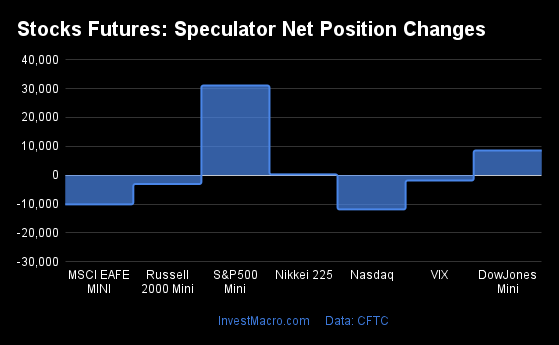
The COT stock markets speculator bets were higher this week as five out of the seven stock markets we cover had higher positioning while the other three markets had lower speculator contracts.

Leading the gains for the stock markets was VIX (9,797 contracts) with the DowJones-Mini (5,840 contracts), the MSCI EAFE-Mini (4,241 contracts), the S&P500-Mini (1,011 contracts) and the Nikkei 225 (61 contracts) also showing positive weeks.

The markets with the declines in speculator bets this week were with the Nasdaq-Mini (-11,784 contracts) and the Russell-Mini (-3,810 contracts) also registering lower bets on the week.


Data Snapshot of Stock Market Traders | Columns Legend
Jul-03-2023OIOI-IndexSpec-NetSpec-IndexCom-NetCOM-IndexSmalls-NetSmalls-Index
S&P500-Mini2,211,00422-207,23934205,791681,44845
Nikkei 22516,35917-6,185294,671641,51447
Nasdaq-Mini248,698295,45880-3,88320-1,57550
DowJones-Mini95,16155-13,0823714,23663-1,15438
VIX406,80576-54,9247958,02217-3,09880
Nikkei 225 Yen57,3184910,9656815,89654-26,86120


Strength Scores led by Nasdaq-Mini & VIX

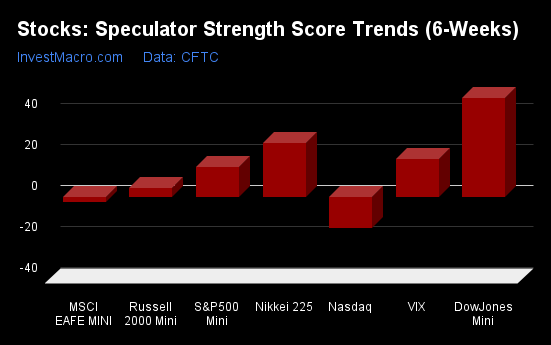
COT Strength Scores (a normalized measure of Speculator positions over a 3-Year range, from 0 to 100 where above 80 is Extreme-Bullish and below 20 is Extreme-Bearish) showed that the Nasdaq-Mini (80 percent) and the VIX (79 percent) lead the stock markets this week. The Nikkei 225 Yen (68 percent) and DowJones-Mini (37 percent) come in as the next highest in the weekly strength scores.

On the downside, the Nikkei 225 (29 percent) comes in at the lowest strength level currently with the next lowest strength score being the MSCI EAFE-Mini (30 percent).

Strength Statistics:
VIX (79.4 percent) vs VIX previous week (72.2 percent)
S&P500-Mini (33.8 percent) vs S&P500-Mini previous week (33.7 percent)
DowJones-Mini (36.9 percent) vs DowJones-Mini previous week (20.4 percent)
Nasdaq-Mini (80.3 percent) vs Nasdaq-Mini previous week (87.1 percent)
Russell2000-Mini (31.5 percent) vs Russell2000-Mini previous week (33.8 percent)
Nikkei USD (28.7 percent) vs Nikkei USD previous week (28.3 percent)
EAFE-Mini (29.9 percent) vs EAFE-Mini previous week (24.7 percent)


S&P500-Mini & DowJones-Mini top the 6-Week Strength Trends

COT Strength Score Trends (or move index, calculates the 6-week changes in strength scores) showed that the S&P500-Mini (29 percent) leads the past six weeks trends for the stock markets. The DowJones-Mini (27 percent), the MSCI EAFE-Mini (11 percent) and the VIX (7 percent) are the next highest positive movers in the latest trends data.

The Russell-Mini (-11 percent) leads the downside trend scores currently with the Nasdaq-Mini (-5 percent) coming in as the next market with lower trend scores.

Strength Trend Statistics:
VIX (7.1 percent) vs VIX previous week (-7.6 percent)
S&P500-Mini (29.4 percent) vs S&P500-Mini previous week (26.9 percent)
DowJones-Mini (27.3 percent) vs DowJones-Mini previous week (7.7 percent)
Nasdaq-Mini (-5.2 percent) vs Nasdaq-Mini previous week (-1.6 percent)
Russell2000-Mini (-11.2 percent) vs Russell2000-Mini previous week (0.2 percent)
Nikkei USD (-4.4 percent) vs Nikkei USD previous week (-11.2 percent)
EAFE-Mini (10.7 percent) vs EAFE-Mini previous week (1.0 percent)


Individual Stock Market Charts:

VIX Volatility Futures:

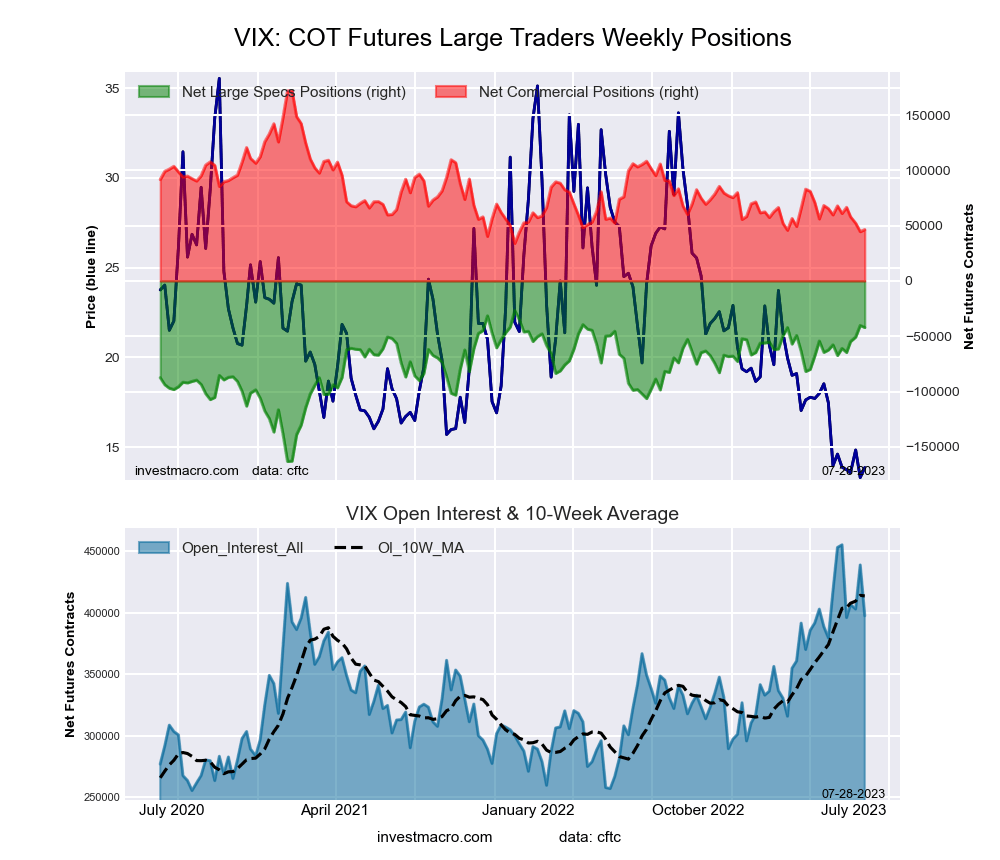
VIX Volatility Futures COT ChartThe VIX Volatility large speculator standing this week reached a net position of -54,924 contracts in the data reported through Tuesday. This was a weekly increase of 9,797 contracts from the previous week which had a total of -64,721 net contracts.

This week’s current strength score (the trader positioning range over the past three years, measured from 0 to 100) shows the speculators are currently Bullish with a score of 79.4 percent. The commercials are Bearish-Extreme with a score of 17.5 percent and the small traders (not shown in chart) are Bullish-Extreme with a score of 80.1 percent.

Price Trend-Following Model: Downtrend

Our weekly trend-following model classifies the current market price position as: Downtrend. The current action for the model is considered to be: Hold – Maintain Short Position.

VIX Volatility Futures StatisticsSPECULATORSCOMMERCIALSSMALL TRADERS
– Percent of Open Interest Longs:23.250.26.4
– Percent of Open Interest Shorts:36.735.97.2
– Net Position:-54,92458,022-3,098
– Gross Longs:94,274204,07126,095
– Gross Shorts:149,198146,04929,193
– Long to Short Ratio:0.6 to 11.4 to 10.9 to 1
NET POSITION TREND:
– Strength Index Score (3 Year Range Pct):79.417.580.1
– Strength Index Reading (3 Year Range):BullishBearish-ExtremeBullish-Extreme
NET POSITION MOVEMENT INDEX:
– 6-Week Change in Strength Index:7.1-7.32.2


S&P500 Mini Futures:

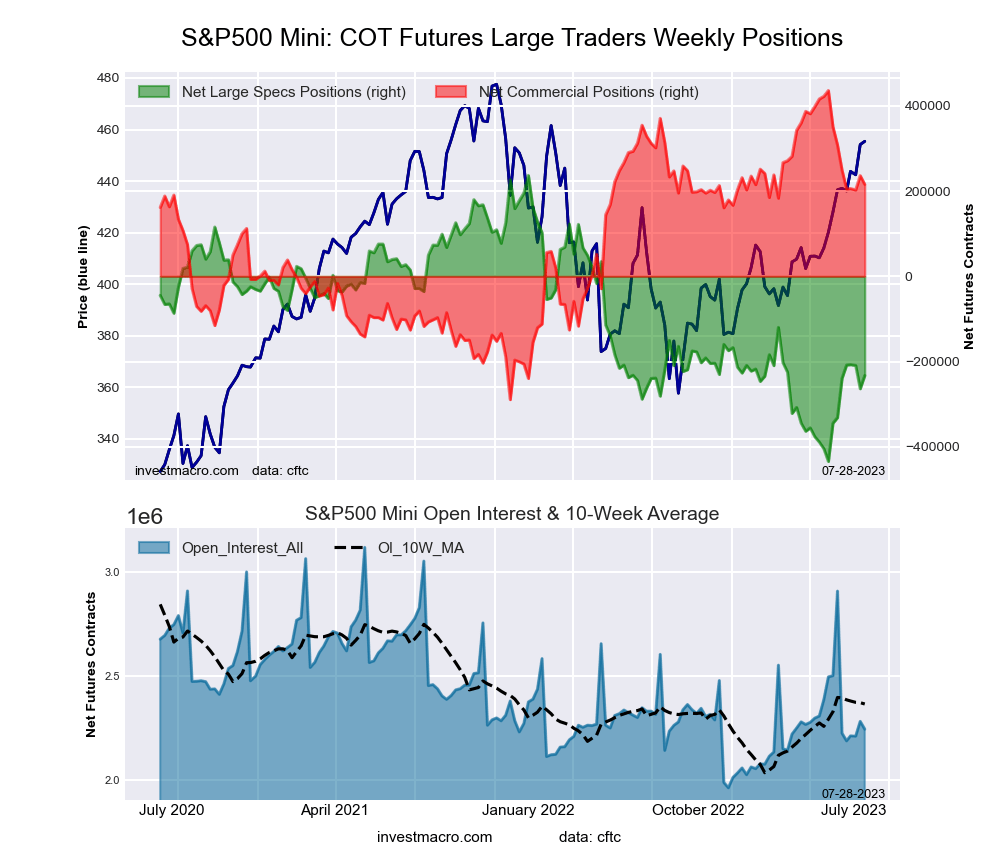
SP500 Mini Futures COT ChartThe S&P500 Mini large speculator standing this week reached a net position of -207,239 contracts in the data reported through Tuesday. This was a weekly lift of 1,011 contracts from the previous week which had a total of -208,250 net contracts.

This week’s current strength score (the trader positioning range over the past three years, measured from 0 to 100) shows the speculators are currently Bearish with a score of 33.8 percent. The commercials are Bullish with a score of 68.3 percent and the small traders (not shown in chart) are Bearish with a score of 44.7 percent.

Price Trend-Following Model: Strong Uptrend

Our weekly trend-following model classifies the current market price position as: Strong Uptrend. The current action for the model is considered to be: Hold – Maintain Long Position.

S&P500 Mini Futures StatisticsSPECULATORSCOMMERCIALSSMALL TRADERS
– Percent of Open Interest Longs:10.176.411.1
– Percent of Open Interest Shorts:19.567.111.1
– Net Position:-207,239205,7911,448
– Gross Longs:223,3581,688,344245,999
– Gross Shorts:430,5971,482,553244,551
– Long to Short Ratio:0.5 to 11.1 to 11.0 to 1
NET POSITION TREND:
– Strength Index Score (3 Year Range Pct):33.868.344.7
– Strength Index Reading (3 Year Range):BearishBullishBearish
NET POSITION MOVEMENT INDEX:
– 6-Week Change in Strength Index:29.4-29.86.8


Dow Jones Mini Futures:

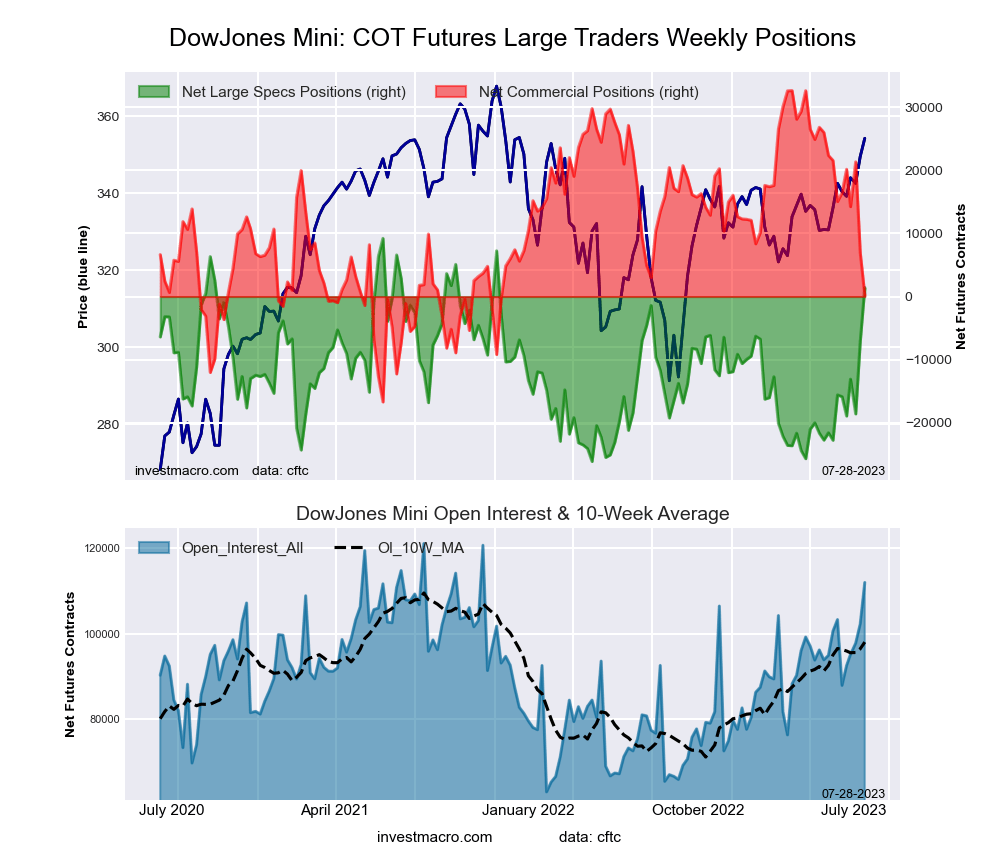
Dow Jones Mini Futures COT ChartThe Dow Jones Mini large speculator standing this week reached a net position of -13,082 contracts in the data reported through Tuesday. This was a weekly boost of 5,840 contracts from the previous week which had a total of -18,922 net contracts.

This week’s current strength score (the trader positioning range over the past three years, measured from 0 to 100) shows the speculators are currently Bearish with a score of 36.9 percent. The commercials are Bullish with a score of 62.7 percent and the small traders (not shown in chart) are Bearish with a score of 38.3 percent.

Price Trend-Following Model: Uptrend

Our weekly trend-following model classifies the current market price position as: Uptrend. The current action for the model is considered to be: Hold – Maintain Long Position.

Dow Jones Mini Futures StatisticsSPECULATORSCOMMERCIALSSMALL TRADERS
– Percent of Open Interest Longs:25.560.313.4
– Percent of Open Interest Shorts:39.245.414.7
– Net Position:-13,08214,236-1,154
– Gross Longs:24,23357,40312,794
– Gross Shorts:37,31543,16713,948
– Long to Short Ratio:0.6 to 11.3 to 10.9 to 1
NET POSITION TREND:
– Strength Index Score (3 Year Range Pct):36.962.738.3
– Strength Index Reading (3 Year Range):BearishBullishBearish
NET POSITION MOVEMENT INDEX:
– 6-Week Change in Strength Index:27.3-23.810.3


Nasdaq Mini Futures:

Nasdaq Mini Futures COT ChartThe Nasdaq Mini large speculator standing this week reached a net position of 5,458 contracts in the data reported through Tuesday. This was a weekly decline of -11,784 contracts from the previous week which had a total of 17,242 net contracts.

This week’s current strength score (the trader positioning range over the past three years, measured from 0 to 100) shows the speculators are currently Bullish-Extreme with a score of 80.3 percent. The commercials are Bearish with a score of 20.2 percent and the small traders (not shown in chart) are Bullish with a score of 50.4 percent.

Price Trend-Following Model: Uptrend

Our weekly trend-following model classifies the current market price position as: Uptrend. The current action for the model is considered to be: Hold – Maintain Long Position.

Nasdaq Mini Futures StatisticsSPECULATORSCOMMERCIALSSMALL TRADERS
– Percent of Open Interest Longs:28.452.816.1
– Percent of Open Interest Shorts:26.254.316.7
– Net Position:5,458-3,883-1,575
– Gross Longs:70,707131,22340,005
– Gross Shorts:65,249135,10641,580
– Long to Short Ratio:1.1 to 11.0 to 11.0 to 1
NET POSITION TREND:
– Strength Index Score (3 Year Range Pct):80.320.250.4
– Strength Index Reading (3 Year Range):Bullish-ExtremeBearishBullish
NET POSITION MOVEMENT INDEX:
– 6-Week Change in Strength Index:-5.21.213.6


Russell 2000 Mini Futures:

Russell 2000 Mini Futures COT ChartThe Russell 2000 Mini large speculator standing this week reached a net position of -67,510 contracts in the data reported through Tuesday. This was a weekly decline of -3,810 contracts from the previous week which had a total of -63,700 net contracts.

This week’s current strength score (the trader positioning range over the past three years, measured from 0 to 100) shows the speculators are currently Bearish with a score of 31.5 percent. The commercials are Bullish with a score of 66.4 percent and the small traders (not shown in chart) are Bearish with a score of 37.9 percent.

Price Trend-Following Model: Strong Uptrend

Our weekly trend-following model classifies the current market price position as: Strong Uptrend. The current action for the model is considered to be: New Buy – Long Position.

Russell 2000 Mini Futures StatisticsSPECULATORSCOMMERCIALSSMALL TRADERS
– Percent of Open Interest Longs:10.383.54.7
– Percent of Open Interest Shorts:23.471.14.0
– Net Position:-67,51063,8563,654
– Gross Longs:52,926429,65624,280
– Gross Shorts:120,436365,80020,626
– Long to Short Ratio:0.4 to 11.2 to 11.2 to 1
NET POSITION TREND:
– Strength Index Score (3 Year Range Pct):31.566.437.9
– Strength Index Reading (3 Year Range):BearishBullishBearish
NET POSITION MOVEMENT INDEX:
– 6-Week Change in Strength Index:-11.24.731.4


Nikkei Stock Average (USD) Futures:

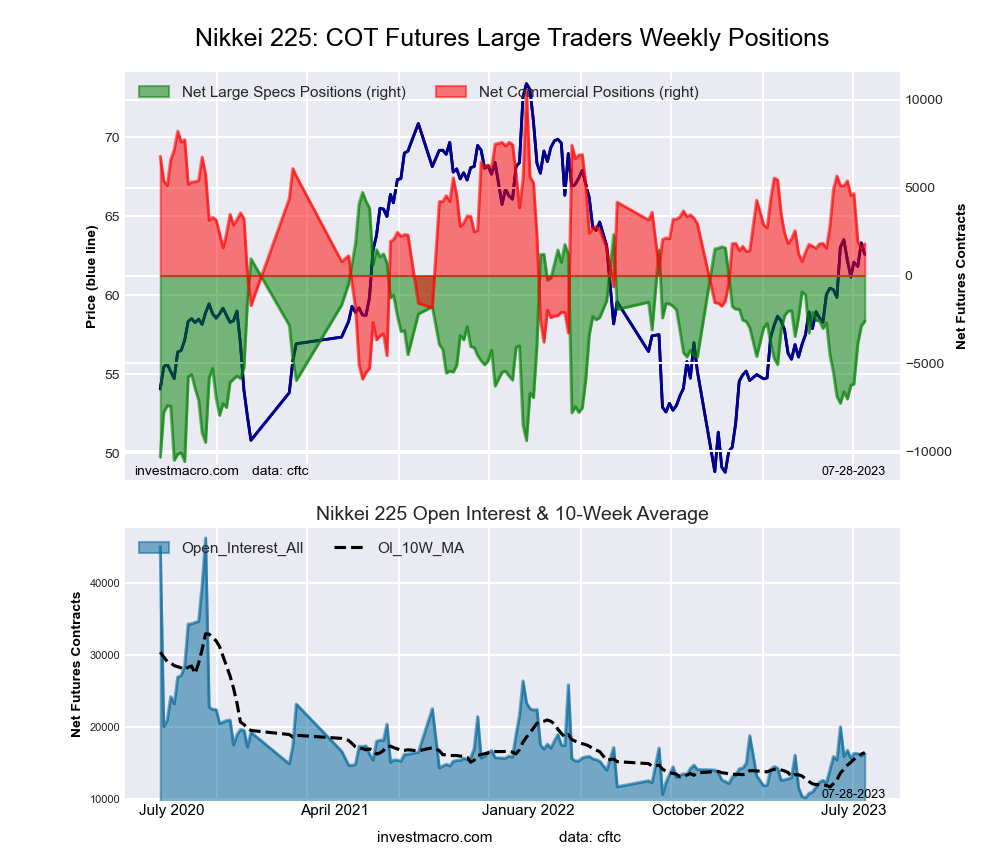
Nikkei Stock Average (USD) Futures COT ChartThe Nikkei Stock Average (USD) large speculator standing this week reached a net position of -6,185 contracts in the data reported through Tuesday. This was a weekly gain of 61 contracts from the previous week which had a total of -6,246 net contracts.

This week’s current strength score (the trader positioning range over the past three years, measured from 0 to 100) shows the speculators are currently Bearish with a score of 28.7 percent. The commercials are Bullish with a score of 64.3 percent and the small traders (not shown in chart) are Bearish with a score of 47.3 percent.

Price Trend-Following Model: Uptrend

Our weekly trend-following model classifies the current market price position as: Uptrend. The current action for the model is considered to be: Hold – Maintain Long Position.

Nikkei Stock Average Futures StatisticsSPECULATORSCOMMERCIALSSMALL TRADERS
– Percent of Open Interest Longs:8.963.627.5
– Percent of Open Interest Shorts:46.735.118.2
– Net Position:-6,1854,6711,514
– Gross Longs:1,46010,4074,492
– Gross Shorts:7,6455,7362,978
– Long to Short Ratio:0.2 to 11.8 to 11.5 to 1
NET POSITION TREND:
– Strength Index Score (3 Year Range Pct):28.764.347.3
– Strength Index Reading (3 Year Range):BearishBullishBearish
NET POSITION MOVEMENT INDEX:
– 6-Week Change in Strength Index:-4.4-1.411.4


MSCI EAFE Mini Futures:

MSCI EAFE Mini Futures COT ChartThe MSCI EAFE Mini large speculator standing this week reached a net position of -11,743 contracts in the data reported through Tuesday. This was a weekly rise of 4,241 contracts from the previous week which had a total of -15,984 net contracts.

This week’s current strength score (the trader positioning range over the past three years, measured from 0 to 100) shows the speculators are currently Bearish with a score of 29.9 percent. The commercials are Bullish with a score of 70.8 percent and the small traders (not shown in chart) are Bearish with a score of 26.9 percent.

Price Trend-Following Model: Weak Uptrend

Our weekly trend-following model classifies the current market price position as: Weak Uptrend. The current action for the model is considered to be: Hold – Maintain Long Position.

MSCI EAFE Mini Futures StatisticsSPECULATORSCOMMERCIALSSMALL TRADERS
– Percent of Open Interest Longs:6.590.72.1
– Percent of Open Interest Shorts:9.588.21.6
– Net Position:-11,7439,7691,974
– Gross Longs:25,587356,5048,292
– Gross Shorts:37,330346,7356,318
– Long to Short Ratio:0.7 to 11.0 to 11.3 to 1
NET POSITION TREND:
– Strength Index Score (3 Year Range Pct):29.970.826.9
– Strength Index Reading (3 Year Range):BearishBullishBearish
NET POSITION MOVEMENT INDEX:
– 6-Week Change in Strength Index:10.7-7.0-14.4


Article By InvestMacroReceive our weekly COT Newsletter

*COT Report: The COT data, released weekly to the public each Friday, is updated through the most recent Tuesday (data is 3 days old) and shows a quick view of how large speculators or non-commercials (for-profit traders) were positioned in the futures markets.

The CFTC categorizes trader positions according to commercial hedgers (traders who use futures contracts for hedging as part of the business), non-commercials (large traders who speculate to realize trading profits) and nonreportable traders (usually small traders/speculators) as well as their open interest (contracts open in the market at time of reporting). See CFTC criteria here.

COT Soft Commodities Charts: Speculator bets led by Soybean Oil & Lean Hogs

By InvestMacro

Here are the latest charts and statistics for the Commitment of Traders (COT) reports data published by the Commodities Futures Trading Commission (CFTC).

The latest COT data is updated through Tuesday July 3rd and shows a quick view of how large traders (for-profit speculators and commercial entities) were positioned in the futures markets.

Weekly Speculator Changes led by Soybean Oil & Lean Hogs

The COT soft commodities markets speculator bets were lower this week as five out of the eleven softs markets we cover had higher positioning while the other six markets had lower speculator contracts.

Leading the gains for the softs markets was Soybean Oil (7,992 contracts) with Lean Hogs (4,006 contracts), Live Cattle (2,354 contracts), Wheat (1,713 contracts) and Cocoa (1,032 contracts) also showing positive weeks.

The markets with the declines in speculator bets this week were Corn (-67,035 contracts) with Sugar (-20,806 contracts), Coffee (-18,522 contracts), Soybeans (-10,876 contracts), Cotton (-8,336 contracts) and Soybean Meal (-3,275 contracts) also registering lower bets on the week.


Data Snapshot of Commodity Market Traders | Columns Legend
Jul-03-2023OIOI-IndexSpec-NetSpec-IndexCom-NetCOM-IndexSmalls-NetSmalls-Index
WTI Crude1,816,04337141,4291-170,1489928,71937
Gold448,06312163,09749-184,7175321,62034
Silver114,421017,99044-29,5695811,57931
Copper204,399461,88832-4,003682,11532
Palladium14,781100-7,89008,358100-46814
Platinum69,383708,06734-13,570655,50342
Natural Gas1,241,41957-98,7753368,3136730,46252
Brent127,0191-39,8733438,114701,75933
Heating Oil305,6813827,69978-41,8104014,11147
Soybeans610,352890,97325-71,92472-19,04955
Corn1,246,983846,4032852476-46,92746
Coffee180,11838,49536-8,05268-4437
Sugar863,84340199,36861-229,7133930,34542
Wheat297,9337-45,4643451,05370-5,58954


Strength Scores led by Cocoa & Live Cattle

COT Strength Scores (a normalized measure of Speculator positions over a 3-Year range, from 0 to 100 where above 80 is Extreme-Bullish and below 20 is Extreme-Bearish) showed that Cocoa (94 percent) and Live Cattle (93 percent) lead the softs markets this week and are in Bullish-Extreme levels. Sugar (61 percent), Soybean Meal (55 percent) and Soybean Oil (42 percent) come in as the next highest in the weekly strength scores.

On the downside, Cotton (7 percent) and Lean Hogs (19 percent) come in at the lowest strength levels currently and are in Extreme-Bearish territory (below 20 percent).

Strength Statistics:
Corn (28.1 percent) vs Corn previous week (37.8 percent)
Sugar (61.4 percent) vs Sugar previous week (68.7 percent)
Coffee (36.1 percent) vs Coffee previous week (61.8 percent)
Soybeans (24.9 percent) vs Soybeans previous week (29.2 percent)
Soybean Oil (41.8 percent) vs Soybean Oil previous week (37.2 percent)
Soybean Meal (54.9 percent) vs Soybean Meal previous week (56.7 percent)
Live Cattle (92.7 percent) vs Live Cattle previous week (90.1 percent)
Lean Hogs (19.3 percent) vs Lean Hogs previous week (16.1 percent)
Cotton (7.5 percent) vs Cotton previous week (13.7 percent)
Cocoa (94.4 percent) vs Cocoa previous week (93.3 percent)
Wheat (34.5 percent) vs Wheat previous week (33.3 percent)


Soybean Oil & Wheat top the 6-Week Strength Trends

COT Strength Score Trends (or move index, calculates the 6-week changes in strength scores) showed that Soybean Oil (40 percent) and Wheat (29 percent) lead the past six weeks trends for soft commodities. Soybeans (24 percent), Lean Hogs (17 percent) and Corn (16 percent) are the next highest positive movers in the latest trends data.

Sugar (-26 percent) leads the downside trend scores currently with Coffee (-23 percent), Soybean Meal (-8 percent) and Cotton (-2 percent) following next with lower trend scores.

Strength Trend Statistics:
Corn (15.6 percent) vs Corn previous week (23.2 percent)
Sugar (-26.4 percent) vs Sugar previous week (-17.9 percent)
Coffee (-23.1 percent) vs Coffee previous week (-0.0 percent)
Soybeans (24.3 percent) vs Soybeans previous week (25.0 percent)
Soybean Oil (39.8 percent) vs Soybean Oil previous week (36.1 percent)
Soybean Meal (-7.8 percent) vs Soybean Meal previous week (-7.3 percent)
Live Cattle (4.1 percent) vs Live Cattle previous week (1.0 percent)
Lean Hogs (17.5 percent) vs Lean Hogs previous week (10.0 percent)
Cotton (-2.4 percent) vs Cotton previous week (4.1 percent)
Cocoa (7.6 percent) vs Cocoa previous week (7.9 percent)
Wheat (29.0 percent) vs Wheat previous week (24.3 percent)


Individual Soft Commodities Markets:

CORN Futures:

CORN Futures COT ChartThe CORN large speculator standing this week recorded a net position of 46,403 contracts in the data reported through Tuesday. This was a weekly reduction of -67,035 contracts from the previous week which had a total of 113,438 net contracts.

This week’s current strength score (the trader positioning range over the past three years, measured from 0 to 100) shows the speculators are currently Bearish with a score of 28.1 percent. The commercials are Bullish with a score of 76.2 percent and the small traders (not shown in chart) are Bearish with a score of 46.5 percent.

Price Trend-Following Model: Strong Downtrend

Our weekly trend-following model classifies the current market price position as: Strong Downtrend. The current action for the model is considered to be: Hold – Maintain Short Position.

CORN Futures StatisticsSPECULATORSCOMMERCIALSSMALL TRADERS
– Percent of Open Interest Longs:21.749.09.8
– Percent of Open Interest Shorts:18.048.913.6
– Net Position:46,403524-46,927
– Gross Longs:270,772610,770122,354
– Gross Shorts:224,369610,246169,281
– Long to Short Ratio:1.2 to 11.0 to 10.7 to 1
NET POSITION TREND:
– Strength Index Score (3 Year Range Pct):28.176.246.5
– Strength Index Reading (3 Year Range):BearishBullishBearish
NET POSITION MOVEMENT INDEX:
– 6-Week Change in Strength Index:15.6-17.49.0


SUGAR Futures:

SUGAR Futures COT ChartThe SUGAR large speculator standing this week recorded a net position of 199,368 contracts in the data reported through Tuesday. This was a weekly reduction of -20,806 contracts from the previous week which had a total of 220,174 net contracts.

This week’s current strength score (the trader positioning range over the past three years, measured from 0 to 100) shows the speculators are currently Bullish with a score of 61.4 percent. The commercials are Bearish with a score of 39.5 percent and the small traders (not shown in chart) are Bearish with a score of 41.9 percent.

Price Trend-Following Model: Uptrend

Our weekly trend-following model classifies the current market price position as: Uptrend. The current action for the model is considered to be: Hold – Maintain Long Position.

SUGAR Futures StatisticsSPECULATORSCOMMERCIALSSMALL TRADERS
– Percent of Open Interest Longs:32.543.38.6
– Percent of Open Interest Shorts:9.469.95.1
– Net Position:199,368-229,71330,345
– Gross Longs:280,634374,26274,497
– Gross Shorts:81,266603,97544,152
– Long to Short Ratio:3.5 to 10.6 to 11.7 to 1
NET POSITION TREND:
– Strength Index Score (3 Year Range Pct):61.439.541.9
– Strength Index Reading (3 Year Range):BullishBearishBearish
NET POSITION MOVEMENT INDEX:
– 6-Week Change in Strength Index:-26.428.5-25.2


COFFEE Futures:

COFFEE Futures COT ChartThe COFFEE large speculator standing this week recorded a net position of 8,495 contracts in the data reported through Tuesday. This was a weekly decline of -18,522 contracts from the previous week which had a total of 33,494 net contracts.

This week’s current strength score (the trader positioning range over the past three years, measured from 0 to 100) shows the speculators are currently Bearish with a score of 36.1 percent. The commercials are Bullish with a score of 67.9 percent and the small traders (not shown in chart) are Bearish-Extreme with a score of 7.3 percent.

Price Trend-Following Model: Uptrend

Our weekly trend-following model classifies the current market price position as: Uptrend. The current action for the model is considered to be: Hold – Maintain Long Position.

COFFEE Futures StatisticsSPECULATORSCOMMERCIALSSMALL TRADERS
– Percent of Open Interest Longs:23.447.03.7
– Percent of Open Interest Shorts:18.751.43.9
– Net Position:8,495-8,052-443
– Gross Longs:42,19084,6066,662
– Gross Shorts:33,69592,6587,105
– Long to Short Ratio:1.3 to 10.9 to 10.9 to 1
NET POSITION TREND:
– Strength Index Score (3 Year Range Pct):36.167.97.3
– Strength Index Reading (3 Year Range):BearishBullishBearish-Extreme
NET POSITION MOVEMENT INDEX:
– 6-Week Change in Strength Index:-23.124.0-19.8


SOYBEANS Futures:

SOYBEANS Futures COT ChartThe SOYBEANS large speculator standing this week recorded a net position of 90,973 contracts in the data reported through Tuesday. This was a weekly lowering of -10,876 contracts from the previous week which had a total of 101,849 net contracts.

This week’s current strength score (the trader positioning range over the past three years, measured from 0 to 100) shows the speculators are currently Bearish with a score of 24.9 percent. The commercials are Bullish with a score of 72.0 percent and the small traders (not shown in chart) are Bullish with a score of 55.3 percent.

Price Trend-Following Model: Weak Downtrend

Our weekly trend-following model classifies the current market price position as: Weak Downtrend. The current action for the model is considered to be: Hold – Maintain Short Position.

SOYBEANS Futures StatisticsSPECULATORSCOMMERCIALSSMALL TRADERS
– Percent of Open Interest Longs:27.950.27.1
– Percent of Open Interest Shorts:13.062.010.2
– Net Position:90,973-71,924-19,049
– Gross Longs:170,206306,59843,239
– Gross Shorts:79,233378,52262,288
– Long to Short Ratio:2.1 to 10.8 to 10.7 to 1
NET POSITION TREND:
– Strength Index Score (3 Year Range Pct):24.972.055.3
– Strength Index Reading (3 Year Range):BearishBullishBullish
NET POSITION MOVEMENT INDEX:
– 6-Week Change in Strength Index:24.3-24.117.8


SOYBEAN OIL Futures:

SOYBEAN OIL Futures COT ChartThe SOYBEAN OIL large speculator standing this week recorded a net position of 40,809 contracts in the data reported through Tuesday. This was a weekly increase of 7,992 contracts from the previous week which had a total of 32,817 net contracts.

This week’s current strength score (the trader positioning range over the past three years, measured from 0 to 100) shows the speculators are currently Bearish with a score of 41.8 percent. The commercials are Bullish with a score of 57.7 percent and the small traders (not shown in chart) are Bearish with a score of 40.5 percent.

Price Trend-Following Model: Strong Uptrend

Our weekly trend-following model classifies the current market price position as: Strong Uptrend. The current action for the model is considered to be: New Buy – Long Position.

SOYBEAN OIL Futures StatisticsSPECULATORSCOMMERCIALSSMALL TRADERS
– Percent of Open Interest Longs:17.656.96.6
– Percent of Open Interest Shorts:9.266.85.1
– Net Position:40,809-48,0287,219
– Gross Longs:85,067274,38532,017
– Gross Shorts:44,258322,41324,798
– Long to Short Ratio:1.9 to 10.9 to 11.3 to 1
NET POSITION TREND:
– Strength Index Score (3 Year Range Pct):41.857.740.5
– Strength Index Reading (3 Year Range):BearishBullishBearish
NET POSITION MOVEMENT INDEX:
– 6-Week Change in Strength Index:39.8-39.830.8


SOYBEAN MEAL Futures:

SOYBEAN MEAL Futures COT ChartThe SOYBEAN MEAL large speculator standing this week recorded a net position of 95,998 contracts in the data reported through Tuesday. This was a weekly fall of -3,275 contracts from the previous week which had a total of 99,273 net contracts.

This week’s current strength score (the trader positioning range over the past three years, measured from 0 to 100) shows the speculators are currently Bullish with a score of 54.9 percent. The commercials are Bearish with a score of 48.9 percent and the small traders (not shown in chart) are Bearish-Extreme with a score of 14.0 percent.

Price Trend-Following Model: Downtrend

Our weekly trend-following model classifies the current market price position as: Downtrend. The current action for the model is considered to be: Hold – Maintain Short Position.

SOYBEAN MEAL Futures StatisticsSPECULATORSCOMMERCIALSSMALL TRADERS
– Percent of Open Interest Longs:24.637.99.0
– Percent of Open Interest Shorts:4.660.66.3
– Net Position:95,998-109,01213,014
– Gross Longs:118,320182,43143,129
– Gross Shorts:22,322291,44330,115
– Long to Short Ratio:5.3 to 10.6 to 11.4 to 1
NET POSITION TREND:
– Strength Index Score (3 Year Range Pct):54.948.914.0
– Strength Index Reading (3 Year Range):BullishBearishBearish-Extreme
NET POSITION MOVEMENT INDEX:
– 6-Week Change in Strength Index:-7.86.114.0


LIVE CATTLE Futures:

LIVE CATTLE Futures COT ChartThe LIVE CATTLE large speculator standing this week recorded a net position of 105,443 contracts in the data reported through Tuesday. This was a weekly boost of 2,354 contracts from the previous week which had a total of 103,089 net contracts.

This week’s current strength score (the trader positioning range over the past three years, measured from 0 to 100) shows the speculators are currently Bullish-Extreme with a score of 92.7 percent. The commercials are Bearish-Extreme with a score of 10.3 percent and the small traders (not shown in chart) are Bearish-Extreme with a score of 14.7 percent.

Price Trend-Following Model: Uptrend

Our weekly trend-following model classifies the current market price position as: Uptrend. The current action for the model is considered to be: Hold – Maintain Long Position.

LIVE CATTLE Futures StatisticsSPECULATORSCOMMERCIALSSMALL TRADERS
– Percent of Open Interest Longs:44.429.08.0
– Percent of Open Interest Shorts:13.955.611.9
– Net Position:105,443-92,019-13,424
– Gross Longs:153,517100,08927,594
– Gross Shorts:48,074192,10841,018
– Long to Short Ratio:3.2 to 10.5 to 10.7 to 1
NET POSITION TREND:
– Strength Index Score (3 Year Range Pct):92.710.314.7
– Strength Index Reading (3 Year Range):Bullish-ExtremeBearish-ExtremeBearish-Extreme
NET POSITION MOVEMENT INDEX:
– 6-Week Change in Strength Index:4.1-2.6-9.3


LEAN HOGS Futures:

LEAN HOGS Futures COT ChartThe LEAN HOGS large speculator standing this week recorded a net position of -12,574 contracts in the data reported through Tuesday. This was a weekly rise of 4,006 contracts from the previous week which had a total of -16,580 net contracts.

This week’s current strength score (the trader positioning range over the past three years, measured from 0 to 100) shows the speculators are currently Bearish-Extreme with a score of 19.3 percent. The commercials are Bullish-Extreme with a score of 83.6 percent and the small traders (not shown in chart) are Bullish with a score of 73.2 percent.

Price Trend-Following Model: Strong Uptrend

Our weekly trend-following model classifies the current market price position as: Strong Uptrend. The current action for the model is considered to be: Hold – Maintain Long Position.

LEAN HOGS Futures StatisticsSPECULATORSCOMMERCIALSSMALL TRADERS
– Percent of Open Interest Longs:29.239.49.3
– Percent of Open Interest Shorts:35.532.010.4
– Net Position:-12,57414,847-2,273
– Gross Longs:58,15178,65818,525
– Gross Shorts:70,72563,81120,798
– Long to Short Ratio:0.8 to 11.2 to 10.9 to 1
NET POSITION TREND:
– Strength Index Score (3 Year Range Pct):19.383.673.2
– Strength Index Reading (3 Year Range):Bearish-ExtremeBullish-ExtremeBullish
NET POSITION MOVEMENT INDEX:
– 6-Week Change in Strength Index:17.5-13.9-25.6


COTTON Futures:

COTTON Futures COT ChartThe COTTON large speculator standing this week recorded a net position of -1,678 contracts in the data reported through Tuesday. This was a weekly fall of -8,336 contracts from the previous week which had a total of 6,658 net contracts.

This week’s current strength score (the trader positioning range over the past three years, measured from 0 to 100) shows the speculators are currently Bearish-Extreme with a score of 7.5 percent. The commercials are Bullish-Extreme with a score of 91.9 percent and the small traders (not shown in chart) are Bearish-Extreme with a score of 12.1 percent.

Price Trend-Following Model: Strong Uptrend

Our weekly trend-following model classifies the current market price position as: Strong Uptrend. The current action for the model is considered to be: Hold – Maintain Long Position.

COTTON Futures StatisticsSPECULATORSCOMMERCIALSSMALL TRADERS
– Percent of Open Interest Longs:30.950.96.7
– Percent of Open Interest Shorts:31.949.57.0
– Net Position:-1,6782,320-642
– Gross Longs:53,59788,18411,530
– Gross Shorts:55,27585,86412,172
– Long to Short Ratio:1.0 to 11.0 to 10.9 to 1
NET POSITION TREND:
– Strength Index Score (3 Year Range Pct):7.591.912.1
– Strength Index Reading (3 Year Range):Bearish-ExtremeBullish-ExtremeBearish-Extreme
NET POSITION MOVEMENT INDEX:
– 6-Week Change in Strength Index:-2.42.8-5.7


COCOA Futures:

COCOA Futures COT ChartThe COCOA large speculator standing this week recorded a net position of 72,584 contracts in the data reported through Tuesday. This was a weekly rise of 1,032 contracts from the previous week which had a total of 71,552 net contracts.

This week’s current strength score (the trader positioning range over the past three years, measured from 0 to 100) shows the speculators are currently Bullish-Extreme with a score of 94.4 percent. The commercials are Bearish-Extreme with a score of 7.0 percent and the small traders (not shown in chart) are Bearish with a score of 26.6 percent.

Price Trend-Following Model: Uptrend

Our weekly trend-following model classifies the current market price position as: Uptrend. The current action for the model is considered to be: Hold – Maintain Long Position.

COCOA Futures StatisticsSPECULATORSCOMMERCIALSSMALL TRADERS
– Percent of Open Interest Longs:43.826.14.1
– Percent of Open Interest Shorts:22.848.03.2
– Net Position:72,584-75,5943,010
– Gross Longs:151,31990,38114,031
– Gross Shorts:78,735165,97511,021
– Long to Short Ratio:1.9 to 10.5 to 11.3 to 1
NET POSITION TREND:
– Strength Index Score (3 Year Range Pct):94.47.026.6
– Strength Index Reading (3 Year Range):Bullish-ExtremeBearish-ExtremeBearish
NET POSITION MOVEMENT INDEX:
– 6-Week Change in Strength Index:7.6-5.1-23.7


WHEAT Futures:

WHEAT Futures COT ChartThe WHEAT large speculator standing this week recorded a net position of -45,464 contracts in the data reported through Tuesday. This was a weekly increase of 1,713 contracts from the previous week which had a total of -47,177 net contracts.

This week’s current strength score (the trader positioning range over the past three years, measured from 0 to 100) shows the speculators are currently Bearish with a score of 34.5 percent. The commercials are Bullish with a score of 69.7 percent and the small traders (not shown in chart) are Bullish with a score of 53.9 percent.

Price Trend-Following Model: Downtrend

Our weekly trend-following model classifies the current market price position as: Downtrend. The current action for the model is considered to be: Hold – Maintain Short Position.

WHEAT Futures StatisticsSPECULATORSCOMMERCIALSSMALL TRADERS
– Percent of Open Interest Longs:28.041.49.2
– Percent of Open Interest Shorts:43.324.311.1
– Net Position:-45,46451,053-5,589
– Gross Longs:83,554123,40027,557
– Gross Shorts:129,01872,34733,146
– Long to Short Ratio:0.6 to 11.7 to 10.8 to 1
NET POSITION TREND:
– Strength Index Score (3 Year Range Pct):34.569.753.9
– Strength Index Reading (3 Year Range):BearishBullishBullish
NET POSITION MOVEMENT INDEX:
– 6-Week Change in Strength Index:29.0-23.6-38.9


Article By InvestMacroReceive our weekly COT Newsletter

*COT Report: The COT data, released weekly to the public each Friday, is updated through the most recent Tuesday (data is 3 days old) and shows a quick view of how large speculators or non-commercials (for-profit traders) were positioned in the futures markets.

The CFTC categorizes trader positions according to commercial hedgers (traders who use futures contracts for hedging as part of the business), non-commercials (large traders who speculate to realize trading profits) and nonreportable traders (usually small traders/speculators) as well as their open interest (contracts open in the market at time of reporting). See CFTC criteria here.

Gold Struggles to Gain Momentum: Challenges Persist in Precious Metals Sector

By RoboForex Analytical Department

The precious metals sector continues to face challenges, as gold has experienced a meager 5.1% increase from January to June 2023. This growth pales in comparison to the indicators seen in the US stock markets. Currently, the price of one troy ounce of gold stands at $1917 as we enter the second half of the year.

One of the key factors weighing on XAUUSD is the upward trend in interest rates, particularly in the US. This trend leads to higher yields in US government bonds and a stronger USD exchange rate. Historically, gold prices have exhibited an inverse correlation with these indicators.

Technical Analysis of XAU/USD:

On the H4 XAU/USD chart, the price has once again rebounded from the moving averages, indicating the development of a bearish trend since May 22, 2023. This price behavior reinforces the strength of the current trend and the ongoing pressure from sellers. The closest support area lies at the level of 1895, and a breakout below this level would pave the way for a decline towards 1860. Technically, this scenario is supported by the MACD, as its signal line has moved out of the histogram area, signaling a decline and the continuation of the bearish trend. It is worth noting the formation of a bullish divergence signal on the MACD indicator on June 30, 2023, when the quotes reached 1935, and the signal was successfully executed.

On the H1 XAU/USD chart, the quotes have broken out of the boundaries of the bullish correction channel. The price is currently below the 200-day moving average, indicating increasing pressure from sellers and a lack of upward movement in the market. There is still potential for a minor bullish correction, with a possible test of the 1915 level before a decline towards 1895 is expected. Technically, this scenario is confirmed by the MACD, as histogram bars have dropped below the July 5, 2023 minimum, nullifying the attempt to form a bullish divergence. A favorable scenario for sellers would be a breakout of the resistance area with the price consolidating above the 1920 level.

Disclaimer

Any forecasts contained herein are based on the author’s particular opinion. This analysis may not be treated as trading advice. RoboForex bears no responsibility for trading results based on trading recommendations and reviews contained herein.

Murrey Math Lines 07.07.2023 (Brent, S&P 500)

By RoboForex.com

Brent

Brent quotes have broken the 200-day Moving Average on H4 and are now above it, indicating a probable development of an uptrend. The RSI has rebounded from the support line. In this situation, further growth to the resistance level of 6/8 (78.12) is to be expected. The scenario can be cancelled by a downward breakout of 4/8 (75.00). In this case, the quotes could drop to the support of 3/8 (73.44).

Brent_H4
Risk Warning: the result of previous trading operations do not guarantee the same results in the future

On M15, the upper line of the VoltyChannel is broken, which increases the probability of a rise to 6/8 (78.12) on H4.

Brent_M15
Risk Warning: the result of previous trading operations do not guarantee the same results in the future

S&P 500

S&P 500 quotes remain in the overbought area on H4. The RSI is testing the resistance line. In this situation, a test of 8/8 (4375.0) is expected, followed by a breakout and a drop to the support at 7/8 (4296.9). The scenario can be cancelled by a rise above the resistance level of +1/8 (4453.1). In this case, the quotes could continue growing and reach +2/8 (4531.2).

S&P500_H4
Risk Warning: the result of previous trading operations do not guarantee the same results in the future

On M15, the lower line of the VoltyChannel is broken, which increases the probability of a price decline.

S&P500_M15

Article By RoboForex.com

Attention!
Forecasts presented in this section only reflect the author’s private opinion and should not be considered as guidance for trading. RoboForex LP bears no responsibility for trading results based on trading recommendations described in these analytical reviews.

The strong US labor market increased fears of further interest rate hikes by the Fed

By JustMarkets

Stronger-than-expected employment data from ADP reaffirmed fears of further interest rate hikes by Federal Reserve policymakers. At the close of the stock market yesterday, the Dow Jones Index (US30) decreased by 1.07%, and the S&P 500 Index (US500) was down by 0.79%. The NASDAQ Technology Index (US100) closed negative by 0.82% on Thursday.

US employers announced 40,709 layoffs in June, down 49% from the 80,089 layoffs announced in May. Private sector jobs rose to 497,000 in June, much higher than the gain of 267,000 in May and much better than the estimated 220,000. At this point, the labor market is showing no signs of easing, giving the US Fed room to tighten further. Today in the US, the Nonfarm report will be released. Economists forecast that the US economy will add 200,000 jobs in June. The unemployment rate is expected to be 3.6% (now 3.7%), and average hourly earnings will be 0.3%.

Federal Reserve Bank of Dallas President Lorie Logan said yesterday that further interest rate hikes would likely be needed to stimulate meaningful disinflation and return the rate of price growth to the Central Bank’s target level. She added that forecasts from Fed officials showed two more interest rate hikes this year.

Stock markets in Europe were down yesterday. Germany’s DAX (DE30) decreased by 2.57%, France’s CAC 40 (FR40) lost 3.13%, Spain’s IBEX 35 (ES35) was down by 2.21%, Britain’s FTSE 100 (UK100) closed negative by 2.17%.

Head of the German National Bank Nagel said yesterday that, at present, the ECB does not see a threat of excessive policy tightening but does not know yet where interest rates will peak. Nagel also added that rates will remain restrained for an extended period.

Traders are betting on a Bank of England interest rate hike to 6.5% by March 2023. Raising the cost of borrowing to that level would put mortgages further in the Bank of England’s pain zone, making credit less available to businesses and dealing a sharp blow to the economy. It will also exacerbate the difficulties facing the government of Prime Minister Rishi Sunak in the run-up to next year’s elections.

Oil continues to fall in price amid fears of a rate hike. But amid signs of tightening supply and improving demand, oil still has a good chance of going higher. Data on Thursday showed US inventories declined more than expected, with a larger-than-expected drop in gasoline inventories pointing to improved demand for fuel during summer.

Asian markets were mostly down yesterday. Japan’s Nikkei 225 (JP225) fell by 0.86%, China’s FTSE China A50 (CHA50) was down by 0.82%, Hong Kong’s Hang Seng (HK50) lost 2.44% for the day, and Australia’s S&P/ASX 200 (AU200) closed negative by 1.25%.

In Japan, the wage hikes triggered by this spring’s labor negotiations have begun to take effect. Base wages rose by 1.8% in May compared to last year’s period, the most significant increase since February 1995. Wage growth is one of the key trends under scrutiny by the Bank of Japan (BOJ) as the Central Bank considers whether and when it should roll back its super-soft monetary stimulus. BOJ Governor Kazuo Ueda has repeatedly stressed the need for an accommodative policy until wages rise enough to support sustained price growth of around 2%.

New Zealand’s Central Bank is likely to keep interest rates unchanged at 5.50% next Wednesday and leave that level for the rest of the year, marking the end of its 20-month cycle of increases that have already driven the economy into recession. The country’s biggest banks – ANZ, ASB, Bank of New Zealand, Kiwibank, and Westpac – are not forecasting any rate changes next week.

S&P 500 (F) (US500) 4,411.59 −35.23 (−0.79%)

Dow Jones (US30)33,922.26 −366.38 (−1.07%)

DAX (DE40) 15,528.54 −409.04 (−2.57%)

FTSE 100 (UK100) 7,280.50 −161.60 (−2.17%)

USD Index 103.36 +0.32 (−0.04%)

Important events for today:
  • – Switzerland Unemployment Rate (m/m) at 08:45 (GMT+3);
  • – German Industrial Production (m/m) at 09:00 (GMT+3);
  • – UK BoE Gov Bailey Speaks at 10:30 (GMT+3);
  • – US Nonfarm Payrolls (m/m) at 15:30 (GMT+3);
  • – US Unemployment Rate (m/m) at 15:30 (GMT+3);
  • – Canada Unemployment Rate (m/m) at 15:30 (GMT+3);
  • – US Natural Gas Storage (w/w) at 17:30 (GMT+3);
  • – Eurozone ECB President Lagarde Speaks at 19:45 (GMT+3).

By JustMarkets


This article reflects a personal opinion and should not be interpreted as an investment advice, and/or offer, and/or a persistent request for carrying out financial transactions, and/or a guarantee, and/or a forecast of future events.

Week Ahead: SPX500_m set for rollercoaster ride

By ForexTime

Even as markets turn cautious ahead of the highly anticipated US jobs report later today (Friday, July 7), investors are bracing for more action in the week ahead thanks to another round of risk events.

It’s all about the incoming US inflation data, speeches from numerous Fed officials as well as earnings announcements by US banks which could inject fresh volatility into the S&P 500 over the coming week.

Monday, July 10 

  • CNH: China CPI, PPI
  • GBP: Bank of England Governor Andrew Bailey speech
  • USD: Fed speak – San Francisco Fed President Mary Daly, Cleveland Fed President Loretta Mester, Atlanta Fed President Raphael Bostic

Tuesday, July 11

  • AUD: Australia consumer confidence
  • EUR: Germany CPI & ZEW survey expectations
  • GBP: UK jobless claims, unemployment report
  • USD: St. Louis Fed President James Bullard speech

Wednesday, July 12 

  • CAD: Canada rate decision
  • NZD: New Zealand rate decision
  • JPY: Japan PPI
  • USD: US June CPI report, Cleveland Fed President Loretta Mester, Atlanta Fed President Raphael Bostic speech

Thursday, July 13 

  • CNH: China trade
  • EUR: Eurozone industrial production
  • GBP: UK industrial production
  • USD: US initial jobless claims, PPI

Friday, July 14

  • JPY: Japan industrial production
  • USD: University of Michigan consumer sentiment
  • SPX500_m: Bank earnings – Wells Fargo, JP Morgan and Citigroup

The June US Consumer price index (CPI) report published on Wednesday, July 12 will be one week after hawkish Fed minutes reinforced expectations around US rates staying higher for longer.

Given how the Fed remains data dependent, the strong ADP jobs report, pending NFP release this afternoon, and incoming US inflation data are likely to further influence Fed hike expectations.

Markets are forecasting: 

  • CPI year-on-year (June 2023 vs. June 2022) to cool 3.1% from 4.0% in the prior month.
  • Core CPI year-on-year to cool 5.0% from 5.3% seen in May.
  • CPI month-on-month (June 2023 vs May 2023) to rise 0.3% from 0.1% in the prior month.
  • Core CPI month-on-month to cool 0.3% from 0.4% seen in May.

Over the past few months, there has been evidence of inflationary pressures cooling in the world’s largest economy, but core inflation has remained sticky. Should June’s CPI report slow further, this could fuel hopes around the Fed pausing rate hikes beyond July’s policy meeting.

How might the US CPI data influence the SPX500_m?

US equity bulls have warmly welcomed signs of cooling inflationary pressures as this supports the argument over the Fed pausing and eventually cutting interest rates down the road. Given how the S&P 500 Index has a handful of tech stocks that remain sensitive to Fed hike expectations, the CPI data could trigger volatility. In a nutshell, tech stocks dislike higher interest rates because their value is based on earnings projected in the future.

  • The SPX500_m might find itself under renewed selling pressure if the inflation numbers exceed market expectations.
  • Should the inflation numbers print below market forecasts, this could push the SPX500_m higher as expectations swell over the Fed nearing the end of its hiking cycle.

Let’s talk about US earnings season.

It’s that time of the year again!

Second quarter earnings season kicks off on Friday 14th July led by banking giants JP Morgan, Wells Fargo, and Citigroup. The bank earnings will be closely scrutinized for fresh insight into the US economy. It is worth keeping in mind that back in June, these major banks all passed the Fed’s stress test – lifting optimism ahead of earnings. Higher interest rates are expected to support bank earnings in the second quarter of 2023 as the Fed waged war against inflation.

Ultimately, a positive set of bank earnings may boost appetite for risk – injecting equity bulls with renewed confidence. 

How might bank earnings impact the SPX500_m?

Given how financial stocks accounts for roughly 12.5% of the S&P 500, the market reaction to the earnings of these big banks on Friday could influence the index.

  • The SPX500_m could push higher if the bank earnings exceed market expectations.
  • If the earnings disappoint, the SPX500_m may trade lower.

Technical Outlook: Bulls vs Bears 

The SPX500_m could be thrown on a roller-coaster ride next week if bulls and bears wrestle for control on the daily charts. 

Even though prices are respecting a bullish channel on the D1 timeframe, bears are clearly in the vicinity and could ramp up their pressure if the index sinks back below 4332. Alternatively, bulls need to push prices beyond the 4463 resistance level to regain control of the steering wheel.

  • A solid breakout above 4463 could encourage an incline towards 4500 and 4580, respectively.
  • Should prices break down below 4332, this could encourage a decline to 4300, 4260, and 4200, respectively.


Forex-Time-LogoArticle by ForexTime
ForexTime Ltd (FXTM) is an award winning international online forex broker regulated by CySEC 185/12 www.forextime.com
Bitcoin and the Big Blockchains Update After Steep Runup

Source: Clive Maund  (7/4/23)

Technical Analyst Clive Maund takes a look at the current state of Bitcoin and Big Blockchain stocks to tell you where he believes it is all headed. 

The article posted on the site toward the end of May looking at Bitcoin and a range of Blockchain stocks turned out to be prescient, for although it took them a couple of weeks longer to get moving, when they did move, they really moved, so that, with the exception of RIOT Platforms (formerly RIOT Blockchain), we are up about 50% on these stocks in a month.

Starting with Bitcoin itself, we see on its latest 6-month chart below that after the article was posted, it dribbled lower toward our revised uptrend channel boundary before turning and taking off strongly higher in the middle of this month, rising sharply to resistance in the vicinity of its mid-April highs where it has stalled out with a tight trading range forming that looks like a bull Flag.

Meanwhile, Hut 8 Mining Corp. (HUT:NASDAQ;HUT:TSX), which is continuing to work on its merger with U.S. Data Mining Group, took off strongly higher in the middle of this month so that it is now up about 50% from where we bought it.

Hive Blockchain has performed very well indeed, rising steeply over the past couple of weeks, so we are now up about 50% from where we bought.

However, it is starting to look overbought and a bit tired here after this big runup, with a toppy-looking doji candle appearing on the chart yesterday, which suggests that a period of consolidation or reaction is imminent, although the persistent strong volume on the advance means that if it does react back, it probably won’t be by very much.

On this chart for HIVE from the late May article, we can see the correctly identified Cup & Handle base that spawned the strong advance.

Moving on, we see that Marathon Digital Holdings Inc. (MARA:NASDAQ) also broke strongly higher at the same time, following a tight standoff that we figured would lead to an upside breakout.

MARA also put in a short-term toppy candle yesterday, so traders may want to scale back positions here to sidestep a possible consolidation / reaction that, again, is unlikely to be severe.

On the chart for MARA from the late May article, we can see that it had already broken out of a rather different-looking Cup & Handle base early in April and had returned to test support at the top of the pattern.

The only one of our small range of Blockchain stocks that hasn’t performed so far is Riot Platforms Inc. (RIOT:NASDAQ) (formerly RIOT Blockchain), and while this may be a sign of incipient weakness, it is still well positioned to break above the nearby resistance level into another upleg, and if it does this upleg is likely to be big.

RIOT’s relatively poor performance in recent weeks may be due to lingering fallout from a “hit piece” on the company and the industry by no less than the New York Times. The company mounted a vigorous response on 10th April, calling the attacks baseless and politically motivated, and from what I know about the NYT as it exists today, such an attack by it may be worn by the victim as a “badge of honor” for as I understand it, truly intelligent and discriminating people no longer take this publication seriously and haven’t done for a long time.

Given the immediate outlook for the other Blockchains reviewed here, there is the possibility that the stock will react back to the support shown on our chart and then turn up, in which case the uptrend boundary will require to be adjusted.


Important Disclosures:

  1. Statements and opinions expressed are the opinions of the author and not of Streetwise Reports or its officers. The author is wholly responsible for the validity of the statements. The author was not paid by Streetwise Reports for this article. Streetwise Reports was not paid by the author to publish or syndicate this article. Streetwise Reports requires contributing authors to disclose any shareholdings in, or economic relationships with, companies that they write about. Streetwise Reports relies upon the authors to accurately provide this information and Streetwise Reports has no means of verifying its accuracy.
  2. This article does not constitute investment advice. Each reader is encouraged to consult with his or her individual financial professional and any action a reader takes as a result of information presented here is his or her own responsibility. By opening this page, each reader accepts and agrees to Streetwise Reports’ terms of use and full legal disclaimer. This article is not a solicitation for investment. Streetwise Reports does not render general or specific investment advice and the information on Streetwise Reports should not be considered a recommendation to buy or sell any security. Streetwise Reports does not endorse or recommend the business, products, services or securities of any company mentioned on Streetwise Reports.

For additional disclosures, please click here.

CliveMaund.com Disclosures

The above represents the opinion and analysis of Mr. Maund, based on data available to him, at the time of writing. Mr. Maund’s opinions are his own, and are not a recommendation or an offer to buy or sell securities. Mr. Maund is an independent analyst who receives no compensation of any kind from any groups, individuals or corporations mentioned in his reports. As trading and investing in any financial markets may involve serious risk of loss, Mr. Maund recommends that you consult with a qualified investment advisor, one licensed by appropriate regulatory agencies in your legal jurisdiction and do your own due diligence and research when making any kind of a transaction with financial ramifications. Although a qualified and experienced stock market analyst, Clive Maund is not a Registered Securities Advisor. Therefore Mr. Maund’s opinions on the market and stocks can only be construed as a solicitation to buy and sell securities when they are subject to the prior approval and endorsement of a Registered Securities Advisor operating in accordance with the appropriate regulations in your area of jurisdiction.
Insights into This “Ultimate Harbinger” of the Bear Market

Enthusiasm for U.S. IPOs seems to be dramatically decreasing

By Elliott Wave International

Back in early 2021, many investors were chomping at the bits to invest in entities about which they knew next to nothing.

These entities are known as Special Purpose Acquisition Companies (SPACs), which may be described as shell companies which raise money through an initial public offering to acquire another company. Investors’ enthusiasm towards them has waned, but they are still around.

The amazing thing is that people who invest in SPACs don’t know the identity of the company to be acquired. Yet, they eagerly invest anyway.

It’s a reminder of Charles Mackay’s book, Extraordinary Popular Delusions and the Madness of Crowds, in which he described the extreme bullish sentiment way back in 1720:

“[A]n undertaking of great advantage came to market, but nobody is to know what it is.”
In March 2021, when several athlete- and celebrity-sponsored SPACs hit the market, the Elliott Wave Financial Forecast, a monthly publication which covers major U.S. financial markets, called it:

The ultimate harbinger of the next bear market.

Yes, the major stock indexes held up for another nine months or so — yet the IPO market had already started to show weakness.

Today, that weakness has morphed into an outright bear market. The June 2023 Elliott Wave Financial Forecast provides a review with this chart and commentary:

The chart shows the Renaissance IPO Index, which records the aftermarket performance of U.S. IPOs. The index peaked on February 16, 2021 and declined 69%. The total number of IPOs peaked a month later at 135, also an all-time high. For 2022 and the first four months of 2023, the average monthly total is only 15 U.S. IPOs.

As Barron’s stated back in March:

The Tech IPO Well Has Run Dry. It’s Likely to Stay That Way.

The diminishing number of IPOs is by no means the only warning sign for stock investors.

Elliott Wave International’s Financial Forecast Service discusses an array of indicators which may be of interest to you, as well as the message of the Elliott wave model.

An important point about the Elliott wave model is that it helps investors to identify turning points in the trends of financial markets.

Indeed, here’s a quote from Frost & Prechter’s Wall Street classic, Elliott Wave Principle: Key to Market Behavior:

When after a while the apparent jumble gels into a clear picture, the probability that a turning point is at hand can suddenly and excitingly rise to nearly 100%. It is a thrilling experience to pinpoint a turn, and the Wave Principle is the only approach that can occasionally provide the opportunity to do so.

Here’s the good news: You can access the entire online version of the book for free once you become a member of Club EWI, the world’s largest Elliott wave educational community.

Club EWI is free to join without any obligations and members enjoy free access to Elliott wave resources on financial markets and investing, including exclusive articles and interviews with Elliott Wave International’s analysts.

Click on the link to get started right away: Elliott Wave Principle: Key to Market Behaviorget free and instant access.

This article was syndicated by Elliott Wave International and was originally published under the headline Insights into This “Ultimate Harbinger” of the Bear Market. EWI is the world’s largest market forecasting firm. Its staff of full-time analysts led by Chartered Market Technician Robert Prechter provides 24-hour-a-day market analysis to institutional and private investors around the world.

Chasing Down a Winner

Source: Michael Ballanger  (7/3/23) 

With investors scrambling at buzzwords, Michael Ballanger of GGM Advisory Inc. looks at one company he believes is a winner beyond the exciting jargon of the day.

There are moments in my long career that stand out as “watershed” moments where a simple telephone call or a chance meeting at a mining conference created an impression upon me that had a discernible impact on my life at the time. The memories of those conversations are vivid, and they rarely leave me, especially when I am confronted with that eerie feeling that occurs at the precise moment of revelation that something important just happened.

A few years back, I wrote a piece entitled “Serendipity,” where I spoke of events that occurred while boating or playing sports or searching out investment ideas that came literally “out of the blue,” as in totally unexpected occurrences but because the outcomes were always favorable, they stand out over the years as “life lessons” and deserve to be passed along.

I was once in a meeting where one of my partners, a rough-and-tumble prison guard from LaRonge, Saskatchewan, got out of his seat and proceeded to explain in no uncertain terms that since stock certificates are made out of newsprint, they deserve little more value than the paper with which they are printed.

When it is all said and done, these glamorized slabs of altered newsprint are really only worth the people that put their names to the certificate, which is why professional money managers would tell us that of all the bullet points on their “Prerequisites for Investment,” there is only one word that matters, and that is the word “management.”

His crystallizing line came when this strapping Prairie lad told the group that “the last time I looked, newsprint is going for a buck eighty-six a pound!”

That statement, coming from a man with, shall I say, “limited” knowledge of the securities world, enlightened me to the stark reality that not all citizens of this planet look at stock certificates with the same kind of shock and awe envy.

Stock certificates are indeed nearly worthless in and of themselves, and only when they are recognized as “titles” to a share of a venture do they begin to get recognition.

In the current market environment, pieces of finely crafted newsprint with detailed etching and meticulous legal scribbling can be worth next to nothing if the word “gold” is contained in the scribbling, or it can be worth a small fortune if the words “artificial intelligence” can be seen.

Ten years ago in Canada, the word “cannabis” magically elevated the value of a tenth-of-a-pound certificate to many times the going rate for newsprint, and a few years later, the word “crypto” replaced “cannabis” creating yet another generation of self-enabled millionaires scalping trading profits from the safety of their cellphones.

When it is all said and done, these glamorized slabs of altered newsprint are really only worth the people that put their names to the certificate, which is why professional money managers would tell us that of all the bullet points on their “Prerequisites for Investment,” there is only one word that matters, and that is the word “management.”

Volt Lithium

With the prior few paragraphs as the appropriate preamble, it is no accident that I had yet another magical moment that only with the fullness of time can be classified as “life-altering.”

I was scanning a few of the websites that cover the companies I follow and about which I write from time to time when I came across a site that posted a screenshot of a list of insiders that had been recently buying stock. As I peered down the list, I came across the name of the Chairman of the Board of a company that I have owned since early 2021, Warner Uhl, with the company being Volt Lithium Corp. (VLT:TSV;VLTLF:US).

It seems that with the stock price down over 65% from the May 24 peak, Mr. Uhl decided to do what I have been doing, and that is buying more of that “glorified newsprint.”

I have spoken to Warner Uhl perhaps twice in my life going back to mid-2021 when I was trying to get a handle on the direction of his company (then called Allied Copper Corp.) after some early hiccups resulted in a trading halt. The second call was after I noticed his first (small) insider transaction, which was just after they announced the move to amalgamate with Volt Lithium Corp. Without hesitation, I rang him up after a brief conversation. I was delighted to learn that he was an aficionado of lithium as well as copper and that he would be staying on as Chairman.

Fast-forward to June 27, 2023.

Insiders of junior Canadian resource deals rarely buy positions in their own deals; they prefer to use the “Directors’ Incentive Options” instead of their own cash to beef up their notional, if not actual, ownership. With markets on the defensive and retail investors puking out positions at the first sign of any size bids, I found the recent insider activity at Volt to be a breath of fresh air but this last purchase by Mr. Uhl caught my undivided attention.

Why Buy Now?

Why buy now? I picked up the phone resulting in a 25-minute conversation with a man who, in his early career, toiled on the Mt. Milligan Project, and the best description of his contribution can be gleaned only after lifting it from his impressive resumé:

2009 – 2013 Project Director, AMEC (Mt. Milligan project)

  • Project Director for EPCM services, in a joint venture with Fluor, for a 60,000 tpd copper-gold project with open-pit mining, conventional concentrator, gold gravity concentration, water treatment, tailings management, utilities and infrastructure, and an offsite concentrate loading and handling facility. Managed an engineering staff of 250 and an onsite staff of 120 persons overseeing a peak of 1,600 contractors. Oversaw the design, permitting, construction, and commissioning. The work that Mr. Uhl directed was built under budget and on time. Over 5.0 million man-hours without a lost-time accident. All this was accomplished with a very inexperienced industrial workforce and significant participation by local indigenous companies.

For the past several years, Warner has toiled for the mighty Worley Canada, providers of professional services in the energy, chemicals, and resources sectors (including copper and lithium). His title is “Regional Director for Study Management in the Americas, Technology and Expert Solutions, Worley, Canada.”

Warner has over three-hundred project study managers and engineers reporting to him on various projects within a larger company employing over 50,000 people and generating over US$10 billion in sales.

Now, buying 150,000 shares in the open market for CA$40,500 may not seem like a big deal, but to my sexagenarian eyes, it was like a message from the Messiah. I asked Warner today why he bought the stock, and his reply was quite simple. The market was missing the significance of the last press release, which, after third-party vetting and sign-off by Sproule Inc., reported that their pilot plant test confirmed the cost per tonne of a mere  US$3,977 required to produce 1,000 tonnes of lithium carbonate from the oilfield brines.

It seems that the “knock” on Volt is that few investors believe their claim that their Direct Lithium Extraction (DLE) technology actually works. There are a number of companies out there that shall remain anonymous that think that their DLE technology will work on a larger scale basis, but to date, nothing compares to Volt.

By calling Warner Uhl, whose company is currently working on a US$3 billion lithium extraction deal in Argentina, I asked a man that knows lithium extraction and all of the challenges to commercial processing of oilfield brines WHY he bought the stock. As obvious as the answer is to everyone close to the deal, It was almost an embarrassment to ask that question.

Volt Lithium Process

His answer was exactly as one would expect; based upon the extrapolation of prospective profitability using a DLE technology that he trusts, the stock price was “disconnected” from its market potential.

The market “disconnect” lies in the mistaken assumption that Volt’s claim is either overstated or false, but if one drills down into Sproule, one will quickly appreciate the significance of their involvement and why IIROC gave their blessing on the release.

Warner went on to explain the “green company” benefits whereby Volt returns formerly toxic brines to the subsurface aquifer in pristine shape, free of all impurities, including oil, for which they are paid a royalty by Cabot Energy. This is a feature of immense benefit to politicians, and with a great deal of government money allocated to the battery metals hunt and to water treatment, it is not a stretch to expect Volt to be approved for government grants as a means of defraying commercial development costs.

I would urge all shareholders to do what they can to retain their positions because as a longer-term investment, I think they will do quite well.”

That is an endorsement of the highest order from Volt’s Chairman and a person with decades of experience in the building of mines around the world and who is on the record as a buyer of shares.

Under threat of “overkill,” I want to hammer home the significance of Volt’s insider activity, and as you can observe from the graphic shown below, it is not only the Chairman adding to positions. Several directors, as well as CEO Alex Wiley, have stepped up to take advantage of the recent weakness, and over my many decades of dodging the poisonous darts of the insidious TSX Venture Exchange, this is an extremely valuable tool and certainly must be heeded.

Whenever you get a stock guy (me) with several decades behind him discussing DLE technology with a veteran mine builder and engineer (Uhl), it can many times be a difficult interaction, but I have always gravitated to the technical people rather than the “pitchmen” because the validity of the “pitch” lies solely in the hands of the technicians.

Over the past forty-five years, I have encountered so much horse manure in the boardrooms of Bay and Granville Streets that I could fertilize the Canadian Prairies if I could ever have bottled it. This is why the actions of Warner Uhl spoke louder than anything on their website or in their power-point presentation. When phenomenal growth stories are disconnected from the market due to faulty assumptions, they represent truly unique opportunities once one is able to define the disconnect.

As I have now explained this “disconnect,” it explains why Volt Lithium Corp. is now my largest holding and why I am adding to the position from the grandkids’ education pool and Granny’s bingo money and since Granny will want that money back by Labor Day, I must be very confident.


Important Disclosures:

  1. As of the date of this article, officers and/or employees of Streetwise Reports LLC (including members of their household) own securities of Volt Lithium Corp.
  2. Michael Ballanger: I, or members of my immediate household or family, own securities of: Volt Lithium Corp. I determined which companies would be included in this article based on my research and understanding of the sector.
  3. Statements and opinions expressed are the opinions of the author and not of Streetwise Reports or its officers. The author is wholly responsible for the validity of the statements. The author was not paid by Streetwise Reports for this article. Streetwise Reports was not paid by the author to publish or syndicate this article. Streetwise Reports requires contributing authors to disclose any shareholdings in, or economic relationships with, companies that they write about. Streetwise Reports relies upon the authors to accurately provide this information and Streetwise Reports has no means of verifying its accuracy.
  4.  This article does not constitute investment advice. Each reader is encouraged to consult with his or her individual financial professional. By opening this page, each reader accepts and agrees to Streetwise Reports’ terms of use and full legal disclaimer. This article is not a solicitation for investment. Streetwise Reports does not render general or specific investment advice and the information on Streetwise Reports should not be considered a recommendation to buy or sell any security. Streetwise Reports does not endorse or recommend the business, products, services or securities of any company.

For additional disclosures, please click here.

Michael Ballanger Disclosures

This letter makes no guarantee or warranty on the accuracy or completeness of the data provided. Nothing contained herein is intended or shall be deemed to be investment advice, implied or otherwise. This letter represents my views and replicates trades that I am making but nothing more than that. Always consult your registered advisor to assist you with your investments. I accept no liability for any loss arising from the use of the data contained on this letter. Options and junior mining stocks contain a high level of risk that may result in the loss of part or all invested capital and therefore are suitable for experienced and professional investors and traders only. One should be familiar with the risks involved in junior mining and options trading and we recommend consulting a financial adviser if you feel you do not understand the risks involved.

The trade war between China and the US is worsening again. FOMC minutes point to further rate hikes

By JustMarkets

The US indices closed lower on Wednesday as minutes from the Federal Reserve’s June meeting showed appetite for policy tightening and interest rate hikes. At the close of the stock market yesterday, the Dow Jones Index (US30) decreased by 0.38%, while the S&P 500 Index (US500) was down by 0.20%. The NASDAQ Technology Index (US100) closed negative by 0.12% on Wednesday.

Highlights of the June FOMC minutes:

  • Nearly all participants said that inflation risks are prevalent at the moment and remain key to the outlook for the direction of monetary policy;
  • All Fed officials agreed that continued restrictive monetary policy would be appropriate;
  • The Fed expects further rate hikes but at a slower pace;
  • Fed policymakers believe a shallow recession at the end of the year is likely;
  • Some representatives favored raising rates rather than pausing at the June meeting, noting a “very tight” labor market that threatens to raise wages and inflation.

According to the FedWatch Tool, nearly 90% of traders expect the Fed to resume raising rates in July.

Stock markets in Europe were down yesterday. German DAX (DE30) was 0.63% lower, French CAC 40 (FR 40) decreased by 0.80%, Spanish IBEX 35 (ES35) fell by 1.06%, and British FTSE 100 (UK100) was 1.03% lower.

In the Eurozone, consumer inflation expectations for the next 12 months declined further, while inflation expectations for the three years ahead remained stable. Expectations for economic growth over the next 12 months have become less negative. Consumers expect lower growth in their home prices over the next 12 months.

Gold prices ended lower Wednesday as minutes from the Federal Reserve’s last meeting showed that some central bank officials pushed for an interest rate hike in June. Gold has an inverse correlation to the dollar index and to government bond yields, so a policy tightening is a negative for the precious metals.

The OPEC+ meeting proceeds without surprises. OPEC energy and oil ministers reviewed current oil market conditions and agreed to continue current production quotas for a stable and balanced oil market. Additional crude oil inventories will be released today.

Natural gas continues to be cheaper. The hot weather in Texas and other southern US states has eased slightly, prompting market participants to push gas prices down further to $2.5. Additional natural gas inventories will be released tomorrow.

Asian markets were mostly down yesterday. Japan’s Nikkei 225 (JP225) was down by 0.25%, China’s FTSE China A50 (CHA50) decreased by 1.08%, Hong Kong’s Hang Seng (HK50) lost 1.57% on the day, and Australia’s S&P/ASX 200 (AU200) close negative by 0.35%.

Janet Yellen is set to visit China in an effort to ease tensions between the two economic powers. Treasury Department officials say they don’t expect any diplomatic breakthroughs from Yellen’s trip. But the secretary of state hopes to forge closer ties with China’s new economic leaders to avoid a deeper deterioration in relations between the world’s two largest economies. This week, China announced new restrictions on exports of key minerals used in the manufacture of semiconductors and solar panels. This was China’s response to US export restrictions on China. The Biden administration has restricted the sale of advanced computer chips to China and is considering restricting China’s access to US cloud computing services.

S&P 500 (F) (US500) 4,446.82 −8.77 (−0.20%)

Dow Jones (US30)34,288.64 −129.83 (−0.38%)

DAX (DE40) 15,937.58 −101.59 (−0.63%)

FTSE 100 (UK100) 7,442.10 −77.62 (−1.03%)

USD Index 103.36 +0.32 (+0.31%)

Important events for today:
  • – Australia Trade Balance (m/m) at 04:30 (GMT+3);
  • – UK Construction PMI (m/m) at 11:30 (GMT+3);
  • – Eurozone Retail Sales (m/m) at 12:00 (GMT+3);
  • – US ADP Nonfarm Employment Change (m/m) at 15:15 (GMT+3);
  • – US Unemployment Claims (w/w) at 15:30 (GMT+3);
  • – Canada Trade Balance (m/m) at 15:30 (GMT+3);
  • – US Trade Balance (m/m) at 15:30 (GMT+3);
  • – US ISM Services PMI (m/m) at 17:00 (GMT+3);
  • – US JOLTS Job Openings (m/m) at 17:00 (GMT+3);
  • – Canada Ivey PMI (m/m) at 17:00 (GMT+3);
  • – US Crude Oil Reserves (w/w) at 18:00 (GMT+3).

By JustMarkets


This article reflects a personal opinion and should not be interpreted as an investment advice, and/or offer, and/or a persistent request for carrying out financial transactions, and/or a guarantee, and/or a forecast of future events.