COT Soft Commodities Charts: Speculator bets led by Lean Hogs & Cotton

By InvestMacro

Here are the latest charts and statistics for the Commitment of Traders (COT) reports data published by the Commodities Futures Trading Commission (CFTC).

The latest COT data is updated through Tuesday February 20th and shows a quick view of how large traders (for-profit speculators and commercial entities) were positioned in the futures markets.

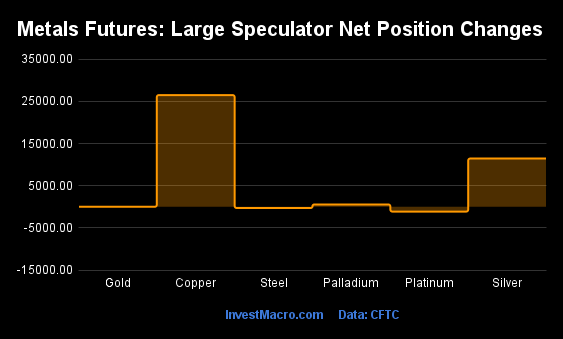
Weekly Speculator Changes led by Lean Hogs & Cotton

The COT soft commodities markets speculator bets were slightly lower this week as five out of the eleven softs markets we cover had higher positioning while the other six markets had lower speculator contracts.

Leading the gains for the softs markets was Lean Hogs (14,917 contracts) with Cotton (11,158 contracts), Live Cattle (8,286 contracts), Soybeans (1,463 contracts) and Soybean Meal (14 contracts)  also in the plus column for the week.

The markets with the declines in speculator bets this week were Corn (-20,128 contracts) with Wheat (-15,632 contracts), Soybean Oil (-9,325 contracts), Coffee (-4,221 contracts), Cocoa (-1,225 contracts) and Sugar (-465 contracts) also seeing lower bets on the week.


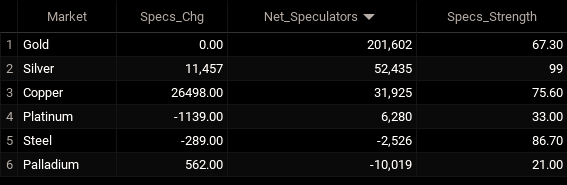
Softs Net Speculators Leaderboard

Legend: Weekly Speculators Change | Speculators Current Net Position | Speculators Strength Score compared to last 3-Years (0-100 range)


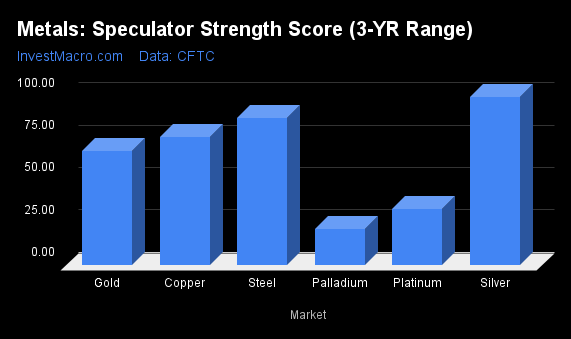
Strength Scores led by Coffee & Cotton

COT Strength Scores (a normalized measure of Speculator positions over a 3-Year range, from 0 to 100 where above 80 is Extreme-Bullish and below 20 is Extreme-Bearish) showed that Coffee (85 percent) and Cotton (80 percent) lead the softs markets this week. Cocoa (59 percent) comes in as the next highest in the weekly strength scores.

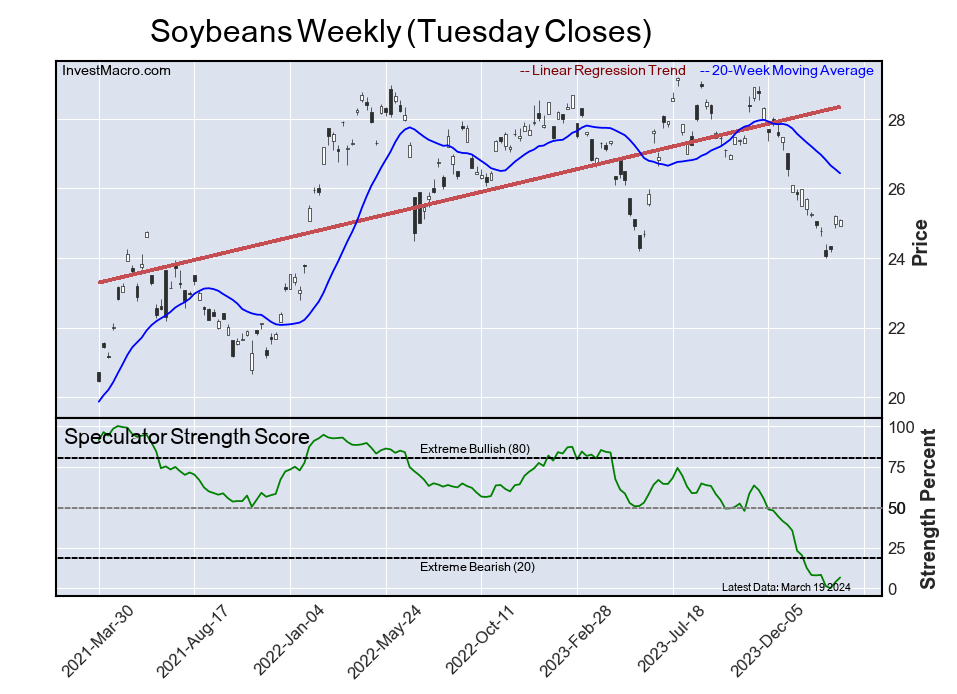
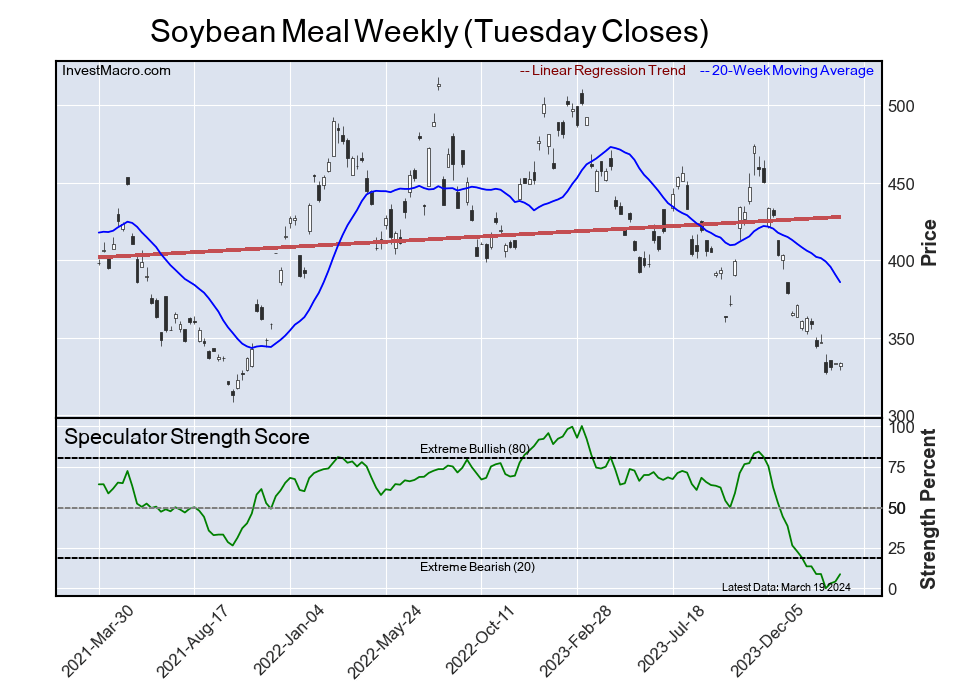
On the downside, Soybean Meal (0 percent), Corn (0 percent), Soybeans (0 percent) and Soybean Oil (3 percent) come in at the lowest strength levels currently and are in Extreme-Bearish territory (below 20 percent).

Strength Statistics:
Corn (0.0 percent) vs Corn previous week (2.5 percent)
Sugar (23.8 percent) vs Sugar previous week (23.9 percent)
Coffee (84.7 percent) vs Coffee previous week (89.0 percent)
Soybeans (0.4 percent) vs Soybeans previous week (0.0 percent)
Soybean Oil (2.5 percent) vs Soybean Oil previous week (8.3 percent)
Soybean Meal (0.0 percent) vs Soybean Meal previous week (0.0 percent)
Live Cattle (45.7 percent) vs Live Cattle previous week (36.7 percent)
Lean Hogs (43.2 percent) vs Lean Hogs previous week (31.0 percent)
Cotton (80.3 percent) vs Cotton previous week (71.9 percent)
Cocoa (59.1 percent) vs Cocoa previous week (60.3 percent)
Wheat (36.5 percent) vs Wheat previous week (47.4 percent)


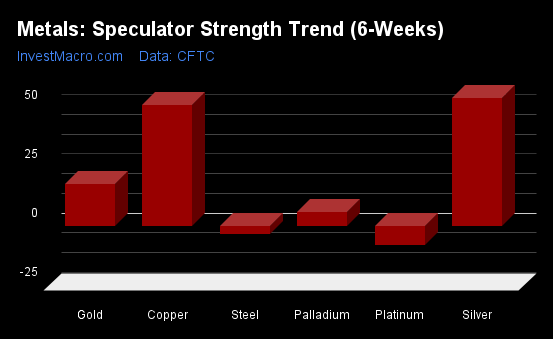
Cotton & Live Cattle top the 6-Week Strength Trends

COT Strength Score Trends (or move index, calculates the 6-week changes in strength scores) showed that Cotton (67 percent) and Live Cattle (42 percent) lead the past six weeks trends for soft commodities. Lean Hogs (34 percent), Coffee (11 percent) and Sugar (8 percent) are the next highest positive movers in the latest trends data.

Soybeans (-30 percent) leads the downside trend scores currently with Cocoa (-21 percent), Soybean Meal (-19 percent) and Corn (-11 percent) following next with lower trend scores.

Strength Trend Statistics:
Corn (-11.5 percent) vs Corn previous week (-12.3 percent)
Sugar (8.2 percent) vs Sugar previous week (6.3 percent)
Coffee (10.5 percent) vs Coffee previous week (17.1 percent)
Soybeans (-29.6 percent) vs Soybeans previous week (-33.9 percent)
Soybean Oil (-2.9 percent) vs Soybean Oil previous week (4.9 percent)
Soybean Meal (-19.3 percent) vs Soybean Meal previous week (-32.5 percent)
Live Cattle (41.5 percent) vs Live Cattle previous week (24.7 percent)
Lean Hogs (33.7 percent) vs Lean Hogs previous week (24.7 percent)
Cotton (67.1 percent) vs Cotton previous week (58.9 percent)
Cocoa (-21.2 percent) vs Cocoa previous week (-20.0 percent)
Wheat (-7.8 percent) vs Wheat previous week (3.2 percent)


Individual Soft Commodities Markets:

CORN Futures:

CORN Futures COT ChartThe CORN large speculator standing this week resulted in a net position of -266,067 contracts in the data reported through Tuesday. This was a weekly decline of -20,128 contracts from the previous week which had a total of -245,939 net contracts.

This week’s current strength score (the trader positioning range over the past three years, measured from 0 to 100) shows the speculators are currently Bearish-Extreme with a score of 0.0 percent. The commercials are Bullish-Extreme with a score of 100.0 percent and the small traders (not shown in chart) are Bullish-Extreme with a score of 97.2 percent.

Price Trend-Following Model: Strong Downtrend

Our weekly trend-following model classifies the current market price position as: Strong Downtrend. The current action for the model is considered to be: Hold – Maintain Short Position.

CORN Futures StatisticsSPECULATORSCOMMERCIALSSMALL TRADERS
– Percent of Open Interest Longs:17.646.110.1
– Percent of Open Interest Shorts:34.328.511.2
– Net Position:-266,067282,468-16,401
– Gross Longs:282,549738,256162,300
– Gross Shorts:548,616455,788178,701
– Long to Short Ratio:0.5 to 11.6 to 10.9 to 1
NET POSITION TREND:
– Strength Index Score (3 Year Range Pct):0.0100.097.2
– Strength Index Reading (3 Year Range):Bearish-ExtremeBullish-ExtremeBullish-Extreme
NET POSITION MOVEMENT INDEX:
– 6-Week Change in Strength Index:-11.511.36.9


SUGAR Futures:

SUGAR Futures COT ChartThe SUGAR large speculator standing this week resulted in a net position of 91,690 contracts in the data reported through Tuesday. This was a weekly reduction of -465 contracts from the previous week which had a total of 92,155 net contracts.

This week’s current strength score (the trader positioning range over the past three years, measured from 0 to 100) shows the speculators are currently Bearish with a score of 23.8 percent. The commercials are Bullish with a score of 79.5 percent and the small traders (not shown in chart) are Bearish-Extreme with a score of 10.3 percent.

Price Trend-Following Model: Downtrend

Our weekly trend-following model classifies the current market price position as: Downtrend. The current action for the model is considered to be: Hold – Maintain Short Position.

SUGAR Futures StatisticsSPECULATORSCOMMERCIALSSMALL TRADERS
– Percent of Open Interest Longs:21.754.38.4
– Percent of Open Interest Shorts:10.965.87.7
– Net Position:91,690-97,6936,003
– Gross Longs:184,174461,06271,375
– Gross Shorts:92,484558,75565,372
– Long to Short Ratio:2.0 to 10.8 to 11.1 to 1
NET POSITION TREND:
– Strength Index Score (3 Year Range Pct):23.879.510.3
– Strength Index Reading (3 Year Range):BearishBullishBearish-Extreme
NET POSITION MOVEMENT INDEX:
– 6-Week Change in Strength Index:8.2-4.9-9.1


COFFEE Futures:

COFFEE Futures COT ChartThe COFFEE large speculator standing this week resulted in a net position of 55,863 contracts in the data reported through Tuesday. This was a weekly decline of -4,221 contracts from the previous week which had a total of 60,084 net contracts.

This week’s current strength score (the trader positioning range over the past three years, measured from 0 to 100) shows the speculators are currently Bullish-Extreme with a score of 84.7 percent. The commercials are Bearish-Extreme with a score of 19.6 percent and the small traders (not shown in chart) are Bearish with a score of 23.8 percent.

Price Trend-Following Model: Uptrend

Our weekly trend-following model classifies the current market price position as: Uptrend. The current action for the model is considered to be: Hold – Maintain Long Position.

COFFEE Futures StatisticsSPECULATORSCOMMERCIALSSMALL TRADERS
– Percent of Open Interest Longs:38.236.23.6
– Percent of Open Interest Shorts:11.163.63.2
– Net Position:55,863-56,600737
– Gross Longs:78,87574,7127,412
– Gross Shorts:23,012131,3126,675
– Long to Short Ratio:3.4 to 10.6 to 11.1 to 1
NET POSITION TREND:
– Strength Index Score (3 Year Range Pct):84.719.623.8
– Strength Index Reading (3 Year Range):Bullish-ExtremeBearish-ExtremeBearish
NET POSITION MOVEMENT INDEX:
– 6-Week Change in Strength Index:10.5-8.8-18.5


SOYBEANS Futures:

SOYBEANS Futures COT ChartThe SOYBEANS large speculator standing this week resulted in a net position of -160,288 contracts in the data reported through Tuesday. This was a weekly gain of 1,463 contracts from the previous week which had a total of -161,751 net contracts.

This week’s current strength score (the trader positioning range over the past three years, measured from 0 to 100) shows the speculators are currently Bearish-Extreme with a score of 0.4 percent. The commercials are Bullish-Extreme with a score of 100.0 percent and the small traders (not shown in chart) are Bullish with a score of 77.3 percent.

Price Trend-Following Model: Strong Downtrend

Our weekly trend-following model classifies the current market price position as: Strong Downtrend. The current action for the model is considered to be: Hold – Maintain Short Position.

SOYBEANS Futures StatisticsSPECULATORSCOMMERCIALSSMALL TRADERS
– Percent of Open Interest Longs:12.559.26.5
– Percent of Open Interest Shorts:32.537.87.9
– Net Position:-160,288171,748-11,460
– Gross Longs:100,976476,36452,352
– Gross Shorts:261,264304,61663,812
– Long to Short Ratio:0.4 to 11.6 to 10.8 to 1
NET POSITION TREND:
– Strength Index Score (3 Year Range Pct):0.4100.077.3
– Strength Index Reading (3 Year Range):Bearish-ExtremeBullish-ExtremeBullish
NET POSITION MOVEMENT INDEX:
– 6-Week Change in Strength Index:-29.628.110.0


SOYBEAN OIL Futures:

SOYBEAN OIL Futures COT ChartThe SOYBEAN OIL large speculator standing this week resulted in a net position of -33,941 contracts in the data reported through Tuesday. This was a weekly fall of -9,325 contracts from the previous week which had a total of -24,616 net contracts.

This week’s current strength score (the trader positioning range over the past three years, measured from 0 to 100) shows the speculators are currently Bearish-Extreme with a score of 2.5 percent. The commercials are Bullish-Extreme with a score of 98.8 percent and the small traders (not shown in chart) are Bearish-Extreme with a score of 18.8 percent.

Price Trend-Following Model: Strong Downtrend

Our weekly trend-following model classifies the current market price position as: Strong Downtrend. The current action for the model is considered to be: Hold – Maintain Short Position.

SOYBEAN OIL Futures StatisticsSPECULATORSCOMMERCIALSSMALL TRADERS
– Percent of Open Interest Longs:19.448.85.0
– Percent of Open Interest Shorts:25.543.04.8
– Net Position:-33,94132,5271,414
– Gross Longs:107,910271,18227,829
– Gross Shorts:141,851238,65526,415
– Long to Short Ratio:0.8 to 11.1 to 11.1 to 1
NET POSITION TREND:
– Strength Index Score (3 Year Range Pct):2.598.818.8
– Strength Index Reading (3 Year Range):Bearish-ExtremeBullish-ExtremeBearish-Extreme
NET POSITION MOVEMENT INDEX:
– 6-Week Change in Strength Index:-2.92.7-0.5


SOYBEAN MEAL Futures:

SOYBEAN MEAL Futures COT ChartThe SOYBEAN MEAL large speculator standing this week resulted in a net position of -45,453 contracts in the data reported through Tuesday. This was a weekly advance of 14 contracts from the previous week which had a total of -45,467 net contracts.

This week’s current strength score (the trader positioning range over the past three years, measured from 0 to 100) shows the speculators are currently Bearish-Extreme with a score of 0.0 percent. The commercials are Bullish-Extreme with a score of 100.0 percent and the small traders (not shown in chart) are Bearish with a score of 29.0 percent.

Price Trend-Following Model: Strong Downtrend

Our weekly trend-following model classifies the current market price position as: Strong Downtrend. The current action for the model is considered to be: Hold – Maintain Short Position.

SOYBEAN MEAL Futures StatisticsSPECULATORSCOMMERCIALSSMALL TRADERS
– Percent of Open Interest Longs:17.449.49.6
– Percent of Open Interest Shorts:26.543.66.3
– Net Position:-45,45329,15016,303
– Gross Longs:87,267247,49747,872
– Gross Shorts:132,720218,34731,569
– Long to Short Ratio:0.7 to 11.1 to 11.5 to 1
NET POSITION TREND:
– Strength Index Score (3 Year Range Pct):0.0100.029.0
– Strength Index Reading (3 Year Range):Bearish-ExtremeBullish-ExtremeBearish
NET POSITION MOVEMENT INDEX:
– 6-Week Change in Strength Index:-19.317.713.4


LIVE CATTLE Futures:

LIVE CATTLE Futures COT ChartThe LIVE CATTLE large speculator standing this week resulted in a net position of 61,880 contracts in the data reported through Tuesday. This was a weekly rise of 8,286 contracts from the previous week which had a total of 53,594 net contracts.

This week’s current strength score (the trader positioning range over the past three years, measured from 0 to 100) shows the speculators are currently Bearish with a score of 45.7 percent. The commercials are Bullish with a score of 52.9 percent and the small traders (not shown in chart) are Bullish with a score of 64.4 percent.

Price Trend-Following Model: Weak Downtrend

Our weekly trend-following model classifies the current market price position as: Weak Downtrend. The current action for the model is considered to be: Hold – Maintain Short Position.

LIVE CATTLE Futures StatisticsSPECULATORSCOMMERCIALSSMALL TRADERS
– Percent of Open Interest Longs:36.636.710.7
– Percent of Open Interest Shorts:15.356.312.3
– Net Position:61,880-57,126-4,754
– Gross Longs:106,475106,52330,961
– Gross Shorts:44,595163,64935,715
– Long to Short Ratio:2.4 to 10.7 to 10.9 to 1
NET POSITION TREND:
– Strength Index Score (3 Year Range Pct):45.752.964.4
– Strength Index Reading (3 Year Range):BearishBullishBullish
NET POSITION MOVEMENT INDEX:
– 6-Week Change in Strength Index:41.5-41.3-24.8


LEAN HOGS Futures:

LEAN HOGS Futures COT ChartThe LEAN HOGS large speculator standing this week resulted in a net position of 16,496 contracts in the data reported through Tuesday. This was a weekly gain of 14,917 contracts from the previous week which had a total of 1,579 net contracts.

This week’s current strength score (the trader positioning range over the past three years, measured from 0 to 100) shows the speculators are currently Bearish with a score of 43.2 percent. The commercials are Bullish with a score of 59.4 percent and the small traders (not shown in chart) are Bullish with a score of 61.4 percent.

Price Trend-Following Model: Strong Uptrend

Our weekly trend-following model classifies the current market price position as: Strong Uptrend. The current action for the model is considered to be: Hold – Maintain Long Position.

LEAN HOGS Futures StatisticsSPECULATORSCOMMERCIALSSMALL TRADERS
– Percent of Open Interest Longs:36.736.28.4
– Percent of Open Interest Shorts:29.441.310.6
– Net Position:16,496-11,597-4,899
– Gross Longs:82,76281,58018,963
– Gross Shorts:66,26693,17723,862
– Long to Short Ratio:1.2 to 10.9 to 10.8 to 1
NET POSITION TREND:
– Strength Index Score (3 Year Range Pct):43.259.461.4
– Strength Index Reading (3 Year Range):BearishBullishBullish
NET POSITION MOVEMENT INDEX:
– 6-Week Change in Strength Index:33.7-36.31.1


COTTON Futures:

COTTON Futures COT ChartThe COTTON large speculator standing this week resulted in a net position of 95,093 contracts in the data reported through Tuesday. This was a weekly advance of 11,158 contracts from the previous week which had a total of 83,935 net contracts.

This week’s current strength score (the trader positioning range over the past three years, measured from 0 to 100) shows the speculators are currently Bullish-Extreme with a score of 80.3 percent. The commercials are Bearish with a score of 20.2 percent and the small traders (not shown in chart) are Bullish with a score of 67.0 percent.

Price Trend-Following Model: Strong Uptrend

Our weekly trend-following model classifies the current market price position as: Strong Uptrend. The current action for the model is considered to be: Hold – Maintain Long Position.

COTTON Futures StatisticsSPECULATORSCOMMERCIALSSMALL TRADERS
– Percent of Open Interest Longs:44.633.46.3
– Percent of Open Interest Shorts:8.772.43.1
– Net Position:95,093-103,4978,404
– Gross Longs:118,28888,44716,722
– Gross Shorts:23,195191,9448,318
– Long to Short Ratio:5.1 to 10.5 to 12.0 to 1
NET POSITION TREND:
– Strength Index Score (3 Year Range Pct):80.320.267.0
– Strength Index Reading (3 Year Range):Bullish-ExtremeBearishBullish
NET POSITION MOVEMENT INDEX:
– 6-Week Change in Strength Index:67.1-66.453.6


COCOA Futures:

COCOA Futures COT ChartThe COCOA large speculator standing this week resulted in a net position of 48,126 contracts in the data reported through Tuesday. This was a weekly reduction of -1,225 contracts from the previous week which had a total of 49,351 net contracts.

This week’s current strength score (the trader positioning range over the past three years, measured from 0 to 100) shows the speculators are currently Bullish with a score of 59.1 percent. The commercials are Bearish with a score of 39.2 percent and the small traders (not shown in chart) are Bullish with a score of 50.3 percent.

Price Trend-Following Model: Strong Uptrend

Our weekly trend-following model classifies the current market price position as: Strong Uptrend. The current action for the model is considered to be: Hold – Maintain Long Position.

COCOA Futures StatisticsSPECULATORSCOMMERCIALSSMALL TRADERS
– Percent of Open Interest Longs:35.930.56.4
– Percent of Open Interest Shorts:16.651.54.6
– Net Position:48,126-52,5974,471
– Gross Longs:89,68076,17715,889
– Gross Shorts:41,554128,77411,418
– Long to Short Ratio:2.2 to 10.6 to 11.4 to 1
NET POSITION TREND:
– Strength Index Score (3 Year Range Pct):59.139.250.3
– Strength Index Reading (3 Year Range):BullishBearishBullish
NET POSITION MOVEMENT INDEX:
– 6-Week Change in Strength Index:-21.214.950.3


WHEAT Futures:

WHEAT Futures COT ChartThe WHEAT large speculator standing this week resulted in a net position of -44,639 contracts in the data reported through Tuesday. This was a weekly lowering of -15,632 contracts from the previous week which had a total of -29,007 net contracts.

This week’s current strength score (the trader positioning range over the past three years, measured from 0 to 100) shows the speculators are currently Bearish with a score of 36.5 percent. The commercials are Bullish with a score of 63.6 percent and the small traders (not shown in chart) are Bearish with a score of 44.5 percent.

Price Trend-Following Model: Weak Uptrend

Our weekly trend-following model classifies the current market price position as: Weak Uptrend. The current action for the model is considered to be: Hold – Maintain Long Position.

WHEAT Futures StatisticsSPECULATORSCOMMERCIALSSMALL TRADERS
– Percent of Open Interest Longs:31.336.87.9
– Percent of Open Interest Shorts:42.624.39.2
– Net Position:-44,63949,606-4,967
– Gross Longs:124,169145,80731,337
– Gross Shorts:168,80896,20136,304
– Long to Short Ratio:0.7 to 11.5 to 10.9 to 1
NET POSITION TREND:
– Strength Index Score (3 Year Range Pct):36.563.644.5
– Strength Index Reading (3 Year Range):BearishBullishBearish
NET POSITION MOVEMENT INDEX:
– 6-Week Change in Strength Index:-7.85.317.7


Article By InvestMacroReceive our weekly COT Newsletter

*COT Report: The COT data, released weekly to the public each Friday, is updated through the most recent Tuesday (data is 3 days old) and shows a quick view of how large speculators or non-commercials (for-profit traders) were positioned in the futures markets.

The CFTC categorizes trader positions according to commercial hedgers (traders who use futures contracts for hedging as part of the business), non-commercials (large traders who speculate to realize trading profits) and nonreportable traders (usually small traders/speculators) as well as their open interest (contracts open in the market at time of reporting). See CFTC criteria here.

COT Stock Market Charts: Speculator Bets led by VIX & Russell-Mini

By InvestMacro

Here are the latest charts and statistics for the Commitment of Traders (COT) data published by the Commodities Futures Trading Commission (CFTC).

The latest COT data is updated through Tuesday February 20th and shows a quick view of how large traders (for-profit speculators and commercial entities) were positioned in the futures markets.

Weekly Speculator Changes led by VIX & Russell-Mini

The COT stock markets speculator bets were lower this week as just two out of the seven stock markets we cover had higher positioning while the other five markets had lower speculator contracts.

Leading the gains for the stock markets was the VIX (11,895 contracts) with the Russell-Mini (246 contracts) also showing a small positive week.

The markets with the declines in speculator bets this week were the Nasdaq-Mini (-6,515 contracts), the DowJones-Mini (-3,641 contracts), the S&P500-Mini (-2,752 contracts), the MSCI EAFE-Mini (-3,346 contracts) and the Nikkei 225 (-332 contracts).


Stock Net Speculators Leaderboard

Legend: Weekly Speculators Change | Speculators Current Net Position | Speculators Strength Score compared to last 3-Years (0-100 range)


Strength Scores led by DowJones-Mini & VIX

COT Strength Scores (a normalized measure of Speculator positions over a 3-Year range, from 0 to 100 where above 80 is Extreme-Bullish and below 20 is Extreme-Bearish) showed that the DowJones-Mini (88 percent) and the VIX (80 percent) lead the stock markets this week. The Nasdaq-Mini (79 percent) and Russell-Mini (68 percent) come in as the next highest in the weekly strength scores.

On the downside, the S&P500-Mini (32 percent) comes in at the lowest strength level currently followed by the MSCI EAFE-Mini at 34 percent.

Strength Statistics:
VIX (79.9 percent) vs VIX previous week (70.4 percent)
S&P500-Mini (32.2 percent) vs S&P500-Mini previous week (32.6 percent)
DowJones-Mini (87.5 percent) vs DowJones-Mini previous week (93.4 percent)
Nasdaq-Mini (78.8 percent) vs Nasdaq-Mini previous week (88.9 percent)
Russell2000-Mini (67.9 percent) vs Russell2000-Mini previous week (67.7 percent)
Nikkei USD (40.2 percent) vs Nikkei USD previous week (42.5 percent)
EAFE-Mini (34.1 percent) vs EAFE-Mini previous week (37.6 percent)


VIX & MSCI EAFE-Mini top the 6-Week Strength Trends

COT Strength Score Trends (or move index, calculates the 6-week changes in strength scores) showed that the VIX (4 percent) leads the past six weeks trends and is the only positive mover for the stock markets this week.

The Russell-Mini (-32 percent) leads the downside trend scores currently with the Nasdaq-Mini (-17 percent) coming in as the next lowest market for trend scores.

Strength Trend Statistics:
VIX (4.1 percent) vs VIX previous week (-4.8 percent)
S&P500-Mini (-15.1 percent) vs S&P500-Mini previous week (-0.3 percent)
DowJones-Mini (-12.0 percent) vs DowJones-Mini previous week (1.3 percent)
Nasdaq-Mini (-17.4 percent) vs Nasdaq-Mini previous week (-10.8 percent)
Russell2000-Mini (-32.1 percent) vs Russell2000-Mini previous week (-16.7 percent)
Nikkei USD (-7.5 percent) vs Nikkei USD previous week (0.2 percent)
EAFE-Mini (-2.1 percent) vs EAFE-Mini previous week (9.2 percent)


Individual Stock Market Charts:

VIX Volatility Futures:

VIX Volatility Futures COT ChartThe VIX Volatility large speculator standing this week equaled a net position of -39,071 contracts in the data reported through Tuesday. This was a weekly advance of 11,895 contracts from the previous week which had a total of -50,966 net contracts.

This week’s current strength score (the trader positioning range over the past three years, measured from 0 to 100) shows the speculators are currently Bullish with a score of 79.9 percent. The commercials are Bearish-Extreme with a score of 19.1 percent and the small traders (not shown in chart) are Bullish with a score of 73.9 percent.

Price Trend-Following Model: Weak Downtrend

Our weekly trend-following model classifies the current market price position as: Weak Downtrend. The current action for the model is considered to be: Hold – Maintain Short Position.

VIX Volatility Futures StatisticsSPECULATORSCOMMERCIALSSMALL TRADERS
– Percent of Open Interest Longs:21.944.87.5
– Percent of Open Interest Shorts:33.332.08.8
– Net Position:-39,07143,488-4,417
– Gross Longs:74,671152,74725,470
– Gross Shorts:113,742109,25929,887
– Long to Short Ratio:0.7 to 11.4 to 10.9 to 1
NET POSITION TREND:
– Strength Index Score (3 Year Range Pct):79.919.173.9
– Strength Index Reading (3 Year Range):BullishBearish-ExtremeBullish
NET POSITION MOVEMENT INDEX:
– 6-Week Change in Strength Index:4.1-6.013.6


S&P500 Mini Futures:

SP500 Mini Futures COT ChartThe S&P500 Mini large speculator standing this week equaled a net position of -218,530 contracts in the data reported through Tuesday. This was a weekly lowering of -2,752 contracts from the previous week which had a total of -215,778 net contracts.

This week’s current strength score (the trader positioning range over the past three years, measured from 0 to 100) shows the speculators are currently Bearish with a score of 32.2 percent. The commercials are Bullish with a score of 59.7 percent and the small traders (not shown in chart) are Bullish with a score of 67.0 percent.

Price Trend-Following Model: Strong Uptrend

Our weekly trend-following model classifies the current market price position as: Strong Uptrend. The current action for the model is considered to be: Hold – Maintain Long Position.

S&P500 Mini Futures StatisticsSPECULATORSCOMMERCIALSSMALL TRADERS
– Percent of Open Interest Longs:11.774.111.3
– Percent of Open Interest Shorts:21.168.08.0
– Net Position:-218,530143,35375,177
– Gross Longs:271,8701,722,121262,112
– Gross Shorts:490,4001,578,768186,935
– Long to Short Ratio:0.6 to 11.1 to 11.4 to 1
NET POSITION TREND:
– Strength Index Score (3 Year Range Pct):32.259.767.0
– Strength Index Reading (3 Year Range):BearishBullishBullish
NET POSITION MOVEMENT INDEX:
– 6-Week Change in Strength Index:-15.117.6-10.4


Dow Jones Mini Futures:

Dow Jones Mini Futures COT ChartThe Dow Jones Mini large speculator standing this week equaled a net position of 16,728 contracts in the data reported through Tuesday. This was a weekly decrease of -3,641 contracts from the previous week which had a total of 20,369 net contracts.

This week’s current strength score (the trader positioning range over the past three years, measured from 0 to 100) shows the speculators are currently Bullish-Extreme with a score of 87.5 percent. The commercials are Bearish-Extreme with a score of 10.8 percent and the small traders (not shown in chart) are Bullish with a score of 54.5 percent.

Price Trend-Following Model: Uptrend

Our weekly trend-following model classifies the current market price position as: Uptrend. The current action for the model is considered to be: Hold – Maintain Long Position.

Dow Jones Mini Futures StatisticsSPECULATORSCOMMERCIALSSMALL TRADERS
– Percent of Open Interest Longs:31.552.314.4
– Percent of Open Interest Shorts:15.270.812.3
– Net Position:16,728-18,8982,170
– Gross Longs:32,29353,58414,754
– Gross Shorts:15,56572,48212,584
– Long to Short Ratio:2.1 to 10.7 to 11.2 to 1
NET POSITION TREND:
– Strength Index Score (3 Year Range Pct):87.510.854.5
– Strength Index Reading (3 Year Range):Bullish-ExtremeBearish-ExtremeBullish
NET POSITION MOVEMENT INDEX:
– 6-Week Change in Strength Index:-12.09.54.0


Nasdaq Mini Futures:

Nasdaq Mini Futures COT ChartThe Nasdaq Mini large speculator standing this week equaled a net position of 25,561 contracts in the data reported through Tuesday. This was a weekly reduction of -6,515 contracts from the previous week which had a total of 32,076 net contracts.

This week’s current strength score (the trader positioning range over the past three years, measured from 0 to 100) shows the speculators are currently Bullish with a score of 78.8 percent. The commercials are Bearish-Extreme with a score of 16.9 percent and the small traders (not shown in chart) are Bullish-Extreme with a score of 95.2 percent.

Price Trend-Following Model: Uptrend

Our weekly trend-following model classifies the current market price position as: Uptrend. The current action for the model is considered to be: Hold – Maintain Long Position.

Nasdaq Mini Futures StatisticsSPECULATORSCOMMERCIALSSMALL TRADERS
– Percent of Open Interest Longs:32.251.814.8
– Percent of Open Interest Shorts:23.363.012.4
– Net Position:25,561-32,4326,871
– Gross Longs:92,445148,59642,460
– Gross Shorts:66,884181,02835,589
– Long to Short Ratio:1.4 to 10.8 to 11.2 to 1
NET POSITION TREND:
– Strength Index Score (3 Year Range Pct):78.816.995.2
– Strength Index Reading (3 Year Range):BullishBearish-ExtremeBullish-Extreme
NET POSITION MOVEMENT INDEX:
– 6-Week Change in Strength Index:-17.411.12.8


Russell 2000 Mini Futures:

Russell 2000 Mini Futures COT ChartThe Russell 2000 Mini large speculator standing this week equaled a net position of -24,205 contracts in the data reported through Tuesday. This was a weekly advance of 246 contracts from the previous week which had a total of -24,451 net contracts.

This week’s current strength score (the trader positioning range over the past three years, measured from 0 to 100) shows the speculators are currently Bullish with a score of 67.9 percent. The commercials are Bearish with a score of 33.1 percent and the small traders (not shown in chart) are Bearish with a score of 44.1 percent.

Price Trend-Following Model: Uptrend

Our weekly trend-following model classifies the current market price position as: Uptrend. The current action for the model is considered to be: Hold – Maintain Long Position.

Russell 2000 Mini Futures StatisticsSPECULATORSCOMMERCIALSSMALL TRADERS
– Percent of Open Interest Longs:11.781.06.1
– Percent of Open Interest Shorts:16.577.15.2
– Net Position:-24,20519,7274,478
– Gross Longs:59,033407,62330,904
– Gross Shorts:83,238387,89626,426
– Long to Short Ratio:0.7 to 11.1 to 11.2 to 1
NET POSITION TREND:
– Strength Index Score (3 Year Range Pct):67.933.144.1
– Strength Index Reading (3 Year Range):BullishBearishBearish
NET POSITION MOVEMENT INDEX:
– 6-Week Change in Strength Index:-32.133.1-21.9


Nikkei Stock Average (USD) Futures:

Nikkei Stock Average (USD) Futures COT ChartThe Nikkei Stock Average (USD) large speculator standing this week equaled a net position of -3,720 contracts in the data reported through Tuesday. This was a weekly reduction of -332 contracts from the previous week which had a total of -3,388 net contracts.

This week’s current strength score (the trader positioning range over the past three years, measured from 0 to 100) shows the speculators are currently Bearish with a score of 40.2 percent. The commercials are Bearish with a score of 48.8 percent and the small traders (not shown in chart) are Bullish with a score of 63.1 percent.

Price Trend-Following Model: Strong Uptrend

Our weekly trend-following model classifies the current market price position as: Strong Uptrend. The current action for the model is considered to be: Hold – Maintain Long Position.

Nikkei Stock Average Futures StatisticsSPECULATORSCOMMERCIALSSMALL TRADERS
– Percent of Open Interest Longs:10.864.924.3
– Percent of Open Interest Shorts:32.552.514.9
– Net Position:-3,7202,1241,596
– Gross Longs:1,85211,1214,156
– Gross Shorts:5,5728,9972,560
– Long to Short Ratio:0.3 to 11.2 to 11.6 to 1
NET POSITION TREND:
– Strength Index Score (3 Year Range Pct):40.248.863.1
– Strength Index Reading (3 Year Range):BearishBearishBullish
NET POSITION MOVEMENT INDEX:
– 6-Week Change in Strength Index:-7.52.410.8


MSCI EAFE Mini Futures:

MSCI EAFE Mini Futures COT ChartThe MSCI EAFE Mini large speculator standing this week equaled a net position of -31,202 contracts in the data reported through Tuesday. This was a weekly fall of -3,346 contracts from the previous week which had a total of -27,856 net contracts.

This week’s current strength score (the trader positioning range over the past three years, measured from 0 to 100) shows the speculators are currently Bearish with a score of 34.1 percent. The commercials are Bullish with a score of 63.3 percent and the small traders (not shown in chart) are Bearish with a score of 45.1 percent.

Price Trend-Following Model: Uptrend

Our weekly trend-following model classifies the current market price position as: Uptrend. The current action for the model is considered to be: Hold – Maintain Long Position.

MSCI EAFE Mini Futures StatisticsSPECULATORSCOMMERCIALSSMALL TRADERS
– Percent of Open Interest Longs:8.687.93.2
– Percent of Open Interest Shorts:15.782.11.9
– Net Position:-31,20225,5655,637
– Gross Longs:37,822386,07214,132
– Gross Shorts:69,024360,5078,495
– Long to Short Ratio:0.5 to 11.1 to 11.7 to 1
NET POSITION TREND:
– Strength Index Score (3 Year Range Pct):34.163.345.1
– Strength Index Reading (3 Year Range):BearishBullishBearish
NET POSITION MOVEMENT INDEX:
– 6-Week Change in Strength Index:-2.12.7-2.5


Article By InvestMacroReceive our weekly COT Newsletter

*COT Report: The COT data, released weekly to the public each Friday, is updated through the most recent Tuesday (data is 3 days old) and shows a quick view of how large speculators or non-commercials (for-profit traders) were positioned in the futures markets.

The CFTC categorizes trader positions according to commercial hedgers (traders who use futures contracts for hedging as part of the business), non-commercials (large traders who speculate to realize trading profits) and nonreportable traders (usually small traders/speculators) as well as their open interest (contracts open in the market at time of reporting). See CFTC criteria here.

Speculator Extremes: Mexican Peso, GBP, Corn & Soybeans lead Bullish & Bearish Positions

By InvestMacro

The latest update for the weekly Commitment of Traders (COT) report was released by the Commodity Futures Trading Commission (CFTC) on Friday for data ending on February 20th.

This weekly Extreme Positions report highlights the Most Bullish and Most Bearish Positions for the speculator category. Extreme positioning in these markets can foreshadow strong moves in the underlying market.

To signify an extreme position, we use the Strength Index (also known as the COT Index) of each instrument, a common method of measuring COT data. The Strength Index is simply a comparison of current trader positions against the range of positions over the previous 3 years. We use over 80 percent as extremely bullish and under 20 percent as extremely bearish. (Compare Strength Index scores across all markets in the data table or cot leaders table)


Here Are This Week’s Most Bullish Speculator Positions:

Mexican Peso
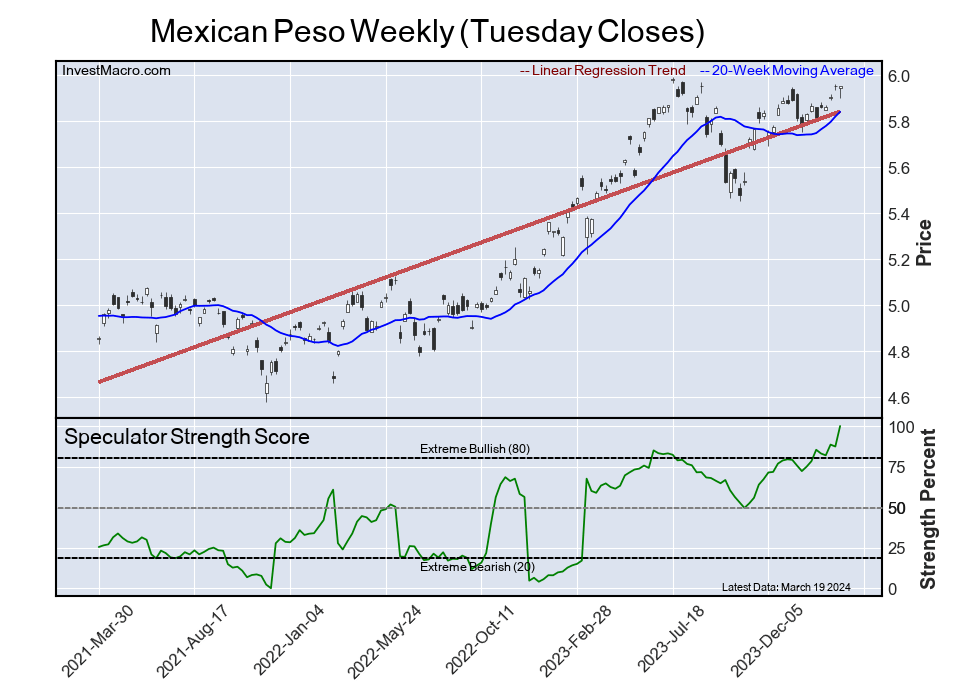

The Mexican Peso speculator position comes in as the most bullish extreme standing this week. The Mexican Peso speculator level is currently at a 97.3 percent score of its 3-year range.

The six-week trend for the percent strength score totaled 4.6 this week. The overall net speculator position was a total of 95,995 contracts this week with a decline of -4,449 contract in the weekly speculator bets.


Speculators or Non-Commercials Notes:

Speculators, classified as non-commercial traders by the CFTC, are made up of large commodity funds, hedge funds and other significant for-profit participants. The Specs are generally regarded as trend-followers in their behavior towards price action – net speculator bets and prices tend to go in the same directions. These traders often look to buy when prices are rising and sell when prices are falling. To illustrate this point, many times speculator contracts can be found at their most extremes (bullish or bearish) when prices are also close to their highest or lowest levels.

These extreme levels can be dangerous for the large speculators as the trade is most crowded, there is less trading ammunition still sitting on the sidelines to push the trend further and prices have moved a significant distance. When the trend becomes exhausted, some speculators take profits while others look to also exit positions when prices fail to continue in the same direction. This process usually plays out over many months to years and can ultimately create a reverse effect where prices start to fall and speculators start a process of selling when prices are falling.


British Pound Sterling


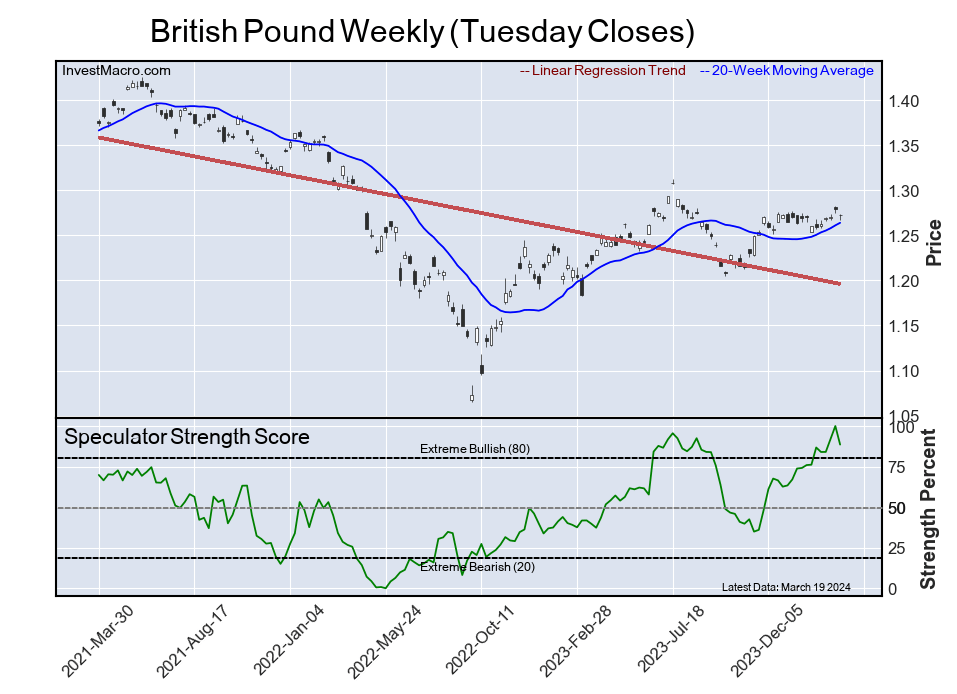
The British Pound speculator position comes next in the extreme standings this week. The British Pound speculator level is now at a 87.9 percent score of its 3-year range.

The six-week trend for the percent strength score was 17.8 this week. The speculator position registered 46,312 net contracts this week with a weekly fall of -4,160 contracts in speculator bets.


DowJones Mini
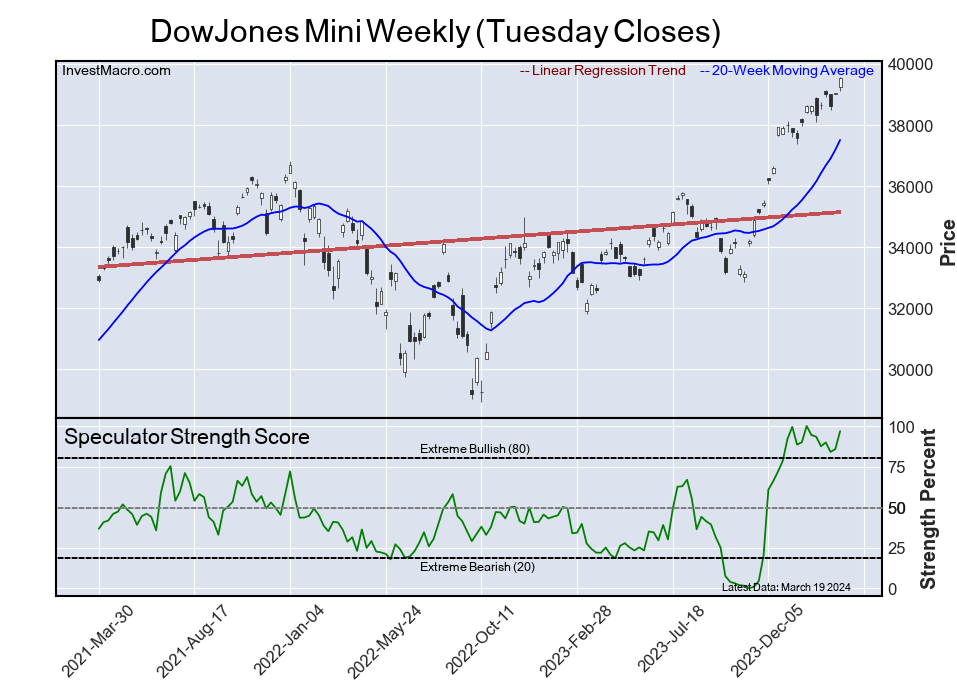

The DowJones Mini speculator position comes in third this week in the extreme standings. The DowJones Mini speculator level resides at a 87.5 percent score of its 3-year range.

The six-week trend for the speculator strength score came in at -12.0 this week. The overall speculator position was 16,728 net contracts this week with a decrease of -3,641 contracts in the weekly speculator bets.


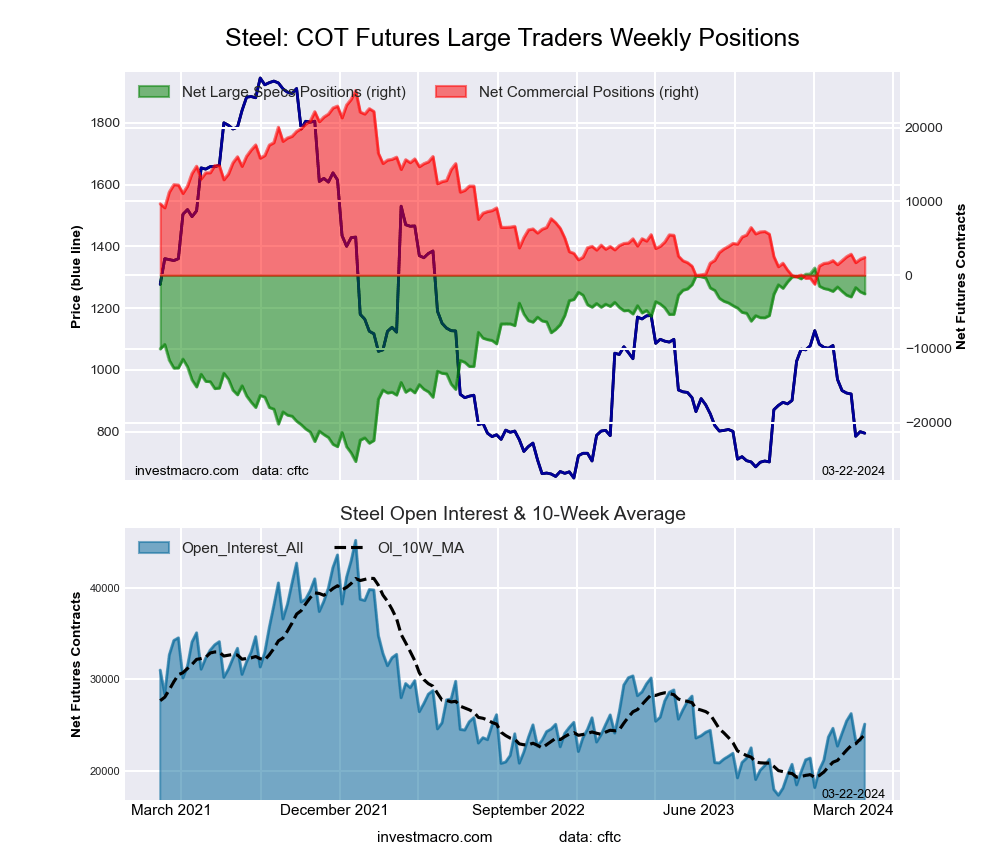
Steel


The Steel speculator position comes up number four in the extreme standings this week. The Steel speculator level is at a 86.0 percent score of its 3-year range.

The six-week trend for the speculator strength score totaled a change of -4.7 this week. The overall speculator position was -2,701 net contracts this week with a dip of -518 contracts in the speculator bets.


Brent Oil


The Brent Oil speculator position rounds out the top five in this week’s bullish extreme standings. The Brent Oil speculator level sits at a 85.8 percent score of its 3-year range. The six-week trend for the speculator strength score was 10.9 this week.

The speculator position was -13,856 net contracts this week with a gain of 1,589 contracts in the weekly speculator bets.


This Week’s Most Bearish Speculator Positions:

Corn


The Corn speculator position comes in as the most bearish extreme standing this week. The Corn speculator level is at a 0.0 percent score of its 3-year range.

The six-week trend for the speculator strength score was -11.5 this week. The overall speculator position was -266,067 net contracts this week with a drop of -20,128 contracts in the speculator bets.


Soybean Meal


The Soybean Meal speculator position comes in next for the most bearish extreme standing on the week. The Soybean Meal speculator level is at a 0.0 percent score of its 3-year range.

The six-week trend for the speculator strength score was -19.3 this week. The speculator position was -45,453 net contracts this week with a edge higher by 14 contracts in the weekly speculator bets.


Soybeans


The Soybeans speculator position comes in as third most bearish extreme standing of the week. The Soybeans speculator level resides at a 0.4 percent score of its 3-year range.

The six-week trend for the speculator strength score was -29.6 this week. The overall speculator position was -160,288 net contracts this week with a small increase of 1,463 contracts in the speculator bets.


Soybean Oil


The Soybean Oil speculator position comes in as this week’s fourth most bearish extreme standing. The Soybean Oil speculator level is at a 2.5 percent score of its 3-year range.

The six-week trend for the speculator strength score was -2.9 this week. The speculator position was -33,941 net contracts this week with a drop of -9,325 contracts in the weekly speculator bets.


Japanese Yen


Finally, the Japanese Yen speculator position comes in as the fifth most bearish extreme standing for this week. The Japanese Yen speculator level is at a 6.3 percent score of its 3-year range.

The six-week trend for the speculator strength score was -43.4 this week. The speculator position was -120,778 net contracts this week with a decrease of -9,242 contracts in the weekly speculator bets.


Article By InvestMacroReceive our weekly COT Newsletter

*COT Report: The COT data, released weekly to the public each Friday, is updated through the most recent Tuesday (data is 3 days old) and shows a quick view of how large speculators or non-commercials (for-profit traders) were positioned in the futures markets.

The CFTC categorizes trader positions according to commercial hedgers (traders who use futures contracts for hedging as part of the business), non-commercials (large traders who speculate to realize trading profits) and nonreportable traders (usually small traders/speculators) as well as their open interest (contracts open in the market at time of reporting). See CFTC criteria here.

Rising stock indices overshadowed hawkish speeches by US Fed policymakers. Canada is seeing a drop in retail sales

By JustMarkets

At the close of the stock market yesterday, the Dow Jones Index (US30) added 1.18%. The S&P 500 Index (US500) jumped 2.11% yesterday. The NASDAQ Technology Index (US100) closed positively at 2.96%. The S&P 500 (US500) and Dow Jones (US30) set new record highs, while the NASDAQ (US100) set a weekly high. Nvidia (NVDA) rose more than 16% to a record high on Thursday, leading a rally in the chip market after its quarterly earnings results released on Wednesday showed an explosive rise in demand for its artificial intelligence computing hardware.

Hawkish comments from policymakers failed to stop the indices from rising yesterday. Fed spokesman Christopher Waller said Thursday that the Fed should hold off on cutting rates for at least a couple more months to ensure the January inflation report was a fluke and that the Fed is still moving toward its inflation target. He added that acting too soon could squander the central bank’s gains in fighting inflation and cause significant damage to the economy. Fed Vice Chairman Jefferson agreed. He said that the Fed should be on guard against cutting interest rates too much in response to falling inflation because “excessive easing could cause progress in restoring price stability to stall or backslide. In addition, Philadelphia Fed President Harker cautioned against expecting interest rate cuts “right now and immediately” and said the biggest risk is cutting rates too quickly. Markets estimate the odds of a 25 bps rate cut at 6% for the March 19-20 FOMC meeting and 29% for the April 30-May 1 meeting.

Today, in the US, the minutes from the January FOMC meeting will be released. Investors will be looking for clues on the timing of the first-rate cut. Traders and investors have heard several Fed officials speak since the January meeting, and most preached patience with rates, warning against a premature cut, citing the strength of the US economy. If the minutes strike the same tone, given that the market is still pricing four rate cuts this year while the Fed has signaled only three, the dollar could get a boost. This would hurt stock indices and precious metals.

The latest economic data showed that US weekly jobless claims unexpectedly fell by 12,000 to a 5-week low of 201,000, indicating a strengthening labor market versus expectations of a rise to 216,000. The S&P Manufacturing PMI for February rose by 0.8 to a 17-month high of 51.5, stronger than expectations of no change at 50.7. US home sales for January rose by 3.1% to a 5-month high of 4.00 million, stronger than expectations of 3.97 million.

Canadian consumers sharply reduced their spending in January following stronger-than-expected retail purchases late last year. According to Statistics Canada’s preliminary estimate released Thursday, retail receipts fell by 0.4%, the biggest decline since March 2023. This followed a 0.9% jump in December. While this data points to strong consumer spending at the end of last year, the sharp decline in January suggests some weakness, especially amid rapid growth in Canada’s population due to immigration. The slowdown in retail consumption is expected to continue as more households renew their mortgages at higher interest rates this year.

Equity markets in Europe were mostly up yesterday. Germany’s DAX (DE40) rose by 1.47%, France’s CAC 40 (FR40) gained 1.27% yesterday, Spain’s IBEX 35 (ES35) jumped by 0.31% on Thursday, and the UK’s FTSE 100 (UK100) closed positive 0.29%.

Eurozone January CPI declined to 2.8% y/y from 2.9% y/y in December, matching expectations. Core CPI for January was 3.3% y/y, unchanged from December, which was in line with expectations. The report on the ECB’s January 24-25 meeting was hawkish as policymakers said the risk of cutting interest rates too early is more dangerous than cutting too late. Swaps estimate the odds of a 25 bps ECB rate cut at 3% at the next meeting on March 7 and 29% at the April 11 meeting.

Germany’s economy contracted by 0.3% in the final quarter of 2023 after two consecutive periods of stagnation. Europe’s largest economy has been hit by rising prices, higher borrowing costs, and weak external demand, especially in the manufacturing and construction sectors.

Asian markets also rose yesterday. Japan’s Nikkei 225 (JP225) gained 2.19% for the day, China’s FTSE China A50 (CHA50) added 0.50%, Hong Kong’s Hang Seng (HK50) ended Thursday up 1.45%, and Australia’s ASX 200 (AU200) ended the day positive 0.04%.

Singapore’s annual inflation rate unexpectedly fell to 2.9% in January 2024 from 3.7% in December, well below market forecasts of 3.8%. This marked the lowest inflation rate since September 2021.

Malaysia’s annual inflation rate in January 2024 stood at 1.5%, unchanged for the third consecutive month and at its lowest level since February 2021. The data was slightly below market forecasts of 1.6% amid declines in the cost of clothing (0.2% vs. unchanged in December) and communication services (2.4% vs. 3.7%). At the same time, prices continued to rise for food (2.0% vs. 2.3%), housing (2.0% vs. 1.6%), and transportation (0.7% vs. 0.3%).

S&P 500 (US500) 4,981.80 +6.29 (+0.13%)

Dow Jones (US30) 38,612.24 +48.44 (+0.13%)

DAX (DE40)  17,118.12 +49.69 (+0.29%)

FTSE 100 (UK100) 7,662.51 −56.70 (−0.73%)

USD Index  103.87 −0.13 (−0.13%)

Important events today:
  • – US FOMC Member Cook Speaks at 00:00 (GMT+2);
  • – US FOMC Member Kashkari Speaks at 00:00 (GMT+2);
  • – Singapore Consumer Price Index (m/m) at 07:00 (GMT+2);
  • – German GDP (q/q) at 09:00 (GMT+2);
  • – Switzerland Employment Rate (m/m) at 09:30 (GMT+2);
  • – German IFO Business Climate (m/m) at 11:00 (GMT+2).

By JustMarkets


This article reflects a personal opinion and should not be interpreted as an investment advice, and/or offer, and/or a persistent request for carrying out financial transactions, and/or a guarantee, and/or a forecast of future events.

Week Ahead: USDJPY timebomb triggered above 150?

By ForexTime 

  • JPY worst performing G10 YTD
  • Japan CPI & US PCE in focus
  • Yen back on intervention watch
  • USDJPY bullish but RSI overbought
  • Key level of interest at 150.90

Our focus lands on the Japanese Yen which has been the worst-performing G10 currency against the US Dollar year-to-date.

The final trading week of February promises to be eventful due to key economic data, speeches by numerous Fed officials, and threat of a partial US government shutdown:

Tuesday, 27th February

  • JPY: Japan CPI

Wednesday, 28th February

  • EUR: Eurozone economic confidence, consumer confidence
  • NZD: New Zealand rate decision
  • USD: Q4 GDP (2nd estimate), Atlanta Fed President Raphael Bostic, Boston Fed President Susan Collins, New York Fed President John Williams speech

Thursday, 29th February

  • AUD: Australia retail sales
  • CAD: Canada GDP
  • EUR: Germany CPI, unemployment
  • JPY: Japan industrial production, retail sales
  • USD: US January PCE report, Chicago Fed President Austan Goolsbee, Atlanta Fed President Raphael Bostic, Cleveland Fed President Loretta Mester speech

Friday, 1st March

  • CNH: China official PMI, Caixin manufacturing PMI
  • EUR: Eurozone CPI, unemployment, PMI, Germany Manufacturing PMI
  • GBP: UK S&P Global/CPIS Manufacturing PMI
  • USD: US ISM manufacturing, University of Michigan consumer sentiment, Fed speeches
  • Deadline for avoiding partial US government shutdown

Yen weakness has been a major theme this quarter thanks to a dovish BoJ, with the recession in Japan fuelling uncertainty about likely timings for a policy pivot.

Note: Yen down more than 6% versus the USD year-to-date.

The Yen’s recent depreciation below 150 per dollar has sparked warnings from Japanese officials, ultimately fuelling market fears of possible intervention.

With the USDJPY venturing closer to multi-year highs just below 152, a major move could be brewing.

With all the above said, here are 3 factors that could influence the USDJPY:

  1. Japan inflation data

Japan’s national consumer price index (CPI) is forecast to slow to 1.9% year on year in January from the 2.6% in January. The core measure which excludes fresh food is expected to cool 1.9% year on year, down from 2.3% in December.

Should expectations match reality, this will be the first time the core CPI has dipped below the BoJ’s 2% target since March 2022.

Traders are currently pricing in only a 29% probability that the BoJ will scrap negative rates by March, with the odds jumping to 78% by April.

  • A softer than expected inflation report may support the argument around the economy being too weak for rate hikes, weakening the Yen as a result.
  • Should the inflation report print above expectations, this could boost the Yen as expectations mount over the BoJ ending negative rates.
  1. US January PCE report

The Fed’s preferred inflation gauge – the Core Personal Consumption Expenditure is likely to influence rate cut expectations.

Traders are currently pricing in 79% probability of Fed rate cut by June, according to Fed fund futures.

The PCE core deflator is forecast to rise 0.4% month-over-month, from 0.2% in December while cooling 2.8% in January, down from 2.9% in the previous month.

  • Ultimately, more signs of cooling price pressures may boost bets around the Fed cutting interest rates down the road – hitting the dollar as a result.
  • If the PCE report prints above market forecasts, this could further dampen hopes for early rate cuts – pushing the USDJPY higher as a result.

Note: Looking beyond the PCE report and other key US data, it may be wise to keep an eye on the looming partial government shutdown.

The United States is facing another partial government shutdown deadline set to expire on 1st March. Should this become reality, it could impact the dollar and risk sentiment – reflecting on the USDJPY.

  1. Technical forces

The USDJPY is firmly bullish on the daily timeframe as there have been consistently higher highs and higher lows. However, the Relative Strength Index (RSI) is approaching 70 – signalling that prices are overbought.

  • A solid weekly close above 150.90 may encourage an incline towards the 151.90 level.
  • Should bulls get cold feet below 150.90, this may trigger a selloff towards 149.70 and potentially lower.

Bloomberg’s FX model points to a 78% chance that USDJPY will trade within the 149.18 – 151.95 range over the next one-week period.


Forex-Time-LogoArticle by ForexTime

ForexTime Ltd (FXTM) is an award winning international online forex broker regulated by CySEC 185/12 www.forextime.com

NVIDIA reported record earnings and issued an encouraging outlook. Traders are no longer reacting to the Fed’s hawkish bias

By JustMarkets

At yesterday’s stock market close, the Dow Jones Index (US30) was up 0.13%. The S&P 500 Index (US500) added 0.13% yesterday. The NASDAQ Technology Index (US100) closed negative 0.32%. Liquidation of long positions in high-yielding artificial intelligence (AI) technology stocks weighed on the overall market on Wednesday ahead of NVIDIA Corporation’s (NVDA) earnings release. But NVDA shares jumped more than 10% in late trading after its quarterly earnings beat forecasts, and the chipmaker predicted better-than-expected revenue in the next quarter.

Minutes from the January 30-31 FOMC meeting proved hawkish, as it said most participants noted the risks of easing policy too quickly and stressed the importance of carefully evaluating incoming data to judge whether inflation is steadily easing to 2%. Fed spokeswoman Bowman said yesterday that given the current economic environment, the time for the Fed to cut interest rates is definitely not now.

FRB Richmond President Barkin also noted that recent economic data suggest that price pressures in some sectors are still too great despite an improving overall inflation picture. But despite the hawkish nature of the remarks, markets reacted calmly, suggesting that investors have postponed their rate cut expectations until later.

Equity markets in Europe were mostly up yesterday. Germany’s DAX (DE40) rose by 0.29%, France’s CAC 40 (FR40) gained 0.22%, Spain’s IBEX 35 (ES35) jumped by 0.69% on Wednesday, and the UK’s FTSE 100 (UK100) closed negative 0.73%. Following their global peers, European equity markets opened higher on Thursday as an encouraging earnings report from chip giant Nvidia boosted investor confidence. Investors also overlooked the latest Federal Reserve meeting minutes, which indicated the central bank would delay interest rate cuts.

British economists at Pantheon Macroeconomics revised their forecast for the Bank of England’s first June rate cut since May. This adjustment is due to the strategic timing of allowing the Monetary Policy Committee (MPC) to consider additional economic data before making a decision. In particular, waiting until June will allow the MPC to review April labor market data, reflecting the impact of the National Living Wage (NLW) increase on wages.

Asian markets traded flat yesterday. Japan’s Nikkei 225 (JP225) was down 0.26% for the day, China’s FTSE China A50 (CHA50) added 2.19%, Hong Kong’s Hang Seng (HK50) increased by 1.57% on the day, and Australia’s ASX 200 (AU200) was negative 0.66% on the day.

Nvidia’s share gains spilled to Asian chipmaker stocks as strong results and guidance suggested increased demand for artificial intelligence developments. Japan’s Advantest Corp. and Taiwan’s TSMC (NYSE: TSM), both suppliers to Nvidia, rose by 4.7% and 1.2%, respectively. The rise in shares of leading tech companies led Japan’s Nikkei 225 Index (JP225) to jump 1.8% to a record intraday high of 39,001.50 points, breaking the 1989 peak that preceded the deflation of Japan’s huge speculative bubble in the 1990s. But it should be noted that the Bank of Japan’s ultra-soft stance has been one of the main drivers of the rally in Japanese stocks in recent months.

Broader Asian stocks are trading weaker. After seven straight sessions of gains, Chinese stocks were weak on Thursday, as much of the rebound was driven by heavy-handed government restrictions. Beijing banned institutional traders from building sell positions near the market’s open and close.

Australian economists moved their forecasts for the start of the Reserve Bank’s (RBA) easing cycle, reflecting a slight reduction in inflation estimates and bringing them in line with current money market prices. Under the new forecasts, the RBA will cut the money rate by a quarter percentage point to 4.1% in the third quarter of 2024. Judo Bank’s Australian manufacturing PMI fell to 47.7 in February 2024 from 50.1 a month earlier, flash data showed. This was due to a significant drop in new orders, which led to a downturn in production. High interest rates and difficult manufacturing conditions weakened demand, leading to the sharpest decline in output since May 2020. Employment and purchasing activity fell accordingly.

S&P 500 (US500) 4,981.80 +6.29 (+0.13%)

Dow Jones (US30) 38,612.24 +48.44 (+0.13%)

DAX (DE40)  17,118.12 +49.69 (+0.29%)

FTSE 100 (UK100) 7,662.51 −56.70 (−0.73%)

USD Index  103.87 −0.13 (−0.13%)

Important events today:
  • – Australia Manufacturing PMI (m/m) at 00:00 (GMT+2);
  • – Australia Services PMI (m/m) at 00:00 (GMT+2);
  • – Japan Manufacturing PMI (m/m) at 02:30 (GMT+2);
  • – Japan Services PMI (m/m) at 02:30 (GMT+2);
  • – German Manufacturing PMI (m/m) at 10:30 (GMT+2);
  • – German Services PMI (m/m) at 10:30 (GMT+2);
  • – Eurozone Manufacturing PMI (m/m) at 11:00 (GMT+2);
  • – Eurozone Services PMI (m/m) at 11:00 (GMT+2);
  • – UK Manufacturing PMI (m/m) at 11:30 (GMT+2);
  • – UK Services PMI (m/m) at 11:30 (GMT+2);
  • – Eurozone Consumer Price Index (m/m) at 12:00 (GMT+2);
  • – Eurozone ECB Monetary Policy Meeting Minutes at 14:30 (GMT+2);
  • – Canada Retail Sales (m/m) at 15:30 (GMT+2);
  • – US Initial Jobless Claims (w/w) at 15:30 (GMT+2);
  • – US Manufacturing PMI (m/m) at 16:45 (GMT+2);
  • – US Services PMI (m/m) at 16:45 (GMT+2);
  • – US Existing Home Sales (m/m) at 17:00 (GMT+2);
  • – US Natural Gas Reserves (w/w) at 17:30 (GMT+2);
  • – US Crude Oil Reserves (w/w) at 18:00 (GMT+2);
  • – New Zealand Retail Sales (m/m) at 23:45 (GMT+2).

By JustMarkets


This article reflects a personal opinion and should not be interpreted as an investment advice, and/or offer, and/or a persistent request for carrying out financial transactions, and/or a guarantee, and/or a forecast of future events.

Target Thursdays: NAS100 and CN50 reach targets, Nvidia to hit new record high!

By ForexTime 

Check out these potential profits that you may have missed from our Daily Market Analysis.

  • NAS100 bears snagged 638 index points
  • Nvidia investors to reap 14% reward
  • CN50 surges by 430 index points

1) NAS100 bears took advantage before Nvidia-fuelled rebound

  • Where and when was Target Price (TP) published?

As written in our Week Ahead article on Friday, February 16th:

Should 18000 prove to be a tough nut to crack, this could encourage a decline back towards the 17500 higher low …”

  • What happened since TP was published?

That 18,000 psychological level was indeed a “tough nut to crack” this past Friday.

The tech-heavy NAS100 then fell from 17965.7, briefly broke below 17,500 to hit as low as 17,327.2, before rebounding.

  • How much in potential profits?

638 index points for traders who shorted (bet prices will move lower) this tech-heavy index from peak to trough since Friday.

The downward move ended as the NAS100 rebounded after Nvidia posted better-than-expected financial results.


2) Nvidia set to reward investors with 14% post-earnings boost

  • Where and when was Target Price (TP) published?

As written in our article titled Nvidia earnings preview: Moment of truth…” on Wednesday, February 21st.

Given how Nvidia shares ended Wednesday’s session around $675, this is equivalent to a rally towards fresh all-time highs …”


  • What happened since TP was published?

Nvidia, the US chipmaker whose GPUs are essential to the AI industry, reported better-than-expected earnings after US markets closed on Wednesday.

This sent the stock soaring by more than 14% in Thursday’s early trading session (before US markets officially open).


  • How much in potential profits?

Investors stand to gain 14% overnight 

That’s if they had bought this stock yesterday (Wednesday) and hold on today, assuming the gains from the pre-market session carries over into today’s (Thursday) US market open.

Nvidia is then set to register a new all-time high today (Thursday)!


3) CN50 reaches 12,000 psychological level

  • When/where was Target Price (TP) published?

CN50: Needs more spark post-rate cut” on Tuesday, February 20th.

The article cited the “psychologically-important round number level” of 12,000 as a potential resistance.


  • What happened since TP was published?

The CN50 index surged on Wednesday (day after this article was published) likely due to some market intervention in China.

After briefly breaking above that 12k mark, the psychologically-important level duly acted as a resistance level, as mentioned in the article.


  • How much in potential profits?

Traders who opened long positions (bet that prices will go up) on the CN50 index on Tuesday, would have watched this index climb by as much as 430 index points the next day.

At the time of writing on Thursday (Feb 22nd), the CN50 index is still holding on to most of Wednesday’s gains, and is just hovering below that 12k TP.


Forex-Time-LogoArticle by ForexTime

ForexTime Ltd (FXTM) is an award winning international online forex broker regulated by CySEC 185/12 www.forextime.com

This AI Co.’s Upside Potential Is Substantial, Analyst Says

Technical Analyst Clive Maund reviews Treatment.com AI Inc.’s charts to explain why he believes it is currently a Strong Buy.

Source: Clive Maund  (2/16/24)

Treatment.com AI Inc. (TRUE:CSE; TREIF:OTCMKTS) is a company that should have a very bright future as it has been pioneering the development of an AI healthcare platform using AI and advanced machine learning technologies that has the potential to revolutionize healthcare due to the streamlining of healthcare provision and the massive cost savings across the industry that should result.

The growth potential of this industry is enormous, as is made clear when you consider that the AI healthcare market, which was valued at US$11 billion in 2021, is projected to grow to US$187 billion in 2030, and with Treatment.com AI having already developed its own platform it is centrally placed to be a part of this.

The fields in which AI is set to make a big contribution are Virtual Assistance and Chatbots, Diagnosis and Treatment Planning, Streamlining Administrative Tasks, and Predictive Analytics.

Treatment.com AI’s platform is powered by its proprietary Global Library of Medicine, which incorporates AI machine learning and has been trained by hundreds of physician experts across the globe.

The company is already in partnership with the Mayo Clinic and the University of Minnesota Medical School and is in discussion with another 52 organizations.

More details on all these developments are available in the company presentation.

We will now examine a range of charts to determine exactly what is happening with Treatment.com AI stock. These charts reveal clear technical patterns that enable us to see with almost pinpoint accuracy where the stock is in its lifecycle and, therefore, what we can expect to see unfold going forward.

The upside potential from the current historically low level is very substantial, especially in percentage terms.

We will start with the 2-year arithmetic chart, which makes brutally clear the severity of the bear market that followed from the peak at almost CA$63 towards the middle of 2021.

This savage bear market resulted in the stock losing well over 99% of its value from that peak. The value of this chart is not just that it clearly shows this bear market in its entirety, but it also shows how the rate of decline decelerated during the second half of 2022 before it settled into a long and very low base pattern that has continued from late 2022 all through 2023 and into this year.

Beyond observing these points, this chart is of little use technically because it squashes the base pattern so flat that we can’t see what is going on within it, but we can solve that problem by means of a log chart for the same timeframe, which we will now proceed to look at, but before leaving this chart to observe how upside volume has expanded quite dramatically since mid-October which has resulted in the Accumulation line shown at the bottom of it trending steeply higher — this is a clear indication of persistent accumulation of the stock presumably by those investors who believe that the company is set to do well and that its stock will, in consequence, enter a bullmarket. These are, therefore, very bullish indications.

Now, we will look at the 2-year log chart, which looks dramatically different from the arithmetic chart above for the same timeframe, which is due to the fact that the base pattern still in progress has formed at a very low level. This most useful chart makes it possible for us to see exactly what has been going on.

A Head-and-Shoulders pattern has built out whose Left Shoulder formed as far back as late 2022, so 14 months ago. The Right Shoulder of the pattern has been forming for several months now and is not yet complete, but with the price and its moving averages having converged in a most potent manner, we are believed to be fast approaching an upside breakout from this base pattern, especially as the Accumulation line is so strong.

We will now move on to review recent action in much more detail on a 10-month chart where we see that, embedded within the latter part of the Head-and-Shoulders bottom, is a fine, albeit lopsided, Cup & Handle base whose most distinguishing characteristic is high volume on the rally to complete the right side of the Cup part of it, which is exactly what we saw back in October.

These kinds of hybrid patterns, where the price chart has the characteristics of different base patterns simultaneously, are not uncommon, and happily, both the patterns we see on the Treatment.com AI chart are decidedly bullish. The Handle part of this Cup & Handle base, which started to form in mid-October, has been a remarkably narrow trading range, and the good news is that we can be reasonably confident of an upside breakout before much longer, thanks to the Accumulation line trending higher throughout, due to a preponderance of upside volume.

The conclusion is, with a breakout from the base pattern looking increasingly likely soon, the stock is rated a Strong Buy for all timeframes, and the upside potential from the current historically low level is very substantial, especially in percentage terms. The number of shares in issue is a reasonable 38.5 million.

Treatment.com AI closed at CA$0.52 on February 15, 2024.


Important Disclosures:

  1. As of the date of this article, officers and/or employees of Streetwise Reports LLC (including members of their household) own securities of Treatment.com AI Inc..
  2. Author Certification and Compensation: [Clive Maund of clivemaund.com] is being compensated as an independent contractor by Street Smart, an affiliate of Streetwise Reports, for writing this article. Maund received his UK Technical Analysts’ Diploma in 1989.  The recommendations and opinions expressed in this content accurately reflect the personal, independent, and objective views of the author regarding any and all of the designated securities discussed. No part of the compensation received by the author was, is, or will be directly or indirectly related to the specific recommendations or views expressed.
  3. Statements and opinions expressed are the opinions of the author and not of Streetwise Reports, Street Smart, or their officers. The author is wholly responsible for the accuracy of the statements. Streetwise Reports requires contributing authors to disclose any shareholdings in, or economic relationships with, companies that they write about. Any disclosures from the author can be found below. Streetwise Reports relies upon the authors to accurately provide this information and Streetwise Reports has no means of verifying its accuracy.
  4.  This article does not constitute investment advice and is not a solicitation for any investment. Streetwise Reports does not render general or specific investment advice and the information on Streetwise Reports should not be considered a recommendation to buy or sell any security. Each reader is encouraged to consult with his or her personal financial adviser and perform their own comprehensive investment research. By opening this page, each reader accepts and agrees to Streetwise Reports’ terms of use and full legal disclaimer. Streetwise Reports does not endorse or recommend the business, products, services or securities of any company.

For additional disclosures, please click here.

Clivemaund.com Disclosures

The above represents the opinion and analysis of Mr. Maund, based on data available to him, at the time of writing. Mr. Maund’s opinions are his own, and are not a recommendation or an offer to buy or sell securities. As trading and investing in any financial markets may involve serious risk of loss, Mr. Maund recommends that you consult with a qualified investment advisor, one licensed by appropriate regulatory agencies in your legal jurisdiction and do your own due diligence and research when making any kind of a transaction with financial ramifications. Although a qualified and experienced stock market analyst, Clive Maund is not a Registered Securities Advisor. Therefore Mr. Maund’s opinions on the market and stocks can only be construed as a solicitation to buy and sell securities when they are subject to the prior approval and endorsement of a Registered Securities Advisor operating in accordance with the appropriate regulations in your area of jurisdiction.

Drone Co.s Revenue and Income Forecasts Climb Through 2025

Source: Dr. Ashok Kumar  (2/20/24)

Current released revenues for Red Cat Holdings Inc. show that the company is doing well in the market, noted a Think Equity research note. 

Red Cat Holdings Inc.’s (RCAT:NASDAQ) updated third quarter for 2024’s fiscal year shows that the company’s Teal 2 is doing well in the marketplace, according to Think Equity analyst Dr. Ashok Kumar in a February 20 research note. 

The company disclosed initial revenue figures for the three-month period, which ended on January 31, 2024, which represents the third fiscal quarter of 2024. Revenue for those months totaled around US$5.8 million. Additionally, the value of confirmed future orders and contracts currently stands at approximately US$5.1 million. For the following fiscal quarter, ending April 30, 2024, revenue estimates come to about US$7 million, based on current projections. Kumar noted that Red Cat is perceiving regained positive momentum after spending 12 months focused on business development and building relationships in NATO member nations and Saudi Arabia.

Finalist for Army’s Drone Program

Kumar stated that Red Cat was chosen as one of the final contenders for the U.S. Army’s Short Range Reconnaissance Tranche 2 drone program. Separately, an unspecified U.S. federal government agency placed orders with Red Cat for 344 drones amounting to around US$5.2 million total.

He also reported that Red Cat also secured a contract with U.S. Customs and Border Protection for 106 of its Teal 2 drone systems. In addition, Red Cat’s drones received Remote ID certification from the Federal Aviation Administration to operate legally in U.S. airspace.

“Teal2 sUAS is now available through the federal government’s GSA Advantage. Red Cat continues its global expansion by entering Latin America,” Kumar said.

IPO With Unusual Machines

Red Cat also shared that Unusual Machines bought two subsidiaries, Rotor Riot and Fat Shark, from the company for a total price of US$20 million. The payment was structured as US$1 million in cash upfront, a US$2 million promissory note from Unusual Machines to Red Cat promising future payment, and US$17 million worth of Unusual Machines stock, which at the current valuation equals 4,250,000 shares. After finalizing this acquisition deal, Red Cat will hold a 48.66% ownership stake in Unusual Machines based on the outstanding common shares of Unusual Machines.

Midterm Revenue and Catalysts

For the upcoming fourth quarter financial period, the projected revenue goal is US$7 million. Achieving that quarterly target would amount to an annual revenue pace of US$28 million within only nine months of introducing the Teal 2 drone system to market. Looking even further ahead to the 2025 fiscal year, current forecasts have estimated annual revenue of US$35 million based on current business performance and expected further expansion.

“We forecast total revenues to grow from US$9.9 million in fiscal 2023 to US$35.0 million in fiscal 2025. Over the same period, we expect operating income to improve from US$27 million to US$9 million,” Kumar wrote.

Kumar pointed out that some primary catalysts for the rest of 2024 will be to increase revenue, improve gross profit margins, and keep operating expenses under control. With the recent influx of capital from an initial public offering with Unusual Machines that raised US$1 million, Kumar believes that the company now has the necessary funding to work toward achieving those key objectives over the course of the next year.

With this, Kumar gave Red Cat Holdings Inc. a Buy rating with a US$5 target price. 


Important Disclosures:

  1. As of the date of this article, officers and/or employees of Streetwise Reports LLC (including members of their household) own securities of Red Cat Holdings Inc.
  2.  This article does not constitute investment advice and is not a solicitation for any investment. Streetwise Reports does not render general or specific investment advice and the information on Streetwise Reports should not be considered a recommendation to buy or sell any security. Each reader is encouraged to consult with his or her personal financial adviser and perform their own comprehensive investment research. By opening this page, each reader accepts and agrees to Streetwise Reports’ terms of use and full legal disclaimer. Streetwise Reports does not endorse or recommend the business, products, services or securities of any company.

For additional disclosures, please click here.

Disclosures for Think Equity, Red Cat Holdings Inc., February 20, 2024

Analyst Certification The analyst, Ashok Kumar, responsible for the preparation of this research report attests to the following: (1) that the views and opinions rendered in this research report reflect his or her personal views about the subject companies or issuers; and (2) that no part of the research analyst’s compensation was, is, or will be directly related to the specific recommendations or views in this research report.

Financial Interests The analyst, Ashok Kumar, has no financial interest in the debt or equity securities of the subject company of this report. Further, no member of his household has any financial interest in the securities of the subject company. Neither the analyst, nor any member of his household, is an officer, director, or advisory board member of the issuer(s) or has another significant affiliation with the issuer(s) that is the subject of this research report. The analyst has not received compensation from the subject company. The CEO of ThinkEquity, LLC., owns shares in the company. At the time of this research report, the analyst does not know, or have reason to know, of any other material conflict of interest.

Company Specific Disclosures ThinkEquity, LLC is a member of FINRA and SIPC. ThinkEquity, LLC or an affiliate has a client relationship with and has received compensation from this subject company Red Cat Holdings, Inc. in the last 12 months.

ThinkEquity, LLC ThinkEquity, LLC is a member of FINRA and SIPC. ThinkEquity expects to receive or intends to seek investment banking business from the subject company in the next three months. ThinkEquity does not make a market in the securities of the subject company of this report at the time of publication. ThinkEquity does not hold a beneficial ownership of more than 1% or more of any class of common equity securities of the subject company. This report is for information purposes only. Under no circumstances is it to be used or considered as an offer to sell, or a solicitation of an offer to buy any security. While the information contained in this report has been obtained from sources believed to be reliable, we have not independently verified the information and we do not represent or guarantee that the report is accurate or complete and it should not be relied upon as such. Any references or citations to, or excerpts from, third-party information or data sources (including, but not limited to, Bloomberg and Capital IQ) do not and are not intended to provide financial or investment advice and are not to be relied upon by anyone as providing financial or investment advice. Based on public information available to us, prices and opinions expressed in this report reflect judgments as of the date hereof and are subject to change without notice. The securities covered by or mentioned in this report involve substantial risk and should generally be purchased only by investors able to accept such risk. This research report and the securities mentioned herein, some of which may not be registered under the Securities Act of 1933, are intended only for Qualified Institutional Buyers (QIBs), as defined under Rule 144A. Any opinions expressed assume that this type of investment is suitable for the investor.

Canada is seeing a sharp decline in inflation. SNB continues to increase foreign exchange reserves

By JustMarkets

The Dow Jones Index (US30) was down 0.17% at the close of the stock market yesterday. The S&P 500 Index (US500) lost 0.60%. The NASDAQ Technology Index (US100) closed negative 0.92%. The broad market was under pressure yesterday as weakness in chip maker stocks led to a decrease in the technology sector. Shares of Nvidia (NVDA) fell more than 5%, leading to a decline in technology sector stocks ahead of Wednesday’s fourth-quarter earnings results.

Tesla (TSLA) shares fell more than 3% after Phillip Securities downgraded the stock to “neutral.” Airbnb (ABNB) is down more than 3% after Phillip Securities downgraded the stock to “neutral” from “buy”. Caterpillar (CAT) is down 1% after Evercore ISI downgraded the stock to “neutral” from “buy”. Walmart (WMT) is up over 4%, leading the Dow Jones Industrials, after the company reported Q4 comparable sales rose by 3.9%, which was stronger than the consensus forecast of 3.2%.

Today, in the US, the minutes from the January FOMC meeting will be released. Investors will be looking for clues on the timing of the first-rate cut. Traders and investors have heard several Fed officials speak since the January meeting, and most preached patience with rates, warning against a premature cut, citing the strength of the US economy. If the minutes strike the same tone, given that the market is still pricing four rate cuts this year while the Fed has signaled only three, the dollar could get a boost. This would hurt stock indices and precious metals.

Canada’s annual inflation rate for January 2024 fell to 2.9%, the lowest since June, from 3.4% the previous month and well below market expectations of 3.3%. The result marked a sharp reversal from the significant reading in December, renewing hopes for disinflation in the Canadian economy and strengthening the case for more easing measures from the Bank of Canada (BoC) on rising growth concerns.

Equity markets in Europe traded yesterday without a single dynamic. Germany’s DAX (DE40) was down 0.14%, France’s CAC 40 (FR40) was up 0.34%, Spain’s IBEX 35 (ES35) jumped 0.94% on Tuesday, and the UK’s FTSE 100 (UK100) closed negative 0.12%.

The latest ECB report showed that Eurozone wage growth slowed to 4.5% in the final quarter of last year from a record 4.7% in the previous period. This confirmed market expectations that while wage growth has peaked, it is still well above the level consistent with 2% inflation. ECB President Christine Lagarde recently said she prefers to wait for the outcome of the first quarter wage agreement before considering a rate cut. Other policymakers have supported the cautious sentiment for monetary easing, suggesting that rate cuts are possible this year but refraining from giving a specific timeline for such moves.

The Swiss National Bank (SNB) may start cutting its benchmark discount rate in the year’s first half, including possibly a March cut. The SNB also increased its foreign exchange reserves for the second consecutive month in January, indicating a recovery from a prolonged decline over the past two years that has seen reserve levels hit seven-year lows.

Asian markets traded flat yesterday. Japan’s Nikkei 225 (JP225) was down 0.28% for the day, China’s FTSE China A50 (CHA50) added 0.03%, Hong Kong’s Hang Seng (HK50) increased by 0.57% on Tuesday, and Australia’s ASX 200 (AU200) was negative 0.08% on the day. Hong Kong stocks (HK50) soared to a seven-week high of 16,615 in Wednesday morning trading, rising for a second straight session, amid rising bets that China’s central bank may go for more policy easing this year after a record cut in the main 5-year lending rate on Tuesday, as policymakers seek to support economic growth. Economists say China’s increased stimulus could boost its growth and positively impact the global economy.

Japan’s trade deficit narrowed sharply to JPY1,758.311 billion in January 2024 from JPY3,506.43 billion in the same period of the previous year. Exports rose by 11.9% Y/Y to JPY7,332.65 bln, the highest in 14 months, helped by strong demand from the US and China. Meanwhile, imports fell 9.6% YoY to JPY9,090.97 bln, marking the tenth consecutive month of decline driven by lower energy prices. The Tankan sentiment index for manufacturers in Japan fell sharply to negative 1 in February 2024 from plus 6 in January, adding to fears of a further economic slowdown.

Australian wages rose by 4.2% year-on-year in the fourth quarter, beating forecasts for a 4.2% increase and the highest since the first quarter of 2009. Wage growth tends to be accompanied by rising inflation figures. This could eventually lead to the Reserve Bank of Australia (RBA) holding rates for longer than forecast.

S&P 500 (US500) 4,975.51 −30.06 (−0.60%)

Dow Jones (US30) 38,563.80 −64.19 (−0.17%)

DAX (DE40)  17,068.43 −23.83 (−0.14%)

FTSE 100 (UK100) 7,719.21 −9.29 (−0.12%)

USD Index  104.00 −0.08 (−0.07%)

Important events today:
  • – Japan Trade Balance (m/m) at 01:50 (GMT+2);
  • – Australia Wage Price Index (m/m) at 02:30 (GMT+2);
  • – US FOMC Member Bostic Speaks at 15:00 (GMT+2);
  • – US FOMC Member Bowman Speaks at 20:00 (GMT+2);
  • – US FOMC Meeting Minutes at 21:00 (GMT+2).

By JustMarkets


This article reflects a personal opinion and should not be interpreted as an investment advice, and/or offer, and/or a persistent request for carrying out financial transactions, and/or a guarantee, and/or a forecast of future events.